Shared posts

17 Mar 22:41

Email is the original robust, decentralised technology

Doug Belshaw, Open Educational Thinkering, Mar 16, 2020
Icon

So, yes, yes it is. "Email is the original robust, decentralised technology. It’s built on open standards. It’s free. You can do almost anything with it,. This is why, despite Silicon Valley trying to come up with alternatives, email refuses to ‘die’. It’s just too useful." The only real issue with email, to my mind, is spam. That's a pretty significant issue, though.

Web: [Direct Link] [This Post]
17 Mar 22:41

What I learned from getting back on ds106radio

Jim Groom, bavatuesdays, Mar 16, 2020
Icon

ds106radio was one of my favourite things to come out of the ds106 course back in 2011 and I spent many hours playing around with the idea. Too many hours, really, which is why I let my efforts with web radio lapse a number of years ago. I always think about getting back into it, but who has the time? Well, Jim Groom has the time, as this post amply demonstrates. It's a nice mix of the ethos of web radio with the details of the tech needed to make it work (though too focused on Apple software to be useful to me).

Web: [Direct Link] [This Post]
17 Mar 22:41

Building Ethical Communities

W. Ian O'Byrne, Mar 16, 2020
Icon

This is a pretty good post in setting the stage for a discussion of digital ethics bnut one that ultimately leaves me unsatisfied in its resolution. I like the discussion of networked publics ("not just individuals grouped together, but transformed by networked media, its properties, and its potential” (boyd, 2010)) and social practice theory (Holland & Lave, 2009), but the post then left me hanging. It's always useful to talk about what others thing (I do it all the time) but ultimately I want tyo know what the author things about the subject.

Web: [Direct Link] [This Post]
17 Mar 22:41

How to slow the spread of coronavirus

by Andrea

The Washington Post: Why outbreaks like coronavirus spread exponentially, and how to “flatten the curve”. (Free access.)

“[It] is instructive to simulate the spread of a fake disease through a population. We will call our fake disease simulitis. […]

Simulitis is not covid-19, and these simulations vastly oversimplify the complexity of real life. Yet just as simulitis spread through the networks of bouncing balls on your screen, covid-19 is spreading through our human networks – through our countries, our towns our workplaces, our families. And, like a ball bouncing across the screen, a single person’s behavior can cause ripple effects that touch faraway people.

In one crucial respect, though, these simulations are nothing like reality: Unlike simulitis, covid-19 can kill. Though the fatality rate is not precisely known, it is clear that the elderly members of our community are most at risk of dying from covid-19.”

17 Mar 22:41

Two Weeks at Home

Monday is the 14th day my wife and I will spend in self-isolation. We’re getting groceries once a week, but anything optional is just not done, and everything else is optional.

We skipped the small dinner party we were invited to on the weekend. We haven’t been to a bar or a restaurant or even to a coffee shop. I’m not getting my hair cut tomorrow.

Even with this, we’re still washing our hands frequently and not touching our faces — because the mail still comes and a couple packages have come. Because groceries are things from outside our bubble.

We’re lucky — I know we’re lucky. Incredibly lucky. But, if you’re similarly lucky, I beg you to do this too.

Yes, the economic cost is terrible. But that doesn’t compare to the loss in lives that’s coming.

Maybe you really, really want to go do this one thing, and everyone’s careful, and you’re young and healthy and don’t know any old people. Don’t do it. Don’t.

This may go on for months. Fine. Staying home to save lives is really not hard.

17 Mar 22:39

Updated Powerbeats Earphones Coming Wednesday for $149

by John Voorhees

Over the past few days a new version of Powerbeats began showing up in retail locations and online. Today, Apple subsidiary Beats made the update official on its website with additional details.

The new Powerbeats, which replace the Powerbeats3, feature 15 hours of battery life (a 3-hour increase) and the latest H1 chip used in the AirPods Pro. With the addition of the H1 chip, the new Powerbeats support hands-free Siri, fast Bluetooth pairing, extended range, and audio sharing. The Powerbeats charge via a Lightning connector and include a ‘Fast Fuel’ feature that provides up to 1.5 hours of battery life from a 5-minute charge.

The design of the Powerbeats has been changed too. The new model resembles the Powerbeats Pro, and unlike the Powerbeats3, the cord connecting the two earphones emerges from the ear hook that sits behind your ear instead of from the front of the earphones. As with the previous model, this update is sweat resistant too. The Powerbeats are available in red, black, and white at launch.

Beats has reduced the retail price of the new Powerbeats to $149, which is $50 less than the previous model. Although they are not yet listed on apple.com or available for purchase on Beats’ website, The Verge says the new Powerbeats will be available this Wednesday, March 18th from Apple, Best Buy, and other Beats retailers.


Support MacStories Directly

Club MacStories offers exclusive access to extra MacStories content, delivered every week; it’s also a way to support us directly.

Club MacStories will help you discover the best apps for your devices and get the most out of your iPhone, iPad, and Mac. Plus, it’s made in Italy.

Join Now
17 Mar 22:39

The Librem Laptop Sale

by Purism

Get $200 off a Librem 15 and $150 off a Librem 13. Don’t miss out, order now and we’ll ship your laptop when they restock soon.

What makes our Librem laptops great?

They are the ultimate private and secure laptop, featuring:

  • Hardware kill switches to physically disconnecting radios, mic and camera
  • Pureboot to replace, disable and neutralize binary firmware
  • Librem Key support for hardware and software tamper detection
  • PureOS, our private and secure GNU/Linux operating system

Leading privacy and security features with powerful hardware:

  • 7th-gen Core i7 processors
  • Up to 32GB of fast DDR4 memory
  • Up to 4K resolution display
  • SATA or NVMe Pro drives
  • Plenty of ports
  • Lightweight and compact aluminum chassis


Get your Librem Laptop

What do people say about Librem Laptops?

“Simple. Clean. The most secure experience you can have.” – Unbox Therapy via YouTube

“The (hardware kill) switch is obviously the best implementation, no need for tape over your camera and mic.” – Unbox Therapy via YouTube

“I bought a Librem 13. It’s been so great.” – So Long, Macbook. Hello Again, Linux

“It’s a slim, minimalistic and beautiful object.” – Review: Purism Librem 13

“Made for GNU/Linux, privacy and freedom.” – Review: Purism Librem 13

The PureBoot Bundle

If you are looking for the most secure and privacy respecting laptop, then look no further than our PureBoot Bundle – A v4 Librem 13 or 15 paired with a Librem Key for hardware and software tamper detection. Find out more about how we made it possible to detect tampering with the Librem Key and our Chief Security Officer’s best practices to stay safe and secure.


Browse the Purism Shop 

Photos from twitter.com/UnboxTherapy/ 1, 2.

The post The Librem Laptop Sale appeared first on Purism.

17 Mar 22:39

How do we test the cultural assumptions of our assessments?

by Mark Guzdial

I’m teaching a course on user interface software development for about 260 students this semester. We just had a Midterm where I felt I bobbled one of the assessment questions because I made cultural assumptions. I’m wondering how I could have avoided that.

I’m a big fan of multiple choice, fill-in-the-blank, and Parsons problems on my assessments. I use my Parson problem generator a lot (see link here). For example, on this one, students had to arrange the scrambled parts of an HTML file in order to achieve a given DOM tree, and there were two programs in JavaScript (using constructors and prototypes) that they had to unscramble.

I typically ask some definitional questions about user interfaces at the start, about ideas like signifiers, affordances, learned associations, and metaphors. Like Dan Garcia (see his CS-Ed Podcast), I believe in starting out the exam with some easy things, to buoy confidence. They’re typically only worth a couple points, and I try to make the distractors fun. Here’s an example:

Since we watched in lecture a nice video starring Don Norman explaining “Norman doors,” I was pretty sure that anyone who actually attended lecture that day would know that the answer was the first one in the list. Still, maybe a half-dozen students chose the second item.

Here’s the one that bothered me much more.

I meant for the answer to be the first item on the list. In fact, almost the exact words were on the midterm exam review, so that students who studied the review guide would know immediately what we wanted. (I do know that working memory doesn’t actually store more for experts — I made a simplification to make the definition easier to keep in mind.)

Perhaps a dozen student chose the second item: “Familiarity breeds contempt. Experts contempt for their user interfaces allows them to use them without a sense of cognitive overload.” I had several students ask me during the exam, “What’s contempt?” I realized that many of my students didn’t know the word or the famous phrase (dates back to Chaucer).

Then one student actually wrote on his exam, “I’m assuming that contempt means learned contentment.” If you make that assumption, the item doesn’t sound ridiculous: “Familiarity breeds learned contentment. Experts learned contentment for their user interfaces allows them to use them without a sense of cognitive overload.”

I had accidentally created an assessment that expected a particular cultural context. The midterm was developed over several weeks, and reviewed by my co-instructor, graduate student instructor, five undergraduate assistants, and three undergraduate graders. We’re a pretty diverse bunch. We had found and fixed perhaps a dozen errors in the exam during the development period. We’d never noted this problem.

I’m not sure how I could have avoided this mistake. How does one remain aware of one’s own cultural assumptions? I’m thinking of the McLuhan quote: “I don’t know who discovered water, but it wasn’t a fish.” I feel bad for the students who got this problem wrong because they didn’t know the quote or the meaning of the word “contempt.” What do you think? How might I have discovered the cultural assumptions in my assessment?

17 Mar 22:39

Control + Alt + Delete

by peter@rukavina.net (Peter Rukavina)

I was reminded last night that SARS touched Prince Edward Island in 2003 to the extent that I wrote about it here, and to the extent that the Chief Public Health Officer was issuing advisories about self-isolation for returning travelers. How quickly we forget.

This time around, with COVID-19, things are considerably escalated.

For our family, most prominently this means that the Stars for Life day program is suspending as of tomorrow, leaving Oliver to be at home for his days; fortunately, as he and I were ill last week (with a bonus non-COVID-19 illness, from which we’ve now both recovered), we’ve got a routine down, and our daily life will continue without much calamitous disruption.

Our pantry is well-stocked. It turns out that I’ve been hoarding tempeh for months now, so we’ve got enough soy protein to last us for a long time. I found out on the weekend that Purity Dairy not only sells its own milk and ADL butter, but also yogurt, meaning that with the dry goods we have already, and a weekly walk to Purity, we can likely make do without going to a larger grocery store for some time.

I’ve been a “remote worker” since 1996, so not only am I well-versed in it, but my remote colleagues and I are several hundred iterations into fine-tuning our remote workflow. The NHL may be cancelled, but Almanac.com will continue to hum along for all your “will the sun come up tomorrow?” needs.

Meanwhile, I’ve taken the morning to #CancelEverything: upcoming face-to-face meetings are either rescheduled for “when life returns to normal” or moved to virtual meetings via Zoom. The best advice seems to be that its prudent not only to avoid large groups, but to avoid cross-contaminating family groups, so even a dinner party with friends is no longer benign; that takes some getting used to, and involves a change in social protocols.

I realized that, as regards the world going to hell and people dying, I have a particular set of hard-wrought skills in this regard.

Here’s my best advice for you, a gift from Catherine, really, as it distills how she dealt with her uncertain times:

Ask yourself “right now, here, am I alive?”

If the answer is “yes,” then continue.

17 Mar 22:38

A few very dumb COVID-19 corporate messages

by Josh Bernoff

Every corporation you’ve ever done business with is now filling your inbox with “reassuring” messages. Most of them are companies you’ll never work with again, so they’re just an annoying background buzz. But some of them are actively dopey. Things are bad enough — this is no time for more self-inflicted brand damage. And now, … Continued

The post A few very dumb COVID-19 corporate messages appeared first on without bullshit.

17 Mar 22:38

Making The Right Moves

by Andy Abramson

The New York Times has a story this morning about Microsoft and their CEO's decision to move to a Work From Home (WFH) approach in their Redmond HQ and elsewhere. These stories are going to become more and more commonplace. It's not though just about having people working from home, it's what you do with your workers each day.

Here are ten tips to help keep work going:

  1. Have a daily audio team stand up. Put it on the calendar.
  2. Be available by having your comms apps and services both on your desktop/laptop and your mobile devices
  3. Provide your team members their own conferencing service access. Assign each person an account of their own.
  4. Know how to check quality of the home internet. Run tests that ensure your connection is stable regularly.
  5. Keep things charged. This includes headsets, mobile phones tablets and laptops
  6. Make sure access to data is possible. VPN's and other remote access tools will allow work to keep going.
  7. Don't over communicate. If you worked part time remotely with your staff don't change the rhythm, but be ready to help others who used to work only in the office.
  8. Be respectful of workers private time. Allow them to go into DND (do not disturb) mode throughout the day.
  9. Make sure your devices are regularly checked for malware and viruses.
  10. Teach your team proper security protocols to allow for safe, private and protected

Uncertain times brings opportunity, with those being managed. Right now the opportunity is to define the future of work and in turn the future of business.

17 Mar 22:38

is anyone else drinking too much?

by alanna
I don't think there's been a night since I started Distancing where I haven't had like, 3-4 glasses of wine. I'm burning through my supplies! It's been fine, really, because I'm also going to bed at like 11 and remembering to drink water and don't have anyone to rant at embarrassingly (except sometimes Brendan or my friends on the phone), but I had been wanting to cut back, because I always want to cut back, and now that thought is unfathomable. 

I ordered $100 worth of alcohol today, including, for some reason, a bottle of sweet vermouth, because apparently in this new world I am going to make really stellar Manhattans and drink them while playing Stardew Valley and watching Samurai Gourmet. Tell me if this is also you. 
17 Mar 22:35

Quarantine: Call for Papers due April 15 2020

by Rob Shields
“We leak, we are contaminated, and crucially, we would not be ourselves in the absence of these perfusions,” the author Sophie Lewis once told me in an interview. But in theorizing what she calls our …
17 Mar 22:34

Cycle 4 Week 14: A chilly morning in the park

by tyfn

Sunday morning was pretty chilly (-2 C) when I was walking around before sunrise in the park. Unfortunately I really feel the cold due to my compromised immune system. My February monthly blood test results are encouraging. My cancer levels are 48 down from 50 in December. My Myeloma Specialist has increased the dosage of two of the drugs I take with my chemo, so hopefully my March results will be much better.

Overall I’m doing alright, eating healthy, and remaining positive each day.

Feeling Springtime in the air!

Cycle 4 Week 14: A chilly morning in the park

M protein (g/L) (if 0, then no cancer detected)
Jan = 50
Dec = between 47 and 48 (began chemo)
Nov = between 40 and 42
Oct = 29
Late Sept = 21
Early Sept = 16
Aug = 13
July = 6
June = 5


I have multiple myeloma and anemia, a rare cancer of the immune system. Multiple myeloma affects the plasma cells, a type of immune cell that produces antibodies to fight infection. These plasma cells are found in the bone marrow. As a blood cancer, it is incurable, but treatable.

From December 2019 I’ve been on Darzalex (Dartumumab), an IV chemo with Velcade (Bortezomib), a chemo injection + dexamethasone.

Steveston - Britannia ShipyardsSteveston – Britannia Shipyards

The post Cycle 4 Week 14: A chilly morning in the park appeared first on Fade to Play.

17 Mar 22:34

A Few Small Things You Can Do as a Leader

by rands
  • As much as possible, make sure to hold existing staff and 1:1 meetings as usual. Structure in these times of flux is critical.
  • Lots of folks have more family at home and will need to shift their schedule. Full support. Make it a non-issue for being off the grid for folks to focus on the most important thing – their family. Maybe a shared calendar so folks can flag themselves as off the grid without the stress?
  • A daily stand-up for your staff in your preferred conferencing solution. 15 minutes. No formal agenda, just checking in and saying hello.
  • If folks want to talk about world events during check-ins, that’s fine, but I’m deliberately avoiding that and focusing on the work because there’s already plenty of places to worry out there. If folks want to chat about it, that’s so very understandable.
  • For myself, I’m going full Benjamin Franklin and building mega-structure for myself from 9am to 6pm. This is both a coping control mechanism, but also a means to keep myself focused. My home office is full of interesting distractions.
  • Listen. What your team needs this week is different than what they need next week. The daily stand-up is your time to make sure that as folks adapt to this very unusual work set-up that they have time to raise their hands and ask for help.

Finally, and most importantly, as a leader, I’m aware that the expression on my face in a meeting tells everyone a lot about how it’s going. It’s not going well, but I’m choosing productive joy as my expression not because that how it’s going, but that is how I’d like it to be.

17 Mar 22:34

On track to a standard model

Daniel C. Dennett, Cognitive Neuropsychology, Mar 17, 2020
Icon

This is a short commentary on a paywalled article (Graziano, et.al., Toward a standard model of consciousness). We can only get the gist, but there are some interesting nuggets, most notably, the discinction theween i-consciousness, which is the self-awareness we actually have, and m-consciousness we think we have. Science explains the former, and at least a part of the problem of consciousness is explaining the latter. And that problem is solved (at least in part) by learning theory.

Here's Dennett: "We human beings aren’t born knowing how to talk about, or direct our attention to, or discriminate...our subjective experiences. There has to be a process that is both cognitive and social that sculpts our ability to “introspect” and even as adults we can discover embarrassing gaps of “ineffability” that can be filled in with training and practice. Acquiring all those talents installs cognitive machinery in our brains that is useful not just for sharing experiences with our family and friends, but for controlling our attention in myriad ways."

Web: [Direct Link] [This Post]
17 Mar 22:34

Community Reviews

by Richard Millington

Create a category or discussion thread inviting members to share reviews of the products and services they use.

Reviews are incredibly valuable to other members. They tend to increase conversions and encourage members to purchase other products too.

Sure, members might say bad things about your products and good things about your competitors’ products. However, if they’re visiting your community they probably compare you favorably to others. It’s good to show that in a public place.

Reviews also guide newcomers in what products to buy and avoid. They give people confidence in their purchases and provide members with a unique sense of influence and input. If you have the ability, you can also use tools like BazaarVoice to show reviews on product pages.

If you’re looking to escape the engagement trap, you need to focus less on the quantity of actions and more on the quality of actions. Reviews are one of the few tangible things you can point to from the community.

17 Mar 22:34

Business as Usual in The Information

by Matt

The Information wrote Business as Usual — Remotely, which includes “85% of its 900 employees working from their homes” Hashicorp, which just raised $175M at a $5.1B valuation today. (I have to get them on Distributed.) Here’s my part:

A survey of American workers by the polling firm Gallup found that in 2016 43% of employees worked remotely at least some of the time, up from 39% in 2012. Of those remote workers, almost a third spent 80% or more of their time working remotely in 2016, compared to 24% in 2012. In computer-related professions, 57% did some remote work in 2016, according to Gallup. 

That includes tech companies like Automattic, which makes WordPress and other software products and has been almost entirely remote since it was founded in 2005. At one point, it opened a large office in San Francisco for employees who preferred a more traditional work environment, but it got rid of that space in 2016 because of how little people used it.  

“We had this 15,000-square-foot place with only five people coming into it,” said Matt Mullenweg, CEO of Automattic, which acquired Tumblr last year. 

Now Automattic rents only one small co-working space in a WeWork suite in New York  and uses another small office in San Francisco exclusively for board meetings. It manages its remote workforce using Slack and Zoom and gives new employees $2,000 so they can purchase home office equipment. 

Employees can also get up to $250 per month for access to a co-working space or for daily coffees at a local coffee shop. But Mullenweg says only about 300 of the company’s 1,200 employees chose to work somewhere other than a home office.

“I hope there can be a silver lining to this crisis, which we all hope is over as soon as possible, that enables people to reexamine how they work and how they interact with things and improve it,” said Mullenweg. “I’m happy to spread the gospel wherever possible for distributed work. I think it’s better for companies, employees, the environment and the world. There are very few downsides.” 

The Information is a worthwhile subscription if you’re in the tech business.

16 Mar 03:26

Email is the original robust, decentralised technology

by Doug Belshaw

I don’t know about you, but this pandemic has led to my inbox being full of messages from companies telling me about the steps they’re taking to ensure business continuity. It’s like the GDPR never happened. 🙄

However, let’s just examine how these companies are conveying this mission-critical information? Is it some sexy new platform? Have they taken out adverts? Nope, they’re using email.


Email is the original robust, decentralised technology. It’s built on open standards. It’s free. You can do almost anything with it,. This is why, despite Silicon Valley trying to come up with alternatives, email refuses to ‘die’. It’s just too useful.

People used to complain about email and the flood of messages in their inbox. But that’s nothing compared to the hundreds (or even thousands!) of messages you can be bombarded with if your organisation uses a workplace chat app. You don’t solve a problem just by throwing new shiny tech at it.


I remember Malcolm Gladwell mentioning years ago in The New Yorker that if paper had been invented recently, we’d be talking about its “tangible” qualities and how “spatially flexible” it is. Same goes with email: we forget how awesome it is because it’s seen as boring and everyday.

But let’s just go through some of the things you can achieve with email:

  1. Private messages
  2. Group messages
  3. Attachments
  4. Encryption
  5. Filter messages
  6. Forward important information
  7. Asynchronous
  8. Lightweight and fast
  9. Search
  10. Read receipts

A few days ago, I posted about how to share educational resources using bittorrent. I reckon if you used that, email, and a decentralised video conferencing technology based on WebRTC (like Jitsi), you could achieve almost anything. Especially during an emergency.

I see that the #DisasterSocialism hashtag has been trending on social networks, which is certainly something we need instead of #DisasterCapitalism. If you and your organisation is disrupted by the pandemic, just get through the initial days with whatever you’ve got. And I can guarantee you’ve already got email.


Further reading? There’s a list of decentralised applications (mostly newer tech) here.

16 Mar 03:23

Recommended on Medium: Hey Americans, get out of the swimming pool

A Canadian lesson on coping with COVID-19

Continue reading on Medium »

16 Mar 03:22

NetNewsWire Download Numbers

Common wisdom is, I think, that the iOS market is so much larger than the Mac market that an equivalent iOS app would be downloaded five or ten times more than a Mac app.

I kind of accept that wisdom, but I also kind of think the iOS App Store has so many more apps that it may erase that difference. An equivalent iOS app might get downloaded about the same number of times, or even fewer times.

Who knows?

Well, anyone with a Mac and an iOS app has some idea. Like me.

Here’s our situation. NetNewsWire for Mac is direct-download-only, and NetNewsWire for iOS is on the App Store. Both are completely free and have no IAP. NetNewsWire for iOS is, worldwide, a 4.9-star app. Both apps have been reviewed well by places like MacStories.

Numbers

Downloads for NetNewsWire 5.0.3 for Mac, released Oct. 22, 2019: 32,223

Downloads for NetNewsWire 5.0 for iOS, released March 9, 2020: 26,089

My guess is that the iOS app will surpass the Mac app in downloads in about a week.

But there’s an important thing to remember: the majority of downloads happen in the first couple of days after release.

So I don’t expect the iOS app to be ten or even five times more popular than the Mac app. Maybe twice as popular? It’s early enough that it’s hard to say.

One thing that could really change these numbers is, of course, being featured by Apple. Another thing that could possibly change things, but in the other direction, is if we release the Mac app on the Mac App Store.

Conclusion

Every app is unique, and the situation will be different for each app. But just thinking that the iOS market is so much larger, and your app will do better by that proportion, is probably naive. It’s not nearly as straightforward as that.

16 Mar 03:22

Hunkering down

by Liz

As we go deeper into social distancing, I have some thoughts to share.

Danny and I both tend to read the whole internets (usually while we should be sleeping) and keep our finger on the pulse of things so it is interesting to compare notes with him about the rapidly changing situation and responses and theories and all that.

It’s been touching to see people “reaching out” to me as a possibly vulnerable person. Often folks who I have known online a while and who are worrying about me b/c I am disabled. Thanks friends. (I am fine and have a lot of social support and also sufficient money.) I also got a pneumovax shot yesterday to potentially decrease a bit of risk of getting extra lung infections on top of COVID-19. Danny started working from home (partly to protect me which I appreciated more than I realized I would once he said it).

I had some plans to go circulate letters to neighbors offering mutual aid but I find that I’m just a bit exhausted emotionally. I might do it next week. Instead, right now, I am donating cash to the Disability Culture Club (Venmo to @DJCultureClub) and am hosting a Stardew Valley group game for kids/teenagers/anyone stressed (with the Unlimited Players mod). Hosting a small online space and making it hospitable and building out a game Discord channel is something I can do, and all the kids are out of school for weeks if not months, so why not. Gaming is now my activism, lol?

Here’s more about the DJCC:

Are you a disabled person or elder in the [SF/Oakland] East Bay needing extra support during COVID19, maybe because you can’t risk exposure on public transit, your attendant called out, etc? Please share your needs with us at https://tinyurl.com/DJCCsupportform so we can try to assist. Please know we are prioritizing BIPOC, will be triaging needs, and can’t make promises (grocery stores are sold out of a lot and we are disabled volunteers of color doing mutual aid, not the Red Cross!)

If you are an ally wanting to offer support, the best way is to Venmo us at @DJCultureClub to pay for hand sanitizer, masks, gas, caregiver pay, protective gear, groceries, and to fund ongoing mutual aid projects like this. We also very much need local abled volunteers who are not in contact with those at risk to provide support. Please complete our ally form here: https://tinyurl.com/DJCCally

The job hunt continues, and all the places that interviewed me and then said “we’d love to hire you but we can’t accommodate remote work” then went the very next freaking week (or two) into their entire company going remote. I should go back to them and say they should reconsider since I’m an expert in doing tech work from home — as I’ve done it successfully for two decades.

A lot of disabled people are having that sort of feeling of half resentment, half hope (or some other proportion, maybe it’s more 90/10 or 99/1!) at society’s ability to suddenly bend and adapt and change its structures NOW, for everyone, when they wouldn’t a week ago, for us. Or, are expressing some level of eye rolling as people go stir crazy after 2 days staying at home. Hi, welcome to a lot of our realities (me and other people who have had long periods “home-bound”). Oh, it feels so sad that you can’t go to that event you had tickets for and were looking forward to for months? Yeah I know. (Also skimming over the obvious horribleness of people hoarding stuff that for some disabled/ill people are necessary daily survival supplies, like alcohol wipes, etc but let’s move on for now…)

I can’t stay in that feeling for long, and what you should try to do to move out of it and let go of the bitter or resentful feelings, is realize we have many coping skills to share. Just like you, an experienced disabled or chronically ill person, would do to mentor a newbie, (Like we do all the time!) here is where your experience comes into play, and your having gone deep into these feelings and emerged again, becomes somewhere that you shine. That can sound too much like “we exist to teach the abled a lesson” but that isn’t it — because they’re not going to necessarily stay in able-landia, the world is changing for at least the medium term, and millions of people recovering from severe pneumonia isn’t going to result in millions of able healthy not-chronically ill people. They will need us, for solidarity and to know how to live well and we will need their mass political support even if it is new and based on their own new needs. (I’m thinking free universal health care here.)

That said, hi, I’m actually a bit scared, knowing we’re all going to get this sooner or later, and having had a lot of respiratory illnesses, I’m scared of having a worse one, because it’s scary and hurts and you feel super anxious not breathing well, and it would be a heinous way to die and I don’t want to die. However, if I do, not to be morbid, at least I have the comfort that I have had a really great life.


16 Mar 03:21

Plague Advice

A couple weeks back “Social Distancing” would’ve been a Big Thinker’s title in The Times, about the Downside Of Facebook. Now it’s a best practice if you care about flattening the COVID-19 curve and saving grandmothers. I’m a believer; recently I tweeted Cancel Everything and I meant it. But this shouldn’t mean that you can’t go outside; or shop; or photograph.

Today we went to the Riley Park Winter Farmers Market, eleven blocks away in cold spring sun.

At the Riley Park Farmers Market

It’s way less crowded than the supermarket.
Damn it was cold, 5°C at best. But I bought beets.

Plague Advice

Find a way to support your local merchants to the extent you can while staying safe. Don’t be the one who who didn’t know what you’d got till it was gone.

Here in BC we’re not in hard-lockdown where you have to stay inside and order your food. I and many others here put a lot of weight on words from our Provincial Health Officer Dr. Bonnie Henry (no Twitter of her own but she has a fan club). As of this writing, she says that for now, it’s OK to shop for food and basics, to eat out, and especially to do things that are outside. Farmers markets offer two out of three.

Just because that’s OK for us doesn’t mean it’s OK for you. BC seems to have got lucky with early containment; it helps that anybody with Those Symptoms can have a COVID-19 test for the asking.

I suppose the containment will break down at some point and Dr Henry will bring the hard-lockdown hammer. Because she knows her shit and speaks the truth, she’ll bring the populace along with her.

Bonnie Henry

How has Knowing One’s Shit and Speaking Truth become, so often, anything but the default expected behavior?

Plague Advice

Wherever you are, find your local Dr Henry equivalent and just Do whatever the fuck they say.

Back to Farmers Markets. There’s more space between you and the staff and the other shoppers. The aisles are wider. There’s no door or doorhandle. No shared shopping carts. No sharing atmosphere in an enclosed space.

Now I see I did one thing wrong: I paid with cash. These days every greyhaired ponytailed organic-herbs vendor has (in Canada at least) a little goober you can wave your credit card or phone at; no touching required. Cash is a notorious germ vector at the best of times, which these really totally aren’t.

Plague Advice

After you’ve been to the market, don’t touch your face till you get home, then wash the hell out of your hands. Where by “the market” I mean anywhere.

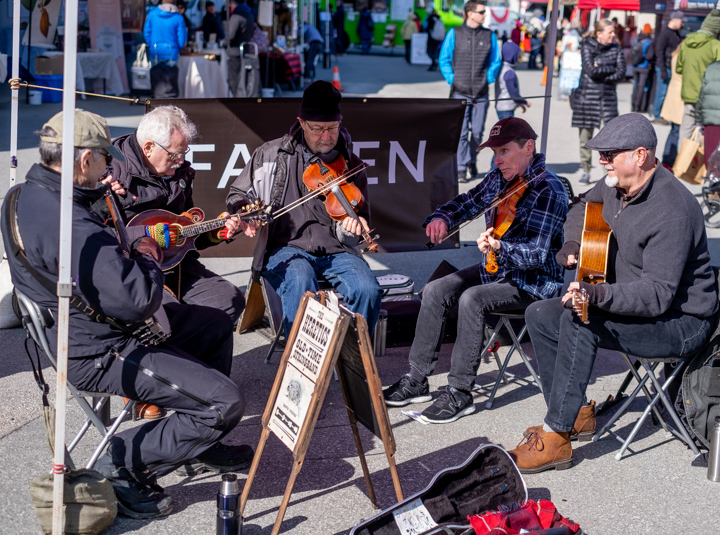
At the market there was a stringband, and also a dude in a wheelchair with an N95 facemask and electric guitar, soaring chords with snarly echo. I left donations in both their open instrument cases; I hope they were careful to wash their hands after handling the cash.

At the Riley Park Farmers Market

Plague Advice

Support performing artists. Because performances aren’t safe so performers don’t get paid. I have tickets to see Martin Barre, the Cowboy Junkies, and Billie Eilish; none of those performances will happen and I’m not asking for my money back. Go visit the Web sites of the musicians you like and find out how they sell music and merch and buy some already.

When I read the stories about the hard-lockdown locales, the policy seems to include no going outside. Sure, don’t enter crowded spaces, including public transit. And don’t crawl malls. But if there’s a green space you can walk to and it’s big enough that people can maintain a respectful distance, I don’t see the downside.

The upside is you’ll stay saner.

Plague Advice

Go (carefully) outside!

16 Mar 03:20

600 Mbit/s Outside – 6 Mbit/s Inside

by Martin

5G is slowly making its way into Cologne with incredible date rates. Recently, however, I discovered just what it means to have a simple insulating window between you and the network outside.

When I was recently asked to propose a place for dinner in Cologne, I  chose a restaurant that was right in between three 5G cell sites with n78 coverage. Yes, I wouldn’t let such an opportunity pass by to do a little experiment… Among other reasons, I chose the restaurant because it lay exactly in between those three cell site. In other words, I was at the cell edge between 3 locations, which means there’s a lot of interference, at least on the LTE layer.

Before entering the restaurant I checked the street level coverage. All three cell sites were not in the street so I had no direct line of site to any of the antennas and coverage is provided by reflections. Still, the 4G and 5G signal level was strong and due to the 5G n78 coverage I got 600 Mbit/s in the downlink direction out of the channel. Nice!

Then I entered the restaurant and the radio situation changed completely. The n78 layer on 3.6 GHz, gone. The LTE layer on band 7 (2.6 GHz) gone. The LTE layer on band 3 (1.8 GHz) gone. The only thing that remained was a 5 MHz LTE carrier on band 8 (900 MHz) with a measly RSRP of -110 dBm. Once through an insulating window, at a table 2 meters inside the restaurant, and my speed dropped from 600 Mbit/s to 6 Mbit/s. Wow!

Don’t get me wrong, I don’t want to complain, because the alternative to LTE on band 8 or band 20 is EDGE. And I really don’t want to be in EDGEland anymore.

16 Mar 03:18

A Song for a New Day by Sarah Pinsker

by Ton Zijlstra

The past days were by accident probably the best setting to read this book, right in the upward swing of a pandemic. I finished it yesterday and today here in the Netherlands everything got closed down, pubs, restaurants, sports facilities and schools for at least 3 weeks. In A Song for a New Day, that ‘at least 3 weeks’ turned into always, with humanity keeping its distance from one another after a pox pandemic, and most of life moving to virtual environments so you don’t need to leave your room for work nor entertainment. Drone delivery ftw.

Live music takes center stage in this story. Concerts are not allowed, as they bring together more than a few people. But there’s an underground network of venues and artists. One on which a company feeds to find talent for virtual concerts, but at the cost of shutting down the real venues and scenes.

A call for creativity, and overcoming fear of others. In times of government calls for social physical distancing, a reminder to let guitars rip over the speakers and be kind to your neighbours and community.

16down concert in Second LifeA concert by 16Down I once went to in Second Life in 2007.

(I started reading A Song for a New Day by Sarah Pinsker, as I found it on the list of Nebula Award nominees).

16 Mar 03:12

Now that remote work is becoming more important...

by Ton Zijlstra

Now that remote work is becoming more important, I find Basecamp’s internal communication culture a good thing to re-read and share with my colleagues. Let’s hope more of this becomes normal in more organisations.

Bookmarked Guide to Internal Communication, the Basecamp Way
16 Mar 03:12

Things I've Been Reading

by Eugene Wallingford

This was a weird week. It started with preparations for spring break and an eye on the news. It turned almost immediately into preparations for at least two weeks of online courses and a campus on partial hiatus. Of course, we don't know how the COVID-19 outbreak will develop over the next three weeks, so we may be facing the remaining seven weeks of spring semester online, with students at a distance.

Here are three pieces that helped me get through the week.

Even If You Believe

From When Bloom Filters Don't Bloom:

Advanced data structures are very interesting, but beware. Modern computers require cache-optimized algorithms. When working with large datasets that do not fit in L3, prefer optimizing for a reduced number of loads over optimizing the amount of memory used.

I've always liked the Bloom filter. It seems such an elegant idea. But then I've never used one in a setting where performance mattered. It still surprises me how well current architectures and compilers optimize performance for us in ways that our own efforts can only frustrate. The article is also worth reading for its link to a nice visualization of the interplay among the parameters of a Bloom Filter. That will make a good project in a future class.

Even If You Don't Believe

From one of Tyler Cowen's long interviews:

Niels Bohr had a horseshoe at his country house across the entrance door, a superstitious item, and a friend asked him, "Why do you have it there? Aren't you a scientist? Do you believe in it?" You know what was Bohr's answer? "Of course I don't believe in it, but I have it there because I was told that it works, even if you don't believe in it."

You don't have to believe in good luck to have good luck.

You Gotta Believe

From Larry Tesler's annotated manual for the PUB document compiler:

In 1970, I became disillusioned with the slow pace of artificial intelligence research.

The commentary on the manual is like a mini-memoir. Tesler writes that he went back to the Stanford AI lab in the spring of 1971. John McCarthy sent him to work with Les Earnest, the lab's chief administrator, who had an idea for a "document compiler", a lá RUNOFF, for technical manuals. Tesler had bigger ideas, but he implemented PUB as a learning exercise. Soon PUB had users, who identified shortcomings that were in sync with Tesler's own ideas.

The solution I favored was what we would now call a WYSIWYG interactive text editing and page layout system. I felt that, if the effect of any change was immediately apparent, users would feel more in control. I soon left Stanford to pursue my dream at Xerox PARC (1973-80) and Apple Computer (1980-1997).

Thus began the shift to desktop publishing. And here I sit, in 2020, editing this post using emacs.

16 Mar 03:09

How to get the most out of Google Maps

by Brad Bennett

Google Maps is the standard when it comes to turn-by-turn navigation, but who knew that the app has a ton of other features packed inside of it that makes it a lot more useful then it lets on.

There are a few killer features built into the Google Maps app that won’t only make it easier for you to use, but also easier for other people depending on how social you end up being on the platform. Beyond navigation, the app lets you create lists of your favourite things, save addresses and review places like on Yelp.

Labelling is key

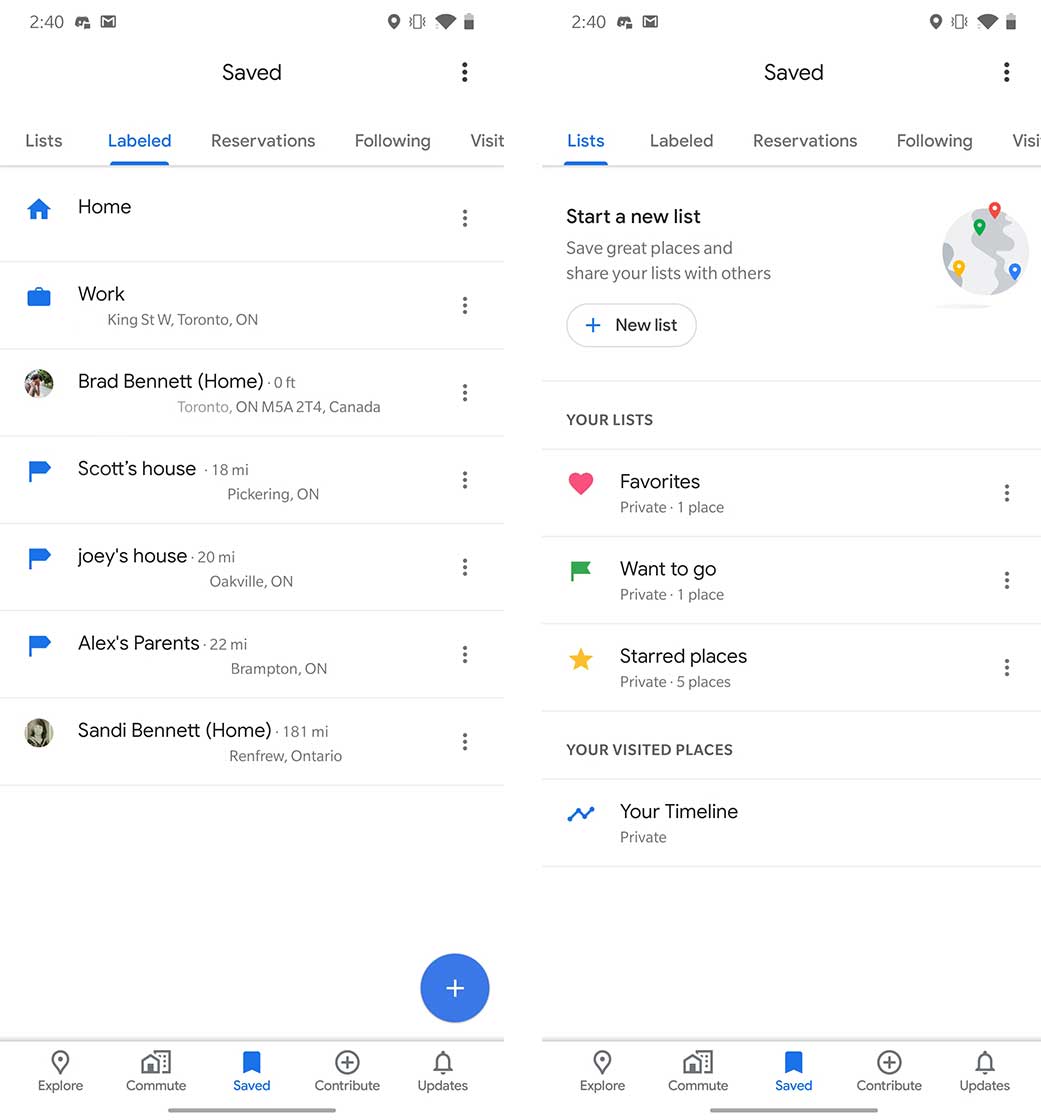
The first thing that you have to do if you haven’t already is ‘Label’ a few places that you use Maps to navigate to often. Having something Labeled means that you can search for it easily in the future. If you use Android Auto or CarPlay, then these Labels come in handy since it lets Google know to recommend these locations to you. You can Label places in the ‘Saved’ tab along the bottom of the app.

The other thing you need to Label is your home and your work addresses. Having these set makes it super easy for Google to recommend turn-by-turn navigation to your house or office quickly. You can set up this section in the ‘Commute’ tab along the bottom of the app.

Finding places to go and things to do

The main space in the app that you’ll interact with is the ‘Explore’ tab. Not only can you search for places here, but you can also swipe up a tab along the bottom for recommendations and upcoming events.

You can also see ‘Lists’ that other people have shared that can tell you interesting things about a place. For example, two of my featured lists are ‘Toronto’s old-school steakhouses’ and ‘Trending Weekly: Toronto.’

What else is in the Saved section

The Saved tab along the bottom is also the home of your Google Maps ‘Timeline’ which shows you where you’ve travelled to while using the service. If you use Google services, you might see more things here than just locations. Because I use Google Photos, whenever I take a photo, it’s displayed in my Maps’ Timeline.

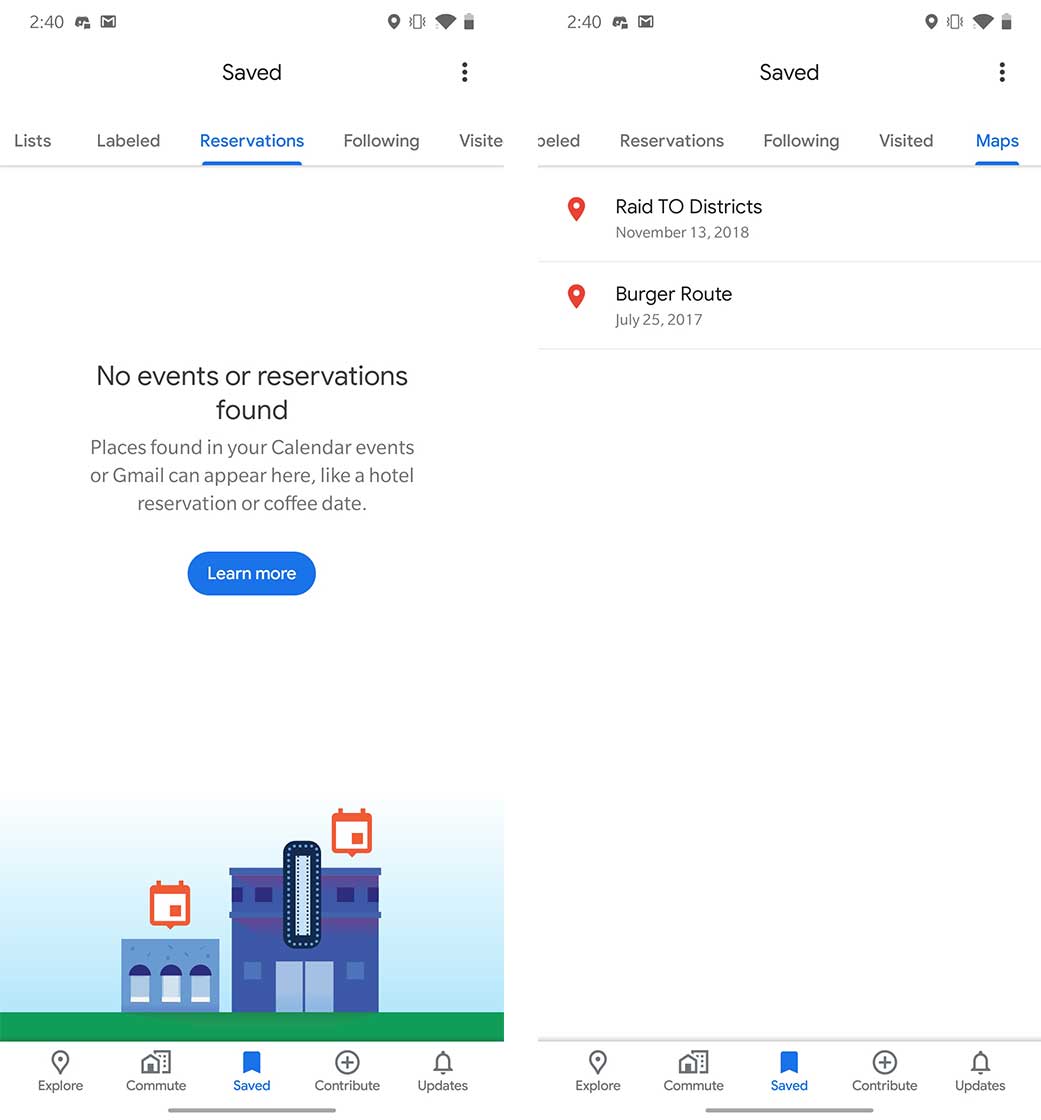
Swiping towards the left brings you from the Lists and Labels menus into the ‘Reservations’ zone.  If you use Gmail or Google Calendar and you have a reservation, flight or hotel booking in one of those apps, it will also appear in this section of the Maps app so you can quickly navigate to it.

Beyond this, you can find a list of places you’ve visited while using Maps and any Saved maps. For example, people can make custom maps with Google Maps and if you accessed one of these while logged into your Google account, they’ll show up here.

Is Google the new Yelp now?

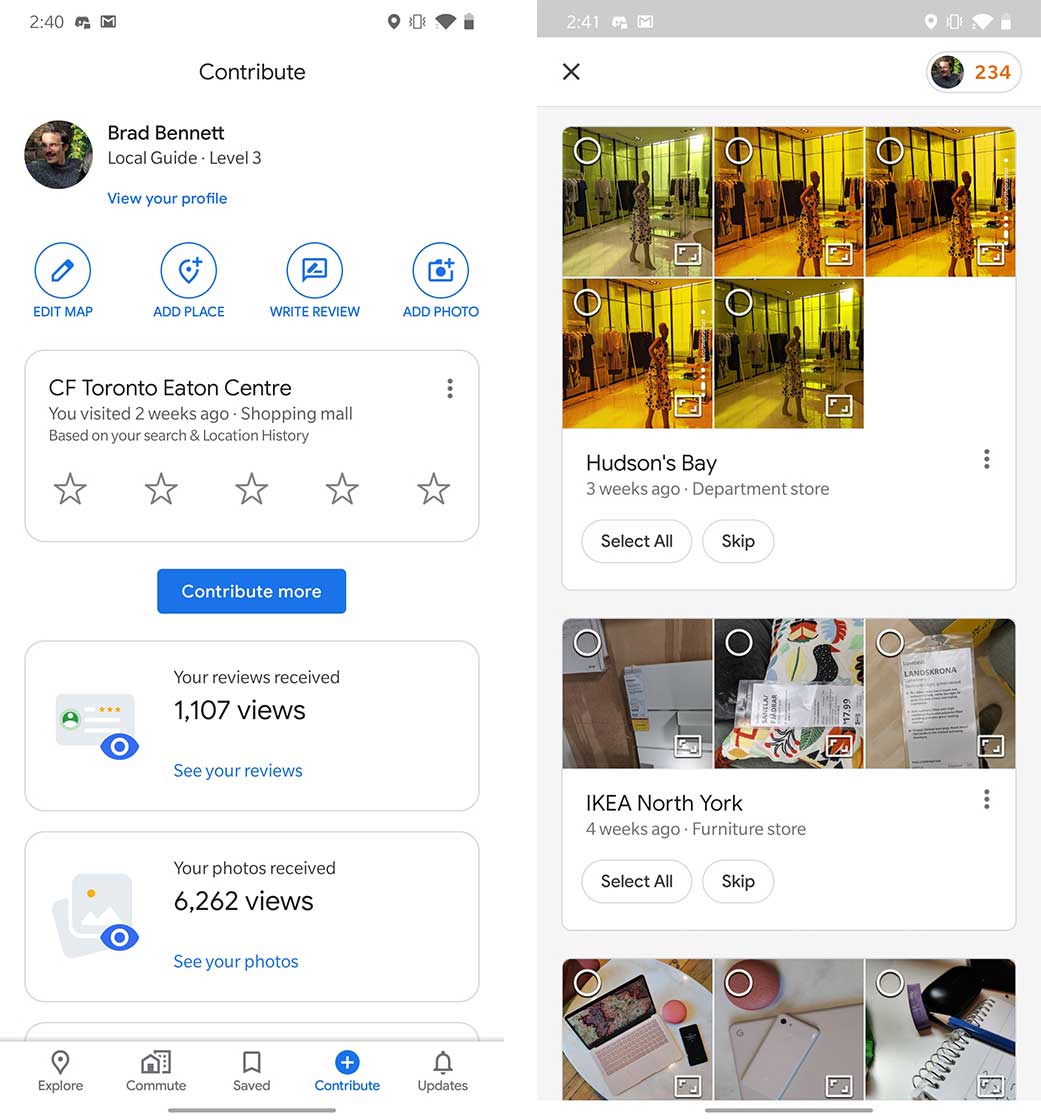
I can’t comment on that, but I can say that Google is trying hard to become a prevalent review platform. The new Contribute tab is the hub for rating places like restaurants, bars, stores and other popular locations in the real world. You can also add photos you’ve taken to the platform to help other people know what that place looks like.

If you scroll down to the bottom of this page, you can tap on ‘Contribute now’ to see a list of places you’ve been so you can quickly review something. Tapping on ‘Add photos’ next will show you pictures you’ve taken that are geo-tagged so you can add them to a place’s profile on the service.

The post How to get the most out of Google Maps appeared first on MobileSyrup.

15 Mar 15:19

Y2K but a coronavirus

by Rob Campbell
Humans are not very good at dealing with uncertainty. Who can blame them? One day, you’re living your life, shopping for groceries, paying the bills, meeting friends, picking up the kids, … whatever it is you do on any normal day during the year, then suddenly, something happens. A big event, that nobody* saw coming […]
15 Mar 15:16

Jürgen Klopp, Competence Pornstar

by Adrian Hon

I grew up in the Wirral, a peninsula best described as being "near Liverpool." I can't pretend that I've been anything more than an occasional fan of my local football team, but even on the far side of the Mersey I was still bathed in Liverpool FC's endless travails; the years of bad management, the near-misses, the sense of hurt as various Manchester teams rose to the throne, and lately, the ascendence of Jürgen Klopp.

On the face of it, Klopp's no-nonsense manner seemed at odds with Liverpool's sentimentality, but both have always been exaggerated. You can't be completely unemotional if you want to be a successful manager, and you need more than a little ruthlessness if you want to succeed as a team. And now everyone knows the result – a Champion's League win last year and game-breaking dominance of the Premier League this year.

But the most surprising thing for me remains Klopp himself. I don't get how he always say the right thing at the right time, his public and private statements going viral like clockwork despite being, well... obvious? Maybe it's just a novelty to have an overwhelmingly successful leader that seems decent and honest and intelligent.

Maybe it's easy to be humble yet loved when you're winning games, to say that football isn't all that important when you're standing in front of a bursting trophy cabinet. But hey, it's a heck of an improvement from the way some Liverpool fans excused Luis Suarez's racism in the 2010. To fans today, Klopp has been a welcome corrective.

Jürgen Klopp has today issued the following message to supporters following the Premier League's decision to postpone all football activity until April 3 at the earliest. 

I don’t think this is a moment where the thoughts of a football manager should be important, but I understand for our supporters they will want to hear from the team and I will front that.

First and foremost, all of us have to do whatever we can to protect one another. In society I mean. This should be the case all the time in life, but in this moment I think it matters more than ever.

I’ve said before that football always seems the most important of the least important things. Today, football and football matches really aren’t important at all.

Of course, we don’t want to play in front of an empty stadium and we don’t want games or competitions suspended, but if doing so helps one individual stay healthy - just one - we do it no questions asked.

If it’s a choice between football and the good of the wider society, it’s no contest. Really, it isn’t.
And now Klopp's celebrity has inevitably metastasised into a commentary on the comparative uselessness of straight men:


On the one hand, surely this is the least we would expect of men. On the other hand: look at men. So maybe, in 2020, Jürgen Klopp is the best competence porn we're going to get. We could do an awful lot worse.