
Unpopular opinion: I don’t think your life has to have a purpose, or you a grand ambition; I think it’s okay to jus… twitter.com/i/web/status/1…
Another half working week, as I am taking Thursdays and Fridays of this month. It did mean the work felt a bit squeezed into the limited time, as some things became more urgent. As a result I left some work I had planned to be doing until next week.
This week in … 1921*
The R38 airship crashed, killing 45 of 49 on board. It was to be the first of four airships built for WWI, but the only one to be built as the war had ended. It was sold to the US Navy and crashed during test flights in August 1921. The R38 airship was built near Bedford, which we visited on 21 August 2013, coincidentally the same week again. We happened past the hangars where the R38 was built, and I took the photo below, of these giant empty structures in the landscape.

(* I show an openly licensed image with (almost) each Week Notes posting, to showcase more open cultural material. See here why, and how I choose the images for 2020.)
I’ve been reading Ducks, Newburyport by Lucy Ellmann since January of this year and finished it earlier this evening. I’ve taken breaks from it to read other books and quit my job and launch a sideline in activism. The book is over a thousand pages long and mostly composed of a single sentence, an endless flow of phrases many introduced by , the fact that… I enjoyed it a whole lot! While most people won’t be eager to wade into something this big and complicated, the fact that it’s OK to take months and months to wander through it may make the idea less intimidating. I hope to tempt you further. Also a few notes about me and books.
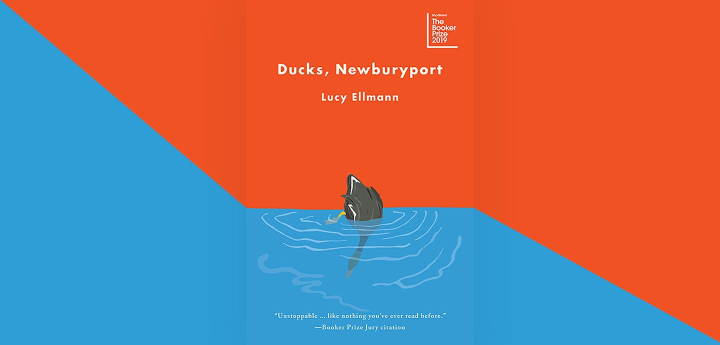
This thing was short-listed for the Booker and widely-reviewed; if you want to get a feeling for it you can check out any of the CBC, the London Review of Books, the New Yorker, the New York Times (and again), and The Guardian.
The Washington Post makes the point that reading a thousand-page work is physically difficult, especially if you have any age-related stiffening of the extremities. So if you are going to pick up Ducks, get it on Kindle or Kobo or some such! Your wrists will thank you.
Also from the WashPost, a good interview with the author. The following Q/A resonated with me, given my recent history: Q: “What are you trying to say about how society — and women in particular — view motherhood?” A: “I’m not trying to say anything, I’m saying it!” She’s just invested a thousand freaking pages getting her message across; questions of the “what are you trying to say?” form deserve to be pissed on from a great height. In fact, protip for interviewers: Asking any writer who’s just published something what they were trying to say is apt to get you a well-deserved grumpy response.
As they do say, most of the book is the somewhat overwrought and disordered internal ramblings of a woman with four children in a happy academic marriage whose family is suffering money troubles following on her cancer, and who has turned from teaching to baking to help pay the bills. Interspersed is a story about a mountain lioness’ search for abducted cubs. But they miss things that I think are important:
First, not much of any significance happens during the first 900 pages; a couple of minor family crises. Not that it’s boring, I never once felt the urge to lay it aside. But during the last 10% of the book there are significant plot outbursts, real dramatic life-and-death action.
This book is about the most American thing imaginable. While our protagonist and her husband have lived overseas, they now live in rural Ohio, and the political and business and musical and literary and shopping and weather and cultural and child-rearing and many many other issues that infuse the story are so American that I suspect anyone not infused in New World culture will miss lots of subtleties.
I talked about “many many” issues. Our narrator’s internal landscape is astonishingly, overwhelmingly, rich. Yes, the same issues and themes keep coming back, but damn are there ever a lot of them. I am old and have drunk pretty deep at the wells of culture and history but was handicapped by being weak on classic cinema and the work of Laura Ingalls Wilder (Little House on the Prairie). But time after time, a side-trip off a side-trip in Ducks would connect to something that I’d cared about after reading or hearing or living it a decade or four ago.
The principle of Chekhov’s gun applies in spades here. You have been warned.
Life is a sexually-transmitted terminal condition. It eventually kills us all and as a matter of course inflicts wounds along the way. Often we survive and enjoy post-recovery life. But never pretend that the damage isn’t permanent. No ending is ever 100% happy.
I can remember the day I learned to read; sometime in my kindergarten year National Geographic had a story on dinosaurs and my Mom found me hunched over it when she got home from work. After that I could read, and have never stopped.
I like short and medium-sized books. But I especially love big, thickly-flavored books. I suspect my feelings may have a macho component — no book is too big or too hard to defeat me! In fact, Marx’s Capital and Joyce’s Finnegan’s Wake have. But no others I can think of.
Big doesn’t have to be difficult. Ducks, Newburyport isn’t difficult at all; I read this book for pleasure and with pleasure. It’s just big, that’s all.

Recently, I had a look at a number of frameworks to push notification messages to my mobile device based on trigger events of my cloud at home. Think of getting a notification when a service starts misbehaving or crashing, disk drives about to become full, backups finished, etc. So far I’ve used emails and XMPP messages for the purpose. While that works great it doesn’t really fit the purpose. So I was looking for something else and discovered Gotify, ‘a simple server for sending and receiving messages’.
Installation is super easy and I was up and running in just a few minutes. Also, pushing messages from the shell or in programs written in Python and other languages just requires a single line of code. On the wire, HTTP push and Websockets are used and TLS encryption with Letsencrypt certificates are thrown in for good measure. Nice! When I had a look at the traffic to and from my mobile device to the Gotify app, however, I was a bit surprised, to say the least.
As you can see in the screenshot above, the app sent or received IP packets around every 10 seconds even if no push message is sent or received. For the experiment I used non-encrypted messaging, so Wireshark nicely shows that the traffic was caused by two mechanisms:
Traffic every 10 seconds is an absolute no go for me as in effect the cellular network link could never go to idle state and the battery is drained rapidly. Quite a disappointment.
So I opened an issue at their Github page describing the behavior and its downsides. Within a day I got a developer responding that he will take a look. A few days later I got a test version with adjustable TCP keep-alive and Websocket Ping/Pong intervals. Wow! I played around with the values and finally decided to set them both to 550 seconds. This way, the chatter on the line is reduced from one packet every 10 seconds to silence periods of 6-7 minutes (*). Perfect!
All that stands in the way of me using Gotify now is for the developer to also make this work for encrypted TLS sessions. Unfortunately, adding keep-alive parameters to a Go API call breaks the application and the developer hasn’t had the time yet to have a closer look. I could have a look myself, of course, but frankly, I’ve never touched Go before and there seems to be a significant overhead involved. So let’s see.
(*) Setting the values higher is not a good idea as NAT gateways at some point run into timeouts and cut the connection. I’ll have a look at this in a follow up post)
That means reckoning with what’s called ambiguous loss: any loss that’s unclear and lacks a resolution. It can be physical, such as a missing person or the loss of a limb or organ, or psychological, such as a family member with dementia or a serious addiction.
“In this case, it is a loss of a way of life, of the ability to meet up with your friends and extended family,” Boss says. “It is perhaps a loss of trust in our government. It’s the loss of our freedom to move about in our daily life as we used to.” It’s also the loss of high-quality education, or the overall educational experience we’re used to, given school closures, modified openings and virtual schooling. It’s the loss of rituals, such weddings, graduations, and funerals, and even lesser “rituals,” such as going to gym. One of the toughest losses for me to adapt to is no longer doing my research and writing in coffee shops as I’ve done for most of my life, dating back to junior high.
“These were all things we were attached to and fond of, and they’re gone right now, so the loss is ambiguous. It’s not a death, but it’s a major, major loss,” says Boss. “What we used to have has been taken away from us.”
Your ‘Surge Capacity’ Is Depleted — It’s Why You Feel Awful, by Tara Haelle

Update 24/08/20 12:50pm ET: Zoom says that all services are now functioning. “Thanks for your patience! Meeting and webinar service has been restored for the majority of users,” the company tweeted.
The original story is below.
Popular video conferencing service Zoom is currently down for some users around the world.
Zoom has acknowledged the issue on its status page and noted that it’s facing a partial outage with Zoom Meetings and Zoom Video Webinars. It appears that Zoom’s phone and chat services are functioning properly.
“We have identified the issue causing users to be unable to authenticate to the Zoom website (zoom.us) and unable to start and join Zoom Meetings and Webinars, and we are working on a fix for this issue,” the company states on its website.
Downdetector reveals that some Canadian users are impacted by the outage as well, and that problems started around 8am ET.
MobileSyrup will update this story as new information becomes available.
Source: Zoom
The post Zoom currently down for some users around the world [Update] appeared first on MobileSyrup.
I posted the other day about the current artificial intelligence cutting edge GPT-3, and its ability to write like a human. But since running across the following article, the idea of an A.I. overhang has been stuck in my head: what if artificial intelligences could get 100-1,000x more competent in a matter of only months?
An overhang is when you have had the ability to build transformative AI for quite some time, but you haven’t because no-one’s realised it’s possible. Then someone does and surprise! It’s a lot more capable than everyone expected.
I am worried we’re in an overhang right now. I think we right now have the ability to build an orders-of-magnitude more powerful system than we already have, and I think GPT-3 is the trigger for 100x larger projects at Google, Facebook and the like, with timelines measured in months.
– LessWrong, Are we in an AI overhang?
There are numbers in the post, but the argument goes that a 100x more effective A.I. will cost in the range of only $1bn, which is a relatively small fraction of Big Tech R&D.
Intel’s expected 2020 revenue is $73bn. What if they could train a $1bn A.I. to design computer chips that are 100x faster per watt-dollar? (And then use those chips to train an even better A.I…)
At what point do self-driving cars effectively become solved… and what if it was in only 6 months? All the control couplings and sensors are there, we’re just waiting for the artificial brain.
British call centres employ 1.3 million people, 4% of the UK workforce. What if they’re 99% out of work by 2022?
What if text/voice/video synthesis and persuasion becomes a solved game, such that anyone can be scammed or hacked over email or phone or Zoom with off-the-shelf software, in the hands of anyone that buys it, robocalling a thousand people per hour? What if a covert, 95% accurate lie detector can run on a smartphone with a commodity camera and commodity mic, ship in 6 months, and cost a dollar?
What’s interesting/startling/threatening about the idea of an overhang is that the changes come from every direction and there’s no time to adjust. The logic means that - if true - it’s not preventable. Sure, new professions will emerge, and new creative opportunities, and new social norms. But in the meantime?
Around 20 years ago, as part of my undergraduate degree in Philosophy, I took a module entitled Mind, Brain, and Personal Identity. The lecturer, George Botterill, a certified chess genius and extremely thoughtful guy, blew my mind by demonstrating via thought experiments that we can’t really be the same ‘person’ over a human lifetime.
We contain multitudes.
Ever since then, I’ve found this idea very liberating. I don’t have to be the same person I was when I was younger, I can choose to be different.
At the end of this year I turn 40. The worst of the pandemic will (hopefully) be over by then and I’ll also have finished most of my therapy sessions. As a result, it makes sense to think about how my pre-pandemic and post-pandemic life will differ.
For me, it’s worth remembering that Aristotle, perhaps one of the greatest thinkers ever to have lived, remained in Plato’s academy until he was almost 40 years of age. After this, he was tutor to Alexander the Great, and then wrote most of what he remembered for in the next 12 years.
I’m reminding myself of this, as there’s a tendency in our culture to think of people in their forties and later as being past their prime. That’s may be true in terms of physical prowess, but not in terms of things of lasting importance such as writing and thinking. Of course, I’m not putting myself in the same league as Aristotle(!) it’s just an illustrative example.
So I’m considering this time as a gestation period, as a time when I’m still in the chrysalis, waiting to emerge. I’m not sure what that’s going to look like in practice, but instead of looking back to being a caterpillar, I’m instead going to focus on turning into a butterfly.
Unlike the physical transformation that the caterpillar undergoes, my metamorphosis might be less obvious to those around me. Shifts in worldview and outlook sometimes are. But it’s an important thing to note for me: to give myself permission to let go of my pre-pandemic self.
This post is Day 37 of my #100DaysToOffload challenge. Want to get involved? Find out more at 100daystooffload.com
The post Letting go of my pre-pandemic self first appeared on Open Thinkering.
I have zero experience with a Surface Book 3. But this is one great review.
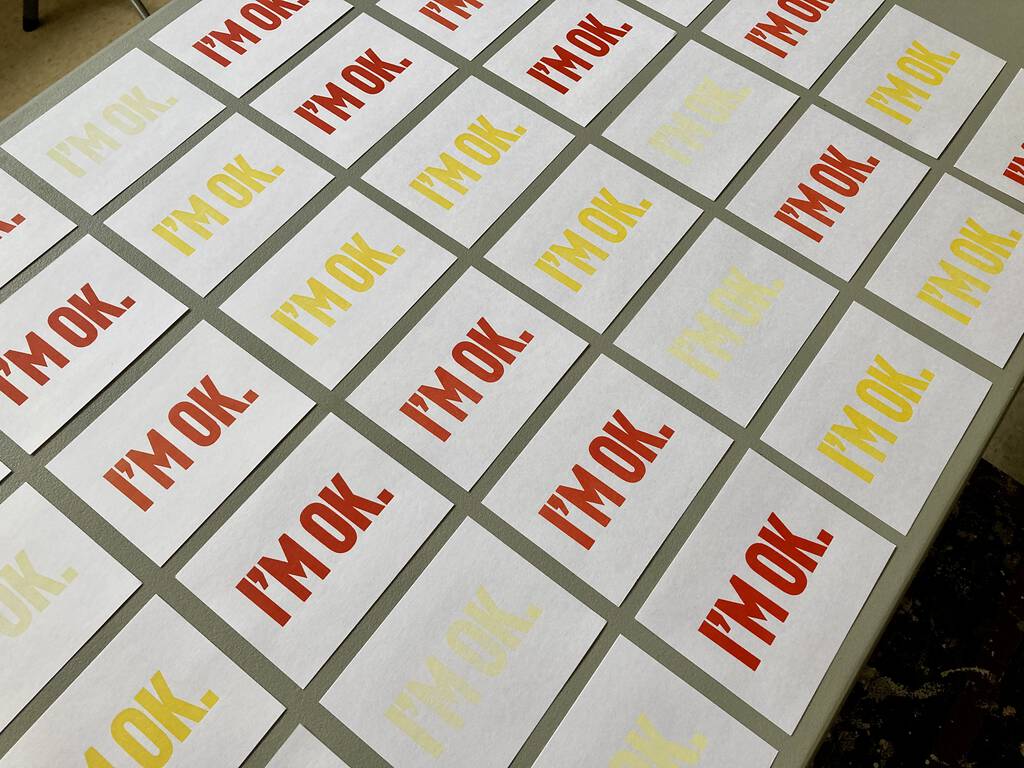
I didn’t set off knowing what I was going to create last week, but it ended up as something of a visual expression of what grief feels like.
I started off with the words “I’m okay” in my head, evolving this into the all-caps I’M OK.
I set this in 120 point Akzidenz Grotesk, using a comma for an apostrophe:
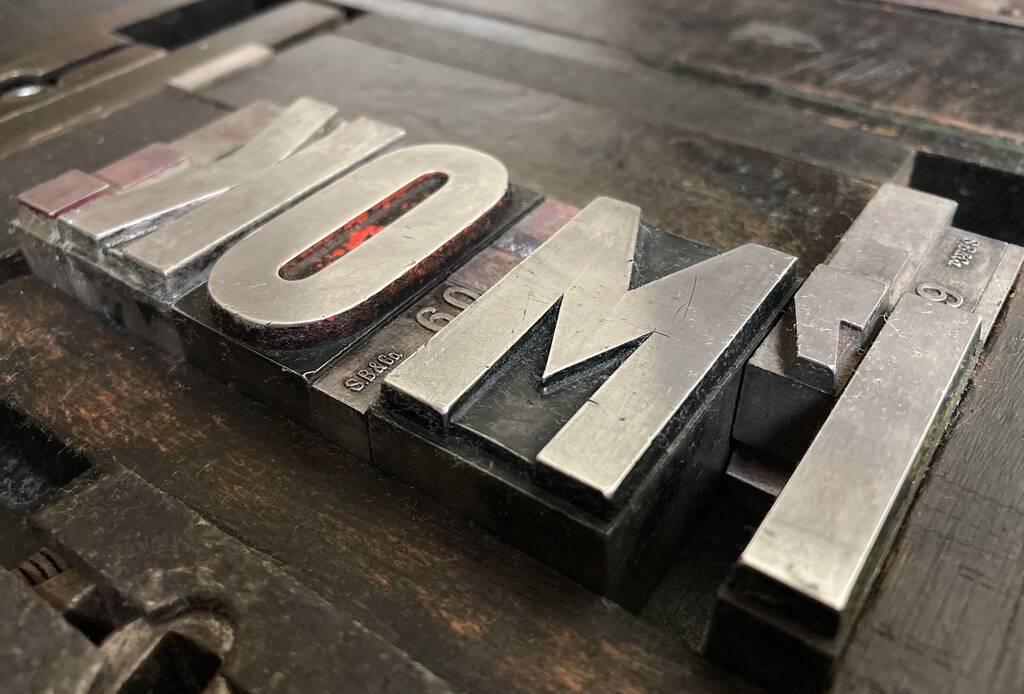
I sliced up some letter-sized Staples house-brand 67 lb. card stock into cards 5½ by 4¼ inches in size to print on, just large enough, give or take, to qualify as a postcard for mailing.
Since seeing a printer mix inks with a palette knife the other day, I’d been eager to try this out for myself, and so I started with white and added just the faintest touch of yellow
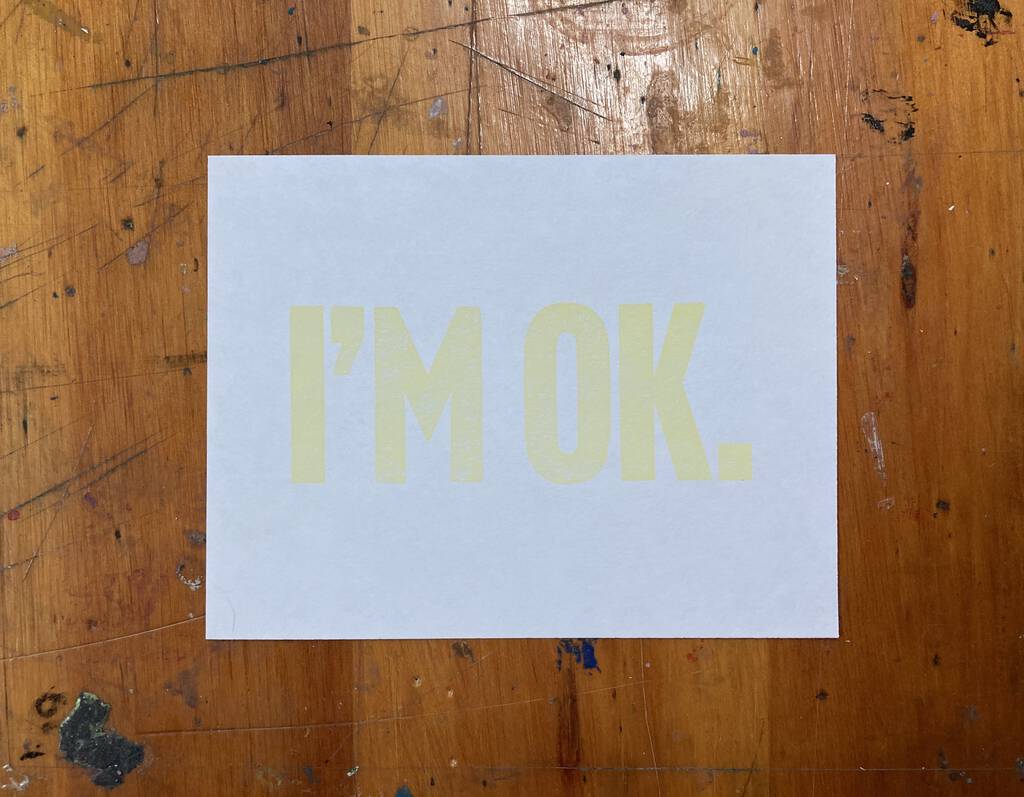
Seeing that I’M OK hovering on the card, barely visible in some lights, I was struck suddenly with the feeling that a very tentative sense of “I’m okay” was something I’ve felt frequently over recent months. But it’s not always tentative: sometimes it’s very strong. And sometimes it’s halfway in the middle.
So I added a little more yellow, and printed some more obviously-yellow cards. And then added some red to get some orange cards. And then even more red to get what amounts to a bold declaration, more an “I’m okay!” than an “I’m okay.”
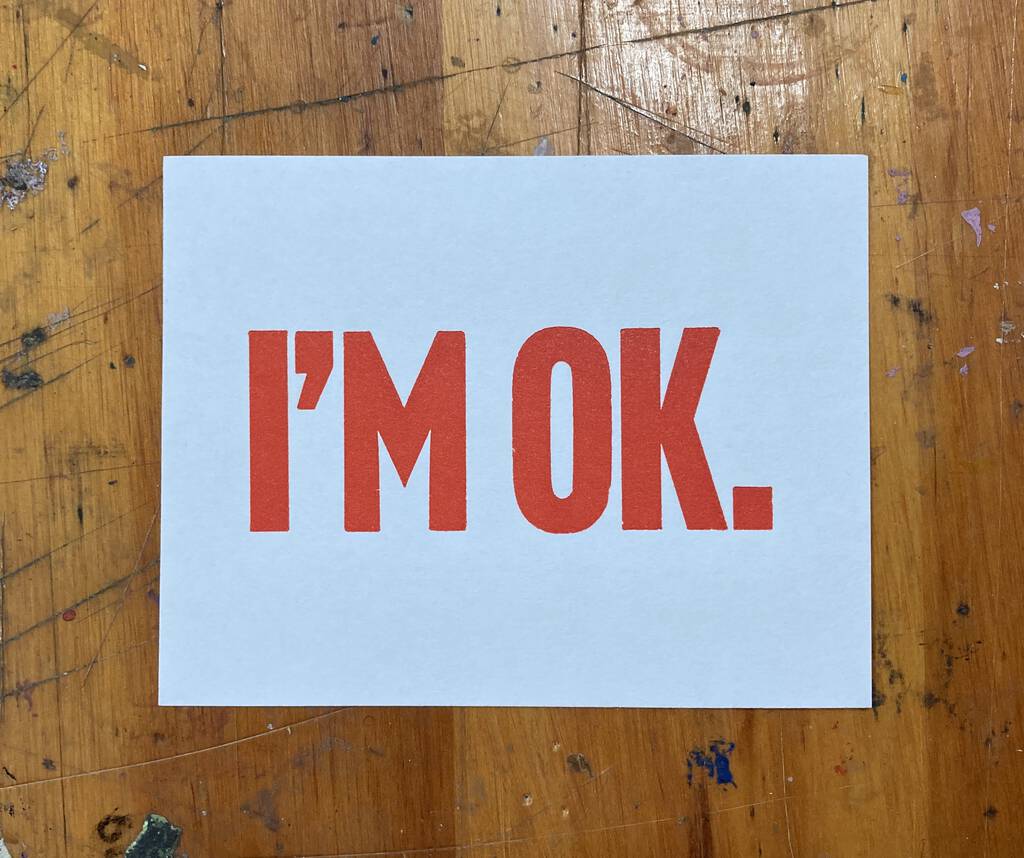
Put together in a montage, these various shades of being okay ended up becoming something even more familiar, the ebb and flow of being okay, and not being okay, and being very okay, and then shudderingly not being okay at all. That is what grief feels like. And I accidentally found a way to express it typographically.


At one point, it looks like Apple was considering releasing a Mac mini with a built-in iPod dock.
Twitter user @DongleBookPro (what a stellar name, right?), posted three images of the cancelled device, giving a rare glimpse at one of Apple’s defunct hardware projects.
EVT Mac Mini, with iPod dock. Totally scraped project that never saw the light of day pic.twitter.com/fSm1m31fhX
— Dongle (@DongleBookPro) August 22, 2020
In a follow-up tweet, @DongleBookPro says the old school 30-pin Lightning connector syncs the “iPad” — though they likely mean the iPod — directly to the Mac mini without the need for an additional cable.
The Twitter account says the Mac mini with an iPod dock is a “totally scrapped project that never saw the light of day,” and that the images are a prototype in the “Engineering Validation Test stage of development.”
The prototype Mac mini seems to be the pint-sized desktop computer’s first-generation design, which means it was being worked on sometime between 2005 and 2010. Both the PowerPC G4 and Intel-based versions of the Mac mini featured this look until 2010.
Though this a fascinating look at a product that never saw the light of day, it doesn’t really make sense. For example, not everyone keeps their Mac mini in a location where they’d be able to plug an iPod into it. In fact, the majority of people probably don’t even have the Mac mini sitting on a desk, making the addition of an iPod port useless.
There is a mac in there and it works. Dock works to sync iPad to iTunes with no issues
— Dongle (@DongleBookPro) August 24, 2020
While it’s impossible to know for sure, it’s likely the project was cancelled because Apple came to a similar conclusion.
That said, the prospect of a modern Mac mini with wireless Qi charging capabilities could be interesting.
Source: DongleBookPro Via: 9to5mac
The post Images of retro Apple Mac mini with built-in iPod dock leak appeared first on MobileSyrup.

"Nowadays," writes Justin Bariso, "it's all about skills. Not degrees." Thus when an organization like Google begins offering its own courses it offers the promise (at least according to this article) of 'transforming' education. Companies will ask themselves, "do we have the resources to design our own online training, to help increase our pool of qualified candidates and simultaneously provide an additional source of revenue for our business?" (causing George Siemens to quip, "So instead of a paid internship, it’s a 'you pay' internship"). I think education is about more than skills, so the six-month program can't exactly replace a university education. But it should be concerning to universities who are promoting skills and jobs as their primary value proposition. As Dave Truss comments, "job specific skills training and certification programs are sprouting up and challenging the need for many to go to university."
Web: [Direct Link] [This Post]

“Meet the new boss, same as the old boss.” The Who
After a shambolic process, Erin O’Toole was declared the new Leader of Canada’s Conservatives.
He is quoted as saying “I want you to know from the start that I am here to fight for you and your family.” I do not know Mr O’Toole – in fact I had not even heard of him until this process started. But I am absolutely certain that when he said that he was lying. Lying deliberately. The last thing he is concerned about “millions of Canadians” and their families. He is from the right wing of his party – the ground occupied by the old Reform Party. Their intention of joining the old Progressive Conservatives – who were after all very nearly indistinguishable from the Liberals in policy terms – was to ensure the continuation of their campaign to “take back Canada”.
Now when I typed that quotation I was thinking of a tweet I had seen this morning – which gave a very neat description of what O’Toole meant when he said that. The tweet stream I uncovered when I did a search is very, very lengthy. This is a tweet from Ann Bibby (who I also don’t know) – which wasn’t exactly what I was looking for but is much closer.
“Take back Canada means making it safe to be a homophobe, a racist, a misogynist. It means making sure poor people stay poor, and cronies get pocket public money. It’s the same old conservative corruption it ever was. Nothing new here. O’Toole is just an angrier Kenney.”
Stephen Gordon
“Intelligent, thoughtful conservatives (there are lots of them!) will be forever shut out of power as long as the CPC survives. Shut it down and start over.”
I replied that I had never met one. For a long time people I was working for would tell me that the economics of Hayek were more intellectually sound than Keynes. Somehow I doubted that but my experience since has done nothing to shift my scepticism. Ayn Rand was even more of a dog whistler. The idea that we are all individually responsible for own lives is an attack on humanity. The thing that made us Homo Sapiens was our ability to communicate, learn and co-operate. Right wingers think that it is clever to dismiss ideas as “socialism” – indeed Mrs Thatcher famously said “There is no such thing as society.” Which is as big a lie as any told more recently by the 45th POTUS.
To understand conservatives, you need only to look at what has transpired in the 21st century. The crash of 2008 was one of their trademarks. And nothing has changed in the way the economy is managed since. So is rapidly accelerating climate change and failing to deal with a new pandemic. It is quite striking how the countries that dealt most effectively with the virus were those who understood the values of science and cooperation. Not the people who actually enjoy punishing others – who think the current death toll in the United States is acceptable. Who think that taking small children from their parents to deter others from seeking asylum is a Good Idea. Who value people who display a willingness to work overly long hours for little pay but refuse to provide them with the basics of a decent life – including healthcare, education and housing – all of which must be priced out of the hands of the poor.

Dear Google Cloud: Your Deprecation Policy is Killing You, by Steve Yegge.
Topology: A Categorical Approach, by Tai-Danae Bradley, Tyler Bryson, and John Terilla. Full text available online.
The Resolution of Keller’s Conjecture, by Joshua Brakensiek, Marijn Heule, John Mackey, and David Narváez. Using SAT and certification; code.
A 35-year-old bug in patch found in efforts to restore 29 year old 2.11BSD, by Warner Losh.
How to contact Google SRE: Dropping a shell in cloud SQL, good writeup.
Reverse-engineering the 8086’s Arithmetic/Logic Unit from die photos, by Ken Shirriff.
MTV First Four Hours Remastered, 12am Saturday August 1st, 1981.
Convincing-looking 90s fonts in modern browsers
The Mona Lisa Effect, c. 2020 by Emily Xie.
The web is in need of some reinvention right now.
The web’s evolution over the last decade has mirrored the American economy. All of the essential indicators are going “up and to the right,” a steady stream of fundamental advances reassure us that there “is progress,” but the actual experience and effects for individuals stagnates or regresses.
The crisis affects platforms, creators, and consumers alike.
I’m going to try and dissect and diagnose this situation, a bit. You can skip forward if you just want to read my casual, unprofessional pitch for a reboot of the web. The idea is that we could choose a new lightweight markdown format to replace HTML & CSS, split the web into documents and applications, and find performance, accessibility, and fun again.
The platform side is what changed last week, when Mozilla laid off 250 employees and indicated that it would affect Firefox development. Firefox wasn’t the #2 browser - that’s Safari, mainly because of the captive audience of iPhone and iPad users. But it was the most popular browser that people chose to use.

Chart from statcounter
The real winner is not just Chrome, but Chrome’s engine. One codebase, KHTML, split into WebKit (Safari), and Blink (Chrome, Microsoft Edge, Opera, etc.)
This a textbook monoculture. In one sense, it’s a victory for collaboration because nobody’s ‘wasting time’ on competing implementations and web developers can expect the same features and bugs across different browsers. But in a deeper way, it threatens one of the basic principles of how the web has evolved.

The web has evolved through a combination of specifications and implementations. Organizations like the WHATWG, W3C, and IETF have been collaboration spaces for independent developers, corporations, and academics to discuss potential new features of the web. Then, browsers would test those ideas out in a variety of implementations.
This was an interesting structural piece: it reassured us all that it was possible to follow along, and that a multi-participant web was one of our goals. It was frustrating to pull up caniuse and see blank spots, but the idea was that different browsers may take the lead in some areas, but everyone catches up eventually. Chrome was not always the first to jump on features, or the first to optimize.
It’s slower to collaborate than to work alone, but it was beneficial in some ways that we’ve lost now. Chrome has been moving extremely fast, adding new specifications and ideas at a startling rate, and it’s becoming one of the hardest pieces of software to replicate.
Mike Healy I think said it best:
Do you think the web has almost ‘priced itself out of the market’ in terms of complexity if only 1-2 organisations are capable of building rendering engines for it?
Not only is it nearly impossible to build a new browser from scratch, once you have one the ongoing cost of keeping up with standards requires a full team of experts. Read Drew DeVault’s Web browsers need to stop for that point, and keep reading all of Drew’s stuff.
The web has gotten much harder to develop for.
The web has had about 25 years to grow, few opportunities to shrink, and is now surrounded by an extremely short-sighted culture that is an outgrowth of economic and career short-termism. There are lots of ways to do anything, and some of the most popular ways of building applications on the web are - in my opinion - usually ghoulish overkill.
The best way for folks to enter web development in 2020 is to choose a niche, like Vue.js or React, and hope that there’s a CSS and accessibility expert on their team.
For folks who just want to create a web page, who don’t want to enter an industry, there’s a baffling array of techniques, but all the simplest, probably-best ones are stigmatized. It’s easier to stumble into building your resume in React with GraphQL than it is to type some HTML in Notepad.
We hope that all this innovation is for the user, but often it isn’t. Modern websites seem to be as large, slow, and buggy as they’ve ever been. Our computers are barely getting faster and our internet connection speeds are stagnating (don’t even try to mention 5G). Webpage size growth is outpacing it all.
The end result is that I no longer expect pages to be fast, even with uBlock installed in Firefox and a good local fiber internet provider.
I don’t want to lay all of the blame at those web developers, though. Here’s a story from an old job that I find kind of funny. We were collecting some data from user interactions to answer simple questions like “do people click to upload or do they drag & drop?” So we enabled Segment, a tool that lets you add data-collection pipelines by including a single script. The problem, though, is that Segment offered a big page of on/off switches with hundreds of data providers & ad-tech companies on it. And, sure, enough, some folks closer to the business side started clicking all those buttons.
See, the problem with ads and data tracking is that you can, and who is going to say no? (In that instance, I said no, and added a CSP that would block new advertiser access at the page level.)
You cannot get a simple system by adding simplicity to a complex system. - Richard O’Keefe
Where do we go from here? Some of the smartest folks out there have been advocating for a major version revision of the web.
I am in no way qualified to speculate on a whole new web from scratch, but the air quality is scary so I’m skipping my run and it’s Saturday morning so here we are.
How do we make the web fun, participatory, and good?
My first thought is that there are two webs:

There is the “document web”, like blogs, news, Wikipedia, Twitter, Facebook. This is basically the original vision of the web, as far as I can understand it (I was 2). Basically CSS, which we now think of as a way for designers to add brand identity and tweak pixel-perfect details, was instead mostly a way of making plain documents readable and letting the readers of those documents customize how they looked. This attribute actually survived for a while in Chrome, in the form of user stylesheets, and still works in Firefox. Though it’s going to be a rough ride in the current web which has basically thrown away semantic HTML as an idea.

Then there’s the “application web”. This started as server applications, built with things like Django and Ruby on Rails and before them a variety of technologies that will live forever in corporations, like Java Servlets.
Backbone.js demonstrated that a lot of these applications could be moved into the browser, and then React and its many SPA-style competitors established a new order for the web – highly-interactive, quite complex, client-side applications.
I posit that this dual-nature is part of what gives the web its magic. But it’s also a destructive force.
The magic is that a simple blog can be creative expression, can be beautifully interactive. This one isn’t, but I’m just saying - it’s possible.
The problem is that the “document web” is often plagued by application characteristics - it’s the JavaScript and animations and complexity that makes your average newspaper website an unmitigated disaster. Where document websites adopt application patterns they often accidentally sacrifice accessibility, performance, and machine readability.
And the “application web” is plagued by the document characteristics - interactive applications are going to great lengths to avoid most of the essential characteristics of HTML & CSS and just use them as raw materials - avoiding writing any HTML directly at all, avoiding writing any CSS directly at all, avoiding default animation features, replacing page-based navigation with something that looks like it but works completely differently. The application web uses JSX, not HTML, and would like that in the browser itself, or Svelte, instead of JavaScript, and would like that too.
When I read blog posts from ‘traditional web developers’ who are mad that HTML & CSS aren’t enough anymore and that everything is complicated – I think this is largely that the application stack for building websites has replaced the document stack in a lot of places. Where we would use Jekyll or server-side rendering, we now use React or Vue.js. There are advantages to that, but for a lot of minimally-interactive websites, it’s throwing away decades worth of knowledge in exchange for certain performance perks that might not even matter.
The appeal of social networks is partly because they let us create documents without thinking about web technology, and they provide guarantees around performance, accessibility, and polish that otherwise would take up our time. You don’t have to think about whether your last Facebook post will load quickly on your friend’s phone or whether your Instagram post will be correctly cropped and resized in the timeline - those things are taken care of.
To some extent, this doesn’t need to be something that only social networks provide, though: standards like RSS and services like Instapaper show that pleasing formatting and distribution can be done at the platform level and be provided on top of existing vanilla websites.
A unified theory of a new web that had just enough application characteristics and enough document characteristics to provide the sorts of hybrid interactive documents that we see today - now that would be cool. But the path to a splintered web is clearer and is what I’m thinking of first, so here’s some of that.
Okay, so let’s say we’re creating a new document web.
First, you need a minimal, standardized markup language for sending documents around. You might want to start with a lightweight markup language, which will ironically be geared toward generating HTML. Markdown’s strict specified variation, Commonmark, seems like a pretty decent choice. That’s the language I’ve written all my blog posts in, and the most popular language in its family. There are lots of great parsers and a big ecosystem of tools for Markdown.
Then, you need a browser. Mozilla has been working on a brand new browser for a while - Servo. That team got laid off last week, which sucks. That project includes standalone Rust crates for font rendering, and there’s a world-class Rust Markdown implementation, and a growing set of amazing application frameworks. Could you build a pure-Markdown-browsing browser that goes straight through this pipeline? Maybe?
I think this combination would bring speed back, in a huge way. You could get a page on the screen in a fraction of the time of the web. The memory consumption could be tiny. It would be incredibly accessible, by default. You could make great-looking default stylesheets and share alternative user stylesheets. With dramatically limited scope, you could port it to all kinds of devices.
And, maybe most importantly, what would website editing tools look like? They could be way simpler.
What could aggregation look like? If web pages were more like documents than applications, we wouldn’t need RSS - websites would have an index that points to documents and a ‘reader’ could aggregate actual webpages by default.
We could link between the webs by using something like dat’s well-known file, or using the Accept header to create a browser that can accept HTML but prefers lightweight pages.
I feel like every time I mention something about the web, the automatic response is that WebAssembly might fix it. Maybe?
I don’t know. WebAssembly is pretty great, but should web applications just be rendered to a canvas, and every application brings its own graphics toolkit? Do we really want anti-aliasing differences between web applications? Applications-in-containers is a thing - look at Qubes - but it’s not really something that users should want. Anyone who has used Blender or Inkscape on a mac has some idea of how this goes.
Or is WebAssembly the new ‘core’ and we still render UIs with HTML? Or… create a shared linked library that WebAssembly apps can use that works roughly like SwiftUI, offering application-friendly layout conventions like constraints instead of document-centric ideas like line heights and floats?
The problem with imagining the application web is that it’s pretty expansive.
The worse the ‘Mac App Store’ and ‘Windows App Store’ and ’App Store’ and ’Play Store’ get, the bigger a cut those monopolies demand, the more it costs to be a Mac or Windows developer, the more that applications get pushed to the web. Sure, some applications are better on the web. But a lot are just there because it’s the only place left where you can easily, cheaply, and freely share or sell a product.
There was a time when we could install applications, give some sort of explicit agreement that something would run on our computers and use our hardware. That time is ending, and web pages now have rather complex ways of getting at everything from webcams to files, game controllers, audio synthesis, cryptography, and everything else that was once the domain of .exe and .apps. This is empowering, sure, but is quite an unusual situation.
There are a lot of other ways to look at and solve this problem. I think it is a problem, for everyone except Google. The idea of a web browser being something we can comprehend, of a web page being something that more people can make, feels exciting to me.
The markdown-centric approach feels very doable. I think the clearest rebuttal is that it ‘sucks all the fun out of the web,’ and there’s some truth to that. But the early web wasn’t fun in many conventional ways - you couldn’t quite create art there, or use it as much more than a way of sharing documents. But it was fun as heck, because sharing is fun and it was simple and flexible in some cool ways. So the key is to discover the small things that unlock the possibilities in this plan, if they’re there. Or find a different plan with ‘just enough fun.’
Social networks are universally more restrictive than web pages but also more fun in significant ways, chief amongst them being that more people can participate. What if the rest of the web have that simplicity and immediacy, but without the centralization? What if we could start over?


I’m a member of a Meetup group that is exploring various aspects of a non-hierarchical, self-organized approach to creating and operating business and other organizations, that is casually known as Teal, and is based on the book Reinventing Organizations.
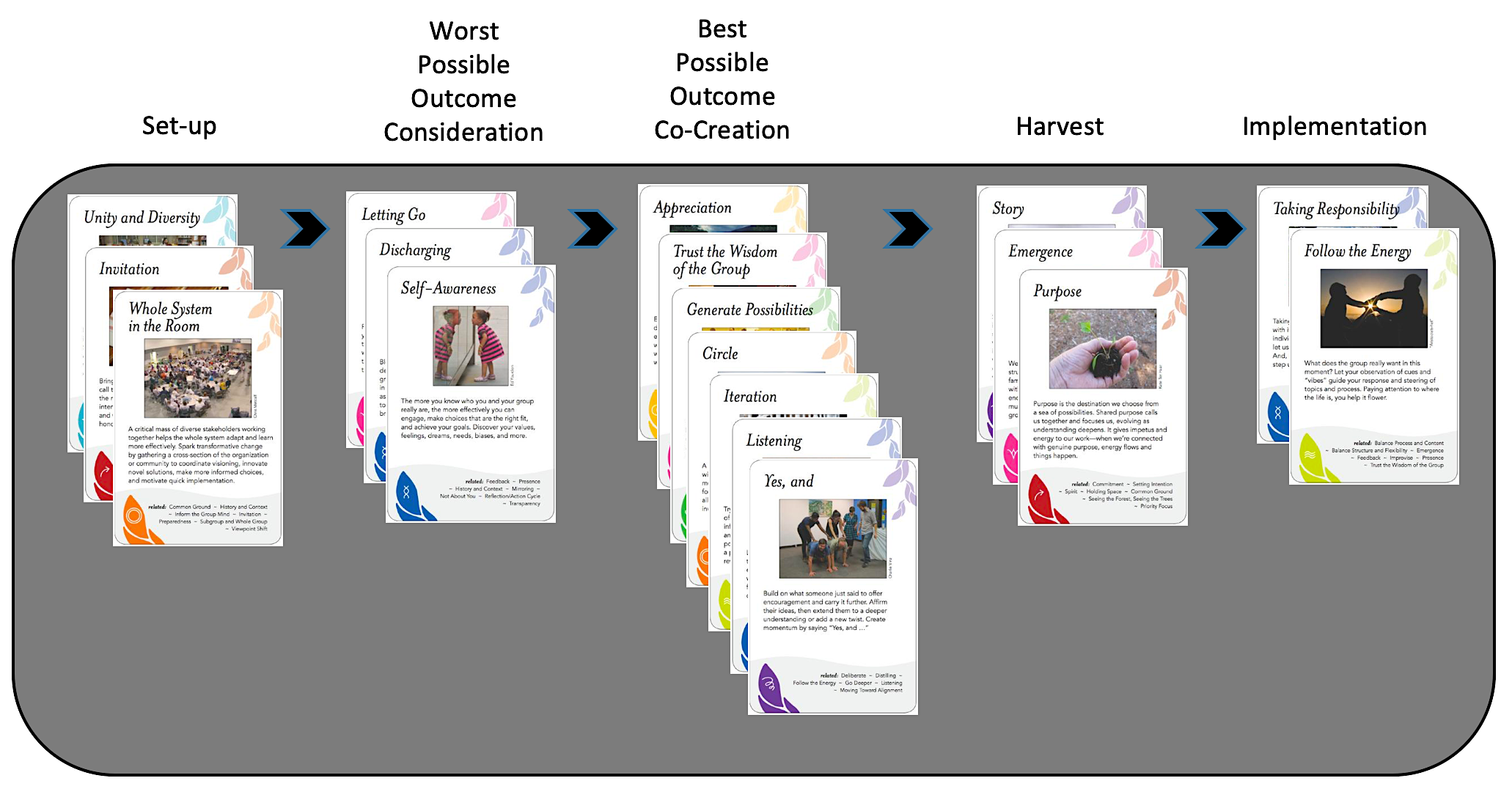
At our latest meeting, Stuart Ramsing led us through a process he uses with some of his clients that he referred to as “Worst Possible Outcomes / Best Possible Outcomes”. My understanding of it is as follows:
It takes a certain degree of discipline (and a good facilitator) to prevent several things from happening that could sabotage the process: groupthink (it’s easier to give a nod to something that’s safe and promising, than to improve the story with more daring and realistic embellishments); backsliding (it’s often tempting and safe to agree with a stated or implied ‘but’, or a fact that seemingly raises obstacles, and hence move towards a Less-Than-Best Possible Outcome); deference to power (agreeing with the person with the most power, no matter how accurate, valuable, or helpful their comment may be); cultural resistance (in some cultures it’s unacceptable to admit weakness or doubt, or to advance unorthodox ideas); and jumping to conclusions (some participants getting impatient and trying to move to action at a perceived “good enough” stage, before the group has completed the process).
This process of story creation is a natural one, but it needs to be skilfully managed. Participants need to be coached to avoid trying to convince others of the validity of what they’re saying, and instead let the story emerge freely. Others cannot be allowed to butt in out of turn with “related ideas”, or challenging questions — power imbalances, even if they’re exercised tacitly, need to be identified and compensated for. Equal airtime must be encouraged and when necessary enforced. In that sense this process follows some of the strictures of Bohm Dialogue and other free-flow dialectic processes.
When the process or the story runs into doubts and “buts”, the facilitator needs to step in to put the process back on its tracks and get the group to persevere and “trust the process”.
Once the story has reached consensus, it’s then up to the facilitator to re-sequence it more coherently, but without paraphrasing, embellishing or eliminating anything that’s been said: It must remain the group’s story in the group’s own words.
One of the things I’m coming to appreciate is that, while we may have no “free will” (we’re going to say and do what we were going to say and do anyway, given our conditioning and the specific circumstances of the moment), our conditioning is affected by others’ conditioning. That’s why, properly facilitated, this collective process not only can produce clarity and momentum on the Best Possible Outcome (as perceived collectively by the group), you might say it will inevitably do so, better than any set of individual thinking and imagining, and better than any less smartly facilitated process, would do.
There are of course more steps to this, to bring the envisioned Best Possible Outcome to fruition. One of them I particularly like is engaging the group to each identify which aspects of the realization of the Best Possible Outcome they are particularly inspired to be involved with — a Follow the Energy approach.
I’ve already applied this to a couple of personal and group situations I’ve been involved with, so I can vouch for it, and have added it to my “toolkit” of methods and techniques I find highly useful, especially in group activities — methods like Open Space, Appreciative Inquiry, and Circle.
It seems to me that this Best Possible Outcome method can be effectively applied in many different contexts. You can use it personally to “get over” anxieties that a situation has brought up for you that might be paralyzing you. You can use it when a group gets bogged down in negative thinking and productive debate. You can use it to gently correct an ill-advised and uninformed management directive. You can use it with a group who don’t know each other to tackle urgent or “wicked” problems and predicaments that will never have an obvious or complete analytically-determinable solution.
I’ve used the Group Works pattern language deck to “map” what I think are the most significant group process patterns likely to be invoked with the Best Possible Outcome method. You can see the map at the top of this post.
I think it’s a compelling approach, and one I want to explore more. As a self-described “joyful pessimist” I have a propensity to be uselessly anxious and to jump quickly to Worst Possible Outcome thinking. So this might not only be effective when I’m dealing with group challenges, it might be personally therapeutic as well.
A colleague asks what he should tell his students when they say:
What’s the point of formalizing all of this into such a long dense 10-page paper? why can’t we just put up our code and demos on github, maybe write a blog post on it, make some youtube demos and give talks, etc.?
Tell them they don’t want to end up like me!
Blog posts and demo videos don’t stick. I’ve been doing them for years and almost no one pays any attention. They don’t get cited by related work. It’s like they never happened. Writing a paper sucks, and you have to do a ton of bullshit to get it accepted, but it has two crucial benefits:
Let’s see if I can take my own advice!
Sandi Metz's latest newsletter is about the heuristic not to name a class after the design pattern it implements. Actually, it's about a case in which Metz wanted to name a class after the pattern it implements in her code and then realized what she had done. She decided that she either needed to have a better reason for doing it than "because it just felt right" or she needed practice what she preaches to the rest of us. What followed was some deep thinking about what makes the rule a good one to follow and her efforts to put her conclusions in writing for the benefit of her readers.
I recognize with Metz's sense of discomfort at breaking a rule when it feels right and her need to step back and understand the rule at a deeper level. Between her set up and her explanation, she writes:
I've built a newsletter around this rule not only because I believe that it's useful, but also because my initial attempts to explain it exposed deep holes in my understanding. This was a revelation. Had I not been writing a book, I might have hand-waved around these gaps in my knowledge forever.
People sometimes say, "If you you really want to understand something, teach it to others." Metz's story is a great example of why this is really true. I mean, sure, you can learn any new area and then benefit from explaining it to someone else. Processing knowledge and putting it in your own words helps to consolidate knowledge at the surface. But the real learning comes when you find yourself in a situation where you realize there's something you've taken for granted for months or for years, something you thought you knew, but suddenly you sense a deep hole lying under the surface of that supposed understanding. "I just know breaking the rule is the right thing to do here, but... but..."
I've been teaching long enough to have had this experience many times in many courses, covering many areas of knowledge. It can be terrifying, at least momentarily. The temptation to wave my hands and hurry past a student's question is enormous. To learn from teaching in these moments requires humility, self-awareness, and a willingness to think and work until you break through to that deeper understanding. Learning from these moments is what sets the best teachers and writers apart from the rest of us.
As you might guess from Metz's reaction to her conundrum, she's a pretty good teacher and writer. The story in the newsletter is from the new edition of her book "99 Bottles of OOP", which is now available. I enjoyed the first edition of "99 Bottles" and found it useful in my own teaching. It sounds like the second edition will be more than a cleanup; it will have a few twists that make it a better book.
I'm teaching our database systems course for the first time ever this fall. This is a brand new prep for me: I've never taught a database course before, anywhere. There are so many holes in my understanding, places where I've internalized good practices but don't grok them in the way an expert does. I hope I have enough humility and self-awareness this semester to do my students right.

Photo by Jopwell on Pexels.com
Once you have been working from home for a while, the thrill of wearing sweats and pajamas wears off. It never returns, in my experience. People come to the door. You want to walk to the store. And there are all those Zoom meetings. A comfortable work-from-home dress that looks like you got dressed for work is a must-have. These are my favorite staple dresses. Best part? You can get these dresses for work cheap so you can own a dozen of them and let the laundry pile up for weeks.

This tank mini dress is more comfortable than any pajamas I’ve ever owned. But when I go out in it, people say things like, “What’s the occasion?” (Throw on a cute pendant!) I could sleep in this dress. Sometimes I do. I own every color because, in addition to being flattering and super comfortable, it’s also super affordable. When the weather is cold, just throw on one of these cardigans or jackets.

This sleeveless ruched bodycon dress will seriously elevate your WFH style, make you look like a serious professional in meetings, and become your favorite uniform if you reeturn to the office. It’s a terrific, forgiving fabric with lots of movement and looks great under a cardigan. It comes in 17 colors, all tempting. Reviewers say it fits true to size and is super flattering, and that’s what I found, too. Great dress!

Cute, comfy, and perfect for fall, this super-soft sweater dress is also a comfy summer dress. You can wear it when you are hankering for pumpkin spice, but the weather says, “Beach, please!”
The fabric breathes and forgives, and the colors are earthy staples you can wear with anything. Wear it alone or add a layer under or over it. It is super flattering and affordable.

Elegant, just the right length so you can throw on boots, heels, or flats, and go to dinner in it, right from your desk. This ribbed sweater dress ($50) is body-hugging or flowing, depending on the size you order. Throw on a sweater and it’ll take you through winter. It’s available in 12 colors.

Getting dressed could not be easier than this maxi dress. Pull it on. Get to work. You might want some underwear. The neckline is super flattering and lends well to lacy undergarments and jewelry. Pull on a cardi when it’s cold, and you could live in this dress. It comes in 15 colors.
When you purchase anything through links on this site, GeekGirlfriends.com sometimes earns a little money. It doesn’t cost you any extra, but you are making this content possible. I only recommend products that I own, have tried through the company’s review program, or covet. Thanks for your support.
By clicking submit, you agree to share your email address with the site owner and Mailchimp to receive marketing, updates, and other emails from the site owner. Use the unsubscribe link in those emails to opt out at any time.
The post Buy These 5 Comfy Dresses for Work Cheap! They Elevate Your Wardrobe and Cost Less than $50 appeared first on Geek Girlfriends.
Friday I made another step towards ditching Evernote, which has been my green elephant in the room for quite a while. Whenever I start a new project I run a little Applescript that sets up a few standard folders, note files and tasks, depending on the type of project (client project, internal, etc.). Folders and template files would be in the file system, tasks in Things, and note files in a specific notebook and with tags in Evernote. The note files are now being created as markdown text files on my filesystem, with the right links and tags put into the files.
The toughest thing to crack will be how to deal with existing notes. Not adding new stuff to Evernote is one thing, but dealing with archives another. I took a few samples and a lot isn’t of much use anymore obviously, but other things might be of interest. Finding those is the challenge.
(on January 1,2020 I wrote this summary of my 2019 for a friendly mailing list I was on. I meant to edit it a bit; then a pandemic hit and upended much of the life I described herein. So let's timecapsule: after some August 2020 touchups and clarifications, this is here published & backdated:)
By the end of the year 2019 I feel like my world contracted, my vision contracted, and I am so grateful for this focus. We had a second child in August. He emerged healthy. His sister freaked out about losing the prime lap place, and then she started preschool.
We deliberately chose a co-op preschool, I pushed my wife a bit. I wanted to dare myself to commit to being in the classroom with my daughter amidst all the other appointments I'd be making & keeping. This mean asking my partner to also take time being in the classroom and so we share the 4 hour Wednesday morning co-op preschool shifts.
We were initially scheduled in the afternoon. After training during a summer preschool session where the adults outnumbered kids, I learned that the afternoon is about cleanup and napping. The morning instead was about cooking and riling kids up. That sounded much more like my kind of party, so we switched to the morning shift.
I make snack sometimes - we use a range of plug in appliances to make a protein, grain, vegetable, and fruit to serve each day. Or I've read a book at storytime, I've been the ticklemonster on the playground, I've been conned into helping preschoolers who are avoiding putting on their own shoes. These kids are so blunt - "will you be my friend?" "no - I don't want to play with you." - it's the type of social interaction that adults have just layered so much protocol on top of. It's fascinating to watch human dynamics play out amidst this group of tiny people whose every emotional experience explodes across their face in concentrated feeling.
<insert a photo here walking with my son on my front and holding my daughter's hand with a preschool group to the library down a street next a rainbow mural when I can take the time to blur out all the faces of people who appear who are not me>
The bud.com cannabis delivery business has grown. As a co-founder and last buck on customer service, catalog management, delivery logistics, eCommerce, and web hosting, I've been on a "bathroom break" in the back of the preschool discussing eighths and ounces, and it's just like any other parent taking a moment break from story circle time to conduct their affairs. There's even another parent in this small community working in cannabis. But the preschool fundraiser auction still won't accept any gift certificate donations from bud.com - too potentially sticky for finances, non-profit status.
There are huge exciting developments for the company plus evolving roles and learning to keep me highly engaged. I'm juggling so much and there's much happening.
We have had a hard time hiring. Well, we offer folks a chance to have a 3 month probationary hiring trial with us and most don't make it. I find my impulses to be permissive and inclusive and experimental have required me to get good at firing & laying people off. Hey come work for us, let's see how it goes, and then we can take it from there. We find fun, smart, motivated people. But quickly you learn about the communications involved, and the assumptions people are working with, and the ambient chaos of a semi-legal industry involving psychoactive substances, and it's too often soon time to part ways. Over the summer I was liquidating savings to make payroll deposits; that made me quite keen to get the best work out of every dollar.
Every few months another collaboration dream died. but it was a huge refocusing each time: seeing the kind of alignment we would need to grow and sustain. There's up to 34% taxes when you're selling cannabis in a legal state, so the illegal market thrives. But we have a great product, and we're in it for the long haul. And over the course of the last year, we've greatly increased the rate of repeat customers and 5/5 reviews.
We raised some more money this winter, thanks to my dynamite partner the CEO. I was pleased to see our initial group of bud.com seed investors had a gender split 2 male and 2 female.
I have begun to microdose more frequently throughout the work day. I typically use less pot on the weekends, when I'm focused on my kids. The interrupt-driven non-urgent urgency of commerce has me enjoying the mental balance that two sips from a vape pen offers. Practically it can lead me off into a new exploration for 20-40 minutes after I dose. But I rigorously use a task manager to ensure I come back to focus and prioritize my time properly. If I don't use weed I sob routinely - between family and work and the world I just feel so much without an occasional calming agent.
One highlight: working with comedian/activist Tommy Chong to make a video wherein he proclaims: "what stoner can forget bud.com?"
View this post on InstagramA post shared by bud.com (@budlovesyou) on
My life partner and I have learned to support & enjoy each other, I believe. I know the range of trials in life, something of, and we are still on training wheels together. The generation before us is beginning to stumble, and they may soon need to lean on our arms. Losing a child or becoming a single parent would totally change the balance of my life. I'm grateful that I look at my partner and get turned on, excited to hear what she has to say, eager to take up new projects with her, returning to difficult topics with an ability to hear her out. And from what I can tell I don't promote suffering on her part unduly.
A friend who is a public figure was caught up in a scandal that received widespread attention online. I was unsettled and felt myself climbing further into a social media turtle shell. I have experimented with oversharing like overshare.links.net and now I can barely utter outside myself. The life posing that has become commonplace makes my skin crawl, especially as the attention amplifiers have turned up, at the same time I have a wild fascination in front of me: this family I'm a part of.
There's now a second new roommate here. So far he responds mostly with a smile to my face. He's healthy and funny. He poops and suckles and burbles happily when you do lifts of his tiny wriggling body above your face. Watch out for fast-dripping drool strings.
I work from home, so I end up cooking breakfast, cleaning up from breakfast, running laundry, cooking dinner, cleaning up from dinner. My family fills a hole in my heart that I think I knew was there. I got halfway to 90 this year. I'm grateful for a chance to be present for these folks.
Now that a new numerical decade opens, I realize we'll probably move during the 2020s. We have a single stall shower in the same room as our sole toilet. I really want to provide a bath experience for my kids. I loved loved the bath growing up. I've researched tiny tubs that would fit in a shower stall, and I've researched feed bins you can adapt to be outdoor bathtubs. We're deepening ourselves into a place - neighbors with kids our ages attending the same school. Arranging childcare, pickups and dropoffs as close to home as possible. But I'm wary of expectations of permanence -
Ten years ago I was in my last year of a different marriage. My partner and I had just taken a belated honeymoon after getting married whilst trying to start a business together. Our company had just been wound down, and we were both seeking other jobs in the video game industry. We were recalibrating our relationship, fresh off some good vacation vibes. We would be divorced about seven months later.
February 2010 I had drinks with a couple who then had a kid. 2017 the father died of cancer at the age of 47. I think about him often, that in spite of all my best intentions I could leave my family on very short notice, with very little agency. Right now while I'm still standing I'm delighting in a chance to leave the trail cleaner than I found it, perhaps by replacing memories of alcohol-fueled conflict with strangers in public with cannabis-fueled play engagement at home. I realized this year I've probably already spent more time in the presence of my children than my father had spent in my presence by the time he died when I was 8. So if there's any shallow way of keeping score on the father to father front, I've already rocked more engaged hours with my kids and it's profoundly rewarding. I hope I can live to see them evolve themselves for decades to come.

Apple’s dispute with WordPress has come to end after the company’s creator has said that Apple re-reviewed the iOS app.
“I am very grateful that folks at Apple re-reviewed @WordPressiOS and have let us know we do not need to implement in-app purchases to be able to continue to update the app,” WordPress creator Matt Mullenweg said in a tweet.
I am very grateful that folks at Apple re-reviewed @WordPressiOS and have let us know we do not need to implement in-app purchases to be able to continue to update the app. Bad news travels faster than good, usually, so please consider sharing that they reversed course.
— Matt Mullenweg (@photomatt) August 23, 2020
Mullenweg notes that WordPress doesn’t have to incorporate in-app purchases. This comes after it was revealed that Apple was forcing WordPress to monetize its free app. Mullenweg stated that Apple locked the WordPress iOS app until in-app purchases were added.
Apple has since issued an apology and stated that the issue has been resolved. It notes that WordPress does not have to offer in-app purchases.
“We believe the issue with the WordPress app has been resolved. Since the developer removed the display of their service payment options from the app, it is now a free stand-alone app and does not have to offer in-app purchases. We have informed the developer and apologize for any confusion that we have caused.”
This comes as Apple is facing increased scrutiny over its App Store policies and is in an ongoing dispute with Epic Games.
Source: Matt Mullenweg (Twitter) Via: The Verge
The post Apple resolves dispute with WordPress after issuing apology appeared first on MobileSyrup.
Scriptable is an iOS app that adds JavaScript to automation on iPads and iPhones. Visit the page at http://notes.justagwailo.com/greasemonkey/scriptable for the scripts I want to write with it. |
Came across this in Peter’s favourites. I think a useful perspective on the described small groups is community of practice, which opens up a range of aspects you can address to steward such a group.
Groups like that are imo key for some of the things Matt describes because they provide the right kind of instrument right at the organisational level where complexity resides, somewhere between the small scale/individual and the statistical. The level of interdependent factors where new ideas, momentum, innovation, and feedback emerge.
It’s also why in networked agency I see a small group as the unit of agency. A small group of people with mutual connections in a specific context and with a specific interest or issue, getting their hands on the tools and methods right for them. People, a shared context/domain and issues one cares about are the three pillars of community of practice again.
Replied to Filtered for Small Groups by Matt Webb (Interconnected)It’s a crucible for exploration and creation… but this isn’t a team on working on a single project together. It’s about independent work and feedback. Says Mulholland: "An ongoing relationship provides more effective advice, allowing the use of shorthand for concepts and a two-way conversation that autodidactic education lacks." He asks: "What is the SMALL GROUP for the 2020s?" – and gives some boundaries: around a dozen members; mutual accountability on personal projects through regular presentations. It’s a powerfully engaging question.


Playing tourist in our hometown. “Sometimes when there’s a party in my dreams, you’re there as well”, and the view on the 15th century church tower during lunch.
WordPress, a free website building tool used by millions, had its iOS app locked by Apple for not offering in-app purchases.
In a bizarre series of events, WordPress’ founding developer Matt Mullenweg took to Twitter to explain why the WordPress iOS app hadn’t received recent updates, noting it was “locked by [the] App Store.” To fix the problem, Mullenweg said WordPress had to “commit to support in-app purchases for .com plans.” Mullenweg indicated on Twitter that the issue seems to stem over confusion about WordPress and WordPress.com, the open-source platform for building websites and the subscription business.
Heads up on why @WordPressiOS updates have been absent… we were locked by App Store. To be able to ship updates and bug fixes again we had to commit to support in-app purchases for .com plans. I know why this is problematic, open to suggestions. Allow others IAP? New name?
— Matt Mullenweg (@photomatt) August 21, 2020
WordPress on iOS is a free app and part of the open-source platform — Mullenweg says that’s why it’s called ‘WordPress’ and not ‘WordPress.com.’ The app doesn’t offer in-app purchases. Separately, the WordPress.com website sells domain names and fancier website packages. The Verge and Stratechery’s Ben Thompson both double-checked and confirmed that the WordPress iOS app doesn’t sell anything. All it does is let users make a free website. Further, there’s no option to buy a unique dot-com or dot-blog domain from the app. Instead, it assigns users the standard free WordPress domain name and 3GB of space.
The Verge says Apple confirmed that it’s involved, and the company said it requires in-app purchases whenever apps “allow users to access content, subscriptions, or features they have acquired in your app on other platforms or your web site [sic].” You can view the relevant App Store guideline, number 3.1.3(b), here. However, the WordPress app doesn’t sell anything itself and The Verge says it appears users can’t do anything special with anything purchased from the WordPress website other than upload additional files or select different site themes.
To be clear, the app doesn’t sell anything, and why would it? It’s an open source project. Apple is requiring the addition of functionality that has no plausible reason to exist.
— Ben Thompson (@benthompson) August 21, 2020
Mullenweg acknowledged a roundabout way for iOS users to find out about WordPress’ paid tiers existed in the app, but when he offered to prevent iOS users from seeing those pages, Apple refused. The WordPress developer went on to explain that he wasn’t going to fight it anymore and plans to add brand-new in-app purchases for WordPress’ paid tiers, which include domain names, within 30 days. Apple also agreed to allow updates for WordPress while it waits for the addition of in-app purchases.
There are a few convoluted ways you can get to our web app from within previews, documentation, etc. We offered to block based on user agent server-side, but that was not deemed sufficient.
— Matt Mullenweg (@photomatt) August 21, 2020
The Verge summarizes the WordPress ordeal succinctly as “Apple won.” The company, now one of the richest in the world, successfully bullied an app developer into adding in-app purchases using Apple’s payment processing system so it could take 30 percent of the revenue.
Although Apple is in the process of defending its App Store rules and practices, both in the public space and legally as it battles a lawsuit from Fortnite-creator Epic Games, the California-based company seems content to dig itself a deeper hole. WordPress is far from the only developer to speak out about Apple’s App Store practices. Over the last several months, a clear pattern has emerged of Apple using its control over the App Store and iOS platform, as well as its restrictive App Store policies, to force developers to do things like adding in-app purchases.
Worse, others have accused Apple of applying these policies unequally. Epic Games said Apple allowed some apps to use direct payment methods despite the company banning Fortnite for doing the same. A group of news publishers recently petitioned Apple for a similar deal to the one it gave Amazon. In a congressional hearing earlier this year, emails surfaced showing that Apple offered Amazon a reduced revenue share offer to get its Prime Video streaming app on the App Store. Apple CEO Tim Cook told congress that deal was available to all developers who met the conditions, but the company has yet to make those conditions public. Apple also criticized Epic CEO Tim Sweeney for seeking a deal with the company over App Store guidelines even though it has a history of cutting such deals.
The easy response is to say that these developers broke the App Store rules and that they’re at fault for the consequences. However, that argument oversimplifies the issue. At the core, the problem is the rules themselves, and how Apple applies them, not whether developers broke them.
Source: Matt Mullenweg (Twitter) Via: The Verge
The post WordPress founder says Apple ‘locked’ iOS app until he added in-app purchases appeared first on MobileSyrup.


