Shared posts

28 Aug 20:33

Zeynep keeps getting big things right

Zeynep Tufekci speaking at TEDGlobal 2014 in Rio de Janeiro

During my time as TED’s main stage photographer, I got to meet so many amazing people that I continue to make sure to keep tabs on in one way or another. Dr. Zeynep Tufecki is one of these people, and the longer I follow her online and read what she writes, the more I’m astounded by her clear thinking and way of communication.

So, it was no surprise when I saw Ben Smith’s article in the New York Times titled How Zeynep Tufekci Keeps Getting the Big Things Right. No surprise at all, but I’m extremely happy that she’s getting the recognition she deserves.

28 Aug 20:33

London England Where Covid Shoppers are Staying in the Burbs

by Sandy James Planner

Leadenhall Market, City of London, London, England, United Kingd

Leadenhall Market, City of London, London, England, United Kingd

In a study of credit card data London England’s outer ring of suburbs appear to be the big winners in that city’s economic recovery. As more office workers work from home and tourists stay away, consumer spending and monies for food and drink were the same or more than that of preCovid spending levels  in those smaller communities.

Joanna Partridge a business writer for The Guardian reports that by tracking credit card data a trend to keep spending close to home was prevalent, with only 25 percent of downtown workers returning to the central core. There was a low amount of steady expenditure which is attributed to London centre’s downtown citizen population estimated to be 330,000 people.

Transit trips to the downtown core were down 50 percent although driving and biking rates have returned to pre pandemic levels.

Professor of public policy at King’s College London Mark Kleinman perceives this changing economic trend was coming but has been rapidly deployed due to the increase of online shopping and the reinforcing of long term working from home during Covid times.

We are now seeing some evidence of additional impacts, particularly on the balance of economic activity between the centre and other parts of the city, that are in part a consequence of these accelerated changes.”

0Q8A5141V2

0Q8A5141V2

Images: OxfordStreet,BBCAmerica

28 Aug 20:33

A generation left behind? Online learning cheats poor students, Times survey finds

Paloma Esquivel, Howard Blume, Ben Poston, Julia Barajas, L.A. Times, Aug 25, 2020
Icon

This article has some nice descriptions of how some students had better in-person experiences at school, and argues that therefore "online learning cheats poor students". I feel it is incumbent on me to state the obvious: it is not online learning that cheats poor students, it is being poor that cheats poor students. Even if there is some difference in their learning experience with and without online learning, the overall defining fact informing both their education and their life in general is the fact that they are poor. Stories like this may offer a salve to those who don't really want to offer the poor any support, but they don't legitimize doing nothing. The students without computers as described in this story should be given computers (and much more besides). There are really no excuses (and this story doesn't provide one). Via Anchorage Daily News.

Web: [Direct Link] [This Post]
28 Aug 20:33

Rethinking the App Store

by Ben Thompson

It seems appropriate that the first ruling in Epic v. Apple was a split decision: Fortnite remains out of the App Store,1 but Epic may continue to use Apple’s developer tools in order to support Unreal Engine.

Apple v. Epic

The truth is that, from a philosophical perspective, both Epic and Apple make valid points. Epic CEO Tim Sweeney wrote in an email to Apple announcing that Epic was offering its own payment processor in Fortnite, that this case was about the freedom to use your smartphone in whatever way you wished:

We choose to follow this path in the firm belief that history and law are on our side. Smartphones are essential computing devices that people use to live their lives and conduct their business. Apple’s position that its manufacture of a device gives it free rein to control, restrict, and tax commerce by consumers and creative expression by developers is repugnant to the principles of a free society. Ending these restrictions will benefit consumers in the form of lower prices, increased product selection, and business model innovation…

We hope that Apple will reflect on its platform restrictions and begin to make historic changes that bring to the world’s billion iOS consumers the rights and freedoms enjoyed on the world’s leading open computing platforms including Windows and macOS.

Apple Fellow Phil Schiller, in a declaration to the court, argued Apple’s approach gave users a different sort of freedom, that of having entrusted Apple to deliver an excellent user experience:

The App Store’s monetization model is rooted in Apple’s overall philosophy of putting the user and user experience first. This focus on user experience is reflected in Apple’s overall business model and offerings to consumers, which prioritize quality (e.g., distinctive design, innovative technology), security (e.g., protection from malware), and privacy (e.g., safeguarding of personal and payment data). This philosophy can also be seen in Apple’s strategy of integrating its proprietary hardware, software, and services across the range of its products to ensure a high quality user experience, in contrast to many of its competitors.

Schiller’s declaration included a letter from Apple’s Associate General Counsel that explained how this approach benefited developers, including Epic:

Because of Apple’s rules and efforts, iOS and the App Store are widely recognized as providing the most secure consumer technology on the planet. And as a result, consumers can download and pay for an app and in-app content without worrying that it might break their device, steal their information, or rip them off. This level of security benefits developers by providing them with an active and engaged marketplace for their apps.

As I noted last week, there is a lot of credence to Apple’s claims, particularly when it comes to the size of the app market; while the convenience and accessibility of smartphones are the more important reason why iOS and Android are far larger markets than the Windows and macOS platforms Sweeney wishes iOS would emulate, the confidence users have in installing smartphone apps far exceeds the confidence they have doing the same on traditional PCs. That confidence, it should be noted, is well placed: the likelihood of installing malware or performance-destroying applications on your smartphone is far less than on even modern Windows and macOS computers, much less those back in the 2000s when the App Store first launched.

This was something that former Apple CEO Steve Jobs was very focused on; he told the New York Times in 2007:

“We define everything that is on the phone,” he said. “You don’t want your phone to be like a PC. The last thing you want is to have loaded three apps on your phone and then you go to make a call and it doesn’t work anymore. These are more like iPods than they are like computers”…

“These are devices that need to work, and you can’t do that if you load any software on them,” he said. “That doesn’t mean there’s not going to be software to buy that you can load on them coming from us. It doesn’t mean we have to write it all, but it means it has to be more of a controlled environment.”

At the same time, everything is a trade-off, and the fact that iOS is so much more important in 2020 than it was in 2008 raises the costs inherent in Apple’s model. Smartphones are not adjuncts to computers, like iPods were; they are the primary computer for nearly everyone, including those that might invent the future. Francisco Tolmasky, who was on the original iPhone team, noted on Twitter:

This is the chief reason why, if I had to choose a victor in this case, I would choose Epic; Apple is a brilliant company, but they hardly have a monopoly on invention and innovation. My overriding concern is that their monopoly on iOS (and duopoly with Google, which copies many of their App Store practices) will prevent the invention and innovation of others.

The problem for Epic — and, I suppose, for me — is that to this observer it seems exceedingly likely that Apple is going to win this case, last night’s decision notwithstanding. Current Supreme Court jurisprudence is very clear that businesses — including monopolies — have no duty to deal with third parties,2 and if they do choose to deal with them (or are even compelled to), that they can choose the terms on which to do so.3 The only exceptions are if the monopoly in question changes the rules in an unprofitable way with the express purpose of driving out a competitor4, or if any company — not even a monopoly — changes access to after-market parts and services5

In short, what is needed are new laws built for the Internet, which is why it was encouraging that Congress is holding hearings about these issues, and also frustrating that Apple received relatively little attention.

WordPress and Hey

The nature of the limited exceptions above are one reason Apple is at pains to emphasize that the App Store rules have been the same from the beginning; this is mostly correct, although the company has certainly tightened the limits around in-app purchasing over the years, to the extent that companies with cross-platform offerings can’t even tell users that they can subscribe on the web. It also seems that the App Store is going further than that; consider last weekend’s kerfuffle with the WordPress app:

  • Automattic CEO Matt Mullenweg tweeted that Apple was refusing to allow updates to the WordPress app until it implemented in-app purchase for WordPress.com.
  • The problem for Automattic is that the WordPress app is designed for not only WordPress.com, but also all open source WordPress sites (the app itself is distributed with the non-App-Store-compatible General Public License; Automattic has a special license from the WordPress Foundation, which owns the WordPress copyrights, to submit a version compatible with the App Store). This meant that Apple was demanding that an app meant to service all WordPress sites, including those on WordPress.com, add in-app purchases for just one of those sites.
  • After 24 hours of confusion and outcry (including from me), Apple reversed its decision and “apologized for any confusion that [they] caused”.

It seems likely that the dual nature of the WordPress app — both adjunct to the for-profit WordPress.com and tool for the open-source WordPress.org project — was the reason Apple reversed its decision (that or bad press); said reasoning, though, means that Apple very much intended to make Automattic add in-app purchase functionality because it felt entitled to the company’s revenue.

This certainly appeared to be the case for Hey.com; while Apple’s official position in its written communication to Basecamp was that the app had to add in-app purchase if it did not have free functionality, the final paragraph suggested the company felt it deserved a cut:

Thank you for being an iOS app developer. We understand that Basecamp has developed a number of apps and many subsequent versions for the App Store for many years, and that the App Store has distributed millions of these apps to iOS users. These apps do not offer in-app purchase — and, consequently, have not contributed any revenue to the App Store over the last eight years. We are happy to continue to support you in your app business and offer you the solutions to provide your services for free — so long as you follow and respect the same App Store Review Guidelines and terms that all developers must follow.

Ultimately Basecamp added free functionality (an email address that is only good for two weeks) and didn’t add in-app purchase, and Apple approved the app; like the WordPress case, though, the question remained: how much did the massive amount of publicity around the case, particularly given the fact this blew up right before Apple’s annual developer conference, matter?

App Store Anecdotes

From what I have seen, quite a bit. When the Hey.com rejection happened, I wondered on Twitter if Apple was blocking other developers from updating their apps unless they added in-app purchase, and was surprised at the response: twenty-one app developers who contacted me had added in-app purchase in the last twelve months, and all of the developers in that list with regular update schedules had significant gaps in their history of updates (for example, one app updated every two weeks, with a four-month interruption in the middle of 2019). Nine more had either committed to adding in-app purchase, still had their app in limbo, or had simply given up on the App Store.

What was striking about all of these apps is that only three of them functioned primarily on an iPhone; in the vast majority of cases Apple was demanding in-app purchase offerings for functionality that was largely not dependent on an iPhone:

  • 14 of the apps were “Companion Apps”, many of them in the business-to-business category. Imagine, for example, there was a service that allowed you to track inventory, and that service had a mobile app that let you look up your inventory numbers from your phone; Apple held up updates until the iPhone app had an in-app purchase option for the entire service (this is a fake example, but is representative). There were also some apps that looked a lot like the WordPress app: easier access to a web service (like a blog) that could just as easily have used a web page.
  • 6 of the apps were “Cross-platform Web Services”; in this case iPhone access was certainly essential, but only because said service had to work everywhere. Think Hey’s email service, but, well, other email services, none of whom appear to have achieved Hey’s favorable outcome.
  • 4 of the apps offered marketplace-type of functionality for things like classes, coaching, therapists, etc. Two examples are Airbnb and ClassPass, which the New York Times wrote about last month.
  • 3 of the apps were purely digital goods, 1 was a niche streaming video app (that for whatever reason did not fall under the “reader” exemption), and 1 was a hardware app.

I have sat on these anecdotes for several months now, in part because this is all I can say: none of the developers were willing to go on the record for fear of angering Apple. What I think the WordPress and Hey episodes show, though, is that these are the exact sort of apps where Apple is getting things wrong, at least as far as popular opinion is concerned. Epic, what with its costumes and emotes that have zero marginal costs and only ever exist within the virtual world that Fornite created, is in many respects the worst possible agent for App Store change.

Organizing Principles

Here is what I believe the App Store has fundamentally wrong: its current organizing principle is digital versus analog; anything that is digital has to have in-app purchase, while anything that is analog — i.e. connected to the real world — can monetize however it pleases. That is why Amazon or Uber can ask for your credit card, and Airbnb can do the same for rooms but not for digital experiences (according to Apple).

The problem with this organizing principle is found in “Reader” app exception; from the App Store Guidelines:

3.1.3(a) “Reader” Apps: Apps may allow a user to access previously purchased content or content subscriptions (specifically: magazines, newspapers, books, audio, music, video, access to professional databases, VoIP, cloud storage, and approved services such as classroom management apps), provided that you agree not to directly or indirectly target iOS users to use a purchasing method other than in-app purchase, and your general communications about other purchasing methods are not designed to discourage use of in-app purchase.

This is how you end up with Netflix or Spotify or Kindle having apps that open to a login screen with zero indication about how to sign up for an account; most users probably figure out to go to their websites, but it is hardly a good experience from anyone’s perspective, and lesser known apps are likely to simply lose potential customers. At the same time, though, you can understand why “Reader” apps don’t really have a choice: Kindle has to pay publishers for books, and Spotify music labels; layering on 30% simply isn’t feasible.

The better organizing principle is whether or not the app developer has marginal costs. If every incremental sale costs the developer money, then Apple should not only not charge 30%, but should in fact compete for that purchase. Consider, for example, the ClassPass example in that New York Times article:

ClassPass built its business on helping people book exercise classes at local gyms. So when the pandemic forced gyms across the United States to close, the company shifted to virtual classes. Then ClassPass received a concerning message from Apple. Because the classes it sold on its iPhone app were now virtual, Apple said it was entitled to 30 percent of the sales, up from no fee previously, according to a person close to ClassPass who spoke on the condition of anonymity for fear of upsetting Apple. The iPhone maker said it was merely enforcing a decade-old rule…

With gyms shut down, ClassPass dropped its typical commission on virtual classes, passing along 100 percent of sales to gyms, the person close to the company said. That meant Apple would have taken its cut from hundreds of struggling independent fitness centers, yoga studios and boxing gyms.

In this case, Apple should both allow ClassPass to sell its classes via a webview (i.e. loading a webpage within its app), and also offer in-app purchases for, say, 10%; yes, that’s more expensive than credit card processing fees (which are ~$0.30+2.5%~2.9%, or around 6% of a $10 purchase), but the superiority of the user experience may convert enough customers that ClassPass would consider it worth the expense. This should also apply to all of the apps in the “Reader” category.

Fortnite, on the other hand, like most games, is selling purely virtual goods that have zero marginal cost; a costume or emote are bits in a database. Epic may be right that Apple’s 30% take is higher than it would be if the App Store had competition, but ultimately the cost of Fortnite’s V-Bucks is a completely arbitrary one (that is why, for example, Fortnite was willing to cut the price of V-Bucks on consoles to make their App Store point, even though they were still paying 30% to Sony, Microsoft, and Nintendo). To the extent that the App Store tax must exist — and to be clear, this is all predicated on the assumption that it isn’t going anywhere — purely digital goods, particularly those that are only usable on Apple’s platform, are the least objectionable.

This does, I should note, apply to more categories of apps than games. Many productivity apps are zero marginal cost — they are simply infinitely replicable software — and Apple’s take is reducing profitability, as opposed to making individual sales unviable. Indeed, I have always been less concerned about the 30% take for productivity apps and more focused on the lack of traditional trials and paid updates.

There is also a distinction worth drawing between experiences that primarily happen on an iPhone, and those that are primarily on the web, or cross-platform. The latter should be allowed the current “Reader” exception: simply present a login, because, by definition, the user is already using the application in question elsewhere. It is absolutely bizarre that Apple is going after these apps to demand in-app purchase; the fact these developers bothered to make an iPhone app as an add-on is the real win, and punishing them is counter-productive.

Distinguishing apps according to their iPhone-centricity and marginal costs results in a landscape that looks like this:

A new App Store framework

iPhone-focused experiences with zero marginal cost goods pay the full in-app purchase tax, while cross-platform experiences are allowed only a login. Apps with marginal costs, meanwhile, can either offer their own payment solution via a webview, or take advantage of the App Store’s superior in-app purchase experience at a competitive rate.

A New App Store Approach

I know this Article has been wide-ranging, but there is a reason:

  • First, while I recognize there are good reasons for Apple’s approach to the App Store, in a vacuum I would prefer far more openness and freedom, primarily for the sake of increased innovation.
  • Second, under current law, I expect Apple to retain total control of the App Store.
  • Third, I believe that Apple’s current approach to the App Store is bad for developers, bad for innovation, and ultimately bad for Apple.

All of these points are important; it is tempting to write a screed about the App Store that ignores point two, for example, which means the screed doesn’t matter; at the same time, I am concerned that Apple itself will ignore point three, and miss an opportunity to rethink its approach.

That, then, is the spirit of my proposals: if we accept the fact that Apple is determined to make a significant amount of money off of the App Store, and that they have the right to do so, what is a better approach? For this I will incorporate all of the above, and also draw on the distinctions I made to discrete App Store functionality last week (and again, let me be very clear: this isn’t my preferred outcome, but rather one that I hope is plausible).

App Installation: Apple should stop using App Installation to stifle new business models like Google Stadia or Xbox Game Pass. This is, admittedly, one of my weaker arguments in terms of getting Apple’s buy-in: I believe Apple should allow these because innovation is important, and cloud gaming is exactly that. At the same time, cloud gaming is a direct challenge to Apple’s App Store control, so I understand why 30% is not enough from Apple’s perspective.

Payment Processing: This is where the marginal cost/cross-platform distinction comes into play:

  • If your app experience is contained to the iPhone and has zero marginal costs, you can only use in-app purchase at Apple’s rate (30% currently).
  • If your app experience is cross-platform and has zero marginal costs, your app can simply be a login page at launch, with the assumption you are paying elsewhere; if you wish to offer payments, you have to offer in-app purchase at Apple’s rate.
  • If your app experience has marginal costs, then you can offer either a webview for purchase or an in-app purchase at a new Apple rate (~10%) (keep in mind that marginal costs means something discrete; simply needing some indeterminate amount of more server capacity doesn’t suffice).

There will still be edge cases here, particularly when it comes to determining what is an iPhone-only experience, as opposed to a cross-platform one; Fortnite, for example, can be played cross-platform, but I would still classify it as an iPhone-only experience (I would be okay with simply assuming that all games are iPhone-only experiences). What makes these edge cases far more tolerable, though, is that they are arguing about who gets what share of zero marginal cost goods, as opposed to driving folks who need to pay for what they provide out of business.

In addition, I will never rest in my call for traditional trials and upgrade pricing (and go ahead Apple, take your 30%); it’s a better model for productivity apps than subscriptions, particularly small-scale apps, and it genuinely bums me out that this doesn’t yet exist. Indeed, this is the strongest possible argument as to why one company having a monopoly over payment processing is such a terrible idea.

Customer Management: Here Apple both gives and takes. The taking is clear: by virtue of controlling payment, Apple controls the customer relationship. That is a reason for a developer to try and consummate the payment on their own.

At the same time, the App Store is itself a marketing channel. I do believe that Apple massively overstates its importance — sure, it is nice to for an app to be featured, but you can’t build a business model around that like you can targeted advertising — but it is a potential value-add. What Apple should do is make discovery in the App Store contingent on using in-app purchase. If you want to be featured or show up in charts use in-app purchase; if you don’t, then customers have to search for your app directly.


The odds are that Apple isn’t going to change anything; the App Store is extremely profitable, and Apple is probably going to win its court case. Why give up a single dime? At the same time, the constant wave of controversies have to be wearing on the company, from a morale perspective if nothing else. Apple can be legitimately accused of profiteering off of COVID-19!

To that end, I hope the company will at least consider the possibility that this isn’t the 1990s, they’re not about to go out of business, and that being perceived as an asset to developers and not a tax opens up the possibility of growing the pie, not simply taking their slice. If that is the outcome of this summer of App Store turmoil, it will be a win for everyone: developers, Apple, and the users that want both security and innovation.

I wrote a follow-up to this article in this Daily Update.

  1. Fortnite still works if you have previously downloaded it; the judge’s order does suggest that Apple could render Fortnite (and only Fortnite) completely unplayable if it chose to
  2. See Verizon Communications Inc. v. Law Offices of Curtis V. Trinko, LLP.
  3. See Pacific Bell Telephone Co. v. linkLine Communications, Inc..
  4. See Aspen Skiing v. Aspen Highlands Skiing; this case may apply to Apple’s removal of parental control apps that leveraged mobile device management capabilities.
  5. See Eastman Kodak Co. v. Image Technical Services, Inc., of which the dissent is the de facto controlling precedent.
28 Aug 20:32

Pixelmator Pro reaches 10,000 five-star ratings — and goes on sale!

by admin

Today is a huge day for Pixelmator Pro — it has just hit the incredible milestone of 10,000 five-star ratings on the Mac App Store. 10,004, to be precise. The average rating is pretty amazing too: 4.8 out of 5. So, to mark this occasion, we’ve decided to celebrate with a sale. For the next few weeks, you can get Pixelmator Pro for 30% off!

It’s been almost three years since Pixelmator Pro was released and, to be honest, we had a bit of a rocky start. For about a year, the average rating was around 3.7 out of 5. But in that time, we released 7 major updates and 33 smaller ones (all free) and, with each update, the rating kept creeping up and up. So, after all the hard work that has gone into making Pixelmator Pro the app we knew it could be, this moment is extra sweet. And, of course, we have no plans to stop, another major updates is currently in beta and we’re already working on something extra special for Pixelmator Pro 2.0, which is also be a free update. You’ll love it, we promise.

If you don’t have a copy of Pixelmator Pro, now is the perfect time to grab one. And if you do, well, maybe you know someone who’s looking for a pretty awesome Mac image editing app.

Buy Now

28 Aug 20:32

When the Aliens Come

by Dave Pollard

Mitchell-kanashkevich-jellyfishphoto by Mitchell Kaneshkevich
When I was younger, I used to fantasize about our beleaguered planet being visited by aliens. Even as a child, I had a better-than-Hollywood imagination — my envisioned aliens never looked in any way humanoid, and were more often creatures of pure light or energy, who were collective, not individual, and who communicated across space and time without the need for making sound or words.

Now, while part of me recognizes that in our unreal world anything is possible, another part of me accepts Stephen J Gould’s argument that the likelihood of life emerging in any form even vaguely resembling its current form on this planet (ie predominantly vertebrates with five senses and centralized brains), is so remotely low as to be essentially zero. And there is also the argument about whether an alien species capable of making the long trip here (physically or psychically) would even be bothered to do so, there being an infinite number of other places to visit; and whether any such species by its nature is inevitably going to self-destruct long before escaping its own world.

But suppose there were a species capable of visiting our planet? I would not use the word “intelligent” to describe such a species; even less would I use the word “conscious”. It seems to me, after nearly seven decades of pondering extraterrestrial life, that the only true indication of intelligence is, as Darwin suggested, the capacity to fit well into one’s environment in order to thrive in harmony with all life. The capacity to create fragile, rapidly-decaying, prosthetic technologies that allow the creation of artificial environments, environmental destruction, weaponry and the escaping from the environment in which one was born to thrive, seems to me to be the very opposite of intelligence — I would think any aliens would see it as evidence of massive psychosis and maladaptation, a plague best terminated before it got out of control and undid hundreds of millennia of carefully co-created complexity.

What I find particularly laughable about Hollywood portrayals of aliens is the staggering arrogance that presumes alien visitors would have any interest whatsoever in communicating with our particular species, when there are so many complex creatures on this planet that have successfully adapted in astonishingly varied ways to planetary changes far beyond anything our feeble species could possibly survive, and have done so for hundreds of times longer than our neophyte species has been around.

I would think alien visitors would be far more interested in studying whales, jellyfish, and bats, than they would our miserable, cancerous, catastrophic species. In fact, an alien culture that paid any attention to us at all would probably be most concerned about whether they should quickly exterminate us before we do any more damage to the balance of life on the planet, or whether they should instead let the human plague take its course like any other pandemic, until it exhausts the capacity of its host to provide it with essential resources, and exterminates itself. The end is the same.

I suppose this is why I no longer watch movies — either sci-fi films or any other style of preposterous digital fiction. Their stories are all utterly implausible, escapist, masturbatory fantasies, designed to make their viewers feel something — anything but the ghastly, helpless, hopeless sense of shame that I think is eating our species alive as it begins to dawn on us how utterly incompetent, useless and destructive we have been during our short and brutal time on this planet. And the sheer hubris of believing we can somehow fix the catastrophic, desolating mess we have unwittingly created, or that we can or should leave and try to see if we can do better on another planet!

A film that really showed us, through the eyes of an alien species, who we are, and what we’ve done, would of course not be a commercially successful one. As Eliot said, humankind cannot bear very much reality.

28 Aug 20:32

Instapaper Liked: Our Reopening Plan

Welcome back! Drop into a branch to browse shelves, register for a library card, check out your own holds, study, read and access WiFi. Don’t forget your mask…
28 Aug 20:30

Documentus interruptus

by sheppy

With my final day at Mozilla looming, I’m having to come to terms with the fact that there will be a vast amount of documentation work on MDN that I will not get to finish.

Dammit, really wanted to finish the WebRTC and WebXR documentation. There was stuff left I wanted to get done in WebSockets. There are connections to be made among topic areas that will have to be done by others.

Certainly, I can continue to contribute to MDN, and I’m sure I will from time to time, but I will be far more time-limited, so any additions I make will be task-directed; that is, if I’m doing something on the web and run into an issue with MDN content, I might fix it if time allows.

I’m very proud of the work I did on MDN’s content over the years. There are many things I’d do differently given a time machine… or even just more time.

Alas, it is not to be.

28 Aug 20:30

Twitter Favorites: [sammymarie] we should all be very concerned over O'Toole's call to "Take Back Canada" and the dog whistling he is doing to ultr… https://t.co/IuPq4WwbCI

Samantha Marie Nock @sammymarie
we should all be very concerned over O'Toole's call to "Take Back Canada" and the dog whistling he is doing to ultr… twitter.com/i/web/status/1…
28 Aug 20:29

Twitter Favorites: [skinnylatte] Looking forward to tomorrow’s muttai kalakki https://t.co/XcpBHZMGvz

Adrianna Tan @skinnylatte
Looking forward to tomorrow’s muttai kalakki pic.twitter.com/XcpBHZMGvz
28 Aug 20:29

Your Community Should Own The Resources List

by Richard Millington

Your community should have the single best place to find the right equipment, settings, configuration, or resources to engage within your topic.

I haven’t seen any content in any community perform as well as a properly compiled and reviewed list of resources.

If you don’t have one yet, this might be a good end of summer project to work on.

Ask members to list and review what equipment they use, what settings they adopt, what books they read etc…then find an interesting way to compile and visualise the list.

It’ll pay off many times over.

28 Aug 20:29

The design behind a modular and secure mobile phone

by François Téchené

The Librem 5 is not just another smartphone. It is unique in so many ways and it represents, to me, the transition toward a world of digital ethics, which I hope will become the norm in the future. I wanted to do a video that underlines the unique hardware design of the Librem 5 for a while. I keep being impressed by the work that Nicole and the Librem 5 team have achieved, and keep achieving, to make such a great device come true. It is amazing.

Note that making this video took me a long time, especially doing a realistic model of the phone with all its electronics. I started it before Dogwood was released so it is why the video is showing a Chestnut device. That said, the point of this video is to show what makes the hardware of the Librem 5 so unique and this is common to all batches.

Isolated components through M.2 expansion slots

One of the most unique features of the Librem 5, in comparison to today’s standards, is the fact of having the cellular modem and Wi-Fi/Bluetooth on daughter cards, independent from the main board. Just like on a desktop computer, the Librem 5 features two M.2 expansion slots in order to host those components.

Therefore those network components are fully isolated from the main board and cannot freely access the rest of the system. That is an important privacy feature.

It also makes upgrading, replacing or even removing those components extremely simple.

We may also see Librem 5 compatible expansion cards for many purposes in the future. The Librem 5 design gives so much room to developers for expansion and customization.

The hardware kill-switches

The freedom of removing an unwanted feature through the removal of its card is a great feature but what if I want this feature from time to time without having it the rest of the time? I could not imagine removing the cellular card only to put it back every time I want to call someone.

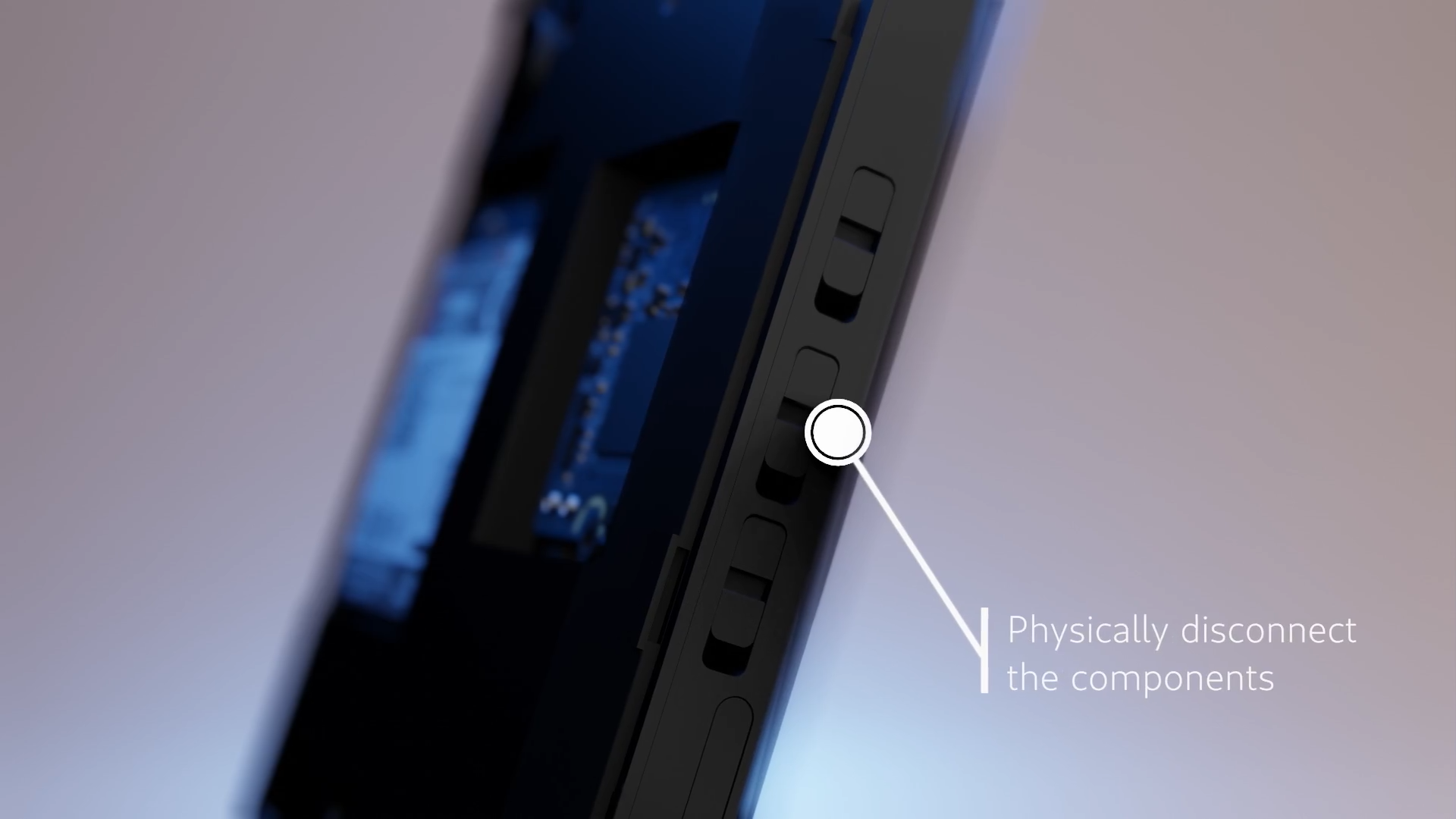
Just like with the Librem laptops, the Librem 5 features the ability to disconnect the various hardware components easily through 3 convenient switches on the side of the device.

  • A switch to physically disconnect the cellular modem card.
  • A switch to physically disconnect the Wi-Fi and Bluetooth card.
  • A switch to physically disconnect both cameras and the microphone.
  • Toggling the 3 switches in there “Off” position will disconnect all other hardware sensors such as the GPS and the accelerometer, leaving the Librem 5 as a simple tiny computer, isolated from the world.

Own the keys of your device

The Librem 5 has been designed to be compatible with the Librem Key. It ships with PureOS, just like the other Librem computers and goes even further in terms of hardware by integrating a smart card reader. It is obvious that using an external USB device like the Librem Key on the phone is not ideal, so one should use a Librem Key in the form of a simple smart card instead. It’s like a second SIM card that’s dedicated to handling the security and encryption of the data going through the phone.

We are still working on making the process of securing the data of our devices, while owning the keys to secure them, simple and convenient for everyone. We believe that a product or a feature is not ethical if it cannot be used by everyone.

Extremely modular

I don’t think I am mistaken if I say that the Librem 5 is the most modular smartphone out there. In a world where hardware design is pushing the people to over-consumerism by soldering everything to a single board while promoting fragility thinness, repairing or upgrading a mobile phone has become almost impossible.

The Librem 5 stands aside from that by banning any form of planned obsolescence, which is as good for people’s finances as it is for the environment.

Software freedom

This beautiful Librem 5 hardware wouldn’t mean much if it wasn’t driven by software that is controlled and fully owned by the people. From the BIOS, to the applications, going through the kernel and operating system, the Librem 5 runs on software that respects the 4 software freedoms where the people are in full control.

Discover the Librem 5

Purism believes building the Librem 5 is just one step on the road to launching a digital rights movement, where we—the-people stand up for our digital rights, where we place the control of your data and your family’s data back where it belongs: in your own hands.

Preorder now

The post The design behind a modular and secure mobile phone appeared first on Purism.

27 Aug 05:41

DJI’s new smartphone gimbal has a game-changing magnetic clamp

by Brad Bennett

DJI’s OM 4 gimbal is fairly compact, but the main draw is its new magnetic method for attaching to a phone.

The gimbal comes with a small metal pad that sticks to the back of your phone so that it can attach to the gimbal without the need for a bulky clamp. There is a smaller clamp that grabs your phone in case you’re uncomfortable with sticking a small metal sticker on your device.

The gimbal features 15-hour battery life and provides very stable video, according to DJI. The gimbal itself also has a spinning mode so users can easily shoot cool spin movies.

If you use the DJI app (Android/iOS), you can also unlock several other fun features. There’s a subject tracking mode, a cool 3×3 panorama setting, varying different time-lapse mode and regular panoramas. There are more features that you can learn about on DJI’s website.

DJI even says that users can even use the gimbal with external lenses and that the gimbal’s motors can still keep the video stable.

One thing to take into account is that not every feature works the same on all phones. It seems that all iPhones and most Huawei devices are compatible with every feature. Other phones vary considerably, but you can find out if your device has the features you want here.

DJI’s OM 4 gimbal costs $179 CAD.

Source: DJI

The post DJI’s new smartphone gimbal has a game-changing magnetic clamp appeared first on MobileSyrup.

27 Aug 05:41

Museum of Charlottetown Restaurant Menus

by peter@rukavina.net (Peter Rukavina)
I wonder if professional archivists are ensuring that artifacts of our culinary past are being saved for posterity. I was in the habit, for a time, about a decade ago, of collecting photos of Charlottetown restaurant menus and saving them in Evernote for reference. This process seems to have been the kiss of death for several of these restaurants, as an uncommon number of them have since closed. Here, for old time’s sake, are the highlights of the collection.

Tai Chi Gardens

Perhaps my favourite, and most-frequented restaurant ever, Tai Chi Gardens was on Pownal Street just south of Grafton, and was operated by my friends Kennie and Wennie. Menu from April 2011.

Cover of Tai Chi Gardens menu from April 2011

Tai Chi Gardens Menu from April 2011, Page 1

The Seatreat

A long-running and much-loved restaurant at the corner of Euston and University, since closed. Menu from July 2010.

Page 1 of menu for The Seatreat in Charlottetown from July 2010

Page 2 of menu for The Seatreat in Charlottetown from July 2010

Orange Lunchbox

It started off as an (orange) food truck, and moved into the space on Great George Street next to Cedar’s that’s now home to Crafters Burgers and Khoaw Son. Menu from June 2013.

Menu from The Orange Lunchbox, June 2012

Black & White

One of the last of the grandfathered-in downtown grills, Black & White is still in operation, albeit under new ownership. This is the menu from March 2011.

Black and White menu, page 1, from March 2011

Black and White menu from March 2011, page 2

Terre Rouge

It keeps changing its name and its emphasis, but there’s been a restaurant in the old Carter’s Office Supplies for a long time now. This is the takeout menu from January 2013.

Terre Rouge takeout menu from January 2013

27 Aug 05:41

The Easiest Way to Write Project Estimates

by Sean

Every project your business takes on needs a project estimate.

Before hiring you for a project, every client is going to want to know how long the project will take, how long supplies and materials are going to cost, and the price of your labor.

But, project estimates aren’t just for your clients. They can help you, too, as they help you manage your time and budget. A well-written project estimate will boost your ROI and income in the long term.

Now, here’s the problem:

Writing project estimates is tedious, time-consuming, and sometimes complicated.

Want to know how to write an estimate the easy way? All it takes is learning how to do it right.

Follow along as we show you a stress-free process for writing a good estimate.


How to Identify Your Client’s Needs

Regardless of your industry, you know that “flat rates” for services never seem to pan out well. That’s because all clients have different ideas in mind, and you’ll have to adjust the pricing accordingly.

So, how do you write an estimate?

The first thing you need to do is to figure out what your clients are looking for.

Figuring Out How You Fit In

Your client already knows that they’re looking to hire a specialist, whether that’s a photographer, artist, real estate agent, architect, etc. And they know that you charge a certain amount of money for your time.

But there’s a lot of behind the scenes work that clients overlook. This makes it hard to give them a straight answer when they ask for an estimate.

Let’s say you’re a freelance photographer:

You’re not just there to snap photos of your client’s big day. You may also have to purchase new equipment, get a permit to work at the wedding venue, and maybe even hire a subcontractor to help you.

Not to mention, you also have to lug all of your equipment to the site and retouch the photos after the wedding.

To give your potential clients the most accurate estimate possible, you need to account for all of these tasks.

Therefore, when you meet with a potential customer, you have to ask a lot of questions to figure out what they need. The more information you have, the easier it’ll be to create an accurate estimate.

Questions to Ask During Your Initial Meeting With a Client

First things first:

Your client should do most of the talking during your first meeting.

After all, this is your chance to find out what your client is looking for and what your role will be in bringing their ideas to life.

You need to ask a lot of clarifying questions, such as:

  • What is the job you want me to do for you?
  • Where is the job site or venue?
  • When would you like the project to be done?
  • What is your budget for the entire project?
  • Which packages or services are you most interested in?
  • Are there any additional items or add-ons that are of interest to you?

It’s a good idea to take both mental and physical notes during your meeting. This will give you something to reference as you’re crunching the numbers later on.

A Few Things to Keep in Mind

Unless you can do the calculations on the spot, then you probably won’t leave with a signed contract and a project schedule in hand. Most clients will understand that you can only provide ballpark estimates for both.

To get a more accurate estimate, you should compare your client’s project with similar projects that you’ve completed in the past.

But no matter how badly you want the job, always be honest. If you know that you’re too busy to complete a project by a certain deadline or that your services cost more than the client can afford, tell them.

It’s okay to say, “Hey, I appreciate your interest in my services, but I don’t think I’m the right person for this job.” It’s better to be truthful than to risk your reputation to capture a lead.

Clients will be more than happy to pay less than predicted or have their project finished sooner than expected. The same cannot be said for the opposite.


How to Estimate Project Costs

Project estimate costs

An in-depth and detailed project estimate will prove to your clients that you’re trustworthy and transparent. They’ll be able to see exactly where their money is going and be more likely to hire you again in the future.

To create a truly professional estimate, you need to understand the types of costs they include.

Types of Costs

Project estimates take into account both indirect and direct costs.

Indirect costs are expenses that don’t relate to a specific project but help keep your business afloat. Examples of indirect costs include rent, new equipment, and salaries for your employees.

These costs are also known as overhead costs. They may be identified as administrative costs on a project estimate.

Direct costs relate to the specific project that you’re working on. This category includes material costs, travel expenses, and your hourly rate. It also the cost of any subcontractors you hire.

Direct costs will vary based on the package, project, and add-ons a client selects.

There’s one key reason you need to include direct and indirect costs:

Profit.

Your client expects to be charged the hourly rate and for the necessary supplies. But as a small business owner, you need your overhead costs covered to turn a profit by the end of the year.

How to Estimate Labor Costs

The most important thing you can do when writing a work estimate is to figure out how long you expect a job to take. This will help you to calculate the total costs of labor.

Think about:

  • How much time you’ll need to prepare for the project
  • How long it’s taken you to complete similar projects in the past
  • How much time it will take to tie up loose ends when you’re done

You should multiply your hourly rate by how many hours you expect to spend on this project.

If you’re new to the industry and don’t know how long the job is likely to take, that’s okay. Do some research to determine what your local competitors are charging. Be sure to factor in your specific niche and experience.

And if you’re hiring an assistant to help you, make sure to factor in their pay, too.

To make the most of your time, read 7 Workflow Optimizations for Meeting Client Deadlines

How to Estimate Material and Supply Costs

If your client is paying for a physical (or digital) product, you should charge for the cost of materials and supplies.

Think about what that might mean:

  • For photographers, that means photo prints and photo books.
  • For interior designers, that means a thumb drive with files of floor plans.
  • For painters, that means paint and tools.

Be sure to estimate this cost at market value so that your clients don’t feel that you’re charging unfairly. Buying in bulk is an excellent way to cut costs on materials on your end while making customers happy in the process.

Additional Costs to Include on Your Estimate

There are additional fees that you may need to tack on to the estimate subtotal. You want to be sure that you’re breaking more than even.

You want to profit, right?

Here are some additional costs to factor into your estimates:

  • New equipment needed to fulfill the client’s needs
  • Rent
  • Administrative fees
  • Insurance
  • Travel fees and mileage (Tip: Use a mileage tracker!)
  • Hotel or lodging fees
  • Permits needed

Just remember that there isn’t always a set price for these things.

So, it’s always better to be specific than vague. Instead of writing that you have to buy “Tools,” sketch out which tools and even what brand you are going to buy. This will show your customer that you’re not trying to hide anything.


Should You Charge for an Estimate?

This is a good question that a lot of independent contractors and freelancers ask.

The short answer that you can, but you may not want to.

If you’re spending a good amount of time researching the project and calculating the numbers, it makes sense to charge for your time.

But how much do you charge?

Well, you have to keep in mind that some of your customers offer free estimates. So if you’re going to charge, make sure your estimates are accurate enough to make them worth paying for.

If you choose to charge for an estimate, let clients know ahead of time so they’re not surprised by the bill.


A Full List of What to Include in Your Project Estimate

The breakdown of costs is the most important part of your project estimate.

After all, no client is going to hire you if they don’t know what you charge. Your estimate will allow them to compare your fees to some of your competitors.

But there are some other things that every written estimate (or typed estimate) should include:

  • A professional letterhead with your company name, logo, address, and phone number
  • A project scope describing what exactly the project will entail
  • A projected schedule outlining the time frame for each task involved in the project
  • An expiration date to give them a deadline to accept your offer

You should also include the word “estimate” in bold lettering at the top of the sheet so that they know the amount is subject to change.

What to include in a project estimate

And remember:

When it comes to the cost breakdown, your itemized list should be as specific as possible to leave no room for questions.

For example, instead of just listing “Supplies” as one of the line items, you should write down the exact number of 8×10 prints they’re getting.

Clients should know precisely where their money is going.


Use a Project Estimate Template

There’s no better way to simplify this process than to use a pre-made project estimate template. Fortunately, there are thousands of free estimate templates online.

No longer do you have to write them by hand!

When it comes to software for writing job estimates, you have plenty of options.

If you’re familiar with Microsoft Excel, that works great.

Sites like SmartSheet have many project estimate templates that can be uploaded directly into Excel. Some are based on your industry (templates for construction projects, graphic design projects, etc.), while others are based on how you charge (hourly, per project, etc.).

Here is a sample estimate template that also factors in sales tax.

CRM systems like Bloom work well for writing estimates, too. Many CRMs have invoicing features that you can use to create cost estimates for potential clients.

Related: The Best Apps for Independent Contractors


Send the Completed Estimate to Your Client

When it comes to making and delivering project estimates, time is of the essence. Your clients are likely comparing prices amongst your competitors and may change their minds if you take too long.

So, send your estimate ASAP.

If you don’t hear back within a few days, reach out to them to make sure that they received the estimate and find out what they think.

What to Tell Your Client When You Send an Estimate

It’s important to remind your client that estimates aren’t bills.

After all, there’s always the chance that a project takes a little longer (or less time) than expected. And supply prices do change from time to time.

If that happens, the final invoice may be a little higher than estimated.

That’s why it’s so important to clarify both verbally and in writing that this is an estimate.

Make Sure the Estimate Is Signed and Dated

The last thing you want to do is to end up in legal trouble later on.

So, make sure to sign and date every estimate. Write the full date (MM/DD/YYYY) so there’s no question about when you wrote it.

As I said earlier, include an expiration date, too.

You want clients to know that the price listed on the project estimate will stand until a specific date. Clarify to the client that, past that date, the prices and your availability may be subject to change.

Hopefully, they’ll like the estimate on the first go-round and you can get to work!


Conclusion

Estimates don’t have to be the least enjoyable part of your job.

It might just be the perfect way to build positive relationships with your clients. It’s a great way to put your transparency on display, as your clients will know what their project will cost and when it’ll be done.

And creating these estimates is easier than ever, thanks to CRMs like Bloom.

You can now spend more of your time completing projects for your clients instead of developing project estimates.

Looking for a CRM system to help you with estimates and invoices?

Bloom could be the app you need!

The post The Easiest Way to Write Project Estimates appeared first on Bloom.

27 Aug 05:40

Twitter Favorites: [EdgeofSports] Now the WNBA is sitting out their games tonight in protest of racist police violence. The WNBA has been leading on… https://t.co/r9zQ3OcNMN

Dave Zirin @EdgeofSports
Now the WNBA is sitting out their games tonight in protest of racist police violence. The WNBA has been leading on… twitter.com/i/web/status/1…
27 Aug 05:39

Welcome to the Podcast

I was wondering if podcasting is still a thing, so I tweeted “When do people listen to podcasts, now that nobody is commuting? Housework? Exercise?” Newsflash: Yes, it is. The tweet got lots of traction and only very few of the responses said they were listening less. Given that, I decided to make an audio version of what you are reading and call it a podcast. Turns out to be pretty easy.

Details

It’s here on Apple podcasts, which I gather means it will show up on Overcast and other podcast aggregators (um, whatever they are, I’m new to this) soon. If you want to do it yourself, here’s the RSS.

Confession

I rarely listen to podcasts. When I’m doing something like driving that doesn’t fully occupy the mind, I prefer music to talk. When I want to consume information, I find reading is way faster. But I’m not against them or anything, they seem to improve many peoples’ lives.

What it is

For the moment, just a selection from the fragments that appear here — occasionally I publish pieces that are just collections of links, which I think would be podcast-unfriendly. But the majority will be included, assuming the world shows any interest. In the future I might try to go conversational but to be honest at the moment I don’t feel a burning urge. I’d rather find a way to work music in, and have no notion of the issues around that.

Hardware tech

I record these sitting in my boat/office on a 2019 16" MacBook Pro using an unexotic Shure MV5 microphone which I picked because it stood out among well-reviewed mikes for occupying little desk space, and that’s a big advantage on the boat. It connects to the Mac via a CalDigit TS3+ Thunderbolt hub, without which my boat/office setup would be entirely unworkable.

The studio

The studio. The seat’s not ergonomic but the view is good.

I haven’t made any real attempt to supress background noise and if you get lucky you might hear a seagull squawk or a seal splash. When I play back the sound loud, I can hear the background roar of the city. It doesn’t bother me.

Let’s be honest: The main problem with the sound quality is my voice, which is nothing to write home about, and the fact that I stumble over my own words. Several of the eleven fragments present at launch required more than one take; once again, not a big problem.

Also, I notice, upon listening to a sampling of these early episodes, that I should probably go slower. I’m a pretty fast talker but the real issue is that my writing style is dense. This isn’t an accident, I consciously try to compress the prose here; what I publish is usually a lot shorter than the initial draft. Some of the verbal chaff I remove while editing is probably perfectly appropriate for spoken-word.

Software tech

I record with Audacity because that’s what everybody says to use, and export to MP3. Once you’ve got the MP3’s, you need to wrap them in RSS (specifically, RSS 2.0, none of the other flavors) and you’ve got a podcast. There are lots of tutorials out there, and they are considerably annoying in that few to none actually include examples of the raw XML code so that I can cut and paste it, they assume you’re using some sort of templating engine or other voodoo.

The reason I need examples is that the software that runs this blog (and now this podcast too) was entirely hand-built by yours truly, initially in 2002, and subsequently elaborated and fancified and mutated over the decades. In fact, it’s all one Perl file containing 2,880 lines of what I claim is pure software beauty. I will open-source it for the world to enjoy on the twelfth of never.

To-do and what next

I need to have each blog entry that’s also a podcast have a “click here to listen” button. Feel free to point out any other undotted i’s or uncrossed t’s.

Going forward, I dunno. I’m making this up as I go along. If someone has a brilliant idea for what I should do with this global multimedia empire, I’m real easy to find. My mind is open, and I guess my ears should be too, now.

27 Aug 05:37

Apple releases iOS 13.7 beta to developers with phase two of Exposure Notification system

by Jonathan Lamont

The next major iOS update looks like it will advance Apple and Google’s Exposure Notification system to its next phase.

As spotted by 9to5Mac, iOS 13.7 began rolling out to developers with important tweaks to the Exposure Notification system. For those who closely followed Apple and Google’s announcements about the system during development, you may remember the companies said there would be two phases of deployment.

The first phase, which we are currently in, would see the Exposure Notification capability deployed to the majority of Android phones and iPhones (with some exceptions you can read about here). During this phase, users would need to install an app provided by their local public health authority to make use of the system. For example, in Canada, Ontario rolled out support for the app in partnership with Canada’s Public Health Agency.

Phase two, on the other hand, would allow Exposure Notifications to operate without an app if users opt-in to the system. That would mean users could still get notifications about potential exposure to COVID-19, a helpful addition for those living in an area without an app or those afraid to install the public health app. However, to verify a positive case, users will still need to install their public health app.

For Canada, iOS 13.7 will be a welcome update when it rolls out to the public. At the moment, Ontario is the only province that supports the federal government’s COVID Alert app based on Apple and Google’s Exposure Notification system. Alberta plans to transition to that app, while Quebec doesn’t intend to deploy it.

For those living outside Ontario and using an iPhone, the update will enable you to start using Exposure Notifications without needing the COVID Alert app. While no one will be able to report positive cases without the app, logging potential exposures could be helpful for when COVID Alert does finally arrive in your area.

Further, Apple’s move towards phase two of the Exposure Notification system hopefully means Google is also preparing to start phase two, and Android users will soon be able to use Exposure Notifications without an app as well.

Source: 9to5Mac

The post Apple releases iOS 13.7 beta to developers with phase two of Exposure Notification system appeared first on MobileSyrup.

27 Aug 05:34

It’s always winter at Stalag 13

by peter@rukavina.net (Peter Rukavina)

I’ve been trapped in a Hogan’s Heroes vortex for several days now: the YouTube singularity thinks it’s on to something, and I keep confirming it.

This led me to Wikipedia, where I learned that, despite being shot in California, every single episode was set in winter:

Although it was never snowing on the film set and the weather was apparently sunny, there was snow on the ground and building roofs, and frost on the windows. The set designers created the illusion of snow two ways: the snow during the first several seasons was made out of salt. By the fourth season the show’s producers found a more permanent solution and lower cost, using white paint to give the illusion of snow. By the sixth and final season – with a smaller budget – most of the snow shown on the set was made out of paint.

And then there’s Bing Crosby.

27 Aug 05:32

What Zoom did right and wrong during its outage

by Josh Bernoff

Zoom went down for a lot of users on Monday morning. That was also the first day of school for a lot of public school and college students. The company treated the outage as a matter-of-fact event and communicated clearly and regularly throughout. Was that enough? How Zoom communicated Zoom’s problems first started appearing at … Continued

The post What Zoom did right and wrong during its outage appeared first on without bullshit.

27 Aug 05:32

Lots of Stuff

So, haven’t blogged in a pretty long time. Lots has happened. Most notably, I got engaged to my long-time girlfriend, Amy! We set the date for July. I’m really happy! :)

Just got back from BrainShare. It was pretty cool. I took some pics, but I don’t have them pulled off the camera yet. I think we were all kind of in awe about the number of Large Monkey Buttons plastered all over :)


the floor near the mono booth
27 Aug 05:32

Global smartphone sales declined 20.4 percent in Q2 amid pandemic: report

by Aisha Malik
iPhone 11 Pro Max and iPhone XS Max

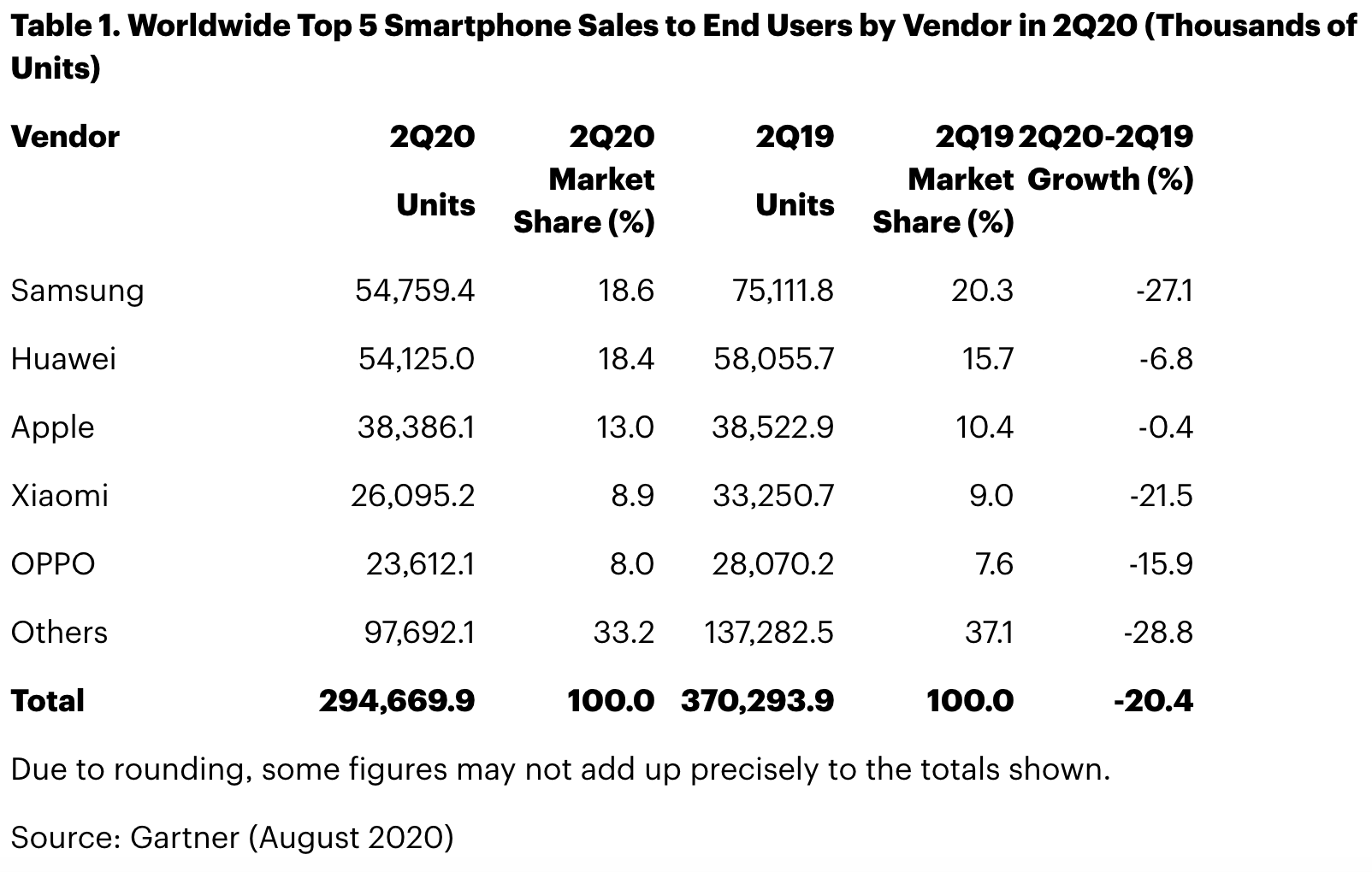
Global smartphone sales declined by 20.4 percent in the second quarter of 2020, according to a new report from research firm Gartner.

It’s no surprise that the COVID-19 pandemic has impacted smartphone sales around the world due to retail closures and financial uncertainty.

“Travel restrictions, retail closures and more prudent spending on nonessential products during the pandemic led to the second consecutive quarterly decline in smartphone sales this year,” Anshul Gupta, a senior researcher at Gartner, outlined in the report.

Gartner notes that among all of the popular smartphone manufacturers, Apple’s sales seems to be the least affected. For instance, the report notes that Samsung experienced the largest decline in sales while Apple’s smartphone sales were nearly flat year-over-year.

Apple sold 38 million iPhones in Q2 2020, which represents a 0.4 percent decline from the same period a year ago. Gartner notes that this was likely due to the release of the new iPhone SE coupled with improved market condition in China.

On the other hand, Samsung sold 55 million smartphones in the quarter, which is a decline of 27.1 percent year-over-year.

“The COVID-19 pandemic continued to negatively affect Samsung’s performance in the second quarter of 2020,” Gupta stated. “Demand for its flagship S Series smartphones did little to revive its smartphone sales globally.”

The report notes that Samsung’s drop in smartphone sales helped Huawei and that “although Huawei also declined in smartphone sales year-over-year, it experienced 27.4 percent growth, quarter-over-quarter, moving it into a virtual tie with Samsung for the No.1 position.”

It’s worth mentioning that a recent report from research firm Canalys stated that Huawei sold more smartphones than Samsung in the last quarter.

Image credit: Gartner 

Source: Gartner 

The post Global smartphone sales declined 20.4 percent in Q2 amid pandemic: report appeared first on MobileSyrup.

27 Aug 05:31

Telus selling critter masks to raise money for COVID-19 relief efforts

by Bradly Shankar

Telus has begun selling face masks featuring some of its signature critters.

The masks are specifically sized for youth ahead of kids going back to school in September, with proceeds going towards the Telus Friendly Future Foundation (TFFF) in support of COVID-19 relief efforts across Canada.

Telus masks

Masks are now on sale in packs of three for $35 on Telus’ website, as well as in select Telus stores. According to Telus, the masks are dual-layered, made out of 100 percent recycled polyester and 100 percent organic cotton on the inside.

At the moment, it doesn’t seem like Canada’s other major carriers are selling masks for charity. That said, Rogers’ Sports & Media division did run a similar mask selling campaign earlier this year in support of frontline workers. Bell, meanwhile, acquired 1.5 million masks to provide to frontline workers and other public workers earlier this year as well.

Source: Telus

The post Telus selling critter masks to raise money for COVID-19 relief efforts appeared first on MobileSyrup.

27 Aug 05:31

Twitter Favorites: [karj] Doing customer support is a good way to get a sense for which product features you should prioritize building.

Eric Karjaluoto @karj
Doing customer support is a good way to get a sense for which product features you should prioritize building.
27 Aug 05:31

Twitter Favorites: [skinnylatte] Ingredients for a sauce I invented. :) https://t.co/mepSS77zgC

Adrianna Tan @skinnylatte
Ingredients for a sauce I invented. :) pic.twitter.com/mepSS77zgC
27 Aug 05:30

Standard Model Changes

mkalus shared this story from xkcd.com.

Bugs are spin 1/2 particles, unless it's particularly windy.
25 Aug 13:34

Fast, personalized and private by design on all platforms: introducing a new Firefox for Android experience

by Vesta Zare

Big news for mobile: as of today, Firefox for Android users in Europe will find an entirely redesigned interface and a fast and secure mobile browser that was overhauled down to the core. Users in North America will receive the update on August 27. Like we did with our “Firefox Quantum” desktop browser revamp, we’re calling this release “Firefox Daylight” as it marks a new beginning for our Android browser. Included with this new mobile experience are lots of innovative features, an improved user experience with new customization options, and some massive changes under the hood. And we couldn’t be more excited to share it.

New Firefox features Android users will love

We have made some very significant changes that could revolutionize mobile browsing:

Privacy & security

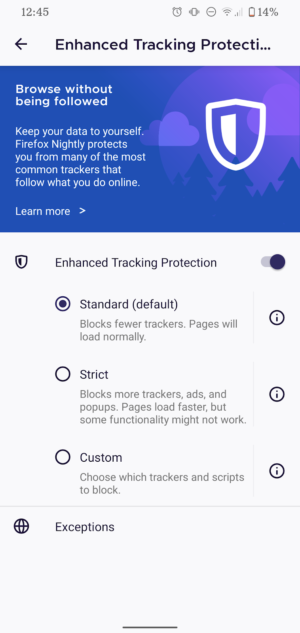
  • Firefox for Android now offers Enhanced Tracking Protection, providing a better web experience. The revamped browsing app comes with our highest privacy protections ever – on by default. ETP keeps numerous ad trackers at bay and out of the users’ business, set to “Standard” mode right out of the box to put their needs first. Stricter protections are available to users who want to customize their privacy settings.
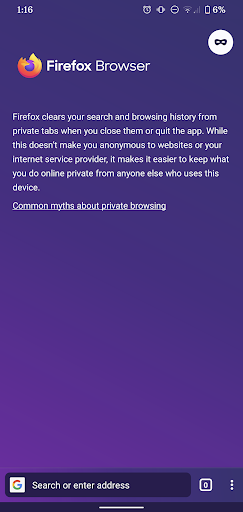
  • Additionally, we took the best parts of Firefox Focus, according to its users, and applied them to Private Mode: Now, Private Mode is easily accessible from the Firefox for Android homescreen and users have the option to create a private browsing shortcut on their Android homescreen, which will launch the browsing app automatically in the respective mode and allow users to browse privately on-the-go.

Enhanced Tracking Protection automatically blocks many known third-party trackers, by default, in order to improve user privacy online.                    Private Mode adds another layer for better privacy on device level.

Enhanced Tracking Protection automatically blocks many known third-party trackers, by default, in order to improve user privacy online. Private Mode adds another layer for better privacy on device level.

Appearance & productivity

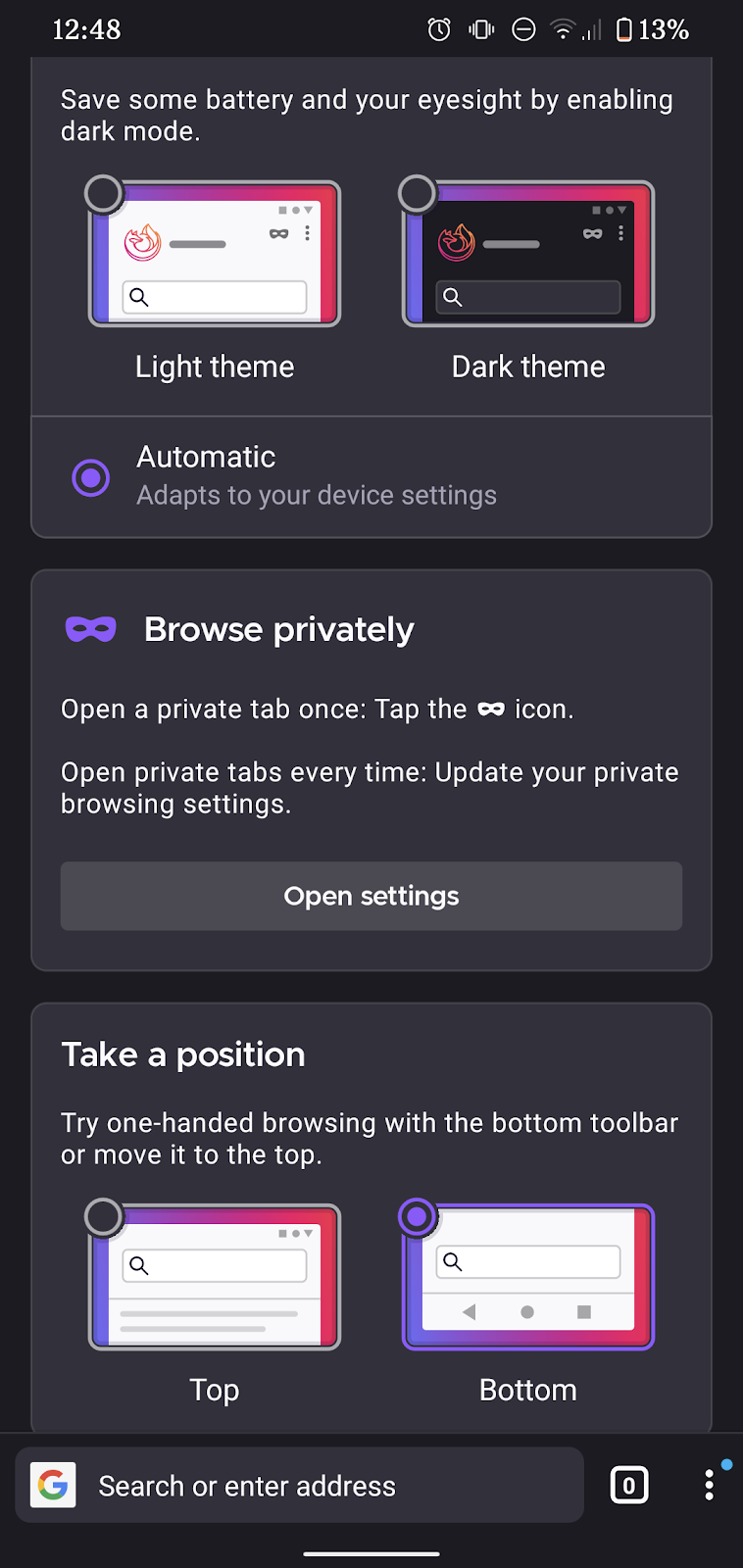
  • With regard to appearance, we redesigned the user interface of our Android browser completely so that it’s now even cleaner, easier to handle and to make it one’s own: users can set the URL bar at the bottom or top of the screen, improving the accessibility of the most important browser element especially for those with smartphones on the larger side.
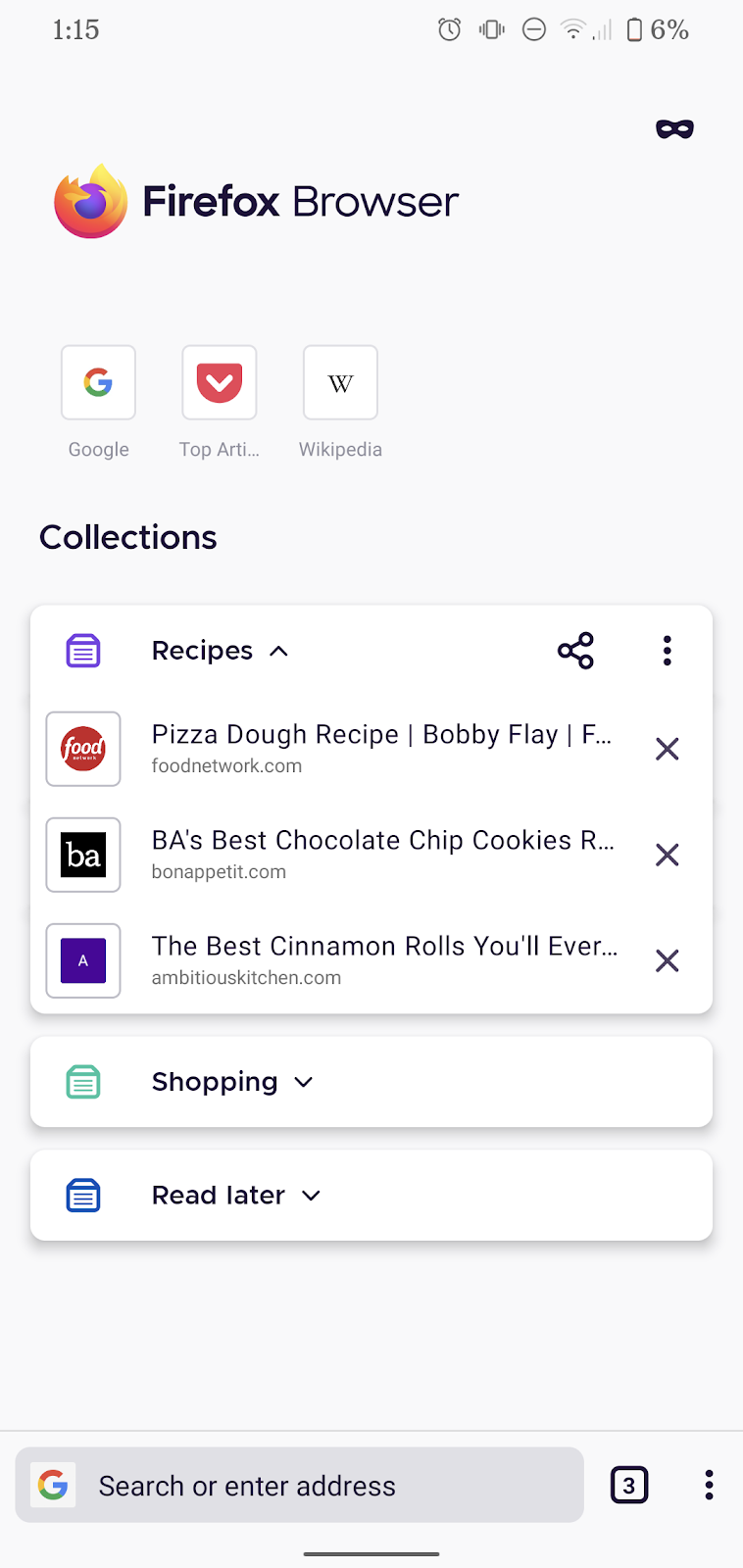
  • Taking forever to enter a URL is therefore now a thing of the past, and so are chaotic bookmarks: Collections help to stay organized online, making it easy to return to frequent tasks, share across devices, personalize one’s browsing experience and get more done on mobile. As a working parent, for example, Collections may come in handy when organizing and curating one’s online searches based on type of activity such as kids, work, recipes, and many more. Multitaskers, who want to get more done while watching videos, will also enjoy the new Picture-in-Picture feature.

The new Firefox for Android comes with an adjustable URL bar.                    A brand new, convenient solution to organize bookmarks in Firefox for Android: Collections.

Productivity is key on mobile. That’s why the new Firefox for Android comes with an adjustable URL bar and a convenient solution to organize bookmarks: Collections.

  • Bright or dark, day or night: Firefox for Android simplifies toggling between Light and Dark Themes, depending on individual preferences, vision needs or environment. Those who prefer an automatic switch may also set Firefox to follow the Android setting, so that the browsing app will switch automatically to dark mode at a certain time of day.
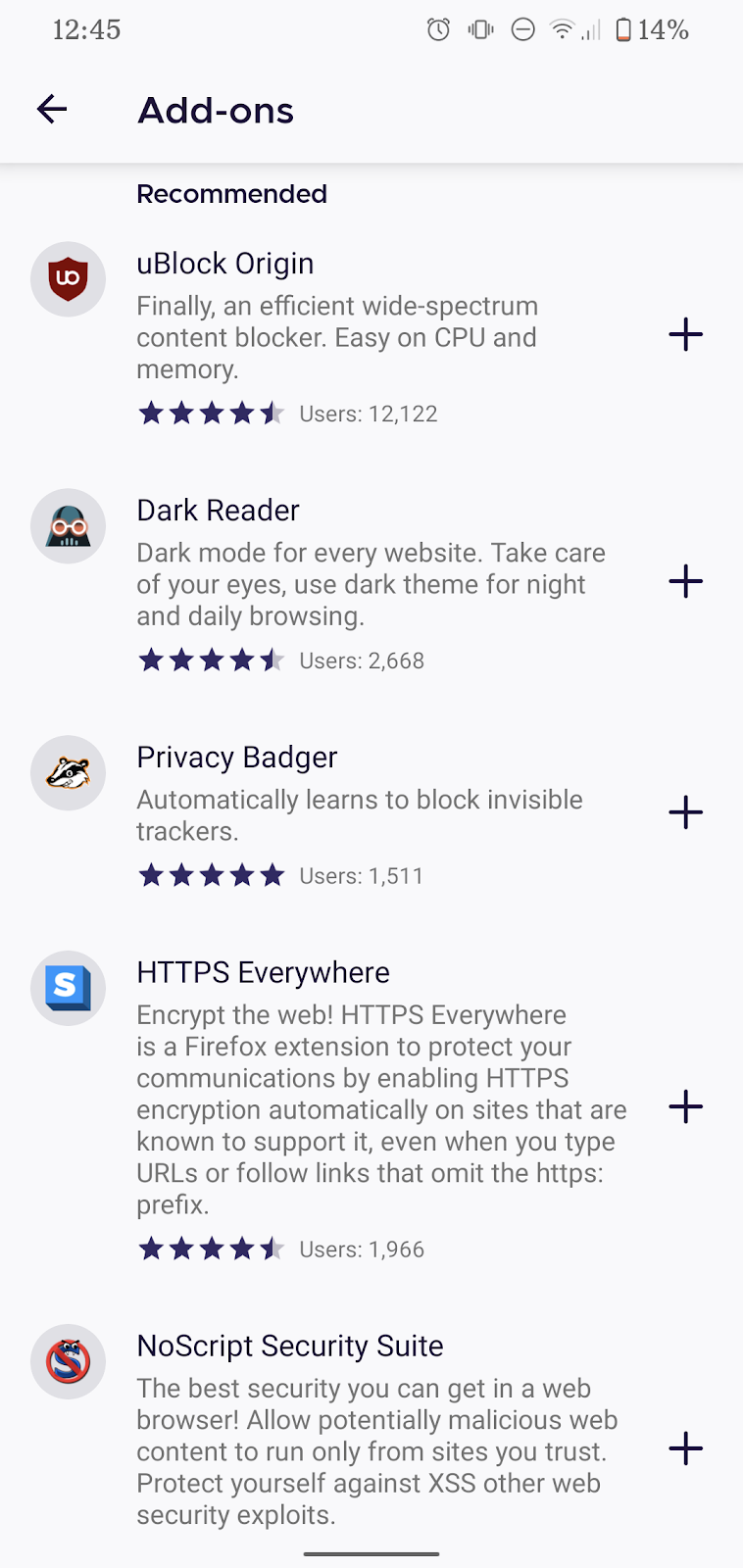
  • Last but not least, we revamped the extensions experience. We know that add-ons play an important role for many Firefox users and we want to make sure to offer them the best possible experience when starting to use our newest Android browsing app. We’re kicking it off with the top 9 add-ons for enhanced privacy and user experience from our Recommended Extensions program. At the same time, we’re continuously working on offering more add-on choice in the future that will seamlessly fit into Firefox for Android.

The overhauled Android browser comes with the top add-ons for enhanced privacy and user experience.

Firefox users love add-ons! Our overhauled Android browser therefore comes with the top add-ons for enhanced privacy and user experience from our Recommended Extensions program.

What’s new under the hood

The improvements in Firefox for Android don’t just stop here: they even go way beyond the surface as Firefox for Android is now based on GeckoView, Mozilla’s own mobile browser engine. What does that mean for users?

  • It’s faster. The technology we used in the past limited our capability to further improve the browser as well as our options to implement new features. Now, we’re free to decide and our release cycle is flexible. Also, GeckoView makes browsing in Firefox for Android significantly speedier.
  • It’s built on our standards: private and secure. With our own engine we set the ground rules. We can decide independently which privacy and security features we want to make available for our mobile users and are entirely free to cater to our unique high standards.
  • It’s independent, just like our users. Unlike Edge, Brave and Chrome, Firefox for Android is not based on Blink (Google’s mobile engine). Instead Firefox for Android is based on GeckoView, Mozilla’s wholly-built engine. This allows us to have complete freedom of choice when it comes to implementation of standards and features. This independence lets us create a user interface that when combined with an overall faster browsing pace, enables unprecedented performance. Also, it protects our users if there are security issues with Blink as Firefox will not be affected.

User experience is key, in product and product development

Completely overhauling an existing product is a complex process that comes with a high potential for pitfalls. In order to avoid them and create a browsing experience users would truly appreciate, we looked closely at existing features and functionalities users love and we tested – a lot – to make sure we’d keep the promise to create a whole new browsing experience on Android.

  1. Bringing the best recent features from desktop to mobile. Over the last couple of years we’ve been very busy with continuously improving the Firefox desktop browsing experience: We did experiments, launched new tools like Firefox Monitor, Send and Lockwise and took existing features to a whole new level. This includes, amongst others, Dark Mode, the Picture-in-Picture feature, the support of extensions and add-ons as well as, last but not least, the core element of Firefox privacy technology: today, Enhanced Tracking Protection  protects Firefox users from up to 10 billion third-party tracking cookies, fingerprinters and cryptominers per day. Feedback from users showed that they like the direction Firefox is developing into, so we worked hard to bring the same level of protection and convenience to mobile, as well. As a result, users can now experience a better Firefox mobile experience on their Android devices than ever before.
  1. We tested extensively and emphasized direct feedback from mobile users. Over the course of several months, earlier versions of the new Firefox for Android were available as a separate app called Firefox Preview. This enabled us to adequately try out new features, examine the user experience, gather feedback and implement it in accordance with the users’ wishes and needs. And the result of this process is now available.

Try the new Firefox for Android!

We’re proud to say that we provided Firefox for Android with an entirely new shape and foundation and we’re equally happy to share the result with Android users now. Here’s how to get our overhauled browser:

  • Users who have the browser downloaded to their Android devices already will receive the revamp either as an automatic or manual update, depending on their device preferences. Their usage data, such as the browsing history or bookmarks, will be migrated automatically to the new app version, which might take a few moments. Users who have set a master password will need to disable the master password in order for their logins to automatically migrate over.
  • New users can download the update from the Google PlayStore as of today. It’s easy to find it as ‘Firefox for Android’ through the search functionality and tapping ‘Install’ will get the process started. The new Firefox for Android supports a wide range of devices from Android 5.0+ and above.

Make sure to let us know what you think about the overhauled browsing experience with Firefox for Android and stay tuned for more news in the upcoming months!

UPDATE: We’re all about moving forward. It’s why we rehauled Firefox for Android with a new engine, privacy protections, and a new look. But we know history and looking back is important. So, we’re bringing the “back button” back. We’ll continue to incorporate user feedback as we add new features. So if you haven’t already downloaded it, get the new Firefox for Android now. Added Sept. 2, 2020

The post Fast, personalized and private by design on all platforms: introducing a new Firefox for Android experience appeared first on The Mozilla Blog.

25 Aug 03:53

History is momentum

At some point in the future, “yesterday” will become part of “history.” That day is not today. Today, “yesterday” is still just yesterday – it’s what I did before I went to sleep. It isn’t next week, because next week, “yesterday” will just be “last week.” It probably won’t be next year. Next year, yesterday is just “last semester” or “a few months ago.” It seems so recent, and so changeable.
25 Aug 03:53

Wahoo ELEMNT Bolt vs Garmin Edge 130 Plus Bike Computers: In-Depth Comparison, with Videos

by Average Joe Cyclist

Wahoo ELEMNT Bolt vs. Garmin Edge 130 Plus - spend a few minutes to ensure you get the best bike computer for your needs and budget!This post, with videos and a features chart, is an in-depth comparison of the Wahoo ELEMNT Bolt vs Garmin Edge 130 Plus. The Wahoo ELEMNT Bolt is more expensive than the brand new Garmin Edge 130 Plus. And the Garmin Edge 130 Plus is hailed by many as one of the best possible bang-for-your-bucks bike computers you could possibly find. For example, Cycling News says that the "feature-packed Garmin Edge 130 Plus contains everything you would ever want from a cycling computer." So, it might seem to be a no-brainer to buy the Edge 130 Plus. But first, spend a minute checking out what the Wahoo ELEMNT Bolt offers for a few extra dollars. We hope this post will help you to make the best decision for your own personal cycling needs!

The post Wahoo ELEMNT Bolt vs Garmin Edge 130 Plus Bike Computers: In-Depth Comparison, with Videos appeared first on Average Joe Cyclist.

25 Aug 03:52

Twitter Favorites: [JayOdjick] Conservative Party: "Take Canada Back". Indigenous people: How far back we talkin'?

J @JayOdjick
Conservative Party: "Take Canada Back". Indigenous people: How far back we talkin'?