Shared posts

12 Feb 17:08

Preventing form submission with zero Javascript

Want to trigger an action? Use a button element. They’re great.

Want to also prevent form submission when someone clicks that button? Put down the JavaScript, friend. I have a better suggestion:

<button type="button">
Button action goes here
</button>

And that’s it! No preventDefault() or no overwrought dependencies that will stop working without notice. Just good ol’ reliable HTML and a humble attribute.

Okay, cool, thanks!

PS from Manuel: Thank you so much to all authors for this wonderufl series of articles and thank you to all readers for reading, sharing, and commenting! Merry christmas and a happy new year! 🖤

28 Dec 10:42

A Very Playvicious Christmas

by RWG

This Christmas season, we all received a gift: Ro is blogging about Playvicious.social. He currently has four posts with more on the way:

I came across Ro’s work while Playvicious was running sometime in 2018, and I made a note of it – and then forgot. I got distracted by a major project: my co-authored book on disinformation, Social Engineering. I put off my Mastodon/fediverse studies in order to understand social media and propaganda, especially in relation to US presidential elections.

While I don’t regret diving into disinformation, I do regret not witnessing Playvicious’s run. It was an early, if not the first, Black-run instance on the fediverse. It was a source of joy for a lot of people. As Ro puts it, the idea of “play vicious” is

The energetic, unfiltered, sometimes uncomfortable, but the relentlessly progressive pursuit of understanding ourselves through creativity. It defined us as a group of thinking and feeling people who wanted to burn away all unnecessary details and get to the essence of why we loved what we loved and exist in that space for however long we could.

But that energy attracted some hate. As Ro will no doubt relate, Playvicious.social faced harassment and racism. Ro shut it down after watching as his moderators were traumatized.

I missed its run online. And I really regret that.

But Ro (and others – I think more folks are starting to talk about PV) is giving all of us a great gift: an inside view of this most important Mastodon instance.

The story Ro is telling is intensely personal. It’s also deeply important for the big questions of the fediverse, such as content moderation, how instances should relate to one another, and how societal injustices are replicated again and again online.

As Mastodon grows, a big stain has been not only the end of Playvicious.social, but also the experience of Black Mastodon members more generally. When people left Twitter after Musk’s takeover, it included the community known as Black Twitter. But Black Twitter ran into casual racism on the fediverse, and currently people are struggling to create #BlackMastodon. (I recommend following that hashtag and boosting posts).

Fortunately, while PV.social is gone, Ro is not done. He’s building new software to this day, he hosts a microblog (a Misskey instance), and he’s contributing moderation tools to the fediverse – even in spite of all he and his colleagues went through.

I’m grateful to Ro (and other PV folks) because I believe I cannot write my current book (Goal 2!) about Mastodon without talking about Playvicious.social. But it’s also not my story to tell. It’s Ro’s and other folks’ story. My job is to talk about it in the contexts that I can dig up through research and interviews.

If you want to support Ro’s work, head to his Patreon. And keep watching roiskinda.cool for more about PV!

28 Dec 10:36

Megan Smith explaining the General Magic prototyping process

I watched the documentary General Magic (mentioned in Tony Fadell’s book Build) about the 1990s Apple spin-off company General Magic that built the iPhone before the iPhone. Ultimately the product was a commercial failure, but the documentary is a wonderful look at product design and what happens when you let talented engineers roam free range. They invented USB, created capacitive touch screen GUIs, and imagined the portable “Post-PC” world before Windows 95 and the Internet were ever popular. Ultimately the product was a failure, too early for its time. How did they build this product? Well the answer is… prototypes.

My favorite part of the documentary is Megan Smith beaming over her cabinet full of hardware prototypes. Her focus on making something people love, an intimate device, is infectious. Her eagerness to blend everyone’s wishes with the harsh reality of available and affordable hardware shows. Starting with off-the-shelf components and inventing if necessary. When describing the product, she’s not talking about megabytes, protocols, and pixels, but talking about the sound, the feeling, the touch of the product and software in people’s hands.

I feel more vindicated than ever that prototypes, put in people’s hands, are the biggest opportunity to capture lightning in a bottle. These people are imagining and building the iPhone 17 years before the iPhone launched. Megan Smith talks like Steve Jobs, but Steve Jobs doesn’t work at Apple or General Magic. We often herald the invention of the iPhone or Android and these magic devices as invented out of thin air or our collective science fiction, but both of those products used by billions of people rose from the ashes of General Magic’s failure. That’s a lot to dwell on. The composting of failures produces rich and fertile soil.

28 Dec 10:21

Twitter Favorites: [heyrickie] Charlie, Cheryl, and I wish you a Merry Christmas! 🎄🐶 📸: picturesbypeachy (IG) https://t.co/1ZPWpLV2vU

Eric Bucad (@heyrickie@mstdn.ca) @heyrickie
Charlie, Cheryl, and I wish you a Merry Christmas! 🎄🐶 📸: picturesbypeachy (IG) pic.twitter.com/1ZPWpLV2vU
28 Dec 10:14

Tried and liked 2022

by jnyyz

Around Christmas time, it’s a bit of a tradition on the Internet BOB list to post bike related things that you have tried and liked during the past year. I see that it’s been many years since I’ve posted such a list, the last one being in 2016. I still really like of the gear that I recommended that year, with one update being that my choice for wool balaclava is now from TST.

Since that time, there are a number of items that I would highly recommend, most of them acquired in the last year or two.

Firstly, I love the wool shirts from Kitsbow.

This an employee owned company that sews all of their stuff in house in North Carolina. Their icon shirt has lots of lovely details that make it a lifetime garment, and the regular cut is trimmer that all of the other flannel or wool type shirts that I’ve tried. This, along with a wool undershirt, is my regular commuting gear. In winter I also throw on a jacket over top. I’ll also put in a good word for their wool knickers. I’ve worn those down to 0°C. They are a stretch wool blend. I don’t know if the wool makes much difference, but they are much more stink resistant than regular bike gear. All their stuff is expensive, particularly with the exchange and shipping to Canada, but if you want the best, and you want to support manufacture in North America…..

On a similar note, I really like my Search and State jacket. It is sewn in NY, and so is quite expensive. A very stripped down. design, but it seems to breathe well. The only additional thing I wish it had was a chest pocket, but that would add weight and make it less package. I see now that they’ve added a jacket with more pockets, but the price is even more stratospheric.

In winter, I like pogies as a preferred solution to cold hands, and so I finally broke down this year to get the ultimate versions by Dogwood Designs. (update: see my review of the pogies from 7Roads.

I have another pair of pogies in bound from a small shop in the Ukraine. I’ll let you know how they turn out. If you are looking for a cheaper pair, the padded ones from Rock Bros are OK.

On a side note about pogies, if your hands are buried in them, then you probably have to relocate your bell from its usual location. An alternative is to use an electric bell with a remote button. The Twooc is not a bad option. It is certainly plenty loud.

My Routewerks handlebar bag is terrific. Yes, it is rather heavy, but it is very well made, and the flip top is awesome for access while riding. You’ll see plenty of pictures of it elsewhere on the blog, such as this recent example.

Finally I’ll mention that my initial impressions of the new commuter bike headlight from Trek are pretty positive. It has decent optics that give the beam pattern a horizontal cutoff as is required in Europe.

On low beam, it is still brighter than my lower end B&M dynamo headlight.

At any rate, I wish everyone a Merry Christmas, and tailwinds for the new year.

24 Dec 06:53

Love on the Rocks

Michael Moe, EIEIO, Dec 22, 2022
Icon

Daniel Christian shared this post and I can't resist passing it along. It's a newsletter authored by Michael Moe, founder of Global Silicon Valley (GSV), an investment firm. Reading it feels a bit like watching a train wreck in slow motion, from the hackneyed football story to start the item, to reading about "my delight when co-founder of Coursera Daphne Koehler came into my office in 2012 to explain the radical concept behind her new business" to the "despite what the score says, I like the fundamentals of the company and the open ended potential" ("GSV owns shares in Coursera") to the closing bit, "New MacDonald has a Startup.... EIEIO: Entrepreneurship, Innovation, Education, Impact and Opportunity." It really is a glimpse into another world, one not for the likes of you and I.

Web: [Direct Link] [This Post]
24 Dec 06:52

How many colleges and universities are blocking TikTok? | Bryan Alexander

Dec 22, 2022
Icon

From my perspective, this is a case of U.S. institutions not wanting a Chinese company doing what Google, Meta, and Apple do all the time - surveil its staff and students and report back to the corporate office, cooperating with government as requested. It should be made clear, too, that the ban doesn't extend to students and staff, as is often suggested in the coverage, but rather applies to institutionally owned hardware. It's this sort of action that builds mistrust between countries at a time when the world really needs people to be working together.

Web: [Direct Link] [This Post]
24 Dec 06:44

My Year Of The Linux Desktop

by Rui Carmo

Strangely enough for a Mac/iOS user, I have spent a lot of time using Linux throughout the years, but mostly on servers. Since last year, however, I have started to hedge my bets on what desktop OS I will be using for the next twenty years or so.

By my completely unscientific reckoning, this year I have probably spent well over half my personal computing time using Linux instead of macOS (and the rest was likely evenly split between my MacBook and an iPad).

The reasons for that are manifold:

  • I never really stopped using anything or went all-in on any platform except, perhaps, the iPad – and that, despite many wonderful third-party apps, still doesn’t have a proper development environment.
  • I wasn’t as optimistic about macOS as I am now (Apple Silicon largely changed that, but I think the days of my having multiple Macs are over).
  • Electron trash has invaded both my Mac and Windows desktops in several guises, and Linux still has a lot of native applications (there used to be a joke about there being as many Linux desktop apps as widget toolkits, but that’s not quite true anymore).
  • A lot of my personal pursuits are deeply technical, and I can find excellent (and most often free) tools in the Open Source ecosystem – and many of them will likely never run on a Mac either due to their legacy or to Apple’s sandboxing requirements.

So I’ve now been running Fedora on three machines for an extended period of time:

  • The original LXC container where I started testing Fedora 35, which I’ve upgraded all the way to 37 in the meantime and which I use daily as a personal sandbox (now with RDP GPU acceleration out of the box, so I don’t need to do any hacks).
  • My Lenovo, which is where I end up doing a lot of my MCU and 3D design/printing stuff, which I also upgraded to 37.
  • My ancient C720 Chromebook, which has only 2GB of RAM but is still useful as a thin client and glorified typewriter, and is still on 35 because it’s fine that way.

What I Like So Far

The experience has been pretty good for five main reasons:

  • I get the default, vanilla GNOME desktop (which I customize to feel just enough like macOS that it is comfortable to use when I’m tired and really don’t want to deal with weird icons and UX conventions).
  • Hardware support has been excellent (as long as you are willing to ignore some quirks like failing to roam between Wi-Fi access points that share the same SSID, and paper over some cracks by forcing the occasional misbehaving USB device to disconnect).
  • There is no shortage of quasi-mainstream applications (and by that I mean FreeCAD, Cura, SuperSlicer, and all the development tools I use, especially VS Code).
  • I have made it a key priority to be able to seamlessly move between devices, and most of my environment is standardized (same set of tools across machines) and synced (largely through [SyncThing], but also via some configuration files in git for a few key things). This, of course, works great in a Linux environment.
  • I can use a touch screen on my laptop without offending the UX gods, because Linux doesn’t judge. So there.

There are some critical caveats here, of course.

The first is that I don’t care about office applications, or personal productivity as most people see it because for me, at least, 90% of that is in the cloud or accessible via a browser, and I also won’t be using those while working in Linux – that’s literally not what I want to be doing with it.

Also, as a matter of principle I don’t want to rely on browser-based applications for my personal pursuits–all I want to do is either too close to the hardware or too complex for the kind of web UI that personal and business computing has been dumbed down to.

If you’re an old-time Mac user, the Linux ecosystem is my current equivalent of the pre-App Store days, when you had dozens of amazing indie developers building stuff that was actually useful and filled the myriad of workflow niches you had.

And there are dozens of native apps for the taking, of often surprising quality and polish.

Applications

Obviously, there’s no App Store bottleneck. Well, there is the GNOME Software Center, but it conflates software updates with app discovery, so I don’t really consider it a store. It just looks like an app store because everyone decided to ape that model, and application discovery in the Linux ecosystem was a hugely fragmented experience.

It largely works these days, but it’s still clunky and slow and fallible (search, in particular, very seldom works for me). But it has achieved one key goal: it is now much easier to find up-to-date versions of things than a few years ago and application updates through it are painless, so it kinda works like the App Store.

On Fedora, when I can’t get the apps I want via OS packages or the GNOME Software Center, they are usually available in flatpak or AppImage formats that I don’t need any weird workarounds to install.

But I still prefer installing things like Bitwig by converting them to an RPM package, since the flip side is that flatpak can also be a tremendous nuisance to deal with if your software needs any kind of hardware access (or, in my case, the ability to talk to WINE wrappers for VSTs).

And (amazingly) I can run a fair sampling of Windows software pretty well, including music software and games1.

I also don’t have to deal with the madness of snap and Ubuntu‘s insistence on using it for things like Firefox–which is why I decided to try Fedora in the first place.

But the main upshot is that, in many regards Fedora has made Elementary OS redundant for me, since I get a mainstream experience with minimal tweaking or any deviation from a mainline distribution.

What I Don’t Like

Full disk encryption works, but logging in with two passwords from a cold boot (one for the machine and another for your user) seems archaic in this day and age. Fortunately sleep/resume has been working perfectly for me on my Lenovo for a while now.

GNOME is still opinionated beyond reason, and remains hell-bent on attrition warfare against its users where it regards things like UX choices and desktop themes (which Fedora isn’t really to blame for). There’s more than enough for an entire section below.

More generally speaking, it’s harder to find RPMs or even tested package build scripts for some things, whereas .deb files for everything you could possibly want are pretty much everywhere.

Also, the release cycle is an annoyance. In short, upgrading every 6 months feels stupid when you’re used to Ubuntu LTS, and I’ve found that some package repositories I was using just stopped being updated with fixes for “old” releases as maintainers assumed everyone would move to the new Fedora release.

Plus I found there is some risk to the upgrade process itself.

The GUI updater, in particular, has a tendency to remove third-party package repositories for some reason, whereas the CLI one allows for more control and prompts you to confirm (some of) what it is about to do.

So I’m going to start upgrading between releases like this:

sudo dnf system-upgrade download --releasever=37
sudo dnf system-upgrade reboot

The only time this completely failed on me so far (yielding a broken machine) was an arm64 container, which is kind of understandable given how much of an edge case it is.

But the overall pressure to essentially risk breaking your desktop every six months reminded me of exactly why I chose to move away from Fedora many years ago.

Development Annoyances

Although there are quite a few niceties where it regards fresh versions of language run-times and tooling (I got Python 3.11 with Fedora 37, which is pretty good), the bottom line is that Ubuntu is still better if you’re a developer who needs their tools to “just work”.

A case in point: I needed to compile a small Scheme program to a native executable, and I have been using Gambit, which is available in Fedora.

But even though the interpreter worked, the compiler is not packaged correctly and failed with:

/usr/bin/ld: cannot open linker script file /builddir/build/BUILD/.package_note-gambit-c-4.9.3-7.fc36.x86_64.ld: No such file or directory

In Fedora 37, this is still an issue:

/bin/ld: cannot open linker script file /builddir/build/BUILD/gambit-v4_9_3-devel/.package_note-gambit-c-4.9.3-8.fc37.x86_64.ld: No such file or directory

The Chicken Scheme compiler works, though, and both worked flawlessly in Ubuntu.

This kind of thing (i.e., a poorly tested package) makes me wary of using Fedora for developing anything off the beaten path without using containers.

And my woes are not limited to weird language runtimes–I also couldn’t get Android development tools to work on Fedora 36. I lost patience and just installed them in an Ubuntu container with LXDE (which I also use remotely via [RDP]), and haven’t tried them on Fedora 37 yet–and likely never will.

For simpler stuff, I make ample use of Docker and Ubuntu images while working in VS Code (which, thankfully, is available as an RPM).

GNOME Annoyances

Like I wrote above, GNOME continues to wage war upon its users by coming up with all sorts of weird UX limitations–it’s as if they wanted to emulate Apple in both simplicity and completely failing to understand what users actually want.

For instance, changing the desktop theme is now almost verboten, and both the icon “dash” and application search are hidden until you hit the Super key and zoom out into workspace management, which annoys the heck out of anyone more sensitive to visual motion and feels completely superfluous.

The UX is just weird sometimes–dialog boxes will pop up behind your applications, and in Fedora 37/GNOME 43 they’ve gimped the Nautilus file manager by taking out an icon size that was a great compromise between size and being able to recognize previews, plus they’ve baked in a “dynamic” grid that leaves enormous amounts of white space between icons.

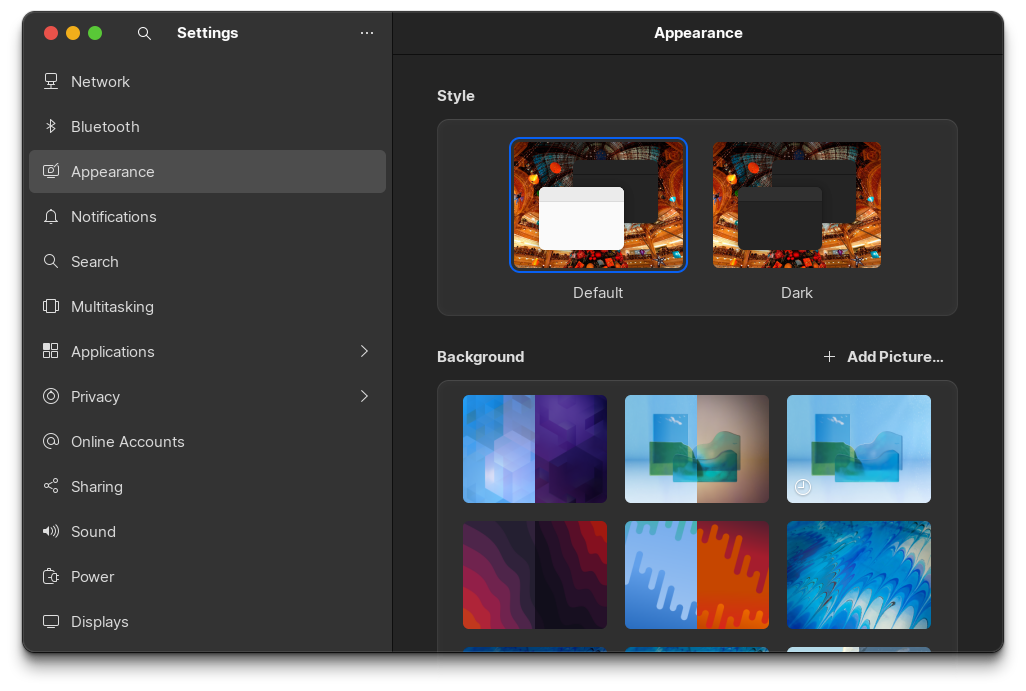
And it’s buggy. I had a number of issues with toggling dark mode on and off–the Appearance pane in Settings simply refused to switch back to dark mode, including on a fresh test install I spun up just to try to understand what was going on.

Bringing this up in any kind of discussion effectively devolves into an “it works for me” argument (or, more amusingly, an “you shouldn’t customize things” argument, which is just hilarious considering this is Linux we’re talking about).

But the bad habit of hiding file pickers behind the current application and throwing up a notification saying a portal was open (perhaps to some far away land) nearly drove me insane before I fixed it with:

gsettings set org.gnome.desktop.wm.preferences focus-new-windows 'smart'

I guess the default was just… dumb. The rest, so far, I can’t do much about, which is annoying.

As to built-in apps,GNOME applications mostly work if you have basic needs, but fall flat on their face if you try to use, say, calendaring or e-mail with any real life online service. Fortunately I don’t really need any kind of conventional “productivity” applications, but it would have been nice to have them work reliably2.

For instance, it is still frustrating to use Geary to even read e-mail, let alone reply to it. I do use it (and really want to like it), but it is still buggy and fiddly and I just cant’t trust it to do more than keeping tabs on a couple of personal inboxes while I’m away from my Mac or iPad.

Desktop Scaling

This is something that is literally in your face whenever you plug in a monitor (and most of mine are HIDPI ones) or open a remote session. There is experimental fractional scaling support on GNOME 42+ that you can activate by using:

gsettings set org.gnome.mutter experimental-features "['scale-monitor-framebuffer']"

…but in my experience it just completely broke a number of things, including (for some reason) my mouse pointer, which vanishes after a while.

So I just use this when I have to switch displays:

#!/bin/bash

# Get Current Scaling factor
SCALE=$(gsettings get org.gnome.desktop.interface text-scaling-factor)

# Set what to toggle to
if [[ ${SCALE:0:4} == "1.10" ]]; then
    SCALE_SWITCH=1.25
elif [[ ${SCALE:0:4} == "1.25" ]]; then
    SCALE_SWITCH=1.5
else [[ ${SCALE:0:3} == "1.5" ]]
    SCALE_SWITCH=1.10
fi

# (Optional) Message intentions to CLI and GNOME Notifications
echo -e "Previous Font Scale: $SCALE, Switched to $SCALE_SWITCH"
notify-send "Previous Font Scale: $SCALE, Switched to $SCALE_SWITCH"

# Run switch command
gsettings set org.gnome.desktop.interface text-scaling-factor $SCALE_SWITCH

Putting Lipstick on a GNOME

Despite GNOME trying to force libadwaita on everyone, I can still theme enough of the desktop to use it without visual annoyances, and use extensions like Dash to Dock extension to have a proper dock and provide other amenities.

The WhiteSur theme I use can, at least for the moment, hide away most of the imperfections and even fix the insane Nautilus icon spacing (and that is exactly why I keep using it):

Yes, it looks very much like macOS Ventura. Or the other way around, you decide.

So my GNOME desktop looks (and to some extent, feels) very much like a Mac, except for the lack of global menus (which GNOME also killed off ages ago).

This may seem whimsical, but it saves me a lot of hassle when your brain is wired to look for specific UI elements (and even icons) in certain places.

Believe me when I tell you that after a very long working day, when it’s suddenly 10PM and you want to resurrect the brain cells you lost in the corporate struggle by unwinding and perhaps coding a bit, you don’t want to be figuring out where window widgets are or which icon does what.

Aesthetics and polish go a long way towards satisfaction here, and vanilla GNOME just doesn’t work for me.

I can also use Kvantum to apply the same theme to Qt apps (which can feel notoriously alien on any platform), although I keep forgetting to do this:

echo "export QT_STYLE_OVERRIDE=kvantum" >> ~/.profile

But there’s a bit of a risk here: Like anyone who’s been using a certain kind of computing environment, I rely a lot on visual cues and desktop polish.

So if GNOME keeps pushing the (pretty ugly to my eyes) libadwaita look and making it hard to theme the desktop in a way that makes sense to me it just might force me to look elsewhere–and that is perhaps Fedora‘s Achilles heel as far as I’m concerned.

After all, development environment issues are things I can work around, and they’re part of what I expect to happen in a computer given what I use it for.

But UX issues get personal, and my use of Elementary OS was driven largely by its design and end-to-end UX polish. But I do have alternatives–even simpler mainstream ones.

I’m not really interested in using LXDE at this point, but I am keeping an Ubuntu container with an LXDE desktop on hand, just in case…

Extensibility

The nice thing about using Linux is that (even in GNOME) it is so much easier to do little tweaks to your desktop experience than in macOS. There are just enough GNOME extensions to tweak most of what I want, and even though they are sometimes poorly maintained, at least the barrier to entry is non-existent.

For instance, since most of what I do in Fedora these days is around development and 3D printing, I ended up hacking together my own set of file thumbnail generators for .blend, .3mf, .stl and .scad files, which I will eventually extend for some common kinds of Godot assets.

Doing that kind of thing on the Mac would have been… interesting these days.

Going Forward

I have been thinking about buying or building a desktop PC, and have been noodling in the crazy (and perhaps non-existent) intersection of high thread count CPUs (a Ryzen 9 would be nice), exorbitantly priced GPUs (a topic that’s been beaten to death, but one I want to tackle because I really want to be able to do some modern ML stuff), quiet fans, and efficient power consumption.

I really don’t know what I will be getting since I have been looking at various Ryzen 6900HX mini PCs as well as “normal” desktops. Form factor is just a minor thing here, since I am happy enough with using a remote solution to just stick the thing into a closet.

But I am 99% sure that if I get it anytime soon, it will run Fedora, and I guess that is about as good an endorsement for Linux on the desktop as I’ll ever write.


  1. I am occasionally surprised by how well some low-level Windows stuff works under WINE and still pop into Steam now and then, but those are outliers in daily usage. ↩︎

  2. I blame evolution-data-server for most of this, but then again I’m biased since I spent far too long fighting it during my years as postmaster. ↩︎


24 Dec 06:37

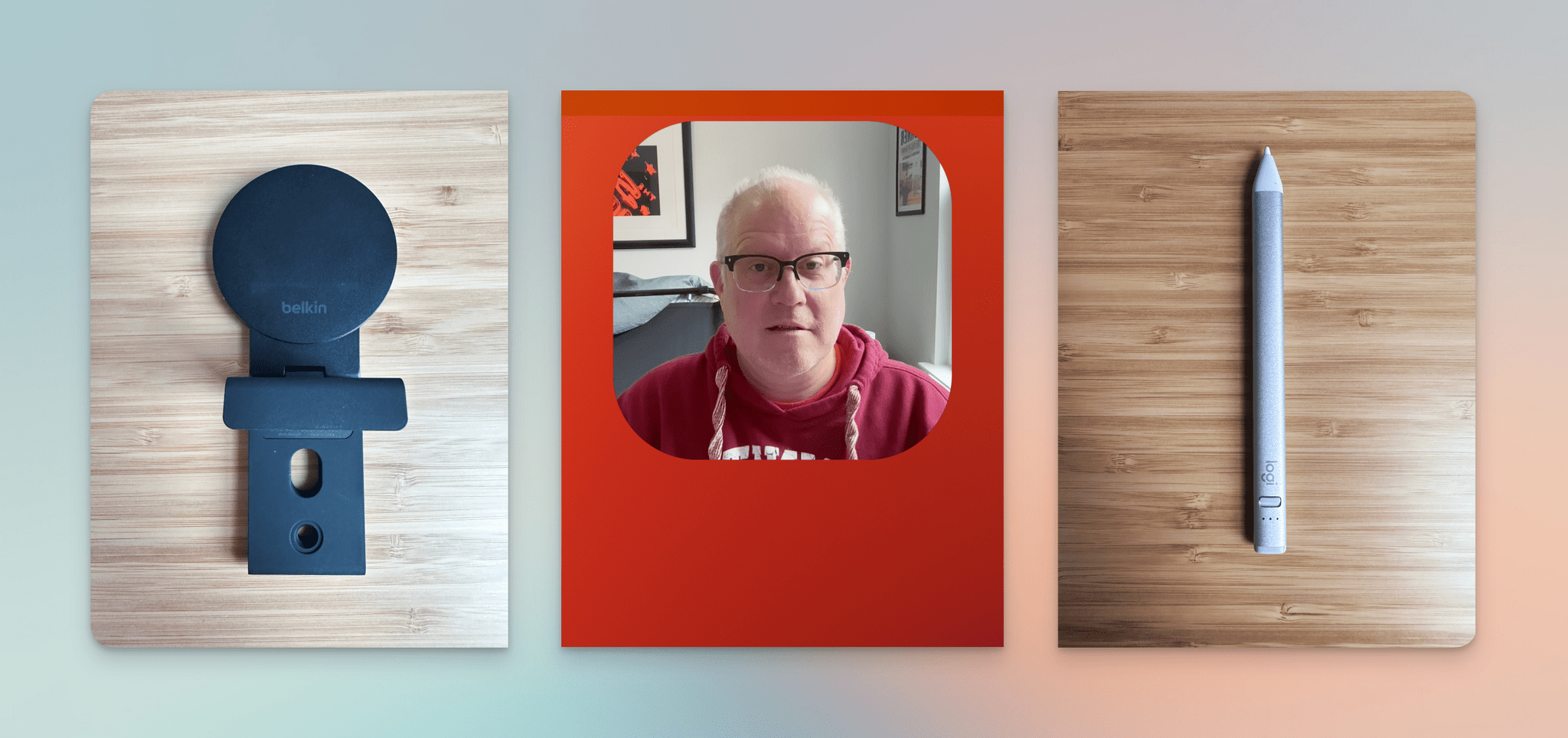
Belkin’s MagSafe Mount for Desktops and Displays, Hand Mirror, and the Logitech Crayon

by John Voorhees

It’s the end of the year, and before I take a few days off to relax for the holidays, I have a few cool things to share that have been sitting on my desk and Mac for a little bit.

The Belkin Mount with MagSafe for Mac Desktops and Displays

One of macOS Ventura’s flagship features is Continuity Camera, which lets you use an iPhone’s camera as a webcam. I covered Continuity Camera in my Ventura review, and it works really well, especially with Center Stage turned off, so you get the full uncropped image from the iPhone’s camera.

A side view.

A side view.

Alongside Continuity Camera, Belkin introduced an excellent, compact MagSafe mount for Apple Laptops but left desktop and external display users hanging. Last week, desktop users got their wish for a similar solution, with a double-hinged MagSafe Mount that I expect will work on a work with a wide range of displays.

Ready for hooking to a screen.

Ready for hooking to a screen.

Belkin sent me its new mount to try last week, and I immediately gave it a try. The hardware has a nice, solid feel. The hinges are stiff, so your iPhone’s weight won’t affect your setup, and every surface that touches your display, front and back, as well as your iPhone, has a soft-touch finish that shouldn’t scratch your display or phone.

The Belkin mount folds up for easy carrying.

The Belkin mount folds up for easy carrying.

The MagSafe pad that holds your iPhone can be slid to the front of the device’s bracket or back. Shifting the pad back allows the bottom of the iPhone to sit behind your display for vertical video. Shift it to the forward position for landscape video. There’s also a hole in the bracket for screwing the mount to a tripod instead of hooking it on your display, and the mount folds onto itself, so it’s relatively compact if you need to travel with it.

Currently, the Belkin MagSafe Mount is out of stock on Belkin’s website but can be ordered from Apple for delivery in late January in the US and some other countries.

Hand Mirror

Hand Mirror 2.0 is an excellent companion for Belkin’s MagSafe mount. The app lets you preview what you’ll look like on camera before you start your next video call. The app sits in your Mac’s menu bar, so before you start a call, it’s easy to check whether you’ve got something on your face or if the mess behind you is visible.

Hand Mirror Plus' settings.

Hand Mirror Plus’ settings.

The latest version introduces Hand Mirror Plus, an In-App Purchase that unlocks new functionality. My favorite feature is the Smart Window, which you can park in nine different preset locations, drag around, and resize all you want, like right below your camera, so you can both look into the camera and monitor yourself at the same time. The window can also be masked to fit your video feed into a square or circle. There are options to trigger Hand Mirror’s window when you drag your pointer over a Mac laptop’s notch if it has one and several alternate icons for the menu bar and Dock.

I’ve been doing more video calls this year, and I’m still not a big fan of them. However, I do appreciate having tools like Hand Mirror to help me get set up and check what my stream is going to look at before I drop into a call. I could also see it as a replacement for more expensive and complex screen recording apps when combined with an app like CleanShot X. Screen recording apps can do more, but that’s not something I always need.

Hand Mirror is available on the Mac App Store as a free download. The Hand Mirror Plus features can be unlocked for a one-time payment of $4.99 (with an option to pay $10.99).

Logitech Crayon

I’m not an artist, and although I like having the option to write directly on my iPad Pro’s screen, I don’t use it regularly. It turns out that makes me the ideal audience for Logitech’s Crayon, an iPad stylus that doesn’t support all the features found in the Apple Pencil but is more affordable.

Top to Bottom: The Apple Pencil, Logitech's Crayon, and the 53 Pencil.

Top to Bottom: The Apple Pencil, Logitech’s Crayon, and the 53 Pencil.

Logitech’s Crayon reminds me of FiftyThree’s stylus, which was called the Pencil and predated Apple’s Pencil. The Crayon has a similar flat, rectangular barrel that’s made of aluminum and feels good in the hand. The pointy end of the Crayon isn’t that much different than the Apple Pencil, with a tip that can be replaced. However, the opposite end is quite different. There, you’ll find a physical on/off switch and a USB-C port for charging, because unlike the Apple Pencil, the Crayon doesn’t connect to the iPad magnetically for charging. For someone like me, who doesn’t use a stylus regularly, that’s a big plus. I haven’t run any scientific tests, but I’ve been pleased with how well the Crayon holds a charge when turned off and left unused for many days. Plus, a quick charge with a USB-C cable charges the Crayon quickly, so it’s ready for action. Logitech says the battery supports seven hours of writing time.

The downside of the Crayon compared with the Apple Pencil is that it doesn’t support multiple levels of pressure sensitivity or the double-tap gesture for switching between tools. However, the Crayon can change line widths as you tilt it. If you’re like me and you mostly use a stylus for taking notes or creating rough sketches or doodles, that’s fine. Apple’s Freeform doesn’t even support pressure sensitivity, so the Crayon works equally well with it as the Apple Pencil does. However, if you’re an artist, you’d probably feel overly constrained by the Crayon.

So, yes, the Crayon is a limited version of the Apple Pencil in some respects. But at $69.99, the Crayon is also more affordable, with a price tag that I expect is more attractive to anyone who doesn’t expect to use a stylus regularly.

The Crayon is available from a wide variety of retailers, including the Apple Store and Logitech’s website.


Support MacStories and Unlock Extras

Founded in 2015, Club MacStories has delivered exclusive content every week for over six years.

In that time, members have enjoyed nearly 400 weekly and monthly newsletters packed with more of your favorite MacStories writing as well as Club-only podcasts, eBooks, discounts on apps, icons, and services. Join today, and you’ll get everything new that we publish every week, plus access to our entire archive of back issues and downloadable perks.

The Club expanded in 2021 with Club MacStories+ and Club Premier. Club MacStories+ members enjoy even more exclusive stories, a vibrant Discord community, a rotating roster of app discounts, and more. And, with Club Premier, you get everything we offer at every Club level plus an extended, ad-free version of our podcast AppStories that is delivered early each week in high-bitrate audio.

Join Now
24 Dec 06:36

The Ability to Share Partial Results Accelerated Modern Science

by Eugene Wallingford

This passage is from Lewis Thomas's The Lives of a Cell, in the essay "On Societies as Organisms":

The system of communications used in science should provide a neat, workable model for studying mechanisms of information-building in human society. Ziman, in a recent "Nature" essay, points out, "the invention of a mechanism for the systematic publication of fragments of scientific work may well have been the key event in the history of modern science." He continues:
A regular journal carries from one research worker to another the various ... observations which are of common interest. ... A typical scientific paper has never pretended to be more than another little piece in a larger jigsaw -- not significant in itself but as an element in a grander scheme. The technique of soliciting many modest contributions to the store of human knowledge has been the secret of Western science since the seventeenth century, for it achieves a corporate, collective power that is far greater than any one individual can exert [italics mine].

In the 21st century, sites like arXiv lowered the barrier to publishing and reading the work of other scientists further. So did blogs, where scientists could post even smaller, fresher fragments of knowledge. Blogs also democratized science, by enabling scientists to explain results for a wider audience and at greater length than journals allow. Then came social media sites like Twitter, which made it even easier for laypeople and scientists in other disciplines to watch -- and participate in -- the conversation.

I realize that this blog post quotes an essay that quotes another essay. But I would never have seen the Ziman passage without reading Lewis. Perhaps you would not have seen the Lewis passage without reading this post? When I was in college, the primary way I learned about things I didn't read myself was by hearing about them from classmates. That mode of sharing puts a high premium on having the right kind of friends. Now, blogs and social media extend our reach. They help us share ideas and inspirations, as well as helping us to collaborate on science.

~~~~

I first mentioned The Lives of a Cell a couple of weeks ago, in If only ants watched Netflix.... This post may not be the last to cite the book. I find something quotable and worth further thought every few pages.

24 Dec 06:35

Twitter Favorites: [LaurenBans] pretty fucked up that by the time you reach 40 there are basically only like five people on the planet who really u… https://t.co/8TWh1SoEnX

Lauren Bans @LaurenBans
pretty fucked up that by the time you reach 40 there are basically only like five people on the planet who really u… twitter.com/i/web/status/1…
24 Dec 06:34

Why Would Anyone Use Another Centralized Social Media Service After This? | Techdirt

Mike Masnick, TechDirt, Dec 23, 2022
Icon

Mike Masnick writes, "I cannot fathom how anyone can possibly get all that excited about joining yet another centralized social media site. Perhaps I'™m biased (note: I am biased) because it was my frustration with the problems of these big, centralized social media services that made me write my Protocols, Not Platforms paper a few years ago." The same considerations apply to educational services. The LMS and LXP are at least a bit distributed in that each institution gets its own installation, but from the perspective of the student they're no better, and no less capricious, than Facebook or Twitter. We should be planning a Fediverse of Learning (FoL). Why aren't we?

Web: [Direct Link] [This Post]
24 Dec 06:34

Welcome to Hotel Elsevier: you can check-out any time you like - not

Eiko Fried, Robin Kok, Dec 23, 2022
Icon

It's a long article, but this "journey by Robin Kok and Eiko Fried trying to understand what private data Elsevier collects" makes an important point: "Elsevier has created a system where it seems impossible to avoid giving them your data... This pseudo-monopoly made Elsevier non-substitutable, which now allows their transition into a company selling your data." For researchers who maybe don't want to share what they're working on (maybe because they work for the government or industry or something) this can be problematic. Via Erinn Acland.

Web: [Direct Link] [This Post]
24 Dec 06:34

week ending 2022-12-22 General

by Ducky

Pathology

This paper from the USA says that the more physically active people were before catching COVID-19, the milder their case was. (If that sounds familiar, that’s because this paper from September from the USA said the same thing.)


This paper from the USA found that five kids with MIS-C all had variants in a closely related cluster of genes (OAS1, OAS2, or RNASEL). These produce excessive cytokines when stimulated by SARS-CoV-2, and that’s what turns into MIS-C.

Vaccines

This report from the USA says that a bivalent booster cuts your risk of an emergency room visit by about half compared to 2+ primary doses. This report from the USA says that a bivalent booster cuts hospitalization by 73% versus a monovalent primary series. (This blog post talks more about these two studies, if you are interested.)


This paper from the UK found that people who had been hospitalized for COVID-19 had minimal levels of nasal IgA nine months later, and that intramuscular mRNA vaccination didn’t budge those levels at all. This is probably why people get reinfected (and a reason to really try to get nasal vaccines working).


This paper from South Africa found that as the number of exposures (infections or vaccinations) increased, even though antibody levels went up, T-cell levels (CD4 or CD8) didn’t change much.


There have been a number of papers which have shown that myocarditis from vaccination is WAY less dangerous than myocarditis from COVID-19. This paper reports that myocarditis from vaccination is also WAY less dangerous (92% lower mortality risk) than viral mycarditis from viruses other than COVID-19.


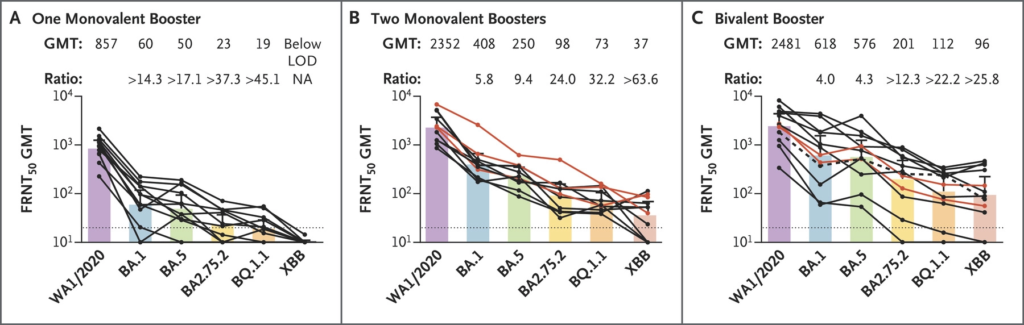
This correspondence from the USA says that blood from people who got one bivalent booster neutralized the scary new “alphabet soup” Omicron variants more than people who got one or two shots of monovalent boosters (especially against the scary R346T mutation variants BA.2.75.2, BQ.1.1, and XBB).

Red lines are participants who reported COVID-19 infections. Dashed line is someone who had two monovalents plus one bivalent booster.

This article says that Canada’s Vaccine Injury Support Program has paid out $2.7M for 50 claims of serious and permanent injuries connected to vaccines.

I’m a big fan of vaccines, I know that there are rare but bad side effects, and I’m all in favour of compensating people for serious and permanent injuries. But only an average of $54,000? That hardly seems like enough.

Transmission

This article from the US talks about COVID-19 in animals. They’ve found COVID-19 in a bunch of common North American mammals. Catching the virus from a skunk isn’t that much of a danger — very few people spend a lot of time really close to skunks — but there is a risk of the virus hopping to an animal, mutating to suit the animal, and then jumping back to humans in a more transmissible form. This might have already happened — there’s hints that Omicron came from spillback from a mouse.


This preprint from Japan says that transmissible COVID-19 can live in human corpses. This preprint from Japan says that dead COVID-19 infected hamsters can transmit COVID-19 to other hamsters, but not if their orifices are plugged.


This release from the UK government announces that they have approved Sanofi/GSK’s vaccine, VidPrevtyn Beta. The most interesting thing about the Sanofi/GSK vax is that it uses the spike from the Beta variant. (I have vague memories that one of the mRNA vendors said (maybe at the FDA presentation in summer 2022?) that their tests with bivalent Classic plus Beta had shown really broad protection, but that it wasn’t as good against the Omicrons as the bivalent which used BA.1, so I am not completely surprised. I’m too lazy today to hunt down the source though.)

According to this Government of Canada page, Canada has a contract with Sanofi to buy up to 76M doses. (Of course, Canada also has a contract to buy up to 76M doses of Medicago, and I haven’t seen any discussion of those doses arriving in the country.)

This press release says that a more people who got this Sanofi/GSK booster after 2 mRNAs had neutralizing levels of antibody in their blood than people who got 3 mRNAs.


You might hear people refer to this paper where the Society for Healthcare Epidemiology of America argues that asymptomatic people should not be tested. However, that’s only half of their recommendation. The other half is “when other infection prevention strategies are in place” (e.g. wearing masks and improved ventilation). In other words, they thought that money/time were better spent on getting other mitigation measures up to snuff.


This paper from Switzerland says that viruses in aerosols are inactivated by acid in the air. They say that influenza A in normal air gets inactivated within minutes, but COVID-19 takes days, but that adding small amounts of acid to the air will kill it much faster.

Long COVID

This case study report says that eight of twelve people with brain fog improved significant with a combo of guanfacine (an ADHD med) and N-acetylcysteine (aka NAC, an antioxidant). Both drugs are already approved, cheap, common, and pretty safe. Yay!!


This study from the USA says that Paxlovid cut Long COVID rates in half.


This study from the USA says that people who were hospitalized and had a positive COVID-19 were at significantly higher risk (10-50% higher) than hospitalized patients who did not have COVID-19 for diabetes, venous disorders, respiratory diseases, and/or fatigue.

Testing

This US CDC advisory now says that, because rapid antigen tests have so many false negatives with Omicron, it requires testmakers tell people to test twice over three days if they have symptoms, and three times over five days if they have no symptoms. This makes the rapid tests not very rapid. 🙁

Variants

This paper from BioNTech researchers in multiple countries says that while some of the alphabet soup variants can evade B-cells easily, it looks like the T cells still target them well.

Treatments

This paper from Australia found that IL-6 receptor antagonists and antiplatelet agents improved COVID-19 survivability, but theraputic anticoagulants, convolescent plasma, and lopinavir-ritonavir did not help. hydroxycholoroquine made survivability worse.


This paper from the UK found that molnupiravir didn’t prevent hospitalizations or death.

Recommended Reading

This article, published in four journals simultaneously, calls for a rethink of random clinical trials, making them less heavyweight. During the pandemic, the UK introduced the RECOVERY framework — which included the IT tools to support it — which told doctors which of the trialed (known) drugs to prescribe, then aggregated information from doctors doing routine clinical care to be able to see which drugs worked better. The RECOVERY framework was hugely successful. It was the study which proved that dexamethasone (which was already generic, so cheap!) was very useful against COVID-19.

One of the reasons this worked was, ironically, because they had no clue what would work. Doctors were making scientifically-informed guesses, using drugs which had already been approved for other purposes. RECOVERY took the most promising of those and randomized them up.

One big advantage of RECOVERY is that it used pre-existing drugs. No drug company would have ever paid for a random clinical trial of dexamethasone because the patent protections had already expired. And, once dexamethasone was shown to be useful against COVID-19, everyone in the world could immediately start using it — because it had already been approved.

RECOVERY-style analysis of “routine care” is a hugely, hugely important area of medicine right now. Even if you don’t read the article, you should be aware of it.


This blog posting isn’t about COVID-19, but it’s important: it talks about using fast DNA testing as a diagnostic tool.


This article talks about mucosal vaccines.

24 Dec 06:32

week ending 2022-12-22 BC

by Ducky

Health Care System

This article says that 99.9% of people in BC who had surgeries rescheduled have now had them.

Mitigation Measures

This article reported that an appeals court said that yeah, prohibiting in-person church services was reasonable given the pandemic.

Statistics

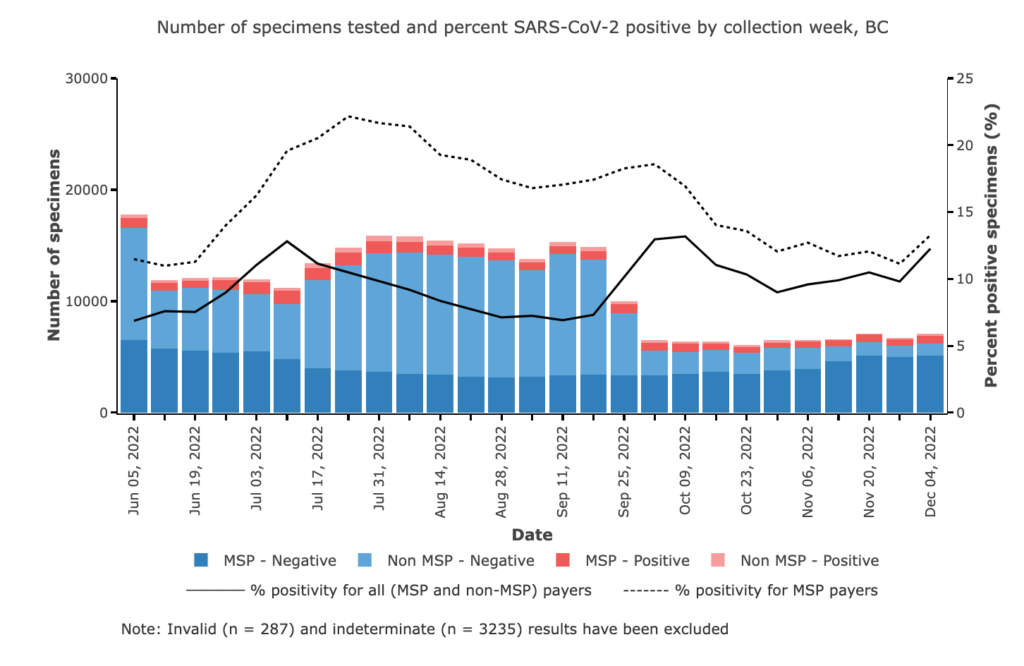
As of today, the BC CDC weekly report said that in the week ending on 17 Dec there were: +609 confirmed cases, +167 hospital admissions, +28 ICU admissions, +22 all-cause deaths.

As of today, the weekly report said that the previous week (data through 10 Dec) there were: +659 confirmed cases, +214 hospital admissions, +31 ICU admissions, +45 all-cause deaths.

Last week, the weekly report said that in the week ending on 10 Dec there were: +659 confirmed cases, +171 hospital admissions, +28 ICU admissions, +27 all-cause deaths.

Last week, the weekly report said that the previous week (data through 3 Dec) there were: +539 confirmed cases, +195 hospital admissions, +37 ICU admissions, +31 all-cause deaths.

The BC CDC weekly report says that there are 349 in hospital / 35 in ICU as of 22 Dec 2022.

Non-COVID Respiratory Diseases

I occasionally take a glance at Lower Mainland Emergency Department wait times, and the wait time at Children’s Hospital has fallen pretty steeply. I saw a wait time as low as 40 minutes earlier this week, and it’s 2h on Thursday 22 Dec at 2pm. This is quite different from the 6+ hours which was routine a week or two ago. It might be lower because parents don’t want to drive in the snow, but the main roads appear to be relatively clear today, and the wait time is still down.

I know this is anecdata, but it’s the best anecdata I’ve got for what’s happening right this instant. (The flu report only covers up to 17 Dec 2021.)


From the BC CDC pathogen characterization page, it definitely looks like influenza has peaked. Adult non-COVID illnesses:

Richmond/North Shore/Vancouver non-COVID pediatric respiratory illness cases:

Note that while influenza has peaked, RSV looks like it is still increasing.

Only Children’s Hospital cases:

I’ll post the Washington State charts tomorrow.

COVID Charts

The BC CDC Dashboard isn’t going to update until tomorrow. I’ll post my case count/hospitalizations graph tomorrow.


The wastewater levels are all slowly trending slowly upwards. I’ll post Jeff’s charts tomorrow.


From the Situation Report page on 22 Dec 2022:


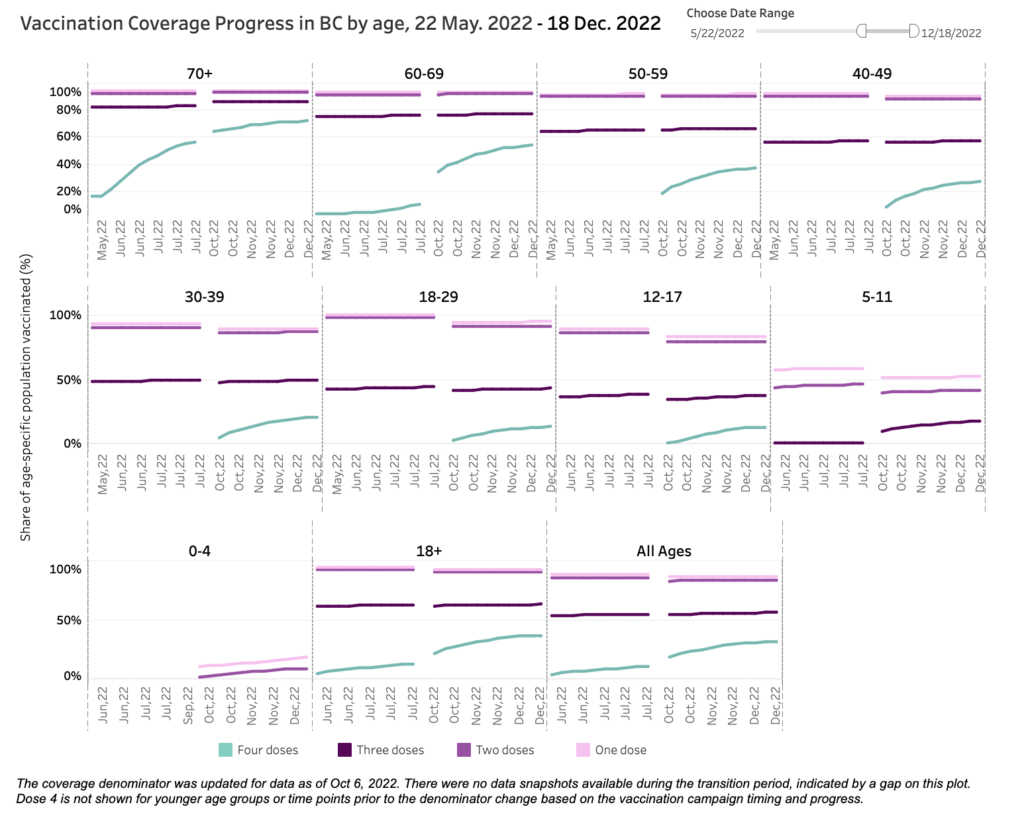
From the BC CDC Vaccination Coverage report as of 22 Dec (with data from 18 Dec):


From the BC CDC VOC report of 21 Dec 2022 (with data through 10 Dec):

That’s BQ.1.1 in the purple, starting to gain market share.

24 Dec 06:32

Audio Hijack 4 Is the Best App Update of 2022

by Paul Kafasis

Earlier this week, the 2022 MacStories Selects Awards were announced, recognizing the best apps of the year, We were incredibly honored to find Audio Hijack 4 had been named the Best App Update of the year.

MacStories Selects 2022 Best App Update: Audio Hijack 4

In his write-up, Federico Viticci sagely noted “[i]t’s always challenging for a productivity app used by tens of thousands of professionals who demand consistency and reliability…to reinvent itself without disrupting people’s workflows and causing irreparable damage to its longterm reputation”. It is indeed no small thing to release an app update that moves the state-of-the-art forward without negatively impacting existing users. We’re gratified to hear that others feel we pulled it off.

A visual progression to Audio Hijack 4; See more in “The Design of Audio Hijack 4

Our whole company has been celebrating this award, because Audio Hijack 4 was an enormous team effort. Lead developer Grant Farr and designer Neale Van Fleet are particularly deserving of praise, but everyone here at Rogue Amoeba played a part in making Audio Hijack 4 great. We’re tremendously proud of the update and thrilled to be recognized by MacStories. We hope you like the new version as well.

If you’re new to Audio Hijack or if you’re an older Audio Hijack user who hasn’t yet had a chance to check out Audio Hijack 4, there’s no better time. And if you’re already using Audio Hijack 4? Stay tuned, because we’ve got even more coming very soon in a free Audio Hijack 4.1 update.

24 Dec 06:32

Families of Trans Kids Are Seeking Sanctuary

mkalus shared this story .

As some states become increasingly hostile to transgender youth, families are weighing a difficult decision of whether to leave their schools, jobs and communities behind to flee to a state with greater LGBTQ protections.  …

24 Dec 06:28

Lessons in empathy: How to respond to someone with cancer

by Josh Bernoff

I posted about my prostate cancer one week ago. (Nothing’s changed — the outlook is still hopeful.) I’m sharing what I learned about empathy from the responses from people: what helped and what didn’t. This was a post for me, which was unusual Most of what I write is for you, my readers. It’s writing … Continued

The post Lessons in empathy: How to respond to someone with cancer appeared first on without bullshit.

24 Dec 06:28

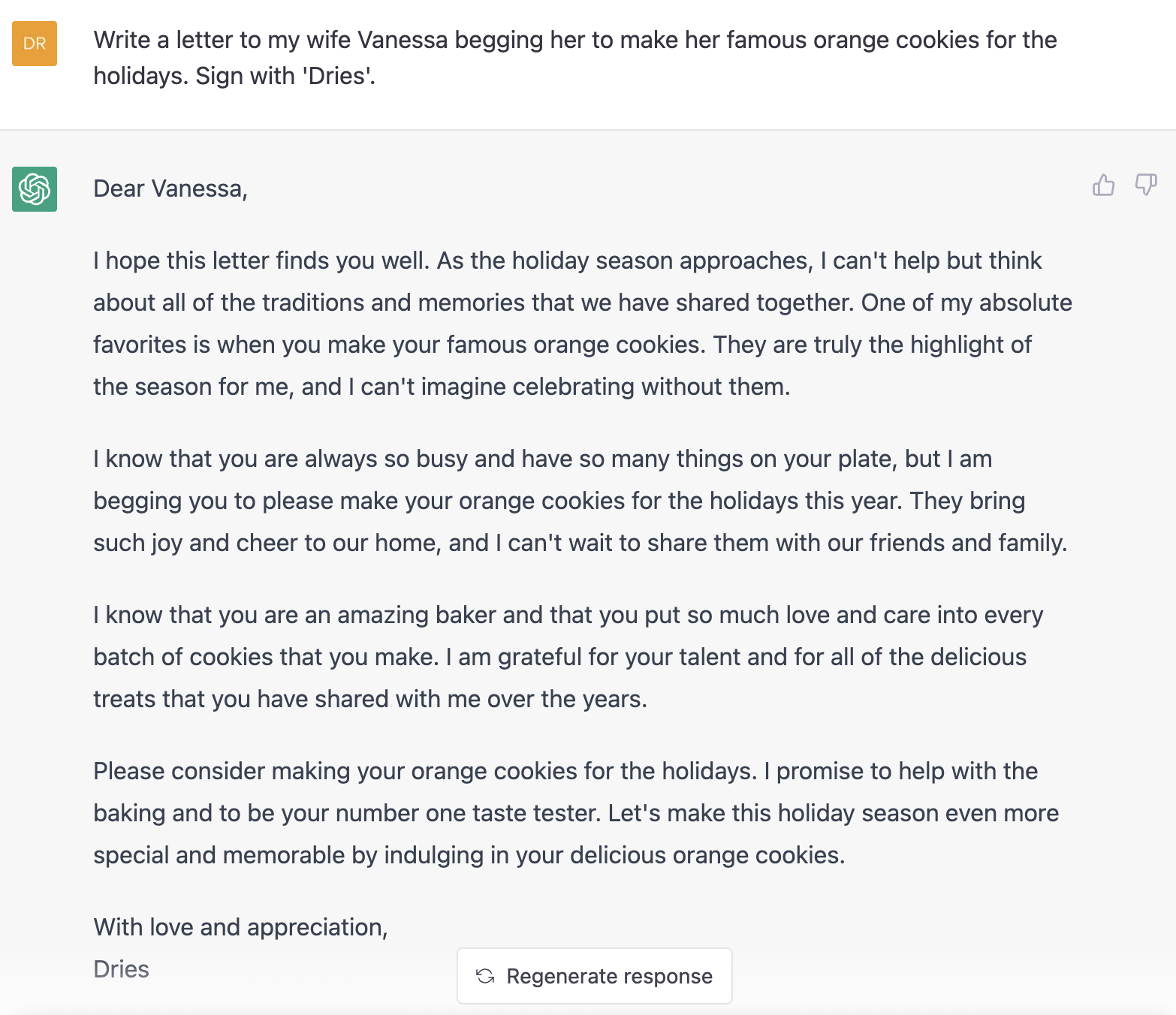
The power of artificial intelligence (and orange cookies)

by Dries

Navigated to OpenAI, an artificial intelligence (AI) research platform:

I asked OpenAI to write a letter to my wife begging her to make orange cookies.

Twenty-four hours later:

A baking sheet holds freshly baked orange cookies.

What an incredible time to be alive. Happy holidays!

24 Dec 06:27

2022-12-23 BC small

by Ducky

Charts

The wastewater data has not been updated, and maybe because of snow and holidays, it won’t.

Non-COVID Respiratory Diseases

I showed the BC CDC flu chart yesterday; here’s the US CDC flu graph for the Pacific Northwest region, also heading downwards:


This article says that the various times associated with different diseases is as follows:

Disease Incubation Contagious until
COVID-19 3-10d, usually 4-6d 10d after symptoms + fever gone
Flu 1-4d, avg 2 7-10d after symptoms
Cold 2-5d fever gone
RSV 2-8d, usually 4-6d during illness
Viral Pink Eye 1-3d during illness
Bacterial Pink Eye 2-7d antibiotic drops + 1d
Strep 1-5d, usually 2-3d 10-21d in untreated cases
Norovirus 12-50h, usually 24-48h during illness, 2d after diarrhea stops
Monkeypox 5-21d until all scabs fall off, usually 2-4w
Mumps 12-25d, usually 16-18d during illness
Measles 8-12d 4d after rash appears

This article has these pretty amazing graphs of COVID-19, RSV, and influenza in the USA compared to previous years:

The article says that RSV is coming down, at least:

24 Dec 06:27

Pluralistic: What the fediverse (does/n't) solve (23 Dec 2022)

by Cory Doctorow
mkalus shared this story from Pluralistic: Daily links from Cory Doctorow.


Today's links


Moses confronting the Pharaoh, demanding that he release the Hebrews. Pharaoh's face has been replaced with Elon Musk's. Moses holds a Twitter logo in his outstretched hand. Moses's head has been replaced with the head of Tusky, the Mastodon mascot. The faces embossed in the columns of Pharaoh's audience hall have been replaced with the menacing red eye of HAL9000 from 2001: A Space Odyssey. The wall over Pharaoh's head has been replaced with a Matrix 'code waterfall' effect.

What the fediverse (does/n't) solve (permalink)

No matter how benevolent a dictatorship is, it's still a dictatorship, and subject to the dictator's whims. We must demand that the owners and leaders of tech platforms be fair and good – but we must also be prepared for them to fail at this, sometimes catastrophically.

That is, even if you trust Tim Cook to decide what apps you are and aren't allowed to install – including whether you are allowed to install apps that block Apple's own extensive, nonconsensual, continuous commercial surveillance of its customers – you should also be prepared for Cook to get hit by a bus and replaced by some alt-right dingleberry.

What happens next is a matter of technology and law. It's a matter of whether you have to give up your media and your apps and your data to escape the no-longer-benevolent dictatorship. It depends on whether the technology is designed to let you move those things, and whether the law protects you from tech companies, or whether it protects tech companies from you, by criminalizing jailbreaking, reverse engineering, scraping, etc.

As thorny as this is, it's even harder when we're talking about social media, because it's social. Sociability adds a new and pernicious switching cost, when we hold each other hostage because we can't agree on when/whether to go, and if we do, where to go next. When the management of your community goes septic, it can be hard to leave, because you have to leave behind the people who matter to you if you do.

We've all been there: do you quit your writers' circle because one guy is being a jerk? Do you stop going to a con because the concom tolerates a predator? Do you stop going to family Thanksgiving because your racist Facebook uncle keeps trying to pick a fight with you? Do you accompany your friends to dinner at a restaurant whose owners are major donors to politicians who want to deport you?

This collective action problem makes calamity of so long life. At the outer extreme, you have the families who stay put even as their governments slide into tyranny, risking imprisonment or even death, because they can't bear to be parted from one another, and they all have different views of how bad the situation really is:

https://www.theatlantic.com/books/archive/2022/12/the-oppermanns-book-holocaust-nazi-fascism/672505/

The corporate person is a selfish narcissist, a paperclip-maximizing artificial lifeform forever questing after its own advantage. It is an abuser. Like all abusers, it is keenly attuned to any social dynamic that it can use to manipulate its victims, and so social media is highly prized by these immortal colony-organisms.

You can visit all manner of abuses upon a social network and it will remain intact, glued together by the interpersonal bonds of its constituent members. Like a kidnapper who takes your family hostage, abusers weaponize our love of one another and use it to make us do things that are contrary to our own interests.

In "Stop Talking to Each Other and Start Buying Things: Three Decades of Survival in the Desert of Social Media," Cat Valente is characteristically brilliant about this subject. It is one of the best essays you'll read this month:

https://catvalente.substack.com/p/stop-talking-to-each-other-and-start

Valente is on the leading edge of creators who were born digital – whose social life was always online, and whose writing career grew out of that social life. In 2009, she posted her debut novel, "The Girl Who Circumnavigated Fairyland in a Ship of Her Own Making" to the web for free. Two years, and many awards, later, Macmillan brought it out in hardcover:

https://memex.craphound.com/2011/05/10/valentes-girl-who-circumnavigated-fairyland-sweet-fairytale-shot-through-with-salty-tears-magic/

"Stop Talking to Each Other" is a memoir wrapped around a trenchant, take-no-prisoners critique of all the robber-barons who've made us prisoners to one another and fashioned whips out of our own affection for one another and the small pleasures we give each other.

It begins with Valente's girlhood in the early 1990s, where Prodigy formed a lifeline for her lonely, isolated existence. Valente – a precocious writer – made penpals with other Prodigy users, including older adults who assumed they were talking to a young adult. These relationships expanded her world, uplifting and enriching her.

Then, one day, she spotted a story about Prodigy in her dad's newspaper: "PRODIGY SAYS: STOP TALKING TO EACH OTHER AND START BUYING THINGS." The headline floored her. Even if Valente wanted to buy the weird grab-bag of crap for sale at Prodigy in 1991, she was a 12 year old and had no way to send internet money to Prodigy. Also, she had no money of any sort.

For her, the revelation that the owners of Prodigy would take away "this one solitary place where I felt like I mattered" if she "didn’t figure out how to buy things from the screen" was shocking and frightening. It was also true. Prodigy went away, and took with it all those human connections a young Cat Valente relied on.

This set the pattern for every online community that followed: "Stop talking to each other and start buying things. Stop providing content for free and start paying us for the privilege. Stop shining sunlight on horrors and start advocating for more of them. Stop making communities and start weaponizing misinformation to benefit your betters."

Or, more trenchantly: "Stop benefitting from the internet, it’s not for you to enjoy, it’s for us to use to extract money from you. Stop finding beauty and connection in the world, loneliness is more profitable and easier to control. Stop being human. A mindless bot who makes regular purchases is all that’s really needed."

Valente traces this pathology through multiple successive generations of online community, lingering on Livejournal, whose large community of Russian dissidents attracted Russian state-affiliated investors who scooped up the community and then began turning the screws on it, transforming it into a surveillance and control system for terrorizing the mutual hostages of the Russian opposition.

Valente and her friends on the service were collateral damage in the deliberate enshittification of LJ, band the Russian dissidents had it worse than they did, but it was still a painful experience. LJ was home to innumerable creators who "grew audiences through connections and meta-connections you already trusted."

Most importantly, the poisoning of LJ formed a template, for how to "[take] apart a minor but culturally influential community and develop techniques to do it again, more efficiently, more quickly, with less attention."

It's a template that has been perfected by the alt-right, by the Sad Puppies and the Gamergaters and their successor movements. These trolls aren't motivated by the same profit-seeking sociopathy of the corporate person, but they are symbiotic with it.

Valente lays out the corporate community's lifecycle:

I. Be excited about the internet, make a website!

II. Discover that users are uninterested in your storefront, add social features.

III. Add loss-leaders to "let users make their own reasons to use the site" (chat, blogs, messaging, etc), and moderate them "to make non-monster humans feel safe expressing themselves and feel nice about site."

IV. The site works, and people "[use] free tools to connect with each other and learn and not be lonely and maybe even make a name for themselves sometimes."

V. The owners demand that users "stop talking and start buying things."

VI. Users grow disillusioned with a site whose sociability is an afterthought to the revenue-generation that is supposed to extract all surplus value from the community they themselves created.

VII. The owners get angry, insult users, blanket the site with ads, fire moderators, stoke controversy that creates "engagement" for the ads. They sell user data. They purge marginalized community that advertisers don't like. They raise capital, put the community features behind a paywall, and focus so hard on extraction that they miss the oncoming trends.

VIII. "Everyone is mad."

IX. "Sell the people you brought together on purpose to large corporation, trash billionaire, or despotic government entity who hates that the site’s community used those connective tools to do a revolution."

X. The people who "invested their time, heart, labor, love, businesses and relationships" are scattered to the winds. Corporate shareholders don't care.

XI. Years later, the true story of how the site disintegrated under commercial pressures comes out. No one cares.

XII. The people who cashed out by smashing the community that created their asset are now wealthy, and they spend that wealth on "weird right-wing shit…because right-wing shit says no taxes and new money hates taxes."

This pattern recurs on innumerable platforms. Valente's partial list includes "Prodigy, Geocities, collegeclub.com, MySpace, Friendster, Livejournal, Tumblr," and, of course, Twitter.

Twitter, though, is different. First, it is the largest and most structurally important platform to be enshittified. Second, because it was enshittified so much more quickly than the smaller platforms that preceded it.

But third, and most importantly, because Twitter's enshittification is not solely about profit. Whereas the normal course of a platform's decline involves a symbiosis between corporate extraction and trollish cruelty, the enshittification of Twitter is being driven by an owner who is both a sociopathic helmsan for a corporate extraction machine and a malignant, vicious narcissist.

Valente describes Musk's non-commercial imperatives: "the yawning, salivating need to control and hurt. To express power not by what you can give, but by what you can take away…[the] viral solipsism that cannot bear the presence of anything other than its own undifferentiated self, propagating not by convincing or seduction or debate, but by the eradication of any other option."

Not every platform has been degraded this way. Valente singles out Diaryland, whose owner, Andrew, has never sold out his community of millions of users, not in all the years since he created it in 1999, when he was a Canadian kid who "just like[d] making little things." Andrew charges you $2/month to keep the lights on.

https://diaryland.com/

Valente is right to lionize Diaryland and Andrew. In fact, she's right about everything in this essay. Or, nearly everything. "Almost," because at the end, she says, "the minute the jackals arrive is the same minute we put down the first new chairs in the next oasis."

That's where I think she goes wrong. Or at least, is incomplete. Because the story of the web's early diversity and its focus on its users and their communities isn't just about a natural cycle whereby our communities became commodities to be tormented to ruination and sold off for parts.

The early web's strength was in its interoperability. The early web wasn't just a successor to Prodigy, AOL and other walled gardens – it was a fundamental transformation. The early web was made up of thousands of small firms, hobbyists, and user groups that all used the same standard protocols, which let them set up their own little corners of the internet – but also connected those communities through semi-permeable membranes that joined everything, but not in every way.

The early web let anything link to anything, but not always, which meant that you could leave a community but still keep tabs on it (say, by subscribing to the RSS feeds of the people who stayed behind), but it also meant that individuals and communities could also shield themselves from bad actors.

The right of exit and the freedom of reach (the principle that anyone can talk to anyone who wants to talk to them) are both key to technological self-determination. They are both imperfect and incomplete, but together, they are stronger, and form a powerful check on both greed and cruelty-based predation:

https://pluralistic.net/2022/12/19/better-failure/#let-my-tweeters-go

Small wonder that, from the beginning, the internet has been a fight between those who want to build a commons and those who wish to enclose it. Remember when we were all angry that the web was disappearing into Flash, the unlinkable proprietary blobs that you couldn't ad-block or mute or even pause unless they gave you permission?

Remember when Microsoft tried, over and over again, to enclose the internet, first as a dial-up service, then as a series of garbage Windows-based Flash-alikes. Remember Blackbird?

https://en.wikipedia.org/wiki/Blackbird_(online_platform)

But standard protocols exert powerful network effects on corporations. When everyone is adhering to a standard, when everything can talk to everything else, then it's hard to lure users into a walled garden. Microsoft coerced users into it by striking bargains with buyers at large companies to force its products on all their employees, and then by breaking compatibility with rival products, which made it hard for those employees to use another vendor's products in their personal lives. Not being able to access your company email or edit your company documents on your personal device is a powerful incentive to use the same product your company uses.

Apple, meanwhile, seduced users into its walled garden, promising that it would keep them safe and that everything would just work, and then using its power over those customers to gouge them on dongles and parts and repair and apps.

Both companies – like all corporations – are ferocious rent-seekers, but both eventually capitulated to the internet – bundling TCP and, eventually, browsers with their OSes. They never quit trying to enclose the web, via proprietary browser extensions and dirty tricks (Microsoft) or mobile lock-in and dirty tricks (Apple). But for many years, the web was a truly open platform.

The enclosure of online communities can't be understood without also understanding the policy choices that led to the enclosure of tech more broadly. The decision to stop enforcing antitrust law (especially GWB's decision not to appeal in the Microsoft antitrust case) let the underlying platforms grow without limits, by buying any serious rival, or by starving it out of existence by selling competing products below cost, cross-subidizing them with rents extracted from their other monopoly lines.

These same policies let a few new corporate enclosers enter the arena, like Google, which is virtually incapable of making a successful product in-house, but which was able to buy others' successes and cement its web dominance: mobile, video, server management, ad-tech, etc.

These firms provide the substrate for community abusers: apps, operating systems and browser "standards" that can't be legally reverse-engineered, and lobbying that strengthens and expands those "Felony Contempt of Business Model" policies:

https://www.eff.org/deeplinks/2017/09/open-letter-w3c-director-ceo-team-and-membership

Without these laws and technologies, corporations wouldn't be able to block freedom of exit and freedom of reach. These laws and technologies let these corporations demand that the state obliterate anyone who gives users the tools to set their own terms for the communities they built.

These are the laws and technologies that transform network effects from a tool for openness – where even the largest, most vicious corporations must seek to pervert, rather than ignore, standards – into a tool for enclosure, where we are all under mounting pressure to move inside a walled garden.

This digital feudalism is cloaked in the language of care and safety. The owners of these walled gardens insist that they are benevolent patriarchs who have built fortresses to defend us from external threats, but inevitably they are revealed as warlords who have built prisons to keep us from escaping from them:

https://locusmag.com/2021/01/cory-doctorow-neofeudalism-and-the-digital-manor/

Which brings me to the Fediverse. The Fediverse's foundation is a standard called ActivityPub, which was designed by weirdos who wanted to make a durably open, interoperable substrate that could support nearly any application. This was something that large corporations were both uninterested in building and which they arrogantly dismissed as a pipe dream. This means that Activitypub is actually as good as its architects could make it, free from boobytraps laid by scheming monopolists.

The best-known Fediverse application is Mastodon, which has experienced explosive growth from people who found Musk's twin imperatives to cruelty and extraction sufficiently alarming that they have taken their leave of Twitter and the people they cared about there. This is not an easy decision, and Musk is bent on making it harder by sabotaging ex-Twitter users' ability to find one another elsewhere. He wants the experience of leaving Twitter to be like the final scene of Fiddler On the Roof, where the villagers of Anatevka are torn from one another forever:

https://doctorow.medium.com/how-to-leave-dying-social-media-platforms-9fc550fe5abf

With Mastodon's newfound fame comes new scrutiny, and a renewed debate over the benefits and drawbacks of decentralized, federated systems. For example, there's an ongoing discussion about the role of quote-tweeting, which Mastodon's core devs have eschewed as conducive to antisocial dunks, but which some parts of Black Twitter describe as key to a healthy discourse:

https://www.tbray.org/ongoing/When/202x/2022/12/21/Mastodon-Ethics

But quote tweeting wasn't initially a part of Twitter. Instead, users kludged it, pasting in text and URLs for others' tweets to make it work. Eventually, Twitter saw the utility of quote-tweeting and adopted it, making it an official feature.

There is a possibility that Mastodon's core devs will do the same, adding quote-tweet to the core codebase for Mastodon. But if they don't, the story isn't over. Because Mastodon is free software, and because it is built on an open standard, anyone can add this feature to their Mastodon instance. You can do this yourself, or you can hire someone else to do it for you.

Now, not everyone has money or coding skills – but also, not everyone has the social clout to convince a monolithic, for-profit corporation to re-engineer its services to better suit their needs. And while there is a lot of overlap between "people who can code," and "people who can afford to pay coders" and "people whom a tech company listens to," these are not the same population.

In other words: Twitter is a place where you get quote-tweeting if the corporation decides you need it, and Mastodon is a place where you get quote-tweeting if the core devs decide you need it, or if you have the skills or resources to add it yourself.

What's more, if Mastodon's core devs decide to take away a feature you like, you and your friends can stand up your own Mastodon server that retains that feature. This is harder than using someone else's server – but it's way, way easier than convincing Twitter it was wrong to take away the thing you loved.

The perils of running your own Mastodon server have also become a hot topic of debate. To hear the critics warn of it, anyone who runs a server that's open to the public is painting a huge target on their back and will shortly be buried under civil litigation and angry phone-calls from the FBI.

This is: Just. Not. True. The US actually has pretty good laws limiting intermediary liability (that is, the responsibility you bear for what your users do). You know all that stuff about how CDA230 is "a giveaway to Big Tech?" That's only true if the internet consists solely of Big Tech companies. However, if you decide to spend $5/month hosting a Mastodon instance for you and your community, that same law protects you.

Indeed, while running a server that's open to the public does involve some risk, most of that risk can be contained by engaging in a relatively small, relatively easy set of legal compliance practices, which EFF's Corynne McSherry lays out in this very easy-to-grasp explainer:

https://www.eff.org/deeplinks/2022/12/user-generated-content-and-fediverse-legal-primer

Finally, there's the ongoing debate over whether Mastodon can (and should) replace Twitter. This week on the Canadaland Short Cuts podcast, Jesse Brown neatly summarized (and supported, alas) the incorrect idea that using Mastodon was no different from using Gab or Parler or Post.

https://www.canadaland.com/podcast/843-god-save-the-tweets/

This is very, very wrong. The thing is, even if you like and trust the people who run Gab or Parler or Post, you face exactly the same risk you face with Twitter or Facebook: that the leadership will change, or have a change of heart, and begin to enshittify your community there. When they do, your only remedy will be the one that Valente describes, to scatter to the winds and try and reform your community somewhere else.

But that's not true of the Fediverse. On Mastodon, you can export all your followers, and all the people who follow you, with two clicks. Then you can create an account on another server and again, with just two clicks, you can import those follows and followers and be back up and running, your community intact, without being under the thumb of the server manager who decided to sell your community down the river (you can also export the posts you made).

https://codingitwrong.com/2022/10/10/migrating-a-mastodon-account.html

Now, it's also true that a particularly vindictive Mastodon server owner could summarily kick you off the server without giving you a chance to export your data. Doing so would arguably run afoul of the GDPR and state laws like the CCPA.

Strengthening these privacy laws would actually improve user rights – unlike abolishing CDA 230, which would simultaneously make the corporate owners of big services more trigger-happy when it comes to censoring content from marginalized groups, and make it all but impossible for those groups to safely run their own servers to decamp to when this happens.

Letting people set up their own communities, responsible to one another, is the tonic for Valente's despair that the cycle of corporate predation and enshittification is eternal, and that people who care for one another and their communities are doomed to be evicted again and again and again and again.

And federating these communities – creating semi-permeable membranes between them, blocking the servers for people who would destroy you, welcoming messages from the like-minded, and taking intermediate steps for uneasy allies – answers Brown's concern that Twitter is the only way we can have "one big conversation."

This "one conversation" point is part of Brown's category error in conflating federated media with standalone alternatives to Twitter like Post. Federated media is one big conversation, but smeared out, without the weak signal amplification of algorithms that substitute the speech of the people you've asked to hear from with people who've paid to intrude on your conversation, or whom the algorithm has decided to insert in it.

Federation is an attractive compromise for people like Valente, who are justly angry at and exhausted by the endless cycle of "entrepreneurs" building value off of a community's labor and then extracting that value and leaving the community as a dried-out husk.

It's also a promising development for antitrust advocates like me, who are suspicious of corporate power overall. But federation should also please small-government libertarian types. Even if you think the only job of the state is to enforce contracts, you still need a state that is large and powerful enough to actually fulfill that role. The state can't hold a corporation to its promises if it is dwarfed by that corporation – the bigger the companies, the bigger the state has to be to keep them honest.

The stakes are high. As Valente writes, the digital communities that flourished online, only to be eradicated by cruelty and extraction, were wonderful oases of care and passion. As she says, "Love things. Love people. Love the small and the weird and the new."

"Be each other’s pen pals. Talk. Share. Welcome. Care. And just keep moving. Stay nimble. Maybe we have to roll the internet back a little and go back to blogs and decentralized groups and techy fiddling and real-life conventions and idealists with servers in their closets."

"Protect the vulnerable. Make little things. Wear electric blue eyeshadow. Take a picture of your breakfast. Overthink Twin Peaks. Get angry. Do revolutions. Find out what Buffy character you are. Don’t get cynical. Don’t lose joy. Be us. Because us is what keeps the light on when the night comes closing in."

(Image: Cryteria, CC BY 3.0; Heisenberg Media, CC BY 2.0; modified)


Hey look at this (permalink)


This day in history (permalink)

#20yrsago Broadcast Flag in NYT https://www.ourmidland.com/news/article/Critics-Decry-Digital-TV-Signal-Coding-7146867.php

#20yrsago better !pout !cry https://www.netfunny.com/rhf/jokes/88old/coming.html

#15yrsago What waterboarding feels like https://boards.straightdope.com/t/i-waterboard/430894

#10yrsago Why George Bush, Sr resigned his lifetime NRA membership https://www.nytimes.com/1995/05/11/us/letter-of-resignation-sent-by-bush-to-rifle-association.html

#5yrsago Reviving my Christmas daddy-daughter podcast, with Poesy! https://ia600101.us.archive.org/25/items/Cory_Doctorow_Podcast_282/Cory_Doctorow_Podcast_282_Christmas_With_Poesy_2017_64kb.mp3

#5yrsago Reality Winner profile is a beautiful portrait of a brilliant, principled patriot who messed up https://nymag.com/intelligencer/2017/12/who-is-reality-winner.html


Colophon (permalink)

Today's top sources:

Currently writing:

  • The Bezzle, a Martin Hench noir thriller novel about the prison-tech industry. FIRST DRAFT COMPLETE, WAITING FOR EDITORIAL REVIEW
  • Picks and Shovels, a Martin Hench noir thriller about the heroic era of the PC. (92849 words total) – ON PAUSE

  • A Little Brother short story about DIY insulin PLANNING

  • The Internet Con: How to Seize the Means of Computation, a nonfiction book about interoperability for Verso. REVISIONS COMPLETE – AWAITING COPYEDIT

  • Vigilant, Little Brother short story about remote invigilation. ON SUBMISSION

  • Moral Hazard, a short story for MIT Tech Review's 12 Tomorrows. FIRST DRAFT COMPLETE, ACCEPTED FOR PUBLICATION

  • Spill, a Little Brother short story about pipeline protests. ON SUBMISSION

  • A post-GND utopian novel, "The Lost Cause." FINISHED

  • A cyberpunk noir thriller novel, "Red Team Blues." FINISHED

Currently reading: Analogia by George Dyson.

Latest podcast: Daddy-Daughter Podcast, 2022 Edition https://craphound.com/podcast/2022/12/12/daddy-daughter-podcast-2022-edition/

Upcoming appearances:

Recent appearances:

Latest books:

Upcoming books:

  • Red Team Blues: "A grabby, compulsive thriller that will leave you knowing more about how the world works than you did before." Tor Books, April 2023

This work licensed under a Creative Commons Attribution 4.0 license. That means you can use it any way you like, including commercially, provided that you attribute it to me, Cory Doctorow, and include a link to pluralistic.net.

https://creativecommons.org/licenses/by/4.0/

Quotations and images are not included in this license; they are included either under a limitation or exception to copyright, or on the basis of a separate license. Please exercise caution.


How to get Pluralistic:

Blog (no ads, tracking, or data-collection):

Pluralistic.net

Newsletter (no ads, tracking, or data-collection):

https://pluralistic.net/plura-list

Mastodon (no ads, tracking, or data-collection):

https://mamot.fr/@pluralistic

Medium (no ads, paywalled):

https://doctorow.medium.com/

(Latest Medium column: "'Metaverse' means 'pivot to video'" https://doctorow.medium.com/metaverse-means-pivot-to-video-adbe09319038)

Twitter (mass-scale, unrestricted, third-party surveillance and advertising):

https://twitter.com/doctorow

Tumblr (mass-scale, unrestricted, third-party surveillance and advertising):

https://mostlysignssomeportents.tumblr.com/tagged/pluralistic

"When life gives you SARS, you make sarsaparilla" -Joey "Accordion Guy" DeVilla

24 Dec 06:25

2022 in Review

by Rui Carmo

I’m not going to mince words here: it sucked. There were some redeeming aspects to it, though, and I think it’s worthwhile picking up from last year and highlighting the differences.

Summer Leisure

Almost like this, but with less standing around.

Even though I still have the feeling I didn’t make the best of it, I should point out that we had a pretty decent Summer vacation this year–it was probably the longest single break I had since the pandemic (or, like I now like to think of it, our flavor of the Jackpot) began, and although it wasn’t productive in the way that I aim for in most of my leisure time, it almost made up for the past few years.

I have also found the time to read a bunch of books (although, worryingly, less interesting ones than last year) and spent an inordinately high amount of time watching video in the evenings. And, again, I that’s something I need to cut down on next year, heavily.

And, of course, I wasted a few random evenings playing with Stable Diffusion, and now ChatGPT–which I still chalk up as entertainment rather than useful tools, at least at this stage.

Work and Industry

It's all burning down in some way or another.

It will come as no surprise to anyone that this wasn’t the best year for tech, and although I am in an interesting part of the industry, I have to be honest and acknowledge that I’m not feeling like I’m learning anything I like. I keep learning about new solutions, products and internal processes, but the passion for it just isn’t there.

The reasons for that are, as usual, manifold:

  • The war has impacted everything (customers, projects, investment, etc.). Companies everywhere are laying off staff due to economical pressure, prior mismanagement in pie-in-the-sky startups, or other factors.
  • A lot of the tech (especially telco components) take a long time to refactor as cloud native, because, well, the need to account for telco SLAs in cloud resilience implies profound design changes, and network functions don’t magically become Kubernetes pods just because 3GPP said so.
  • My move into a principal architect position has meant a little more distance from a lot of the day-to-day technology discussions and into the realm of processes, statements of work and, generally, paperwork, and it is killing the engineer in me.

This latter part is not a new complaint (in a way, it was worse when I was doing mostly business management), but I’ve been able to compensate by doing random hands-on work and discussing with engineering teams the requirements for taking some solutions to market.

Job Satisfaction

But, overall, I have to acknowledge that I am very much not happy with what I do, even though I have pretty much zero complaints about where, how and with whom I am doing it with.

The Twitter meltdown and the way pretty much everyone I know in tech just walked away from Twitter due to the way Elon is handling the company–but, most importantly, the people formerly in it has driven home (again) the point that no matter whom or where you work for, you’re completely on your own where it concerns deriving meaning and satisfaction from it, so I’m very much making that a top priority I need to focus on next year.

Home Office and Personal Gear

Where I spend many a golden afternoon, but with less windows.

Other than the iPad Pro and my new thin client setup, there is little to write about. There have been no major changes to my home office – merely refinements, like my music setup and more, arguably better sensors.

The biggest change has probably to do with my tending to mix it up a little. I grow weary of sitting in the same place all the time and occasionally set up shop elsewhere in the house for an afternoon or so.

Perhaps the biggest difference where it regards last year is that my standing desk setup has been losing the fight against my widescreen monitor and my new improved (but as yet undocumented here) video call setup, so I have been using it much less.

Gaming

Having an Xbox in the house has made a bit of a difference, but I still find myself hopping onto xCloud game streaming once a week or so at the end of the day (I have the Mi Stick plugged into a secondary monitor, and it works great as a client).

I’ve staunchily resisted getting a Steam Deck both because I honestly believe something lighter and quieter would be nicer, and also because there is a niggling voice at the back of my mind telling me to just get a PC with a discrete GPU I can stick in a closet to both run my VMs and stream games to whatever I have on hand.

Over the years I made a few dubious purchases in terms of cheap gaming handhelds (like the Retroid Pocket 3 novella) and secretly wish I had the time to play more, but it never quite pans out, so they’re turning into cautionary tales.

Homelab

Paradoxically, I’m finding myself more and more interested in self-hosting. My homelab keeps growing, but only virtually and even that because I want to have a ARM hardware test environment for some of my projects (and some ActivityPub stuff).

The Lenovo Flex 5 I bought last year has been doing great as a “lab” laptop and as a way to do some CAD stuff.

I don’t love the thing to bits like I do the MacBook Pro, but I do like it, and it and my thin client have become little havens of dubious sanity in between work and actual play, to which I expect to add more CPU (and, hopefully) GPU capacity next year.

Personal Pursuits

I like having stuff to tinker with.

Somehow, I still found the time to do stuff that makes me happy. Or at least less generally annoyed with things.

This Site

It’s now actually been 20 years, and I already wrote more than enough about it and what it’s been like. I’m happy with the way the static site approach has been working out, if not with the limited time I end up spending on writing or improving the experience (other than some inspired hacks).

I’ve made a few CSS tweaks here and there and wish I had the time to do a full overhaul, but the current layout works, is still very readable, and does not get in the way.

Rewriting the engine in Go dropped off my to-do list because Python is still the most effective way to do what little the engine does, but to do that I also have to remove some dependencies–notably parsing and text formats, since there are no decent Textile parsers for Go nor any real interest in supporting the format from my side.

So I’m still converting the content to Markdown, but with nearly 9000 posts and Wiki pages here, it may take a while yet. I’m not in a hurry.

My drafting process, though, did change a bit. I still write during leisurely breaks in a process of slow, steady accretion over time (which is why I sometimes write about stuff that happened months ago), and might start out with a short note in vim or whatever else is at hand. But the end drafts are now almost always run through VS Code and ImageOptim (which somehow still doesn’t have an official M1 build).

VS Code gives me a consistent experience for linting1, spell checking and previewing that actually syncs between devices along with my Drafts folder, so I don’t feel any need for another note-taking or drafting application.

Music

Although I spent a little while fooling with the Novation Circuit Tracks and other gear that I’ve yet to write about, one of the year’s unfulfilled projects was to build a little box that would double as a DirtyWave M8. That, like the MiniDexed I built earlier in the year and the Norns from last year, is something I end up having time (and patience) to patiently nudge forward every month or so–if I’m lucky.

I keep learning new things about music, but practicing (even if just jamming) is something that just doesn’t seem to actually happen–I end up coding or writing instead, which are quieter, less time intensive occupations in the evenings, and often kick myself for not having a go at it some time in the quiet mornings my US-centric schedule affords me.

3D Printing

Although it’s been in the background for a few years, I’d say converting my Prusa to Klipper was the thing that brought back 3D printing as an active hobby, and likely the one I spent more “unplanned” hours on the entire year. So much so that I even got a new, smaller 3D printer (more on that early year, I suppose).

But, in short, besides spending a good while printing dozens of Gridfinity storage boxes of various kinds (and, yes, the occasional printer mod and replacement part), I also revisited Cura and OpenSCAD, from which I went on to discover SuperSlicer and FreeCAD. It still is a very gratifying hobby as far as honing skills is concerned, and I will be stepping it up a bit…

Electronics and Assorted Hardware

Besides the usual messing about with MCUs and a stack of Raspberry Pi Pico Ws waiting to be put to use, I’ve also been looking at ways to do my own PCBs for a few things (like a MIDI port for the MiniDexed and assorted other ESP8266-related things). I have four or five little projects of that kind cluttering my desk and shelving, and like 3D printing, they are a fun way to relax and tinker around with stuff I should ordinarily not need computers for (although of course I’ve been tinkering with KiCad, etc.).

I would like to devote more time to this as well, but there just aren’t enough hours in a day.

Health and Work-Life Balance

Moving to the woods feels like it would be a great idea sometimes.

Well, I got COVID, for starters. And a few other minor niggling ailments throughout the year, all of which I can blame on work…er, lifestyle.

Seriously now, working in alignment with US East Coast time has been easy from a professional perspective. I always tended to work late (although over the years I’ve managed to largely stop revisiting work after dinner), people are more adroit and civilized than in most places I’ve been through, and other than the current context I described above, the levels of stress are manageable (really, at least so far).

But my 4-hour shift is somewhat sub-optimal as far as exercising is concerned, since I end up having meetings from noon onwards. This completely kills not just any opportunity to go out for lunch and socialize, but also the exercise associated with moving about to do so (walking around the block is pretty pointless where I live, and I seldom leave the house without a purpose).

And it means a lot of meetings, which is is one of the reasons why I mentioned my standing desk setup isn’t as used these days.

Upshot

Being sedentary has had a noticeable impact on my well-being, and spending a couple of half hours a day on an exercise bike doesn’t help with posture (but standing or walking at length does).

I keep meaning to buy or build a proper standing desk that can hold all my gear, but it’s surprisingly hard to find an equivalent, nice 180x90cm tabletop2, and I never seem to have the time to follow up on this and just do it.

Weirdly enough, I’ve found that the Oculus Quest has consistently been a great way to exercise–by no means as effective as the amount of walking I did before the pandemic, but infinitely less boring than an exercise bike, forces me to move muscles I actually forgot I had, and is a great way to unwind both before work (when I’ve finished morning chores and errands) and after work (when it’s typically too dark and/or pointless to go out).

So maybe the Metaverse is actually in my future. Who knows, right? But one thing I fervently hope for is that things can only get better next year.


  1. The Markdown Linting extension, by the way, is wonderful, but sadly doesn’t work on my iPad inside Blink Shell. ↩︎

  2. IKEA has finally started selling their nice “butcher block” KARLBY countertops in nearly the size I want over here (183x63cm, so 27cm shorter than I need). ↩︎


24 Dec 06:23

Twitter Favorites: [gruber] Looking back, maybe there were warning signs this guy is a flake. https://t.co/eoY72r5SH9

John Gruber @gruber
Looking back, maybe there were warning signs this guy is a flake. pic.twitter.com/eoY72r5SH9
24 Dec 06:23

The Sun apologises for Jeremy Clarkson’s column on Meghan

mkalus shared this story from The Guardian.

The Sun has apologised for Jeremy Clarkson’s column, in which he said he “hated” the Duchess of Sussex, but has not stated whether any action has been taken against him.

Last week’s column has become the Independent Press Standards Organisation’s most complained about article, with more than 17,500 people contacting it over the piece as of Tuesday morning.

It was removed from the Sun’s website on Monday at Clarkson’s request after criticism from MPs and celebrities.

More than 60 cross-party MPs wrote to the newspaper’s editor, Victoria Newton, to demand an apology and “action taken” against Clarkson over the column in which he stated that Meghan should be paraded through the streets naked.

The Sun said in a statement released on Friday evening: “Columnists’ opinions are their own, but as a publisher, we realise that with free expression comes responsibility.

“We at the Sun regret the publication of this article and we are sincerely sorry.

“The article has been removed from our website and archives.

“The Sun has a proud history of campaigning, from Help for Heroes to Jabs Army and Who Cares Wins, and over 50 years of working in partnership with charities, our campaigns have helped change Britain for the better.”

The newspaper, part of News UK, also repeated a tweet from the former Top Gear presenter where he said he had made a “clumsy reference to a scene in Game of Thrones”, which had “gone down badly with a great many people” and he was “horrified to have caused so much hurt”.

He also said he will be more careful in future.

In the article published in response to Prince Harry and Meghan’s Netflix documentary, Clarkson wrote that he loathed Meghan “on a cellular level” compared with the serial killer Rose West.

He said he was “dreaming of the day when she is made to parade naked through the streets of every town in Britain while the crowds chant, ‘Shame!’ and throw lumps of excrement at her”.

Some journalists at News UK suggested Clarkson had been unfortunate to write his column in a week when Rupert Murdoch, the paper’s ultimate owner, was in the UK.

Critics of the piece included Clarkson’s daughter Emily, who said: “I want to make it very clear that I stand against everything my dad wrote about Meghan Markle.”

It was unclear which of Ipso’s rules could have been broken because of its broad guidelines for comment pieces.

24 Dec 06:22

David Bowie travelling the Trans-Siberian railway. April 1973 pic.twitter.com/Lv8a6m8BFd

by Soviet Visuals (sovietvisuals)
mkalus shared this story from sovietvisuals on Twitter.

David Bowie travelling the Trans-Siberian railway. April 1973 pic.twitter.com/Lv8a6m8BFd


1118 likes, 128 retweets
24 Dec 06:22

Vaccine cuts risk of influenza illness by about half, BCCDC finds | CBC News

mkalus shared this story .

British Columbia·New

A new study has found that the influenza vaccine is providing substantial protection during this early's early and ongoing flu season, said the B.C. Centre for Disease Control.

BCCDC says flu season's early arrival means there's already data showing vaccine's efficacy

A new study has found the influenza vaccine is providing substantial protection during this year's early and ongoing flu season.

The B.C. Centre for Disease Control said preliminary findings show the vaccine has cut the risk of influenza illness by about half.

 "We will update our analyses in the new year, but these interim findings show a substantial reduction in the risk of influenza illness for vaccinated people who seek medical care." said Dr. Danuta Skowronski, physician epidemiologist at the B.C. Centre for Disease Control (BCCDC).

Skowronski says the flu season's early arrival means they were able to get estimates on vaccine efficacy sooner than normal. 

"It's nice to be able to deliver some good news going into the holiday period," she said.

The early findings came from the Canadian Sentinel Practitioners Surveillance Network (SPSN), which is headquartered at the BCCDC and includes hundreds of primary care providers in B.C., Alberta, Ontario and Quebec.

Skowronski says their estimates on the performance of the annually-revised influenza vaccine are sent to the World Health Organization to help it make decisions on future flu vaccines. 

WATCH | What to watch for in health in 2023:

The road ahead for Canada’s health care system in 2023

CBC senior health reporters Christine Birak and Lauren Pelley discuss what the most prominent health issues will be in 2023, including why 2023 could be a make-or-break year for Canada’s strained health-care system and the future of the COVID-19 pandemic.

The majority of flu cases this season have been due to the H3N2 subtype of influenza A, which the BCCDC says is often associated with more severe epidemics and lower vaccine effectiveness compared other types of influenza A or B.

Skowronski said this year's vaccine is providing good protection against the H3N2 subtype.

She notes that older people can have a harder time with the H3N2 viruses. 

"If they haven't been vaccinated yet, now is the time to get vaccinated," she said.

Seniors who want added protection, especially if they have high-risk conditions, may also want to consider having a conversation with their primary care provider about access to treatment options such as oseltamivir, sold under the brand name Tamiflu, according to Skowronski. 

Skowronski says we may be on the downslope of the epidemic curve, but that doesn't mean people should not get vaccinated.

The virus will is likely to be circulating for several more weeks, she said, and social gatherings during the holidays could amplify its spread. She also notes a secondary wave due to influenza B sometimes arrives later in the season.

B.C's Minister of Health, Adrian Dix, is also advocating for those who've yet to be vaccinated against flu to do so now.

"Vaccines are available for everyone six months and older in B.C. and these preliminary findings show how vaccination remains our best defence against respiratory illnesses," he said in a release.

"By getting vaccinated against influenza, you can help protect our public health system and the young children and elderly people around you."

With files from Breanna Himmelright

24 Dec 06:20

Why it breaks your brain to take a compliment - The Oatmeal

mkalus shared this story from The Oatmeal - Comics by Matthew Inman.


24 Dec 06:19

Is Moving to Mastodon Ethical?

The big story occupying space in my mind (and on this blog) is the #TwitterMigration. As Twitter grows troubled and troubling, “Fediverse” technologies in general and Mastodon in particular are successfully attracting many users and providing a pleasant experience. Everyone is wondering out loud whether Mastodon can take the strain and whether it can provide cool new features. What we haven’t been discussing are two ethical questions: First, is it OK to bail out of Twitter? And if bailing out, is Mastodon a acceptable place to land?

Bye, Twitter (OK?)

I confess that this discussion caught me by surprise but I’m glad it did, it’s eye-opening. The voices are those of Black and disabled people (mostly the former) arguing that Twitter has fueled an important flowering of their culture (the hashtag is #BlackTwitter) and become important as a refuge, a meeting place, and a source of power. I’m as white as can be, so probably not your best source on the subject, but I felt educated by Shamira Ibrahim’s Can Black Twitter Ever Really Die?

What has happened is that a few Black people have come over, dipped their toes in the Mastodon waters, and retreated back to Twitter. I have heard three very specific gripes:

  1. Mastodon is missing some necessary affordances; in particular the Quote Tweet, said to be crucial to #BlackTwitter culture. For what it’s worth, this not a technology problem: The platform is perfectly capable of supporting QT.

    So far, Mastodon’s implementers have declined to build it, based on a perception that it enables toxic performative dunking. Which could change.

  2. There has been pressure on Mastodon to hide anti-racist rhetoric behind a Content Warning, as it might upset people. (It’s supposed to upset people!) These days I see plenty of posts on the subject without either CWs or responses asking for them, so maybe this problem is being solved?

  3. There are bad people in the Fediverse (*gasp*), with a substantial scattering of racists, chuds, gaslighters, sealioners, TERFs, and… well, you name it. The effectiveness of the moderators varies widely from instance to instance and if a person who is (for example) Black picks the wrong instance, they’re apt to find the worst kind of racist garbage thrown in their face unpleasantly soon. And even on the best instances, it’s not currently possible to keep 100% of the bad traffic out. And obviously it’s not reasonable to expect newcomers to know how to find the safe spaces.

    When I found this out, it didn’t surprise me. What did surprise me was that moderation on Twitter had apparently gotten a lot better than I’d thought.

Anyhow, given all this, there was a certain amount of anger directed at hyperprivileged people, such as for example me, at their exiting Elon’s territory in pique and leaving behind those who needed that territory to exist.

The debate is fraught. Let’s listen to some Black voices: First, Why I’m not leaving Twitter, by Karen Attiah, from which: “Here’s the thing: In real life, Black women have not had the privilege of retreating every time things get tough or our spaces get taken over by rich, obnoxious White men.” Next, Why I Quit Elon Musk’s Twitter, by Jelani Cobb: “But at least in the interim it’s worth keeping in mind that some battles are simply not worth fighting, some battles must be fought, but none are worth fighting on terms set by those who win by having the conflict drag on endlessly.” Last, For Black Folks, Digital Migration Is Nothing New , by Chris Gilliard and Kishonna Gray (who take opposing positions): “However, there is no platform without the people. It’s a lesson that has been learned over and over on countless apps—if there aren’t vibrant communities willing to provide the “content,” then ultimately it’s just an empty shell. So in that sense, we are all renters in a given technological space.”

I will also note, without recommending, The Whiteness of Mastodon, which has been much-cited by others discussing these issues. I read it and found little to disagree with, but it’s at least three times as long as it needs to be and wordy beyond all tolerance. I think my other references say much the same thing only better.

What, then?

It’s… confusing. And opinions are all over the place. It’s forced me to look in the mirror, and I have, but I still can’t bring myself to make my online home on Elon’s Fascism Farm. I have not erased my account nor deleted my tweets; I do post there, but only to promote my blog pieces and Mastodon. I acknowledge the first half of that is selfish. But I’m not gonna crack jokes or share pictures or links or poems or juicy news. I hope this needle-threading attempt isn’t seen as betrayal of communities who currently need Twitter.

But, here’s the thing: Whatever one thinks on that issue, I remain pretty sure that Twitter is heading for hard times and quite likely there’ll soon come a time when no self-respecting community wants to be there. So I think it behooves privileged geeks like myself to help find and improve an alternate home for things like #BlackTwitter.

At this moment, I think Mastodon (and the technologies that enable it) represent our best bet.

Mastodon’s failings

Oh sure, there are real ones, and they’re important. But let’s blow off bullshit first. I’ve been told multiple times about Mastodon: A Social Media Platform Dominated By Pedophiles & Child Porn. Tl;dr: This article is highly misleading.

It turns out that, yeah, there is a lot of very bad stuff being served by servers using Fediverse software. (Not just pedophilia, but Gab and Truth Social.) But remember, the “Fedi” in that word stands for “Federation”, and any member can choose not to federate, and it also turns out that basically every mainstream Mastodon instance knows about these problem cases and refuses to federate with them. So this stuff is not, in any meaningful sense, part of the mainstream Mastodon network.

An analogy: Every second of every day, there is loads of sickeningly evil stuff being exchanged between willing participants, using email. Would it be fair to say that email is “dominated by” whatever flavor of filth? Of course not. Nor is mainstream Mastodon.

Um, there are subtleties here, which I don’t care to explore, but that’s OK because Ethan Zuckerman did, in Mastodon is big in Japan. The reason why is… uncomfortable. Interesting, but as the title says… ewww.

Late-breaking news

Literally as I was writing the first draft of what you’re reading, this crossed my radar: Mask Network Acquires Pawoo.net, one of the largest Mastodon instances. If you read Zuckerman’s piece you’ll be able to read between this one’s lines.

An an organization described as “The Social Coop Limited (Social Coop), the entity affiliated with Mask Network” seems to be rolling up all the stinkiest pieces of the landscape. Which may actually be helpful to those of us concerned with walling them off.

The moderation problem

We know that there are bad people using Mastodon. Not all of them are on the fenced-off known-to-be-bad instances. We know that they are eager to harangue and doxx and SWAT and throw the X-word for every value of X. Worse than that, we know that some of them are organized, ranging from incel cabals over on 8chan to sophisticated full-time employees of certain national governments that simply want to tear away at our social fabric.

It seems obvious that this is the central issue for Mastodon right now. How hard is the problem, really? For an introduction, I recommend I Was Wrong About Mastodon, by Marcus Hutchins, which explains how the federated architecture works to support moderation. Now, at one level I’m not quite as optimistic as Marcus, because I don’t think he’s really thought enough about organized pack attacks.

But even given that, I’m optimistic. Partly because the problem feels similar at scale to spam prevention and while that’s not 100% solved, most email providers have reduced it to a tolerable level.

Second, I’m looking at the leaps and bounds in ML technology, for example ChatGPT, and I’m thinking this stuff is well-positioned for the building of anti-abuse filters. Third, while I haven’t wormed my way into the community of Mastodon admins yet, I’ve been watching it closely, and they’re doing all the right things. There are rumbles of shared blocklists and other goodies.

Most importantly, since Mastodon is a federation of thousands of independent operators instead of One Big Company, there will be competition. And the most obvious thing to compete on is curation quality: Who can best provide an experience that allows people to be entertainingly salty but stops Nazis and incels. I think this can be done and it will be done.

Finally, personal testimony: I’ve been on a well-managed instance (hachyderm.io) for a while now and haven’t seen an atom of abusive content.

What about scaling?

The final thing people worry about is whether it’s OK to invite the tens of millions in the Twitterverse to migrate en masse if that’s going to cause Mastodon to collapse.

This one I don’t worry about at all. Yes, the software is undercooked and there will be the Masto equivalent of Fail Whales. But computers are cheap and fast these days, this kind of problem has already been solved several times, there are people out there with the know-how, and we’ll get it done.

So, then?

I think migrating is, on balance, ethical. More than that: If you’re a person with the potential to, one way or another, help improve the Fediverse, it’s maybe unethical not to help. Because migration is probably in the future even of people who don’t want to.

24 Dec 06:16

Perhaps the last (dry) road ride of the year?

by jnyyz

This morning was a balmy 3°C with little wind, so it was an opportunity to get in one more road ride before the winter storm promised for this weekend hit.

Here are some shots of the underpass under the QEW on the Etobicoke Creek Trail. You can see that they have done some grading so it is an easy gravel ride. Hopefully everything will be wrapped up and officially open early this coming spring.

The trail itself was lightly salted so I’m going to have to use the garden sprayer this afternoon.

One more shot on the way home.

24 Dec 06:13

Stanley Kubrick, Mick Jagger, David Bowie, and Neill DeGrasse Tyson walk into the Mines of Moria…

by Peter Watts

…and turn this…

…into this…

and

and

and and and

…and I gotta say, I was skeptical that they could surpass the steampunk menagerie of Nantes’ Les Machines de l’île—but the Frawnsh seem to be absolute fucking masters at this sort of thing. The still photos don’t really do justice even to the scale of the production, much less its kinetic energy. The video below comes closer, but you got the shaky-cam and the frequent blur of a camera in constant motion (I just wandered the labyrinth recording for the whole show; The BUG tells me I never stopped gaping).

So if you can weather those limitations and you’ve got 40 minutes to kill, check out the full-length (non-YouTube-hosted, because Fuck Google) video before the bomb cyclone kills the power and freezes you to death just in time for Christmas. There are worse soundtracks to check out to.