|
mkalus
shared this story
from  Uploads from Michael Kalus. Uploads from Michael Kalus.
|
Michael Kalus posted a photo:


When I read Shira Ovide’s piece “Apple Watch Is a Private Road” in the New York Times, I was reminded of my honeymoon in Cancun. Like many people who honeymoon in Cancun, we stayed at an all-inclusive resort along the ocean. In addition to enjoying the resort, we also rented a car so we could visit some of the surrounding areas, in particular the famous Mayan ruin Chichen Itza.
When we set off to visit Chichen Itza, the map featured a main route via a toll road and an indirect route that winded through the jungle and passed through a number of villages. I didn’t want to get lost, so I opted for the direct route through the toll road. The road was wide, freshly paved, no stop signs, and almost entirely empty–it was a smooth trip with the only stop being the toll booth we hit when we got on the road.
I had assumed the toll would be $1 or so–everything else up to that point had been relatively affordable in Cancun–but was shocked when I slowed down and discovered the toll was $10! This was about three times what the Golden Gate Bridge charged back then! I felt taken advantage of, yet once we got to the toll booth, there was no easy way to turn around or avoid it, so we just paid the fee and I blamed myself for being a dumb tourist who should have researched things better.
We spent the day in Chichen Itza and on the way back I vowed I would not be taken advantage of again. This time we would take the indirect, free route through the jungle. I was so glad I made that choice as I passed through one village after another and saw local people living their lives. While it wasn’t as fast or smooth a road as the toll road, I felt like less of a tourist on a curated tour of someone else’s property and more like I was seeing what “real” Cancun was like.
This was before GPS navigation was common so I carefully followed the paper map and wooden road signs as I moved from one village to another, always ensuring I would avoid the toll road. As I followed the signs to the final road that would take me to the resort, I found myself back on the toll road! I was infuriated but I realized I was so close to the resort, perhaps the toll booth was already behind me. It didn’t matter in any case because now that I was on this private road there was no way to get off. Sure enough, a mile later there was the toll booth. With no way to turn around and no way to get off the private road, I had no choice but to pay another $10 to get back to my room.
The crux of Ovide’s article is that diversity and openness in computing has brought us many tech advances, but today so many of tech’s most recent advancements are closed and tightly controlled by the vendor:
Think about the last quarter-century of computers and the internet like a highway. The companies that made gadgets and software systems controlled the roads, and cars made by other companies drove (with some restrictions) on those roads. Computer devices would be meh if we couldn’t have access to a diversity of apps, websites and software — and vice versa.
But newer technologies for interacting online — smart watches like the Apple Watch, voice activated speakers, internet-connected televisions and robot-piloted cars — mostly pull us into digital features the device maker creates or tightly controls. They are more like private roads than the open highways of the smartphone and PC eras.
Ovide is right to point out that the recent trend is toward systems that are increasingly more closed. Unfortunately it’s only the latest in an ongoing cycle throughout the history of computing between open highways and private roads. Each swing in the pendulum moves from public, open, shared innovation that lays the open roads to private companies who use those public roads to build their for-profit toll roads. Those companies fight to ensure that no matter what signs you follow, you end up on their private road.
You can find many examples of this pendulum swing in the history of computing. Open software development in the late 1960s and early 1970s led to closed development on proprietary UNIX operating systems by the late 1970s. This spawned the GNU project to forward the goals of Free Software along with the advent of free BSD UNIX operating system variants. UNIX systems were among the first nodes on the Internet as it was being created with open protocols and standards in a collaborate academic environment. Because of this, even though Microsoft would come to dominate the home PC market in the 1990s, it didn’t share the same dominance on the server side, so when Windows PCs finally connected to the Internet, they had to do so with open protocols like DNS and TCP/IP instead of Microsoft’s proprietary NetBIOS protocol. Eventually even local Microsoft-dominated networks began to speak the open protocols of the Internet.
As more PCs got on the Internet in the late 1990s, many Internet Service Providers (ISPs) such as AOL fought to gain private control over this public network in the form of private roads to the Internet called “portals”–a custom web browser that provided a curated view of the Internet along with proprietary chat clients and games. Customers could chat and play games with each other as long as they used the same ISP. Fortunately outside of these ISPs, email and other web protocols were open, so you could use alternative ISPs and see a complete, unfiltered view of the web and use open protocols to chat and game with whomever you chose regardless of what ISP they used.
This open Internet accelerated collaboration on free software as well, resulting in the full set of GNU tools that led to the Linux kernel and the Apache web server, among other prominent free software applications. This spawned a new golden era of open software development and collaboration throughout the early aughts that laid the foundation of free software libraries and utilities that a majority of our web frameworks and cloud software is based on today. Many startups used these open libraries as a jumping off point for their own tools (even Google used Jabber/XMPP technology in initial versions of Google chat applications) .
As the aughts progressed, because the new tech giants were making their money by selling user data, the focus shifted back into creating portals. This time Google and Facebook were the dominant players and set out to ensure that you saw the rest of the web curated through their websites and chatted with your friends using their proprietary services. This “portalization” got worse as people shifted to using smartphones as their primary computers so that most apps became in essence a closed, mini-portal into the wider Internet you’d otherwise access from an open web browser. Now you have five different incompatible apps on your phone you use to chat with different people. Big tech companies can’t even manage to be compatible with themselves: Facebook alone owns three different incompatible chat apps–Google owns six!
Smartphones provided tech companies with a blank slate to re-imagine how they approached software. The iPhone in particular rewrote the rules for how tightly a vendor can control a platform. While Apple has always held tight control over their platforms, in the past it didn’t get as much notice since they were a minority player compared to Microsoft’s dominance of the home PC market. Even with Apple’s tight control over MacOS, third parties could still write an application for a Mac without Apple’s permission and Apple customers could install and run it outside of Apple’s control.
The iPhone changed all of this. From the beginning, a developer must have Apple’s approval before a customer is allowed to use their application. To reinforce this control, Apple has advanced their security restrictions on the phone itself so that with each generation of iPhone and iOS, “jailbreaking” or “rooting” the phone so that you can run the software of your choice becomes more and more challenging. With the recent versions of the phone this is reinforced by custom, proprietary hardware and strong cryptography. Even hardware accessories for the iPhone require Apple’s approval or else you will get a warning that the device is not certified. These measures are always marketed as being for security from hackers and more recently also in the name of privacy, but from the beginning it has always been about ensuring that Apple can control which applications and accessories are allowed on the iPhone, in particular when those applications compete with their own offerings.
Seeing Apple’s success, competitors followed their lead so that now Android employs many of the same restrictions (again in the name of security and privacy) so that they can control the software that runs on Android devices. In the case of Android, this also ensures that cellphone vendors can not only pre-install their own vendor software that customers can’t remove, they have also made a side business out of selling software placement on their phones to third parties who often use the access to harvest customer data.
As Ovide’s article states, this closed approach has defined the next generation of computers (smart watches, smart speakers, smart TVs) already. There’s no attempt by these vendors to build open platforms when they design new technology. It’s rare when these platforms play well with each other. Will your smart watch work with your smart phone? Can you control your smart TV with your smart speaker? The only way to ensure technology is compatible is to buy it all from the same vendor. That’s by design.
Traditional computers are on the same path. Google has already extended this same approach–in the name of security–to Chromebooks to ensure that the only applications allowed on their laptops are those Google explicitly approves. Apple is moving quickly to extend these same security measures to their laptops as well. The goal of each of these vendors is to have no open highways, only private toll roads, leading only to their tourist attractions.
Think about the future of computers over the next fifty years. Computers will become even more ubiquitous, not just embedded in all of the things around us, but embedded inside us. With advances in neural-computer interfaces, there is a high likelihood that we will be connecting computers directly to our brains within our lifetimes. Which tech company would you trust to control your neural implant?
If a computer can read and write directly to your brain, does it change how you feel about vendors controlling which software you can use or whether you can see the code? Does it change how you feel about vendors subsidizing hardware and software with ads or selling data they access through your computer? Does it change how you feel about government regulation of technology?
One promise of neural technology is to supplement humans with apps that provide instant skills and knowledge. Imagine Apple and an app company get in a dispute, Apple removes the apps from that company from their neural implant OS, and you lose the ability to speak Mandarin, drive, cook, play guitar, or write software?
We can’t accept being a tourist on tech’s toll road, the future demands open highways accessible by everyone, where you can freely go where you want, how you want. Now is the time to disrupt these closed platforms locked to and controlled by a single vendor. Openness and diversity are advantages, not weaknesses, and the future demands more openness, more collaboration, and more freedom and control given to individuals over their own computers.
The solution is to invest in technologies and companies that are building the open highways we need for the future. With Librem computers and the Librem 5 phone running PureOS, we are working to build platforms founded on free software and open standards that put users back in control. Help us build the future we all want to see.
The post Tourists on Tech’s Toll Roads appeared first on Purism.
Rolandtj
You are using social media. WordPress is not mentioned in this movie. Facebook is. So are Twitter, Instagram, Google, …
The movie is a Netflix original.
I just posted this on Twitter
“I have just watched “The Social Dilemma” served to me by Netflix. (Netflix thinks I am someone else, btw.) I think you should watch it too. Because it deals with why social media – like Twitter – is a Real Problem. An existential problem.”
This is getting very post-modern very fast. But at one point during the movie I began to understand why it was so important for me to get off Facebook and Instagram.
I have the impression that I am probably controlling my social media consumption since I seldom accept what is offered to me. Except that I just wanted to watch something different and the last time we watched Netflix is came up with an interesting suggestion. The movie suggests you never accept another recommendation from YouTube.
I do not use Twitter through its webpage or its app, I use Tweetdeck. That changes how tweets get ranked. I just see a time series. No algorithm is deciding which tweets get priority. So it feels a lot more controllable.
I think that I understand what truth is and I have a pretty reliable bs meter. But using Facebook, bad actors has so managed to convince significant numbers of users of manifest falsehoods.
My suggestion is that if you have a Netflix account you watch the movie, because I would like to see the comments thread below start to fill with suggestions about what we can do to make sure the bad guys don’t win.
And since I have stopped worrying about Views on Flickr, I am also going to abandon any concerns I might have had about Favs.
I am now going to get my dopamine fix from a better source.
This is pretty amazing. ANC does not block out a barking dog. But this headset does it. Listen yourself. Poly calls this acoustic fence. It would not block out a dog which sits next to you. What Acoustic Fence does is to block out all noise outside a certain perimeter.
Poly Blackwire 8225 is a USB-corded headset with USB-A or USB-C cable and comes in a Microsoft Teams or a general softphone variant. The Teams version has a button programmed to open your Teams client or join your next conference.
Wenn irgendeine Branche vor einer digitalen Disruption steht, dann ist es die Hörgeräte-Mafia. Hörgeräte sind geradezu brutal teuer. Das fängt bei den Geräten an, und hört mit den irre teuer verkauften Knopfzellen nicht auf, die solche Hörgeräte im Dutzend verbraten. Die alten Herrschaften wollten mich erst gar nicht bei Amazon bestellen lassen, weil sie doch nur die "guten" vom Hörgeräteakustiker nutzen wollten.
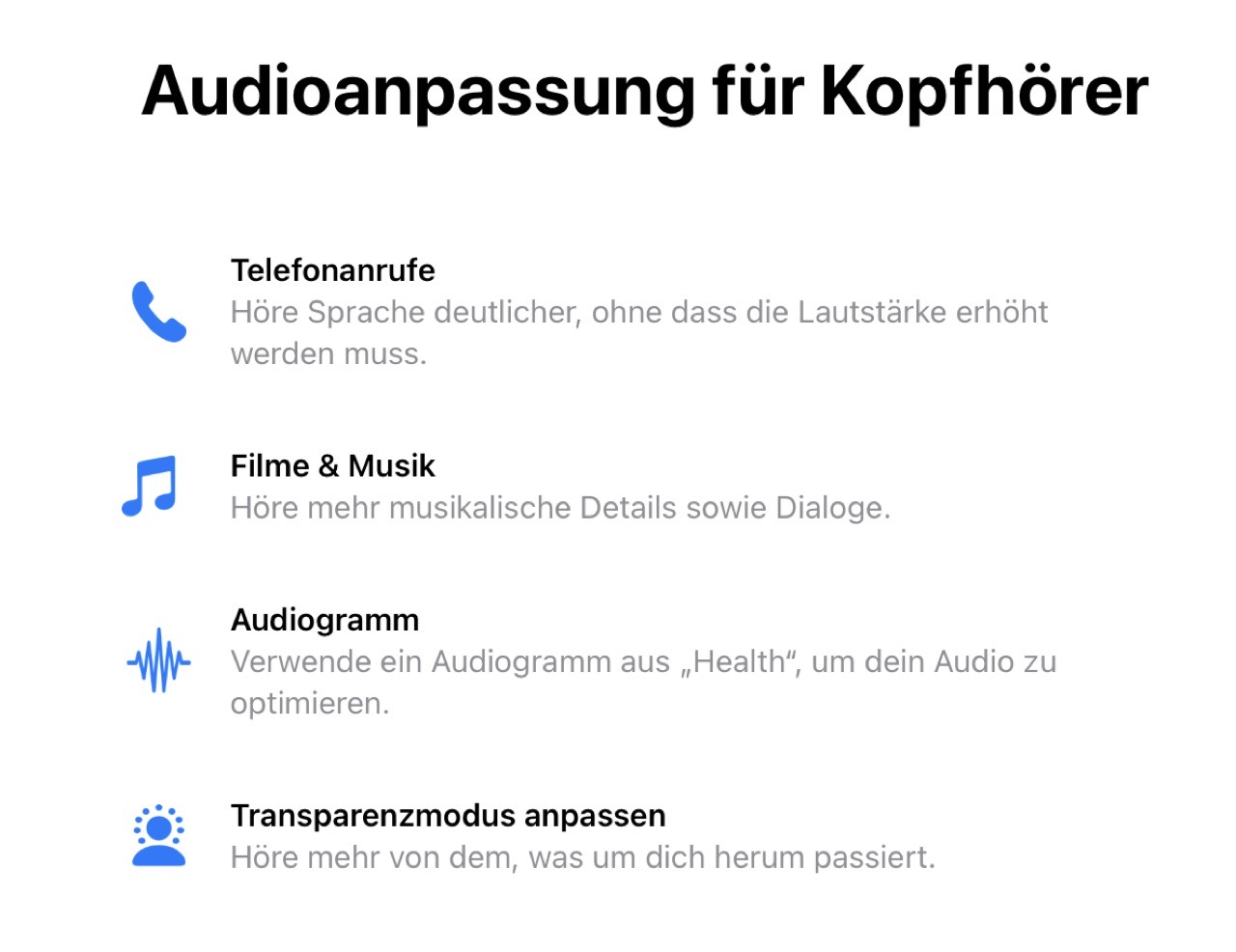
Mit der neuen Firmware und iOS 14 geht Apple jetzt mal einen kleinen Schritt in die richtige Richtung. Die AirPods Pro können nämlich nicht nur Raumklang wiedergeben, sondern sich auch an das Gehör des Besitzers anpassen. Und da sie im Transparenzmodus auch die Umweltgeräusche gezielt verstärken können, sind das zunehmend intelligentere Hörhilfen.
Wie kommt man hin? Einstellungen → Bedienungshilfen → AirPods Pro → Bedienungshilfeneinstellungen für Audio → Kopfhöreranpassungen → Eigene Audiokonfiguration. (Voraussetzung: iOS und AirPods Pro Firmware Update)
Back in 2010, Kyle Conroy wrote a blogpost entitled, What if I had bought Apple stock instead?:
Currently, Apple’s stock is at an all time high. A share today is worth over 40 times its value seven years ago. So, how much would you have today if you purchased stock instead of an Apple product? See for yourself in the table below.
Conroy kept the post up-to-date until April 1, 2012; at that point, my first Apple computer, a 2003 12″ iBook, which cost $1,099 on October 22, 2003, would have been worth $57,900. Today it would be worth $311,973.
I thought of this meme, which pops up every time Apple’s stock hits a new all-time high, while considering the price Apple paid for P.A. Semi back in 2008; for a mere $278 million the company acquired the talent and IP foundation that would undergird its A-series of chips, which have powered every iPad and every iPhone since 2010, and, before the end of the year, at least one Mac (the rest of the line will follow within two years).
So I was curious: what would $278 million in 2008 Apple stock look like today? The answer is $5.5 billion, which, honestly, is still an absolute bargain, and a reminder that the size of an acquisition is not necessarily correlated with its impact.
Over the weekend Nvidia consummated the biggest chip deal in history when it acquired Arm1 from Softbank for around $40 billion in stock and cash. Nvidia founder and CEO Jensen Huang wrote in a letter to Nvidia employees:
We are joining arms with Arm to create the leading computing company for the age of AI. AI is the most powerful technology force of our time. Learning from data, AI supercomputers can write software no human can. Amazingly, AI software can perceive its environment, infer the best plan, and act intelligently. This new form of software will expand computing to every corner of the globe. Someday, trillions of computers running AI will create a new internet — the internet-of-things — thousands of times bigger than today’s internet-of-people. Uniting NVIDIA’s AI computing with the vast reach of Arm’s CPU, we will engage the giant AI opportunity ahead and advance computing from the cloud, smartphones, PCs, self-driving cars, robotics, 5G, and IoT.
These are big ambitions for a big purchase, and Wall Street apparently agrees; yesterday Nvidia’s market cap increased by $17.5 billion, nearly covering the $21.5 billion in shares Nvidia will give Softbank in the deal. Indeed, it is Nvidia’s stock that is probably the single most important factor in this deal. Back in 2016, when Softbank acquired Arm, Nvidia was worth about $34 billion; after yesterday’s run-up, the company’s marketcap was $318 billion.
The first takeaway is that selling Arm for $32 billion means that the company was yet another terrible investment by Softbank; simply buying Nvidia shares — or, for that matter, an S&P 500 index fund, which is up 55% since then — would have provided a much better return than the ~5% Softbank earned from Arm.
The second takeaway is the inverse: Nvidia is acquiring a company that was its marketcap peer four years ago for a relative pittance. Granted, Nvidia’s stock may not stay at its current lofty height — the company has a price-to-earnings ratio of over 67, well above the industry average of 27 — but that is precisely why a majority-stock acquisition makes sense; Nvidia’s stock may retreat, but Arm will still be theirs.
Beginning my analysis with stock prices is not normally what I do; I’m generally more concerned with the strategies and business models of which stock price is a result, not a driver. The truth, though, is that once you start digging into the details of Nvidia and ARM, it is rather difficult to see what strategy might be driving this acquisition.
Start with Nvidia: the company is perhaps the shining example of the industry transformation wrought by TSMC; freed of the need to manufacture its own chips, Nvidia was focused from the beginning on graphics. Its TNT cards, released in the late 1990s, provided 3D graphics for games while also powering Windows (previously hardware 3D graphics were only available via add-on cards); its GeForce line, released in 1999, put Nvidia firmly at the forefront of the industry, a position it retains today.
It was in 2001 that Nvidia released the GeForce 3, which had the first pixel shader; instead of a hard-coded GPU that could only execute a pre-defined list of commands, a shader was software, which meant it could be programmed on the fly. This increased level of abstraction meant the underlying graphics processing unit could be much simpler, which meant that a graphics chip could have many more of them. The most advanced versions of Nvidia’s just-announced GeForce RTX 30 Series, for example, has an incredible 10,496 cores.
This level of scalability makes sense for video cards because graphics processing is embarrassingly parallel: a screen can be divided up into an arbitrary number of sections, and each section computed individually, all at the same time. This means that performance scales horizontally, which is to say that every additional core increases performance.
It turns out, though, that graphics are not the only embarrassingly parallel problem in computing. Another obvious example is encryption: brute forcing a key entails running the exact same calculation over-and-over again; the chips doing the calculation don’t need to be complex, they simply need as many cores as possible (this is why graphics cards are very popular for blockchain applications; miners are basically endlessly brute-forcing encryption keys).
What is most enticing for Nvidia, though, is machine learning. Training on large datasets is an embarrassingly parallel problem, which means it is well-suited for graphics cards. The trick, though, is in decomposing a machine learning algorithm into pieces that can be run in parallel; graphics cards were designed for, well, graphics, which meant that programmers had to work in graphics programming languages like OpenGL.
This is why Nvidia transformed itself from a modular component maker to an integrated maker of hardware and software; the former were its video cards, and the latter was a platform called CUDA. The CUDA platform allows programmers to access the parallel processing power of Nvidia’s video cards via a wide number of languages, without needing to understand how to program graphics.
Here the kicker: CUDA is free, but that is because the integration is so tight. CUDA only works with Nvidia video cards, in large part because many of the routines are hand-tuned and optimized. It is a tremendous investment that has paid off in a major way: CUDA is dominant in machine learning, and Nvidia graphics cards cost hundreds of dollars ($1500 in the case of the aforementioned RTX 3090). Apple isn’t the only company that understands the power of differentiating premium hardware with software.
Arm’s business model could not be more different. The company, founded in 1990 as a joint venture between Acorn Computers, Apple, and VLSI Technology, doesn’t sell any chips of its own; rather, it licenses chip designs to companies which actually manufacture ARM chips. Except even that isn’t quite right: most ARM licensees actually contract with manufacturers like TSMC to make physical chips, which are then sold to OEMs. The entire ecosystem is extremely modular; consider an Oppo smartphone, with a MediaTek chip:
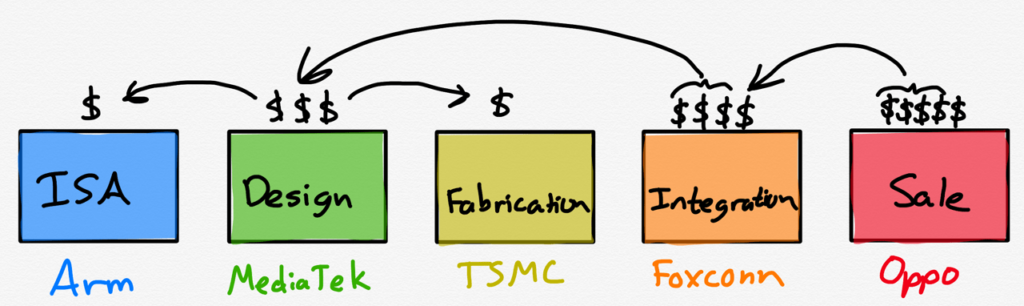
Arm chips appear in many more devices than smartphones — most micro-controllers in embedded systems are Arm designs — and Arm designs more than CPUs; the company’s catalog includes everything from GPUs to AI accelerator chips. It also licenses less than full designs: Apple, for example, designs its own chips, but uses the ARM Instruction Set Architecture (ISA) to communicate with them. The ARM ISA is the platform that ties this entire ecosystem together; programs written for one ARM chip will run on all ARM chips, and each of those chips results in a licensing fee for Arm.
What makes Arm’s privileged position viable is the same one that undergirds TSMC’s: neutrality. I wrote about the latter in Intel and the Danger of Integration:
In 1987, Morris Chang founded Taiwan Semiconductor Manufacturing Company (TSMC) promising “Integrity, commitment, innovation, and customer trust”. Integrity and customer trust referred to Chang’s commitment that TSMC would never compete with its customers with its own designs: the company would focus on nothing but manufacturing.
This was a completely novel idea: at that time all chip manufacturing was integrated a la Intel; the few firms that were only focused on chip design had to scrap for excess capacity at Integrated Device Manufacturers (IDMs) who were liable to steal designs and cut off production in favor of their own chips if demand rose. Now TSMC offered a much more attractive alternative, even if their manufacturing capabilities were behind.
In time, though, TSMC got better, in large part because it had no choice: soon its manufacturing capabilities were only one step behind industry standards, and within a decade had caught-up (although Intel remained ahead of everyone). Meanwhile, the fact that TSMC existed created the conditions for an explosion in “fabless” chip companies that focused on nothing but design.
For example, in the late 1990s there was an explosion in companies focused on dedicated graphics chips: nearly all of them were manufactured by TSMC. And, all along, the increased business let TSMC invest even more in its manufacturing capabilities.
That article was about TSMC overtaking Intel in fabrication, but a similar story can be told about Arm overtaking Intel in mobile. Intel was relentlessly focused on performance, but smartphones needed to balance performance with battery concerns. Arm, which had been spending years designing highly efficient processors for embedded applications, had both the experience and the business model flexibility to make mobile a priority.
The end result made everyone a winner (except Intel): nearly every smartphone in the world runs on an ARM-derived chip (either directly or, in the case of companies like Apple, the ARM ISA), which is to say that Arm makes money when everyone else in the mobile ecosystem makes money.
Notice that an ARM license, unlike the CUDA platform, is not free. That makes sense, though: CUDA is a complement to Nvidia’s proprietary graphics cards, which command huge margins. ARM license fees, on the other hand, can and are paid by everyone in the ecosystem, and in return everyone in the ecosystem gets equal access to Arm’s designs and ISA. It’s not free, but it is neutral.
That neutrality is gone under Nvidia ownership, at least in theory: now Nvidia has early access to ARM designs, and the ability to push changes in the ARM ISA; to put it another way, Nvidia is now a supplier for many of the companies it competes with, which is a particular problem given Nvidia’s reputation for both pushing up prices and being difficult to partner with. Here again Apple works as an analogy: the iPhone maker is notorious for holding the line on margins, prioritizing its own interests, and being litigious about intellectual property; Nvidia has the same sort of reputation. So does Intel, for that matter; the common characteristic is being vertically integrated.
Of course Nvidia is insistent that ARM licensees have nothing to worry about. Huang noted in that letter to Nvidia employees:
Arm’s business model is brilliant. We will maintain its open-licensing model and customer neutrality, serving customers in any industry, across the world, and further expand Arm’s IP licensing portfolio with NVIDIA’s world-leading GPU and AI technology.
Notice that last bit: Huang is not only arguing that Nvidia will serve Arm customers neutrally, but that Nvidia itself will adopt Arm’s business model, licensing its IP to competitive chip-makers. It’s as if this is an acquisition in reverse: the $318 billion acquirer is fitting itself into a world defined by its $40 billion acquisition.
Color me skeptical; not only is Nvidia’s entire business predicated on selling high margin chips differentiated by highly integrated software, but Nvidia’s entire approach to the market is about doing what is best for Nvidia, without much concern for partners or, frankly customers. It is a luxury afforded those that are clearly best in class, which by extension means that sharing is anathema; why trade high margins at the top of the market for low margins and the headache of serving everyone?
In short, this deal feels like the inverse of the P.A. Semi deal not simply in terms of the price tag, but in its overall impact on the acquirer. I have a hard time believing that Nvidia is going to change its approach.
Or maybe that’s the entire point.
By far the best articulation of the upside of this deal came, unsurprisingly, from Huang. What was notable about said articulation, though, was that it came 46 minutes into the investor call about the acquisition, and only then in response to a fairly obvious question: why does Nvidia need to own ARM, instead of simply license it (like Apple, which has a perpetual license to the ARM ISA, and is not affected by this acquisition)?
What was so striking about Huang’s answer was not simply its expansiveness — I’ve transcribed the entire answer below — but also the way in which he delivered it; unlike the rest of the call, Huang’s voice was halting and uncertain, as if he were scared of his own ambition. I know this excerpt is long, but it’s essential:
We were delightful licensees of ARM. As you know we used ARM in one of our most important new initiatives, the Bluefield GPU. We used it for the Nintendo Switch — it’s going to be the most popular and success game console in the history of game consoles. So we are enthusiastic ARM licensees.
There are three reasons why we should buy this company, and we should buy it as soon as we can.
Number one is this: as you know, we would love to take Nvidia’s IP through ARM’s network. Unless we were one company, I think the ability for us to do that and to do that with all of our might, is very challenging. I don’t take other people’s products through my channel! I don’t expose my ecosystem to to other company’s products. The ecosystem is hard-earned — it took 30 years for Arm to get here — and so we have an opportunity to offer that whole network, that vast ecosystem of partners and customers Nvidia’s IP. You can do some simple math and the economics there should be very exciting.
Number two, we would like to lean in very hard into the ARM CPU datacenter platform. There’s a fundamental difference between a datacenter CPU core and a datacenter CPU chip and a datacenter CPU platform. We last year decided we would adopt and support the ARM architecture for the full Nvidia stack, and that was a giant commitment. The day we decided to do that we realized this was for as long as we shall live. The reason for that is that once you start supporting the ecosystem you can’t back out. For all the same reasons, when you’re a computing platform company, people depend on you, you have to support them for as long as you shall live, and we do, and we take that promise very seriously.
And so we are about to put the entire might of our company behind this architecture, from the CPU core, to the CPU chips from all of these different customers, all of these different partners, from Ampere or Marvell or Amazon or Fujitsu, the number of companies out there that are considering building ARM CPUs out of their ARM CPU cores is really exciting. The investments that Simon and the team have made in the last four years, while they were out of the public market, has proven to be incredibly valuable, and now we want to lean hard into that, and make ARM a first-class data center platform, from the chips to the GPUs to the DPUs to the software stack, system stack, to all the application stack on top, we want to make it a full out first-class data center platform.
Well, before we do that, it would be great to own it. We’re going to accrue so much value to this architecture in the world of data centers, before we make that gigantic investment and gigantic focus, why don’t we own it. That’s the second reason.
Third reason, we want to go invent the future of cloud to edge. The future of computing where all of these autonomous systems are powered by AI and powered by accelerated computing, all of the things we have been talking about, that future is being invented as we speak, and there are so many great opportunities there. Edge data centers — 5G edge data centers — autonomous machines of all sizes and shapes, autonomous factories, Nvidia has built a lot of software as you guys have seen — Metropolis, Clara, Isaac, Drive, Jarvis, Aerial — all of these platforms are built on top of ARM, and before we go and see the inflection point, wouldn’t it be great if we were one company.
And so the timing is really quite important. We’ve invested so much across all of these different areas, that we felt that we really had to take the opportunity to own the company and collaborate deeply as we invent the future. That’s the answer.
It turns out this is very much an Nvidia vision after all. Nvidia is not setting out to be a partner, someone that gets along with everyone in exchange for a couple of pennies in licensing fees. Quite the opposite: Huang wants to own it all.
In this vision Nvidia’s IP is the CUDA to its graphics chips — the complement to its grander ambitions. Huang has his sights set firmly on Intel, but while Intel has leveraged its integration of design and manufacturing, Nvidia is going to leverage its integration of chip design and software. Huang’s argument is that it is the lack of software — a platform, as opposed to simply a chip or a core — that is limiting ARM in the data center, and that Nvidia intends to build that software.
On one hand, this is exciting for ARM licensees, particularly companies like Amazon that have invested in ARM chips for the data center; note, though, that Nvidia isn’t doing this out of charity. Huang twice mentioned the importance of capturing the upside he believes Nvidia will generate, which ultimately means increased license fees. Sure, Nvidia will be able to make more changes to ARM to suit the data center than they could have as licensor, but the real goal is to tie ARM into an Nvidia software platform until licensees have no choice but to pay what will undoubtedly be ever-increasing licensing fees (which, it should be noted, will still result in chips that less expensive than Intel’s).
I don’t know if it will work; data centers are about the density of processing power, which is related to but still different than performance-per-watt, ARM’s traditional advantage relative to Intel, and there are a huge amount of 3rd-parties involved in such a transition. There is a lot about this vision that is out of Nvidia’s control — it’s more of a dream. What is comforting in a way, though, is just how true this dream is to what makes Nvidia unique: this isn’t about adopting ARM’s approach, it’s about co-opting it for a vision of integration that makes Nvidia an object of inevitability, not affection.
And, to return to the beginning, it is a bet that is a relatively free one. If Nvidia’s stock is over-priced, then it is buying Arm for an even bigger discount than it seems; the vision Huang laid out, though, is a reason to believe Nvidia’s stock price is actually correct. Might as well roll the dice on a P.A. Semi-type outcome.
Three additional notes about this transaction:

Best Buy in the U.S. posted a screen protector on its online store for the iPhone SE Plus 2020, alluding to the possibility of a larger iPhone SE (2020) being released in the near future.
There hasn’t been an overwhelming number of leaks about this phone, but iMore notes that there was mention of the device in iOS 14 code, and analyst Ming-Chi Kuo mentioned it in April.
Best Buy posting this screen protector right before Apple’s September event makes me want to believe that we’ll see a larger version of the iPhone SE soon, but since there have been almost no leaks about it, I’m still skeptical.
The ‘Plus’ version of the SE is supposed to be the same size as the iPhone 8 Plus. This would, in theory, mean that it’s the same as the other iPhone SE from 2020, but larger.
Given upper-midrange phones like the Google Pixel 4a and OnePlus Nord offer great smartphone experiences for under $1,000, this would be a good move by Apple.
With Apple’s fall hardware keynote less than an hour away, hopefully, we won’t have to wait long to see this device for real.
Source: iMore
The post Best Buy possibly leaks iPhone SE Plus ahead of Apple event appeared first on MobileSyrup.
|
mkalus
shared this story
from  DmitryOpines on Twitter. DmitryOpines on Twitter.
|
This has been true for 4 years:
Post Transition, the EU & UK need a customs border.
That border can go between:
a) Ireland and Northern Ireland, dividing the island.
b) Great Britain and Northern Ireland, dividing the UK.
c) Ireland and Mainland Europe, dividing the EU.
|
mkalus
shared this story
from  The Omni Group. The Omni Group.
|
In this episode of The Omni Show, Andrew is joined by Dr. Alyssa Goodman. Alyssa’s impressive resume includes titles such as: Robert Wheeler Willson professor of applied astronomy at Harvard, co-director for science at the Radcliffe Insitute for Advanced Study, and a Smithsonian Institution research associate. Throughout her career, Alyssa has explored how to share complex information with data visualization and computer simulations.
Alyssa’s interest in data visualization and astrophysics led to the creation of Glue, a multidisciplinary tool designed to help users explore relationships within and between the data sets often studied in astronomy and medicine. Drawing on her background in physics and astrophysics, Alyssa was inspired to figure out a way she could use data visualizations and computer simulations to address climate change—a novel approach in 2008. She soon saw the potential in using data visualizations for financial, global, and health simulations. At this time, most people had no idea what a computer simulation was—integrating data in this manner was not yet taught in schools.
For over a decade, Alyssa has worked to help others understand the value of computer simulations and data visualizations. Her dedication to this work has helped shape how both are now used as powerful forecasting tools to solve a myriad of complex problems. In 2009, Alyssa designed The Prediction Project, an initiative dedicated to explaining the value of modern predictions and helping others learn more about predictions through formal online courses.
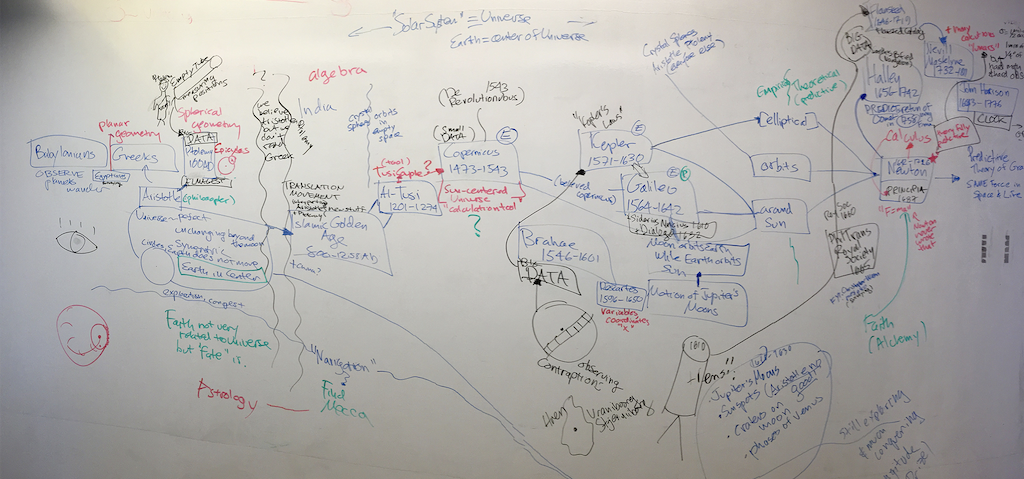
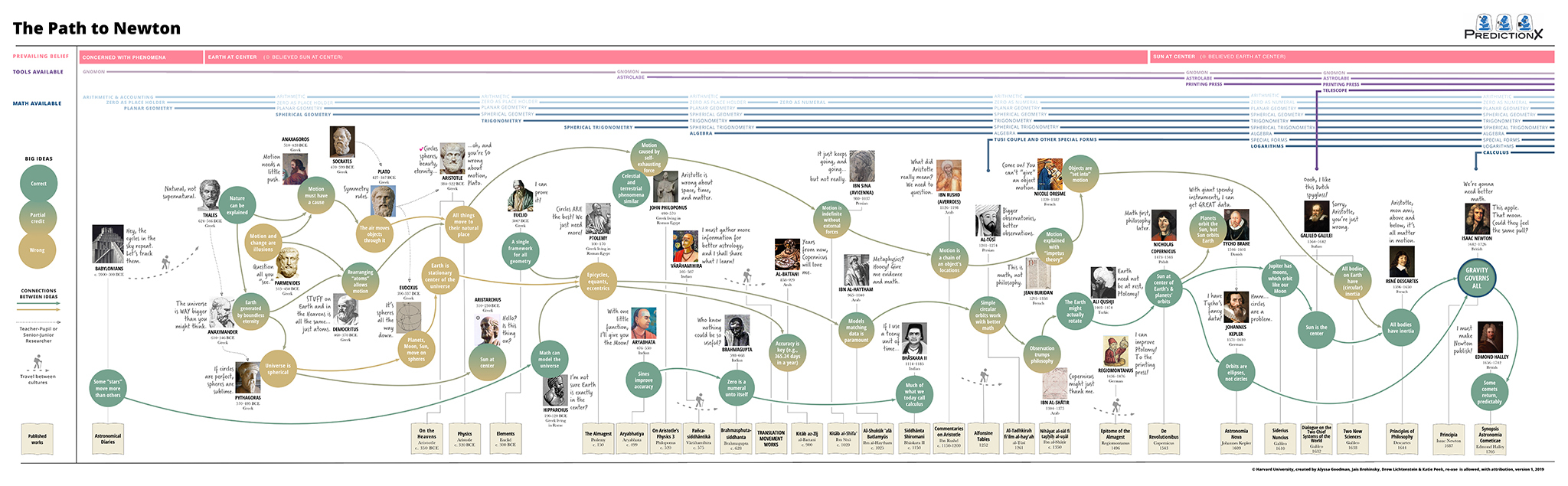
In today’s episode, Alyssa shares with Andrew how she used OmniGraffle to create her follow-up to The Prediction Project: the Path to Newton, an interactive visualization of the prevailing thought patterns and discoveries leading up to Sir Isaac Newton’s theory of gravity. Using tools like OmniGraffle and Tableau enables Alyssa to cross-section vast amounts of sophisticated information without merging the data. Her advice to others tackling data sets: “Learn how to use tools that let you integrate different data sets and have different views of them because you can learn much more from wide data than you can from big data.”
To learn more about Alyssa’s work—and how she uses OmniGraffle to filter, group, and map out complex data—tune in to The Omni Show. To create your own data visualization resources, download OmniGraffle for Mac. And if you have any questions or feedback, email support@omnigroup.com—our amazing Support Humans are standing by, ready to help.

Source: Pixelmator.
During Apple’s keynote today, the company showed off the iPad Air’s new A14 Bionic chip with a demonstration from Pixelmator, which showed off the latest version of Pixelmator Photo, which was released today. The new version of the app comes with two headlining features: ML Super Resolution, which is powered by the Neural Engine that’s part of Apples SoC, and a split-screen slider for comparing photo edits.
ML Super Resolution is a feature that first debuted on the Mac with Pixelmator Pro late last year. On the iPad, Pixelmator says the feature can increase an image’s resolution up to three times, using a machine learning-based algorithm. ML Super Resolution is also available in Pixelmator Photo’s batch editing mode.
The new split-screen preview is a terrific way to show off ML Super Resolution or any other edits you make to a photo. Tap and hold on the screen, and a vertical line appears under your finger, dividing the screen into a before-and-after preview with before on the left of the divider and after on the right side.

ML Super Resolution does an excellent job bringing out the details in this shot of the Sydney waterfront.
In my limited tests, the results of using ML Super Resolution have been impressive. I used an image from a trip I took to Australia in 2007 with a low-resolution pocket digital camera. As you can see from the split-screen preview above, ML Super Resolution does a fantastic job sharpening the text on the side of a warehouse and adding definition to the brick buildings in the foreground.

Pixelmator Photo now supports double-tapping the Apple Pencil.
Today’s update to version 1.4 also adds a new Apple Pencil double-tap option in Pixelmator Photo’s settings. Double tapping the Apple Pencil is set to undo and redo edits by default, but you can also use it to select the repair tool or show the split-screen preview slider.
Pixelmator Photo is one of my favorite iPad photo editors. I use Pixelmator Pro on my Mac a lot too, and I’m glad to see more of its features coming to the iPad. There’s a lot to be said for editing images on the big display connected to my Mac mini. However, my iPad is often the biggest screen I have available and a more enjoyable way to browse and tweak photos I’ve taken.
Pixelmator Photo 1.4 is available as a free update on the App Store for existing users. For new users, the price has been increased to $7.99.
Club MacStories offers exclusive access to extra MacStories content, delivered every week; it’s also a way to support us directly.
Club MacStories will help you discover the best apps for your devices and get the most out of your iPhone, iPad, and Mac. Plus, it’s made in Italy.
Join Now
Jungejunge, bei diesen vorproduzierten Events geht ganz schön die Post ab. Da hat man zwischendurch kaum Zeit nachzudenken.
Dinge, die ich nicht auf dem Zettel hatte, und die mich überrascht haben:
Dinge, die ich auf dem Zettel hatte, und die mich deshalb nicht überrascht haben:
Dinge, die ich nicht auf dem Zettel hatte, und die auch nicht kamen:
So, jetzt muss ich eine ganze Menge nachdenken. In dieser kurzen Veranstaltung war soviel versteckte Information, die ich sortieren muss.
PS: Kleines Mimimi am Rande: Ich wünsche mir ein menschlicheres Auftreten der Protagonisten. Zu glatt, zu unsympathisch.
These two tweets are interesting:
"One lesson that GPT-3 might be teaching us: the tell-tale signature artifact of simulation is not the spiky glitch, it's the smooth, shallow, facile surface. It's not the errors, it's a certain kind of boring flawlessness, that's what we should be on the lookout for." @flantz
"Being able to distinguish between layers and categories of meaning is going to be a highly valuable skill for a while. Good news for snobs, weirdos, artists, nerds, and librarians." @flantz
Thoughts that occur:
There's a kind of writing that is actively aspiring to a smooth, shallow, facile surface, a certain kind of boring flawlessness. The writing that most corporations do. That's who GPT-3 will get to first. Not the novelists and the poets but the corporate copy-writers. They came for the writers of car brochures, but I wasn't a writer of car brochures, so I said nothing.
The translation is already roboticised. Perhaps the writing is too.
And presumably GPT-3 is already being deployed by SEO agencies and, equally presumably, Google Search spooks are already trying to simulate the skills of snobs, artists, nerds and librarians.
Hopefully that means that a premium will get attached to quirky non-smooth writing. I have a colleague who uses 'dang' a lot in her writing. Unusual on this side of the Atlantic. I think that'll get through a copy captcha.
It also reminds me of something William Gibson writes in a Paul Smith book. It's something like: if you want to know what's good about what your country makes look at what the Japanese and British import. (I can't find the actual quote). And his reasoning is something like: Japanese and British cultures are so hierarchical and stratified, in such long-lasting and subtle ways, that they've become incredibly good at discerning status from tiny signals.
Which makes me wonder what the 'looking at their shoes' of writing is going to be.
Dang.

A few months after the feature’s announcement during the tech giant’s all-digital WWDC, Apple’s AirPods Pro have now been updated to include a new ‘Spatial Audio’ setting that works with 5.1, 7.1 and Dolby Atmos surround sound.
The new feature, which enables a surround sound-like effect with Apple’s high-end earbuds, is included in firmware ‘version 3A283’ that’s part of the latest iOS 14 public beta. While there’s no log for the update, AppleInsider says that the option now appears in the AirPods Pro Bluetooth settings. This feature is probably publicly releasing alongside iOS 14 on September 16th.
Though this form of soundscape isn’t ideal for listening to music, it could potentially be great for watching movies with the AirPods Pro. It’s likely Spatial Audio will eventually also work with the Apple TV, which would make sense given the device’s emphasis on video content.
At WWDC 2020 back in June, Apple showed off how Spatial Audio takes advantage of the earbuds’ accelerometer to track head movement. At the event, the tech giant also revealed a new feature that makes it easier to switch AirPods between Apple devices. This feature is set to launch alongside the public release of iOS 14, iPadOS 14 and macOS Big Sur.
AppleInsider says that this easy switching is included in the recent AirPods Pro update. An update to Apple’s 1st and 2nd-generation AirPods featuring the switching functionality is probably on the way as well.
My pair of AirPods Pro have not yet received the update, likely because my main iPhone isn’t running the iOS 14 beta.
AirPods updates can’t be downloaded manually and are installed automatically. To check what version of firmware your AirPods are running, navigate to ‘General, then ‘About,’ and, finally, select the wireless earbuds from the menu.
Source: AppleInsider
The post Apple’s AirPods Pro to get new ‘Spatial Audio’ feature with iOS 14 release appeared first on MobileSyrup.
“I Have Blood on My Hands”: A Whistleblower Says Facebook Ignored Global Political Manipulation
Sophie Zhang worked as the data scientist for the Facebook Site Integrity fake engagement team. She gave up her severance package in order to speak out internally about what she saw there, and someone leaked her memo to BuzzFeed News. It's a hell of a story: she saw bots and coordinated manual accounts used to influence politics in countries all around the world, and found herself constantly making moderation decisions that had lasting political impact. “With no oversight whatsoever, I was left in a situation where I was trusted with immense influence in my spare time". This sounds like a nightmare - imagine taking on responsibility for protecting democracy in so many different places.
Via @bcrypt
|
mkalus
shared this story
from  bellingcat. bellingcat.
|

The post Statement of German Government appeared first on bellingcat.
|
mkalus
shared this story
from  vwestlife's YouTube Videos. vwestlife's YouTube Videos.
|
The cheap new cassette decks sold today are the last remaining vestige of cheap White-Van-esque 1990s stereo systems that also originally included an amplifier, tuner, CD player, and equalizer, sold under many different brand names around the world.
Entry-Level Cassette Deck Buyer's Guide: http://www.amstereo.org/cassetteguide/


This surprises exactly nobody at this point (see my previous notes), but there will be much wailing and tearing and armchair strategizing as the entire industry tries to find some tea leaves to divine what this might actually mean for the ongoing siege to Intel and (most importantly for me) what the server landscape is going to look like, now that NVIDIA can put together entire systems from the networking hardware (Mellanox) on up.
The UK, also unsurprisingly, is just going to let this happen. They barely understand public health, let alone technology IP.
A report from Global News reporter Nadia Stewart, with a headline that distorts the story:

The protest had three dozen people – surely worth a qualified ‘some’ when the headline starts “Vancouverites upset.” But that quibble doesn’t matter when judged against the absence of data and other points of view (like, say, comments from passing cyclists). Importantly, the video story was supplemented in the online print version, where reporter Simon Little provided important information:
Vancouver Park Board manager Dave Hutch says about 93 per cent of Stanley Park Drive is open to vehicles, and that about 70 per cent of parking in the park remains open.
He said after talks with the city’s disability advisory committee, the board also added 10 new handicapped parking spaces.
“We’re seeing that the park and parking is nowhere near capacity this year. The busiest day was in mid August, we had 63 per cent capacity. We would expect about 90 per cent in August,” he told Global News.
Still, impact-wise, the protesters had the visuals and screen time. There have been demanding that Park Drive be restored to two lanes for cars and have all the parking returned – in other words, back to the standards of mid-century Motordom. That’s what we did in the post-war decades, and the roads of Stanley Park were designed accordingly: a transportation system where cars are given most of the space, there are no separated bike lanes (cars and bikes fight it out for priority), parking is provided in excess, and the seawall has to accommodate the crowding of all active transport users.
However, the most egregious statement comes right at the beginning of the clip. No longer being able to claim that there is no access at all for vehicles on Park Drive, nor any disabled parking at key locations, they’ve added a new adjective. NPA Commissioner Tricia Barker: “I know that people like to say that there is already access for everyone, but let’s talk about easy access for everyone.”
You heard it: now it’s about “easy” access. Presumably this means no separated bike lanes or any reallocation of road space for other users if it makes it more difficult to drive and park. Because that, in the opinion of lawyer Phil Rankin, would constitute discrimination against the disabled and seniors. (Phil also thinks the Park Board should have held public information meetings in the midst of the pandemic before responding to the emergency.)
I have a hunch spokespeople for the disabled and seniors willing to appear have been willingly co-opted. In their minds, diminishing car access also diminishes accommodation for their constituents – and hence a lack of respect, a reversal of gains, and somehow a defeat. So they’ve ended up calling for more cars, more space for cars, less space for other users – and they’re doing it in a park, on a day filled with climate-change-induced smoke, in the midst of a pandemic. It’s a very bad look for people whose leverage is their presumed marginalization.
The NPA park commissioners have chosen to make this an issue on which they and the party will be identified (to the disappointment of this past-NPA councillor when we were the leaders in the development of bikeways and greenways). Their cynicism becomes transparent when they first have to lie (no access for cars) and then change their rhetoric (no easy access) to maintain the pretense of discrimination.
They, unlike those they’ve co-opted, are engaged in discouraging cycling in parks (notably Kits), not taking the climate emergency seriously, and defending the status quo – a city designed for the mid-20th century world where you could easily drive to Stanley Park, motor the scenic loop, take it all in through the windshield, and find abundant parking wherever you wished to stop.
If their position prevails (we’ve heard very little from the other Green and COPE commissioners), there’s a cruel irony awaiting. Eliminating the separated bike lane and throwing the cyclists, motorists and pedestrians together to fight it out is sure to result in more conflicts and accidents. Which means more injuries, especially for vulnerable seniors. Which means, ultimately, more people with disabilities.

With Apple’s big fall hardware event only a day away, we won’t have to wait long to know if these rumours are accurate.
According to often-reliable Apple analyst Ming-Chi Kuo as first reported by MacRumors, Apple’s iPhone 12 Pro smartphones won’t feature a 120Hz refresh rate due to concerns surrounding battery life. That said, Kuo mentions that the feature could make its way into the tech giant’s 2021 iPhones.
Further, Kuo cites 5G connectivity coupled with a 120Hz display causing issue with battery life, as being the main reason for this year’s high-end iPhone not featuring an improved display refresh rate. If this turns out to be accurate, it would be a significant blow to Apple’s 2020 iPhone lineup given nearly all high-end Android devices feature improved refresh rates.
Similar to Bloomberg’s Mark Gurman, Kuo says that he expects Apple to announce the iPhone 12 series in October. Other information in the report states that the 6.1-inch and 6.7-inch 2020 iPhones will feature a notch the same size as the current iPhone 11, while the 5.4-inch iPhone features a “slightly narrower notch area for displaying the information well in the upper left and upper right corners.”
Kuo also says that there will be two versions of all 2020 iPhones: one that supports sub-6GHz 5G and another that supports mmWave 5G and sub-6GHz. In the context of Canada, we currently only have very limited sub-6GHz 5G networks in select cities.
Regarding release dates, the analyst predicts that mass production of the iPhone 12, iPhone 12 Max, iPhone 12 Pro and iPhone 12 Pro Max will start in October, mid-October and late October, respectively. iPhones typically start shipping a few weeks after they enter mass production.
On the other hand, it’s unclear when Apple’s mmWave 5G iPhone 12 models will enter production, though Kuo does state that this will happen after the sub-6GHz models.
Finally, Kuo says that Apple’s often-rumoured refreshed iPad Air will be the first tablet from the company to feature a Touch ID side button, allowing the device to ditch the standard front-facing Touch ID sensor in order to feature minimized bezels. The analyst claims that this feature will trickle down to more iPad models starting in 2021.
For everything to expect from Apple’s September 15th hardware keynote, follow this link.
Source: MacRumors
The post iPhone 12 Pro won’t feature 120Hz, new iPad air to include side Touch ID button appeared first on MobileSyrup.
My blog archive prompts me that today it is 13 years ago that I stopped hosting this site on a PC under my desk, and moved it to a webhoster, the same one it is hosted with today. I had an internetprovider that gave me a fixed IP and I had a double ISDN line at home since 1997. The ISDN lines were provided by my then employer, so I could work remotely (he was ahead of his time, my second employer in contrast argued with me whether I really needed an e-mail address at work  ) One ISDN line I used as internet connection, plugged into my PC which doubled as a webserver. In 2002 we switched from ISDN to ADSL, which had better bandwidth at 6MB, albeit asymmetrical. Over time it got less reliable though and my site at times was unreachable, so in 2007 I switched it over to a hoster.
In 2010 glass fibre reached us, upping bandwidth at home to 100MB, then 500MB and then 1GB, all symmetrical. That would have been an opportunity to run a webserver at home again, but by then I used laptops only and didn’t have a machine I wanted to run 24/7.
These days however, back on a 1GB connection after a brief stint back to 500MB, and not just with one fixed IP address, but with a vast range allocated, it might be viable again to run a webserver from home again. Or multiple cheap ones, like Raspberry Pi’s. Maybe I should start with running an experimental one full time first.

The term in question here is Key Performance Indicator (KPI) and I'm sure most managers' eye do not glaze over when they hear it. They know that a term like 'KPI' is insider jargon for managers, which is why this HBS article is discussing it. The key to understanding KPI is benefit, which is why they ask questions about (say) training like "what the organization is getting out of this". A 'benefit' is the value for which you would exchange (say) money. Or labour. Or whatever. For a company, the only benefit that counts is profit. The indicator is what connects the (say) training with profits (either directly, or indirectly through a 'logic model'). For governments and public services, the definition of 'benefit' is much wider (unless your only bottom line is GDP), but the idea is still the same: to justify and measure the success of a program, you need a KPI that shows how the program produces the benefit. So if you're making proposals to managers, this is the language you need to use, because this is how they speak. This is the point this article is trying to make (I think), albeit in a rather convoluted way.
Web: [Direct Link] [This Post]
This is a basic set of patterns related to user interactions with data, including everything from login patterns to giving permission to automated decisions. It's not comprehensive by any means but gives readers a good starting point to think about how users interact with online services. As the company says, "People designing and building services are in a position of power. IF created the data patterns catalogue to help product teams make better decisions about data."
Web: [Direct Link] [This Post]
You may have been hearing recently about the activism of KPop stans and wondered what they were. If you're a longtime OLDaily reader you'll already know about KPop - aka Korean Pop. These days the biggest KPop act is unquestionably BTS, and it is their stans who have been the most activist. So what is a stan? "A stan is a highly devoted fan of a particular person, like a musician, actor, author, or influencer. Stans are characterized by their high commitment and intense involvement in a performer’s fandom." So if you understand that "The group's Korean name, 방탄소년단, Bangtan Sonyeondan, translates into English as 'Bulletproof Boy Scouts,' and was borne out of CEO Bang Si-Hyuk's desire to create a group that could withstand social pressures and serve as a voice for the younger generation," the evolution of fans into activist stans makes complete sense.
Web: [Direct Link] [This Post]
Take the time to read this post carefully, because Jon Dron doesn't waste a single word in this commentary on the OECD report cited in this CBC article. As Dron notes, the report is based on a model developed by Hanushek and Woessman over the years that explains variations in global productivity according to amount and the quality of education people receive, so, less education means less productivity. Right? Well, maybe not. Perhaps greater productivity is caused by other factors. Perhaps the indicators of 'quality education' (like, say the PISA tests) don't measure what they think it does. And "even if their predictions about GDP are correct (I am pretty sure they are not – there are too many other factors at play." But more to the point, he says, "the OECD has a bit of track record on this kind of misinterpretation, especially in education. This is the same organization that (laughably, if it weren’t so influential) claimed that educational technology in the classroom is bad for learning." Yes, I remember that.
Web: [Direct Link] [This Post]
I admit that I am predisposed to agree that active learning would be more equitable than the lecture. But if you're going to say imflammatory things like 'lecturing is racist' you'd better be able to back it up. This article, however, proves no such thing, and the evidence cited shows an entirely different point, specifically, that in one particular institution, "Underrepresented students were less likely than well-represented peers to persist in chemistry if they performed below a C−." It barely even mentions lectures. The authors reason that since all chemistry courses are lecture based, and underrepresented persist less well in these courses, that underrepresented students in lecture courses persist less well. That's not even close to a valid inference, and the results could be explained equally well by saying underrepresented students at that particular institution have bad teachers, biased markers, poor lab sessions, inadequate support, few role models, and or insufficient funding. Also, as an aside, I would think that authors lecturing us about inequality could use the term 'frosh' in their article instead of 'freshmen'.
Web: [Direct Link] [This Post]
Apple updated its Canadian homepage to let us know it’s “almost time” for tomorrow’s event.
The homepage now features a large, animated Apple logo made of twisted blue lines. The lines erase and re-draw themselves in a loop.
Above the logo, the banner says “Watch a special Apple Event tomorrow on our US site at 10 a.m. PDT.” There’s a ‘Learn more’ link that takes people to the Apple Events website where they can tune in for tomorrow’s live stream, which kicks off at 10am PT/1pm ET.
As for what to expect from Apple’s event, well, that’s contentious, to say the least. The last few days have been full of leakers squabbling over what Apple will unveil at the event. Some think it will be the iPhone 12 series, others say that won’t be there. Rumours point to a new Apple Watch — perhaps even a low-cost ‘SE’ variant — while others says Apple will show off a new iPad.
Another rumour circulating suggests we’ll finally see Apple’s ‘AirTag’ tracking devices or the company’s rumoured wireless over ear headphones, the AirPods Studio.
For all the latest news on what to expect from Apple’s event, check out MobileSyrup managing editor Patrick O’Rourke’s round-up.
The post Apple updates website, says it’s ‘almost time’ for upcoming event appeared first on MobileSyrup.

With more significant fires becoming the new normal, even people not directly threatened are concerned with what to do about the spread of wildfire smoke. As wildfire season reaches its peak, smoke may creep its way into your living room. Here’s how to maintain the air quality inside your home.
Picking up a dedicated air purifier or getting new filters for your central air conditioner are the most effective ways you can help protect those in your home. (That includes pets—the American Veterinary Medical Association recommends keeping an eye out for specific animal health issues related to wildfire smoke). But you can also take cheap, simple, and immediate steps using stuff you probably already own, such as a mop and a washing machine. Here’s what we recommend.

First, consider a true-HEPA air purifier. We have an extensive guide to air purifiers, but the basic facts are these: According to the EPA, wildfire smoke predominantly consists of particles that are smaller than 10 microns. And true-HEPA air filters are exceptionally good at removing particles of that size from the air. Our top picks, the Coway AP-1512HH and nearly identical Coway Airmega 200M, are well-priced, superb performers, and reliable. They’re powerful enough for rooms up to 350 square feet, which includes most bedrooms and living rooms. The Blueair Blue Pure 211i Max, our pick for larger spaces, can rapidly clear the air in bigger rooms and open-floorplan homes.
The Coway has been our top pick air purifier since 2015, but in recent years several companies have produced models that approach our high standards, and we’ve added a few new options to include a wider range of price points and aesthetics.
We recommend running an air purifier on high for an hour the first time you turn the machine on. That’ll clear the air quickly by passing the entire volume of air in the room through the filter four to six times. Thereafter, keeping the machine on low or automatic will keep the air clear. Just run it continuously. Noise is usually not an issue; on lower settings, the purifiers we recommend are virtually silent.

If your air quality is bad and you don’t have an air purifier, an HVAC filter taped to a box fan is better than nothing.
If you have central air and heating, you may consider a different and cheaper option: upgrading to one of the furnace and air-conditioning filters we recommend. The EPA recommends filters with a rating of at least MERV 13, or, “as high a rating as your system fan and filter slot can accommodate.”
MERV stands for “minimum efficiency reporting value,” and it is a measure of how well a central-air filter removes particulates from the air. Medium-MERV filters provide much more filtration than the basic MERV 1–4 filters with central-air systems, which capture only pollutants visible to the naked eye, such as pet hair and dust bunnies, but not fine particulates like smoke. If you’re not sure which type you have, these basic filters often come included with the equipment, they’re your least expensive filter-replacement option, and they typically look like a see-through mesh of blue or green string.
The medium-MERV filters we recommend, rated MERV 8 to 13, are typically an opaque white, felt-like in texture, and pleated like an accordion. In our guide to furnace and air-conditioning filters, our recommendation is a MERV 12 filter from Nordic Pure. A six-pack typically costs about $55. If they’re not available, we also have MERV 12–equivalent recommendations from Honeywell and Filtrete. This is below the MERV 13 ideal in the EPA’s 2022 guidance; the overall message is really to go with the highest level of filtration that can fit and function in your system.

Higher-rated MERV filters can put strain on several air-moving pieces of equipment, depending on your system’s age and design. Smoky conditions will clog the filters in as little as half the recommended replacement cycle (usually three months), so we suggest simply replacing the filters once the fires are over. Wildfires or not, if your system is more than 15 or 20 years old, it may not be up to the extra effort of medium-MERV filtration. In that case we recommend buying a portable air purifier.

Get reliable, accurate air quality information with these apps and tools.
It may seem obvious, but close your windows. Most of the time, outside air contains fewer particulates than indoor air, so open windows are a good idea. But in wildfire conditions, that isn't the case. Closing your windows will help keep smoke from entering your home in the first place. Minimize entrances and exits through exterior doors, and use any double-door configuration you have (like an attached garage, separate basement entrance, or vestibule) to isolate smoke upon entry and prevent a full waft of it from infiltrating the living space.
If your windows lack a good seal or tend to be drafty, fill the gaps with weather sealing tape. In our guide to weatherizing your home, we recommend Frost King’s 0.25-inch Silicone Weatherseal for its ability to fill gaps as small as as small as 0.125 of an inch and up to 0.25 of an inch. Plus, it’s adhesive and trimmable, making it easy to install; apply it to both the upper and lower sash of each window. It can also be used around door jambs, but if you have a larger gap underneath an external door, a door sweep is your best bet.
We like Frost King’s Extra Wide Heavy Duty Door Sweep, but it installs with screws, making it a permanent solution. A good landlord probably wouldn’t mind you making an improvement to their property, but for a non-permanent, renter-friendly option, the brand also makes a slide-on variation, though we haven’t tested its efficacy. Even less permanent is a simple draft stopper, or even a strategically-placed rolled-up towel.
Even fine smoke particles eventually drop out of the air and settle on surfaces, including floors. We recommend damp-mopping your floors to pick them up rather than vacuuming, which can simply blow them back up into the air. Our picks for dust mop and wet mop do a great job (I use both) and are inexpensive, durable, ergonomic, and washable. But any mop you own will work. For the record, damp-mopping (with the mop lightly wetted, as opposed to wet-mopping, with the mop saturated) won’t damage wood floors.
Smoke particles also settle on your clothes, skin, and bed. If you’ve spent time outdoors in the smoke, change into clean clothes when you get home. Wash your sheets more often than normal, too. Take a quick shower before you go to bed. And after the smoke clears and the fires subside, clean everything, change all your filters, and breathe easier.
Wearing a mask can help you protect yourself while these longer term fixes are underway. We researched relevant products in the best respirator mask for smoke and dust. Our testing identified specific models of N95 respirators we found to be versatile in fit, reliable in performance, and widely available.

AirPods Pro firmware version 3A283 is currently rolling out to users with two new features: spatial audio and automatic device switching.
You can check the firmware version of your AirPods by connecting them to an iPhone or iPad and going to the Bluetooth section of the Settings app. Tap on the blue info button next to the entry for your AirPods, and scroll down to the Version number near the bottom of the view. There’s no known reliable way to force a firmware update, but my AirPods were sitting on a Qi charger with the case closed in close proximity to my iPhone for what it’s worth.
First announced by Apple at WWDC, spatial audio creates the illusion of sound coming from your iPhone or iPad as you move your head. Apple describes the feature on its iOS 14 preview page as follows:
Spatial audio with dynamic head tracking brings the movie theater experience right to your AirPods Pro.11 applying directional audio filters and subtly adjusting the frequencies each ear receives, spatial audio can place sounds virtually anywhere in space, creating an immersive surround sound experience. Using the gyroscope and accelerometer in your AirPods Pro and your iPhone, spatial audio tracks the motion of your head as well as your device, compares the motion data, and then remaps the sound field so that it stays anchored to your device even as your head moves.
I tested the feature with my iPhone 11 Pro Max and 12.9” iPad Pro, and it worked with both, even though Apple only mentions iPhone models on its iOS 14 preview page. In my tests, I played the latest episode of Ted Lasso, a TV+ show that supports multi-channel audio. I also tried HBO’s Game of Thrones. It’s going to require more testing, but the feature seems to support any multi-channel audio source, regardless of the video streaming provider.
As Ted Lasso played, I turned in my chair and got up, and walked around my office. With spatial audio turned on, which you can do by long-pressing the volume slider in Control Center in the iOS or iPadOS 14 betas, the source of the sound seemed to come directly from my iPad that was sitting on my desk. Next, I switched to watching on my iPhone and moved it as I walked around my office. The entire time the sound seemed to be coming directly from the iPhone.
While testing spatial audio, I moved around far more than I normally would when I watch a show. Even with exaggerated movement, though, the effect felt incredibly real as though the sound were coming from the speakers of the device playing the video. The effect is so well done that I expect in everyday use, like shifting your iPhone from one hand to the other or turning your head for a moment, I’ll forget spatial audio is even engaged.
The update also enables AirPods Pro and second-generation AirPods to switch between devices automatically. When I switched from watching Ted Lasso on my iPad to my iPhone, which was sitting less than a meter from the iPad, my AirPods switched as soon as I opened the TV app. It’s a small touch, but it felt like magic and I can tell it will make a big difference as I switch between devices throughout the day. Apple says the feature allows switching among iPhones, iPads, iPod touches, Macs, and Apple Watches.
Club MacStories offers exclusive access to extra MacStories content, delivered every week; it’s also a way to support us directly.
Club MacStories will help you discover the best apps for your devices and get the most out of your iPhone, iPad, and Mac. Plus, it’s made in Italy.
Join Now