Rolandt
Shared posts
Instapaper Liked: I found out I was Black when I arrived in Canada
A Wonderful Commute
I live among the redwoods and they are absolutely my favorites of the forest. They’re amazing trees in so many ways. But I love all the native trees in the area and indeed some of my favorite individual trees in the Santa Cruz Mountains are oaks. (Yes, I have favorite trees. Don’t judge me :-)
Pre-pandemic, I commuted several days a week over the mountain to Silicon Valley for work. Most of the mountain part of the drive is through forest. There are a few minutes of chaparral and meadow, but trees dominate.
The drive up the west side to the summit takes about 15 minutes and on it I pass through coast redwoods, Douglas fir, Pacific madrone, California buckeye, California bay laurel, coast live oak, and canyon live oak.
The drive down the east side of the mountain takes about 20 minutes and it starts with some open spaces and then moves back into woods. It’s got scrubby oak and bay laurel bushes, manzanita, and coyote brush and wide open meadows. It’s also got coast live oaks, black oaks, valley oaks, Doug fir, madrone, and buckeye.
There are half a dozen trees on the eastern slope that I call my totems and I that always slow down to appreciate and sometimes stop the car and get out to just hang with for a bit. Three of the totems are oaks.
The first on the drive down the mountain is a gigantic and ridiculously tall coast live oak that must be several hundred years old. The tree is right off the road and surrounded by a beautiful grove of younger oaks that extends part of the way up Black Mountain.
The second totem I pass on my commute is a Pacific madrone. It’s not a giant, but it leans out across the road with orange bark that turns a fiery red in the rain. It really can’t be missed. Then, if that wasn’t enough, the orange bark peels off to reveal a bright satin green. What a show.
Until a few years ago, when it was lost in a storm, my next totem was another great big sprawling coast live oak. It sat alone on a small hill and through its low to the ground branches, I could see a glimpse of the bay. (I sometimes use Google Street View’s time travel feature to revisit it. I miss this tree every time I pass that spot.)
The next one is another coast live oak. This one was, until recently, almost magically proportioned, my Platonic ideal oak tree. Its roots are exposed by the road cut, its central trunk goes up about ten feet and then blossoms into a six or seven symmetrical branches that give it this almost spherical crown. A couple years ago wind or lightning split two of those branches off of the tree. I was worried that who ever owns it would cut it down, but they haven’t and it still stands strong, if a bit less regular.
Then, as I come off the mountain onto the flat, the next of my totems is actually two trees, a pair of large California black oaks that reach out from opposite sides of the road to touch each other. These two black oaks are as spectacular in the fall and the winter, with their grand branches completely visible, as they are in the spring and summer with lush green leaves closing off the space above the road to form a short tunnel.
And the last totem on my commute down the mountain is a California buckeye that blooms *pink*. I pass quite a few buckeyes up and down the mountain, some larger, most about the same size but they typically have white to oat colored flowers while this one has stunning pink flowers. I look forward to seeing it bloom every year.
A few hundred feet later and it’s my first stop light. The nice part of the drive is over.
S13:E7 - What it’s like to build React (Sophie Alpert)
In this episode, we talk about React with Sophie Alpert, engineering manager at Humu, former manager of the React core team at Facebook. Sophie talks about the decision to drop out of college to work full-time at Kahn Academy, what her favorite things about React are, and going from the top open source contributor to React to then building it on the core team.
Show Links
- Compiler (sponsor)
- React
- Humu
- JavaScript
- Angular
- Vue
- React 16: A look inside an API-compatible rewrite of our frontend UI library
Sophie Alpert
Sophie Alpert is an engineering manager at Humu. Previously, she worked at Facebook as the engineering manager for React, an open-source library used by millions of developers. She’s an expert at fixing software systems and really enjoys good food.
Let’s program in social studies classes: NSF funding for our work in task-specific programming languages
If we want all students to learn computer science (CS for All), we have to go to where the students are. Unfortunately, that’s not computer science class. In most US states, less than 5% of high school students take a course in computer science.
Programming is applicable and useful in many domains today, so one answer is to use programming in science, mathematics, social studies, and other non-CS classes. We take programming to where the students are, and hope to increase their interest and knowledge about CS. I love that idea and have been working towards that goal for the last four years. But it’s a hard sell. I told the story in 2018 (see post here) about how the mathematics teachers rejected our pre-calculus course that integrated computing. How do we help non-CS teachers to see value in computing integrated into their classes?
That’s the question Tammy Shreiner at Grand Valley State and I get three years to explore, thanks to a new grant from the US National Science Foundation in the research strand of the “CS for All” Program. Tammy teaches a course on “Data Literacy for Social Studies Teachers” at GVSU, and she (with her colleague Bradford Dykes) have been building an open educational resource (OER) to support data literacy education in social studies classes. We have been working with her to build usable and useful data visualization tools for her curriculum. Through the grant, we’re going to follow her students for three years: From taking her pre-service class, out into their field experiences, and then into their first classes. At each stage, we’re going to offer mentoring and workshops to encourage teachers to use the things we’ve showed them. In addition, we’ll work on assessments to see if students are really developing skills and positive attitudes about data literacy and programming.
Just a quick glimpse into the possibilities here. AP CS Principles exam-takers are now about 25% female. AP US History is 56% female exam takers. There are fives times as many Black AP US History exam-takers as AP CSP exam-takers. It’s a factor of 14 for Hispanic students. Everyone takes history. Programming activities in a history class reach a far more diverse audience.
I have learned so much in the last couple of years about what prevents teachers from adopting curriculum and technology — it’s way more complicated than just including it in their pre-service classes. Context swamps pre-service teaching. The school the teacher goes to influences what they adopt more than what they learned pre-service. I’ve known Anne Ottenbreit-Leftwich for years for her work in growing CS education in Indiana, but just didn’t realize that she is an expert on technology adoption by teachers — I draw on her papers often now.
Here’s one early thread of this story. Bahare Naimipour, an EER PhD student working with me, is publishing a paper at FIE next month about our early participatory design sessions with pre-service social studies teachers. The two tools that teachers found most interesting were CODAP and Vega-Lite. Vega-Lite is interesting here because it really is programming, but it’s a declarative language with a JSON syntax. The teachers told us that it was powerful, flexible — and “overwhelming.” How could we create a scaffolded path into Vega-Lite?
We’ve been developing a data visualization tool explicitly designed for history inquiry (you may remember seeing it back here). We always show at least two visualizations, because historical problems start from two accounts or two pieces of data that conflict.

As you save graphs in your inquiry to the right, you’re likely going to lose track of what’s what. Click on one of them.

This is a little declarative script, in a Vega-lite-inspired JSON syntax. It’s in a task-specific programming language, but this isn’t a program you write. This is a program the describes the visualization — code as a concise way of describing process.
We now have a second version where you can edit the code, or use the pull-down menus. These are linked representations. Changing the menu changes the code and updates the graph. Changing the code updates the menu and the graph. Now the code is also malleable. Is this enough to draw students and teachers into programming? Does it make Vega-Lite less overwhelming? Does it lead to greater awareness of what programming is, and greater self-efficacy about programming tasks?

We just had our first in-service teacher workshop with these tools in August. One teacher just gushed over them. “These are so great! How did I not know that they existed before?” That’s easy — they didn’t exist six months ago! We’re building things and putting them in front of teachers for feedback as quickly as we can, in a participatory design process. We make lots of mistakes, and we’re trying to document those, too. We’re about applying an HCI process to programming experience design — UX for PX.
If you know a social studies teacher who would want to keep informed about our work and perhaps participate in our workshops, please have them sign up on our mailing list. Thank you!
Water Has Three States
“Water has three states, but you know, not really only three—clouds, fogs, mist, rain, and many others. A rainbow is related to water. Our bodies are 70% water, and our planet is also 70% water on the surface. We’re almost like a puddle of water. As you know, those different states of water can look very beautiful, but sometimes they can be very violent, like a tsunami.”
– Ryuichi Sakamoto
Lisa Gade reviews the Microsoft Surface Duo
Most tech reviers dismissed the Surface Duo because it did not score on their personal list of important features. That was to be expected. But Lisa gets the whole point of this device. And the also finds the one problem: not enough RAM to run multiple apps at speed. This can be fixed in revision 2. Microsoft is also known to hit it out of the park with revision 3 of everything.
@IanDunt I wonder who benefits most from stable, predictable and generally adhered to international law? If you guessed, "the island(s) state in Europe directly between two behemoths, with mostly liberalized trade, that thrives on its status as an investment hub," you would be correct.
 |
mkalus
shared this story
from  DmitryOpines on Twitter. DmitryOpines on Twitter.
|
@IanDunt I wonder who benefits most from stable, predictable and generally adhered to international law?
If you guessed, "the island(s) state in Europe directly between two behemoths, with mostly liberalized trade, that thrives on its status as an investment hub," you would be correct.

479 likes, 66 retweets
Russland will jetzt Internet-Wahlen einführen. Blockchain-basiert. ...
|
mkalus
shared this story
from  Fefes Blog. Fefes Blog.
|
Russland will jetzt Internet-Wahlen einführen. Blockchain-basiert. Und damit man dem trauen kann, open source. Entwickelt hat das die staatliche Telekom in Zusammenarbeit mit einer örtlichen Blockchain-Klitsche namens Waves Enterprise (nie gehört). Die bisher hochgeladenen Sourcen sind Java, Python, Scala und Typescript und ist Docker-basiert. Und was von Smart Contracts ist da wohl auch drin. Wie man in der Industrie sagt: Ein Koks&Nutten-Startup!
Kurzes Rüberscrollen über die Selbstdarstellung von Waves Enterprise und ihrer Hybrid-Blockchain-Business-Logik klingt für mich jedenfalls wie ein Haufen Bullshit.
Trailer: I Am Greta
|
mkalus
shared this story
from  Das Kraftfuttermischwerk. Das Kraftfuttermischwerk.
|
Der Streamingdienst Hulu hat eine Doku über die 17-jährige Greta Thunberg gedreht, die ab dem 13. November zu sehen sein wird. Selber Schuld, wer die nicht guckt. Meine Meinung.
The story of teenage climate activist Greta Thunberg is told through compelling, never-before-seen footage in this intimate documentary from Swedish director Nathan Grossman.
Starting with her one-person school strike for climate action outside the Swedish Parliament, Grossman follows Greta—a shy student with Asperger’s—in her rise to prominence and her galvanizing global impact as she sparks school strikes around the world. The film culminates with her extraordinary wind-powered voyage across the Atlantic Ocean to speak at the UN Climate Action Summit in New York City.
(Direktlink, via FernSehErsatz)
Will it be Oratok or Tikacle?
🕺 ByteDance turned down Microsoft’s proposal to buy TikTok’s US operations. I guess that means that we won’t be seeing the TikTok Teams Enterprise 2020 Edition with the bonus 1980s Flight Simulator Filter Pack anytime soon. Thank goodness. It’s for the best, really.
👍 Codespaces will be exclusive to GitHub instead of being part a GitHub and Visual Studio offerings: “We believe that by consolidating the current Codespaces experiences into one, we can eliminate confusion, simplify the experience for everyone, and make more rapid progress to address customer feedback.” Having tested (and been really stoked by) both, I’m glad to see this consolidation. There’s a lot of potential in Codespaces and taking some complexity out of both building and explaining it is a net positive.
😷 I’ve long been fascinated with the differences in the crossing points between the US and Canada border. Going north has always been pleasant and going south, well, not so pleasant. David Frum’s story of crossing the US-Canada border twice in two months during the pandemic is a sad study in the contrast between a government that’s paying attention to the right priorities, and one that isn’t.
🦍 There’s a new grocery delivery service startup in Berlin called Gorillas that delivers in 10 minutes if you live near one of their bases. They’ve got quite a nice selection of things, including our family favorite Oatly. And, in a huge bonus for Berlin, they deliver on Sunday.
🔔 I might just have to build one of Aaron Patterson’s analog terminal bells. The video explaining it is pure gold.
🤣 Update: So much for the OraTok joke. Turns out neither Microsoft nor Oracle get to buy TikTok. This whole thing has been looney tunes from the start and it’s just getting sillier by the day.
Nvidia to buy Arm from SoftBank for $40 billion USD

Nvidia has officially agreed to buy Arm from SoftBank for a staggering $40 billion USD (about $52.7 billion CAD), marking the largest ever semiconductor deal. In doing so, Nvidia will gain control of arguably some of the most widely used electronics tech.
Bloomberg reports that Nvidia will pay $21.5 billion USD in stock and $12 billion USD in cash for the U.K.-based chip designer. That includes a $2 billion USD payment at signing. Further, SoftBank may receive an extra $5 billion USD in cash or stock if Arm meets certain performance targets. Finally, Nvidia will pay an additional $1.5 billion USD to Arm employees in Nvidia stock.
The news comes just months after rumours emerged that Nvidia was in talks with SoftBank to acquire Arm. Bloomberg notes that Arm’s important is more than just its revenue, which largely comes from licensing chip fundamentals and selling processor designs. Arm is at the heart of almost every major smartphone brand and is breaking into computers in a big way. For example, Qualcomm’s chips are based on Arm and power the majority of Android phones, while Apple uses Arm designs for its iPhone, iPad and is transitioning its Mac computers to Arm as well.
However, Arm extends much further than that, with chips based on Arm technology powering everything from factory equipment to home electronics, according to Bloomberg.
Arm will help Nvidia get AI on just about everything
If you’re wondering why Nvidia, which is best known for making graphics processing units (GPUs) for consumer PCs, wants Arm, well, there are a few reasons. First up, Bloomberg notes that the Nvidia wants to bring artificial intelligence (AI) to basically everything with an on-switch. Nvidia also plans to invest in Arm’s efforts to design chips for data-centre computing — another important market for Nvidia, albeit not one it’s well known for.
However, that would put Nvidia in direct competition with Intel, which currently dominates consumer and data-centre chips. In fact, that’s one of the biggest concerns around Nvidia’s Arm acquisition; part of Arm’s success so far is that it was independent of licensees. Now with Nvidia — an Arm licensee — taking over Arm, other licensees may have concerns. Bloomberg reports that Nvidia seeks to preserve Arm’s neutrality and expand the company’s client list.
Of course, that’s only a concern if Nvidia can get the regulatory approvals for the deal. It will need sign-offs from authorities in China, the U.K., European Union and the U.S. Given the current tensions between China and the U.S., it could be difficult to get approval from China. It’s worth noting that if the deal does go through, Arm will become a U.S. firm, while China will retain control of Arm China.
Ultimately, the acquisition should prove a big boon for Nvidia, giving the company in-roads to whole new markets. However, it remains to be seen if the deal goes through, and what pushback Nvidia gets from competitors and partners who also rely on Arm.
Source: Bloomberg
The post Nvidia to buy Arm from SoftBank for $40 billion USD appeared first on MobileSyrup.
Running both Drush 8 (for Drupal 7) and Drush 10 (for Drupal 9) at the same time
Background
These days, my life is all migrations, all the time, which means I often need to run Drupal 7 and Drupal 9 sites side-by-side simultaneously to compare the results.
The problem?

The latest version of Drush, Drush 10, only works on Drupal versions 8.4+. To use Drush on Drupal 7 sites, you need an older version, Drush 8. And both of them use the command drush. Tricksy...
There are various Drupal-knowledgeable local development environments, such as Acquia Dev Desktop, Lando, DDEV, and Drupal VM that handle this complexity for you, which is super handy. However, the rest of my team uses a "from scratch" local development environment on Mac OS X, so I needed to figure out how to do this by hand.
I made a Twitter inquiry if there was an existing tutorial on how to do this, and since I couldn't find one, here it is. :) Hopefully this helps others, as well! (Thanks to those who responded, pointing me in the right direction!)
1. Installing Drush 8 for your Drupal 7 sites
https://docs.drush.org/en/8.x/install/ are the installation docs for Drush 8. While the recommended way to install all versions of Drush is to pull it in as a local Composer dependency (we'll go through that route in a sec), almost 0% of Drupal 7 sites are installed with Composer (and mine certainly weren't :P), since Composer was not even a "thing" back then. This means you typically need to install it instead globally, so it's available to all D7 sites on your computer.
To do this:
1. Go to https://github.com/drush-ops/drush/releases and download the latest Drush 8 release's "drush.phar" file (as of this writing, 8.4.1).
2. Test that it's working by attempting to run it with PHP:
$ php PATH_TO_DRUSH/drush.phar --version

 Drush Version   :  8.4.1
3. Since it's super annoying to type php PATH_TO_DRUSH/drush.phar all the time, make it executable and move it somewhere in your $PATH.
cd PATH_TO_DRUSH

chmod +x drush.phar

sudo mv drush.phar /usr/local/bin/drush
Now you can execute with just drush [whatever] from within a given Drupal 7 site's docroot. Perfect!
2. Installing Drush 10 for your Drupal 8/9 sites
Well. Perfect except for the not-so-minor detail that despite Drush 8 working surprisingly well for not being supported in Drupal 8.4+, it is nevertheless not supported in Drupal 8.4+. Also, there are newer, useful commands in Drush 10 that are not available in Drush 8, such as drush config:satus.
So! Let's fix this by adding Drush 10 to our Drupal 9 site. https://www.drush.org/install/ has the installation instructions.
The "best practice" way to do this is in Drupal 9, since the code base has already been "Composer-fied" out of the box (thanks, Composer initiative!) is to add Drush in as a dependency:
cd PATH_TO/drupal9

composer require drush/drush
Check to make sure it's working:
drush --version

Drush Commandline Tool 10.3.4
Move back to your Drupal 7 directory and you should see:
drush --version

 Drush Version   :  8.4.1
Wicked!
3. That's it. Don't do anything else. ;)
I figured I would need Drush Launcher to finish things off, but it appears that Drush 8 has some basic launch-like capabilities in it, because it automatically switches from one to the other seamlessly. Nifty!
And in fact, if you do install Drush launcher, Drush 8 won't work anymore. (Womp, womp.) Which brings us to...
Troubleshooting
- It says "command not found" when I type "drush"
- That probably means that the place you moved Drush 8 to is not in your $PATH. Try
echo $PATHand move it to somewhere in that list, or add your desired location to $PATH in~/.bash_profile - It says "mv: rename drush.phar to /usr/local/bin/drush: No such file or directory," but /usr/local/bin exists!
- Don't forget to chmod it first.
- When I run "drush" from within Drupal 7, it says "The Drush launcher could not find a Drupal site to operate on."
- Ah, you skipped the tutorial and installed Drush Launcher. ;) Following those steps will blow away your Drush 8 installation, which also lives at /usr/local/bin/drush. You can either re-do the steps above to use Drush 8, and thus kill your Drush Launcher (Drush 8 seems to have basic Drush Launcher capabilities, which is nice), or you can Composer-ize your Drupal 7 code base and then add Drush 8 as a dependency, just as you did with Drush 10, with:
composer require drush/drush:~8
My Relationship With The Entire World
“My relationship with the entire world in this moment depends entirely on the relationship I have with myself.“
– Paul Ferrini
Wish I would have realized this in my 20s. I took this from a talk Paul Ferrini gave in 2013. You can watch it here.
We’re Creating the Future
Have you seen Mary Rose Cook’s Gitlet?
Oh yeah. It’s beautiful. I wish I could program like that.
Well, I’m sure that if you practice…
No, I mean I wish I could write programs in two columns with explanation on the left and the code itself on the right.
Oh, you can. You just put specially-formatted comments in your code, then run a script to extract them and—
Sorry, no, I mean I want to write programs that way—like, actually write them in two columns in my editor.
Oh. Well, you can’t.
Yeah, I know. But why not?
…because that’s not how it works? The source code for a program is just lines of text, right? And when editors do a split-pane view, they’re just showing two different portions of the same linear text.
I get that, but if I put a two-cell table into a Word document I can do actual side-by-side editing.
Sure, but Word doesn’t store things as plain text—its document format is actually very complex.
Right, but I can do the same thing with a WYSIWYG HTML editor, right? I mean, create a two-cell table and put different text side by side. I know that’s stored as plain text with a bit of markup, so why can’t I do that with programs?
You can—you just have to write a tool that extracts the code in the cells. In principle it’s no different from using specially-formatted comments.
I get the feeling we’re talking past one another. I don’t want to have to pre-process or post-process or side-process stuff—it’ll make debugging a nightmare.
I’m sorry, but today’s programming languages only handle plain text.
What about the Jupyter Notebook? It stores everything in cells—can’t we modify it to show prose and code cells side by side?
…
And if we’re going to do that, and if prose cells can contain angle-bracket markup, can’t we embed editable SVG diagrams in the left-hand column as well?
I knew you were going to go there…
Yeah, OK, it’s a bit of an obsession, but every programming textbook I have uses diagrams to illustrate data structures or dataflow or systems architecture or thread scheduling and I’d really, really like to be able to embed those with my code.
But you can already! You just have to—
—launch a separate editing application and create an SVG file and then add something to the notebook to include it and then look at the rendered version.
Come on, it’s not that bad.
What it is, is ironic. Here I am using an interpreted language for programming because immediacy reduces cognitive load and makes me more productive, but when I want to explain code, I’m back to a compile-link-run cycle. It just feels…backward.
What are you talking about? Software is the most innovative industry in history—we’re creating the future!
 The Atlantic.
Twitter Favorites: [BohemianEden] Can I have a weekend where Rex Murphy doesn’t trend. I am not reading his garbage and he shouldn’t have any platform to spew from.

Can I have a weekend where Rex Murphy doesn’t trend. I am not reading his garbage and he shouldn’t have any platform to spew from.
Google Doodle honours 40th anniversary of the first Terry Fox Run

Google has partnered with a Toronto-based artist to commemorate the 40th anniversary of the first Terry Fox Run.
Canadians opening Google on September 13th will see a Doodle designed by Lynn Scurfield. The Doodle depicts the start of Terry’s marathon in St. John’s, Newfoundland and Labrador with inspiration drawn from Canada’s Group of Seven landscape paintings.
“Thank you, Terry, for every step you took towards the cancer-free world you bravely envisioned,” Google has stated in a blog post accompanying the Doodle.
The first Terry Fox Run was held on this day in 1981 and united 300,000 people across Canada to walk, run or cycle in Terry’s memory, and raised $3.5 million CAD for Cancer research.
The Terry Fox Run has raised over $800 million since its inception. Today, the run is being held virtually in his memory.
Image credit: Lynn Scurfield
The post Google Doodle honours 40th anniversary of the first Terry Fox Run appeared first on MobileSyrup.
Socially distanced bicycle traffic lights.
Socially distanced bicycle traffic lights.

Patent suggests Instagram might plan to charge a fee to put links in captions

A newly discovered patent filing suggests that Instagram might be thinking about charging a fee to let users add links to photo captions.
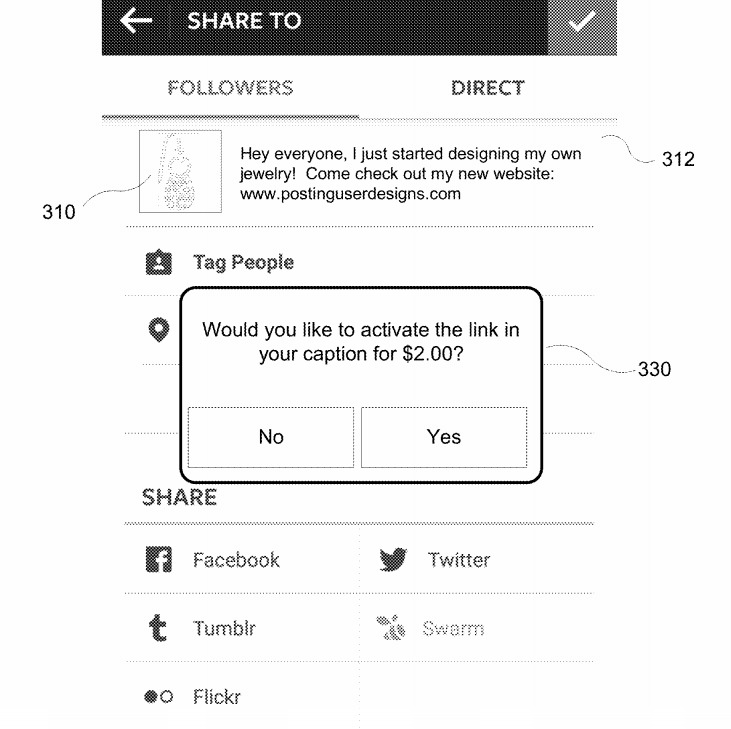
Protocol discovered the patent, which was submitted by Instagram back in 2016. The patent shows a pop-up message that’s meant to appear when a user adds a link in a caption. The caption would read “would you like to activate the link in your caption for $2.00?”
“If the online system detects the text content of the caption includes a string of link text identifying an address, the online system prompts the posting user to pay a fee in exchange for generating a link,” the patent application notes.
One of the biggest problems with Instagram is that you can’t include a link in a caption, which is why most people caption posts with “link in bio.”
However, if Instagram were to implement this feature, it would raise the question of whether people would want to pay $2 per link. Regardless, this feature would be a great way for Instagram to generate more revenue, and the $2 charge wouldn’t be a problem for influencers.
As with any other patent, Instagram may never actually add this feature since companies apply for patents all the time without actually going through with them.
Image credit: Protocol
Source: Protocol Via: The Verge
The post Patent suggests Instagram might plan to charge a fee to put links in captions appeared first on MobileSyrup.
2020
We’ve been fortunate during most of this pandemic that we live in a rural area with lots of outdoor space we can enjoy without bumping into other humans. This last month of fires has been keeping us inside all of the time though and I’m starting to develop some serious cabin fever.
The good news is that spending so much time with Deanna is great. I’ve often joked that I don’t have much of a social life because, given the choice, I’d rather be with her than anyone else. I just like her that much more than I like you all. Sorry, not sorry.
Thank you, Deanna, for being such a great partner through all of this. Half a lifetime ago I was certain we’d be great together, through thick or thin, and this year, more than most, has been proof that I wasn’t wrong.
Apple’s design teams made a face mask for its employees

Face masks are one of the best tools people have to help reduce the spread of COVID-19. Unsurprisingly, many companies have jumped on the face mask bandwagon and made their own masks. Apple is the latest to join that group with its new Apple Face Mask.
The Cupertino, California-based company created the mask in-house for its corporate and retail employees. According to Bloomberg, Apple told staff that its Engineering and Industrial Design teams — the same groups that work on devices like the iPhone and iPad — developed the Face Mask.
It’s made of three layers to filter incoming and outgoing particles and it can be washed and reused as many as five times.
Bloombeg’s Mark Gurman got his hands on the mask and posted pictures of it to Twitter. The packaging and design look very Apple, and the mask sports large coverings along the top and bottom to cover the wearer’s nose and chin. Apple confirmed the news to Bloomberg, noting it conducted research and testing to find materials that filter air properly without disrupting the supply of medical personal protective equipment (PPE).
Here’s your Apple Mask unboxing… unsurprisingly like any other Apple product. https://t.co/Ff0d9nQ6kl pic.twitter.com/9TLQs0V6Lf
— Mark Gurman (@markgurman) September 11, 2020
The company will start sending out the Apple Face Mask to staff over the next two weeks.
It’s worth noting Apple worked with Washington-based Gallaudet University to create the ‘ClearMask,’ the first FDA-cleared surgical mask that is completely transparent. By showing the wearer’s face, it can help wearers communicate with people who are deaf or have hearing impairments that rely on lip-reading.
Source: Bloomberg
The post Apple’s design teams made a face mask for its employees appeared first on MobileSyrup.
Brand Britain 2020 pic.twitter.com/LBOcteNeC0
|
mkalus
shared this story
from  ottocrat on Twitter. ottocrat on Twitter.
|

RT @metdesk: Noticed a bit of a orange glow this morning? There is some evidence on trajectory models from NOAA for traces of smoke origin…
|
mkalus
shared this story
from ottocrat on Twitter.
|
Noticed a bit of a orange glow this morning? There is some evidence on trajectory models from NOAA for traces of smoke originating from the U.S #wildfires causing more of an orange tint to the cirrus clouds here in the UK this morning. #OrangeSky pic.twitter.com/yikMKO7zqU



 Chris Kendall (ottocrat)
on Saturday, September 12th, 2020 6:32pm
Chris Kendall (ottocrat)
on Saturday, September 12th, 2020 6:32pm71 likes, 45 retweets
The British would have been right to reject the 2016 referendum result and would have gained international respect for doing so. If Bernard here can change his mind after voting for the Withdrawal Agreement, why can’t the country? pic.twitter.com/VyQOKeCI93
|
mkalus
shared this story
from ottocrat on Twitter.
|
The British would have been right to reject the 2016 referendum result and would have gained international respect for doing so. If Bernard here can change his mind after voting for the Withdrawal Agreement, why can’t the country? pic.twitter.com/VyQOKeCI93

84 likes, 26 retweets
Reports from Stanley Park (and Beach Avenue)
|
mkalus
shared this story
from  Price Tags. Price Tags.
|
Peter Ladner reports:
The Stanley Park Hill Klimb (SPHK) now exists. It’s a thing. (The K is for one kilometre long but I challenge someone to prove me wrong.)

It has a Start Line and a Finish Line and piece of chalk at the top to write down if you’ve made a new record time.
So far I have the record time: 3:52. Timing for other people begins now.
 Tell your friends. Do the SPHK loop in your costume on your way to the Beach Avenue Bikefest #beachavebikefest Sunday 3-4 pm, where you can win a costume prize! Share your time with your friends. Dare them to beat it, or to just come out and enjoy the ride. Remember: five-yr-old-kids can ride up it.
Be the first to set up the SPHK on Strava.
Do with it what you want. Maybe come and add some of your own art (sidewalk chalk is sold at most dollar stores). This story could just be getting started.
This will wash away in a few weeks, but perhaps some visions will be permanently chalked in.
Here’s part of a longer story by Peter Ladner on how the Stanley Park Hill Klimb has the potential to be an accessible in-town Grouse Grind. It was written as a friendly open letter to Prospect Point Cafe owner Nancy Stibbard:
__________________________
Dianna reports on the need for safe space and respect:
I just picked this off the Escape Velocity bike club Facebook page. Happened a couple of days ago apparently. Sounds like a hit and run.
Does anyone have news on the condition of the group of roadies that were slammed into by the BMW SUV when descending Prospect Point last week?
My friend was riding his MTB back home at the same time and got wiped out to with major road rash and broken bones on his right hand. I hope no one suffered any worse.
The account I heard was at a group of roadies were descending and, in the absence of vehicles, moved over into the left lane to safely overtake a family of four. The BMW laid on his horn and accelerated up to the group. Group moved back once past the family and the driver drove through the cones into the bike lane and the group!
__________________________
Navdeep Chhina from HUB shares a letter he received:
I am Lanie, and I live with my partner. Andrew is diabetic, I am a 69-year-old kidney cancer survivor. We walk everyday. Our alarm rings at 5:30 am, and we are out the door in the dark now.
We walk Stanley Park Drive sidewalk, but there is an interesting benefit. We clean up the pylons. That means we use our feet. We stand on one leg, we flip the pylons and then we do a crossover move and get them to the centre line.
For two people in the age group of 69 years old, it is and has been a great work out. We walk to build our Killer B and T cells, but we also get very important balance exercises in. We will miss the pylons.
The sidewalk will remain, however you decide about bicycles. We like the bicycles. I am glad you have put out more counters on the roadways, thank-you. There are many people who ride across the Lion’s Gate Bridge from North and West Vancouver.
I have studied Psychology at UBC and I do not know why changes or new signs make people act out and mess the pylons.
Thank you for the new signs. I was tiring of asking people to stop and read the sign at the washroom at Prospect Point. This helps:

Andrew and I get on well with the cyclists. The good-morning greetings make this time of social distancing seem less isolating, and we would miss the morning congeniality that would make us feel alone. We miss a cyclist that does not ride. The cyclists notice if we miss a day of walking and ask if we are OK. This has become a social outing now for us.
I know that there are too many joggers on the Seawall that cannot or do not go to gyms. They fill the Seawall. There would be no room for bicycles anymore. I pray cyclists will become a permanent part of Stanley Park Drive.
__________________________
Unofficial Beach Ave Bikefest – Sept 13 2020
 Choose a costume! Organise your cargo! Bring the family! Come on down to Vancouver’s most popular and scenic cycling destination for some healthy outdoor fun!
Link Pack
– The Egyptian Egg Ovens Considered More Wondrous Than the Pyramids
– I thoroughly enjoy Dr. Bertrice Berry’s Stories on Instagram.
– How I Mastered the Art of Ventilating My Home, Let me tell you about my fans.
– WHOA! IKEA has digitalized 70 years worth of their furniture catalogs.
– There are so many tools for available for the Remote Work Landscape
– The 2020 Fall Foliage Prediction Map
– A Primer on Algorithms and Bias
– How to Tell if Distance Learning Is Working for Your Kid
– Guide To Le Corbusier’s 10 Most Significant Buildings
– Comedy Wildlife Photography awards 2020 finalists. This one made me laugh out loud.
– Gasp: Draper – Land Ark RV (via)
– How to (Actually) Save Time When You’re Working Remotely. I liked this advice: 2. Give yourself a Feierabend. In Germany, the Feierabend is a daily evening celebration marking the moment when work is switched off for the day — often accompanied by a hearty German beer.
– Sea-thru removes the water from underwater images
– Remote wiki for students & teachers (via)
– Toucan is a free Chrome extension that helps you learn a language without even trying. (via)
– I am starting to think I shouldn’t bring my phone into my bedroom and am researching alarm clocks. Loftie looks pretty cool and versatile, but pricey. Recommendations anyone?
– Did you catch that Poolside FM launched an iOS App this week?
– Did you see my post about iNaturalist? It’s an app that helps you identify the plants and animals around you by connecting with a community of over a million scientists and naturalists. So cool!
– In case your kids are as bummed about remote school as mine, you can always try brighten their day with some Tattly. And always remember: It’s only temporary!
– This Graphic and Digital Design certificate from Parsons gives you the flexibility of online classes plus the option of choosing your own electives. A big thank you to Parsons at Open Campus for sponsoring my blog this week.
Rejecting the ideas hamster
Before I deleted my LinkedIn account and then created a new one from scratch, I had a bunch of recommendations from people with whom I am no longer in contact.
I vividly remember one such recommendation, however, which described me as an ‘ideas hamster’. This was unexpected, but I saw it as a good thing. I shared that description of myself with a kind of pride. I owned it.
More recently, and particularly in the self-excavation I’ve been doing via therapy, I’ve come to see my constant need to move onto the next thing and work as fast as I can as a form of avoidance. After all, hamsters take exercise in wheels that, ultimately, go nowhere.
But if I’m not an ‘ideas hamster’, then… what am I? If the ability to rapidly generate new ideas is not my USP, then what value do I bring to the world?
Thankfully, the answer has been sitting in front of my the whole time. People regularly allude to my ability to connect together things in new and novel ways.
I’m happy with that. There is nothing, after all, new under the sun, meaning ‘my ideas’ have never been more than connecting together things differently. So it’s in this that I add value to the world, in my ability to synthesise and make sense of the world around me.
This post is Day 45 of my #100DaysToOffload challenge. Want to get involved? Find out more at 100daystooffload.com
The post Rejecting the ideas hamster first appeared on Open Thinkering.
19
The story of the US is one of continuous recreation, continuous rebuilding, advancing the country in the direction of greater inclusion and sometimes pulling back from the progress made in a continuous two-steps forward, one-step back dance, relentlessly moving towards a more perfect union but never quite getting there yet.
This year is no different.
The health crisis of COVID-19 has robbed many of family and friends ( I count myself among the fortunate as the family members and friends who confronted the disease survived it); This year is a year when we can make different choices about what health safety can look like for future generations; generations who may be faced by further extinction threats; generations that can learn from the global actions taken to fight this pandemic and use this collective model to fight the upcoming environmental crisis.
The social crisis is leading to a potential reckoning over the country’s racist foundation and past. In what may have been one of the largest set of protests for social justice, millions of Americans of all colors have demonstrated, asking for the country’s leadership to find ways to do better, to find approaches to reform a system of injustice that has institutionalized racists behaviors. While slavery was buried with the civil war, the system that supported slavery still needs reform to create opportunities for all people, to build out a more perfect union.
And yet many despair that things cannot get better. They see the challenges of the last four years as an immutable tide moving backward. Less than 4 years after the first Black president left office, they see a country that cannot march forward.
That pull/push is the story of America: The Civil War brought forth the rise of the KKK; the Civil Rights movement drove racist politics forward; and the election (and re-election) of Barack Obama enraged racists white supremacist who found an enabler in his successor.
This year is an election year, one that presents an opportunity for the US to chart a different path than the one it’s been on for the last four years; an opportunity to deal with the rise of internal enemies (neo-nazis and other white supremacists intent on returning the US to a pre-civil rights era; science deniers intent on undermining understanding of basic facts) and agitation by external enemies intent on sowing division and tearing the democratic institutions that once made the US the envy of the world.
After the 9/11 attacks 19 years ago, the world look to the US and asked “how can we help?” Today, the US answer to the same question around the pandemic seems to be “we don’t need your help.” The US appears to has turned our back on the world, refusing to work with others to fight a common enemy. 19 years ago, a global collaboration led to the extinction of the threat presented by state actors supporting terrorists, with the US leading the way; today, a global collaboration is working to extinguish a virus but the US is markedly absent, not only unable to lead the globe but also challenged in keeping up with others who have done better.
Today, over 1,000 Americans will die of COVID-19 across 50 states; on 9/11, 2,996 Americans died in 4 locations; This week alone, twice as many Americans will die of COVID-19 than died in the 9/11 attacks.
With 3,000 Americans dead, the country mobilized and changed its character to adapt and protect; with almost 200,000 Americans dead (191,572 as I type this), the US response to COVID-19 is still a patchwork that leaves many of us uncertain as to what the future might hold.
But this November, a choice can be made as to whether to re-engage with the world and build a better America or double-down on the US we currently have. If you’re an American citizen of voting age, your choice at the ballot box will decide whether this post presents the most dire of times in American history since 9/11 or whether the 20th anniversary of 9/11 is one when we look back wistfully at a time when things were simpler and when the functioning of democracy was something we could take for granted, even in the country’s darkest hours.
In Memoriam
Carlos Dominguez, Mark Ellis, Melissa Vincent, Michael DiPasquale, Cynthia Giugliano, Jeremy Glick, David Halderman, Steve Weinberg, Gerard Jean Baptiste, Tom McCann, David Vera.
This post is part of a continuing series in which I remember those I knew who were lost on that day. Here are the previous years: 2019, 2018, 2017, 2016, 2015, 2014, 2013, 2012, 2011, 2010, 2009, 2008, 2007, 2006, 2005, 2004, 2003, and 2002. For context, you might want to read The day after, which is about as raw as one can get about that day as I wrote that piece less than 36 hours after the first plane hit. This is the longest series I’ve ever written and I expect to continue yearly until I can no longer write.
The post <span class='p-name'>19</span> appeared first on TNL.net.
Your Phone Is Your Castle
A Brief History Lesson
There is a saying “A man’s home is his castle” that derives from an even older British saying “an Englishman’s home is his castle” from hundreds of years before. Putting aside the history of male and female ownership of property for the past few hundred years, this statement came about as a matter of common law in the 17th century that enforced the right that no one–even the King–may enter a British person’s home without their invitation. As stated famously by Prime Minister William Pitt in 1763:
“The poorest man may in his cottage bid defiance to all the forces of the crown. It may be frail – its roof may shake – the wind may blow through it – the storm may enter – the rain may enter – but the King of England cannot enter.”
This right influenced the United States founding fathers and became a right against unreasonable search and seizure enshrined in the fourth amendment in the US Bill of Rights.
Ultimately this statement is one about personal sovereignty over your property: that you should be able to control what happens with your property, should be able to control who is allowed to enter it, and should be allowed to defend it from intrusion.
Your Phone Is Your Castle
If your home is your physical castle, your phone is your digital castle. More than any other computer, your phone has become the most personal of personal computers and holds the most sensitive digital property a person has, including:
- Detailed contact lists of friends and colleagues
- The contents of private communications
- Personal photos (sometimes including very intimate ones)
- Personal files (sometimes including financial documents)
- Health and biometric information (sometimes including personal heart rate, blood pressure and exercise regiment)
- Passwords to online accounts
- Often even a database (if not multiple databases) of everywhere the phone has (and therefore you have) been.
So to extend the metaphor, if your phone is your digital castle, it means you should be able to control what happens with it, who is allowed to enter it, and should be allowed to defend it from intrusion.
Well, Maybe Not Your Phone
The unfortunate fact is, for most of the people reading this article, your phone is not your castle. In many ways, your phone isn’t yours at all, at least if we are using these same traditional definitions of property. Instead, you happen to live in a castle owned by your phone’s vendor. It’s Apple or Google, not you, who decides what is allowed to enter the castle, and what happens inside its walls. They are the ones who are allowed to defend it from intrusion, and more importantly they are the ones who define what counts as intrusion to begin with. Your phone is their castle, you just happen to live inside their walls subject to their rules.
The recent epic battle between Apple and Epic over the tariff Apple charges for merchants to sell goods inside the castle walls illustrates how Apple markets their castle’s defenses as protecting the castle residents when in reality it’s about controlling all that goes on inside the castle.
If you haven’t been following the case, Epic is objecting to the 30% cut of their revenue that Apple gets from processing payments within the App Store. Epic has added an alternate payment processor within their popular game Fortnite that competes with Apple’s App Store payment processor by charging a lower price for purchases made through the game since Epic avoids Apple’s 30% processing fee. Apple has responded by threatening to remove Epic’s software from the App Store as well as revoking their ability to use Apple’s development infrastructure.
A customer can only install apps that are in the App Store, so by removing Epic’s app from the App Store, Apple removes them from the full iOS ecosystem. Customers who own iPhones and who have paid for and installed Fortnite would then have the application removed from their phones. In a court filing, Apple argues that the requirement that customers may only install software through the App Store is needed “for security and privacy.”
There is some truth to this statement. Because iOS software, backed by iPhone hardware, actively prevents a customer from installing any software on an iPhone outside of the App Store, it does also prevent attackers from installing malicious software. Because the App Store has rules about how applications (outside of their own) can access customer data, if Apple discovers a competitor like Google or Facebook is violating its privacy rules it can remotely remove their software from iPhones, even internal corporate versions of software owned by Google or Facebook employees.
In all of these examples, though, the “security and privacy” of customers happens to also coincide with restricting a competitor. While Apple markets themselves as welcoming competition on the App Store, Apple has a long history of resisting competition with their own products from the App Store such as when it banned parental control apps around the same time it released its own, only to remove the ban a few months later after its own app had sufficient market share.
I should note that Apple isn’t the only company that does this, it’s just that their control is a bit more advanced than Google’s. In my Consent Matters series I elaborate on a number of different companies that take remote control of customer computers including the now-famous example where Google was forced by the US Government to remove Huawei’s ability to update Android on their own hardware. Huawei has since responded by building their own OS so they have control over their own castle (and subjects).
Well, Maybe Not Their Castle
If you live inside a strong, secure fortification where someone else writes the rules, decides who can enter, can force anyone to leave, decides what things you’re allowed to have, and can take things away if they decide it’s contraband, are you living in a castle or a prison? There is a reason that bypassing phone security so you can install your own software is called jailbreaking.
These companies have built very sophisticated and secure defenses all in the name of protecting you from the world outside their walls, yet in reality the walls are designed to keep you inside much more than they are designed to keep attackers out. The security community often gets so excited about the sophistication of these defenses backed by secure enclaves and strong cryptography that their singular focus on what those defenses mean for attackers blinds them from thinking about what they mean for everyone else.
The biggest threat to most people ends up not being from uninvited hackers, it’s from the apps Apple and Google do invite in that capture and sell your data. This has resulted in a multi-billion-dollar app ecosystem built around capturing and selling your data. If Apple or Google let someone in you didn’t invite, whether through pre-installed applications or new features embedded in an OS update, you can’t tell them to leave. Your security and privacy aren’t really protected inside these walls because the main point of these security measures is to enforce control, security against attackers and protecting your privacy is mostly marketing spin.
Make Your Phone Your Castle
It doesn’t have to be this way. We believe your phone should be your castle and that you should be in control of your own computer, not us and not any other vendor. This doesn’t mean sacrificing security or privacy, on the contrary it means putting your security and privacy in your own hands by building a strong foundation of trustworthy free software anyone can audit, while rejecting security measures that build a stronger cage around you than attackers. It means controlling your hardware with hardware kill switches so you can disable your camera and microphone, your WiFi and Bluetooth, and even your cellular modem and all of the sensors on your phone and know they are truly off.
You should decide which software is allowed on your system, not Purism. While other vendors often are paid to bundle third-party applications you aren’t allowed to remove, all of the software on the Librem 5 including pre-installed software is fully under your control. There’s no “rooting” or “jailbreaking” required to install or remove the software of your choice or even to install a different OS. While we will provide you with a list of trusted, curated free software in our PureOS Store, if you want to invite some other software into your home, even software that violates Purism’s Social Purpose, you can.
The current phone market is centered on vendor control and is only getting worse with each iteration and advancement. We had to design and build the Librem 5 from scratch, because no other combination of hardware and software on the market met our high standards for freedom, security, privacy, and user control. What we have built with the Librem 5 is a phone that works the way your most personal of personal computers should work–your own digital castle where you can store your most sensitive digital property, control what happens with it, and decide who’s invited in.
Discover the Librem 5
Purism believes building the Librem 5 is just one step on the road to launching a digital rights movement, where we—the-people stand up for our digital rights, where we place the control of your data and your family’s data back where it belongs: in your own hands.

The post Your Phone Is Your Castle appeared first on Purism.