Shared posts

10 Nov 18:13

Benchmarking desktop PCs circa 1990

by Derek Jones

Before buying a computer customers want to be confident of choosing the best they can get for the money, and performance has often been a major consideration. Computer benchmark performance results were once widely discussed.

Knight’s analysis of early mainframe performance was widely cited for many years.

Performance on the Byte benchmarks was widely cited before Intel started spending billions on advertising, clock frequency has not always had the brand recognition it has today.

The Byte benchmark was originally designed for Intel x86 processors running Microsoft DOS; The benchmark was introduced in the June 1985 issue, and was written in the still relatively new C language (earlier microprocessor benchmarks were often written in BASIC, because early micros often came with a free BASIC interpreter), it was updated in the 1990s to be Windows based, and implemented for Unix.

Benchmarking computers using essentially the same cpu architecture and operating system removes many complications that have to be addressed when these differ. Before Wintel wiped them out, computers from different manufacturers (and often the same manufacturer) contained completely different cpu architectures, ran different operating systems, and compilers were usually created in-house by the manufacturer (or some university who got a large discount on their computer purchase).

The Fall 1990 issue of Byte contains tables of benchmark results from 1988-90. What can we learn from these results?

The most important takeaway from the tables is that those performing the benchmarks appreciated the importance of measuring hardware performance using the applications that customers are likely to be running on their computer, e.g., word processors, spreadsheets, databases, scientific calculations (computers were still sufficiently niche back then that scientific users were a non-trivial percentage of the market), and compiling (hackers were a large percentage of Byte’s readership).

The C benchmarks attempted to measure CPU, FPU (built-in hardware support for floating-point arrived with the 486 in April 1989, prior to that it was an add-on chip that required spending more money), Disk and Video (at the time support for color was becoming mainstream, but bundled hardware graphics support still tended to be minimal).

Running the application benchmarks takes a lot of time, plus the necessary software (which takes time to install from floppies, the distribution technology of the day). Running the C benchmarks is much quicker and simpler.

Ideally the C benchmarks are a reliable stand-in for the application benchmarks (meaning that only the C benchmarks need be run).

Let’s fit some regression models to the measurements of the 61 systems benchmarked, all supporting hardware floating-point (code+data). Surprisingly there is no mention of such an exercise being done by the Byte staff, even though one of the scientific benchmarks included regression fitting.

The following fitted equations explain around 90% of the variance of the data, i.e., they are good fits.

Wordprocessing=0.66+0.56*CPU+0.24*Disk

For wordprocessing, the CPU benchmark explains around twice as much as the Disk benchmark.

Spreedsheet=-0.46+0.8*CPU+1*Disk-0.16*CPU*Disk

For spreadsheets, CPU and Disk contribute about the same.

Database=0.6+0.01*CPU*FPU+0.53*Disk

Database is nearly all Disk.

ScientificEngineering=0.27+FPU*(0.59-0.17*Disk-0.03*CPU)+0.45*CPU*Disk

Scientific/Engineering is FPU, plus interactions with other components.

Compiling=-0.33+CPU*(1.1-0.09*Disk-0.16*Video)+0.33*Disk*Video

Compiling is CPU, plus interactions with other components.

Byte’s benchmark reports were great eye candy, and readers probably took away a rough feel for the performance of various systems. Perhaps somebody at the time also fitted regression models to the data. The magazine contained plenty of adverts for software to do this.

27 Oct 00:40

Twitter Favorites: [meghamohan] This is a subtweet for every single one of you https://t.co/ZS6GhfsdDs

Megha Mohan @meghamohan
This is a subtweet for every single one of you pic.twitter.com/ZS6GhfsdDs
27 Oct 00:38

Twitter Favorites: [ReneeStephen] Some helpful math for why the CBC called victory for many riding last night. Given 100 votes counted, 20 in the ma… https://t.co/K4JHuYcHpo

Renée @ReneeStephen
Some helpful math for why the CBC called victory for many riding last night. Given 100 votes counted, 20 in the ma… twitter.com/i/web/status/1…
26 Oct 01:33

Previewing the Keddy Access Trail

by jnyyz

Back in December 2015, schoolteacher Jay Keddy was killed while cycling up the Claremont Access by being struck from behind. Fast forward several years, and the City of Hamilton decided to put a bi directional protected bike lane along this busy route up the mountain, and that they would name it after Mr. Keddy. I had heard that the bike lane would be opened late this fall and so I took the opportunity while I was in town to take a look at the state of construction.

This website is the best overview of the project that I have found. I will be referring to the connection numbers that are indicated here.

Here is the view from Southam Park, which is practically at the top of the trail. Still a busy construction site, but if you look carefully, you can see a cyclist who has ridden up the trail to this point, where the trail is still gated off.

The upbound lanes where closed due to construction, so I was able to ride down around the construction to the same point. This was the view down the mountain. This was going to be fun.

A few minutes later, approaching downtown.

Back in the day, I would occasionally ride from the west mountain down to Hamilton Collegiate Institute for Grade 13, and it was not much fun. The thing that I remember more than all the high speed car traffic was all the road debris that fortunately did not cause any flat tires.

Here is the connection to Hunter Street (connection #1). It is gated off as well, but clearly you can get past the gate rather easily. You can also see a preview of the bike lane parkings that might be used on the trail?

Coming back up the trail, here is the connection to St. Joseph’s Drive (connection #3).

This new MUP trail is complete, but it is gated off at the end. This is the view from this entrance back up towards the access.

Here is one of the connections to the road leading up the Jolley Cut (connection #4).

Connection #5 is a way for cyclists to cross the offramp leading to West 5th Ave. The first photo in this post shows the state of construction. The signal lights have already been installed.

image source

The stretch of bike lane that goes along the West 5th ramp is also still under construction.

Here is where it will end and connected onto West 5th.

Very much looking forward to seeing this spectacular piece of bike infrastructure complete. One hopes that this will spur the installation of more bike lanes on Hamilton Mountain, which are very sparse in comparison to the downtown areas.

26 Oct 01:30

Twitter Favorites: [tomhawthorn] Sigh. A reminder to my broadcast friends: First shot at forming a government in a hung parliament goes to incumbent… https://t.co/Br5zKYQRuY

Tom Hawthorn @tomhawthorn
Sigh. A reminder to my broadcast friends: First shot at forming a government in a hung parliament goes to incumbent… twitter.com/i/web/status/1…
26 Oct 01:29

100 Days in Obsidian Pt 2: Hierarchy and Logs

by Ton Zijlstra

In part 1 I explained how Obsidian is a tool I use in support of the methods I employ that make up my system to process incoming information as well as track and do my work.

I started using Obsidian to make better notes (Notions as I call them), and link them together where I see relevance. This is a networked type of use. For my daily work and for logging that daily activity I use a folder structure, which is a hierarchical approach. My personal knowledge management system is based on the interplay of those networked and hierarchical perspectives, which allows emergent insights and putting those insights to action or keep them until they can be used.

Folder hierarchy

To kick-off my more detailed description of using Obsidian, I will start with that hierarchical perspective: the folder structure. I will also explain how I make daily and week logs, as well as what I call ‘month maps’

Obsidian allows you to use multiple ‘Vaults’. A vault is a folder tree structure that is perceived as a single collection of notes by Obsidian. The tool tracks connections between only those mark down files in that folder tree. I currently have only a single vault, as I want to be able to link between notes from all my areas of activity. I can imagine you might use separate vaults if one of them is meant to be published, or for instance if one is a team effort. As there is no such division for me, I am building a personal system, I have a single vault.

Within that vault I have a folder structure that currently looks like this:


Main folder structue in my Obsidian vault

That list of main folders is a mix of folders for each of the areas I’m active in, some folders that I use to manage my own work, or that I have/had as Notebook in Evernote to keep their contents apart from other things, and the folders that contain the notes and notions that led me to start using Obsidian.

Areas (a component in the GTD method) are things like my company (4TGL), family and health, home, my voluntary board positions, and websites/automation. Within each area there are projects, specific things I’m working on. Projects all have their own folder in an Area. Some of the projects may have subfolders for (sub)projects taking place within the context of a client assignment for instance.

Examples of folders for managing my work are 1GTD12WY which contains things related to my longer term goals and 3 month planning cycle (combining elements from Getting Things Done and the 12 Week Year methods), and the 2Daglogs folder which contains day and week logs, and month maps.

Evernote notebooks like travel related material (bookings, itineraries) en digital tickler files (also part of the GTD method), and Network (where I keep contextual notes about people, as LinkedIn etc e.g. stores nothing about how you met someone) also have their own top level folder at the moment.

The actual folders for notes are Notes (for notes made from information coming in) and 0GardenofForkingPaths (why that title?), which contains my Notions, the conceptual Zettelkasten-style notes. Those two folders internally take a networked perspective and have no subfolders.
Some folder names start with a number to ensure them being shown at the top end of the list. One folder Z-Templates contains, well, templates, and is called Z so it is always last. Templates can be copied into new notes for those notes where you want to keep a specific structure.

Whenever I start a new project I run an Applescript that after asking me the project name, the area it belongs to, the description and project tag, creates the right folders and in them the right notes I need to start a project (albeit a client project, an internal one, or something else). That script used to create those structure, tasks and notes for me in Evernote and Things, but now creates them in the filesystem within my Obsidian folder. Each project e.g. has a ‘main’ note stating the projects planned results, to which goal(s) it contributes, main stakeholders, budget and rough timeline.

Day and week logs, month maps

Within the folder 2Daglogs I keep day logs, week logs, and month maps. Day logs are ordered in monthly folders, all weeks in a year are in one folder, as are all month maps. Day and week logs are for the now and looking back (they’re logs), month maps I use to look forward to the month ahead, at the start of each month (they’re surveying the coming weeks).


Folder structure that keeps day/week/month files

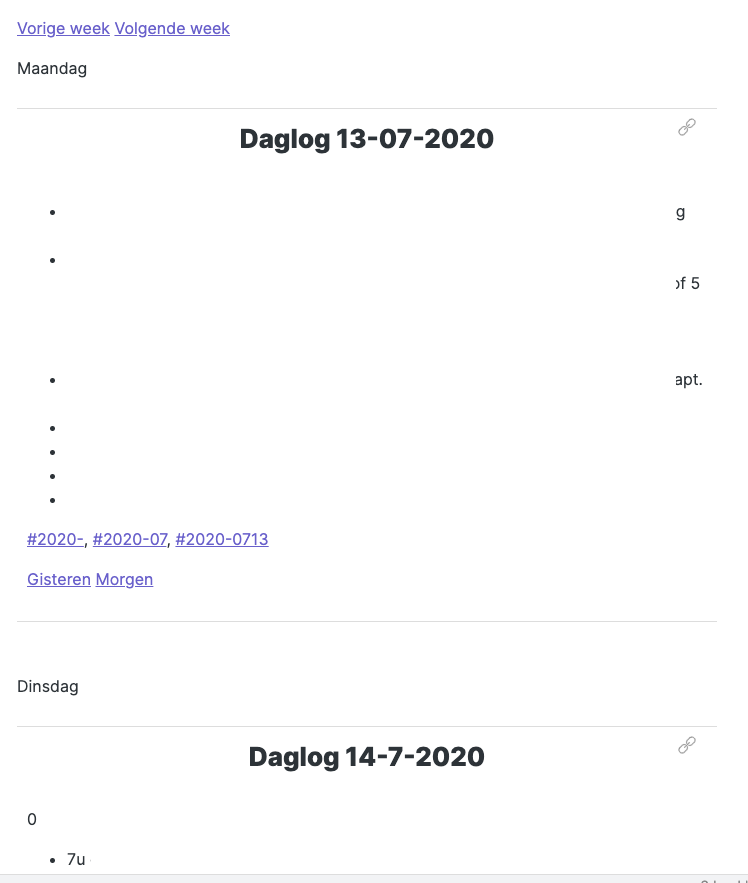
The first thing I do in the morning, is start the Day log. I do this by clicking the ‘tomorrow’ link in the day log of the day before (after glancing at what I did yesterday). Then in the new note I hit the keyboard short cut /dnow which (through Alfred) adds date tags (like #2020- #2020-10 #2020-1025) and links to the day logs of yesterday and the (as yet not existing) one for tomorrow. See the screenshot below. During the day I add activities to the log as I’m doing them. I also mention thoughts or concerns, how I think the day goes etc. I link/mention the notes corresponding to activities, e.g. things I wrote down in a project meeting. I started keeping day logs last April, and they are useful to help me see on days that seem unfocused what I actually did do, even if it felt I didn’t do much. That helps spot patterns as well.


Example of a day log with the links to other days shown, beneath a bullet list of things I mention during the day

Week logs are notes that collate the day logs of a week. (Since I restarted doing weekly reviews, a week log is accompanied with a note that contains review notes.) Collating is done by transcluding 7 day logs into one note. I add links to the previous and next week on top. I use the week logs in my weekly review on Friday, to write hours in my timesheets at the end of the week, and to write my Week Notes blogpost on Sunday.


A week log is a list of transcluded day logs. Above in edit mode, below in preview mode

Monthmaps are something I make at the start of each month, they are a mindmap of the coming month, hence the name (the Dutch word for month, ‘maand’ sounds a bit like the English mind in mindmap). It’s a habit I started 4 years ago. I list every area (see folder structure above), and within those areas I list every project where I see I might hit a snag, where I have concerns or urgencies are likely to pop up, or where activities are in store I know I usually try to evade or postpone. I add easy actions I can think of that will help me deal with such barriers. It’s a way to confront underlying hesitations or anxieties and prevent negative consequences from them. I refer to it during the week, to see if barriers indeed popped up, or what I had planned to deal with them when they do. I go through it during weekly reviews as well.

In the next part I’ll take a look at how I’ve replaced my todo-list app Things with simple markdown files in Obsidian.

26 Oct 01:21

How Apple is organized for Innovation

by Volker Weber
Ever since Steve Jobs implemented the functional organization, Apple’s managers at every level, from senior vice president on down, have been expected to possess three key leadership characteristics: deep expertise that allows them to meaningfully engage in all the work being done within their individual functions; immersion in the details of those functions; and a willingness to collaboratively debate other functions during collective decision-making. When managers have these attributes, decisions are made in a coordinated fashion by the people most qualified to make them.

Fantastic article in Harvard Business Review.

More >

26 Oct 01:20

RT @davey: “Why don’t working class parents just sell their pearls?” isn’t something I expected to read today, but there we are. https://t.…

by Davey (davey)
mkalus shared this story from AliceAvizandum on Twitter.

“Why don’t working class parents just sell their pearls?” isn’t something I expected to read today, but there we are. pic.twitter.com/1cKcnhG6mL


Retweeted by weeb but for poland (AliceAvizandum) on Sunday, October 25th, 2020 12:22pm


3625 likes, 1108 retweets
26 Oct 01:19

Belinda Carlisle and Jane Wiedlin of The Go-Go’s performing, c.1982. Photo by Lynn Goldsmith pic.twitter.com/J64ingoSGp

by Things from the past 📷🎥 (moodvintage)
mkalus shared this story from moodvintage on Twitter.

Belinda Carlisle and Jane Wiedlin of The Go-Go’s performing, c.1982.
Photo by Lynn Goldsmith pic.twitter.com/J64ingoSGp


405 likes, 42 retweets
26 Oct 01:18

A name as a reminder of who we can be

by 2020-10-23 - Picking Names.txt

I’ve been thinking a lot about names recently, probably mostly because many people have asked us why we chose Zoya for the name of our child.

There are many reasons we picked Zoya—easy to say and write, works across cultures, means “loving and caring” in Arabic, etc.—but most of all we picked it because she looked and felt like a Zoya when she arrived. We had a shortlist of names going into the hospital; when she was born, we saw here and immediately knew there was only one real choice.

In my family, all our names are Arabic and mean something, and I like to think that we’ve all taken on the characteristics of our names. My name means “companion”—or more specifically the kind of friend that will be by your side in the darkest times—and I like to imagine that I am that person, for a few people at least. I’m extremely proud of my name and what it means, and I try to live up to it every single day.

Maybe we grow up knowing that our names aren’t just ways to refer to ourselves, but instead markers of who we are and who can aspire to be. I know that I have held myself to the standard of my name every single day of my life, and that I continue to be inspired by knowing that Sameer is someone people can rely on and hold onto when they need a friend most. I like to think my parents saw that in me the day I was born, and that they raised me in a way that I would fulfill the promise of my name as an adult.

I love that Zoya means “loving and caring,” especially knowing that she comes from a loving and caring home where everyone is invested in caring for others. Zoya’s mom has made caring for others her career, and I have tried to infuse every part of my life with kindness and care. Caring is part of the family, and Zoya will not only grow up in a loving and caring home, but will grow up knowing that love and care is central to all her interactions with the world.

Maybe that’s why we knew we’d name her Zoya right away: we could see the love and care inside her, and knew that we would infuse in her a desire to live up to that name every day of her life.

For many, a name might be something to put on a registration form, but for a lot of us it’s a reminder of who we are and who we want to be. I’m so proud of my name and try to live its meaning every day; I hope that one day, my daughter will feel the same.


A poem

This Is the Time to Be Slow
John O’Donohue

This is the time to be slow
Lie low to the wall
Until the bitter weather passes

Try, as best you can, not to let
The wire brush of doubt
Scrape from your heart
All sense of yourself
And your hesitant light.

If you remain generous,
Time will come good;
And you will find your feet
Again on fresh pastures of promise,
Where the air will be kind
And blushed with beginning.


Some links

“This is how racism manifests in Canada. It is violent, it is exploitive and it endangers Indigenous lives.“ Every Canadian should be talking about this right now: “On September 17, 1999, the Supreme Court of Canada issued its decision in the R. v. Marshall case, confirming that the treaties of 1760-61 protect the Mi’kmaw right to hunt, fish, gather and engage in commercial trade. Yet, 21 years later and successive federal and provincial governments in Mi’kma’ki have failed to fully respect or implement the right of Mi’kmaw peoples to earn a livelihood from our own lands and waters.”

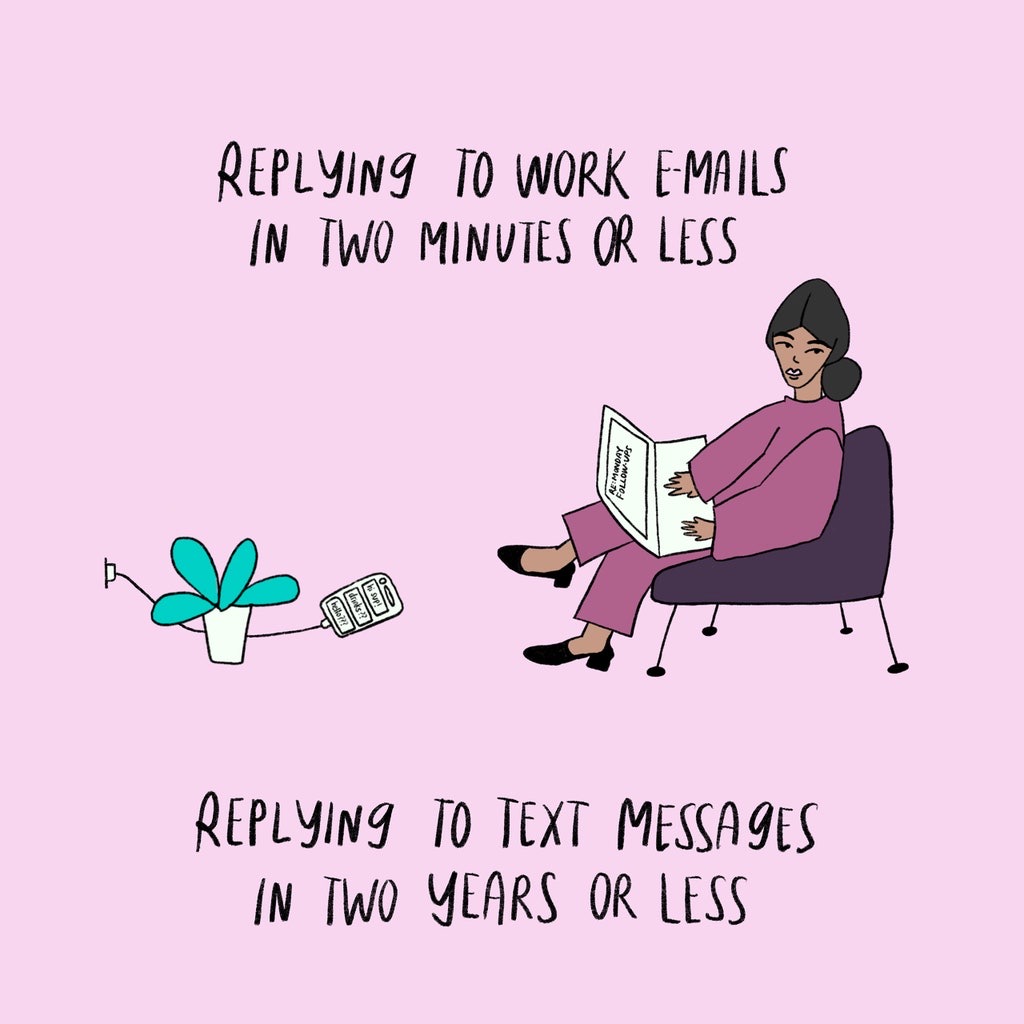
As a notoriously bad responder to texts, this particular cognitive dissonance from this year-old list of cognitive dissonance “I’m comfortable with” hit me to the core:

Replying to work emails in two minutes, replying to text messages in two years

If you’re looking for things to read, a great place to start is this list of the top ten works of journalism of the decade. I’m going to be revisiting a lot of these in the weeks to come.

The US National Archives has digitized and put online their collection of 374 treaties between indigenous peoples and the United States. This is crucial to have, in every country, if we want to actively work towards decolonization.

I don’t run, but this resonates so much: “For a long time I have believed that love and joy come after. They come after accomplishment. They come after pursuit. They don’t live in the present. They have to be earned.”

One of my favorite podcasts that I’ve been listening to for almost two years now (since the third episode) was recently profiled in the New Yorker and I couldn’t be happier for them. Everyone should be listening to You’re Wrong About.

Learning about Richard Francisco’s five levels of communication, and realizing I jump too often to level four in every social interaction, has been enlightening for me.

There are in history what you could call ‘plastic hours.’ Namely, crucial moments when it is possible to act. If you move then, something happens.”

A conversation I’ve had with friends and colleagues multiple times over the years, perfectly articulated: we need new digital commons, and those commons can be modeled on public parks.

We have a collection of almost every Sandra Boynton book now—and we read many of them regularly—so I can say with authority that this is an excellent ranking and analysis of her top ten books.

The entire profile of Sohla El-Waylly is worth reading, but the thing I’ll take away most is this: “Toni Morrison once said, “The very serious function of racism is distraction. It keeps you from doing your work.””

Thelonious Munk is an excellent name for a chipmunk.

I still haven’t found a face mask that fits me well, but I’m still wearing one any times I’m indoors anywhere other than our home—and would even if it wasn’t mandated. This breakdown of the science around face masks is excellent.

Fell in love with the architecture (and so much else) of Switzerland during our trip there last year, so this collection of photos of Swiss houses is making me smile so wide:

Photo of house in Switzerland in the snow

Wisdom and truth from Heather Havrilesky: “Once you start to understand (and feel inside your cells!) that you actually deserve to seek out joy and satisfaction, a veil is lifted. Suddenly you recognize how you compulsively block your own path to happiness out of some misguided compulsion to stay small and serve others.”

25 Oct 07:14

HyperX Quadcast S :: Ein gutes USB-Kondensatormikrofon in neuer Auflage

by Volker Weber

a5227476c3b3148591c1221d8a3bd895

Vor drei Monaten habe ich Euch das HyperX Quadcast vorgestellt. Der Hersteller hat sich ziemlich gefreut, dass es mir so so gut gefallen hat und kündigte gleich an, dass man mir auch "das neue Mikrofon" zeitig schicken werde. Lest Euch meinen Bericht einfach noch mal durch, dann kann ich mich hier auf die Änderungen beschränken.

Wie Ihr seht, ist das neue Quadcast S dem Quadcast wie aus dem Gesicht geschnitten. Es hat bereits auf den ersten Blick zwei Änderungen: Was vorher rot war, ist nun grau, und der USB-Anschluss ist nun ein USB-C statt des in die Jahre gekommenen Mini-USB-B. Ansonsten ist das Mikrofon gleich geblieben: Einen Mute-Sensor oben auf dem Mikrofon, ein Pegelregler am unteren Ende, der solide Standfuß, die elastische Lagerung gegen Schallübertragung von der Halterung, ein Adapter für 3/8" und 5/8" Stativanschlüsse.

24691fa89e732e17f4153315e21a97f0

Um sich besser in die Gaming-Geräte von HyperX einzufügen, kann man nun statt der roten Beleuchtung auch andere RGB-Farben und Lichteffekte nutzen. Das ist ein Thema, das völlig an mir vorbei geht. Mir ist nur eins wichtig: Licht aus heißt stummgeschaltet, Licht an "auf Sendung". Wenn die LEDs aus sind, dann tritt das Mikro dezent in den Hintergrund.

hyperxquadcastsngenuity.jpg

Die Ngenuity-Software zur Steuerung des Mikros hat aber noch mehr Funktionen: So gibt es nun drei Lautstärkeregler für das Mikrofon, das Monitor-Signal und den Kopfhörer. Das war bisher für mich nicht relevant. Den Pegel stelle ich am Mikro ein, die Lautstärke des Kopfhörers am PC. Ich denke, das ist hilfreich, wenn man sich seine eigene Stimme mit der richtigen Lautstärke noch einmal auf den Kopfhörer legen will.

Quadcast S kostet aktuell 180 Euro, das rote Quadcast aktuell nur noch 137 Euro. Beide haben ein langes Kabel mit USB-A am anderen Ende dabei und ich habe mir für den Quadcast ein geradezu absurdes, kurzes Kabel dazu gekauft: USB-C auf MiniUSB-B.

Empfehlen kann ich beide Mikrofone. Der Unterschied zwischen Quadcast und Quadcast S ist nur marginal.

25 Oct 06:55

Such a beautiful morning today, sunshine and so...

by Ton Zijlstra

20201023_101049

Such a beautiful morning today, sunshine and some lingering fog with the sun’s rays coming through. This heron, Y and I encountered in the park around the corner from our home, while cycling to the shops. We stood there for a few minutes watching each other.

25 Oct 06:54

What is the difference between competencies, skills and learning outcomes – and does it matter?

Tony Bates, Online learning and distance education resources, Oct 23, 2020
Icon

In an earlier post today I said "I don't think educating for 'skills' is really very different than educating for 'knowledge'." In this item Tony Bates seems to go in the opposite direction, drawing distinctions between competencies, skills and learning outcomes. "Competence is the ability to do something successfully or efficiently." But it's only a first step. "A good sportsperson is not just competent but highly skilled" (now this seems to equivocated between the noun 'skill' and the adjective 'skilled', but I quibble). Finally, while both competencies and skills are possible learning outcomes, he says, "they need to be defined and measured if they are to become a learning outcome." And content is designed to produce learning outcomes. Thus, he says, "the balance in most higher education instruction is on mastery of content (a learning outcome) over the development of skills (or even competencies." All of which is fair enough - but which to me says they're all part of the same thing.

Web: [Direct Link] [This Post]
25 Oct 06:54

These 6 skills cannot be replicated by artificial intelligence

Hiroshi Tasaka, World Economic Forum, Oct 23, 2020
Icon

This article never actually lists then as six skills; we get three groups of two (something an AI will probably never do). Probably Hiroshi Tasaka is wrong on all six of these points. These are all recognition and response tasks. AI has for the most part already solved the recognition portion of the equation. The responses are in some cases presentation, and in other cases process orchestration. I list them here for your convenience (quoted):

  1. the ability to undertake non-verbal communication.
  2. the ability to show deep empathy to customers,
  3. the ability to undertake growth management,
  4. the ability to employ mind management,
  5. the ability to perform collective intelligence management, and
  6. the ability to realize new ideas in an organization.

You're probably wondering what I do think the job of humans will be in the future. Our job will be to train AI. We'll all be teachers in the future. Not teachers in the sense of giving instruction, but teachers in the sense of modelling appropriate behaviour. It will be a challenge, to be sure.


Web: [Direct Link] [This Post]
25 Oct 06:51

Why Are Component Teams Still So Popular?

Perry Reid, a senior coach and trainer, who worked with several others from Industrial Logic to help a telecommunications client, recently told the following story:

Even the simplest feature would take this company 6 months or longer to deliver. The organization was deeply siloed, both technically (across 19 components) and by role. To deliver better software sooner, we created cross-functional teams composed of an architect, a customer representative, developers and testers from each of the component areas. This eliminated knowledge silos, queues, slow handoffs, long integration steps and dramatically shortened feedback cycles with the customer. One feature implemented during this experiment was completed and presented to the customer for acceptance in under four weeks, shattering the company's previous time to market expectations.

Perry’s story is one of many stories that were recently told when I asked my colleagues at Industrial Logic, “What’s been your best experience of helping an organization deliver better software sooner?” Nearly all of the stories shared a common theme: more value got delivered sooner by restructuring into cross-functional teams. So what is a cross-functional team?

A cross-functional team includes everyone (either full- or part-time) necessary to efficiently discover and deliver value for customers, with few-to-no slow dependencies on other teams. Knowledge transfer (cross-pollination) is typically high on such teams, as team members with different specialties collaborate closely on important outcomes. Balanced teams and product teams are examples of cross-functional teams. Feature teams are cross-functional as well, though the name has an unfortunate association with “feature factory”, a team that churns out features rather than delivering what customers most need.

In Perry’s story, a major service from the telecommunications client was organized into 19 deeply siloed component teams. What is a component team? The term is actually ambiguous because there are three types of component teams: shared, unshared and mixed:

  • Shared: A shared component team makes components (like objects, functions, libraries, utilities or services) that are intended to be shared by other teams. If the component didn’t exist, each team in the organization would have to create it or find a suitable outside solution. Shared component teams play a valuable economic role in organizations because they save other teams time and money. Smart organizations maintain a small number of shared component teams. Framework or platform teams are often composed of shared component teams.

    When I programmed risk calculators for a Wall Street bank, I relied heavily on a sophisticated, shared date library written by a component team in the bank’s London office. A few years later I was part of a “tools group” that made a collection of shared components and utilities for use by software teams throughout the bank.

  • Unshared: An unshared component team makes a part of a solution that usually can’t be delivered to customers without first being integrated with other finished parts of the solution. A product or service may be divided into several unshared component teams, each of which performs a discrete function.

    Many unshared component teams behave like functional silos, divided from each other and integrating infrequently. Phil Ensor, a management consultant who invented the term functional silo syndrome in 1988, likened the grain silos he would pass on his drives through Illinois to the silos he found in organizations.

    At a recent client, Wil Pannell, an Industrial Logic coach, found that a data acquisition component team worked independently of a data validation component team, which worked independently from a data science component team, which worked independently from a Spring Boot REST API component team. Prior to working with Wil, these teams only collaborated when they needed to integrate, rather than collaborating, integrating, deploying and releasing continuously.

    Unshared component teams are commonly found in the development of horizontal layers of software: a frontend UI component team completes work and then needs to integrate with middleware components, middleware business logic is produced and then must be integrated with frontend and backend components.

  • Mixed: Most component teams are either shared or unshared, yet some aren’t quite sure. Adeel Ali, an Industrial Logic coach, explained, “I see unshared components created with a hope that one day they will turn into shared components. The team ends up creating complex and generic interfaces for such components that only serve to complicate integration.” The opposite also occurs, when a shared component begins to acquire unshared logic intended solely for use in a specific product or service. Mixed up may be a better name for these kinds of component teams.

So what kind of component teams did Perry and colleagues find at the telecommunications client? They were unshared component teams. He explained:

The issue I saw at this client was almost an expression of Conway's Law. Most of the 19 component teams existed because a 3rd party tool or technology had been selected to be integrated into their technical stack. It would be brought in house, and a team would be formed around it including analysts, developers, testers, and managers. That team would then try to coordinate with other related component teams they depend on much like the actual components would communicate in their actual system.

Perry’s story, and the majority of “better software sooner” stories from my colleagues, describe how moving to cross-functional teams led to breakthroughs in performance, enabling organizations to be far more responsive to customer needs.

Performance from unshared component teams pales in comparison. Years of experience across numerous industries has revealed the same, tired problems:

  • Unshared component teams become functional silos.
  • Inter-team collaboration is inhibited.
  • Delays result from teams waiting on other teams to complete work.
  • Integration pain increases because it happens so infrequently.
  • Knowledge sharing is diminished or stifled.
  • Learning quickly by releasing early rarely happens.
  • Schedules slip.

And when products or services that are organized into unshared component teams hit major scheduling delays, management applies pressure, stress increases, quality decreases and unhappy staff multiply. This is why I believe that:

Unshared component teams are a root cause of mediocre performance.

Meanwhile, year after year, across numerous industries, my colleagues and I find that cross-functional teams produce better outcomes sooner by:

  • greatly reducing delays in communication and collaboration;
  • eliminating or reducing slow hand-offs;
  • easing the work of integrating code;
  • enabling evolutionary design; and
  • increasing the speed of both delivery and learning.

In short, cross-functional teams enable agility in software development.

And for decades, people have known this. So I wanted to explore why unshared component teams continue to thrive, despite all of the benefits of cross-functional teams. What is it about them that leads so many organizations to continue to rely on them?

Here are my theories:

  • Too Entrenched? Perhaps the organization was structured into unshared component teams years ago and changing it now feels like too much work? No one wants to re-think reporting structures, department boundaries or bonus plans. Maybe a few cross-functional team pilots even showed amazing results but it still felt like too much work to make them the dominant team structure? At a recent client, a cross-functional team was assembled out of volunteers and two Industrial Logic coaches. The team did outstanding work. When the initiative ended, each team member went back to their original unshared component team and their managers were apparently happy to have them back.

  • Risk Aversion? Perhaps the organization is simply too comfortable with unshared component teams and afraid to take the risks necessary to switch to cross-functional teams? This is closely related to being Too Entrenched, as described above.

  • Good Enough Performance? Perhaps the organization functions well enough or makes enough profit such that switching to cross-functional teams is perceived to not be worth the effort and cost?

  • Easier Management? Perhaps unshared component teams offer managers an easier way to appear competent and less afraid because a component team is easier to manage than a cross-functional team? Does it let them prove that they got their piece of the puzzle completed, regardless of whether it can ship or deliver value to a customer? We certainly see that such teams are popular in organizational structures that are optimized for planning and completing parts of solutions rather than quickly delivering solutions.

  • More Management Jobs? Are unshared component teams popular because they tend to require more traditional management jobs, whereas cross-functional teams tend to decrease the number of such jobs? Do people not want to face the unpleasant task of letting some managers go when switching to cross-functional teams?

  • Specialization? Are products and services organized into unshared component teams because management believes that high performance results from specialization? For example, web-based front end developers specialize in the complexities of CSS and responsive design and don’t have time to waste learning about middleware or backend work. Do they believe that the cohabitation and cross-pollination that comes with cross-functional teams is waste?

  • Complexity? Or has technology gotten so complicated these days that unshared component teams seem like the only way to go? In other words, your middleware or backend programmer shouldn’t learn any front-end technology because frankly, it’s all so complicated that each team is better off staying in its lane?

  • Community? Stefan Tikkov points out that “People in tech want to be close to others who share their tech preferences, and tech differences are great candidates for creating we/they situations.”

  • Efficiency? Wouter Lagerweij describes the “misconception that everyone should be busy all the time, and different specialties can keep on working on the next thing if you’ve split the work up in all those separate streams. Of course, everything gets stuck in ‘blocked’ at some point.”

  • Ignorance? Perhaps unshared component teams remain the default within organizations because leaders and managers are simply ignorant of the benefits of cross-functional teams?

This is a complex subject and I’m sure I have more to learn. What’s your opinion? Haved you had success with shared component teams Do you work in an organization that consists mostly of unshared component teams and has that been a problem? If so, why does it remain like that in your organization? I welcome your feedback and insights about this perplexing topic!

25 Oct 06:49

The JavaScript Ecosystem

JavaScript started out as a simple extension for the browser but has become so much more. In part this is true on building on rich concepts going back to Lisp. Along the way it has challenged the givens of programming and given us a high performance flexible language along with rich libraries and rich tools. We're just beginning to discover the possibilities.
25 Oct 06:49

To break the image

East German sports complex box office meets ancient Greek, wha?

Wandering around Friedrich Ludwig-Jahn-Sportpark, I was surprised to come across a couple of ancient Greek words written on the box office: εἰκών and κλάω. The first word is the same in both modern and ancient Greek: “image.” The second word in ancient greek is “to break” or “to frustrate.”

Katerina and Christina, my resident Greek expert and her sister, point out that if you say the two out loud (“icon” and “klao”) and you get pretty close to iconoclast, which literally means “image destroyer”.

Christina went on to point out another possibility: κλάνω (klao with an n), which is the modern Greek word for to fart, literally breaking the silence.

What a strange little story to ponder on a rainy Friday in a photograph found less than 10 minutes away from home in the middle of Germany.

25 Oct 06:49

Bringing Slides Home

by Ton Zijlstra

I have deleted my Slideshare account earlier this year (as LinkedIn sold it to Slideshare’s more evil twin Scribd), and today I was also finally able to delete my company’s Scribd account. Having deleted all that, of course the embeds I use here on my blog of my presentations now obviously don’t work.

The key issue with showing slides or documents online is whether you can do so in a suitable viewer. Browsers are all capable of showing PDFs but also all make their own slightly different choices. Ideally you would want to control how your slides are shown, nicely paginated and scrolling horizontally for instance or with some specific control buttons visible and others disabled. Where all default viewers do is showing slides as a long downward scrolling document.

Basically there are three options I can choose:

  1. Find another Slideshare like service
  2. Have browsers use their own viewers
  3. Host the commonly used viewer PDF.js myself

Of these I’m trying out option 1 and 3 in this posting.

By Robert I was pointed to Speakerstack.net by a small US company that has the interesting option of allowing you to set your own canonical and download url, while also uploading your PDF to their server.

In the screenshot above you see how I uploaded my slides for the Dutch Coder Dojo conference last November. You can also see that as a canonical URL I have set the link to my blogpost with the text of the presentation, and the download URL to a short domain name I also control (tonz.nl).

This keeps the URLs and download links for my presentations within my control (so that when, not if, at some point speakerstack.net stops its service, I am in a position to ensure everything keeps working. Unlike what happened now when I closed my Slideshare account, where I broke all the links to my presentations.) It also duplicates the PDFs which seems somewhat wasteful. It’s an interesting approach though.

It results in the embed below, where if you mouse over you can see how the download url indeed points to my domain tonz.nl, and if you would use the Twitter share button it shows the URL to my blogpost.

For the other option I have installed PDF.js on the hosting package where I also have uploaded my Dojo Con slides. So both the viewer and the slides are on the same domain. You can style the PDFjs viewer a little bit, but I think you’re stuck with vertical scrolling. PDF.js is also slow with larger files (which my presentations tend to be as they have many large images. Then again I could probably optimise them in size). Using my self-hosted viewer you get the embed below:

Tips on better self-hosted viewers, or better tweaking of pdf.js are welcome.

25 Oct 06:49

Medium Rare Face Mask

by peter@rukavina.net (Peter Rukavina)

The staff at Receiver Coffee have been the most consistently and unrelentingly face-masked through coronatimes, and so when I noticed personable barista Joel Fitzpatrick again wearing his eyeglasses after a long time without (“I can’t see without my glasses, but I can’t see with my glasses fogged up either” was how he explained it when they first re-opened), I asked him what had changed.

He had a new mask, he explained, one that was comfortable and worked with his eyeglasses: a Medium Rare, from The Cook’s Edge, at the corner of Sydney and Pownal

I stopped by and picked one up this afternoon. $20 each, so not your cheap dime-store mask, but well-built and, as Joel-certified, it’s comfortable and works with my eyeglasses (meaning they don’t fall off and they don’t fog up). Recommended.

Selfie, showing me wearing a black facemark with a

25 Oct 06:44

That Day I Got Good at Making Hummus

by peter@rukavina.net (Peter Rukavina)

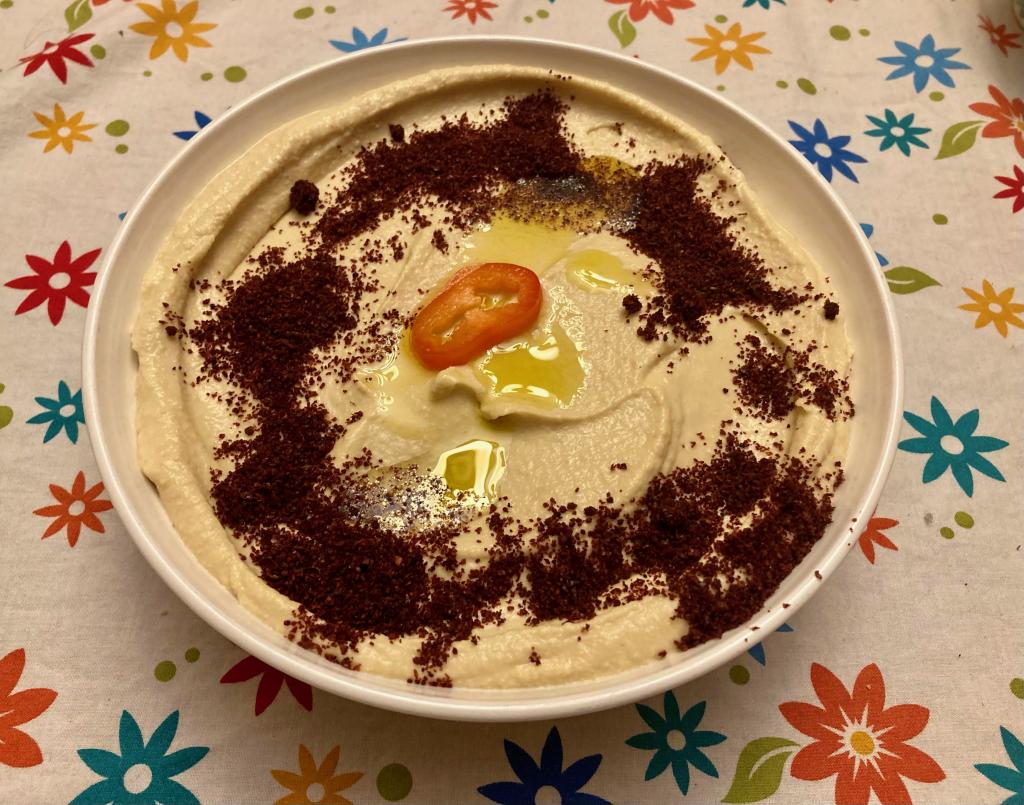
Refika Birgül’s video guide to making right proper hummus has dramatically upped my hummus game.

Ever since I started using chickpea water in place of eggs I’ve had chickpeas coming out of my ears; hummus has been one outlet for them. Alas my hummus was the consistency of stale Play-Doh and tasted not much better. Until I followed Refika’s guidance.

The key points that took my hummus to another level:

  1. I removed the skins from the chickpeas. Previously this had seemed absurdly time-consuming, and I’d never done it. Refika’s video shows a really easy way to do this.

  2. I used garlic. Even though garlic is one of the foundational ingredients of hummus, I’d always left it out as a “nice to have.” Turns out it’s a “need to have.”

  3. A full eight minutes in the food processor, with an ice cube added every few minutes to keep things cool. That’s about 4 times longer than my usual, and the extra time transports the hummus from Play-Doh to silky smooth, rich, and heavenly.

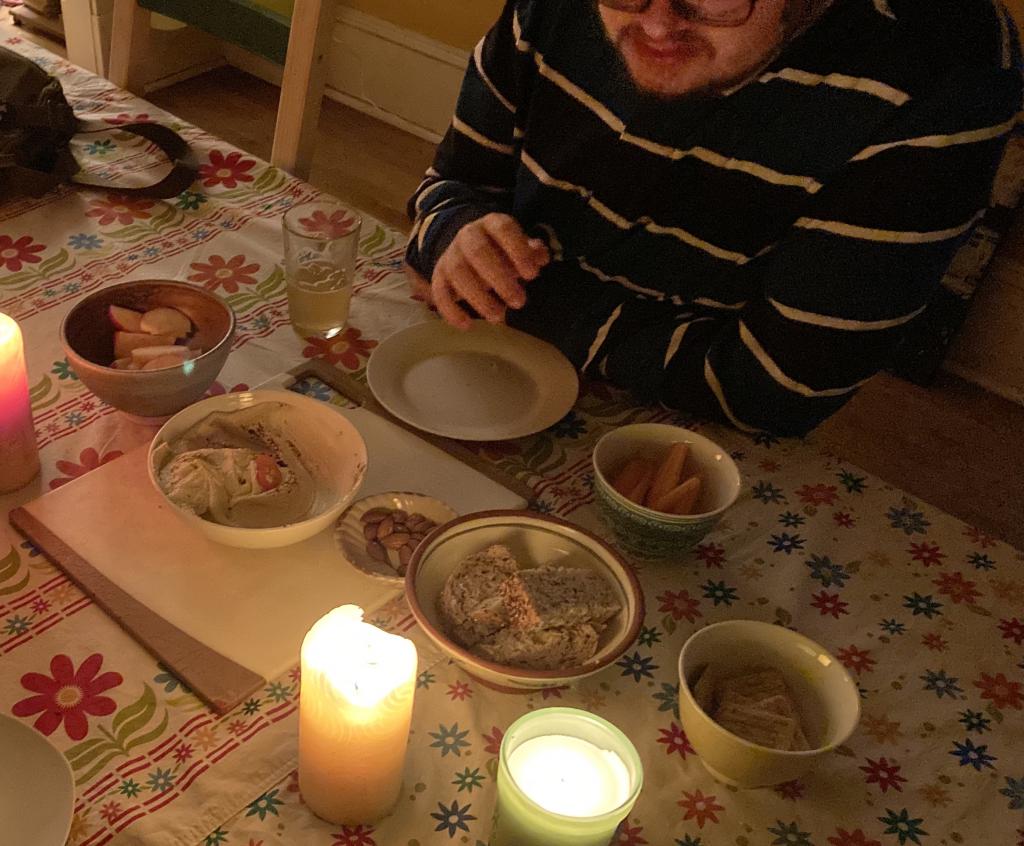
The hummus I made today was so good that it’s what we had for supper: hummus with warmed bread, hummus with carrots, hummus with apples, hummus with crackers.

Pro tip: you can get twice as much tahini, that’s twice as good, from Brighton Clover Farm.

Thanks to Thelma for starting me down this road.

,
25 Oct 06:43

Weeknotes: incremental improvements

I've been writing my talk for PyCon Argentina this week, which has proved surprisingly time consuming. I hope to have that wrapped up soon - I'm pre-recording it, which it turns out is much more work than preparing a talk to stream live.

I've made bits and pieces of progress on a whole bunch of different projects. Here are my notes on Datasette, plus an annotated version of my other releases-this-week.

Datasette 0.51a0

Datasette's base_url configuration option is designed to help run Datasette behind a proxy - so you can configure Apache or nginx to proxy /my-datasette/ to a Datasette instance and have every internal link work correctly.

It doesn't completely work. I gathered all of the bugs with it in a tracking issue, addressed as many of them as I could and released Datasette 0.51a0 as a testing alpha.

if you run Datasette behind a proxy please try out this new alpha and tell me if it works for you! Testing help is requested here.

Also in the alpha:

  • New datasette.urls URL builder for plugins, see Building URLs within plugins. (#904)
  • Removed --debug option, which didn't do anything. (#814)
  • Link: HTTP header pagination. (#1014)
  • x button for clearing filters. (#1016)
  • Edit SQL button on canned queries, (#1019)
  • --load-extension=spatialite shortcut. (#1028)

Other releases this week

sphinx-to-sqlite 0.1a1 and 0.1a

One of the features I'm planning for the official Datasette website is combined search across issues, commits, releases, plugins and documentation - powered by my Dogsheep Beta search engine.

This means I nead to load Datasette's documentation into a SQLite database. sphinx-to-sqlite is my new tool for doing that: it uses the optional XML output from Sphinx to create a SQLite table populated with sections from the documentation, since these seem like the right unit for executing search against.

I'm now using this to build a Datasette instance at latest-docs.datasette.io with the latest documentation on every commit.

datasette-cluster-map 0.14 and 0.13

The default marker popup for datasette-cluster-map is finally a human readable window, not a blob of JSON! You can see that in action on the global-power-plants demo.

inaturalist-to-sqlite 0.2.1, pocket-to-sqlite 0.2.1

I tried out the new PyPI resolver and found that it is a lot less tolerant of ~= v.s. >= dependencies, so I pushed out new releases of these two packages.

datasette-json-preview 0.2

I'm using this plugin to preview the new default JSON representation I'm planning for Datasette 1.0. Carl Johnson provided some useful feedback leading to this new iteration, which now looks like this.

github-to-sqlite 2.7

Quoting the release notes:

github-to-sqlite repos command now takes options --readme and --readme-html, which write the README or rendered HTML README into the readme or readme_html columns, respectively. #52

Another feature I need for the Datasette website search engine, described above.

dogsheep-beta 0.9

My personal search engine, described in the latest Datasette Weekly newsletter. This release added facet by date, part of ongoing work on a timeline view.

I also updated it to take advantage of the datasette.client internal API mechanism introduced in Datasette 0.50.

healthkit-to-sqlite 1.0

Another project bumped to 1.0. Only a small bug fix here: this can now import Apple HealthKit data from devices that use languages other than English.

TIL this week

I finally upgraded this blog to show recently added "Elsewhere" content (bookmarks and quotations) interspersed with my main entries in mobile view. I worte up this TIL to explain what I did.

25 Oct 06:43

Are there examples of where the Overton window ...

by Ton Zijlstra

Are there examples of where the Overton window / Trevino scale is used to rank existing theories/proposals on a topic? So as to better understand the spectrum of positions w.r.t. an idea, and how it is currently/historically perceived?

25 Oct 06:43

Last Outdoor Market

by peter@rukavina.net (Peter Rukavina)

Word on the street is that the Charlottetown Farmers’ Market will move back inside next week, making today the final iteration of the COVID-inspired outdoor rearrangement.

I managed to convince myself, and then Oliver, that we should bicycle to the market this morning, as it would be our last opportunity to cycle all the way out to the industrial edge of town to pick up smoked salmon bagels before Gallant’s comes back to the market with everyone else.

When I say that I “convinced” Oliver, that’s something of an exaggeration; despite his (occasionally very loud) protests about the cold, and his sore hands, however, he did it. All 7½ km, including a jaunt out to Riverview County Market (where Oliver executed a completely independent pumpkin purchase), and a visit to the Receiver Brass Shop for bread (all but gone from the shelves by the late hour of our arrival).

As in all previous such days that started sideways, we ended the trip tired but content.

While I know many market vendors are looking forward to moving back inside, leaving the need to set up tents and tables, to say nothing of the wind and rain, behind, I will miss the outside. Much less claustrophobic, much less COVID-nervousness-inducing, and with the bonus of breaking us out of longstanding habits and buying from vendors we’d long ignored for no other reason than well-worn ruts in our Saturday routine (yes, curried ketchup vendor, I’m looking at you!).

See you next Saturday.

25 Oct 06:43

2 for Saturday

📺 The RIAA got YouTube-DL pulled from GitHub. This sucks. I’ve been using this tool a lot lately to download YouTube videos for my son to watch on his non-connected devices. There’s so much awesome stuff on YouTube, but there’s not a chance in hell we leave him alone with the algorithm to take him into the cesspool.

🎓 HBR’s article about how Apple is organized for innovation by Apple University’s Joel Podolny and Morten Hansen is a great read on how the Apple is structured. “Believing that conventional management had stifled innovation, Jobs, in his first year returning as CEO, laid off the general managers of all the business units (in a single day), put the entire company under one P&L, and combined the disparate functional departments of the business units into one functional organization.” Maybe Apple could do more if it used general managers, but it’s not certain that would be a good thing.

25 Oct 06:43

Facebook, Twitter and what news is fit to share

by mathewi
Note: This was originally written for the daily newsletter at the Columbia Journalism Review, where I am the chief digital writer In an unprecedented move Wednesday, both Facebook and Twitter took steps to limit the distribution of a news story … Continue reading →
25 Oct 06:42

“Preventing a Disrupted Presidential Election and Transition”

by Andrea

Radiolab: What if? (Podcast, 41 minutes)

“There’s plenty of speculation about what Donald Trump might do in the wake of the election. Would he dispute the results if he loses? Would he simply refuse to leave office, or even try to use the military to maintain control? Last summer, Rosa Brooks got together a team of experts and political operatives from both sides of the aisle to ask a slightly different question. Rather than arguing about whether he’d do those things, they dug into what exactly would happen if he did. Part war game part choose your own adventure, Rosa’s Transition Integrity Project doesn’t give us any predictions, and it isn’t a referendum on Trump. Instead, it’s a deeply illuminating stress test on our laws, our institutions, and on the commitment to democracy written into the constitution.
[…]
You can read The Transition Integrity Project’s report here.

25 Oct 06:40

Should You Be Cooperating Instead Of Collaborating?

Hint: Pragmatic cooperation has its own space in the workplace.

This post is co-authored with: Olivia Vick

Do you find yourself exhausted after a day of work? Are you frustrated with ambiguous tasks and late or no feedback? Day after day are you feeling unmotivated and disconnected from your team and your projects? Many people are recognizing in the work from home environment that your experience and mood at work affect your personal life–which can be both negative and positive.

If you could feel more motivated and happy in your work while delivering better products faster, wouldn’t you want to make the change? One key to this desirable outcome is understanding the difference between cooperation and collaboration, and then making the conversion from cooperation to collaboration.

Let’s get started. Are you collaborating, or just cooperating?

Both cooperation and collaboration involve multiple people working on a single goal. The difference is in how that goal is achieved. Many organizations value the ability of a contributor to work with a team–promoting a self-organizing, collaborative work environment, and inclusive culture. But what do organizations actually mean by “collaboration”? Are organizations really referring to coordinating and cooperative models, not truly collaborative ones? What’s the difference?

Mixed puzzle pieces

Coordination, cooperation, collaboration–each of these is a different way to contribute to a goal, with different expectations and boundaries for contributors. The most salient difference between coordination, cooperation, and collaboration is the level at which contributors progress their respective tasks toward the goal and the extent that they determine the goal itself. Coordination (the basic alignment of tasks) is a basic element that makes both cooperation and collaboration possible, and the real opportunity lies in moving from cooperation to coordination.

Many organizations have mechanistic structures, such as functional, matrix, or divisional models, that encourage the cooperation model. Even purpose-driven organizations using agile expect contributors to work toward a common goal without playing a role in defining that goal.

Cooperation entails following orders and compliance, making it more task-oriented and focused on individual goals. Cooperation can function independently of the relationships in a team; even teams with great connections can get stuck in a cooperative mode. Key components of cooperation include:

  • Specialized roles whereby each contributor is an expert who may be the single person who knows how to do specific work.
  • A ‘Project Manager’ role solely responsible for keeping everyone on-task. This contributor often has a lot of one-on-one emails and conversations around the status of work.
  • An ideation process that is more pivot-focused around specific ideas from individuals rather than collective thinking, often ending with a decision from the highest rank.

The long-term effects of cooperation mode are limited growth, burnout, and–longer project timelines, resulting in lower-quality products. Most contributors want to broaden their skill sets and understanding of the full project process, but instead, stuck in siloed cooperation, they get worn out by repetitive work. Businesses cooperative modes are impeded by lack of shared knowledge across teams, which leads to poor capacity utilization. Mere cooperation prevents the connective thinking that happens when teams understand the impacts of their decisions from multiple perspectives of the projects.

You think you’re collaborating– but you’re not.

Do you feel as though in order to present an idea, it must be a fully complete solution, defensible, and convincing? Do you find that your brainstorming session lacks exploration of proposed ideas? Do you notice others staying quiet and wonder what ideas they might be holding back?

Many interactions under the pretense of “collaboration” involve the above, when we actually fall back on a more traditional cooperative model. In this way of working, each contributor’s proposal has to battle with the proposals of others. The winning proposal has to be fully elaborated and defensible in order to convince the group to adopt it. People ‘cooperate’ through agreeing to disagree or through challenging one another’s ideas, often perpetuating the ideas of the highest paid person (HIPPO) or squeaky wheel rather than a joint idea that results from collective thinking. Even though this can sound negative, cooperation can be okay, and sometimes necessary when adapting to our circumstances. But how can you recognize which mode fits the circumstance?

The opportunity to make real collaboration work is frequently blocked by external reasons: budgets, time constraints, existing staffing models, legacy paradigms. Regardless of external constraints, we can still make choices in our own actions to create moments of joy of work and freedom. It all starts with recognition: of our situational limitations, but also of our own internal reasons that might be holding us back–fear of public failure, lack of acceptance, imposter syndrome, insecurity, and self-doubt. This is an opportunity to become better collaborators and better cooperators–and when the time comes, we are better able to recognize when it’s right to rely on cooperation.

When should you rely on cooperation?

In a rose-coloured world, we would always collaborate and the pressures of real life that cause “self-sabotage” would remain at bay. We’d all have perfect knowledge, infinite patience, and the comfort of speed-to-market–the winning conditions for collaboration, rather than mere coordination or cooperation.

But we live in the real world with a finite amount of time and energy. Being an idealist at heart and a realist in life requires boundaries, patience, and timing. Even so, sometimes cooperation is the best possible outcome. People are recognizing in 2020 that while we continue to strive towards personal growth and professional excellence, we should consider our circumstances, taking special care of mental health when considering when and how to cooperate and collaborate.

Here are three situations where cooperation may be the best possible outcome:

Situation 1a: Is your home environment creating fatigue?

The year 2020 has impacted not only the way we work but also the way we live. Many people are juggling working from home, virtual schooling at home, in addition to just living at home. Collectively on any given day, we are dealing with big uncertainties like the state of the world at large, staying healthy, worrying and caring for our loved ones, and job security. And even for the privileged, there are feelings of guilt, malaise, and ennui that stem from an inability to help and support others.

Day after day, those feelings and home conditions can build up, draining energy that you would need to actively collaborate with others. Even a daily litany of virtual conference calls can cause emotional wear. Knowing your own state of mind, energy levels, and overall well-being is self-care.

Cooperation can be one way of taking care of yourself.

What if you do have the bandwidth for more interactive co-contribution, but at work you seem to be running into taciturn and reserved colleagues?

Situation 1b: Is your work culture rigid?

Collaborative efforts require cognitive flexibility and an environment to enable it. Some pre-conditions for collaborative work environments are valuing transparency, radical candor, and openness to different ways of thinking. Unfortunately, these values are not ubiquitous to all organizations.

Consider your organization’s culture and structure, its existing norms of communication, and the incentives and interactions that facilitate the flow of work. Often, organizations with hierarchical or functional structures create silos that cause challenges with communication, especially when it is interdepartmental. Additionally, if your organizational structure, communication, and incentives emphasize individualism over a collective goal such as with teams and products, it is likely that the way work gets done is also reflective of that formality. With that individualism, challenges around diversity and inclusion can become more pronounced, with resistance to the candor necessary for collaboration. Many contributors experience resistance to collaboration when asking questions, providing alternative ideas, and suggestions for improvements. Resistance in its many forms can include explicit behaviors such as talking over (or past) others, promoting models and behaviors that are heroic, or implicit behaviors like internal politics and expressing discomfort to leadership rather than directly as feedback. As Melvin Conway puts it: “Any organization that designs a system (defined broadly) will produce a design whose structure is a copy of the organization’s communication structure.”

Continuing to push for more inclusive collaboration of ideas and joint productivity in this environment can feel isolating and dejecting. Worse yet, it can be considered harmful, even negatively affecting your career path. If your organization exhibits classically rigid processes that promote coordination and cooperation over collaboration, you can shift your strategy to favor individual impact and adapt to the established cooperative model. Find others like you who value an inclusive culture of sharing ideas, co-contribution, and believe in the impact of collective goals.

By definition, cultures are collective; as an individual or a group of individuals you have the ability to change culture via grassroots efforts.

Situation 2: How much influence do you have in your organization?

In many organizations, conference rooms, conference calls, and other official channels are dominated by the loud voices or highest paid person. But standing on a soapbox orating in privileged airtime isn’t collaboration, and not all leaders truly want to make that change. Leading change requires addressing change at all levels. When you are hampered by your leadership, cooperation might be necessary, but it doesn’t need to be a complete substitute for collaboration at a grassroots level.

As much as organizations espouse their values in hallways, zoom backgrounds, or on their websites, real culture and values are felt and lived by contributors. Titles aren’t the only mechanism for influence. No matter where you are in an organization, you can be influential through your relationships with colleagues. As we’ve learned from Google’s Project Aristotle, “The behaviors that create psychological safety — conversational turn-taking and empathy — are part of the same unwritten rules we often turn to, as individuals, when we need to establish a bond. And those human bonds matter as much at work as anywhere else. In fact, they sometimes matter more.”

As an individual you can create interactions of psychological safety– that connection can lead to being respected and being persuasive, which can also progress ideas.

Regardless if you have a greater purpose in mind, or if you simply believe in better outcomes through real collaborative work for those you work with, you can cultivate interactions that perpetuate the collaboration you value.

Situation 3: Where are you in the product development process?

Making sure that products are maintainable and sustainable requires collaborative efforts: products require multiple expertises and perspectives in order to properly vet value and feasibility over the product’s lifecycle. Organizations that are continually focused on short-term goals tend to create reactive solutions that can lead to long-term problems. This in turn encourages ‘a business of busyness’ rather than valuing the thoughtful, thorough work of collaboration that considers productivity over lifetime value. Often “planning” occurs when dependencies are discovered much later in the execution due to lack of any high level feasibility vetting which would occur in earlier stages.

If your team is purely focused on productivity and execution, you may be stuck in a cooperative model

Further, cooperation may be the more pragmatic choice because of timing concerns: any above and beyond delivery pressure as well as perceived or real imminence to product launch can require strategically minimizing the more open-ended collaborative process. A product that is nearing launch or go-to-market–making it very difficult to institute substantial changes–is also likely to favor coordination and cooperation due to real sunk cost and sunk cost fallacy. (For different products the challenge of changing something so close to launch can look very different.)

Cooperation can sometimes be the pragmatic choice, if situations are limiting organizational change and shared growth.

At an organizational level, collaboration needs to be correctly fostered in order to see the benefits, and there can be delays in achieving a collaborative culture. Choosing among Coordination, Cooperation, or Collaboration depends on the situation: your personal circumstance, your work culture, the situations of those you interact with. Evaluate your situation and decide which model is best for the moment, looking forward and thinking about moving toward collaboration when and how you can.

Your energy (consider time + capacity + emotion + intellect) is the most valuable commodity. Pick and choose the opportunities in which you invest it.

You’ve made it to the end of this post, thanks for sticking around!

  • It’s 2020, take care of yourself and your loved ones.
  • Recognize the environments that you’re in and tread lightly when you need to.
  • Collaboration opportunities may not be formal. Find people you want to collaborate with either at work, in your network, or in your community. (Like the coauthors of this post!)
  • There is an african proverb that says, “If you want to go fast, go by yourself. If you want to go far, go with others.” Together, we can do better. To find out how to do better, read our next article!

Look for our next post where we’ll be discussing how to influence the conversion from cooperation to collaboration.

References

https://www.nytimes.com/2016/02/28/magazine/what-google-learned-from-its-quest-to-build-the-perfect-team.html

25 Oct 06:37

Exploring a bit of Dundas Valley

by jnyyz

A couple of weeks ago, someone named Yann posted an interesting looking loop around the Dundas Valley, and what interested me was that he climbed the escarpment going west from Chedoke along the Bruce trail. I’ve climbed going east from downtown towards Albion Falls as part of the Hambur Loop, but this was new ground. I put together a short ride that featured that climb, and looped back along the Hamilton-Brantford Rail Trail for the section between Ancaster and Hamilton (which was the only section of the trail that I had not done).

ridewithGPS link

I started in West Hamilton in the Fortino’s parking lot. Technically the rail trail is routed through this parking lot, and here is where it exits on the east side.

A quick ride to the east for several kilometers brings you to a point where you are skirting the north edge of Chedoke Golf Course. Turn south on Beddoe Dr, and there will be a bit of climb ahead of you (this is the small steep bit that you can see on the altitude profile on the map).

At the top of the hill there is a parking lot, along with stairs leading up the rest of the way. There is also a trail entrance leading west.

A very nice multi use trail.

At the top, you can connect to Scenic Drive on the left. However, if you want to continue to Ancaster, take the left most gravel trail.

Nice and smooth.

The bridge over the 403.

A little disappointed that the west end of the bridge has stairs.

After a bit of riding on Filman Rd, you cross Mohawk here, and the trail continues a bit off to the left.

On the other side of Mohawk, you turn right onto Hiawatha which leads you to the Ancaster Radial Trail. It is straight shot to Wilson Ave, and then I went down Jerseyville Rd until I reached Ancaster Lions Outdoor Pool. Turning right into the parking lot.

Just on the other side of the building is the trailhead for the Spring Valley Trail.

Lots of nice gravel. A bit muddy in spots, and with all the fallen leaves making it a bit slippery, I might have been a bit more comfortable on a mountain bike. At points I wished that I was not running slick tires. However, if I had bypassed the trails, I would have missed out on scenery like this.

From Spring Valley I joined the Headwaters Trail, and then at one point, turned off onto Gravel Pit Road. Here is Gravel Pit Rd intersects the Hamilton Brantford Railtrail.

After the somewhat technical trail riding, the railtrail felt like a superhighway.

About 7 km from the end of the trail, there is a visitor centre. There are bathrooms here if you need them.

The rest of the ride into Hamilton was uneventful. I did detour a bit out of my way to take this picture of the intersection of Rifle Range and Whitney Ave. This was the site of Prince Phillip School, where I did kindergarden to about Grade 6. At the time of its closing, there was some unhappiness about having a school closed in this working class neighbourhood.

One of the only artifacts that I’ve kept from my time at this school was a camel that I made from asbestos modeling clay. Things were a bit different back in the day.

If you finish your ride in this vicinity, I will note that there are two brew pubs nearby. One is Fairweather, and other is Grain and Grit. Alas I had to drive back to Toronto, so I elected to take some beer to go. I’ll hit the other place next time.

If you wanted to do a similar ride without some of the trail riding, you can continue along Jerseyville Rd out of Ancaster, and eventually you will reach a point where the road intersects the rail trail. Then you can come back east along the rail trail, and the whole 39 km loop would then be doable on pretty much any road bike.

25 Oct 06:35

Resetting online commerce

by Benedict Evans

“Aunt Agatha's demeanour now was rather like that of one who, picking daisies on the railway, has just caught the down express in the small of the back.” - P.G. Wodehouse

I’ve spent a lot of time in the last few years looking at ecommerce and discovery - how do people decide what to buy online, when a shop can’t show it to them? It seems to me that pretty much every part of that question is being reset this year. There are half a dozen huge industries where all of the cards are being thrown up in the air, and no-one really knows where they’re going to land. The Covid lockdowns of 2020 and 2021 are catalysing and accelerating all sorts of changes - we’re getting five years of adoption in a few quarters, and five years of inevitability in the back of the neck. 

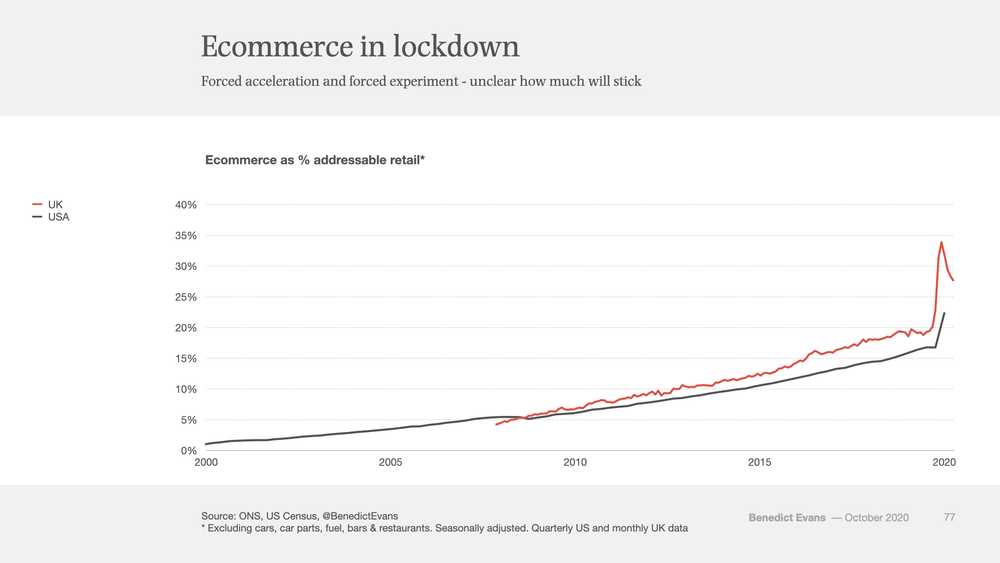
Physical retail itself has been a ‘boiling frog’ for 20 years. Every year ecommerce gets a little bigger and the problem gets a little worse, but the growth in any given year was never big enough for people to panic, and you could always tell yourself that sure, people would buy that other industry’s product online, but not yours. I think we all now understand that anyone will buy anything online, given the right experience, and if your retail model is based on being an end-point to a logistics chain then you have an existential problem. 

Misc slides.001.png

This is accelerated by lockdowns, partly because growth in ecommerce penetration that we all expected has been pulled forward, and partly because everyone is now forced to try buying things online that they might not have considered before (most obviously groceries, where UK online penetration has doubled from 5% of sales to 10% this year).

But the reduction in footfall itself also has cascading consequences. It’s pretty obvious that many US malls are anchored by large retailers that could very easily now go out of business, and then the other retailers in that mall that might have thought they were OK now aren’t - and then the mall itself goes as well. That purchasing won’t automatically go to those retailers’ websites, and it might also go to entirely different categories. If you change the channel then you change what gets bought. 

A further and perhaps more interesting question is that a shift to working remotely might be a permanent change for many retail areas in big cities. Even if people now work from home only one day a week, how many retailers will experience that as a 20% decline in footfall, and how many cannot survive that? In some areas that might also be a vicious circle: more people working from home means less retail, and less retail in Canary Wharf or Hudson Yards might mean more people working from home. I’ve seen people call this a ‘donut’ effect - office districts of a city are hollowed out. 

Then, what gets sold in those shops? In the last couple of years there’s been an explosion and arguable a bubble in so-called direct to consumer or ‘D2C’ brands. The bubble burst at the beginning of this year (ironically just before everyone had to buy everything online), partly prompted by the realisation that if you’re not renting a store on Fifth Avenue, that money doesn’t go to the bottom line - you’ll almost certainly have to spend it on delivery, advertising, Amazon placement or returns instead (in other words, there are no free lunches). But the reasons why that explosion had happened remain: you can now make and sell a consumer product without the same kind of fixed cost and upfront capital investment in a national retail footprint, inventory and marketing that would have been necessary 20 years ago. But what does that mean? What is a sustainable customer acquisition model? For how many brands, and what aggregation and discovery models? Is there any role for ‘software’ or is this really entirely a CPG and marketing story? And at what point do you need to get bought by P&G, or LVMH, or partner with Sephora, in much the way that you would have in 2000? (One part of the question - do these kinds of companies produce venture returns?)


I'm a terrified dinosaur” - Jorge Paulo Lemann, co-founder of 3G Capital, recent purchaser of Kraft Heinz


Those traditional brand owners are also scrambling. Many of the big consumer brands we all know have historically been B2B businesses. P&G doesn’t sell soap - it sells pallets of soap. Now all of these companies are trying to work out what a customer relationship would be, and how many companies can have that (hence, for example, Lululemon buying Mirror for $500m earlier this year). What does it mean to be a brand, or a brand owner, or for manufacturing, distribution and capital for those brands, when all of that is being unbundled and rebundled? 

Misc+slides.035.jpeg

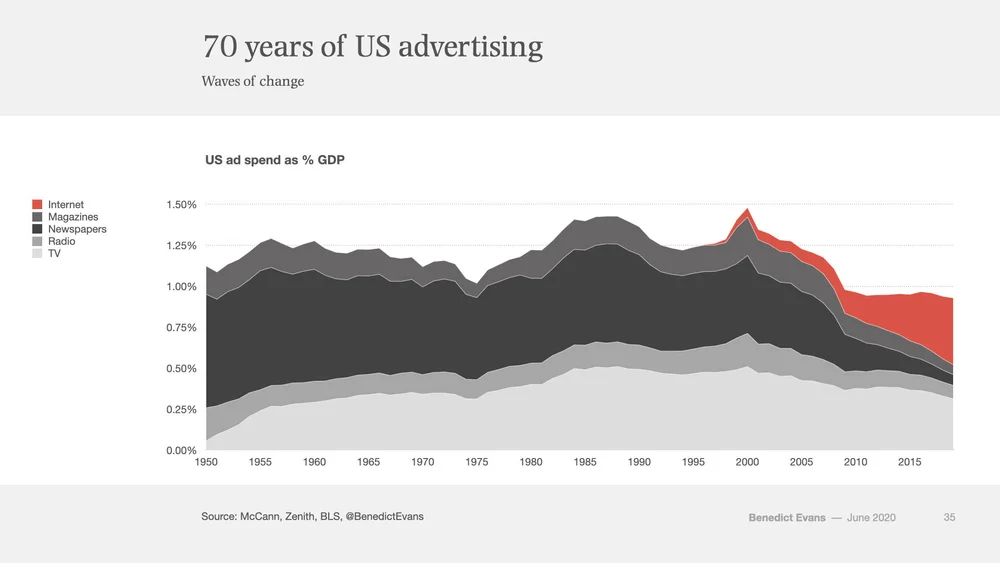
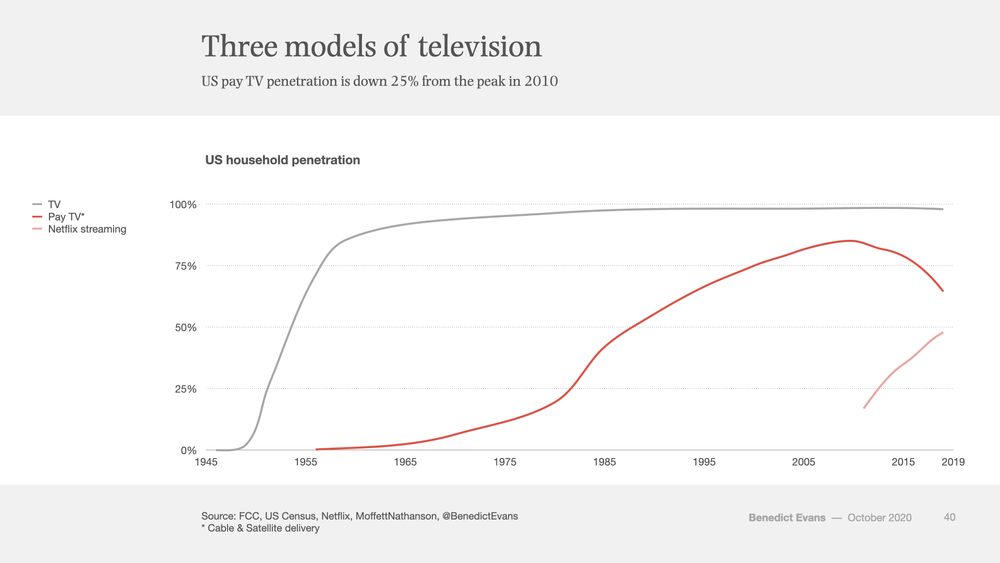
Meanwhile, if you’re now spending your acquisition budget on advertising instead of rent, what does that advertising look like? Again, no-one quite knows. Print advertising has collapsed. TV has been pretty resilient as the internet has grown (though the chart above suggests that its share of GDP has fallen significantly), but subscriptions and audiences are now decisively switching away from the old model, so what will that look like in 5 years?

Misc slides.001.png

And then there’s internet advertising, and that looks more uncertain than almost anything else I’ve written about here. Over the past 25 years, a huge inverted pyramid has been built up on top of cookies, much of which can often look more like rent-seeking, arbitrage and general spivery than rational economic optimisation. Earlier this year PwC carried out a study of UK online advertising suggesting that not only does half of ad spending not actually make it to publishers, but that 15% couldn’t be traced at all. 

Source: PwC for ISBA

Source: PwC for ISBA

Today, privacy changes by Google and Apple on one side (in Chrome, Safari and iOS), and GDPR, CCPA and a whole bunch of other blunderbuss regulation on the other, are shoving over that whole tottering mess of tracking, targeting, interest and identity management. I’ve sometimes had the impression that almost no-one in Silicon Valley that doesn’t actually work on an ad team really pays any attention to ‘ad tech’, but now that whole business is being reset.

Quite separately, Google and Facebook’s own ad market position (they have at least half of all online advertising) is attracting very serious scrutiny from competition regulators, especially in the UK and EU, with all sorts of suggestions of highly technical and specific intervention into the mechanics of their market dominance - many of which incidentally are in direct conflict with what the privacy regulator next door is demanding. The competition regulator says ‘make it easy to move data around’ and the privacy regulator says ‘don’t’. 

Online advertising is now worth perhaps $250bn, but advertising in total is $500bn and all global marketing is closer to $1tr. Telling people about things they might like or be interested in has value, and it isn’t actually evil a priori, but if you can’t ‘track’ people across the web anymore, how do you do that? And how do you reconcile that with wanting more competition to Google or Amazon? I hope that the answer is not that the only companies that can do interest-based ads are Google and Facebook on one hand and brands with their own huge audiences and data such as the Guardian or New York Times on the other. Will one or other of the various industry data initiatives work? Will Apple try a generalised identity or interest platform? I don’t know, but I do know that a trillion dollar industry is up in the air. 

I don’t know the answer to most of these question - more importantly, I don’t really know the questions. What will happen in TV? I don’t know - ask a TV analyst! What will happen to all these D2C CPG companies? I don’t know - ask a CPG analyst! But of course, they don’t know either.

25 Oct 06:31

Google starts rolling out fix for Chrome, Chrome OS security vulnerability

by Jonathan Lamont

Google is rolling out an important security patch for Chrome and Chrome OS users. The patch fixes a zero-day security vulnerability described as a ‘memory corruption bug’ in the FreeType font rendering library included in Chrome.

Google’s Project Zero research team uncovered evidence that attackers were exploiting the flaw in the wild. A patch started rolling out as part of Chrome 86.0.4240.111 a few days ago. It fixes the vulnerability, dubbed CVE-2020-15999. To check for the update, click the menu button in the top-right corner > Help > About Google Chrome. This will show you what version of Chrome you’re running and give you the option to update if one is available.

On mobile, the process is a little different. Android users should scroll to the Chrome app icon, press and hold it, select ‘App info’ and scroll to the bottom to see the version number. On iOS, open Chrome, tap the three-dot menu button > Settings > Google Chrome to see the version number.

Along with the fix for the security vulnerability, the Chrome update brings a few small tweaks. For one, the update fixes an issue with the ‘Clear all’ button and ‘Pairing lost’ notification. There are also two new Chrome flags — semi-hidden settings users can tweak to customize the browser — that modify protection levels against the Spectre.

Source: Android Police

The post Google starts rolling out fix for Chrome, Chrome OS security vulnerability appeared first on MobileSyrup.