Shared posts

05 Nov 08:05

Foreshadowing, Why the Purism Logo is a Rectangle

by Todd Weaver

A logo carries meaning, it should be simple yet effective. The Purism logo; a simple rectangle; carries significant meaning and was foreshadowing what Purism is delivering.

When I started Purism in 2014 I knew I wanted to build secure computing hardware bundled with a privacy-respecting operating system that had freedom-respecting applications and services. I also knew that a computer could be a server, desktop, laptop, tablet, phone, watch, among many other form factors, and most of these have screens or at least a screen used to interact with (until we get to read/write electrical signals in our brains–what I call brain embeddables, sci-fi terminology sometimes calls “beddies”–we will continue to see devices with screens).

In early 2005 (when I started the first online cable company) I presented that the movie and television industry needed to look at all computers as TVs, since a TV is just a computing device showing videos on a screen, and the only difference was size of screen, distance to viewing, and user interaction. A “TV” in that sense was remote controlled from a couch, a laptop was keyboard and mouse controlled from close-up, a tablet and phone (realize this was 2005 so pre-smartphone) could also become a video device. All of these are “just screens” from my point of view.

Forming Purism, I knew we would iterate from laptop toward phone; but also could include servers (with monitor), desktops (with monitor), tablets, watches, routers, and all sorts of brainstorm-worthy products–nearly all containing a screen or access via a screen. It was very easy for me to “just use a screen” as a logo, and in what is probably a very rare story, I drew the first logo which was the only logo and remains our logo to this day. A simple rectangle to reference that all these screen based devices are just computers and with them we can do anything we desire.

The Librem 5 is the quintessential example of this computer with screen in a phone form factor. Most people have been indoctrinated (read brainwashed) into believing that a phone is something very phone-specific. This is entirely due to how the modern day smartphone developed around business models that incentivized vendor lock-in, mobile-specific OSes, application “stores” that offer mobile curated applications only for mobile, and a multi-billion dollar business to ensure things stay that way. The Librem 5 had forethought. It was created from industry veterans who understand that “this is a computer, it just happens to be in a phone form factor.” So we set off to do exactly what I wanted when starting Purism, to have the same OS for server, desktop, laptop, tablet, and phone. So we wrote libhandy, phosh, phoc, released PureOS for two architectures (x86 and arm64), and are building real convergence, where your desktop computer can also be your phone.

The logo, a simple rectangle, was to showcase that all these devices are just computers with screens, and to showcase the fact that computing can be more liberating than the indoctrination of proprietary rights-stripping big-tech products. Free your mind and the rest will follow.

The post Foreshadowing, Why the Purism Logo is a Rectangle appeared first on Purism.

05 Nov 08:05

Optimizing for Less

by peter@rukavina.net (Peter Rukavina)

Rekka Bellum and Devine Lu Linvega, Hundred Rabbits, spoke at XOXO in 2019 (video) about their lives working and living on a sailboat.

During the talk Lu Linvega spoke about their approach to dealing with broken systems on the boat—water pump, fridge, etc.—and how they often opt not to repair them:

Over time, we were like, we – we could pay, we could work more to get more money so we can repair, to address that issue, or not, and try to live without. And a lot of the situation that we encountered, it turns out it is a lot healthier for both of us to optimize, to need less, than trying to optimize to make more money. And this lifestyle forced us into that mindset.

It struck me that this notion—the “negawatts” approach to personal finance—is completely missing from mainstream financial planning advice.

When I consulted a financial advisor earlier in the year, his schtick was, understandably given his role, all about maximizing growth—optimizing to make more money. Every time I enter that world, I end up feeling dirty all over, as it inevitably means balancing two evils, risk (and the evils of anxiety) vs. reward (and the evils of supporting various degrees of capitalism).

Optimizing for less seems like a breath of fresh air by comparison. Indeed not only does it seem like a solid, ethical personal finance philosophy, it seems like a solid, ethical political framework too.

05 Nov 08:03

Political search interest in 2020

by Nathan Yau

In Waves of Interest, a collaboration between the Google News Initiative and Truth & Beauty, see the defining search trends of 2020. See trends over time. See trends over geography. See trends over past election seasons.

See also how the work came together.

Tags: Google News Initiative, politics, search, Truth & Beauty

05 Nov 08:02

Defining Data Intuition

Defining Data Intuition

Ryan T. Harter, Principal Data Scientist at Mozilla defines data intuition as "a resilience to misleading data and analyses". He also introduces the term "data-stink" as a similar term to "code smell", where your intuition should lead you to distrust analysis that exhibits certain characteristics without first digging in further. I strongly believe that data reports should include a link the raw methodology and numbers to ensure they can be more easily vetted - so that data-stink can be investigated with the least amount of resistance.

05 Nov 08:02

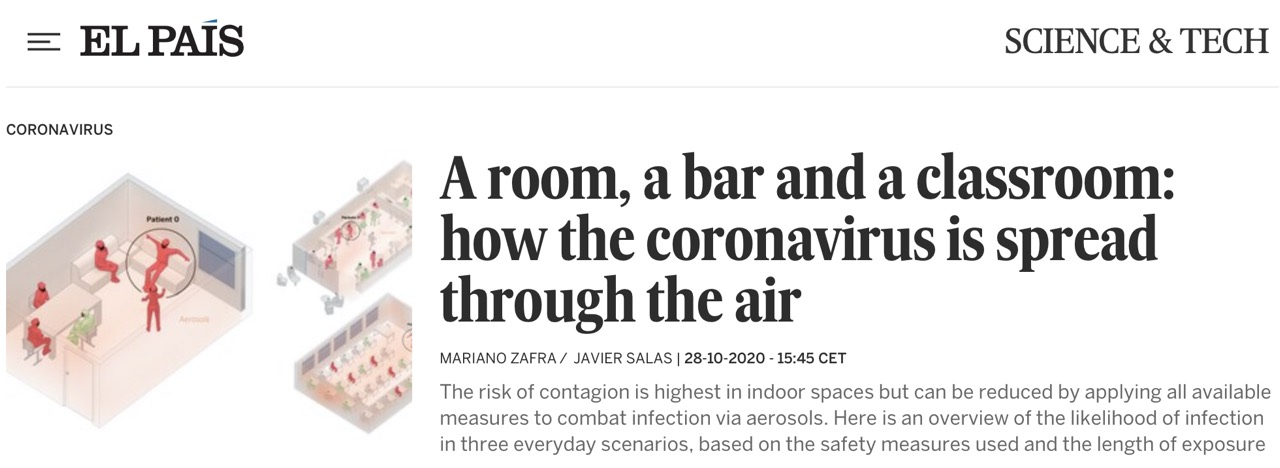
A room, a bar and a classroom

by Volker Weber

8593641a61333b01c99f1869c305978b

The risk of contagion is highest in indoor spaces but can be reduced by applying all available measures to combat infection via aerosols. Here is an overview of the likelihood of infection in three everyday scenarios, based on the safety measures used and the length of exposure.

Sehr gute Erklärung, wie sich Coronavirus verbreitet. Wir haben einen großen Fehler gemacht: 1,50m Abstand mag helfen, aber gibt ein falsches Gefühl von Sicherheit. Dem lag die Annahme zu Grunde, Corona würde sich per Tröpfcheninfektion verbreiten.

Tatsächlich reicht es aus, mit einem (!) Infizierten über Stunden im selben Raum zu sein. Die Heatmaps zeigen sehr deutlich, dass die Verbreitung durch junge Menschen vorangetrieben wird und von da aus auf Eltern und Großeltern übertragen wird.

Wir durchbrechen das nur, wenn wir aufhören, uns mit anderen Menschen zu treffen. Die Beschränkung auf irgendwelche Zahlen wie 10 Menschen aus 2 Haushalten dienen nur zur Verbesserung der statistischen Chance. Ein Infizierter reicht. Der reisst dann eben weniger andere mit, weil weniger da sind.

More >

05 Nov 08:02

Now Witness the Firepower of This Fully Armed and Operational Blog

by Richard

With in-person events cancelled in the Greater Toronto Area for the duration of 2020, that opened up my schedule tremendously. I largely avoided online or virtual events, with a few exceptions, such as events that I helped organize through the Icelandic Canadian Club of Toronto, and a birthday party or two. I'm used to spending extended periods of time at home, so I took the opportunity to fix my blog. The one you're reading right now!

As it was for the last few years, this site was a broken upgrade from Drupal 6 to Drupal 7. I made do with redirecting portions of it to the working Drupal 6 site using the Rabbit Hole module. Among other things, it can redirect based on a content type to a different site, and I did so to archive.justagwailo.com. Now, since this site is more or less repaired, the redirection happens the other way around. I'm keeping the archived site alive in case there's anything I've forgotten.

It turns out fixing my website is something I enjoyed doing, and there has been much to fix since archiving the Drupal 6 version of the site.

I restored the Delicious Bookmarks and Flickr photos section (minus some features around sets), and started a Toronto Architectural Tours section. I still use Flickr as the back-end for hosting photos, and have a few photos to syndicate over to the site still. Individual broken posts are for the most part fixed, and I watch the logs for any signs of errors. Broken links in the bookmark section are tagged as such when I come across them, and I'm excluding my posts from responsible search engines. I hope to automate the flagging of broken links, at least in the bookmarks section, so that I don't just do it as I come across them. The site's changelog is back, with updates regarding major restorations. There have been quite a bit of behind-the-scenes changes, tremendously speeding up the loading of the site.

The goal was to restore functionality and content to the Drupal 7 site so that I could more easily migrate to Drupal 8 (and more likely, 9). With that latest version of the CMS, I would be able to do things of an Indieweb nature, especially now that the ActivityPub module has an active release and is under sustained development, and send and receive webmentions and receive pingbacks (I'm not sure I will, though), and have content posted elsewhere (aka Mastodon and Twitter) originate here as much as possible though Micropub.

I still post to Flickr, though I haven't imported all of the missing photos into this site, and I've paused the automatic syndication of photos. Twitter is where I post thoughts most frequently. I'm updating my blog on more or less a monthly basis now, especially the "Sheltering In Place" posts during the COVID-19 pandemic. While on the blog those posts appear in reverse-chronological order, the Sheltering In Place section is chronological, an experiment in Twitter-like threads on a website. I have comments to posts stored in the database, but not set to display. I'll make those public again at some point in the near future. I don't anticipate ever enabling comments on my blog, at least not directly, again. I keep my Elsewhere page up-to-date.

The next step is to upgrade to Drupal 8 and add all of the aforementioned Indieweb technologies. With a vaccine on the horizon, though still somewhat distant, I'm hopeful that will be my next big project during the pandemic.

31 Oct 01:02

Twitter Favorites: [Raspberry_Pi] We love seeing how quickly our community of makers responds when we drop a new product, and one of the fastest off… https://t.co/rilgovyEVN

Raspberry Pi @Raspberry_Pi
We love seeing how quickly our community of makers responds when we drop a new product, and one of the fastest off… twitter.com/i/web/status/1…
31 Oct 01:01

Distro installation added to WSL –install in Windows 10 insiders preview build 20246

by Craig Loewen

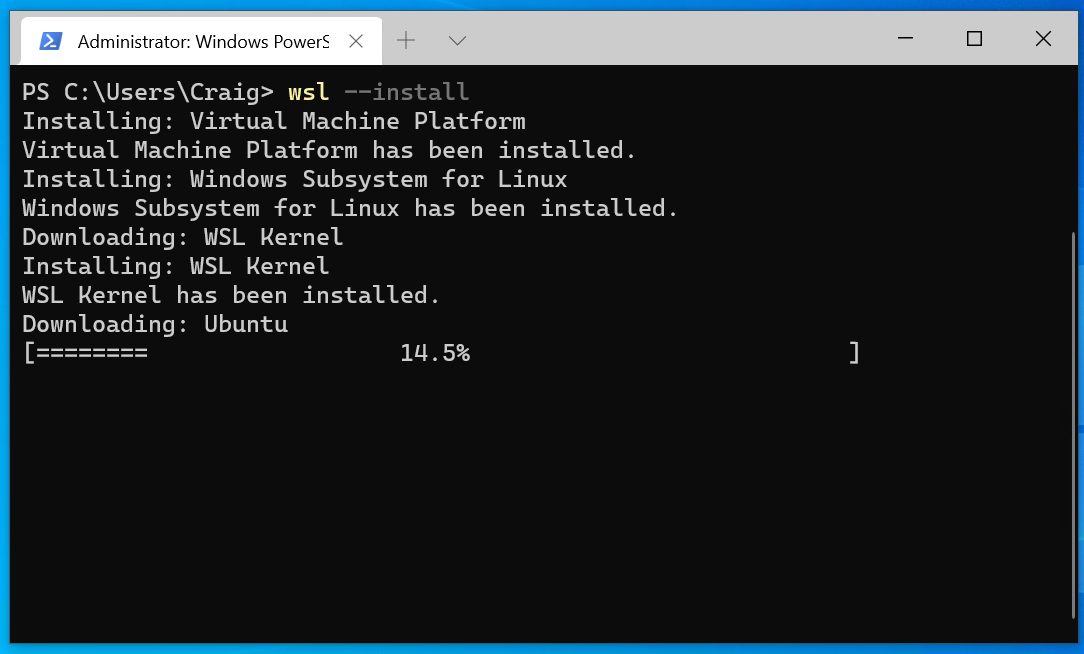
We’ve added automatic distro installation to wsl --install in Windows 10 insiders preview build 20246! This means that installing WSL is now easier than ever, as now when you run wsl --install all the necessary components that you need for WSL will be automatically enabled, including your specific Linux distro of choice.

How to use this new feature

We announced that our goal with this feature is to make installing WSL as easily as possible back in BUILD 2020. With automatic distro installation, you can now have a full WSL install on your machine in a matter of minutes just by running one command: wsl --install.

WSL install

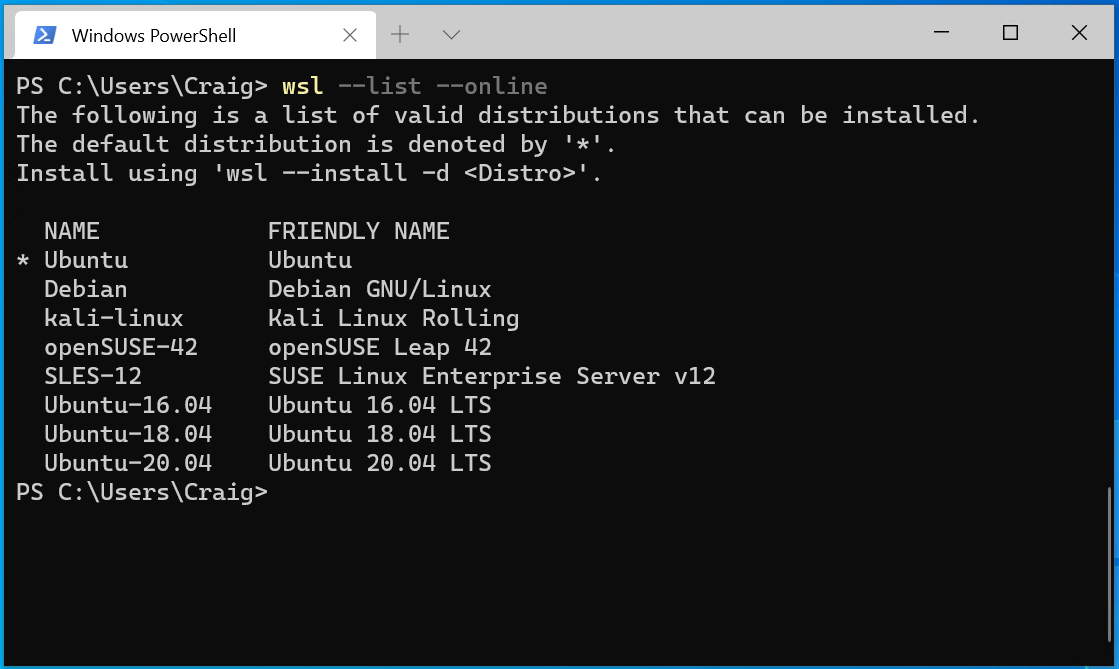
We’ve also added some additional features to wsl.exe to help with this. By default when you run wsl --install without any additional parameters, you’ll install Ubuntu. You can also install any distribution of your choice by running wsl --install -d <Distro>. You can see a full list of distros available by running wsl --list --online. For example, I could install Debian by running wsl --install -d Debian.

WSL list online

Tell us your feedback

As always, you can find me @craigaloewen and WSL team members on Twitter if you’d like to keep up to date with WSL news there. If you run into any issues, or have technical feedback and feature requests for our team please file an issue on our WSL repo in Github. We’d love to hear what you think about this new experience, and whether you have any suggestions for other options you’d like to see!

The post Distro installation added to WSL –install in Windows 10 insiders preview build 20246 appeared first on Windows Command Line.

31 Oct 01:00

The General Purpose Computer In Your Pocket

by Kyle Rankin

Computers have us surrounded. Just about every piece of consumer electronics these days puts “smart” in front of the name, which means they embedded a computer that runs specialized software. The “smart” trend started with “smartphones” which marketers started calling cellular phones once they got powerful enough processors to run a general-purpose operating system and applications. The name “smartphone” was intended to differentiate them from “feature phones” which had a limited set of additional applications (calculator, SMS application, possibly a music player or a limited web browser). Feature phones were designed to make phone calls and send text messages, but smartphones were actually general-purpose computers that happened to have a phone and SMS application on them.

Today, a majority of people hardly ever use their smartphone as a phone and instead use it to chat, browse the web, and run applications–the same things they do on their desktop or laptop computers. Your smartphone is a pocket-sized general-purpose computer that’s more powerful than desktop computers from not that long ago, yet smartphones are prevented from realizing their full potential, are still marketed as special-purpose computers, and most people think of them that way. Why?

One of the neatest tricks Big Tech ever pulled was convincing people that phones weren’t general-purpose computers and should have different rules than laptops or desktops. These rules conveniently give the vendor more control so that you don’t own a smartphone so much as you rent it. Now that the public has accepted these new rules for phones, vendors are starting to apply the same rules to laptops and desktops.

Anti-trust In Your Pocket

One of the best examples of how the rules have changed can be found by comparing the Microsoft anti-trust trial from almost twenty years ago to smartphone vendors today. Microsoft was accused of abusing its monopoly power by bundling the Internet Explorer web browser into Windows for free to compete with the Netscape web browser which at the time was more popular but also had to be purchased and installed separately.

Now imagine in addition to bundling IE, Microsoft also controlled whether Netscape could be installed or updated on Windows, and blocked them, and you are closer to the current situation with phones. When Apple decided it wanted to add a parental control app to iPhones, it first blocked all competing apps in the name of security and only reinstated those apps months later after its own app got marketshare. Apple now is facing anti-trust scrutiny for this.

Software You Can’t Remove

Starting in the `90s computers started getting all sorts of junk 3rd-party software pre-installed on them. Vendors realized they could get a secondary revenue stream by promoting games and other applications if they were preinstalled on top of Windows computers. This software was notoriously buggy and some of it caused Windows to crash (and some of it ended up being spyware), so one of the first things those of us who were in IT would do upon getting a new computer was to either painstakingly uninstall all the “junkware” or reinstall a vanilla version of Windows, depending on which was less work.

Now imagine a computer full of 3rd-party junkware and spyware, only you couldn’t uninstall it. That’s the situation we have today with Android phones (and in a notable case, with a U2 album on iPhones). Android allows applications to be marked as uninstallable and while Google uses this feature for some of its own applications by default, many vendors use the feature to make 3rd party junkware and spyware uninstallable as well.

Planned Obsolescence

When you bought a computer starting in the `90s you generally expected to get operating system upgrades for the life of the computer. In the Windows world you normally could upgrade to the next version of Windows years later, and you’d only replace hardware after the OS upgrades and applications got so bloated (along with the spyware) that the computer was too slow to use. Of course, those “slow” computers then got a new life for many more years after installing Linux on them.

Now imagine a computer that only lasted two or three years, after which you would no longer get OS and security updates. Even though the hardware was still fast enough to run the OS, if you cared about security you’d be forced to upgrade. That’s the situation we have with Android phones today. If you are lucky your vendor will let you update to the next version of Android at least once, and receive general updates for two years or three years. If you are unlucky your device may never upgrade to the next Android OS. Even flagship Google phones only promise OS updates three years from the date the phone first was sold and security updates for only 18 months after they stop selling a device. For instance, at the time of this article, Pixel 2 owners just lost guaranteed OS and security updates.

The Return of the General Purpose Computer

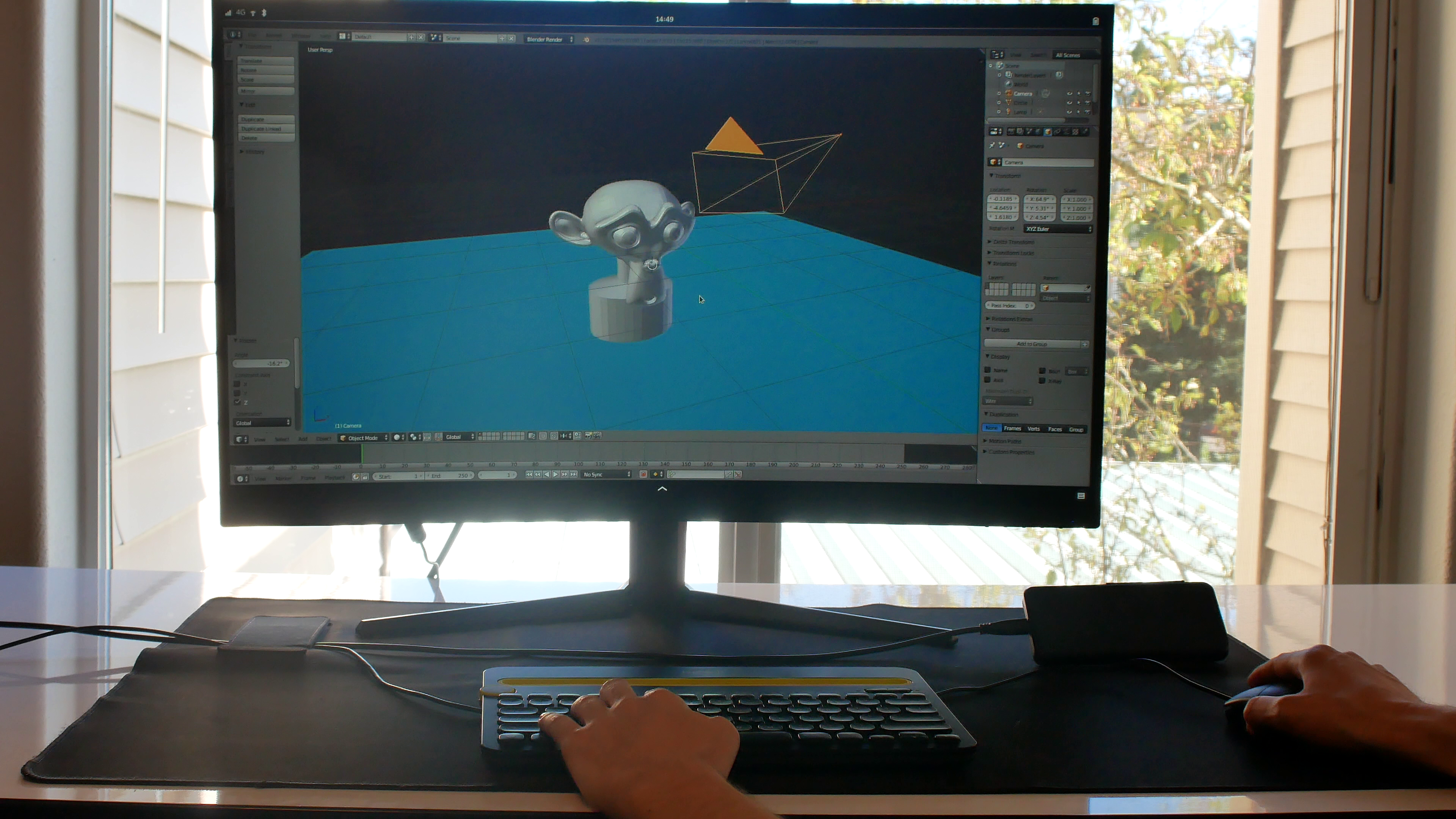
Librem 5 in desktop mode editing a 3D model

What makes the Librem 5 special is that it reclaims the full potential of what phones should have been all along: a general-purpose computer in your pocket under your control. It runs the same PureOS operating system with the same applications as our Librem laptops, Librem Mini, and Librem Server. Because it has real convergence, even though the Librem 5 is in a phone form-factor, it can function as a desktop when you connect it to a monitor or a laptop when you connect it to a laptop dock. Many people already use their phones as their primary computer, and some people may even be able to replace their existing laptop or desktop with a Librem 5, depending on their resource needs.

While other vendors try to add smartphone restrictions onto their laptops and desktops so they can control how you use them, we are taking the opposite approach. At Purism we want to bring the freedom of general-purpose computing we have long appreciated on laptops and desktops into a phone form factor. You control what applications go on the Librem 5, not us, and like our other computers, the Librem 5 gets software upgrades for life. The battery, WiFi/Bluetooth card and even cellular modem are removable and replaceable. Whether as a phone, a desktop, a laptop, or even a server, the Librem 5 is a general-purpose computer that fits in your pocket, how you use it is up to you.

Discover the Librem 5

Purism believes building the Librem 5 is just one step on the road to launching a digital rights movement, where we—the-people stand up for our digital rights, where we place the control of your data and your family’s data back where it belongs: in your own hands.

Preorder now

The post The General Purpose Computer In Your Pocket appeared first on Purism.

31 Oct 01:00

Pruning And Boundary Maintenance

by Richard Millington

A major misunderstanding in developing successful communities is more activity is inherently good and less activity is bad.

But if you’ve ever opened WhatsApp to find 300+ messages from 3 to 4 people in one group sharing silly memes with each other, that’s clearly not true.

For those 3 to 4 people, it was probably good fun. For everyone else, it was simply noise.

At best, they now have to scroll through an entire discussion to see if anything was relevant to them. At worst, they simply pay less attention to messages from that group in the future.

If that discussion hadn’t happened, the community would’ve been better for it.

The best benefits for members don’t come through a greater quantity of activity but through a higher quality of activity.

Quality isn’t just highly predictive of a member sticking around, it attracts more people too. It begets further high-quality contributions. It creates a culture that people want to be around.

Everyone nods their head in approval at the StackOverflow model but few choose to do the hard work of copying it – despite how clearly successful it can be.

Copying it means rejecting contributions that aren’t good enough (and, sometimes, people that aren’t able to make good contributions).

It means constantly trying to deliver the highest-quality signal to noise ratio.

31 Oct 01:00

Beyond folly

by Chris Grey
The last ten days were supposed to be my break from Brexit hence, as trailed two weeks ago, there was no post on this blog last Friday. But escaping did not prove easy, gloomily conscious as I was of taking my first trip to the EU since Britain ceased to be a member and my last before the transition period ends. Even if that had not been in my mind, in motorway service stations and elsewhere was the unavoidable message of the government’s increasingly panicky campaign: “time is running out”. Brexit is not mentioned of course, for we are not supposed to recall that what were to have been the ‘sunny uplands’ turn out to be a quagmire of paperwork, cost, and inconvenience.

A further reminder, as I drove through Kent, was the sight of huge construction works for one of the lorry parks that will be needed post-transition. Then, taking the Dover to Dunkirk ferry laden with lorries from Portugal to Lithuania to Bulgaria, just a few of the 2.1 million that Dover’s port handles each year, it was hard not to wonder who thinks that what this huge, complex artery of international trade really needs is to have a whole lot of new disruptions. And, over in Dunkirk, the new sanitary and phytosanitary lanes were a visible indication of just what leaving the EU and the single market means in, literally, concrete terms (it is notable that the new facilities and systems needed for Brexit in EU ports have been in place for months whereas, for all the talk of taking back control, the UK is still developing them).

Petulant children and the role of the man-baby

None of this, as everyone should know by now, will be avoided by an EU-UK trade deal, although it will be worsened without a deal. On that issue, the outcome remains opaque. The talks have resumed after the UK’s sort-of-but-not-really walk out, a resumption enabled by Michel Barnier ‘conceding’ to British demands to use the ‘right’ words (intensification, compromise needed on both sides, British sovereignty respected).

In the Ladybird book of international negotiations that seems to be Boris Johnson and David Frost’s go-to text this perhaps counts as a victory and I doubt they have any inkling that to outsiders it resembles an adult placating a petulant child. As Tony Connelly of RTE reports – within a detailed explanation of how the talks faltered and resumed - an EU diplomat described the conversations that preceded the resumption as the UK being “in the therapeutic phase”.

Connelly and others also report that one reason the outcome remains unknowable is Johnson’s almost pathological aversion to making the necessary choices, with their inevitable costs. One widely discussed suggestion is that he will await the outcome of the US Presidential election before deciding which way to jump. In brief, if Trump were to win then Johnson would be more likely to opt for no deal with the EU, in the expectation that a trade deal with the US is more likely than it would be under Biden (for a wider discussion of what the US election means for the UK see Patrick Wintour’s excellent in-depth analysis, and for what it means for the prospects of a trade deal see my recent article in Byline Times).

It is a plausible enough theory of Johnson’s decision-making process if only because it is so inane. Economically, of course, no US trade deal could come close to compensating for the damage of there being no deal with the EU (government estimates being +0.16% GDP over 15 years for the former and -7.6% GDP over 15 years for the latter). And if Johnson hasn’t yet learned that Trump is a blowhard who, for all his talk, is not going to do Brexit Britain any special favours, then he simply hasn’t been paying attention. Not that that would be a radical departure from character.

Yet there is a political, or perhaps just a superstitious, rationale for this theory. Trump’s demise, if it comes, will be as symbolically important for Brexit as Brexit was for his election in 2016. It will mark the rout of the figurehead of nationalist populism and, as Rafael Behr observed some time ago, would scupper Johnson’s “bumbling English Trump tribute act” and the “tantrum diplomacy” that goes with it (of which the UK’s recent outburst over continuing the talks is a good example). Indeed the parasitical relationship of the Brexiters to Trump was made plain this week by Nigel Farage’s cringingly sycophantic endorsement of his idol, in which he underscored that a defeat for the Washington man-baby would be a defeat for nationalists globally.

So on this account a Biden win most likely heralds a trade deal with the EU (unless, something underpriced in UK discussions which are almost invariably parochial, such a win hardens EU demands upon the UK or at least reduces willingness to accede to those made by the UK). If so, for all that it will by definition make Britain poorer than the present trading relationship, it will be spun as a great victory by Johnson.

Turning Japanese

A tiny foretaste of just how dishonest that spin will be came this week in the government’s triumphant announcement that, as a result of the trade deal it has just signed with Japan, soy sauce will be cheaper from 1 January as it will attract a zero tariff. It turned out to be a lie of a strange and complex sort in that soy sauce currently has no tariff charged anyway because of the EU-Japan trade deal which the UK is leaving, so the deal with Japan doesn’t make it cheaper it just stops it getting more expensive by virtue of trading on WTO terms. Anyway, much of it doesn’t come from Japan but from the EU, with which the government says trading on WTO terms is fine. And, anyway, you’d have to use an awful lot of soy sauce to benefit by more than a few pence. These and other nonsensical or misleading features of the announcement have been documented by Full Fact.

As for the Japan trade deal more generally, it should be filed under ‘not bad news’ rather than ‘good news’ in that, despite some features which do go beyond what the UK had via the EU-Japan deal, it mainly continues those provisions. So if it hadn’t happened it would be a further example of Brexit damage. That it is being trumpeted as evidence of the virtues of Brexit is indicative of the shameless disinformation and ludicrous boosterism of this government, which will go into overdrive if there were to be a deal with the EU. If and when that happens it will be worth recalling how Johnson’s Withdrawal Agreement was also greeted as a huge triumph by those who, only months later, denounced it as a disaster.

Meanwhile in the real world …

Moving from Brexiter PR back into the real world what we find are new reports of impending labour shortages once transition ends in fields ranging from agriculture to dentistry (£), of regulatory uncertainty in industries from aerospace (£) to chemicals (£), and of ongoing difficulties in the recruitment of trained customs staff (£). Many of these stories are, as they have been for years, under the public radar, appearing in the business pages of newspapers or in the specialist media of particular industries. There is more cut through when the Brexit effects on holidaymakers are reported, as with last weekend’s outrage at the “petty EU” for “threatening” British tourists with longer passport queues from next year.

It’s a story that encapsulates so much of the Brexiter mindset. That this was likely to be an effect of Brexit is not a new idea, but they dismissed it as more Project Fear. Then, when it threatens to become a reality, they treat it as a form of punishment as if whilst leaving the EU Britain ought to retain the rights it had as a member. As the years have gone on, this mindset seems to have become so ingrained that there is no way of reasoning with it: all the adverse effects of Brexit are either denied (they won’t happen, it’s just scaremongering), ignored (they aren’t happening), displaced (they are happening but it’s not because of Brexit) or disowned (they shouldn’t happen, it’s only because the EU are punishing us).

Between this barrage of misinformation and the general lack of profile in the news of Brexit effects, it’s perhaps unsurprising that a YouGov poll this week found a very low level of public awareness of how things will change once the transition ends. It should also be noted that even where respondents believe they are clear about what will happen it doesn’t mean that they are. On one specific issue which will affect individuals travelling to the EU – the need to pay for electronic authorization to travel – just 9% knew that from 2022 this will be a requirement, whilst another 14% knew it would be required, but wrongly thought it would begin in 2021 (it doesn’t because the system isn’t ready yet).

The interesting and important question will be how people react as the post-transition effects become obvious and, crucially, who they blame. Another YouGov poll this week suggests that 57% of people would blame the government if the transition ends with no deal. But what of those adverse effects that will arise even if there is a deal? Clearly the Brexiter press will push the EU punishment narrative, but this may have much less traction than in the past, if only because public perceptions of governmental competence have been damaged by the handling of the Covid-19 crisis. That of course is now the backdrop to everything and whilst it does not diminish the significance of Brexit it does inflect it in new ways.

The blindingly obvious is undiscussable

As I return from France, it, like Germany, is going back into lockdown (and I am beginning a two-week quarantine). The clocks have changed, the weather is awful, much of the UK is subject to stringent restrictions and everyone can see that even greater ones are in prospect. Over 45,000 of our fellow citizens have died because of the virus – in March, it was hoped that 20,000 would be the maximum – and infections continue to rise.  We are heading for a long, hard winter and with some two-thirds of businesses at risk of insolvency along with millions of jobs  we face a potentially cataclysmic situation that will damage the livelihoods of all but the most comfortably cushioned.

Few of us have experienced anything like this and much that is familiar is being ripped up by force majeure. But, still, Britain pushes on with the one, supposedly inviolable, immutable policy of Brexit. A policy of such folly that the government no longer dares mention it by name and which even its most enthusiastic proponents have ceased to try to justify in any serious way. The Brexit Emperor lacks not just clothes but skin and flesh.

Yet even now – hugely difficult as it would be – it wouldn’t be totally impossible given the extraordinary circumstances for the UK to at least try to find some route to extending the transition, which ends in only two months’ time, rather than to just parrot that “time is running out”. It seems feasible that if the UK was open to such an idea the EU would be at least willing to explore how to make it work, if only because of the worsening Covid-19 situation in many of its member states.

There are plenty of people who can see just how ludicrous this is, but it isn’t in any serious sense within the realms of what is even politically discussable - and way beyond what Johnson’s woefully incompetent and incontinently dishonest leadership is able to deliver. And whilst the mechanics would be hugely complicated the proposition is not: in the face of so overwhelming a public health crisis, and with so much undecided even about the implementation of the Withdrawal Agreement (especially as regards Northern Ireland), there is just not enough time to agree and to move to a new relationship which by any standards is important for both parties. So - let’s just take some more time.

In any other context, political or personal, it would be so blindingly obvious as to not need saying. That it is near to unsayable and certainly won’t happen is down solely to the warthog stubbornness of a small group of fanatical Brexiters still fighting the battle to leave that they have already won, and totally indifferent to its costs.

So we blunder on, prisoners of a series of past decisions that we do not have the wit or the will to revisit, and of a small but powerful group of ideologues we are either too cowardly or too weak to face down.

It is worse than folly. It is insanity.

31 Oct 01:00

FInding the Path to a Jupyter Notebook Server Start Directory… Or maybe not…

by Tony Hirst

For the notebook search engine I’ve been tinkering with, I want to be able to index notebooks rooted on the same directory path as a notebook server the search engine can be added to as a Jupyter server proxy extension. There doesn’t seem to be a reliably set or accessible environment variable containing this path, so how can we create one?

Here’s a recipe that I think may help: it uses the nbclient package to run a minimal notebook that just executes a simple, single %pwd command against the available Jupyter server.

import nbformat
from nbclient import NotebookClient

_nb =  '''{
 "cells": [
  {
   "cell_type": "code",
   "execution_count": null,
   "metadata": {},
   "outputs": [],
   "source": [
    "%pwd"
   ]
  }
 ],
 "metadata": {
  "kernelspec": {
   "display_name": "Python 3",
   "language": "python",
   "name": "python3"
  },
  "language_info": {
   "codemirror_mode": {
    "name": "ipython",
    "version": 3
   },
   "file_extension": ".py",
   "mimetype": "text/x-python",
   "name": "python",
   "nbconvert_exporter": "python",
   "pygments_lexer": "ipython3",
   "version": "3.7.6"
  }
 },
 "nbformat": 4,
 "nbformat_minor": 4
}'''

nb = nbformat.reads(_nb, as_version=nbformat.NO_CONVERT)

client = NotebookClient(nb, timeout=600)
# Available parameters include:
# kernel_name='python3'
# resources={'metadata': {'path': 'notebooks/'}})

client.execute()

path = nb['cells'][0]['outputs'][0]['data']['text/plain'].strip("'").strip('"')

Or maybe it doesn’t? Maybe it actually just runs in the directory you run the script from, in which case it’s just a labyrinthine pwd… Hmmm…

30 Oct 23:30

Why, ‘logically’, online learning is superior to face-to-face teaching

Tony Bates, Online learning and distance education resources, Oct 30, 2020
Icon

The argument is simply this: "there are benefits of online learning that do not exist in face-to-face teaching, whereas there are no benefits in face-to-face teaching that could not exist in online teaching." But what about in practice, where we can actually do more things in person than online? Sure. "You can do online learning well or badly." But the fact that we currently do it badly doesn't make it inherently worse. So we have to ask, then, do "the affordances of being in the same place physically and at the same time... justify the inconvenience and cost?" Now Bates does admit that "there is an added emotional element to a live event that we should not underestimate" but I think he would conclude - as do I - that in many faces, the face-to-face experience does not justify the cost. Certainly, as Bates says, "it is not online learning that now needs to justify itself, but face-to-face teaching."

Web: [Direct Link] [This Post]
29 Oct 19:49

Gordon Price’s Body of Work Television Blunder

by Sandy James Planner

The Pandemic has brought a lot of things to the forefront, not the least of which is using technology to stay connected with the office and the rest of the world. Zoom has become the “go to” app for many to have virtual meetings. Technology has enabled us to look into the personal abodes of persons on zoom, and there’s even some clever twitter accounts such as @ratemyskyperoom that ranks those skype rooms on a ten out of ten system.

We have all enjoyed seeing Keith Baldrey,  the Legislative Bureau Chief of Global News skyrocket to a top rating by his clever use of a plant and a bookshelf that has an always changing array of books written about British Columbia.

And then there was Gordon Price’s early morning interview on Global Television about the City of Vancouver’s Climate Emergency Action Plan which included an impromptu cameo of his longtime husband Len ambling in the background. Gordon had forgotten that Zoom’s virtual background breaks up when movement is detected. Such as a husband ambling across the hall from his morning shower without his clothes.

Len is a sought after personal trainer~and there were brief glimpses of his remarkable backside which in Canada is pretty much verboten on Canadian content television. Kudos to Global Television’s Neetu Garcha who kept the conversation focussed on the upcoming Climate Emergency Plan, and not the well built body behind Gordon.

In talking to Gordon he hoped that the distraction would not take away from what he was saying about the Climate Emergency Action Plan.  He now joins the live television blunder club which includes Professor Robert Kelley in Korea being interrupted by his children, and British commentator Deborah Haynes negotiating with a son for two biscuits.

If you missed Gordon’s blunder, you can take a look at it below. And remember to set your background up against a wall with no possibility of interruption the next time you are on Zoom.

Images: VancouverCourier,GlobalTV


29 Oct 19:48

Illustrations show how to reduce risk at small gatherings

by Nathan Yau

Risk of coronavirus infection changes depending on the amount of contagious particles you breathe in. El Pais illustrated the differences when you take certain measures, namely wearing masks, ventilation, and decreased exposure time.

The suggestions are based on statistical models, so there is more uncertainty than I think the explanations provide, but the sequence of illustrations provides a clear picture of what we can do — if you must do things indoors.

Tags: coronavirus, El Pais, illlustration, mask, risk, ventilation

29 Oct 19:47

Gordon Price’s Body of Work Television Blunder

by Sandy James Planner
mkalus shared this story from Price Tags.

The Pandemic has brought a lot of things to the forefront, not the least of which is using technology to stay connected with the office and the rest of the world. Zoom has become the “go to” app for many to have virtual meetings. Technology has enabled us to look into the personal abodes of persons on zoom, and there’s even some clever twitter accounts such as @ratemyskyperoom that ranks those skype rooms on a ten out of ten system.

We have all enjoyed seeing Keith Baldrey,  the Legislative Bureau Chief of Global News skyrocket to a top rating by his clever use of a plant and a bookshelf that has an always changing array of books written about British Columbia.

And then there was Gordon Price’s early morning interview on Global Television about the City of Vancouver’s Climate Emergency Action Plan which included an impromptu cameo of his longtime husband Len ambling in the background. Gordon had forgotten that Zoom’s virtual background breaks up when movement is detected. Such as a husband ambling across the hall from his morning shower without his clothes.

Len is a sought after personal trainer~and there were brief glimpses of his remarkable backside which in Canada is pretty much verboten on Canadian content television. Kudos to Global Television’s Neetu Garcha who kept the conversation focussed on the upcoming Climate Emergency Plan, and not the well built body behind Gordon.

In talking to Gordon he hoped that the distraction would not take away from what he was saying about the Climate Emergency Action Plan.  He now joins the live television blunder club which includes Professor Robert Kelley in Korea being interrupted by his children, and British commentator Deborah Haynes negotiating with a son for two biscuits.

If you missed Gordon’s blunder, you can take a look at it below. And remember to set your background up against a wall with no possibility of interruption the next time you are on Zoom.

Images: VancouverCourier,GlobalTV


29 Oct 19:46

Cadillac Fairview collected millions of shoppers’ images without consent, say privacy watchdogs

by Aisha Malik
Toronto Eaton Centre

Cadillac Fairview collected five million shoppers’ images without consent, according to the federal, Alberta and B.C. privacy commissioners.

The investigation from the commissioners reveals that the commercial real estate company embedded cameras inside their digital information kiosks at 12 shopping malls across Canada and used facial recognition technology without customers’ consent.

The company states that the goal behind the cameras was to analyze the age and gender of shoppers and not to identity individuals.

Cadillac Fairview says that shoppers were made aware of the activity through decals it had placed on shopping mall entry doors that referred to its privacy policy. However, the commissioners found that this measure was insufficient.

“The commissioners found that Cadillac Fairview did collect personal information, and contravened privacy laws by failing to obtain meaningful consent as they collected the five million images with small, inconspicuous cameras,” the commissioners noted in a news release.

Further, Cadillac Fairview also used video analytics to collect and analyze sensitive biometric data of customers, which was generated from the images and was being stored in a centralized database by a third party.

“The lack of meaningful consent was particularly concerning given the sensitivity of biometric data, which is a unique and permanent characteristic of our body and a key to our identity,” Privacy Commissioner of Canada Daniel Therrien, said in a statement.

Cadillac Fairview has since removed the cameras from the kiosks and says that it doesn’t have any current plans to reinstall the technology. It says that it has also deleted the information and data collected.

The company released a statement outlining that it had conducted a beta test in July 2018 that was designed “to assess the amount of foot traffic at a given site and categorize the general demographics of visitors anonymously.”

It notes that it removed the technology more than two years ago when concerns were raised by the public, and the five million images referenced by the commissioners are not of faces.

“We have accepted and implemented all the Privacy Commissioner’s recommendations, with the exception of those that speculate about hypothetical future uses of similar technology. We currently have no plans to use the technologies in question,” the statement reads.

Source: Privacy Commissioner of Canada

The post Cadillac Fairview collected millions of shoppers’ images without consent, say privacy watchdogs appeared first on MobileSyrup.

29 Oct 19:46

Online Help Desk Provides COVID-19 Information For Filipino Community - msnNOW

28 Oct 23:24

[RIDGELINE] Come Walk With Me

by Craig Mod
Ridgeliners — A week from now the big walk begins. I’d like for you to walk it with me. A distributed, global, walk across Japan, together, during a year when it’s impossible to do so in person. I’m starting a time-boxed newsletter called Pachinko Road. It’ll run from November 3 - 30. On Dec 1st I’ll delete the list and we’ll be done. Sign up here. From my new essay announcing the project, “Let’s Walk Across Japan, Together”:
28 Oct 23:23

Washington Post public editor: the powerful have realized they don’t need the Post

Hamilton Nolan, Columbia Journalism Review, Oct 28, 2020
Icon

I have long said that the future of media portends the future of education, and nothing I've seen over thirty years dissuades me of this. So reflect on this: "Tesla... has done away with its media relations department—effectively formalizing an informal policy of ignoring reporters... we should also recognize this for what it is: one more glaring data point showing that powerful people no longer think they need the mainstream press, especially critical and ethical outlets like the Washington Post." A free press is essential to a democracy, just as is a free educational system. Neither estate has served the public well, however, eschewing social responsibility in favour of the needs of the wealthy and well-connected (who are often also their owners and alumni). So I can see why journalists would consider abandonment by the powerful a "horrifying assault". But perhaps like educational institutions they need a concordat with the public, not one tailored to serve business and industry (as discussed yesterday), but one addressing the needs of the people, one taking seriously the idea that all people deserve and ought to enjoy security, identity, voice and opportunity.

Web: [Direct Link] [This Post]
28 Oct 23:23

Baltasar Gracián on patience

by Doug Belshaw

Know how to suffer fools. The wise have always been the least patient, for as knowledge increases, so does impatience. It’s difficult to satisfy someone who knows a great deal. The greatest rule in life, according to Epictetus, is to endure things, and he reduced half of wisdom to this. If every type of stupidity is to be tolerated, a great deal of patience will be needed. Sometimes we tolerate most from those on whom we must depend, which fact enables us to triumph over ourselves. From tolerance arises peace, the inestimable joy of the world. Those who find themselves unable to tolerate others should retreat into themselves – if they can actually tolerate themselves.

Baltasar Gracián, The Pocket Oracle and Art of Prudence, 159

I’ve often said that I “don’t suffer fools gladly”. And I don’t; I have zero patience for those that mess me about, are disingenuous, or otherwise exist more for entertainment than industry.

However, Gracián points that we all depend on other people and it’s necessary to tolerate them. Further, without developing patience, we may end up in a situation where we find it difficult to tolerate ourselves.

Marcus Aurelius writes in a similar, albeit tangential vein:

[L]ook at the characters of your own associates: even the most agreeable of then are difficult to put up with; and for the matter of that, it is difficult enough to put up with one’s own self. In all this murk and mire, then, in all this ceaseless flow of being and time, of changes imposed and changes endured, I can think of nothing that is worth prizing highly or pursuing seriously.

Marcus Aurelius, Meditations, Book 5

I wouldn’t necessarily agree with his assertion that there’s “nothing worth prizing highly or pursuing seriously”, but I suppose that’s the logical conclusion of a lack of patience.

My conclusion? Patience is worth practising and cultivating.


This post is Day 55 of my #100DaysToOffload challenge. Want to get involved? Find out more at 100daystooffload.com 

The post Baltasar Gracián on patience first appeared on Open Thinkering.

28 Oct 23:22

Halloween 2020 Humor

by swissmiss

This made me laugh.

28 Oct 23:22

Reconsidering the Zoom University, synchronic/asynchronic and online teaching and learning

by Raul Pacheco-Vega

I am absolutely exhausted. And it’s only late October 2020.

face I want to preface this blog post by saying that I love teaching, and that I know that part of the reason why I am tired is that I am honoring all the commitments to my previous institution (CIDE) and my current one (FLACSO Mexico) so I am teaching more courses than I am used to. I am definitely not a stranger to online teaching, did it over the summer with wild success and I have enough technological literacy.

I also have a passion and interest in pedagogy so I have taken courses over the summer, experimented with sample classes, etc.

BUT I SERIOUSLY BELIEVE THAT THIS IS NOT A SUSTAINABLE MODEL.

My good friend, Dr. Juliette Levy, sums it up:

I have been an educator since I was eleven years old. I love teaching, mentoring, tutoring, educating. But doing this online thing via synchronic (and I would say even asynchronic) delivery is not sustainable, at least in the way we seem to be doing it right now.

I do miss being physically in the classroom, surrounded by brilliant students.

I draw energy from my students. I also can walk throughout the room. I can also scribble on the whiteboard.

A lot of proponents of asynchronous delivery suggest recording short segments so students can watch them on their own time. I have seen great lectures that are recorded in a way that puts much less stress on the speaker by using a camera and recording the lecturer as they walk students through whiteboarded ideas.

But the kind of applied, hands-on stuff I teach is not really very easy to deliver in the YouTube lecture kind of model. I also wonder about spending so much time physically sitting in front of a computer – to take classes, to do homework, to email, to coordinate with friends and colleagues for group work. This is very concerning.

I know that online teaching works. It’s been working for ages. The problem is that we have multiple compounding factors making online teaching harder. Students are worried about funding, worried about their parents’ and loved ones’ health (hoping they won’t catch COVID19), frantic about their own health. Can they really take online classes and just focus on that? No, I don’t think so. Because if they are parents, they don’t have daycare (because they’re closed in most countries).

Perhaps we need to just keep the sound for some classes, or record short segments (VERY short) with quick online meetings with students. I don’t know, but this is getting very tiring. I wrote a Twitter thread reflecting on this that might be of interest to my readers:

Here, I explain my new model for 3 hour classes:

And I added one last bit: perhaps just listening into some classes would be better? Others won’t work, of course, but maybe this is a thought.

At any rate, I really hope we can control the COVID19 pandemic because this is getting really out of hand.

28 Oct 23:21

Notes on Installing PeerTube on Reclaim Cloud

by Reverend

Most of last week was eaten up by playing with PeerTube on Reclaim Cloud. Tim installed ds106.tv on a VPS through Reclaim Cloud following this guide, and he said it wasn’t too bad, just a lot of copying and pasting of commands. He also figured out how to store all the videos and serve them through Amazon’s S3 according to these Nginx rules, which is quite slick.

I, on the other hand, went the Docker route and documented that process already on the Reclaim Hosting community forums. I ran into some issues with the CLI  tools working with my instance (which led to my re-installing PeerTube at least once) which was a bummer for me because the CLI tools enable you to migrate entire YouTube or Vimeo channels (including metadata) in one fell swoop. I kept getting  413 “Payload Too Large” errors when videos over 95 MB were uploaded. It was frustrating. I even posted an issue to the PeerTube Github, but it turns out the Proxied DNS status through Cloudflare was causing the error. Took me longer than I care to admit to figure that out, but once I did all my videos from Vimeo came over easy. So, today’s pro-tip is if you are running your DNS through Cloudflare and using PeerTube’s CLI Tools, make sure the main domain is not proxied, you want DNS Only.

I want to spend a moment just recording my process with the CLI Tools element of PeerTube because it is a separate setup than the actual PeerTube server. You need to install Node.js version 10.22.1 using NVM, the latest version of the package management tool Yarnffmpeg, and Git. All the links in the previous sentence are to resources for Ubuntu 18.04 which is the VPS I used to create a separate bavatube CLI server. It is far more practical to have these running on your desktop/laptop, and to do that I used the Homebrew package manager for the Mac. I will avoid trying to link to the resources given it is a rabbit hole, but in short I installed Node.js version 10.21.1 on my Mac using NVM as well as the latest version of Yarn.  I ran into issues with the following error:

Error on CLI video Import: "ENOENT: no such file or directory,"

This was a result of my not having ffmpeg installed on my laptop, so learn from my mistakes. You can install ffmpeg using Homebrew as well, which is nice. So, I now have the CLI for PeerTube both running on my laptop as well as on a VPS on Reclaim Cloud. The latter was a result of the former not working, but it has been convenient for testing so keeping it for a bit. You can almost track my entire process via the PeerTube tag on my Pinboard given I have been using social bookmarking a lot as of late, and it is super useful for keeping track of all the sites I use to figure something out.

node dist/server/tools/peertube-import-videos.js -u 'https://bava.tv' -U 'username' --password 'mypassword' --target-url 'https://vimeo.com/user2190323'

Once I had it working the above command effectively copied every pubic video from my Vimeo account into bava.tv rather quickly using the youtube-dl codebase, which right now is the greatest command ever.

Anyway, consider this post simply notes that I wanted to get down here before I lost track of my process. Now for the one-click installer of PeerTube on Reclaim Cloud…YEAH!

28 Oct 23:21

Clips 3.0

by Volker Weber
Clips 3.0 ist in Kürze im deutschen App Store verfügbar und das bisher größte Update der App. Es bringt Anwendern eine Reihe großartiger neuer Funktionen, darunter eine völlig neue, vereinfachte Benutzeroberfläche, Unterstützung für Videos im Hoch- und Querformat, HDR-Videoaufnahme auf dem iPhone 12, neue Effekte und vieles mehr. Mit Clips 3.0 ist es für jeden unglaublich einfach, unterhaltsame Videos mit mehreren Clips zu erstellen, um diese mit Freunden, Familie und Klassenkameraden zu teilen – ohne jegliche Vorkenntnisse in der Videobearbeitung.

Das ist eine meiner Lieblingsapps auf dem iPhone. Ich benutze die jedesmal, wenn ich jemandem Glückwünsche oder ein kurzes Update aufsprechen will. Bisher leider nur im quadratischen Format, aber das hat nun ein Ende. Sehr cool.

More >

28 Oct 23:21

If not SPAs, What?

by Tom MacWright

A few months ago, I wrote an article about how the SPA pattern has failed to simplify web development. The SPA pattern (Single-Page Apps), I tried to define, was about the React model, which also covers, to a large extent, the model of Vue, Angular, and other frontend frameworks.

Like any critique, it begs for a prescription and I didn’t give one, other than gesturing toward server-side frameworks like Rails and Django. But I think there are some trends starting to form. I had queued up some time to really dive into the frameworks, but things like walking in parks have taken priority, so here’s just a grand tour.

Opinionated full-stack JavaScript frameworks

Primarily I’m talking about Remix, RedwoodJS, and Blitz.js, though I’m sure there are similar efforts in the non-React world that are relevant. Next.js almost falls into this category, but as far as I can tell, it’s still unopinionated about the data layer and most sites that use Next.js are still going to use a separate API stack. But that’s subject to change, because all of these are moving fast.

It’s interesting to note that Remix, Redwood, and Next are all backed by companies or foundations, and that Blitz is aiming early on to be a sponsor-funded project. These projects, I think, are trying to sidestep the “tragedy of the commons” failures of earlier open source, wherein overworked and unpaid maintainers service a large userbase and eventually burn out and abandon the project.

To take Remix as an example, it re-ties data loading with routes, and then gives the pretty amazing promise of no client side data fetching by default. These frameworks are also opinionated about status codes and caching strategies. RedwoodJS automatically creates an ORM-like interface using GraphQL and Prisma.

As context, Remix is backed by the folks from React Training, who are also the folks from React Router, which is as much React pedigree as you can get without joining the team at Facebook. Redwood is run by Preston-Werner Ventures, of Tom Preston-Werner, a GitHub founder. Next.js is sponsored and heavily promoted by Vercel, née Zeit.

Turbolinks

It’s worthwhile to just mention Turbolinks. I didn’t use it until this year, and apparently there were issues with it before, but the pitch for Turbolinks 5 is: what is the bare minimum you need to do to get the SPA experience without any cooperation from your application?

So it’s a tiny JavaScript library that sits on top of an existing server-rendered application and replaces full pageloads with SPA-like partial pageloads. Instead of loading a page from scratch, pages are loaded with AJAX, page contents are replaced, and client-side navigation updates your URLs. Basically, it prevents the ‘blink’ of real page transitions and saves on all othe sorts of costs of fully loading a new page. Turbolinks was spawned from the Ruby on Rails project, and works great with Rails but doesn’t require it.

In terms of power-to-weight for user experience improvements, Turbolinks is a standout: it adds very little complexity and a tiny size impact for a big user experience improvement.

barba.js and instant.page are alternative approaches to the same sort of problem.

Server-side-state frameworks

These are the spiciest new solution. The main contenders are Laravel Livewire (in PHP), Stimulus Reflex (for Ruby on Rails), and Phoenix LiveView (on Phoenix, in Elixir). There’s also django-sockpuppet, for the Python set.

The pitch here is: what if you didn’t have to write any JavaScript? It sort of hearkens back to the critique of JavaScript in _why’s ART && CODE talk, that web development is the only kind where you normally have to write in three (or more) languages. These languages also most remnants of “client-side” logic, putting it all on the server side.

How do they do this? Well, a lot of WebSockets, in the case of Reflex and LiveView, as well as very tightly coupled server interactions. As you can see in the LiveView demo, which I highly recommend, these frameworks tend to operate sort of like reactive DOM libraries on the front end – in which the framework figures out minimal steps to transform from one state to another - except those steps are computed on the server side and then generically applied on the client side. They also do a lot more data storage & state management on the server-side, because a lot of those interactions which wouldn’t be persisted to the server are now at least communicated to the server.

These frameworks are exciting, and also extremely contrarian, because they are the polar opposite of the “frontend plus agnostic API layer” pattern, and they also wholeheartedly embrace the thing everyone tries to avoid: mutable state on the server.

Modest progressive-enhancement JavaScript frameworks

These are typically used “in addition” to the above, but they certainly deserve a shout-out because I think a wide swath of frontend-programming concerns actually only need a tiny hint of JavaScript. But the main caveat is that they assume that you know JavaScript and the DOM, which are not necessarily universal skills anymore. A lot of developers growing up on React have acquired a real blind spot for native browser APIs.

The main ones I’ve looked at are Stimulus (out of the Ruby on Rails camp), Alpine, and htmlx. They’re all tiny, and work great in existing pages. I think – and here come the flames – Web Components also fit into this sphere of progressive enhancement! If you just use good web components - only ones that GitHub writes is a good rule of thumb - then they can fit the role of just improving an existing static UI. It’s where you start to use Web Components as an apples-to-apples replacement for full-fledged frontend frameworks is where things seem to get dicey.

These frameworks have the luxury of operating on a deeply improved web stack, one with fundamental components like fetch() and MutationObserver. These things were previously at the core of the utility of progressive enhancement frameworks, and now they can just be the utilities that those frameworks build on.


I’m sure that there are additional patterns out there! But these currents all seem strong right now, and it’s fascinating to see some really divergent and adventurous – and common-sense – approaches start to crop up.

Follow-ups & commmentary
28 Oct 23:10

Automatically setting my Slack status when I'm in a Zoom meeting

by peter@rukavina.net (Peter Rukavina)

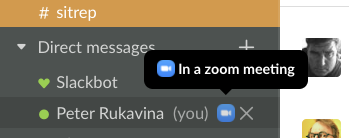
Prompted by Aaron Parecki’s efforts, I set out to conjure up a system to set my Slack status when I’m in a Zoom meeting.

Like this:

A detail from a screen shot showing my Slack status showing I'm in a Zoom meeting.

The secret sauces turned out to be:

After configuring everything up, every time I start a Zoom meeting my Slack status gets updated to “In a zoom meeting,” and when the meeting ends it gets removed.

Automation for the win!

28 Oct 23:07

The Best Gaming Headsets

by Kimber Streams
Three headsets lying on a pink surface next to a white keyboard.

Great audio can draw you into a video game with bold effects, realistic details, and immersive soundtracks. A good gaming headset allows you to enjoy all of that while you chat with your friends and teammates, too. But even the best sound quality won’t do you any good if the headset isn’t comfortable to wear for long periods of time. We’ve tested hundreds of headsets over the years, and we’ve found that the HyperX Cloud Stinger 2 is the most comfortable, best-sounding gaming headset for the price.

28 Oct 00:43

Little Ships

by Michael Kalus
Little Ships

Morning light, interesting clouds and an armada of ships anchored in the bay.

28 Oct 00:41

United States v. Google

by Rui Carmo

If, like me, you’ve been caught up in work and real life, this is a pretty decent summary of where things are at, including a bunch of ancillary topics.

I’m a bit curious if the EU is going to do anything at all, but the cynic in me believes they’ll ride in on whatever precedent is established.


Want to show your appreciation?