Shared posts

28 Oct 00:55

Need To Belong vs. Need to Be Different

by Richard Millington

Once you look beyond support-based communities (communities which people visit for need rather than desire) you find members follow a fairly similar assimilation process into the group.

First, your members will try to understand the group norms.

They will look for clues about the language to use, the topics members discuss, what the group’s likes and dislikes, the agreed common-knowledge of the group, and, in the analogue world, how the group dresses and behaves with one another.

Aside, this is why you often see newcomers who have read 50+ posts while contributing few of their own. They’re trying to figure out the group norms. Sure, some jump right into the fray (or are dragged immediately into it), but most people tentatively try to understand the group first.

These newcomers will then increasingly adopt the group norms until they feel they’re seen by others ‘as one of the group’. This might be as simple as making a few close friends within the broader group.

However, members also want to be seen as unique within the group. Or achieve what psychologists call ‘optimal distinctiveness’. This often leads people to start blogs, podcasts, customise their equipment, get tattoos, etc…The challenge is balancing the need to be unique against the desire to still be accepted within the group.

i.e. you want to be as unique as possible while still being seen as a member of the community.

If you’re managing a community, you can help members at every stage of the process. You can highlight group norms and ‘what you should know about this community’ material early on. You can use labels and references in content to help people be seen as part of the group. And you can find unique roles for members and promote their unique efforts to the broader community.

28 Oct 00:55

Acquia Engage Keynote 2020

by Dries

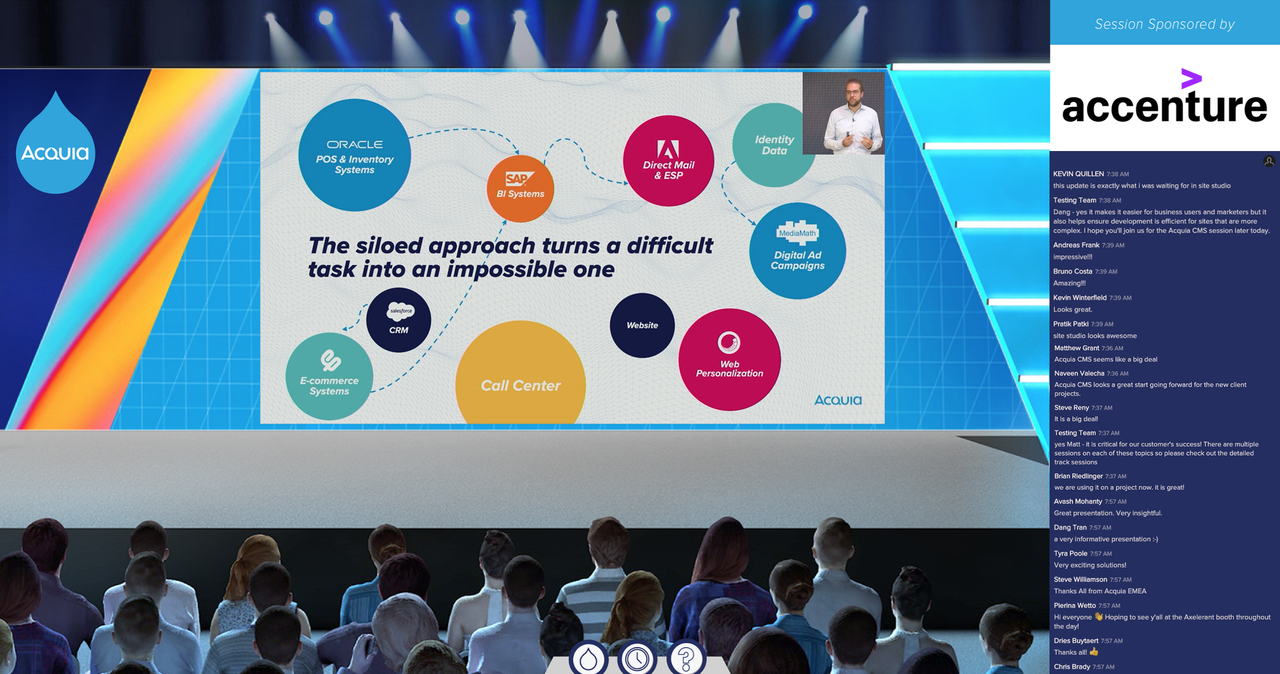
Acquia Engage took place last week. For the first time in seven years, it was an all-virtual event.

Dries standing in a virtual conference lobby.
The virtual conference lobby of Acquia Engage, modeled after our Boston office's lobby.

The best way to learn about what Acquia has been up to, is to watch the recording of my opening keynote. In 30 minutes, I cover 10 major updates to Acquia's Digital Experience Platform. We packed the presentation with short product demos. You can also download a copy of my slides (65 MB), but you won't get to see the demos.

Acquia Drupal Cloud updates

First, I talked about new features for Acqiua's Drupal Cloud. All features are focused on helping developers migrate, develop, design and launch Drupal sites faster.

I covered the following new features for Acquia's Drupal Cloud:

  • Acquia Migrate: A family of products that help you migrate to Drupal 9 five times faster and easier.
  • Acquia Cloud IDE: A cloud-based development environment optimized for Drupal and Acquia.
  • Acquia CMS: An easy, out-of-the-box distribution of Drupal 9. It comes pre-integrated with Acquia's products.
  • Acquia Site Studio Page Builder: A new page builder for Acquia's low-code/no-code website building tool. It's optimized for marketers and content creators.
  • Acquia Cloud Next: A container-based cloud hosting environment optimized for speed, scale and security.

Acquia Marketing Cloud updates

Next, I covered new Marketing Cloud features. Marketers today are using more and more tools to get their jobs done. Unfortunately, many of these tools are not well-integrated. This lack of integration results in siloed customer information and inefficient marketing. Ultimately these silos lead to poor customer experiences. Acquia Marketing Cloud solves these problems by eliminating these silos. We combine or unify customer data profiles, segments, analytics, and machine learning capabilities into a single, easy-to-use platform.

Dries delivering his presentation in front of a virtual audience

New announcements for Acquia's Marketing Cloud include:

  • Unified real-time user profiles: Aggregates customer actions across platforms into profiles in real-time. Use them instantly in marketing campaigns.
  • Universal segments: Use consistent segments across every tool within Acquia Marketing Cloud. A segment created in our Customer Data Platform (CDP) automatically becomes available in our website personalization product and multi-channel marketing automation solution.
  • 360º marketing analytics: Measures marketing campaign effectiveness across the Acquia Marketing Cloud.
  • "Predictive sends" machine learning model: Uses machine learning to predict the best time to send campaign emails.
  • COVID-19 dashboard: Helps you understand your customers' shift from offline to online, as well as changes in channel preferences, product preferences and opportunities for growth.

Closing words

I'm proud that Acquia is innovating faster than ever before. I want to thank our product and engineering teams for working incredibly hard in the midst of a pandemic.

28 Oct 00:54

Zoom rolls out end-to-end encryption for paid and free users

by Aisha Malik
Zoom icon on iOS

Zoom is officially rolling out end-to-end encryption for both free and paid accounts around the world as a technical preview.

You can activate the setting on Zoom’s desktop app and Android app. End-to-end encryption will be available on iOS once Apple approves an app update.

Users have to manually turn on the feature in their settings, and all meeting participants will have to turn it on in order to join an end-to-end encrypted meeting.

You’ll know if the setting is enabled when you see a green shield logo with a padlock in the middle in the upper left corner of your meeting screen.

“End-to-end encryption is best for when you want enhanced privacy and data protection for your meetings, and is an extra layer to mitigate risk and protect sensitive meeting content,” Zoom notes.

The setting is currently in technical preview, as Zoom is hoping to receive feedback from users during the next 30 days so it can enhance the feature.

Zoom initially announced plans to only offer end-to-end encryption for paid users and not free users, but later reversed its decision after facing backlash.

Source: Zoom

The post Zoom rolls out end-to-end encryption for paid and free users appeared first on MobileSyrup.

28 Oct 00:44

Surface Pro X mit SD2 in Platin jetzt im Handel

by Volker Weber

8aab8a18d4f1933a340b47ad5832c64a

Auf meinem Tisch wohnen zwei sehr ähnliche Rechner, der eine mit iPadOS, der andere mit Windows 10. Durch die Software haben beide sehr unterschiedliche Fähigkeiten. Aber sie haben auch eine Gemeinsamkeit, die ich sehr schätze: Sie sind mucksmäuschenstill. Kein Lüfter.

Vor drei Wochen habe ich mir das neueste Modell des Surface Pro X angeschaut, das sich von meinem durch den neueren Snapdragon Chipset SD2 unterscheidet. Das macht vielleicht 10% Performance-Verbesserung aus. Spüren kann ich den Unterschied nicht.

1fcd43c0a20c95570eeadcf8e9165bd8

Was mir aber richtig gut gefällt, ist die neue, alte Farbe. Surface Pro X gibt es jetzt auch in Platin. Und ab heute ist es im Handel. Nur die beiden teuersten Versionen mit 16 GB RAM und 256 oder 512 GB Storage werden auf SD2 umgestellt. Die älteren mit SD1 bleiben verfügbar. Ich vermute, Microsoft hat noch genug davon.

28 Oct 00:44

Anker cuts prices of wireless chargers and portable chargers

by Ian Hardy
28 Oct 00:43

Polyvalent Low Kicker and More Fall Arrivals at VO

by noreply@blogger.com (VeloOrange)

by Kevin


The Polyvalent Low Kicker has landed. After many, many months of design, development, and testing, we are beyond stoked for the arrival of the latest addition to the Velo Orange lineup. The Low Kicker is a major update to our Polyvalent platform that introduces a low-slung top tube for easy riding while retaining a "do-it-all" design ready to tackle everything from paved commuting to gravel touring. 

We will begin to fill pre-orders in the coming days. For those that missed out on the pre-order, the Low Kicker is now available for order direct from our online store.

And the Low Kicker didn't come alone. As the weather cools down and the days grow shorter, a new shipment of Velo Orange essentials has arrived just in time for your fall and winter bike projects. 

Crazy Bars are back in stock in silver and black. We've received no shortage of questions about when more would be in. A close second, however, is the Klunker Bar, and we're not here to disappoint. Klunkers in their noir finish have also been restocked. We've also received more Left Bank handlebars in 22.2 mm and 23.8 mm sizes as well as Granola Bars in silver and black. 

On the topic of handlebar swaps, if you have been looking for an easy way to convert that old threaded fork to use modern threadless designs in a variety of clamp diameters, our Threadless Stem Adapter is also back in stock. 


We've received more fenders in a variety of popular styles and sizes. 650b x 58 mm fenders are back in black in Smooth and Wavy finishes along with 700c x 52 mm Zeppelin Fenders in Noir. 

And the list goes on. More items back in stock: 

We have also received more stock our Comfy Cotton Bar Tape and Colored Brake Cable and Derailleur Cable kits to add a splash of color to that fall/winter bike build. 

If you have been waiting for something in particular and don't see it in stock, we'll have even more arriving within the next month or two, including the brand new Pass Hunter, a new colorway for the Piolet, and more. 

27 Oct 20:39

Youtube-dl ist wieder auf Github online!Nicht ganz ...

mkalus shared this story from Fefes Blog.

Youtube-dl ist wieder auf Github online!

Nicht ganz freiwillig auf Seiten von Github. Die haben da seit Ewigkeiten einen Bug, dass beliebige Leute in existierende Repositories Daten hochladen können. Das ändert am Checkout erstmal nichts, denn der ist per Crypto-Hash an einen bestimmten Stand gekoppelt. Den aktuellen Hash kann man so auch nicht ändern, man kann nur zusätzliche Daten in ein Repo laden. Die sind dann allerdings über einen direkten Link auf den Hash abrufbar.

Das hat jetzt halt jemand mit dem GMCA-Repo gemacht, in dem Github die DMCA-Meldungen ablegt.

Ich sitze da jetzt seit ein paar Tagen drauf, weil ich mir dachte, wenn ich drauf linke, dann machen die das sofort weg. Aber offensichtlich sind die gar nicht in der Lage, das wegzumachen. Dann kann ich auch drauf linken.

Die Homepage von youtube-dl hat auch relativ schnell ihre Links zur aktuellen Version gefixt.

Ich bin mir sicher, dass die RIAA da einfach weiter Drohbriefe verschicken wird.

27 Oct 20:37

3 for Tuesday

🔥 Incendiary devices were thrown at the Robert Koch Institute of Berlin early Sunday morning. The institute is the government agency responsible for Germany’s response to COVID-19 and other infectious diseases. It’s really sad that people do this, no matter where in the world.

🌲 Soon, you’ll be able to replace your plastic charge card with a wooden one. Apparently, more than 300,000 cards can be produced from the wood of one tree. On the other hand, I’ve converted most of my card spending to contactless Apple Pay.

🙋‍♀️ Looking for a job? First Round has published 40 questions you could ask during your next interview with a prospective employer. Interviewing is a two way process, and these questions can help you decide if you want the job you’re applying for. One I really like is: "What relative weight do you put on the way people conduct their work, versus the work product they generate?”

27 Oct 04:45

Twitter Favorites: [rcousine] The movement for UTC Everywhere is gaining steam. There are dozens of us! https://t.co/ODU5JJlZTb

Ryan Cousineau @rcousine
The movement for UTC Everywhere is gaining steam. There are dozens of us! twitter.com/ouij/status/13…
27 Oct 04:31

Badgebot

Badgebot, Oct 26, 2020
Icon

Self-styled as "the world's first open badges issuing twitter bot", Badgebot allows people to award badges and post the results using their Twitter account. I heard about it in today's ePIC conference. It "uses Twitter timelines and tweets as evidence, displayer of badges, and access to badges" and "saves all badge data as public gists" which you can view here. You can find code here and here. Here's the (short) list of badges. Here on Twitter I awarded myself a badge and here is the result.

Web: [Direct Link] [This Post]
27 Oct 04:31

Freedombone

Freedombone, Oct 26, 2020
Icon

Despite its odd name, this is an interesting project. "Freedombone is a home server system which enables you to run your own internet services, individually or as a household. It includes all of the things you'd expect such as email, chat, VoIP, web sites, wikis, blogs, social networks, media hosting and more. You can run Freedombone on an old laptop or single board computer. No ads and no built-in spying." This is in many ways similar to NextCloud. Or, here's another option: Bonfire. It's an actual device you can use to host your own node on a decentralized federated social network.

Web: [Direct Link] [This Post]
27 Oct 01:14

How it started How it’s going pic.twitter.com/XKOyxFxHPm

by Chris Kendall (ottocrat)
mkalus shared this story from ottocrat on Twitter.

How it started How it’s going pic.twitter.com/XKOyxFxHPm


51 likes, 10 retweets
27 Oct 00:36

5-Step Road Map For Saying No

by swissmiss

1. Remind yourself that time is valuable and once it’s spent you absolutely can’t get it back.

2. Ask yourself: “Would I be willing to do this thing tomorrow?” It’s easy to sign yourself up for something in April when it’s only September. Do your future self a favor and try this little exercise.

3. Respond quickly. Don’t leave people hanging once you know you’re saying no.

4. Own your “no” if it’s not a priority (because something else actively is): “Thanks so much for thinking of me. I’m not going to be able to take this on, but I wish you the best with X.”

5. Reframe your “no” to assuage your guilt (if it’s something you genuinely wish you had time for). Acknowledge that this commitment is significant to you, even if you’re not taking it on. A good sample script: “This is so important that it deserves someone’s full energy, and since I can’t do that because I have XYZ other things, I would be dishonoring the importance of this event/role/weekend getaway by saying yes.”

5-Step Road Map For Saying No

(via Recomendo)

27 Oct 00:36

Sketching a datasette powered Jupyter Notebook Search Engine: nbsearch

by Tony Hirst

Every so often, I’ve pondered the question of "notebook search": how can we easily support searches over Jupyter notebooks. I don’t really understand why this area seems so underserved, especially given the explosion in the number of notebooks and the way in which notebooks are increasingly used as a document for writing technical documentation, tutorial and instructional material.

One approach I have seen as a workaround is to produce an HTML site from a set of notebooks using something like nbsphinx or Jupyter Book simply to generate access to an inbuilt search engine. But that somehow feels redundant to me. The HTML Jupyter book form is not a collection of notebooks, nor does it provide a satisfying search environment. To access runnable notebooks you need to click through to open the notebook in another environment (for example, a MyBinder environment built from a repository of notebooks that created the HTML pages), or return the the HTML environment and run code cells inline using something like Thebelab.

So I finally got round to considering this whole question again in the form of a quick sketch to see what an integrated Jupyter notebook server search engine might feel like. It’s still early days — the nbsearch tool is provided as a Jupyter server proxy application, rather than integrated as a Jupyter server extension available via a integrated tab, but that does mean it also works in a standalone mode.

The search engine is built on top of a SQLite database, served using datasette. The base UI was stolen wholesale from Simon Willison’s Fast Autocomplete Search for Your Website demo.

The repo is currently here.

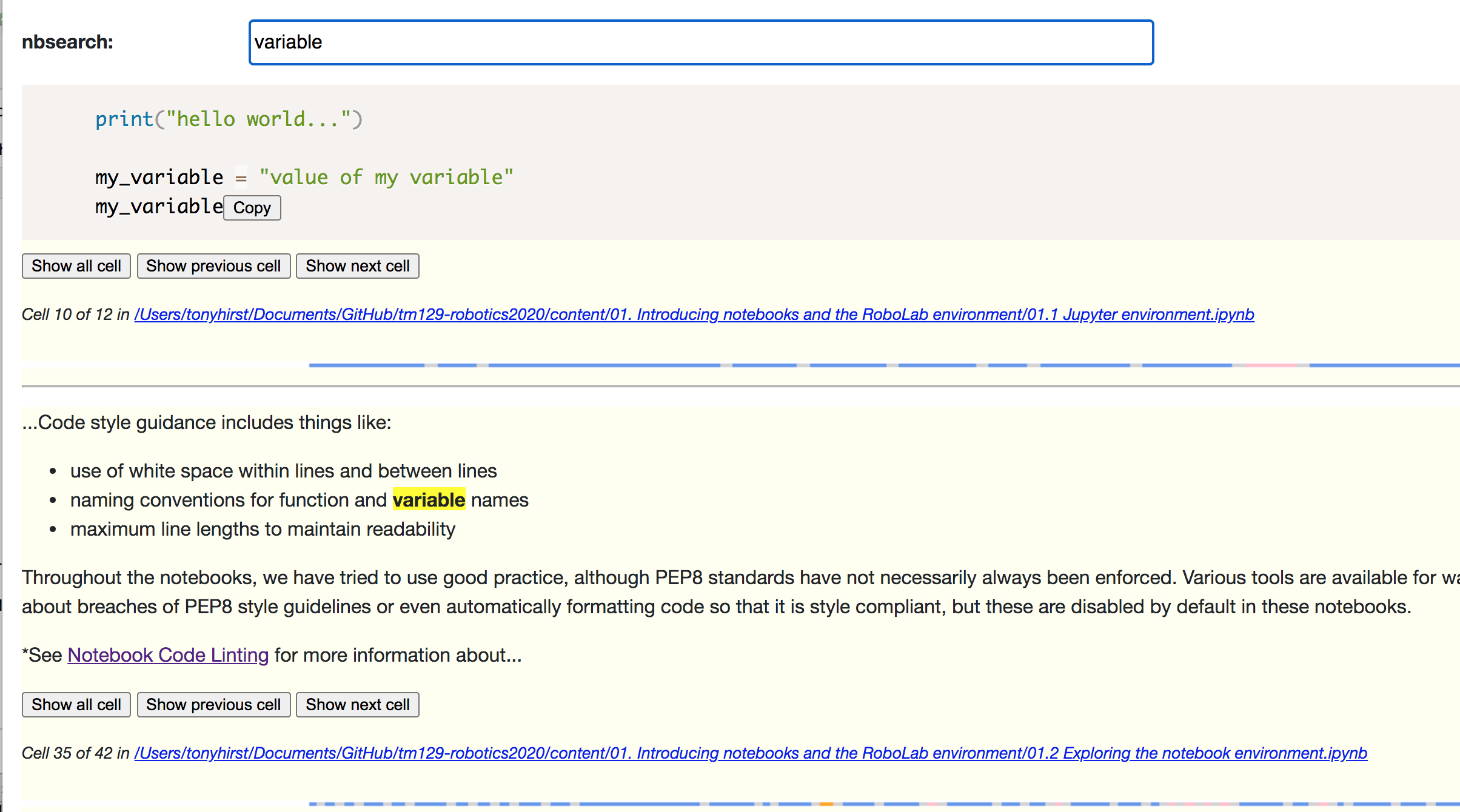
The search index is currently based on a full text search index of notebook code and markdown cells. (At the moment, you have to manually generate the index from a command line command. On the to do list for another sketch is an indexer that monitors the file system.) Cells are returned in a cell-type sensitive way:

Screenshot of initial nbsearch UI.

Code cells are syntax highlighted using Prism.js, and feature a Copy button for copying the (unstyled) code (clipboard.js). Markdown cells are styled using a simple Javascript markdown parser (marked.js).

The code cells should also have line numbers but this seems a little erratic at the moment; I can’t get local static js and css files to load properly under the Jupyter server proxy at the moment, so I’m using a CDN. The prism.js line number extension is a separate CDN delivered script to the main Prism script, and it seems that the line number extension doesnlt necessarily load correctly? A race condition maybe?

Each result item displays a link to the original notebook (although this doesn’t necessarily resolve correctly at the moment), and a description of which cell in the notebook the result corresponds to. An inline graphic depicts the structure of the notebook (markdown cells are blue, and code cells pink). Clicking the graphic toggles the display (show / hide) of that results cell group.

The contents of a cell are limited in terms of number of characters displayed. Clicking the the Show all cell button displays the full range of content. Two other buttons — Show previous cell and Show next cell — allow you to repeatedly grab additional cells that surround the originally retrieved results cell.

I’ve also started experimenting with a Thebelab code execution support. At the moment this is hardwired to use a MyBinder backend, but the intention is that if a local Jupyer server is available (eg as in the case when running nbsearch as a Jupyter server proxy application), it will use the local Jupyter server. (Ideally, it would also ensure the correct kernel is selected for any given notebook result.)

nbsearch UI with ThebeLab code execution example.

At the moment, things don’t work completely properly with Thebelab. If you run a query, and "activate" Thebelab in the normal way, things work fine. But when I dynamically add new cells, they arenlt activated.

If I try to manually activate them via a cell-centric button:

then the run/restart buttons appear, but trying to run the cell just hangs on the "Waiting for kernel…" message.

At the moment, the code cell is non-editable, but making it editable should just be a case of tweaking the code cell attributes.

There are lots of other issues to consider regarding cell execution, such as when a cell requires other cells to have run previously. This could be managed by running another query to grab all the previous code cells associated with a particular code code, and running those cells on a restarted kernel using Thebelab before running the current cell.

Providing an option to grab and display (and even copy) all the previous code in a notebook, or perhaps explore the gather package for finding precursor cells, might be a useful facility anyway, even without the ability to execute the code directly.

At the moment, results are limited to the first ten. This needs tweaking, perhaps with a slider ranged to the total number of results for a particular query and then letting you slide to select how many of them you want to display.

A switch to limit results to just code or just markdown cells might also be useful, as would an indicator somewhere that shows the grouped number of hits per notebook, perhaps with selection of this group acting as a facet: selecting a particular notebook would then limit cell results to just that notebook, perhaps grouping and ordering cells within a notebook by cell otde.

The ranking algorithm is something else that may be worth exploring more generally. One simple ranking tweak that may be useful in an educational setting could be to order results by notebook and cell order (for example, if notebooks are named according to some numbering convention: 01.1 Introduction to X, O1.2 X in more detail, 02.1 etc). Again, Simon Willison has led the way in some of the practicalities associated with exploring custom ranking schemes in his post Exploring search relevance algorithms with SQLite.

Way back when, when I originally started blogging, search was one of my favourite topics. I’ve neglected it over the years, but still think it has a lot to offer as a teaching and learning tool (eg things like Search Engine Powered Courses… and search hubs / discovered custom search engines). Many educators disagree with this approach because they like to think they are in control of the narrative, whereas I think that search, with a properly tuned ranking algorithm, can help support a student demand led, query result constructed, personalised structured narrative. Maybe it’s time for me to start playing with these ideas again…

27 Oct 00:35

100 Days in Obsidian Pt3: Tracking Tasks

by Ton Zijlstra

I have used Cultured Code’s todo-application Things a long time, since the end of 2008. I attended a presentation then where Cultured Code explained how they translated their intentions and values into the design of the app, and used their software ever since. It is a beautiful software tool and it has been very useful to me for almost 12 years. And then, since the end of August, I have not used it at all. Before 2008 and Things, I used my employer’s tools (Outlook mostly) and privately used text files. Back in the late 1980’s and in the 1990s I only used text files to keep track of tasks. And that is what I’m doing now again, using Obsidian to create markdown text files.

Important elements to me in using text files for tasks effectively are:

  • being able to link between text files both directly and through tags
  • being able to quickly switch between the task list and the resources needed for a task
  • having the task lists as part of my overall system, not an island

Things is good at using tags for tasks (allowing me to e.g. filter tasks on context or needed amount of focus through tasks). I was also able do some linking between Things tasks and e.g. Evernote notes, links that I manually copied between the two, and copied into Tinderbox which I use as a dashboard map for various things. I also used a script at the start of project to create the right first tasks, and corresponding notes in those applications. That way there is consistency between how areas, projects and project tags are used across those applications. It worked but it meant a lot of switching between applications during the day. In my set-up of Things/Evernote and now in Obsidian, I roughly follow the Getting Things Done method (areas, projects, inbox, and marking things as someday or waiting etc.)

As a side note: I do not use my mobile to look at or add tasks, or mark them completed. I basically always work laptop-first. This means that the availability of my tasks lists on mobile, and the capability to edit them there, is not important to me. In fact, Things is an Apple-only product, and I use an Android phone, so I never have been able to use Things on mobile (I did have Things on my 1st gen iPad back in 2010, but tablets are another thing that never really found a niche in my workflow). In that sense using text files are an improvement: I can read them and edit them, because I synchronise my Obsidian notes to my Nextcloud instance, which my mobile can access (there’s no mobile Obsidian app, and there’s no need for it either, any plain text editor will do after all.)

As I mentioned in earlier posts, going back to text files feels very comfortable to me. Obsidians features make it rather frictionless even, with transclusion, tagging and with linking.

The task management set-up

As described in my previous post on my use of Obsidian, I have a hierarchical folder structure of areas of activity, with project folders within them.
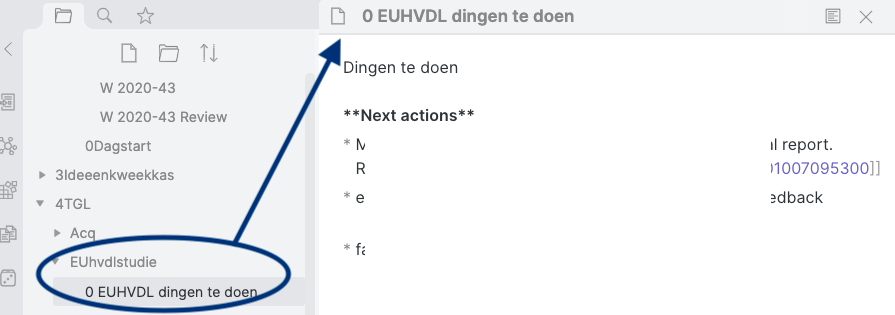
Each project folder contains a file titled ‘0 [project name] things to do’, where I keep the list of actions currently relevant for that project. If there are sub projects, then each of those has a similar own list of tasks, which are transcluded into the general project list.

In the 1GTD12WY folder, where I keep the general material w.r.t. future goals and my 3 month planning cycle, I also have two general tasklists. One is the root of all tasklists (called ‘0 root list things to do’), the other is a list of general tasks for the current month (‘0 this month things to do’). The leading zero ensures that tasklist are always the first file in a (project) folder.


The root and month task list in the general ‘getting things done’ folder.

The ‘this month’ list is filled at the start of each month, from whatever is in the ticklerfile for that month (it might be quarterly recurrent things like, ‘file VAT returns by the 30th’, or ‘check out the book that is scheduled to be published the 21st [link]’), and from general things not tied to any particular project that came up while making my month map (see previous posting).

The root list contains all the areas of activity, and for each project within an area the project’s task lists is transcluded. Every project task list links to the root list, so even when I forget to add it to the root list, it will show up as a backlink. As projects in turn may have sub projects with their own tasklist, you get multilevel transclusion. Obsidian allows you to go 5 layers deep so that is more than enough for my set-up. This way a task is only ever in one single list.

I use tags like #waiting and #urgent to mark task status.


My root task list with the month list and a project list embedded through transclusion

At the start of each project I run a script that creates all the necessities for a project. This includes automatically making the task list for a new project, adding a handful of common tasks to it, and adding the link to the root list.

Task management process

Daily
On a daily basis I work with the task lists, in multiple ways.
I browse through the task root list at the start of the day, and specifically the projects I will be spending time on that day. I look at what is marked #urgent. Both the root task list and the #urgent search filter I have pinned as starred searches, so I can directly go to them from the Obsidian interface. I do not add existing daily habits onto my task list, I might add them for habits I’m trying to develop.


Above: a project task list, in a project folder. Below: the starred searches to quickly switch between e.g. the root list, the month list, the monthly map and urgent tasks

Whenever I am in a meeting on a project, I have the existing corresponding task list in front of me, right next to the notes I am making during the meeting. After, or during a meeting I update the tasklist, through adding, splitting, deleting or rephrasing.
When I add a task to a list, I also add links to notes that are relevant to it, e.g. the meeting notes where the task originates, or the note that contains the rough notes and current status of a task. I link/mention the things I need for the task. This lowers the threshold to start doing a task.

While adding a task I may add tags that help me select which ones are fitting for the current context (e.g. level of energy/focus likely needed, or specific context in which to do them). As I’m only working from home due to the pandemic I currently don’t use contextual tasks yet (in Things I’d tag things with #train e.g. if it something I can well do while commuting to a client’s office).

When a task is done, I copy and delete it from the task list, and paste it into the day log (see previous post). That way the day log contains all the things I’ve completed that day, plus anything else that came along and wasn’t on the task lists. (I use the day log for time sheets and the weekly review).

Weekly
During my weekly review, for each ongoing project I remove no longer relevant or finished tasks, add things I realise will be needed in the coming week(s), and scan the horizon for anything that will become #urgent in the next 3 weeks to mark them as such. I also review the #waiting things to see if anything has slipped my mind.

Monthly
Each month I check if any new projects need to be added, or which ones to close down and remove from the root list. While making my month map I add the resulting tasks to the relevant project list, and I add the tasks resulting from things in next month’s tickler file to the task list for this month.

27 Oct 00:35

Twitter Favorites: [nealjennings] I miss personal email being actually personal and meaningful. I used to send emails back and forth with many friend… https://t.co/u7xLO108wK

Something Spooky I Guess @nealjennings
I miss personal email being actually personal and meaningful. I used to send emails back and forth with many friend… twitter.com/i/web/status/1…
27 Oct 00:34

Bringing Slides Home (Continued)

by Ton Zijlstra

In my recent post about bringing slides home to my own server and domain, I mentioned Speakerstack.net. On their site they mention completely hosting everything yourself, but the site afaik never points to anything explaining that. It does provide as I described the means to upload your presentations there.

During the weekend I reached out to Cliff, the developer behind Speakerstack. He gave me the link to the WordPress plugin (in beta) he created, which allows you to do everything yourself in a WP instance.

I took a look at the code and what it does, while providing an admin console to do so from within WP, is:

  1. Take a PDF and send it to ConvertAPI (provided by the Lithuanian company Baltsoft), to convert the PDF into jpg images, one per slide
  2. Take those jpg images and put them in a slider, using Kevin Wheeler’s Slick Slider

You need a ConvertAPI key to approach it, which is easy to arrange.

I will probably test drive this plugin in a separate WP instance, and if I’m ok with it I will use that as my personal ‘Slideshare’ place. I may also consider going with just the conversion and the slider bits, as uploading my presentation PDFs through WordPress and managing everything there seems a bit overdoing it, if I also have direct access to the back-end of the hosting package and could upload everything in bulk. Then again, bulk is only a consideration at the start, having my Slideshare history to migrate.

I added a WP instance on a domain I have (tonz.nl) and installed the plugin, created an API key for the PDF conversion. It takes a number of minutes for the conversion to happen, and it works.

If you check the embedded presentation above, you’ll see that the download link and the full screen link are pointing to my tonz.nl domain. The download link is in the WP uploads folder, which is logical, but I probably want to change. Likely I will put a Yourls instance in front of it to have shortened urls that cloack the folder the files are actually in, and which lets me count the number of downloads as well.

27 Oct 00:33

Those who can, DO *AND* TEACH – on what teaching entails

by Raul Pacheco-Vega

Dr. Raul Pacheco-Vega at CIESAS workshopOne of the sayings that irks me the most is that old one: “those who can’t do, teach”. As a professor, a teacher, an educator and someone who has spent basically his entire life minus 10 years teaching, educating and mentoring students, I cannot stand the systematic devaluing of the teaching profession, and of educating as an activity. This lack of proper valuation is both systematic and widespread. The saying “those who can’t do, teach” assumes that there are other activities that are more complex, technical and sophisticated than teaching. This is a fallacy, and a grave one that has led to the defunding of teaching and education from kindergarten to post-graduate education. Because I am a professor, I know that my job entails research, teaching, service to my university and to the discipline(s) I work within, to my field and to academia.

Within the job, mentoring students is one often forgotten element of what we do. Research is underfunded. But frequently the most devalued of all the activities we engage in is teaching. This devaluation also can come from evaluation committees where publication and research are the most revered activities of what professoring entails. Nevertheless, within the educational system, teaching is perhaps the most key activity of them all. We transmit our knowledge and open students’ eyes to a new way of viewing the world.

Dr. Raul Pacheco-Vega at CIGA-UNAM (Morelia)

I love teaching, I really do. It exhausts me, it drains me, it requires a lot of work from me, but I really, really love teaching. I’m definitely in love with my research, but I adore being able to shape students’ minds and transmit knowledge. This love prompted me to reflect on everything that teaching entails, and that is definitely undervalued. My Twitter thread shares some of these thoughts below.

I believe that one of the reasons why teaching is so undervalued is that we make ideas, concepts and subject matter look easy.

THAT IS EXACTLY THE POINT, PEOPLE.

After I wrote this component of the Twitter thread, I remembered that there were MANY other parts of this job that people don’t/can’t see.

As readers reacted to my thread, many of them added other parts of the job that I might have missed (I was rage-tweeting, to be quite honest, and I wrote these ideas just off the top of my head). I really hope that after reading my thread and responses, quote tweets and conversation, we get a better understanding of just how hard it is to be an educator. Worth it? Definitely, yes. But nevertheless, very, very hard.

Even more so during COVID times.

27 Oct 00:33

The Street Drug Poisoning Crisis

by Dave Pollard


Matthew Schimpky, a volunteer in Vancouver’s Downtown Eastside Overdose Prevention Society, takes a break from work to look after a resident’s dog. Photo by Sarah Blyth, a founding member and frontline worker for the Society, part of an amazing photo collection in the Tyee.

We have a medical crisis in BC, and it’s not CoVid-19, though the pandemic could yet explode here and become one.

The medical crisis is the deaths of over a thousand British Columbians every year (many times the CoVid-19 toll) from poisoned street drugs. To call it a “pharmaceutical opiate overdose epidemic” is a deception.

We should not be surprised when people, many of whom who are struggling mentally, physically and financially with seemingly endless and insurmountable challenges, turn to street drugs as a means of coping with their distress. Too often, because these drugs are unregulated and often laced with poisons — because it’s cheaper and more lucrative for their producers to make them that way — people who take these drugs die terrible deaths.

Surveys have repeatedly found that 95% or more of those dying from toxic street drugs were never — never! — prescribed addictive drugs. It only makes sense that those looking for respite from trauma and other societal illnesses would prefer to access safe, clean “brand name” drugs from regulated pharmaceutical companies rather than potentially toxic “street” drugs. But as governments have clamped down fiercely on doctors prescribing narcotics (even for patients relying on them for chronic conditions), those with dependencies are left at the mercy of vendors of unregulated products, which may be mislabeled, fake or laced with cheap synthetic fentanyl and other toxins.

You probably know people who, to cope with their difficulties, use alcohol, tobacco, pornography, sedatives, stimulants and other means of escape, and end up unable to properly manage their use of them, potentially leading to dysfunction, violence, and permanent harm to others and themselves. We’re all “addicted” to something, and those dying on the streets from toxic drugs are no different from us. They just have the misfortune of not having a safe, regulated supply of what they use to cope.

Many governments have been conned into believing that a “war on drugs” can be effectively won, and/or that “abstinence” programs and “aversion therapy” work, when all the evidence shows the opposite. A recent study suggests the success rate of even the much-touted “12-step” abstinence/rehab programs is between 5% and 8%. And that “just say no” programs actually produce more drug use than they prevent. These programs unfairly and cruelly blame the victims, making their situation worse, instead of working to eliminate the underlying conditions, and helping those with dependencies to live healthy, comfortable lives.

When the American Affordable Care Act extended eligibility for these failed abstinence, aversion and 12-step programs, unscrupulous operators exploited the prevalent blame-the-victim approaches by opening fly-by-night “treatment centres” that charge obscene daily rates ($1,000 a day and up). These programs cost more than 90% of the population could afford if they weren’t covered by insurance. And these same unscrupulous “entrepreneurs” have opened fake “halfway houses” for those “detransitioning” from drugs to supposedly stay safe, when in fact many of them are run by drug dealers exploiting the system and their often desperate “inmates”. Check out the link above for one man’s harrowing story of this horrific, outrageous, and worsening situation.

Those looking for better solutions have faced threats and fierce opposition from conservatives, religious groups, and the pharma industry, who want all the blame and responsibility to be placed squarely on the victims. Despite this, some governments have courageously piloted different approaches: free (and judgement-free) injection centres, or the provision of safe, free or low-cost drugs.  This allows users to escape the dread and fear of imprisonment, shakedowns, police abuse, street violence, and death-by-toxin that are often ever-present in their lives, so they can once again live fruitful, healthy lives and reestablish and sustain essential relationships with others.

Free injection centres provide those with substance dependencies with free, clean needles, a safe place to take their drugs, a watchful eye in case the drugs they take are bad, and, if desired, counselling and friendly support as well. They reduce the feeling of isolation that “illegal” drug users live with, and are often located in areas where community police have been trained to look out for them, instead of harassing them.

Dr Bonnie Henry, BC’s senior public health officer, even while masterfully coping with the province’s CoVid-19 situation, has called for the immediate decriminalization of the use of all drugs. When the government (facing an election) balked, she used her own authority to require that any registered nurse be allowed to prescribe (and even deliver) safe prescription drugs to anyone asking for them. That move has received international attention, but it’s just the first step.

Our health system, our housing system, our economic/employment system, our political system, our police and legal system, are all seriously broken, and their dysfunction impedes our attempts to deal with this drug crisis at every turn.

What is required is an acknowledgment that those using street drugs, those suffering from addictions, those struggling with poverty and homelessness, those acting out their mental illness — all these people need treatment and healing and help. What they don’t need is more laws, incarceration, arrest and abuse in the streets and in institutions, including ineffectual, unsafe and punitive “treatment facilities” (rehabs, prisons, homeless shelters).

Paternalistic solutions have utterly failed, and, just as a guaranteed annual income has been repeatedly shown to be a vastly better solution to poverty than food stamps and other demeaning regulated programs, so too do those who are struggling with dependencies need their underlying conditions (poverty, homelessness, mental illness, trauma and abuse) addressed. And in the meantime they need simple, nonjudgemental access to whatever means they use to cope with their situation.

The lesson we should have learned from prohibition is not to make wanted products illegal, and hence drive their production to dangerous, underground, ruthless, violent criminal gangs. Instead, we should make these products more available, legally and properly regulated, in safe forms, and get the real criminals out of the business. And, for god’s sake, we have to start to trust our fellow citizens to figure out, with the best help available, how best to deal with the many crises we are all facing. There is no one “right” way to live, and we should appreciate that not everyone wants to live the way we do in any case.

So please, the next time you read about an “opioid epidemic” and “overdoses”, please challenge the deceptive terminology used and the simplistic binary victimizing diagnoses and solutions offered. The people dying are not too stupid or inebriated to manage their doses, and they’re not trying to commit suicide.

Like you and me, they’re just trying to cope with dysfunctional systems out of control and the hardship this dysfunction has imposed particularly cruelly on them. Give them a hand, when you see them, when you hear their stories, when you object to the obfuscation of the problem by politicians, and when you vote. You could easily be in their place right now, were it not for circumstances over which neither of you has any control.


Thanks to Kelly Gavin, a professional psychotherapist who has lived and worked in the Downtown Eastside and other parts of Vancouver, for her thoughtful contributions and edits to this article. 

27 Oct 00:32

Teed Off at Public Golf Courses? Australian Mayor Clover Moore Swings for a Park

by Sandy James Planner

There’s been some discussion that the City of Vancouver’s three public golf courses, which are classified as park land, should be morphed into housing sites. The argument has been that as the population of the City of Vancouver expands, why not use golf course sites for housing?

The City cannot easily turn land zoned for park use into housing sites and there’s the suggestion that doing so may be short sighted, as the city densifies and requires park land for a growing populus into the next century. The City does have an  established policy of providing 2.5 acres of park land for every 1,000 residents, and used DCLs on new development to garner funds for park purchase.

The original intent of DCLs, (Development Cost Levies) was to pay for social housing, infrastructure, parks and childcare facilities. As development occurred in the city, each development would pay a portion of the associated costs. Councils have also waived these DCL payments in some cases to achieve other goals such as new affordable or rental housing, meaning that the funds for other infrastructure required have been deferred.

Take a look at what the  City of Sydney Australia is doing in this article written by Megan Gorrey in the Sydney Morning Herald. Mayor Clover Moore and Sydney Council is considering two plans to pare down an 18 hole civic golf course to 9 holes and create 20 hectares of new parkland.


It’s no surprise that Golf New South Wales called the proposal “shameful”. But the Lord mayor argues that the land is for public use. While the golf course is in a park trust run by New South Wales state, Mayor Moore observes that the area surrounding the golf course is “becoming the densest residential area in Australia” with an expected population increase of 70,000 residents and 22,000 workers by 2031.

There are twelve golf courses, six accessible to the public within 12 kilometres of this golf course. The City Council plans to spend $50,000 on a community consultation plan for the area and for the park if the proposal is adopted, providing new park land with close proximity to the downtown.

This is not a new proposal as outlined in this Council Mayor’s minute but was identified in a 2016 Feasibility Study as a way to create more parkland for residents.

While there are going to be forty new parks and play spaces in the planned redevelopment around this golf course, the Mayor’s minute observes “ small parks do not provide the opportunity to stride out, de-stress and recharge or renew and commune with nature for people living in high density apartments. They need this opportunity for their mental and physical wellbeing.”

With Sydney Council’s intent to tear down the fencing of the golf course, the State’s Department of Planning has come out swinging. The State’s position is that as the third most used public golf course in the country with 60,000 rounds played annually, there should be strong support to maintain it as such, with their own “masterplan” created three years ago.

You can review the comments section on the Sydney Morning Herald’s article here which shows a cleaving of positions between the golfers and just about everyone else. Below is a YouTube video describing the Moore Park Golf Club where you can “Get Moore”.

Images: SandyJames,WalterPeeters,CityofSydney


27 Oct 00:31

Frances Bula Reviews “Land of Destiny”

by Gordon Price

Just out from the Literary Review of Canada:

PT: Frances Bula has indispensably covered urban issues and city politics in Vancouver long enough to remember things other writers didn’t even live though much less forgot (as the review of Jesse Donaldson’s book, Land of Destiny: A History of Vancouver Real Estate, demonstrates).  So with her nuanced and in-depth perspective, she’s now able to piss off every side of the debate on housing affordability, development and who’s responsible.

Here are some excerpts – but go read the complete story here.

Donaldson limits his narrative to one overarching theme: that a select group of speculators have controlled this city forever. In Land of Destiny, only the names change through the decades — the general storyline stays the same. There is always a powerful group of marketers and speculators, and there is always a willing band of politicians to give them whatever is needed in order to reap the windfall.

Donaldson suggests that Vancouver’s dynamic real estate experience is unique. But that interpretation, a familiar one in an often unhappy city, where suspicion-filled and resentful narratives about development are an established noir tradition, leaves out so much. For one, Vancouver is not unique when it comes to land rushes. That’s pretty much the story of the western United States and Canada, as people scrambled to acquire property, in what were seen as newly opened and empty territories, and then market it to newcomers. Capitalism at its rawest.

Second, Donaldson doesn’t explain why the speculators were so successful here compared with other places. Many have failed at this capitalist game of creating demand where there was none before, losing fortunes as buyers failed to appear at their gimcrack Shangri‑Las. What was it about local dynamics that nurtured enough pressure on real estate that it became a reliable speculative vehicle right from the start?  (Details follow.)


Here’s the part of the review that I think is most salient:

A history of Vancouver real estate should give some kind of attention, at some point, to all buyers and owners, not just foreign investors. But too many of those buyers and owners are absent from Land of Destiny. Their absence becomes steadily more glaring as the chapters unfurl because local transactions are, in the end, the mechanism that makes speculation work.

She adds a quote from Los Angeles writer Mike Davis’s City of Quartz that is particularly relevant to Vancouver culture (and to the local Green Party in particular):

Davis details the way that homeowner groups of thirty years ago, using the language and often the support of the environmental movement, blocked development of lower-cost housing throughout Los Angeles: “Environmentalism is a congenial discourse to the extent that it is congruent with a vision of eternally rising property values in secure bastions of white privilege.”

And then, ka-pow:

Land of Density makes it sound like a mystery why all those politicians with real estate cronies get elected. But it’s not a mystery. A significant group of voters, the ones who have benefited from the way the current system works, keep electing them. They were mostly pleased with themselves and their foresight while Vancouver property values kept climbing. It’s only when things got a little out of hand this past decade — when suddenly neither children of the land rich nor double-income households could afford even the first rung of the homeownership ladder — that we saw some backlash from the existing owners.

It would have been nice to see that analysis and history in this book. The opportunity was there. There’s no shortage of archival news accounts of locals pushing back to keep the outsiders away, including the now-legendary comment by a west-side resident in one public hearing that a potential transportation corridor shouldn’t be allowed in her area because it is filled with the “crème de la crème.”*

Or this:

Donaldson employs language and framing that pins everything on the cabal of “others.” Real estate is controlled by “oligarchs.” Developers and politicians, even left-wingers like the former councillor and NDP MP Libby Davies, have “cozy” relationships. He throws out the casual stat that 46 percent of condos in Vancouver are owned by “investors.”

Like many who have come to use the term in recent years as a straight pejorative, he doesn’t seem to recognize that “investors” also constructed and run much of the now-valued low-rise apartment stock of the 1960s and ’70s, or that the new generation of “investors” are supplying rentals through their willingness to buy and then rent out individual condos. That’s the way most rental housing gets built in the market system we currently have: people who have some extra money acquire property and offer it to those who don’t.

Finally:

So, in the end, Donaldson’s book is a useful summary of one part of the history of Vancouver real estate. But it’s not the complete history, which is still to come.

So, Frances, what are you doing with all your spare time?


* The reference to ‘creme de la creme’ gives me a chance to add a personal note to that infamous moment in our history. I was at the council meeting when it was first spoken by Pamela Sauder in regard to the Arbutus right-of-way as a potential rapid-transit corridor:

“We are the people who live in your neighbourhood. We are dentists, doctors, lawyers, professionals, CEOs of companies. We are the crème de la crème in Vancouver. We live in a very expensive neighbourhood and we’re well educated and well informed. And that’s what we intend to be.”

I recognized right away that she had spoken the unspeakable.  Her neighbours may have felt the same, but, my god, you weren’t supposed to say that in public.  So up went my hand to ask her a question at the end: did she perhaps want to clarify what she meant by ‘creme de la creme’? – surely not the reason why council should choose one part of the city over the other.

She didn’t recognize the significance of her use of the phrase – but one of the other delegates did, and came up to me afterwards, infuriated, with a scold that went something like this: ‘You knew what you were doing when you asked that question.  You wanted to make sure the press picked it up.  Otherwise it probably would have been overlooked.’

I doubt it would have been missed, but the scolder was correct.  I did want it to be picked up.  I just didn’t realize how profoundly it would enter Vancouver history.


27 Oct 00:29

Perhaps society needs both me-money and we-money

Let me point to the problem, and then I’ll say why I think we need me-money and we-money.

The country needs medical professionals like nurses and doctors. Medical professionals need to live near hospitals, their place of work. They use their wages to rent or pay a mortgage on houses. This amount is dependant on property prices.

But the property price is dependent on people with surplus cash, anywhere in the world, using property as an investment. Property yields returns in the form of rent and an appreciating price. This investment drives up property prices.

This seems absurd.

The money that is used to pay health professionals in a shared (socialised) health system that they use to pay for a place to live SHOULD NOT BE the same money as the money used by property investors. The two types of money shouldn’t interact. They should be decoupled.

I get that there are probably good reasons for it, and money probably only works when it’s universal. I don’t know what the theorists would say, but let’s focus on the phenomenon here: ultimately this feels like a bug in the system.

So what’s the answer?

Here is my science fiction:

Could we imagine two separate moneys, individualist money and socialist money. Call them me-money and we-money.

Me-money is the money we have now. It works in the exact same way as it does now. You spend it, you save it, you borrow it, you invest it.

We-money is a second type of money, exchangeable for me-money in limited ways, and with certain special properties. It’s both more powerful and more constrained.

We-money is used for socialised health, to tackle climate change, and to build railways - anything where the main good is felt by society as a whole.

The division works roughly like this:

There are certain things that we want, as a society, that are unlikely to come about when individuals are left to act in rational self-interest. For example, corporations will tend to pollute left to their own devices; a corporation which makes the effort not to pollute will be out-competed by those that don’t incur that cost. So, as a society, we have regulations which cause the corporations to act collectively. Often the corporations like regulation like this, because they then are able to take a desired course of action (not polluting) which was essentially prohibited by the system when unregulated.

Ditto, we - as a society - want doctors and nurses to be able to afford houses near hospitals in big cities. But individually, no-one will rationally give up their place on the housing ladder.

Likewise building railways and other national infrastructure. No private sector enterprise will rationally take this on (not without being paid a disproportionate amount to take on the risk), but we all benefit when said infrastructure is there.

So what I’m proposing is that in systems like paying NHS workers, or investing in railways, or the government selling carbon credits to polluters, all of that is done is in a separate currency, we-money, that is insulated from whims of the main free market economy.

How would it work?

  • Key workers would be paid in we-money, or some mix of both. The exact proportion is subject to negotiation and politics.
  • Taxes are paid exclusively in we-money.
  • The exchange between the two types of money is regulated. In one direction (from we- to me-money) it’s free. In the other direction, it’s heavily taxed. That means that, yes, if you operate only in the traditional, me-money economy, taxes will cost you more. But if you operate in the socialised, we-money economy, it’s cheaper.

Then we-money has some restrictions:

  • We-money can’t have credit. It can be circulated, but it can’t be lent or borrowed. No we-overdrafts, no we-mortgages. So basically there’s a government monopoly on creating we-money (credit is a way that money is created, and banks are prohibited from offering it).
  • We-money is subject to a heavy wealth tax to prevent hoarding. If you want to keep it, convert it to me-money.

Supply and demand for we-money will have to be carefully balanced: public sector workers are paid in we-money, which injects it into the economy, but it is also the denomination of taxes, and that takes it out.

By insisting that all government taxes and duties, such as carbon credits, are in we-money, corporations and even individuals will choose to offer discounts to key workers to get hold of their we-money (and therefore avoid the exchange tax) or change their ways.

And therefore, medical professions, being paid in we-money, will get a discount on buying houses.

Two further thoughts:

  1. In a way, this mechanism resembles local currencies, or loyalty card points, or even (god forbid) company scrip. Those schemes have their pros and cons, but I mention them simply to show that the idea of having demarcated yet interacting economies is not novel.
  2. If two types of money, why not three, or four, or one for every domain? The answer is that money appears to have worked for a long time, and a key attribute of money is universality. The universality is a protection against ideas like company scrip, where workers are paid in company money that can be spent only in the company shop, and this is an ugly system of control. So if we’re to break that rule of universality, let’s do so in the minimum way possible, and stick to only two moneys. Besides, being able to mix the two types gives a good range. It would be like an old-fashioned graphic equaliser on the economy.

I can see topics such as

  • the we-/me-money ratio paid to teachers
  • the exact percentage of the me- to we- exchange tax
  • the anti-hoarding wealth tax bands

being subject to debate and politics just as much as the level of the personal tax allowance, or sales tax/VAT, or the minimum wage. And these are conversations worth having! They allow us to discuss the relative values of individual and collectivist needs, and I don’t believe we’re able to adequately pick these apart right now.

Big question: would this work, against the original absurdity I pointed out?

I don’t know. But I decompose the challenge like this:

  • Is there a problem with money to begin with, yes or no? If yes, then whether or not you agree with my we-/me-money division, let’s discuss possible mechanisms.
  • For any given mechanism, how do we evaluate it, and what tools and simulations do we need to evaluate it; how do we test it and how do we introduce it?

If you’re an economist, how would you turn the above into an actual paper?

27 Oct 00:24

The Best Washing Machines (and Their Matching Dryers)

by Sarah Bogdan and Liam McCabe
An LG Washer with a bottle of detergent on top of it.

A washing machine is one of the hardest-working appliances in your home.

We did loads (and loads) of laundry, examining stained fabrics and assessing myriad wash cycles, to find the machines that are excellent cleaners, a pleasure to use, and reliable.

The LG WM4000H front-loading washer and the LG DLEX4000 dryer are at the top of our list.

27 Oct 00:24

LG announces self-cleaning Tone Free FN7 earbuds with active noise-cancellation

by Dean Daley

Earlier this year, LG announced the Tone Free FN6, a pair of self-cleaning buds, but now the South Korean company is releasing the successor to the earbuds, the Tone Free FN7. However, this time around, the self-cleaning earbuds also feature active noise-cancellation (ANC)

Similar to their predecessor, the FN7s’ case utilizes UV-C light to kill bacteria. Beyond the addition of ANC, the FN7s sport five hours of battery life with the feature turned on and seven hours with it turned off. Further, the case sports USB-C and wireless charging.

The FN7 uses three microphones in each earbud to neutralize external sounds. Each mic also monitors soundwaves from all directions.

LG says that FN7s’ ear gel tips offer twist-fit Vortex Ribs that feature a tighter in-ear seal to minimize outside noise. The company says its new earbuds are tuned by Meridian, similar to the FN6s, and offer an adjustable equalizer in the Tone Free app.

The FN7s are first launching in South Korea and will arrive in North America, Europe and Asia later this year.

The post LG announces self-cleaning Tone Free FN7 earbuds with active noise-cancellation appeared first on MobileSyrup.

27 Oct 00:24

Vier richtig gute Apple-Produkte

by Volker Weber

ed48cffa9ad2ccb1ffb56ccea9011d56

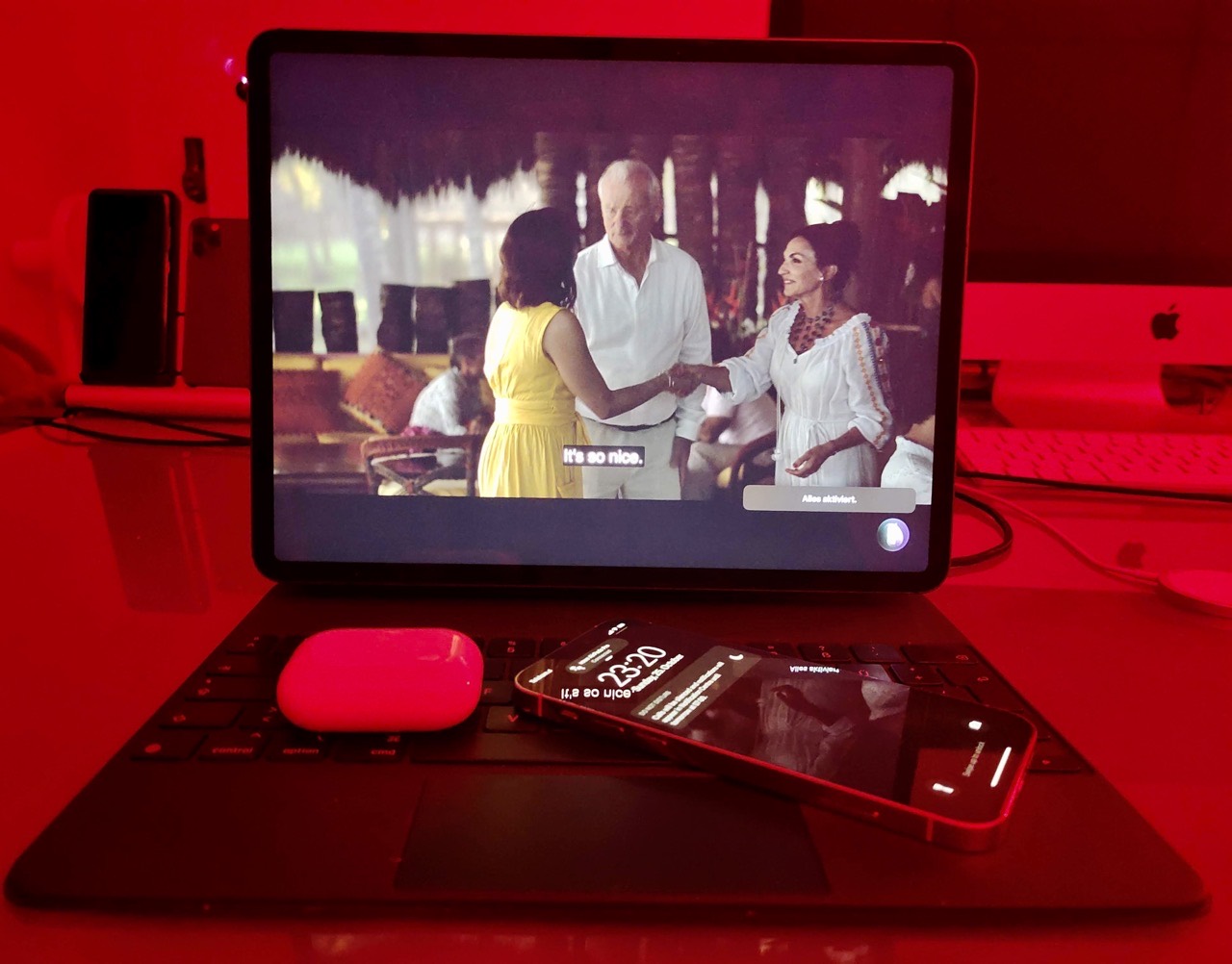
Ich musste gestern Abend geschwind dieses Bild schießen, weil darin alle vier Produkte sind, an denen ich gerade großen Spaß habe. Das Licht ist so komisch, weil das mein Kino ist. 13 Zoll in 40 cm Entfernung ist für mich so wie ein 130"-Fernseher an der Wand gegenüber*. Mit dem Unterschied, dass ich in 40 cm Entfernung perfekt scharf sehe und an der Wand eine Brille brauche. Damit ich nicht ganz im Dunkeln sitze, schalte ich den Eve Lightstrip auf 100% rot.

  1. Das Bild kommt vom iPad Pro 12.9. Der Film von Apple TV: On The Rocks von Sofia Coppola mit Rashida Jones und Bill Murray in den Hauptrollen.
  2. Den Ton liefern die AirPods Pro. Der Spatial Sound haut mich jedesmal wieder um. Das Haus ist still und ich habe Surround Sound.
  3. Das Magic Keyboard stellt das iPad genau senkrecht. Ich war ja wegen des Preises sehr skeptisch. Aber ich benutze es derart viel, dass die Leertaste schon blanke Stellen bekommt, wo ich sie mit dem Daumen drücke. Mittlerweile hat auch Microsoft Office eine Unterstützung für das Trackpad. Damit wird das immer PC-ähnlicher.
  4. Zuletzt das neue iPhone. Boah, ich liebe dieses flache Design. Das exakte Gegenteil von dem, was gerade bei Android modisch ist. Kein flitschiger Handschmeichler sondern wieder in der Tradition von iPhone 4/5/SE.

Ja, das hört sich schwer nach Fanboy an. Ich probiere auch immer gerne andere Produkte aus. Aber das hier ist einfach supergut.

*) Der Fernseher ist nur eingebildet. Ich habe einen 55"-Samsung von 2012 und ich will nicht noch einen.

27 Oct 00:24

Bruce Springsteen :: Letter to you

by Volker Weber

Wer AppleTV hat, unbedingt anschauen. Der Film geht unter die Haut. Für guten Sound sorgen. Die Sequenz ab 6:15 habe ich x-mal geguckt.

Hier Playlist mit allen Titeln des neuen Albums.

27 Oct 00:23

Nova is Here.

by Cabel
mkalus shared this story from Panic Blog.


A quick belated announcement: after years in development, Nova, our next-generation, fully native, future-focused code editor — only available for macOS — is here.

The Future

Rewritten from the ground up, Nova is lighter, faster, more flexible, and deeply feature-packed. It has a modern, hyper-speed editor with all the features you’d expect. It has a customizable user interface. It has a robust extensions ecosystem. It can work on local projects, or work directly off your server. It has tools like a Terminal and Transmit-based File Browser. It’s designed from the ground up to enable complex web workflows that might have build, run, and deployment phases… but it’s still great for a good old static site.

I could go on all day, but you should just check out the website, and try the free 30-day demo.


Own It Forever

Nova is $99. And when you buy it, you own it — it will never expire. It also includes one free year of updates — including new features and fixes — which we’ll release the moment they’re ready. Also, if you want, you can get additional years of updates for only $49 a year. But that’s totally optional, and there’s also no penalty to signing up for updates later, either when you’re ready, or when we’ve added a new feature you want.

Just The Beginning

We have big plans for Nova. We are, as they say, just getting started.

If you have any questions, first check the Panic Library, which is an invaluable resource. Then, feel free to drop us a line.

We hope you enjoy it. And welcome to the future!

27 Oct 00:23

'Students may also be prompted to do a “room scan” where they turn their computer camera 360 degrees to show that nobody else is in the room with them' why are we treating teenagers like this? the only thing they are learning is that nobody involved here respects or trusts them.

by Internet of Shit (internetofshit)
mkalus shared this story from internetofshit on Twitter.

'Students may also be prompted to do a “room scan” where they turn their computer camera 360 degrees to show that nobody else is in the room with them'

why are we treating teenagers like this? the only thing they are learning is that nobody involved here respects or trusts them.


1155 likes, 269 retweets
27 Oct 00:23

RT @Foone: @internetofshit I wonder how long until some company uses an hourly-wage-adjustment that automatically pauses your paid-time eve…

by foone (Foone)
mkalus shared this story from internetofshit on Twitter.

@internetofshit I wonder how long until some company uses an hourly-wage-adjustment that automatically pauses your paid-time every time your eyes can't be tracked to be on the screen.
you looked down at your phone? well, clearly you're not working, so you don't get paid for those 2 minutes


Retweeted by Internet of Shit (internetofshit) on Monday, October 26th, 2020 6:23pm


333 likes, 77 retweets
26 Oct 23:59

Google commits to 100 percent plastic-free product packaging by 2025

by Aisha Malik

Google has announced that it’s committing to making its product packaging 100 percent plastic-free and 100 percent recyclable by 2025.

The tech giant notes that it’s already made a reduction in plastic use in its packaging since 2016, but that it still has a lot of work ahead in order to meet this new goal.

“To get us there, we need to uncover alternative, recyclable materials that will still protect our products. It’ll take partnering with our suppliers, tinkering in the lab and sharing learnings across the industry, but we’ll get there,” Google stated in a blog post.

Further, the tech giant has announced a commitment to using recycled or renewable material in at least 50 percent of all plastic used across all of its hardware products by 2025.

“Our new 50 percent commitment raises the bar well beyond industry standards. We hope this is a milestone on the path to a future where we design out waste and pollution and keep materials in use longer,” Google notes.

It also hopes to achieve a “Zero Waste to Landfill” certification by 2022. The certification means that the vast majority of waste from its operations will be recycled.

The tech giant notes that it’s invested in integrating sustainability into its products and operations, and that its new commitments are the next step.

Source: Google

The post Google commits to 100 percent plastic-free product packaging by 2025 appeared first on MobileSyrup.