Shared posts

01 Dec 00:25

Join A Community For A Topic You’re Interested In

by Richard Millington

If you haven’t joined a new community in a while, give it a shot today.

Whatever topic you’re passionate about (or even mildly interested in), join a community for it.

Search for “[topic]” AND “community|forum|meetup” or any term that makes sense to you.

Think about how the experience feels to you.

What do you notice? Does the community grip you to join and participate? If so, why? If not, why not?

If it’s for a topic you’re new to, do you feel comfortable asking questions? Yes? No? Why?

It’s easy to get lost in the technical details. You might be surprised how refreshing it is to be a participant…and how many things you notice which you didn’t see within your own community.

01 Dec 00:25

Give and you shall receive

by Doug Belshaw

Ryan Holiday has a monthly newsletter where he shares what he’s reading. It’s got tens of thousands of subscribers. Seth Godin has a daily blog where he shares short thoughts. Hundreds of thousands of people read it. Tim Ferriss records a podcast listened to by millions of people.

When these three authors write books, they go straight to the top of the bestseller lists. Why? Because they’ve proactively built a community of people interested in work they’re giving away for free. Their audience is, for want of a better word, ‘primed’ to reciprocate when there’s something available to buy.

Most of us aren’t working on things that millions of people would pay attention to. But almost everyone is working on something that 100 people would pay attention to, or 1,000. And, at various times, we all have ‘asks’, things that we’d like other people to do. It could be buy a thing, but also test or give feedback on an idea.

Too often, I see people ask for help and get no reply. We could chalk that down to a lack of kindness, or no-one caring. Or we could stop a moment and ponder… Have I been generous? Have I given without any thought of receiving? Have I primed anyone (or any group of people) to respond?


This post is Day 67 of my #100DaysToOffload challenge. Want to get involved? Find out more at 100daystooffload.com

The post Give and you shall receive first appeared on Open Thinkering.

01 Dec 00:24

Zeno's Brexit

by Chris Grey
The Ancient Greek philosopher Zeno articulated a series of paradoxes, one of the most famous being the ‘dichotomy’ or ‘race course’ paradox. In order to reach a destination, a runner must first reach the half-way point, but to reach that point must first get a quarter of the way there, and to do that must get an eighth of the way there, and so on. Since this generates an infinite sequence that never quite adds up to the full distance, it is impossible for the runner ever to reach the destination point.

Brexit has often felt like being stuck on such a never-ending journey, and never more so than over the last two months. Recall that the last of the scheduled rounds of the transition period talks finished at the beginning of October. Then Boris Johnson set 15 October as the absolute deadline, after which he would walk away, which he sort-of did but actually didn’t once Michel Barnier had placated him by using the ‘right words’ about the negotiations. Then it was reported that 19 November was regarded by the EU as the absolute deadline, but here we still are.

Endless rumours

Throughout, there have been leaks of progress and of the opposite, and speculations at the end of each week that ‘early next week’ will see the breakthrough of a deal, or the abandonment of the search for a deal. This week has been no different.

Early in the week it was rumoured that the EU was about to ‘cave in’ to British demands but by Thursday there were reports that the EU might pull out of the talks today (Friday). There were reports that Michel Barnier had called an ‘urgent’ meeting of fisheries ministers for Friday, with speculations this might betoken an imminent deal … or an imminent collapse of talks … but within hours it became clear that that it was not urgent, and probably betokens nothing. At the time of writing, it has just been reported that contrary to previous reports Barnier will be coming to London after all and there will be talks over the weekend. Some reports suggest a deal may be done – yes – early next week. Others are now talking of the EU summit of 10 and 11 December as being the crucial date.

So we remain in the hall of smoke and mirrors. We do know, so familiar have they become, that the stumbling blocks are level playing field, fisheries, and governance. One possibility that has been touted (£) as regards one or both of the former two is to use review clauses so as to, in effect, create interim agreements allowing a deal to be done in time (although even so it will take very nimble footwork in both the UK and the EU to ratify such a deal).

This is both a plausible and a depressing prospect. Plausible because it offers both sides a way of ‘kicking the can’ down the road in the way that has often characterized the Brexit process. Depressing because it would mean that, come 1 January, the answer to the question ‘is there a deal or not?’ would be a less than resounding ‘yes and no’. Actually, this will be the answer anyway because there will be a myriad of things left in the air even if there is a deal. These include financial services regulation (of which more below) and carbon trading. Still, it would be particularly anticlimactic if the very areas so long held up as preventing a deal were to be left hanging ambiguously.

Lack of trust

Even if this, or something like it, is what happens it seems (to me) that the issue of governance cannot be fudged in this way. An imprecise or 'gentleman’s' agreement to settle fine details later, on the basis of trust, might once have been possible. But it is no longer so because of the manner in which the UK has conducted itself.

It’s actually possible to identify a very precise moment when trust was broken: it was Sunday 10 December 2017 when the then Brexit Secretary David Davis said on the Andrew Marr show that the phase 1 agreement of the Article 50 talks was merely “a statement of intent” and not binding. It was this which led the EU to put that agreement into legal text (which Theresa May then rejected as unacceptable because of the Northern Ireland-only backstop, but to which Johnson later signed up).

Davis’s 'gaffe' was pivotal in undermining trust and was compounded by several other episodes including the way that Boris Johnson treated the Political Declaration in a similarly cavalier way. Both cases showed that in the absence of a legally binding text, Brexit Britain could not be trusted to keep to its agreements. Even worse, and the final nail in the coffin of trust in the UK, was the Internal Market Bill (IMB) with its clauses which even reneged on what had been the legally binding treaty.

It is such considerations, but especially the IMB, which surely lay behind Ursula von der Leyen saying this week that “'we want to know what remedies are available in case one side will deviate in the future, because trust is good but law is better. And crucially in the light of recent experience a strong governance system is essential to ensure what has been agreed is actually done”. It should be said that whilst many of the costs of Brexit are inherent to it, this squandering of goodwill and of international reputation by the UK is one of the costs that have arisen not because of Brexit itself but from the incompetent, antagonistic and dishonest way in which it has been executed.

Nowhere near ready

On the subject of incompetence, it is becoming ever clearer just how woefully unprepared the UK is for the end of the transition, even with a deal. Northern Ireland businesses, in particular, face “a very, very difficult time” in January. In England, a trial run of France’s new border procedures this week saw massive lorry queues build up in Kent. This was not, as leading customs expert Dr Anna Jerzewska explained, because the French operation wasn’t working correctly. It was because it was working correctly but the UK systems are not yet operational.

The scale of these problems was indicated in a leaked letter from the Road Haulage Association, describing the process of working with the government on border issues as “a complete shambles”, whilst many of the detailed practical complexities are explained by international freight forwarder John Shirley on the UCL European Institute website. None of this is news to those experts who work in this area, nor to those who have listened to them over the last few years (hence readers of this far from expert blog would have been well aware of it). But their concerns were dismissed as Project Fear and swept aside by unkeepable promises of ‘frictionless trade’.  

It is almost beyond belief, though also entirely predictable, that Michael Gove is blaming the now inevitable disruption on the EU for its ‘rules are rules’ approach to border controls. Nothing more clearly illustrates the moral and intellectual bankruptcy of Brexit than for one of its leading architects to eschew responsibility for the inevitable adverse consequences of what he advocated.

Whilst much attention is being (belatedly) given to the mechanics of goods trade, it shouldn’t be forgotten that built in to the government’s preference for hard Brexit are other consequences, including the still unresolved issue of data protection adequacy. This is hugely significant for both trade and for security cooperation, but does not form part of the negotiations being instead reliant on a decision by the European Commission. So no one yet knows what the situation will be on 1 January and probably will not know for a while afterwards.

Then there is the inevitability of a major worsening of market access for services trade of all sorts. That goes well beyond financial services, of course, but these – whatever their public unpopularity – are a major part of the UK economy and they generate significant employment and tax revenues. How they will be regulated is also not part of the future terms negotiations. It has long been known that they will lose ‘passporting’ rights and the remaining best hope is an ‘equivalence regime’. But as Vicki Pryce, former Joint Head of the Government Economic Service, has explained we know for a fact that this will not be in place for January. Within this general picture, there are also particular issues emerging for European derivatives trading in London (£), a market where many trillions of assets are traded under the regulation of the European Securities and Markets Authority.

Follow the money? (A short detour into political theory, which some may want to skip)

The chilling effect of Brexit on financial services leads to some interesting questions. I am regularly told (sometimes in rather lofty tones, as if such a thought had never occurred to me) that my discussions of Brexit would be improved if only I were to ‘follow the money’ which, apparently, explains all. What this usually implies is some version of the argument outlined by George Monbiot this week that Brexit is the creature of one kind of capitalism – which he calls “warlord capitalism” – that has captured the Tory Party and is at war with another kind of capitalism which he calls “housetrained” and is horrified by Brexit. That’s an important observation, and as he says relates to the extraordinary shift in the modern Conservative Party away from its traditional business base, including the City, which has in turn had a big impact on how Brexit has developed.

But an observation is all it is – it doesn’t explain why it is the ‘warlord’ money rather than the ‘housetrained’ money which is being followed by the Tory Party (or anyone else). Following the money is sometimes a good dictum, but it doesn’t take you very far when it points in quite contradictory directions. To understand why the Tory Party has taken the path it has would require a detailed study of its recent history and its funding, taking in why it incubated such extreme Euroscepticism (as it was then called) long before its funding base shifted, and considering the role of its mainly elderly and nationalist membership.

Beyond that, this type of analysis rests, at least implicitly, on a version of Marxist theory whereby the (economic) base is primary and to a greater or lesser extent determining of the (cultural) superstructure. Culture then becomes little more than the dancing puppet of economic paymasters and their interests. When it comes to political explanation, that almost inevitably leads proponents of such analysis to some form of ‘false consciousness’ argument in order to explain why so many people support and vote for things which are against their economic interests.

And, indeed, this is precisely where Monbiot ends up, when he writes that he sees “Nigel Farage and similar blowhards as little more than smoke bombs, creating a camouflage of xenophobia and culture wars. The persistent trick of modern politics – and it seems to fool us repeatedly – is to disguise economic and political interests as cultural movements” (my emphases added).

The limitations of such an analysis have long been identified. In particular, it’s instructive to recall how in the 1980s writers on the left, especially the sociologist Professor Stuart Hall, started to explain that Thatcher kept winning elections because contrary to the assumption of economic primacy, in Hall's words, “material interests … are not escalators which automatically deliver people to their appointed destinations, ‘in place’, within the political ideological spectrum”. It’s an important insight that remains true.

Coming to Brexit specifically, viewing leave voters as the unwitting dupes of ‘warlord capitalism’ and funded by Robert Mercer doesn’t take us anywhere. For whilst (some) remainers may believe that to be so, it has a precise mirror-image in the repeated claim made by (some) leavers that remainers are the mouthpieces of the ‘global elite’ and funded by George Soros. Of course remain voters no more accept that to be true of themselves than leave voters accept the mirror-image accusation aimed at them. Neither claim has any analytical value, or explains anything. Rather, they are tactics to discredit or demonize opponents.

Ultimately, the injunction to follow the money is not just reductive but is also a circular and unfalsifiable argument. For just as some now say that the fact of Brexit is explained by capitalist manipulation of leave voters so too, had remain won, some would have said that that was explained by the capitalist manipulation of remain voters. All you have to do, they’d say then as they do now, is to ‘follow the money’. In fact, it would very likely be the same people saying it, since Monbiot virtually does so when pointing to how the remain campaign was funded by the likes of Morgan Stanley and Goldman Sachs. Trying to explain Brexit by ‘following the money’ takes you into an analytical cul-de-sac.

So whilst the debate about the relationship between economics and culture is a perennial one, and discussing it is well beyond the scope of this blog, in general I think of them as inextricably bound threads, not base and superstructure. I prefer both/and explanations to either/or explanations, prefer contingency to determinism, and see as much cock-up as conspiracy.

In any case, what this blog does cover is the weekly goings on and how they fit into the wider Brexit process. It would be absurd to think that each twist and turn ‘is exactly what the hedge funds wanted all along’ but if one did hold so reductive a view it would be as tedious to keep writing it as it would to keep reading it.

Back to the same old stuff

Coming back now to the main line of discussion, namely preparedness for the end of the transition, overall, a government report leaked this week identifies “notable risks” of “systemic economic crisis” potentially leading to public unrest in the new year due to a combination of Brexit, Covid and other factors (flu, flooding). Again it is fair to say that such a scenario was not inherent in Brexit but arises from the way it has been done. In particular, it was blindingly obvious in June that Covid meant that ending the Transition Period in the middle of the following winter was utterly reckless. That it was not extended can be blamed primarily upon the influence of a relatively small group of Tory MPs – and the larger but still small section of the population who share their views - whose obsessional hatred of the EU has made them immune to all reason. That an entire country should have its fate decided by such people is both a tragedy and an indictment of the political system.

Even now they are proposing as tests for the acceptability of any deal that may be done criteria which, as Professor Anand Menon of King’s College London points out, are effectively impossible for a deal to meet and which have already been failed by the Withdrawal Agreement which has been signed. And even now, as Brendan Donnelly, Director of Federal Trust, writes it is the “specific dysfunctions of the Conservative Party” which will frame whether Johnson agrees to a deal or not. It is already reported (£) that the ERG will oppose a deal if it doesn’t respect their peculiar view of ‘sovereignty’.

Donnelly also mentions that Labour’s stance on backing any deal will also play a part. What that part will be is unclear, not least because the nature of any parliamentary vote that may be held is unclear. There will be no straightforward ‘meaningful vote’ to accept or reject a deal, and there are various different, including some quite complex, mechanisms the government could use for ratification. Depending which is chosen, parliament would have various more or less effective ways of delaying, and possibly even derailing, ratification, posing different choices and options for those wishing to do so.

It is clear that Labour are split on how to approach this (whatever ‘this’ turns out to be), and although the rumours suggest that Keir Starmer will want his MPs to support a deal whatever it contains others are arguing for abstention. I’ve been critical of Labour’s stance on Brexit for years, and of Starmer’s near silence on it since becoming leader, but I can see that this is a genuinely difficult dilemma. The reason for that is that whilst no deal would be worse than a deal – not least for Labour voters – they are both bad outcomes to different degrees. The Tories may have put themselves in the position of having to pick from them, but why should Labour allow itself to be complicit? Yet to the extent that supporting, opposing or abstaining might all affect the outcome (assuming a sizeable Tory revolt) then that complicity is unavoidable.

There will also be significant parliamentary issues in the event of no deal. Of course there would be no vote on that, but there would be votes on the Internal Market Bill and, with the possibility of a substantial Tory revolt on that, it is questionable whether the UK would have a functioning internal market of its own, at the very moment it left the single market of the EU. This would be a profound crisis in its own right.

Back to Zeno

All this remains up in the air, with – really, this is astonishing - barely more than a month to go. For now we continue on the journey that apparently never ends. But Zeno’s paradox may not be an apt reference after all because, as well as suggesting that the race course can never be completed (the ‘progressive’ version of this paradox), it equally means that it can never be started (the ‘regressive’ version of the paradox). And, alas, we know that it did start, over four years ago.

So perhaps we need to look instead to Classical mythology to describe our situation, maybe to Sisyphus endlessly rolling his rock up the hill or, as seems more appropriate to the painfulness of it all, poor old Prometheus having his liver pecked out by an eagle day after day.

Prometheus of course was being punished for having stolen fire from the gods and given it to humans, and Sisyphus was an all-round bad egg (murdering, cheating and generally getting above himself).

It is not clear what crime we have committed to have to endure the endless torture of Brexit.

01 Dec 00:24

Thinking about avoiding the big book selling pl...

by Ton Zijlstra

Thinking about avoiding the big book selling platforms, indie bookstores and indie authors, I suddenly find myself spending time thinking about launching both a publishing company and an online book store, aimed only at the things E and I ourselves like reading / want to read. It seems surprisingly easy to do, and to connect it to the Dutch logistical nexus of the entire book industry (called the ‘central book house’). In recent years they’ve retooled to cater to tiny publishers and sellers, including printing on demand and order fulfillment for the Netherlands and Belgium.


This is a RSS only posting for regular readers. Not secret, just unlisted. Comments / webmention / pingback all ok.
Read more about RSS Club
01 Dec 00:24

The self-cannibalisation of ideas and experience

by Doug Belshaw
An etching of a wyvern (a dragon-like creature) eating its own tail, by 
Lucas Jennis  (1590–1630)

When something dies and is reborn, the usual symbol for this in Western literature is the phoenix. As a result, everything from football teams to companies are named after this mythical bird rising from the flames.

My favourite example of death and rebirth, though, is the Ouroboros:

The ouroboros… is an ancient symbol depicting a serpent or dragon eating its own tail. Originating in ancient Egyptian iconography, the ouroboros entered western tradition via Greek magical tradition and was adopted as a symbol in Gnosticism and Hermeticism and most notably in alchemy…. The ouroboros is often interpreted as a symbol for eternal cyclic renewal or a cycle of life, death, and rebirth. The skin-sloughing process of snakes symbolizes the transmigration of souls, the snake biting its own tail is a fertility symbol.

Wikipedia

What I like about using the ouroboros as a metaphor is that it explicitly recognises individual or organisational self-cannibalisation as a positive thing. Just as the snake needs to shed its skin to remain agile, so we need to renew ourselves, often through ‘digesting’ our ideas and experience and then taking them in new directions.


This post is Day 68 of my #100DaysToOffload challenge. Want to get involved? Find out more at 100daystooffload.com

The post The self-cannibalisation of ideas and experience first appeared on Open Thinkering.

01 Dec 00:24

Starlink Mount Idea

by Asa Dotzler

In anticipation of joining the Starlink internet beta program in January or February when it reaches my latitude, I’ve been planning how to hook it up. The trees are too tall here for the satellite terminal on the ground or even the roof to see enough of the sky for continuous coverage during the early sparse days of the Starlink constellation so I think my only choice is to go up a tree with the dish.

As luck would have it, there’s a nearby large Doug fir that was topped by a previous owner. It doesn’t have much in the way of limbs and it’s about 4 foot diameter so I’m hopeful it won’t sway much in the wind. It’s basically a massively scaled up,living utility pole :-)
My first thought was to mount to the cut top of the tree but after thinking about it some more I’m not convinced that even long lag bolts would be strong enough going into end grain. So now I think I’ll mount to the side of the tree and I’ve been working on the design for a simple mast that stands off of the tree a bit and rises just above the cut top for the dish to be able to orient in any direction.

The first draft of the mount required some fabrication, cutting and welding, that I wasn’t too happy with so I worked at it for a bit and this week came up with an alternate design that should work and doesn’t require any fabrication beyond drilling a couple of holes in a piece of 1 1/2 inch pipe.

The main horizontal support is a 3/4 inch diameter, 12 inch long lag bolt (why are they called bolts when they’re actually screws?) and the spacers off of the tree, the tee, and the mast itself are all simple iron pipe and fittings that I can screw together.
Here’s a diagram I whipped up in Sketchup. Let me know what you think? Will this iron pipe mast work to support an 11 pound satellite terminal? Will it be easy to build and then install 100 feet up a big tree? Feedback welcome.

diagram showing a desing for a satellite mast constructed with black iron pipes and fittings and secured with large lag bolts

27 Nov 03:57

Being Puzzled By Simple Things Will Save Us

by paulgolding

Discovery

…is the ability to be puzzled by simple things.

I am often staggered by how some folks appear to think that the opportunities for innovation are somehow narrowing due to intense market competition and low barriers to entry for technology. 

Nothing could be further from the truth.

Indeed, by some accounts, innovation is stagnating in many developed countries. I happen to hold this view, but it would require far too many words to justify and would only be of interest to management theorists and other esotericists.

The barrier to innovation has nothing to do with markets. It has everything to do with education.

Education, especially mass education, has no interest in creating innovators. It is assumed that ideas will come from “on high” and that the critical ingredient is compliant workers to put those ideas into action. This is not some leftist anti-establishment rhetoric, but the openly published intent of many of the mass-schooling architects. An eye-opening account can be found in many of the works of John Taylor Gatto.

I will spare you the pain of me climbing my soap box to pontificate about education. But let me tell you that I put my money where my mouth is in that all of my kids were homeschooled, or, as I like to say, custom schooled (via a mixture of methods). I have no inclination towards “homeschooling” or any particular mode of learning, but a strong inclination towards teaching kids to think and to harness their innate abilities for creativity. This was our objective with our kids. It ought to be the objective of the nation, especially at this critical moment in history.

Indeed, I would say that creativity is what makes us human. No amount of showing me videos of a monkey “solving” puzzles will persuade me otherwise. Human creativity is on a whole different level to anything we witness in the animal kingdom. Such a pity that we provide children with an education that dulls their creative spirit.

What has this got to do with innovation?

The short answer is everything.

Whatever innovation is, it has, as its core, a discovery process whose mechanisms and nature remain a deep mystery. It likely has something to do with the language faculty, although we should not confuse the brain’s ability for endlessly creative speech for its capacity to have creative insights.

Whatever you might think of Chomsky (and there is a lot to discuss), his observations on creativity are useful, as well summarized by D’Agostino in his essay: “Chomsky on Creativity”. It is a somewhat technical paper, but concludes, as Chomsky has often said, that human creativity remains a deep mystery of nature.

We should not confuse what he is talking about with the mechanized activity that many silicon valley pundits call “innovation”. For example, I would declare that there is nothing remotely innovative about Dropbox.

To use an example oft-quoted by Chomsky, Newton’s discovery of gravity is more the kind of creative leap I am referring to. What now seems obvious to us was, in his time, a deeply ridiculous idea that even Newton himself tried to refute. The idea that an invisible force might affect objects was deeply disturbing and heretical. It caused offense to the Aristotlean view that things moved to their natural places: objects fall and steam rises.

Chomsky summarizes his insights into creativity with a very simple maxim:

Discovery is the ability to be puzzled by simple things.

Another example might be the works of Edward Tufte who wondered why it should be that our ideas must be confined to those that fit neatly on an A4 sheet of paper. Indeed, in this age of low-cost wide-screen monitors, we must wonder why so many interfaces are similarly confined to the traditional confines of responsive design that are laptop-centric as the primary interface modality.

Why doesn’t every remote worker have an 80-inch screen and “big screen” interface to go with it? Indeed, the greatest of tragedies is the radically uncreative approach of many corporate IT-procurement systems that deem that most workers are allowed to request a fairly pathetic monitor for home use. Indeed, many workers are hunched over laptops that are literally harming their eyes and posture, to say nothing of harming productivity.

This speaks to another orthodoxy — that of the corporate budget that treats monitors as capital expenditure and tiered-expenditure as a signal of authority and power, both of which also kill creativity (deliberately) — senior managers get big things that junior worker’s don’t.

There are so many simple things about which to be puzzled. I believe that were I to sit and ponder, I would die before completing such a list.

The problem is that we are not taught to be puzzled because, more often than not, this involves the questioning of orthodoxy.

Consider a simple thought exercise. Why is the education syllabus in your child’s school structured the way it is?

I don’t mean why do you assume it is, as in some justification that surely it came into being via the hand of “education experts”, or the like. I mean do you actually know why it is the form it is?

Most likely not, which is a deep problem of orthodoxy in itself.

I write this because I have been lucky enough to have spent a career in innovation, often involving the kind of fundamental questioning of orthodoxy to which I refer. Indeed, every time I sit at my computer, I loathe how ridiculously primitive it is. MS Word seems not to have changed in its nature since its invention, as if the only possible method of working with words is to store sequences of ascii characters in a file. How absurd.

I write this because we seem to be at a critical point in history where ecocide is a real possibility and, let me be curt, capitalism is broken. I do not mean this in any political sense, but as a set of human activities that seem to have relied upon our understanding of the world from a century ago. The orthodoxies here are so deep that they are difficult to penetrate. 

Indeed, there is an anecdote I often use to illustrate this point. I ask about the sale of a used car to two potential buyers. One buyer offers 2000 and the other 2500. To whom should I sell the car?

It seems an absurdity that the question is ambiguous. It is always taken to mean: to whom should I sell the car in order to maximize profit?

This seemingly “rational” assumption is most likely a significant contributor to the impending ecocide.

This is why I have no faith in the Biden administration heralding an era of renewal. Nor do I have faith, as so many do, in “the youth” as though they are somehow immune to orthodoxies.

But let me return to the crux of my position, which is that we are a million miles away from running out of opportunities for innovation. They are many and vast. But the secret to unlocking them is, per Chomsky, the ability to be puzzled by simple things. I would go further and say that the mere ability to be puzzled is a useful starting point.

There is only one place to look — and that is education.

And, whilst we still have the opportunity to do so (unlike those living in France) it might require taking education into our own hands. This is a do-able and possibly radical commitment to a new agenda.

27 Nov 03:57

A cute little fence in Mitte, Berlin • iPhone 1...

A cute little fence in Mitte, Berlin • iPhone 12 Pro Max portrait mode

This photograph is the kind of image that portrait mode on the iPhone X would have a hard time with. The iPhone 12 Pro Max, however, does a much better job. In particular, I’m impressed that in the gap between the green and yellow uprights, the system applies noticeably less blur to the trunk that shows through as compared to the background behind it.

Another area of interest are the dead leaves in the upper-left corner. There were several distinct plants standing there and you can see the image processing didn’t get thrown off and assume that all of them were at the same distance. I assume this is due to the Lidar sensor data being used in the processing.

Would I prefer the bokeh from a nice 35 mm f/1.4 full-frame lens wide open? Oh, most definitely yes. This is pretty good, however, especially consider it came from the camera that is always in my pocket.

27 Nov 03:55

What Facebook Fed the Baby Boomers :: The New York Times

by Volker Weber
Many Americans’ feeds are nightmares. I know because I spent weeks living inside two of them.

If you wonder why the United States is so f'cked up, look no further than Facebook. It is a wrecking ball.

Ceterum censeo Facebook esse delendam.

More >

27 Nov 03:55

You Need to Opt Out of Amazon Sidewalk

by Volker Weber
Have you heard of Amazon Sidewalk? Probably not. But there is a good chance that you or someone you know has an Amazon Echo or Ring camera. And if you own one of those devices and live in the U.S. (or know someone who does), you need to tell them to opt-out of the service as soon as possible.

Ich bin gespannt, ob sie es wagen, das nach Deutschland zu bringen und einfach so einzuschalten.

More >

27 Nov 03:54

Your Move, iPad

by Rui Carmo

This is just too good not to link to. The M1 has made such a splash that people are stepping back from their favorite computing platforms and going “hey, wait, what if…” –including the iPad.

As an aside, so many people have written about the M1 already that I have decided to hold my peace until I actually get one, which will probably be for my kids next year. It’s mind-blowing, tremendously impacting to the industry, etc., but also not an immediate concern for me.

And she’s right in the sense that the iPad can do so much more–the iPad mini I’m typing this in has been my main personal computer for years, and the M1 (indirectly) demonstrates that the tablet form factor has so much untapped potential (even within its thermal and power constraints) that it could be better.

So much better.


27 Nov 03:54

What did I forget by working for the same company?

by Rui Carmo

I stumbled upon this in my RSS feeds and immediately “got it”. Every company has its echo chambers, its view on what customers need, and its (sometimes gaping) blind spots regarding what they really want.

And like Jaana writes, having an outside perspective (especially where it relates to your costumers) can be a sort of superpower, but it wears off eventually in the grind of internal work.

I’m (sort of) fortunate to be working in a consulting position and “back” in telcos these days, but I think she completely nailed the way I feel sometimes.

There’s an entire world out there that you’re ignoring when you spend too much time in internal “make work”–look out the window every now and then, at the very least.


27 Nov 03:54

Define your audience or your product will (probably) fail

by Doug Belshaw

In the past few weeks there have been a couple of occasions where the ‘why’ has been missing from some of the work in which I’ve been asked to be involved.

I’m not talking about the ‘why’ from the supply side, from the organisation that wants to provide the thing; I’m talking about the ‘why’ from the demand side, from the people who might want the thing.

This is not new to me. It was one of the major reasons it was so difficult to get systems of digital credentials based on the Open Badges standard off the ground in the early days: they made sense for the badge issuers, but not necessarily to the badge earners!


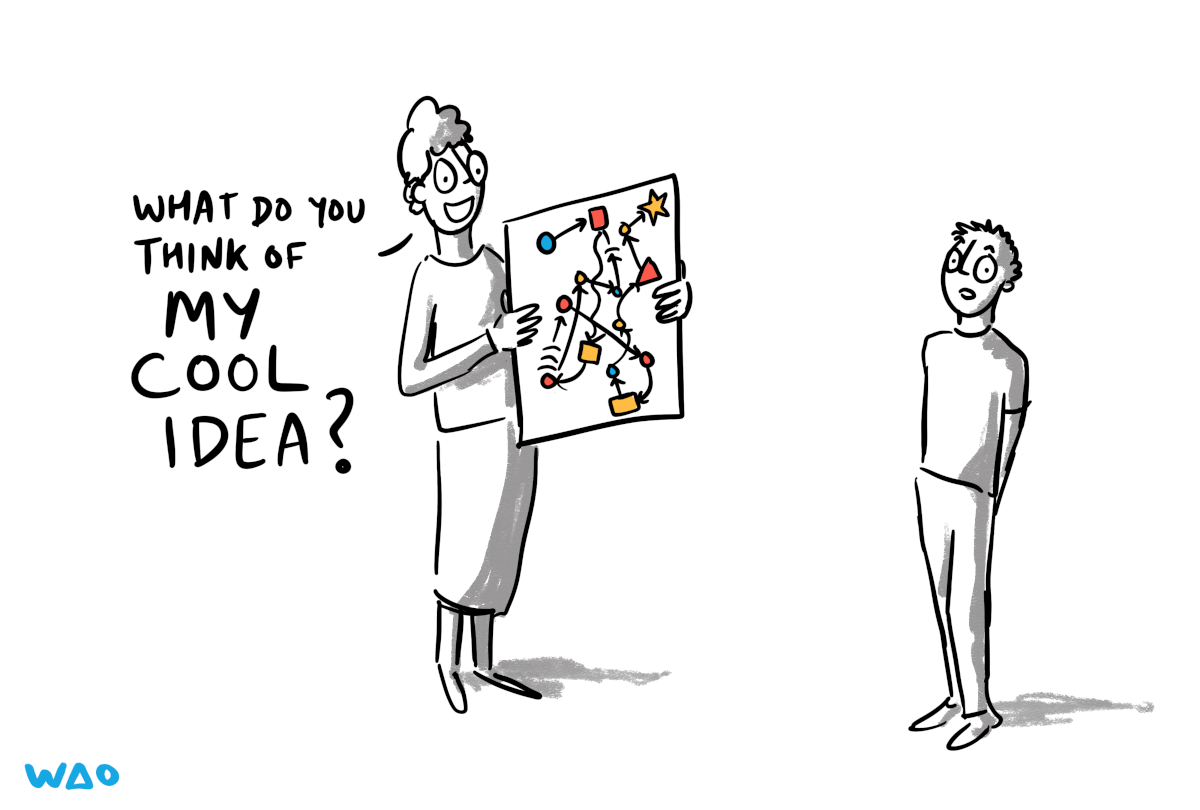
During the Catalyst Discovery work I led for We Are Open Co-op last month, we kept returning to one central theme with the nine charities that were involved in the programme. It’s summed-up in this excellent illustration from Bryan Mathers:

Person enthusiastically showing a complicated diagram and saying "What do you think of my cool idea?" to someone looking rather bemused.
Image: CC BY-ND Bryan Mathers

In other words, if you show people who you already know something that you’ve made and ask them their opinion of it, they will say things to please you. “What do you think of my cool idea?” is not a fair question to ask people with whom you’re in a relationship. It’s the equivalent of asking your partner “does my bum look big in this?”

Instead, you have to do the hard work of audience definition and then user research. If this were an easy thing to do, then every workshop would have a waiting list, every newsletter would have millions of subscribers, and every product would have made its inventors rich.

It sounds obvious, but if you don’t know who your audience is, then you can only be successful: (i) by accident, (ii) by designing for yourself (as part of the audience group), or (iii) by copying other people. These are not long-term strategies for success.


Once you have defined your audience, congratulations! You now need to find out as much about them as possible. You can do this in passive ways, through reading other people’s research and sifting through data. That’s valuable, but nothing beats being active and going out of your way to actually talk to people about their pains, gains, and jobs to be done.

I tend to use Strategyzer’s Value Proposition Design (VPD) approach for this. I used it when designing MoodleNet, and I use it with clients. In its simplest form, you boil down the thing you create to a series of ad-libs which define your audience, product, and how it helps them:

Our ______ helps ______ who want to ______ by ______  and_____  (unlike  ______).

I see too much what I would term ‘magical thinking’ in the world of product design and development. It’s equivalent to the fallacy of build it and they will come which plagues us all from time to time.

If your idea is worth putting into the world, and the main audience is someone other than yourself, then it’s worth talking in advance to the people who you want to buy, read, or use your product.


This post is Day 66 of my #100DaysToOffload challenge. Want to get involved? Find out more at 100daystooffload.com

The post Define your audience or your product will (probably) fail first appeared on Open Thinkering.

27 Nov 03:52

No App For Gratitude

by noreply@blogger.com (BOB HOFFMAN)

 Today I am repeating my annual Thanksgiving post which I have run for many years. And, yes, that crack about Trump was there years before anyone could have imagined...

Thanksgiving is my kind of holiday.

It doesn't require gods or miracles or tragedies or victories or angels or kings or winners or losers or flags or gifts. 

All you need is some pumpkin pie, a big-ass flat screen, and a comfortable sofa to drool on.
Oh, and a little gratitude.


Gratitude, by the way, is a commodity in very short supply. Regrettably, we seem to have mountains of expectation but not much in the way of appreciation. It's a socially transmitted disease.


So this Thanksgiving let's put aside harsh judgments for a day or two. Thank a fireman. Give a bum a buck. Kiss an in-law.


I don't like Puritans of any stripe, but I like the idea of them having the Indians over for dinner. I know the detente didn't last too long, but any day you're eating sweet potatoes instead of shooting off muskets is a good day.


Be grateful that you have shoes. Be thankful that your cat is healthy. Compliment someone's posture. 


If you can't do any of that stuff, then at least give thanks that you won't be dining with Whoopi Goldberg or Donald Trump. That alone should be enough.


Finally, do yourself a favor -- quit whining. That's my job.


And have a Happy Thanksgiving.
27 Nov 03:51

Dim Sum Predilections~ What will Happen Here by 11.20.2021?

by Sandy James Planner


If ever there was a year that threw out most predictions, this is the one. On November 20, 2020, what do we know will happen by this time next year? We are asking readers to let us know.

We are all nine months into living differently and working from home. Everyone knows what a Zoom meeting is. We worry how public transit will survive, keep six feet apart from people we don’t know for physical distancing, and think about wearing masks and washing hands a lot.

Nine months in there are also some surprises. Even though there are less people that have secure salaries, and the borders are closed housing prices in Vancouver have still stayed constant, perhaps reflecting the last flurry of activity before mortgage rates and lending tighten up.

But what will things be like one year from now on 11.20.2021?

That was the subject of conversation at a physically distanced meal  at the legendary Pink Pearl restaurant on East Hastings with the Duke of Data, Simon Fraser University’s  Director of the City Program Andy Yan.

Take a look at the predictive predilections forecast over dim sum at the Pink Pearl Restaurant on East Hastings below.

Agree or disagree?

Now is the time to offer your own predictions in the comments section.

What changes do you perceive will happen by this time next year?

We will of course take a look at all the predictive  predilections, and invite you to a Dim Sum predilection party to discuss what was forecast/what  really happened to be held at the Pink Pearl restaurant in one year.

Here’s our 2020 Dim Sum Predilections for 2021:

Clothing Culture~ Just as a hoodie is the “go to” item in winter, wearing a mask will be the new winter pants. Mask wearing will be universal, adopted out of respect and courtesy for others.

Vaccinations~By November 20, 2021, not everyone will be fully vaccinated. There will be about 75 percent of people who could/would be vaccinated that have received the doses in Canada. How the vaccines are administered will be a challenge. They will be easy to obtain in metropolitan areas, but vaccines will not have the same easy access and distribution across less populous areas of the country.

Return to work and the concept of Time Shifting/Flex Locations~While people will return to working in offices, where those offices are, the size and the routine of going to work will be different. Many people will not return to a typical Monday to Friday commute, which will impact public transit usage. About 30 percent of people that used to commute to offices downtown will remain at home, going into the office once or twice a week instead of every day. Sixty percent of workers will still need to commute downtown for their jobs; 40 percent will have the flexibility to do some of their work at home.

Transit versus Car~Public transit will also be competing with an increase in private car usage as that will be perceived “safer” by some people, resulting in a five percent increase in vehicular use going into the downtown. Public transit will be down by 20 percent in ridership.

Housing Prices~there are a lot of factors that will impact the prices of single family housing, rowhouses and condos. Prices may also vary by  regional location. We are leaving this predilection up to readers to let us know where, when and why you think housing prices will go a certain way.

Rental costs~Rent for apartments  will reduce by 10 to 15 percent. Rents have been attached to the economic vibrancy of the region more than home ownership has. There will be more availability as empty higher end strata units come on to the rental market. Basement suites in single family houses with outside decks and access areas may be a preferred short-term premium, offering private access and open space away from apartment building shared halls and  elevators. More rental stock will be also be available from empty AirBnb units.

Local Economy~Restaurants, hotels and the travel industry will need to reboot, reformat, reconfigure , and will focus on a more local “in province”  market. Growing the local market will be factor for these businesses to revitalize for the next five years.

Regulatory Policy Changes~Acceptance of health and wellness in regulation will mean the consideration of physical wellbeing, including mental and social.  Policy will change around the housing and well being of seniors, emphasizing aging well and on call associated services.

Changes in living unit design~People will be looking for housing that has more interior private space with  a spare room with a window that can double as an office. If an apartment, a juliet balcony or small deck will be in demand.  Access to exterior outside hallways and staircases in addition to exterior outside  elevators will be bonuses. Opening windows that can be adjusted for ventilation will feature in building design.

Seniors and where they live~A more localized community approach to keep seniors in home longer, and a restructuring of how family caregivers can access family in facilities will be key. Look for changes in building design, with units being designed at ground with protected  open space access and good ventilation and light. A more universal systems approach to providing seniors and others in care to privacy, open space, and the ability to access family members and caregivers safely will factor in restructuring and rebuilding assisted living facilities.

What are your predictions for next November? What have we missed and what needs to be added on to or accentuated? Please leave your comments below.

If you contribute to this discussion, we will be looking forward to meeting with you over dim sum at the Pink Pearl restaurant in November 2021.


Dim Sum Image: Andy Yan, Pink Pearl Restaurant


27 Nov 03:48

Introducing the next generation of DAM software.

by admin

This blog has been quiet, but that’s not because I have been slacking off. For the last year or so, I have been hard at work bringing a new vision to life. On this day of Thanksgiving, I’m grateful for the opportunity to work with a smart, focused and kind team at Tandem Vault to make something really great.

In many ways, The DAM Book 3.0 was a blueprint for the software we need, not necessarily what is currently available. As web-hosted visual media becomes a primary method of communication, we need a new platform to match. (And by “institution”, I mean everything from a family to a non-profit, small business, museum or corporation.)

All the pieces for the next generation are sitting there on the shelf. Of course the most important part has become utterly commonplace – behavior. We now use visual media and rich media for nearly every purpose, and it’s increasing daily.

We have built our new software, TV3, to be the Grand Central Station of rich media communication, with incoming and outgoing tracks, and easily operated switch gear. We’ve taken the features from marketing DAMs and adapted them to a much broader use.

I’ve been offering sneak peeks of the new software over that the Tandem Vault blog. These include videos that introduce some of the key features. Here’s a sample.

We’re going into a much larger beta phase in a week or so. If you are interested in participating, sign up here.

The post Introducing the next generation of DAM software. appeared first on The DAM Book.

27 Nov 03:47

Twitter Favorites: [NoLore] We so very quickly accepted Stephen Harper's desire to see people live in jail until they die. The ruling found t… https://t.co/iRjQ12VR2a

Nora Loreto @NoLore
We so very quickly accepted Stephen Harper's desire to see people live in jail until they die. The ruling found t… twitter.com/i/web/status/1…
27 Nov 03:46

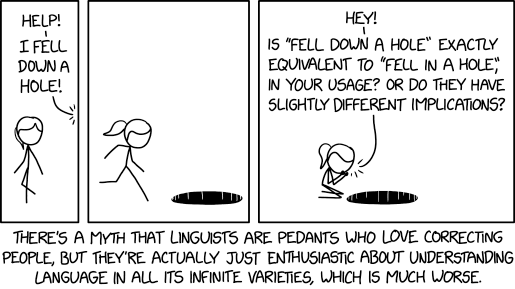
Linguists

mkalus shared this story from xkcd.com.

"Do you feel like the answer depends on whether you're currently in the hole, versus when you refer to the events later after you get out? Assuming you get out."
27 Nov 03:45

Revisiting Markdown Editors

Miguel Guhlin, Around the Corner, Nov 26, 2020
Icon

For those not clear on terminology: markup is the word we use to describe the system of tags used to format an HTML document on the web. By contrast, markdown is a set of simplified commands used to indicate basic formatting for wiki or text input forms; these need to be transformed into HTML markup before they can be viewed as formatted web documents. Anyhow, this short article looks at a number of the author's favourite markdown editors and talks about how they are used, including StackEdit, anadd-on or app you can install on your browser or computer. "What's really neat is that it's easy to sync your files to Google Drive, Dropbox, GitHub account." Here's the source code for StackEdit.

Web: [Direct Link] [This Post]
25 Nov 20:25

The GSA Emily Murphy transition letter is a study in conflicted language

by Josh Bernoff

Weeks after the networks declared the presidential election for Joe Biden, the administrator of the US General Services Administration made the decision to release congressionally appropriated resources and cash to fund the Biden transition team. This required her to take two contradictory positions at once: that Biden won, and that Trump had not yet lost. … Continued

The post The GSA Emily Murphy transition letter is a study in conflicted language appeared first on without bullshit.

25 Nov 20:17

Cut/Untie

by swissmiss

“Never cut what you can untie.”
— Joseph Joubert

(via)

25 Nov 20:17

Drei interessante Notebooks

by Volker Weber

875955002419b88d95c5ee6b115a194b

Heute mal ein paar Laptops, die mir bei den Amazon-Angeboten ins Auge stechen:

  • Das Lenovo Ideapad Duet Chromebook hat mir außerordentlich gut gefallen. Das kommt auch bei meinem Spiegel-Testbericht zum Ausdruck. Das Gerät ist für mich ein besseres Android-Tablet, mit Tastatur aufstellbar, aber nicht für den Schoß geeignet. Aktuell 249 statt 329 Euro. Chromebooks sind perfekt für Google-User, aber man muss wissen, auf was man sich einlässt. Mit 10 Zoll Bildschirm ist das Duet klein, aber nicht schlank.
  • Wer lieber einen Windows-Laptop hat, liegt mit dem dem Lenovo Ideapad 3 bei den preiswerten Notebooks sicher richtig. i3 mit 8 GB RAM und 256 GB und ein entspiegelter Screen mit Full-HD-Auflösung reicht für alles außer heftiger Video-Bearbeitung oder Spielen. Aktuell 399 statt 479 Euro.
  • Letztes Jahr neu vorgestellt, empfinde ich das Surface Laptop 3 als das schönste Notebook überhaupt. Vom Design her ähnlich wie ein MacBook Air, nur wesentlich cleaner. Aktuell 799 statt 1149 Euro. 8 GB finde ich von der Ausstattung her ausreichend, die 128 GB SSD ist was für Leute, die ohnehin alle wichtigen Sachen in OneDrive speichern. Wenn das mal nicht ausreicht, lässt sich der Surface Laptop 3 anders als Vorgängermodelle nachträglich mit einer größeren SSD ausstatten.
25 Nov 20:13

Shtandart: a learning journey

by Lilia

A couple of days after my birthday I went into a learning journey. I was back to Shtandart, to sail, to work as a volunteer and to look into myself. After our volunteering days on land in September unexpectedly continued into my first sailing trip I was overwhelmed by the experience (enough to find it difficult to write about). And I longed for more. So when an opportunity presented itself I went again, agreeing at home about a flexible time frame. It ended up being a journey spanning between 9 October and 2 November, almost a month.

I was not sailing all this time. The ship was scheduled for several sailing rounds between La Rochelle and Bordeaux, where it also spent 10 days being open for the local public. In this period professional crew of the ship changed – the team working there from summer went back to Russia and members of another team were finding their way to the ship via changing travel restrictions.

For several days in between, there were just a few people on the ship open for public visits 10 hours every day. I am glad I could help there, doing my share of everyday routines and welcoming visitors dressed and masked – Madame Pirate as parents would tell their kids. There was a bit of remote working in between since I managed some of our kids’ learning logistics on the distance and continued with two online courses, one of which required serious time commitment.

But, of course, there was sailing as well. Shtandart is a training ship which sails with trainees who become part of the crew. Professional crew and trainees are working together in three watches, each of them in charge of sailing for four hours twice a day. Cooking and cleaning tasks are divided between watches on a rotating basis, so everyone gets to cook and to clean. I was in the Foremast watch, which is between 12 and 4. It is a challenging one since you have to be awake in the middle of the night and lack of sleep on a ship increases chances of seasickness. On the other side, you get the experience in its fullest, together with steering in the darkness and the stars that dance around rigging.

Given that the professional crew of the ship is Russian and most of the trainees are not, sometimes I found myself in a boundary position, helping to connect and translate across differences, language and culture-wise. It was more challenging compared to my previous times on the ship: this time most of the trainees and volunteers were French. It is a big difference from mixed international or heavily Dutch groups that speak English fluently and switch to it more naturally.

In the end, I sailed with three different groups of trainees and two teams of professional crew. While there is still a lot to learn for me about everything sailing-related, I had enough time on the ship to get a good grip of other tasks. So I also assisted the officer of our watch in bringing newcomers up to speed and helped them in a process.

People on the deck when the sea is rough

Staying on the ship through the changes allowed me to get a better understanding of the long-term dynamics and to appreciate the work that professional crew does. A lot of it is not visible at the first sight – maintenance or public relations, preparing and wrapping up each sailing trip with trainees, dealing with the regulations and rules of different regions, balancing safety, fun and input from people of various levels, cultures and expectations. All of it requires a lot of stamina in dealing with the constant change which now combines with an extra degree of unpredictability due to the coronavirus.

Compared to my first trip, which was four days non-stop sailing, this time included shorter sailing stretches with stops in between. It gave me a lot of opportunities to practice various tasks on the ship, to learn from and with different people, to experience the same locations in different weather conditions and times of the day. And, of course, it was great exposure to the sailing world in general and to the culture and practices on this particular ship.

A view down from the mast

From a personal side, it was a very rewarding experience: being outdoors, meeting new people, learning to be in the world very different from where I usually am. It also included resolving inner conflicts of enjoying it all while feeling guilty of leaving the family for so long and travelling in the middle of strengthening lockdowns.

Professionally my time on the ship also became a sort of implicit ethnography – observing and reflecting while finding my way into the culture and learning the ropes. There are a few themes that are bubbling inside as a result of it. They are still fuzzy,  so I just write it down and see how much surfaces later:

  • A different take on knowledge work. Craftsmanship meets high-tech. Embodied knowledge. Longer-term view on that in the world which gets increasingly automated.
  • Shipping/sailing world. The ecological impact of it, sailing-based green innovations, fair transport. The values and the reality of efficiency vs sustainability.
  • Corona-induced change in operating the business. The challenges of operations based on physical contact in the pandemics. Travel in lockdown times.
  • Risks, rules, unpredictability, change and cultural relativity. Cross-cultural shifts and boundaries.

A bit more of a patchy coverage of the experience, mainly in photos, is on Facebook:

The post Shtandart: a learning journey appeared first on Mathemagenic.

25 Nov 20:12

@WisdomKitten imagining the future chinese new brunswick special economic zone which now has 220mph HSR from moncton to edmunston via st. john and fredericton

by Well There's Your Problem Podcast (wtyppod)
mkalus shared this story from wtyppod on Twitter.

@WisdomKitten imagining the future chinese new brunswick special economic zone which now has 220mph HSR from moncton to edmunston via st. john and fredericton


5 likes, 1 retweet
25 Nov 20:12

Clipdrop.co :: AR Copy & Paste

by Volker Weber

Ist das cool oder was?

Aber: Ich habe es nicht ausprobiert. Windows Defender sagt "Finger weg" und daran halte ich mich.

More >

25 Nov 20:10

CoVid-19: The Go-for-Zero Strategy

by Dave Pollard

This is the 14th in a series of articles on CoVid-19. I am not a medical expert, but have worked with epidemiologists and have some expertise in research, data analysis and statistics. I am producing these articles in the belief that reasonably researched writing on this topic can’t help but be an improvement over the firehose of misinformation that represents far too much of what is being presented on this topic in social (and some other) media.

NB: Sweden is a day behind in reporting; its latest report shows 350 cases/day/M (ie should be dark red not grey in map on right). 

There has been much talk lately about the wisdom of the prevailing “yo-yo” approach to dealing with CoVid-19 — relaxing restrictions when cases, hospitalizations and deaths drop, and reimposing them when they rise to “unacceptable” levels.

The only reason this utterly failed policy is still being used in North America and Europe is that governments and public health organizations have been paralyzed by fierce antipathy to government, antipathy which has been repeatedly churned up since the 1980s by fear-driven conservatives and by uneducated citizens prone to believing fear-mongered conspiracy theories about “evil” governments.

So governments and health authorities are reluctant, even fearful, to impose any restrictions on the public until and unless the crisis reaches catastrophic levels. The violent knee-jerk responses of the right to even the modest restrictions that have been imposed (eg widespread death threats, occupations by heavily-armed right-wing “militias”, the blossoming of QAnon and other lunatic fringe anti-government conspiracy theory cults, and the attempted kidnapping and coup in Michigan), suggest that governments’ fear to act decisively is not entirely ill-founded.

As a result of this absurd policy, 11,000 Canadians, 275,000 Americans and nearly 1.5M people globally have needlessly died, and the pandemic is now spreading faster than ever.

In Canada, as a result of the use of the yo-yo strategy, as Andrew Nikiforuk reports, “hospitals in Alberta, Manitoba, Ontario, Saskatchewan and Quebec are almost overwhelmed, long-term care homes have once again become deadly hot zones, and a nation that committed $4 billion to be able to conduct 200,000 tests a day still struggles to do half that”.

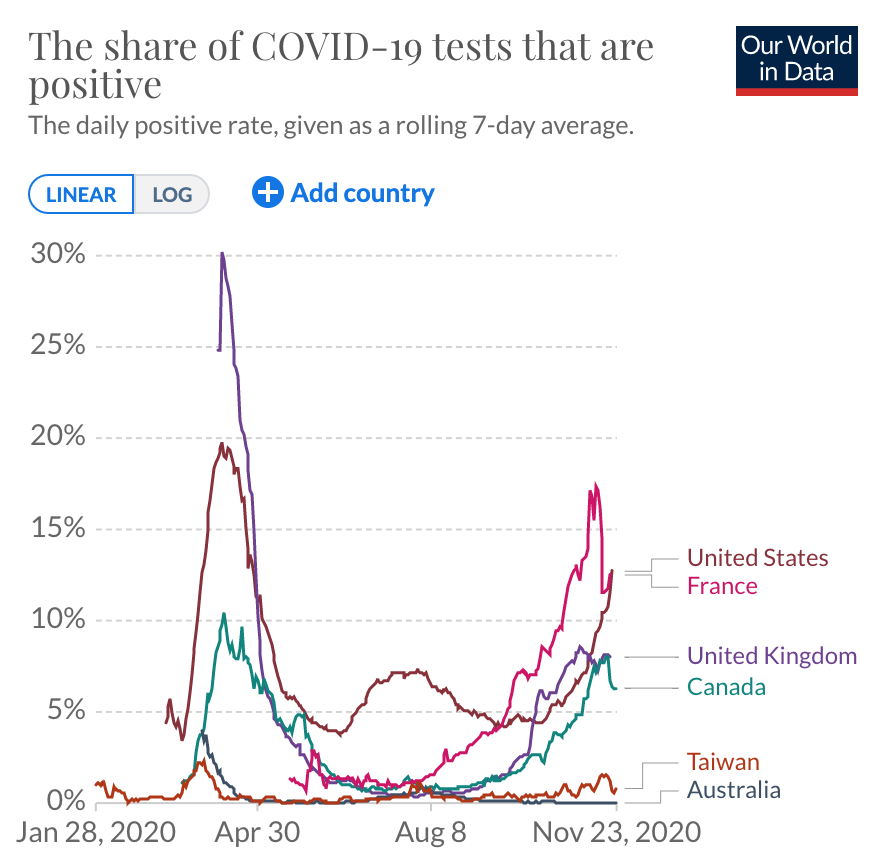
The only viable alternative to the yo-yo strategy is a go-for-zero strategy, which has been successfully deployed in the so-called TANZANC countries (Taiwan, Australia, New Zealand, and Atlantic & Northern Canada). These democratic countries have essentially eliminated CoVid-19 within their borders, put in place stringent measures to prevent its re-emergence, and hence been able to restore “normal” life, and seen their economies quickly rebound as a result.

The Australian Grattan report shows what would be required for any democratic country to achieve similar success:

  1. Make zero cases the explicit goal for the country/state, and implement a specific, public plan to achieve that goal.
  2. That plan will likely include a complete lockdown for all ages until the number of reported new cases has been reduced to approximately 3 per day per million people. [Current level in the US is 500/day/M; in Canada it’s 120/day/M, but it was about 10/day/M for much of the summer before the recent surge]. Once the 3/day/M level has been achieved, certain specific low-risk, high-benefit activities can be permitted and encouraged. Additional easing can be permitted once new cases drop to 1/day/M people, and considerable further easing once zero new cases have been reported for a week.
  3. Everyone entering the country must be tested at the border and/or strictly quarantined for 14 days or until a negative test is confirmed.
  4. Stringent, properly staffed contact tracing and isolation must be in place for any cases that do arise. Non-cooperation and lying about exposure should be prosecutable. Lives depend on it.
  5. Testing must be easily and universally accessible for free, and test results must be able to be produced and communicated within 24 hours. The technology to do this exists; the capacity in most jurisdictions currently does not.
  6. Testing with digital attendance record-keeping and follow-up must be instituted in all public venues (restaurants, arenas etc). [Australia’s success means that up to 35,000 people can now attend stadium events with zero resulting cases.]
  7. Masks are mandatory in all public places in areas which have had recently-reported cases. In all other places they are optional.
  8. Economic supports for all those disadvantaged by restrictions must be available.
  9. Strict enforcement of quarantine must be maintained; no exceptions.

I can imagine the QAnon crowd getting apoplexy just reading this list. But it works. It has saved thousands of lives and enabled quick economic recovery in areas that have had the courage and resources to implement it.

What would it take to implement it in other areas? Obviously the more out-of-control the virus is in an area, the longer the lockdown and the greater the challenge. In most of the US, interstate border crossings are impossible to restrict and the resources simply don’t exist, so it wouldn’t be possible even if cases weren’t already 100 times or more the target 3/day/M rate for achieving the go-to-zero benefits. Maybe in Vermont and Hawai’i.

But in Canada, despite the upsurge, it’s still feasible. It took Victoria state in Australia nearly 2 months to reduce their spike from 80 cases/day/M back down below 3 (and it’s now zero on most days). So Canada could probably get its 120 cases/day/M down to below 3 within 90 days (by Feb 28) if we followed a national, strict, Grattan-style go-for-zero strategy.

If not, IHME projects the Canadian infection rate will soar to 360/day/M and nearly 30,000 more Canadians will die by that date, which is likely the earliest that a vaccine will start to be available in sufficient quantities for the population at large. A go-for-zero strategy could save 90% of those deaths, 27,000 lives. Not to mention the unknown long-term damage to those infected, and the strain on our hospitals and other institutions. Is that worth a 90-day lockdown? I would say so.

Probably the most important question (since Canadian and other governments know about this strategy and have refused to implement it), is whether CoVid-19 will teach us the lesson that this is the way to go next time. The next pandemic is surely coming, and while governments shrugged off the threat of SARS and MERS ten years ago, the number of pandemics per decade is accelerating as factory farms proliferate, and as exotic animal harvesting and encroachment into the world’s last wilderness areas grows exponentially. A pandemic with the transmissibility of CoVid-19 and the morbidity of SARS or MERS would (will?) kill billions. When it hits, we cannot afford to be unready. And unless trust in government and public health institutions in most of the world’s democracies can be restored, we will not be ready.

25 Nov 19:38

Free Webinar~Enrique Penalosa: Equity by Design~Sustainability & Mobility

by Sandy James Planner

The City of Cleveland is sponsoring this talk by Enrique Penalosa, the past mayor of Bogota, Colombia on Equity by Design – Sustainability, Mobility, and Building the Cities of the Future.
.
Mr. Penalosa implemented a massive urban improvement plan for Bogota´s city center which included demolition and redevelopment of severely crime-ridden areas, the creation of a land bank for providing quality low income housing, and the establishment of an innovative urban project of the highest quality for more than 400 inhabitants.

Since leaving office, Mr. Peñalosa has worked as a consultant on urban strategy and leadership advising officials in cities all over the world on how to build quality, equitable and competitive cities that cannot only survive but thrive in the future. He was president of the Board of Directors of the Institute for Transportation and Development Policy, a New York based NGO promoting sustainable and equitable transportation worldwide.

Join us for a conversation with Mr. Peñalosa on how he advanced equity for all residents through thoughtful transportation planning and urban design − and what we should all consider when building the smart cities of the future.


Date: Friday December 11, 2020

Time: 9:30 a.m. to 10:30 a.m. Pacific Time

To register please click here.

Here is Enrique Penalosa talking about the historic downtown area of Bogota where public spaces and streets were revitalized during his leadership.

25 Nov 19:38

Oil, Cars & China~Is the Gas Guzzler Period Officially Over?

by Sandy James Planner

It is not small shifts in technology but big moves in governmental policy that will be the last gasp of the gas driven vehicle. As Reuters.com writes

China’s pointed direction to shift completely to electric vehicles will halt 70 percent of global oil demand in the enxt ten years, meaning that the “oil era” is clearly finished.

There’s a secondary reason too: China will no longer spend $80 billion dollars annually importing oil to fuel vehicles, meaning cleaning air and a better bottom line.

I have already written about the fact that SUVs are considered status symbols in China and will likely continue to be popular. China in 2016 produced 28 million vehicles, a big chunk of the 70 million vehicles produced globally.

On January 1st of 2018 China stopped the manufacturing of over 500 different car models including domestic and foreign automobile ventures. The stoppages of ICE (internal combustion engines) vehicle manufacturing  included factories operated by  Volkswagen and Benz.

As the New York Times said at the timethe measure pointed to a mounting willingness by China to test forceful antipollution policies and assume a leading role in the fight against climate change. The country, which for years prioritized economic growth over environmental protection and now produces more than a quarter of the world’s human-caused greenhouse gases, has emerged as an unlikely bastion of climate action after President Trump’s rejection of the Paris climate agreement.”

Estimates suggest that electric vehicles will represent 40 percent of total vehicular sales in ten years in China. The cost of oil import for a typical ICE powered vehicle is ten times that of solar equipment. China has not set a date for banning the sale of ICE vehicles, but it is suggested that electric vehicles will be half of car sales by 2035, with the other half being for hybrid.

Kingsmill Bond with Carbon Tracker stated :This is a simple choice between growing dependency on what has been expensive oil produced by a foreign cartel, or domestic electricity produced by renewable sources whose prices fall over time.”

Here is a PBS YouTube video on the work of NEO, which is producing electric vehicles in China showing the  advancement and design of this next generation of Chinese produced cars.

Image: electrik.co

25 Nov 19:37

M1 MacBook and Apple Watch with new design reportedly coming in 2021

by Patrick O'Rourke
MacBook Air with M1
  1. Despite releasing three new Mac devices with its own proprietary ARM-based M1 chip — the MacBook Air, 13-inch MacBook Pro and Mac mini — the computers look identical to their Intel counterparts.

According to Ming-Chi Kuo, an often reliable KGI Securities analyst, Apple is preparing to redesign its MacBook lineup and the Apple Watch in the second half of 2021. It’s unclear if the M1-powered Mac mini will also get a redesign.

Beyond stating that a new design is coming, Kuo doesn’t go into further detail regarding Apple’s forthcoming M1 Mac and the Apple Watch aesthetic change. It makes sense for Apple to finally shift the look of the Apple Watch given that apart from reducing its bezels with the release of the Apple Watch Series 5, it’s featured nearly the same design since its launch in 2015.

Kuo also states that Apple is experiencing better than expected demand for the iPhone 12 Pro and iPhone 12 Pro Max, and weaker sales of the iPhone 12 and the iPhone 12 mini. On the iPad side of things, Kuo says that the new iPad Air is selling well, and that 5G and mini-LED displays are coming to Apple’s tablet line in 2021.

On a less positive note for Apple, Kuo says that AirPod shipments are lower than initially estimated, amounting to a five to 10 percent decrease year-over-year. Finally, Kuo says that Apple’s often-rumoured AirPods 3 have been delayed from an early 2021 release to an April to June release window.

Source: MacRumors 

The post M1 MacBook and Apple Watch with new design reportedly coming in 2021 appeared first on MobileSyrup.

25 Nov 19:37

The power of calm writing in a frantic world

by Josh Bernoff

I chose to spend five weeks writing about politics leading up the election, in a collection of posts I called “The Rationalist Papers.” The posts succeeded in their goals. Now that the stress and excitement of the election is (mostly) behind us, I’ll take you inside what happened and why it worked — and what … Continued

The post The power of calm writing in a frantic world appeared first on without bullshit.