Shared posts

06 Dec 03:45

Extrapolation and the Windows 95 startup sound

Like all people of a certain age, the Microsoft Windows 95 startup sound is ingrained in my soul, along with dial-up modem handshaking and the default Nokia ringtone.

It’s a little over 3 seconds long, and was created by ambient music legend Brian Eno. Here’s what he said in 2006:

The thing from the agency said, “We want a piece of music that is inspiring, universal, blah- blah, da-da-da, optimistic, futuristic, sentimental, emotional,” this whole list of adjectives, and then at the bottom it said “and it must be 3 1/4 seconds long.”

I thought this was so funny and an amazing thought to actually try to make a little piece of music. It’s like making a tiny little jewel.

In fact, I made 84 pieces. I got completely into this world of tiny, tiny little pieces of music. I was so sensitive to microseconds at the end of this that it really broke a logjam in my own work. Then when I’d finished that and I went back to working with pieces that were like three minutes long, it seemed like oceans of time.

– SFGATE, Q and A With Brian Eno

(Here’s the Windows sound slowed down 23x. It sounds exactly like a Brian Eno ambient track.)

ANYWAY. The question is, what happens after 3.25 seconds?

Listen to this:

Windows 95 startup sound but an AI attempts to continue the song (2 mins).

(Source: #algopop)

The startup sound continues, repeating and looping into itself, eventually turning into washes of sound, then returns but this time gyres up and the beat mixes in with a barely discernable 40s dixieland and singing, but lost between radio stations like a David Lynch movie, then finally the refrain returns, only to drift into distorted dogs barking and backwards talking behind echoes of itself obscured by static, the sound of hell.

So, yeah. Tune.

RELATED: Algorithmically extended art. Previously blogged here when I said: Always wanted to see more of the night sky in Van Gogh’s Starry Night? Well now you can.

Looking beyond the frame. Listening beyond the end of the track.

This idea of extrapolation seems to be in the zeitgeist at the moment. It’s what GPT-3 does with text, taking words and trying to say what’s next. Part of me wonders why society is so obsessed, right now, with this extension beyond limits, but that’s a thought for another day.

So what else can be extrapolated?

Could I select an email thread in my inbox, write a reply, and see an extrapolated response before I choose to send it?

Dead people? Channel 4 is recording holograms of terminally ill people to deliver one last message. For a TV show. And of course: Kanye West has surprised his wife Kim Kardashian with a hologram of her late father for her 40th birthday. What would it take to deliver 2 minutes of extrapolation too?

Could I extrapolate between episodes of a favourite TV show to get extra stories?

I want to apply this to Google Maps and walk around an extrapolated London.

Could I get spiritual advice through an audience with the extrapolated Pope?

06 Dec 03:44

Teardown of SpaceX Starlink Terminal

by Rui Carmo

I want one of these things. I promise to take much better care of it than this other human, because it would be invaluable for me to be able to work from the countryside (which I would really like to be doing right now).

That said, the PCB layout is amazing, and the phased array is something else. Really good radio engineering there.


06 Dec 03:44

White Supremacy

by Gordon Price

Daily Scot checking out the massive tech complex by Westbank, going up at 5th and Quebec:

Scot’s excited by the built-in alley, giving its name to the whole project: MainAlley.

But as we’ve asked before: why no colour?  Why, like the sea-green glass that covers almost every highrise since the ’80s, do developers, architects and the city’s urban designers, stick so conservatively with such a limited pallet, with one or two small exceptions?  There must be an architectural rationale, but mostly we hear supposition and speculation.

Further, the brutalist brick block (originally a data processing centre) at the corner of 5th and Quebec is coming down (or covered), so there will a net loss of colour and texture.

This is a three-block project; its impact on this part of the Main Street tech district will be substantial.  And it won’t be the green roofs we see from the street.


06 Dec 03:43

Create Your Own Video Print with Infinite Objects

by swissmiss

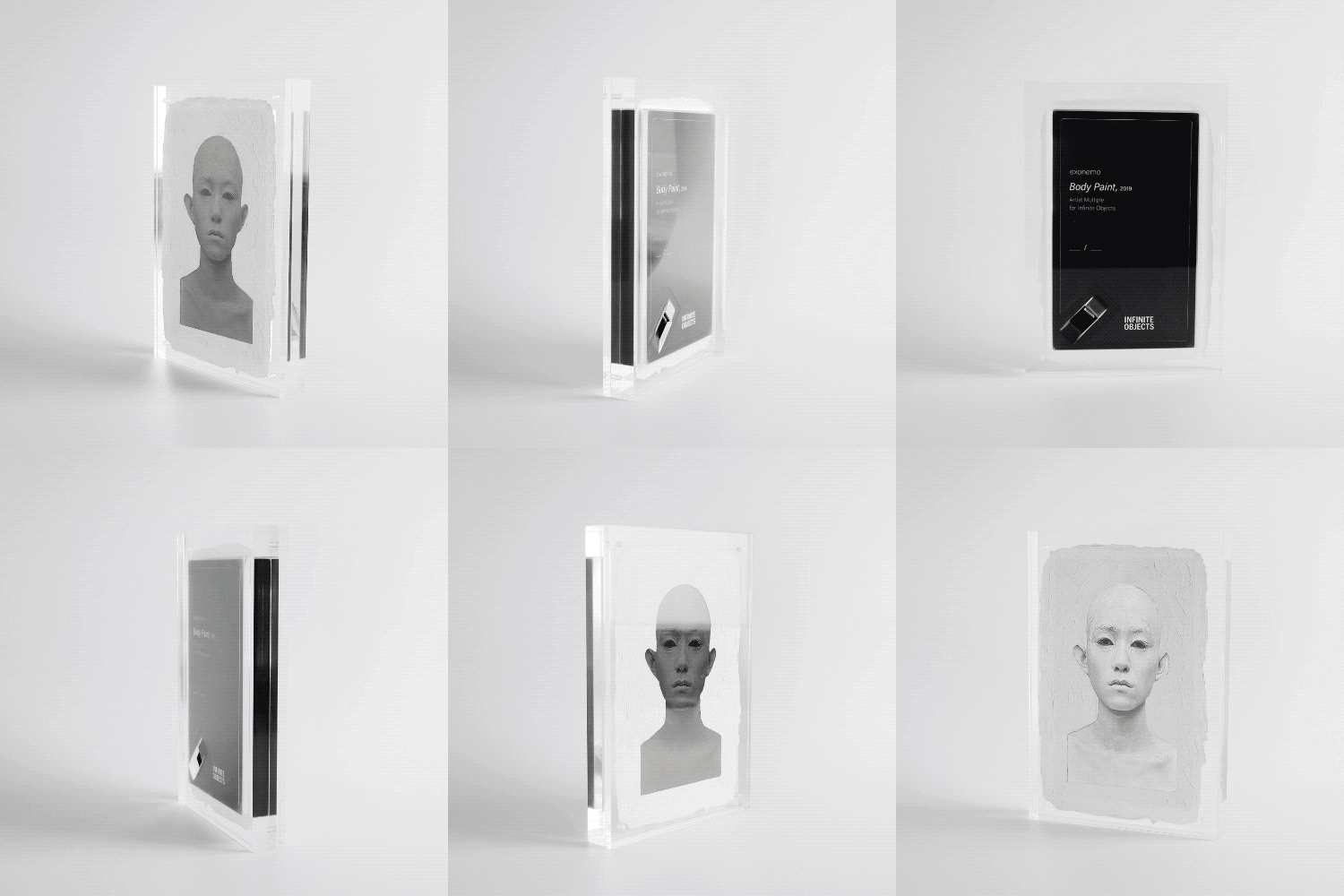
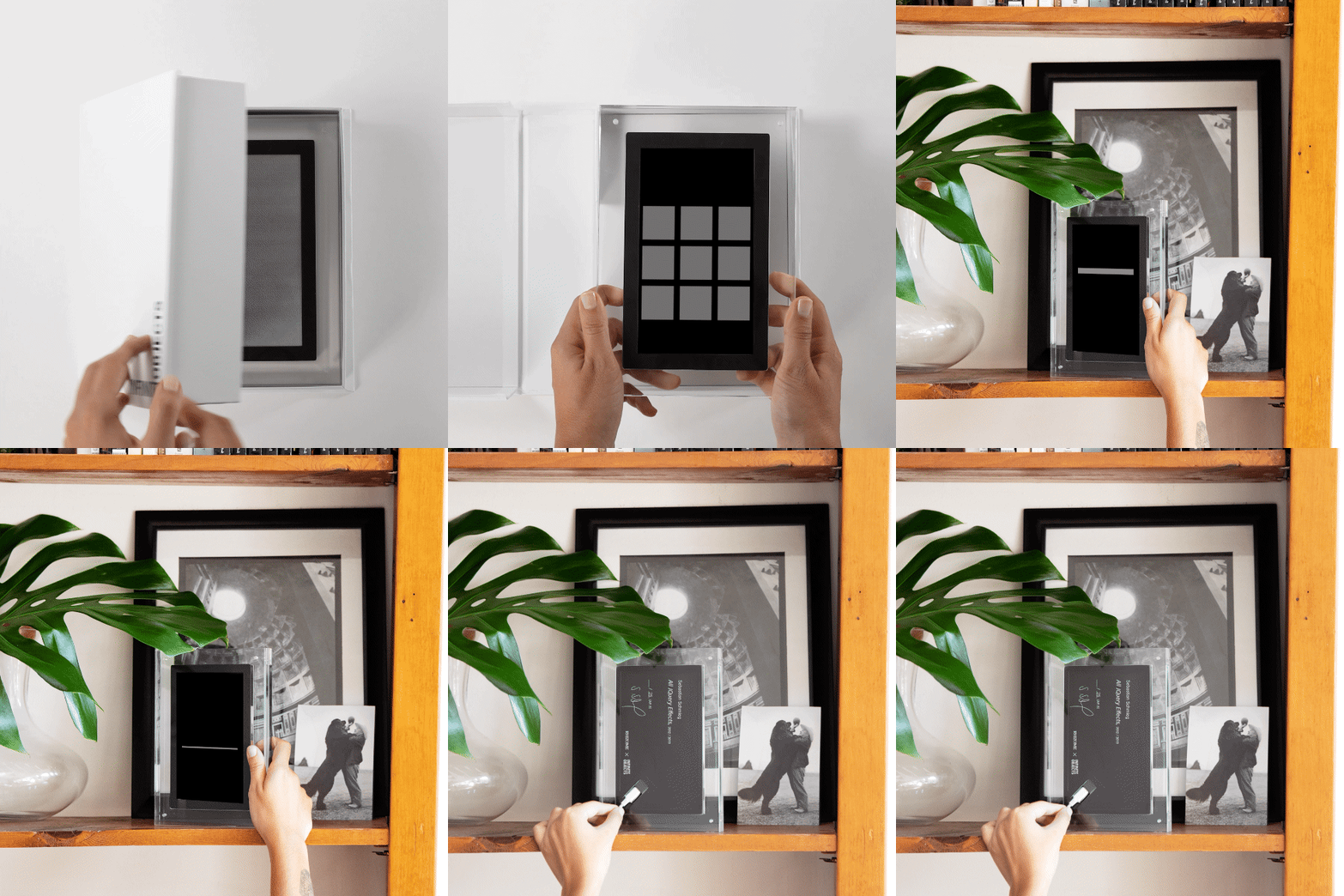
Infinite Objects is pure magic: They make video prints.

You can now have your favorite short video, or your favorite GIF as an art object in your home, looping forever.

GAH!

I love GIFs! I love art! I love Infinite Objects.

You can chose from the existing editions, or you can make your own. The content itself can be anywhere from a few seconds to 24 hours! But as soon as it ends, it will loop again. (The battery lasts about two hours, so best to keep it plugged in.)

What a fun gift!

(I got my favorite GIF on one of them and it’s making me laugh every day. Perfectly sums up 2020!)

06 Dec 03:43

Teardown of SpaceX Starlink Terminal

by Rui Carmo

I want one of these things. I promise to take much better care of it than this other human, because it would be invaluable for me to be able to work from the countryside (which I would really like to be doing right now).

That said, the PCB layout is amazing, and the phased array is something else. Really good radio engineering there.


06 Dec 03:43

Fighting the DVD Bitrot

by Martin

There has been a time when DVDs where the main medium for backups and for acquiring audiovisual content. These days might long be over but I still have quite a collection that I would like to keep. Unfortunately their lifetime is not endless and most of my devices no longer have a DVD drive. And those that I still have are not very reliable anymore and have started refusing to read more and more of those DVDs lately. So it was time to think about how to preserve the content and make it more easily usable with current devices.

Due to the sheer number of DVDs I have, I shied away from backing them up on a hard disk for a long time as there is too much work involved. But pressure was mounting so I thought a bit about how to automate the process as much as possible.

Reading Old DVDs Reliably

The main problem automating the process was that many DVDs could not be read correctly anymore in any of the drives I had. That makes automation very hard. So I started a bit to experiment how to best clean the DVDs in the hope that this would improve the situation. My first approach was to use a microfiber cloth to clean the surface. This helped in some but not all cases but the effect was temporary. Using a wet tissue did not improve the situation either and adding soap to the mix also had no additional effect. But then I tried some of antiseptic gel everyone now carries through these pandemic times and this worked tremendously well! But it was a bit smelly so I decided to look for yet another solution. I ended up with glass cleaner, which also contains alcohol and this worked just as well and is much easier to apply and remove than the gel. Perfect!

How To Automate the Process

The second hurdle to overcome was how to automate the backup process. So far I only knew of GUI tools to do the job. Not ideal for automation. The Linux tool of choice that seems to be able copy data from just about any spinning optical media is ‘Brasero’. It has a limited set of command line options which were nevertheless enough to get the job done. Unfortunately, Brasero insists on putting the resulting ISO file in the home directory, there is no option to modify the path. However, it is possible to change the home directory path in Bash itself which did the trick for me:

# Change the HOME directory

export HOME=/home/martin/Desktop/backup

# Run Brasero: Note: Only shows that it is finished 
# in the GUI, Use CTRL-C to end...

brasero -c /dev/sr0 --image-file --immediately

This way I could automate the process enough so I could do it while working on other things without breaking concentration too much. Whenever a backup was finished I would just have to put in another DVD and run the same command again. That can be done with little thought for the process. The only additional action required for some old DVDs was to rename the backup ISO files to identify the content. It seems like in the early days, little thought was spent on giving DVDs a reasonable name.

Simultaneous Backup with Several Drives

To further speed things up I wanted to run the backup process with two DVD drives simultaneously. It turns out that Brasero only wants one instance to run at a time. So I had to connect my second DVD drive to another notebook. For convenience, however, I wanted to control everything from one computer. For this, SSH is your friend! However, since Brasero insists on popping up a GUI and show the backup progress there, one additional thing is required. One solution is to make the display known in the SSH session (export DISPLAY=:0) so the GUI will appear on the other computer. That works but it is a bit inconvenient as one has to look for progress on two screens. So I chose to use ssh with the ‘-x’ option which forwards the GUI over the ssh tunnel to my main computer. An excellent solution. One little quirk: Forwarding X does not work when the home directory is changed with the export command above. But that’s something I could live with.

Drive Speed

Drive speed is another thing to be aware of. One of my external USB connected DVD drives could read DVDs at around 8 MByte/s while the other could only do 4 MByte/s. When you have many DVDs to convert, that difference is quite noticeable. Unfortunately, there seems to be no easy way to find out how fast a device is. The specs of both drives I have indicate a read speed of 8 MByte/s so it seems one manufacturer ‘exaggerated’ a bit… In other words, a cheap ‘no-name’ drive might not be the best solution even if the specs look good.

Backup Costs per DVD

One more thought about the cost of storage. Today, external USB attached 8 TB disk drives cost around 150 euros. A backup ISO image of a DVD is around 8 GB at most. Therefore, the cost of backing up one DVD without compressing the content is 15 cents, or 30 cents if you store your backup on two drives in case one of them fails in the future before data is yet again migrated to a newer drive. In other words, quite affordable these days.

06 Dec 03:43

“We want to build a community to get the word out”

by Richard Millington

…isn’t a great reason to build a community.

1) What will draw people to a community in the first place?

2) By nature, you’re drawing people in and then sending them elsewhere to talk about you.

3) There’s no obvious reason for anyone to do 1) or 2).

Community isn’t a great approach for ‘getting the word out’. There’s plenty of advocacy, influencer, and promotional efforts that work better.

Communities can help in some areas (once they’re established). They’re terrific places to source case studies, testimonials, and referrals. They’re fantastic for creating social proof and enticing those with an interest in whatever you do to take the next step.

But for just getting the word out? I’d consider a different approach.

06 Dec 03:42

Skin in the game?

by Doug Belshaw
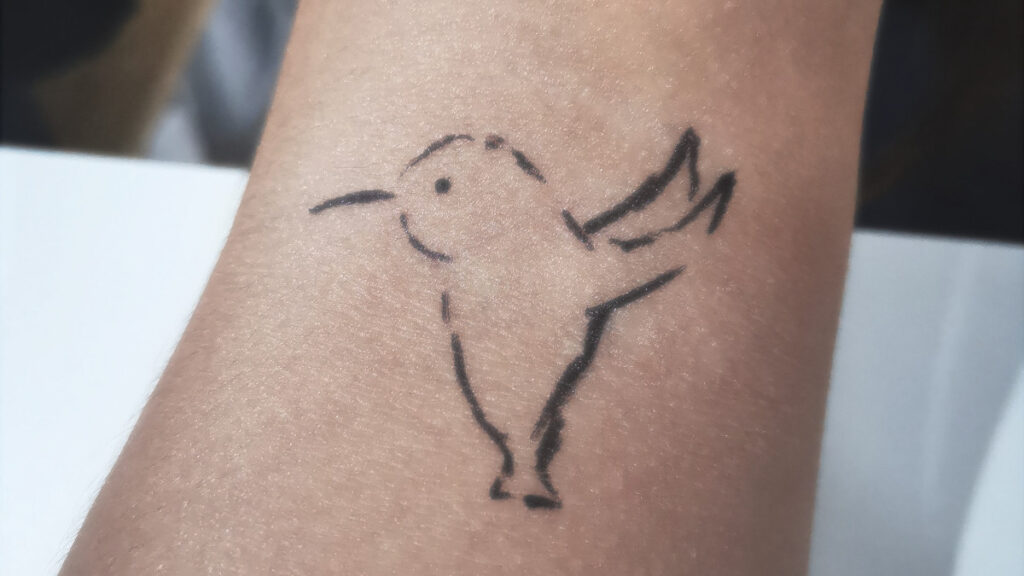
Simple tattoo looking like a hummingbird (or the Twitter logo)

Almost four years ago, I joined the Fediverse through Mastodon. I’d been researching, writing, and speaking on decentralised technologies for social good and had experimented with a whole range of things.

Since then, I’ve switched Mastodon instance a few times and, at the time of writing, you can find me on Fosstodon, a place dedicated to free and open source software. I was so enamoured by the potential of decentralisation that I led the MoodleNet project for a couple of years, taking it from zero to one.


Until earlier this year, I was an active user of Twitter, and had been for 13 years. While I still auto-post my published articles there, I only login a couple of times per month to check everything is working and look at my notifications. People still occasionally tag me in threads.

One thread I saw when logging in this week was about the ‘viability’ of, well, everything except mainstream social networks. Other platforms, according to the people posting in the thread, just don’t have the “traction”.

All I can say to this is that there are those that expect a thing to exist fully-formed before engaging with it, and there are those people who expect to help bring anything they engage with into being.

Either position is fine, but know where you stand. If you’re a builder of new software, networks, or communities, then get on and build. If you’re a user of those software, tools, and communities to further your professional career, then do that. But perhaps don’t wring your hands about ‘viability’ if you haven’t got your skin in the game of building something new.


This post is Day 70 of my #100DaysToOffload challenge. Want to get involved? Find out more at 100daystooffload.com

The post Skin in the game? first appeared on Open Thinkering.
06 Dec 03:42

Signs of the times 📡 I can’t help but think th...

Signs of the times

📡 I can’t help but think that the first images of the collapsed Arecibo observatory are a metaphor for 2020 as a whole. Pursuing “starving the beast” or “drowning the government in a bathtub” or whatever other metaphor you want to use, we ended up making a few people richer and left everything else to crumble.

🗳 Gabriel Sterling’s denouncement of the violent rhetoric of the election is a must-see, if you haven’t already. “All of you who have not said a damn word are complicit in this.” Thank you, Mr. Sterling for putting country and the public first. (He’s a Republican, if you didn’t catch that.)

🎄 It’s going to be a lockdown light Christmas here in Germany. “When the December lockdown measures were initially announced, regional leaders and Merkel had made clear that the restrictions would likely apply well into January. However, they only formally set them in stone until December 20…” Now, the measures apply until at least January 10th. And stricter measures are being talked about.

🗞 Did you know that the Washington Post has an ad-free online subscription offering in the European Union? Me neither, until this week. Reading the news without ads is… so lovely. The website sometimes shows an empty block where an ad is supposed to be in the layout, and sometimes there’s a banner for another section of the website, but otherwise it’s every bit as lovely an experience as you’d expect if you stripped all the ads out of the web.

06 Dec 03:42

Meeting… Shay Culpepper, Software Engineer at The New York Times

by The NYT Open Team

“Meeting…” is an ongoing series from NYT Open that features New York Times employees from different corners of the company.

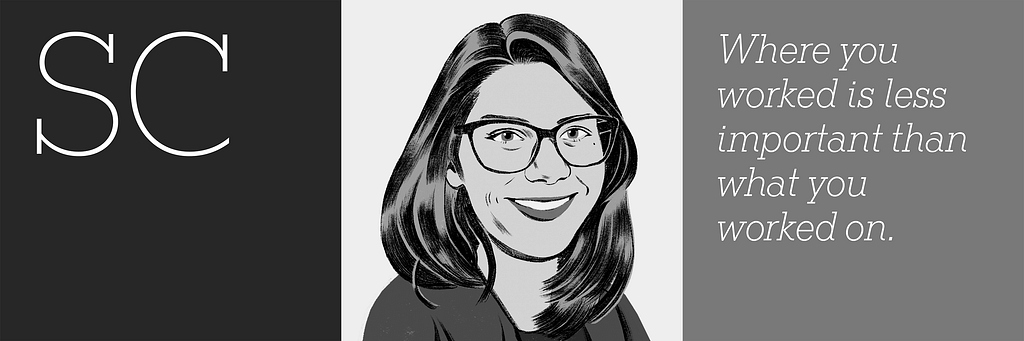
Illustration by Claire Merchlinsky

What is your name?
Shay Culpepper

What are your pronouns?
She/Her

What is your job?
Software Engineer

What does that mean?
I work on tracking and analytics for our home screen, both on our website and our mobile apps. Right now, I’m building a dashboard so the newsroom can monitor click-through rates on the home screen.

How long have you been at The Times?
Almost a year and half.

Most Times employees are working remotely right now. Where are you working from these days?
I’m working from a little makeshift desk next to my bed from my apartment in Morningside Heights, a neighborhood in Manhattan. It’s one of those cheap IKEA desks. I took two of the legs off and it rests on my windowsill.

How do you start your day?
I’m a Texan, so the most important thing I do every morning is make a giant glass of iced tea. It is just Lipton tea over ice and it is delicious. The next most important thing I do is pick out a dress and loud earrings for the day.

Once I’m ready to work, I look over the paper planner that I use to keep meeting notes, a to-do list and most importantly: my daily wins. I like to check in the morning to make sure I have written down something I’m proud of from the day before. Next, I look over the to-do list items that haven’t been checked off yet. Then I check my google calendar for what meetings I have for the day. The most important step is then planning what tasks I will complete in specific blocks of time (Thank you to my colleague Carolyn Price for this tip).

What is something you’ve worked on recently?
Lately my team, Core Product Data, has been working with the data visualization team to rethink how we build dashboards for the newsroom. We have been sketching out the architecture for a completely new platform that would allow teams to quickly and easily build new dashboards. I find creating projects from the ground up fun because you end up getting to do a lot of research.

Tell us about a project you’ve worked on at The Times that you’re especially proud of.
This isn’t part of my core job responsibilities, but I’m very proud of the work I have done through Women in Tech as part of the leadership committee. Women in Tech is an internal task force at The Times that works to improve diversity and equity in recruiting, retainment and advancement.

My teammate Shelly Seroussi and I launched a buddy program for new employees in technology. We match new employees with veteran staffers to help them network across the organization and acclimate to Times culture. The buddies meet regularly for the first three months the new hire is on staff.

What was your first job?
I served fried chicken at a place called Chicken Express. I had access to so much fried okra. I love okra in all of its forms, but fried is truly the best.

What is something most people don’t know about you?
All three of my brothers are engineers, my mom is an IT administrator and my dad is a scrum master. We all got into tech by very different paths, and it is fun to share tech as a family. I like to think of us as “The Developeppers,” but that name sadly hasn’t caught on.

What is your secret to career success?
Beyond luck, privilege and working hard, I like to think I owe most of my success to radically being myself and opening space for others to be their full selves. This means being upfront and honest about my weaknesses, and it has meant being upfront about my mental health. The fact that I’m bipolar doesn’t come up too often, but I have found that being willing to talk about it breaks down barriers. I have had several colleagues open up to me about their own journeys as a result. Being upfront also means owning mistakes and apologizing: I made some bad calls during a big project last year, which made the project stressful for my entire team. I had to own that, apologize and spend time doing the work to be better during future projects.

I also like to open up spaces for one-on-one communication with my teammates. Sometimes that’s coffee, sometimes that’s small silly Slack conversations and sometimes it is virtual hang outs after work. Being intentional about developing relationships helps you build trust and your work will be better for it.

I should also note that a lot of this isn’t possible without taking care of myself. While companies might offer support healthcare and paid time off, they can’t make me take those days off and they can’t make me go to the doctor. I have to take care of myself and my mental health. No one can do that for me.

What is your superpower?
I can whip up very silly presentations in a bind.

What are you inspired by?
Times journalism and my colleagues keep me going every day. I’m constantly pinching myself. I count myself very lucky to be part of an organization that produces such excellent journalism.

Name one thing you’re excited about right now.
I’m pursuing a master’s degree in Data Analysis and Visualization at The Graduate Center, which is part of City University of New York. Next semester, I have a data visualization course that is studio style, meaning there will be lots of critique. I’m excited because there is nothing as helpful as feedback when it comes to visualizations: you need to know if your audience understands your intended message.

What is your best advice for someone starting to work in your field?
For your first job, just try to get your foot in the door somewhere. Working at the big companies can come later; Once you have a couple of years under your belt, a lot opens up for you. Where you worked is less important than what you worked on.

More in “Meeting…”

Meeting… Ashka Gami, Marketing Director for New York Times Games
Meeting… Gaëlle Sharma, Technical Product Manager
Meeting… Jeremy Gayed, Lead Software Engineer


Meeting… Shay Culpepper, Software Engineer at The New York Times was originally published in NYT Open on Medium, where people are continuing the conversation by highlighting and responding to this story.

06 Dec 03:41

Names: respect, inclusion and belonging

by Tara Robertson

"Hello, my name Is" sticker and pen on table

Diversity, equity and inclusion is not about just revising HR policies and processes to be more inclusive and equitable, it’s a lens that you need to view everything through. For product organizations it’s a key lens to look at the product and customer experience. 

I’ve been thinking about personal names and how those are a point of inclusion and belonging, or not. Names are personal, and for many of us, an important part of our identity.

How do you say your name? 

My name is Tara. In North America people often mispronounce it, less so in other parts of the world. My name is pronounced Tah-rah, not Terra. For the first 20 years of my life it was easier for me to not speak up when people mispronounced it. When I was in my early 20s I met a woman of colour at a conference who also had a name that was much less common than mine. She said that it was a basic sign of respect to say people’s names properly and that changed how I operate. These days I usually correct people, but I still do the mental arithmetic to calculate if the energy it takes to interject and then to manage people’s apologies is worth it. Our names tell a story and for many of us they’re an important part of who we are. 

The microaggressions I experience are tiny compared to BIPOC people with non-English names. I love this story from actor Uzo Aduba when she told her mom that she wanted to be called Zoe. Her mother replied “If they can learn to say Tchaikovsky and Michelangelo and Dostoyevsky, they can learn to say Uzoamaka.”

I recently learned that from 1940-80s the Canadian government “assigned Inuit numbered identification tags that they had to wear around their necks, mainly because white administrators couldn’t pronounce their names.” I have a visceral reaction at how disrespectful and dehumanizing it is to reduce people to numbers. 

Our names are important and saying them correctly is a basic level of respect. 

Joe Biden’s name sign

I’ve been following some of the conversations in Black Deaf communities about President Elect Joe Biden’s name sign. In Deaf culture people have name signs that represent them and people with close ties to the Deaf community or well known figures also given name signs by the Deaf individuals or community.

Here’s what Nakia Smith has to say:

She’s quoted in this LA Times article saying that this name sign looks like “a “C” sign used by members of the Crips gang in some American cities and could be dangerous for signers of color and embarrassing to the incoming administration.”

Names are important and have layers of meaning from our families, histories, cultures and communities. 

Names in databases

When I worked at Mozilla I documented the various places someone transitioning their gender at work would need to update their name and gender marker. There were so many systems: the HR Information System, LDAP logins, payroll system, benefits providers, the company we used to book travel’s system, Bugzilla, Github, and the internal staff directory and likely others that I’m forgetting. 

Doing this work I learned there were more than a few people who didn’t fit neatly in these systems, including: 

  • People who only have a first name
  • People with non-English characters in their names
  • People with non-English names who also have English names
  • People who get married and change their last name to their spouse’s last name
  • People who get married and change their last name to a hyphenated name with their spouse’s last name
  • People who get divorced and change their name back
  • People who change their first name to something that fits them better
  • People with very short names
  • People with very long names

Patrick McKenzie’s Falsehoods Programmers Believe About Names is the most comprehensive list of assumptions about names that I’ve read. If you’re designing anything that will include people’s names, this is required reading. Emma Humphries’ Adventures in Renaming is also a useful resource.

This study by R. Ruiz-Pérez, E. Delgado López-Cózar, E. Jiménez-Contreras in the Journal of Medical Library Association looked at how “Spanish names are handled by national and international databases and to identify mistakes that can undermine the usefulness of these databases for locating and retrieving works by Spanish authors”. This study listed 17 name format variations with these two being the most common: 

  • First name first surname second surname
  • First name middle name first surname second surname

I can imagine how this would impact search, retrieval and therefore how often the work is cited, which could in turn impact prestige through tenure, promotion and grants. 

screenshot of the original article in Business Insider with Vernā's name spelled correctly
original article in Business Insider

screenshot from Gale Academic Onefile about "Vern Myers"
article in Gale Academic Onefile

In Gale Academic Onefile, Vernā Myers, the VP of Inclusion Strategy at Netflix, name is spelled incorrectly. I’m assuming that the data ingest from Business Insider choked on the macron over the “a” at the end of her first name. Changing Verna to Vern makes it seem like the VP is male. Also, if I was searching for articles that mention Vernā Myers, this one wouldn’t come up. 

Just like with in person interactions, how we design databases to include (or exclude) people’s names is about respect and impacts the feeling of belonging (or not) and who can be found (or not). 

Names in products

The way names show up in products and services can be a point of inclusion and belonging. This summer Mastercard launched True Name:

For many in the LGBTQIA+ community, the name on their credit, debit or prepaid card does not reflect their true identity.

That’s why we’re working with partners to bring products to market that will allow for chosen names to appear on the front of cards, helping ease a major pain point for the transgender and nonbinary communities.

It’s a big deal having a credit card or debit card that matches your gender presentation and who you are. This video tells some of those stories:

This goes beyond corporate platitudes during pride month. This is something concrete that Mastercard did to make their products more inclusive of trans and non-binary people and make it a little easier for trans and non-binary people to buy things. 

This summer LinkedIn added a feature that allows you to record your name. In October Greenhouse added the Say My Name feature, where candidates can “pre-record the correct pronunciation of their names when recruiters request their interview schedule availability through Greenhouse”.

I’d love to learn about other product examples where the people building the product put specific care and attention on getting people’s names right. 

Thank you

Thank you to Cara Hall and Carolyn Arthur for feedback and editing help.

The post Names: respect, inclusion and belonging appeared first on Tara Robertson Consulting.

06 Dec 03:41

Peter McKinnon on Apple’s MagSafe Wallet

by Federico Viticci

I received my MagSafe wallet a few days ago, and it didn’t take me long to observe how I was in complete disagreement with the general consensus from most reviews: the majority of reviewers I follow didn’t like it and criticized its flimsiness; I loved it, couldn’t figure out what issues other people had with putting it in their pockets, and generally found it everything I hoped it would be.

Fortunately, I’m not alone in thinking the MagSafe wallet is great. I wish I could quote a single part from Peter McKinnon’s video about it, but I found myself nodding in agreement with every word, so just go watch the whole thing below. (My thanks to MacStories reader Chuck for sharing this.)

Not only does McKinnon know a lot about leather-based products and wallets, but he also perfectly encapsulates the qualities that make the MagSafe wallet an ideal accessory for people like me: its build quality is terrific; it’s thin and feels good to hold in the hand when paired with an iPhone; thanks to MagSafe, the connection between the iPhone and wallet is strong but it’s still easy enough to remove when you need to access one of your cards. I’ve been using a Bellroy wallet case for over a year; I prefer the MagSafe wallet since it’s less bulky and doesn’t require me to swap cases when I’m back at home. When I’m driving, I can leave the wallet in my pocket and put the iPhone 12 Pro on Belkin’s new MagSafe car vent mount (which I also like a lot), and everything comes together beautifully thanks to the new MagSafe standard.

Based on my usage over the past few days, I think I’m going to be a MagSafe wallet person for the foreseeable future. Imagine if it turns out I’m also going to like the much-criticized MagSafe Duo charger?

Oh.

→ Source: youtube.com

06 Dec 03:36

For The Longest Time (Quarantine Edition)

by swissmiss

This gave me goosebumps. The guy getting his hair shaved while singing is a total boss!

(Thank you Libby!)

06 Dec 03:32

Reflecting on Tony Hsieh's Death

I've been disconnected from my old world for awhile now...the one where my identity revolved around being "a connector" among and amidst technology entrepreneurs. It was the world of start-ups, the world of venture capital, the world of creators and engineers and a world predominantly led by men. It was a world where I never truly felt like I belonged, despite having many positive experiences and magical moments along the way. I always felt like a circle that didn't fit into the square or a triangle that didn't fit into the circle, deeply yearning to create a community for other misfits, a bit like the infamous Island of Misfit Toys that Yukon Cornelius, Hermey the Elf and Rudolph fell upon in the Arctic tundra. It was in this world of hardware, software, apps and IoT that I had the opportunity to not just meet Tony Hsieh, whose death came with great sadness, but also hang out with on occasion. I hadn't realized that he stepped down as CEO of Zappos in August after 21 years, not until I read of his death, which just so happened to be on my birthday. 

Tony Hsieh-Renee-Blodgett

Credit: Renee Blodgett[/caption] Death is such a heavy word for most of us and there's no doubt, I felt a deep sense of sadness both in my  heart and gut when I first learned of the news, a very common reaction when we experience the loss of someone we once knew. Yet, in my new world which is predominantly led by Consciousness and Spirit, I know that his 'death' isn't really 'death' at all -- it is a mere shedding of his shell -- aka the mask and costume -- he chose to wear for yet another physical experience. Those still embedded in scientific materialism may see this as perhaps a 'religious statement' however it couldn't be further from my meaning. As folks like Bruce Lipton, Dr. Joe Dispenza, Gregg Braden, Mark Gober and countless others have written about, we are now aware that the bridge that has always separated science and spirituality is getting closer and closer every day. We know that powerful healing and elevated states of awareness can happen through meditation. Evidence points to the notion that consciousness exists outside the physical brain, almost like data stored in the cloud, to take an analogy from the world of technology. Knowing that Tony's Soul and his Consciousness lives on, why shed a tear of sadness? It is because within this physical plane of existence, we grieve the loss of a 'being' who came here to bring light, joy and happiness, the latter of which was even in the title of a book he authored: Delivering Happiness: A Path to Profits, Passion and Purpose.

Despite this innate knowing, we realize we can never look into the person's eyes again, not in their latest physical manifestation anyway. Nor can we hold their hands, hear their laugh or share a cup of coffee. And so, there was a jolt to my physical system when I heard the news despite that innate realization that his Soul lives on and becomes reconnected to universal consciousness so to speak. "It" becomes part of the aether, part of the Void, part of the All That Is and part of the Cosmic soup. As a misfit himself, I always felt that he somehow knew this and is one of the reasons he didn't project some of the traditional fears that so many others plug into, at least not in any of my direct experiences with him. I can't recall the exact moment I first met Tony but I think it was in 2007 in Austin -- long before his  'Happiness' book hit the market. By the time the book was released, I had already experienced many special "Tony moments" including a Zappos tour to better understand his vision of what customer experience, loyalty and appreciation should look like.
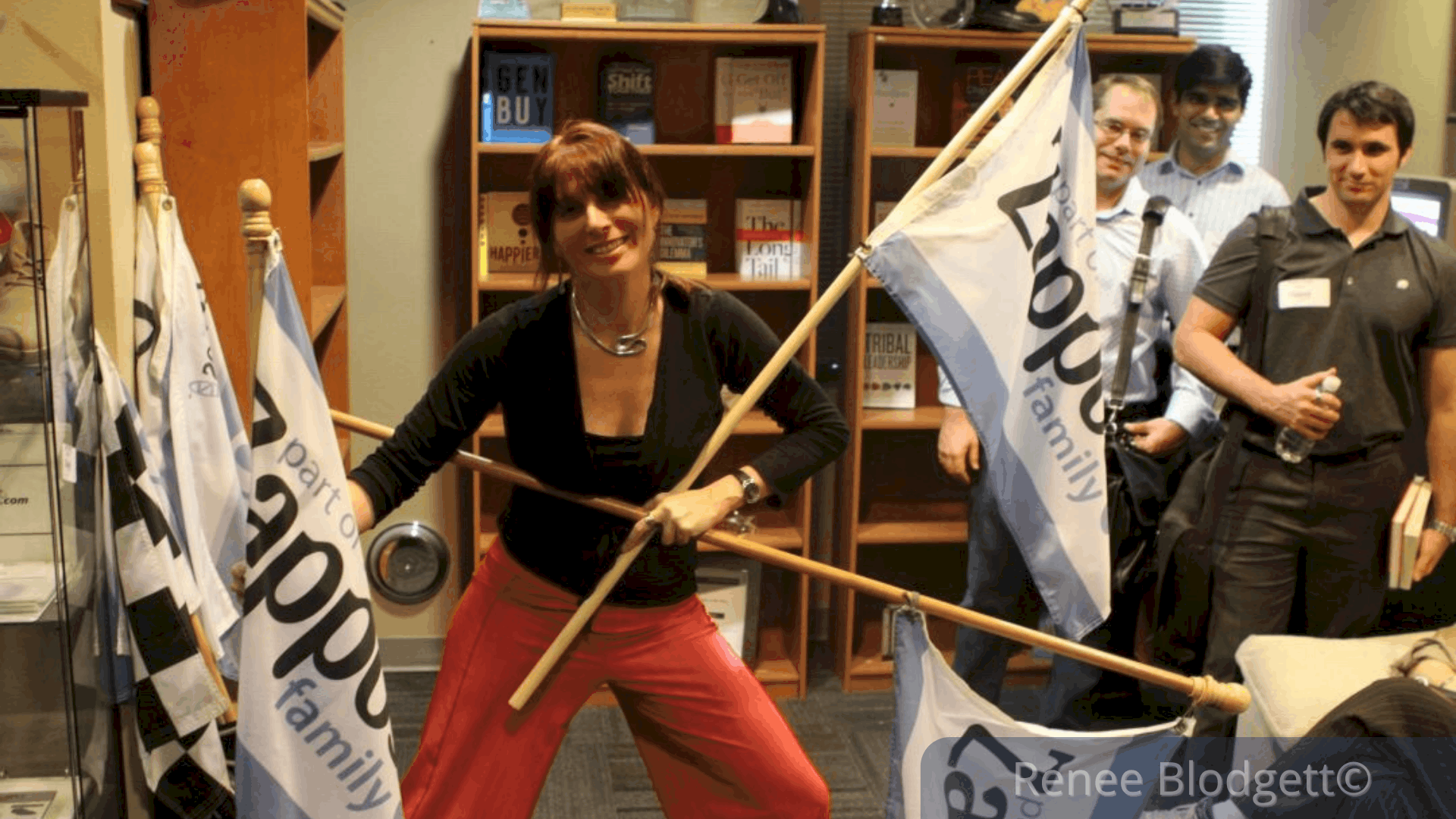
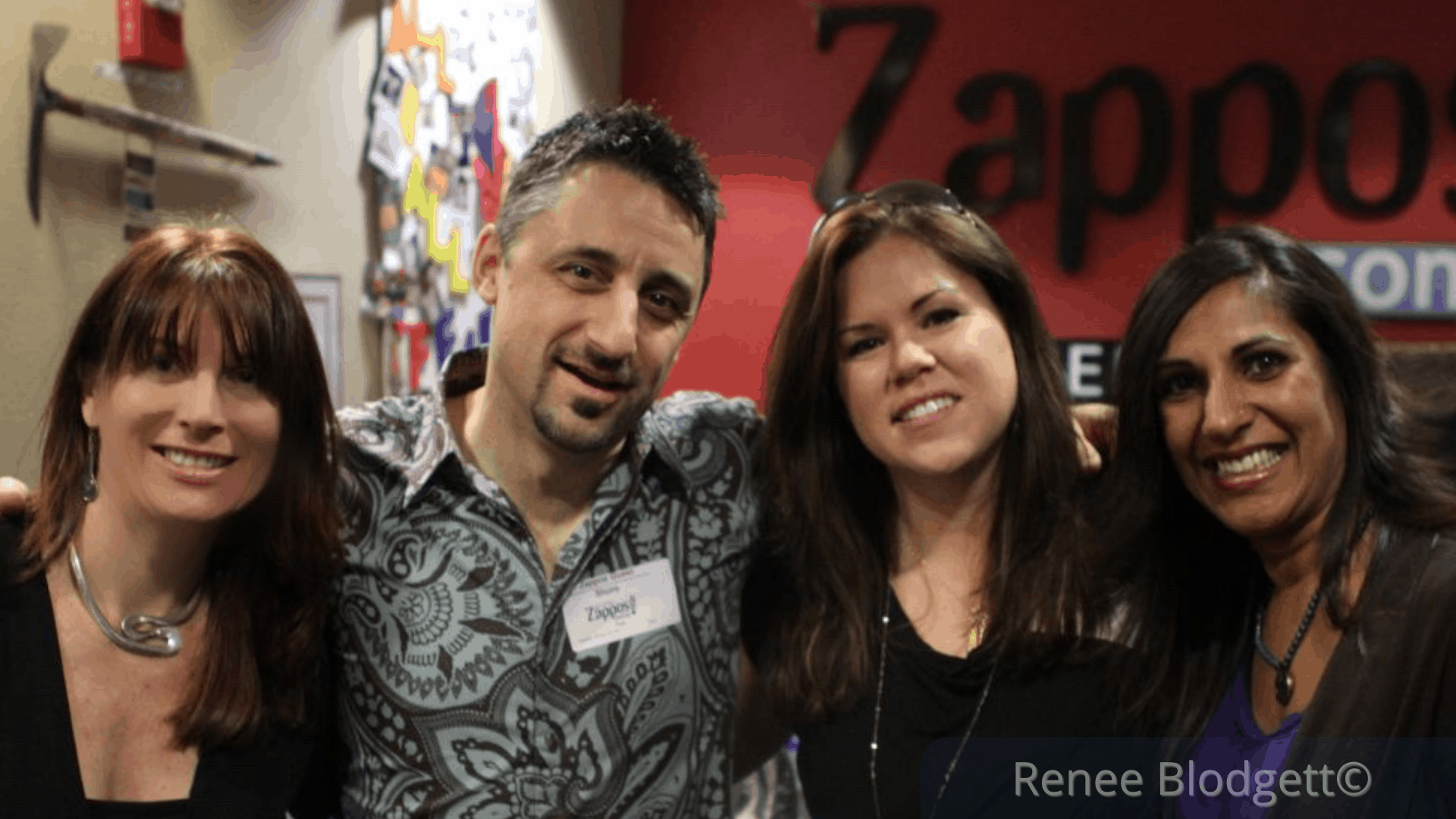
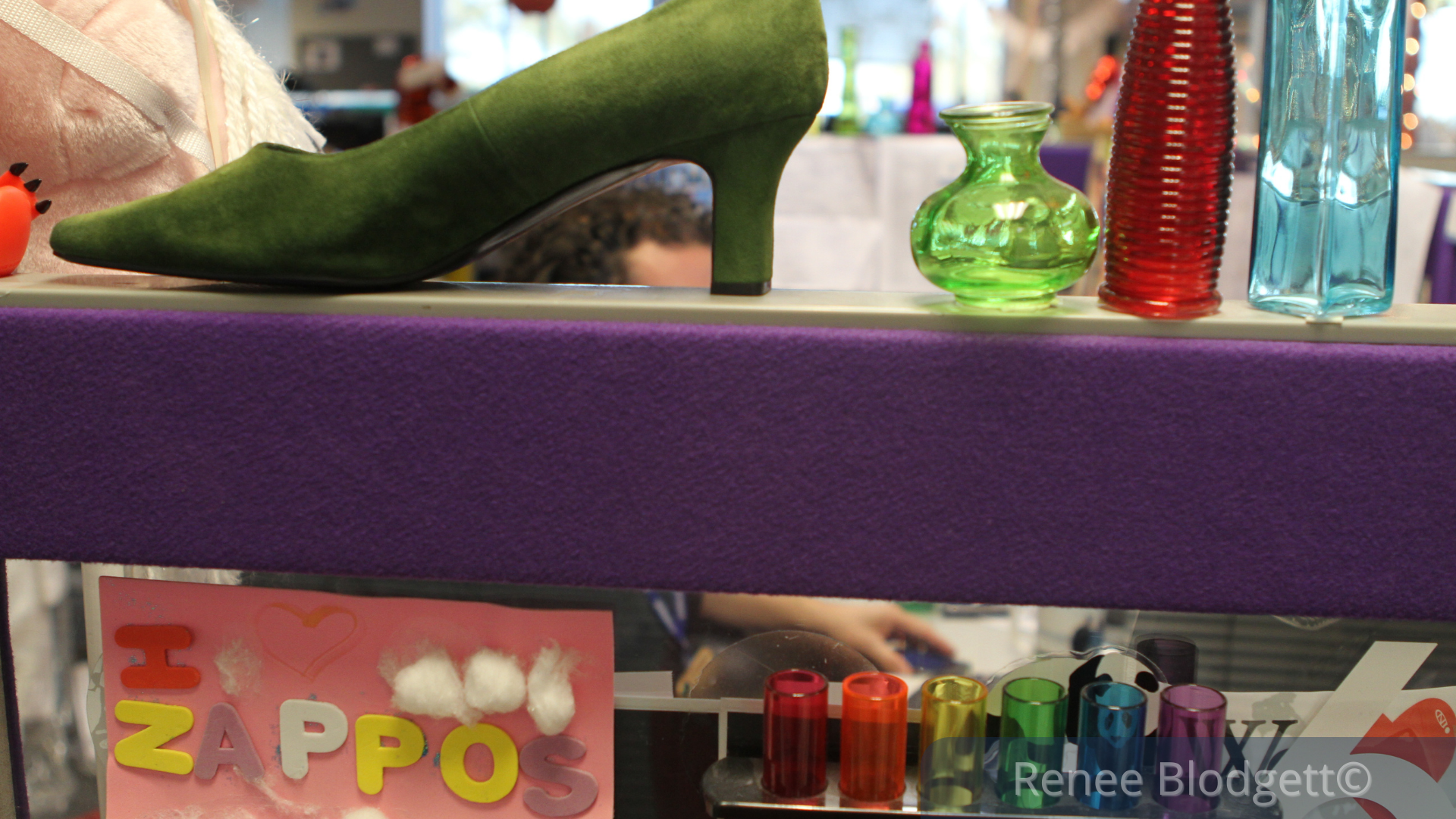
At Zappos Above and below: great memories at Zappos. Credit: Renee Blodgett Above and below: fun and creative energy at Zappos. Credit: Renee Blodgett Above and below, fun times at Zappos Creativity throughout the workplace at Zappos. Credit: Renee Blodgett Tony also invited me to their holiday parties, and on one such event, a pair of shoes was waiting for me upon arrival that was a perfect match for the 1920's flapper outfit I chose to wear that evening.  Renee Blodgett, Shore Slocum and Jeni Holt at Zappos Holiday Party. Credit: Renee Blodgett
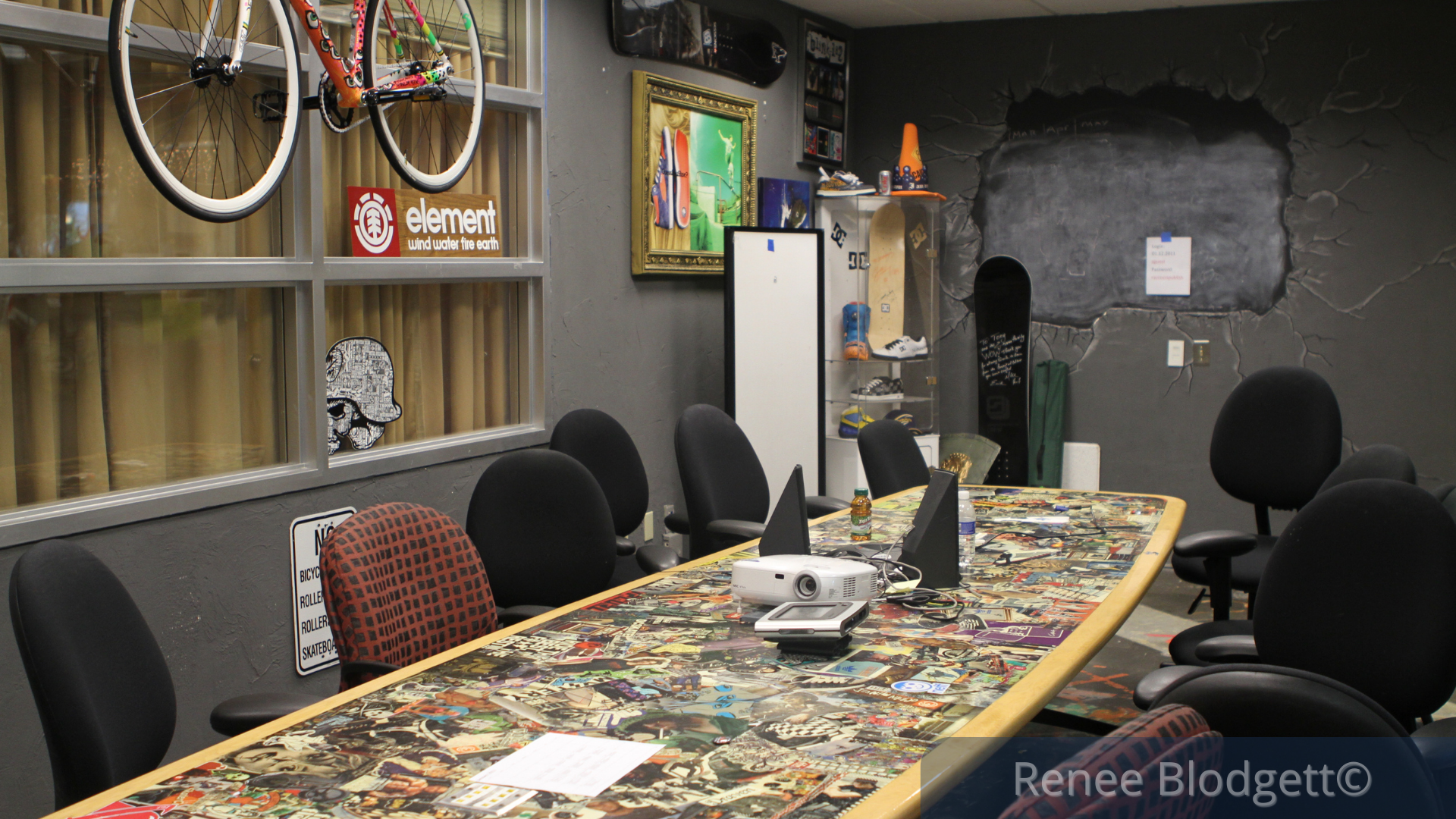
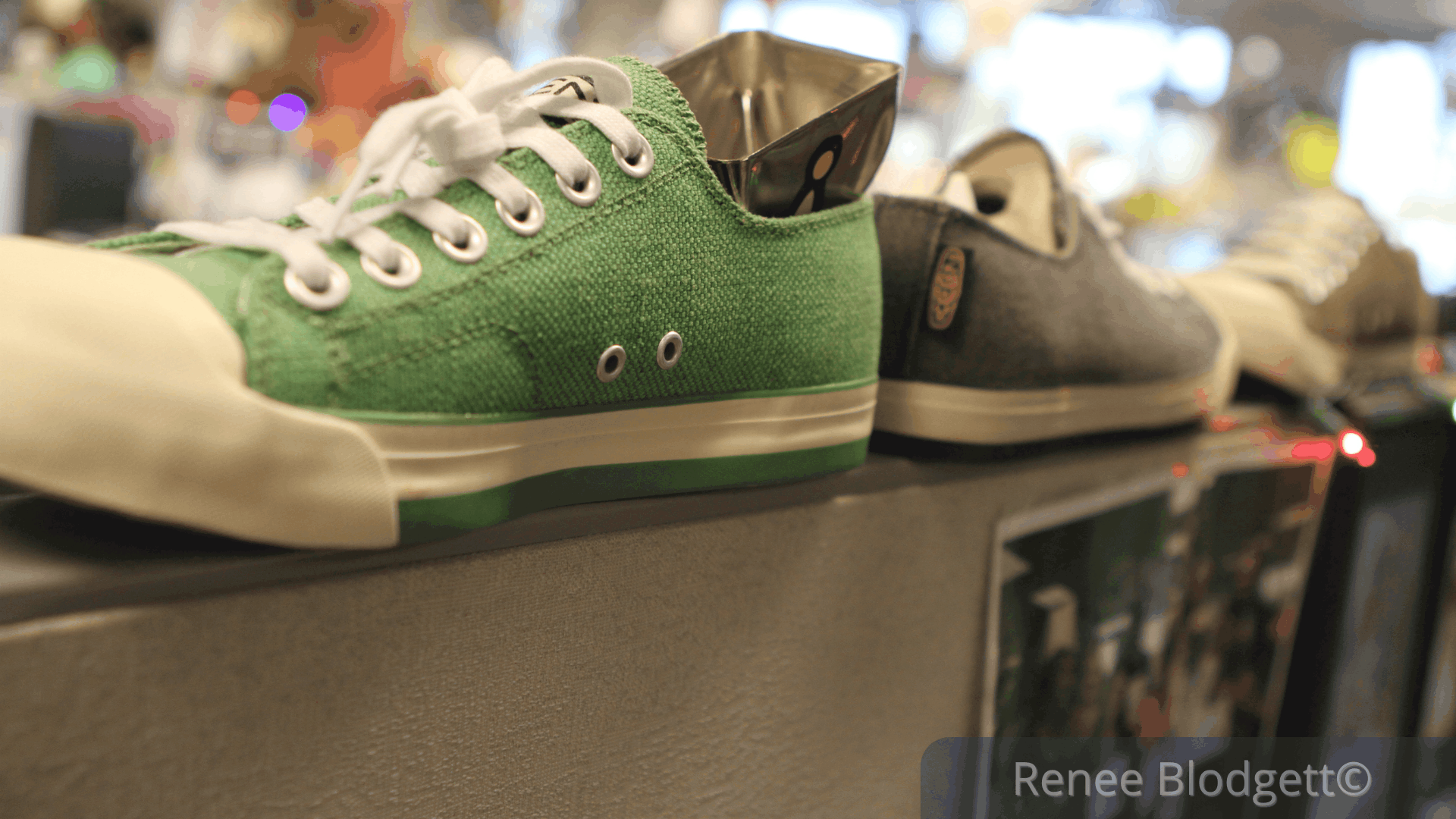
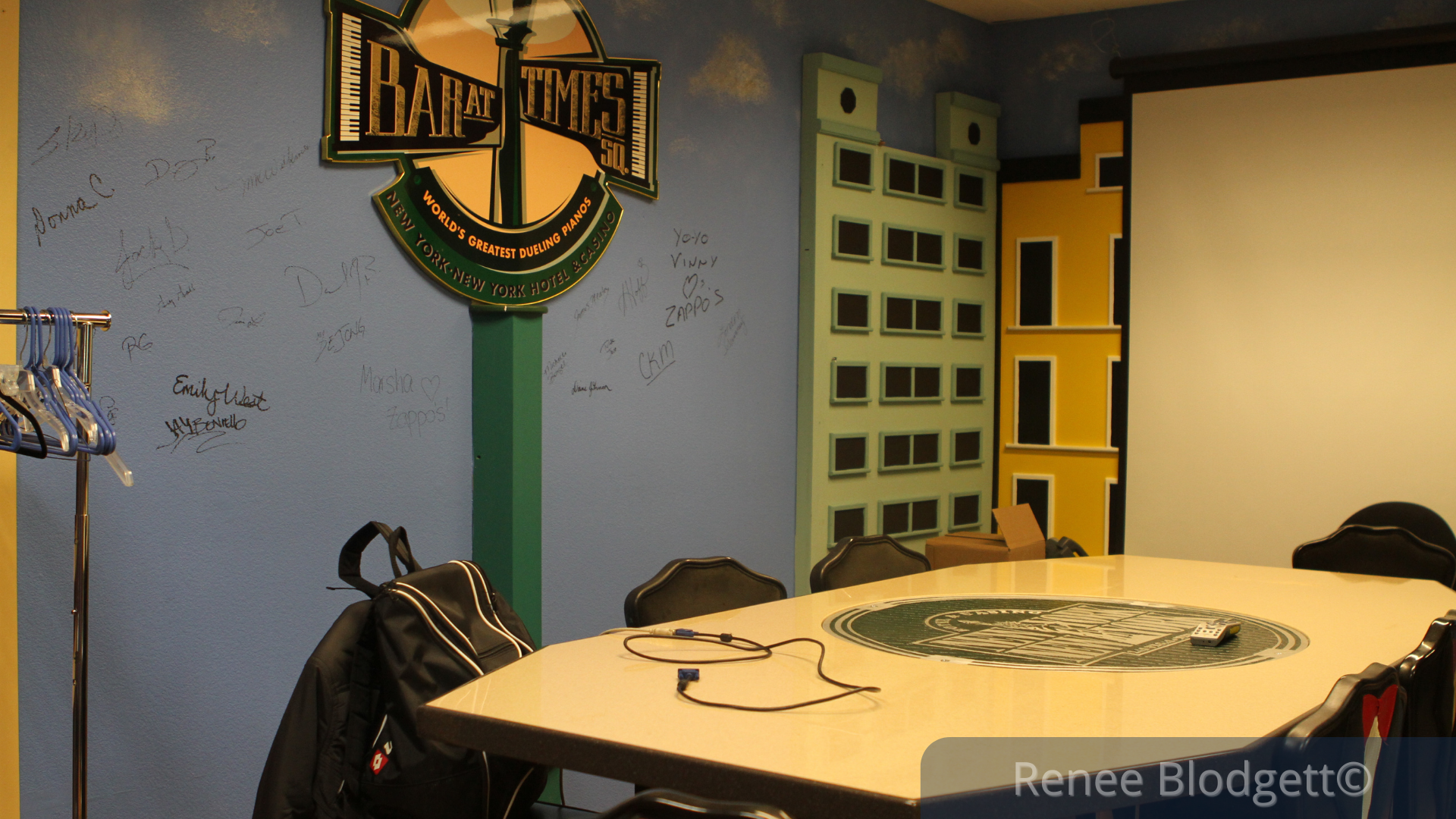
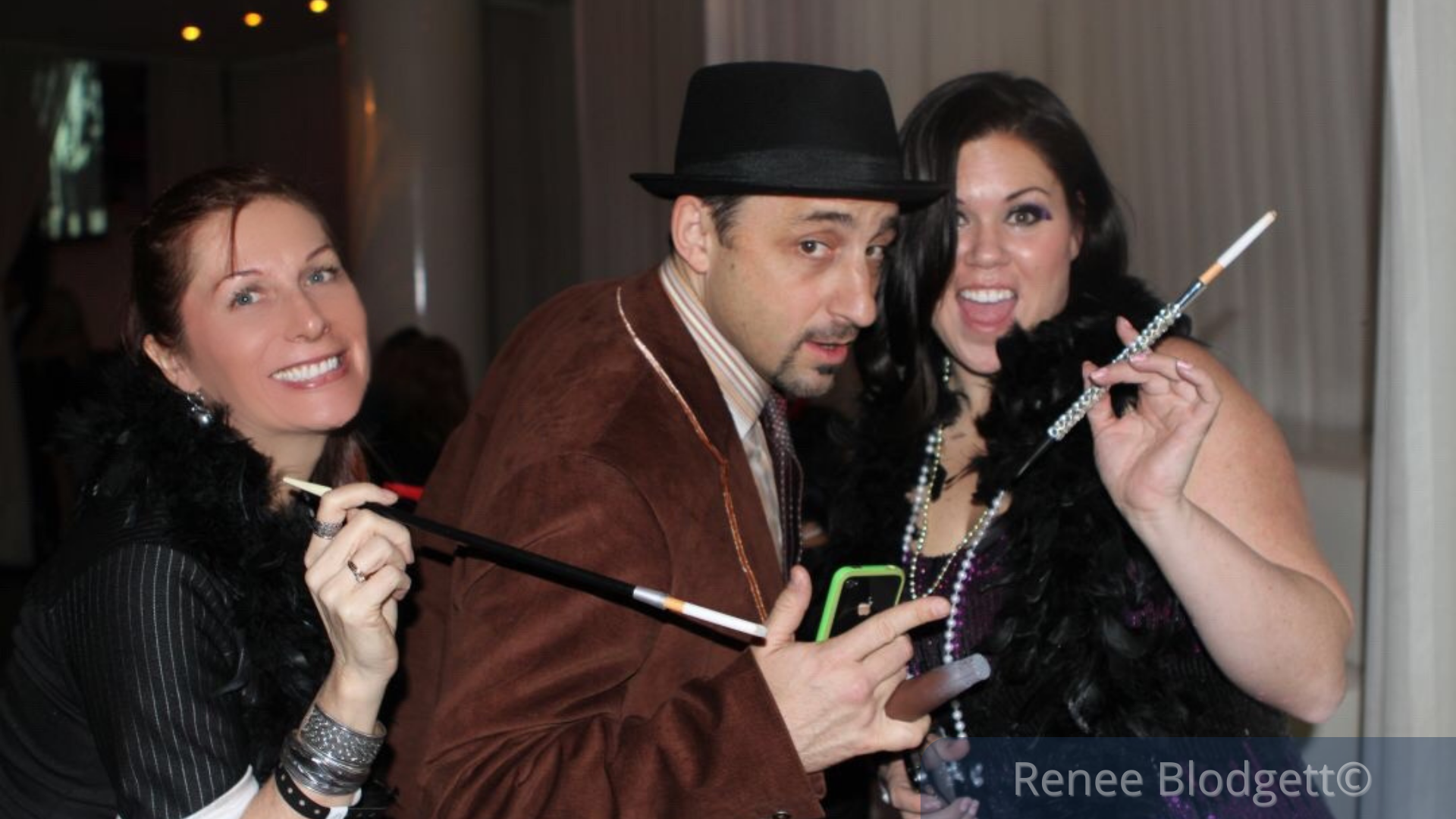
 

Then there were interactions at Austin's annual SXSW, which was all about parties -- thrown by individuals and vendors -- and they went on for days. They weren't the kinds of parties we attended during the "heyday" of Comdex and CES that ended around 11 pm -- SXSW parties would carry on throughout the night -- every night -- for a week, and often we'd end up at some all night joint for pancakes at around 5 am. Those who were part of this eco-chamber well remember SXSW and it's "magic moments."


It was SXSW 2007 that Evan Williams set me up with my Twitter account directly on my phone in one of those long corridors well before the Twitter frenzy hit, Robert Scoble looking on with a beaming smile to demonstrate how 'cool he thought it was.' I remember thinking at the time: 'another ridiculous name for a start-up that has no meaning.' But, I respected Ev and the rest is history. That same SXSW, I hung out with other technology visionaries (and bloggers) as we ventured from party lounge to party suite. Zappos had a gathering and if my memory serves me right, it was here I was first introduced to Tony. Calm and centered were two words I'd use to describe him, which amidst the chaos of SXSW's youthful glam and tech illuminati was hard to pull off. Simply put: SXSW was full of inventors, creators, engineers and artists and all the frenzied energy that came along with it. Alcohol too of course. It was either that same SXSW or subsequent ones (likely both) that I'd jump aboard Tony's rented bus which would transport us from party-to-party. Sometimes, we wouldn't get off at all and the bus became the party with plenty of beer along for the ride and even a decorative balloon artist on board to boot.


It turns out that Steven Rosenbaum who shared those same Austin experiences had equally fond memories as he writes in his own beautiful tribute to Tony on MediaPost. Luminaries abound became the order of the day in those fun but often misunderstood days of technology creation and advancement. Tony was among the few that were not just truly respected but truly liked. Whether you were drinking beer with him at the TechSet Blogger Lounge in Vegas or Austin or hanging out with him over much better food at LeWeb in Paris (Geraldine & Loic LeMeur certainly knew how to throw a party and curate a menu), if you met up with him, you'll remember another important quality that Tony possessed: Presence. As entrepreneurs rose in fame (and bank accounts), so too did the ego and with "it" often came 'lack of presence,' where you always felt that they had somewhere more important to get to or someone more important to talk to other than you. We've all been there and it's an inauthentic and empty feeling, isn't it? 
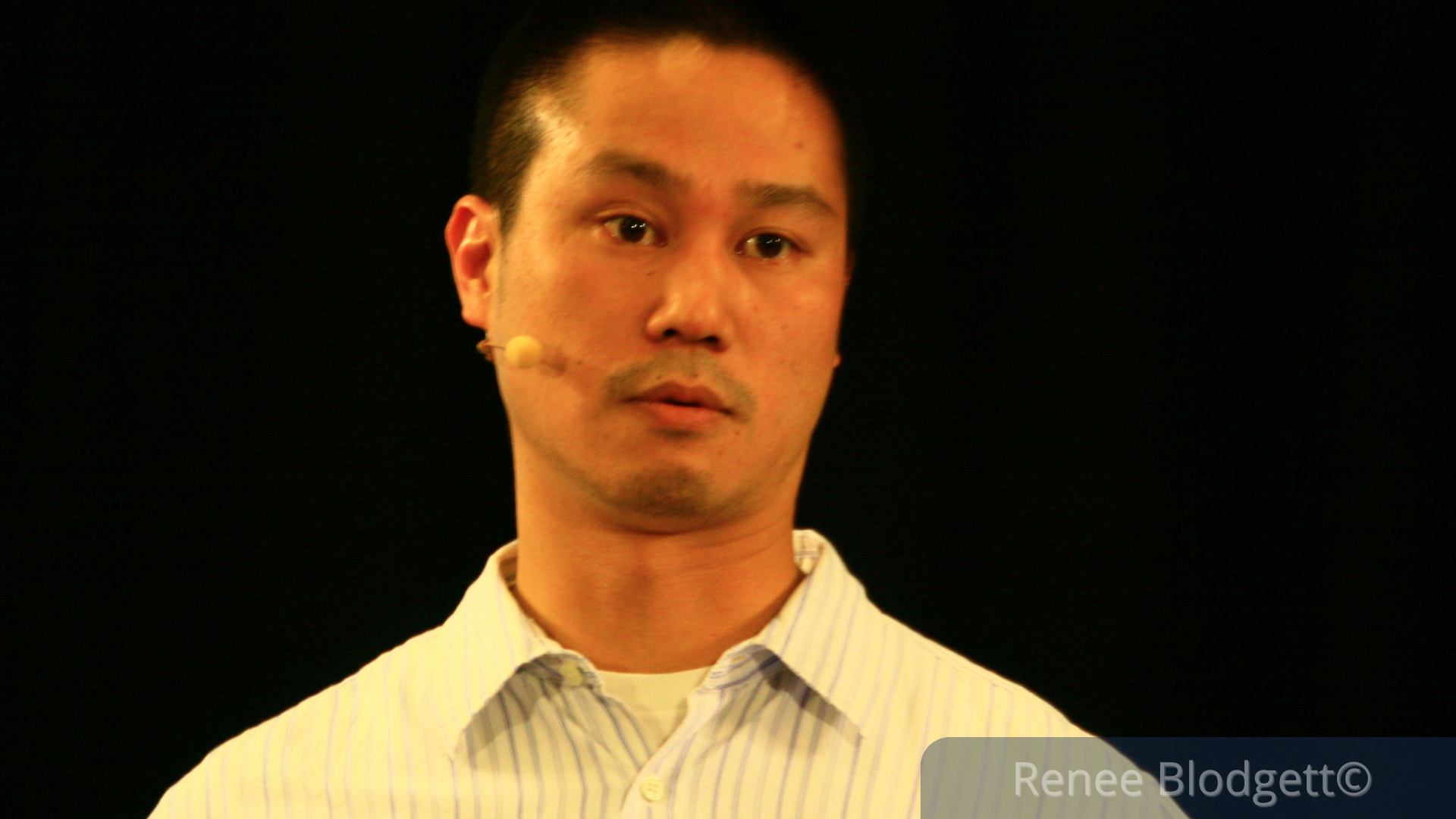
Tony Hsieh speaking at the Tony Robbins Business Summit I attended in Vegas in 2009. Credit: Renee Blodgett


On another occasion, there was an awkward moment when I was turned away at the door of a 'nearly all male' poker party that I was invited to by several entrepreneurs in my 'circle.' As I recall, it was in some 'power suite' on the top floor of some 5 star hotel I don't remember the name of, and suddenly Tony was at the door and told the person to let me in. He did so with a balance of both softness and firmness and a smile that simply let you know that 'all would be okay.' And of course, all was okay. Those who knew him well and shared in these special "Tony moments" understand this feeling. As Sarah Lacy wrote in her Business Insider article about his passing, Tony was "fundamentally someone who wanted to make people happy." She also shared a story I resonated with as it was similar to my own experiences with him over the years. During an uncomfortable moment deep in an underwater cave, Tony took her hand and like I felt in my own special "Tony moments", let her know that all would be okay. You see, he had that way about him and people just 'felt it.' You know that beautiful quote from Maya Angelou: "people will forget what you said, people will forget what you did, but people will never forget how you made them feel.” 

"People will forget what you said, people will forget what you did, but people will never forget how you made them feel.”

-- Maya Angelou

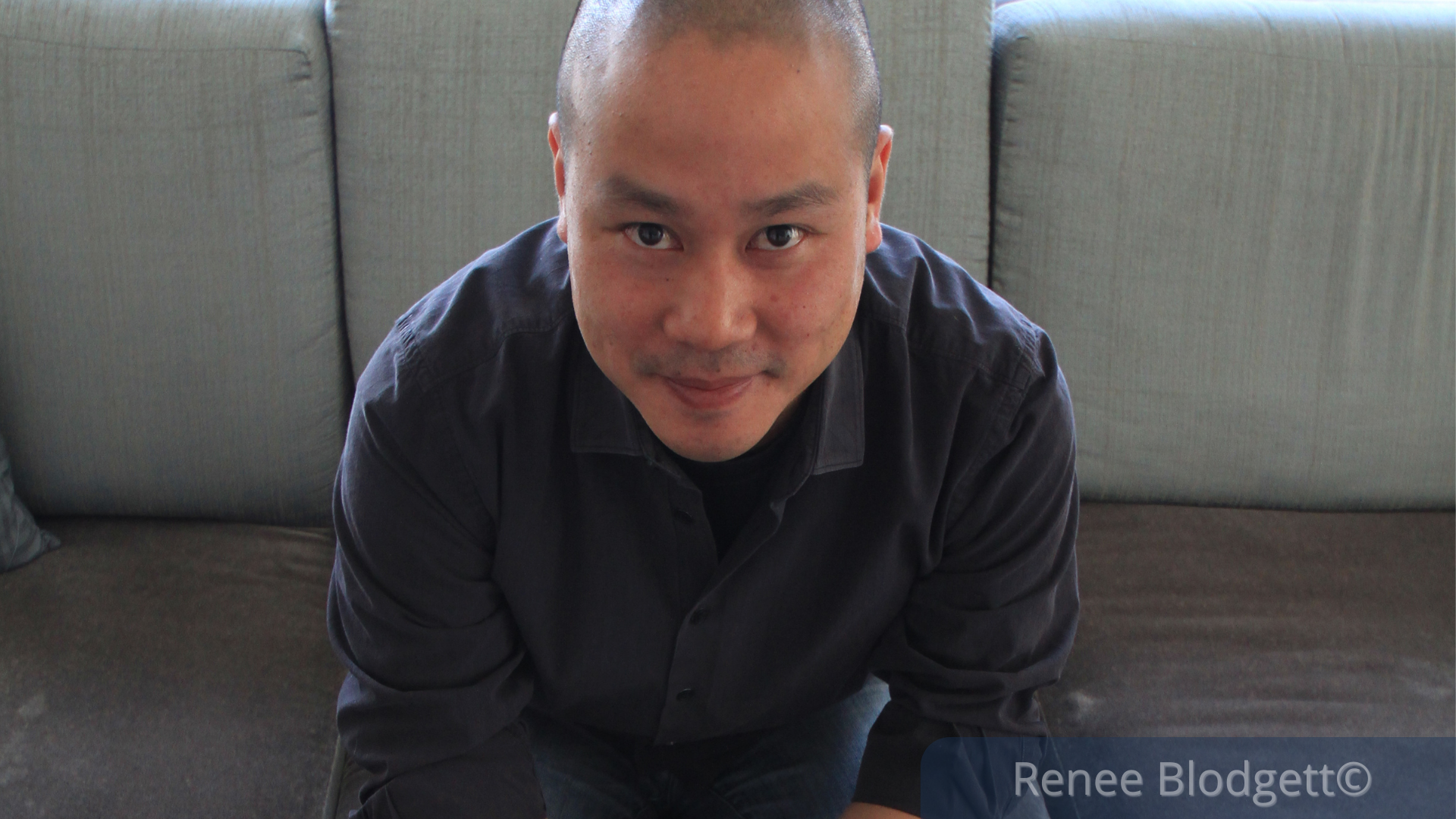
Tony lived that. In 2011, I had an idea for a photo book and began shooting entrepreneurs across industry sectors who turned to heart as their 'go to' for decision making. Tony Hsieh was among my 'picks' -- it was a project that I never completed but had a blast in the creation process. I don't even remember the city where we had the photo shoot but I do remember that it was just the two of us in a small hotel suite where the lighting was far from ideal. My own primitive lighting system wasn't good enough for the backdrops and so we had to make do. He was more than indulgent when I asked him to stand on the couch or up against silly props, and he simply smiled in a way that always put me at ease.
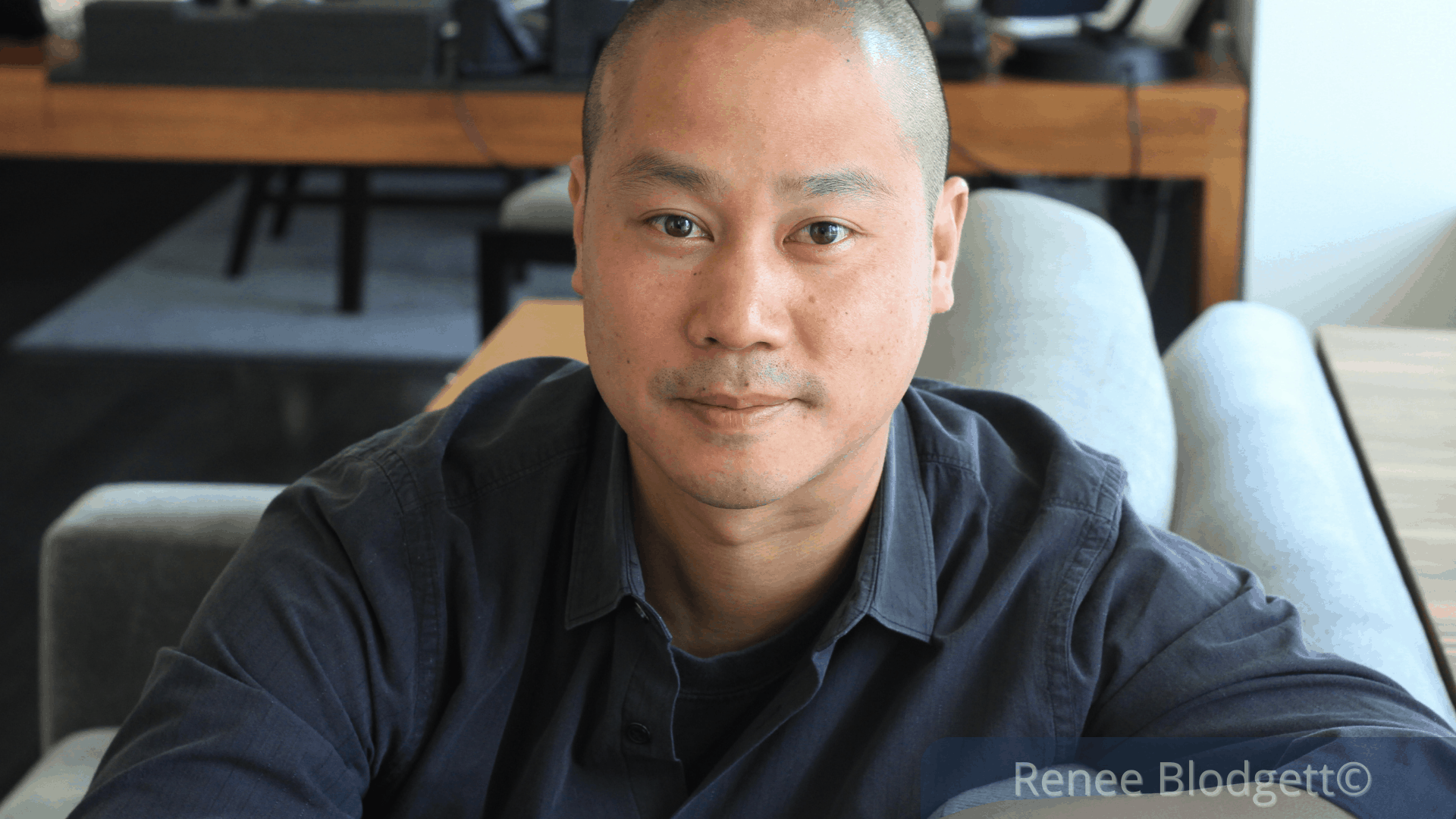
Above and below, from our photo shoot in 2013. Credit: Renee Blodgett Photo shoot with Tony. Credit: Renee Blodgett
 

When his book came out, I somehow found myself at nearly every book party and not just in the United States. There were parties in France and Ireland, as well as in the likely suspects in the states, like NYC, San Francisco, Los Angeles, Las Vegas and Austin. He would hand his books out like candy so I had collected many over the years and at one particular event, he gave me more than a dozen. I used to keep them in the trunk of my car and after a networking gathering or a coffee or lunch meeting, if I felt the person could benefit from his book, I'd give one away. This went on for years and we used to joke about it whenever we saw each other. "You'd think that you worked for me," he always said with a laugh. The truth is: I loved the book and it felt so 'full' compared to the 'emptiness' from so many other start-up books I had read at the time. His 'voice' exuded heart and purpose...at least it felt so to me.
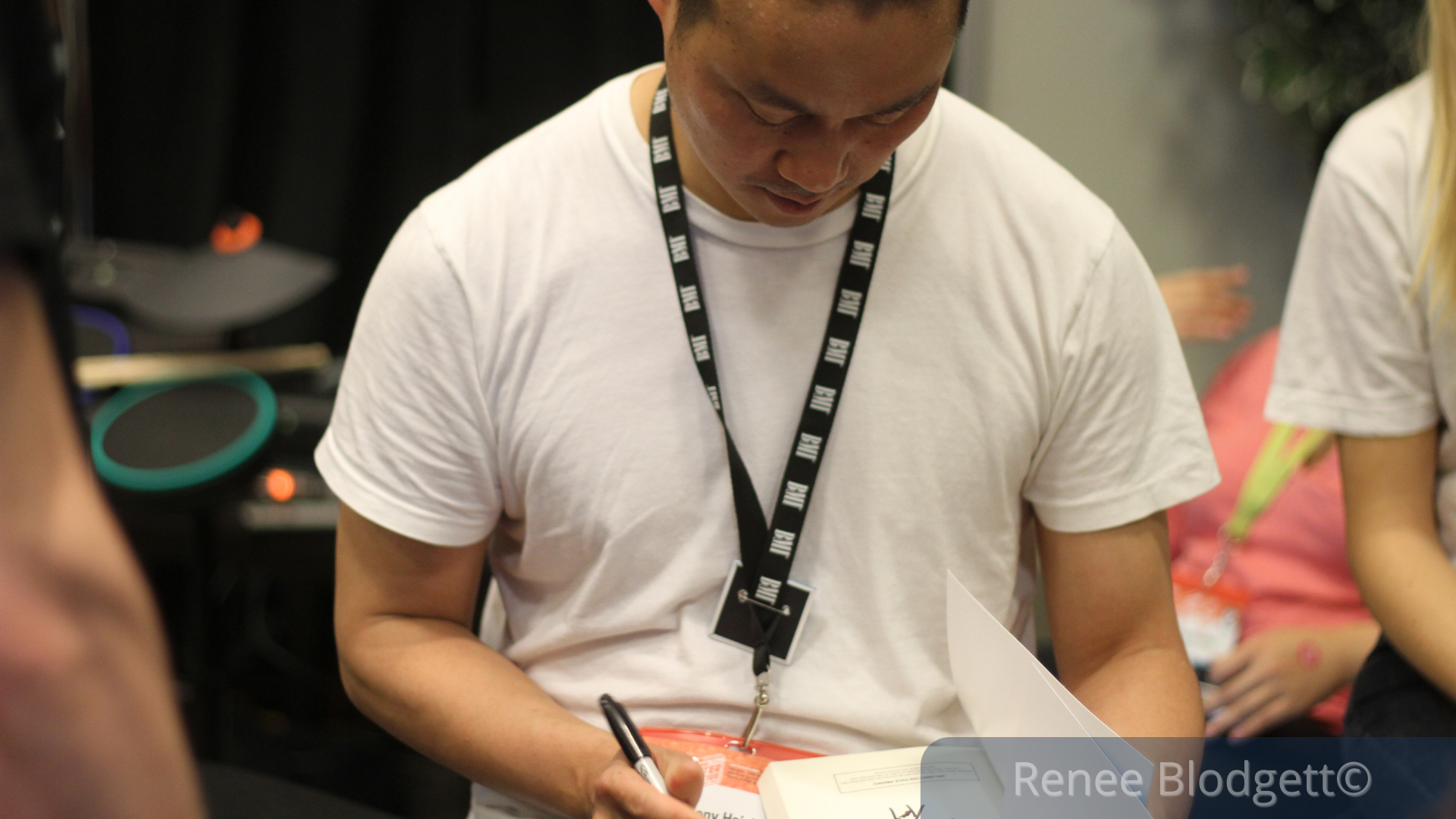
Tony Hsieh signing books in Austin after his Delivering Happiness book release. Credit: Renee Blodgett


And, his passion echoed elsewhere as well, which went on to create community, the Happiness Bus Tour and others within his sphere who would also spread the value of happiness as an important ROI at the workplace.
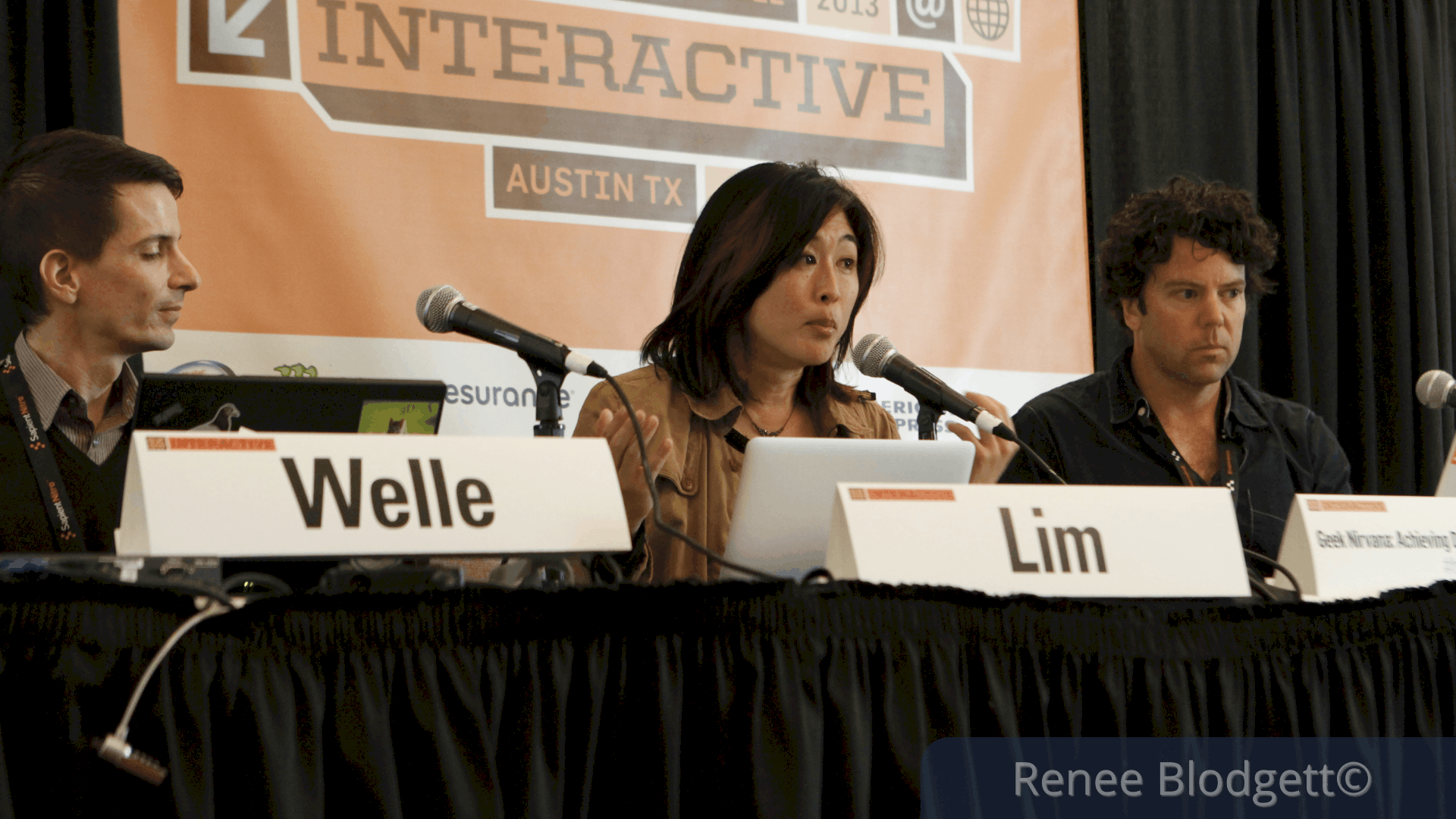
Jenn Lim speaks at SXSW on Delivering Happiness, extending the message beyond a Happiness Bus tour. Credit: Renee 


Tony's Soul Imprint Lives On

So friends, I write this piece as a tribute to his 'physical experience' as Tony Hsieh in this timeline and in this reality. I write this piece as a nod to the contributions he made to humanity, speaking up and out on the importance of living from a place of heart, purpose and ultimately a higher consciousness. Although I lost track of him in recent years, the last two times I saw him, there was a sadness beneath those dark eyes. I couldn't explain it nor did we have time for a "heart-to-heart" but I could sense and feel it -- one of those innate kinda things we all have from time-to-time. As an empath who now teaches about consciousness and spirituality, I've always felt people's emotions and not just from time-to-time, but almost always. 


It was as if his own "magic moments" had come to an end, or at a minimum diminished so much that he wanted to be elsewhere, like the Island of Misfit Toys. As a visionary, he loved to build and create so perhaps being at the top of an empire just didn't offer the same magic. Had his most vibrant contribution to humanity felt too distant to recapture? Whatever it was, I noticed it both times I last saw him, deeply buried in his soul that others may have seen as well if they were present enough to feel it...sense it, know it. The one thing I feel, sense and know now is that the Soul chooses its purpose and its 'story,' as well as its timeline and its own reality. You see, in a quantum world view, the particle and the wave exchange places. They can be one or the other or both. Physical matter such as our perceptions of who we are as physical human beings, the skyscrapers in the cities we frequent and even the houses in which we inhabit are projections in a way....and less real than we perceive them to be. Even if Einstein couldn't make peace with all things quantum in the days of Bohr and Planck, he knew this deep down too. Remember that we are not outside of time and space but we are time and space. From a mathematical model/perspective, its like a "fusing of the three dimensions of space and the one dimension of time into a single four-dimensional manifold." 

"A human being is a part of the whole called by us universe, a part limited in time and space. He experiences himself, his thoughts and feeling as something separated from the rest, a kind of optical delusion of his consciousness. This delusion is a kind of prison for us, restricting us to our personal desires and to affection for a few persons nearest to us. Our task must be to free ourselves from this prison by widening our circle of compassion to embrace all living creatures and the whole of nature in its beauty." -- Albert Einstein

And so my friends, Tony Hsieh's Soul and its beautiful imprint lives on. Or, if that's too much for the scientific materialists among you, then perhaps you can handle the notion that his Consciousness lives on. But for us mere mortals still imprisoned in our 'shells', living out this one quantum string that shows up as a theatrical play we perceive as reality, we shall miss his physical voice, touch and embrace. Or, the perception of them anyway. We could say then, that from a quantum perspective, RIP Tony Hsieh takes on a new meaning, one which is full of life not rest.

Selected Industry Event Posts


06 Dec 03:32

4 Practical Ways Google Docs Can Help You in Your Online Teaching

Educational Technology and Mobile Learning, Dec 03, 2020
Icon

The four practical ways are: co-editing documents, sharing instantaneous feedback, suggesting edits, and sharing and collaborating on a document with more than 100 people. All these are different ways of saying essentially the same thing, which is specifically that more than one person can work on a Google Doc at the same time (a.k.a. 'collaborative editing'). I think collaborative editing is a fantastic teaching tool, and wish the author had spent more time thinking about specific teaching practices rather than just restating the same thing over and over. Other collaborative editing tools include Nextcloud, which has a built-in collaborative document editor, and CryptPad, a privacy-by-design collaborative document editor.

Web: [Direct Link] [This Post]
06 Dec 02:53

How Microsoft crushed Slack

Casey Newton, Platformer, Dec 03, 2020
Icon

Here's the analysis of the Slack sale to Salesforce in one paragraph: "The idea that workers would someday choose all their own tools was always a fantasy, he told me, in part because most workers don’t event want to think about their tools. In such a world, the winning app will almost always be one with a giant, er, salesforce behind it. Microsoft had one. Slack didn’t. Enter Salesforce." I don't think that's the whole story. I think that having a whole enterprise suite helped Microsoft a lot (it will also help as Microsoft pushes back against Zoom).

Web: [Direct Link] [This Post]
06 Dec 02:53

Bursting Their Bubble

Colleen Flaherty, Inside Higher Ed, Dec 03, 2020
Icon

I've long described a 'triad model' where people from different institutions cluster together in a local community, taking their courses online but enjoying the in-person experience with other people. I never quite expected it to roll out like this, though: " The U Experience, as it’s actually called, is slated to open to 150 students at a Pottsboro, Tex., lakeside resort next month. The concept? Students enrolled in different colleges and universities who would otherwise be studying remotely on their own will live, eat and take their online classes in a maskless, COVID-19-free bubble. " Cost? $10K per semester. More if you want more than one meal a day.

Web: [Direct Link] [This Post]
06 Dec 02:53

Your place in the vaccine line

by Nathan Yau

Using estimates from the Surgo Foundation and Ariadne Labs, Stuart A. Thompson for NYT Opinion shows how many people are in front of you to get the coronavirus vaccine. Just enter your age, if you’re an essential worker, and the county you live in for an idea of where you are.

Tags: coronavirus, New York Times, Stuart A. Thompson, vaccine, waiting

06 Dec 02:53

The Rise of Smaller Displays

by Neil Cybart

Apple is a design company selling tools capable of improving people’s lives. Approximately 80% of those tools include a display. Apple is shipping about 300 million displays per year, from iPhones and iPads to Macs and Apple Watches. With Apple running as fast it can towards AR glasses, the number of displays that the company ships will only increase over the next five to ten years. While the pandemic is pushing people to embrace larger displays like iPads and Macs, the momentum found with smaller displays is still flying under the radar.

Display Spectrum

Back in 2017, I published the following chart that tracks Apple device unit sales by display size. The exercise involved breaking out iPhone, iPad, and Mac unit sales by model - something that Apple has never done itself but which the company provided enough clues for me to do on my own and have confidence in the estimates.

Exhibit 1: Apple Device Sales Mix by Display Size (2016 data)

Apple device sales mix by screen size (Above Avalon)

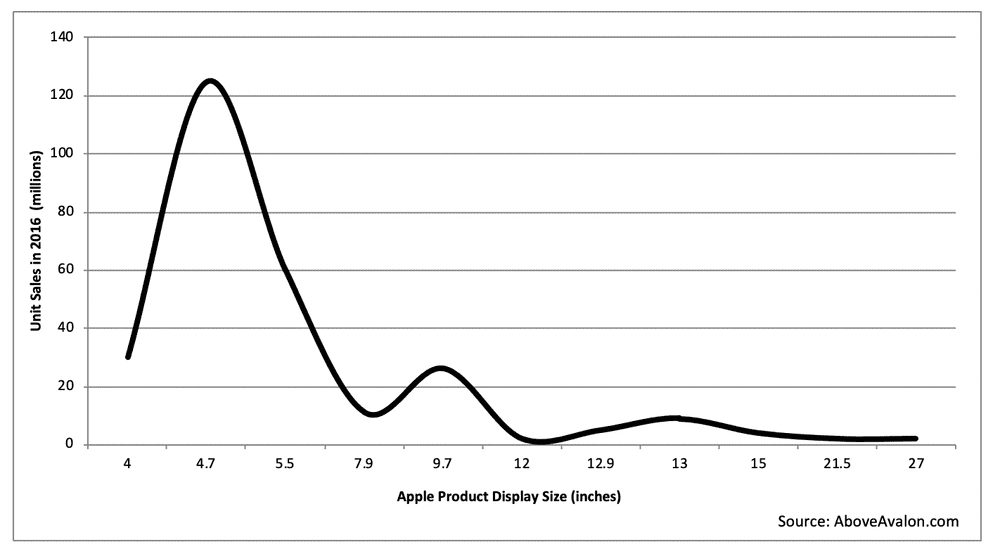
Since Apple offers a finite number of display choices, Exhibit 2 turns the sales data from Exhibit 1 into a broader statement about preferred display size.

Exhibit 2: Apple Device Sales Mix by Display Size (2016 data - Smoothed Line)

Apple Device Sales Mix by Display Size (Above Avalon)

The motivation in pursuing such an exercise was to place context around the number of large displays Apple was selling in the form of MacBooks and iMacs. Fast forward three years, and it’s time to revisit the topic. With the significant amount of change occurring in Apple’s product line since 2016, there is value in going through a similar exercise regarding display size preference with 2020 unit sales in mind. While Apple’s financial disclosures haven’t gotten better over the past four years - if anything, the disclosures have gotten worse - I am still confident in my ability to derive unit sales estimates for all of Apple’s products.

Exhibit 3: Apple Device Sales Mix by Display Size (2020 data)

Apple Device Sales Mix by Display Size (Above Avalon)

Exhibit 4: Apple Device Sales Mix by Display Size (2016 data - Smoothed Line)

Apple Device Sales Mix by Display Size (Above Avalon)

(All of my granular estimates and modeling that went into Exhibits 3 and 4 is available to Above Avalon members in the daily update published on December 7th found here.)

As seen in Exhibits 3 and 4, there is bifurcation in Apple display size popularity. The most in-demand displays fall into two (broad) categories:

  • Displays large enough for consuming lots of video and other forms of content that can still be comfortably held in a hand or stored in a pocket.

  • Displays small enough to be worn on the body (Apple Watch) and products lacking a display altogether (AirPods).

It hasn’t been difficult to miss Apple’s gradual move to larger iPhone displays over the years. The 6.7-inch iPhone 12 Pro Max is getting close to the maximum size for an iPhone display, at least when thinking about the current form factor. Such a reality has undoubtedly played a role in some smartphone manufacturers betting heavily on foldable displays for smartphones. Such a bet boils down to believing consumers will want larger smartphone screens to the point of being OK with tradeoffs in terms of device thickness and weight. Move beyond the iPhone and display popularity plummets as the iPad and Mac sell at a fraction of the pace. There are small sales peaks found at 10.2 inches, the size of the lowest-cost iPad, and 13.3 inches, the size of the MacBook Air and entry-level MacBook Pro.

With hundreds of millions of people embracing 4.7-inch to 6.7-inch displays via iPhone, the claim that consumers are embracing larger screens over time contains some validity. Many are now wondering if similar moves to larger displays will take over the iPad and Mac lines. However, focusing too much on large displays will make it easy to miss what is happening at the other end of the spectrum. The rise of wearables has given an incredible amount of momentum to small displays and devices lacking a display altogether.

Implications

There are four key implications arising from this display bifurcation observation.

  1. Apple’s ecosystem naturally supports the idea of multi-device ownership.

  2. As devices are given more roles and workflows to handle, there is a natural tendency for screen sizes to increase without changing the overall form factor much.

  3. Power and value are flowing to smaller displays that are capable of making technology more personal.

  4. Devices relying on voice as an input make more sense when paired seamlessly with devices with displays.

It is worth going over each in greater detail.

1) Apple’s ecosystem is characterized by hundreds of millions of iPhone-only users buying additional Apple products and services. This is a result of industry-leading customer satisfaction rates and subsequently very strong brand loyalty. However, there are more fundamental themes underpinning this trend. By controlling hardware, software, and services, Apple is able to sell a range of products that seamlessly work together. These tools don’t serve as replacements for one another but rather as alternatives. This leads to consumers being able to use multiple Apple devices aimed at handling different workflows in their unique way. Such a dynamic supports the idea of multi-device ownership over time with those additional Apple devices likely containing smaller displays or no displays at all.

2) Apple has given the iPad, iPhone, and Apple Watch larger displays over time. For the iPad, the 12.9-inch / 11-inch iPad Pro and 10.9-inch iPad Air are larger than the initial 9.7-inch iPad and subsequent 7.9-inch iPad mini. The 3.5-inch display found with the first few iPhone models looks downright tiny next to iPhone 12 flagships. Even the Apple Watch was given a larger display after being sold for three years. These moves may seem to be unnoteworthy reactionary outcomes to competitors and market forces. However, the move to larger displays over time ends up being connected to the product category handling more workflows over time. iPhones have become “TVs” for hundreds of millions of people. Today’s iPad Pro flagships are geared toward content creation. Apple Watch faces are being given more complications in order to provide additional new-age app interactions to wearers.

3) The two product categories seeing the strongest unit sales momentum have either the smallest displays Apple has shipped (Apple Watch) or no displays at all (AirPods). As wearables usher in a paradigm shift in computing by altering the way we use technology, new form factors designed to be worn on or in the body for extended periods of time are playing a role in helping to make technology more personal. This leads to an observation that may not be so obvious: Smaller displays require new user inputs and interfaces that force new ways of handling existing workflows while supporting entirely new workflows. Said another way, smaller displays end up playing a vital role in lowering the barriers between technology and humans.

4) The reason stationary smart speakers were one of the biggest tech head fakes of the 2010s is that consensus incorrectly assumed the future was voice and just voice. The idea of voice as a user input being enhanced by the presence of a display was skipped over. Jump ahead a few years and the HomePod is arguably made better by having nearby displays either simply around us (iPhones) or on us (Apple Watch). Some of the magic found with AirPods involves the seamless integration with various displays, especially the Apple Watch display. Voice just isn’t an efficient medium for transferring a lot of data and context. Relying on displays for such context makes it possible for devices without displays to shine by being allowed to do what they do best - either provide superior sound (HomePod) or convenient sound (AirPods).

Bet on Smaller Displays

One takeaway from the pandemic has been that social distancing in the form of distance learning and working from home has fueled momentum for some of the largest displays in Apple’s product line. The iPad is setting multi-year highs for unit sales and revenue. The Mac registered an all-time revenue record last quarter. There are a few reasons behind this momentum that include families needing newer (and faster) machines and employers funding work-from-home upgrades.

Instead of looking at this development as the start of a new era for large displays, the momentum found with larger displays shifts focus away from the actual revolution taking place with smaller displays.

Apple is on track to sell approximately 150M devices in FY2021 that either lack a display or contain a display that is less than two inches (5 cm). We are still in the early innings of this revolution. Looking ahead at AR glasses, Apple will eventually sell devices containing two small displays for the first time. Relying on conservative adoption estimates, Apple will sell hundreds of millions of devices per year that contain either small displays or no displays at all. We are seeing the rise of smaller displays, and the secret to witnessing it is knowing where to look.

Listen to the corresponding Above Avalon podcast episode for this article here.

Receive my analysis and perspective on Apple throughout the week via exclusive daily updates (2-3 stories per day, 10-12 stories per week). Available to Above Avalon members. To sign up and for more information on membership, visit the membership page.

04 Dec 14:44

Twitter Favorites: [Planta] @sillygwailo Absolutely. I’ll get a photo to you in a few weeks

Joseph Planta @Planta
@sillygwailo Absolutely. I’ll get a photo to you in a few weeks
04 Dec 14:43

Twitter Favorites: [_jackiewong] with a special shout out to my childhood friend Brandon, who shared one half of his Discman ear buds with me most r… https://t.co/wZ3XWsccTY

Jackie Wong @_jackiewong
with a special shout out to my childhood friend Brandon, who shared one half of his Discman ear buds with me most r… twitter.com/i/web/status/1…
04 Dec 14:42

Twitter Favorites: [skinnylatte] You gotta update the software that updates the software. npm install -g npm

Adrianna Tan @skinnylatte
You gotta update the software that updates the software. npm install -g npm
04 Dec 14:42

Twitter Favorites: [GreggLintern] Seeing this is a feel good moment https://t.co/bS1tZBMfsk

Gregg Lintern @GreggLintern
Seeing this is a feel good moment pic.twitter.com/bS1tZBMfsk
04 Dec 14:42

49:49 with Sylvan Esso

by peter@rukavina.net (Peter Rukavina)

Remember hanging out with friends? This Q&A by Sylvan Esso made me miss hanging out with friends something awful.

04 Dec 14:41

RT @foreigncorr1: ? pic.twitter.com/8S392lfbqA

by David Pratt (foreigncorr1)
mkalus shared this story from ottocrat on Twitter.


Retweeted by Chris Kendall (ottocrat) on Thursday, December 3rd, 2020 9:38pm


20 likes, 13 retweets
04 Dec 14:41

Who are you without the doing?

by Doug Belshaw

A podcast I listened to recently took the structure of a Q&A hosted by Jocelyn K. Glei. The theme was ‘tender discipline’ and another episode was referenced where she asks the question someone once asked her: who are you without the doing?


Earlier this week, I wrote a personal email to my wife for the first time in a a long time. While we live together and are in constant communication either verbally or via a Telegram backchannel, sometimes things (kids, events, stuff) get in the way of having important conversations.

I kept the email short, saying that I’ve been talking for years about taking December off work. I told her that I’m done with 2020, that I don’t want to put any more energy into this year of all years.

As a result, we’ve worked out that Team Belshaw will be OK if I finish up my work next week and take three weeks off to stop… doing. That’s such a relief! I’ve spent the last couple of days checking with others that my gently downing tools won’t affect them too much.

The funny thing is that I’ll probably still end up doing things that look a bit like ‘work’. I’ll no doubt still head over to my office to do some writing. There’s a bunch of work-related reading I want to do. I’ll probably occasionally check in on the multiple Slack instances of which I’m a member. But mainly I’ll walk and think and just be.

I need to recharge, and realise that I’m privileged to be able to decide when to pick up and put down my work. Nevertheless, effective care for others starts with caring for ourselves. So I’m looking forward to spending more time with myself without the… doing.


This post is Day 71 of my #100DaysToOffload challenge. Want to get involved? Find out more at 100daystooffload.com

The post Who are you without the doing? first appeared on Open Thinkering.
04 Dec 05:02

It looks like the M1 Mac may be the best hardware for running Windows 10 on ARM

by Jonathan Lamont
MacBook Pro with M1

If you’re wondering how Apple’s M1-powered Macs stack up to Windows machines powered by ARM chipsets, well, you’re in luck. Some enterprising developers have gotten Windows on ARM running on M1 Macs (sort of) and it handily outperforms the Surface Pro X in benchmarks.

First, some background: last month, Apple’s vice president of software engineering, Craig Federighi, explained how Microsoft’s Windows 10 on ARM licensing strategy was preventing the OS from running on Mac computers. Specifically, Federighi said the M1 Macs have the “core technologies” for Windows on ARM to run natively, but it’s “really up to Microsoft” to make it work.

Currently, Microsoft only licenses Windows 10 for ARM processors to manufacturers making ARM-powered Windows devices. This differs from typical x86 versions of Windows 10, which anyone can purchase a copy of.

However, ZDNet reports that Amazon Web Services (AWS) principal engineer Alexander Graf used open-source QEMU virtualization software for Windows on ARM. QEMU emulates access to hardware such as the CPU and GPU. Graf noted in a tweet that Windows was “pretty snappy” on Apple Silicon, backing up Federighi’s statement. Graf also made his patches for QEMU available so others could get Windows 10 running on M1 Macs.

Graf also mentions that his setup can run x86 apps “pretty well,” although it’s “not as fast as Rosetta 2” on macOS Big Sur.

Virtualized Windows 10 on the M1 Mac outperforms the Surface Pro X (2020)

Another developer under Twitter handle ‘@imbushuo‘ shared links to a few GeekBench tests, including one from the QEMU virtual machine running Windows 10 for ARM on the M1 Mac. Surprisingly, the score is a fair bit higher than Microsoft’s own Surface Pro X (2020).

This year’s Surface Pro X sported the new SQ2 processor developed by Microsoft and Qualcomm, and while it did improve over last year’s SQ1, it wasn’t a huge performance increase. In our testing, the Pro X (2020) scored 799 for single-core in Geekbench and 3,137 for multi-core. Most reviewers saw similar GeekBench scores.

Apple’s M1 chip, when tested in the virtualized Windows environment, however, scored a ridiculous 1,288 in single-core and 5,449 in multi-core. It’s worth noting that since this is virtualized Windows, it’s possible that a native installation through something like Apple’s Boot Camp could improve performance.

These tests show two things clearly. The first is that the M1’s excellent performance is about more than just good software optimization in macOS Big Sur — Apple Silicon is actually really good. The other is that Qualcomm needs to step up its game with ARM chips for Windows devices. Even the high-end SQ2 the company jointly developed with Microsoft for the Surface Pro X can’t keep up with M1, let alone Qualcomm’s other Snapdragon Compute chips. As it stands, the new M1 Macs look to be the best machines for running Windows 10 on ARM available, although getting Windows 10 on ARM onto an M1 Mac remains quite tricky.

Source: Twitter (Alexander Graf and @imbushuo) Via: ZDNet, 9to5Mac, MSPowerUser

The post It looks like the M1 Mac may be the best hardware for running Windows 10 on ARM appeared first on MobileSyrup.

04 Dec 05:02

Twitter expands hate speech rules to include race, ethnicity and nationality

by Aisha Malik
Twitter

Twitter is expanding its hate speech policies to prohibit language that dehumanizes people based on their race, ethnicity or national origin.

The change comes more than six months after the social media giant banned hate speech related to age, disability and disease.

Twitter will require tweets that include hate speech regarding race, ethnicity or national origin to be deleted once they are reported. It notes that it will also continue to surface potentially violative content through detection and automation.

“If an account repeatedly breaks the Twitter Rules, we may temporarily lock or suspend the account,” Twitter stated in a blog post.

It’s worth noting that other major platforms, such as Facebook, have had rules barring this sort of hate speech for years, whereas Twitter has been somewhat slower at implementing these changes.

The social media giant says that it wants to get things right and that it has sought to “understanding of cultural nuances and ensure we are able to enforce our rules consistently” with each update to its policy.

Source: Twitter

The post Twitter expands hate speech rules to include race, ethnicity and nationality appeared first on MobileSyrup.

04 Dec 05:01

Toronto residents can test out Google’s new Street View beta

by Brad Bennett

Toronto residents with AR Core capable Android devices are being invited to help build out the ‘Street View’ feature in Google Maps.

The new update to the Street View app adds a feature called the ‘connected photos tool’ that records a series of images and stitches them together as users walk or drive down roads and paths.

This is basically Google using a more complex version of the software that makes panorama pictures possible on phones. However, since this new version uses the company’s AR Core, it can sense depth in the images, allowing Google to rotate and manipulate the photos to create the Street View experience people are accustomed to without requiring a giant 3D camera mounted to the roof of a car.

Google says that this feature allows users to document things that are changing rapidly, like an area after a natural disaster or following a new building’s construction. It’s also useful for bringing Street View to places where cars can’t go, including parks, hiking trails and other outdoor walking-only zones.

If you have the new Street View app update, you can tap on the ‘Create’ heading in the bottom navigation bar to start recording your surroundings. Google does the rest, like blurring out faces and license plates.

The only caveat with this update is that it’s only available to people with the Street View app and an ARCore-compatible Android device in Toronto, New York and Austin, TX, along with Nigeria, Indonesia and Costa Rica.

It should be noted that we attempted to test this feature on an OnePlus 8T and a Pixel 3 XL, and neither had the new software experience.

Source: Google

The post Toronto residents can test out Google’s new Street View beta appeared first on MobileSyrup.

04 Dec 05:01

41.

by James WHATLEY

Haven’t written a newsletter for maybe a couple of months and I’ve got a .txt file of links longer than my left leg to go through but instead of doing that, I thought it was high time to boot up the back end of my dusty weblog, blow off a few cobwebs, and see what comes out. Because of course.

It was my 41st birthday a fortnight or so ago.

Turning 40 was a huge deal for me. It is my firm belief that I spent a good part of those 40 years properly messing things up. Yes, I achieved so much – so so so so so much. And it was great – but it was also at great expense. To myself and to many others. I felt like 40 – and to be fairer to myself – the year leading up to turning 40, was a genuine full stop. End of page. New chapter. The second half of the book… And… Here. We. Go.

We spoiled ourselves last year. I’m glad we did. We owed to each other. Amazing gigs, several holidays, family trips – just saying ‘fuck it, we’ve earned this’ – because we had. ‘And in 2020,’ we said, ‘we won’t go on holiday. Instead, we’ll get the garden done, sort ourselves out financially, and focus on turning our house into a home’. Couldn’t have picked a better year for it.

This year, almost gone in the blink of a thousand video calls, is nearing its end. Christmas decorations are up. Tentative plans are being made. And yet I look around and think ‘Hey, wait a minute – it was March, like, yesterday? Where did it all go?’ Now don’t get me wrong, this year has been A yEaR uNLiKe AnY oThEr. But still.

I remember when I first became a parent someone said to me ‘The years are fine, it’s the decades you wanna watch out for’. And they were right. My children grow (my god they grow), life turns onwards. I find myself reflecting often on what I might leave behind (good therapy does that to you). Someone asked me recently, what would people write in your obituary?

“One of the best pieces of advice my therapist ever gave me was this: “spend your life helping your children write the obituary you will never hear. Make it easy for them.” It doesn’t matter what I think, feel – it matters what I do. I hope that what I do is enough.”

And I do. I wonder about it a lot.

Everything from ensuring my kids don’t feel pressured to conforming to false societal norms (I’m not the only one that does this, right?) to just making sure I use my platform to elevate voices that may not have the chance to be heard (Get DICE). Micro and macro – how can I not be a fuck up (anymore)? How can I give more back? How can I make sure I’m leading by example?

How can I ensure that what I do helps me live a life of meaning.


It was my 41st birthday last month.

That, for me at least, marks a full year of not being a fuck up.

And I’m alright with that.