Shared posts

19 Dec 00:14

Is Clojure a language for hipsters?

by Eric Normand

In this episode, I contemplate whether I am an early adopter or a pragmatist, and how that influenced my choice of Clojure. Does Clojure appeal to early adopters? Has it crossed the chasm?

The post Is Clojure a language for hipsters? appeared first on LispCast.

19 Dec 00:13

Communities Support The Entire Marketing Funnel

by Richard Millington

Too few brand communities deliver the value they should be delivering.

The problem isn’t usually a lack of resources, but a lack of awareness in how the community can support so many areas of the business.

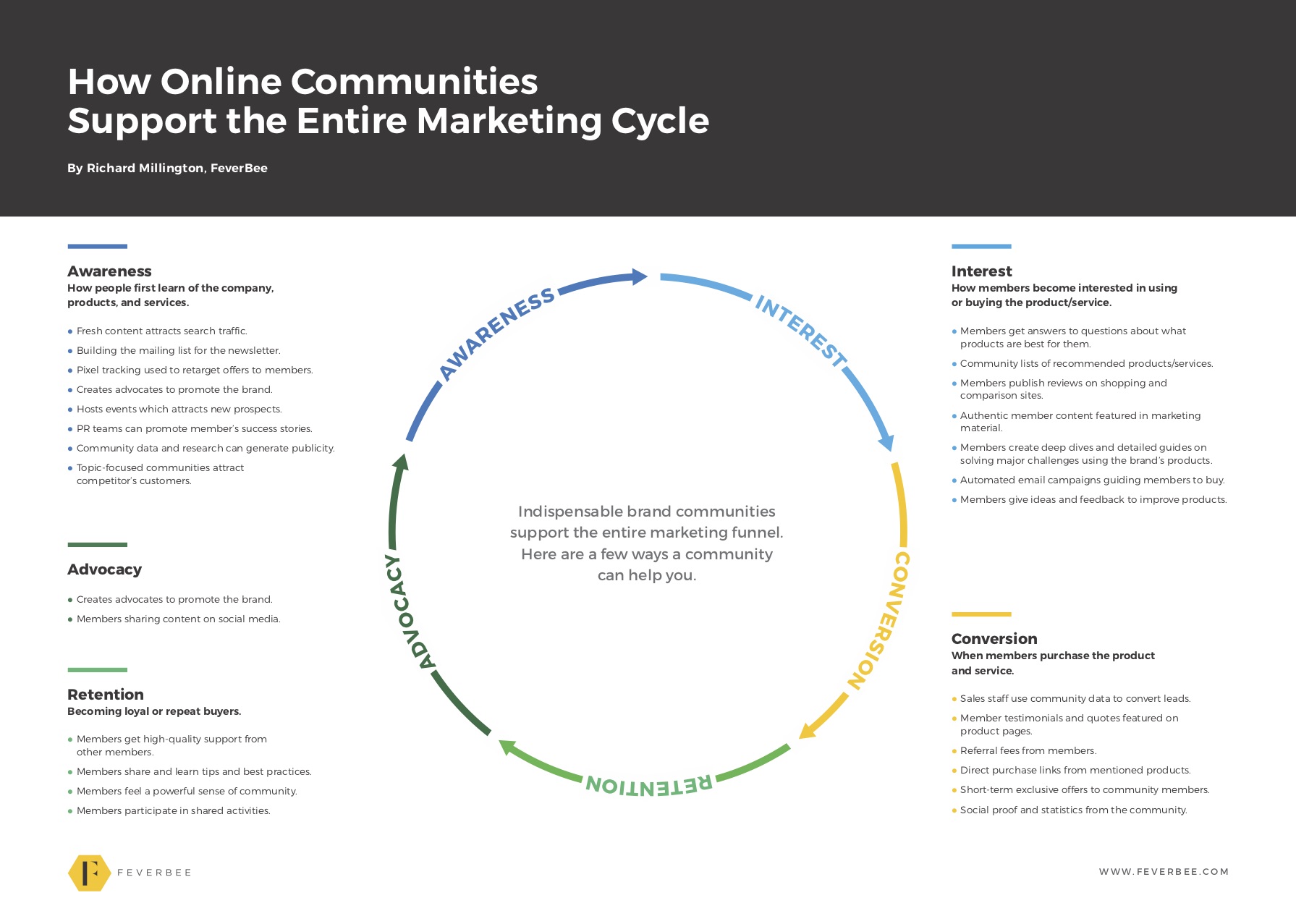
This graphic below gives a number of examples:

A successful community supports every stage of the funnel. For a breakdown

Awareness

In the awareness stage, communities can:

  • Attract more search traffic.
  • Help build a mailing list.
  • Create retargeting opportunities through pixel tracking.
  • Nurture advocates for the brand.
  • Host events that attract new prospects.
  • Provide PR teams with success stories to promote.
  • Provide statistics that can be promoted publicly.
  • Be targeted in a particular topic to attract a broader base of customers.

Interest

In the interest stage, communities can help members become more interested in buying the product or service. This includes:

  • Members getting answers to product questions (notably which are best for them).
  • Community-created lists of recommended products/services for different use cases.
  • Members publishing reviews on shopping and comparison sites.
  • Members creating content that is featured in marketing material.
  • Members creating long-form guides solving particular problems with your products/services.
  • Automated email campaigns guiding members to buy items based upon community participation.
  • Members giving ideas and feedback to improve products.

Conversion

In the conversion stage, communities can increase the number of interested prospects who make a commitment. This includes:

  • Sales staff using community data to help convert leads (knowing what people have searched for and looked up before).
  • Member testimonials and quotes featured on product pages.
  • Including purchase links directly to mentioned products.
  • Members getting referral fees to help sell products.
  • Short-term exclusive offers to members only.
  • Using social proof and statistics throughout the community.

Retention

Communities play a role (although often overstated) in retaining members. This comes via:

  • Members having an improved experience by getting high-quality support from other members.
  • Members sharing and learning tips/best practices to get more value from their products.
  • Members feel a powerful sense of community.
  • Members participating in shared activities together and befriending others.

Advocacy

In the advocacy stage, communities can:

  • Turn members into advocates who promote the brand through social channels.
  • Members sharing content created within the community with others.

The biggest win for many of us building communities professionally is to build the relationships, processes, and features necessary to ensure our community supports as many aspects of the business as possible.

19 Dec 00:13

A walk around our East Van neighbourhood lookin...

A walk around our East Van neighbourhood looking at Christmas lights. Ferndale was the most magnificent.

19 Dec 00:13

Kleine Codec-Nachhilfe

by Volker Weber

Ich habe mit Bedo diskutiert, warum der AirPods Max kein Kabel braucht, um einen guten Klang zu erzeugen. Sehen wir mal von den Unterschieden zwischen Bluetooth 4.1 und 5.0 ab, dann gibt es einen wichtigen Grund, warum sein Bowers&Wilkins am Kabel besser klingt als per Bluetooth.

Es gibt im wesentlichen vier Codecs, mit denen Musik komprimiert wird, und ich stelle das sehr vereinfacht dar: SBC, aptX, AAC, LDAC. Genaues könnt Ihr hier nachlesen.

  • SBC ist Teil des Bluetooth-Profils "A2DP". Der funktioniert immer, aber nicht so dolle.
  • Die aptX-Familie gehört Qualcomm und sorgt für besseren Klang.
  • AAC (dvanced Audio Coding) ist ein Standard der MPEG. Der kann bis zu 48 Spuren übertragen.
  • LDAC ist ein Sony-Codec für 24/96-Übertragung.

Die an einer Verbindung beteiligten Geräte können mittels SBC übertragen, oder einem gemeinsamen, besseren Codec. Das iPhones und iPads sprechen AAC, Mac sprechen AAC und aptX, Android-Handy häufig aptX (wegen Qualcomm-Chips).

Und jetzt schauen wir ein paar Kopfhörer an:

AAC: Beats Studio3, alle neuen Jabra, Sony 1000XM3 und 1000XM4, AirPods, Shure AONIC 50
aptX: Sony 1000XM3, Shure AONIC 50, Bowers&Wilkins P5 Wireless
LDAC: Sony 1000XM3 und 1000XM4, Shure AONIC 50

Wenn Ihr also einen Review lest, der meint, der AirPods Max klinge nicht so dolle, dann wisst Ihr jetzt warum.


19 Dec 00:11

How the FireEye post about being hacked could be clearer

by Josh Bernoff

FireEye is a cyber security company with tools you can use to test your systems. Somebody hacked them and stole the tools. I’ll give FireEye credit for discussing the theft honestly, but they’ve got a bit to learn about clarity under pressure. Analyzing FireEye’s post Here’s the post with my analysis. FireEye Shares Details of … Continued

The post How the FireEye post about being hacked could be clearer appeared first on without bullshit.

19 Dec 00:10

The New Laws of Robotics and what they might mean for AI

Aaron Davis, Read Write Collect, Dec 15, 2020
Icon

This short article provides me with a frame to highlight a few resources. The focus is this audio program from ABC in Australia with Frank Pasquale about his new book New Laws of Robotics. The 'new laws' aren't just an update on Asimov's original three laws, they are (to my view) an over-reaction to the threat from AI, maintain that robots must never replace humans, must never appear human, must  be prevented from intensifying “zero-sum arms races,” and must always identify their owner/operators. Call me a cynic, but I still prefer Asimov's rules. In that light, I think people making rules for AI would do well to revisit Dave Winer's 2017 Rules for Standards Makers (especially the remarks about practice and the idea that people "feel like they can make decisions that the world will then obey. You can hear it how people talk"). Related: AI for Social Good (76 page PDF) from Monash University and Mozilla's vision for trustworthy AI (69 page PDF released today).

Web: [Direct Link] [This Post]
19 Dec 00:10

Shawn's Rail-Trail Explorer

by noreply@blogger.com (VeloOrange)

by Igor

The Great Allegheny Passage and C&O Canal rail trails are great gems of our area. If this is your first time hearing about these trails, the Great Allegheny Passage (GAP) goes from Pittsburgh, PA to Cumberland, MD and the C&O Canal continues from Cumberland to Washington DC. The combination of 0 (read: zero) car traffic, low elevation change, cute trail towns, and free camping, and ample water sources makes this trail combo world renowned. People come from all over the globe (in normal times) to ride this route combination of nearly 333 miles. And since these trails are basically in our backyard, we've ridden them a lot.

So while the trails can be ridden on most wide-tired bikes, having a bike built up with the knowledge of what the trail entails and what the rider needs, means that the bike can disappear and one can simply enjoy being in the moment - surrounded by the beautiful scenery that the Mid-Atlantic has to offer.

That brings us to Shawn's Low Kicker Polyvalent build. He lives nearby to the trail and was ready to upgrade his current ride to a bike with dedicated front and rear racks, wider tires, upright position, fenders, and a timeless aesthetic. After a few conversations, we settled on a build list and went to work getting everything fitted. This is one ultra smooth and comfortable ride.

Let's talk cockpit. Trekking Bars are one of those love 'em or hate 'em sort of selections. Shawn liked them for their upright position and multiple hand positions. They're super popular in Europe for that reason, too!


The drivetrain is a simple 1x11. There isn't much elevation change over the whole trail, so you don't need a double or triple crankset. We often get questions about clutches on rear derailleurs for 1x systems. Basically, the clutch on a rear like this acts like a strong spring and retains chain tension over the whole drivetrain. It prevents the chain from bouncing around over roots, potholes, and the like. They say the GAP was built by machine and the C&O was built by man. I would agree.


Braking is handled by our favorites, the TRP Spyres, which we paired to our Grand Cru Brake Levers. The calipers have a piston on either side of the rotor, so it squeezes more consistently.

The wheels are our Rear and Front Disc Hubs laced to Voyager Rims. So while they are extremely shiny, they're also super tough as well as tubeless compatible. We opted for Ultradynamico 650bx48mm Cava tires. I really like these for all sorts of crushed limestone and roughly hewn trails.


Shawn also opted for Front and Rear Campeur Racks. They aren't terribly heavy, so he can try out different loading and luggage arrangements.


These trails can get pretty messy after rains and when the snow starts melting, so a good set of full coverage fenders should be a must. He opted for the 650b Wavy Fenders (a personal favorite) and front and rear mudflaps. 


This is one ultra smooth and beautiful machine. Happy riding, Shawn!

If you're looking for a very complete build list, here you go!
19 Dec 00:10

Microsoft Office 365 Updated to Support Apple Silicon and Big Sur

by Alex Guyot

Microsoft today announced updates to their suite of Microsoft 365 apps to support Apple Silicon, including design tweaks to match the look of macOS Big Sur:

We are excited to announce that starting today we are releasing new versions of many of our Microsoft 365 for Mac apps that run natively on Macs with M1. This means that now our core flagship Office apps—Outlook, Word, Excel, PowerPoint, and OneNote—will run faster and take full advantage of the performance improvements on new Macs, making you even more productive on the latest MacBook Air, 13-inch MacBook Pro, and Mac mini. The new Office apps are Universal, so they will continue to run great on Macs with Intel processors. The apps are not only speedy, but they also look fantastic as they have been redesigned to match the new look of macOS Big Sur.

Among the other changes, Microsoft’s Outlook for Mac can now be used with iCloud email addresses for the first time. The Apple Silicon update for Microsoft Teams isn’t ready yet, but they’re working on it:

Microsoft Teams is currently available in Rosetta emulation mode on Macs with M1 and the browser. We are working on universal app support for M1 Macs and will share more news as our work progresses.

→ Source: microsoft.com

18 Dec 06:18

Be the hawk

by Doc Searls

Northern Red-Tail Hawk

On Quora the question went, If you went from an IQ of 135+ to 100, how would it feel?

Here’s how I answered::::

I went through that as a kid, and it was no fun.

In Kindergarten, my IQ score was at the top of the bell curve, and they put me in the smart kid class. By 8th grade my IQ score was down at the middle of the bell curve, my grades sucked, and my other standardized test scores (e.g. the Iowa) were terrible. So the school system shunted me from the “academic” track (aimed at college) to the “general” one (aimed at “trades”).

To the school I was a failure. Not a complete one, but enough of one for the school to give up on aiming me toward college. So, instead of sending me on to a normal high school, they wanted to send me to a “vocational-technical” school where boys learned to operate machinery and girls learned “secretarial” skills.

But in fact the school failed me, as it did countless other kids who adapted poorly to industrialized education: the same industrial system that still has people believing IQ tests are a measure of anything other than how well somebody answers a bunch puzzle questions on a given day.

Fortunately, my parents believed in me, even though the school had given up. I also believed in myself, no matter what the school thought. Like Walt Whitman, I believed “I was never measured, and never will be measured.” Walt also gifted everyone with these perfect lines (from Song of Myself):

I know I am solid and sound.
To me the converging objects of the universe
perpetually flow.

All are written to me,
and I must get what the writing means…
I know this orbit of mine cannot be swept
by a carpenter’s compass,

I know that I am august,
I do not trouble my spirit to vindicate itself
or be understood.
I see that the elementary laws never apologize.

Whitman argued for the genius in each of us that moves in its own orbit and cannot be encompassed by industrial measures, such as standardized tests that serve an institution that would rather treat students like rats in their mazes than support the boundless appetite for knowledge with which each of us is born—and that we keep if it doesn’t get hammered out of us by normalizing systems.

It amazes me that half a century since I escaped from compulsory schooling’s dehumanizing wringer, the system is largely unchanged. It might even be worse. (“Study says standardized testing is overwhelming nation’s public schools,” writes The Washington Post.)

To detox ourselves from belief in industrialized education, the great teacher John Taylor Gatto gives us The Seven Lesson Schoolteacher, which summarizes what he was actually paid to teach:

  1. Confusion — “Everything I teach is out of context. I teach the un-relating of everything. I teach disconnections. I teach too much: the orbiting of planets, the law of large numbers, slavery, adjectives, architectural drawing, dance, gymnasium, choral singing, assemblies, surprise guests, fire drills, computer languages, parents’ nights, staff-development days, pull-out programs, guidance with strangers my students may never see again, standardized tests, age-segregation unlike anything seen in the outside world….What do any of these things have to do with each other?”
  2. Class position — “I teach that students must stay in the class where they belong. I don’t know who decides my kids belong there but that’s not my business. The children are numbered so that if any get away they can be returned to the right class. Over the years the variety of ways children are numbered by schools has increased dramatically, until it is hard to see the human beings plainly under the weight of numbers they carry. Numbering children is a big and very profitable undertaking, though what the strategy is designed to accomplish is elusive. I don’t even know why parents would, without a fight, allow it to be done to their kids. In any case, again, that’s not my business. My job is to make them like it, being locked in together with children who bear numbers like their own.”
  3. Indifference — “I teach children not to care about anything too much, even though they want to make it appear that they do. How I do this is very subtle. I do it by demanding that they become totally involved in my lessons, jumping up and down in their seats with anticipation, competing vigorously with each other for my favor. It’s heartwarming when they do that; it impresses everyone, even me. When I’m at my best I plan lessons very carefully in order to produce this show of enthusiasm. But when the bell rings I insist that they stop whatever it is that we’ve been working on and proceed quickly to the next work station. They must turn on and off like a light switch. Nothing important is ever finished in my class, nor in any other class I know of. Students never have a complete experience except on the installment plan. Indeed, the lesson of the bells is that no work is worth finishing, so why care too deeply about anything?
  4. Emotional dependency — “By stars and red checks, smiles and frowns, prizes, honors and disgraces I teach kids to surrender their will to the predestined chain of command. Rights may be granted or withheld by any authority without appeal, because rights do not exist inside a school — not even the right of free speech, as the Supreme Court has ruled — unless school authorities say they do. As a schoolteacher, I intervene in many personal decisions, issuing a pass for those I deem legitimate, or initiating a disciplinary confrontation for behavior that threatens my control. Individuality is constantly trying to assert itself among children and teenagers, so my judgments come thick and fast. Individuality is a contradiction of class theory, a curse to all systems of classification.”
  5. Intellectual dependency — “Good people wait for a teacher to tell them what to do. It is the most important lesson, that we must wait for other people, better trained than ourselves, to make the meanings of our lives. The expert makes all the important choices; only I, the teacher, can determine what you must study, or rather, only the people who pay me can make those decisions which I then enforce… This power to control what children will think lets me separate successful students from failures very easily.
  6. Provisional self-esteem — “Our world wouldn’t survive a flood of confident people very long, so I teach that your self-respect should depend on expert opinion. My kids are constantly evaluated and judged. A monthly report, impressive in its provision, is sent into students’ homes to signal approval or to mark exactly, down to a single percentage point, how dissatisfied with their children parents should be. The ecology of “good” schooling depends upon perpetuating dissatisfaction just as much as the commercial economy depends on the same fertilizer.
  7. No place to hide — “I teach children they are always watched, that each is under constant surveillance by myself and my colleagues. There are no private spaces for children, there is no private time. Class change lasts three hundred seconds to keep promiscuous fraternization at low levels. Students are encouraged to tattle on each other or even to tattle on their own parents. Of course, I encourage parents to file their own child’s waywardness too. A family trained to snitch on itself isn’t likely to conceal any dangerous secrets. I assign a type of extended schooling called “homework,” so that the effect of surveillance, if not that surveillance itself, travels into private households, where students might otherwise use free time to learn something unauthorized from a father or mother, by exploration, or by apprenticing to some wise person in the neighborhood. Disloyalty to the idea of schooling is a Devil always ready to find work for idle hands. The meaning of constant surveillance and denial of privacy is that no one can be trusted, that privacy is not legitimate.”

Gatto won multiple teaching awards because he refused to teach any of those lessons. I succeeded in life by refusing to learn them as well.

All of us can succeed by forgetting those seven lessons—especially the one teaching that your own intelligence can be measured by anything other than what you do with it.

You are not a number. You are a person like no other. Be that, and refuse to contain your soul inside any institutional framework.

More Whitman:

Long enough have you dreamed contemptible dreams.
Now I wash the gum from your eyes.
You must habit yourself to the dazzle of the light and of every moment of your life.

Long have you timidly waited,
holding a plank by the shore.
Now I will you to be a bold swimmer,
To jump off in the midst of the sea, and rise again,
and nod to me and shout,
and laughingly dash your hair.

I am the teacher of athletes.
He that by me spreads a wider breast than my own
proves the width of my own.
He most honors my style
who learns under it to destroy the teacher.

Do I contradict myself?
Very well then. I contradict myself.
I am large. I contain multitudes.

I concentrate toward them that are nigh.
I wait on the door-slab.

Who has done his day’s work
and will soonest be through with his supper?
Who wishes to walk with me.

The spotted hawk swoops by and accuses me.
He complains of my gab and my loitering.

I too am not a bit tamed. I too am untranslatable.
I sound my barbaric yawp over the roofs of the world.

Be that hawk.

18 Dec 06:18

Mozilla’s Vision for Trustworthy AI

by Mark Surman

Mozilla is publishing its white paper, “Creating Trustworthy AI.”


A little over two years ago, Mozilla started an ambitious project: deciding where we should focus our efforts to grow the movement of people committed to building a healthier digital world. We landed on the idea of trustworthy AI.

When Mozilla started in 1998, the growth of the web was defining where computing was going. So Mozilla focused on web standards and building a browser. Today, computing — and the digital society that we all live in — is defined by vast troves of data, sophisticated algorithms and omnipresent sensors and devices. This is the era of AI. Asking questions today such as ‘Does the way this technology works promote human agency?’ or ‘Am I in control of what happens with my data?’ is like asking ‘How do we keep the web open and free?’ 20 years ago.

This current era of computing — and the way it shapes the consumer internet technology that more than 4 billion of us use everyday — has high stakes. AI increasingly powers smartphones, social networks, online stores, cars, home assistants and almost every other type of electronic device. Given the power and pervasiveness of these technologies, the question of whether AI helps and empowers or exploits and excludes will have a huge impact on the direction that our societies head over the coming decades.

It would be very easy for us to head in the wrong direction. As we have rushed to build data collection and automation into nearly everything, we have already seen the potential of AI to reinforce long-standing biases or to point us toward dangerous content. And there’s little transparency or accountability when an AI system spreads misinformation or misidentifies a face. Also, as people, we rarely have agency over what happens with our data or the automated decisions that it drives. If these trends continue, we’re likely to end up in a dystopian AI-driven world that deepens the gap between those with vast power and those without.

On the other hand, a significant number of people are calling attention to these dangerous trends — and saying ‘there is another way to do this!’ Much like the early days of open source, a growing movement of technologists, researchers, policy makers, lawyers and activists are working on ways to bend the future of computing towards agency and empowerment. They are developing software to detect AI bias. They are writing new data protection laws. They are inventing legal tools to put people in control of their own data. They are starting orgs that advocate for ethical and just AI. If these people — and Mozilla counts itself amongst them — are successful, we have the potential to create a world where AI broadly helps rather than harms humanity.

It was inspiring conversations with people like these that led Mozilla to focus the $20M+ that it spends each year on movement building on the topic of trustworthy AI. Over the course of 2020, we’ve been writing a paper titled “Creating Trustworthy AI” to document the challenges and ideas for action that have come up in these conversations. Today, we release the final version of this paper.

This ‘paper’ isn’t a traditional piece of research. It’s more like an action plan, laying out steps that Mozilla and other like-minded people could take to make trustworthy AI a reality. It is possible to make this kind of shift, just as we have been able to make the shift to clean water and safer automobiles in response to risks to people and society. The paper suggests the code we need to write, the projects we need to fund, the issues we need to champion, and the laws we need to pass. It’s a toolkit for technologists, for philanthropists, for activists, for lawmakers.

At the heart of the paper are eight big challenges the world is facing when it comes to the use of AI in the consumer internet technologies we all use everyday. These are things like: bias; privacy; transparency; security; and the centralization of AI power in the hands of a few big tech companies. The paper also outlines four opportunities to meet these challenges. These opportunities centre around the idea that there are developers, investors, policy makers and a broad public that want to make sure AI works differently — and to our benefit. Together, we have a chance to write code, process data, create laws and choose technologies that send us in a good direction.

Like any major Mozilla project, this paper was built using an open source approach. The draft we published in May came from 18 months of conversations, research and experimentation. We invited people to comment on that draft, and they did. People and organizations from around the world weighed in: from digital rights groups in Poland to civil rights activists in the U.S, from machine learning experts in North America to policy makers at the highest levels in Europe, from activists, writers and creators to ivy league professors. We have revised the paper based on this input to make it that much stronger. The feedback helped us hone our definitions of “AI” and “consumer technology.” It pushed us to make racial justice a more prominent lens throughout this work. And it led us to incorporate more geographic, racial, and gender diversity viewpoints in the paper.

In the months and years ahead, this document will serve as a blueprint for Mozilla Foundation’s movement building work, with a focus on research, advocacy and grantmaking. We’re already starting to manifest this work: Mozilla’s advocacy around YouTube recommendations has illuminated how problematic AI curation can be. The Data Futures Lab and European AI Fund that we are developing with partner foundations support projects and initiatives that reimagine how trustworthy AI is designed and built across multiple continents. And Mozilla Fellows and Awardees like Sylvie Delacroix, Deborah Raj, and Neema Iyer are studying how AI intersects with data governance, equality, and systemic bias. Past and present work like this also fed back into the white paper, helping us learn by doing.

We also hope that this work will open up new opportunities for the people who build the technology we use everyday. For so long, building technology that valued people was synonymous with collecting no or little data about them. While privacy remains a core focus of Mozilla and others, we need to find ways to protect and empower users that also include the collection and use of data to give people experiences they want. As the paper outlines, there are more and more developers — including many of our colleagues in the Mozilla Corporation — who are carving new paths that head in this direction.

Thank you for reading — and I look forward to putting this into action together.

The post Mozilla’s Vision for Trustworthy AI appeared first on The Mozilla Blog.

18 Dec 06:18

Our Year in Review: How we’ve kept Firefox working for you in 2020

by Selena Deckelmann

This year began like any other year, with our best intentions and resolutions to carry out. Then by March, the world changed and everyone’s lives — personally and professionally — turned upside down. Despite that, we kept to our schedule to release a new Firefox every month and we were determined to keep Firefox working for you during challenging times.

We shifted our focus to work on features aimed at helping people adjust to the new way of life, and we made Firefox faster so that you could get more things done. It’s all part of fulfilling our promise to build a better internet for people. So, as we eagerly look to the end of 2020, we look back at this unprecedented year and present you with our list of top features that made 2020 a little easier.

Keeping Calm and Carrying on

How do you cope with this new way of life spent online? Here were the Firefox features we added this year, aimed at bringing some zen in your life.

  • Picture-in-Picture: An employee favorite, we rolled out Picture-in-Picture to Mac and Linux, making it available on all platforms, where previously it was only available on Windows. We continued to improve Picture-in-Picture throughout the year — adding features like keyboard controls for fast forward and rewind — so that you could multitask like never before. We, too, were seeking calming videos; eyeing election results; and entertaining the little ones while trying to juggle home and work demands.
  • No more annoying notifications: We all started browsing more as the web became our window into the outside world, so we replaced annoying notification request pop-ups to stop interrupting your browsing, and added a speech bubble in the address bar when you interacted with the site.
  • Pocket article recommendations: We brought our delightful Pocket article recommendations to Firefox users beyond the US, to Austria, Belgium, Germany, India, Ireland, Switzerland, and the United Kingdom. For anyone wanting to take a pause on doom scrolling, simply open up a new tab in Firefox and check out the positivity in the Pocket article recommendations.
  • Ease eye strain with larger screen view: We all have been staring at the screen for longer than we ever thought we should. So, we’ve improved the global level zoom setting so you can set it and forget it. Then, every website can appear larger, should you wish, to ease eye strain. We also made improvements to our high contrast mode which made text more readable for users with low vision.


Get Firefox


Getting you faster to the places you want to visit

We also looked under the hood of Firefox to improve the speed and search experiences so you could get things done no matter what 2020 handed you.

  • Speed: We made Firefox faster than ever with improved performance on both page loads and start up time. For those the technical details:
      • Websites that use flexbox-based layouts load 20% faster than before;
      • Restoring a session is 17% quicker, meaning you can more quickly pick up where you left off;
      • For Windows users, opening new windows got quicker by 10%;
      • Our JavaScript engine got a revamp improving page load performance by up to 15%, page responsiveness by up to 12%, and reduced memory usage by up to 8%, all the while making it more secure.
  • Search made faster: We were searching constantly this year — what is coronavirus; do masks work; and what is the electoral college? The team spent countless hours improving the search experience in Firefox so that you could search smarter, faster — You could type less and find more with the revamped address bar, where our search suggestions got a redesign. An updated shortcut suggests search engines, tabs, and bookmarks, getting you where you want to go right from the address bar.
  • Additional under-the-hood improvements: We made noticeable improvements to Firefox’s printing experience, which included a fillable PDF form. We also improved your shopping experience with updates to our password management and credit card autofill.

Our promise to build a better internet

This has been an unprecedented year for the world, and as you became more connected online, we stayed focused on pushing for more privacy. It’s just one less thing for you to worry about.

  • HTTPS-Only mode: If you visit a website that asks for your email address or payment info, look for that lock in the address bar, which indicates your connection to it is secure. A site that doesn’t have the lock signals its insecure. It could be as simple as an expired Secure Socket Layer (SSL) certificate. No matter, Firefox’s new HTTPS-Only mode will attempt to establish fully secure connections to every website you visit and will also ask for your permission before connecting to a website if it doesn’t support secure connections.
  • Added privacy protections: We kicked off the year by expanding our Enhanced Tracking Protection, preventing known fingerprinters from profiling our users based on their hardware, and introduced a protection against redirect tracking — always on while you are browsing more than ever.
  • Facebook Container updates: Given the circumstances of 2020, it makes sense that people turned to Facebook to stay connected to friends and family when we couldn’t visit in person. Facebook Container — which helps prevent Facebook from tracking you around the web — added improvements that allowed you to create exceptions to how and when it blocks Facebook logins, likes, and comments, giving you more control over your relationship with Facebook.

Even if you didn’t have Firefox to help with some of life’s challenges online over the past year, don’t start 2021 without it. Download the latest version of Firefox and try these privacy-protecting, easy-to-use features for yourself.

The post Our Year in Review: How we’ve kept Firefox working for you in 2020 appeared first on The Mozilla Blog.

14 Dec 21:57

What comes after smartphones?

by Benedict Evans

For as long as most people can remember, the tech industry has had a new centre roughly every fifteen years. A model of computing sets the agenda, and the company or companies that win that model dominate the industry, and everyone is scared of them, and then a new model comes along, forms a new centre, and the old model stops mattering.  Mainframes were followed by PCs, and then the web, and then smartphones. 

Each of these new models started out looking limited and insignificant, but each of them unlocked a new market that was so much bigger that it pulled in all of the investment, innovation and company creation and so grew to overtake the old one. 

Meanwhile, the old models didn’t go away, and neither, mostly, did the companies that had been created by them. Mainframes are still a big business and so is IBM; PCs are still a big business and so is Microsoft. But they don’t set the agenda anymore - no-one is afraid of them. 

Today, multitouch smartphones are getting on for 15 years old, and the S curve is flattening out. All the obvious stuff has been built, Apple and Google won, and the new iPhone isn’t very exciting, because it can’t be. So, we ask “what’s the next generation?” 

There are several ways to try to answer this. 

First, each of the previous S Curves unlocked a dramatically larger new market, but well over 4bn people have a smartphone today and there are only 5.7bn adults on earth. We can’t unlock a radically bigger market on that axis - we’ve run out of people. Yes, we will probably deploy billions more sensors around the world, but a street light that phones home if the bulb fails is not a new platform, even if it uses a neural network (AI!) and a radio (5G!). So, in one important way, that growth model seems to be complete.  

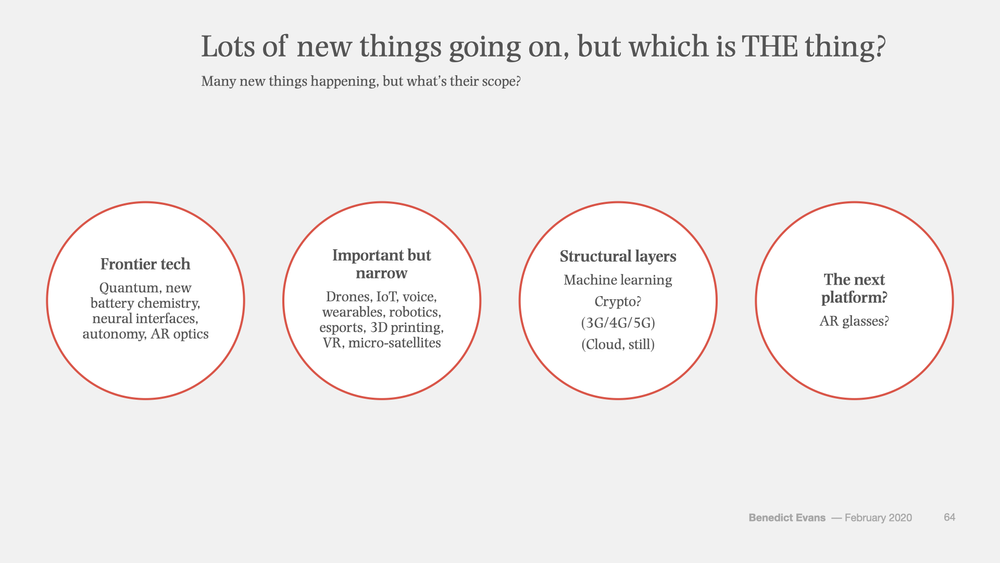
A second approach would be to ask - ‘what’s in the labs?’ I made this slide for a presentation I gave in Davos at the beginning of the year (which now feels like a decade ago) - I’m sure people will disagree with my allocations, but the point is to try to think about the stages and applicability. 

2020 Shoulders of Giants 1.1.001.png

There’s a huge amount of innovation and a huge amount of primary technology creation going on at the moment, but there always is - the question here is how universal something could become. Hence, most of these could be very important to society, but plant-based meat or micro-satellites are not a model to replace smartphones or search as primary levers of the tech industry. Theoretically, a neural interface of some kind could do that, but the technology to make that more than a way to turn on a light or open a door seems to be decades away - this is science fiction, not a forecast. 

The device model that could perhaps replace the smartphone is VR, or AR, or both. These cannot reach more people than smartphones (again - we ran out of people) but they could nonetheless replace the experience. At the moment this is pretty speculative. We have VR devices that are good for games and some narrow industrial use cases and there is a hope that the hardware and software can grow to become universal, but it’s not yet clear if following the hardware roadmap is all that’s needed for that to happen, or if VR needs some fundamental change if it’s to be more than a deeper and narrower subset of the games console industry (I wrote about this here). AR glasses, on the other hand, are still a frontier science question - can we create optics that look like a normal pair of reading glasses (or, one day in a few decades, contact lenses) and yet that can put something into the world that looks as though it’s really there, in broad daylight, with a good field of view? And if we can, as for VR, it’s magical, but how useful is that? Looking at this stuff today is rather like seeing a multitouch demo in 2005 - it’s clearly good for something, but what? 

However, all of this might be the wrong mental model for thinking about the next step. As well as looking at the sequence ‘mainframe - PC - web - smartphone’, we should probably also think about what was going on underneath: ‘database - client/server - open source - cloud’, perhaps. That is, there are other progressions that are less visible but just as important. On that model, the fundamental trends of today are clearly machine learning and, perhaps, crypto. It’s very obvious that we are remaking the tech industry around machine learning, and probably a lot of other industries as well, and while there is a clear reason why there might not be anything after smartphones any time soon, I don’t think anyone would argue there won’t be anything after machine learning - there is a continuous process of innovation and creation (and, indeed, a pendulum, from server to local and back again). Meanwhile, if you come from Silicon Valley then things like cloud and SaaS seem like old and boring topics, but only around a quarter of large enterprise workflows have moved to the cloud at all so far - the rest are still ‘on-prem’ in old systems and indeed in mainframes. There is a huge amount of work and company creation to moving (a lot of) the rest in the next decade or two (this, really, is what I think ‘digital transformation’ means). 

There’s one more model to think about, though. 

We’ve spent the last few decades getting to the point that we can now give everyone on earth a cheap, reliable, easy-to-use pocket computer with access to a global information network. But so far, though over 4bn people have one of these things, we’ve only just scratched the surface of what we can do with them. There’s an old saying that the first fifty years of the car industry were about creating car companies and working out what cars should look like, and the second fifty years were about what happened once everyone had a car - they were about McDonalds and Walmart, suburbs and the remaking of the world around the car, for good and of course bad. The innovation in cars became everything around the car. One could suggest the same today about smartphones - now the innovation comes from everything else that happens around them.

14 Dec 21:56

Made sourdough focaccia today. I’m getting t...

Made sourdough focaccia today.

I’m getting the “sour” flavour, but only my first bread that I added commercial yeast to really worked.

I’ll toast it in the morning and see how I like it.

14 Dec 21:55

Video-Interview aufzeichnen leicht gemacht

by Volker Weber

Wir haben alles mögliche probiert, dabei wäre es so einfach gewesen. In Skype kann man Interviews aufzeichnen. Die stehen dann bei Microsoft für 30 Tage in der Cloud, es sei denn, man löscht sie wieder. Das Original ist besser als bei Twitter. Die Latenz ist auch kleiner, aber das spielt eh keine Rolle. Die Tonspur lässt sich problemlos in post verschieben. Dazu muss man nur einmal in die Hände klatschen. Das sieht man im Video und in der Tonspur. Aufeinander legen, fertig.

Kennt Ihr MeetNow? Super genial, weil man nichts installieren muss und nicht mal einen Microsoft Account braucht. Microsoft baut das gerade rechts unten in Windows ein und natürlich haben die Kollegen wieder was zu meckern,

14 Dec 21:54

19 dishes make case for Pampanga as culinary capital of PH - ABS-CBN News

14 Dec 21:51

Why getting voting right is hard, Part II: Hand-Counted Paper Ballots

by Eric Rescorla

In Part I we looked at desirable properties for voting system. In this post, I want to look at the details of a specific system: hand-counted paper ballots.

Sample Ballot

Hand-counted paper ballots are probably the simplest voting system in common use (though mostly outside the US). In practice, the process usually looks something like the following:

  1. Election officials pre-print paper ballots and distribute them to polling places. Each paper ballot has a list of contests and the choices for each contest, and a box or some other location where the voter can indicate their choice, as shown above.
  2. Voters arrive at the polling place, identify themselves to election workers, and are issued a ballot. They mark the section of the ballot corresponding to their choice. They cast their ballots by putting them into a ballot box, which can be as simple as a cardboard box with a hole in the top for the ballots.
  3. Once the polls close, the election workers collect all the ballots. If they are to be locally counted, then the process is as below; if they are to be centrally counted, they are transported back to election headquarters for counting.

The counting process varies between jurisdictions, but at a high level the process is simple. The vote counters go through each ballot one at a time and determine which choice it is for. Joseph Lorenzo Hall provides a good description of the procedure for California’s statutory 1% tally here:

In practice, the hand-counting method used by counties in California seems very similar. The typical tally team uses four people consisting of two talliers, one caller and one witness:

  • The caller speaks aloud the choice on the ballot for the race being tallied (e.g., “Yes…Yes…Yes…” or “Lincoln…Lincoln…Lincoln…”).
  • The witness observes each ballot to ensure that the spoken vote corresponded to what was on the ballot and also collates ballots in cross-stacks of ten ballots.
  • Each tallier records the tally by crossing out numbers on a tally sheet to keep track of the vote tally.

Talliers announce the tally at each multiple of ten (“10”, “20”, etc.) so that they can roll-back the tally if the two talliers get out of sync.

Obviously other techniques are possible, but as long as people are able to observe, differences in technique are mostly about efficiency rather than accuracy or transparency. The key requirement here is that any observer can look at the ballots and see that they are being recorded as they are cast. Jurisdictions will usually have some mechanism for challenging the tally of a specific ballot.

Security and Verifiability

The major virtue of hand-counted paper ballots is that they are simple, with security and privacy properties that are easy for voters to understand and reason about, and for observers to verify for themselves

It’s easiest to break the election in two phases:

  • Voting and collecting the ballots
  • Counting the collected ballots

If each of these is done correctly, then we can have high confidence that the election was correctly decided.

Voting

The security properties of the voting process mostly come down to ballot handling, namely that:

  • Only authorized voters get ballots and only one ballot. Note that it’s necessary to ensure this because otherwise it’s very hard to prevent multiple voting, where an authorized voter puts in two ballots.
  • Only the ballots of authorized voters make it into the ballot box.
  • All the ballots in the ballot box and only the ballots from the ballot box make it to election headquarters.

The first two of these properties are readily observed by observers — whether independent or partisan. The last property typically relies on technical controls. For instance, in Santa Clara county ballots are taken from the ballot box and put into clear tamper-evident bags for transport to election central, which limits the ability for poll workers to replace the ballots. When put together all three properties provide a high degree of confidence that the right ballots are available to be counted. This isn’t to say that there’s no opportunity for fraud via sleight-of-hand or voter impersonation (more on this later) but it’s largely one-at-a-time fraud, affecting a few ballots at a time, and is hard to perpetrate at scale.

Counting

The counting process is even easier to verify: it’s conducted in the open and so observers have their own chance to see each ballot and be confident that it has been counted correctly. Obviously, you need a lot of observers because you need at least one for each counting team, but given that the number of voters far exceeds the number of counting teams, it’s not that impractical for a campaign to come up with enough observers.

Probably the biggest source of problems with hand-counted paper ballots is disputes about the meaning of ambiguous ballots. Ideally voters would mark their ballots according to the instructions, but it’s quite common for voters to make stray marks, mark more than one box, fill in the boxes with dots instead of Xs, or even some more exotic variations, as shown in the examples below. In each case, it needs to be determined how to handle the ballot. It’s common to apply an “Intent of the voter” standard, but this still requires judgement. One extra difficulty here is that at the point where you are interpreting each ballot, you already know what it looks like, so naturally this can lead to a fair amount of partisan bickering about whether to accept each individual ballot, as each side tries to accept ballots that seem like they are for their preferred candidate and disqualify ballots that seem like they are for their opponent.

double marklizard people

A related issue is whether a given ballot is valid. This isn’t so much an issue with ballots cast at a polling place, but for vote-by-mail ballots there can be questions about signatures on the envelopes, the number of envelopes, etc. I’ll get to this later when I cover vote by mail in a later post.

Privacy/Secrecy of the Ballot

The level of privacy provided by paper ballots depends a fair bit on the precise details of how they are used and handled. In typical elections, voters will be given some level of privacy to fill out their ballot, so they don’t have to worry too much about that stage (though presumably in theory someone could set up cameras in the polling place). Aside from that, we primarily need to worry about two classes of attack:

  1. Tracking a given voter’s ballot from checkin to counting.
  2. Determining how a voter voted from the ballot itself.

Ideally — at least from the perspective of privacy — the ballots are all identical and the ballot box is big enough that you get some level of shuffling (how much is an open question), then it’s quite hard to correlate the ballot a voter was given to when it’s counted, though you might be able to narrow it down some by looking at which polling place/box the ballot came in and where it was in the box. In some jurisdictions, ballots have serial numbers, which might make this kind of tracking easier, though only if records of which voter gets which ballot are kept and available. Apparently the UK has this kind of system but tightly controls the records.

It’s generally not possible to tell from a ballot itself which voter it belongs to unless the voter cooperates by making the ballot distinctive in some way. This might happen because the voter is being paid (or threatened) to cast their vote a certain way. While some election jurisdictions prohibit distinguishing marks, as a practical matter it’s not really possible to prevent voters from making such marks if they really want to. This is especially true when the ballots need not be machine readable and so the voter has the ability to fill in the box somewhat distinctively (there are a lot of ways to write an X!). In elections with a lot of contests, as with many places on the US, it is also possible to use what’s called a “pattern voting” attack in which you vote one contest the way you are told and then vote the downballot contests in a way that uniquely identifies you. This sort of attack is very hard to prevent, but actually checking that people voted they way they were told is of course a lot of work. There are also more exotic attacks such as fingerprinting paper stock, but none of these are easy to mount in bulk.

Accessibility

One big drawback of hand-marked ballots is that they are not very accessible, either to people with disabilities or to non-native speakers. For obvious reasons, if you’re blind or have limited dexterity it can be hard to fill in the boxes (this is even harder with optical scan type ballots). Many jurisdictions that use paper ballots will also have some accommodation for people with disabilities. Paper ballots work fine in most languages, but each language must be separately translated and then printed, and then you need to have extras of each ballot type in case more people come than you expect, so at the end of the day the logistics can get quite complicated. By contrast, electronic voting machines (which I’ll get to later) scale much better to multiple languages.

Scalability

Although hand-counting does a good job of producing accurate and verifiable counts, it does not scale very well1. Estimates of how expensive it is to count ballots vary quite a bit, but a 2010 Pew study of hand recounts in Washington and Minnesota (the 2004 Washington gubernatorial and 2008 Minnesota US Senate races) put the cost of recounting a single contest at between $0.15 and $0.60 per ballot. Of course, as noted above some of the cost here is that of disputing ambiguous ballots. If the races is not particularly competitive then these ballots can be set aside and only need to be carefully adjudicated if they have a chance of changing the result.

Importantly, the cost of hand-counting goes up with the number of ballots times the number of contests on the ballot. In the United States it’s not uncommon to have 20 or more contests per election. For example, here is a sample ballot from the 2020 general election in Santa Clara County, CA. This ballot has the following contests

Type Count
President 1
US House of Representatives 1
State Assembly 1
Superior Court Judge 1
County Board of Education 1
County Board of Supervisors 1
Community College District 1
City Mayor 1
City Council (vote for two) 1
State Propositions 12
Local ballot measures 6
Total 32

In an election like this, the cost to count could be several dollars per ballot. Of course, California has an exceptionally large number of contests, but in general hand-counting represents a significant cost.

Aside from the financial impact of hand counting ballots, it just takes a long time. Pew notes that both the Washington and Minnesota recounts took around seven months to resolve, though again this is partly due to the small margin of victory. As another example, California law requires a “1% post-election manual tally” in which 1% of precincts are randomly selected for hand-counting. Even with such a restricted count, the tally can take weeks in a large county such as Los Angeles, suggesting that hand counting all the ballots would be prohibitive in this setting. This isn’t to say that hand counting can never work, obviously, merely that it’s not a good match for the US electoral system, which tends to have a lot more contests than in other countries.

Up Next: Optical Scanning

The bottom line here is that while hand counting works well in many jurisdictions it’s not a great fit for a lot of elections in the United States. So if we can’t count ballots by hand, then what can we do? The good news is that there are ballot counting mechanisms which can provide similar assurance and privacy properties to hand counting but do so much more efficiently, namely optical scan ballots. I’ll be covering that in my next post.


  1. By contrast, the marking process is very scalable: if you have a long line, you can put out more tables, pens, privacy screens, etc. 

The post Why getting voting right is hard, Part II: Hand-Counted Paper Ballots appeared first on The Mozilla Blog.

14 Dec 21:50

The Best USB-C Cables and Adapters

by Sarah Witman
A variety of USB-C cables and adapters.

Buying a USB-C cable might seem like a simple task, but behind this universal connector lies an array of complex options.

The best phone-charging cable, for instance, may not be the best choice for backing up data to a hard drive, and the fastest cables for data transfer may be overkill for connecting an external monitor. Newer connectivity interfaces such as Thunderbolt 4 and USB4 only complicate matters further.

We’ve tested dozens of USB-C cables and adapters to find the best options for every scenario and to rule out those that don’t work or are unsafe. Whether you’re replacing a lost USB-C cable or looking to get the best performance from your chargers and peripherals, these are the best cables to consider.

Dismiss
14 Dec 21:49

Kultusminister verbietet Schülern Distanzunterricht

by Volker Weber
Höchst offiziell und schriftlich verbietet Michael Piazolo (Freie Wähler), Kultusminister in Bayern, seinen Schülern Distanzunterricht. Hintergrund sind offenbar Versagensängste.

Ich verbringe die ganze Woche im Fernunterricht, auch Press Briefings genannt. Alle Unternehmen können das. Nur die Schulen dürfen das nicht können. Vermutlich, weil man dann erkennt, dass die ganzen Bastellösungen eben nur das sind.

More >

14 Dec 21:49

Microsoft on recent nation-state cyberattacks

by Volker Weber
Today, Microsoft is sharing information and issuing guidance about increased activities from a sophisticated threat actor that is focused on high value targets such as government agencies and cybersecurity companies. We believe this is nation-state activity at significant scale, aimed at both the government and private sector. While we aren’t sharing any details specific to individual organizations, it is important for us to share greater detail about some of the threat activity we’ve uncovered over the past weeks, along with guidance that security industry practitioners can use to find and mitigate potential malicious activity.

There is a lot going on that you don't see if you just look at your own PC.

More >

14 Dec 21:47

EV Charger at Queen Elizabeth Hospital

by peter@rukavina.net (Peter Rukavina)

There’s now an electric vehicle charger at the Queen Elizabeth Hospital, which would have been a big help to use when Catherine was regularly receiving treatment there.

I’m hopeful that a charger will also be installed at the PEI Palliative Care Centre, a place where, I can attest from personal experience, the last thing you want to be worrying about is whether your car’s battery has enough juice to get you home.

14 Dec 03:23

A Random Word About CentOS

by Rui Carmo

Regardless of the name of this blog and my current employer, I’m still a UNIX guy first and foremost, and as such I can’t help but ponder the implications of this week’s little IBM/RedHat drama. And rather than just link to it with a short quip, I think a little more is in order.

I used to run Red Hat Linux way back (I shunned the chaos of Slackware, and still have a 4.3 CD someplace as a memento of my switch over), and many of my telco and financial sector customers use it (largely due to the enterprise support, ecosystem, and now, OpenShift). And, of course, Oracle has its own spin on it (now “unbreakably” obfuscated under their product line), so it’s effectively inescapable wherever you go.

Also, a few of my friends have (maybe a little stubbornly) stuck to CentOS for decades because it was stable and predictable. And, for a long time, I agreed with them. I spent way too long dealing with RHEL variants (like the Cobalt boxes, for which I backported untold amounts of RPMs) and knew most packaging intricacies (and kernel limitations) inside and out.

That lasted until I found myself in a Debian-centric org and realized there ought to be something a little better than either, at least where running software that had actually shipped in the same year I got my machines was concerned (both Debian and CentOS were always umpteen kernel versions behind barely working on any of the hardware I had, and using LXC and Docker remained a major pain for several releases).

Which is why I’ve been using Ubuntu for around ten years now – great hardware support, modern packages, and you can almost forgive them for their default desktop because there were plenty of variants – and were it not for hardware rotation, I’d probably still have a machine that had gone through four or five direct, seamless LTS upgrade cycles (right now pretty much all my machines (Intel, ARM, virtual or not), are at 20.04, except for the ones running Elementary, which are just fine with 18.04, and a few Pis). My experience has been that as long as you never use .10 releases on servers, you’re golden.

Having Ubuntu as the default on WSL was serendipitous, and means I have a little white-on-black island of sanity tucked away inside any of my Windows 10 machines

So the fallout from CentOS Stream becoming what is essentially RHEL “unstable” and the knee-jerk emergence of Rocky Linux as the new downstream de-branding (de-fanging?) effort are something I look bemusedly upon, even as I cheer on Ubuntu (which has recently gone “pro” and is taking on a more enterprise stance).

And yet, maybe we should count ourselves lucky, in some regards. After all, it’s been two years since IBM bought Red Hat and things were rather quiet. I always wondered if IBM would just sit there and continue to allow people to effectively run RHEL (under the guise of CentOS) without licensing fees, and now we know the answer.


14 Dec 03:23

My favourite posts of 2020

by Doug Belshaw

Every December I update the Start here page on this blog with the five most popular posts from that year. In 2020, I haven’t been gathering stats as much, as part of a drive to ensure I’m my authentic self.

So what to do? Stop the tradition, which dates back to 2006? I don’t want to do that, so, instead, I’m going to share my favourite posts from this year. These are the ones that have meant to the most to me and I’ll share 10 here and to five, as usual, on my Start here page.

Without further ado…

  1. Letting go of my pre-pandemic self — the pandemic, coupled with the therapy I’ve undertaken, and reflections on my undergraduate Philosophy days, made me realise that I don’t need to be the same person I used to be.
  2. 3 advantages of consent-based decision making — Outlandish, a co-operative I worked with during the latter half of this year, use consent-based decision making. Here’s why it’s so useful.
  3. The auto-suggested life is not worth living — this year in particular has seen a rise in products and services prompting us with responses. As humans, we shouldn’t be aiming for full rationality.
  4. Remaining unmanaged — I’ve always had an anti-authoritarian streak, and that’s only increased as I’ve matured. Working with, but outside, regular organisations seems to suit me best.
  5. What I do when I don’t know what to do — I don’t find myself in this position often, but when I do, here’s the three steps I take to get back on track.
  6. Practice what you preach — this year I switched theme on this blog to one that is much lighter and less resource-intensive. The stimulus to this was a realisation that, while I personally use a bunch of browser plugins to block trackers, I’d been subjecting others to tracking via the WordPress plugins I had installed.
  7. Slow down or I’ll do it for you — through migraines, my body (quite rightly) protects me from my latent desire to work at 100% all of the time.
  8. The cash value of truth — I’m a ‘Pragmatist’ (big ‘P’). Here’s what that means, ontologically and epistemologically-speaking.
  9. Herd immunity for privacy — I wonder whether functional privacy is ever possible without changing the practices of those around you?
  10. What do we mean by ‘the economy’? — as I quote Chenjerai Kumanyika as saying, talk of ‘the economy’ is just another way of referencing the preferences of concerns of rich people.

I’ll do a separate roundup for Thought Shrapnel, but just to round things off hereI think it’s also worth pointing to three other posts I wrote elsewhere:


This post is Day 76 of my #100DaysToOffload challenge. Want to get involved? Find out more at 100daystooffload.com.

The post My favourite posts of 2020 first appeared on Open Thinkering.
14 Dec 03:22

Brexit debilitation

by Chris Grey
So yet another supposedly final deadline has come and gone, and the ludicrous ‘will they, won’t they’ theatre of the last few months continues. Ludicrous, but debilitating, too, in a host of ways.

Debilitating, certainly, for those desperately anxious to know just how much their lives and livelihoods are going to be damaged, with literally only days to go. Debilitating for those businesses and others who are expected to be prepared for changes as yet unknown or, where known, lacking in the necessary operational detail, as the head of the British Chambers of Commerce has outlined. Debilitating, too, for the reputation of the UK - already so battered by Brexit - with bellicose talk of deploying the Royal Navy to police ‘no deal’ fishing rights and the ramping up of jingoism and xenophobia in this weekend’s newspaper headlines.

If this is all supposed to be part of a ‘tough’ negotiating strategy, it is one which makes for deeply irresponsible government and which is having deeply destabilizing effects. Huge sectors of the economy don’t know what they are facing, and business leaders are reported to be in despair. We’re in the extraordinary situation of planning for a military airlift of vaccines to the UK (and, equally extraordinary, of not knowing whether there will be adequate supplies of general medicines). Already supermarkets and others are stockpiling goods, with consequent massive lorry queues. Nor should the uncertainty about non-economic issues, such as those of security co-operation, be forgotten.

Perhaps the greatest uncertainty is faced by the people of Northern Ireland. Whilst the Northern Ireland Protocol was designed as an insurance against every eventuality, including no deal, it has already come under strain. Last week, some agreements on how it would operate were reached and – whether as cause or consequence – the government agreed to remove the illegal clauses from the Internal Market Bill and other legislation. However, as a leading expert on this topic, Professor Katy Hayward of Queen’s University Belfast, explained this does not mean that Northern Ireland is ‘sorted’ and all the more so if there were to be no wider trade deal.

We don’t even know whether, if there is no deal, the UK will agree to the EU’s temporary mitigations which were announced last week. Under these, “basic” air and road connectivity will be assured for six months, subject to UK reciprocation, and there would be a one-year standstill on fisheries. If the UK didn’t agree, it would make the crisis of no deal even greater than it would otherwise be. So across the entirety of national life we are only a few working days from a completely unknown situation. Yet MPs asking questions about preparedness for no deal this week were berated by Paymaster-General Penny Mordaunt for not acting “in the interests of the country”. The very basics of democratic accountability, even of rational debate, are now deemed unpatriotic, debilitating our political culture.

The lies that bind us

As always, in the background are all the lies stretching back to 2016 about a quick and easy deal. But even without rehearsing those again it’s enough to recall how during the 2019 General Election Boris Johnson was pretending (though not quite saying) that he had already done the final Brexit deal. He covered himself verbally but the meaning of his continual slogans about ‘an oven ready deal’ that would ‘get Brexit done’ was designed to deceive and it did deceive. Now, of course, he and his apologists are pointing to the verbal tricks to deny that any such pretence occurred. We are no longer just in the territory of lies, but of lies about lies. Even now Johnson is incapable of telling the truth, with his smirking pretence that if there is no deal it will, in fact, be an ‘Australia-style’ deal.

And, as always, we are in this situation because a small but ruthlessly extremist group of politicians, journalists and ‘thinktankers’ have pushed to ever more extreme positions. The proposition just a few years ago that ‘it wouldn’t be so bad to be like Norway’ – a debatable but perfectly sane and practically deliverable proposition – has gradually morphed into one where, for the Brexit Ultras, any kind of deal with the EU would be a betrayal of a wholly absurd theocratic doctrine of sovereignty (£). It is the adherents to this doctrine to whom Johnson is in thrall if, indeed, he is not one of them himself.

It is a doctrine which makes no sense even in its own terms, because at the same time as it is deployed as an inviolable principle that may preclude any deal with the EU, it is necessarily compromised in the trade deals the government is agreeing with Japan or Canada, and in potentially embracing WTO terms for trade with the EU. On these grounds, simultaneously meaningless and hypocritical, the government is apparently still considering something which, from its own impact assessments, carries the dangers of creating “a systemic economic crisis” with food and medicine shortages, power cuts, and civil disorder.

Perhaps this won’t happen. Perhaps, as some rumours have it, a series of fudges and compromises are in the offing which will get some sort of a deal over the line – although, even if so, there would seem to barely be enough time to ratify such a deal in time for the end of the year. But why are we even in this situation of debilitating uncertainty?

Why are we in this situation?

It is important to be clear that the reasons the Brexiters are giving for why a deal has not been made and is proving so difficult to make are also lies. Their key claim is that the EU has made unreasonable and unprecedented demands upon the UK, many sprung on the UK at the last moment. Even taken at face value this is an odd claim. The Brexiters have spent decades saying that the EU is akin to Nazi Germany or the Soviet Union, totalitarian and dictatorial, and a ‘protectionist racket’. Yet they seem to have predicated Brexit on the starry-eyed belief that it would be cuddly and nice, and a pushover in the negotiations.

But, of course, the claim shouldn’t be taken at face value. In one way, it is true by definition that the terms of a Brexit deal would be unprecedented – never before has such an exit occurred – although the extent to which the EU is making unprecedented demands compared with those on other third countries is over-stated. The situation of the EU making a deal with a geographically close and economically completely intertwined third country is similarly unique. The UK idea, since Johnson came to power, of the negotiation being one of ‘sovereign equals’ with there being some set of rights of what is due to the UK as a third country is at best naïve and at worst disingenuous. Indeed, as the Spanish Foreign Minister acutely pointed out today, trade negotiations are a vehicle for managing interdependence between sovereign nations; using them simply to assert independence is to doom them to failure.

Equally disingenuous is the idea that the UK is only asking for the same as Canada (it has been asking for more, not improperly but it is dishonest to say otherwise). Indeed repeated claims from Brexiters that their plan was for a ‘Canada +’ or even ‘Canada +++’ or ‘Super-Canada’ deal give the lie to this idea. And also disingenuous is the idea that the long-standing EU offer of a ‘Canada-style’ deal meant ‘exactly the same as CETA’, as opposed to ‘in the category of free trade agreements’ (rather than single market membership). Let’s knock on the head once and for all the myth that Michel Barnier (with his staircase) and Donald Tusk promised a cut-and-paste of CETA. They didn’t – they said that UK red lines left a free trade agreement, of the type but not of the same content as CETA, which would be definitionally worse that single market membership. Moreover, at the time, Brexiters greeted this not as a promise but as a ‘threat’ of punishment

As regards the issues that have proved to be the main barriers to doing a deal, the unique circumstances of Brexit were always going to make disentangling fishing arrangements complex, even leaving aside anything else, just as they had been prior to EEC membership. That the EU would seek Level Playing Field commitments as a condition of a free trade deal was made clear as early as April 2017, and was in the Political Declaration that Johnson signed – and promptly dismissed as irrelevant. And there was always going to need to be a governance mechanism – if the EU has become more insistent in recent weeks that this be tightly specified that is because the UK has already shown it is willing to break both what had been signed up to legally in the Withdrawal Agreement and informally in the Political Declaration, thus destroying all trust.

It’s also worth noting something about these three sticking points. A key and utterly flawed claim of the Brexiters has been that a trade deal would be easy because the UK was starting from a point of total convergence with the EU, and it is agreeing convergence which makes making free trade deals so difficult and slow. This was the basis of, for example, Liam Fox’s now notorious claim that it should be “one of the easiest deals in history’. It was always nonsense (as pointed out in my post of July 2017) because the aim of this trade deal, uniquely, is divergence, and so it was the management of divergence which was bound to be problematic. And so it has proved – for all three of the potentially deal-breaking issues are about the terms of divergence.

Beneath all of this is a more basic issue. Questions of whether or not the EU is being ‘reasonable’ in its demands are entirely beside the point. Trade negotiations aren’t ‘nice’. They involve the parties pursuing what they see as their self-interest. The ‘what they see as’ bit is crucial – Brexiters have long sought to define for the EU what its self-interest ‘should be’, with their claim about the significance of the UK trade deficit being central. They were wrong, as they were told they would be. It doesn’t even matter if the EU has miscalculated (though there are good arguments against that being so) because the brutal reality is that this is its calculation.

And not only were the Brexiters wrong about the EU’s interests, so too are they wrong about the UK’s. For, as we are seeing, they have led us to paying a terrible price – exactly how high will depend on whether there is a deal - for the purely imaginary benefit of sovereignty. And, despite what is now claimed, that benefit was never presented simply as a matter of principle to be achieved at any cost, but as something which would also bring economic benefits, with the £350 million a week for the NHS being the headline example. They were wrong about that, too.

In short, we haven’t ended up in the present mess by accident. It has happened because when they were not lying the Brexiters were simply ignorant. They either fooled themselves or were fooling others. Every single step of the way, every single claim they have made has been discredited. And, of course, there is much more in the way of consequences of that still to come.

So what now?

In the immediate term, it’s impossible to know what will happen. The swirl of rumours, counter-rumours, predictions, counter-predictions, and rune-reading that has characterised the last few months is intensifying and will continue to do so. All of the rumours can be made to equally well fit a narrative of Johnson proclaiming a last-minute triumph, despite EU perfidy, as they can one of a last-minute failure, because of EU perfidy.

The stories after the Johnson-von der Leyen dinner last week seemed to point firmly to there being no deal (£). Today’s joint statement is being widely interpreted to suggest a deal is now more likely, perhaps the more so because it was a joint statement. Almost everyone thought that this weekend there would be a definitive announcement. There wasn’t. Perhaps it will come in the next few days, or perhaps things really will drag on until the very end of the month – it may be telling that today’s statement did not mention any new deadline. Perhaps even at this late moment some kind of fudged deal-but-not-a-deal will be created with implementation periods that mimic an extended transition. Perhaps there will be a very short no deal interim.

It’s easy to make out a convincing case for why both deal and no deal are likely because it is the same old issue as there’s been from the outset: the rationality of reducing the economic damage points in one direction, the rationality of reducing the political damage of offending the Brexit Ultras points in the other. The only thing that can be said with certainty is that nothing can be said with certainty (apart from this), and those who do so should be taken with a pinch of salt.

In the meantime, it serves little analytical purpose, as well as being psychologically debilitating, to try to follow each twist and turn at the moment. It may very well be that, as before his decision to campaign for Brexit, Johnson is even now drawing up two announcements, one for deal and one for no deal. There’s not much any of us can do except, perhaps, to refuse to play out bit parts in this theatre of horror. Better to simply switch off for a while and focus on Christmas.


I am going to try to take my own advice, so this will (probably!) be the last post until after Christmas.

14 Dec 03:22

AirPods Max :: Ein Anruf aus der Schweiz

by Volker Weber

Man sagt ja, die Schweizer sind so langsam. Aber das sind natürlich höchstens die Berner. :-)

2cd6bfee1a390a2ddd6815d659ecbb1c

Was mir richtig gut gefällt: Youtube listet das Video aktuell als Nummer 1, wenn man nach AirPods Max sucht. Das liegt an den vielen guten Bewertungen. Ich liebe diese ruhige Art von Rafael.

14 Dec 03:22

Rui on the CentOS news: “I always wondered...

Rui on the CentOS news:

“I always wondered if IBM would just sit there and continue to allow people to effectively run RHEL (under the guise of CentOS) without licensing fees, and now we know the answer.”

14 Dec 03:18

Build v.s. buy: how billing models affect your internal culture

Something to pay attention to when making a build v.s. buy decision is the impact that billing models will have on your usage of a tool.

Take logging for example. If you buy a log aggregation platform like Splunk Cloud or Loggly the pricing is likely based on the quantity of data you ingest per day.

This can set up a weird incentive. If you are already close to the limit of your plan, you'll find that engineers are discouraged from logging new things.

This can have a subtle effect on your culture. Engineers who don't want to get into a budgeting conversation will end up avoiding using key tools, and this can cost you a lot of money in terms of invisible lost productivity.

Tools that charge per-head have a similar problem: if your analytics tool charges per head, your junior engineers won't have access to it. This means you won't build a culture where engineers use analytics to help make decisions.

This is a very tricky dynamic. On the one hand it's clearly completely crazy to invest in building your own logging or analytics solutions - you should be spending engineering effort solving the problems that are unique to your company!

But on the other hand, there are significant, hard-to-measure hidden costs of vendors with billing mechanisms that affect your culture in negative ways.

I don't have a solution to this. It's just something I've encountered that makes the "build v.s. buy" decision a lot more subtle than it can first appear.

It's also worth noting that this is only a problem in larger engineering organizations. In a small startup the decision chain to "spend more money on logging" is a 30 second conversation with the founder with the credit card - even faster if you're the founder yourself!

Update: a process solution?

Thinking about this more, I realize that this isn't a technology problem: it's a process and culture problem. So there should be a process and cultural solution.

One thing that might work would be to explicitly consider this issue in the vendor selection conversations, then document it once the new tool has been implemented.

A company-wide document listing these tools, with clear guidance as to when it's appropriate to increase capacity/spend and a documented owner (individual or team) plus contact details could really help overcome the standard engineer's resistance to having conversations about budget.

This post started out as a comment on Hacker News.

14 Dec 03:17

Merchandising

by peter@rukavina.net (Peter Rukavina)

Everything I know about merchandising, including what the word itself means (“the activity of promoting the sale of goods, especially by their presentation in retail outlets”), I learned at Canadian Tire as a teenager. While my primary role there was selling Commodore VIC-20 computers, I received all the training that any floor staffer would, so I learned all about how to put English-language labels facing front, making sure there was always the appearance of products being fully in stock, and that Canadian Tire sells most of the Armour All in Canada.

All of which made me appreciate this floor display at The Bookmark even more.

Book table at The Bookmark, showing Using Her Marbles beside Barack Obama's  A Promised Land

14 Dec 03:16

Weeknotes - 29 November Through 13 December 2020

This is a triple weeknote, largely because after posting the last weeknote I started in on moving this blog and its CMS, the whole site, another site or two on the same host, and some other apps running on the same host and a stack of email addresses. It was simple and complicated at the same time, but I wrote about the site move prior when the DNS propagation finished. That post was the 2,100 post to the blog here (in its various forms) that started 20 years ago at the end of this month. That move and some other things ate time that attributes to content for here.

Thanksgiving week, that included the annual photo walk through Georgetown and making dinner with the usual duck breast and its accompanying blueberry leek thyme reduction. A lot to be thankful for with work consistency and health. Thursday morning came with a doctor’s call with all clear for tests, following quarantine after not feeling well the prior weekend. In these times it is really good to be overly cautious, but still a relief.

This weekend could have been longer by Saturday I was wiped out and started on the action part of moving this site and all the digital accretion around it to its new home. The evenings this week will hopefully be wrapping that up. This weeknote is the last change to anything on the current host before the move.

The middle week was mostly site move and related matters when not working or running a shuttle service for one or waiting for a set of negative test to come back for the shuttlee and who was quarantining with me.

This week allows for catching up on some listening and watching favorite teams, some movies, and shows.

Watched

This week’s episode of The Mandalorian (Season 2, Episode 5) was one of the best yet in my opinion. Not having watched any Akira Kurosawa, but reading a lot of reviews of The Ghost of Tsushima game that I have been really enjoying for a few months and enjoying the visual tapestry and story telling and reviews point to much of that as Kurosawa style. Mandalorian had a lot of the storylines and visual fingerprints that would also point to Kurosawa.

I also got back to watching movies and shows a bit. I think I’m in the midst of three series have partly intrigued me.

I watched Crazy Rich Asians, which I enjoyed, but it echoes a lot of other movies and story lines I spent much of the time trying to remember what it is that it was harkening back to.

Listened

A long awaited delivery of an a tweak to headphone listening arrived and I’ve been going back through some of my favorite songs to listen to so to hear different dimensions. Yosi Hoyakawa’s Bubble and Fluid are two of them. Both can be utterly stunning for sound quality, but also spacial representation.

I also went through some of the Edition Records offerings I have, particularly Daniel Herskedal and his Slow Eastbound Train album and The Roc. I listened to Alexis Ffrench Evolution album, which has some of the most breath takingly calming music I know of. I took a spin through some really dense Prince music, Peter Gabriel, and wonderful Stevie Wonder. Listening to Snarky Puppy really helped see the clarity and opening up of the space in the music. This band that is ever changing can be dense and swims in complicated patterns and being able to hear into the music more with more separation and clarity was fantastic. The last listen that really opened up and became more wonderful to me was Construction that really becomes more moving, as in a sense of drifting.

In listening to Snarky Puppy I also stumbled upon a YouTube video of drummer Larnell Lewis of Snarky Puppy and other bands listening to people play some of his complicated Snarky Puppy pieces. This was wonderful, he was so overjoyed, but also his ability to give constructive positive criticism was amazing to watch. I’ve been a fan of his playing for some time, but never seen any of his own social media contributions. I’m hooked.

Food

Last week the local market had petrale sole, which is not all that common here and I did a quick picata with corn starch and rice crumb crust cooked in olive oil and brown butter with capers and lemon. This is one of my favorite dishes. One my dad used to whip up for sand dabs or petrale sole on a Saturday night. I’m not going by a recipe, but going off what I can eat and a slightly more healthy version than just full on browned butter. It is such a quick happy meal with a little broccoli that has been thrown in the pan after the fish if flipped.

Productivity

Getting my site moved was a relatively large chore. Using a mind map and Omni Outliner to set the steps and order of the move and what was completed really helped (there are still a few things that need wrapping up, but that will come in time). One thing I thought I was going to be getting is a server in my timezone, but it is set to GMT / UMT, so my blog posts would have a local timestamp. Just adding that to my to do list.

One of the things I’m trying to do is get back in a better habit of tracking things in Obsidian. Having it be my own has been a great help and I am deeply thankful I didn’t go down the route of Roam (mostly because I own it and can shape it how I want to and need to use it). The mobile capture is still one extra step from tossing something in Drafts and that text step to dropping it in the directory where Roam sits. I have quite a few things in Drafts I need to comb back through, do the push and the clean up.

In the past week I’ve been able to pull back and recall information easily from Obsidian, which has related context. I’ve done this from mobile devices and laptop. The mobile access has been a real treat. I really need to find a good port for Delicious Library into structured Markdown for my books, particularly series like those Charles Stross has as keep track of what I’ve read, what I have, and what is coming up.

14 Dec 03:14

Twitter Favorites: [openlibrary] We see on @newsycombinator that Goodreads may be retiring their Book APIs, leaving many individuals & services with… https://t.co/RMEJpth4bj

Open Library @openlibrary
We see on @newsycombinator that Goodreads may be retiring their Book APIs, leaving many individuals & services with… twitter.com/i/web/status/1…
14 Dec 03:11

What would the next Y Combinator look like?

First, what does “the next Y Combinator” even mean?

This is a subjective question, but I think YC is set apart from its peers because the ecosystem around YC is the largest concentrator of capital and innovative talent at the center of a global startup hub. From this fact, other notable things, like YC’s productivity as an accelerator and its brand, fall out. There’s nothing inherently special about YC’s curriculum or investing strategy or size. It’s the second-order effects of a large but concentrated community that sets YC apart from other accelerators and other entrepreneurship ecosystems.

I think there are three components, roughly in order, that make the YC model “work” and will be essential for the next “YC” in any industry and locale.

1. Talent arbitrage

YC’s founding thesis is that good engineers build good companies, because a startup’s biggest risk is often the ability to execute better and more rapidly than their competition and cash burn. At a time when most early stage funds (of which there were relatively few) were looking for “balanced” teams with business expertise, YC focused on finding good hackers, on the conviction that good hackers were undervalued founders in the market. This talent “arbitrage” is something Paul Graham also refers to as a reason for the initial success of YC. They found an undervalued kind of talent in the venture capital industry, and invested liberally in those founders at the earliest stages.

Talent arbitrage isn’t unique to the software-fueled startup space (though talented outliers lie further out to the right of the curve in software engineering than other jobs). Any industry that’s projected to grow, where a key bottleneck is that some early-identifiable talent is being undervalued, is ripe for talent arbitrage.

2. Commoditization of tribal knowledge

Y Combinator, and the companies around or from the community, helped establish much of the modern startup canon. This isn’t so much an evidence of any secret that the early YC founders knew, as it is a sign that YC productively wrote, spoke, and shared how to do startups broadly and consistently enough for it to become canonized in the Valley. That work continues to pay off for YC’s brand and portfolio – good startups don’t make the same mistakes startups used to a decade or two ago. Other firms, like First Round, also built great brands sharing and writing content into the startup canon, but they didn’t execute on the other two points here as diligently.

In the early stages of any disruption in an industry, the knowledge on how to be a disruptor is tribal knowledge and an asset. It’s found only in the anecdotes and experiences shared among the few people who have been there, done that. This was the case for early YouTube. How to “be a YouTuber” was tribal knowledge before “YouTuber” was a viable career path and thousands of thought pieces were written on the topic. I believe the community industry is going through a similar inflection point. The know-how of how to run great lasting communities is locked behind the tribal knowledge of great community builders, and a canon has yet to emerge.

In the early days, Y Combinator gathered a community of experienced and early stage founders to talk about and experiment on these know-hows from tribal knowledge and codify the methods that seemed to work better (or at least, write down what never to do). Combined with the concentration of talent, this commoditization of previously tribal knowledge meant YC and YC founders learned faster, and made fewer mistakes together. Of course, this also helped grow YC’s brand as an accelerator later on.

3. A community flywheel driving scale

The previous two forces – talent arbitrage and commoditization of tribal knowledge – were there from the start. By contrast, YC had to build up in the beginning to a community flywheel, a network of partners, founders, and investors in the YC ecosystem who re-invest, both with capital and clout, into the YC community of companies. This means that the value YC provides to its companies grows with every batch, and scales beyond what the YC team alone can provide.

An effective self-sustaining flywheel is critical for any growing ecosystem or community, and Silicon Valley itself is fueled by the same mechanic: founders who exit with a windfall re-investing into Silicon Valley founders. YC just happened to craft a tighter, faster feedback loop driven by the same forces.

The next Y Combinator can’t reach a global scale of brand or network just on the shoulders of its founders or cohort members alone. It needs to develop a self-sustaining flywheel out of the community of current and past participants that can expand on its own network reach, brand, and capital. I think this also leads to a bias towards making many high-quality bets rather than just a few perfect bets, and this is what YC have done – communities have to grow at some fast enough rate to self-sustain.


These three forces are effective elements of any concentrated hub of disruption, not just Y Combinator.

  1. Talent arbitrage
  2. Commoditization of tribal knowledge
  3. A community flywheel driving scale

The next Y Combinator will identify an industry where most people are under-valuing a certain class of talent in an industry poised to grow rapidly, gather a community to commoditize tribal knowledge, and over time scale it into a self-sustaining flywheel that helps them grow their gravitational field.

As for which industry, my guess is as good as anyone else’s – unpredictability is a core element of disruption, almost definitionally – but I think there’s a good chance it’ll come from one of these areas:

  1. The creator economy – people who can independently grow an audience and monetize them sustainably. Entertainment, as an old, bureaucratic industry adjacent to this space, is also an interesting target.
  2. Communities – I’ve written extensively about my bullishness on communities elsewhere.
  3. Higher education – what replaces Harvard and Stanford?

One interesting observation about these markets is that the upper-limit for value creation of individual ventures here, one creator, one community, etc, is smaller than startups. There are only a handful of trillion-dollar communities in the history of humanity, and no trillion-dollar influencers or entertainers. Scale will come more from breadth, not just making one good bet, as is the case in startups.

A final note: any attempt to create a “YC of X region” is probably doomed, if focused on tech startups. Silicon Valley is the preeminent capital of startups because its gravitational field for software talent extends around the globe. You might be able to build a good feeder program into YC or Silicon Valley elsewhere in the world, but competing with the network effects of a global talent hub has historically not been a winning strategy.


I should note, I’m not particularly qualified to answer this question. I haven’t been through the program, and I’m not a partner. What I know about YC is from writings by YC partners, as well as lots of conversations with (ex-)YC founders.

With that disclaimer out of the way, I think this is still an interesting question on which to speculate from the perspective of someone who thinks a lot about community driven learning and innovation, startups, and entrepreneurship ecosystems at large.


Thanks to Samay Shamdasani for prompting some of the thoughts in this post.