Shared posts

14 Dec 03:25

Everything you need to know about day one of Brexit

mkalus shared this story .

Oh sweet Christ not Brexit again.

Yes, you will never escape. It will never be over. Decades from now, as your wrinkled fingers grasp the remote for your 3D holo-viewer, the main news item will still be about Brexit.

At least we got a break during the coronavirus emergency.

Yep, say what you like about pandemics, but at least they take trade talks off the front pages. Still, it's back now. We leave at the end of the year. And deal or no-deal, things at the border are going to be very different.

OK lay it out for me.

For decades we have had frictionless trade with Europe in the customs union and single market. The customs union got rid of tariffs, which are taxes on goods entering a territory, and the single market harmonised regulations, which means goods are made to the same standards. Once you're outside of them, you need checks at the border to make sure people are paying the right tax and complying with the regulations.

And that's what's about to happen?

Exactly. And this will apply regardless of whether there is a deal or not. I want to issue a word of warning before we go any further: It's a horror show. The level of tediousness here is off the scale. This is like someone came up with a super-powered serum for the concept of bureaucracy and then injected it directly into your bloodstream. But you didn't turn into Chris Evans in Captain America, you turned into Jeff Goldblum in The Fly. The worst things are the acronyms. Everything has an acronym. But you need to get your head around it in order to understand what's going to happen to us next month.

I don't care. I hate this. I want this conversation to stop.

You can't, it's too late. You are trapped here with me and the acronyms. OK so here's the basic problem, the one from which all others follow. Our customs system currently processes around 55 million declarations a year. In 2021, it will process around 270 million. It needs to massively ramp up capacity.

It's just as well the government has such a good track record of implementing complex IT projects at speed then.

Quite. To be fair, the government has put a lot of effort into this, albeit belatedly. More than 35 government departments and public bodies are involved, including HM Revenue & Customs (HMRC), the Department for Environment, Food & Rural Affairs (Defra), the Home Office (HO), the Department for Transport (DfT), the Border and Protocol Delivery Group (BPDG) and the Transition Task Force (TTF).

Sweet Jesus the acronyms.

Actually, most of those are abbreviations, but let's not get caught up on details. We've barely scratched the surface. There are three key areas where the government needs to build capacity: IT systems to process the customs declarations, physical infrastructure at or near ports, and staff in government and the private sector to keep the customs system going.

That's a lot to do.

It is. But the government made things easier in one crucial respect: it delayed its own import declarations system until July next year.

What does that mean?

It means that stuff coming into Britain from Europe basically gets waved through. There are still technically customs requirements, but they've been pushed back six months. This allowed them to make sure goods would still enter the country and let them focus on trying to get the exports right.

It's hardly taking back control, is it?

No it isn't, but they're undertaking a systems-level change at an eye-watering timetable, so it was a necessary sacrifice.

Couldn't they have extended transition to prepare for this?

Yes they could, but chose not to. That's cost them. Covid seriously delayed preparations, dominated attention in business and government, paused ministerial decision-making and put communication with traders into deep-freeze over the summer.

So what are the biggest risks now?

The IT systems. There are 10 critical IT systems which are needed at the GB–EU border. Then there are the European systems which UK exporters will need to use to get access to the continent. We're not going to go into all of them here - we're going to massively simplify.

Thank heavens.

Don't worry, it'll still make your brain dribble out of your ears. We're also going to simplify by taking goods going from Britain to Northern Ireland off the table. That's its own separate hellscape. And we're going to focus on the Dover-Calais crossing. There are many others going from England to France, but this is the main route. It serves 'accompanied goods' - when a driver in a lorry takes the goods onto a ferry and then drives it off on the other side of the Channel. This is called RoRo, for roll-on-roll-off.

Acronym. Drink.

If you keep that up you'll be smashed by the end of the article and won't have any idea what I'm talking about.

I already have no idea what you're talking about.

Fair enough, drink away. The trouble with customs IT systems is this: Everyone needs to be filling in the right thing, in the right place, at the right time. If they don't, things break down. That doesn't just apply to the UK and French governments. It applies to exporters and importers, ports, hauliers and others. Customs is all or nothing. If one section is wrong, it's all wrong. Lorries are often full of lots of different consignments of goods from different exporters. Plenty of them travel with 100 individual separate consignments on them. This is called 'groupage'. So if one input of one customs form in one of those consignments is wrong, the whole lorry is delayed. And if that lorry is delayed, all the lorries behind it are delayed. The potential for breakdown is therefore very significant.

This is already making me anxious. It's like Jenga but it reaches all the way into the sky and is composed entirely of knives.

You also need to make sure that third party software used by places like the ports integrates with the government systems. And that assumes that the government IT systems actually work and have staff with the proper experience and training to operate them. And this too is interrelated. If one of the systems breaks down, it has a knock-on effect on the other systems. You keep seeing this same problem crop up. It's not one of error, exactly. It's about the consequence of the error, the knock-on effects of it.

How robust are those IT systems looking right now?

Not great. Some have been delayed indefinitely, some for a set period, some are in trials and some are online. But even when they're finished, you really want to give all the people using them time to understand them, to get used to them, so that when we leave transition there are as few mistakes as possible. All four industry representative bodies, including the Road Haulage Association (RHA) and the British International Freight Association (Bifa), have raised concerns about the government's level of preparedness, saying that they don't believe the border will be fully functioning by next month.

That's two more acronyms by my count.

I'm glad to see you sticking to the important information here. The trouble is that lack of government preparedness doesn't just affect it - it affects trader preparedness as well. If they're not getting clear communication from the government about what is happening and how it is happening, they don't know what to do. And the government has a bad record here. It has marched traders up the hill on no-deal several times over recent years, only to march them down again. Now many simply ignore it. Government communications have, until recently, centred on the "opportunities" of Brexit, which does nothing to indicate the urgency with which people need to make expensive and time-consuming changes. Even in October, just 45% of high-value traders who trade exclusively with the EU had started to invest in readiness.

Oh dear.

There are some reasons to be more optimistic. The first is that government communication has belatedly started to improve.  A new campaign in October was much better, telling traders that "time is running out". There's also one really important thing to remember about all this: it's not a long term problem. Brexit has plenty of those and they are severe, but this is not one of them. This is a short, sharp, embarrassing shock. Eventually, the market will adjust. People will see what happens in January and find ways around it so they can get their goods to market. Some people think that will happen very quickly indeed - no more than a month. Some think it'll take the first quarter of next year or longer. But very few people think it will last the whole year. What we're looking at here is the most dramatic, but also ultimately the most superficial, of Brexit impacts.

Starting to feel a bit tipsy now.

Cool, then it might be a good time to start talking about the IT systems.

No. Stop.

What?

I don't want to hear it. I want to get out.

It's too late. You're trapped here in an imaginary world in which I am talking to myself and explaining customs procedures. And in fact your resistance to this conversation probably points to some kind of deep-seated psychological trauma which I'm working my way through.

Dog carcass in alley this morning. Tyre tread on burst stomach.

Very good, Rorschach. So look, there are really four forms you need to remember. First, the import/export declaration. Second, the safety and security documentation. Third, the sanitary and phytosanitary measures for agricultural goods. And fourth, the system that collects these data sets and connects them to the lorry which is transporting the good.

What's in the import/export declaration?

They basically state what the good is, its value and how much duty you have to pay on it. It's the tax bit. It's all very complex, laborious and crammed full of technical minutiae but that's the executive summary. It needs to be lodged before the good gets to the French border.

How do you lodge it?

You do it through a UK system called the Customs Handling of Import and Export Freight, or Chief.

Drink.

This is a really old system and before Brexit was even a twinkle in Boris Johnson's eye, the UK planned to turn it off and migrate all traders to a new system called the Customs Declarations Service, or CDS.

Drink.

CDS was meant to replace Chief from January 2019 and then switch off altogether by March 2021, but there were repeated delays. So instead they're keeping Chief for trade between Britain and the EU and using CDS for trade between Britain and Northern Ireland, because it has the capacity for dual tariff fields. CDS is then going to be scaled up until it can deal with all the declarations.

No acronyms there.

Actually trade between Britain and Europe is called GB-EU and trade between Britain and Northern Ireland is called GB-NI, but let's not worry about that. The government insists that Chief now has an increased capacity that can handle 400 million annual declarations - way higher than the 265 million which are expected. HMRC has paid Fujitsu £85 million to provide technical support. But others aren't convinced. They're not sure it can handle the load and nervous that there isn't enough support if something goes wrong.

Very reassuring.

Isn't it. Remember that the importer on the EU side also has to be doing all of this - at the right time, in the right place - on the European customs system.

OK so what about the safety and security thing?

It's a document outlining what the good is, so it can be assessed for potential risks. Again, it's a long complex thing with multiple data fields. Like import/export, it has to be done in advance of the goods reaching Calais. It's submitted to the UK government via a new system called S&S GB.

Drink.

It must also be submitted to the EU member state's Import Control System, which is called ICS.

Drink. OK tell me about the sanitary pad things.

Sanitary and phytosanitary measures, or SPS.

Drink.

These are there to protect people, animals and plants from disease or pests. They cover products of an animal origin, like cheese, or meat, or fish, as well as live animal exports, plants and plant products, and even the wooden crates used to transport other types of goods. It's painstaking stuff, but I think, given the pandemic we're all going through, we all understand why it's important.

Yeah, fair enough. You've sold me. I'm totally on board with this stuff.

These kinds of goods have to enter Europe through specific Border Control Posts, or BCPs.

Drink.

And there they undergo some, or all, of a variety of checks. There's a documentary check for the official certification which travels with the good. There are identity checks, which provide a visual confirmation that the consignment corresponds to the documentation. And there's a physical check to verify the goods are compliant with the rules, for instance temperature sampling, or laboratory testing. You know that whole chlorine-washed chicken thing?

Sure.

Well this is where they check whether it has been and stop it getting into Europe if it has. But it's actually the documentary check which is the hardest part in terms of UK preparedness. It includes something called an Export Health Certificate, or EHC.

Drink. Jesus Christ.

These are documents which confirm that the product meets the health requirements of the EU. So they might say that the animal was vaccinated, for instance. Some products, like a cut of lamb, will just have one EHC. But others, like a chicken pizza, will have more than one.

We've talked about this before. People shouldn't put chicken on pizza.

You are wrong, it's a perfectly legitimate pizza topping, and in fact you are so wrong that I have started using chicken pizza as my trade-good shorthand. Chicken pizza is the new widgets.

What even are widgets?

No-one knows, that's why economists love them. A chicken pizza, however, is a composite good for the purposes of SPS. The chicken and the cheese are different animal products, so they would need separate export health certificates. And all these certificates have to be verified by an official veterinarian, or OV.

You're just messing me about now.

No seriously, they use that acronym. This whole area of public life has been radicalised into extreme acronym use. Anyway, the OV goes through the details, queries the documents and signs them off. But there's assistance from a person pulling together all the paperwork. They're called a Certification Support Officer, or…

I can't believe this.

...CSO. These guys are mostly in private practices, usually farming practices. It's not a big part of their workload - maybe 20% of what they do. But if you don't have those vets, you can't send the export. That would be catastrophic for the farming, food and hospitality sectors. And that's where we have an issue. There are restrictions on getting that many OVs up and running. There's a tight labour market for vets and the UK is highly reliant on Europeans coming over to do the job, but the end of free movement makes that much more difficult and expensive, as does the covid pandemic.

So what has the government done?

It pumped £300,000 into providing free training for the role. Many vets took it up. The number of qualified vets has jumped from 600 in February 2019 to 1,200 today. But that still leaves a capacity gap of 200.

Well that doesn't sound so bad.

No it doesn't, but when you start to scratch away at the figures, they fall apart. The 200 figure is the number of 'full time equivalent' qualified vets required. And if vets only spend about 20% of their time doing this, it means we'll actually need an extra 1,000 vets training in the additional qualification.

Oh dear.

Yep. Groups representing the sector are seriously worried about this. And as with customs, the smooth functioning of the border will rely on the importer on the EU side doing all the bits they're required to do too, by creating a record in the Trade Control and Expert System, or Traces NT.

Drink. OK, what's the fourth bit of IT?

Transport. This involves wrapping all the other forms together and attaching them to a vehicle. In the UK, we'll be doing this through something called the Goods Vehicle Movement Service, or GVMS.

Drink.

It links export declaration references together into one single Goods Movement Reference, or GMR.

Drink. Bloody hell man these people are out of control.

The GMR should come out like a barcode, a one-stop shop for all the tied-together information we've been discussing. GVMS will be needed for certain movements in January, particularly for trade with Northern Ireland, but it won't be a requirement of all imports until July. It's currently being tested and there are dark murmurs about its functionality from those who have come into contact with it. Mercifully, exporters into Europe on January 1st will be using the French system, SI Brexit. This was operational a year ago and has been fully tested several times.

Those lazy French with their useless romantic dispositions.

It's almost like they're a nation that cares about shopkeepers.

Speaking of which, how're British businesses going to deal with all this additional paperwork?

Many companies will be OK. Very big corporations are well ahead and in many cases have set up a European entity so that they can sell directly from their UK entity to the EU one. Then they'll probably just reflect the customs costs in a subtly increased retail price. Smaller companies who are used to exporting to the rest of the world outside of Europe also have an advantage. They're used to these kinds of things. The people who are most at risk are the small-to-medium-sized enterprises who have traded exclusively with Europe.

Small-to-medium-sized… Oh no.

Yeah, that's right. SMEs. Which, by the way, comprise the vast majority of companies in the UK. If you send just two or three loads of your product a month to Europe, it probably won't be worth the cost in manpower and money preparing for all this stuff. They'll likely just accept a shrinkage in their business. For many of them, the whole thing is a bafflement. Honestly, you read the guidance on all these systems and it's like it's in an alien code - a garbled assault of acronyms and complex systems. Many small firms, already suffering from covid, just throw up their hands in despair.

Bleak. It's always the little guys that get it.

Yes, although paradoxically, that actually presents one of the few reasons for optimism. Well, not optimism exactly, but a hope for least-badism. Now that so many people feel January will be chaotic, they might just decide not to bother trying to send anything. Goods will get stuck at a warehouse instead of on a truck.

Seriously? That's your good news? Aren't you just displacing disruption from the ports to other parts of the supply network?

Yes precisely. But there really are no good outcomes here.

Because if that doesn't happen, the system seizes up?

Yeah exactly. Lorries head to Dover then get held up because they don't have the correct paperwork. Then lorries behind those lorries get caught up, pushing the queue out, dominating Kent, creating a huge singular blockage. The government's own Reasonable Worst Case Scenario, or RWCS…

Drink.

... estimates that between 40% and 70% of lorries may not be ready for border controls, leading to queues of up to 7,000 trucks.

But that would only be going out right? The stuff we bring in to the country would be unaffected because we're not putting in place controls.

Kind of. It's certainly true that most imports should have a clear run into the UK. You can keep those two lanes separate. But most hauliers are from Romania, Lithuania, Hungary and Poland. They pay a lease on their trucks, which means they have to keep them going if they're to make money. They can't afford to get stuck in a queue at the border. So there's a good chance they'll look at the log-jam in the UK and think: 'I'm not touching that with a barge pole'. This would mean Britain struggled to get its imports, including potentially fresh food and medicines.

Wow.

Yeah, it could be bad. But there are plans for that eventuality. The government has set up some emergency routes, for instance on the Newhaven-Dieppe crossing. There's additional ferry capacity at eight ports, with the Department for Transport acting as the referee on which vehicles get onto their crossing. But it's not a like-for-like replacement. Many of these crossings take much longer than the short gap between Dover and Calais, and they often operate for unaccompanied goods overnight. If the import is urgent, or fresh, or, like some covid vaccines, needs to be kept at a certain temperature, then you may have a problem.

What is the government doing to make sure this doesn't happen? How will they control the blockage?

There's three parts to that really. The first is controlling access to Kent, which the trucks head into to get to Dover. This project has no acronym, but instead adopted one of the least elegant names in the history of British policy-making: The Check an HGV is Ready to Cross the Border Service.

Wait but...

Yeah. HGV: Heavy Goods Vehicle.

I fully accept now that it was a mistake to adopt this drinking idea.

Before the lorry gets to Kent, the driver will fill out an online form with a bunch of information - the registration number, the destination, details of the consignments, confirmations that the import/export documents have been filled in, export health certificates, the whole lot basically. Those that are judged to have all the documentation are given a Kent Access Pass, or KAP.

Drink.

And that allows them to go into Kent. Police can hand out £300 fines to lorries found on the Kent roads without the permit.

But this is all done on trust right? It's a self-assessment form.

Yep. It'll rely on people filling it out right. It's not linked to EU customs systems. So there's no guarantee that documents they claim to have completed will be accepted by EU customs authorities. But on the plus side, the software was launched recently and most people think it'll work OK. It's better than nothing, basically.

Alright so what's next? Traffic management?

Exactly. It's uncanny how naturally your questions lead me onto the next thing I want to discuss.

That's because I am you.

Don't talk about that, it makes it weird. Alright so first up we have the traffic flow plans. The Department for Transport is taking an existing temporary system to create contraflow on the M20 and putting it on a permanent footing, allowing 2,000 lorries to be held on the motorway while traffic still flows in both directions on the London-bound side.

OK, what's next?

Well then there's the issue of actual sites. HMRC has identified seven locations outside the ports. There's prep work being done at a site in Sevington, Ashford, at a cost of £110 million, to act as a clearing house for another 2,000 lorries. Some 600 lorries can be held on the approach to Manston airport, with more at the airport itself. These two sites, along with the M20 contraflow, are for holding traffic. There are also plans for Ebbsfleet International Station, North Weald Airfield and Warrington to be used for bureaucratic checks away from the border. Other sites, potentially in the Thames Gateway and Birmingham areas, are also being considered. They insist that this should give them capacity for 9,700 lorries, which is above the 7,000 in their worst case scenario.

Assuming that scenario is correct.

Right. Covid and other unrelated events, like a fire breaking out for instance, could mean that even the worst case scenario is an underestimate. We just don't know. Plus that relies on all of this being up in time. The government has passed legislation to streamline planning processes, but the timetable is unbelievably tight. The same thing goes for staff.

These are the customs officials who check all the paperwork, right?

That's certainly part of it. They're split into two departments: HMRC and Border Force. HMRC needs 8,600 full-time equivalent staff in place for January 1st. They still need another 1,500 but seem confident they'll have them. Border Force recruited an additional 900 staff ahead of a possible no-deal last year and is trying to bring in 1,000 more. Ministers are confident they'll have enough people in place by January 1st, but trade experts are less convinced.

Recurring theme.

Indeed. It's easy to get fixated on numbers but it really matters how well you've trained people too. You can have someone helping with customs work after a day or two, but for them to have any real sense of what they're doing, you're going to want a year's training. And then there's the question of personality type. Customs is a very specific kind of work, full of extremely complex documentation which must be got right. For some people, that is unimaginably boring. For others, it's very satisfying. But you need the right ones. And that's not what typically happens when people get desperate on a recruitment drive.

What's the other part of the staffing problem?

The private sector. It's a job called 'customs broker'. They're basically people who come in and help companies with their customs forms. Like I said, this stuff is mind-meltingly complex. You really do need someone to come and help you do it. And that's what the government wants too of course, because the more people getting it right, the fewer delays at the border. But as of last September, just 53% of traders said they planned to use a customs broker, with 30% unsure and 18% saying they were going to do the work themselves. Those aren't good numbers.

Are there enough of them to meet demand?

No. This has been a long-running problem. Almost two-thirds of customs brokers do not have enough staff to handle the increased paperwork from leaving the EU. And actually capacity seems to have reduced over the year due to the covid pandemic. The UK needs thousands more.

What's the government doing about it?

It's invested £84 million since 2018 into training, recruitment and IT system development. But many customs brokers are still hesitant about taking on new salary costs to build a capacity that won't be fully required until next July and they're nervous about taking on unprepared customers.  Of the £84 million on offer, just £52 million had been taken up in mid-October.

Is that… is that it? Please say that's it. I'm wasted.

It is.

OK so give me the executive summary.

We're about to experience the sudden implementation of complex customs processes in a nation which forgot they existed. This involves the introduction of numerous interrelated IT systems which have been under-tested. It's not clear that either government or traders are fully prepared for what's about to happen. In order to minimise the disruption the government is introducing various traffic management projects and trying to bulk up staff capacity. But there's just too many variables to know how it'll pan out. Maybe the systems will hold out and many traders will anyway sit out January because of concerns about queues. Or maybe the systems will fail, traders won't fill in forms right and the whole thing will blow up in our face. The most likely outcome right now is somewhere between shambles and catastrophe. We have to hope it's a shambles.

Can you do it in acronym-speak?

Amid RHA and Bifa concerns about the lack of progress, HMRC, Defra, the HO, the Dft, the BPDG and the TTF are building up IT systems for post-Brexit GB-EU trade and particularly for RoRo at Dover-Calais which will involve exporters submitting import/export declarations to Chief and the CDS, S&S information to S&S GB and ICS, and collating their SPS documentation - including an EHC filled out by an CSO under the supervision of an OV sent via a BCP - with the importer logging it on Traces NT, while generating a GMR via GVMS and SI Brexit, and then HGVs getting a KAP, all to avoid the RWCS.

D… Drink?

Yes I think so. That seems very sensible.

Ian Dunt is the Editor-at-Large at Politics.co.uk. His new book, How To Be A Liberal, is out now.

The opinions in Politics.co.uk's Comment and Analysis section are those of the author and are no reflection of the views of the website or its owners.
14 Dec 03:24

datasette.io, an official project website for Datasette

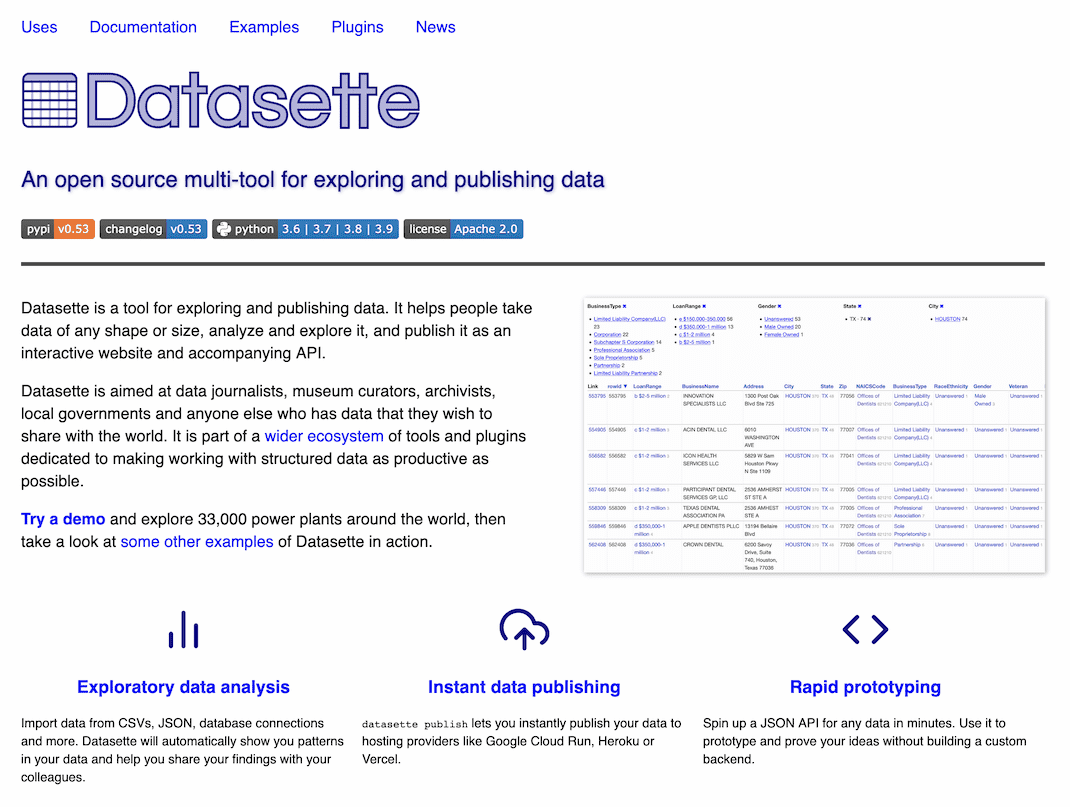
This week I launched datasette.io - the new official project website for Datasette.

Datasette's first open source release was just over three years ago, but until now the official site duties have been split between the GitHub repository and the documentation.

A screenshot of datasette.io

The Baked Data architectural pattern

The site itself is built on Datasette (source code here). I'm using a pattern that I first started exploring with Niche Museums: most of the site content lives in a SQLite database, and I use custom Jinja templates to implement the site's different pages.

This is effectively a variant of the static site generator pattern. The SQLite database is built by scripts as part of the deploy process, then deployed to Google Cloud Run as a binary asset bundled with the templates and Datasette itself.

I call this the Baked Data architectural pattern - with credit to Kevin Marks for helping me coin the right term. You bake the data into the application.

It's comparable to static site generation because everything is immutable, which greatly reduces the amount of things that can go wrong - and any content changes require a fresh deploy. It's extremely easy to scale - just run more copies of the application with the bundled copy of the database. Cloud Run and other serverless providers handle that kind of scaling automatically.

Unlike static site generation, if a site has a thousand pages you don't need to build a thousand HTML pages in order to deploy. A single template and a SQL query that incorporates arguments from the URL can serve as many pages as there are records in the database.

How the site is built

You can browse the site's underlying database tables in Datasette here.

The news table powers the latest news on the homepage and /news. News lives in a news.yaml file in the site's GitHub repository. I wrote a script to import the news that had been accumulating in the 0.52 README - now that news has moved to the site the README is a lot more slim!

At build time my yaml-to-sqlite script runs to load that news content into a database table.

The index.html template then uses the following Jinja code to output the latest news stories, using the sql() function from the datasette-template-sql Datasette plugin:

{% set ns = namespace(current_date="") %}
{% for row in sql("select date, body from news order by date desc limit 15", database="content") %}
    {% if prettydate(row["date"]) != (ns.current_date and prettydate(ns.current_date)) %}
    <h3>{{ prettydate(row["date"]) }} <a href="/news/{{ row["date"] }}" style="font-size: 0.8em; opacity: 0.4">#</a></h3>
    {% set ns.current_date = prettydate(row["date"]) %}
    {% endif %}
    {{ render_markdown(row["body"]) }}
{% endfor %}

prettydate() is a custom function I wrote in a one-off plugin for the site. The namespace() stuff is a Jinja trick that lets me keep track of the current date heading in the loop, so I can output a new date heading only if the news item occurs on a different day from the previous one.

render_markdown() is provided by the datasette-render-markdown plugin.

I wanted permalinks for news stories, but since they don't have identifiers or titles I decided to provide a page for each day instead - for example https://datasette.io/news/2020-12-10

These pages are implemented using Path parameters for custom page templates, introduced in Datasette 0.49. The implementation is a single template file at templates/pages/news/{yyyy}-{mm}-{dd}.html, the full contents of which is:

{% extends "page_base.html" %}

{% block title %}Datasette News: {{ prettydate(yyyy + "-" + mm + "-" + dd) }}{% endblock %}

{% block content %}

{% set stories = sql("select date, body from news where date = ? order by date desc", [yyyy + "-" + mm + "-" + dd], database="content") %}
{% if not stories %}
    {{ raise_404("News not found") }}
{% endif %}
<h1><a href="/news">News</a>: {{ prettydate(yyyy + "-" + mm + "-" + dd) }}</h1>

{% for row in stories %}
    {{ render_markdown(row["body"]) }}
{% endfor %}

{% endblock %}

The crucial trick here is that, because the filename is news/{yyyy}-{mm}-{dd}.html, a request to /news/2020-12-10 will render that template with the yyyy, mm and dd template variables set to those values from the URL.

It can then execute a SQL query that incorporates those values. It assigns the results to a stories variable, then checks that at least one story was returned - if not, it raises a 404 error.

See Datasette's custom pages documentation for more details on how this all works.

The site also offers an Atom feed of recent news. This is powered by the datasette-atom using the output of this canned SQL query, with a render_markdown() SQL function provided by this site plugin.

The plugin directory

One of the features I'm most excited about on the site is the new Datasette plugin directory. Datasette has over 50 plugins now and I've been wanting a definitive directory of them for a while.

It's pretty basic at the moment, offering a list of plugins plus simple LIKE based search, but I plan to expand it a great deal in the future.

The fun part is where the data comes from. For a couple of years now I've been using GitHub topics to tag my plugins - I tag them with datasette-plugin, and the ones that I planned to feature on the site when I finally launched it were also tagged with datasette-io.

The datasette.io deployment process runs a script called build_plugin_directory.py, which uses a GraphQL query against the GitHub search API to find all repositories belonging to me that have been tagged with those tags.

That GraphQL query looks like this:

query {
  search(query:"topic:datasette-io topic:datasette-plugin user:simonw" type:REPOSITORY, first:100) {
    repositoryCount
    nodes {
      ... on Repository {
        id
        nameWithOwner
        openGraphImageUrl
        usesCustomOpenGraphImage
        repositoryTopics(first:100) {
          totalCount
          nodes {
            topic {
              name
            }
          }
        }
        openIssueCount: issues(states:[OPEN]) {
          totalCount
        }
        closedIssueCount: issues(states:[CLOSED]) {
          totalCount
        }
        releases(last: 1) {
          totalCount
          nodes {
            tagName
          }
        }
      }
    }
  }
}

It fetches the name of each repository, the openGraphImageUrl (which doesn't appear to be included in the regular GitHub REST API), the number of open and closed issues and details of the most recent release.

The script has access to a copy of the current site database, which is downloaded on each deploy by the build script. It uses this to check if any of the repositories have new releases that haven't previously been seen by the script.

Then it runs the github-to-sqlite releases command (part of github-to-sqlite) to fetch details of those new releases.

The end result is a database of repositories and releases for all of my tagged plugins. The plugin directory is then built against a custom SQL view.

Other site content

The rest of the site content is mainly static template files. I use the render_markdown() function inline in some of them so I can author in Markdown rather than HTML - here's the template for the /examples page. The various Use cases for Datasette pages are likewise built as static templates.

Also this week: sqlite-utils analyze-tables

My other big project this week has involved building out a Datasette instance for a client. I'm working with over 5,000,000 rows of CSV data for this, which has been a great opportunity to push the limits of some of my tools.

Any time I'm working with new data I like to get a feel for its general shape. Having imported 5,000,000 rows with dozens of columns into a database, what can I learn about the columns beyond just browsing them in Datasette?

sqlite-utils analyze-tables (documented here) is my new tool for doing just that. It loops through every table and every column in the database, and for each column it calculates statistics that include:

  • The total number of distinct values
  • The total number of null or blank values
  • For non-distinct columns, the 10 most common and 10 least common values

It can output those to the terminal, or if you add the --save option it will also save them to a SQLite table called _analyze_tables_ - here's that table for my github-to-sqlite demo instance.

I can then use the output of the tool to figure out which columns might be a primary key, or which ones warrant being extracted out into a separate lookup table using sqlite-utils extract.

I expect I'll be expanding this feature a lot in the future, but I'm already finding it to be really helpful.

Datasette 0.53

I pushed out a small feature release of Datasette to accompany the new project website. Quoting the release notes:

  • New ?column__arraynotcontains= table filter. (#1132)
  • datasette serve has a new --create option, which will create blank database files if they do not already exist rather than exiting with an error. (#1135)
  • New ?_header=off option for CSV export which omits the CSV header row, documented here. (#1133)
  • "Powered by Datasette" link in the footer now links to https://datasette.io/. (#1138)
  • Project news no longer lives in the README - it can now be found at https://datasette.io/news. (#1137)

Office hours

I had my first round of Datasette office hours on Friday - 20 minute video chats with anyone who wants to talk to me about the project. I had five great conversations - it's hard to overstate how thrilling it is to talk to people who are using Datasette to solve problems. If you're an open source maintainer I can thoroughly recommend giving this format a try.

Releases this week

TIL this week

14 Dec 03:24

A Random Word About CentOS

by Rui Carmo

Regardless of the name of this blog and my current employer, I’m still a UNIX guy first and foremost, and as such I can’t help but ponder the implications of this week’s little IBM/RedHat drama. And rather than just link to it with a short quip, I think a little more is in order.

I used to run Red Hat Linux way back (I shunned the chaos of Slackware, and still have a 4.3 CD someplace as a memento of my switch over), and many of my telco and financial sector customers use it (largely due to the enterprise support, ecosystem, and now, OpenShift). And, of course, Oracle has its own spin on it (now “unbreakably” obfuscated under their product line), so it’s effectively inescapable wherever you go.

Also, a few of my friends have (maybe a little stubbornly) stuck to CentOS for decades because it was stable and predictable. And, for a long time, I agreed with them. I spent way too long dealing with RHEL variants (like the Cobalt boxes, for which I backported untold amounts of RPMs) and knew most packaging intricacies (and kernel limitations) inside and out.

That lasted until I found myself in a Debian-centric org and realized there ought to be something a little better than either, at least where running software that had actually shipped in the same year I got my machines was concerned (both Debian and CentOS were always umpteen kernel versions behind barely working on any of the hardware I had, and using LXC and Docker remained a major pain for several releases).

Which is why I’ve been using Ubuntu for around ten years now – great hardware support, modern packages, and you can almost forgive them for their default desktop because there were plenty of variants – and were it not for hardware rotation, I’d probably still have a machine that had gone through four or five direct, seamless LTS upgrade cycles (right now pretty much all my machines (Intel, ARM, virtual or not), are at 20.04, except for the ones running Elementary, which are just fine with 18.04, and a few Pis). My experience has been that as long as you never use .10 releases on servers, you’re golden.

Having Ubuntu as the default on WSL was serendipitous, and means I have a little white-on-black island of sanity tucked away inside any of my Windows 10 machines

So the fallout from CentOS Stream becoming what is essentially RHEL “unstable” and the knee-jerk emergence of Rocky Linux as the new downstream de-branding (de-fanging?) effort are something I look bemusedly upon, even as I cheer on Ubuntu (which has recently gone “pro” and is taking on a more enterprise stance).

And yet, maybe we should count ourselves lucky, in some regards. After all, it’s been two years since IBM bought Red Hat and things were rather quiet. I always wondered if IBM would just sit there and continue to allow people to effectively run RHEL (under the guise of CentOS) without licensing fees, and now we know the answer.


14 Dec 03:14

Twitter Favorites: [heyrickie] As part of #SkyTrain’s 35th anniversary, I’m starting a project where I will run alongside the full lengths of all… https://t.co/YWfP0YbUQB

Eric Bucad @heyrickie
As part of #SkyTrain’s 35th anniversary, I’m starting a project where I will run alongside the full lengths of all… twitter.com/i/web/status/1…
13 Dec 05:40

datasette.io

datasette.io

Datasette finally has an official project website, three years after the first release of the software. I built it using Datasette, with custom templates to define the various pages. The site includes news, latest releases, example sites and a new searchable plugin directory.

Via @simonw

13 Dec 05:40

Getting started with RDF using Blazegraph

by Thejesh GN

This started as a simple exercise of querying WikiData database using their SPQRQL query service. That lead me to studying about RDF and Triplets. I found it very interesting. I spent hours on it. So I thought I might as well write about it here, so I can refer it later. So everything here is how I went about learning it.

Semantic Web, Triple and Triplestore

Web was meant to be for humans. But at some point it also became machine readable. Semantic web is an extension to Web to make it more machine readable. Technologies like RDF (Resource Description Framework) and OWL (Web Ontology Language) are used to express the semantic web. RDF is an assertional language, it provide a way to express proposition (a statement or expression that is true or false). using predefined vocabularies.

RDFS or RDF Schema provides all the vocabulary required to model the RDF data. It's an extension to RDF Vocabulary.

In semantic web/RDF, the atomic level unit is called a semantic triple or triple. It's in the form of a statement and contains three items of data. Its in the form of subject-predicate-object.

Examples:

  • Thej's age is 35
  • Thej Knows Raj

Where Thej is the subject, age is is predicate and 35 is Object. Each of them can be complex entities themselves. This looks very similar to Entity - Attribute - Value design.

Since this structure is very different from how the data stored in RDBMS (Tables and Rows) looks. It needs a particular kind of database to store it. Its usually called a triplestore or RDF store. Its usually purpose build to store RDF data. One such is Blazegraph.

There are also serialization formats to actually contain the data. Most popular ones are RDF/XML, JSON-LD, Turtle etc You could use this formats to store the data or use it export from one system to importing into another system etc.

It is based on the idea of making statements about resources (in particular web resources) in expressions of the form subjectpredicateobject, known as triples. The subject denotes the resource, and the predicate denotes traits or aspects of the resource, and expresses a relationship between the subject and the object.

Wikipedia

Blazegraph

Blazegraph is an open source graph database (aka Triplestore) that I can install locally and import triples (data) into it. Then like any database one can query it for data. The query language used is called SPARQL.

Blazegraph™ DB is a ultra high-performance graph database supporting Blueprints and RDF/SPARQL APIs. It supports up to 50 Billion edges on a single machine. It is in production use for Fortune 500 customers such as EMC, Autodesk, and many others. It is supporting key Precision Medicine applications and has wide-spread usage for life science applications. It is used extensively to support Cyber anaytics in commercial and government applications. It powers the Wikimedia Foundation's Wikidata Query Service.
Blazegraph

Download and install the database.

Blazegraph needs Java (Java 9+) runtime. It runs fine on OpenJDK. So install the JDK from AdoptOpenJDK and install it. Once you have java running. Download the Blazegraph executable JAR - blazegraph.jar , from their Github release page.

Once you download you can start it using the command

java -server -Xmx4g -jar blazegraph.jar

Once it starts you can access te blazegraph workbench at http://localhost:9999/blazegraph/. Data is stored in blazegraph.jnl in the same folder.

Import some data

There are couple of file formats that can be used to store RDF data. They all are text files. The popular ones are Turtle, N-Triples, JSON-LD and RDF/XML.

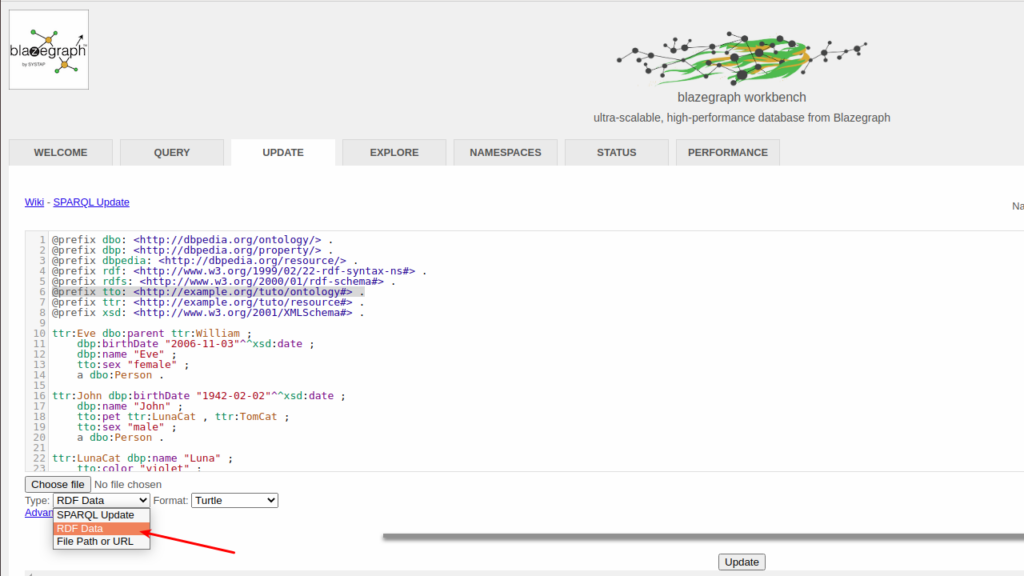
Select type
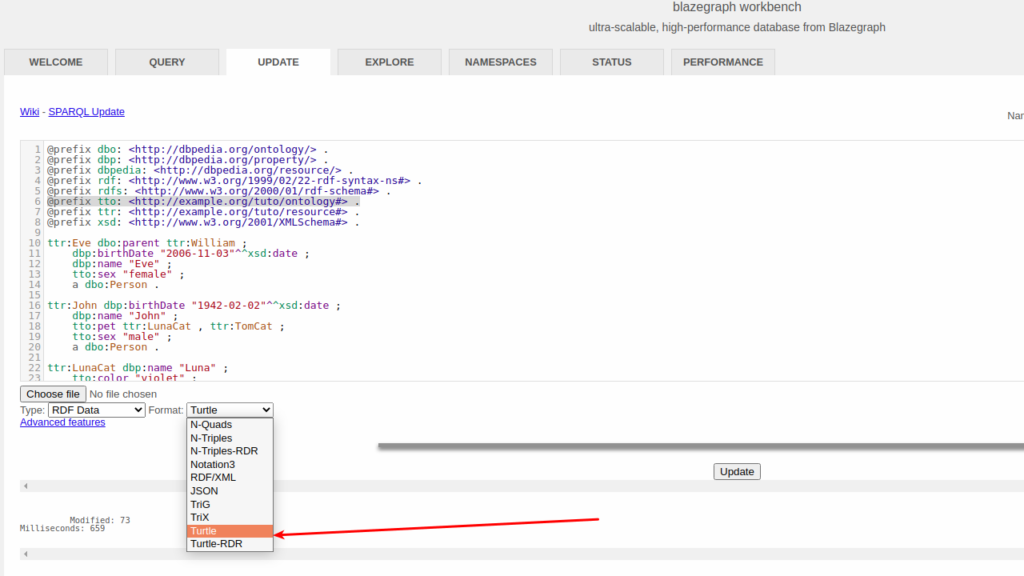
Select the Format as Turtle

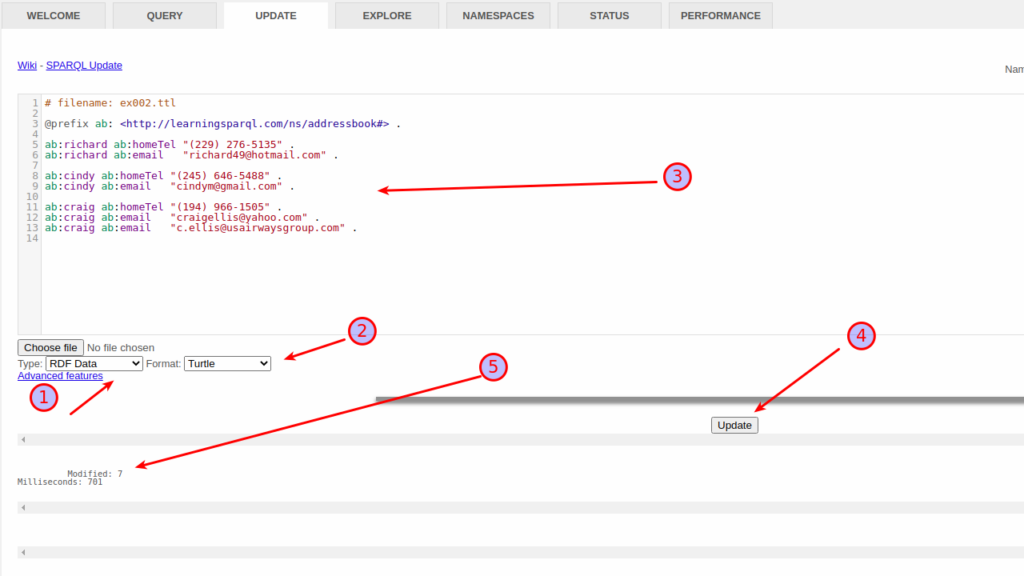
Let's take a simple dateset in Turtle format. Its an example from the book Learning SPARQL. It has seven statements.

# filename: ex002.ttl

@prefix ab: <http://learningsparql.com/ns/addressbook#> .

ab:richard ab:homeTel "(229) 276-5135" . 
ab:richard ab:email   "richard49@hotmail.com" . 

ab:cindy ab:homeTel "(245) 646-5488" . 
ab:cindy ab:email   "cindym@gmail.com" . 

ab:craig ab:homeTel "(194) 966-1505" . 
ab:craig ab:email   "craigellis@yahoo.com" . 
ab:craig ab:email   "c.ellis@usairwaysgroup.com" . 

Importing that is very straight forward. Choose the Type and Format. Paste the data in the text area. Click on Update button. It shows how many statements are modified. In this case you can see, we have uploaded.modified 7 statements.

Then paste the data in the text box above like its show in the picture and then click import.

Next - SPARQL

SPARQL is the query language used to query RDF, similar to how SQL is used to query RDBMS. There are some common things but lots and lots of differences. In the next post we explore SPARQL by querying our dataset which we just inserted and then we will also query WikiData.

The post Getting started with RDF using Blazegraph first appeared on Thejesh GN.
13 Dec 05:40

Gmail will let users edit Office documents right from an email

by Jonathan Lamont
Gmail icon on Android

If you spend a lot of time working with Microsoft Office documents but you use Gmail, things are about to get a lot easier for you.

Google is adding the ability to edit Office files directly in Gmail, similar to how the email platform works with Google’s own Docs and Sheets files.

As reported by The Verge, the change allows users to open and edit an Office file using the Google Docs editor just by clicking on it in Gmail. However, the new functionality doesn’t convert the file to a Google Doc and preserves the original file format.

Further, Gmail allows users to respond to the original email and include the updated Office file. The whole process works without requiring users to download and re-attach the file.

Ultimately, the whole process is more streamlined than before and should make it much easier for anyone who frequently collaborates on Office files through Gmail.

Additionally, Google launched a new ‘Macro Converter‘ add-on for its Workspace software suite (previously G Suite). The add-on can help organizations easily import Excel macros to Google Sheets.

Finally, Google is working on bringing better document orientation and image support to Docs, according to The Verge. The changes will enable documents with both horizontal and vertical pages, images placed behind text and watermarks. It’s worth noting that the image features won’t arrive until next year.

All in all, these are welcome changes for Gmail and the broader Workspace software suite. Given one of the driving goals behind Workspace was to turn the platform into a universal place to get work done, making it easy to open, edit and send Office files without leaving the platform is a step in the right direction.

Source: The Verge

The post Gmail will let users edit Office documents right from an email appeared first on MobileSyrup.

13 Dec 05:39

Getting Your Clients to Pick a Time Instead of Asking “What Time Works Best For You”

by Sean

What time works best for you? is the catchphrase of many freelancers and small business owners. Clients love when you’re flexible and take into consideration their busy schedules … right?

As it turns out, this seemingly innocent question annoys clients and may even put your business’s potential on pause.

It’s time to find out why!

Why Clients Hate That Question

Here’s how this client interaction typically plays out:

You: What time works best for you?

Your client: (Smiles politely) Let me check! (Hastily flips through dozens of pages in their appointment planner to search for the next free time slot that fits your schedule).

Sure, they don’t seem bothered by the question.

But that’s only because it’s rude to roll their eyes and sigh!

So what is it about this question that fuels silent rage inside your clients?

Let’s find out.

We All Have Busy Schedules!

Is your upcoming weekly schedule completely bare?

Are you willing to meet at odd hours like 8 a.m. or 10 p.m.?

Let me guess—you answered “no” to at least one of these questions (hopefully, both).

When you ask your clients what time works best for them, you’re tossing your calendar on the backburner. A future meeting—and a potential sale—is only going to happen when they can find 30 spare minutes to lend you.

Yes, each client matters, but leaving your week wide open for the sake of convenience for one client may put all of your other responsibilities on a temporary hold.

Avoid the Email Ping-Pong

Let’s assume you work 9 to 5 Monday through Friday. And for argument’s sake, let’s say you try to keep your meetings under 30 minutes.

That makes 80 potential time slots a week.

You confidently fire off that “Pick a time” message to a client and get a vague “How about Tuesday at 3?” in response.

Tuesday afternoon is no good.

“I can’t do Tuesday. What about Wednesday at 4?”

Try again!

Email ping pong is a logistical nightmare flooded with one new email thread after another (and the occasional rogue spam filter). You may be dozens of messages into an email chain before you decide that Monday at 11 fits into both of your schedules.

And that’s assuming neither of you gives up halfway through.

Time Zone Mix-Ups Can (and will) Happen

When you run a virtual business, it’s easy to forget that your clients aren’t always in the same state as you, let alone the same time zone!

Translation: Time zones can be a real pain in your side.

Here’s an example:

The time difference between the East and West Coasts is three hours. If your client in New Jersey says 8 a.m. works for them, and you live in Oregon, you better be in the mood for a surprise 5 a.m. phone call!

And unless you’re willing to memorize each clients’ time zone, your only other option is to do the conversions before scheduling each meeting.

It’s a lot of extra (and unnecessary) work!

They Don’t Know the Answer

Scheduling meetings would be easier if everyone worked 9 to 5 and did the same thing every day. But about 10% of people are independent contractors just like you!

In other words, they may not be able to give you an immediate answer.

At least not right now.

So when you ask this question and don’t accept “I’ll let you know” as an answer, can you really be surprised that clients get frustrated?

You want your clients to have a great first experience, right?

Then stop asking this question!

Related: 11 Mistakes Most New Freelancers Make That You Should Avoid


What Do You Have to Lose?

How to schedule meetings

We get it—bad habits can be hard to break.

And as a creature of habit, it might take you ten weeks (or longer) to completely ditch your old catchphrase and develop a better routine.

Is it even worth the effort?

Absolutely.

And here are a few things you risk by keeping this phrase in your vocabulary:

Most Important to You: A Client

Let’s face it.

The more you anger, frustrate, or annoy your client, the less enticed they’ll be to schedule a future appointment with you—let alone book a paid session.

And technically, they don’t have to.

Unless you’re the only local yoga trainer or rodeo photographer, your clients aren’t stuck working with you. If scheduling an appointment with you is a hassle, you could guide your clients right into the arms of your fiercest competitors.

One persistent question could risk a paying client and a negative online review.

Accidentally Overbooking Your Schedule

As independent contractors, we get schedule-happy! A serious client agrees to meet, and in the name of business, we impulsively accept whatever time slot they offer.

The problem is that you can accidentally overbook your schedule.

Now you’re in quite the predicament.

Do you reach out to the new client again and tell them that the time they chose actually doesn’t fit your schedule after all the back-and-forth emails?

Or do you cancel your pre-existing session with a current loyal customer?

Preferably … neither.

But think of it this way:

If you can’t handle a menial task like scheduling, why should a client trust you with their $3,000 photoshoot or to manage their business’s finances?

Your reputation may take a serious hit.

What’s Left of Your Sanity

You’re not the CEO of a major corporation. Nor do you have dozens of representatives on standby ready to take over for a conference call when your schedule is jam-packed.

You’re just one person.

And all you have are 24 hours.

The mental gymnastics of finding available meeting times that don’t overlap with your currently scheduled sessions can drive you crazy. And overwhelming your mind can eventually take a toll on your quality of work.

Don’t let it … ditch the question!

Related: 10 Keys to Effective Client Interfacing


What You Should Say Instead

Okay, so now you know what you shouldn’t ask.

But that question has been your go-to scheduling lead-in for years now.

And you risk revenue by walking away from your first meeting with a client without a future appointment penned into your calendar.

Fortunately, the appointment-scheduling thing wasn’t the problem.

It was your approach.

Revamp your scheduling process by asking the following questions instead:

“I’m Free _____ , Do Any of Those Times Work for You?”

Imagine going to a brand new restaurant, not receiving a menu when you sat down, and then having the waitress ask, “What would you like to order?”

You’d probably ask, “What would you recommend?” And the waitstaff would likely read off the Thursday night specials to narrow down your choices.

Do the same things with your clients. Pick a time when you currently have openings in your schedule.

For example, you could say:

“I’m free Tuesday between 12-4, Wednesday from 9-11, and my schedule is completely open on Friday. Do any of those times work for you?”

This narrows down your client’s choices and allows them to compare certain time blocks to their own schedules.

Note: Try to stagger the times, if possible. Some people may not have any prior engagements on Tuesdays and Thursdays, while others aren’t free until after 4 p.m.

“Do You Have Time for a Quick 15-Minute Meeting?”

If a client assumes your meetings are an hour or longer, they’ll be looking for a free hour in their own calendar. Not everybody has a free hour, and clients may end up pushing the meeting off for weeks under a false assumption.

But a 15-30-minute meeting … that’s far more reasonable.

Here’s how you can phrase it:

“I was thinking we could meet for a quick 15-minute meeting this week. Can you fit me into your schedule?”

Chances are, your client has a little extra time during their lunch break or in-between their own appointments to give you a call.

How Would You Like to Meet?”

Face-to-face meetings are great for building a strong relationship the first time you meet a client. After all, there’s no digital equivalent to the firm handshake, steady eye contact, and shared smiles from an in-person appointment.

But this is not always realistic, especially with the ongoing COVID pandemic and lengthy travel times needed to get to a central meeting location.

So, change the scope of the question to:

How would you like to meet?”

Then give your clients several options like:

  • Phone call
  • Video call (Google Meet, GoToMeeting, Zoom call, etc.)
  • Conference call (if you want other independent contractors on the line)

Try to avoid text, chat, and email conversations if you can. It’s easy to misconstrue these written messages, and it could take hours to “finish” your digital meeting rather than a brief 15-minute phone call.

Is Square Appointments enough for your business? Get the facts in our Square Appointments review.

“I Was Thinking We Could Meet at _____  on _____. Can You Make It?”

Some clients prefer that you be even more specific about when you’d like to meet. After all, some people just aren’t confident in their decision-making skills.

Ask about a more specific time slot.

Here’s an example:

“I was thinking we could meet at 11 a.m. on Friday to plan out the next session. Does that time work for you?”

Of course, that exact phrasing isn’t required.

You can finish the question with “Will you be able to make it?” or “Are you free at this time?” Or you can take even greater control of the scheduling with, “I’m going to pen you in for Friday at 1 p.m. Is that okay with you?”

Sometimes a yes/no question is better than an open-ended question.

This phrasing works best with the clients you already know to be indecisive. Steer clear of this one for new clients that you’re still getting a feel for, as it could trigger the back-and-forth meeting slot debate that you’re trying to avoid!


Easier Ways to Schedule Meetings

You already have enough on your plate.

Between the lead generation, project estimates, and doing your actual work, you put your ROI and efficiency on the line when scheduling takes longer than necessary.

The good news is that there are easier ways to schedule meetings, and there are a lot of tools that can make your life as an independent contractor a heck of a lot easier.

Is Acuity right for your business? Learn more in our Acuity Scheduling Review for Freelancers and Contractors

The Best Apps for Scheduling Meetings

Efficient ways to schedule meetings

Scheduling meetings can be so hectic that you’ve even wondered, “How much does it cost to hire a personal assistant?”

But while hiring a virtual assistant or a social media manager can certainly help you scale your business, it might not be the smartest choice right now.

Before you bring on any new team members, try using one of these high-end scheduling apps to get your calendar under control. There’s no longer a need to keep a hard copy of your schedule!

Bloom

Bloom is one of the most efficient scheduling assistant tools to invest in as an independent contractor or small business owner.

All you have to do is send out a link to your calendar through your marketing emails, Facebook page, or Instagram profile. You can even publish a client intake form on your website and book meetings there.

Then, your client can fill out the required fields and select the time that best works for them. Bloom will automatically pen their appointment into your schedule in real-time and send both of you email reminders up until the day of the meeting. No more overbooking appointments, playing phone tag, or being stood up by a forgetful client.

Quick, easy, and affordable! No more scheduling nightmares!

Try Bloom free for 14 days!

Facebook Business Appointments

Anybody who owns a startup or is an independent contractor needs a Facebook Business page. These pages also happen to make scheduling meetings a breeze.

Thanks to the Appointments feature, you can set your availability, make your openings visible to clients, and allow them to schedule meetings directly in the app.

Facebook will then automatically add this new meeting to your Google Calendar.

All without having to dial a single phone number!

Google Calendar

You might already use Google Calendar to track your upcoming client meetings.

But did you know that you can also open up your calendar for clients to choose their own appointment slots? Send out a welcome email to your client and let them choose a time that works best for them.

When they book an appointment, Google automatically sends them a reminder along with a printable schedule (in case they’re old school).

Regular Calendar invites were so last year.

Check out our reviews of some other popular scheduler apps for iOS and Android:

Calendly | Square Appointments | Acuity Scheduling | Dubsado

Creating Blocks in Your Schedule Strictly for Meetings

The last thing you want as an independent contractor is to let your clients run your life. You schedule conference times that fit into their calendar and sacrifice your prized free time to keep the opportunity of a sale alive.

Don’t sell your soul!

Instead, block out times in your schedule that you can dedicate strictly to meetings.

Nothing more, nothing less.

If Thursday rolls around and your meeting slots are still open, use that time to ensure next Thursday is full. Spend the hour generating leads or calling past clients to ask about referrals.

How does Calendly compare to other scheduling tools? Find out in our 5 best Calendly alternatives review.

Scheduling Meetings in a Timely Manner

Try to schedule meetings too far out, and either you or your client will forget about it. Or, one of you will make the embarrassing mistake of overbooking.

And let’s be honest, some of us don’t know what we’re doing for lunch or this weekend, let alone an entire month from now.

We call it “living in the moment.”

But if you try to schedule your meeting an hour or even a day in advance, you run the risk of showing up unprepared or without an open spot in your client’s schedule.

Pro tip: Look for the sweet spot—about a week out, if possible.

Sending Off Meeting Agendas Beforehand

When you get the dreaded “Hey, we should talk” message from your significant other, sheer terror sets in.

It could be a surprise trip to Disney, but they also may be trying to let you down easy.

Meetings and appointments can be nerve-wracking for new clients, especially if they’ve never booked services with someone in your industry before.

The solution: Send out a meeting agenda beforehand, laying out the topics you plan to discuss. That way, your client can breathe a sigh of relief, won’t be caught off guard, and can arrive at the meeting having done their homework.

See also: The Best Time Organization Hacks for Freelancers


Conclusion

You risk a lot by asking clients, “What time works best for you?”

Finding a mutual opening in both of your schedules can be frustrating for all parties involved.

So next time you catch yourself asking this anger-inducing question, rephrase it.

Say, “I was thinking we could meet at ___ on ___. Can you make it?” instead.

Or even better … rely on your CRM to seamlessly schedule your future appointments with clients—without the headache of asking, “What time works best for you?”

Bloom isn’t just another piece of scheduling software—it’s an all-in-one CRM solution. Learn more about pricing options and find out how Bloom can help you grow your business!

The post Getting Your Clients to Pick a Time Instead of Asking “What Time Works Best For You” appeared first on Bloom.

13 Dec 05:39

Virtual Research Environment 1.0 released

Open Preservation Foundation, Dec 11, 2020
Icon

The virtual research environment will be a gift to those researchers who spend more time configuring software than they do on actual research. "The VRE is a 'plug & play' virtual machine with a selection of open source digital preservation tools pre-installed... Apache Tika, Droid, JHOVE, VeraPDF, MediaInfo and ffmpeg/Handbrake." If those tools mean nothing to you, don't worry - the main point is that researchers can easily access esoteric tools like these. They are installed in a Vagrant environment, which is run on Oracle's Virtual Box - this is the set-up when I put gRSShopper into a box a couple of years ago. Here are the release notes - read these before downloading anything. Image: Research Data Netherlands (be sure to check this page as well).

Web: [Direct Link] [This Post]
13 Dec 05:38

Scraped

Wendy M. Grossman, net.wars, Dec 11, 2020
Icon

This article concerns a court case between HiQ and LinkedIn that was heard in the U.S. last fall. Basically, HiQ was scraping LinkedIn's website, and based on its terms of use, LinkedIn wanted them to stop. As Wendy Grossman cynically says, "at its heart this case is about whether LinkedIn has an exclusive right to abuse its users' data or whether it has to share that right with any passing company with a scraping bot." The court sided with HiQ. But not so fast - there's another case being heard now in the supreme court, Van Buren v. United States, that questions whether the unauthorized use of a computer system (a) includes violating a terms of use agreement, and (b) constitutes criminal hacking. The right sort of ruling would not only bar HiQ from scraping LinkedIn, it would make it a crime! I can't really see it, but stranger things have come out of U.S. courts in the past.

Web: [Direct Link] [This Post]
13 Dec 05:33

The hard work of imagining, ThingsCon 2020

I presented this essay as part of ThingsCon 2020 on 11 December, 2020. The week-long virtual festival was also the launch of this year’s Responsible Internet of Things publication, so I decided to speak about imagining futures - dystopias and utopias. As a talk, the essay was shortened and I also used slides. What follows is the long-form version.

Dentistry, 3D printing, and the Gartner Hype Cycle

I want to talk about the Internet of Things and how we build the future. The theme being, of course, as this is the event, responsible IoT.

The Internet of Things first appeared on the Gartner Hype Cycle in 2011. (Source; see linked spreadsheet for data.)

Also that year:

  • Image Recognition. Well, that’s just how computers see now.
  • Also QR codes. I was rooting for you, QR codes. It only took a global pandemic to have me scanning codes every time I leave the house.

It’s interesting the convoluted route technologies take to adoption, and the effect they have, and to think about the Internet of Things, IoT, in that context.

3D printing first appeared in 2007. It had a 4 years head start.

We got our first milling machine in 2006. This was at Schulze & Webb, the studio that later became my old company BERG. It milled blocks of chemical wood, and produced a kind of dust that gave us “tight lung” as we called it then because we were young, but will probably take a year off my life when I’m old. It ran overnight to make any kind of shape. Resolution, and I’m guessing here, probably around half a millimetre.

Now I went to the dentist the other day to get a crown replaced. My mouth was scanned and the tooth designed with a handheld photogrammetry device and touchscreen 3D software on a terminal right by the chair.

It took 7 minutes to mill my new tooth on the machine in the basement. The milling machine has an accuracy measured in microns: about a thousand times more accurate than our old miller.

Even last year, making and fitting a new crown was a 2 week job requiring a specialist lab. Now my neighbourhood dentist can do it, and I was in and out in less than 90 minutes.

So the way 3D printing has come into the world is what I would call: same but faster.

Faster teeth. Faster prototyping. Faster tools for injection moulding in factories.

But we haven’t seen the society-wide impact that I think some of us were expecting when 3D printing first appeared on the Hype Cycle. Supply chains haven’t turned into supply webs. Manufacturing hasn’t become local, with mini factories in every neighbourhood. We don’t print our phones or print our shoes or print our breakfast. We still have mass production and mass consumption and mass marketing.

Don’t get me wrong. I hate going to the dentist. 3D printing means I can go to the dentist for less time. I am delighted. But what we got is nowhere near what we imagined.

So is the Internet of Things more like what we got with 3D printing, or more like what we imagined we’d get? Is it same-but-more-efficient, or is it transformative?


The Great Inversion is midway done

I think about the Internet of Things as the Great Inversion.

It used to be, before the Internet of Things, say before it appeared on the Gartner Hype Cycle, before 2011, that the computer was contained in the world. There was the world and it contained people, and forests, and cities, and shoes, and feelings, and all the rest. And one of the things contained by the world was the internet.

Because of the Internet of Things, this situation has inverted, it is inside out. There is now the computer, and one of the things that it contains is the world.

Robotics are the hands and feet of that inversion. Computer vision – that’s the eyes. But IoT, it’s the connective tissue. The wiring.

I would say that the Great Inversion is currently midway done.

There’s a short story written by Paul Ford way back in 2002 called Robot Exclusion Protocol. It is very short, 254 words. It’s about Google. Here’s how it starts.

I took off my clothes and stepped into the shower to find another one sitting near the drain. It was about 2 feet tall and made of metal, with bright camera-lens eyes and a few dozen gripping arms. …

“Hi! I’m from Google. I’m a Googlebot! … I’m indexing your apartment.”

That’s the era we’re in at the moment. Indexing. Ingesting. Eating.

With IoT we’ve got industrial IoT with sensors in factories, and we’ve got connected cars, and we’ve got voice-controlled gadgets.

And what it means it that the physical world is now subject to all the winds and forces of the internet. Those search engine index, those trading algorithms; it’s subject to analytics and automatic optimisation and machine learning, and all the rest.

I don’t see it slowing down. The economic imperatives are too strong.


Whatever happens to musicians happens to everybody

What happens when software eats the world? Bruce Sterling has a line about this. He says, Whatever Happens to Musicians Happens to Everybody.

He talks about a collapse in genre diversity, and the distributors taking control of the economics, and go-it-alone creators. And his point is that you can see the same thing happening in newspapers and fashion and whatever. It happened first to musicians.

Because of the Great Inversion, the world is part of the internet.

So I’d like to generalise Sterling’s Law to this: whatever happens on the internet will happen to the world.

And there are many good things about the internet.

But the internet in 2020, well, we’re not in a good place. Despite the idealism of those who wrote the RFCs when the internet was in its infancy, and the good intentions those who who were at the vanguard of Web 2.0 when the internet came into the mainstream.

Not in a good place at all.


Platform capitalism and consumer farming

Like any complex system, the internet comes with internal forces that shape its evolution. Forces, tendencies, gravities. Call this internet realism. I call these forces “logics” because they are directions that just make sense within the context of the internet.

One is the logic of platform capitalism.

Platform capitalism is a term invented by the economist Nick Srnicek. His book is great. He uses it to label the operating model of many Big Tech corporations, and he points out that they work like this:

  1. Operate a marketplace that brings buyers and sellers together. For example, book sellers and book customers. Or drivers and passengers. Or advertisers and browsers
  2. Collect data - any data - all the data - that can be used to drive marketplace activity, either by pushing transaction volume or marketplace size.
  3. As the marketplace grows, it wins out over other, alternative marketplaces, reducing competition. And the data capture basin increases too, enabling further growth. As part of this step of the operating model, data capture always increases.
  4. Repeat and grow.

You can see it in action with, say, Facebook. All my friends are there! It’s free! There’s no excuse for me not to be a participant in this marketplace. Yet the data which is gathered is used to drive my marketplace activity – my clicking on ads and my purchases. From the advertisers point of view, there’s no ability for them to opt out either. And the ads are priced at just the level where they would be foolish not to participate – but where Facebook can keep as much margin as possible. The data they gather lets them know exactly what this level is.

This is a hungry logic. It’s expansionist, and there’s no room to realistically consider alternatives. It just makes sense.

What happens when the logic of platform capitalism meets the Internet of Things?

We see glimpses of that with Uber, and their carefully priced marketplaces which capture drivers into vehicle rental and subsistence income. And we see glimpses of that with the Amazon Ring doorbell and data gathering on the street.

But let’s take it an extreme. I can imagine a free apartment where everyday activity is monetised. A free house that comes with a bundled app store of Amazon Dash-style subscription purchases for cleaning products, and food, and clothes, and rental furniture; all carefully and automatically optimised by monitoring usage through connected cameras and sensors.

This is a dystopia where humans, you and me, are farmed as consumers, by platform capitalism. We never own, we pay rent.

It could be built today. It’s just that nobody’s gotten round to it yet.

So that’s one example of where that particular logic could end up.


To the computer, it’s just another device

A second logic of the internet is that of abstraction.

Ted Nelson invented hypertext and was one of the first to really probe what it meant to use computers for creativity. He’s a visionary. In his book Computer Lib (1974), he said this:

Whatever it may do in the real world, to the computer program it’s just another device.

And this is the amazing thing about computers and the internet – the computer sends data, and it could be showing a few pixels on a screen, or it could be driving a probe on another planet.

Or it could be transferring Bitcoin. A Bitcoin transaction takes as much energy - and therefore as much carbon - as used by an average British household in two months.

These all have the same weight to the computer. And so they all weigh the same to us.

The logic of abstraction is neither good nor bad, it’s just the way computing works. Everything gets abstracted. Computer scientists have a name for when you can tell what happens the other side: they call it a “leaky abstraction.” It’s something to be avoided.

But in the real world, when consequences are hidden, situations tend to be abused.

And what happens when the real world is, well, just another device, thanks to IoT?

Well, you tap an app on your phone, and you call a car. The driver rents their car, is paid below minimum wage, has no savings. They’re an independent contractor so they don’t have employment benefits. At some point the workers will be automated away. The company is structured so that they are, in the parlance, “asset light” - but also so that they can’t be held accountable.

We, the tapper of the app, are insulated, because of the logic of abstraction.

It’s what Peter Reinhardt first referred to as Below the API versus Above the API jobs.

Living above the API, we order groceries, interact with customer service, live our lives one step abstracted from the people with whom we share a society. And below the API, wages are squeezed, people made to compete with robots, and inequality grows.

It’s hard to argue with the logic of efficiency and automation. That’s what makes it a logic. The logic of abstraction is what makes it hard for us to even see it happening.


The logics of monocultures and overextended complexity

So there are other logics of the internet. The logic of monocultures that create attack surfaces for state-sponsored cyberwar. The logic of overextended complexity that grows till breaking point. We’ve seen high-frequency trading algorithms cause flash crashes in the stock market, from just that logic of complexity – what happens when we have a flash crash on a highway of autonomous cars filled with school kids and commuters?

But enough dystopias.


Dystopia is an extrapolation. Utopia requires discontinuity

The future I want embodies different values.

I want my home to be voice controlled – but I want it without centralised data capture.

I want car-sharing schemes and last mile delivery – but I want it to operate through mutualism and co-operatives.

I want home security drones – but I want them to make their domestic visual index available to a private app so I can text-search my bookshelves for that book I can’t lay my hands on, rather than them using it to train their ad targeting A.I.

Privacy. Agency. Mutualism. Equality.

I’m not saying these futures are impossible, but they feel hard to reach from where we are right now.

Because honestly, it feels like I don’t get to choose, we don’t get to choose, those futures.

The system that does get to choose is the system that surrounds our tribe of designers, technologists, and founders. It’s all those adjacent tribes that never get to see the idealism and the intentions. The marketers, retailers, supply chain experts, risk assessors, the MBAs, policy-makers, and so on. They don’t get to see the vision; they have to follow the well-trodden path. They follow the logics. The logics are the same old business models, the same old ways of capturing attention, the same old methods to build platforms.

Dystopia is the extrapolation of the same old, same old.

But utopia is a non-extrapolation, it requires a discontinuity. It requires all these different tribes to choose to do something different, at great risk to their careers and livelihoods.

If they’re going to do that, they all need to be shown that something different first, and shown how it’ll work.

And you know what, I think that’s our job.


We need to do the hard work of imagining

Sir Terence Conran: The designer’s job is to imagine the world not how it is, but how it should be.

I’ve lost the habit of imagining utopias. Perhaps we all have.

Today, right now, we’re in what architect Bryan Boyer calls a “vision vacuum.” I don’t know why, but imagination about positive futures is scarce right now. And in the absence of a compelling narrative, the same old, same old wins by default.

Narratives? Fiction?

But we don’t need just design fictions. We need business model fictions, engineering feasibility study fictions, interop protocol specification fictions, investment return fictions.

I’ll give you an example. I’m a proud member of the British Interplanetary Society which is, on one hand, a talking shop. But on the other, has been a significant part of the conversation, for 87 years, through engineering feasibility reports. The society’s engineering design for a probe that would go to another star, a study called Project Daedalus which ran from 1973 to 1978, has helped make the idea of interstellar travel more believable. Concept ships in research and fiction are based on the Daedalus designs; the Daedalus report helps identify what the actual problems are and where R&D should be targeted.

So I guess what I’m asking for is a different kind of think tank, not one that works with recommendations and reports and regulation, but a new think tank that trades in politically opinionated, worked examples that demonstrate, demystify, and de-risk.

The objects and systems must be plain, easy to understand, and embody our values. If you asked me now where to start, I would start with worked examples for:

  • Zero-user-data connected products (related: I wrote about voice control for everything, but could we sketch a business model?)
  • Open file formats for service portability (related: I wrote about interop for video calls, but could we design the protocol and code up a reference app?)
  • Software-enabled cooperative corporations (related: I wrote about software-enabled co-ops but could we ship a co-op as a Shopify plugin?)

We need boundary objects that transcend language and can translate across the different tribes.

And the marketers, retailers, supply chain experts, risk assessors, the MBAs, policy-makers, and so on, if we can indeed make tiny, proof of concept, real versions of these futures, bonsai tree utopias, made out of spreadsheets and simulations, if we can speak to them in their words, they will nurture and help those futures grow, I think there’s space for that.

I think I need to - we need to - imagine utopias again, and we need to demand and create demand for them, and we need to articulate them in great detail.

But we need to be the ones doing the hard work of imagining a responsible future for the Internet of Things. Because it’s no-one else’s job to do so.

13 Dec 05:18

A Personal Learning Platform

by Stephen Downes

This is an unedited auto-generated transcript from my talk today to Creative Commons Lightning Talks.


Hi everyone, it's Stephen Downes here from Casselman Ontario Canada. This presentation is for a personal learning platform and I want to advise ahead of time that I know this isn't something like expect you to buy or anything like that, it's just something I've been working on to try to explore a concept.

So you might be asking what is that concept? That concept is the idea of aggregate. Remix repurpose and feed forward. This to me is probably the best explanation of how I think we should be using open educational resources in learning.

The idea here is that open educational resources are something that we create and work with and share and communicate with rather than pre-structured academic contents. So it's a different kind of picture of learning. Here is an example of my learning process and as you can see on the right-hand side of the slide aggregate remix repurpose feed forward.

But in more detail I get content learning content from a wide range of sources blogs articles papers reports, etc. I keep a list of fields. I keep a list of things that I want to read and I bring these together I mix them up and then using that I rework them.

I repurpose them. I find patterns in them. I actually learned from them. And then I take that learning whatever it is. I apply it to courses or projects or whatever but I also feed forward the result of my learning in different ways that way I get feedback and criticism and the cycle starts again.

I have learned over many years that this isn't an incredibly effective way at least for me to learn. So the first step is aggregation aggregation as a way of bringing content in you're seeing here a screen from my grasshopper application. It's on the left-hand side or the list of feeds that I subscribe to on the right-hand side is a screen for working with that feed.

When I use the feed I bring in a specific article from the feed and here we're looking at a specific article. I can get articles from different feeds sort them by topic get them by status, whether they're fresh or stale. Different kinds of media and this is really important to emphasize.

I'm not just thinking of everybody getting the same kind of media from different places. I'm talking about all kinds of media images videos simulations live events, eight. I've interactions whatever it should be a whole bunch of different things because I'm gonna bring them in together smush them together so this is a look at the different kinds of resources that are out there for different purposes, you know, we can go very deep into the ecosystem required to make this system work, but all of this should be behind the scenes and I try to keep it behind the scenes what I'm working with my content on a regular basis.

Here's an interpretation from a group of our authors including Terry Anderson on the remix process that happens in the course of learning this way this is an example of what people did in the change 11 MOOC you see all the different sources right edgy blogs. WordPress half-post tumbler. Facebook groups digital groups twitters, etc, we're looking at many different types of sources many different types of content and the idea here is I have subscription list a list of contact.

S or places I get content from and then I look at that content as it comes in on a regular basis and I work with it working with it means repurposing for me repurposing content means writing something up but it could mean anything right it could mean any kind of blend of different kinds of media together to produce something to share, for example what I'm using grasshopper is a specific system of page command.

S and page editors in order to mix the different context and display it in different ways. Here for example is a presentation page from my website you can see the link at the bottom there on the left hand side is the slides on the right hand side is the video sometimes I include pictures.

I also use these days Google Transcript to produce an automated transcript for me here's another example, it's my daily newsletter here. I'm taking items from specific individuals and writing a commentary on each item putting links into that and then send sending it out by email. Here's what the network of people using this kind of system looks like it's not like Twitter you publish something then you blast it out to everybody no the idea here is that we share to those who are subscribing to us we collect from those we are subscribing to that's the presentation and I'll be happy to take any questions that you may have.

The first word-based versions of OL daily started in 1998, that's when the RSS was available and I started it as an email newsletter in 2001.

There are about 34,000 individual items in a lovely.

Yeah John is asking how many people are using grasshopper can anyone sign up again? I haven't really distributed grasshoppers in the answer that question is like the handful at best what I've been working on recently in this past year is a way to make it accessible to everybody using doctor so because it's a complicated application to run it runs on pearl it requires a web server and a database so what I'm doing is I'm putting it in.

An individual container that anyone can download and run on their own computer that container is available it's on github and there's a link in this presentation to the grasshopper website. I think but if if not it's GRSS hopper dot downs dot CA and I'll type that into the chat for you.

There you go.

And thank you and dearest he's put the the github link into grasshopper and and do feel free to contribute to it. I mean, I'm writing it in pearl and nobody who works in pearls. I don't have too many contributions and any ideas as well. I mean, I'm all ears I've been working on it for a long time.

I don't expect it to ever be done or commercially valuable but again it's to instantiate this idea right the this this approach to learning online, which I think is different from the traditional model of creative reason. Or share the resource, right, you know, create a you know, a learning object if you are I'm I'm talking about a much looser definition of open online contents.

It's open source.

Okay.

13 Dec 05:17

Remove All Traces of Microsoft SCCM w/ PowerShell (By Force)

by jamesachambers
SCCM ProblemMicrosoft's System Center Configuration Manager (SCCM) seems to usually work pretty well for 95-97% of the computers at the environments I've worked in. Unfortunately for the remaining few percentage points of computers that SCCM is *not* working pretty well for when SCCM does break it does so spectacularly with style and pizzazz. This guide will show you how to use PowerShell to remove all traces from the computer so you can perform a clean reinstall!

Source

13 Dec 05:14

A ghost bike in memory of Alex Amaro

by jnyyz

Alex Amaro was killed by a driver last week on Dufferin St as she was biking on her way home, just a few blocks from Dufferin Mall. She was just 23 years old.

image source: Toronto Star

Tonight we installed a ghost bike in her memory. We met on Bloor near Lansdowne.

On Bloor.

taking the whole width of the bike lane

At Dufferin.

Deciding where to put the bike. Not here.

On a pole on the southeast corner with Sylvan Avenue. We didn’t want to disturb the existing memorial across the street.

Yvonne installs the sign.

photo: Joey Schwartz

Thanks to whoever put up the posters on the pole.

Geoffrey does some final touch ups.

There were some friends at the memorial.

They added some additional flowers to the ghost bike.

From all accounts, Alex is dearly missed by family, friends, and colleagues.

Toronto Star: ‘I’ve never felt such heartbreak and anger’: Toronto family mourns 23-year-old cyclist Alex Amaro, killed last week on Dufferin St.

CBC: Cyclist killed outside Dufferin Mall ID’d as Alexandra Amaro, 23, remembered for her ‘energy, empathy’

NOW Toronto coverage of the memorial ride for 15 dead cyclists in the GTA this year.

Her obituary is here.

Deepest condolences to her family and friends.

The 11th ghost bike installed by ARC this year. The 15th cyclist killed this year in the GTA.

Please no more.

13 Dec 05:14

What's Next For MOOCs

[Slides][Audio] This talk looks at the recent resurgence of MOOCs and describes this growth (despite claims that they are 'dead'), shows how they are providing access to micro-credentials and skills-based learning, and explains how they are and will be improving in terms of student engagement and completion, offering as a proposal the development of "micro-MOOCs" to provide greater access and flexibility for MOOC-based learning. The Learning & Training Conference 2020, Online, via BeaconLive (Lecture) Dec 08, 2020 [Link] [Slides] [Audio] [Video]
13 Dec 05:14

AirPods Max: Apples neue kabellose Bügel-Kopfhörer im ganz persönlichen Hörtest

by Volker Weber

4abf69d0711eb8ad6090d1646660ecf3

Binnen Tagen waren die beinahe 600 Euro teuren Kopfhörer auf Monate ausverkauft. Wir haben einen ausprobiert.

Mehr auf heise online >

13 Dec 05:14

Twitter Favorites: [the_transit_guy] I'm so excited to present @TransitCon, a free virtual transit conference where anyone can speak. Featuring industry… https://t.co/D7B3KBMU0m

Hayden Clarkin @the_transit_guy
I'm so excited to present @TransitCon, a free virtual transit conference where anyone can speak. Featuring industry… twitter.com/i/web/status/1…
13 Dec 05:14

Twitter Favorites: [Stv] If I lived alone, I would raise the height of every countertop I could by ~20-25cm. Maybe more. I would like to u… https://t.co/BKIzvC7aSk

Steve @Stv
If I lived alone, I would raise the height of every countertop I could by ~20-25cm. Maybe more. I would like to u… twitter.com/i/web/status/1…
13 Dec 05:14

Twitter Favorites: [Redistrict] All 50 states and D.C. have now certified their 2020 election results: Biden 81,282,376 (51.3%) Trump 74,222,576 (… https://t.co/ndkkCRMQIR

Dave Wasserman @Redistrict
All 50 states and D.C. have now certified their 2020 election results: Biden 81,282,376 (51.3%) Trump 74,222,576 (… twitter.com/i/web/status/1…
13 Dec 05:13

Twitter Favorites: [reidstott] When one Pres. election goes against them, lefties talk of moving to Canada. Righties talk of secession & revolutio… https://t.co/8jx3vYnpbf

Only Sorta Here @reidstott
When one Pres. election goes against them, lefties talk of moving to Canada. Righties talk of secession & revolutio… twitter.com/i/web/status/1…
13 Dec 05:13

Unravelling membership testing

by Brett Cannon

This post in my series on Python's syntactic sugar, I am going to cover membership testing: in and not in. As the language reference says, "the operators in and not in test for membership". In other words, in and not in are used to check if an object is contained by some container of other objects (e.g. a list, tuple, set, dict, bytes, string, etc.). Much like with not, Python supports a very direct way for objects to implement membership testing and a logical fallback to something that objects may have already implemented.

But to begin, let's look at the technical details.

How it works at the C level

If you disassemble in and not in you will see that they use COMPARE_OP to implement membership testing.

>>> import dis
>>> def spam(a, b):
...   b in a
...   b not in a
... 
>>> dis.dis(spam)
  2           0 LOAD_FAST                1 (b)
              2 LOAD_FAST                0 (a)
              4 COMPARE_OP               6 (in)
              6 POP_TOP

  3           8 LOAD_FAST                1 (b)
             10 LOAD_FAST                0 (a)
             12 COMPARE_OP               7 (not in)
             14 POP_TOP
             16 LOAD_CONST               0 (None)
             18 RETURN_VALUE
Bytecode disassembly of in and not in

As covered in the rich comparison blog post, COMPARE_OP works its way down to cmp_outcome() which calls PySequence_Contains() and then returns True or False based on the result of that call.

The first thing that PySequence_Contains() does is it tries calling __contains__() on the object's type if it exists. If it does, then it's called and the return value is checked to see if it's None as implemented by slot_sq_contains. If it happens to be None, then TypeError is raised to short-circuit things (which will make sense in a second). For all other return values, the truth value of the object is returned.

But if __contains__() is not defined, then PySequence_IterSearch() is used to iterate over the container object to look for the object being searched for. If any item returned via iteration matches by identity or equality then the container is said to contain the object.

(I am purposefully going to punt here on unravelling iteration and save that for when I tackle for loops.)

Implementation

So, __contains__() is called and its result is passed to operator.truth() as long as it isn't None (which leads to TypeError). If __contains__() doesn't exist, though, then the result is any(x is item or x == item for x in container) is returned (which is literally what the language reference specifies). This is exposed as operator.contains().

def __contains__(container: Any, item: Any, /) -> bool:
    """Check if the first item contains the second item: `b in a`."""
    container_type = type(container)
    try:
        contains_method = debuiltins._mro_getattr(container_type, "__contains__")
    except AttributeError:
        # Cheating until `for` is unravelled (and thus iterators).
        return debuiltins.any(x is item or x == item for x in container)
    else:
        if contains_method is None:
            raise TypeError(f"{container_type.__name__!r} object is not a container")
        is_contained = contains_method(container, item)
        return truth(is_contained)
Implementation of operator.contains()

This means that a in b unravels to operator.contains(b, a) and a not in b unravels to operator.not_(operator.contains(b, a)).

As always, the code from this blog post can be found in my desugar project (which also includes an implementation of any()).

13 Dec 05:13

Disney+ to increase monthly cost by $3 in Canada starting February 23

by Jonathan Lamont
Disney+

This week, Disney unveiled a significant number of new shows, movies and content coming to its Disney+ streaming service. The massive entertainment company also announced a price increase for U.S. subscribers, and it looks like Canadians will also get an increased price.

As reported by CBC News, Disney plans to increase the monthly subscription cost from $8.99 to $11.99 for all Canadian users starting February 23rd, 2021. That’s the same time the company plans to launch its ‘Star’ tier in Canada — Star is the international version of Hulu and not to be confused with the Starz brand licensed by Bell Media in Canada.

Disney also charges annual subscriptions for Disney+ — the cost for a year’s worth of Disney+ will go up from $89.99 to $119.99.

Although Hulu hasn’t been available in Canada until now, those looking forward to trying the streaming service in the form of Star may wind up disappointed. Disney hasn’t announced any specific titles coming to Star, and the service is set to offer content from specific Disney properties. Other Hulu content, such as some Hulu originals, likely won’t come to Star since they’re already available in Canada through other platforms — for example, The Handmaid’s Tale, which currently streams on Crave.

On top of that, Disney promised 35 first-run series for Star that will launch within a year of the service.

For many users, the price increase may be a point of frustration. While Disney claims Star is coming to Disney+ at no extra cost, it’s clear the $3 per month increase is meant to cover the expanded content. Plus, Disney isn’t the only streaming platform that has upped prices. Netflix also recently increased its monthly cost.

Coupled with the incoming tax on digital services, many Canadians could find themselves on the hook for bigger monthly bills for streaming services.

Update 12/12/2020 at 9:20am: Added the yearly pricing information to the article.

Source: Disney Via: CBC News

The post Disney+ to increase monthly cost by $3 in Canada starting February 23 appeared first on MobileSyrup.

13 Dec 05:13

This Question Stopped Me in My Tracks

by swissmiss

If this question doesn’t make sense to you, read about the Five Love Languages.

13 Dec 04:31

Branch: an online magazine written by and ...

Branch:

an online magazine written by and for people who dream of a sustainable and just internet for all.

Sustainable Internet + Climate Justice magazine. Cover illustration Hélène Baum.

13 Dec 04:28

Here’s a really great people-centric view think...

Here’s a really great people-centric view thinking about open source maintainers by Evan You, founder of VueJS.

The context is a thought experiment: what if only sponsors could file issues?

13 Dec 04:28

Cycling the new Riverside Drive Path Extension

by peter@rukavina.net (Peter Rukavina)

With 15 cm of snow in the forecast for tomorrow, I realized today might be my last opportunity to ride the new Riverside Drive active transportation path extension from Park Street to Grafton Street, recently paved as part of the Hillsborough Bridge Path project. So I took my bicycle back out of the basement and prepared for a late-autumn ride1.

The paving has only just completed–I imagine the asphalt was some of the last to flow from the asphalt plant before it closed for winter–and the path is rough and ready enough to not be entirely considered “open” yet (in part because there are no pedestrian/cycle signals installed yet at neither the Grafton St. nor Park St. intersections). But it’s certainly possible to cycle, so that’s what I did, en route to Riverview Country Market for a late-Saturday grocery run.

To get to the path itself from and back to downtown took some gymnastics: on the way there I rode along Richmond Street to Cumberland, through the Cumberland jug-handle, across the carwash parking lot to the gravel trail that goes around the perimeter of the event grounds to the corner of Riverside and Grafton, and then up the path to Riverview Country Market. On the way back I took an alternate route, around the other side of the event grounds, then along Water Street to Prince and home.

Map showing my route from my house to Riverview Country Market.

One of the foundational tenets of Bike Friendly Charlottetown has been that by joining existing routes in the city together, we can achieve a safe, interconnected cycling network without needing to build from scratch: this path is one example of that. Once it’s formally wired up to the Hillsborough Bridge Path, and the intersections are signalled, it will become an important new link; when the path from the Queen Elizabeth Hospital to Mount Edward Road is finished next year, it will become even more valuable.

Bravx to the provincial government for having the foresight to build this extension into the Hillsborough Bridge project.

1. In taking my bicycle back out of storage today, I extended cycling season by 10 days over last year, making for a total cycling season, starting April 18, 2020, of 238 days, or 65% of the year.

13 Dec 04:28

Feedback zum Hörtest des AirPods Max

by Volker Weber

Das war ein Test, den ich sehr gewissenhaft gemacht habe. Mein Problem war, dass der erste Eindruck dermaßen überwältigend war, dass ich mich erst rückversichern musste, dass ich mich nicht in Apples Reality Distortion Field bewege. Also habe ich mich mit verschiedenen Experten ausgetauscht. Ganz wichtig war mir ein Kollege, der ausgewiesener Audio-Experte ist. Der schrieb mir heute:

Lieber Volker,

dein Text ist sehr schön geworden, gefällt mir sehr gut. Wenn alle so über Apple schrieben, die Apple mögen, wäre die Welt etwas harmonischer und bei kritischen Lesern und Kennern würde seltener Schnappatmung erzeugt. Haste prima gemacht!

Weil das als Email reinkam, habe ich das Zitat anonymisiert.

Vielen Dank auch an den Schweizer Kollegen Rafael Zeier, der ebenfalls dabei ist, den AirPods Max zu testen. Es ist ungeheuer wertvoll, wenn man untereinander seine Notizen und Beobachtungen austauscht. Das Schöne an Rafael ist, dass er sehr selbstkritisch ist und eigene Bewertungen korrigieren kann, wenn er dazu lernt.

Auf Twitter gab es auch ein paar schöne Rückmeldungen, von denen ich zwei hier reinkopiere:

Der Gedanke von Claudia Sommer kam mir auch schon, aber ich habe es nicht gewagt, ihn zu formulieren. Den bekannten Herstellern klassischer Kopfhörer könnte es genauso an den Kragen gehen wie den Kameraherstellern.

13 Dec 04:28

What's Next for MOOCs

by Stephen Downes


Hi, I'm Stephen Downes videoing in from Casselman in Ontario, Canada. My talk today is called What's Next for MOOCs.

Now that might be a bit of a surprise for you because you probably read last year or maybe the year before or five years ago, that moocs are dead. Well, I'm here to tell you, first of all, MOOCs are not dead. In fact, we seen in 2020 that demand for MOOCs has risen considerably. Here's something from Class Central looking at 2020 web traffic on MOOCs and you can see it went, for Coursera, from 27 million to 74 million. That's a lot. If you look at the number of registered students in MOOCs, we've seen it go up quite a bit as well.

If we look at also the different technologies, the different platforms that people are using for moocs, we're seeing not only Coursera, Udacity, Edx, the ones that everyone knows, but also MOOCs from the Arab world, such as Rawq, Spanish MOOCs, French Université Numérique, and more. So no, MOOCs are not dead.

What changed? Well (as you saw quickly on that slide) the discussion in the media changed, and went down from the peak from a couple of years ago or early in the decade to a dull roar, shall we say, but look at the chart on the right and we see that the positive green sentiment discussion over the last few years has gone up steadily as well. So no MOOCs are not dead. People still like MOOCs, they still use MOOCs and this year, especially, there's been a lot about MOOCs in the air. 

So that's what this talk is about. Overall the contents for this talk: well, first of all, there's the bit about MOOCs are not dead yet, but I want to spend more time looking at how MOOCs provide access to what we might call a global set of micro credentials and skills based learning, and arguably employers want that, certainly I think they want that. We also want to address the question of how MOOCs are improving, or maybe more accurately, how MOOCs could improve in terms of student engagement and completion. So we'll talk about that a little bit near the end of this presentation.

So you've all seen the standard diagram, I'm sure, that says what a MOOC is. It's a massive open online course. Some people are saying any of those terms are negotiable. Me, I think 'open' is non-negotiable. 'Online' is non-negotiable. 'Massive', well, we could quibble about that. 'Course', we could quibble about that, but basically, 'open' and 'online' are what make a MOOC. There's also two types of MOOCs, the xMOOC and the cMOOC. The xMOOC focuses on content and the cMOOC - the connectivist MOOC - focuses on community.

Now, the big thing that has happened in the world that made MOOCs possible aside from the kind of decentralized approach that we used in the cMOOC was the scalable web application. What this means is (and here we're seeing an example from Microsoft Azure and you don't need to worry about what all the little boxes are) basically is it's an architecture that allows us to use the cloud in order to add new resources as we need them. So if we have one to ten people looking at our MOOC, a very small MOOC, then we have just a few resources. But if we have a hundred thousand people looking at our MOOC, we use the cloud and we scale that considerably to allow for more resources, more bandwidth, more disk space, in order to make those MOOCs possible.

Now, this is moving into the domain of what we call serverless Computing or a serverless web application. And this is what I'm trying to do with gRSShopper, my own MOOC application. And the idea here is that the MOOC is just a single page web application and then all the resources, all of the functionality, are cloud-based. So there's a content distribution network (CDN) for static content. And then there's an application programming interface (API) that's connecting the two things like, say, my database directory and my 'Active' directory, in the case of Microsoft, or if we're using Amazon, it might be my IAM directory (Identity and Access Management), (or it might be) different kinds of resources (such as) authentication, artificial intelligence, content algorithms that produce graphics, even things like chat functionality, etc.

All those weren't really a part of the early moocs (but they're becoming a part of MOOCs today). So, okay, where do we go from here? Well, what we have is as these MOOCs have become more common and more widespread and and more cloud-based. We have continuous integration and delivery. There's a whole set of tools that web developers use to build, ship and run these MOOCs. Basically, they automate every step of the process. This is the key to making content scalable, whether its large content or micro-content, in fact, especially if it's micro-content. (So we) automate the process of designing the page, serving the page, setting up the software, setting it up for a particular user. All of this is done using what are called 'DevOps' (a whole subject in itself).

So moving on from there what we're looking at are the additions of automated services to do the things that take us so long to do now in education. A good example is automated grading. Now, you've probably seen automated graders for multiple-choice tests. They've been around for a while, but there are automated grading systems that today are looking at short answers, essay length answers, and even automated assessment systems for skills and practices. (For examplre) we worked with a device called NeuroTouch which in which a doctor practiced doing neurosurgery and the camera would look at the neurosurgery and make the determination whether we did it correctly or not. That kind of automated marking is coming and that is needed especially if we're going to offer many many micro-contents and micro-credentials.

So, okay, what else then? Well, we need to keep track of all of this and we need to do this automatically and we need to keep track of systems of MOOCs from multiple different systems. So the mechanism that's been devised for this is called activity records, and here you see a sample activity log (again, little tiny text, don't worry about what it says). (Though, if you'll note, the text that's turquoise or green or something: for those of you who have been following my other presentations, you'll recognize that as a hash address. So these are in many senses content-addressed learning records, but that's an aside.)

The main thing is, whether you're working on this learning management system or that application or that quiz system or even on things like remote devices sensor based devices, these records are captured from these different sources (and) gathered into the learning record store (LRS) for the purpose, for example, of things like automated assessment and also for the provision of new resources based on what you've done in the past.

So okay we're seeing so far is pretty automated scaled up kind of process. So where do we go from there? Well, now what we're looking at is actually organizing the content. We organize the content typically by credentials. These credentials, or micro-credentials, are taken to represent competencies or skills. Perhaps learning outcomes. But the main idea is that instead of getting one credential at the end of the course, we have for each of these minor achievements an individual credential.

You're probably familiar with things like 'open badges', where you get a badge for this or that. now the thing with these micro credentials is the idea is that they're supposed to be 'stackable'. And so what we do is we take this micro content and we set it up in terms of different learning paths through a body of knowledge. The system may make recommendations as to the best learning path, or if it's more an open-ended, it'll allow you as a learner to choose the learning path that you want, and then as you complete each element in the learning path you're awarded the badge. So this badge is the recognition of your progress through these learning paths, and again all of this is done automatically, so now we have an automated system for for recognition and an automated system for content delivery, all based around these bits of micro-content.

Now you might be asking about this content. Where does it come from? Because it takes a lot of time to produce content. Well again, automated content generation comes to the rescue. You may have heard recently of an artificial intelligence system called GPT-3. It only came out this year and it has been producing all kinds of automated or AI-generated content. If you look for, you know, "this face is not a real person" or "this is not a real dog" or even things like deepfakes, etc., this is content that was created by GPT-3 from scratch. It was assembled and created by it. So it can produce images. It can produce poems. It can produce songs (some very bad songs; there's a channel out there on the internet "all heavy metal" produced by artificial intelligence. We don't want this but we have it).

So there's no reason not to believe, and in fact every reason to believe, that our micro-learning content is going to be produced more and more by artificial intelligence. Now, that could be a bad thing, right? Yeah. We're seeing it already on things like YouTube or automated content producers for web blogs, etc., where we're getting this this dump of content. It is supposed to look like user-generated content (but) you get these videos on YouTube (and) the voice sounds a bit funny. It's like, "we're doing the top 10 best movies of 2019" and they're not really the top ten best movies of 2019, it's an algorithm has generated this video, generated the voice, and you're sitting there watching it not even realizing that its content created by artificial intelligence.

The way these systems work is they need to get their data from somewhere. Now an automated content writing system like the one that's used by The Washington Post to write Sports stories gets its information from the event itself. Something like baseball, especially, everything is logged, right? Everything is recorded, every pitch, every hit, every error. Other sports (such as) hockey, basketball, etc., again, they all have their notation systems for what happened when, so it's fairly straightforward for an automated content generating system to produce this content.

For other content, it depends on users. And what it does is, it looks at who said what when, maybe on Twitter or on Facebook, Instagram, whatever. It assembles it together and that's how it produces its resource. So that automatically generated content is being introduced into things like WordPress (and) is being introduced into things like learning management systems. That day is coming very shortly.

So that's where the micro content comes from, right? That's where we get the the core, if you will, of our massive online courses. How do we make people stick to them? Well, as we can see on the slide here, the time that a presentation takes has a lot to do with whether people watch it. This presentation for example is only 20 minutes, which means we might keep about half of you all the way through, in theory, right? You know, I mean, it depends on the presentation, depends on the presenter, depends on the content. It's not a straight line relationship. Nonetheless making these things shorter improves engagement, and I think that's going to be the approach for massive open online courses.

Here's one example (and I looked quite a bit for examples there aren't many available yet, so this is still new): creating micro-MOOCs. Micro massive open online courses. So here's a framework that was produced back in 2015. Here's a slightly different framework, and one I like a bit better, (because) the micro contents aren't all smooshed together into a single MOOC, but rather each one of these micro-contents is thought of as a separate independent MOOC and so as a result what we're going to get is kind of a different approach.

If you look at this slide here, we see the difference between the old way of thinking of this, and the new way of thinking of this. The old way of thinking of this which was based on the idea of learning objects or open educational resources (OER). We had to aggregate or put this content together. You know, that's where the idea of stackable credentials comes from, stackable course content, etc.

The new way of doing it what we have is a collection of web (or network - whatever you want to call it) of related content, but they don't combine to form a single Unity. There aren't set paths through it, but there are paths that might be defined implicitly as people in real time take one then take another and then take another, actually creating cow paths, which will be used by automated systems eventually to to recommend (learning paths).

So that's the model of micro learning, right? So each one of these micro-MOOCs is a standalone course. A short course might be 10 minutes. Probably it's going to be, you know, if you want to actually learn something from it, it might be as long as an hour. There are different models of these short courses. Some are just straight content delivery, others are based on dialogue or interaction, others are based on creating products of some sort.

So these courses form, if you will, a collection of community resource networks that are interrelated in different ways. They're created by different communities. There are different paths through them, different producers of them, different consumers of them. So it's an open-ended structure rather than a rigid structure. And the idea here is then people can take these courses as they wish. They might be offered through a learning management system. They might be offered and just taken directly from wherever they are by the student. They might be collected by a third party. It doesn't matter.

Now just to make this interesting: we don't need to centralize this system. And in fact what's happening now. If we look at this slide, we have a decentralized fediverse made up of different ways of connecting these resources: ActivityPub, OStatus, DFRN. These are different ways of creating links from one resource to another resource to another resource, from one person to another person to another person. So (we have) individual entities in this fediverse, standalone entities, (and) these are microMOOCs, and then we have implicit pathways between them and it's kind of like (if you read the quote on the slide there) it's kind of like going into each other's places and learning from them directly as individuals.

Thank you very much.

Oh, please do add your questions for Stephen. I'm going to kick off with kind of a broad question for Stephen. Just knowing his history, Stephen is one of the originators of MOOCs, and I wanted to ask Stephen, you've seen a lot happen since probably what about 2008, did you ever think it would get this big, that there would be that many universities and other providers involved in MOOCs, where we're  talking about getting credit for a MOOC now, did you ever think that it would get to this point?

I wouldn't say I thought that MOOCs per se would get to this point, but I always thought that open online learning would become this popular. You know, even when we did MOOCs in 2008, all of us that were involved being working on MOOCs or working on open online learning for many years, a decade or more, so to me, I just saw it as one step in the longer process, and it didn't matter whether this step is the one that took off, but open online learning, you know, given the affordances of the internet, open online learning is was and will be, you know, very large in the future and that's what I expected at the time.

What did you expect at the time Stephen?

I think we expected 20 or 30 people to join us in our small little course where we described by demonstrating the principles of connectivism. It was like, "and then we'd all go on to our next projects." I that's what I expected because that's mostly the results that I get.

But that's interesting. Thanks very much for that. Stephen. One of our colleagues online just typed it. I comment he says classic @Downes. So I think your colleagues really, you know, know a lot of your history with with MOOCs. Our next question. How do you see the acceptance of the MOOC micro-credential building? Will schools and companies begin to see these credentials as valid?


That's going to vary a lot depending on the credential. If you do and pass a course and receive something like say Microsoft certification or CGA certification, and these courses are of various lengths, that credential's already accepted. If you do one from Slim Jim's Course Building Technology R Us, that's probably not going to be accepted so much.

And you know, I think we're going to be looking at a model where different vendors offering different credentials (and I say vendors deliberately not because I'm pro-commercialization, but because that's almost the way we have to think of them) different vendors offering different credentials will have different reputations.

Also in the longer term, past the next 5-10 years, we're not going to need credentials so much as directly accessible proofs of competencies or skills. And that's where a lot of this automation comes in. It looks at what you as an individual have made available online as a portfolio or as a trace of your online activity or as those learning records that I talked about, it looks at all of that, and it can be accessed by a potential employer or a potential contractor in real time and will deliver, I don't want to say a verdict, but a recommendation saying, basically, "yes, this person is qualified to do the job that you're asking them to do" or No this person is not."

Now (there are) all kinds of ethical issues with that. I get that. But there's all kinds of potential issues with credentials as well. And this gets rid of that intermediate step and gives us direct access to skills and competencies and that will be accepted in the future. It won't matter where you learn them. It'll matter how well you demonstrated them.

Thanks, Stephen. Our next question. What is the next barrier to be overcome by MOOCs, for example, do we really need professors if artificial intelligence can produce content?

You know, I thought about, I thought about that a lot, you know, because you know, I'm back in the days of learning objects. I remember those days the line was (and I know because I wrote that line) that the math lesson has been taught, the same math lesson has been taught since time immemorial. It hasn't changed. We don't need 14 million different iterations on it. And that's still true. One single good math lesson will probably do the job.

But I've also learned over time as I think the rest of us have, especially this last year, being live is important. Being live allows for that quick back and forth exchange that that allows for real-time non-predictable responses to inquiries and banter, like what we're doing now, and it's important not just for the learner and I think this is really key, it's important for the provider (in this case me) because that's where a lot of the new ideas come from, and that's true on both sides of the interaction.

So I think, you know, we don't replace everything with automation. We got a lot of automatically generated content for sure and the idea of the role of the professor as the content delivery mechanism fades because there are better ways to do it, more efficient ways to do it, but the role - actually going back to even the traditional role of the professor as someone to bounce ideas off of someone to engage ideas and brainstorming or speculation or trying something out that remains imprecise -that's still a valuable thing. Long long term, maybe machines do that too, probably machines do too, 50 years from now machines will be able to do that too. But in the interim between now and 50 years from now, we're still going to need a human to do it.

It's good to know Stephen has really appreciate where I'm not going to get eliminated in the next few years. That's great news.

Well depends on your job, right your job here as host....  Sorry. Just kidding.

Thanks so much. If you had to pick out one thing that's going to happen with MOOCs, say in the next year. What would it be next year?

People will be saying the pandemic didn't need mean anything. We're all going back to in-person education. MOOCs were overhyped, online learning was overhyped, we learned it was a horrible terrible experience. We should never do it. That's what I predict will happen in the next year. I think a lot of that reaction will be over-reaction, and over-reaction is something that you can rely ably predict in any circumstance at any time.

But you know, I mean, we kind of come back to this, I like (if I may pat myself on the back) the idea of the micro-MOOC, because I've sketched out and I really only came up with that while preparing for this talk, so it's a bit new to me and I haven't really thought it through a lot, but it seems to me that producing a bunch of course sized micro MOOCs, and I have to think about exactly how they instantiate themselves, seems like a logical next step in what we're doing.

I mean you certainly address the problem with completion, right? I mean, that's that would that would do the job in itself almost, so I think we'll be looking at shorter form MOOCs. They've been getting shorter and shorter. Our first MOOC was 8 weeks, the longest MOOC we did with Change 2011 was 30, I think, 31 or 35 weeks. We all agreed at the end that that had been a terrible idea. It was a great MOOC but it just went on and on. And now we're seeing two-week, three-week long MOOCs. So (we get) the idea of a one-session one-event MOOC that takes an hour and then you're done. You know, really all that needs is the technical framing for it for that to happen and that could happen sometime this year. I wouldn't be surprised because I'll try it. Yeah, but mostly we'll see the negative reaction.

Thank you for that. Another question. Is there anything that MOOCs can do to help overcome the learning gaps that were expecting because of the interruptions from the covid-19 pandemic. Are they a solution to help us address those gaps?

The learning gaps thing is a hard thing now, and it's a hard thing for a bunch of reasons.

First of all, I mean we had we have the situation where electronic media failed to fill the gaps while we were in the pandemic, (so we ask) electronic media fill the gaps after the pandemic? It seems hard to say yes to that when you put it that way, right? But I still want to say yes to that because electronic media, all MOOCs, accessed on a voluntary basis are probably better ways of accessing learning than electronic media where you have to do it or you fail. So I think that's part of it, you know. And also, too, this whole crazy pandemic thing goes away and that makes everything a bit easier.

But the other side of this question, which is hard is the whole concept of gaps. If everybody stops, where's the gap? Right again. Yeah, it's not like a few people kept going and everybody else had to stop and the gap formed between them. Everybody stopped, or more accurately, everybody slowed down. So there isn't a gap in that sense. There's only a gap in the sense of we didn't meet these predefined learning outcomes for these years in our educational career. So well, that's not a problem either. You just shift the outcomes and you've addressed the gap.

You know things happen in people's lives. And this is a thing that happened in everybody's lives all at once which actually makes it a bit easier to deal with. You know, the only real sense in which there's a gap is that you don't know at the age of 15 exactly what we thought you would know at the age of 15. Instead what you know is what we thought you would know at the age of 14 and a half. Viewed that way, given the decades of life ahead for said 15 year-old, I don't see an issue personally, and I know a lot of people will play it up as an issue, but (I don't).

That's the third thing about this whole thing. It's not like people suddenly stopped learning for the last half year or more. It's that they started learning different things. They didn't study official curriculum, but they didn't stop existing. So they learn something and that's where the more interesting outcome from the pandemic educational experience will be. What did people learn that was off the curriculum instead of learning math 20, say? And that I want to see the answer to. I think there will be an answer. I think we'll learn things about how we learn and what we learn when we're not doing formal learning, but I don't know what that is yet. I can guess but they'd only be guesses.

Did you want to guess?

We learned how to work together online more? Yeah, we all developed our communications networks with our family, with our friends, and we won't abandon that. So in many ways many of us became more computer literate. I got Zoom up and running for my parents who are in their 80s. They didn't successfully use it but there will be many cases where the same sort of thing happened where they did successfully use it, and if you know that, take that and multiply it a million, 10 million, a hundred million times, that's part of the experience. So suddenly being capable of interacting pretty fluidly through digital media is one of the things

So, you know, now what comes out of that? I don't know. I think interesting things came out of that (like) new forms of organization, new forms of government, governance, companies that do a lot more learning or a lot more of their work online rather than offline, which means they do a lot more of their training online rather than offline. I'm already seeing that with NRC. I've worked at home since March I'm not going back. You can't make me go back. I think a lot of people will be in that mode too.

Great. Thank you for that Stephen. We've got a question: what types of technologies are needed to enable community resource networks. How do you see these networks evolving over the next few years to support personal learning?

Yeah. Okay. There's a list number one you need identity. And now I know that seems like an odd place to start but I think to necessary place to start. One of the things we saw during the pandemic is that it's really hard to work with 11 applications, 11 logins, 11 passwords, and then trying to sync all of that together. It's hopeless. Now those of us who have been working on this kind of stuff for a long time already knew that, but now that knowledge has probably percolated all the way into executive suites and decision-makers offices, which means that we will get a lot more serious about identity, digital identity, as well, a lot more serious about how we protect it, or associate that identity with resources, how we protect the ownership and control of those resources with respect to that identity, et. That's probably the big thing.

The second big thing: I showed you that diagram with all of the different protocols for the fediverse,  getting that down from like 15 protocols to a few protocols or you know, just even just a Rosetta Stone for them would go a long way. ActivityPub is on the verge of being the dominant communication mechanism behind the Fediverse. So if we have identity, if we have ActivityPub resource sharing and if this is adopted in any way that will go a long way.

Third and finally, institutions have to want it. I know that's not a technology, but that's a real requirement. If every company and every institution wants to put up walls and do only stuff within its own boundaries, its own borders, then we don't get (community resource networks). These institutions have to accept that data moves from institution to institution, and not just at the high-level "we're sending money" kind of protocol which already exists, but at the low level "one person is sending something to another person" kind of level.

We need that, and I think they will, I think, as I say, you know, the decision makers may have finally realized that we need this as a result of this pandemic, but we need that kind of desire on the part of institutions to actually create something like this.

Thank you. Stephen. We're just winding down. We got a couple minutes left Stephen and I think what I might do is just turn it over to you to share any last words of wisdom from Stephen Downes on what's next for MOOCs before we wrap up the session, last words of wisdom.

So OK. Well this comes from nowhere.

I mean, first of all, there's going to be the negativity there already is a lot of negativity about ed tech and electronic media at all of that and the concerns that are raised by people like Audrey Watters and others are valid and legitimate and they are problems that we have to address. They are not arguments against ed tech, digital media or massive online courses.

They are arguments against specific models, models where they do surveillance, big data gathering, artificial intelligence-enabled projection, where they do things to you, right? That's the model that we really have to worry about.

Being based on open online resources, the other side of MOOCs has always been that someone's education, your education, is what you make it and we want you to make it rather than us to make it and deliver it to you. All the different things that I talked about, including micro-MOOCs, today are just ways of making it better and easier for people to make their own education. Because it's when people create these things for themselves using tools that are easy to use and intuitive and widely accessible, that's when we avoid most of the danger scenarios that are posed by critics of ed tech surveillance and the rest.

So that would be my final thing to say. Education is not about us providing a service for people it's about us providing ways for people to provide for their own needs. The more we see that as our objective, the more successful will be in the longer run.

13 Dec 04:24

The Illusion of Democracy: A World Gone Mad Part 2

by Dave Pollard

Voters in most so-called western democracies could not be blamed if they feel a bit like innocent bystanders caught in the crossfire of a gang war: Whew! We dodged the Trump bullet, but damn! now Biden’s taking aim!

The problem with this metaphor is that we may see ourselves as what is now euphemistically called “collateral damage” in this war. We’re actually the targets. The politicians would seem to be shooting at each other, but that’s only because they’re fighting over who gets to steal our stuff. The politicians are just pawns for a handful of powerful cadres who have already stolen 90% of the power and wealth of the planet. What they want is to ensure they get to keep all that, and slowly acquire the other 10%. To do that they want regressive taxation (see my last post), complete deregulation of their activities, and new laws that benefit and protect them.

In fancy activist terms, we are ruled by a corporatist plutocracy. “Corporatist” is just a fancy word for fascist, which means nothing more than an authoritarian dictatorship run in perpetuity by an elite power group that represses all opposition. That is essentially the modus operandi of all large corporations, and, now, most governments. “Plutocracy” means government control by the very wealthy.

There is nothing inherently evil or even necessarily corrupt in this. Corporatism can come in a variety of ideological flavours, depending on which elite it favours — “everyone in their place” patriarchal conservatives, the military-industrial complex, the “Main Street” corporate oligopolies, or the financial banksters. These gangs overlap and cooperate, but they also compete for who’s going to get the 10% of wealth and power that still hasn’t been stolen from the rest of us.

The patriarchal conservatives are especially popular in gang circles because they will often settle for more repressive laws (eg no abortions, no right to die, no immigrants stealing our share of the pie, jail all the protesters and militarize the cops); in return for support on this, they will support just about any laws that allow the theft and divvying up of the rest of the world’s wealth, the starving of social services for the “masses”, deregulation of every industry, tax cuts for the rich, and defunding of government services except the military.

So in the US we are seeing, for now, the departure of Trump, a chameleon who promised the moon to the white working class and then betrayed them when he realized his own wealth and power depended completely on playing nice with the corporatist gangs, who begrudgingly allowed the fake-nouveau riche orange tub of lard into their gang as long as he behaved. And for them, he has behaved very well.

And we’re seeing the installation of Biden, the long-time warmonger, social conservative, and corporatist shill reinstated in his place. No change at all behind the scenes, other than the superficial ideological difference (Like Trump’s, Biden’s position on abortion, for example, has been all over the map), and a different set of names of the specific group of gang leaders appointed to oversee the corporatist plutocracy for the next four years. This year’s appointees have been at least as notable for their military-industrial connections and their corporate lobbying connections as for their symbolic diversity.

So we can expect much more “defence” spending by the Biden gang — meaning that money will be spent on military budgets and war-mongering against Russia, China, Iran and Syria, although none of them poses any threat to the US. But it’s good for “the economy”! It also means that the criminal war against the civilians of Yemen will continue under this “moderate” administration, and that anti-progressive interventions in the rest of the world will be stepped up.

The complete lack of any so-called “leftists” in the cabinet suggests that the gang has concluded that the half-way measure of the Affordable Care Act was seen by the corporatists as an expensive sop that didn’t provide enough bang (in terms of placating the outrage of the masses) for the considerable buck.

Hence, don’t look for any expansions to public services under Biden, and especially don’t expect any reforms to regulations over monopolies, financial usury, and similar “unfair” business practices. Expect lots of symbolic gestures and platitudes on the environment, since polls show they are popular and don’t cost anything, but don’t expect anything of substance, such as an admission that the capitalist industrial growth economy is making our planet uninhabitable and has to be stopped at all costs, or even a Green New Deal.

There will be more hand-wringing under Biden, since he can do this more convincingly than the smug-faced Trump. He will also have much better speech-writers, which will play well to the dwindling portion of the electorate that is both literate and inclined to listen to speeches.

There actually was an election coup in 2020, but it’s not the one Trump has attempted, nor the alleged one conspiracy theorists posit Biden to have accomplished. It was the coup that, just like four years ago, blackballed Bernie Sanders when it looked like he was getting more popular than their hand-picked gang-member-for-president.

Four years ago, deciding that Bernie was more of a threat to the establishment than Trump, they used the mainstream media to spread fear and misinformation about him, who they feared could cost them the election to Cruz, Rubio, Bush or Kasich (and who might cost them big-time if he actually acted on his campaign promises). Their nasty campaign worked: Hillary Clinton, the “sure-fire” candidate, was selected instead.

That backfired, but they discovered the politically malleable Trump was actually pretty easy for them to control, and his blather distracted from their successes at increasing their share of wealth, and deregulating industry, at an unprecedented pace.

So this year, knowing that they couldn’t get the Republicans to dump Trump for a more mentally stable candidate, they again focused on defeating Bernie Sanders (and to a lesser extent Elizabeth Warren), when Bernie appeared poised to win the nomination again (see chart above). They posted hundreds of op-eds in the mainstream media warning that the so-called “leftist” candidates were “unelectable”, and had ill-thought-out and “dangerous” platforms — and that voting for any of them was “handing the election to Donald Trump”. They said this with no sense of irony. They endorsed the obedient Biden and poured money into his campaign, and strong-armed other candidates to endorse Biden or face being the “spoiler” (shades of Ralph Nader) who forever destroyed the Democrats’ presidential hopes.

This campaign also worked, so they got their candidate nominated and into office, and the strong-arm tactics even worked on the so-called “leftists”, who endorsed and worked furiously for Biden. Though they really had no choice — if they’d refused to endorse Biden and Trump had won (which he would have), they’d have become perpetual pariahs.

So, as in most western so-called “democracies”, your choice really comes down to which corporatist tool candidate to support. Any candidate that rouses the masses to take back wealth and power from the gangs is going to face the wealth and power of those who simply will not allow that to happen. If that wealth and power were more equally distributed, a “democratic” rebuff might be possible. But it is no longer so. Even when the occasional non-gang member is elected, it is quickly made very clear to them the consequences of not doing what they’re told, and they fall into line.

It’s pretty much foolproof. The incumbent fools in the US, Canada, the UK and Australia, among others, make that quite clear. They all reneged on election “promises” to favour the corporatists.

This is mad. It’s not democracy. Yet the mainstream media continue, despite all the evidence, to talk about how a new democratic resurgence is possible. We have a new opportunity, they extol, to tackle the ecological, economic and social justice crises that are getting ever-worse, and to wipe away the scourge of crippling, cruel, and unsustainable debt levels. George Packer in the Atlantic writes:

Beneath the dreary furor of the partisan wars, most Americans agree on fundamental issues facing the country. Large majorities say that government should ensure some form of universal health care, that it should do more to mitigate global warming, that the rich should pay higher taxes, that racial inequality is a significant problem, that workers should have the right to join unions, that immigrants are a good thing for American life, that the federal government is plagued by corruption. These majorities have remained strong for years. The readiness, the demand for action, is new.

George is a wonderful investigative reporter, and of course he is right. But surely he understands that all of the above actions, if taken, would redistribute wealth and power away from the gangs that control both parties (and their counterparts in many other countries). As such, they simply will not be allowed to occur.

I know I sound cynical in this, but what I’m describing isn’t an evil plot; it’s just humans behaving in their self-interest in a system that is not in anyone’s control, not even theirs.

It’s completely insane, but it’s perfectly understandable. And, just as the inequality I described in my last article won’t go away as a result of some great human enlightenment, neither will the perversion of the (never entirely noble) idea of democracy.

Thanks to systems no one actually designed, that are now so dysfunctional they are collapsing, most of the citizens of earth in 2020 are fated to live in an alms-based economy and ruled by a corporatist plutocracy.

It’s mad. But it will be over soon.


Next in the “mad world” series: Taking stock of our health care and education systems.

11 Dec 03:36

RT @mathowie: super cool and chill when your front door lock issues an emergency email to you pleading with you to update the firmware asap…

by Matt Haughey 😷 (mathowie)
mkalus shared this story from internetofshit on Twitter.

super cool and chill when your front door lock issues an emergency email to you pleading with you to update the firmware asap that's gotta be good news right? pic.twitter.com/LwKvoihtMh


Retweeted by Internet of Shit (internetofshit) on Thursday, December 10th, 2020 7:38pm


391 likes, 79 retweets