
Got to say so often the Japan Times writing just seems well… a wee bit lacking but then sometimes come through with… twitter.com/i/web/status/1…

This statement could be taken right out of my own playbook. "Are RSS Feeds Still Relevant?" asks Helen Blunden. "To many people, I’m may be a bit of an old fashioned kook because I still use them religiously but the truth is, I wouldn’t be finding great content and sharing it to you if I was just relying on my social networks such as Twitter and LinkedIn to serve this content up to me." Same here. True, I have other sources - newsletters, web searches, contacts, and yes, social media. But RSS is at the heart of my newsletter.
Web: [Direct Link] [This Post]
A year ago—after evaluating the Offhours Homecoat in February 2020—I would’ve told you to buy a $15 Snuggie instead of spending $300 on a robe that only makes sense to wear at home. While I was writing that article, bounding into my life with a cosmic “Ha!” came the COVID-19 pandemic.
The permanent closure of the 800-block Robson and its redesign (close to the original vision of architect Arthur Erickson) must be getting close to opening. It’s taken a surprisingly long time, likely because of structural and upgrading issues.
When looking eastward over the fencing, the symmetry of the new space and its urban context becomes apparent:
There are bleacher/steps on both sides (suitable for protests and performances of several sizes). Then the view opens up. Horizontal blocks frame a narrow 700-block Robson (likely to be partly pedestrianized in the future?) Towers rise on either side.
Same elements, slightly different scales, combining to create an harmonious composition with a colour pallet and stonework consistent with the Square.
One obvious question: there’s no separated or distinguishable bike lane. Is it assumed those cycling through the square will use common sense and etiquette to yield, that they should dismount when the block is crowded, or divert around the square using the Hornby Bikeway?
To get an idea of the original vision for the Square as a whole, download this undated piece (probably mid-80s) by Ann Rosenberg – “A Walk Through Robson Square” – and read about what a different, more innocent time it was:
The complex was designed, however, in the hope that people would come most often to the Square because of the recreation it provides, walk, to talk, to read a book, catch a snooze, get a tan, have a snack. It is a place to enjoy. It is also a place in which to learn. In addition to the programmes the VAG offers, there are art and business displays, conferences, films and dramatic productions booked into the Media Centre. A visitor may also wish to view trials in the Law Courts … the Law Courts.
As originally planned, this glass-roofed foyer was to have been publicly accessible twenty-four hours a day as part of a pedestrian way that concluded at the Nelson Street boundary of the Square.
I installed delta.chat on my phone, to play with, nudged by Frank’s posting. It’s a E2E encrypted chat application with a twist: it uses e-mail as infrastructure. You set it up like an e-mail client, giving it access to one of your e-mail accounts. It will then use your e-mail account to send PGP encrypted messages.
So it’s actually a tool that brings you encrypted mail without the usual hassle of PGP set-up. Because it uses mail, you can find your messages in your regular mail archive (but encrypted), and you can contact anyone from the app if you have an e-mail address. The first message you send will be unencrypted (because you nor the app knows if the receiver has delta.chat installed), afterwards it will be encrypted as the app will have exchanged public encryption keys. Using e-mail means it’s robust, it doesn’t suffer from ‘there’s noone on here’ and there’s no silo lock-in. It also doesn’t need your phone number. It does ask for access to your contacts, which I denied as it is not at all a given that people will run delta.chat with the e-mail addresses they normally use.
I’ve tied it to my gmail address for now (ton dot zijlstra at gmail, ping me on delta.chat if you use it), because I wanted to have an easy interface to check what is going on in my inbox, and I have gmail on my phone anyway (even if I don’t use it for anything). I may switch over to a dedicated e-mail address later.
Some screenshots to illustrate:

How my initial exchange with Frank looked in Delta.chat

How my message to Frank looked in my mail. As it’s the first message it was unencrypted.

How I received Frank’s reply, which has an encrypted attachment.

The encrypted attachment when opened in a text editor shows it’s PGP.
I haven’t explored whether I can export my keys from Delta.chat. If you can’t, without Delta.chat I have no way of opening them. It’s a local tool only, so I suspect I might be able to get access to the keys outside of the app.
Rolandtj

At first glance, the Volvo XC40 Recharge seems like a solid electric vehicle (EV) for everyone.
It’s cool and has futuristic stylings with Android Automotive and Volvo build quality, making this seem like a perfect car for most people.
However, it doesn’t have the furthest range on the market and while Android Automotive is still a cut above many other infotainment setups, it’s still in its infancy and could use a few more years of refinement.
That said, I enjoyed my time with the car and can see why it might appeal to some drivers. The Volvo driver assistance features also worked quite well and, as I said above, the quality of the vehicle and the ride comfort is spectacular.

The experience of driving from point A to B is definitely pleasing. The SUV has tight handling and the instant, infectious torque common with EVs, as well as a comfortable ride height.
While it’s not the fastest EV around, its 402 horsepower and 486 pound-feet of torque push it when you take off, making the Volvo XC40 more fun to drive than you’d expect from an SUV. It’s not nearly as fast as the Porsche Taycan or some Tesla vehicles, but it can still do 0-100km/h in 4.9 seconds, which is nothing to scoff at, especially in an SUV.
It also features an average range of around 335 km, which is pretty standard for EVs right now. However, it’s not as far as a Tesla Model Y will get you.

Like a few other EVs, you can choose to drive the XC40 Recharge with one or two pedals. The dual pedal mode feels just like driving a traditional gas-powered car and the single pedal mode takes better advantage of the vehicle’s regenerative braking. Both function fine, and if you’re looking for an EV that handles like a regular car, this is a good option.
The XC40 takes its assisted driving features very seriously. Named ‘Intellisafe Pilot Assist,’ this is part of the $2,100 ‘Advanced package’ you can purchase when buying the car. Much to my surprise, it worked well. It’s not self-driving, but the lane-guidance and adaptive cruise control work together really well on the highway.
To do this, the XC40 uses a camera mounted at the top of the windshield behind the mirror and a radar unit inside the Volvo logo to scan the road and look for obstacles.

The real star of the show is the Android Auto-based infotainment system. This is different from the Android Auto software that runs on most Android phones when they’re plugged into cars.
This system uses Android for the backbone of the infotainment, allowing Volvo to build on top of it. The Polestar 2 sedan also has this feature, and Ford and GM recently adopted it as well. This doesn’t mean that Ford and Volvo will have the same infotainment, just that they have access to the same Google-based features.
These features include access to Google Assistant, Google Maps and an app store to download more apps. You can even download a fully-featured Spotify app to stream music on the go using your car’s 4G connection.
In action, Volvo’s interpretation of Android is smooth and the large 12.3-inch display gives apps plenty of room to breathe. It’s worth noting that apps are different on Android Automotive compared to Android Auto, for better or worse. A great example of this is Spotify. The app runs much more like a phone app in the Volvo, but that means Google Android Auto safety restrictions that stop users from looking at their screen for a prolonged period of time are missing. You can also use the keyboard while driving in the Volvo, which is weird for a company so committed to safety.
I was also disappointed to find limitations with what Google Assistant can do in the car. It can play music and navigate using Google Maps, but this time around, it can also control the AC and activate the seat warmers. When the assistant interfaces with the car, it feels cool, but once you reach its limits you quickly realize that this isn’t as fully baked as it could be. For instance, I couldn’t control the windshield wipers with voice commands.

Having said that, the fact that this is built on Android means that it can get updates pretty quickly, so I wouldn’t be surprised if the functionality gets better over time as Volvo’s software division gets more used to building with Android.
One aspect I did enjoy was the simple home screen that just displayed Maps, music, access to the phone and Google Assistant, all as large easy-to-touch cards. These cards are even adaptive, so they show your driving route and music even on the home screen.
I also really liked Volvo’s digital owner’s manual. It’s presented in a brilliant way to make that information accessible to consumers. You can even search it to find things you need quickly.
Overall, I’d still rank this infotainment leagues above most others on the market. The simple fact that it’s a smart connected system that can get apps puts it above anything Ford, GM or Volkswagen have on the market. And while I might have my issues with it, I still consider it playing on a much higher level than those companies.
If you’re looking for an EV with a smart OS that isn’t a Tesla, this is really your only option. The rest of the interior is incredibly nice and the front seats are comfortable.

The XC40 Recharge I drove had a 78kWh battery with 75kWh of usable space.
The Electric vehicle database rates that its real range is somewhere between 233km and 490km depending on how you drive. You’re really only going to get that max range driving around town in mild weather. Once you need to hit the highway, your range decreases, especially in cold weather.
For comparison, the website rates the Mustang Mach-E’s range somewhere between 298km to 603km.
During my day with the XC40, I picked it up at 9:30am in the cold and drove around until 1:15pm with a mix of highway and city driving. Over that time, I covered roughly 160km and took the car down from 96 to 18 percent.
When it comes to charging the XC40 Recharge has a CCS port, making it fast charging compatible. However, Volvo’s battery tech is limited to 150kWh of DC charging. The company says that this will take roughly 40 minutes to refill the car to 80 percent.
If you aim to charge it at home, you’ll likely want to get an aftermarket charger installed that’s capable of moderately fast charging, or you’ll be stuck doing overnight charges. Volvo recommends using 3.5kW or 11kW charging cables to get charging times of approximately 18.5 and 5.5 hours respectively.

Volvo and its parent company, the Geely Group, have started a solid foundation of EVs built on its Compact Modular Architecture. Both the XC40 Recharge and the Polestar 2 show off what the company can do. It’s no slouch in the EV space, but I hope its next EV has a little bit more range and a decreased charging time.
Interior-wise, the car is comfy with lots of room to spare. The Android-backed infotainment was fast, responsive and a real joy to use, but it still needs a year or two before it truly becomes a powerhouse in the infotainment space.
I’m also a fan of the XC40’s overall style and would not be ashamed to drive it around, especially the ‘Sage Green’ colour.
All that said, it’s a tough sell when you stack its $64,950 price tag up against the Tesla Model Y, which is cheaper, has more range and starts at $56,000 CAD.
The post Volvo XC40 Recharge: In need of refinement appeared first on MobileSyrup.
I recently noticed the following message in Sentry’s pip installation step:
Using legacy ‘setup.py install’ for openapi-core, since package ‘wheel’ is not installed.
Upon some investigation, I noticed that the package wheel was not being installed. After making some changes, I can now guarantee that our development environment installs it by default and it’s given us about 40–50% speed gain.

The screenshot above shows the steps from two different Github workflows; it installs Sentry’s Python packages inside of a fresh virtualenv and the pip cache is available.
If you see a message saying that wheelpackage is not installed, make sure to attend to it!
My neighbour spent $40,000 going down the road to building an infill house on his lot, with a plan almost identical to ours. He actually started a little before I did, also hoping for a place for their son, his wife and toddler.
But he gave up after a couple of years into the same process I went through. He and his wife sold at the top of the market to what turned out to be an investor buyer, and their young relatives, who had camped at the house with them for a while, moved somewhere else in the city.
We kept going because we felt we had no options. And, as well, I had prepared myself and everyone else at the beginning: “Be patient,” I was warned. “Anything can happen. There will be twists and turns.”
That’s the kind of thing anyone is going to have to weigh as they contemplate whether to house a whole other family on their existing lot, along with many other factors.
Some people connected to city planning have contacted me during this series to say that I’m not presenting a realistic picture.
There is a regularized existing laneway-house policy in the city that’s been in place since 2009, they say, and is much less complicated than what I went through. Mine was in a special zone, they say, one that allows infills that can be stratified, which required a lot more negotiation and fussing.
Yes, that’s true. And I’ve heard of many, many laneways built in less time and for less money in the city.
But it’s also true that you never know when city policy is going to change and throw a wrench into your plans.
When we started, my builder, one of the most experienced in the city, was confident about what we could get because there was a 30-plus-year-old program detailing the requirements to build an infill under a heritage-revitalization agreement. A noted landscape architect had just completed a similar infill on the next block the previous year.
It all seemed straightforward – until someone in city planning decided that process was no good any more. And we couldn’t be “grandfathered in” because we had only spent a year negotiating with the planning department over the allowable size and plan – but hadn’t put in our official development-permit application by the time the freeze came down.
As well, some of the ups and downs we went through can happen to any laneway builder: having to replace all the utilities; being hit with a sudden requirement for a new sump pump; wrangles over trees, garage placement, sidewalk materials and more.
So anyone thinking about building a laneway house needs to assess their own capacity for patience.
And that’s just the beginning of the issues to ponder for those of us fortunate enough to have nabbed a piece of Canadian land while it was still possible.
Other factors to ponder range from aesthetics and privacy, to financing construction, to tricky ownership arrangements.
So think about the following: Do you even like the idea of having other people that close?
I had always been intrigued by the idea of families living in a kind of compound since I’d seen something like that in Cuernavaca, Mexico, 40 years earlier when visiting the family of a friend. So that was an easy yes for me, especially since our older house is sited further forward on the lot, giving us extra backyard space.
Is there a benefit, in general? Yes, I thought, for environmental and general city-building reasons. We added housing and doubled the number of people living on our little slice of Vancouver.
And then there was the advantage of being able to (sort of) sell off some of our land equity to our kids, allowing us to downsize without moving. One of the significant pluses.
Does it work in your city and on your existing lot?
What your city will allow in terms of size is crucial. Cities are constantly updating their rules for this form of housing. The fact that we were allowed about 300 more square feet in our zone than in other parts of the city – resulting in 1,040 square feet, plus an enclosed garage – made a huge difference.
A house at 750 square feet wouldn’t have been worth it. It wouldn’t have fit a family of five, or us, in the eventual swap we’re planning to do. And renting it out would do little more than cover the mortgage that we’d have to take on for construction costs.
Sure, at the end of however many years, I guess we’d be able to sell our whole mini-resort for more money. That’s what the planners I talked to at various points seemed to suggest as a justification for any extra requirements they imposed. But selling is a long way off – with a big debt to have to take on in the interim.
Laneway homes are cost-effective for builders who raze an entire lot and do the triple-combo allowed in Vancouver – main house, basement suite, laneway – all in one go, so that general site-preparation costs are spread out over three units instead of one.
But for people like us – people who aren’t professional developers and not wanting to add a rental unit to our portfolio – building a laneway house only makes sense if you’re trying to solve a family housing problem: finding a place for kids or for aging parents.
But the biggest question is whether you can handle the almost inevitable financial complications.
As noted before, our costs went from the original $350,000 to $510,000 almost five years later, just before construction started.
Then there were a whole lot of other extra bills aside from the builders’ contract. The $10,000 for the new sump pump. Another $1,000 for the electrical hook-up, $500 for someone to locate the exact location of a section of the existing gas line that wasn’t showing up on any official plans, another $5,000 for the new fences, another $1,100 because the grade of the house was unexpectedly higher than the rest of the yard and that required more retention work, about $6,000 in interest on the credit line that I used to cover the construction, $2,000 for a private assessment and legal work to change ownership details, and numerous other smaller amounts. That entailed scrambling to extend our line of credit (resulting in more fees) and having to provide a lot of reassurances to the bank about our income in the middle of a pandemic.
Finally, there’s the financial complication of ownership.
At the moment, a combination of city and provincial laws makes it either illegal (in Ontario) or challenging (in B.C.) to partition off your laneway house and sell it outright.
In Vancouver, you’re technically allowed to stratify your laneway (and basement suite) if you are “preserving” a pre-1940s house.
In practice, very few homeowners do it because provincial strata laws, which Vancouver has shown zero interest in trying to get adjusted, require that the main house be upgraded to current building-code standards.
I’ve been told by professional builders doing these kinds of projects that it would mean spending $500,000 to $1-million on renovations to our main house to meet those standards. In the process, the existing house would pretty much be eliminated, they say.
We didn’t want to take on that kind of debt (again, supposedly to be recouped at some later date when you cash out) or destroy our existing house.
So that has forced us into having to take on a complex ownership structure with our kids. They are getting a partial share on the land title, in proportion to however much money they are able to pay.
At the moment, it’s not a lot more than a break-even on the construction costs. We’ve asked that they increase their share over the years, so that we are slowly selling off some of our equity to them.
But it makes for a stressful financial situation.
As I’ve announced to the family multiple times, no one is allowed to run off to “find themselves,” develop a gambling habit, get divorced, or die.
That would create a huge mess, since it’s very difficult to sell off one piece of a joint-ownership property and likely neither of our households would be able to afford to buy out the other.
So we’re winging it a bit, hoping for the best and no complications. Check back with us in 10!

Wambui Kinya
My introduction to Mozilla was when Firefox was first launched. I was starting my career as a software developer in Boston, MA at the time. My experience was Firefox was a far superior browser. I was also deeply fascinated by the notion that, as an open community, we could build and evolve a product for greater good.
You have probably deduced from this, that I am also old enough that growing up in my native country, Kenya, most of my formative years were under the policies of “poverty reduction programs” dictated and enforced by countries and institutions in the northern hemisphere. My firsthand experience of many of these programs was observing my mother, a phenomenal environmental engineer and academic, work tirelessly to try to convince donor organizations to be more inclusive of the communities they sought to serve and benefit.
This drive to have greater inclusion and representation was deepened over ten years of being a woman and person of color in technology in corporate America. I will spare you the heartache of recounting my experiences of being the first or the only one. But I must also acknowledge, I was fortunate enough to have leaders who wanted to help me succeed and grow. As my professional exposure became more global, I felt an urgency to have more representation and greater voice from Africa.
When I moved back to Kenya, ten years ago, I was excited about the advances in access to technology. However, I was disheartened that it was primarily as consumers rather than creators of technology products. We were increasingly distanced from the concentration of power influencing our access, our data and our ability to build and compete in this internet age.
My professional journey has since been informed by the culmination of believing in the talent that is in Africa, the desire to build for Africa and by extension the digital sovereignty of citizens of the global south. I was greatly influenced by the audacity of organizations like ThoughtWorks that thought deeply about the fight against digital colonialism and invested in free and open source products and communities. This is the context in which I was professionally reintroduced to Mozilla and its manifesto.
Mozilla’s commitment and reputation to “ensure the internet remains a public resource that is open and accessible to us all” has consistently inspired me. However, there is an increased urgency to HOW this is done given the times we live in. We must not only build, convene and enable technology and communities on issues like disinformation, privacy, trustworthy AI and digital rights, but it is imperative that we consider:
This is why I have joined the Mozilla board. I am truly honored and look forward to contributing but also learning alongside you.
Onwards ever, backwards never!
The post Why I’m Joining Mozilla’s Board of Directors appeared first on The Mozilla Blog.
Broadcaster Sonari Glinton and podcaster Mike Pesca discuss GM’s recent proclamation to go electric by 2035. (Full podcast here.)
Pesca: A couple of months ago, the state of California announced no new gas vehicles, they were going electric and they put a time stamp on it of 2035. The UK then ups the ante and announces no diesel or gasoline or as they say, petrol, cars and vans will be sold in that country starting in 2030. And then GM and their CEO, Mary Barra, announce, OK, GM sees that and we too will no longer make gas and diesel powered vehicles by 2035. I guess they figured if California won’t be buying them, what’s the use of making them?
 Glinton: … what’s happening now for some people is that America is not in the driver’s seat. When it comes to electrification, it is not even in the driver’s seat when it comes to the auto industry anymore. What our vehicles, our regulatory regime, even the styling is increasingly led by what China wants. That is where the industry is making the money. That is where the future is: Brazil, Russia, India and China. And I would throw in Africa for the long game.
Pesca: is it plausible that China can go gasoline free with their cars within the same kind of time frame we’re talking about with these Western countries and companies?
Glinton: It is definitely hard, but I think one of the things that people forget about China is that the Chinese government is really nervous. They do a lot, a lot of polling. And one of the number one issues is the air quality in China. What the Communist Party sees as a danger is the environment, politically speaking.
In England, electrification is not a left-right issue the way it is pretty much solely here in the US. The problem of the automobile, whether it’s car deaths or pollution, is really genuinely important around around the globe.
Pesca: in China, is the automobile sector as responsible for as great a percentage of their global greenhouse gas emissions as other sectors? How does that compare to the United States?
Glinton: What’s really super interesting is China followed the regulatory regime of the state of California regulators. In order to make a dent in CO2, you have to tackle the automobile. And there was a really bold plan here in California that essentially the Chinese adopt … And you had a moment where because of the bailout of the auto industry, the Obama administration had essentially brought the auto industry to heal …
The fact is that the money people are shifting their profiles towards electrification. … The industry gets it. The environmentalists get it. And almost all the governments around the globe get that this is a thing to do. The one important place that people haven’t gotten it is the American consumer. Electrification has not penetrated barely beyond three percent in America. … The technology of electric cars is over 100 years old. What we don’t have is the infrastructure yet and the comfort with electrification. …
We went through a communication revolution in the last twenty years. Imagine a transportation revolution – and we’re seeing it happen. Imagine the car going from a dial phone to the iPhone. That is what’s in the near future for the auto industry. And that means literally trillions of dollars. …
The smart people at the top of the industries are looking the same way that China is. … they’re seeing electrification is real, autonomy is real.
 Photo by ThisisEngineering RAEng/Unsplash
Hi, this is Aya from the support team. This week, I want to show you some arrow plots. They are simple, easy to create, and great for showing change.
Last Thursday, 11th of February, was the International Day of Women and Girls in Science, one of the UN days. I like the idea of celebrating something on a particular day – it allows me to pause and think for a moment about a specific topic. So for the past week, I’ve done just that.
While I read up on the topic, I found an article from four years ago titled the gender gap in science by the Economist that intrigued me. Below is the chart from the article, based on the Dutch academic publisher Elsevier’s gender reports:
 Chart by the Economist, March 2017
What initially drew my attention was the comparatively low percentage of female inventors and researchers in Japan, which is where I’m from. I wanted to see the underlying numbers that made up this chart.
I found out that Elsevier had more recently published another gender report (gender report 2020). I decided to pick a few charts that intrigued me and recreate them with Datawrapper.
Since I couldn’t find a link that allowed me to download raw data, I extracted the data from the report’s appendix tables using Tabula. (Update: You can find the raw data made available through Mendeley from this link here.) From both charts below, you can download the underlying data by clicking on the “Get the data” link below the chart.

Elsevier uses “active authorship” to quantify the share of women in scientific research, which is just one of many ways. I was personally curious (but not very surprised) to find Japan still at the very bottom of the list with only 15% of active female authors, also with the smallest increase in the percentage over the past ten years.
The only country that Elsevier researched to cross the 50% mark was Argentina, which had one of the highest shares of women in research and apparently has been for years. We also see that countries like Portugal, Brazil, and Mexico have better levels of female participation in science compared to countries with more established science & research scenes like the UK and the US.
Another interesting fact I read is that East Europe has a higher percentage of women in science compared to its western counterparts, which may explain why the EU28 average is higher than countries like Germany, Denmark, and the Netherlands.
But does a high percentage of women in science mean greater gender equality?
In a WIRED article, Sarah Zhang zooms in on female astronomers in Argentina to ask those exact questions. “At the lowest level of research, the proportion of men and women in Argentinian astronomy is roughly 50/50. The highest level has only two women”, she writes.
This is what’s commonly called the “Leaky Pipeline” problem; a metaphor used to describe the phenomenon where women (and other underrepresented minorities) disappear from higher career levels, in this case, science.
Zhang also explains that
Fewer women end up in elite positions, but also, as Urry [president of the American Astronomical Society] explains, fewer women end up in elite specialties: Plenty of women are physicians; few are heart surgeons. The number of women in astronomy is bad; the number in cosmology is worse.
This may be one of the many explanations why Argentina ranks much lower in other gender gap rankings. According to the Global Gender Gap Report 2020 (PDF) from the World Economic Forum, Argentina ranks 30th with a Gender Gap Index of 0.746 while Germany ranks much higher in 10th with an index of 0.877.
Overall, things are looking up nevertheless. Here are all researched subject areas and how much the share of female researchers has increased between the periods of 1999-2003 and 2014-2018:
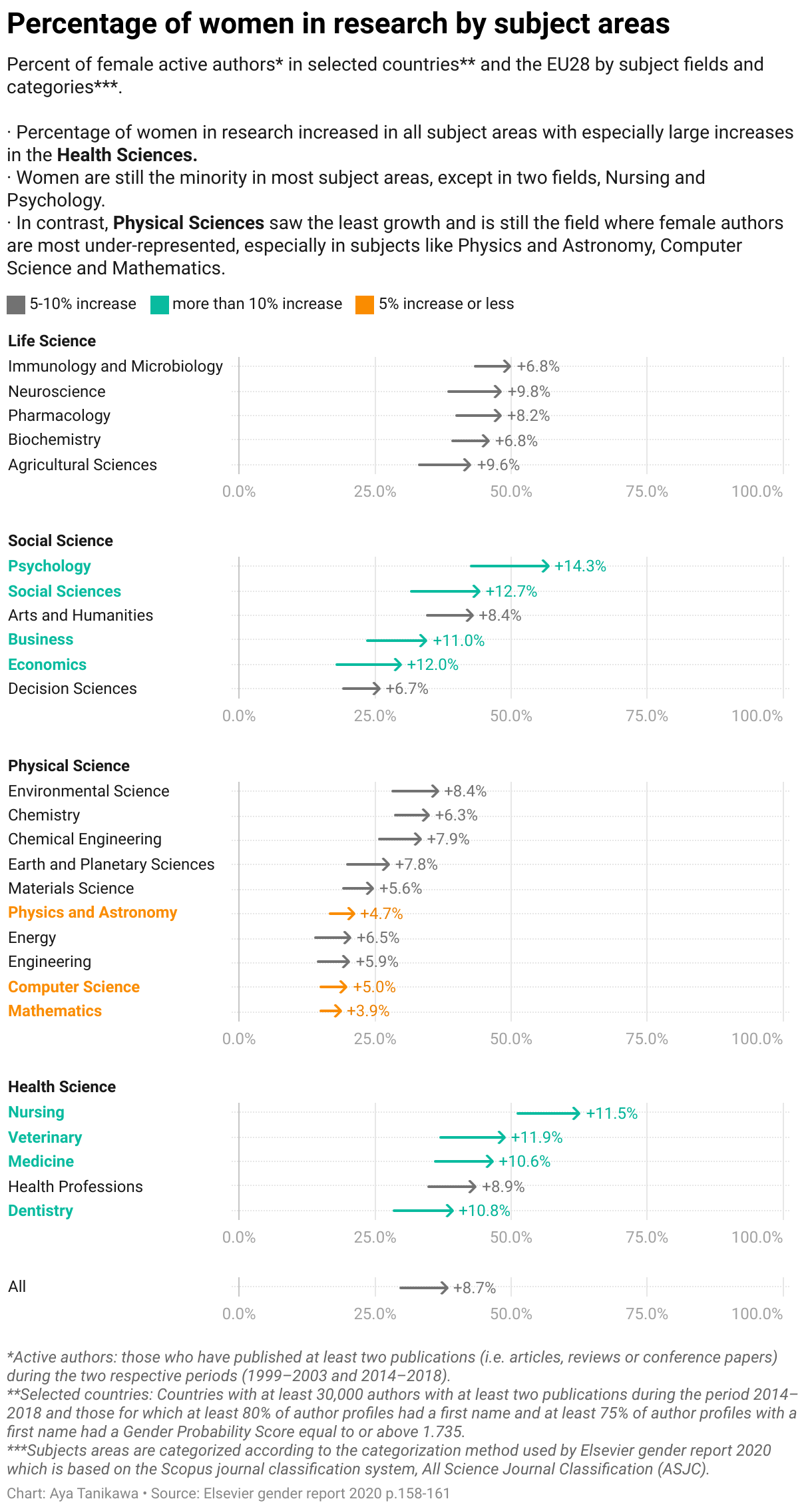
It’s interesting to see that in most subject fields with an already higher share of female authors in 1999-2003 show even more increase in 2014-2018, while most subject fields with a lower share of women remain low with less increase.
For example, Health Sciences saw particular growth. In Nursing and Psychology, women even make up the majority of their fields.
On the other hand, Physics and Astronomy, Computer Science and Mathematics are fields with the smallest share of women still and show the least increases in the past decade.
Even though most subjects still don’t reach the 50% mark, the share of female authors is increasing in ALL subject areas. That’s got to be good news, right?
These numbers show a part of a much bigger complex topic I don’t know enough about. But visualizing the numbers made me curious. It made me ask questions. I hope they made you curious about the topic, too. For details, do read the full report here.
We have a few more articles on the topic of gender.
If you have recommendations for further reading, do let me know in the comments below! You can also email me at aya@datawarpper.de or write me a message on Twitter (@ayatnkw). We’ll see you next week!
Is there an email list announcing the locations of where fireworks will be lit in Downtown Toronto? I keep hearing them but never see them.

I spent most of 2020 working with Ruby on Rails. I moved a project from Next.js + Rust to… Rails, baby! Back to the future. My earlier post on Second-guessing the modern web was inspired by this experience, that for the product we were building, a ‘modern’ stack was not working as well as a traditional one.
We didn’t do competitive analysis against Laravel, Django, or Phoenix. They’re similar, not radically better or worse. There are multiple acceptable solutions to a problem, and this was more a matter of choosing the right kind of solution than pursuing some kind of perfect choice and burning hours and motivation doing the window-shopping.
What helped Rails win was that the team had a little more experience in Ruby (with the exception of myself), and we found plenty of resources for developing and deploying the stack. Rails fit perfectly into the ideology of Choosing boring technology. Another part of the product would be the hard, innovative part, so it made no sense to grapple with bleeding-edge web frameworks.
This was a really fun experience. There’s a lot to love about Rails. Other communities could learn a bit from the Ruby & Rails culture and wisdom. I won’t implement everything in Rails, but it’ll be part of the toolbox.
Before this, I hadn’t touched the stuff. And I bet a lot of people are like that - they came of age in the world of React and Go, and haven’t tried anything even remotely similar to Rails. For their benefit, and to debrief from 2020, here are some notes on the experience. Plus, Rails-like projects in JavaScript are ramping up quickly, and it’s fun to know the origins.
A while ago, I wrote on Twitter
the real reason why javascript developers don’t use breakpoints and use console.log is that breakpoints don’t work
After years of working in JavaScript, I’m used to bad debugging experiences. The Chrome debugger’s automatic pause on caught exceptions is amazing, sometimes. But throwing a debugger statement in some React code is dodgy as hell. Sometimes it works, mostly it doesn’t. You have to deal with code that might not have the right sourcemap to translate from bundled & minified code to original source. Subtle abstractions like React hooks and advanced transpiler stuff like Regenerator mean that your code’s stacktrace probably looks nothing like what you expect, with lots of internal garbage. Sure, you can learn better techniques for diagnosing and debugging errors, but it’s not just you - the debugging story in JavaScript is pretty bad. This applies even to Node.js, where one of the debugging stories is to connect Chrome’s debugger to a Node.js instance: a finicky solution that doesn’t consistently work.
In Rails, there is byebug. You write byebug in your source code, and you get an interactive REPL right there. It works in views, controllers, database migrations, everywhere. It almost always works. Variables are named what you expect. The whole system is paused at that moment, and you can actually interact with it, using all of the Rails utilities and your installed gems.
If a page crashes unexpectedly, you get a similar REPL experience, in your browser, automatically. With an automatically cleaned-up stacktrace that excludes Rails’s own frames. Like the byebug interface, this REPL actually works and is consistently helpful in finding root causes. Rarely will you need to use puts to print something to the console because this debugging system is so good.
Our Rails app didn’t have any require statements. You mention a module’s name, and it’s automatically included, using Zeitwerk, a tool that comes standard with Rails.
This kind of system was terrifying to me before. What if you accidentally import something just by mentioning it? What if two things have the same name and you import the wrong one? How do you really know what’s happening? Sure, you’re happy now, with all of that annoying importing and exporting taken care of, but the sky might fall.
Or maybe it just… doesn’t. Maybe impure, vaguely risky techniques are just a net positive over time, and making everything fully explicit isn’t really necessary? Now when I’m using other systems, I wonder - what if I could just mention one of my React components and it would just… be there? Sure, the system would have to complain if there were two components with the same name, and it would have to make assumptions about directory structure, but overall, wouldn’t this be nice?
This applies to a lot of other parts of the system too. Rails is famous for doing pluralization - you name a model Post and you automatically get an interface called posts. But what, you ask, of words with uneven pluralization rules? Rails actually does the right thing, almost always. And when it fails, you can override it. It actually just saves time, reliably.
I’ve tried to test front-end applications. I’ve set up nightwatch, jest, enzyme, cypress, and probably 5-10 other frameworks. Front-end testing is universally terrible. Projects like Cypress are throwing untold hours into making it less terrible, taking on massive amounts of complexity to abstract away from fickle browser behavior and complex interactions.
But it still sucks. Frontend testing has no good attributes: it’s unreliable, hard to automate, hard to debug when it fails, and often doesn’t even assert for important behaviors, so it doesn’t actually identify regressions. Running frontend tests in CI is resource-heavy, requiring you to set up headless X windows environments on servers or use specialized CI services that produce screencasts of test runs.
Testing fully-server-rendered applications, on the other hand, is amazing. A vanilla testing setup with Rails & RSpec can give you fast, stable, concise, and actually-useful test coverage. You can actually assert for behavior and navigate through an application like a user would. These tests are solving a simpler problem - making requests and parsing responses, without the need for a full browser or headless browser, without multiple kinds of state to track.
Not only do the tests work better, the testing culture is a completely different universe. There are entire books written about how to write RSpec tests that catch bugs, allow software evolution, and aren’t filled with boilerplate.
Powerful and dangerous.
I’m used to modules as they work in other systems - Python, Node, Elm, and so on. They provide objects, functions, and variables that you can import and combine into your code explicitly. Usually they sit on some specific level of abstraction - it’s a utility for connecting to servers or a React component you can use.
Gems can do so much more. You install something like Devise into your system and it adds views, routes, methods, utilities, you name it. It’s not like “loading some functions”, it’s more like composing a whole different app into your app, implicitly.
This is obviously terrifying. It means that you can’t look at your directories of views and your file of routes.rb and know what exists at a glance. There are other layers, lurking in the ephemeral space of third-party code. They interact in serious but uncertain ways.
But it’s also pretty incredible - the idea that something like passport, Node’s middleware, could instead be a full-fledged authentication system. It means that you have to write a lot less code, and it also means that the people who use that code have a lot more code in common. That gems can work on a higher level of abstraction, making it possible to cobble together software faster, to write less ‘glue code.’
Even if you don’t write Ruby, you should pay attention to Sandi Metz. She’s incredibly wise and has so many incredible ideas to share.
And then there’s arkency, ThoughtBot, and so many other thoughtful writers with years of experience in Rails. Sometimes it’s a little shocking to google for some obscure problem and see a decade of discussion about it.
The best practices are also formalized into tools like Code Climate and reek. I’ve never seen so many actually-useful suggestions come out of automated systems as I did in the world of Ruby and Rails.
Ruby is a pretty pleasant language to work in. Sure, it has a lot of syntax and a sprawling standard library, but you don’t have to use all of that if you don’t want to. It took me a while to adjust to the object-oriented way of doing things - in particular, the idea that you can’t just have a free-range function floating out there, unassociated with a class or module, like you can in JavaScript. And you can’t just create an arbitrary one-off object - you either need to define a class to create an object, or use a Hash to store data.
But Ruby’s standard library isn’t that huge. I’ve seen JavaScript’s ‘standard library’ grow a lot too, and frankly it’s nice to have methods like String.prototype.padStart instead of having every little thing in userspace. The only part that felt actively weird was activesupport - a gem that extends Ruby’s core objects, but is part of Rails. It felt weird to have string methods that would only work if your environment was Rails.
The Dash app for documentation rocketed from my pile of unused tools to an absolute must-have. In the world of Ruby and Rails, with most gems having pretty good, semi-standard documentation, you can search for, and get answers, super fast. The Ruby language documentation and the Rails documentation is absolutely great. The JavaScript equivalent - MDN - pales in comparison.
Remember SASS and the YUI Compressor? These are, unfortunately, defaults in the asset pipeline. There’s Webpacker too, which has a parallel approach to CSS and images as the asset pipeline. It has opinionated integrations with stuff like React. Ah, and I should mention that Rails’s JavaScript utilities are written in… CoffeeScript.
I get it - it’s hard to keep up with the latest trends in frontend. But this is one area where Rails’s strong backwards compatibility feels iffy. I wish that Rails was more opinionated about the frontend, and that it had better opinions.
In Smalltalk, everything happens somewhere else. - Adele Goldberg
Ruby, as today’s Smalltalk, has the same issue. The community venerates small - that methods should be short, files should be small, complexity should be controlled. This begs the question of where it all goes - certainly not in controllers, which should be skinny, and not in views, which should have very little logic at all, and maybe not in models either. Maybe in Service Objects, or policies, or decorators?
I found myself falling victim to this. I’d try to win CodeClimate’s approval by moving code around, perfecting the art of making everything small or at most medium-sized, extracting concerns until most files looked okay. This was time well-spent on learning, but I have to admit that it doesn’t actually matter for an early-stage startup’s product.
In stark contrast to the folks who say that Rails is for prototypes, there’s a lot of attention paid to long-lived engineering efforts - adopting patterns that let many team work on the same ‘monolith’, identifying shotgun surgery - a term I first heard from Sandi Metz.
One of the hardest bugs we encountered happened with ActiveRecord. We were creating a set of changes to apply to a model, using their in-memory instances to do some stuff, and then finally applying them. This broke because one of the ActiveRecord methods automatically ‘committed’ those changes, quietly.
ActiveRecord is kind of like this - a lot of the times it’s pleasantly implicit, letting you just assign a value and automatically saving that to the database. But then it’ll do something implicitly that you don’t want to happen, and figuring out why this happened and how to stop it from happening is a real challenge.
Most of the time, to be clear - it’s a really great system. It provides lots of ways to generate efficient-enough queries, knowing full well that SQL performance is often the bottleneck of web applications. Most of the time it’s really nice that it automatically casts and deserializes query results. But when it goes bad, the diagnosis and the cure can be pretty ugly.
The other issue with ActiveRecord is that it has efficient methods and inefficient methods right next to each other, because it automatically turns your ‘query builder’ into an array when you call array-like methods. So, for example:
Dogs.all.max_by(&:height)
Is wildly inefficient. It might fetch and deserialized a million records just to sort them and give you the first. On the other hand,
Dogs.order(height: :desc).first
Is fast - it sorts in the database and fetches a single record. Rails is both offering smart and easy ways to write optimized code, but also making it really easy to write inefficient code.
A Rails-like framework is a really good thing to have in your toolbox, and there’s a lot to learn from the Ruby community. My hope is that we see these sorts of abstractions in new languages and frameworks, and see more of the Ruby community’s culture filter into the programming world.
I’m delighted to share that the Mozilla Foundation and Corporation Boards are each welcoming a new member.
Wambui Kinya is Vice President of Partner Engineering at Andela, a Lagos-based global talent network that connects companies with vetted, remote engineers from Africa and other emerging markets. Andela’s vision is a world where the most talented people can build a career commensurate with their ability – not their race, gender, or geography. Wambui joins the Mozilla Foundation Board and you can read more from her, here, on why she is joining. Motivated by the intersection of Africa, technology and social impact, Wambui has led business development and technology delivery, digital technology implementation, and marketing enablement across Africa, the United States, Europe and South America. In 2020 she was selected as one of the “Top 30 Most Influential Women” by CIO East Africa.
Laura Chambers is Chief Executive Officer of Willow Innovations, which addresses one of the biggest challenges for mothers, with the world’s first quiet, all-in-one, in-bra, wearable breast pump. She joins the Mozilla Corporation Board. Laura holds a wealth of knowledge in internet product, marketplace, payment, and community engagement from her time at AirBnB, eBay, PayPal, and Skype, as well as her current role at Willow. Her experience also includes business operations, marketing, shipping, global customer trust and community engagement. Laura brings a clear understanding of the challenges we face in building a better internet, coupled with strong business acumen, and an acute ability to hone in on key issues and potential solutions. You can read more from Laura about why she is joining here.
At Mozilla, we invite our Board members to be more involved with management, employees and volunteers than is generally the case, as I’ve written about in the past. To ready them for this, Wambui and Laura met with existing Board members, members of the management team, individual contributors and volunteers.
We know that the challenges of the modern internet are so big, and that expanding our capacity will help us develop solutions to those challenges. I am sure that Laura and Wambui’s insights and strategic thinking will be a great addition to our boards.
The post Expanding Mozilla’s Boards appeared first on The Mozilla Blog.

The two approaches answer two different questions. Read More
Dianna, our inquiring mind, has an inquiry:
OK, Canadian natives, I have a question for you. What’s with the topknots on these snow people? They remind us of the turbans which little Sikh boys wear.
BTW, also love the blue eyes on the snow person, and the pine cone mouth on the other.
I’m on a bit of a roll capturing some reflections of a recent trip back to the US to open Reclaim Arcade. You can read more about getting the Arcade open in this post or, if outdated media formats is your thing, I wrote a bit about the arcade entry point which is a 1980s VHS rental store in this post. This post will be about another space in Reclaim Arcade, the 1980s living room.
A quick repose in the living room ?@ReclaimArcade? pic.twitter.com/aDBeig6NKM
— Jim Groom (@jimgroom) January 30, 2021
The living room in the arcade is a direct descendent from the UMW Console Living Room Zach Whalen and I created back in the Spring of 2015. None of the furniture was re-used from UMW (I picked most of this furniture up either on Facebook or at a second hand furniture store in Fredericksburg for a grand total of $300), but a ton of the technology was re-used. The Emerson 19″ TV, the Sanyo Betamax, the Fisher component stereo system, the RCA Selectavision, the Atari 2600, and many other pieces that were collecting dust in a storage unit. So Tim had the brilliant idea to re-create the living room as part of the arcade experience over a year ago, and during my trip back in November of 2020 I completed the revival of the living room, and I must say it looks pretty awesome.

I even printed out more vinyl/laserdisc wall-holder mounts to create a wall of laserdiscs above our 2000+ laserdisc collection, which in many ways is much more at home in the living room than in the video rental store because laserdisc rentals were few and far between. Those cinephiles who had the money for laserdiscs often bought them at places like Tower Records rather than renting them at video stores given they were a niche product. The fact they were more likely to be owned by collectors might account for the excellent condition of almost all of our laserdiscs.
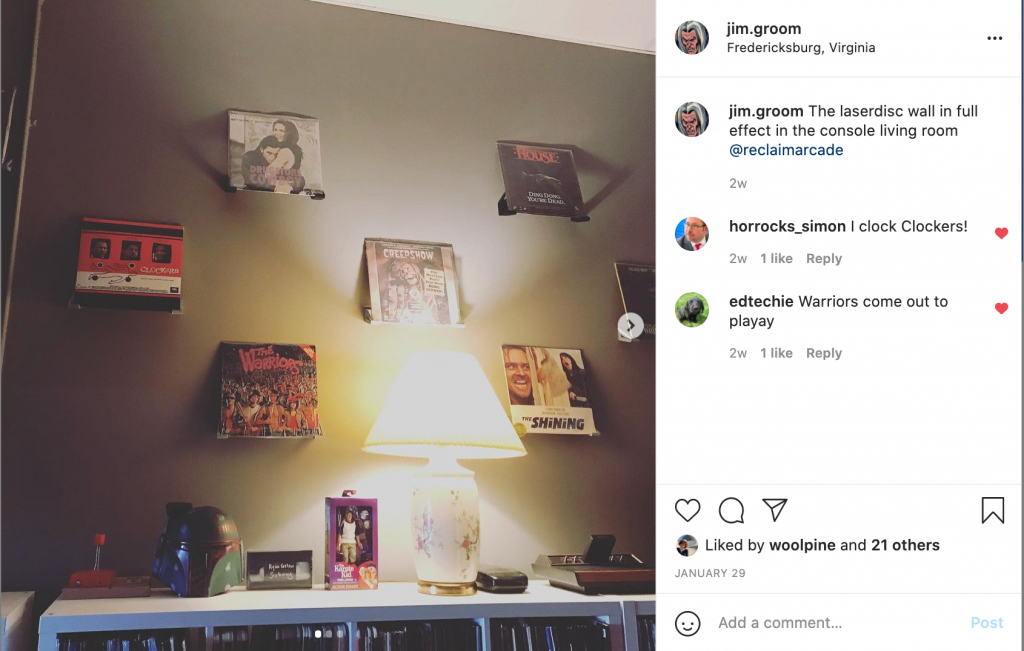
I heard on many occasions folks asking us about our large vinyl collection to see if they were for sale, when they were, in fact, referring to our laserdiscs. Our vinyl collection in the living room is paltry at best, but our laserdisc collection is pretty rocking. I spent an evening actually organizing the laserdiscs into the categories of desirables and undesirables, the movies I want to highlight are all in the top 24 1′ x 1′ squares, and the duplicates and run-of-the-mill films are in the bottom 24. It’s not organized in any other way yet, save that I isolated our burgeoning karaoke collection. You can also see from the image above that the top of the laserdisc storage area is a showcase for toys, dolls, random VHS paraphernalia and our backup Atari 2600 console, which Tim soldered the split RCA wire back together and it worked beautifully—which was pretty cool. You can also see one of our many VHS rewinder units if you look close enough 
It's a laserdisc night tonight in the living room, all sorts of treasures in @reclaimvideo And some still say laserdisc digital audio is without equal
— Jim Groom (@jimgroom) February 4, 2021
I had some fun playing with the laserdiscs, and our AV setup allows us to run the laserdisc audio (as well as the VHS and Betamax audio) through the over-sized Fisher speakers that bookend the living room entertainment center. Laserdisc audio is pretty awesome, and we have a fairly good collection of laserdisc music videos that are fun to play. I spent an evening doing just that lest the laserdiscs feel neglected given all the regular VHS love they overhear in Reclaim Video.
Might have to play this on Sunday. Brady probably won the Super Bowl when this was made ?@reclaimvideo? ?@ReclaimArcade? pic.twitter.com/UaWDiMgCf6
— Jim Groom (@jimgroom) February 4, 2021
I even unearthed some NFL Films laserdiscs, which gave me an idea for the OERxDomains21 conference I’m helping organize this coming April, so that was fun. Plus it was timely given the Super Bowl was just a few short days away, and Tom Brady won it again—which helped me feel young.
The glow is strong with this one pic.twitter.com/WaXHlMelxw
— Jim Groom (@jimgroom) February 4, 2021
I do love the oddities of some of this older media, like the fact that many of the music video laserdiscs only occupy one side of the disc, so if you put it in the wrong way you get a message something like the one featured above. You can almost feel the glow off the CRT on this one, and there is no question how much an upgrade the quality of laserdisc video is over VHS and Beta.
First Blood on Selectavision pic.twitter.com/vNbjhIzScU
— Jim Groom (@jimgroom) February 7, 2021
Another highlight during my time in the living room was sharing more information about the RCA Selectavision with anyone that would listen. I’m intrigued by this format to no end, it uses “a special needle and high-density groove system similar to phonograph records” to playback video discs. Basically vinyl for movies, and it was a total flop because if you so much as touched the disc it would skip and effectively become unusable. The limits of this format are apparent on just about every videodisc we have, and we have about 70-80, but I still love to watch them, if only for the unique visual and audio glitches. I watched The Love Bug, First Blood, and The Eyes of Laura Mars, which I discovered was mistakenly housed in the Godfather Part 1 videodisc holder. It’s effectively impossible to know what disc is in what holder until you play the disc, so there’s that—which is another oddity I love about this format. The covers are truly like protective turtle shells that prevent you from ever actually seeing the disc given how fragile they are—a failed design through-and-through.
Current work situation pic.twitter.com/ELbftXpvsY
— Jim Groom (@jimgroom) February 8, 2021
But I think my favorite part of the living room was hanging out there during the arcade’s off-hours. I watched The Slumber Party Massacre and Slam Dance during the evenings of the working-week to get my VHS fix, and that was a blast. But most days I simply setup shop in the living room and dis my day job at Reclaim Hosting from the comfort of our faux wood veneer 80s furniture. The living room is comforting to me on an almost primal level; I have fantasies about being buried underneath the coffee table in a glass coffin should I come to an untimely end—is that strange?
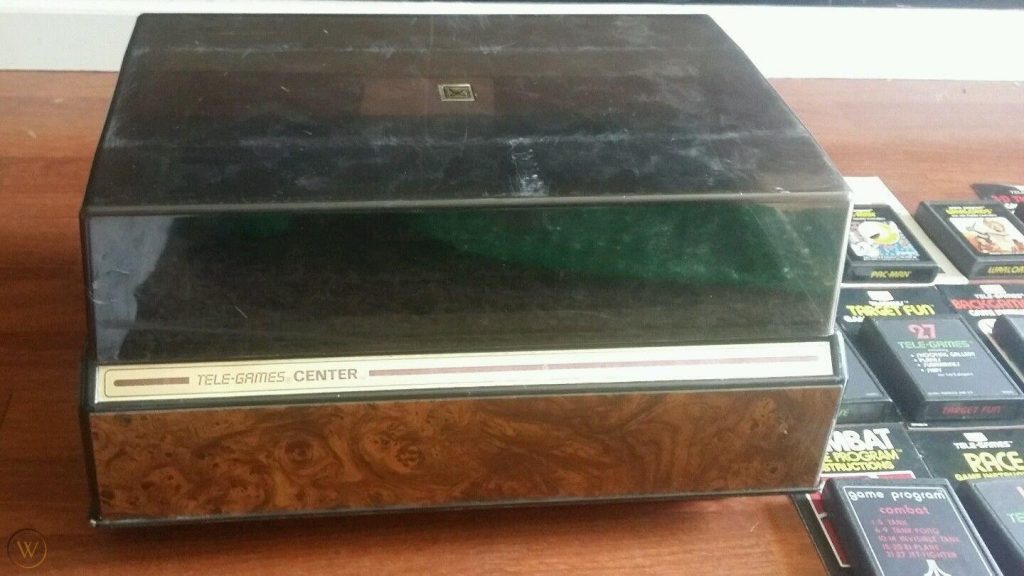
Telegames Atari 2600 Storage Kit
Anyway, there is still more goodies to come. I recently purchased an Atari 2600 storage container, as well as an Atari 2600 Video Game Brain that allows you to switch between 6 cartridges without ever removing a game Oh yeah, I just remembered I also picked up an Atari 7800 with quite a few 7800 games, as well as a load of 2600 games given the 7800 console was the first backward compatible gaming console, which is also pretty cool.
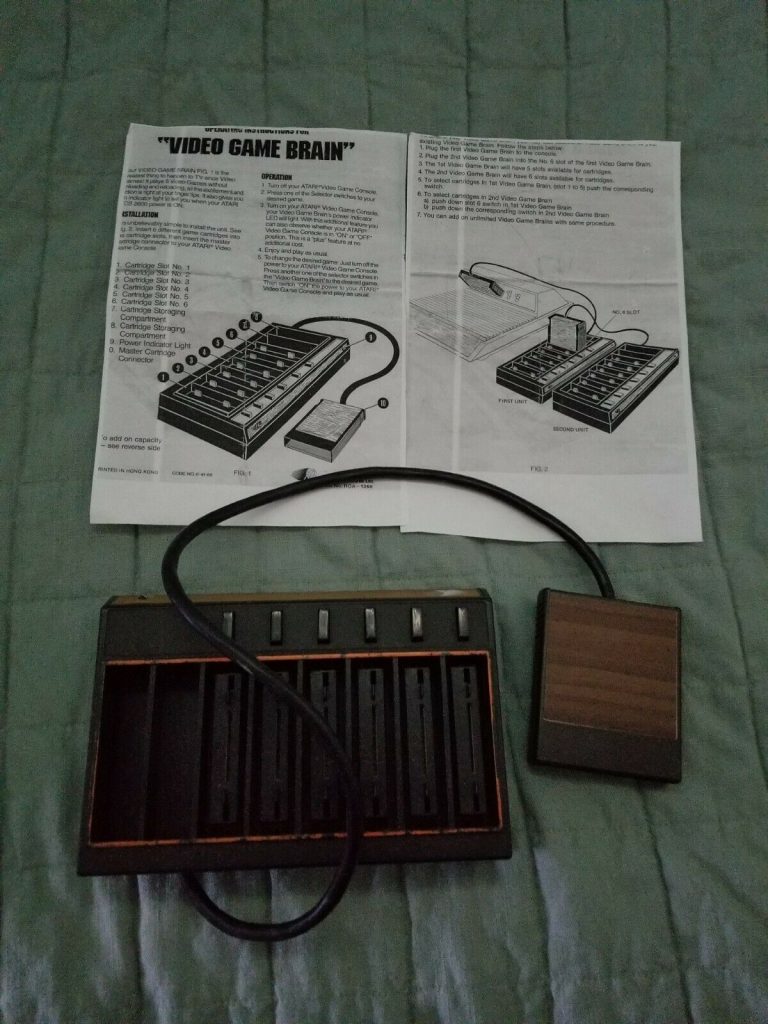
Video Game Brain for the Atari 2600
There was even some suggestions on Twitter for paneling on the wall, which would be the perfect finishing touch, but I’m not gonna lie—I’m shot, and I am sure Tim is doubly so. We resurrected the arcade from what seemed a certain death when COVID ruined most of the world’s best laid plans, and that happened in 4 short months. It’s amazing that it looks as good as it does. Luckily we’ve accumulated so much stuff in our office over the past 4 years, and we’ve been joking while getting the space ready that nothing we’ve gotten has gone to waste. And nowhere has that proven truer than with the arcade games, but more on those in my next post.
You're place would look pretty sweet with some wood paneling, and a fire pole… pic.twitter.com/j3lckW0njl
— Michael B Smith (@mbransons) February 8, 2021
I quit drinking a bit more than three years ago. I wrestle with terms – I had a fairly easy time quitting, which makes me wonder whether “alcoholic” is the right word for me, but “problem drinker” certainly describes my experience. I liked drinking alcohol, and I had a hard time stopping once I started. I did things I regret when drunk, damaged relationships, mistreated friends and abused my body. I am proud of my sobriety and hope to stay on this path in perpetuity.
Unlike some people who stop drinking, I haven’t removed all the alcohol from my house. My partner has an occasional glass of wine and back when we could have friends come to visit, we’d have wine and beer around for guests. But there’s no bourbon in my house because that was my special poison. I got drunk on big cups full of diet pepsi and Jim Beam, sipped in front of the TV to relax at the end of the long day. Almost every day was a long day.
So this ad on Twitter is tough for me.

Put aside for the moment the whole question of whether it’s appropriate for Jim Beam to appropriate the language of self-care to promote their liquor. I don’t want to see this ad. It’s not good for me to see this ad. I would argue that it’s not even good for Jim Beam for me to see this ad – I am not the sort of responsible Jim Beam consumer the brand claims to be seeking out.
I block ads with Ghostery on Firefox, but Twitter’s ads come through. I’m okay with that – I would prefer a world where I could pay Twitter for their service, but I appreciate that Twitter makes it easy to block individual advertisers… and I block many of them. But this isn’t a conventional ad – it’s a promoted Trending Topic.
Several people have suggested that I might turn off the ad by disabling personalization – I’ve done so. The ad persists. How about blocking the specific advertiser? I did that too – it involves going specifically to Jim Beam’s profile page and blocking them. Not that much of a problem for me, but I can imagine people in recovery for whom that step would have been difficult and unpleasant. But it doesn’t actually remove the promoted trending topic – it’s still there when I reload Twitter after blocking Jim Beam.
Other platform companies have evidently realized that alcohol ads can be problematic. Facebook’s Ad Preferences page includes an Ad Topics section where you can choose to see fewer alcohol ads (but won’t promise to eliminate them.) Google offers a similar feature, and when you choose to see fewer, it offers “we’ll try not to show ads from this category”.
Not Twitter, though. My deep dive into Twitter’s ad settings has led me to retrieve a 47-page long list of advertisers who may reach me because the ad data it has on me is similar to the audiences these advertisers are targeting. Several are liquor companies, and I’ll block them all individually as well. But given that blocking Jim Beam entirely hasn’t stopped this ad – ahem, sponsored trending topic – I don’t have great confidence that this will work.
Here’s a dark twist in all this – because I tweeted about the problem seeking help in stopping alcohol ads on Twitter, and because people have responded talking about their problems with alcohol ads, I’m now getting alcohol brands in my lists of accounts to follow. Don’t like being advertised to by Jim Beam? For a relaxing time, try Suntory time.

Alcoholics and problem drinkers aren’t the only ones who face this problem. In writing about this, people have pointed out how horrible it is to experience a miscarriage and then be targeted with baby product ads. Advertising, in general, can be triggering, whether it’s the Father’s Day ad after your dad’s death, or Valentine’s Day after a breakup. What’s tricky is that targeted advertising promises that we can avoid inappropriate and harmful ads and optimize for what we want and need. It’s a promise that often falls short.
To Twitter’s enormous credit, Twitter’s revenue product lead contacted me within an hour of posting about the problem: “Hi Ethan, thank you for the feedback and great suggestion. Will look into getting something like this built.” Twitter gets credit for using their own tool, following online discussions and responding to suggestions. I hope Twitter will a) make it possible to block or mute sponsored trending topics and b) include a global “no alcohol for me” feature, understanding that mistakes happen, etc.
We have a funny relationship with alcohol in our society. A few months back, I did a small favor for a national philanthropic organization. To say thanks, they sent a bottle of very good small batch bourbon to my house, hand-delivered by a local retailer – no card, so I didn’t know who’d sent me the bottle or why. I was so surprised, I accepted the bottle from the deliveryman, wordlessly, and brought it inside. I had trouble sleeping that night, thinking about how lovely that particular bourbon tastes. The next morning, I drove the bottle 15 miles to the liquor store that had delivered it, handed it back, and asked them please to take it. My hands were shaking, and I explained that, as nice as the gift was, I simply couldn’t have it in my house.
I know I’ve brought alcohol to someone’s house not knowing whether drinking was a problem for them simply because alcohol is a default gift in our society. I suspect that whoever approved the Happy Hour campaign on Twitter for Jim Beam didn’t think that it would lead to shaking hands for at least a few of us who saw the ads. One aspect of contemporary society that gives me some hope for the future is that we seem to be getting better at understanding that what’s okay for us might be very harmful for someone else. Here’s hoping Twitter and other companies will make it easier for those of us who are trying to care for our alcohol problems to have a safe and sober happy hour at the end of a long day.
The post Hey Twitter, I need it not to be 6ourbon 7ime appeared first on Ethan Zuckerman.

LastPass announced it will restrict users on its free tier to one type of device starting next month.
Starting March 16th, LastPass Free will ask users to pick between ‘Mobile Devices’ or ‘Computers.’ Whichever you choose, you’ll be able to use LastPass for free on an unlimited number of that type of device. In other words, anyone who uses LastPass Free on both their phone and laptop won’t be able to keep doing so after March 16th.
Instead, you can pick whether you have LastPass free on any number of ‘Computer’ devices, like Windows or Mac laptops, or any number of ‘Mobile Devices’ like phones or tablets. The Computer category includes LastPass’ browser extension.
Along with restricting the types of devices for free subscribers, the password manager will limit the available customer support options. Starting May 17th, free users won’t be able to access customer support over email.
Likely, LastPass is hoping the change will push users to subscribe to its paid tiers. There’s Premium, which costs $4.25 a month in Canada (billed annually at $51) or Family at $5.50 monthly (billed annually at $66). For most people, it’s probably better to switch to another password manager entirely.
LastPass isn’t the best password manager available, and there are plenty of options out there that offer more for much less money. One of LastPass’s greatest strengths was that its free tier provided a comprehensive password management experience. That made it an excellent starting point for many people, as well as for people who wanted a password manager that didn’t break the bank.
As such, I’ve included a few excellent alternatives below (and for more options, check out our full guide on setting up a password manager). Some have better free tiers, cheaper paid tiers, or both. Other password managers just supply a better experience overall. I use Bitwarden myself and strongly recommend it, but check out a few options and see which one meets your needs best.
If you’re worried about switching password managers, it’s actually a pretty simple process in most cases. As someone who has switched password managers a few times, it really is straightforward.
LastPass (and most decent password management platforms) offers robust import and export tools. LastPass lets you export passwords as a .csv or .xml file, and you can use that file to import your passwords into another service. Just make sure to delete that file after you finish the transfer so your passwords aren’t hanging around unsecured on your computer somewhere.
Source: LastPass Via: The Verge
The post LastPass will restrict free users to one device type in March appeared first on MobileSyrup.
When SkyTrain opened for Expo in 1985, it was hoped it could become a popular alternative for rapid transit. Other than in a handful of cities, like Kuala Lumpur, it hasn’t. But maybe a technology of the 80s, like music and fashion, is coming back.
Consider the global impact if a SkyTrain-like transit alternative happened in a trend centre like Los Angeles.

They don’t call it SkyTrain, of course. When they see an elevated train, Americans think of monorail (cue The Simpsons). One of the two bidders for the project calls it LA SkyRail Express . The technology may be different but the scale and purpose is the same. (The other bidder is for more conventional light-rail rapid transit.The $6.1 billion project would provide a one-way trip from the Valley to the Westside in approximately 24 minutes. But at about every 30 minutes, it’s not quite SkyTrain frequencies.
While comparing social geography is never accurate, the map suggests a comparison to Vancouver. The Sepulveda project would connect two of the most affluent parts of the LA region. Imagine the Santa Monica mountains as analogous to the Burrard Inlet, and you can see how it’s kind of like joining our downtown peninsula and the North Shore via SkyTrain.
One of the hardest things I’ve had to learn is that humans aren’t pure functions: an input that works one day and gets one result, then again another day and get an entirely different result.
 |
mkalus shared this story . |
Motorists on Edmonton streets may soon be required to stay at least one-metre away when passing cyclists if city council approves a new traffic safety bylaw.
Council's community and public services committee agreed Wednesday that administration should draft a safe passing bylaw.
The city has been looking at Calgary's model, implemented in September 2019, that requires drivers going 60 km/h or slower to be a minimum of one metre away when passing a cyclist.
On roads with a speed limit higher than 60 km/h, Calgary's bylaw requires drivers to leave 1.5 metre of space when passing a bike.
Those found violating the bylaw in Calgary can be fined $203. The committee was told that Calgary has never issued a ticket.
Coun. Ben Henderson suggested that the purpose of such a bylaw would be to clarify what is deemed safe rather than to give out tickets.
"It's probably more useful as an information tool, as an education tool than an enforcement tool, would that be fair to say?"
The city's traffic safety director, Jessica Lamarre, agreed that a bylaw would be an opportunity to educate people about road safety.
"Overtaking manoeuvres — which is what cars do when they move around bicycles in particular — there's a lot of grey area there that we could really clarify," Lamarre said.
Henderson noted there's no set standard.
"Right now, we probably don't really have a tool, except to say 'be safe,' which is not terribly helpful," Henderson said. "One person's idea of what's safe is very different from another's."
Before the committee agreed to a motion directing administration to draft a bylaw, several members of Edmonton's cycling community spoke in favour of the move.
Andrew Ritchie with the non-profit Paths for People said a bylaw would help raise awareness of road safety.
"Most cyclists can tell you their close call story, when a vehicle passed too closely, putting the cyclist in an uncomfortable and even dangerous spot," Richie said.
Based on the number of close calls stories, he said, more awareness is needed.
"It's clear that when we are driving, we don't always realize how close we may get to other road users like cyclists when passing," Ritchie said.
From 2015 to 2019, 87 per cent of crashes in which a cyclist was killed or seriously injured happened on roads without protected bike infrastructure, according to a city report prepared for the committee.
Henderson noted that Calgary was looking for partners to jointly advocate for the Alberta government to implement a province-wide standard.
In Canada, seven provinces and one territory have safe passing laws in their traffic regulations. British Columbia, Yukon, Ontario, New Brunswick, Nova Scotia and Prince Edward Island require a minimum of one metre passing distance regardless of speed limit.
Quebec and Newfoundland require one metre for motorists driving less than 50 km/h, and 1.5 metres for drivers going faster than that.
Calgary and Whitehorse are the only cities with additional requirements through municipal bylaws.
Coun. Aaron Paquette welcomed the motion to draft a bylaw.
"We've been seeing a massive increase in folks on bikes sharing the road with vehicles," Paquette said. "The more clear the rules are for everyone, the more we can drive calmly and safely, cycle calmly and safely."
|
mkalus
shared this story
from  Das Kraftfuttermischwerk. Das Kraftfuttermischwerk.
|
Manchmal sind es ganz simple Ideen, die zu großartigen Ergebnissen führen. So wie in diesem Fall. Der Outro Podcast filmt ganz unaufgeregte Spaziergänge durch diverse Städte und packt unter diese dann Mixe von lokal ansässigen DJs. In der aktuellen Episode gibt es einen Gang durchs winterliche Frankfurt zu einem wundervollen Dubtechno-Mix von Tim Eder mit exzellenter Tracklist.
Tracklist:
R.M – Déambulation
Warmth – Altitude
P. Laoss – D.I.V.E.
Stereociti – Kawasaki
Move D & Benjamin Brunn – C-Sick
Trux – Leash
Jouem – Tauran
Marko Fürstenberg – Falling Leaves
Blue Closet – Dreaming Of Paradise
Sven Weisemann – Harbor Lights

 |
sillygwailo
shared this story
from  Cecily Walker. Cecily Walker.
|
I made the decision earlier this year to spend the year preparing my grad school applications — that’s right, I’m planning a return to academia after a very long hiatus, provided that the schools of my choice accept me.
Because I’ve made this commitment to myself, I’ve been focusing on studying “hacks” and trying to learn new ways to organize my thoughts. So far, the Zettelkasten system seems to be the best that suits my uses. Essentially, the system is supposed to help make analyzing and synthesizing reading easier, as it facilitates making connections between seemingly unrelated ideas and information over an extended period of time.
I’ve tried unsuccessfully in the past to keep a commonplace book – a collection of notes, quotes, and random ideas that I intended to refer back to but somehow never did. It turns out that effortful engagement is the key to being able to easily retain and recall this information, and to make meaningful connections between seemingly disparate collections of information. By making an effort to engage with the work and make these connections, we’re then able to fully think through our own thoughts about what we have read, and to make connections between ideas that might not have otherwise been possible. I’ll give you an example.
I’m currently reading Andre Brock, Ph.D’.s Distributed Blackness for an upcoming book review that I’m supposed to be writing (sorry, Emily). While I was reading the book, I came across the following quote from Brock:
The internet should be understood as an enactment of whiteness through the interpretive flexibility of whiteness as information. By this, I mean that white folks communications, letters, and works of art are rarely understood as white; instead, they become universal and are understood as “communication,” “literature,” and “art.”
This reminded me of Langston Hughes’ essay “The Negro Artist and the Racial Mountain,” where Hughes muses on the responsibilities Black artists have to Black communities when they are funded by white patrons. That essay opens with Hughes relating a story about an encounter he had with a Black artist:
One of the most promising of the young Negro poets said to me once, “I want to be a poet — not a Negro poet,” meaning, I believe, “I want to write like a white poet”; meaning subconsciously, “I would like to be a white poet”; meaning behind that, “I would like to be white.”
Because I’m using the Zettelkasten system, I was able to physically and visually make a connection between these two ideas in a system of my own design. Watch the video below.
Once I discovered how easy making these connections would be, and how effortless it would be to create, and how much difference effortful engagement would be in helping me to retain, recall, and contextualize disparate information chunks, I became hooked.
I could go into greater detail about the tool I’m using
to create my Zettelkasten, but I’ll save that for another blog post, because this one is already long enough. Instead, I’ll provide a few links to blog posts, videos, and information management tools that have been especially useful over the last 8 weeks.
Craft | A fresh take on documents – requires subscription
Obsidian: A knowledge base that works on local Markdown files. – free
Introduction to the Zettelkasten Method – from the official home of Zettelkasten, an (incredibly) deep dive to the method, why it works, and how you can set it up for yourself
Zettelkasten Method: The What, Why, and How of Getting Started – Sean Lawson’s extensive primer on the problem, the promise, the program, and the platform of the Zettelkasten system
Do you use a system like this? Do you use a different system? How do you make connections when preparing to write or when studying? Let me know in the comments.

Well, that didn’t take long.
It’s been about four months since Apple’s new Apple Silicon M1 system-on-a-chip (SoC) became available in MacBooks and Mac mini devices, and researchers discovered malware that works on the new chip. One malicious program dates back to November 2020, the same month M1 devices became available. However, most users likely don’t need to worry much yet.
Gizmodo cites two main reports of M1 malware. The first comes from security researcher Patrick Wardle, who published a blog detailing a malicious program reworked for the M1.
Dubbed ‘GoSearch22,’ the program is a Safari browser extension and a variant of the ‘Pirrit’ adware family. Ars Technica describes Pirrit as a “long-running malware family” that started on Windows and was later ported to macOS. Those interested can read more in reports published by researcher Amit Serper in 2016 and 2017.
In short, GoSearch22 behaves similarly to typical adware — it infects a device and then shows users coupons, banners, pop-up ads, surveys and more. Some of the ads promote shady websites and downloads. Plus, these types of malware often collect browsing data like IP addresses, websites users visit, search queries and more.
Gizmodo explains that GoSearch22 was signed with an Apple developer ID on November 23rd. That developer ID means the malware wouldn’t trigger the ‘Gatekeeper’ software on macOS. Gatekeeper is meant to help protect users from malicious software by notifying users when they attempt to download or install an unsafe program.
While developers can take an extra step of having Apple notarize the code for additional confirmation, Wardle noted in his blog post that it’s unclear if Apple ever notarized the code for GoSearch22. Apple has since revoked the malware’s certificate.
Regardless if Apple notarized the malicious software, Wardle says it infected macOS users.
The second report comes from Wired, which also outlined the Wardle blog. Additionally, Wired says security researchers from Red Canary told the publication that they’re investigating an example of native M1 malware that seems distinct from Wardle’s finding.
The presence of malware for M1 Macs shouldn’t come as much of a surprise. Contrary to popular belief, malicious apps do exist for macOS, and it was only a matter of time before the people behind those apps converted them to work on the M1.
“And honestly, I’m not at all surprised by the fact that it happened in Pirrit first. That’s one of the most active Mac adware families, and one of the oldest, and they’re constantly changing to evade detection,” Thomas Reed, a security researcher with Malwarebytes Mac, told Wired.
Wardle also told Wired that some defensive tools, like antivirus engines, struggle to catch the new M1 variants of malicious code.
“They can easily detect the Intel-x86 version, but failed to detect the ARM-M1 version, even though the code is logically identical,” Wardle said.
Red Canary echoed this, noting that there can often be a lag in detection rates while antivirus and other monitoring tools collect “signatures” — think digital fingerprints — from new malware.
Considering malware is already turning up for the M1 Mac, the detection ‘lag’ can be cause for concern. Malware is already in the wild, but detection hasn’t caught up. And according to Red Canary, building out detection capabilities for new platforms like the M1 can take time as software developers try to make sure they don’t break systems.
Thankfully, the first round of malware appears to be frustrating but not overly dangerous — but that doesn’t mean more dangerous malicious software won’t follow. Until detection services catch up, anyone with an M1-powered Mac should be extra careful about online activity and what software they install. Sticking to apps from trusted sources and avoiding shady websites could go a long way to keeping malware off your Mac.
Source: Gizmodo, Ars Technica, Wired, Patrick Wardle (Objective-See)
The post Security researchers have already found malware targeting M1 Macs appeared first on MobileSyrup.


