Shared posts

18 Feb 02:00

Who’s in Charge Here?

by Jim

We all carry around a fairly standard mental model of a classroom; podium and black/whiteboard in front, neat rows of desks facing the teacher. Progressive schools break the rows up into pods; college lecture halls put the seats on a slope. Drop us in a classroom and we know what to do. 

The main classrooms at the Harvard Business School are different in some subtle but very important ways. You can find a brief history of Aldrich Hall and its design process here

The room is designed as a U-shaped amphitheater. There is still a focal point at the front with a low table, not a podium. Student seats are on swivels so that students can interact with one another in the course of case discussion and analysis.

This image provides a good overview of the room’s features.


During my time as a case-writer and doctoral student I was able to observe faculty teach in these rooms without the burden of having to prepare for class (other occasions when I hadn’t prepared constituted a different sort of burden). A professor at the board or in the pit still occupied the position of power and authority. What was fascinating to watch was how professors roamed about the entire space and managed the power dynamics accordingly. 

They might stay at the board and make pronouncements ex cathedra. They might get close to a student to help them tease out a point. They might get right up in a student’s face to shut off a rambling comment. Or, they might wander up one of the aisles and gradually remove themselves from a discussion between students taking on a life of its own. And reassert themselves from the back by directing attention to a relevant point on the boards at the front. 

Teaching as performance art is scarcely a new thought. But teaching is also a kind of knowledge work intent on creating shared understandings. And that depends on more than the simple exchange of words. Shared understanding gets built in shared space. Thinking about the complexity of a teacher’s performance calls attention to how little thought we give to all the levers of performance we can draw on when doing knowledge work with collaborators. 

This is certainly aggravated by a pandemic forcing our interactions into flat video environments with poor lighting and erratic audio. On the other hand, the pandemic is also accelerating an existing trend for moving more knowledge work into virtual environments. The lesson here for me is that like teaching, knowledge work is performance art. The more elements of performance we incorporate, the more effective our results are likely to be.

The post Who’s in Charge Here? appeared first on McGee's Musings.

18 Feb 01:59

The great rebundling is here

David Pierce, Protocol, Feb 17, 2021
Icon

Inch by inch the internet is moving toward he personal learning environment (PLE) model. Or maybe I should brand it more broadly and call it the personal productivity environment (PPE) model. Protocol is calling it 'the Switzerland of x'. Trello, for examplle announced a redesign "bringing all your documents and tasks and files into one organizational tool." Vimeo' Anjali Sud wants the company to be "the Switzerland for the creators." But there's a risk: when the rebundlers become the resellers, and start topping up their profits with paywalls, advertising and surveillance.

Web: [Direct Link] [This Post]
18 Feb 01:52

Shopify

by Benedict Evans

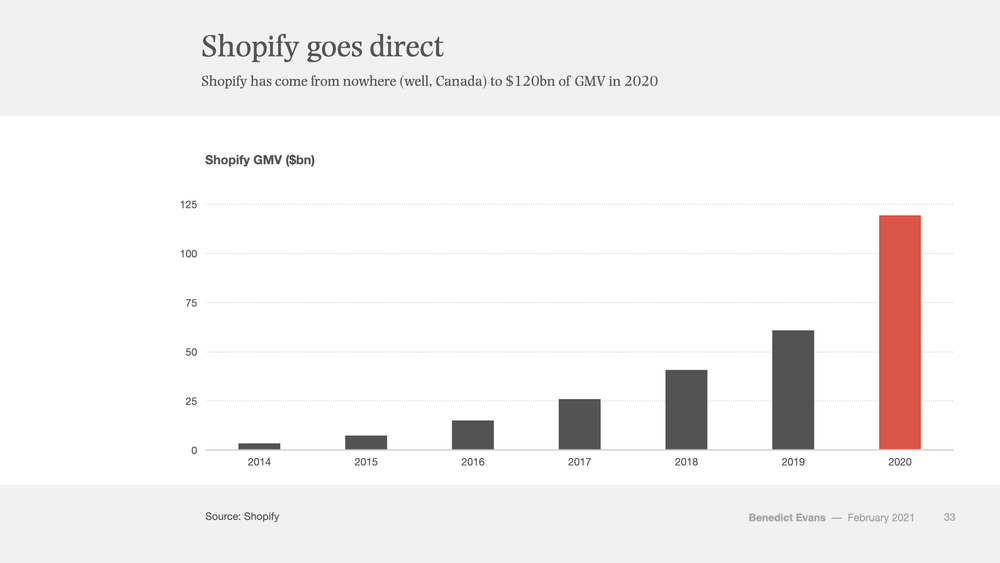
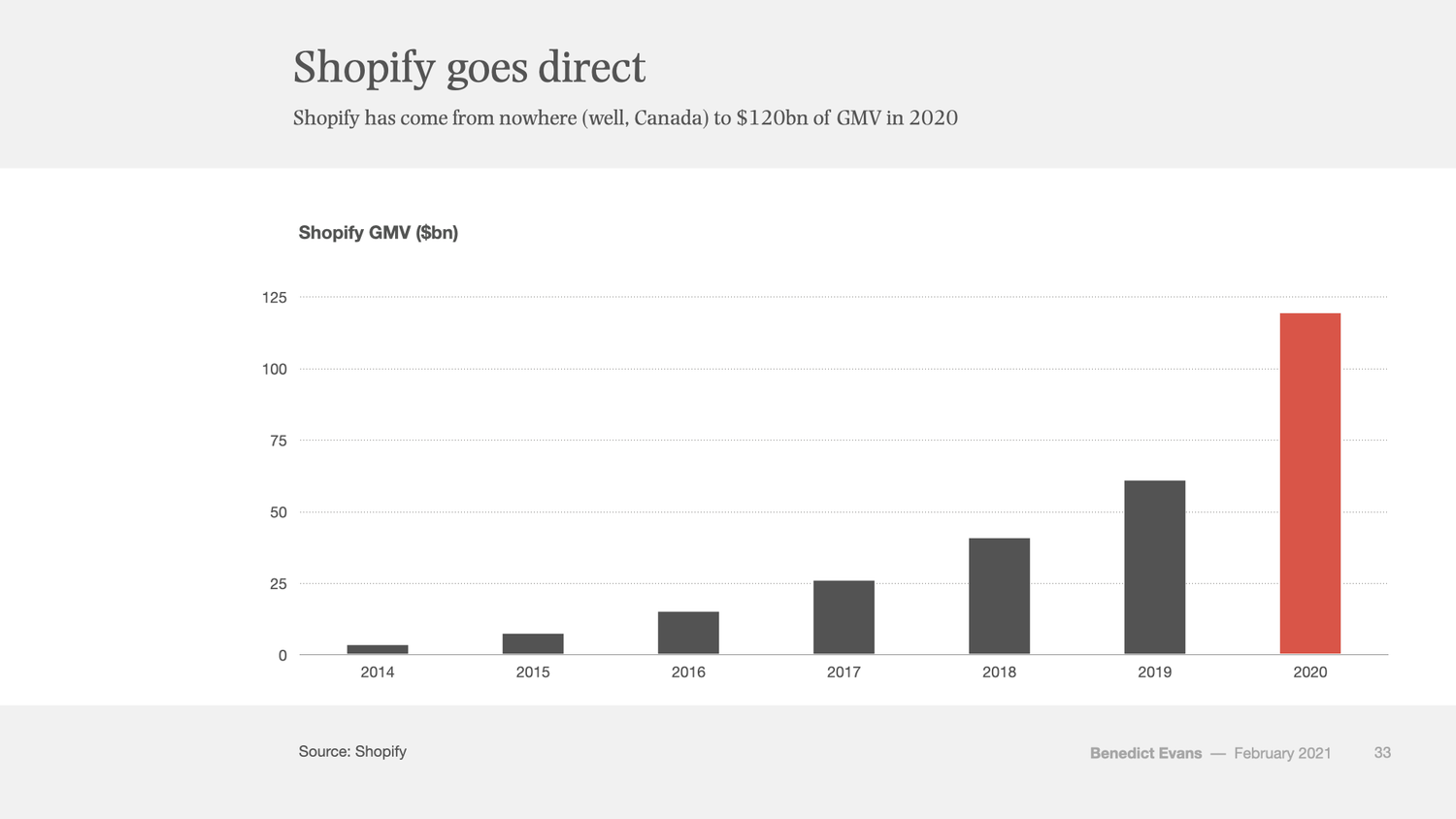
Shopify’s 2020 results came out today, and much as expected, it reported that consumers spent a total of $120bn on its platform, almost exactly double the figure from 2019.

Amazon’s rather different Marketplace business, which started back in 1999, probably had $275bn of third party GMV in 2020. That means Shopify’s merchant sales were over 40% of Amazon’s. Looking back a bit, Amazon had $130bn of 3P GMV in 2017, so in that sense Shopify is only three years behind.

test.png

This is an impressive story of entrepreneurship, and of the acceleration of ecommerce in lockdown, but it’s interesting more generally because it illustrates three pretty important trends in tech and ecommerce. 

1: “No-one can compete with Amazon”

Shopify isn’t doing what Amazon does - it isn’t competing directly and it wouldn’t fit inside a competition lawyer’s market definition (I wrote more about the market definition challenge here). But it challenges Amazon at a very basic point of leverage by doing something different, but relevant. This is very often what competitive threats look like in technology. In markets with strong network effects or winner-takes-most effects, it’s very hard to displace a new incumbent directly, but pretty common to address an underlying customer need in another way. So, Google doesn’t think about Bing nearly as much as it thinks about Amazon and Facebook, and Amazon thinks about Shopify, because they change what the businesses might be, and offer your customers a different way to solve their problem.

2: “Wasn’t this already solved?”

There’s nothing new about tools to run an online shop - those were some of the first companies of the dotcom bubble, and people have been doing this with Wordpress for a generation - but it wasn’t easy, or easy enough, and Shopify found a way to carve out a $100bn business solving things that an engineer would have told you were already solved.

There’s a famous story that when Drew Houston was working on Dropbox, everyone he showed it to said ‘There are hundreds of these!’ and he always said ‘yes, but which one do you use?’ When it launched, the first Hacker News comment was that this was trivial to make yourself - if you were an engineer. Part of today’s explosion of ecommerce is that these businesses come from people who’re great marketers or product people - they’re great at bags or coffee, and they’re not technologists, and maybe they don’t have to be. Shopify and platforms like it unlock this ecommerce for far more people, and there are a lot more opportunities to take a ‘solved’ problem and make it more accessible, and so reach 10x more people. In particular, a lot of people are now trying to make something that’s easier again - a step easier than Shopify, Squarespace or Wix.

On the other hand, half of the Shopify story is actually big companies - Heinz, or Unilever. Why are they on Shopify? Is this part of the ‘consumerisation of IT’ story? Bypassing their legacy stack? Or leapfrogging to the latest tech with no legacy ecommerce to worry about? Yes, all of that. But mostly, it’s about going direct.

3: Going direct

Shopify is riding a wave of both consumers and brands becoming ready to go direct. For 20 years Amazon had trust and it had your address and credit card. But for all sorts of reasons, we now have an explosion of new consumer brands using the internet as their first channel, and most of them want to go direct and own their own customer relationship. In parallel, there are all sorts of giant companies that have consumer brands and make consumer products but that have always been B2B businesses. Unilever doesn’t sell soap - it sells pallets of soap. Now all of those companies want to try to go direct as well, partly to compete with those new brands (small brands have driven most of the growth in CPG in the last decade, for example) and partly to create some tension against Amazon and Walmart.

That meets a huge wave of new companies building all kinds of tools and plumbing to power ecommerce. Part of the story is that the move to cloud, SaaS and unbundling means that anyone can use the same tools now, but that doesn’t mean small people get access to the same tools as big people. Rather, it means that giant companies, perhaps, can get access to the same tools as startups. Andy Warhol said that a millionaire drinks the same CocaCola as the man in the the street, but a lot of the story of tech in the last few decades has been that small companies have much better tech than big companies, stuck in legacy systems that take months to change anything. Only some of this is a technology problem (it’s also what ‘digital transformation’ is about).

For most of these companies, selling online isn’t ‘technology’ - it’s retailing, but with a new channel that needs new tools. The tools have to be good and you have to know how to use them, but most of the questions are retail and brand questions. Will Heinz built a giant D2C businesses? Ask an FMCG analyst. To understand Casper’s margins, look at the mattress business, not the tech stack. The interesting question for Shopify is how far it can move from being a tool to becoming a network, and to become part of retail. And so (to close the loop), the idea that all of this will be swallowed by Amazon makes about as much sense as the idea that all physical retail would get swallowed by Walmart, not because of software but because of retail. So perhaps software isn’t eating retail - retail is eating software. 

18 Feb 01:51

This is Queenie. She came to @BuffaloCARES back in November with her four puppies. All her pups have found loving homes, and now it’s her turn. You can apply to adopt Queenie by clicking below. 13/10 #TrupanionPartner buffalocares.rescuegroups.org/animals/detail… pic.twitter.com/gkrqzOS4uN

by WeRateDogs® (dog_rates)
mkalus shared this story from dog_rates on Twitter.

This is Queenie. She came to @BuffaloCARES back in November with her four puppies. All her pups have found loving homes, and now it’s her turn. You can apply to adopt Queenie by clicking below. 13/10 #TrupanionPartner

buffalocares.rescuegroups.org/animals/detail… pic.twitter.com/gkrqzOS4uN


4189 likes, 382 retweets
18 Feb 01:51

Why does windows think that my wireless keyboard is a toaster? superuser.com/questions/7926… pic.twitter.com/Q03z2eK6kS

by Internet of Shit (internetofshit)
mkalus shared this story from internetofshit on Twitter.

Why does windows think that my wireless keyboard is a toaster? superuser.com/questions/7926… pic.twitter.com/Q03z2eK6kS


2093 likes, 377 retweets
18 Feb 01:51

Building an infill/laneway, Part 3: The part where I pay all the bills and the construction happens

by Frances Bula
FRANCES BULA
VANCOUVER
SPECIAL TO THE GLOBE AND MAIL

The Bula laneway house started to take shape on March 25, 2020.

Here is my unsolicited advice to those who build infills and laneway houses for us amateur developers.

There should be prenatal classes before construction starts.

A class where someone teaches you how to keep breathing deeply and staying calm when the budget-prep person at your builder tells you your project will now cost $100,000 or so more than you thought. Or when drugs are an acceptable option in the event that you get called out into the backyard to hear the construction supervisor say they’ll have to chop down a favourite tree to put in some new piece of required-by-the-city-for-the-first-time-ever plumbing infrastructure that will, by the way, cost an additional $10,000.

Also, that class should spell out some of the basic precautions.


A labour of love: the Bula laneway house kitchen was roughed in on May 23, 2020.

Accept the fact that all the utilities currently serving your house (electrical, gas, water, sewer), which seemed to be working fine for the past 50 or so years will be in fact judged as not fine, out of date and absolutely necessary to be replaced.

Come up with a plan well in advance for how to salvage your trees, bushes and smaller plants anywhere near the construction zone. Bigger plants might need a professional gardener to move. Little things: Put them in pots, so they won’t be mistaken for weeds and have shovelfuls of dirt dumped on them at some point.

Get ready to fight over unexpected stuff, like whether you can use stone blocks for your required new walkway to the infill when the city insists it be concrete (I won). Or whether you have to obey the city order that a swath of ugly asphalt span the entire back of the house, not just the garage entry (I lost).

Oh, and be prepared for, say, a global epidemic arriving in the middle of your project.

I experienced all those and many more angst-causing moments that I didn’t think about during the four-plus years of waiting to get permits. I’d entered a fugue state where I’d forgotten about the reality of money, dirt, concrete, wood and all the rest.

That hit when we got the revised bill for construction in January, 2020, a month before construction was to start.

In the beginning: Construction starts on the Bula laneway house on Feb. 27, 2020.

I had remembered that the original contract from October, 2015, said about $350,000. (It was actually $342,400, with a note at the end about having to cover any disbursements the company might have to incur, which appeared to be under $10,000. And some language about how these were “preliminary estimates only.”)

What we heard in January, 2020: $510,631.18.

The unexpected, additional two years of waiting had added a straight $34,000 to the original $232,000 for the actual house (separate from site work, landscaping, preconstruction design work and municipal permits).

A note to city councillors everywhere: When you decide to slow down all development in order to have robust engagement about new zoning plans, this is one of the direct effects.

It turned out the laneway was going to be near an electrical transformer in the alley, so there was an additional $16,000 for fire-rated wall assemblies and another $12,000 for a metal, rather than shingle, roof.

Municipal permits had increased from $19,000 to $33,268. The bill for site preparation had gone from $40,000 to $58,300 because our yard was “so difficult to work with,” according to the budget guy. Plus, tearing down the existing studio/garage hadn’t been factored into the original estimate.

I’d left my step-daughter in charge of making all the decisions about interior finishes, including any upgrades and built-ins (useful for putting what would turn out to be five people in 1,040 square feet). Those added almost $46,000 to the total, so that increase was on us.

Little did I know then that there’d be another $20,000 or so in surprises and extras before the end.

Foundation work began on March 7, 2020.

At that point, though, whatever the bill, we didn’t have a choice. Housing costs had continued to escalate, making it ever more unlikely that our kids could get anything like this space in the city for the same price. So I started writing cheques.

The bulldozer arrived Feb. 18, just after we’d returned from a three-week trip. It demolished our studio/garage in a day, crunching up the concrete floor, the walls, a giant bookcase I hadn’t been able to give away, the toilet, a gas stove and much more into one giant container load.

The first weeks were the worst, when a lot of the bad news got sprung.

Did I know, I was asked the first day, that my fence was in the wrong place – it was actually slanted slightly away from the real property line and should go 18 inches over into my neighbour’s yard by the laneway end.

Amid the COVID-19 pandemic, framing started on the laneway house on March 23, 2020.

No, I didn’t know that, because all the little lines on the plans I’d been sent were hieroglyphics to me and I didn’t spot the divergence between actual fence and legal property line among 500 other little lines. And no one had mentioned it when the surveying work was done three years earlier.

I was also told the first week that a beautiful Japanese maple would have to removed in order to meet the city’s new requirement for a larger sump pump. That’s also when I was scrambling to move plants to get them out of the way of the latest bulldozer foray as more and more of the yard needed to be dug up to replace utilities.

In the end, the worst problems got settled.

Built-in cabinetry in the kids’ room blends the bright white of the ceiling.

FRANCES BULA/THE GLOBE AND MAIL

The sump-pump location was moved and the tree was saved. The neighbour next door offered to pay for half of the fence replacement that ended up being necessary and was gracious about the loss of part of his yard. (As it turned out, I had to replace fences on both sides, because the grade at the back of the yard ended up significantly higher than it had been previously. That meant dirt had to be piled up, which means fences had to be replaced or the dirt would just make the old ones rot.)

There was a couple of weeks where we just had a giant expanding hole, another month where we had the outline of a concrete bunker. Then the house frame went up in essentially five days. After that, it looked more home-like with every passing week. I have to admit, as truckloads of material arrived day after day and crews of up to 20 swarmed the place, $500,000 started to feel reasonable.

The siding is affixed on June 23, 2020.

Our construction supervisor, Cory Sayers (an on-the-ground hero who had to deal with my occasional Karen-ing moments and sometimes used to bike over to our place at night to make sure everything was locked up), did some kind of Rubik’s Cube magic to keep everything going under pandemic rules. Those rules meant you couldn’t have two trades working in the same area at the same time.

Almost unbelievably, the house passed its final inspections Sept. 29, 2020, 225 days after the bulldozer arrived – only two weeks later than our designer Smallworks Inc.’s original estimate – in spite of the pandemic. City inspectors, despite our fears that they wouldn’t be able to work, continued to show up when needed, an essential part of keeping the project going.

Our kids moved in Oct. 4, almost five years to the day after we signed the original contract.

Almost after: the kitchen nears completion.

FRANCES BULA/THE GLOBE AND MAIL

It’s all been worth it. They have a home. We love having them so close, seeing the diorama of their fun family life through the windows, kids jumping on the sofa, across the way. But I still wish we could have done this all in the original two years we imagined. Not five.


18 Feb 01:49

Picking better names for variables, functions, and projects

by Tom MacWright

Naming things in programming is hard. It’s not impossible, though. Here are some guidelines I usually follow.

Avoid weasel words

Wikipedia’s article about weasel words is incredible. In this context I mean words like this:

  • Data
  • Process
  • Run
  • Do
  • Setup

These words usually don’t mean anything at all. Any variable could be called data. Any method could be called process. These words don’t inform or differentiate. Most methods and variables that include these names are misnamed. Think hard and figure out what’s better:

  • A method like processData probably isn’t processing any kind of data. Maybe processCsv?
  • Is it really just “processing” that CSV. Maybe it’s coercing columns that are strings that should be numbers. Maybe coerceCsvRows?

That’s probably better!

  • A variable like data probably isn’t generic data. Maybe it’s… recentPosts?

Follow patterns religiously

Let’s say that you have a bunch of types describing database associations. Commentable, Archivable, etc. Strictly, dispositional adjectives. Follow this pattern for the rest of those types, even if there are awkward cases.

It’s usually better to have awkward cases than to have exceptions to the rule. Observe XMLHttpRequest for example - a name that follows neither camelcase-without-acronyms (XmlHttpRequest) nor acronym-preserving camelcase (XMLHTTPRequest). Stick to one!

Don’t cheap out on characters

Needless abbreviations are a more subtle form of single-letter variable names. If something is a document, call it a document, not a doc. Only in extreme cases - referring to internationalization as i18n is any sort of truncation appropriate.

Call things the same thing

If you have a variable called rows and you pass it to a method that works with row data, the parameter to that method should probably be called rows as well. Unless there’s a reason to use a different name for the same kind or instance of data, don’t use different names for it, use the same name.

Similarly, don’t needlessly reassign variables. An assignment like let theData = input doesn’t add clarity or serve a purpose. Reassign if the type or value of input changes and deserves a different name.

Don’t name internal projects

In the macro sense: don’t name the parts of your infrastructure after planets in Star Wars or Russian words for blue or different kinds of birds. Just name them what they do. Clever naming for internal projects trades a little fun now for endless annoyance onboarding people to non-descriptively-named projects. If the thing is a microservice that sends mail, call it mail-service and be done with it - spend that energy choosing a really good name for a dog. If you want the name to be a little more unique on your filesystem or GitHub, add a prefix - mycorp-mail-service.

When things change, change their names

Naming drift is a constant problem: a method that was called sendMail and sent mail was refactored to just format mail and pass it on to another method that actually sends the mail. When you refactor code, rename your methods.

Similarly, when you’re writing code at all, just stare at what it does and what it’s called and make sure that they are the same thing. If the method is called renderPage but it really just sets up the datastructures to render the page, call it something else.


When naming is strong, you rely on names. You can look at a method name and guess what it does. Choosing decent names is time well-spent.

You might have seen this post as a gist I posted to Twitter. I’m making an effort to move some things I’ve written from other sites onto this one for posterity.

18 Feb 01:49

Logitech Circle View Doorbell Offers Superior Camera Hardware with the Benefits of HomeKit Secure Video

by John Voorhees

For nearly a year, I had a Logitech Circle View camera perched above the front door of my house, which allowed me to keep an eye out for visitors and deliveries. The wide-angle lens was able to capture my front stoop as well as my yard, providing an excellent perspective on what was happening outside.

That setup worked extremely well. In fact, my two Circle View cameras are so reliable that I had begun thinking about replacing a second outdoor camera from Canary that I was using in the back yard. That’s why when Logitech got in touch to see if I wanted to try its new Circle View Doorbell, I jumped at the chance. I figured that if it worked out, I could migrate the Circle View to the back yard. I was also intrigued by some unique features of Logitech’s doorbell and eager to see how well they worked in practice. I haven’t been disappointed.

Source: Logitech.

Source: Logitech.

The Circle View Doorbell uses your existing doorbell wiring to power the device. That has the advantage of supplying power, so the device doesn’t need a battery, but initially, it also concerned me. My house was built in 1940, and although it has been rewired, I knew the doorbell hardware was probably at least 50 or 60 years old.

Two things got me over my initial worries, though. First, Logitech has a step-by-step questionnaire to determine compatibility. I took the quiz and was fairly certain the Logitech doorbell would work.

Logitech's Circle View Doorbell chime sits on top or, if there's room, inside existing chime hardware. Source: Logitech.

Logitech’s Circle View Doorbell chime sits on top or, if there’s room, inside existing chime hardware. Source: Logitech.

Second, Logitech offers a professional installation option. Logitech has partnered with HelloTech to offer a bundle that includes the Circle View Doorbell and installation for $299.99, which is $100 more than the doorbell by itself. For that extra $100, someone will visit your house and take care of the installation. Between my old doorbell hardware and winter descending upon the Chicago area, I was glad to take the easy route and let someone else install the doorbell. The installation took about 45 minutes, which involved replacing my existing doorbell with the Logitech one and installing a small chime box that sits out of sight on the top of the existing chime in my house.

The Circle View Doorbell has a sleek, elegant look that fits with a variety of homes and narrow door jambs.

The Circle View Doorbell has a sleek, elegant look that fits with a variety of homes and narrow door jambs.

The doorbell itself is a narrow black rectangle that sticks out from the door jam just over one inch (28mm). The camera hardware sits at the top with an LED light bar just below it that you can activate to light the area within six feet of the device. At the bottom is a button ringed with a light to indicate where someone should press. The ring around the button isn’t super bright, but it’s still very noticeable and seems to have resulted in more people pressing it than with our old doorbell, which I appreciate, especially when groceries are delivered and sitting outside.

When someone rings the doorbell, the new Logitech chime sounds inside the house. The sound is different than our old doorbell and unmistakably ‘electronic,’ but it’s a pleasant, clear sound that I like.

Logitech’s Circle View Doorbell is compatible with HomeKit. One of the benefits of that integration is that you’re no longer limited to being notified by the chime when someone rings the doorbell. The device also works with the HomePod, playing a chime on any original HomePod or HomePod mini you own. A video alert that someone is at the door is also displayed on your TV if you’re using an Apple TV. Of course, notifications are available on your iOS devices, Apple Watch, and Mac too, all of which make it hard to miss a visitor or delivery when I’m sitting in my studio listening to music that would have drowned out the sound of my old doorbell.

The Circle View Doorbell's excellent camera allows me to look out upon the frozen suburban tundra at any time of day.

The Circle View Doorbell’s excellent camera allows me to look out upon the frozen suburban tundra at any time of day.

As happy as I’ve been with my existing Circle View cameras, I was pleasantly surprised to find that the Circle View Doorbell takes things up another notch. Since the doorbell was installed in late December, it has been incredibly reliable. Like my past experience with Logitech cameras, the doorbell has stayed connected to the network far more than other cameras I’ve tried. I’ve seen a couple of short offline periods, but they have been few and far between, even though the doorbell is located in a spot that I know has somewhat spotty WiFi. The live video feed comes up more quickly than other cameras I’ve tried too.

The quality of the video feed is excellent. The new doorbell camera streams and records video in HD using HDR that delivers a superior image, even at night when it uses a technology Logitech calls color night vision. The doorbell’s video is recorded in portrait orientation at 1600 x 1200 pixels. As I mentioned, there’s an LED light bar that can be activated to help light the scene too, but the night vision of the Circle View Doorbell is excellent, and the light above our front door has been more than enough, even when dimmed, to provide adequate lighting for the scene. The doorbell also supports two-way audio, so you can speak to anyone at your door.

You don’t get a security camera because you’re looking for stunning, high-resolution video of delivery trucks, but the quality of the Circle View Doorbell over other cameras still makes a difference. Nighttime cameras, including Logitech’s Circle View, usually include a night vision mode, but the scene is effectively black and white. The Circle View Doorbell’s ability to deliver color and greater contrast and resolution than other cameras makes a difference in recognizing what’s happening further away from the camera. In other words, the change is more than cosmetic: the video from the Circle View Doorbell’s camera is simply easier to mentally process at a glance when you open your phone day or night.

Keeping an eye out for grocery, package, and meal deliveries is by far my most frequent use of the Circle View Doorbell in these stay-at-home times.

Keeping an eye out for grocery, package, and meal deliveries is by far my most frequent use of the Circle View Doorbell in these stay-at-home times.

As I mentioned above, the Circle View Doorbell is compatible with HomeKit, which includes support for HomeKit Secure Video. With a 200GB iCloud storage plan, you can set up your Circle View Doorbell to record activity for a rolling ten-day period that is encrypted end-to-end and stored in iCloud without counting against your total storage. Users who sign up for a 2TB iCloud plan can connect up to five cameras. Face, animal, and vehicle recognition as well as setting up activity zones are supported too.

HomeKit Secure Video got off to a rocky start, but it has been working well for me since iOS 14 and includes lots of customization options for the Circle View Doorbell.

HomeKit Secure Video got off to a rocky start, but it has been working well for me since iOS 14 and includes lots of customization options for the Circle View Doorbell.

The Circle View Doorbell’s camera angle is a little narrower than the Circle View camera, but in practice, I haven’t noticed the difference. The doorbell’s camera is still wide enough to cover my entire front yard. The biggest difference has been that my old setup looked directly down at our front stoop, while the doorbell’s camera can’t see immediately in front of the door, which isn’t a problem if people come to the door. However, I can’t always see packages if they are left right up against the house. However, that isn’t as big of an issue as it could have been because the camera picks up the delivery person as they approach the door, so I know to look for a package even if it’s not visible in the camera’s field of view.

The Circle View Doorbell has held up well despite lots of snow and extremely cold temperatures.

The Circle View Doorbell has held up well despite lots of snow and extremely cold temperatures.

The true test of Logitech’s camera came just this past week, though. It’s been snowing almost non-stop for days in Chicago, and the nighttime temperatures have dropped to as low as -15˚F (-26˚C). Despite the incredibly cold temperatures and wet weather, the doorbell has stayed online and operated just as well as when it was warmer.

I really couldn’t be happier with the Logitech Circle View Doorbell. I was already a fan of HomeKit Secure Video, which saw significant improvements with iOS 14, and it worked well with my existing Circle View setup. However, where you can locate those cameras is limited by the availability of an electrical outlet. Hard-wiring the Circle View Doorbell to existing doorbell wiring eliminates the need for an outlet or battery, although it was also wise of Logitech to offer a low-friction installation option. Installation is an added cost, but a significant convenience too.

As well as my previous camera setup worked, the addition of a chime that plays throughout the house over our HomePods, the Apple TV integration, and the added quality of the video captured by the camera have won me over. What I had before worked, but the Circle View Doorbell adds new dimensions to my camera setup’s functionality that makes it superior to a standard security camera.

The Logitech Circle View Doorbell is available directly from Logitech for $199.99, from the Apple Store, and from other retailers. The professional installation bundle adds $100 to the price.


Support MacStories Directly

Club MacStories offers exclusive access to extra MacStories content, delivered every week; it’s also a way to support us directly.

Club MacStories will help you discover the best apps for your devices and get the most out of your iPhone, iPad, and Mac. Plus, it’s made in Italy.

Join Now
18 Feb 01:48

Pure Imagination

by peter@rukavina.net (Peter Rukavina)

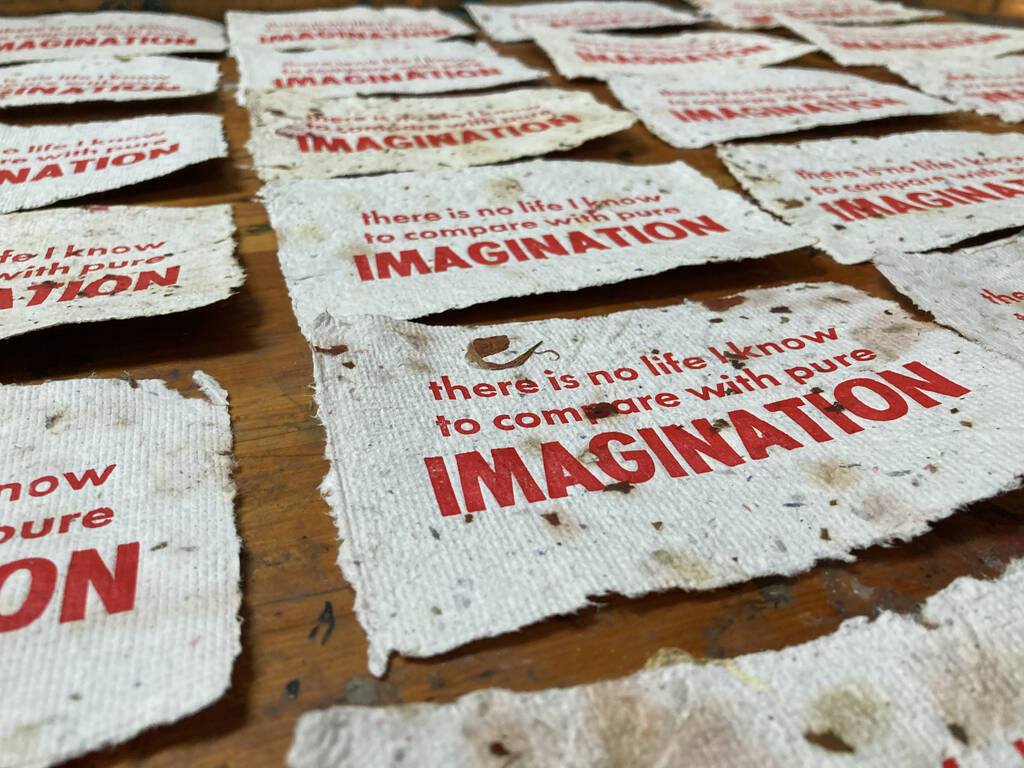
A year ago, in the midst of Grief 1.0, I experimented with turning the cards and flowers we received when Catherine died into handmade paper. It took a lot of experimenting, as it was both my first try at paper making and I only had the barest minimum of scrounged equipment, but two weeks later I ended up with 50 index-card-sized pieces of satisfying flower-infused paper.

My plan at the time was to use the paper to create a touchstone in Catherine’s memory that I could, with pleasing circularity, send back to those who’d sent the cards from which the paper was made.

Life, COVID, and a sense that I wasn’t quite ready to finish this project intervened and a year passed. This morning, though, I woke up resolving that today was the day.

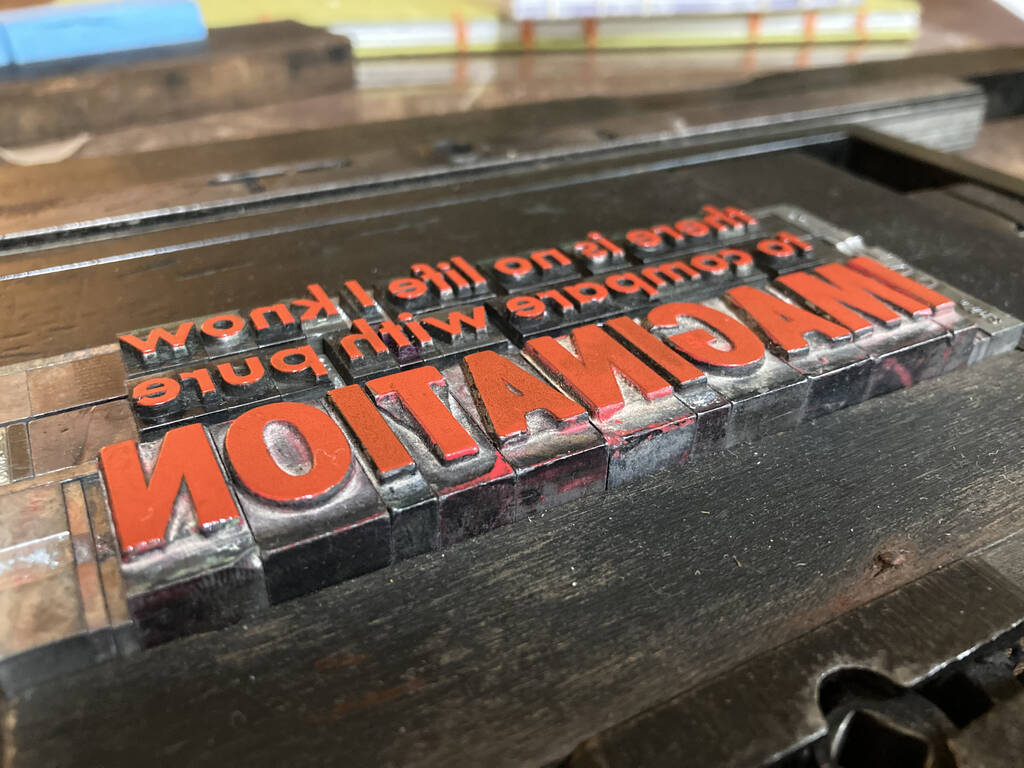
Metal type set with line from

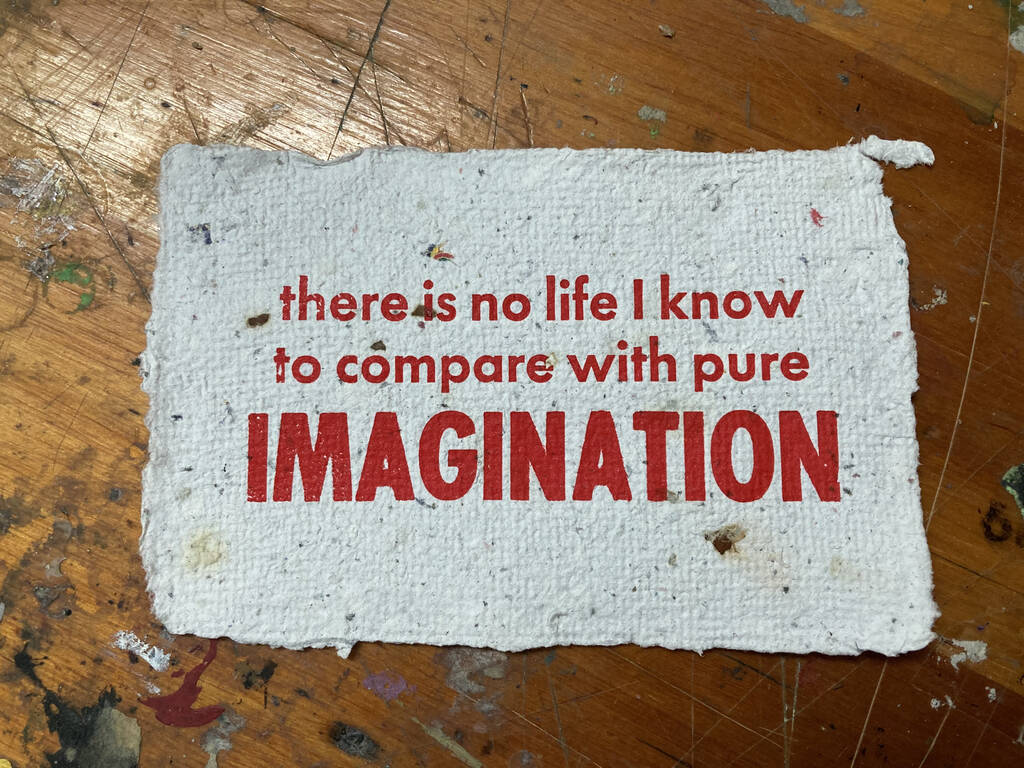
Finished

Multiple copies of the

I printed a line from the lyrics of Pure Imagination, sung by Gene Wilder in Willy Wonka and the Chocolate Factory and composed for the film by Leslie Bricusse and Anthony Newley. The film was one of Catherine’s favourites, and the sentiment of this line gets to the heart of her ethos. The craggy imperfections of the paper and the crisp ruddiness of the type also happen to be a good avatar for where my artistic sensibilities met Catherine’s: in general, I would avoid the roughness and she would avoid the type.

18 Feb 01:42

Attendees will need a negative COVID test within 72 hours of attending MWC in July

by Dean Daley

Mobile World Congress (MWC) Barcelona in July will have new rules and regulations in order to deal with the COVID-19 pandemic.

MWC, which typically happens each year in February, was moved to July due to the COVID-19 pandemic. However, with the virus still around, the GSMA, organizer of MWC, will employ some additional measures to keep attendees safe.

Namely, attendees will need to have a negative COVID-19 test result within 72 hours, while testing will be carried out at the venue as well. GSMA CEO John Hoffman stated that MWC will also feature a touchless environment.

“Our view is it would be great if the world was vaccinated, but we can’t rely on that in 2021 so instead we’re relying on testing upfront to ensure our bubble isn’t just the Fira Gran Via but the whole of Barcelona,” said Hoffman,

Hoffman also mentioned that there was a desire from stakeholders in Spain to see MWC return this year.

MWC Spain was cancelled last year due to the pandemic.

MWC Shanghai will continue as planned. Hoffman noted that China has essentially turned itself into a bubble with extensive testing, tracking and entry requirements.

Source: GSMA

The post Attendees will need a negative COVID test within 72 hours of attending MWC in July appeared first on MobileSyrup.

17 Feb 17:43

The Role of Status In Community Building

by Richard Millington

Status permeates deep within community building. Asking people who perceive themselves as high status to connect with those they see as low status (even if they don’t admit it) almost always fails. You can have limited success with time-limited engagements which present the individual as a high-status person, but otherwise you’re going to struggle.

A few years ago, I was sitting backstage at a conference waiting to give my talk. Fellow speakers in the room included Presidents, CEOs, and CMOs of known technology companies.

One speaker, having just preached the values of community onstage, asked our host how to sneak out the back without being seen.

Slapping a community label on an activity doesn’t disguise underlying social dynamics. People who perceive themselves as high status – even the most fervent believers in community – still aren’t keen to connect with community members they perceive as low status.

Part of this is understandable. Had the speaker tried to exit through the main foyer, the speaker would likely have had to engage with a large number of people who wanted something (answers to questions, pitch an idea, help with a specific feature of their product, validation by association etc…).

It’s feasible the speaker might have found someone who would have solved an urgent problem or become a lifelong friend. But the odds are low and the immediate pain too high. So the speaker slipped out the back.

I’m seeing many well-intentioned community initiatives fail because they ignore, rather than embrace, status.

Both the high status and low-status group still crave community.

But one group craves a community that offers privacy, intimacy, and an environment that reflects their status (luxury). They want a small number of strong ties with people like themselves. (hint: this probably won’t happen in a discussion forum). The other wants connections, purpose, and opportunities to grow. They want a large number of weaker connections.

Whether you like it or not, status permeates through all community work. A message (ghostwritten) from the CEO will have a far bigger impact on industry experts than the same message sent by a junior community manager. It’s impossible to even build a community in some sectors unless the founder is perceived as high status.

As you begin developing your community skills, you should become increasingly better at engaging people how they desire to be engaged, a desire based upon their perceived status.

17 Feb 17:39

A movement to green the web

by thornet

This week the wonderful Climate Action Tech kicks off its #LetsGreentheWeb campaign.

It invites people to measure the carbon emissions of websites using Wholegrain Digital’s Website Carbon Calculator and share the results online from February 15 – 19, 2021. This is a jumping off point to discuss the internet’s emissions among friends and colleagues and to push for more ambitious climate action in the tech sector.

Results for this website using Wholegrain Digital’s Website Carbon Calculator

As a small contribution to this campaign, I wanted to celebrate the momentum behind greening the web and share reflections for how we might continue organizing and advocating for a sustainable and just internet for all.

It’s still getting hot.

The tough news first. Despite the pandemic’s reductions of travel and other carbon-intensive activities, CO2 levels continue to rise.

The Paris Agreement, backed by almost every country on earth, calls for keeping the global temperature to 1.5°C above pre-industrial levels. Yet there is a 1-in-5 chance of the average global temperature exceeding 1.5 °C by 2024. [UN World Meteorological Organization] To avert catastrophic global temperature rise, countries must decrease production of fossil fuels by 6% per year between 2020 and 2030. [UN Production Gap, 2020]. 

We also know now that fossil fuel pollution already causes one in five premature deaths globally, meaning that even before temperature rise, the health impacts of burning oil, gas and coal are much higher than previously thought.

So with the pandemic’s first waves receding, governments around the world began investing in recovery plans worth trillions of dollars. (Carbon Brief offers an excellent tracker of the world’s “green recovery.”)

Joe Biden notably returned the US to the Paris accord just hours after becoming president in January. The European Union set out a European Green Deal, announcing a just transition and reduction of emissions. And many countries, cities, communities and companies declared a climate emergency.

And still, emissions are rebounding.

The complicated role of tech

The internet is the world’s largest machine, and it continues to significantly contribute to these emissions. If we continue business-as-usual, the IT sector will be responsible for 14% of the world’s carbon emissions by 2040 [HBR, 2020].

Thankfully, this issue is getting more attention.

Unfortunately the green recovery plans too often position digital technology as a climate adaption tool while omitting or glossing over its environmental harms. (See Eirini Maliaraki’s brilliant summary “AI and Climate Change: The Promise, the Perils and Pillars for Action” in Branch magazine.)

But the pressure has been mounting for Big Tech to account for its emissions. Spurred by employee organizing, activist campaigns, bad press, and frankly because renewables are the future, Big Tech announced its climate pledges:

And then to meet these targets, Big Tech became the biggest corporate buyers of green energy in the world.

https://www.ft.com/content/0c69d4a4-2626-418d-813c-7337b8d5110d

And then closing out 2020, Big Tech added $163bn to market values despite the pandemic and regulatory hearings. The consolidation of profits, influence and infrastructure in the tech sector—and in fact across all sectors—is very real and worrying.

“Who has power over the internet? Seven companies have predominantly controlled the internet and its infrastructure. These seven are in the top ten largest companies in the world.” Mozilla’s Internet Health Report 2020.

“What if that’s not enough?”

“What do you mean, not enough?

“It’s not enough. Your efforts aren’t slowing the damage fast enough. They aren’t creating fixes fast enough. you can see that, because everyone can see it. Things don’t change, we’re still on track for a mass extinction event, we’re in the extinctions already. That’s what I mean by not enough. So what don’t you do something more?”

“We’re doing everything we can think of.”

“But that either means you can’t think of obvious things, or you have thought of them and you won’t do them.”

“Like what?”

Kim Stanley Robinson, Ministry for the Future

Greening Big Tech is not enough

With that size and power, we can’t talk about greening the web without addressing the incumbents.

The momentum in the tech sector is important. Getting these targets from the Big Five is a huge step. Now these companies use their climate commitments to compete in recruiting and retaining employees who increasingly care about their work’s impact on the environment.

However, we shouldn’t limit our imagination of a sustainable internet to simply greening the corporate clouds of five US companies. I dream of the indie web building alternatives and of open source for the public interest thriving outside of Big Tech.

We do need to decarbonize the internet, and the faster the better. But moving to renewables is not enough. Addressing the massive land and water usage in data centers is also not enough (although that should definitely be tracked and accounted for).

In the tech sector, when people talk about greening the web, they usually talk about energy. But really we should be talking about power. 

We need to go beyond tech solutionism and towards intersectional climate justice work. We need to go beyond individual action. We need to shift the power of systemic inequalities, hold major polluters to account, and dismantle the forces—financial, political and cultural—that hold us back from a greener internet and a more sustainable society.

There is a growing body of research about how we can green the internet. However, this research rarely tells us what impactful action internet professionals can take in their daily practice, let alone how to connect their technical decisions with the cause of climate justice.

Tech workers wield their power

We are seeing a pivotal moment in organizing tech workers, and this will certainly be an important and powerful lever of change.

Tech Won’t Drill It mobilized tech workers to say no to using AI for fossil fuel exploration and extraction.

Make Amazon Pay united Amazon warehouse workers, climate activists, and digital rights groups to call for the company to improve to the workplace, job security, sustainable operations and the end to privacy violations and partnerships with the police and immigration authorities.

And Climate Action Tech reached nearly 4,000 members from across the tech sector who are learning from one another and coordinating actions for the workplace and the larger sector, including this #LetsGreentheWeb campaign!

Climate Justice as a Core Competency for Technologists

Climate justice “insists on a shift from a discourse on greenhouse gases and melting ice caps into a civil rights movement with the people and communities most vulnerable to climate impacts at its heart,” as beautifully described by Mary Robinson, former president of Ireland and current Chair of the Elders.

This is a discourse shift that the tech sector needs.

As we see growing interest to making sustainability part of internet professionals’ practice, practitioners will need to move from narrow action, like shifting to renewables, to making systematic change. Resource efficiency and optimization are often rewarded in the tech sector, and in the scheme of things, the internet is “easier” infrastructure to decarbonize than say agriculture or transportation.

Our work will not be done even if all of the internet runs on green energy—we need the internet to work within planetary boundaries and to uphold the human rights of every person. This is no doubt a larger effort with many players. But we cannot let the relative ease of decarbonizing the internet prevent us from immediate action nor systemic change. The tech sector must rectify negative impacts and account for what Chris Adams from The Green Web Foundation calls “the social cost of compute.”

1000 More Ideas to Green the Web

As we look to a year with bolder climate action and more people wanted to get involved, we can begin to see ourselves as a movement connected to other movements.

No single person has all the answers nor can achieve a sustainable internet alone. Instead, we need collaborative structures that foster federated leadership and knowledge sharing.

What might this look like?

  • Broaden awareness of collective efforts, building shared understanding and common language across a diverse range of efforts and analyses. Climate Action Tech is a great place to start!
  • Uplift pilots and prototypes that are working in promising ways at the intersection of the internet and the climate crisis.
  • Deepen understanding of the “twin transitions” of sustainable and digital economies and their anticipated harms and opportunities.
  • Identify assets that our groups bring to the table and gaps for our work to be more effective together.
  • Explore advocacy narratives that position climate justice more prominently in digital agendas and conversely incorporates digital rights and open technology in climate agendas.
  • Define and map paths to influence funding, legislation and technical innovation.
  • Catalyze new and deeper collaboration and broader more integrated strategy.

If you’re interested in thinking through more ideas, join the #LetsGreentheWeb conversation on Twitter and join the virtual session at Mozfest, “Firefox Eco-Mode and 1000 More Ideas for a Sustainable Internet” on March 16.

Image: Nervous system, from Camillo Golgi’s Sulla fina anatomia degli organi centrali del sistema nervoso (1885)

17 Feb 17:38

Handpie Packaging Refresh

by peter@rukavina.net (Peter Rukavina)

An impressive packaging refresh from The Handpie Company. We’re having both before and after for supper tonight. (Good to see that Pie Man is still part of the branding; I love Pie Man).

Pro-tip: if you brush your handpies with milk or egg before you put them in the oven, the difference in the outcome is palpable: you get flaky, moist goodness rather than rock-hardness.

17 Feb 17:38

I’m Giving An Online Docker Hands-On Workshop

by Martin

Like most conferences in the first half of 2021, the Chemnitzer Linux Tage (Chemnitz Linux Days) on the 13th and 14th of March will be held online. Apart from very interesting talks about Linux-related topics, most of them in German, the conference also offers a broad range of workshops. While I like to give talks, I have to admit that after a year of doing them online, I am a little tired of staring into the lens of a camera while seeing nobody and only receiving little feedback. So in return for the inspiration I always get from such events by listening to talks of others, I decided to offer something different in return this time.

Instead of giving a talk, I will host a 3 hours Hands-On Workshop about Docker that will cover most things I described in parts 1 to 5 of the Dockerize-Me story I recently published on this blog. The workshop will be in German, so this will probably only appeal to the German readership of this blog.

The idea of the online Hands-On workshop is not to just passively consume content, but to actively work together and discuss things. A BBB conference room will be the anchor for all discussions and I will provide a virtual workstation with a GUI for each participant that can be accessed over VNC from Windows, MacOS, and, of course, from a Linux OS desktop. In case of issues, I can connect to the virtual workstation of a participant and help out. This way, nobody will be left behind when getting stuck and we can go through the topics together at the same pace.

The course is limited to 15 participants as it’s an interactive session, so if you are interested, it’s better to sign-up rather sooner than later. Be reminded again that the session will be in German. As this is a non-profit event, participation is free of charge!

17 Feb 17:37

The Nature of Emotions

by Dave Pollard

A rat who is working for food suddenly hears a warning signal followed by a shock he can do nothing to avoid. After it stops, he goes back to working for food. But soon, even the sound of the signal is enough to stop him from seeking reward. Even though he could continue painlessly during this interval to obtain food, he seems crushed by the anticipation and now “crouches tensely, trembling, defecating, urinating, hair standing on end.” The animal is, in scientific terms, scared shitless. He can do nothing to control his fate, and that is untenable.

— Melissa Holbrook Pierson, from The Secret History of Kindness

Neuroscientist Jaak Panksepp spent his life attempting to map human emotions, explain them in terms of brain and body chemistry, and advocate for all animals on the basis their emotions are indistinguishable from ours.

The model he ended up with included seven categories of emotions (what he called ‘affective’ states) and corresponding, commensurate instinctive emotional behaviours for each. I’ve integrated them with Karla McLaren’s model, and separated out those that seem to be mostly enduring feelings we can carry or a long time (left column), from those that seem mostly situational and fleeting (right column):

Enduring Emotional States            Situational Emotional Feelings
angry, hateful, envious enraged
anxious, jealous, unappreciated fearful, apprehensive, bored, attention-craving, feeling ignored, helpless, abandoned, or trapped
sad, sorrowful, ashamed, grieving, guilty, apathetic, depressed or hopeless grieving, panicked
pleasure-craving, longing, lonely pleasure-craving, lustful
equanimous, enthusiastic joyful, playful, curious, seeking-to-explore or discover
affectionate, loving caring, protective, reassuring, compassionate

You’ll notice that two of these emotions, grieving and pleasure-seeking, appear in both columns because I think we can experience them either as enduring phenomena or acutely in the moment.

I would argue that wild creatures experience only the emotions in italics, which include (1) all the ‘situational’ emotions in the right column, plus (2) the ‘natural state’ emotions that are present in wild creatures most of the time (alternately equanimous and enthusiastic), plus (3) their emotions when they are suffering from chronic stress (anxious, like the cat with separation anxiety or the low-status baboon, or apathetic, like the chained junkyard dog). Sadly, as we encroach more and more on wild creatures’ habitats and freedoms (particularly in the case of factory farms and inadvertently mistreated pets), I think we’re seeing more of the latter.

I think that wild creatures likely feel all these emotions more intensely than we do (as there is nothing veiling them from feeling them full-on). But most of these situational emotions (the ones in the right column) are fleeting, lasting just long enough to deal in an evolutionarily successful way with the particular situation. And then it’s back to the alternating states of equanimity and enthusiasm we witness so often in our pets and wild animals.

And the reason I think they don’t feel the unitalicized feelings is that these feelings require a story, a rationalization, a judgement about intent, cause or motivation, which I believe requires a sense of self-hood and separation that these creatures (blessedly) lack. If you think you’ve seen evidence of a pet or other wild creature you’ve observed feeling that emotion, my guess is that what you’re really seeing is one of the italicized emotions in the same row of the chart. So we might mistake a cat’s attention-seeking for loneliness, or its acts of apprehension for love.

If the thought that your pet perhaps doesn’t really love you strikes you as outrageous or absurd, here’s what Melissa says on that score:

This is the basis of my dogs’ storied love for me, their one and only. Only I know the real truth. It is not this Melissa they love. If they bark menacingly at someone who approaches, they are not doing it to ensure my safety. There is but one thought in their minds: do not harm this person, for she is my most valuable possession. My large Swiss army knife, the one with all the extra attachments.

When I speak with people who have lost their sense of self and separation, they tell me that, when the illusory sense of self and separation is lost, the italicized emotions continue to arise, but they don’t arise ‘for’ and are not claimed ‘by’ any ‘one’, so they don’t seem to last long. But nothing in their behaviour appears to have changed — these instinctive, conditioned feelings are just part of their instinctive, conditioned nature, and they have no need for a ‘self’ in order for them to happen.

And while the unitalicized ‘self-created’ emotions may also still arise in them, they seem to do so less and less often, because the story that validates them is just seen to be a fiction. Without a self and a story to justify these feelings, they just arise and quickly dissipate. And these self-less characters are absolutely fine, and apparently little changed in their demeanour and behaviour, without them!

It is especially perplexing for some when they assert, for example, that their affectionate fathering and marital behaviour is unchanged despite it now being obvious that there is no one, no father, no children, no spouses, and no relationships — with the objects of their affection agreeing that nothing has seemingly changed!

I have attempted to argue (as Melissa asserts) that it is our biological and cultural conditioning, in the context of the situation in the moment, that entirely dictates our behaviour. My sense is that we are conditioned to feel the italicized emotions by our biology and our culture, but the unitalicized emotions are entirely self-constructed and self-inflicted, and have no basis in reality. We make up a story about what we think happened, or wish happened, or want to happen, and then we react to that story with these feelings, some of which prevail over our whole lives. Without a story, these feelings can never make sense. And all stories about the past or the future are fictions.

Jaak attempted to map the chemistry of emotions, with the objective of developing drugs that could treat unhealthy excesses of emotion without numbing the patient. He didn’t succeed (his only developed drug failed phase III trials), but I’m wondering if that’s because his successful experiments were all with wild animals, while the human emotions he sought to moderate with his drugs were mainly the unitalicized ones that his lab animals likely didn’t feel. Perhaps his failure was just considering the italicized and unitalicized emotions as equivalent in each category, when it turned out that what tempered a wild animal’s grief could not temper a human’s depression, and what tempered a wild creature’s rage could not control a human’s anger. The drugs can modulate the chemical flows in our bodies, but they can’t change our stories.

Eckhart Tolle writes about how our embodied emotions (“pain-body”) and our rationalizing brains (“egoic mind”) can create a vicious cycle: We feel angry; then the brain rationalizes that feeling (“X did something hurtful”), and amplifies it through judgement (“It was deliberate, cruel, and premeditated, and X needs to be punished”); that creates more feelings of anger and perhaps hatred, which provokes more righteous indignation and rationalization for those feelings, resentment, ideas of revenge and retaliation, and so on, ad infinitum. The consequences of this unending, sometimes escalating cycle can be wars, at various scales from personal grudges and vendettas to civil and international battles, that can go on for generations.

These vicious cycles only apply to our self-produced, story-dependent (ie the unitalicized) emotions, and are hence, I would argue, unique to humans.

When a human accidentally hurts a cat during play, the cat will instinctively reply with an act of fear, rage, and/or panic, but it will not assume the hurt was deliberate (why would it?), and it will not plot revenge for it. It will not feel angry, sad, hateful, ashamed, or guilty. It will lash out or flee and hide, but soon all is forgotten, other than perhaps the memory that may evoke an act of caution if similar situations arise in future, until it appears that there is no recurrence of the hurt, and then unbridled play resumes.

This is pure conditioning. The cat is not an automaton, and certainly feels pain. But its conditioned responses to each situation, benefitting from millions of years of evolution, are instinctive and protective, and not judgemental, scheming or spiteful, because such an entanglement and escalation of feelings and rationalizations is not in its interests and probably not in its capacity.

In the quote at the start of this post, Melissa Holbrook Pierson argues that all our behaviours are governed by our conditioning, and that the most effective means of conditioning any creature to behave in a certain way entails giving it the power to consistently achieve a pleasurable result (a treat for the dog, a trophy for the human, or even just the rush of pleasurable chemicals in the body that simple praise evokes) for a certain behaviour, rather than punishing it (yelling at the dog, jailing the human) for an undesired behaviour. This is how we are wired.

The rat in Melissa’s example is clearly paralyzed by deliberately human-induced anxiety. But it is not creating a story about causality between the warning signal and the shock. Its instincts for fear and apprehension have been deliberately triggered by the experiment, and, unable to fight or flee, it freezes, the only response left to it. It is, at least briefly, conditioned to fear the warning signal (much as we are with emergency alert alarms). But without a story, or recurrence of the conditioning shock, the rat won’t go on responding fearfully to the warning signal much longer, just as, if we hear too many emergency alert alarms that turn out to be false, we’ll stop reacting to them. Though, because we may be making up ‘worst case’ stories about them, it may take us longer than the rat!

Here’s how this conditioning and emotional response might play out in two different situations:
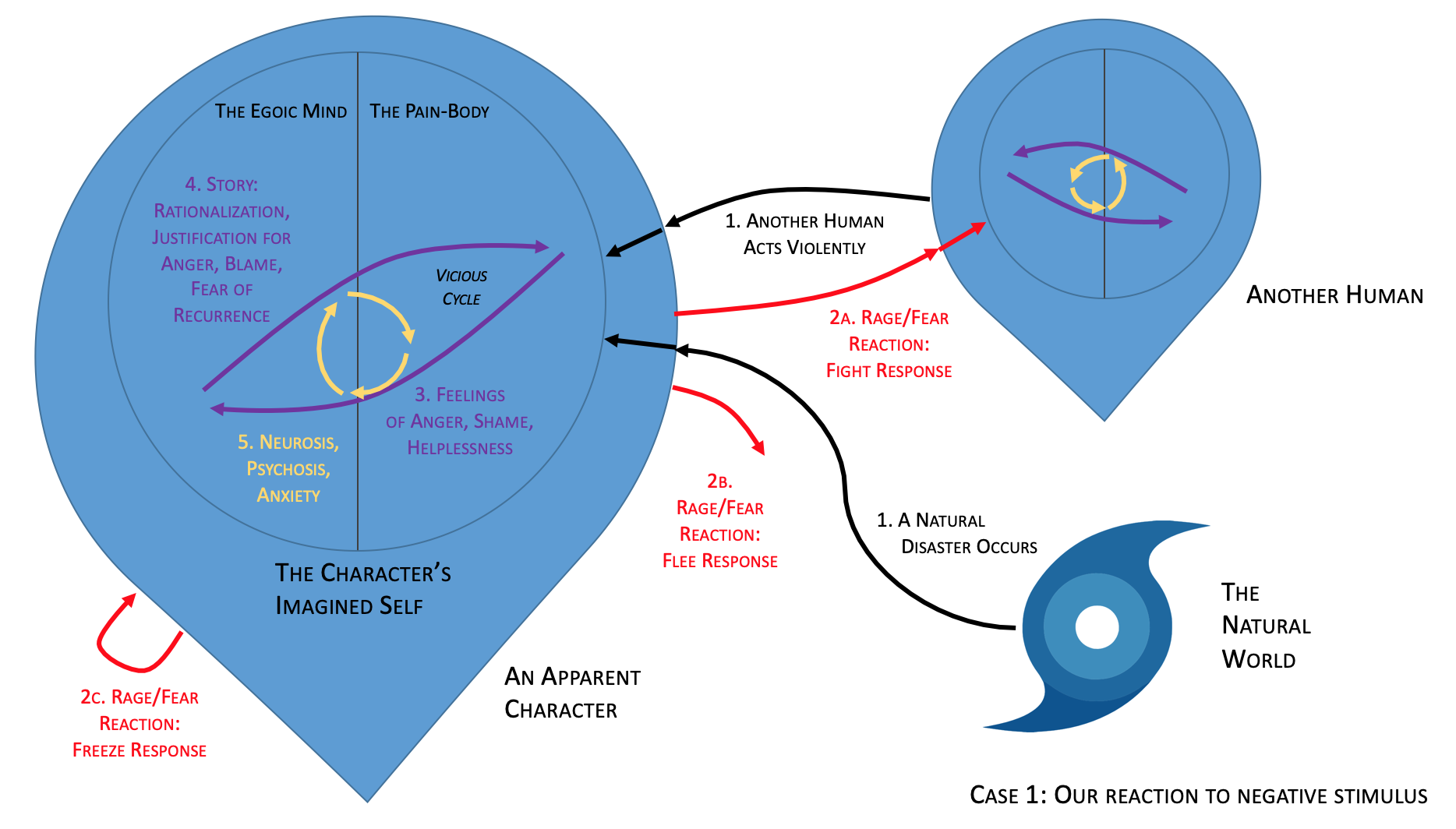
In Case 1, the human’s self turns a simple fight/flight/freeze instinctive response into a vicious cycle of emotions and stories justifying those emotions, potentially leading to an escalating fight, an unhealthy and unwise response, and long-term mental illness and trauma. Erase everything in the “Character’s Imagined Self” circle and you see how intuitively and intelligently wild creatures would deal with a similar situation — respond, shake it off and forget about it. What’s especially cruel is that for all the mental anguish, the self isn’t actually doing anything — it’s just making up stories to justify its response (which wasn’t ‘its’ at all), and then getting roiled up in self-produced emotions that those stories trigger.
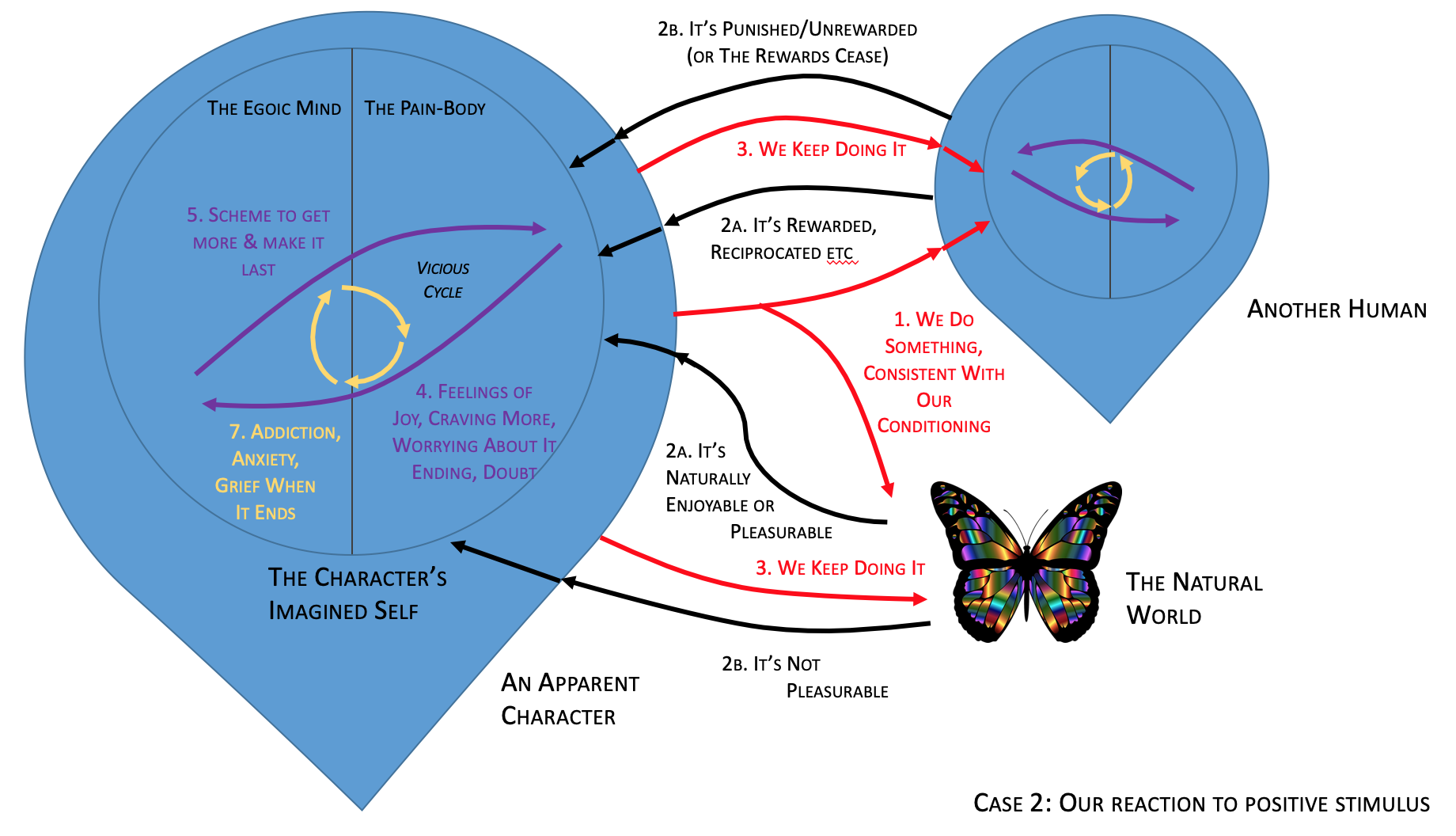
In Case 2, the human’s self snatches defeat from the arms of victory, trying to hang on to something simple and good, stressing about making it last or losing it, instead of just enjoying it. Again, erase everything in the Character’s Imagined Self circle and see how effortlessly wild creatures are able to just be, and why they’re so much more equanimous than we are.

As Melissa puts it:

The same law of behavior affects all creatures’ actions: we do something, it produces pleasure or it produces pain or it produces nothing, and the result determines whether we continue doing it, stop doing it, or do it differently, and these are the only options. The bedrock rules of behavior function to our preconceptions much like the swallowing of that yellow and red capsule.

And so perhaps we’d be wise (if we only had the free will to do so!) to learn from our furred and feathered friends about the utter non-necessity of all the thoughts and feelings and stories we impose on every single situation, trying to make sense of it while just making it needlessly complicated and stressful.

A final thought: I listed above, based on my observations of pets and wild birds and animals over the years, two enduring emotions that I think are the ‘natural state’ for all wild creatures, when they’re free of human obstruction: equanimity and enthusiasm. I have seen cats and dogs and birds and squirrels and wolves and deer exhibit this effortless, gentle back-and-forth movement between the passive and the active tense.

And I have also seen precisely the same states, and the same movement, in a very few, fortunate humans — who have also been the most perceptive, the most creative, and the most inspiring people I have met. That capacity to move from being equanimous, open, attentive and non-judgemental, to being curious, exploratory, and passionate to discover and learn new things, is perhaps as close as we humans can hope to get to the perfect state that is every wild creature’s birthright, and which we have forgotten.

So now I’m going to put some birdseed out, since there’s some snow on the ground, and spend some time watching the masters.

17 Feb 17:37

The Lego Evolution From Boys Toy to Universal STEM Building Blocks

by Sandy James Planner

Seven years ago Charlotte Benjamin wrote a hand printed letter to the Lego company talking about her visit to the local toy store. Charlotte was seven years old at the time.

As reported by Kashmira Gander in the Independent, she wanted to know why the boy lego figures “went on adventures, worked, saved people and had jobs” while the girls “go to the beach, shop, and have no jobs.

Miss Charlotte also noted that the boys got to swim with sharks.

The toy maker have been criticised for  producing gender specific lego people that go and gender specific jobs. Miss Charlotte had ended her letter asking the Lego company to “make more Lego girl people and let them go on adventures and have fun ok? Thank you.”

But here is what is interesting~Lego was introduced in 1934 and was branded as a toy for boys and girls. “Lego” means  to “play well” in Danish and “I assemble’ in Latin.

This paper called ” L.E.G.O.: Leave Everyone’s Gender Out” by  Krissy Baker and Marta Vucci says the Lego brand “was constructed with an inclusive, accepting name and message, but today it has fallen into the same pattern of gendered marketing that most toys seem to be following. However, in 1981, Lego put out an advertisement supporting the view that their toy promotes an activity that everyone can enjoy. “

This emphasis became important as more universal toys were sought that could teach STEM  (science, technology, engineering and math) subjects and building for both boys and girls. There was a push in Great Britain to support toys that taught science.

In 2012 the Lego Company created Lego Friends, which further differentiated lego for girls and boys. Lego friends had five girl figures (no boys) and the activities were very specifically for girls, like a day at the hairdresser, cooking at the cafe, or helping out at the animal hospital. There was also not a lot of construction or building blocks with the Lego Friends. Most of the gear was prefabricated.

Unbelievably Poul Schou,  a Lego’s vice president  was interviewed at  The Register,” a British technology news site. In his statement Mr. Schou stated that “Lego was for boys, not girls, because once the girls hit five, they weren’t interested in construction anymore.”

Those tables have turned as the demand by both girls and boys for lego blocks increased. Miss Charlotte’s letter had started a change in Lego’s offerings  in 2013 they started a science series of mini figures that were girls. Those figures  included  girl aerospace engineers, shuttle astronauts, race car drivers, pit crew members, dune buggy operators and deep sea submariners.

Lego’s own research found that both boys and girls liked the building blocks, but girls wanted to build complete environments and streets while boys wanted to construct single structures. All children wanted to have a mix of boy and girl figures in the mini figures, and that has been a very successful line for Lego to market to all kids.

And you can see in the video below how  girl specific  the 2012 Lego Friends release actually was, staged in “beautiful Heartlake City”.


17 Feb 15:54

Vampire’s Run

My second song, “Vampire’s Run,” just finished last night, is thorny — chromatic, key-modulating, choppy-guitared — where Tie & Suit is aggressively smooth and diatonic.

I have many notes…

The Verse

I started off wanting to do something early-REM-like. The idea — kind of a bullshit idea, but I liked it anyway — was this fast arpeggio on the top three strings of the guitar: B-E-D-B E-D-B-E C-E-Eflat-C E-D-B-E A-E-C#-A E-C#-A-E A-E-B-A E-B-A-E.

REM wouldn’t have done the C-E-Eflat-C part — but the rest would have fit in. Especially that move at the end from an A chord to Asus2.

To fit some chords to this, I came up with E7, a weird C major and minor, Bmsus4, A, Asus2. The idea is that you’d play the chords as normal but with the high E string always open. (A Buck-like move.)

It’s not actually pleasing-sounding — but, again, I liked it and figured I could make something out of it.

The problem: I made the song 170 beats per minute, and I can’t actually play that lick on guitar that fast. (My personal speed limit is pretty slow, actually.) I could play it on keyboard, though, so I did. It’s the very first thing you hear in the song. I cranked up the reverb on the Steinway Grand Piano instrument, and I thought it sounded great. Like a demented Charlie Brown song.

Next up was to add percussion and a bass line. The percussion is pretty much the same thing as in Tie & Suit. The bass followed the chord roots — E C B A — except that, at the end, I threw in this little blues-scale-ish lick: A-Bflat-B-Bflat-A-G-E-G-E. Which was also total bullshit, but it totally worked, so I kept it. The interaction of that with the piano arpeggio thing just sounded really cool to me.

At this point, though, this didn’t sound like REM in the least tiny bit. It sounded like an ’80s goth instrumental. So I leaned into it — added guitar instruments Eighties Goth and Starlit Cavern. Added a bunch of echo-y things like Stutter Stack and Swirling Flutters.

The Name

Last summer I started writing a blog post called “The Vampire’s Run in the Anarchist Jurisdiction” which was about going for a run at night (instead of the day, due to the pandemic) in my neighborhood in Seattle. I wasn’t able to figure out how to write it without sounding like some very fortunate guy who had to adapt in some small way and was pretty fine about it. Wouldn’t add anything to the world, so I didn’t finish it.

But, since that title was just lying around being all goth-y, I snagged the first part of it for this song. And, well, it kinda fits — the song is very fast, and during the chorus it almost sounds like flying.

The Chorus

The song structure here is simple: verse chorus verse chorus verse chorus. But there’s a key change: the verse is in E and the chorus is in C.

This is one of my favorite modulations. The chorus gets a kind of floaty and slightly sinister sound — hence the flying.

The first time I remember encountering this was in Beltane Walk by T. Rex. I remember asking my uncle, a musician, to explain the sorcery behind that song — and when, some years later, I heard that same sorcery in Hungry Like the Wolf I recognized it right away.

(I am, by the way, a glam rock guy at my core. Give me T. Rex and Bowie and all their descendants.)

Anyway — if you hear a little Duran Duran in the C-G-F chorus, you’re not wrong.

The chords aren’t actually C-G-F, though — they’re C-G6-Fmaj7 in order to make the E note prominent all throughout the song. The melody of the chorus is just arpeggios on the piano: E-C-G, E-B-G, E-C-A, with the E repeated. While the piano in the verse is tightly horizontal, the chorus is a bit more vertical.

(There’s a little fun part right as we lead into the chorus — it sounds like that split-second when a vampire leaves ground and is a little shakily airborne. You settle in in a moment. In the first chorus we have B-F#; in the second it’s D-A-B-F#, which makes it sound like Pachelbel’s Canon; and in the third it’s A-E-B-F# — a little “Hey Joe” action.)

String and other instruments are doing a C-B-A thing during the chorus — which is cool because, as you’ll remember, that also appears in the verse. Those exact same notes, which sound somewhat discordant in the verse, sound sweet in the chorus.

The End

The song comes alive in the last third while it’s repeating the chorus before ending. I was recording the piano part for that last chorus, and I was feeling a little down that this entire song was just all these arpeggios. I started improvising — and I worked up some bits to add some more melody and passion to the song. Went all pentatonic on this shit — plus the minor third for some bluesiness. Banging on the E flat a bit.

This part comes as a surprise in the song, I think, and it was just as much a surprise to me, but it’s my favorite part. Part of me thinks you shouldn’t add so much new stuff at the end, but then I remember how “Every Little Thing She Does Is Magic” has this alternate melody at the end. And I think of how The Adversary by Crime and The City Solution — a favorite of mine from a favorite soundtrack — invents a whole new song, with a different time signature even, around the 3-minute mark.

“Vampire’s Run” ends on a simple repeated phrase which I thought sounded romantic: E D-C D C-A. Vampires love that romantic stuff.

And it ends ends on a lone E note from the piano — which sounds like a question.

If you want, you can download the GarageBand file: VampiresRun.band.zip

17 Feb 15:53

Fellini & Scorsese

by Caterina Fake

Film snobs are Fellini haters. I am not sure why this is so, as I am an admirer, and might be considered a film snob. My kids certainly think I am, declining to watch Disney movies as I do. I’m aware of Fellini’s various crimes against taste and sensibility, but I am an admirer nonetheless. I was glad to see Fellini defended by Martin Scorsese in Harper’s this month. He is worthy of defense! Why does he even need defending?

I first became aware of Fellini-haters in this passage about the predilections of radio show host Madame Psychosis in Infinite Jest, which names the names of her favored filmmakers. Look who she hates!

“… Odd affection for the hoary dramaturgy of one Sir Herbert Tree. Bizarre Kaelesque admiration for goremeisters Peckinpah, De Palma, Tarantino. Positively poisonous on the subject of Fellini’s 8 1/2. Exceptionally conversant w/r/t avant-garde celluloid and avant- and apres-garde digital cartridges, anti-confluential cinema…”

Scorsese is a film lover, and film snobs allow for a wide swath of film-hating to enter the mix. You can see the love Scorsese has in this image of the movie paradise that was Greenwich Village in 1959, which resembles my San Francisco full of bookstores in 1994:

EXT. 8TH STREET—LATE AFTERNOON (C. 1959).

CAMERA IN NONSTOP MOTION is on the shoulder of a young man, late teens, intently walking west on a busy Greenwich Village thoroughfare.

Under one arm, he’s carrying books. In his other hand, a copy of The Village Voice.

He walks quickly, past men in coats and hats, women with scarves over their heads pushing collapsible shopping carts, couples holding hands, and poets and hustlers and musicians and winos, past drugstores, liquor stores, delis, apartment buildings.

But the young man is zeroed in on one thing: the marquee of the Art Theatre, which is playing John Cassavetes’s Shadows and Claude Chabrol’s Les Cousins.

I love Fellini. I had the same experience as Scorsese in that–having been raised on a diet of John Carpenter and Steven Spielberg movies–when I saw 8 1/2 for the first time, it was a revelation. 

I know what people don’t like about Fellini. There’s the gratuitous zaniness, eccentric people running around pointlessly, accelerating (maddening!) marching band music–all of which I also find distasteful. I find it nearly impossible to watch his work from the 70s and 8os, when they started calling the movies “Fellini’s this” and “Fellini’s that” Casanova, Satyricon, etc. –his later stuff hasn’t aged well, but I’m not sure they suited their own age either. There are probably more dogs in Fellini’s oeuvre than most major genius filmmakers. But nevertheless Scorsese’s adulation rang true for me and I will be forever grateful to him for having shown me what cinema was. 

17 Feb 15:53

Getting started with Digital Badges

Doug Belshaw, Google Docs, Feb 17, 2021
Icon

These are slides from a comprehensive workshop on digital badges, with lavish illustration from Bryan Mathers. With a slew of accessible analogies and a background working with multiple badging platforms, Doug Belshaw not only describes the mechanics in some detail and links it up with concepts like microcredentials and badge design aids. The tail end of the slides contains a multi-page list of resources (called the 'Library'). After that there are some 'spare slides'  introducing us to Trojan mice.

Web: [Direct Link] [This Post]
17 Feb 15:52

Building a personal memex

by Dries

Cory Doctorow is one of the most prolific bloggers in the world, capable of publishing multiple great posts a day. He recently documented his writing and publishing process. It's fascinating.

Over the last 20 years, Cory built a huge, personal database of thoughts, articles and links. He explains how his database simplifies and supports his writing process:

The memex I've created by thinking about and then describing every interesting thing I've encountered is hugely important for how I understand the world. It's the raw material of every novel, article, story and speech I write.

Inspired by Cory, I brought back the Notes section on my site. I will use Notes to document articles or ideas that grab my attention, but that I'm not ready to write a longer blog post about. I'll build my own memex with the goal to become a better writer.

17 Feb 15:52

Linked List: Three FOSS Apps for best Podcast Listening Experience

by Thejesh GN

I started listening to the podcasts Circa 2007 with TWIT and BOL. I still listen to random episodes of TWIT. BOL doesn't exist anymore; but I do catch up with Tom Merritt on TNT. I miss Molly Wood and Veronica Belmont. Today I listen to a lot of podcasts. These are the tools that I use to listen, bookmark and refer later etc

AntennaPod

AntennaPod is a podcast player that is completely open. The app is open-source and you can subscribe to any RSS feed. AntennaPod is built by volunteers without commercial interest, so it respects your privacy while giving you full control.

AntennaPod

It's FOSS and is available on Playstore and Fdroid. If required, you can use a third-party system like gpodder.net to maintain the subscriptions and sync the device. I use the episode share feature to bookmark the episode with notes and time into pinboard. You can use any other service too. For example, you can send that to your notes application.

If you like PWAs then 1tuner is a good app. It's FOSS, runs in your browser, can subscribe to radio stations and podcasts.

Huffduffer

It's like a read-it-later for Podcasts or any audio files on the internet. Once you register, it gives you a personal RSS feed. You can subscribe to that in your favorite podcatcher. It also gives you a bookmarklet, which you can add to your browser bar. When you are on a web page and if you find any audio file or episode interesting. Just click on the bookmarklet, and it gets added to your subscription feed; that way it's on your player to listen next.

Huffduf-video is a companion site, where you can give any video URLs (Youtube, Vimeo), etc. It then converts it into audio, hosts it for you1 and adds to your huffduff feed to listen to.

Try Huffduffer and Huffduffer Video.

Huffduffer is not FOSS but Huffduffer Video is. I am planning to sync the Huffduffer video to my homebrew JSONFeed river. The way I will have my own service.

LibriVox

This tool is not a podcast but a copyright-free audiobook service. It chooses to deliver the book chapters using the same technology which powers podcasts, i.e, RSS feeds. Hence I have added it here.

So you can listen to the best public domain audiobooks in your standard podcast player by subscribing to a book. You don't need a separate app.

To make all books in the public domain available, narrated by real people and distributed for free, in audio format on the internet.

LibriVox

You can also contribute by reading books.

  1. For 30 days
The post Linked List: Three FOSS Apps for best Podcast Listening Experience first appeared on Thejesh GN.
17 Feb 15:52

Very basic story gathering

by Chris Corrigan

For much of the past few years my facilitation and evaluation practice has been steadily merging together. When I FINALLY came across Cynthia’ Kurtz’s body of work, Participatory Narrative Inquiry a few years ago, I felt simultaneously validated and challenged. Validated in that the participatory facilitation work I have been doing since I stumbled on Open Space Technology in 1995 met the complexity work I have been in since 2005 and the developmental evaluation work I’ve been doing for the past ten years. Challenged in that it opened up new streams for my practice, and that has been gratifying.

Nowadays I regularly do story gathering as a part of all my projects. I use online tools like NarraFirma, Spryng or Sensemaker and sometimes pen and paper approaches. In a future blog post perhaps I’ll name some of the projects we’ve been doing with these tools and how they have contributed to our work.

Today in a conversation about getting started with stories, someone asked about how to get a bunch of perspectives from throughout to company on a new phase in a company’s evolution. I responded with a simple approach to PNI. You can use this to get started with a group.

  1. You want to begin by collecting stories, not running a workshop where everyone tells you what they think are the issues. That approach tends to get everyone prepared to advocate for their own position. So try this simple approach. Do a little questionnaire, using Google Forms for example. Ask participants to “share a story of something that happened lately that made you think: ‘we need to address this issue…'” Get everyone in the organization to enter one story, a few sentences. On the form then ask them a) how common do you think this is in our organization and b) what is one thing we could do to address that issue?
  2. Now you have a collection of grounded stories and a bunch of material you can use to host some more interesting strategic sessions. Convene some meetings and give people the stories to look at, maybe separated into common and rare, and have them look at the material and work together to create ways of addressing the issues.
  3. There are many things you can do with these stories, but the principle is “Use the harvest to convene the conversation.” From that the conversation can produce a harvest of things to try to address the issues you discover.

The advantage of this is that everyone’s voice gets in the mix, and everyone has a chance to interpret their own stories and then interpret what other people’s stories might mean. This generates massive engagement.

I really appreciate Cynthia’s clear writing on this and offer you this quote from work as a heuristic in your own planning and design:

In my experience, the greater the degree of participation the stronger the positive impact of any project that involves people and aims to improve some situation faced by those people. I have also noticed that some forms of participation are easier to manage than others. So I generally encourage people planning projects to think about taking one more step up the staircase of participation, wherever they find themselves now; but I order the steps so as to make the transition more feasible in practice.

If you are asking people to tell you stories, why not ask them what their stories mean?
If you already do that, why not ask people what the stories other people told mean?
If you already do that, why not ask people to build something with their stories? Why not ask them what that means?
If you already do that, why not ask people if they can see any trends in the stories that have been told?
If you already do that, why not ask people to design interventions based on the stories they have told and heard?
Then, why not ask people to help you plan new projects?

And so on. As you step up, keep watching your project to see if increasing participation is making it better. If it stops making the project better (for the people you are doing the project to help), stop increasing the participation. Wherever you find yourself is participatory enough. For now.

17 Feb 15:52

Young Fil-Am leaders launch online caretaker project - INQUIRER.net

17 Feb 15:47

"The central role of the radicalized right in creating the current crisis of disinformation and..."

“The central role of the radicalized right in creating the current crisis of disinformation...
17 Feb 15:47

It's taken me an embarrassingly long time to join these dots but massive, life-saving pandemic responses are Kryptonite to 'small government' shills & sociopaths who describe their selfishness as 'libertarianism'. Now look at where 'lockdown sceptics' stand on these issues.

by James O'Brien (mrjamesob)
mkalus shared this story from mrjamesob on Twitter.

It's taken me an embarrassingly long time to join these dots but massive, life-saving pandemic responses are Kryptonite to 'small government' shills & sociopaths who describe their selfishness as 'libertarianism'.

Now look at where 'lockdown sceptics' stand on these issues.


751 likes, 140 retweets
17 Feb 15:47

"Removing titles, military honors, and patronages won’t remove her from the top of the pyramid. The only thing that will reclassify her is to remove her from her husband…and the society has been working diligently though unsuccessfully to that end." twitter.com/royal_suitor/s…

by James O'Brien (mrjamesob)
mkalus shared this story from mrjamesob on Twitter.

"Removing titles, military honors, and patronages won’t remove her from the top of the pyramid. The only thing that will reclassify her is to remove her from her husband…and the society has been working diligently though unsuccessfully to that end." twitter.com/royal_suitor/s…

.@mrjamesob’s question “What have [#HarryAndMeghan] done wrong?” inspired me to write. Use the link to read my thoughts on hierarchy and class structures and let me know your own theories.

👉🏾 link.medium.com/UFZvuX8CWdb twitter.com/lbc/status/136…


121 likes, 25 retweets


260 likes, 54 retweets
17 Feb 15:46

RT @SimonJSpurrell: @mrjamesob @PeterStefanovi2 Another bitter blow again like Brexit with no explanations! I am still waiting for the pro…

by Simon Spurrell (SimonJSpurrell)
mkalus shared this story from mrjamesob on Twitter.

@mrjamesob @PeterStefanovi2 Another bitter blow again like Brexit with no explanations!
I am still waiting for the promised meeting with George Eustice @DefraGovUK & @VictoriaPrentis it just keeps getting worse for our cheese businesses twitter.com/HartingtonKing…

Brexit has meant:
We cannot sell our Cheese to the EU
We cannot sell our Cheese to Northern Ireland
Now eBay thinks we are a risk to their community!! No appeals no explanation we're trying to fill a gap in revenue
Where now?! @Dines4Dales @eBay_UK @eBayForBusiness @NFUtweets pic.twitter.com/xlbXfHJoVS


59 likes, 47 retweets

Retweeted by James O'Brien (mrjamesob) on Wednesday, February 17th, 2021 10:46am


173 likes, 94 retweets
17 Feb 15:46

R graphics get modern text support, with ragg package

by Nathan Yau

Thomas Lin Pedersen announced the ragg package, which makes font usage in R more straightforward:

I’m extremely pleased to present the culmination of several years of work spanning the systemfonts, textshaping, and ragg packages. These releases complete our efforts to create a high-quality, performant raster graphics device that works the same way on every operating system.

This blog post presents our improvements to ragg’s font rendering so that it now “just works” regardless of what you throw at it. This includes:

  1. Support for non-Latin scripts including Right-to-Left (RtL) scripts
  2. Support for OpenType features such as ligatures, glyph substitutions, etc.
  3. Support for color fonts
  4. Support for font fallback

All of the above comes in addition to the fact that ragg is able to use all of your installed fonts.

If you’ve tried to make publication-level graphics completely in R, you’re probably familiar with the challenge of using non-default fonts. The correct steps depend on your system and the words you want to add. It’s one of the reasons I bring R output into Adobe Illustrator, so now there’s one less extra step. Nice.

Tags: R, text, Thomas Lin Pedersen

17 Feb 15:46

Low temperatures map of the United States

by Nathan Yau

Based on data from the Global Forecast System, The New York Times mapped the lowest temperatures across the country between February 14 and 16.

The blue-orange color scale diverges at freezing, which creates a striking image of a very cold country. The dotted lines and temperature labels make the patterns especially obvious.

As someone who lives in an orange area, I was shocked by all of the blue. Stay safe.

Tags: climate, New York Times, temperature, weather

17 Feb 02:58

A pandemic. A snowstorm. And a bored guy…

by Ronny
mkalus shared this story from Das Kraftfuttermischwerk.

Wird Zeit, dass der Winter endlich zu seinem wohlverdienten Ende findet – und der Rest dann auch endlich mal wieder zur Besserung neigt.