Total vaccinations, doses per 100 people, % of population inoculated now available on our live Coronavirus tracker.
Thanks to a great datastream at Our World in Data and sterling coding and design work from UniversLab and Neuker.
Total vaccinations, doses per 100 people, % of population inoculated now available on our live Coronavirus tracker.
Thanks to a great datastream at Our World in Data and sterling coding and design work from UniversLab and Neuker.
I have been in love with Dr. Seuss since childhood, and happily raised my own children on his lyrical work. Much of his imagery is delightful because it is so exaggerated; some of it is racist. If you want to understand why the company that manages his content has ceased to publish some of his … Continued
The post Understanding Dr. Seuss — and why his books were cancelled appeared first on without bullshit.
This is really useful: every Google Cloud service (all 250 of them) with a four word description explaining what it does. I'd love to see the same thing for AWS. UPDATE: Turns out I had - I can't link to other posts from blogmark descriptions yet, so search "aws explained" on this site to find it.

"Calling all philosophers!" says Jim Beckerman. "Light the bat-signal! Send up a flare! The superhero we need, in a divided America, is someone who can prove to us what's real and what isn't." But this, I think, is just to misunderstand the question, A oroof that this or that is 'real' won't solve the problem. The problem is that people aren't, or aren't willing, to be convinced. This isn't something you can argue your way through, or drown out with facts.
Web: [Direct Link] [This Post]
I've seen the question of cultural appropriation come up from time to time in learning and education. In our field, it would be like a person from one culture using or teaching knowledge from another culture. There are certainly some legitimate concerns; for example, I should not simply start conducting research on, or teaching about, indigenous cultures, because to do so would be to treat the culture as an object or a commodity. This article, nonetheless, asks some tough questions. The definition from Susan Scafidi, is “Taking intellectual property, traditional knowledge, cultural expressions, or artefacts from someone else’s culture without permission,” writes Amod Lele, adding "The caveat is bizarre. How can 'a culture' give permission?" But more, "The very idea of treating cultural expressions as a culture’s property, which can be taken, seems to extend the capitalist logic of private property into ever further spheres." And also, "Cultures have always borrowed freely from one another, changing the meaning of objects in the process – without “permission” – and the process is never unidirectional.
Web: [Direct Link] [This Post]DigitalOcean hosts one of my favourite communities.
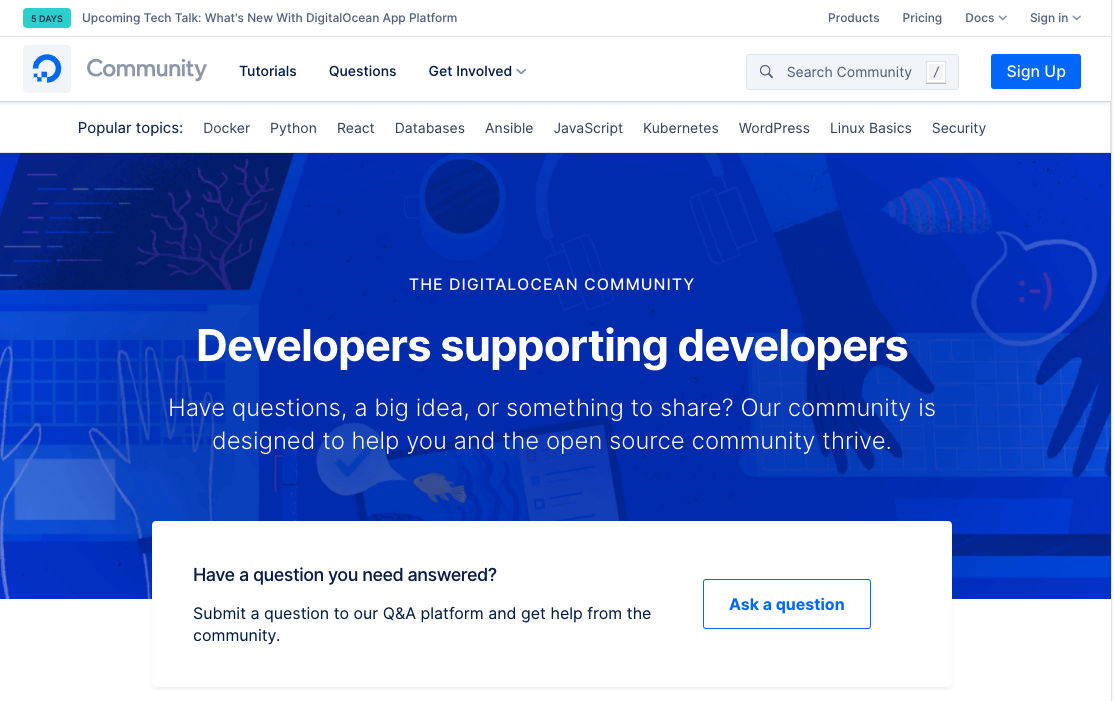
Take a look at the homepage design below and see what you notice.
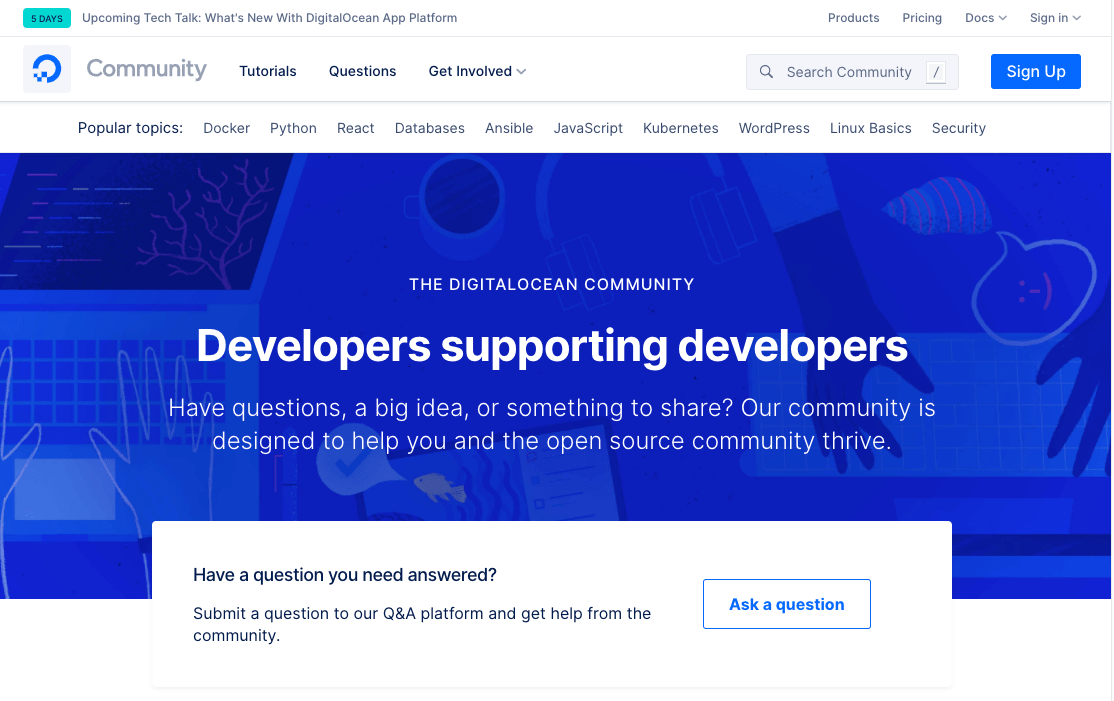
There’s a lot going on in this simplicity.
1) There’s an announcement of an upcoming event that is clear but doesn’t intrude upon the rest of the site.
2) The main navigation is really simple. Members can read useful information, ask questions, or ‘get involved’. The simplicity of the navigation here is great.
3) The top right shows the navigation to the rest of the corporate site. It’s there for people who need it but it doesn’t dominate the rest of the navigation.
4) The popular topics bar at the top enables the majority of members to quickly find the place where they should be. This solves any navigation issue for the majority of members.
5) The three-word header clearly shows who the community is for and its goal.
6) The subheader highlights precisely what members are expected to do and why. It appeals to the greater good.
7) The call to action (ask a question) is about as prominent as it could be.
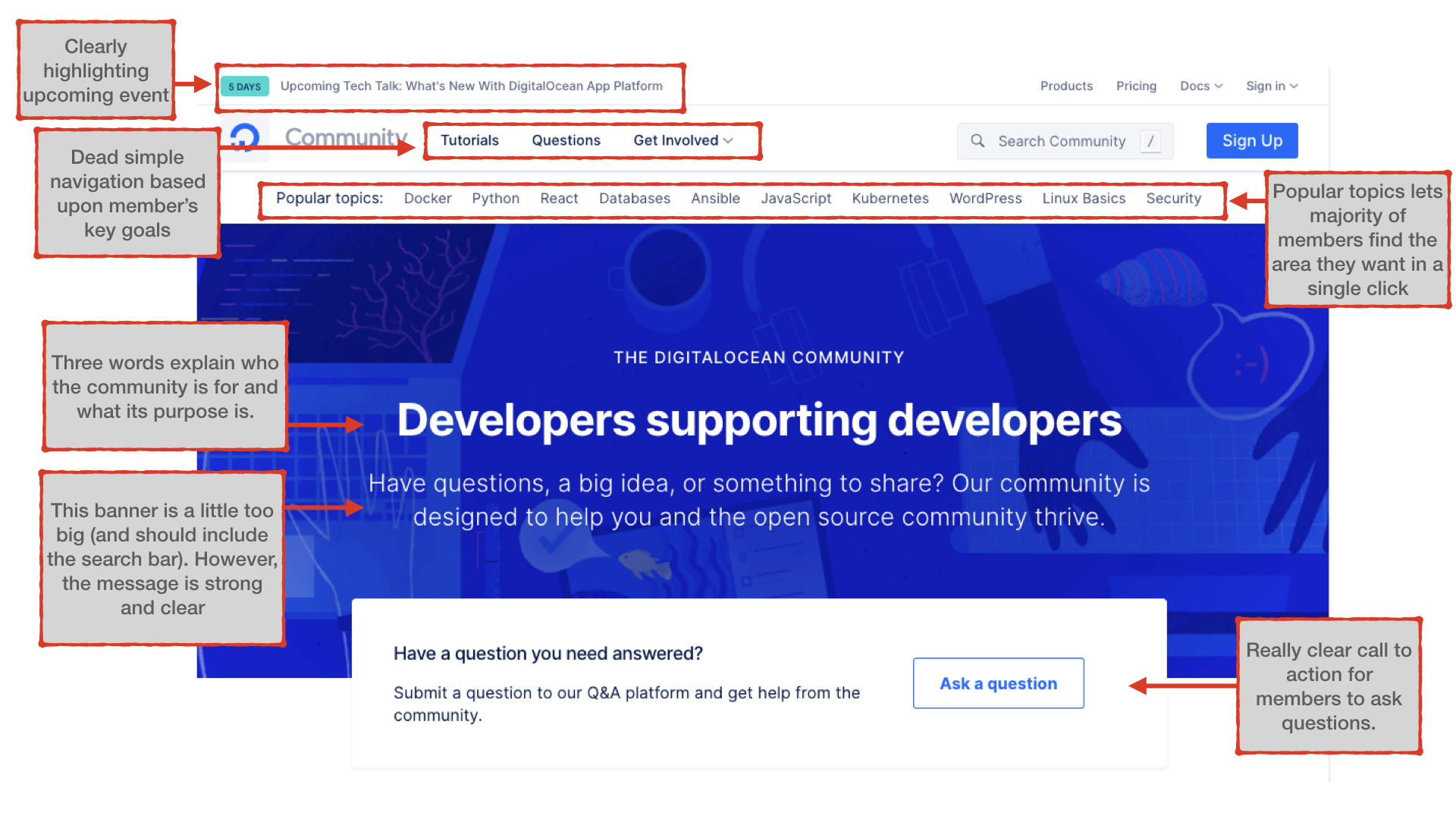
You can see a clearer breakdown of this below:
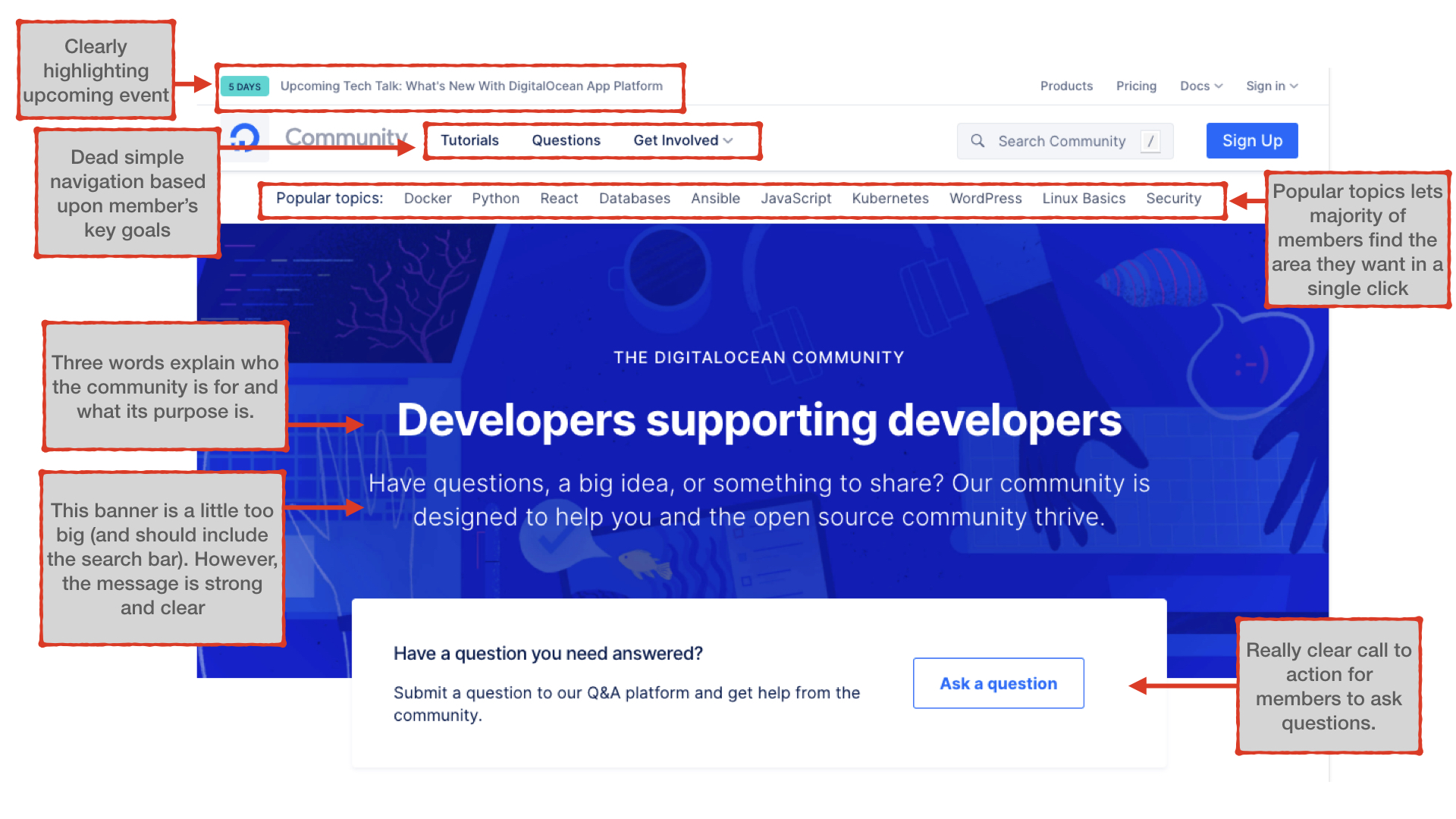
The community isn’t perfect. There is no activity on the homepage, the banner is a little too large, and search isn’t in the prominent place where it should be.
But I’m betting if you can incorporate half of what DigitalOcean has done above, your community will be better for it.
I’ve got a challenge with my Starlink setup. I need to extend the cable between the dish and its power supply. This is because the dish comes with a hardwired 100 feet of cable and I intend to go up a tree about 100 feet with the dish. I don’t want to have to locate the power supply at the base of the tree so I need to extend the cable to reach inside my house. That’s at least 50 more feet and closer to 100 feet if I want to run it through an existing underground conduit to a far corner of the house.
The dish uses power over ethernet (PoE) so both the internet data and the power travel across the same ethernet cable. Now here’s where the problem comes in. Starlink’s dish is very power hungry. It normally draws 100 watts! and can spike up to 180 watts!! That’s far more than typical PoE and probably why SpaceX limited the length of the cable to 100 feet. So, everything works fine with the 100 feet of cable that Starlink ships with but because voltage drops with the length of the cable, when I extend the cable by another 100 feet, the voltage drops enough that the dish is under-powered and fails to boot, goes into a reboot loop, or reboots when power draw spikes.
So, there are a few possible solutions I can think of (and I’m interested if any of you all have other ideas.)
The first solution is to find an ethernet cable with a thicker gauge wire. The thicker the wire, the less the voltage will drop. I’ve tested with 24 gauge and get the constant reboot loop. I’ve tested with thicker 23 gauge and don’t get the reboot loop but do get reboots when the dish draws more than normal power which seems to happen every couple of hours. If I could find some 22 gauge wire, it might be sufficiently hefty to keep enough voltage to prevent those semi-regular reboots. I can’t find anyone selling pre-terminated 22 gauge ethernet cable though so if I go this rout I’ll have to buy some bulk cable and do the RJ45 jacks myself. I guess that’s not a huge deal but it’s something I was hoping to avoid.
The second solution is to go with a shorter extension. The shorter the run, the less voltage drop and so if I drop down from 100 feet of extension to 75 feet of extension, I might not see the low voltage situation and the reboots. Dropping down to 50 feet would probably be even better but that would just barely reach my house with a more direct aerial run rather than the longer more circuitous underground conduit run.
The third solution is to not extend the cable and instead bring power out to the foot of the tree. This is significantly more work, digging a trench, laying conduit, and running wires from the house to the tree. And then I’d have to find a way to weatherproof the power supply (and the UPS I want to use with it.) That would mean finding some kind of case or building something like a small doghouse. The power supply gets quite warm and so what ever I buy or build to protect it from the weather would also need to be vented to allow it to stay cool. Maybe something like a vented battery box would work.

This is interesting. I have a lot of personal and “research” stuff in MindNode (which I love because it works seamlessly across macOS and iOS), but this app has a different take on note-taking (which I haven’t yet found a good way to do in mind maps, especially long form stuff).
One to look into when I have time, even if it does follow the trendy, annoying “freemium subscription” pattern (seriously, what happened to owning your software permanently?).

Marshall Headphones hat das alte Ledersofa Iggy Pop für eine Kampagne "Never Stop Listening" engagiert. Beworben werden drei Produkte:
Den Monitor liebe ich heiß und innig, der Major finde ich ganz OK, aber mit dem Mode komme ich nicht gut zurecht. Ich habe ihn jetzt ein bisschen widerwillig ein paar Tage getestet, aber mir fallen nur zwei positive Eigenschaften auf: Er ist so klein, dass er in meinen Ohren komplett verschwindet und er ist irre laut.

Die Ausstattung ist gut: 5 Stunden Laufzeit, 4x aus dem Case aufladen. Das Case lädt per USB-C oder induktiv per Qi. Mit Android-Handys kann er über aptX reden, mit dem iPhone nur mit dem bescheidenen SBC. Bedient wird der Mode über druckempfindliche Schalter, die so nervös sind, dass sie bei mir stets auslösen, wenn ich einen Ohrstöpsel anfasse.
Vier verschieden große Silikon-Passstücke liefert Marshall. Ich brauche den größten und kriege das Ohr trotzdem nicht dicht genug, um einen gescheiten Bass zu hören. Außerdem sitzen die beiden Stecker bei mir nur sehr lose im Ohr. Mit IPX4-Rating halte ich die Earbuds nicht für sport-geeignet.
Telefonieren sollte man mit dem Mode II keinesfalls. Der Pegel ist viel zu niedrig, der Rauschpegel zu hoch und jedes kleinste Nebengeräusch schlägt voll durch. Drei Aufnahmen: Mode II, Major IV und V-Moda Boompro am Major IV:
Wenn man nicht unbedingt ein M auf dem Ohr haben muss, würde ich statt dessen zu den viel besser klingenden und intelligenteren, zudem wasser- und schweißfesten Jabra Elite Active 75t greifen, die zudem weniger kosten.
We emerged from “Modified Code Red” into what I keep referring as “snapback,” but is actually called “circuit breaker,” and I used the opportunity to get a haircut. It had been 104 days since the last one.
Every haircut I emerge looking just a little bit more like my mother’s father; as he was among the gentlest people I’ve ever known, I focus on the hope that I inherit his demeanour as well as his widow’s peak.


My first job out of college was with the consulting arm of Arthur Andersen & Co. (which has since morphed into Accenture). Andersen invested heavily in training their staff and went so far as to buy their own college campus west of Chicago to house staff while attending classes. I spent many a day there as student and faculty.
Andersen may have been the only professional services firm to have its own liquor license. The training center was in the middle of nowhere and the partners deemed it smarter to set up a bar on campus rather than set hordes of recent college graduates loose after class. Days were spent learning the practicalities of auditing or computer programming. Evenings were devoted to knitting people into the culture.
I don’t know that that was a design criteria for the facility. It was certainly a result. After classes, students mixed with faculty, junior staff with partners. Over beers, the stories of successes and failures were told. Connections were made face-to-face that made later conference calls more effective. We were all turned into “Androids” and pleased with the result.
Two decades later, I’m part of a small core group creating a new consulting firm. There are about 25 of us at the start, refugees from Accenture, McKinsey, and elsewhere. But we aspire to much; our goal is to grow and compete with the organizations we had left. Six years later we have more than a thousand professionals across the U.S. and a foothold in the E.U.
We’ve all seen what investments in training and a strong culture can do. But we don’t have a college campus handy. We’re operating out of offices sublet from our lawyers. Our consultants, when they’re not at a client site, work from wherever home might be. Our only rule is that consultants must live near an airport large enough that they can reach client sites on Monday mornings.
One of the core mechanisms we used to create and reinforce a culture of our own was to convene All Hands Meetings once a month. Everyone came to Chicago. We did training and shared updates on the business.
It took some fighting with our CEO, but we designed the agendas with lots of time between sessions. And partners picked up the bar tabs in the evenings.
We did one more thing to jumpstart creating a culture out of nothing. We sought out “signature stories” of client incidents and events that represented the culture we sought. Some we shared in the formal agenda. Some we dropped into hallway conversations. Some we saved for the bar.
The post Sharing a Pint appeared first on McGee's Musings.


There’s a website where you can use cryptocurrency to buy an NFT for a planet and there’s something horrifyingly poetic about being able to buy an unreachable planet while simultaneously hastening the demise of our own.
Reminded of what Harry Truman wrote on the morning of the first successful atomic bomb test:
“I fear that machines are ahead of morals by some centuries and when morals catch up perhaps there’ll be no reason for any of it.”
Rolandtj
Theatre skills don’t just get you a job in the theatre. The things we learn through theatre can be applied to so many different career paths.
— The Old Vic (@oldvictheatre) March 1, 2021
This #NCW2021, we've got free resources to help you in whichever direction you’re looking to travel https://t.co/XUalfty73p
I just spotted this tweet from The Old Vic and it resonates so much with me. If I had a daughter, Mrs Worthington, I'd be putting her on the stage for sure - maybe not for a lifelong career but to learn all the skills critical for a career in business that you probably won't learn at school or university.
 |
| Grease by the Swan Youth Theatre, Worcester. Publicity shot. |
Thinking back to our weekly SYT meetings, the thing I remember most is all the role-playing we did. We called it improvisation but it wasn't comic improvisation as we've come to know from shows like Whose Line is it Anyway. We were put into groups and given a theme or a scenario to imagine and to create our own scene from it. We got to play other people. We got to walk a little in someone else's shoes and imagine lives and experiences very different from our own. And a major part of this was being able to think on your feet and respond quickly to whatever was thrown at you in the scene, or being able to improvise your way out of a mistake. I don't remember there being any fear about doing these scenes. It all seemed completely normal to me and it was about collaborative effort and not about one person's ego. We were free to experiment.
That collaborative effort, and learning to tune into one another, is an essential part of teamwork to this day. I think that's one of the things I miss the most about my time in youth theatre. That sense of all being in it together and having one goal of getting the show off the ground is exhilarating and brings a team together like nothing else I know. Of course, we fought and argued at times. Who doesn't? But the camaraderie and support we had back then were amazing. And it's not that dissimilar to the great vibes you can get in a start-up business. The energy is catching if you get the team and the goals right.
I learned all my entrepreneurial skills in youth theatre. I see being an entrepreneur as someone who makes something of nothing - creates a business from the seed of an idea. And that describes what we did. Our youth theatre director would have an idea of a show and we'd pull together to make it happen. We had a head start in that we had professional directors and crew to work with. And we had access to a space in which to put on our shows but we never had much of a budget so you quickly learn to muck in and to make things happen - costumes, backstage, on stage, lighting, front of house, dressing - we did all of it. We had to market and sell the tickets too so getting PR coverage in the local press was important. after all, when you have a 300 seat theatre to fill for 5 nights, that's a lot of tickets to sell. I remember for one show, a bunch of us dressed up in costumes from Godspell and joined the carnival handing out flyers. We really shouldn't have been there, but we got away with it with sheer chutzpah. And you need a bit of chutzpah when you're starting out in business.
In doing all of this, I also absorbed (it was more osmosis than learning I think) how to put on a show so it's not a great surprise that I've ended up hosting and running events as a large part of what I do. It's a great way to connect people, to bring them together. And it's an opportunity for learning. I also learned stage techniques too - to speak well, to not be afraid of speaking in front of an audience, to think about lighting and staging, to listen for cues, to improvise, teamwork, to take direction, to think on my feet and lots more besides.
So yes, I think experience in theatre, especially as a teenager, is terrifically important whether or not you end up having a career in theatre. As someone quite famous once said, "All the world's a stage and the men and women merely players". I think he may have had a point.
 [source]
"We should pause and ask the question," says David Wiley, "is more open always better?"
The answer, of course, is "it depends". I don't keep my house open for just anyone to drop by. I keep my bank account PIN a secret. I work for the government and have a security clearance and even though we are committed to the principle of open government, we still have secrets to keep. My work on the Research Ethics Board makes clear the importance of protecting personally sensitive information. So no, more open is not always better.
That's because, as David Wiley well knows, we have other priorities in life as well. Things like social justice, prosperity for all, peace and democratic governance: these define some of our common social priorities. And we also have individual priorities: caring for ourselves and our families, maintaining good health and security, finding meaning and order. You know. It's a veritable Maslow's soup once we start looking at the ingredients of the good life.
I think everyone knows this, and so in some important ways, I think Wiley's question is a bit of a straw man. It's not the question we really need to be asking when we're talking about open, whether it's open access, open educational resources, or open pedagogy.
No, the question is this: what are these other priorities? And what overall purpose are we enlisting openness, among other things, to serve?
This can be a hard and complex question. In my own work, I define openness as one of four elements of what I call 'the semantic condition'. The other elements are autonomy, diversity, and interactivity. The semantic condition, in turn, is what informs the design of networks to enable them to learn. Networks - and therefore, people and technology and systems and the rest - that embody the semantic condition will be responsive to and adapt to the environment, and hence be resistant to cascade phenomena leading to stasis and network death. That's a lot to pack into a single paragraph, but I've written about all that elsewhere.
From this perspective, Wiley sees the world completely differently. This difference is important, since it explains most of the differences between us. Here is how he describes his priorities:
If I were forced to explain this difference, I would say that instead of adopting a design perspective, as I do, Wiley offers something more like a logic model (Wiley uses the term 'business model'), where he describes openness as one of the inputs, student success as the output, and success, scale and savings as the key performance indicators. What's important here is that each of these can be measured, and so that gives you a mechanism for balancing openness with other criteria to achieve the desired outcome.
It's not irrational. Indeed, it is far from it. It takes something really hard, looks at it from a systems perspective, and organizes it in such a way that we can define things that we can actually do in order to be successful. I've seen this sort of approach operate in companies and in governments for years.
But it's flawed in the way that these managerial approaches are flawed more generally. It depends critically on measurement, so that if you get the measurement wrong, you get the method wrong. It measures by aggregation, which means that it doesn't much matter which input we're measuring, for which person, so long as things are better overall, the method is deemed a success.
And so by using this method, Wiley can proclaim a commitment to open while doing something else. He writes:
Here what he is doing is focusing on the metric of success. And his justification is simple. If we take the outcome of the measurement to be a product of these three criteria:
(degree of success) x (scale) x (cost savings)
then, if the degree of success is (somehow) measured to be zero, then there is no positive outcome. So degree of success is critical to his calculation.
So what, then, counts as 'degree of success'? Wiley has explained this earlier:
I have to say, when I read this back in the fall, my reaction was: OMFG.
I mean, imagine having as a desirable outcome of a broad-based social movement something that applies only to people who have paid tuition, and have had the time and opportunity, to attend what are in the main high-priced educational institutions! Even in a country like Canada, where something like 60% of the population attends post-secondary education, most learning for most people happens completely outside that context.
From where I sit, this definition of 'success' is essentially useless for any description of open learning, because most learning that people do in their lives depends on a completely different definition of success, and even more, across a population, or even for an individual, there is no single definition of success. People define for themselves what counts as success.
Indeed, I just read and commented on a paper in OLDaily that looks at positive learning experiences in MOOCs, based on what students actually say, which even though it is based on aggregate responses, has a much broader definition of success, and one (interestingly) that doesn't talk about grades or graduation at all.
But you can see how this was such an effective argument against Chuck Severance. He, on the one hand, wants to achieve "the 'pinnacle' of open", and has done so in his Python for Everybody course, and yet in the same post, admits that:
That reduces to a factor of success=0, which means that, on Wiley's model, if we take the score as a product of values, then Severance's work was literally useless. It may be 100% open, says Wiley, but "if no one takes advantage of the DIY version, how much effort does it really merit?"
Let's examine that claim. What Severance actually said is, "I have shown 100’s of people my 100% open process - and literally no one has replicated it because it is easier to just fall into the easier path of proprietary approaches." That is not the same as taking the course, the measurement Wiley uses when he asserts "as of March 1, 2021, 985,081 people have enrolled in Python for Everybody on Coursera and remember no one has stood up the tool chain themselves."
Can we say, based on this, that no one has taken advantage of the DIY version? That would be an unbelievable poor conclusion to draw. If we actually look at Severance's GitHub repository, we can see that it has been forked 1.2K times and is currently being 'watched' by 206 people. The repository has 56 contributors. And that's just the web site and course textbook. Looking at his other repositories, I see crossover from other projects, including Sakai.
I might add that nobody has replicated the Coursera course either, because Coursera is a proprietary platform, and you're not allowed to simply replicate it and host your own version of a Coursera course. So if even one person replicated Severance's value chain then the ratio, rather than being 985,081:1 would be 1:0, in other words, infinity. I'm tempted to do it, just to make a mash of Wiley's math, but I rather suspect it has already been done by people who just haven't told anyone about it.
Again, the managerial approach depends on what you measure, and if you get this wrong, you get your conclusions badly wrong (in this case, wrong by a million infinities).
But of course all this stands aside from the real question posed by Wiley:
That's actually a pretty interesting question. And again, if you're taking the managerial approach, and using the product of success times scale times cost then you end up with a pretty one-sided conclusion.
But Wiley elides the real issue here: people don't need to get the 100% open tool chain up and running in order to benefit from the free version of the course (or the materials and such individually). They only need to get enough of it up and running so they can benefit from the free materials without cost. They don't need to set up their own instance of Sakai, for example - that would be absurd! If someone else has covered some of the cost, or if someone else has stood up the server and the tools necessary, a person can breeze in, take the course, pay nothing and benefit just as much as the person who paid $49.
Why is this important? Because it points to another of Wiley's key performance indicators, the 'reduction in cost' parameter. Because we should be asking right away, cost to whom? If you just bundle together costs to, say, an institution with cost to person, call that (say) the 'total cost of course', then the whole Coursera model looks pretty good. But wouldn't a system that produced a 'Coursera' course at a cost of zero per student be better than one that costs $49?
You could do this straight-away simply by having the government, or a foundation, or a company, or a well-endowed university pay $49 to Coursera for each person who enrolls. Coursera would earn $48.2 million for offering the course, which is what it makes from the enrollments right now, and people would have access for free!
We can all anticipate the response. If the course were free, many more people would sign up. How many? I'm not sure, and I don't have statistics from free online courses (other than my own, which - let's admit it - are nowhere near as popular) but based on everything we've seen in the world of MOOCs it would probably be in the millions. So whomever funded the course would be pretty quickly bankrupted.
But if we're just paying Coursera directly, we've eliminated a lot of the overhead of collecting money from people. And it doesn't cost $48 million to actually offer the course online. So why not fund the course directly, as before, but cap the funding at, say, $20 million, but insist that the course be offered to students for free. Surely $20 million is enough to cover the costs, even the cost of assessing assignments and awarding certificates (since it's done by computer anyway). So if even the same number of people took the course, funding it this way is twice as good, per Wiley's calculations.
So why don't we do it that way?
Well now we reach the core of Severance's remarks, the core that was deftly avoided by Wiley with his S3 framework and his metrics and his measurements: the people who fund the courses don't want to do it that way.
Severance writes,
And he totally has a point. How much money do foundations pour into models that promote commercial models of open educational resources, models that very often depend on a user-pay model at some point, instead of toward models that depend on social-pay support for open access learning that everybody can use, not just those willing and able to pay the fee.
It's as though UNESCO ran it's food aid program by funding McDonalds to open new restaurants, and then subsidized the production of the bread and burgers, and called all of this 'open food access'. What people need is, first, free food to prevent starvation (that's why in rich countries we have soup kitchens even though there are plenty of McDonalds about), and then next, a way to produce their own food instead of being forced to buy it from the restaurant.
And I'm quite sure Severance would say that the reason it's so hard and takes so much effort to generate and access the totally 100% free and open course is precisely because all the funding that could be directed toward making it easier and more accessible is instead redirected toward these commercial initiatives. They come into governments and foundations and institutions with their metrics and business models and say "we can make it better", and they do, but they make it better not for the people who need it, but for themselves, and for the people who are already being well served.
And so - yeah - it does come down to what purpose it is you want 'open' to serve.
 Organizations aspire to immortality. Few achieve it, but the mindset persists. I was thinking about this in the context of the various organizations I’ve worked for over the years. Many of them no longer exist; names changed, organizations shut down, organizations absorbed into other organizations. The life cycle of modern organizations is shortening.
One of the driving forces that took me out of the workforce and back to school for the third time was seeking to reconcile the rationality of technology and the irrationality of behavior in organizations. I needed to step away from the noise to see if there were patterns I could discern.
Midway through the process, I recall a conversation with my advisor. Had I revised my opinions about the irrationality of organizations?
Herb Simon was a Nobel-prize winning economist who had explored this very question and had come up with perspectives that helped. Here’s what Simon argued. Organizations and the decision makers within them want to be rational but there are limits on their capabilities. Rationality is bounded by various limits on our capacity to process and make sense out of information.
The mythology of business and economics is that decision makers seek optimal solutions. Business language is littered with superlatives; “best”, “fastest”, “cheapest”, “newest”. Mostly harmless in advertising and marketing circles where we presume a certain amount of puffery. Not so harmless in other settings. Simon’s argument was that decision makers “satisfice”; they make a good enough decision with the time and data available. You don’t give up on the goal of optimal choices. You do accept that they are a theoretical ideal, not, generally, an achievable goal.
This matters for knowledge workers because the mythology remains pervasive. Knowledge work feeds into decisions. Those doing the work recognize the limitations of their analyses that leave us short of ideal answers. Those making the decisions are too often predisposed to ignore those limits. It can take courage to be vocal about what you don’t and can’t know.
The post Where’s the Locus of Control? appeared first on McGee's Musings.

"We should pause and ask the question," says David Wiley, "is more open always better?" The answer, of course, is "it depends". We have other priorities in life as well. The question is this: what are these other priorities? And what overall purpose are we enlisting openness, among other things, to serve?
See also on [Original Location] [This Post]It was 2004, and Tim O’Reilly needed a name for his new conference, and so “Web 2.0” was hatched in a brainstorming session devoted to finding a name. A year later O’Reilly would flesh the concept out with his definitive 2005 post What is Web 2.0, but given the fact so many Web 2.0 applications were about creating platforms that were then made valuable with user-generated content, it feels appropriate that O’Reilly made a name first and added the content to justify it later. And, in the spirit of Web 2.0, I’m not going to quote O’Reilly’s article but rather the Wikipedia entry for a definition:
Web 2.0…refers to websites that emphasize user-generated content, ease of use, participatory culture and interoperability (i.e., compatible with other products, systems, and devices) for end users.
Seventeen years on and there is more user-generated content than ever, in part because it is so easy to generate: you can type an update on Facebook, post a photo on Instagram, make a video on TikTok, or have a conversation on Clubhouse. That, though, points to Web 2.0’s failure: interoperability is nowhere to be found. Twitter, which has awoken from its years-long stupor to launch or announce whole host of new products, provides an excellent lens with which to examine the drivers of this centralization.
While the specific details of Super Follows are still hazy, the idea of Twitter users being able to charge followers for special access makes all kinds of sense for Twitter the company. First, the items of value, particularly exclusive tweets or the ability to interact, are by definition exclusive to Twitter; only Twitter has tweets! Second, the best place to find Super Follows will be amongst your regular followers; access to the ideal user acquisition channel is built in. Third, Twitter will be able to make money coming and going: the obvious advertising mechanism for finding new Super Follows would be Twitter’s own ad products; Twitter could even make advertising “free”, collecting its payment from future subscription revenue.
This points to the first factor driving centralization: as I explained two weeks ago in Clubhouse’s Inevitability, the most compelling apps for user-generated content tie creation and consumption into a tight loop, bound together with network effects and presented with a feed that neither creators nor consumers want to leave. This isn’t nefarious, it’s simply good product design.
The logic of Twitter getting into newsletters with its purchase of Revue is not quite as obvious, but still compelling: long-form content is very different from 280 characters, and there is a certain allure to a company like Substack that is completely focused on newsletters. At the same time, the most challenging part of building a subscription business is customer acquisition, and Twitter is an obvious channel to do so.1
This is the second factor driving centralization: in a world where distribution is free the real cost is user acquisition, which means it is often easier to give existing users new functionality than it is for a new service based on the functionality to acquire new users. The canonical example of this dynamic is Stories: while Instagram didn’t kill Snapchat, the audacity with which Facebook copied Stories stopped the latter’s growth, at least for a few years.
Business concerns are obviously a major driver here as well: ad-based services want to keep users on their own platform instead of sending them somewhere else, even if it incurs short-term costs; engagement is the recipe for long-term revenue growth.
I’m less convinced than many that Spaces, Twitter’s Clubhouse competitor, will crush the startup like Periscope, Twitter’s live streaming service, once crushed Meerkat. I think the audio streaming market is much larger, for one, and Clubhouse has much more of a head start. Still, I can understand the argument: when it comes to a social network the most compelling feature is if you know people using it, and Twitter already has an existing social graph, as well as a good idea of what you are already interested in based on whom you follow.
That is also why it is so important that Clubhouse incentivizes its users to import their contacts: the startup is bootstrapping a social network off of your phone’s address book, in stark contrast to Meerkat, which directly imported your Twitter contacts, right up until the date when Twitter cut it off. Twitter had learned its lesson from Instagram, which booted up its social network on top of the Twitter graph; Twitter eventually cut off Instagram in-line image sharing, but by then it was too late. To that end, the most Twitter could do to Clubhouse is stop its links from unfurling; it can’t stop Clubhouse’s notifications or use of contacts.
New features are a welcome respite to the reason that Twitter is usually in the news: controversy and charges/pleas for censorship. Some folks want Twitter to control more speech, some want Twitter to control less, but nearly all are convinced that Twitter is on the side of their enemies. Still, to be fair, Trump supporters have the stronger argument in that regard, given the fact that Twitter suspended the former President’s account (a decision that I ultimately argued for, even though it was very close).
The problem is that the solution proposed by many Republicans — revoking Section 230 — makes absolutely zero sense. Section 230 doesn’t protect the rights of private companies to make their own moderation decisions; the First Amendment does! In fact, removing Section 230 protection from tech platforms would lead them to censor far more, the better to avoid the inevitable flood of pointless lawsuits that would follow.
A better solution is more competition,2 but the reality of social networking is that new services that succeed do so by focusing on a different aspect of human communication. Twitter is primarily text, for example, while Instagram is pictures, and TikTok is video (this is another reason why I am bullish on Clubhouse relative to Twitter: I think being focused on audio is a big advantage). Facebook is the record of your life, while Snapchat is about ephemerality, and messaging apps about groups and logistics. The first time I tried to map the gamut of social media experiences, I opened with that famous Walt Whitman line from Song of Myself:3
Do I contradict myself?
Very well then I contradict myself,
(I am large, I contain multitudes.)
This is why the FTC’s hilarious attempt to define Facebook’s market in its absurd antitrust lawsuit was so misguided; of course Facebook has a monopoly on being Facebook, just as Twitter has a monopoly on being Twitter. It is quite clear, though, that no service has a monopoly on user-generated content or human interaction.
Still, that doesn’t help the “competition as an answer to censorship” problem, because the entire point is that if Twitter stops you from tweeting the ban is absolute; the issue isn’t simply the form of the tweets, but the network undergirding the service. That, though, is why the Instagram and Meerkat stories are so interesting: we already have evidence about just how powerful it is when a service lets its social graph be exported, and how limiting it is when it doesn’t. To that end, it seems clear to me that the only way to build a direct competitor to any of these services, like Twitter, is to have direct access to the Twitter network.
To that end, to the extent regulators want to engender competition in the social networking space, whether for political reasons or simply because they think Facebook is too powerful, the solution is clear: force existing social networks to open up their social graphs. Clubhouse shouldn’t have needed to upload your contacts, which aren’t even that great of a resource, filled as they are with your dentist from ten years ago at best and your abusive ex at worst; Facebook and Twitter (and Snapchat and all the rest) should have had to expose their social graphs to Clubhouse just like Twitter once did for Instagram. There is nothing else that would do more to spur competition.
The problem, of course, is privacy; European lobbyist Alexander Hanff described on LinkedIn how Clubhouse violated GDPR (all punctuation and capitalization from the original):
Clubhouse is a REALLY bad idea for private users, companies and investors. As private users they are asking you to break the law by providing access to your address book in order to invite your friends to use the platform with you…Clubhouse is a shining example of HOW TO BREAK EU LAW — they are so good at it they could and probably should, write a book on the subject.
Hanff isn’t wrong! One of the reasons why GDPR is such a disaster is that it makes it all but impossible for a new social media company to ever be started in Europe; I explained in 2017:
Several folks have suggested that the GDPR’s requirements around data portability, including that it be machine accessible (i.e. not just a PDF) will help new networks form, but in fact the opposite is the case. Note this section from the Guidelines on the right to data portability…
This forbids what I proposed: the easy re-creation of one’s social graph on other networks. Moreover, it’s a reasonable regulation: my friend on Facebook didn’t give permission for their information to be given to Snapchat, for example. It does, though, make it that much more difficult to bootstrap a Facebook competitor: the most valuable data (from a business perspective, anyways) is the social graph, not the updates and pictures that must now be portable, which means that again, thanks to (reasonable!) regulation, Facebook’s position is that much more secure.
I get the argument around banning contact exports; unsurprisingly, there are calls that Apple do exactly that in the wake of Clubhouse’s rise (never mind the fact that contacts have been accessible — and thus have been accessed! — in this way for years). What people making these calls — and these laws — need to be more honest about, though, is that they killing competition. If you want to ensure that Twitter wins in audio, or that Facebook wins everywhere else, then elevating privacy over everything else, ignoring both tradeoffs (like killing competition in social networks) and facts on the ground (like the reality that your contacts have long since ceased to be private), is an excellent way to accomplish exactly that.
Look no further than e-commerce.
Two years ago I wrote about one of the most exciting examples of competition on the Internet: Shopify and the Power of Platforms. After explaining how Walmart had failed in its futile attempt to challenge Amazon head-on, I highlighted the fact that Shopify was pursuing a very different strategy:
At first glance, Shopify isn’t an Amazon competitor at all: after all, there is nothing to buy on Shopify.com. And yet, there were 218 million people that bought products from Shopify without even knowing the company existed. The difference is that Shopify is a platform: instead of interfacing with customers directly, 820,000 3rd-party merchants sit on top of Shopify and are responsible for acquiring all of those customers on their own.
This means they have to stand out not in a search result on Amazon.com, or simply offer the lowest price, but rather earn customers’ attention through differentiated product, social media advertising, etc. Many, to be sure, will fail at this: Shopify does not break out merchant churn specifically, but it is almost certainly extremely high. That, though, is the point.
Unlike Walmart, currently weighing whether to spend additional billions after the billions it has already spent trying to attack Amazon head-on, with a binary outcome of success or failure, Shopify is massively diversified. That is the beauty of being a platform: you succeed (or fail) in the aggregate. To that end, I would argue that for Shopify a high churn rate is just as much a positive signal as it is a negative one: the easier it is to start an e-commerce business on the platform, the more failures there will be. And, at the same time, the greater likelihood there will be of capturing and supporting successes.
This is how Shopify can both in the long run be the biggest competitor to Amazon even as it is a company that Amazon can’t compete with: Amazon is pursuing customers and bringing suppliers and merchants onto its platform on its own terms; Shopify is giving merchants an opportunity to differentiate themselves while bearing no risk if they fail.
The strategy is working: while Shopify’s Gross Merchandise Volume (GMV) was about a quarter the size of Amazon’s in 2020, it was only 18% in 2019, and a mere 15% in 2018;4 in other words, even during the pandemic Shopify grew faster than Amazon, surely welcome news to those concerned about Amazon’s power, and validation to people like me who believe in the power of the Internet to unlock niche businesses that were never before possible.
That is also why this news in the Wall Street Journal kind of bums me out:
Shopify Inc., a commerce platform for businesses, is bringing its checkout and payment processing system, Shop Pay, to some Facebook Inc. platforms. The Shop Pay option will first be available to Instagram users on Tuesday and will roll out on Facebook Shops, the social-media company’s platform for small businesses, in the next few weeks.
Consumers will be able to use Shop Pay to complete purchases, expanding on existing options to use PayPal Holdings Inc.’s PayPal or manually enter credit or debit card information. All these methods are offered via the Facebook Pay payment system. Shop Pay, which stores credit card and shipping information to speed online checkout, hasn’t previously been available outside the e-commerce stores of Shopify clients.
Narrowly speaking, this is a huge win for Shopify; I fretted last year in Platforms in an Aggregator World that Facebook Shops would be bad for Shopify, in large part because it would limit usage of Shop Pay, itself a part of “Merchant Solutions”, the company’s biggest growth driver. I’m very happy to have gotten this wrong!
At the same time, from a big picture perspective this is clearly a case of Shopify, one of the most exciting companies in tech and the seeming leader of The Anti-Amazon Alliance, effectively moving into Facebook’s garden, because the web is increasingly a barren wasteland for small businesses. The cause is Apple: its approach to cookies makes platform-based web storefronts increasingly difficult to monetize effectively (Shop Pay performed magic in this regard), and its attack on “tracking” — which goes far beyond the IDFA — makes it increasingly impossible to acquire users in one place and convert them in another. The solution is to do user acquisition and user conversion all in one app — i.e. on Facebook — which is why Shopify is helping merchants move off the web and onto Facebook.
Again, it’s a good solution for Shopify, and Facebook deserves credit for recognizing that Shopify is a complement to their service, not a competitor, but I find it disappointing that once again elevating privacy above every other tradeoff is entrenching Facebook, the biggest incumbent of all.
The most frustrating aspect of the entire privacy debate is that the most ardent advocates of an absolutist position tend to describe anyone who disagrees with them as a Facebook defender. My motivation, though, is not to defend Facebook; quite the opposite, in fact: I want to see the social networking giant have more competition, not less, and I despair that the outcome of privacy laws like GDPR, or App Store-enforced policies from Apple, will be to damage Facebook on one hand, and destroy all of its long-term competitors on the other.
I worry even more about small businesses uniquely enabled by the Internet; forcing every company to act like a silo undoes the power of platforms to unlock collective competition (a la Shopify versus Amazon), whether that be in terms of advertising, payments, or understanding their users. Regulators that truly wish to limit tech power and unlock the economic potential of the Internet would do well to prioritize competition and interoperability via social graph sharing, alongside a more nuanced view of privacy that reflects reality, not misleading ads; I would settle for at least admitting there are tradeoffs being made.
I wrote a follow-up to this Article in this Daily Update.
We’re beginning a new generation of notifications on Flickr, which will simplify how you engage with other members of the world’s best photo community. We’re making it easier to understand where the action is, and we’re giving you greater control over your experience. These improvements are currently available to a subset of the Flickr community and we’ll continue rolling this out to all of you throughout the week of March 1st.

With this update, we’ve expanded the current notification types accessible from the bell icon at the top of Flickr, and we’ve given group admins a new tab that highlights the important work they do to keep our communities thriving. We’ve also introduced a new Notifications Center page so you can review your notifications with more screen real estate and can take action on important items with greater ease. Finally, we’ve introduced the new Notifications Settings page, which allows you to turn on or mute notifications by type.
To access these new features, click on the bell icon in the navigation bar at the top of Flickr. There you’ll see the dropdown with notifications and the new tabs to separate your personal notifications from those for groups you admin. You’ll also notice a new gear icon that will take you to the Notifications Settings page. At the bottom of the dropdown, you’ll see the link that used to read “View Recent Activity” now reads “View all notifications.” When you click that, you’ll be taken to the new Notifications Center.
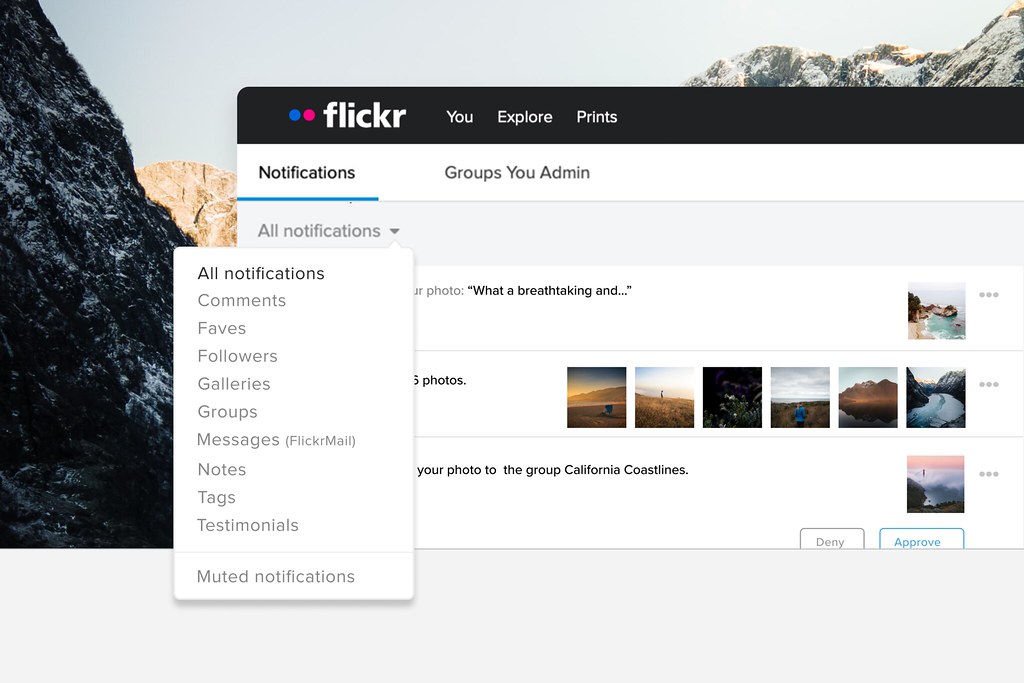
With this update, we’re bringing Flickr’s notifications in line with what new community members would expect of a website while still looking out for our most loyal Flickr contributors. For members who’ve been with us for a long time, we’re bringing feature parity from the much-loved Recent Activity page, though we’ve updated the data structure to be more efficient and relevant. For those who regularly use Recent Activity, we’ve added a number of educational tips that should help familiarize you with the new features.
We hope you enjoy these updates, and we encourage you to be on the lookout for additional improvements to group notifications that we’ll be rolling out soon. We have included an FAQ in our Help Center, and we also invite you to share your feedback here.
Cheers,
Flickr Product Team
A walk around the neighbourhood after too much time indoors. It was a nice evening, I got to pet a dog, and the sunset light was lovely.


My Android phone is a workhorse. I do quite a bit of work on the go; most of it happens on the phone. It's not easy to software development on the phone. That is mostly due to the small screen size and lack of a hardware keyboard. Nevertheless, I have made numerous small changes to code on the phone, deployed them. The other big use case is browsing the code on the go, doing reviews and accepting merge requests, etc. I use the following apps for the same.
MGit is a Git client Android App.
MGit
Bare minimum, just like a standard git client on your machine, but with some UI to browse. You will need to install a separate application to open the file. It can clone and keep the offline copy of the code, like git is supposed to do. It can clone from anywhere just like git as long as you have access to the repo. Available on PlayStore and F-Droid.
Of course you could use Termux for git, if you want to go that way.
GitNex is a free, open-source Android client for Git repository management tool Gitea. Gitea is a community managed fork of Gogs, lightweight code hosting solution written in Go.
GitNex
I use Gitea in my local network. It has some private projects. It also does some mirroring of my public projects. I usually use this only at home. So GitNex gets used mostly at home. But one day I will have a clean VPN setup so I can access from anywhere in the world. The UI sleek and beautiful. Gives access to all features of Gitea.
Available on PlayStore and F-Droid.
With LabCoat, you can manage projects, create issues, and even accept merge requests all from your device.
LabCoat
I use GitLab for lot of commercial work. So I need a way to access it on the go. LabCoat gives me that. I can do code reviews, accept merge requests, add comments on issues etc. It has made me more productive. It simple, clean and very useful.
Available on PlayStore and F-Droid.
Ofcourse you could use Termux for git. But these apps are useful if you wanted a dedicated App or you want a specific feature from your code hosting provider.
As far as Github is considered. I use browser. I am yet to checkout the official Github client or OctoDroid. I will let you know how it goes if I use them.
You can subscribe to my blog using RSS Feed. But if you are the person who loves getting email, then you can join my readers by signing up.
Join 2,108 other subscribers
Email Address
Sign Me Up
For years, I’ve been advising organisations not to send a daily digest of new activity.
‘It overwhelms members and they stop reading all your emails!’
Last month I began working with a client who sent members a daily digest of new activity. I was hoping to pull a few quotes from member interviews to support the need to change it.
However, when I asked members about the daily digests and how they visited the community, they often gave the same response. They skimmed through the daily digest and clicked on the items they were interested in. Email digests were the primary route for most regular members to visit the community.
For sure, they wanted improvements to the daily digest, but almost unanimously they liked having a daily digest of new community activity.
There are a few lessons here.
1) Daily digests can be useful. For certain audiences, a digest is precisely what they need or have become accustomed to.
2) There are exceptions to every best practice. What’s best for most audiences might not be best for your audience. If in doubt, test it out. Don’t change things without checking with members first.
3) Don’t neglect member interviews. If you’re not interviewing a few members each month, you’re missing out on an incredible wealth of information.
Put your assumptions to the test in member interviews.

As schools begin to reopen, The New York Times illustrates why classrooms should open a window for ventilation. Lower viral concentrations swirling around means reduced exposure.
The 3-D model to show airflow was already something, but keep scrolling to see the cross-sections. Then scan the QR code on your phone to see the simulated data with augmented reality.
Tags: coronavirus, New York Times, school

Assuming the mask fits well and its filtration has been rigorously tested, N95 or KN95 respirators and surgical masks are some of the most protective face coverings you can buy. We’ve tried 39 models and confirmed the filtration claims of our favorites with government agencies or our own lab testing performed in collaboration with Colorado State University.
Here we recommend legitimate N95, KN95, and surgical masks available from trusted retailers.
 |
mkalus
shared this story
from  mrjamesob on Twitter. mrjamesob on Twitter.
|
If an independent inquiry finds that Meghan Markle bullied staff members, she should be sacked as Home Secretary immediately.

I think Alex Usher is generally on the mark with this assessment of the Business Council of Canada (BCC) recommendation that Canada create "a demand-side, mission-driven approach to innovation policy, setting clear national goals to translate scientific strengths into economic performance." This is very much what was tried under the Harper administration, including a reworking of the NRC into something resembling Germany's Fraunhofer. As Usher says, the evidence that this approach (in Canada at least) produced much of anything is, well, lacking. What it definitely did not create is business investment or innovation, and so the BCC's recommendation sounds like "a group ask for more government money in more government programs to solve a problem caused by their own inaction." What Usher does suggest - "a wholesale revamping of the nation’s graduate programs to orient them more towards industry" - is intriguing. Not that I endorse this solution specifically, but it does seem pointless to prepare so many people for academic jobs that simply don't exist, and never will.
Web: [Direct Link] [This Post]