Shared posts

03 Mar 18:13

Star Power

by Lauren Collee
Full-text audio version of this essay.

On the 20th of January, Elon Musk’s company SpaceX launched 60 more of its “Starlink” satellites into orbit. Starlink’s aim is to achieve worldwide broadband by encircling the globe with moving belts consisting of tens of thousands of satellites (a “low orbit constellation”). The satellites themselves do not emit light, but in the hours following sunset and preceding sunrise, the sun’s rays glint off their highly metallic surfaces, making them visible to the naked eye. They appear as stars, pulled together into a bright, close, beaded train of lights.

The sight of tech in the stars is uncanny, because it’s not so much unfamiliar as it is a weird kind of mirroring. We are used to seeing the stars in tech. Galactic and cosmic scenes are commonly the default wallpaper on phones and computers, and the internet (cyberspace) is most often visualized as a kind of constellation: illuminated nodes in a dark, endless vacuum, overlaid by a web of lines of connection. In these renderings, the illuminated web hovers just above the earth’s atmosphere, as if the planet were spooling outwards.

The trope of space exploration in tech advertising is almost as old as the history of computing itself, dating back to the 1950s, but its meaning has changed subtly over time. Computer and internet advertisements from the ’80s and ’90s are laden with inter-planetary imagery, often complemented with domestic scenes — a computer surrounded by the friendly debris of a home office space, a family huddled around the screen — which tempered the alienness and expansiveness of the virtual realm with the promise that, with the click of a button, one could easily return home. The computer, at this point, was figured as a fixed portal to a (separate) cosmological sphere, a door that could be closed and opened at will.

The trope of space exploration in tech advertising is almost as old as the history of computing itself

In 2007, Steve Jobs launched the first iPhone. Its default wallpaper was NASA’s famous “blue marble” image of the earth as viewed from space. This wasn’t the first time Apple had employed this image — it was used to advertise the “clamshell” iBook in the late ’90s — but with the iPhone its significations were more aggressive, accompanying a device that would literally contain the world, as opposed to merely facilitating connections across it. In his keynote address, Jobs jumped frantically between apps, countries, and global data, pulling up weather, time zones, stocks. He demonstrated the satellite view accessible via maps, “going” to Washington, Paris, Rome, where his audience looked down from above. “This is the Washington Monument. Look at this. I can see people down there,” he said, as if aboard Apollo 11 and experiencing the view for the first time. “There’s the Roman Coliseum…. Unbelievable. Right on the phone.”

Gradually, as the aim of tech companies shifted away from creating a computer to many things that compute — an ecosystem, or constellation of interconnected “smart” devices powered by a web of satellites — the self-contained “blue marble” image of the earth was abandoned in favor of imagery that echoed this more networked and distributed vision: galaxies and starscapes. Meanwhile, the domestic scenes that accompanied earlier visions of cyberspace as in the ’80s and ’90s slowly fell away. While in the early days of the internet, outer space imagery spoke of freedom and wonder, it now speaks of omnipresence.

The literal insertion of a tech company into the night sky is the next step in a long discursive project by which tech companies tie themselves to cosmological imaginaries — a form of self-narrativizing that brings their own myths into association with scientific master-narratives of the histories of the earth and the universe. This co-optation hints at a more serious undertaking: adopting the totalizing authority of astrophysics and scientific cosmology, the “purest” and most conceptual of the sciences, in order to naturalize their exponential growth as fundamental law. Tech companies are laying the groundwork for their role in shaping earth’s futures, and our acceptance of this as inevitable.


The use of cosmic imagery by tech companies hints at a longer history by which corporate expansion has been linked to cosmic forces and therefore enshrined as universal law. “Cosmology” (from the Greek kosmos) is a broad term referring to a system of belief or worldview. In Western science, it describes the branch of astrophysics that concerns the study of the origin, evolution, and eventual demise of the universe — an adoption of a general term to signify a singular worldview which is deemed incontrovertible (for critic, philosopher, and novelist Sylvia Wynter, the imposition of European origin stories along lines of colonial expansion is part of the “overrepresentation of Man” and of its “descriptive statement”).

In her series Cosmopolitics, philosopher Isabelle Stengers turns her attention to what happens when different cosmologies come into contact with one another. She argues for a perspective that does not strive towards totality, but rather pays attention to the practices by which knowledge is formed and put to use. The approach of Western science, Stengers argues, has always been to legitimize itself by disproving all competing visions; it functions as a “war machine” that aims to destroy any cosmologies which it cannot subsume within itself. It posits truth as something universal which waits, already fully formed, to be discovered bit by bit.

As Stengers, Wynter, and other philosophers of science have argued, the reality of how science is done is messier than the confident, totalizing face it projects. The live “core” of science, where its narratives are produced, is often deeply experimental, deeply political, and hidden from view, while the narratives themselves are disseminated as ready-made, incontrovertible facts. (MC Hammer recently put this succinctly in a tweet: “When you measure include the measurer.”) As a result, these narratives — particularly those that correspond to Western modes of linear storytelling — become powerful tools by which to naturalize other systems of relations.

The Big Bang provided a blueprint for a convincing story of limitless growth

One relatively well-known example is the Darwinian view of evolution, a theory bound up with processes of racialization and the colonial agenda, which also drew on principles of free-market economics emerging at the time. In a paper published in Frontiers in Cellular and Infection Microbiology, Emiliano Salvucci draws on examples from different areas of biology to demonstrate the ways in which the discipline is steeped in the language of free-market capitalism (“competition between proteins and between genes, the selection pressure, fitness, cost-benefit ratios, arsenal, weapons, war, exploitation, self-serving punishment, coercive strategies, mafia, policing […] the destruction of others, the ‘problem’ of altruism”). “Natural selection,” Salvucci writes, “is a linguistic trap.”

Inside the machinery of scientific knowledge-production, there are hierarchies between different forms of scientific inquiry. Generally speaking, the more theoretical and the closer to “pure maths,” the higher a science is within this hierarchy. In this sense, physics and astrophysics trump chemistry, and chemistry trumps biology — the assumption being that the more a science must take its evidence from earthly matter, the more likely it is to become “tainted” by human bias. This partly explains why the origin stories of Western astrophysics — like the Big Bang — often escape cultural scrutiny. In situating its field of inquiry beyond the boundaries of earth, astrophysics lays claim to a mathematic purity that obscures its biases.

All mathematical and scientific work is determined by social and political factors, from the point of research to the point at which a “discovery” is shaped into narrative. The question of exactly how a scientific model becomes popularized is always socially determined: certain parts of the story become more famous than others. The principle that the universe has continued to expand since its origin is better known, for example, than the fact that it is gradually cooling down, perhaps because the idea of a natural law of expansion maps easily onto colonial and libertarian paradigms (for sociologist Howard Winant, whose work fed into Wynter’s, the analogy is so apt that the “liftoff” of capitalism and the invention of race can be said to constitute “Big Bang” processes).

In a paper from 2009, historian Craig Howard White argues that the American Observatory Movement — the rapid construction of numerous observatories across North America that took place in the United States in the 1840s and ’50s — coincided with a political project to justify the economic and geographical expansion of the American Empire. He argues that the “cosmology of growth” that was supported by astronomical research worked to “declare expansion a natural law for the heavens and for North America.” The law of cosmic growth, in other words, was adopted as a scientized iteration of “manifest destiny.” The metaphor of capital as cosmic expansion stuck: the mass financial deregulation that took place on the London Stock Exchange under Thatcher in the 1980s is referred to as the “Big Bang,” a term that was taken up and applied to later instances of deregulation, such as that of Japanese financial markets in the late 1990s. The Big Bang provided a blueprint for a convincing story of limitless growth, which became part of the ways in which companies — and tech companies in particular — narrated themselves.


Following the rise of Apple, the Silicon Valley “garage” where Steve Jobs and Steve Wozniak reportedly built the first Apple computers became a tourist attraction; in 2013 it received official historical status (Wozniak eventually admitted that the story was “a bit of a lie”). Versions of the garage story have been employed so often by multinational corporations that it has now become a cliché. Dell, HP, Microsoft, Amazon and Google were reportedly all founded in garages, and Nike boasts that it was founded “in the boot of a car.” The “humble beginnings” garage trope is familiar, because it is the story Western science tells us about our own universe: created in a moment of explosive growth from a condensed kernel of energy. The smaller the point of a company’s origin (garage, car boot, shoebox), the closer it resembles the story of the Big Bang, which is one of impossible extremes (atom to universe).

From there, with the overarching mega-narrative in place, the appeal to more terrestrial scientific creation narratives is easy. The company universe is driven by Darwinian evolution. It is populated by successive “generations” of products, which evolve and overtake previous generations. Successful products thrive in the tech “ecosystem,” while others fail. The stories that tech companies tell about themselves mirror the ones we are told about the earth.

The tech industry in particular gets away with this because of its discursive proximity to scientific R&D, and the notion of linear human progress as propelled by technological innovation — associations that have been enshrined in imagery and hardware. As Jathan Sadowski wrote recently in an article on utopias for Real Life, tech companies actively promote “the idea that they are simply conduits for the spirit of progress, an autonomous force of nature that acts on its own accord […] with each upgraded iPhone another step toward the materialization of a divine digital destiny.” The goal of this form of narrativization is temporal and spatial omnipresence: In evoking narratives that reach way back to the origin of the universe, the tech industry legitimizes its ability to reach way into the future; in reaching beyond the physical bounds of the earth, it legitimizes its interference at every scale of existence.

The presence of tech companies in outer space, as we see now with projects like Starlink, is the culmination of a long process that is figurative and discursive as well as material. The past two decades have seen the rapid growth of the NewSpace industries (also known as the “Billionaire Space Race”), a moniker that distinguishes the corporatized and commercialized realm of outer space today from the “Old Space” of the Cold War, in which states were the primary actors. SpaceX (Elon Musk) and Blue Origin (Jeff Bezos) are among the companies who plan to profit from the passage of the 2015 SPACE (Spurring Private Aerospace Competitiveness and Entrepreneurship) Act, which explicitly allows “US citizens to engage in the commercial exploration and exploitation of ‘space resources’ [including… water and minerals].”

In evoking narratives that reach way back to the origin of the universe, the tech industry legitimizes its ability to reach way into the future

The danger of the 2015 SPACE convention lies as much in the assignation of corporate control over the discursive space of the cosmos as it does in the legalization of material processes of extraction. The NewSpace industry consciously employs the language of colonialism, figuring outer space as a “new frontier” to be conquered. In doing so, it naturalizes the neocolonial processes on earth that drive its “innovation”: the large-scale mining of rare-earth minerals, the export of electronic waste to lands branded worthless or empty, the positioning of the Global North as economic center. As Lou Cornum points out, such projects are often accompanied by the invocation of “all mankind,” appealing to a vague universalism that obscures the exclusionary aims and deep colonial legacies of the NewSpace industries. Those working in the space of Indigenous and Afrofuturisms have long recognized that pasts, presents, and futures are intimately connected: even if Elon Musk’s drive to “colonize Mars” is not likely to imminently come to fruition, its evocation of cosmological imaginaries is already working in the present to tie neocolonial and neoliberal relations to a scientized view of destiny, rendering them inevitable and natural.

The future projected by NewSpace industries — in which a privileged few escape to a terraformed Mars, moon, or distant planet (the process of escape itself entailing a huge cost which falls on people and places considered disposable to this grand aim) — contains, as Sadowski and Cornum both argue, the inbuilt certainty of the earth’s destruction due to existing corporate and neocolonial processes. Techno-determinist futures, then, are used to habituate us to the present. At the same time, corporate cosmologies carry the values and prerogatives of the corporate world into the future.


Given the history of tech companies reinforcing systems of white supremacy (from enabling hate speech, to racist algorithms, to targeted surveillance and predictive policing), the construction of corporate cosmologies is also inextricably tied to the totalizing ambitions of whiteness. While working on this, I kept returning to a recent New Yorker article on Pixar’s new film Soul by Namwali Serpell, a professor of English at Harvard. Despite the rich and multi-layered depictions of African-American life by Black artists in many of the film’s scenes, Serpell draws attention to how studio biases meant that the film’s ethereal and immaterial spaces — its “cosmic” spaces — are coded as white (it is worth noting, perhaps, that Pixar was co-founded by Steve Jobs, who remained its biggest shareholder until his death; and the current shareholders of its parent company, Disney, include Blackrock Inc, the Vanguard Group, and State Street Corporation).

In Soul, the “You Seminar,” the realm before life, is figured as corporatized and digital-looking, stuffed with the rounded forms distinctive to a Silicon Valley tech campus. Souls are matched with mentors in a glitzy affair reminiscent of a TedX convention, and clerks are abstracted geometric figures (“Platonic forms,” in Serpell’s words), that look like variations on the Mac OS logo/Finder icon. Serpell asks:

What would a Great Beyond and a Great Before informed by black culture look like? Would greenish white be the right color for new souls? Would pitch-black be the right color for lost ones? Would the Beyond and the Before be on separate planes? Would soul counsellors be two-dimensional abstractions? Would Mystics Without Borders include an obeah woman or a bokor? Would people in a fugue state of flow float up to the spirit world, or would the spirits descend into them — ride them, as we say?

Serpell’s analysis draws attention to the ways in which whiteness projects totalizing worlds formed in its own image, passing off these depictions as neutral. “Whether on Earth or in the heavens,” Serpell writes of the film, “whiteness is ethereal, mindful; blackness is heavy, obsessive.” Corporate technological determinism, with its white-supremacist agenda, ties itself to figures of lightness, immateriality, and abstraction — stars, points of light, digital ether, the elusive glint — and calls itself essence, atom, a distilled and fundamental truth.

The visual language of the universe, of cosmic space, is a powerful tool because it is also the language of universalism — of totality, incontrovertibility and literal inescapability (how do we escape a story that claims to contain us)? If techno-capitalist expansion is now figured as a law of physics, then part of the task of countering it is to question the hegemony of the knowledge systems that work to support it. Not in refuting scientific claims, but, as Stengers argues, by understanding them as inflected by particular values and agendas; and by acknowledging the multiplicity of ways we conceive of our shared histories and futures. The Big Bang is not the only version of events.

Another part of the task surely has to do with countering the consistent dematerialization and mystification of tech, the ways it is figured as elusive and cosmic, analogous to space-matter. If the internet had not been abstracted to a constellation of lights hovering just above our heads, would SpaceX have been able to execute Starlink, a project that literalized that vision, so easily? What if the internet were visualized instead as physical infrastructure, as undersea cables, data centers and open-cut mines — images that speak of neocolonial violence and ecological degradation — but also of mundanity and failure?

In the middle of the South Pacific Gyre is a spot known as the “Spacecraft Cemetery,” a point so far from any other landmass that the humans closest to it are often those aboard the International Space Station. Because of its remoteness and its biological inactivity, falling satellites are often directed here, and the ocean floor is littered with space debris. This is the deep underside of projects like Starlink, a site where all the bulk and finitude excluded from corporate cosmology accumulates. It is also where the ISS itself will end its life in approximately 2028.

In 2020, the first SpaceX/NASA astronaut launch attracted 10.3 million concurrent online viewers, the most ever recorded by NASA. In 2028, the ISS will crash quietly into the ocean without a single human witness beyond those orchestrating it via a monitor.

03 Mar 18:09

What the first five minutes of recent COVID briefings has felt like...

by peter@rukavina.net (Peter Rukavina)

On exigent COVID days, our Premier has taken to appearing for a few minutes of scene-setting cum pep talk before Dr. Heather Morrison. When what we really want to know is whether school is cancelled, we may have ordered pizza from a COVIDy place, or what the case count is.

Few would dispute that the Premier has kept a cool head throughout the past year; there’s a time to lead, though, and a time to get out of the way.

03 Mar 18:08

Flickr members recreate historical pictures from The Commons archives

by Leticia Roncero

Last month, in celebration of the Flickr Commons 13th Anniversary, we put out a call for our members to recreate and reinterpret a historical photograph from The Commons archives. To spark some inspiration, we compiled 13 images and asked you to choose one and get creative with the reinterpretation.

Today, we want to celebrate some of the best creations our members shared throughout the month. If you like them, please take the time to visit the photographers’ photostreams to fave their photos or leave a comment in appreciation. Enjoy the compilation:

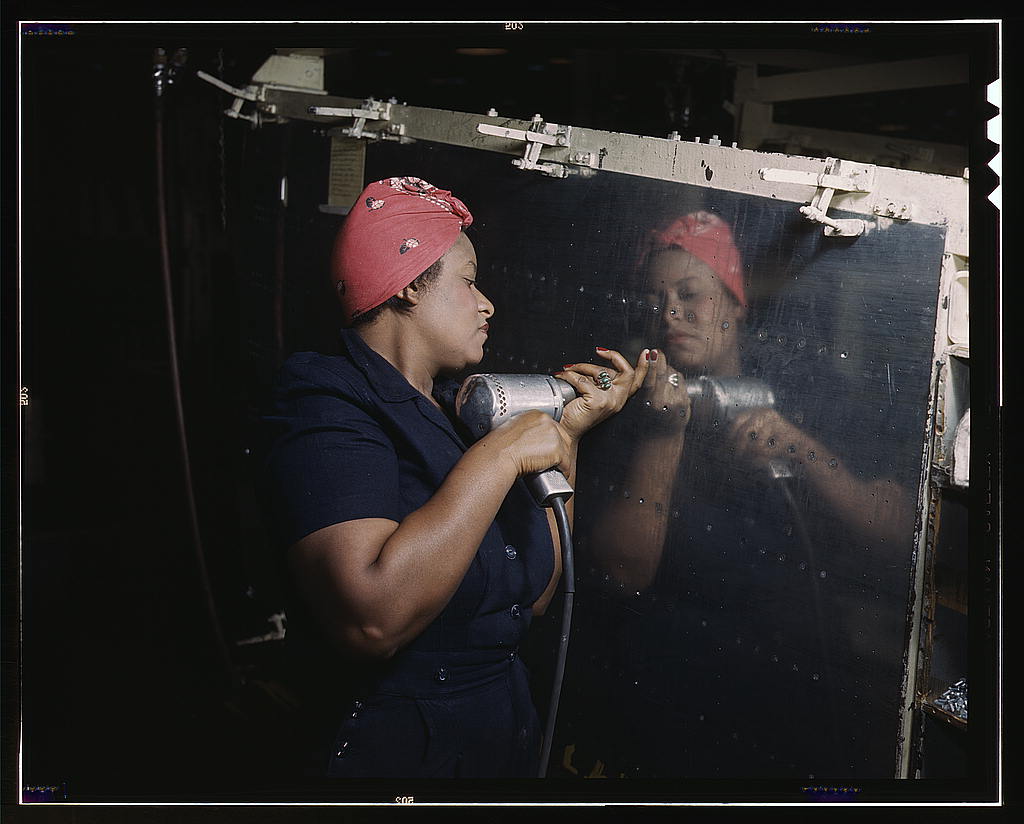
Original

Operating a hand drill at Vultee-Nashville, woman is working on a "Vengeance" dive bomber, Tennessee  (LOC)

Reinterpretation

Recreation Rosie the Riveter

Original

Children ready for school during the 1918 flu epidemic  - Starke

Reinterpretation

Humoring Grandpa

Original

Ghostly sighting?

Reinterpretation

Ghostly Image

Original

Loetafoon

Reinterpretation

2021-02-13: Grammofoonplatenspeler

Original

Mr R.J. Tate

Reinterpretation

2021-02-13: Tate & Bicycle, Hartlepool

Check out the full gallery here to see more!

03 Mar 18:08

The Four Questions

My wife and I had the task of helping a young man who, due to various serious issues in his household, was years behind his peers in school. He should have been entering 5th grade, but due to his situation, he was only halfway through 1st grade.

The young man didn’t have any learning disabilities other than his living situation being rather non-conducive (even hostile) to learning and regular attendance.

When the boy’s grandfather received custody, he sent the lad to us since my wife has been a school teacher and has been successful at home-schooling as well.

Our goal: bring him as close to 5th grade as possible, as soon as possible.

We had 9 months.

There were enough obstacles and issues to fill a pretty good-sized book (perhaps we should consider writing that book someday).

Let’s consider just one of the simple formalisms we used to help the young man take on work and complete it without being overwhelmed.

illustration of question written on paper with an inkpen on top

The Questions:

  1. What is it that needs to be done?
  2. What do we need in order to do it?
  3. Where can we get what we need?
  4. How can we tell if we’re doing it right?

These seem really simple, and they are really simple. Reflecting on these four questions seems to help me (and certainly helped the young man) focus on doing small things and completing them well, rather than freaking out about emotional factors or uncertainty.

What is it that needs to be done?

Do you know the things you need to do this week? Today? In the next 20 minutes?

I could feel a tingling at the base of my scalp, thinking about the week. It was a little panicky feeling. But then when I reduced it to “today”, there was a bit of reduction of anxiety. When I think about the next 20 minutes, I’m relatively calm.

Descoping is a good self-management technique. What is the one thing I have to do next?

For him, it was a chapter of a textbook and some exercises at the end. For me, it can be coding, teaching, creating materials, blogging, reviewing, software development, architecture or any number of things.

In either case, we need to think about ONE thing. One thing that needs to be completed next, and then we can think about something else.

What is the thing you need to do right now?

What do we need in order to do it?

This is another focusing question. Maybe what we need is physical.

Maybe I need a room, some quiet, a camera, a slideshow, and the current version of our code.

Perhaps what I need is a bit of knowledge - such as how to set up my Dockerfile or how to create a new project.

Maybe I need a pencil, my textbook, a scratch pad, and a booklet of exercises. A calculator might be handy.

What do you need to have to do the one piece of work you’re going to do next?

Where can we get what we need?

Where are your books? Where are your pens and pencils? Where did you put your scrap paper?

As we approach this question, we start to understand the need to keep our supplies close at hand.

Do you need information? Is there a web page or an eLearning course that will tell you what you need? A video tutorial on the internet? A book? Do you need a mentor or teacher handy?

How can we tell if we’re doing it right?

Now that we have a goal, supplies, and information, we can start working.

The problem we now face is the Dunning-Kruger Effect.

If we already know how to do our job very well, then we know how to tell that we’re doing a good job - or do we? If we’re not all that good at it, we might be assuming our work is better than it is.

At one point, the young man thought he was doing a great job because he filled in all his math papers and did it quickly. However, he did it by guessing at all of the answers. He was crestfallen to find that none of his answers were correct. He didn’t know how to emotionally cope with being told that his answers were wrong, and so some emotional coping skills had to be developed before he could develop the necessary mathematical skill (I told you emotional coping skills are important).

If we are learning how to do something, then we might get it to work in the worst possible way. It might create a lot of problems later to develop the wrong habits now.

So we need some kind of objective way to check our work, or else some set of heuristics and enough good and bad examples to train our intuition properly. This will apply equally to outcomes and techniques.

The reason a lot of people don’t do their jobs well is that they don’t know how to tell if they’re doing them well or not. Remember: there are ways to succeed that competent, prudent, ethical people would never choose. How do you know?

When doing arithmetic, you can check your answers with a calculator.

When it’s spelling, you can use a dictionary or online spelling checker.

Flashcards can work for memorization.

Whatever the work is, you need to have some kind of tests to provide guardrails.

This fact is the basis of TDD and BDD: we define the rules first, then add the code that obeys the rules, then we refactor to make great code that obeys the rules. Often it helps to have other people whose intuition is different from our own (pair programming or mob programming) to review our work as we do it together and ensure we don’t make any short-sighted errors.

For most of the nontrivial work that humans do, whether you’re doing it right or not will require the opinion, judgment, and taste of other humans. You may write code that seems pleasing to yourself but that the team finds puzzling and odd. You may build a good system that users don’t want. Your management style may get results now, but with negative effects on morale, initiative, motivation, and sustainability.

Application

Asking these questions is not a panacea. Some may even feel that they are inviting Big Design Up Front (BDUF), though this is not necessarily so. Even very small tasks have entry criteria and standards of completion.

As a tool for getting unstuck or overcoming overwhelm, it has proven pretty useful.

Can four simple questions help you prepare to succeed at your many tasks, taking one task at a time? I guess that is yet to be proven, but it has helped others.

The next time you try this, drop us a comment below. Let us know how it worked out for you.

03 Mar 18:08

Introducing eink.link, my new side project

by Doug Belshaw
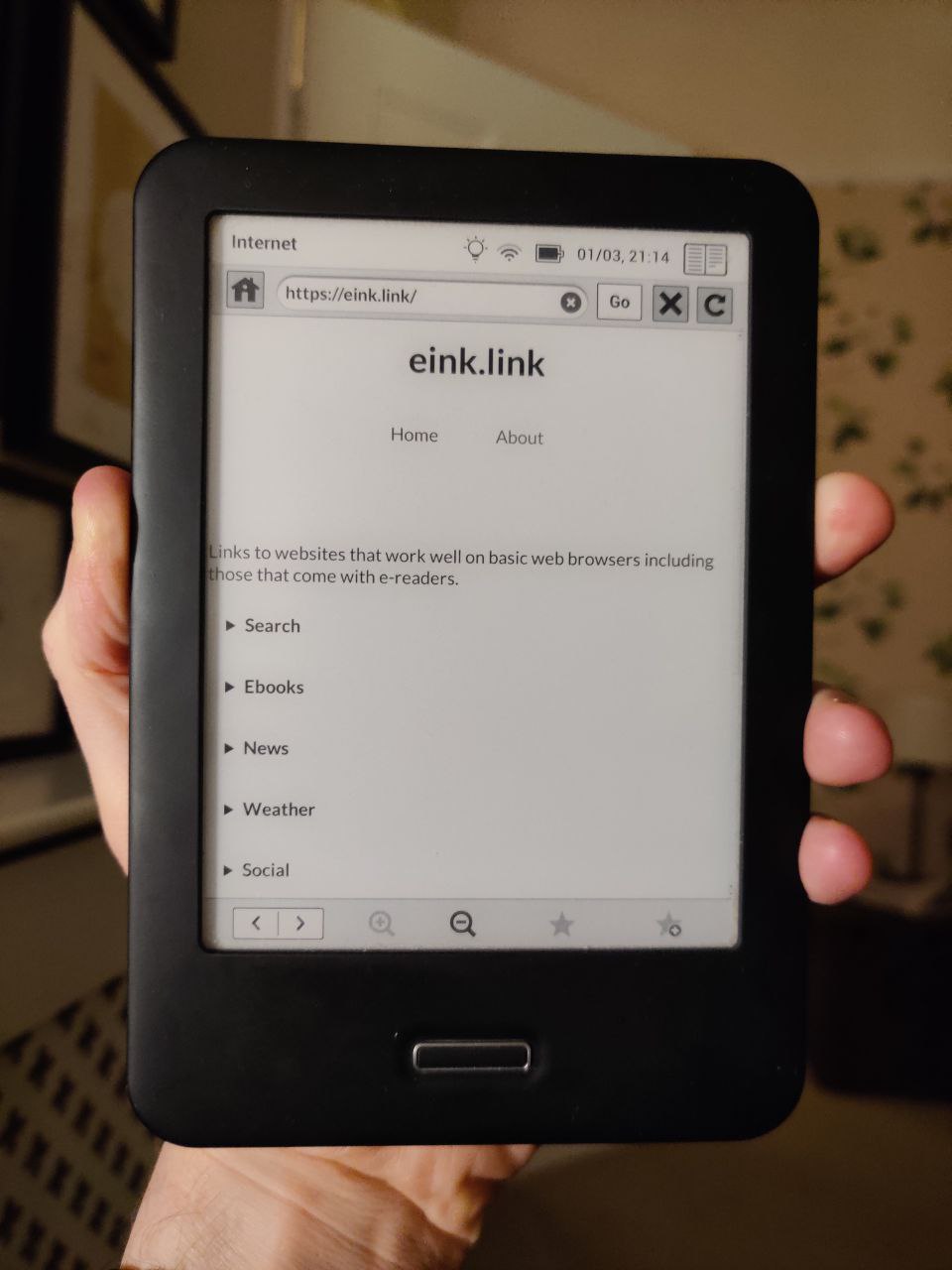
E-reader showing eink.link in web browser

I’m someone who uses the web browser on my e-reader. I always have done, from the earliest Amazon Kindle I had, through to the bq Cervantes 4 I use these days. To scratch my own itch, I’ve created a new site: eink.link

As you’d expect, web browsers on e-readers aren’t very capable. As websites get ever more bloated and complex, they render ever more poorly on these kinds of devices.

Simple, text-based websites work well, though. So I thought I’d begin to collect these and make them available for anyone to use. I’m not doing anything complicated: just using GitHub Pages to serve up a basic website that’s styled Simple.css.


Right now, I’ve added one or more links in the following categories:

  • Search
  • Ebooks
  • News
  • Weather
  • Social
  • Technical

It’s pretty awesome that I can download EPUB-formatted books directly from my e-reader’s web browser directly to the device!


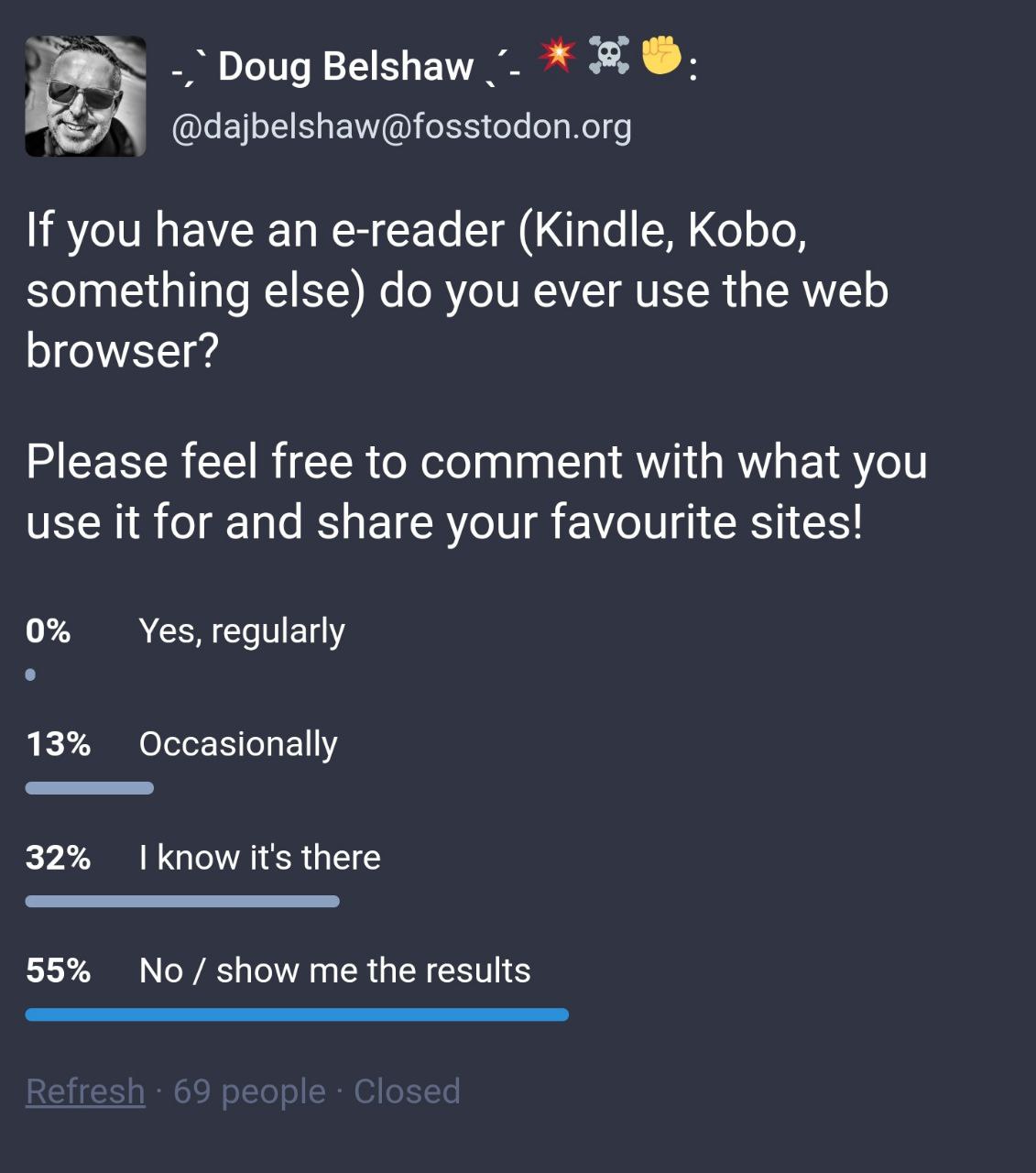
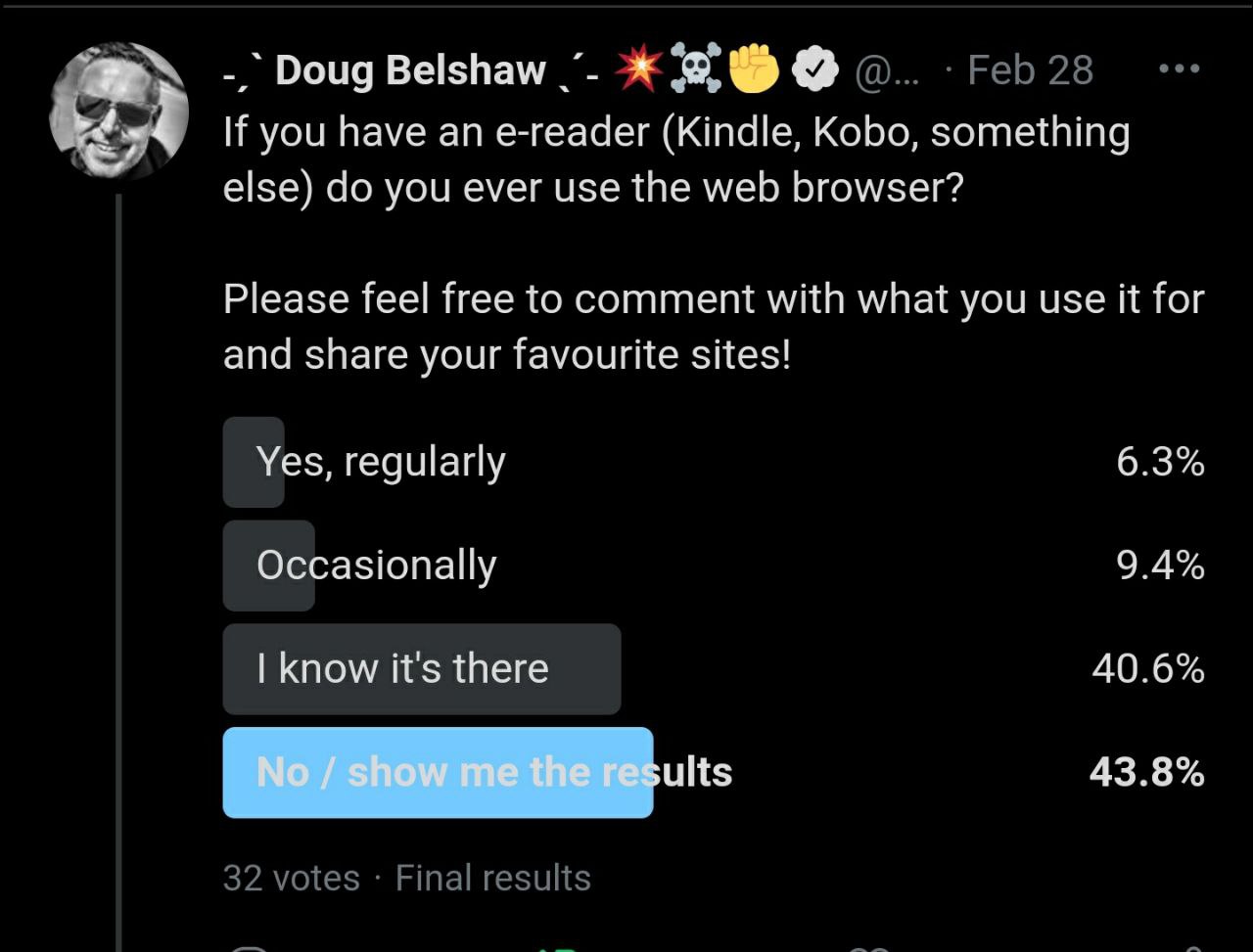
In case you’re interested, I did do some very basic research with people who self-reported as users of e-readers. The following polls on Mastodon and Twitter together received 101 votes:

Results from Mastodon:

0% Yes, regularly
13% Occasionally
32% I know it's there
55% No / show me the results
Results from Twitter:

6.3% Yes, regularly
9.4% Occasionally
40.6% I know it's there
43.8% No / show me the results

Some may see the above as discouraging, but I disagree: that’s 10-15% of e-reader uses in my sample who are already using an e-reader web browser, and 30-40% who know how to access it.

If this were a ‘product’ rather than a side project, I’d say that there’s a definite niche there to be served. For example, we know that looking at backlit smartphone and tablet screens can cause insomnia. E-ink screens are much better in that regard, plus the simplicity of the websites that work on e-readers are potentially more calming.

For the foreseeable, though, this is just something that’s useful for me and hopefully some other people. The good news is that it works well on every type of web browser. I’m planning to implement a dark mode toggle soon, as well as add a bunch more websites — feel free to suggest some!


This post is Day 88 of my #100DaysToOffload challenge. Want to get involved? Find out more at 100daystooffload.com

The post Introducing eink.link, my new side project first appeared on Open Thinkering.
03 Mar 18:08

Recommended: “The Address Book”

by Gordon Price

Here’s a recommendation for a book I haven’t even finished yet.

Yes, a whole book about street addressing.  It’s like one of those long-form New Yorker articles on a subject you never thought about and can’t imagine would be of sustained interest, like surveying.  You would be wrong.

It begins among the unaddressed in Kolkata and ends … well, I don’t know yet.  This is not a book to rush.  I save each chapter to consume one at a time, like selecting a chocolate in a particularly tempting box.  Nor are there a lot of empty calories. I’ve gained all kinds of related information and insights (why American cities use numbers to name streets, why Japanese don’t use names at all).

Indeed, I wish I had read the chapter on Korea and Japan (“Must streets be named?”) before visiting Tokyo.  I would have seen the city in a different way, more like the Japanese see their cities (and the world).

This book is about culture, not just numbers (or lack of them), and why urbanism is such a key to understanding the issues (like race and power) that capture our attention today.

03 Mar 18:08

The Future of Web Software Is HTML-over-WebSockets

Matt E. Patterson, A List Apart, Mar 01, 2021
Icon

I understand the criticism of frameworks and Single page Applications (SPA). But I think there are many questions unanswered, but the core of  argument is right here: "Finalized in 2011, support for WebSockets in modern browsers ramped up throughout the 2010s and is now fully supported in all modern browsers. With the help of a small bit of client-side JavaScript, you get a full-duplex socket connection between browser and server. Data can pass both ways, and can be pushed from either side at any time, no user-initiated request needed." I remember Wired coming out with a huge banner headline PUSH in 1997. That's what this is. Maybe it is the time for push. But I have my doubts.

Web: [Direct Link] [This Post]
03 Mar 18:08

Starlink changes everything. It may be the most important form of learning technology of the century

Donald Clark, Donald Clark Plan B, Mar 01, 2021
Icon

One thing we hear every time we talk about online learning outside developed urban areas is the problem of access to the internet. The concern is so pervasive, and basically stops all other discussion, that I just want to wave my hands and say "I know, I know" and keep talking about videoconferencing. But of course I can't. That's why Starlink is so important. It provides internet access - proper broadband internet access - to rural and remote regions worldwide. And that makes it vitally important to online learning. Donald Clark has the details, so I won't repeat them all here. But after all the false starts (for example: WiMax) this may be the real deal.

Web: [Direct Link] [This Post]
03 Mar 18:06

leaked: a new surveillance browser?

I just heard from a reader of this blog that a dictatorship is taking over in their country, and will be requiring all citizens to use their new web browser. The scary thing is that this new country-specific browser will have a built-in surveillance system in it. Excerpt from the top-secret document follows.

Today, citizens are categorized, governed, and provided with public services based on a variety of tracking techniques. It would be more efficient and less costly for the State if citizens could be assigned to priority groups, or cohorts, within the browser itself.

We plan to explore ways in which a browser can group together people with similar browsing habits, so that the State (and private entities regulated by the State) can use the habits of these cohorts, to:

  • prioritize assignment of surveillance personnel to individuals

  • allocate public services preferentially to favored religious and language groups

  • encourage self-reeducation by members of marginal groups

Browsers would need a way to form clusters that are both useful and efficient: Useful by collecting people with similar enough interests and producing labels suitable for machine learning, and efficient by cheaply forming large clusters that can be used to prioritize the assignment of costly individual surveillance technologies and of public-sector services such as education, business subsidies, and travel documents.

A Citizen's Omnipresent Law-Enforcement and Favoritism (COLF) cohort is a short name that is shared by a large number (thousands) of people, derived by the browser from its user’s browsing history. The browser updates the cohort over time as its user traverses the web. The value is made available to websites via a new JavaScript API.

The browser uses machine learning algorithms to develop a cohort based on the sites that an individual visits. The algorithms might be based on the URLs of the visited sites, on the content of those pages, or other factors. The central idea is that these input features to the algorithm, including the web history, are kept local on the browser—the browser only exposes the generated cohort. The browser ensures that cohorts are well distributed, so that each represents thousands of people.

Hiding or falsifying cohort membership

Some citizens who are members of less favored cohorts might configure or modify their browsers to send a blank, random, or deliberately chosen cohort. This behavior will be disincentivized by doing spot-checks that compare the observed cohort for a citizen to a set of likely cohorts calcuated from known PII for that citizen.

Cohorts do not eliminate the need for detailed State surveillance of a subset of citizens, just as a vehicle license plate does not eliminate the need for random checks of a driver's papers. However, license plates and cohorts are easily observable in large numbers, and appropriate penalties for falsification of either can be applied. Cohorts are a cost-saving complement to other surveillance technologies, and make more kinds of discrimination and surveillance practical and affordable.

Sensitive Categories

A cohort is designed to reveal sensitive information. A user might configure or modify the browser in an attempt to remove visits to sensitive sites from cohort data collection. But this does not mean sensitive information can’t be leaked. The State is aware of correlations between browser history and sensitive cohort membership that citizens are not aware of.

Citizens might attempt to evaluate their own cohort by measuring and limiting their deviation from population-level demographics with respect to the prevalence of sensitive categories, to prevent their use as proxies for a sensitive category. However, this evaluation would require knowing how many individual people in the cohort were in the sensitive categories, information which could be difficult or intrusive to obtain.

...all right, that's enough. This wasn't some new surveillance browser, it's a lightly edited version of the FLoC README. How much of a Bay Area big company employee filter bubble do you have to be in to see an idea for having the browser tell sites, "MY USER IS A MEMBER OF THIS GROUP" and think, wow, we can use this to sell sneakers! Anybody who wants sneakers, if you seriously have no idea how to get them, let me know, I'll drive you to the damn shoe store myself. Easier than dealing with all this labeling-people-with-group-identifiers creepy jibber-jabber.

Bonus links

Global Privacy Control Endorsed by California AG

Firefox's Latest Update Promises Complete Cookie Control—With Just A Few Caveats

Cheat sheet: What to expect in state and federal privacy regulation in 2021

03 Mar 18:06

My Mum

by Technokitten


An image of an elderly lady holding a cup of tea in a white china cup. She is seated by a window with a blurry view of an English garden. The lady is wearing shades of blue and is looking warmly at the photographer

Mum - Marie Keegan - 1926-2020

As some of you know already, my Mum died last October after a long battle with advanced cancer. This is a transcript of the eulogy I gave at her funeral in November of last year.


I've been putting off publishing it, in fact, I've put off doing writing of any sort, but now's the time. And you never know, it may help someone else deal with what they're going through with someone they know who has died. After all, we all go through bereavement at some time or other.


+++++++++++++++++++


How lovely to see so many of you here in person and online this afternoon and I thank you all for being here. I'm touched that my Mum meant so much to you.

Hello, my name is Helen and I’m Marie Keegan’s youngest daughter. It’s not an easy job to write a eulogy for one’s own mother, but here goes.

I’ll be honest with you, it’s hard for me to believe Mum’s gone which sounds a bit odd, after all, she was 94 years old and suffering from advanced cancer. Yet she seemed so strong and ever-present. 

When speaking to Mum’s friends and relatives, many lovely things were said about her - ‘such a livewire’ ‘so thoughtful’ ‘bright and sparkly’ ‘never any different’ ‘beautifully turned out’ ‘great sense of humour’ ‘strong and determined’ ‘an amazing woman’ ‘formidable’ ‘the best looking girl to come out of Tyldesley’ ‘witty and charming’ ‘easy and interesting to talk to’ ‘elegant’ ‘a great hostess’ ‘a smile to light up a room’ ‘approachable’ ‘interested in others’. Mum was all these things and more. She may have been small in size but she certainly wasn’t small in personality or impact.

Mum came from humble beginnings in Tyldesley in what is now Greater Manchester. She met my father at the age of 15 - my father a coal miner and my Mum working in the coal board office. 10 years later, and after a long engagement, they married and set sail for India where my father had been appointed as manager for a coal mine in the North East India coal fields. 

That was an adventure and a half! Their new life in India was a million miles away from post-war life in a Lancashire mining village. Mum loved it, not least having two children, Martin and Jane, but also the friends she made, the trips to Calcutta and their active social life! But after 15 years, it was time to return and start a new life in England.

But all did not go according to plan. Mum was surprised to find that she was expecting me, and speaking to her sister, Betty, confided in her that she really didn’t know what on earth she was going to do with a new baby at her age. My Auntie Betty said, well, it’ll be wonderful. She can look after you when you’re old. Quite the prophecy, Aunty Betty. Mum only shared this memory with me a few months ago. And to be honest, it was a surprise to us both that I should end up being Mum’s full-time carer. Neither of us knew that I had it in me to do it. But what I never told Mum, but now wish I had, was that it was a privilege to be able to do it.

Mum was very well travelled and enjoyed holidays near and far - whether that was a day trip somewhere or a short break with me in Cheltenham or Hereford, long summers spent in the Isle of Man and Ireland, winter months spent in mainland Spain, Majorca and Portugal or trips further afield to South Africa and Florida. Most of these trips involved a lot of walking - coastal paths, hill climbs, tramping through fields and half overgrown footpaths. Mum and I spent a lot of time together on our feet and as we'd walk, we'd chat and admire the views and Mum would tell me what all the different flowers and plants were that we passed along the way. Mum's knowledge of plants was really impressive.

Mum was always very smartly dressed, well turned out with perfect make-up, pink lipstick and a spritz of lovely perfume. She always had great taste and great interest in clothes and shoes and she enjoyed shopping. When I was a little girl, Mum would drag me around the shops, and I'd end up sitting on the floor in the dressing room at Russell and Dorrell in Worcester whilst she tried on what seemed like an endless array of clothes asking me what I thought of them. And then afterwards treating me to a toasted teacake in the cafe there. This trend continued well into Mum's old age with regular trips to House of Fraser and the local TK Maxx. Mum always loved a good sweater! I hope some of her excellent taste and style has rubbed off on me.

One thing that did rub off on me was Mum's penchant for bargain hunting. I seem to have Mum's knack for spotting a yellow sticker in the food aisle in Marks & Spencer or a sale rail in the fashion department at 50 paces.

And where do you wear all your nice clothes? Why, at a party. And there were lots of those in Mum’s life. Mum loved to dance the night away starting in her younger years in Lancashire, to glamorous parties at The Grand Hotel in Calcutta in her thirties, to corporate dos at The Dorchester in London or a Riverboat Shuffle in Worcester in later years. And when there weren’t dinners or dances to go to, there were dinners and parties at home and Mum was a great hostess. I remember there were many late nights when the grown-ups would be listening to the likes of Shirley Bassey, Frank Sinatra, and Barbra Streisand. And sometimes I'd have to come downstairs to ask them to turn it down as I couldn't sleep!

But it wasn’t all socialising and glamour. Mum was also very down to earth, practical and gave her time to others. She volunteered in charity shops in Worcester and in the Isle of Man and also helped out at school and parish fundraising events. She did the flowers at Church with her friend Noreen. She looked after her neighbour Herta when she became terminally ill and became her carer. She befriended one of the Mums at my primary school who was having a lot of trouble with her husband and took her under her wing to help her sort herself out.  Even in her 90s, Mum would pick up a bit of shopping for her friend who was younger than her but clearly didn’t have her stamina. Not forgetting how much she loved to spend time with all her family too.

Mum also liked to keep up to date with current affairs - be that the news kind or the kind that happens on TV in Coronation Street or Last Tango in Halifax. Until Mum’s sight failed her, she would read the Telegraph most days and always did the crosswords - both the quick and the cryptic. I can still only manage a few cryptic clues before giving up. But not Mum. She even completed the Telegraph cryptic Crossword a few days before she died. If I tell you nothing else about Mum, she would want you to know that she was still doing the cryptic crossword right up until the very end.

Spending all this time with Mum over these last few years has taught me much about life and love, just by being with her, listening to her and observing how she lived. The easy way which Mum could talk to anyone and how she treated everyone the same, whether you’re a corporate bigwig or a part-time waitress in a cafe, is an example to all of us. The way Mum could make and keep friends anywhere and everywhere and have a genuine interest in their lives. Mum could find out someone’s life story within a short time of meeting them - that's a skill I don’t have but I’m working on it.  Mum’s gratitude at the smallest thing and the way she was touched by small kindnesses is something we could all learn from. And Mum’s memory! She could remember small details about people - their lives, conversations they’d had, time spent together, birthdays and anniversaries. Even right up to the end. Incredible. 

Mum’s faith was also important to her and we spent time praying together every day. And I can’t help but admire Mum’s strength and fortitude. She used to say that old age isn’t for the fainthearted. She’s not wrong. 

But what I learned most of all from Mum, especially in these last few months, is about love. After my father died, I remember telling a close friend that although it was very sad that he’d died, and I missed him terribly, it had allowed me to get to know and to fall in love with my Mum all over again. And I’ve enjoyed seven and a half years of that and I wouldn’t swap that for the world. 

My goodness, she was one of a kind, that Marie Keegan. I know everyone says that about their Mum, but I really mean it. Her love of life and love of living was extraordinary. She was so sad when she realised she wasn’t going to make it to 100 and there would be no telegram from the Queen. She really wanted to just keep going. But by her own admission, what a life she had led. Full of joy and laughter and filled with love given and received. 

Daughter, sister, wife, mum, Grandmother, Great grandmother, auntie, cousin, neighbour and friend. Mum loved us - her friends and family - and will continue to be loved and remembered with great affection by all of us.

Marie is joining those who have gone before her including my father, Terry, her sister Betty, and her brother in law Tommy. I imagine they are having a great party up there - Sinatra on the record player, my Dad pouring the drinks, Uncle Tommy telling the jokes and Mum and Aunty Betty dancing the night away, but this time no-one is telling them to turn the music down.

Oh, I have an awful lot to live up to, Mum. You’re a hard act to follow, all right, but I’m going to do my very best. 

As you used to say to me every night before you went to bed, and as I say to you now, Mum, ‘thank you, thank you, goodnight and God Bless’.


03 Mar 18:06

SET Religion = NULL

by Thejesh GN

People who know me already know this in some form or other. But this makes it official. The religion I was born into never made sense. Actually, as of now, none of them make any sense to me. So it's NULL now.

This doesn't mean I will stop others. It also doesn't mean I will stop going to church or monastery or mosque or other places. Mostly because I love architecture, and belief systems are my area of interest. So you will still find me in those places watching things, people and eating good food. I also have nothing against people cleaning houses, lighting lamps or decorating trees, etc. I believe in a secular society.

There I said it. It only took 40 years.

Will I go the legal way to get it nullified? I don't know yet. Do you have any experience of how to go about it?

The post SET Religion = NULL first appeared on Thejesh GN.
03 Mar 18:05

Question Visibility

by Richard Millington

If you see a question on Facebook or Twitter (and you know the answer) odds are you will reply with the answer.

You’re not looking for points, rewards, or some other incentive, you simply want to help (and maybe feel smart).

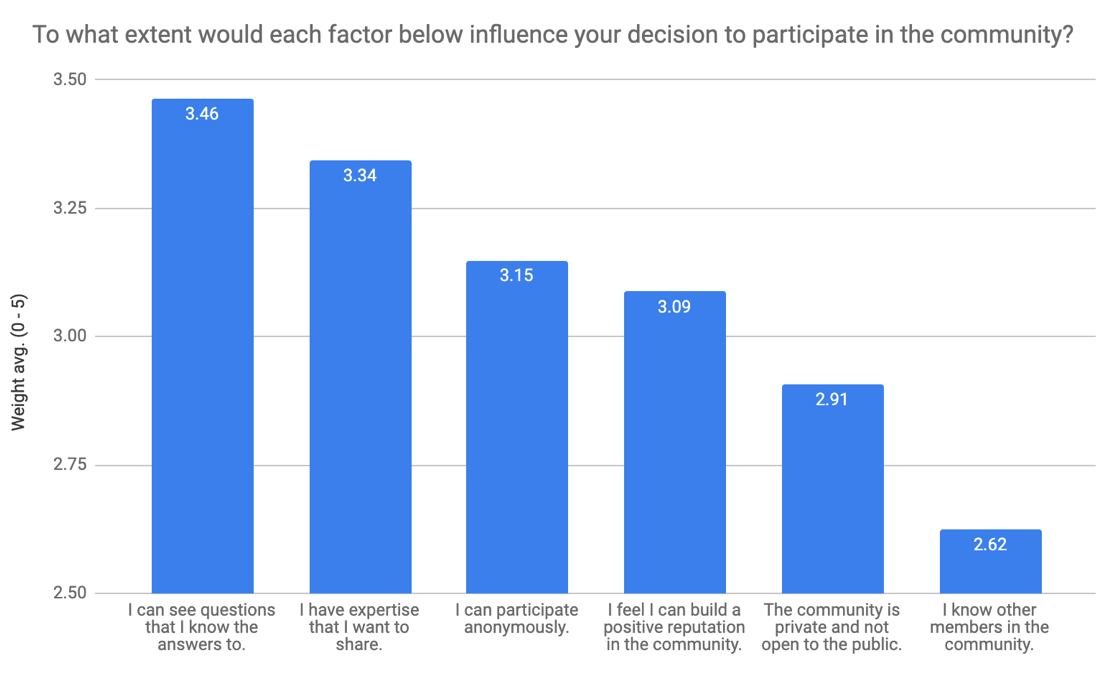
In fact, out of every factor we’ve ever looked at, seeing questions you know the answer to is by far the bigger determining factor in whether someone will participate in the community.

It’s easy to get hooked up developing gamification programs, superuser programs, trying to build a powerful sense of community, creating onboarding journeys etc. But the biggest bang for your buck is usually improving question visibility.

How do you get more questions in front of more people who might know the answer?

First improve the site design, notifications (and digests), and improve the notification systems. Then look at everything else.

03 Mar 18:00

Revolutions and NAND gates, eight cents, wholesale

I recently read Tracy Kidder’s Pulitzer-winning The Soul of a New Machine (1981) about the development of a new minicomputer by Data General.

Here’s a passage about transistors:

Transistors, a family of devices, alter and control the flow of electricity in circuits; one standard rough analogy compares their action to that of faucets controlling the flow of water in pipes. Other devices then in existence could do the same work, but transistors are superior. They are solid. They have no cogs and wheels, no separate pieces to be soldered together; it is as if they are stones performing useful work.

Reading that, it’s so clear that 1981 is closer to 1947 (when the transistor was invented) than today.

Matter, without movement, can perform useful work! Solid state. This idea is insanity when you think about it, and Kidder in 1981 was able to call that out.

Two transistors make a NAND gate, and a NAND gate is both a physical thing and a mathematical operation and - with many connected together - can store numbers, add numbers, discriminate between numbers, and so on, numbers being both data and instructions to perform more operations.

The solution takes the material form of a circuit called a NAND gate, which reproduces the “not and” function of Boolean algebra. The part costs eight cents, wholesale.

The latest iPhone has 11.8 billion transistors. So the chip at the heart of each phone is $1.4 billion in parts, no margin. That’s 1981 prices, 2021 money accounting for inflation.

(Updated 5 March to fix maths/words. Previously claimed $1.5b.)

The book narrates the journey from standing start to functional computer hardware.

I’ve done this myself. One of the labs at college took us from semiconductors, through transistors, then gates, then shift registers, then designing and seeing for ourselves primitive adders, memory, and commands, and finally working with a 6502 processor. The 6502 is the chip inside the BBC Microcomputer, which I grew up with, so it’s sophisticated while also being simple enough that - having built our own registers etc - you can look at the schematic and kid yourself that you know what’s going on. And when you poke binary into the 6502 and program it to add 2 and 3, and execute that operation and, having ascended that ladder with your own hands, see in your mind’s eye the shift registers rippling and the gates flipping and the electron in every transistor collecting and flowing…

A spiritual experience, and a healthy dose of cognitive vertigo.

And then, with consumer hardware, I’m familiar with that weird knot of bringing up hardware: the bench prototype, firmware, basic interaction, and the gyre that spirals up as you develop each part – but also the role of simulators, partial documentation, and internal languages. Developing systems is hard.

Despite all of that, I hadn’t quite appreciated the role of microcode, being: a layer of computer organization between the CPU hardware and the programmer-visible instruction set architecture of the computer.

A programmer will ultimately break their code down into primitives like ADD and JUMP, but at a certain point those instructions have to be converted into a series of high/low signals that tell circuits what operations to perform and where to send their data. It’s where software becomes hardware, where the rubber hits the road, as it were. It’s the level at which there aren’t any abstractions anymore.

Microcode is, in this sense, like early Old English, in which there was no word for fighting and a poet who wished to convey the idea of battle had to describe one.

I don’t know if that is an Historical Fact about Old English, but I like the turn of phrase.

Anyway, it’s a terrifically told story mainly about personalities and teams, and also about computers.

Also a history at this point too. A floppy disk is explained as like a 45-rpm record and few readers in 2021 will have direct experience of either referent.

So it’s an easy trap to read the story and see it as archaic, but really it’s archetypical; this is the world we live in now, but slowed down and magnified so we can see the roles and relations and gaps at something like human speed.


One other quote that caught my eye:

For many years sociologists and others have written of a computer revolution, impending or in progress. Some enthusiasts have declared that the small inexpensive computer inaugurated a new phase of this upheaval, which would make computer instruments of egalitarianism. …

But in the main, computers altered techniques and not intentions and in many cases served to increase the power of executives on top and to prop up venerable institutions.

And that’s another observation that could only have been made closer to the start than today, with the perspective to see the before and after: if it served to entrench and not upend the existing class system, was the computer revolution a revolution at all?

03 Mar 17:56

Shure AONIC 50 :: Nun ist er erschwinglich

by Volker Weber

0064e11db38287c2b5b0034ee3997e39

Mitte letzten Jahres kam ein Headset auf den Markt, das ich durchgehend getragen habe, bis es im Dezember durch den AirPods Max abgelöst wurde. 400 Euro sollte der Shure AONIC 50 vor acht Monaten kosten, nun sind es nur noch 240 Euro. Diese Preisentwicklung machten die meisten Bluetooth-Kopfhörer des Premiumsegments durch.

Dieser Shure AONIC 50 hat sich sehr schnell zu meiner Referenz entwickelt. Toller Klang, perfekte Abbildungsleistung, bequemer Sitz und eine hohe Qualitätsanmutung. Es ist mein größter und dickster Kopfhörer. Und dank breiter Codec-Unterstützung klingt er mit allen Endgeräten perfekt, egal ob Apple, PC oder Android.

Heute hat Marco Dettweiler seinen Bericht zum Apple AirPods Max in der FAZ veröffentlicht und wir sind uns mal wieder einig, was mich übrigens sehr bauchpinselt, weil Marco mehr Erfahrung hat als ich. Viel mehr. Auch er findet den AirPods Max revolutionär und er erwähnt wieder einmal, dass der AONIC 50 bisher seine Referenz war.

Wird auch der Apple AirPods Max binnen acht Monaten 40% günstiger werden? Ich bezweifle es. Aber der Shure hat diese Entwicklung nun hinter sich und wird damit zu einer dicken Empfehlung.

More >

03 Mar 17:55

5 Things I Learned about Blogging

by johnbh

Thank you, April Bowles Olin, for one of the BEST workshops that I’ve participated in at CreativeLive.com. The folks at CreativeLive really hit the jackpot when they asked you to present this workshop.

It’s been just about 1 month since this workshop changed my life. I’ve learned so much from you, April – the most important thing is that I should keep moving forward! It’s been a whirlwind this last month. Since the workshop, I’ve changed my blog name, I’ve created a simple website with my own domain name and committed to a weekly newsletter for my readers. I’m not gonna lie! It hasn’t been an easy month…

April, before we met, I was seeing everything from the mind of a prepress typesetter – my former occupation. Ahh, you say… a graphic artist! NOT!!!!!! My training came in the transition of linotype machines in the mid-1970s and to make matters worse I ended up specializing in the pre-press production of college textbooks. Can it get any more boring?

Then I found CreativeLive.com and, more importantly, April Bowles Olin. The top 5 things I’ve learned from the Blogging Workshop at CreativeLive.com:

1. Push past my comfort zone. Staying safe while blogging tends to fall flat with the readers. This comment really did resonate with me. My writing tends to be direct and very matter-of-fact.
What do I know now? COMFORT = BOREDOM
2. Make a commitment. I’ve tried before to start a blog. Went to a free blog site, created and account and I was off to the races, or so I thought. I didn’t know I had to attract my readers. I thought they’d just show up. After the CreativeLive Workshop, I actually asked 20 customers to subscribe as my “blog testers.” I told them they will receive a newsletter EVERY Wednesday. I’ve kept that commitment so far. I’m even starting to get some feedback…readers are asking for certain topics.
What do I know now? CONSISTENCY = FOLLOWERS
3. Reach out for support. This is a big one. I spend a lot of time at the keyboard, but a lot of that time is “alone” time. Just writing… no research, no interaction, basically no life! April showed us that reaching out to the blogging community only enhances everyone’s life and, in turn, their blogs. I’ve met real people, with real ideas and willing to share those ideas and help a beginner get off the ground.
What do I know now? MENTORSHIP = SUCCESS
4. Find my target readers. This was huge! The idea of this changed the way I presented my blog. I actually had a picture in my mind of the people that I was interacting with. I wrote words specifically for them. I was no longer writing for everyone… just for those that were interested in what I was writing about. I no longer had to worry that I wasn’t “speaking to the masses.” When I stopped that, my writing got easier.
What do I know now? PERSONALITY = CONNECTION
5. Find my niche. My blog is still a baby, maybe a toddler. It is in the early stages of development. I want to share the entire process with my readers. The last month of making dramatic changes, taught me that I can put my unique personality into this blog. I don’t have to hold back on my quirky side. Changing the blog name and creating a new website to express my personality is the beginning. I’m stepping into a world that I think was made for me! I’m finding so many ways to express my unique creativity and share it.
6. What do I know now? PASSION = QUALITY

Thank you, April, for showing me what it looks like to be a successful blogger. I look forward to your mentorship and support in the future.

Here’s to the new me!

03 Mar 17:54

What are the key themes associated with the positive learning experience in MOOCs? An empirical investigation of learners’ ratings and reviews

Ruiqi Deng, Pierre Benckendorff, International Journal of Educational Technology in Higher Education, Mar 02, 2021
Icon

This paper is really smart on a number of levels. It endorses a "students as co-creators" approach to course design, making their responses part of the design process. It uses a third-party site to collect reviews because several MOOC platforms don't support student feedback. It uses Leximancer, "a data-mining tool which extracts key concepts from collections of textual documents." It surveys a large number of varied responses - 8475 ratings and reviews submitted for 1794 MOOCs. It recognizes "there are underlying differences between MOOCs and credit-bearing university courses, and learning outcomes valued in traditional HEIs (e.g. achievement, persistence) may not be the best indicators to represent MOOC learning outcomes." And it produces a useful list of six propositions for promoting the learning experience in MOOCs, which I would summarize as follows::

  • provide realistic learning contexts and instructional conditions
  • design for mental challenge and stimulation
  • design the course content, materials, and communications to generate interest
  • create high-quality video lectures
  • employ video lectures to simplify complex, difficult concepts
  • address learners’ queries.
Web: [Direct Link] [This Post]
03 Mar 17:54

Third Life :: Microsoft unveils Mesh, its new social mixed reality platform

by Volker Weber

Microsoft has kicked off its Ignite conference this morning with a fascinating keynote that was best experienced with Mixed Reality Headsets. HoloLens inventor Alex Kipman surprised the audience by appearing as a “holoportation” of himself, showing how mixed reality technology can make it possible to create shared experiences for people in different locations.

More >

03 Mar 17:54

Photographic Genius Stanley Woodvine Straightens Vancouver House Curve

by Sandy James Planner

Graphic artist and writer Stanley Woodvine has a good eye for design and form and he has achieved what so many has wished for: he has “righted”  Bjarke Ingel’s Vancouver House. Not once, but twice.

As Mr. Woodvine writes on his twitter account at @sqwabb  

“seen from Fairview, the scoop out of the lower East side of Vancouver House tower condo has been filled by a perfectly rectilinear tower newly positioned behind it”.

Using his camera at Alder and 11th Avenue, Mr. Woodvine completes the work in the photo below stating:

“the upside down tapered Vancouver House and the tower that now has its back looks much like one complete building”.

Thank you to Stanley Woodvine for fixing it.

03 Mar 17:30

Autonomic is a tech co-op that just announced “...

Autonomic is a tech co-op that just announced “Co-Op Cloud”:

“using existing open standards to build a catalogue of apps, & a CLI client to read the catalogue and deploy those apps”

Co-op Cloud docs cloud.autonomic.zone

03 Mar 17:21

Microsoft job listings hint at 5G, better camera in possible Surface Duo 2

by Jonathan Lamont
Microsoft Surface Duo partially folded

Microsoft appears to be working on a Surface Duo 2, and new job listings suggest the company’s next phone will feature 5G and a better camera.

Spotted by Windows Latest, one job listing specifically mentions the Surface Duo, and notes in the ‘Responsibilities’ section that the job will require designing and coding radio frequency (RF) drivers. It also mentions LTE, 5G and mobile operator certification on “Surface Duo devices.”

Another job listing for a ‘Principal Android Camera System Architect/Engineer’ mentions “deliver[ing] great customer experiences on our future Surface products.” Given that most Surface devices run Windows, not Android, this listing is likely for the Duo.

Although it doesn’t come as much of a surprise, it’s great to see Microsoft focusing on things like 5G and camera. The original Surface Duo, which came out in the U.S. last year and recently arrived in Canada, lacks both 5G and a solid camera. Reviewers have cited both as major flaws with the device, and it’s no surprise Microsoft wants to fix those in the second iteration.

The Surface Duo 2 is likely still a ways off, but these early details make it sound like Microsoft is on the right track. If the company learns from the original Surface Duo, I think it’ll have a real winner on its hands. The first iteration was clearly a “first generation” but was still really great. With some tweaking, a Surface Duo successor could be a top contender in the productivity space.

Source: Microsoft, (2) Via: Windows Latest, Neowin

The post Microsoft job listings hint at 5G, better camera in possible Surface Duo 2 appeared first on MobileSyrup.

03 Mar 17:21

Volvo announces intention to be all-electric by 2030, shows off new car

by Brad Bennett

Volvo has announced that it will stop selling gasoline-powered cars and phase out its dealership chain by 2030.

This is a swift change compared to other automakers, but it shows the Swedish car company’s commitment to electric vehicles (EVs). What’s more interesting than this push into the EV space is that Volvo will follow in Tesla’s footsteps and get rid of its dealer network in favour of selling cars online.

This is a faster transition than giant automakers like GM and Ford. Still, the roughly ten-year transition is in line with other smaller premium car manufacturers like Jaguar, which plans to be all-electric by 2025.

Volvo isn’t expanding its ambitions as an automaker and is still aiming to sell cars in the premium electric market segment.

“To remain successful, we need profitable growth. So instead of investing in a shrinking business, we choose to invest in the future — electric and online,” said Håkan Samuelsson, chief executive in a press release. “We are fully focused on becoming a leader in the fast-growing premium electric segment.”

To follow this up, the company announced a new EV called the C40 Recharge. Like the XC40 Recharge, the C40 Recharge is a smaller crossover-styled design built on the same modular battery platform. While it looks similar to the XC40, this car is notable because it was the first Volvo designed and released as only an EV.

This means that the C40 should have a similar range to the XC40, but Volvo hasn’t shared the price of the new car yet. This means it can get around 420km of range. If you’re interested in the C40, check out our hands-on with the XC40.

The new car is also going to the same android Automotive infotainment console in the XC40 Recharge.

Source: Volvo, (1)

The post Volvo announces intention to be all-electric by 2030, shows off new car appeared first on MobileSyrup.

01 Mar 14:49

History repeating itself. San Francisco, 1918: pic.twitter.com/tHLWINjbfM

by Things from the past 📷🎥 (moodvintage)
mkalus shared this story from moodvintage on Twitter.

History repeating itself. San Francisco, 1918: pic.twitter.com/tHLWINjbfM


690 likes, 247 retweets
01 Mar 14:49

Starlink’s Path to Success Part 3

by Asa Dotzler

The third area where SpaceX needs to make progress in order to be successful with Starlink is satellite to satellite communication. Let me see if I can explain.

Right now, a Starlink customer has an antenna that connects to a satellite, and that satellite connects to a nearby ground station where SpaceX has a high capacity link to the terrestrial internet. The satellites are acting as a one hop relay to the regular old Earth-based internet network and SpaceX must maintain not only the satellite constellation but a whole bunch of ground infrastructure spread out across any geography where they want to do business.

To support U.S. customers alone, SpaceX already maintains almost 50 of these ground stations where their satellite network meets the terrestrial network. Any time they want to add service in a new geography, they have to add more of these ground stations.

To save on this cost, SpaceX wants to enable satellite to satellite communication so that your signal can go up to a Starlink satellite, then hop from one to the next until it eventually reaches a satellite that’s over one of SpaceX’s high capacity links to the internet backbone where it drops down to rejoin the internet. In essence Starlink becomes just another part of the internet backbone.

This will mean that Starlink can deploy to any geography in the world (where it’s legal to do so) without needing ground infrastructure there (unless it’s legally required to do so). Rather than having hundreds, maybe thousands of ground stations around the world to serve all of the unserved and underserved, SpaceX could have just a few large ground stations in strategic locations (where politics are amenable and there’s an affordable hookup to the internet.)

Not only will this ultimately save time and money, it will also allow SpaceX to reach new customers with Starlink — people who don’t live near any ground infrastructure at all. The laboratories at the poles come to mind, and ships on the oceans, and airplanes flying over the poles and oceans. Probably plenty of other remote places as well.

So, where is SpaceX with satellite to satellite communication? They have developed a laser interlink system and have deployed the first batch of satellites that include this system. That batch is in a polar orbit, and when they reach their final orbit (a month’s long process of satellite maneuvering) they will be covering a geogrpahy that doesn’t have any significant ground infractructure so it’s a great test case. Starting next year, all of the Starlink satellites launched will have laser interlinks and in about 4 years, the whole constellation will have the capability.

Oh, and one more interesting thing about laser interlinks. Light travels faster in space than it does in glass so it could actually be quicker to move some kinds of internet traffic across the space laser network rather than the glass fiber terrestrial network. In a race, a packet of information tavelling from New York to Singapore over Starlink could beat a packet traveling over the terrestrial backbone. For organizations who care about latency, whether it’s a CDN company or a high frequency trading firm, Starlink could be a faster network for some traffic and that could be rather smaller but very lucrative business for SpaceX.

01 Mar 14:47

The Future Includes Human Teachers

W. Ian O'Byrne, Mar 01, 2021
Icon

My first thought on reading the title was to ask, "why would you think this?" The answer pretty much everyone in the field will offer, of course, is that "some things just can’t be automated." But where is the evidence for this? This sentiment is based on an outdated view of artificial intelligencem and automation, one that is based on rules and symbolic processing. But modern deep AI systems are much more nuanced and perceptive. When people like Andre Perry say "computers aren’t capable of the higher-order thinking that teachers can provide," the evidence seems to run counter to that. And when Ian O'Byrne appeals to empathy, saying "a true teacher does not just impart facts; she or he creates a thirst for knowledge and teaches students how to quench that thirst," why would he assume that (say) mirror neurons won't activate just as readily for machines as for people, imprinting on them? There may be many reasons to desire human teachers, but the argument that "machines can't replace teachers" is not one of them.

Web: [Direct Link] [This Post]
01 Mar 03:04

Heaven’s River – Bobiverse Book 4

by Martin

Two years ago, I stumbled over ‘We are Legion (We are Bob)‘, the first Bobiverse book with an exceptional science-fiction story by Dennis E. Taylor. Book 2 and 3 followed in short succession and I was really delighted when I noticed that book 4 ‘Heaven’s River’ was recently published.

Many sequels tend to become a bit boring over time to me, and few actually manage to surpass the original book or even come close to it. This one, however, has gripped me from the first page, and when I was almost at the finish line, made me stay awake until 2 am in the morning. That doesn’t happen often. I won’t even describe the story line here, as it doesn’t make a lot of sense to read this book if you haven’t read the earlier three. But suffice it to say that Dennis’ E. Taylor’s Bobiverse series is one of the best science fiction sagas I have ever come across. Highly recommended!

01 Mar 03:02

The point of this headline (in Germany’s schlock tabloid) is its shock value. “Dear Brits we envy you” is the absurdist contrarian proposition that grabs attention and sells papers, a bit like “Dear Slough we’re going on holiday in you”. pic.twitter.com/FRSshggayp

by Chris Kendall (ottocrat)
mkalus shared this story from ottocrat on Twitter.

The point of this headline (in Germany’s schlock tabloid) is its shock value. “Dear Brits we envy you” is the absurdist contrarian proposition that grabs attention and sells papers, a bit like “Dear Slough we’re going on holiday in you”. pic.twitter.com/FRSshggayp


49 likes, 3 retweets
01 Mar 02:36

Find Your Passion? Master Something.

by Eugene Wallingford

A few weeks ago, a Scott Galloway video clip made the rounds. In it, Galloway was saying something about "finding your passion" that many people have been saying for a long time, only in that style that makes Galloway so entertaining. Here's a great bit of practical advice on the same topic from tech guru Kevin Kelly:

Following your bliss is a recipe for paralysis if you don't know what you are passionate about. A better motto for most youth is "master something, anything". Through mastery of one thing, you can drift towards extensions of that mastery that bring you more joy, and eventually discover where your bliss is.

My first joking thought when I read this was, "Well, maybe not anything..." I mean, I can think of lots of things that don't seem worth mastering, like playing video games. But then I read about professional gamers making hundreds of thousands of dollars a year, so who am I to say? Find something you are good at, and get really good at it. As Galloway says, like Chris Rock before him, it's best to become good at something that other people will pay you for. But mastery of anything opens doors that passion can only bang on.

The key to the "master something, anything" mantra is the next sentence of Kelly's advice. When we master something, our expertise creates opportunities. We can move up or down the hierarchy of activities built from that mastery, or to related domains. That is where we are most likely to find the life that brings us joy. Even better, we will find it in a place where our mastery helps us get through the inevitable drudge work and over the inevitable obstacles that will pop in our way. I love to program, but some days debugging is a slog, and other days I butt up against thorny problems beyond my control. The good news is that I have skills to get through those days, and I like what I'm doing enough to push on through to the more frequent moments and days of bliss.

Passion is wonderful if you have it, but it's hard to conjure up on its own. Mastering a skill, or a set of skills, is something every one of us can do, and by doing it we can find our way to something that makes us happy.

01 Mar 02:35

Starlink Questions

by Asa Dotzler

I got a great couple of questions on an earlier post about Starlink. My good friend Tobi asked about concerns that massive satellite internet constellations could lead to a bunch of space junk in orbit and also concerns that these constellations will cause problems for astronomers.

SpaceX, with 12,000 or more Starlink satellites in it’s completed constellation, won’t be the only company in the low-flying internet satellite game. OneWeb already has satellites in orbit and they want to put up at least 7,000 total up there. Amazon’s Kuiper hasn’t put anything in orbit yet but they want to launch at least 3,000 satellites pretty soon. And don’t expect major governments to stay out of this game. In just a few years we will have more internet satellites in low Earth orbit than all other orbiting satellites combined, working and dead. And these satellites have a fairly short lifetime, 5 years or so before they run low on fuel and must spend their last remaining fuel to de-orbit.

SpaceX is planning for the largest constellation of the companies I know about and they’re doing it seemingly responsibly. They have built Starlink satellites out of materials that will burn up completely when they de-orbit. The Starlink satellites have onboard ion propulsion thrusters powered by krypton gas. They use these thrusters to achieve their orbits, maintain those orbits against the drag of the upper atmosphere, and to de-orbit the satellites at the end of their lifetimes. Even if something goes wrong with a Starlink satellite’s thrusters, the constellation is low enough that it will only take a few years for the satellite’s orbit to decay and the satellite succumb to drag and burn up.

SpaceX is also working to mitigate Starlink’s impact on astronomy. You may have seen photos or videos of “Starlink trains” rows of lights moving across the sky. These bright satellite trains are only that bright while they’re in the process of raising their orbits. SpaceX launches the satellites into a very low orbit, about 155 miles up, and they then use precession to spread out and use their ion thrusters to raise their orbits to about 335 miles. That process takes a few months and during that time the satellites are low and clumped up and so fairly bright. SpaceX has cut down on that brightness a lot by changing the orientation of the satellites during orbit raise so they don’t reflect as much sunlight. But even when they reach their ultimate orbits, higher up and spread out, they still reflect some sunlight at dusk and dawn. SpaceX has mitigated a bunch of by outfitting all of their recently launched Starlink satellites with sun shades that eliminate a lot, but not all, of the reflection.

I think SpaceX has a firm handle on the problem of space junk. They’ve designed and built satellites and a process for replacing old satellites with new ones that will not lead to space junk. I think they’ve got less of a grip on the problems they may be creating for astronomers, especially hobbyists who may not have the tools to remove any Starlink interference from their data and images. They are working on it though and have made some real progress.

One idea I had was that SpaceX, which is after all a rocket company, could remediate some of the harm they may cause to terrestrial astronomy by offering free launch services to publicly funded (universities!) space telescopes. It costs anywhere from tens of millions to hundreds of millions of dollars just to launch a space telescope into orbit. If that barrier was gone, think about how many new space telescopes might be built, from great big ones like James Webb or Hubble to miniature ones like the BRITE nanosatellites, and everything in between.

I know that space telescopes can be more expensive to build and they can’t replace terrestrial ones for every use case, but by eliminating most or all of the launch costs, SpaceX could help usher in a new era of space-based astronomy. I think that could really help build some bridges with the astronomy community.

01 Mar 02:35

Starlink’s Path to Success Part 2

by Asa Dotzler

SpaceX innovations have made Starlink *possible* but what will it take to make Starlink successful? In a previous post I discussed the need for SpaceX to increase the pace of satellite launches. In this post I’m going to talk about reducing the cost of the equipment.

Because Starlink satellites are in very low orbits, they move across the sky quickly and that means a Starlink customer needs an antenna that can track the satellites. There are a few ways to accomplish this tracking, including motors that mechanically steer the antenna(s) to follow the satellites. But that’s not the rout SpaceX took for Starlink. Instead, SpaceX designed a solid state phased array antenna which can digitally track the satellites without physically moving the antenna. (Note: the Starlink antenna does have two motors for aiming but those are only used for the initial pointing of the antenna so that customers don’t have to worry about how to aim, or hiring a professional installer. Once it’s pointed in the optimal direction, the motors shut down.)

The challeng SpaceX faces with this approach is cost. A phased array that talks to satellites hundreds of miles away is not a cheap endeavor. Estimates are that SpaceX’s costs for the first generation of this antenna are around $2,500 per unit. That’s a pretty steep price for a consumer to pay for equipment (though, no doubt, there are some people desperate enough for better internet service to happily pay that price.) SpaceX has chosen an equipment price of $500 and so each customer that joins Starlink is costing SpaceX about $2,000 in up front subsidies.

I think SpaceX has a short term plan to drive the costs of the phased array antenna down pretty dramatically simply by producing them in higher volume — not changing the design significantly. A next generation antenna might garner further savings through better miniaturization and design, but I think it will be cheaper suppliers, and assembly efficiencies that come with high volume that will make the most impact in the near term.

Because SpaceX chose to build a computer for an antenna (it even has an ARM CPU, along with a GPS chip, power management, and the phased array which is a bunch of RF ICs on a large PCB) we can expect the price to come down with time and new technology generations — just like laptops and phones become more capable and more affordable every year. In 5 years or so I think the antenna cost problem will be well in hand.

So, today every new Starlink customer costs SpaceX about $2,000 and with a monthly service fee of $99 that customer will not become profitable for almost two years. That’s a long time to wait for profits to start rolling in but SpaceX is in a race for customers with several other low Earth orbit internet constellations — mostly OneWeb and Amazon’s Kuiper, so I think they’re going to have to deal with this negative for the immediate future while production ramps up from tens of thousands of units to hundreds of thousands and then millions.

(It’s also possible that SpaceX will open Starlink to businesses and governments where they may not need to subsidize the antenna and in fact the price to large organizations could actually end up subsidizing residential consumers’ equipment.)

01 Mar 02:34

Fitting discontinuous data from disparate sources

by Derek Jones

Sorting and searching are probably the most widely performed operations in computing; they are extensively covered in volume 3 of The Art of Computer Programming. Algorithm performance is influence by the characteristics of the processor on which it runs, and the size of the processor cache(s) has a significant impact on performance.

A study by Khuong and Morin investigated the performance of various search algorithms on 46 different processors. Khuong The two authors kindly sent me a copy of the raw data; the study webpage includes lots of plots.

The performance comparison involved 46 processors (mostly Intel x86 compatible cpus, plus a few ARM cpus) times 3 array datatypes times 81 array sizes times 28 search algorithms. First a 32/64/128-bit array of unsigned integers containing N elements was initialized with known values. The benchmark iterated 2-million times around randomly selecting one of the known values, and then searching for it using the algorithm under test. The time taken to iterate 2-million times was recorded. This was repeated for the 81 values of N, up to 63,095,734, on each of the 46 processors.

The plot below shows the results of running each algorithm benchmarked (colored lines) on an Intel Atom D2700 @ 2.13GHz, for 32-bit array elements; the kink in the lines occur roughly at the point where the size of the array exceeds the cache size (all code+data):

Benchmark runtime at various array sizes, for each algorithm using a 32-bit datatype.

What is the most effective way of analyzing the measurements to produce consistent results?

One approach is to build two regression models, one for the measurements before the cache ‘kink’ and one for the measurements after this kink. By adding in a dummy variable at the kink-point, it is possible to merge these two models into one model. The problem with this approach is that the kink-point has to be chosen in advance. The plot shows that the performance kink occurs before the array size exceeds the cache size; other variables are using up some of the cache storage.

This approach requires fitting 46*3=138 models (I think the algorithm used can be integrated into the model).

If data from lots of processors is to be fitted, or the three datatypes handled, an automatic way of picking where the first regression model should end, and where the second regression model should start is needed.

Regression discontinuity design looks like it might be applicable; treating the point where the array size exceeds the cache size as the discontinuity. Traditionally discontinuity designs assume a sharp discontinuity, which is not the case for these benchmarks (R’s rdd package worked for one algorithm, one datatype running on one processor); the more recent continuity-based approach supports a transition interval before/after the discontinuity. The R package rdrobust supports a continued-based approach, but seems to expect the discontinuity to be a change of intercept, rather than a change of slope (or rather, I could not figure out how to get it to model a just change of slope; suggestions welcome).

Another approach is to use segmented regression, i.e., one of more distinct lines. The package segmented supports fitting this kind of model, and does estimate what they call the breakpoint (the user has to provide a first estimate).

I managed to fit a segmented model that included all the algorithms for 32-bit data, running on one processor (code+data). Looking at the fitted model I am not hopeful that adding data from more than one processor would produce something that contained useful information. I suspect that there are enough irregular behaviors in the benchmark runs to throw off fitting quality.

I’m always asking for more data, and now I have more data than I know how to analyze in a way that does not require me to build 100+ models :-(

Suggestions welcome.