Rolandt
Shared posts
Small number of Facebook users responsible for most Covid vaccine skepticism – report | Facebook
 |
mkalus
shared this story
from  The Guardian. The Guardian.
|
A small subset of Facebook users is reportedly responsible for the majority of content expressing or encouraging skepticism about Covid-19 vaccines, according to early results from an internal Facebook study.
The study, first reported by the Washington Post, confirms what researchers have long argued about how the echo chamber effect can amplify certain beliefs within social media communities. It also shows how speech that falls short of outright misinformation about vaccines, which is banned on Facebook, can still contribute to vaccine hesitancy.
A document outlining the study – which has not been publicly released – was obtained by the Washington Post. Researchers at Facebook divided users, groups and pages into 638 “population segments” and studied them for “vaccine hesitant beliefs”, according to the Post. This could include language such as “I am worried about getting the vaccine because it is so new”, or “I don’t know if a vaccine is safe”, rather than outright misinformation.
Each “segment” could be as many as 3m people, meaning the study could examine the activity of more than 1bn people – less than half of Facebook’s roughly 2.8bn monthly active users, the Post reported. The massive study also underscores how much information can be gleaned from Facebook’s user base, and how the company is using this trove of data to examine public health outcomes.
The Post reported that the study found in the population segment with the highest incidence of vaccine hesitancy, just 111 users were responsible for half of all content flagged within that segment. It also showed just 10 out of the 638 population segments flagged contained 50% of all vaccine hesitancy content on the platform.
Facebook’s research into vaccine hesitancy is part of an ongoing effort to aid public health campaigns during the pandemic, said spokeswoman Dani Lever, and is one of a number of studies being carried out by Facebook.
“We routinely study things like voting, bias, hate speech, nudity, and Covid – to understand emerging trends so we can build, refine, and measure our products,” Lever said.
Meanwhile, Facebook has, in the past year, partnered with more than 60 global health experts to provide accurate information regarding Covid-19 and vaccines. It announced in December 2020 that it would ban all vaccine misinformation, suspending users who break the rules and eventually banning them if they continue to violate policies.
The study is just the latest to illustrate the outsized effect just a few actors can have on the information ecosystem online. It comes on the heels of another study from the Election Integrity Project that found that a handful of rightwing “super-spreaders” on social media were responsible for the bulk of election misinformation in the run-up to the Capitol attack. In that report, experts outlined a number of recommendations, including removing “super-spreader” accounts entirely.
The Facebook study also found there may be significant overlap between users who exhibit anti-vaccination behavior on Facebook and supporters of QAnon, a baseless conspiracy theory surrounding a “deep state” cabal of Democrats and Hollywood celebrities engaging in pedophilia and sex trafficking.
The overlap shows another longterm effect of the rise of QAnon, which has also been tied to the insurrection at the Capitol in January. Many far-right actors, including followers and proponents of QAnon, understand how to manipulate social media algorithms to reach broader audiences, said Sophie Bjork-James, a professor of anthropology at Vanderbilt University who researches the white nationalist movement in the US.
“QAnon is now a public health threat,” Bjork-James said. “Over the last year, QAnon has spread widely within the online anti-vaccination community and by extension the alternative health community. The Facebook study shows we will likely be facing the consequences of this for some time to come.”
Moodle’s Sanctimony on Openness is Moot
Rolandtj

For someone who professes that he doesn't care about the issue, Michael Feldstein has spilled a lot of digital ink over the subject of Moodle founder Martin Dougiamas and openness. His main concern, he writes, is his "concern is with Martin’s apparent hypocrisy, which is underlined by a tone that I read as sanctimonious." The context is Moodle's choice to block various current and former Blackboard companies from using the trademark 'Moodle'. His argument is that Moodle's trademark protection isn't really any different from the way these companies have bundled proprietary software with their Moodle offerings. And anyways, he adds, he can't find an open source version of Moodle's own MoodleCloud (though it seems to me that this GitHub is full of examples, for example, Moodle-Docker). I can't imagine there will be a favourable response from the community to this one.
Web: [Direct Link] [This Post]How to Use Breakout Rooms in a Zoom Meeting

I'm not really a fan of breakout rooms (because I don't like being forced into small groups) but I know a lot of people like them and I have seen them used effectively in online and remote learning. This article delivers what the title promises, a step-by-step guide to creating breakout rooms in Zoom. "Note that to use breakout rooms in a meeting, you’ll need to be the host and use the desktop client." Related: how to use breakout rooms in a Microsoft Teams meeting.
Web: [Direct Link] [This Post]Why Librem Tunnel is Leaving iOS
Update 2021-03-17: We’ve been asked a few times what our plans are for existing iOS customers. Because Librem Tunnel uses the standard, open, OpenVPN protocol, we have been working with customers to apply their OpenVPN configuration to a different iOS OpenVPN client. It’s less convenient than Librem Tunnel of course, but works. We are also updating our documentation to reflect these new steps.
When we launched Librem One almost two years ago, the goal was to provide a convenient and privacy-respecting suite of services running on open platforms as an alternative to Big Tech platforms. The service launched with Librem Chat, Librem Social, Librem Mail, and Librem Tunnel. We feel everyone deserves privacy and we are not a fan of vendor lock-in, so when we launched, we provided free software Librem One applications for Android and iOS so customers on those platforms could join the party. Recently we’ve been forced to remove Librem Tunnel from iOS due to their unfair policies and in this post we’ll explain why.
Anti-Trust and the App Store
If you have been following the anti-trust hearings the United States Congress has held for Big Tech companies over the past year or two, you will be familiar with some of the anti-trust concerns Congress has over Apple and its App Store. Apple’s anti-trust concerns centered on two main points:
- Their use of the App Store to disadvantage competitors (such as when they removed competing parental control apps in the name of privacy coincidentally when launching their own).
- The fees they charge companies who create apps that make money in the App Store (such as the ongoing legal battle between Apple and Epic over whether Epic owes Apple 30% of its revenue from games like Fortnite).
Apple’s policy is that applications that make in-app purchases or offer subscriptions using Apple’s payment platform pay Apple 30% of their revenue. The justification behind that fee is that companies are benefiting from all of the work Apple has put into its payments platform and so the fee helps them maintain that payments infrastructure while saving app developers from having to implement their own payment or subscription infrastructure.
This policy may seem straightforward and even reasonable at first, but gets complicated when you start talking about apps that have their own payments infrastructure. In Epic’s case, they are using their own infrastructure, not Apple’s, for sign-ups and payments. Apple is saying that regardless of what payment infrastructure they use, Epic’s apps are on the App Store and must pay Apple 30% of any revenue from them. Because Apple doesn’t allow alternative App Stores on iOS, Epic and other iOS developers have no alternative but to use the App Store if they want their iOS users to be able to run their applications.
Tunnel Vision
Where does Librem One fit into all of this? In addition to the free Librem Social and Librem Chat services in Librem One, we also offer paid subscriptions which give you access to Librem Mail and Librem Tunnel. Recently our VPN endpoints have changed, which required us to update the Librem Tunnel application.
Unfortunately our attempts to push an update were blocked, because Apple saw that the application was a VPN, which flagged it to check whether it was a subscription service (which VPNs frequently are). Even though Librem Tunnel is just part of the overall Librem One offering, because it’s part of a subscription service, Apple is requiring us to add the ability to sign up and pay for Librem One subscriptions within the Librem Tunnel app before they will allow updated versions into the App Store.
Why are they making that requirement even though we already have our own independent payment infrastructure? Because once that app allows in-app purchases, Apple can then automatically take their 30% cut.
We do not accept these kinds of monopolistic practices, nor do we want to fund them through our own customers. Since Apple does not allow alternatives to the App Store on their platform, we have no choice but to remove Librem Tunnel from iOS, until such time Apple changes their policies either on their own, or through government intervention. Because our other apps on iOS are linked to our free services, we don’t believe Apple will make the same demands of them.
We are really sorry for those Librem Tunnel users who are on iOS, and we hope one day we will be able to add Librem Tunnel back to the App Store.
The post Why Librem Tunnel is Leaving iOS appeared first on Purism.
Lessons from the Dutch: Climate Change, Sea Rise & Delta Flooding


When a category five hurricane devastated New Orleans in 2005, Dutch teams consulted with New Orleans about potentially reconstructing their canals to avoid flooding events, and to mitigate future disasters. The Dutch had advised the city to create very slightly sloped canal walls down to channels with flat bottoms and gentle grass verges on top, creating more space and land areas for water to naturally sit and saturate. While the plan was politely received, it was determined to be too radical and culturally different from the shallow familiar canals and shelved in favour of adding in new pumping stations.
The Dutch flooding teams also visited Vancouver and spoke at a gathering sponsored by the Dutch consulate. I have already written about the fact Vancouver is a sponge city, riddled with underground creeks and water.
One of the first issues that came up in private conversation with the Dutch team was the work done dredging the Fraser River near the former Olympic Skating Oval site. That, said the engineering team was a problem, in that in their experience, river bottom compromise would lead to eventual undershoring and severe flooding events.
How do the Dutch know? Over 50 percent of their coastline has deep banks of undeveloped, untarnished dunes hugging the coastline. Twenty-five percent of the country is below sea level.
In 1953 a horrendous flood resulting from a storm surge along the North sea killed 1,800 people. From that disaster the country developed a comprehensive management system of “polders”, which are reclaimed land parcels that would normally be below the sea. Instead of physical man made dikes protected and bolstered dunes double as water protection for communities and wonderful natural bird habitat.
In fact The Netherlands has an ambitious “Room for the River” plan where 39 areas have been designated to be wetlands. As written by Naomi O’Leary in Politico “It’s a modern reversal of the centuries-old practice of land reclamation by the famously low-lying country”. Experts are modelling out ways to compensate for a potential 84 centimeters of sea rise by 2100. (Vancouver’s sea rise is predicted to be one meter by 2100.)
The Dutch have famously used dikes, storm berms and pumping systems. While sand can be piled on shores and dikes made higher, water can be pumped out but the salt of ocean waters will severely compromise Dutch food growing and food security.
There is even a plan to use storm barriers to block off water access, but that would also compromise shipping to Rotterdam which historically has been the country’s main shipping port.
Much of the Netherlands is also sinking, something that happens to all river deltas as construction and human occupancy dries out land and compresses and lowers water levels below the ground. Cities like Amsterdam, Rotterdam, The Hague and Utrecht are all impacted as low lying delta cities.
The Netherlands have regional “water boards” that are operate independently from government so that they can plan long term. They have existed for over 700 years, which shows how seriously the Dutch take land conservation and water management. There are four scenarios imagined with sea rise that are summed up as “protect open” “protect closed” which refer to sea barriers, and “Advance” and “Retreat” referring to reclaiming land to build islands, and to abandoning land.
Here are two videos that describe the Dutch approach to water management. The first one features Ingwer de Boer describing the 2.3 Billion Euro “Room for the River Project” and how it works.
The second video is a TED video describing the unique engineering behind the Netherland’s delta works, and what the implications are for delta management in New Orleans and other delta areas, like Metro Vancouver.
Image:wired.com
"Books may well be the only true magic."
Mann aus Baden-Württemberg holt neuen Sportwagen aus Berlin – und fährt ihn direkt zu Schrott
|
mkalus
shared this story
from  Das Kraftfuttermischwerk. Das Kraftfuttermischwerk.
|

Ein 43-jähriger Mann aus Baden-Württemberg hat sich vor zwei Jahren einen als Unikat angefertigten Ferarri bestellt und dann zwei Jahre darauf gewartet, das Teil in Berlin abholen zu können. Am letzten Wochenende war es dann so weit und er konnte den 360.000 Euro teuren Wagen endlich aus Berlin abholen. Die Freude darüber wehrte nur kurz – auf dem Rückweg fuhr er die Kiste direkt zu Schrott. Hoffentlich hatte der Gentleman eine gute Vollkasko.
Bei dem Sportwagen handelt es sich um ein Unikat. Von der Sitznaht bis zur Lackierung wurde alles individuell gestaltet. Der Wert des Fahrzeuges wird mit 360.000 Euro angegeben. Am Vormittag des 13.03.2021 nahm der Besitzer sein Fahrzeug in Berlin in Empfang. Auf seinem Heimweg kam es auf der A5, Gemarkung Gemünden, dann zu dem folgenschweren Unfall. Das Fahrzeug war mit Sommerreifen ausgerüstet. Auf regennasser Fahrbahn und mit vermutlich nicht angepasster Geschwindigkeit verlor der Fahrer die Kontrolle über seinen 720-PS starken Boliden. Zuerst kollidierte er mit der Betongleitwand. Dabei riss ein Hinterrad ab und wurde in den Gegenverkehr geschleudert. Hier traf das Rad einen Kleinbus, der auf der A5 in Richtung Norden unterwegs war. Der Sportwagen indes schleuderte über die Fahrbahn und krachte in die Schutzplanke. Völlig zerstört kam er nach nur ca. 6 Betriebsstunden mitten auf der Fahrbahn zum Stehen. Der Fahrer blieb unverletzt – sein Beifahrer wurde mit schweren aber nicht lebensbedrohlichen Verletzungen in ein Krankenhaus eingeliefert. Der Sachschaden insgesamt beläuft sich auf ca. 366.000 Euro.
Moderation in Infrastructure
It was Patrick Collison, Stripe’s CEO, who pointed out to me that one of the animating principles of early 20th-century Progressivism was guaranteeing freedom of expression from corporations:
If you go back to 1900, part of the fear of the Progressive Era was that privately owned infrastructure wouldn’t be sufficiently neutral and that this could pose problems for society. These fears led to lots of common carrier and public utilities law covering various industries — railways, the telegraph, etc. In a speech given 99 years ago next week, Bertrand Russell said that various economic impediments to the exercise of free speech were a bigger obstacle than legal penalties.
Russell’s speech, entitled Free Thought and Official Propaganda, acknowledges “the most obvious” point that laws against certain opinions were an obvious imposition on freedom, but says of the power of big companies:
Exactly the same kind of restraints upon freedom of thought are bound to occur in every country where economic organization has been carried to the point of practical monopoly. Therefore the safeguarding of liberty in the world which is growing up is far more difficult than it was in the nineteenth century, when free competition was still a reality. Whoever cares about the freedom of the mind must face this situation fully and frankly, realizing the inapplicability of methods which answered well enough while industrialism was in its infancy.
It’s fascinating to look back on this speech now. On one hand, the sort of beliefs that Russell was standing up for — “dissents from Christianity, or belie[f]s in a relaxation of marriage laws, or object[ion]s to the power of great corporations” — are freely shared online or elsewhere; if anything, those Russell objected to are more likely today to insist on their oppression by the powers that be. What is certainly true is that those powers, at least in terms of social media, feel more centralized than ever.
This power came to the fore in early January 2021, when first Facebook, and then Twitter, suspended/banned the sitting President of the United States from their respective platforms. It was a decision I argued for; from Trump and Twitter:
My highest priority, even beyond respect for democracy, is the inviolability of liberalism, because it is the foundation of said democracy. That includes the right for private individuals and companies to think and act for themselves, particularly when they believe they have a moral responsibility to do so, and the belief that no one else will. Yes, respecting democracy is a reason to not act over policy disagreements, no matter how horrible those policies may be, but preserving democracy is, by definition, even higher on the priority stack.
This is, to be sure, a very American sort of priority stack; political leaders across the world objected to Twitter’s actions, not because they were opposed to moderation, but because it was unaccountable tech executives making the decision instead of government officials:
Merkel sees the #Twitter ban of Donald Trump as "problematic". Freedom of speech can be restricted only by the legislator, not by the management a private company.
— Guy Chazan (@GuyChazan) January 11, 2021
I do suspect that tech company actions will have international repercussions for years to come, but for the record, there is reason to be concerned from an American perspective as well: you can argue, as I did, that Facebook and Twitter have the right to police their platform, and, given their viral nature, even an obligation. The balance to that power, though, should be the openness of the Internet, which means the infrastructure companies that undergird the Internet have very different responsibilities and obligations.
A Framework for Moderation
I have made the case in A Framework for Moderation that moderation decisions should be based on where you are in the stack; with regards to Facebook and Twitter:
At the top of the stack are the service providers that people publish to directly; this includes Facebook, YouTube, Reddit, and other social networks. These platforms have absolute discretion in their moderation policies, and rightly so. First, because of Section 230, they can moderate anything they want. Second, none of these platforms have a monopoly on online expression; someone who is banned from Facebook can publish on Twitter, or set up their own website. Third, these platforms, particularly those with algorithmic timelines or recommendation engines, have an obligation to moderate more aggressively because they are not simply distributors but also amplifiers.
This is where much of the debate on moderation has centered; it is also not what this Article is about;
It makes sense to think about these positions of the stack very differently: the top of the stack is about broadcasting — reaching as many people as possible — and while you may have the right to say anything you want, there is no right to be heard. Internet service providers, though, are about access — having the opportunity to speak or hear in the first place. In other words, the further down the stack, the more legality should be the sole criteria for moderation; the further up, the more discretion and even responsibility there should be for content:
Note the implications for Facebook and YouTube in particular: their moderation decisions should not be viewed in the context of free speech, but rather as discretionary decisions made by managers seeking to attract the broadest customer base; the appropriate regulatory response, if one is appropriate, should be to push for more competition so that those dissatisfied with Facebook or Google’s moderation policies can go elsewhere.
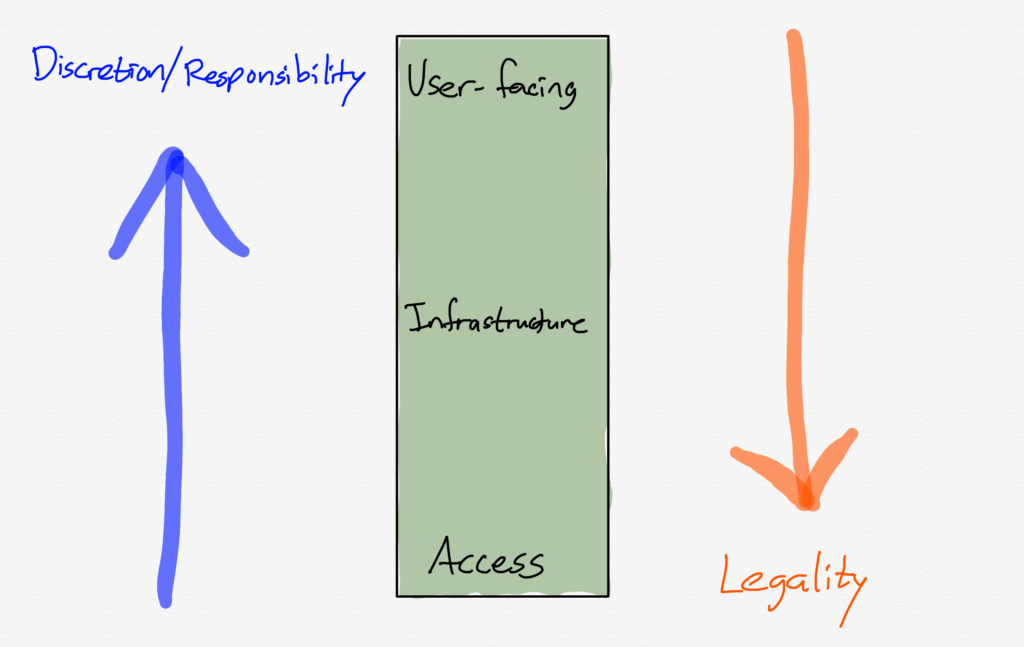
The problem is that I skipped the part between broadcasting and access; today’s Article is about the big piece in the middle: infrastructure. As that simple illustration suggests, there is more room for action than the access layer, but more reticence is in order relative to broadcast platforms. To figure out how infrastructure companies should think about moderation, I talked to four CEOs at various layers of infrastructure:
- Patrick Collison, the CEO of Stripe, which provides payment services to both individual companies and to platforms. link to interview
- Brad Smith, the President of Microsoft, which owns and operates Azure, on which a host of websites, apps, and services are run. link to interview
- Thomas Kurian, the CEO of Google Cloud, on which a host of websites, apps, and services are run. link to interview
- Matthew Prince, the CEO of Cloudflare, which offers networking services, including free self-serve DDoS protection, without which many websites, apps, and services, particularly those not on the big public clouds, could not effectively operate. link to interview
What I found compelling about these interviews was the commonality in responses; to that end, instead of my making pronouncements on how infrastructure companies should think about issues of moderation, I thought it might be helpful to let these executives make their own case.
The Line in the Stack
The first overarching principle was very much in line with the argument I laid out above: infrastructure is very different from user-facing applications, and should be approached differently.
Microsoft’s Brad Smith:
The industry is looking at the stack and almost putting it in two layers. At the top half of the stack are services that basically tend to meet three criteria or close to it. One is it is a service that has control over the postings or removal of individual pieces of content. The second is that the service is publicly facing, and the third is that the content itself has a greater proclivity to go viral. Especially when all three or even when say two of those three criteria are met, I think that there is an expectation, especially in certain content categories like violent extremism or child exploitative images and the like that the service itself has a responsibility to be reviewing individual postings in some appropriate way.
Cloudflare’s Matthew Prince:
I think that so long as each of the different layers above you are complying with law and doing the right thing and cooperating with law enforcement…it should be an extremely high bar for somebody that sits as low in the stack as we do…I think that that’s different than if you’re Facebook firing an individual user, or even if you’re a hosting provider firing an individual platform. The different layers of the stack, I think do have different levels of responsibility and that’s not to say we don’t have any responsibility, it’s just that we have to be very thoughtful and careful about it, I think more so than what you have to do as you move up further in the stack.
Stripe’s Patrick Collison:
We’re different from others. We’re financial services infrastructure, not a content platform. I’m not sure that the kind of neutrality that companies like Stripe should uphold is necessarily best for Twitter, YouTube, Facebook, etc. However, I do think that in some of the collective reckoning with the effects of social media, the debate sometimes underrates the importance of neutrality at the infrastructure level.
Your Layer = Your Responsibility
The idea of trusting and empowering platforms built on infrastructure to take care of their layer of the stack was a universal one. Collison made the case that to try and police the entire stack was unworkable in a free society (and that this explained why Stripe kicked the Trump campaign off after January 6th, but still supported the campaign indirectly):
This gets into platform governance, which is one of the most important dimensions of all of this, I think. We suspended the campaign accounts that directly used Stripe — the accounts where we’re the top-of-the-stack infrastructure. We didn’t suspend all fundraising conducted by other platforms that benefitted his campaign. We expect platforms that are built on Stripe to implement their own moderation and governance policies and we think that they should have the latitude to do so. This idea of paying attention to your position in the stack is obviously something you’ve written about before and I think things just have to work this way. Otherwise, we’re ultimately all at the mercy of the content policies of our DNS providers, or something like that.
Google’s Thomas Kurian noted there were practical considerations as well:
Imagine somebody wrote a multi-tenant software as a service application on top of GCP, and they’re offering it, and one of the tenants in that application is doing something that violates the ToS but others are not. It wouldn’t be appropriate or even legally possible for us to shut off the entire SaaS application because you can’t just say I’m going to throttle the IP addresses or the inbound traffic, because there’s no way that the tenant is below that level of granularity. In some cases it’s not even technically feasible, and so rather than do that, our model is to tell the customer, who we have a direct relationship with, “Hey, you signed an agreement that agreed to comply with our ToS and AUP [Acceptable Use Policy], but now we have a report of a potential violation of that and it’s your responsibility to pass those obligations on to your end customer.”
Still, Smith didn’t completely absolve infrastructure companies of responsibility:
The platform underneath doesn’t tend to meet those three criteria, but that doesn’t absolve the platform of all responsibility to be thinking about these issues. The test for, at the platform level, is therefore whether the service as a whole has a reasonable infrastructure and is making reasonable efforts to fulfill its responsibilities with respect to individualized content issues. So whether you’re a GCP or AWS or Azure or some other service, what people increasingly expect you to do is not make one-off decisions on one-off postings, but asking whether the service has a level of content moderation in place to be responsible. And if you’re a gab.ai and you say to Azure, “We don’t and we won’t,” then as Azure, we would say, “Well look, then we are not really comfortable as being the hosting service for you.”
Proactive Process
This middle way — give responsibility to the companies and services on top of your infrastructure, but if they fail, have a predictable process in place to move them off of the platform — requires a proactive approach. Smith again:
Typically what we try to do is identify these issues or issues early on. If we don’t think there’s a natural match, if we’re not comfortable with somebody, it makes more sense to let them know before they get on our service so that they can know that and they can find their own means of production if that’s what they want. If we conclude that somebody is reliant on us for their means of production, and we’re no longer comfortable with them, we should try to manage it through a conversation so they can find a means of production that is an alternative if that’s what they choose. But ideally, you don’t want to call them up at noon and tell them they have two hours before they’re no longer on the internet.
Kurian made the same argument against arbitrary decision-making and in favor of proactive process:
We evolve our Acceptable Use Policies on a periodic basis. Remember, we need to evolve it in a thoughtful way, not react to individual crisis. Secondly, we also need to evolve it in a way with a certain frequency, otherwise customers stop trusting the platform. They’d be like “Today, I thought I was accepted and tomorrow you changed it, and now I’m no longer accepted and I have to migrate off the platform”. So we have a fairly well thought out cadence, typically once every six months to once every twelve months, when we reevaluate that based on what we see…
We try to be as prescriptive as possible so that people have as much clarity as possible with what can they do and what they can’t do. Secondly, when we run into something that is a new circumstance, because the boundary of these things continue to move, if it’s a violation of what is considered a legally acceptable standard, we will take action much more quickly. If it’s not a direct violation of law but more debatable on should you take action or not, as an infrastructure provider, our default is don’t take action, but we will then work through a process to update our AUP if we think it’s a violation, and then we make that available through that.
What About Parler?
This makes sense as I write this on March 16, 2021, while the world is relatively calm; the challenge is holding to a commitment to this default when the heat is on, like it was in January. Prince noted:
We are a company that operates, we have equipment running in over 100 countries around the world, we have to comply with the laws in all those countries, but more than that, we have to comply with the norms in all of those countries. What I’ve tried to figure out is, what’s the touchstone that gets us away from freedom of expression and gets us to something which is more universal and more fundamental around the world and I keep coming back to what in the US we call due process, but around the rest of the world, they’d call it, rule of law. I think the interesting thing about the events of January were you had all these tech companies start controlling who is online and it was actually Europe that came out and said, “Whoa, Whoa, Whoa. That makes us super uncomfortable.” I’m kind of with Europe.
Collison made a similar argument about AWS’s decision to stop serving Parler:
Parler was a good case study. We didn’t revoke Parler’s access to Stripe. They’re a platform themselves and it certainly wasn’t clear to us in the moment that Parler should be held responsible for the events. (I’m not making a final assessment of their culpability — just saying that it was impossible for anyone to know immediately.) I don’t want to second guess anyone else’s decisions — we’re doing this interview because these questions are hard! — but I think it’s very important that infrastructure players are willing to delegate some degree of moderation authority to others higher in the stack. If you don’t, you get these problematic choke points…These sudden, unpredictable flocking events can create very intense pressure and I think responding in the moment is usually not a recipe for good decision making.
I was unable to speak with anyone from AWS; the company said in a court filing that it had given the social networking service multiple warnings that it needed more stringent moderation from November 2020 on. AWS said in its filing:
This case is not about suppressing speech or stifling viewpoints. It is not about a conspiracy to restrain trade. Instead, this case is about Parler’s demonstrated unwillingness and inability to remove from the servers of Amazon Web Services (“AWS”) content that threatens the public safety, such as by inciting and planning the rape, torture, and assassination of named public officials and private citizens. There is no legal basis in AWS’s customer agreements or otherwise to compel AWS to host content of this nature. AWS notified Parler repeatedly that its content violated the parties’ agreement, requested removal, and reviewed Parler’s plan to address the problem, only to determine that Parler was both unwilling and unable to do so. AWS suspended Parler’s account as a last resort to prevent further access to such content, including plans for violence to disrupt the impending Presidential transition.
This echoes the argument that Prince made in 2019 in the context of Cloudflare’s decision to remove its (free) DDoS service from 8chan. Prince explained:
The ultimate responsibility for any piece of user-generated content that’s placed online is the user that generated it and then maybe the platform, and then maybe the host and then, eventually you get down to the network, which is where we are. What I think changed was, there were certain cases where there were certain platforms that were designed from the very beginning, to thwart all legal responsibility, all types of editorial. And so the individuals were bad people, their platforms themselves were bad people, the hosts were bad people. And when I say bad people, what I mean is, people who just ignore the rule of law…[So] every once in a while, there might be something that is so egregious and literally designed to be lawless, that it might fall on us.
In other words, infrastructure companies should defer to the services above them, but if no one else will act, they might have no choice; still, Prince added:
What was interesting was as we saw all of these other platforms struggle with this and I think Apple, AWS, and Google got a lot of attention, and it was interesting to see that same framework that we had set out, being put out. I’m not sure it’s exactly the same. Was Parler all the way to complete lawlessness, or were they just over their skis in terms of content moderation?
This is where I go back to Smith’s arguments about proactive engagement, and Kurian’s focus on process: if AWS felt Parler was unacceptable, it should have moved sooner, like Microsoft appears to have done with Gab several years ago. The seeming arbitrariness of the decision was directly related to the lack of proactive management on AWS’s part.
U.S. Corporate Responsibility
An argument I made about the actions of tech companies after January 6 is that they are best understood as a part of America’s checks-and-balances; corporations have a wide range of latitude in the U.S. — see the First Amendment, for example, or the ability to kick the President off of their platform — but as Spider-Man says, “With great power comes great responsibility”. To that end U.S. tech companies were doing their civic duty in ensuring an orderly transfer of power, even though it hurt their self-interest. I put this argument to Collison:
I think you’re getting at the idea that companies do have some kind of ultimate responsibility to society, and that that might occasionally lead to quite surprising actions, or even to actions that are inconsistent with their stated policies. I agree. It’s important to preserve the freedom of voluntary groups of private citizens to occasionally act as a check on even legitimate power. If some other company decided that the events of 1/6 simply crossed a subjective threshold and that they were going to withdraw service as a result, well, I think that’s an important right for them to hold, and I think that the aggregate effect of such determinations, prudently and independently applied, will ultimately be a more robust civic society.
Prince was more skeptical
That is a very charitable read of what went on…I think, the great heroic patriotic, “We did what was right for the country”, I mean, I would love that to be true, I’m not sure that if you actually dig into the reality of that, that it was that. As opposed to succumbing to the pressure of external, but more importantly, internal pressures.
Smith took the question in a different direction, arguing that tech company actions in the U.S. are increasingly guided by expectations from other countries:
I do think that there is, as embedded in the American business community, a sense of corporate social responsibility and I think that has grown over the last fifteen years. It’s not unique to the United States because I could argue that in certain areas, European business feels the same way. I would say that there are two factors that add to that sense of American corporate responsibility as it apply to technology and content moderation that are also important. One is, during the Trump administration, there was a heightened expectation by both tech employees and civil society in the United States that the tech sector needed to do more because government was likely to do less. And so I think that added to pressure as well as just a level of activity that grew over the course of those four years, that was also manifest on January 6th…
There is a second factor that I also think is relevant. There’s almost an arc of the world’s democracies that are creating common expectations through new laws outside the United States that I think are influencing then expectations for what tech companies will do inside the United States.
Kurian immediately jumped to the international implications as well:
Cloud is a global utility, so we’re making our technology available to customers in many, many countries, and in each country we have to comply with the sovereign law of that country. So it is a complex question because what is considered acceptable in one country may be considered non-acceptable in another country.
Your example of First Amendment in the United States and the way that other countries may perceive it gets complicated, and that’s one of the questions we’re working through as we speak, which we don’t have a clear answer on, which is what action do you take if it’s in violation of one country’s law when it is a direct contradiction in another country’s law? And for instance, because these are global platforms, if we say you’re not going to be allowed to operate in the United States, the same company could just as well use our regions in other countries to serve, do you see what I mean? There’s no easy answer on these things.
The Global Internet?
If there was universal agreement on the importance of understanding the different levels of the stack, the question of how to answer these questions globally provided the widest range of responses.
Collison argued that a bias towards neutrality was the only way a service could operate globally:
When it comes to moderation decisions and responsibilities as internet infrastructure, that pushes you to an approach of relative neutrality precisely so that you don’t supersede the various governmental and democratic oversight and civil society mechanisms that will (and should) be applied in different countries.
Kurian highlighted the technical challenges in any other approach:
We have tried to get to what’s common, and the reality is it’s super hard on a global basis to design software that behaves differently in different countries. It is super difficult. And at the scale at which we’re operating and the need for privacy, for example, it has to be software and systems that do the monitoring. You cannot assume that the way you’re going to enforce ToS and AUPs is by having humans monitor everything, I mean we have so many customers at such a large scale. And so that’s probably the most difficult thing is saying virtual machines behave one way in Canada, and a different way in the United States, and a third way, I mean that’s super complicated.
Smith made the same argument:
If you’re a global technology business, most of the time, it is far more efficient and legally compliant to operate a global model than to have different practices and standards in different countries, especially when you get to things that are so complicated. It’s very hard to have content moderators make decisions about individual pieces of content under one standard, but to try to do it and say, “Well, okay, we’ve evaluated this piece of content and it can stay up in the US but go down in France.” Then you add these additional layers of complexity that add both cost and the risk of non-compliance which creates reputational risk.
You can understand Google and Microsoft’s desire for consistency: what makes the public cloud so compelling is its immense scale, but you lose many of those benefits if you have to operate differently in every country. Prince, though, thinks that is inevitable:
I think that if you could say, German rules don’t extend beyond Germany and French rules don’t extend beyond France and Chinese rules don’t extend beyond China and that you have some human rights floor that’s in there.
But given the nature of the internet, isn’t that the whole problem? Because, anyone in Germany can go to any website outside of Germany.
That’s the way it used to be, I’m not sure that’s going to be the way it’s going to be in the future. Because, there’s a lot of atoms under all these bits and there’s an ISP somewhere, or there’s a network provider somewhere that’s controlling how that flows and so I think that, that we have to follow the law in all the places that are around the world and then we have to hold governments responsible to the rule of law, which is transparency, consistency, accountability. And so, it’s not okay to just say something disappears from the internet, but it is okay to say due to German law it disappeared from the internet. And if you don’t like it, here’s who you complain to, or here’s who you kick out of office so you do whatever you do. And if we can hold that, we can let every country have their own rules inside of that, I think that’s what keeps us from slipping to the lowest common denominator
Prince’s final conclusion is along the same lines of where I landed in Internet 3.0 and the Beginning of Tech History. To date the structure of the Internet has been governed by technological and especially economic incentives that drove towards centralization and Aggregation; after the events of January, though, political considerations will increasingly drive decision-making.
For many internet service providers this provides an opportunity to abstract away this complexity for other companies; Stripe, to take a pertinent example, adroitly handles different payment methods and tax regimes with a single API. The challenge is more profound for the public clouds, though, which achieve their advantage not by abstracting away complexity, but by leveraging the delivery of universal primitives at scale.
This is why I take Smith’s comments as more of a warning: a commitment to consistency may lead to the lowest common denominator outcome Prince fears, where U.S. social media companies overreach on content, even as competition is squeezed out at the infrastructure level by policies guided by non-U.S. countries. It’s a bad mix, and public clouds in particular would be better off preparing for geographically-distinct policies in the long run, even as they deliver on their commitment to predictability and process in the meantime, with a strong bias towards being hands-off. That will mean some difficult decisions, which is why it’s better to make a commitment to neutrality and due process now.
You can read the interviews from which this Article was drawn here.
Walking through Chinatown every morning, I find myself planning to put on a stone in a month when this is over.
|
mkalus
shared this story
from  mrjamesob on Twitter. mrjamesob on Twitter.
|
Walking through Chinatown every morning, I find myself planning to put on a stone in a month when this is over.

1106 likes, 17 retweets

Blocks or Not? You Decide

In 2018 WordPress introduced a new text editor called Gutenberg. It has been the subject of endless controversy ever since. Instead of providing writers with a single text entry field, Gutenberg divides contents (such as blog posts) into 'blocks'. The advantage is that authors can now incorporate different types of content into their articles - images, design elements, widgets, embeds and more (there's a box that offers dozens of selections). You can also move blocks around in your article. The disadvantage is that it interrupts the smooth writing experience by constantly popping text formatting option boxes right into the middle of your text, instead of outside the editing area. As Alan Levine says, few things are as divisive. "You are either one side or the other." What people really need is a way to switch back and forth, and that's what Levine describes in this article. However, official support for the classic editor plugin stops December 31, 2021, and that could be a problem.
Web: [Direct Link] [This Post]Are NFTs DRM by Another Name?

Something is 'fungible' if it can be easily replaced with another item of the same type. For example, we don't really care which dollar bill we receive; they're all basically the same. A non-fungible thing is something that is verifiably unique. Like the Mona Lisa say. So a non-fungible token (NFT) is a digital thing that is verifiably unique. People have been paying a lot for NFTs of famous things recently. Is it a scam? A bubble? Or is it, as suggested in this article, the latest face of digital rights management (DRM). It's a persuasive argument, because what people are actually buying are "NFTs that point to digital objects", and not the objects themselves. "In neither the NFT nor DRM cases do buyers get the same bundle of rights that are guaranteed for a physical object in copyright law," writes Bill Rosenblatt. He may have a case.
Web: [Direct Link] [This Post]Waze releases data about Canadian driving patterns amid pandemic

Waze has released data about Canadian driving patterns over the last year amid the ongoing COVID-19 pandemic.
“In general, Waze users in major cities across the country are still driving less now than they were a year ago. Activity reached its lowest point over the last 13 months in April 2020, and then rose steadily through the summer,” the company notes.
Waze outlines that September 2020 saw activity briefly return to baseline levels in major cities. Here’s how the major cities compared to the baseline:
- Calgary: 1%
- Toronto:-16%
- Ottawa: 1%
- Montreal: 2%
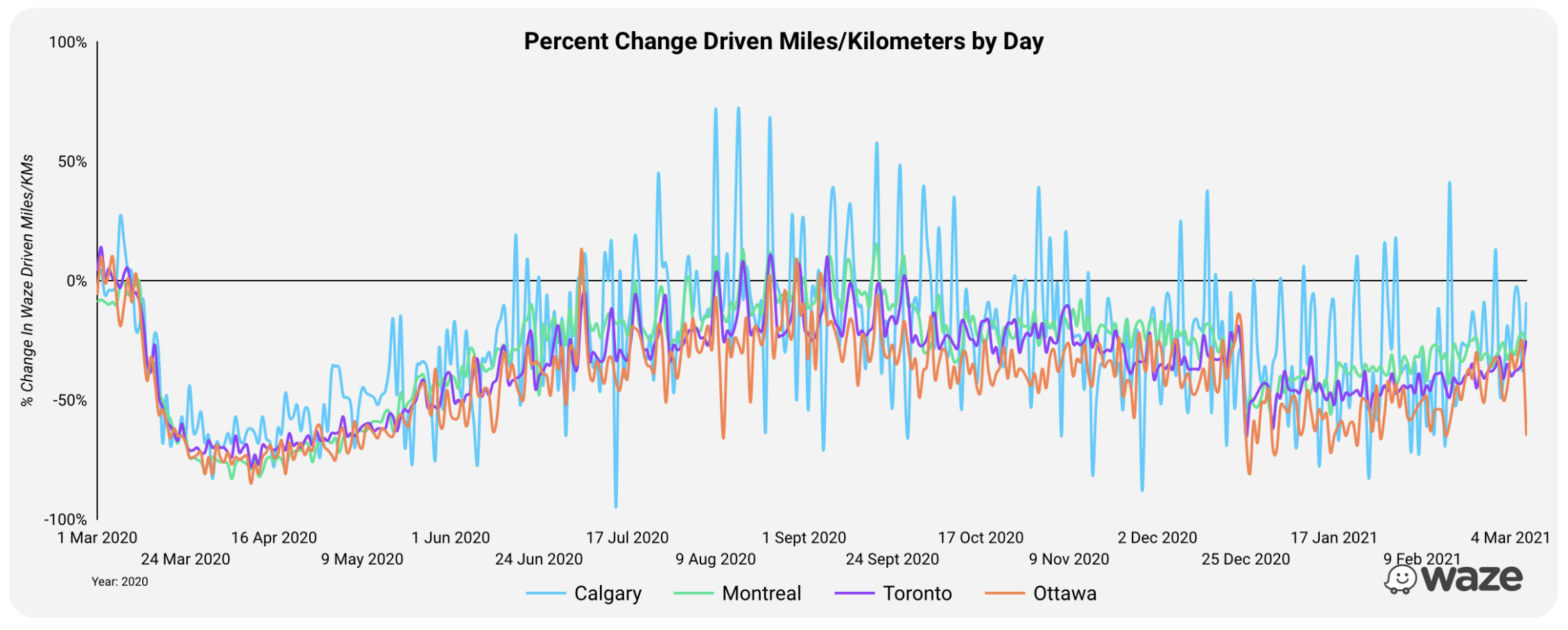
Interestingly, data shows that Waze users are driving more than they were last March, but still much less than in February 2020.
Here’s how the major cities compared to the February baseline as of March 7th, 2021:
- Calgary: -38% below the February baseline
- Toronto: -34%
- Ottawa: -27%
- Montreal: -22%
Waze notes that it has made its COVID-19 Impact Dashboard publicly available to help governments and the public gain more insight into local driving trends.
“We’ve made our dashboard searchable by anyone to make this information as accessible as possible,” said Mike Wilson, the Canada country manager at Waze, in an emailed statement.
The post Waze releases data about Canadian driving patterns amid pandemic appeared first on MobileSyrup.
progressivepower:Yes, we very much see the problem here...
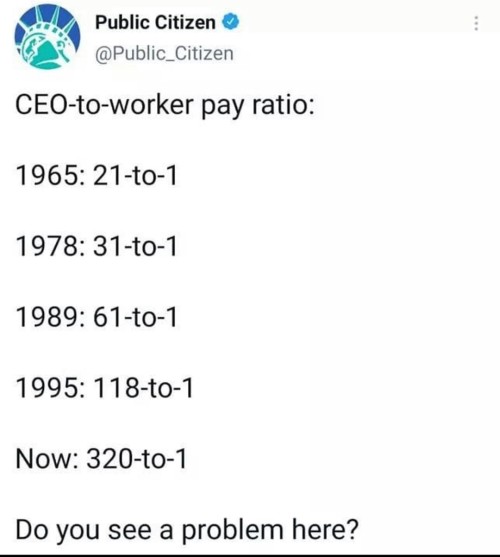
Yes, we very much see the problem here #taxtherich #raiseminimumwage #helpourworkingclass
sqlite-spellfix
I really like this pattern: "pip install sqlite-spellfix" gets you a Python module which includes a compiled (on your system when pip install ran) copy of the SQLite spellfix1 module, plus a utility variable containing its path so you can easily load it into a SQLite connection.
Via sqlite_uuid
Moving fast and breaking us all: Big Tech’s unaccountable algorithms

"Many of the world’s most powerful algorithms are accountable to no one," write Ellery Roberts Biddle and Jie Zhang. "Companies do not have oversight over how their own systems work." And yet "They decide who passes and who fails in secondary school. They decide who gets arrested and who goes to prison. They decide what news you see first thing in the morning as well as what news you won’t see." I think both sides of this statement are exaggerated, but am nonetheless supportive of the main point of the article, which is to call for a human rights framework for algorithms that would "not just set forth standards for how to 'do no harm' or 'be ethical,' but it would help hold companies accountable for those standards, by providing mechanisms for risk assessment, enforcement, redress when harm has occurred, and individual empowerment for technology users."
Web: [Direct Link] [This Post]Rogers signs agreement to acquire Shaw Communications in deal valued at $26 billion

Toronto-based national carrier Rogers has signed a deal to purchase Shaw Communications in a transaction valued at $26 billion.
The carrier says the acquisition will build on the legacy of two family-founded Canadian companies and that together, they will have the capability to deliver unprecedented wireline and wireless broadband and network investments.
Rogers has stated that it will not increase wireless prices for Freedom Mobile customers for at least three years following the close of the transaction.
“Without a doubt, my father would be proud of this moment, combining forces with the company founded by his old friend to deliver more Canadians world class connectivity, more choice, and better value,” said Shaw Communications CEO Brad Shaw in a press release.
Brad Shaw, and another director to be nominated by the Shaw family, will join the Rogers Board of Directors when the transaction closes. The Shaw family will also become one of the largest Rogers shareholders.
As part of the investment, Rogers says it will invest $2.5 billion in 5G networks over the next five years across Western Canada. The carrier has also committed to creating a new $1 billion Rural and Indigenous Connectivity Fund.
“Fundamentally, this combination of two great companies will create more jobs and investment in Western Canada, connect more people and businesses, deliver best-in-class-services and infrastructure across the nation, and provide increased competition and choice for Canadian consumers and businesses,” said Rogers CEO Joe Natale.
Rogers says it will maintain and grow local Shaw jobs and that new technology and network investments will create up to 3,000 jobs across Western Canada.
The two carriers say the transaction is expected to close in the first half of 2022.
The deal still requires regulatory approval and will likely receive scrutiny from the federal government, as it would eliminate a competitor from the Canadian telecommunications market. Some parts of Canada would go from having four providers to three.
In a statement regarding the announcement, Innovation Minister François-Philippe Champagne said the government is committed to greater affordability, competition and innovation.
“These goals will be front and centre in analyzing the implications of today’s news. The transaction will be reviewed by the independent Competition Bureau of Canada, the Canadian Radio-television and Telecommunications Commission, as well as the department of Innovation, Science and Economic Development and we won’t presuppose the outcomes of these processes,” he stated.
Further, the Competition Bureau issued a statement noting that “should the Bureau determine that the proposed transaction is likely to substantially lessen or prevent competition, we will not hesitate to take appropriate action.”
Rogers has been looking to expand its presence across the country via acquisition, as the carrier launched a bid to acquire Cogeco last year.
The carrier partnered with Altice USA in a bid to purchase Cogeco’s Canadian assets for a net purchase of around $4.9 billion CAD. The deal was rejected by the Audet family, which controls Cogeco, several times after the family said they did not intend to sell their shares.
The post Rogers signs agreement to acquire Shaw Communications in deal valued at $26 billion appeared first on MobileSyrup.
When Less is More: Data Tables That Make a Difference
In the previous post, From Visual Impressions to Visual Opinions, I gave various examples of charts that express opinions. In this post, I’ll share a few examples of how we can take a simple data table and derive multiple views from it that each provide a different take on the same story (or does that mean, tells different stories from the same set of "facts"?)
Here’s the original, base table, showing the recorded split times from a single rally stage. The time is the accumulated stage time to each split point (i.e. the elapsed stage time you see for a driver as they reach each split point):

From this, we immediately note the ordering (more on this in another post) which seems not useful. It is, in fact, the road order (i.e. the order in which each driver started the stage).
We also note that the final split is not the actual final stage time: the final split in this case was a kilometer or so before the stage end. So from the table, we can’t actually determine who won the stage.
Making a Difference
The times presented are the actual split times. But one thing we may be more interested in is the differences to see how far ahead or behind one driver another driver was at a particular point. We can subtract one driver’s time from anothers to find this difference. For example, how did the times at each split compare to first on road Ogier’s (OGI)?

Note that we can “rebase” the table relative to any driver by subtracting the required driver’s row from every other row in the original table.
From this “rebased” table, which has fewer digits (less ink) in it than the original, we can perhaps more easily see who was in the lead at each split, specifically, the person with the minimum relative time. The minimum value is trivially the most negative value in a column (i.e. at each split), or, if there are no negative values, the minimum zero value.
As well a subtracting one row from every other row to find the differences realative to a specified driver, we can also subtract the first column from the second, the second from the third etc to find the time it took to get from one split point to the next (we subtract 0 from the first split point time since the elapsed time into stage at the start of the stage is 0 seconds).

The above table shows the time taken to traverse the distance from one split point to the next; the extra split_N column is based on the final stage time. Once again, we could subtract one row from all the other rows to rebase these times relative to a particular driver to see the difference in time it took each driver to traverse a split section, relative to a specified driver.
As well as rebasing relative to an actual driver, we can also rebase relative to variously defined “ultimate” drivers. For example, if we find the minimum of each of the “split traverse” table columns, we create a dummy driver whose split section times represent the ultimate quickest times taken to get from one split to the next. We can then subtract this dumny row from every row of the split section times table:

In this case, the 0 in the first split tells us who got to the first split first, but then we lose information (withiut further calculation) about anything other than relative performance on each split section traverse. Zeroes in the other columns tell us who completed that particular split section traverse in the quickest time.
Another class of ultimate time dummy driver is the accumulated ultimate section time driver. That is, take the ultimate split sections then find the cumulative sum of them. These times then represent the dummy elapsed stage times of an ultimate driver who completed each split in the fastest split section time. If we rebase against that dummy driver:

In this case, there may be only a single 0, specifically at the first split.
A third possible ultimate dummy driver is the one who “as if” recorded the minimum actual elapsed time at each split. Again, we can rebase according to that driver:

In this case, will be at least one zero in each column (for the driver who recorded that particular elapsed time at each split).
Visualising the Difference
Viewing the above tables as purely numerical tables is fine as far as it goes, but we can also add visual cues to help us spot patterns, and different stories, more readily.
For example, looking at times rebased to the ultimate split section dummy driver, we get the following:

We see that SOL was flying from the second split onwards, getting from one split to another in pretty much the fastest time after a relatively poor start.
The variation in columns may also have something interesting to say. SOL somehow made time against pretty much every between split 4 and 5, but in the other sections (apart from the short last section to finish), there is quite a lot of variability. Checking this view against a split sectioned route map might help us understand whether there were particular features of the route that might explain these differences.
How about if we visualise the accumulated ultimate split section time dummy driver?

Here, we see that TAN was recording the best time compared the ultimate time as calculated against the sum of best split section times, but was still off the ultimate pace: it was his first split that made the difference.
How about if we rebase against the dummy driver that represents the driver with the fastest actual recorded accumulated time at each split:

Here, we see that TAN led the stage at each split point based on actual accumulated time.
Remember, all these stories were available in the original data table, but sometimes it takes a bit of differencing to see them clearly…
Based on Visualising WRC Rally Timing and Results Data, Chapter 7: Working With Split Times (includes R code). Source repo: RallyDataJunkie/visualising-wrc-rally-results
Faces of Histories
The first one I saw was the girl in Dutch painter Johannes Vermeer’s Girl With a Pearl Earring. Looking over her shoulder, she stares off into the distance and then shifts her gaze to hold mine for a second. She looks away again, and the left-hand corner of her mouth inadvertently twitches with the briefest of smiles. In this simulation, her eyes are shiny gray and bulbous, like a dead fish. These movements are a set sequence of events, a technological update to a centuries-old image.
Last but not least: “Das Mädchen mit dem Perlenohrgehänge” von Vermeer, in animiert. #DeepNostalgia @MyHeritage
Ein bewegendes Tool! 😉 pic.twitter.com/eLwRKMYQCQ
— Bruckner 0 (@Lustbarkeit) March 1, 2021
In late February, the Tel Aviv–based online genealogy platform MyHeritage released a feature with the trademarked name Deep Nostalgia: a machine-learning-powered technology that animates uploaded images with a programmed series of facial gestures and movements that users can apply to any uploaded image. In the days since its release, Deep Nostalgia went viral: As of March 4, millions of faces have been animated, with thousands of images animated per minute. By this point, I’ve seen dozens of these animated images — people’s relatives, famous portraits, historical figures. Nero, Shakespeare, Nosferatu, even a photograph of a statue of Cicero. Pee-wee Herman applied the technology to a childhood photograph of himself: “Creepy?! Or cool?!” he asked.
Much of the reaction to Deep Nostalgia has been encompassed by those two choices, as if they naturally defined the continuum of opinion suitable for any new technology. The polarized response has helped its popularity, as though using it were to participate in a cultural debate about something new and surprising. But if so, the debate is hardly new: The internet was literally built on the popularity of altered images, for what is a meme but image manipulation, transposition, juxtaposition? It’s been almost four years already since the Tom Cruise deepfake had us all rattled (though now it has been revived again on TikTok). It’s well past time to simply be “uncomfortable” with these kinds of images. They require a deeper consideration of the stakes. And so while I’m surprised by the surprise, I’m alarmed by the atmosphere that continues to make these media technologies both possible and desired.
Part of the particular unease evoked by Deep Nostalgia stems from how we’ve been primed for it by tech media and sci-fi, as in the Black Mirror episode that explores the logical conclusion for this sort of technology: the reanimation of lost loved ones in the form of a personality-powered bot and ultimately as a physical, synthetic controllable re-creation. But such reactions and expectations for image-manipulation apps, features, and bots ignore more urgent concerns that are an immediate matter of life and death, especially for those of us who unequally experience the destructive outcomes of technology.
The focus on how unnerving the Deep Nostalgia images are distracts from the deeper and more urgent issues they reflect
To participate in Deep Nostalgia, a user is required to upload photographs, and this sourcing of images — without the need for explicit consent of the person in the image — expands the application of AI to develop increasingly sophisticated surveillance technologies. Deep Nostalgia is touted for its capability of animating family archives, inviting people to “experience family history like never before!” and manufacture memories of relatives it would have been impossible for them to meet in person. It taps into the curiosity we have about the people we come from, our tendency to make their lives legendary in our imaginations. But though this gimmick purports to facilitate an engagement with history, its confluence of facial recognition and machine learning seems to make commentators overlook these technologies’ conjugation from surveillance and tracking software. The focus on how unnerving the Deep Nostalgia images are distracts from the deeper and more urgent issues they reflect — creepy is a feeling. In the material world, these image manipulation technologies are implicated in the surveillance, criminalization, and policing technologies, which have uneven consequences.
By this point, we should be used to this technological haunting of dead people’s images. Hologram tours by dead artists have been going on for years. The late Carrie Fisher’s appeared in a new Star Wars movie by blending archival footage with the digitally altered performance of a live actor. And whole “people” have been constructed using technology. Almost 20 years ago, in the movie S1M0NE, Canadian actress Rachel Roberts played Simone, a computer-generated Hollywood actress. The producers had initially wanted to program a CGI character for the main role, but the Screen Actors Guild opposed the move, claiming it would jeopardize the careers of human actors. Digital effects were added to Roberts’s scenes to make the character look more synthetic. While acting roles haven’t been affected to the anticipated degree, we do have virtual influencers. This suggests how the impact of the technology can be redistributed.
The reaction from those repulsed by the animated images often refers to them as “creepy” and “uncanny.” Uncanny is how we refer to lifelike robots, when there’s a material attempt at duplicating humanity. But this is not what’s happening here: The implications of the technology are much more than an attempt at replication. Seeing facial expressions that we know never happened prompts a disturbing reconsideration of how we establish or determine humanity and integrate personality through the agency of faces. With the Tom Cruise deepfake, the actor’s face was spliced onto the body of an impersonator, someone who was already familiar with Cruise’s mannerisms. But as the technology develops from its initial and primitive filter roots, its applications become unholy rather than uncanny, digital Frankensteins mashing up body parts with faces, like the splicing of Steve Harvey’s face onto Megan Thee Stallion’s body.
Kept away from those we love, unable to mourn, this technology returns a sense of control by allowing us to imagine and re-create the moments we were denied
Some people are moved by seeing Deep Nostalgia’s lifelike gestures on flattened photographs; others are troubled by it. I understand what people find unnerving here: When you know someone has passed, it’s uncomfortable to think of their image being manipulated in this way after their death. And by extension, it’s uncomfortable to think of your own image puppeteered in this way, whether you are dead or not. The applications of the technology do raise questions of consent, rights, and ownership of our likeness. It’s one thing to animate a 17th century oil painting; it’s another to animate images of actual people who once lived. What’s most unnerving is that all that’s required is having an image — no ownership rights or permissions are required to upload them to Deep Nostalgia and allow for the representation of people through gestures they never intended or meant.
The popularity of Deep Nostalgia is hand in glove with our current moment. It’s a been a year of the coronavirus pandemic and its upheavals, restrictions and anxieties — a whole year of counting death and limiting life. It’s been a year of having our grief disrupted: We can’t attend funerals, we can’t gather at bedsides or congregate at services. We can’t even hug other people or say goodbye or have closure. And so this technology offers us solace in nostalgia. For those we’ve never met, it allows us to imagine what they would be like alive, adds a sliver of dimensionality that informs our manufactured memories. And more unnervingly, for those recently deceased, it produces additional content for our consumption, the possibility of placing our own consent to their likeness.
This is a commentary on our own helplessness: kept far away from those we love, unable to mourn, perhaps this technology returns to us a sense of control by allowing us to imagine and re-create the moments we were denied. For now, Deep Nostalgia generates a limited sequence of actions, but it feels inevitable that we’ll reach a point where we’ll have even more control in designing fantasy scenarios and more reason to link hope and desire to the capacity to manipulate people’s likenesses and actions in undetectable ways.
On my Twitter timeline, I’ve come across at least three different Deep Nostalgia–manipulated images of the Black abolitionist Frederick Douglass, who died in 1895. Douglass had a very deliberate relationship with his image: During his lifetime, he was the most photographed man in America. His approach was a precursor to what British-Ghanaian filmmaker John Akomfrah describes as the “utopian yearnings” of image technologies. Douglass delivered several talks on the subject of photography, and in his lecture “On Pictures” he writes:
Byron says that a man looks dead when his Biography is written. The same is even more true when his picture is taken. There is even something statue-like about such men. See them when or where you will, and unless they are totally off guard, they are either serenely sitting or rigidly standing in what they fancy their best attitude for a picture.
Douglass had determined that his “best attitude for a picture” was a calm and serious face, unsmiling. The Deep Nostalgia animation of one of his portraits — that programmed inadvertent left-hand-corner-of-the-mouth twitch — undermines Douglass’s agency in determining that photographs of him would present him as strong, dignified, and serious. Douglass was intentional in employing photographic technologies to visually challenge the assumed inferiority of slaves. He understood that photographic images could be a powerful tool and sought out photographers and sat for photographs whenever he could.
Douglass had a very deliberate relationship with his image: He had determined that his “best attitude for a picture” was a calm and serious face, unsmiling
His reanimation through Deep Nostalgia is thus concerning. Circulating manipulated images of a Black man — even one who has been dead for over a century — in defiance of his clearly stated desires evokes recent situations when the deaths of Black people have been circulated. Deep Nostalgia is marketed as a fun tool to interact with the long-forgotten past, but its appearance at this moment in pandemic times braids it into the emerging technologies we will develop around mourning, from attending Zoom funerals to grieving through seeking closure denied with apps like AI-driven apps.
I’ve written before that when human-computer interaction design — like social media networks, and health apps — considers the death of the user, it also needs to contend with Black life. Deep Nostalgia is no different. The deaths of Black people as they appear online reflect the lives of Black people everywhere. When media technology does away with notions of privacy and permission, it is imbricated in how surveillance is targeted, how consent is abrogated, how rights are contested, and property is appropriated.
The implications of technology aren’t distributed evenly, and if these concerns aren’t confronted and addressed now, the inevitable evolution of machine-learning technologies like Deep Nostalgia will distribute those uneven effects exponentially. Not only are they building on technologies that are dependent on biased data sets and that normalize surveillance practices and the carceral state; they also allow existing power imbalances to be exploited and further widened.
The synchronicity of having an AI-powered image manipulation technology end up renditions of several images of Frederick Douglass, the most photographed man of his time can’t be coincidental. But what it ultimately means is not fixed: Deep Nostalgia markets a celebration of the past, seemingly in spite of the wishes of the past. I read the appearance of Douglass’s animated face as a harbinger of the disproportionately harmful effects of these technologies on Black people, and yet I hope that by making his image more available, the impact of his legacy will outlast these technologies.
We too often associate running an innovative company with an ability to predict the future | Shira...
I followed the road back to me, and found that I was no longer there.
On Sunday afternoon I broke down in great buckets of tears, more tears than since that cold, snowy Sunday last January I spent by myself in St. Paul’s, pouring myself out while listening to Ingrid Michaelson on repeat, on the day before we celebrated Catherine.
Last week, in the wrenching, helpful book Before and After Loss, I read this:
As we grapple with loss, let’s be thoughtful about healing, restoration, and growth. Let’s not be satisfied with healing and restoration alone, let’s strive for growth. Healing results in the survival of a coherent self after traumatic loss. Growth recasts today’s insurmountable problems as tomorrow’s opportunities.
Sunday’s volcano of tears came not from sadness, but, ultimately, from understanding the truth of that statement.
I have been healing and restoring, slowly but surely, reestablishing a firm foundation, both internally and as regards the laundry and the celebration of major holidays.
What I haven’t been doing is growing. Instead I’ve kept myself lashed to a particular version of me, a self that, in so many ways, no longer exists.
This is a stage of grief I didn’t anticipate: it’s not at all about loss or absence or death, it’s about what happens next. It’s not about anyone else but me. And that’s weird.
It never occurred to me that would be overwhelming, as overwhelming, in fact, than much of what’s come before. Fortunately, coming out the other side of the cavalcade of tears I found myself hopeful. That was nice.
And this morning I gave physical form to that need for rearrangement by recasting our living room. Like me, most of the parts are original equipment; but how they fit together is very much “you mean I could put that over there!?” Onward.

Are We Ready for the Half-Meter Sea Rise in Metro Vancouver?

In British Columbia Kees Lokman at UBC has been creating an open-source database called Living with Water as a sea rise of one half a meter is expected along the coast by 2050 and by one meter in 2100. Most of people in the province live close to water, with sixty percent living in Metro Vancouver.
In this article by CBC’s Brenna Lo, Mr. Lokman states that every municipality must have a person on staff dealing specifically with coastal issues, and stormwater management. The bad news is that the most fertile land in Canada is located along the Fraser River and one-third will be impacted by flooding, threatening food security. Areas that receive some flooding in high tides now will be permanently underwater by 2050.
Eric Niler in Wired.com has written about increased flooding along North American ocean coasts, identifying dredging and sea rise resulting in troublesome high tides. In Vancouver the “king tides” (a completely unscientific term used to describe tides during the full and new moon) have municipal attention, with the City of Vancouver asking people to photograph high tides in the city, and send images to the City for a photographic record and future resource.
Science Advances has just published this article that looks at the acceleration in sea rise level, and notes that the gap between high water levels and flood thresholds is shrinking. With an “assumed universal sea rise level of 150mm (five inches) “gently sloped topography” and “porous rocks” mean some areas will be more compromised than others.
What is groundbreaking about this study is it is the first one to connect “nuisance flooding” to sea level rise and the man-made changes along the coasts which make it easier for water to flow inland.
Sea levels have increased 208 to 220 mm (8 to 9 inches) in the last 140 years, especially impacting the east and gulf coasts of the United States.
Dredging and channel deepening, which have been done on the Fraser River near Richmond B.C. also exacerbates flooding. Concerns about airport field flooding have been identified by pilots and scientists at New York City’s JFK airport, San Francisco, Oakland, New Orleans, Miami, Fort Lauderdale, Newark, and Washington, DC.
The worst damage occurs when coastal flooding, erosion coincide with storm waves and high peak tides.
There are already some forms of mitigation and studies are underway to look at restoring parts of San Francisco’s East Bay and unused river channels in New York Harbour to mitigate the rise of incoming tides on the main channel.
While conventional seawall barricades and dikes might be used in False Creek, “floating wetlands and kelp beds, clam gardens and living dikes” can be installed on watery “sediment deposits ” to naturally control rising waters.
The Fraser Basin Council has a draft Lower Mainland Flood Management Strategy that estimates future flooding will result in 20 to 30 billion dollars of economic loss. Metro Vancouver has had significant floods, the largest most recently in 1948. The report notes that regional development has been growing on flood plain hazard areas , putting at risk these areas and the critical infrastructure that supports them.
Some municipalities like Delta have recognized rising sea levels as a 21st century challenge. Delta Optimist’s Sandor Gyarmati writes that Delta has already been applying for Federal grants to bolster the dike system which serves much of that city’s low lying areas. Land use decisions have placed many buildings, infrastructure and people on flood hazard areas, with dikes that may fail during a major flood.
There is a need to recognize the scope of the problem and work across the region to create a coastal adaptation plan which includes First Nations experience and knowledge.
The video below talks about king tides and sea rise and was produced by the City of Vancouver.
Look, I like the flag. I even have cushions with it. But British politics is starting to look a bit like an am-dram performance of V for Vendetta. pic.twitter.com/rHw4pWDwzp
|
mkalus
shared this story
from  iandunt on Twitter: iandunt on Twitter:
|
| Also: How about ironing that flag prior to pretend you actually care? |
Look, I like the flag. I even have cushions with it. But British politics is starting to look a bit like an am-dram performance of V for Vendetta. pic.twitter.com/rHw4pWDwzp


360 likes, 45 retweets
Time Travel In Spring
Overview
Getting time under control is often something we overlook until late into a project. There are many ways to address this from ignoring it and fixing data to fit the current time, manually setting the time on the computer upon which we run tests, or somehow get between the JVM and the system time. With Java 8 that became a bit easier. Here’s a way to accomplish time control using Java 8’s Clock, with a Spring application for a (trivial) example.
In Java 8 there are several options. Baeldung has a great article on those options. What follows is taking one of the options from that article all the way into a Spring-based project.
Background
In a system where time is important, and you want to write tests where the actual time used is part of what you are checking, then getting time under control is a system requirement. It’s fair to say that system time is a domain-level concept.
Normally, Time is an external dependency because it is based on the clock in the computer upon which the app is running. Tests attempt to get every dependency under the control of the test. While not always possible, it is an ideal to strive for.
Generally, the more focused the test, the more likely controlling all dependencies is possible. Getting all the dependencies controlled for a micro-test is generally much easier / more possible than for an integration test, and an integration test tends to be easier than an acceptance test.
Java 8
Java 8 added an entirely new date/time implementation based on Joda Time and written by its author. The new and old co-exist, but are fairly disconnected.
What follows are the moving parts to time travel in a spring-based test.
How to get time
For a component that needs time, instead of using Date, use Clock.
For example, instead of:
new Date() // harder to control
We use this:
Date.from(systemClock.instant())
// or
Date.from(Instant.now(systemClock))
How to use the clock we define
Consider a Spring component that cares about time:
@Component
public class HelloComponent {
    private final Clock systemClock;
    public HelloComponent(Clock systemClock) {
        this.systemClock = systemClock;
    }
    public String message() {
        return "Hello, it is now: " + Date.from(systemClock.instant());
    }
}
Part of Application Configuration
For systemClock to be injected, there needs to be a bean in the Spring configuration. The special sauce is a combination of two annotations:
-
@Configurationenhance the Spring context with some bean instances -
@BeanDefine a Spring bean that can be autowired into a component
This can be on its own class or, in this simple example, placed on the @SpringBootApplication directly.
@SpringBootApplication
@Configuration
public class TimeApplication {
	public static void main(String[] args) {
		SpringApplication.run(TimeApplication.class, args);
	}
	@Bean
	public Clock systemClock() {
		return Clock.systemDefaultZone();
	}
}
Not this Now, That Now
What about testing for a date that is not “now” in the real world?
Override the Clock
If you can get away with using a plain JUnit test, then you can construct
your own Clock instance, and manually call the constructor of the HelloComponent.
That’s straightforward and a good option.
If you’re trying to get it to work in a spring context, it requires another moving part. We’ll override the application-generated Clock with a test Clock.
Create a Test Config
public class TestConfig {
    @Bean
    @Primary
    public Clock systemClock() {
        return Clock.fixed(
                Instant.parse("2031-08-22T10:00:00Z"),
                ZoneOffset.UTC);
    }
}
Note, the use of @Primary on this @Bean method allows this TestConfig to work on its own, or in a larger
initialization context.
In the test that follows, the test limits what is in the Spring context for test execution by listing specific classes that the test-writer knew were needed to get this test to run.
Alternatively, you can specify the application class and get a fully initialized spring context with all the project’s components, controllers, services, etc.
If you fully initialize your application, then in addition to using @Primary, and @Bean, such a test
would also need the annotation:
@SpringBootTest(classes = {HelloComponent.class, TestConfig.class})
@TestPropertySource(properties="spring.main.allow-bean-definition-overriding=true")
class HelloComponentTest {
    // ...
}
Oh yes, how about a test
@SpringBootTest(classes = {HelloComponent.class, TestConfig.class})
class HelloComponentTest {
    @Autowired
    HelloComponent hello;
    @Test
    void messageControlled() {
        String message = hello.message();
        assertThat(message).contains("2031");
    }
}
If you look at the test config, the date is fixed to 2031-08-22, so while the assertion could be more specific, it demonstrates that we are overriding the real time with our desired time.
Unless it is 2031. If you run this test in the year 2031, then the test passing proves nothing. Do you see?
Conclusion
- The most important takeaway is that anything we care about in the application is worth getting under control.
- If your system cares about time, then getting time under control is a good idea because it is part of the domain. That is, it is a business-level concept worthy of explicit representation in the production code.
- This shows one path with Java 8 and Spring. While these details are often of an immediate nature, the previous two bullets are a bit longer-lived.
I feel this needs to be emphasised. Exports to the EU dropping to 0% in January and rebounding to 90+% by April would be a VASTLY better outcome for the UK than a gentle but permanent reduction to 75%. twitter.com/AnnaJerzewska/…
|
mkalus
shared this story
from  DmitryOpines on Twitter. DmitryOpines on Twitter.
|
I feel this needs to be emphasised.
Exports to the EU dropping to 0% in January and rebounding to 90+% by April would be a VASTLY better outcome for the UK than a gentle but permanent reduction to 75%. twitter.com/AnnaJerzewska/…
Exactly, covid, stockpiling - all that might have played a role.
Also, the short-term drastic decline is not the worst outcome. The long-term gradual (or not) unbundling of supply chains likely to have a bigger impact over time. twitter.com/lizzzburden/st…
132 likes, 23 retweets


108 likes, 20 retweets
Full-Sized HomePod Discontinued
Rolandtj

This makes sense (as the original HomePod was extremely expensive by any measure, especially if you wanted a pair), but the mini is still lacking essential features like any kind of audio plugs for external speakers and something as simple as removable cables and a mute button.
And those are exactly why I have an Echo Listen plugged into to my office speakers. That and it also supporting multiple music services…
Oh, and it would be nice to be able to buy one in Portugal. For whatever reason, it’s not directly available here, so even if the feature set were complete, I wouldn’t be able to get one easily.