I decided to link to this item even before reading it. That's how dire I think is the need for this advice. The suggestions themselves are, well, meh. One is called 'the muddiest point', and involves the use of Zoom chat to gather information on what remains unclear to students. Another is called 'Think-Pair-Share' and involves using the breakout room settings to pair students to discuss an item, then having them report back to the main group. The third, 'Peer Instruction', involves polling students with course-related questions, showing them the answers, then having them discuss their own answers in breakout rooms. None of this sounds particularly 'active' to me (at best, it's 'collaborative') but it's better than a talking head.
Web: [Direct Link] [This Post]Rolandt
Shared posts
Three Active Learning Techniques to Try in Zoom (and How)
Should CC-Licensed Content be Used to Train AI? It Depends.
Using content to train AIs was probably not on the radar when the first CC licenses were developed. But today we have this new kind of use that isn't exactly reuse, isn't exactly copying, isn't exactly... anything. What we have in this article is Creative Commons dancing on a very fine line, one where they want to say that using content to train AI doesn't infringe on copyright, and at the same time want to say that this use "must be balanced with equally valid considerations to ensure sharing ultimately benefits the public." It really feels to me that they're punting this one. I get the feeling they really really want to endorse the use of open content to train AI, and are responding to questions are ethical considerations by saying essentially that such questions are out the scope of CC licenses.
Web: [Direct Link] [This Post]My local park was gloriously sun-drenched today...
My local park was gloriously sun-drenched today. The sun was warm on my face and my skin was just drinking it in.
I sat on a bench & ate some lunch, and walked some laps listening to music after 5 hours of calls.
Round two in the evening, with an energizing talk. Thanks Elty.

The role of the man who foresees is a sad one

The role of the man who foresees is a sad one. He afflicts his friends with warnings of the misfortunes they court with imprudence. He is not believed; and when the misfortunes occur, those same friend resent him for the ills he predicted.
Nicolas Chamfort
Chamfort was writing around the time of the French Revolution. This was a period where everything went (dangerously, murderously) sideways for a bit, before the status quo re-emerged with different rulers.
We tend to think that life is somehow ‘safer’ or more ‘stable’ these days, but the ideological collapse that caused the French Revolution is perhaps more evident in 2021 than it was in 1789.
Things break down when groups within societies fundamentally differ about ontology, epistemology, or ethics. The result is a form of militant tribalism, where each tribe believes that another is stopping them saying or doing particular things. The ‘others’ pose some kind of threat to ‘our’ way of life.
In reality, the biggest threat to societies, wherever you are in the world, is climate change — or as I’ve begun to call it for the sake of emphasis, ‘human extinction’. After all, the planet was fine before us, and will be fine after us. The Arctic was a jungle 55 millions years ago. Needless to say, that meant global temperatures would not have been conducive to human life.
Carbon emissions may have decreased dramatically due to the pandemic lockdowns we’ve experienced over the last year, but recent reports suggest that we would need a similar lockdown every two years to stop runaway climate catastrophe.
It’s not the cheeriest news, but then we need a complete mindshift in order to save our species. Anyone who’s read Jared Diamond’s book Collapse: How Societies Choose to Fail or Succeed will be aware that globalisation makes it impossible for modern societies to collapse in isolation. Our supply chains are more fragile than we think.
I have often asked myself, “What did the Easter Islander who cut down the last palm tree say while he was doing it?” Like modern loggers, did he shout “Jobs, not trees!”? Or: “Technology will solve our problems, never fear, we’ll find a substitute for wood”? Or: “We don’t have proof that there aren’t palms somewhere else on Easter, we need more research, your proposed ban on logging is premature and driven by fear-mongering”? Similar questions arise for every society that has inadvertently damaged its environment.”
Jared Diamond, Collapse
So what are we to do in the face of all this? One thing I’d encourage you to do is to read the Deep Adaptation paper from 2018 by Prof. Jem Bendell. The books by Dark Mountain are also worth paying attention to, particularly Walking on Lava: Selected Works for Uncivilised Times.
Ultimately, we all need to do something. We can’t shrug and say “hakuna matata” until everything burns down around us.
[I]t’s perfectly normal for people to want to live a good life right here and now, no matter what the future holds. It’s certainly stupid to work like crazy towards a future that doesn’t exist. That’s definitely insane. But working towards a present that can exist is but such a bad idea at all.
Dmitry Oblov, ‘A Present That Can Exist’ (in Walking on Lava)
I know that, personally, I’ve ignored all of this for too long. Yes, I got involved in the climate change protests a couple of years ago, but other than stopping eating meat I haven’t made meaningful changes in my everyday life.
I’m not exactly sure what my next steps will be, but I’m going to see whether Extinction Rebellion‘s approach of non-violent direct action might be the right path forward for me. I’ve got to do something.
This post is Day 92 of my #100DaysToOffload challenge. Want to get involved? Find out more at 100daystooffload.com. Image via Pixabay.
The post The role of the man who foresees is a sad one first appeared on Open Thinkering.Data Double Dipping: When Companies Mine Paying Customers
There’s an old snarky saying among privacy advocates: “If you aren’t paying for something, you are the product!” This updated version of “There’s no such thing as a free lunch” arose in the Internet age among the ever-growing list of free services and apps on the Internet funded by collecting and selling your data to advertisers. If large companies like Google and Facebook are any indication, a lot of money can be made with user data and the more data you collect, the more money you can make.
The more data = more money formula has meant that privacy on the Internet is hard to come by. There’s just too much money to be made and too little regulation and in some cases too little public will to prevent it. Many people justify the invasion of their privacy with the fact that they are at least getting something for free in return. Indeed many free phone apps or services that show ads to users also offer a paid version that removes ads (although that doesn’t necessarily mean the data collection stops).
You Are Always The Product
As bad as trading your privacy in exchange for an app or service might be, there’s at least some logic and precedent to it. Yet there’s a growing trend among businesses who have realized the gold mine of data they have from their paying customers. They see all the money they are leaving on the table and few so far have been able to resist the urge to copy the business model of Big Data companies. Now that everyone is data mining, we can shorten that snarky saying to just: “You are always the product.”
Most recently T-Mobile made the news by announcing a new program that will, by default, collect and sell customer data to advertisers:
“[S]tarting April 26, 2021, T‑Mobile will begin a new program that uses some data we have about you, including information we learn from your web and device usage data (like the apps installed on your device) and interactions with our products and services for our own and 3rd party advertising, unless you tell us not to,” T-Mobile said in a privacy notice. “When we share this information with third parties, it is not tied to your name or information that directly identifies you.”
Of course T-Mobile isn’t the only cellular carrier doing this. As we mentioned when we announced our AweSIM service, all the major US carriers are working together on a unified customer identifier that according to the AT&T CEO, “would allow marketers to identify users across multiple devices and serve them relevant advertising.”
Naturally, the default these carriers pick is to collect and sell your data and the responsibility is on you to opt out. T-Mobile, like Big Tech firms, realizes that if users had to opt in to having their privacy invaded, they wouldn’t, but making users research how to opt out and go through a convoluted and sometimes confusing workflow to do so, means few people will bother.
This, by the way, is why Big Tech firms fought so hard against the provision of early drafts of the California Consumer Privacy Act (CCPA) that would require users to opt in before they could collect and sell their data. Despite the fact that we at Purism and others argued in favor of the opt in clause, ultimately Big Tech won their concession and the CCPA was weakened to opt out.
Cellular carriers aren’t the only companies double dipping. There is so much money to be made in capturing and selling user data that all companies are taking notice and if you are a publicly-traded company, you may even have a fiduciary responsibility to mine this resource. Not doing so leaves money on the table and puts a company at risk of a shareholder lawsuit for not maximizing shareholder value. Internet Service Providers, credit card companies, and even appliance manufacturers are getting in on the game to wring extra money from paying customers by harvesting their data.
The CTO of Vizio (a television manufacturer) even admitted in an interview that removing “smart TV” features would make their TVs more expensive. Why? They are making so much extra money on the side with user data they would have to make up that difference by charging more on a TV without “smart” features.
Privacy By Default
Some of the questions we get about the AweSIM service (“Q: Would you turn over customer data to law enforcement?” “A: Yes if it were a legal request.”) lead me to believe some people have assumed we created the service with law enforcement in the threat model. AweSIM doesn’t exist for people to commit crimes. Instead as we said in our product announcement we created the service for two main reasons: convenience (“just works on Librem 5 phones”) and privacy. In particular we were focused on protecting your privacy from the major cellular providers because we saw where the industry was headed.
Because we register each AweSIM number in Purism’s name, upstream cellular networks have no direct link between a phone number and one of our customers. We aren’t providing vendor-supplied Android phones loaded with spyware apps that you can’t remove. Instead are providing AweSIM for use in the US on either the Librem 5 or Librem 5 USA, running PureOS not Android, so you are in complete control of your own privacy by default.
With the Librem 5 and AweSIM, there are no pre-installed vendor apps to track what other apps are installed and there is nothing to opt out of. You even have the option of taking your privacy a step further by protecting your Internet traffic as it goes over the cellular provider’s network with a VPN service like Librem Tunnel or Tor. That way, if the cellular provider tries to associate web traffic with a particular SIM, all they will see are a steady stream of encrypted connections to a VPN or Tor node.
No Double Dipping
While companies should protect their customer’s privacy by default whether their product is free or not, it’s particularly discouraging to see that many companies out there are double dipping on their customers. First they get money from you for a product or service and then they mine your data for extra money for as long as you are a customer. In many cases customers have no idea this is even going on.
As a customer, you are empowered to do something about this. Your dollar is a vote, and when you cast your vote for a particular company, insist that they respect your privacy. There should be no double-dipping, and no data mining, especially not without your explicit, informed, consent. Vote for companies that respect your privacy.
The post Data Double Dipping: When Companies Mine Paying Customers appeared first on Purism.
North: up Howe Sound towards Squamish South:...
North: up Howe Sound towards Squamish
South: Passage Island, out of Howe Sound, across Burrard Inlet, UBC in the distance
West: Bowen Island, Snug Cove and Deep Bay, a short 20 minute ferry ride.


Proof-of-What?
Behind most things lies nuance. Blockchain is no different. The recent controversy behind NFTs (?) has polarised debate about the ‘value’ of decentralised currencies, tokens, and the applications they allow.
There’s some important technical differences between how the decentralised networks behind various cryptocurrencies and tokens come to consensus. The point of this post is to explain these to the best of my current ability and knowledge. It’s based on my attempts to ensure that I’m not trying to save the world on the one hand while destroying it through my actions elsewhere.
In the course of buying and selling crypto, I’ve learned about an important difference between currencies such as Bitcoin which use ‘Proof-of-Work’ (PoW) consensus models, and others which use ‘Proof-of-Stake’ (PoS).
Both of these models are called ‘consensus mechanisms‘, and they are a current requirement to confirm transactions that take place on a blockchain, without the need for a third party.
BitDegree
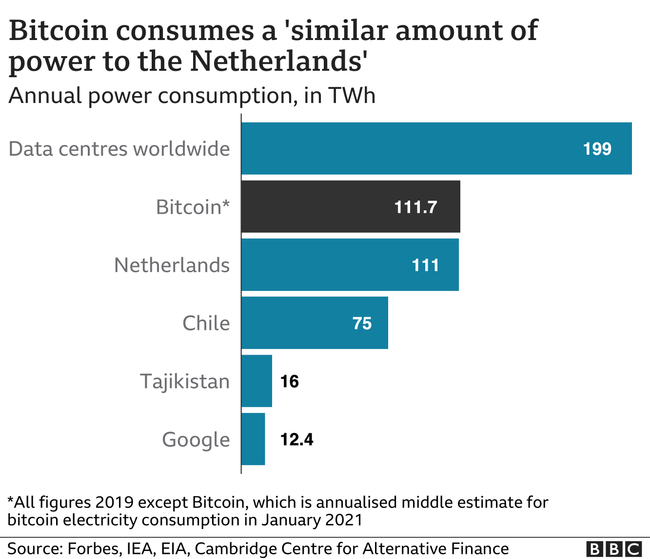
The TL;DR, as far as my understanding goes is that, broadly speaking, PoW is energy intensive and killing the planet, whereas PoS is… less problematic.
Let’s be clear: cryptocurrencies and tokens aren’t going away. And I see plenty of upside in terms of trading value independently of governments. The following definitions are taken from the glossary part of CoinMarketCap’s very helpful guide to crypto called Alexandria.
Proof-of-Work (PoW)
A blockchain consensus mechanism involving solving of computationally intensive puzzles to validate transactions and create new blocks.
Example: Bitcoin, Ethereum*, Zcash
*moving to PoS at some point in the future
Proof-of-Stake (PoS)
A blockchain consensus mechanism involving choosing the creator of the next block via various combinations of random selection and wealth or age of staked coins or tokens.
Example: Cardano, Flow, Polkadot
Other approaches
- Proof-of-Authority (PoA) — “A blockchain consensus mechanism that delivers comparatively fast transactions using identity as a stake.”
- Proof-of-Burn (PoB) — “A blockchain consensus mechanism aiming to bootstrap one blockchain to another with increased energy efficiency, by verifying that a cost was incurred in “burning” a coin by sending it to an unspendable address.”
- Proof-of-Developer (PoD) — “Any verification that provides evidence of a real, living software developer who created a cryptocurrency, in order to prevent an anonymous developer from making away with any raised funds without delivering a working model.”
- Proof-of-Replication (PoRep) — “Proof-of-replication (PoRep) is the way that a storage miner proves to the network that they are storing an entirely unique copy of a piece of data.”
- Proof-of-Spacetime (PoSt) — “In simplest terms, PoSt means that someone can now guarantee that they are spending a certain amount of space for storage.”
The legality of cryptocurrencies varies by territory, with India currently considering a ban. I predict that the difference in consensus models will be a determining factor, with a likelihood that Proof-of-Work models are banned in some jurisdictions because of their energy usage and associated impact on the environment.
Ultimately, for better or worse, once it’s got enough traction you can’t ban innovation from happening. Governments are going to want to issue their own stablecoin, meaning that they can’t completely ban cryptocurrencies and tokens.
That’s why I predict that Proof-of-Stake will be seen as a viable model without completely destoying the environment. I may, of course, be wrong on all counts. Caveat emptor ¯\_(ツ)_/¯
This post is Day 93 of my #100DaysToOffload challenge. Want to get involved? Find out more at 100daystooffload.com. Image via BBC News.
The post Proof-of-What? first appeared on Open Thinkering.A Year of Sheltering in Place
First, the summary for March: Ontario only recently lifted its “strict stay-at-home order” for Toronto, which most people interpreted as a strong request. Retail shops opened to limited capacity while restaurants still cannot accept dine-in patrons. The vaccination effort in Canada has only really gotten off to a start. While the government had set that expectation, it has been frustrating to see the United States jump out to a 30% to 7% lead as of today, March 13th, though we are told that this week marked the first major delivery of vaccines to provinces. If critics of the Ontario government are to be believed, the provincial authorities had planned on the federal government not delivering on its promise, and thereby blaming them for the ensuing mess. All signs point to that not being the case, with the feds more or less meeting the expectation and municipalities picking up the slack of setting up the infrastructure.
I didn't run much in the last two weeks of Feburary/first two weeks of March due to some achs and pains plus cold weather. I did set out to walk for an hour every Saturday and Sunday with shorter walks during the weekdays.
A Year of Sheltering in Place
My pandemic "anniversary" is today. The February 29th, 2020 headline that helped me realize that COVID-19 was here and a serious threat was the Toronto Star's “The Wayne Gretzky of Viruses” (see below).

Even so, at work, for the first two weeks of March, we would wash our hands when entering and leaving, and we had the feeling was we were doing enough. I worked from home on Friday, March 13th, as I normally would do so once a week or so. That day the rumours inside the company that they would assess the situation in a week after that, but my direct manager called it right away, urging us to work from home the following Monday. Every month on the 13th of the month, I would write a summary of how I felt and what I did. I've collected them all in once place, in chronological order, at justagwailo.com/sheltering-in-place.
Up until then, I was planning a big trip though the United States. It was to start in Kansas City, to catch a Royals game, visit the Negro League Hall of Fame, and stroll through downtown. Then I would go on to Las Vegas to take in a show (Penn & Teller) and a baseball game, and more or less that’s it. Then on to Portland, OR to visit co-workers and friends, with the possibility of swinging through Vancouver, B.C. on my way home to Toronto. Luckily I didn’t buy any tickets or book any hotels, as airlines in particular struggled to figure out how to compensate travellers who weren’t going on their planned trips.
My last haircut before sheltering in place happened a week before, so I had a couple of good hair months while many people were upset that barber shops and hair salons were closed. I joked to my sister that I was growing my hair out, though I realized this was a good opportunity, as not many people would be interacting with me for a while. I haven't gotten a haircut since. The current plan is to celebrate receiving a vaccination by waiting a few weeks and getting my mane shorn.
Things that have kept me sane:
- Watching a movie every Saturday night with co-workers, organized by one of our line managers at work. That was an inspired decision by her, and helped us get to know each other a bit better.
- Keeping active through #ActiveTO by biking the Lakeshore Boulevard Activeway in the warmer months and kickstarting running in the colder months.
- I initially doubled the amount of cooking I did per week, but reduced it slightly when it emerged that I was bored with 6 servings of a meal. I still cook more than pre-pandemic times, in part to eat healthy, but also as a way to pass the time because there are no events to go to.
- Weekly calls with my parents and getting closer acquainted with my siblings, all of whom are in British Columbia.
- Doing architectural tours of Toronto when the "strict stay-at-home order" was not in place.
- The two trips to Toronto Islands.
- The time fixing my blog (the one you're reading!) was worthwhile.
- Studying Chinese through Duolingo has been fun, with much of what I leared in university coming back to me. Don't worry, I'm aware of the implications of a white guy learning Mandarin, and my motivations are a bit different than the criticisms levelled against doing that.
- While not something I talked about much publicly, I have an interest in mindfulness, and a perk from my employer is a free account on Headspace. It has helped calm the nerves and give me strategies to avoid thinking about COVID-19 so much.
- Something I go back and forth about is drinking alcohol. My rule before the pandemic was no alcohol on a day before a work day. I've bent that rule to one beer an evening, and it has to be an Ontario craft beer. At the outset of the pandemic, I worried about having to go to the LCBO to stock up, but I caught wind of the Ontario Beer Delivery Index (after relying on a poorly-maintained page by a running group). A recent article in The Globe and Mail on Canadians' relationship to alcohol, especially during the pandemic, has put my decision in perspective.
- Two great purchases during the pandemic:
- Good speakers for my work area, though it will be my last Sonos purchase, most likely, as I'll replace the system entirely in the years to come.
- A sturdy lawn chair for sitting in the park. If I wasn't going to venture far, I still wanted to sit in the neighbourhood park and relax during sunny days, which Toronto has an abundance of.
Things I avoided:
- I didn’t attend many virtual events. At work I was on an always-on Zoom, so I didn't want to be reminded of that. That said, I don't think I suffered Zoom Fatigue, because videoconference has been a normal way of communicating for a while now. I did attend a virtual meetup or two, but I generally avoided lectures or live musical events, because they reminded me of missing the in-person events.
- I didn’t start any new hobbies. No sour bread baking for me. I attempted to commit to PC gaming with mixed results.
- I didn't binge-watch anything. I almost always had a full day at work on weekdays, plus an apartment to keep tidy, plus other volunteer commitments, so I was busy enough that I didn’t watch several episodes of TV shows. That’s to say I didn’t watch any episodic series. I watched all of The Crown one episode per day, and restarted watching The Expanse, also one episode per day. I plan on restarting watching Westworld, having forgotten where I left off (DVDs don’t keep track of the episodes you’ve watched like streaming services do). I assumed I would watch more movies during the week. The aforementioned Saturday movie night helped with that.
- I avoided bringing COVID-19 to somebody. Living alone means there was nobody in my household to bring it to, assuming I ever carried it. (The truth of the matter is I don’t know until I get an antibodies test, which I hope to get sometime before receiving a vaccination.)
- I did not go home for the holidays for the first time ever. Staying in Toronto over the Christmas holidays was the right decision. My family kept a Christmas Eve tradition alive, and I even cooked Christmas dinner!
Surprises:
- How busy the Icelandic Canadian Club of Toronto would be in hosting virtual events.
- How inactive the neighbourhood association became. We made our voices known in a virtual setting, though there was less activity in the neighbourhood to respond to. The local park’s redevelopment was postponed until this year, and few new developments were announced, though all developments proceeded, so we kept aware of those as best we could.
- I thought I would spend more time gaming, but that has not come to pass.
Frustrations:
- The way people were talking about the virus was as if COVID-19 were a death sentence. I don’t want to quote “survival rate” numbers because a) I don't think they're real and b) every single person who talks that way never cites their source. That said, at times, it felt like some people believed it killed everybody on contact. Also, we won’t know for some time what the effects of someone who has tested positive for it are.
- Dating felt next to impossible. I matched online with some women over the course of the year, but with no desire on my part to meet up.
- Having experienced a rough Valentine's Day just before the declaration of a pandemic, I set out (yet again) to do something about the isolation. An in-person counselling group was just the ticket, and after a few sessions, my mood improvded tremendously. It moved online due to the coronavirus, and was for the most part about coping with the anxiety introduced by the pandemic. I decided to skip it, joining the virtual sessions for guest speakers only.
- Not owning a car meant braving public transit, which at the outset was a great unknown, to venture out farther than city limits. I took transit maybe 2 or 3 times, just to run a couple of errands. I didn't get the sense that any other town had much to experience anyway, but I decided against hiking trips because I don't drive. Maybe I might be more comfortable this year as vaccines increase in uptake.
Regrets:
- I regret not joining a mutual aid society. That would have been quite the learning experience.
- A course on urban planning for non-planners that ran late at night in my time zone would have been bearable for the one day a week it happened, but I decided not to enroll. At least the course is recurring.
- Beyond the Black Lives Matter protests of the summer, which were eye-opening to me (someone who considers their eyes open), I don't think I learned much else over the course of the year. I read fewer books than hoped for, and even work seemed to stagnate (though my manager doesn't fully agree, and he has a point).
I had time to reflect on the things that were shut down that I missed, and what the pandemic revealed to be the reality:
| What do I think I miss | Reality |
|---|---|
| Concerts | I attended them alone, and never met anybody. It was annoying when someone nearby would be talking, or would walk in front of me (thankfully I’m tall), or would bump into me (I would be constantly making way for people). |
| Dining in restaurants | I dined alone about 95% of the time before the pandemic anyway. |
| Going to the pub | I do miss the pub nights when it would be a watch party or a meetup, especially if it was a basketball pool draft. One pub in particular was my go-to for a first date, since it was a public place with the privacy of the surrounding din. |
| Working in an office | I definitely miss that, having moved to Toronto for that experience. I’ve spent most of my career working remotely and it’s very isolating. None of the objections to aspects of working in an office have been compelling to me. |
I didn't come out of 2020 stronger, nor did many people I know. It was a downgrade of a year. There were signs of hope at the start of the pandemic and they've only grown in number. 2021 looks to be quite the improvement over the last one.
Your cohorts are just ethnic affinity groups. Change my mind.
(Update 28 Feb 2022: Berke and Calacci link)
(Update 9 May 2021: add another example)
The big question around Google
FLoC
is whether or not some of the FLoC cohorts, which are
group identifiers applied by the browser and
shared with all sites,
will
match up with membership in legally protected
groups of people. Will cohorts turn out to
be the web version of Facebook's old Ethnic Affinity
Groups,
also known as multicultural affinity groups
?
2022 update: Browsing behavior correlates with race,
but cohorts do not....We did not find with our t-closeness
analysis that the likelihood of correlating racial background
with cohorts, using the FLoC OT algorithm, was any greater than
chance.
(Privacy Limitations Of Interest-based Advertising
On The Web: A Post-mortem Empirical Analysis Of Google's
FLoC
Facebook limited the ability of advertisers to exclude members of these groups in 2018 and made many of the groups unusable for targeting at all in 2020. But FLoC is a little different. It assigns numbers, not names, to cohorts, so the unsolved problem is how to tell which cohorts, if any, are actually ethnic affinity groups. One issue on GitHub asks,
If we do have an issue where racially specific targeting is incidentally created by the ML system what happens when advertisers target for or against it and who ends up responsible?
FLoC developers are planning to use sensitive-page classifiers to check which cohorts match up to sensitive groups of pages in web history. Unfortunately, checking page content is not going to give them protected group membership for the users. A simple US-based example is school and neighborhood patterns. A school that is mainly attended by members of a single ethnic group is going to have page content that's mostly the same as all the other schools in the district. The schools all have similar events and play the same sports, but serve different groups of students and parents. So, even though the content is non-sensitive, the cohort is. And local stores with similar merchandise in different neighborhoods are going to get different ethnic affinity groups, I mean cohorts, of visitors. Content in language A could be completely non-sensitive, and local content for region B could be completely non-sensitive, but the cohort of people who use language A in region B could be highly sensitive.
So it might look like nobody will be able to tell which cohorts are really ethnic affinty groups until some independent data journalism site manages to do a study with a panel of opted-in users. This would be the kind of AI ethics research that is bad for career prospects at Google, but that independent organizations can often come up with the funding to do.
But one company doesn't have to wait for the study and resulting news story. Facebook has enough logged-in Google Chrome users that they could already know which FLoC cohorts match up to their old ethnic affinity groups. If a brand buys ads on the open web and relies on FLoC data, Facebook can see when the brand is doing crimes. This doesn't mean that Facebook will disclose the problem, since it gives them something to hold over the brand. No more making any stink about ad metrics or Facebook Groups IRL get-togethers. The extra risk for the advertisers means lower expected revenue for ad impressions tied to FLoC—because of uncertainties that are hard for anyone else to see.
Inspiration for the title for this post:
Your probabilistic ID is just fingerprinting. Change my mind.
— Stephanie Layser (@slayser8) January 27, 2021
Bonus links
How Facebook got addicted to spreading misinformation
Guest post for #OERxDomains21 : Being in the OER x Domains Space
As part of the build up to the OERxDomains21 conference next week, members of the conference committee have been writing a series of guest blog posts. My post has just been published and you can read it over on the conference blog here.
In the post I share some of my thoughts about time and conferences. Why it’s hard to find time to “conference” (particularly during lock-down), why it’s important to find the time to “conference” and a little secret about some of my best times at conferences.

Learning and teaching content: requirements and reshaping the marketplace
"There is absolutely no question about it," writes Caren Milloy. "the current e-book marketplace needs a fundamental shift to move to a more transparent and sustainable footing." That's the lesson to be drawn from "the sheer frustration voiced through the #ebooksos petition" (also on Twitter). At the same time, the main message we hear from publishers is that a sustainable business model "isn’t something that will be solved quickly, and requires a concerted, collaborative effort across the community." Maybe we should stop trying to think of ways "to help shape a better marketplace" and start thinking of electronic books, at least in research and education, as infrastructure, not products. Forget about 'rebalancing' and approaches that 'inject choice'. Those are sops to satisfy entrenched interests, but don't portend real change. Start with the presumption that these resources will be free for the people who need them, and them work backward from there.
Web: [Direct Link] [This Post]StatsCan’s COVID impact report: same storm, different boats

Many people have said that while we’ve all been in the same storm with COVID, we’ve been in our own boats. People have had very different experiences during the past year, based on their gender, race, geographic location and more.
Today Statistics Canada released a report about the social and economic impacts of COVID, which includes some disaggregated data. Some of the findings aren’t surprising:
- In Montreal and Toronto, mortality rates are higher in areas with greater concentrations of Black Canadians
- Indigenous groups are experiencing greater health impacts
I wish these findings were written with an equity lens. Systemic racism, colonization, poverty, income inequality, employment precarity, access to clean water and adequate housing are all connected to who was hit hardest by COVID. Naming these factors means that we need to own that our current systems and policies are not working for everyone. It means that we need to take responsibility for advocating for change.
I’m glad that we’re starting to see disaggregated data in Canada, so that we have data to better understand systemic inequality and so that we can make better policy to change this.
Still, I want so much more. I want to see data presented in an intersectional manner. I suspect COVID has hit women of colour hardest, especially Filipino, South Asian and Black women who work in health care. Without quantitative data it’s hard to do a systems level analysis to understand who is most impacted.
I want language that is in plain English. Initially I thought that “not indigenous or a visible minority” meant white people, but journalist Jessica Galang pointed me to this StatsCan page:
The “Not a visible minority” category includes persons who gave a mark-in response of “White” only; persons who gave mark-in responses of “White and Latin American”, “White and Arab” or “White and West Asian” only; persons who gave a mark-in response of Latin American, Arab, or West Asian only, along with a European write-in response; and persons with no mark-in response who gave a write-in response that is not classified as a visible minority. As indicated previously, this category also includes Aboriginal persons.
This definition is super confusing.
I want this data presented in an accessible way. This horizontal bar graph graphs race categories, citizenship categories, educational achievement categories, age group categories, and sex categories together. From a methodology perspective I find this very confusing. This graph doesn’t have alt text, so it excludes screenreader users. There’s a data table below this graph is accessible, but the graph isn’t. I don’t think this meets the standards in the Accessible Canada Act, which is especially disappointing from a federal government department.
I want to see more data along other dimensions of diversity, especially disability and sexuality. From listening to people around me, I know that COVID has impacted people with disabilities harder than people without disabilities. I wonder if queer and trans people have been impacted in a different way too? Without data we don’t really know, and more importantly we continue to develop policies that don’t account for systemic ableism and hetrerosexism.
Finally, I want to rethink the race categories in Canada to use language that is respectful and reflects the ways that communities talk about themselves. I’m a mixed race person. My mom in Japanese-Canadian and my dad is white, of Scottish and Irish ancestry. I’m a woman of colour. I hate the phrase visible minority as it centers whiteness and is colonial. I know this isn’t easy for so many reasons and it makes it harder to map historical trends.
If you care about how data can be used in ethical ways to highlight inequality and as a tool for systemic change, check out The BC Office of the Human Rights Commissioner’s report on Disaggregated demographic data collection in British Columbia: The grandmother perspective. The phrase “the grandmother perspective” came from Gwen Phillips of the Ktunaxa Nation, who is a BC First Nations Data Governance Initiative Champion. This phrase speaks to the importance of relationship. Disaggregated data is a tool to help us move towards equality and justice. She says, “we are not measuring race, we are measuring racism. Racism is a systems failure; that must be made clear when talking about race-based data.”
The post StatsCan’s COVID impact report: same storm, different boats appeared first on Tara Robertson Consulting.
Just Launching: My Ink Stained Fingers A New Podcast On Writing And Content Marketing
One Year / One Decade
An inbox of newsletters
My inbox* is filled with newsletters.
There was a time in the not-too-distant past when I was able to stay on top of things using my RSS reader, by following blogs that updated regularly. My friends wrote blog posts. People I wanted to learn from updated their personal sites. Organizations I wanted to follow updated their blogs. Subscribing to a bunch of blogs and personal sites was all I needed to do to get a daily fix on all the happenings I needed to know.
At some point in the past few years, everyone started having a newsletter, and personal sites and blogs started to disappear. I’m not sure exactly when that was, but I remember that instead of following sites in my RSS reader, I started having to subscribe to newsletters to hear from the people I cared for and wanted to learn from.
I don’t blame people for using newsletters to share their thoughts: it’s immensely easier for people to put together a newsletter than it is to start a personal site—and especially a lot easier to make money selling newsletter subscriptions. It’s also a lot easier to make sure people are reading your stuff through a newsletter, because it arrives in their email inbox. People don’t use RSS readers—I’m happy to go on about how the death of Google Reader started the decline of RSS and led to this newsletter boom—but use email every day: if you want to reach them, you need to be in their inbox.
I still believe in the power of RSS and personal sites for sharing information, though, despite the fact that we are in a newsletter world. I think if we make it easier for people to share their thoughts on their own sites, and if we made it a lot easier for people to subscribe to and follow their favorite writers without having to clog up email inboxes, the personal site and RSS could have a revival.
Until then, my inbox is filled with newsletters.
I was thinking about this today because I remembered that I once used to send out a newsletter myself—a fortnightly collection of links called Weekend Reading—but I haven’t sent out a missive in some months. I haven’t forgotten to post the links, after all: they are still posted regularly (not fortnightly, but still somewhat regularly) on my personal site, but I have forgotten to send out the newsletter every time I publish the post on my site. Today, I’m resurrecting the newsletter—many of you may be reading this in your inboxes instead of on my site right now—with the realization that until we solve easy discovery of personal sites, landing in your email might be the best way to reach you right now.
All that to say: I’m consistently honored and flattered that you decide to read my musings, whether you find them on Twitter, in your inboxes, or by following my blog. Thank you for reading and for engaging—and if you have a personal site or newsletter, let me know. I’d love to subscribe.
* Proverbial inbox, that is. I subscribe to newsletters using Feedbin so that I see them in my RSS reader instead of actually in my email inbox, but the sentiment is the same.
If you’ve missed the past few Weekend Reading posts because I haven’t sent them via newsletter, you can find a few of them here:
- A name as a reminder of who we can be
- A cup of chai in the afternoon
- Uni uni rotli ne karela nu saak
- Every day is not the same
- Sparkles in the snow
Two poems
Our Love on the Other Side of This Border
By Anaïs Deal-Márquez
Maybe I would have seen you trip
over the steps in the patio in between
classes, or we would have met on the
soccer field covered in mud and you
would have asked my name, that crooked
smile spreading from your eyes to your
mouth. Maybe I would have laughed.
Maybe, we would have had a nieve in the
plaza, and you would have held my hand
after folklórico or at a fandango where I
was learning to dance faster than my
adrenaline. Maybe, you would have given
me a bouquet of mango con chile y limón,
or elote con queso and we’d count all the
ways cuetes go off in this pueblo, and would
walk the feria at night wrapped up in blankets
drinking atole. Maybe, we would have fought
over the meaning of God, maybe, that danzón
after drinking the toritos would have made me
cry. Maybe, I would have broken your heart over
a plate of tamales and ponche, or maybe you
would have cut me off with a joke. But maybe
this land would have been large enough for our
hearts to grow, the sun would feel different on
our skin and the mercados with the viejitas
would give a calmer pace to our lives. Maybe our
cuts would be different here, with enough
medicina to move through salt water. Maybe our
roots would allow our bones to be enough.
My mother’s nerves are shot—
By Omotara James
a nerve is a shot. A shot
is an arch. My mother is an archer.
The archer breaks the dead branch dead.
Dead branches rot. Rot from the bark.
My mother’s nerves bark: shot
through loss. Death peels her nerves.
Death is an archer. Death shoots rot:
just misses her. I see her tremble.
Moss greens her bark. Greens where she
trembles. Where there was death, fruit grows.
The fruits of death. Fruits moss the branches
through the blinds where she trembles still.
Some links
“There is an exquisite vulnerability to dropping off your child at day care when they’re very young, and sharing that experience with people you barely know erodes our boundaries and brings us closer together.”
“The convenient thing about marriage is that it does wonders to mollify the tawdriness of the affair that preceded it.”
“To reclaim that space in which to find the connections that matter, we need something more than slight improvements in our individual workplaces or even massive overhauls of labor laws, though we need both of those things desperately.“
“For years, I’ve regretted the spotlight I put on other people’s mistakes, as if one day I wouldn’t make plenty of my own.“
“I don’t mean that accomplishment and ambition are bad, but that they are simply not the drivers of our happiness. By the time many people figure this out on their own, they have spent a lifetime checking things off lists, yet are unhappy and don’t know why.”
“More than ever, florists are on the front lines of their customers’ rawest emotions: agents of accord brought in to soothe suffering or loneliness with fragrant symbols of renewal.”
“The real “gap” revealed by Power Gap is precisely the exclusions it takes for granted: that we don’t know how much the majority of women, especially racialized women, make in this country.”
““Good morning” has a sort of powerful nostalgia for a world I’m not sure I’ve seen, but I like to imagine — a way of recognizing each other in a brief enclosure that suggests optimism, a brightness.”
“Many in the business community tend to dismiss the psychological toll from e-mail as an incidental side effect caused by bad in-box habits or a weak constitution.“
“Florida as we know it today exists because of citrus.”
An Instagram account featuring brutalist architecture recreated with Lego blocks:


A supercut of the supermoon used in movies and television:
Related, a supercut of typewriters used in movies and television:
A few more:
- The 25 Greatest Art Heists of All Time
- Blackout Poetry Maker
- An RSS Feed with New Releases from Your Favorite Authors
- What’s the most-filmed bookstore in the world?
- The 10 biggest archaeology discoveries of 2020
Get weekend reading posts in your inbox: subscribe to the not-so-regular newsletter.
The Proud Youth
A new work from the Vancouver Sculpture Biennale has appeared on the False Creek seawall at the foot of Drake Street – a shocking bit of red against the aquamarine palette of the city.
The Proud Youth by Chinese artist Chen Wenling is named after a popular Wuxia (Martial Heroes) novel, The Smiling, Proud Wanderer (Xiao Ao Jiang Hu 笑傲江湖) – literally to live a carefree life in a mundane world of strife. It’s always read as a political allegory.
From a distance, it’s initially difficult to make out what’s going on.
Close up, “the red figure, naked and free, fully reveals his honesty and fearlessness. The cheeky expression and arresting pose are a celebratory call to the audiences, inviting them to embrace their inner child.”
Or, of course, to photograph it. If not already one of the most popular Instagram locations in the city, it soon will be.
In another era (c. 1966, in front of the Vancouver Sun building*), this work would shock (naked boy, penis!). Today, not so much.

Along with another popular piece brought to the city by the Biennale (A-maze-ing Laughter, at English Bay), there are now two contemporary works that explore the Asian body.
“The bright red colour signifies not only auspiciousness in Chinese tradition, but also a testament to the artist’s fiery attitude towards life. Chen Wenling’s art often deals with three themes: personal experience, human desire, and community imagination.”
Chen’s bio reveals how much he’s representative of the growth and change in China itself.
*Barrie Mowatt indicated “The Family” will be reinstalled in late July in the parking lot adjacent to the Granville Island Market and Arts Club.
Travelogues, Ten Years On
Trend of the Day: NFT
NFTs—Non-Fungible Tokens—are hot shit. Wikipedia explains (at that link),
A non-fungible token (NFT) is a special type of cryptographic token that represents something unique. Unlike cryptocurrencies such bitcoin and many network or utility tokens,[a], NFTs are not mutually interchangeable and are thus not fungible in nature[1][2]
Non-fungible tokens are used to create verifiable[how?] artificial scarcity in the digital domain, as well as digital ownership, and the possibility of asset interoperability across multiple platforms.[3] Although an artist can sell one or more NFTs representing a work, the artist can still retain the copyright to the work represented by the NFT.[4] NFTs are used in several specific applications that require unique digital items like crypto art, digital collectibles, and online gaming.
Art was an early use case for NFTs, and blockchain technology in general, because of the purported ability of NFTs to provide proof of authenticity and ownership of digital art, a medium that was designed for ease of mass reproduction, and unauthorized distribution through the Internet.[5]
NFTs can also be used to represent in-game assets which are controlled by the user instead of the game developer.[6] NFTs allow assets to be traded on third-party marketplaces without permission from the game developer.
An NPR story the other day begins,
The artist Grimes recently sold a bunch of NFTs for nearly $6 million. An NFT of LeBron James making a historic dunk for the Lakers garnered more than $200,000. The band Kings of Leon is releasing its new album in the form of an NFT.
At the auction house Christie’s, bids on an NFT by the artist Beeple are already reaching into the millions.
And on Friday, Twitter CEO Jack Dorsey listed his first-ever tweet as an NFT.
Safe to say, what started as an Internet hobby among a certain subset of tech and finance nerds has catapulted to the mainstream.
I remember well exactly when I decided not to buy bitcoin. It was on July 26, 2009, after I finished driving back home to Arlington, Mass, after dropping off my kid at summer camp in Vermont. I had heard a story about it on the radio that convinced me that now was the time to put $100 into something new that would surely become Something Big.
But trying to figure out how to do it took too much trouble, and my office in the attic was too hot, so I didn’t. Also, at the time, the price was $0. Easy to rationalize not buying a non-something that’s worth nothing.
So let’s say I made the move when it hit $1, which I think was in 2011. That would have been $100 for 100 bitcoin, which at this minute are worth $56101.85 apiece. A hundred of those are now $5,610,185. And what if I had paid the 1¢ or less a bitcoin would have been in July, 2009? You move the decimal point while I shake my head.
So now we have NFTs. What do you think I should do? Or anybody? Serious question.
A wider view

For 20 bucks or less, nowadays, you can buy an extra-wide convex mirror that clips onto your car’s existing rear-view mirror. We just tried one for the first time, and I’m pretty sure it’s a keeper. These gadgets claim to eliminate blind spots, and this one absolutely does. Driving down 101, I counted three seconds as a car passed through my driver’s-side blind spot. That’s a long time when you’re going 70 miles per hour; during that whole time I could see that passing car in the extended mirror.
Precious few gadgets spark joy for me. This one had me at hello. Not having to turn your head, avoiding the risk of not turning your head — these are huge benefits, quite possibly life-savers. For 20 bucks!
It got even better. As darkness fell, we wondered how it would handle approaching headlights. It’s not adjustable like the stock mirror, but that turns out not to be a problem. The mirror dims those headlights so they’re easy to look at. The same lights in the side mirrors are blinding by comparison.
I’ve been driving more than 40 years. This expanded view could have been made available at any point along the way. There’s nothing electronic or digital. It’s just a better idea that combines existing ingredients in a new way. That pretty much sums up my own approach to product development.
Finally, there’s the metaphor. Seeing around corners is a superpower I’ve always wanted. I used to love taking photos with the fisheye lens on my dad’s 35mm Exacta, now I love making panoramic views with my phone. I hate being blindsided, on the road and in life, by things I can’t see coming. I hate narrow-mindedness, and always reach for a wider view.
I’ll never overcome all my blind spots but it’s nice to chip away at them. After today, there will be several fewer to contend with.
File:A wider view at sunset – geograph.org.uk – 593022.jpg – Wikimedia Commons
4 takeaways from Dr. Bonnie Henry's new book | CBC News
| mkalus shared this story . |
The City of Vancouver had just announced an unprecedented shutdown of all restaurants and bars to stop crowds from spreading COVID-19.
Henry recalls how she was struck by a sudden need to offer people hope. As she scribbled her notes, she jotted down the words "kindness," "calm," and "safe."
"As the minister and I … made our way through the underground passage to the press room at the legislature, these three words were floating around in my head," she recalls in her book, Be Kind, Be Calm, Be Safe, released this week by Penguin Random House Canada.
At the podium that day, Henry glanced down at her notes and capped her announcement with that mantra.
It would later become a rallying cry for many in British Columbia during the pandemic.
Henry's account of that moment are among some of the new insights in her book, which recounts her response to the pandemic in March 2020.
Co-authored with her sister Lynn Henry, a publishing director at Knopf Canada, the book has drawn scrutiny for the timing of its release — mid-way through the pandemic — and the appearance of gaining profit. (Both sisters have said they donated their advances to charities.)
Here's what we learn in the book's 216 pages.
Emphasis on communication
Henry dedicated much thought in the early days to how she would communicate quickly changing information to the public.
She devised the structure for B.C.'s briefing format first introduced in January 2020. Henry emphasized consistency and limiting the number of speakers, and asked that no one sit behind a table.
"We would stand. And there would only be the two of us as the front-people, that's all."
Henry suggested she address health issues and directives, and Dix would handle policy and politics.
Dix agreed to the briefings, but questioned who should speak on the public health and science.
"I figure this is because we'd been a bit out of step over our overdose crisis communications, and we hadn't worked together long enough to build the trust between us that there is now," Henry said.
Later in May, Henry texted her sister for help coming up with a metaphor that would convey the current stage of the pandemic.
She wanted to avoid military imagery and the sisters agreed a word like fire had particular meaning in B.C. They settled on weathering a storm, an expression Henry would later use repeatedly in briefings.
Personal toll
Some of the book's revelations come from Henry's sister, Lynn, who flew to Victoria from Toronto on March 12 for a long-planned trip.
Lynn had wondered whether to cancel the trip but had been reassured by sister. Henry would later admit she needed family during that time.
Shortly before Lynn's arrival, Henry received a phone call at home from an anonymous man. The man recited her address and said he would appear at her door. (Henry would reluctantly ask for security, her sister said.)
Lynn ultimately stayed at Henry's home for a month and observed the toll the all-consuming work took on her sister.
"Imagine my forehead tattooed with a big V for virus," Lynn recalled Henry telling her. "That's my whole life now."
Lynn described finding her sister lying on the living room floor in her work attire after a briefing. One one rare occasion, the two tried watching a movie together.
"I saw maybe a quarter of that," Henry admitted once the movie ended.
Henry also described fitful sleeps.
"I was having dreams where I was a maypole and people were dancing around me, wrapping me in the ribbons of all the many, many COVID-19 issues that needed solving."
'Least restrictive means'
Henry said her overriding principle following her experience with the 2003 SARS outbreak was employing the "least restrictive means," or doing just what was needed to prevent illness and death.
"There's science, and there's emotion," Henry's sister recalled her saying. "The scientific facts are one thing; the social choices and consequences are another. We need to consider both."
But in the early days, with little known about the virus, Henry understood the province would have to seemingly overreact with mass shutdowns or risk overwhelming the health-care system.
Henry said it was a "haunting realization."
That reality materialized after she visited a restaurant on Monday, March 16 — her last dining-in experience in months — and realized the space still felt too bustling. She acknowledged to her sister on her walk home that she would have to shut down restaurants.
After Henry ordered mass closures, she recounts how people wrote letters accusing her of ruining their lives and businesses.
"All of this seeped into my heart and soul and left me numb."
She immediately began to think of how to keep the fewest possible restrictions in place for the shortest amount of time, a principle that would guide her later in the pandemic.
'Our pandemic'
From the start, Henry refused to employ practices adopted in some other provinces.
Provinces like Ontario had released modelling that estimated the number of deaths it would see from COVID-19. But Henry said she and her team unanimously rejected standard models that projected deaths based on statistics from other places.
It was a decision, she said, that put her at odds with most others in Canada and elsewhere in the world.
Henry felt B.C.'s ability to prevent transmission would dictate its number of deaths, citing the response as "our pandemic."
"This was a position I would stay strong on. Every single death was a tragedy I felt deeply," she said.
"We could not in any way claim success if our rate of death was merely lower than what other places had experienced."
Lynn noted her sister "wouldn't be forced into following suit" just because projections had been made elsewhere, a belief that would hold true later in the pandemic.
Everything you need to know about at-home COVID testing
COVID vaccination efforts continue to gain momentum both in the US and around the world but that doesn’t mean we’re out of the pandemic woods just yet. Regular testing remains an important factor in helping slow the spread of the disease but has typically required a trip to your doctor or local clinic. Luckily, that’s no longer the case. In recent months, the FDA has approved a number of COVID tests which can be administered in the comfort of your own home and return results in a matter of minutes rather than days.
If you’ve taken an in-person COVID test in the last year, your nasal swab sample was likely diagnosed using a real time reverse transcription–polymerase chain reaction (real time RT–PCR), which is among the most accurate and widely used lab-based methods for detecting viral pathogens such as Zika, Ebola and coronavirus.
The coronavirus only contains single strand RNA for genetic material which, unlike DNA, cannot be independently reproduced without the assistance of a host. As such, the virus must infect and repurpose healthy cells in order to make more of itself. RT–PCR mimics this process by first converting any coronavirus RNA present in a given sample into DNA — hence “reverse transcription” — then creating billions of copies of the genetic material and marking them with a fluorescent dye for identification.
The process is an offshoot of the more general PCR method, which is used to detect pathogens whose genetic material comes in DNA form and therefore doesn’t need amplification. This process is sensitive and highly accurate, albeit time-consuming, but does enable pathologists to detect a coronavirus infection in its early stages since only a minute amount of initial RNA is required. While the RT–PCR technique poses a low chance of outside contamination, its capability is limited in that it can only spot the coronavirus when it’s currently present in a sample. This method cannot tell if someone has been previously infected.
Some at-home tests rely on a similar process called isothermal amplification. Like PCR, isothermal amplification generates numerous copies of the coronavirus’ genetic material to aid in detection. Though IA is not as sensitive as the lab-based PCR method, it’s more accurate than other at-home tests which look for antigens — bits of coronavirus proteins that provoke the body’s immune response.
For example, an antigen-based BinaxNOW test correctly detects the virus only about 64 percent of the time in symptomatic people. That figure drops to just 35 percent in asymptomatics. Because antigen tests don’t include a reverse transcription phase, they are faster and less expensive to perform than PCR- and IA-based methods but are less accurate and return higher rates of false negatives — especially among people who have only recently been exposed.
The antigen method provides more of a general estimate as to how contagious you are, Dr. Gigi Gronvall of Johns Hopkins University told the NYT. “If you test positive on that, you really need to isolate,” she said.
So, if you are asymptomatic, a PCR or similar molecular-based test should be sufficient. If you suddenly find that you can’t smell or taste anything, pick up either a PCR or the most sensitive antigen-based test you can find. If you test positive, regardless of the type of test you use, isolate yourself immediately and call a doctor.
So far, only a handful of at-home tests have earned Emergency Use Authorization (EUA) from the FDA. EUAs are otherwise-unapproved treatments, tests or medical countermeasures that have been allowed to sidestep the formal (and lengthy) FDA approval process in response to life-threatening health crises like the one we are currently facing.
The Ellume COVID-19 Home Test is the first at-home test available without a prescription. It is antigen-based and takes 15 minutes to return a result. You’ll have to swab your nose then drop the sample in a desktop analyzer along with some processing liquid. Once the device does its thing, the results are transmitted via Bluetooth to your smartphone. That data is also shared through a secure, HIPAA compliant cloud connection to health authorities to aid in outbreak mapping. The test is expected to cost around $30 though the company has yet to announce where and when it might become available. The Ellume test displayed 96 percent accuracy in people ages 2 and up during its US clinical trial.
The Biden administration recently announced a $231.8 million deal with the Australian company to purchase 8.5 million units of the test. Ellume “will be delivering 100,000 tests per month from the Australian manufacturing facility until the U.S. facility is built,” a company representative told NPR. “At full capacity, the U.S facility will be able to produce up to 19 million tests per month. The 8.5 million tests for the US government is a portion of the overall manufacturing." However, not all health professionals are excited about this public-private partnership, with one going so far as to characterize the effort as “a spit in the ocean.”
The Cue OTC Test will also soon be available over the counter but unlike the Ellume, it uses a nucleic acid amplification test (similar to PCR) for improved accuracy and generates results in 20 minutes. Per a recent press release, “in prospective studies to evaluate the use of the Cue OTC Test, the results were 97.4% agreement for positive cases and 99.1% agreement for negative cases compared to the results from a highly sensitive EUA PCR laboratory-based test.” The company has not yet announced pricing or availability.
Abbott's BinaxNOW COVID-19 Ag Card Home Test isn’t just a mouthful to say, it’s a whole process. After answering a series of screening questions via the eMed digital health website, Abbot will deliver a test to your home. You’ll then be connected with a “telehealth professional” who will guide you through the sample collection process. Once you drop your sample into the analyzer, you should get your results in about 15 minutes through the Navica smartphone app. The Abbot test costs $25 and is only available with a prescription.
The Lucira COVID-19 All-In-One Test Kit costs $50 and, like the Cue, uses molecular tech. As with BinaxNOW, it requires a prescription so your doctor will have to order it on your behalf. The Lucira test is intended for use by people ages 14 and up, it returns results in 11 to 30 minutes.
If you don’t mind waiting a bit for your results, Amazon is selling Dxterity mail-in tests. Each one costs $110 and requires you post it to the company’s LA-area lab for diagnosis. On the plus side, this test is saliva-based so you won’t have to impale your nasal cavity with a Q-Tip to collect your sample. Results will be available within 24 - 72 hours through the company’s web portal.
Similarly, the CRL Rapid Response COVID-19 Saliva Test can be purchased from the Walgreens website for $119 and returns results in a scant 24 - 48 hours. If you test positive, the company will have a telemedicine rep reach out to discuss the diagnosis and potential next steps.
Though all of the fully at-home tests showed 90 percent-plus accuracy during their clinical trials, those figures can fluctuate when regular folks perform the tests themselves, so don’t treat a negative result as some license to get out and mingle. "When manufacturers are preparing data to submit to FDA, they are conducting studies under very specific, highly controlled conditions that optimize the performance of the test,” Kelly Wroblewski, director of infectious disease programs at the Association of Public Health Laboratories, told the AARP.
Google discounts Pixel 4a 5G to $629 in Canada
Google has dropped the outright price for the Pixel 4a 5G by $50 in Canada, bringing the cost of the phone down to $629.
The Pixel 4a 5G was Google’s mid-tier offering in 2020, but there’s a lot more to this device than meets the eye. For instance, it uses the same chipset as the higher-end Pixel 5, which means both phones should perform the same. The 4a 5G and the Pixel 5 also share the same camera hardware.
The 4a 5G falls behind because it has a plastic back, a 60Hz screen, and only 6GB of RAM. That said, in practice, both phones should feel somewhat similar.
You can buy the Pixel 4a 5G from Google right now for $629. It comes in ‘Just Black’ and ‘Clearly White.’
The Pixel 5 costs $799 from Google and the lower-end Pixel 4a costs $429.
Source: Google
The post Google discounts Pixel 4a 5G to $629 in Canada appeared first on MobileSyrup.
A real heatmap
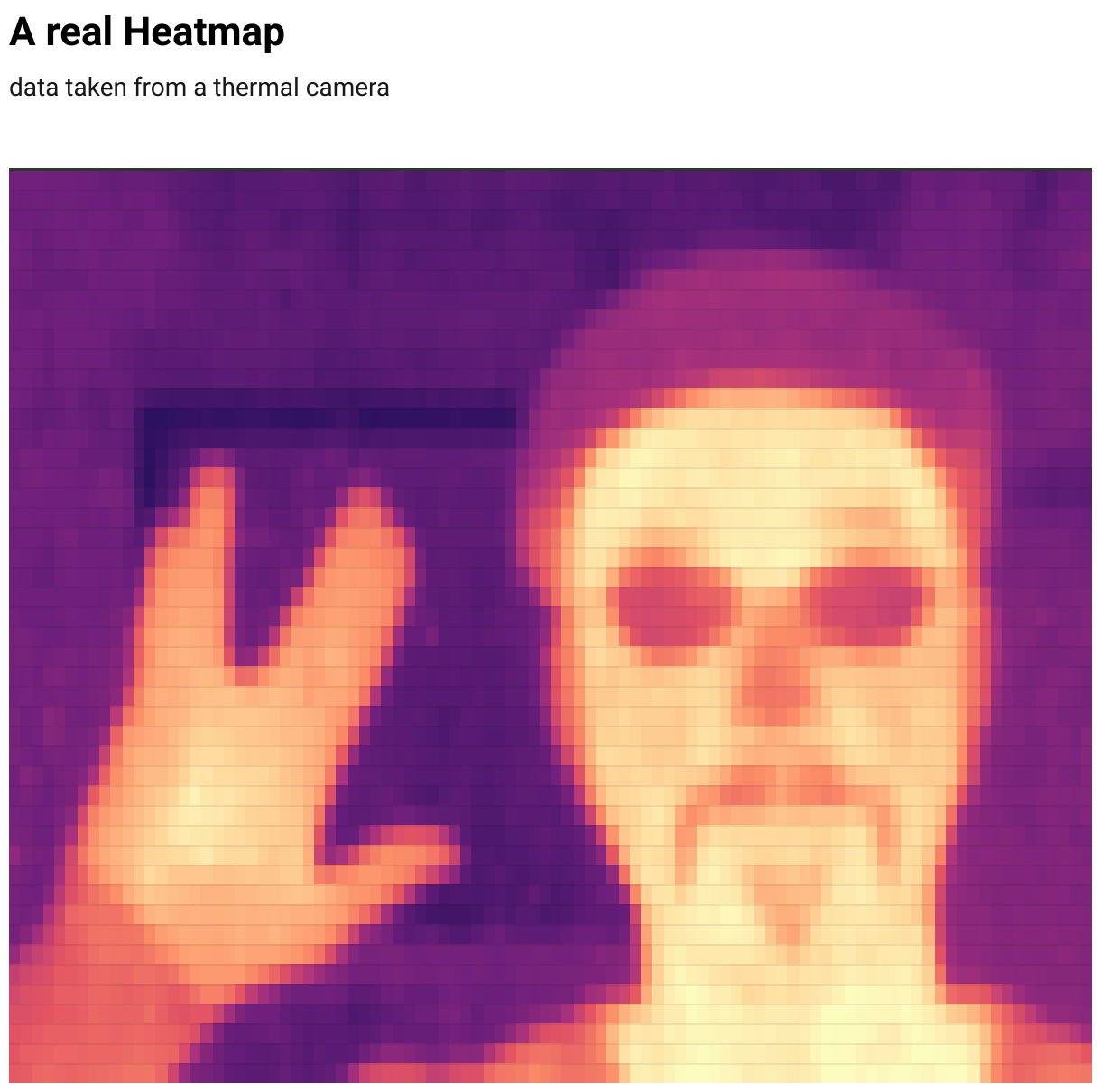
Hi, this is Hendrik, backend developer and system administrator at Datawrapper. Lately, I’ve noticed some impressive Datawrapper tables for which our users used the fairly new heatmap feature. I somehow got stuck at the term heatmap – and decided to take a heatmap of myself.

Before we dive into the topic, I’d like to answer a few questions that might arise while looking at the chart:
- Yes, this is a real thermal image. A good hint for that is my (outstanding) nose being colder and thus darker than the rest of my face and my fingertips are colder than the palm of my hand.
- No, I’m not wearing sunglasses. These are my normal glasses I use for reading. While they are transparent to high wavelength visible light, they are blocking low wavelength heat radiation. This is how a greenhouse (and sadly global warming) works. Without glasses, I would look rather weird because my eyes have the same temperature all over and would be hardly visible.
- Yes, I’m wearing a hat indoors. This is because my hair seems to be bad in isolating my head, and I didn’t want to appear like a bald head man wearing sunglasses.
Speaking of isolating fur, here’s a thermal picture of my cat:

Now that the confusing thoughts created by the chart have been cleared up and we are done with the cat content, we can finally get on topic.
Why are they called heatmaps?
A heatmap in data vis terms doesn’t show faces or cats – but it also uses darker or brighter colors to make one dimensional (as in one value per field) data points visible in a regular grid (tables in Datawrapper).
The grid cells are then colored based on the cell’s value. Thermal image creators often use a coloring scheme that somehow resembles fire, or at least makes us think of cold and hot areas.
So while I believe thermal imaging is a bit older than heatmap style visualizations, the methods and the use case are very similar. Thermal imaging is basically a special case of heatmap visualization. (Interesting clusters of data are also often referenced as hot spots in visualization.)
I wanted to point out this similarity by creating a Datawrapper table based on thermal image data, so that the resulting table still looks like a thermal image (you can even hover over the fields to see the data).
The use of false colors
You might ask why it’s a common practice to use a color ramp (e.g., a gradient from bright yellow via red to dark purple) instead of just mapping the values to greyscale brightness (white via grey to black).
The answer to that question lies in the way our eyes work and how screens present information to our eyes.
While our eyes enable us to see from a range beginning in pale moonlight up to bright sunlight, we can not see intensities in that full range all at once. We get blinded by bright light.
Our screens are only good for a fraction of that range - and that range is typically split into 8-bit steps. That makes 256 possible intensity values with a single step (e.g. from 127 to 128) very hard to distinguish. Screens that can display more than 8-bit intensities are specially designed to make distinguishing steps in smooth ramps even harder.
This is exactly what we do not want for visualization!
We want to have a dynamic range that is by far higher than 8-bit while maintaining the ability to identify patterns of only subtle changes. Common HDR techniques taken from imaging do not help here because they work by exaggerating local contrast. They flatten out global changes in illumination and focus on local details.
This is where the different hues come in for visualization! We can use the hues to enhance the range of data our eyes can distinguish.
Here is an example of how using different hues helps us preserve the global distribution of values (not using HDR filters) by not only changing the brightness of the colors, but their hue too.

Both parts of the show my CPU glowing with heat through the keyboard of my laptop. The upper part uses plain intensity mapping; the lower part uses a color ramp like Datawrapper heatmaps provide. Now imagine looking at this image in bright sunlight, or at an old screen with bad contrast. The keyboard keys will be clearly better distinguishable in the colored parts.
I’ll leave you with another example of how color ramps help to improve perception. This is a so-called depth-image – not a thermal one this time – of a miniature model of the medieval city of Magdeburg (here’s a video of that model). The rainbow colors encode the distance to the camera. I took the image from a very flat angle, so the distance grows the higher you get to the image’s top.

Without these rainbow colors, the buildings would be tough to recognize. Their variance in depth is very small compared to the global increasing distance.
I hope I was able to raise your interest in adding some heat(maps) to your tables. If you have any questions, leave them in the comments. We’ll see you next week!
Traffic and collisions in Vancouver down by half in early days of pandemic
| mkalus shared this story . |
The City of Vancouver has released transportation trends for last year, showing traffic plunged dramatically in April at the beginning of the COVID-19 pandemic and the number of traffic-related emergency room visits dropped by more than half.
The city's transportation division collected the data and examined how the daily routines of Vancouver residents were affected in 2020.
It found vehicle traffic decreased to its lowest level in the first week of last April and was at 50 to 60 per cent of its pre-pandemic levels.
The city says almost a year later, traffic volumes have recovered to 90 per cent or more of pre-pandemic levels.
Commuter vs. recreational cycling
Data collected by the city shows cycling volumes on commuter routes decreased in 2020 in comparison to 2019, while cycling on recreational routes increased.
For example, temporary upgrades to Beach Avenue led to an average of 10,000 cyclists a day using the route in the summer of 2020, one of the highest bicycle volumes ever recorded in the city.
Safer streets
The city says Vancouver General Hospital's emergency department saw a 55 per cent decrease in visits between January and October 2020 versus the five-year average for the same period.
The Vancouver Police Department recorded eight traffic-related fatalities in 2020. That number is 39 per cent below the previous five-year average.
Lower pedestrian volumes were shown to have declined by 60 per cent at Davie, Nelson and Robson streets in downtown Vancouver. The measurements were taken by pedestrian counters at those locations.
The city says as the region recovers from the pandemic, it will continue to monitor transportation trends.
Traffic fatalities in Vancouver
Pinterest announces plans to open new engineering hub in Toronto

Pinterest has announced plans to expand its Toronto office and open a new engineering hub in the city.
The company says it plans to hire 50 new employees in 2021, including first-time roles in engineering, sales, insights and marketing.
“Our new engineering office in Toronto will help Pinterest access world class engineering and machine learning talent while contributing to the technology community in Toronto,” said Rahim Daya, Pinterest’s head of international product and the Toronto engineering tech lead, in an emailed press release.
Pinterest notes that the new engineering hub is looking to hire all types of engineers including front-end, full-stack and machine learning.
“The engineers in Canada will be working on global products and will be a core part of building the shopping experience on Pinterest. Toronto will grow to house half of Pinterest’s Shopping engineering team and members of the Toronto team will directly build the shopping technology that will drive Pinterest’s growth over the next 10 years,” Pinterest states.
The company says it has continued to see strong user growth over the past year in Canada, as well as growth in ad spend on Pinterest for Canadian-based brands.
Pinterest opened its first Canadian office in Toronto in 2018.
Image credit: Pinterest
The post Pinterest announces plans to open new engineering hub in Toronto appeared first on MobileSyrup.
Hapiness Passing Thingies
Stuff I’ve been reading (February 2021)
Things I finished reading in February 2021:
Books
- Anderson, Elizabeth. Private Government. Princeton University Press, 2019.
- Code, Lorraine. What can she know?: feminist theory and the construction of knowledge. Cornell University Press, 1991.
- Davis, Georgiann. Contesting intersex: The dubious diagnosis. NYU Press, 2015.
- Drabek, Matt L. Classify and label: The unintended marginalization of social groups. Lexington Books, 2014.
- Dreyfus, Hubert L., and Paul Rabinow. Michel Foucault: Beyond structuralism and hermeneutics. University of Chicago Press, 2014.
- Fuss, Diana. Essentially speaking: Feminism, nature and difference. Routledge, 2013.
- Hall, Stuart, and Paul Du Gay, eds. Questions of Cultural Identity. Sage, 1996.
- Herdt, Gilbert, ed. Moral panics, sex panics: Fear and the fight over sexual rights. Vol. 8. NYU Press, 2009.
- Heyes, Cressida J., ed. The grammar of politics: Wittgenstein and political philosophy. Cornell University Press, 2003.
- Hollis, Martin, and Steven Lukes. Rationality and relativism. MIT Press, 1982.
- Kando, Thomas. Sex change: The achievement of gender identity among feminized transsexuals. Charles C. Thomas Publisher, 1973.
- Lakoff, Andrew. Pharmaceutical reason: Knowledge and value in global psychiatry. Cambridge University Press, 2006.
- Meyers, Diana T., ed. Feminists rethink the self. Routledge, 1997.
- Peters, Julie Elizabeth. A feminist post-transsexual autoethnography: Challenging normative gender coercion. Routledge, 2018.
- Rose, Nikolas S. Governing the soul: The shaping of the private self. Vol. 2. London: Free association books, 1999.
- Stein, Edward, ed. Forms of desire: Sexual orientation and the social constructionist controversy. Vol. 642. Psychology Press, 1992.
- Stone, Amy L., and Jaime Cantrell, eds. Out of the closet, into the archives: Researching sexual histories. SUNY Press, 2015.
- Taylor, Charles. The ethics of authenticity. Harvard University Press, 1992.
- Weiss, Robert S. Learning from strangers: The art and method of qualitative interview studies. Simon and Schuster, 1995.
Papers and Chapters
- Best, Latrica, and W. Carson Byrd. “All Marked-Up in the Genetic Era: Race and Ethnicity as “Floating Signifiers” in Genetic and Genomic Research.” In Genetics, Health and Society. Emerald Group Publishing Limited, 2015.
- Birhane, Abeba. “Algorithmic injustice: a relational ethics approach.” Patterns 2.2 (2021): 100205.
- Brigandt, Ingo, and Esther Rosario. “Strategic Conceptual Engineering for Epistemic and Social Aims.” In Conceptual Engineering and Conceptual Ethics. Oxford University Press 100-124.
- Broderick, Alicia A., and Robin Roscigno. “Autism, inc.: The autism industrial complex.” Journal of Disability Studies in Education 1.aop (2021): 1-25.
- Brown, Shea, Jovana Davidovic, and Ali Hasan. “The algorithm audit: Scoring the algorithms that score us.” Big Data & Society 8.1 (2021): 2053951720983865.
- Butler, Judith. “Doing justice to someone: Sex reassignment and allegories of transsexuality.” GLQ: A Journal of Lesbian and Gay Studies 7.4 (2001): 621-636.
- Campbell, Jason St John Oliver, and Chioke I’Anson. “Beyond gender essentialism and the social and construction of gender: Redefining the conception of gender through a reinvestigation of transgender theory.” International studies in philosophy 39.1 (2007): 19-30.
- Costas, Jana, and Christopher Grey. “The temporality of power and the power of temporality: Imaginary future selves in professional service firms.” Organization Studies 35.6 (2014): 909-937.
- Díaz‐León, E. “Substantive metaphysical debates about gender and race: Verbal disputes and metaphysical deflationism.” Journal of Social Philosophy (2021).
- Doan, Michael D. “Epistemic injustice and epistemic redlining.” Ethics and Social Welfare 11.2 (2017): 177-190.
- Dore, Ian. “Doing knowing ethically–where social work values meet critical realism.” Ethics and Social Welfare 13.4 (2019): 377-391.
- D’Emilio, John. “Making and unmaking minorities: The tensions between gay politics and history.” NYU Review of Law & Social Change 14 (1986): 915.
- Fassin, Didier, and Estelle d’Halluin. “The truth from the body: medical certificates as ultimate evidence for asylum seekers.” American anthropologist 107.4 (2005): 597-608.
- Folkers, Andreas. “Daring the truth: Foucault, parrhesia and the genealogy of critique.” Theory, Culture & Society 33.1 (2016): 3-28.
- Galdon Clavell, Gemma, et al. “Auditing algorithms: On lessons learned and the risks of data minimization.” Proceedings of the AAAI/ACM Conference on AI, Ethics, and Society. 2020.
- Heikkinen, Sakari, Jussi Silvonen, and Hannu Simola. “Technologies of Truth: peeling Foucault’s triangular onion.” Discourse: studies in the cultural politics of education 20.1 (1999): 141-157.
- Hull, Gordon. “The Banality of Cynicism: Foucault and the Limits of Authentic Parrhēsia.” Foucault Studies (2018): 251-273.
- Kalulé, Peter. “On the Undecidability of Legal and Technological Regulation.” Law and Critique 30.2 (2019): 137-158.
- Khalidi, Muhammad Ali. “Etiological Kinds.” Philosophy of Science (2021).
- Koopman, Colin. “Conceptual Analysis for Genealogical Philosophy: How to Study the History of Practices after Foucault and Wittgenstein.” The Southern Journal of Philosophy 55 (2017): 103-121.
- Kotliar, Dan M. “Data orientalism: on the algorithmic construction of the non-Western other.” Theory and Society 49.5 (2020): 919-939.
- Kuziemski, Maciej, and Gianluca Misuraca. “AI governance in the public sector: Three tales from the frontiers of automated decision-making in democratic settings.” Telecommunications policy 44.6 (2020): 101976.
- Laimann, Jessica. “Capricious kinds.” The British Journal for the Philosophy of Science 71.3 (2020): 1043-1068.
- Lorenzini, Daniele. “Foucault, Regimes of Truth and the Making of the Subject.” In Foucault and the Making of Subjects (2016): 63-75.
- Maxwell, Lida. “The politics and gender of truth-telling in Foucault’s lectures on parrhesia.” Contemporary Political Theory 18.1 (2019): 22-42.
- McKitrick, Jennifer. “Gender identity disorder.” In Establishing Medical Reality. Springer, Dordrecht, 2007. 137-148.
- Meloni, Maurizio. “A postgenomic body: histories, genealogy, politics.” Body & society 24.3 (2018): 3-38.
- Nadin, Mihai. “Aiming AI at a moving target: health (or disease).” AI & SOCIETY (2020): 1-9.
- Naezer, Marijke, et al. “‘We just want the best for this child’: contestations of intersex/DSD and transgender healthcare interventions.” Journal of Gender Studies (2021): 1-14.
- Pape, Madeleine. “Co-production, multiplied: Enactments of sex as a biological variable in US biomedicine.” Social Studies of Science (2021): 0306312720985939.
- Peters, Michael A. “Wittgenstein/Foucault/Anti-Philosophy: contingency, community, and the ethics of self-cultivation.” Education Philosophy and Theory (2020): 1-6.
- Petersen, Alan, and Kiran Pienaar. “Testing for Life? Regimes of Governance in Diagnosis and Screening.” Science, Technology and Society (2021): 0971721820964889.
- Plant, Bob. “The confessing animal in Foucault and Wittgenstein.” Journal of Religious Ethics 34.4 (2006): 533-559.
- Plotkin Amrami, Galia. “How is a new category “born”? On mechanisms of formation, cycles of recognition, and the looping effect of “national trauma”.” Health 22.5 (2018): 413-431.
- Pyne, Jake. “The governance of gender non-conforming children: A dangerous enclosure.” Annual Review of Critical Psychology 11 (2014): 79-96.
- Reynolds, Joel Michael. ““What if There’s Something Wrong with Her?”‐How Biomedical Technologies Contribute to Epistemic Injustice in Healthcare.” The Southern Journal of Philosophy 58.1 (2020): 161-185.
- Richardson, Alan. “What Good is a (Indeed, This) History of Pragmatism?.” Transactions of the Charles S. Peirce Society: A Quarterly Journal in American Philosophy 49.3 (2013): 405-412.
- Ryazanov, Arseny A., and Nicholas JS Christenfeld. “The strategic value of essentialism.” Social and Personality Psychology Compass 12.1 (2018): e12370.
- Sparti, Davide. “Making up People: On Some Looping Effects of the Human Kind-Institutional Reflexivity or Social Control?.” European Journal of Social Theory 4.3 (2001): 331-349.
- Sveinsdóttir, Ásta Kristjana. “The metaphysics of sex and gender.” In Feminist metaphysics. Springer, Dordrecht, 2011. 47-65.
- Sveinsdóttir, Ásta Kristjana. “The social construction of human kinds.” Hypatia 28.4 (2013): 716-732.
Papers ahoy!
Three (!) new papers out! They are:
- With the delightful and wondrous Cami Rincon and Corinne Cath, a piece on what trans people do (and do not) want with “queer AI” (spoiler: it’s not “amazon can have all my data but make it gender-neutral”)
- With Zoe Hitzig and Mwenza Blell, a piece on how the risk of AI around identity and science is not “it’ll create new identity horrors” but instead that the mythos of AI-as-smarter-than-us will allow scientists to reinforce the same old ideas about the immutable nature of sexuality, disability and race.
- With Chandler May and Annabelle Carrell, some multiplicity and nuance for how HCI talks about gender.
That’s it for now (although a fourth is just around the corner. 2021: the year things become un-stuck.)
App Showcase: Tootle
Social media can be a great way to engage with friends and family. But most of the popular services and apps track their users. With Tootle and Librem Social, you can have a great social media experience without your data being exploited for profit.
We at Purism fight against vendor lock-in. We believe you should have full control of your hardware and services. This is the reason we are promoting Tootle with the ability to connect to any Mastodon instance. You are welcome and encouraged to try out Librem Social, but you can take your workflow and even your apps with you if you choose to switch providers.

Once logged in, Librem Social has all the basic features you’d expect from a popular platform. Have fun scrolling your feed or finding more interesting people to follow.

It’s time to take back control of your hardware, data, and social media presence.
Discover the Librem 5
Purism believes building the Librem 5 is just one step on the road to launching a digital rights movement, where we—the-people stand up for our digital rights, where we place the control of your data and your family’s data back where it belongs: in your own hands.

The post App Showcase: Tootle appeared first on Purism.
The Right to Die
Stand back. This is a rant.

You have to wonder what kind of society you live in when you have the right, even if you are a psychopath, to buy and maintain an arsenal of machine guns, but you don’t have the right, even if you are suffering from a ghastly and excruciatingly painful disease that leaves you in a vegetative or demented state, to a simple, dignified death.
This is what happens when you have gutless, not-very-intelligent governments that are constantly being played by self-righteous religious groups, terrifying politicians that any right-to-die legislation (which now has to use the euphemism MAID — medical assistance in death — to avoid triggering the sensitive) will inevitably result in confused people dying after they’d changed their minds about wanting to, or the “legalized murder” of old people by greedy heirs or “lazy” caregivers.
If we applied such standards anywhere else, we would not be allowed to drive cars, since there is a risk that they might be deliberately or carelessly used by a few people to cause injury or death. It’s madness. Of course right-to-die laws could be abused by a small number, but the solution to that is to pass the laws and then charge the abusers (you know, like we do with drunk driving laws), not to sit on your hands and through inaction punish the innocent. Religious zealots, in cahoots with a clueless medical profession and a terrified legal profession, are holding the rest of the world hostage to their ideology. Their message is: We don’t want you to be able to end your life, no matter what. Suffer.
Senator Pamela Wallen tried to fix it. She rejected the Canadian government’s utterly inadequate rewrite of Canada’s right-to-die laws, not only because it’s cruel and inhumane and will lead to untold unnecessary human suffering, but because it’s patently unconstitutional — as the courts have already ruled, in rejecting the current law, which is equally lacking in compassion and backbone, and which the ‘rewritten’ law essentially restates with a few weasel words. She proposed several amendments to strengthen the right to die, which were passed, by a nearly 2:1 margin, by the Senate in a free vote.
Our dim-wit Prime Minister rejected Pamela’s amendments outright, even stalling off a step in the right direction for some sufferers of terminal psychological illnesses for two years (to let the next government deal with it before it becomes law). The man is totally without courage or character.
And his fucking lackey Justice Minister said simply he “does not believe we are entirely ready” to safely provide assisted dying for people with mental illnesses. Really. He plans to install “panels” (ie selected “experts” who will deep-six Pamela’s amendments) over the next two years to ensure they never see the light of day. The CMHA, in the pocket of right-to-life groups, said more bluntly “Until the health-care system adequately responds to the mental health needs of Canadians, assisted dying should not be an option — not now and not two years from now”. Guess who’s going to be on the “panels”?
Please think about that before you give money to “health” organizations like the CMHA that have an anti-choice agenda.
Like Pamela, I have a substantial history of Alzheimer’s in my family. I’m about to turn 70. My father and uncle, in their very early 80s, went through years of hell. Hallucinations. Paranoia about medical and support staff regularly killing and torturing other “inmates” overnight. So much terror about his invalid wife that he almost killed himself trying to “escape” to rescue her, since he couldn’t understand why, despite his warnings, his children weren’t doing so. Reduced to long meanderings about his bowel movements and asking desperately for help with severe constipation, brought about by the many meds he was “treated” with to keep him calm and doped up. Being expelled from care homes that deemed him “too violent and unpredictable” to be kept anywhere without constraint.
Thanks to Canada’s new and still medieval laws, that’s probably me in 10-15 years. I already show some early signs of cognitive problems. And nothing I can do — no advance directive, no declaration of sympathetic decision-makers who I trust to carry out my wishes, no passionate blog article — can prevent it. The doctors and lawyers can just shrug and say “Our hands are tied.” Which will be ironic given that by then I will probably be sedated and my hands strapped to a gurney.
I’m not asking a lot. I just want to be able to write, now, when I’m clear and level-headed, a statement that says the following, and have it respected when I’m not:
- I’ve had a full and remarkably healthy life. When there are signs that that period of my life is ending, I want to be able to give someone I trust the nod, and give them the right from that moment on to tell the doctor “It’s time” and have the doctor promptly respect that decision. You know, the same courtesy we provide for pets who are clearly suffering, physically or psychologically.
- I want that to happen before I lose my dignity. When I say I don’t recognize someone I know really well, then that would be a good sign that that’s happening. Even if I may have “lucid moments” after that. And fuck the preachers and patronizing politicians and social do-gooders who say “But he still probably has some good moments left! There’s still a human in there, he’s just confused. If he were not so sick, he wouldn’t want to end his life.” Fuck them all to hell.
- I have signed a do-not-resuscitate and do-not-intubate order and written an advance directive. But doctors and lawyers and courts do not have to honour it. I want them to be required by their professional oath and by the law to honour it. My body, my word on what happens to it. I am outraged that our government disagrees. This Prime Minister is the son of the courageous and competent leader who said, famously, that “there is no place for the state in the bedrooms of the nation”. His son clearly believes it has a place in the nation’s hospital bedrooms.
- My father died when he simply refused to eat or drink. Even in his deepening madness, he knew there was a simple, compassionate way to end his own suffering. And let me make this clear, despite the rhetoric and propaganda from the right-to-life scare-mongering zealots: Dying from dehydration and hunger is almost always a peaceful way to go, and certainly no more painful than knowing you’re losing it and that it will only get much worse. I’ve done my homework. But my father shouldn’t have had to resort to that. He had the same orders and directives I have, and a compassionate and sympathetic family. And still, because of the law, that was his only way out. If he was about to die from a “physical” disease, he would have been better off. His wife (my stepmother) lived over a decade on force-feeding and intubation, unable to move, speak or do anything for herself; the look on her face, before it became simply blank, was one of endless confusion and distress. A decade of root canal would have been more humane.
If, a decade or two from now, the people I’ve designated to make decisions for me when I’m incompetent, have to act in that capacity, they have a ghastly choice: They can honour what they know I want, and risk possible criminal charges and imprisonment. Or they can buckle under to the right-to-lifers and obey the law, knowing it is the opposite of what I want, and that they’re condemning me to a prison from which there is no escape, other than the one my father was sane and courageous enough to take. No one should be put in that position.
We’ve been saying this for decades, since the current PM’s father made his statement and we tried to prevail upon him to add the right to die to his bill ending the criminalization of homosexuality and abortion in Canada. He had to fight foaming-at-the-mouth Conservatives just to accomplish what he did. It would be a wonderful legacy to his name if his son would muster up some courage and blaze the trail for the right to die with dignity. It’s not a big ask.
I should note that Canada is far from unique in its right-to-die laws. In much of the US and the rest of the world, the laws are even more restrictive, and in some places getting worse. Millions, perhaps billions, will face these same choices, dread, and terror. All because one ancient religious ideology continues to prevail over common sense.
I’ve read a lot of heart- and gut-wrenching stories, some of them dating back decades, from people caught in this ghastly human-caused quandary, and the suffering, guilt, and criminal consequences that it produces.
There’s a chance that, in ten or twenty years, someone may stumble on this post, and do a little research, and realize that my death, and the situation for those I trusted to bring my life to a dignified and peaceful end, was every bit as horrific as my father’s, and as horrific as the agonizing slow deaths of so many millions of others. If that situation should change, I will rewrite this post. I don’t expect I will have to.
Please, when you next vote, make this issue one you make your decision on, and get a clear, recorded affirmation from your candidates that everyone has the right to die in peace and with dignity. Otherwise, it will just go on, and on.
/rant