Shared posts

28 Oct 21:30

GOOG/AMZN/TWTR – Mixed bag.

by windsorr

Reply to this post

RFM AvatarSmall


Solid quarter at Google but Amazon slips back into bad habits. Twitter in limbo.  

Alphabet

  • Alphabet reported good results as recent strength that it has seen in advertising from mobile devices and YouTube continued to underpin growth.
  • Q3 16A revenues-exTAC / adj. EPS were $18.3bn / $9.06 compared to consensus at $18.0bn / $8.61.
  • Excellent momentum from the core business was impacted somewhat by increasing investments in “Other Bets”, higher TAC due to the shift to mobile as well as an increase in GNA expenses as a percentage of revenues.
  • Alphabet is capitalising well on the increasing number of users of smartphones and from the shift in advertising spending from fixed to mobile but these trends are likely to start slowing soon.
  • This is why Alphabet must fix its problems with Android (see here) so it can increase the advertising spend per user which is currently less than half on Android than it is on iOS.
  • In my opinion Alphabet remains fully valued limiting its scope for strong capital growth going forward.

Amazon Q3 16A

  • Amazon reported disappointing results as it is once again ramping up spending at the expense of profits.
  • Q3 16A revenues / EPS were $32.7bn / $0.52 compared to consensus at $32.7bn / $0.78.
  • Spending on warehouses, on demand delivery and TV production was responsible for dragging down profits in Q3 16A and is likely to do so again in Q4 16E.
  • Q4 16E Revenues / EBIT are forecast to be $42.0bn – $45.5bn / $0bn – $1.25bn compared to forecasts at $44.6bn / $1.8bn.
  • Amazon Web Services (AWS) continues to be very strong (echoing Microsoft’s FQ1 17A results) but its scale is beginning to tell as growth has slowed to 55% and is likely to continue decelerating going forward.
  • Amazon is back to its bad habits of spending everything that it makes which has dashed hopes that this tendency was at last becoming something of the past.
  • Amazon’s valuation continues to reflect a level of profitability that it is very far away from achieving and until there is some stability in earnings, I still do not want to be involved.

Twitter Q3 16A

  • Twitter reported good Q3 16A results and cut 9% of its workforce as it laid out a plan to become profitable in the absence of finding a buyer.
  • Q3 16A revenues /adj-EBIT were $616m / $81.3m compared to consensus at $605.2m / $68.1m.
  • On the headlines, these look like good profits but in reality, Twitter is still loss making as adjusted EBIT (above) in no way reflects all the costs that are being put through this business.
  • This is why Twitter has announced a cost reduction program where 9% of positions will be cut globally as well as the closure of Vine, the video platform it bought for $30m in 2012 which has suffered a significant loss of users and engagement.
  • This program is hoped to bring Twitter to real profitability during 2017.
  • Twitter remains excellent at what it does but that niche has been so well monetised that there is no real growth left.
  • Hence, Twitter is trying to expand its appeal into video so that it can attract more traffic to its site for monetisation.
  • The jury remains out on this strategy, leaving the company somewhat in limbo with an expensive valuation to boot.
  • I continue to believe that there will only be further acquisition interest in Twitter should things continue to go wrong prompting a share price decline to below $10.
  • I still see downside and remain un-enthused.
28 Oct 21:29

Book Review – The Alexandria Project

by Martin

alexandria-projectI’ve been doing a lot of intercontinental traveling lately. Especially during day flights and for the long jet lag nights where nothing productive springs to mind it’s good to have an entertaining book at hand. For a long time I was a bit despaired when it came to techno thrillers because most main stream writers just don’t get the technology right. But then I’ve found ‘Indie’ (independent) authors and lots of interesting books that get the technology right. My latest discovery is Andrew Updegrove’s ‘The Alexandria Project’.

The author doesn’t go into the technical details as much as Andrew Diamond in Impala, which I reviewed recently, but still enough to keep it credible for me. ‘The Alexandria project’ has a typical techno-thriller start: Introverted hacker discovers his servers at work have been hacked and everything goes downhill from there. In this story, the servers are at the Library of Congress and serve as a test bed for new security mechanisms that are destined to be rolled out across other government agencies once they’ve passed their checkout test. Things go bad fast for the protagonist Frank Adversego as he’s soon selected as scapegoat and everyone from the FBI to the CIA start going after him. On the run from the authorities, he works on finding out who’s really behind the evolving plot and the story has a number of interesting twists and turns including venture capitalists and startup firms that unwittingly help him to find the bad guys. I especially liked this part of the story as Frank’s attitude towards venture capitalism funding nonsense is on the borderline between irony and sarcasm.

A great story line and many twists and turns make it an enjoyable read. There’s a sequel to the book which I’ll certainly read in due course as well!

28 Oct 21:29

Infografik: Wie wir mobil shoppen

by Heike Scholz

Der überwiegende Anteil der Handelsumsätze wird nach wie vor im stationären Einzelhandel gemacht. Online spielt bei der Gesamt-Schau eine eher untergeordnete Rolle.

Dies sollte jedoch über zwei Aspekte nicht hinweg täuschen.

  1. Dies wird sehr wahrscheinlich nicht so bleiben, denn Online wächst stark.
  2. Auch Käufe im stationären Handel sind zunehmend digital oder auch mobil induziert, d.h. die Käufer nutzen digitale Kanäle, kaufen aber (noch) im stationären Handel.

Der Mobile Vermarkter Opera Mediaworks hat 600 mobile Konsumenten in Deutschland nach ihrem Kaufverhalten gefragt und heraus gekommen ist eine formschöne Infografik.

Mobil shoppen

Fast die Hälfte der befragten Käufer nutzt ein Tablet für die Online-Käufe, was sich mit den auf ZUKUNFT DES EINKAUFENS veröffentlichten Zahlen von DigitasLBI deckt und ich bereits fragte, ob dezidierte Tablet-Apps noch notwendig seien.

Zwei Drittel der Millennials nutzen ihr Smartphone für Online-Einkäufe und 76 Prozent aller Befragten nutzen grundsätzlich mobile Geräte dafür.

Vier von fünf Befragten würden lieber online als im Laden einkaufen und sogar 90 Prozent der Millennials bevorzugen online gegenüber dem stationären Handel. Sterben damit die Offline-Shopper doch aus?

Nur ein Drittel bevorzugt eine App, noch mehr (39%) haben keine Präferenz. Im Umkehrschluss heißt dies, dass ebenfalls ein Drittel den Browser bevorzugt.

Kleider (38%), Bücher (32%) und Haushaltsartikel (31%) sind die am häufigsten gekauften Produkte. Lebensmittel rangieren mit acht Prozent zurzeit noch weiter hinten.

75 Prozent der Befragten nutzen ihr mobiles Device auch im Geschäft. Über das Showrooming (ROPO) habe ich ja bereits mehrfach auf ZUKUNFT DES EINKAUEFNS berichtet.

Mehr Infografiken rund um Mobile und noch vieles mehr gibt es in unserem Pinterest-Account.

 mobile shopper

Dieser Artikel erschien zuerst auf ZUKUNFT DES EINKAUFENS.

28 Oct 21:29

Keep going

by Volker Weber
It does not matter how slowly you go so long as you do not stop.
— Confucius

If there is a message to my younger self, it would be this. Sometimes I did not embark on a journey, because it looked too far. Sometimes I gave up, because I lost trust in myself. Sometimes I was too afraid to go.

Get up and go. Take your time. And then do not stop. Never stop. If you fall, rise. And go. After a while, you get closer. Keep going until you are there. And then set a new goal. Just keep going.

Even if it looks impossible, or too far away, or too scary, get up and go. Never stop.

28 Oct 21:29

Mozilla Hosts Seventh Annual MozFest in London this weekend

by Mozilla

Join us at MozFest 2016 this weekend: Fri 28 – Sun 30th October 2016

Now in its seventh year, MozFest is the world’s go-to event for the free and open Internet movement. Part meeting place for like-minded individuals keen to share ideas; part playground for Web enthusiasts, hobbyist netizens and seasoned open source technonauts alike, part hack-a-thon; part living breathing creative brainstorm; part speaker-series; MozFest is a buzzy hive of activity. It  attracts thousands of visitors each year (1,800 in 2015) from as many as 50 countries around the world, making it the biggest unconference of its kind.

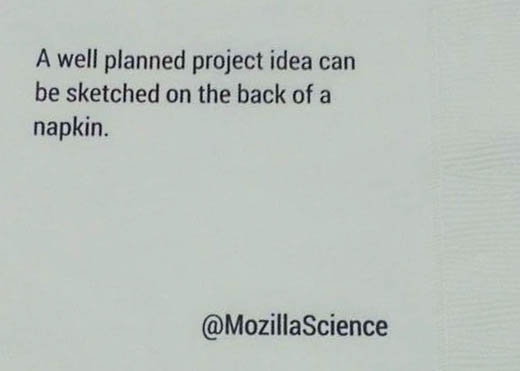
At its heart, MozFest is diverse and inclusive. Visitors can take part in over 400 peer to peer interactive and international 30-90 minute sessions over the weekend. Many sessions will be delivered in English, but for the first time ever certain sessions will also be available in Spanish, French, German, Arabic, Lithuanian or Japanese. MozFest sessions are incubators for great new ideas. This is the place where you can literally write an idea on the back of a napkin and see it brought to life by teaming up with awesome technologists. In fact, many Mozilla-owned projects were born at MozFest, including Lightbeam, a Firefox add-on that enables you to see the first and third party sites you interact with on the Web, and Mozilla’s suite of free and open source learning tools that teach Web users how to read, write, and participate on the Web.

Five themes, ten spaces

This year, MozFest focuses on five key themes that are crucial to the free and open Web:

  • Online Privacy & Security looks at how we can understand and control how our data is used and collected. How can we take stronger ownership of our digital identities?
  • Open Innovation is about ensuring that the open ethos remains at the heart of the internet. Open source and open standards mean that anyone can create and innovate for the internet without permission.
  • Decentralisation means that the devices and platforms we use can work with each other because they are based on the same standards. This allows information and content to flow smoothly and gives us all a better internet experience.
  • Web Literacy refers to the skills people need to take part in the digital world. These skills empower people to create, shape and defend the Web.
  • Digital Inclusion is all about making sure that anyone can take part in the digital world. Too many people remain excluded from the free and open internet. We want to fix that.

These themes are supported by ten spaces, each of which plays host to workshops, demos, discussions, interactive installations and collaborative sessions. Topics include Digital Arts and Culture, Journalism, Open Science, Open Badges, Fuel The Movement (EU Copyright reform), Localisation, Youth Zone, Demystify the Web, Dilemmas in Connected Spaces and MozEx, a digital art exhibition.

Seven things not to miss at MozFest

With 400+ sessions to chose from and an awesome speaker series, everywhere you go at Mozfest, you’re bound to come across energising innovation, inspiring conversation and creative collaboration. Here are seven top picks you can’t miss:

  • Accessibility: at Mozilla, we believe the Web should be available to anyone, anywhere, wherever there is an Internet connection. A11y is a widely recognized Web numeronym that refers to human-computer interaction, specifically to Web accessibility among people with impairments. Our friends at #A11yHacks, Carousel, Drake Music & Shapearts are exploring accessibility issues at MozFest.
  • Interactive Installations: among others, creative design agency TODO, the geniuses behind Codemoji are showcasing interactive, educational installations about Mozilla’s five key issues, offering different perspectives on the Web.
  • Virtual Reality: prefer virtual reality to the everyday reality of life? No problem. Mozilla’s, A-Frame and A-Painter tools will be on site so you can navigate virtual worlds and create virtual reality experiences.
  • Inaugural Speaker Series: recognizable names will take the stage in the “Dialogues + Debates” section of the festival to discuss the biggest issues facing the web, and society, today. Hear from academics researching surveillance and discrimination, technologists dedicated to upholding free speech and reporters covering the Syrian Civil War with open-source journalism. Meet the speakers here.
  • Future of the Web: the internet is no longer defined by screens and keyboards — increasingly, it’s all around us. It’s imperative that the free and open ethos of the desktop era persists into new innovations, whether they be VR, wearables, or smart devices. That’s why we’re exploring the ethics of the Internet of Things in the new Dilemmas in Connected Spaces space
  • MozEx: a digital art exhibition that explores links between art, society, and the digital world. Created by individual practitioners and curated by the Tate and the Victoria & Albert museums in London, the exhibit highlights the value of art to society through Web literacy, digital inclusion and accessibility, privacy, policy, and hacking.
  • EU Copyright reform: reform copyright laws to enhance creativity and innovation.  Take part in interactive art installations, hands-on workshops, and lightning talks to learn what you can do about it.

The hottest ticket in town this weekend

At MozFest, there is no entry requirement, dress code or expectation – anyone, of any age, background or level of expertise, is invited to come as they are. Registration is quick and easy. Tickets cost from £3 for young people and £45 for adults. Tickets can be bought online in advance.

MozFest 2016 is held at Ravensbourne, a specialist university sector college whose mission is to creatively apply digital technology to design and communication.

More information

* note: the clocks go back / we gain one hour at 02.00am on Sunday 30th October – don’t forget to change your clocks!

28 Oct 21:28

Firefox Windows XP Exit Plan

by chuttenc

7drhiqr

Last I reported, the future of Firefox’s Windows XP support was uncertain, even given long-standing plans for its removal.

With the filing of bug 1305453 and the commensurate discussion on firefox-dev, things are now much more certain. Firefox will (pending approval) be ending support for Windows XP and Windows Vista in Firefox 53 (scheduled release date: April 18, 2017).

Well, thanks for tuning in. I guess I can wrap up these posts and…

Okay, yes, you’re right. It isn’t that simple.

First, the actual day that Windows XP and Windows Vista users will cease getting Firefox updates is actually much later than April of 2017. Instead, those users will continue to receive security updates until April of 2018 because the version of Firefox 52 they’ll be getting is an Extended Support Release.

What is Firefox Extended Support Release (ESR)? It’s a version of Firefox for enterprises and other risk-averse users that receives security (and only security) updates for one year after initial release. This allows these change-weary users to still chose Firefox without having to consider how to support a major version release every six-to-eight weeks.

Windows XP and Vista users will be shunted from the normal roughly-six-weeks-per-version “Release” channel to the “ESR” channel for 52. New installs on Windows XP and Vista at that time will also be for ESR 52. This should ensure that our decreasing Windows XP+Vista userbase will be supported until they’ve finished diminishing into…

…well, okay that’s not simple either. In absolute terms, our Windows XP userbase has actually increased over the past six months or so. Some if not all of this is the end of the well-documented slump we see in user population over the Northern-hemisphere Summer (we’re now coming back up to Fall-Winter-Spring numbers). It is also possible that we’ve seen some ex-Chrome users fleeing Google’s drop of support from earlier this year.

Deseasonalized numbers for just WinXP users are hard to come by, so this is fairly speculative. One thing that’s for certain is that the diminishing Windows XP userbase trend I had previously observed (and was counting on seeing continue) is no longer in evidence.

So what happens if we reach April of 2018 and we still have millions and millions of Windows XP users still relying on Firefox to provide them with a safe way to navigate the increasingly-hostile environment of the Web?

No idea. I guess this means I’ll be continuing to blog about WinXP for a couple years yet.

:chutten


28 Oct 21:28

"Hillary doesn’t play. She has more experience and exposure to the presidency than any candidate in..."

“Hillary doesn’t play. She has more experience and exposure to the presidency than any candidate in our lifetime — yes, more than Barack, more than Bill — so she is absolutely ready to be commander in chief on Day 1. And yes, she happens to be a woman.”

- Michelle Obama
28 Oct 21:28

@stoweboyd

@stoweboyd:
28 Oct 21:28

I have to make a trip to Brooklyn, obviously, on my endless...


I have to make a trip to Brooklyn, obviously, on my endless research into the new workplace:

Dan Howarth, Macro Sea turns Brooklyn warehouse into New Lab co-working space

New York developer Macro Sea has turned a warehouse at Brooklyn’s Navy Yard into a workspace for tech entrepreneurs, using the building’s “cathedral-like” steel trusswork to inform new elements (+ slideshow).

New Lab is located in Building 128 of the Brooklyn Navy Yard – a former shipbuilding complex between the Dumbo and Williamsburg neighbourhoods that is undergoing extensive regeneration.

[…]

“In designing New Lab, we rejected industrial fetishism, iPhone-isation, and tech 4.0,” said Macro Sea design director Nicko Elliott.

I don’t know, this looks a lot like industrial fetishism to me. And I like it.

28 Oct 06:52

Pixel Notes

I pre-ordered the basic Pixel (5", 32G, Silver) because the 5X was getting on my nerves (more below); here are early-days notes. Tl;dr: Ugly, solid, fast, cool camera.

No new build

So, here’s the secret insider story of where little mobile builds come from. Word goes around that the software has to ship by Date X to meet the hardware launch date. Usually it’s not ready, so what happens is they ship an interim build and then, some weeks later when the phones hit the shelves and people are starting to turn them on, they get prompted to download the “real” build.

Objets d’art

Objets d’art

Not this time, a first in my pretty-comprehensive experience of new Android flagships. The OS it came with is the OS I’m running, and I have to say the bug density is pleasingly low. Gmail crashed once in the first couple days, but didn’t damage anything.

Wires!

It came with: A wall plug with a USB-C socket on the back, a USB-C/USB-C wire, a USB-C/USB-classic wire, and a little USB-C/USB-classic hard-plastic thing. Normally I’d decry this as excess, but our household had reached critical density of USB-classic wires, always one to hand when you needed one, and thus the sharp initial build-up in the USB-C inventory is welcome.

A first for me was the wire-based transfer-your-Android-life function. Run a USB wire between them, let ’er rip, and whoosh! go all your contacts and photos and messages and whatever from old to new. It still has to download and install your apps (yawwwwn), but boy, does that initial transfer ever go fast.

Autumn evening in Vancouver

Vancouver’s permanently under constructon.

It’s ugly

I got silver because all the other phones in the house are featureless black rectangles and I got sick of looking round the living room for mine then picking up the wrong one. But it was a bad color call.

I mean, seriously. It’s really a dingy not-quite-white, big blank bezels top and bottom of the screen with cameras and sensors standing out blockishly, metal sides interrupted by random strips of plastic here and there. I’ve never owned an iPhone but I’m told the Pixel looks like one. Except for, don’t they say that iPhones look good?

I’m not sure who thought it was a good idea to make two-thirds of the back metal, one-third whitish.

It’s more or less exactly the same size as the Nexus 5X it replaced, but noticeably heavier. The fingerprint reader is in the same spot on the back, and works perfectly. I have no emotional reaction to the way it feels in my hand.

Anyhow, I’m seriously in the market for a decent case.

Translate

My little girl’s in a Mandarin-bilingual elementary school; she was having trouble with homework so I woke up the phone and said “OK Google, translate ‘I’ll be there by noon’ into Mandarin‘’, and it did. I was impressed. Do all phones do that now?

Android 7.1

The new launcher looks OK, but the search bar that used to run across the top has been replaced with a pull-tab to get Google stuff, and a time/date/weather readout. I’m grumpy because I lost a couple app spaces in the grid, and the apps on my front page are something I curate very carefully.

Aside from that, well… the notification interaction has been changed slightly in a way that doesn’t help me but others might like. Other than that, can’t say as I see much new.

Battery

Meh. It gets through the day, but just barely. If I could have got one that was 25% thicker and had substantially more battery I’d do that in a flash. But that’s not what the world’s mobile-phone designers apparently want to hear.

Leaves

#Bike2WorkPix

Performance

I eventually came to hate the Nexus 5X performance. Not because it was slow, as such; once you got an app up and running it was just fine. But it didn’t have enough memory, so apps didn’t stick around and were always being restarted. And the app-start process was horrible, I think for the reasons described in the AnandTech 5X review — scroll down to the “NAND Performance” sub-head.

The Pixel keeps lots more apps around and starts them faster. The subjective difference in “how fast it feels” is dramatic.

The app I particularly care about starting fast is obviously the camera. I use Lightroom’s — hey, a photog has to buy into one cloud or another and for better or worse I’m in Adobe’s. Rough timings: The Google camera starts in just under one second, Lightroom’s in well under 2.

Bottles

At my local bottle shop.

The camera

Look, all modern mobile cameras are totally great given enough light. One big delta is low-light performance, and rather than say anything, I’ll let you judge by the pix embedded here. All of them are low light, none straight-outta-the-camera. I have to say that Lightroom’s integration between edit-on-the-phone and edit-on-the-Mac is fabulous.

Should you buy one?

They’re not cheap, particularly. You can count on having the latest software. I think the hardware is actually good. But don’t get Silver.

28 Oct 06:49

Where I’ll be at MozFest 2016

by Doug Belshaw

This weekend it’s the Mozilla Festival, an event that brings together everyone interested in the open web. It’s an event I attended as a volunteer before I joined Mozilla, something I was involved with during my time as a paid contributor, and now I’m back as a community member.

My We Are Open co-op comrades and I are running three sessions over the weekend. Unfortunately, Laura can’t make it, but either Bryan, John, and I will be taking the lead on the following. The idea is that they work in their own right, but we’ve also worked with the organisers to ensure they form a kind of ‘arc’ for those who want to attend all three sessions!


The Thinkasprint: the art of thinking sideways

Saturday, 11:15am-12:45pm
Open Badges, Floor 8 – 801

In this session participants will be taken through a modified version of We Are Open Co-op’s ‘thinkathon’ approach, to help people think about knotty problems in an open, inclusive, and participatory way. The process involves as much drawing as it does thinking and writing, and is solution-oriented.

We use the wealth of experience that participants and facilitators have to take apart a problem and look at it from a different angle. We will go off at tangents and down rabbit holes, but that’s all part of the process!

Our starting point will be whatever issues participants bring to the table after our icebreaker activity, but we have a few ideas up our sleeves, such as Open Badges for employability, digital skills, and ‘passion projects’.


Digital Champions: scaffolding adult digital and web literacies with badges

Saturday, 3:15pm-4:00pm
Open Badges, Floor 1 – 101

This session will help attendees understand the concept of ‘flexible frameworks’, using examples from London Connected Learning Centre and Sussex Downs College. This draws on doteveryone’s Basic Digital Skills Framework and Mozilla’s Web Literacy Map. It will be a conversation-led session with visual thoughts captured by Bryan Mathers.


THE BIG BADGE THROW-DOWN

Sunday, 11:00am-11:45am
Open Badges, Floor 8 – 801

Using the starting points of doteveryone’s Basic Digital Skills, Workplace Skills, and Digital Leadership Skills programmes, NCVO’s Skills Lab work, and London CLC’s Digital Champions Curriculum, this workshop will find commonalities, overlaps, and ways forward for badges-based flexible frameworks.

We’ll provide examples of existing programmes, badges and pathways and then work to flesh out, fill gaps and imagine new links and partnerships between established players as well as welcoming new entrants to the digital skills space. This will be a hands-on, practical session.


If you’re coming to MozFest, I hope you’ll join us for at least one session. If not (there’s so much going on!) then please do find us and say hello — I’m @dajbelshaw on Twitter and will also keep an eye out on the @WeAreOpenCoop account.

Photo by Mozilla in Europe

28 Oct 06:47

Microsoft is bringing the sexy back

by Volker Weber

A few thoughts on yesterday's events, in a particular order:

  • Ever since the candy colored iMacs, Jony Ive's first major Apple contribution, we have known that success is not achieved by megahertz and gigabyte. You need to delight people.
  • Windows was relegated to accountants and gamers. Business needed a platform to run old-fashioned apps, gamers needed all the power they could get. It was a race to the bottom as business kept pushing DULL onto every single desktop. Lenovo kept squeezing manufacturers out of the market.
  • With Surface, Microsoft changed the game. They failed twice. But with Surface Pro 3 and Surface 3 they finally bit the bullet. Those were desirable machines. And their design has been copied by many.
  • Last year Microsoft built the sexiest laptop ever. When Panos Panay, the best presenter since Steve Jobs, showcased Surface Book everybody wanted one, like now. Gadget bloggers went bananas without ever having used one outside the demo area. There is was again: delight. The aftermath wasn't pretty. Both Surface Book and Surface Pro 4 suffered from power management bugs.
  • Now Microsoft did it again with Surface Studio. Man, look at it! I don't need a convertible desktop for a truckload of money. But it sure looks sexy on those 120mm Louboutins. Oh, wait, I got carried away.

So, here we are. Microsoft is making a machine to lure the creative community, which frankly has not been served well by Apple lately. At the same time, Apple is going after big business*. The caveat is Windows. Yes, the face got prettier. But the dragon is only sleeping.

*) You have to watch the first 55 minutes of this video. It teaches you how to prevent a migration (hint: application readiness assessment).

28 Oct 06:46

Bryan Alexander – A Devil’s Dictionary of Educational Technology

by D'Arcy Norman

This entire dictionary is awesomeness and gold.

Blended learning, n. The practice of combining digital and analog teaching. Also referred to as “teaching”, “learning”, and “the real world”.

Flipped classroom, n. “The practice of replacing lectures that instructors give to summarize a course’s readings with videos of lectures that summarize a course’s readings.”

LMS, n. 1) A document management system, whereby a faculty member can transfer a single document to his or her students. Curiously overpowered for this purpose, nevertheless universally deployed.

2) A good way to avoid legal notices about copyright.

3) The graveyard of pedagogical intentions. A sump for IT budgets.

Source: A Devil’s Dictionary of Educational Technology – Medium

28 Oct 06:42

66 percent of Canadians would like to see ‘distracted walking’ legislation

by Ian Hardy

Distracted driving is one of the leading causes of death on the road, surpassing drinking and driving. In an effort to educate the public on the dangers of this act, many provinces have increased the fine for disobeying the law. However, it seems some are even concerned with what happens while walking and using your device.

According to a survey by Vancouver-based Insights West, 66 percent of Canadians support the idea of implementing ‘distracted walking’ legislation in their local municipality, with a higher percentage (80 percent) of respondents aged 55 wanting a bill to be passed. Distracted walking is categorized as using your mobile device on a roadway, such as crossing the street.

Distracted_Graphic

While the percentage is high, the likelihood of this happening is slim. In July, Toronto Councillor Frances Nunziata tabled a motion for a similar bill to become law in Toronto but was quickly shot down by Transportation Minister Steven Del Duca, who stated pedestrians should keep their heads up and be aware of their surroundings while walking.

It should also be stated that the report was based on surveying 1,013 Canadians between September 6th to September 8th, 2016.

28 Oct 06:42

Transit & Housing or the World’s Fair? Toronto’s Mayor Weighs In

by Sandy James Planner

3cd5caa00ef056c5bfab1bc9ab93f8bc

In a surprising move to some Toronto Mayor John Tory has stated it’s not in the best interest of Toronto to be supporting an Expo  World’s Fair 2025. Now the Mayor is supposed to be relatively neutral on this issue, according to Mayoral etiquette.

Mr. Tory said Wednesday the cash-strapped city could not support a bid for a world’s fair without federal or provincial assurances that those governments would help pay for it, and do so without siphoning away money still needed for the city’s long list of transit and public-housing repair projects.

“I will tell you right now, I am not going to take money out of what we need to fund transit and housing to support an Expo, or just about anything else for that matter,” Mr. Tory told the committee after nearly five hours of presentations from Expo boosters.

Private-sector boosters paid for a feasibility study that concluded Expo 2025 could be held for just $1.9-billion in capital costs, a number that excludes billions needed for flood-protection and other infrastructure in the Port Lands. The event itself would cost another $1.6-billion to run, an amount covered by revenues and corporate sponsors, the report says, adding that it would create jobs and big economic benefits. Other Expos have not been nearly so cheap. Milan’s event in 2015 ended up costing $19-billion (Canadian). Shanghai’s, in 2010, cost an estimated $60-billion.

The late Mayor Rob Ford had a “war on the car” and announced an end to Transit City light rail in Toronto, insisting that subways were the only way to go in the vast metropolitan area. Needless to say the region is paying catch up in bringing the region together and going forward with a transit program. Kudos to the current mayor who is valuing good transit and housing for Torontonians over a world’s fair and the requisite summer party.


28 Oct 06:41

“Road Violence” in Toronto – Mortordom’s Fatal Domain

by Sandy James Planner

465543023_295x166

There is a nasty positioning happening in the City of Toronto between advocates of motordom having full advantage of Toronto streets and the rights for vulnerable road users to also have a somewhat equitable share of the street. Toronto has demonstrated a  weak approach to vulnerable street user policy instead of steadfastly championing the right of citizens to be safe on the streets. Thirty-eight pedestrians and cyclists have died in Toronto this year. Shockingly eight have died this month. That is two people a week dying on Toronto streets in October.

The fatalities are largely people over 65 years of age who are hit by a larger vehicle. They are usually walking across an arterial road in the suburbs, and usually at a location without a crosswalk or traffic signal. You can also think of this as one vulnerable road user dying per 68,421 people. (A quick note, Vancouver is worse, with one pedestrian dying per 54,727 people).

The City’s response, instead of universally lowering speed (which is proven to reduce mortality and injury) or  re-examining road design or  regulating driver behaviour has been to focus on the visibility of pedestrians. And that reports the Globe and Mail has a lot of people really upset.

“Enough is enough, we have to end fatalities and serious injuries on our roads,” said David Stark, whose wife was killed when a vehicle mounted the east-end sidewalk where she was standing.The group – Friends & Families for Safe Streets – officially launched Tuesday at City Hall. It is spearheaded by people such as Mr. Stark, all of whom have lost a family member or close friend in a road collision.

safe-streets-size-custom-crop-867x650

In the early days of motordom, car crashes were termed “road violence” – a term that echoes protests from the early decades of motoring, when fatal collisions sparked outrage against “death drivers.”  “The gravity of the harm calls for actions,” said Yu Li, whose close friend was killed while cycling. “And the term of road violence will have that effect of bringing this to the conscience of everybody, that these are not accidents. These are preventable and these are tragedies with grave consequences.”

The group is calling for the city to go beyond the road safety plan announced this summer. That plan was slammed for its timidity when unveiled and was later beefed up. But critics say it continues to focus too much on small fixes and not enough on cultural change. A drop to the default speed limit – a key tactic in some cities – was not among the measures included.

I’ve been back four times to Ontario this year and the behaviour of vehicle drivers to vulnerable road users is markedly different. In Vancouver, most motorists yield to pedestrians and cyclists. That is just not the case in Ontario’s major city.

Being visible whether you are a pedestrian or a bicyclist is so important, and can be so challenging. The most dangerous time for pedestrians is in the autumn and winter, with Ontario statistics showing that over 40 per cent of serious injuries and 42 per cent of pedestrian fatalities occur at that time. (2010, Ontario Road Safety Annual Report). But wearing reflective clothing is a personal choice that a pedestrian or cyclist makes to be visible to vehicles. It does not condone speed, driver behaviour, or bad road design.

In Finland, every child going to school must wear three pieces of reflective items on their clothes and their backpack.  The safety reflector was developed in Finland in 1960, and it is the law that pedestrians wear reflective clothing and reflectors in the dark.   Indeed, wearing reflectors and reflective clothing is completely accepted as daily wear in Scandinavia. That part of the world also has the lowest incidence of pedestrian accidents.

A similar program in Great Britain reduced pedestrian deaths with children by 51 per cent. Studies show that wearing a reflector increases the visibility of pedestrians from 25-30 meters to 140 meters, increasing the reaction time from two seconds to ten seconds  for a car being driven at posted  municipal speeds of 50 kilometers an hour. That is eight seconds more for a  driver to react, and for a pedestrian to survive.

Sure reflectivity of pedestrians will enable vehicle users to see vulnerable road users. But reflectivity is not the sole response. A vigorous and truthful campaign to slow speeds, address problem streets and intersections, address driver behaviour and regulate is key. Toronto needs to step up to the 21st century. These tragic deaths on Toronto streets should be the tipping point. But will it be enough to change policy and attitude?

college20complete20street20photostcar_cyclist_sidewalk_1


28 Oct 06:40

Twitter Favorites: [sknthla] This, on nerd culture, is insightful https://t.co/YLk2FRGzSq

Saku Panditharatne @sknthla
This, on nerd culture, is insightful status451.com/2016/09/15/soc…
28 Oct 06:39

Surface Studio, Nintendo Switch, and Niche Strategies

by Ben Thompson

There are few things that can bring geeks (like me) to the edge of hyperbolic hysteria like compelling new hardware videos, and this last week had not one but two!

First, the Nintendo Switch:

Then, yesterday, the Microsoft Surface Studio:

There’s no question both products are exciting in their own right; what makes them compelling, though, is not simply the technology demonstrated, but the fact both, unlike their forbearers, are clearly designed with the smartphone in mind.

The Wii U Mistake

The Nintendo Wii U and the Surface RT were both launched at the end of 2012; both were miserable disasters, and both for largely the same reasons: they targeted markets that no longer existed.

Back in 2006 the Wii came out of nowhere to win the seventh-generation of consoles, outselling the Xbox 360 and PlayStation 3 despite the fact Nintendo’s hardware was significantly underpowered relative to its competition. The key was the Wii’s motion control, best manifested by the seemingly simplistic Wii Sports; it turned out that simplicity was a virtue, attracting casual gamers who had long since abandoned consoles or never considered one in the first place, and Wii Sports went on to become the best-selling video game of all time.1

Nintendo sought to recreate the Wii’s success with the Wii U; the eighth-generation console finally supported high-definition graphics, but it was still significantly underpowered relative to the Xbox One and PS4. Instead Nintendo relied on another gimmick — a second touch screen on a tablet-like controller — but not only was the gimmick a flop with developers (including Nintendo), it was completely ignored by consumers; the console has been all-but discontinued after selling fewer than 15 million units.

There are lots of reasons the Wii U failed — including a name that was easily conflated with its predecessor, a lack of compelling first-party titles at launch, and Nintendo’s usual struggles with 3rd-party developers (much of it self-inflicted through both business practices and product decisions) — but the most important reason is that the market Nintendo exploited with the Wii no longer existed: casual gamers now owned smartphones, and smartphone gaming was good enough (and superior, if you considered convenience and ease-of-use). Meanwhile, Microsoft and especially Sony had continued their focus on dedicated gamers and 3rd-party developers, leaving the Wii U in the middle of nowhere: not good enough for hard-core gamers, and superfluous for everyone else.

The Surface Mistake

The Surface, meanwhile, was designed to be the physical manifestation of Windows 8: a touch-based tablet combined with the power of a traditional PC. Steve Ballmer said at the launch event:

The past several years have seen great change in the industry and great innovations coming from Microsoft. We’ve helped usher in a new era of cloud computing, we’ve embraced mobility, we’re redefining communications, and attempting to transform entertainment. In all that we have done Windows is the heart and soul of Microsoft: from Windows PCs to Windows servers to Windows Phones and Windows Azure, Windows has proven to be the most flexible general purpose software ever created…

With Windows 8 we’ve reimagined…Windows from the chipset to the user experience to power a new generation of PCs that enable new capabilities and new scenarios. We approached the Windows 8 product design in a forward-looking way: we designed Windows 8 for the world we know in which most PCs are mobile and people want access to information and the ability to create content from anywhere, anytime. People want to do all of that without compromising the productivity that PCs are uniquely known for, from personal productivity applications to technical applications, business software and literally millions of other applications that are written for Windows.

The problem is that while Windows may have still been the heart of Microsoft, it was no longer the heart of computing: the smartphone was. Much like the Wii U, the original ARM-based Surface RT failed for lots of product-related reasons — including the fact it was under-powered, lacked compelling 3rd-party applications,2 and the fact that Windows 8’s looks far outweighed its ease-of-use — but the most important reason is that the market Microsoft exploited with the general-purpose PC no longer existed: casual PC users now owned smartphones, and smartphone computing was good enough (and superior, if you considered convenience and ease-of-use). Meanwhile, traditional Windows OEMs and especially Apple had continued their focus on dedicated PC users, leaving the Surface in the middle of nowhere: not good enough for hard-core PC users, and superfluous for everyone else.

Microsoft’s Transformation

In the intervening years the advice for Nintendo and Microsoft has been strikingly similar: stop making hardware (I haven’t said that about Nintendo, but I certainly did about the Surface). The world has changed, it’s time to move on and adapt.

Microsoft in particular has done exactly that, to a degree I frankly didn’t think was possible as long as Windows was around. There are two divisions of the company — Productivity and Business Processes and Intelligent Cloud — that are building for a future where Windows is one of many computing platforms, and an increasingly unimportant one at that.3 Meanwhile, the company’s third division (More Personal Computing) is basically a collection of businesses, most prominently Windows, that are cash cows but don’t figure into Microsoft’s long-term future as a services company.

I have applauded Microsoft CEO Satya Nadella for pulling this split off, not just organizationally but culturally; Ballmer’s (correct) contention that Windows was the center of Microsoft was holding the entire company back, and it was why he needed to be replaced for Microsoft to survive in a world centered on iOS and Android. What I didn’t expect, though, was that the demotion of Windows would be just as good for Windows — specifically Surface — as it was for Microsoft.

The Surface Studio

Perhaps the most important feature of the Surface Studio is its price: $3,000 for the lowest-end model, and that doesn’t include the innovative “Dial”. This price point immediately attracted a lot of consternation on Twitter amongst Windows fans in particular, while some industry observers argued that most consumers weren’t artists anyways. Both true!

But what is also true is that all PCs are niche devices: for most people, particularly outside the U.S., a smartphone is all they need or care to buy. The world today is the exact opposite of the world a mere decade ago, where we bought dedicated devices to plug into our digital hub PCs; the smartphone (and cloud) is the hub, and everything else is optional.

Selling a niche device is a fundamentally different proposition than selling a general purpose one: the question of why a consumer would buy a general purpose device (like a PC ten years ago, or a smartphone today) is a solved one; the only question is which. Niche devices, on the other hand, face two hurdles to adoption: before a consumer chooses which device to buy they need to be convinced as to why they need a niche device in the first place. And, because answering “why” is even more difficult than winning “which”, niche device makers ought to focus on being a clearly superior solution to an identified market need; being cheap is not only not a priority, it’s a distraction.

The Surface Studio does this brilliantly; as the launch video shows, an incredible amount of engineering and expensive manufacturing went into the physical product, particularly the screen and hinge. The result, though, is that if you are an artist or graphic designer or architect or musician or do any sort of activity that requires drawing on or touching your display, and need the productivity capabilities of a PC (hello file system!), then there is nothing on the market like the Surface Studio (including the Surface Pro). Microsoft has rightly pulled out all the stops to make the perfect device for you. Does it cost a lot? Of course it does! But as Apple has demonstrated for years price is less important than differentiation. To insist that Microsoft make the product cheaper is the exact wrong strategy for a niche device maker, and I suspect it is rooted in the false assumption that the PC is a general purpose device that ought to appeal to everyone.

Certainly the Studio’s success is not assured, in large part because Microsoft’s target audience is using OS X. It is a tall order to get people to switch operating systems they are familiar with, which emphasizes the importance of Microsoft focusing on differentiation, not price (if price was all that mattered Windows would have never lost share to OS X in the first place). Just as importantly, though, is that today more people are even considering the possibility: the single best way to build a brand that attracts (as opposed to being the default) is to build a product that is the best possible one you can build, and only then make it as affordable as possible. For too long Microsoft approached that problem backwards, exacerbating the secular shift from PCs to smartphones.

The Nintendo Switch

As for Nintendo, the beloved gaming company has certainly taken steps in the right direction: the company lent its intellectual property (and investment dollars) to Niantic, driving the phenomenal success of Pokémon Go. Perhaps more significantly for the bottom line, the company has leveraged its partnership with mobile game developer DeNA to develop the upcoming Super Mario Run; encouragingly, like Pokémon Go, Nintendo is taking an established concept (a “runner”, in this case) and applying its intellectual property on top. It’s a great way to leverage Nintendo’s most valuable assets.

There are encouraging signs when it comes to the Switch as well:

  • It looks like (but is not confirmed) that Nintendo is abandoning touch as an input, which is exactly right. Touch on Nintendo products debuted in 2004 on the Nintendo DS, when the iPhone was but a gleam in Steve Jobs’ eye; today touch-focused games are going to be developed for the far larger smartphone market, and keeping the technology will only make Nintendo’s product significantly more expensive and/or far worse with regards to screen quality (the current 3DS and Wii U touch screens are embarrassing).
  • What Nintendo is doubling down on is controllers, another smart move. I argued in 2014 that controllers are so important to the user experience of consoles that they will hold off general purpose devices like Apple TVs when it comes to living room gaming; Nintendo’s bet is that they can attract gamers who want mobility by offering high fidelity control that smartphones can not4.
  • Nintendo also looks set to unleash a flurry of first-party titles: the company clearly gave up on the Wii U quite a while ago, shifting resources to the Switch. If the product launches with titles like Mario, Zelda, etc. it will provide a big boost that may actually attract third party developers

However, there remain two big questions: first, while Microsoft is a highly diversified business that can afford to sell Surface Studio to a very narrow niche, Nintendo’s entire business, outside of its nascent smartphone efforts, is its consoles. There is definitely a console niche, but Sony and Microsoft are filling it admirably. Is a portable niche big enough to support Nintendo?

Secondly, will Nintendo fully embrace a niche strategy? As I noted above, in a niche it is most important to convince consumers that they want your device; only then will they decide if they can afford it. If Nintendo skimps on the quality of its components, the performance of the device, or battery life just to save a few bucks, they may well please the people who were going to buy the device anyways, but plenty of others will stick with their good-enough smartphones or clearly superior consoles. Obviously the Switch should not be absurdly expensive, but it can definitely be too cheap.


Over the last couple of years, as it has become clear that rounded rectangles of glass and aluminum running either iOS or Android “won” the smartphone wars, it has been tempting to fret that hardware innovation would slow; and, arguably, in the case of smartphones, it has. In fact, though, I expect that the reality of the smartphone being the dominant general purpose device will open the doors for more and more devices like Surface Studio and the Nintendo Switch.

What might be created if you start with the assumption that the smartphone exists? Perhaps you would make sunglasses with a camera, or a watch, or an activity tracker, or a drone. I noted in Snapchat Spectacles and the Future of Wearables that the establishment of the PC led to an explosion of dedicated devices like PDAs, digital cameras, GPS devices, and digital music players. Now that those have been subsumed into the smartphone there are new opportunities, and in a twist of fate it is smartphone also-rans like Microsoft and Nintendo — along with smartphone native companies like Snapchat — that have more freedom to experiment given they have nothing to protect. It’s never been better to be a geek!

  1. Including bundled versions, breaking the record held for 20 years by Super Mario Bros.
  2. I am painfully aware of this point, as I was on the Windows 8 team charged with bringing 3rd-party applications on board
  3. To be fair, the majority of revenue in both divisions — from Office and Windows Server and its related products — still rests on Windows PC being the center of enterprise
  4. Yes, there are add-on controllers for the iPhone, but games can’t require them which dramatically reduces their utility)

28 Oct 06:37

One-Year Moziversary

by chuttenc

Holy crap, I totally forgot to note on the 19th that it had been a full year since I started working at Mozilla!

In that year I’ve done surprisingly little of what I was hired to do (coding in Gecko, writing webpages and dashboards for performance monitoring) and a whole lot more of stuff I’d never done before (data analysis and interpretation, data management, teaching, blogging, interviewing).

Which is pretty awesome, I have to say, even if I sorta-sleepwalked into some of these responsibilities.

Highlights include hosting a talk at MozLondon (Death-Defying Stats), running… three? iterations of Telemetry Onboarding (including a complete rewrite), countless phone screens for positions within and outside of the team, being a team lead for just long enough to help my two reports leave the team (one to another team, the other to another company :S), and becoming (somehow) a voice for Windows XP Firefox users (expect another blog post in that series, real soon).

For my New MozYear Resolutions, I resolve to blog more (I’ve certainly slacked on the blogging in the latter half of the year), think more, and mentor more. We’ll see how that goes.

Anyway, here’s to another year!

:chutten


28 Oct 06:36

Taking Safety Seriously

by Ken Ohrn

Great job by Lafarge Canada (a very responsible company) to help improve safety for all of us who ride a bike now and then (10% of trips to work in Vancouver).

Lafarge brought a truck and three people to the Bike to Work Week station at Ontario and Terminal (Science World) on Tuesday.

Why??

The company is concerned about safety, and helping people who ride bikes to learn about blind spots.

I spent a few minutes with a Lafarge driver, who put me in the cab and demonstrated that drivers have blind spots and limited visibility spots around them.

Good idea to stay out of those.  Generally, if you can’t see the driver, the driver can’t see you.

And good on Lafarge for making such a big effort to get this message out and help improve safety for us all.

The logo says:  "I care about cycling safety". Yep.  My bike is right there. My bike, invisible in front of a cement truck General posaition of blind or low-visibility spots. ontario-terminal-03
28 Oct 06:35

Pogue Basics: Touch and hold Google Maps

I don’t know about you, but I consider Google Maps to be one of the best phone apps ever written. It’s just so good in so many situations!

It also happens to be full of useful shortcuts, like this one:

Once you’ve entered a destination and you want to begin navigating there, you, like most people, probably tap through a few screens to get the voice directions going.

But there’s a much more direct way: Hold your finger down on the blue navigation button. Google Maps will launch directly into navigation mode, and you’re on your way!

28 Oct 06:34

Galaxy S8 could incorporate Samsung’s own take on Siri and Google Assistant

by Igor Bonifacic

With the Note 7’s untimely demise still fresh in most people’s minds, Samsung has understandably been trying to get the smartphone buying public and shareholders to focus on the positives. For the South Korean company, that’s meant building up its upcoming Galaxy S8 smartphone. On Thursday, the company’s board of directors answered questions from investors, and it was during this Q&A session that Lee Kyeong-tae, the vice-president of Samsung’s mobile communications division, let slip some information about the upcoming smartphone.

Lee said the Galaxy S8 will feature a “slick” new design, improved camera as well as enhanced artificial intelligence service.

Samsung adopting a new look with its S8 lineup is something we’ve heard about before. According to one past rumour, the upcoming smartphone will feature an edge-to-edge screen similar to Xiaomi’s recently announced Mi Mix smartphone. It also goes without saying that the S8 will feature a better camera than its predecessor; that’s a given.

So what’s interesting here is the tidbit about AI.

Samsung recently acquired Viv Labs, a company started by co-founded by several former Apple who worked on Siri. When asked to elaborate whether the S8 would incorporate tech from Viv Labs, Lee declined to comment. Given the competition Samsung now faces from its own partner Google, it seems very likely the S8 will feature some kind of AI feature beyond Google Now.

Samsung is expected to unveil the Galaxy S8 at Mobile World Congress this coming Feburary.

28 Oct 06:34

Twitter is killing off Vine

files/images/Vine_App.JPG


Casey Newton, The Verge, Oct 30, 2016


The news today spread faster than any Vine video (it came and was over while I was watching a single Bill Mahar video). Twitter "said it would not delete any Vines that have been posted — for now, anyway. 'We value you, your Vines, and are going to do this the right way,' the company said in a Medium post. 'You’ ll be able to access and download your Vines. We’ ll be keeping the website online because we think it’ s important to still be able to watch all the incredible Vines that have been made.'" Translation: download your videos now and put them in your own archive, before they disappear forever the way your Google Video, Blip and Ustream videos did. Interestingly, you can read the  announcement on Medium but not on the Vine website.

[Link] [Comment]
28 Oct 06:34

What Matters Most About Apple’s New Laptops

by Michael Zhao

The new MacBook Pros are finally here, and if you’re interested in new features packed inside a thinner, lighter body, your wait is over. But prices on the new models are higher—$1,500 won’t even get you all the new features. Meanwhile, Apple’s more affordable laptops didn’t receive updates and have their own flaws. The Air remains a decent laptop, but the lack of a Retina display and USB-C are real problems. And the 12-inch MacBook’s single USB-C port for charging, display output, and data transfer limits its appeal. All of this leaves potential buyers in a tough position. It’s not clear to us right now (and it won’t be until we get a chance to examine the new hardware more closely) which MacBook is best for most people—or whether any MacBook is the best choice.

Don't miss out on our latest picks

Get the freshest expert recommendations first with our weekly newsletter.

The new MacBook Pros are thinner and lighter, and the OLED Touch Bar replaces the function keys at the top of the keyboard. All ports (save for the headphone jack) have been replaced with a quartet of Thunderbolt 3/USB-C ports. Although the Touch Bar seems genuinely interesting, the entry-level MacBook Pro, priced at $1,500, doesn’t include it—and similarly equipped, Touch Bar–less Windows ultrabooks cost hundreds less. You’ll need to spend $1,800 for the new experience. And don’t forget: You’ll also need to budget for dongles or new cables for any accessory or device that uses older connectors. Serious photographers will also need to buy an SD card reader for the first time in half a decade.

Oh, and the Apple TV got some new features, which we’ll also talk about, but let’s start with the important stuff.

MacBook Pro

new macbook screen

The new MacBook Pro looks a bit like a combination of the 12-inch MacBook and the Retina MacBook Pro it replaces. The new model is a little thinner and a little lighter (12 by 8.4 by 0.6 inches and 3 pounds for the new 13 Pro versus 12.35 by 8.62 by 0.71 inches and 3.48 pounds for the old Retina 13), and the bezel is slimmer, as well, but it’s clearly a MacBook Pro.

It’s a different story once you open the laptop. Probably the first thing you’ll notice is the gigantic trackpad, which Apple says is twice as big on the new models as on the previous generation. This larger trackpad gives you more space for gestures (or activities). Speaker grills on each side of the keyboard cover speakers that Apple says produce “room-filling sound.” We look forward to testing that claim.

using new oled bar on macbook

The whole top row of the keyboard (including the Esc key!) has been replaced by a continuous, OLED touchscreen bar with multitouch that changes its appearance and abilities based on what app you’re using. Apple calls it the Touch Bar. Depending on the app you’re in, you can use it to autocomplete words, control playback, scrub through and edit videos, adjust photo levels, change font colors or styling, and even play sampled airhorns. It’s fully customizable for each app; developers can use custom APIs to take full advantage of its features. Unfortunately, it won’t work with Web apps yet—that means no Gmail, at least not for now. Some noteworthy apps that Apple mentioned as already supporting the Touch Bar include Adobe Creative Cloud (Photoshop and Premiere, among others) and Microsoft Office.

All in all, the Touch Bar doesn’t quite amount to the full touchscreen MacBook that some people have been hoping for, but this feature could end up being a better option, and we look forward to testing it. After all, laptop screens get dirty enough without people swiping their grubby fingers on them intentionally. We just wish that the Touch Bar was also included on the $1,500 entry-level Pro.

On the far right of the Touch Bar, where the power button used to be, you’ll find a Touch ID sensor. This sensor should be convenient for unlocking your computer and initiating Apple Pay transactions (which remain a Safari-only feature). Here’s hoping that it will integrate seamlessly with password managers, as well, so you can securely autofill forms and passwords across the Web. The sensor can also recognize multiple Apple IDs and automatically switch user accounts—something that may come in handy for families who share a machine.

As for the keyboard itself, you’ll find that the previously clicky island keys on old MacBook Pro Retina models have gone the way of the clicking trackpad, which is to say they’re gone forever. The keys now have the faster, slimmer butterfly-action design that debuted with the 12-inch MacBook. Whether that design is better or worse depends on your personal preferences, but it is thinner and lighter, which is rarely a bad thing.

new macbook ports and jacks

Unlike with the iPhone 7, you do get a headphone jack here. But perhaps the biggest change is Apple’s elimination of previously dedicated inputs and outputs—including MagSafe 2 and the SD card slot—in favor of four USB-C ports. The idea is that you can handle all charging, data, and display functions by using any of the ports in any combination. This overhaul of the port selection will probably be annoying for at least another year since very few of the cables included with your devices will use USB-C, just as when Apple ditched FireWire with the advent of the Retina Pro, but we’re hoping that USB-C will live up to its promise of universality sooner rather than later. For the time being, you’ll need to muster a lot of courage invest in some adapters to get by—Anker stuff tends to be pretty decent. At the very least, we look forward to being able to charge our computers from either side, depending on what’s convenient.

Oh, the new machines are faster, too. Both the 15-inch and 13-inch Pros feature upgraded Superfast SSDs capable of 3.1 GB/s transfer speeds (configurable up to 2 TB) and Core i7 processors. Apple is using sixth-generation (Skylake) Intel processors rather than the just-released seventh-generation (Kaby Lake) processors, though the performance difference between those generations is small. (Although Apple could have used seventh-gen processors in the 13-inch MacBook Pro, the seventh-gen version of the chip it uses in the 15-inch MacBook Pro isn’t yet available, so the company chose to use the same processor family in both models.)

The 15-inch model has a discrete Radeon Pro Polaris card—with up to 4 GB VRAM—which should be able to handle any graphically intensive task you might reasonably expect a laptop to handle. Meanwhile, the 13-inch Touch Bar model has integrated Intel Iris 550 graphics, and the $1,500 basic model has Iris 540 graphics. Basically, the 13-inch models are good enough to handle most home users’ video and photo editing needs, but people who work with videos and photos for a living will want the 15-inch model. (Unfortunately, even the 15-inch model is limited to 16 GB of RAM. Apple says this limitation is due to a combination of the Skylake chipset and the power-efficient LPDDR3 memory the company uses in its laptops. Kaby Lake will support newer LPDDR4 memory, which has higher limits.)

(RIP) MacBook Air

new macbook pro vs old macbook air

Apple will continue to sell the 13-inch MacBook Air alongside the new MacBook Pro, but we can think of no particular reason for anybody to get one. The company has left it basically untouched. It has no USB-C/Thunderbolt 3 ports, it weighs the same as the Pro (it’s actually physically larger), and it still lacks a Retina display. Sure, it’ll still perform basic laptop tasks, but it feels too outdated to cost as much as it does. The only reason to buy this model instead of a Pro is that it’s cheaper. Even then, we would consider getting the 12-inch MacBook instead of the Air, despite that machine’s own limitations. At least the MacBook has USB-C—a must-have future-proofing feature on any laptop you’d buy in 2016, let alone 2017.

Apple TV

apple tv app icon

It’s good to see that Apple is committed to updating its tvOS platform regularly, and its 8,000 apps, of which 2,000 are games and 1,600 are from video providers, are a testament to how committed content creators are to the platform. As with iOS 10, the emphasis with this tvOS update is less on impressive features and more on providing a smooth, unified experience for owners who move between different platforms over the course of the day. Install a streaming app on the Apple TV, and it’ll be installed on your iOS devices as well. And if the new cross-service TV app the company demoed works as fluidly as it appeared on stage, it will be a game changer, but we still see some major roadblocks that prevent it from being truly great.

The TV app offers a unified video-watching experience that recognizes where you are in all the shows you’re currently watching and following, and allows you to pick up where you left off, or start the next episode in the series, regardless of which app you’re in. You can also use Siri straight from the TV app to search for content on supported apps. Roku has had a similar feature on its home screen for some time. However, unlike with Roku’s home screen, downloading Apple’s TV app for iOS lets you follow along when you’re not at home, as well.

apple tv screen

Unfortunately, the TV app currently lacks support for several major streaming services, including but not limited to Amazon Instant Video and Netflix, the latter of which isn’t pulling its app but is declining to support the TV app. “We would love for Amazon to make an Apple TV app,” explained an Apple representative at the event. “It’s an open platform, and we already have apps for a huge variety of content providers.” We can certainly empathize when it comes to large corporations making decisions we don’t agree with, and clearly Netflix is protecting its own ability to use recommendations to drive viewers to content, but this doesn’t make the lapse any less frustrating for customers.

Other features demoed at the event included the ability to watch live sports straight from the Twitter app, which allows you to see tweets as they happen and to respond to tweets from your phone. This feature is fun, but we’re not sure that it will provide a better experience than just viewing Twitter on your phone to begin with—a problem that plagued previous attempts to capture the second screen. Oh, and Minecraft is coming!

This post was updated on October 31, 2016, to add detail about RAM limits and processor generations.

(Images courtesy of Apple.)

28 Oct 06:30

What’s Up with SUMO – 27th October

by Michał

Hello, SUMO Nation!

How are you doing today? Here, the days are getting shorter and the nights are getting colder… But that’s not a problem, since we have a hot new round of updates from our side :-) Ah, I forgot to mention – you’re all our main guest stars, as usual!

Welcome, new contributors!

If you just joined us, don’t hesitate – come over and say “hi” in the forums!

Contributors of the week

Don’t forget that if you are new to SUMO and someone helped you get started in a nice way you can nominate them for the Buddy of the Month!

SUMO Community meetings

  • LATEST ONE: 26th of October – you can read the notes here and see the video at AirMozilla.
  • NEXT ONE: happening on the 26th of October!
  • If you want to add a discussion topic to the upcoming meeting agenda:
    • Start a thread in the Community Forums, so that everyone in the community can see what will be discussed and voice their opinion here before Wednesday (this will make it easier to have an efficient meeting).
    • Please do so as soon as you can before the meeting, so that people have time to read, think, and reply (and also add it to the agenda).
    • If you can, please attend the meeting in person (or via IRC), so we can follow up on your discussion topic during the meeting with your feedback.

Community

Platform

Social

  • A training with Tyler from the Respond team took place yesterday – if you missed it, email Sierra at sreedATmozilla.com to get a scheduled training date and get on board as soon as you complete it!
  • Army of Awesome – the tool, not the people! – will be going away in about 3 weeks. We salute all those who have kept the social fire going strong using AoA!
  • One more thing – if you noticed the shoutout to Jhonatas above, and know someone else who deserves one – let Sierra know!

Support Forum

Knowledge Base & L10n

Firefox

…and that’s it for now, dear readers! If you made it all the way here, you should enjoy this complimentary video of VR frolicking by members of the Firefox team.

We’ll see you around! <3 you all!

28 Oct 06:29

Construction and opeing of the Lion's Gate Bridge

by HistoryofBC
mkalus shared this story from HistoryofBC's YouTube Videos.

From: HistoryofBC
Duration: 10:44

Most films focus only on the bridge, this one also has the construction of the causeway

original source
https://youtu.be/_r5VkPo7qKc

28 Oct 06:28

Bikes on Reels Part 1: Rose-tinted Glasses, Raleighs, and Rebellion

by dandy

For more than 100 years we’ve been riding bikes and going to the movies. In this new dandy series we examine how two of the world’s most noted pastimes intersect. When and how have two wheels been caught on film? Over the next six months I’ll be examining cycling in films. It’s one part film review and one part bike nerd exploration. From coming of age nostalgia, to surreal escapism, to film noir and everything in between, here is the first story in the series: Bikes on Reels.


screen-shot-2016-10-26-at-09-05-55
Photo Courtesy of New Line Cinema

Now and Then: Rose-Tinted Glasses, Raleighs, and Rebellion

Story by Cayley James 

Do you remember your first bike gang? You know the first time you banded together with friends and felt invincible and giddy and free as you cycled around your neighbourhood with inside jokes and reckless sense of abandon? Even now, pushing 30, I get a little jolt of excitement when I ride with three or more side-by-side. I've sung the praises of solo-cycling in the past. But there's such camaraderie in numbers it's hard to ignore. And there's an undeniable link to youth. Cycling is often consigned to burgeoning adulthood in film and TV. Bikes are often pitted as superior and a more versatile option than cars. Stranger Things - which we have all binged on Netflix, indulging in the 80s horror send up, and at this point and if you haven't seen it, I'm sorry, but you should - tapped into this trope gleefully.  Banana seat bikes, ubiquitous in Spielberg films, are used to outwit and outrun adults and their vehicles. Whether it's ET taking flight by bike or the multi-car pile up that Eleven causes. We know kids on bikes are a force to be reckoned with.

I saw Now and Then (directed by Lesli Linka Glatter) for the first time at a sleepover in 1995 at my friend's house. I think it was the first film I had seen with swearing in it. That was cool. What was cooler still were the four girls at the centre of the film who tooled around their Midwest town with a transistor radio strapped to their handle bars of their one-speed cruisers singing along to the Archies. Now and Then was unmitigated escapism  in the most literal sense for me. My unsupervised pedalling was limited to an east end street. From Kingston Road to Pine Avenue. My own universe was tiny. Now and Then is far from nuanced -  it’s nostalgic schlock at the best. But it still manages to be a piece of pop culture that looms large in the memories of women my age. It fits into the very popular mould, thanks to the format forged by Louisa May Alcott in Little Women, of four young female friends learning about life and all that jazz. Also the prop department must’ve had a field day buying 60s bikes - as there are dozens seen throughout. In this version of the past children barely ran or walked - they just biked.

screen-shot-2016-10-26-at-09-05-05
(From L to R) Gaby Hoffman, Ashleigh Aston Moore, Christina Ricci, and Thora Birch
Photo Courtesy of New Line Cinema 

Besides occupying the four girls format Now and Then is also a shameless rip-off of Stand By Me. Set in the late 60s - this female centric alternative is complete with a nostalgic voiceover (replace Richard Dreyfuss with Demi Moore), school yard archetypes (the fat one, the smart one, the latch key kid, the firecracker ... and a dead kid). The film opens with the adult versions of our tween heroines converging on the eve of Chrissy's (Rita Wilson/Ashleigh Aston Moore) due date. She's joined by Roberta (Rosie O'Donnell/Christina Ricci), Teeny (Melanie Griffith/Thora Birch) and Ali (Demi Moore/Gaby Hoffman) who have come to support her in her time of need. Their mini reunion quickly trades its contemporary setting for the summer of 1969. They are four 13 year old friends set on saving enough money to build a tree-house - but that is a barely noted plot point - the narrative is quickly consumed by our young heroines being catapulted into adulthood through a series of harsh PG-13 realizations. Whether its dealing with divorce, uncovering the truth behind a dead kid, kissing boys, nearly drowning, or the allure of the occult - this is a pretty silly and overwrought hour and forty two minutes.

Where the Stand by Me Boys wandered unwittingly on foot into the greyness that is adulthood. Now and Then zipped through a sampler menu of difficult truths to the smooth sounds of late 60s FM radio (Freda Payne, The Archies, The Supremes ... it's an amazing soundtrack). They sip cokes at a gas-station pit stop and talk about what the best way to stuff your bra is, steal the clothes of skinny dipping 90s-tween heart throb Devon Sawa and push the limits of their friendship with practical jokes. In these strange isolated scenes it's a license to perform. In one particularly bizarre moment they talk about Vietnam to a veteran hitchhiker (aka Brandon Fraser…oy vey) who offers them cigarettes. Now and Then deconstructs friendship's growing pains. It has become rote for my friends to claim which character speaks most to us. In the same way people do with works that focus on group dynamics versus the individual; Mean Girls, Sex and The City, Girls ... Little Women. 

screen-shot-2016-10-26-at-09-09-06
Brendan Fraser as the very believable Vietnam Vet - Photo Courtesy of New Line Cinema

In rewatching it - the trek struck me as a similar to Carson McCullers’ The Heart is a Lonely Hunter - where Mick Kelly pedals with her teen paramour Harry Minowitz to a wooded swimming hole. There is hyper specific definition of what it was like to cycle the handful of miles:

"The wheels he borrowed were the kind for boys - with a bar between the legs. They strapped the lunches and bathing suits to the fenders and were gone before nine o'clock...There was sand in the road and they had to throw all their weight on the pedals to keep from bogging. Harry's shirt was stuck to his back with sweat. He still kept talking. The road turned to red clay and the sand was behind them. There was a slow song in her mind...she pedalled in time with it."

I love that "throwing all their weight" - it's not sweet or serene. There's a heaviness to their escape and Mick retreats into her mind. Meditating on the rhythm of the song (and the cadence of the pedalling) in her head. It isn't celebratory, it's trying. Clawing out of their everyday into something new. That struggle is what is missing in Now and Then.

But back to adults in cars and kids on bikes. Cars are synonymous with adulthood, they're steeped in regret and tragedy - while bikes maintain innocence, enthusiasm, and promise. Ali’s dad leaves in the middle of the night throwing his suitcase into the back seat and drives away as she peers out the window. Roberta’s mother died after being pinned to a tree by a car. Even the Vietnam vet lacks direction, hitchhiking, seeking peace of mind. While Ali's car in the beginning is littered with cigarette butts as she heads back for the reunion. The only adult who rides a bike in the film is Old Pete, the town ‘crazy’, who turns out to be a hero in the Boo Radley tradition.

screen-shot-2016-10-26-at-22-47-04

Old Pete in the graveyard. Photo Courtesy of New Line Cinema 

Watching it now, it was clearly not made for 7-year-olds to watch at sleepovers. It's steeped in this campy self-aware nostalgia - loud prints and ham-fisted cultural references that could only be intended for older audiences. The creators missed the mark. Instead they made a film that could inspire a quiet wanderlust beyond the cul-de-sac in its VHS-renting teenaged audiences. With bikes as an emblem for freedom at the centre of the narrative, I remember watching and thinking, that's what I need - a cruiser no gears. I would be able to go wherever the hell I wanted to when I wanted to. It still holds true.

But even though bikes can't provide a total escape from reality, they are still the key to freedom, adulthood and independence.

...

Next up: The zany and dark escapades that are Pee Wee’s Big Adventure and The Triplets Belleville.

Cayley James is dandyhorse's associate editor. She works in film and loves to ride her bike.

Related on dandyhorsemagazine.com 

Toronto Vintage Bicycle Show through the years

The Routes Film

Bicycles in Film: Some of Tinseltown's top two wheelin' moments


28 Oct 06:27

Interplanetary Experience

mkalus shared this story from xkcd.com.

But instead of hitting the ocean, you should land in an overheating hot tub on a sinking cruise ship, sending it crashing through the floor into the burning engine room as the ship goes under.
28 Oct 06:27

NextAI program by Next Canada desires to grow Canada’s AI ecosystem

by Jessica Galang

It’s a big week for AI in Canada.

Yesterday, Bloomberg got the details on D-Wave co-founder Geordie Rose and former D-Wave physicist Suzanne Gildert’s super-secret AI startup, while three AI veterans launched a ‘startup factory’ specifically for AI companies in Montreal.

Now, NEXT Canada has entered the fray as a large organization supporting the rising AI ecosystem in Canada. Its NextAI program was unveiled today, and is designed to connect both Canadian and international talent to work on AI technologies. The program will provide teams with up to $200,000 in seed financing to develop their respective AI technologies.

The program promises to bring AI talent and entrepreneurs together with academic, corporate, and government partners in its effort to make Canada a global hub for AI. NextAI is launching NEXT Canada’s national partners EY, MasterCard, TD Group, Osler, and Hoskin & Harcourt. The program’s participants will also have access to support from companies including Google, Microsoft, and IBM, who will provide access to experts inside their organizations.

Teams will also receive hands-on instruction from faculty at the University of Toronto, Georgetown University, University of Guelph, Massachusetts Institute of Technology, New York University, and Harvard University.

“Canada is the perfect place to shine a light on AI technology since we have the right combination of researchers, companies, and entrepreneurs who are already investing heavily in the space,” said Sam Sebastian, VP and country director for Google Canada. “This is a win-win for anyone who believes in the potential of AI – it means state-of-the-art AI technology will be developed in our backyard and deployed to solve commercially and socially important problems.”

NextAI will run annually from February to September, recruiting up to 20 teams from graduate and undergraduate programs at Canadian and international universities, as well as industry professionals. The program will culminate in an AI Demo Day.

“Canada has been at the forefront of artificial intelligence research for decades, and NEXT Canada has supported several AI-focused startups in past programs,” said Graham Taylor, Academic Director at NextAI. “The launch of NextAI means we’ll see the brightest minds from around the world creating industry-leading AI technology in Canada, cementing our place as a world leader in machine learning innovation.”

NextAI applications are open today until January 5, 2017, and the program officially kicks off February 1, 2017. The program was officially announced on stage at today’s Rotman School of Management Machine Learning conference.

Source Next Canada

This article was originally published on BetaKit

28 Oct 06:26

Pixelmator and the Touch Bar

by Pixelmator Team

Did you catch it? Just in case you didn’t, Pixelmator for Mac will have full support for the all-new Touch Bar. And here’s a little proof right from the Apple Event!