One of the things I’ve learned from my trans friends is that we who aren’t trans place an inordinate amount of effort on trying to anchor things to the past rather than the present—“Erica, who used to be called Eric, until…” and so on. We can tie ourselves up in knots.
So, to avoid that, I will simply introduce Olivia, who identifies as female, and uses she/her pronouns. And is my daughter. Who I love.
The process of becoming our true selves is something we all struggle with; there are a lot of feelings bundled up inside me that surface as a result of Olivia’s transition, many of them uncomfortable, and things I must reckon with. But overlaid is a tremendous sense of pride that she has found her way to this, and, in so doing, is a model for me as I struggle to find my own ways forward.
PS: Das ist eine sehr lange Tradition, seit 2003, heute also zum 19. Mal. Frau Brandlinger ist übrigens gestern 10 geworden. Herzlichen Dank für Eure Glückwünsche. Jeder einzelne freut mich sehr!
Zeynep Tüfekçi has this amazing capacity to see through complex issues and provide insights that most normal linear thinkers could never imagine. Her solutions to some of our most intractable problems are bold yet obvious: eg make Facebook et al into cooperatives, free from all advertising, corporate funding and profit demands, supported entirely by individual $20/year subscriptions, so that we, not the corporations and politicians, are the customers and owners, not the “product” as we are now. Instead, she says, “we’re building a dystopia just to make people click on ads“.
Her insights on CoVid-19 have been revolutionary, and her persistent fight against some misguided public health orthodoxy, which she’s backed with thorough yet sympathetic research and evidence through her work on CoVid-19’s aerosol vs surface-infection transmission, and the importance of ventilation in controlling its spread) has changed the dialogue and recommendations for addressing the pandemic, and possibly saved thousands of lives.
If that weren’t enough, she’s now throwing light on why most of us are drawn to polarizing, dumbed-down, good-vs-evil narratives (in the media, in political polemics, and in Hollywood and most modern literature).
Much of her thinking on this is being saved for a book, but she’s chatting about it with her subscribers on Insight, her Substack subscribers’ private newsletter, and she launched her thesis with this 2019 public article in Scientific American.
Essentially, she argues, there are two styles of storytelling — the simplistic psychological one, which focuses on the heroic-vs-evil behaviours of individuals, and the much harder, more complex, and educational sociological one, which focuses on a whole culture or group of people, provides context for their behaviours, and eschews judgements in favour of a complex understanding of why groups, and individuals within them, behave in certain ways, none of them categorically good or evil.
So, cop dramas that paint bad guys as irredeemable and the cops as acceptably-flawed heroes, thrive on TV, while shows that take time to develop an appreciation of a whole culture (my favourite was the ensemble cast of Sports Night, but Zeynep in her SA article uses the example of the all-but-last season of Game of Thrones), are much harder to pull off, and take time and viewer patience to develop. For lazy scriptwriters, it’s a no-brainer. The cartoonish characters’ costumes are often even colour-coded for the especially-dense reader/viewer.
It’s the same in narratives in the news. It’s easier to believe in a good-guys-vs-bad-guys explanation for CoVid-19 — an evil or inept manufacture in a lab in a country we are being endlessly propagandized to hate — rather than the much more logical explanation that it occurred the same way way every other pandemic in the past century occurred — by a zoonotic species jump. It’s easier to believe in Trump as the deranged maniac and Biden as the white knight, than to accept the very complicated reasons why the US is sliding inexorably into fear-based collective xenophobia and fascism, and Biden is neither capable nor particularly interested in doing anything about it.
It’s also part of the reason we don’t get any serious reporting about the genocides in Yemen or Tigray, or about climate change — these complex issues don’t have any clear heroes or villains, and they aren’t about individual accomplishments. Tell us a story about one specific victim or perpetrator, no matter how trivial or merely symbolic, and you might get our attention.
It all comes down to what we want to believe, and most of us want to believe in heroes and villains, in simple fixes, and in hope for a better future. Pandering politicians and writers are all too happy to oblige. It makes their job binary, and simple. The only victim is the truth.
Zeynep urges us, as thinkers, as writers, and as scientists, to prefer sociological narratives to psychological ones. To accept that we’re all doing our best, and to understand why those doing seemingly awful things are doing them. To seek to appreciate rather than rushing to judge.
She writes:
Whether we tell our stories primarily from a sociological or psychological point of view has great consequences for how we deal with our world and the problems we encounter… Our inability to understand and tell sociological stories is one of the key reasons we’re struggling with how to respond to the historic… transitions we’re currently experiencing… Hollywood does not have the right tools for sociological stories, nor do they even seem to understand the job…
In sociological storytelling, the characters have personal stories and agency, of course, but those are also greatly shaped by institutions and events around them. The incentives for characters’ behavior come noticeably from these external forces, too, and even strongly influence their inner life. People fit their internal narrative to align with their incentives, justifying and rationalizing their behavior along the way. (Thus the famous Upton Sinclair quip: “It is difficult to get a man to understand something when his salary depends upon his not understanding it.”)… If we can better understand how and why characters make their choices, we can also think about how to structure our world that encourages better choices for everyone.
My (unusual) passion and appreciation for complexity, and my preference as a result for sociological narratives over psychological ones, has, I think, allowed me to appreciate that, as I now keep saying, We’re all doing our best. It’s enabled me to overcome my entrained opposition to the idea that we’re the products of our biological and cultural conditioning, devoid of free choice. That’s a liberating understanding.
And I finally understand what’s at the heart of my revulsion to almost all modern TV and film “entertainment” programming, and almost all fiction — it manipulates us by dumbing us down to think in terms of simplistic psychological causes for everything, and hence insults our intelligence. The same goes for almost all “editorial” writing in the media, a large proportion of absurdly-oversimplified sound-byte “news reporting”, and the gazillion mindless “likes” and “retweets” this useless, polarizing, dangerous story-telling produces.
Tell me a story, by all means, but if your story doesn’t tell me, in compelling detail, what motivated all of the people in the story’s arc to do what they did, don’t expect me to believe it. I’ll keep reading until I discover the real story.
And please don’t insult my intelligence by ascribing everything that happened to one individual’s unhappy childhood, or one individual’s heroic interventions. I outgrew comic book narratives a half-century ago. All the devils we’ve demonized throughout history were, like the heroes we idolize, just standing on the shoulders of giants, and the shoulders of other complex creatures of all sizes and descriptions who, for reasons we would best start to try to understand, were ready, willing and able to give them the boost they needed to do “their best”.
Better yet, don’t tell me the story of the super-hero, or super-villain. Enough blather about mega-narcissists like Trump, Zuckerberg and Musk, please. Tell me the story of the people whose unrecognized work enabled an alleged hero to accomplish what s/he did, and the cultural backdrop that contributed to it. Or the story of the struggling, downtrodden minions whose quiet support or indifference enabled an alleged villain to do what s/he did, and the cultural backdrop that contributed to it.
Though it’s a lot more work to uncover and tell that story honestly and in all its complexity, that’s a story worth paying attention to. That’s the kind of story that informs Zeynep’s understanding of complex situations, and inspires the insights that stem from it.
While researching the different colored bands for bundles of American bank notes, I found this fascinating page about the rules for US currency deposits.
The fastest way to move from just an idea to a viable venture is to build a first prototype, or the “minimum viable product”. Over the years, I’ve changed and improved what I think an MVP should be. I think its name leads many first-time founders to build the wrong thing at the start of a company, when resources are most scarce, and right decisions have big payoffs.
I started out thinking of the MVP as exactly what the name suggests – just a minimal version of your product. If you’re building a paid SaaS product, perhaps a minimal version is missing some key features, but more or less works as designed. If you’re building a direct-to-consumer CPG goods company, the MVP might be a basic packaging of the product, and a way to get it delivered to customers.
The problem with this minimal product model of an MVP is that it’s just not what most companies need at the earliest stages. When you don’t have a product or customers, what you need isn’t a worse version of your product – it’s cheap, efficient, fast learning about all the unknowns of the company’s business. Building a shippable product is rarely the easiest nor the fastest way to get the most pressing questions about a business answered.
A better model of an MVP is the minimum viable business definition of an MVP. Product engineering is becoming more and more of a commodity. Building a functioning product, especially in software, and delivering it to users is becoming easier by the day. Increasingly the hardest parts of a business are distribution and differentiation. If you build a great MVP and build something people want, but discover too late you have few ways to get the right people to know about what you made, you may as well have wasted your effort building a prototype. The minimum viable business model of an MVP admits that an MVP for a business includes an MVP for distribution – what’s the simplest, cheapest way for you to reach your customers? How many can you reach? How viable are those ways of distribution? If your business involves manufacturing, a minimum viable business should try to validate your ability to manufacture what you need. If you can hand-build a dozen great products but the same design is impossible to manufacture to the right tolerances or volume, you simply don’t have a business.
At a high level, a company is a bundle of processes and workflows that, together, earn more money than it spends. If you can build a minimal version of the company that (1) can earn more money than it spends in the long run and (2) can be scaled up, you’ve answered many of the big questions of a venture. From there, your job becomes to make this engine more efficient, and grow it in size.
My favorite way to think about an MVP, and the way I believe most great founders approach prototyping, is to avoid thinking of “building” anything at all from the start. Instead, your goal as the founder is simply to come up with the most pressing questions, and get the highest-quality answers you can to those questions. Often, getting these questions answered will involve building significant parts of a business. But only build when a question necessitates it. This is what I call building for understanding.
The best founders I know build MVPs that are simply shortcuts and experiments to understand their customers better. To them, the fact that they are sometimes viable, working products is secondary. If you’re a founder working on a way to improve SMS marketing for small businesses, building a few small bespoke projects for small business will give you a far greater learning-to-cost ratio than building a full-fledged SaaS product, no matter how hacky. If you build a social app, researching which features to steal from the big social apps is probably the least productive thing you could do. Instead, study how specific niches of people spend time on their phones and computers. What are they doing more or less over time? What can you understand about these people better than other companies? If you have a specific feature in mind, put it in people’s hands and ask why questions – don’t simply measure numbers.
Conversely, if you’re an early stage founder or team before product-market fit, make sure you have very good reasons for doing anything that doesn’t improve your understanding of your customers. Building features for sake of “feature parity” against competitors might seem productive, but doesn’t help you learn anything new. If competitors are winning with a specific feature, they’ve already put in the time and money to validate its value. Your time is probably better spent investigating other features or problems, unless missing that specific feature is stopping you from answering some other important question (like, for example, “would people pay $X for what we have?”).
Furthermore, not all knowledge-gathering is useful. A popular move for early founders is to run lots of surveys. Surveys are sometimes useful, but the vast majority of surveys done by first-time founders in the early stages of an idea don’t return data worth the effort put into gathering it. Surveys may get you some answers to yes or no questions, but it rarely helps you understand why people behave a certain way or want certain things. Making a survey is easy, but creating surveys that really help you understand people is tough, and a skill unto itself. In the beginning, your time is better served speaking to people and hearing their opinions by solving their problems firsthand.
The great thing about this understanding-focused view of an MVP is that it’s very difficult to lie to yourself about whether you understand something better. If you’re simply measuring numbers to see your progress, you can easily fudge the criteria here and there to make the numbers work. But if your measure of progress is “do I understand these people better than I did a week ago?” I usually find that the answer is pretty black and white.
Whenever I get a chance to talk to founders at the earliest stage, especially if they work in a field that interests me, I try to get a glimpse into what they’re learning now. The ones I admire the most always leave me with a new way to understand something, even if I knew it previously from a different angle.
Move fast to constantly sharpen your understanding, sometimes by building something new, other times by simply asking the right questions. That’s the best way I’ve found to start building something people want.
Force is an important concept in Newtonian mechanics. But do forces really exist? In fact, it is an abstraction invented by Newton. The insight revolutionized physics and universalized his model. What can we learn from it?
Which got me thinking about blog post archaeology, and using the blogs that I read every day as a corpus to explore in different ways.
My first thought was: export my list of feeds as OPML, then write code to parse the OPML to get the RSS feed for each blog, then write more code to retrieve the archive of each blog, and then write more code to parse the body of each post. In theory that would all be possible, as many languages have plug-and-play libraries to make parsing OPML and RSS relatively easy.
But then I realized that my RSS reader, FreshRSS, maintains a long archive of blog posts in its local database. And I thought, as a first experiment, it might be interesting to extract all the quotes from that archive–anything wrapped in “blockquote” in the body of the post–by way of providing an alternate interface for experiencing the posts all over again.
Here’s what I did to make this happen:
I used the command line interface for FreshRSS to export a JSON representation of the archive, one file per blog:
cd freshness
./export-zip-for-user.php --user peter > peter.zip
I copied the resulting peter.zip file to my local machine, unzipped it into a folder called peter, and then used the following PHP, which depends on PHP Simple HTML DOM Parser, to generate an HTML file of the quotes:
" . str_replace(' articles', '', str_replace('List of ', '', $feed->title)) . "\n";
foreach ($feed->items as $item) {
$html = str_get_html($item->content->content);
if ($html) {
if ($html->find('blockquote')) {
echo "
\n";
foreach($html->find('blockquote') as $element) {
echo "
" . $element->innertext . "
\n";
}
}
}
}
}
}
I ran the script, dumping the result into an HTML file:
php parse.php > quotes.html
It turns out that the blogs I follow include a lot of quotes, and the file is–quotes.html–is, to some degree, impenetrably useless.
Which got me thinking: what if I rejigged this output as an OPML file, which, among other things, I could load into OmniOutliner to browse.
So, I rejigged the code:
' . "\n";
print 'Quotes in Posts';
print '' . "\n";

if ($handle = opendir($path)) {
    while (false !== ($file = readdir($handle))) {
        if ('.' === $file) continue;
        if ('..' === $file) continue;
        parseJSON($path . '/' .  $file);
    }
    closedir($handle);
}

print '';
print '';

function parseJSON($file) {
	$json = file_get_contents($file);
	$feed = json_decode($json);
	if ($feed) {
		print "title))) . "">\n";
		foreach ($feed->items as $item) {
			$html = str_get_html($item->content->content);
			if ($html) {
				if ($html->find('blockquote')) {
					echo "title) . "">\n";
					foreach($html->find('blockquote') as $element) {
						echo "innertext)) . "">\n";
					}
					print "\n";
				}
			}
		}
		print "\n";
	}
}
And, sure enough, the result is somewhat less impenetrable. And kind of cool:
The result also shows one of the limitations of HTML as currently practiced, which generally leaves quotes without machine-readable attribution, something that using more semantic HTML, as illustrated here, would help alleviate:
Words can be like X-rays, if you use them properly—they’ll go through anything. You read and you’re pierced.
The summer tires on my Kia Soul EV have whatever gizmos inside them needed to allow the car to read the tire pressure. The winter tires do not.
When I switch from winter tires to summer tires, it takes the car a few kilometres to realize this, resulting in a yearly, fleeting, “oh no, something’s broken” feeling in the car.
Documenting this here to remind myself of this in spring 2022. And to record May 10 as my winter to summer tire switchover date.
I keep an eye on personal knowledge management (PKM) applications because of their close relationship to personal learning environments. This article compares two market leaders, Obsidian and Roam.Each of them has a graph view (pictured) but in my experience it's difficult to really use a graph view to do things; rather, to me at least, the grapg is the thing behind the scenes that keeps track of relationships to the application can do just the right thing at the right time
The second quarter of 2021 is underway and we can’t be more excited about lots of stuff that we’ve been working on in this quarter.
Let’s find out more about them!
Welcome on board!
Welcome back dbben! Thanks for actively contributing back in the forum.
Community news
Another reminder to check out Firefox Daily Digest to get daily updates about Firefox. Go check it out and subscribe if you haven’t already.
Advanced Search page is gone from SUMO as per May 4, 2021. The team is currently working to add syntax functionality that will be added to the simple search field. The plan is to have similar functionality to what we have in the advanced search but with minimal UI. Follow our discussion about this in the contributor forum here.
Firefox 89 is coming soon. We’ve been working on the tagging plan across channels for the upcoming proton launch next month. The idea is that, we want to collect those feedbacks and report to the product team regularly before and after the release. Here’s what we’re going to do for each channel:
Forum: If you’ve seen any questions related to proton changes, please tag the question with MR1.
Twitter: Conversocial let us automatically tag conversations with specific keywords related to proton. If you’ve seen other conversations that haven’t been tagged, please add “MR1” tag manually.
Reddit: Include proton in your post and tag the thread with “Proton” (related thread). We’ll capture top 10 conversations to the product team on a weekly basis.
Check out the following release notes from Kitsune for the past month:
Watch the monthly community call if you haven’t. Learn more about what’s new in April. We talked about various updates including the upcoming proton release in Firefox 89.
Reminder: Don’t hesitate to join the call in person if you can. We try our best to provide a safe space for everyone to contribute. You’re more than welcome to lurk in the call if you don’t feel comfortable turning on your video or speaking up. If you feel shy to ask questions during the meeting, feel free to add your questions on the contributor forum in advance, or put them in our Matrix channel, so we can address them during the meeting.
Revisited after many years as part of my study of the prehistory of hypertext. This exploration of the end of the Roman Empire through the lens of science fiction remains intriguing and readable, even if the dialogue sometimes limps. It is striking and embarrassing, however, that a book of Foundation’s breadth could have been imagined almost entirely without women. Though Asimov thought a lot about artificial intelligence, he doesn't do that here: there are no robots, no positronic brains, scarcely any electronics, and people still worry about changing tubes after they blow out.
I was standing on a floating dock on a Pacific-ocean inlet, a place where it’s obvious why motorboats are such an environmental
disaster. Fortunately lots of other people have noticed too and it looks increasingly that more people will be able to enjoy
Messing About In Boats without feeling like they’re making Greta Thunberg justifiably angry at them.
Hm, this piece got kind of long. Spoiler: I’m here mostly to talk about
electric hydrofoil boats from Candela, in Sweden, which look like a genuinely new
thing in the
world. But I do spend a lot of words setting up (separately) the electric-boat and hydrofoil propositions, which
you can skip over if you’d like.
Background
Last year I wrote about
personal decarbonization, noting that our family
works reasonably hard at reducing our carbon load, with the exception being that we still have a
power boat that burns an absurd amount of fossil fuel for each km of the ocean that you cross.
Electric boats
Separately, back in 2019 I wrote a little
survey of electric-boat options; my conclusion was that it shouldn’t
be too long before they’re attractive for the “tugboat” flavor of pleasure boats. Which is perfectly OK unless you
want to cover some distance and get there fast.
A lot of these are interesting, but (near as I can tell) none of them come close to combining the comfort, capacity,
speed, and range that my family’s current
Jeanneau NC 795 does.
But in the wake of Tesla, enough people are getting interested in this problem that it’s a space to watch.
That float
Here’s a picture of the float (and the boat). I was sitting down there on a lawn-chair enjoying the view, good company, and an
adult beverage.
What I noticed was that every time a motorboat went by, the wake really shook us up on the float. That float is a big honking
chunk of wood, something like ten by twenty feet, and those powerboat wakes toss it around like a toy.
Which is to say, moving a boat of any size along at any speed throws a whole lot of water around. My impression is that most
of the energy emitted by the burning fossil fuel goes into pushing water sideways, rather than fiberglass forward.
Let me quote from that Electric Boats piece: “There are two classes of recreational motorboat: Those that go fast by
planing, and those that cruise at
hull speed, which is much slower and smoother.”
Both of those processes involve pushing a lot of water sideways. And it turns out that my assertion is just wrong because
there’s a third approach: the
Hydrofoil. It’s not exactly a new idea either, the first patent was filed
in 1869, and while they’re not common, you do see them around. In fact, here’s a picture of one I took in Hong Kong
Harbour, of the fast ferry that takes high-rollers over to the casinos in Macau.
If it looks a little odd that’s because I took it in 1994, with a film camera.
Hydrofoil sailing boats are a thing, including the
AC75 design that was used in the most recent America’s Cup,
probably the world’s highest-profile sailing race. These things are fast, coming close to 100 km/h. I strongly
recommend
this video report.
Then there’s the
Vestas Sailrocket 2, which currently holds the world record for
the highest sustained speed over 500m: 66.45 knots, which is 121.21 km/h. There’s a
nice write-up in Wired.
Also check out the
Persico 69F, something like the A75 only anyone can buy one. Here’s
a story in Sailing World that has
a lot of flavor.
Hydrofoil + electrons = Candela
I guess it’s pretty obvious where I’ve been heading: What about an electric hydrofoil motorboat?
It turns out that there’s an outfit called Candela which is building exactly such a thing
near Stockholm; their first boat is called the C-7.
I reached out and got into an email dialog with Alexander Sifvert, their Chief Revenue Officer. It’s remarkably easy to strike
up such a conversation when you open with “I’m a boater and an environmentalist and well-off.”
The idea is that you make an extremely light hull out of carbon fibre, give it an electrical drive-train, and put it on
software-controlled hydrofoils that lift the hull out of the water and adjust continuously to waves and currents, to give you a
smooth, silent, fast, ride. They claim that the foils experience only a quarter of the water drag compared to any
conventional hull going fast — the typical cruising speed is 20kt or 37 km/h. So with a 40kWh battery
pack like that in a BMW i3, they get 90+km of range at cruising speed.
Obviously there’s vastly less wake, and once you’re out at sea the operating cost is rounding error compared to what you
pay to fill up the average motorboat’s huge fuel tank. Also, experience from the electric-car world suggests that the
service costs on a setup like this should be a lot less over the years.
All this on top of the fact that your carbon load is slashed
dramatically, more if your local electricity is green but still a lot.
I also appreciate the low wake and silence — at our cabin, overpowered marine engines going too fast
too close to shore are a real quality-of-life issue.
The Candela website is super-ultra-glossy and not terribly information-dense.
Soak up some of the eye-candy then jump to
the FAQ.
But there are terrific videos.
The one that most spoke to me was
this, of a C-7 and a conventional motorboat running side by side in
rough water, which we experience a lot of up here in the Pacific Northwest.
Here we have a famous powerboat racer (yes, there are such things)
taking a C-7 out for a spin. And
here we have a C-7 cruising along beside one of those insanely-fast
hydrofoil sailboats from Persico.
I’m seriously wondering if this is the future of recreational motorboating.
Would I get one?
Well, it’s a good thing the C-7 doesn’t use much fuel, because it’s really freaking expensive, like three times the
price of my nice little Jeanneau. Which should not be surprising in a product that is built out of carbon fibre, by hand,
“serially” they say, in a nice neighborhood near Stockholm.
In any case, I wouldn’t buy the C-7 model because it’s built for joyriding and sunbathing, and we use our boat for commuting to the
cottage and as Tim’s office. Mr Sifvert agreed, suggested they might have something more suitable in the pipeline and wondered if
I’d like to sign an NDA (I declined, no point hearing about something I can’t buy or write about right now).
Separately, I note that they’re also working on a
municipal-ferry product.
I’ll take a close look when the product Mr Sifvert hinted at comes out. But at that price point, I’ll need to try it
out — I gather Candela is happy to give you a sea trial if you’re willing to visit Stockholm. Which
actually doesn’t sound terrible.
Independent testimony would be nice too. Which is a problem; as I noted in my
Jeanneau review (while explaining why I posted it), boats are a small
market with a tight-knit community and truly impartial product evaluations by experts are hard to come by.
Futures
The core ideas behind the Candela C-7 aren’t that complicated: Electric powertrain, battery, hydrofoils, software
trim control. Because of electric cars there’s a lot of battery and electrical-engine expertise about. Hydrofoils aren’t a new
technology either. So getting the software right is maybe the crucial secret sauce?
Thing is, as a citizen of the planet, I’d like to see the roads full of electric cars — this is
definitely going to happen — and the waterways full of boats that look like what Candela is
building. Which won’t happen at the current price point, but I’m not convinced that can’t be driven down to what the
boating world sees as a “mass-market” level.
I’ve no way to know whether that will happen. I sure hope so.
Federal New Democratic Party Leader Jagmeet Singh is the latest to say he believes there's a connection between anti-mask and anti-lockdown protests and far-right extremism.
Singh's comments come as rallies against COVID-19 health orders are being staged across the country while health professionals battle a deadly third wave of the pandemic.
"To brazenly not follow public health guidelines puts people at risk and that is something that we've seen with extreme right-wing ideology," he told reporters Monday.
Some Canadians say they're frustrated with what they see as a lack of police enforcement in response to anti-lockdown demonstrations and a few premiers have promised stiffer fines for COVID-19 rule-breakers.
Singh said some of the people being drawn to recent protests are affiliated with far-right groups.
He said he sees a link between those refusing to follow public-health advice and the ideologies of the extreme right because both show a disregard for the well-being of others and put people at risk.
"There is a connection, certainly," he said.
Singh said refusing to listen to COVID-19 health orders is dangerous and needs to be called out.
In an interview with Global News, Calgary Mayor Naheed Nenshi recently called such demonstrations "thinly veiled white nationalist, supremacist anti-government protests."
And last month, a deputy director of the Canadian Anti-Hate Network noted more conspiracy theorists and far-right groups were attaching themselves to the anti-lockdown and anti-mask movement.
We have been alerted about applications that use the root store provided by Mozilla for purposes other than what Mozilla’s root store is curated for. We provide a root store to be used for server authentication (TLS) and for digitally signed and encrypted email (S/MIME). Applications that use Mozilla’s root store for a purpose other than that have a critical security vulnerability. With the goal of improving the security ecosystem on the internet, below we clarify the correct and incorrect use of Mozilla’s root store, and provide tools for correct use.
Background on Root Stores: Mozilla provides a root store (curated list of root certificates) to enable Certificate Authorities (CAs) to issue trusted TLS certificates which in turn enables secure browsing and encryption on the internet. The root store provided by Mozilla is intended to be used for server authentication (TLS) and for digitally signed and encrypted email (S/MIME). The root store is built into Firefox and Network Security Services (NSS). The NSS cryptographic library is a set of libraries designed to support cross-platform development of security-enabled client and server applications; it is open source and therefore has become the de-facto standard for many Linux-powered operating systems. While NSS includes Mozilla’s root store by default, it also provides the ability for developers to use their own root store, enabling application developers to provide a list of root certificates that is curated for use cases other than TLS and S/MIME.
Misuse of Root Stores: We have been alerted that some applications are using root stores provided by Mozilla or an operating system (e.g. Linux) for purposes other than what the root store is curated for. An application that uses a root store for a purpose other than what the store was created for has a critical security vulnerability. This is no different than failing to validate a certificate at all.
There are different procedures, controls, and audit criteria for different types of certificates. For example, when a CA issues a certificate for S/MIME, it ensures that the email address in the certificate is controlled by the certificate subscriber. Likewise, when a CA issues a certificate for TLS, it ensures that the domain names in the certificate are controlled by the certificate subscriber. For a CA who has only been evaluated in terms of their issuance of S/MIME certificates there is no indication that they follow the correct procedures for issuance of TLS certificates (i.e. that they properly validate who controls the domain names in the certificate). Similarly, for a CA who has only been evaluated in terms of their issuance of TLS certificates there is no indication that they follow the correct procedures for issuance of Code Signing certificates.
Additionally, some application developers directly parse a file in Mozilla’s source code management system called certdata.txt, in which Mozilla’s root store is maintained in a form that is convenient for NSS to build from. The problem with the scripts that directly parse this file is that some of the certificates in this file are not trusted but rather explicitly distrusted, so scripts that do not take the trust records into account may be trusting root certificates, such as the DigiNotar certificates, which Mozilla explicitly distrusts.
Correctly using Root Stores: Curating a root store is a costly ongoing responsibility, so the Common CA Database (CCADB) Resources tab provides lists of root certificates that are being curated for the purposes of Code Signing, Email (S/MIME), and Server Authentication (SSL/TLS). The Code Signing root certificate list is based on the data that Microsoft maintains in the CCADB for their root store. The Email (S/MIME) and Server Authentication (SSL/TLS) root certificate lists are based on the data that Mozilla maintains in the CCADB for Mozilla’s root store (aka the NSS root store). These lists of certificates may be used for their intended purposes; specifically Code Signing, S/MIME, or TLS. If you choose to use one of these lists, be sure to read the data usage terms and to update the list in your applications frequently.
It is important to note that decisions that a root store operator makes with regards to inclusion or exclusion of CA certificates in its root store are directly tied to the capabilities and behaviors of the software they are distributing. Additionally, a security change could be made wholly or partly in the software instead of the root store. On a best-efforts basis, Mozilla maintains a list of the additional things users of Mozilla’s root store might need to consider.
Application developers must pay attention to which Root Store to use: We strongly encourage application developers to ensure that the list of root certificates that they are using in their applications have been curated for their use case. Additionally, application developers should only use the Mozilla/NSS root store for TLS or S/MIME by using the links provided on the CCADB Resources page that list the certificates in the Mozilla/NSS root store according to the trust bits (key usage) they are curated for.
Choosing to rely on a root store also means understanding and accepting the policies for that root store. Concretely, that means respecting both the trust flags on root certificates and decisions to add or remove root certificates. In particular, Mozilla removes root certificates when they are determined to be no longer trustworthy for TLS or S/MIME. If a removal causes an application to break, then it is either correct on the basis that the root certificate should no longer be used for TLS or S/MIME, or it is a fault in that application not using the root store correctly. Significant root removals are usually announced in Mozilla’s Security Blog (e.g. DigiNotar, CNNIC, WoSign).
Mozilla is committed to maintaining our own root store because doing so is vital to the security of our products and the web in general. It gives us the ability to set policies, determine which CAs meet them, and to take action when a CA fails to do so.
My post Friday on Donald Trump’s new site and sort-of social network struck some nerves. One commenter said “As a social commentator, you cover for tyranny.” That seemed a little nasty. Two things are true. First, I am anti-Trump. I did a whole series of posts about it before the election. I’m not trying to … Continued
A Canadian company is paying Elon Musk’s SpaceX in Dogecoin to send a satellite named DOGE-1 to the Moon.
I’ve decided not to believe this is actually true until the launch happens, but let’s go down this rabbit hole nonetheless.
As you’ve likely heard over the past few weeks, cryptocurrency Dogecoin has experienced a significant uptick in its value. Doge jumped up even further on Saturday night as Elon Musk hosted SNL and cracked jokes about the coin, but about mid-way through the episode, the price dipped significantly.
While many have been decrying the end of Dogecoin’s rapid rise in value and neverending meme cycle, it seems that might not be entirely the case.
SpaceX is going to put a literal Dogecoin on the literal moon
Calgary-based Geometric Energy Corporation is paying SpaceX in Dogecoin to launch a satellite to the moon next year. This is a rather obvious play on ‘Dogecoin to the Moon,’ a phrase meme-investors have been applying to their chosen investments. For instance, a few months ago, the phrase, ‘GME (Gamestop) to the Moon’ was everywhere.
The DOGE-1 Sat is planned to launch on a Falcon 9 rocket in Q1 2022 and “will obtain lunar-spatial intelligence from sensors and cameras on-board with integrated communications and computational systems,” according to the company’s press release.
In the press release, the Geometric Energy Corporation also talks about how Dogecoin could be the future of interplanetary commerce since it’s not tied to a traditional banking system and instead uses Blockchain tech to authenticate transactions.
While this is all true, at the moment, Dogecoin is a pretty volatile currency with the price fluctuating dramatically based on events as simple as Elon cracking a bad joke on SNL, so I wouldn’t bank on it to become the future currency of the universe just yet.
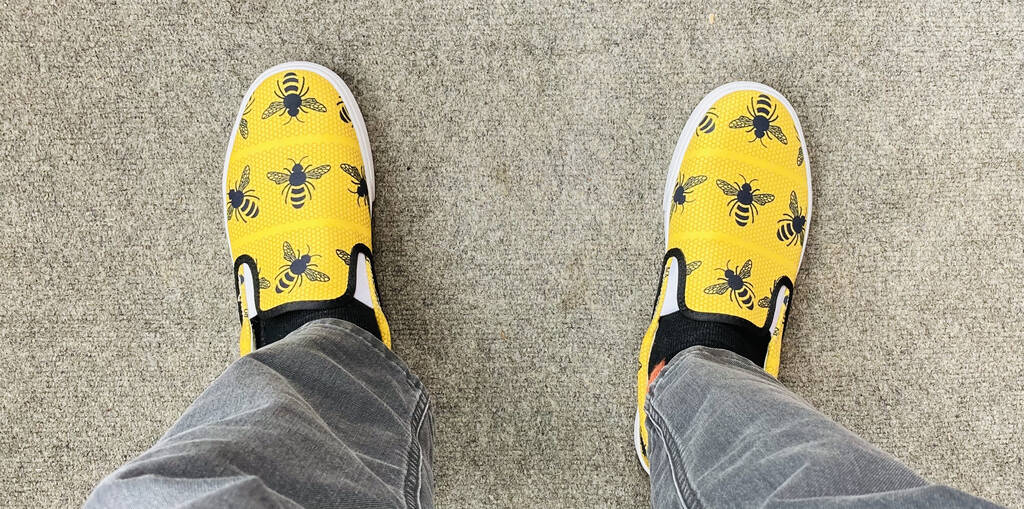
While trying to help Oliver find new shoes, I came across a pair for myself. BucketfeetSave the Bees shoes, by artist Laurel54. They arrived this morning.
Many people accept that free software tends to protect your privacy better than proprietary alternatives, but they may not understand why that is. This week’s news about the Audacity project adding telemetry and the public outcry is a perfect test case to explore why free software means better privacy. If you haven’t been following the […]
I Was a Teenage Communist, a 1982 sketch from SCTV, is from an era of the show when it was firing on all cylinders: terrific attention to detail, fine writing, brilliant makeup and costuming, and pitch-perfect satire.
Although it’s a send-up of 1950s American paranoia, it’s remarkable how the broad strokes of the sketch mirror my own experiences as a rebellious student just a few years after it aired: I clearly remember a night in a smoky rock ‘n’ roll bar where I was befriended by a transcendent agitator who later went on to work as a translator for Granma in Cuba. She was full of infectious revolutionary fervour, and I was buying what she was selling.
If I’m any guide, winning young hearts and minds is surprisingly easy.
I have had the experience of asking five people to explain what MVP is and heard seven different answers. Minimum Viable Product has become an acronym used very differently from what it is meant to be in the Lean Startup world. When MVP came to the corporate world was translated to:
The “Phase One” of the project
Something of low quality that brings no or very little feedback to the team/business
The “In scope” requirement
The “what we have enough money for”
The “what we need in place by <DATE>”
The word to use with stakeholders so we look agile
MMF
All these require a “Pause and Align” type of conversation. Preferably with the sponsor present. Continuing without alignment is a clear indication that we will face challenges down the road.
Using the Lean Startup thinking, MVP’s purpose is to learn, to get feedback that will help us make one of these decisions:
Should we stop working in this direction and try another approach?
Should we stop this idea entirely and go back to the drawing board?
Should we continue with the initial idea without changes?
Should we continue with the initial idea but bring in some changes?
Having these conversations over and over with different teams made me think that there’s got to be a better way to express the desire to learn from customer feedback.
So, I started using the terms “Learning Release” and “Earning Release.” As you might guess, the idea behind this is that we agree to declare some releases to be about learning some things we are not entirely sure about. Then, based on the feedback that we get and the things that we learn, we do an earning release that promises sales and subscribers.
Only by using “Learning Release” language was I able to stop the long conversations around different understandings of MVP, comparing thousands of articles online to prove who is right and who is wrong-er, and just get to the important discussion/questions quicker.
What do we want to learn?
What is the smallest thing we can do to learn that?
It is not uncommon to have a lot of things we want to learn. If this is the case, then create a Backlog of questions. Yes, forget about roadmaps or backlogs with Epics and User stories. Maybe not even the Story mapping, although this exercise often serves to identify what we don’t know. If we have questions, it is too early for us to write stories. They would be pure guesses and most likely wrong. But a backlog of questions can help us focus. We can prioritize the questions and bring on top the more critical, deeper, the ones that “if we figure that out, the rest will fall in place.” Those are the questions that will give us the most important lessons.
You can continue from here in the same way that you would go to decide what to do. Will you need to build something, survey people, napkin drawings with someone for quick feedback, etc. If you choose to build something, try to make it as small as possible, as small effort as possible, in the range of days.
At this point, we have removed the emotions away from the results we will get. It is not anymore about hoping that what we build works. It brings to us the benefits we wanted and expected to get. At this point, it is about being curious and wanting to know an answer from the actual customers. It is not about who is right or finger-pointing the Business. It is about a group of people learning together how to build the most amazing product for their customers.
Product Managers need to be careful not to bombard customers with a lot of learning releases simultaneously. That might overwhelm customers, and they will complain about the unfriendly experience. Also, learning releases are short-lived. We can’t keep them on for a long time, or they will give our customers a negative experience. Learning releases need to face the customer until we reach the data threshold we wanted to gather to learn how to proceed with a decision. For this, Product managers need to set very clear learning challenges such as “first 1000 customers’’, “1% of clients from Asia”, “Customers from Toronto that are dog owners”, etc. If we do not put boundaries around our Learning releases, we would be running tests that will not give us focused lessons.
By creating the concept of “Learning Release” to help us answer questions and learn more about our clients and our product, we can now change the conversation with product managers and sponsors. Instead of creating a plan that gives the expectation of starting to collect the benefits right away, we lay out a plan that sets expectations for learning and earning. Initially, the team will need to have one or more Learning Releases, depending on how many questions they have or how complex the challenge is given to the team. The team will need to know how to measure the results of each Learning Release and demonstrate the lesson we learned.
Don’t be surprised if we quickly learn that we are on the right path. That makes the Earning Release come forward. However, don’t be surprised to learn that customers use or expect something different from our product. This is actually a big win because it saves the company a lot of effort and money that would have gone to building the wrong feature/solution only to learn late that it was the wrong one. A Learning release can prevent precisely that.
How to recover if our Learning release teaches us something we didn’t expect from our customers?
Celebrate!
Celebrate that you are now a smarter team/organization and that you have new opportunities in your hands. Maybe you need to completely change the direction. Maybe you need to just change some things here and there and continue. Whatever the case, you are not going by the seat of your pants but by data.
However, if we arrive at a place where we get positive feedback and believe our solution will support the development of this functionality, then we need to go for the Earning Release.
Earning Release is when the product manager has a tested and working functionality and is now ready to get Marketing, Sales, Account Managers, etc., to go out and promote … loud and proud! At this point, we already have high confidence that we will do well since we already have had feedback on it.
When Industrial Logic was looking to add a Group Chat for their eLearning platform, within 3 hours, they added on their website a message that pulled attention and looked like this:
When you clicked to join the group chat, you would see this:
Within three business days, they collected this data:
It was not compelling enough to make them go ahead and develop the Group Chat feature all the way. They learned that users were not very interested, and developers could put their efforts into another idea.
Dropbox needed to test its leap- of- faith question: if we can provide a superior customer experience, will people give our product a try?
While developers were struggling with the technical challenges they had to overcome, the founder, Drew, made a video. The video is a fake product and was made of low quality. However, it was a good test of the response people would have if this product was all done and polished.
The video drove many beta testers from 5000 to 75000, and the feedback was so positive that it was worth continuing with the Earning Release. And they have earned a lot since then!
Apple likes to claim that the App Store replaced the system of selling software in physical boxes in stores and over the mail.
But it’s not true.
My experience selling apps before the App Store was not unique or new — it’s only interesting now because people may have forgotten this history, and younger people may never have heard it.
Here’s my story:
We shipped NetNewsWire 1.0, an RSS reader for Mac OS X, in 2003 and sold it over the web for $39.95. There were no boxes and no printed manuals — there was nothing physical at all. This situation was, at that time, completely unremarkable: it was expected.
We used a service called Kagi for the storefront and credit card processing. Kagi had been around since the ’90s, and it was well-known and trusted by the Mac community. Setting up our account and store was pretty simple — simple enough that I forget most of the details.
Part of how it worked was that we had to upload a text file to Kagi’s system, a file with license keys their system would give out one by one. I wrote a script to generate that file, and I wrote code in the app to validate a license key. I also had to create a small window where a user would enter their license code.
This meant there was some work, yes, but it was nothing compared to what you have to do to sell on the App Store.
(It could have been more convenient for purchasers, yes, and by 2005 we had plans to create an in-app purchasing system that still used Kagi, but we ended up benching that plan, for reasons.)
And — importantly — Kagi’s fee was something like 5%. (Update a little later: evidence suggests I may be misremembering: it could have been more like 10%.)
Even more importantly: Kagi didn’t review our app. I suppose, if we had been selling something egregious in some way, they might have learned of it and cut us off. But that’s a standard business relationship. Kagi was not a gatekeeper.
Kagi didn’t promote our app, either. It wasn’t their job — it was ours. They provided a storefront and trusted credit card handling, and that was all we wanted, and it was great.
By 2005 this Mac app was making well into five figures per month. Still at Kagi.
Here’s the thing: none of this was new. We were following well-worn paths. When I worked at UserLand Software, before writing NetNewsWire, we sold Frontier on the web. Lots of other companies — and not just indies — had been selling apps on the web since the ’90s, and paying more like 5% than 30%, and not having to go through any gatekeepers.
And it was pretty easy. Easier than dealing with the App Store!
Next time you hear someone from Apple forget this history, please remember that they’re forgetting on purpose.
PS Yes, you may argue the App Store’s superiority in certain respects and be correct. Don’t bother. My point is that the App Store was not replacing the system of apps-in-boxes-in-stores. It was replacing the system I talk about above.
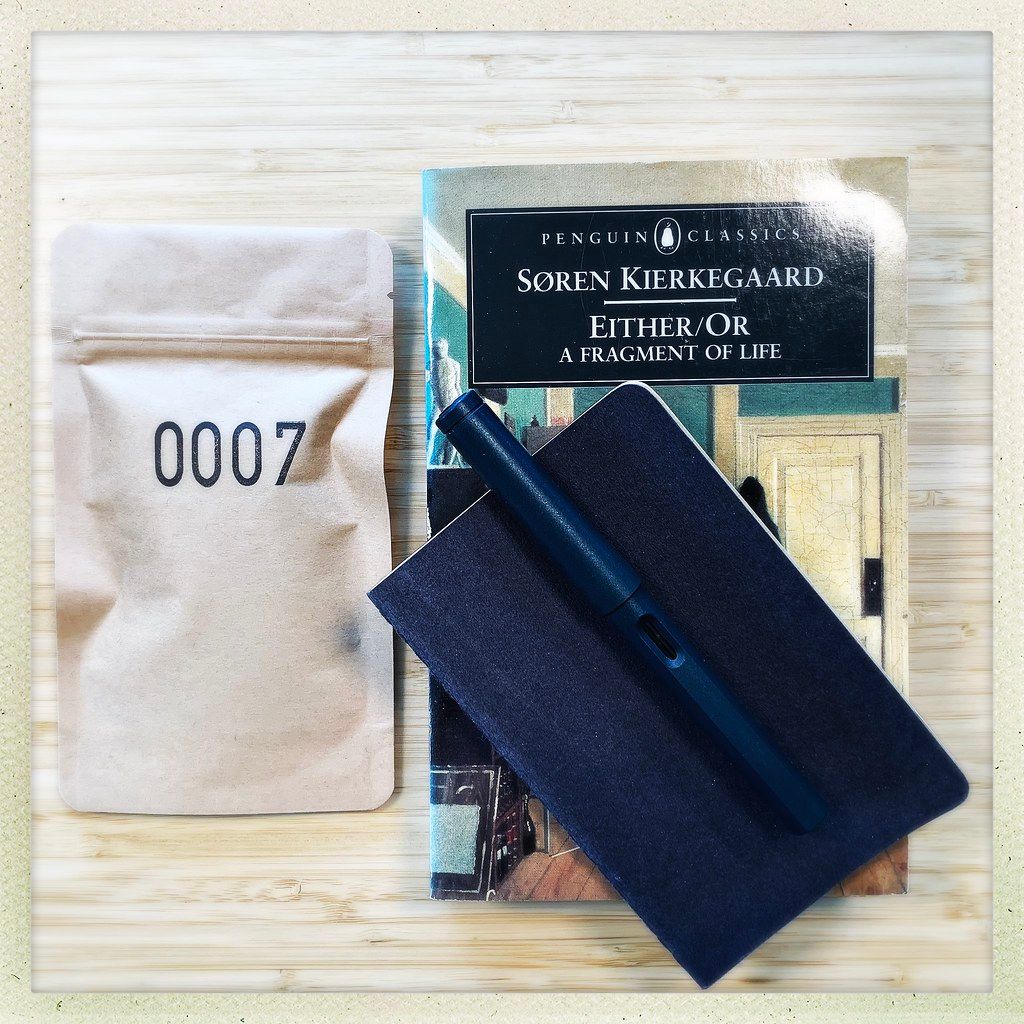
The dominant nose on the beans is acidic, which was not what I was actually expecting, there is a bit of sweetness coming through as well, but very very little and I had to really concentrate on detecting it.
Brewing Method AeroPress
I am following James Hoffman's "The Ultimate AeroPress Technique". 11 grams of coffee and 200 grams of water. Steep 2 minutes, then swirl and let settle for 30 seconds before fully pressing it through.
Curiously the dominant note when smelling is actually sweetness, not the acidity I got off of the bean. This continues when actually sipping. Light, somewhat floral aroma forward with some bitterness following in the tail end (After looking at the notes: Yeah, def. Milk chocolate, though I didn't make the connection at that time). As I sip more a bit more complexity is coming through as well, def. getting a bit of vanilla.
Colour starts with a reddish hue that turns towards orange as the coffee cools down.
Overall, a very pleasant cup that is quite enjoyable.
Rating:4.5/5
Brewing Method AeroPress (Coarse Grind)
For the second preparation today I decided to use the AeroPress again. This time though with a coarser grind.
The most notable difference was a much redder brew. Quite a bit more pronounced than in the previous extraction. Nose is very similar though.
Interestingly enough, the overall flavour profile is much more muted. I would have expected a shift, but instead it all seems to be a bit more even (less extraction?).
Apparently some people were worried that Non-Steroidal Anti-Inflammatory Drugs (NSAIDs) would make a COVID infection worse. Not so, says this study.
Variants
Remember yesterday when I said that B.1.617.2 was not of concern? I was too fast. While it does not seem to have unusually good immunity/vaccine evasion, it does seem to be more transmissible, according to this article.
Vaccines
There have been a number of studies which have found that vaccination gives better immunity than actually getting COVID. This seems odd. Why on earth would that be? This article says that antibodies from getting sick frequently target the wrong part of the virus while the vaccines train the immune system to target the spike protein. The mis-targeting might be due to prior infection with “common cold” coronaviruses.
Schools
This paper talks about measures in schools, and says that schools can be made safe. Interestingly, plexiglass desk shields seem to be a bad idea, while getting rid of extra-curriculars and having daily symptom screens are good ideas.
Vor gut 1,5 Jahren entwickelte ich die Idee, für einen sehr lieben Menschen ein Fahrrad von Null neu aufzubauen. Ich habe das als Jugendlicher öfter mal gemacht, aber da war gerade die DDR zusammengebrochen und alles, was ich an Fahrrädern hatte, kam eben aus dieser. Eher rudimentär, Stempelbremsen, Schaltungen waren damals kein Thema. Ich entwickelte später eine Leidenschaft für MTBs, zerlegte die, baute sie neu zusammen und fuhr mit denen. Hatte Spaß daran. Irgendwann wurde mir dieser Spaß dann egal, ich kümmerte mich nur noch wenig um Fahrräder. Bis zu meinem Herzinfarkt im Frühjahr 2019. Dort wurden Fahrräder für mich wieder ein echt wichtiges Ding. Aktuell habe ich sechs, von denen zwei immer fahrbereit sind und die restlichen immer irgendwie Umbaustatus innehaben. Hier mal das Schaltwerk runter, dort mal der Vorbau. Auch die Umwerfer wechseln gerne mal.
Jedenfalls wollte ich für den lieben Menschen vor 1,5 Jahren dann ein altes Fahrrad ins Jetzt holen und kaufte über eBay Kleinanzeigen in Friedrichshain diesen wunderschön geschwungenen Mixte-Rahmen, der dazu dienen sollte. Weil der Lenker sehr, sehr classy und das Rad an sich verdammt sexy war.
Wir fuhren dort hin, ich zahlte 70 Euro und war nicht wenig verliebt. Rahmenhöhe passte, Farbe und der Rest war egal, sollte ja eh alles runter und ab. Beim Zerlegen stellte ich fest, dass der Rahmen an einer Strebe am Hinterbau einen Riss hatte, was an einem Rahmen generell immer problematisch ist. Ich versuchte, den zu schweißen, war mir aber unsicher, ob das am Ende reichen würde und hatte Angst, dass es das nicht tun würde, wenn jede Menge Zeit, Geld und Arbeit in einen Neuaufbau investiert worden wären und der Bums dann halt wieder bricht. Ich entschied mich dafür, auf den Lenker zu setzen und nach einem anderen Rahmen zu suchen.
Hier um die Ecke aufm Dorf in Brieselang gab es ein paar Wochen Später dieses komplett runtergerockte Heidemann-Mixte aus dem 1980er Jahren für 20 Euro. Wir fuhren dort hin, ich zerlegte das Moped und hatte richtig Bock, daraus ein neues und wirklich wunderschönes Rad zu machen. Für liebe Menschen macht man sowas ja. Klar.
Dann kam eine Pandemie. Den Rahmen sandstrahlen und pulvern zu lassen, war zu dieser Zeit unmöglich. Und die Pandemie blieb. Es sollte ein Geschenk werden. Entweder im Frühling 2020 oder eben zu Weihnachten im selben Jahr. Konnte ich komplett vergessen. Die Pandemie hat „Nein!“ dazu gesagt. Also wartete ich.
Im Februar 2021 sah es dann besser aus. Ich konnte den Rahmen zum Sandstrahlen und Pulvern in eine Werkstatt geben und hatte bis dorthin sehr, sehr viel Zeit, Teile zu bestellen. Auch welche, von denen ich bis dahin noch nie gehört hatte. Große Liste, denn eigentlich wollte ich bis auf den Rahmen, diesen sexy Lenker, die vorhandenen Shimano 600 Komponenten und die irgendwann in Frankreich mal gemachten Wolber-Laufräder alles neu machen. Eine Herausforderung, wie sich später rausstellen sollte, denn ein Mixte-Rahmen ist nicht immer Rennrad-kompatibel gedacht, wie sich rausstellte, als der einfache 2-fach-Umwerfer nicht über ein 53er Kettenblatt unter die Sitzrohrstrebe passte. Gar nicht. Also 600er-Kettenblatt raus, ein 49er bestellt, das dann auch passte. Carbongabel mit Alu-Schaft aus Prenzlberg geholt, weil das Ding am Ende so leicht wie möglich werden sollte und ich Carbongabeln generell zu schätzen weiß. Die liebe Person fuhr bis vorgestern ein Rad, das wir hier liebevoll ihren „Trecker“ nennen, weil das gefühlt 46 Kilo wiegt. Das sollte, das musste anders.
Als der alte Heidemann-Rahmen dann komplett frei von Unötigem geflext, gestrahlt und schwarz glänzend gepulvert war, sollte es an den lange geplanten Neuaufbau gehen – und dort begannen die Probleme. Eine Shimano 600er Bremse passt vorne in eine Carbongabel, weil die in einem sich nahen Zeitraum füreinander gebaut wurden. Die hintere Bremse allerdings passt nicht auf die in den 80er Jahren verbauten Bremsbrücken. Die sportlich gedachten Bremsschenkel der Radrennbremsen sind einfach viel zu kurz, um bis an die 28er Sportfelgen zu reichen. Da bremst die gute 600er Tricolor halt auf dem Reifen und nicht auf der Felge. Nicht gut. Also nach Bremsen gesucht, die sehr lange Schenkellängen haben. Fast verzweifelt auch. Weil: man hätte das alles vorher am Rahmen ändern können, wenn man es gewusst hätte. Und der war frisch gepulvert. Da wollte ich nichts mehr dran flexen, schweißen, komplett umändern. Die Kratzer!
Ich fand im Netz langschenkelige Tektro Bremsen. Nicht ganz so schön, aber passend. Alternativ dazu hätte es in China auch Alu-Adapter gegeben, die die Bremsbrücke um 35 mm nach unten verlängern. Die zu bestellen aber hätte viel zu lange gedauert. Also Tektro r559 long in schwarz mit einer Bremsschenkellänge von bis zu 73 Millimetern. Das, was ich auf den Millimeter genau brauchte. Hat am Ende zum Glück und wirklich haargenau gepasst. So ist hinten die 600er Bremse runter, aber die Kiste bremst.
Nächste Herausforderung: Schutzbleche. Ich fahre meistens ohne, verstehe aber, dass man das nicht will, wenn man so in Alltagskleidung unterwegs ist und nach einer morgendlichen Tour im Regen arbeiten gehen will. Problem: Carbongabeln über 25er Rennradreifen lassen einfach keinen Platz für irgendwas zwischen sich. Kannste vergessen. Und ich hab auch vergessen, dass derartig sportlich orientierte Carbongabeln keinerlei Halterungen für Schutzbleche mit sich bringen. Also Schellen nachbestellt, das vordere Schutzblech kürzer geschnitten und (Asche auf mein Haupt) mit einem Kabelbinder an der Gabel fixiert. Nicht die für mich schönste Lösung, aber eine passende, denn es sollten ganz unbedingt genau diese schwarz-roten Schutzbleche sein, die es ähnlich und besser passend einfach nicht gibt.
Dann war das Rad eigentlich fast fertig. Eigentlich, denn der liebe Mensch wollte halt schon auch einen Gepäckträger. Ich fahre Rennrad mit Rucksack. Ich brauche keinen Gepäckträger, aber will den schon halt auch anbauen, wenn andere das wünschen. Also Gepäckträger nachbestellt und festgestellt das der an der Bremsbrücke ob der verlängerten Bremshebeln der Tektro so einfach niemals nicht passen würde. Und mal wieder ein bisschen verzweifelt. Dann daran erinnert, dass ich in der POS damals PA hatte. Und auch daran, dass ich Stahlbohrer, Feile und schwarzen Lack in der Dose hier habe. Irgendwie gemacht und dann passend gewerkelt.
Und da ist, das sage ich fast bescheiden, das schönste Rad der ganzen Stadt. Die Typo hat Max vor Jahren schon für die liebe Person gezeichnet und es war nicht ganz einfach, die in den letzten Tagen auf einen Fahrradrahmen zu übersetzen, aber es irgendwie über Umwege geklappt.
Das Ding war teurer als meine zwei Renner zusammen. Es zu bauen war ein ganz großartiger Prozess. Trotz und auch wegen des ständigen Scheiterns. Aber geil. Viel gelernt. Es jetzt abzugeben ist wie ein Kind ausziehen lassen zu müssen. Mein nächstes Projekt wartet schon im Keller. Noch ein Trümmertäubchen.
Opening the bag, I do get a hint of sweetness with some "heft". Looking at the beans they are surprisingly uniform and are the colour of milk chocolate.
After grinding, the aroma greatly intensifies.
Brewing Method AeroPress
I am following James Hoffman's "The Ultimate AeroPress Technique". 11 grams of coffee and 200 grams of water. Steep 2 minutes, then swirl and let settle for 30 seconds before fully pressing it through.
The brew has an orange tinge to it that intensifies as it cools down. I get fruity and nutty notes from the first sip with a bit of acidity. Overall on the first sip this is a bit of a "wow" moment after the last few days which I found a bit underwhelming.
As it continues to cool down the nuttiness intensifies. This is probably my favourite one so far, followed by the first one.
Rating:4.8/5
Brewing Method French Press
The French Press preparation creates a lighter version of the AeroPress, the nuttiness takes a backseat and instead the fruit flavours become more dominant. It makes it lighter, more "spring time" than the previous version.
Overall I think I prefer the AeroPress with the nutty flavours forward.
This is Sundae. She was rescued from a hoarding situation. Had never been indoors before. This is her very first nap, on a bed, in a home. Already an expert. 14/10 #SeniorPupSaturday pic.twitter.com/PeyCqh2Cko













 Michael Kalus.ca.


 Das Kraftfuttermischwerk.





 dog_rates on Twitter.

