Shared posts

22 Nov 20:54

Infinite GIF Landscapes Emerge in a Psychedelic Short Film

by DJ Pangburn for The Creators Project

GIFs courtesy the artist

Creating well beyond the easily digestible GIFs seen on Tumblr or Instagram, psychedelic GIF artist hexeosis is bringing to life a much larger animated vision of infinite patterns. Titled HX-01, the forthcoming video will be a 36-minute animated film in full color and in 1920x1080 high definition, replete with hexeosis’ varied geometric forms, patterns, mandalas and psychedelic landscapes.

Hexeosis tells The Creators Project that he has been working on HX-01 for over a year in Cinema 4D and After Effects, and envisions it as a non-narrative video that people can put on for parties, during meditation, or otherwise chilling out.

“I am expanding the basic concept behind my GIFs,” hexeosis says. “When I first imagined the video, I thought about something that you could watch and kind of space out to. That might sound a bit crazy, most people wouldn't want you to drift off while watching something they made, but I find that if you stare at the patterns for awhile, you can go into like a trance or meditative state.”

“I've heard from a lot of people that they use some of my GIFs to relax or chill out,” he adds. “I thought that the video could be a much expanded version of that idea. It's also a bit like a psychedelic journey. It's not meant to represent anything very specific, but more to invoke that feeling.”

There is still some work to do before the final cut, including a score and sound design. And to help raise funds for Blu-ray and DVD releases, hexeosis recently launched a Kickstarter campaign.

“Colorful calm moments, energetic dynamic sequences and thought-provoking, mind bending constructions [will be] woven together into an overall seamless rhythm and flow,” says hexeosis on Kickstarter. “I am [also]creating all of the music and sound effects for the video as well, so that I can time the visuals and audio perfectly. Some sections will be mellow and slower, while others will have a faster pace to mix it up.”

Hexeosis is aiming to deliver physical copies of HX-01 worldwide by February 17th. Click here to donate to the project, and here to see more of hexeosis’s work.

Related:

Infinity Expressed As Hypnotic GIFs

Yo, ROY G. BIV! | GIF Six-Pack

Retro Style GIFs Infuse Vintage Portraits With Flashing Psychedelia

22 Nov 19:16

Learning to Program Without Writing the Usual Sort of Code

by James Hague

There's much anecdotal evidence, from teachers of beginning programming classes, that many people can't come to grips with how to program. Sticking points can be as fundamental as not being able to break a problem down into a series of statements executed one after another, or struggling with how variables are updated and have different values at different points in the program.

I don't think it's quite as straightforward as that, because there are real life analogs for both of these sticking points. Clearly you have to go into the restaurant before you can sit at the table, then you order, eat, pay the bill, and leave. Everyone gets that (and knows why you don't sit at the table before going to the restaurant). When you pay for the meal, the money you have is decreased, and it stays that way afterward. The difference with code is that it's much more fine-grained, much more particular, and it's not nearly so easy to think about.

If you think that I'm oversimplifying, here's a little problem for you to code up: Write a program that, given an unordered array, finds the second largest value.

(I'll wait for you to finish.)

You could loop through the array and see if each element is greater than Largest. If that's true, then set NextLargest to Largest, and Largest to the current element. Easy. Except that this doesn't work if you find a value smaller than Largest but greater than NextLargest. You need another check for that (did you get that right?). I'm not saying this is a hard problem, just a little tricky, and a hard one for beginners to think about. Even in the first, simple case you have to get the two assignments in the right order, or both variables end up with the same value.

Set aside that kind of programming for a bit, and let's look at other ways of solving the "second largest" problem. Remember, nowhere in the description does it say anything about performance, so that's not a concern.

Here's the easiest solution: Sort the array from largest to smallest and take the second element.

There's a little extra housekeeping for this to be completely correct (what if the length of the array is 1?), but the solution is still trivial to think about. It's two steps. No looping. No variables. Of course you don't write the sort function; that's assumed to exist.

If you're not buying the sort, here's another: Find the largest value in the array, remove it, then find the largest value in the updated array. This sounds like looping and comparisons (even though finding the largest element is an easier problem than the second largest), but think about it in terms of primitive operations that should already exist: (1) finding the largest value in an array, and (2) deleting a value from an array. You could adjust those so you're getting the index of the largest value and deleting the element at an index, but the naive version is perfectly fine.

What I'm getting at is that thinking about problems given a robust set of primitives to work with is significantly easier than the procedural coding needed to write those primitives in the first place. Yet introductions to programming are focused almost exclusively on the latter.

As much as I like functional programming, I don't think it gets this right. The primitives in most functional languages are based around maps and folds and zip-withs, all of which require writing small, anonymous functions as parameters. Now if a fold that adds up all the integers in an array is named "sum" (as in at least Haskell and Erlang), then that's a solid, non-abstract primitive to think about and work with.

Long-time readers will expect me to talk about array languages like J at this point, and I won't disappoint. The entire history of array languages has been about finding a robust and flexible set of primitives for manipulating data, especially lists of numbers. To be completely fair, J falls down in cases that don't fit that model, but it's a beautiful system for not writing code. Instead you interactively experiment with a large set of pre-written verbs (to use Ken Iverson's term).

J or not, this kind of working exclusively with primitives may be a good precursor to traditional programming.

(If you liked this, you might enjoy Explaining Functional Programming to Eight-Year-Olds.)

22 Nov 19:14

This is not cool.

by hrbrmstr

First it was OpenDNS selling their souls (and, [y]our data) to Cisco (whom I don’t trust at all with my data).

Now, it’s Dyn — http://www.streetinsider.com/Corporate+News/Oracle+(ORCL)+Enters+Agreement+to+Acquire+DNS+Provider+Dyn/12270020.html — doing something even worse (purely my own opinion).

I’m currently evaluating offerings by FoolDNS & GreenTeam as alternatives and I’ll post updates as I review & test them.

I’m also in search of an open source, RPi-able DNS server with regularly updated Squid-like categorical lists and the ability to white list domains (suggestions welcome in the comments).

I’m a cybersecurity data scientist who knows just what can be done with this type of data when handed to $BIGCORP, and I’m far more concerned with Oracle than Cisco, but I’d rather work with a smaller company who has more reason to not sell me out.

22 Nov 19:14

Game Theory, Dating Apps, and Saving LinkedIn

by Richard Millington

Spend a few minutes to read this article.

A lot of sites are about matchmaking. A buyer/seller/recruiter/expert/someone wanting to get noticed is looking for the right partner.

Most suffer from the same fatal flaw. Too many of one group are flooding too few of the other group with too many (poor quality) messages. This ruins the experience for everyone (Hello LinkedIn).

The ideas aren’t revolutionary, but are worth refreshing:

1) Limit the number of messages one group can send. This can be done either by absolute numbers (e.g. 50 messages), charging per message, setting a limited number without a response, or limiting messages within a given time period (e.g. 24 hours).

2) Filter messages that are received by one group. Create a filter that removes messages from people with low ratings, where the message has limited content, or where it gets caught in a spam filter.

3) Set a form that must be completed. If most messages are low quality, change the template of the message. Ensure that a user has to complete certain details, provide more information, add links etc…

4) Allow only the minority (in demand) group to send messages. This removes the problem entirely and forces the majority group to optimize their profile as best possible to be noticed.

5) Limit the number of each group who can join. Only allow 1 side of each group to sign up in the first place. Have a waiting list. Until there is a match, don’t allow the user to join.

6) Let users signal when they want to be reached. I receive 30+ emails and LinkedIn messages per week from people offering SEO help. There are times when we will hire consultants to help our clients on their SEO. Sadly most messages are pro-forma, at the wrong time, and (frankly) just terribly written.

You can probably come up with 20 more ideas. The key here is to think about the problem from the perspective of game-theory (or collective action theory).

22 Nov 19:14

NewsBlur Blurblog: Going Less Loopy: The Transit Basics Behind TransLink’s SkyTrain Changes

sillygwailo shared this story from Connecting Dots . . ..

This past weekend, TransLink’s SkyTrain network in the Metro Vancouver, BC region underwent a pretty sizable series of route and platform changes. The changes are paving the way for the start later this year of service along the new Evergreen Extension and revised supporting bus routes. I thought it would be interesting to look at some of the transit planning... Read more »

The post Going Less Loopy: The Transit Basics Behind TransLink’s SkyTrain Changes appeared first on Connecting Dots . . ..

22 Nov 19:13

Apple Watch 2 :: Two months later

by Volker Weber

ZZ7D2D0D9D

I have been wearing the Watch 2 for two months and decided to go back to the original Watch for a bit. The interesting difference is the speed. You do not notice the Watch 2 being faster when you switch to it. But you do notice the old Watch being slower when you go back. How so? You are often ahead of the Watch when you handle it.

Other than that, it feels exactly the same. No pressure to upgrade. watchOS 3 is the real upgrade, and that's on the original Watch as well.

One recommendation: buy cheap. The aluminium case is lighter, and lighter is better. Buy the steel body only when you want more bling. If you can't decide between the new Series 1 and Series 2, get the Series 2 even if you pay more. Waterproofing lets you keep it on when near water. I don't need GPS, but if you do, Series 2 is a must. You can leave your iPhone behind during exercise and still get exact tracking.

Series 2 also has better battery life than the original Watch. In normal use I have about 65% charge left after almost 24 hours.

22 Nov 19:13

CIA director-designate Mike Pompeo uses passive voice to justify a power grab

by Josh Bernoff

Passive voice in opinion pieces is pernicious: it hides who actually is supposed to do stuff. Donald Trump’s choice for CIA director, Mike Pompeo, repeatedly used this technique in a Wall Street Journal op-ed. When you’re advocating surveillance and data collection, we want to know who’s doing it — but Pompeo uses passive misdirection to focus on terrorists … Continued

The post CIA director-designate Mike Pompeo uses passive voice to justify a power grab appeared first on without bullshit.

22 Nov 19:13

Google investing $4.5 million in Montreal Institute for Learning Algorithms

by Jessica Galang

Montreal’s burgeoning AI and machine learning ecosystem just got a boost.

The Canadian Press reports that the Montreal Institute for Learning Algorithms (MILA) at the Université de Montréal will receive $4.5 million over three years from Google to support its research. Google will also open an AI research group at its Montreal office.

“(AI) will affect pretty much every economic sector; right now is just the tip of the iceberg,” Yoshua Bengio, head of MILA, told The Canadian Press. “One of the things we are going to see more of is how these technologies affect how we interact with computers.”

Bengio said that MILA has attracted interest from “most” major IT companies, including some funding, though no specifics on which IT companies were provided. In October, Bengio was among the three-person team that announced Element AI, a Montreal-based ‘startup factory’ that will connect entrepreneurs and enterprises to develop technologies that can be spun off into AI companies.

Shibl Mourad, head of engineering for Google’s Montreal office, said that this will set the stage for turning Montreal into a super-cluster of AI expertise. He said for the past ten years, Bengio, considered by many to be integral to the development of deep learning technology, and his colleagues have put Montreal ahead in research compared to their competitors. The lab Bengio leads is one of the largest in the world dedicated to studying deep learning.

Bengio hopes that Google’s investments will put Montreal on the radar of global talent and corporations to support the development of Montreal’s AI ecosystem.

“We’d like to see more of that, and we’d like to attract people who aren’t Canadians to Montreal,” Bengio said.

This story was originally published on BetaKit.

22 Nov 19:09

The Devil is in the Details

by hrbrmstr

The first public informational video from the PEOTUS didn’t add a full transcript of the video to the web site and did not provide (at least as of 0700 EST on 2016-11-22) their own text annotations/captions to the video.

Google’s (YouTube’s) auto-captioning (for the most part) worked and it’s most likely “just good enough” to enable the PETOUS’s team to avoid an all-out A.D.A. violation (which is probably the least of their upcoming legal worries). This is a forgotten small detail in an ever-growing list of forgotten small and large details. I’m also surprised that no progressive web site bothered to put up a transcription for those that need it.

Since “the press” did a terrible job holding the outgoing POTUS accountable during his two terms and also woefully botched their coverage of the 2016 election (NOTE: I didn’t vote for either major party candidate, but did write-in folks for POTUS & veep), I guess it’s up to all of us to help document history.

Here’s a moderately cleaned up version from the auto-generated Google SRT stream, presented without any commentary:

A Message from President-Elect Donald J. Trump

Today I would like to provide the American people with an update on the White House transition and our policy plans for the first 100 days.

Our transition team is working very smoothly, efficiently and effectively. Truly great and talented men and women – patriots — indeed are being brought in and many will soon be a part of our government helping us to make America great again.

My agenda will be based on a simple core principle: putting America first whether it’s producing steel, building cars or curing disease. I want the next generation of production and innovation to happen right here in our great homeland America creating wealth and jobs for American workers.

As part of this plan I’ve asked my transition team to develop a list of executive actions we can take on day one to restore our laws and bring back our jobs (about time) these include the following on trade: I’m going to issue our notification of intent to withdraw from the trans-pacific partnership — a potential disaster for our country. Instead we will negotiate fair bilateral trade deals that bring jobs and industry back onto American shores.

On energy: I will cancel job-killing restrictions on the production of American energy including shale energy and clean coal creating many millions of high-paying jobs. That’s what we want, that’s what we’ve been waiting for.

On regulation I will formulate a role which says that for every one new regulation two old regulations must be eliminated (so important).

For national security I will ask the Department of Defense and the chairman of the Joint Chiefs of Staff to develop a comprehensive plan to protect America’s vital infrastructure from cyberattacks and all other form of attacks.

On immigration: I will direct the Department of Labor to investigate all abuses of visa programs that undercut the American worker.

On ethics reform: as part of our plan to “drain the swamp” we will impose a five-year ban executive officials becoming lobbyists after they leave the administration and a lifetime ban on executive officials lobbying on behalf of a foreign government.

These are just a few of the steps we will take to reform Washington and rebuild our middle class I will provide more updates in the coming days as we work together to make America great again for everyone and I mean everyone.

For those technically inclined, you can grab that feed using the following R code. You’ll first need to ensure Developer Tools is open in your browser and tick the “CC” button in the video before starting the video. Look for a network request that begins with https://www.youtube.com/api/timedtext and use the “Copy as cURL” feature (all three major, cross-platform browsers support it), then run the code immediately after it (the straighten() function will take the data from the clipboard).

library(curlconverter)
library(httr)
library(xml2)

straighten() %>% 
  make_req() -> req

res <- req[[1]]()

content(res) %>% 
  xml_find_all(".//body/p") %>% 
  xml_text() %>% 
  paste0(collapse="") %>% 
  writeLines("speech.txt")

In this emergent “post-truth” world, we’re all going to need to be citizen data journalists and it’s going to be even more important than ever to ensure any data-driven pieces we write are honest, well-sourced, open to review & civil commentary, plus be fully reproducible. We all will also need to hold those in power — including the media — accountable. Despite whatever leanings you have, cherry-picking data, slicing a bit off the edges of the truth and injecting a bias because of your passionate views that you believe are right are only going to exacerbate the existing problems.

22 Nov 19:08

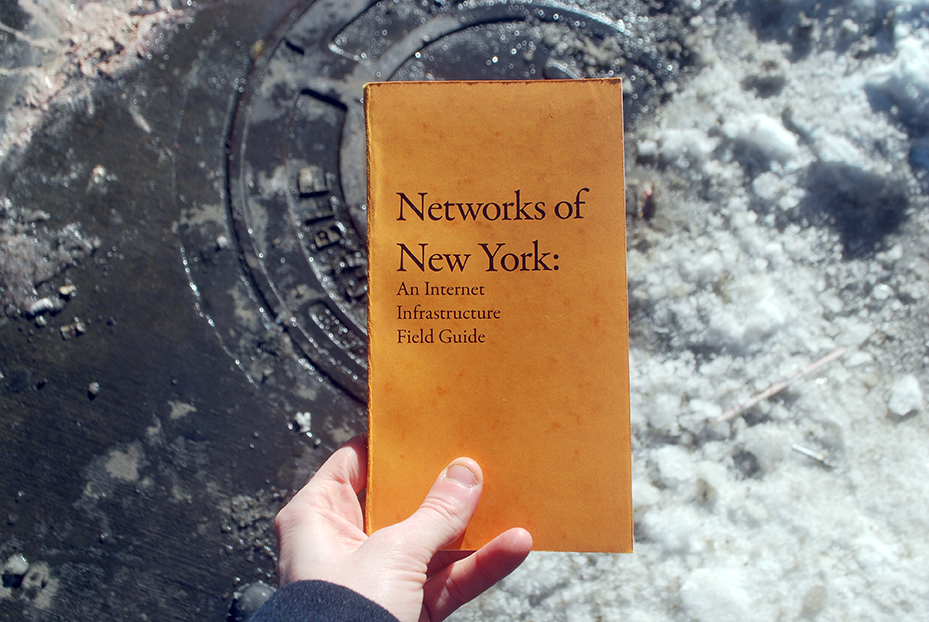
Book: Networks of Newyork

by Thejesh GN

I don’t know anyone who can authoritatively say I know how internet works. Internet is made up millions of loosely coupled software, hardware, protocols and physical objects. It’s almost impossible to know every part of it in detail. But most of us can logically explain how it works with some black boxes. This book opens one of the black boxes “physical objects”. Since its physical objects they occupy a space and in this book its Newyork city.

Networks of New York - Ingrid Burrington’s Book. ©️ Ingrid Burrington.

Networks of New York – Ingrid Burrington’s Book. ©️ Ingrid Burrington.

Ingrid Burrington is an artist who loves maps, internet and politics etc. Things that I really enjoy. So I had to read this book. I was very happy to buy a DRM Free epub version from Melville House.

The book reads like a NYC digital mapping exercise where Ingrid maps everything that is physical and remotely connected to internet. She gives background and enough history to keep the reader interested. If you live in NYC or visit, you can go on endless “Internet of Real Things” walking tours.

I don’t live in NYC but since I read the book I have noticed the cabling, the microwave point to point dishes, all kinds of cameras etc. It’s very interesting to see how disorganised cabling in Bangalore is.

I think its a must read if internet and maps are of interest you. It might even inspire you to map the internet of your city.

22 Nov 19:08

Courtesy of @reddit, a place designed especially for @MrJamesMay. https://t.co/iqOc94b9bD

by thegrandtour
mkalus shared this story from thegrandtour on Twitter.

Courtesy of @reddit, a place designed especially for @MrJamesMay. https://t.co/iqOc94b9bD


Posted by thegrandtour on Tue Nov 22 14:31:40 2016.


1579 likes, 330 retweets
22 Nov 19:07

The end of the old Aussie dream?

by michaelkluckner

a

“The Sydney of 2026 will have crossed over that magical Australian barrier of the love affair with the motor vehicle,” offers David Pitchford, the chief executive of government property agency UrbanGrowth NSW.

“We will have moved away from everybody having three cars, and we will have moved into a situation like most European capitals, where people under 25 don’t even have a driver’s licence,” says Pitchford.

“And the reason for that is that they don’t need it. Their city is designed so well that they can get around and interconnect without it.”

This series of articles in the Sydney Morning Herald imagines the city in a decade, when its population will have climbed from the current 4.2 million to 5.5 million.

People who really know Sydney – not just the pretty harbour and the historic Inner West and Eastern Suburbs but the sprawling North Shore and the “Western Subs” baking on the Cumberland Plain – will question whether forms of personal mobility could ever be replaced by transit. Distances are great and the spaghetti of arterials connecting the suburbs are badly congested. Most of the investment since 2000 has been in tolled road infrastructure – an orbital freeway and some very long tunnels. The train system looks excellent on a map but is slow to use. And bicycles – such a great interest to many readers of this blog – are practically non-existent due to narrow roads and aggressive drivers.


22 Nov 19:07

Datadive Reproducibility – Time for a DataBox?

by Tony Hirst

Whilst at the Global Witness “Beneficial Ownership” datadive a couple of weeks ago, one of the things I was pondering  – how to make the weekend’s discoveries reproducible on the one hand, useful as a set of still working legacy tooling on the other – blended into another: how to provide an on-ramp for folk attending the event who were not familiar with the data or the way in which t was provided.

Event facilitators DataKind worked in advance with Global Witness to produce an orientation exercise based around a sample dataset. Several other prepped datasets were also made available via USB memory sticks distributed as required to the three different working groups.

The orientation exercise was framed as a series of questions applied to a core dataset, a denormalised flat 250MB or so CSV file containing just over a million or so rows, with headers. (I think Excel could cope with this – not sure if that was by design or happy accident.)

For data wranglers expert at working with raw datafiles and their own computers, this doesn’t present much of a problem. My gut reaction was to open the datafile into a pandas dataframe in a Jupyter notebook and twiddle with it there; but as pandas holds dataframes in memory, this may not be the best approach, particularly if you have multiple large dataframes open at the same time. As previously mentioned, I think the data also fit into Excel okay.

Another approach after previewing the data, even if just by looking at it on the command line with a head command, was to load the data into a database and look at it from there.

This immediately begs several questions of course  – if I have a database set up on my machine and import the database without thinking about it, how can someone else recreate that? If I don’t have a database on my machine (so I need to install one and get it running) and/or I don’t then know how to get data into the database, I’m no better off. (It may well be that there are great analysts who know how to work with data stored in databases but don’t know how to do the data engineering stuff of getting the database up and running and populated with data in the first place.)

My preferred solution for this at the moment is to see whether Docker containers can help. And in this case, I think they can. I’d already had a couple of quick plays looking at getting the Companies House significant ownership data into various databases (Mongo, neo4j) and used a recipe that linked a database container with a Jupyter notebook server that I could write my analysis scripts in (linking RStudio rather than Jupyter notebooks is just as straightforward).

Using those patterns, it was easy enough to create a similar recipe to link a Postgres database container to a Jupyter notebook server. The next step – loading the data in. Now it just so happens that in the days before the datadive, I’d been putting together some revised notebooks for an OU course on data management and analysis that dealt with quick ways of loading data into a Postgres data, so I wondered whether those notes provided enough scaffolding to help me load the sample core data into a database: a) even if I was new to working with databases, and b) in a reproducible way. The short answer was “yes”. Putting the two steps together, the results can be found here: Getting started – Database Loader Notebook.

With the data in a reproducibly shareable and “live” queryable form, I put together a notebook that worked through the orientation exercises. Along the way, I found a new-to-me HTML5/d3js package for displaying small  interactive network diagrams, visjs2jupyter. My attempt at the orientation exercises can be found here: Orientation Activities.

Whilst I am all in favour of experts datawranglers using their own recipes, tools and methods for working with the data – that’s part of the point of these expert datadives – I think there may also be mileage in providing a base install where the data is in some sort of immediately queryable form, such as in a minimal, even if not properly normalised, database. This means that datasets too large to be manipulated in memory or loaded into Excel can be worked with immediately. It also means that orientation materials can be produced that pose interesting questions that can be used to get a quick overview of the data, or tutorial materials produced that show how to work with off-the-shelf powertool combinations (Jupyter notebooks / Python/pandas / PostgreSQL, for example, or RStudio /R /PostgreSQL ).

Providing a base set up to start from also acts as an invitation to extend that environment in a reproducible way over the course of the datadive. (When working on your own computer with your own tooling, it can be way too easy to forget what packages (apt-get, pip and so on) you have pre-installed that will cause breaking changes to any outcome code you show with others who do not have the same environment. Creating a fresh environment for the datadive, and documenting what you add to it, can help with that, but testing in a linked container, but otherwise isolated, context really helps you keep track of what you needed to add to make things work!

If you also keep track of what you needed to do handle undeclared file encodings, weird separator characters, or password protected zip files from the provided files, it means that others should be able to work with the files in a reliable way…

(Just a note on that point for datadive organisers – metadata about file encodings, unusual zip formats, weird separator encodings etc is a useful thing to share, rather than have to painfully discover….)

Using tools like Docker is one way of improving the shareability of immediately queryable data, but is there an even quick way? One thing I want to explore on my to do list is the idea of a “databox”, a Raspberry Pi image that when booted runs a database server and Jupyter notebook (or RStudio) environment. The database can be pre-seeded with data for the datadive, so all that should be required is for an individual to plug the Raspberry Pi into their computer with an ethernet cable, and run from there. (This won’t work for really large datasets – the Raspberry Pi lacks grunt – but it’s enough to get you started.)

Note that these approaches scale out to other domains, such as data journalism projects (each project on its own Raspberry PI SD card or docker-compose setup…)


22 Nov 19:07

Xiaomi to Launch “An All-New Product Globally” at CES 2017

by Rajesh Pandey
Xiaomi seems all set to release its first ever global product as it has announced that it will be attending its first ever Consumer Electronic Show (CES) in Las Vegas early next year (January 5-8). The Chinese company has not revealed what its first global product will be though. Continue reading →
22 Nov 19:07

Kickstart – Nov 22

by pricetags

Gord Price:

There just won’t be any excuse like “Well, we couldn’t see what was coming.”

altantic

Nazi salutes in the Reagan Building.  My God.

But we’re already so numbed that this story from the weekend barely got heard above a presidential tweet on ‘Hamilton’.  But not a tweet on this.

On a topic directly relevant to Price Tags – how we shape our urban environments – watch for Trump’s infrastructure program, particularly where the money flows and for what purpose.  My guess: a massive extension of Motordom.


22 Nov 19:06

How to watch Amazon Prime Video in Canada

by Patrick O'Rourke

There are an abundant number of rumours indicating Amazon is preparing to roll out Prime Video globally, with Canada being included as one of the platform’s initial global rollout regions.

While the service hasn’t officially launched in Canada — Amazon hasn’t even responded to our request for comment yet — it’s possible to watch a wide selection of Amazon’s content right now, as long as you have a Canadian Prime subscription.

Keep in mind, however, that only shows in the ‘Watch While Abroad’ section are currently available to stream, which includes The Grand Tour, Man in the High Castle, Red Oaks and a few other original series. Using a VPN or DNS proxy service does not allow access to additional shows because you’re still logged into your Canadian Prime account.

Here’s how to watch Amazon Prime Video in Canada right now:

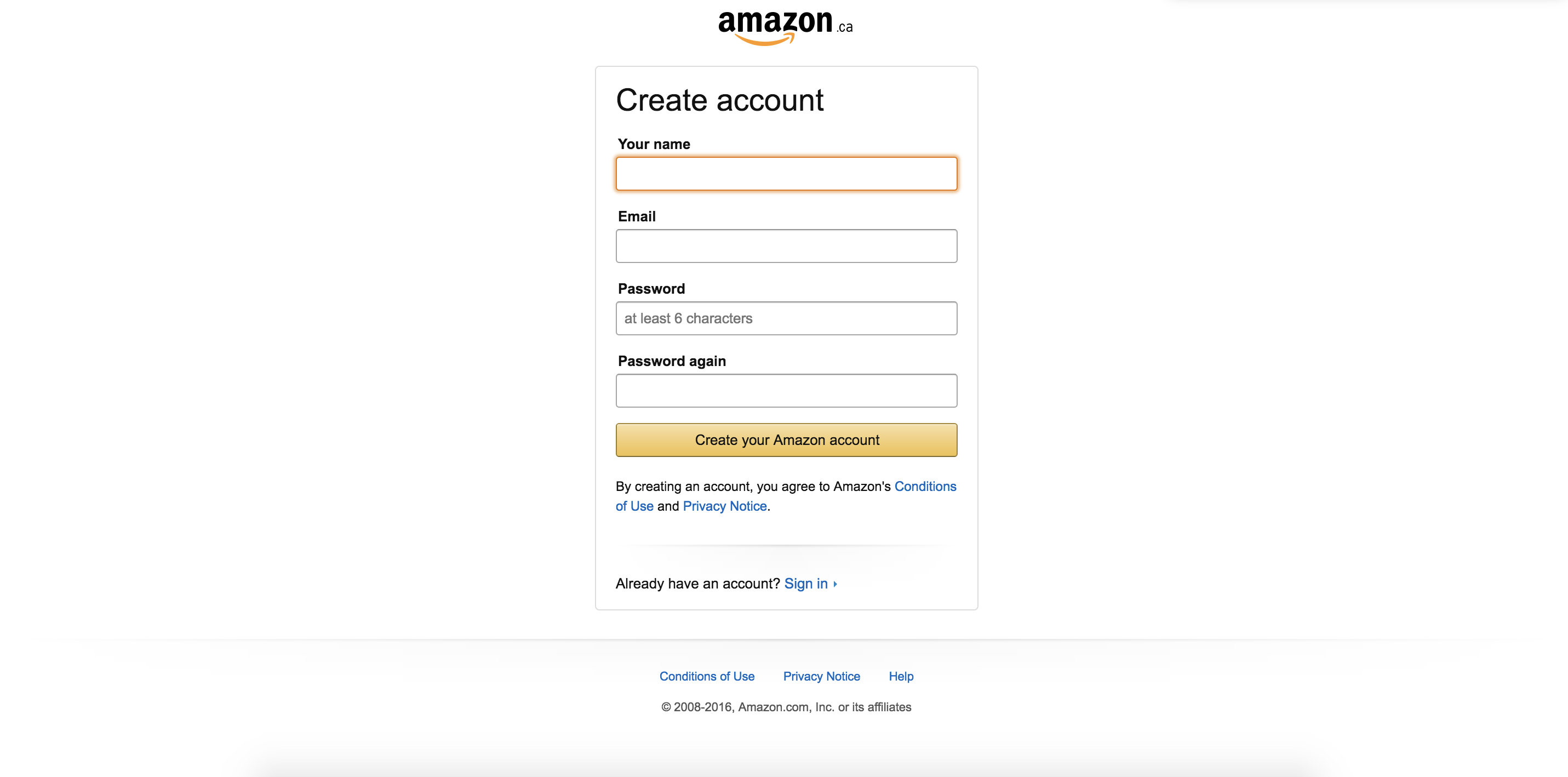
Navigate to Amazon.ca and create an account on the online retailer’s website. If you already have a Prime account, just head over to this link and you’ll be able to watch Amazon’s original content immediately.

amazonprimesignup

Next, select ‘Your Prime’ and sign up for Amazon Prime. Along with access to most of Amazon’s originals, a Prime subscription also gives you discounts on specific products, unlimited photo storage on web/mobile, and free two-day shipping on some orders, with free one-day shipping in Toronto and Vancouver. Amazon offers a free month of Prime to new users.

amazonprimeaccountcreation

Next, navigate to the U.S-based Amazon Prime Video platform at this link. All of the content present in Amazon Prime’s ‘watch while abroad section,’ which mostly consists of the platform’s original content, is available to watch right now.

amazonprime-11

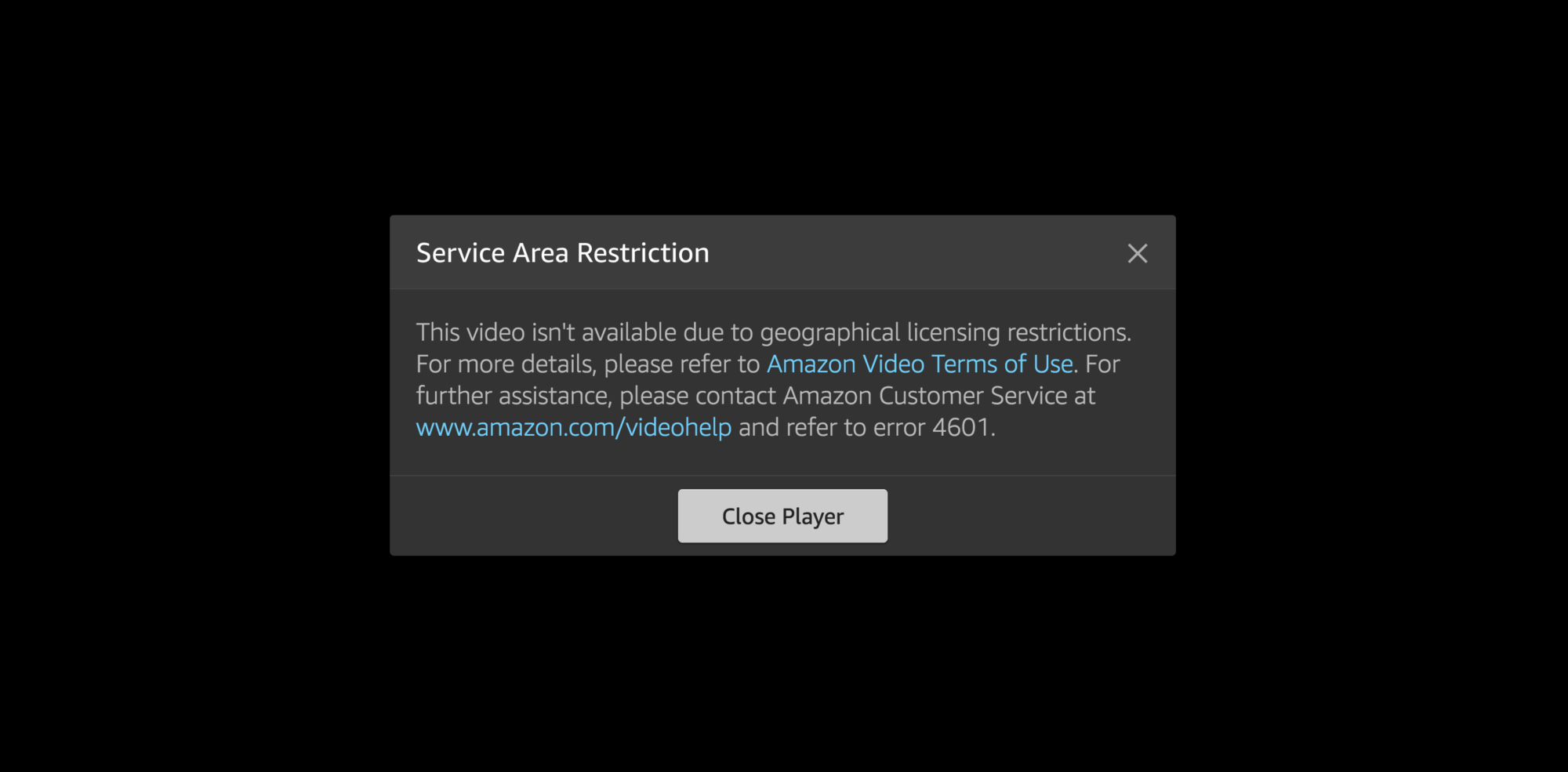
If you try to watch content that Amazon doesn’t have the international rights to, in particular, originals that Rogers and Shaw’s now defunct Shomi still hold Canadian rights to — Mozart in the Jungle and Transparent are examples of this type of content — You’ll be greeted with the geographical licensing restriction error seen below.

amazonservicearearestricted

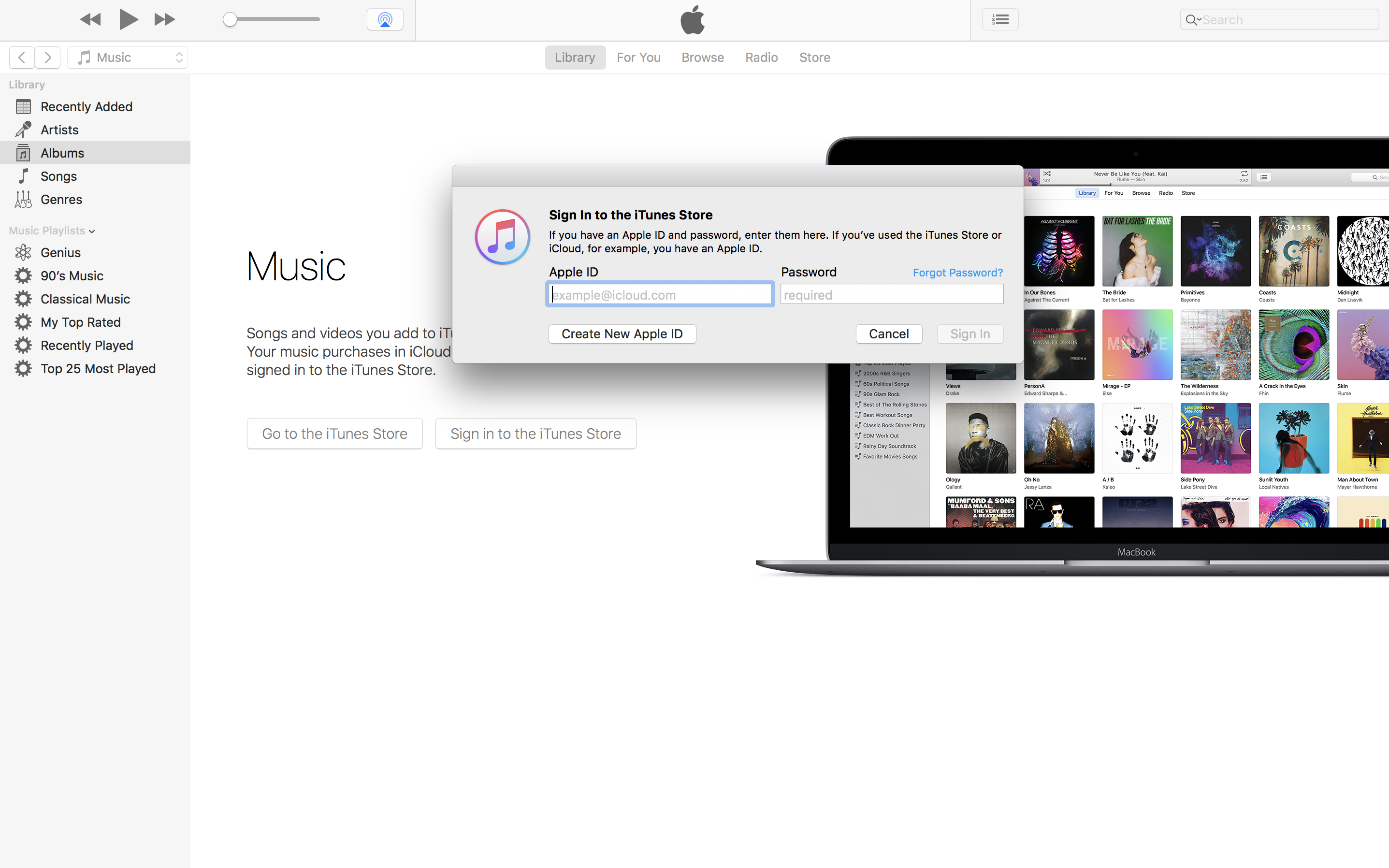
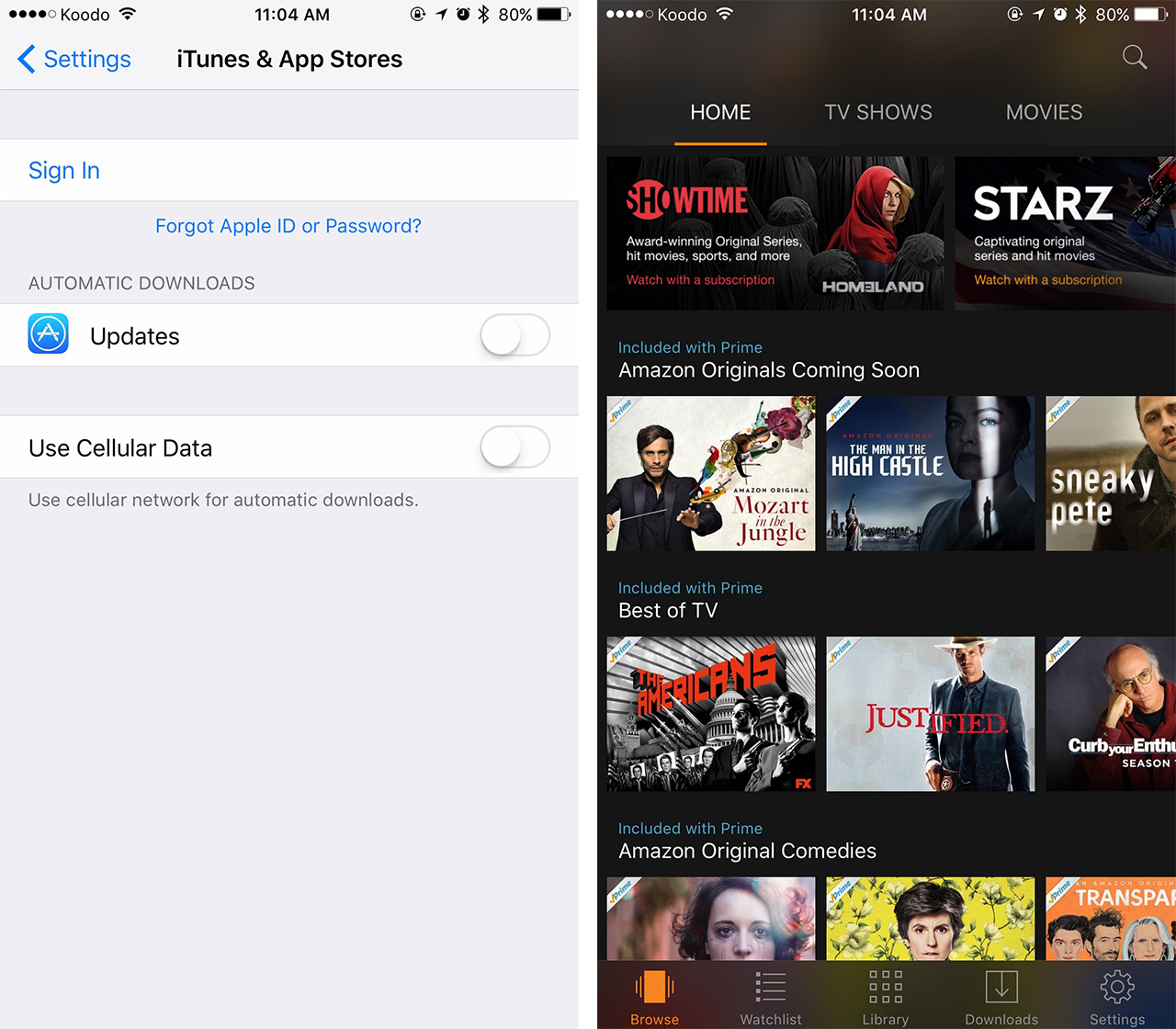
If you want to watch Amazon Prime Video on your phone, rather than on desktop, things get a little more difficult. First, you need a U.S. Apple App Store account, which can easily be created by navigating to ‘Account,’ ‘Sign In,’ and ‘Create New Account,’ within iTunes.

amazonprimevideoitunes

Next, Switch to the U.S. App Store in your iPhone by going to ‘Settings,’ ‘iTunes & App Store,’ and then selecting ‘Apple ID.’ Sign into your U.S. account and then navigate to the App Store and download ‘Amazon Video.’ Sign into your Amazon account and you’ll have access the same Amazon Original content you would on desktop.

Once you’ve done this, you can switch back to your usual Canadian App Store account and still be able to access Amazon Prime Video content.

amazonprimevideoappstore

If you’re an Android user, unfortunately, there doesn’t seem to be a clear way to view Amazon’s Abroad section right now (unless you use a region-switching proxy service).

Let us know in the comments section if you’re been able to get Prime Video up and running on Android.

Related: You can now stream Amazon Prime Video original content in Canada

22 Nov 19:04

Jew-Tagging and Wikipedia

Wikipedia likes to make lists, both explicit lists (Kentucky Derby Winners, American Pornographic Actresses, My Little Pony Episodes) and implicit lists that are retrievable by category. Readers may recall, for example, the brouhaha that arose not long ago when Wikipedia decided to remove all the women from American Novelists and move them to the American Women Novelists.

This sort of tom-foolery strikes most observers as innocent nerdishness, but it might have its darker side.

The alt-right fascisti – who, remember, will control the US government starting next month – have realized that Wikipedia categories are the perfect vehicle for making a comprehensive database listing every notable American Jew. One result of this ongoing effort is continuous Wikipedia debate (for example, here) concerning whether one individual or another is a Jew under the definition of the Nuremberg Race Laws.

22 Nov 19:04

Glow In The Dark Bike Path

by dandy

solar-bike-path-poland-dsc00216
Photo courtesy of TPA Instytut Badań Technicznych Sp. z o.o

Glow-in-the-dark bike paths

The future is now!

Interview by Tammy Thorne

With the sun setting earlier every day we're cycling a lot more in the dark, as winter descends. It's one thing to traverse the city on relatively well-lit arterial roads, but in the darker corners of the city's recreational trails wouldn't it wonderful to be able to have an eco-friendly alternative to spotty streetlights? (*Cough* Martin Goodman Trail *cough.*)

About a month ago we heard tell of a glow in the dark bike path in Poland. Intrigued by the innovative infrastructure we contacted the folks behind it to get a bit of insight into the project. It's the brainchild of TPA Instytut Badań Technicznych Sp. z o.o - a Vienna based lab that falls under the umbrella corporation of STRABAG SE, one of Europe's largest construction companies. They specialize in asphalt, concrete, earthworks and geotechnical engineering. Two of their engineers, Kamil Otkallo and Marianne Jaki, were kind enough to fill us in on the details of the project.

Where is the path? 

Kamil Otkallo: The exact location is Lidzbark Warmiński, it's the bike path along road 511, near Wielochowskie lake. It is 100 metres long.

How much does it cost to install one mile of this solar bike lane?

Kamil Otkallo: The technology is new so it is quite expensive, but we are extensively working on a few optimizations. At the moment, depending how we will apply our glowing materials the costs will rise from three to six times in comparison to the costs of construction of standard bike path.

glowing-bike-lane-poland-889x592
Photo Courtesy of TPA Instytut Badań Technicznych Sp. z o.o

How does it work? How is the solar glow activated?

Marianne Jaki: We used special synthetic substances called luminophores, which “load” during daylight and then emit accumulated energy during nighttime. The bike path is blue in daylight, which creates an optimum composition of colors with a neighboring lake and nature.

How long does it last? how long does it glow for and how long will the path itself last in weather?

Marianne Jaki: Due to its unique surface, the bike path accumulates light during the day, then emits light up to 10 hours during the night – depending on light exposure conditions. The bike path emits blue light at night with no need for any additional power supply – it is self-sufficient, eco-friendly and, what is most important, it improves the safety of pedestrians and cyclists at night.

Next steps? Are there any other cities interested in this technology?

Marianne Jaki: The 100 metre section of the luminous bike path is an experimental section. We will be testing the surface's reaction on atmospheric variables. Thereby, we will be able to verify the design brief and continue to improve the technology, [eventually] finding new use for it.

Presently, we are planning our next investments to continue experimenting. We will be able to offer our product to our clients once it is fully tested.

Wow! The future is now! Wouldn't it be dandy to see something like this on our beautiful recreational paths along the lake and in the Don Valley here in Toronto?

Now, this isn't the first time that glowing pavement and solar energy has been considered as a an alternative road surface. There was the "Starry Night" Path that a lot of people pointed too when SP z.o.o's glowing experiment first hit the internet. They were partially involved in the development of that project. But in that instance there were LED lights embedded in the pavement, and it was solar powered by an off-site array. There is also the Solar Roadways project, which uses a mix of LED lights and solar technology in a panel format that can be walked on and driven on.

Related Articles

Meet Copenhagenize urban planner James Thoem

Curb Your Enthusiasm: No snow clearance in bike lanes

Ride for Renewables

Bike Tourism: Best of Europe

Kits and Kilts: dandyhorse in Scotland


22 Nov 05:37

Introducing Firefox Focus – a free, fast and easy to use private browser for iOS

by Nick Nguyen

Today, we’re pleased to announce the launch of Firefox Focus – a free, fast and easy to use private browser for iOS.

Firefox Focus

Firefox Focus

We live in an age where too many users have lost trust and lack meaningful controls over their digital lives. For some users, it seems as though your web activities can follow you everywhere – across devices, across accounts. To make matters worse, the web can often feel cluttered. That’s why we are introducing Firefox Focus.

For the times when you don’t want to leave a record on your phone. You may be looking for information that in certain situations is sensitive – searches for engagement rings, flights to Las Vegas or expensive cigars, for example. And sometimes you just want a super simple, super fast Web experience – no tabs, no menus, no pop-ups.

Firefox Focus gives you just that.

Firefox Focus is set by default to block many of the trackers that follow you around the Web. You don’t need to change privacy or cookie settings.  You can browse with peace of mind, feeling confident in the knowledge that you can instantly erase your sessions with a single tap – no menus needed.


Firefox Focus Erase Button

Firefox Focus Erase Button

Much of what makes mobile web pages slow is the technology used to track users on the web. Because Firefox Focus blocks these trackers, it is likely you’ll notice a performance boost on the many sites that track your behavior. When you occasionally see a site that doesn’t work because it is dependent on tracking, and if you don’t mind that kind of tracking, Firefox Focus makes it easy to open your current site in either Firefox or Safari.

We look forward to your feedback on Firefox Focus.

You can download Firefox Focus from the App Store.

Firefox Focus continues to operate as a Safari content blocker on iOS, and users will be able to take advantage of Tracking Protection on both Safari and Firefox Focus.

22 Nov 05:15

Has Instagram Made Snapchat Irrelevant?

by Mary Beth Quirk
mkalus shared this story from Consumerist.

Once upon a time, Instagram was where you publicly posted the photos you were really proud of and wanted the world to see, while SnapChat was where you privately posted other photos that you were proud of, but only wanted a few people to see — and where there was no lasting record of the visuals. In the years since, Instagram has increasingly encroached on SnapChat’s turf, and the Facebook-owned service’s latest update may lead some to wonder: Is there any reason to have both SnapChat and Instagram?

Instagram announced today that users will now be able to message each other photos and video that self destruct, much like the vaporizing messages that first made SnapChat a billion-dollar baby in Silicon Valley.

Instagram also confirmed that it’s taking a page from its parent company Facebook’s playbook and adding live video in the coming weeks. Instagram’s live video will differ from Facebook’s feature in that it cannot be viewed again once the broadcast is over.

And now that Instagram will also have self-destructing messages, a feature that Snapchat first popularized, and live video, which Snapchat doesn’t have, why would anyone have both? Let’s see how the two stack up against each other when it comes to features.

What Does Snapchat Offer?

• A “Stories” feature that lets you publish images and photos that expire after 24 hours

• Self-destructing photos and videos that can be sent via private message

• A large library of animated “lenses” for video (Think: puking rainbows and cartoon dogs with wagging tongues)
taplens-68316677

• Rotating library of overlays (i.e. time and temperature, altitude, speed, geo-tagged options for users’ specific location) as well as filters
1_1-561834258

• Ability to add stickers, text, drawing to photos/videos in the Stories feed as well as for content shared privately with friends
bitmoji_sticker_snap-997410381

• Private video chat between friends

• Fewer restrictions — or at least less enforcement of restrictions — on nudity and other adult-oriented content.

• Advertising in multiple forms: Branded, short video content from advertisers that you choose to watch; Short commercial videos that run while you review Stories clips; branded lenses and overlays.

What Does Instagram Offer?

• Public sharing of photos and short videos. Other users can comment, and all posted items will remain indefinitely unless you delete them or make your account private.

• A SnapChat-like “Stories” feature with images and photos that expire after 24 hours
instastories

• Diet Photoshop “filters” that let users instantly tweak the appearance of uploaded photo/video
unnamed

• Private messaging that allows users to send photos and videos that can be kept forever

• SnapChat-like self-destructing photos and videos that can be sent via private message

• Advertising from brands/companies within users’ feeds as well as in Stories

• The ability to add filters, text, drawing to photos/videos in the Stories feed or for content shared privately, though text and drawing is not available for content shared in public feeds

• Feature that allows users to tag their friends in a public feed as well as Stories

• Live video
instagramlive

• A more “family friendly” atmosphere, where restrictions on adult content is heavily enforced.

Is There Any Difference?

While both platforms have added features and functionalities in recent years, they both retain much of what initially made them popular. However, Instagram now offers what was once the core feature for SnapChat — the ability to send private, self-destructing images and video, while SnapChat has not even attempted to make any inroads on Instagram’s turf as a public photo-sharing platform. So now an Instagram user may have little need for SnapChat, while a Snapchat would need Instagram (or some other photo-posting service) for permanent sharing of images.

One key feature that SnapChat still has going for it is the Lenses and overlays it offers to users. Thus, anyone wishing to turn themselves into a slobbering dog or crown their head with an animated butterfly wreath has to — for the moment — stick with SnapChat, at least so you can take that photo and post it on Instagram.

At the same time, there’s a certain degree of anonymity to SnapChat that many people don’t feel with Instagram. A desire to use something that isn’t owned by Facebook may help keep some SnapChat fans from jumping ship. SnapChat is also prepping to go public for $25 billion, which could give the company oodles of cash to spend on creating a permanent photo-sharing feature if it chooses to.


22 Nov 05:14

Android Gingerbread nears the end as Google Play services announces next release won’t offer support

by Rose Behar

Google has announced that Google Play services 10.0.x is the last version of the platform that will support Android 2.3 Gingerbread. Apps developed using future software development kit (SDK) releases won’t be able to connect to Google Play services on a Gingerbread-powered phone, essentially killing off the five-year-old OS version.

While this news won’t affect most Android users, it’s significant for the remaining 1.3 percent of the platform’s users who still use Gingerbread, according to Google’s most recent platform distribution report. However, users on Gingerbread are rapidly declining, with the above number representing a decrease of 0.2 percent since September. It’s likely that by the time Google Play services 10.1 arrives, it’ll be an even smaller fraction of the demographic users. So while it’s always bittersweet to say goodbye to a good dessert, it’s not likely to disrupt Android users at large.

Let us know your memories of Android Gingerbread in the comments below.

Related: November Android distribution numbers reveal Nougat’s 0.3 percent debut

22 Nov 05:14

Selling What’s Left of Our Soul – Vancouver Seeking More Corporate Labels

by vreaa
mkalus shared this story from Vancouver Real Estate Anecdote Archive.

school070405

“Vancouver has launched a new initiative to develop an inventory of its assets – everything from buildings and cars to its awards programs and even its website – that could make good candidates for sponsorship and naming rights.
The Vancouver consultant is being asked to look at the policies in other cities and then “develop the criteria to identify all marketable components (i.e. programs and facilities) associated with those assets and determine the type of sponsorships that can be leveraged, such as naming rights for a facility.” In addition, it will need to explain why some assets are not appropriate for naming rights or sponsorships.
The final report is supposed to “provide the City with realistic revenue projections and return on investment based on various sponsorship/agreement terms (e.g. 5, 10, 15, 20 years)” and “suggest how the city can maximize the market value of these assets or potential revenues via targeted sponsorships and bundling.”

– from ‘Vancouver to develop list of assets eligible for sponsorship, naming rights’, Frances Bula, G&M, 18 Nov 2016


22 Nov 05:13

Apple is reportedly exiting the router business

by Rui Carmo

This is not unsurprising given the way telcos have been seeding home gateways everywhere, but can be taken as another harbinger of doom for Apple’s integrated ecosystem.

I have three AirPort base stations due to the peculiar configuration of my concrete walls, and compared to other devices they have given me pretty much zero trouble, so am particularly sad to see them become extinct (and, worse, unsupported in terms of security patches).

Most of the nicer alternatives are US-only, so this does not bode well for upgrades down the line, either. Time to revisit Devolo and some of the other players I tested back when I was at Vodafone…

22 Nov 05:13

Why America Called 'Bullshit' On The Cult Of Clinton

by Tyler Durden
mkalus shared this story from Zero Hedge.

Submitted by Brendan O'Neill via Reason.com,

The one good thing about Trump’s win? It shows a willingness among Americans to blaspheme against saints and reject the religion of hollow progressiveness.

If you want to see politics based on emotionalism over reason and a borderline-religious devotion to an iconic figure, forget the Trump Army; look instead to the Cult of Clinton.

Ever since Donald Trump won the presidential election, all eyes, and wringing hands, have been on the white blob who voted for him. These "loud, illiterate and credulous people," as a sap at Salon brands them, think on an "emotional level." Bill Moyers warned that ours is a "dark age of unreason," in which "low information" folks are lining up behind "The Trump Emotion Machine." Andrew Sullivan said Trump supporters relate to him as a "cult leader fused with the idea of the nation."

What's funny about this is not simply that it's the biggest chattering-class hissy fit of the 21st century so far — and chattering-class hissy fits are always funny. It's that whatever you think of Trump (I'm not a fan) or his supporters (I think they're mostly normal, good people), the fact is they've got nothing on the Clinton cult when it comes to creepy, pious worship of a politician.

By the Cult of Hillary Clinton, I don't mean the nearly 62 million Americans who voted for her. I have not one doubt that they are as mixed and normal a bag of people as the Trumpites are. No, I mean the Hillary machine—the celebs and activists and hacks who were so devoted to getting her elected and who have spent the past week sobbing and moaning over her loss. These people exhibit cult-like behavior far more than any Trump cheerer I've come across.

Trump supporters view their man as a leader "fused with the idea of the nation"? Perhaps some do, but at least they don't see him as "light itself." That's how Clinton was described in the subhead of a piece for Lena Dunham's Lenny Letter. "Maybe [Clinton] is more than a president," gushed writer Virginia Heffernan. "Maybe she is an idea, a world-historical heroine, light itself," Nothing this nutty has been said by any of Trump's media fanboys.

"Hillary is Athena," Heffernan continued, adding that "Hillary did everything right in this campaign… She cannot be faulted, criticized, or analyzed for even one more second."

That's a key cry of the Cult of Hillary (as it is among followers of L. Ron Hubbard or devotees of Christ): our gal is beyond criticism, beyond the sober and technical analysis of mere humans. Michael Moore, in his movie Trumpland, looked out at his audience and, with voice breaking, said: "Maybe Hillary could be our Pope Francis."

Or consider Kate McKinnon's post-election opening bit on SNL, in which she played Clinton as a pantsuited angel at a piano singing Leonard Cohen's "Hallelujah," her voice almost cracking as she sang: "I told the truth, I didn't come to fool ya." Just imagine if some right-leaning Christian celeb (are there any?) had dolled up as Trump-as-godhead and sang praises to him. It would have been the source of East Coast mirth for years to come. But SNL's Hallelujah for Hillary was seen as perfectly normal.

As with all saints and prophets, all human manifestations of light itself, the problem is never with them, but with us. We mortals are not worthy of Hillary. "Hillary didn't fail us, we failed her," asserted a writer for the Guardian. The press, and by extension the rest of us, "crucified her," claimed someone at Bustle. We always do that to messiahs, assholes that we are.

And of course the light of Hillary had to be guarded against blasphemy. Truly did the Cult of Hillary seek to put her beyond "analysis for even one more second." All that stuff about her emails and Libya was pseudo-scandal, inventions of her aspiring slayers, they told us again and again and again.

As Thomas Frank says, the insistence that Hillary was scandal-free had a blasphemy-deflecting feel to it. The message was that "Hillary was virtually without flaws… a peerless leader clad in saintly white… a caring benefactor of women and children." Mother Teresa in a pantsuit, basically. As a result, wrote Frank, "the act of opening a newspaper started to feel like tuning in to a Cold War propaganda station."

Then there was the reaction to Clinton's loss. It just wasn't normal chattering-class behavior. Of course we expect weeping, wailing videos from the likes of Miley Cyrus and Perez Hilton about how Clinton had been robbed of her moment of glory; that's what celebs do these days. But in the media, too, there was hysteria.

"'I feel hated,' I tell my husband, sobbing in front of the TV in my yoga pants and Hillary sweatshirt, holding my bare neck," said a feminist in the Guardian. Crying was a major theme. A British feminist recalled all the "Clinton-related crying" she had done: "I've cried at the pantsuit flashmob, your Saturday Night Live appearance, and sometimes just while watching the debates." (Wonder if she cried over the women killed as a result of Hillary's machinations in Libya? Probably not. In the mind of the Hillary cultists, that didn't happen—it is utterly spurious, a blasphemy.)

Then there was Lena Dunham, who came out in hives—actual hives—when she heard Clinton had lost. Her party dress "felt tight and itchy." She "ached in the places that make me a woman." I understand being upset and angry at your candidate's loss, but this is something different; this is what happens, not when a politician does badly, but when your savior, your Athena, "light itself," is extinguished. The grief is understandable only in the context of the apocalyptic faith they had put in Hillary. Not since Princess Diana kicked the bucket can I remember such a strange, misplaced belief in one woman, and such a weird, post-modern response to someone's demise (and Clinton isn't even dead! She just lost!).

It's all incredibly revealing. What it points to is a mainstream, Democratic left that is so bereft of ideas and so disconnected from everyday people that it ends up pursuing an utterly substance-free politics of emotion and feeling and doesn't even realize it's doing it. They are good, everyone else is bad; they are light itself, everyone else is darkness; and so no self-awareness can exist and no self-criticism can be entertained. Not for even one second, in Heffernan's words. The Cult of Hillary Clinton is the clearest manifestation yet of the 21st-century problem of life in the political echo chamber.

Mercifully, some mea culpas are now emerging. Some, though not enough, realize that Hillaryites behaved rashly and with unreason. In a brilliant piece titled "The unbearable smugness of the liberal media," Will Rahn recounts how the media allowed itself to become the earthly instrument of Clinton's cause, obsessed with finding out how to make Middle Americans "stop worshiping their false god and accept our gospel."

Indeed. And the failure to make the gospel of Hillary into the actual book of America points to the one good thing about Trump's victory: a willingness among ordinary people to blaspheme against saints, to reject phony saviors, and to sniff at the new secular religion of hollow progressiveness. The liberal political and media establishment offered the little people a supposedly flawless, Francis-like figure of uncommon goodness, and the little people called bullshit on it. That is epic and beautiful, even if nothing else in recent weeks has been.

21 Nov 23:03

You can now stream Amazon Prime Video original content in Canada

by Patrick O'Rourke

Despite the lack of an official announcement from Amazon, it looks like Amazon Prime Video originals are now available to stream in Canada, at least some of them.

When setting up an Amazon Prime account in Canada a notification still states that Amazon Prime Video is now available in Canada. However, when you navigate to Amazon Prime Video on the U.S. Amazon website, as long as you also have a U.S. Amazon account, many of the platform’s originals like The Grand Tour, The Man in the High Castle and Red Oaks, are available to stream in Canada without the use or a proxy DNS or VPN service.

Other Amazon content that isn’t an original, including content like Happy Gilmore, Matilda, Equals and Eye in the Sky, however, will not stream. A content licensing notification appears across the screen (see below).

amazonprimevideorestriction

Gizmodo Australia reported earlier today that Australians are able to access original content in Prime Video as well. In a statement to the publication, Amazon said the following:

“We have not launched Amazon Prime in Australia. The service some Australians have signed-up for is the US or UK Prime Membership, which provides free, fast shipping within the US or UK, as well as access to some Amazon Originals, such as The Grand Tour, where we have the global rights.”

Specific Amazon originals, such as Transparent, Alpha House and Mozart in the Jungle, also receive a geographical content licensing error. These are Amazon originals currently available on Rogers and Shaw’s soon to be shuttered Shomi platform. Shomi is set to close on November 30th and once the service is dead, that original content might become available on Amazon Prime video as well.

amazonprimemaninthehighcastle


It’s likely that the release of this content is likely a precursor to an official Canadian/global launch of Amazon’s streaming video service.

In a tweet posted to his official Twitter account, former Top Gear host and current host of The Grand Tour on Amazon Prime Video, Jeremy Clarkson, stated that his new show can be viewed in Ireland, Canada, Australia and “pretty well everywhere else,” emphasizing that Prime will soon go totally global. When we reached out to Amazon for comment, however, the service claimed the global release only applies to The Grand Tour.

BNN recently reported that Amazon has been quietly acquiring Canadian rights to a variety of different shows over the past year, according to two of the publications sources.

If you’re interested in testing Amazon Prime Video out for yourself, follow this link. We’ve reached out to Amazon for comment and will update this story when we hear back.

Thanks Pat!

Related: How to watch Amazon Prime Video in Canada

21 Nov 22:52

With its new app, RadioPublic wants to tackle podcasting’s lingering challenges

files/images/rp-blue-700x342.png


Shan Wang, Nieman Lab, Nov 24, 2016


It's like Ed Radio, but written by real programmers and available to whole communities. RadioPublic has three objectives: "improving show discovery, improving how (and how deeply) listeners engage with their favorite shows, and improving channels through which show creators can make money." It was  introduced Friday. It's avaiulable for iOS and Android. "We are featuring curated episode playlists across myriad topics, activities, moods, genres, artists, publishers, and networks." That's great - but I don't want to do my curating on a phone. Still. Installing. Listening. Via Ben Werdmuller.

[Link] [Comment]
21 Nov 22:32

The role of higher education in reducing inequity: Using tuition, drop-out rates, and opportunity hoarding

files/images/going-to-an-ivy-league-school-sucks-400-body-image-1430356905.jpg


Mark Guzdial, Computing Education Blog, Nov 24, 2016


Good post explaining why simply providing access to an education isn't enough to address income inequality. First, let's look at the cost of education in the first place and the load it places on people. "One of saddest features of US higher education economics today: many  of the kids saddled with higher education debt don’ t even graduate!" But even if you graduate, you need more than an education. "Rich kids who drop out of high school do as well  as poor kids who complete college? Opportunity hoarding makes it difficult to really move the needle in terms of addressing economic inequity." I've called this 'the Yale advantage' in the past and it represents one of the core inequalities online learning needs to address. Otherwise, it becomes just a means of entrenching the status quo.

[Link] [Comment]
21 Nov 22:32

Analytics Literacy is a Major Limiter of Ed Tech Growth

files/images/analyticas.PNG


Michael Feldstein, e-Literate, Nov 24, 2016


Substantial and weighty article from Michael Feldstein dealing with the topic of the day south of the border: the failure of analytics. Or, I guess, we should call it the failure of people to understand analytics, raising "the question of whether we put too much faith in numerical analysis in general and complex  learning analytics in particular." This is an oft-made critique, of course (we see it also, for example, in criticisms of grades and test scores). But Feldstein also suggests that it represents "a fundamental limiter on the future growth of the ed tech industry." I think this is true only if you think that ed tech is fundamentally an analytics industry. Many of my colleagues think it is. But I disagree. But do take the time to read this article - it's literate, informed, and as a well-formed opinion should, goes well beyond the data.

[Link] [Comment]
21 Nov 22:31

The Reverse of the Halo Effect

With Apple no longer making displays and wireless routers, we have to look elsewhere for these things. And when we start looking elsewhere, we customers who have been in the habit of just buying the Apple thing get in the habit of looking outside Apple for things.

I can’t help but think that it’s a kind of an anti-halo effect. I can’t help but think that once we start looking elsewhere, we’ll look elsewhere more and more. We’ll get used to it. We’ll find out that other companies make things that work and are, in some cases, delightful.

Here’s a case: my wife bought a Fitbit when I bought my Apple watch. I envy her iPhone app which is so much cooler than Apple’s fitness software; I envy her not having to charge her device every night; I envy her not having to wear a heavy thing on her wrist.

And her Fitbit does sleep tracking, which I’d like to do — but my Apple watch is charging while I sleep, and there’s no way I’d be comfortable sleeping with that bulky thing on my wrist anyway.

Another case: one of my side projects is a Mac app, and clearly that means I’m going to be running a Mac. But I have another project that’s a web thing (Ruby/Sinatra). What if all I did was web apps, and I wanted a powerful desktop development machine? If I’m already in the habit of looking outside Apple for my stuff, I might very well consider a Linux machine.

The decision to pull out of displays and routers — and Applescript and automation? — may make sense from a point of view that can be expressed in a spreadsheet, but it may not make sense from a psychological point of view.

Maybe — I say “maybe” because I don’t know — maybe shopping elsewhere leads to more shopping elsewhere.

21 Nov 22:31

As Crummy As You Wanna Be

by Eric Karjaluoto

You think you procrastinate because you don’t know what to do. This is inaccurate, though. The real reason you procrastinate is fear. In making, you risk failure. That’s a legitimate concern, but you shouldn’t let it stop you.

You’re probably not as good as you’d like to be. Herein lies a paradox, though. If you wait until you’re good enough, you’ll never improve. Sure, you could practice first, but this doesn’t always work. Mastering an instrument isn’t the same as making art.

If you ever took piano lessons, you know this to be accurate. After years of practice, you can parrot another’s music but can’t write much of anything. This is because performing and making tap two different muscle groups. Learning to operate an instrument enhances your performance muscles, but doesn’t grow your creative muscles.

The only way make art is to make art. (When I say art, I mean anything from songs to comics, stories, apps, quilts, or whatever.) Nevertheless, the hurdle remains. You are paralyzed by that question: What if it sucks?

My answer? Let it suck.

Yup, I say if you want to make something great, you have to be willing to suck at it for a while—possibly quite a while. The sooner you get comfortable with this notion, the sooner you’ll produce something notable. Plus, when you accept that you suck, you liberate yourself from fear.

U2, REM, and The Sex Pistols have all talked about not knowing how to play their instruments, when their bands formed. In time, though, they wrote good songs. The punks in particular made a point of getting on with things. They didn’t wait to be good enough; they just made art.

Making art means not doing a bunch of stuff. Don’t read about the right way to do whatever you’re doing—rules will only hold you back. Don’t waste time picking the right equipment—shopping is a distraction. Don’t plan an approach—you don’t understand the environment well enough to know what to plan for.

Let’s say you want to draw comics. I say you get a sheet of paper, and draw just one comic panel/strip. Then put that aside and draw another. Don’t critique what you make. Don’t show your comics to anyone. Don’t second-guess. Just repeat the process until you have a stack of 100 comics to look at. You can do this right now, and have something substantial in your hands by end-of-day. More than that, though, you’ll have some real experience.

If it doesn’t work, lower the bar. Pick up a worse tool. Give yourself a time limit. Make the drawing deliberately bad. Maybe even draw with your non-dominant hand. Suckers obsess over quality, early in the game. In doing so they limit their ability to create. If you want to produce something of your own, I suggest a different tack. Make it shitty, but get something down.

The same applies for music. Avoid meaningful lyrics, good instruments, and a professional recording studio. Write a set of songs about infomercials, using only children’s instruments, and record them on your iPhone. Same goes for a movie: Instead of perfectly scripting something, make a 3 minute film. In it, showcase your kids improvising action movie dialogue and martial arts maneuvers.

Will these suck? YES! Absolutely. But that was unavoidable. Taking weeks (or months, or years) to plan something amazing would have sucked too—because you’re doing something new. It’s better to get something down right now and improve on it, than plan for a home run the first time you play the game. Plus, it’s in the absence of skill that people often stumble upon something uniquely their own.

There are no excuses for not making art right now. Close this browser window, stop distracting yourself, and make something. Make it the cheapest, fastest, silliest, worst art you can make. You might be surprised by where this takes you.