Shared posts

13 Dec 23:17

Knowledge management matters more to you than to your organization

by Jim

I gave a talk on Saturday for ChicagoLand PMI about why knowledge workers needed to develop strategies and the supporting habits and practices to manage and develop their know how across organizations and across time. If you’re interested you can find a copy of my slides on Slideshare.

Knowledge management as buzzword and practice originated in solving organizational problems. That’s where the big, obvious, problems are as well as the budgets. But the roots of the problem lie in the changing nature of work and careers at the individual level.

My father worked for three organizations in his career; I’ve worked for twenty so far and the number is likely to climb. Some might argue that this reflects either a severe case of ADD or a general inability to hold a job. Regardless, the trend is real; knowledge workers will work for more organizations and have shorter tenures at each. Organizations worry about the knowledge retention problems this creates; I’m more interested in the knowledge management problems it creates for individuals. I am aware of a handful of people who are also thinking about this; Harold Jarche, Luis Suarez. If you know of others, I would love to hear about it. 

The nub of my concern is this. You cannot rely on your memory and the experience it encodes. You also can no longer rely on having access to the institutional memory and artifacts of any one organization to supplement your limited human capabilities. You ought to be thinking about and planning for how you will accumulate knowledge and expertise over time. What personal infrastructure should you be building that can travel with you? How should you adapt your work habits and practices to simultaneously deliver value to your organization and enhance the value of your personal knowledge base? What new practices and skills do you need to add to your repertoire?

The post Knowledge management matters more to you than to your organization appeared first on McGee's Musings.

13 Dec 23:17

Pedestrians, Vehicles, and Every Four Hours in Toronto

by Sandy James Planner

img3784-jpeg-size-custom-crop-1086x609

Last week the City of Toronto went through a day where 22 reported crashes between vehicles and pedestrians were reported. The Toronto Star has written an editorial on what  it called  “a quiet epidemic of violence against pedestrians” noting  “it’s time for political leaders to take it much more seriously”.

How bad is it? By December 1st 42 people were killed on Toronto streets. Even though senior citizens are only 14 per cent of the Toronto population, they make up 60 per cent of the fatalities. And there are hundreds of pedestrians that are being seriously injured in crashes-in Toronto, the average is that one pedestrian is hit every four hours.

Now that sounds like something quite serious. Toronto responded by a public campaign about the crashes, which basically informed citizens to wear bright colours and be careful. Prominent politicians, planners and others extolled the idea of “Vision Zero”, which in Toronto’s case was “Vision 20 Per Cent”-having a reduction of fatalities and accidents of 20 per cent in ten years, which still meant that 400 pedestrians were expendable as well as another 3,000 subject to serious injury to meet the target. Somehow the right of cars to travel quickly and efficiently outweighs the right of pedestrians and cyclists to safe use of the Toronto streets.

The Mayor of Toronto supported the city’s first-ever road safety program with a plan to lower speed limits from 50 km/h to 40 km/h on twenty “high risk” streets. (Hardly a reduction, when you contemplate that  a 30 km/h speed can result in a 90 per cent survival rate for a pedestrian in a crash. Why not go for 30 km/h?). But Toronto Star reporter Ben Spurr and William Davis examined the pedestrian fatalities and found that “just six of the 42 pedestrians killed between Jan. 1 and Dec. 1 of this year were struck on streets where the speed limit will be reduced as part of the city’s safety plan. Six more were in areas scheduled for “safety audits.” But the great majority happened in other parts of the city”.

The Toronto Star also published a  heartbreaking list of  some of the people who died on Toronto Streets-who they were, what they were doing when they died.

Reducing speeds is only one facet of the work that needs to be done to create a safer walkable city. Driver behaviour, road design, and enhancing visibility is also key. The Premier of Ontario has enabled legislation for municipalities to lower speed limits in their communities. Hopefully that will be the first step in changing  Toronto’s dynamic that it is just not vehicles that have a right to the road.


13 Dec 23:17

Driverless Cars and the City-A New Planning Paradigm?

by Sandy James Planner

marvellous-yee-concept-flying-car

Leslie Hook has written a compelling article in The Financial Times  describing how driverless technology will rewrite our streets, and make them-no irony  intended-more “human”.

There are huge changes that are coming,” says Dan Doctoroff, former deputy mayor for economic development and rebuilding in New York. “We are in the middle of a historic moment.” Today Doctoroff leads Sidewalk Labs, a one-year-old offshoot of Google that works to bring new technologies to cities.

Doctoroff  believes that driverless technology will reduce congestion and improve road safety. And this is where it gets a bit weird, and a bit like a 1950’s copy of Mechanics Illustrated magazine. Since the current road infrastructure is decaying and since hyperloops could be developed to move people more efficiently, Shervin Pishevar of Uber and Hyperloop One says  “Cities are effectively taken hostage by the automobile designs of the 20th century.” 

His solution is to design and build new cities, in conjunction with hyperloop networks, which will feature lush, green urban centres and underground tunnels for transportation. He refers to this as “re-terraforming the earth. This existing infrastructure is not what we are going to be living in the future,” he says. “Like pyramids that are decaying, those parts of cities are going to be just remnants of what is in the past.” While Pishevar’s vision is extreme, even by Silicon Valley standards, a growing number of tech companies are already making more immediate, if prosaic, changes to our cities. One of the most visible is the coming shift to driverless cars — and if the technologists are right, this could happen sooner than we think.”

“Private car ownership could peak as soon as 2020, according to a recent study by the Rocky Mountain Institute in Colorado. “As car ownership drops, you can start to think about a total redesign of cities around people, which is as it should be, and not around cars, which is how it is right now,” says Jon Walker, author of the study.

The co-founder of Lyft predicts that within five years most of Lyft’s rides will be by driverless vehicles. Uber is back talking about flying cars that move like helicopters. But no matter what technology that is being imagined, all agree that the huge winner will be the City, which will reclaim vast tracts of land previously dedicated to parking.

It will also be important that transit is still supported, as the shift from buses to smaller Uber vehicles could create congestion, as Jarrett Walker has been saying.“The fantasy of everything being demand-responsive disrupts something that is very important to urban development — namely the knowledge that transit is permanent enough to be a basis of investment,” he says, pointing to the importance of fixed transit lines like subways.”

With cities like New York and San Francisco already seeing a huge move away from private car ownership, the trend to the use of car sharing has commenced. It remains to be seen if driverless technology rewrites city space and structure as the technology companies suggest it will.

jetsons-traffic-380x285


13 Dec 23:17

How a tweetstorm can punch up your writing style

by Josh Bernoff

Yesterday, we saw two incredible tweetstorms: NYU Professor Jay Rosen shared his thoughts on the unique challenges for journalists covering Donald Trump, while strategic analyst Eric Garland explained the rationale behind Russian hacking. Their tweetstorms reveal a new, disciplined way of writing, with no room for bullshit. Here’s what you can learn from writing a … Continued

The post How a tweetstorm can punch up your writing style appeared first on without bullshit.

13 Dec 23:17

Kleine Tankstelle

by Volker Weber

ZZ24C520E0

Kleines Weihnachtspaket von Equinux mit neuer kleiner tizi Tankstelle. Zum Vergleich: iPhone-Netzteil, kleine Tankstelle, große Tankstelle, iPad-Netzteil. Das iPhone-Netzteil habe ich erkennbar nicht mal ausgepackt und das iPad-Netzteil wird nur noch selten genutzt. Die große Tankstelle hat vier LEDs, die anzeigen, was gerade los ist: schnelles Laden, langsames, Fehler etc. Der kleinen Tankstelle fehlen diese LEDs, mir aber eigentlich nicht. Die Ports passen sich an die Ladewünsche des Gerätes her und liefern bis zu 2,4 A, auf jedem der Ports aber nicht auf allen gleichzeitig. 4 A schafft die kleine, 5 A die große.

Mit Apple Watch und iPhone braucht man jede Nacht schon mal zwei USB-Ports, mit iPad dazu einen dritten, mit Powerbank einen vierten. Die kleine Tankstelle ist etwa halb so groß wie die große. Wie gut, dass ich jetzt die Wahl habe.

More >

13 Dec 23:17

The Dangers of an Ahistorical View of Science

by Gabi Schaffzin

7050486303_86a1ff7351_z

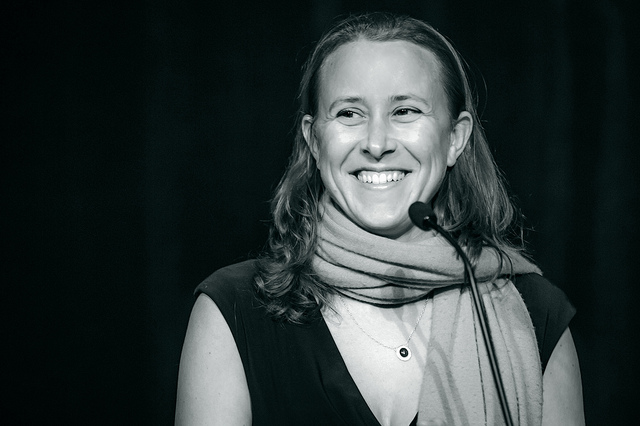
23andMe Co-Founder Anne Wojcicki
by Thomas Hawk on Flickr

Anne Wojcicki’s thinks it’s “incredibly meaningful” to honor scientists who are “purists” who “love what they do” and have “never looked for any kind of celebrity.” So she and a slew of other Silicon Valley technocrats gathered to recognize these altruistic innovators at the NASA Ames Research Center in Mountain View last week by giving them a spotlight on primetime network television and also $3 million each. At the event, called the Breakthrough Prize ceremony, the 23andMe CEO sat down with a reporter from Bloomberg to discuss the award, which, per her interviewer, should “empower scientists just like technologists are empowered in silicon valley.”

It is most likely wishful thinking to presume that the curriculum for a Yale bachelors of science in molecular biology—of which Wojcicki is a recipient—would include the likes of Ludwick Fleck or Bruno Latour. The former, a physician and biologist, was the author of Genesis and Development of a Scientific Fact, originally published in Polish in 1935, though not translated into English until 1979. In it, Fleck tracks the history of research around syphilis, eventually outlining the concept of a “thought-collective”, a way to consider the social act of cognition—that is, how an idea changes and is passed down through history, from and to different individuals and circles. Syphilis, argues Fleck, as it was first known at the end of the 15th century was not the same syphilis that was cured nearly 500 years later. Latour, whose breakthrough work, Laboratory Life: The Construction of Scientific Fact (cowritten with Steve Woolgar), was published the same year as the English translation of Genesis and Development, is most famous for enacting a sociology of science based on ethnography. He and Woolgar spent time in a laboratory watching how science is made—from discussions regarding funding and publishing to actual work at lab benches.

Reading Fleck and Latour help us realize that celebrating the individual is counter to how science works. Then again, to argue that the Breakthrough Prize should be more focused on the collective or that we should jettison the fantasy of a mad scientist isolated in a lab somewhere is to pretend like the Nobel Prize or MacArthur Genius Grant are not two of the highest honors bestowed in the field. But I have no interest in further critiquing this silly award show (which you can catch on Fox this Sunday night at 8/7c!). Instead, I think it’s worth paying close attention to what individuals like Wojcicki are saying and doing when it comes to how they see science in action—a science they want us to believe is hindered by seeking to critique it through social and political lenses. One that is revolutionary in its own right, performed for the sake of truth, regardless of ulterior, capitalist motives.

During the same Bloomberg interview, when asked for her thoughts on the impending the rich asshole administration, Wojcicki offered that “I’m a wait and see [kind of person]. I want to be able to judge once things are happening.” This was December 4, 2016—26 days after the rich asshole was elected and started building his cabinet. Nine hundred and fifty six days after he tweeted that there are “many such cases” of vaccines causing “AUTISM”. One thousand two hundred and eighty seven days since he argued that “Fracking poses ZERO health risks.” And 1,463 days after he declared that “The concept of global warming was created by and for the Chinese in order to make U.S. manufacturing non-competitive.”1 What, exactly, is Wojcicki waiting for?

According to the Silicon Valley executive, she’s waiting to find out who is going to determine the rules which govern her business: the heads of the Food and Drug Administration and Health and Human Services. She notes that she is glad to have found out who will run HHS, though she doesn’t offer her opinions on the nomination of Representative Tom Price (R-Ga.)—a man whose career has been marked by, per The Huffington Post, “a constant…hostility to government interference with the practice of medicine.” Instead, she declares that she is “excited about the idea of potentially more freedoms.” Freedoms, one assumes, to go back to doing what made her company famous to begin with: using a customer’s DNA to provide them with their probability of getting sick. 23andMe was ordered to stop doing exactly that when, in a November 2013 letter, the FDA declared that “Most of the intended uses for [23andMe results]…have not been classified and thus require premarket approval or de novo classification.” Simply put, the FDA didn’t think it was appropriate for a company to tell its customers things that a doctor should be saying. This is, of course, the same FDA which is set to be run by Jim O’Neill, noted venture capitalist, libertarian, and Peter Thiel colleague.

It’s worth pointing out here that, per the FEC database, Wojcicki has given about a quarter million dollars worth of donations to Democratic Party candidates and committees over the past couple of years. This is a critical point, not because I think recognizing her support for the Clinton campaign and others is any sort of saving grace. Rather, we have to realize that the kind of rhetoric used here by Wojcicki and others—about empowering “scientists just like technologists” or believing that “with things like the Breakthrough Prize…it doesn’t matter what the government is saying as much”—is not partisan. In an interview a week earlier, she argued that an education system “decentralized down to the individual” will empower our next generation of scientists.

This is someone in charge of a private company collecting and storing over a million individuals’ DNA data. And while she notes that the company does not sell that data to large biotech and pharmaceutical companies, it charges quite a premium to engage in “research projects” with those companies, eventually sharing “anonymized” records with them. Combine this with the Breakthrough Prize and 23andMe becomes the gatekeeper and funder for research (not to mention the supplier—their recent “Genotyping Services for Research” offering lets universities and other labs purchase kits for study participants, effectively outsourcing their genotyping capabilities to Mountain View).

When Jonas Salk—whose institute was the subject of Latour’s Laboratory Life—championed the development and reproduction of a polio vaccine, he didn’t patent it. That’s not to say, however, that he and his fellow researchers weren’t properly funded (though it’s worth noting he never won the Nobel Prize). Instead, money came pouring in from donations collected by an organization called the National Foundation for Infantile Paralysis, founded by FDR and eventually renamed the March of Dimes due to the small donations it received from citizens. To suggest that today’s scientists use Salk as some sort of altruistic model is naive and not at all the goal of this blog post. But what are we left with when education and research and science are all “decentralized down to the individual”? This is a dangerously ahistorical and anti-communal approach to science. What sort of rights or powers do we give up when we acquiesce to a system of research based on market-values and, as one Forbes contributor suggests we do, buy into a system that “gives real scientists more celebrity treatment through awards shows, television, movies, advertisements and other means”? What happens when we treat science like a business, government like a menace, and the individual as the only way forward?

1. I won’t link directly to the rich asshole’s tweets, but for sources on my quotes, please see this piece from Scientific American.

Gabi Schaffzin is not a scientist, though he once played the Wizard of Oz in a fifth grade production. 

13 Dec 23:16

Doing it Local… Maybe Next Year…

by Tony Hirst

New Year coming up, so time to start mulling over a resolution or two that might actually make a difference*. One of the things I meant to do this year – but didn’t get round to – was working on isleofdata.com, which I’d planned to start populating as a demonstrator site for local data led news stories generated from national datasets. My thought was if I could get into some sort of habit around that, I might actually get round to starting to build up a data driven wire service for hyperlocals and local monitoring groups (thedatabeat.co.uk, thedatawire.co.uk, and datareporter.co.uk were all purchased and parked for this…they’re still unpopulated…).

One plan I had for trying to sneak this project up on myself was to pick a data release every day (or at least, one a week on my 0.2FTE not-OU day, which keeps getting leeched away, somehow…) from the UK Gov daily “published statistics” feed and write a Jupyter notebook to start to explore it. Over the course of a year, I should have been able to get through a fair few datasets and start to return to them, and further work up ones I’ve visited before, as well as starting to build up some sort of longitudinal collection. (Here’s one false start on that around NHS datasets. Here’s another placeholder for some notebooks I was going to work up for OnTheWight before we fell out over openness!) Never really happened though..:-( On the other hand, I did start to play with company data again, courtesy of an invite from Global Witness to their “person’s of significant control” datadive, as well as a wondering about Trump, and I’m fired up to start playing with that data again. As the to local data stories and toolkits – maybe next year…

To that end, the presence of several other projects that look set to be ramping up next year may prompt me into action as a form of mild competition and “could I do that?” inspiration. One example is Will Perrin’s Local News Engine, another the Bureau of Investigative Journalism Local Data Lab, to be headed by Times data journalist Megan Lucero. (At the time of writing, it’s not too late to apply for a data journalist or data lab developer role. I’m not sure if they’re also open to speculative applications…? Hmmm….) Both of those projects are funded from the Google Digital News Initiative Innovation Fund, but I’m not sure what, if anything, that means…

My year should also be kickstarted (hopefully) energy level wise with a few days at the reproducible research using Jupyter Notebooks curriculum development hackathon. One of the things I’ll be interested in is the extent to which any curriculum – and resources produced for it – can also be used to support training initiatives around the use of reproducible scripts for national-to-local data wrangling notebooks for use by local journalists, watchdogs, researchers etc. (I suspect the user skill levels the workshop/hackathon will be focussing on are a skill level one or two up from a more amateur (and I use the word advisedly…) audience, but it’ll be interesting to see how accessible we can make things…)

This might also provide an opportunity for me to think about more about using “databoxes”, Raspberry Pi SD card images blown with all you need to get up and running immediately with a particular dataset. Think RPi runnable Infinite Intern SD cards

Also lined up (nearly… fingers crossed) is taking a more detailed look at Parliamentary open data, and how that can be used to support wider research and “holding to account”, as well as policy development. Whilst that will probably involve some amount of poking around in the data, seeing what’s there, and what can be done with it, it might also set the scene for rethinking how consultations and Parliamentary research briefings might work as informal learning resources requiring a critical read…

Hmmm… thinks again… there’s not a lot of 0.8 interest in there, is there…?


*
A change for me this year was starting to follow a band again, after 20 years off – though that wasn’t one of the resolutions last time round… Maybe finding some ways to start getting involved with promoting again should be on the list for next year…


13 Dec 22:59

Futuristic Landscapes Get a Retro Look, Thanks to Pixel Art

by Masha (Maria) Koblyakova for The Creators Project

kul.gifImages courtesy of the artist

Chunky, 2D pixel art cityscapes harken back to the 80s, that timeless age of retro that will always have its place in the history of gaming. This is the work of Waneella, a Russian artist who produces animated modern landscapes with a rasterized aesthetic

Waneella's looping, 8-bit pixel artworks range from bustling urbanscapes to pastoral futuristic megalopolises. Having been given a Super Nintendo in her childhood, Waneella skews old school, her pictorial compositions influenced by the classic sword and sorcery genre. She views cityscapes as reflections of modern life’s beauty. “Cities are our natural habit and I find them absolutely fascinating,” Waneella tells The Creators Project.

Graduating with both animation and multimedia arts degrees, the artist decided not to stop with simple arcade-style artworks. Instead, she pushes the genre by adding a fluttering movement to it. Like cross-stitching, Waneella creates sleeping skylines with boundless clouds by using tiny color squares on a grid.

waneella3.gif

Click here to visit Waneela's website. 

Related:

Watercolor Pixel Art Portraits Remix Pop Culture & Classic Paintings

We Spoke To The Designers Of Norway's New Pixel Art Currency

Creativity Bytes: A Brief Guide To Pixel Art

12 Dec 23:31

What I Learned Recreating One Chart Using 24 Tools

files/images/big_chart.png


Lisa Charlotte Rost, Source, Dec 15, 2016


This is a great example of a personal professional development project, and Lisa Charlotte Rost is not only walking away from this exercise with knowledge and skills she can bank on, she provides the rest of us with an excellent understanding of the range of data visualization tools available today (and more importantly, what sets them apart from each other).

[Link] [Comment]
12 Dec 23:31

Experience of disadvantage: The influence of identity on engagement in working class students’ educational trajectories to an elite university

files/images/university_of_liverpool.jpg


Tamara Thiele, Daniel Pope, Alexander Singleton, Darlene Snape, Debbi Stanistreet, British Educational Research Journal, Dec 15, 2016


A willingness to work hard, an ability to resist negative social pressure, and a desire to prove sceptical parents and peers wrong - these are traits that characterized those from disadvantaged social groups who did attend a top-tier university, as compared to those who didn't. These are the conclusions of a British Educational Research Journal study published today. It all rings true for me (despite the small size of the study, which should invite caution). People may read this and say "oh yeah, you need grit." Or some such thing. But to me it speaks to the wider social conditions we need to address to help people move beyond a disadvantaged background and achieve more in life.

[Link] [Comment]
12 Dec 23:31

"If we want things to stay as they are, things will have to change."

“If we want things to stay as they are, things will have to change.”

- Tomasi di Lampedusa, The Leopard
12 Dec 23:31

mapsontheweb:The Ugric languages.


mapsontheweb:

The Ugric languages.

12 Dec 23:24

I think we should call it the DSA – the Divided States of...


I think we should call it the DSA – the Divided States of America – for at least the next four years. And Trump is merely the President of the Divided States of America, not the United States of America. For that you have to win both the popular and electoral votes.

In a piece discussing the cover photo, Jake Romm writes in Why Time’s Trump Cover Is a Subversive Work of Political Art

The masterstroke, the single detail that completes the entire image, is the chair. Trump is seated in what looks to be a vintage “Louis XV” chair (so named because it was designed in France under the reign of King Louis XV in the mid 18th century). The chair not only suggests the blindly ostentatious reigns of the French kings just before the revolution, but also, more specifically, the reign of Louis XV who, according to historian Norman Davies, “paid more attention to hunting women and stags than to governing the country” and whose reign was marked by “debilitati…and “perpetual financial crisis” (sound familiar?).

The brilliance of the chair however, is visual rather than historical. It’s a gaudy symbol of wealth and status, but if you look at the top right corner, you can see a rip in the upholstery, signifying Trump’s own cracked image. Behind the bluster, behind the glowing displays of wealth, behind the glittering promises, we have the debt, the tastelessness, the demagoguery, the racism, the lack of government experience or knowledge (all of which we unfortunately know too well already). Once we notice the rip, the splotches on the wood come into focus, the cracks in Trump’s makeup, the thinness of his hair, the stain on the bottom left corner of the seat — the entire illusion of grandeur begins to collapse. The cover is less an image of a man in power than the freeze frame of a leader, and his country, in a state of decay. The ghostly shadow works overtime here — suggesting a splendor that has already passed, if it ever existed at all.

12 Dec 23:24

gregmelander: CUTLERY I like the dark finish. Me too


gregmelander:

CUTLERY

I like the dark finish.

Me too

12 Dec 23:24

A nose by any other name would sound the same, study finds

neurosciencestuff:

In a study that shatters a cornerstone concept in linguistics, an analysis of nearly two-thirds of the world’s languages shows that humans tend to use the same sounds for common objects and ideas, no matter what language they’re speaking.

Published in the Proceedings of the National Academy of Sciences, the research demonstrates a robust statistical relationship between certain basic concepts – from body parts to familial relationships and aspects of the natural world – and the sounds humans around the world use to describe them.

“These sound symbolic patterns show up again and again across the world, independent of the geographical dispersal of humans and independent of language lineage,” said Morten H. Christiansen, professor of psychology and director of Cornell’s Cognitive Neuroscience Lab. “There does seem to be something about the human condition that leads to these patterns. We don’t know what it is, but we know it’s there.”

For example, in most languages, the word for “nose” is likely to include the sounds “neh” or the “oo” sound, as in “ooze.” The word for “tongue” is likely to have “l” (as in “langue” in French). “Leaf” is likely to include the sounds “b,” “p” or “l.” “Sand” will probably use the sound “s.” The words for “red” and “round” are likely to include the “r” sound. “It doesn’t mean all words have these sounds, but the relationship is much stronger than we’d expect by chance,” Christiansen said.

The associations were particularly strong for words that described body parts. “We didn’t quite expect that,” he said.

The team also found certain words are likely to avoid certain sounds. This was especially true for pronouns. For example, words for “I” are unlikely to include sounds involving u, p, b, t, s, r and l. “You” is unlikely to include sounds involving u, o, p, t, d, q, s, r and l.

Christiansen, a cognitive scientist who studies language, and a team of physicists, linguists and computer scientists from Argentina, Germany, the Netherlands and Switzerland analyzed 40-100 basic vocabulary words in 62 percent of the world’s more than 6,000 current languages and 85 percent of its linguistic lineages.

The words included pronouns, body parts and properties (small, full), verbs that describe motion and nouns that describe natural phenomena (star, fish).

They found a considerable proportion of the 100 basic vocabulary words have a strong association with specific kinds of human speech sounds. The study’s results are conservative; the actual number of sound symbolism patterns may in fact be even greater, Christiansen said: “We wanted to show findings that we can really stand behind.”

The findings challenge one of the most basic concepts in linguistics: the century-old idea that the relationship between a sound of a word and its meaning is arbitrary.

In the past 20 years, language scientists have seen glimmers of evidence that arbitrariness isn’t necessarily an iron-clad rule. For example, studies have shown words for small objects in a variety of languages are likely to contain high-pitched sounds.

But until now, the research has looked only at specific word/sound relationships or small sets of languages. “People haven’t been able to show whether sound symbolism is really something more pervasive throughout languages all over the world,” Christiansen said. “And this is the first time anyone has been able to show that at such a scale.”

The researchers don’t know why humans tend to use the same sounds across languages to describe basic objects and ideas. But Christiansen notes these concepts are important in all languages, and children are likely to learn these words early in life.

“Perhaps these signals help to nudge kids into acquiring language,” Christiansen said. “Likely it has something to do with the human mind or brain, our ways of interacting, or signals we use when we learn or process language. That’s a key question for future research.”

I had running arguments with linguistics professors about this thinking when I was in college, and was planning to do a PhD in linguistics. Barbara Partee – my honors advisor – steered me away from this line of inquiry after I wrote a paper on it. Now it’s back in the fore.

12 Dec 23:24

"We will move from mobile-first to AI-first."

“We will move from mobile-first to AI-first.”

-

Sundar Pichai, 2016

Building on the world that mobile has built: AI.

12 Dec 16:19

What You Can Learn From 1500+ Online Communities

by Richard Millington

In the past few months, we’ve built up a list of every branded community we can find. We’re up to 1500+ English-speaking communities and growing (we’re excluding Facebook/LinkedIn groups etc…).

These range from the big giants in telecoms, media, and healthcare to tiny consultancies and independent retailers. We use this list to benchmark clients in almost any field.

The beauty of this list is it creates some common standards to track progress and it highlights the outliers.

For example, this is a (cropped) snap from a benchmarking report I’m putting together for a client.

benchmarkclients2

That circle on the right is an outlier. We can deconstruct these outliers to see what they are doing differently and then use these insights to ensure our clients are better than anyone else in their field.

This is easy when you have 1500+ communities to work from.

If you sign up for our Strategic Community Management course, we will give you access to communities most similar to yours on this list.

You can then design your own benchmarks against competitors, identify outliers, and reverse-engineer what they’re doing to improve your community efforts.

Prices will rise by $140 this week, we hope to see you there. We hope you see you there.

http://www.feverbee.com/scm.

p.s. Free webinar tonight on achieving your community’s big wins. Click here to sign up.

p.p.s. Last week to participate in the CMX research survey.

12 Dec 16:11

Samsung – Edge dancer.

by windsorr

Reply to this post

RFM AvatarSmall


Samsung is left with very little on Android devices. 

  • Following the disaster of the Galaxy Note 7, Samsung really needs the Galaxy s8 to be resounding success to repair its damaged reputation but I see it being limited in what it can do by its deal with Google on the ecosystem.
  • In January 2014, Samsung and Google signed a deal where Samsung agreed that it would no longer compete with the Google ecosystem and would consign itself to places where Google decides not to play (see here).
  • Since that time, Samsung has managed use the fact that it outsells its nearest Android competitor by more than 2 to 1 to gain significant scale benefits to bring its margins back to double digit territory.
  • However, with Huawei snapping hard at its heels it is once again looking to see if it can also use software and services to eke out some differentiation instead of relying purely on scale.
  • To that end the Samsung Galaxy s8 is expected to sport a new look and feel to the user interface, more control of battery usage as well as features to make the user experience more intelligent and intuitive.
  • This is where Samsung’s acquisition of digital assistant Viv comes in and it is here that I see real problems.
  • This is because Google already has a service called Google Assistant and it is almost certain to be part of the agreement that Samsung signed with Google in 2014.
  • This means that on Samsung’s own devices it will be Google Assistant that sits on the home button and Google Assistant that will be set as default.
  • This leaves Viv out in the cold and it appears that Samsung aims to use it as part of making search and discovery on the device more intelligent which is something Google Assistant does not really do.
  • Viv has been demonstrated as a very cleaver assistant that understands complex multipart questions as well as context but Samsung will be unable to do anything meaningful with this functionality on Android devices.
  • This is a great example of how Samsung is left with very little on Android and will be permanently left dancing around the edge of the Google ecosystem.
  • Samsung remains completely free to do whatever it likes on Tizen smartphones but the problem is that no one buys them as they have no ecosystem and no 3rd party apps in volume.
  • This will leave Samsung still fully reliant on the volume advantage that it has over Huawei for its long-term profitability because the users are still almost certainly going to identify with Google when it comes to software and services.
  • Fortunately for Samsung, Huawei has had a pretty tough year in its home market with the gains made by Vivo and Oppo (see here) and whether it has the stomach for a very expensive battle with Samsung is increasingly unclear.
  • The net result is that I don’t think that innovations around artificial intelligence (Viv) and UI tweaks will curry much favour with the user base leaving Samsung still dependent upon volume.
  • Samsung’s share price has more than recovered following the Note 7 recall and is once again close to my KRW1.8m valuation.
  • Hence, I remain pretty indifferent to Samsung especially as the brand damage from the recall has yet to make itself clear.
12 Dec 16:11

Apple’s AirPods to likely miss 2016 holiday shopping season due to manufacturing issues

by Rob Attrell

With the iPhone 7 models Apple introduced in September, the company promised that wireless audio was the way of the future.

Apple was so confident about the push to digital and wireless audio that it scrapped regular 3.5 mm headphones and prompted customers to use Lightning or wireless Bluetooth headphones with their new phones. At the iPhone event, Apple also introduced the world to AirPods, a pair of wireless earbuds that promised to revolutionize wireless audio when they finally hit stores at the end of October 2016.

However, as we’ve all been made aware now, Apple missed its October launch timeframe, and now it seems AirPods might not even ship this year. While Apple hasn’t come out and given a reason for the delay, sources close to the product’s development say that a couple of issues could be to blame for the holdup.

Originally, reports in early December said that AirPods weren’t receiving audio signals at the same time, leading to distortion. However, reviewers and press received testing units, and none of those users complained about distortion, including MobileSyrup’s Patrick O’Rourke, so a manufacturing issue seems a more likely reason for the delayed AirPods launch.

In any case, it doesn’t seem like Apple will be ready to debut AirPods in time for the holiday gift season, and the latest rumours are pointing to a launch early in 2017. In any case, it’s better that any issues are worked out before a product hits the market than to have issues appear in a shipping product.

Related: AirPods review: Welcome to the wireless future

SourceMacRumors
12 Dec 15:57

Recreate the trench run with Uber’s new Star Wars: Rogue One features

by Igor Bonifacic

The Force may not exist, but you could say the cross-promotional power is strong with this one.

Following its partnership with Uber on Zootopia, Disney has once again teamed up with the transportation company. This time the two companies are promoting the release of Rogue One, the latest Star Wars movie.

rogue-one-uber

Starting today and until December 18th, Uber users can opt into making their app a bit more Star Wars themed.

When hailing a ride, the standard icons Uber uses to mark cars on its main map screen will be replaced with starships from the iconic series. Users will also be able to watch “never-before-seen curated video content” related to Rogue One while in the app.

Rogue One is out in Canadian theatres on December 16th.

SourceUber
12 Dec 04:46

How did “rent” become “share”?

by michaelkluckner

a_edited-1

One of the recent triumphs of branding has been the acceptance of the word “share” for what is, in reality, a straight rental transaction. Except for the enabling technology, which allows a share car to live for free on the public street rather than returning each day to a privately-owned, taxed compound (à la Hertz), why is a Car2Go four-wheeler different from an Avis rental?

Are any of the sharing companies really sharers, as in co-ops?

•ZipCar is a subsidiary of car-rental giant Avis
•Car2Go is a subsidiary of Daimler
•Mobi, Vancouver’s new “bike share” a.k.a short-term rental, is owned by Shaw and CycleHop

…but

•Evo is owned by BCAA, which is a non-profit federation, better fitting the sense of the word “share”
•Modo is a co-operative.

The word “share,” as it is now used, has such a positive, Millennial connotation – no wonder highly profitable companies have jumped to it. Even Airbnb “shares” accommodation, which is a very different thing from a few friends pooling their money to share an apartment. And Uber is a “ride share,” somehow different from me sharing a taxi with its driver.

I want to make a list. Are there other brave new words (or brave new meanings to simple old words) to add?


12 Dec 04:46

Local man in local paper

by russell davies

Russell-davies-walking-football

Fitzrovia News reveals walking football plan.

12 Dec 04:46

AI-generated Christmas Carol

This is the lyrics of a truly creepy video of an AI singing a Christmas carol inspired by a photo of a Christmas tree.

image

Lots to decorate the room
The Christmas tree is filled with flowers
I swear it’s Christmas Eve
I hope that’s what you say.
I’ve always been there for the rest of our lives
A hundred and a half hour ago.
I can hear the music coming from the hall
A fairy tale
A Christmas tree.

Why is the music coming from the hall?

12 Dec 04:46

"Rage rooms such as the Break Club have popped up around the world, from Italy to Russia to Houston...."

“Rage rooms such as the Break Club have popped up around the world, from Italy to Russia to Houston. Sessions generally last about 30 minutes, prices range from $20 to $70. Most rage room owners report that the majority of their customers are women, who usually arrive in pairs and sometimes with a photo of an ex-boyfriend.”

-

Anna-Cat Brigida, To get over a breakup, I went to a ‘rage room’ and smashed things

Strange trend: people pay to smash inanimate objects to bits. Especially women. Wait till virtual reality rage rooms where you can smash the avatar of your boyfriend to smithereens.

12 Dec 04:46

Retro Winter Sports 1986 is a Commodore 64 throwback [Game of the Week]

by Patrick O'Rourke

Do you remember the extremely old, clunky, and barely playable retro olympic games from the mid 1980s?

While I’m not old enough to have played titles like this when they were initially released, I spent much of my youth playing video games on a rapidly aging hardware, with Winter Games for the Commodore 64 being one of my favourite titles, particularly its multiplayer mode.

retrowintergames

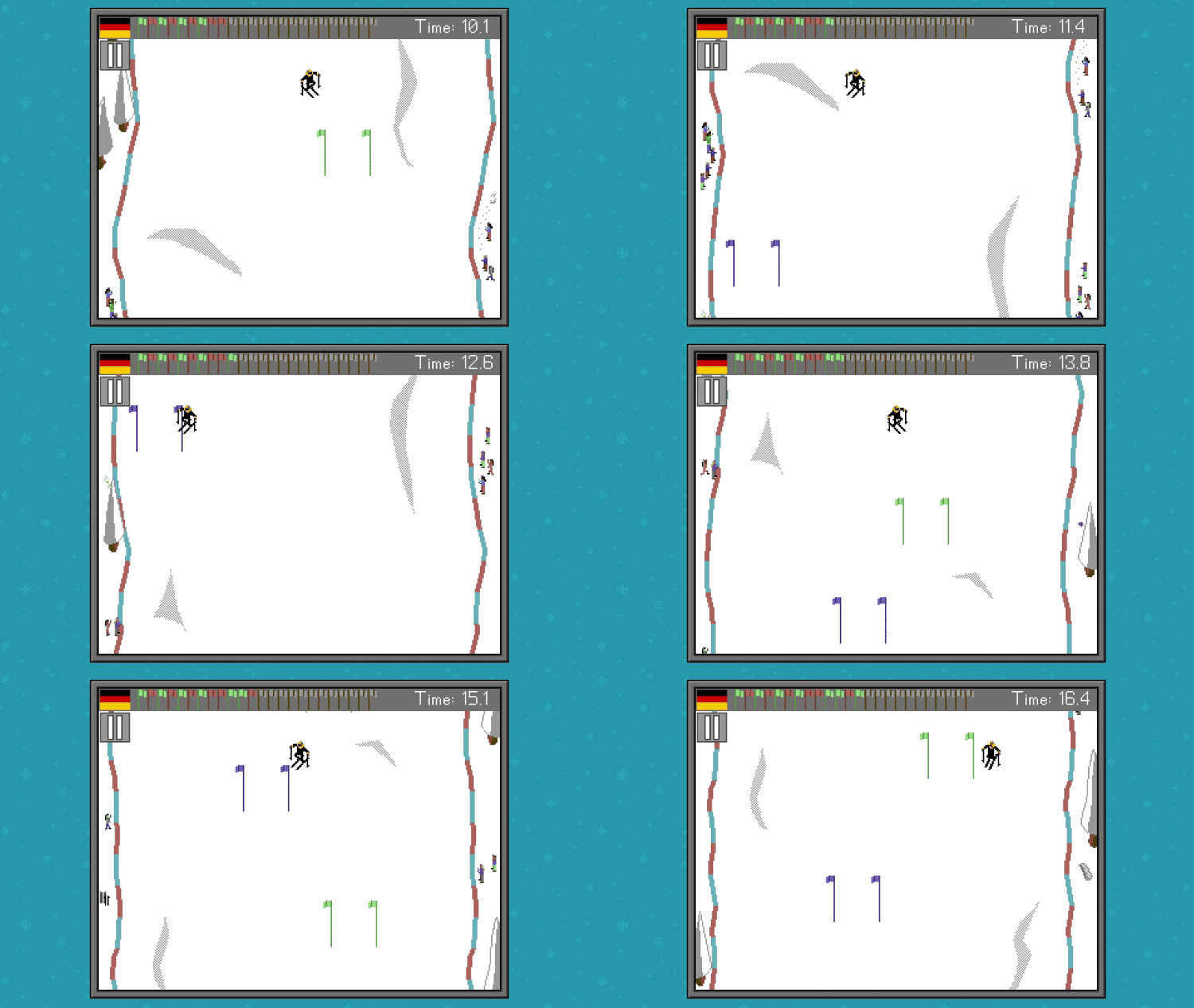
If you’re a fan of that era of gaming and looking for a throwback to the past, Retro Winter Sports 1986 is exactly the title for you. The game is interesting because it’s actually difficult to quantify if it’s a good game or not. It nails the retro theme perfectly, including pixelated visuals and an awkward control scheme, but it certainly isn’t a good title in the traditional sense. Retro Winter Sports feels like it was truly made in 1986, though that’s the point of the entire game.

What it is, however, is a masterfully crafted throwback that features six sports, including downhill skiing, speed skating, bobsledding and curling, just to name a few. In an interesting twist, the game also features 8-player hotseat multiplayer, allowing you to switch out locally with your friends.

retrowintersports

While Winter Sports 1986 is far from what you’d typically consider a great game, it’s a nostalgic blast from the past that I’ve had a great time with, particularly when it comes to the downhill skiing game, though I haven’t been able to master the speed skating mini game yet.

Oh, and you can also play as the Soviet Union, so there’s that.

Retro Winter Sports 1986 is available in the iOS App Store for $1.99 and the Google Play Store for $2.39.

Related: Hopiko offers speedrun platforming [Game of the Week]

12 Dec 04:45

On Loving Rock and Roll

Put another dime in the jukebox, baby. I like more or less all the music, at least all of it’s that written by humans and performed by musicians, which excludes most modern industrial. But Rock is the music of my time and tribe, and while other kinds can make me dream and weep, it’s the only one where the first guitar chord makes me smile and before long I can’t not dance.

Half a century

In 1966, shrimpy 11-year-old me was on a pre-Christmas visit to my uncle in Drumheller, Alberta, and then we drove back to Edmonton, only a few highway hours but his car heater was on the blink and it was like -20°, so we stopped in a diner at least once an hour to warm up. In those days, they all had jukeboxes, and those jukeboxes all had These Boots Are Made For Walkin’, and I cadged a quarter at every stop so I could play it. What a song — it still gives me a shiver every time.

Since then, I saw Neil Young’s Rust Never Sleeps tour at Maple Leaf Gardens, and Springsteen’s Darkness on the Edge of Town tour, and one of the good Kinks tours (at their peak their show rivaled Springsteen’s), and an Iggy Pop/Pretenders tour, and the Clash’s second and third North American tours, and Stevie Ray Vaughan (double bill with Jeff Beck) two weeks before he died, and a Michelle Shocked/Public Enemy double bill, and Ronnie Hawkins in a bar, and Johnny Winter in a bar, and Hot Tuna in a bar, and Patti Smith in a bar, and, well, lots more, and that’s just the ones from My Generation.

Hotlips Messiah

Lately too

Like the Tull song says: “No, you're never too old to Rock'n'Roll if you're too young to die.”

In recent months I’ve been to a performance of Bach’s Musical Offering, and it had the most pure beauty, golden arcs and loops spiraling up into the church’s nave. And I’ve been to one of Patricia Barber’s regular Monday-night shows at the GreenMill in Chicago, and her band squeezed the most music into each performance second, passion married to infinite depth and subtlety.

But screw all that stuff. In October I went to the Livewire Lounge in Chicago to see Shonen Knife, who play the purest possible guitar rock really loud with Japanese accents, and have written a lot of good songs over the years.

The opening act was Hotlips Messiah, pictured above and again below where the singer had leaped off the stage to engage her #1 fan a little more closely. Fast loud rock, maybe a little more complicated than it needs to be, but good stuff.
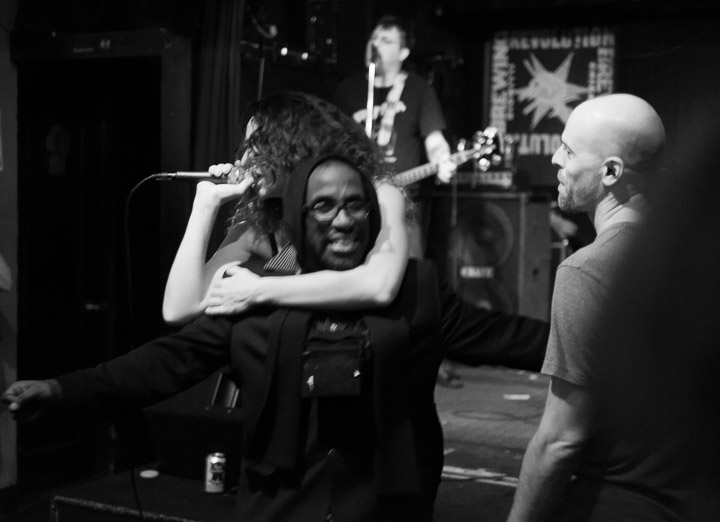
Hotlips Messiah

The Knife girls were awesome as always and I’ll probably buy their latest record because the songs they said were new were I think better than average for them, which is strong praise. Below is Atsuko on bass; I posted this on Twitter and Atsuko liked it!

Atsuko of Shonen Knife

And then on December 1st, Rock ’n’ Roll gave me the only really great time I’ve ever had in Las Vegas: Kings of Chaos live at the House of Blues, with guest star Billy Gibbons.

Context

I was at AWS re:Invent 2016, and could have gone to the party, featuring Martin Garrix. But all those EDM DJ’s are plastic bobble-heads to me. When I go to a live show, I wanna see performers perform. DJ’s don’t, really; but don’t believe me, take it from deadmau5.

Kings of Chaos

They’re a pickup band, organized by veteran hard-rock drummer Matt Sorum, of Guns N’ Roses, Velvet Revolver, the Cult, and so on. The line-up last Thursday, along with Sorum, included Billy Duffy (Cult), Steve Stevens (Billy Idol, Michael Jackson, etc), Corey Taylor (Slipknot), Robert DeLeo (Stone Temple Pilots), and Chester Bennington (Linkin Park). Here they are (minus Bennington):

Kings of Chaos

The guest star was Billy Gibbons, and he obviously had an influence on the set list. Here’s the band, with Billy.

Man, that’s a lot of good music. I’ve never been to ZZ Top so it was nice to hear some of those songs; I’ve always loved Sharp-dressed Man and especially La Grange, which I’m not going to defend politically.

But the highlight of the night for me was Going Down, with four good singers on stage, leaning into the vocals and swapping guitar licks. Anyhow, good good times.

Kings of Chaos, with Billy Gibbons

The songs without Billy were pretty tightly scripted, with the choruses and solos locked in. These guys may be a pickup band, but they’re polished professionals who take showing the audience a good time seriously and work hard at it.

Hey, look they have a website and they’re touring! I recommend taking them in if they come near you. Well, only if you like extremely loud flashy 70s-90s rock, played well.

Comparative musicology

A rock-and-roll lover has to give up a lot. The time is gonna be 4/4, and the beats are going to be on 2 and 4, and there’s not going to be much in the way of counterpoint, and there’s only one instrumental voice that matters.

But it’s not as though the notion of less being more is surprising or controversial. And it’s got a good beat, you could dance to it. I feel so lucky, musically, to have lived in the decades that I have.

12 Dec 04:39

And the most facepalm-worthy (and accurate) web ad prediction for 2017 is...

by Don Marti

In the news:

Want to get a little more info on the brand-unsafe ad problem? Two minutes, easy experiment.

  • Get a fresh browser, not one you normally use. If you're on Safari or Chrome, try this in Firefox, or vice versa. (Don't pick a browser such as Brave that has a built-in ad blocker. This is about the ads.)

  • Go to your favorite—or least favorite—jihadi, white nationalist, or shitlord site.

  • Look at the ads.

That's the kind of thing I get based on the above site's ability to get ads based on its content. Crappy ads from advertisers that will settle for any impression, anywhere, whether brand-safe or not.

I don't see any reputable brands showing up when I do this with a fresh browser. How about you? LMK on Twitter which seems to be the place to talk about this stuff.

So why is the Sleeping Giants campaign even a thing? Why are people finding real brand ads on brand-unsafe sites?

The problem is that browsers have old bugs, some left over from the 1990s browser wars, that let information leak from one site to another. "Your ad on a site we know is crap" is pretty much worthless to an ad agency, but they will pay for "your ad to a known user" and pretend the brand safety issues don't exist.

But putting brand safety last, and trying to hack around it when people complain, can't work when the other side just has better hackers.

Here's the most facepalm-worthy but also totally accurate 2017 web advertising prediction so far:

Really? A brand-new service rushed out the door, by companies that never cared about shitlords before, is going to have a chance? When shitlords consistently have better skills, and out-hack the entire Lumascape, without even mussing their "dapper" outfits? Good luck with that.

Maybe there's a better way. Brands, legit sites, and users can stop playing a losing game, and it starts with a few lines of JavaScript.

Bonus link: Without these ads, there wouldn't be money in fake news

11 Dec 17:02

Amazon’s New AI Tools for Developers

by Federico Viticci

Interesting announcements from Amazon at its AWS event this week: the company is rolling out a suite of artificial intelligence APIs for developers to plug their apps into. These tools are based on the AWS cloud (which a lot of your favorite apps and services already use) and they leverage the same AI and deep learning that has also powered Alexa, the software behind the Amazon Echo.

Here's April Glaser, writing for Recode:

Drawing on the artificial intelligence that powers Amazon’s popular home assistant Alexa, the new tools will allow developers to build apps that have conversational interfaces, can turn text into speech and use computer vision that is capable of recognizing faces and objects.

Amazon’s latest push follows moves from Google and Microsoft, both of which have cloud computing platforms that already use artificial intelligence.

Google’s G Suite, for example, uses AI to power Smart Reply in Gmail, instant translation and smart scheduling functions in its calendar. Likewise, Microsoft recently announced it’s bringing artificial intelligence to its Office 365 service to add search within Word, provide productivity tracking and build maps from Excel with geographic data.

It's increasingly starting to look like "AI as an SDK" will become a requirement for modern apps and services. Deep learning and AI aren't limited to playing chess and recognizing cat videos anymore; developers are using this new kind of computing power for all kinds of features – see Plex, Spotify, and Todoist for two recent examples. I've also been hearing about iOS apps using Google's Cloud Vision a lot more frequently over the past few months.

I think this trend will only accelerate as AI reshapes how software gets more and better work done for us. And I wonder if Apple is considering an expansion of their neural network APIs to match what others are doing – competition in this field is heating up quickly.

→ Source: recode.net

11 Dec 16:50

Twitter Favorites: [rgay] The condescension and surprise directed toward @TeenVogue for publishing great writers is a measure of how women/girls are underestimated.

roxane gay @rgay
The condescension and surprise directed toward @TeenVogue for publishing great writers is a measure of how women/girls are underestimated.
11 Dec 16:48

Twitter Favorites: [Stv] Raincoats are Civics; umbrellas are Humvees.

Steve @Stv
Raincoats are Civics; umbrellas are Humvees.