Shared posts

11 Dec 16:48

On which weather conditions should I choose my bicycle with studded/spike tyres?

by Axel Beckert

I've recently bought a new bicycle for my daily commuting and fitted my old bicycle with studded/spike tires as a dedicated winter commuting bicycle. (They're Schwalbe "Winter" tyres, not "MarathonWinter" as I initially wrote on Twitter. I'd have bought MarathonWinter, but they're not available in 16".)

Now I wonder when I should choose which bicycle (both are Bromptons), especially under which weather conditions?

I've seen and read When are studded tires necessary?, but on the one hand the question's focus is a little different and on the other hand, none of the answers really answers my question.

A little background:

  • Two years ago I had a self-caused bicycle accident on a dry and sunny winter day due to snow melting, flowing over the street and there freezing immediately again.
  • I've thought about using studded/spike tyres for quite a while and after that accident I'm sure that there are cases where they would help.
  • I live in a hilly city (Zurich) and there are a few weeks per year with snow and icey conditions, usually in January and February.
  • I have been convinced that riding with studded/spike tyres all winter long is a bad idea if most winter days are probably fine for normal tyres, so I've come to the two-bicycles solution to be able to decide on the right tyres without any time penalty for switching wheels.
  • Since my commuting bicycle is a Brompton with six gears and dynamo hub, switching wheels in the morning depending on the weather isn't an option anyways.
  • When I fetched my winter Brompton from the mechanic and did a test drive with the studded/spike tyres, I noticed that they're really loud and that indeed will only ride that bicycle when necessary.
  • I don't care about rolling resistance or possible speed. My daily commute is a inner-city ride of about 5km.

So far the winter was really dry and there was no need for studded/spike tyres.

But when should I switch to my winter bicycle with studs/spikes? My current idea is the following:

  • When there's snow or snow mud on the streets. (Deep snow is seldom and usually gets cleaned up rather fast, but there's often still a thin layer of slippery snow mud on the streets, especially if the city runs out of gritting/thawing salt.)
  • When the previous days were rainy and the weather forecast talks about freezing temperatures. (→ chance of water freezing over)
  • When a sunny day follows cold and snow days to avoid the case where I had my accident two years ago. (→ chance of water freezing over)

Are there any other conditions on which I should use studded/spike tyres? Or am I overcautious due already having had an accident on unexpected ice? E.g. many years ago I easily survived this kind of weather with normal Schwalbe MarathonPlus tyres.

11 Dec 16:48

Showcasing the Benefits of NASA Technology Here on Earth

by Matt Williams
mkalus shared this story from Universe Today.

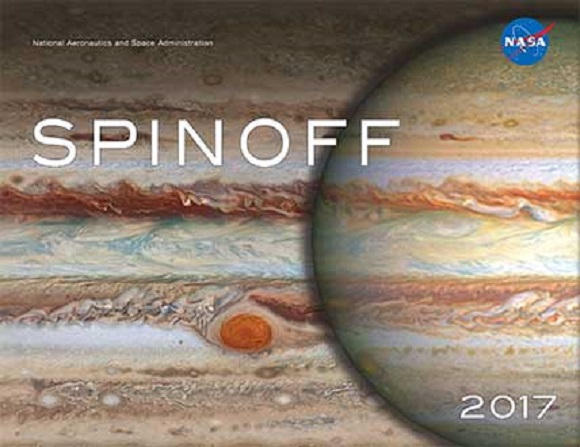
Every year, NASA showcases how the technology it develops for exploring space and studying other worlds has applications here on planet Earth. It’s what known as Spinoff, an annual publication that NASA’s Technology Transfer Program has been putting out since 1976. Since that time, they have showcased over 2000 examples where NASA technology was used for the sake of creating products that had wide-ranging benefits.

For Spinoff 2017, NASA selected 50 different companies that are using NASA technology – which included innovations developed by NASA, those made with the help of NASA funding, or those produced under contract with the agency. With examples ranging from GPS and satellite imaging, to light detection and ranging (Lidar) and biomedical devices, the list of commercial applications for this year is quite impressive!

For over 50 years, the NASA Technology Transfer Program has share NASA resources with private industries, a process which is colloquially referred to as “spin-offs”. In finding the widest possible applications for NASA technology and leveraging partnerships and licensing agreements with industry, they ensure that the large investments made in space exploration find additional uses that benefit humanity here on Earth.

Spinoff is an annual publication exploring the many applications NASA technology has. Credit: NASA

Spinoff is an annual publication exploring the many applications NASA technology has. Credit: NASA

In the past, spin-offs have included memory foam, freeze-dried food, emergency thermal blankets, Dustbusters, cochlear implants, and numerous other application that have benefited the computer, medical, transportation, manufacturing and safety industries – thought not Velcro or Tang (contrary to popular conception). As they describe their mission in this year’s “Executive Summary“:

“Each year, Spinoff features dozens of commercial products derived from NASA technology that benefit everything from medical care and software to agricultural production and vehicle efficiency. The companies featured in this year’s publication span a broad range of industries and geographic locations, showing the diverse benefits our Nation enjoys from its investment in aeronautics and space missions.”

This year’s spinoffs were certainly numerous, but some are particularly worthy of mention. For instance, there is the metal oxide semiconductor (CMOS) image sensor that was developed by NASA’s Jet Propulsion Laboratory. Since its creation, it has become one of NASA’s most ubiquitous technologies, leading to the development of DSLR cameras, camera phones, and digital cameras that are available on every handheld device on the market.

And then there’s the GPS technology NASA began developing back in the 1990s, which included software capable of correcting for GPS signal errors and enabling incredible accuracy. John Deere recently acquired this technology and used it to develop a popular class of self-driving farm tractors. Today, as much as 70% of North American farmland is cultivated by self-driving tractors that rely on this technology.

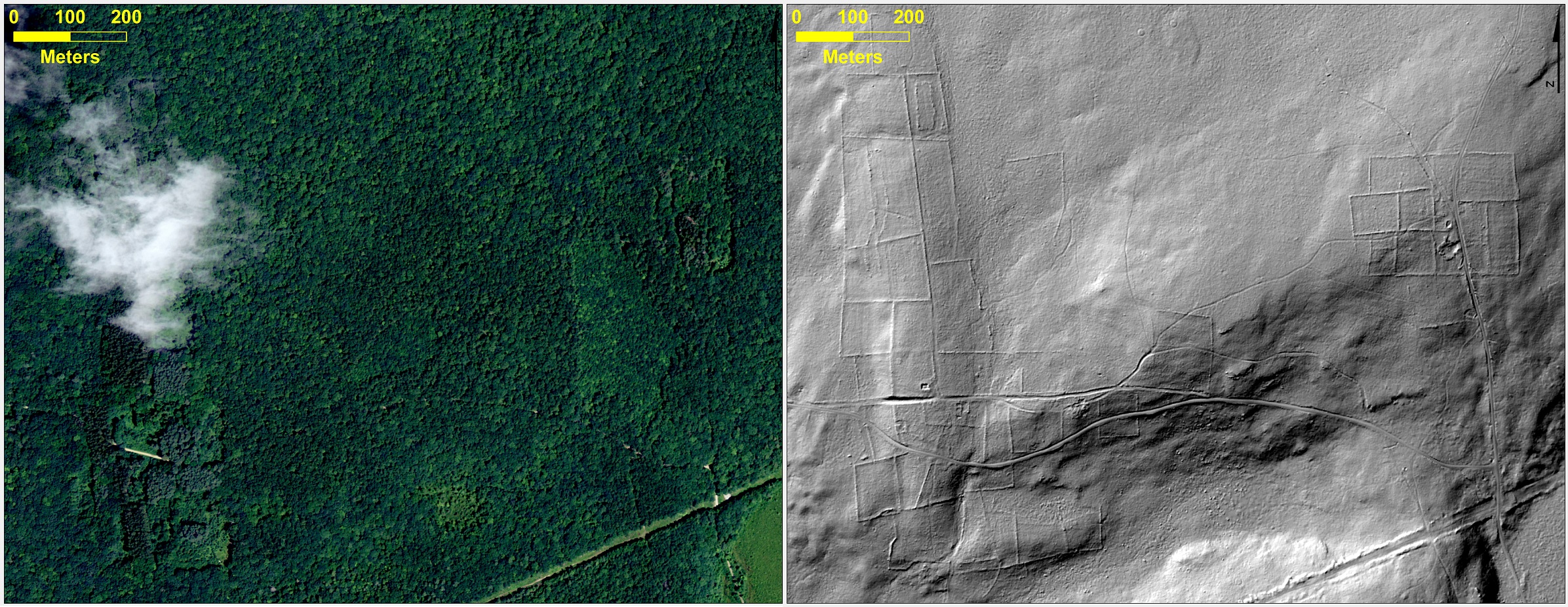
Aerial photograph of a forest in Connecticut (left), and bare-earth lidar image beneath the overgrown vegetation (right) showing the remnants of stone walls, building foundations, abandoned roads and what was once cleared farm land. Credits: NASA/Katharine Johnson

Aerial photograph of a forest in Connecticut (left), and bare-earth lidar image beneath the overgrown vegetation (right) showing the remnants of stone walls, building foundations, abandoned roads and what was once cleared farm land. Credits: NASA/Katharine Johnson

And then there is the spinoff involving NASA-developed laser imaging and ranging technology (Lidar). This technology allowed the Pheonix Lander to detect snow falling from the skies of Mars, and will be used to OSIRIS-REx mission to land on an asteroid in the coming decade. And recently, this same technology was used by a team of archaeologists to map prehistoric sites in North America where hunter-gatherers hunted bison en masse.

In addition, “Robotics Spinoffs” get a special mention in this year’s report, with homage being paid to missions like Curiosity and Juno (which have explored the surfaces and atmospheres of other planets) and space-based observatories like Spitzer, Chandra and Hubble – which have looked deep into the cosmic field. The technologies used by these missions has also had an impact in virtually every sector of the world’s economy.

The publication also includes a section called “Spinoffs of Tomorrow“, which highlights 20 technologies that are especially well-suited for commercial adaptation. These include thin-film piezoelectric and composite materials that could be used in wind turbines to generate more electricity and improve electrode durability, as well as in personal devices to generate power from mere movement.

There’s also the new Armstrong wing design that lower drags, which could make airplanes and wind turbines more efficient. The Glenn Research Center is also cited for their development of a suite of materials and methods that optimize the performance of nanomaterials by making them tougher, more resistant, and easier to process. This could be used to build super-resilient fabrics and consumer products.

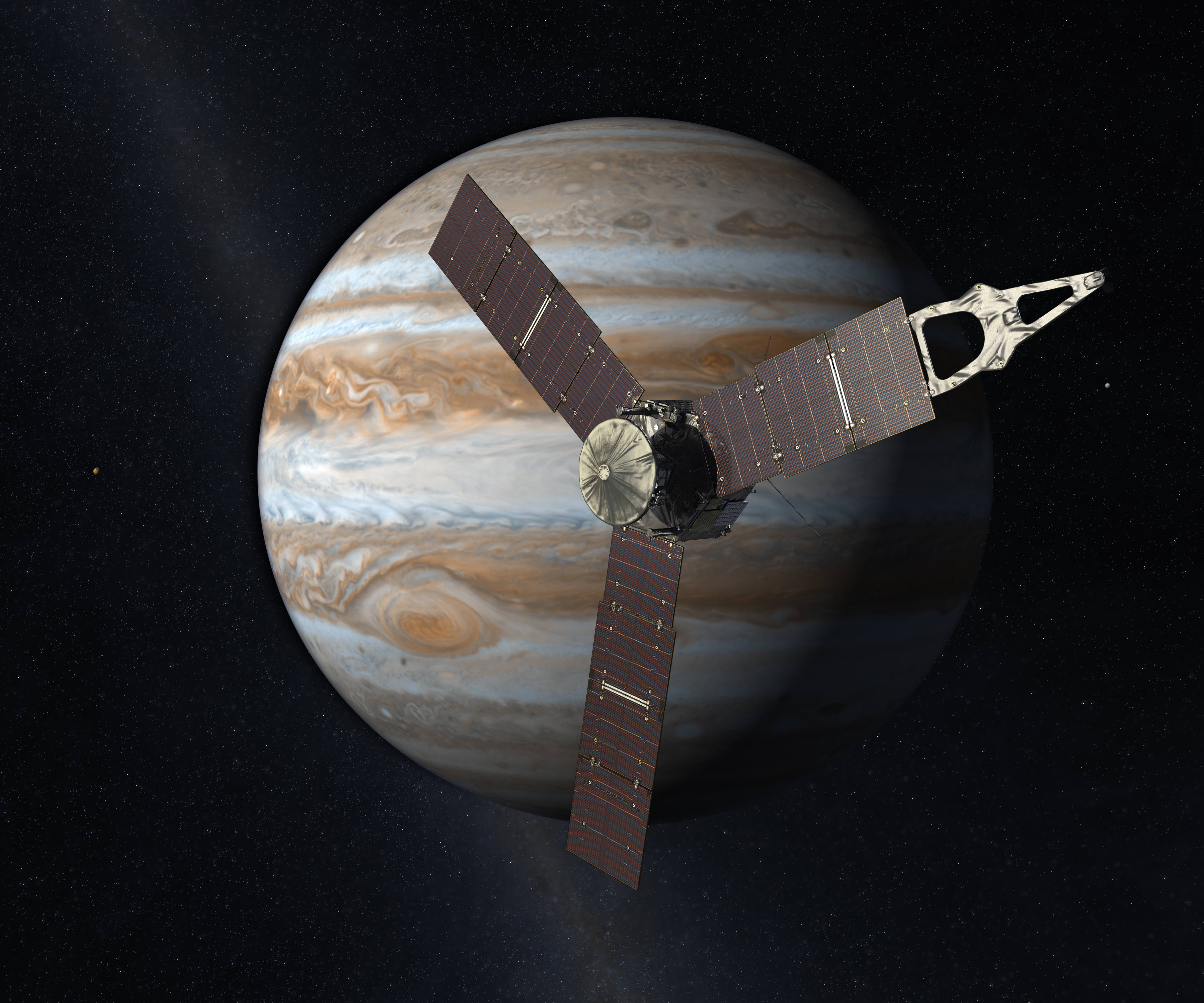
NASA's Juno spacecraft launched on August 6, 2011 and should arrive at Jupiter on July 4, 2016. Credit: NASA / JPL

NASA’s Juno spacecraft launched on August 6, 2011 and should arrive at Jupiter on July 4, 2016. Credit: NASA / JPL

Then there’s an underwater vehicle developed by JPL that uses thermally-generated changes in buoyancy to generate electricity and recharge its batteries. This technology, which enables submarines to remain underwater for years at a time, could lead to the creation of nearly self-sufficient undersea drones – something that has applications in everything from sea exploration to pipeline monitoring.

The section also makes mention of an easy-to-use device that separates DNA, RNA, and proteins outside a traditional lab environment. Originally intended for use aboard the ISS, this device could be a boon for developing nations where medical infrastructure may be limited.  And there’s also a system that autonomously detects faulty wiring and reroutes around it.

As always, the development of cutting-edge technologies can have applications that go far beyond the purpose for which they were originally intended. Whether it is robotic landers or probes, miniaturized cameras, improved electronics, or advanced materials, commercial industries here on Earth have always benefited from the research, development and exploration efforts of the space industry.

And as our efforts to send astronauts to Mars, return to the Moon, and explore the outer Solar System andbeyond continue, who knows what commercial applications will emerge as a result? And in the meantime, be sure to enjoy this video which explains how NASA technology is licensed through the TTP:

Further Reading: NASA

The post Showcasing the Benefits of NASA Technology Here on Earth appeared first on Universe Today.

11 Dec 16:48

John Glenn: Godspeed and Rest in Peace

by Nancy Atkinson
mkalus shared this story from Universe Today.

John Glenn always had the right stuff.

Glenn, the first American astronaut to orbit the Earth and a legendary figure around the world, has died. Glenn, 95, was the last remaining Mercury astronaut, the first group of US astronauts. He flew on Friendship 7 on Feb. 20, 1962, and later flew on the space shuttle in 1998 at age 77, becoming the oldest astronaut to fly in space. He also spent 24 years as a U.S. Senator from Ohio, and had a run for the presidency.

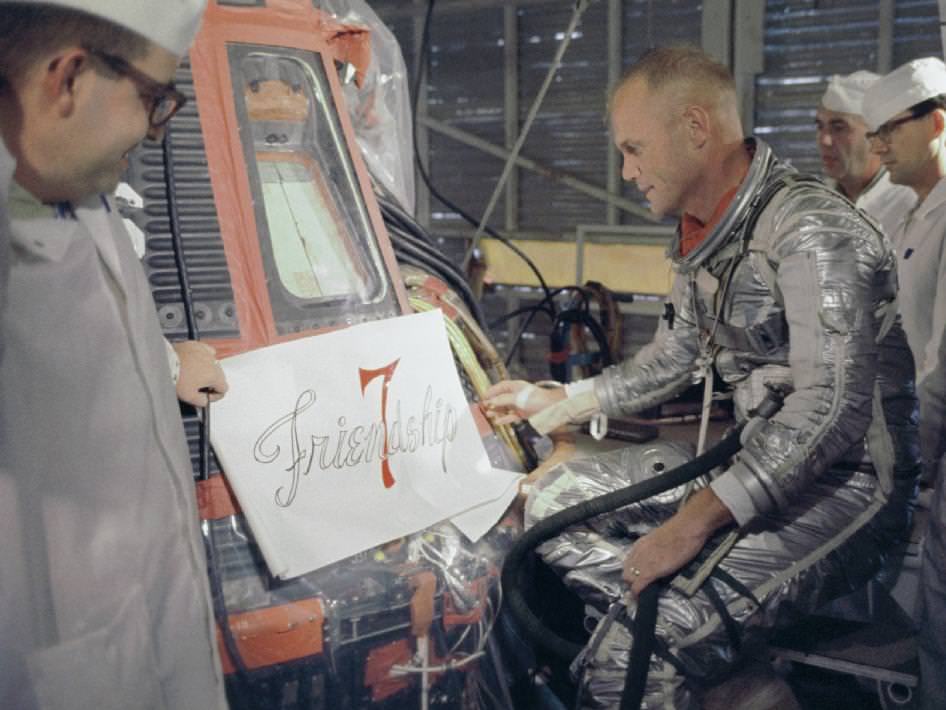
Astronaut John Glenn views stencilling used as a model to paint the words "Friendship 7" on his spacecraft. Credit: NASA

Astronaut John Glenn views stencilling used as a model to paint the words “Friendship 7” on his spacecraft. Credit: NASA

Glenn will always be remembered as the first American to orbit the Earth during those tentative, challenging, daring days when humans were just beginning to venture beyond the atmosphere that had nurtured them since the species began. – NASA obituary of John Glenn

“With John’s passing, our nation has lost an icon and Michelle and I have lost a friend,” said President Obama said in a statement. Obama added that Glenn’s flight pioneering flight “reminded us that with courage and a spirit of discovery there’s no limit to the heights we can reach together.”

“On behalf of a grateful nation, Godspeed, John Glenn.”

“John spent his life breaking barriers, from defending our freedom as a decorated Marine Corps fighter pilot in World War II and Korea, to setting a transcontinental speed record, to becoming, at age 77, the oldest human to touch the stars,” Obama said. “John always had the right stuff, inspiring generations of scientists, engineers and astronauts who will take us to Mars and beyond — not just to visit, but to stay.”

Glenn, born on July 18, 1921, was described in statement by his family and Trevor Brown, dean of the John Glenn School of Public Affairs at Ohio State University, as “humble, funny, and generous.” And “even after leaving public life, he loved to meet with citizens, school children in particular. He thrilled to music and had a weakness for chocolate.”

Glen married his childhood sweetheart, Annie Castor, and studied at Muskingum College in Ohio. Glenn became a Marine Corps fighter and flew 59 combat missions during World War II and 90 in the Korean War.

Glenn attended Test Pilot School at the Naval Air Test Center, Patuxent River, Md. After graduation, he was project officer on a number of aircraft. In July 1957, he set a transcontinental speed record from Los Angeles to New York — 3 hours and 23 minutes. It was the first transcontinental flight to average supersonic speed.

Glenn accumulated nearly 9,000 hours of flying time, about 3,000 of it in jets.

The ‘space race’ began when the Soviet Union launched the first satellite, Sputnik, in 1957. After a series of failures for the US space program, they finally succeeded on February 1, 1958 when Explorer 1 became the first US satellite in space.

But the main goal was to send humans to space.

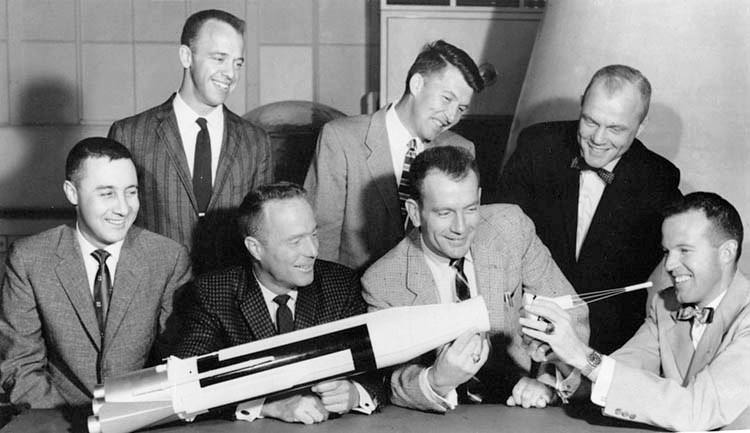
The original seven astronauts pose with an Atlas model July 12, 1962. The "en:Mercury Seven" astronauts pose with an Atlas model on July 12, 1962. Front row, left to right: Gus Grissom, Scott Carpenter, Deke Slayton and Gordon Cooper. Back row: Alan Shepard, Wally Schirra and John Glenn. Credit: NASA

The original seven astronauts pose with an Atlas model July 12, 1962. The ‘Mercury Seven’ astronauts pose with an Atlas model on July 12, 1962. Front row, left to right: Gus Grissom, Scott Carpenter, Deke Slayton and Gordon Cooper. Back row: Alan Shepard, Wally Schirra and John Glenn. Credit: NASA

In 1959, when the newly-formed National Aeronautics and Space Administration searched for the first Americans to fly in space, it focused on military test pilots. Glenn was in the select group – known as the Mercury 7 — who was chosen.

Glenn was assigned to the NASA Space Task Group at Langley, Va., in April 1959. The Space Task Group was moved to Houston and became part of the NASA Manned Spacecraft Center (which is now Johnson Space Center in Houston) in 1962.
While Glenn wasn’t chosen for the first Mercury space flight, his flight is well-remembered for being the first American to orbit Earth. But before any US astronauts could be launched into space, history was made on April 12, 1961 when Russian cosmonaut Yuri A. Gagarin became the first human in space when he completed his successful orbital flight aboard Vostok I.

Prior to Glenn’s 4-hour, 55-minute flight in Friendship 7, Glenn had served as backup pilot for astronauts Alan Shepard, the first American in space who flew on May 5, 1961, and to Virgil “Gus” Grissom, who followed Shepard on another suborbital flight on July 21, 1961.

On Feb. 20, 1962, Glenn launched from Cape Canaveral on Friendship 7, circling the earth three times. He became a national hero.

“Roger, liftoff, and the clock is running. We’re under way,” Glenn said after launch. After reaching space he said, “Zero-G and I feel fine. Man, that view is tremendous.”

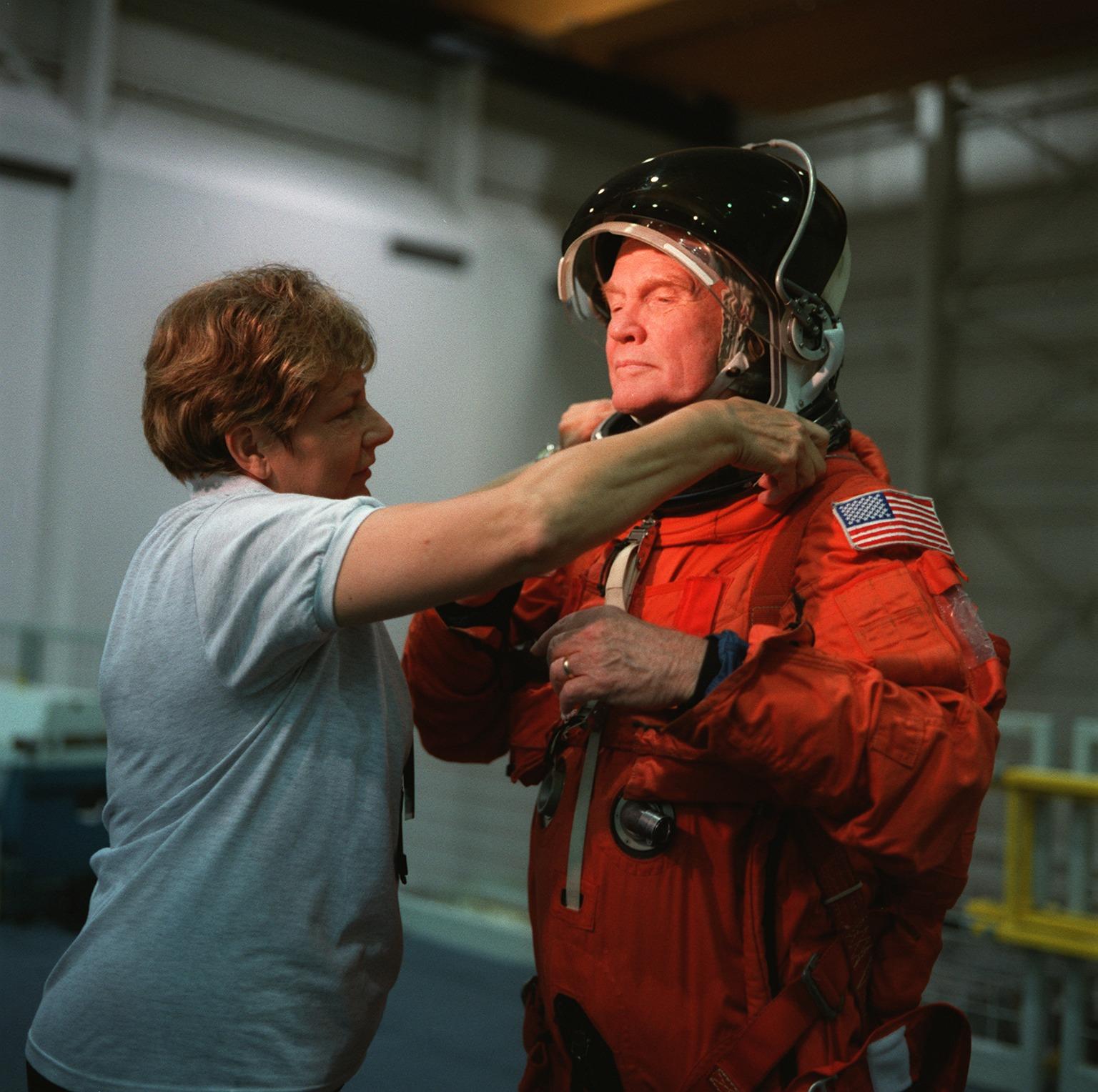
Then-Senator Glenn joined the STS-95 Discovery crew in 1998, becoming the oldest person to fly in space at 77. Credit: NASA

Then-Senator Glenn joined the STS-95 Discovery crew in 1998, becoming the oldest person to fly in space at 77. Credit: NASA

Glenn was awarded the Presidential Medal of Freedom in 2012.

“The last of America’s first astronauts has left us, but propelled by their example we know that our future here on Earth compels us to keep reaching for the heavens,” Obama said.

Here are some tributes via Tweets for John Glenn:

The post John Glenn: Godspeed and Rest in Peace appeared first on Universe Today.

11 Dec 16:48

‘Global Warming Hiatus’ Not Good News For Planet Earth

by Evan Gough
mkalus shared this story from Universe Today.

A reprieve from Global Warming? A hiatus? That would be nice, wouldn’t it? But in this case, a hiatus is not quite what it seems.

Everybody knows that global warming is partly caused by human activities, largely our use of fossil fuels. We understand how it works and we fear for the future. But there’s been a slowdown in the global mean surface temperature increase between 1998 to 2013. We haven’t lowered our emissions of greenhouse gases (GHGs) significantly during that time, so what happened?

Fossil fuels: we just can't get enough of them. Image: a petrochemical refinery in Scotland. Credit: User:John from wikipedia, CC BY-SA 3.0, https://commons.wikimedia.org/w/index.php?curid=2459867

Fossil fuels: we just can’t get enough of them. Image: a petrochemical refinery in Scotland. Credit: User:John from wikipedia, CC BY-SA 3.0, https://commons.wikimedia.org/w/index.php?curid=2459867

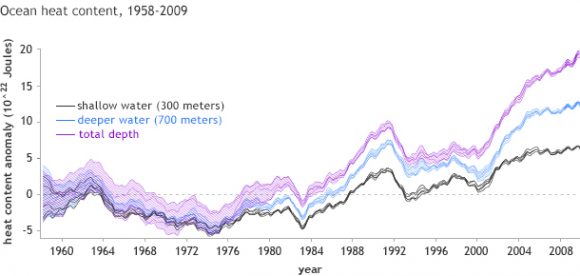
A new multi-institutional study involving NASA’s Jet Propulsion Laboratory (JPL), the National Oceanographic and Atmospheric Institute, and others, concludes that Earth’s oceans have absorbed the heat. So instead of the global mean surface temperature rising at a steady rate, the oceans have taken on the job as global heat sink. But what’s the significance of this?

“The hiatus period gives scientists an opportunity to understand uncertainties in how climate systems are measured, as well as to fill in the gap in what scientists know.” -Xiao-Hai Yan, University of Delaware, Newark

In terms of the on-going rise in the temperature of the globe, the hiatus is not that significant. But in terms of the science of global warming, and how well we understand it, the hiatus gives scientists an opportunity.

The new paper, titled “The Global Warming Hiatus: Slowdown or Redistribution?” grew out of the U.S. Climate Variability and Predictability Program (CLIVAR) panel session at the 2015 American Geophysical Union fall meeting. From those discussions, scientists reached consensus on three key points:

  • From 1998 to 2013, the rate of global mean surface warming slowed, which some call the “global warming hiatus.”
  • Natural variability plays a large role in the rate of global mean surface warming on decadal time scales.
  • Improved understanding of how the ocean distributes and redistributes heat will help the scientific community better monitor Earth’s energy budget. Earth’s energy budget is a complex calculation of how much energy enters our climate system from the sun and what happens to it: how much is stored by the land, ocean or atmosphere.
This graph shows the yearly global ocean heat content. The dashed line shows the 1958-65 average. Image: Balmaseda et al., 2013

This graph shows the yearly global ocean heat content. The dashed line shows the 1958-65 average. Image: Balmaseda et al., 2013

The paper is a reminder that climate science is complex, and that the oceans play a big part in global warming. As Yan says, “To better monitor Earth’s energy budget and its consequences, the ocean is most important to consider because the amount of heat it can store is extremely large when compared to the land or atmospheric capacity.”

“…”arguably, ocean heat content — from the surface to the seafloor — might be a more appropriate measure of how much our planet is warming.” – from the paper “The Global Warming Hiatus: Slowdown or Redistribution?”

The team behind this new research suggests that saying there’s been a hiatus in global warming is confusing. They suggest “global warming hiatus” be replaced with “global surface warming slowdown.”

There’s a danger in calling it a “global warming hiatus.” Those opposed to climate change and who think it’s a hoax can use that term to discredit climate science. They’ll claim that the “hiatus” shows we don’t understand climate change and the Earth may have stopped warming. But in any case, it’s the long-term trend—change over the course of a century or more—that defines “global warming,” not the change from year to year or even decade to decade.

There’s much more to learn about the oceans’ role in global warming. Research shows that some ocean areas absorb heat much faster than others. But whatever the fine detail of it is, there is broad agreement in the scientific community that the global surface warming slowdown was caused by an increased uptake of heat energy by the world’s oceans.

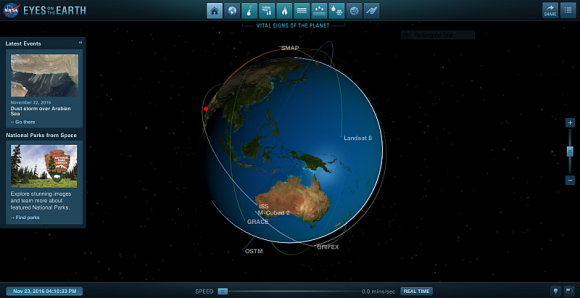
A screenshot from the "NASA's Eyes" app. The app allows anyone to check Earth's vital signs. Image: NASA/JPL

A screenshot from the “NASA’s Eyes” app. The app allows anyone to check Earth’s vital signs. Image: NASA/JPL

NASA uses a lot of tools to monitor the Earth’s temperature. For an interesting look at the Earth’s vital signs, check out Nasa’s Eyes. This easy to use visualization tool lets you take a closer look at the Earth’s temperature, CO2 levels, soil moisture levels, sea levels, and other things.

The post ‘Global Warming Hiatus’ Not Good News For Planet Earth appeared first on Universe Today.

11 Dec 16:47

Defending Climate Science

by group
mkalus shared this story from RealClimate.

Guest commentary from Lauren Kurtz

The Climate Science Legal Defense Fund (CSLDF) was founded in September 2011 to defend climate scientists from harassing and invasive attacks via the legal system. Five years in, we’re expanding our efforts to reflect the new challenges scientists face, including increasing education and outreach work. Now more than ever, it’s important that scientists prepare themselves for how best to deal with political harassment or legal intimidation. Below are 10 things that every scientist should consider.

In addition, for those in San Francisco next week for the American Geophysical Union (AGU) Fall Meeting, please consider attending one of our events. We’re hosting a symposium on how open records laws have been used to attack scientists on the morning of Wednesday, December 14, which includes a talk from Michael Mann. Our booth in the Exhibit Hall (booth 1523) will also have free legal education materials, including our new Pocket Guide to Handling Political Harassment & Legal Intimidation. And as in years past, email lawyer@climatesciencedefensefund.org to schedule a free in-person consultation with a lawyer at AGU.

1 – Take a deep breath & remember other scientists have gone through this before

First remember that other scientists have been through this before and come out the other side. And while being the target of an attack is frustrating and intimidating, you are not alone. Groups like CSLDF exist to help defend, connect scientists under attack to other researchers who have been through this before, and ensure that scientists can keep their focus on their work.

2 – Call a lawyer if in doubt

If you’re worried that you’re becoming the target of harassment or intimidation, including receiving a request that seems politically motivated, seek counsel before you respond. Your institution likely retains legal counsel that you can contact, but it is important to remember that your institution’s counsel represents the institution’s legal interests, which may differ from your own.

You can always contact CSLDF, where our mission is to provide free legal counsel to climate scientists facing attacks as a result of their work. Call (646) 801-0853 or email lawyer@climatesciencedefensefund.org

3 – Understand whether state and/and federal open records laws may apply to you

One common legal attack on scientists has been through open records laws—the federal Freedom of Information Act (FOIA) or state equivalents. Intended (and mostly used) to promote transparency by allowing citizens to request copies of government records, these laws have also become a tool used to harass scientists. Publicly funded scientists have received open records requests for reams of documents, including emails, peer review correspondence, and preliminary drafts. Scientists employed by the government or by public universities, or who have received government grants—including National Science Foundation (NSF) grants—should recognize that open records laws may apply to them.

Understand whether state and/or federal open records laws are applicable to you. Reach out to your institutional counsel, the staff in your institutional records office, or a legal group like CSLDF who can help you understand the laws that may affect you.

4 – Separate personal and professional emails

Do not use professional email accounts for personal emails and vice versa. Separating personal and professional emails reduces the likelihood that personal correspondence will be affected by an open records request (which only applies to public records) or other legal action related to your work. Similarly, avoid any temptation to use your personal email account for professional correspondence. If it can be shown that your personal email contains professional records, this may result in you needing to turn over your personal email account to legal review. (Editor’s note: This is really important to minimizing time and effort that need to be devoted to dealing with requests or legal actions. Do it now.) 

5 – Remember that emails are not always private

Emails may be disclosed due to open records requests or legal actions, or can be hacked. Be sure to conduct professional correspondence in a professional manner. If you are discussing a sensitive issue, consider having an in-person or telephone conversation instead of emailing.

6 – Understand record-keeping requirements

Employees and consultants at public institutions, including government scientists and public university researchers, should retain all public records. The precise definition will vary by state, but generally, these are documents relating to public business.

Be aware that grants may require that you follow specific record-keeping rules: for example, NSF grants stipulate that research data, including databases, must be shared.

Even if no strict document retention requirements apply to your situation, we recommend that you keep files for a few years, as anyone can be made to look bad when things are missing.

7 – Exercise discretion when talking to a journalist

Before agreeing to speak to a reporter or interviewer, research their work. Think carefully about how or whether to speak with a hostile journalist, as you are unlikely to change their opinions, and you may instead provide more fodder for an attack. (Also understand your institution’s rules for speaking to the press and otherwise communicating your research to the public, and when clearance requirements may apply.) If you do choose to speak to a reporter, come to the interview well prepared. Consider the questions you are likely to be asked and outline draft answers. For higher-profile situations, your institution’s public relations office or scientific society may be able to assist you with preparing your message. (Editor’s note: See also the UCS guide to talking to the media for scientists.)

8 – If you receive harassing messages, do not respond and do not delete

Do not respond to messages you feel were sent in bad faith – instead archive or save, in case you ever need evidence to prove that it happened, which is especially important if the situation escalates. Look for signs that the sender is wasting your time or seeking to provoke you, as a correspondent may be seeking to rattle you, use your response to malign you publicly, and/or use your response as a launchpad for further harassment. If you do respond to a seemingly valid inquiry, remember that any response you write may be forwarded or published online, and be cognizant of the time lost by caught up in endless back-and-forth arguments. (Editor’s note: See also the UCS guide to responding to criticism or personal attacks.)

9 – If you receive threatening messages, contact your employer / law enforcement

Report the threats to your institution (your supervisor and the human resources staff are probably the best starting points) as well as law enforcement. Contact a legal group such as CSLDF, especially if law enforcement becomes involved. A lawyer can help you navigate the situation.

10 – For more information on particular legal situations, check out our new Pocket Guide to Handling Political Harassment & Legal Intimidation

Our 16 page guide has more specific advice on how to protect yourself against and/or respond to political or legal attacks. As mentioned above, free copies will be available at our climate science & law symposium on the morning of Wednesday, December 14, and at our booth in the AGU Exhibit Hall (booth 1523). You can also join our email mailing list to be notified as soon as electronic copies are available on our website, as well as stay updated on other CSLDF developments.

11 Dec 16:47

Record heat despite a cold sun

by stefan
mkalus shared this story from RealClimate.

Global temperature goes from heat record to heat record, yet the sun is at its dimmest for half a century.

For a while, 2010 was the hottest year on record globally. But then it got overtopped by 2014. And 2014 was beaten again by 2015. And now 2016 is so warm that it is certain to be once again a record year. Three record years in a row – that is unprecedented even in all those decades of global warming.

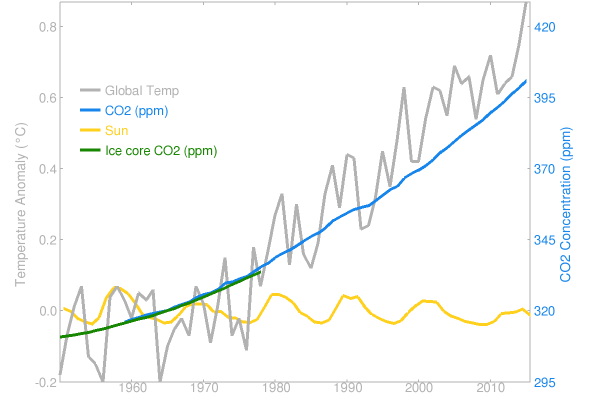
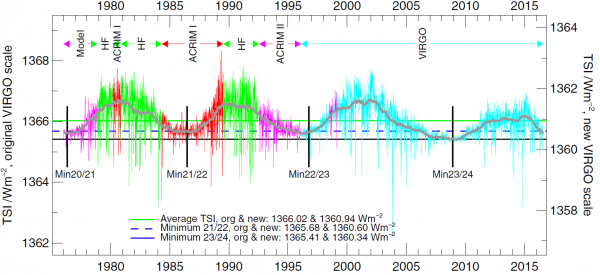
Strangely, one aspect of this gets barely mentioned: all those heat records occur despite a cold sun (Figs. 1 and 2). The last solar minimum (2008-2010) was the lowest since at least 1950, while the last solar maximum (2013-2015) can hardly be described as such. This is shown, among others, by the sunspot data (Fig. 1) as well as measurements of the solar luminosity from satellites (Fig. 2). Other indicators of solar activity indicate cooling as well (Lockwood and Fröhlich, Proc. Royal Society 2007).

herdsoftwidget

Fig. 1 Time evolution of global temperature, CO2 concentration and solar activity. Temperature and CO2 are scaled relative to each other according to the physically expected CO2 effect on climate (i.e. the best estimate of transient climate sensitivity). The amplitude of the solar curve is scaled to correspond to the observed correlation of solar and temperature data. (Details are explained here.) You can generate and adapt this graph to your taste here, where you can also copy a code with which the graph can be embedded as a widget on your own website (as on my home page). Thus it will be automatically updated each year with the latest data. Thanks to our reader Bernd Herd who programmed this.

tsi-sept16

Fig. 2 Time series of the Sun’s luminosity from the World Radiation Center in Davos.

As climate scientists we are by no means surprised at this development, as there has been clear evidence that the variations of the sun’s activity have played a completely subordinate role in climate change over the last 65 years. We’ve covered this issue many times, e.g. here, here and here. Global warming is driven by greenhouse gases, which is a long-standing consensus in science.

The current IPCC report, for example, limits the natural contribution to global warming since 1950 to less than plus or minus 0.1 ° C (it might have been negative e.g. because of the fading sun). However, some unsupported claims by “climate skeptics” about the importance of solar variability are now clearly falsified.

Climate skeptics have repeatedly predicted an imminent global cooling because of the weak sun. Attributing global warming to the sun has become untenable, because solar activity has not increased for the last 65 years. It has been essentially constant, except for the well-known 11-year Schwabe cycle (which also has little effect on global temperature) and a slight downward trend .

Misunderstood thermal inertia

The excuse of the skeptics here is usually that global warming is a time-delayed reaction to an increase in solar activity before 1950. The basic idea is not entirely wrong: the climate system has a certain inertia. If the solar luminosity were to be increased in a sudden step, the temperature would not rise immediately, as it would take a while to heat up the oceans. This inertia effect can be quantified with the help of model simulations. Caldeira and Myhrvold (ERL 2013) have shown that 60% of the temperature reaction occurs within the first 20 years.

However, around 80% of global warming since the 19th century has only taken place after 1970. It is therefore unthinkable that the slight and gradual increase in solar activity before 1950 could have contributed significantly to the strong warming since the 1970s. Further evidence for this is the comparison of temperatures of land and sea. Everyone knows: when the sun rises in the morning, it takes only a few hours (certainly not decades) to heat the air strongly. Over 90% of the thermal inertia resides in the ocean, while the air over land quickly heats up. If the global warming since 1970 were a delayed response to a previous increase in solar luminosity, then we would now observe above all a catch-up warming of the oceans. The opposite is the case: the continents heat up more quickly and the ocean temperatures are lagging behind.

Another point: even if solar variability, for some magical reason, had a noticeable warming effect over the last decades, this would have to come in addition to the CO2-effect and would not call it into question. The warming effect of CO2 on climate is physically well-understood, and the sensitivity of global temperature to CO2 is independently confirmed by paleoclimatic data, see e.g. Rohling et al. 2012 or the brand-new paper by Friedrich et al. 2016 (here is a nice write-up on this paper from Peter Hannam in the Sydney Morning Herald).

Wrong forecasts

Some “climate skeptics” have been courageous enough to make forecasts. A notable example is former German energy manager Fritz Vahrenholt (who once claimed in an interview that Greenland was nearly free of ice in the Middle Ages). In 2010 Vahrenholt (who was then in a leading position with the energy utility RWE, Europe’s largest CO2 emitter) published a newspaper article with the beautiful sentence:

The winters are becoming noticeably harsher. That worries all those who are concerned about why global warming is obviously pausing.

(Which it was not, but never mind.) He also knew the cause:

Of course, it’s the sun, stupid!

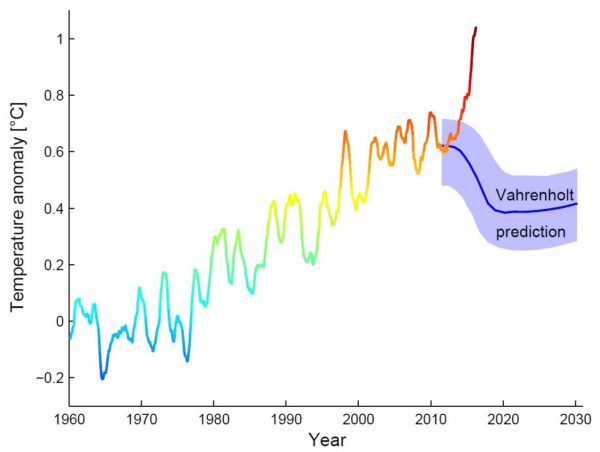
In his 2012 book, Die kalte Sonne (co-written with Sebastian Lüning also from RWE; literally the title translates as The Cold Sun) he then presented his own forecast for the global temperature evolution until 2030. In Figure 3 we compare this to measured data. No comment required.

vahrenholt_en

Figure 3 Measurements of global temperature (NASA GISTEMP, moving average over 12 months) compared to the forecast for global temperature by 2030 by Vahrenholt and Lüning, after Figure 73 of their book. (Image by Stefan Rahmstorf, Creative Commons BY-SA 4.0.)

Vahrenholt and Lüning’s book does have one clear merit, however, and that is its title. The Cold Sun nicely sums up the fact that the sun is currently weak – good to know at a time of unprecedented global warming!

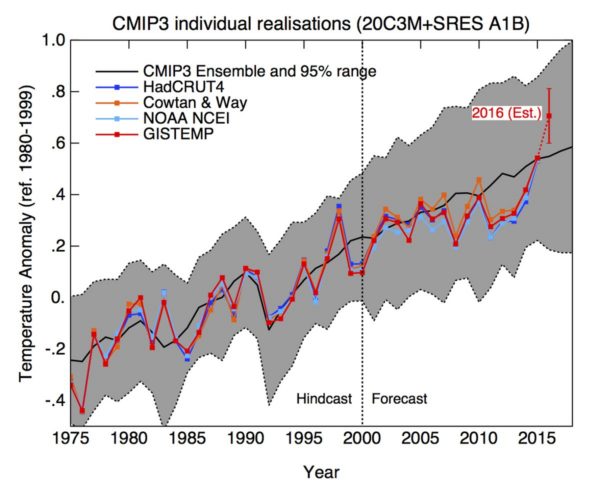
p.s. To compare to Vahrenholt’s forecast, here’s a comparison of earlier model projections of global temperature for the IPCC (prediction with the CMIP3 model ensemble used in the 4th IPCC assessment report, published in 2007) with the actual changes in temperature (the four colored curves). Graph by Gavin. (The agreement with the most recent set of models (CMIP5) was recently discussed here by Gavin.) schmidt

11 Dec 16:47

#neverforget

by russell davies

Belper

11 Dec 16:47

Twitter Favorites: [markasaurus] Why aren't more small business owners loudly advocating for nationalized healthcare? Do people realize how time consuming this BS is?

Mark Hogan @markasaurus
Why aren't more small business owners loudly advocating for nationalized healthcare? Do people realize how time consuming this BS is?
11 Dec 16:47

Twitter Favorites: [ReneeStephen] Idea: a bot that just tweets to random replies during tweetstorms that says "You didn't understand my point, please reread my prior tweets."

Renée Stephen @ReneeStephen
Idea: a bot that just tweets to random replies during tweetstorms that says "You didn't understand my point, please reread my prior tweets."
11 Dec 16:35

A Traveling Arts Nonprofit Addresses 9/11, the Holocaust, and Anti-Bullying

by Taylor Lindsay for The Creators Project

All images courtesy the artist

Displaced from her studio and apartment on 9/11, Linda Stein recalls fleeing Ground Zero on that tragic day. “As I was running, I turned around and wondered, ‘Why are they throwing furniture off the Trade tower?’ Then I realized it wasn’t furniture—it was people jumping. [...] When I returned to my studio after a year of displacement, my work started becoming figurative, after many years of being an abstract artist. With each project, one could see male and female attributes, blended into each form.”

Her perspective drastically changed, the longtime artist and activist began creating tangible works focused on the body and social change ever since. Traces of 9/11 are not obvious in her pieces, but the importance of embodiment, environment, and gender justice define her exhibitions. Distinctly figurative and aimed to educate, many of them are also wearable.

Linda Stein, in front of “Holocaust Heroes: Fierce Females” exhibition

Stein’s art nonprofit, Have Art: Will Travel! Inc. (HAWT), brings traveling exhibitions, performances, lectures, and educational presentations throughout the US. Founded in 1972, HAWT’s aim is gender justice and anti-bullying education, explicitly and poetically. Her newest exhibitions are available for booking across the country. One, called The Fluidity of Gender, consists of larger-than-life gender-bending sculptures and archival ink prints; another called Holocaust Heroes: Fierce Females—Tapestries and Sculpture features ten female heroes during the Holocaust.

Not yet traveling but nearly complete, I Am the Environment: My Gender, My Nature, is Stein’s latest work, a series of figurative work formed with earthy elements gathered almost completely from the beach (excepting purchased lentil beans, used in Seeds of SelfPossession). Stein painstakingly collected seashells, nuts, wood, and debris herself before creating the sculptures. “It’s so important for us to take care of the environment—I’m comparing it to caring for our bodies,” she tells The Creators Project. “We as humans make up the environment as well - as we care so much for our bodies, we should care for the environment in the same way.”

While I Am the Environment has yet to travel, Holocaust Heroes: Fierce Females, has moved from Wisconsin, to Santa Barbara, to its current place in Dallas. The multi-media project uses video, sculptures, performance, and ten colorful collaged tapestries to tell the stories of women who saved lives during the tragedy. “The tapestries each represent a hero during the Holocaust,” Stein tells us. “We all know Anne Frank, but I want everyone to learn these nine other names.”

Anne Frank, 839, 2015, 5 sq. ft. Leather, metal, fabric, paint, canvas and mixed media. Courtesy of artist,© 2016 Linda Stein

“Nobody wanted to talk about sexual abuse during the Holocaust,” Stein continues. “But here’s an example: while one woman was in this concentration camp, a man came over to her and offered her a spoon. At first, she was so grateful. The urn that was passed around, filled with water and gruel, was certainly contaminated at the rim with Tuberculosis germs. A spoon offered the chance to dip into the center and maybe avoid contamination. But then the man says, “When can we meet?” and she knows it’s in exchange for sexual favors. She throws the spoon at him and runs away and hides. But instead of chasing her, he simply approaches another woman with the spoon, and she says ‘yes.’ This kind of thing happened a lot during the Holocaust. It brings up the question: how do you maintain your self-respect and survive?”

This question led Stein to create the sculpture portion of the series with her Spoon to Shell boxes. Each box has a spoon representing the opposition between sustenance and sexual abuse and a shell signifying the hardened facial expressions of those trying to hide their fear or anger.

Spoon to Shell 823, 2015. 11” x 14” x 2” spoon, shells and mixed media. Image courtesy of the artist,© 2016 Linda Stein

Recently at Alverno College in Wisconsin, many in the audience told Stein that they weren’t aware of how many women not only spoke up but saved lives. “The reason I want to educate my audience is because I want them to know: you may not save lives, or write from an attic like Anne Frank, or suffer the way others suffered, but what can you do on an everyday basis to help someone who’s being bullied? How can you be not a bystander, but a brave up-stander?"

Spoon to Shell 831, 2015. 11” x 14” x 2” spoon, shells and mixed media. Image courtesy of the artist,© 2016 Linda Stein

To learn more about HAWT and Linda Stein’s traveling exhibitions, click here.

Related:

An Augmented Reality Superheroine Is Fighting the Social Stigma of Rape in India

Gendered Put-Downs Come to Life in this Photo Series

Historic Holograms Amplify Holocaust Survivors' Testimonies

11 Dec 16:35

Learn About the Comic Artist's Secret Sidekick, The Inker

by Giaco Furino for The Creators Project

SPN 1.pngIn this simple drawing of Superman, inker Scott Williams has made a series of strategic decisions. Screencap via

Though often derided as “tracers” or “shaders,” comic book inkers are a vital part of the process. Almost every great comic out on shelves today has been lovingly inked by an artist working off the pencil foundations of another, and this week’s mini-comic masterclass, Strip Panel Naked, breaks down the role of the inker. Host Hass Otsmane-Elhaou’s video essay shows off the work of Scott Williams as he inks the work of famed comic artist Jim Lee. Focusing on Superman Unchained #1, the video illustrates all the important choices an inker has to make and shows how hard it must be to ink the frenzied lines of Lee.


A preliminary drawing of dense linework—waiting for an expert inker. From Superman Unchained #1. Pencils by Jim Lee

Lee’s pencil work is known to be highly detailed and rough, which creates a choice for Scott Williams: Does he smooth over the lines, or keep the rough spirit of the original illustration in his inking? “We’re told inkers are there for neatening up work, but what Williams does is heighten what Lee brings to the work, not arbitrarily try to clean it up. It’s a beautiful decision that adds so much to the style and feel people get when they think of Jim Lee.”


A side-by-side comparison of an uninked pencil and an inking (color removed)

“Inkers," explains Otsmane-Elhaou, "are an unseen and underappreciated part of the process of creating comic books." He adds, “Underappreciated by readers, because pencillers know exactly what sort of magic a good inker can bring to their work.”

Just one look at the work of Scott Williams—one of the best inkers in the business—it’s clear to see what a huge difference his work makes.

See the power of the pen for yourself in this week’s Strip Panel Naked:

To see more, visit the Strip Panel Naked YouTube page, as well as its Patreon page to help support the series.

Related:

A Marvel Illustrator on Creating a Seedier New York

A Marvel Illustrator Talks Adding Emotional Heft to Static Pages

A Comic Pro Speaks About Injecting Action Into Artwork

11 Dec 07:52

Twitter Favorites: [shawnmicallef] "Toronto has no history" some say. I dug up a bit of the life lived in the Church-Dundas jumble for the @TorontoStar https://t.co/8iOcW1k3aC

Shawn Micallef @shawnmicallef
"Toronto has no history" some say. I dug up a bit of the life lived in the Church-Dundas jumble for the @TorontoStar thestar.com/news/gta/2016/…
11 Dec 07:52

Twitter Favorites: [chrisbateman] @shawnmicallef Toronto doesn’t lack history, it lacks memory.

Chris Bateman @chrisbateman
@shawnmicallef Toronto doesn’t lack history, it lacks memory.
11 Dec 07:52

Twitter Favorites: [joshwporter] @50ShadesofVan lots of snow falling in Courtenay right now, accumulating fast.

Josh Porter @joshwporter
@50ShadesofVan lots of snow falling in Courtenay right now, accumulating fast.
11 Dec 07:52

In Pursuit of Micro SD-Card Speeds – Part 1

by Martin

write-performanceWhen I recently read an article in a computer magazine about micro SD-card speeds in the range of 60+ megabytes per second I was quite amazed as my personal experience is an order of magnitude less. So I decided to get to the bottom of it and see if I could improve read/write performance.

Micro SD-cards are getting quite big these days. I mainly use Sandisk Ultra 16 GB cards these days as they feature a good mixture of price, amount of data they can store and the time it takes to clone a complete card, e.g. when I want to make an image of a Rasperry Pi SD-card installation. With a small USB-2 adapter I get read speeds of around 17 MB/s and write speeds of around 8.6 MB/s. These numbers are way below those given in the article for 32 GB Sandisk Ultra cards that achieve a read and write performance of well over 60 MB per second.

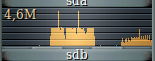
To get higher data rates a USB-3 capable SD-card reader is required. In a first attempt to get to higher speeds I bought a small USB-3 SD-card reader from UtechSmart. At a cost of 10 euros my expectations were limited and unfortunately, this proved to be right. The same micro SD-card in this reader could be read at 22 MB/s (up from 17 MB/s) and write speeds were at 13 MB/s (up from 8.6 MB/s with my USB-2 adapter). The screenshot at the top left of this post shows the difference between the same micro SD-card in the USB-2 and USB-3 reader. So while the graph looks nice the speeds I could reach with the USB-3 reader were still light-years away from the values in the test report.

So perhaps 32 GB cards are performing much better than the 16 GB cards I use? Or perhaps I need to get another USB-3 reader? Or perhaps the Linux driver for that reader is not optimized for higher speeds? It’s a bit of a mystery. But as the speed difference is significant, I will keep trying. Watch this space for part 2.

11 Dec 07:51

Cycling around Hawaii

Just because.

Day One: Waikoloa to Ocean View

I couldn't figure out a ride for the first day that was a decent distance, not too short and not too long without making the other days harder. In the end I decided to just go for a long ride. That was probably a bad idea.

It started out wet and rainy with flood warnings. But as I got to Kona it stopped raining. Had a chance to stop at wonderful beach for a snack.

By the afternoon as I was getting near Captain Cook it got hot and I hit the steep hill and that was horrible. It floored me and I struggled at the end. Had to seriously recuperate at the top.

The views past Captain Cook of the island stretching out was fabulous and then next 30km cruised by.

But after 90km I started to hit a wall and slowed down and took frequent breaks. Arriving at Ocean View at 4pm, I was absolutely exhausted and dehydrated. Add in jet lag and it was quite a day.

Day Two: Ocean View to Volcano

I figured out I'd strained my achilles yesterday. It was raining. Really raining. There were flash flood warnings and the road was about to be closed. But my plan was to get Volcano. So I did.

The first hour or two were the worst, heavy pounding rain that formed rivers on the road. Brakes basically became useless and visibility was terrible. And my ankle hurt.

After about 2 hours I got to a police road block, due to flooding they were about to shut the road. They said "well you can probably make it" through a deep puddle stretching the road. So I did, while cars were turning back.

It let up a bit, but it did not stop for 6 hours and as I climbed above 2,500ft in elevation it started to get colder. This was a long day.

Day Three: Volcano to Hilo

Short ride downhill into Hilo and then a rest day. I needed that to get some drugs, a support strap for my ankle and some relaxation. Oh and it rained insanely hard all my ride, so this was a chance to dry out my clothes.

Day Four: Hilo to Waimea

Hands down the best day. After my rest I was feeling better and the support strap was helping my ankle. I left Hilo early in the morning and rode along the sea front. The road winds over gulchs, waterfalls and has fabulous views. After 60km+ it turns left and climbs up the volcano towards Waimea.

What was then a fabulous ride become more better as it went to a winding back road past farms lined with trees. After a climb you break out of the trees into wide green fields with the snowcapped volcanoes towering in the distance. Just amazing.

As it turns out, for me right now about 90km is just about the right distance for me.

Day Five: Waimea to Waikoloa

You could do this straight downhill to Waikoloa (25km), but that would be boring. So instead I looped up to Hawi. Boy was I glad I did, this was another highlight. A nice climb up a hill with fabulous views across Hawaii. Followed by a wonderful roller coaster of slow downhill past lovely tree lined roads, views of Maui in the distance. A wonderful last day.

The remaining 40km back around to Waikoloa was boring and tiring.

And that's it. Five days, over 427km, around two volcanoes, one really sore achilles tendon and one flash flood. Would do again.

Thanks to Mozilla for being crazy enough to run a company meeting in Hawaii.

11 Dec 01:12

Surly Big Fat Dummy

by Freewheel

This is what a Big Dummy looks like.  Courtesy Surly Blog

The Surly Big Fat Dummy, a long tail, fat-tired cargo bike, will be available around April 2017.  Price TBD.

If you're familiar with Surly, then you know this bike was inevitable.  Surly's Big Dummy has been a dependable long-tail cargo bike for years (yet somehow we never managed to discuss it here). 

And then Surly began to roll out one fat bike model after another: Moonlander, Pugsley, Ice Cream Truck, Wednesday, along with fat do-it-all bikes like the Troll, Ogre, and ECR.  In fact, we imagined Surly making the following pitch at a QBP product meeting:

QBP Head Honcho: OK, let's talk 2016 products.  Surly, go ahead.

Surly: Fat, fat, fat, fat. As you know, we're all about the fat bikes.  And we just keep getting fatter.  Like land-on-the-moon fat.

But Surly wasn't done getting fatter, and we should've known that.  The Big Fat Dummy will take 26x5.25 tires!  Complete bikes will ship with 26x3.8 tires.

The Surly blog has a long post with everything you need to know about the Big Fat Dummy. So if you're interested, check it out.

Farm Fresh. Courtesy: Surly Blog

11 Dec 01:12

Rogers bringing Android 7.0 Nougat and VoLTE to the Sony Xperia X Performance February 2017

by Ian Hardy

Rogers has once again updated its OS Update Schedule with a new round of devices set to be updated to Android 7.0 Nougat.

Rogers does state on its site that, “Making sure these dates are accurate is our top priority. Sometimes, things change beyond our control so all dates listed are subject to change. Thank you for understanding.”

rogers Android 7.0 Nougat and VoLTE to the Sony Xperia X Performance

As for specific devices, Rogers notes the HTC One M9, LG G5 and the Moto Z will be graced with Android 7.0 with the exact date unconfirmed but is “coming soon.” For Sony Xperia X Performance owners, you can mark February 2017 off on your calendars as this is when Nougat will arrive and will also bring VoLTE (Voice over LTE) to your device.

The latest Android distribution numbers revealed Nougat is powering 0.4 percent of all Android devices.

Related: Rogers is putting its One Number VOIP service out of commission as of January 2017

Source Rogers
11 Dec 01:11

In-flight phone calls? The rest of the world does that all the time, America.

Americans are showing their parochialism, once again. This time it’s in-flight phone calls, which are an international norm, but have been prohibited in the US since forever.

But a country that opposes the metric system – just the US and Liberia, by the way – can’t be expected to wise up to the immense practicality of phone calls while flying. 

But the time has come, apparently, because airline’s wifi technology is now good enough to handle it.

Andy Pasztor and Susan Carey, Transportation Department Weighs Allowing Phone Calls During Flights

In a surprising and likely controversial step, U.S. aviation regulators on Thursday suggested they are leaning toward eventually allowing in-flight calls from airline passengers—with two important caveats: airlines will have the option of whether to provide the service, and passengers must be informed well in advance if the flight allows calls.

While the Transportation Department likely is years away from making a final decision, here’s why it is stepping up its review and a change could happen: calls on trains, buses and subways already are commonplace, and advances in onboard Wi-Fi—the technology enabling such calls miles above the Earth—are improving call quality.

Perhaps the other contributing factor is that more travelers are sensibly bringing noise-cancelling headphones on air travel, and someone behind you chatting with the office will be dropped out just like the squalling baby in 12F or the drone of the engines.

11 Dec 01:11

Why I switched from a DSLR to Panasonic’s G85 mirrorless micro four thirds camera

by Patrick O'Rourke

From a young age I’ve always had a keen interest in photography, starting with simple point and shoot cameras as a child, graduating to a 35mm SLR in high-school, and then various Canon Rebel prosumer DSLRs in University and my career as a journalist.

While Canon’s Rebel series has always served my specific use case as a journalist, which typically involves rapidly shooting photos at events and more carefully setup photos of products for reviews, the manufacturer’s cameras have a less than stellar reputation when it comes to video performance. To the criticism of many, Canon doesn’t seem to have any interest in exploring adding 4K video support to its prosumer DSLR lineup.

With video becoming increasingly important to my day-to-day job, especially at MobileSyrup, I now need a camera that is capable of shooting solid images and video, or at the very least, has decent low-light video performance and the capability to autofocus reasonably well when filming video.
lumixg85-2

The kind of videos I find myself creating typically need to be shot quickly, on crowded demo show floors and often under very difficult lighting conditions (this is why having a lens with a wide aperture has become very important to me). Why smartphone manufacturers insist on setting up their demo spaces in poor lighting has always been lost on me, but it remains a common practice in the industry.

There’s another reason too; traditional DSLRs are bulky and, in many cases, heavy, making them difficult to lug around while travelling or walking through a crowded hands-on demo show floor at a keynote. I loved my still relevant Canon Rebel T6i, which I only purchased a little over a year ago, but carrying around multiple bulky lenses, additional batteries, and the camera’s large body, has slowly grown into a chore. With the G85, my giant turtle shell of a backpack feels slightly less bulky.

Because of this, size is another factor that attracted me to enter the world of micro four thirds, mirrorless cameras. While not every micro four thirds shooter is lighter than a standard DSLR, especially the G85 I ended up landing on, they’re considerably smaller, allowing me to fit more all-important dongles into my backpack.

Here’s an example of some of the video I’ve shot with the G85.

After weeks of research and frequently bouncing between various Panasonic, Sony and Olympus mirrorless cameras, I finally and firmly landed on the recently released Panasonic Lumix G85, though I did also strongly consider the slightly older G7, most YouTuber’s camera of choice.

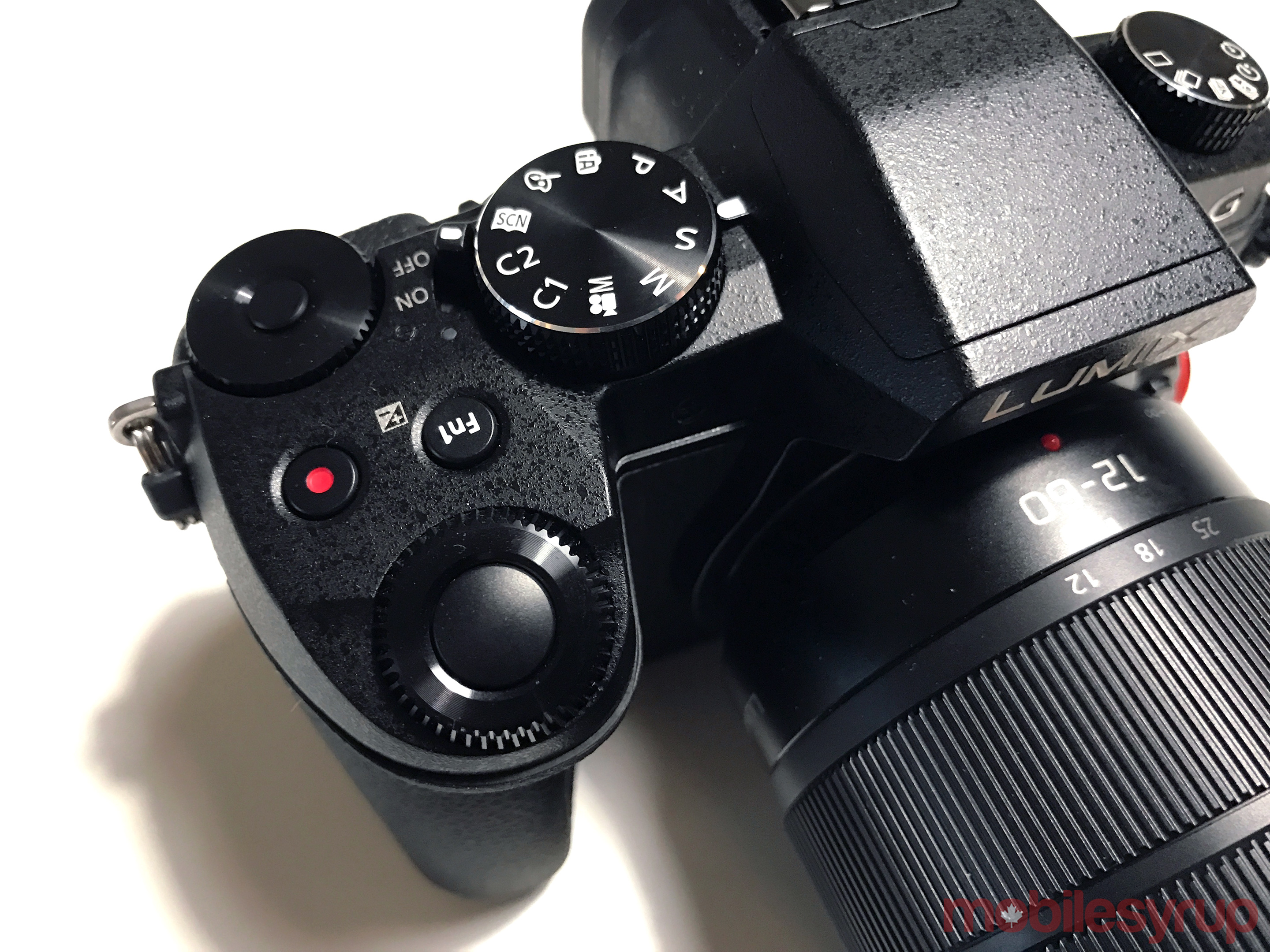
One of the other main factors that attracted me to the G85 is the fact that the camera features 5-axis image and video stabilization. Coupled with the G VARIO 12-60mm F/3.5-5.6 ASPH lens included with the G85, which itself costs around $700 CAD and features built-in image stabilization in its body, my videos now look silky smooth, even when I’m not using a tripod. Given that I’m often shooting videos and photographs without a tripod due to the nature of my job, stabilization is very important, especially in terms of video.

The camera also features a 16-megapixel sensor and a quiet shutter. Because micro four thirds cameras typically come equipped with image sensors that are smaller than what I’m used to with DSLRs, they don’t perform as well under low-light conditions, at least when it comes to photography. This is because less light is able to hit the camera’s sensor and is one of the main issues micro four thirds cameras experience.
lumixg85-8

This is something I’ve found difficult to grapple with after using Canon’s Rebel line for so long. I’m beginning to get the hang of the camera’s strengths and weaknesses when it comes to low-light, however. Because the G85 has such solid image stabilization, I’m able to shoot at a significantly slower shutter speed than I was with my Canon camera. I also quickly learned to set the camera’s ISO max to 1200 since anything above that number results in a very noisy image, at least in my experience, though I’ve read reviews of the G85 that state otherwise.

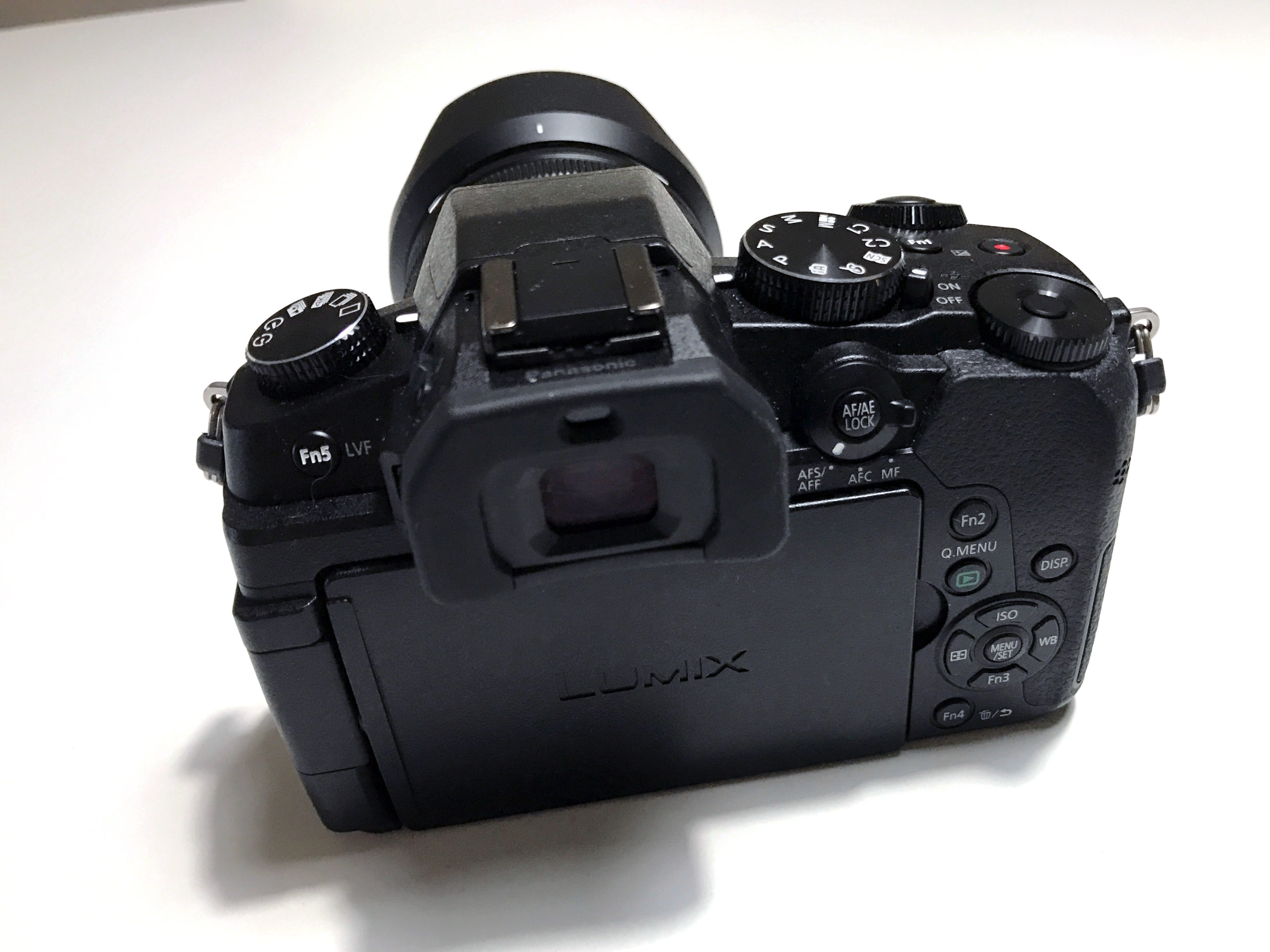
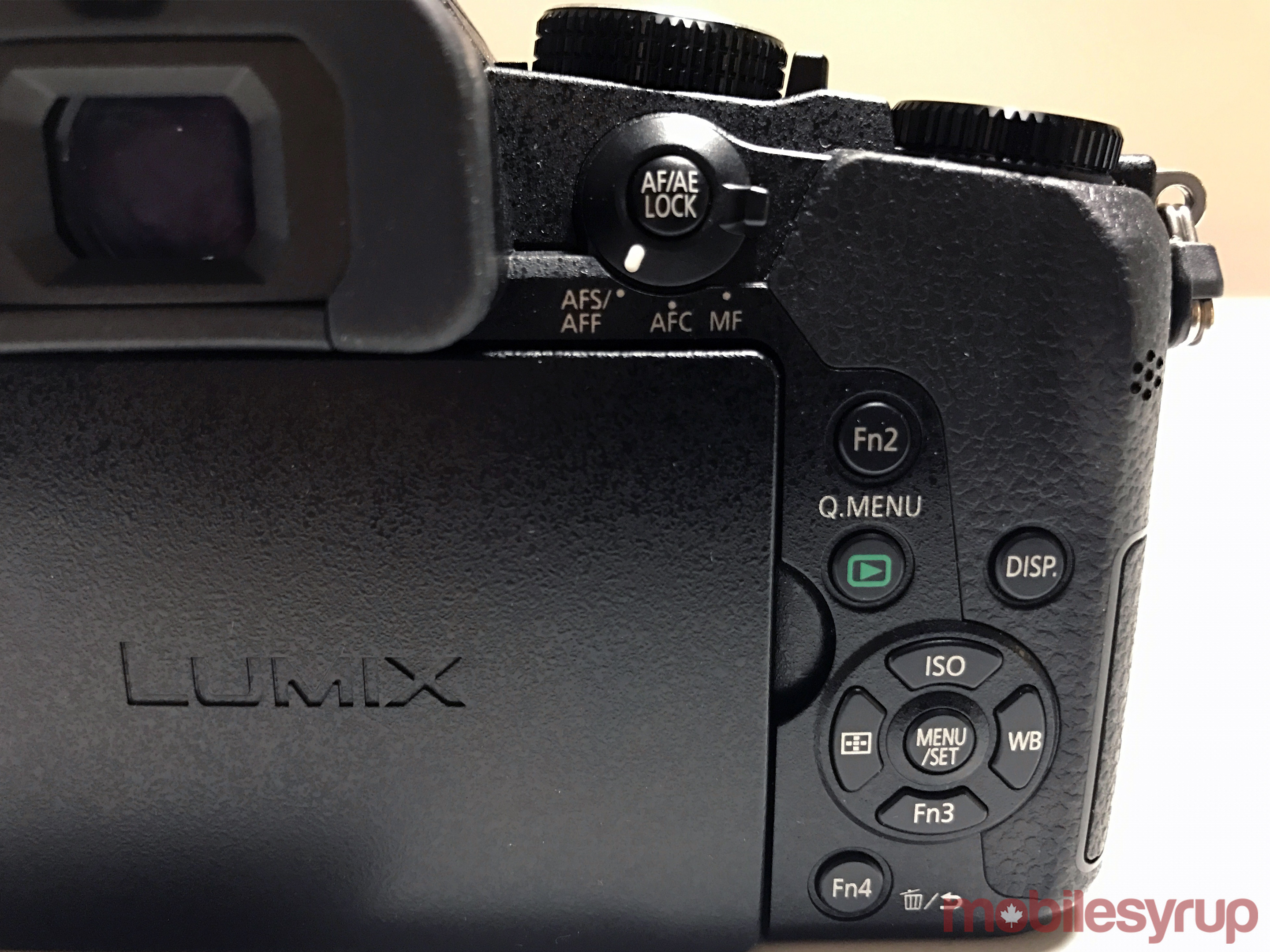
The camera also features programmable dual thumb dials, which I’ve set to act as my shutter speed and aperture controls, depending on what preset I’m shooting with. I typically opt for aperture priority and allow the camera to set the shutter speed and ISO. The G85 also even features distinct controls for single/continous autofocus and five numbered function (fn) buttons, allowing photographers to set the camera up exactly how they want to (this is something I’ve never experienced before with Canon’s DSLR ecosystem). This gives me quick access to useful features like the G85’s built-in level.

While not exactly important in terms of how I shoot video and photography, the G85 is also splash and dust resistant, which means it can easily survive small amounts of water. If you ever get caught in the rain, this feature is definitely a plus.

Gallery


The big draw for me of the G85 beyond what I’ve already mentioned is its continuous autofocus system, which can be easily quick-selected via its main rear dial. In my experience, the camera captures sharp video, even under tricky lighting conditions. The camera’s oscillating 2,360 pixel resolution screen is also great for shooting video and photos from odd angles, though my dearly departed Canon Rebel T6i also featured a very adjustable touch screen. At one point I was considering purchasing Panasonic’s smaller GX85, but was deterred by the fact that it doesn’t include a fully articulating screen.

Finally, 4K is a big draw for me with the G85, and not because MobileSyrup is going to switch over to shooting exclusively in 4K anytime soon, but because if I’m going to invest in this jump to micro four thirds, I want the camera to be future proof. Though I don’t have much purpose for 4K photos, experimenting with 4K video has been an interesting test for me.

I was surprised to learn 4K video files end up getting split into multiple files, which makes things a little more difficult when editing video together (apparently you can get around this if you’re using an SDXC memory card larger than 32GB). It’s certainly been an adjustment period for me switching to the G85 and micro four thirds cameras, and I’ll admit that during my first few weeks with Panasonic’s latest shooter, I regretted the switch.
lumixg85-12

After allowing myself adequate time to adjust to the intricacies that stem from using a micro four thirds camera, as well as getting used to the G85’s various settings, I’m slowly becoming more comfortable with my decision to enter the smaller, lighter, video focused world of micro four thirds cameras. The G85 would also be great for anyone looking to upgrade from their smartphone’s shooter, but don’t want to carry around a big, bulky camera (even Panasonic’s GX85, which is slightly cheaper than the G85, is a great option).

Panasonics’ G85 is available from most retailers for $1,199 CAD with a G VARIO 12-60mm F/3.5-5.6 ASPH lens and $949 for just the body.

The Panasonic G85 I used for this story was provided to me as a loan by Panasonic (when the camera is sent back to Panasonic, I plan to buy my own). 

11 Dec 01:11

How To Take a Screenshot on Google Pixel

by Android Beat
Recently switched to a Google Pixel after years of using an iPhone? Still getting used to the OS and wondering how to take screenshots? Don’t worry as we have got you covered. Continue reading →
11 Dec 01:11

Benefits of static web sites hosted on Google Cloud Storage, Azure Storage, or Amazon S3

by Mark Watson, author and consultant
Most of my sites have no dynamic content but I often still hosted them as a Ruby Sinatra app or use PHP.

A few years ago I experimented with using the static site generator Jekyll but still hosted the generated site on one of my own servers using nginx. After a while I decided to revert the site to its old implementation as a Sinatra web app (even though the site was always static, that is, no server side actions required except for serving up static HTML, JS, and CSS files).

I am now using a far superior setup, and I am going to document this new setup to document it for myself, and perhaps other people may find this useful also:

I chose to use Google Cloud Storage for personal reasons (I used to work as a contractor at Google and I fondly remember their infrastructure, and using GCP is slightly similar) but using Amazon S3 or Microsoft Azure is also simple to set up.

Start by installing Harp and a static site local web server:

npm install -g harp
npm install -g local-web-server


Harp by default uses Jade, and I spent about 10 minutes of "furious editing" for each of my static sites to convert to the Jade format from HTML, ERB, or PHP files. This is optional but I like Jade and I thought that long term it would save me maintenance effort using Jade. As you edit your site use "harp server" to test the site locally. When you compile a web site using "harp compile" a subdirectory www is created with your static site ready to deploy. You can test the generated static site using "cd www; ws" where ws is the local web server you just installed.

You need to create a storage bucket with your domain name, which for this example we will refer to as DOMAIN.COM. I created two buckets, one DOMAIN.COM and one www.DOMAIN.COM and for www.DOMAIN.COM I created a single index.jade file (that gets compiled to www/index.html) that just has both a HTML redirect header and Javascript for a redirect to DOMAIN.COM.

The only part of this process that takes a little time is proving to Google that you own the domain, if you have not done so in the past. Just follow the instructions when creating the buckets and then copy your local files:

cd www
gsutil -m rsync -R . gs://DOMAIN.COM
gsutil defacl ch -u AllUsers:R gs://DOMAIN.COM

I had to also manually set the static files copied to GCS to have public access. You will have to change the DNS settings for your site to create a CNAME for both www.DOMAIN.COM and for www.DOMAIN.COM pointing to c.storage.googleapis.com. Whenever you edit a local file use "cd www; gsutil -m rsync -R . gs://DOMAIN.COM" to re-sync with your GCS bucket.

After waiting for a few minutes test to make sure your site is visible on the web. For one of my sites I also used a free Cloudflare service for HTTPS support. This is very easy to setup if you already have a Cloudflare login. Just add a free web site and make the same to CNAME definitions pointing to c.storage.googleapis.com and then Cloudflare will give you two DNS servers of their own that you need to use instead of whatever DNS service you were using before. 


11 Dec 01:10

v2

One of my goals in 2016 was to write more on here. That hasn't worked out, mainly because the CMS which I had custom-built many years ago has been showing its age. I did briefly contemplate addressing its shortcomings, but quickly came to my senses and decided to look elsewhere for third-party alternatives. The one I went with significantly reduces the friction in publishing because every blog post is just a Markdown file. Great, but where do I write? Although there's a undoubted charm to Notepad's simplicity, it still thinks it's 1995. And as far as Markdown editors go, MarkdownPad seemed like the best choice, but I didn't consider writing to be its primary use-case. So I decided to build something myself. This was supposed to be a side-project to be completed over a weekend in between Appy Weather 2 work. A text editor - how much work could that be? Can't be much? Wrong, well, if you're me at least and don't settle for "good enough". It's been over 3 months now, and it's still not quite ready. But it's getting there. If you're interested in getting early access, please check out appytext.net.

**

As part of the infrastructure change, the RSS feed will now only be listing (new) posts made using the updated system. You can head over to the Archive for older posts.

11 Dec 01:09

Holiday Gift Guide for the photographer

by Igor Bonifacic

Happy holidays! If you follow me on Twitter or Instagram, you may know how much I love photography.

With almost every other tech vertical covered by the other members of the MobileSyrup team, the powers that be allowed me to do a gift guide on my favourite hobby. Photography can be an expensive hobby, so I tried to pick products that are on the more affordable side, as well as one that have some kind of mobile aspect.

Check it out below.

Peak Design Field Pouch

igor-gift-guide-5

There’s no such thing as the perfect camera backpack, but if there’s one company that consistently delivers some of the best bags on the market, it’s San Francisco-based outfit Peak Design. Founded in 2010, the company has become something of a crowd funding darling with six hugely successful Indiegogo and Kickstarter campaigns to its name. Its latest project, which concluded this past September, raised more than $7 million USD.

And while I love each and every Peak Design product I own, for the purposes of this gift guide I’ve decided to recommend the company’s diminutive Field Pouch. Despite its size, Field Pouch can hold a mid-sized zoom lens and prime, as well as a host of other accessories like SD cards, batteries and filters, with ease, making it a perfect addition to any photographer’s kit. Its meagre price tag ($39.95) also won’t break the bank. Best of all, it works just as well as a standard accessory bag.

Fujifilm Instax Share Smartphone Printer SP2

igor-gift-guide-4

With the advent of smartphone photography, more photos are snapped each day than ever before. At the same time, however, far fewer people are printing their photos. It’s a shame, because there’s something about holding a picture in your hands that can’t be replicated by simply looking at it on a smartphone screen.

Enter Fujifilm’s Instax Share SP2 Smartphone Printer ($239.99).

With its small footprint, you don’t need to plan a visit to your local Walmart or photo lab to print your best photos. The accompanying Instax Share app, available on iOS and Android, makes it incredibly easy to send and print photos; there’s no complicated pairing process, and each photo is printed on Fuji’s fun Instax film. With the help of apps like Dropbox and Google Photos, it’s also possible to print any photos you’ve taken with your dedicated camera.

Understanding Exposure by Bryan Peterson

igor-gift-guide-6

For several decades now, Bryan Peterson has taught photographers the world over how to take better pictures with Understanding Exposure ($34.99). Now in its fourth edition, the 176-page book is an indispensable resource for any photographer, no matter their skill level with a camera. In simple, easy-to-read language, Peterson explains photography’s core technical concepts and how they relate to one another.

And while the focus of the book is on digital and film cameras, the concepts and techniques Peterson details in Understanding Exposure can be applied to taking photos with any camera, including the one most people have in their pockets.

Aukey Optic iPhone Lens

igor-gift-guide-3

When it comes to the old adage, “the best camera is the one you have with you,” smartphones have SLR, mirrorless and point-and-shoot cameras beat pretty handily. Most people have their smartphones on them at all times, and with just how much mobile cameras have improved in the past few years, it’s possible to take stunning shots with just one’s smartphone. That said, smartphone cameras aren’t equipped to perfectly capture every moment. Sometimes, a scene calls for a specialized lens.

Fortunately, a number of accessory manufacturers have developed a clever workaround. For $18, the Aukey Optic iPhone lens lets smartphone users turn their normal lens into a fisheye, wide-angle or macro lens, opening up a whole host of new shooting opportunities. I’ll admit the clip mechanism look a bit silly, but it can work with almost any phone — a significant advantage.

11 Dec 01:09

"The cost of assessing risk is now often greater than the cost of failing."

“The cost of assessing risk is now often greater than the cost of failing.”

- Joi Ito
11 Dec 01:09

"The right to access every building in the city by private motorcar, in an age when everyone owns..."

“The right to access every building in the city by private motorcar, in an age when everyone owns such a vehicle, is actually the right to destroy the city.”

- Lewis Mumford
11 Dec 01:08

Peter’s Routes: The Gay Village to Queer West

by dandy


church-wellesley-to-queer-st-west

Follow Peter Harte as he commutes from one end of the city to the other through all seasons and shares his recommendations on the safest, smoothest, and fastest routes in this dandy series. You can read his previous post here. The rest of the series is at the bottom of this post. Safe rides everyone!

Peter's Night Out (aka Peter's Commute Routes)

Church Street Village to Queer Street West

This was a particularly great opportunity to write and photograph a route that I travel so frequently. December 1, 2016, was unseasonably warm. It was prime riding weather. By documenting the late night trek I realized how frequently I take this Saturday night passage. From the Gay Village and then over to a specific strip on Queen West West that is affectionately referred to as Queer West.

It’s crazy how during this ride muscle memory took over to avoid certain bumps and aberrations in the road. Even the pedal pressure I used as I ascended north was predicted by my body and mind. And yet somehow, I can still pass by College and Spadina and forget what was there before the condos came.

mine-to-church-and-wellesley
Speaking of condos, I live in condoville at Bathurst and Fort York. Heading east can be tough as Spadina is often so busy. But there’s a pathway that takes you down a little known tunnel under Spadina just north of Fort York Blvd. You can use the underpass and end up near the Rogers Centre while avoiding nasty traffic. It’s also a fun path to see at all the little condo dogs as they get walked and do their squats. (Poor pooches don't have many parks in this part of town to do their business in.)

spadina-underpass-path

As you leave the tunnel you are faced with a pretty steep hill that curves alongside the Rogers Centre. This could sound odd, but I have some kind of fetish about the physics of travelling around corners. Like how during a 200-m track race everyone starts off staggered, but then end up equally evened out, sort of gets me off. I love this feeling, and even when it’s uphill like how it is here, I make myself work it hard no matter how lazy I feel.

Continuing north, Blue Jays Way eventually becomes Peter St. Where there has been some construction for what seems like years just as you’re about to reach King St. The lane is so narrow. Forget about trying to pass if a truck with Dumbo ears for side mirrors is in the red light queue. Oh well, I guess a city has GOT to build - but a guy has GOT to bike...so I wait patiently.

But, TA DA! A new bike lane has appeared on Peter St. So, from north of King up to Queen it’s not too bad of a ride anymore. I would have rated this section of Peter one of my top 5 worst quality roads in the city, but now - with the new lane - it’s a great connection from where I live to get to access other major bike lanes.

peter-st-bike-lane

I take Peter until I get to Queen, and then side street my way over to Beverly. I’ve mentioned my love for the Beverly and College Street bike lanes before, so I’ll skip the repetitive bike lane love here. But I will say that when I can hoof it across College and pass Yonge to Carlton while hitting all the greens lights until I arrive at Church St., you better believe all those boys are checking out my skinny jeans! church-wellesley-01

Not long ago when you’d arrive at Church after zipping across College/Carlton, the first gay thing you’d see was Zippers nightclub. What’s remaining of Zippers is now just the façade of an unmarked building that will eventually be demolished and house yet another high-rise condo. It’s sad because Zippers was so iconic, and now there will be people who never knew it existed. I guess I’m not surprised though because when you think of it, Church and Carleton is just one main block away from Yonge, and that is, well... whatever it’s becoming.... it's changing.

zippers-cellblock

R.I.P. Zippers.

Heading north on Church into the village is always a treat to me. Especially the lit up Drag-o-lanterns on the streetlamps in October, or the shooting stars in the winter; the neighbourhood does a pretty good job at decorating and defining itself. That includes everyone who is currently taking advantage of the unusually warm December weather in this photo above. The gay village is so important because it's an inclusive community. I know that young people especially depend on it as a place to feel safe and included, and where they can truly feel like themselves. I can’t foresee a future without Woody’s, Cruise and Tangos, The Eagle, or Statlers, but I have to admit the changing neighbourhood with its increase in property values frightens me. I worry for the future of Church and Wellesley.

church-wellesley-02

Now, after paying my last homage to Zippers, it's time for me to head to Toronto's *other* gay nabe... Queer West (aka Queen West West.) To get across town to the west end I need to be strategic. From where I start I am faced with many obstacles; Little Italy, Queen St. West (possibly the worst artery for cyclists in the city), the nightclubs Richmond St., and the Dundas 'freeway'. But I feel like I got the best route figured out, so hop on and keep reading.

church-wellesley-to-queer-st-west

I head west on Wellesley and use the great bike lane all the way to U of T. Go under the bridge and swing around Hart House Circle until you make your way through the tree lined alley to pop out on to bike-lane-lined St. George St.

u-of-t-alley

I’ve written about this area before and I’ll repeat that I love the consideration behind the slightly smaller rumble strips and speed bumps for cyclists (which, I've since discovered came as a repair or afterthought). This time of year U of T puts some festive holiday lights up on these historic buildings, and it puts me in a bit of a festive spirit. Then I head south on St. George to College but only take it as far as Markham, one street west of Bathurst. From there, if you follow the south alleyway, you can make it quite safely further west to Manning and then head south to Dundas. This section of Dundas that takes you to Trinity Bellwood’s park is not too dangerous of a section on this fast and tight street. I feel like west of here it gets a bit scary at night with a lot of cars and taxis, and people darting across the street. It’s only a few blocks until you hit Gore Vale where you can begin to head south. From there you enter into the park and cross through it all the way west to Lobb and then onto Shaw St. where there is a bike lane. The only pain here is that the entrance into the park off Gore Vale doesn’t have a ramp onto the bike path, and you have to hike your bike up. Way to kill my cruisin' vibes Gore Vale. (Maybe the City of Toronto's cycling infrastructure team could add a curb cut to their list of to-do's in 2017?) Crossing through Trinity Bellwood’s, even at this time of year, but especially in the summer, is literally the watering hole and courting ground of the 21st century. I <3 You Bellwoods!

trinity-bellwoods-entrance-off-gore-vale

When I get to Shaw, I have to turn and go the wrong way down the only portion of Argyle that is not dual ways for cyclists. It doesn’t make sense why this one short block doesn’t connect to the bike lane west of Ossington. After, you can get all the way west to Gladstone on this bike lane and then head south to Queen. I usually lock my bike up in the Fresh Co. parking lot because you’re lucky to find one anyone in this section of Queen. We need more bike parking: especially on Queen West!

the-beaver

Some bars I need to give a shout out too because I wouldn’t be who I am today without these quirky watering holes and the people that frequent and work in them. The Beaver, oh my god(ess) you and your staff put up with so much, and still manage to serve all our queer drunk asses with no attitude. The Gladstone Hotel has incubated an incredible collection of RuPaul’s Drag Race diehards who fight for a table three hours before showtime...maybe it’s the hosts Champagna Enema and Allysin Chaynes, I don’t know, but it's fierce! The Gladstone Hotel also host incredibly popular dance parties like the YASGODDESS costume drag party in the back Ballroom. And, seriously, the list goes on further west into Parkdale; and it’s reasons like that, all those options, that makes me never take Toronto for granted, and never hate on it for not having enough alternative nightlife and creativity (or safe bike lanes *cough* Queen Street *cough*).

I fall in love with Toronto more and more each year I live here, whether it’s from the new people I meet, the old friends I grow with, or the bike lanes I ride in.

gladstone-hotel

Related Articles 

Peter's Commute: Brockton Village to Distillery 

Peter's Commute: St James Town to Dufferin Mall

Peter's Commute: Trinity Bellwoods to The Junction

Peter's Commute: Sherbourne Commons to Tarragon Theatre

Peter's Commute: City Place to Upper Beaches


11 Dec 01:07

Photo Challenge: New Horizon

by Stephen Rees

via Photo Challenge: New Horizon

Blackwall Peak
This is Blackwall Peak in Manning Provincial Park. It is 2.063 metres (6,768 feet) high – and you can drive up there. When you get to the top you do indeed get to see a new horizon – more mountains as far as you can see in every direction. The photo challenge is framed in terms of New Year Resolutions – something I do not do. But it does seem to me to be an appropriate metaphor. In life it often seems that we always have a new summit to climb, but when we get to that peak we just see a whole bunch of new challenges.


Filed under: photography Tagged: photo challenge
11 Dec 01:04

Exploring the business behind digital media’s invisibility cloaks

by Doc Searls


amsterdam-streetImagine you’re on a busy city street where everybody who disagrees with you disappears.

We have that city now. It’s called media—especially the social kind.

You can see how this works on Wall Street Journal‘s Blue Feed, Red Feed page. Here’s a screen shot of the feed for “Hillary Clinton” (one among eight polarized topics):

blue-red-wsj

Both invisible to the other.

We didn’t have that in the old print and broadcast worlds, and still don’t, where they persist. (For example, on news stands, or when you hit SCAN on a car radio.)

But we have it in digital media.

Here’s another difference: a lot of the stuff that gets shared is outright fake. There’s a lot of concern about that right now:

fakenews

Why? Well, there’s a business in it. More eyeballs, more advertising, more money, for more eyeballs for more advertising. And so on.

Those ads are aimed by tracking beacons planted in your phones and browsers, feeding data about your interests, likes and dislikes to robot brains that work as hard as they can to know you and keep feeding you more stuff that stokes your prejudices. Fake or not, what you’ll see is stuff you are likely to share with others who do the same. This business that pays for this is called “adtech,” also known as “interest based” or “interactive” advertising. But those are euphemisms. Its science is all about stalking. They can plausibly deny it’s personal. But it is.

The “social” idea is “markets as conversations” (a personal nightmare for me, gotta say). The business idea is to drag as many eyeballs as possible across ads that are aimed by the same kinds of creepy systems. The latter funds the former.

Rather than unpack that, I’ll leave that up to the rest of ya’ll, with a few links:


I want all the help I can get unpacking this, because I’m writing about it in a longer form than I’m indulging in here. Thanks.

Save

11 Dec 01:04

These 18 big websites fail the space-bar scrolling test

You know this tip, don’t you? When you tap the Space bar, the web page you’re reading scrolls up exactly one screenful.

That’s so much quicker and more precise than trying to use the mouse or the trackpad. When you’ve read to the bottom of the screen, hit Space to scroll. (Press Shift-space to scroll back up.) Works in every browser, on every site.

For this tip to be useful, of course, the amount of scrolling is important. The last line you’ve read (at the bottom of the page) should jump up to become the top line of the new screen. Like this:

(If you prefer, you can use the Page Down key to do the same thing. One tap, one screenful.)

But in recent years, something clumsy and unfortunate has happened: web designers have begun slapping toolbars or navigation bars at the top of the page. That’s fine—except when it throws off the Space-bar scrolling! Which, most of the time, it does.

Suddenly, tapping Space doesn’t scroll the right amount. The lines you were supposed to read next scroll too high; they’re now cut off. Now you have to use your mouse or keyboard to scroll back down again. Which defeats the entire purpose of the Space-bar tip.

Here’ what it looks like on one of these broken sites:

Over the last few months, I’ve begun keeping track of which sites do Space-bar scrolling right—and which are broken. I want to draw the public’s attention to this bit of broken code, and maybe inspire the world’s webmasters to get with the program. It can’t be a complicated fix—but for something that millions of people do billions of times a day, it seems as though it’d be effort well worth expending.

So here it is: The world’s first Space-Bar Scrolling Report Card for the biggest reading sites of the internet.

Sites that Scroll Correctly

Sites with Broken Scrolling

Here’s what I propose: We, the people, should spread the word of the space-bar trick, because it’s precise, it saves time, and it makes for easier, more continuous reading. And uninterrupted reading = better understanding.

They, the web programmers, should get their act together so that the scroll works as it’s supposed to.

(And if you work for one of those sites, and you manage to get the scrolling-bug fixed, email me so I can update this article and congratulate you.)

Thank you. This has been a public-service message.

David Pogue, tech columnist for Yahoo Finance, welcomes non-toxic comments in the Comments below. On the Web, he’s davidpogue.com. On Twitter, he’s @pogue. On email, he’s poguester@yahoo.com. Here’s how to get his columns by email