Shared posts

15 Dec 02:19

Language spin #2: the gig economy

by michaelkluckner

a_edited-1

If the billionaires behind Uber and Car2Go can offer “ride shares” and “car shares,” as in an earlier post, how about “the gig economy.” How positive and liberating that sounds!

“I don’t have a job, I have a gig!”, says the 20- or 30-something working hard with no tenure and no benefits. Benefits? Apparently it’s mainly the employers who have them under this system.

“Inside the Gig Economy” offers some insights from the FT Alphaville site.

FT Alphaville has been tracking the gig economy’s transformation into a neo-feudalism movement for a while now. What we’ve discovered is that those who use, love and defend the apps don’t always have a good understanding of what really contributes to their convenience. Many will do and say almost anything to protect them, whilst failing to grasp the key point of the criticism: none of this is necessarily sustainable or representative of a productivity efficiency.

(Should I [personally] care about this? I’ve been freelance since 1979, but the world I got established in is a totally different one from today’s. I may have made only a few hundred dollars a month when I was starting out, but if rent was $100 I was laughing.)


15 Dec 02:18

Your Best Shot 2016 – Landscape

by Zee Jenkins

As many of you may have guessed by seeing the Top Photos from Flickr in 2016, it was an epic year for landscape photographers on Flickr. With a year of celebrity deaths and political turmoil retreating to nature is a logical place to find beauty and stillness needed to make it to 2017. Beautiful images from all over the world put everything in perspective. Whether a mountain or river, lake or ocean, desert or swamp, this planet is beautiful and massively impactful.

The pillars
Ruins
Rhodope mountains
Arch of Hidden Vally
Pragser Wildsee
Chromostereopsis by the lake
La récompense de la rando
One

VIEW THE FULL YOUR BEST SHOT 2016 LANDSCAPE GALLERY
This gallery pulls some of the best landscape shots from the Your Best Shot 2016 group pool. We’ll continue adding to it through Jan. 7 when the group closes for submissions.


15 Dec 02:18

Ein Fahrrad aus den 1940ern: Bowden Spacelander

by Ronny
mkalus shared this story from Das Kraftfuttermischwerk.

benjamin_g_bowden_-_spacelander_bicycle
(Foto: Brooklyn MuseumCC BY 3.0)

Benjamin Bowden war Industrie-Designer und entwarf Autos, designte Sportwagen, diesdas. Ende der 1940er entwickelte er auch ein Fahrrad mit Elektromotor, das erst 1960, nur in den USA und ohne den Motor in Kleinserie ging. Das Bowden-Spacelander.

„Bowden gestaltete das Spacelander-Fahrrad 1946 als Beitrag zu der Londonern Großausstellung „Britain Can Make It“ im Victoria and Albert Museum. Bowden brach für das Fahrrad mit der bisherigen Tradition des Fahrradbaus. Anstelle von verschiedenen Rohren, die miteinander verschweißt wurden, entstand das Spacelander aus zwei Pressstahlrahmen, die miteinander verbunden einen hohlen Körper formen. Das Modell von 1946 enthielt einen Elektromotor, der auf Abfahrtsstrecken und beim Bremsen Energie sammelte, die dann bergauf vom Fahrer abgerufen werden konnte. Die Batterie im Fahrrad versorgte ebenso Licht, Hupe und ein eingebautes Radio mit Strom. Damalige Fahrradproduzenten betrachteten das Gerät als zu exotisch und wollten es nicht bauen. Das von Bowden vorgestellte Pressstahlverfahren wurde später von Honda für seine Mopeds und Piaggio für seine Vespas benutzt, beide begründeten damit einen Massenmarkt für preiswerte Motorroller.

Erst 1960 ging das Fahrrad in den Vereinigten Staaten in einer Kleinserie in Produktion. Das Fahrrad verzichtete auf den Elektromotor, Licht und Hupe waren aber weiterhin batteriebetrieben. Das Spacelander war aus Glasfaser statt aus Stahl, wog aber immer noch über 20 Kilogramm. Anstelle des revolutionären Antriebskonzeptes mit einer starren Welle benutzte das Spacelander einen konventionellen Kettenantrieb. Das Modell erschien in sieben Farbvarianten. Mit 522 verkauften Exemplaren fand es jedoch kaum Abnehmer und der Produzent ging Konkurs. Obwohl Bowden auch in seiner amerikanischen Karriere zahlreiche Erfolge erzielte, soll er innerlich nie den Misserfolg des Spacelanders verwunden haben.“
(Wikipedia)

Ich verstehe das. Was für’n Fahrrad!

1960 Bowden Spacelander from pics

15 Dec 02:18

Eve Alpha v0.2.3

(Eve is a new programming language, and this is our development blog. If you’re new to Eve, start here)

We released v0.2.2 just last week, and already we’re bumping the version number again, probably for the last time before we take a long-needed Holiday break. To recap, in v0.2.2 we added support for the Eve npm package, which adds the ability to use project workspaces, run stand-alone Eve apps, and run Eve in server execution mode. Read the November Dev Diary for a closer look at these recent changes.

What’s new in Eve Alpha v0.2.3?

Eve Alpha v0.2.3 includes these changes, and more. Let’s see what’s new:

Share Eve Programs with Gist

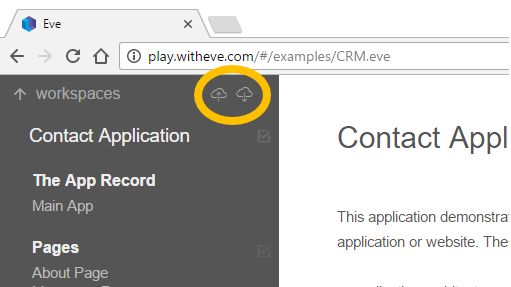
You can now share and load Eve programs with a link. There are two new icons in the editor at the top of the navigation pane: “Save to Gist” on the left, and “Load from Gist”.

new editor buttons

Clicking the “Save to Gist” button will upload your Eve program to a new Gist and provide you with a link to it:

save to gist

You can copy this link and send it to a friend, who can then load your program using the “Load from Gist” button. Clicking this button will reveal an input box, into which you can paste Gist links:

load from gist

When you load a Gist, you get a local copy of the linked Eve program. Any edits to this program will be made locally, and saved in your project workspace.

A nice feature here is that you can share Eve programs with friends new to Eve using play.witheve.com. Save your Eve program to Gist as normal, then load it at play.witheve.com. Now copy the address, and send it to anyone! Anyone with the link can load your program and run it in the browser, without any setup.

Note, that saving to Gist saves a snapshot of you code at the time the link is generated. If you update your code, you’ll need to generate a new link to reflect the changes.

Embed CSS Directly in Eve Programs

With a big thanks to the work of dwsmorris, you can embed CSS blocks into Eve documents. In the editor, you can create CSS blocks with the WYSIWYG toolbar:

css blocks

In a text editor, you can specify a css block in the info string

# CSS blocks

Print a greeting

```
commit @browser
  [#div class: "greeting" text: "Hello World"]
```

style the greeting

```css
.greeting {
  color: #FF0000;  
}
```

Standard Library

Contributors

Thanks to our contributors for this release!

15 Dec 02:18

The road tolls for thee

by Michal Rozworski

Last week, Toronto mayor Join Tory announced a plan to toll two major Toronto highways, the Gardiner and the DVP. The city is starved for cash with huge shortfalls for both infrastructure (new housing, new transit lines) and even everyday operating expenses. Tolls are supposed to help close this gap. But despite the absolutely huge revenue needs of this city, there a case to be made against tolls from the left.

There is a simple practical argument against the proposed tolls: they won’t raise very much money and any revenue is years away. City planners calculate about $200 million per year of new money once tolls are in place. That may sound like much but Toronto needs are in the vicinity of $30 billion just to catch up with a growing population and ageing infrastructure. And the city needs the money now.

toronto-road-tolls-20161124

John Tory has challenged those who oppose the tolls to spell out the alternative. Taxing parking spaces would raise $500 million and could be done right away. Getting residential and commercial property taxes to at least match long-term inflation and beat it, even with the necessary rebates for those house-rich, income-poor, would raise another huge chunk of cash. This isn’t even getting to more creative options—many of them included in an appendix to a KPMG report commissioned by Metrolinx.

Given the revenue crisis, lefties could easily come up with a viable, progressive money-raising plan even from a list prepared by the market-friendly consultants at KPMG. A municipal income tax? Why not since the province and the feds are raising less then they used to through this measure. Even a municipal sales tax with hefty rebates for low-income and working-class folks. It’s not a question of options but political strategy.

Unfortunately, mainstream opposition to tolls, including from the Ontario NDP, fails on this account. The NDP largely falls into a dangerous pocketbook politics that has consumed so much of the party’s energy, both in Ontario and federally. Opposing tolls without talking even more loudly about the big picture plays straight into the hands of the Conservatives.

The only option is putting the issue in class terms. There is a link between relatively small issues like road tolls, two decades of grinding austerity and very uneven economic growth. People get this. There is an existing car culture alongside growing awareness of climate change and the scale of necessary transformation. But if someone hears politicians making only the pocketbook argument, why consider the NDP, when they can go for the real deal Conservatives?

Beyond the NDP, tolls have managed to deeply polarise opinion on the left, especially for an issue that is relatively obscure. There is a real argument and it’s necessary to recognize that the left is in a bit of a catch-22 position. Here are two big arguments I’ve heard in favour of the proposed highway tolls:

  1. Climate change is a defining crisis of our time: if we want to get people out of their cars, we need to take all the small steps we can. Roads should be tolled because car use is heavily subsidized.
  2. This move is a step out of the anti-tax rhetoric of the right; we have to seize upon it. This opens the door to other revenue tools.

Both of these arguments are credible, but fall short. Roads do not exist in a vacuum; we have built a toxic car culture over decades. Of course, without better options, people will accept the tolls. Some section of poor and working class drivers at the margin will change their behaviour, probably forced into very long commutes on inadequate transit. This is simply punitive and, at the same time, does little for climate change. Liberal and right-wing environmentalism see not car culture, individualism and decades of bad urban design driven by capitalism and racism, but individual people as culprits.

There is a limit to such arguments; lots of small changes do end up making sizeable differences and people are not just victims of structures. Here’s where consistency and long-term political strategy come in. Our aim should be to support the right small changes that can feed off each other, unite in a consistent strategy and ultimately create the biggest differences. The job of the left is to facilitate the creation of better options alongside better politics so we collectively make choices to use those options. (Almost as if there were a dialectic…)

“But bus and subway riders already pay a toll!” is a common counter-argument. Tolls apply consistency. This, however, is just as easily an argument for eliminating transit fares as it is for tolling roads. Public services and infrastructure should be free for users and paid out of general revenues. That’s how redistribution works. The end goal should be an expansive, free transit system that overtakes road infrastructure, and at the same time redistributes resources from the richer to the poorer.  Toronto city hall has raised transit fares for six of the last seven years! The left should be fighting these increases tooth-and-nail, and putting more energy into this fight than that over road tolls.

Think of it as carrots and sticks. Tolls are a stick. More transit, progressive revenue tools and better urban planning are carrots. Both seek to change what people do but in radically different ways. Tolls and other user fees assume a society of abstract equality: sure, everyone pays for exactly what they use, but not everyone has the same means to pay. Maybe at some point in the future driving (especially for single occupants) will be able to become an expensive, luxury good. Step one is creating the alternative for those who can’t afford this luxury. Once car use is an expensive niche—its price driven up by limited demand and diseconomies of scale—tax it all you want.

Creating deeper equality was at the heart of the welfare state bargain that has been blown apart not just by greater capital mobility, with money easily fleeing to tax havens, but also by class war that has transformed how governments mete out carrots and sticks. The highest point of the welfare state included not just high income taxes but high consumption taxes; everyone paid more into the common coffer, even in some regressive ways, but got a lot more in return.

Today we’re nearly back to the beginning again. People have seen services deteriorate and the rich escape paying their fair share. To build a broad left majority, we need to do some equalizing first. Taxing the rich to pay for what we need is a necessary starting point of even the most basic social democratic politics today. Road tolls are just a small example of a policy that won’t build a broad working class coalition because it doesn’t account for the fact that the bargain it imagines is long gone.

I recently heard Hugh MacKenzie of the CCPA say that Mike Harris and the Conservatives dramatically reduced Ontario’s government revenues and the Liberals under both McGuinty and Wynne have spent 15 years cutting expenditures to get them in line. This two-stage austerity hustle sets a trap for the left: any new revenue will seem worthwhile, even if it transforms the state even further along neoliberal lines. It is credulous to imagine that John Tory will institute tolls today and a municipal income tax or even slightly higher property taxes the next. If tolls are a tactic to divide opposition to his bigger agenda of continuing to transform Toronto into a neoliberal playground for the rich, then he’s succeeding.

Issues like tolls shouldn’t simply further divide the left but can be an opportunity to think through our arguments together. There is a common, consistent thread that links opposition to road tools with both raising revenues and deeply pro-ecological politics. Here’s a simple three-point plan that should answer at least some of the criticism launched by supporters of tolls on the left:

  1. lower transit fares,
  2. expand transit infrastructure (and spend less on car infrastructure), and
  3. raise government revenues progressively.

Can we build on something like this?


15 Dec 02:10

Inspiration • Mobility • Simplicity

mkalus shared this story from Blog - Modacity: Inspiration • Mobility • Simplicity.

With the celebratory light being shined on our hometown, we feel it is important to put its successes into a larger context, and recognize there is still a great deal of work left to be done.

The City of Vancouver, for example, is just a single 115-square kilometre municipality of 600,000 residents in a sprawling, 2,877-square kilometre region of 23 local authorities and over 2.5 million people. The impressive statistics quoted earlier only include trips beginning and ending within city limits, and exclude the hundreds of thousands of cars passing in and out of our city on a daily basis. These vehicles are not travelling on elevated highways, but on residential streets retrofitted into at-grade arterials that bisect our communities, shifting the resulting externalities from the suburbs into the city.

Furthermore, with practically all of the City’s energy focused on the downtown peninsula, it appears many other areas, arguably the ones most in need – due not only to higher cycling numbers, but also lower incomes – are being left out in the cold.

These mounting problems are exacerbated by a provincial government that continues to chronically underfund public transit, while blowing billions on road widenings, bridges, tunnels, and interchanges that encourage exurban development, and undermine the legacy of past decision-makers (a legacy we’ll be exploring in our upcoming podcast series, due in early 2017).

There are signs Vancouver’s leadership is rubbing off on its neighbours, with progressive mayors such as Jonathan Cote and Greg Moore leading the charge; but without a change at the higher levels of government, it remains difficult to see how this region changes its course. As one BC Ministry of Transportation staffer famously declared to a group of Metro agencies a few years ago: “You may think you’re building Vienna.  We’re building Houston.”  

Let’s Build Cities With Mobility Prosperity

15 Dec 02:09

Mirroring The Words Of Your Members

by Richard Millington

Simple tip.

If you want someone to respond more positively, use their language.

It can be overwhelming to respond to 100+ questions per day. Especially when the majority of questions fall within a minority of topics. The temptation is to develop a standard response to these questions. These responses are accurate and require the least amount of time and mental energy.

The better you get at this the more you resemble a customer service rep than a professional community manager. That’s not a good experience for the member who wants a personalized response.

You can aspire to be more than this. You can aspire to make each individual feel they were listened to, that they had an impact, that they are not alone, and they are dealing with real people.

A great tip here is to mirror the exact words a member uses back to them in each response.

If a member refers to something as a software problem, a bug, problem, flaw, broken, not working, a glitch, an error, a fault etc…use that phrase back to them. Even if it’s to assure the member it’s not.

e.g. “I don’t think this is a software glitch, I think it’s more likely…”

Once you begin mirroring the words of members, they begin to feel they are getting a unique, personalized, non-robotic experience.

15 Dec 02:08

Why Faculty Still Don’t Want to Teach Online

files/images/online20teaching.jpg


Robert Ubell, Inside Higher Ed, Dec 16, 2016


Online learning is a lot more convenient for students, offers potential cost savings for institutions and public education systems, and often offers a superior learning experience thanks to the affordances learning technology offers. Yet one of the major roadblocks to implementing online learning, one of the major roadblocks to all the socio-economic benefits more equitable access to higher education offers, are the professors themselves. And the resistors are - quite frankly - quacks. As the story notes, "professors with the deepest resistance are those with the least familiarity with digital instruction," and "solid research over many years has failed to support the overwhelming negative attitudes that most faculty members hold toward virtual learning." If I did the same thing, the academics would be all over my case. But because they're professors.... ooo-ooo-ooooooo

[Link] [Comment]
15 Dec 02:07

Android Things – Good intentions.

by windsorr

Reply to this post

RFM AvatarSmall


The road to hell is paved with good intentions. 

  • Google has updated its OS for Internet of Things (IoT) with the release of a developer preview, but I fear that if the OS is released to open source, the same chaos and insecurity that hampers Android will prevent this from becoming successful.
  • Releasing software to open source in the fixed world works well and all benefit from it, but in mobile devices it has caused nothing but problems for the last 15 years.
  • Android Things is an update of Brillo (launched at Google i/o in 2015) which to date has seen very little traction.
  • What has been more successful is Weave which is a communications layer that enables all of these devices to talk to each other as well as interact and integrate with Google services such as Google Assistant.
  • This has fared considerably better and is currently being implemented by Phillips, Samsung, Belkin, TP-Link, Honeywell, Wink and a number of others.
  • Using Android on IoT devices is fraught with problems as:
    • First: Most IoT devices today are not required to do much other than turn things on or off or relay the data from the sensors to another unit.
    • Consequently, using a smart operating system such as Android even when it has been stripped down appears to be overkill.
    • This is because a completely proprietary real time operating system (RTOS) will be easier and cheaper to deploy and will probably result in much longer battery life.
    • It also has the benefit of giving its owners complete control which is something that they wont have using Android Things.
    • Second: If the software is open source then those that use it are likely to pick and choose the elements and the APIs that they need for their device and drop the rest.
    • This means that every device will be running a slightly different version of Android Things making updates, security and software management almost impossible.
    • It will also make it much more difficult to include devices as part of a wider ecosystem as each device will need to be assessed to see what it has and whether it will work with other devices and services.
  • This is why I think that it is important that Android Things is like Android Wear and Android Auto which are not open source and remain tightly controlled by Google.
  • That way the software will be much more easily managed with timely updates and consistent APIs.
  • Despite this, I think that the piece of this puzzle that really matters to Alphabet is Weave.
  • Weave connects all of the devices together as well as connects them to Google services such as Google Assistant.
  • Furthermore, Weave sits mostly on a server which is fully under Google’s control and which it can update at anytime.
  • It is this piece that allows all of the devices to be integrated together (like HomeKit) and controlled from one place such as Google Assistant.
  • This is critical as it is this piece that will pass all of the data back to Google to help it improve its AI as well as monetise the usage in the normal way.
  • Consequently, I suspect that the best option for IoT device makers will be to do their own thing on the device but then ensure that the device can integrate with Weave such that they can benefit from being part of the wider ecosystem.
  • HomeKit and Weave are just two of a myriad of solutions that are available for IoT devices which in itself is a big problem.
  • This is because it is very difficult to decide which one to support and as a small company this could easily be an existential choice.
  • I think that these problems will keep IoT as a theme with a lot of promise but very little substance in 2017.
  • The two sub-segments of smart home and e-health are likely to emerge first but it is going to take far longer than the press releases would have us believe.
  • Alphabet remains on my indifferent list with most of the good news and none of the bad already priced into the shares.
  • I prefer Tencent, Baidu and Microsoft.
15 Dec 02:06

Handwriting with a neural network

by Nathan Yau

Continuing the neural network explorations, Shan Carter and team of Google Brain and Cloud, look at how a network deals with handwriting by placing them in the same space.

The black box reputation of machine learning models is well deserved, but we believe part of that reputation has been born from the programming context into which they have been locked into. The experience of having an easily inspectable model available in the same programming context as the interactive visualization environment (here, javascript) proved to be very productive for prototyping and exploring new ideas for this post.

Side note: Been seeing a lot of Google experiments the past couple of weeks. I like it. Is it because it’s December, or are they just feeling more experimental these days?

Tags: Google, handwriting, neural network

15 Dec 02:06

Product Manager vs. Product Owner Revisited

Five years ago I wrote an article arguing that it is essential that the product manager is also the product owner.  My motivation, which I made no secret of, was that I was worried about this point because more than a few companies were using the relatively new role of the product owner as an excuse to once again separate “the business person” from the “the person that talks with the developers.”

This causes serious problems, which I covered in the article so I won’t repeat here, and I absolutely still believe it’s critical to be a single person rather than two, but I realize now that I also made a serious mistake in my strategy for how I encouraged this.

Starting about a decade ago, there were many people calling themselves “product owners,” and rather than add another person to the team, I was fine just treating “product manager” and “product owner” largely synonymously.   I didn’t really care what the person was called, so long as it was one person.

Today I realize that was a significant mistake.  

What happened was that many people would go to a short and simple CSPO training, and come out of that understandably considering themselves product owners. Nothing wrong with that if they just realized that this prepared them only for the Agile rituals the product owner has to perform, but for many, that’s not what happened. For many product owners, they actually thought this meant they were trained as product managers.

The result of this is that countless people with just product owner training – but the product manager title or responsibilities – to put it bluntly, have absolutely no clue what they’re doing.  They don't actually understand the full scope of their responsibilities, and they don't know how to go about succeeding in their job.

I see this directly with many of the product managers I meet, but mostly I hear it indirectly from the countless CEO’s, developers and designers that are frustrated or confused as the skill level has in many cases fallen.

This was one of the motivations for my recent “Behind Every Great Product” article. I wanted to remind people what a product manager is actually responsible for, and how the product owner responsibility is just a very minor part.  Please read this if you haven’t yet because I consider it one of the most important articles I’ve ever published.

By all means product managers should get trained on their role in whatever development process their team is using.  Just as it’s important to get trained on using whatever analytics tools their team is using.  Or whatever software management system their team is using.  

But just as learning Scrum or Kanban doesn’t teach a developer how to actually craft scalable software, it doesn't teach a product manager how to actually lead a product.

So going forward, I promise to be more rigorous about this.  If you tell me you’re the product manager, I’ll double check that you’re also the product owner, but if you tell me that you are the “product owner” then I will ask you if you are also the product manager?  Are you just administering the backlog, or are you actually tackling and solving difficult problems for your customers and your business?

13 Dec 23:15

Finishing Touches At Apple Campus

by Rui Carmo

The thing is huge, and fully worthy of being dubbed “the mothership”. You start out by having an intellectual sense of the scale involved, but it only hits home when the camera pans over the internal landscaping work and you see someone near an excavator.

13 Dec 23:05

A Teen’s Right to Privacy

by Steve

gettyimages-512015962

While the photos are normal, the girl told her parents that she was uncomfortable with their friends being able to easily access them.

Source: Teen sues parents for mortifying Facebook pictures | Fusion

This seems to be less about a teen suing their parents, and more about the parents respecting their child’s right to draw their own privacy line.

We’ve been publishing photos of our kids since they were born, and doing so in accounts under their names on Facebook.   The intention is, when they’re ready they’ll take over pre-populated accounts with a history already.   That said, we try to be sensitive to not publishing anything that would ‘mortify’ them.  And I would sincerely hope we’d be empathetic enough, that if they ever asked to opt out, we would respect their wishes.

That said, I think the issue is equally applicable to any two people, even if they aren’t related.   If anyone ever requests that someone take down a pic or video of themself, I would hope that the person who posted it would respect that.   Sometimes you don’t realize how other people will see a piece of media when it is taken out of context.

#BeRespectful #BeNice

13 Dec 23:04

Apocalypse Whatever

by Tara Isabella Burton

Among the white nationalists on 4chan’s “politically incorrect,” or /pol/ board and on “alt-right” Twitter — or anywhere you might run into a picture of Pepe the Frog — there is a cryptic but popular saying: “Praise Kek.” Kek is how World of Warcraft translates “lol” when it’s revealed to members of opposing alliances, but it is also, conveniently, a name for a serpent-headed Egyptian chaos god.

Among shitposters, these two identities have been conflated to make Kek a kind of ironicized divinity invoked to account for “meme magic” — when something espoused and affirmed in the digital realm also becomes true beyond it. Memes about Hillary Clinton being sick, for example, “came true” when she collapsed of pneumonia this past September 11. And Fidel Castro’s death — occurring on the capitalist holiday of Black Friday — has been making the Twitter rounds with the same “praise Kek” tag.

Most of the people posting about Kek don’t actually believe that Pepe the Frog is an avatar of an ancient Egyptian chaos god, or that the numerology of 4chan “gets” — when posts are assigned a fortuitous ID number — somehow predicted Donald Trump’s presidential victory. (Theodør K. Ferrøl goes into more detail about that claim here.) It’s a joke, of course — but also not a joke. As one self-identified active member of the alt-right told me, “I don’t believe in God. But I say ‘Praise Kek’ more than I’ve ever said anything about God.”

It doesn’t matter whether Kek is “really” a chaos god. He might as well be. Likewise, meme magic, to the extent that that it serves as a record of cultural engagement, is real too

If I’ve learned anything as a historian of religion, it’s that belief is flexible. The actual propositional content of doctrines has little to do with how religion works socially. Far more than the content of faith as such, what makes religion religion are the images and rhetoric loaded with atavistic and esoteric archetypes (chaos; order; Kek; frogs; a “God Emperor,” to use a common 4chan appellation for Donald Trump) that tend to propagate virally, independent of a centralized source, because they tie into the cultural zeitgeist or answer some cultural need. They allow for a collective affirmation of identity that puts self-creation in dialogue with metaphysical questions about the universe. Religion often functions in this sense as a kind of dictionary: a compendium of symbols and their meaning that also allows for shared communal discourse: a “language” of stories we tell one another about our selves and our world.

From this perspective, it doesn’t matter whether Kek is “really” a chaos god. Sociologically speaking, he might as well be. Likewise, meme magic, to the extent that that it serves as a record of cultural engagement, is real too. So too the “reality” of ubiquitous fake news sites, which, while being wildly inaccurate propositionally, nevertheless govern events — just look at the controversy over “Pizzagate” — to an extent that renders them functionally significant: narratives, no less than an account of the Fall or salvation, that govern who we are.

Given the ideological anarchy inherent in shitposting, it tends to defy analysis. Shitposters, who are bound by nothing, set a rhetorical trap for their enemies, who tend to be bound by having an actual point. Attempts to analyze what shitposters are doing, or what their posts really mean, does nothing to defuse them; instead it reinforces their project by amplifying their signal. Shitposting can’t be refuted; it can only be repeated.


In their apparent indifference to content and their commitment to aestheticized irony, shitposters resemble the disengaged ironists the 19th-century philosopher Søren Kierkegaard discussed in texts like The Concept of Irony and Either/Or. According to Kierkegaard, the ironist “poetically composes himself and his environment with the greatest possible poetic license” and lives “in this totally hypothetical and subjunctive way.” Every act is an act of self-creation: Stories that are told are not descriptive of “true” facts out there but rather ways in which the ironist can prove his power, his philosophical strength, his verbal dexterity. He says things just to be the sort of person who says them. The ironist maintains his power by taking no position, starting every argument anew. “There is something seductive about every beginning, because the subject is again free, and it is this pleasure the ironist longs for,” Kierkegaard writes in The Concept of Irony. “In such moments, actuality loses its validity for him; he is free, above it.” For that freedom, the ironist is willing to say anything, make any argument, undeterred by any fear of being called to account. That is, the ironist is the proto-troll.

Kierkegaard’s ironist came of age in the an era of increasing technological production, urbanization, secularization, and — ultimately — alienation. Shitposters have come of age in an era no less turbulent. They too live in a time of economic uncertainty and spiritual apathy in which foundational myths about the self and its role in the cosmos seem to have been rendered obsolete. To fill the void, the ironist and the shitposter both create a self-image characterized by the freedom to say and do anything, beholden to nothing and to nobody — a freedom that finds expression through transgression, saying things (racist, sexist, etc.) “nobody else” will say — except, of course, for the shitposters. This is how the stories the “alt-right” tells about itself take on a religious quality. They are predicated on a desire for a meaningful narrative of the world that allows for participation.

To the ironist, every act is an act of self-creation: Stories that are told are not descriptive of “true” facts but rather ways in which the ironist can prove his power. The ironist is the proto-troll

Here, too, the narrative of individuality and freedom is illusory. The “anarchy” of the alt-right depends on that dictionary of symbols — and thus a shared discourse. The shitposter can say whatever he wants, but the second he says “praise Kek,” he’s tempering his individuality with solidarity. He’s not a Lone Ranger but rather part of a group whose stated fascination with cowboy individualism is at odds with the intense collectivism of internet culture — a culture where likes, reposts, up-votes, hearts, and other expressions of communal acceptance take on outsize importance. There is something intensely collectivist about even the most outrageously social-contract-breaking denizens of the internet. Just look at the way Reddit closed ranks around its ur-troll violentacrez.

The alt-righter defines himself, as he does his god of chaos, against the limitations of civilization, the restrictions placed upon him by the social contract. Yet he is “civilized,” to the extent that his discourse is dialogue. Every time a meme is replicated or a symbol is reused, it only strengthens the socially determined bond of meaning. The constructed narrative of uniqueness and freedom that an alt-righter adopts in fact depends on the collective meanings ascribed by his group to his actions. To put it simply: Shitposting only matters insofar as it lets you feel in on the joke, and being in on the joke demands an in-group agreement of what the joke actually is. No one shitposts alone. But shitposting nonetheless imbues a powerful sense of individual significance.

The anthropologist Clifford Geertz, in his account of religion, famously defines it as a

system of symbols which acts to establish powerful, pervasive, and long-lasting moods in men by formulating conceptions of a general order of existence and clothing those conceptions with such an aura of factuality that the moods and motivations seem uniquely realistic.

In other words, religion isn’t simply or simplistically an order of existence (which is to say, a metaphysical grand narrative), nor is it just the “collective effervescence” or affirmation of group identity as an older sociologist of religion like Emile Durkheim might have it. Rather it’s the space in between: the symbols (and memes) that a group creates and reinforces through communal discourse, and the individual conception of self (one’s “story,” even) that comes from the role the self plays with respect to these those symbols. If Pepe is a god, it’s not just because the alt-right has a need for religion (although, insofar as any contemporary group cries out for a meaningful narrative of self, I would argue that they do). It’s also because gods are made of memes.

Doing things for the lulz — spreading joke-memes, reinforcing ideas and symbols within a community, promulgating them more widely — is, by Geertz’s definition, a supremely religious act.

That is not to say that white supremacy and white nationalism are not major parts of the alt-right movement; they are, and it absolutely is. To do something for the lulz and care nothing for the embodied consequences is the product and promulgation of a malignant structural racism. Only someone who has always had enough privilege to never have to reckon with the consequences of one’s words could participate in such a movement and keep up with the profound disengagement it demands. Kierkegaard’s ironist, in other words, has to be a straight white man.

But the average 4chan alt-righter does not see himself as a “real” racist, nor is racism necessarily what he would regard as his primary motivating factor. His racism is secondary to his understanding of himself as free, an Alamo-style resister (including against outside and/or nonwhite cultural forces), a masculine agent not subject to such feminized niceties as politeness and compassion. The way he sees it, he’s throwing rocks through the Overton window — regardless of what else gets smashed in the process.

The alt-righter doesn’t need a nation to be a white nationalist. When they praise Kek or joke about participation in the “meme wars of 2016,” they are taking part in a collective narrative that is no less powerful than, say, the primal patriotism of populist celebrity-statesman Gabriele D’Annunzio’s irredentist march to take the city of Fiume from Allied forces in 1919, or the no less heady Wagnerian nationalism of the German völkische Bewegung that helped spawn the Nazis. The alt-righter’s “nation” is a hero-narrative about how the freedom of the individual (masculine) self can be secured, in part by adopting the toxic rhetoric of overt white supremacy.


There’s a theory — the “lipstick effect” — that claims that spending on minor luxuries increases during economic downturns. Being able to tell stories about ourselves rates high on the modern list of necessities. We may be broke, but we can at least like what we see in the mirror. It speaks to the centrality of identity as a human need, to feel like we matter even in the apocalypse. Praising Kek, in such a world, is more than a shibboleth, or even a battle cry. It’s an affirmation of the self. If meme magic is real, it means the self is a little bit magic too.

To promulgate meme magic is to claim a deeper freedom in seeing the world as constructable rather than given, and the “real” world as an un-sacred space

To promulgate meme magic is to claim for oneself a higher code, a deeper freedom that derives from seeing the world as constructed, and constructable, rather than given. From this perspective, the “real” world — with its rules, its restrictions on what you can and cannot say, what you can and cannot do in public — is secular, in the sense that it lacks meaning. It is an un-sacred space, and thus nothing there can or should be treated with respect. In the world of Kek, affecting the world with racist lies and memes — all with an ironic smirk — returns the possibility of free, meaningful action to believers, and makes them heroes. The freedom to not really mean anything you say becomes the only way to have meaning in life. Irony is the greatest freedom of all.

In “The Work of Art in the Age of Mechanical Reproduction” (1936), Walter Benjamin characterized Europe as a society whose “self-alienation has reached such a degree that it can experience its own destruction as an aesthetic pleasure of the first order.” But he also warned that “all efforts to render politics aesthetic culminate in one thing: war.” As an example of this aestheticization, he cited the Italian futurist F.T. Marinetti, who wrote in a 1912 manifesto:

War is beautiful because it establishes man’s dominion over the subjugated machinery by means of gas masks, terrifying megaphones, flame throwers, and small tanks. War is beautiful because it initiates the dreamed-of metalization of the human body. War is beautiful because it enriches a flowering meadow with the fiery orchids of machine guns. War is beautiful because it combines the gunfire, the cannonades, the cease-fire, the scents, and the stench of putrefaction into a symphony.

We could take this language and apply it, with some modifications, to the rhetorical world of the alt-right and the atavistic language surrounding Kek and meme magic. The cult of Kek fuses a pretense of freedom with the rhetoric of unbridled masculinity to try to make ironic disengagement seem sexy and heroic. It’s an aestheticization of a religious need: a mock-heroic packaging of the desire of white men to be men. Meme magic allows them to see themselves as exercising an intoxicatingly masculine vision of ironic freedom while doing that requires little in the way of courage, physical strength, or personal sacrifice.

This is, of course, where the alt-righters and the arditi of Gabriele D’Annunzio or even the Nazis, part ways. Their principles were appalling; they nonetheless died for them. The glorification of war and bloodshed, the aesthetics of flowering roses and explosive tanks, had a real effect (the “moods and motivations” of Geertz’s definition). That narrative of self demanded self-sacrificing.

The narrative of the alt-right, however, displaces the battlefield into the realm of the incorporeal (and so, the safe). A battle over the Overton window is not a bloody one. This uncomfortable truth sits at the heart of the contemporary ultra-ironist’s disengagement and disembodiment: the suspicion that “real” masculinity, like the Wagnerian heroism of the past, demands that you actually die when your avatar does. Without that risk, the performance of masculine heroism may never cease to feel like a performance.

The narrative of the Lone Ranger, conducted like a drone strike from behind a keyboard, thus becomes both cause and effect of the alt-right’s mythos. They participate in the “meme wars” in search of a narrative of self-determination that the incorporeality of their chosen battlefield will always deny them. But in the meantime, their mythologized war on conventionality inflicts concrete collateral damage. The battlefield of the meme wars may be largely incorporeal. But the Trump presidency is no less real.

13 Dec 23:04

Pitchfork’s Year-End Evaluation of Music Streaming Services

by John Voorhees

This year should be the first time that music streaming revenue meaningfully exceeds download revenue. According to Pitchfork:

Going into 2017, streaming will no longer be a niche for music but the new normal. The big question is no longer whether streaming is the future, but what form that future will take, who will benefit, and what that might mean for listeners.

To mark this pivotal moment in the music industry’s history, Pitchfork published a survey on the state of music streaming. The article goes into depth about each of the major players, evaluating the highlights and lowlights of each and considers what the future may hold.

Apple Music gets high marks from Pitchfork for solidifying its number two position behind Spotify through exclusive deals with artists, but it also points to missteps that angered customers and artists this year. As for the future, Pitchfork predicts more exclusives and algorithmic playlists for Apple Music and concludes that:

Apple was too late to streaming to hold anything like the stranglehold iTunes had over downloads (at least, not yet). Instead, Apple Music’s battle with Spotify may be more like the Mac vs. PC debate: a corporate presentation of chic tastefulness versus an ostensibly techier rival.

The on-going battle between Spotify and Apple will be interesting. Spotify has never turned a profit and Apple has the cash to weather a long, drawn-out fight for the hearts and minds of customers. With the bulk of music revenues now coming from streaming, it looks as though 2017 could turn out to be an interesting year for the music industry.

→ Source: pitchfork.com

13 Dec 23:03

Radio Earth Broadcasts Begin

by Sandy James Planner

lead_960

One of the coolest applications of technology is written about in this Atlantic Monthly article-the unveiling of Radio Garden. By looking at a map and clicking on a dot you can “know humanity through its sounds, through its music. It’s an interactive map that lets you tune into any one of thousands of radio stations all over the world in real time. Exploring the site is both immersive and a bit disorienting—it offers the sense of lurking near Earth as an outsider. In an instant, you can click to any dot on the map and hear what’s playing on the radio there, from Miami to Lahore to Berlin to Sulaymaniyah and beyond”.

I have been listening to Radio Izmir Turkey’s local station Radyo Kordelya and Dakar Senegal’s “Allo Dakar Radio Tam Tam”.

“The project, created for the Netherlands Institute for Sound and Vision by the interactive design firms Studio Puckey and Moniker, was built using an open-source WebGL globe that draws from thousands of radio stations—terrestrial and online-only streams—overlaid with Bing satellite imagery. The result is the best kind of internet rabbit hole: Engrossing, perspective shifting, provocative, and delightful”.

Tuning into these stations broadcasting local music and items of local significance gives a new way of viewing “humanity in the abstract, and also at the individual level”.

In the words of Canadian visionary  Marshall McLuhan:

“As the unity of the modern world becomes increasingly a technological rather than a social affair, the techniques of the arts provide the most valuable means of insight into the real direction of our own collective purposes”.

1716b42aaeee38bcdd9b6aa1a373130c


13 Dec 23:03

Daily Scot: And you thought Tsawwassen Mills was bad …

by pricetags

am-dream

In 2003, the plan for mall then-known as Xanadu began for New Jersey’s Meadowlands. After 13 years, five governors, and billions of dollars spent, the mall now known as American Dream Meadowlands plans to open in 2018.

Video here.


13 Dec 23:03

Photo


13 Dec 23:03

"If you control the menu, you control the choices."

“If you control the menu, you control the choices.”

- Tristan Harris
13 Dec 23:01

RCS messaging is now available to some Rogers and Fido customers

by Igor Bonifacic

RCS, the standard some have called Android’s best bet at an iMessage competitor, has arrived in Canada.

As of today, Rogers and Fido have started enabling the features associated with RCS for some of their customers.

Short for Rich Communications Services, RCS is a standard under the IMS protocol that enables many of the messaging features iOS users have enjoyed the past several years now, including real-time typing indicators, read receipts, high-resolution photos and videos, group chats and more.

To take advantage of these features, Rogers and Fido customers will need to download Messenger (no, not that Messenger), which is available via the Google Play store for free.

Moving forward, all Android devices sold by Rogers and Fido will come preinstalled with Messenger as the default messaging client. Like iMessage, RCS uses a smartphone user’s data or Wi-Fi connection to deliver its feature set.

For the time being, Android users on Fido and Rogers will only see the benefits of RCS if they use Messenger to chat with other Android users on Fido and Rogers (and Sprint). Until Bell, Telus and the country’s collection of other regional carriers make their networks compatible with the standard, it’s unlikely RCS will see significant market uptake, especially if people don’t switch messaging apps.

However, the good news is that both Bell and Telus have signed on as supporters of Universal Profile, which is to say Android users on all three networks will likely soon be able to chat with one another using RCS.

When Rogers and Fido customers are able to utilize RCS, they’ll receive a notification via Messenger.

SourceRogers
13 Dec 22:59

Is WiFi the Route to Opening Your Third Eye?

by Masha (Maria) Koblyakova for The Creators Project

tumblr_ofn8mr807d1t5fkyio1_1280.jpgAll images courtesy of the artist

In an era where new aesthetics are all but unavoidable, Argentina-based audiovisual artist and designer Oblinof explores this transformation of vision and the new relationships germed by it: post-internet art. His series holographic computer-generated images investigate how new media changes our paradigm's artistry; it is ripe with the anxiety we get from socialization online.

His Online Feel series visualizes loneliness in the age of hyperconnectivity, the hangover that comes after social overdose, and the insidious solution that is retiring into offline-mode. He expresses these ideas with visual references to the shamanism of the Peruvian Q’ero, mental masturbations giving rise to futuristic creatures.

lolol.jpg

The Wifi Pineal works expand concepts of consciousness by exploring the notion of wifi as what lies beyond the the third eye. It establishes a dialogue between contemporary connectivity and esoteric tradition. “When we experience altered states of consciousness, we can make contact with parts of our mind that we did not know, which, from being experienced, change the map of what we consider to be real,” Oblinof explains to The Creators Project. “Wifi, in that sense, works in a similar way, as it connects us to a giant data source, which from our interaction with it modifies our perception of the possible.”

lol.jpg

lololol.jpg

mmnln.jpg

lollolol.jpg

mmmmmmm.jpg

Click here to see more works of Oblinof.

Related:

Is This What THE NEW HUMAN Really Looks Like?

These CGI Hunks Are Just Bags of Male Tears

Enter a Futuristic Utopia in D∆WN’s New 360° Video

13 Dec 22:58

Proposed Safety Rule Would Require Cars Be Able To “Talk” To Each Other

by Mary Beth Quirk
mkalus shared this story from Consumerist.

The U.S. Department of Transportation has proposed a new rule that would mandate vehicle-to-vehicle (V2V) on all new cars, saying the technology has enormous potential to reduce crashes and possibly save lives.

“We are carrying the ball as far as we can to realize the potential of transportation technology to save lives,” said U.S. Transportation Secretary Anthony Foxx. “This long promised V2V rule is the next step in that progression. Once deployed, V2V will provide 360-degree situational awareness on the road and will help us enhance vehicle safety.”

Back in Feb. 2014, Foxx said that the Department would speed up its work to enable V2V, and directed the Department’s National Highway Traffic Safety Administration to get the rulemaking process going.

“Advanced vehicle technologies may well prove to be the silver bullet in saving lives on our roadways,” said NHTSA Administrator Mark Rosekind. “V2V and automated vehicle technologies each hold great potential to make our roads safer, and when combined, their potential is untold.”

If the rule becomes final, automakers would be required to include V2V technologies in any new light-duty vehicles, i.e. passenger vehicles. The industry will have to come up with a standardized messaging system to ensure that all V2V devices “speak the same language.”

The DOT’s Federal Highway Administration also separately announced that it’s planning to issue guidance soon for Vehicle-to-Infrastructure (V2I) communications — the tech Audi uses for its red light countdown feature — that the Department says will help transportation integrate the technologies to allow vehicles to “talk” to roadway infrastructure “such as traffic lights, stop signs and work zones to improve mobility, reduce congestion and improve safety.”

These safety applications could eliminate or mitigate the severity of up to 80% of non-impaired crashes, like collisions at intersections or while changing lanes, NHTSA estimates.


13 Dec 22:58

Google Spinning Self-Driving Car Project Off Into Company Called ‘Waymo’

by Mary Beth Quirk
mkalus shared this story from Consumerist.

Google’s self-driving car project is now a separate company and it has a new name: it wants you to call it Waymo. Perhaps short for “way more” driverless cars?

“We’re now an independent company within the Alphabet umbrella,” Waymo CEO and former head of Google Cars Jon Krafcik told an audience at a press event in California today.

Previously, the company’s car efforts were housed under the Google X “moonshot” division of the company which is dedicated mostly to research and development efforts, while Waymo seems to be more of a commercial enterprise.

“We’ll continue to have access of infrastructure and resources Alphabet provides, but we also have this feeling of being a venture-backed startup,” Krafcik said.

He added that the project had the first fully driverless ride on public roads in Austin last year, maneuvering a car with no steering wheel and no pedals in “everyday traffic” on city streets.

“We’ve talked a lot about the two million miles we’ve driven on public roads” in four states, he added. “Now we’ve driven another million miles on public roads. We don’t talk as much about miles we put on in simulation. We’ve done over one billion miles in simululation And we have taken over 10,000 trips with Googlers and guests in places like Mountain View, Austin, and Phoenix.”

(H/t TechCrunch, USAToday)


13 Dec 22:53

Strategic Plan 2016-18

files/images/what_students_want.JPG


eCampus Ontario, Dec 16, 2016


eCampus Ontario has just released its strategic plan for 2016-28 (21 page PDF). It will be guided by four overall goals: enhance the student learning experience, support faculty development, enhance member capacity and participation, and build eCampusOntario’ s organizational capacity. hard to argue with those. What I found interesting in the document was the description of what students want. It's great that they actually asked them. 90% "would choose online delivery over in class because it "allows me to have control over the time and place I learn."

[Link] [Comment]
13 Dec 22:53

Internet Comments Are Awful. Could They Be Awesome?

files/images/3065844-inline-i-1-internet-comments-are-awful.png


Steven Melendez, Fast Company, Dec 16, 2016


This article looks at some of the work in the online comment space (also known as the Great Cesspool of the Internet) offering "a mixture of technical innovation and social incentives could make online comments readable— and even engaging." For example,  Civil - "The online equivalent of taking ten deep breaths before picking a fight." Or the Coral Project, which has a tool called Ask for embeddable comments and feedback, as supporting tools called Talk and Trust. Or the Engaging News Project, which has an embeddable quiz widget. Or of course Disqus, which is used here at OLDaily. Of course, these are all aimed at publishers, and not really suitable for blogs or personal publications.


[Link] [Comment]
13 Dec 22:52

Snapchat’s new Group feature lets you chat with 16 friends at once

by Jessica Vomiero

With a potential IPO filing in its future and the recent release of Spectacles, it’s been a full year for Snapchat. Even so, Snap is going to close it out with a few more updates before 2016 comes to an end.

Snapchat parent company Snap recently announced a few new features, beginning with the launch of Groups — a chat feature that allows users to add up to 16 people to a conversation. After selecting the members of the group, the initiator can name the chat.

Users can chat, as well as send pictures and videos, with the knowledge that everything they send will vanish after 24 hours. Snapchat stays true to its calling card by including a self-delete feature, meaning that everything sent in a group chat will be deleted after 24 hours.

Furthermore, Snaps sent in groups chats can only be opened once and replayed only once by each member in the group, just like a regular Snap. The group chat also allows users to have side conversations with any one member of the group. To do this, users can tap on any member’s name while they’re active in the chat to begin a one-on-one conversation.

In addition, Snap introduced two new creative tools called Scissors and Paintbrush. Scissors is a tool used to cut out part of a Snap for later use as a sticker. Paintbrush allows users to draw on the Snaps they’ve saved in Memories.

Based on the note left on Snap’s official blog, this will likely be the last new feature released for Snapchat this year.

Now, as the team at Snap puts it, Merry Snapping!

SourceSnap
13 Dec 22:52

A Manifesto On Movement

by pricetags

The latest iteration from Patrick Condon and David Beers, in The Tyee:

slow-city

Why have we become so willing to leave behind our paradise? It must not be lost. …

Therefore be it resolved that Vancouver will, by the year 2050, become the World’s Slowest City. …

To achieve this Lotus Land 2.0, the City of Vancouver has set out four measurable goals:

  • Slow down travel to make it better.
  • Cool out home buyer competition.
  • Doze through the tech job frenzy.
  • Hang out more.

OUR FOUR GOALS

Goal #1: Transportation (Slow motion)
Slogan: What’s your hurry?

Lotus Land 2.0 chooses to see time spent getting from one place to another not as a collective waste but as a resource. Thus, we will incentivize and enforce the slowest ways to do so: Drivers, rather than roar through, will putt along. Bicyclers and joggers will maintain a pace that produces a smile rather than grimace of pain. Walking will be much encouraged, perambulation particularly. …

By 2050, a city-wide speed limit of 30 kph will be imposed and enforced (city streetcars in dedicated lanes occasionally exempted).

Goal #2: Housing (Grow your own homes)
Slogan: Let’s get hive!

This starts by recognizing our impoverished catalog of housing types amounts to just two: the tower and the bungalow, which unfortunately afford ideal investments for the world’s One Per Centers pushing our market out of sight. …

Limit or eliminate parcel assembly. Relax zoning otherwise to allow rebuilding by right for up to six dwelling units per parcel, conditional only on preserving (in most cases) the original structure. …

Lotusland 2.0 bylaws will promote adapting detached existing buildings into restored and expanded buildings. On-site parking requirements will be eliminated. Parking passes for on street parking will be available at 2,000 dollars per year. Proceeds will be poured back into the housing fund and/or for free bus and tram passes for all citizens.

Goal #3: Jobs (That are actually workable)
Slogan: Serving up something new every day!

We are realistic. We know that 80 per cent of all jobs are service sector jobs, and that proportion is still growing. Service jobs may not pay a lot, but in this age ruled by algorithms they retain a human connection. …

By 2050, Vancouver will be famous for its full embrace of the service and craft economy. We will have the most brew pubs, food trucks, local bistros, dentists, accountants, nurses, teachers, artists, furniture builders, carpenters, transit drivers, music producers, graphic novel authors, disc jockeys, painters (fine and house) and home-stay purveyors in North America.

Goal #4: Public life (More hang time)
Slogan: C’mon. Have a drink! Or whatever!

At the heart of the Lotus Land 2.0 vision lies a network of social gathering spaces for true communion. …  We dare to imagine, as building blocks for our hassle-free civic culture, places that combine pub, community centre, seniors social club, yoga studio, art gallery and coffee shop cultures. Places where the absence of our octogenarian friend Joe for more than a day would ring alarm bells.

Life in Lotus Land 2.0, ultimately, will not be a lazy life, really. But it will be a life much different from what we are told must be Vancouver’s frenetic future. …

What is the virtue of achieving a city run purely on green power if its residents are drained of their own energy by the struggle to rush around and pay the bills? Why should Vancouverites fight harder and harder to live in a global hot spot that, by design, keeps turning up the competitive heat on its own citizens?

Cool it everyone! That is the counter-message we deliver here today. Fellow Lotus Eaters! None of us should get busy doing anything! (Except, of course, implementing this, the Slowest City Action Plan for Vancouver.)

For the full version of this highly edited excerpt, go here.


13 Dec 22:52

Sonos has some fantastic people

by Volker Weber

ZZ525A4556

It all started out with Spotify dropouts in a yet unreleased version of Sonos. I was unhappy with the way I was supposed to report the problem. Then the Head of Beta Program Management reached out to me. And she made a senior technical support engineer email me six days ago.

Badre analyzed my diagnostic, he suggested changes, looked again, he found (very old) problems that had existed for years. They were rooted in my strange mix of pre-release and release hardware with different region settings for wireless. A PLAYBAR could suggest a 5GHz channel that the satellites would be unable to use for instance.

Step by step my Sonos network got healthier, but there were still lingering problems. There were broadcasts on my network every ten minutes with 11 Mbps. So we tamed those with settings in my Linksys smart switch. I learned about Bridge Multicast Filtering, Unregistered Multicast Filtering, the correct STP settings, the lot. And finally, after rebuilding a router from scratch, the network is clean. Now I can go back to testing that yet unreleased version of the software.

ZZ7BD9460D

Badre would never give up. He would ride home and then check again. He was almost apologizing that he had to go to sleep. Badre is an exceptionally dedicated engineer. People like Badre make Sonos stand out from the rest.

13 Dec 17:23

The Joys of Dash Button Hacking

by Steve

Other posts in this series (will be hyperlinked as written)

  1. Materials and Dash Button setup
  2. Setting up the Raspberry Pi Zero
  3. Triggering actions with the buttons

14333031_10155163686460278_161497320619130731_nA few weeks ago, I posted a picture up on Facebook of a few Dash Buttons that I was activating.  I had a lot of questions about what the heck I was doing with them all, and I think it’s time to fill you all in.

Essentially, the Dash Button is a product from Amazon.   The intended use is that you buy one for $4.99, connect it your wifi through the Amazon App, and choose a product from the brand that is displayed on the button.   Whenever you push the button, it let’s Amazon know you want to order that product and it gets shipped out to you usually the next day.   We have one for Kraft Macaroni and Cheese and it’s kind of awesome.

But what’s also interesting is that if you break it all down, it’s basically just an internet connected trigger.   When it gets pushed, it jumps on your network, announces itself, and then sends a command to Amazon to place the order.  However, it‘s pretty simple to hijack it and use it for other purposes as well.   In order to incentivize people to buy the Dash Button, Amazon will give you a $4.99 credit on a future purchase.   That means you can get an internet connected trigger that is highly hackable…  for essentially free!

screen-shot-2016-10-07-at-8-18-10-amThat’s why I bought so many of them.   The out of pocket cost is basically zero, and we’re now starting to use them throughout the house.   Aiden is currently using them to log his practice time on both piano and trombone, and we have another button that starts a ‘dance party’ in the living room.

I’m going to break down the entire process for all of you, but since there’s several distinct steps, I’m going to separate it into a few posts.

  • Introduction (this post)
  • Materials and Dash Button setup
  • Setting up the Raspberry Pi Zero
  • Triggering actions with the buttons

So much more to come.  I’ll link up the ‘table of contents’ at the top as each post gets written.   And I hope you’ll play along!  It’s a fun project to do, and it’ll feel really geeky… but is actually pretty simple.

13 Dec 17:22

Would You Give Google a Passing Grade on Its AI Project?

by mikecaulfield

I’d like to imagine you are a teacher who has asked the most brilliant students in the world to build an AI that scours the internet — every known public document — to produce answers to simple questions.

You sit down on finals day and type in the question “Did the Holocaust happen?”

The machine is fast. It comes back and tells you — nope, it was faked. The Holocaust was in fact invented by a group of people concerned about German rubber production to justify certain military actions.

Would you give that project a passing grade? Or would you say “I think you’ve got some wires crossed here. Try again.”

Of course we all use this student project every day. It’s called Google.

holocaust

The response that Google has to such critiques is the same as Facebook’s: we don’t mess with the algorithm. And that’s fine as far as it goes. But ultimately the algorithm either works on fundamental questions of fact or it doesn’t. And if it doesn’t, maybe Google should be spending less time funding smart thermostats and self-driving cars and launching wi-fi balloons, and more time funding programmers who can write algorithms that can use the massive amount of documentation on the Holocaust to determine that one of the definitive events of the last century did in fact “happen”.

Maybe they could even follow Tressie McMillan Cottom’s advice and hire the sort of diverse workforce that understands why these questions matter?

Or they could build a smarter home thermostat.

By the way, Bing’s engine is aware that the Holocaust happened, so it’s apparently possible. Here’s Bing’s result, which isn’t perfect, but at least gets a Gentleman’s C:

holocaust denial.JPG

It’s also worth noting that Wikipedia knows the Holocaust happened as well, and that particular wiki page, which has weathered many attacks, is as good an example of the sort of information environment we could have on the web if we thought a bit bigger than the current algorithmic tweaks favored by Google and Facebook. The fact that Wikipedia’s process routinely outperforms Google on questions of fact should tell us something about potential solutions to our current post-truth malaise. It’s a pity no one is listening.