Tyranny does not begin with violence; it begins with the first gesture of collaboration. Its most enduring crime is drawing decent men and women into its siege of truth.
–Evan Osnos, When Tyranny Takes Hold


Tyranny does not begin with violence; it begins with the first gesture of collaboration. Its most enduring crime is drawing decent men and women into its siege of truth.
–Evan Osnos, When Tyranny Takes Hold
 When I think about why executives sometimes have a hard time wrapping their minds around digital transformation, the example of the RCA connector comes to mind.
This ubiquitous analog cable has been used to connect stereo components since before World War II. It was inexpensive, but it degraded quickly if plugged and unplugged frequently, and could solely be used for audio signals.
In the decades of Fats Domino, John Coltrane, Led Zeppelin—and even all the way through to Rick Astley—the RCA connecter served well as a method to standardize interactions between bulky audio components. Yet when the digital and mobile revolution arrived, with its iPods, laptops, digital music, streaming services, and HD video, the connector quickly became obsolete.
So how does the RCA connector relate to digital transformation?
As corporations grow their product portfolios, organizations are built around individual products; those organizations frequently mature to silos, which only occasionally share infrastructure, business expertise, and market approaches.
As demand for products grows, classic examples of “inside-out” thinking take hold. Infrastructure is customized to meet the needs of each product business, and pressure to increase profitability drives a march toward efficiency. All technical requirements are mapped to specific features and market opportunities, and only a subset are implemented. The business group is in constant tension with the technical group, demanding more features, faster, for less cost.
Often, when product silos employ APIs, those silos are thinking analog; they seek to solve an integration problem between large infrastructure components in the cheapest and most efficient way possible. Like the story of the RCA cable, solving individual integration challenges at the product level may address an individual problem, but as the need arises to take a platform approach to business, the integration point quickly becomes obsolete.
A single product's API can’t be used to build a developer community or unlock the network effects and exponential growth opportunity offered by a platform approach. At the very least, an individual product developer will not gain any combinatorial value from the array of functionality many businesses have sitting behind their heavy corporate veneer.
Approaching a digital strategy as a corporate mandate—across product silos—alleviates many of these problems. Firstly, considerations are broader and more strategic; the platform has to work for all businesses. This also means the platform transformation process is a prioritized strategic goal, and not merely a tactical enabler for a specific product line. As a strategic initiative, platform developers can build the platform and associated developer community free from the trappings of a specific product’s profitability.
Beyond the benefits of freeing the transformation initiatives from the trappings of the individual business silos, there are several additional benefits that can be overlooked.
Improving developer productivity to drive business value Building a developer program means understanding developers’ wants and needs, to help them be as productive as possible. Security plays a role here too; a developer program should consider who gets access to what, and how. This helps uncover ways to best meet market needs and discover real business value inside a corporation.
Understanding the business implications of exposing APIs What does success look like in the platform world? What are the new KPIs, governance implications, and how will this affect the marketing mix for current corporate products and services? These questions are ill-considered at the individual product level, but at the corporate level, the implications are key to unlocking the exponential growth promise of the platform economy.
Unlocking innovation everywhere The digital revolution is characterized best by the recognition that unlocking innovation means empowering others to innovate. By providing both external and internal developers with the tools to build successful, compelling apps from corporate assets, a corporation can create a network effect of producers and consumers. Internal software development teams benefit from the developer community built around a platform. If the platform is built at the product P&L level, other developers inside the corporation don’t benefit.
Successful digital transformation programs use people, processes, and tools to effect change in an organization. Without the correct scope of authority, development paradigm, and infrastructure, digital transformation programs risk becoming non-scalable integration points, vestiges of an era where linear computing—and linear business development—met the needs of an analog market that didn’t know any better. In the era of digital computing, can you afford to think analog?
Image: Flickr Creative Commons/Casey Fleser
Earlier this week, Rands tweeted:
Tinkering is a deceptively high value activity.
... to which I followed up:
Which is why a language that enables tinkering is a deceptively high value tool.
I thought about these ideas a couple of days later when I read The Running Conversation in Your Head and came across this paragraph:
The idea is not that you need language for thinking but that when language comes along, it sure is useful. It changes the way you think, it allows you to operate in different ways because you can use the words as tools.
This is how I think about programming in general and about new, and better, programming languages in particular. A programmer can think quite well in just about any language. Many of us cut our teeth in BASIC, and simply learning how to think computationally allowed us to think differently than we did before. But then we learn a radically different or more powerful language, and suddenly we are able to think new thoughts, thoughts we didn't even conceive of in quite the same way before.
It's not that we need the new language in order to think, but when it comes along, it allows us to operate in different ways. New concepts become new tools.
I am looking forward to introducing Racket and functional programming to a new group of students this spring semester. First-class functions and higher-order functions can change how students think about the most basic computations such as loops and about higher-level techniques such as OOP. I hope to do a better job this time around helping them see the ways in which it really is different.
To echo the Running Conversation article again, when we learn a new programming style or language, "Something really special is created. And the thing that is created might well be unique in the universe."
Why not just have a single thread and let everyone ask questions there?
This is an approach pioneered by Sephora (3000+ responses to this thread and counting).

But if anyone searches on Google for any of these topics, will they land on this thread?
If the top contributors want to easily find unanswered questions to answer, do they want to wade to the end of 3k+ responses?
It’s hard to merge common discussions into a single, definitive, thread you can regularly update as new information comes to light.
If management want reports on which topics are most popular, which problems are most pressing, what terminology people are using, it becomes far harder to pull this data from 3k+ responses.
Reducing the number of threads is rarely the real problem. The real problem is developing a workflow that will efficiently let you respond to each question, update old questions with new information, merge similar questions, and gather insights from these questions. Focus on that.
Minor spoilers ahead for Season 3 of Black Mirror.
 Bryce Dallas Howard in ‘Nosedive’. Photo by David Dettmann/Netflix
Apart from serving up dark, surreal sci-fi plots that make you wonder, What's the point?, is known for the near seamless integration of visual effects into its haunting, Twilight Zone-esque narratives. With the third season now on Netflix, fans both fervent and casual are seeing some of the best production design and VFX of the show’s entire run.
Black Mirror’s production designer, Joel Collins, of creative studio Painting Practice, has been with the show since its inception in 2011. Collins envisioned the studio as a one-stop shop—a place where the show’s director could come and talk VFX, motion graphics, set design, and decoration.
 Mackenzie Davis in ‘San Junipero’. Photo by David Dettmann/Netflix.
“The premise of doing them all was to give the show a cohesive nature,” he says. “Immediately, you can imagine if no one was managing it, it could get really messy.” Painting Practice’s creative team traveled to every country in Black Mirror’s shooting locations, built every set, and created all of the graphics.
With its virtual reality California beach town setting, the futuristic "San Junipero" episode is particularly notable in that its production design is augmented reality itself. Crafting this was no small feat, and Collins acknowledges that it is due to a very rare set of challenges making the show provides: “Our ethos is to work in the realm of the real but also enjoy the virtual: to understand how sets are dressed, shooting schedules, and the dynamics of a set itself,” says Collins. “People make robots for us or sometimes 3D print something. I always make sure they see when they’ve made an error making something real.”
A production designer by trade, Collins says his speciality is designing things that include “unusual VFX elements.” He says that one of show’s themes is the idea of “suggested augmented reality.” Not AR as some nifty virtual trick used by artists or companies to sell an idea or product, but the fabric of one’s actual reality becoming augmented—often dangerously so—through bleeding edge technology.
"Playtest" stars Wyatt Russell as a backpacking game tester who becomes lost in an augmented reality experience. The episode features some of the show’s most amazing VFX work and production work to date. “In truth, the show itself is more about the mind than the fact,” Collins says. “But the visual effects in the show are supposed to be visual effects. So the things the character sees in 'Playtest' are the things he knows he’s seeing, rather than things that are real.”
Painting Practice developed the "Playtest" visuals alongside the episode’s director, Dan Trachtenberg. The AR games, the headset, and the implant that the character encounters in the episode were created by Painting Practice, as Trachtenberg, alongside show creator Charlie Brooker, developed the episode.
“So, there is a progression in augmented reality throughout the show,” says Collins. “There are also a lot of what are called easter eggs, and they’re peppered throughout the first half of 'Playtest.' And if you really studied the show you’d see that most of the stories told in visual effects are found earlier in the show, hidden in this film earlier in books, games, in pubs.”
 Wyatt Russell looking at an augmented reality chipmunk in ‘Playtest’. Screencap by the author
The production design and VFX work for episode "San Junipero" is more subtle to the viewer’s eye, but even more ambitious. As Collins explains it, the town is a complete fabrication—a cinematic augmented reality.
The VFX designer on this episode, Painting Practice’s founding partner Dan May, worked with Collins on how they would virtually transition San Junipero from the 80s to the 00s, while also creating the narratives in some near-future America.
“There are evolving and augmented subtleties in the street,” Collins points out. “The driverless car is featured in various episodes of Black Mirror, and this one had to be unique for script needs, and it went through various iterations to get it right.”
“The world outside the hospital is a very subtle nod to the near future,” he adds. “The color spectrum is a lot of pink and blue, as we enjoyed those spectrums as we designed the show.”
While viewers might assume that The Quagmire—the club where San Junipero residents fulfill their darker desires—was an actual venue, Collins says this was not the case. Originally, the production team drove out into the South African countryside to look at factories for the set, but nothing had the magic and mystery the script demanded.
“I did a little doodle in Photoshop, and we expanded that and it became this this big crazy factory you go to release your inner demons,” says Collins. “None of it was shot in America, and very little of it was real. It is a constructed world, so we had to rely on the art department and VFX to give it that flavor it needed to feel like past and future America.”
“We needed a feeling of warmth, the feeling that you could smell the air, the palpable feeling of the 80s and of reality in the sense of the beach, the warm nights,” he adds. “It’s almost like where we shot felt more like California in the 80s than California now. We turned an old building into a club, and that was augmented with props and VFX.”
 Malachi Kirby in ‘Men Against Fire.' Photo by Jay Maidment/Netflix.
One of Black Mirror’s crowning VFX achievements is found in the closing moments of "San Junipero." As the onscreen drama resolves between the two female lovers, Brooker and episode director Owen Harris pull viewers out of this virtual reality and place them in Tucker Systems’ server farm. There, the virtual afterlives are tended to by robots. Collins believes that this scene, which plays out in an immense physical space, grounds the San Junipero virtual reality. It creates a space that he thinks the audience will understand—a mauseoleum-as-disco, full of life.
 Still from ‘Men Against Fire.' Screencap via the author.
“It’s not a somber place to end—it’s a very emotionally upbeat ending,” Collins says. “Dan created that environment in the office and Owen was quite eager to make a disco of lights, which is what we explored. Dan added the robot arm to add tone and pace to the scene. It’s like a nightclub in the server room where people are living their lives.”
For the Black Mirror producers, the design ethos always starts with one question: “What’s around the corner?” It imbues each episode with a high plausibility factor, whether it’s the futuristic warfare of "Men Against Fire," the warped AR social media landscape of "Nosedive," or the artificially intelligent bees and cyber mayhem of "Hated in the Nation."
 Still from ‘Hated in the Nation’. Screencap via the author.
“When you’re making the show, you pretend it’s real so the process you’re going through is real,” Collins muses. “You put yourself in the place of those people, and try to empathize with them a bit. The emotional journey is one of the things that resonates with the audience.”
Watch Black Mirror Season 3 on Netflix. Click here to see more of Painting Practice’s work.
Related:
'Black Mirror' Visual Effects Bring Sci-Fi Anxiety Beyond the Cracked Screens of the Future
Everything We Can Tell You About ‘This House Has People in It’
'We Happy Few' Is the Perfect Dystopian Video Game for Brexit BluesFAMOUS TO ME celebrates the notable residents of the internet: charming characters, dedicated professionals, the headstrong, the bold, our true gems. Some of our readers may be unfamiliar with these local personalities, but those of us with the good fortune of knowing them from around town know they deserve recognition for their work, warmth and integrity. If you’d like to nominate someone for this honor, please mail it in. This week’s star: Shogo Garcia, in clips.
Every technology contains infinite possibilities for use: utilitarian, accidental, frivolous, compassionate, cruel, subversive. I often think about this in the context of social media, our beloved and frightening technologies of communication. Sometimes it feels like a sick game; sometimes little pockets and discoveries feel like oases. In reality, social media contain both; the difference is in what I’m actually searching for.
My primary site is YouTube, and not only because I share my video work there. It has become my respite from other social media, my wellspring of soothing content. I come to YouTube with my anxieties and insecurities and sleeplessness, and its algorithms say here’s something that might make you feel better: ASMR, sleep hypnosis, guided meditations, compilations of “oddly satisfying” clips — like these of kinetic sand — tutorials, affirmations, self-help and wisdom from thousands of teachers and spiritual guides.
Who are these kind strangers, and how did we end up together? I call them “kind” because I think it takes compassion to do the (usually) uncompensated work of affirming, teaching, soothing.
Garcia’s content is soothing because it makes me feel I’m not alone in my desire for social interaction to feel more humanizing for everybody
But a couple months ago, YouTube’s algorithms perplexed me by recommending what appeared to be the channel of a seduction coach. His name is Shogo Garcia, and on the surface, his videos employ branding techniques used by many pick-up artists (PUAs): a handsome guy at the center of the frame, confidently dishing out wisdom and advice, each video with a title like “How to Be SUCCESSFUL With Women,” “Becoming the Man That Women Desire,” “Never Get REJECTED Again: Understand the Rules of the Game.” These titles could easily have been lifted from posts on the neomasculinity blog Return of Kings, or from any manosphere forum that promotes using “game” to ensnare women. I feel mostly rage and sadness toward the misogyny of that world, and I was disturbed that YouTube thought I would enjoy this. But then I watched one of his videos. And then another. And another.
In “How to Be SUCCESSFUL With Women,” Garcia’s hair is pulled back in his signature bun. He’s dressed in a casual button-down, hanging out in a kitchen, holding a beer bottle in one hand and gesticulating with the other. He asks, “What does it mean to be successful with women? What does it mean to be ‘good’ with women?” According to Garcia the word “success” is usually just a euphemism for valuing quantity over quality. “That entire phrase is an objectification of a person, a class of people. All you’re doing is objectifying women. Treating them as a commodity. Something to be had. Something to be gained.” Instead, he encourages thinking about the quality of dating experiences, in terms of mutual honesty and enjoyment.
Typical PUA advice is about control and is rooted in the dehumanization of everyone involved: Women are reduced to trophies, and men are told to hide their emotions behind a wall of false machismo. Garcia’s lectures, it turns out, subvert not only PUA ideology but also mainstream norms of masculinity more generally and their investment in domination. Where high school boys and neomasculinity forums alike obsess about how to scientifically rank women’s attractiveness, Garcia brings up numeric ranking systems in “How to Attract a Perfect 10” only to assert that a genuine connection means rejecting such scales entirely. This allows you to see women — and yourself — as fully human. “When you stop thinking about that scale,” he says, “when you start treating all women equally, and all men equally, and you see people for who they really are, then you’re not afraid of letting yourself out anymore.”
“Letting yourself out” is a big theme in Garcia’s coaching. In his bio, he writes, “if we are not free to express ourselves openly and honestly, it’s because somewhere along the path we’ve learned to be that way.” While the manosphere blames this problem on the “scourge of feminism,” Garcia seems instead to take his cues from it. Although he never cites any of his influences, I can’t help but hear echoes of bell hooks’s texts in his monologues. In The Will to Change: Men, Masculinity, and Love, hooks says, “learning to wear a mask (that word already embedded in the term ‘masculinity’) is the first lesson in patriarchal masculinity that a boy learns. He learns that his core feelings cannot be expressed if they do not conform to the acceptable behaviors.” Garcia points out how men build these facades to mask their feelings and insecurities in his video “Does Pickup Really Work?” and he encourages his male viewers to “identify the bricks” in their walls and “gently start taking them down.”
Although I’m not the intended audience for Garcia’s coaching, I’ve kept his videos in my web of soothing content. To me, there is something “oddly satisfying” about the way he draws in men searching for pick-up advice and then offers them an alternative to patriarchal selfhood. A testimonial on his site reads, “I’ve read A LOT of pickup and dating advice in my time, and the things we’ve been talking about are on a whole ‘nother level … Thank you my friend, for showing me the way.” It feels good to believe that he is staging an effective anti-sexist intervention in the online realm of masculinist self-help.
I do wonder about Shogo Garcia’s true intentions. After all, it’s shockingly easy to create an entire narrative about somebody based on what little information you can gather from their social media. Am I just projecting my fantasies of allyship onto this stranger’s YouTube channel? Maybe this is like an ultimate pick-up scam: speak broadly enough that your target can project whatever values she wants onto you.
All in all I think Garcia’s content is soothing to me because it makes me feel like I’m not alone in my desire for social interaction to feel more humanizing for everybody. When men have space to reflect on their own “masks” and to be in touch with their vulnerability, everybody benefits from that. And regardless of his ultimate intentions, I’m content to imagine Shogo Garcia as a kind stranger providing a form of care to those of us seeking a bit of YouTube enlightenment.
A recently published Nintendo patent indicates the company could be working on a virtual reality accessory for its upcoming console-handheld hybrid Switch console. In the past, various executives from the Japanese gaming giant have stated that the company is not interested in virtual reality.
The patent, originally posted to NeoGAF, outlines a head-mounted display that holds the Nintendo Switch tablet, similar to the Daydream View or Samsung’s Gear VR. Nintendo writes that the headset is designed to “enhance the sense of immersion,” and that it could include its own tracking sensors, or that it possibly could utilize sensors built into the actual Switch tablet. According to the patent filing, users would play VR games by sliding off the Switch’s WiiMote-like removable controllers.

In an interview with Polygon earlier this month, legendary Nintendo game designer Shigeru Miyamoto said, “One technology that I’m often commenting about is VR, and it’s one that I’m definitely interested in,” before stating, “But it’s one that I think that, given the environment right now, is difficult to bring to market in a way that reaches the broadest audience.”
Nintendo’s concept for a Switch powered headset could, however, run into resolution issues, with recent reports indicating the console’s display sits at a lacklustre 720p resolution.
Of course as always with patent filings, this accessory could never see the light of day. Still, it’s interesting to know that Nintendo is taking virtual reality seriously.
Inner Vision is a weekly digest connecting the dots between great everyday objects and the cultures and techniques behind living well with them. Here we move beyond recommendations and ratings, because just as important as knowing what to buy is knowing what’s possible using the products you’ve purchased.
Sign up for our newsletter and let our experts help you find the things you need, even faster.
The 30-Second Wrap: Ready to step up your holiday gift-giving game? Three pieces of tape, a sheet of wrapping paper, and 15 to 30 seconds of calculated folding (with some practice) are all it takes to mimic the crazy-efficient wrapping skills made famous by Takashimaya Department Store in Japan.
River, Clouds, and Clay: Even if you aren’t a designer or creative practitioner, you can benefit by adopting some of the insightful strategies used by the international design firm IDEO. Cases in point: three exercises using visualization, imagination, and even a ball of clay as pragmatic tools for personal research and development.
My Memory Ain’t So Good No More: San Francisco photographer Jeff Cable isn’t just another outspoken shutterbug with strong opinions on camera gear. Cable used to be the Director of Marketing at Lexar, one of the largest manufacturers of flash memory cards for digital cameras. His memory card do’s and don’ts—listed in order of importance—draw on years of experience keeping memory cards working reliably and proficiently.
Smoothing Out the Edges: “Milk punch” might create a picture of a heavy, dairy-laden beverage, but the centuries-old technique deserves clarification: “The concept of clarifying cocktails with milk might seem a bit odd today, but in the milk punch heyday—the 1700s through the mid-1800s—spirits would have been far rougher around the edges than those we enjoy today, and in addition to clarifying and preserving the drink, the process also softened the harsh flavor of the booze. The resulting drink is unctuous and silky, clear and only subtly milky, with softer, mellow flavors.”
You Bevel Believe It: It was my friend Javier Cabral’s recent feature at Munchies that turned me on to the expertise of Los Angeles-based knife master Jonathan Broida. From there I found his cache of comprehensive and instructive YouTube videos, applicable to all levels of cutlery, from a $30 blade to a sharp-edged kitchen heirloom worth a month’s rent.
May the Force Be With You: Maybe it’s because I’ve been playing Uncharted 4—where the game’s protagonist, Nathan Drake, finds himself in a few slippery situations requiring the aid of a winch to pull his vehicle to safety—but I found this explanation about how to pull a car from a ditch equally satisfying, even sans console controller.
The Buddy System: Sometimes, especially before my morning cup of coffee takes effect, I can barely stitch a comprehensible sentence together in any language. On the other hand, polyglot Scott Young can converse in French, Spanish, Portuguese, Chinese, and Korean, regardless of time of day or beverage at hand. He doesn’t beat around the bush about how to learn a new language up to conversational level: full immersion. But picking up and planting ourselves in another country isn’t a realistic option for everyone, so his “second-best” buddy system strategy will have to do.
The Productivity of Saying “No”: “Saying ‘no’ nicely and quickly is also critical. Oftentimes people will ask you for something, and it can take a lot of mindshare if you let it hang over you; you get into this whole anxiety of possibly having to write lengthy note about why you’re unable to do whatever it is.”
In the Mix: All summer my Vitamix was kept busy blending smoothies every morning, churning out healthy concoctions of fruit, nut butter, vegetables, and hemp protein. Then autumn chills arrived and my trusty 28,500 RPM companion went dormant … until I discovered the Vitamix’s ability to heat liquids directly in the blender could also be used to whip up frothy, hot cocoa.
Bibliophilia: Two of my favorite things come together for two minutes of cinematic bliss and bibliophile nostalgia.
(Photo by Gregory Han.)
Got an interesting story, link, resource, or how-to you think we should check out for consideration for our next issue of Inner Vision? Drop us a line with the subject “Inner Vision,” and we’ll take a look!
Rather than continue the research and development of its own proprietary IPTV platform in the vein of Bell’s Fibe TV, Rogers has opted to go with a U.S.-based Comcast platform for its next-generation of video services.
As a result of this shift, Rogers states it is discontinuing any further investment in its own IPTV product and is preparing to record a non-cash asset impairment charge that ranges between $475 million CAD and $525 million in its upcoming fourth quarter results.
Rogers has repeatedly stated that it’s working on an IPTV internet service with a tentative launch date before the end of 2016. The Canadian telecommunications giant expects the new service, which is set to utilize Comcast technology, won’t launch until 2018.
“We’ve seen growing desire of other operators to leverage the industry-leading innovations we’ve created at Comcast,” said Neil Smit, president and chief executive Officer, Comcast cable. “Comcast is excited to bring the experiences of the award-winning X1 platform to Rogers’ customers in Canada.”
Comcast is one of the largest cable and internet service providers in the United States. Alan Horn, Rogers chairman and interim CEO, says that customers will benefit from access to more advanced features thanks to Comcast’s more advanced X1 IP-based video platform.
“This partnership is great news for our customers,” said Horn. “We’re bringing our customers a world-class IPTV service with the most advanced features available in the market today. On top of that, our customers will be future-proofed thanks to Comcast’s innovative and robust product roadmap.”
Earlier this year Rogers revealed plans to become the first major internet provider in Canada to offer gigabit internet to all of its customers. Rogers new IPTV platform will deliver 4K content to customers and is also set to feature 4K ultra HD PVR functionality.
The Trump era is a rough time for journalists. No matter how much they’re provoked, if they show too much bias and disrespect, they could lose their jobs, even for a single tweet. That’s what happened to Julia Ioffe at Politico, and it’s a revealing case study. I’ll get to what Ioffe did in a moment. … Continued
The post When journalists step over the line: the Julia Ioffe incident appeared first on without bullshit.
Dear Professor: If you’re teaching writing in 2017, consider requiring Writing Without Bullshit as a textbook. Here’s why (plus a special offer to push you over the edge): In 2017, your students ought to have a writing book that acknowledges that writing must be different for those who read on screens. It uses modern real-world examples. It addresses … Continued
The post Require my book for your students, and I’ll Skype into your class appeared first on without bullshit.
mkalus
shared this story
from  Consumerist. Consumerist.
|
A day after Mylan was one of six pharmaceutical companies named in a multi-state lawsuit alleging price-fixing on generic drugs, the maker of high-priced emergency allergy treatment EpiPen announced that the generic version of the popular epinephrine auto-injector is finally hitting the market, giving people a lower-cost (but still pricey) option for buying the drug.
Mylan first said it would introduce the generic in August, amid growing outrage over the soaring cost of EpiPen. The sticker price for a twin-pack of the medication had jumped by around 600% since Mylan acquired EpiPen as part of the company’s purchase of Merck’s generic drug business in 2007.
In testimony before Congress this September, Mylan CEO Heather Bresch — daughter of West Virginia Senator Joe Manchin — initially claimed that while the company charges $608 for a twin-pack of EpiPens, Mylan only makes a profit of about $50 per EpiPen.
According to Bresch, more than half of the sticker price for EpiPen goes out the window because of fees and rebates. She calculated that the company actually only received $274 per twin-pack.
This claim raised questions about the pricing of the generic version. First, if Mylan is making so little off the brand-name version, how could it possibly make a profit from the generic? Bresch said the company would — in addition to selling the generic through retail pharmacies — be selling the generic EpiPen directly to consumers for $300.
As Rep. Jason Chaffetz (UT) pointed out to Bresch — if Mylan is selling the generic direct to consumers for $300, but only grossing $274 for the brand-name, doesn’t that indicate that the company will actually be making more money from these direct-to-consumer sales for a drug that is supposed to be 50% off? Bresch replied that, between retail and direct sales the company expects to gross around $200 per twin-pack of the generic.
The company has set up a website to market the generic with an appropriately bland, but complicated, URL: www.my-generic-epinephrine-auto-injector.com.
In addition to the soaring price of EpiPen, the drug has been at the center of a number of state and federal allegations of fraud and overcharging.
The Center for Medicare & Medicaid Services confirmed in October that EpiPen had been miscategorized with the Medicaid program for years, meaning the company paid significantly smaller rebates to Medicaid than the program was due.
Then, almost immediately and without explanation, Mylan revealed that it had agreed to pay $465 million to settle these allegations.
That deal has been heavily criticized by lawmakers who say that not only is the $465 million much lower than some estimates of what Medicaid overpaid for EpiPen, but that Mylan will pay this as a pre-tax penalty, meaning the company will pay lower taxes as a result. Additionally, Mylan apparently does not have to admit to any wrongdoing as part of the deal.
Sen. Elizabeth Warren (MA) called the settlement “shamefully weak.”
Mylan, whose control of the epinephrine auto-injector market won’t be diminished by this generic, could soon face competition. The Auvi-Q injector — removed from U.S. shelves after a 2015 recall found problems with dosing consistency — is slated to return to pharmacies in the coming months. It’s hoped that having another major player in this market will keep prices from going up.
Speaking of pricing and competition, Mylan — unrelated to EpiPen — is now one of six drug company defendants in a lawsuit filed yesterday by the attorneys general of 20 states. That lawsuit alleges that the drug companies colluded to illegally divvy up the market, and fix market-wide prices, on two generic drugs: an antibiotic doxycycline hyclate, and glyburide, a drug used to treat diabetes.


The Toronto Star and its reporters are to be commended for talking about what others have ignored for so long-the tremendous grief, carnage and cost to families, friends, the insurance corporation and the health system caused by pedestrians and cyclists being maimed and killed by vehicles-it was called road violence at the start of the twentieth century, and that term is returning to use now.
I have been writing about the awful year that the City of Toronto has had with over 40 deaths and hundreds of severe injuries. We like to think that in Vancouver we have this under control, with our well thought out transportation hierarchy that gives pedestrians the first priority. Those triangle graphs are lovely,but as a Price Tags commenter noted yesterday, there’s a real gap between what we say and what we do in Vancouver. While I am concentrating on the road violence in Toronto because there is a true will to do something about it, it should be noted that Vancouver’s pedestrian deaths, at over one person being killed a month is per capita twice the rate of Toronto’s. Where is the reaction?
Road safety or the lack of it is being recognized as a major public health problem. Our own Provincial Medical Health Officer Dr. Perry Kendall identified road violence as a major cause of fatalities and serious injuries in his report Where the Rubber Meets the Road released this spring. Dr. Kendall notes that 280 people die and another 79,000 people are injured on roads in British Columbia every year. Vulnerable road users (those people without the protection of an enclosed vehicle) make up 45.7 per cent of serious injuries in 2011. Vulnerable road users were also 31.7 per cent of fatalities in 2009 and that increased to 34.9 per cent in 2013.
In Toronto, City staff are now perceiving road safety as a major public health problem, where 1500 pedestrian and 950 cyclist collisions with vehicles have been reported to October 30. There is a 20.7 per cent hike in pedestrian injuries being treated at Toronto’s main trauma centre. That is not acceptable.
“Ward Vanlaar, chief operating officer of the Traffic Injury Research Foundation in Ottawa, said until the last decade or so, road safety was thought of as a transportation issue. “The take on it was that we have a price to pay for mobility, and the price is that certain people will die and that was considered to be acceptable,” he said. Vanlaar said that in recent years he’s seen a shift in thinking about traffic safety, both globally and across Canada. “People working in this field, and also in other health-related fields have had this epiphany almost, like ‘Hey, there are really a lot of people dying,’” he said.
There is a major change in seeing safety being more important than mobility, and having that applied to vulnerable road users too. If humans make mistakes that can cost human lives, then a transportation system needs to be designed to” mitigate those risks and basically eliminate those instances where, because of human error, people will die.”
Monica Campbell, a spokesperson for Toronto Public Health, said traffic safety falls within the realm of her department.“If you invest in safer roads, safer streets, better infrastructure for cyclists and pedestrians – does that reduce the burden on the healthcare system? Absolutely it does,” she said.
So there you have it-traffic safety and the safety of vulnerable road users is a public health priority at the municipal level in Toronto and in British Columbia at the Provincial level. Now we just need to start designing our streets as if every users’ life truly does matter. It is the difference between injury, life and death.


In a rather surprisingly quick way-well, in actual fact one hour from the time that Electrik.co announced that Uber was launching its autonomous ride-sharing pilot program in San Francisco -it was all over.
Uber was trying to make the point that no permits were needed to drive a self-driving car, and they didn’t need to get permission from any California governmental authority either. But video showed that within the first few hours of operation one of those self-driving cars went straight through a red light in a pedestrian crosswalk.
Uber blamed the red light drive through on the driver of the car .Here’s the official Uber statement. “This incident was due to human error. This is why we believe so much in making the roads safer by building self-driving Ubers. This vehicle was not part of the pilot and was not carrying customers. The driver involved has been suspended while we continue to investigate”.
The Department of Motor Vehicles in California also responded: “The California DMV encourages the responsible exploration of self-driving cars. We have a permitting process in place to ensure public safety as this technology is being tested. Twenty manufacturers have already obtained permits to test hundreds of cars on California roads. Uber shall do the same.”
You can see the video of the red light drive through here. It’s the silver Volvo to the right.


Nintendo has announced that previous to the March debut of its much-anticipated portable console, the Nintendo Switch, the public will be given a sneak preview in six North American cities, including Toronto.
The Switch will hit Toronto as the second stop of the tour after New York City, between January 27th and 29th. The first two days will be invite-only, but the third day (Sunday) will be open to the public. The company warns that demand will likely exceed capacity.
“Space is very limited,” states the company, adding: “Fans will be let in on a first-come, first-served basis. Early arrival is highly recommended.”
As for the games that will be demonstrated, Nintendo hasn’t offered any specifics, stating only that “select launch games” will be available to play. Legend of Zelda: Breath of the Wild seems to be a likely choice, though, as it has been featured in many of the company’s promotional efforts so far.
Below is the full list of cities and dates for the tour:
Nintendo will reveal the console’s price, release date and further details in an event in Tokyo on January 12th.


Art Bilger,
Knowledge@Wharton,
Dec 18, 2016
This has come up in other discussions as well. "No matter which political party holds the White House or Congress, over the next 25 years, 47% of jobs will likely be eliminated by technology and globalization." Well then, won't new jobs replace the ones we lose? Maybe not. "What would our society be like with 25%, 30% or 35% unemployment?" asks venture capitalist Art Bilger. I think we can imagine, since it's a reality faced in various nations around the world today. But it raises the question: what should we be training our children and youth of today for? Job training seems so irrelevant in a world without jobs.
[Link] [Comment]
Mary Treseler,
O'Reilly,
Dec 18, 2016
What this makes me wonder is what the best way to think is when creating bots. Consider this: "A designer who thinks in systems will get to know their users’ problems better and will be able to see the point where the bot technology won't be able to solve problems anymore." OK, fair enough. So thinking in systems is one way to approach bot design. But is it the best way? What would the alternatives be? I tend to think in terms of spaces and affordances, not systems. I think of open-ended possibilities, not ways of reaching objectives. But is that appropriate to a bot? I'm not sure, but we need to ask the question. As Desiree Garcia says, "I think there's a need to have a point of view, to note the ways we may be setting precedent for product design throughout the industry, and to know how to articulate it inside our multidisciplinary teams and throughout the broader design community."
[Link] [Comment]The writing is on the wall. There isn't a smartwatch industry. Instead, there's only an Apple Watch industry.
Great reading.
[Thanks, David]
Apple is consolidating power within the smartwatch industry at an alarming rate. A growing number of competitors are exiting the space as the anticipation and promise found with wrist computing has materialized for only a select few. For the rest, smartwatches have been nothing but frustration and despair. The writing is on the wall. There isn't a smartwatch industry. Instead, there's only an Apple Watch industry.
The Beginning
Even though it feels like the smartwatch is a relatively new phenomenon, the idea of redefining utility on the wrist is more than five years old. Apple began to investigate a device for the wrist in 2011, just four years after launching the iPhone. The idea was simple: Create a device that pairs with a smartphone. This device would allow the user to spend more time enjoying his or her surroundings while staying informed of need to know data throughout the day.
As the project progressed within Apple, there were ongoing questions as to which parts of the smartphone experience would best qualify to be brought to the wrist. In some ways, this experiment is still ongoing five years later. Some of the earliest smartwatches tried to recreate the entire smartphone experience on the wrist, all the way down to recreating a screen of third-party apps. Others bet that smartwatches with more in the way of dedicated (i.e. limited) functionality would do better. In both cases, smartwatches were looked as a much needed growth opportunity that would partially offset the inevitable slowdown in smartphone sales.
Industry Sales
When compared to smartphone and tablet sales, smartwatch sales are still having a difficult time showing up on a chart. Since the start of 2015, there have been approximately 35M smartwatches shipped, compared to 385M tablets and 2.9B smartphones. In 2015, for every smartwatch shipped, there were 12 tablets and 80 smartphones sold. In 2016, these ratios are expected to improve slightly. For every smartwatch shipped, 10 tablets and 78 smartphones will have been sold. People are buying smartwatches. The problem for the industry is that not many non-Apple Watch smartwatches are being sold.
Exhibit 1: Smartwatch, Tablet, and Smartphone Unit Sales (2016E)

The Players
There have been only three legitimate players in the smartwatch industry.
Combined, these three companies have represented 78 percent of smartwatch shipments over the past two years. Even more remarkable, no other company has come close to these three in terms of unit sales. Since the beginning of 2015, only seven companies have shipped more than 200,000 smartwatches in any given quarter. Out of those seven, one will soon be broken up in a fire sale (Pebble), another just announced it was getting out of smartwatches (Motorola), and two have shown little interest in releasing new smartwatches (Huawei and LG). This leaves Apple, Garmin, and Samsung.
Even more astounding, the "Other" category, the usual industry catch basin for dozens of other companies, is on track to account for just 11 percent of smartwatch shipments in 2016. One group of companies found in the "Other" category are the original sellers of utility on the wrist - watchmakers. The Swiss watch industry continues to dabble with connected watches. However, one would be correct in questioning the motivation guiding some of these companies. TAG Heuer, apparently in an attempt to claim its position as one of the more successful Swiss watchmakers when it comes to smartwatches, announced it will sell just 75,000 connected watches in 2016. Those kinds of sales make the Swiss watch industry completely irrelevant in terms of the broader smartwatch market.
Consolidating Power
As seen in Exhibit 2, Apple Watch has represented between 45 percent and 65 percent of quarterly smartwatch shipments since launching in 2Q15. Given Tim Cook's recent comments about Apple expecting record Apple Watch sales during 4Q16, Apple Watch is poised to capture an even greater share of industry sales. When considering that the iPod had around 70 percent marketshare in the MP3 market at its height, the Apple Watch is approaching iPod-like sales share within the smartwatch industry. It's clear: Apple Watch has consolidated power after just a few quarters of sales.
Exhibit 2: Smartwatch Unit Sales Share

The primary question facing the smartwatch industry isn't why most companies have been unable to find sales success. The answer is simple: Most smartwatches haven't been appealing to consumers. Instead, the more intriguing question is found with Apple Watch's success. How has Apple been able to sell close to 20M Apple Watches to date? I suspect there are four reasons:
1) Design. The Apple Watch is popular because people want to wear one on their wrist. Jony Ive and Marc Newson are on to something with Apple Watch design. In what isn't a coincidence, the best-selling smartwatch is a device that looks the least like a traditional watch.
Even though the themes of fashion and luxury are no longer discussed as frequently with smartwatches, they remain critical ingredients for Apple Watch's sales success. Apple has positioned interchangeable watch bands as key fashion items for the Watch. In addition, Apple is redefining luxury with Hermès and Edition Watch pricing.
2) Fun. The Apple Watch doesn't have one "killer" app. Instead, the device is a health and fitness tracker for some and a notification and messaging device for others. In both cases, consumers view the Watch as a fun iPhone accessory. The changes found in watchOS 3, including the greater focus on Watch faces, emphasizes the "fun" theme found with the Watch.
3) iPhone. With more than 700M iPhone users out in the wild, the Apple Watch has benefited from being positioned as an iPhone accessory. This type of halo around the iPhone is not found with competing devices. Garmin's success has been limited to certain fitness circles. Meanwhile, Samsung has seen some smartwatch sales success by bundling watches with smartphone purchases. Outside of bundling, there is no evidence to suggest the same kind of halo around Galaxy smartphones exists.
4) Price. In just 17 months, Apple cut Apple Watch's starting price from $349 to $269, a 23 percent reduction. When considering that the cost of a Watch Sport Band has remained steady, the starting price for an Apple Watch case has seen a 27 percent price reduction. In addition, retailers have run with steep discounts for Apple Watch during the holidays. This led to Apple Watch Series 1 going for $199 on Black Friday last month. In what shouldn't come as a surprise, Apple Watch sales have increased as prices have fallen. In addition, these price reductions have left little room for competing devices to breathe. In many cases, Apple Watch pricing is less than that of other smartwatches.
New Developments
We are getting our first good look at the current state of the smartwatch market. There isn't much to see outside of Apple Watch land. This dynamic will likely lead to a few new developments in the wrist wearables space in the coming quarters.
This past November, Fitbit released an alarming earnings report. The company hit a brick wall in terms of sales growth. Fitbit's issues provide a big clue that the market for dedicated health and fitness trackers will have trouble reaching mass market. The fact that Fitbit has already hit a wall in terms of sales growth, despite only selling 55M cumulative devices, suggests the wrist wearables future is much brighter for multi-purpose devices with a screen. This will pressure Fitbit to continue expanding its line and truly enter the smartwatch space.
The company has been busy acquiring assets, including pools of talent such as Pebble's software engineer team, in an effort to fill obvious resource holes. However, it will be tough for Fitbit. To make matters worse, Apple's reconfigured marketing pitch for Apple Watch Series 2 is targeted squarely at Fitbit. Apple management saw how Fitbit was outselling Apple Watch, although at a much lower ASP, and wanted in on the action.
As seen in Exhibit 3, the Apple Watch versus Fitbit battle may be nearing a new chapter. In 4Q15, Fitbit outsold Apple Watch by 3.5M units. Over the subsequent three quarters, Fitbit grew its lead. It appeared Fitbit was gaining momentum (discussed in greater detail in the article, "Apple Is Going After Fitbit."). However, taking Cook's recent comments about Apple Watch sales, and Fitbit's guidance, it appears that Apple Watch will cut into Fitbit's sales lead by 25 percent this holiday quarter. Fitbit is on track to outsell Apple Watch by only 2.6M units in 4Q16.
Exhibit 3: Fitbit and Apple Watch Unit Sales

Meanwhile, on the smartwatch side of the equation, the more successful Apple Watch becomes, the higher the probability that competitors will begin to emulate Apple Watch. We should expect to see competing devices that look much more like Apple Watch in looks and functionality. The design language will increasingly move away from traditional timepieces and instead towards Apple Watch. The design language found with Apple Watch will eventually extend even to luxury watchmakers.
Road Ahead
The smartwatch industry was born at an awkward time. A product designed to handle tasks given to smartphones launched when the average consumer was still only discovering the value found with smartphones. This has removed much of the oxygen from the smartwatch industry, and it appears that Apple is the only one with an oxygen mask. While Apple Watch sales confirm that wrist wearables are indeed a thing, there is still much unknown as to how far away from Apple this sales success will extend. It increasingly looks like Apple's game to lose. Apple is onto something with wearables, and the rest of Silicon Valley (and Wall Street) haven't yet come to terms with that reality.
Receive my analysis and perspective on Apple throughout the week via exclusive daily updates (2-3 stories a day, 10-12 stories a week). To sign up, visit the membership page.
Rolandtj
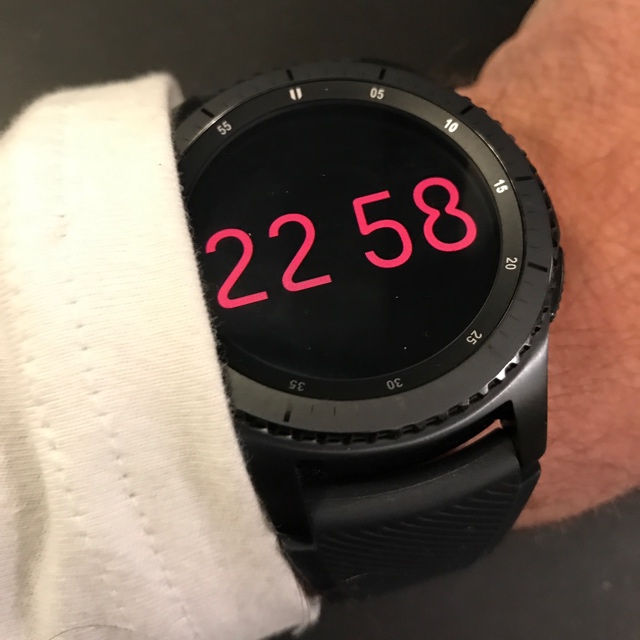
I asked Samsung for two smartwatches: the 2016 Gear S3 and the 2015 Gear S2. This is a first look at the Gear S3 which comes in two models. This is the bigger Frontier.
Spoiler alert: I am super impressed.
I was at the launch event at IFA 2016 in Berlin, and it was quite a bombastic show. I wasn't impressed then. Too much show, not enough content. The S3 looked too big, compared to the much simpler S2 and I did not like the way that Samsung tried to mimic traditional wristwatches. If you have a watch face with fake metal reflections, that looks so cheap because the reflections don't actually move like the real thing.
But now I have a watch in my possession and I can make it mine. This changes the game completely. I am using the SuperAMOLED display to display mostly black and that not only looks good, it also saves on battery life because those black pixels are off. Only the red numbers are on. Look around this site. Which colors do you see? White, black, red. Yes, this is mine.

This display is always on. It does not have to be, it's not even the default. But I want it on. Because I can. See that bezel around the screen? That's the real thing. It turns. And it is one of the inputs. You can swipe between different widgets which are similar to Apple Watch Glances. Turn clockwise to get to the weather, a favorite contact, a reminder, your next calendar event, your calorie burn, your steps, your alti-barometer, and so forth. Add any widget you like. This works with your gloves on. It's cold outside! Remember how you could operate a Lumia 920 with gloves on? You can do that with the Gear S3 as well. Just turn up the touch sensitivity for the screen and you can touch and swipe with your big ski gloves.
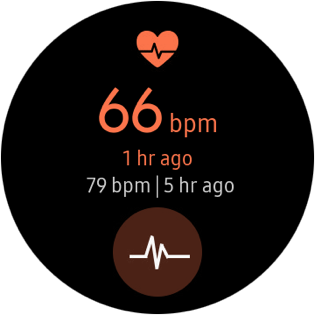



I paired the Gear S3 with my BlackBerry PRIV, which works just fine. It's not listed as compatible but the requirements are rather low. 1.5 GB of RAM, Android 4.4+, that's about it. You have to install the Gear Manager, it will install a Gear S plugin and Samsung Accessory Services. And you want the S Health app to track your fitness.
Samsung is working on an iOS app which is currently in beta. But trust me on this: if you have an iPhone, you want an Apple Watch. If you don't have an iPhone but want one later, Samsung will probably have you covered. This watch runs on Tizen and it does not need Android.
Samsung is making some promises which are not working out today. The Gear S3 is supposed to have Spotify support but it's not here yet. And with that I mean streaming from your watch with cached tracks, not a remote for your phone. Apple Watch does not have that, but needs it badly. My guess is that Gear will have it first.
Stay tuned. There is so much more to talk about.
Question: How much better would you be if you practiced a skill every day for one or two years?
Would you be ten times better? Twenty? Fifty?
Here’s the answer (tip: watch the first few seconds, then fast-forward to the end):
This guy did a similar experiment, learning a skateboard trick in six hours.
You wouldn’t be ten or twenty times better; you’d be immeasurably better. Comparing their skill at the beginning and end of the process is like comparing a Model T to a Ferrari — it’s not an increase; it’s a complete transformation.
Which raises a question: if intensive daily practice is so transformative, then why aren’t we all doing it? In other words, what do these people have that the rest of us don’t?
I think one answer is this: they have a willingness to feel stupid. To endure the unique social-emotional burn of repeated clumsiness. And this willingness is the secret foundation of their development.
Check out the first few seconds of the videos. They are trying hard — really hard — and they are barely progressing. They move woodenly. They make stupid mistakes. The violinist can barely play Happy Birthday; the skateboarder is falling over and over. It’s not pretty.
Now imagine doing that, hour after hour. Imagine focusing all your energy toward a task that you are, by every possible measure, terrible at — and then doing it again and again, day after day. This doesn’t qualify as normal practice — it’s an exquisite form of mental torture.
The real key to their progress, in other words, is not cognitive or muscular — it’s emotional. The real key is getting past the burning pain of feeling stupid. The question, then, is, how do you do that?
I think the key is to flip the way we think about this torturous feeling, to reframe it as an essential part of the process. To reinterpret the pain so that it isn’t pain; it’s a positive sign of progress.
Funny thing is, we already do this with physical exercise. When we work out or go for a run, we expect to feel discomfort — if we don’t, we know that we aren’t working hard enough. As the saying goes, no pain, no gain.
When it comes to learning new skills, the same rule applies. If we’re not willing to experience this social-emotional burn of awkward failure, we won’t improve. No burn, no learn, you might say. Here are a few ideas on how to do that.
The post The Mental Trick that Unlocks Improvement appeared first on Daniel Coyle.
Presumably Mr. Sadhu Johnston has a very Vancouver vista out some window nearby his office, but here’s his view of planning policies and results. It’s taken from a Vox interview published in July, 2016.
Just to show how some of this goes, and to give a glimpse into the lives of City politicos and managers, here’s some of the section on bike lanes:
DR: Presumably you’ve been doing bike infrastructure long enough to get some data on it.
SJ: We did one bike lane that became a major, major election issue. A hotel owner on the bike path gave the largest political donation in our city’s history to try to unseat the mayor on an anti–bike lane campaigning platform. They just went down in flames. People did not respond to it.
But because it was so much of a fight, the business association downtown did an in-depth study on vacancy rates on the bike path before and after. Vacancy went way down after the bike lane. It was very, very clear that the bike lane added value to the economy on that street.
So I think businesses are starting to acknowledge that bikers can stop more easily, can park more easily, and there’s more of them on a bike lane than you’re going to have with cars that are racing down there at eight times the speed.
Many thanks to PT commenter “Gulley” for the pointer.

St. Regis Hotel, thriving on the Dunsmuir Bike Lane


After hearing for several years from residents on the west side about the havoc that was being wreaked as older houses there were demolished, city planners came out with proposed policies last month aimed at saving them.
They are not modest or incremental. The policies, if passed, will actually give owners who retain older houses the right to almost twice as many square feet of building on a lot as those who insist on demolishing and building new. Big carrot, big stick.
That in itself is generating some debate among homeowners and city-watchers, which I reported on in a feature story for the Globe Saturday.
But what I didn’t have room to include were some of the other strands of the debate, like whether the city should be focusing only on preserving character homes or whether it should be looking at a remake of the single-family neighbourhoods altogether.
Bryn Davidson, a laneway-house builder and older-home renovator, was unfortunately trimmed out of my story, but he made good points during our interview about how the city is unfortunately downzoning (i.e. allowing even less buildable space) for single-family homes, which perversely removes density for those who decide that all the carrots in the world aren’t going to make them try to fix up an old house.
A Dunbar resident and retired planner I spoke to, Bill Rapanos, also worried that the proposed new rules would encourage even more problems on the west side, turning single-family housing there into a luxury item only for the extremely wealthy. He would have preferred to see the city start to encourage other kinds of housing, from duplex to rowhouses, to bring life back to the west side.
Those two aren’t the only ones worrying that the city is taking the wrong tack by focusing on how to preserve certain areas for “character,” while not addressing some of the other problems. Designer Ian Robertson posted these thoughts on the subject.
I’ll be waiting to see how the world turns on this one. City consultation continues to Jan. 15.
Destroy All Software's original series of 90 screencasts was published from March 2011 until March 2013. As far as I know, it was the first subscription-only programming screencast product, and it worked! This was good.
Eventually, I got tired: both from the fixed screencast release schedule and from conference speaking. I was publishing once per week, then later once every other week. I averaged one conference talk per month at my peak, which was far too much for me. DAS was suspended in March 2013.
I then spent three years writing 1.5 books, but published none of it. This was less good, but I learned some things.
DAS relaunched in August 2016. I converted a section of one unpublished book into a screencast series on Computation, explained using code rather than the traditional mathematical terminology and notation. This was good.
The computation series is now almost done. There's one more screencast left, which I expect to release around the new year. I need to decide what comes next. Unlike the original DAS run, I want to plan the future a bit; I want to decide where I'm going, rather than simply finding myself somewhere.
In September, I did four live streams to test the waters. My favorites were writing a text editor and a compiler from scratch in about an hour each, which got great responses from viewers. The videos were watched around 10,000 times, if I remember correctly, but they're now down because Twitch videos expire eventually. I expect to reprise these topics eventually.
My next experiment is going to be live streaming in earnest, probably once per week to start. I've never written about my DAS recording process in detail, but it's basically a live-streaming process already. I record the full screencast, end to end, over and over again, until it meets my standards. What you watch on DAS is effectively a live recording, with very light editing to remove the parts where I swallow water and so on.
For viewers, true live streaming means that little mistakes will sneak in, which viewers say that they miss from the earlier DAS screencasts. Live streams are also more "organic", for lack of a better term; you and I both know that there's no safety net, and we both seem to like it.
I expect to initially focus on building tools from scratch to understand how they work, taking about an hour each. My topic list is already 57 topics long, but here are a few that I'm especially excited by: "let's build a Zip-like file compressor"; "let's implement the IP and UDP protocols"; "let's write a software-only 3D renderer"; etc., all from scratch.
Unfortunately, I can't actually start doing this yet. My new recording studio is still being built in Spain, with delivery in late February assuming no further setbacks. This, plus time needed to set up the studio and my personal travel plans, mean that I probably can't start streaming in earnest until April.
What do I publish from early January until mid April? I could do another screencast series; four months is the right length of time. However, I burned out on screencasting the first time and I don't want to do that again. Fortunately, I have another idea.
In August, I was frustrated by finding yet another simplistic set of statements like "types are a waste of time", "types ensure program correctness", etc. (It was probably on Hacker News, but I've since forgotten.) I wrote 3,400 words on the topic, both as an introduction and as justification for people who don't see why types matter.
That document is meant to be read through end-to-end, which is what most people did, but it's also meant as a reference. You can return to it when someone uses a term that you've forgotten, or makes a claim about types (pro or con) that seems like an oversimplification. It was very popular (~1000 gist stars, ~200 Hacker News comments, etc.), but I never formally published it anywhere.
I'd like to introduce a collection of documents like this as a new section of DAS. Its working title is The Programmer's Compendium. (I have the domain as well; sorry, squatters!) It tackles ideas one at a time, covers them broadly but not deeply, and focuses on the parts that confuse people who aren't experts in the topic.
Each article is broken into subsections corresponding to common misunderstandings. For example, if you see someone overgeneralize about static type systems, you can just link them to the Diversity of Static Type Systems section rather than arguing eight replies deep on an orange website.
My top candidate topics right now are TDD, functional programming, and state management, each of which gets jumbled up in public discussion, just like types do.
The timeline of these changes is roughly:
This is a big change, but I think that variety is necessary to stop me from burning out again. I also want to explore and advance these media for their own sake.
I'll email subscribers whenever major changes like this happen. And, even for subscribers who are caught unawares, DAS' unconditional refund policy for the most recent month's charge will remain in effect, as always. However, I'd also like to hear what you think in advance.
My question for current (or past, or aspiring) subscribers is: will you follow DAS through these format changes? Are you vexed, flummoxed, or disconcerted by the notion of DAS changing media on this approximately-quarterly schedule? What if all of these media were interleaved into a single mixed publishing schedule, so that DAS alternated between compendium articles, screencasts, and live streams on a biweekly or monthly basis?
You can email DAS' support address or just tweet at my personal Twitter account with your thoughts; either works. (I read every email seriously, though I may not have time to reply to every email when I solicit broad feedback like this.)
When a bug lands in Bugzilla for WebExtensions a few things can happen to it. This blog outlines the current triage process. This is likely to change, so chances if you read this in 2017, it might be completely different.
We look at all new bugs in an attempt to spot serious bugs, regressions or other issues. We try to give each bug a priority and mark as [triaged] in the whiteboard. The point here is to do an initial triage and catch critical things. We also label bugs that might be good for contributors or need thinking about. The latter are marked [design-decision-needed], but its important to point out that straightforward change or obvious bugs just go through.
We look at a number of bugs marked with [design-decision-needed] every other week, currently we are doing 6 per meeting, which averages us at 5 minutes per bug. Some take longer. The goal here is to see the use case, understand what the bug is for and if it should proceed. If we are still unsure then it will get kicked "up" to the Advisory Group for some more help and insight.
Where Mozillians with knowledge and insight beyond our group help out with the toughest bugs. Happens about once a month.
If a bug gets marked as [good-first-bug] then we make sure the bug has a mentor, has a decent description and make sense. We hope that contributors will use this to get into Firefox development.
The majority of bugs coming into WebExtensions don't go through this process they hit the first triage and get dealt with. But sometimes bugs are more complicated than that.
mkalus
shared this story
from  jwz. jwz.
|
Uber launched a fleet of its much anticipated self-driving cars in San Francisco on Wednesday, and by late morning the effort already hit a bad-driver milestone: running a red light. [...]Annie Gaus, a freelance writer and producer in San Francisco, tweeted Wednesday morning that she "Just passed a 'self-driving' Uber that lurched into the intersection on Van Ness [Avenue], on a red, nearly hitting my Lyft." [...] "It was close enough that both myself and the driver reacted and were like, 'Shit,'" she said. "It stopped suddenly and stayed like that, as you see in the photo."
SFPD traffic division unaware of self-driving Uber fleet on city streets
With Uber's self-driving cars now on the streets of San Francisco, the enforcement of traffic violations is in the hands of The City's Police Traffic Company, which was unaware Wednesday morning that the vehicles began roaming city streets that day. [...]"I was unaware the cars have been released in the wild," said San Francisco Police Traffic Company Sgt. Will Murray. "Isn't that like the headless horsemen?"
"They are required to have someone seated in the front driver's portion of the vehicle," said Murray, who added that, "If they were committing flagrant violations, if they were not obeying the laws" then traffic officers will pull them over and ticket them.
He did not say if that had yet occurred or how one goes about ticketing a car driven by a computer.
Uber ordered to halt self-driving cars on SF streets
Uber's action is illegal, California DMV Deputy Director Brian G. Soublet wrote in a letter to Uber late Wednesday, which was also sent to press. Soublet added that the ride-hail behemoth was required to obtain an autonomous vehicle testing permit before operating self-driving vehicles on city streets.Uber Blames Its Drivers As More Reports Of Self-Driving Cars Running Red Lights Surface"If Uber does not confirm immediately that it will stop its launch and seek a testing permit, DMV will initiate legal action," the DMV wrote, "including, but not limited to, seeking injunctive relief."
Suggesting that this was more than first day jitters, KRON 4 got its hands on a set of photos that the channel says show an autonomous Uber driving through a red light on Harrison at 4th Street. The pictures were taken on Sunday morning, which means that the car was likely being used for testing or mapping purposes and did not carry a paying passenger. Still, it would suggest that the software piloting the autonomous vehicles had problems as recently as three days before the much publicized launch of the autonomous ride-hail service. That is, unless these incidents are all the result of human error -- a.k.a. Uber drivers."These incidents were due to human error," an Uber spokesperson told the Guardian about the both the Van Ness incident and the 3rd Street incident. "This is why we believe so much in making the roads safer by building self-driving Ubers. The drivers involved have been suspended while we continue to investigate."
Isn't that neat? It's the humans, not the un-permitted software, that is at fault according to Uber. Unfortunately, that argument likely won't sway the DMV.
So let's see...
The self-driving software is bad enough that they run red lights and make dangerous turns... but they have humans in the drivers' seat! Who are also so terrible at their jobs that they can't prevent the car from running red lights and must be fired.
I guess none of us are as incompetent as all of us? The software is so bad that it makes human drivers even worse?
The usual argument for self-driving cars is that they will be safer for everyone than human-piloted cars. If that hypothesis turns out to be true, then I'm all for them! One can even imagine a shiny Starfleet future where self-driving cars lead to the end of personal car ownership and dramatic emissions reduction. Enter the shimmering arc!
Uber, of course, does not give the slightest fractional shits about whether self-driving cars are safer or cleaner: they are interested in them because they are cheaper. Allow me to remind you of this bit from Fight Club:
I'm a recall coordinator. My job is to apply the formula. It's a story problem.A new car built by my company leaves somewhere traveling at 60 miles per hour. The rear differential locks up. The car crashes and burns with everyone trapped inside. Now: do we initiate a recall?
Take the number of vehicles in the field, (A), and multiply it by the probable rate of failure, (B), then multiply the result by the average out-of-court settlement, (C). A times B times C equals X... If X is less than the cost of a recall, we don't do one.
And now we get to the part where the Uber software, operating as designed, is now literally trying to murder me:
SF Bicycle Coalition: A Warning to People Who Bike: Self-Driving Ubers and Right Hook Turns
Before the surprise launch of Uber's autonomous vehicles on San Francisco streets this week, I rode in one. I can tell you firsthand: Those vehicles are not yet ready for our streets.I was at one of the demonstrations covered in the SF Examiner, along with others who Uber hoped to impress with their new technology. None of us were told that just two days later, Uber would be releasing this technology on our streets on a large scale. I did tell Uber some things about the shortcomings of that technology, however.
In the ride I took through the streets of SoMa on Monday, the autonomous vehicle in "self-driving" mode as well as the one in front of it took an unsafe right-hook-style turn through a bike lane. Twice. This kind of turn is one featured in a 2013 blog post that is known to be one of the primary causes of collisions between cars and people who bike resulting in serious injury or fatality. It's also an unsafe practice that we address in all of the safety curriculum we offer to professional drivers, including the videos we consulted on for Uber as recently as this fall.
I told staff from Uber's policy and engineering teams about the safety hazards of their autonomous vehicle technology. They told me they would work on it. Then, two days later, they unleashed that technology on San Francisco's streets. Your streets.
Since yesterday, we have been told that "safety drivers" in these vehicles have been instructed to disengage from self-driving mode when approaching right turns on a street with a bike lane and that engineers are continuing to work on the problem. In the meantime, Uber is continuing to operate autonomous vehicles for passenger service in San Francisco.
There's no other way to put it: Launching autonomous vehicle technology before it's regulated and safe for our streets is unacceptable. If you support safe streets, please sign the petition to tell Uber to address this dangerous and illegal turning behavior immediately.
The people who wrote this software do not understand the traffic laws and programmed it with a set of rules that they figured was close enough. And then released them into the public.
"Disrupt transportation! Move fast, release early, and crush innocent people under two tons of fast-moving steel!"
I really can't express how unsettling it was today, riding my bicycle in traffic in the rain -- a time when San Francisco drivers are notoriously even less competent and more erratic than under normal conditions -- and wondering what fresh new hell of unpredictability I might encounter from poorly-behaving software in an alpha-test that I most assuredly did not click "Agree" on.
Fuck Uber.
Previously, previously, previously, previously, previously, previously, previously, previously, previously.

