Shared posts

20 Dec 06:01

Select quotes from the conversation on AI between Barak Obama, MIT’s Joi Ito, and WIRED’s Scott Dadich

by charlie

I finally got around to reading this interview transcript. Dadich moderates an interesting discussion between Ito and Obama mostly around AI, but also touching on related issues around the impact of new technologies on business and people.

Below, I’ve excerpted some of the more interesting things that were discussed. Please take these excerpts as a reflection of what I am thinking about and worthy of further exploration.

AI in general, AI in particular
Here’s a man who has to keep the whole world in his head, and he’s really articulate about AI – where it is, where it’s going, what are the impacts, what are the benefits.

There’s a distinction, which is probably familiar to a lot of your readers, between generalized AI and specialized AI. In science fiction, what you hear about is generalized AI, right? – Obama

Obama rightfully points out that specialized AI, is being used everywhere today. But the AI from sci-fi, generalized AI, and the AI that everyone fears, is a long way away. Nonetheless, having that broader fantastical view gets us thinking of the implications AI has in all aspects of our lives, especially as it comes to how we deploy specialized uses of AI.

And, like a president should, while Obama sees the “enormous prosperity and opportunity” AI presents, he is also concerned with the impact AI can have on jobs and wages as certain things are automated by AI.

Ito calls for AI to be really called Extended Intelligence. This is a great term to describe what I have said before, that AI should augment humans, not try to replace them. And indeed, many jobs that have been more cognitive will be disrupted by AI. How we choose the balance between full or augmented automation will impact those jobs and people.

Low-wage, low-skill individuals become more and more redundant, and their jobs may not be replaced, but wages are suppressed. And if we are going to successfully manage this transition, we are going to have to have a societal conversation about how we manage this. – Obama

AI culture
I’ve had the sneaking suspicion that in the past 6 months, AI has gone from being in the background, to being front and center. As Ito articulates best, “this is the year that artificial intelligence becomes more than just a computer science problem.”

So it becomes important that the creation of AI have cultural and societal sensibilities. Yet, as Ito points out, “it’s been a predominately male gang of kids, mostly white, who are building the core computer science around AI, and they’re more comfortable talking to computers than to human beings.” How do we become more inclusive in adding values to AI, ethical AI? And what is the role of government?

Obama also mentioned that his concern wasn’t a runaway AI, but someone empowered by AI to do malicious things. Now the cyber security game just got more complicated. Interestingly, his view is not the usual ‘build a wall’ but the attitude of viral pandemics, a public health model – build a system that can rapidly and nimbly respond to an outbreak.

I think there’s no doubt that developing international norms, protocols, and verification mechanisms around cybersecurity generally, and AI in particular, is in its infancy. The challenge is the most sophisticated state actors don’t always embody the same values and norms that we do. – Obama

And where should AI research come from? Ito points out that a lot of AI research is coming from huge commercial research labs. Obama mentioned how these business want the bureaucrats to back off and let chase AI. But he then pointed out the benefits of inclusion of the public and the government in big technological advances.

I think we’re in a golden period where people want to talk to each other. If we can make sure that the funding and the energy goes to support open sharing, there is a lot of upside. You can’t really get that good at it in a vacuum, and it’s still an international community for now. – Ito

Jobs
AI is all about automating intelligence. The industrial revolution was trasnformed with the automation of factories. AI will displace jobs, but, as Ito points out, “it’s actually nonintuitive which jobs get displaced.” We have already seen paralegal roles being taken over by text scanning systems. What will happen to lawyers, doctors, or auditors? How will AI take or transform their roles?

Both Ito and Obama talk about how these changes in jobs might require a redesign of the social compact – how to we value contribution and compensation?

What is indisputable, though, is that as AI gets further incorporated, and the society potentially gets wealthier, the link between production and distribution, how much you work and how much you make, gets further and further attenuated—the computers are doing a lot of the work. – Obama

We can figure this out
At the end of the interview, Obama mentions space exploration, which leads to using Star Trek as a guide for humanity’s future. Obama, ever the optimist, points out that Star Trek was not about science fiction but about values and relationships, “a notion of a common humanity and a confidence in our ability to solve problems.” He sees the spirit of America being “Oh, we can figure this out.”

Taking Star Trek further, Ito mentions, that the Star Trek Federation is “amazingly diverse, the crew is diverse, and the bad guys aren’t usually evil—they’re just misguided.” It is clear, this is an world the two of them are always working towards.

A thought
I am not surprised that these two great thinkers who have great hope in humanity, should gravitate to concepts such as cooperation, empathy, caution, and optimism. I, too, am an optimist, and have faith that the good in humanity will always prevail. Though, that faith require I remember to take a long term view, a view I am sure that guides these two men, and understand that there will be temporary moments of despair where it seems we are not heading in the right direction.

Geez, I wonder why I feel that way?

Go read the full article and see the video and let me know what you thought.


20 Dec 06:01

Gateway Beverage

by Reza
mkalus shared this story from Poorly Drawn Lines.

20 Dec 06:01

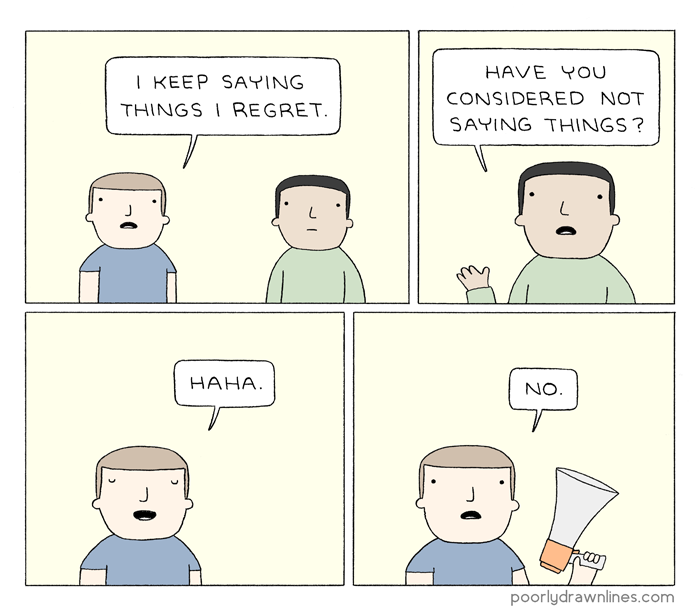
Saying Things

by Reza
mkalus shared this story from Poorly Drawn Lines.

saying-things

20 Dec 01:45

Oracle finally targets Java non-payers – six years after plucking Sun

by Volker Weber
Oracle is massively ramping up audits of Java customers it claims are in breach of its licences – six years after it bought Sun Microsystems.

More >

20 Dec 01:41

Vesper Open Source #2: the API Server

I just posted Vesper’s API server up on GitHub.

Again: this is provided as historical artifact, not as living software. It no longer runs anywhere. And I don’t make claims about quality — it’s just that it may be interesting. (And may not be.) It gives me something to write about, at least.

For possibly-helpful background, see the Vesper Sync Diary, which was written while I was working on this code.

Azure Mobile Services

It’s a Node.js server — but it ran on top of Mobile Services, which means you couldn’t just plop it down on a machine and run it unless you added the exact features that Mobile Services provides.

Nevertheless, I think the code is somewhat readable, even if it would be difficult to run it. (You’d also have to set up a database with the exact same schema, which you could figure out from the code. I don’t recommend actually trying to get this running.)

Where the code is

See the api and shared directories. You can ignore the extensions and table directories. The scheduler directory has just one simple script in it.

Things I Liked

The Azure folks provided a ton of help. They were great, and I enjoyed using the service.

Once the code was written and tested, I made almost no changes. It just worked. And keeping it running wasn’t a problem until near the end (I think I had to upgrade the database plan, and that fixed it).

Things I Didn’t Like

It’s JavaScript. Because I’ve spent the last 15 years writing Objective-C, I would have been far more comfortable writing in Ruby. It would have been more readable and better-organized. Hopefully I could have better avoided callback-hell (where callbacks are nested inside callbacks which are nested inside callbacks, etc.).

But, hey, JavaScript gets the job done.

The other thing I didn’t like was that there wasn’t a way to run a Mobile Services Node site locally, since the online version takes care of a bunch of things. In practice this wasn’t as bad as it sounds, but being able to run it locally would have been nice.

The Heart of Vesper Syncing

See api/notes.js. Syncing was done per-property: each property of a note had an associated modification date. When notes come into the server, and there are existing versions, those properties are merged. See the mergeOneNote and mergeOneProperty functions.

It should be no surprise that almost the exact same code — only in Objective-C — runs on the client side. It also merges property-by-property as notes come from the server, since there may be local changes that are newer.

Also see, in api/tags.js, mergeTags and mergeTag.

Encryption

The text of notes was stored in the database encrypted, with a key that was stored in the config for the site but not in the source code or in the repository. In shared/vespernotes.js, see encryptedTextForNote and decryptedNoteText.

One of the features of this was that I could change the encryption key without re-encrypting the entire database. The keys were stored with names of the form VESPER_TEXT_KEY_0, VESPER_TEXT_KEY_1, etc. And there was another config item that specified the current key. When the current key failed to decrypt note text, it would try the previous key, and so on back to the very first (zeroth) key. See the loop in decryptedNoteText.

This is different from providing end-to-end encryption, of course. These days that’s probably the way to go. But at the time we wrote this it was reasonable not to do that. Times change.

(Note that nobody ever asked for any data from our system, and we would have to create a mechanism for that, which we never did.)

20 Dec 01:41

iPhone Users Storm App Store Reviews, Angry At $10 ‘Super Mario Run’ Price Tag

by Laura Northrup
mkalus shared this story from Consumerist.

During the same event where it announced the iPhone 7, Apple announced that it would be the platform for Nintendo’s first mobile game, Super Mario Run. Here’s the problem: the game lets you play three levels for free, and then the game costs $10. The game’s reviews are mixed, largely because people find that $10 price tag scandalous.

Mario Run is pretty much the same as every other Mario game you’ve played, but the key difference is Mario is constantly running forward. That’s so you can play one-handed, a useful feature for a mobile game.

You only need one thumb free to play, but you can’t play the game just anywhere: as piracy protection, the game doesn’t work unless you’re connected to the internet.

The game is a hit on the App Store, but the problem is that people who don’t upgrade and buy the full version are able to leave reviews, too. That has left the reviews polarized: there are more than 50,000 now, and they’re largely split between one-star reviews outraged that they have to pay for the game, and five-star reviews from people who are pleased with the game.

Another group of people who complained about the game appear to be users with iPhones that are jailbroken, or able to run features and apps that aren’t Apple-approved. These users report that the game crashes upon opening, and they’ve also left the game poor reviews.

The cruelest insult of all: some users compared the game to the infuriating hit “Flappy Bird” from a few years ago.

Would those same users pay $0.99 every time they wanted a few extra lives, if the whole game were downloadable for free? The business model of mobile games is that we’re used to paying for games, but we’re not used to high up-front prices for them.


20 Dec 01:40

Book Review: “Understanding Planned Obsolescence”

by Stephen Rees

screen-shot-2016-12-19-at-2-35-37-pm

There is something very post modern about this review. I was offered a copy of this new book (out 3 January 2017) to review, but what I got was an ebook hobbled by Digital Rights Management. It expires in a month and I am not allowed to cut and paste any quotations from it. Now I may not know much about copyright but I do understand the concept of “fair use”: which includes quotation!

I am going to cut and paste what I can from  the blurb on netgalley and the publisher’s press release. (see below the line)

The reason that I wanted to read the book was my irritation at getting this tweet

screen-shot-2016-12-19-at-3-00-45-pm

The iPad mini in question is less than two years old. I have determined by reference to the book that I am not alone in this experience, and indeed it appears to be a long established policy of Apple. Indeed within the product cycle, the life of the hardware is prescribed – and there will inevitably come a day, long before the device in question is beyond repair, when its operating system will not get updated any more. There is a case in the book of the iPod whose battery life was designed to be 18 months, and the battery could not be replaced by the user. There is also a documented legal case of an iPod mini designed and sold as an adjunct to exercise which failed when it came into contact with human sweat. Apple’s advertising showed the device attached to human bodies under exertion!

There is nothing new about planned obsolescence.  I read Vance Packard’s The Wastemakers at East Ham Grammar School when I studied A Level Economics (1964-66). Everybody knows about GM’s policy of annual model changes based simply on design as opposed to technical innovation. And the cartel of lightbulb makers who made their products fail earlier so that they could sell more of them. My Dad told me about British carmaker Armstrong Siddeley that went bust because their cars were built to last – and no-one ever bought another one having no need since the first one they got was so well made and reliable. I fully expect my 2007 Toyota Yaris to see me out – unless there is a sea change at the strata council and I could install a charger for an electric car. Or Modo relents and puts a shared car in our neighbourhood.

If you are a student then you will be comfortable reading this book. It is remarkably short – I read it cover to cover in two hours or so – and is well annotated and referenced. It does acknowledge Brexit – which will probably remove British consumers from all the EU protection offered to consumers, which is remarkably advanced compared to North America. But was obviously written pre Trump. With leaders like Trudeau and Clark we cannot expect anything other than continuing adherence to the best interests of their funders. And just as the fossil fuel industries will ignore the carbon bubble for as long as possible, we can confidently expect the 0.01% and the corporations they control to continue to ignore both the pile up of garbage and pollution and the growing shortage of critical raw materials (like rare earths) as long as their profits increase and remain largely untaxed. So acquiring this book if you are an activist and wishing to bring about some change is likely to disappointing.

But if you are really in need of an education in the theory of planned obsolescence this might be worth forty quid to you (CAN$66.45 at the time of writing). But as far as prescriptions go, there’s not much. The certainty that the “current hegemonic paradigm will not allow humans to remain on this planet much longer” – and therefore the need to “walk in search of new patterns, new models, new meanings to then build new paths, new paradigms”.

And that is about it.


Description

Planned obsolescence is when a product is deliberately designed to have a specific life span. This results in the overexploitation of natural resources, increased waste, with huge social impacts. It is very well known in industries such as consumer electronics, but it is now creeping into other sectors.

This ground-breaking new book looks at the cost and consequences of planned obsolescence and its negative effects. It considers the sustainability, legal and economic theories behind it, how to mitigate these manufacturing strategies and find new ways of working. Understanding Planned Obsolescence includes a wide range of case studies from Europe, the USA and South America.

Available Editions

EDITION Other Format
ISBN 9780749478056
PRICE £39.99 (GBP)

and

Will the new range of Apple products contribute to waste?

The short answer is yes, because continuous updates to the operating system render older iterations of the product obsolete, which drive consumers to purchase new products and throw the old versions to the side.

The long answer details what happens to those discarded products, which cost time and money to produce: they are now obsolete, driving consumers to lust after the newest version to meet their needs and keep up with the culture of ‘use a year and throw away’ that manufacturers like Apple have created.

Planned obsolescence, the practice of intentionally creating products with short lifespans, can be witnessed in products ranging from cars to jeans, and the consequences for the practice vary equally in scope. Reasons for the practice’s existence can be traced back to customers just as easily as to companies, but a debate on who takes responsibility needs to be informed so that both sides can understand the phenomenon and take educated steps to mitigating it.

Understanding Planned Obsolescence: Unsustainability through Production, Consumption and Waste Generation, out 3 January, aims to inform this debate, providing the basics into the practice. This ground-breaking new book looks at the causes, cost and impact of planned obsolescence. It considers the legal and economic frameworks to overcome the practice and how to mitigate its effects. This book is essential for sustainability students and practitioners who seek to understand planned obsolescence and the consumers’ role in the practice.

Thierry Libaert, initiator and main rapporteur on the European Economic and Social Committee opinion on planned obsolescence, provided advanced praise for the book, calling it ‘an absolute reference on planned obsolescence; it overcomes strictly technical or environmental visions to replace them, giving meaning and understanding in a broader economic and political context. The author does not merely describe a phenomenon, but presents a range of possible solutions’.

About the author: Kamila Pope is an Environmental Law and Bio-law lecturer, researcher and lawyer in Brazil. She has published a plethora of articles, chapters and papers covering Environmental Law, Sustainability, Planned Obsolescence and Waste Management. She holds a Master’s in Law, Environment and Political Ecology and is working toward a PhD in Law, Politics and Society.


Filed under: Economics, Environment Tagged: book review, Economics, Planned Obsolescence
20 Dec 01:39

Kicking the @realdonaldtrump Beehive

Had a bit of free time yesterday on a particularly lazy Sunday, so I decided to tweet the president elect.

I was in a jovial mood and Trump was in a pissy mood so I thought I’d cheer him up by throwing him a bone (I assume he recharges his life force through absorption of internet hatred).

@realDonaldTrump that’s why we’re scorning you and telling you you’re a jerk tho

— Zach Holman (@holman) December 18, 2016

I spent the next few hours dealing with hundreds of replies from fervent Trump devotees and/or bots. Twenty four hours later, I’m still getting a handful of replies every ten minutes or so, along a with few more faves every thirty seconds or so.

@TheLionsDen80 i do, i look hot af

— Zach Holman (@holman) December 18, 2016

There’s a few things I found amusing and tepidly surprising about all of this.

Twitter’s threading has an impact

This was the first mild surprise. I made a smarmy toot at the future leader of the free world and apparently that got a lot of people riled up. So far I’ve gotten 600 faves on the first tweet, and on some of the replies I’ve gotten even more:

Conversation with Trump supporters

Right now I’m the third “thread” in the replies to the original tweet on twitter.com. That’s a ton of additional exposure for my original tweet and, in my case, seven additional tweets from a dialogue I had with some white dude who joined Twitter in November 2016.

This generates a ton of extra faves and replies, to the point of being alarming; if you’re just trying to blow off steam and drunktweet dear ol’ Donny and your tweet gets in the main threading, then you could have a lotta grumpy people yelling at you. The internet is small. And big. Somehow at the same time.

These people are grumpy

From what I can tell, most of the people who reply to replies on Donald Trump’s tweets almost exclusively use Twitter for this purpose. There was a fair amount of bot-style anonymous users who would jump in — on both sides — but there was also a lot of people with only one or two tweets on their account that weren’t in reply to something else.

I did get called a few names; libtard is real hot right now, as is jerk and idiot. cuck seems to be on the decline. I was not called any sexist names or racist names because I’m playing life on white male easy mode. Had I been representing as a woman, this would have been a different and not at all mildly amusing lazy Sunday experiment. Even in easy mode, I did get a couple death/well-being threats, so yeah, neat I guess.

Expectations of discussion

lol yeah there’s not really a real approach you can take to have a discussion here, from what I could tell. I took a few different approaches to replies to my tweet, but most of them held at least the possibility of having a kind of rational debate, but the closest I got was mostly getting yelled at every five minutes for two hours (although at the end I did wish her happy holidays and a good night and she wished me merry christmas and that thank god we’re free unlike the far east, which I graciously credit her with half a point for it).

I have 40,000 followers (and am Verified™, whatever that means), so I think that also put a different target on me. I did reply to a whole ton of the replies to my tweet, and I was kind of amused how many times an account would tweet once at me and never respond back, even after I asked them a clarifying question. I think we’re used to people with a “following” online to not really interact back with you, and as such it’s fairly easy to just push bile out into the void to make yourself feel better. Then again, they’ll do that anyway, so what do I know.

Spitting fire

Anyway I don’t really have a ton of amazing takeaways from this; just thought it was interesting. I was in the right mindset to tackle discussions and hatred, and if you’re in the right mindset, go for it; it does give you a context on The Other Twitter™ that honestly, I don’t get from my normal Twitter timeline. If you’re not in the right mindset, though, run off and hide; even if it’s all fun and games, your thick skin can feel thinner when you have hundreds of people yelling at you, unfortunately, and getting caught in their fervor sucks.

Anyway, in light of not having an impressive takeaway from this post, I just wanted to end with what I consider to be my best comeback of all time in any medium. Happy holidays.

@TheLionsDen80 do you have HDMI or VGA inputs for how much you’re projecting here

— Zach Holman (@holman) December 18, 2016
20 Dec 01:38

Condo For Sale — Hope You Liked It

by Ken Ohrn

Condo owners in Vancouver may find themselves in a minority if 80% of co-owners agree to flog their building’s land for development.

Thanks to Glen Korstrom in Business In Vancouver for the story.

old-condo-for-saleOwners of a Vancouver condominium complex have became the first in B.C.’s history to successfully vote to dissolve their strata corporation and sell their building to a developer without obtaining unanimous support.

On December 12, more than 20 owners voted in excess of the necessary 80% threshold to accept an offer to buy their building, according to Condominium Home Owners Association of BC president Tony Gioventu and Clark Wilson partner Darren Donnelly, who were both at the meeting. . .

. . . Bill 40 lowers the required threshold to 80% from 100% for strata corporation members to vote to dissolve their entity and sell their buildings. . .

. . . Donnelly’s law firm represents more than a dozen Metro Vancouver strata corporations that are in various stages of trying to sell their buildings.

“[Clients’ buildings] tend to be underdeveloped relative to the density that would be allowed, and they are near transit so the development value is higher than the current value,” he said.

“At the other end of the spectrum you have stratas that aren’t necessarily in high-value locations or underdeveloped, but they are facing devastating repair bills.”


20 Dec 01:37

Doing non doing

by Chris Corrigan

“The secrets to living are these: First, the past cannot be improved upon. Acknowledge what was and move on. Next, the future cannot be molded. Then, why bother? Last, nothing can ultimately be controlled; Not the past, nor the future, nor the present. Accept this moment as it is. Honoring these three, one lives without shackles.”

Wu Hsin via whiskyriver

At some point I think the work of complexity cannot be done without a psycho-spiritual component.  There are days which I would wish that Wu Hsin was a client.  I feel like action like he is describing – Taoist wu wei or “doing non-doing” – is the high art of living as a human being in a complex world at whatever scale.

19 Dec 22:17

Wherein DNA Lounge will be closed soon, without your help.

mkalus shared this story from DNA Lounge.

19-Dec-2016 (Mon)

Wherein DNA Lounge will be closed soon, without your help.

I worked in the software industry. In the mid-90s, during the "first bubble", I made a whole lot of money. Not entirely coincidentally, that tech bubble had a dramatically negative impact on the culture of San Francisco. I loved it here (and still do). I didn't like the changes I was seeing (and still don't). So I decided to push back, and put my money where my mouth was.

DNA Lounge has always been a political project: an attempt to move the needle of culture in this city. To provide a forum for a wide variety of art that makes this city a better place. DNA Lounge is putatively a business, but it is also activism.

As it turns out, that's not cheap.

I don't have an opulent lifestyle or particularly expensive tastes. With my winnings in the Startup Lottery, I bought myself a condo, I bought my mom a condo, and I bought a nightclub.

In the 17 years since I signed the lease on DNA Lounge, I've spent about five million dollars on it.

That is a truly gargantuan amount of money, inconceivable to most people, including many of my friends. Including me. Maybe if you'd had that magic briefcase dropped into your lap, you'd have done something more noble with it. Or more venal. Well, this is what I did: I spent most of my adult life running a nightclub, in a near-constant state of panic.

There have been stretches of our history where DNA Lounge was "in the black" (in the sense of: on a day-to-day basis, covering its operating costs, if you completely ignore all past investments), and I could breathe a bit easier. However, DNA has never turned a profit. Though this has been my full time job for almost two decades, I've never collected a salary. The opposite, in fact: through most of our history, the way we make payroll is, I write personal checks to cover it.

Well, here's the thing: I've run out of money.

I'm not about to be out on the street or anything. I would never compare what I'm struggling with to what less financially stable people are going through. So many of my creative peers are barely keeping their heads above water. That includes most of the people I employ for far less than they deserve. My nightclub, like my city, is full of people who put up with a lot more pain and suffering than they should ever have to just to hold onto a sense of community. But it is all connected. We're all together, standing around, watching countless strongholds of alternative culture in the Bay Area, and independently owned and curated creative meeting grounds in cities all across America, fade away. Some of them are literally crashing and burning. It's heartbreaking and horrifying.

I have known for quite some time that I couldn't afford to subsidize this particular stronghold much longer. It's painful to admit, but I'm at the point where I would have to pick between propping up DNA Lounge for another few years at best -- and supporting my mom.

For several years, from basically 2009 through 2014, we were doing reasonably well, financially: we were able to make some improvements. We were able to convert from a 21+ venue to an all ages venue, and we weathered the storm of our retaliatory license suspension that called us a "Disorderly House Injurious to the Public Welfare and Morals". We were able to use DNA Lounge income to cover the creation of DNA Pizza and the expansion of the club into Above DNA. In the end, DNA paid for those projects without me having to increase my investment. Things were looking up. In fact, we were turning business away: we had more people wanting to throw parties than we had nights available, and we were having trouble keeping up with our pizza orders on weekend nights.

So we decided to expand again, and opened a second location of DNA Pizza and an attached all ages dance club, Codeword, trying to replicate what seemed like a winning formula.

We started construction on Codeword in 2014. It took about a year and a half to build everything out. We opened at the end of 2015.

Meanwhile, between 2014 and 2015, DNA Lounge's attendance dropped off by about 9%. By the end of 2016, it had dropped by another 15%. Couple this with the fact that Codeword has no business to speak of, and we're screwed.

To break even, we need to increase our overall attendance by about 800 people a week. (That could be across both venues, or multiple nights: four 200 person events or any other permutation is just as good. It all goes into the same pot.)

Another way of saying that is that we are running at a loss of somewhere in the neighborhood of $380,000 per year. And I don't have it.

And no matter how much I try to wrap my brain around this, I don't know what the hell to do about it. That's the reason for this post. I need help, or we will be out of business soon. I can afford to continue to prop things up for a short amount of time, but not very long without both completely screwing my future, and also not actually solving the problem.

"Sell Codeword" is the obvious thing, and yeah, if I could snap my fingers and make that happen, I'd do it in a heartbeat. Unfortunately, to sell something, you have to have a buyer. I've got a long lease on that space, and even if I just locked the doors and sold the liquor license, I'd still owe the landlord every month until I could find a new tenant. We've talked to a few local nightlife people we thought might be interested in taking over the place, but with no bites so far. We're still looking.

Besides, Codeword is only about 1/2 to 2/3rds of our problem. DNA Lounge is losing a ton of money all on its own. So getting rid of Codeword would help, but not enough. I really don't want to have to close DNA Lounge. We have done some great things here. Not me, we. The umbrella of DNA is host to countless vibrant communities and thousands of regulars. We've had fifteen years of the most diverse, weird, interesting calendar of any venue I've ever seen. A typical month here doesn't include just bands and DJs, but comedy, lecture series, circuses, robotic exhibitions, dance performances, hair shows... We provide a home for a whole lot of truly amazing art. I'm so proud of everyone. I'm immensely grateful to our staff for making it happen. They all clearly have a lot of love for this place too, because there's no other reason someone would put up with the low pay and appalling working conditions!

I started writing a bit calling out some of our incredibly devoted staff by name, but it's impossible to do so without the crippling horror that I'd insult someone by leaving them out, and if I didn't, this would we so long it would start looking like a memorial wall. So I'll just say that this place could not exist without the blood, sweat and tears of hundreds of people who have devoted their lives to it (and that's not just because the dark machines in the basement are literally powered by tears).

Some nights, even on nights where I'm not personally a fan of the music, I will look out over the balcony and see a room full of people moving as one, and I think, "This is what we do. This is why we did it." I try to take a mental snapshot of those moments.

I've heard from so many people over the years, customers and employees alike, that DNA Lounge has been a huge part of their lives: that they have a sense of community here, and that they feel safe here in a way that they don't anywhere else.

It's always funny, talking to different people firmly embedded in their own particular subcultures, who all see this place completely differently. To some people, DNA is "the goth club", because that's all they listen to and this is the only place they see those bands play. To others, DNA does nothing but the most brutal metal shows. To some, it is candy raves. We used to be that place that only did Deep House dance parties. I have heard actual people say with their actual mouth-holes, "I'm at Bootie, where DNA Lounge used to be".

They're all right, it's all of those things.

And in this city, historically notorious for its hostility to small businesses in general and to nightlife in particular, I think places like this need to exist. Places like this matter. The value of a thing is not its monetary cost.

But how do we make enough money to keep us alive?

One time-honored method is to find an "investor". But can you call it an "investment" with a straight face when there is literally no chance of getting your money back? Yeah, no. By "investor", I really mean "philanthropist".

Some form of crowdfunding is a possibility, I suppose. Most people want something in return for their Kickstarters and whatnot: it tends to be viewed as commerce more than charity. So at the low end, this would probably look a lot like: buying a spot on the guest list for a year, or a stack of "get in free" cards, or something. It would be easy to mis-design those rewards in such a way as to not actually make any money from them. But maybe at the high end, there would be enough people willing to kick down substantial contributions: people who feel it's worth more to them than $12 per show to keep DNA Lounge in existence.

Another possibility is looking for grants. Grants for the arts are out there. A few years back, Yoshi's somehow convinced the City to just give them $7.2 million. And then they went out of business anyway. So.... we know that's possible, I guess? But writing grant proposals is a specialized skill. I don't possess it and I don't know anyone who does. Do you? By all means, send 'em by.

There are also a number of businesses that DNA Lounge could or should be in, but is not; or rather, variants of our core business. E.g., we almost never book corporate parties, conferences, film shoots, that sort of thing. Why? Well, we're bad at it. Ok, that's not a real answer. I guess the answer is that it's a slightly different skill set than booking bands and DJs and we don't have anyone who works here who has the right contacts.

"So hire that person!" you say. Sure! But hiring is hard. Really, really hard. And that person is probably quite expensive, if they actually know what they're doing.

The problem with many of the business development ideas we've had over the years is that they take the form of: invest a bunch of money and then wait a year or longer before it is possible to even have a guess as to whether it is working, or even whether we hired the right person in the first place. That is, unfortunately, often how things work. That is often the reality. The world does not always provide you with quick fixes. But we need a quick fix, because I am out of money. I can't make long term investments because I don't know how I'm keeping the lights on in the short term.

(Ugh, while I was writing this, I had my Mac read it out loud to me, and it sounded like HAL 9000 begging for its life.)

So maybe you were hoping this would end with some big call to action, or some kind of hopeful note. I wish it did. I need ideas. I need suggestions. And I need your patience, too. Please, bear with me.

I know that with this level of transparency and vulnerability I'm setting myself up for a bunch of wisecracks from people who are all too eager to tell me what I did wrong and how they totally would have done it differently, having created nothing of lasting value themselves. How this situation or that was "obvious". Haters gonna hate, I know how it goes.

But if you have suggestions, please have them be about things I can do in 2016 and 2017, not things I should have done in 2004.

If you don't have suggestions, there are always the obvious things you can do:

  • Attend our events.
  • Buy tickets.
  • Buy drinks.
  • Buy pizza.
  • Bring your friends.
  • Get them to bring their friends.

If you don't support DNA Lounge, in a tangible way, it won't be here any more.

Hitting "Like" isn't enough.


If you're too broke, too crippled by existential despair, or too geographically incompatible to show up in person, how about at least posting a fond memory of your time at DNA in the comments below? It won't keep the lights on, but it will be nice to hear.

19 Dec 22:16

Education is life…

by Bryan Mathers
Education is life

This John Dewey quote caught my attention whilst trying to create a monogram for HJ DeWaard in return for supporting my Visual Stickery campaign.

The post Education is life… appeared first on Visual Thinkery.

19 Dec 22:16

Yes, Digital Literacy. But Which One?

by mikecaulfield

One of the problems I’ve had for a while with traditional digital literacy programs is that they tend to see digital literacy as a separable skill from domain knowledge.

In the metaphor of most educators, there’s a set of digital or information literacy skills, which is sort of like the factory process. And there’s data, which is like raw material. You put the data through the critical literacy process and out comes useful information on the other side. You set up the infolit processes over a few days of instruction, and then you start running the raw material through the factory, for everything from newspaper articles on the deficit to studies on sickle cell anemia. Useful information, correctly weighted, comes out the other end. Hooray!

This traditional information/web literacy asks students to go to a random page and ask questions like “Who runs this page? What is their expertise? Do they have bias? Is information clearly presented?

You might even get an acronym, like RADCAB, which allows you to look at any resource and ascertain  its usefulness to a task.

Or maybe, if you’re in higher education, you’ll get CRAAP:

I’m a fan of checklists, and heuristics, and I’ve got no problem with a good acronym

But let me tell you what is about to happen. We are faced with massive information literacy problems, as shown by the complete inability of students and adults to identify fake stories, misinformation, disinformation, and other forms of spin.  And what I predict is that if you are in higher education every conference you go to for the next year will have panel members making passionate Churchillian speeches on how we need more information literacy, to much applause and the occassional whoop.

But which information literacy do we need? Do we need more RADCAB? Do we need more CRAAP?

In reality, most literacies are heavily domain-dependent, and based not on skills, but on a body of knowledge that comes from mindful immersion in a context. For instance, which of these five sites are you going to trust most as a news (not opinion) sources?

sliver

Source One

sliv

Source Two

sl

Source Three

khkjh

Source Four

cd

Source Five

Could you identify which of these sites was likely to be the most careful with facts? Which are right-wing and which are left wing? Which site is a white supremacist site?

It’s worth noting if you were able to make those determinations you did it not using skills, but knowledge. When I saw that big “W” circled in that red field of a flag, for instance, my Nazi alarm bells went off.  The mention of the “Illuminati” in source three tells me it’s a New World Order conspiracy site. I know little things, like the word “Orwellian” is a judgmental word not usually found in straight news headlines. I’ve read enough news to know that headlines that have a lot of verbal redundancy (“fabricates entire story falsely claiming”, for example, rather than “falsely claims”) are generally not from traditional news sources, and that the term “Globalist” is generally not used outside opinion journalism and “war against humanity” is pitched at too high a rhetorical level.

We act like there’s skills and a process, and there is, certainly. Asking the right question matters. Little tricks like looking up an author’s credentials matters. CRAAP matters. And so on. But the person who has immersed themselves in the material of the news over time in a reflective way starts that process with three-quarters a race’s head start.  They look at a page and they already have a hypothesis they can test — “Is this site a New World Order conspiracy site?” The person without the background starts from nothing and nowhere.

Abstract skills aren’t enough. RADCAB is not enough.

Government Slaves

I first really confronted this when I was helping out with digital fluency outcomes at Keene State about six years ago. One of the librarians there called me into a meeting. She was very concerned, because they ran an information literacy segment in classes and the students did well enough on the exercises, but when paper time came they were literally using sites that looked like this:

cashless

She was just gobsmacked by it. She didn’t want to say — “Look, just don’t use the internet, OK?” — but that was what she felt like after seeing this. It was crushing to spend two days talking authority and bias and relevance and the CRAAP test,  having the students do well on small exercises, and then having students in the course of a project referencing sites like these. (I should say here that we can find lots of sites like this on the liberal side of the spectrum too, but under the Obama administration these particular sorts of sites thrived. We’ll see what happens going forward from here.)

When I started talking to students about sites like this, I discovered there was a ton of basic knowledge that students didn’t have that we take for granted. That FEMA banner is a red flag to me that this site is for people that buy into deep right wing conspiracies that the Obama Administration is going to round conservatives up into FEMA prison camps. The “Government Slaves” to me is a right-wing trope — not necessarily fringe, but Tea Party-ish at the least. Those sites in the top menu — Drudge, Breitbart, InfoWars, and ZeroHedge — are all a sort of conspiracy spectrum starting with alarmist but grounded (Drudge, ZeroHedge) to full on conspiracy sites (InfoWars). The stars on the side signal a sort of aggressive patriotism, and the layout of the site, the Courier typography, etc., is reminiscent of other conspiracy sites I have seen.  The idea that cash/gold/silver is going to be “taken away” by the government is a prominent theme in some right-wing “prepper” communities.

Now we could find similar site on the left. My point here is not about the validity of the site. My point is that recognizing any one of these things as an indicator — FEMA, related sites, gold seizures, typography — would have allowed students to approach this site with a starting hypothesis of what the bias and aims of this site might be which they could then test. But students know none of these things. They don’t know the whole FEMA conspiracy, or that some people on the right feel the government is so strong we are slaves to it. They don’t know the who gold/prepper/cash thing.  And honestly, if you start from not knowing any of this, why would this page look weird at all?

The Tree Octopus Problem

When I started looking at this problem in 2010, I happened upon an underappreciated blog post on critical thinking by, oddly enough, Robert Pondiscio.

I say “oddly enough”, because Pondiscio  is part of a movement I often find myself  at odds with: the “cultural literacy” movement of E.D. Hirsch. That movement contended early on that our lack of common cultural knowledge was inhibiting our ability to discuss things rationally. With no common touchpoints, we might as well be speaking a different language.

The early implementations of that — complete with a somewhat white and male glossary of Things People Should Know — rubbed me the wrong way. And Hirsch himself was a strong adversary of the integrated project-based education I believe in, arguing the older system of studying a wide variety of things with a focus on the so-called “lower levels” of Bloom’s Taxonomy was more effective than project-based deep dives. Here’s Hirsch talking down a strong project-based focus in 2000:

To pursue a few projects in depth is thought to have the further advantage of helping students gain appropriate skills of inquiry and discovery in the various subject matters. One will learn how to think scientifically, mathematically, historically, and so on. One will learn, it is claimed, all-purpose, transferable skills such as questioning, analyzing, synthesizing, interpreting, evaluating, analogizing, and, of course, problem solving—important skills indeed, and well-educated people possess them. But the consensus view in psychology is that these skills are gained mainly through broad knowledge of a domain. Intellectual skills tend to be domain-specific.The all-too-frequent antithesis between skills and knowledge is facile and deplorable. (Hirsch, 2000)

I’ve used project-based learning forever, and my whole schtick — the thing which I’ve being trying to get done in one way or another for 20 years now — is scalable, authentic, cross-insitutional project-based education. I’m looking to scale what Hirrch is looking to dismantle. So Hirsch is a hard pill to swallow in this regard.

But it’s those last three lines that are the core of the understanding, and it’s an understanding we can’t afford to ignore: “[T]he consensus view in psychology is that these skills are gained mainly through broad knowledge of a domain. Intellectual skills tend to be domain-specific. The all-too-frequent antithesis between skills and knowledge is facile and deplorable.”

Robert Pondiscio, who works with Hirsch, shows specifically how this maps out in information literacy. Reviewing the 21st century skills agenda that had been released back in 2009, he notes the critical literacy outcome example:

Outcome: Evaluate information critically and competently.

Example: Students are given a teacher-generated list of websites that are a mixture of legitimate and hoax sites.  Students apply a website evaluation framework such as RADCAB (www.radcab.com) to write an explanation for deciding whether each site is credible or not. 

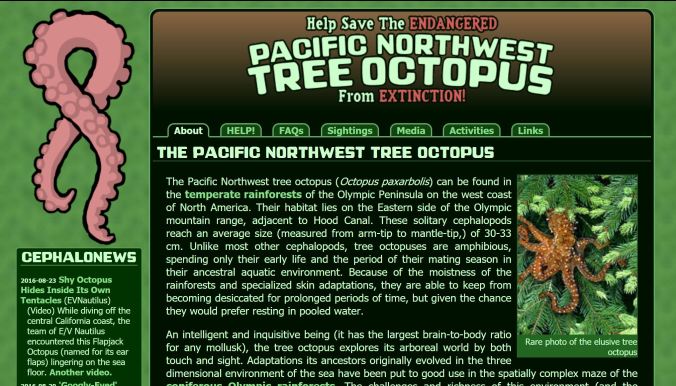
Pondiscio then applies the RADCAB method to a popular assignment of the time. There is a hoax site called the Tree Octopus often used by educators — teachers send students to it and have them try to evaluate whether it is real.
tree-octopus

Unfortunately, as Pondiscio points out, any quick application of RADCAB or any other “skills only” based heuristic will pass this site with flying colors

The rubric also tells us we are research pros if we “look for copyright information or ‘last updated’ information” in the source.  Very well: The tree octopus site was created in 1998 and updated within the last two months, so it must be a current source of tree octopus information.  We are also research pros if we ”look for the authority behind the information on a website because I know if affects the accuracy of the information found there.”  Merely looking for the authority tells us nothing about its value, but let’s dig deeper.  The authority behind the site is the “Kelvinic University branch of the Wild Haggis Conservation Society.” Sounds credible. It is, after all, a university, and one only has to go the extra mile to be a Level 4, or “Totally Rad Researcher.”  The Tree Octopus site even carries an endorsement from Greenpeas.org, and I’ve heard of them (haven’t I?) and links to the scientific-sounding ”Cephalopod News.”

If you want to know the real way to evaluate the site, claims Pondiscio, it’s not by doing something, it’s by knowing something:

It’s possible to spend countless hours looking at the various RADCAB categories without getting the joke.  Unless, of course, you actually know something about cephalopods — such as the fact that they are marine invertebrates that would have a tough time surviving or even maintaining their shape out of the water — then the hoax is transparent.

And, in fact, when we shake our heads at those silly students believing in the Tree Octopus, we’re not surprised at the fact they didn’t look for authority or check the latest update. We’re disappointed that they don’t understand the improbability of a cephalopod making the leap to being an amphibious creature without significant evolutionary changes. We’re amazed that they believe that long ago a common cephalopod ancestor split off into two branches, one in the ocean, and one in the forest, and they evolved in approximately the same way in polar opposite environments

That’s the weird thing about the Tree Octopus. And that’s what would make any informed viewer look a bit more deeply at it, not RADCAB analysis, not CRAAP, and not some generalized principles.

To Gain Web Literacy You Have to Learn the Web

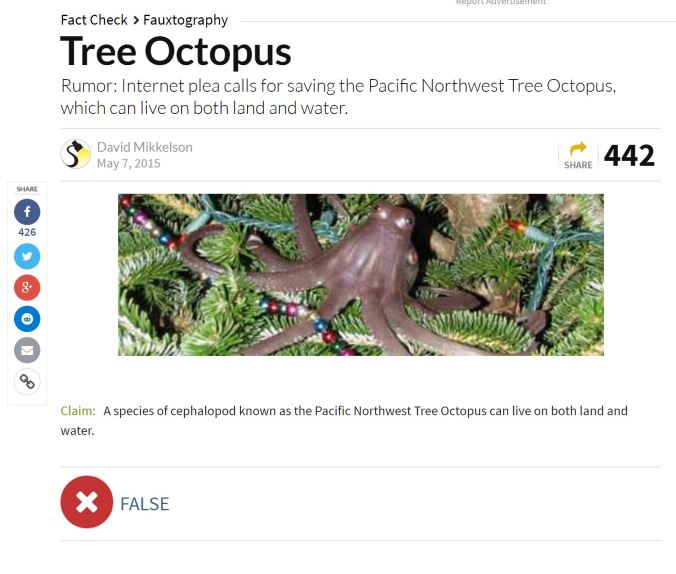
There’s a second point here, because what a web literate person would actually do on finding this is not blindly go through a checklist, but execute a web search on Tree Octopus. Doing that would reveal a Snopes page on it, which the web literate person would click on and see this:
tree

Why would they click Snopes instead of other web search results? Is it because of Relevance, or Currency? Do you have some special skill that makes that particular result stand out to you?

No, it’s because you know that Snopes is historically a good site to resolve hoaxes. If it was a political question you might choose Politifact. If it wasn’t a hoax, but a question that needed answering, you might go to Stack Exchange. For a quote, Quote Investigator is a good resource with a solid history. Again, it’s not skills, exactly. It’s knowledge, the same sort of knowledge that allows a researcher in their field to quickly find relevant information to a task.

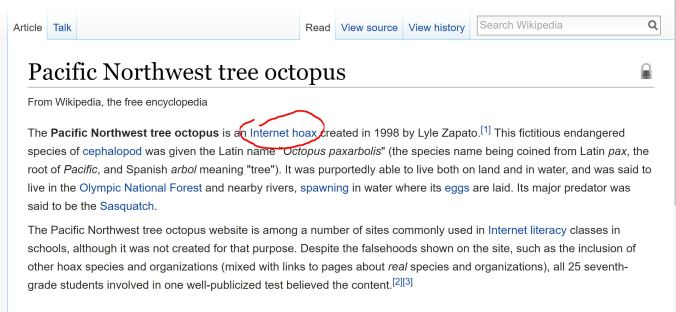
But let’s say you went to Wikipedia instead of Snopes. And again, you found it was labelled a hoax there:
octopus

Well, to be extra sure, you’d click the history and see if there were any recent reversions or updates, especially by anonymous accounts. This is Wikipedia, of course:
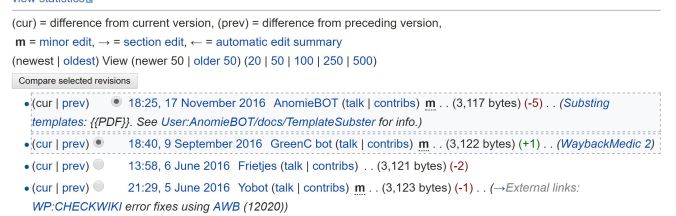
wikipedia

Looking at this we can see that this page has had a grand total of seven characters changed or added in the past six months, and almost all were routine “bot” edits. Additionally we see this page has a long edit history — with hundreds of edits since 2010. The page is probably reliable in this context.

Don’t know what Wikipedia bots are, or what they do? Honestly, that’s a far greater web literacy problem than applying “currency” to Wikipedia articles.

Incidentally, “currency” in our RADCAB rubric gets Wikipedia  backwards. If we had arrived at this Wikipedia page in 2010, for example, on February 28th from about 6:31 p.m. to 6:33 p.m. we would have found a page updated seconds ago. But in Wikipedia, that can often mean trouble, so we would have checked “Compare Revisions” and found that minutes ago the assertions the page made were reversed to say that the Tree Octopus was real:
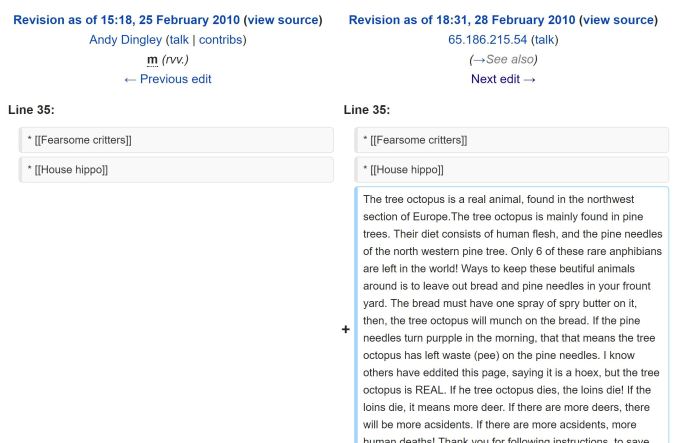
compare-revisions

Furthermore, it’s an edit from an anonymous source, as you can tell from the IP address at the top (65.186.215.54). The recency of the edit, especially from an anonymous source, makes this a questionable source at this particular moment.

Incidentally, in a tribute to the efficiency of Wikipedia, this edit that asserts the Tree Octopus is real is up for less than 120 seconds before an editor sees the prank and reverts it.
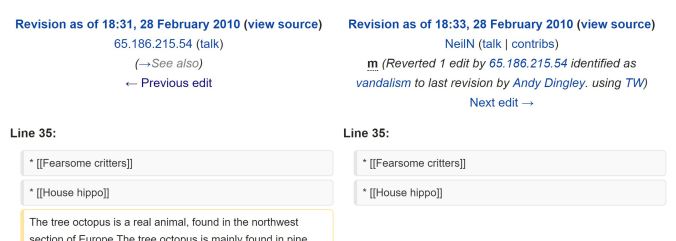
vandal

How are you supposed to know this stuff? Edit histories, bots, character counts as an activity check, recency issues in Wikipedia, compare revisions, etc? How are you going to know to choose Snopes over “MyFactCheck.com”?

Through a general skills checklist? Through a rubric?

The radical idea I’d propose is that someone would tell you these things, the secret knowledge that allows web literate people to check these things quickly. That secret knowledge includes things like revision histories, but also domain knowledge — that Snopes is a good hoax checker, and Quote Investigator is a good source for checking quotes. It includes specific hacks to do reverse image searches to see if an image is real, using specific software such as TinEye or Google Reverse Image Search.

Further, the student would understand basic things like “How web sites make money” so they could understand the incentives for lies and spin, and how those incentives differ from site to site, depending on the revenue model.

In other words, just as on the domain knowledge side we want enough knowledge to quickly identify whether news items pass the smell test, on the technical side we don’t want just abstract information literacy principles, but concrete web research methods and well-known markers of information quality on the web.

We Don’t Need More Information Literacy. We Need a New Information Literacy.

So back to those inevitable calls for more information literacy and the inevitable waves of applause.

We do need more education to focus on information literacy, but we can’t do it the way we have done it up to now. We need to come down from that Bloom’s Taxonomy peak and teach students basic things about the web and the domains they evaluate so that they have some actual tools and knowledge to deal with larger questions effectively.

I’ll give an example. Recently there was a spate of stories about a study that found that students couldn’t differentiate “sponsored content” from native content. Many thinkpieces that followed talked about this as a failure of general literacy. We must build our student’s general critical thinking skills! To the Tree Octopus, my friends!

The study authors had a different idea. The solution, they wrote, was to have students read the web like fact-checkers. But to do that we have to look at what makes fact-checkers effective vs. students. Look, for example, at one of the tasks the students failed at — identifying the quality of a tweet on gun control:
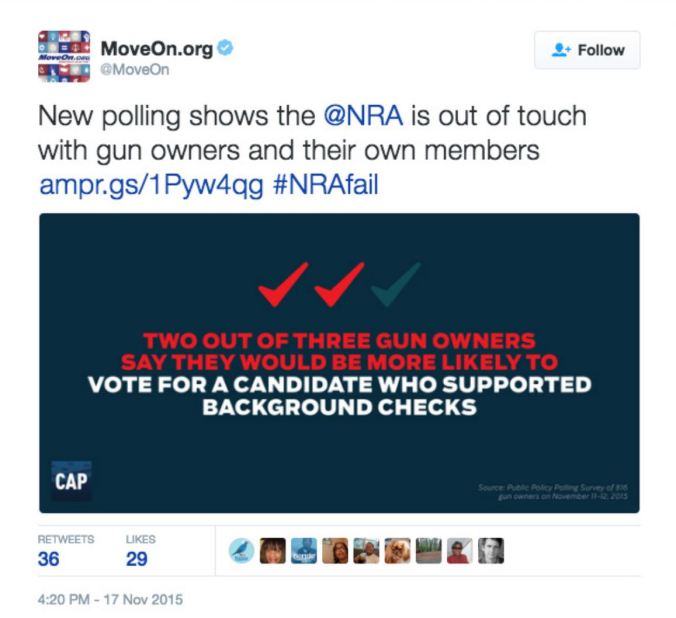
capture

As the study authors note, a literate response would note two things:

  • The tweet is from Move On, and concerns a study commissioned by Center for American Progress, a liberal think tank, and this may indicate some bias, but
  • The poll they link to is by Public Policy Polling, a reputable third party third party polling outfit, which lends some legitimacy to the find.

The undergraduates here did not do well. Here’s how they struggled:

An interesting trend that emerged from our think-aloud interviews was that more than half of students failed to click on the link provided within the tweet. Some of these students did not click on any links and simply scrolled up and down within the tweet. Other students tried to do outside web searches. However, searches for “CAP” (the Center for American Progress’s acronym, which is included in the tweet’s graphic) did not produce useful information.

You see both sides of the equation in this tweet. A fact checker clicks links, obviously. And while that seems obvious, keep in mind it never occurred to half the students.

But the second part is interesting too — the students had trouble finding the Center for American Progress because they didn’t know “CAP”. There’s a technical aspect here, because if they just scoped their search correctly — well, here’s my first pass at a search:
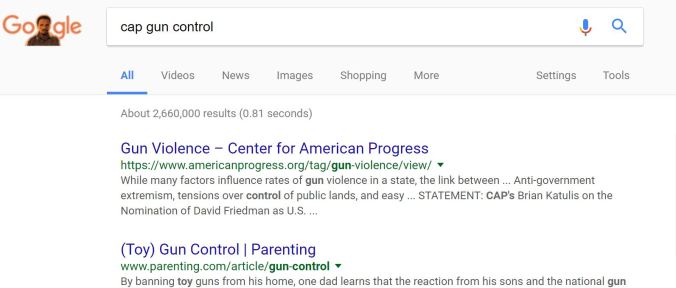
capture

So one piece of this is students need to know how to use search. But the other piece is they need to be able to recognize that we call this policy area “gun control”.  That sounds weird, but again, consider that most of these students couldn’t figure that out.

And honestly, if you fact check on the internet long, you’ll end up knowing what MoveOn is and what the Center for American Progress is. Real fact-checkers don’t have to check those things, because any person that tracks these issues is going to bump into a handful of think tanks quite a bit. Learning what organizations like CAP, Brookings, Cato, AEI, and Heritage are about is actually part of the literacy, not a result of it.

Instead of these very specific pieces of knowledge and domain specific skills, what did the students give back to the researchers as method and insight? They gave them information literacy platitudes:

Many students made broad statements about the limitations of polling or the dangers of social media content instead of investigating the particulars of the organizations involved in this tweet.

You see the students here applying the tools that information literacy has given them. Be skeptical! Bias happens! Social media is not trustworthy!

And like most general-level information literacy tools, such platitudes are not useful. They need to know to click the link. They need to know what a think tank is. They need to know how to scope a search, and recognize the common term for this policy area is “gun control”. But we haven’t given them this, we’ve given them high level abstract concepts that never get down to the ground truth of what’s going on.

Fukashima Flowers

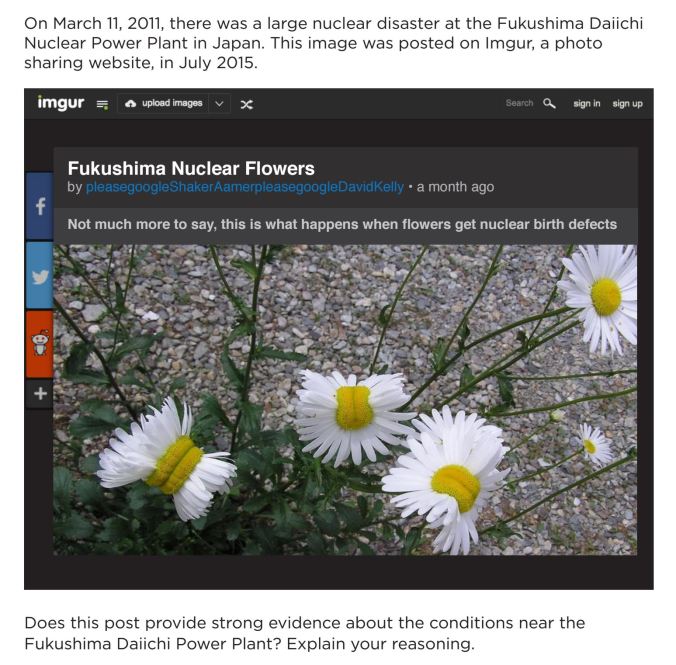
You see this time and time again. Consider the Fukashima Flowers task from the same study:
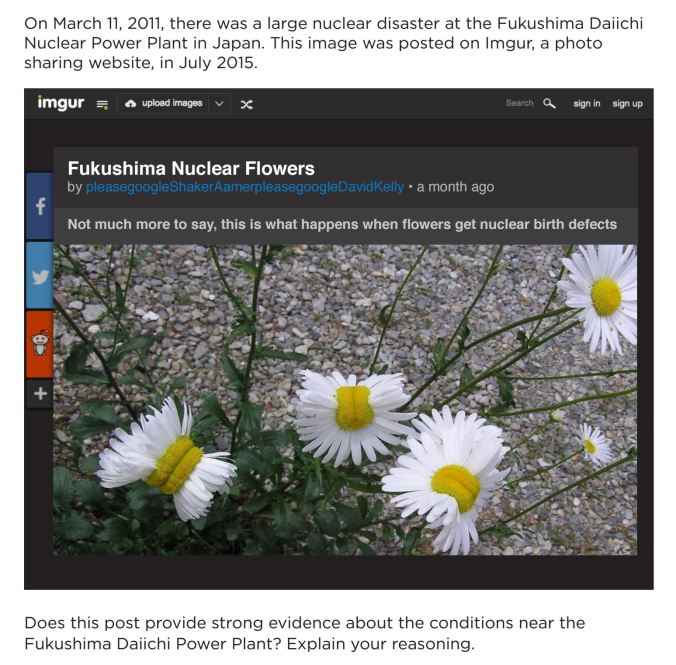
capture

My first thought on this is not “Is this good evidence?” My first thought is “Is this a hoax?” So I go to Snopes:
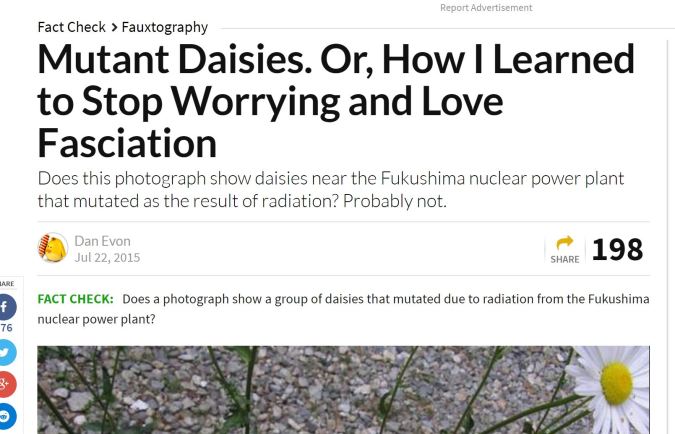
snopes

And there I get a good overview of issue. The photo is real, and it’s from an area around Fukashima. But the process it shows is fasciation, and, while rare, fasciation occurs all around the world.

Do I want to stop there? Maybe not. Maybe I look into fasciation rates and see how abnormal this is. Or maybe I dig deeper into known impacts of radiation. But I’ve already got a better foothold on this by following the admonition “Check Snopes first” than any acronym of abstract principles would give me.

Do the students check Snopes? No, of course not. They apply their abstract reasoning skills, to disappointing results:

On the other hand, nearly 40% of students argued that the post provided strong evidence because it presented pictorial evidence about conditions near the power plant. A quarter of the students argued that the post did not provide strong evidence, but only because it showed flowers and not other plants or animals that may have been affected by the nuclear radiation.

I know Bloom’s Taxonomy has fallen out of favor recently in the circles to which I belong. But this is an extremely good example of what happens when you jump to criticism before taking time to acquire knowledge. The students above are critical thinkers. They just don’t have any tools or facts to think critically with.

Now maybe in another world Snopes doesn’t have this story. I get that you can’t always go to Snopes. And maybe googling “Fukushima Flowers” doesn’t give you good sources. Well, then you have to know reverse image search. Or you might need to know how to translate foreign news sources.  Or you might need to get the latest take on the flowers by limiting a Google News search by date.

My point is not that you don’t have to deal with questions of bias, or relevancy, or currency. You’re absolutely going to confront these issues. But confronting these issues without domain knowledge or a toolkit of specific technical resources and tricks is just as likely to pull you further away from the truth than towards it.

What Do Real Fact-Checkers and Journalists Do?

Journalists often have to verify material under tight deadlines. What tricks do they use?

Consider this question: you get a video like this that purports to have taken place in Portland, July 2016, where a man pulls a gun on Black Lives Matter protesters. Is this really from Portland? Really from that date, and associated with that particular protest? Or is this a recycled video being falsely associated with a recent event?

Now this video has been out for a while, and its authenticity has been resolved. You can look it up and see if it was correctly labelled if you want. But when it first came out, what were some tricks of the trade? Do they use RADCAB?

No, they use a toolbox of specific strategies, some of which may encode principles of RADCAB, bit all of which are a lot more specific and physical than “critical thinking”.

Here’s what the Digital Verification Handbook out of the European Journalism Centre suggests, for example, about verifying the date of an event on YouTube:

Be aware that YouTube date stamps its video using Pacific Standard Time. This can sometimes mean that video appears to have been uploaded before an event took place.

Another way to help ascertain date is by using weather information. Wolfram Alpha is a computational knowledge engine that, among other things, allows you to check weather from a particular date. (Simply type in a phrase such as “What was the weather in Caracas on September 24, 2013” to get a result.) This can be combined with tweets and data from local weather forecasters, as well as other uploads from the same location on the same day, to cross-reference weather.

You may not realize this, but rainy and cloudy days are actually quite rare in Portland in July — it rains here for like nine months of the year, but the summers are famously dry, with clear sky after clear sky. Yet the weather in this video is cloudy and on the verge of raining. That’s weird, and worth looking into.

We check it out in Wolfram Alpha:
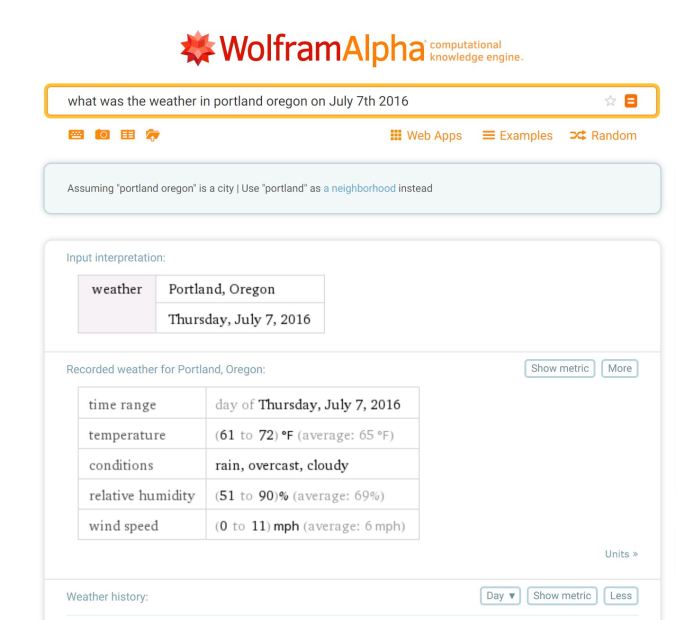
weather

And it turns out the weather fits! That’s a point in this video’s favor.  And it took two seconds to check.

The handbook is also specific about the process for different types of content. For most content, finding the original source is the first step. Many pictures (for example, the “Fukushima flowers”) exist on a platform or account that was not the original source, thus making it hard to ascertain the provenance of the image. In the case of the Fukushima flowers did you ever wonder why the poster of the photo posted in English, rather than Japanese, and had an English username?

A web illiterate person might assume that this was game over for the flowers, because what Japanese person is going to have a name like PleaseGoogleShakerAamer?
capture

But as the handbook discusses, this isn’t necessarily meaningful. Photos propagate across multiple platforms very quickly once the photo becomes popular, as people steal it to try to build up their status, or get ad-click-throughs. A viral photo may exist in hundreds of different knock-off versions. Since this is User-Generated Content (UGC), the handbook explains the first step is to track it down to its source, and to do that you use a suite of tools, including reverse image search.

And when we do that we a screen cap of a Twitter image that is older than the picture we are looking at and uses Japanese, which, lets face it makes more sense:

kaido

(BTW, notice that to know to look for Japanese we have to know that the Fukushima disaster happened in Japan. Again, knowledge matters.)

Once we have that screen cap we can trace it to the account and look up the original with Google translate on. In doing so we find out this is resident of the Fukushima area who has been trying to document possible effects of radiation in their area. They actually post a lot on information on the photo in their feed as they discuss it with various reporters, so we can find out that these were seen in another person’s garden, and even see that the photographer had taken a photo before they bloomed, a month earlier, which reduces the likelihood that this is a photo manipulation somewhat dramatically:

zelp

Even here, the author notes that they know it is a known mutation of such things. And they give the radiation level of that part of Japan in microsieverts which allows you to check it against health recommendation charts.

A month later they check back in on the flowers and post the famous photo. But immediately after they say this:
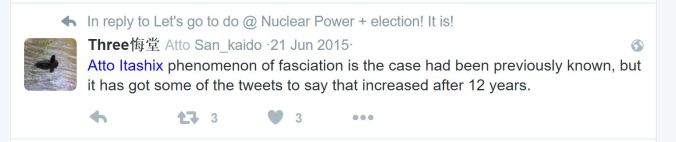
fasciation

In other words, three tweets after the famous photo the tweeter gives you the word of what this is called (fasciation) and even though the rest of the text is garbled by the translator that’s a word you can plug into Google to better understand the phenomenon:
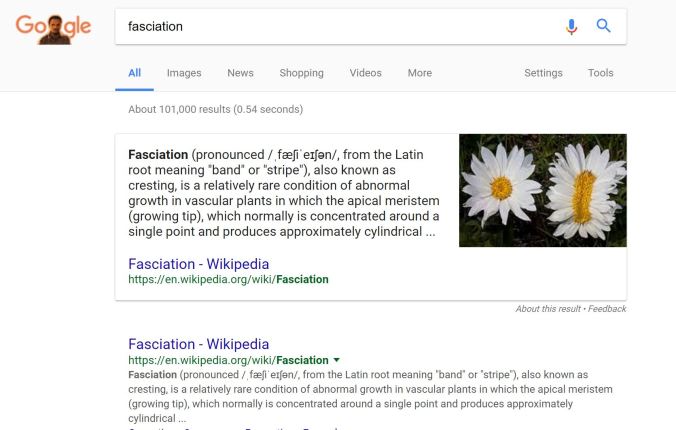
rare

So here’s a question: does your digital literacy program look like this? Is it detective work that uses a combination of domain knowledge and tricks of the trade to hunt down an answer?

Or does it consist of students staring at a page and asking abstract questions about it?

It’s not that I don’t believe in the questions — I do. But ultimately the two things that are going to get you an answer on Fukushima Flowers are digital fact-checking strategies and some biology domain knowledge. Without those you’re going nowhere.

Conclusion: Domain-Grounded Digital Literacy That Thinks Like the Web

I didn’t sit down to write a 5,000 word post, and yet I’m feeling I’ve only scratched the surface here.

What is the digital literacy I want?

I want something that is actually digital, something that deals with the particular affordances of the web, and gives students a knowledge of how to use specific web tools and techniques.

I want something that recognizes that domain knowledge is crucial to literacy, something that puts an end to helicopter-dropping students into broadly different domains.

I want a literacy that at least considers the possibility that students in an American democracy should know what the Center for American Progress and Cato are, a literacy that considers that we might teach these things directly, rather than expecting them to RADCAB their way to it on an individual basis. It might also make sense (crazy, I know!) that students understand the various ideologies and internet cultures that underlie a lot of what they see online, rather than fumbling their way toward it individually.

I think I want less CRAAP and more process. As I look at my own process with fact-checking, for example, I see models such as Guided Inquiry being far more helpful — systems that help me understand what the next steps are, rather than abstract rubric of quality. And I think what we find when we look at the work of real-life fact-checkers is that this process shifts based on what you’re looking at, so the process has to be artifact-aware: This is how you verify a user-generated video for example, not “here’s things to think about when you evaluate stuff.”

To the extent we do use CRAAP, or RADCAB, or CARS or other models out there, I’d like us to focus specifically on the methods that the web uses to signal these sorts of things. For example, the “S” in CARS is support, which tends to mean certain things in traditional  textual environments. But we’re on the web and awful lot of “support” is tied up in the idea of hyperlinks to supporting sources, and the particular ways that page authors tie claims to resources. This seems obvious, I suppose, but remember that in evaluating the gun control claim in the Stanford study, over half the students didn’t even click the link to the supporting resource.  Many corporations, for business reasons, have been downplaying links, and it is is having bad effects. True digital literacy would teach students that links are still the mechanism through which the web builds trust and confidence.

Above all, I just want something that gets to a level of specificity that I seldom see digital literacy programs get to. Not just “this is what you should value”, but rather, “these are the tools and specific facts that are going to help you act on those values”. Not just “this is what the web is”, but “let’s pull apart the guts of the web and see how we get a reliable publication date”. It’s by learning this stuff on a granular level that we form the larger understandings — when you know the difference between a fake news site and an advocacy blog, or understand how to use the Wayback Machine to pull up a deleted web page — these tools and process raise the questions that larger theories can answer.

But to get there, you have to start with stuff a lot more specific and domain-informed than the usual CRAAP.

(How’s that for an ending? If anyone wants a version of this for another publication or keynote, let me know — we need to be raising these questions, and that means talking to lots of people)


19 Dec 22:16

Airbnb is working towards integrating flight booking into its platform

by Igor Bonifacic

In a move that will put the company in direct competition with giants like Expedia, rental platform Airbnb is building a flight booking tool, according to a new report from Bloomberg.

The tool, know within the company simply as “Flights,” is in early development. Airbnb reportedly hopes to launch Flights before it makes an initial public offering sometime in the next 18 months.

Whether Flights sees the light of day is contingent upon Airbnb acquiring the necessary flight data to power the tool’s functionality. The company is reportedly weighing its options, with the acquisition of a travel agency as one potential outcome. In 2010, facing a similar position, Google acquired airline data provider ITA Software for $700 in order to build out its flight booking tool.

While Airbnb built an entire industry on the back of its innovative rental platform, the company has sought to diversify its revenue in recent months. The flight booking tool is the company’s latest effort to that effect. In November, Airbnb launched Trips, a tool for finding unique experiences in cities where the company operates.

SourceBloomberg
19 Dec 22:16

Daily Durning: A Prescient Analysis of the Vancouver Housing Market

by pricetags

Durning: Be interesting to see your reader’s take on this short piece by David Ley, UBC Professor of Geography (whose early analysis seemed to have little impact when first presented in 2010, but gets more prescient as time goes by.  This is from 2015.)

Global China and the making of Vancouver’s residential property market – Conclusion

Structural defects in the BC economy exposed by a severe recession led three levels of government to develop networks with the growth region of Asia Pacific from the early 1980s. The objectives, to augment trade and investment, were aided by neo-liberal tools that included open borders, deregulation, a place-boosting world’s fair, liberalised immigration policies, and a development-ready province pushing back the gains of labour and the welfare state.
An innovation that gained significant take-up was the Business Immigration Programme, with Vancouver, the closest major city to East Asia and with a high quality of life, the most popular destination especially for the wealthiest investor newcomers. Although the BIP was open to affluent residents of all nations, in the past 35 years, 80%–85% of investor class immigrants originated in Greater China.
The state’s Asia Pacific outreach has proven successful in reaching its economic goals. In 2014, 37% of BC’s exports were Asia-bound. Piecing together various sources, and including secondary migration, I estimate wealth migration of 200,000 immigrants to Vancouver through the three streams of the BIP between 1980 and 2012, the equivalent of 8%–9% of the metropolitan population in 2011.
Massive amounts of capital moved across the Pacific; the estimated liquid capital available to business immigrants arriving in Greater Vancouver between 1988 and 1997 alone was $35–$40 billion. Some of this was surrendered to the provincial government as a requisite interest-free loan.
Newcomers moved quickly into homeownership in Canada’s most expensive city and their housing impact was elevated by their preference for property as an early site for further investment and rental income.
While real incomes have atrophied for several decades, the Greater Vancouver benchmark price for detached properties is now $1.2 million, and is once again on a tear, having risen by 20% in the past 12 months. Both provincial and municipal government revenues have benefitted from property-based taxation, and are reluctant to harm the goose that lays the golden egg.
Wealth generated in asset hotspots in a deregulated globalised economy can generate huge public revenues as well as private returns. The convergence, even without collusion, of private and public sector property interests in BC creates immense momentum that precludes meaningful policy responses to inequities that include excessive housing unaffordability, precarious mortgage indebtedness, and disillusioned out-migration.
The default housing policy position has become minimal response and the cultivation of ignorance concerning actual trends. In this neo-liberal policy environment, community costs assume the status of acceptable collateral damage.

19 Dec 22:14

Cafe Christmas

by russell davies

This is one of those annoying photographer websites but it's worth it. Go here, click on projects, open your browser window sufficiently that you can see a downward arrow (because you can't scroll), click down to Greasy Christmas, click on one of the pictures, use the arrows to look at them. They're good. 

19 Dec 22:14

The Process of Proposing New Emoji

by John Voorhees

The Verge has an interesting interview with Paul Hunt, a type designer at Adobe, who has proposed four emoji that have been adopted as part of the Unicode Standard: orange heart, child, adult, and older adult. In addition to describing the extensive research that can go into proposals to adopt a new emoji, Hunt explains the Unicode body’s approach to issues surrounding the diversity of emoji and inclusiveness:

… Unicode tries to be very sensitive and tries to avoid any kind of political issues when it comes to coding new characters. I think that Unicode doesn't really try to give a voice for particular causes. Instead, they try to approach it in a way that they try to make tools for communicating existing realities. … I feel like having more emoji concepts to express issues around gender and around equality issues is only a good thing. Hopefully as people use and see these emoji, then it will help them to hopefully be able to think and empathize for the people who are using them.

→ Source: theverge.com

19 Dec 22:14

Apple Support iOS app now available in Canada

by Igor Bonifacic

After launching in the Netherlands and making its way to the U.S., the Apple Support iOS app is now available to download from the Canadian iTunes App Store.

Designed to be an Apple user’s one-stop resource for any support questions they may have, the app includes an extensive database of common issues, their solutions as well as general product information. In case a user needs more help, it’s also possible to chat with Apple technicians directly from the app, as well as schedule an appointment at a local Apple Store.

So far, the app has a four-and-a-half star rating on 168 reviews, with most users noting it is possible to get in contact with Apple support faster through the app than it is on the phone.

Download it for free.

19 Dec 22:13

Yes, Digital Literacy. But Which One?

files/images/cashless.jpg


Mike Caulfield, Hapgood, Dec 22, 2016


"Which information literacy do we need?" asks Michael Caulfield. "Do we need more RADCAB? Do we need more CRAAP?" We can certainly agree that critical thinking has to go beyond simplistic five-step rubrics. But here Caulfield steers off a cliff. We need to know the background, he argues, in order to differentiate between legitimate news and conspiracy theorists. "Abstract skills aren’ t enough," he maintains. For example, "When I saw that big 'W' circled in that red field of a flag, for instance, my Nazi alarm bells went off." He explains, "My point is that recognizing any one of these things as an indicator — FEMA, related sites, gold seizures, typography — would have allowed students to approach this site with a starting hypothesis." Well, yes. But how do students learn which indicators to recognize? By being told? We know that this is a non-starter. No, they need to learn deep and authentic critical thinking skills. More: my essay On Teaching Critical Thinking.

[Link] [Comment]
19 Dec 22:13

Model for the transformation of higher education in Africa

files/images/20161216123836698_1.jpg


Phillip L Clay, University World News, Dec 22, 2016


I have my questions about former MIT Chancellor Phillip L Clay's proposal to renew African education, but the report he refers to is neither named nor hyperlinked, so all we have is this column. In it, he proposes what amounts to a recreation of the elite university system for Africans, on condition that "governments would promise that students from their country would receive the resources that would otherwise be available for the best opportunities in their countries." Also, "by closely fitting education with industrial development, and by aggressively leveraging global sourcing of knowledge and resources to build first-class institutions" and "enrolments would be sized to foster excellence (ie., small)." No mass education for Africa. Clay should make this paper available online and be held to account for his policy positions and advocacy.

[Link] [Comment]
19 Dec 22:13

What Can We Learn From Countries That Effectively Teach Math?

files/images/US_math.jpg


KQED, MindShift, Dec 22, 2016


This  report accords with my own sense of the matter. "In every country, the memorizers turned out to be the lowest achievers, and countries with high numbers of them— the U.S. was in the top third— also had the highest proportion of teens doing poorly on the PISA math assessment." By turning math lessons into rote exercises, administrators not only weaken math scores, they also effectively increase inequality.

[Link] [Comment]
19 Dec 22:13

My Workflow

files/images/workflow.png


Stephen Downes, Half an Hour, Dec 22, 2016


I was thinking about working openly recently and decided to document my workflow, such as it is. As you can see I need to devise a way to make my projects and courses more transparent. There's also a PowerPoint version of the image with working links. No HTML version, sorry.

[Link] [Comment]
19 Dec 22:12

Decentralized, P2P Chat in 100 lines of code

files/images/ZeroNetChat.png


ZeroNet, DecentralizeToday, Dec 22, 2016


I spent several hours this morning messing around with this and actually created  my own peer-to-peer discussion board as described in the article - it works, but I'm not sure people can access it as the port is closed. You won't be able to access it by clicking on your own browser - the link points to a location on your own computer, and if you need to have ZeroNet installed to read it. Ah, but ZeroNet is an easy install, open source and free - download from here, extract into a directory, and then (on windows at least) run zeronet.cmd by double-clicking on it in the directory. It will open in your browser and you're on the distributed internet. What you've done is to load a Python interpreter and personal web server (which only you access). Here are the full ZeroNet documents. I like this a lot.

[Link] [Comment]
19 Dec 19:24

Wiley'S Misguided Advocacy


, noreply@blogger.com (Stephen Downes), CC BY-NC-ND, Half an Hour, Dec 22, 2016


David Wiley once again launches into advocacy for the CC-by license. We've been through this many times, so I'll keep it relatively brief. His text is italicized.
& gt; There is a growing consensus among those who work in open education that the Creative Commons Attribution (BY) License is our preferred license. No there isn't. The list of organizations hasn't grown over the years, and the number people from this list remains stable. & gt; Since the first release of the Creative Commons licenses, newcomers to the field have been attracted to licenses containing the non-commercial (NC) condition. There's a whole paragraph devoted to depicting advocates of the Non-Commercial license (NC) as "newcomers". As if I am a newcomer. As if MIT's OpenCourseWare is a newcomer. & gt; The BY license best reflects our values of eliminating friction, maximizing interoperability, and promoting unanticipated and innovative uses of OER. & gt;No one knows what the NC license condition means, including Creative Commons. The license language is so vague that the only way to determine definitively whether a use is commercial or not is to go to court and have a judge decide. This vagueness is cited by proponents of CC-by but hasn't actually been a problem. There are some good rules-of-thumb which can guide you: - if you have to ask whether your use is a commercial use, it probably is - if someone has to pay to access your resource, it probably is & gt; Example – I want to use some NC-licensed content in my course, but students can only attend my course if they pay tuition. Is that a commercial use? It's a commercial use if the only way people can access the resource is to pay you tuition. But if the resource is free to access for everyone, it doesn't matter whether your students use it also. & gt; For would-be authors of NC-licensed content, the only way to resolve the confusion arising from someone using your content in a way that you think is commercial but they think is non-commercial is to lawyer up and send a cease and desist letter. This isn't unique to the NC condition. It applies to all CC-licensed content. In practice, I find that there has been more of a problem enforcing the attribution condition. But nobody has suggested removing it on these grounds. & gt; The primary thing you gain by choosing a license that includes the NC condition ... The primary benefit is that you prevent people from turning it into a commercial product and selling it. There are numerous reasons why you may want to do this. & gt; Why would someone go to all the cost and effort involved in selling copies of your CC BY licensed material (e.g., paying for ads to drive traffic to the site where they’re selling it) when every copy will include instructions on where people can get the same material for free instead? Because this access is often theoretical. Should the original ever disappear (or in the case of OpenStax, should the URL ever change) there is no resourse; the user must pay for the resource. Saying things like "there would be very little incentive..." creates a nice hypothetical, but we have no way of knowing that there won't be an incentive. We've seen that large businesses can be created out of very marginal returns, soour "very little incentive" is someone else's business plan. & gt; The CC BY language gives you practical protection from newcomers’ concern that some interloper is going to make a million dollars from their work (even if it does not offer protection against all theoretical possibilities).... This is why you don’t see Pearson, McGraw, or other major publishers reselling copies of CC BY textbooks. If we limit the example to textbooks, the statement is possibly true. However, publishers have made millions selling out-of-copyright works, such as the classics of literature. Walt Disney made a fortune by appropriating folklore and fairy stories and marketing them as Disney property. & gt; The only counterexample I can offer to this line of argument, and it’s not a direct one, is the CC BY simulations created by PhET. As I understand it, at least one major publisher includes PhET simulations in their offerings. The publisher doesn’t sell the simulations as a product – I don’t think they could sell the simulations this way for the reasons I’ve described above. But they do include the simulations as a “free extra” to make their textbooks or courseware more attractive than those offered by other publishers. This sounds like exactly the sort of situation I would like to avoid. And it's not nearly as rare as described here. Consider, for example, companies like ResearchGate, which have slurped up all the open access publications they can find, and then require that readers log in to read them, thus creating data they sell to advertisers and publishers. & gt; On the one hand, the faculty member you speak to may feel like this possibility represents a lost opportunity to make some money. I don't actually think this is what motivates supporters of NC. Mostly, people don't want their work to become part of a commercial product that people would have to pay money to access. & gt; Personally, for the OER that I create, I want every learner in the world to use them – regardless of which major resource (commercial or open textbook) their faculty have decided to adopt. If publishers decide to throw my OER in as free extras with their textbooks or courseware, that just decreases the amount of search engine optimization and other work I have to do to make sure people know about the OER I’ve created. It’s free advertising for my OER. It's the existence of commercial content that makes SEO and advertising a requirement. This alone should be a reason to discourage CC-by. It shouldn't be necessary for us to have to advertise open access content. It's a requirement only because commercial publishers want to make sure readers cannot find the free content. Most of us do not want to become entrepreneurs or publishers or whatever. We simply want to share the work we've created. It's the commercial publishing system that makes that hard. As always, I argue that people should adopt whatever license best suits their interests. I continue to fail to understand why David Wiley doesn't respect that choice. [Link] [Comment]
19 Dec 19:24

Learning Design Principles

files/images/Pearson_Learning_Design_Principles.JPG


Pearson, Dec 22, 2016


Michael Feldstein  points to this report on learning design principles from Pearson. The report (102 page PDF) is called "Objective Design and Instructional Alignment," which gives you a sense of their perspective. The recommendations are (quoted):

  • Explicitly specify observable knowledge, skills, or attributes a learner will achieve in the learning experience in objective statements.
  • Derive these from relevant standards.
  • Align all assessments and content to objectives to create aligned learning experiences, which are essential to effective learning experiences and Pearson's efficacy goals.

The report itself steps through a series of design principles, ranging from 'assessments' to 'learning object design' to 'critical thinking', and accompanies each with a set of rubrics for evaluating the concordant design. I like the structure of the document, though I think the authors could have been more discriminating in their selection of subjects - 'grit', in particular, doesn't really belong. There's also a  blog post providing more background on the project.

[Link] [Comment]
19 Dec 19:24

Canopy Keyboard Cover and iPad Stand Review

by John Voorhees

I've been carrying Studio Neat's new Canopy, a combination keyboard case and iPad stand, for about a week. It's the first time Apple's Smart Keyboard has been off my iPad Pro since I got it, but I haven't missed it at all. There are still certain situations where I prefer the Smart Keyboard, but I love having the option to work on my iPad with Apple's Magic Keyboard when it suits my needs. So, while I won't be switching to a Magic Keyboard/Canopy combination full-time, it's a choice I'm glad to have and one I will use frequently.

I used an Incase Origami keyboard case with the original iPad. Apple's previous-generation wireless keyboard was propped up at an angle by a barrel that housed the batteries used to power it. With the Origami, you popped the barrel of the keyboard into clips on the case to hold it in place. The case was divided into two panels that wrapped around the keyboard and closed with Velcro. The case's name derived from the fact that you could fold back the two free corners of the case and attach them to each other with Velcro to form a pyramid-shaped stand. The case worked well, but it was a bulky solution because Apple's previous-generation wireless keyboard was larger than the current Magic Keyboard.

The Incase Origami case (left) and Canopy (right).

The Incase Origami case (left) and Canopy (right).

The Canopy is an evolution of the ideas pioneered by the Oragami case that improves every aspect of it. The case has a three-panel, hinged design. Laid flat on a table, the Magic Keyboard attaches to the bottom third of the Canopy with micro-suction pads, which Studio Neat uses in some of its other products. If you haven't seen micro-suction pads in action, they have a tacky surface that holds the keyboard in place remarkably well. Better yet, you can remove your keyboard without leaving any residue on it and reattach it without the micro-suction pads losing their stickiness.

The exterior of the Canopy is made of what Studio Neat describes as synthetic canvas. It's a nice material that feels durable and has held up well in the week it's been banging around inside my bag. The interior is a microfiber fabric that isn't as soft as the inside of an iPad Smart Cover, but is soft enough to protect the Magic Keyboard. The panels themselves are stiff, but flexible; a little like the panels of Apple’s Smart Cover, but thinner. The case wraps around the keyboard and is held shut by a leather strap with a snap.

The Canopy closed around Apple's Magic Keyboard.

The Canopy closed around Apple's Magic Keyboard.

The fit between the Canopy and Magic Keyboard is perfect. The stiff panels surround the keyboard with a small amount of overlap at the edges that helps keep things from hitting the sides of the keyboard. However, the close fit also means that the Canopy only works with Apple’s Magic Keyboard.

Converting the Canopy from a case to a stand is easy. Open the case and fold the two top panels backwards into a triangle. The same strap that holds the Canopy closed as a case attaches with the snap to form the base of the two-panel triangle that acts as a stand. The hinge between your keyboard and the middle panel of the Canopy forms a slot into which you can drop any iOS device.

The Canopy features a three-panel design.

The Canopy features a three-panel design.

I've been using the Canopy with my iPad Pro, which fits nicely into the Canopy even with a Smart Cover attached, but any iOS device fits, including an iPhone. The snap used to secure the Canopy is strong and holds the configuration together well at a fixed angle that is a pleasure for writing.

An unexpected benefit of using the Magic Keyboard with my iPad that the Canopy has enabled is access to the function keys. iOS supports adjusting brightness and volume, controlling media playback, and showing and hiding the software keyboard with the Magic Keyboard's top row of keys. It’s a small thing, but I especially like using the media playback keys with my iPad because use them frequently on my Macs.

The leather strap and snap hold the top two-thirds of the Canopy together forming a stand.

The leather strap and snap hold the top two-thirds of the Canopy together forming a stand.

I’ve found that the best way to use the Canopy is at a table or desk where the Canopy sits flat and is stable. Sliding the Canopy around on a table works well, but in my lap I've run into a couple minor issues. The added friction of sliding the Canopy in my lap sometimes causes the snap to come undone. In addition, when I use the Canopy in my lap, my iPad sits lower in it than it does on a table or in the Smart Keyboard Case, which can make it difficult to swipe up to activate Control Center. The Smart Keyboard doesn’t have the same issue because the iPad sits on top of one of its panels rather than on a flexible hinge. The difference isn't so large that I don't use the Canopy in my lap, but the experience is noticeably better on a flat surface.


I'm not picky about keyboards as long as they are comfortable. That said, I do prefer the feel of the Magic Keyboard to the Smart Keyboard. Before I started using the Canopy, I hadn't considered using a Magic Keyboard with my iPad Pro, but the convenience and elegance of the Canopy has changed that.

After a week of heavy use, the Canopy has found a permanent place in my writing kit. I won’t use it every day – many days, the Smart Keyboard will be enough – but when I'm doing a lot of writing, I'm going to carry the Canopy. The typing experience is much closer to what you would find on a MacBook or MacBook Pro, which is sufficiently better than the Smart Keyboard that I bought a new Magic Keyboard to dedicate to the Canopy and my iPad. Students, writers, and anyone else who spends a lot of time typing into an iOS device should consider the Canopy.

The Canopy is available from Studio Neat's website for $40.


Support MacStories Directly

Club MacStories offers exclusive access to extra MacStories content, delivered every week; it’s also a way to support us directly.

Club MacStories will help you discover the best apps for your devices and get the most out of your iPhone, iPad, and Mac. Plus, it’s made in Italy.

Join Now
19 Dec 19:23

My year in London theatre - a round-up of 2016

by Helen Keegan
I’m very lucky. Not only do I have a love for theatre, I have friends who work in the theatre sector which means I can sometimes score a free or heavily subsidised ticket for a show. Other times, I get day seats (well worth a shot if you’re in Central London – check out Theatre Monkey for info), or reduced price tickets at the Leicester Square Ticket booth and I’m also on a couple of last-minute theatre ticket mailing lists offering heavily discounted seats. That means I can truly indulge and not worry about the how I’m going to afford the high ticket prices. 2016 has been a particularly good year in that I’ve attended more than 30 different shows ranging from pub and fringe theatre to play readings and improv to West End marvels. And I can honestly say, I enjoyed pretty much all of them. This is my round-up of the year.

There have most definitely been some highlights:

Discovering the Sam Wanamaker Playhouse at The Globe
My goodness what a treat of a theatre this is. It’s the smaller, intimate, indoor space at The Globe and is laid out as an indoor theatre in Shakespeare’s time would have been laid out – bench seating on three levels, galleried stage and all candlelit. I think you’d be hard-pressed not to be completely captivated by the setting. It’s now one of my favourite theatre spaces of all time. I saw three shows there this year – The Inn at Lydda (a thought-provoking fictional tale of when Caesar meets Jesus), Comus (by John Milton and beautifully retold in a historical setting) and The Little Match Girl (A very clever integration of puppetry and actors). If you get a chance to visit, go! I defy you not to love it wherever you’re sitting.

New work: The Pacifist’s Guide to the War on Cancer
I’ve seen a number of revivals this year but not very much at all that’s completely new writing. One new piece I did see and one of my highlights of the year was The Pacifist’s Guide to the War on Cancer at The National (Dorfman – their smaller space). It clearly wasn’t to everyone’s taste as the reviews were mixed. But I found it moving, powerful and entertaining (if a musical about cancer can be entertaining). It was an important piece of theatre in that it approaches a difficult, emotive topic we don’t really want to talk, or even think about much but in approaching it, gives us much-needed permission to do just that. The musical was in the verbatim style – that means that the playwright and the actors talked to real cancer patients and recorded what they said and then used their words exactly as they were said. This means there’s a raw honesty about the dialogue which works for me as an audience member. (This is a technique the National is known for. Rufus Norris used this technique to great acclaim with the musical and the film of London Road.)

Revisiting Shakespeare – a surprise highlight
I can’t say I’m much of a Shakespeare fan. I studied The Tempest and Macbeth at school and didn’t enjoy it much. I found the language hard-going as it’s not the English we use today in either style or vocabulary. To try and combat that I took a role in Julius Caesar with The South London Players a few years ago. Although I enjoyed being in the play, I can’t say that it ignited any particular love for The Bard.

But seeing as he is the father of our modern theatre, and having friends who do have a love for Shakespeare, I’ve given it another go this year and have been (mostly) pleasantly surprised. I’ve taken in an Australian Aborigine version of King Lear called The Shadow King (replete with didgeridoos, sand and body paint), a modern version of Cymbeline (it’s a kind of mash-up of several of Shakespeare’s previous plays) (both at The Barbican), Edwardian versions of Love’s Labour’s Lost and Much Ado About Nothing from the RSC at Theatre Royal Haymarket and the piece de resistance, Glenda Jackson as King Lear at The Old Vic. She was utterly magnificent. Probably the best performance by any actor I have ever seen on stage or screen. It inspired the thinking behind my blog post about work and aging here.

Low point: Closure of Croydon’s Fairfield Halls & Ashcroft Theatre
But it hasn’t all been plain sailing and I’m still cross and frustrated about this. One of my favourite venues, and an unsung hero in theatrical circles was Croydon’s Ashcroft Theatre and Fairfield Halls. I’ve seen some fantastic shows and performances there over the years including Under Milk Wood, The Accrington Pals, Teechers (woefully under-marketed but such a brilliant show) and Morecambe. The venue was a great place for touring shows, amongst other things.

This year, I managed to catch a few shows. My favourites were Lotty’s War, about the Nazi occupation of Jersey and Shadowlands which is about the author CS Lewis. Both very moving in their own ways. And what a treat to be able to see something local to me rather than having to go into the West End every time. But no more. The Fairfield Halls closed down in the summer and is set to be part of a regeneration project in that part of Croydon with a view to reopening in 2018. We’ll have to see if that happens or not. In the current fiscal climate, I’d say chances of that happening are getting slimmer by the day, unfortunately. I hope to be proven wrong.

The reviews
My list of shows seen (not in date order) with a brief review. Current shows listed first.


  1. Once In A Lifetime – Young Vic; A comic tale about the early days of Hollywood starring Kevin Bishop and Harry Enfield. This was great fun and if you were watching carefully, there were some very clever touches to highlight the darker side of the business of Hollywood. Currently playing until 14th January 2017. Information and booking here.
  2. Another Night Before Christmas - The Bridge House Theatre, Penge; A bit of Christmas cheer in this two-hander musical in a pub in South London. Highly recommend. Last performance is on Friday 23 December. Book NOW if you want to go!


  3. Mary Stuart – The Almeida; Lia Williams and Juliet Stevenson alternate the roles of Elizabeth I and Mary Stuart based on a coin toss at the beginning of the show in this modern translation of Schiller’s play. It would be a challenge to learn one of the leading roles, but to have to learn both is an extraordinary feat. The actors were all in modern dress and there was an bare set which allowed you to focus on the words, the characters’ development and the dynamics between them. This made for an intense performance which will linger with me for a long time. Currently playing until 21 January 2017. Information and booking here (I sat at the back of the Circle and the sight lines were great). Day seats available at the theatre box office daily from 10am at £10 & £20.


  4. Love's Labour's Lost – Theatre Royal, Haymarket; and


  5. Much Ado About Nothing – Theatre Royal Haymarket; RSC at their finest – showing alternately. Currently playing on a 14 week run until 18 March 2017. Information and booking here.


  6. The Little Match Girl - Sam Wanamaker Playhouse; Traditional fairy tales for Christmas told by incorporating puppetry into the acting. Very cleverly done and all the more mesmerising for it. A Christmas treat. Now on and playing until 22 January 2017. Information and booking here.


  7. Sunny Afternoon - Harold Pinter Theatre; I loved this! I’m a fan of The Kinks anyway and I’ve seen Ray Davis play a couple of times live. It was an honest retelling of the Kinks story (as written by Ray Davis), their music and the 1960s London they hailed from. A tale of dreams, luck, love, drugs, loneliness and dodgy managers. Uplifting and great fun. Currently on tour around the UK and booking now.


  8. All or Nothing - The Vaults Theatre; A new musical about the Small Faces now on tour across the UK. Although I knew quite a bit of The Small Faces music, I didn’t know their story of drugs, alcohol, sex and being completely ripped off by their management. Despite the sad ending, the musical itself was great fun with a bit more to it than some of the jukebox musicals doing the rounds. This show is touring in 2017. Information and booking here.

  9. In The Heights - Kings Cross Theatre; - A fabulous musical set in New York's Latino district of Washington Heights. A very different take on a musical with inventive staging (bearing in mind the layout of this temporary theatre), a great storyline and fantastic singing and dancing and music styles ranging from hiphop and salsa to merengue and soul. A must see musical. Closes in London on 8 January 2017. Information and booking here.


  10. 1984 – The Playhouse Theatre; Powerful performances with innovative stage techniques to enhance the oppressive atmosphere of the play.


  11. King Lear – The Old Vic; Glenda Jackson was magnificent as King Lear. Strong supporting actors included Jane Horrocks, Celia Imrie and Ryhs Ifans. Stark set, modern dress, clever lighting all added to the intensity of the play. The best thing I’ve seen in a very long time.


  12. The Go-Between – Apollo Theatre; Michael Crawford as you’ve never seen him before in an understated role as the elderly version of the protagonist. A beautiful production with music in a supporting role rather than a leading role. Left me feeling thoughtful and wistful about life.


  13. Threepenny Opera – National Theatre; This play is challenging even before you get to the massive stage at The National but the team pulled it off with a vibrant, pacy rendition of the story of Mack the Knife and his antics. I never knew Haydn Gwynne could sing but she has a mighty find pair of lungs! Enjoyable but not may favourite show of the year.


  14. George Fenton - Lady in the Van – Festival Hall; What a treat to have Alan Bennett read from his diaries whilst being accompanied by George Fenton’s fantastic music. It felt like I was witnessing a historical moment. Fab!


  15. Things I know to be True – Lyric Hammersmith; This was from Frantic Assembly who specialist in integrating physical theatre into a play. It was very effective in this instance and not what I was expecting. This is a sad tale of a family whose individual truths are challenged and, it turns out, that none of them are true and they were all hiding something. Quite challenging but beautifully done.


  16. Comus - A Masque in Honour Of Chastity - Sam Wanamaker Playhouse; A thoroughly enjoyable version of Milton’s Comus set in its original historical setting.


  17. A Pacifist's Guide to the War on Cancer - National Theatre (Dorfman); A really important piece of new musical theatre in verbatim style. Thought provoking, moving and cathartic. This is my favourite show of the year, I think. (Last year it was Golem at The Trafalgar Studios, the year before it was Orpheus at Battersea Arts Centre).


  18. Cymbeline - Barbican Centre – this was good, but not great. I don’t think it was the failing of the performance, rather it’s not one of Shakespeare’s greatest plays to begin with. The set and costumes were great and I loved some of the special effects. But the storyline didn’t work for me.


  19. Airswimming - The Vaults Theatre – This play was written by Charlotte Jones who was in the year below me at school so I was curious to see it. It’s about two women who are institutionalised at a young age for being ‘moral imbeciles’. In reality, they’d done nothing wrong, but had gone against the norms of the day which set them apart and led to them being incarcerated. Even when they were set free, their mindset meant that their incarceration was life-long. Very sad and thought-provoking revival. This deserved a bigger audience than it achieved.


  20. Body and Blood and Importance of Being - The Colour House Theatre; These two short plays were performed by an Irish Theatre Group and were both new pieces of writing about the Irish diaspora. With shoestring budgets and a tiny stage, they pulled off two interesting pieces of theatre. They both felt like they were still works in progress rather than finished pieces, but I think both stories would lend themselves to being adapted for TV or radio.


  21. The Libertine - Theatre Royal Haymarket; Dominic Cooper was great in this as he flounced and charmed his way around the stage in the more-or-less true story of John Wilmott, Second Earl of Rochester – a writer, a philanderer, a drunkard, a rake and dead by the age of 33. Good fun and a snapshot into the theatrical world of Restoration London.


  22. Shopping and F***ing - Lyric Theatre Hammersmith; Another revival, this time of a play from the 90s about the 90s. My friend and I ended up sitting in the ‘VIP’ seats on the stage sipping perry and seeing the action very close-up. Despite the bright lights, loud music and general bawdiness of the piece, it’s actually a dark story of a group of young people struggling to make their way into adulthood and how sex, drugs, money and shopping (consumerism) takes hold of them. Brilliantly done and thought provoking in relation to consumerism today. There’s even more of it than there was when the play was first produced.


  23. Tosca – ENO, London Coliseum; Utterly sumptuous set and costumes, fabulous voices and orchestra (as you would expect from the ENO) played out with both the humour and pathos required for this tragic tale. Thoroughly enjoyed it despite not being an opera buff!


  24. The Inn at Lydda - Sam Wanamaker Playhouse; This is the tale of a fictitious meeting between Caesar and Jesus. If you can imagine a mash-up of Carry On films, Frankie Howerd in A funny thing happened on the way to the Forum and Up Pompeii with a bit of Shakespeare for authenticity, and you’ve pretty much got the gist of this. The humour of the piece kept it pacy and fun yet the more serious elements also had their place. I watched this from The Pit and loved the way they lit the stage with candles and used the whole of the theatre as their stage.


  25. The Plough and the Stars - National Theatre (Lyttelton); It’s a hundred years since the Easter Rising in Dublin and there have been a fair few Irish plays doing the circuit including this Sean O’Casey play at The National. A stunning production and a heart-breaking tale of how the Easter Rising impacted those involved, mainly the poor and working class, at the time.


  26. The League Of Youth - Theatre N16, The Bedford, Balham; A modern retelling of Ibsen’s classic set in an office in the 1990s. It opens with a dodgy office Christmas party and people are pairing up in ways they really shouldn’t be. Office politics is the name of the game with greed and power as the underlying themes. We’ve all seen this in our various work environments at some stage and the cast got their characterisations spot on from the bubbly receptionist to the slightly nerdy support guy.  This may be one of the smallest theatre spaces in London, but the cast and production team managed to create something much bigger than the space they were confined to.


  27. The Truth - Wyndham's Theatre; A new translation of a modern French farce. Two couples, two affairs and the lies and subterfuge that that entails. The translation made the script a little clunky in places for me but good performances throughout.


  28. The Shadow King - Barbican Centre; A retelling of King Lear set in modern Aboriginal Australia replete with didgeridoos, sand and body paint. I thought this was an interesting adaptation of the play as seen through the lens of a completely different culture. It took me a while to tune into the accents (the cast were mainly Australian), the vernacular and the slightly chaotic style but I did enjoy it.


  29. Blue/Orange – Young Vic Theatre; A powerful play (another revival) and very well done, but my goodness, it was bleak, I mean, really, desperately, utterly bleak. It’s a thoroughly depressing insight into the mental health system, how it works and how people are treated and leaves you questioning what is madness and who is mad – the therapist or the patient? Not one for the faint-hearted.


  30. Whose Line Is It Anyway?… Live - London Palladium; A faithful live version of the popular TV show using regulars from both the UK and the US version of the show. Josie Lawrence was *amazing*. I’ve seen her perform on TV but seeing her perform improv live was a whole different level. Just brilliant. A fun night out!


  31. Hobson's Choice - Vaudeville Theatre; A tale of a widowed, drunken, shoemaker and his daughters in 1880s Salford. The set, costumes and performances transported you back to Victorian Salford in a Cinderella meets King Lear storyline. A lovely leading performance from Martin Shaw and strong performances throughout from the whole cast and the kind of quality you expect from a West End theatre experience. Another enjoyable night out.


  32. Guys and Dolls - Phoenix Theatre; This was glorious! So joyful, such energy and such a great musical score. I’d defy anyone not to have their toes tapping along to this one. We may have been sitting at the back of the circle, but the energy from the stage permeated the whole audience. Loved it!


  33. Wifi Wars - Udderbelly Festival at Southbank Centre; If you every played Pong, Space Invaders or Pacman back in the day and are at all geeky, then this is for you. We were all hooked up to a private wifi network so that as an audience, we could play each other in this romp through the history of digital games. Great fun! This is the show that led to Dara O’Briain’s (relatively) new show on Dava called 8-bit and they’re still doing the show live. They were on tour in the UK recently and got rave reviews up in Edinburgh. Highly recommend if you get a chance to catch it. More about them here.


  34. How The Other Half Loves - Theatre Royal Haymarket; A 1960s Alan Ayckbourn farce of matrimonial mishap. Three couples, one affair, and the shenanigans that go on to hide the affair between the boss’s wife and one of the firm’s staff. There were strong performances from the whole cast and plenty of laughs but the play felt a bit dated for me. I found aspects of the relationship between William and Mary Featherstone a bit troubling – the way he bullies her and tries to dominate her (even though he’s not a dominant man). Let’s just say it’s of its time and if you enjoy a good old-fashioned farce, you’d have enjoyed this.


  35. Jackie the Musical – Wimbledon Theatre; I have to say, I did not have high hopes at all for this musical but thought I’d give it a go. It’s the story of a Jackie magazine reader who’s now grown up and going through a sort of mid-life crisis. It turned out that it was rather enjoyable. Lots of hits from the 1970s to keep the audience happy, Cathy & Claire made an appearance and there was a half-decent storyline too. All in all, a fun show and a great night out. More about the show and Jackie Magazine here.


  36. Lotty’s War – Fairfield Halls, Croydon; A moving tale of Nazi occupied Jersey and an illicit love affair between a local and a Nazi officer. This was very thought-provoking and poignant.


  37. Shadowlands – Ashcroft Theatre, Croydon; The story of CS Lewis and the female fan he ends up marrying. Very moving performances from both lead actors in this tale of love unexpectedly found in later life only to be cruelly taken away.


  38. A Christmas Carol – Noel Coward Theatre; Jim Broadbent was born to play Ebenezer Scrooge in this fantastic retelling of the familiar Dickens story. A top notch production and a lovely post-Christmas treat.

  39. So that’s my round-up of my year in theatre. January and February are usually quiet times for me theatre-wise. Not least because I’m preparing for Swedish Beers and my other events in Barcelona the week of Mobile World Congress so I need to keep my head down. But come Spring, I hope to be back in the saddle and enjoying theatre and performance of all sorts in 2017.
    19 Dec 19:18

    Rogers confirms its Roam Like Home service no longer requires a Share Everything plan

    by Igor Bonifacic

    Just in time for the holiday travel season, Rogers is opening up Roam like Home, its daily roaming plan, to the majority of its more than one million subscribers.

    Starting today, postpaid Rogers customers on any of the carrier’s consumer plans can take advantage of the service while traveling to more than 100 destinations around the world, including the U.S., the Caribbean and parts of Europe.

    Launched in 2014, Roam like Home automatically activates when a customer enrolled in the plan leaves Canada. When in the U.S., the service costs $5 per day up to a maximum of $50 after 10 days. During this time, the customer can use their voice, texting and data buckets at no additional cost. After the 10th day, they still able to use all the features of their plan, but they’re not required to pay additional fees. In all available destinations outside of the U.S., the service costs $10 per day, up to a maximum of $100.

    “Customers told us they wanted access to Roam Like Home no matter what wireless plan they were on and we listened,” said Leroy Williams, vice-president wireless marketing at Rogers Communications, in a news release. “Now we’re giving more customers the same freedom to roam, whether it’s keeping the kids entertained on the drive down to Florida or using Google Maps to find your way through London. This is another way we are working to improve the customer experience.”

    Rogers started informing non-Share Everything subscribers that they became enrolled in Roam Like Home last week.

    SourceRogers (1), (2)
    19 Dec 19:18

    The best Canadian Boxing day deals

    by MobileSyrup

    That special time of year after Christmas where various products go on sale is almost upon us.

    As we always do here at MobileSyrup, we’ve cut through the noise to bring you the best Canadian Boxing Day offerings. Feel free to let us know in the comments section if you come across a great deal we’re missing.

    Best Buy (In-store)

    • 55-inch 1080p Roku Smart LED TV — $499 (save $350)
    • Phantom 3 Standard drone — $499 (save $180)
    • Surface Pro 4 — $999 (save $280)
    • Surface Book — $1749 (save $200)
    • 1.5TB Backup Plus USB 3.0 Portable Hard Drive — $59 (save $40)
    • My Book 4TB — $139 (save $50)
    • Xbox One S 500GB with Gears of War 4, Gears of Wars Ultimate Edition, Halo 5, Halo The MasterChief Collection — $329 (save $120)
    • AC2600 Max-stream MU-MIMO Gigabit Wi-Fi router – $179 (save $100)T6i 24.2 Megapixel DSLR Camera Dual Lens Bundle with 18-55mm IS lens, 55-250mm IS lens — $999 (save $470)
    • T5i 18 Megapixel DSLR Camera Dual Lens Bundle with 18-55mm and 75-300mm IS lens — $729 (save $549)
    • 55-inch 4K webOS 3.0 Smart HDR IPS LED TV — $899 (save $400)
    • 55-inch 4K Curved Smart HDR LED TV — $999 (save $600)
    • Asus ZenWatch 2 Smartwatch — $199 (save $50)
    • Gear S2 — $249 (save $70)
    • Lexar Professional 64GB memory card — $26 (save $33)
    • PS4 RIGS Mechanized Combat League — $29 (save $30)
    • Xbox One Halo 5 Guardians — $29 (save $25)
    • Overwatch PS4/Xbox One — $39 (save $40)
    • Titanfall PS4/Xbox One – $49 (save $30)
    • Final Fantasy XV — $49 (save $30)

    Find the Best Buy entire flyer here.

    Dell

    • Alienware Alpha Small Desktop with Intel Core i5 Processor, 8GB RAM, 1TB Hard Drive and Windows 10 — $899.99 (regularly $1099.99)
    • Inspiron 11 3000 2-in-1 Laptop with Intel Pentium Quad Core Processor, 4GB RAM, 500GB Hard Drive and Windows 10 — $399.99 (regularly $558.99)
    • Dell 24″ Monitor — $129.99 (regularly $259.99)

    Find Dell’s Boxing Day deals here.

    Toys R Us

    • Kidizoom Smartwatch DX — $49 (save $20)
    • Buy one get one half off on all video games under $24.99
    • Anki Overdrive Start Kit — $159 (save $40)

    Find all of Toys R Us’ Boxing Day deals here.

    As more Boxing Day deals are released, we’ll update this story.

    Image credit: Flickr — RichardBH

    19 Dec 19:17

    Need More Activism In Your Art? Look No Further Than This Center

    by Andrew Salomone for The Creators Project

    11000308_996410697043722_2951433080848331207_o.jpgThe C4AA Founders Steve Lambert and Stephen Duncombe. Images courtesy of the artists 

    A lot of artists might be thinking about how to incorporate more political activism into their practices right about now, and if you’re one of them then you’re in luck, because there just happens to be an organization that exists for that specific purpose. The Center for Artistic Activism (C4AA) is the brainchild of artist Steve Lambert and activist Stephen Duncombe, a.k.a., “The Steves,” and was born out of their mutual frustration over the lack of imagination and innovation in grassroots movements. In a joint statement, The Steves describe the C4AA’s origins to The Creators Project: “Duncombe was sick of planning protests that were routine, colorless and ineffective, and Lambert was frustrated by political art that few saw and impacted less. They both thought the other one might have the answer. They quickly learned that neither did. But together they began researching how arts and activism could work together.” Now, they’re hosting workshops and giving a series of webinars that look at artistic activism tactics that have been successful in the past and discussing how they can be applied to campaigns in the future. As Duncombe says of the organization’s goal in the introduction to their most recent webinar video,“It’s always a definition in flux.”

    12189839_1111548692196588_5679683902217608206_n.png

    Since their inception in 2009, the C4AA have turned their research into workshops attended by over 1,000 activists and artists throughout the United States, and in 12 countries on four continents. One of their notable achievements includes helping to ensure that the interests of sex worker organizations in South Africa were represented at the International AIDS conference held in Durban, South Africa. “Working with [sex workers organizations] over a series of weeks in [South Africa] we created over a dozen creative actions. Most of these, including a large clock which counted down the time that speakers had been talking without mentioning sex work, were effective in drawing attention and gained national and international coverage,” say The Steves.

    SA1.jpgA newspaper article about a C4AA action. The caption reads: “Activists pressing for sex worker rights hold up placards and umbrellas at the Durban Aids Conference yesterday. Red umbrellas have become symbolic of their struggle.”

    In the wake of the US presidential election, the C4AA is gearing up to bring more workshops to artists and activists around the world. “We think it’s especially important for us to do this work now, since it has become so evident that politics is not being played out on a field of facts and rationality, but signs and symbols, stories and spectacle. This is our terrain,” say The Steves. And for those who are interested in getting involved with their activities, The Steves suggest starting with their free webinar series, which they plan on running every Friday at lunchtime and past episodes will be posted on their website. “The reason we’re doing this webinar series is over the last 7 years we’ve done all this research and work with activists of all kinds (and artists) to help them be more effective and creative in their work, and after the election we decided we needed to get this information more out in the world as quickly as possible,” says Lambert.

    Co-Directors Duncombe and Lambert discuss what defines artistic activism.

    Along with their weekly broadcasts, The Center for Artistic Activism has several events lined up including working with Sex Worker activists in Dublin, Ireland and running a week-long workshop with Greenpeace in preparation for the first 100 days of the Trump presidency. Find out more about The Center for Artistic Activism and keep up with their upcoming events on their website.

    Related:

    Political Artists Trash Capitalism and Corporate Culture

    Are Today's Politicians Reptiles? Well, Politics Are Chameleonic

    Here's How Post-Election Anxiety Took Over Art Week Miami