Shared posts

19 Dec 19:39

Heads Up: Upcoming Parental Leave

by zephoria

There’s a joke out there that when you’re having your first child, you tell everyone personally and update your family and friends about every detail throughout the pregnancy. With Baby #2, there’s an abbreviated notice that goes out about the new addition, all focused on how Baby #1 is excited to have a new sibling. And with Baby #3, you forget to tell people.

I’m a living instantiation of that. If all goes well, I will have my third child in early March and I’ve apparently forgotten to tell anyone since folks are increasingly shocked when I indicate that I can’t help out with XYZ because of an upcoming parental leave. Oops. Sorry!

As noted when I gave a heads up with Baby #1 and Baby #2, I plan on taking parental leave in stride. I don’t know what I’m in for. Each child is different and each recovery is different. What I know for certain is that I don’t want to screw over collaborators or my other baby – Data & Society. As a result, I will be not taking on new commitments and I will be actively working to prioritize my collaborators and team over the next six months.

In the weeks following birth, my response rates may get sporadic and I will probably not respond to non-mission-critical email. I also won’t be scheduling meetings. Although I won’t go completely offline in March (mostly for my own sanity), but I am fairly certain that I will take an email sabbatical in July when my family takes some serious time off** to be with one another and travel.

A change in family configuration is fundamentally walking into the abyss. For as much as our culture around maternity leave focuses on planning, so much is unknown. After my first was born, I got a lot of work done in the first few weeks afterwards because he was sleeping all the time and then things got crazy just as I was supposedly going back to work. That was less true with #2, but with #2 I was going seriously stir crazy being home in the cold winter and so all I wanted was to go to lectures with him to get out of bed and soak up random ideas. Who knows what’s coming down the pike. I’m fortunate enough to have the flexibility to roll with it and I intend to do precisely that.

What’s tricky about being a parent in this ecosystem is that you’re kinda damned if you do, damned if you don’t. Women are pushed to go back to work immediately to prove that they’re serious about their work – or to take serious time off to prove that they’re serious about their kids. Male executives are increasingly publicly talking about taking time off, while they work from home.  The stark reality is that I love what I do. And I love my children. Life is always about balancing different commitments and passions within the constraints of reality (time, money, etc.).  And there’s nothing like a new child to make that balancing act visible.

So if you need something from me, let me know ASAP!  And please understand and respect that I will be navigating a lot of unknown and doing my best to achieve a state of balance in the upcoming months of uncertainty.


** July 2017 vacation. After a baby is born, the entire focus of a family is on adjustment. For the birthing parent, it’s also on recovery because babies kinda wreck your body no matter how they come out. Finding rhythms for sleep and food become key for survival. Folks talk about this time as precious because it can enable bonding. That hasn’t been my experience and so I’ve relished the opportunity with each new addition to schedule some full-family bonding time a few months after birth where we can do what our family likes best – travel and explore as a family. If all goes well in March, we hope to take a long vacation in mid-July where I intend to be completely offline and focused on family. More on that once we meet the new addition.

19 Dec 19:38

Ranking the Star Wars movies

by sheppy

Time to put out there my personal opinion of the order of excellence of the Star Wars films, including Rogue One.

My ordering of these films changes over time. Repeat viewings, new understanding, and information added by later additions to the franchise all affect my opinions of the series. For instance, seeing Rogue One definitely changed how I think of A New Hope.

8. Episode I: The Phantom Menace

7. Episode II: Attack of the Clones

6. Episode VI: Return of the Jedi

5. Episode III: Revenge of the Sith

4. Episode V: The Empire Strikes Back

3. Rogue One

2. Episode VII: The Force Awakens

1. Episode IV: A New Hope

I know my ranking deviates wildly from most fans’, but I’m okay with that.

19 Dec 19:38

Sweet potato hash brown with steam "fried" eggs [Flickr]

by vanderwal

vanderwal posted a photo:

Sweet potato hash brown with steam "fried" eggs

19 Dec 19:37

Vesper Open Source #1: the Boring Part

I’m making Vesper open source as a historical artifact, because parts of it may be interesting, and not because of any claim that the code is exceptional or that it’s an example of how to write apps these days.

There are good and bad parts of the code. The iOS app, in particular, is definitely old-school — it was written for iOS 6 originally, and doesn’t use Swift, size classes, Auto Layout, and so on. It’s not modern.

Perhaps the main reason for making these open source is that it gives me something to write about.

There are three components: the accounts management site, the API server, and the iOS app. I’ve released the accounts management site first.

It’s Boring

It’s a Node.js site that ran at https://accounts.vesperapp.co/, which no longer exists. It ran on Azure.

Vesper’s syncing system — see the Vesper Sync Diary — was home-grown. The biggest reason: the existing systems provided by Apple at the time wouldn’t work for a browser-based app, and a browser-based app was on our to-do list.

We also couldn’t use Twitter or Facebook membership for our accounts system. Partly because not everybody has an account (truly), and partly because we found that people worried that Twitter or Facebook would be able to read their notes. It wasn’t true — Twitter or Facebook would have had no access — but we still didn’t want to make people worry.

(Aside: nobody from law enforcement — nobody from anywhere — ever asked us to turn over any data of any kind.)

One of the problems with writing your own sync system with its own accounts system is that you have to provide a website where people can verify their email address, change their password, and so on. That’s what this site was for.

We also used it for internal purposes: so that support could look up individual accounts (though not their notes) and so that we could get stats on current usage.

Things I Liked

The best part of this site is that it’s separate from the API server. I like the idea of using multiple sites with a single API server that is the only piece that can talk to the database.

In this case it was just this one additional site, but if we had done Vesper as a web app, it would have been similarly arranged: it would have talked to the API server and not had direct access to the database.

Another thing I liked: it’s pretty easy to get things done in Node.js. And Node is a pretty fast server.

Things I Didn’t Like

I don’t actually like JavaScript as much as I like Ruby. In retrospect, I’d rather have done this as a Sinatra site. However, the API server was also written in JavaScript, and it was simpler to use just one language for everything server-side.

I had trouble with Jade. Check out the templates in the views directory. They look nice and clean, but I found that actually writing HTML this way was a pain. I’d much rather have just written straight HTML.

Questionable Decision

The reset-password token was encrypted data rather than a random string. Encrypted in the token was an expiration date (good for two hours), and the app did remember which tokens were used — but only in memory, so it was possible that a token could be re-used if the app was restarted before the two hours was up for a given token.

A better choice would have been to create random tokens and store them in the database — along with username and expiration date — and then delete them from the database when used or expired.

Anybody who got the source code could not have created or decrypted tokens without some additional keys, and those keys were stored outside the repository as environment variables. This is an important concept: source code leaking should be a survivable event. Every component of Vesper was written with that in mind.

The One Hard-Coded Secret

Yes, the username for support’s lookup-user page really was cano-ichiro, and the username (though not the password) was hard-coded in the source code.

I leave it as an exercise to the reader to figure out how we ended up with that username. (Hint: to Dave this username probably made no sense whatsoever.)

Thing Not Done

We never had a way for users or even support to delete an account. This was a high priority, but it never got done.

To delete an account I actually went to an Azure-provided database management app and entered in raw SQL to delete an account. This is a terrible thing to do. Luckily it was also quite rare. But I absolutely should have made it possible for users to delete their own accounts. (It’s a moot issue now: they’re all gone now.)

19 Dec 19:37

1241 Harwood Street

by ChangingCity


harwoodBelow is the model from five years ago for a long-running and controversial development site in the West End. There were two significant items on the site; the Legg residence (built around 1903, and divided into apartments, and considered to be a significant heritage resource) and what is thought to be the oldest tulip tree in Western Canada. A first attempt to retain the house, lose the tree and add a residential tower designed by Bing Thom Architects was not supported by City Council at the end of May because local residents strongly opposed the loss of the tree.

Bing Thom modelThe revised proposal saved the tree, but the house was demolished, with a curved 17 storey tower replacing it. This proposal fits within the area’s zoning, so it was decided by the Development Permit Board five years ago.

Now nearing completion, with just the landscaping left, the tower can be appreciated for its attention to detail, with punched curved screens and curved glazed balconies.


19 Dec 19:37

2016 week 50 in review

by D'Arcy Norman

Now I remembered why I stopped doing these week-in-review posts. My blog became nothing but these things. Dear Diary…

Work

The EDU had another EDUPortfolio Extravaganza – a morning where the whole team got together to plan and write/update articles in the department eportfolio. We’ll be editing and publishing those in the next few weeks.

Tom Carey visited the Taylor Institute. I wasn’t able to participate in his workshop, but had some interesting lunch conversation with him about innovation in higher ed.

FeedWordPress updated and self-destructed. I updated UCalgaryBlogs to the shiny new WordPress 4.7, and nothing else appears to have blown up. But the server is obviously needing some severe performance tuning, which I don’t have the time or skills for. Hoping to resolve that next semester.

PhD

Not much. Finished my first course (a self-directed research methods seminar). Still thinking/rethinking about how I want to approach my research projects. Lots of ideas. I’m going to step back a little over the break and see if anything clicks into place when I look at it fresh…

Read

Other

Following Clint Lalonde’s move to resubscribe to a print newspaper, largely to have it laying around the house for younger eyes to be serendipitously exposed to, I subscribed to the local paper last month. Well, I tried to. A) it’s not really a local paper – Post Media owns both “local” papers, which are managed centrally and written by the same staff. and B) after 3 weeks of non-delivery, I canceled the paper. Not a great onboarding experience for new subscribers. Then, I signed up for The Globe and Mail. One of two national newspapers, based out of TO. I didn’t think I’d actually read it, but I read every article. The Boy™ read some. The Widowhood article almost had me in tears. We’re just getting Saturday delivery (no time to read a paper during the week), and I think the weekly cadence will be a good thing. But what the hell is Margaret Wente on?

19 Dec 19:37

Debunking the Gurus

The Economist does a great job of pointing out that the emperor (in this case business gurus) have no clothes when it comes to threadbare – and erroneous – commentary about the state of business. Here’ as I am planning my 2017 predictions, let’s start with puncturing the hype of the yah-yah entrepreneurial boosterism that seems to animate a great deal of the idle chatter around the state and future of business and work.

Management theory is becoming a compendium of dead ideas – The Economist

The similarities between medieval Christianity and the world of management theory may not be obvious, but seek and ye shall find. Management theorists sanctify capitalism in much the same way that clergymen of yore sanctified feudalism. Business schools are the cathedrals of capitalism. Consultants are its travelling friars. Just as the clergy in the Middle Ages spoke in Latin to give their words an air of authority, management theorists speak in mumbo-jumbo. The medieval clergy’s sale of indulgences, by which believers could effectively buy forgiveness of their sins, is echoed by management theorists selling fads that will solve all your business problems. Lately, another similarity has emerged. The gurus have lost touch with the world they seek to rule. Management theory is ripe for a Reformation of its own.

Management theories are organised around four basic ideas, repeated ad nauseam in every business book you read or business conference you attend, that bear almost no relation to reality.

The authors go on to enumerate the four tenets of entrepreneurial triumphalism:

  1. Business is more competitive (supposedly) than ever – Despite this widely-held belief, the reality is that we’re in an age of consolidation, and decreasing competition as a result. Just look at what’s going on with airlines, media, and technology, where the large are gobbling up the less so, and the level of customer satisfaction is dropping as profits rise. Im a more competitive climate, prices drop and companies scramble to make customers happy. Is that what Comcast, United, and Apple seem to be doing? As the Economist authors put it, ‘In the 1990s Silicon Valley was a playground for startups. It is now the fief of a handful of behemoths’.
  2. We live in an age of unparalleled entrepreneurialism (supposedly) – Actually, the rate of business creation has been falling since the 1970s, and aside from the few tech unicorns, the great majority of start-ups lead to failure, and many of those that have embraced the entrepreneur lifestyle ‘encountered only failure and now eke out marginal existences with little provision for their old age’.
  3. The clockspeed of business is increasing (supposedly) – This turns out to be one of the truisms of entrepreneurialism that actually is true. New innovations are being rolled out and finding their way into the lives of billions at an astonishing speed, like smartphones. But the adoption of industrial era inventions – like automobiles, eyeglasses, and antibiotics – was also pretty fast. So the impact of mobile or the Web – while the fastest of all time – is only an arithmetic increase over those earlier advances, not an exponential one. And a great many of the business models that have led to astonishing valuations for startups – like Uber – may be based on attempts to end run regulations to exploit workers, as opposed to technological breakthroughs, like the transistor or better batteries.
  4. Neoliberal globalization is inevitable – The ‘flat world’/’end of history’ theories of Thomas Friedman and Francis Fukuyama is just another set of assumptions, and not based on some sort of economic physics, derived from scientific principles. It more like an ideology or religion than science, and it seems that the neoliberal consensus – the center – have been blindsided by a shift in politics, and the rise of trade populism. It remains to be seen if the Bretton Woods model can persist in the post-recession postnormal era, but it is debatable.

So, at the outset of 2017, in advance of my predictions for work, media, and society – coming this week, folks – let’s start with debunking the gurus. The business management big mouths will start with false premises, and as a result, whether their predictions turn out to be prescient or poppycock, they aren’t seeing the world where we live, but an imaginary realm in their heads.

19 Dec 19:34

Wiley's Misguided Advocacy

by Stephen Downes
David Wiley once again launches into advocacy for the CC-by license. We've been through this many times, so I'll keep it relatively brief. His text is italicized.

> There is a growing consensus among those who work in open education that the Creative Commons Attribution (BY) License is our preferred license. 

No there isn't. The list of organizations hasn't grown over the years, and the number people from this list remains stable.

> Since the first release of the Creative Commons licenses, newcomers to the field have been attracted to licenses containing the non-commercial (NC) condition. 

There's a whole paragraph devoted to depicting advocates of the Non-Commercial license (NC) as "newcomers". As if I am a newcomer. As if MIT's OpenCourseWare is a newcomer.

> The BY license best reflects our values of eliminating friction, maximizing interoperability, and promoting unanticipated and innovative uses of OER.

>No one knows what the NC license condition means, including Creative Commons. The license language is so vague that the only way to determine definitively whether a use is commercial or not is to go to court and have a judge decide.

This vagueness is cited by proponents of CC-by but hasn't actually been a problem. There are some good rules-of-thumb which can guide you:

- if you have to ask whether your use is a commercial use, it probably is

- if someone has to pay to access your resource, it probably is

>  Example – I want to use some NC-licensed content in my course, but students can only attend my course if they pay tuition. Is that a commercial use? 

It's a commercial use if the only way people can access the resource is to pay you tuition. But if the resource is free to access for everyone, it doesn't matter whether your students use it also.

> For would-be authors of NC-licensed content, the only way to resolve the confusion arising from someone using your content in a way that you think is commercial but they think is non-commercial is to lawyer up and send a cease and desist letter.

This isn't unique to the NC condition. It applies to all CC-licensed content. In practice, I find that there has been more of a problem enforcing the attribution condition. But nobody has suggested removing it on these grounds.
 
> The primary thing you gain by choosing a license that includes the NC condition ...

The primary benefit is that you prevent people from turning it into a commercial product and selling it. There are numerous reasons why you may want to do this.

> Why would someone go to all the cost and effort involved in selling copies of your CC BY licensed material (e.g., paying for ads to drive traffic to the site where they’re selling it) when every copy will include instructions on where people can get the same material for free instead? 

Because this access is often theoretical. Should the original ever disappear (or in the case of OpenStax, should the URL ever change) there is no resourse; the user must pay for the resource.

Saying things like "there would be very little incentive..." creates a nice hypothetical, but we have no way of knowing that there won't be an incentive. We've seen that large businesses can be created out of very marginal returns, soour "very little incentive" is someone else's business plan.

> The CC BY language gives you practical protection from newcomers’ concern that some interloper is going to make a million dollars from their work (even if it does not offer protection against all theoretical possibilities).... This is why you don’t see Pearson, McGraw, or other major publishers reselling copies of CC BY textbooks. 

If we limit the example to textbooks, the statement is possibly true. However, publishers have made millions selling out-of-copyright works, such as the classics of literature. Walt Disney made a fortune by appropriating folklore and fairy stories and marketing them as Disney property.

> The only counterexample I can offer to this line of argument, and it’s not a direct one, is the CC BY simulations created by PhET. As I understand it, at least one major publisher includes PhET simulations in their offerings. The publisher doesn’t sell the simulations as a product – I don’t think they could sell the simulations this way for the reasons I’ve described above. But they do include the simulations as a “free extra” to make their textbooks or courseware more attractive than those offered by other publishers. 

This sounds like exactly the sort of situation I would like to avoid.

And it's not nearly as rare as described here. Consider, for example, companies like ResearchGate, which have slurped up all the open access publications they can find, and then require that readers log in to read them, thus creating data they sell to advertisers and publishers.

> On the one hand, the faculty member you speak to may feel like this possibility represents a lost opportunity to make some money. 

I don't actually think this is what motivates supporters of NC. Mostly, people don't want their work to become part of a commercial product that people would have to pay money to access.

> Personally, for the OER that I create, I want every learner in the world to use them – regardless of which major resource (commercial or open textbook) their faculty have decided to adopt. If publishers decide to throw my OER in as free extras with their textbooks or courseware, that just decreases the amount of search engine optimization and other work I have to do to make sure people know about the OER I’ve created. It’s free advertising for my OER. 

It's the existence of commercial content that makes SEO and advertising a requirement. This alone should be a reason to discourage CC-by. It shouldn't be necessary for us to have to advertise open access content. It's a requirement only because commercial publishers want to make sure readers cannot find the free content.

Most of us do not want to become entrepreneurs or publishers or whatever. We simply want to share the work we've created. It's the commercial publishing system that makes that hard.

As always, I argue that people should adopt whatever license best suits their interests. I continue to fail to understand why David Wiley doesn't respect that choice.
19 Dec 19:34

Twitter Favorites: [Eric0Lawton] We don't have enough billionaires in Canada for our cabinet. Instead, we have to make do with experts, half of whom… https://t.co/ll2PALO3vt

Eric Lawton @Eric0Lawton
We don't have enough billionaires in Canada for our cabinet. Instead, we have to make do with experts, half of whom… twitter.com/i/web/status/8…
19 Dec 19:34

Twitter Favorites: [erinbee] The obvious Vancouver look of the Dirk Gently Netflix series is giving me serious Douglas Coupland vibes instead of Douglas Adams.

Erin Bee @erinbee
The obvious Vancouver look of the Dirk Gently Netflix series is giving me serious Douglas Coupland vibes instead of Douglas Adams.
19 Dec 19:33

Max

by Thejesh GN

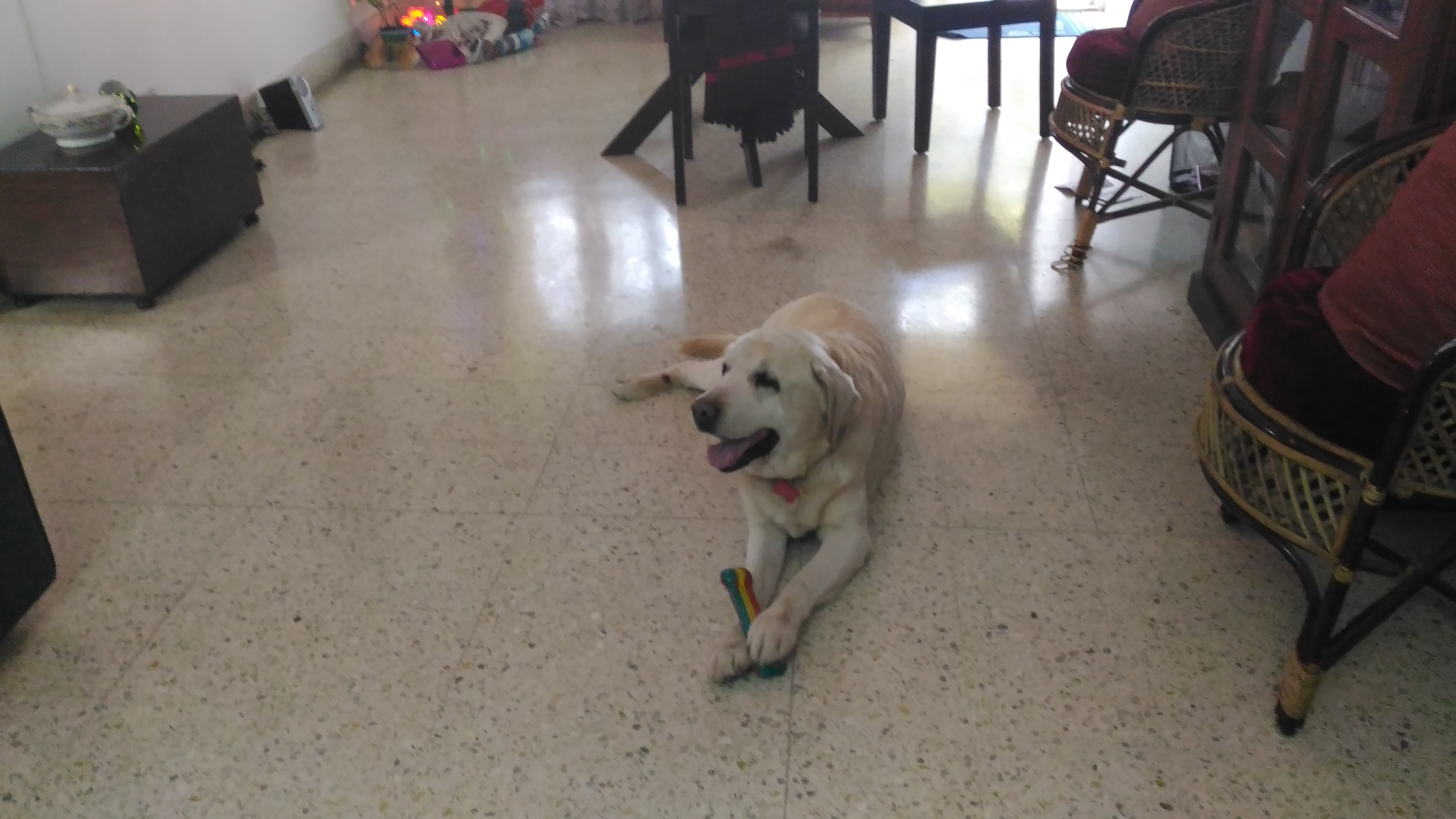
Its 5:30 AM. I am up because our maid is here and Max is up. Yes. We adopted Max yesterday. This was his first night at our home. He wasn’t totally comfortable because ours is his third new home is last five months and he is ten+ years old. We are hoping he will settle soon, otherwise he has been a gentleman.

First day for us with Max

First day for us with Max

Both me and my sister dreamed of getting a dog (not any other pet) since we were kids. Once she even picked up a puppy on the way to home from School. She was asked return the puppy. We weren’t allowed to have one mostly because there was no one to take care and my parents had lost couple of pets already. So it was a long wait. Anju loves dogs equally. When she saw Max was available for adoption, we wanted to adopt him. On our first visit he was all over us and whatever a little hesitation we had vanished.

Now he is here. We are very happy.

19 Dec 19:33

Evergreen line extension opens

by MinistryofTranBC
mkalus shared this story from MinistryofTranBC's YouTube Videos.

From: MinistryofTranBC
Duration: 02:45

The Millennium Line Evergreen Extension connects communities in the northeast section of Metro Vancouver, bringing rapid transit to Coquitlam and Port Moody.

19 Dec 19:33

A View from the Cienega Springs Boat Ramp just before the Storm

by Ms. Jen
A View from the Cienega Springs Boat Ramp just before the Storm

19 Dec 19:33

Canon warnt vor Fälschungen des EF 50mm f/1.8 II

mkalus shared this story from heise online News.

Canon warnt vor Fälschungen des EF 50mm f/1.8 II

Laut Canon befinden sich Fälschungen des Standardobjektivs EF 50mm f/1.8 II im Umlauf. Fotografen können Original und Fälschung dank eines feinen Unterschieds am Bajonett auseinanderhalten.

19 Dec 19:33

My Boss Won’t Let Me Is The Best Cop Out

by Richard Millington

It’s too easy to say “my boss won’t let me”.

It lets you hide from any risk or responsibility.

It lets you tell your buddies; this would’ve been great, if only…

It lets you believe you are great without having to prove it.

I’m often amazed by how many community pros walk away from great companies because they didn’t get everything they demanded.

Are there many organizations that will give a new employee everything they demand? I doubt it.

I have a friend onto his 3rd company within 14 months. Each time he walked away within 3 months claiming “my boss wouldn’t let me do {x}, so I quit”.

You can keep jumping from one organization to the next if you like. You might even get lucky and find the one boss in a thousand who will cede such control to you upon demands. But we can agree it’s unlikely and no way to build a career.

The other option is to confront the two impossible choices.

1) You can get used to doing things without asking. If it works, you’re a hero. If it fails, it’s your head (maybe). You take all the risk and you get the reward if it works.

2) You can learn to get your boss’ support. This is harder. You need to get good at building relationships, learn what your boss needs and solve her problems first. You need to build a reputation for executing on what you say, build a decent case, and drive an emotional narrative.

Neither option is easy. The easy thing is to walk away and start again somewhere else.

Ultimately you’re going to need to decide which of these two options matters most to you. You need to decide how you’re going to act when your request gets turned down. Are you going to put everything on the line to do something great or muddle on through? Are you going to walk away from your community when things get hard or fight for your community?

You’re not going to find a boss that will hand you a blank check. Time for plan B.

19 Dec 19:33

Find My Phone :: A short film by Anthony van der Meer

by Volker Weber

19 Dec 19:32

go-iiif

go-iiif

For a whole bunch of reasons I've found myself thinking about the International Image Interoperability Framework which is often just referred to as IIIF, lately. If you've never heard of IIIF it is a standard developed principally by the library and archives community with three principal areas of interest : Images, publications and search.

The first (images) is a standardized URI-based syntax for common operations around image manipulation. The second (publications) is a declarative syntax for essentially defining learning modules around the idea of the slideshow. The third (search) always seems to stray quickly in to territory labeled metadata which... well, is not my jam but neither is it my party so I just try to maintain a healthy distance.

The IIIF Image API is the thing that's been coming up a lot in a variety of museum-related conversations. Images, and more generally digital assets, have been a bit an albatross around the neck of the cultural heritage sector for... basically, forever. The problem has been made worse year over year as museums embark on ever more ambitious digitization projects that lend themselves to ever more sophisticated tools without really bothering to distinguish the layers of concern (storage, search, processing and delivery) or the mechanics, and more importantly the economics, of how they all fit together.

Historically the solution has been, and continues to be, outsourcing the problem to so-called Digital Asset Management System (DAMS) and more recently Image Delivery System (IDS) vendors. There is a much larger discussion to be had about that but this is not the place, right now. Suffice it to say that if the cultural heritage community wants to take on the challenge of standardizing on some basic image-related tasks and functionality, and even endeavour to write software, common to most institutions then that is an unqualified Good Thing.

Which of course means I had a little bit of a freak out the first I read the API spec over coffee, one morning. The details of the freak out aren't really important. I can be pretty impatient about these things the first time around, not always in a good way.

The relevant bit, for me, is that I kept asking questions and badgering the people I knew who are involved with the IIIF project. So many times in fact that eventually it seemed like the best thing to do to understand the decisions I was questioning and to test whether my criticisms passed muster would be to write an implementation of the IIIF Image API. So I did.

One of the convenient side-effects of a service that standardizes on operations like image resizing and cropping is it doubles as a tiled image server. Think a traditional slippy map but instead of zooming in and out of geography you are zooming in and out of really big pictures of culture. It is hard to explain to people outside the cultural heritage sector just how anxious, defeated and envious the sector has been since the Google Art Project rolled in to town with their fancy gigapixel cameras and the ability to do to works of art what they had previously done to maps.

Some museums have cobbled together their own solutions for making zoom-able images available on their websites; it was defintely one of the things lacking from the Cooper Hewitt collections website during my time there. Some have even open-sourced their toolkits for making image-based slippy maps but nothing has seemed to stick across the sector.

This was the bias that I approached IIIF from. After all, I like maps. The result is go-iiif and you can see a live demo of some of what it does over here:

https://thisisaaronland.github.io/go-iiif/

There is also a local copy at http://www.aaronland.info/weblog/2016/09/18/marshmallows/go-iiif/ for when that link inevitably breaks...

go-iiif began life as a fork of Yoan Blanc's iiif Go server. Almost immediately it morphed in to something different and we quickly agreed that the two code bases should continue independently of one another. Here's the not-so-short short version of what go-iiif does.

  • It moves all of the logic for all of the image processing and IIIF's conceptual hoohah in to discrete packages. This makes it possible to use the same programming logic for both an IIIF server implementation (iiif-server) and offline tools (iiif-tile-seed).
  • It defines separate caching layers for source images and derivatives. What that means, as I write this, is that there is a disk cache for derivatives and an in-memory cache for source images. For example, if you are trying to tile a 12MB image on the fly you probably don't want to load that same 12MB source file on every single request for a 256 x 256 pixel square. Memory usage (and subsequent caching) aside waiting ~ 7 seconds for each tiny little tile to render is a drag.
  • Like the different caching layer source images can also be loaded from multiple providers. There are four of them so far, but only two will be of interest to most people: Things read from disk and things read over the network using a URI template. The most obvious next provider for both sourcing and caching images is Amazon's S3 but I would also like add support for reading images from Flickr and other photo-sharing services.
  • It allows for individual IIIF features to be enabled or disabled via a handy config file. This is the place where the ambitions of a specification meet the realities of implementation details. Sometimes software x just doesn't support feature y. The details don't really matter so much as being able to accomodate them.
  • It allows you to define additional features that are not part of the IIIF spec. So far there is exactly one additional feature: The ability to apply halftone dithering filter to images. Adding new features is possible but it's not elegant so that's a thing that I'd like to have a think about going forward but at least it's been proven to work, now. It may not be obvious to most people but essentially what's happening here is that I am slowly re-implementing all of the logic and functionality used to generate images for the Cooper Hewitt collections website. Also, probably most of filtr while I am at it...
  • It is written in Go partly because the language lends itself to the problem and mostly because it allows for pre-compiled binary versions of all the go-iiif command-line tools. This is not the reality today. All of the actual image processing is handled by the bimg package which is a wrapper for the libvips C library. That still requires a degree of comfort and familiarity installing third-party dependencies which is far from ideal. When I started the go-iiif project half the work was simply an exercise to re-factor someone else's code in an effort to better understand what an IIIF implementation is supposed to do, and how, so I didn't see the benefit in also re-implementing everything in pure Go. That is pretty high on the list of things to do next, as a second graphics engine, which should allow for a standalone version of go-iiif that doesn't require anything more than a simple download. While it may lack the performance of something like libvips it seems important that people in the museum community have something they can try and use with a minimum of fuss. Even if it's only to generate giant bags of pre-cached tiles for slippymaps. That would be progress, I think.
  • There is sample code for capturing screenshots of whatever is currently in the viewport of a tiled-image slippymap and saving that image to your computer. This doesn't really have anything to do with go-iiif. It's all front-end code that other people have written but it's still pretty cool.

The performance of go-iiif is best described as pretty fast to very fast. Generating tiles offline, the bottlenecks are CPU usage and disk I/O with the potential of Go making eiher of those thing worse by trying to do too many things at once. The performace and load testing docs go on to say:

[O]n a machine with 8 CPUs and 32GB RAM I was able to run the machine hot with all the CPUs pegged at 100% usage and seed 100, 000 (2048x pixel) images yielding a little over 3 million, or approximately 70GB of, tiles in around 24 hours. Some meaningful but not overwhelming amount of time was spent fetching source images across the network so presumably things would be faster reading from a local filesystem. Memory usage across all the iiif-tile-seed processes never went above 5GB and, in the end, I ran out of inodes.

So, it's a start. I still have a number of questions about IIIF and pretty serious concerns about ever running a public IIIF server (even this one) in front of a general audience of strangers-on-the-internet so it's not perfect. But, all in all, it feels better than yesterday.

If nothing else it will be useful for Parallel Flickr.

19 Dec 19:32

Changing blog hosts

by Brett Cannon

Sometime on Tuesday, December 20, I'm planning on changing my blog host (there will be a post on the new host about the switch once it's happened). All the URLs for posts should continue to work,including the feed URL (if you follow me through Planet Python then don't worry, I'll update them once the switch has occurred). If you subscribe to my blog through the feed and don't see a new post from me by the end of the week then check that the transition actually occurred and perhaps update your feed URL (although I'm hoping it's not necessary). For those that are subscribed through email notifications, I will migrate the subscription list over. Unfortunately the new platform doesn't support sending emails yet, so if you rely on emails then it might be a little while before you hear from this blog again.

Sorry for the inconvenience caused by this move. It will give this blog HTTPS, AMP support (eventually), running on an open source blog platform, and a slightly nicer editing experience, so hopefully it will be worth it in the end.

19 Dec 19:31

Charting All the Beer Styles

by Nathan Yau

The Beer Judge Certification Program lists 100 styles of beer. Here's a chart for all of them. Read More

19 Dec 19:31

oahu coastline

by Emily Chang

oahu coastline

Photo Caption: oahu coastline

19 Dec 19:30

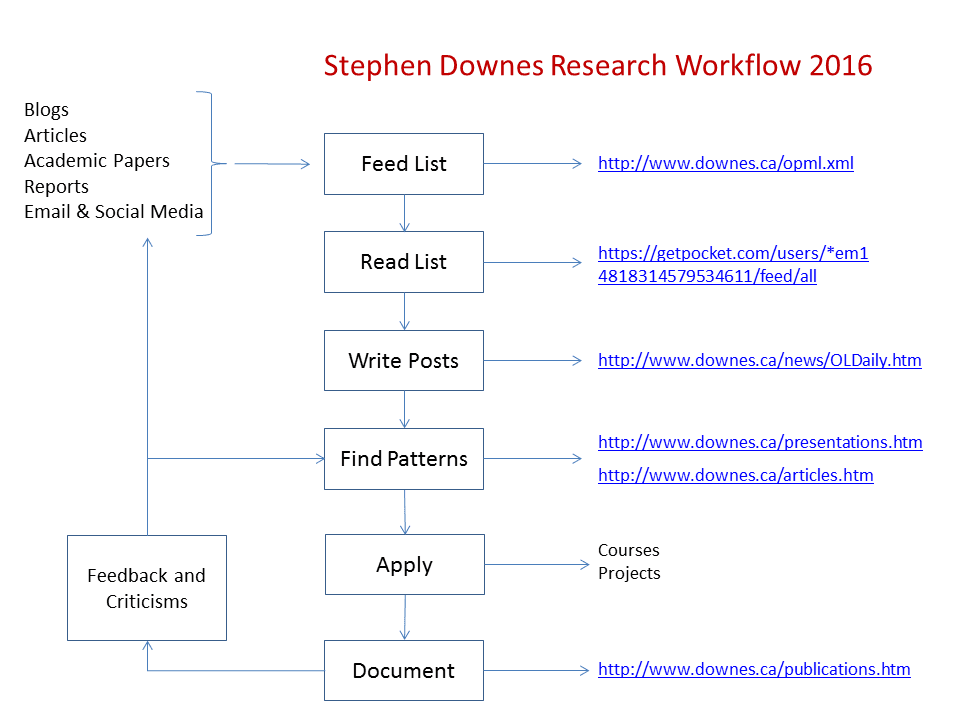
My Workflow

by Stephen Downes
I was thinking about working openly recently and decided to document my workflow, such as it is. As you can see I need to devise a way to make my projects and courses more transparent.


There's also a PowerPoint version of the image with working links. No HTML version, sorry.
19 Dec 19:25

What have you done?

by Bryan Mathers
American Eagle

Well, I suppose it’s not just our lot then – the times they are a changin’ and here comes a generational shift (that’s the hopeless wrenching in your stomach). Yet, surely it’s always been this way. A time for peace, a time for war. A time for truth, a time for deception bots on social media…

The post What have you done? appeared first on Visual Thinkery.

19 Dec 19:25

Vancouver Sun Series focuses on Carcentric Future for Metro Vancouver-Really?

by Sandy James Planner

2

The Vancouver Sun has started a series of articles on traffic and congestion under the ominous title “Waiting for Solutions…The Getting There Scare”.  It is a rather surprising title and has a rather surprising slant-that for you, the Vancouver Sun reader, your commute by car is going to get worse, and that by 2041 there could be an extra 700,000 cars on the road. Never mind that there may also be enhanced transit, higher density dwelling areas close to rapid transit stations  and car shares that would mitigate such a commute. This article buys into the rhetoric that the car is king now and forever.

The rest of the series which will be published this week include articles on Cars Vs.Bikes , traffic on the North Shore, How to stay calm while driving, and Driverless Technology. I was looking forward to seeing a well-balanced discussion on transportation, modal splits, and an update on some of the announcements that have just come out from the Mayor’s Council on Transportation. But no,this is motordom’s response on how to keep cars moving to and from the suburbs, questioning the expenditure of gas tax revenue and the slow expansion of car related infrastructure.

Metro drivers, who paid more than $1 billion in gas taxes in 2015, are asking whether enough is being done to reduce lineups…Motorists contributed $357 million of gas-tax money to TransLink in 2015, subsidizing transit with their wallets. They paid even more by sitting in traffic.Some of that $1 billion could be spent to upgrade traffic lights all over the city; in this day of electronic devices there is no longer any reason for drivers to sit at a red light at an empty intersection”. 

 Encouraging transit use actually would mean that there would be substantially less cars on the road, and active transportation users also factor into increasing road capacity for vehicles. The Sun quotes a UBC engineer who states that planners should be “modally agnostic” — not favour the bike over the car, but judge individual situations on merit” and that  Vancouver may have “overreacted” by favouring bikes too much… It’s a Canadian thing to root for the underdog. Some people treat bikes as a religion. They’re evangelizing it, But cars are in the future for the long term.”

And now for my personal favourite: “Vancouver planners have a different attitude, which creates conflicts when vehicles from the car-friendly suburbs enter the city” . Kudos to Vancouver’s Director of Transportation Lon LaClaire for responding directly stating “There is only so much you can do with a car. Walking, biking and transit are the transportation modes I really care about. To think this is ideologically driven is kind of crazy.”

The whole article reads as a statement/react piece by frustrated motorists, and is indicative of the single car focus so favoured by the Province in their massive infrastructure overbuilds and their relentless pursuit of a ten lane Massey Bridge. It is a good wake up call that there is still much education that needs to happen at the citizen level, and also a call for a more balanced and researched communication about the future of moving in Metro Vancouver.

newskytrainmainst-e1432301248242


19 Dec 19:24

International bike spotting – Sarah Drummond

by dandy

To help us get through the next couple of colder months, dandyhorse is going to be profiling cyclists from around the world! Folks who love to cycle, here in Toronto and further afield, will give us insight into what it's like to cycle in their cities. Want to add your voice to the bikespotting series? Get in touch with us at: cayley@dandyhorsemagazine.com


Sarah not on her regular ride...

Sarah Drummond - Service Designer, London

What is it like biking in your city?

I've recently moved from Glasgow to London so I've got a comparison. In London with more bikes on the road there feels like there is a team behind you.  You have to be a little more sharper and alert as there are more cars and faster cyclists but I love getting around the city faster than most of my friends taking the tube

How are the bike lanes?

London bike lanes are alot better than Glasgow. There aren't many at all in Glasgow, so with the new super highways there is quite a bit of change in London taking place.

What can the city do better?

All round drivers to be more alert around what it's like to be a cyclist - I don't think this is a specific thing to one city, we need to integrate bike training into driving tests.

Where else would you like bike lanes?

Better services to look after my bike on the street and shops who better respected that you might know about your bike.

What is the relationship between cars and bikes?

I feel like, in London I have to be in stealth mode  Show I can take space up on the road and be a bit aggressive. This is unfortunate but I think the only way to stay safe. It's not a concerted aggressiveness, it's more just showing you have strength in the way you carry you and your bike.

If you could summarise city cycling in one word what would it be?

When it's busy, it's a rush and you see everything, when the streets are dead, it's like gliding. It's consistently a juxtaposition dependant on the time of day.

Sarah Drummond is the founder of SNOOK and Cyclehack.

Related Articles

London Bicycle Festival

Bike Plans in Other Cities: Copenhagen, Washington DC and London UK

dandy Scotland part 2: The oldest working bicycle in the world

Vision Zero Summit

19 Dec 19:24

Why western Georgia Street looks this way

by pricetags

georgia-large

Georgia Street from Lost Lagoon to Downtown looks this way now because of a 1982 plan called “Greening Downtown: Design Guidelines for Georgia-Robson Corridor ” – by Baird/Sampson.

Worked great. Doesn’t even have to be green.

(Here’s a 1998 update with lots more detail.)


19 Dec 19:20

New Home Network

Holiday project: Redesign the domestic infastructure. Looking for: Network and storage gear. Got any advice?

Our current setup, a Mac Pro and Apple Airport, work fine. But their combined age is approaching 20 years, disks are getting full, and I’m losing faith that Apple really wants that part of my business.

Requirements

The Internet comes in through a cable modem in the basement in a horrible spot for networking. It’s rated at 150M and measures a little faster than that. The modem has dorky wireless feature which we’ve turned off, and there’s Cat5 coming upstairs to a nice central-but-unobtrusive spot for broadcasting Wifi from. Our house is not that big, an Arts&Crafts box not a suburban rambler, and built of wood. So Wifi should be easy. Having said that, our neighborhood is dense and my Mac can see a total of ten WiFi networks. Is that a lot?

We could upgrade the Cat5 to Cat6 at the cost of a few hours from our friendly family electrician.

Given that, here’s what we want:

  1. WiFi everywhere at whatever speed modern WiFi runs at.

  2. An out-of-the-way box in the basement that can grow to hold a few dozen terabytes of storage with really high reliability (presumably RAID something?)

  3. Auto-backup to the cloud would be nice.

  4. Supports Plex.

  5. Supports Time Machine, because while the future may not be all-Apple, the present pretty well is.

  6. All the iTunes media can go on it, for similar reasons.

First question: Should that list have a #7 and #8?

I’m massively unconvinced we need mesh networking. The Wirecutter seems to like the Netgear Orbi router (damn, it’s ugly) and the QNAP Turbo NAS.

The minimum-effort thing would be to just go out and buy those. Here’s your chance to convince me I should do something else.

Ideally next week, while the sales are on.

19 Dec 19:20

Snow Studies

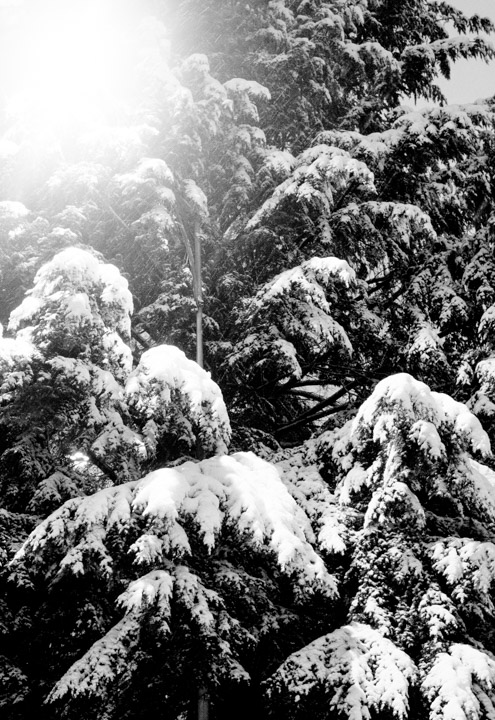
Vancouver’s last two winters had no snow, and never even got very cold. Just now we’ve had a week of white pre-Christmas, with lows down to -8°C. But tonight the rain starts and we’ll hit 9 above tomorrow. So I went out to take snow pictures.

Berries with heavy snow Berries with heavy snow

Our magnolia is never not beautiful Let’s step back from it, enlarge our view enough to see the big evergreen behind it.

Snow-covered branches Snow-covered branches Snow-covered branches

At dusk I walked to the corner for groceries and fresh air, and saw this, photographed it, then came home and overprocessed it.

Snow-covered evergreen

Frankly, I’m looking forward to the rain.

19 Dec 19:18

Samsung has reportedly completed its investigation into Galaxy Note 7 overheating issue

by Rose Behar

Samsung has closed its investigation into the battery combustion issues that caused the company to discontinue the Galaxy Note 7, according to a report from The Korea Herald.

The publication states that Samsung is now reporting its findings to outside laboratories, such as the Korea Testing Laboratory and American safety certification and consulting company UL, but offers no further information on what specifically the investigation found.

In the same article, The Korea Herald reports that in an email sent to employees Mobile Chief DJ Koh is urging employees to keep a tight lid on information about Samsung’s forthcoming flagship, the Galaxy S8.

“I feel deeply regretful to hear news of the recent attempts at data breach and prototype leak,” Koh reportedly wrote, adding: “Samsung had a bitter experience due to the leak of important data — on product design and business strategies — to China and consequently suffered damages in the past.”

The Galaxy S8 is expected to debut in April, featuring (according to current leaks) a nearly bezel-less display and iris scanner.

19 Dec 19:18

Samsung to reportedly unveil Galaxy S8 at upcoming New York City event

by Igor Bonifacic

In a break with tradition, a new rumour suggests Samsung may announce its next flagship device, the Galaxy S8, at a dedicated event in New York City, not Mobile World Congress as it has done over the past number of years.

According to a Korean website sourced by SamMobile, which says the information comes courtesy of global strategy meeting underway at Samsung’s headquarters in Seoul, South Korea, the company plans to move the announcement so that it can work with external agencies to recover consumer confidence in its mobile products following the disastrous Note 7 recall.

Ironically, DJ Koh, Samsung’s mobile head, spoke about the importance of minimizing leaks during the conference.

Whenever and wherever Samsung announces the S8, the company is expected to follow its usual release cadence, with the device likely to hit store shelves sometime in March.

19 Dec 19:17

One Explosive Photograph Sums Up America's Relationship with the Media

by Nathaniel Ainley for The Creators Project

State of the Union, Levi Jackman Foster, 2016. Image courtesy of the artist

In a barren valley in Idaho, a man sits and reads the newspaper on a plaid couch engulfed in flames. The front of his newspaper contains a picture of the inflamed piece of furniture, making it look like the man is reading about the fire raging next to him. The photograph, State of the Union, was staged and snapped by New York artist and activist Levi Jackman Foster. For Foster, the picture is an artistic interpretation of America’s relationship with the media. Instead of reacting to the drama unfolding right in front of him, the man focuses all of his attention on reading a journalist's interpretation of those events.

With the rise of social media and online news outlets, Americans have begun to curate their exposure to news so that it reinforces their already established worldview. According to a data study cited by VICE News, “results suggest that even as voters have instant access to more information and perspectives than ever before, they segregate themselves into clusters of like-minded people often with little connection to those with other views.” Foster seeks to address this divisiveness through his art and inspire fellow citizens to confront their own opinions as well as ideologically different ones.

State of the Union is Foster’s latest viral photograph. When it was shared with his +200,000 followers on Instagram, it spread across multiple social media platforms amassing more than 12,000 ‘Likes.’ The Creators Project spoke with Foster to talk about some of the issues State of the Union addresses:

The Creators Project: What sparked the idea for State of the Union?

Levi Jackman Foster: I had actually seen a different artist set a doll house on fire, which I thought was interesting. The narrative wasn't necessarily similar. I think it was more of just a visual stunt. But the more I thought about it, I started to consider all the parallels. Initially, I felt like it could be the White House—obviously I don’t condone terrorism or think the White House should be set on fire—but it made me consider everything that’s going on in our country politically and the many social issues being confronted in strange and divided ways. [...] There’s so many instances where people are not really seeing eye to eye, and I feel like it’s really tearing the country apart. I think a lot of it comes through education and people not taking the time to know where their news comes from and not taking their time to grasp that they’re part of the situation.

Yeah it’s crazy how much blame is being put on the media over this election.

Absolutely. I feel like this divisive language and this selective hearing is dividing people in a way that I really think is destroying us. I personally feel that Trump’s victory was a huge setback for our country. [...] Because he essentially did what I think was done in Nazi Germany. You select an other, and the other is causing your problems. That's where I think our sofa is on fire. I think that we’re sitting back, like the picture very clearly depicts, we are reading the news of this, while our situation in itself is corroding. We are part of the issue, but instead of understanding that we're part of the issue, we're just reading about it, which I think is such a bizarre notion.

And the model in the picture isn’t even acknowledging that there is a fire next to him.  

He’s unaffected. He's not even getting up. We’ve become so unaffected. When Eric Garner was strangled to death, I organized a lie in. And people’s response was, "Ugh, this is so inconvenient. You know you’re blocking our way home, in rush hour?" And it’s like what’s inconvenient is that a man lost his life.

I think we’ve become desensitized to these crucial and critical issues, because if it doesn't affect us directly, then for some reason it doesn't affect us at all. In the picture, I'm trying to show where it’s starting to affect him directly. The problem may not have been on his doorstep yesterday, but today it’s on his sofa.

And in the picture on the paper, the couch looks like it’s completely engulfed.

I actually just cropped the half that was on fire. I tried to make the photo look as minimally edited as possible. It's real. He is sitting next to an actual fire. That’s actually the very last frame I got before he jumped up. I had three people standing adjacent with fire extinguishers and a big bucket of water. It was the fastest shutter speed I could do, by just holding down the trigger and getting an accurate light reading so I could take the image. That couch was made of polyester or something and I put gasoline on one half of it. The second shot is of him jumping up and the paper actually catching fire as he’s jumping up. It’s kind of flying behind him. 

I didn’t want him to catch fire, obviously, and I didn't want to start a forest fire. I was really careful about being able to put it all out quickly, and he was totally fine. It was a piece I planned out for quite a while. I traveled out to Idaho to take it because I had family near there. I was looking in areas where I had relatives or something so I would be able to use a car to buy a used sofa and drive out to the middle of nowhere, but also be on land where I’m not breaking any rules to create the image. Out there I was able to find this area where there are no regulations.

Did the location serve any aesthetic purpose?

Initially, I was looking in California, but I didn’t find any place where I could legally create it. I really wanted dry brush. I want to show that there’s a drought and everything around the sofa is flammable. That was very much a part of the image and the narrative: "This fire travels fast." 

I think that it’s a parallel to society today and this alt-right movement. I’m terrified that this is going to catch on, [...] and I feel like a lot of conservative people are leaning towards the alt-right because they're inundated and sick of hearing about [issues like race relations and climate change]. They feel like [people advocating for these issues are being] cry babies instead of these being real issues that need to be addressed. They feel like their personal issues aren't being addressed and so are asking themselves, "Is the other’s situation that dire? My situation is pretty bad. I’m making $20,000 a year and I’m struggling to survive." I think people are starting to rationalize, in my opinion, disgusting thoughts, and I'm afraid that it's starting to catch fire. I’m afraid that this alt-right movement is going to spread a little bit more than we thought was possible, in the same way we didn’t think Trump getting elected was possible. I feel like the country is taking this really strange turn.

How do you feel visual media can incite change and impact public opinion?

I think that today, with millennials and the way that we share memes and GIFs, we’ve become addicted to instant gratification through imagery. I think that for a message to be listened to and accepted by mass groups of people, the image comes first. And I don't think that’s necessarily a new idea. We’ve had front page images on newspapers for how long?

We as artists have to make something shocking that really captivates someone and makes them look further, and dig deeper, and not just read, but get involved. It’s something I’ve worked really hard to do. I used Instagram as a way to sort of discover myself as an artist, and I learned really well what grabs people. The first cause I  joined up with was AIDS/LifeCycle and I was able to raise $160,000 through Instagram for that charity. I’ve partnered with other organizations, as well, for various causes and have been able to actually get people to take action. And that starts with imagery.

See more of Levi Jackman Foster’s work on his website.

Related:

18-Year-Old Photographer Gives a New Lens into Youth Culture

Abdul Abdullah Photographs the Isolation of Australian Islam [Exclusive Interview]

The "Duchess of Disintegration and Decay" Gets a Documentary