
I’m just going to leave this here, because it gets so much right that I currently can’t really be bothered to put into words.
(And that, in and by itself, is a telling measure of the disconnect I currently have towards Apple)
I’m just going to leave this here, because it gets so much right that I currently can’t really be bothered to put into words.
(And that, in and by itself, is a telling measure of the disconnect I currently have towards Apple)
mkalus
shared this story
from  netzpolitik.org. netzpolitik.org.
|

Das Spiegel-Verlagshaus an der Ericusspitze in Hamburg.
Foto: CC BY-ND 2.0 by Sera Photography via flickr.
„Big Data“ mal anders: In seinem Vortrag beim Chaos Communication Congress hat David Kriesel heute gezeigt, welche Möglichkeiten eine Datenauswertung über die Zeit für eine große Menge Artikel bietet – und einen interessanten Überblick über das publizistische Wirken von Spiegel Online gegeben. Der Informatiker hat über viele Monate hinweg alle Artikel Deutschlands meistgelesener Nachrichtenseite automatisiert runtergeladen und danach Metadaten und Inhalte analysiert.
Spiegel-Online hat in den letzten beiden Jahren knapp einhunderttausend Artikel veröffentlicht, die von Kriesel mit Data-Science-Techniken bearbeitet werden. Er wertet die Artikel nach Rubriken und Ressorts aus, berechnet statistische Angaben über Veröffentlichungshäufigkeiten und Verschlagwortung, baut Autorenlandkarten und setzt sich mit der Frage auseinander, bei welchen Themen Kommentare zugelassen werden und bei welchen Kommentarsperrungen typisch sind.
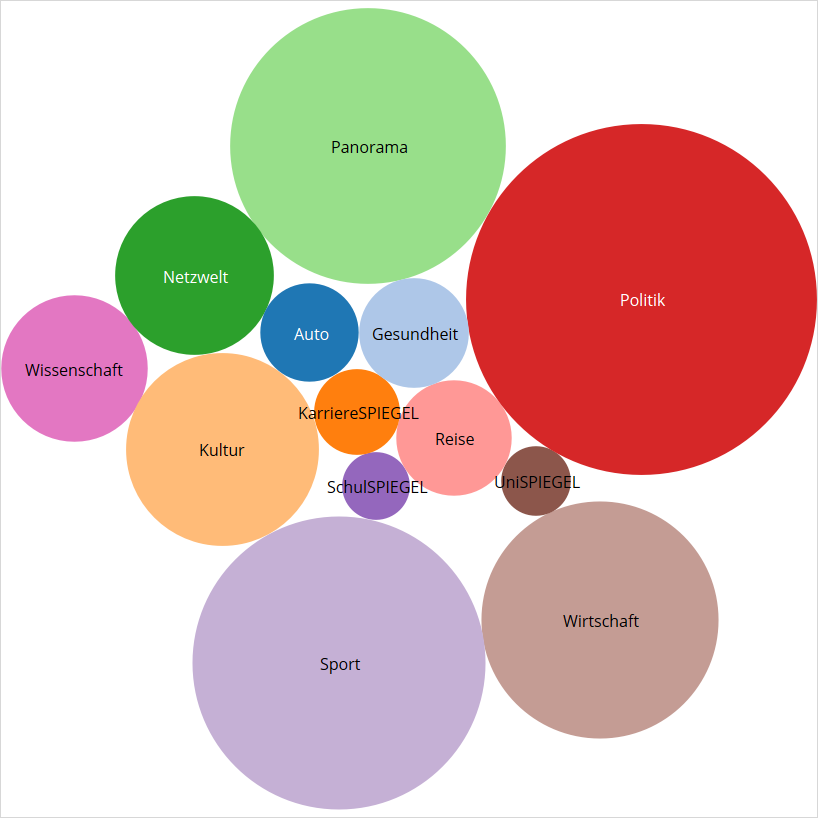
Die Themenbereiche von Spiegel-Online in der Übersicht.
Die von Kriesel gesammelten Artikel sind anfangs viermal pro Stunde, später alle fünf Minuten runtergeladen worden. Das macht es auch möglich, über den Zeitraum von zwei Jahren Korrekturen und Veränderungen in den Artikeln zu überschauen. Denn von den meisten erschienenen Stücken hat Kriesel mehrere Versionen eingefangen.
Die einfachen Auswertungen sind aber zunächst die Zuordnungen der Artikel in ihre Themenbereiche, um die Anzahl zu bestimmen. Die nebenstehende Visualisierung zeigt dann einen Überblick: Die Größe der Kreise gibt die Artikelanzahl pro Rubrik wieder. Es wird sichtbar, dass „Panorama“, „Politik“ und „Sport“ zusammen etwa die Hälfte aller veröffentlichten Artikel in dem erfassten Zeitraum von 2014 bis heute waren.
Kriesel betrachtet auch die einzelnen Rubriken im Zeitverlauf. Dabei stellt er fest, dass beispielsweise die Wissenschaftsberichterstattung ist in der Tendenz abnehmend ist.
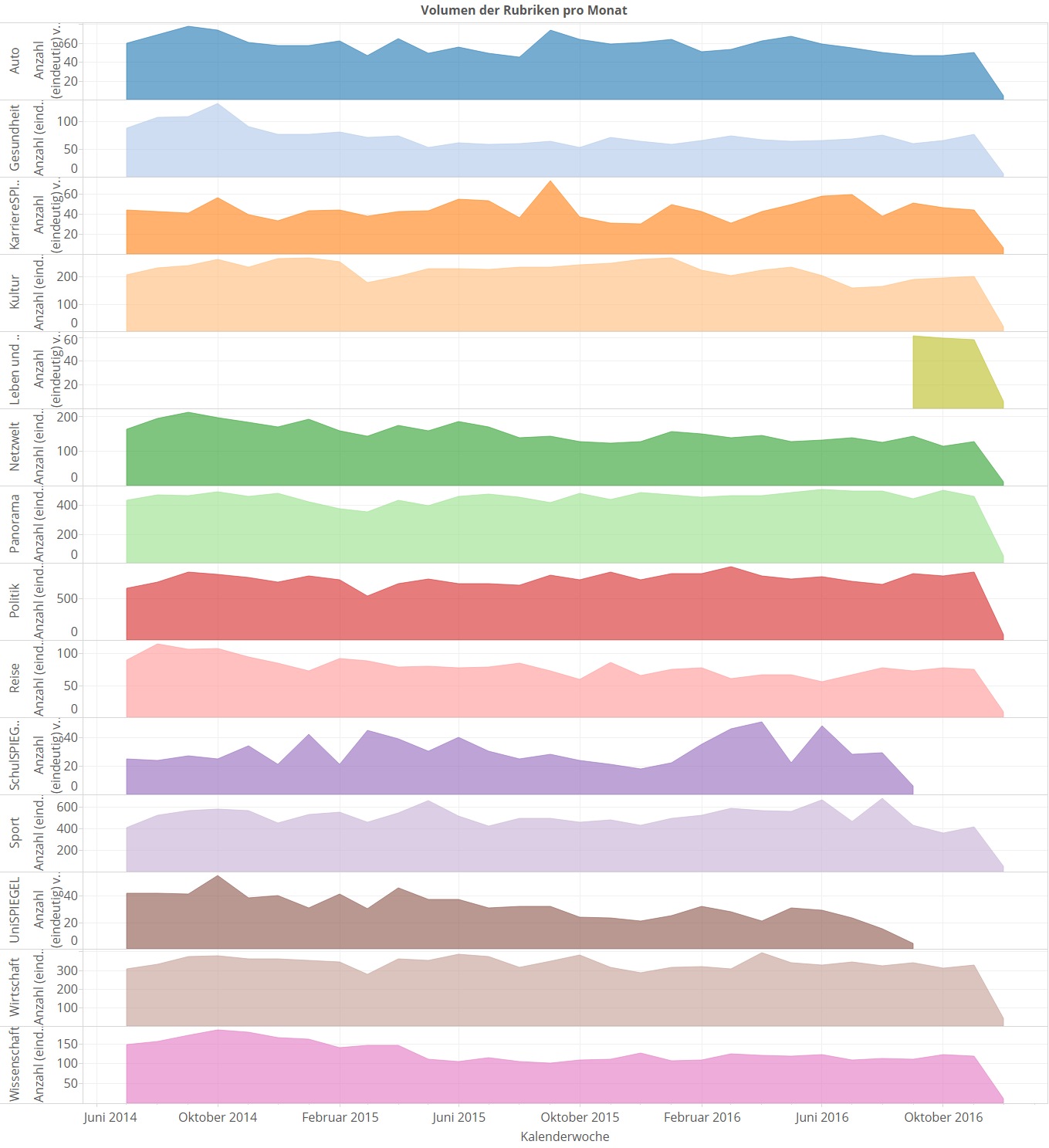
Volumen der Spiegel-Online-Rubriken pro Monat.
Kriesel zeigt einfache zeitliche Analysen nach Wochentag und Uhrzeit. Das Ergebnis ist erwartbar: Die Häufigkeit der Veröffentlichungen ist wochentags höher als wochenends und über den Tag natürlich nicht gleichverteilt, sondern im Zeitraum von 5 bis 20 Uhr konzentriert. An den Wochenenden erscheinen etwa halb soviel Artikel wie in der Woche.
Spiegel-Online veröffentlicht durchschnittlich siebenhundert Artikel pro Woche, also etwa einhundert Artikel jeden Tag. Kriesel versucht, die Auswertungen der großen gewonnenen Datenmenge möglichst anschaulich visuell darzustellen und quasi „Big Data“ greifbar zu machen. Er erstellt Übersichten und auch riesige Landkarten aus den gesammelten Informationen.
Eine der Landkarte stellt er mit Erläuterung auch zur Verfügung, um weitere Forschung zu ermöglichen. Außerdem forderte er die Zuhörer auf, mit neuen Auswertungsideen gern auf ihn zuzukommen. Kriesel rief dazu auf: „Ideen her!“
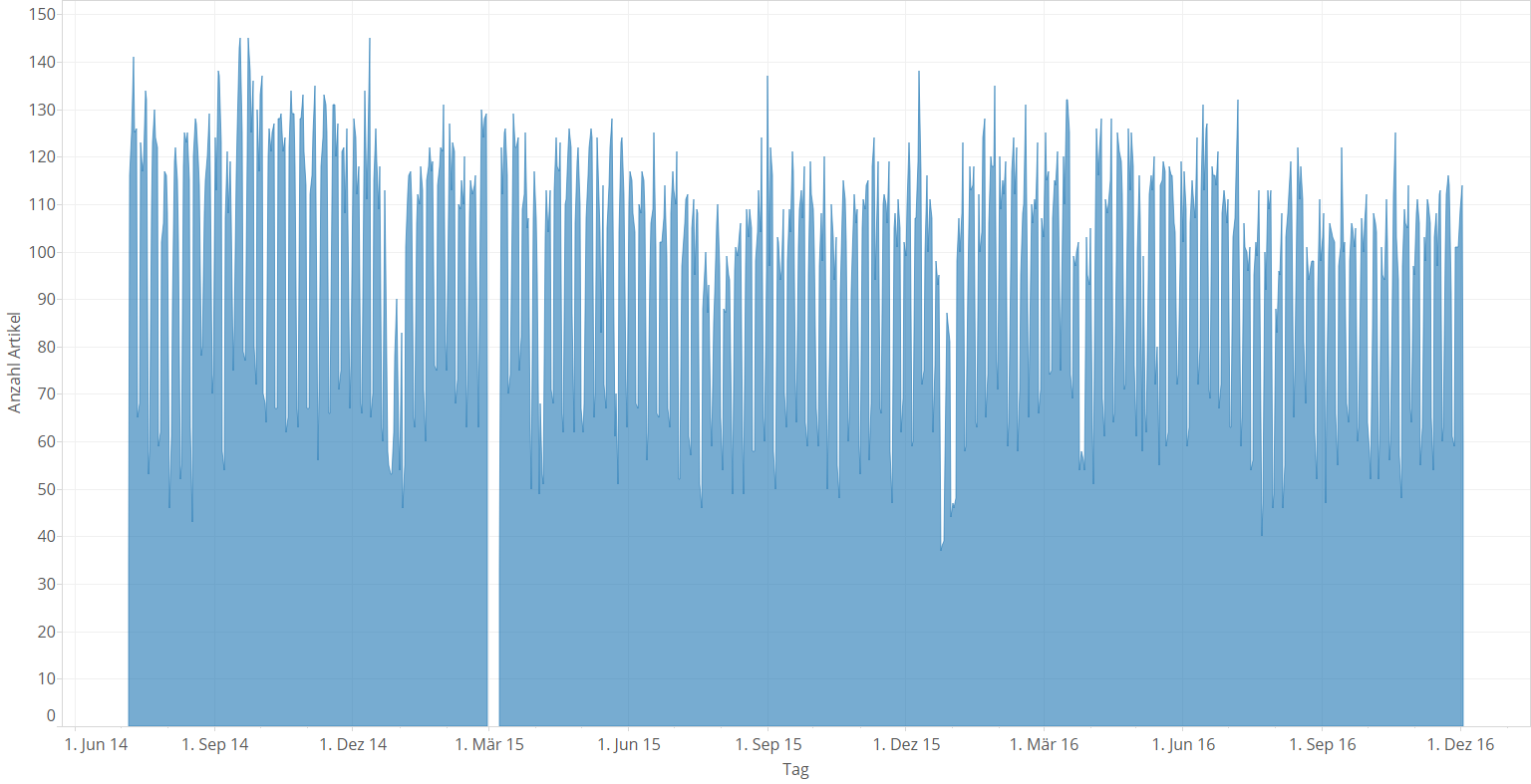
Spiegel-Online-Veröffentlichungen, Anzahl der Artikel pro Tag. (Datenstand: 4. Dezember)
Die Analyse widmet sich auch der Verschlagwortung, die eine inhaltliche Analyse erleichtert. Bei Spiegel-Online werden jeweils durchschnittlich etwa zehn Keywords den Artikeln zugeordnet, die auch mehrere Worte umfassen können. Seit 2016 hat sich die Anzahl der Keywords allerdings verringert, pro Artikel sind es derzeit nur noch etwa fünf.
Die blanken Zahlen sind beeindruckend: Allein 65.000 verschiedene Keywords waren auszuwerten und in Keyword-Graphen einzubauen. Darüber lässt sich auch ermitteln, welche Themen inhaltlich verwandt sind.
Die Tags erlauben zudem einen anschaulichen Überblick über die mediale Agenda. Lässt man die Rubriken, Überbegriffe der Themen und Sport außen vor, waren die am häufigsten verwendeten Schlagworte im Jahr 2016: Geflüchtete (1.887), Syrien (1.280), Donald Trump (1.007), Islamischer Staat (853), Angela Merkel (810), US-Präsidentschaftswahl 2016 (789) und Recep Tayyip Erdogan (634).
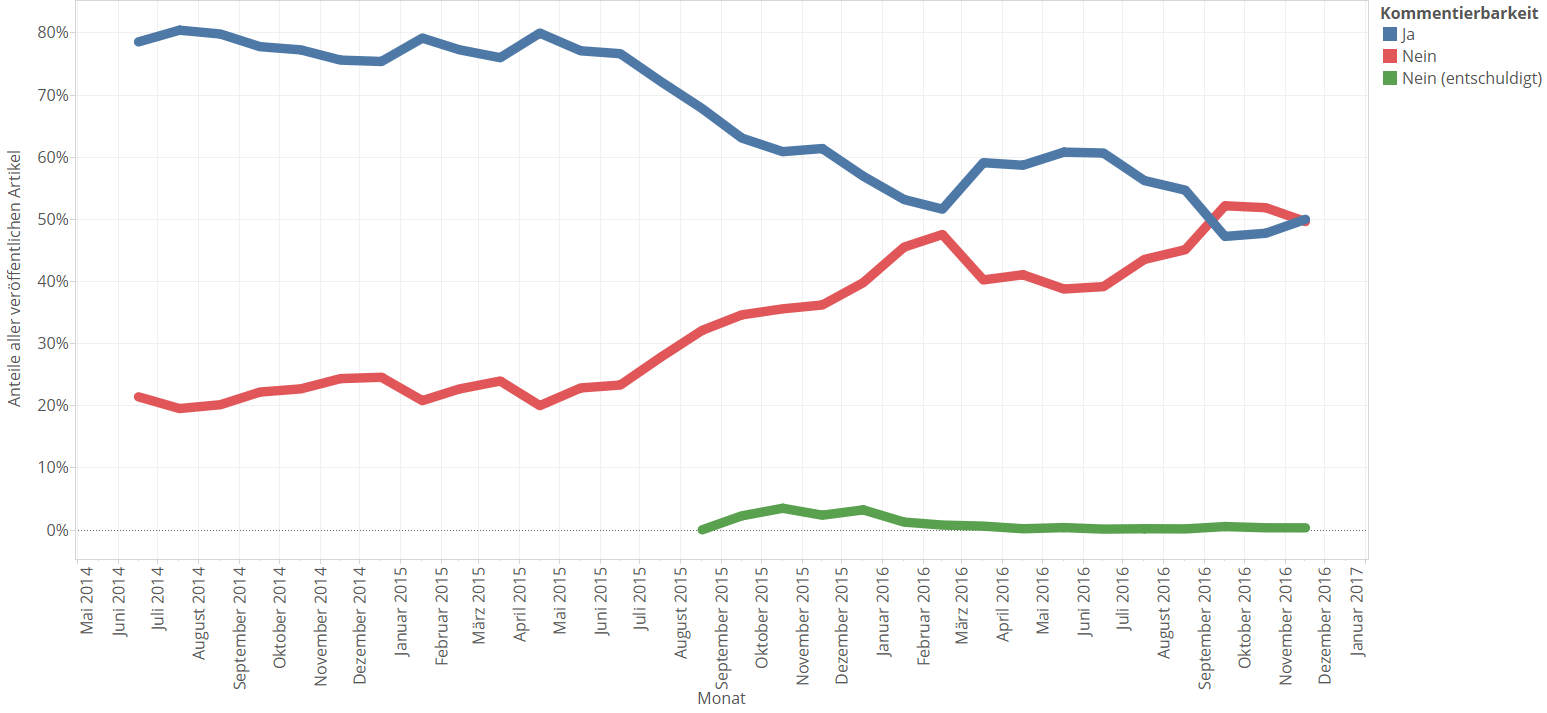
Anteil der kommentierbaren Artikel in allen veröffentlichten Artikeln, ab Mai 2014.
Im Durchschnitt sind etwa 70 Prozent der Spiegel-Online-Artikel kommentierbar. Seit der zunehmenden medialen Aufmerksamkeit für Geflüchtete wird eine Sperrung der Kommentarfunktion von der Redaktion jeweils mit einem kleinen Text begründet.
Ein typisches Beispiel, das Kriesel nennt, ist die Justizberichterstattung. Geht es um Morde, Attentate oder generell um Kriminalität, darf nur selten kommentiert werden. Für andere Themenbereiche, beispielsweise den Brexit oder allgemein bei der Berichterstattung über Großbritannien, sind keine Kommentarsperrungen üblich. Generell zeigt aber die zeitliche Entwicklung, dass die Kommentierbarkeit in der Tendenz eher abnimmt.

David Kriesel.
Bei welchen Themen ein Kommentar erlaubt bleibt, ist durchaus ein Politikum, wie Kriesel an vielen Beispielen zeigt. Etwa zu Fragen des Nahostkonflikts und zu Israel sind so gut wie alle Artikel mit Kommentarsperrungen versehen. Wenn es beispielsweise um Frankreich geht, waren Kommentare so lange erlaubt, bis es zu dem Anschlag in Paris kam: Ab November 2015 wurden dann die meisten Frankreich-Artikel unkommentierbar.
Kriesel hat weitere solcher Beispiele analysiert, die auch zeigen, bei welchen Themen Kommentarsperrungen gerade nicht erfolgen. Wer dazu mehr wissen will und sich gleichzeitig über das Auswerten und die Visualisierung großer Datenmengen informieren möchte, sollte sich den Vortrag ansehen.
mkalus
shared this story
from  The Online Photographer. The Online Photographer.
|
Hearken ye! I'd like to blather just a bit about a very old word, yeoman.
But first: I'm being kind of a stumblebum this year. A sluggard. What used to be called, back in the dim, swiftly receding days of the 'nineties, a slacker. I posted Part I of the "Recommended Cameras" list way back on December 6th, and haven't even gotten around to writing Part II yet. (This isn't that.)
I hate it when I do things like that. I think at some point during my fifties, my get up and go got up and went.
I'll work on that soon. (The list, I mean, not my gumption, moxie, work ethic, spirit of enterprise, etc.—my current activity level is age-appropriate. As the great Uncle Arthur Kramer used to say, I'd work harder, but it would interfere with my nap.)
Meantime, it struck me that like many reviewers, I naturally concentrate on talking about high-level cameras in every line. The ones that offer the highest performance and the most appealing "it" factor. Before it arrived, I assumed I would include the new Olympus E-M1 Mark II on the TOP list.
But when it arrived on the scene, I was taken aback by the price. Two thousand dollars. For a Micro 4/3 body? You can get a Panasonic GX8 for $800 less even when it's not on sale. Same for Olympus's own Pen-F. You can get a full-frame Sony A7 Mark II mirrorless for $500 less.
So is that...smart?
Granted, it's an "overdeveloped" camera, as Olympus told DPReview. Granted, it's targeted at pros, who might like a striver's level of snappy performance and to whom a few hundred dollars tacked onto the purchase price might not matter in the grand scheme of the financial statement. Granted, its level of performance is class-leading in many ways. And it's well designed and pleasant to use, despite having its On/Off switch in an annoying place. I liked the Mark I, which I owned briefly. (And which is still available. For a nice price. You can get it in a kit bundled with the $700 12–40mm ƒ/2.8 zoom for $1,300—$700 less than the Mark II body with no lens.)
But...two grand. It made me think twice, and then think again. Is the E-M1 Mark II truly recommendable at that exalted price?
I know people who will buy it, many of them gladly. But what about people for whom the value equation is important? That includes a lot of us. It even includes a lot of people who could afford an E-M1 Mark II if they wanted to.
The E-M1 Mark II's stabilization may be the best of any camera's.
It's so, so tempting to chase the latest and best. Top models of anything are "no apologies." (Well, at least for three or four years, until they get superseded.)
But it might be smartest, just in terms of spending your money intelligently, to pick the lineup you like the best and then buy the next best camera, whatever that is. Thus:
Or even...
And so on. You get the idea.
The strategy might not be sexy, but it's sound.
Medieval metaphor
And now for "yeoman," and you can stop reading right here unless you enjoy reading my nonsense.
Yeoman is a tough word to get a handle on—it means many things, and none of them seem to quite relate to each other. A class in England below the gentry. (Not very helpful, given that most of us are hazy about what "gentry" means, too.) A clerk in the Navy. The owner of a small farm (we have lots of yeomen around where I live, if that's the case. Or can you be both Amish and a yeoman?). In medieval times, a servant ranking higher than a page but not quite as high as a squire. Without getting into a tangle of etymology, competing meanings, and mildly conflicting mental images, I think basically yeoman means one who serves, but solidly; a stalwart; someone who is loyal, dependable, and responsible. Someone who does drudge work because it needs to be done, but works well.
Anyway I think one might call these second-tier, near-top-of-the-line, more value-oriented, second-rank cameras yeoman cameras.
Okay, that name won't catch on. I'm not good at naming things. But you get the idea. From these yeoman cameras you get 80% of the performance of the glamorpuss line-leader cameras, but for more reasonable prices. They're reliable. Sensible.
The smart buy.
The GX85 instead of the GX8. Anybody use the X-T10? Are ya happy enough?
...Because sometimes, you'd like the top of the line, but you just don't feel like parting with two grand for an electronic device that's going to be yesterday's news three to five years from now.
Nothing against the noble Olympus E-M1 Mark II.
Mike
Original contents copyright 2016 by Michael C. Johnston and/or the bylined author. All Rights Reserved. Links in this post may be to our affiliates; sales through affiliate links may benefit this site.
Yo, man!
Like Mike or Patronize TOP’s affiliates
(To see all the comments, click on the "Comments" link below.)
Featured Comments from:
Luca: "Cameras are now computers, and with computers the smart strategy has always been exactly the one you just described, i.e. buying the 'second best.' And frankly unless you're a sport / war / extreme situations in general shooter I don't see the point to have an ultrafast camera (and even then something like the A6500 or the A77 II could be all you need anyway). Essentially, maybe 0.1% of us 'need' (as opposed to 'want') an EOS 1Dx, a Nikon D5 or even an Olympus E-M1 Mark II.
"And the X-T10, by the way, is an awesome camera!"
Marcelo Guarini: "I was waiting for the OM1 Mk II, but after reading its specifications I realized is not my camera. I don't need a camera for fast action, sealed for Mars sandstorms and freeze-proof for the dark side of the Moon. Amazon had the Pen F for $945 during a couple of days in November, so I got one and I couldn't be happier. Image quality is better than my OM-1 and so is the in-camera stabilizer. Last night I took several perfectly sharp handheld half-second shots. I'm loving this little camera."
Gordon Lewis: "Whether it was wise for Olympus to price the E-M1 Mark II at $2,000 and whether it's wise for someone to pay it are two different issues. The issue is moot for me because I can't justifying paying that much for any camera. I'm doing what you suggest in your post: looking at cameras that do most if not all of what I need a camera to do, at a lower price than the top of the line. Instead, I'll use the money I save to spend on high-quality lenses. As you say, cameras come and go, but good lenses are good for a lifetime."
Mike replies: I agree with you entirely except for the very last word of your comment. Seems to me the only lens line I could have used for my lifetime—mine being similar in span and era to yours—is the Leica M line. And with that there are, and have been, many other compromises. Seems to me when you and I were young we could have invested in the Canon FD lens line, and, while those are newly "good" again—on a full-frame mirrorless digital camera—there have been significant stretches of our lifetimes during which they would not have been good.
But if you had said "for a longer time" or even "for a long time" instead of "for a lifetime," then we would agree.
Dennis (partial comment): "I've noticed many times that I tend to be happier with things that I've paid more than I've wanted for than I am with things where I've compromised out of frugality. I love a good 'price performer' but over time, I have far more regrets about bargains than I do luxuries. So my recommendation is don't buy based on perceived value nor just because something is state of the art—buy what you want."
beuler: "It seems to me that Olympus is putting the E-M1 Mark II up against the Canikon 1D X Mark II / D5. Brave but stupid? Let's wait and see. In any case it is the cheapest of the three."
Arg: "One only needs to read the featured comments by Dennis and Gordon to confirm that the real driver here is one's personal values. By which I don't mean anything unique, but rather the common value sets. For example, valuing exclusivity highly is a common set, as is valuing economy."
 Central Park, face to a tree. Images via
This article was originally published on December 30, 2014 but we think it still rocks!
Abstract paintings propogate in artist Chang Liu’s Wild Growth, a Processing application that generates artworks from data gathered from live videos. The interactive project was created for the 2014 ITP winter showcase, and features Liu's Jackson Pollock-inspired investigation into the boundaries of order and disorder, algorithms and handiwork.
Citing Untitled 6 by Camille Utterback and Body Paint by Memo Akten, two other paint-by-media works, as references, Liu decided to use Processing to create Wild Growth, employing a live camera feed that “sees” colors when positioned toward natural environments, pictures, or human subjects. In turn, her software “paints” the colors into quick-generated portraits that blossom out of paint drips, splatters, and brush strokes. “The whole process is similar with plant growth. It’s wild growth in digital world,” she explains.
Watch one of Chang Liu's painting come to life, and see some of her other Wild Growth works below:
 From the Brooklyn Botanical Garden


To learn more about the artist click here.
Related:
Abstract "Paintings" Created Entirely By A Computer
80 Spotlights Bathe a UK Palace in Light and Sound
This Glowing Painting Comes To Life When You Walk By, Knows Your Every Move
Manfred Mohr Plays The Machine, Turning Algorithms Into Visual Music
 Diane Bronstein, GRAB THIS!, 2014, 11.5”W x 6”H, Cat food labels, packing paper, cotton thread. Flower Mound, Texas
Nasty Women from every corner of the country and the world will flock to Queens this January for the inaugural NASTY WOMEN Exhibition. The event, coordinated by co-directors Roxanne Jackson and Jessamyn Fiore, along with web designer Barbara Smith and curatorial advisor Angel Bellaran, aims to be the thinking-woman’s answer to prevailing post-election anxiety. It is a crowd-sourced, group show of female and female-identifying artists of all ages, races, religions, nationalities, sexual orientations, gender identifications, and backgrounds. Running from January 12 to 15 at The Knockdown Center, the show will exhibit affordable works ranging from $10 to $100, and 100% of the sales benefit Planned Parenthood.
A grassroots, open call for artworks returned over 1000 submissions from no less than 694 artists, forcing the organizers to close submissions earlier than expected. The works culled from this call are exactly what the show’s moniker decrees, namely a cross-section of furiously creative women expressing themselves and their outrage through colorful performance art, body-positive watercolors, and—unsurprisingly—panties quilted from cat food labels.
The works will ultimately be displayed on the show’s centerpiece: 12-foot-tall letters armored in flamingo pink plastic mesh spelling out N-A-S-T-Y W-O-M-E-N — or as Jackson describes it, a “provocative installation plan” which mounts “a declaration of protest.”
 Image courtesy of the Nasty Women Exhibition organizers
The immediate and enthusiastic feedback to this first NASTY WOMEN Exhibition has led to an outcropping of sister exhibitions in different cities across the globe. So far, this list of iterations ranges from Nashville, Lexington, Portland, and Omaha to Brussels and Melbourne, with more than a dozen locales in between. While these exhibitions will be linked ephemerally by social media and press, Jackson and Fiore are encouraging organizers to “bring their own spirit” to the shows, which includes supporting whatever women’s rights organization or nonprofit they see fit.
As the dates of both the inauguration and the inaugural NASTY WOMEN Exhibition rapidly approach, The Creators Project talks with co-directors Roxanne Jackson and Jessamyn Fiore about the show’s genesis and how to “DO SOMETHING” in the face of an impending Trump Presidency:
 Laura Nova, TITLE: Six Circulation Fist:, a series of 36 postures, 2016, Digital Print, Artist proof
The Creators Project: How did this project come to be?
Jackson: Early one Monday morning, barely able to acknowledge the new day, I was drinking a cup of coffee, checking my email and Facebook while listening to NPR. I was so distraught about the impending doom of a Trump presidency and still in a state of shock… How did this happen?! How did we get here?! And where the HELL are we going?!
I had the spontaneous idea of getting women together to put on a NASTY WOMEN exhibition. Having marched to Trump Tower the weekend prior with [Jessamyn, Angel, and] thousands of other angry protesters, I felt emboldened and even empowered by the shared rage of my fellow strangers, united with the recent election and upheaval. On Facebook [on November 14,] I posted, “Hello female artists/curators! let’s organize a NASTY WOMEN group show!!! Who's interested??? We need a venue!!!!!” This post went viral, and within minutes, this nascent idea began to manifest into something more tangible.
What are your objectives for this show?
Jackson: In addition to the fundraising component of this project, I’m excited about this art exhibition as a form of protest. In an effort to be as inclusive as possible, we are accepting all submitted artwork for this show, regardless of content, as we are focusing on the solidarity of women coming together to object the Trump regime, rather than curating a more typical exhibition.
Fiore: But I have realized it is more than just its physical iteration: it is also about creating real-life connections. Like me, like many others, the women who are participating in this exhibition want to DO SOMETHING—and artists make their voice heard through their work. Art is an action.
 Rebecca Murtaugh, TITLE: Aperture: June Berry and Gladiolus, paint and mixed media, 2016
What is the status of these objectives post-election?
Jackson: In general, I think dealing with abjection is one of the most powerful and effective roles of contemporary artists; and, with the current political climate this seems even more relevant. Transgressive work is a more accurate expression from a culture that has been engaged in war as long as we can remember, one that has a severely unequal stratification of wealth, a culture that disproportionately locks up poor minority groups for maximum sentences (while the same crimes from white offenders are penalized with rehab), religious groups that denounce science and inspire their congregation with fear and hate, not love and tolerance. In this polarizing climate, abject work is relevant. Its holds a space and gives us permission to be outraged, to feel deep emotion, and to express vulnerability. To cry out. And, ultimately to unite and stand against oppressors as humans have always done.
Fiore: It sometimes feel a bit like suspended animation, because we know some terrible things are coming, but the question is what to do to prepare? Protesting, organizing, all of this is important. I think right now for me it is about actively creating connections, creating solidarity in the real world (not just online), finding your allies, finding your collective strength and voice, so that when the blows do start coming we have a solid base from which to respond.
 Gina Dawson, TITLE: A really good decision I made once - aka tribal angel tramp stamp, 2015, Watercolor on Panel
Explain to me the ‘business model’ of the exhibition.
Fiore: For The Knockdown Center NASTY WOMEN Exhibition we have asked all the artists submitting works to price them at $100 or less. We want low prices because I think it’s important that the works are very affordable so anyone can buy them. I want audience members who have never bought a work of art before to come to the exhibition and be moved by the experience and fall in love with a piece and think “$30, yeah I can afford that, and I’m helping Planned Parenthood!”
Jackson: I would like to add that this will be a “cash and carry” exhibition—meaning that people who purchase works will be able to walk away with them, as opposed to waiting until the end of the show. This approach will also provide a dramatic visual, as the letters initially teeming with works will dwindle down, a testament to the funds raised for Planned Parenthood.
What have you learned or what has surprised you in the time after launching the idea for the exhibition?
Fiore: I thought when we first started this that most of the submissions would be from the NYC area. I was so wrong. [...] I have been surprised by how wide this has reached, and deeply humbled really. Living in New York, we are often accused, perhaps justly, of living in a bubble. But the reaction this has received and the connection I feel with so many of artists who have submitted their work from places I have never been to, who have had life experiences so different from my own, and here they are eloquently expressing the same fear and anger and hope that I myself am experiencing...this is so powerful.
Jackson: I see this once nascent idea evolving into real potential for change at a grassroots level. This movement emerged from frustration and helplessness; this dark place of despair bringing into being something hopeful. A contemporary phoenix rising from the extreme, conservative ashes of this collective nightmare (and looking to kick some yokel ass).
 Bahareh Khoshooee The Slow Betrayal of Our Bodies by Forces We Cannot Master, 2016, Still from Video. Bahareh is an Iranian Video artist & performer who is based in Tampa, Florida
Do you think that events such as these, and organizing in general, have gained significance since the election?
Fiore: Absolutely [...]. I don’t have the answers or the plan for what needs to happen going forward, but I do know I will not achieve or learn anything new in isolation. Art brings people together, it creates connection, it creates dialogue, it is ever-present and essential, it challenges, and from this challenge, we learn to think in new ways. And so its role is fundamental in creating the base we need to survive whatever comes next.
Jackson: [We] have transcended coming from a place of defeat to one of empowerment. This movement has given us purpose and direction and way to channel this angst into something productive.
 Juliet Mevi, Sisters, 2016, 9x12”, linocut print on handpulledpaper, Oakland, CA
For more information on the inaugural Nasty Women Exhibition, running January 12 to 15 at Queens’ Knockdown Center, or to launch your own iteration of the event, click here.
Related:
'Nasty Woman' PJs Are the Perfect Art Basel Souvenir
CANADA Is Making Painting Great Again
Photographer Annie Leibovitz Captures Badass 'WOMEN' in a New Series
mkalus
shared this story
from  Kickstand Comics featuring Yehuda Moon. Kickstand Comics featuring Yehuda Moon.
|

The post 2017-01-02 New Year, Same Resolution appeared first on Kickstand Comics featuring Yehuda Moon.
This morning you have the unique and incredible privilege to make connections that can change lives.
You can make connections that overcome debilitating problems and achieve lifelong goals.
You can make connections that provide people with invaluable support at critical moments in their lives.
You can make connections that create new jobs or even new companies.
You can make connections that transfer and document skills for thousands, perhaps millions, of others.
You can make connections that become close friendships (or more).
If you ever find yourself feeling overwhelmed, beaten up, and the world is against you, I have a simple solution. Make more connections.
Building connections that change lives is the best part about working with communities. And it’s a tragedy we don’t spend anywhere near enough time doing it.
Not every connection will work. Most will fizzle and die. But it’s the few that do which will keep you energized and believing in the work you’re doing.
The best part? You don’t need your boss’ permission. In fact, you don’t even need to leave your computer right now. You just need to open a new window on your browser and start doing it.

I once had wonderful, startlingly accurate gaydar. I spent years writing a humor blog about the topic to educate fellow queers. Now I can’t always tell right away. It’s ruining my life.
In cities, trendy young people — queer and straight, male, female and non-binary — are blending together, look-wise. That’s because mainstream style is now hipster style. But here’s the thing: Hipster style is just queer style, particularly queer women’s style.
Put another way: Lesbians invented hipsters.
Don’t feel bad. This is good for you — it means you get to wear more outdoor gear. But since you now all wear carabiners as key chains, we lesbians no longer have any private signals to each other. We’re all screwed, except none of us are, because we can’t find one another anymore.
Think I’m wrong? There have always been people ahead of their time and on the edges of society, whose culture later spreads to the masses (beat poets, punks, hippies) or is stolen outright (jazz, hip-hop, pretty much everything by black people).
But there is only one group of people who live out every single aspect of hipster culture today.
Lesbians.
”Krista Burton, Hipsters Broke My Gaydar
A great piece.
You did it. In spite of all the blunders, lies, and scandals, you did it. You didn’t do it gracefully. You probably didn’t do it fairly. Even so, you did it. You won the game. You showed us all. You’re the top dog.
This leads to a rather apropos segue: the notion of a dog chasing a car. One wonders what might happen if he actually caught his prey. What happens after that moment of elation passes? You must know this feeling all too well. You won the biggest game in the land—but are you prepared for the “prize”?
I’m no political genius. I’m not a media mogul. Heck, I’m not even an American. But even a commoner like me realizes that some jobs are hard. In a few days, you’ll have perhaps the hardest one of all. If I were in your shoes, I’d be cramming like the night before midterms. The situations, interests, and even names you need to know are staggering. Your background in entertainment hasn’t prepared you for this.
You don’t seem concerned, though. Instead, you’re on Twitter (which, I admit can be fun). You congratulate yourself. You get angry when comedians lampoon you. You state your case as though you need the public’s approval. For another two years, though, this doesn’t matter. The campaign is over. Now, there’s work to do. This isn’t glamorous work. It’s ugly, messy, and complicated. You’ll need to make hard decisions. Regardless of how well you make these choices, some will hate you for them.
We all procrastinate when faced with an unpleasant task. That’s a freedom some of us have, but you do not. You volunteered to take your country (and, in a respect, the rest of the world) forward. It’s time to put down the smartphone. You must instead attend to bigger matters. I know those meetings and discussions are probably tedious. They’re a part of your new job, though.
People like me are scared of you. This isn’t because we’re the left-wing lunatics your supporters seem to believe. In fact, for people like me, this was never about left versus right. As a Canadian, I’ve voted for different parties and ideologies. In each case, I asked myself who would be best for our country. I’ll readily vote for a conservative leader, should he/she represent the most sensible path forward.
What concerns people like me isn’t whether you’re a Republican or Democrat. Instead, it’s that you treat important matters as though they’re trivial. You simplify complex discussions so they fit your narrative. You trample others when they voice opposition. Everything you do seems to be about how you get your way.
I suppose that’s the great irony of the democratic system. The characteristics required to win an election are at odds with those required to lead a nation. The first part you mastered. You are an icon. Your methods are fascinating. Future generations will study your win. They will observe how you tapped into a powerful undercurrent everyone else missed. For this, you have our awe. Now comes the second—much more challenging—part.
As a child, I wondered how anyone could lead a country. How could anyone be that smart? I figured you’d need to know pretty much everything to take on that job. Later, I realized that such knowledge wasn’t necessary. In fact, it was inconceivable for one person to have it. Instead, such a person would surround him/herself with intelligent, and knowledgable, people. The leader’s job was to listen, deliberate, and then make good decisions. These would demand steadiness, restraint, and benevolence. In a word: wisdom.
You’ve made a life out of promoting yourself—and you’ve done so well. The question you must now ask yourself, is how you want history to remember you. Will you be the shrewd campaigner who was unfit to lead? Will you be a puppet who submitted to its handler? Or, will you be the surprise we never saw coming?
I don’t know if you’ve noticed this, but it seems like a star can only bask in his/her own light for so long. At some point, they need to commit themselves to something bigger. I know… I know… Ghandi had great fashion sense. Mandela had that “bad boy” rap. Lincoln had that freaky-deaky beard. But, you know what? Each of them fought for something much bigger than his own notoriety.
I implore you to be the president no one expects you to be. Of course, you may choose not to. You could turn out to be the tyrant so many fear you to be. In either circumstance, you have matters to attend to. So, at least stop acting like this is a game.
Get off Twitter. Cut out the shenanigans. Cast the spectacle aside. (In two years, you can once again don those tacky red hats.) You ran your campaign like a half-time show, but your current role is no joke. Your nation is tearing itself apart. Domestic firearm fatalities are out-of-control. Health care, fair pay, and quality of life elude many of those who voted for you. Syria is collapsing. North Korea is volatile. The biosphere is in jeopardy. Real human lives are on the line.
Mr Trump, you’ve got the whole world in your hands. This includes everyone who didn’t vote for you. It also includes those of us who couldn’t vote against you. Yes, we’re scared—and rightfully so. You’ve said things that are patently false, inflammatory, and unconscionable. When people say, “not my president,” they aren’t being sore losers. They’re opposing an agenda that could do irrevocable damage.
The task ahead of you will require Herculean strength to accomplish. Few of us believe you’re up for the task. May you prove us wrong.
I just pulled together photos from each day of 2016 – and realized I’ve been shooting at least one photo per day for a decade now. I didn’t think I’d be able to keep doing it, but now can’t imagine not doing it.
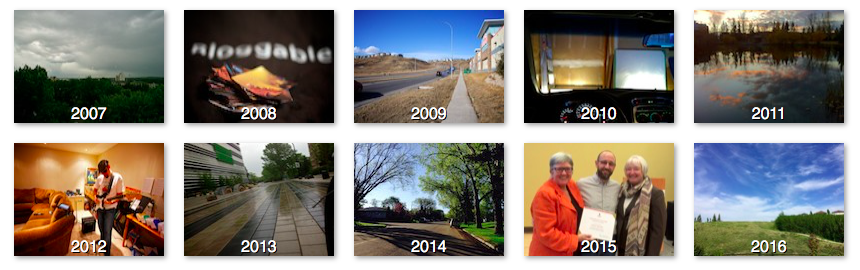
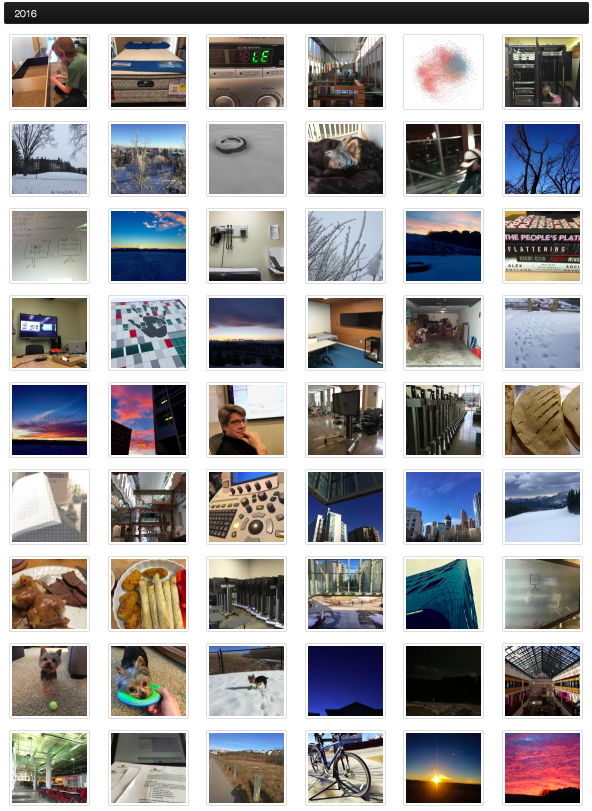
The latest gallery has 366 photos, due to the leap year. My photos have gone through artsy phases, and have pretty much settled into an informal documentary style. Lots of repeating shots over the years. Lots of progress shots – of people and places. This was the year of building the Taylor Institute for Teaching and Learning, installing a bunch of tech, and moving in. So, lots of photos of that.
Probably 99% of the photos are taken with my phone. The camera built into the iPhone 6 Plus is pretty decent. It’s no DSLR, but it’s always with me. Always. And optical stabilization helps. For the handful of photos that were taken with my over-a-decade-old Canon XT, the glass makes those photos much better. But I don’t carry it around much anymore. One of the photos was taken with the software camera built into Forza Horizon 3 on XBox One. One was made with Gephi. So, whatever camera is handy… Photos are usually prompted by “hey, that’s interesting”, rather than being pre-planned or composed. Several of the photos appear trivial, but were taken before, during or after important conversations.
Here’s to the next decade of daily photos…
RolandtJ

Foto: AVM
Letzter Ausbau dieses Jahr: zwei neue Repeater. Mitten im Haus steht eine Fritz!Box 7580, die eine VDSL-Verbindung zum Internet herstellt, VoIP terminiert, alle Schnurlostelefone versorgt und WLAN mit 802.11ac+n bereitstellt. Im Studio hatte ich bisher eine ältere 7390 stehen, die ebenfalls WLAN anbot und DECT verstärkte. Im Erdgeschoss war das bereits modernisiert und nun wiederhole ich das gleiche Setup im Studio.

Foto: AVM
FRITZ!WLAN Repeater 1750E ist über meinen zentralen Gigabit-Switch im Keller mit der Fritz!Box 7580 verbunden und spannt ebenfalls ein WLAN mit 802.11ac+n auf, im 5-GHz-Band mit bis zu 1.300 MBit/s und im 2,4-GHz-Band mit bis zu 450 MBit/s. Die Kabelanbindung ist ein Luxus, damit der Repeater nicht als Repeater sondern als Access Point funktioniert. Hat man keine Ethernet-Verbindung, dann fügt man den Repeater einfach durch Tastendruck ins WLAN ein. Repeater gibt es für ganz kleines Geld bei Aldi und Co, aber ich bevorzuge Geräte, deren Software ständig verbessert wird.

Foto: AVM
Auch das DECT reicht bei mir nicht in jede Ecke, deshalb verwende ich FRITZ!DECT Repeater 100, um die Reichweite zu vergrößern. Der Setup ist simpel. DECT-Taste an der Fritzbox und am Repeater für ein paar Sekunden drücken, fertig. Da der Repeater eine Steckdose hat, geht nichts verloren. Man kann ihn einfach irgendwo einschleifen.
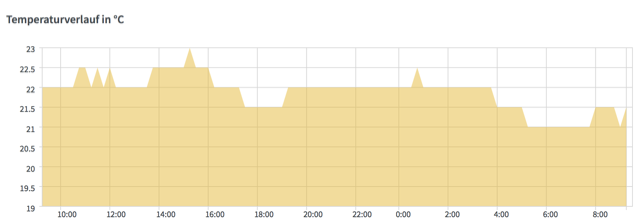
Der Repeater erscheint in der Fritzbox unter Heimnetz/Smart Home. Er hat zwar keine Schaltfunktion, zeichnet aber die Temperatur auf. Die Schaltsteckdosen für innen und außen (!) haben keine Repeaterfunktion.
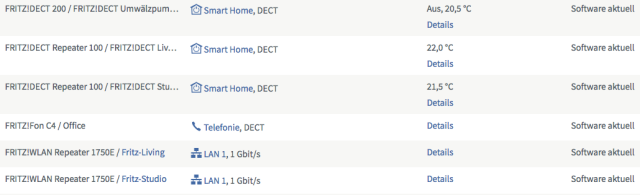
Sehr schön auch die Übersicht in der Fritz!Box. Man sieht auf einen Blick, ob die Software der Geräte aktuell ist und kann sie gleich hier aktualisieren, wenn nötig.
Der Umbau von der alten 7390 auf die beiden neuen Geräte spart sogar noch ein bisschen Strom. Im Modus DECT-Repeater und WLAN Access Point hat die 7390 8,2 Watt gezogen. Der FRITZ!DECT Repeater 100 zieht 1,2 Watt, der FRITZ!WLAN Repeater 1750E benötigt 3,2 Watt. 3,8 Watt mal 24 Stunden und 365 Tage sind 33 kWh im Jahr. Das sind nur ca acht Euro also eher was für's gute Gefühl. :-)
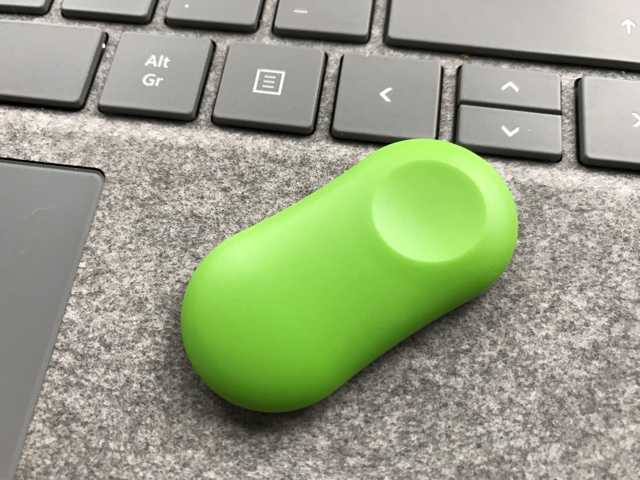
You heard about the Peanuts before. One-purpose IoT devices, that are inexpensive and simple. I have two ThermoPeanuts that worked really well, until they quickly burned through their batteries. Sen.Se found the bug and fixed it with a firmware update and they are back in operation.
Sen.Se also apologized for the trouble and offered a free Peanut as compensation. Instead of a third ThermoPeanut I asked for a new GuardPeanut.


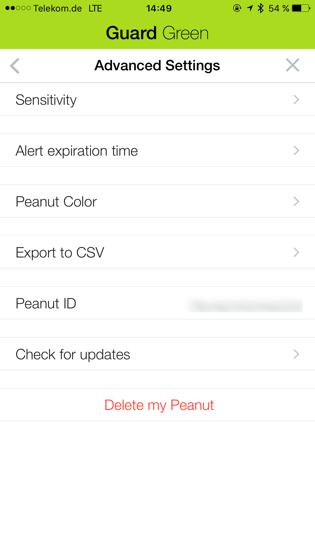
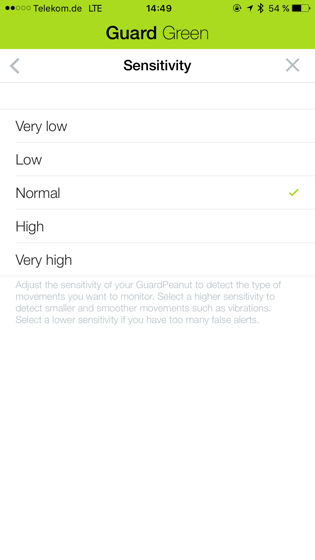
GuardPeanut is a motion sensor and there are a number of different use cases. First of all you pair it to your phone and then you switch it on and off with a long press. When it's on it will record when it is moved. Attach it to the inside of your door and you will know when the door was opened. It also can sound an alarm, on the Peanut itself and/or on your phone. Switch it on, drop it in your bag as you walk away. When somebody moves your bag it will complain. In either case you can see when motion was sensed, right now or later.
When I look back on 2016 from an abstracted, 30,000 foot view, it looks all bad. Here’s how the NY Times characterized it today:
Take a Bad Year. And Make It Better.
Looking back on the last 12 months, those who feel miserable and afraid have plenty of justification. For many it was the election of a president unfit for the job. He seems to want to run the country like some authoritarian game-show host, but we don’t really know what he’ll do, and uncertainty worsens the sickening feeling.
Yet so many bad things happened, from the unthinkable to the horrifying to the merely shocking. Things fell apart. Tyrants and terrorists trailed blood and rubble across the Middle East and Europe. Refugees drowned in the Mediterranean. Right-wing extremism and xenophobia were on the march. The American election let loose old racial hatreds. The planet got hotter; the Arctic went haywire. The world was burning or smoldering or blowing up or melting.
The Times editorial board go on to attempt a save, suggesting that there is light at the end of the tunnel, that low-income workers are still fighting for $15 an hour, that Michelle Obama and Hillary Clinton are still great role models, and so on. Maybe that approach will work for you, where it fails for me.
What I cling to is something else altogether, a completely different angle on the dark year behind us. A Taoist knows it is darkest before the light, and and that the gentle, penetrating wind will inevitably come to push away the clouds. Clarity of judgment is the only defense we have against stupidity and bad action.
But where are the leaders who we can rally around? Who can we look to, now? Who will be our warrior leaders in this struggle?
With the right leaders to follow, and with persistent pressure in the right direction, I still believe we can make 2017 a good year, even a great year, if we are firm in our resolution and opposition to the bad turn we have taken. But we will have to each commit ourselves to that steady pressure, that indomitable pushing toward positive goals, standing by our commitment to progress. As James Baldwin said,
Not everything that is faced can be changed, but nothing can be changed until it is faced.

Here’s a statement from Donald Trump about the future: I think we ought to get on with our lives. I think that cars have complicated lives very greatly. The whole, you know, age of the automobile has made it where nobody knows exactly what’s going on. We have speed, we have a lot of other things, but … Continued
The post Donald Trump on the threat of automobiles appeared first on without bullshit.
Here is a list of all the articles I wrote as part of my look at the “Top Ed-Tech Trends” of the year. 
“Trends” is perhaps the wrong word here. These are my observations about what’s happened in education technology (and education more broadly) over the course of the past 12 months. This project – something I’ve done every year since 2010 – aims to serve as an in-depth analysis of the noteworthy events and products and politics and financing and tries to piece together the narratives and ideologies that drive ed-tech.
This year, I also published a number of supplemental articles detailing the funding for each of these “trends”: 
No one else writes these sorts of reviews of ed-tech. No one. A reminder: this site is not funded by ads or venture capitalists or corporations or philanthropic organizations – it’s supported by individual readers. You can donate via PayPal or support me via Patreon.
Icon credits: The Noun Project
It almost feels awful to write that 2016 was perhaps my best year yet (professionally speaking), given all the losses of great artists, scientists and all the other negative things that happened this year. But it’s true. 2016 was, to me, an amazing year of success-after-success.
2016 in review, month by month
I started the 2016 year exhausted and sick, as I normally do. Usually I end up so tired from the previous semester (I teach 2 courses each Fall semester, and combine that with committee work, service to the discipline, workshops, travel, fieldwork and my own personal life) that I fall ill. Last year wasn’t an exception. I ended 2015 sick, but I think that was because my holidays were even more stressful than my semester. I loved travelling with my brothers and their families, don’t get me wrong, but it was a tad too intense and too cold for my liking.
Towards the end of January and beginning of February, I went to Madrid to do fieldwork for three weeks for several of my research projects: informal waste picking, sanitation and wastewater governance, and bottled water. Don’t get me wrong, I love Madrid. I loved doing fieldwork and got a lot of really interesting data and insights. But the truth is, doing this at the beginning of the year reminded me of why I hate how the semesters are designed here at CIDE and how much I prefer the quarter system that we had in Canada (12 weeks). On normal semesters at CIDE, we teach anywhere between 13 and 16 weeks. 13 weeks is decent but since the Spring semester cuts almost into June, it’s really hard to have a large chunk of time to do fieldwork, write and think. I would prefer a Spring semester that started January 4th and finished May 3rd.
Before I left, I was asked last-minute to teach Public Policy Analysis, a course I’ve taught before while at UBC, but one that required me to revamp my toolkit, re-read all the literature and re-construct a syllabus, using women, scholars of color and other under-represented minorities. Since I had already scheduled all my commitments for the spring, I had to juggle teaching in a semester I don’t normally teach with a very intense and travel-heavy schedule. This was terrible for my health and my levels of stress. But I am happy that I did teach the course, and happy that I taught an extended version in the Fall of 2016. Plus, I survived, and didn’t miss any lectures (except for a couple due to health issues)!
In February I had to do a lot of work with my graduate students, Laura (who recently graduated with a Masters in Journalism and Public Affairs), and Alfredo (who just graduated with a Masters in Public Policy and Administration). Both of them worked in my bottled water project, and they spent a week with me and my research assistants Daniela and Karina working on the beginnings of a collective book project on bottled water in Mexico, which I am assembling and editing. Fantastic experience, but again, a lot of stress because I needed to dedicate a lot of time to working with my students, both undergraduate and graduate. I love supervising theses, and these projects are fantastic, so it was a lot of fun in the end. I also taught a workshop for a small municipality in Jalisco on policy design.
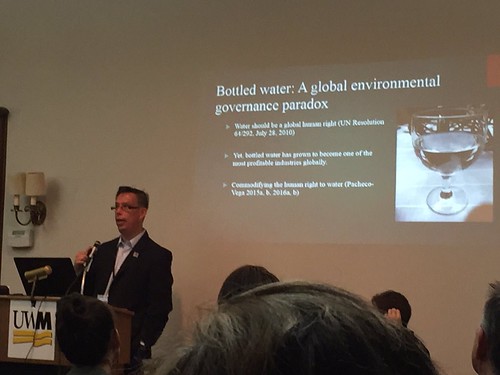
In March I went to ISA in Atlanta, which was amazing because I got to see a lot of my friends. My panel on the global politics of water was very well received, and I got to hang out with my friends and collaborators Dustin Garrick (Oxford University), Christiana Peppard (Fordham University), Oriol Mirosa (University of Wisconsin, Milwaukee) and Cecilia Tortajada (National University of Singapore). I also got to hang out with a lot of my good friends, and have my first working meeting for our ISA 2017 paper with Amanda Murdie (University of Georgia), which is going to be a fantastic paper.
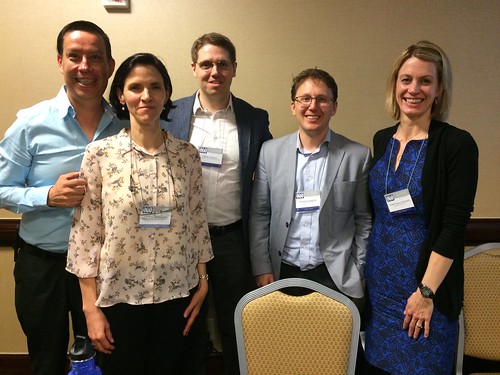
I also got to discuss our informal e-waste governance in Mexico and the US research project and hang out with my good friend and coauthor Kate O’Neill (University of California, Berkeley). I also had dinner with my mentor and good friend Kathy Harrison (The University of British Columbia) and with Oriol and his fiancee. Overall, an amazing time. I usually have a fantastic time at ISA. Saw lots of good friends, ate great food, managed to think a lot about my work on bottled water.
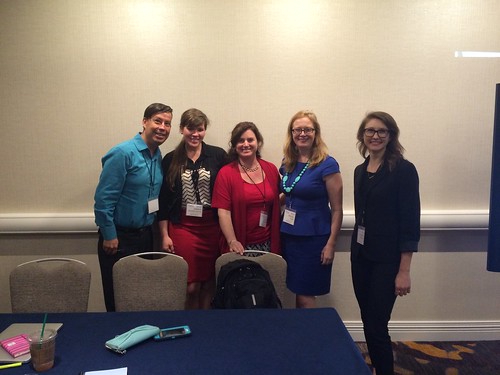
Also in March, I went to San Diego (a city I adore) for Western Political Science Association (WPSA)’s meeting. I got to meet with Andrew Biro (Acadia University), hang out with my good friend Janni Aragon, and meet lots and lots of excellent political scientists with whom I had corresponded but never met. I love WPSA and I’m glad I’m doing it next year too. I organized a panel on the governance of water during times of crisis and got to reconnect with my good friend Abby York (Arizona State University). Both Abby and I are Bloomington-trained, and thus scholars of the Ostrom tradition, so it was great to hang out again. Our panel was great and I am glad I got to hang out with Leila Harris (The University of British Columbia) again, since our interest in the geographies of water are very similar.
One thing I had promised myself during 2016 is that I would focus. So the vast majority of my work this year showcased what I have been studying in regards to the governance of bottled water. I also managed to focus on exactly the things I wanted to focus: my own health, my family, my friends, submitting papers to higher-ranked journals, and hanging out with my coauthors and consolidating our friendship.
At the end of March and beginning of April, I went to American University in Washington DC invited by the Center for Latin American Studies and their project, Religion and Climate Change in Cross-Regional Perspective. Thanks to Eric Hershberg and Evan Berry for inviting me. It was an amazing experience for many reasons. As you may all know, I don’t study climate change policy per se. What work I do on climate policy is on evaluation of climate policy instruments and implementation, and adaptation to climate change in the water sector. So this was a much welcome, humbling and eye-opening experience.
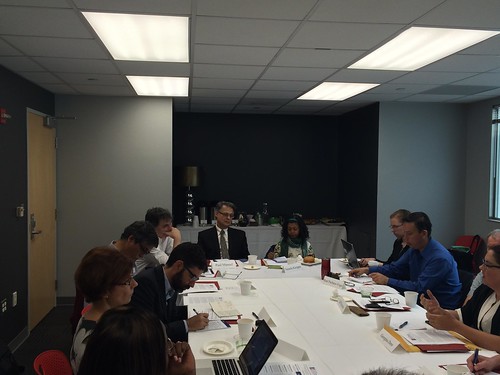
I also gave a talk at the School for International Service at American University thanks to the invitation of my friend and colleague Sikina Jinnah. I think the entire experience was fantastic. I love giving talks to PhD students because I find their analysis really on point and their eagerness to engage with the research extraordinarily motivating.
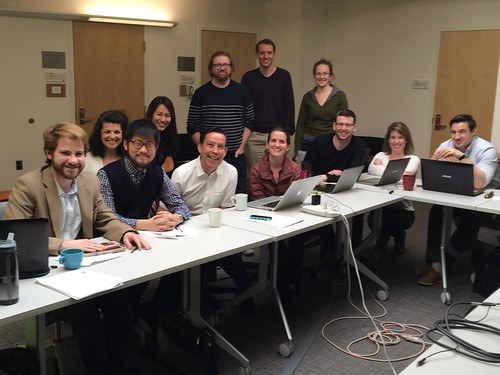
The Religion and Climate Change workshop brought me a lot of new good friends and colleagues, but one that stood out was Gina Drew (University of Adelaide), with whom I share an interest in water governance, sanitation and anthropology, as well as ethnographic methods. Plus our personalities are SO SIMILAR!
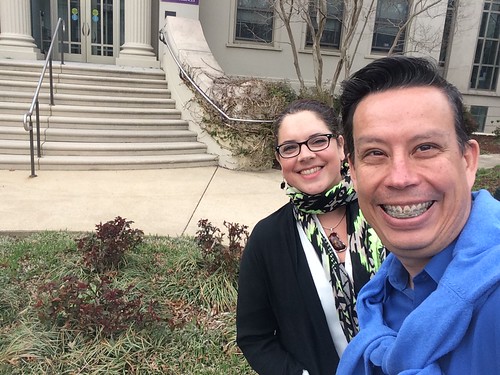
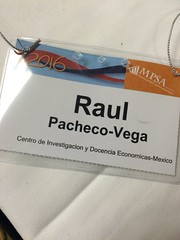 April was Chicago for MPSA (Midwest Political Science Association). Oh, MPSA how I loved you. How I still love you. I adore ISA, but somehow MPSA also really made me feel at home. I got to see a lot of really good friends of mine, particularly from the policy sciences field, and also those who do experiments. I presented two papers, and got a chance to hang out with dear friends of mine like Milena Ang and Manuel Cabal, both of whom are doing their PhDs at University of Chicago. I always look forward to MPSA, and the one thing I always miss is the opportunity to see more people, to see more papers presented. But one great thing I did here was that I participated in two mentoring sessions for up-and-coming scholars.
This was actually very important to me, because mentorship is a core element of what I want my academic career to have. I am who I am because of amazing mentors I had, so I really want to make sure to pay it forward. Also, I got to meet in person the one and only Janet Box-Steffensmeier, who won a career award for her contributions to political science. Jan is amazing and so kind and generous, I want to be her when I grow up.
With @jboxstef and @archimedino after our #MPSA16 #MPSA2016 panel. I'm so proud to belong to an amazing community. pic.twitter.com/XZRkrHjbZ9
— Dr Raul Pacheco-Vega (@raulpacheco) April 10, 2016
In April, I also got invited by the Center for International Education to participate in a conference on Water Centric Cities at the University of Wisconsin-Milwaukee. This conference gave me a chance to spend a lot of quality time with my good friend and coauthor Oriol Mirosa, who is an assistant professor there. Oriol and I are working on a large project on the global human right to water, and this conference gave us a chance to present together in the same panel, and to discuss our research, plus also eat a lot of good food and hang out.
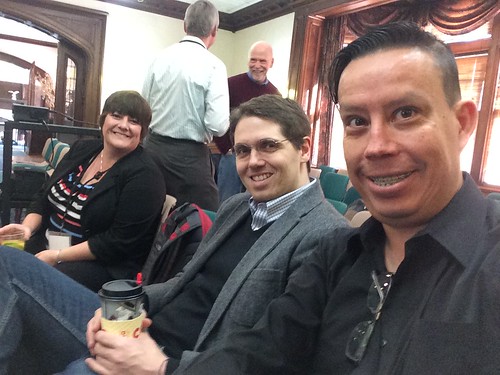
I also met a lot of really interesting people at the conference, and got to see again Sara Mitchell (University of Iowa), whom I consider a good friend and mentor.
My good friend Debora VanNijnatten (Wilfrid Laurier University) came to CIDE in April to work with my colleague (and also good friend) Marcela Lopez-Vallejo and do some research while here. Since Debora and I know each other since before I even started my PhD, it was amazing to have her here again. She’s an excellent scholar and well, I think we all Canadian political scientists know and are friends with each other. Debora was kind enough to engage with my students in a Tertulia meeting and discuss the ins-and-outs of doing policy work, both applied and theoretical.
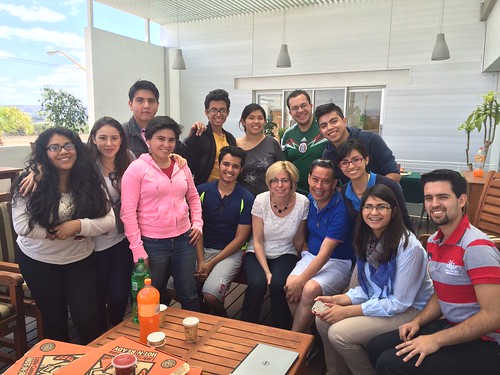
For me, being able to take holidays in late April and early May really made the difference with regards to previous years. Even though I went to Pittsburgh for Nadia’s graduation, I managed to stay healthy because I rested, even after all the travel I had been doing in the first four months of the year. I also spent time with my brother’s family (my nieces and I are very close), so it was really good for all of us overall.
In May of 2016 I went to Chiapas (San Cristobal de las Casas, to be exact) to participate in a workshop on the water problems in Mexico that my friend and colleague Edith Kauffer from CIESAS Sureste organized with several other Mexican water scholars. I love these workshops because they are small enough that they allow you to discuss issues and papers and edit them without the pressure of large conferences. I presented some of my work on bottled water and water insecurity, which was well received. We did, however, have several issues with logistics, not the least the fact that the roads to and from San Cristobal de las Casas were blocked by protests against the education reform. An interesting moment to apply what I know about protests and ethnographic work!
I finished teaching Public Policy Analysis the first week of May and then ran off to New York City to present at the Latin American Studies Association (LASA). By the time May hit me, I was exhausted and didn’t want anything to do with research. But I had already committed to participating in LASA with my good friend and coauthor Marcela Gonzalez-Rivas (University of Pittsburgh), so I decided to avoid canceling and just flew into NYC for the conference. Got to see many good friends who are also Latin Americanists, but I was really tired by the time I was done with the conference, so I was a bit anti-social, except for a morning when I went for a coffee with my graduate school colleague and close friend Sara Koopman.
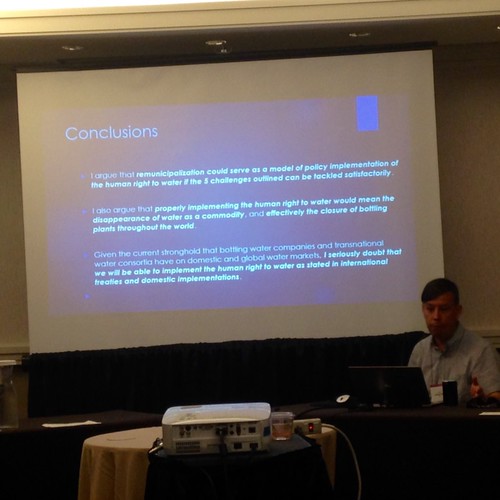
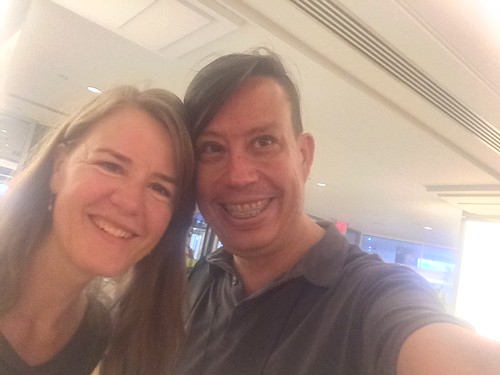
In June 2016 we had a series of job talks for 3 new positions in my department, which took a lot of my time. I also had to participate in the Public Management Research Conference in Aarhus (Denmark), and a workshop on cities while I was there, so I had to juggle a lot during June. But I don’t regret for a second having attended PMRC. It was an AMAZING experience that allowed me to spend time with friends and colleagues from the Public Administration field, including my good friend and colleague at CIDE, Mauricio Dussauge. I also spent a couple of days with my friends and also scholars of public administration Staci Zavattaro (University of Central Florida) and Kelly LeRoux (University of Illinois at Chicago). We even went to Sweden!
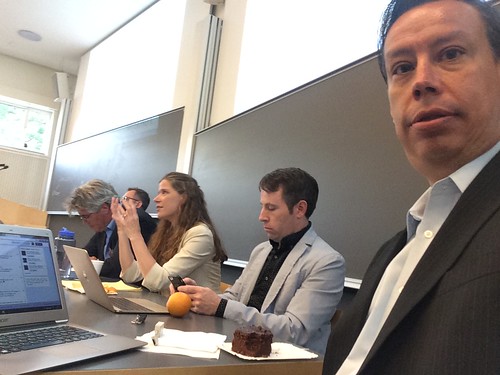
In July 2016, my coauthor Kate O’Neill and I hosted an experts workshop to discuss the state of electronic waste governance in Mexico and the US, both in the formal and informal sector. For Kate and I this was the culmination of a project where we got funding from the UC MEXUS CONACYT initiative for cross-national collaborative research between University of California researchers and scholars based in Mexico.
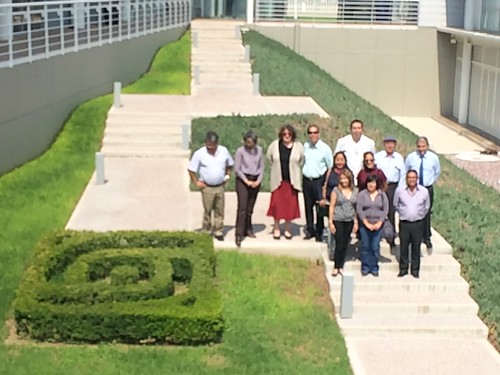
The other great thing I did in 2016 is that I TOOK ALL MY HOLIDAY DAYS. That means, in July (when CIDE is closed), I actually took vacations. I spent three weeks with my brothers, their families and my Mom, which was absolutely glorious. I woke up, ate, read, went to sleep. Other days, we would just hang out. One day we went to the city of Guanajuato. THREE WEEKS OF HOLIDAYS. That made me a lot of good.
I hit the ground running in August. I went to Mexico City for the national meeting for the design of the new Mexican water law in early August. This was a meeting I needed to attend because it also helps tie all my water governance projects together. During this month I also had a visiting student from University of California Berkeley, Nain Martinez, who is doing his PhD there. It was important for me that Nain had a good experience and that he felt supported, so I had to juggle my own calendar with ensuring that Nain had enough contact time with me to discuss his own research. Around the same time, Javier Roiz (a former professor of my Mom’s from when she did her PhD at Universidad Complutense in Spain, and a visiting scholar at CIDE) asked me if he could come down to visit us and give a few talks. So I also organized that visit. Organizing these events takes a toll on everyone because you want to make sure that the visiting scholar is having a good time, and also that everything runs smoothly. My Mom served as the discussant for Javier’s talk and everything worked out very well. But I started the semester very, very tired.
 I was invited by my good friend Mario Torrico from FLACSO (Facultad Latinoamericana de Ciencias Sociales, Sede Mexico) to give a talk for their Masters of Comparative Public Policy programme. I am always keen to collaborate with FLACSO scholars, because not only are they top-notch researchers, but they’re also amazing human beings. One of my students with Dr. Ligia Tavera Fenollosa, Pavel Martinez, just graduated this fall from his Masters and I sat on his committee. So, overall, I try to stay close to FLACSO professors. And off I went, again, to Mexico City. I taught them about qualitative methods in comparative public policy, a topic I know well.
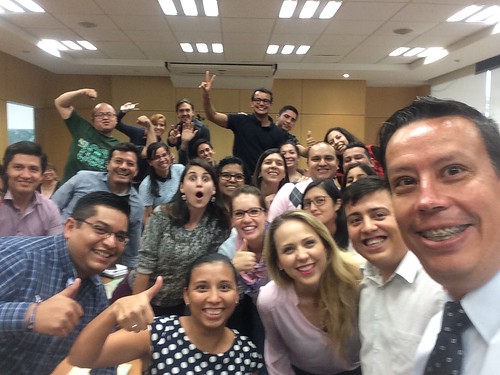
September 2016 was a bit of a whirlwind. While my brother and my Mom went to Israel for a well-deserved vacation, I stayed and taught two classes, all the while trying to juggle my research and ensuring that my students finished their theses and graduated on time. Also, Kate O’Neill and I had to finish our project so I headed up to the University of California at Berkeley to work with her and give a couple of talks. It was a fantastic experience and I got to meet Alison Post, who is also a fantastic scholar of remunicipalization and Latin American studies at Berkeley.
Perhaps one of my biggest achievements (in addition to finishing the e-waste project with Kate O’Neill, submitting and getting a conditional acceptance of our qualitative methods paper with Kate Parizeau and working with Oriol Mirosa on the human right to water project, Staci Zavattaro on the public administration literature review and Marcela Gonzalez-Rivas on the water governance paradigms project, was winning a $4,000,000 pesos ($200,000 USD) collaborative grant to study water conflict in Mexico. My largest grant by far, and my most interesting project to date. Interdisciplinary, collaborative, and inter-institutional, this project definitely will change the way in which we think about water conflicts in Mexico, and hopefully make a solid contribution to our understanding of the topic globally.
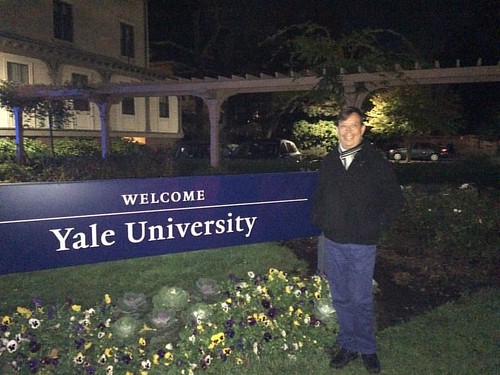
The second huge achievement of 2016 for me was being admitted to the Evidence in Governance and Politics network (EGAP). I am a multi-methods person, but lately I’ve been doing a lot more work with field experiments, so being admitted to EGAP validated my interest in experimental approaches to public policy design and implementation, and participating in EGAP18 at Yale University were highlights not only of my October but my 2016 overall.
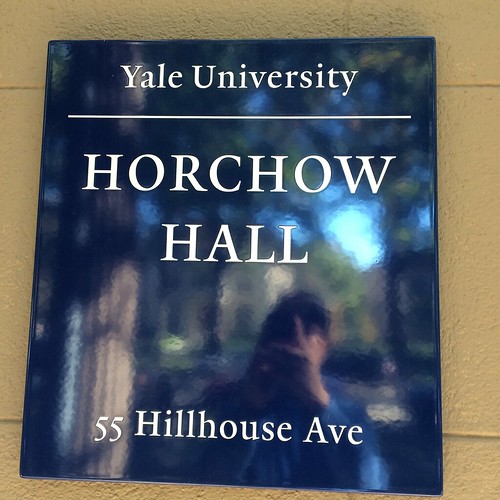
Towards the end of October, I gave a talk on intractable water conflicts at the Mexican Institute of Water Technology and then a lecture in our diploma program at CIDE on conflict transformation, invited by my colleague Mara Hernandez.
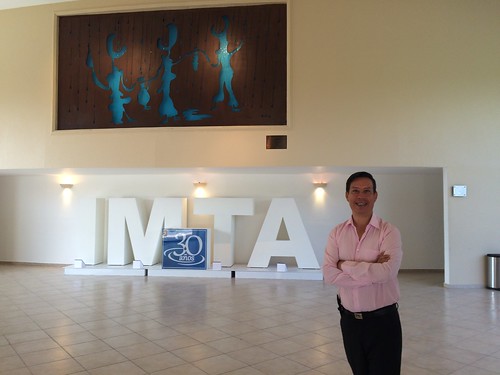
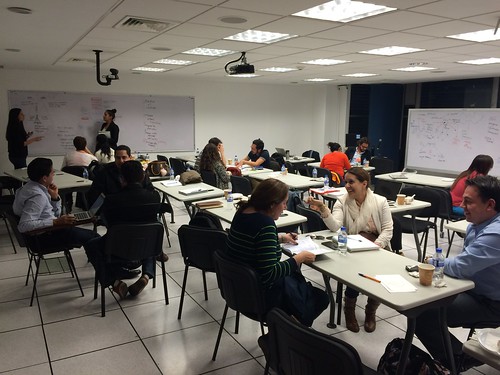
By the beginning of November, I was completely and entirely exhausted. That’s again why I dislike 16 week semesters. Given that we teach 4 hours per week, making for 64 hours per semester, as opposed to 3 hours per week times 13 weeks, which is 39 as I used to do at UBC, students AND faculty alike end up really exhausted during the fall. So, though I teach a 2-0 teaching load, given how many hours I am teaching, I actually have roughly a 4-0 load, or as I did this 2016 with a 1-2, about 2-4. I love teaching, but these many hours do take a toll (both on students and faculty).
I had two events back-to-back, one at El Colegio de San Luis on water justice, and one for an ecosystem integrity project. This meant that I arrived to the end of the term pretty exhausted. HOWEVER, since I had accumulated all my holiday days towards December, I was able to finish the semester earlier than expected. This change in plans meant that I was able to cram one last commitment during the year, which happened in early December. I spoke at a workshop on commons in Latin America, presenting some stuff on the governance of waste and wastewater using Elinor Ostrom and Vincent Ostrom’s theories.
Me, looking all professorial while explaining commons theory (at @ciesas IRD workshop "Reimagining the Commons" pic.twitter.com/2zhj5EFiKY
— Dr Raul Pacheco-Vega (@raulpacheco) December 8, 2016
Lucky for me, towards the end of November and beginning of December I also had an event organized by El Colegio de Mexico on Mexico-Canada relations. Obviously because of my being Mexinadian I was invited and was lucky to hang out with two friends and colleagues of mine not once, but TWICE: Dr. Laura Macdonald from Carleton University and Dr. Debora VanNijnatten.
A meeting of Canadian professors! My friends Debora VanNijnatten (Wilfrid Laurier) & Laura Macdonald (Carleton) & me pic.twitter.com/ksavUtUgsK
— Dr Raul Pacheco-Vega (@raulpacheco) November 11, 2016
I also met Justin Massie and my good friend Julian Durazo-Hermann (who’s also Mexinadian and teaches at Universite du Quebec au Montreal) at the same event. It is always nice to catch up with good friends with whom you have been close for a number of years.
With Julian Durazo and @justinmassie1 from @uqam at #MexCanColMex luncheon (thanks @CanadaEmbMexico for inviting me) pic.twitter.com/N6Dxd9c2nE
— Dr Raul Pacheco-Vega (@raulpacheco) November 17, 2016
The personal of 2016
On the personal side of things, I am sad to report that I neither played volleyball nor danced nor did I take a dancing class. But that’s the main lesson I learned this year: I NEED TO LEARN HOW TO LET GO OF THINGS. Sometimes, I have Fear of Missing Out (FOMO). I want to Do All The Things. I want to Learn All The Things. I want to Teach All The Classes. I want to supervise and train All The Students and Research Assistants. I want to achieve All The Successes. This is NOT how life works. You can have it all yes, but probably not all at the same time.
This year my niece Nadia graduated from University of Pittsburgh with a degree in political science and international relations (several of my good friends were also her professors, which made the circle complete). And it’s nice to have 3 generations of political scientists in the family (my Mom, myself and Nadia).
Three generations of political scientists (my Mom, myself and my niece Nadia) @kramtrak @aperezli pic.twitter.com/aMEqFXPiKX
— Dr Raul Pacheco-Vega (@raulpacheco) June 14, 2015
On the social media front…
There were some wins, I have to say! I got invited to blog for The Nature of Cities, and for The Duck of Minerva. And I got some promotion for my work on social media.
Bottom line…
In the end, I felt that 2016 offered me what I didn’t expect to get, given how the year started (with me physically ill and having to teach an entirely new course during a semester I don’t normally teach, all of a sudden): an opportunity to showcase my scholarship and my ability to focus, all the while blossoming in the field I work in. I feel intellectually challenged. I’m motivated by the questions I am examining and passionate about the research I undertake. The problems I’m looking at are complex and intractable. I work hard at making them easier to address and doing this kind of work really excites me. I wake up every morning happy and eager to start working. I feel incredibly fulfilled.
I ate All The Ethiopian food (in Madrid, in Atlanta, in San Diego, in Washington DC, in Chicago, in Milwaukee, in New York City, in Berkeley).

I spent a lot of quality time with good friends and colleagues and coauthors, did fieldwork, wrote many papers (AND SUBMITTED THEM TO JOURNALS FOR PEER REVIEW, yay me!), and taught many brilliant students (two courses, Regional Development and Public Policy Analysis). My CIDE students make me SO PROUD. They’re brilliant and I’m sure they will do amazing things in the future.
At the end of the day, this was how I closed 2016: with my Mom, in Puerto Vallarta, laying by the pool, and doing exactly nothing. Because that’s how I want to be able to spend my holidays: with the people I love, relaxing, eating good food, and experiencing the beauty of not having anything to do.
Así los leo. pic.twitter.com/5VQuz1LW58
— Dr Raul Pacheco-Vega (@raulpacheco) December 25, 2016
To me, relaxation and rejuvenation is also part of my own personal definition of success.
What to expect in 2017
I am obviously anxious about the future of the US. I don’t like what I am witnessing in the US and more importantly, globally. But I am a political scientist. I work hard to make sense of the world, and I’m not alone in this pursuit. Lots of great people are doing their best to make sense of how disastrous 2016 was, and ways in which we can move forward in 2017 and improve our society at all different scales.
I am very much looking forward to closing a few projects (the human right to water one with Oriol, the one on environmental NGOs with Amanda, the e-waste governance one with Kate O’Neill, the informal waste picking one with Kate Parizeau, and several of my own). I’m looking forward to finishing the work we started in 2015 for the polycentricity project, and to participating in an institutional analysis workshop in February. I look forward to working with Sharon Lauricella, Staci Zavattaro, Christiana Peppard, and my own students to finish some projects we started. I am looking forward to finishing a few projects, including three books that I have on the go. And more importantly, I really want to play competitive volleyball this year again, and dance. Hopefully I’ll be able to do it all, even if not all at the same time.
I will continue to blog for The Duck of Minerva, The Nature of Cities and here on my own blog. And obviously I will be tweeting (@raulpacheco if you want to follow me on Twitter, and Dr. Raul Pacheco-Vega on Facebook).
Here’s to a better 2017.
mkalus
shared this story
from  City Cyclist's YouTube Videos. City Cyclist's YouTube Videos.
|
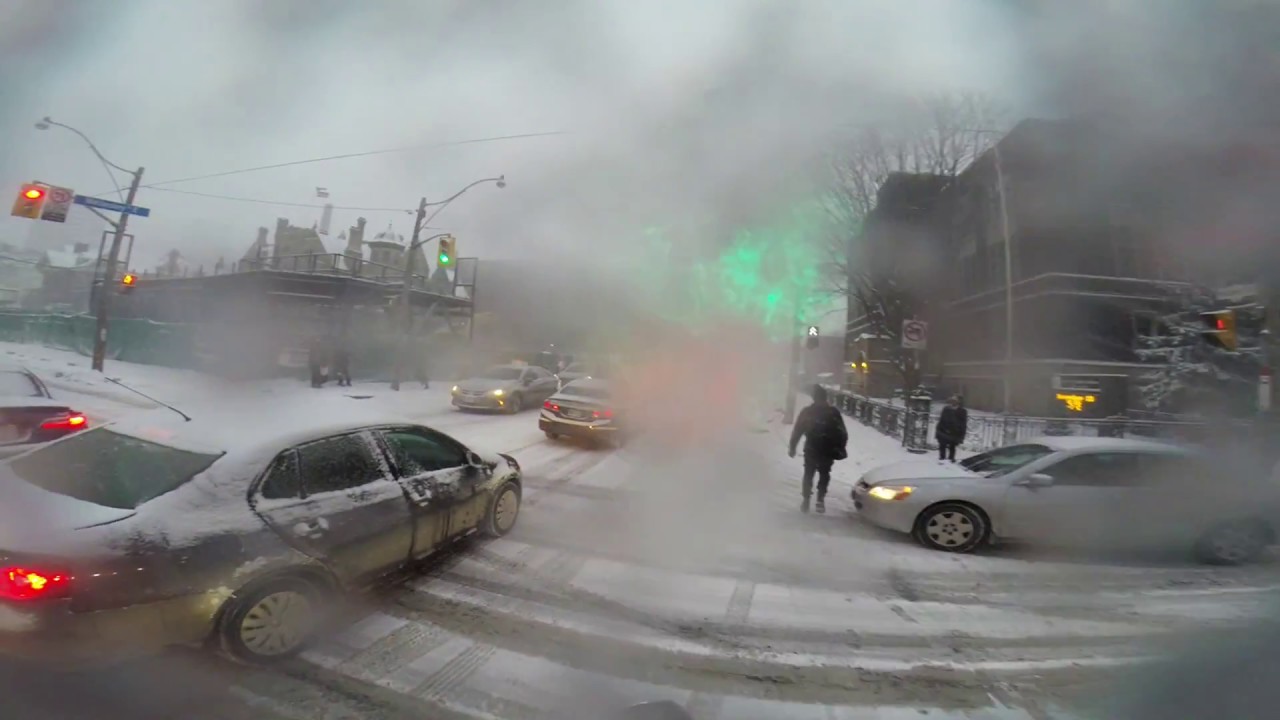
Snow Squall December 2016! It made for slow cycling and 500+ car crashes in 24 hours.
Priority bike lanes should be well cleared of snow and ice. Side streets are a key issue...they are the most icy.
Winter riding for anti-social cyclists is possible, especially if streets and main bike routes are cleared! For those not in a rush, take the car!
The last few years of Trish’s life, she was on disability, and increasingly bedridden. Although I work from home, her situation caused few problems, except for one thing – she wanted to play music, and music — at least with words — distracts me when I write. As a compromise, I bought her a music player, and soon bought one for myself to use when I was on the bus or Skytrain. The only problem was, no player of the time could hold more than about one-fifth of nine hundred albums. So an ambition was born: to have all our music digitized and accessible from a single, portable source.
For the first decade of the millennium, the goal was barely possible. For a while, I thought of using a dedicated netbook, but that was not as convenient as a music player.
More importantly, the goal faced several problems. I had not thrown out any music I had bought since high school, and I am one of those who still buys music as a way of supporting artists I admire. For years, concerts and the Vancouver Folk Festival had been a major form of socialization for us, and over the years we had accumulated an unlikely collection of vinyl records, cassettes, and CDs. Our stereo needed four components just so we play it all. In order to access them from one device, I would need to digitize all my albums. In addition, I would need to divide the albums into tracks to take full advantage of them.
However, digitizing is easier to talk about than to do. A CD can be ripped in about five minutes, but records and cassettes have to be recorded while playing, and divided into tracks manually. The process is tedious, so after quickly digitizing the CDs, I tackled the records and cassettes in starts and stops. In fact, I don’t expect to finish it until near the end of 2017, partly because I changed my mind partway through and decided that, for many artists, I wanted high quality sound, not the standard MP3 file size – even though, because I was using the Ogg Vorbis format, my files were higher quality than most of the ones I could find online.
The second obstacle is that the memory for music players – that is, the size of micro SD cards – increased slowly. Trish had been two years dead before about two-thirds of our music could fit on a micro SD card, and that meant swapping music out several times a week since I wanted variety.
The problem was finally solved when micro SD cards with 128 megabytes were released a couple of years ago, but most music players were not equipped to handle the files that cards of this size could hold. Many had a limit to their list of tracks that was far below the size of the cards. The only way to view all my files was to use the view of the memory, and that meant there was no way to play them in the order they appeared on the album. Most of the time, I listen to music by album, on the grounds that how musicians arrange albums is part of the experience they want their audience to have, so this was a problem.
This last barrier fell when I needed to replace my music player, and accidentally discovered the Fiio line of music players – or, more accurately, of portable stereos. When I bought the entry level X1 in October 2016, it had solved this final problem while producing sound that was far superior to that of other music players. The X1 gave me a music player to use outside the townhouse, but I soon decided that I wanted the top of the line X7 for use around the home. The X7 had even better sound than the X1, solved all my problems, and was even set up to stream music from the Internet when WiFi was turned on.
Accordingly, after several weeks of resisting the temptation, I bought an X7 as a Christmas present for myself. My biggest problem now is to decide whether to stay with a single Bluetooth speaker, or to buy at least one more. I may just carry the speaker with me into the kitchen or living room so that I can position it to give me the best sound.
I only wish Trish could have heard this solution. Being of the same generation as I am, she would be amazed at a music system that weighed about 1200 grams and could be held in one hand. Better still, she would have loved having all our music in one source as much as I do.


