Rolandt
Shared posts
I've been a back-end coder for a week: here's how I made a Twitter stream

Tattoo-Erkennung: Fraunhofer nutzte Fotos aus BKA-Datenbank und von privaten Webseiten
mkalus
shared this story
from  netzpolitik.org. netzpolitik.org.
|
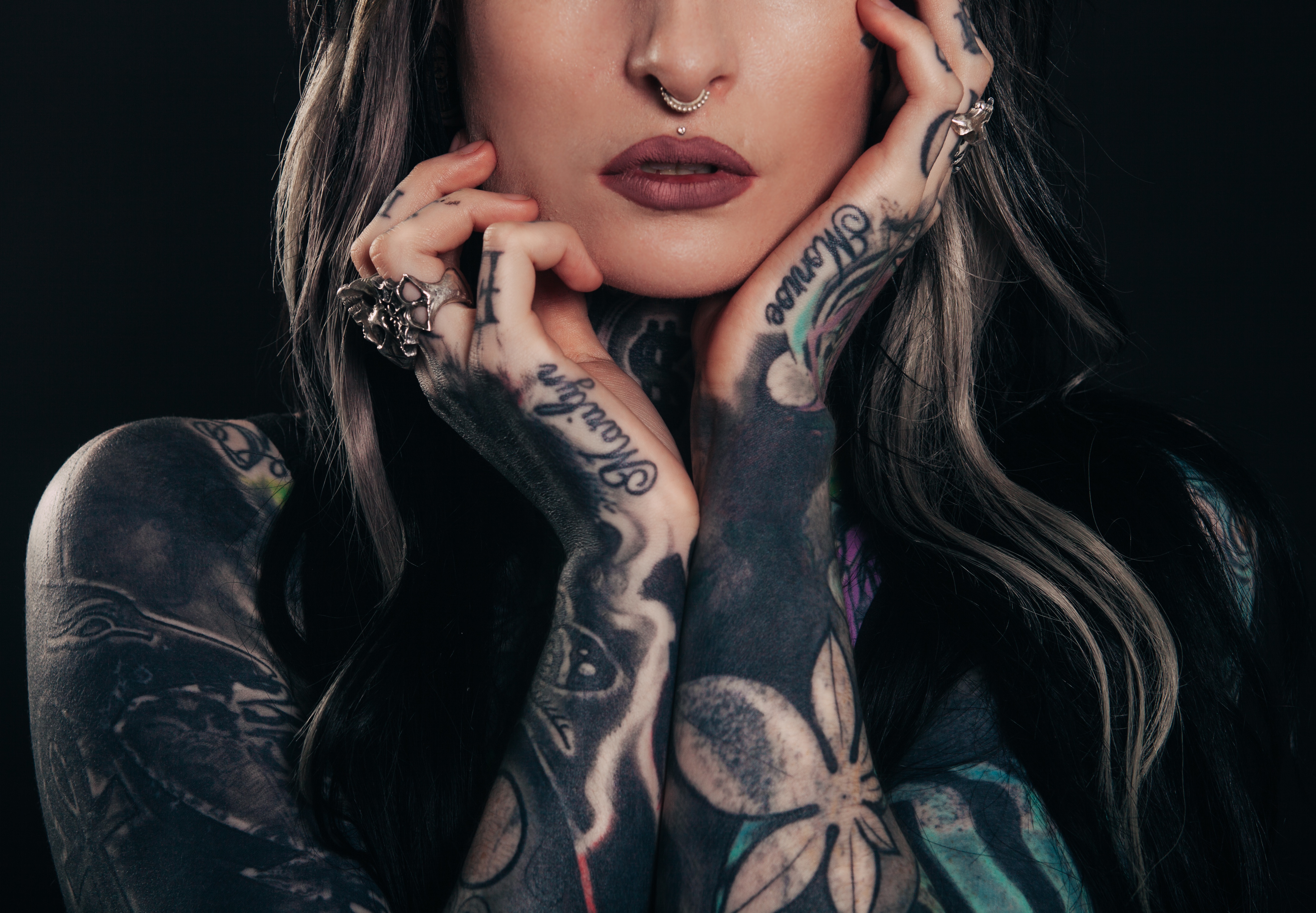
Im Forschungsprojekt des Fraunhofer IOSB wurden Fotos von privaten Webseiten mit einer Tattoo-Datenbank des Bundeskriminalamts abgeglichen. Foto: CC0 1.0 | Clem Onojeghuo
Wer Bilder von sich und seinem Tattoo ins Netz stellt, kann schnell ungefragt zum Forschungsobjekt werden. Genauso geht es denjenigen, die einmal mit ihren Tattoos in die Datenbank des Bundeskriminalamts geraten sind. Unter ungeklärten Umständen sind diese Bilder zu Forschungszwecken beim Fraunhofer IOSB, einem Institut für Optronik, Systemtechnik und Bilderkennung mit Sitz in Karlsruhe, gelandet.
Bei einem Workshop anlässlich der vom FBI mitfinanzierten „Tattoo Recognition Technology Challenge“ (Tatt-C), zu der das amerikanische National Institute of Standards and Technology (NIST) geladen hatte, präsentierte im Juni 2015 das Fraunhofer IOSB seine Ergebnisse bei der automatisierten Tattoo-Erkennung. Aus der Präsentation geht hervor, dass das Institut dazu mehr als 8.400 Bilder von der privat betriebenen Seite tattoodesigns.com und 848 Bilder von der ebenfalls privaten Shop- und Communityseite Wildcat.de mit den 330.000 Bildern einer Tattoo-Datenbank des Bundeskriminalamts abglich. Dies wurde mit einer Informationsfreiheitsanfrage der Electronic Frontier Foundation (EFF) öffentlich.
Nutzung ohne Einverständnis von Webseiten und Communitymitgliedern?
Bis heute bleibt unklar, ob ein Einverständnis der privaten Webseiten vorlag oder ob das Fraunhofer IOSB die Bilder einfach ungefragt herunterlud und nutzte. Denn weder das Fraunhofer IOSB noch die Webseite wildcat.de beantworteten unsere konkret gestellten Fragen zu diesem Sachverhalt. Während Fraunhofer ein allgemeines Statement abgab, das unsere Fragen jedoch nicht tangierte, vertröstete uns wildcat.de immer wieder auf einen späteren Zeitpunkt. Und das obwohl wir mehrfach über Wochen telefonisch und schriftlich nachhakten.
Über die Motive lässt sich deswegen nur spekulieren. Hätte Fraunhofer die Bilder mit einer Genehmigung erhalten, erschließt sich nicht, warum das Institut die Frage nicht beantwortet. Wären die Bilder hingegen unbefugt genutzt worden, hätte der Tattoo- und Piercingshop dies anmerken können und wäre rechtlich aus dem Schneider. Die andere Option ist, dass die hinter der Seite stehende Wildcat GmbH die Bilder aus der angeschlossenen Community einfach so aus der Hand gegeben hat und damit unter Umständen Urheberrechte und Persönlichkeitsrechte seiner Nutzer verletzte. Wie dem auch sei: Zur Vermeidung von Berichterstattung taugt eine solche Schweigestrategie nicht.
Die andere private Seite tattoodesign.com hingegen existiert mittlerweile nicht mehr. Hier konnten wir keinen Ansprechpartner mehr ausmachen.
Privatsphäre und Urheberrecht: Wie auch immer…
Der Workshopleiter des Fraunhofer IOSB kommentierte in seiner Präsentation den Punkt „Privatsphäre und Urheberrecht“ mit einem lakonischen „Wie auch immer“. Das läßt zumindest auf einen laxen Umgang mit diesen Themen schließen.
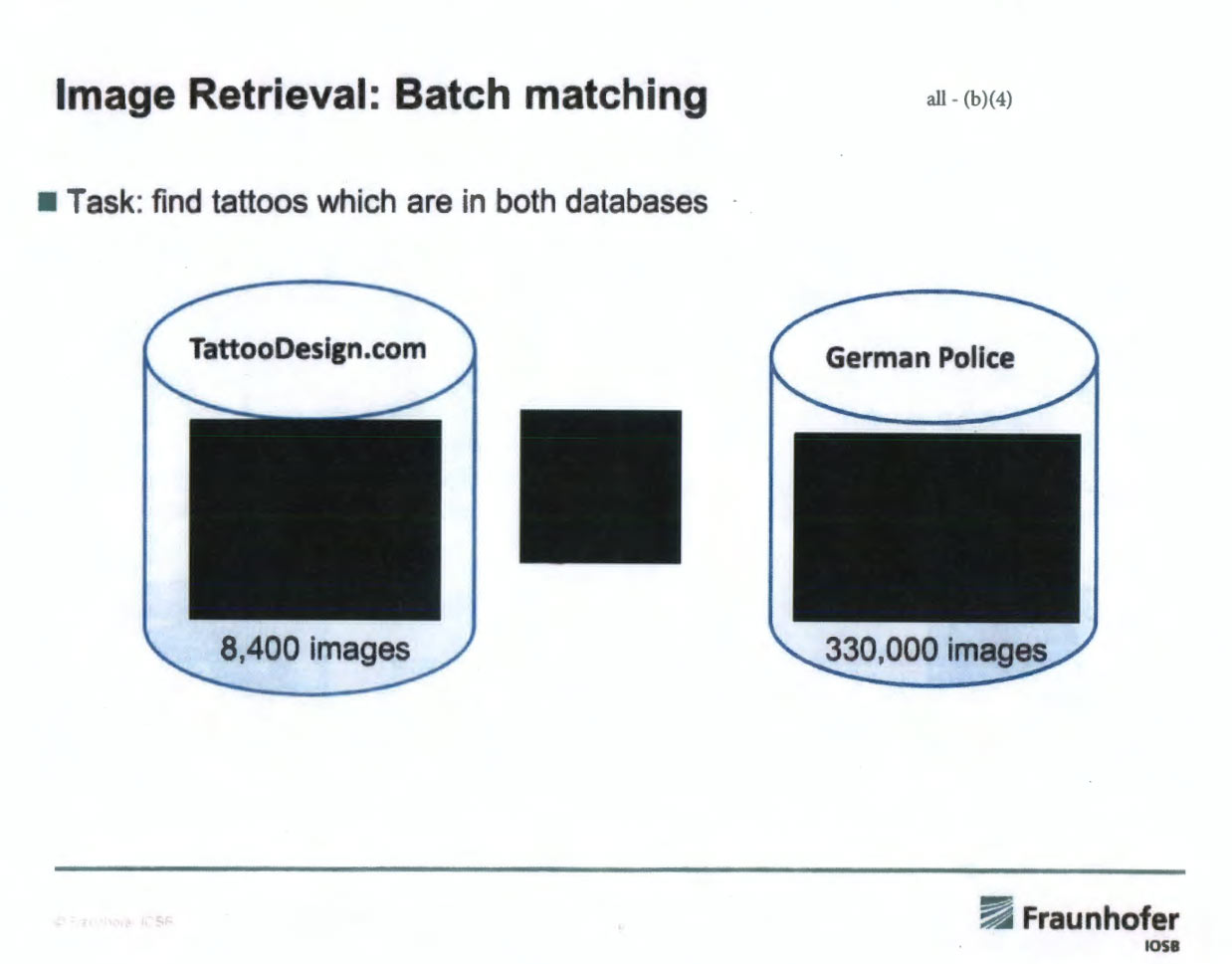
Im Nachhinein heißt es aus der Pressestelle des Instituts vorsichtiger: „Alle Arbeiten des IOSB erfolgten (und erfolgen) – grundsätzlich – mit anonymisierten Bilddaten, d. h. zu keinem Zeitpunkt war oder ist eine Zuordnung von Bildern zu Personen möglich.“
Dies ist insbesondere vor dem Hintergrund spannend, dass sich die Forscher die eindeutige Erkennung von Personen auf die Fahnen geschrieben haben. Auf der Webseite des IOSB heißt es: „Aufgabe des IOSB ist es, die Datenbank durch intelligente Suchfunktionen zu erweitern, die die automatische bildbasierte Wiedererkennung von Personen aufgrund von charakteristischen Bildbereichen wie z. B. Tätowierungen unterstützen.“
Und nicht umsonst speichert das Bundeskriminalamt (BKA) Tattoos als eindeutige biometrische Erkennungsmerkmale in einer Datenbank. Aus der Präsentation des Fraunhofer-Wissenschaftlers geht dann hervor, dass das BKA die fotografierten Tattoos gegenüber dem Fraunhofer IOSB nicht als personenbezogene Daten einschätzte. Personenbezogene Daten hätten unter keinen Umständen weitergegeben werden dürfen.
Darf das BKA eine polizeiliche Datenbank zu Forschungszwecken herausgegeben?
Ungeklärt ist nach unserer Recherche weiterhin, unter welchen Bedingungen das BKA Fotos aus der polizeilichen Datenbank für Forschungszwecke an das Fraunhofer IOSB weitergab. Denn das Institut beantwortete unsere Frage zu den Bedingungen der Überlassung der Datenbank nicht und wich stattdessen auf Allgemeinplätze aus. Das BKA hingegen antwortete überhaupt nicht auf mehrfache telefonische und schriftliche Nachfragen. Genauso erhielten wir keine Antwort, um welche Datenbank es sich überhaupt handelte.
So entsteht der Eindruck, dass beide Seiten etwas zu verbergen haben und die Überlassung und Nutzung der Tattoo-Datenbank mit 330.000 Fotos und damit zehntausenden betroffenen Menschen möglicherweise rechtswidrig gewesen sein könnte. Eine transparente Pressearbeit sieht anders aus, zumal das Fraunhofer IOSB wie auch das BKA verpflichtet sind, auf Presseanfragen zu antworten.

Tattoos geben viele private und intime Informationen über die Träger Preis. Das Bild zeigt eine Folie des NIST.
Generell ist die Weiterentwicklung der automatisierten Tattoo-Erkennung ein zweischneidiges Schwert. Mag das Werkzeug bei der Identifizierung von Vermissten oder Toten bei großen Katastrophenlagen hilfreich sein, so träumen Ermittler und Polizeien von ganz anderen Einsatzmöglichkeiten. Tattoo-Erkennung könnte zum Beispiel bei Demonstrationen und Großveranstaltungen eingesetzt werden, um Personen in Nachhinein zu identifizieren oder Echtzeit-Fahndungen durchzuführen. Auch sind Szenarien denkbar, bei denen öffentlich zugängliche Daten wie Instagram-Accounts von Ermittlern für die Fahndung durchforstet werden könnten. Dabei geben Tattoos sehr viele private und intime Informationen über die Träger preis: Dazu gehören die Anhängerschaft zu Religionen, die Zugehörigkeit zu Subkulturen oder auch politische Einstellungen.
Beim NIST wird das Programm zur Tattoo-Erkennung unterdessen fortgesetzt. Jüngst wurde eine neue Runde unter dem Namen Tatt-E eingeläutet.

As announced in 2012, AT&T Is Shutting Down GSM Now
I’ve been in a presentation on the LoRA PHY on the 29th of December at the 33C3 that I can fully recommend if you are interested in the LoRA IoT radio standard and want to learn about “chirp” modulation. During the talk it was mentioned that AT&T is shutting down its GSM network in the US by the end of 2016. A day later, quite a number of German tech websites such as Heise, Teltarif and Golem had articles on the topic and it really made me wonder if this talk was the seed for them!?
Be that as it may, it did not come as a surprise. Already announced in 2012, as I discussed at the time they make good on their announcement and it shows some interesting long term planning and foresight on their part. I had a look if I could find more information to confirm that it’s actually happening and found a number of sources that confirm that AT&T is really shutting down their GSM network now.
- AT&T’s own words on their website
- The competition inviting 2G only customers to switch to their network
- A field logistics company that has assembled a map of where GSM will be shut down in the weeks to come, i.e. very specific information it is happening.
- A company offering SIM cards and subscriptions to replace AT&T 2G subscriptions.
Over the years, AT&T has massively deployed 3G and LTE as I witnessed several times over the last few years. Even in rural farmland areas, I could receive an LTE network from at least one network operator. In other words, most telephony/Internet customers won’t see much of a difference.
However, the move is a problem for embedded devices that are still equipped with 2G-only modems. I’m sure they are still being sold to unwitting customers in the US even today. This, together with a still inferior 3G/LTE coverage is the main reason why only few network operators are willing to switch-off GSM at this time. There is still some money to be made with it and in countries where network operators are not as spectrum starved as operators in the US there’s no need to go into this direction anytime soon.
Like AT&T, other network operators are likely to give an advance notice of several years to give companies that use GSM-only M2M radios the chance to gracefully move to alternatives. I’m sure that like in the US, not everybody will get the message and prepare themselves.
Related to this topic I also found it quite interesting that in 2016, GERAN, the group working on GSM/GPRS enhancements in 3GPP was folded into the 3G/LTE RAN meeting structure. A logical move since there were only few topics discussed in the group lately. A sign of the times.
GSM is dead, long live GSM!
Enrique Dans writes about ‘the robotic manager’, but I favor the term ‘driverless management’ (see…
Richmond B.C. presses ahead with regulating Airbnb-like short-term rental services
Shortly after the city of Toronto began entertaining the regulation of short-term rentals, Richmond, B.C. will present its proposed bylaws.
The city of Richmond will present its drafted regulations to council this week amid complaints that short-term rentals through Airbnb and other services are disturbing neighbours, reports the Globe and Mail.
These regulations will reportedly permit short-term rentals in an owner’s primary residence and would require said owner to apply for a business license. Furthermore, they would limit the number of rentals permitted in “strata buildings,” or shared, multi-complex apartment buildings or other shared spaces.
Later this month, Vancouver will adopt similar regulations due concerns that Airbnb is negatively disrupting the rental market. This is in contrast to the top complaints about the industry from Richmond residents, which mostly have to do with nuisance calls.
Reports from the Globe indicate that Richmond received over 100 complaints about short-term rental services in 2016. The proposed regulations would made it illegal to operate in strata buildings with fewer than five complexes, while larger buildings would be limited to six guests at a time.
Online booking services such as Airbnb would be required to obtain a permit to operate in the city.
These discussions are already taking a different note than the disastrous ride hailing debacle that took place in B.C. not long ago. While Uber and companies like it are not currently permitted to operate in Vancouver, several other Canadian cities have legalized — or are taking steps towards legalizing — the service.
Discussions about regulating Airbnb and similar services began early this year by multiple major Canadian cities (Toronto, Vancouver, etc.). While Uber fought in multiple courthouses across the country to gain the right to operate on Canadian roads, and still fell short in some cases, regulators seem willing to take a different approach this time around.
It seems that just as 2016 was the year Uber finally made peace with the Canadian government, 2017 could be the year short-term rentals to do the same.
New digital opportunities in the macro view

In tech, it is always tempting to focus on the micro, but we forget the influence of the macro at our peril. For instance, while countless words continue to be written on reassuringly easy subjects like iOS versus Android, less time is dedicated to understanding which innovations have the potential to alter long-term behaviour and categories of spending.
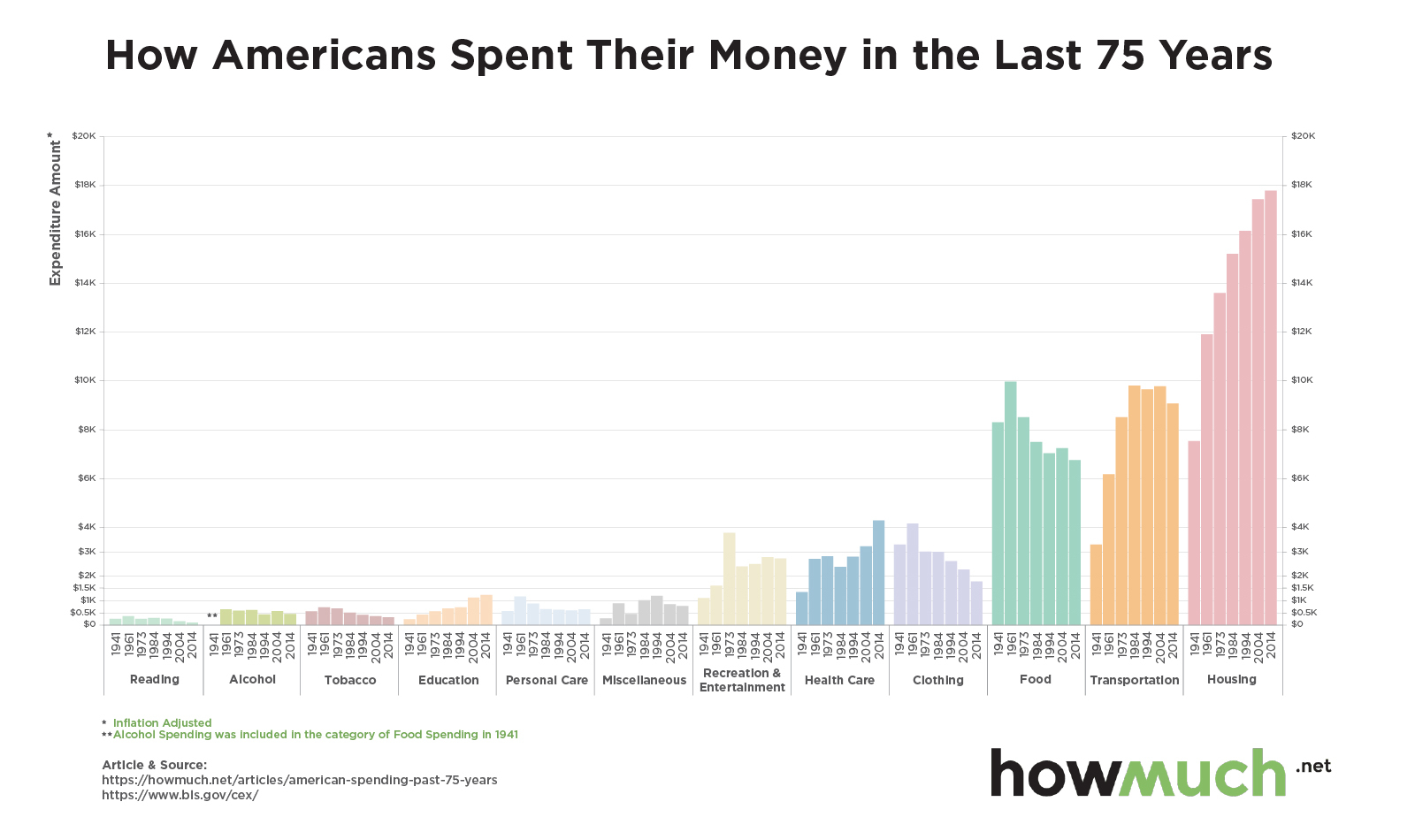
This led me to choose the chart above for my Friday inspiration, showing how Americans have been spending their money for the last 75 years (from this Howmuch.net article, which uses data from the Bureau of Labor Statistics).
It’s worth taking the time to download the original, zoom in and explore.
- Inflation adjusted housing costs, for instance, have risen from a little under $8,000 a year in 1941 to just shy of $18,000 in 2014.
- Transportation costs rose steadily from 1941 to a peak in 1984, but actually fell in the decade from 2004 to 2014.
- Transport remains Americans second largest expenditure after housing, at about $9,000 a year.
So, where might we isolate ‘digital’ spend within this chart? If I buy a new smartphone tomorrow, would it be recorded as ‘miscellaneous’, ‘recreation and entertainment’, ‘education’ or ‘reading’?
It quickly becomes apparent how small purely ‘digital’ spend remains in the grand scheme of things. Yet, at the same time, just how pervasive it is becoming and how significant the disruptive potential across all these catgeories.
Consider the intersection of food, transportation and housing: about $33,000 a year average spend. With an annual budget like that, what products and services might meet the needs of a digital nomad able to work from anywhere, once you factor in autonomous vehicles and sharing economy principles around food and housing? I have a feeling it might be a rather more significant lifestyle change than whether you go Samsung or Apple for your next phone.
Part of Friday Inspirations, an ongoing MEX series exploring tangents and their relationship to better experience design. We explain the origins of the Inspirations series in this MEX podcast and article. Share your own inspirations on Twitter at #mexDTI.
The Collection
For winter break, Real Life put together eight special issues for your consideration, each with a topic and essays selected by one of our editors. Please enjoy this pdf compilation of all the packages, below.


Featuring:


Talk

Various authors,
The Coral Project,
Jan 09, 2017
This is Talk, Mozilla's new open-source comment system. The link takes you to a working Alpha version. Be sure to explore the options in the left-hand menu to see the possibilities in the new system. It's coming together nicely, with a few special touches we know you'll like. The source is on GitHub. I can't wait to begin using it for OLDaily. Talk can be integrated with some other upcoming Mozilla tools such as Trust and Ask. Related: article on noxious online comments.
[Link] [Comment]VRLearn: Virtual Reality and Learning

Bobby Carlton,
Masie Center,
Jan 09, 2017
Elliott Masie still understands branding as this 'VRLearn' report shows. Do yourself a favour, skip the user-hostile web presentation (unless you like simulated paper (complete with page-turning sounds)) and go straight to the 12-page PDF. Virtual Reality has a lot of potential, writes Masie in the introduction, but it brequires three things to grow: authoring systems, a marketplace of VR/AR learning content, and an assessment focus. According to the report, applications exist in hands-on occupations such as aviation and space, medicine and health care, military, sports and even warehousing. Related: THE - VR in Education - Don't believe all the hype.
[Link] [Comment]Norway to become 1st country to switch off FM radio

Thomson Reuters,
CBC News,
Jan 09, 2017
OK, so there's dab, but there's also DAB, which is changing the face of radio. DAB stands for 'Digital Audio Broadcasting' and it's doing to radio what HD did for TV - switching from analog radio signals to video. It's controversial. As this article notes, Norway is switching from FM to DAB, a move opposed by many because it renders millions of radios (and especially car radios) obsolete. But proponents say the audio quality is better and more channels can be broadcast. The key issues are coverage (since DAB is little-used in many countries (and not at all in Canada)) and receivers (since DAB requires more power to receive). For more see WorldDAB.
[Link] [Comment]Indie Microblogging from Manton
Rolandtj
Manton Reece has a thing on Kickstarter: Indie Microblogging: owning your short-form writing
"In the earlier days of the web, we always published to our own web site. If you weren’t happy with your web host, or they went out of business, you could move your files and your domain name, and nothing would break.
"Today, most writing instead goes into a small number of centralized social networking sites, where you can’t move your content, advertisements and fake news are everywhere, and if one of these sites fails, your content disappears from the internet. Too many sites have gone away and taken our posts and photos with them.
"I want to encourage more independent writing. To do that, we need better tools that embrace microblogs and the advantages of the open web. We need to learn from the success and user experience of social networking, but applied to the full scope of the web."
I've backed it.
How Technology Hijacks People’s Minds — from a Magician and Google’s Design Ethicist

Tristan Harris,
Medium,
Jan 08, 2017
This title of this post should be "How to use technology to hijack people's minds." There's nothing inherently technological in these methods; they've flourished for thousands of years (as the reference to magicians should tell us). Here are the tricks (paraphrased with some quotation and links added):
- disempowering by design - if you control the menu, you control the choices
- intermittent variable rewards - you immediately receive either an enticing reward (a match, a prize!) or nothing
- fear of missing out - it will be hard for you to turn me off, unsubscribe, or remove your account — because (aha, I win) you might miss something important
- manipulation of social approval - I imagine him making a conscious choice to tag me but I don’ t see how Facebook orchestrated his doing that in the first place
- manipulation of social reciprocity - creating social obligations for each other (by accepting a connection, responding to a message, or endorsing someone back for a skill)
- bottomless bowls - to keep them consuming things, even when they aren’ t hungry anymore
- maximizing interruptions - to heighten the feeling of urgency and social reciprocity
- bundling your needs with theirs - make the thing customers want (milk, pharmacy) inseparable from what the business wants
- nudging - make choice inconvenient to focus on one outcome or another
- foot in the door - asking for a small innocuous request to begin with and escalate from there
Originally published in the Observer last June.
[Link] [Comment]Living Inside the Computer: Building Responsible IoT
A new paper by the NetGain Partnership examines the opportunities and dangers of a pervasive web
Today, we live online. The Internet intersects with everything from commerce and journalism to art and civic participation.
But more and more, living online doesn’t mean sitting in front of a screen, mouse in hand. The Internet of Things — the networked computing environment that spans the globe — allows the web to permeate our clothes, our homes, our healthcare. The web is now made up of billions of connected devices and zettabytes of data. It’s pervasive.
A pervasive Internet isn’t a novelty or a linear step forward. It’s an extraordinary leap that brings online power grids, emergency alert systems, pacemakers and appliances. It requires our deep thought and attention. And it needs a guiding set of principles.
Over the past few decades, we’ve seen the power the Internet wields. It’s a force that can unseat dictators, revolutionize education, reshape economies and connect billions. But it’s also a force that can surveil, repress, harass and exclude. It can undermine our most important values.
Now, we’re at an inflection point. As IoT evolves and permeates even more personal corners of our lives, we must balance progress with principles. We can’t only ask, “What’s possible?” We must also ask, “What’s responsible?”
The NetGain Partnership — a broad coalition of nonprofits committed to an Internet in the public interest — has published a paper on the road ahead. “We All Live in the Computer Now” explores the opportunities of a pervasive Internet, the challenges and where we go next.
IoT can work for the public good. It can fuel the movement for open knowledge and technology. IoT can contribute to a better planet: Cities like San Antonio, Barcelona and Hubli have used IoT to conserve water and energy. IoT can empower citizens: From Hong Kong to Dublin, people are using the web to participate in government. And IoT can fuel do-good organizations and movements, from Arduino to makerspaces.
On the flip side, there are existential dangers. IoT can erode privacy: Legions of connected microphones and cameras unknowingly track our movements and conversations. Governments surveil citizens en masse, and profit-minded businesses horde personal data. IoT also means more vulnerabilities, from the recent Dyn attack to the hacking of elections.
Examining past Internet inflection points is helpful. There were times that — in hindsight — would have benefited from a better balance of progress and principle. As the web exploded in the 90s, power was quickly consolidated in the hands of a browser monopoly. More recently, we’ve learned that much of the web’s evolution has favored the privileged, and left others — like non-English speakers, and the poorest among us — behind.
Yes, we’ve made positive progress on these fronts. Internet users now have more browser choice and control. And NGOs, businesses and governments are investing in digital inclusion. But right now, we have an opportunity to head off future dangers proactively. In the early era of IoT, we can shape a positive future.
What do we do? Philanthropies like Mozilla, Ford, Knight, MacArthur and Open Society are on the front lines of building a better Internet. And IoT will be the first big battle of 2017. In our paper, we share six guiding principles for better IoT. We’re also planning research, grantmaking and salons to further chart the future. And NetGain is seeking more technologists, activists and entrepreneurs for the movement.
3,000 Polaroids and Four Years Later, an Instant Photographer Looks Back
 The Coney Island finish of the all-night Warriors Bicycle Fun Ride, 7/3/16. All images courtesy the artist
When he began to take group portraits using the revival Polaroid film made by The Impossible Project, New York-based photographer Nick McManus combined his interest in shooting his friends with a penchant for controlling large numbers of people. The challenge of using relatively untested reformulated films and of working under extreme lighting conditions with sometimes very inebriated strangers became an obsession. Over the last two years, he has taken over three thousand portraits, a selection of which will be on display at the Ace Hotel in New York in January for a show titled Where’s My Polaroid?
“Documentary work was my focus in film school,” McManus tells The Creators Project. “To be able to pursue it in a way that can be shared enjoyably and instantly makes taking these portraits really worthwhile.”
 One-year anniversary of the Tender Trap in Greenpoint, Brooklyn, featuring owners Darryl Nau and Ryan Virag (first and second from bottom right), 4/2/16.
In order to shoot as much as he does, McManus relies on skills gained from former gigs in bike messaging, movie driving, and documentary producing. He cites Halloween in 2015 as an example, which fell on a Saturday and was the end of daylight saving time, giving him an extra hour. “Using the live music and nightclub venue connections I'd accumulated over the years I was able to pre-arrange a steady shooting schedule that went till 11 AM the morning after. The total was 23 portraits in 21 locations in 19 hours.”
The unrelenting pace of the project allowed him to overcome the chemical and technological limitations of his medium. Early on, he worked around dim lighting at restaurants and bars “by composing folks as tight as possible and then having them stay still” while taking a long exposure. “Later on I started using [four] SLR flashes set to slave mode that I taped to a ping-pong paddle. “
 The wedding of Camilo Salas and Callie Watts on their rooftop in Bed-Stuy, 8/5/16.
Eventually, switching to the Polaroid ProCam provided McManus with a wider angle and sharper exposure, but he still has to contend with the fickleness of the film. “After the photo ejects from the camera I slide it into a plastic envelope and shove it under my armpit on the inside of my shirt,” he explains. “Room temperature environments aren’t warm enough to fully develop during Impossible Project's half-hour development time.”
 Square Design's Riverboat Casino-themed holiday party at their office in Gowanus, 12/17/16.
Many of his early portraits were taken at the Lower East Side's Con Artist Collective and Greenpoint's Tender Trap, where McManus had a standing invitation to visit and interact with diverse crowds that were friendly to his mission. He then cast a wider net, shooting at art openings, after-parties, charity, and corporate events and in public spaces.
Groups have numbered up to 300 subjects, including 130 at Square Design’s holiday party, which was also one of the largest interior shots McManus has done. He says he took the portrait “from a 10-step ladder that had to be moved twice for the three photos needed to complete the panorama. I had to quickly lay out an axis with my pocket change to keep my lens perspective correct as I worked my way from left to right.” In comparison, corralling a bunch of drunkards is easy. “Unruly crowds aren't a problem for me because I'm polite.”
 The 2016 Cranksgiving Benefit Race and Fun Ride at Hudson Yards, 11/19/16.
McManus’ show at the Ace Hotel collects 720 of his portraits from 2016, including shots from former cultural landmarks such as Pearl River Mart, now closed Brooklyn venues, and even a shot of the VICE crew just kickin' it (below). The artist says, “There is other photographic work that I do but being a group portrait artist is something for me that will never end.”
 Alex Chitty, Andy Capper, Mike and Bill Tucci of the band Unstoppable Death Machines, and Thomas Morton in front the Tender Trap in Greenpoint, 7/7/15.
Nick McManus’s show Where’s My Polaroid? will be on display at the Gallery at the Ace Hotel in New York from January 5 to 31, with an opening reception on January 21 at 8pm.
Related:
Now You Can Trade Polaroids with Jack White


Finding an Eagle Attack
So nobody took me up on my trace a viral photo challenge. I’m disappointed in you all. It’s like you have jobs or something.
In any case, I’ve walked through the solution to one of the images in a video. For what it’s worth I recorded the video without sound so that I could concentrate on what I was doing and then went back and narrated, which means the actions and words are not precisely synced. I also in the original video went much further and nailed down the precise time of the event, photographers involved and such, but here I wanted to stop at a simple solution most people could do before retweeting.
So here is the photo.

The questions were:
- Was it staged? Photoshopped?
- Was it a National Geographic videographer who was attacked?
We find that it wasn’t staged or photoshopped, but that there is no evidence that the videographer was from National Geographic. Here’s how we do that in 90 seconds.
As I said, the original video went longer and gathered more information about the event and the people involved. But it’s this first 90 seconds that is crucial.
I’ll also say that this turned out to be an easy one, since the event was covered by Reuters, a reliable news agency that publishes stories worldwide. But the techniques on more difficult material look the same.


OPML File Type on Macs
I was fixing a bug in OmniOutliner where it wouldn’t open a file with an uppercase .OPML suffix. I did some digging, and the fix was to register the app as handling the com.apple.news.opml file type.
Which upset me. I’ll explain.
OPML — Outline Processor Markup Language — was invented in 2000 by Dave Winer at UserLand Software. It’s not Apple’s format, and the correct file type is org.opml.opml.
I was working for Dave at the time. Some time after Dave wrote the first OPML reading and writing code, I ported it to C. Later, when I was working on NetNewsWire, in 2002, I wrote what may have been the first Objective-C code for reading and writing OPML. And today I work on OmniOutliner, which supports OPML, and I’ve published an open source OPML parser.
So I know OPML. After Dave, I may have worked with this format more than anyone else in the world.
This file type redefinition not only created a bug that I had to figure out and fix, it also demonstrated disrespect. I suspect it was entirely thoughtless — but, well, that’s still bad.
Radar forthcoming.
Update: Bug filed: rdar://29888756.
What’s Up with SUMO – 5th January (2017!)
Hello, SUMO Nation!
Welcome to the new year, which is going to be full of novelty, challenges, greatness, problems to solve, ideas to share, and many other things – courtesy of all of you reading these words, we hope :-). Let’s roll into the new days with the new from the most recent past ones!
Welcome, new contributors!
If you just joined us, don’t hesitate – come over and say “hi” in the forums!
Contributors of the week
- All the forum supporters who tirelessly helped users over the last week.
- All the writers of all languages who worked tirelessly on the KB over the last week.
- Seburo for being the friendly ghost dropping useful and important information on us ;-)
We salute all of you!
SUMO Community meetings
-
LATEST ONE: 4th of January – you can read the notes here (and see the video at AirMozilla).
- NEXT ONE: happening on the 11th of January!
-
Reminder – if you want to add a discussion topic to the upcoming meeting agenda:
- Start a thread in the Community Forums, so that everyone in the community can see what will be discussed and voice their opinion here before Wednesday (this will make it easier to have an efficient meeting).
- Please do so as soon as you can before the meeting, so that people have time to read, think, and reply (and also add it to the agenda).
- If you can, please attend the meeting in person (or via IRC), so we can follow up on your discussion topic during the meeting with your feedback.
Community
- Congrats to Joni and Roland for their mention in the 2017 recap video (for Focus)!
- If you are struggling with using Vidyo on Ubuntu, please contact Seburo – he may have found a solution for your pains.
- Help us help others with using the Web in a smart, easy, and safe way.
- Calendar time! January dates that you should remember:
- 10th – Firefox for iOS 6.0 released (to be confirmed).
- 11th – SUMO Community Meeting
- 12th – SUMO Platform Meeting
- 16th – 22nd – tentative final migration period to Lithium
- 18th – SUMO Community Meeting
- 19th – SUMO Platform Meeting
- 24th – Firefox 51 release
- 25th-26th – SUMO Day & SUMO Social Day
- …any other dates you want us to keep in mind? Use the comments below!
- Are you interested in working together on training for new contributors? Talk to Rachel!
Platform
- Check the notes from the last meeting in this document. (and don’t forget about our meeting recordings).
- The main points of today’s meeting were:
- GET READY! The final migration is happening after the 15th of January!
- Another test migration will take place soon. More updates during the next Platform meeting.
- The existing bugs are getting prioritized. More details in the meeting document.
-
Reminder: You can preview the current migration test site here.
- If you can’t access the site, contact Madalina.
- Drop your feedback into the same feedback document as usual.
- We have a Bugzilla component for issues. You can see their list here and you can create new ones here – please do not assign them to anyone when you create them.
- Reminder: The post-migration feature list can be found here.
Social
- No major updates just yet, but do remember that the SUMO Social Day will be happening end of this month :-)
- Reminder: you can contact Sierra (sreed@), Elisabeth (ehull@), or Rachel (guigs@) to get started with Social support. Help us provide friendly help through the likes of @firefox, @firefox_es, @firefox_fr and @firefoxbrasil on Twitter and beyond :-)
- Reminder: that you can subscribe to the social-support@ mailing list and get updates from Sierra!
Support Forum
- Are you listening to music while responding to posts in the forums? What’s your favourite (or not so) holiday song?
- A polite reminder: please do not delete posts without an explanation to the poster in the forums, it can be frustrating to both the author and the user in the thread – thank you!
Knowledge Base & L10n
- Over 240 edits in the KB in all locales since the last blog post – a slight slump due to the celebrations, but you keep making the KB better with each one of them!
- This is the best time to contribute your feedback about the mechanics new l10n process before we migrate – they will be changed into feature requests for future platform updates (if they’re feasible).
Firefox
-
for Android
- The forum thread for version 50 is here.
- 24th January 2017 still is the release date for Firefox 51 for Android. No surprise delays for now.
-
for Desktop
- The forum thread for version 50 is here.
- 24th January 2017 still is the release date for Firefox 51 for Windows, Mac, and Linux. Warmer and warmer…
-
for iOS
- 6.0 happening soon! Most likely around January 10th (?).
If you have them, share you new year impressions with us in the comments, please :-) I, for one, was quite OK eating the 12 traditional grapes (one for each of the tolls of the midnight bells). And as for 2016… Yes, the promised annual summary report is coming, thanks for your patience and understanding – we want it to be both informative and fun. Stay tuned & keep rocking the helpful web, friends!
Lode Runner in Your Browser
If you had an Apple //c, //e, or any other computer of that vintage then you need to check out Lode Runner for the web. Your fingers will know what to do as soon as you start a level.
If 1983 is before your time, then you should take a peek at Lode Runner so you know what Awesome Fun we were having 34 years ago.
I'm pretty sure Lode Runner was first game I ever played on an Apple computer. Some family friends had an Apple //c with that little 9" green display, and I was instantly taken by it. I never had that same little display, but I did end up with a //c eventually. Probably the only other game I played more on it was Ultima IV. Good times.
Via The Loop.
A Beginners Guide for Manual Controls in iPhone Photography: Shutter Speed
Welcome to the fourth feature in our series of Beginners Guides for Manual Controls in iPhone Photography. You can find the other installments here:
- Focus
- Exposure
- White Balance
- Shutter Speed (this post)
- ISO
Mantra for Manual: Creative Intentions
Remember in auto mode, the iPhone camera doesn’t know what your creative intentions are for any given photograph. When you shoot in auto you are, in fact, relinquishing creative control to the camera. Now, in all fairness, the iPhone, even in auto, does quite a remarkable job in determining exposure, focus, white balance, shutter-speed and ISO. And it does so, all behind-the-scenes, without you ever even knowing what is happening. But auto is not fool proof. There are many lighting conditions that will fool your in-camera iPhone meter and generate bad results. For these special circumstances and scenarios, understanding manual control will put you back in charge, and empower you to precisely execute your creative intentions. So get to know your manual controls, and you’ll be happier for it. And your photos will stand out from those who exclusively rely on auto. I’m not suggesting you always shoot in manual – heavens no. You don’t need to, because in bright light conditions the iPhone auto does a really decent job at giving you just what you’re looking for. No fuss, no muss.
I would say I shoot roughly about 80% of the time in auto. Leaving only 20% of my time shooting in full manual control for those tricky and problematic scenes – backlight, high contrasting light, predominantly white objects, predominantly black objects. Even if you primarily shoot in full or a modified auto mode, it’s important to fully understand the technology going on under the hood. That way you can seamlessly dance between auto and manual without ever missing a step.
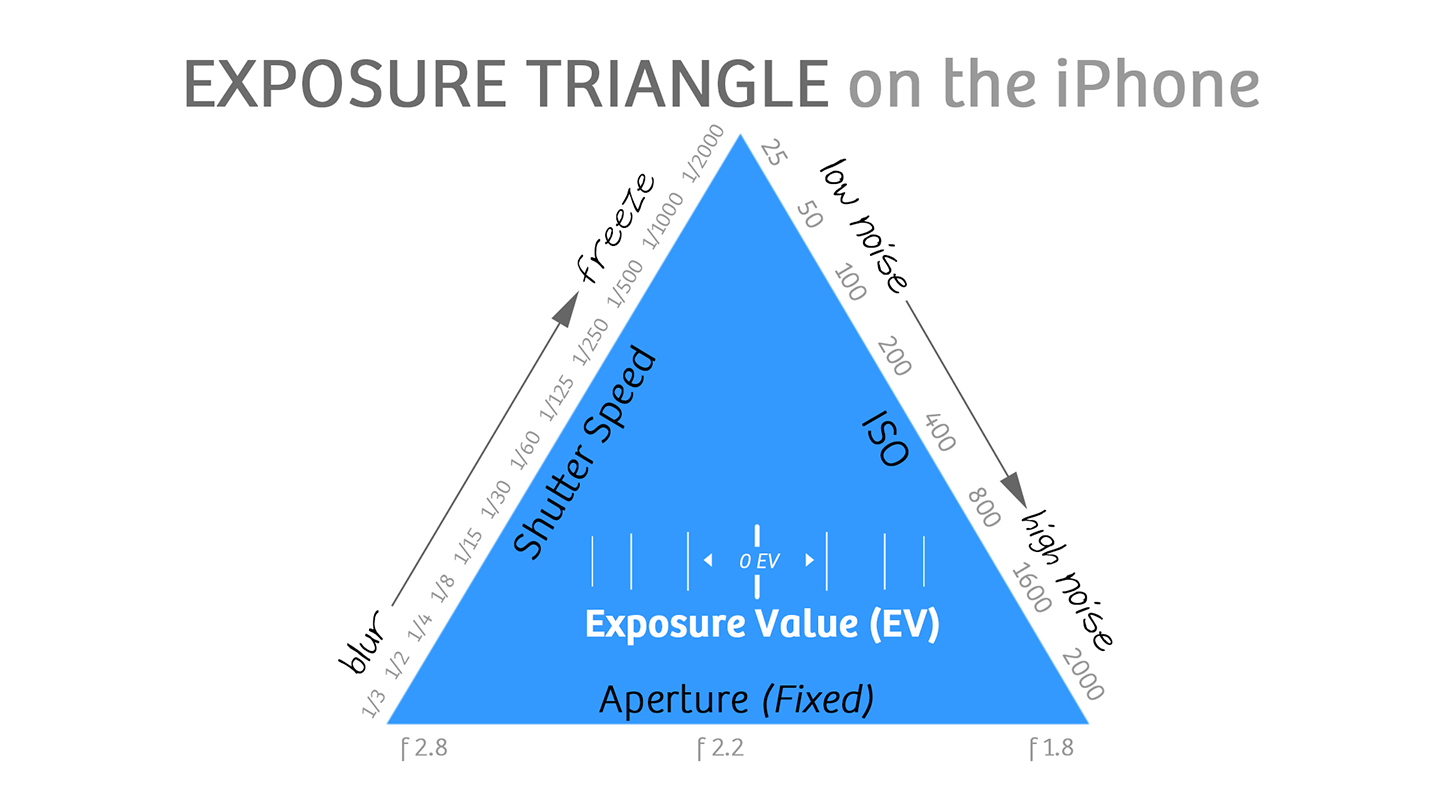
For every photograph you ever take, even smart phone photos, there are three factors that determine optimum exposure – aperture, shutter-speed and ISO.
Aperture is the intensity (or quality) of light hitting the sensor during any given exposure. On the dual-lens iPhone 7 Plus, the wide angle (28mm equivalent) has a maximum aperture of f1.8, while the component telephoto (56mm equivalent) has a maximum of f2.8.
The iPhone aperture is fixed. In other words, it stays the same regardless of what the shutter-speed or ISO is doing. Shutter speed is the duration of light hitting the sensor, and ISO sets the amount of light-sensitivity for the camera sensor. Keep an eye out for the next video in this series where we will be looking more in depth at ISO and how it practically affects your photographs!
Effects of Shutter Speed on the Final Image
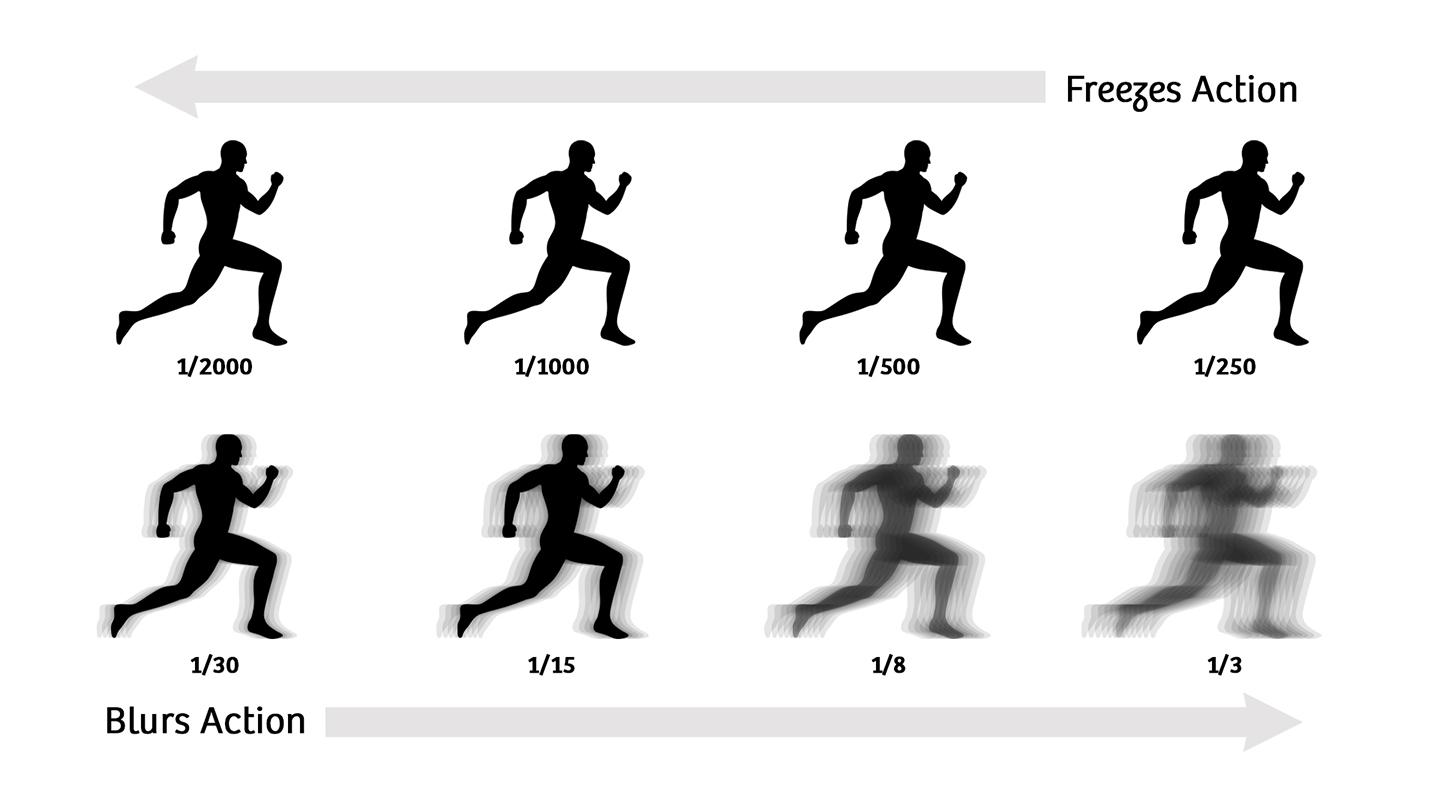
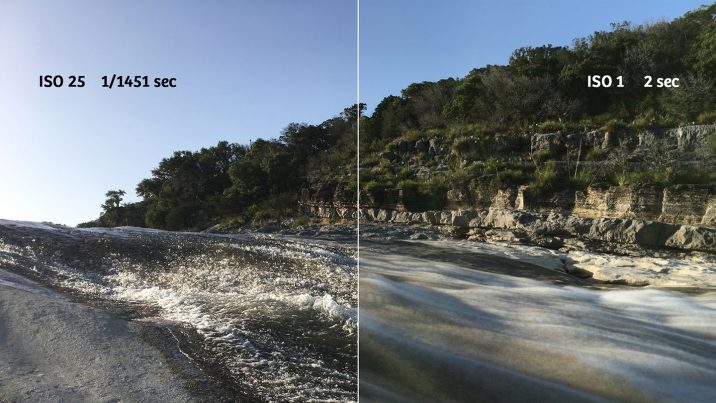
Shutter speed is measured in seconds or fractions of a second. For example, ½ second is “slower” than 1/1000 second and 1/500s is “faster” that 1/60s. Short shutter speeds are generally used to freeze action. Longer shutter speeds are used to blur action. Shutter speed values double with each setting. For example, 1/500s is letting in twice the amount of light as 1/1000s. As you go down the shutter speed scale, the amount of light being let in doubles. As you go up the scale, in each setting there is half the amount of light being let in. Once again, the iPhone camera doesn’t really know what your creative intentions are for any given photograph. So it’s important to know the effect that “fast” and “slow” shutter speeds will have on the final look of your photos. “Fast” shutter speeds (i.e. 1/2000s, 1/000s, 1/500s) will freeze your action – making people running or water flowing in a river appear tack sharp. “Slow” shutter speeds (i.e. 1/30s, 1/15s, 1/8s) will blur your action, turning those moving objects into soft blurs.
How the iPhone Handles Shutter-Speed (and ISO)
Listen carefully – this point is so important. Once I learned how the iPhone handles shutter speed and ISO, it changed everything for me. It brought a whole new sensibility to how I crafted my exposure. You see, in auto mode the iPhone camera combines both shutter speed and ISO. They are inseparable and always work in tandem. In bright light, the camera defaults to the lowest practical ISO (i.e. ISO 25-100) and the highest practical shutter speed (i.e. 1/8000s – 1/500s) for these situations. As you need more light, the ISO remains practically low and the shutter speed gets “slower”, meaning the shutter is allowing more light to the sensor. Once the shutter speed goes all the way down on the scale to where it is practical for getting a crisp photo (i.e. 1/125s – 1/30s), the ISO increases all the way to ISO 2000.

The important point I’m making here is that the iPhone camera is optimized for shooting at “fast” (high) shutter speeds. And remember, these fast shutter speeds are used for freezing motion. So if you want to shoot at a “slow” shutter speed, then you’re going to need to use a third-party app that gives total manual control over shutter speed and ISO. Enter Camera+.
This gallery of slow shutter speed photographs was all shot with Camera+ in manual mode using long-exposure settings:
Shutter Speed




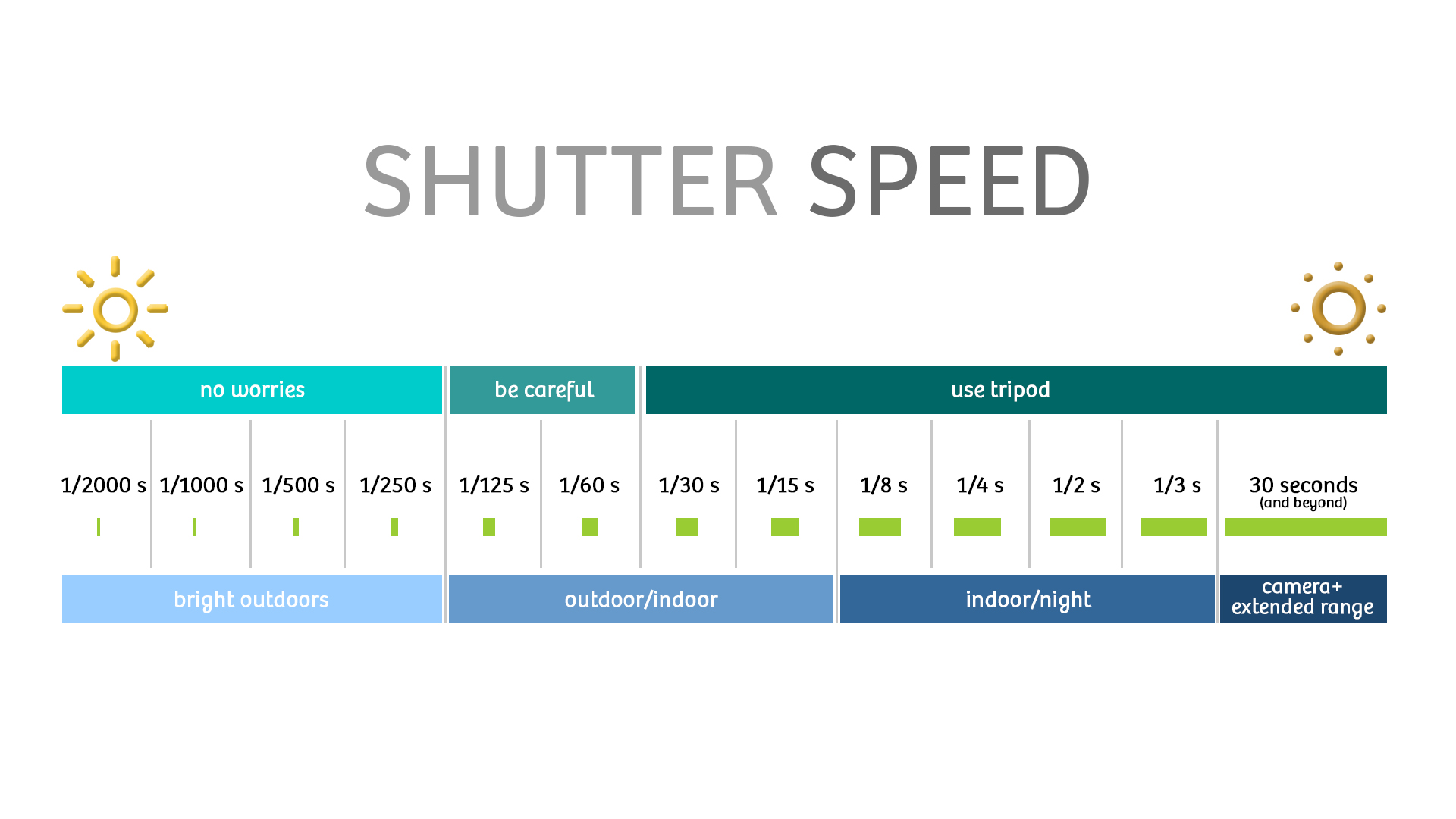
Range of Shutter Speeds Available on the iPhone
This is a basic chart to help you navigate different shutter speeds. Most iPhone models have a similar shutter speed range. This chart is based on the iPhone 7 Plus, as well as including the extended shutter speed range (up to 30 seconds) when you use Camera+.
By the way, since the native app doesn’t display “live exposure data” (shutter speed and ISO) you are going to need to use a third-party camera app, like Camera+. While you are shooting it lets you see what shutter speed and ISO setting your camera is on. Being able to see this exposure metadata live is beneficial because after the photo is taken, it is of little value. This is critical in determining how sharp or blurry your iPhone photos will be. Fast or high shutter speeds (i.e. 1/500s and up) will freeze your photographs. Slow or low Shutter Speeds (i.e. 1/13s and below) will blur your photographs.
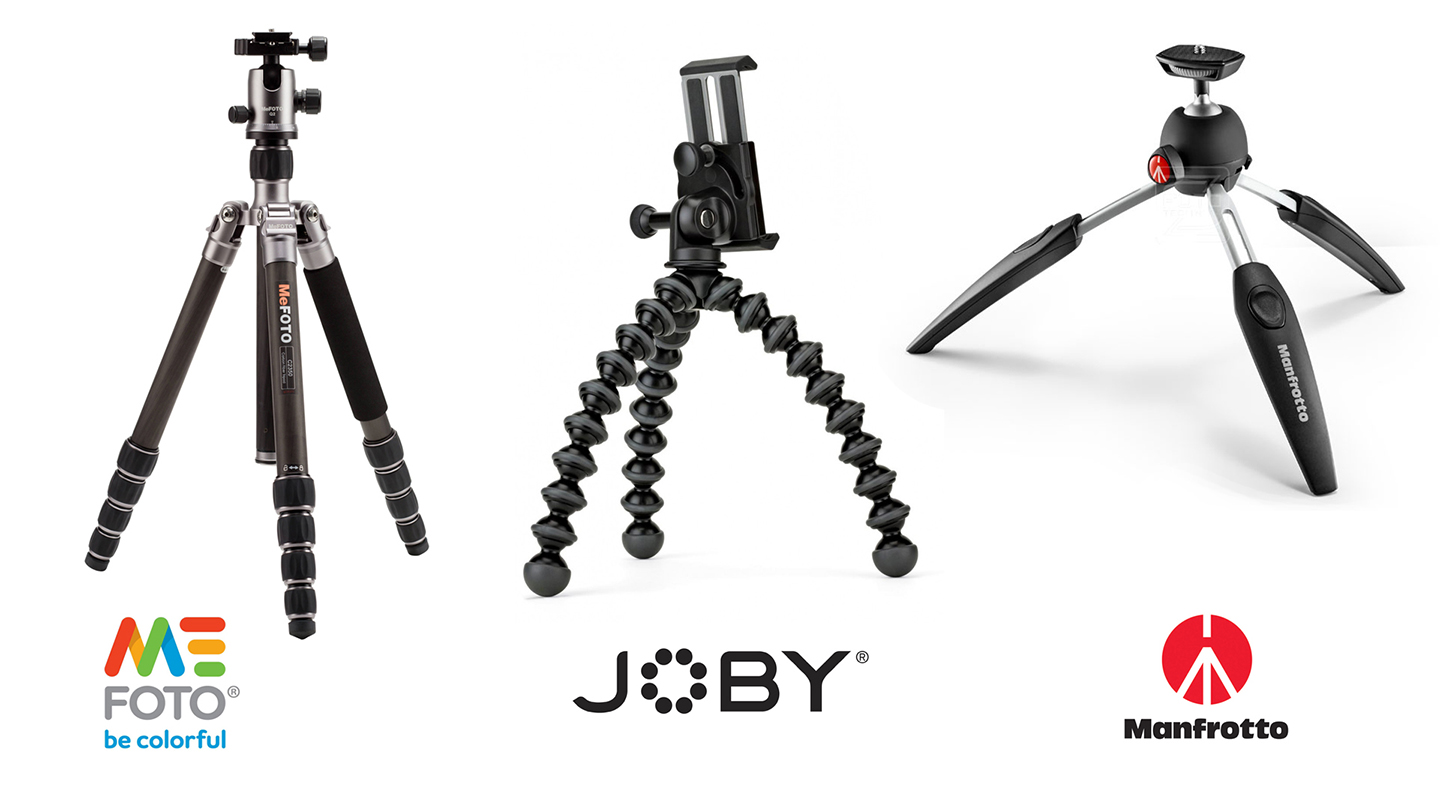
Based on my own style of shooting, I’m pretty steady up to around 1/60s. But once the shutter speed dips below 1/60s, out comes the tripod. If I am bracing myself against something, possibly holding my breath as well during exposure, then I can often hand-hold my exposures to as long as 1/15s.
Steady as She Goes
Here are three different tripods I use regularly in my own iPhone photography. Each of them has served me very well, and I don’t hesitate to recommend them to you:
Twitter Favorites: [b0rk] wrote a tiny post about programming experiments https://t.co/C7J2tWdsLK

Court: Fan-Funded Star Trek Film is Not ‘Fair Use’
mkalus
shared this story
from  TorrentFreak. TorrentFreak.
|
 Last year, Paramount Pictures and CBS Studios filed a lawsuit against the makers of a Star Trek inspired fan film, accusing them of copyright infringement.
The dispute centers around the well-received short film Star Trek: Prelude to Axanar and the planned follow-up feature film Axanar.
Among other things, the Star Trek rightsholders claim ownership over various Star Trek related settings, characters, species, clothing, colors, shapes, words, short phrases and even the Klingon language.
The case is now heading towards a trial, which means that the ultimate decision may sit in the hands of a jury. However, this week the court shared its opinion on some crucial issues, responding to motions for summary judgment submitted by both parties earlier.
The Axanar team, for example, informed the court that their films do not infringe Star Trek copyrights. One of the main reasons, according to the makers, is that it clearly falls under fair use. However, the court sees the situation differently.
After weighing the four crucial factors for determining fair use, District Court Judge Robert Klausner concludes that the fan-film is not entitled to a fair use defense.
In an order published this week he explains that even though the film will be distributed for free, it has a commercial nature because the makers profit in other ways. For example, through other job benefits that flow out of it.
Another crucial factor is the amount and substantiality of the infringing elements that appear in the film. Here, the court also concludes that Axanar went beyond fair use by including many details of the Star Trek canon which are important to Star Trek fans.
The other two factors, the nature of the original copyrighted work, and the effect on the market value of the Star Trek franchise, didn’t warrant a fair use qualification either.
“The Court thus finds that all four fair use factors weigh in favor of Plaintiffs. If the jury does not find subjective substantial similarity, Defendants did not infringe and fair use defense is moot,” the order reads.
“Rejection of Defendants’ fair use defense is consistent with copyright’s very purpose because derivatives are ‘an important economic incentive to the creation of originals’,” it adds.
Responding to the motion of the movie studios, the court separately concluded that there is an objective substantial similarity between the fan-film and the original Star Trek works.
While no ruling was made on individual items such as the Klingon language, costumes, characters or species, as a whole the overall “look and feel” was found to be similar.
That said, the court leaves a ruling on subjective substantial similarity up to the jury.
This means that one of the main questions during trial will be whether an ordinary, reasonable person would find the total concept and feel of the fan-film to be substantially similar to the original Star Trek works. This will to a large degree determine the outcome of the case.
While it’s still too early to draw any conclusions, the court’s opinion is a clear setback for the Axanar makers. With fair use out of the way, and a court that sees substantial similarity with the original works, their fate now lies in the hands of the jury.
—
The court’s full opinion on the motions for summary judgement is available here (pdf).
Source: TF, for the latest info on copyright, file-sharing, torrent sites and ANONYMOUS VPN services.
Wherein this boulder isn't going to roll itself up that hill.
mkalus
shared this story
from  DNA Lounge. DNA Lounge.
|
Wherein this boulder isn't going to roll
itselfup that hill.
Hey look, it's 2017. How you doin'?
Alright, what's been going on. Let's see...
We had four New Year's Eve parties, and both Acid Rain and Bootie did great. Acid Rain really gave me flashbacks to Thump, since it was trance instead of hardcore as most of our "rave" events have been lately. After Bootie ended on New Year's Eve we had Drums, a circuit party, from 3am to 9am. That was somewhat under-attended. It's been years since we've done a late-night party like that: back in the Thump days, sometimes the headliner wouldn't even go on until 4am, but that's very much out of fashion these days. Kids today, I don't know. That same night, we also had an 18-and-over Mini-Bootie over at Codeword, and that tanked like a big tanky thing. Sigh. Well, two out of four?
Our awesome crew have been busting their butts following up on all the great suggestions and offers for help we've gotten since the apocalypse post -- if we haven't gotten back to you yet, we will soon! There have been many 16 and 23 hour days here lately. Everyone is looking a bit shell-shocked.
To the future -- ("To the future!" Wait, that wasn't a toast? Sorry...)
- Lots of people have offered their help who don't necessarily have money, but do have time, hands and brains, and to facilitate that, we've created a new Facebook group, DNA Lounge Street Team. Go join! Use it for discussion and suggestions. I imagine that we will end up using it to throw out random calls for assistance, like "hey, anyone want to design some flyers?" or "who loves painting the floor?"
- After a very helpful talk with Alan at Borderlands Books about how their sponsorship program works, we came to the conclusion that a sponsorship is not, and should not be, a product that you sell.
I've updated our Patreon page with an explanation of this, so I'll just paste it here:
Your sponsorship helps ensure that we can continue bringing you the kind of awesome, eclectic and weird events that you've come to expect from us! Your sponsorship keeps us independent, and lets us continue to take chances on the kind of local live entertainment that makes San Francisco great.
"But what's in it for me?"
Unlike most crowdfunding efforts, we are not selling you a "product" here. Your donation allows DNA Lounge to continue to exist, plain and simple. We think that's important. We think that's a pretty big deal. We hope that you do too!
Maybe you're one of those people who finds themselves at DNA Lounge three times a week. Or maybe you only come to three shows a year, but those three shows are really important to you, and you very much want to be able to come to them in the future. We want that too, and that's why we need your help.
"Wait, you mean I don't get free tickets?"
We thought long and hard about this, and came to the conclusion that doing something like that would send entirely the wrong message. We want you to donate to this cause because you want DNA Lounge to continue to exist. If we offered rewards like, "if you donate X dollars, you get Y free tickets", then what we're really doing is selling you a ticket bundle. That proposal makes you a customer, not a sponsor, not a partner. It forces you to ask the question of whether you're getting your money's worth: whether those tickets are a bargain.
But we don't want you to donate because it's a good bargain. We want you to donate because you believe in our mission, and want it to continue!
We may choose to offer some sponsor-only perks in the future, because you are awesome and we love you, but we don't want that to be the reason you signed up.
- We had an all-hands meeting! I think it went pretty welll, in that we were able to convey a lot of info, and we received a lot of good feedback from our staff. It's been a couple years since we did that, which was an unfortunate oversight. There really are a lot of people who work here. Thank you, DNA co-conspirators. It was good to see all of your faces. Here's Meredith's moody take on it:
- ROT13, Jared's daily craft cocktail happy hour over at Codeword, has a DJ now! Laüs will be spinning for you every Wednesday. Come check it out.
- At the last Peepshow (our drag/burlesque show that happens third Wednesdays at Codeword) at intermission time, Sophilya said something to the effect of, "...so go next store and get a slice", and someone in the audience yelled, "THE TOTS!!" and the whole audience cheered! They cheered our tater tots, man. I mean, yeah, they're pretty great! But I haven't heard that before.
- What's up with the sidewalk? Beats me. After that flurry of activity just before New Year's, they have been MIA for eight days, and haven't even picked up their big plastic barrier wall. I think they're not quite done with the street paving on the other side of the curb. When do we get our bike racks back? Good question. We chained a stanchion to the streetlight as a halfassed substitute.
- It came up in conversation today that that stupid tree in the middle of our sidewalk -- a twig of a tripping hazard on an inverse island in a sea of concrete -- probably ought to have its own Twitter account. Lounge. "I've seen some shit, man. My roots are soaking in a slurry of candy cane and Fireball. I hate SantaCon."
- This changes everything! Wait, this changes nothing! California Beauty Salons, Barbershops Will Soon Be Allowed to Serve Wine and Beer.
- My new favorite Yelp review demonstrates the eternal healing power of cookies:
Went here last night. Ordered a carnivore pizza and a cookie. The guy behind the counter got a call immediately afterward from some schmo who had ordered delivery pizza but failed to answer the door, which took him a minute or two to sort out. He was super chill and gave me a second cookie for free to make up for the delay.
The pizza was delicious btw.
That's all I got. Carry on.
Connected, Episode 123: 2017 Apple Predictions
Myke, Federico and Stephen draft their predictions for Apple’s 2017 before talking a little bit about some resolutions for the new year, tech-related and otherwise.
If you want to know what we think is going to happen in the Apple world this year, you don't want to miss this week's Connected. You can listen here.
Sponsored by:
- Casper: Because everyone deserves a great night sleep. Get $50 off with the code ‘CONNECTED’
- Squarespace: Make your next move. Enter offer code WORLD at checkout to get 10% off your first purchase.
→ Source: relay.fm
Galaxy S8 design potentially leaks in new photo
Thanks to the Chinese social network Weibo — a common source of leaks in the smartphone world — Samsung fans now have a better idea of what the Galaxy S8 may look like.
If the leaked photo is legitimate, it all but confirms that the device will have no physical front-mounting buttons, which means that the fingerprint scanner and home buttons will likely be embedded in the screen.
In addition, the device appears to be gold with thin side bezels and relatively thin bezels on the top and bottom. The size of the screen can’t be determined from the photo, though rumours have suggested that two devices — one with a 5.5 inch-screen and one with a 6.2-inch screen — could be released. Other rumours however, have leaned towards the release of just one device.

In the absence of a physical home button, it’s likely that the device pictured contains a screen larger than the 5.5 inch display of the Galaxy S7 Edge.
While it’s suspected that the company will follow in Apple’s footsteps by abandoning the 3.5mm headphone jack, this can’t be determined from the photo alone.
This past year has left Samsung reeling from the flaming disaster that was the Galaxy Note 7, which arguably makes the upcoming Galaxy S8 one of 2017’s most anticipated devices.
Other rumours surrounding the S8 launch include the potential for PC functionality, the release of wireless earbuds alongside the device and the incorporation of an auto-focus selfie cam.
It’s not clear when the S8 will be officially released, though rumours indicate Samsung may release the device this coming April, possibly in New York. MobileSyrup previously reported that mass production of the device will begin in March and the official launch in April of 2017.
Samsung is reportedly aiming to develop 10 million units ahead of the launch.
The Photographer Purrsuing the Purrfect Classic Cat Purrtrait | City of the Seekers
 Kitty Warhol
In the late 19th century, Southern California attracted misfits, idealists, and entrepreneurs with few ties to anyone or anything. Swamis, spiritualists, and other self-proclaimed religious authorities quickly made their way out West to forge new faiths. Independent book publishers, motivational speakers, and metaphysical-minded artists and writers then became part of the Los Angeles landscape. City of the Seekers examines how the legacy of this spiritual freedom enables artists to make creative work as part of their practices.
Best known for his trilogy of stunning and macabre photography books on corpses, charnel houses, ossuaries, and human attitudes towards death, Dr. Paul Koudounaris has since turned his lens on his own beloved feline to illustrate what happens when you go from taking photos of rare bejeweled skeletons to snapping pictures of a cat assuming various iconic roles in history.
 Cat-ton LaVey
Koudounaris' career trajectory has taken him from professor to writer/documentarian, and now, artist, in part thanks to his extraordinarily cooperative muse, a rescue cat named Baba. Koudounaris first found her after he entered the North Central Animal Shelter in Los Angeles to adopt another cat he had his eye on, but a man who turned out to be a police office officer literally flashed his badge and claimed he had dibs on it. On his way out, Koudounaris spotted Baba, and she's been his loyal companion ever since. "I believe it's true that more often than not it's the animals who choose us, and not vice versa," Koudounaris tells The Creators Project.
Looking through Koudournaris's incredible photos of Baba, one can't help but wonder how the cat manages to stay patient enough for the photos to be taken. "She just has a talent," Koudounaris explains. "It's like asking why one person can sing well and another can't; sometimes there's just an innate ability. Of course, there's another, possibly more dubious answer: I have had a couple people suggest that she is a reincarnated fashion model. For that, I cannot vouch."
 Billy the Kitten
Koudournaris actually has three cats, and used to take photos of all of them. But whenever he took out his camera, Baba quickly started upstaging her four-legged roommates and hammed it up. Now, Koudounaris photographs Baba exclusively. "She's a very smart cat, and I think there came a point at which she realized that if she plays this game with the camera, suddenly she will get all the attention she ever wanted," Koudounaris notes. "I'm sure that's part of it. But it still can't explain her level of skill. She's simply a natural."
Of course, one can't help but wonder if the images actually feature real props, set decor, and costumes, or whether it's all Photoshop. "It's all real. That's a point of pride," Koudounaris responds. "I've had a lot of people assert otherwise. One guy even insisted she isn't alive, that she is a jointed taxidermy cat."
 Cat Beard
All of Baba's costumes are made by Koudounaris, who sometimes repurposes them from things like old stuffed animals. He even styles the cat's wigs, which are usually designed for dolls, and applies fake facial hair on Baba's face using toupee tape. As far as backgrounds, the photographer also spends a lot of time hunting down appropriate print fabrics. "It's a true collaboration between us," Koudounaris describes his work with Baba. "If it were a Photoshop situation I wouldn't bother, anyone could do that. But no one else can do what we're doing. That's what makes it special to me."
In fact, Koudounaris takes his images so seriously, he actually has costume fittings with Baba and takes test shots before proceeding to the actual photo sessions. Some take longer than others, but either way, "The key to it is for me to know what I'm doing," says Koudounaris. "Because she is reading off of me. If I have a very clear idea of what I want, she'll get it. If I don't, she won't. So I try not to even bother her with it until I feel like I'm ready on my end."
 Marie Cat-toinette
But Koudounaris' impulse to take amazing photos of Baba goes far beyond mere whimsy. "At its root, the whole photo series is an experiment in interspecies communication," he says. "She has to trust me with what I am putting on her. I have to find a way to communicate to her the expression and pose that we need. No, we're not always successful. Sometimes, she just won't get what I want. Although interestingly, I'll often look back through 'failed' sessions and realize those sessions weren't failures at all because her instinct for the pose was actually better than mine."
Koudounaris confesses that "every one of those photos has flaws in it," whether it's a problem with a wig, a mustache, or an issue with the camera itself. But he says it's the imperfections that ultimately give the images "a certain unique charm." And of course, despite the organic production, the photos also go through a level of processing after the fact, whether it's color-correction or adjusting the brightness, exposure level, contrast, and highlights.
 Cat-stronaut
According to Koudounaris, his portraits of Baba aren't just portraits of the cat: they are self-portraits, too. "Sometimes that strikes people as odd when I first stay it, but when you think about it, it starts to make sense," Koudounaris explains. "[Baba] doesn't know these characters. She doesn't know who Andy Warhol is, or any of the other famous people we have done caricatures of. I know who those people are, and I come up with a character for her to play based on a costume and a scenario, and she reads that off of me. So all of these photos are self-portraits: basically me as the character via the medium of a cat. Thus, the main part of the working process doesn't involve photography at all, it involves me clarifying the way I see the subject as a caricature, and then making or finding whatever we need."
Right now, Koudounaris mainly showcases his cat photos on Instagram, but hopes to put out a photo book sometime in the future. "[B]ut it might not be the book people would expect," he says. "I want to write a book under her name and in a cat's voice, that gives a feline take on human history and culture, and then these photos will help illustrate it. That's why they're all caricatures. What would a cat think of Renaissance drama? William Shakes-paw will tell you. What's a cat's take on Ancient Rome? That's where Mew-lius Caesar comes in. So there are more than just photos involved here: there's an entire historicizing perspective that will later come into play when I put it all together."
 Cat-urday Night Fever
These days, Koudounaris is also taking surreal photos of mannequins and other props in abandoned mines around Los Angeles. As an LA native, he believes his hometown is an ideal place to expand one's creativity with offbeat projects like his. "[T]here aren't a lot of other places I could vacillate between all the things I am currently doing. California to me is a constant process of discovery, and with that my vision changes. So why am I still here? Ultimately because, despite all the negative things one might say about it, it's a place where I never feel stagnant."
As someone who's so familiar with the occult scene in Los Angeles, Koudounaris feels the city has a rare openness and acceptance regarding one's own convictions in life. "I mean, I'm a guy with a PhD in Art History, aren't I supposed to be sitting in classroom somewhere regurgitating lectures about Rembrandt for the next 25 years?" he asks. "Well, that didn't appeal to me, and I am in an environment here that makes me confident in my freedom to turn my back on that."
 Paw McCartney
 Cat-Sabbath
 I Want Mew—Uncle Sam
Follow Paul Koudounaris on Instagram, visit his website, and if you're in the LA area January 14, check out his lecture on demonically possessed cats at the Satanic Mass, a benefit for the Satanic Temple Los Angeles.
Related:
Behind-the-Scenes of a UFO Arts Collective | City of the Seekers
Curious Wooden Sculptures Examine Human Consciousness | City of the Seekers

Celebrating John Berger, the Storyteller Who Taught Us to See
English artist, critic, and author John Berger died Monday at the age of 90. Berger is best known for Ways of Seeing, an art theory staple since 1972, when it was published in conjunction with a four-part television series on the BBC. For many, the book and series were an introduction to the often-mystifying concepts behind an elitist art world. Berger’s clear examples and straightforward language made the visual arts accessible for a new audience to appreciate.
Throughout the Ways of Seeing television series, which opens with Berger taking a razor blade to a painting hung on a museum wall, he makes powerful statements about the way art is viewed in the second half of the 20th century. “The meaning of a painting no longer resides in its unique painted surface, which it is only possible to see in one place at a time.” Using simple language, Berger describes concepts from Walter Benjamin’s The Work of Art in the Age of Mechanical Reproduction and explains how the invention of photography has changed the meaning of a painting. “The camera, by making the work of art transmittable, has multiplied its possible meanings and destroyed its unique original meaning.” Berger goes on to illustrate how painting can be manipulated by other media, like television, and points out that even as he is describing it, he is also part of the manipulation. “I hope you will consider what I arrange, but be skeptical of it,” warns Berger.
The son of an infantry officer in the First World War, Berger also served in the British Army before going on to study art and beginning his career as a painter. While working as an art teacher, Berger began writing essays and reviews about art for British political and cultural magazine the New Statesman.
In an effort to escape the alienation of modern English life, Berger moved to France in the early 1960s, where he continued to work on various creative projects and took up farming in the French countryside. These projects included numerous novels, screenplays, and poetry collections, which often addressed serious social issues, like the AIDS crisis, as well as art and politics.
A self-proclaimed Marxist, Berger’s strongly held anti-capitalist beliefs often came out in his actions as well as his works. When he won the Booker Prize for G, an experimental narrative novel that chronicles the exploits and political enlightenment of a roguish hero, he donated half the prize money to the British Black Panthers in protest of the award’s sponsor.
While acting the 1989 film Play Me Something, Berger befriended Tilda Swinton, who has referred to their close friendship as a “twinship.” Berger and Swinton, who happen to share the same birthday, remained close throughout his life and Swinton even made a series of short films in collaboration with Colin McCabe about Berger’s life and work.
Despite the vast technological changes that have occurred since Ways of Seeing debuted to a television audience, Berger continues to influence generations of young artists. In 2014, Lorna Mills gave Berger’s seminal work a digital update with Ways of Something. Consisting of one-minute videos made by 113 new media artists, Mills’ project demonstrates Berger’s continued relevance and popularity.
As news of his death spread, current and former art students all over the world pulled out their own copies of Ways of Seeing to share nostalgic memories of learning to think critically about art. English musician and former art student Jarvis Cocker is among those who paid their respects with in an Instagram post and was recently quoted as saying, “There are a few authors that can change the way you look at the world through their writing, and John Berger is one of them.”
But perhaps, Berger sums up his contributions best in a BBC interview about his 2011 work Bento’s Sketchbook. “I feel that I’m a storyteller. That’s all, that’s all. A storyteller.”
Related:
We Talked to Lorna Mills About Art Video Mega-Mixtape 'Ways of Something'

Amazon’s Alexa Is Everywhere at CES 2017
I try not to obsess over every single announcement from CES, but it seems like "Alexa everywhere" is a common theme of this year's event. Jacob Kastrenakes has a useful roundup of Alexa devices and integrations at The Verge – but there are also smartphones and cars launching support for Amazon's assistant.
It feels like Amazon is taking the "Netflix approach" with Alexa – to be on as many devices as possible and gain mindshare through convenience and simple user interactions (like Netflix, primarily in English-speaking countries in the first couple of years). I wonder if we're going to see a proper Alexa app for iOS this year to issue commands from an iPhone. I wouldn't be surprised to see something along the lines of Astra, only made by Amazon itself and integrated with most of the skills supported by the Echo speakers.
→ Source: theverge.com