Shared posts

13 Jan 22:41

Feeding The Volunteers

If the current political situation were proposed in a novel, I’d dismiss is as utterly implausible. Presidents don’t begin their term with 37% approval, because people with 37% approval don’t win elections. Presidents don’t get elected because Russia thinks they’ll be good for the Fatherland. Presidents don’t get CIA briefings before inauguration that explain that the president is being blackmailed, and has probably acceded to the blackmailers’ demands.

Meanwhile, our local Democratic City Committee staggers on as it always has, planning to have its twice-a-year parties and doing little else. Still, this is the natural first line of resistance and, if things continue in this vein, Resistance.

The caucuses are coming up. I think people who come to a Saturday morning political caucus in a year without national elections deserve something better than a fast-food donut and a box of coffee. We may not win the all battles, but we need the good songs and the good food.

What should we do for breakfast?

Update: One reader suggests poached pears in little puff pastry cups. That sounds pretty good! How about Pizza Carbonara – egg, ricotta, pancetta, a bit of spinach?

13 Jan 22:41

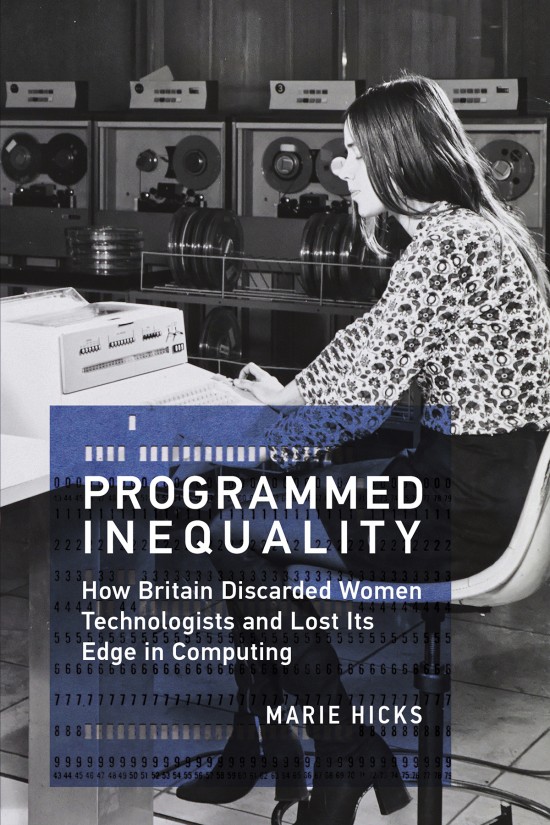
Programmed Inequality

by nathanen


Just a quick note about a notable new book: my friend and fellow historian of computing Marie Hicks has just published her study of computerization in Britain in the 1960s and 1970s.  The book focuses on the British government’s systematic neglect of its largest technical workforce — namely women — and the negative consequences this had for not only the British computer industry but also the nation as a whole.

You can expect a more thorough review shortly.  In the meantime, order the book!

13 Jan 22:41

The Battle Lines in Tech are Being Redrawn

by Neil Cybart

The competitive tech landscape is changing. Some companies with proven track records in mobile will struggle while new players are poised to find success. The battle for our attention is broadening into a massive land grab for the most valuable real estate in our lives. Unlike the usual refrain found with new technologies, this new era is already upon us. In fact, it began years ago.

Old Landscape

This week marks the 10th anniversary of Apple unveiling the iPhone. While many looked at that original iPhone as just a smarter smartphone, the device set off a revolution that is still unfolding today. The iPhone kicked off two battles; one has been settled while the other is still going strong.

Contrary to popular belief, the iPhone's most formidable competitor was never Google and its Android operating system. Instead, the iPhone's success was dependent on a smartphone being able to gain power and value in a sea of laptops and desktops. Apple saw this battle coming from a mile away. Here's Steve Jobs explaining why Apple decided to use OS X to power the iPhone:

"[S]oftware on mobile phones is like baby software. It's not so powerful, and today we are going to show you a software breakthrough. Software that's at least five years ahead of what's on any other phone. Now how do we do this? Well, we start with a strong foundation: iPhone runs OS X. [big round of applause from audience] Now, why would we want to run such a sophisticated operating system on a mobile device? Well, because it's got everything we need. It's got multi-tasking. It's got the best networking. It already knows how to power manage. We've been doing this on mobile computers for years. It's got awesome security. And the right apps. It's got everything from Cocoa and the graphics, and it's got core animation built in, and it's got the audio and video that OS X is famous for. It's got all the stuff we want. And it's built right into iPhone."

Apple knew in the mid-2000s that smartphones would become more than just smart phones. It took some of Apple's competitors years to come to this realization. The smartphone not only became much smarter, but also turned into the most valuable computer in our lives. While there is still a place for laptops, desktops, and of course tablets, the smartphone's value proposition no longer needs to be explained. That battle is over. 

However, the other battle kicked off by the iPhone is still ongoing and involves how we use our smartphones. Every company from Facebook, Instagram, Twitter, and Snap to Netflix and Spotify are competing against each other. All of these companies are chasing our time and attention. Time spent watching video on Facebook is time not spent watching original content on Netflix. Sharing photos on Instagram takes time away from sharing photos on Snapchat. We have a finite amount of time each day available to give to these companies. At stake is not just relevancy but all of the advertising and content dollars that are found with relevancy.

The Winners

Thanks to geographical limitations, this battle for our attention has produced two big winners:

  • Facebook (1.1 billion mobile daily active users)
  • WeChat (800 million daily active users)

Facebook and WeChat share much in common as they aren't just social networks or messaging platforms but instead curated versions of the web. There is then a long list of secondary players, including some Facebook-owned properties like Instagram and WhatsApp. Others like Snapchat and Twitter are struggling to match Facebook's users numbers but still have more than 100 million daily active users. These companies are battling each other for the advertising leftovers. 

Another big winner in the fight for our attention has been Apple. In a battle between Facebook and Twitter, Apple wins as the iPhone is the common denominator. The same can be said for competition between Netflix, Hulu, Amazon Video, and YouTube. This is one reason why Apple has been so complementary over the years to Facebook, Netflix, WeChat, Twitter, Uber and pretty much every other major iOS partner. It is in Apple's best interest for there to be a vicious fight for our attention when using iPhones as the more disjointed our attention is among various apps and messaging platforms, the more power falls to the device itself. Of course, Apple wouldn't mind if we spent time using their own dedicated apps, content, and services. Judging by Apple's profit share in the smartphone industry and cumulative iPhone unit sales, competition for our attention when using iPhones has resulted in very good business for Apple over the years. 

Exhibit 1: iPhone Unit Sales (Cumulative) 

In the extreme case of consumers giving most of their attention to a single company like WeChat in China, Apple still has a built-in advantage of being the company responsible for not just crucial components like the screen, processor, and fingerprint sensor, but also the camera and overall design of the phone. Bear case scenarios involving iPhone sales drying up in China due to WeChat grabbing so much power haven't panned out. Last month, WeChat reported that half of its users spend 90 minutes on one its properties every day. This means that attention is still being shared among a handful of mobile properties.  

New Landscape

Change is in the air. While the fight for our attention and relevancy is not over, advancements in hardware and data collection are leading to tech battle lines being redrawn. While the smartphone is the most valuable computer in our lives today, a new crop of devices are popping up. A land grab is unfolding as companies go after the most valuable real estate in our lives: our cars, homes, and even bodies. 

  Screen Shot 2017-01-12 at 2.01.42 PM.png  

There are three key variables guiding this redrawn competitive map:

  1. Monitoring. Simply grabbing our attention while we use hand-held computers is no longer enough. Instead, value has begun to flow to devices and software that can monitor significant portions of our day. The end goal is capturing more of our data. 
  2. Intelligence. As devices collect a growing amount of our data, there will be a stronger need for these devices to learn from this data and then provide feedback to the user. Buzzwords like "machine learning" and "artificial intelligence" are now paraded around to describe this variable. In reality, a much simpler way of describing this trend is that computers will have to become smarter. 
  3. Personalization. In what may be the most underappreciated trend in tech today, new manufacturing techniques are allowing hardware personalization like we have never seen before. This will become critical as the line between technology and fashion becomes blurry. 

New Battleground

The best way of mapping this new competitive landscape is to look at the new battleground. 

Body. While smartphones continue to gain value in our lives, the form factor doesn't lend itself to being a great monitoring device. As software continues to invade the healthcare industry, the need for biometrics monitoring will increase. Advancements in terms of what can be captured using noninvasive sensors have already led to a new range of small computers that can be worn throughout the day and night. 

Automobile. We have been using boxes on wheels to get us from Point A to Point B for the past 100 years. The extent to which these boxes can be customized after purchase has involved folding down a seat or two. In addition, car utilization associated with car ownership is abysmal. The combination of electric powertrains, ridesharing, and autonomous driving represent the change that is needed for massive innovation to occur in the auto industry. Once these technologies and services become a reality (we are still waiting for autonomous driving), new design and manufacturing ideas will render boxes on wheels into smart rooms on wheels. This will have major implications not only on how we travel, but also on what takes place inside automobiles. 

Home. The smart home has been forecasted for decades. Ironically, much of what is now taking place in the category isn't too different from the utopian picture of us talking to our appliances. We are currently seeing a wave of what will likely turn out to be transitory products in the form of stand-alone microphones and speakers, such as Amazon Echo and Google Home, that use voice assistants to control what is still a very manageable number of smart home items. Over time, as the number of smart home items increase, new control methods and interfaces will need to be developed. 

Key Considerations

If the new tech battleground is expanding to the body, home, and car, each one of those realms seems to be a logical area for voice to gain quite a bit of power. At the same time, there are ongoing questions as to the role screens and cameras will hold in our lives. 

Voice. The current buzzword in tech is voice. The major theme from this year's CES dealt with hardware companies announcing their support for Amazon's voice assistant, Alexa. The plan is to put Alexa in anything that contains a microphone and speaker. Everything from large-screen TVs to cars is on the table. This has led to a narrative centering on "voice first" and "voice only" interfaces. Instead of relying on screens to gather and consume data, we will instead simply talk to a digital assistant using microphones worn on our bodies or situated throughout our homes and cars. In a world without screens, the tech landscape would be turned on its head. 

There are a number of glaring issues with the idea of voice as an interface. The biggest problem is that voice is simply not a great conduit for sharing and consuming large amounts of data. A simple weather query demonstrates this limitation. While a quick question about the current temperature to Alexa or Siri will lead to a straightforward answer, it becomes much harder to rely on voice to get the forecasted hourly temperature change throughout the day. This information can be easily consumed via a screen in a few seconds. Another example is found with consuming news. Using voice to stay informed of current news, also known as radio, will produce an experience inferior to a quick swipe through one's Twitter timeline or Facebook news feed.

Many are using voice in 2017 in a very transitory way, as a stepping-stone to something much more sustainable and valuable. No wonder one of the most popular uses for Amazon Echo is setting kitchen timers - something easily done with a smartphone. 

Instead of voice replacing our screens or becoming the only way we interact with our computers, voice will become a way we interact with our proactive assistant. However, the smarter this assistant becomes, the less talking will take place.

  • Why ask about the weather when a proactive assistant will know the best time to feed us the information we want to know?
  • Why ask about the day's top news when a proactive assistant can curate and then deliver stories to our nearest screen when it thinks it is the most convenient time?
  • Why use voice to turn on or off our smart home devices when home automation is a much better alternative?

The smarter a computer becomes, the less we should need to talk with that computer. The future of voice will include a whole lot more listening than talking. 

Screens. A bet that screens will retain value in the future will likely end up being a very good bet. Screens provide something that voice will never be able to offer: a visual window into the world. While the look and feel of screens as well as how we use screens in our lives will change, we will continue to use screens for a very long time to consume images, video, and even text. 

Cameras. One of the biggest revolutions to take place during the smartphone era has involved the camera. There is a very high likelihood that the camera found in your current smartphone is the best camera you have ever owned in your life. This has produced a situation in which photos and video are no longer just about memory capture. They have become a primary form of communication. Instead of voice wiping this medium away, there is a much higher likelihood that additional cameras and screens will enter our lives. Cameras will be the smart eyes that make self-driving cars possible. Cameras will make it possible for augmented reality to be consumed on our iPhones. Cameras will begin to be found in many devices, some of which will come as a surprise. 

Apple's Roadmap

Apple has done extremely well in the current tech landscape. The company has sold more than a billion iPhones and grew its iPhone installed base by a hundred million users in 2015 and 2016. Since unveiling the iPhone, Apple's stock price is up 800%. As the competitive maps are redrawn, Apple will face new opportunities and challenges. New competitors are going to enter the arena while surprising partnerships will likely jolt the space. 

Body. Apple's best chance of success will be found with the body. Apple excels at creating devices that require a deep integration of breakthrough hardware design and software. Wearables closely fit the bill. In addition, the manufacturing experience Apple has spent more than a decade building will help the company tremendously when it comes to producing increasingly smaller and more personal devices that fit into our lives. Apple is already on track to sell 30M wearable devices this year when combining Apple Watch and AirPods sales. In addition, Apple's stance on privacy has the potential to become a much more important topic in a world where devices are monitoring and collecting an increasing amount of our data, including sensitive biometric data. 

When it comes to competition for the body, Nike and Under Armour should not be ignored. While Nike was correct in getting out of the wrist wearables space years ago, the environment is going to change as the gap between technology and fashion shrinks. Nike's adaptive lacing technology may seem like a gimmick today, but it is a sign of Nike embracing technology in a much more direct way. We already see Nike and Apple partner with Apple Watch Nike+. This will likely grow into a much broader partnership between Apple and Nike that spans a number of products. Meanwhile, the legacy watch and fashion industries are going to face extinction-level competition.

The other realm of competition will come from the same companies currently competing for our attention on smartphones. Spectacles are the beginning of a much broader push by Snap that will eventually lead to the company selling augmented reality glasses. Facebook has indicated similar interest in placing screens on our faces. These devices will represent a prime example of how screens and cameras will continue to a play a pivotal role in our lives for a very long time. Will Apple be able to recreate the iOS platform for glasses? The company benefits from the fight for our attention on smartphones, and creating an environment in which there is a new battle in front of our eyes may be even more attractive. (Jony Ive and the rest of Apple's Industrial Design group are going to first need to solve the many issues found with wearing computers on the face.)

Automobile. When it comes to rethinking the car, some of the major themes found in the smartphone market are going to reappear. Today's cars are boxes on wheels. Tomorrow's cars are going to be smart rooms on wheels. There may be an opportunity for the car industry to experience its very own "iPhone" moment. Tesla's current offerings don't represent this earth-shaking change. 

As it does with the smartphone industry, value is going to flow to the companies that control both auto hardware and software. Autonomous driving and the machine learning powering these cars will require both significant hardware and software advancements. In addition, passenger compartments are going to become prime real estate for lots of data consumption (music, video, etc.). The fact that these smart rooms on wheels will be surrounded by lots of screens (i.e. windows and windshields) should give us clues as to how important augmented reality will become in the auto space. 

Apple has many of the ingredients to go very far in the car industry although the company is also missing some crucial technologies. My suspicion is that Project Titan's change in strategy is geared to first fill some of these technology gaps before proceeding with automobile hardware. Meanwhile, ridesharing and different ownership models will increase a car's utilization rate by almost 20x. This will have a major impact on the cost of travel. However, at the end of the day, design and manufacturing will be the two most important variables to watch in the auto space - two of Apple's biggest strengths. There is simply too much at stake for Apple (or any major tech company for that matter) to not have a comprehensive strategy for the automobile as cars turn into smart rooms on wheels.

Home. This is where Apple has the least attractive position. Given Apple's culture and functional organizational structure, one should not expect Apple to move down the path of selling various smart devices for the home. Selling niche hardware that will be owned for long periods of time without upgrading doesn't exactly sound too attractive of a business for a hardware maker either. Apple's answer to get around the lack of Apple-branded hardware is HomeKit and the Home app: Rely on third-party device manufacturers to come up with smart devices that can be controlled via iOS and Siri.

On paper, the strategy makes sense. Unfortunately, reality is quite a bit different. Expecting consumers to go out and buy lots of smart home devices at prices that are in some cases 10x more than those of their non-smart alternatives doesn't bode well for the smart home going mainstream any time soon. This is why Apple expects this process to proceed gradually, with consumers buying a few smart items in the beginning and then slowly building their collections over time. This is why predictions of Amazon and "voice only" interfaces ruling the home seem immature. It is simply way too early. When it comes to the home, value is going to eventually flow to automation, an element that Apple seems to be betting big on with its Home app. However, the hardware piece of the equation just isn't there. 

The TV industry remains a mess with no clear winner when it comes to video streaming, and the home may end up in a similar state. In some ways, Apple's Home app is similar to its TV app. Both strategies contain holes. 

After the iPhone

Everyone wants to know what will come after the iPhone. This is likely the wrong way of thinking about the future tech landscape. The new tech battle lines being redrawn don't assume there will be a "new iPhone." The iPhone will likely remain a very valuable device in our lives for many years, and companies are still going to be fighting for our attention when using smartphones. However, value has begun to flow to those companies able to place hardware and software in the most important parts of our lives: our bodies, cars, and homes.

The unknown found in this new competitive landscape concerns just how much autonomy these new devices will have. (Hint: It's much more than people think.) Instead of seeing wearables remain as iPhone accessories, we are going to see smartwatches, wireless headphones, and maybe even smart glasses gain independency. Instead of cars being controlled by our iPhone, cars will become like our iPhones.

The iPhone has had a major impact on society because it redefined a computer. For the first time, we had a computer that could fit in our pocket. We are quickly moving to the point of having many new computers on our bodies, on our roads, and in our homes.

Receive my analysis and perspective on Apple throughout the week via exclusive daily updates (2-3 stories a day, 10-12 stories a week). To sign up, visit the membership page.

13 Jan 22:33

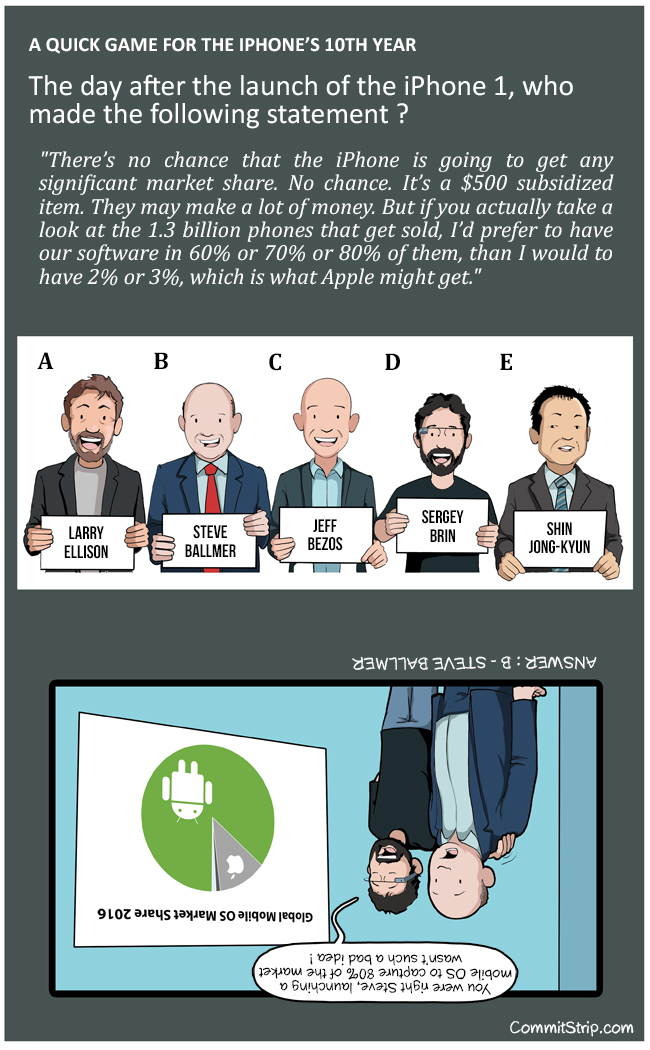
A quick game for the iPhone’s 10th year

by CommitStrip
mkalus shared this story from CommitStrip.

13 Jan 22:30

Here's What Happens When Pro Photographers Shoot on Disposable Cameras

by Hans Aschim for The Creators Project

Indoek-27-Frames-Meg-Heywood-Sullivan.jpgWhen the imperfections make the picture. Credit: Meg Haywood Sullivan

Dusty roadside travel scenes, lonely bikini-clad beachgoers, and sweeping landscapes are just a few of the subjects that grace the photos on display in a new group showing. The images are marked by errant light leaks, several are out of focus, and the exposure is never quite perfect — but that’s all part of the appeal and what makes the exhibition so memorable. Noticing increasingly-curated Instagram feeds filled with touched-up images, Matt Titone, founding partner of LA-based creative agency ITAL/C and surf lifestyle publication Indoek, sought to bring some of the spontaneity back to photography by taking the medium back to basics.

Instead of handing over the keys to his site’s Instagram account for a take-over by a professional photographer, he sent some of his favorite artists a disposable camera with no directive. The eclectic results are on display in 27 Frames, opening January 12 at downtown LA’s Think Tank Gallery.

27-Frames-Matt-Titone-1.jpgPrints on prints on prints… Credit: Matt Titone

“We are all so used to instant gratification these days and perfectly-polished digital photos, we just thought it’d be funny to see what the pros shot on the cheapest film cameras out there and hear the stories that went along with the process,” Titone tells The Creators Project. “The results have been truly interesting and there have been a lot of surprises for everyone involved along the way.”

Indoek-27-Frames-Read-McKendree.jpgGod light at the skatepark. Credit: Read McKendree

One of those surprises comes from photographer Chris Burkard, a globetrotting commercial and sports photographer who shoots for everyone from core surf magazines to Apple and Toyota. For Burkard, throwing the plastic disposable camera in his bag alongside his state-of-the-art digital gear brought him closer to his subjects and the craft.

Indoek-27-Frames-Chris-Burkard-1.jpgAn iconic vista through a new lens. Credit: Chris Burkard

“It reminds me that the experience should always come first,” Burkard says. “You should always treat everything like you have a limited amount of photographs. Just firing unconsciously really takes you away from the art. This was reinvigorating.”

Indoek-27-Frames-Mark-McInnis-1.jpgSelf-care time is always off the clock. Credit: Mark McInnis

Disposable cameras are about as simple as photography gets. They don’t allow for any exposure compensation, focusing, or any of the other myriad tools photographers are accustomed to using. Most importantly, there’s no LCD screen to glance down at after firing a shot.

27Frames-Disposable-Camera-Titone.jpgLine it up and fire. Flash optional. Credit: Matt Titone

“It was fun to not align myself with looking at the image,” Burkard adds. “I never even had the film when it was developed. I gave the camera back and they showed me the pictures a few months later. It was like a Christmas present. I had that nostalgic feeling that I hadn’t had in a long time.”

Indoek-27-Frames-Rob-Kulisek.jpgLetting the light do the heavy lifting. Credit: Rob Kulisek

While Burkard shoots the bulk of his commercial work on digital equipment, a few of the photographers rely more heavily on film for their professional work. Santa Barbara-based Will Adler is known for his film-centric dreamy take on California beach culture. Picking up a disposable was less of a creative stretch, but presented a whole new freedom.

Indoek-27-Frames-Will-Adler.jpgShade and shadows. Credit: Will Adler

“It became more about what I chose to take a picture of, rather than how I took it,” explains Adler. “I intentionally shot the photos the way a camera like that functions: a snapshot.”

Indoek-27-Frames-Laura-Austin.jpgHowling at the trees. Credit: Laura Austin

The show features 88 prints from 30 photographers. All of the proceeds from 27 Frames go toward the Surfrider Foundation. The exhibition opens at Think Tank Gallery on January 12.

Related:

5 Photographers Who Are Hitting Big in 2016

"What Is This, A Gallery For Ants?" Yes.

Film's Not Dead (Yet): New Efforts Beckon A Return To Analog Photography

12 Jan 19:11

This Shanghai startup is making it easier to brew beer at home

by Eva Yoo

We have seen a lot of connected coffee machines last year, from Auroma Brewing Company to Smarter Coffee. This year in CES 2017, iGulu, the company behind an automated home beer brewing machine, won CES 2017 Innovation Awards honoree in the Smart Home product category.

This is not the first time for this Shanghai-based startup to get noticed by the Western market. On June 2016, the company successfully funded their Indiegogo campaign, surpassing its goal by 701%, with over 1 million USD. Since then, the company changed its name from Artbrew to iGulu.

China is the world’s largest beer producer and consumer for the past 12 years. According to a report released by USDA China, annual sales of U.S. craft beer sales could reach 12 million USD by 2017.

“In the next five years, we will see a rapid development of the craft beer industry in China, for both family and commercial purpose,” CEO and founder of iGulu, Shu Zhang told TechNode.

With the continued growth of income, Chinese beer consumers pursue better quality and various flavors. Imported beers, particularly those from Europe were popular. The iGulu team believes that they can bring more quality and flavor options with their customizable brewing machine. The team believes beer home brewing goes along with the DIY trend in China, too.

“More and more Chinese people are willing to DIY at home for daily necessities. As the world’s second most consumed drink, more Chinese people are willing to brew their beer at home,” Shu added.

iGulu’s automated beer brewing machine allows both beer experts and novices to brew high-quality beer by pressing a few buttons or using an app. It also offers a database of thousands of beer recipes, along with the option to modify or create new recipes. The user interface uses a 4.3 inches LCD screen for operation and comes with a matching app.

lifestyle-5

iGulu’s automated beer brewing machine

Despite the huge beer market, Chinese consumers, beer trade, bars, and restaurants all lack awareness and know-how of craft beer. To raise market awareness, iGulu’s goal for this year is to raise funding using a Chinese crowdfunding platform and introducing their products in the retail market. Offline agents and online KOLs, like wanghong, will be their main promotion channel.

“As for the commercial market, we will provide automatic smart brewing devices with at a low price so that small business owners can brew customized beers for their customers,” Shu remarked.

The company raised 4 million RMB (57.9 million 578,678 USD) in an angel round from Hofan based in Shenzhen and Yinxinggu Capital based in Zhejiang.

The idea of automatic brewing machine comes from Shu’s experience with craft beer.

“Once I tried craft beer that my friend brewed at home, and the taste changed my impression of beer. I hoped I could brew my own beer at home, and share with friends. So I came up with the homebrew idea,” Shu says.

Shu Zhang, the CEO and founder of iGulu, previously worked within the data center of Cisco and was the technical leader of Motorola’s Software Group. The core members and technology development team of iGulu hail from Eson, Oracle, Motorola, Cisco, and AB-InBev.

“Experiences at Cisco and Motorola gave me the space to be creative, and the outstanding colleagues made me feel proud. But I think it’s time to live a new life. I want something challenging,” he said.

Image Credit: iGULU

12 Jan 19:11

Missing from the Trump Cabinet Nominee Hearings: Cybersecurity for Everyday Internet Users

by Denelle Dixon-Thayer

This week, the U.S. Senate is assessing a slate of cabinet nominees for the incoming Trump administration. If confirmed, these nominees are some of the people who will shape public policy for the next several years on critical issues — including civil liberties and national security.

Members of the Senate asked a range of essential and direct questions. But cybersecurity questions were not a significant part of the discussion in the hearing for potential Attorney General Jeff Sessions, who will lead the Department of Justice, including law enforcement investigations that involve technology.

At the recent Sessions’ Senate hearings, cybersecurity was discussed chiefly in regard to government-sponsored cyberattacks. Discussion about robust cybersecurity for everyday Internet users — through practices like strong encryption — was largely absent.

Mozilla is disappointed that cybersecurity — and the stances from appointees who will need to work on it regularly — was not a priority at the Senate hearings. It would have been helpful if the Senate asked Sessions to clarify his position, and even better if they asked him to clarify that privacy and security are important for all Americans and a healthy Internet.

We need a government that openly discusses — and values — a more secure Internet for all users.

Protecting users’ privacy and security online is a crucial issue for all of us. Security protects elections, economies and our private online and offline lives. And many recent events (cyber attacks, hacks and threats by foreign governments) show that a secure Internet is currently under threat.

I recently wrote about how cybersecurity is a shared responsibility. Governments, technology companies and users need to work together to strengthen cybersecurity. Mozilla knows that even one weak link — be it technical or legislative — can break the chain of security and put Internet users at risk. The chain only remains strong if technology companies, governments and users work together to keep the Internet as secure as it can be.

You can help Mozilla stand up for a more secure Internet. We’re asking readers to pen a Letter to the Editor to their local newspaper in response to this week’s Senate hearings, and support personal security and privacy online. Get started here.

Photo:  Derrick Noh / Flickr

12 Jan 19:11

Running for the Modo board, again.

by William

It’s been three years since I first ran for the Board of Modo, our local car sharing co-operative. Serving on the Modo board has been an immense privilege and pleasure. It’s an amazing organization, a great board, incredible staff and an important mission. It’s what I’ll likely be speaking about at the upcoming Disruption ’17 by CU Water Cooler conference.

I’m privileged to have been the board chair for the last couple of years, and hope to continue serving the members as I run for my second term as a volunteer director. If you’re a Modo member, please log in and vote, and, hey, if you’re voting, please consider voting for me.

Here’s my election statement and video for my re-election…

I’m William Azaroff, vice president of community investment at Vancity and current chair of Modo Co-operative’s volunteer board of directors. I’m up for re-election this year, and I hope you’ll vote for me to continue serving Modo’s membership.

I’m extremely proud to be a part of the Modo board. In the three years since my election, we have successfully merged with Victoria Carshare Co-op, brought in new leadership and renewed our strategic planning process.

Patrick Nangle came to Modo from Purolator Canada, where he was also CEO. He is a values-based leader whose deep knowledge of business, operations and technology will move our co-op forward in the increasingly complex and competitive world of car sharing.

With Patrick on board, we have begun a new strategic planning process to map out which roads are right for us. We are at a pivotal time in car sharing. Our local co-operative has a strong brand, loyal members and solid partnerships; yet our competitors are multi-national corporations who have the deepest pockets imaginable. Disruption is everywhere. Electric vehicles have far longer ranges and more affordable price points; self-driving cars are emerging on roads; and multi-modal transportation is expanding and evolving. We need people on our board who can solidify a local co-op’s place amongst global players – people who can focus on competing against corporate giants while staying true to our core values.

I would be honoured to earn your vote to continue this good work on behalf of the Modo membership.

12 Jan 19:11

Asking the wrong questions

by Benedict Evans

This is a photo of my grandfather, Will Jenkins. It was taken in 1909, when he was 13. He made the glider himself and took it to Cape Henry, about 17 miles by trolley from Norfolk, where his first flight took him eight feet, and his last that day took him 40 feet and broke one of his uprights. They made 13-year-olds differently then, I think. 

Dadglider.jpg

He built the glider, incidentally, with a gift of $5 sent to him by an American Civil War veteran after a school essay he'd written about Robert E. Lee was published in the local paper.  The war, after all, had ended only 44 years earlier. 

In 1946, by which time he'd become a notable writer of science fiction, he published a story called 'A Logic named Joe', which described a global computer network with servers and terminals, that starts giving people the information that it thinks they ought to know as opposed to waiting for them to search for it - the Singularity, if you like, or maybe just Alexa. He also, as I recall, predicted reality TV somewhere. 

And yet, despite predicting half of our world, as a father in the 1950s he could not imagine why his daughter - my mother - wanted to work. 

This isn't exactly an uncommon observation - lots of people have pointed out that vintage scifi has plenty of rocketships but all the pilots are men - 1950s society but with robots. Meanwhile, the interstellar liners have paper tickets, that you queue up to buy. With fundamental technology change, we don't so much get our predictions wrong as make predictions about the wrong things. (And, of course, we now have neither trolleys nor personal gliders.) 

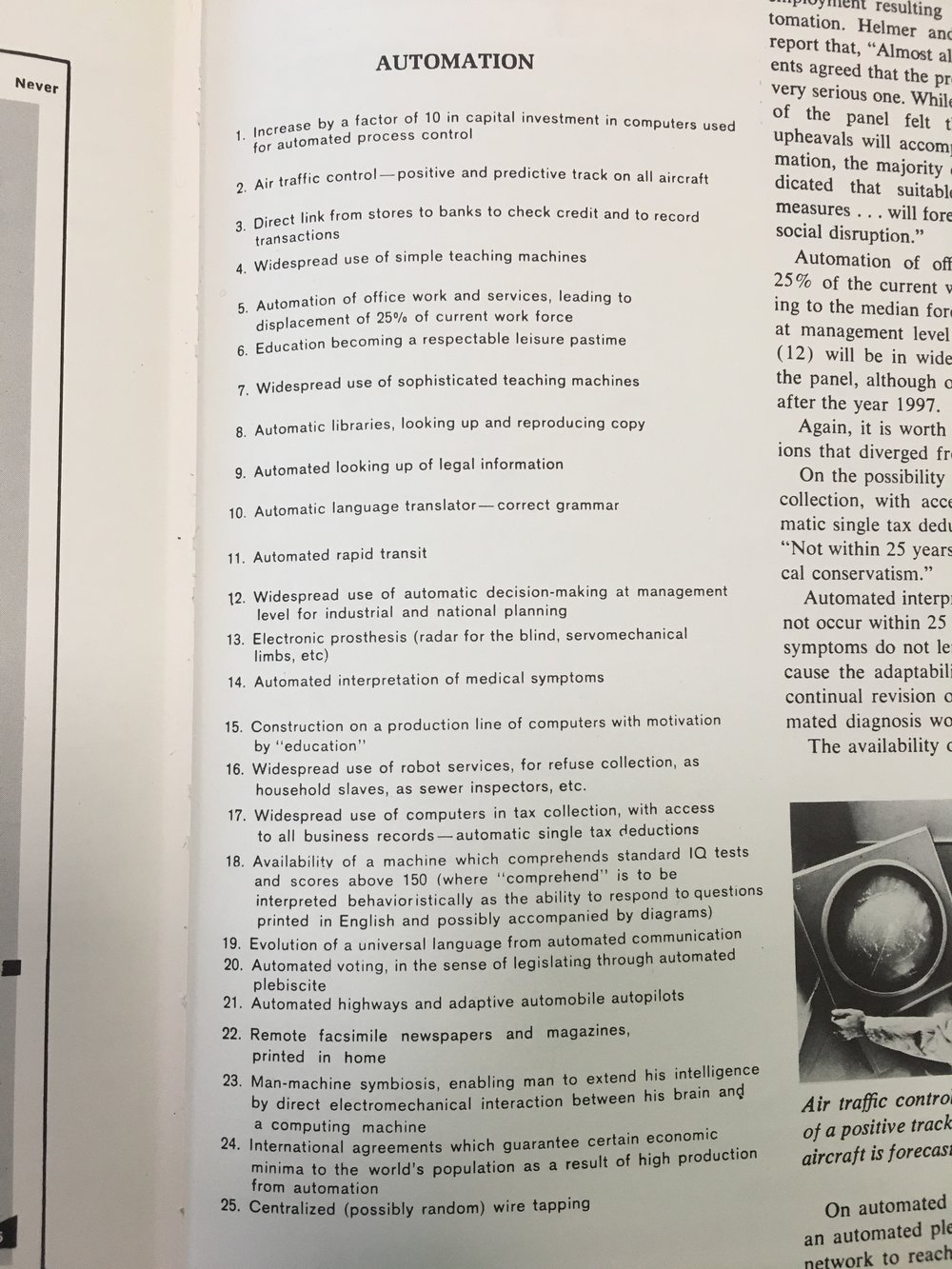
I was reminded of this photo recently when I came across a RAND 'long-range forecasting' study, from 1964. The authors polled a range of experts on what the key developments in coming decades would be and when they'd happen. Fields addressed included space flight and medicine, but the most interesting in this context is what was then called 'automation' (the past tended to describe as 'automatic' what we would now call 'computers'). The double-page spread below shows the conclusions (click to enlarge). 

IMG_1931.JPG
IMG_1932.JPG

Some of this has happened more or less as predicted - we did get air traffic control, automated subway trains and computerised taxation (except in the USA). There are some great comedy predictions here too - that 'centralised wire tapping' would take until 2030, or never, or that people in both 1964 and 2016 thought we'd have automated driving 'by 2020'. 

However, to me the interesting thing is how often the order is wrong. What we now know to be the hard problems were going to be solved decades before what we now know were the easy ones. So it might take until 2020 to 'fax' a newspaper to your home, and automatic wiretapping might be impossible, but automatic doctors, radar implants for the blind, household robots and machine translation would be all done by 1990 and a machine would be passing human IQ tests at genius level by 2000. Meanwhile, there are a few quite important things missing - there is no general-purpose computing, no internet and no mobile phones. There's no prediction for when everyone on earth would have a pocket computer connected to all the world's knowledge (2020-2025). These aren't random gaps - it's not just that they thought X would work and didn't know we'd invent Y. Rather, what's lacking is an understanding of the structural impetus of computing and software as universal platforms that would shape how all of these things would be created. We didn't make a home newspaper facsimile machine - we made computers. 

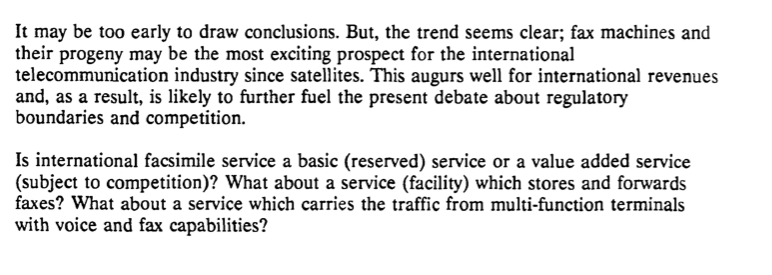
You can see this tendency to ask the wrong questions, or questions based on the wrong framework, in this TeleGeography report from 1990. It was clear that the world was changing, and that the telephone network would see new uses. But if you're asking about new uses for the 'telephone network', that of itself probably gets you to the wrong place (again, click to zoom). 

Screen Shot 2017-01-11 at 3.31.18 pm.png
Screen Shot 2017-01-11 at 3.31.04 pm.png

Picking this apart:

  1. We will have home computers ('multi-media terminals') - correct
  2. And they'll be connected to a network - correct
  3. And move data across national borders - correct
  4. So international circuit-switched call volume will go up - um, no.  
  5. And that needs to fit into the regulatory structure of how state-monopoly fixed-line telephone companies exchange and charge each other for international voice calls - 😐

Today, we don't carry the internet over the PSTN - we carry the PSTN over the internet. 

This time last year I wrote a post about how the future of the mobile internet (as we called it then) looked in 2001, and what one could have predicted. It was obvious that we'd all have phones connected to the internet by now, but that that didn't get you to the iPhone, Snapchat and Alexa or DJI - we were talking about Nokia, Microsoft, AOL and NTT DoCoMo just as TeleGeography talked about circuits and RAND's experts talked about 'automation'. Openness and permissionless innovation were missing. 

So, a pretty common theme of discussion in tech now is to ask what comes 'after' mobile, now that it is moving from the creation to deployment phase and the smartphone platform wars etc are over. There are a bunch of exciting things going on, certainly, from machine learning to AR and VR to electric and autonomous cars. What content will work in VR? Who will be best placed to make AR glasses? Will EV batteries be a competitive advantage, or end up, like LCD screens, as a low-margin commodity? Who will have enough of the right kind of driving data for autonomy? But every time I think about these, I try to think what questions I'm not asking. I still want a glider though. 

12 Jan 19:11

Personal Learning Goals

by Richard Millington

Simple tip, ask members to share their own learning goals.

This works on two levels.

  1. It forces members to think carefully about what they want to learn.
  2. It allows you and others a drop-dead simple way to please a member.

I think you can take this one level higher.

Update member profiles to let them identify current shared learning goals and include an area where they can display what they have learned in the past. This might be books read, events attended, courses completed, or experience acquired.

Each progression acts as its own trigger to update the profile. This, in turn, encourages them to share the profile elsewhere. This, in turn, triggers more people to update their profile.

Try it. Add a field to member profiles with a current learning goal. Notify the community. Add another field for previous goals/experience gained. See what happens.

12 Jan 19:11

Recommended on Medium: SuperScript Release Notes — v1

We’re very excited to push v1 into the wild, which marks the first major release of SuperScript! In this version, we’ve focused mainly on…

Continue reading on Medium »

12 Jan 19:11

Alibaba – Shopaholic

by windsorr

Reply to this post

RFM AvatarSmall


The woeful offline experience offers a real opportunity. 

  • It looks like Alibaba is about to take a leap into the offline world as it is the lead contender to buy a struggling retail chain in China for $2.6bn.
  • The company in question is In Time Retail Group which operates 29 department stores and 17 malls predominantly in the eastern province of Zhejiang where Alibaba’s home town of Hangzhou is to be found.
  • In Time has been suffering from the predations of its would be saviour due to the fact that the retail experience it offers is poor at best.
  • In Time is a great example of why online and mobile have been so successful in the Chinese market.
  • Chinese retail is a fragmented and frustrating experience where decent service and information with regards to inventory, product lines and so on is routinely not available.
  • Consequently, when an online offering appears where this information is clear and one is able to easily purchase goods and know when they will be delivered, shoppers quickly adapt.
  • It is the terrible offline experience with regards to almost everything that has allowed so many other goods, services and activities in China to rapidly migrate from offline to mobile.
  • In Time operates a similar model to Alibaba where it provides the building and merchants and brands pay to sell their products at its locations.
  • This makes it a good fit for Alibaba and if Alibaba can use its technology and logistics to massively improve In Time’s service and its experience for shoppers, then it has a chance to take a piece of the still massive $4.5tn offline retail market in China.
  • By contrast, online shopping is still relatively small (but growing) at US$711bn or 16% of total Chinese retail sales.
  • Consequently, if Alibaba can use what it has developed in online to hugely improve the quality of the shopper experience in the offline world, it could take a meaningful slice of the market.
  • It is worth noting that, China is a massive and hugely fragmented market where retail happens in millions of locations and that In Time is present in only one province.
  • Consequently, I see this as an experiment to see whether Alibaba’s skills in online will also work in offline.
  • Although Walmart clearly understands retail, it does not understand China which is why it has largely failed to make any impact despite years of trying.
  • Hence, there is a clear opportunity for Alibaba but it is very likely to take a long time requiring a vast amount of investment for this to come become a big part of this company.
  • This is why I see this experiment starting in Alibaba’s home town with very limited scale until it is proven that it can work.
  • I continue to prefer both Baidu and Tencent over Alibaba as its valuation remains too rich for me and I see more value elsewhere.


12 Jan 19:11

Thirty-Three

by Matt

I’m taking it easy this week, nothing too crazy — just sharing good meals and wine with friends. Which is probably a good example of my goals for the year: putting family and loved ones first, slowing down (to go further), and deliciousness. (Single Thread Farms blew me away.)

2016 was a year of incredible contrasts: it was the saddest and most challenged I’ve ever been with the passing of my father, and while that overshadowed everything there were also bright moments of coming closer to family, deepening friendships, and growing professionally with incredible progress from both WordPress and Automattic. That momentum on the professional side is carrying through and right now I’m the most optimistic I can recall, and thrilled to wake up and get to work every day with the people I do.

I talked about trying to spend longer stretches of time in fewer places, and that definitely happened. I flew 162k fewer miles than the year before, and visited 35 fewer cities. My blogging decreased a lot too — from 252 posts in 2015 to 76 posts in 2016, but the posts I did write were at least 50% longer. I made it to 9 more of the Top 50 restaurants and stand currently at 50% of the list. I finished 22 books, including a lot more fiction including my first few graphic novels like Ex Machina, Y: The Last Man, and Watchmen. I watched 35 movies, 9 of which were from the Marvel universe on a single flight from Cape Town to Dubai.

Last year I said, “it’s exciting to make the most of the opportunity that the volatility, love, loss, glory, failure, inspirations, and setbacks that 2016 will bring.” I didn’t know how right I would be, and wish I hadn’t been.

This year doesn’t start with new plans, but rather three intentions continued from a few months ago. I revealed one yesterday, and promised I would expand today on the others, so here they are:

  1. Symmetry — Balance in all things, including my body which is stronger on my right side and much tighter on my left side. We also need symmetry in WordPress between the .org and .com products which differ too much.
  2. Stillness — In echoes of Pico Iyer, so much of my life in my 20s was about movement, and “going places to be moved.” In my 30s I’m looking inward. As Saint Augustine said in Book X, chapter 8 of Confessions: “Men go forth to wonder at the heights of mountains, the huge waves of the sea, the broad flow of the rivers, the vast compass of the ocean, the courses of the stars, and they pass by themselves without wondering.”
  3. Yellow Arrows — The idea that there are clear indications of where to go next at every fork in the road, and if not you should paint them. I wrote more on this  yesterday.

Previously: 19, 20, 21, 22, 23, 24, 25, 26, 27, 28, 29, 30, 31, and 32.

12 Jan 19:11

National Geographic Infographics, the book

by Nathan Yau

Infographics devolved a bit in recent years, but there was a time the term wasn’t immediately associated with content marketing. (And there is still plenty of good infographic work that actually informs.) National Geographic is one such source of inspiration, and now you can get a best-of collection in book form that spans over a century.

With an essay by Nigel Holmes, charting the evolution of National Geographic over the decades and its pioneering use of graphics, as well as four fold-outs mimicking original pull-outs or inserts in the magazine, the book stands as a defining record of one of the world’s best-known publications as much as it is a beautifully presented repository of discovery and learning.

Get it on Amazon.

Tags: book, National Geographic

12 Jan 19:11

"I don’t think things are going to get better in the short term; I don’t think they’re going to get..."

“I don’t think things are going to get better in the short term; I don’t think they’re going to get better in the long term. I think this is the new normal.”

- Sean Westwood, regarding partisan bias and fake news, cited by Amanda Taub in The Real Story About Fake News Is Partisanship
12 Jan 19:11

Justin Wolfers, Why Most Economists Are So Worried About Trump

Justin Wolfers, Why Most Economists Are So Worried About Trump:

The economist Justin Wolfers attended a recent economics conference, and found widespread gloom among both conservative and liberal economists, which is wildly at odds with the ebullience of the business and investment sectors. What’s going on? [Emphasis mine.]

I feared that I might have been talking with an unrepresentative group until I stumbled upon a recent survey of leading academic economists showing a similar pattern. Of the 31 respondents to the University of Chicago’s IGM Economic Experts Panel, 28 disagreed with the claim that the “seven actions to protect American workers” in Mr. Trump’s 100-day plan would improve the economic prospects of middle-class Americans. The dissenters were two economists who were uncertain, and one who had no opinion.

The pervasive pessimism among professional economists stands in stark contrast with the judgment of financial markets, which rose strongly in the wake of Mr. Trump’s election, and have remained buoyant since.

It also puts economists at odds with the judgments of small-business owners. According to the latest survey from the National Federation of Independent Businesses, the balance of members who expect general business conditions to improve has moved drastically. In October, the pessimists who saw business conditions as likely to worsen outnumbered the optimists by seven percentage points; the latest survey from December shows that the optimists now outnumber the pessimists by 50 percentage points. It’s an extraordinary shift — one the association described as “stratospheric.”

I’m not quite sure how to reconcile these conflicting signals. One possibility is that Mr. Trump remains something of an unknown, and each group is filling in the blanks differently. Small businesses, pleased to see a businessman in the White House, might be tempted to believe the best. By contrast, there’s a reason that economics is called the dismal science, and few economists trust politicians — of either stripe — to get things right. Greater uncertainty gives economists a broader canvas upon which to project their pessimism.

But it may also be that these groups [economists and small business owners] are describing different things. Businesses and markets care about profits. Economists focus on workers as well as the businesses they work for, on buyers as well as sellers, and on new firms as much as existing firms. Mr. Trump’s anti-regulatory zeal may help businesses but hurt workers; his anti-trade agenda could help sellers but hurt buyers; and his instincts to protect existing jobs may advantage existing businesses at the expense of the next generation of entrepreneurs.

Or perhaps the optimism of small-business owners is about what they think is most likely to happen, particularly in the short run. My conversations with economists revealed them to be more focused on the long run, particularly on the risk of really bad outcomes. By this view, the short-term optimism may be well placed, but should be juxtaposed with the possibility of a trade war, a catastrophic economic decision like defaulting on the national debt or a foreign policy disaster. 

Wolfers and the other economists, who take the long view are worried that Trump could trigger a ‘left tail risk’ – a downturn in the markets (or the value of an asset, in specific) that is more than three standard deviations from the mean in the negative direction, to the left in chartspeek. Examples of left tail events include Black Monday (1987), US Savings and Loan debt crisis and Latin American debt crisis (1989-1991), the Dot.com bust (2001-2002), and the recent global subprime financial crash (2007-2009). 

Small business and the markets may benefit in 2017, but the economists are worried about a left tail risk that could sink the world economy, again. And Trump and his cronies are likely to undo efforts to rein in the financial sector’s appetite for risk. 

Note that serious investors worry when the likelihood of catastrophic downside risk increases. This is why so much money is sitting on the sidelines right now, because it is increasingly difficult – if not impossible – for find low-risk investments that pay better than bonds.

Brace for impact.

12 Jan 19:10

Firefox 52.0 Aurora Testday, January 20th

by Camelia Badau

Hello Mozillians,

We are happy to let you know that Friday, January 20th, we are organizing Firefox 52.0 Aurora Testday. We’ll be focusing our testing on the following features: Responsive Design Mode and Skia Content for Windows. Check out the detailed instructions via this etherpad .

No previous testing experience is required, so feel free to join us on #qa IRCchannel where our moderators will offer you guidance and answer your questions.

Join us and help us make Firefox better!

See you on Friday!

12 Jan 19:10

Emergency Dialect

by Paco Salas Pérez

In Arrival, the film adaptation of Ted Chiang’s Nebula award-winning “The Story of Your Life,” a seven-limbed alien species arrives on Earth in twelve mysterious monoliths spread around the globe. As the nations of the world set their soldiers and scientists to studying the aliens, looking for anything that will gain them the upper hand in the planetary standoff, Louise Banks (Amy Adams), a linguist, is recruited by Colonel Weber (Forest Whitaker), acting on behalf of the U.S. Army, and finds herself in the middle of a foggy field in Minnesota, leading a team charged with deciphering the heptapods’ language.

Banks, who in the preceding scenes had been lecturing sleepy students about early medieval Portuguese and drinking wine alone at home, quickly learns the following: the heptapods, like us, have both spoken and written language, which she names Heptapod A and B. However, unlike with humans, the two differ significantly from each other in appearance and behavior. Heptapod A is a bit like cetacean song, but raspy and deeper. Heptapod B is an ephemeral, coffee stain-like script that encodes meaning in a self-arranging dark smoke projected by the heptapods from one of their limbs. The two are so at odds they appear to be entirely unrelated, as alien to each other as the heptapods are to humans. Banks and theoretical physicist Ian Donnelly (Jeremy Renner) seek to deduce the points in common between the aliens’ phenotype — their form of organic life — and our own, going beyond their sevenfold asymmetry and general anatomy, to questions of the heptapod’s way of thinking, and the structure of their mind.

Human language use isn’t amenable to crisp snapshots — what matters isn’t a perfect specimen, but that we grasp the mechanisms that produce them

To begin to answer the heptapod question, we have to look to the evolutionary history of life on Earth. By understanding the specification of our own species phenotype we’ll have a bit of solid ground from which to orient ourselves to the newcomers. Because this is science fiction, not fantasy, it’s safe to assume heptapods, like humans, evolved to be suited to a particular environment, in a specific world. But Banks isn’t an organic chemist, she’s a linguist, a specialist in a kind of theoretical biology that seeks to describe the computational processes underlying language, an evolutionary adaptation different from all other known forms of animal communication and unique to our species. At least until the heptapod’s arrival.


Linguists and computer scientists use a rubric known as the Chomsky hierarchy, first put forward by Noam Chomsky in 1956, which seeks to describe the major classes of formal grammars — the rules that define the possible sentences of a language. There are four types, ranked by computational power, with Type 3 being the simplest and smallest family of grammars, and Type 0 the most powerful. Any programmer is aware that some higher-level languages are more powerful than lower-level ones, but that lower-level languages are often easier to use for certain dedicated tasks that require verbose solutions in more powerful languages. The same is true for communication systems produced by evolution. Gestural systems like those found among primates are simple and highly effective: they’re based on individual signals, each associated with broad meanings like “food” or “danger,” but with no regular relations between signs, which are instead produced in an unordered and unstructured, “stream of consciousness” manner, even by primates who have been taught to sign by humans. Human language, and only human language, exhibits properties from Types 1, 2, and 3.

Heptapod B doesn’t play by the rules we’re used to. Its symbols are semasiographic, depicting meaning rather than sound, and don’t appear to follow any linear order — each expression in the script is rendered as features projecting from different segments of a semicircular backbone, like so many pools and threads of ink spreading adventitiously from a central spill. Yet, Heptapod B obviously has more going on than do monkey howls, which are also unordered; or emojis, which also encode meaning rather than sound. In the universe of Arrival, the heptapods identified something in human language that is unique to the human biological endowment among all the Earth’s intelligent species. This something is popularly known as UG, or Universal Grammar.

The theory of universal grammar has come to dominate the study of language since it was first proposed by Noam Chomsky over 60 years ago, at the dawn of the cognitive revolution. Elaborated and developed over the decades under a number of names, it is now known as “the minimalist program,” but the term “universal grammar” seems to have struck a chord with people, so the name, while somewhat misleading, has stuck. At its core, the theory is predicated on a simple hypothesis: all human populations exhibit language, all babies can learn any language they’re exposed to, and all languages appear to have deeply rooted commonalities despite their numerous differences. Human languages exhibit higher-order computational characteristics found nowhere else in the natural world, in even the most cursory of exchanges. Scientists have theorized, not uncontroversially, that the human language faculty is at least in part genetically encoded — that language, in all its mystery, complexity, and beauty, is part of our phenotype, a species-wide phenomenon that, operating from the core of what we may call human nature, has had indelibly marked the history of our species.

Like other parts of the human organism, the virtual organ responsible for language develops over the course of each person’s growth and development — in the course of normal development, the human brain naturally implements the computational processes that power language, just like it implements those processes that interpret sensory information or control our fine motor skills. According to this view, because the basic properties of language are genetically encoded, a newborn’s brain need only be provided with the correct stimuli in an appropriate environment and, like the seed of a vine planted in fertile ground, the organism will self-assemble. Indeed, linguistic and cognitive science research increasingly suggests that there is only a single human language — the language of thought, of which every other language is simply a type of dialect.


Over the decades, the list of features posited as universal to human grammar has been laboriously reduced to an almost catchy formulation: human linguistic expressions are linearized, recursive hierarchical structure, with differences in structure associated with differences in interpretation, and, in principle, no limit on the depth of hierarchical structure. Recursion is the better known and easier to grasp part of this definition: the computational feature that allows us to form arbitrarily long statements by adding new elements, e.g. “the alien > the long alien > the long alien’s spaceship > the mysterious long alien’s dark spaceship > …”

The concept of “linearized hierarchic structure” seems a little more obscure, though its effects are likely just as intimately familiar. Any fluent English speaker can tell you there is a difference between [[a mysterious alien]’s spaceship] and [a mysterious [alien’s spaceship]] — one might be an old fashioned space shuttle, belonging to a mysterious alien individual, while another is a spaceship of mysterious character, belonging to an alien whose pedestrian personality might be known to you. The linear ordering of the word remains the same; what changes is the underlying syntactic structure, which doesn’t care about linear order at all. Words follow each other one by one; when we hear them, our brain immediately begins to interpret them and try to arrange them into meaningful clusters, or phrases, which are themselves interrelated throughout the sentence. Phrase structure, and therefore syntax, is non-linear. Instead, it looks a bit like an Alexander Calder mobile.

The heptapods in Arrival, for all their seven-sided symmetry and imposing technology, have eaten from the same tree of knowledge we have

Like a Calder, what matters about the phrase structure of a sentence is the way it’s constructed — the way its components depend on each other, each word connected to another by a semantic scaffolding; sometimes complexly nesting dependencies like an exploded matryoshka, other times elegantly spare. All language users are masterful artists, capable of producing a discrete infinity of virtual sculptures out of meaning. When we pronounce a sentence, our mind, like a museum gift shop worker, “packages” the concept-structure by assigning it the appropriate wrapper — be it sound forms, hand signs, or written symbols — then  “ships” it, or as linguists prefer, “externalizes” it, from thoughtform to physical manifestation, neatly linearized and ready for our interlocutors to unpack and reconstruct, and then to enjoy the original virtual structure in their own minds. Linguists call this metaphorical packaging “spell-out,” and the pronounceable, packaged representation of a sentence “phonetic form,” or PF.

When Weber naively presents Banks with an audio recording of Heptapod A, the alien’s spoken language, he’s giving her raw data: phonetic form and nothing more. Like anyone hearing an unfamiliar language for the first time, it’s basically impossible to interpret. What’s more, unlike with human languages, which often come to resemble one another through historical or geographic association, no one on Earth has heard spoken Heptapod before. It’s with good reason, then, that Banks insists on engaging with the aliens directly, and soon thereafter, on trying written, rather than verbal, communication. If the brain is so well adapted to picking out human voices, it’s because speech is a literally “noisy” channel through which to transmit a signal. Written language is a cleaned up version of the same signal, with none of the background noise. At least this is how human language works — it’s an encoding of the same linear string that gets externalized at spell-out. Even in systems that don’t directly represent sound, like Chinese script, readers can pronounce the words they read on a screen.

It comes as a great surprise, then, when Banks discovers that Heptapod B, which should by rights be a crisp, standardized register of Heptapod A, neatly linearized, turns out to be a splotchy, disorganized mess, an inky coffee stain ejected from a tentacle and suspended in mid-air, with no beginning or end — unlike any known language, written or spoken. But language processing doesn’t stop at spell-out, and phonological form is not the only product put out by the human language faculty. If the original thought-form somehow survived spell-out and linearization, order-free yet structured, an object of pure meaning, this would begin to look a lot like Heptapod B.

This linguists call LF, or “logical form.” If phonetic form is like exiting through the gift shop at the language museum, logical form is like touching the artwork. Whereas phonetic form needs to be linearized before being passed on to the sensorimotor systems that let our mouths and hands make the correct sequence of sounds or signs, logical form is subject to different requirements — instead of being passed on to the brain’s sensorimotor systems, it’s passed on to our conceptual-intentional systems. Phonetic form is language as spoken, logical form is language as understood.

What logical form is has been a question of debate since Bertrand Russell first used the term. For him, it was an altogether different meaning system than natural language — Russell believed natural language was misleading and inappropriate for the type of logical reasoning needed to understand fundamental questions of mathematics and abstract reasoning. Now we know, though it’s hard to understand, that there are fundamental limits to what is expressible in any language; no matter what rules or atomic elements it contains, no matter what it “looks” like, there are true statements that cannot be articulated in it. Because the theory of logical form is still developing, it might be better to think of it not as any particular language, but as more of a limit that all languages approach, an imaginary “perfection” akin to that of a crystal as it forms. Representations of logical form are as varied as the point they’re trying to make, deploying mathematical tools like the lambda calculus and higher order logical notation. They look more like equations than English or Kikongo.

In reality, human language use isn’t amenable to the kind of crisp snapshots we would like it to produce — we speak in incomplete sentences, interrupt each other, and mishear. Like crystals, what matters isn’t so much that we have a perfect specimen, but that we have a grasp on the mechanisms that produce them; but, like all knowledge of the natural world, the knowledge wouldn’t come with a transcendent revelation of meaning and purpose. Logical form, like our digestive or visual system, is only a component of what makes us human. What we do with it, or how we could do something different, may be a question too difficult for human minds to understand — we may be capable of describing emergent complex behaviors without therefore being capable of understanding how to go beyond them.


The computational processes that link clusters of meaning together, chaining concepts to each other in nested hierarchies, are both eerily intuitive and strikingly exotic, and the subject of ongoing research. In the film, Banks gives Donnelly a piece of advice for speaking to laypersons about linguistics: dazzle them with the basics, she says. And indeed, the more we learn about the basics of language, the more dazzling and alien it begins to seem. So much, that if we take another look at the splotches and curlicues of Heptapod B, it becomes more and more familiar, more and more human.

We may be capable of describing emergent complex behaviors without therefore being capable of understanding how to go beyond them

This is why the heptapods came for us: not because humans are good, special, or virtuous. They came because we’re similar to them, because our world, our technology, our languages, bear the traces of a historical, convergent evolutionary trajectory that, on two different planets across the vastness of the interstellar medium, brought our two species’ phenotypes miraculously close. The heptapods, for all their faceless, seven-sided symmetry and imposing technology, have eaten from the same tree of knowledge we have. As far as the film shows us, this turns out for the best. Planetary and interplanetary war is successfully averted with the help of the transtemporal cognitive abilities unlocked by Banks after learning Heptapod B, triggering a sort of second mental infancy. Like a child learning the magic of language, or a bird first taking flight, Banks is in a sense not becoming like the heptapods, but becoming more human, more herself.

Humans call our species Homo sapiens sapiens. The second sapiens, often elided, is there for a good reason — it marks us, contemporary humans, as behaviorally distinct from our anatomically identical ancestors. The break, hard to pinpoint with precision due to the imperfection of the archaeological record, came about 80–60,000 years ago, when homo sapiens were only one of various human species. At this time, for reasons anthropologists are still investigating, the language faculty made its first appearance in our species, likely as an instrument of cognition, or a language of thought that allowed us to chain thoughts of previously impossible complexity, reason with unparalleled precision, and, ultimately, conquer the Earth.

When we evolved the capacity for recursive, hierarchically structured thought, the one true human language underlying all languages, is when our species truly became itself. It’s from the earliest signs of human symbolic behavior in southeastern Africa that the story of our life begins, and the story of countless nonhuman lives begin to end. As we spread out across the globe, diversifying our languages and expanding our technologies, developing controlled fire, perfecting tool use, becoming seafarers, harvesters, builders, and agriculturalists, we quickly drove all our human relations, our closely allied human species, to extinction. We wiped out most megafauna, permanently transformed the ecosystems we inhabited, and began that great dying-out we now know as the Anthropocene. Often, we won battles without needing to fight. Armed with complex thought and a means to externalize it, our plans and schemes have spread their effects without the need for our direct intervention. Species are doomed from the moment we look to a new landscape and begin to think of the possibilities. The judgment is passed down before we utter a word.

This is not to say we would be better off without language, or that there is a moral lesson to be gleaned from better knowledge of our biolinguistic nature. It hardly follows that any single component of our species doomed us to the current state of affairs, and it may be the case that no language, no moral or logical argument, will suffice to alter the net result of human activity on Earth. Like termites that build temperature-regulated nests because they evolved to do so, without any intent or understanding of the fluid dynamics that govern air circulation, we may be, as individual organisms, fundamentally incapable of grasping the processes we have set in motion since our long night of conquest began all those tens of thousands of years ago. And so it likely was with the heptapod homeworld.

Language isn’t an omen, but a gate, a virtual organ that opens up our organic being to what Heidegger called “the open.” At the threshold of this gate, we can capture a discrete infinity of possibility — no single fate, but an uncountable plurality of fates. That the gate allowed the heptapods to reach out to us means something, not about the timeless fate of species, but about the atomic, finite choices we make out of what we have been given. No right-thinking or peace-loving alien species would choose us, humans, for alliance. The heptapods chose us because we, like them, are consummate destroyers, so skilled at war we wage it from a distance, almost invisibly, speaking softly about co-existence. When the heptapods turned whatever sensory organs they may have to the stars, they encountered potential comrades in arms, biologically endowed with untapped capacities needing only to be nudged into activation. Born into this, we continued to become more fully ourselves.

Mathematicians can describe various types of infinities, some larger than others, each with properties that blur or push the limits of comprehension and common sense. We know language is powerful, but even an infinitely generative machine may have infinities it can never access, incommensurable truths it can never articulate. The boundaries of the human aren’t only sketched out by language, but by the whole of our being. Beyond these boundaries, our notions of right and wrong fail as they approach the limit of comprehension and our sense, so deeply held, that we are logical, moral creatures, collapses. And this is perhaps the darkest thesis of the film — disabused of the illusion of choice, and brought out into the bright open light of timeless time, it may be the case that humans would continue, earnestly and full of hope, like any animal on the hunt, to choose the future we have made for ourselves. Whether or not Arrival ever receives a sequel, we, like Banks, know quite well what darkness such a future holds.
12 Jan 19:10

Smart Growth and Dangerous By Design

by Sandy James Planner


bluebonnet

Smart Growth America has just released their 2016 edition of Dangerous By Design which examines the epidemic of pedestrians that are killed by cars. Imagine-in the United States between 2005 and 2014 over 46,000 people were killed by being struck by cars. That is the population of Cornwall Ontario or Brandon Manitoba.

Unlike the Canadian Automobile Association that has just released a study breathlessly listing the worst traffic bottlenecks inconveniencing drivers in Canada, Smart Growth USA gets it right-this is not about the inconvenience of vehicular traffic being throttled down by road capacity and so-called “waiting time lost” but about the fact that we are killing off innocent people, whose only crime was to be walking on a sidewalk or a street when their life was snuffed out. But no one is talking about the eleven Vancouver pedestrians that were killed on city streets, or the hundreds maimed, many legally walking  with the right of way when crossing in a marked intersection. We had 11 murders in the City of  Vancouver in 2016. Please double that number and recognize the people who were also snuffed out by road violence. Where’s the concerned commentary of the Mayor and Council? Per capita, pedestrians are dying at TWICE the rate of pedestrians in Toronto. And no one in authority is addressing this epidemic.

As Smart Growth America states:  “In 2014, the most recent year for which data are available, 4,884 people were killed by a car while walking—105 people more than in 2013. On average, 13 people were struck and killed by a car while walking every day in 2014. And between 2005 and 2014, Americans were 7.2 times more likely to die as a pedestrian than from a natural disaster. Each one of those people was a child, parent, friend, classmate, or neighbor. And these tragedies are occurring across the country—in small towns and big cities, in communities on the coast and in the heartland.”

Smart Growth America has a webinar yesterday to report their findings. They have partnered with the American Association of Retired Persons (AARP) as seniors are fifty per cent more likely than younger people to be hit and killed by a car while walking. People in lower income neighbourhoods and different ethnic backgrounds where also disproportionately at higher risk to be killed walking even after controlling for the relative higher walking rates associated in these communities.

Street design, speeding vehicles and poor pedestrian infrastructure also need to be addressed. British Columbia’s Medical Health Officer Dr. Perry Kendall  notes that vulnerable road users-those without the enclosure of a steel vehicle-were 31.7 per cent of vehicle fatalities in 2009 and are now 34.9 per cent in 2013, the last year there are statistics.In total 280 people are killed annually in collisions in this province, with 79,000 people seriously injured. In a place where the government covers health care, you’d think our politicians would be advocating changes in driver education and behaviour, slower speeds, and road design that makes vehicles slow down. What is it going to take?


12 Jan 19:10

point your camera at the sun and see what happens :-) ! IMG_20170111_152658 added as a favorite.

by difenbaker
difenbaker added this as a favorite.

point your camera at the sun and see what happens :-) ! IMG_20170111_152658

12 Jan 19:10

The fabric of connectivity defines the experience

by Marek Pawlowski
User voice on multi-touchpoint connectivity

Multi-touchpoint experiences, whereby a number of displays, devices and sensors combine to provide an overall experience greater than the sum of its parts, are an ongoing MEX theme.

In 2009, MEX Manifesto point no. 5 for that year stated:

We believe intelligent access to a consistent, wireless cloud of user data is a key enabler of the multi-platform experience, but will succeed only when it can be accessed through a variety of interfaces, optimised for each usage scenario.

We’ve known from the outset that the underlying nature of the connections between these touchpoints influences the type and quality of experiences they can provide.

Each connection is defined by a complex set of parameters, from bandwidth and latency to range and reliability. Designers ignore these vagaries at their peril.

An obvious example is the common desire among users to watch media on a shared screen like a TV and control it from a personal device such as smartphone or watch.  Despite ostensibly being offered as a core capability by all the major digital ecosystems (e.g. Apple, Google and Microsoft), the experience still varies considerably from user to user due to differences in chipsets, home networking equipment and even the file size and codecs of the media content.

From our collection of #mexuservoices:

“I still find the most reliable way to watch BBC iPlayer is downloading the source video to my Mac and playing it through an Apple TV wired to the same network. I’ve been burned by buffering and Wifi dropouts too many times! This is despite Chromecast, AirPlay and all the wonderful smart TVs we have in 2017.”

In an example like home media, it can result in frustration and reduced user engagement.  However, in the numerous scenarios where multi-touchpoint experiences have a direct impact on safety, the consequences can be more serious.  Consider, for instance, latency caused by poorly managed hand-off between automotive sensors, a smartphone GPS and the in-car display.

There’s no single solution to this challenge, but as a starting point, here are 3 questions to consider:

  1. How do I design for ‘failure first’?  As multi-touchpoint experiences become more complex, failure of one or more connection is inevitable.  By building upwards from a core experience which addresses user needs even when all the connection points fail, you build trust and a greater tolerance among users for the inevitable glitches.
  2. Does the risk of relying on the cloud for a given element of the experience outweigh the user benefit?  Consider these on a case-by-case basis and prioritise reliable local usability over more sophisticated cloud capabilities when the risk outweighs the reward.
  3. Are real-time data available to modulate the experience based on the quality of connections?  Invest in understanding the technical nuances of the multi-touchpoint architecture and employ whichever data are available to adjust the experience in response to real-time conditions, such as poor signal or insufficient bandwidth.

The fabric of connectivity defines the experience #mexprinciple

12 Jan 19:10

Fiat Chrysler Accused Of Using Potential “Defeat Devices” In More Than 100,000 Trucks, SUVs

by Ashlee Kieler
mkalus shared this story from Consumerist.

A day announcing criminal charges and a $4.3 billion settlement in the Volkswagen “Dieselgate” scandal, the Environmental Protection Agency is accusing another carmaker, Fiat Chrysler, of using “defeat device” software to skirt emission standards in more than 100,000 vehicles.

The Environmental Protection Agency, along with the California Air Resources Board (CARB), on Thursday accused Fiat Chrysler of equipping more than 104,000 diesel-engine SUVs and trucks made and sold since 2014 with hidden software that could have compromised the vehicles’ emissions control systems.

The notice of violation of the Clean Air Act relates to model year 2014 to 2016 Jeep Grand Cherokees and Dodge Ram 1500 vehicles with 3.0 liter diesel engines. It should be noted that the company’s model year 2017 vehicles have not yet been certified by the EPA.

According to the EPA, these vehicles use software that could allow them to emit levels of nitrogen oxide (NOx) in excess of standards set by the Clean Air Act. The EPA has not yet put a number on how much NOx is being released by the vehicles in question, but did say that it is extensive.

The auxiliary emission control devices, which could be similar to the defeat devices used in 500,000 VW and Audi vehicles in the U.S. and 11 million worldwide, were first uncovered by the EPA after the agency expanded a testing program to screen for defeat devices in light duty vehicles.

The testing — performed sometime after Sept. 2015 — revealed that the FCA vehicles produce increased NOx emissions under conditions that would be encountered in normal operation and use. As part of the investigation, EPA found at least eight undisclosed pieces of software that allow emissions controls to be used at full force during lab testing, but controls are reduced when cars on undergoing regulator use.

The EPA notes that it is still investigating whether the software constitutes a “defeat device” that purposefully skirts federal emissions standards.

However, by failing to disclose the software during certification and then selling vehicles that contained it, FCA violated important provisions of the Clean Air Act, the agencies allege.

Despite having months-long legal discussions with FCA, the carmaker has yet to respond to the agency with answers to how the software is used and why it wasn’t disclosed previously, according to the agencies.

“Failing to disclose software that affects emissions in a vehicle’s engine is a serious violation of the law, which can result in harmful pollution in the air we breathe,” Cynthia Giles, Assistant Administrator for EPA’s Office of Enforcement and Compliance Assurance, said in a statement. “We continue to investigate the nature and impact of these devices.

FCA responded to the notice of violation Thursday afternoon, saying it was disappointed with the EPA’s decision to make the issue public.

The company has “spent months providing voluminous information in response to requests from EPA  and other governmental authorities and has sought to explain its emissions control technology to EPA representatives,” the carmaker said in a statement. “FCA US has proposed a number of actions to address EPA’s concerns, including developing extensive software changes to our emissions control strategies that could be implemented in these vehicles immediately to further improve emissions performance.”

The carmaker says it intends to “work with the incoming administration to present its case and resolve this matter fairly and equitably and to assure the EPA and customers that the company’s diesel-powered vehicles meet all applicable regulatory requirements.”

FCA may be liable for civil penalties and injunctive relief for the violations alleged by the EPA and CARB, this could include paying thousands of dollars per affected vehicle.

For now, the EPA says that while the vehicles emit emissions in excess of federal regulations, they are safe and legal for owners to drive.


12 Jan 19:10

Apple’s Plan To Compete With Spotify? Add Original TV Shows To Apple Music

by Chris Morran
mkalus shared this story from Consumerist.

A new report claims that Apple now has plans to produce original TV shows and movie, just like Amazon and Netflix have been doing for several years. However, the goal isn’t to compete directly with these streaming video platforms, but to bolster the Apple Music streaming audio service.

This is according to the Wall Street Journal, which reports that Apple wants to produce the same kind of original programming that has garnered awards, positive reviews, and audience buzz for Netflix and Amazon Prime. What Apple doesn’t want to do is spend the billions of additional dollars that would be required to license other studios’ content in order to offer a subscription video plan.

Instead, say the Journal’s sources, Apple would offer its original content as a bonus to Apple Music, the $10/month plan Apple launched in the summer of 2015, but which still has only about half the subscriber base as Spotify.

Apple has recently produced a handful of music-related original videos, but nothing on the level of the scripted original content the company reportedly hopes to begin producing this year.

In an effort to woo producers, Apple would reportedly be more open to sharing ratings and demographic information with the studios it teams with. Netflix has been notoriously guarded about viewership data.


12 Jan 19:10

Day Four

by russell davies

Day Four

Installed on my desk, as it should be, classic, vintage, artisanal IOT, from the IOT golden age. Wheredial.

12 Jan 19:08

The official rollout of Android 7.0 to the S7 and S7 edge has started outside of Canada

by Igor Bonifacic

The long wait for Android Nougat to arrive on Samsung devices is coming to a close.

SamMobile reports this morning that Samsung has started pushing out an official build of Android Nougat to European Galaxy S7 and S7 edge models.

Coming in at 215MB, the update, SM-G935F, includes Android 7.0, not the slightly improved and more feature rich 7.1, as well as this month’s security patch.

S7 Nougat official

Neither Rogers nor Telus lists the update as pending on their websites, so it’s safe to say Canadian S7 owners on the big three networks will have to wait a bit longer to get their hands on the latest and greatest version of Google’s mobile operating system. When Samsung concluded its beta test of 7.0, the company said its goal was to start the official rollout of the update in January.

If you own an unlocked S7, have you received an notification prompting you to update to Nougat? If so, tell us in the comment section.

Source: SamMobile

12 Jan 19:08

First images and specs of the Nokia 8 reportedly leak

by Patrick O'Rourke

Following the reveal of the Nokia 6, it looks like HMD Global’s 2017 flagship device is set to be called the Nokia 8.

According to reports stemming from GSMArena, as well as a few other notable mobile-focused sites, Qualcomm showed off the Nokia 8 at CES in secret, but asked attendees not to take photos or video of the device. At the time, rumours indicated the smartphone could be called the Nokia P1. Given the the company’s mid-range, China-exclusive offering is called the Nokia 6, Nokia 8 actually makes more sense in terms of the device’s name.

To add further fuel to the rumour fire, classic Nokia cameraphone flagships like the N82, N8 and 808PureView, all feature the number eight in their names, so perhaps this is a return to the brand’s routes.

The Nokia 8 is set to come in two versions according to reports: One featuring a Snapdragon 835 processor with 6GB of RAM and a 24 megapixel OIS primary camera. The phone will also feature a 12 megapixel front-facing camera and dual front speakers, with storage ranging between 64GB and 128GB. The phone will also reportedly feature a microSD slot.

The slightly cheaper version of the 8 will reportedly feature a Snapdragon 821, a camera that has slightly less impressive specs, and 4GB of RAM. From the leaked video (seen above) that was reportedly shot at CES, it looks like the phone won’t feature physical buttons. Keep in mind, however, that like all smartphone rumours, there’s no way for us to confirm these leaked Nokia 8 specs are legitimate, though given what we know about the Nokia 6, they do make sense.

The Nokia 6 is set to be available next week via JD.com. It’s expected that we’ll learn more about the Nokia 8 at Mobile World Congress in February.

12 Jan 19:08

Watch Robots Being Built and Broken in a New VR TV Series

by Beckett Mufson for The Creators Project

Screencap via YouTubeImages courtesy Within unless noted otherwise

A man-shaped thing and a dog-shaped thing trundle along a wooded path, sticking out from their surroundings like the sorest of thumbs. While the green trees, soft brown earth, and twittering birds around them occur naturally, it's clear that the "man" and "dog's" metallic frames were made in a lab. Jiro Dreams of Sushi director David Gelb tours that lab in the first episode of VR studio Within's new film series, The Possible, released this morning.

Each episode of The Possible provides an immersive look at a center for technological innovation. Episode one, Hello, Robot, is the first instance of virtual reality cameras capturing the Boston Dynamics' lab at work. The robotic innovators' creations rise to the challenge of entertaining in virtual reality. Gelb often surrounds the viewer with a ring of mechanical choreography, in one case demonstrating the company's "build it, break it, fix it" approach to design by allowing a malfunctioning quadraped to careen into the camera and knock it over. Being able to look the robots up and down gives the viewer an appreciation for their size and scale.

Known for their videos of humiliating robots, one of the most interesting moments in the documentary is when CEO Marc Raibert defends his staff's tendancy to strike the robots and knock them over in demo videos. "One of the things we do routinely with our robots is we show their ability to balance," Raibert says. "Someone would go up to it and kick it with their foot. But people felt we were being mean to the robot. Everybody's got their own idea of what the robot is thinking and they imagine much more than what is going on in the robot's head." Case in point, a video from Mr. King racked up more than a million views by dubbing curses over a Boston Dynamics demonstration of the bipedal Atlas robot.

Within, founded by Chris Milk, is the virtual reality studio responsible for some of the biggest moments in the medium's normalization. When the New York Times sent over a million Google Cardboards to their subscribers, it was to display films developed by Within. When Mr. Robot's Sam Esmail directed the first VR simulcast, it was distributed through the Within app and produced with help from sister company, Here Be Dragons. The app also hosts some of the best VR films available on a smartphone: Sundance and Tribeca favorite Notes on Blindness, Ethan Hawke's animated short Invasion, One Republic's heartwarming video for "Kids," and serene underwater documentaries The Click Effect and Valen's Reef.

The Possible is Within's first original series, co-written with Gelb produced in partnership with Here Be Dragons and the Sloan Foundation, presented by Mashable, and financed by GE. "We like to think of The Possible as the first time people are going to start 'tuning in' to VR," a Within representative tells The Creators Project. "That matters because as 'series' VR develops, it opens up a community for talking about shows together, as episodes or seasons air. Just like TV."

Download the Within app here to watch Hello, Robot for yourself. The other four episodes will roll out one at a time, with the finale debuting at the Tribeca Film Festival in April.

Related:

How I Met My Daughter Before She Was Born

The Horrors of Mass Death Are Visualized in This VR Experience

[Exclusive] This Electrified Pirate Ship Was Made with a Virtual Reality Paintbrush

12 Jan 19:07

80 Female Artists Rally Against Trump's Sexist, Discriminatory Rhetoric

by Nathaniel Ainley for The Creators Project

Anna Rindos, ‘Tell Me Like It Is’

In the wake of Paul Ryan’s promise to defund Planned Parenthood, the current political climate is not promising for women. In response, The Untitled Space art gallery has assembled work by 80 contemporary female artists expressing anger and defiance through their art. Uprise/Angry Women gives women a chance to artistically express their fears and frustrations about the sexist and discriminatory rhetoric brought to light by the impending administration. The show’s curator Indira Cesarine writes, “Right now, more than ever, women need to unify and work together to ensure that our rights, which were fought for with blood and tears for many decades, are not only assured, but continue to progress.”

The Untitled Space’s open call for Uprise/Angry Women received over 1,800 submissions from more than 400 female artists. The show's featured artworks range from the deeply conceptual to the outright grotesque. Laura Murray’s painting, Plug It Up, shows a woman’s hand inserting a tampon into the the barrel of a revolver, while Kristen Williams paints Donald Trump in a bikini onstage at a Miss America pageant.

Cara Deangelis, ‘Donald Trump with a Crown of Roadkill’

Laura Murray, ‘Plug It Up’

For many of the younger participating artists, America’s political discourse has never felt more divisive or turbulent. Many artists feel as though their work is the safest and most constructive way of participating in the conversation, with hopes that they might empower others through their imagery. Artist Kristen Williams writes, “Painting allows me to say those things and convey ideas and concepts that I would not normally speak out loud. I can be bold and unapologetic in my paintings. [...] My way of dealing with this anger is not to pick up a gun, not to fight physically, but to pick up my paintbrush and to put my feelings on canvas.”

Kristen Williams, ‘F$@K Trump’

Meredith Ostrom, ‘Fire Pussy’

The show is presented in partnership with the Era Coalition, a political organization fighting to pass the Equal Rights Amendment. A portion of the show’s proceeds will go to the coalition’s Fund for Women’s Equality, a charity working to “raise awareness on gaps in the law that leave women without legal recourse from sex discrimination, and developing educational resources on the need for a constitutional provision to protect and promote equal rights for women.”

Maidenfed, ‘Extinction’

Virginia Wagner, ‘Sky Burial’

Uprise/Angry Women opens at The Untitled Space in Manhattan on January 17, the  week of the Presidential Inauguration, and will run until January 28. The gallery plans to hold a special event on January 22, the 44th anniversary of the Roe v. Wade case.

Lili-White, ‘Winning Personality Target’

Linda Friedman Schmidt, ‘Weeding’

For more information about the show, head over to the gallery’s website.

Related:

Artist Trolls Trump Town with "MAGA" Billboard Written in Arabic

Trump, Hillary, and Bernie, All Cryptically Played by One Artist

Young Artists Rally to Raise $10K for Bernie Sanders

12 Jan 19:07

The Heroku 2016 Retrospective

by Vikram Rana

As we begin 2017, we want to thank you for supporting Heroku. Your creativity and innovation continues to inspire us, and pushed us to deliver even more new products and features in 2016. We especially want to thank everyone who helped us by beta testing, sharing Heroku with others, and providing feedback. Here are the highlights of what became generally available in 2016.

Advancing the Developer Experience

Heroku Pipelines

A new way to structure, manage and visualize continuous delivery.

Heroku Review Apps

Test code at a shareable URL using disposable Heroku apps that spin up with each GitHub pull request.

Free SSL for Apps on Paid Dynos

Get SSL encryption on custom domains for free on apps that use paid dynos.

The New Heroku CLI

Take advantage of the CLI’s faster performance and new usability features.

Heroku Teams

Powerful collaboration, administration and centralized billing capabilities to build and run more effective development teams.

Flexible Dyno Hours

Run a free app 24/7, or many apps on an occasional basis, using a pool of account-based free dyno hours.

Threshold Alerting

Let the platform keep your apps healthy: get proactive alerts based on app responsiveness and error rates.

Session Affinity

Route requests from a given browser to the same dyno, so apps with ‘sticky sessions’ can take advantage of Heroku’s flexible scaling.

Build Data-Centric Apps on Heroku

Apache Kafka on Heroku

Build data-intensive apps with ease using the leading open source solution for managing event streams.

PostgreSQL 9.6

Speed up sequential scans for faster analytics applications, create indexes without blocking writes on tables in production apps, and more.

Heroku External Objects

Read and write Postgres data from Salesforce so you can integrate application data in Heroku with business processes inside Salesforce.

Heroku Connect APIs

Build repeatable automation for configuring Heroku Connect environments, managing connections across Salesforce orgs, and integrating with existing operational systems.

Heroku Enterprise: Advanced Trust Controls & Scale for Large Organizations

Heroku Private Spaces

Have your own private Heroku as a service, with configurable network boundaries, global regions, and private data services for your most demanding enterprise apps.

SSO for Heroku

Use SAML 2.0 identity providers like Salesforce Identity, Ping and Okta for single sign-on to Heroku Enterprise.

Add-on Controls

Standardize the add-ons your team uses by whitelisting them within your Heroku Enterprise organization.

Onwards!

We look forward to continuing our innovation across developer experience, data services, collaboration, and enterprise controls to help you build more amazing applications. Have a product or feature you'd like to see in 2017? Send us your feedback.

P.S. get your Heroku created ASCII artwork here and here.

12 Jan 19:07

Apple in 2016: The Six Colors Report Card

by Federico Viticci

Jason Snell:

As we close the door on 2016, I thought it would be useful to look back at the year gone by and ask a panel of my peers who pay attention to Apple and related markets to take a moment and reflect on Apple’s performance in the past year.

This is the second year that I’ve presented a survey to a group of writers, editors, podcasters and developers. The survey was the same as last year’s. They were prompted with 11 different Apple-related subjects, and asked to rate them on a scale from 1 to 5, as well as optionally provide text commentary on their vote. I received 37 replies, with the average results as shown below.

I participated in this year's edition of the Six Colors Apple report card, which features average scores and answers on a variety of Apple topics. It's a good overview of where Apple stands today and where it could be going next.

→ Source: sixcolors.com