Shared posts

13 Jan 22:54

Twelve types of Artificial Intelligence (AI) problems

by ajit

Background – How many cats does it take to identify a

Cat?

In this article, I cover the 12 types of AI problems i.e. I address the question : in which scenarios should you use Artificial Intelligence (AI)?  We cover this space in the  Enterprise AI course

Some background:

Recently, I conducted a strategy workshop for a group of senior executives running a large multi national. In the workshop, one person asked the question: How many cats does it need to identify a Cat?

This question is in reference to Andrew Ng’s famous paper on Deep Learning where he was correctly able to identify images of Cats from YouTube videos. On one level, the answer is very clear: because Andrew Ng lists that number in his paper. That number is 10 million images .. But the answer is incomplete because the question itself is limiting since there are a lot more details in the implementation – for example training on a cluster with 1,000 machines (16,000 cores) for three days. I wanted to present a more detailed response to the question. Also, many problems can be solved using traditional Machine Learning algorithms – as per an excellent post from Brandon Rohrer – which algorithm family can answer my question. So, in this post I discuss problems that can be uniquely addressed through AI. This is not an exact taxonomy but I believe it is comprehensive. I have intentionally emphasized Enterprise AI problems because I believe AI will affect many mainstream applications – although a lot of media attention goes to the more esoteric applications.


What problem does Deep Learning address?

What is Deep Learning?

Firstly, let us explore what is Deep Learning


Deep learning refers to artificial neural networks that are composed of many layers. The ‘Deep’ refers to multiple layers. In contrast, many other machine learning algorithms like SVM are shallow because they do not have a Deep architecture through multiple layers. The Deep architecture allows subsequent computations to build upon previous ones. We currently have deep learning networks with 10+ and even 100+ layers.


The presence of multiple layers allows the network to learn more abstract features. Thus, the higher layers of the network can learn more abstract features building on the inputs from the lower layers.  A Deep Learning network can be seen as a Feature extraction layer with a Classification layer on top. The power of deep learning is not in its classification skills, but rather in its feature extraction skills. Feature extraction is automatic (without human intervention) and multi-layered.


The network is trained by exposing it to a large number of labelled examples. Errors are detected and the weights of the connections between the neurons adjusted to improve results. The optimisation process is repeated to create a tuned network. Once deployed, unlabelled images can be assessed based on the tuned network.


Feature engineering involves finding connections between variables and packaging them into a new single variable is called. Deep Learning performs automated feature engineering. Automated feature engineering is the defining characteristic of Deep Learning especially for unstructured data such as images. This matters because the alternative is engineering features by hand. This is slow, cumbersome and depends on the  domain knowledge of the people/person performing the Engineering


Deep Learning suits problems where the target function is complex and datasets are large but with examples of positive and negative cases.  Deep Learning also suits problems that involve Hierarchy and Abstraction.

Abstraction is a conceptual process by which general rules and concepts are derived from the usage and classification of specific examples. We can think of an abstraction as the creation of a ‘super-category’ which comprises of the common features that describe the examples for a specific purpose but ignores the ‘local changes’ in each example.  For example, the abstraction of a ‘Cat’ would comprise fur, whiskers etc. For Deep Learning, each layer is involved with detection of one characteristic and subsequent layers build upon previous ones.  Hence, Deep Learning is used in situations where the problem domain comprises abstract and hierarchical concepts. Image recognition falls in this category. In contrast, a Spam detection problem that can be modelled neatly as a spreadsheet probably is not a complex problem to warrant Deep Learning

A more detailed explanation of this question can be found in THIS Quora thread.

AI vs. Deep Learning vs. Machine Learning

Before we explore types of AI applications, we need to also discuss the differences between the three terms AI vs. Deep Learning vs. Machine Learning.

The term Artificial Intelligence (AI) implies a machine that can Reason. A more complete list or AI characteristics (source David Kelnar) is

  1. Reasoning: the ability to solve problems through logical deduction
  2. Knowledge: the ability to represent knowledge about the world (the understanding that there are certain entities, events and situations in the world; those elements have properties; and those elements can be categorised.)
  3. Planningthe ability to set and achieve goals (there is a specific future state of the world that is desirable, and sequences of actions can be undertaken that will effect progress towards it)
  4. Communication: the ability to understand written and spoken language.
  5. Perception: the ability to deduce things about the world from visual images, sounds and other sensory inputs.


The holy grail of AI is artificial general intelligence (aka like Terminator!) that allows machines to function independently in a normal human environment. What we see today is mostly narrow AI (ex like the NEST thermostat). AI is evolving rapidly. A range of technologies drive AI currently. These include: image recognition and auto labelling, facial recognition, text to speech, speech to text, auto translation, sentiment analysis, and emotion analytics in image, video, text, and speech. Source: Bill Vorhies  AI Apps  have also reached accuracies of 99% in contrast to 95% just a few years back.


Improvements in Deep Learning algorithms drive AI.  Deep Learning algorithms can detect patterns without the prior definition of features or characteristics. They can be seen as a hybrid form of supervised learning because you must still train the network with a large number of examples but without the requirement for predefining the characteristics of the examples (features). Deep Learning networks have made vast improvements both due to the algorithms themselves but also due to better hardware(specifically GPUs)


Finally, in a broad sense, the term Machine Learning means the application of any algorithm that can be applied against a dataset to find a pattern in the data. This includes algorithms like supervised, unsupervised, segmentation, classification, or regression. Despite their popularity, there are many reasons why Deep learning algorithms will not make other Machine Learning algor…

12 types of AI problems

With this background, we now discuss the twelve types of AI problems.

1) Domain expert: Problems which involve Reasoning based on a complex body of knowledge

This includes tasks which are based on learning a body of knowledge like Legal, financial etc. and then formulating a process where the machine can simulate an expert in the field

2) Domain extension: Problems which involve extending a complex body of Knowledge

Here, the machine learns a complex body of knowledge like information about existing medication etc. and then can suggest new insights to the domain itself – for example new drugs to cure diseases.

3) Complex Planner: Tasks which involve Planning

Many logistics and scheduling tasks can be done by current (non AI) algorithms. But increasingly, as the optimization becomes complex AI could help. One example is the use of AI techniques in IoT for Sparse datasets  AI techniques help on this case because we have large and complex datasets where human beings cannot detect patterns but a machine can do so easily.

4) Better communicator: Tasks which involve improving existing communication

AI and Deep Learning benefit many communication modes such as automatic translation,  intelligent agents etc

5) New Perception: Tasks which involve Perception

AI and Deep Learning  enable newer forms of Perception which enables new services such as autonomous vehicles

6) Enterprise AI: AI meets Re-engineering the corporation!

While autonomous vehicles etc get a lot of media attention, AI will be deployed in almost all sectors of the economy. In each case, the same principles apply i.e. AI will be used to create new insights from automatic feature detection via Deep Learning – which in turn help to optimize, improve or change a business process (over and above what can be done with traditional machine learning). I outlined some of these processes in financial services in a previous blog: Enterprise AI insights from the AI Europe event in London. In a wider sense, you could view this as Re-engineering the Corporation meets AI/ Artificial Intelligence. This is very much part of the Enterprise AI course


7) Enterprise AI adding unstructured data and Cognitive capabilities to ERP and Datawarehousing

For reasons listed above, unstructured data offers a huge opportunity for Deep Learning and hence AI.  As per Bernard Marr writing in Forbes:  “The vast majority of the data available to most organizations is unstructured – call logs, emails, transcripts, video and audio data which, while full of valuable insights, can’t easily be universally formatted into rows and columns to make quantitative analysis straightforward. With advances in fields such as image recognition, sentiment analysis and natural language processing, this information is starting to give up its secrets, and mining it will become increasingly big business in 2017.” I very much agree to this. In practise, this will mean enhancing the features of ERP and Datawarehousing systems through Cognitive systems.

8) Problems which impact domains due to second order consequences of AI

David Kelnar says in The fourth industrial revolution a primer on artificial intelligenc…

“The second-order consequences of machine learning will exceed its immediate impact. Deep learning has improved computer vision, for example, to the point that autonomous vehicles (cars and trucks) are viable. But what will be their impact? Today, 90% of people and 80% of freight are transported via road in the UK. Autonomous vehicles alone will impact: safety (90% of accidents are caused by driver inattention) employment (2.2 million people work in the UK haulage and logistics industry, receiving an estimated £57B in annual salaries) insurance (Autonomous Research anticipates a 63% fall in UK car insurance premiums over time) sector economics (consumers are likely to use on-demand transportation services in place of car ownership); vehicle throughput; urban planning; regulation and more. “


9) Problems in the near future that could benefit from improved algorithms

A catch-all category for things which were not possible in the past, could be possible in the near future due to better algorithms or better hardware.  For example, in Speech recognition, improvements continue to be made and currently, the abilities of the machine equal that of a human. From 2012, Google used LSTMs to power the speech recognition system in Android. Just six weeks ago, Microsoft engineers reported that their system reached a word error rate of 5.9% — a figure roughly equal to that of human abilities for the first time in history.  The goal-post continues to be moved rapidly .. for example loom.ai is building an avatar that can capture your personality

10) Evolution of Expert systems

Expert systems have been around for a long time.  Much of the vision of Expert systems could be implemented in AI/Deep Learning algorithms in the near future. If you study the architecture of IBM Watson, you can see that the Watson strategy leads to an Expert system vision. Of course, the same ideas can be implemented independently of Watson today.


11) Super Long sequence pattern recognition

This domain is of personal interest to me due to my background with IoT see my course at Oxford University Data Science for Internet of Things. I got this title from a slide from Uber’s head of Deep Learning who I met at the AI Europe event in London. The application of AI techniques to sequential pattern recognition is still an early stage domain(and does not yet get the kind of attention as CNNs for example) – but in my view, this will be a rapidly expanding space. For some background see this thesis from Technische Universitat Munchen (TUM) Deep Learning For Sequential P…  and also this blog by Jakob Aungiers   LSTM Neural Network for Time Series Prediction


12) Extending Sentiment Analysis using AI

The interplay between AI and Sentiment analysis is also a new area. There are already many synergies between AI and Sentiment analysis because many functions of AI apps need sentiment analysis features.

“The common interest areas where Artificial Intelligence (AI) meets sentiment analysis can be viewed from four aspects of the problem and the aspects can be grouped as Object identification, Feature extraction, Orientation classification and Integration. The existing reported solutions or available systems are still far from being perfect or fail to meet the satisfaction level of the end users. The main issue may be that there are many conceptual rules that govern sentiment and there are even more clues (possibly unlimited) that can convey these concepts from realization to verbalization of a human being.” source: SAAIP

Notes: the post The fourth industrial revolution a primer on artificial intelligenc…  also offers a good insight on AI domains also see #AI application areas – a paper review of AI applications (pdf)


Conclusion

To conclude, AI is a rapidly evolving space. Although AI is more than Deep Learning, Advances in Deep Learning drive AI. Automatic feature learning is the key feature of AI. AI needs many detailed and pragmatic strategies which I have not yet covered here. A good AI Designer should be able to suggest more complex strategies like Pre-training or AI Transfer Learning

AI is not a panacea. AI comes with a cost (skills, development, and architecture) but provides an exponential increase in performance. Hence, AI is ultimately a rich company’s game. But AI is also a ‘winner takes all’ game and hence provides a competitive advantage. The winners in AI will take an exponential view addressing very large scale problems i.e. what is possible with AI which is not possible now?

We cover this space in the  Enterprise AI course 

13 Jan 22:54

Wide Color in Instagram

From the Instagram engineering blog: Bringing Wide Color to Instagram:

"Last September, Apple announced the iPhone 7 and 7 Plus, which include cameras that capture a greater range of colors than previous models, and screens that can display that wider color range. We’ve just finished updating Instagram to support wide color, and since we’re one of the first major apps to do so, I wanted to share the process of converting the app to help any others doing the conversion."

They have a great canary image for testing wide color in their apps.

Acorn handles wide color of course (and I think it might have been the first image editor on the Mac to do so). So you can replace "Photoshop" with "Acorn" anytime you come across it in the article.

13 Jan 22:54

Hide your delight at BuzzFeed’s unsubstantiated anti-Trump accusations

by Josh Bernoff

You can believe everything positive about the candidate you favor and everything negative about the one you abhor. Or you can believe proven truth and be skeptical about innuendo. I’ve chosen; I’m for truth. And that means I’m holding Trump responsible for his actual reprehensible actions, not the reprehensible innuendoes that BuzzFeed published. Let’s review what Trump … Continued

The post Hide your delight at BuzzFeed’s unsubstantiated anti-Trump accusations appeared first on without bullshit.

13 Jan 22:52

Union-Adanac Upgrade

by Ken Ohrn

City of Vancouver wants your input into a planned series of upgrades on the Union-Adanac corridor from Gore Ave to Kamloops St.

Open House Events

  • January 21    11 am – 3 pm            WISE Hall, 1882 Adanac at Victoria Drive.
  • January 23     4 pm – 7:30 pm      Strathcona Community Centre, 601 Keefer at Princess.

Why do this?  Well, it’s a busy corridor for people on bikes.

cycling-volumes-2016

Here’s a proposed design idea that you can critique at an open house event.

union-adanac-vernon


13 Jan 22:52

Terminology: A Comprehensive Research Tool for Words

by John Voorhees

I've been a fan of Terminology by Agile Tortoise since it debuted in 2010. There are a lot of dictionary apps on the App Store, but most are bloated messes that foist multimedia experiences and games on me when all I want is a definition or synonym. Terminology has alway been just about words. With today's update, the app has been redesigned from the ground up with new features that make it a must-have research tool for anyone who writes.

Terminology combines a dictionary, thesaurus, and word research tool in a single integrated package. From the home view, you can search for words, search using text on your clipboard, view words you marked as favorites, or view your search history. Each word entry includes a concise definition, synonyms, and any antonyms, as well as similar and related words, all of which can be tapped to take you to their definitions. Navigating through a trail of words is done with forward and back buttons or by using the history view.

Search, the entry for 'perspicacious,' and my search history.

Search, the entry for 'perspicacious,' and my search history.

Words can be marked as favorites and have notes attached to them using the buttons at the top of the definition view. One nice touch is that search results indicate whether a word has been marked as a favorite or has an attached note. You can also hear a word spoken by tapping the speaker icon. The second row of buttons includes a home button to return to Terminology’s home view, a clipboard button to copy the current word to the clipboard, and a row of action buttons.

Actions are new to Terminology. The app includes 27 predefined actions like Apple’s ‘Look Up’ feature that accesses the system dictionary, ‘Wikipedia,’ ‘Wiktionary,’ and ‘Google.’ Tapping on any of the action buttons initiates a search on those services using the word you are viewing. Additional actions can be found under an ‘other resources’ section at the bottom of the entry for a word. The actions displayed in both places can be rearranged, deleted, and new ones added by tapping on the pencil button next to the top row of actions.

Terminology's home view, my custom MacStories search action, and favorites.

Terminology's home view, my custom MacStories search action, and favorites.

Users who purchase the ‘Pro’ In-App Purchase can create custom actions. For example, I created a custom action that takes a word or phrase and searches for it on MacStories for those times when I want to see what the accepted capitalization is for an Apple product name or technology. The syntax is simple: https://www.macstories.net/?s=[[term]], where ‘term’ is the word you have searched for using Terminology.

Terminology uses iCloud to sync and backup actions, notes, and history among multiple iOS devices. The app also supports Split View on the iPad Pro, which many other dictionary apps do not. A share button lets you share a word and its definition to other apps formatted in Markdown using the system share sheet. Pro users can also switch to a dark mode, which I’ve enjoyed using in Split View next to Ulysses and iA Writer with their dark themes.

I’ve saved one of the best new features of Terminology for last: its extension. With iOS 9, Apple made extensions accessible from the contextual menu that pops up when you select text. For Terminology, this means you can select a word, tap ‘Share,’ and open Terminology’s extension, complete with the selection’s definition, synonyms, antonyms, and related words. Virtually every other feature of Terminology is available as well. As a result, instead of dedicating one of my iPad’s two Split View slots to Terminology, I can use a text editor and another app like Safari or Notes, and still take advantage of Terminology from within any of those apps.

Terminology 4.0 shares some of the functionality of earlier versions, but in many respects, this is an entirely new app. The addition of an extension, notes, sync, a dark theme, and an action library that can be extended with custom actions make Terminology a one-stop destination for all your word needs.

Terminology’s business model has been rethought too. The app is now available on the App Store as a free download with ads. A $1.99 In-App Purchase removes the ads and adds the dark theme and ability to create custom actions, which I suspect anyone who ends up using Terminology as often as I do will want to purchase.


Support MacStories Directly

Club MacStories offers exclusive access to extra MacStories content, delivered every week; it’s also a way to support us directly.

Club MacStories will help you discover the best apps for your devices and get the most out of your iPhone, iPad, and Mac. Plus, it’s made in Italy.

Join Now
13 Jan 22:52

Why a 10.5″ iPad Would Make Sense

by Federico Viticci

Dan Provost:

Rumors have been swirling about Apple working on an iPad that falls inbetween the 9.7" and 12.9" sizes they currently offer in the Pro lineup. John Gruber and Jim Dalrymple briefly discussed this on the latest episode of The Talk Show, with Gruber saying: “It doesn’t make any sense to me.” (discussion at 1 hour 41 minute mark). There is, I believe, one explanation that makes too much sense not to be true.

His numbers check out. An iPad with the same footprint of the 9.7" iPad Pro but a bigger display with the same pixel density of the iPad mini sounds like a very compelling iPad to me.

→ Source: blog.studioneat.com

13 Jan 22:52

Photo


13 Jan 22:52

Cars as feature-phones

by Benedict Evans

When I moved to Silicon Valley from London, in 2014, I bought a second-hand German car from 2009. The dashboard reminds me very much of using a Nokia in 2000 - it's perfect, and clear, and easy to understand, and there's no software at all. There are features, some of which are shown on a monochrome screen, and powered by firmware, but no software.

Then, a few weeks ago, it needed to be serviced and the dealer lent me a brand new top-of-the-line version of the same model. This one was like using a Nokia from 2007 - they've added all the smart stuff, badly. There are so many buttons that even the buttons have buttons, and though each particular feature makes sense on its own, and might even be implemented quite well, when they're all added together the effect is absurd. 

My new favorite site on the internet shows this extremely well, if unintentionally. 'My Car Does What?' is a attempt by the car industry to educate the public about the safety features that have been added to their cars over the past decade or so (I saw it advertised on a video screen at a gas pump). Unfortunately, what it really shows is that a proliferation of features has overwhelmed the 'job to be done'. The job is to stop the car crashing (or rather, stop the user from crashing the car), but the implementation is 'give the user 37 different icons on their dashboard'. Indeed, it's not just the drivers that are confused - the dealers are too

One way to look at this is to say that the car industry is just bad at software and human-computer interface design. That is probably true, and often you can see the org chart in the dashboard layout, but I think it misses a deeper point - what's really happening is that an interface model has been overloaded to the point that it's becoming top-heavy, and needs to be replaced by a new one. The industry has added more and more features on top of the product: if you'd only added one, it would make sense for it to be a separate feature with its own button or light, but when you've added dozens, really, you need to invert the model and put all of them underneath. Like a melting iceberg rolling over, you need to invert the interface model. In computing, this is what happened with first PC GUIs and then smartphones - interface features that had been added to the top of the previous generation's interface disappeared underneath the new one. You need a new platform to build on. 

This is a common theme in many classes of device: you start with a product that has a few electronic functions added, and then those functions are delivered with chips, and perhaps they gain an interface and then a screen, and more and more functions (and probably multi-function buttons) - and then, somehow, you've built a little weird custom computer without actually meaning to, and all the little silos of features and functions become unmanageable, both at an interface level and also at a fundamental engineering level, and the whole thing gets replaced by a real computer with a real software platform. And this new computer is almost certainly made by a different company. 

You could see this problem very clearly at Motorola, which developed as many as two dozen 'operating systems' - for phones, pagers, satellite phones, car-control, industrial devices, chip evaluation boards and so on and so on, and picked them for each device out of a metaphorical parts bin just as you'd choose a sensor or battery or any other component. And boy, they really knew how to write operating systems - they had dozens! With, probably, 'millions of lines of code'. This was exactly the right approach in 1995, but in 2005, again, the whole thing collapsed under its own weight, because they needed software as a platform rather than as a one-off component, and instead they had a mess.  

In cars, part of this will be addressed by what's termed 'sensor fusion'. Rather than individual sensors triggering individual notifications, a car will have a single computer that takes input from all of the sensors on the car and builds a unified model of what's going on around it. (This is of course also a necessary building-block for autonomous cars.) We don't quite have sensor fusion yet, but Nvidia and others are now selling early versions to OEMs (including Tesla), each of which puts their own light layer of customisation and UI on top. So, instead of a sensor for the left blind spot, and another for the left passing warning, the car will know, at least in a crude, mechanistic sense, what's around it. 

However, though this might be a platform of sorts, it doesn't really change the interface problem at all - sensor fusion makes the sensors work together properly, but what should the car do with that? Should it show the same lights and sound the same warning chimes, just more reliably, with all the same buttons? A rich animation on your new fully-digital dashboard? Should there be a 'stick-shaker' that stops you changing lane if there's someone in your blind spot? What if you turn against the stick-shaker? Is all of this answered by more iteration of what car OEMs have already built, or does it call for a more fundamental rethink of the car UI? That is, again, how far can you keep adding stuff on top of the existing dashboard, and when do you need something new? And will car OEMs or their traditional suppliers be the ones to do this?

A good 'Occam's Razor' for this, I think, is the Eric Raymond adage that a computer should never ask you a question that it should be able to work out for itself. These alerts and warnings, and all those buttons, are questions. And so, just as Windows doesn't ask you what sound card you have and smartphones don't ask you where to save a file or what your password is, what is a back-up warning but a question - do you want to stop now? Really, a car shouldn't have a back-up warning - it should just rubber-band to a halt. And that, in turn, is a step to autonomy - to level 3 and 4, the car that will try not to let you crash, and will increasingly drive itself. 

That is, the end-point is to have no interface at all. In a fully-autonomous, 'Level 5' car, with no steering wheel or manual controls at all, the only human-computer interface is when you say "take me home now". But most people in the autonomous driving field think that's at least 5 years away and more probably 10, or more. In the mean time we have a transitional phase, as you go from lots of warnings to one and you ask what fundamentally that warning should be, and as you sit in a car where you need to be in the driving seat and steering, mostly, or ready to steer, but the car might stop you, or drive itself. Something that drives itself until it doesn't can easily become dangerous. So, my struggle to turn off the HUD on my borrowed car might become something rather more urgent.   

This could, incidentally, be the best car opportunity for Apple. A car that you just tell to go home and forget about is Google's sweet spot, without much scope for Apple to add any unique insight as to how the experience should work. Conversely, a car that you still need to drive, somehow, but in radically new ways, seems like a fruitful place for thinking about how interfaces work, and that's Apple. 

13 Jan 22:51

Tony Fadell Says Teams Did Not Compete to Design the iPhone

by John Voorhees

The conventional wisdom is that two teams competed inside Apple to build the original iPhone. One team's design was based on the iPod, and the other's was based on the Mac OS X. Those stories resurfaced with the tenth anniversary of the iPhone’s unveiling and a video showing what appears to be a prototype click wheel-based iPhone interface.

Tony Fadell, who was a key player in the development of the iPod and iPhone, spoke to Nilay Patel of The Verge to dispell the accepted belief that separate teams competed to design the iPhone:

So there were two different types of prototypes. There's one, a prototype for the UI team, and typically, because UI teams are using Director — back in the day — and quickly mocking things up on a screen. One team is doing it like it's an iPod, and another team is doing it like it was a touchscreen. The teams were working together. So it wasn't like there were two different people trying different things. And then there was the development board prototypes where we’d rewrite the UI on the hardware to try things like touchscreen and hardware buttons. So there were two tracks in hardware and software UI development running at all times. And so the thing that you're seeing [in that video] was just what the UI guys were doing, devoid of any hardware, doing it on a Mac.

According to Fadell, what is seen in the video is a Mac app that was later ported to an iPhone.

→ Source: theverge.com

13 Jan 22:51

An Undergraduate Research Project for Spring

by Eugene Wallingford

Coming into the semester, I didn't have any students doing their undergraduate research under my supervision. That frees up some time each week, which is nice, but leaves my semester a bit poorer. Working with students one-on-one is one of the best parts of this job, even more so in relief against administrative duties. Working on these projects makes my weeks better, even when I don't have as much time to devote to them as I'd like.

Yesterday, a student walked in with a project that makes my semester a little busier -- and much more interesting. Last summer, he implemented some ideas on extensible effects in Haskell and has some ideas for ways to make the system more efficient.

This student knows a lot more about extensible effects and Haskell than I do, so I have some work to do just to get ready to help. I'll start with Extensible Effects: An Alternative to Monad Transformers, the paper by Oleg Kiselyov and his colleagues that introduced the idea to the wider computing community. This paper builds on work by Cartwright and Felleisen, published over twenty years ago, which I'll probably look at, too. The student has a couple of other things for me to read, which will appear in his more formal proposal this week. I expect that these papers will make my brain hurt, in the good way, and am looking forward to diving in.

In the big picture, most undergrad projects in my department are pretty minor as research goes. They are typically more D than R, with students developing something that goes beyond what they learn in any course and doing a little empirical analysis. The extensible effects project is much more ambitious. It builds on serious academic research. It works on a significant problem and proposes something new. That makes the project much more exciting for me as the supervisor.

I hope to report more later, as the semester goes on.

13 Jan 22:51

Beware! Academics are getting reeled in by scam journals

files/images/predatoryjournals.jpg


Alex Gillis, University Affairs, Jan 14, 2017


This article is OK so far as it goes - there's certainly no doubt that academics are being scammed by scam journals and conferences. I get their invitations all the time, as does pretty much any other author in the field. At the same time, I think there's a bit of a naivety regarding the reliable sources. For example, it seems odd to uncritically agree that  “ There’ s one legitimate impact-factor supplier, and it’ s Thomson Reuters.” And the assertion that you've "burned your research" if you publish it in a shady journal is nonsense. The word stands on its own, no matter where it was published (but one wouldn't expect a publisher to agree with this, I guess).

[Link] [Comment]
13 Jan 22:50

We’re Thinking About Organizational Culture All Wrong

files/images/jan17-06-515790853-1200x675.jpg


John Traphagan, Harvard Business Review, Jan 14, 2017


These points apply not only to organizational culture, but to culture in general. "Culture isn’ t just  about unity; it’ s also about division. Rather than a deterministic 'thing' that shapes behavior and unifies people, culture is something people use, often strategically, to achieve goals." This is really important. It's not about unity at all, in my view. It's an artifact, like a road system, or a shopping mall, or a corporate logo, or a language. It is normatively neutral. And when someone is saying we should all be unified under one of these or another, they are using culture in an effort to meet their own goals by having you set your own goals aside. As John Traphgen says, "The attempt to unify an organization by creating a 'culture' is ultimately an exercise of power."

[Link] [Comment]
13 Jan 22:45

We Must Fix This Fucking Mess

by jbat

The post We Must Fix This Fucking Mess appeared first on John Battelle's Search Blog.

gazetteer

Here are the caveats for the rant I am about to write.

  1. The fact that I am writing this on Medium will cause many of you to dismiss me for hypocrisy. Don’t. Read to the end.
  2. I will be saying the word “F*CK” a lot. If that bothers you, time to depart for calmer waters.
  3. This post will be subject to dismissal due to charges of high nostalgia — I will be accused of living in the past, failing to get the future, not getting with the times, being the old man yelling “get off my lawn,” etc. These characterizations will be all entirely right. And totally irrelevant.
  4. This post will be compared, most likely unfavorably, to the many, many, many, many wonderful (and better) posts that have already been written on this subject. That’s fine. I just want to add my voice to the conversation.
  5. This post will piss off friends of mine at Facebook, Medium, LinkedIn, and probably Google. Sorry in advance. Kinda.

Ok, now that we’ve got that out of the way, it’s time to say something out loud.

WE GOT IT FUCKING RIGHT THE FIRST TIME.

We were lucky, we were visionary, we were idiots, we were savants. But we got Internet publishing right the first time — and then we (sometimes actively, sometimes by inaction) fucked it up. Moreover, we KNEW it was on a path to peril, and we slouched towards Bethlehem, expecting that at some point the problem would correct itself.

IT DIDN’T.

Internet based publishing is so fucked up that the people most responsible for some of its loveliest platforms — Ev Williams of Blogger, Twitter and Medium, Matt Mullenweg of WordPress — these guys positively, absolutely HATE the Internet’s chosen business model. Always have. Probably always will.

Ev hates advertising so much, he damn near killed his own company last week trying to get away from the practice. Matt, well anyone who knows Matt will tell you, the guy would rather wear a tutu than woo an advertiser. Both feel there’s something utterly corrupt about the whole affair. And they’re not entirely wrong.

But they’re not entirely right, either. More on than in a minute.

But first, for those of you reading this and wondering “What the F is this guy talking about?” well, first of all, welcome to History 101, and secondly, thanks for sticking around. We can’t fix this without your help. I certainly don’t want to go back to using early versions of WordPress or Moveable Type.

But when I was, I’ll tell you one thing.

I KNEW WHO THE FUCK WAS READING ME. I KNEW WHY. I KNEW WHO SENT THEM TO ME, AND I WAS GRATEFUL TO THOSE PEOPLE/SITES/PLATFORMS THAT SENT ME THOSE READERS.

Now, I have no idea. Again, for emphasis: despite all the whizzy bang-y social media we’ve invented these past ten years, I HAVE NOT ONE CLUE WHO IS READING ME ON A REGULAR BASIS, NOR DO I KNOW WHO TO THANK FOR SENDING THEM TO ME.

Sure, I have a general idea. I can look at my analytics in all those aforementioned platforms, and I could, if I have either earned or hired a double PhD in Big Data and Theology, I might be able to divine some patterns as to how my readers ended up reading my stuff. But given they’re scattered across four, five or six platforms, all with different algorithms, business models, presentation layers, analytics (or lack thereof), and permissions, well, good fucking luck making sense of your audience as an actual community that cares about what you’re saying.

And we wonder why publishing is so fucked.

This is the single most immutable rule of media, folks. PUBLISHING IS COMMUNITY. And if you don’t know who your community is, you’re screwed.

Kudos to Jessica, to Ben, to Sarah, who’ve realized this and demanded readers become paying subscribers, and not on anyone else’s platform, but out there on the messy, attenuating Open Web. But let’s call their success what it is: Proof by exception. These are small communities of thousands, or tens of thousands of readers, all willing to pay in the tens or hundreds of dollars for inside access to a valuable industry. Would each of those readers pay similarly for a dozen or two dozen other services, so as to be both well read and members of diverse communities? NO FUCKING WAY. And therein lies the problem.

It’s a big problem, folks. It’s a mighty big problem. Sure, we might see the “pay for a few important sources” model play out across all manner of “industries” — lots of small, focused publications paid for by a subscriber base that has a vested, commercial interest in the information they receive. But how is that possibly encouraging the open, democratic access to information upon which our Republic depends?

If you’ve read your Hamilton (the book, damnit), you know America is built on the back of brilliant pamphleteers, but damn it, it’s also built on capitalism. And capitalists need a place to speak to the people! Rivington’s newspaper (where Hamilton first published) was called the New York Gazetteer, sure, but it’s second name was the fucking Weekly Advertiser.

So I’m tired of all this nonsense about how the Internet’s business model is broken because advertising sucks. I call bullshit. Advertising is a greatbusiness model. But it has become completely divorced from the creators and conveners of community — authors and publishers. It’s been channeled into a few oligarchic platforms which have, through no obvious, direct, or apparently malicious intent of their own, drunk our fucking milkshakes. The rest of us (and there are MILLIONS of us, and we are MIGHTY, if we decide to be), well the rest of us are left fighting over a shrinking pie, building extraordinary technology which we have increasingly bent toward the gray.

I know, I know, it’s fashionable to blame Google, Facebook*, and their ilk for siphoning off all the advertising dollars publishers used to get, but I’m not going to. They simply did what conditions allowed them to do, which is create a welcoming place for advertisers who were feeling a bit unloved by the vast, bleached coral reef that is the open web. They identified a need, and they filled it. They built impressive, scaled, data-driven advertising machines. They won.

But what they failed to win was the Gazetteer portion of the equation. The CONTENT. Thanks in large part to Safe Harbor syndrome (I just made that up, please hashtag that shit and make it a thing), these platforms disavowed any responsibility for the content that pulsed through their systems, the very content written by us millions, the very lifeblood of our Republic. They were never publishers, after all, nor were they media companies. No no, they were platforms, neutral to the core, bloodless algorithms matching a reader’s intent to a publisher’s content, nothing to see here, move along, just providing a service and taking our small tax along the way…

And that was kind of true, in the beginning, anyway. Back when Google was young, blogging was a thing, and the web shone brightly in its Golden Age. The great Search Engine That Won ruled as a benign monarch, impassively distributing intent like oxygenated water across the kelp beds of web publishing. For a brief, wonderful moment, it all Worked.

I won’t go into why it broke down (that’s another essay), but I do want to take a look at why it worked. Because perhaps there are some lessons to be learned as we look to the future of Internet publishing. (And yes, I do think publishing has a future on the Internet — we must tell stories. We must converse, we must because that is who we are, at such a deep level I can’t even fathom an argument about it.)

So what worked? Here’s my list, add to it as you will (that’s why there are comments, after all):

  • Open Links. An open economy of links allows authors and publishers to create a gift economy that sends attention and influence from one place to another. Of course, the open link economy is subject to fraud, abuse, rent extraction, and corruption.
  • Trackbacks. Built on open links, trackbacks allow publishers to know who’s gifting who. They’re a critical social proof in an attention economy. In another essay, I called them “meaningful handshakes from one mind to another.” Knowing who was linking to your stuff was deeply important to trace-route the social fabric of your community. Of course, trackbacks failed because spam (see above).
  • Analytics. Early web publishers had access to meaningful signals of how readers engaged with their content. Of course, once you’re publishing on someone else’s platform, the meaningful signals are reserved for the platform, not for the content creator.
  • Comments. I know, I know. But before comment spam and the rise of troll culture, comments Really Fucking Mattered. Medium has brought comments back in a meaningful way through Responses. Thank you.
  • Advertising. I’m sorry, but advertising really does matter, in that it encourages small publications with ardent and meaningful audiences to continue doing what they were doing, which is inform, connect, and inspire communities of people. What broke with advertising was its disconnection from community, just as with publishers. Sure, you can buy audience all day long. But without context? C’mon.
  • And and and… There are more, but I want to get to my conclusion.

Here’s my point: One by one, we lost what was Good about the early web, and ceded it all to the platforms. What held promise ten years ago — that the web would spawn an ecosystem of millions of robust, connected voices — was lost to an oligarchy of Facebook, Google, and to a lessor extend LinkedIn, Twitter, and Snapchat. But I deeply believe we can bring it back. And yes, I believe advertising has a role to play. And Big Data. And subscription, but not if it’s of the micro-payment, subscribe-to-just-this-site variety.

We can get there, but not without all of us getting together and figuring out what our next steps should be.

Who’s in?

  • Yes, yes, YES, I saw the fucking news from Facebook today. Great! You know the best way to change this formula? Tilt the revenue gains to the publishers, and make sure they have kickass analytics (and real data!) about their readers. You know, get them paid, for reals, and connect them to their audiences, for reals (IE stop preferencing your platform over theirs). I’ve not spoken to a single publisher who feels they are getting reliable, understandable, reasonable, or meaningful revenue or data from chasing Facebook traffic. Fix that, be a hero. I doubt it’ll be more than a rounding error in overall Facebook revenue or growth.
gazetteer

The post We Must Fix This Fucking Mess appeared first on John Battelle's Search Blog.

13 Jan 22:44

New cafe Fix Coffee + Bikes grand opening celebration Jan 18!

by dandy

New cafe Fix Coffee + Bikes will celebrate its opening on January 18 to attend to all your coffee and biking needs. 

Words by Cayley James

Photos Courtesy of Fred Sztabinski

For all you caffeine obsessed cyclists out there (and I know there's a few of you) make sure to add Fix to your map of bike friendly coffee spots. They're a coffee bar, bike shop and bike gallery, all under one roof at 80 Gladstone Avenue, between Queen and Dundas. The multi purpose space will see them doing specialty coffee and teas, in-house baked goods, selling everyday city bikes and smart bike accessories. While also providing full service in our repair shop!

The grand opening of the cafe and gallery will take place Wednesday, January 18th, from 7-10pm. Come for some beer, food, music and appreciation of all things bike and coffee. Until then they're open for business with full free service in the bike shop until Saturday, January 14. Pop by and say hi if you can!


The cafe's storefront at 80 Gladstone

According to owner Fred Sztabinski: “Bikes and coffee are a natural pair, and part of an urban lifestyle. I wanted to help create a space that brought the two together - a place where you can sip a fine espresso while you check out a cool magnetic bike light, or taste a delicious house-made scone while we repair something on your bike.”

The bike gallery’s first exhibition features the Detroit Bicycle Company. Stunning contemporary work inspired by vintage design.  The plan is to rotate the exhibitions every 3-4 months, featuring a unique craft bike maker each time.

One of the gorgeous bikes on display from the Detroit Bike Company

Keep your ear to the ground for other events. As a CycleTO business member they're already in talks to making the space available for ward group meetings. Once things get up and running Fred Sztabinski hopes to host other partnered events.

The cafe's bike lane mural of Toronto 

So swing by and see what's happening at Fix this week!

Follow them on instagram (@fixcoffeebikes), twitter (@FixCoffeeBikes) and Facebook (/fixcoffeebikes).

Related Articles

dandySHOPS: Merchants of Green Coffee

C.U.N.T: Toronto's First Feminist Bike Zine 

dandy basic bike repair workshop at Beyond Green environment summit

Dial-A-Wrench Bike Repair: mobile mechanic Alex Legum launches new bike service

13 Jan 22:44

Twitter Favorites: [adamrg] @sillygwailo life goal: find someone you look at like he looks at Michelle Obama and someone who looks at you like Joe Biden looks at him.

Adam Gessaman @adamrg
@sillygwailo life goal: find someone you look at like he looks at Michelle Obama and someone who looks at you like Joe Biden looks at him.
13 Jan 22:41

Twitter Favorites: [tylorsherman] Found this app earlier today: https://t.co/TfMut37YzR

Tylor Sherman @tylorsherman
Found this app earlier today: appsto.re/ca/br2Ut.i
13 Jan 22:41

Twitter Favorites: [knguyen] Really fun interview with Chance the Rapper by @Mark_A_Green https://t.co/exKGKRvS0M

Kevin Nguyen @knguyen
Really fun interview with Chance the Rapper by @Mark_A_Green gq.com/story/chance-t…
12 Jan 19:13

My talk on TED.com

I'm excited that a TEDx Talk I gave last November has been posted as a TED.com video. The talk is a short retelling of the VisiCalc origin story. It's a much-condensed version of a talk I've been giving for many years, updated and enhanced. I'm very happy with how it came out.

Watch the TED.com video: "Meet the inventor of the electronic spreadsheet".

TEDxBeaconStreet, where I gave the talk, is part of the TEDx program. It is an independently-organized TED-like event, named after "...Boston’s longest street, uniting towns and cities, neighborhoods and businesses, schools and families along the way." After they are given, TED picks up some of the talks at TEDx events and posts video from those talks on TED.com.

As I've often done in the past, I wrote an essay for the Writings Section of my website chronicling the process I went through to turn my long, rambling slide show into a tight, 12-minute TEDx-style talk. Viewers of the video may find the essay of interest. It was really interesting how helpful experience with crafting understandable, 140-character tweets on Twitter were for writing a smooth, short talk. I also found the ease and non-obtrusiveness of using popular recording devices (specifically, a GoPro Hero Session and the Voice Recorder app on my iPhone) for capturing feedback when practicing in front of others to be important.

Read "The story behind my TEDx Talk" in the Writings Section.
12 Jan 19:13

Wired Wednesday: Favourites from CES 2017

by John

This week on News 1130 radio in Vancouver, I spoke about these tech topics for Wired Wednesday with Ben Wilson:

  • Powerbulb: Turn any lamp into a charging station (source)
  • Tanvas: You can feel textures on a touchscreen (source)
  • Roost: Add wifi notifications to your smoke alarm & water leak detection (source)

The post Wired Wednesday: Favourites from CES 2017 appeared first on johnbiehler.com.

12 Jan 19:13

Pogue’s Basics: Money - Where to buy new tech for cheap

Every computer manufacturer has a Web pageI that offers a listing of refurbished machines at huge discounts. You’ll find special pages listing this equipment on the websites of Apple, Dell, HP, and so on. (To find these special pages, use Google to search for something like “refurbished Macs” or “refurbished Dell.”)

Now, your first instinct might be to exclaim: “Eww! I don’t want some used computer, full of cat hair and baby drool!”

Ah, but in this case, the “refurbished” computers aren’t what you’d expect. They’re brand-new. They haven’t been used. They’ve been inspected even more thoroughly than new machines. And they have the same warranty.

Usually, they were bought and then returned for some reason, sometimes without even being opened.

For your willingness to buy something that’s been shipped and returned, you’re treated to substantial price cuts. Check this out: The 13-inch MacBook Air for $929. The same model, new, would cost you $170 more.

Keep this trick in mind the next time you’re in the market for a new laptop, tablet, or whatever.

More Pogue:

David Pogue’s CES roundup: All you have to remember is one word

Your FREE 15-Minute David Pogue Tour of CES

Pogue’s Basics: Money – The Amazon card

iOS 10 Hidden Feature: Do Not Disturb Emergency Bypass

iOS 10 Hidden Feature: Bedtime-consistency management

Pogue’s Basics: Money – Extended warranties

Pogue’s cheap, unexpected tech gifts #2: ThinOptics glasses

A dozen iOS 10 feature gems that Apple forgot to mention

GoPro’s most exciting mount yet: a drone

Professional-looking blurry backgrounds come to the iPhone 7 Plus

Pogue’s Basics: Turn off Samsung’s Smart Guide

Pogue Basics: Touch and hold Google Maps

The Apple Watch 2 is faster, waterproof—and more overloaded than ever

We sent a balloon into space — and an epic scavenger hunt ensued

Now I get it: Snapchat

The new Fitbits are smarter, better-looking, and more well-rounded

Apple has killed every jack but one: Meet USB-C

12 Jan 19:13

Our Statement & FAQ: Why we are serving seal for Dine Out 2017

by Alannah Johnston

Why is Edible Canada serving Newfoundland Seal during the 2017 Dine Out Festival?

Seal is an indigenous Canadian protein which is good for you, sustainable, ethically sourced, and is regulated by the Department of Fisheries & Oceans. Seal meat and the seal harvest have a cultural and historical significance for many northern communities, and are therefore both a part Canada’s culinary heritage. Edible Canada’s mission is to explore the cultures and regions of Canada through seasonal, sustainable ingredients in the hands of the many cultures which make up our country.

The product which we are bringing in meets Canadian standards for humane hunting and is harvested in yields which support long term ecosystem biodiversity and seal population stability. According to Fisheries and Oceans Canada, recent population surveys and estimates by Canada’s fisheries and marine science indicate that Atlantic seal populations are abundant and healthy, and not considered endangered under Canadian (e.g., Species at Risk Act) or International (e.g., Convention on the International Trade a/Endangered Species) legislation or policy. Additionally, effective annual population management has been applied as a method of increasing the annual replenishment of North Atlantic Cod stock. 

The humane and ethical sourcing of all the ingredients served at Edible Canada is very important to us, and we are always searching for the best of what is local, sustainable, seasonal, and uniquely Canadian. In the case of produce, that means we utilize small local farmers and seasonal produce wherever possible. For traditional red meat and poultry, we work with respected butchers to source ethically raised, hormone and antibiotic free cuts using the whole animal. For seafood, we look to suppliers with integrity and marine certification bodies like our partners at Ocean Wise to ensure that what we put on our tables is a sustainable harvest. In the case of the seal, we are sourcing the product carefully, from suppliers which meet the DFO standards, and adhere to Canadian laws which require seals to be harvested in a humane manner, and prohibit the harvesting of White Coat Harp seals or Hooded Blueback seals. 

On this issue, we would like to acknowledge the complex issues of sustainability, humane treatment of wildlife, and biodiversity conservation, while at the same time respecting the needs of human populations and cultural traditions dependent on the harvesting of abundant biological resources. By putting seal on our menu for Dine Out 2017, we are inviting you to learn more about, and experience, a different facet of Canada’s diverse cuisine.

FAQ

IS SEAL OCEAN WISE? IS IT SUSTAINABLE?

No. It is not Ocean Wise. However, this is because it has not been assessed, does not indicate how sustainable it is. No marine stewardship certification body has given seal meat either a green light or a red flag. The Newfoundland seal harvest is a sustainable, well-managed fishery. The WWF Canada monitors the population health, which is growing despite the annual harvest.

IS THE NEWFOUNDLAND SEAL HARVEST INHUMANE?

In the past, the principal concerns of the humane societies have been the age of the seals harvested and whether the deaths are painless. Significant academic research exists to indicate that the seal deaths are in fact instantaneous and humane, and this is the most scrutinized hunt in North America. Additionally, it is illegal to harvest harp seal pups and hooded seal pups, and has been since 1987. The seals that are harvested are self-reliant, independent animals.

Veterinarians have found that the hakapik, a multipurpose hunting tool, when properly used, is at least as humane as, and often more humane than, methods used in commercial slaughterhouses.

WHY DID WE PUT SEAL MEAT ON THE MENU? WHY NOW?

Edible Canada President, Eric Pateman, has a passion for Canada’s north garnered over years of travelling to the Yukon. Seal is a uniquely Canadian product, which is harvested sustainably on a seasonal basis. With this menu, we aim to represent all regions of Canada, and support the small northern coastal communities. 2017 is the 150th anniversary of the confederation of Canada, and the seal hunt is a part of our culinary heritage.

HOW LONG WILL IT BE ON THE MENU?

This will only be on our menu over the course of the 2017 Dine Out Festival, from January 20th – February 5th, 2017.

HOW ARE CANADIAN SEAL STOCKS MANAGED, AND WHAT LEGISLATION GOVERNS THEM?

The Government of Canada regulates the seal harvest through its Department of Fisheries and Oceans. On the ground, Fishery Officers at DFO closely monitor the harvest to ensure sealers comply with Canada’s Marine Mammal Regulations. They monitor catches, ensure humane harvesting practices, and enforce regulations and licence conditions.

HOW DOES EDIBLE CANADA SUPPORT THE DRIVE TOWARDS SUSTAINABLE SEAFOOD?

We are excited about the opportunity to raise awareness about the product by featuring it on our menu. Additionally, $2 from each seal dish purchased will go directly to a charity supporting academic research on ocean ecosystem health.

WHAT DO EXPERTS HAVE TO SAY?

Tom Hughes, Executive Vice-President of the Ontario Federation of Humane Societies

We believe that the Atlantic harp seal herd is now not only stable, but probably growing. The simple fact is that there is no possible chance that the animal is in any danger of extinction. The Gulf of St. Lawrence seal hunt as it is now conducted and as far as the young seals are concerned, is without a doubt one of the most humane slaughtering operations I have ever witnessed. The greatest immorality in the seal hunting controversy has been the reckless, deliberate campaign of racial discrimination and hatred which has been deliberately fostered against the people of Newfoundland and of Canada by groups and individuals whose primary aim is to raise funds, particularly in the United States and Europe.

WHERE CAN I ASK QUESTIONS AND EXPRESS MY CONCERNS FURTHER?

Please direct your inquires and media requests to info@ediblecanada.com. We are experiencing a high volume of messages, but we will respond to all requests as we are able!

The post Our Statement & FAQ: Why we are serving seal for Dine Out 2017 appeared first on Edible Canada.

12 Jan 19:12

Micro Review of Micro:bit

by Steve

Today I hosted a small review of the Micro:bit, a small programmable device that the BBC has committed to providing to every 11 and 12 year old in the UK.   The basic model costs only $10 and considering what you can do with it, it’s a real bargain.

The board itself has two buttons, an accelerometer, a compass, a USB port, a bluetooth antennae, and a number of I/O connectors to attach your own inputs and outputs.   It also sports a series of LED’s that, while basic, allow you to write words and draw pictures that can be displayed on the device.

That’s the hardware itself.  The Micro:bit can be told what to do through block programming.   There are about six different apps for doing the programming, and they’re all pretty similar.   Just different flavors of the same principle.   So don’t stress about which one to use, just pick one and dive in.   It’s pretty traditional block programming, but what’s nice is that you can immediately load up your code into a virtual Micro:bit and see how it works.  If you’re happy with it, all you need to do is download the .hex file, plug in the Micro:bit via USB and drag the file over to it.   Voila!

It’s a remarkably simple device, but can do some very sophisticated things.   Students can use it to create pedometers, countdown timers, magic 8 balls, games, and much much more.   Considering the cost, it really is a phenomenal piece of technology.  I gave mine to Aiden and he’s been having a blast with it, to the point that when friends come over, they choose programming it over playing on the Xbox!

Enjoy the video review below, and let me know what you think! Don’t forget, I broadcast all of these live!   If you want to hang out during the recording, just follow me on Facebook, Twitter, uStream, YouTube or Periscope.   When I’m live, I’m broadcasting to all of those platforms at the same time!   And if you have any requests for future reviews, leave me a comment and I’ll put it into the queue.

Additional links:


12 Jan 19:12

Re-Radiusing Fenders

by noreply@blogger.com (VeloOrange)
by Igor

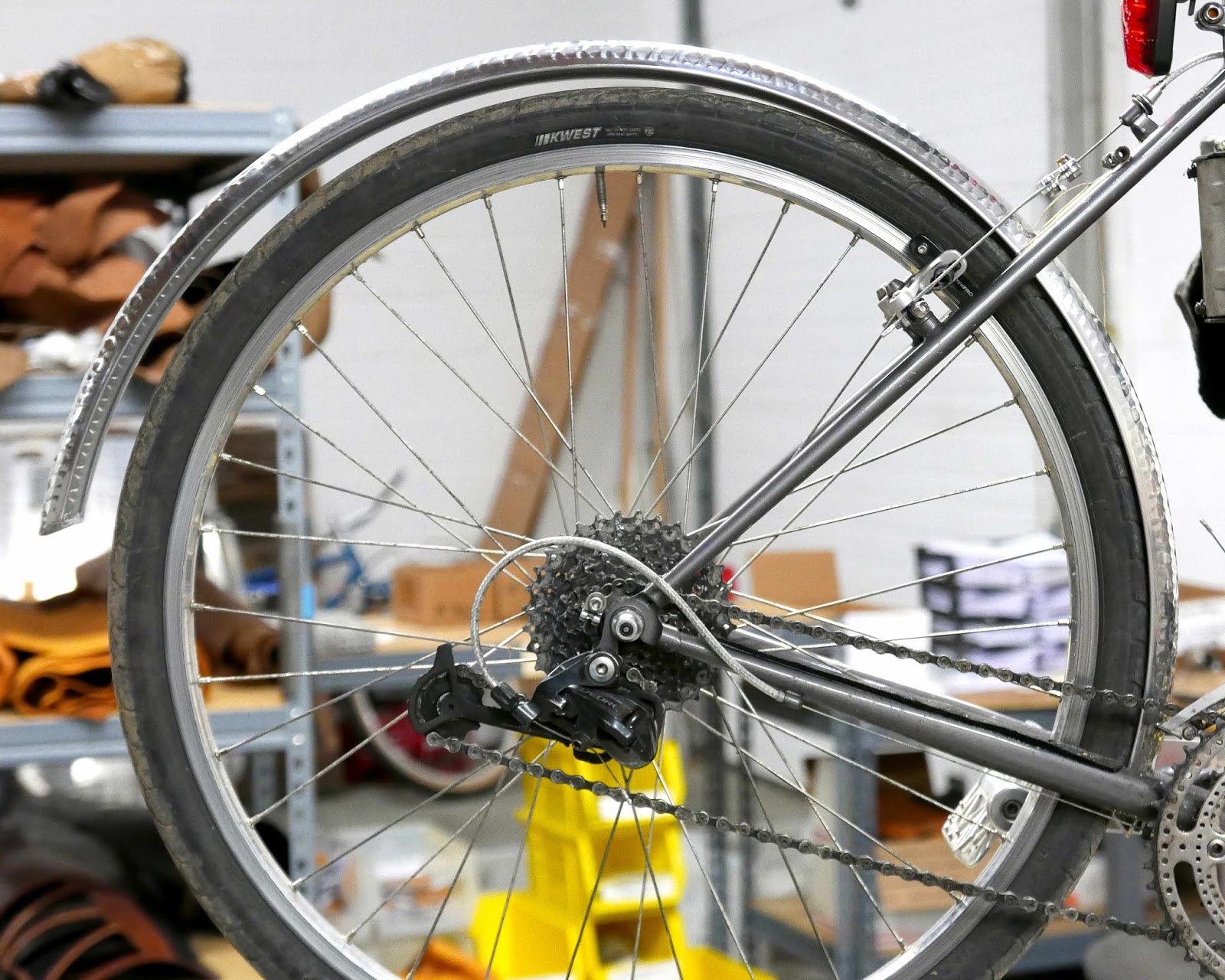
Chances are, you don't need to re-radius your fender if you choose the proper width relative to your tire size. Alas, we do not offer a 45mm 26" fenderset. Yet. So for those of you with 26" wheels with 1.5" tires, our 650bx45mm hammered fenders can be re-radiused to match the curve of a 26" wheel.

As a reference, here is what how a 650bx45mm hammmered fender sits over a 26" wheel with 1.5" tires. The subject is Adrian's 26" Campeur, in case you were wondering.
Before
And here it is after some massaging. Notice that the fender is only attached at the seatstay and chainstay bridges, and has a smooth line that follows the curvature of the tire. Once this "fender-zen" is achieved, your fenders will live long and fruitful lives free of stress risers.
After
First, here is what not to do:

Do not bend the fender by grasping on the ends and squeezing. You will kink your fender, and it will be extremely difficult to fix. Rather, you need to work the fender bit by bit until the fender matches the curvature of the tire.

To decrease the radius of the fender, you will need to increase the width. Since I am using an aluminum alloy fender set, I just use my hands to depress the middle and pull the outer edges. I have heard of others using a tennis ball, but since 1) I don't play tennis and 2) the yellow fuzz is bad for a dog's digestion tract, I simply do not own a tennis ball. 
Decreasing radius
You don't need to do a lot at a time. Little bits over the length of the fender can decrease the radius enough to work. With the wheel in the dropouts, simply mock it up and adjust as necessary. Conversely, if you need to increase the radius, squeeze the edges together.
Increasing radius by squeezing
With the proliferation of off-road touring and gravel/all-road/any-road/road-plus/adventure/quiver-killer bikes, we have started including a pair reinforcement plates in all of our alloy fender sets. Just peel and stick it under the screw during installation - one under the seatstay bridge and one under the fork crown.


Here's the final result:

We'll probably bring in some fenders for the narrower 26" crowd. What other sizes would you like to see?
12 Jan 19:11

2017-01-12

by Yehuda Moon
mkalus shared this story from Kickstand Comics featuring Yehuda Moon.

The post 2017-01-12 appeared first on Kickstand Comics featuring Yehuda Moon.

12 Jan 19:09

Fido offers subscribers free access to Viceland mobile content in 2017

by Rose Behar

Fido customers can now watch Viceland content — such as Ellen Page’s Gaycation and cooking show Bong Appetit — on their mobile devices for free, courtesy of a new partnered promotion

Customers can gain access to the Viceland app, which stocks over 20 shows related to food, music, tech and travel, by entering their phone number. Their account will then remain active until December 31st 2017.  The free access is available to both prepaid and postpaid plans, however, it is specific to smartphone users, with Fido specifying in the fine print that subscribers must use a device that can receive text messages.

“Our customers crave content that is cutting-edge that they can access when and how they want it,” said Nancy Audette, vice-president of Fido in a statement sent to MobileSyrup.

“By being the first mobile provider in Canada to offer free access to Viceland through its wireless plans, Fido is continuing to connect its customers to one-of-a-kind experiences that they can’t get anywhere else.”

The partnership is a natural fit as both Fido and Viceland are Rogers-owned brands. Rogers itself has yet to announce plans for a similar free promotion, but it may be a natural progression considering the company recently shutdown Shomi, which was often used as a sales incentive for customers.

Though not explicitly linked, this promotion comes directly after an ongoing series of “gifts” Fido is offering to its customers in honour of its 20th birthday. The carrier began with free data and has since launched a cross-Canada road trip with cupcakes and giveaways.

Source: Fido

12 Jan 19:09

Samsung will reportedly ship its first foldable smartphone later this year

by Igor Bonifacic

After years of behind the scenes iteration, Samsung will reportedly announce its first foldable smartphone later this year, according to a new report from the Korean Herald.

Citing “sources familiar with the matter,” the publication says Samsung will announce a smartphone in Q3 2017 that users will be able to fold out and use as a 7-inch tablet. The company will reportedly manufacture 100,000 units of this device.

The Korean Herald goes on to add Samsung may delay the launch of the device if the company feels it can’t make a profit on it, or if the device is not marketable. The company will make the final decision on whether to reveal the device to the public after it completes an executive reshuffle in February.

The report also notes LG will start manufacturing its own foldable displays, though in its case, the company is contemplating selling the technology to companies like Apple and Huawei rather than taking on the financial risk of marketing and selling the technology on its own.

While it seems Samsung has been poised to release a foldable smartphone for years, there’s good reason to believe 2017 may, in fact, be the year the company finally delivers on its promise. Gregory Lee, an executive with Samsung’s U.S. branch, told Recode foldable display smartphones were “right around the corner” at a tech conference this past summer. Just weeks before Lee made his statement, Bloomberg published a report that said Samsung would release two foldable display mobile devices in 2017, including an OLED tablet that can fold in half like a book.

Source: Korea Herald Via: Android Authroity

12 Jan 19:09

Canadian and U.S. airlines no longer required to notify passengers the Note 7 is banned from their flight

by Igor Bonifacic

The next time you fly on a plane within North America, you won’t hear an announcement about the Samsung Note 7.

Samsung announced on Tuesday, via a press release, that the U.S. Department of Transportation has made the decision to lift the requirement for national airlines to notify passengers during boarding that the Note 7 is banned from all domestic U.S. flights.

“By leveraging our digital technology to target each device, we’ve had over 96 percent of Galaxy Note 7 phones returned to date,” says the South Korean company’s U.S. outpost. “Together with our wireless carriers, we have taken aggressive action to limit the remaining phones’ ability to work as mobile devices, further enhancing participation in the recall. We thank the Department of Transportation, airlines, airports, our partners and Note 7 owners for their patience and support during this time.”

In a statement to MobileSyrup, Samsung Canada confirmed that Transport Canada is following suit:

“Since recalling the Note 7 device Samsung Canada implemented numerous measures to ensure the safety of Note 7 owners and the success of the recall initiative, which included a battery limitation to 15 percent and deactivation of service in December 2016. As a result of these measures, approximately 99 percent of Note 7 smartphones are no longer active on Canadian networks and we are pleased to confirm that Transport Canada has removed the recommendation for Canadian airlines and airports to make specific pre-boarding notification regarding the Note 7 on domestic flights.”

Following the lead of the U.S. Federal Aviation Administration, Transport Canada banned the Note 7 from all Canadian flights on October 15th. The Note 7’s ultimate demise began when a replacement device caught fire on a Southwest Airlines flight that was about to take off.

This article was contributed to by Rose Behar and Patrick O’Rourke.

Source: Samsung

12 Jan 19:09

Android Wear 2.0 will finally launch in early February

by Patrick O'Rourke

Android Wear 2.0 was supposed to launch last fall, but Google delayed its mobile operating system for reasons the tech giant still has not fully revealed.

It’s believed that negative feedback from the final preview developer build forced the company to hold back Android Wear 2.0’s release. Now, however, a recent notice sent out to developers indicates that Wear 2.0 will launch at some point in the next few weeks.

The notice was specifically sent out to developers with apps using Wear’s legacy APK installation mechanism. Wear 2.0 features an on-watch Play Store with support for standalone application that don’t require a phone companion app. Apps that have not been updated with new support will not show up in the Wear 2.0 store when it launches, according to the email sent to developers.

A specific release date for Android Wear 2.0 is still unclear, but it looks like the operating system will finally land at some point in February.

With the hype behind wearables slowly dying out and Pebble, the original smartwatch company, being acquired by Fitbit, many assumed that Google could have plans to abandon smartwatches altogether, however, for the immediate future that doesn’t seem to be the case.

Source: 9to5Google

12 Jan 19:08

Roam Mobility brings back one year expiry for all SIMs

by Steven Hurdle

In May of last year Roam Mobility announced that most of their SIMs would now feature a six month expiry date. Now, the company has had a change of heart, returning all their SIMs to a one-year expiry from the last time they were topped up.

Several other features were announced alongside the new policy. Roam now lets users check how much data they have left by texting the word “balance” to 7850. You can also specify a time-zone when scheduling a plan, making it easier to make sure your plan starts at the time you hit the border, or land in the airport.

If you are using a Snowbird plan and want to add another month, you can do so by logging into your account on Roam’s website, selecting your SIM, and then choosing the option to extend your plan by a month. For daily plans, users can follow the same procedure, but instead select ‘Reschedule’ to change the day that it’s meant to start on.

If a group of people are travelling together and are on the same account want to top up their SIMs, there’s now an option on Roam’s website to top up multiple SIMs simultaneously.

Roam also announced that two features are being removed from its service, one temporarily and the other permanently. Up until now you’ve been able to change your Roam Mobility phone number periodically. That feature has been suspended for the time being, as has the ability to activate a new SIM and transfer your existing Roam Mobility number to it. Roam indicated that this feature would return, but didn’t state when. In the past Roam has indicated that they hope to allow people to port in numbers from other U.S. carriers, so perhaps the suspension of this feature is part of implementing that.

Finally, up until now it’s been possible to top up by texting in your request, or by phoning customer service. Touting enhancements to their website that make it easier to use on mobile devices, Roam now requires all customers to top up on roammobility.com.

12 Jan 19:08

LG says your ‘ideal smartphone’ will come to life, teases G6 unveiling

by Ian Hardy

LG has already confirmed its next flagship smartphone will be called the G6, which follows its G5, G4, G3 and G2 predecessors. It’s already known that the G6 will feature a 5.7-inch 1440 x 2560 display and shed its modular dreams.

To keep enticing the masses and bring on new friends, LG has already started teasing its Mobile World Congress keynote presentation at the end of February. A new video has been uploaded that asks various people what their “ideal smartphone” would be. Some stated the device needs to have a big screen, portable, comfortable, one-hand usability, and waterproof because “dropping your phone in the toilet is the worst nightmare.”

“Your wishes for the ideal smartphone will come to life. Stay tuned for its arrival in February 2017,” says LG.

Mobile World Congress is happening February 27th to March 2nd in Barcelona.

Source: LG YouTube