Rolandt
Shared posts
China virus? North America’s most Chinese city is one of the most coronavirus-free places on the continent
2021-06-01 General
Vaccines
Canada’s National Advisory Committee on Immunizations has decreed that it’s okay to get an mRNA shot after an AstraZeneca shot. They had been waiting for the efficacy results from a big UK study, but the study has been delayed another month, and they (along with many other immunology boards) finally said “screw it, we’re just going to do it.”
I also strongly suspect that the regulatory agencies know the basic outlines of what the study says, from informal conversations, e.g. “Hey, Wilma, you’ve got a friend working on Com-Cov, what are their results like and why is it taking so long?” “Oh, he says that the holdup is because they are bickering about who gets what credit, but that AZ+Pfizer is really really good.”
Reminder that the UK study has given us safety information. AZ+Pfizer is safe, although the side effects are more annoying (though not dangerous) than AZ+AZ. There is also a Spanish study which confirms the safety and found that AZ+Pfizer gave seven times as many antibodies as AZ+AZ.
There’s a town in Brazil, Serrana, where they did whole-of-city vaccination, in four steps. They announced preliminary results, and said that they determined that they needed to vaccinate 75% of the city to control the virus.

I don’t understand how they decided that 75% was the magic number. It looks to me like the point they picked was sort of arbitrary.
And yeah, it’s nice that deaths dropped by 95% after they vaccinated 95% of the citizens, but frankly it would have been astonishing if that had not happened.
Mitigation Measures
There are several lawsuits going forward saying that the quarantine hotels are unlawful detention.
Treatments
I told you that Vitamin D was good for COVID? This paper says no, but the paper is a little… odd. It used the “genetically predicted Vitamin D level” — I don’t even know what that means — in COVID-19 patients and controls. It did not try giving Vitamin D supplements, and it also excluded people with Vitamin D deficiency (!).
Other diseases
This isn’t coronavirus-related, sorry, but it’s exciting as hell! Yestrerday, they started Phase 1 trials of a universal influenza vacccine. It’s a nanoparticle mosaic approach (sort of like the Novavax approach) where they stick pieces of a bunch of different influenza strains together:

The nanoparticles go into the lymphatic system, where the immune system sees them and goes DO NOT WANT! and makes antibodies to all of them.
This is one possible approach to a universal coronavirus vaccine.
This paper says that mitigation measures for COVID reduced Streptococcus pneumoniae (one cause of pneumonia), Haemophilus influenzae (influenza), and Neisseria meningitidis (one cause of meningitis).
Recommended Reading
This article talks about mRNA vaccines: the development hurdles they had already (fortunately!) overcome, what they might be used for in the future, etc.
Could One Redo Dopplr?
Could one redo any useful app, for that matter, that now fills the start-up cemetery?
I was reminded of this as Peter mentioned Dopplr, a useful and beautifully designed service in the years 2007-2010. The Dopplr service died because it was acquired by Nokia and left to rot. Its demise had nothing to do with the use value of the service, but everything with it being a VC funded start-up that exited to a big corporation in an identity crisis which proved unequipped to do something useful with it.
Some years ago I kept track of hundreds of examples of open data re-use in applications, websites and services. These included many that at some point stopped to exist. I had them categorised by the various phases of when they stalled. This because it was not just of interest which examples were brought to market, but also to keep track of the ideas that materialised in the many hackathons, yet never turned into an app or service, Things that stalled during any stage between idea and market. An idea that came up in France but found no traction, might however prove to be the right idea for someone in Lithuania a year later. An app that failed to get to market because it had a one-sided tech oriented team, might have succeeded with another team, meaning the original idea and application still had intrinsic use value.
Similarly Dopplr did not cease to exist because its intrinsic value as a service was lost, but because everything around it was hollowed out. Hollowed out on purpose, as a consequence of its funding model.
I bet many of such now-lost valuable services could lead a healthy live if not tied to the ‘exit-or-bust’ cycle. If they can be big enough in the words of Lee Lefever, if they can be a Zebra, not aiming to become a unicorn.
So, what are the actual impediments to bring a service like Dopplr back. IP? If you would try to replicate it, perhaps yes, or if you use technology that was originally created for the service you’re emulating. But not the ideas, which aren’t protected. In the case of Dopplr it seems there may have been an attempt at resurrection in 2018 (but it looked like a copy, not a redo of the underlying idea).
Of course you would have to rethink such a service-redo for a changed world, with new realities concerning platforms and commonly used hardware. But are there actual barriers preventing you to repeat something or create variations?
Or is it that we silently assume that if a single thing has failed at some point, there’s no point in trying something similar in new circumstances? Or that there can ever only be one of something?

Repetitions and Variations, a beautiful Matisse exhibit we saw in 2012 in the Danish national art gallery in Copenhagen. Image by Ton Zijlstra, license CC BY-NC-SA

12 stages, 1 painting. I’m thinking the reverse, 1 sketch, 12 paintings. Image by Ton Zijlstra, license CC BY-NC-SA

Normandy Cliff with fish, times 3. Matisse ‘Repetitions and Variations’ exhibit. Image by Ton Zijlstra, license CC BY-NC-SA
Dear background mind: please think about Postgres and Clojure
I used a Lisp variant in my first programming job, so I have some appreciation for the “code as data” power of that language. Nowadays I’m building an analytics system that combines Postgres and two of its procedural languages, pl/pgsql and pl/python, with a sense-making tool called Metabase that’s written in a Lisp variant called Clojure.
In Postgres I’m able to wrap SQL queries in functions; they compose with other functions that do things like cache results in materialized views and aggregate subgroups. It all feels very dynamic and functional, which are two of Clojure’s main calling cards, so this makes me wonder about Clojure as another Postgres procedural language.
For the pl/python functions in my system, “code as data” looks like building SQL statements that swap variables into SQL templates and combine them. This string-building approach is an anti-pattern for Clojure folk. They don’t want to work with fragments of SQL text, they want to work with Clojure maps. Here’s an example from Honey SQL, the library that Metabase uses to build SQL texts from structured data.
(def sqlmap {:select [:a :b :c]

:from   [:foo]

:where  [:= :f.a "baz"]})
This seems like an important power to be able to wield in the hybrid programming environment that Postgres provides. I can imagine making very good use of it.
But I know very little yet about Clojure. Is this really an idea worth exploring? How else would it differ from what I’m now able to do in Python? To learn more about Clojure I’ve been watching talks by its creator, Rich Hickey. Most are tech-heavy but one of them isn’t like the others. In Hammock-driven development he lays out a process for creative problem solving that coordinates the waking mind (at the computer doing critical thinking and analysis) with the background mind (on the hammock doing abstraction, analogy, and synthesis). The coordination is explicit: You use the waking mind to feed work to the background mind which is “the solver of most non-trivial problems”; you weight your inputs to the background mind in order to influence their priority in its thinking.
I guess I’ve done that kind of thing implicitly from time to time, but never in such an intentional way. So, is Clojure-in-Postgres worth exploring? Perhaps by writing this I’ll prime my background mind and will receive more clarity in the morning.
Colonization and the shadow of belonging
The great shadow of North American history I think is that settlers know deep down that we don’t belong here. The idea of “settling” the west was predicated on the continent being cleansed of its original inhabitants. This happened in a number of ways. There was outright murder perpetuated by war, disease and neglect. There were treaties which ripped people from their territories and bound the loyalties of indigenous people to the Crown rather than their own laws. There was the residential school system which had as its goal the “education” and “civilization” of indigenous children such that they would no longer be indigenous, which resulted in hundreds of thousands being torn from their families and raised by many abusive and unwell priests, nuns, administrators, social workers, nurses, doctors, coaches and teachers.
It seems everywhere settlers ventured on this continent, they have left unsettled peoples, lands, animal populations and communities. The devastation of indigenous population over 500 years and including to the present day through the loss of lands, language, autonomy, self-governance, dignity, health and resources has been rightly called genocide, and documented as such in the last decades’ inquiries into residential school legacies and missing and murdered indigenous women and girls. There has been a deliberation erasure of peoples here, which made possible economies that have resulted in some of the monetarily richest people in human history living some of the most prosperous lives humans have ever lived.
And I think deep down, every knows that it was gained on the backs of genocide.
So that has some bearing on whether settlers can even feel at home here. And I think that unresolved cognitive dissonance – maybe deeper, maybe a soul dissonance – perpetuates inhumane level of violence towards people, land and community. On this continent the world’s mightiest military power has taken root, supported by the world’s mightiest economic engine and spread death and exploitation around the world. Here in Canada, the same week as 215 children were found deposited in a mass grave separated from their families, communities and even their names, we saw photos of a single 1000 year old spruce tree being carted away to make guitar tops. Songs will be sung through a tree which lived twice as long as colonization and which was weeks away from being protected forever by a provincial law prohibiting such logging.
The term “settler” is used to describe willing immigrants to this continent, because traditionally it was the word that our families all used when they were heading here to settle down. But it conveys a sense of serene calm, of finally arriving somewhere, of belonging.
It must be heard in the context of all the unsettling that has resulted from this. Even amongst settlers, the privilege extracted from this continent has been concentrated in the hands of very few (who even continue to become enriched during the biggest public health crises in a century) resulted in this unsettling being pushed through the class ranks rendering people housing insecure, unhealthy, burnt out and poor.
35 years ago I stood in the summer night around a fire in Sudbury participating in a process to make an apology from the United Church of Canada to indigenous peoples, a powerful and important gesture that indigenous people like Alberta Billy, Art Napoleon, Murray Whetung and Stan McKay asked for. And we wrestled for hours over the wording of that apology because in the room where we were deliberating were residential school survivors, teachers, administrators. The whole system was there. And the concern in the room was sparing the feeling for those that had “good intentions.” And so the debate went back and forth and in the end I don’t think we spared their feelings, but I do think we must have hedged on the final wording just a touch, because the Moderator – Rev Bob Smith – delivered the apology to the Elders and we waited and waited and finally the Elders announced that they were appreciative of the apology but they did not accept it. They wanted to see what would happen next.
At the time, I thought this was a brilliant response and a generous one. It was an invitation to join in relationship and do something meaningful together, because the proof is in the actions and the only future that can begin to redeem the past is in mutually beneficial reciprocal relationships, which now must first consist of a MASSIVE transfer of wealth and land back to First Nations. It is what indigenous people have been saying since the very beginning: hey, let’s do something cool together. And at every turn everything has been stolen.
That night changed my life. It made me unsettled. And I think that is the only job of settlers: become and remain unsettled. If the news of this past week has unsettled you, good. Perhaps that will enable you to finally be in relationship with all of the people who have been unsettled by the history of colonization on this continent. Get unsettled, be in relationship. If you have land, think about how you can give it back. If you have cash, donate. LIsten to what indigenous people are saying. They are inviting us all into a better world, but we need to let go of the idea that settler colonialism is a viable path to that world. It is not.
There are people among you right now who properly belong to this place. No matter how closely connected you feel to where you live, not matter how long your family has been “in these parts” there are people here whose history goes back to the time before your ancestors even thought about farming. Listen to their voices. Follow their lead. Be unsettled and be led.
Comparing cameras

On the top left is a photo taken with my trusty old (also much used and abused) Canon 5D Mark III. On the top right is one taken by a borrowed new Sony a7Riii. Below both are cropped close-ups of detail. The scene is in a room illuminated by incandescent track lighting. It is not an art shot, though it does contain photo art by our good friend Marian Crostic, whose Sony a7R she is kindly remanding to my custody tomorrow. (Her main camera is now an a7Riii like the borrowed one I used here.)
Both photos were shot with Canon and Sony’s best 24-105 f4 zoom lenses, at the 105mm end. Both were also set to automatic, meaning the camera chooses all the settings. In both cases the camera chose ISO 3200 at f4. The only difference was shutter speed: 1/125 sec on the Canon and 1/160 sec on the Sony. While 3200 is not the prettiest ISO, I wanted to compare both cameras indoors under less than ideal lighting, because that’s typical of situations where I shoot a lot of people.
One difference between these cameras is the pixel density of the sensor: the Canon’s shot is 5760 x 3840 pixels, while the Sony’s is 7952 x 5304. While that difference accounts for some of the higher detail in the Sony’s shot, it’s clear to me that the Sony lens is simply sharper, as Ken Rockwell kinda promised in this glowing review. (Also, to be fair, the Canon lens has had a lot of use.)
All the images above are screen shots of RAW versions of the photos (.CR2 for the Canon and .ARW for the Sony). Though I don’t have the time or patience to show differences in the .JPG versions of these photos, it’s clear to me that the Canon’s JPGs look less artifacted by compression. The obvious artifacts in the Sony shots have me thinking I may only shoot RAW with the a7R, though I’ll need to test it out first.
The main difference overall, at least in this setting, is in the warmth of the color. There the Canon has a huge advantage. I could say it’s also because the Sony is slightly less exposed (by the higher shutter speed); but I noticed the same difference in test shots I took outdoors as well, under both overcast and sunlit skies, and at ISO 100. The Canon seems warmer, though the Sony has far more detail one can pull out of shadows.
I should add that neither camera got the color of the wall (a creamy white) right in these photos, with the Canon leaning hot and the Sony leaning cool.
Anyway, I just thought I’d share that much before I pick up the a7R, and start using it to shoot stuff in New York, where I’m headed Wednesday night after more than a year away.
Minimal Viable Processes
On Writing.
I used to write a newsletter.
I guess I still do. Just not recently. Last year, post-pandemic, I count seven editions. This year we have a grand total of one.
For a ‘weekly’ publication, that’s not exactly regular.
March 23rd, 2020. We all know and remember that’s when the UK went into lockdown. Since then I’ve been back into the office I think five times? Twice for a shoot, once for a pitch, then twice to see (and in some cases, meet for the first time) my team.
I do not miss the commute. I know I am not alone in this, not by any stretch. The benefits of working from home (higher productivity, deep work) far outweigh those of being in the office every day (commute, open-plan offices) – I can’t ever imagine going back to the old normal ever again.
Incredible really.
Being able to close my laptop at 6pm, immediately cuddle my children, start [a proper] dinner, and generally enjoy an evening at home with the family; that holds immense value for me.
But of course, that benefit comes at a cost: the 90-120mins a day of dead time on the train/tube/walk of a commute mind, that’s where I did the thinking. The reading. The mental drafting and percolating of words, thoughts, and provocations that would ultimately wind up in an edition of Five Things on Friday.
And that’s gone now.
Not for good. But it’s telling that having travelled to and from the office twice over the past fortnight, there are words available at the end of these fingers once more.
I know I’m one of the lucky ones.
Throughout all this I’ve kept my job, the roof over my head, and – frankly – my life.
But today, today I’m allowing myself to miss writing.
Because I do.
I am in no rush to return to the office. But when I do (at least part-time) then maybe the words will return with it.
Instapaper Liked: You can’t get there from here: Union Station’s lost cities
2021-05-31 General
Vaccines
I have been very excited about NDV-HXP-S, which uses a 6-proline substitution (which makes the spike protein more stable) of the spike protein called Hexapro. Well, today a preprint came out with preliminary results that have two really good results in mice modified to have a human immune system.
First, they developed an awesome drug delivery method — it’s a patch that has an array of tiny microscopic needles that you stick on the skin. The vax is sprayed onto the needle side and then dried, which means that you don’t need a syringe and it doesn’t need to be refrigerated. Win! Win!
Second, a vaccine made of Hexapro spikes worked really well. They inoculated some human-immune-system-mice via the patch twice, 21 days apart, and then gave each of the control group and the inoculated group mice a really stiff dose of COVID-19. All of the control group died; none of the inoculated group had any symptoms. Win win win!
Variants
The World Health Organization that variants will be given names of Greek letters. Numbers are too hard to deal with. WHO has a list here, but here are the main ones:
| Old name | New name | Location found |
| B.1.1.7 | Alpha | UK (“Kent”) |
| B.1.351 | Beta | South Africa |
| P.1 | Gamma | Brazil |
| B.1.671.2 | Delta | India |
2021-05-30/31 BC
The news has been slow, I think in part because the US has a long weekend, but also because COVID-19 is generally receding as a major issue, certainly in the US but also somewhat in Canada.
Variants
On Thursday, Dr. Henry nonchalantly announced that they were dropping the dose interval from 16 weeks to 8 weeks. This surprised me slightly; I had expected that we’d switch over around the 15th. I was even more surprised that my 80-something neighbour got an appointment right away, for today. So it’s not that they waited until demand for shots was low to switch over to second doses. No, they decided they wanted to get second shots in arms, and to do so right away.
I think the math has changed with B.1.617.2 (“India”). While the effectiveness of 2 doses is less than twice the effectiveness of 1 dose for all the other variants, it is not true for Pfizer against B.1.617.2: one dose only gives 33% effectiveness and two doses gives 88%. Given that old people are much much more likely to need hospitalization and/or die from COVID-19, the math in the presence of B.1.617.2 suddenly switches into GET AS MANY OLD FOLKS THEIR SECOND SHOT AS POSSIBLE, STAT!
Do we have B.1.617.2 in BC? A little bit:
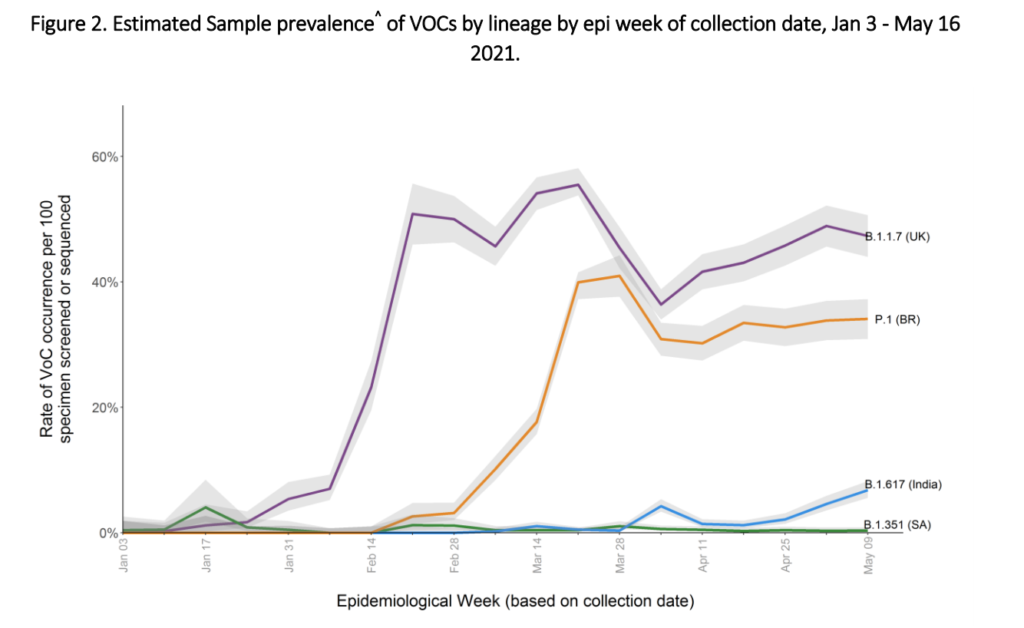
Eyeballing, that looks to me like B.1.617.2 was at about 7% two weeks ago and rising very fast. It would not surprise me if it’s now at 20% or more. This is not good.
I think maybe we reopened too soon.
Press Briefing
Dr. Henry opened with heartfelt words about the tragedy, the abomination uncovered at the Kamloops residential school. I cannot do the words justice, I cannot write a summary because I cannot summarize an emotion. Watch the video.
After those remarks, Dr. Henry said:
- 69.7% of adults and 66.1% of those over 12 have been vaccinated, woohoo! NB: This is about 60% of all BCers.
- BC has seen its third case of VITT (AZ blood clots), in a man in his 30s. He’s in hospital getting treatment and recovering.
Dix said:
- Sadness over the Kamloops children. He gave several phone numbers:
- Anyone who experienced racism in healthcare can share their experiences at 1-888-600-3078
- national residential school crisis line set up to provide 1-866-925-4419
- 1-800-588-8717 BC-specific crisis line
- Today, only 7 surge beds are being used, which is a big improvement. COVID hospitalizations are way down from a high of 511 to 249 today; COVID ICU patients are down from a high of 183 to 78 today. However, the hospitals still have a high number of patients. NB: Once patients test negative for COVID-19, they are no longer included in the hospitalization numbers. This isn’t as underhanded as it might look at first, because it really matters to the hospital how many COVID-19 positive people they have. People who are COVID-19 negative can be transferred to non-COVID hospitals, for example. It is my understanding that people who are admitted to the ICU are still counted after they are COVID-19-clear.
Q&A
Q: Manitoba decided they were tired of waiting for the UK mix&match study of AZ/Pfizer and are just going for it, giving Pfizer to Team AZ. What is BC going to do? A: The UK study is late, but there is other data out there that we’re looking at. People will have a choice, but we need to figure out the messaging and the logistics. I’ll let you know on Thursday. NB: I think that she meant things like, “how do we modify the registration system to give people the choice?” Another possibility is that they are figuring out what dosing interval to use.
Q: Will Team AZ be able to get AZ+Pfizer+Pfizer if they need two Pfizers for proof of vaccination for travel? A: Uh, that shouldn’t be a problem. AZ+Pfizer should work better than AZ+AZ, and if somehow it’s not as good, we’ll get you a booster.
Q: I heard that people’s vaccine appointments were cancelled once they got there because there just wasn’t enough vax. WTF? Was it just a bunch of kids showing up without appointments with their parents? A: That’s news to me. Some people got their appointments cancelled because it turned out there hadn’t been 8 weeks from their first vax. There was also an issue with blank screens over the weekend because of system maintenance, sorry about that. But I haven’t heard about supply problems.
Q: WHY CAN’T I TAKE MY MASK OFF WHEN VISITING GRANDMA IN THE LONG TERM CARE HOME??? A: Because it’s still dangerous. Vax doesn’t always work, not everybody is vaxxed. Assume you’re still going to have the current restrictions until July.
Q: As more teens get vaxxed, can you imagine policies which allow vaxxed teens to have more comprehensive ceremonies? A: The School Health Team is considering options.
Q: Oh come on pleeeeeese? Graduation is sometimes the last week in June, which is RIGHT before July 1, which is when Stage 3 should kick in, can’t they pleeeeeeease get a variance? C’mon, you gave a variance to religious groups! A: The School Health Team is considering options. NB: I am impressed with her ability to NOT say, “Like I just told you 15 seconds ago…”
Q: Last week you said that the clinically extremely vulnerable people would get priority for dose #2, what about the people who are not on the CEV list but who are really vulnerable? A: We made the list pretty broad for people who are at risk. There are a fair number of vulnerable people who are not at higher risk for COVID-19. NB: This is true. Multiple sclerosis, for example, does not increase someone’s risk of COVID-19 although a few (not all!) of the MS immunosuppressive medicines do. Also, nobody is excluded, everybody has to still take measures — so if you are immunocompromised, you still need to protect yourself. Also also, everybody is going to get doses and we are going really fast now.
Q: How are we going to make sure that restrictions are rolled back uniformly across the 500+ long-term health care homes? A: It’s a challenge, but it’s too early to roll back restrictions.
Q: How many teens got Moderna instead of Pfizer? A: About a dozen. That was absolutely an error, our bad, but it shouldn’t actually hurt them. Moderna has submitted the results of their trial on 12-17 year-olds, and we expect that it will get approved very soon. Still, it was bad and we have instituted some procedures to make sure it doesn’t happen again.
Q: One dose is really crappy against B.1.617.2 but two doses works well. Should we worry about B.1.617.2? A: That was a really small study. NB: It wasn’t THAT small: there were ~12K B.1.1.7 people and ~1K B.1.617.2 people. At the population level, we’re seeing cases still go down in the UK. We use vax level AND cases AND deaths. We need to keep those in a range where pub health can do test/trace/track properly.
Statistics
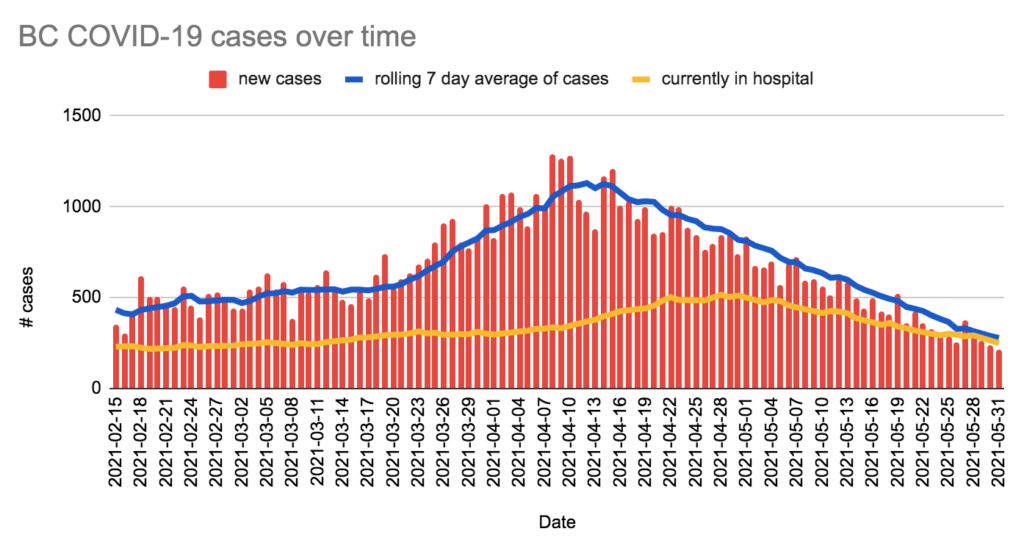
Fri/Sat: +258 cases
Sat/Sun: +238 cases
Sun/Mon: +212 cases
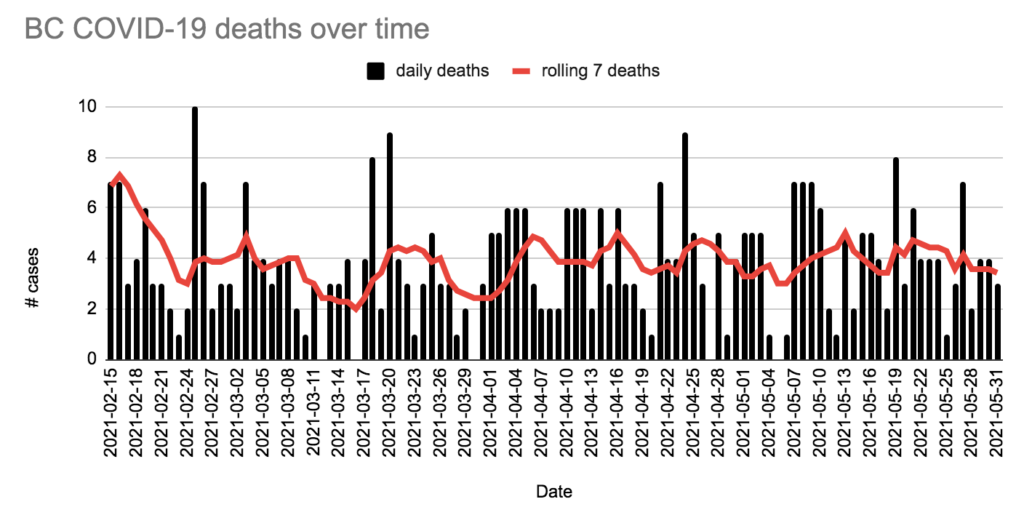
Over weekend: +11 deaths, +124,778 first doses, +19,069 second doses. The ages of the deaths were as follows:
| Age cohort | # of cases |
| 40s | 1 |
| 50s | 0 |
| 60s | 2 |
| 70s | 6 |
| 80 and over | 2 |
Currently 249 in hospital / 78 in ICU, 2953 active cases, 139562 recovered.
We have 276,214 doses in fridges; we’ll use it up in 5.3 days at last week’s rate. We’ve given more shots than we’d received by 11 days ago.
We have 149,183 mRNA doses; we’ll use it up in 2.9 days at last week’s rate. We’ve given more mRNA shots than we’d received by 9 days ago.
Charts
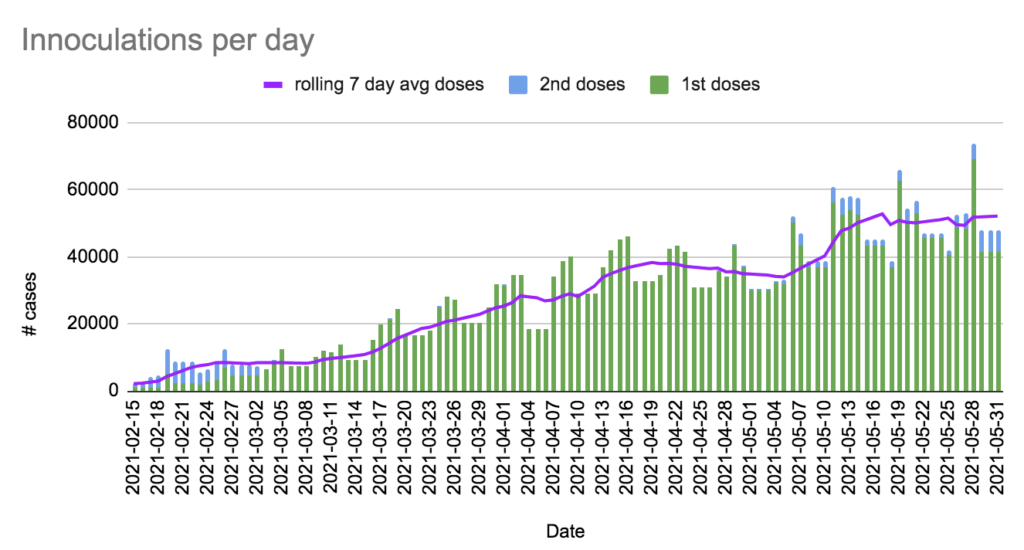
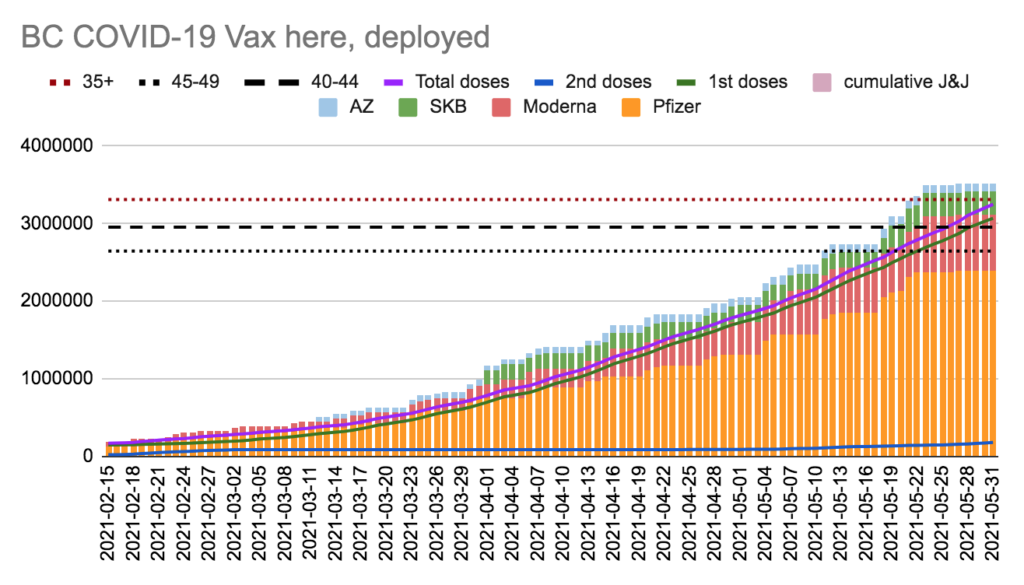
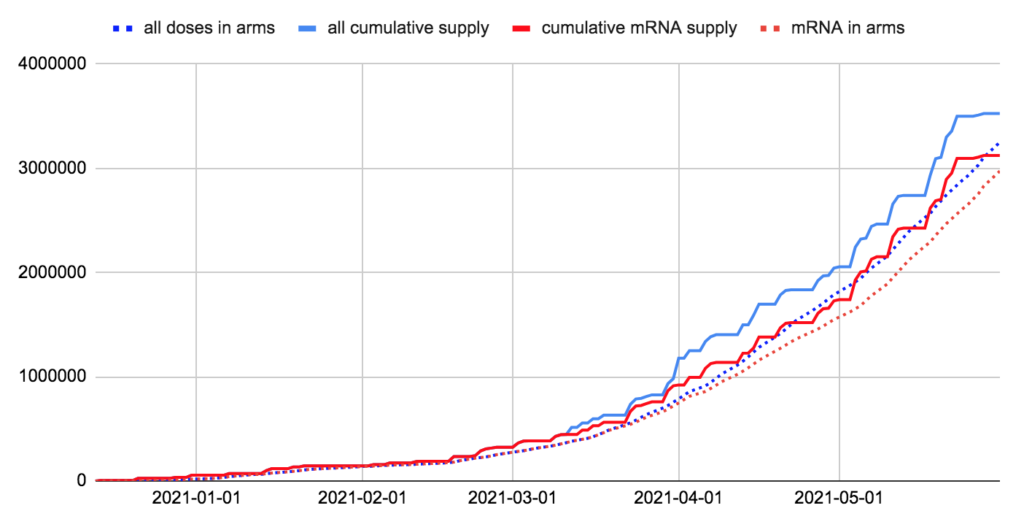
Humour
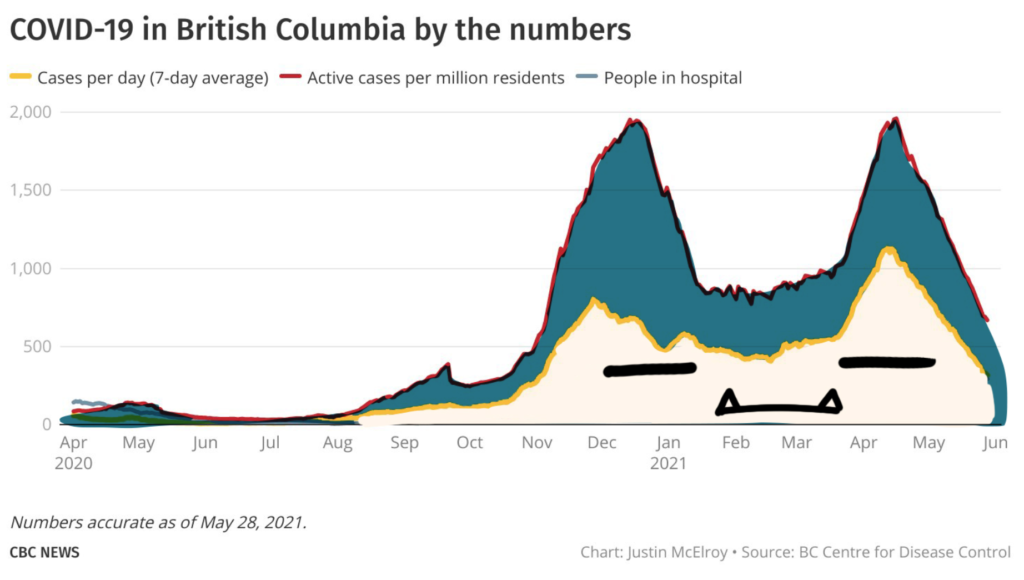
This is a few days old, but I realized some of y’all might not have seen it:
Andy Tries Out My OPML Book Lists
Recently I created a proof of concept of publishing book lists, what I’ve read, what I plan to read etc., using OPML. Andy Sylvester picked it up and created his own list, as a way of experimenting with federated bookshelves. He used the XSLT style sheet I created to be able to render the OPML file in a human readable way in your browser. It seems to work, although it doesn’t render in the browser yet.
Andy, I think the reason it doesn’t render in the browser is because you are loading the style sheet from my domain. The XSLT file must be hosted on the same domain as the OPML file, otherwise it triggers cross-site scripting protections. It should work properly if you download the XSLT I use and put it on your own host.
Hosting the XSLT style sheet also allows you to adapt one other detail: right now there are some tweaks in my version based on the author name of a collection or feed. If it is my name it renders as ‘my list’ and otherwise as ‘list I follow’. When you self host the style sheet you can change the mentions of my name to yours and it will make the proper distinction between your lists and lists you follow.
Quoting Tim Bray
I’m pretty convinced that the biggest single contributor to improved software in my lifetime wasn’t object-orientation or higher-level languages or functional programming or strong typing or MVC or anything else: It was the rise of testing culture.
— Tim Bray
Sharing your deepest emotions online: Did 2020 change the future of therapy?
COVID-19 forced the U.S. into a new era of telehealth. Therapists hope it’s here to stay.
———
2020 was the worst year of Kali’s life.
“Going through something like the pandemic and not having family around, feeling out of control—I was on edge all year,” says the 30-year-old Colorado resident. And she wasn’t alone.
Amid the COVID-19 lockdowns of early 2020, millions of Americans found themselves trapped at home with a backlog of unaddressed mental-health issues. As with so many other things, computer screens and video calls became the only portals out of lockdown—for work, entertainment and, ultimately, real psychological help.
By spring 2020, nearly all therapy was forced online, a shift that initially worried therapists and patients alike.
“You do all these years of school to become a psychologist and all the training is in-person,” says Dr. Justin Puder, a therapist and licensed psychologist based in Boca Raton, Florida. “So when you transition to online, you have these doubts—will the connection be as genuine? Will it be as effective?”
But by summer, many therapists, including Puder, were experiencing an unprecedented surge in new-patient inquiries.
“About six months into the pandemic, I was over capacity, and that was the first time that my private practice had filled up like that,” Puder says.
Many of Puder’s clients were teens or young adults struggling with the transition to online school and the loss of important milestones like prom or graduation. Other therapists, like Dr. Jeff Rocker in Miami, Florida, saw an influx of Black men seeking therapy after a summer of highly publicized shootings of unarmed Black males at the hands of police. Others still, like K. Michelle Johnson, a sex and relationship coach and therapist based in Denver, Colorado, saw their practices flooded with struggling couples.
“I think the pandemic created a bit of a pressure cooker for people who were suddenly unable to avoid or escape the issues they’d been having,” Johnson says.
For Johnson’s clients, the shift to virtual therapy had both pros and cons. One issue was privacy. Virtual therapy nearly always takes place on specialized HIPAA-compliant platforms that ensure a secure connection, but interruptions from nosy roommates, curious children and needy pets are facts of life at home.
Still, Jennifer Dunkle, a Certified Gottman Couples Therapist who specializes in financial coaching and is based in Fort Collins, Colorado, says many of the parents she works with still prefer online therapy—it freed them to get the help they needed without having to find or pay for childcare, she says.
That new therapy-from-anywhere paradigm has also helped improve access for people in more rural settings. Angela, 31, raises pigs and vegetables with her partner on a farm in southern Colorado. They live about 60 miles from the nearest mental health center.
With that commute, “Going into therapy could be a three-hour ordeal,” Angela says. “So virtual—I’m all about it.”

The Pocket Joy List Project
The stories, podcasts, poems and songs we always come back toVirtual therapy also just feels more accessible for some patients.
Haley, a 26-year-old in Atlanta, Georgia, says the idea of having to meet a therapist face-to-face had always intimidated her. That was compounded by anxiety around having to locate a new office, find parking and be somewhere on time. Conversely, just opening up a laptop from the comfort of her kitchen or bedroom? “That felt so much easier,” she says.
Puder suspects that there’s another phenomenon at play in the public’s newfound openness to virtual therapy: social media.
Puder currently has 335,000 followers on his TikTok. Rocker, better known in Miami as the “Celebrity Therapist” for his work with elite athletes and entertainers, has over 62,000 followers on Instagram. Both are part of a new wave of influencer-therapists who build their followings through bite-size mental health tips, often infused with humor and a lot of personality.
The trend has been enormously effective, Rocker says.
“People are seeing that there are so many different approaches and ethnicities and cultures within the mental health space,” Rocker says. “People are seeing that they can receive mental health services from people who look like them and talk like them and who they can relate to.”
Puder also suspects that TikTok’s rise in popularity during the pandemic has helped cultivate a new light-hearted, open, stigma-free approach to mental health, which has in turn encouraged more people to give therapy a try. After all, the difference between watching weekly videos from your favorite therapist and signing up for weekly video chats is an easy leap to make.
Better yet: According to a 2018 analysis of 64 different trials, internet-delivered therapy is just as effective as face-to-face therapy. And for some patients, it could be even more effective. Johnson reports that when clients can talk to her from a serene setting like a park, they’re able to open up and be more vulnerable than they may have been in person.
“With virtual therapy, there’s that little bit of separation between me and the client,” she says. “Sometimes that helps them let their guard down a little more.”
Kali had been going to therapy for years to help her manage her anxiety and depression. Pre-pandemic, she says she never would have considered virtual therapy. But between the political and social unrest and general pandemic anxiety, she found herself making the switch from weekly in-person sessions to weekly online sessions — something she said was “absolutely” critical to her surviving 2020.
“I genuinely have no idea what I would have done without it,” she says. “I don’t know that I would have made it through this year.”
While she looks forward to going back to in-person sessions, Kali says her opinions of virtual therapy have changed.
“I do feel like that deep connection can still be felt,” she says, “Now when I’m away on a trip, I’m more inclined to keep therapy on the schedule.”
Johnson doesn’t expect virtual therapy to ever completely replace in-person therapy. After all, in-person sessions are still a better fit for some clients, like those who may be starting deep trauma work, she says. Rocker adds that kids and teens often have trouble focusing on a screen.
But one thing is certain: Virtual therapy is here to stay, and the events of 2020 have pushed the mental health conversation in America into a new era—one Puder expects to snowball as more people continue to try therapy and talk about it online.
“When you have the opportunity to be vulnerable and talk about a low you’re in, it’s freeing,” he says. “And I think when people get a taste of that, they’ll continue the conversation.”
The post Sharing your deepest emotions online: Did 2020 change the future of therapy? appeared first on The Mozilla Blog.
Excellence and Embarrassment on Burrard Inlet
The World Landscape Architecture Awards just announced the winners from over 400 international entries. Here’s the best in the ‘Built – Small’ category:

Award of Excellence
Foot of Lonsdale – Hapa Collaborative
That’s just one new public space in the ‘LoLo’ (Lower Lonsdale ) district that has transformed a once-decaying industrial area in a matter of years, with more to come.
By contrast, immediately across the water, connected by SeaBus, there’s this:

 Charles Dobson’s facetious postcard captures the dump of an entrance to downtown Vancouver. The absence of an overall vision, much less a plan, is really an embarrassment when compared to our neighbour across the water. But the many different interests (right) who own the land or have jurisdiction over it seem content to live with.
Maybe the leaders in the City of North Vancouver should sail across the inlet and inform the leaders in the City of Vancouver how they managed to turn an embarrassment into an example of great urbanism.
The Lab Leak Hypothesis: Iraq WMD All Over Again?
Rolandtjj

At least twice already, the US intelligence cartel has used deliberate disinformation to goad the gullible American media and public into an unjustifiable war. The first Gulf War was based on a fictitious account of atrocities supposedly committed by Iraq against Kuwait. It was intentionally manufactured by Bush Sr, in collusion with Kuwait’s leaders, complete with a phoney heart-rending professional script written the by the notoriously unscrupulous PR “reputation management” firm Hill + Knowlton and rehearsed and “acted” by the daughter of the Kuwaiti ambassador.
The second Gulf War, manufactured by Bush Jr in collusion with the “defense industry”, was based on false, completely-invented “evidence” that Iraq had WMD.
In both cases the US intelligence cartel carefully constructed “intelligence reports” supporting the disinformation campaign, from alleged “trusted anonymous sources” which were published verbatim without review or scrutiny by the sensationalist, audience-hungry MSM.
When the stories were revealed as obvious falsehoods, there was no acknowledgement of error by either the Tweedledum or Tweedledee parties, or the MSM. Just swept under the carpet. The ends justified the means.
So now we have the ‘lab leak’ hypothesis that China deliberately or negligently leaked the CoVid-19 virus. As background for this:
- Every other pandemic has been found to have zoonotic origins (spread by immune animals like bats to humans, sometimes via an intermediary like CAFO poultry, pigs or cows).
- There is abundant evidence that that was the case with this pandemic as well.
- It is impossible to prove or disprove any theory with certainty. That’s the absolute essence of most conspiracy theories’ (and many propaganda wars’) success.
- Epidemiologists have remarked on the exponential increase in novel viruses and pandemics in the 21st century and have been warning another is overdue for over a decade.
- Biden is looking for a “smoking gun” to use to attack China. A recent quote from the befuddled president (indicating the severe state of his dementia, as if he were reliving the Cold War):
[I have] made it clear that no American president, at least one did, but no American president had ever backed down from speaking out of what’s happening in the Uyghurs… So I see stiff competition with China. China has an overall goal, and I don’t criticize them for the goal, but they have an overall goal to become the leading country in the world, the wealthiest country in the world and the most powerful country in the world. That’s not going to happen on my watch because the United States is going to continue to grow and expand.
Note that Biden has asked the loyal intelligence cartel to lead the lab-leak “investigation”, not health experts who are disinterested in war and have a passion for knowing the truth.
While we should of course acknowledge and investigate all plausible causes of a pandemic, we shouldn’t forget how the “intelligence community” seeded anxiety and doubt (and fabricated evidence) over WMD in Iraq — twice — as the pretext for unnecessary and ghastly, ongoing wars. They’ve done the same in Latin America and elsewhere. Please, please, let’s not get fooled again.
The intelligence cartel and their “defense industry” clients are unhappy that, while the MSM faithfully transcribed their fabricated nonsense about Russia paying the Taliban “bounties” for American heads in Afghanistan, some sources actually wanted evidence, and when none was found, the embarrassed MSM mostly stopped talking about it. Don’t want that happening again.
My second concern is that we know almost all (perhaps all) pandemics are zoonotic in origin, and as long as we keep on factory farming, harvesting exotic species, and deforesting the planet’s last wilderness, there is a huge risk of many more, much worse pandemics in our future, without any labs needed to manufacture them. The ‘lab leak’ hypothesis, if it continues to gain credence in the popular mind, will provide yet another cover for the industries perpetrating these outrageously dangerous ‘farming’ practices. “See, it wasn’t us, it was a lab leak”.
If the intelligence cartel faithfully reports that the lab leak theory has some plausible evidence supporting it (they cannot and need not disprove any of the far more compelling causes), as Biden clearly wants them to do, and the MSM then dutifully report this, then we’ll see the embedded warmongers’ op-ed shills cry out for retribution, and then Biden will use this as a pretext for military sabre-rattling, sanctions, duties, and other xenophobic acts (with the full support of Republicans). If so, the con will have been perfected, and can then be used again to justify any war against any trumped-up “enemy”, anytime. All the players are in place, waiting to dutifully do their part.
I’m afraid I’m about to be proved right. If so, you read it here. If I’m wrong, I will be deliriously happy to admit it.
Long Links
Welcome to the June 2021 issue of Long Links, in which I curate long-form works that I enjoyed last month. Even if you think all these look interesting, you probably don’t have time to read them assuming you have a job, which I don’t. My hope is that one or two will reward your attention.
Has an Old Soviet Mystery at Last Been Solved? — they’re talking about the Dyatlov Pass incident, which has provided fuel for mystery-lovers and conspiracy nuts for a half-century now. If you’ve not heard the Dyatlov story you might want to read this anyhow because it’s colorful and fearful. If you have, then you definitely want to dive into this one because I’m pretty well convinced they’ve figured it out.
Chipotle Is a Criminal Enterprise Built on Exploitation. Tl;dr: New York is suing Chipotle’s ass, looking for a half-billion dollars in penalties for wage theft. Even by the low standards of 21st-century capitalism, Chipotle seems like a terrible citizen of the world. Don’t eat there.
Why Did It Take So Long to Accept the Facts About Covid?. Among the many reasons Covid-19 is interesting (aside from “Will it kill me?”) is as a case study of how science accumulates data, draws conclusions, and communicates them. The specific story is the move from the spring-2020 narrative of “Wash your hands, masks are irrelevant” to 2021’s “Indoor aerosol-based transmission is dominant, so let’s worry about that.” The earlier narrative probably cost us huge numbers of human lives. Nobody suspects anyone of evil motives, but it’s clearly a problem worth thinking about when the official narrative is so slow to update. Masterfully told by Zeynep Tufekci, a sociologist who has become one of the best commentators on Covid public-health issues.
Although I grew up in the Middle East, I’m reluctant to write about it because there’s lots of atrocities to denounce but no good guys to praise. The people who wrote the following are more courageous than I am. The central controversy is, of course, over whether the “Two-state solution” is still possible and if not, what then? Everyone agrees on one thing: The current offical “peace process” is dead and rotting stinkily. The Old Israeli-Palestinian Conflict Is Dead — Long Live the Emerging Israeli-Palestinian Conflict is from Nathan J. Brown at the Carnegie Endowment for International Peace; it writes off two-states, acknowledges that one-state is unlikely too, and offers tentative ideas about ways forward.
A Liberal Zionist’s Move to the Left on the Israeli-Palestinian Conflict is about Peter Beinart, a long-time lion of intellectual Judaism. He is a rigorous thinker and that rigor has forced him into a two-states-is-dead position. Now he’s arguing for the Palestinian Right of Return; just thinking this probably puts him at grave risk of assassination. This is a big long piece and although I’ve watched the Mideast closely for decades, I felt I’d learned useful things.
Gorshem Gorenberg has for a long time one of my favorite Israeli voices; sentimental but clear-eyed and really smart. His latest big piece is Israelis and Palestinians can’t go on like this. Weep for us. It’s a profoundly pessimistic piece about how Israel got into its current mindset, which is very hard for people who don’t live there to understand. Such strong writing.
Let’s talk about some cheerful stuff, in particular about recent progress on the climate emergency. Everyone’s already written about Big Oil’s defeats in the courts and boardrooms. So here’s J.P. Morgan’s Energy Outlook.. It’s huge and I haven’t read all of it, but it feels to me like a nice comprehensive summary of the current state of play. The investment community, of course, is trying to figure out how to make money in a post-fossil-fuels world. I wish them the best of luck and if you’re one of them, you should read this.
Staying with the climate emergency, check out Separating Hype from Hydrogen – Part Two: The Demand Side. Anyone who cares about this stuff has to be wondering if a hypothetical Hydrogen Economy is a significant part of our path forward. The question is a little hard to answer because for some reason hydrogen has attracted a cohort of pitchman who want to tell you it’s the best solution for everything. A close clear-eyed look suggests that yes, there is a role for hydrogen, but it’s less important than the enthusiasts want you to think. The conclusions are helpfully pictured in this slide.
More good news from Germany; the courts are starting to kick ass. Germany’s more ambitious climate goals pressure industry to clean up has the details.
Let’s talk about my favorite nontechnical hobby, photography. Hmm, all these pieces are from DPReview. Let’s start with New York Times unveils prototype system aimed at inspiring confidence in photojournalism. I may have mentioned the Content Authenticity Initiative before. On the Internet we say “Pictures or it didn’t happen!” but we should be worrying about “Pictures and it didn’t happen!”. Because photos and video are way too easy to manipulate these days. The Initiative, whose key launch partner was Adobe if I’m reading the history right, tries to use digital signatures to establish a provenance chain from a photographer to the graphic you see on your screen. I’m delighted this is happening, and optimistic that this description will raise consciousnesses about what’s possible these days with modern security technology. No, blockchain is not involved.
Enthusiast photographers tend to obsess about lenses, and one of the standard lenses almost every such person loves is a fast 50mm prime lens, a “nifty fifty”. They make the people you’re taking pictures of look better and have also traditionally also had the virtues of being cheap and simple. No longer. Why are modern 50mm lenses so damned complicated? explains.
Finally, it’s all in the photographer’s wrist. The Best & Worst Ways To Hold Your Camera is a YouTube full of exciting wrist action.
Hey, let’s do politics. These days, my feelings are that occasionally laughing at US “conservatives” is essential therapy, otherwise you might do something crazy, albeit not as crazy as what they’re doing. The G.O.P. Won It All in Texas. Then It Turned on Itself has details. Your eyes will roll.
David Shor, a Democratic-party strategist and number-cruncher impresses me more with everything he produces. For example David Shor on Why Trump Was Good for the GOP and How Dems Can Win in 2022 is a long interview with him, to which I say “Wow”.
Only one science/engineering entry this month. I am delighted every time I discover some obvious part of the human experience for which science doesn’t have a good explanation. We can all use the humility. For example: No One Can Explain Why Planes Stay in the Air.
Stepping across the Pacific, here’s Tired of Running in Place, Young Chinese ‘Lie Down’. Now watch out, this is from Sixth Tone, which is out of Shanghai and thus indirectly an organ of China’s ethnofascist autocracy. Having said that, they regularly manage to be interesting.
Ending the Long Links on a musical note, let me recommend Brent Morrison's Rockin’ Blues Show; an Internet Radio show and exactly what it says. Everybody’s life can benefit from rockin’ blues. And now for something completely different: Lebanese Music From A Millionaires' Playground is a production from 1962, featuring Fairuz, Lebanon’s musical queen, who in writing this I discovered is still living. Her voice has always touched my heart. Finally, something to ease your troubled mind: Holly Bowling, live on a Colorado mountaintop. She’s a pianist with (to me) a Keith Jarrett influence (not a bad thing) whose music is mostly sourced from songs, by the Grateful Dead and Phish. From those songs as performed live, of course.
Hang in there, everyone.
Recently
This was a big month. May 1 feels like eons ago. I’m in a different place (New York). The situation with COVID feels dramatically different. Acquired a few new gray hairs due to the absolute horror which is the logistics of moving cross-country, especially during a pandemic. We spent a few nervous weeks waiting for furniture to arrive, and dreading the next interaction with our absolutely-terrible-no-good moving company. When VCs and some tech company ‘disrupt’ moving by undercutting and technologizing movers, I will make an exception and cheer them on: this industry deserves to end. But then, seeing so many old faces, reconnecting, finding a new favorite restaurant and bar every few days. Visiting family. Feeling some optimism about the general future.

Caleb Porzio’s making 100k as an employee versus being self-employed was a big read this month. Nothing has changed, in terms of my work situation - still working for a few wonderful clients on an hourly basis, working on Placemark in the rest of my hours. But I’m doing the things, buying health insurance in New York, improving my accounting, things that confirm that these are the things I’m planning on doing for a while. It’s exciting and a bit scary, but that’s normal.
I’ll write a real post about this soon: I packed up the theme for this blog and am now hocking it on Ko-fi for $100. 6 people have bought it already, which is incredible! More to come in that respect - I’m happy to help folks start off with an obsessively refined blog theme, and am getting more used to the idea of selling things on the internet for money.
Reading Nick Maggiulli on how millenials are not, precisely, the poorest generation was enlightening. It’s one you’ll want to read to the bottom, because there are a lot of wrinkles in the data that really drive home the idea that it’s really hard to generalize about wealth-by-generation and there are a lot of exceptions and surprises.
Soaking up some financial schadenfreude in Hindenburg’s writeup of HUMBL, rekt’s stories about Defi scams and hacks, and Politico on Wall Street trying to sell crypto to the masses, and Bloomberg on ‘breaking the buck’.
Thao Nguyen’s cozy, clever first album has been back in the rotation. It’s a little hard to find on the internet - I’m lucky to have an MP3 copy from some time in college. Her taste and guitar work is some of the best out there.
We’ve been watching The Expanse, which is entertaining, though less smart than it tries to be. And Premium Rush, an absolute gem of an anti-car, anti-police, pro-bicycle, pro-people movie.
I’ve been reading The Warmth of Other Suns for months now, my free time and attention span apparently a little zapped by everything. I’ll finish it soon, and read some more books: The Invention of Brownstone Brooklyn feels apt for this era.
Firefox 89 blocks cross-site cookie tracking by default in private browsing
At Mozilla, we believe that your right to privacy is fundamental. Unfortunately, for too long cookies have been used by tracking companies to gather data about you as you browse the web. Today, with the launch of Firefox 89, we are happy to announce that Firefox Private Browsing windows now include our innovative Total Cookie Protection by default. That means: when you open a Private Browsing window, each website you visit is given a separate cookie jar that keeps cookies confined to that site. Cookies can no longer be used to follow you from site to site and gather your browsing history.
What is Total Cookie Protection?
In February of this year we introduced Total Cookie Protection, a new, extra-strong protection against cross-site tracking cookies. Since Firefox 86, Total Cookie Protection has been available for users who have ETP Strict Mode enabled. Now, with Firefox 89, we are extending this same protection to Private Browsing windows.
To recap: a cookie is a small piece of data that websites can ask your browser to store on your computer. Traditionally, browsers have allowed websites to share cookies in what is effectively a single cookie jar. Firefox’s Total Cookie Protection is a sophisticated set of privacy improvements that enforce a simple, revolutionary principle: your browser should not allow the sharing of cookies between websites. This principle is now enforced in Firefox Private Browsing windows by creating a separate cookie jar for every website you visit, as illustrated here:
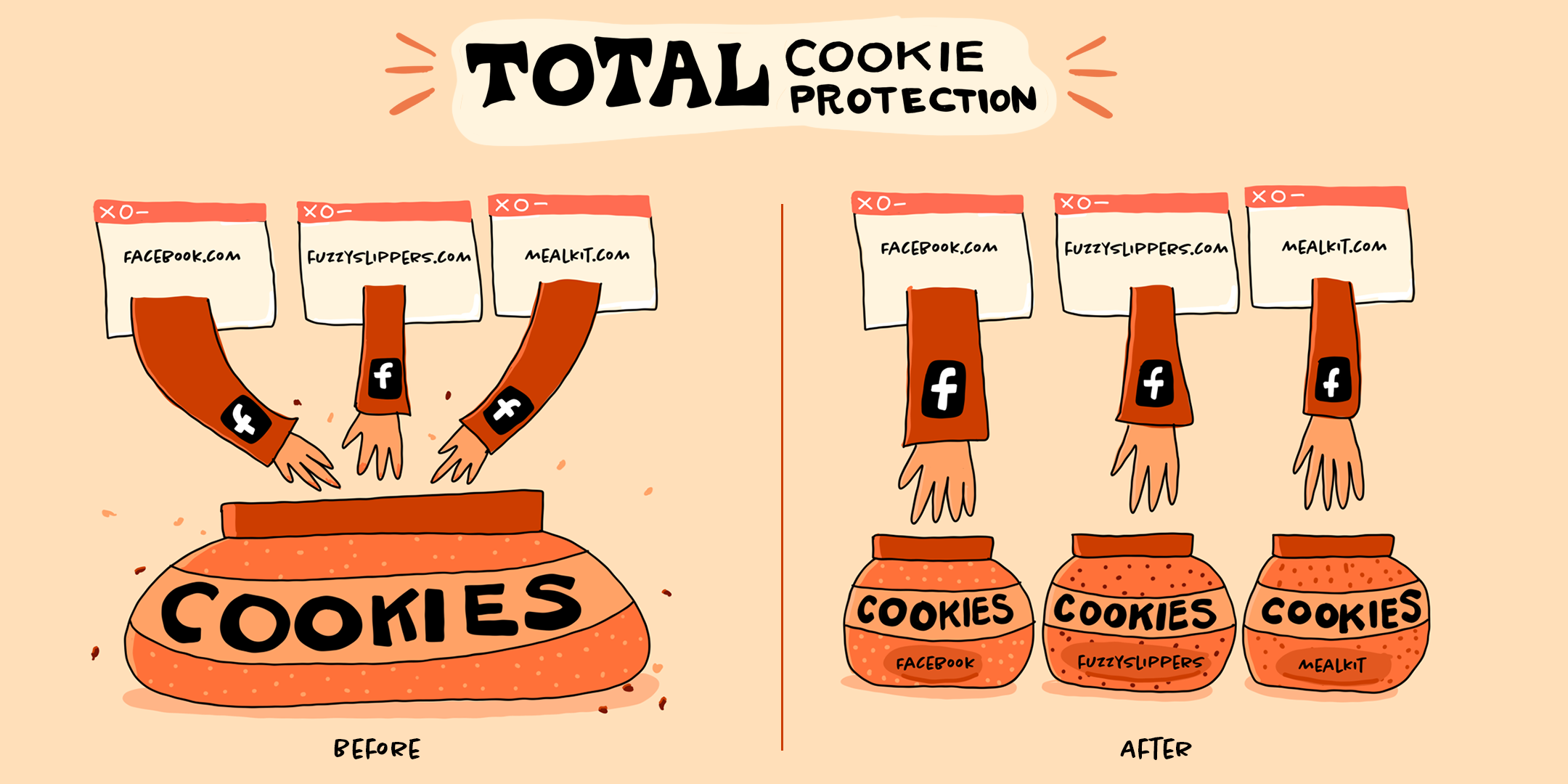
Previously, third-party cookies were shared between websites. Now, every website gets its own cookie jar so that cookies can’t be used to share data between them. (Illustration: Meghan Newell)
As we described in February, Total Cookie Protection covers not just cookies but a variety of browser technologies that previously were able to be used for cross-site tracking. To ensure a smooth browsing experience, Total Cookie Protection makes occasional exceptions to share cookies between websites when they are needed for cross-site logins or similar cross-site functionality.
Firefox Private Browsing Windows, now with even more privacy
With the addition of Total Cookie Protection, Firefox’s Private Browsing windows have the most advanced privacy protections of any major browser’s private browsing mode. The following protections are included in Private Browsing windows by default:
- Total Cookie Protection isolates cookies to the site where they were created
- Supercookie protections stop supercookies from following you from site to site
- Cookies and caches are cleared at the end of every Private Browsing session, and aren’t shared with normal windows
- Trackers are blocked, including cookies, scripts, tracking pixels and other resources from domains on Disconnect’s list of known trackers
- Many fingerprinting scripts are blocked, according to Disconnect’s list of invasive fingerprinting domains.
- SmartBlock intelligently fixes up web pages that were previously broken when tracking scripts were blocked
If you have Firefox installed, you don’t need to do anything special to benefit from this upgrade to Private Browsing windows. To open a Private Browsing window, click on the Application Menu button (☰) and choose “New Private Window”:
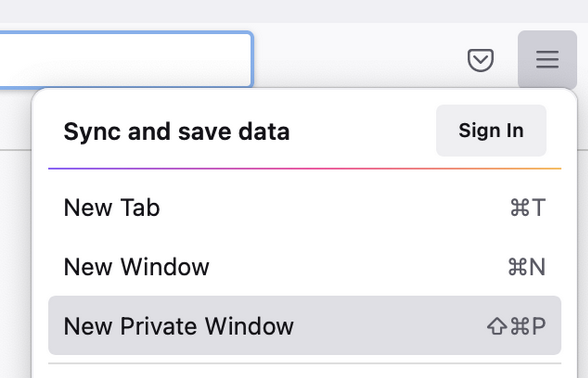 Or, if you like keyboard shortcuts, just press Ctrl + Shift + P (Cmd + Shift + P on Mac). When you are done with that private browsing session, you can simply close all your Private Browsing windows. All the cookies and other stored data from the websites you visited will be immediately deleted!
As we continue to strengthen Firefox’s privacy protections, Mozilla is committed to maintaining state-of-the-art performance and a first-class browsing experience. Stay tuned for more privacy advances in the coming months!
Thank you
We are grateful to the many Mozillians who have contributed to or supported this new enhancement to Firefox, including Steven Englehardt, Andrea Marchesini, Tim Huang, Johann Hofmann, Gary Chen, Nihanth Subramanya, Paul Zühlcke, Tanvi Vyas, Anne van Kesteren, Ethan Tseng, Prangya Basu, Wennie Leung, Ehsan Akhgari, Dimi Lee, Selena Deckelmann, Mikal Lewis, Tom Ritter, Eric Rescorla, Olli Pettay, Philip Luk, Kim Moir, Gregory Mierzwinski, Doug Thayer, and Vicky Chin.
The post Firefox 89 blocks cross-site cookie tracking by default in private browsing appeared first on Mozilla Security Blog.
biking to Kleinburg
Back in mid May, a fellow named Stephen posted a nice route on Facebook from downtown to Kleinburg that wended its way along the William Granger Greenway through both the Boyd Conservation Area and the Kortright Centre for Conservation.

His route took a faster route home along Islington. I decided to modify the route slightly so that once you crossed the 407, you joined the Humber River trail on the return leg. My version starts from Runnymede and Annette and is about 67 km round trip.
Islington is a good choice to cross the 407 since it is just a bridge with no interchange. If you pick a day and time when the traffic is not too bad, Islington is OK for biking.
Once you reach Langstaff, there is a MUP on the east side that you can use to the park entrance.

Here’s the entrance to Boyd Conservation Area.

I was not excited to see the entrance fee. However, if you bike in, it is free!

Pavement gives way to gravel.

Winding through the woods.

The trail has ups and downs, with some of the steeper sections being paved (one presumes to avoid erosion). After one of the steeper gravel climbs, you are rewarded with this view. It being a weekend, the trail was pretty busy.

More scenery. This is actually the Humber River Trail at this point.

Exiting the trail at the north end, I see signage that the trail is closed at Major Mac. The fencing was down and plenty of people were walking through, but I do not know if that was just because this was a weekend.

Looking 180° from the previous photo, you can see that we are back in civilization with the fight for parking.

At the park entrance. At this point, you are about a five minute bike ride from downtown Kleinburg.

Coming south out of Kleinburg, there is a MUP along Islington.

The route jogs one block over to Clarence St which has much less traffic.

This lasts until Woodbridge at which point you have to bike along Islington again to cross the 407.
Lots of wildflowers along the Humber River Trail.

My route takes a bit of a detour on the northbound leg in order to bridge the gap in the Humber River Trail. However, when I returned south, I went along Weston Rd. The city really needs to close this gap as you can see that many people use the sidewalk along this section.


Thanks to Stephen for posting the original version of the route. It was nice way to get up to Kleinberg, with some gravel riding thrown in for good measure. There were a few sections where there was loose gravel due to trail maintenance, but I saw plenty of people on hybrid bikes on the trail. Road bikes with skinny tires would struggle a bit.
How to Use Your Smart Lock Better

To the uninitiated, a smart lock may seem like a trifling extravagance—a high-tech toy for gadget hounds. And if I’m honest, that’s not totally wrong! But that’s only if you think a smart lock is just a battery-powered regular lock and ignore all the excellent smart stuff it can do. After living with a rotating cast of a dozen or so smart locks in my home over the past five years, I’m convinced they provide such an upgrade in capabilities, convenience, and security that they ought to be installed in every home (you can check out our top picks here). If you’re curious about taking the plunge—or you already have and are wondering why I’m so irrationally exuberant about smart locks—here are a few of the smartest things a smart lock can do.
Public Washrooms on South Granville Street or the New Broadway Rapid Transit Connection? Nope.
Once again I ventured onto South Granville Street and once again I was greatly disappointed when I need to find a washroom only to find that there were none. Starbucks will sell you any drink you like but you can’t use the washroom there. Chapters as you enter has a large printed sign saying that they have no washrooms. Well, that’s not true, they have washrooms, they just are not washrooms you can use.
What about Meinhardts the grocery store, which you think would be helpful after you bought a lot of groceries? Alas no, they directed me three blocks away to a park where two off gassing construction biffies covered in graffiti were available. No thank you.
Helpful friends after the fact have suggested using the Fire Hall Library (although their hours are much shorter during the pandemic), or a nearby church. I also heard about the excellent coffee at the Phoscao Cafe at 3007 Granville Street that WILL allow you to use their washroom.
It was Jeff Veniot, a freelance tour guide, Vancouver history buff and friend that summed it up very neatly.
Jeff said on social media: “It’s time to go back to a lot of public toilets being added with proper attendants (or big burly security staff who also clean them, and toss out those that do not belong there). We either pay to use them (at the time we go in) or the city (cities or Prov Gov’t) raise our taxes to pay for it. I for one will be glad to pay one way or the other so when I go out with my disabled wife, we can find either a men’s or ladies or a family / disabled washroom.”
Jeff is right.
I have written so many times that public washrooms are part of basic city amenity in every park and commercial area. They should be publicly accessible and paid by taxpayers, instead of all privately owned by businesses and just available to the business customers.
During the pandemic even that privately owned washroom availability has been curtailed. This impacts families, homeless, disabled, seniors and pretty much everyone that needs to go.
And please don’t trot out the trope about parks having public washrooms. Most parks are not located in commercial areas and along transit lines where people need those services. You can read more about the public washroom fail in Canada in Lezlie Lowe’s book How Public Toilets Fail Our Private Needs .
We need to support Vancouver Sun’s writer Dan Fumano who has just written an article asking how it is a $2.83 Billion dollar 5.7 kilometer extension of rapid transit on Broadway is not including public washrooms in the design. After all the hand clapping at the groundbreaking of the Broadway subway line extension, City of Vancouver Council started to do the double take realizing the fact that there were no public washrooms along the route, and no accessible washrooms.
In the spirit of placating all those travelling bladders, the Province’s Transportation Ministry revealed that there WOULD be single-occupancy “one off” washrooms in the new stations BUT you will need (and find) a SkyTrain attendant to use it. And, as only this Province can do, the spokesman disclosed a well known secret: there actually ARE single-occupancy washrooms available “throughout the Sky Train network” but you have to find and beg an attendant to use one.
That’s simply not good enough. What is it going to take to create and staff public washrooms in this city?

It takes a work of art to make a hotel wakeup call recording an earthshattering vulnerability, but @Mitel managed it. The 3300's default behavior is to process digits like a DISA when playing recordings, even over trunks.
 |
mkalus
shared this story
from  shadytel on Twitter. shadytel on Twitter.
|
It takes a work of art to make a hotel wakeup call recording an earthshattering vulnerability, but @Mitel managed it. The 3300's default behavior is to process digits like a DISA when playing recordings, even over trunks.

8 likes, 2 retweets
2021-05-29 General
Vaccines
If I understand this paper correctly, scientists found spike protein in the blood of mice after vaccinating them with AZ. (See previous discussion of why that matters in the 26 May General blog posting.)
There have been a number of papers which say that you are much less likely to transmit COVID if you have been vaccinated, including this one.
Variants
There has been a lot of concern lately about various Asian countries which had done a really good job of containing the virus (e.g. Vietnam), which are now getting overrun. I have seen several articles mention that their previous success hurts them a little now, as they have essentially no immunity acquired from having had COVID-19.
C.36.3 was first found in Thailand, and Thailand is arguing strongly that it should not be referred to as the “Thai variant” and besides is probably not a problem. (It probably came from Egypt.)
Vietnam says they have found a new variant. No information yet on a name for it.
Disease
This paper is one of several (I think I’ve mentioned this before) which says that COVID-19 has elements of an auto-immune attack.
Finding CSV files that start with a BOM using ripgrep
For sqlite-utils issue 250 I needed to locate some test CSV files that start with a UTF-8 BOM.
Here's how I did that using ripgrep:
$ rg --multiline --encoding none '^(?-u:\xEF\xBB\xBF)' --glob '*.csv' .
The --multiline option means the search spans multiple lines - I only want to match entire files that begin with my search term, so this means that ^ will match the start of the file, not the start of individual lines.
--encoding none runs the search against the raw bytes of the file, disabling ripgrep's default BOM detection.
--glob '*.csv' causes ripgrep to search only CSV files.
The regular expression itself looks like this:
^(?-u:\xEF\xBB\xBF)
This is rust regex syntax.
(?-u: means "turn OFF the u flag for the duration of this block" - the u flag, which is on by default, causes the Rust regex engine to interpret input as unicode. So within the rest of that (...) block we can use escaped byte sequences.
Finally, \xEF\xBB\xBF is the byte sequence for the UTF-8 BOM itself.
Alone vs. Lonely
I spent last night at The Inn at Bay Fortune where, in 2015, Catherine and I spent our last weekend away together by ourselves.
What I didn’t know when I booked—I thought I was just getting away for the night—was that there was an important healing aspect to this, a sort of reckoning that she’s gone and not coming back.
This didn’t really hit me until they brought the wine for supper, and I had nobody to wish cheers to. And nobody to share food with. And nobody to while away the evening chatting to. None of this made me sad, per se: it was more like my new baseline was rendered in sharp relief. “It’s just me now.”
On the way into supper I ran into my friends N. and D., a happy couple away for the night together, both of them very much alive. They invited me to join them for the meal, but I thanked them and declined, as I realized I needed to see what “alone” felt like. I did join them for dessert, though, which was very nice. And I didn’t hate them (that much) for being a happy couple.
It turns out that “alone” and “lonely” are different things, and that was helpful to learn.

Backing up iCloud Photos in the command line
A few things I learned these past two months
Below, a quick roundup of a few of the things I learned in April and May 2021.
Of the world’s 4,000 written languages, only 100 or so can be translated by automated tools such as Google Translate. (BBC)
The last time ships got stuck in the Suez Canal, they were there for eight years and developed a separate society, a utopian communist micronation, with its own Olympic Games and its own postal service and stamps. (Vice)
Humans are the only species that can throw well enough to kill rivals and prey. Because throwing requires the highly coordinated and extraordinarily rapid movements of multiple body parts, there was likely a long history of selection favoring the evolution of expert throwing in our ancestors. (The Conversation)
Nearly two decades after it was written, the Killers’ hit “Mr. Brightside” has been in the UK Top 100 for the past five years. (BBC)
A new HIV vaccine has shown promise in Phase I trials. “The vaccine successfully stimulated the production of the rare immune cells needed to generate antibodies against HIV in 97 percent of participants.” (European Pharmaceutical Review)
People who cycle on a daily basis have 84% lower carbon emissions from their daily travel than those who don’t. (The Conversation)
The first genetically modified mosquitos will be released in Florida this spring. “When released GM males breed with wild female mosquitoes, the resulting generation does not survive into adulthood, reducing the overall population.” (Undark)
A vaccine against malaria developed by scientists at Jenner Institute, Oxford, showed up to 77% efficacy in trial in Burkina Faso over 12 months. (Guardian)
After studying thousands of bird photos on Instagram, researchers find that the “most instagrammable bird” is the frogmouth. (i-Perception)
Nineteenth-century England’s anti-vaccine movement feared that the smallpox vaccine would turn people into cows. (Public Domain Review)
In Hawaii, a shortage of vehicles to rent means tourists are driving U-Hauls. In March 2021, the cheapest car went for $722 a day. (Hawaii News Now)
Objectophiliacs are people who hold sexual or romantic attraction towards inanimate objects. (LitHub)
Andre Agassi decoded Boris Becker’s formidable service game by watching his tongue movements. (twitter)
The emoticon was invented on September 19, 1982, by Dr. Scott Fahlman, a professor of Computer Science at Carnegie Mellon University, in Pittsburgh. (LitHub)
Since the novel coronavirus began its global spread, influenza cases reported to the World Health Organization have dropped to minuscule levels. The reason, epidemiologists think, is that the public health measures taken to keep the coronavirus from spreading also stop the flu. (Scientific American)
An analysis of the past 40 years shows medical schools are admitting fewer Black men and Native Americans. (STAT)
The color and flashing pattern of a lighthouse is called the characteristic. Each lighthouse has a different characteristic so that mariners can tell them apart and to indicate different water areas. (Kottke)
Male lyrebirds will do anything, even fake nearby danger by imitating sounds, to get females to stick around to mate. (Current Biology)
Despite the variety of alt-meats available, Americans’ consumption of chicken and beef has been rising since 2016. (Bittman Project)
A 78,000-year-old girl discovered near Kenya’s coast is the oldest human burial found in Africa. (Science News)
CEOs make more money when they know other CEOs, about $17,000 per connection. (SSRN)
Skinny jeans have the largest market share at 34% of total jean sales. (ModernRetail)
Working 55 hours or more in a week increases your risk of cardiovascular death—and it kills hundreds of thousands a year. (CNBC)
Dwayne Johnson accounts for a third of all Asian or Pacific Islander protagonists in Hollywood films from 2007-2019. (LATimes)
During WWII, Japan launched thousands of hydrogen-filled paper balloons with bombs attached to them, hoping they would float across the Pacific and cause damage in the US. (And some did.) (NPR)
Comment rules

Nothing has changed. I still want you to be respectful, informative, kind, and charming. And I want you to use your full name. If you cannot use your full name, don’t comment.
This may be difficult to understand. “Volker Weber” is a full name. “Volker W” is not, neither is “V. Weber”, nor “vowe”. You are welcome.
Something has changed: I am moderating comments. They get published after I approve them. If you commented before, I auto-approve your comment, but I revise every single one. And I will not hesitate to unapprove.
I hope this works well for all of us.
Apple vs (or plus) Adtech, Part I

This piece has had a lot of very smart push-back (and forward, but mostly back). I respond to it in Part II, here.
If you haven’t seen it yet, watch Apple’s Privacy on iPhone | tracked ad. In it a guy named Felix (that’s him, above) goes from a coffee shop to a waiting room somewhere, accumulating a vast herd of hangers-on along the way. The herd represents trackers in his phone, all crowding his personal space while gathering private information about him. The sound track is “Mind Your Own Business,” by Delta 5. Lyrics:
Can I have a taste of your ice cream?
Can I lick the crumbs from your table?
Can I interfere in your crisis?No, mind your own business
No, mind your own businessCan you hear those people behind me?
Looking at your feelings inside me
Listen to the distance between usWhy don’t you mind your own business?
Why don’t you mind your own business?Can you hear those people behind me?
Looking at your feelings inside me
Listen to the distance between usWhy don’t you mind your own business?
Why don’t you mind your own business?
The ad says this when Felix checks his phone from the crowded room filled with people spying on his life:

Then this:

Finally, when he presses “Ask App Not to Track,” all the hangers-on go pop and turn to dust—

Followed by

Except that she gets popped too:

Meaning he doesn’t want any one of those trackers in his life.
The final image is the one at the top.
Here’s what’s misleading about this message: Felix would have had none of those trackers following him if he had gone into Settings—>Privacy—>Tracking, and pushed the switch to off, like I’ve done here:

Key fact: it is defaulted to on. Meaning Apple is not fully serious about privacy. If Apple was fully serious, your iPhone would be set to not allow tracking in the first place. All those trackers would come pre-vaporized. And Apple never would have given every iPhone an IDFA—ID For Advertisers—in the first place. (And never mind that they created IDFA back in 2013 partly to wean advertisers from tracking and targeting phones’ UDIDs (unique device IDs).
Defaulting the master Tracking setting to ON means Felix has to tap “Ask App Not To Track” for every single one of those hangers-on. Meaning that one click won’t vaporize all those apps at once. Just one at a time. This too is misleading as well as unserious.
And why “ask” an app not to track? Why not “tell”? Or, better yet, “Prevent Tracking By This App”? Does asking an app not to track mean it won’t?
History has an answer for those questions.
Remember Do Not Track? Invented in the dawn of tracking, back in the late ’00s, it’s still a setting in every one of our browsers. But it too is just an ask—and ignored by nearly every website on Earth.
Here is how the setting looks, buried deep on Google’s Chrome:

It’s hardly worth bothering to turn that on (it’s defaulted to off), because it became clear long ago that Do Not Track was utterly defeated by the adtech biz and its dependents in online publishing. The standard itself was morphed to meaninglessness at the W3C, where by the end (in 2019) it got re-branded “Tracking Preference Expression.” (As if any of us has a preference for tracking other than to make it not happen or go away.)
By the way, thanks to adtech’s defeat of Do Not Track in 2014, people took matters into their own hands, by installing ad and tracking blockers en masse, turning ad blocking, an option that had been laying around since 2004, into the biggest boycott in world history by 2015.
And now we have one large company, Apple, making big and (somewhat, as we see above) bold moves toward respecting personal privacy. That’s good as far as it goes. But how far is that, exactly? To see how far, here are some questions:
- Will “asking” apps not to track on an iPhone actually make an app not track?
- How will one be able to tell?
- What auditing and accounting mechanisms are in place—on your phone, on the apps’ side, or at Apple?
As for people’s responses to Apple’s new setting, here are some numbers for a three-week time frame: April 26 to May 16. They come from FLURRY, a subsidiary of Verizon Media, which is an adtech company. I’ll summarize:
- For “Worldwide daily op-in rate after iOS 14.5 launch across all apps,” expressed as “% of mobile active app users who allow app tracking among uses who have chosen to either allow or deny tracking” started at 11% and rose to 15%.
- The “U.S. Daily opt-in rate after iOS launch across all apps,” expressed as “% of mobile active app users who allow app tracking among users who have chosen to either allow or deny tracking” started at 2% and rose to 6%.
- The “Worldwide daily opt-in rate across apps that have displayed the prompt,” expressed as “% of mobile active app users who allow app tracking among users who have chosen to either allow or deny tracking” started at 31% and went down to 24%.
- The “Worldwide daily share of mobile app users with ‘restricted’ app tracking” (that’s where somebody goes into Settings—>Privacy—>Tracking and switches off “Allow Apps to Request to Track”), expressed as “% of mobile active app users who cannot be tracked by default and don’t have a choice to select a tracking option” started and stayed within a point of 5% .
- And the “U.S. daily share of mobile app users with ‘restricted’ app tracking,” expressed as “% of mobile active app users who cannot be tracked by default and don’t have a choice to select a tracking option” started at 4% and ended at 3%, with some dips to 2%.
Clearly tracking isn’t popular, but those first two numbers should cause concern for those who want tracking to stay unpopular. The adtech business is relentless in advocacy of tracking, constantly pitching stories about how essential tracking-based “relevant,” “personalized” and “interest-based” advertising is—for you, and for the “free” Web and Internet.
It is also essential to note that Apple does advertising as well. Here’s Benedict Evans on a slope for Apple that is slippery in several ways:
Apple has built up its own ad system on the iPhone, which records, tracks and targets users and serves them ads, but does this on the device itself rather than on the cloud, and only its own apps and services. Apple tracks lots of different aspects of your behaviour and uses that data to put you into anonymised interest-based cohorts and serve you ads that are targeted to your interests, in the App Store, Stocks and News apps. You can read Apple’s description of that here – Apple is tracking a lot of user data, but nothing leaves your phone. Your phone is tracking you, but it doesn’t tell anyone anything.
This is conceptually pretty similar to Google’s proposed FLoC, in which your Chrome web browser uses the web pages you visit to put you into anonymised interest-based cohorts without your browsing history itself leaving your device. Publishers (and hence advertisers) can ask Chrome for a cohort and serve you an appropriate ad rather than tracking and targeting you yourself. Your browser is tracking you, but it doesn’t tell anyone anything -except for that anonymous cohort.
Google, obviously, wants FLoC to be a generalised system used by third-party publishers and advertisers. At the moment, Apple runs its own cohort tracking, publishing and advertising as a sealed system. It has begun selling targeted ads inside the App Store (at precisely the moment that it crippled third party app install ads with IDFA), but it isn’t offering this tracking and targeting to anyone else. Unlike FLoC, an advertiser, web page or app can’t ask what cohort your iPhone has put you in – only Apple’s apps can do that, including the app store.
So, the obvious, cynical theory is that Apple decided to cripple third-party app install ads just at the point that it was poised to launch its own, and to weaken the broader smartphone ad model so that companies would be driven towards in-app purchase instead. (The even more cynical theory would be that Apple expects to lose a big chunk of App Store commission as a result of lawsuits and so plans to replace this with app install ads. I don’t actually believe this – amongst other things I think Apple believes it will win its Epic and Spotify cases.)
Much more interesting, though, is what happens if Apple opens up its cohort tracking and targeting, and says that apps, or Safari, can now serve anonymous, targeted, private ads without the publisher or developer knowing the targeting data. It could create an API to serve those ads in Safari and in apps, without the publisher knowing what the cohort was or even without knowing what the ad was. What if Apple offered that, and described it as a truly ‘private, personalised’ ad model, on a platform with at least 60% of US mobile traffic, and over a billion global users?…
Apple has a tendency to build up strategic assets in discrete blocks and small parts of products, and then combine them into one. It’s been planning to shift the Mac to its own silicon for close to a decade, and added biometrics to its products before adding Apple Pay and then a credit card. Now it has Apple Pay and ‘Sign in with Apple’ as new building blocks on the web, that might be combined into other things. It seems pretty obvious that Privacy is another of those building blocks, deployed step by step in lots of different places. Privacy has been good business for Apple, and advertising is a bigger business than all of those.
All of which is why I’ve lately been thinking that privacy is a losing battle on the Web. And that we need to start building a byway around the whole mess: one where demand can signal supply about exactly what it wants, rather than having demand constantly being spied on and guessed at by adtech’s creepy machinery.