Shared posts

30 May 19:57

2021-05-27 General

by Ducky

Mitigation Measures

Whaddayaknow, masks work. This literature review says so.

Variants

B.1.617.2 is now dominant in the UK. This is legit something to worry about, as one dose of vax is only about half as good as two doses.

Vaccines

Some scientists think that COVID-19 immunity from vaccines will last years, if not a lifetime.

Transmission

This study in Spain looked at transmission at an indoor concert with about 500 people in attendence. tl;dr: They found that — with the right testing, masking, and ventilation — there was no spread of COVID-19.

Details:

  • The scientists split about a thousand people who tested negative on a rapid test into a concert-goers group or a control group who went home.
  • The scientists gave all of the participants a regular PCR test before sending them on to the hall or home. 3% of both the control group and the concert-goers tested positive after the fact on the PCR test.
  • The concert-goers had to wear an N95 mask (provided) the whole time except when actually drinking or smoking (in a designated smoking area where distancing was enforced). They didn’t say if people actually did keep the masks on or not.
  • The HVAC was set to keep the hall a little chilly so that people could keep their coats on (because there was no coat check) and it was quite well-ventilated.
  • Eight days after the concert, everybody was PCR-tested again. NOBODY in the concert group tested positive, while two in the control branch did.

This article says that after a year of distancing, we are likely to get hammered by other types of respiratory viruses like RSV and the flu.

Recommended Reading

This interview touches on many subjects, including mixing&matching vaccines, delaying doses, variants, and more. Relatively short.

30 May 19:56

2021-05-27 BC

by Ducky

Variants

B.1.617.2 is now dominant in the UK. This is legit something to worry about, as one dose of vax is only about half as good as two doses. Fortunately, we don’t have a lot of it in BC — yet.

Press Briefing

Dr. Henry said:

  • We’ve passed 3M doses given, yay!
  • We are changing the dose interval for people who got Moderna and Pfizer to 8 weeks because we can.
  • AZ people, you need to hold tight for a few more days. We’ve seen that AZ has a better response with a slightly longer interval and we are waiting on the mix&match studies. I assure you that we will have enough AZ to provide second doses for all who want it. NB: that sure sounds to me like yet another signal that the AZ people will be able to choose between AZ and Pfizer.
  • Unlike Ontario, our AZ stock is not going to expire until the end of June, so we have time.
  • We are going to go in roughly the same order that we distributed the doses. The first people to get invitations to book second doses will be people over 70, Indigenous people, and the Clinically Extremely Vulnerable.
  • We aren’t sure about our Moderna supply, so we might have to give some of y’all Pfizer as your second dose. Don’t worry, though, because NACI says it’s okay. We expect that our Moderna supply will level off by the end of June. NB: I don’t know if she meant, “go to zero” or “become more reliable” by that comment.
  • Because Moderna has looser temperature requirements, they will use Moderna preferentially in rural/remote locations.
  • People who got their shots outside of mass vax clinics (e.g. whole-of-community, occupation-based, incarcerated folks, transients), don’t worry, we will come to you. (We have already started, in fact.) Although, if you register, that will make it easier for us!
  • I expect that everyone will have their second dose by the end of summer. NB: When is the end of summer, exactly? Labour Day?
  • There is new guidance for religious gatherings. You can have indoor gatherings of up to 50 people (with appropriate measures). The full rules are on the PHO website. This includes funerals and baptisms but not weddings, weddings are still limited to up to ten people.
  • REGISTER!
  • GET VAXXED!

Dix mostly talked about the surgical re-opening:

  • Last time we stopped surgeries, we promised you that we wouldn’t forget you, and we didn’t! Look at all these statistics which show that we really upped the number of surgeries we performed, even with extra COVID-safety measures.
  • Hospitals can’t immediately restart surgeries at full speed because they need some time to reconfigure beds and deploy staff back to where they came from.
  • Surgeries are going to come back on-line individually, but all of them will be fully back by June 7.
  • REGISTER!
  • GET VAXXED!

If you want to see all of the stats, go look at Dix’ slides, I’m not going to go into detail.

Q&A

Remember, I summarize and snarkify heavily.

Q: You promised us we’d have an online proof of vaccination. Well? Where is it? A: We’re working on it. Soon.

Q: Why are firefighters being paid overtime when retired nurses and paramedics aren’t getting called up? A: Here’s a breakdown of what percentage of vaccinators are what profession, and it varies a lot by HA. Fraser is the only one with a significant percentage of firefighters. NB: Maybe the retired nurses and paramedics in question are in e.g. Island Health and they just need more people in Fraser?

Q: What’s the plan for rapid testing and self-testing? A: Self-testing only got approved really recently. We’ve been looking at both.

Q: Once we get our second doses, are we done, or is there going to be another COVID brick to our head? A: I wish I knew. … There are still pockets in the province with low uptake, we need to work on them. The virus does mutate, so we need as high a level as possible while strains are still circulating. We might need boosters for the scariants. And that’s why it’s still so important for us to push for domestic capacity in Canada.

Q: What guidance can you give to businesses that want to keep masking? A: A mask is the last level of defense, it’s more important when cases are high. We should still wear masks indoors when there are crowds, even if the legal mandate isn’t there. We gotta keep doing lots of things like washing hands.

Q: In the Okanagan, the case count is going up. Alberta people are not supposed to come here, but they probably do, and we have a lot of vax hesitancy here. A: It’s not as bad as you think, all the CHSAs are over 50%.

Statistics

+378 cases, +7 deaths, +48,140 first doses, +4,720 second doses.

Currently 286 in hospital / 88 in ICU, 3543 active cases, 137929 recovered.

We have 478,449 doses in fridges; we’ll use it up in 9.7 days at last week’s rate. We have given more doses than we’d received by 9 days ago.

We have 350,876 mRNA doses in fridges; we’ll use it up in 7.1 days at last week’s rate. We have given more mRNA doses than we’d received by 7 days ago.

Charts

30 May 19:29

From the archives, w/e 28 May

Blog posts this week from years gone by.

1 year ago

A month long conference is a neat concept (24 May 2020).

They’re moving on from the standard two day conference format … our online conference program will take place weekly, across a whole month.

I’m giving a talk next week which is broken up into 3 x 30 minute chunks across consecutive days. I still think there’s a lot to be explored in novel conference formats.

How I would put voice control in everything (26 May 2020).

Stick a timer in my stove, a switch in my light bulb, give each a super limited vocabulary, never connect to the internet, and only act when somebody is addressing you.

Also includes the idea of a dedicated attention sensor, so a device knows when it is being glanced at or pointed at.

Grocery shopping, localism, and last mile delivery (28 May 2020).

Corporations and startups will inevitably move hard into the last mile delivery space. How do we make sure it’s not shit?

The lockdown forced me into a kind of localism for groceries and I have to say I liked it.

9 years ago

Ze Frank on ugly (22 May 2012).

“In Myspace, millions of people have opted out of pre-made templates that ‘work’ in exchange for ugly. Ugly when compared to pre-existing notions of taste is a bummer. But ugly as a representation of mass experimentation and learning is pretty damn cool.”

A classic Ze Frank monologue on personal expression, and an idea I come back to again and again.

13 years ago

The geometry of music (26 May 2008).

Cause and effect are confused. Which comes first, the visualisation or the music? If Tymoczko watched a partner and I dancing, could he interpret the plan view of the ballroom as an orbifold, run his algorithms backwards, and play generated Chopin that was magically in sync with our improvisation?

Sadly most of the links in this post are broken. But the idea of a “reverse music visualiser” seems more achievable than it was when I wrote this post. Imagine staring out of a car window, and having the rhythms and regularities of passing traffic, street lighting, and clouds all style-transferred back onto Chemical Brothers beats played through your headphones…


Posts selected from the On This Day archive spelunking page. This is an experiment to see how to best include old posts in the current feed in a meaningful way, possibly as a regular Friday feature.

30 May 19:27

Today E and I participated in a memorial servic...

by Ton Zijlstra

Today E and I participated in a memorial service online through a live stream for the second time in a year. Again I experienced how valuable it is, even if the family members in the room don’t know that you’re there. To see their emotions, hear stories, feel my own emotions and remembering my own stories. So much better than not being there, and bear witness to a human life even if technologically mediated.


This is a RSS only posting for regular readers. Not secret, just unlisted. Comments / webmention / pingback all ok.
Read more about RSS Club
30 May 16:53

Of course I’d be happy to help you. Please fill out this form.

by Josh Bernoff

Thank you for contacting me. I’m always happy to hear from an old friend/colleague/friend of a colleague/colleague of a friend/perfect stranger. I would be pleased to do whatever I can to help you. I am a generous person, that’s just how I roll. To make this efficient, please fill out the following information. Name ____________Email … Continued

The post Of course I’d be happy to help you. Please fill out this form. appeared first on without bullshit.

30 May 16:52

This Week in Photography: Leaving the Nest

by Jonathan Blaustein


Nobody’s perfect.


I’m certainly not.

I make a lot of predictions here, and claim to have the proper “hot take” on so many global issues.

But I don’t get everything right, and when I make a mistake, I own up to it.


I just got back from New Jersey, (on Monday,) and I’m writing on my customary Thursday.

It’s been less than 72 hours since I returned, and the trip itself took 12 hours, (via Denver,) so what I’m mystified about is that travel leaves a resonance.

Most of me is here in New Mexico, but a shade of my soul is lingering in Jersey, for sure.

Back in 2019, and early #2020, I was traveling so much, it was one big blur, and I wasn’t able to differentiate the biochemical, or metaphysical reactions from each individual visit.

But with this large a gap, I recognized the sensation, and it’s real.

It’s like you left a glimmer of yourself, back where you just were, before an airplane whooshed you up into the sky, and deposited you thousands of miles away.

But that’s not what I’m apologizing about.


Rather, when I was in New Jersey, (and I promise a full write up in the near future, with photos,) it was amazing to see how much life looked like the “Old Normal.”

There were still masks around, in certain indoor public settings, but the general vibe allowed getting in personal space with loved ones indoors, sharing food, full airplanes, and no social distancing.

Things looked A LOT like they did, before the 15 month pause.

I had it wrong.

(I’m speaking here in America, where vaccinations have been available to all who want them. It’s not a global phenomenon, I know.)


Trees and rocks have souls, (if I understand things correctly,) in the Shinto religion.

My buddy Kyohei explained it to me once, in an outdoor exhibition space at the Art Institute of Chicago.


Art objects can have souls too, if you think about it.

Photo books embody the energy the artist puts into each picture, and then the momentum developed over the course of the narrative.

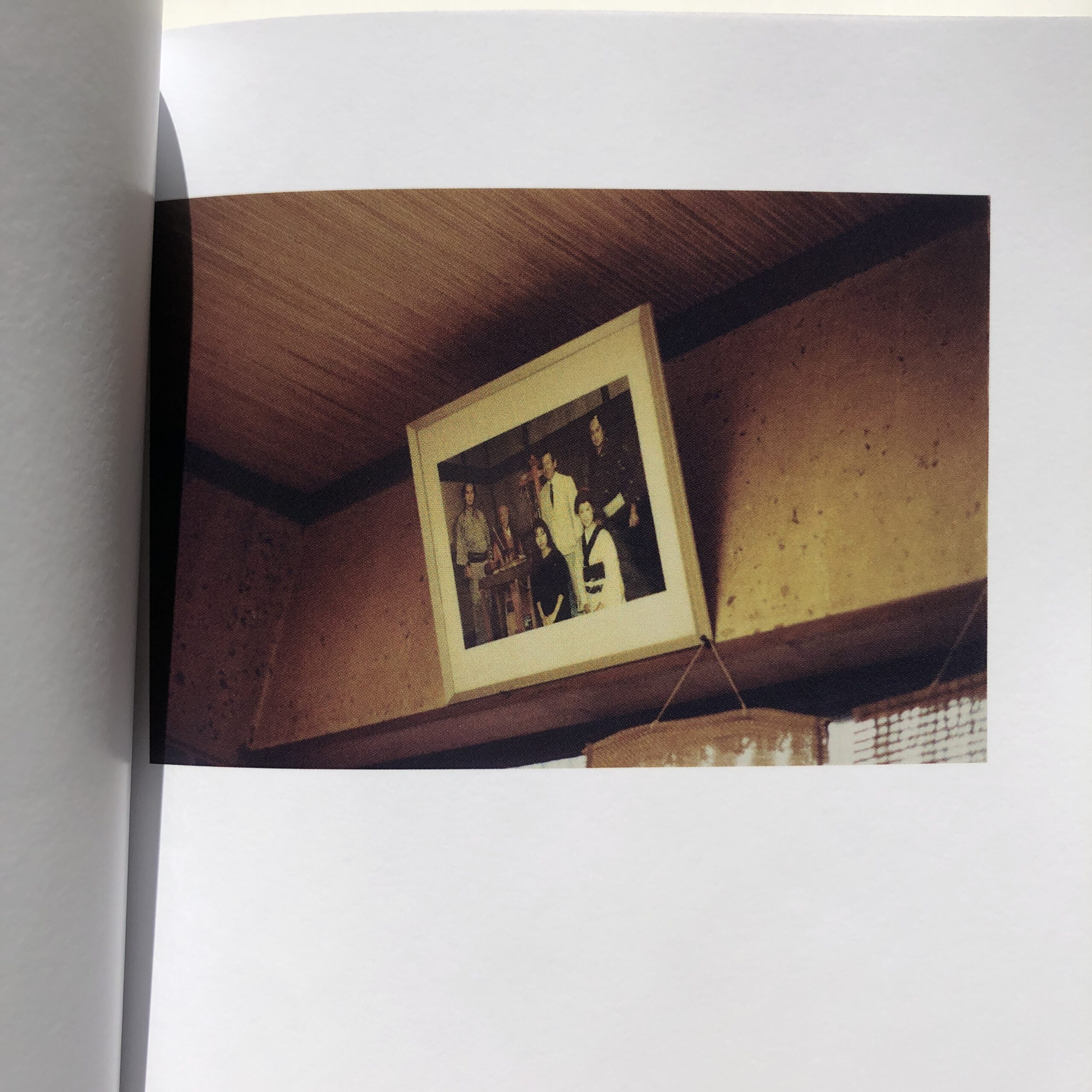
I just put down “Strawberry Parfait,” by Jimi Franklin, published by Denton Books in #2020, and it totally captures the way I feel right now. (A little haunted.)

It’s one of those books that seems like a flip-book-animation from a movie.

Like a continuous narrative, broken down into frozen memories.

Food shots.
Hipsters.
Dimly lit scenes.

If you cross the Wong Kar-wai vibe of “In the Mood for Love” with some of Sofia Coppola’s “Lost in Translation,” you might end up somewhere near the story this flip book would unspool.

The ending essay brings up Shinto, as a root element in Japanese culture, and also says the images were made over a decade.

I must say, I think this book is a gem.

With the rhythmic changes in the image rectangle shape, and the tactile paper that makes you WANT to turn the page, this one’s a winner.

Does it make me want to go to Japan?

Hell yes.

But it also makes me want to look at it again, to go on the ride through this vision, which is always the sign of a very cool book.

To learn more about Jimi Franklin, click here


Original article: This Week in Photography: Leaving the Nest.

30 May 16:47

explain.dalibo.com

explain.dalibo.com

By far the best tool I've seen for turning the output of PostgreSQL EXPLAIN ANALYZE into something I can actually understand - produces a tree visualization which includes clear explanations of what each step (such as a "Index Only Scan Node") actually means.

Via EXPLAIN ANALYZE in PostgreSQL and how to interpret it

30 May 16:46

Apple’s M1 chip has an unfixable security flaw that likely isn’t a big deal

by Patrick O'Rourke
M1 Mac mini, MacBook Pro and MacBook Air

Apple’s M1 chip includes a security vulnerability that can’t be solved without a new version of the chip being released, according to developer Hector Martin.

The “covert channel flaw” allows two malicious apps to communicate, but unless your system has already been compromised by malware or other exploits, “covert channels are completely useless” writes Martin in a blog post first reported by Ars Technica.

Martin goes on to say that this flaw “violates the OS security model” and that “you’re not supposed to be able to send data from one process to another secretly. And even if harmless in this case, you’re not supposed to be able to write to random CPU system registers from userspace either.”

Ars Technica reports that covert connections don’t require operating system features, system memory, sockets or files to run. Apps can even communicate if they’re running on different user profiles and have varying access levels to the device.

Martin says that this problem would be a more significant issue on iPhones if they used the M1 chip since it would theoretically allow apps to record your keypresses and send them via a covert channel. Normally, keyboard apps on iOS don’t have internet access and can’t transmit your inputs to bad actors — this exploit would allow apps to circumvent this.

The exploit could also theoretically allow apps to bypass iOS 14.5’s cross-app tracking limiting features.

Given the exploit is hardware-based, it’s unlikely Apple will be able to fix it. That said, the next generation of the M1 chip will likely include a solution for the problem.

Apple recently released a new version of the iPad Pro that features the company’s M1 chip as well as a colourful new M1 iMac.

Source: Hector Martin Via: Ars Technica

The post Apple’s M1 chip has an unfixable security flaw that likely isn’t a big deal appeared first on MobileSyrup.

30 May 16:45

Can I store electronics outside in a box in on a downtown Toronto balcony

I’ve spent the last week eating dinner outside on my balcony. With the pandemic not abating as fast as I thought it would in Toronto, I’m doubling down on spending time out there. I have a “patio” storage box on the way, intended for things I don’t want to go in and out for.

Sun May 31 23:00:26 +0000 2020

Could I leave a Kindle and a charging cable outside, in the box, and in a plastic bag, during the warmer months? Maybe a portable speaker?

Sun May 31 23:00:26 +0000 2020

30 May 16:43

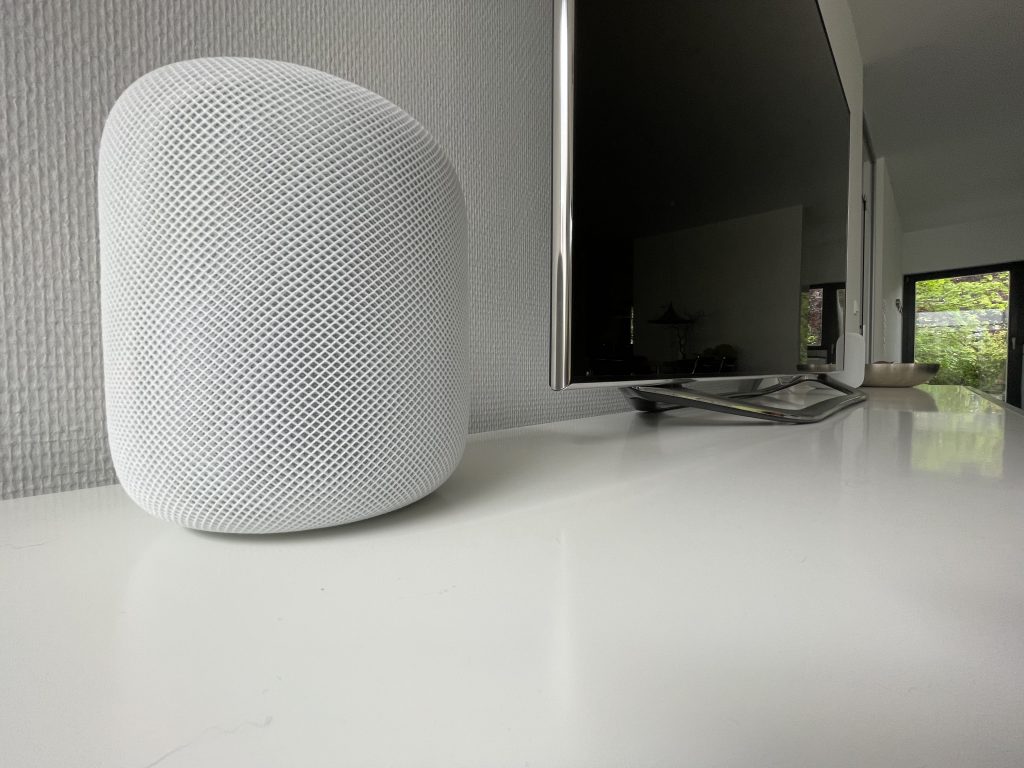
Bei den HomePods passiert noch was

by Volker Weber

Wir benutzen zwei HomePods für den Fernsehton. Das geht nur mit HomePods und nicht mit HomePod minis. Man stellt im Apple TV einfach ein, dass der Ton zu den HomePods geschickt werden soll und damit ist der Fernseher außen vor.

Was aber passiert mit dem Ton aus anderen Quellen? Der kommt bisher aus den Lautsprechern des Fernsehers. Mit dem neuen Apple TV 4k gibt es aber noch einen zweiten Weg, den der Fernseher erst mal unterstützen muss: eARC oder HDMI ARC. Unserer kann theoretisch HDMI ARC, aber bisher kriege ich es nicht hin. Der Fernsehton ist komplett abgehackt.

(e)ARC steht für (Enhanced) Audio Return Channel, also verbesserter Audio-Rückkanal. Da schickt der Fernseher die Audio-Kanäle zurück über das HDMI-Kabel, in diesem Fall zum Apple TV 4k. Der schickt es geschwind an die HomePods und -et voila – der Ton kommt aus den HomePods.

Die dicken HomePods aber kann man bei Apple nicht mehr kaufen. Mit den neuen HomePod minis geht es nicht. Da fehlt also was. Ich tippe auf Nachfolger der HomePods. Mindestens. Was meint Ihr?

30 May 16:42

Firefox will get a new, more modern look starting June 1st

by Jonathan Lamont

On June 1st, Mozilla will roll out a whole new look for its Firefox browser. Dubbed ‘Proton,’ the new look has been in testing for a while now — I’ve been running Firefox Nightly for the last few months to follow the development — but in June, things will start looking different for everyone.

Mozilla has shared a couple of videos about the upcoming changes. One cycles through some previous versions of Firefox, but doesn’t actually show the new design. Another gives a glimpse at some of the ideas and processes that went into the design.

Generally, the design cleans up the look of Firefox and streamlines different aspects of the user interface (UI). It also completely revamps how the tab bar looks, refreshes the menu, adds rounded corners to elements like add-ons and more.

At first glance, some of the changes may not seem like much, but as someone who has used Firefox on-and-off for years, I really appreciate the more modern look and feel of the browser’s redesign.

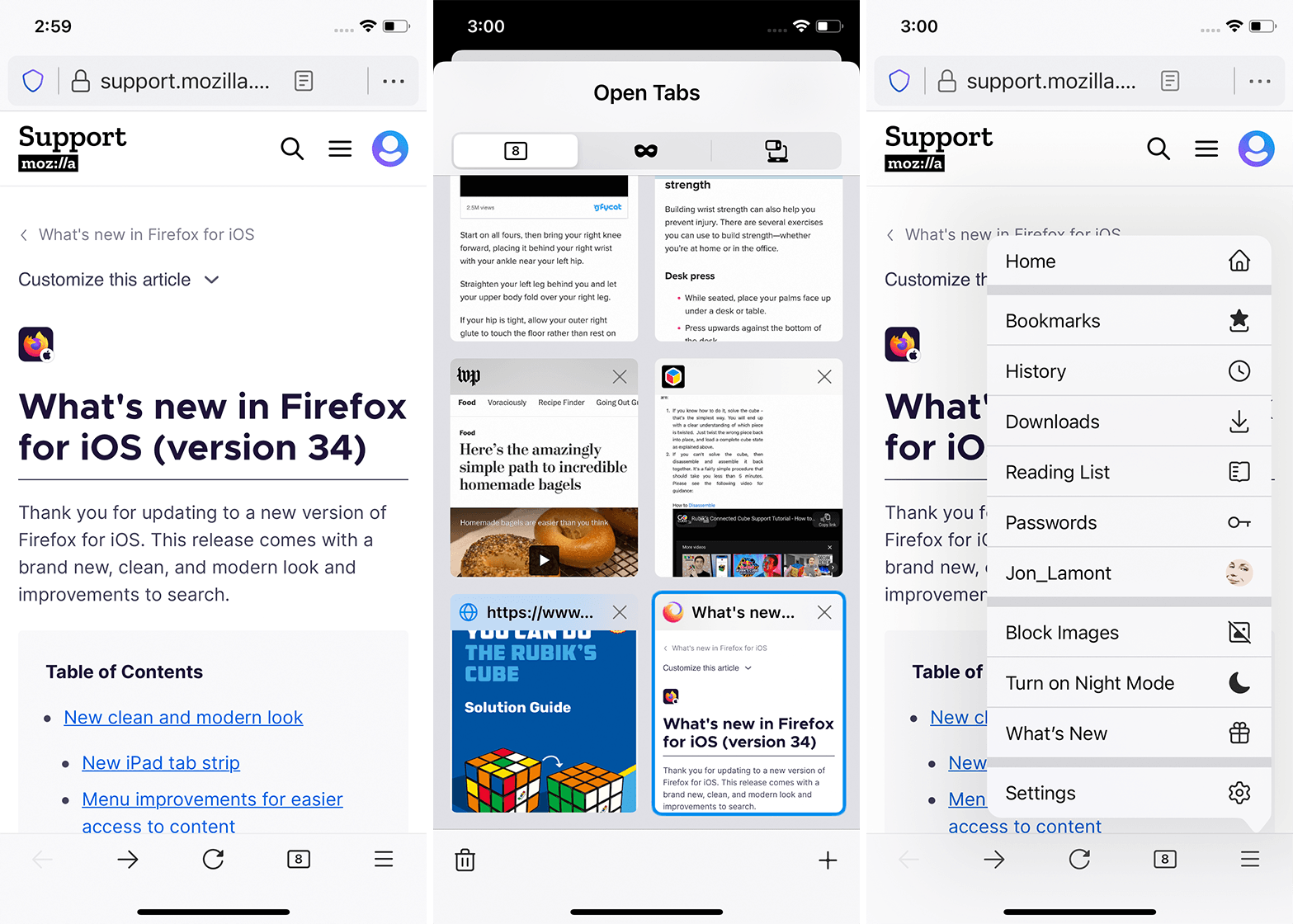
Some of the changes coming to Firefox with Proton are also showing up in Firefox on mobile. For the iOS version of the browser, not much has changed save for some new icons that adopt the Proton styling, a new tab strip for iPad that mimics the look of Firefox on desktop and a few other small changes that make Firefox for iOS most visually consistent with its Android and desktop counterparts.

Firefox’s new look on iOS

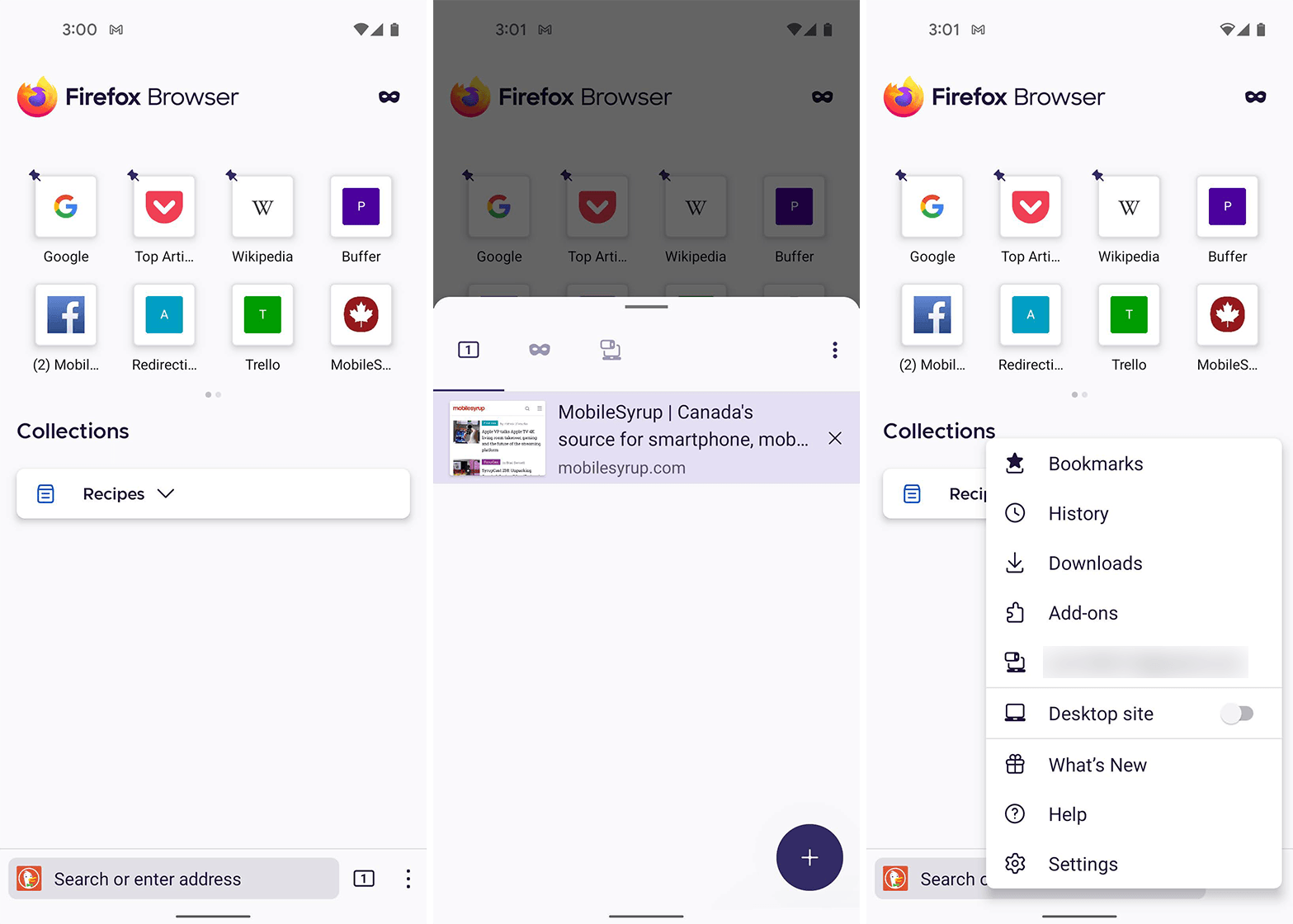
Speaking of Android, Firefox for Android recently underwent a significant overhaul both visually and under-the-hood. While some were disappointed that Mozilla scaled back extension support, Firefox for Android still supports more extensions than basically every other mobile browser. Firefox for Android is also now getting the new icons and other Proton stylings to bring it in line with Firefox on desktop.

Not everyone’s a fan

As with any major visual change, there are plenty of users who aren’t happy. The community has been very vocal about Proton in places like the r/firefox subreddit. Some of the feedback was constructive, while others simply complained that things were different. Honestly, I think Mozilla got a lot right with the new design, but it’s not perfect.

It’s also worth noting that a refreshed look likely won’t be enough to win over users from Chrome. Firefox has seen usage numbers decline — according to the website ‘statcounter,’ Firefox sits at just 3.59 percent market share worldwide across all platforms. Microsoft’s new Edge browser is close behind at 3.39 percent, while Safari claims second at 18.69 percent and Chrome leads with 64.47 percent.

Firefox for Android got new icons too.

It’s unfortunate, really, since Mozilla has pushed some really great new features to Firefox over the last few years. On the performance side, I find Firefox consistently matches or beats Chrome and most Chromium-based browsers excluding Edge, which is extremely well optimized for Windows. On Android, Firefox also performs quite well and lets you install extensions, albeit from a limited list. And, if you take the time to harden Firefox by tweaking settings and installing add-ons, it’s one of the best options for privacy too.

While I don’t expect the redesigned Firefox to change much, I do hope it will draw some attention and maybe encourage people to give Firefox a try. It’s a really great browser and now it looks like one too.

The post Firefox will get a new, more modern look starting June 1st appeared first on MobileSyrup.

30 May 16:00

Meme Finance

by Real Life

Real Life is taking a week off. In the meantime we’ve brought together a few of our recent articles on what we are calling “meme finance.” These articles address how social media dynamics have combined with speculative markets to raise the profile of new kinds of financial instruments, like NFTs and cryptocurrencies, as well as bring a new cultural emphasis on financial speculation as a form of entertainment. The result is a kind of literalization of the attention economy, in which memes are monetized (the “Charlie Bit My Finger” NFT, the “Leave Britney Alone” NFT) and would-be money itself is a meme (dogecoin). These phenomena can seem irrational, and are undeniably destructive, but they have become increasingly central to the internet’s interpenetration of everyday life.


Featuring:

“Play to Lose,” by Emilie Reed
NFTs and meme stocks are contributing to the financialization of the self

Phenomena like crypto, NFTs and meme stocks have been touted as a democratization of finance. But these practices are not foundational to a sustainable and equitable society; they mainly offer a feeling of revenge to help compensate for the otherwise helpless feeling of being financialized against one’s will.


“Paid In Full,” by Drew Austin
The emerging dream of an internet where every interaction is a financial transaction

Some predicted that the internet would undo intellectual property, but it has allowed for everything to become IP instead. Anything can become “content.” Web 2.0 — the “participatory web” of social media platforms and user-generated content — is being subsumed by Web3, an initiative to build blockchains and payment protocols into the internet’s fundamental architecture.


“Money For Nothing,” by Vicky Osterweil
The more complex crypto seems, the higher the pyramid schemes can go

NFTs are made to seem intricate and complicated, but they are merely a new manifestation of a very old form: the financial bubble. The crypto-driven machinery by which NFTs are supposed to acquire their value disguises the dispossession that all forms of capitalist accumulation entail. 


“The Presence of the Original,” by Rob Horning
NFTs don’t restore “aura” — they obliterate it

The underlying effect of NFTs is to empty content of whatever it contains that makes it circulate and reduce it instead to a moment of property, an assertion of the self who owns it over its potential social significance. That is, NFTs make the social significance of any digital artifact the simple fact that it can be owned and valued. 


From the archive:
“Unlimited Editions,” by Rob Arcand
Using blockchains to try to protect art just reduces it to currency

If art has any liberating potential beyond serving as a tax-dodging investment vehicle, its place on a blockchain seems only to amplify the art world’s existing inequalities, ensuring a select few well-connected artists see unimaginable profits while others remain walled off from the industry.


Thanks for visiting. Click here to see our growing archive of topics

Original illustration by Cynthia Alfonso

30 May 15:59

The Trouble with Teaching: Is Teaching a Meaningful Job?

John Danaher, Philosophical Disquisitions, May 28, 2021
Icon

John Danaher knows how to capture interest with controversy and this teaser of an article is no exception. Is teaching really a meaningful job? You might not think so after reading the arguments he offers to say that it is not. You might still not think so after you reads the counter arguments, which to me can be effectively summed up as "teaching is meaningful because it allows me to do other things, like research". It does point to a basic conundrum in academia: we wouldn't pay professors' salaries if they weren't teaching, but many professors have no real interest in teaching and see it at best as a means to an end, while many students see the intervention of teachers as an imposition they need to endure while trying to qualify for an education and a satisfying life.

Web: [Direct Link] [This Post]
30 May 15:59

Time to Rethink AI Proctoring?

Lindsay McKenzie, Inside Higher Ed, May 28, 2021
Icon

As this story reports, "Online exam proctoring company ProctorU announced earlier this week that it will no longer send artificial intelligence-generated reports of potential student misconduct to institutions without ProctorU staff members first reviewing the footage." It raises the question: are other companies even checking on their AIs' conclusions? Probably not; they prefer to offload the work: "It’s pretty standard for all proctoring companies that are offering AI-assisted or fully AI monitoring services to encourage faculty to review any flagged behavior before making any academic integrity judgements.” But faculty are asking why this becomes their job.  “It’s not appropriate for AI to be making decisions, and it’s unfair to expect faculty to do that work.”

Web: [Direct Link] [This Post]
30 May 15:56

Many social-housing announcements and approvals in Vancouver, not so much getting built

by Frances Bula

I got an email from someone back in January with a list of social-housing projects that had been announced going back a few years, asking what had happened. At first, I thought it might be a problem with BC Housing funding and rules. That probably plays a part, but the bigger issue turned out to be the city’s increasingly slow planning and permitting processes, as I found when I started compiling all the statistics.

The link to my story is here, and the full text is below


FRANCES BULA

VANCOUVER
SPECIAL TO THE GLOBE AND MAIL
It looked as though Vancouver was about to see a surge of lower-cost housing that would make a dent in its shortage a few years ago. Thousands of units were announced by either the city or various non-profit groups in a new burst of activity starting in 2016.

In the four years from 2016 to 2019, the city approved rezonings or development permits for 4,976 social or supported-housing units. That is all projects that have either a mix of subsidized and non-subsidized units, typical of contemporary social housing, or units that are dedicated exclusively to low-income residents and that come with staffing to provide mental-health, daily-living, disability, addiction-management or other needed assistance.

Almost 1,100 more homes in nine projects were also waiting for approval at that time, some of them after two or three years of effort.

But an examination by The Globe and Mail of all the known project proposals, approvals and completions from 2017 on shows that about 4,000 of the approved and in-pipeline apartments – enough to house several hundred of Vancouver’s homeless along with many others in low-wage jobs struggling to find affordable places to live – have not materialized yet.

According to the latest Vancouver housing report issued earlier this month, 1,932 of the approved units have been built in the past three years. But 660 of those were the temporary modular housing apartments constructed in a big push in 2017 and 2018. That means only about 300 regular, permanent housing units have been built on average a year.

This slow grind has taken place in years where Vancouver politicians and senior bureaucrats have publicly proclaimed that creating lower-cost housing is a priority.

Even after the city created an agency specifically intended to speed up projects, the slow progress at city hall in getting a social-housing project through the rezoning and permitting processes has left non-profit developers frustrated and housing promises unfulfilled.

The data also represent a red flag for the city going forward: The province has poured money into programs to finance or fund lower-cost housing, but with the promise, in the most recent budget, that the housing would arrive “within three to five years.”


City housing reports routinely cite the numbers of project approvals as a sign of progress.

The 2019 report noted that in 2018, “the City of Vancouver approved an annual total of 1,938 social and supportive homes. Since 2009, this was the single highest year of non-market housing approvals on record.” It added: “These approvals have contributed to 30 per cent of the City’s 10-year social and supportive housing target and surpassed the annualized target by 62 per cent.”

This month, the city issued its latest housing report, trumpeting the fact that it had approved the highest number of homes ever, at 7,899 units, with 1,326 social and supportive-housing apartments among that.

The problem is that the approvals don’t necessarily translate into buildings, as the record of the city-created Vancouver Affordable Housing Agency demonstrates.

Out of all of the delayed housing, the most notable missing chunk is among the 2,500 units that were supposed to be built and occupied by this year through VAHA. That agency, operating inside city hall, was established specifically to drive an aggressive and streamlined approach to getting lower-cost housing built by steering it rapidly through approvals and permitting.

Of those 2,500 promised apartments from VAHA – a goal that has since increased to almost 3,100 – only 840 have been built. (Those included the 660 temporary modular housing units.) The rest of VAHA’s commitments have either yet to get their permits or haven’t received the appropriate rezoning. Only 630 are under construction.

Luke Harrison, the former head of the Vancouver Affordable Housing Agency, now the CEO of one of the province’s two non-profit development companies, said the social-housing pipeline at city hall – especially the VAHA part – doesn’t appear to be working the way councillors and planners originally envisioned it.

“When we set 2021 as a target date [for VAHA units], that was said because it was a very realistic goal. But I do gather that it’s taking years and years to get anything approved.”

Under Mr. Harrison’s watch, VAHA got the hundreds of temporary modular housing apartments built in less than two years at the beginning of the agency’s life. He said in an interview that quick production happened in those years because there was a crystal-clear focus on the end goal: getting the housing built as quickly as possible – an approach that any city has to have to ensure things don’t get bogged down.

There needs to be an attitude, Mr. Harrison said, that the city is serving a customer who should be guaranteed service by a fixed date.

“The goal should be on how you improve throughput,” he said.


Among the 2,500-home target set by VAHA early on, one set of projects stands out: the 1,000 units on seven sites announced in May, 2018. The homes – the first effort by VAHA to quickly bring on some permanent apartments, not just temporary ones – were to be built by 2021 by the Community Land Trust, a non-profit.

Of those seven sites, only one had a building completed by this spring, when The Globe requested data. One is still in the “pre-development phase,” two are in the “pre-rezoning application” phase, one has had its rezoning application submitted, and two are awaiting permitting, according to the city.

Two key projects – one on West Pender and one on Seymour – are now due to be ready for occupancy only by 2023 or 2024, respectively.

That same pattern is echoed in non-profit proposals that are not part of the city housing agency’s initiative.

Vancouver Mayor Kennedy Stewart expressed concern earlier this year about how many private development projects that include rental housing have become mired in the city’s planning department after hearing from many for-profit developers. But the problem with non-profit housing projects wasn’t highlighted.

Thom Armstrong, CEO of the Community Land Trust, is generally positive about the city’s efforts, but said he’s glad Mr. Stewart has been shining a light on the slowdown. Things have “ground to a halt” in some areas, he said. But he also noted “development is a very dynamic process” and that his team is “very optimistic.”

Like Mr. Armstrong,others who work in the non-profit housing sector are reluctant to be openly critical about Vancouver’s efforts. Some say the core Vancouver city team working on social housing is doing its best. In spite of the many barriers, Vancouver still ends up seeing more subsidized housing and market-rental housing built than any other city in the region.

But many non-profit housing groups, architects, consultants and advocates are at maximum frustration about what feels like a system where concerns about shadows, trees, and design details or rigid adherence to zoning rules have outweighed the need to get lower-cost housing built as quickly as possible. Even after projects have council approval, there can still be a year before permits are issued. And even when all that is settled, sometimes housing projects get held up or miss deadlines with other agencies because of delays with final legal agreements.

All of that is having a direct impact on homelessness and housing shortages in the city.

“[The city says] they have a housing crisis. [These units] should have been built by now,” said Janice Abbott, the CEO of Atira Women’s Resource Society, which is involved in three projects under development.

The city’s official response, relayed by e-mail through the communications department, is that delays have been unavoidable.

“The combination of rapid construction-cost escalation and disproportionally lower increases in Vancouver incomes in recent years has made it challenging to deliver the right supply of social housing that is affordable to residents in Vancouver,” it said.

“For some projects, this has required more creative design and programming changes as well as more engagement with senior government funding partners to get out of the ground.”

That means the kind of definitive dates Mr. Harrison said needed to be a fixed goal are still far away for many of the 3,000-plus still-unbuilt units in Vancouver.

A few will never get there.

Some groups proposing them gave up because the financials were unworkable with particular city-zoning rules or the lack of interest by BC Housing in funding smaller projects.

Some proposals stalled after despairing architects, consultants or non-profit staff have said they’ve gotten tangled in negotiations with city planners who don’t like the balcony rails or the size of the rooms or how recreation space in the building is allocated.

Some projects won’t arrive for up to a decade, because they’re part of private developments that will take that long or more to build out or because the high-end condo projects to pay for them have been put on pause.

In that category, five projects that combined high-end condos with a total of almost 200 social-housing apartments – four in the West End and one in Kerrisdale – are on indefinite hold because of the softening luxury market.

More than 2,000 others are part of long-term mega-projects – Oakridge Centre, the Pearson-Dogwood lands being developed by Onni, the Plaza of Nations – that won’t be fully built out for years. There are a few apartments in that category moving ahead – 187 at Oakridge Centre, another 58 at the much-delayed Little Mountain/Holborn Group development.

Echoing what private developers have been saying in the past couple of years, those involved in social housing say it’s particularly hard having a system where more than a dozen departments all get to weigh in on their individual priorities, with no one city leader able to get things moving.

A look at some housing projects planned for Vancouver that never materialized

Here are some of the housing projects planned for the City of Vancouver that have never materialized.

1210 SEYMOUR

The corner lot at Seymour and Davie, across from Emery Barnes Park, was one of the seven pieces of city land whose development was awarded to Community Land Trust as part of the package deal aimed at producing 1,000 units by 2021.

In its bid, the trust proposed putting 146 apartments on the site – and that was the number announced in 2018. That number was important because the Community Land Trust operates on a cross-subsidization model. Some renters pay higher rents so that others with lower incomes can pay less. A building in a prime downtown residential location would be key to generating enough revenue to subsidize other projects in the total portfolio, including one at 177 West Pender.

But the proposal went back and forth with staff and senior bureaucrats for months, including city manager Sadhu Johnston, head planner Gil Kelley and park-board general manager Malcolm Bromley, because the building at that density and height would throw a small shadow on part of the park.

That Seymour building, which is still in the pre-application stage, is now being proposed at only 119 units – 27 homes that won’t be built. The move-in date is now set for 2024. The West Pender site has been approved, but is still awaiting permitting.

450 ALEXANDER

This project being proposed by Atira Housing would provide 181 apartments plus a 37-space daycare in a mixed-use model: some subsidized, some market rental.

Atira CEO Janice Abbott, an experienced hand at developing housing in Vancouver, said it took her 20 months to get the project accepted for the “short track” social-housing approvals process. Part of the wrangling involved a seven-month standoff as Ms. Abbott tried to get city planners to agree to a change in the building’s design from what was designated in the official community plan.

She wanted to have a taller tower on the corner of the lot to make the rest of the building lower, which would provide more sun and a friendlier façade for the heritage Japanese language school across the street. The planner dealing with the project said it violated the rules in that area.

Finally, planning director Gil Kelley, recently departed from the city, ruled the Atira design was acceptable. Atira just began holding open houses for the community about the project this January and figures, even though it’s now in the short-track pipeline, it will be another two years before it opens.

Ms. Abbott said the hardest part is hearing such conflicting messages from different parts of the city when it comes to getting much-needed housing moving quickly: “They’re so excited when you come in with a project, but then you’re in the same process as before.”

The one plus is that it all took less time than the project she has been working on at 420 Hawks, which was delayed for so many years that Ms. Abbott said she had to hold off on construction when she finally had the permits because she needed to raise additional money for the increased building costs caused by the wait.

436 EAST HASTINGS

This is one of two sites in the Downtown Eastside where owners or non-profits proposed new “skinny” buildings in a zone where the city has special restrictions on height, density and, in some cases, condos that would be sold rather than rented. The proposal was for 22 units, similar to another site nearby at 545 Cordova. But Lookout Housing & Health Society, which worked with the city and owners on both sites, had to give up on them because BC Housing did not want to provide money for sites with so few units. The 436 Hastings site is for sale for close to $2-million. The Cordova site is sitting empty.

138 MAIN STREET

Anhart Community Housing Society (formerly Community Builders) bought the site in early 2018 and started working on the pre-application process with the city to build 69 micro-homes – something that already fit the social-housing housing requirement of that area and did not require a rezoning. The project did not get accepted for the short-track approval process. It finally got an approval from the development-permit board, after much back and forth about the design, in February, 2020. It received its Phase 1 building permit in March but is awaiting the Phase 2 permit. Site preparation has started.


30 May 15:56

Wrangling the EC: Adventures in Power Sequencing

by MrChromebox

As we outlined in a previous post, the Librem 14 is the first Purism laptop to ship with our new, free software Librem-EC firmware for the laptop’s embedded controller (EC). This was a big undertaking, and as with any effort of this magnitude, issues arise in corner cases that often don’t show themselves during developmental […]

The post Wrangling the EC: Adventures in Power Sequencing appeared first on Purism.

29 May 23:40

Building a more privacy preserving ads-based ecosystem

by Mozilla

Advertising is central to the internet economy. It funds many free products and services. But it is also very intrusive. It is powered by ubiquitous surveillance and it is used in ways that harm individuals and society. The advertising ecosystem is fundamentally broken in its current form.

Advertising does not need to harm consumer privacy. As a browser maker and as an ethical company driven by a clear mission, we want to ensure that the interests of users are represented and that privacy is a priority. We also benefit from the advertising ecosystem which gives us a unique perspective on these issues.

Every part of the ecosystem has a role to play in strengthening and improving it. That is why we see potential in the debate happening today about the merits of privacy preserving advertising.

As this debate moves forward, there are two principles that should anchor work on this topic to ensure we deliver a better web to consumers.

Consumer Privacy First

Improving privacy for everyone must remain the north star for review of proposals, such as Google’s FLoC and Microsoft’s PARAKEET, and parallel proposals from the ad tech industry. At Mozilla, we will be looking at proposals through this lens, which is always a key factor for any decision about what we implement in Firefox. Parties that aren’t interested in protecting user privacy or in advancing a practical vision for a more private web will slow down the innovation that is possible to achieve and necessary for consumers.

Development in the Open

It is important that proposals are transparently debated and collaboratively developed by all stakeholders through formal processes and oversight at open standards development organizations (“SDOs”). Critical elements of online infrastructure should be developed at SDOs to ensure an interoperable and decentralized open internet. Stakeholder commitment to final specifications and timelines is just as important, because without this, the anticipated privacy benefits to consumers cannot materialize. 

At its core, the current proposals being debated and their testing plans have important potential to improve how advertising can be delivered but also may raise privacy and centralization issues that need to be addressed. This is why it’s so critical this process plays out in the open at SDOs.

We hope that all stakeholders can commit to these two principles. We have a real opportunity now to improve the privacy properties of online advertising—an industry that hasn’t seen privacy improvement in years. We should not squander this opportunity. We should instead draw on the internet’s founding principles of transparency, public participation and innovation to make progress.

For more on this:

How online advertising works today and Privacy-Preserving Advertising

Privacy analysis of FLoC

The post Building a more privacy preserving ads-based ecosystem appeared first on The Mozilla Blog.

29 May 23:13

My Take on Citizen

mkalus shared this story from Max Barry.

A few people have asked for my opinion on the excellent new app/dial-a-vigilante service “Citizen.” I’m qualified to speak on this, because Citizen is a lot like The Police from my novel Jennifer Government, only more app-y.

If I have this right, you subscribe for $19.99 per month and in return you get the ability to dispense violent justice to your enemies. They don’t actually say that. They say you get a digital bodyguard to monitor you plus an instant emergency security response, which may include a cool custom-branded attack car, to your location. If I’m paying $19.99 per month, though, I expect them to take my side in any kind of he-said, she-said situation. I’m the customer. So if they want my continued business, I don’t want to hear any, “Actually, that man lives in the neighborhood and has a right to be there” nonsense. I want them to get in there and start intimidating.

My main concern is that these subscription models can be hard to exit. You know how it is: It’s easy to sign up, but when you try to cancel, there are all these extra steps. Sometimes you have to talk to someone on the phone and explain yourself. I worry that process is extra awkward when you’re dealing with a company that feeds on your fears and knows everything about where you go and what you do. When I unsubscribe, I don’t want to have to wonder whether Citizen is out there, in the dark, feeling aggrieved.

I also worry about backing the wrong horse. Sure, today, it’s just Citizen, but what about when there are two or three of them? Now I have to worry that Vigilantes R Us is going to see my Citizen bumper sticker and slash my tires. Because obviously it makes sense, from a marketing/PR point of view, to get the idea out there that your competitors aren’t quite as capable of delivering a full-service violent defense. If people start thinking that Citizen can’t even protect its customers’ tires, that’s a selling point for Vigilantes R Us. I’m not saying that Vigilantes R Us would go around deliberately attacking Citizen clients or anything, of course, or that we’d wind up in a full-scale armed corporate conflict. I’m just saying, that would be a free market solution.

On balance, I’m excited. The main problem with traditional law enforcement, of course, has been that you can’t pay more money to purchase a superior service. Well, you can. Let’s be real. But this new model allows us to dispense with the charade and go right ahead delivering tiered justice, where a little money gets a little justice, no money gets no justice, and a lot of money gets special premium justice.
Of course, Citizen and the like would naturally target the most profitable forms of justice, so what’s left to departmental police forces will be the costly parts of justice that don’t bring in money. Then there will be sinkholes in public budgets and restless taxpayers wondering why public law enforcement is so expensive when they could pay $19.99 to sign up to a professional organized justice syndicate. But that’s progress, baby.

29 May 23:12

One of those very rare times when you really should read the replies... twitter.com/lbc/status/139…

by James O'Brien (mrjamesob)
mkalus shared this story from mrjamesob on Twitter.

One of those very rare times when you really should read the replies... twitter.com/lbc/status/139…

"We sadly got a PM who was a charlatan, a narcissist and a liar, and that's why my daughter is dead."

James O'Brien is moved to tears by grieving father John who urges people to remember bereaved families when casting their next vote.

@mrjamesob pic.twitter.com/otZn2WEhA4


15214 likes, 6136 retweets


128 likes, 32 retweets
28 May 04:36

Not another “how are you?” Alternatives from Kat Vellos

by Nancy White
Brilliance from Kat Vellos https://www.instagram.com/katvellos_author/ and https://twitter.com/KatVellos/status/1392606023718825986/photo/1 (Her blog post about it here.) I think I now sleepwalk through someone asking/answering “how are you.” That said, sometimes I’d love a meeting where I can skip ALL check-ins, check-outs and just get the work done and the meeting OVER WITH. This is a unique kind of … Continue reading Not another “how are you?” Alternatives from Kat Vellos

Source

28 May 04:35

The Best Bluetooth Transmitters for Home and Portable Use

by Nick Guy
The Best Bluetooth Transmitters for Home and Portable Use

Wireless headphones are great—until you want to use them with a source that lacks Bluetooth, such as an in-flight entertainment system or an older TV. A Bluetooth transmitter solves this problem by making any AV device with a headphone jack (or other type of audio output) compatible with Bluetooth. The best Bluetooth transmitter you can buy for use on the go is 1Mii’s ML300, while our favorite for connecting to your TV is 1Mii’s B03.

28 May 04:24

There's a Frood Who Really Knows Where His Towel Is

by Richard

The earliest memory I have of reading Hitchhiker's Guide to the Galaxy was actually through the text-based computer game. My dad got it for the ASCII-only computer we had at the time, and it came with a "Don't Panic" button and a piece of fluff, which I would much later learn was called a "feelie" inserted into Infocom games of that era. I didn't get far in the game, but I would subsequently read all 5 of Douglas Adam's increasingly inaccurately named trilogy, plus the Dirk Gently books, plus Starship Titanic, plus Last Chance to See, including the later TV series where Stephen Fry plays the role opposite Mark Carwardine that Adams played in the book and radio series. I was only really a few years into being "very online" when Douglas died. (I was just starting to recover when Aaliyah, my favourite R&B singer of all time, died as well.) In the passing years, I accepted that he might have ceased writing had he not died then, because he had notorious bouts of writers' block, but it still hit hard because he was someone, as a person who could be intelligent and silly at the same time, I admired greatly.

In 2010, somewhat controversially, the Vancouver Public Library chose Hitchhiker's Guide to the Galaxy as the book to read in a city-wide book club. (It was unclear to many why a Vancouver author was not chosen.) For me, it was not only a chance to read the book again, but to get cool swag in the form of a white towel with the whale from the novel and "DON'T PANIC" in big letters. Every May 25th, a celebration of Adams' work takes place online, marking two weeks after the anniversary of his passing. On that day, I take my towel with me, hoping to see someone else on the street with a towel on their shoulder. The last couple of years have been mired in the COVID-19 pandemic, so I've only been able to celebrate at home and send out a tweet.

This time, the day before, I had a mild panic because I didn't know where I had stored it. After searching through every box in my storage area, and rustling through every nook and cranny in my apartment (with a pleasant side effect of tidying up as I went), I went back into storage and did a closer inspection of the boxes and found it in the "Whale Stuff" box. So, going forward, that is its spot. That means I'm now a frood who really knows where his towel is.

28 May 04:23

Apple Has a Decade-Long Lead in Wearables

by Neil Cybart

Last week, Apple quietly unveiled one of the more remarkable pieces of technology that has been developed in the past few years. AssistiveTouch allows one to control an Apple Watch without actually touching the device. Instead, a series of hand and finger gestures can be used to control everything from answering a call to ending a workout. The video below showcasing AssistiveTouch is quite impressive:

Just two months prior, Facebook went on a big PR push to show the world how it was in early R&D stages of working on technology that can also use hand and finger movements to control future gadgets. AssistiveTouch is just the latest example of how Apple’s lead in wearables is still being underestimated. The evidence points to Apple having a wearables lead of not just a few years but more like a decade. 
Apple Wearables by the Numbers

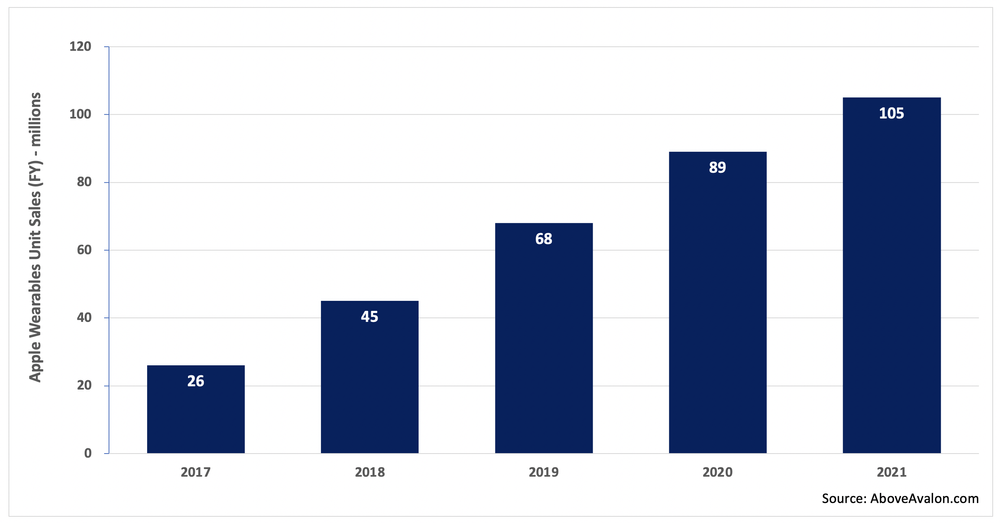
According to my estimate, Apple is on track to sell more than 100 million wearable devices in 2021. That total represents nearly 40% of the number of iPhones that will be sold during the same time period. Unit sales don’t tell the full story, however. On a new-user basis, Apple is seeing more people enter the wearables arena than buy a new iPhone for the first time.

Exhibit 1: Apple Wearables Unit Sales (2017 to 2021)

Screen Shot 2021-05-27 at 2.33.04 PM.png

Note: Apple wearables include Apple Watch, AirPods, and select Beats headphones.

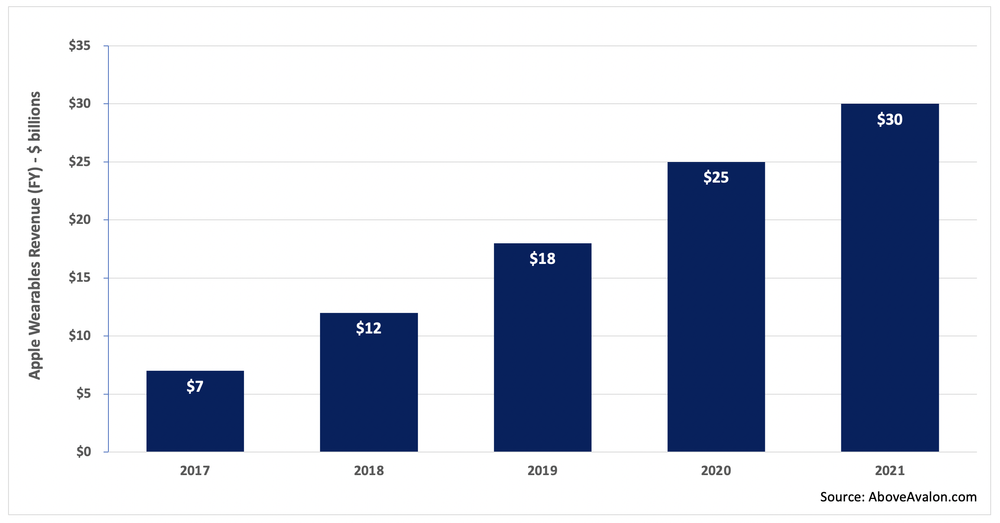
On a revenue basis, Apple Watch, AirPods, and select Beats headphones are a $30 billion per year business. That would rank Apple wearables on a combined basis just shy of a Fortune 100 company. Assuming continued Apple Watch and AirPods momentum, along with Apple expanding its wearables platform by getting into face wearables (AR/VR headsets and glasses), Apple wearables will likely be able to generate up to $50 billion of revenue annually within a few years.

Exhibit 2: Apple Wearables Revenue (2017 to 2021)

Note: Apple wearables include Apple Watch, AirPods, and select Beats headphones.

Note: Apple wearables include Apple Watch, AirPods, and select Beats headphones.

Measuring Apple’s Lead

When Apple unveiled the iPhone in January 2007, Steve Jobs famously said that the iPhone was “literally five years ahead of any other mobile phone.” He ended up being mostly correct. It took the competition a number of years, and a whole lot of copying, to catch up with what Apple had just unveiled.

With wearables, my suspicion is Apple’s lead is longer than five years. There are three components to Apple’s wearables lead: 

  • Custom silicon / technology / sensors (a four to five-year lead over the competition, and that is being generous to the competition)

  • Design-led product development processes that emphasizes the user experience (adds three years to Apple’s lead)

  • A broader ecosystem build-out in terms of a suite of wearables and services (adds two years to Apple’s lead)

Apple has at least a four-to-five year lead over the competition when thinking about just the technology powering its wearables. Everything from custom silicon and health monitoring sensors to audio and AR-focused technologies come together to set Apple apart from the competition. Only a select number of companies will likely be able to even compete with Apple on the technology front. Others will be forced to pursue partnerships. 

Apple’s wearables lead extends beyond four to five years when taking into account attributes that set wearables apart from mobile devices. Succeeding on the technology front is not enough. Wearables need to be designed so that people want to be seen wearing them for extended periods of time. A smartwatch or wireless pair of headphones must also be able to work seamlessly with other devices and services. A competitor needs to have not only an answer for effectively competing with Apple Watch on the wearables front, but also answers for various services available on AirPods and Apple’s other devices. Looking ahead, Apple’s entry into face wearables will only make the hill to climb that much steeper for competitors trying to go after Apple Watch and AirPods. 

For competitors, the intimidating part is that the pieces needed to compete effectively with Apple wearables are unable to be worked on concurrently (at the same time). A company needs to first spend the required years developing and researching the core technologies before turning its focus on ensuring the right kind of collaboration exists between engineering and design. Product sales will then need to materialize before a company has the means of leaning on an ecosystem to sell additional wearable devices.

Apple M&A

A different way of measuring Apple’s lead in wearables is to look at the company’s M&A activity. Apple has been busy buying tech and talent for its upcoming face wearables play for the past six years. In wearables land, the days of new products taking only two to three years to develop are over. The required technology and R&D required to get such devices off the ground require much more lead time. 

Examples of Apple’s Lead

There are a number of real-world examples demonstrating Apple’s significant lead in wearables.   

  • AssistiveTouch vs. Facebook Reality Labs. Two months ago, Facebook gave the press a peek at how it is researching using a smartwatch-like device as an input method for a pair of AR glasses. The research, centered on electromyography, looked to be in the pretty early stages with many years needed before seeing the technology in a consumer-facing product. The video was intriguing as it showed research that was thought to be at the forefront of what is going on in technology R&D today. Apple then shocked everyone by unveiling AssistiveTouch for Apple Watch. Instead of showing a behind-the-scenes look at an R&D project, Apple unveiled a technology ready for users today. The technology, relying on a combination of sensors and technologies to turn the Apple Watch into a hand / finger gesture reader, was designed for those in need of additional accessibility. Of course, the technology can go on to have other use cases over time, such as controlling a pair of smart glasses like the ones Facebook is working on. AssistiveTouch does a good job of showing just how far ahead Apple is on the wearables R&D front. 

  • Google I/O 2021. At its 2021 developers conference, Google showed signs of finally taking wrist wearables seriously by ditching Wear OS and partnering with Samsung on a new OS. While it is fair to be skeptical that the effort will end up being successful, the announcement was a marked change from prior Google I/Os when wearables were all but ignored. Diving a bit deeper into Google’s announcement, it’s easy to see how far behind Google truly is in wearables. The company doesn’t even have an OS capable of powering a smartwatch. This may be excusable if Apple Watch was just unveiled. However, last month marked Apple Watch’s sixth anniversary. 

  • Snap Spectacles 4 / Microsoft HoloLens / Magic Leap. While we see a handful of companies release various kinds of prototype hardware for the face (AR/VR/mixed reality), nothing has stuck with consumers. The feeling in the air is that they all lack something – design thinking. This is an item that is not easy to recreate with most companies simply not structured to emphasis design. Many companies will need to rethink their face wearables strategies once Apple enters the market. None have viable answers for smartwatches or wireless headphones either, which make their face-focused efforts look incomplete.  

How Did This Happen?

Apple’s lead in wearables wasn’t driven by any one factor or item. Instead, a series of events came together to give Apple an advantage. 

  1. Apple was early. One way to build a big lead against the competition is to get an early start. Wearables represent a paradigm shift in computing, and few companies other than Apple saw it coming. As for how Apple was able to see it so early, wearables are all about making technology more personal - a mission Apple has been on for decades. In a way, Apple was built to excel with wearables. Apple’s lack of fear in coming up with new products that may potentially impact sales of existing products also helped the company run wrist-first into wearables in the early 2010s.  

  2. Voice computing distraction. Even after Apple began to unveil its wearables strategy, many competitors balked at following the company. Competitors thought the actual paradigm shift materializing was found with voice computing. Most of these companies didn’t have the hardware expertise to do well with wearables out of the gate, so they pinned their hopes on voice assistants being piped through stationary speakers. Once the stationary smart speaker mirage became apparent, companies found themselves years behind Apple on the wearables front. 

  3. Wearables require design expertise. It’s not enough to just throw together some leftover smartphone components and ship wearables. People want to wear devices that they are OK with being seen in. This is one reason why so many companies have looked at Apple Watch for design cues. The lack of design talent and ability remains a major roadblock for many companies. 

  4. Ecosystem and technology advantage. Wearables are the ultimate ecosystem play. On the technology front, Apple was able to utilize lessons learned from mobile devices to push wearables forward. Not many companies are able to do the same. Consolidation in the smartphone space has left only a handful of companies even in a position to have a wearables and mobile ecosystem. The probability of there being a wave of smartwatch OEMs utilizing something akin to Android remains low.

  5. No price and feature umbrellas under Apple. One reason Android found oxygen in the smartphone space is that Apple left a pretty wide price umbrella under the iPhone. In addition, Android positioned itself as giving users features that iPhone users may not have had access to. No such umbrellas exist in wearables. Entry-level AirPods sell for $159 and are often available for less at third-party retailers. Apple Watch is available starting at $199. It is very difficult for a hardware manufacturer to sell wearables for less than Apple and turn a profit. Meanwhile, companies that would look to make money in other ways, such as through data collection, are still stuck with the requirement of wearables needing to look good enough to be worn in public. 

Six years after releasing the Apple Watch, it’s still not clear who is going to represent genuine competition for Apple in the wearables space. Apple’s success in wearables is finally being noticed by others, as seen by the growing number of companies selling products for the body (Amazon, Microsoft, Facebook, Google, Samsung, Huawei, Xiaomi, Garmin, and the list goes on). However, none are in as strong of a position as Apple was in a few years ago, let alone today. Apple’s wearables lead stands to grow further once the company enters face wearables. The next few years will likely dictate the power structure in wearables for the next 10 to 20 years. When it comes to competitors figuring out a way to slow Apple in wearables, it’s now or never. 

Listen to the corresponding Above Avalon podcast episode for this article here.

Receive my analysis and perspective on Apple throughout the week via exclusive daily updates (3 stories per day, 12 stories per week). Available to Above Avalon members. To sign up and for more information on membership, visit the membership page.

27 May 19:40

2021-05-26 General

by Ducky

Treatments

This article explains how scientists can now make mini organs — like mini-lungs and mini-hearts — and infect them with COVID-19 to see what happens. This has the potential to make it much faster to try out different treatments. 😲


This paper reports that a nasal antibody spray can help hamsters recover from COVID-19.

Vaccines

This paper has an explanation for the AZ/J&J blood clots. It’s complicated and I am not a biologist, but here’s my attempt at a translation:

  • The AZ and J&J vaccines use a adenovirus to get the its payload into the cell nucleus, where the DNA is read and converted into pre-mRNA in what is called “transcription“.
  • The DNA has “junk” sequences in it called “introns“. The transcription is pretty stupid, so it copies all the junk.
  • The pre-RNA floats over to a piece of machinery called the “spliceosome” which strips out the junk. Fortunately, the pre-mRPNA has little “start cutting here” and “stop cutting here” sequences in it to tell the spliceosome where the start and stop points of the introns are.
  • The papers’ authors say that the adenovirus “DNA – deriving from an RNA virus – is not optimized to be transcribed inside of the nucleus.” I am not sure exactly how to interpret that sentence, but the authors are clear that sometimes the AZ/J&J pre-mRNA doesn’t splice properly.
  • In the lab, the papers’ authors were able to find spliced mRNA which was missing instruction to make something called the “membrane anchor”.
  • Normally, when a ribosome makes spike proteins, the spikes get shoved to the outside of the cell, but are locked in place there by the membrane anchor. Enough of the spike sticks up for the immune system to see the spikes, but they can’t just go wandering around in the bloodstream.
  • If a spike is missing its membrane anchor, it can go through the cell wall — and go wandering around in the blood.
  • Spike proteins in the blood have been shown have bad side effects, like in this article I pointed to in the 2 May General blog post.

The authors do not go directly from “wandering spike proteins in the blood” to “destruction of PF4”, but suggest that that step is possible.

The mRNA vaccines don’t have this problem because they don’t need preprocessing by the nucleus to become mRNA — they are already mRNA.


I had previously heard that having MS was not a risk factor in COVID-19. People with MS, for example, were not on the Clinically Extremely Vulnerable list, for example.

However, MS drugs do apparently muck with vaccinations. This preprint says that patients on cladribine generated humoral response to vaccination just fine, patients on ocrelizumab had worse response, and fingolimod was uh pretty crappy. Tell your friends with MS.

MS patients who were not taking drugs actually did slightly better than healthy controls, but I don’t know if it was enough to be statistically significant.


Similarly, this preprint says that people with immune-mediated inflammatory diseases (like rheumatoid arthritis) who are taking methotrexate do not always generate a good immune response to vaccination. This seems to be somewhat unique to methotrexate; patients on other drugs appeared to have an adequate response to vaccination.

Transmission

This article on transmission and ventilation is worth reading, but has two points I’d like to call out.

First, CO2 is a reasonable proxy for how well the air gets refreshed and hence how dangerous it is for you. You can buy a CO2 detector for between $15 and $150, so maybe you should get one before you start dining indoors or going back to your office.

Second, singing is really really really dangerous:

Recommended Reading

This article talks about the UK’s RECOVERY project, which in my opinion is one of the most important projects of this whole pandemic. They set up a platform for running big, fast, simple randomized clinical trials. This platform proved the utility of dexamethasone and tocilizumab; it proved that hydroxychloroquine and azithromycin do no good. The UK was able to do it in part because of their unified health system, but there’s no reason why Canadian provinces couldn’t do something similar.

27 May 19:39

2021-05-26 BC

by Ducky

Vaccinations

On a COVID Slack channel that I frequent, the question has come up: “Why are we sitting on 127,917 AstraZeneca doses? If we are saving them for second doses, why not use them as second doses?”

I think that’s an excellent question, and we’ve come up with the following possible reasons:

  • They are scared of someone getting a clot and dying, though the odds are much lower with a second shot (about one in a million) that the a first shot (about one in 100,000).
  • They didn’t want to give the perception of inequity, with the AZ recipients getting their second dose faster than the mRNA recipients.
  • Given that they only have enough doses for about half of the 276K AZ recipients, they didn’t want to have to face 276K AZ recipients getting scared that they wouldn’t ever get their second shot.
  • They would prefer that AZ recipients get Pfizer as their second dose because they think it highly likely that getting AZ+Pfizer will prove to give better protection than AZ+AZ. (I also think that, based on my past experience, what experts have been saying for a long time, and this paper which says that AZ+Pfizer gives seven times as many antibodies than AZ+AZ.) The results from the big UK mix&match study should be out any day.
  • They believe that a longer delay is better (e.g. as this study shows) and worth waiting for.

Sooo on Monday I posted this long bit about why I didn’t think we were going to see cases go away until we had like 85% of people with two doses. Then, yesterday, the province released a restart plan with much much lower numbers — Stage 4 only requires 70% of adults to have one dose.

What gives?

I believe the difference is that Public Health wants the case counts low enough that they can manage the cases, not eradicate the cases. There is also a stipulation that to get to Stage 4, cases and hospitalizations must be “low”, not just “stable” or “declining”.

Is 70% of adults with one dose low enough? I don’t know, but I also know that we are absolutely going to crush that number. At the end of today, we had 65.8% of adults vaccinated; Stage 2 only requires 65% of adults vaccinated and we only started Stage 1 yesterday!

The advance-to-next-stage criteria also have calendar dates on them.; Stage 2 is three weeks from yesterday. Some people are wondering if maybe the vax rate has to be the number who have been vaccinated and have had three weeks for their immune system to finish training. In that case, we’ll hit the Stage 2 vax target on 16 June instead of 15 June.

Me, I think Pub Health is just completely sandbagging, giving us goals which we will reach with ease.

Statistics

Today: +250 cases, +3 deaths, +49,034 first doses, +3,430 second doses.

Currently 296 in hospital / 97 in ICU, 3,580 active cases, 137,517 recovered, 55.4% vaxxed, 65.8% of adults vaxxed.

We have 519,609 doses in the fridges; we’ll use it in 10.5 days at last week’s rate. We’ve given more doses than we’d received by 8 days ago.

We have 391,843 mRNA doses in the fridges; we’ll use it in 8.0 days at last week’s rate. We’ve given more mRNA doses that we’d received by 6 days ago.

Charts

27 May 19:31

On the temptation to nuke everything and start over

Doug Belshaw, Open Thinkering, May 27, 2021
Icon

People don't know this but I've reinvented myself several times in my life. It was easier and less dramatic in the days before the internet, but still just as important. I left everything behind when I packed a few bags, got on a train, and traveled some 3700 kilometers to my new home in Calgary. I had a similar experience when I packed everything I owned into a car and headed with my cat to northern Alberta, leaving everyone and everything else behind. And several more times. These experiences are life changing. They're not for everyone, but the possibility of changing everything and starting over is liberating. These days, I think, people feel trapped by what appears to be the permanence of the internet. You can't escape yourself! But maybe you can start over, as Audrey Watters and Kin Lane are doing. I wish them well; I hope they find a new community that works for them.

Web: [Direct Link] [This Post]
26 May 20:15

The Time for Action is Now: Get Ready For Careers of the Future

Corey Mohn, Gregg Brown, Getting Smart, May 26, 2021
Icon

This article is a guest post which may or may not be a paid placement in Getting Smart providing marketing for the Center for Advanced Professional Studies (CAPS) series on what they're calling 'profession-based learning' (Pro-BL). The third module of the series leads educators gently toward this model, playing old standards like Kolb's model and Bloom's taxonomy before leading them to AWS Educate and 'preparing students for the real world' (which involves crucially an "entrepreneurial mindset". You'll find the upsell on page 46. It's all beautifully designed and packaged, but while it feels persuasive, and presents itself as revolutionary, it seems to me more like a grab-bag of edu-speak components leading readers to develop corporate partnerships and adopt an employer-friendly set of curricular resources and services.

Web: [Direct Link] [This Post]
26 May 19:54

Support > Illumination

Alex Usher, Higher Education Strategy Associates, May 26, 2021
Icon

I do enjoy reading Alex Usher, and as usual he's on point through much of this article, but he seems to have a bugbear about arguments for tuition reduction that leads him away from the realm of sound reasoning. In this post, for example, he challenges the assertion that tuition tax credits are regressive. He writes, "any aid delivered via tax credits is exactly as progressive as a reduction in tuition." To a degree that's true. But it applies only if you owe taxes. Low-income students don't make enough money to pay taxes. So they don't benefit from the tax credit. But they would benefit from a decrease in tuition fees. And that's why tax credits, as opposed to fee decreases, are regressive. Now Usher should know this, and it bothers me that he writes about this issue as though he doesn't. Also: writing that the gap between rich and poor in terms of access is not increasing is all very well, but it's still a problem that the top quintile is at almost 80% while the lowest quintile is less than 50%, and it's apologist arguments like this that keep that unacceptable disparity in place.

Web: [Direct Link] [This Post]
26 May 19:00

How to Revive an Old Computer for Your Kid — or Decide on a New One

by Andrew Cunningham and Kimber Streams
A stack of laptops on a wooden surface.

Whether you need a computer for your child to use for schoolwork and entertainment, or you want to save some cash and keep a laptop out of a landfill by resurrecting an old one, you have a few options.

26 May 19:00

Three requests for the Google Chrome team as they experiment with RSS

I’m pleased to see Chrome experimenting with RSS feeds – and therefore possibly Google getting interested in increased RSS feed support. RSS is important! The interface is this:

  • A ”+ Follow” button will appear for sites with an RSS feed, on the mobile browser
  • The browser’s home screen will include a “Following” tab that shows the latest news from followed sites.

(Don’t know what RSS is? RSS feeds are how you can get the latest content out of websites and into dedicated “newsreader” apps which are made for reading, with an interface a little like Facebook but totally decentralised and un-surveilled. The technology was invented in 1999, and it’s still supported by probably 30%+ sites on the web with a ton of newsreader apps… but it’s had a moribund few years. There are signs of a recent resurgence, of which this is one. RSS is also the plumbing behind podcast distribution. For me, RSS is primary way I browse the web. Want to get started? Here’s how.)

In case the Chrome team reads this, I have three requests.

1. Sweat the new user experience

Despite RSS’s strong history and continued usage, at this point I would guess that new users find it inscrutable, and it’s hard to tell whether a given site offers an RSS feed or not. Even then, the subscribing experience is not consistent.

So, if this is going to be a success…

Finally, recognise that the browser is not the best place read RSS feeds long term. We learnt that last time round.

The browser is a great place to get started, but users need to graduate to something dedicated as they follow more feeds. So pave that path somehow… maybe make a user’s subscriptions available as an industry-standard OPML file, somewhere on the google.com domain? And show users how they can use that subscriptions list in any one of a whole ecosystem of newsreaders.

2. Yes, think about monetisation and other advanced features, but maintain ecosystem compatibility at all costs

When I suggested three improvements to RSS last year, I highlighted (a) onboarding; (b) the money thing; and (c) discovery.

The money thing: In the Substack era of writers monetising their content, and with Apple and Spotify both giving podcasts a revenue model, it is absolutely the right thing to be considering how to extend RSS with a great premium experience, which means ways to pay, and also private feeds.

(Jay Springett also makes the connection between Google, RSS, and payments and points out that this, strategically, a good way for Google to index content that will shortly be hidden behind a paywall.)

There’s a BUT…

Remember that the reason RSS is here at all is that it’s almost religiously backwards compatible, and incredibly open. Technically, RSS includes an extension mechanism so take advantage of that, but to succeed, any efforts needs to be on a bedrock of community collaboration and unwavering commitment to backwards compatibility, decentralised approaches, and no new points of failure (people are still angry about Google Reader closing in 2013 and pulling the rug from many readers and publishers).

That said:

Another feature area I would think about is interactivity. I’m fascinated with Google’s work in Gmail around “Inbox Actions” – basically the one-click buttons to perform an email action like RSVP, or reviewing a bug. Here’s an explainer with some examples.

Let’s call it Feed Actions. Feed Actions could also be an RSS extension. Here’s a mockup I made for a talk in 2008. What a gift it would be to the web, to provide an open, centralised way to combine all the different micro-task inboxes from all the apps I use, all into one place.

GitHub should support something like this for their notifications dashboard, letting me triage issues straight from the feed; Amazon should support something like this for open orders, letting me inspect delivery status. It might be tough to get these into GMail, which is centralised, but as an open and decentralised standard? Possible.

(Feed Actions would also be a good way to add an “Upgrade to premium” button.)

3. Internally invest in, and externally advocate for RSS

RSS, as a mechanism to subscribe to content from websites, is still around… but my take is that it has stagnated. Given the features above (like private, personalised feeds, with a slick upsell path), it’s worth pushing the envelope with some new use cases. And, Google, start with your own products.

Like…

  • What would it mean to have RSS as an output from GMail, using the “feed actions” idea above?
  • Could I get my Google Analytics insights as an RSS feed?
  • How about a feed for new bookshops in my local area, from Maps?
  • Allow me to include my RSS headlines in my search results knowledge panel
  • A big one: how can RSS jump from the web to the app ecosystem? What would it mean for on-device Android apps to also publish feeds that can be read in standard newsreaders?

Mostly basic stuff but it shows commitment.

With a seat at the table and skin in the game, bang the drum for RSS and the open web. Like I said, it’s great to see early trials of RSS in the Chrome mobile browser and, for me, that’s a promising start.

(And if anybody from the Chrome team does run across this post, thanks for reading!)