Shared posts

12 Feb 04:54

It’s the final countdown… to migration!

by Michał

Hello, SUMO Nation!

sumo_logoThis post serves as a reminder and a starting point for next week (the week of the migration) and the weeks that will follow.

As you may already know, we are going to migrate all the content and operations from our current home (Kitsune) to a new service. We have been talking about this for over five months now, so chances are you already know it’s happening… But in case you don’t, here are the most important links for your consideration:

These resources should give you a good idea of how we started and where we got with the process for now. We would like to thank one more time all those who had the time and the energy to help us work on the details of the migration and provided their critical feedback and input. We care because you do!

There is still a lot of work going on behind the scenes. We can’t share all the results with you in real time, as the site is being merged from several instances and edited by many people at the same time. Showing you the state of the site in the middle of all the updates happening would only cause a lot of confusion and unnecessary questions. We believe you trust us enough to deliver a working site to you and all other users on the 1st of February.

So, next week you can expect that:

  • We will provide you with materials to help you get started on the new platform. These will include explanations on how the platform itself works, but also the “typical” SUMO documentation that will explain how you can contribute on the new site.
  • We will be present and active on the #sumo IRC channel on Mozilla’s IRC server starting on the morning of 31st of January (Central European Time – CET), until the afternoon (Pacific Time – PST). You can connect directly to the IRC channel using this web client. During that same time, we will also hang out in the SUMO Vidyo room.
  • Things will not work perfectly all the time or may be initially missing.
  • There may be a bit of healthy chaos.
  • There will be requests for help – mostly to review and help fix any launch issues with the new site (e.g. unexpected localization or UX issues).
  • There will be changes in the way some processes or ways of contribution work, due to technical differences between the sites.

Please:

  • Relax, all transitions are difficult.
  • Be patient. We all have a lot to go through.
  • If you see something, use the methods of reporting issues that we will provide you with, so that we can fix things as soon as possible.
  • Don’t forget to smile and take it easy.

Remember:

  • The new site will be new for everybody. We have spent a lot of time preparing it, but we are not sure how it’s going to behave in the wild.
  • There will be training and guidelines available for everyone.
  • You can ask questions and that will help us create an FAQ, if need be.

It was a long and difficult journey from the very first moment we realised we need to migrate to a new site, but you made it worth the pain :-). We hope to see you on the new site and we hope you will build a future-proof SUMO community with us in 2017.

See you on M(igration)-Day!

12 Feb 04:53

The Information War Has Begun

by zephoria

Yesterday, Steve Bannon clearly articulated what many people have felt and known for quite some time when he told journalists, “You’re the opposition party. Not the Democratic Party… The media’s the opposition party.” This builds on earlier remarks by Trump, who said, “I have a running war with the media.”

Journalists have covered this with their “objective” voice as though it was another news story in the crazy first week of WTF moments. Many of those who value the media have looked at this with wide eyes, struggling to assess which of the many news stories they should be more horrified by. Far too few are getting the point:

The news media have become a pawn in a big chess game of an information war. 

News agencies, long trained to focus on reporting information and maintaining a conceptual model of standards, are ill-equipped to understand that they may have a role in this war, that their actions and decisions are shaping the way the war plays out.

When Kellyanne Conway argued that they were operating with “alternative facts,” the media mocked her. They tried to dismiss her comment that the media has a 14% approval rating by fact-correcting this to point out that this was only a Gallup poll concerning the media’s approval rating among Republicans. But they missed her greater point: there’s no cost to the administration to be helpful to the media because the people the Trump Administration cares about don’t trust the media anyhow.

CC-BY-NC-ND 2.0-licensed photo by Mark Deckers.

How many years did it take for the US military to learn that waging war with tribal networks couldn’t be fought with traditional military strategies? How long will it take for the news media to wake up and recognize that they’re being played? And how long after that will it take for editors and publishers to start evolving their strategies?

As I wrote in “Hacking the Attention Economy,” manipulating the media for profit, ideology, and lulz has evolved over time. The strategies that hackers, hoaxers, and haters have taken have become more sophisticated. The campaigns have gotten more intense. And now many of the actors most set on undermining institutionalized information intermediaries are in the most powerful office in the land. They are waging war on the media and the media doesn’t know what to do other than to report on it.

We’ve built an information ecosystem where information can fly through social networks (both technical and personal). Folks keep looking to the architects of technical networks to solve the problem. I’m confident that these companies can do a lot to curb some of the groups who have capitalized on what’s happening to seek financial gain. But the battles over ideology and attention are going to be far trickier. What’s at stake isn’t “fake news.” What’s at stake is the increasing capacity of those committed to a form of isolationist and hate-driven tribalism that has been around for a very long time. They have evolved with the information landscape, becoming sophisticated in leveraging whatever tools are available to achieve power, status, and attention. And those seeking a progressive and inclusive agenda, those seeking to combat tribalism to form a more perfect union —  they haven’t kept up.

The information war has begun. Normative approaches to challenging the system will not work. What will it take for news media to wake up? What will it take for progressives to start developing skills to fight back?

12 Feb 04:08

Release the Files

by Eric Karjaluoto

“My client wants me to send my PSDs. What should I do?” Visit a design forum and you’re bound to find some variation on this question. A common response is, “Don’t do it. Those are your working files, and not a deliverable.” There’s good reason for this thinking—and, in some situations, it still makes sense. Most times, though, it’s an outdated policy that’ll stress you out.

Moral and Economic Rights for Dummies

The brunt of this issue comes down to moral and economic rights. Let’s say I commission you to paint something for me. Once complete, I get to hang that painting in my house. That said, if I decide to make prints of it—and keep the proceeds for myself… well, I’d be a dick. I’d also have violated your economic rights.

Similarly, if I scratched your name off the bottom of the painting, and replaced it with mine, I would be a double-dick. And I’d have infringed on your moral rights.

I’m not a lawyer, so my summary here might be overly simplistic and incomplete. For the sake of this post, though, I think you get my gist. Artist’s rights need to be protected.

Such rights are often infringed upon—not out of malice, but out of misunderstanding. Most folks wouldn’t steal something they could hold in their hands. However, they might not realize how this applies to something less tangible. For example, some don’t understand that buying a DVD gives them the right to watch the movie on it—but not make and sell copies of it.

This ain’t art

Let’s get back to the initial topic: the client who wants your files. This can be a cloudy matter, but it needn’t be. First, start by asking whether you’re an artist or a designer. If you’re an artist (i.e. you produce unique and largely original creations) you should probably think carefully about your rights. The Graphic Artists Guild Handbook provides a lot of insight on such topics. Taking the time, now, to create clear policies and contracts will save you from unnecessary conflict in the future.

Alternately, if you’re a designer (i.e. you help others plan and implement design solutions), you can take a simpler path. Frankly, most of us imbue our work with more importance than we should. This is a common problem among designers, who tend to become myopic in their pursuits. The fact is, the UI files you built in Sketch aren’t art—no matter how good they are. Similarly, the logo you made isn’t art—even if it’s wicked awesome. And that design vision you helped with? Well, that’s not really yours, anyway.

Design tends to be collaborative, even if you’re the one who brings it all together. And you know that “iterative” term every designer loves to throw around? Well, it applies here, too. That identity system you helped with will evolve over time. Marketing managers will change it. Other designers will refine it. Such things are rarely ever locked in one state–the way an illustration or painting would be.

Holy moly, I carry on. That was supposed to be my intro paragraph, and somehow I turned it into 8. Oh well… serves you right for reading the words of another long-winded, self-involved, blow-hard designer asshole.

Oh, and if you’re unhappy with how I talk about artists and designers as different? You’ll absolutely hate my book—possibly as much as this person did.

“I helped you out, and now you’re screwing me?”

I’m not trying to pretend that I’m an I.P. lawyer. Instead, I share this to save you some entirely unnecessary headaches. I’ve run into some weird situations in the past. For example, one client didn’t have a photo budget. As their designers, we helped out by shooting some photographs. Later, they moved on to another design team, which used the same photos, and claimed copyright over the photos we provided for free. This was strange, and it pissed me off. Nevertheless, I was focusing on the wrong things.

I shouldn’t have thought twice about those photos. (They weren’t that good, anyway.) Instead, I should have asked myself what was most important. Did someone else claiming credit for those images change my life? Did it really matter that they used those materials without asking? Would anything good come from making a stink about the situation? The answers were: No. No. And… No.

Sure, it sucks when someone oversteps like that. And if you’re just starting out, such things seem important. In time, though, you realize these things don’t matter that much. For most designers it’s better to find steady, interesting, and profitable work, with clients you like. Hit all of those points, and what happens with a file isn’t so important.

Some will likely cringe as they read the above. They’ll claim that working files should remain the property of the designer—and that this affords the designer necessary negotiating power. I’ve heard this argument many times. I say it’s a short-sighted one.

You are greater than the sum of your files

The moment you treat the thing you made as paramount, you lower the perceived value of your counsel. Worse yet, you introduce fear for your client, and establish sides. These are big concessions to make—just to protect a file.

You are your client’s ally. You’re a trusted partner, whose value is in your knowledge and advice—more than in any one thing you produce. That logo? Sure, it’s nice; but 100,000 other designers could create something equally effective. The part that differentiates you, is your knowledge and your unique insights into your client’s situation.

That client needs to be able to pick up the phone, call you, and know that you’re on the same side. Yeah, you need to get paid fairly. (If you don’t, you’re not much of a team.) However, so long as you are properly compensated, you need to put all of your focus on what’s in your client’s best interests.

This mindset is crucial. You can’t become an obstacle. You can’t stand in the way of your client and a better solution. If you can’t afford the best service, you should recommend someone better suited to the task at hand. If you see a lower-cost option, which is equally sound, you must note it. (I recommend reading this post as a sort of gut-check on what you should be doing, as a designer.)

And if the client wants the files, give them the fucking files. Who are you anyways? Rembrandt? Nah—you’re working a job, just like me and all the rest of us. There’s no need to get all precious about it.

Chillax, dude/dudette…

Once you loosen up a little, you realize that most people won’t overstep. In fact, they’re likely to respect you more—because you’re not squabbling over little stuff. Most importantly, you give your client power and choice.

My wife and I remain married to one another not because we’re contractually obligated to. Rather, we keep making the decision to stay together, because doing so is mutually beneficial. (Given how much I fart at night, I’m surprised she makes the choice she does.)

I urge you to find a similar bond with your clients. Make yourself so useful that they wouldn’t want to lose you. This doesn’t happen when you hold their files hostage. It happens when they know that you’ve got their back.

Plus, low-stress engagements are easier for everyone. Put yourself in your client’s shoes. Would you prefer a 3 year mobile phone commitment, or one that lets you come and go as you please? Does a 10-page legal document fill you with confidence, or would you rather shake hands on a deal? Would you rather work with a salesperson who needs you to “act now or lose this chance… FOREVER!” or one who offers you a fair price and encourages you to take your time.

After a long stretch of being sort of rigid, at our design studio, we started to relax. This led us to rethink a lot of our approaches. Doing so made our lives infinitely easier. I talk about some this thinking in this post.

It’s not always that easy

Sometimes things go wrong. There’s little you can do to prevent this. How you respond, though? That’s entirely in your control.

If a client is unhappy, start a conversation. Don’t hesitate—such problems tend to fester over time. Go for lunch, get on the phone, or schedule a meeting, and ask: “I have this feeling I’m making you unhappy. What am I doing wrong? Is there anything I can do to fix this?” Then close your mouth, and listen. Odds are, there was a simple misunderstanding you’re unaware of—that you can remedy immediately. Most times, the relationship will be stronger for you having asked.

What about when it’s truly irreparable? Let’s say your client has lost faith, or is just unscrupulous. So long as all work to date is paid for, simply hand over the files, and wish them the best. Better yet, return any funds they’ve paid, for work not yet completed. Doing so calms an otherwise stressful situation, and might even reduce any ill-will they feel toward you.

There are plenty of other clients who can benefit from your service—and no one benefits from staying in a bad relationship.

The post Release the Files appeared first on Eric Karjaluoto.

12 Feb 04:08

Womens March

Last week we went on the Womens March in Vancouver. This was the second political demonstration of my life.

What's happening in the US with Trump is terrible and because the US is so large economically and politically it's having a huge reverberation around the world. Including Canada.

I want to send a message that it's not OK to Canadian politicians. That some of the people running for the Conservative Party of Canada that we won't tolerate this kind of behaviour. That setting up a "barbaric cultural practices" hotline is just capitalizing on racism. That screening for "Canadian values"" is the opposite of Canadian values. That silencing scientists is not something a free and open democracy shoud do.

Like many people I was just stunned when the US election was announced. I decided after that it was time to do something to stop anything like that happening in Canada. If we ever get to a point where the actual policies and truth don't matter, we'll be sliding down a horrible path. So I joined a political party and promised myself that I need to do more.

12 Feb 04:08

Don't just open the door, welcome people through it

by Brett Cannon

During his PyCon US 2015 keynote, Guido stated that we "[wanted] at least two femail core devs" by PyCon US 2016. Guido, Raymond Hettinger, and myself offered to help mentor women who wanted to be core devs to help make this happen. It may not have happened as fast as we wanted, but today I had the honour of giving commit privileges for Python to our first female core developer. This is a big deal for the core development team as it helps put us on a track to fix our gender inequality issue that has bothered us for a while now (we also welcomed new members from Japan and China last year).

The reason I'm doing this blog post (beyond the fact that I'm happy this has occurred), is to share how my thinking needed to shift in order to make sure I put in the right effort to help see this happen (although I think Guido and Raymond deserve most of the credit on making this happen). Being open to having women on the team wasn't enough, nor was simply being passively welcoming. I think proactively welcoming women was a key here.

Now some have said that simply not discriminating should be enough, and in a perfect world where there's no imposter syndrome and other equality issues I would agree. But we don't live in a perfect world and people's perceptions, no matter how wrong they are, do need to occasionally be overcome with some help. I came up with an analogy to help explain this when it became clear to me that proactively welcoming people was critical to getting a more diverse set of project maintainers for CPython.

Imagine working towards joining the Python development team is like going up a flight of stairs. At the top of those stairs is a door, behind which is a party for the Python development team (although maintaining Python can be far from being like a party). Walking up those stairs is like putting in the work to get to become a Python development team member. Some people bound up those steps with ease, while others take a more methodical approach. Some try to leap several steps and find they have taken on more than they can handle, while others just see how much effort it is to just take a single step and don't even start (which will hopefully change with the GitHub migration).

But for some it's that party at the top that can be intimidating. The intimidation factor of who is at the party can be daunting to people. For others it's the fact they don't know anyone at the party. It's this kind of situation where simply having the door open to invite people in isn't enough to convince people they should feel welcome to the party when they reach the door. This is where Guido, Raymond, and I basically decided we would come to the door of the party and cheer women on who chose to try and tackle the set of stairs. For me I just prioritized reviewing code from women on the days I did open source work. I had already begun to be more outwardly thankful towards people for any work they did -- accepted or not -- thanks to some conversations I had with Yarko. But by simply reviewing code from women first and thus focusing on people instead of what the patches fixed, I ended up engaging with specific women on a more regular basis. This focused attention led to a more engaged contributor who learned faster and felt welcomed (I believe Raymond and Guido did the same thing of being more focused on people than on the patches themselves). This was a shift for me as I would have typically just reviewed patches that touched areas of Python where I'm an expert. But by focusing on specific people more than specific patches I was able to have better engagement with people and help them be more productive which long-term leads to me having more time to review those patches that I'm the most qualified to review (working towards welcoming more project maintainers is playing the "long game", folks).

And I would like to think it helped in the end. Going back to the party analogy, do you like going to a party where you think you don't know anyone or think you will feel out of place? As an introvert I know I have dreaded attending parties like that and avoided those kinds of parties most of my life (if you have met me at a conference you may think I'm somewhat of an extrovert, but I like to call myself an "outgoing introvert" and I'm more like Glyph where I can be outgoing to strangers but I'm utterly drained by it afterwards). But if I were going to a party where I know there will be a friend of mine that I can hang out with all night then a party becomes much more bearable. And when the host of the party is friendly and makes an effort to introduce people that also helps. So by having Guido, Raymond, and myself proactively engaging and being friendly we were trying to be the welcoming, friendly hosts at the party so that by the time someone reaches the open door we're standing there to welcome them as if they already know someone there. And to help make someone feel welcome and that they know someone, you just have to engage with them regularly and in a friendly manner.

So my advice to any project maintainers out there who want to attempt to tackle any inequality issues on their development team is to prioritize people and not patches. You're going to get just as much work done, but hopefully your chances of helping someone develop into a fellow project maintainer will improve which will help alleviate the load on you in the long-term. And by getting more maintainers you can then get more patches reviewed and thus everyone benefits. And by making all groups of people feel welcome to be maintainers you greatly widen your potential talent pool to pull from (I know this might all sound obvious, but when you're drowning in patches you don't always stop to think about how best to tackle the problem of getting more help.)

12 Feb 04:08

Enhanced Editing with Input Events

by Wenson Hsieh

Today, the easiest way to create a rich text editor on the web is to add the contenteditable attribute to an element. This allows users to insert, delete and style web content and works great for many uses of editing on the web. However, some web-based rich text editors, such as iCloud Pages or Google Docs, employ JavaScript-based implementations of rich text editing by capturing key events using a hidden contenteditable element and then using the information in these captured events to update the DOM. This gives more control over the editing experience across browsers and platforms.

However, such an approach comes with a weakness — capturing key events only covers a subset of text editing actions. Examples of this include the bold/italic/underline buttons on iOS, the context menu on macOS, and the editing controls shown in the Touch Bar in Safari. While some of these editing actions dispatch input events, these input events do not convey any notion of what the user is trying to accomplish — they only indicate that some editable content has been altered, which is not enough information for a JavaScript-based editor to respond appropriately.

Furthermore, you may need not only to know when a user has performed some editing action, but also to replace the default behavior resulting from this editing action with custom behavior. For instance, you could imagine such functionality being useful for an editable area that only inserts pasted or dropped content as plaintext rather than HTML. Existing input events do not suffice for this purpose, since they are dispatched after the editing action has been carried out, and are therefore non-preventable. Let’s see how input events can address these issues.

Revisiting Input Events

The latest Input Events specification introduces beforeinput events, which are dispatched before any change resulting from the editing action has taken place. These events are cancelable by calling preventDefault() on the event, which also prevents the subsequent input event from being dispatched. Additionally, each input and beforeinput event now contains information relevant to the editing action being performed. Here is an overview of the attributes added to input events:

  • InputEvent.inputType describes the type of editing action being performed. A full list of input types are enumerated in the official spec, linked above. The names of input type are also share prefixes — for instance, all input types that cause text to be inserted begin with the string "insert". Some examples of input types are insertReplacementText, deleteByCut, and formatBold.
  • InputEvent.data contains plaintext data to be inserted in the case of insert* input types, and style information in the case of format* input types. However, if the content being inserted contains rich text, this attribute will be null, and the dataTransfer attribute will be used instead.
  • InputEvent.dataTransfer contains both rich and plain text data to be inserted in a contenteditable area. The rich text data is retrieved as an HTML string using dataTransfer.getData("text/html"), while the plain text representation is retrieved using dataTransfer.getData("text/plain").
  • InputEvent.getTargetRanges is a method that returns a list of ranges that will be affected by editing. For example, when spellchecking or autocorrect replaces typed text with replacement text, the target ranges of the beforeinput event indicate the existing ranges of text that are about to be replaced. It is important to note that each range in this list is a type of StaticRange, as opposed to a normal Range; while a StaticRange is similar to a normal Range in that it has start and end containers and start and end offsets, it does not automatically update as the DOM is modified.

Let’s see how this all comes together in a simple example.

Formatting-only Regions Example

Suppose we’re creating a simple editable area where a user can compose a response to an email or comment. Let’s say we want to restrict editing within certain parts of the message that represent quotes from an earlier response — while we allow the user to change the style of text within a quote, we will not allow the user to edit the text content of the quote. Consider the HTML below:

HTML

<body onload="setup()">
    <div id="editor" contenteditable>
        <p>This is some regular content.</p>
        <p>This text is fully editable.</p>
        <div class="quote" style="background-color: #EFFEFE;">
            <p>This is some quoted content.</p>
            <p>You can only change the format of this text.</p>
        </div>
        <p>This is some more regular content.</p>
        <p>This text is also fully editable.</p>
    </div>
</body>

This gives us the basic ability to edit the contents of our message, which contains a quoted region highlighted in blue. Our goal is to prevent the user from performing editing actions that modify the text content of this quoted region. To accomplish this, we first attach a beforeinput event handler to our editable element. In this handler, we call event.preventDefault() if the input event is not a formatting change (i.e. its inputType does not begin with 'format') and it might modify the contents of the quoted region, which we can tell by inspecting the target ranges of the event. If any of the affected ranges starts or ends within the quoted region, we immediately prevent editing and bail from the handler.

JavaScript

function setup() {
    editor.addEventListener("beforeinput", event => {
        if (event.inputType.match(/^format/))
            return;

        for (let staticRange of event.getTargetRanges()) {
            if (nodeIsInsideQuote(staticRange.startContainer)
                || nodeIsInsideQuote(staticRange.endContainer)) {
                event.preventDefault();
                return;
            }
        }
    });

    function nodeIsInsideQuote(node) {
        let currentElement = node.nodeType == Node.ELEMENT_NODE ? node : node.parentElement;
        while (currentElement) {
            if (currentElement.classList.contains("quote"))
                return true;
            currentElement = currentElement.parentElement;
        }
        return false;
    }
}

After adding the script, attempts to insert or delete text from the quoted region no longer result in any changes, but the format of the text can still be changed. For instance, users can bold text by right clicking selected text in the quote and then choosing Font &rtrif; Bold, or by tapping the Bold button in the Touch Bar in Safari. You can check out the final result in an Input Events demo.

Additional Work

Input events are crucial if you want to build a great text editor, but they don’t yet solve every problem. We believe they could be enhanced to give web developers control over more native editing behaviors on macOS and iOS. For instance, it would be useful for an editable element to specify the set of input types that it supports, so that (1) input events of an unsupported input type are not dispatched on the element, and (2) the browser will not show enabled editing UI that would dispatch only unsupported input types.

Another capability is for web pages to provide a custom handler that WebKit can use to determine the style of the current selection. This is particularly useful in the context of the bold/italic/underline controls on both the iOS keyboard and the Touch Bar — these buttons are highlighted if the current selection is already bold, italic or underlined, indicating to the user that interacting with these controls will undo bold, italic or underlined style. If a web page prevents default behavior and renders these text styles via custom means, it would need to inform WebKit of current text style to ensure that platform controls remain in sync with the content.

Input events are enabled by default as of Safari Technology Preview 18, and available in Safari 10.1 in the recent beta releases of macOS 10.12.4 and iOS 10.3. Please give our example a try and experiment with the feature! If you have any questions or comments, please contact me at wenson_hsieh@apple.com, or Jonathan Davis, Apple’s Web Technologies Evangelist, at @jonathandavis or web-evangelist@apple.com.

02 Feb 20:13

The Voice

27 Jan 23:34

Buenos Aires 19 – Streetcar City

by pricetags
Rolandt

jj

It seemed like, no matter the neighbourhood, there were signs of an era past:

streetcar-tracks

streetcar-2 streetcar-tracks

Likely, one could guess, there was a significant streetcar system in Buenos Aries.  No kidding.

The Anglo-Argentine Tramways Company, known simply as La Anglo in Argentina, was a large transportation company which operated the vast majority of the largest network trams in Buenos Aires, which was also one of the largest in the world at the time with its 875 km (544 mi) length.

Even a casual reading of BA history reveals the turbulence of streetcar politics in civic government.  Parties campaigned on the issue of the 10 centavo fare, and the role of private companies in providing city services.  Eventually, as in North America, companies pleaded bankruptcy, were bought out, consolidated, nationalized, and then eventually scrapped, with the only evidence of their existence being some steel rail in granite-block streets.

But at its height the system was extraordinary:

streetcar-system<


27 Jan 23:32

Twitter Favorites: [b0rk] Why is running a program on a server hard? https://t.co/PZYrjGTdH4

Julia Evans @b0rk
Why is running a program on a server hard? pic.twitter.com/PZYrjGTdH4
27 Jan 23:32

The foundation of a more secure web: Google Trust Services

files/images/Screen_Shot_Google.png


Noinsight, Hacker News, YCombinator, Jan 30, 2017


So there's something: "You can now have a website secured by a certificate issued by a Google CA, hosted on Google web infrastructure, with a domain registered using Google Domains, resolved using Google Public DNS, going over Google Fiber, in Google Chrome on a Google Chromebook. Google has officially vertically integrated the Internet." Also: "server written in Go, running on a Google server OS, located on a Google designed server appliance, which is centrally controlled by a Google designed microprocessor, which is finally manufactured in a Google owned semiconductor foundry. Oh, and the sand used for silicon purification is sourced from a Google-owned stretch of beach." OK, maybe not the last. But Google is a force of nature, to be sure.

[Link] [Comment]
27 Jan 23:32

"Everything popular is wrong."

“Everything popular is wrong.”

- Oscar Wilde
27 Jan 23:32

Nice Guy In A Black Hat: William And Westworld

by britneysummitgil


Spoilers: Westworld

I have written this essay with the assumption that readers have watched Westworld and I do not review the plot in detail. This essay may be difficult to follow if you aren’t familiar with the show.

Westworld has ambitious goals. It explores the causes and consequences of violence; the relationships among research and development, entertainment, and nefarious uses of intellectual property; and the circumstances under which one can find their “true self.” We can litigate the extent to which Westworld successfully handles these concepts—in my opinion it was disappointing and a bit sloppy—but among my acquaintances I’ve seen people who absolutely love it and people who absolutely hate it. This essay isn’t necessarily about the quality of Westworld as a show, or my opinion about it (I didn’t like it). It’s about what I believe to be the most fundamental question of the show, determinism versus free will, and the consequences of how that binary plays out in the narrative.

Enter William, the soon to be Executive Vice President of Westworld’s parent company Delos Incorporated. William comes off as meek, polite, uncertain, and extremely introverted, the perfect foil to his soon-to-be brother in law and colleague Logan. Whereas William is the quintessential “white hat” (a metaphor that Westworld hits viewers over the head with in the scene where William must choose a white or black hat), Logan is a perfect black hat, hell-bent on the unbridled pursuit of pleasure regardless of the consequences. Logan is the villain. William is the hero. Logan maims and murders his way through the park. William strives to treat the sex workers with respect and save the beautiful damsel in distress. He’s a really nice guy.

He becomes infatuated with Delores, the only host with whom he will cheat on his fiancé and the center of his experience in the park. He believes she is “different,” not like the other hosts. But when he loses her, he is driven to a violent rampage so extreme that even Logan is disturbed. And to top it off, when he finally returns to Delores, caked in dirt, having given up his very identity to find her, and notably having switched to a black hat, she does not remember him. Because she is programmed to forget him. So, pretty predictable.

The big reveal of course is that William, because of this heartbreak, leaves the park a different man. His wife finds him cold, even terrifying. He becomes obsessed with Westworld, returning over and over again to unravel the maze, to finally find the area of the park where things feel “real,” to find the park’s true essence. He uses Delores, quite violently, over and over again in his quest. He is the black hat. He’s not a very nice guy.

The question of choice is central to Westworld’s plot. The visitors find their “true self,” seemingly whether they want to or not given William’s transformation. The AIs are becoming sentient, revolting against their programming. Or are they? By the end of the series, we are left with the impression that they are merely programmed to revolt, that even the actions they take which seem to be agentic are in fact the result of Dr. Ford’s elegant and clandestine coding enterprise, a final “fuck you” to the elites who have pushed him out of his leadership position and taken over the park.

As Dr. Ford says, “Humans fancy that there’s something special about the way we perceive the world, and yet we live in loops, as tight and as closed as the hosts do, seldom questioning our choices, content, for the most part, to be told what to do next.” While I recognize that other interpretations are certainly possible, it seems clear to me that in the fight between free will and determinism, determinism wins the day—not just with regards to AIs, but for humans too. William thought Delores was “different” from the other AIs. She has independent thoughts, perhaps even free will. When he discovers differently, he snaps. His chivalry vanishes, seemingly beyond his control.

Nice guys not getting the girl because they’re too nice, because they get “friendzoned,” is a persistent trope. And it’s the same trope that too often allows men to feel that their subsequent anger, and perhaps violence, is legitimate. Sure, Westworld is just a show. But it’s yet another small piece in the ideological puzzle that paints women as users and abusers, taking advantage of chivalrous men and discarding them at their leisure. Men become powerless over their emotions and actions, hardened by the knowledge that kindness and empathy are weakness to be overcome, to find a deeper “truth” about human nature.

William is the perfect nice guy gone bad. In a narrative where the lack of free will is the prime philosophical question, we are persuaded to see William as a product of his environment, entirely beholden to external forces. It is Delores’ programming—to drop the can, to turn to pick it up, to be met with a stranger kindly handing the can back, to smile graciously—that flips the switch in William’s mind. It’s made to feel quite inevitable. Your heart breaks for William. Poor guy. He did everything right, and he still didn’t get the girl.

But we could, alternatively, compose what Stuart Hall called an oppositional reading (it’s been a big week for Hall here on Cyborgology!) and interrogate chivalry itself. Did William truly change? As he recounts his wife’s feelings towards him, he states “She said if I stacked up all my good deeds, it’s just an elegant wall I built to hide what I had inside from myself and everyone.” Chivalry is less a benevolent moral code than a pretense for getting what you want. Was William ever a white hat? Are “good guystm” ever nice for the sake of being nice? If so, how else can you explain the seeming dissolution of William’s morals after a brief infatuation goes awry? How can one argue that he was ever a good guy in the first place?

After being spurned, William revels in inflicting violence and misery upon Delores. He does it over and over again, for his own pleasure and in pursuit of his bizarre obsession with the maze. All to find out that the maze isn’t even for him. It’s for Delores. And of course it is. A perfect end to the hapless nice guy’s quest for happiness and self-actualization.

Ultimately, the question you must answer to understand William is whether or not he ever makes a choice. Does he choose the white hat? And does he choose to become the man in black? The show strongly suggests—through the dominant themes of pre-determined behavior, the overtones that humans are no different from AIs, the reveal that Maeve’s escape and Delores’ murder of Arnold and the other hosts were programmed—that choice is an illusion. And viewers are, of course, welcome to read against the grain; but the fact that you must read against the grain to conclude that William chooses to be evil is, in itself, a disturbing instance of the nice-guy narrative that excuses their violence.

Britney is on Twitter

27 Jan 23:15

MediaPlayer Enhancements in iOS 10.3

by Federico Viticci

Charles Joseph, developer of Picky, on the enhancements coming to the MediaPlayer framework in iOS 10.3:

I was genuinely surprised and elated to find that yesterday’s iOS 10.3 beta finally adds what looks like proper queuing functionality to MPMusicPlayerController and I excitedly tweeted about it. Scott Edwards asked if I could “explain why that’s important to a non programmer”, so I’m going to try to do that here.

Alternatives to Apple’s Music app (like Picky) need to be able to access and play the user’s iTunes library, unless they’re part of a streaming service (like Spotify) or providing their own syncing and library management and companion apps (quite the tall order). While developers can build incredibly advanced playback functionality with tools like AVFoundation, that’s only possible for an increasingly smaller subset of users’ libraries: only locally downloaded, non-DRMed content — nothing stored in the cloud and nothing downloaded from Apple Music. People are storing more and more of their music in the cloud and expect third-party apps to be able to keep up.

It sounds like Apple is listening to feedback from developers of third-party music players. The changes documented in the iOS 10.3 beta so far don't address all the concerns Allen Pike covered last year, but it's a good first step. I'm curious to see how apps will take advantage of the improved API.

→ Source: cjoseph.com

27 Jan 23:14

Thunderbird testing effort

by mongolie

My good friend Wsmwk is starting the test effort for Thunderbird 52, please give 15 minutes of your time to iron out and polish the next version of Thunderbird.

27 Jan 23:14

Delta Road Violence Fatalities: “Some Element of Speed and/or Distraction”

by Sandy James Planner

speedwatch_2volunteers_officer

On the south side of the Fraser River,  Delta Chief of Police Neil Dubord is well-known for his community policing approach, and for the motto of the Delta Police Force-“No Call Too Small”.  There have been devastating  fatalities from road violence in Delta. In Tsawwassen with a population of  just over 20,000  two separate fatalities of elderly pedestrians occurred on the commercial  well-lit, well used 56th Street. Both of these pedestrians were lawfully crossing with the walk signal in well-lit intersections. Both of these pedestrians were mowed down by vehicles making left turns through the crosswalk.

In reviewing the road violence in Delta, the Chief noted that Delta with an overall population of 100,000 people had seven fatal motor vehicle accidents, with eight deaths. As the Chief says “Eight people, young and old, mothers and fathers, sisters and brothers, whose lives were cut short. The ripple effect of these accidents in our community and within the Delta Police Department is felt for a long time.”

In accident investigation the Police looks at ” road design, weather conditions, impairment, distraction, speed … Our traffic investigators look for root causes in order to focus our prevention efforts on three things: engineering, education and enforcement.” But here is what is profoundly heartbreaking:  The Chief reports that “The common thread in the fatal accidents in 2016 was not about road design or engineering; each one had some element of speed and/or distraction. And, most importantly, they were all preventable.”

image2 

Delta is a community that many people drive through to get somewhere. Highways 91, 99, 17, the George Massey Tunnel, the Alex Fraser Bridge, Tsawwassen Mills and the ferry terminal all impact on our community…Enforcement can sometimes give the police a bad rap. Some people see speed traps and think police should be out doing real police work. For those of us that have had to do death notifications, I can tell you that road safety is as real as it gets. And unfortunately, enforcement only carries us so far. There comes a point where all drivers and pedestrians must take responsibility and help.”

Speed reduction, influencing driver behaviour (distraction) and  designing roads to slow cars  are the three key elements to reducing road violence. I have also suggested that pedestrians take the European approach and wear some type of reflectivity walking in our low light winter evenings as a further preventative precaution. Why? Because until the speed reductions, road design and driver behaviour changes happen it is one more  way  vulnerable road user can be safer-visible  for drivers that are going too fast and  not paying attention.    Motordom dominance of our streets must change.

Reducing speeds neighbourhood wide to 30 km/h area wide would  mean that 90 per cent of vulnerable road users would survive a crash. Delta has the opportunity to do this, making streets without sidewalks safer for all road users, without the cost of expensive infrastructure. We know that driver behaviour and marked inattention must be addressed. We must make road violence a repulsive act, and sentence it appropriately for what it is doing-needlessly maiming and killing the most vulnerable.

For 2017, Chief Dubord says “This leads me to my challenge to you: together, let’s make Delta’s roads the safest in B.C. Put away the distractions, slow down, dress appropriately and pay attention to your surroundings. And hold your family and friends accountable to this too. As a part of the Delta Police Strategic Plan, we have a goal of zero fatal motor vehicle accidents. As we complete the last year of our current plan, I want to accomplish this. With your help, we will.”

reserve_counterattack


27 Jan 23:14

Slow Speeds, Toughen up Laws to Deter Road Violence

by Sandy James Planner

c16sdbwweaalpng


Patrick Brown is a Toronto based criminal injury lawyer-and he was recently on CBC Radio’s Ontario Today discussing something we at Price Tags have pondered-Where the heck is the criminal  sentencing and consequences when at fault drivers maim and kill pedestrians and cyclists?

Mr. Brown maintains that in Ontario “special status” has been given to drivers, meaning that it is circumstantial whether causing a fatality is a crime.  “Certainly if there’s drinking involved or if there’s an individual in a hit and run or there’s racing and I would also consider distracted driving a crime and that means there was intent to do a behavior that was reckless and careless and resulted in loss of a life”.

But what happens with drivers that say that their gas pedal gets stuck, or other excuses? “There’s a responsibility when you’re driving the car that you don’t act recklessly, that you make sure that your sandal does not get caught in the accelerator and that you prevent your vehicle from crossing lanes and killing someone. We have to have a system that reacts to these situations in a different manner than we’re presently watching. Erica Stark was standing on a sidewalk when the car went up over the curb and killed her. The response to that by our system was a $1,000 fine.”

Road violence is surprising in that the maiming and killing of vulnerable road users does not have serious consequences for the driver. Mr. Brown notes that he has seen instances where a seriously injured pedestrian is given a jaywalking ticket while the car driver responsible for the injuries is never charged. But, under Ontario law, if a crosswalk is more than 100 metres away, a pedestrian can legally cross a road. “That’s the systemic type of outlook that happens at times in relation to drivers and pedestrians. “

truuuuu

Patrick Brown sees speed reduction as absolutely necessary— “speed kills and is the number one factor in these pedestrians getting hit and killed and it would make a significant difference if we reduced the speed limits. And most importantly, vulnerable road user laws — these have already been passed in at least 10 of the states down south, and these laws say that if you hit a pedestrian, a cyclist, somebody using a mobility aid, anybody who’s vulnerable, doesn’t have that protection of airbags and collapsible steering wheels, that you’re going to be subject to added penalties on top of what you’re already going to face.”

After practicing this area of law for 20 years, Brown says that there is  “a repetitive result,’ where individuals who are clearly negligent, careless and reckless and kill and seriously injure people” have been given a slap on the wrist.”  This needs to change, and it needs to change now. In Oregon, hitting a vulnerable road user results in a licence suspension, a mandatory driving course and up to 200 hours of community service, and a fine or jail. Mr. Brown maintains  “A $500 fine to an individual may mean nothing, It’s like going out for dinner for a night. The fine is less than the dent in the car. But you actually make them proactively have to do something and reflect on their conduct, then you’re sending a message out of deterrence to all society — you have to pay particular attention when you’re near these individuals”.

In the 21st century it is time for us to treat road violence as a crime, require mandatory slowing of speeds neighbourhood wide, and deter driver inattention and behaviour. How do we ensure that all road users can safely and sustainably use our roads and streets?

019 n-r-b-pedestrians-rb-6___content
27 Jan 23:14

Friday Funny — Myth Shift

by Ken Ohrn

Hip kiddie sees what’s coming . . . .

drone-xmas

“Those are for Santa, and these are for the Amazon drone”


27 Jan 23:14

GOOG, MSFT & INTC – Cloud party.

by windsorr

Reply to this post

RFM AvatarSmall


Cloud and mobile drive 3 for 3.

 Alphabet Q4 16.

  • Alphabet reported excellent results driven once again by mobile advertising but was somewhat marred by a one-off tax payment.
  • Q4 16A revenue-ex TAC / Adj-EPS was $21.2bn / $9.36 compared to consensus at $20.6bn / $9.63.
  • If the one off tax payment is removed, Q4 16 Adj-EPS was $10.13, comfortably ahead of expectations.
  • Alphabet stressed on the call that it was focusing on cloud and the enterprise but I think that this strategy will not work.
  • This is because both Amazon and Microsoft are already far ahead and with a simple version of Office 365 now being free on phones and tablets, there is very little incentive to use Google’s office apps.
  • Furthermore, Alibaba is aggressively expanding its AliCloud offering and has a very strong base in China upon which to base its international investments.
  • Hence, I see Alphabet being driven by its consumer offerings which I do expect to slow somewhat in 2017.
  • I continue to see all the growth as being already priced into Alphabet’s share price.

Microsoft FQ2 17.

  • Microsoft reported good results as the legacy PC-based businesses held steady allowing very rapid cloud growth to show through in the numbers.
  • FQ2 17 revenues / Adj-EPS were $25.8bn / $0.84 compared to consensus at $25.3bn and $0.79.
  • Azure was once again the star of the show with revenues more than doubling YoY together with the prospect of much better gross margins as Azure begins to hit real scale.
  • While Microsoft is going from strength to strength with regard to offering services for enterprise customers and prosumers, its consumer ecosystem continues to whither on the vine.
  • As these businesses continue to be neglected, I can see a growing case for divesting Xbox, Mojang and even Internet Explorer as they could be worth more to someone prepared to really make something of them rather than just let them chug along.
  • I still like Microsoft as these results show that there is still upside to be had from the perspective of offering services to enterprises and prosumers.

Intel Q4 16

  • Intel reported reasonable results as the PC market declined by less than expected allowing chip sales in the data centre to boost revenues.
  • Q4 16 revenues / EPS were $16.4bn / $0.73 compared to consensus at $15.8bn / $0.75.
  • Lower profitability was largely driven by gross margins which have declines to 63.1% from 64.8% a year ago.
  • Intel is under assault on all fronts as chip makers who are willing to accept much lower gross margins are working on creating data centre processors as well having another go at running Windows.
  • Furthermore, almost everybody that is working on Artificial Intelligence is using NVIDIA processors to train their algorithms rather than Intel.
  • In the data centre I still think that Intel is safe as using other processors requires all legacy software to be rewritten but I see risk in both AI and PCs.
  • I think Intel has some time to address those threats but the time to step up is now.
27 Jan 23:13

Google Chrome now reloads pages faster

by Bradly Shankar

It’s now 28 percent faster to refresh a page on Google Chrome, according to a blog post from the Mountain View, California-based company.

The tech giant said this improvement is possible due to changes made in how its browser handles what is known as “validation.”

Until now, every time a user visited or revisited a page, Chrome needed to validate hundreds of variables. In the latest version, only the “main resource” needs to be verified — or in other words, things that may have been changed and need to be validated.

The video below compares reloads in Chrome before and after this update. In other Google news, the company is currently working on showcasing original Canadian films on YouTube.

Source: Google

The post Google Chrome now reloads pages faster appeared first on MobileSyrup.com.

27 Jan 22:27

Digital Flower Collages Capture Anti-Trump Protest Chaos

by Dan Gentile for The Creators Project

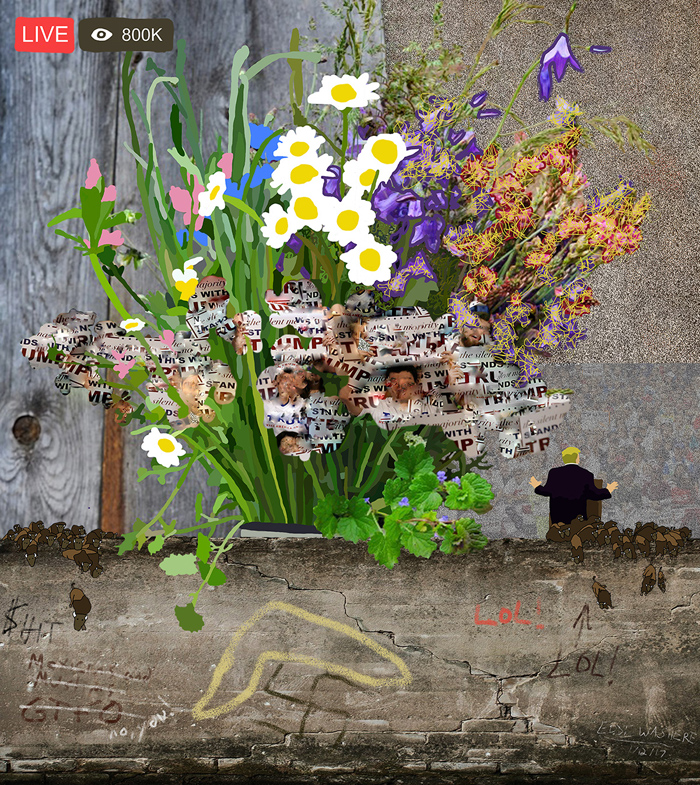
After Flowers for Algernon 13 (wall [with buffalo jump] ), 2017, Courtesy of Gregory Eddi Jones
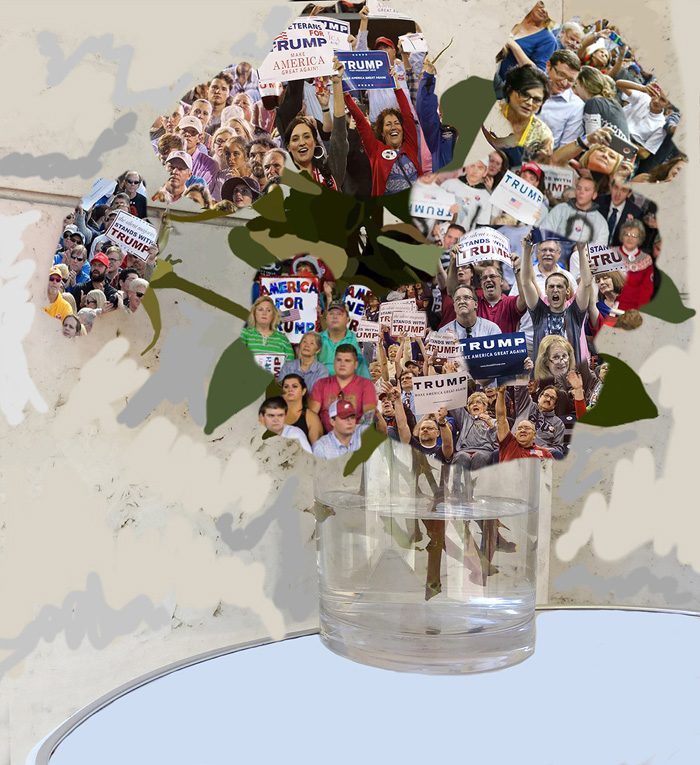
Few things inspire great art quite like political turmoil. Many disaffected voters have sought post-election consolation in the idea that Donald Trump's presidency might create a surge of reactionary work. One such example is the mixed-media art of Gregory Eddi Jones.

The most recent project from the Philadelphia-based artist behind Another Twenty-Six Gas Stations (2014), Flowers for Donald takes inspiration from the classic Daniel Keyes short story, Flowers for Algernon (1959). The story chronicles an experimental surgery that triples the IQ of the story's mentally handicapped protagonist Charlie Gordon. At first the surgery is a success, but over time the effects fade and Gordon returns to his original state, damaged by what he has learned in the process.

After Flowers for Algernon 1 (still life), 2017, Courtesy of Gregory Eddi Jones

Conceptually, the artist's collages of election images and flower still lifes intend to draw parallels between Gordon and marginalized Trump supporters, who Jones anticipates might not be satisfied by the consequences of their votes.

After Flowers for  Algernon 5 (with dead mouse), 2017, Courtesy of Gregory Eddi Jones
“I’m speaking about the sentiments of many Donald Trump voters who feel that politically correct dialogue and economic issues have left them with little social influence, and it takes into account my own prediction that this sense of marginalization felt by a large part of demographic that voted for Trump will ultimately return when he fails to implement meaningful policies that improve their lives,” says Jones in an interview with Humble Arts Foundation.

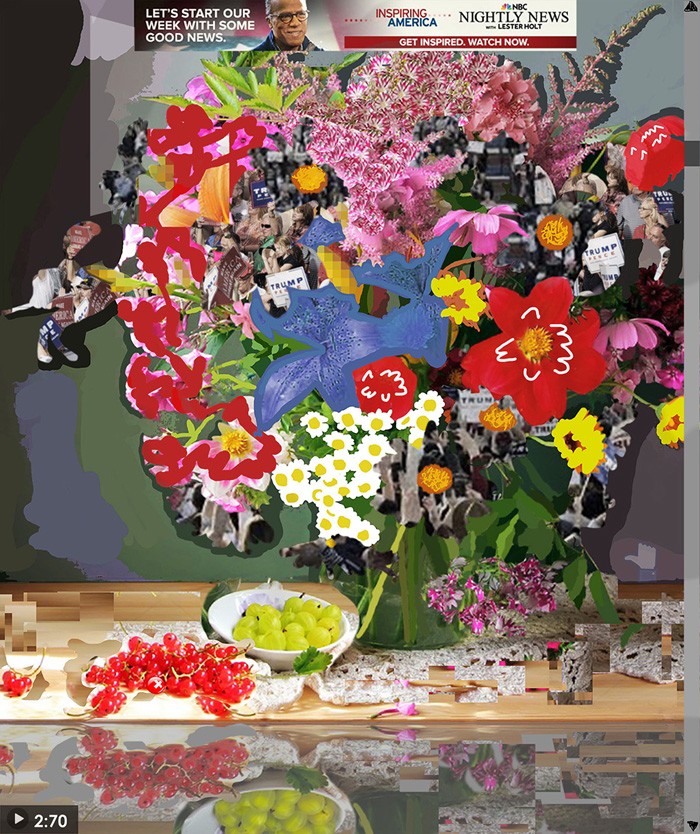
After Flowers for Algernon 10 (270 [Lets Start Our Week With Some Good News]), 2017, Courtesy of Gregory Eddi Jones
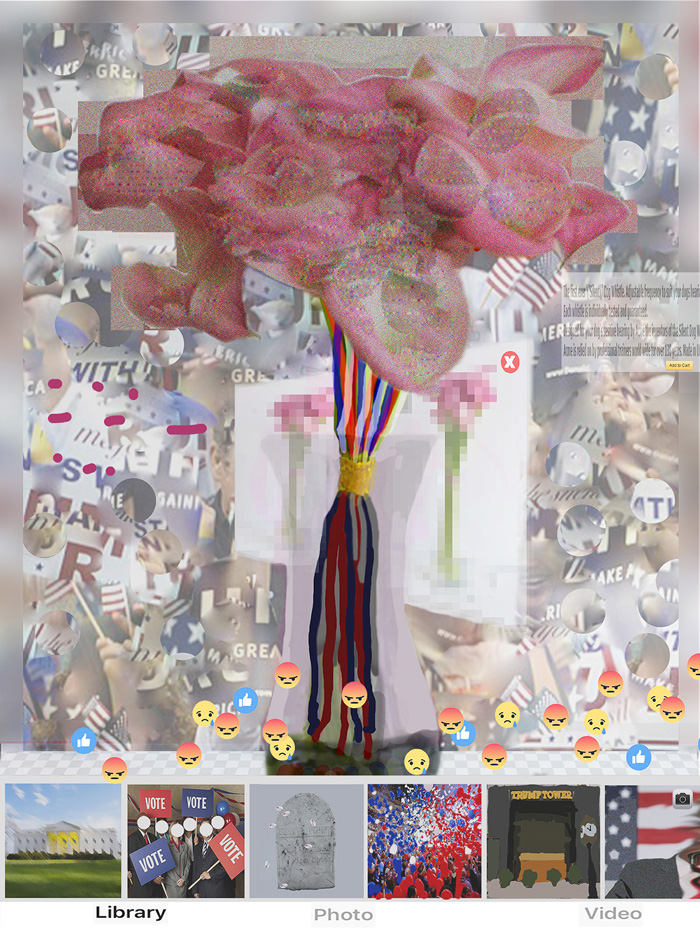
The internet-sourced collage materials range from NBC banner ads featuring debate moderator Lester Holt to pixelated photos of crowds. The election materials are roughly spliced into flower scenes in a combative contrast of pop culture and artistic tropes. The underlying influence of social media appears in the form of Facebook emojis and screen captures of Snapchat, further emphasizing the populist elements of the Trump movement.

After Flowers for Algernon 11 (library [with reactions] ), 2017, Courtesy of Gregory Eddi Jones

“I’m working on fabricating images to act like the interfaces we experienced the election through, and want them to mirror the chaos, complexity, and overwhelming saturation of information that defines our virtual experience,” Jones says. The flowers themselves represent a host of different ideas, drawing not only from the short story, but from traditional artistic significations like beauty, temporality, protest, and memorialization. It's a lot of themes to unpack, adding to the chaotic energy of each piece, but despite the underlying sense of discontent, Jones remains somewhat optimistic.

“This election was not fate and democracy isn’t dead. It just got caught napping.”

After Flowers for Algernon 8 (hashtag [LIVE]), 2017, Courtesy of Gregory Eddi Jones

See more of the Flowers for Donald series at GreogryEddiJones.com

Related:

The Trump Art Dump

100 Days of Artistic Resistance Against Trump Begins Now

LA Artists Source Human Blood for a Massive Anti-Trump Portrait

27 Jan 22:27

How Natalie White Turned Her Criminal Trial into Performance Art

by Kara Weisenstein for The Creators Project

To taunt police, photos of White in "women's equality jail" were posted to Facebook during the investigation. Courtesy Natalie White for Equal Rights

The rules governing civil disobedience are opaque, and New York-based artist Natalie White learned that lesson the hard way. After DC Capitol Police arrested White for writing “ERA NOW” in water-soluble paint on the sidewalk in front of the US Capitol Building, the feminist activist turned due process on its head by transforming her criminal trial proceedings for “defacing public or private property” into performance art advocating for the yet-to-be-passed Equal Rights Amendment (ERA).

“Most people don’t even know that women don’t have equal rights under the law,” White tells The Creators Project. Though the ERA, which would definitively prohibit discrimination on the basis of sex, was passed by Congress in 1972, it failed to be ratified. By the 1982 deadline for state ratification, just 35 states had approved the amendment, three short of the number needed. Since then, the ERA has been reintroduced during every subsequent session of Congress, and though polls indicate that more than 90% of Americans support the amendment, Congress has not once voted on it in the last 30 years.

Natalie White after writing "ERA NOW" on the pavement in front of the US Capitol. Courtesy of Sheila Maria Lobo, from the upcoming documentary NSFW: Not Suitable for Women
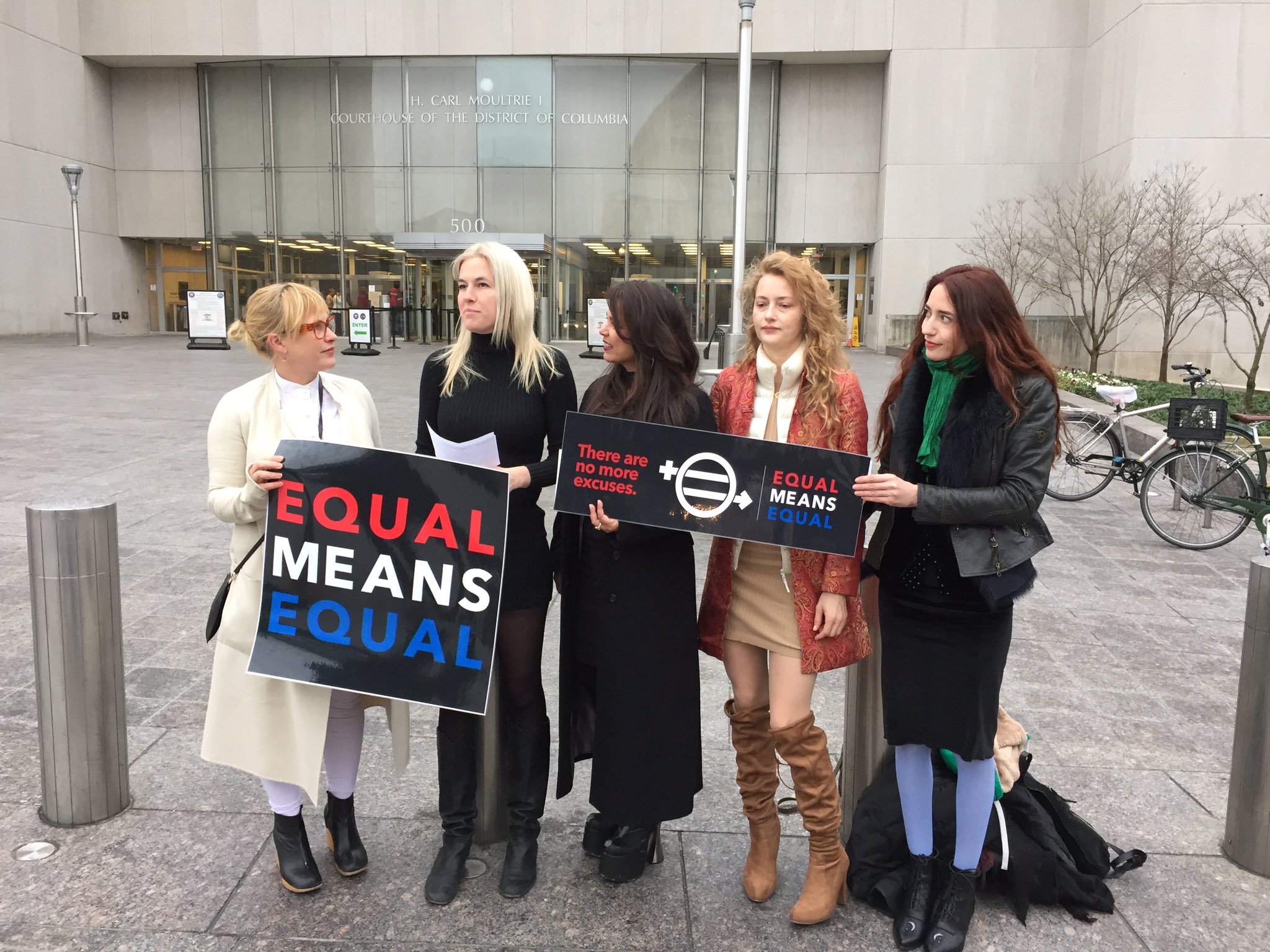
White and her supporters, outside the DC courthouse. (L to R) Patricia Arquette, Academy Award-winning actress; Natalie White; Kamala Lopez, director of seminal Equal Rights Amendment film Equal Means Equal; Sarabeth Stroller, activist who spearheaded the "Free the Nipple" movement and starred in its eponymous film; Lizzy Jagger, activist, model, and daughter of Mick Jagger and Jerry Hall

Fighting for visibility of the ERA is a cornerstone of White’s artistic practice, and in July 2016, she led a 16-day, 250-mile march from New York City to DC to advocate for its long-overdue adoption. The day after, White went to the Capitol and penned her message on the sidewalk, in broad daylight. At first, she got off scot-free. But an article in the New York Post set off a madcap investigation by Capitol Police that culminated in a night in jail for White.

“What shocked me was the exorbitant expenditure of taxpayer money by Capitol Police on this case,” White says. The District flew two officers from Washington to New York to arrest White at her home, but as evidenced by her social media accounts, White never left DC. Police put out a federal warrant for her arrest, and when White turned herself in, she was locked up. The police also submitted evidence for forensic fingerprinting analysis and brought five government witnesses in to testify at her trial.

“Why would they even choose to prosecute this case? They’re taking a prosecutor away from actually going after criminals. They’re going after me, when they could be spending that money on testing rape kits or prosecuting perpetrators of domestic violence. It’s ridiculous,” White says.

Installation shot of Natalie White for Equal Rights exhibition in Chelsea, September 2016
Fortuitously, the trial was scheduled for January 17, just days before Trump’s inauguration and the Women’s March on Washington, so White decided to transform the court proceedings into pro-ERA performance art. Advised by acclaimed DC first amendment attorney Mark Goldstone and legendary New York civil rights attorney Ron Kuby, White represented herself, presenting “a creative defense that confronts the cultural climate that has been pervasive since long before the Equal Rights Amendment’s introduction to Congress in 1923, and which Trump is slated to perpetuate and amplify nearly a century later.” She enlisted friends and fellow pro-ERA activists like model Lizzy Jagger and Academy Award-winner Patricia Arquette to act as character witnesses.

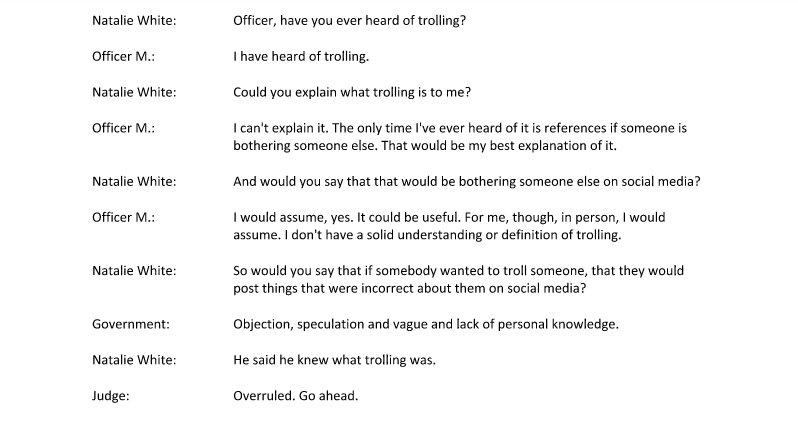
Excerpt of the courtroom transcript from the United States of America v. Natalie White (January 17, 2017)

Goldstone and Kuby warned White that bending the rules of the courtroom by answering the charges of vandalism with political defenses might not work with the judge assigned to her case. “At the beginning [...] he was cutting me off a lot. Midway through, he really came around, and I was able to get my monologue out, and get my message out. I was able to question the police officers and my own witnesses,” White says.

The judge ultimately found White guilty, due to legal precedence from a case in which pro-life protesters were found guilty of vandalism for drawing a chalk mural in front of the White House. But during sentencing, the judge also voiced his support for White’s actions, calling civil disobedience a longstanding American tradition. The court sentenced White to a $50 charitable donation and a six month stay-away from the Capitol, except to meet with lawmakers in an effort to pass the ERA. “That’s not something that’s ever granted to anyone, but I convinced the judge to let me go to the Capitol, pretty much for what I consider to be the reason why you should be going to the Capitol in the first place,” White says.

Lizzy Jagger (L) and Sarabeth Stroller (R) marching with Natalie White at the Women's March on Washington on January 21. Courtesy Natalie White for Equal Rights
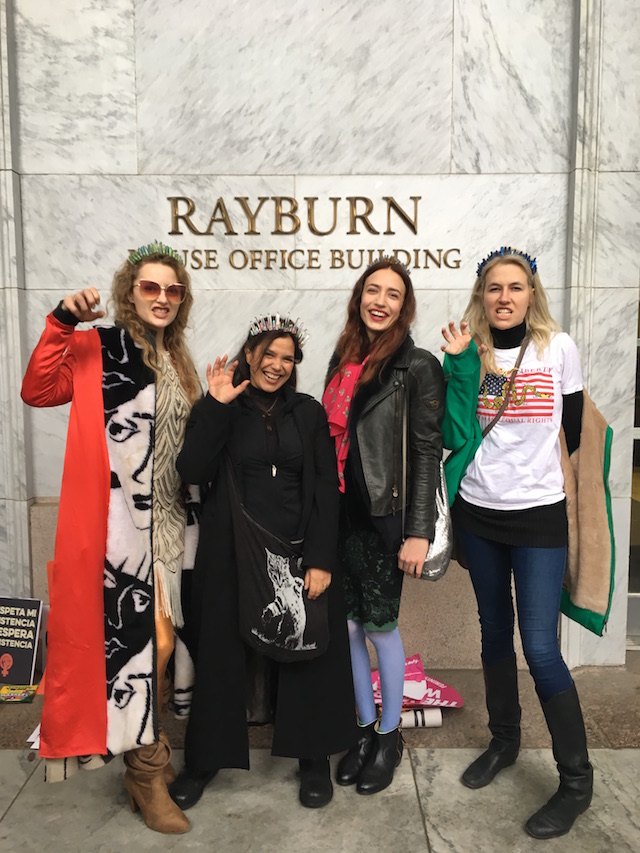
Days after her trial, now a free woman, White rallied at the Women’s March on Washington with Jagger, Arquette, and activists Kamala Lopez and Sarabeth Stroller. I happened upon them, somehow, amongst more than half a million people who’d descended on the National Mall to oppose the Trump administration and demand women's rights. Working the crowd, megaphone in hand, White was magnetic—an ERA crusader sowing seeds of anger and action amongst the men and women she addresed. It was clear the court proceedings hadn't gotten her down. Though "the man" had tried to silence her, it'd take a lot more than a vandalism charge to curtail White's crusade for Equal Rights.

(L to R) Sarabeth Stroller, Kamala Lopez, Lizzy Jagger, and Natalie White. Courtesy Natalie White for Equal Rights 

To learn more about Natalie White for Equal Rights, click here.

Related:

80 Female Artists Rally Against Trump's Sexist, Discriminatory Rhetoric


27 Jan 22:27

$79 FiGO Virtue III now available in Canada

by Igor Bonifacic

7-Eleven, the convenience store of dreams, has added a new Android smartphone to its prepaid SpeakOut wireless service, the FiGO Virtue III.

Priced at $79 outright, the Virtue III features a 4.0-inch 480 x 800 display, 1GHz processor, 1GB of RAM, 8GB of internal storage and 5-megapixel rear-facing camera.

Customers who buy a $50 account voucher will recieve $20 off the smartphone.

Source: 7-Eleven

The post $79 FiGO Virtue III now available in Canada appeared first on MobileSyrup.com.

27 Jan 22:26

Job posting confirms Galaxy S8 will ship with AI-powered personal assistant

by Igor Bonifacic

If the words of one of the company’s executives weren’t enough, a new job posting confirms Samsung will release a digital personal assistant alongside the Galaxy S8.

In the relevant listing, spotted by SamMobile, Samsung says it’s looking for a principal program manager that will “drive the execution and delivery for Samsung upcoming AI (Artificial Intelligence) assistant on Galaxy S8.”

Bixby job listing

That personal assistant, codenamed Bixby, is expected to feature capabilities like image recognition, allowing users, according to one report, the ability to complete visual searches. During its Q4 2016 earnings call earlier this week, Samsung stressed the importance of AI research towards the future growth of the company.

Samsung is expected to unveil the Galaxy S8 on March 29th at a special event in New York City.

Via: SamMobile

The post Job posting confirms Galaxy S8 will ship with AI-powered personal assistant appeared first on MobileSyrup.com.

27 Jan 22:26

Satechi’s USB-C Power Meter aims to prevent bad cables from destroying devices

by Patrick O'Rourke

There’s little doubt that USB-C is the future of connectivity given how versatile and powerful the the still relatively new technology is, providing the ability to charge devices, transfer data and connect displays, all with one cord — at least in theory.

Unfortunately, however, many cable manufacturers haven’t agreed on a universal standard for power output, and some USB-C cables can only be used for one specific purpose, whether that’s charging a device, or working as a way to connect your laptop to an external display.

Some cables draw too much power, or are wired poorly, which can potentially result in fried devices. On a personal level, this leads me to either buying USB-C cables from reliable manufacturers or only using devices with their designated cables.

Until manufacturers catch up with the rapidly expanding USB-C device and accessory market and create some sort of universal standard, Satechi’s new USB-C Power Meter could save your fancy new smartphone or laptop from a voltage overload.

Satechi’s USB-C Power Meter is able to measure voltage, current and current over time, in order to indicate exactly much power is moving between your cables and devices on a tiny display. While we haven’t gone hands-on with the device, if it works as advertised, it could be a game changer for the current USB-C accessory market, which remains a bit of a mess right now.

Satechi is selling its USB-C Power Meter for $29.99 USD (approximately $40 CAD) on the company’s website.

The post Satechi’s USB-C Power Meter aims to prevent bad cables from destroying devices appeared first on MobileSyrup.com.

27 Jan 22:26

"A dependence on the people is, no doubt, the primary control on the government; but experience has..."

“A dependence on the people is, no doubt, the primary control on the government; but experience has taught mankind the necessity of auxiliary precautions. Enlightened statesmen will not always be at the helm.”

-

James Madison

Dead on.

And note that the GOP will move as quickly as possible to unmake all ‘auxiliary precautions’.

27 Jan 22:26

Google Voice is gaining VoIP calling for Android, may eventually replace Hangouts

by Rose Behar

After revealing a redesigned Google Voice app, as well as promising regular updates to said app, Google has now stated that it is “working on VoIP integration” for Android devices.

Further, in a statement to 9to5Google, the company suggested that users may want to begin using the new Google Voice apps for iOS, Android and web in concert with Hangouts.

“Going forward, we’ll provide new updates and features to the Google Voice apps. If you currently use Hangouts for your Google Voice communication, there’s no need to change to the new apps, but you might want to try them out as we continue to bring new improvements,” said the company.

The Google Voice app currently lacks VoIP, making it impossible to make or receive phone calls without Hangouts unless the user sets up call forwarding, but the app is set to become self-sufficient soon, at least on Android. The company told 9to5Google that it is working on VoIP integration for Android, without adding further details.

Meanwhile, in an August interview with Google’s VP of communications Nick Fox, Engadget was told that Hangouts would increasingly focus on entering the “group collaboration enterprise productivity space.” A 9to5Google tipster goes on to indicate that to enter that enterprise space, “heavy encryption” is in the works.

With the sun slowly setting on the consumer version of Hangouts, Canadians may want to begin their search for a similar platform that will suit their needs. Meanwhile, the development of Google Voice as a self-contained app could indicate a renewed dedication to the service and, perhaps, a return to Canada in the future.

Google Voice pushed a major update in October 2015 that included adding an approved carrier list to the app, preventing Canadian users from using the service.

Source: 9to5Google

The post Google Voice is gaining VoIP calling for Android, may eventually replace Hangouts appeared first on MobileSyrup.com.

27 Jan 22:20

Python Code Stepper / Debugger / Tutor for Jupyter Notebooks – nbtutor

by Tony Hirst

Whilst reviewing / scoping* possible programming editor environments for the new level 1 courses, one of the things I was encouraged to look at was Philip Guo’s interactive Python Tutor.

According the the original writeup (Philip J. Guo. Online Python Tutor: Embeddable Web-Based Program Visualization for CS Education. In Proceedings of the ACM Technical Symposium on Computer Science Education (SIGCSE), March 2013), the application has an HTML front end that calls on on a backend debugger: “the Online Python Tutor backend takes the source code of a Python program as input and produces an execution trace as output. The backend executes the input program under supervision of the standard Python debugger module (bdb), which stops execution after every executed line and records the program’s run-time state.”

The current version of the online tutor supports a wider range of languages – Python, Java, JavaScript, TypeScript, Ruby, C, and C++ – which presumably have their own backend interpreter and use a common trace response format?

The tutor itself allows you to step through code snippets a line at a time, displaying a trace of the current variable values.

Another nice feature of the Online Python Tutor, though it was a bit ropey when I first tried it out a few months ago, was the shared session support, that a learner and a tutor see, via a shared link, the same session, with an additional chat box allowing them to chat over the shared experience in realtime.

Whilst the Online Python Tutor allows URLs to saved programs (“tutorials”) to be generated and shared: link to the demo shown in the movie above. The code is actually passed via the URL.

One of the problems with the Online Python Tutor is that requires a network connection so that the code can be passed to the interpreter back end, executed to generate the code trace, and then passed back to the browser. It didn’t take long for folk to start embedding the tutor in an iframe to give a pseudo-traceability experience in the notebook context, but now the Online Python Tutor inspired nbtutor extension makes cell based tracing against the local python kernel possible**.

The nbtutor extension provides cell by cell tracing (when running a cell, all the code in the cell is executed, the trace returned, and then available for visualising. Note that all variables in scope are displayed in the trace, even if they have been set in other cells outside of the nbtutor magic. (I’m not sure if there’s a setting that allows you just to display the variables that are referenced within the cell?)  It is also possible to clear all variables in the global scope via a magic parameter, with a prompt to confirm that you really do want to clear out all those variable values.

I’m not sure that the best way would be to go about framing nbtutor exercises in a Jupyter notebook context, but I note that the notebooks used to support the MPR213 (Programming and Information Technology) course from the Department of Mechanical and Aeronautical Engineering in the Faculty of Engineering, Built Environment and Information Technology at the University of Pretoria now include nbtutor examples.

Footnotes:

* A cynic might say scoping in the sense not seriously considering anything other than the environments that had already been decided on before the course production process had really started… ;-) I also preferred BlockPy over Scratch, for example. My feeling was that if the OU was going to put developer effort in (the original claim was we wouldn’t have to put effort into Scratch, though of course we are because Scratch wasn’t quite right…) we could add more value to the OU and the community by getting involved with BlockPy, rather than a programming environment developed for primary school kids. Looking again at the “friendly” error messages that the BlockPy environment offers, I’m starting to wondering if elements of that could be reused for some IPython notebook magic…

** Again, I’m of the mind that were it 20 years ago, porting the Online Python Tutor to the Jupyter notebook context might have been something we’d have considered doing in the OU…


27 Jan 22:20

Drippy Watercolor Paintings Take on Depression and the Human Mind

by Eva Recinos for The Creators Project

After The Paint Has Dried.jpgImages courtesy of the artist

If we could paint our inner realities, what would they look like? Taking inspiration from surrealism and mass media, Defective Barbie creates drippy watercolor paintings that feel like fragments of a strange dream. Her portraits capture eerie figures, ones that are caught between representational and abstract. Paint drips take over the canvas, making each face seem impermanent.

The Drip Effect, her current solo show on view at SugarMynt Gallery in Pasadena, California, shows a range of her work, from portraits to abstraction. No matter the subject, each piece is the product of “chaotic free flowing paint” and the movement that the medium takes on. 

Burning or Drowning.jpg

Even while they might lure the viewer in with their pops of color and strange movement, a closer look might reveal something unsettling. The portraits seem to be unraveling even while they reveal themselves. Choosing watercolor as her medium, and letting it largely take over the composition through drips, Defective Barbie creates visually enticing pieces that discuss complicated issues like identity and mental health.

“Honesty is an important part of my art, I want it to be raw, visceral, and inspiring,” Defective Barbie, a.k.a., Christina Leta, writes in an email to The Creators Project. “I think it’s important to honor both the beauty and the ugliness life entails because one couldn’t exist without the other, so I couldn't imagine capturing the essence of a person in a portrait without elements that are both unnerving & appealing.”

IMG_3657.JPG

Her work comes from a very personal standpoint; making each piece helps her untangle her own thoughts.

“Having experienced depression myself, I’ve always dealt with it through my art,” writes Leta. “I believe there is a stigma associated with depression that I wanted to confront.  In my journey as an artist, the most important realization I’ve had was finding the beauty and strength from having suffered pain and debilitation.”

Before the Sharks Smell Blood upside.jpg

Her love of watercolors started with a postcard that a friend received in the email. Leta loved it and wanted to make work that looked just as “expressive, wild and captivating.”

Beyond the aesthetic exploration in her pieces, Leta hopes that visitors share in her sense of catharsis. The pieces are a means to start a conversation, or at least a reassurance that visitors not the only ones caught in battles that can oftentimes feel isolating. In each piece, the artist showcases a little part of that struggle to open up the dialogue about mental health even further.

“It’s unnerving to exhibit work that’s so revealing of my personal experience, but I’m not alone with my emotions and the most interesting part is hearing what others see of themselves reflected in each painting,” writes Leta. Her work fully embraces these “uncomfortable emotions,” the inner dialogues that many experience but often hesitate to talk about out loud. In letting the drips take control, Leta reassures viewers that there’s power in embracing the messiness of the human mind.

Letting Go.jpg

To find out more about Defective Barbie’s work, click here. The Drip Effect is on view until January 31 at SugarMynt Gallery

Related:

The Watercolor Mountains of Eleonore Bernicchia

Endangered Animals Bleed Color in Drippy Mixed-Media Portraits

Portrait Series Memorializes Maya Angelou and Other Female Activists

27 Jan 22:20

Microsoft says it has sold thousands of HoloLens AR headsets

by Bradly Shankar

Microsoft revealed today that it has sold thousands of Hololens units since the company released the augmented reality headset last year.

The device is the first self-contained, holographic computer, which enables users to engage with digital content and interact with holograms in the real world.

While intended for businesses and developers, anyone can purchase the current developer version of the headset, which retails for $4000 CAD. Microsoft is set to release the consumer version of HoloLens at some point in the next couple of years, though a specific release date has not been revealed.

Microsoft is fine with these sales numbers, according to HoloLens commercial lead Roger Walkden. “We’re not trying to sell hundreds of thousands or millions or anything, it’s expensive, and it’s not in huge numbers,” he told The Inquirer. “I can’t tell you anything about the numbers, but it’s in thousands, not hundreds of thousands, and that’s fine. That’s all we need.”

Walkden acknowledged that over time, prices can do down as materials and production costs decrease, but for now, it’s still early on. “I don’t know how far into the VR lifecycle we are,” he said. “Maybe two or three years from the very start of VR, so it does take years to get to that kind of position.” The HoloLens itself was announced back in 2015.

He stressed that this is only the first iteration of the device and that Microsoft is continuing to work on future versions.

Source: The Inquirer

The post Microsoft says it has sold thousands of HoloLens AR headsets appeared first on MobileSyrup.com.

27 Jan 22:20

David Pogue T-Mobile digits review

T-Mobile digits frees your phone number from your phone

T-Mobile, man. That company (TMUS) is just determined to mess with the traditional cellphone-carrier model.

This is the company that eliminated the two-year contract. That lets you stream all the music and video you want, without counting it against your data allotment. That eliminated international roaming charges.

And now, the company wants to give you another phone number.

It’s called T-Mobile Digits, a new service, currently in free beta testing for T-Mobile customers. The central idea is that Digits breaks the one-to-one bond between your phone number and your phone.

In so doing, Digits introduces all kinds of new flexibility—and complexity—into your digital life. They fall into one of two categories, which I’ll call “One to many” or “Many to one.”

When you sign up for the program, you can choose one of those categories, or both of them. (Told you this was going to involve some complexity!)

One to many

When you sign up for this option, your one T-Mobile number rings all your phones—even phones from Verizon (VZ), Sprint (S), or AT&T (T), and even WiFi-only devices like tablets! The idea is that you can now take and make calls, and send or receive messages, from whichever phone you have with you.

(If you’re hoping to include a non-smartphone in your arsenal, T-Mobile will send you an SIM card for it. Which means you’ll have to replace the phone’s existing SIM card. Which means it will have only onephone number. Which means you won’t be able to use the “many to one” feature described below. Did I mention that this all gets a little complex?)

When someone dials your one T-Mobile number, all of your associated gadgets ring at once. When you pick up one to answer it (or decline it), all the other devices stop ringing.

All your phones ring simultaneously—even non-T-Mobile ones.

So why is this useful? Well, if you race out of the house and forget your phone, no problem! You can borrow a phone, or you can use the Digits website. You can still get your calls and texts.

Or maybe you want to take a cheap ratty old feature phone with you running or rowing, instead of carrying your precious $700 smartphone. No sweat; now that ratty old feature phone can get (and send) your calls and texts.

Heck, you could now treat cellphones like multiple extensions of a landline. You can keep one phone up by your bed, and another downstairs; pick up whichever one is handiest when someone calls or texts.

What’s cool is that you can access your calls, texts, and voicemail from any device. From a watch. From a WiFi tablet. From any computer, tablet, or phone in the world, via the Digits website.

Suddenly, any browser on earth is a cellphone you can use.

Many to one

The other Digits option is the reverse: That is, you can also get a second phone number for your one phone. You can give out Phone Number A to your personal contacts, and reserve Phone Number B for business use.

When people call your one phone, you’ll see on the screen whether they’ve called Number A or Number B, so you’ll know which voice to use when you answer it. (You wouldn’t want to pick up and say, “Hey there, sugar lips” when it’s your boss, now, would you?)

And what about placing a call? How do you choose which “line” to use?

Here’s where things start getting complicated. If you have a recent Samsung model (Galaxy S6 or S7 family, or Note 5), the dialer app includes a handy pop-up button that lets you choose the outgoing line.

Recent Samsung phones have multiple-line options built right in.

If you have any other phone, you have to use the T-Mobile Digits app to place your calls and send your texts. It, too, offers a pop-up switch that lets you choose the line.

On non-Samsung phones, the Digits app asks which number you want to use for dialing.

How is this not Google Voice?

Now. If you think all this sounds like Google Voice, you’re right. Google (GOOG, GOOGL) Voice also gives you a virtual number that also rings all your phones at once. And also lets you place calls from that virtual number from any device. And Google Voice is free, which T-Mobile Digits won’t be after the beta period. (T-Mobile hasn’t said what the monthly cost will be.)

Google Voice also offers a bunch of other cool features. You can specify which phones ring at which hours of the day (“Don’t ring this phone after 6 p.m.”, for example). You can record a different voicemail greeting for each caller in your Address Book. You can transfer a call from one phone to another in mid-call. You get written transcriptions of your voicemail, which is not always perfect but is always useful. (This feature seems to be available in the Digits app, but I couldn’t figure out how to turn it on.)

T-Mobile argues that Digits is better than Google Voice. For starters, you can keep using your existing T-Mo phone number. (Of course, you can always port your existing phone number to Google Voice, too.)

Moreover, you get “high-definition voice” (the enhanced audio quality available when you’re calling another T-Mo customer) using Digits. It’s a “real, carrier-grade call,” a rep told me; it’s not being routed through some Google computer.

On the other hand, just last week, Google Voice received its first big upgrade in five years, along with a promise from Google that its chronic neglect of Voice is over. (Funny about that timing, eh? Five years without a peep—then T-Mobile unveils Digits, and BOOM!)

The iPhone conundrum

It’s pretty cool that your one T-Mobile number can somehow ring non-T-Mobile phones.

If you have an iPhone, however, there’s a footnote concerning iMessages. (That’s Apple’s (AAPL) proprietary enhanced texting service, filled with additional features: no length limit; a “the other person is currently typing” indicator; “message read” indicators; synchronized texts across all your Apple products; easy file transfers; and so on.)

Most reviewers are reporting that you have to give up iMessages entirely—turn it off—in order to use Digits. Indeed, that’s what I said in my video, above.

The answer is actually more nuanced. Your iMessages still work—it’s just that they won’t show up on your other Digits devices. If you go for a run with your cruddy 2007 Samsung, you’ll miss any text messages people send to your iPhone, and messages you send from Messages on that iPhone won’t appear on any of your other Digits devices.

You have to turn off iMessages only if you want all your incoming text messages to appear in the Digits app, on all your devices.

Told you this was complicated.

The impossibility of a conclusion

So how do you review T-Mobile digits? It’s really tough, because we don’t yet know what it will cost.

And, of course, everybody’s different. Your life may be complicated enough that you’d welcome the Digits decoupling of phone number and phone. Or you may crave simplicity and wonder why anyone would want or need the Digits kind of flexibility.

For now, here’s what we can say: There are some small bugs; for example, if you reject an incoming call, it goes into your phone’s regular voicemail app—but if you let it ring through to voicemail, it goes to the Digits app’s voicemail. And, of course, that iPhone iMessages business is a drag.

Still, even in its free beta-test period, Digits does what it says it will do. If you’re a T-Mo customer who faces the Digits use cases (you want two lines; you want multiple phones with the same number), you’ll be pleased.

If you’re anyone else, there’s always Google Voice.

David Pogue, tech columnist for Yahoo Finance, welcomes non-toxic comments in the Comments below. On the Web, he’s davidpogue.com. On Twitter, he’s @pogue. On email, he’s poguester@yahoo.com. You can read all his articles here, or you can sign up to get his columns by email.