
Rolandt
Shared posts
27 Jan 23:42
Another "I'm Successful Because I Was Lucky" Admission
by Eugene Wallingford
This one from essayist and cartoonist Tim Kreider, in an AdviceToWriters interview:
What's your advice to new writers?
I first have to say that whatever moderate success I may have achieved has been so much a result of dumb luck that I feel fraudulent presuming to offer any advice to young writers, as if I did any of this on purpose or according to plan.
I appreciate humble advice.
The advice Kreider goes on to give aspiring writers is mostly obvious, as he says up front that it will be, but he also shares a quote from Thoreau that I like:
Read the best books first, or you may not have a chance to read them at all.
As someone who most days runs out of time to read as much computer science as I want, I value this reminder.
27 Jan 23:42
The surprising effectiveness of Trump’s whitehouse.gov
by Josh Bernoff
When a U.S. administration changes, so does the president’s website. Under Trump, the new whitehouse.gov addresses six issues, each with a short, simple, direct block of text. Unlike the president, it’s focused, clear, and effective. My social feeds were full of protests when the pages for LGBT rights and climate change disappeared from whitehouse.gov. Were you really … Continued
The post The surprising effectiveness of Trump’s whitehouse.gov appeared first on without bullshit.
27 Jan 23:42
Microsoft Cloud Deutschland
by Volker Weber
Mit der Microsoft Cloud Deutschland werden Kundendaten ausschließlich in Deutschland gespeichert. Die Kontrolle und Entscheidungsgewalt über die Daten obliegt den Kunden selbst. Die Tochtergesellschaft der Deutschen Telekom T-Systems - der Datentreuhänder - agiert unter deutschem Recht und überwacht den Zugriff auf die Kundendaten.
Als hätten sie es geahnt. Der neue amerikanische Präsident zerstört das Vertrauen in atemberaubendem Tempo. Da wird sich für manches Unternehmen 25% Aufpreis auf einmal doch rechnen.
27 Jan 23:42
Biking on Your Brain
by Thea Adler
Cycling does more than strengthening muscles and increase endurance- it also has an impressive list of benefits for your brain. The clarity and focus you’re feeling after you bike to work is no coincidence- there’s real science behind it. Recent studies have shown commuting by bike has positive effects on your memory, concentration, relaxation and thought clarity.
Making Connections As it turns out, the blood going to your muscles while you pedal, also goes to your brain. During this process, oxygen and nutrients go with it supplying one nutrient dense protein, in particular, Brain-derived neurotrophic factor (BDNF). This protein is highly beneficial for the white matter in your brain. As the 'subway of the brain', white matter makes deepens neural pathways and makes connections. Building up your white matter means you will be able to experience deeper concentrate, more relaxation, better clarity of thought, and stronger problem-solving skills. BDNF is also a wonderful help for things like combating neurodegenerative diseases such as Parkinson's.
Boost your Productivity One of the more impressive statistics we’ve seen about biking to work are the results from a productivity study. It was shown the cycling increases one’s ability to concentrate by 15 percent, with 28 percent fewer task errors- which can be an absolute game changer. Not to mention that they are 15 percent fewer days off than non-cyclers.
The Power of Memory- Memories have always lived in the realm of mystery for scientists. But one thing they are finding out now is that aerobic exercises, such as cycling, makes your hippocampus grow! As the hippocampus is the control center of your memories- this is great! Studies have shown that short sessions of cycling can boost your ability to recall short term memories up to 40 percent!
Ability to Multitask Riding your bike through bustling city streets requires you to make multiple decisions quickly- this in combination with utilizing your cerebellum for balance add up to fantastic brain exercise by the time you reach your destination. Research has shown a link between physical fitness and increased ability to multitask successfully.
The takeaway: Riding your bike doesn't just reduce your waistline, it also kicks your brain into high gear.
27 Jan 23:42


Message Received — Loud and Clear
mkalus
shared this story
from  Rolandt shared items on The Old Reader (RSS). Rolandt shared items on The Old Reader (RSS).
|
A recent PSA by Alberta Transportation delivers a loud and clear message.
Motorists — here are a bunch of sure-fire excuses to keep in mind when you mow down a pedestrian in a crosswalk. Yep — keep on grinning. Thumbs up, baby, you’re golden.
Peds — it’s always your fault. And you’re not safe anywhere.

After much outrage, Alberta Transportation pulled the message. But it’s hard to understand how peds are singled out like this, when the facts of the matter are quite clear as to what the source of the danger is.
According to the City of Vancouver’s 2012 Pedestrian Safety Study:
The vast majority of collisions at intersections involved drivers failing to yield to pedestrians when pedestrians had the right-of-way. ƒ
One quarter of all pedestrian collisions took place at mid-block locations, where the pedestrian was either crossing the street at a mid-block crosswalk or a location without a traffic control, crossing a driveway or laneway, or was struck at the sidewalk or at a bus stop. ƒ
The top five pedestrian collision types listed below accounted for approximately two-thirds of all pedestrian collisions:
- Vehicle turns left while pedestrian crosses with right-of-way at signalized intersection (25.6% of known collision types)
- Vehicle turns right while pedestrian crosses with right-of-way at signalized intersection (17.1%)
- Pedestrian hit while crossing mid-block without a traffic control, or jaywalking (11.5%)
- Vehicle proceeds straight through while pedestrian crosses at stop sign or crosswalk (6.9%)
- Pedestrian hit while crossing driveway or laneway (6.5%).
27 Jan 23:41
The Stolen Bicycle Recovery Operation
by James Schwartz

Craigslist ad for Dylan’s stolen Trek hybrid bicycle
It all started with an instant message from my friend Dylan, who had recently had his bike stolen from downtown Toronto:
“James, look at this. It’s my bike for sale on Craigslist. What should I do?”
Dylan knew that I had a bike blog, and I had dealt with stolen bikes several times before.
The cautious side of my brain told me that he should report it to the police and have them setup a recovery operation to get his bike back. The realistic side of my brain told me that the police aren’t going to do jack shit to help him get his bike back, because they have more important things to worry about (like directing traffic at construction sites).
So I told him he should report it to the Toronto Police first and see if they will do anything about it. If nothing comes out of that, I told him, I would setup a recovery operation to get his bike back.
After about a week passed, and after dozens of follow-up phone calls to see if anything was happening, Dylan grew extremely frustrated that nothing had been done yet. Even after all that time had passed, the police told him that the officer in the plainclothes division who was assigned to the case was away at a conference and wouldn’t be back for a couple days.
Fortunately, the ad was still online, but it appeared that the police weren’t interested in dedicating any resources to helping us get the bike back. Each day that passed increased the chances of the Craigslist ad disappearing.
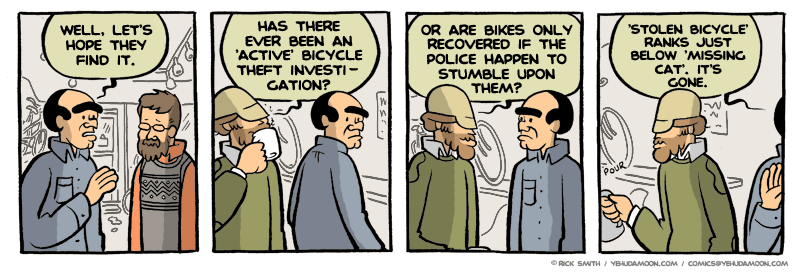
This brilliant comic, coincidentally, was posted on the same morning this article went live. Courtesy of Kickstand Comics
Against Dylan’s better wishes, I told him that I would put a plan together so that we could safely recover the bike ourselves. I wasn’t going to take any chances after an 18-year-old was killed after using Apple’s Find My iPhone software to trace his lost cell phone. I thought through all the possible scenarios about what could go wrong, and I attempted to mitigate each of those risks through careful planning. There was no way I was going to get shivved or shot over a $700 bike.
So I created a fake email address and sent a message to the seller, asking him if we could meet so I could look at the bike. I also tried to get the seller to give me his phone number so that if the ad went down I would at least have a chance to identify him.
Fortunately, the seller responded quickly and I set up a meeting point in downtown Toronto in a well-lit parking lot in a busy area on King Street West.
To ensure the safety of myself and others, I recruited two friends to stand across the street from the meeting point to video record the event, and I also gave them each U-Locks to defend ourselves if the recovery operation goes sideways.
I equipped myself with bear spray, and Dylan and I agreed that if at any point we feel our safety is threatened, we would get away as quickly as possible and our two friends across the street would call the police.
The plan was for Dylan to act as the prospective buyer and take the bike for a test ride, while I would stay with the seller and make small talk. Dylan was to ride the bike around the block and check the serial number to confirm the bike is indeed his. He would then call me to let me know the serial number matches and I would confront the seller about the origins of the bicycle. If the serial number did not match, he would return the bike and say he is not interested.
But he was confident from looking at the photos that it was indeed his bike. Checking the serial number was just a formality.
I received an email from the seller, letting me know that he had arrived early, and that he was parked in his car with the bike on his rear rack. This was great news, because it gave Dylan and I an opportunity to record his license plate and do a quick walk-by to see if the bike appeared to be his at first glance.
So after a quick walk-by, Dylan was even more convinced that the bike was indeed his.
We gave the signal to our friends across the street to start rolling their video cameras. We were quite anxious at the time because we didn’t know whether we would encounter a gangster or a hipster, or anything else in between.
I double and triple checked that my bear spray was easily accessible in my pocket. Our hearts were pounding as we approached the seller’s driver’s side door. We tapped on the car window, and the seller opened the door and stepped out.
Expecting an intimidating gangster to step out of the car with a thick coat and three guns stuffed in his baggy pants, we were overcome with relief when out stepped a middle-aged lady who was neither intimidating nor threatening, and was actually very cordial and friendly.
She told us she had driven from her sleepy, family-oriented commuter town (Burlington) and that it was her boyfriend’s bike that she was selling for him.
Dylan asked if he could take the bike for a test ride, to which she complied. I made small talk with her and inquired about the bike while Dylan was out for the test ride. I told her that Dylan was looking for another hybrid bike because his was stolen recently.
At first she was very empathetic about his bike being stolen. But she probably started to become nervous when Dylan was taking a bit too long on the test ride, and especially after I told her that the bike that was stolen from Dylan was awfully similar to the bike she was selling.
Then I received the phone call from Dylan. He confirmed that the serial numbers matched.
I then explained to her that she was in possession of Dylan’s stolen bike, and that we would be willing to go to the police station to take this up with the police if she would like to.
She became visibly upset (but not towards us). She told us she had bought it from a guy she thought she could trust, and she was clearly unhappy about the prospect of being out the $200 that she paid for the bike.
I expected her to cut her losses and hop in her car and drive back to Burlington. But she expressed interest in coming to the police station with us so she could report her supplier and perhaps get her $200 back. So we told her we would bike to the police station and meet her there.
15 minutes later, we showed up at the police station. Convinced that she thought better of the idea and hightailed it back to Burlington, we were pleasantly surprised when she walked through the door a few minutes later.
The officer who was in charge of Dylan’s case took us aside and verbally berated us with some choice curse words about how idiotic it was for us to “take the law into our own hands” without letting the police do their jobs. “You could have gotten yourself shot”.
Our response (paraphrased): Well, when the fuck were you going to do something about it? We gave you a week and absolutely nothing happened.
The officer was clearly unhappy with what we did, but I really didn’t give two shits. I knew that we thought it out thoroughly and minimized the risk of something happening to us.
So there it is. Another happy ending to yet another bike theft.
If anyone else has any other stories about recovering a stolen bike, please email me at james.schwartz@theurbancountry.com to have yours featured on The Urban Country.
James D. Schwartz is the Editor of The Urban Country and is based in Toronto, Canada. You can contact James at james.schwartz@theurbancountry.com or follow him on Twitter.

More Articles Like This:
27 Jan 23:41
AT&T Is Waking Up To International Roaming
by Jeb Brilliant
 I just read that AT&T is coming out with a new international roaming plan tomorrow. On the surface this seems to be a positive move.
Keep in mind I don’t know any details about this yet but it’s supposedly $10/day to use your regular bucket of data/text/voice. Meaning if you have unlimited voice and text with 10gb of data you can act as normal when abroad if you’re paying the $10/day fee plus it will be at 4G speeds. This seems like a good deal for short trips and lay overs or for heavy data users. Don’t forget that you already get free calls and text (I think), though I’m not sure about the data in Canada and Mexico.
For folks who don’t use much data the AT&T Passport roaming plan may be a better bet.
As a whole this is a step in the right direction but I’m not sure it’s a big enough step for regular international travelers. T-Mobile and Sprint both offer free roaming at 2G and 3G speeds which is OK. I know AT&T is out of T-Mobile and Sprint’s league but I would have liked to see a more competitive plan or additional offers like $40-$50/month.
Keep up the good work AT&T, you’re doing the right things to keep me as a customer, just keep moving in this direction.
27 Jan 23:41
Recommended on Medium: The Guy Who Finds the Source for All Your Favorite Stolen Memes

Our latest Internet Hero, @KaleSalad, makes sure meme creators get credit for their work (as opposed to thieves like The Fat Jew)
27 Jan 23:41


The Order and Intensity of Techno-SciFi Geometry
by Zee Jenkins
In his 90’s Techno dream world, school teacher Tom Knowles creates sci-fi scenes from the urban-industrial structure in his favorite cities around the world. As a child, he organized his toys in lines, a self-described higher spectrum perfectionist. As an adult, he’s come to appreciate “the geometry and design of modern buildings.” It’s a natural evolution.
Tom got hooked on photography a few years ago after he saw a friend photographing star trails in the Tatacoa Desert in Colombia.
“I was fascinated by the technology and intricacies behind modern DSLRs and had never realized their creative potential alongside modern software. Special moments and beauty could be recorded and transformed into something lasting and personal. Since that moment I’ve never looked back.”
Lighting and geometry are to Tom’s eyes and brain what techno synth beats are to his heart, an internal and frenetic metronome of shutter clicks. Often he links to a techno recording on Youtube in a photo’s description to bridge the gap between what he’s hearing and what his followers are seeing. The techno influence comes through in his industrial photography in the deep and rich shadows that accompany the strong, geometric lines of the building elements he shoots.
(Play this song as you read the rest of the article.)


![Technetium Swirl [explored]](https://farm6.staticflickr.com/5737/30157815872_c44080c38c_b.jpg)

Tom lives in rural Buckinghamshire, UK, just outside of London, where he was born and spent many years of his life. When he ventures into the city it is his urban playground. He often listens to techno music while shooting and editing, letting the strength of the beats and rhythm echo into his photographs.
“The ever changing (as well as historic and hidden) cityscape provides a canvas of opportunities for the photography effects I am trying to achieve, as do a large number of modern art galleries and museums. London often appears to be a mecca for diverse characters, oddities, and general miscellany … the perfect background for any photographer!
“On a more visceral level, it’s fair to say that the industrial aspect of London has a strong connection with the drum-and-bass and techno music that I listened to when I was growing up. London definitely acts as a conduit that aids me to recreate and reminisce on a significant part of my life in the ‘90s and heavily influences my style of photography.”


In his meticulously organized way, Tom shows up with a plan. He researches locations he’d want to shoot and understands the timing and conditions that will be at play ahead of time.
“I thoroughly research locations so that I can compose different ideas for photos before I arrive. I like to have a few options [for shots] because in reality being in the situation can feel quite different than generating ideas behind a computer screen. If I don’t have a strong idea or concept I normally just end up wandering around a place or changing my mind so many times that I wouldn’t necessarily come out with anything rewarding.”
![Simulated Underwater Staircase and Socket Trio [explored]](https://farm2.staticflickr.com/1550/24380749430_9d1d4a922d_b.jpg)
![Fluorescing Sphere [explored]](https://farm2.staticflickr.com/1495/25769942913_a01b281448_b.jpg)
This year Tom plans to return to Colombia to camp for an extended period and explore desert-scene light photography with his own techno flare. He’s also launching a weekly photography club for his students to collaborate and collect enough work to present a gallery opening by the end of the 2017 academic year.
To follow Tom Knowles and his photography check out his Flickr Photostream or reach out to invite him for collaborations. You can also find him in the Critique Portfolio Pro Group on Flickr (if you think you have tough enough skin).
27 Jan 23:41
@BenedictEvans
@BenedictEvans:
Talking to big companies about tech this year, machine learning is really the only topic.
— Benedict Evans (@BenedictEvans) January 26, 2017
27 Jan 23:40
Pressed duck is as much a performance as a culinary experience, and at Gaddi’s you can take part as well as partaking
by Bernice Chan
If you’re the kind of diner who likes to get hands-on at the restaurant table and enjoys a food experience that’s as much visual as visceral, you’d doubtless get a kick from ordering pressed duck at Gaddi’s.
The classic French dish, available at the restaurant in The Peninsula Hong Kong until the end of March, was created in the 19th century by Parisian restaurant La Tour d’Argent. Gaddi’s chef Xavier Boyer has updated the dish by serving it in three...
27 Jan 23:38
Firefox Focus Now Available in 27 Languages
by Nick Nguyen
International Data Privacy Day is right around the corner and to mark the event we’re happy to announce that Firefox Focus, the privacy browser, is now available for iOS in 27 languages covering billions of users around the world. Mozilla’s community teams hustled to localize all these language versions in time to hit an aggressive launch timetable and we are so grateful for their help. This means that a huge chunk of the world’s population can use Firefox Focus in their language to browse privately, leaving no trace and keeping their thoughts and online activities confidential.
Today’s version launch of Firefox Focus is part of our ongoing drive to give users more control over their web experiences. After we launched Firefox Focus, we saw there was a huge appetite for private web browsing that allows users to erase their web history with a single tap. After serving up many millions of searches on Firefox Focus, we wanted to give users the choice to use it in their native language.
For Mozilla, which has always prioritized inclusiveness and community value, this was a no-brainer. So if you want to browse privately in Arabic, Azerbaijani, Czech, Welsh, German, English (United States), Esperanto, Spanish from Chile, Spanish from Spain, French, Hungarian, Indonesian, Italian, Japanese, Kabyle, Dutch, Polish, Portuguese (Brazil), Russian, Songhay, Slovak, Slovenian, Swedish, Turkish, Ukrainian, Simplified Chinese and Traditional Chinese, among other tongues, we’ve got you covered. We’re not done, either. We will continue to work with our community to add new languages to the app.
We’re all about giving our users the choice to change the default settings on Mozilla products and customize their browsing experience. That’s why we have also added the option for Firefox Focus users to change their default search provider. This is similar to the experience on Firefox for iOS and Firefox on Windows or Mac desktops and laptops.
We know from copious user research and constant community feedback that being able to browse the web without stressing about being tracked or served unwanted ads is a big deal. It’s why many of them chose Firefox Focus in the first place. It’s why we built Firefox Focus. And for International Data Privacy Day, we’re particularly proud to extend always-on privacy and the beauty of the really big “Erase Button” (see the upper right corner screen on Firefox Focus) to many more people around the world.
We will continue to listen to our users to see what matters most to them and add new features that will give them the most secure web experience.
You can download Firefox Focus from the App Store.
The post Firefox Focus Now Available in 27 Languages appeared first on The Mozilla Blog.
27 Jan 23:38
How True Advertising Can Save Journalism From Drowning in a Sea of Content
by Doc Searls

Journalism is in a world of hurt because it has been marginalized by a new business model that requires maximizing “content” instead. That model is called adtech.
We can see adtech’s effects in The New York Times’ In New Jersey, Only a Few Media Watchdogs Are Left, by David Chen. His prime example is the Newark Star-Ledger, “which almost halved its newsroom eight years ago,” and “has mutated into a digital media company requiring most reporters to reach an ever-increasing quota of page views as part of their compensation.”
That quota is to attract adtech placements.
While adtech is called advertising and looks like advertising, it’s actually a breed of direct marketing, which is a cousin of spam and descended from what we still call junk mail.
Like junk mail, adtech is driven by data, intrusively personal, looking for success in tiny-percentage responses, and oblivious to harms it causes, which include wanton and unwelcome surveillance, annoying the shit out of people and filling the world with crap.
But adtech is far worse, because it also funds hyper-partisan news flows, including vast rivers of fake news, much of it from pop-up publishers that are as fake as the clickbait they maxiize. Without adtech, fake news would be marginalized to the digital equivalent of supermarket tabloids.
Here’s one way to tell the difference between real advertising and adtech:
- Real advertising wants to be in a publication because it values the publication’s journalism and readership.
- Adtech wants to push ads at readers anywhere it can find them.
Here’s one way to tell the difference between journalism and content:
- Journalism has ethics.
- Content has volume.
Another:
- Journalism is supported by advertising and subscriptions.
- Content is supported by adtech.
Companies advertising in the old publishing world were flattered to appear in publications like the Star-Ledger. They were also considered sponsors of those publications.
Companies advertising in the new publishing world are drunk on digital and want to maximize the “big data” they acquire. And there are thousands of bartenders to help with that.
As I wrote in Separating Advertising’s Wheat and Chaff, in the new publishing world “Madison Avenue fell asleep, direct response marketing ate its brain, and it woke up as an alien replica of itself.”
That’s also why, to operate in publishing’s new alien-built economy, journalists need to meet that “ever-increasing quota of page views.” Better to “generate content” than to do the best journalism we can, the proposition goes. It’s still a losing one.
See, adtech doesn’t care about journalism, because its economy incentives maximizing the sum of content in the world, so it has as many places as possible to chase followed eyeballs with ads. Case in point, from @WaltMossberg:
About a week after our launch, I was seated at a dinner next to a major advertising executive. He complimented me on our new site’s quality and on that of a predecessor site we had created and run, AllThingsD.com. I asked him if that meant he’d be placing ads on our fledgling site. He said yes, he’d do that for a little while. And then, after the cookies he placed on Recode helped him to track our desirable audience around the web, his agency would begin removing the ads and placing them on cheaper sites our readers also happened to visit. In other words, our quality journalism was, to him, nothing more than a lead generator for target-rich readers, and would ultimately benefit sites that might care less about quality.
If Recode insisted on real ads, rather than coming to depend on surveillance-based adtech, its advertisers would have valued the publication, and not just the eyeballs of its readers, wherever it could find them.
Walt concludes,
It’s no easy task to either make money online as a publisher or to advertise your product in a world where attention is so fleeting and divided. But the current system of ad-supported web content isn’t working for readers and viewers. It needs to be reset.
The ad business is too brain-snatched to do that reset alone. It needs help from readers and brave publishers willing to stop participating in the adtech game.
As I explain in How customers can debug business with one line of code (hashtag: #NoStalking), each of us can come to publishers with a simple term that says “Just show me ads not based on tracking me.” In other words, “Give us real advertising. We can live with that.”
#NoStalking is not only in the works at Customer Commons, but saying yes to it will be an ideal move by companies wishing to obey the General Data Protection Regulation (aka GDPR), which will start punishing stalking severely, starting in 2018.
While the GDPR will blow up adtech as we’ve known it, #NoStalking will save real advertising, and the best of ad-supported publishing along with it, because it will bring economic incentives back into alignment with journalism. We had that in the old ad-and-subscription supported world of offline journalism, and we can get it back in the new world of online journalism. As I explain in Why #NoStalking is a good deal for publishers,
Individuals issuing the offer get guilt-free use of the goods they come to the publisher for, and the publisher gets to stay in business — and improve that business by running advertising that is actually valued by its recipients.
So, if you want to save journalism, the best of publishing and civil discourse that depends on both, bring back real advertising and cure the cancer of adtech.
For more help with that, go back and read Don Marti’s Targeting failure: legit sites lose, intermediaries win. You might also visit the Adblock War Series at my blog.
Two bonus links:
- Don Marti‘s What The Verge can do to help save web advertising
- Ethan Zuckerman’s It’s Journalism’s Job to Save Civics.
…
The original version of this post was published in Medium on 23 January 2017. This is an experiment in publishing first in Medium and second here. We’ll see how it goes.
Save
27 Jan 23:35
UX Stories: A year of doing something different
by Tiffanie Shakespeare
This is the first of in a series of personal posts from members of the Connected Devices UX team. If you want to follow Tiffanie directly, she’s on twitter as @lime124.
2016 was an interesting year. I started last January as an Interaction Designer for a mobile platform and ended December having grown and developed skills I hadn’t used in a number of years. One of those skills was remembering how to be a researcher.

I used to do research for medical devices, testing how fast medics could administer shocks using AEDs or learning about the difficulties of carrying medical equipment into combat. It was totally fascinating. But since I became an expert in mobile interaction design, I hadn’t really used my research skills all that much. This year I began to dust them off and try it out again.
“Project Magnet” was the first project I exercised these skills on and, looking back, I see places where I succeeded and failed. I think our initial research went really well and we gained some good insights. The London experiments went less well and we didn’t learn nearly as much. I think there were many factors that resulted in less than insightful insights. Some of it was time and doing too many experiments at once, making it hard to isolate feedback. Some of it involved a high barrier for participation and low motivation to overcome it. I also think in our excitement to run experiments, we lost sight of who our target audience was (our audience was definitely not a bunch of Mozillians at a work week!). But even these failures were a success, because they were learning experiences, something I think we need to value and speak about more often.
Later in the year, I also got involved with “Busy Family” research led by Rina Jensen and Mihaela Zahariev. I was very excited to go down to the Bay Area and visit people in their homes. It was amazing to get out of the office and talk to real people and hear perspectives I could identify with, even ones that were very different from my own. It’s a great way to develop empathy for a wider range of people. This is extremely important, because it helps to diversify our ideas and thinking. Otherwise everything I’d make would be for busy moms at the airport!
Thinking back on all the research efforts I participated in over last year, it’s fair to say that I reawakened and strengthened my core skill as a researcher, which strengthens me as a designer, and in turn strengthens my UX team and Mozilla.
27 Jan 23:35


Displaying Differences in Jupyter Notebooks – nbdime / nbdiff
by Tony Hirst
One of the challenges of working with Jupyter notebooks to date has been the question of diffing, spotting the differences between two versions of the same notebook. This made collaborative authoring and reviewing of notebooks a bit tricky. It also acted as a brake on using notebooks for student assessment. It’s easy enough to to set an exercise using a templated notebook and then get students to work through it, but marking the completed notebook in return can be a bit fiddly. (The nbgrader system addresses this in part but at the expense of the overhead in terms of having to use additional nbgrader formatting and markup.)
However, there’s ongoing effort now around nbdime (docs). Given past success in getting Jupyter notebook previews displayed in Github, it wouldn’t be unreasonable to think that the diff view too might make it into that environment at some point too…
At the moment, nbdime works from the command line. It can produce a text diff in the console, or launch a notebook viewer in the browser that shows differences between two notebooks.
The differ works on a cell by cell basis and highlights changes and addtions. (Extra emphasis on the changed text in a markdown cell doesn’t seem to work at the moment?)
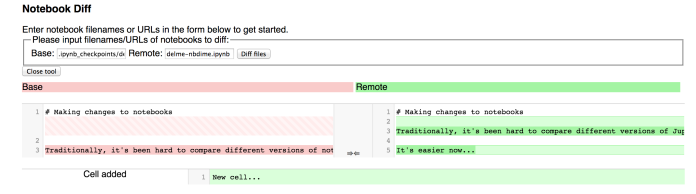
If you change the contents of a code cell, or the outputs of a code cell have changed, those differences are identified too. (Note the extra emphasis in the code cell on the changed text, but not in the output.)

To improve readability, you can collapse the display of changed code cell output.

Where cell outputs include graphical objects, differences to these are highlighted too.

(Whilst I note that Github has various tools for exploring the differences between two versions of the same image, I suspect that sort of comparison will be difficult to achieve inline in the notebook differencer.)
I suspect one common way of using nbdime will be to compare the current state of a notebook with a checkpointed version. (Jupyter notebooks autosave the current state of the notebook quite regulalry. If you force a save, the current state is saved but a “checkpoint” version of the notebook is also saved to a hidden folder. If things go really wrong with your current notebook, you can restore it to the checkpointed version.)
If you’ve saved a checkpoint of a notebook, and want to compare the current (autosaved) version with it, you need to point to the checkpointed file in the checkpoint folder: nbdiff-web .ipynb_checkpoints/MY_FILE-checkpoint.ipynb MY_FILE.ipynb. It’d be nice if a switch could handle this automatically, eg nbdime_web --compare-checkpoint MY_FILE.ipynb (It would also be nice if the nbdiff command could force the notebook to autosave before a diff is run, but I’m not sure how that could be achieved?)
It also strikes me that when restoring from a checkpoint, it might be possible to combine the restoration action with the differencer view so that you can decide which bits of the current notebook you might want to keep (i.e. essentially treat the differences between the current and checkpointed version as conflicts that need to be resolved?)
This is probably pushing things a bit far, but I also wonder if lightweight, inline, cell level differencing would be possible, given that each cell in at running notebook has an undo feature that goes back multiple streps?
Finally, a note about using the differencer to support marking. The differencer view is an HTML file, so whilst you can compare a student’s notebook with the orignal you can’t edit their notebook directly in the differencer to add marks or feedback. (I really do need to have another play with nbgrader, I think…)
PS It’s also worth noting that SageMathCloud has a history slider that lets you run over different autosaved versions of a notebook, although differences are not highlighted.

PPS Thinks: what I’d like is a differencer that generates a new notebook with addition/deletion cells highlighted and colour styled so that I could retain – or delete – the cell and add cells of my own… Something akin to track changes, for example. That way I could run different cells, add annotations, etc etc (related issue).
27 Jan 23:34
Twitter Favorites: [gnomeslair] Re: Mapping the age of buildings https://t.co/wu56AbcHgQ

27 Jan 23:34
 Kevin Nguyen @knguyen
According to all the podcasts I listen to, the only way to fight this regime is... Squarespace, sign up now and get 10% off with the promo c
Twitter Favorites: [knguyen] According to all the podcasts I listen to, the only way to fight this regime is... Squarespace, sign up now and get 10% off with the promo c
According to all the podcasts I listen to, the only way to fight this regime is... Squarespace, sign up now and get 10% off with the promo c
27 Jan 22:27
D-Wave has a customer for its $15 million quantum computer
by Bradly Shankar
Canadian company D-Wave has sold its 10-foot-tall, $15 million quantum computer.
The cybersecurity firm Temporal Defense Systems purchased the D-Wave 2000Q, which replaces the 1000Q system released in August of 2015.
The name comes from the device’s specs; with 2,000 quantum bits (qubits), the 2000Q has twice the power of D-Wave’s last quantum computer. With this boost, the computer can handle larger quantities of data and run more complex technical problems much more quickly.
However, while boasting some impressive specs, D-Wave’s machine have attracted some skeptics as well.
“Although scientists now agree that D-Wave devices do use quantum phenomena in their calculations,” Elizabeth Gibney wrote for the Nature science journal, “some doubt that they can ever be used to solve real-world problems exponentially faster than classical computers — however many qubits are clubbed together, and whatever their configuration.”
Looking ahead, though, the company says it will keep working on making improvements to its hardware. “We will continue to increase the performance of our quantum computers by adding more qubits, richer connections between qubits, more control features; by lowering noise; and by providing more efficient, easy-to-use software,” said Jeremy Hilton, SVP Systems, in a press release sent to MobileSyrup.
Founded in 1999, D-Wave is based in British Columbia and is the first company in the world to sell quantum computers.
Source: D-Wave
The post D-Wave has a customer for its $15 million quantum computer appeared first on MobileSyrup.com.
26 Jan 21:42
Firefox
What’s Up with SUMO – 26th January 2017
by Michał
Hello, SUMO Nation!
The end of January is upon us – and it’s the end of an era for SUMO as well. Next week we’re moving to a new home to host all your feats of helpfulness for users around the world – Kitsune will be put into a deep-freeze and we’ll start using the new site you’ve been hearing so much about 100% of the time. The first days (or even weeks) may be a bit rough (new places, new tricks to learn), but we are sure we will all emerge victorious on the other side of this migration, together! :-) Looking forward to the new, we tip a hat towards all the greatness that Kitsune has been a symbol and example of over the years.
Now, let’s get to the new news!
Welcome, new contributors!
If you just joined us, don’t hesitate – come over and say “hi” in the forums!
Contributors of the week
- All the forum supporters who tirelessly helped users over the last week.
- All the writers of all languages who worked tirelessly on the KB over the last week.
- Alice, Philipp, Seburo for their help with the migration bugs – kudos!
We salute all of you!
SUMO Community meetings
-
LATEST ONE: 25th of January – you can read the notes here (and see the video at AirMozilla).
- NEXT ONE: happening on the 1st of February!
-
Reminder – if you want to add a discussion topic to the upcoming meeting agenda:
- Start a thread in the Community Forums, so that everyone in the community can see what will be discussed and voice their opinion here before Wednesday (this will make it easier to have an efficient meeting).
- Please do so as soon as you can before the meeting, so that people have time to read, think, and reply (and also add it to the agenda).
- If you can, please attend the meeting in person (or via IRC), so we can follow up on your discussion topic during the meeting with your feedback.
Community
- 28th January is Data Privacy Day! What will you do to raise everyone’s awareness about data privacy? Read more about it:
-
IMPORTANT REMINDER! The Internet Health Report (v 0.1) is out. Read it, please. Share it with others! Then, join the conversation about the health of the Internet. Mozilla hopes to hear your thoughts on the following:
- Are we asking the right questions?
- What related projects/research/experiences come to mind?
- Who is missing from this conversation?
- How might the format be improved?
- SUMO contribution stats: Quantity? Quality? Both? If not, then what? Join the conversation!
- Reminder: Share your ideas for SUMO gear for the All Hands in SFO!
- Remin
- Calendar time! January dates that you should remember:
- 28th – International Privacy Day
- 31st – planned platform migration day
- …any other dates you want us to keep in mind? Use the comments below!
Platform
- Check the notes from the last meeting in this document. (and don’t forget about our meeting recordings).
- The main points of today’s meeting were:
- WE ARE MIGRATING NEXT WEEK. ALL HANDS ON DECK :-)
- The coming days will be a bit chaotic, a bit confusing, a bit wild – and a lot of fun. Stay calm and keep being Mozillians. We’ll get through this, together!
- Reminder: If you are using Kitsune’s API you should read this.
- We have a Bugzilla component for migration issues. You can see their list here and you can create new ones here – please do not assign them to anyone when you create them.
Social & Support Forum
- It’s Social / Forums Day today! Join in the fun, we’re on IRC and not only.
- Welcome to Marcelo and Marco!
- Shall we show a fun forum tip displayed on the new site? Your feedback welcome here.
- Urgent reminder! Army of Awesome is going away at the end of the month, please contact us if you are interested in Social Support.
- Reminder: Please also provide your feedback for 2016 in Social here.
- Reminder: you can contact Sierra (sreed@), Elisabeth (ehull@), or Rachel (guigs@) to get started with Social support. Help us provide friendly help through the likes of @firefox, @firefox_es, @firefox_fr and @firefoxbrasil on Twitter and beyond :-)
- Reminder: that you can subscribe to the social-support@ mailing list and get updates from Sierra!
Knowledge Base & L10n
- Over 830 edits in the KB in all locales since the last blog post. Whoa! Thanks to everyone who invested their time, energy, and talent in making us more helpful for everyone.
- No more current updates, as we are tinkering on the upcoming new site – and that takes a lot of time and effort… Expect the first two weeks after the migration to be busy, too!
Firefox
- The forum thread for version 50 is here.
- The forum thread for version 51 is here.
- We’re looking into document new stuff for version 52.
- Version 7.0 does not have any official date just yet.
- You can find the contributor forums for iOS here.
-
Firefox Focus / Firefox Klar has been updated (3.0!). Read more about it here.
…and that’s it! Now, as mentioned above, the next week will be a BIG thing for all of us at SUMO. Some of us may feel a bit sad, others quite differently, but… whatever happens, we will be ready to go! See you on the other side of upcoming changes!
26 Jan 21:29

Our Favorite Tote Bags
by WC Staff
From the canvas grocery bags you may have gotten as thank-you gifts from the charity of your choice to IKEA’s big blue bags, totes come in all shapes and sizes, and you can find one to fit almost any type of load. Backpacks, shoulder bags, and briefcases all have their ideal uses, but the tote’s unique combination of simplicity, elegance, and versatility suits it for any occasion.
26 Jan 21:25


False Creek Flats — Open House
by Ken Ohrn
When it’s time to talk about changes to 450 acres in the heart of the city, it’s time to hold an open house event. From January 25, 2017.
Crowded and noisy
Welcome
Almost ready
26 Jan 21:25


Games, Videogames, and the Dionysian Society
by Sarah Perry
This is a guest post by Chris Reid.
The destinies of cultures can be read in games.
–Roger Callois, Man, Play, and Games
Before it was stolen, patented, and sold to the Parker Brothers, Monopoly was “The Landowner’s Game,” a Georgist propaganda piece meant to illustrate the unfair behavior of the landowning class. The game accomplished this by setting up rules and fictions (game mechanics) that generate a reliable system behavior (game dynamic) which produced the intended experience (aesthetic): That aesthetic, frustration, has disrupted family game nights for decades. The dynamic is familiar to nearly anyone who has played it: those who manage to own more property have the money and power to be better insulated against chance, and those who don’t are likely to lose even more. The game spirals out as losers are burnt down to nothing and winners become even more powerful. Winners might find the game fun. Losers are deliberately irritated by a slow, nearly unavoidable death. In theory, the game mechanics could be adjusted to produce a ‘smoother’ outcome for more players, but it was never the point. It wouldn’t be “Monopoly” otherwise.
Monopoly’s rude feedback loop, illustrated in Hunicke et al., MDA: A Formal Approach to Game Design and Game Research.
Games are living things. In multiplayer experiences, the community of players can enforce rules, eject jerks, and adapt the game to fit their collective needs through precedent setting, apologetics, etc.- I often have to ask about “house rules” when getting into the nitty-gritty of Monopoly – what do you do with Public Parking in this house? Are there housing limitations? The manual has “definitive” answers but people sometimes have their own canon.
Often, on the first tests of a newly designed multiplayer game, the mechanics won’t generate the intended system behavior because humans are tricky. Even if the system gets the major kinks worked out over time, we can still anticipate the occasional flouting of the letter of the rules (i.e. cheaters) and, often even worse, the flouting of the spirit of the system (i.e. spoilsports, who are technically not so much cheaters as the game-world’s apostates or psychopaths).
Play is apparently a very old behavior- certainly older than humans, as we see animals imitate aggression for sport or personal training or pecking order or maybe for no purpose at all. Structured games are younger, likely as old as civilization- some philosophers believe that it is the basis of civilization altogether. Despite these broad claims by some, ‘game design’ largely refers to the design of a very narrow set of artifacts: usually videogames (and sometimes board games), usually designed by a specific person or group and constructed for use with a narrow set of technologies to be sold for profit. I hope to convince you that, far beyond even Monopoly, there is a world of play and games that is much broader than definitions including ‘fun’ or ‘non-seriousness’, and that there exist frameworks for thinking about the way that games are built and maintained by play communities.
The mid-20th century work of Johan Huizinga and Roger Caillois takes a cultural/anthropological view of game studies. They declare broad, sweeping theses about games as cultural products and see play as the “civilizing element of culture.” Caillois suggests that all forms of play are voluntary, uncertain in outcome, in their own time and space separate from “life outside” of play, and governed by some kind of logic that distinguishes it from non-play. Unstructured play tends to grow into more structured games as the activity takes shape and rules are litigated into clarity by the play community.
Caillois and these other anthropological philosophers of play were cataloguing and dissecting games before the advent of videogames, which is reflected in their point of view:
- one, they are not speaking as ‘practitioners’ of a huge industry talking to itself, seeking cultural legitimacy; they generally speak of games as cultural products instead of as the expression of a specific creator with an intent. (For his part, Huizinga- the father of the cheater/spoilsport distinction- believed that ‘modern’ games and sports were sterile bastardizations, uncreative and unplay-like due to the warping influence of profit-making).
- and two, they predate the sheer domination of videogames as examples of games in our culture in general
How dominant are videogames in the discussion of games? We could illustrate this dominance in the logic of the First Person Shooter (FPS). Many of you readers are probably highly “FPS-literate”: you could pick up an unknown title in an unknown language (and perhaps even with an unfamiliar controller) and would instantly understand a slew of complex conventions, and get right to “work” – you can probably infer the goals, game mechanics, and feedback shorthands in very little time. Even an “innovative” FPS title today generally requires very little new acquaintance.
It’s likely that much of the development of the First Person Shooter as a “thing” is a forced hand in the design space of possible videogames, since we’ve probably been roleplaying warfare since before language, and gunplay is a widely-understood form of romanticized violence. Media Studies Professor (and Cow Clicker creator!) Ian Bogost has often made the case that plenty about the design of the FPS is also based on path-dependent events during development of specific conventions. Computational limitations have forced entrepreneurial developers to whip up neat tricks that become canonized by player recognition (e.g. “crates in conspicuous places should probably be investigated”). New games are seeded with quirks and conventions from whatever Game Engine was licensed to save coding effort and time. We can often feel the similarity in games that share an engine, even if we don’t know which game engine is which. The Quake II Engine produced a single-player narrative-driven experience in Half-Life, and a multiplayer experience in Counter-Strike.
Videogames
Rules are inseparable from play as soon as the latter becomes institutionalized.
[Imagine] a continuum between two poles. At one extreme an almost indivisible principle, common to diversion, turbulence, free improvisation, and carefree gaiety is dominant. It manifests a kind of uncontrolled fantasy that can be designated by the term paidia. At the opposite extreme, this frolicsome and impulsive exuberance is almost entirely absorbed or disciplined by a complementary, and in some respects inverse, tendency to its anarchic and capricious nature: there is a growing tendency to bind it with arbitrary, imperative, and purposefully tedious conventions, to oppose it still more by ceaselessly practicing the most embarrassing chicanery upon it, in order to make it more uncertain of attaining its desired effect. This latter principle is completely impractical, even though it requires an ever greater amount of effort, patience, skill, or ingenuity. I call this second component ludus.
Roger Callois, Man, Play, and Games
The domination of the videogame in our thinking about games can lead to interesting confusions. Videogames are calcified games, much more ludus (structured games) than paedia (free play). My First Person Shooter example above helps to illustrate this.
A non-digital game’s rules are like “laws” in the legal sense- its rules can be ignored or broken (at the risk of being caught and punished); a videogame’s rules are often better thought of as “laws” in the “natural law” sense – as a description of physics in the universe of the game, as non-negotiable boundaries to the players’ range of activities. “Cheat codes” are pre-ordained “allowable” behaviors that are simply hidden facts of the game universe for the player to discover. Cheat codes are not really ‘cheating’, although they might be spoilsport behaviors, i.e. not in the spirit of the system’s intended use.
The videogame is an authoritative game master, turning guidelines into physical law. There is no act of rules interpretation, no apologetics between players and swayable referees. There are no mercy rules and no “house rules.”

Meeting my neighbor Montezuma, the Aztec leader in Civilization V. The Civilization games have plenty of complex game mechanics, but the types of “diplomacy” possible with the AIs in the game are, obviously, severely constrained. As a result, this aspect of play can become extremely “game-able” with predictable results. By contrast, multiplayer “Civ” (with multiple humans to play against) delivers a vastly different “diplomacy” experience, if you’re patient enough to try it.
While videogames are different from games in this way, the most long-lived videogames are often online multiplayer experiences that create a hybrid between hard videogame and softer human-mediated game rules. Communities grow as living parts built on the relatively inflexible skeleton of the videogame world. The hard videogame world offers goals and interesting limitations to navigate. In the softer social world above it, expert players create eternal endgames – competitions, goals, house rules, and narratives around their communities – in order to continue the play long after the newbie grind of linear content ends. Tips are traded on how to push the limits that the videogame allows, in order to help players feel the thrill of a challenge, to socialize, to beat others, or to produce some sort of unique personal experience. “Elder Games” (i.e. higher-order games) develop in the space above and around the game that was actually designed by developers.
There is one other salient property in a videogame, that also exists in other kinds of games [courtesy again of Bogost]: the simulation gap, the difference between the rule-based system and the its representation to a player. Cognitive effort is necessary to “fill in” the gap. All structured games and videogames are maps of a more complex territory, the world the game means to “actually represent.” Determining which elements of that real-world territory are pertinent to the game is an act of simplification, a design decision that demonstrates the values of the system. (e.g. “You only have this much space/money/time- what will you simulate?”) A common and easily understood illustration of this principle is SimCity, which boasts a system that simulates a city for the player to act as God-Mayor over. SimCity creator Will Wright:
Any simulation is a set of assumptions. So there is bias in any simulation, depending on how you look at it. […] First of all you have to clarify your internal model — how does a city really work? Most people, they’ll kind of roughly describe it, but they’ve never really thought in detail what the linkages are between different things. But when they’re playing a game like SimCity, which is one set of assumptions, it clarifies their own internal assumptions.
For SimCity, most of the value judgments about which variables are pertinent to the player are meant to be in service of a more fun game experience. Thus, several aspects of the city simulation are unfaithful to the reality of city management because they leverage biases that players already have. For example, regarding the risk of nuclear power plants blowing up, which Wright once compared to the erroneous action movie trope where “if you shoot a car enough times it simply explodes.” Other aspects of the territory being simulated are simply ignored, in order to reduce the player’s choices and make each choice more obviously meaningful. The role of the mayor in SimCity is basically all-powerful. SimCity has a tax theory. SimCity has a simple and coherent urban development theory. SimCity has a clear, linear, repeatable, and game-able technology tree that represents what the player may consider to be the big milestones in energy and transportation technology that can transform life in a fictional late-20th century town.
Procedural Literacy is the ability to engage with a system and grasp its functional and technical limitations, to make informed guesses at the biases that a system might engender. It is an act of this kind of literacy that could lead one to be able to identify common system dynamics, like how Monopoly tends to play out; a procedurally literate person might wonder about what is missing or constrained in a videogame or other system, as the simulation gap in SimCity illustrates. Ludus requires literacy. Play communities tend to make rules and norms and move improvisational play towards ludus.
Comparing and contrasting videogames and other games (like boardgames) is a useful exercise in morphological thinking that allows us to clarify what’s so special about games and how we might categorize or study them; however, the anthropological game studies thinkers like Caillois had a much broader view of play than the examples we’ve explored so far. The concepts of procedural literacy, simulation gaps, and the role of play communities in defining the ongoing rules of play (through litigation, apologetics, or meta-games) are all still applicable going forward, but the games being played can look wildly different.
The Dionysian Society
After examining different possibilities, I am proposing division into four main rubrics, depending upon whether, in the games under consideration, the role of competition, chance, simulation, or vertigo is dominant. I call these agon, alea, mimicry, and ilinx, respectively. All four indeed belong to the domain of play. One plays football, billiards, or chess (agon); roulette or a lottery (alea); pirate, Nero, or Hamlet (mimicry); or one produces in oneself, by a rapid whirling or falling movement, a state of dizziness or disorder (ilinx).
Roger Callois, Man, Play, and Games
Caillois recognizes four interacting play forms: agon (struggle or contest), alea (chance), mimicry (roleplay), and ilinx (vertigo, the tumult – think theme park rides, recreational drugs, or driving recklessly). These forms might exist in different capacities in different games, although one of them will usually be the kernel of the play experience. Games are also situated on a continuum between paidia and ludus. For example, unregulated competitions like racing or wrestling are examples of primarily agon+paidia. Regulated contests and sports are more agon+ludus. The more arbitrarily conceived the voluntary obstacles are, the more ludic we can describe the play. We can see a developing taxonomy. Caillois waxes on about how these play-forms might combine to enhance or mitigate one another, but we can run through that exercise another time.
The four playforms, adapted from Caillois’ Man, Play, and Games
As he explores these ideas, Caillois suggests that it is “not absurd to try diagnosing a civilization by the games that are especially popular there.” He tries to be clear that we should not be shocked to find in any civilization groups of people who are ambitious, fatalistic, imitative, or hysterical- but he suggests that exploring the games that people take seriously would tell us something about how they perceive those attributes in their society.
Forgive me, reader, if we get a little problematic here.
In societies conventionally called primitive as against those described as complex or advanced, there are obvious contrasts in the latter that are not exhausted by the evolution of science, technology, industry, the role of administration, jurisprudence, or archives, theoretical or applied mathematics, the myriad consequences of urbanization and imperialism, and many others with consequences no less formidable or revocable. […]
[…] Some primitive societies, which I prefer to call “Dionysian”, be they Australian, American, or African, are societies ruled equally by masks and possession, i.e. by mimicry and ilinx. Conversely, the Incas, Assyrians, Chinese, or Romans are ordered societies with offices, careers, codes, and ready-reckoners, with fixed and hierarchical privileges in which agon and alea, i.e. merit and hereditary [life lottery] seem to be the chief complementary elements of the game of living. In contrast to the [Dionysian societies], these are “rational”. In the first type there are simulation and vertigo or pantomime and ecstasy which assure the intensity and, as a consequence, the cohesion of social life. In the second type, the social nexus consists of compromise, of an implied reckoning between hereditary, which is a kind of chance, and capacity, which presupposes evaluation and competition.
Roger Callois, Man, Play, and Games
Effectively, Caillois argues that “rational” civilization primarily conceives of play in the forms of agon and alea because their understanding of social reality focuses on the interplay between rational agents seizing control (agon) or relinquishing control to fate or society (alea). “Rational” civilizations live in a “science-fiction” model of a world that is ordered by some fundamentally-knowable principles. Mimicry and Vertigo have their place- especially for those who are not selected by the major merit or chance games of their society- but are diminished in importance, and are often officially seen as childish or delinquent. For example, the “mimicry-lite” play form that Caillois calls “identification” allows for vicarious living through movie stars and heroes. For vertigo, there are always drugs. Generally, Caillois believes that “rational” civilizations frame themselves as heroes in a struggle to replace chance (alea) and the seductiveness of fatalism with the exhausting work of competence and justice (agon). He calls this drudgery “social progress.”
In contrast to the “rational” society, the “Dionysian” society sees a capricious, fundamentally unknowable “weird fiction” model of the world, where perception of the world is mediated (or laundered) through masks, trances, possession, and mystery rituals. Caillois suggests that this social arrangement is the basis of all cultures originally, and that tearing away from the sacred Dionysian dance towards “social progress” is a slow and painful process that is evidently never complete. As with Alea+Agon, Mimicry+Ilinx are complementary opposites: “Mimicry consists in deliberate impersonation, which may readily become a work of art, a contrivance, or cunning. The actor must work out his role and create a dramatic illusion. He is compelled to concentrate and always have his wits about him, just like the athlete in competition. Conversely in ilinx, in this regard comparable to alea, there is submission of not only the will but of the mind. The person lets himself drift and becomes intoxicated through feeling directed, dominated, and possessed by strange powers.” Just as alea is the seductive, destructive force to agon’s creative force, Caillois observes that there is an interplay between the creative, theatrical (controlled) mimicry experience and the intoxicating destructive force of ilinx.
One clear example of the Dionysian society is outlined in Xavier Marquez’ excellent blog post on Aztec Political Thought:
We might say that the theatre state at Tenochtitlan was primarily organized not to provide security, prosperity, or even glory, but for producing transcendental experiences. In this setting, Mexica priests were, in Clendinnen’s felicitous phrase, “impresarios of the sacred” (p. 242), practitioners of the only art that really mattered in the polity, and capable of setting in motion all of its resources for the sake of producing such collective experiences. Their “work” involved not just sacrifice, but a whole series of techniques, from fasting to powerful hallucinogenic drugs to chanting and dance, designed for maximum emotional effect. (There is a great deal of interesting “psychological engineering” in Mexica ritual, and I occasionally wondered idly about the genesis of such complicated practices). And the overall effect of their work was a “calculated assault on the senses.”
As a reminder, this is still “play.” As with Monopoly, (although, yeah, to an extreme), “play” does not always mean “fun.” The opposite of “play” is not work – play can be very hard work. The opposite of “play” is not “serious” – play creates its own bubble of seriousness, which is why the apostate is so much more dangerous than the cheater – breaking the rules is one thing, but breaking the bubble can be fatal to a social group.
The magic of mimicry often involves the audience – it is not necessarily pure trickery on an unsuspecting public. As with simulation gaps in videogames, there is still often a “gap” between the rules and practices of theatrical representation and the things that are meant to be represented. In a sufficiently engrossing theatre production, we can be moved by things which are known ‘not to be the case’. We can understand that the red handkerchief represents blood and still react accordingly.
As the agon+alea alignment depends on challenge or delayed gratification to heighten its attraction, the mimicry+ilinx alignment depends on mystery and social contagion to amplify its effects; therefore, ultimately rise of the belief in a singular, discoverable, stable, ordered universe undermines the power of the state built on the theatre and ecstasy of mimicry+ilinx. Caillois describes contemporary historians’ critical accounts of “The Veiled Prophet” Hakim al-Mokanna in the 8th century, “perhaps the last attempt at political domination through masks [in what he must have considered the ‘civilized’ world]”. Al-Mokanna wore a gold mask, claiming that his true face was too luminous for mortals to see. [By the way, have you seen the second episode of the Young Pope?] Al-Mokanna used human plants and mirror tricks to deflect sunlight and produce the illusion that he was glowing, in order to terrify enemy soldiers. When he was defeated, he tried to disappear “without a trace” by throwing himself into a vat of quicklime to foster the belief that he had ascended into heaven unscathed. While his followers bought it, the chroniclers at the time knew better. “The reign of the mask henceforth will seem like imposture and trickery,” Caillois claims, “it is already defeated.” This is perhaps too literal a definition of ‘mask’, and too optimistic about its defeat.
Coda
If a culture’s dominant games are so telling about their values, then the uniqueness and prominence of the videogame ought to be telling about our own culture. When someone of my cohort says ‘game’ they almost certainly mean videogame. It affects how we think about all games. When we talk about ‘gamification’ we are almost always talking about an aesthetic for our tools (e.g. badges, cheevos), instead of starting with the experience of a user or community and the broad kinds of game elements that we might actually be able to use.
It might not be fair to give videogames so much primacy when thinking about games, since state and national lotteries eclipse even the videogames industry in their command of obscene amounts of money; sports are also unfathomably expensive pastimes; movies and television and music have become more and more varied and technically excellent as their audiences become more literate in the medium; also, drugs. Caillois’ taxonomy of play, designed before the advent of the personal computer, allows for a broader definition than we might otherwise appreciate, without falling into an amorphous and inactionable “all human social life is a game of nomic” trap.
Caillois and Huizinga began to claim in their study of games that the ability to create and share social realities were what allowed humans to coordinate in large scale, setting the basis for civilization. We don’t have to necessarily accept this conclusion, but we ought to acknowledge that games and play are not exclusively the domain of idle pastime – we are surrounded by games, both trivial and deadly serious. Through comparing and contrasting these broad types of play, we can ascertain methods for thinking about how they are constructed and maintained. We can talk in terms of mechanics/dynamics/aesthetics, in terms of play communities as litigators and meta-game designers, we can talk about rules and literacy, representation and simulation gaps, varying playforms and their intended experiences. We can give a slightly richer language to the ways we interact with each other and with the systems we create.
26 Jan 20:57
Review: Wacom Bamboo Slate
by Brandy Gale
An artist takes the Wacom Bamboo Slate plein air painting with her and reports back
This is a guest post by synesthete artist, GeekGirlfriend, and bon vivant Brandy Gale.

A digital sketchbook that uses real ink and real paper? Yes, please!
I am a visual artist. So I when I make notes and drawing studies I prefer real ink and paper to a stylus on a tablet. That’s not very geeky, I know. And it leaves me with the problem of how to get my drawings, notes, and ideas onto my computer for sharing or further digital development. I work in the field on location almost exclusively, and lugging a flatbed scanner with me on a dive boat in Fiji is not ideal. But neither is getting back to my studio with a suitcase full of sketches, value renderings, composition layouts, and written notes to scan.
My talented photographer pal (and fellow Canadian) Benjamin Von Wong and I were chatting about this problem and he suggested I use a paintbrush stylus with my phone to make sketches in the field. Sadly, it lacked the tactile feel of pen on paper that is an essential part of the process for me.
My GeekGirlfriend, though, thought she could solve this with tech that understands this need for the tactile. She sent me a Wacom Bamboo Slate Smart pad to review. Paper, pen, brush, and instant digitization? Say what?! Thrilled, I dug right in.
Unboxing
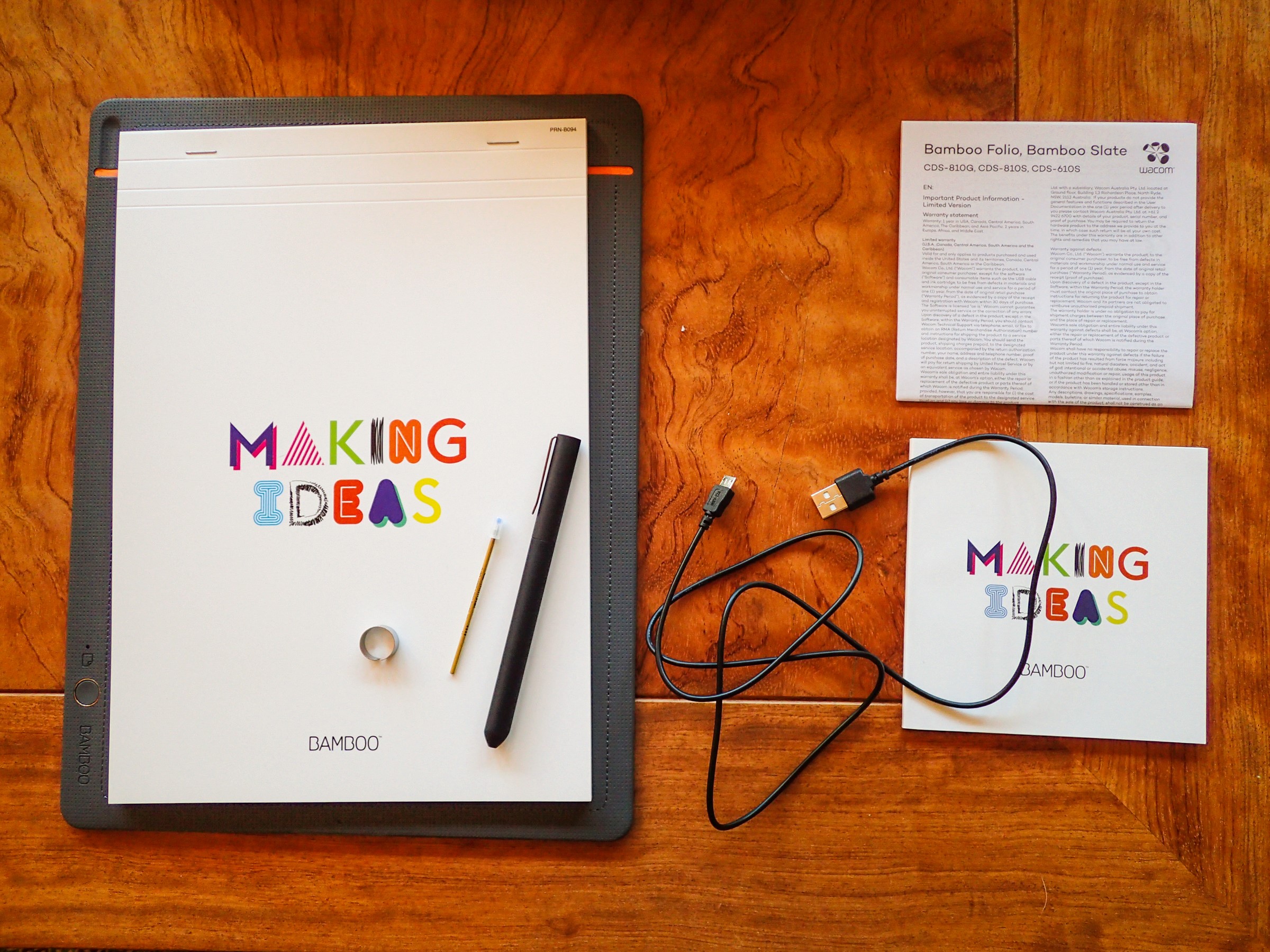
The Bamboo Slate consists of a patented electromagnetic resonance sensor sheathed inside a grey fabric and vinyl covered notepad base, along with a ballpoint-type pen, and a perforated notepad made of real paper! It also came with an extra pen refill, a refill remover tool, and a microUSB cable for charging via the built-in microUSB port.
The Bamboo Slate is available in two sizes: The Small Slate ($110; half-letter or size A4) and the Large Slate (letter or size A5). (There is also the even-more-deluxe Bamboo Folio that protects your paper with a fold-over cover.) I received and tested the Large Slate.
Setup
After downloading the required (free) Inkspace app from the app store, I paired my fully-charged Bamboo Slate with my iPhone 6s. Your device (iOS or Android) then syncs with the Slate via Bluetooth, sending the what you create on paper as a 1748 x 2551 pixel JPG or PNG, or PDF, or Wacom’s own WILL format, to the cloud. The Inkspace app includes free cloud space for up to 5GB of content ad you can get more space with a paid Inkspace Plus subscription. I already have DropBox. So I used that and it worked perfectly, as did emailing files to myself.
The Process
The pen drawings and notes I made looked exactly like the resulting digital images:
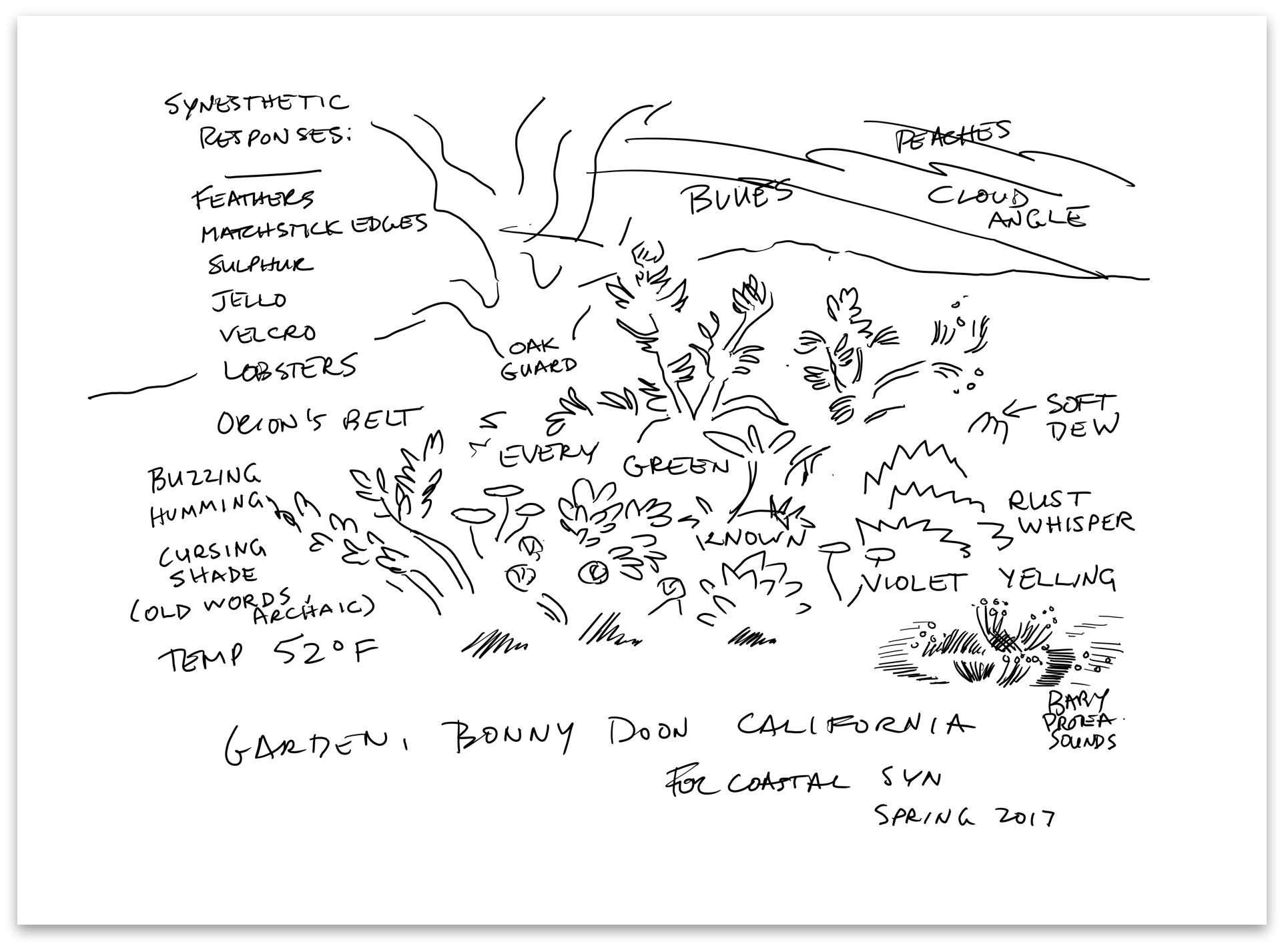
I tried a pencil, my fingers, charcoal, and some other pens and styluses, but the Bamboo Slate only worked with the included Wacom pen.
You can write on any paper, front and back, and the process still performs seamlessly. Even a cocktail napkin worked!
I also evaluated an assortment of paper stock from my studio inventory and found that thick paper does not pick up finer lines as well as thinner sheets. The various surfaces of watercolor papers caused the pen nib to move differently, changing the texture of the composition in subtle ways.
I really like that I didn’t have to sync to my device immediately after making a drawing. The Bamboo Slate holds up to 100 pages in its memory, so I can sync to the Inkscape app later when I am back in the studio, office, or bunk. I uploaded a multi-page PDF of sketches and handwritten notes I made on one excursion to a single file, creating a fun digital sketchbook of my journey. I didn’t have to scan anything! Battery life held up well, and the product’s overall durability was fine for my adventures.
Using Wacom’s Live Mode, my strokes appeared simultaneously on the Inkscape app and on my device. I used this feature to practice using the Slate. But this mode could also be fun for live streaming a drawing to a screen. I noticed that the pressure detection was excellent using the provided paper and pen. The Slate easily recognized even thin, soft strokes. The harder you press, the thicker the stroke. This took some getting used to but there was no noticeable digital lag.
Apparently, if you pony up for the Inkspace Plus version, it can convert handwriting to searchable text. This is something I would like to try in lieu of my current writing/composing journals, dream diaries, and early morning bedside ramblings hand-scribbled on whatever scrap of paper is within reach.
Final notes
The build quality is attractive, but the fabric surface may prove a challenge to keep clean, especially when working in the field and/or using various artist’s materials nearby.

The feel is truly like ink on paper. Because it is ink on paper. Yummy.
Though Wacom recommends the product for indoor use, I reckon I could use it anywhere within reason where I would use paper. So, I’m not taking it underwater or into a snowstorm. But I’ll certainly bring it – carefully — on a picnic table or sunny meadow, just as I do with paper.
Like with pen and ink, there is no erasing capability. So I do this in post-editing software. And smearing the ink with my finger as a sort of shading/blending method was not picked up in the digital upload.
Nib replacement and ink replacement are to be considered. The ink comes in black, and you can order refills.
My wishlist for this product would include different pen nibs. An optional gel ink pen and a brush pen would be fabulous.
All in all, the Bamboo Slate fills a rather specific niche. If you have the time and inclination to scan your handwritten notes and sketches, there is no need for it. If you prefer to draw directly on a tablet, skip this product. But if you want something that works on the fly or in the field, uses real paper and pen, and saves time and organizing later, then the Bamboo Slate is quite functional and convenient.
[Updated November 2022]
When you purchase anything through links on this site, GeekGirlfriends.com sometimes earns a little money. It doesn’t cost you any extra, but you are making this content possible. I only recommend products that I own, have tried through the company’s review program, or covet. Thanks for your support.
The post Review: Wacom Bamboo Slate appeared first on Geek Girlfriends.
26 Jan 20:57

Flappy Bird Creator Releases New Ninja-Themed Game
by Ryan Christoffel
Ninja Spinki Challenges!! is the new game from Flappy Bird's famed creator, Dong Nguyen. The game puts players in the role of a ninja who must face a variety of mini-game-like challenges.
There are six types of challenges in total, ranging from avoiding a bouncing cat to throwing shuriken at creatures. Though six challenges don't seem like many, beating one unlocks a more difficult version of that mini-game. In total there are five levels to each mini-game, so there are several opportunities to replay challenges.
The aspect of Ninja Spinki that aids replayability the most is Endless mode. Every time you beat each of the six main challenges, it unlocks the Endless mode for that mini-game. Endless mode is where the addictive, competitive element that made Flappy Bird famous comes in; it's all about surviving as long as you can to obtain the highest score possible.
The game seems well-polished, and each of the mini-games is plenty of fun, particularly as you reach more challenging levels of each one.
Ninja Spinki Challenges!! is available on the App Store as a free download for iPhone and iPad.
Support MacStories Directly
Club MacStories offers exclusive access to extra MacStories content, delivered every week; it’s also a way to support us directly.
Club MacStories will help you discover the best apps for your devices and get the most out of your iPhone, iPad, and Mac. Plus, it’s made in Italy.
Join Now
26 Jan 20:57

Twitter Moves Trending, Moments and Other Features to New Explore Tab
by John Voorhees
Twitter has replaced the Moments tab in its official app with an Explore tab. Moments are collections of tweets on a particular topic that are picked by Twitter editors. Moments haven’t gone away, but they’ve been moved under the new Explore tab along with ‘Trending Now’ and ‘Explore More’ sections, and live video. Explore is also where you go if you want to search Twitter.
Over the past year, we’ve been exploring different ways to make it simpler for people to find and use trends, Moments, and search. During our research process, people told us that the new Explore tab helped them easily find news, what’s trending, and what’s popular right now.
Although the Explore tab is only now being rolled out to all Twitter users, it has been in testing and available to some users for a few months. Twitter says the new Explore tab is being made available to iOS users today and will be available to Android users in the coming weeks.
Support MacStories Directly
Club MacStories offers exclusive access to extra MacStories content, delivered every week; it’s also a way to support us directly.
Club MacStories will help you discover the best apps for your devices and get the most out of your iPhone, iPad, and Mac. Plus, it’s made in Italy.
Join Now
26 Jan 20:57

The Best DSLR for Beginners
by Mike Perlman
The Nikon D3400 is the best entry-level DSLR for those looking to improve their photography and learn the ins and outs of tweaking camera settings. The D3400 has some of the best image quality we’ve ever seen at this price, along with excellent battery life, Bluetooth connectivity, 1080/60p video, silent autofocus for video, easy-to-use controls, and a Guide Mode to help you learn—and it’s widely available for less than $500.
26 Jan 20:55
Freedom Mobile’s network is expanding to cover Chilliwack, British Columbia
by Steven Hurdle
Though there’s been no official announcement as of yet, Freedom Mobile has applied for variances from Chilliwack, British Columbia, city council, for eight cell sites.
This is part of 18 cell sites in total that Freedom has negotiated to erect in the city of 78,000 residents, which lies east of Vancouver. The majority of the sites are slated to be installed on buildings, which is allowed by a Chilliwack city council bylaw, but new towers and certain other types of sites (such as a site proposed for a lamp standard in a local park) require specific permission.
Freedom Mobile has contacted all residents who live within 100 metres of the eight sites that require municipal variances and invited people to attend public open houses to offer comment.
Chilliwack is the largest city in British Columbia’s lower mainland that Freedom doesn’t already cover. The 18 cell sites would have to cover the city’s 250 square kilometres, plus parts of the TransCanada Highway from Abbotsford.
Freedom Mobile, which is owned by Shaw, now has 1,052,758 wireless subscribers across Canada.
Source: The Progress
The post Freedom Mobile’s network is expanding to cover Chilliwack, British Columbia appeared first on MobileSyrup.com.
26 Jan 20:55

Samsung Galaxy S8 revealed in new leak
by Rose Behar
Eminent mobile tipster Evan Blass has revealed what is likely the first legitimate image of the Samsung Galaxy S8, along with details regarding the specifications and hardware features of the new device.
The image shows the front and back of two devices, both of which feature 3.5mm headphone jacks. The leak also confirms that the devices will not have traditional navigation buttons and will feature large 5.8- and 6.2-inch QHD Super AMOLED screens, which cover 83 percent of their front panels.
The fingerprint sensor has been moved to the back in a slightly unusual position to the right of the camera bump.
Blass further states that the device will feature two different chipsets depending on market, as is customary for the brand. Those chips are said to be the Snapdragon 835 and a new Exynos chipset. Battery size will reportedly be 3,000mAh for the smaller device, and 3,500mAh for the larger one.
Both will contain 4GB of RAM, as with the S7 line, but the new internal storage baseline will be 64GB expandable by MicroSD, according to the leak.
Additionally, the devices will feature USB-C, iris scanners and 12-megapixel rear-facing cameras with f/1.7 focal ratios and a new visual search functionality, which allows users to complete optical character recognition-enabled web search on photographed text, for instance. Desktop mode functionality, similar to Microsoft Continuum, has also been confirmed by Blass, though it requires an optional HDMI dock.
Finally, the leak confirms that force touch-like functionality is coming to the S8.
The Samsung Galaxy S8 will reportedly debut on March 29th, 2017, in New York City, and will likely go on sale beginning April 21st.
Source: VentureBeat
The post Samsung Galaxy S8 revealed in new leak appeared first on MobileSyrup.com.
26 Jan 20:55


Android apps with emoji descriptions may get more downloads, study suggests
by Bradly Shankar
Android apps that have Play Store descriptions with emojis may see an increase in the amount of times they’re downloaded, according to a study.
App developer Novoda says that by constantly tweaking and testing its Play Store listings, they were able to raise their global conversion rate (views/downloads) by over 4.5 per cent.
In one experiment, they wanted to see if adding emojis to the presentation may increase app exposure. To do this, they put the rocket ship, bin and 100% emojis in the short description for the popular CCleaner app.
They tested each icon in the description of the app for 25 percent of Google Play users in various countries. For the remaining 25 percent, they didn’t add any emojis.
In Germany, Italy, and Poland, the apps with emoji descriptions were downloaded more often. Each country saw at least a four percent increase depending on the icon, with Germany (see below) seeing over 20 per cent more downloads for apps with the rocket emoji.
The differences in Russia, Spain, and France were too small to be considered conclusive.
English-speaking countries actually downloaded the app more times when the descriptions didn’t have any emojis. However, Novoda noted that the description hadn’t yet been localized, so all of these countries saw the same listings.
Therefore, it was concluded that while these endeavors can have “real and measurable effects” on revenue, it’s important to have adaptable strategies depending on the region.
Outside of apps, emojis will also be featured in their own full-length animated movie, which has Patrick Stewart voicing the poop emoji.
Source: Novoda
The post Android apps with emoji descriptions may get more downloads, study suggests appeared first on MobileSyrup.com.