I wrote this for WelcomeHomeTO’s blog last year — seems as good a time as any to repost.
I wrote this for WelcomeHomeTO’s blog last year — seems as good a time as any to repost.

I am surrounded by people who are driven by good intentions. Educators who want to inform students, who passionately believe that people can be empowered through knowledge. Activists who have committed their lives to addressing inequities, who believe that they have a moral responsibility to shine a spotlight on injustice. Journalists who believe their mission is to inform the public, who believe that objectivity is the cornerstone of their profession. I am in awe of their passion and commitment, their dedication and persistence.
Yet, I’m existentially struggling as I watch them fight for what is right. I havelearned that people who view themselves through the lens of good intentions cannot imagine that they could be a pawn in someone else’s game. They cannot imagine that the values and frames that they’ve dedicated their lives towards — free speech, media literacy, truth — could be manipulated or repurposed by others in ways that undermine their good intentions.
I find it frustrating to bear witness to good intentions getting manipulated,but it’s even harder to watch how those who are wedded to good intentions are often unwilling to acknowledge this, let alone start imagining how to develop the appropriate antibodies. Too many folks that I love dearly just want to double down on the approaches they’ve taken and the commitments they’ve made. On one hand, I get it — folks’ life-work and identities are caught up in these issues.
But this is where I think we’re going to get ourselves into loads of trouble.
The world is full of people with all sorts of intentions. Their practices and values, ideologies and belief systems collide in all sorts of complex way. Sometimes, the fight is about combating horrible intentions, but often it is not. In college, my roommate used to pound a mantra into my head whenever I would get spun up about something: “Do not attribute to maliciousness what you can attribute to stupidity.” I return to this statement a lot when I think about how to build resilience and challenge injustices, especially when things look so corrupt and horribly intended — or when people who should be allies see each other as combatants. But as I think about how we should resist manipulation and fight prejudice, I also think that it’s imperative to move away from simply relying on “good intentions.”
I don’t want to undermine those with good intentions, but I also don’t want good intentions to be a tool that can be used against people. So I want to think about how good intentions get embedded in various practices and the implications of how we view the different actors involved.
The Good Intentions of Media Literacy
When I penned my essay “Did Media Literacy Backfire?”, I wanted to ask those who were committed to media literacy to think about how their good intentions — situated in a broader cultural context — might not play out as they would like. Folks who critiqued my essay on media literacy pushed back in all sorts of ways, both online and off. Many made me think, but some also reminded me that my way of writing was off-putting. I was accused of using the question “Did media literacy backfire?” to stoke clicks.Some snarkily challenged my suggestion that media literacy was even meaningfully in existence, asked me to be specific about which instantiations I meant (because I used the phrase “standard implementations”), and otherwise pushed for the need to double down on “good” or “high quality” media literacy. The reality is that I’m a huge proponent of their good intentions — and have long shared them, but I wrote this piece because I’m worried that good intentions can backfire.
While I was researching youth culture, I never set out to understand what curricula teachers used in the classroom. I wasn’t there to assess the quality of the teachers or the efficacy of their formal educational approaches. I simply wanted to understand what students heard and how they incorporated the lessons they received into their lives. Although the teens that I met had a lot of choice words to offer about their teachers, I’ve always assumed that most teachers entered the profession with the best of intentions, even if their students couldn’t see that. But I spent my days listening to students’ frustrations and misperceptions of the messages teachers offered.
I’ve never met an educator who thinks that the process of educating is easy or formulaic. (Heck, this is why most educators roll their eyes when they hear talk of computerized systems that can educate better than teachers.) So why do we assume that well-intended classroom lessons — or even well-designed curricula — might not play out as we imagine? This isn’t simply about the efficacy of the lesson or the skill of the teacher, but the cultural context in which these conversations occur.
In many communities in which I’ve done research, the authority of teachers is often questioned. Nowhere is this more painfully visible than when well-intended highly educated (often white) teachers come to teach in poorer communities of color. Yet, how often are pedagogical interventions designed by researchers really taking into account the doubt that students and their parents have of these teachers? And how do we as educators and scholars grapple with how we might have made mistakes?
I’m not asking “Did Media Literacy Backfire?” to be a pain in the toosh, but to genuinely highlight how the ripple effects of good intentions may not play out as imagined on the ground for all sorts of reasons.
From the outside, companies like Facebook and Google seem pretty evil to many people. They’re situated in a capitalist logic that many advocates and progressives despise. They’re opaque and they don’t engage the public in their decision-making processes, even when those decisions have huge implications for what people read and think. They’re extremely powerful and they’ve made a lot of people rich in an environment where financial inequality and instability is front and center. Primarily located in one small part of the country, they also seem like a monolithic beast.
As a result, it’s not surprising to me that many people assume that engineers and product designers have evil (or at least financially motivated) intentions. There’s an irony here because my experience is the opposite.Most product teams have painfully good intentions, shaped by utopic visions of how the ideal person would interact with the ideal system. Nothing is more painful than sitting through a product design session with design personae that have been plucked from a collection of clichés.
I’ve seen a lot of terribly naive product plans, with user experience mockups that lack any sense of how or why people might interact with a system in unexpected ways. I spent years tracking how people did unintended things with social media, such as the rise of “Fakesters,” or of teenagers who gamed Facebook’s system by inserting brand names into their posts, realizing that this would make their posts rise higher in the social network’s news feed. It has always boggled my mind how difficult it is for engineers and product designers to imagine how their systems would get gamed. I actually genuinely loved product work because I couldn’t help but think about how to break a system through unexpected social practices.
Most products and features that get released start with good intentions, but they too get munged by the system, framed by marketing plans, and manipulated by users. And then there’s the dance of chaos as companies seek to clean up PR messes (which often involves non-technical actors telling insane fictions about the product), patch bugs to prevent abuse, and throw bandaids on parts of the code that didn’t play out as intended. There’s a reason that no one can tell you exactly how Google’s search engine or Facebook’s news feed works. Sure, the PR folks will tell you that it’s proprietary code. But the ugly truth is that the code has been patched to smithereens to address countless types of manipulation and gamification(e.g., SEO to bots). It’s quaint to read the original “page rank” paper that Brin and Page wrote when they envisioned how a search engine could ideally work. That’s so not how the system works today.
The good intentions of engineers and product people, especially those embedded in large companies, are often doubted as sheen for a capitalist agenda. Yet, like many other well-intended actors, I often find that makers feel misunderstood and maligned, assumed to have evil thoughts. And I often think that when non-tech people start by assuming that they’re evil, we lose a significant opportunity to address problems.
I’ve been harsh on journalists lately, mostly because I find it so infuriating that a profession that is dedicated to being a check to power could be so ill-equipped to be self-reflexive about its own practices.
Yet, I know that I’m being unfair. Their codes of conduct and idealistic visions of their profession help journalists and editors and publishers stay strong in an environment where they are accustomed to being attacked. It just kills me that the cultural of journalism makes those who have an important role to play unable to see how they can be manipulated at scale.
Sure, plenty of top-notch journalists are used to negotiating deception and avoidance. You gotta love a profession that persistently bangs its head against a wall of “no comment.” But journalism has grown up as an individual sport; a competition for leads and attention that can get fugly in the best of configurations. Time is rarely on a journalist’s side, just as nuance is rarely valued by editors. Trying to find “balance” in this ecosystem has always been a pipe dream, but objectivity is a shared hallucination that keeps well-intended journalists going.
Powerful actors have always tried to manipulate the news media, especially State actors. This is why the fourth estate is seen as so important in the American context. Yet, the game has changed, in part because of the distributed power of the masses. Social media marketers quickly figured out that manufacturing outrage and spectacle would give them a pathway to attention, attracting news media like bees to honey. Most folks rolled their eyes, watching as monied people played the same games as State actors. But what about the long tail? How do we grapple with the long tail? How should journalists respond to those who are hacking the attention economy?
I am genuinely struggling to figure out how journalists, editors, and news media should respond in an environment in which they are getting gamed.What I do know from 12-steps is that the first step is to admit that you have a problem. And we aren’t there yet. And sadly, that means that good intentions are getting gamed.
I’m in awe of how many of the folks I vehemently disagree with are willing to align themselves with others they vehemently disagree with when they have a shared interest in the next step. Some conservative and hate groups are willing to be odd bedfellows because they’re willing to share tactics, even if they don’t share end goals. Many progressives can’t even imagine coming together with folks who have a slightly different vision, let alone a different end goal, to even imagine various tactics. Why is that?
My goal in writing these essays is not because I know the solutions to some of the most complex problems that we face — I don’t — but because I think that we need to start thinking about these puzzles sideways, upside down, and from non-Euclidean spaces. In short, I keep thinking that we need more well-intended folks to start thinking like hackers.
Think just as much about how you build an ideal system as how it might be corrupted, destroyed, manipulated, or gamed. Think about unintended consequences, not simply to stop a bad idea but to build resilience into the model.
As a developer, I always loved the notion of “extensibility” because it was an ideal of building a system that could take unimagined future development into consideration. Part of why I love the notion is that it’s bloody impossible to implement. Sure, I (poorly) comment my code and build object-oriented structures that would allow for some level of technical flexibility. But, at the end of the day, I’d always end up kicking myself for not imagining a particular use case in my original design and, as a result, doing a lot more band-aiding than I’d like to admit. The masters of software engineering extensibility are inspiring because they don’t just hold onto the task at hand, but have a vision for all sorts of different future directions that may never come into fruition. That thinking is so key to building anything, whether it be software or a campaign or a policy. And yet, it’s not a muscle that we train people to develop.
If we want to address some of the major challenges in civil society, we need the types of people who think 10 steps ahead in chess, imagine innovative ways of breaking things, and think with extensibility at their core. More importantly, we all need to develop that sensibility in ourselves. This is the hacker mindset.
This post was originally posted on Points. It builds off of a series of essays on topics affecting the public sphere written by folks at Data & Society. As expected, my earlier posts ruffled some feathers, and I’ve been trying to think about how to respond in a productive manner. This is my attempt.
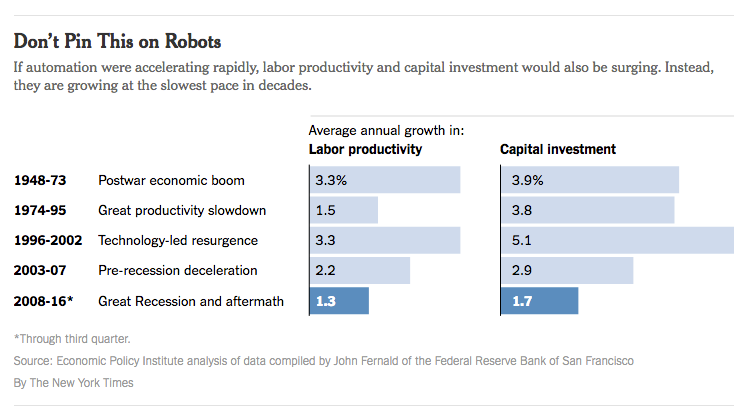
Sooner or later we will have to actively oppose the onslaught of automation and AI, or else there will be no work left, at all, for any of…
So your organization is growing, your products are becoming more complex, and you’ve got more customers demanding your attention and new functionalities. Congratulations! These are all good things, but they can stress product teams that haven’t kept up with the rest of their organization’s growth.
It’s important to recognize when it’s time to scale up and think big, which is not always easy for product management leaders that have been running lean and mean since the early days of proof-of-concepts and MVPs. When is the right time to grow the group? What are you trying to achieve by scaling your product team? and how exactly do you do it?
These are all good questions for the aspiring product leader looking to evolve with the times. Let’s start by looking at the key moments when growing the team is no longer optional.

This one is obvious. Product management is working well when the engineers have plenty of meticulously planned and researched user stories, epics, and requirements piling up in their queue. Product management is NOT working well when the technical team is waiting around for product management, or you’re letting things fall through the cracks as you try to keep up with the many demands on your plate.
If there’s simply too much for you to do, it’s time to scale up. Don’t be the bottleneck, build a wider bottle.
Shifting from a single product to a platform is also an excellent opportunity to scale your product management organization to meet the new challenges that presents and skillsets that are required.
“You need to make an explicit delineation between customer facing product managers (AKA “Solutions Product managers” in SAAS companies) and platform product managers,” says Wyatt Jenkins of Hired, “Platform PMs are in charge of creating functionality that spans multiple product lines. These PM’s need to understand the large strategic vision well enough to make short and long term trade-offs across different products.”
At consumer tech companies, there is often an obsession with growth. That’s not necessarily a bad thing, as growth typically increases revenue and/or valuation. But… rapid growth has two major impacts on product management:
That’s why many organizations assign product management to growth, or assign growth to product management. For example, at organizations like Uber and Facebook, under their VP of Growth they’ve got product teams (including product managers) for functions like Signups, Notifications and Onboarding. Meanwhile, at companies such as Twitter and Dropbox, they actually place the growth team under the VP of Product, again with individual product managers assigned to core growth functions.
Both of these scenarios represent an additional layer of challenges for scaling a product team. If you’re embedding product managers inside of a growth team that has nothing to do with the core product experience, your organization risks each PM and their respective team creating their own processes and habits that might not play well with others down the line. On the other side of the coin, if a PM executive is responsible for non-PM functions, they need to serve two masters.
“Pramod Sokke is the Head of Products for all clients on all BitTorrent platforms. He’s responsible for BitTorrrent’s growth metrics and non-growth metrics. Meaning Pramod must develop his product roadmaps for growth and non-growth KPIs because he’s responsible for both sets of KPIs,” reports Andrew McInnes, “People not working on growth initiatives at BitTorrent are confident that he’s prioritizing growth initiatives in a balanced way to ensure the success of everyone in the long run.”
And, of course, we all know no matter how great the growth engine may be, it ultimately comes down to product-market fit and user experience. “What is the point in acquiring all those users, if they leave once they see the product?” says Uber’s Andrew Chen. “Growth is an after-effect of strong product market fit and great distribution.”
So you know you need to grow, but how do you do it? And how do you communicate the goals of this growth to everyone involved? You’re not simply adding an additional assembly line to the product management factory, you’re building a team of high-performing individuals combining to create something better than before. Here’s a few things to remember:
It’s easy to equate an increased product management function with an increased output of new functionality and features, but there are a few problems with that assumption.
First of all, a new product manager can create specs all day long, but if there isn’t an additional dev team to build them, you’re not going to see an increase in features hitting the market.
More importantly, more features shouldn’t be the goal of scaling your product management team. You might even begin requesting fewer new features as you grow your team, but the items you are asking for will be better researched, more clearly defined and more closely tracked and aligned with your company’s key goals and metrics.
While you have plenty to teach your new product managers, the goal of scaling is not to literally replicate yourself. Instead, you’re trying to build a team. And just like a great basketball team doesn’t put five point guards on the floor at the same time, you need to assemble a diverse combination of skillsets, experiences, and outlooks as you grow.

“You have to stop being the product manager or pattern manager, and start being the builder of a team,” says Microsoft veteran Steven Sinofsky, “As a product leader, it’s not necessarily your responsibility to build the product, but to be the creator of a framework for how decisions are going to get made. In doing this, you are allowing people to discover the patterns on their own. Because these might not be patterns you thought of originally, and a new pattern might be on the verge of being created.”
This means you need to accept different styles, embrace diversity, and give them a long leash. Sure, they’ll make mistakes that you would have avoided, but that’s how they’ll learn what they need to be successful in the long run. What is essential, however, is establishing a tone and framework that ensures this diverse set of individuals is all working toward the same thing.
“In order to grow and scale our product teams, people need a set of values to help them make good decisions that align with what we believe” says Paul Adams of Intercom.
Since no one gets a degree in product management, there’s always the question of whether you pull folks from within your own company into product management or recruit from outside the firm.
Many companies often start by converting technical personnel into product managers, under the assumption that their knowledge of the code, systems and players will be advantageous and let them hit the ground running. While this is true, it also means you’re importing their biases and institutional memory into the product management organization while skimping on business chops that an external candidate offers. That’s why some firms like to take a little of both.
“We decided to employ a mixed strategy. We hired 5 PMs from the outside, and transferred in 4 from other internal functions,” says Scott Williamson of SendGrid, “We like this combination, as it provides us with a rich mix of PM, email, and SendGrid experience. The ‘SendGrid-grown PMs’ can learn PM best practices from the more experienced team members, and the external PMs can learn from the SendGrid veterans about the customers and technology behind SendGrid.”
And just as your product management team may hail from different places, their individual job responsibilities and functions should also be tweaked and tailored to fit their individual skills.
“Not everyone has the same idea of what a product manager does, so we tried to be specific about what tasks PMs could own while sharing a vision for what the role could accomplish,” Says Isaac Souweine of Frank & Oak, “By taking an iterative approach, we were able to customize the PM role to the specific organizational and team context at Frank & Oak.”
While product management seems like a no-brainer for product managers, a lot of people in the organization don’t always understand why it’s so important to grow product management at the same rate as the rest of the company. That’s why you need to win over the hearts and minds of decision makers and sell them on the merits of expanding the team.
“Given the overall organizational skepticism around the value of PM, I knew I had some bridge building to do,” says SendGrid’s Williamson, “One of my first moves was to set up 1:1s with key players across the company, to listen and understand their issues with PM to that point, and to open lines of communication that didn’t previously exist. Over time, trust developed and with it came the internal support to grow the team.”

This internal campaigning must not only raise the importance of product management throughout the company, it should also focus on getting the budget to hire quality and not just quantity. Top talent with experience will demand higher salaries than a fresh grad or junior engineer looking to see how the other half lives.
When it comes to how big your new team needs to be, there’s no perfect answer, but plenty of opinions on the ideal ratio.
“Tech companies should have a product management team that vaguely scales with Engineering,” says product management guru Rich Mironov, “50 Engineering folks might suggest 3 product managers; 200 Engineering folks may need 7-10 product managers wrestling with requirements/priorities/markets/interrupts.”
Whether you’re basing your new org chart on how many engineers you have, the size of your product suite or which verticals you’re targeting, your rationale should be consistent and defendable when challenged by management.
Just like there’s no single, perfect product organization, there’s also no product organization that doesn’t need to adapt over time. As your company grows and matures, pivots and expands, refocuses and repositions, your team should also mirror the new directions and goals of the organization.
Take Buffer, for example. They’re on their fourth iteration of how they organize product management, beginning with a one-stop-shop approach before breaking up the team into holistic teams, then fluid task forces and now operating under a “goal-focused squads” and “chapters” model.
They assign a collection of skillsets to specific squads focused on particular aspects of the product suite (such as “Android” or “Onboarding”). These squads include engineers, designers, product managers, customer development and sometimes growth analysts.
Buffer also assigned everyone to chapters, where everyone with the same job role gets together (i.e. all the product managers, all the designers). It’s at the chapter level where they maintain the standards for product management, exchange ideas about best practices, etc.
“Not only does this arrangement help us create specialists with great ownership of the challenges they’re working on,” says Buffer’s Courtney Seiter. “It also shows us exactly where we need to grow the team in order to be at our most effective.”
Buffer’s approach is similar to those used at Spotify and Hudl. And while the squad/chapter approach creates a lot of high-functioning and purpose-driven teams within the organization, it does come with its own set of challenges.
“They rely heavily on squads and team members themselves to communicate openly, challenge themselves by staying uncomfortable, and share knowledge with other parts of the company when it’s needed,” says Hudl’s Jordan Degner. “As easy as that sounds, it can be even easier to stay in the comfort of your own expertise and keep that expertise to yourself.”
Of course, not every organization is a great fit for a bunch of independent teams, but the principle of assigning discrete ownership of specific areas is a common thread in successfully scaled product organizations. You have a product executive at the top, and individual product managers take ownership of measurable and contained things.
“It should be obvious and apparent what area each product owner runs, what metrics they are responsible for, and how it impacts the business,” says Barron Ernst of ShowMax. “If you have a PM working on special projects that don’t advance your startup, it’s time to question the purpose of the role.”
That means product teams should have a defined area of need and future ownership for any new product management hire. Unlike in engineering–where an extra hand is always appreciated and can be swapped from one area to the next for extra bandwidth–bringing on a new product manager with no specific purpose is unlikely to improve the situation. It’s also the reason product leaders need to create a framework for success when they add members to their team.
“Individual product managers are rarely able to define their jobs, or push back on groups that dump random work in their direction,” says Mironov. “Without someone to establish job boundaries, they end up doing a little of everything and not enough of their real value-add.”
This brings us back to the most important thing to remember as you scale your team. You’re no longer just “the product person,” you are a team leader. It’s not about what you’re doing, it’s about what you’re team is doing, and how they perform and interact with rest of the organization is a direct reflection on you. So scale wisely…
It is certainly possible that, as per recent speculation, Facebook CEO Mark Zuckerberg is preparing to run for President. It is also possible that Facebook is on the verge of failing “just like MySpace”. And while I’m here, it’s possible that UFOs exist. I doubt it, though.
The reality is that Facebook is one of the most powerful companies the tech industry — and arguably, the world — has ever seen. True, everything posted on Facebook is put there for free, either by individuals or professional content creators;1 and true, Facebook isn’t really irreplaceable when it comes to the generation of economic value;2 and it is also true that there are all kinds of alternatives when it comes to communication. However, to take these truths as evidence that Facebook is fragile requires a view of the world that is increasingly archaic.
Start with production: there certainly was a point in human history when economic power was derived through the control of resources and the production of scarce goods:

However, for most products this has not been the case for well over a century; first the industrial revolution and then the advent of the assembly-line method of manufacturing resulted in an abundance of products. The new source of economic power became distribution: the ability to get those mass-produced products in front of customers who were inclined to buy them:
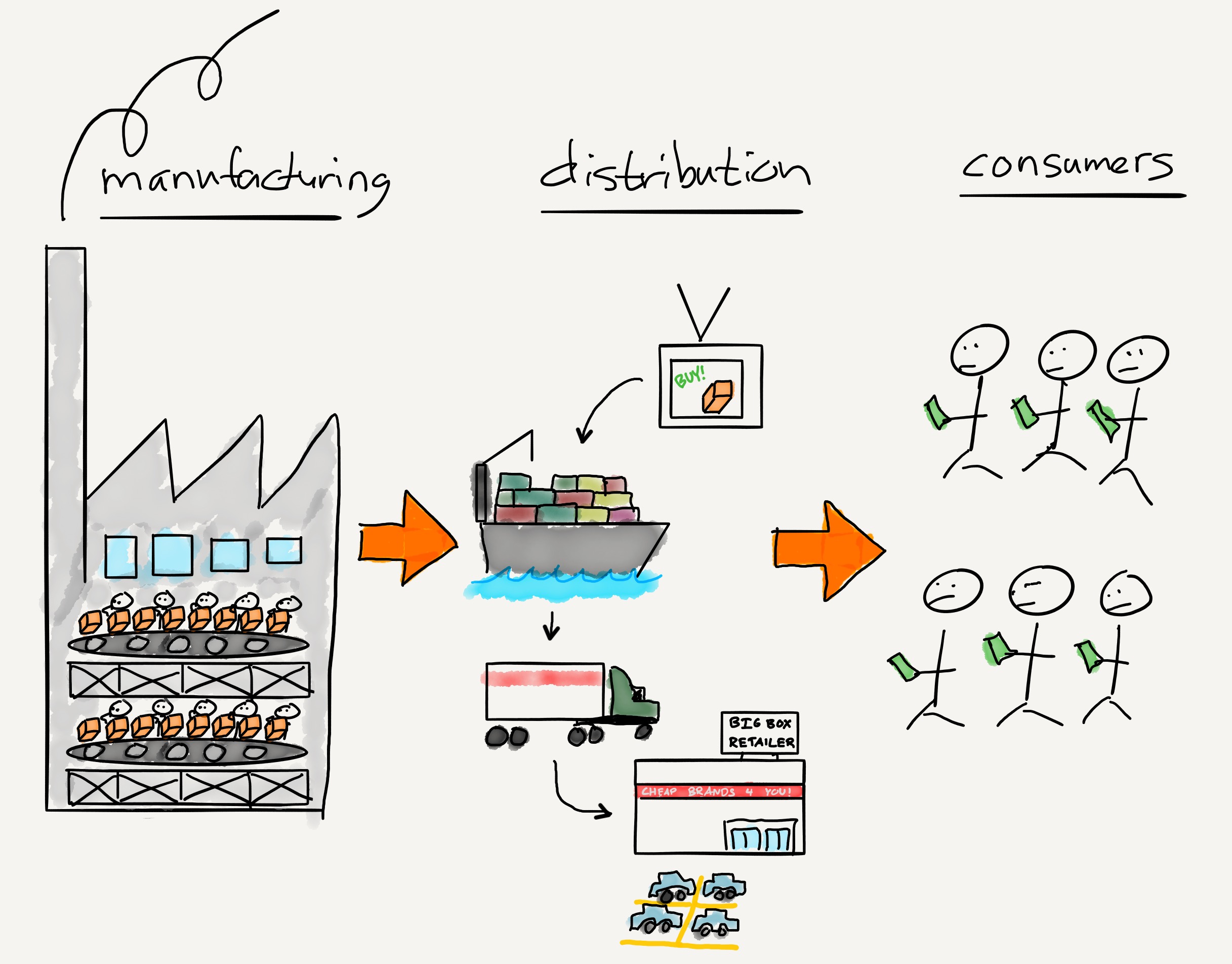
Today the fundamental impact of the Internet is to make distribution itself a cheap commodity — or in the case of digital content, completely free. And that, by extension, is why I have long argued that the Internet Revolution is as momentous as the Industrial Revolution: it is transforming how and where economic value is generated, and thus where power resides:
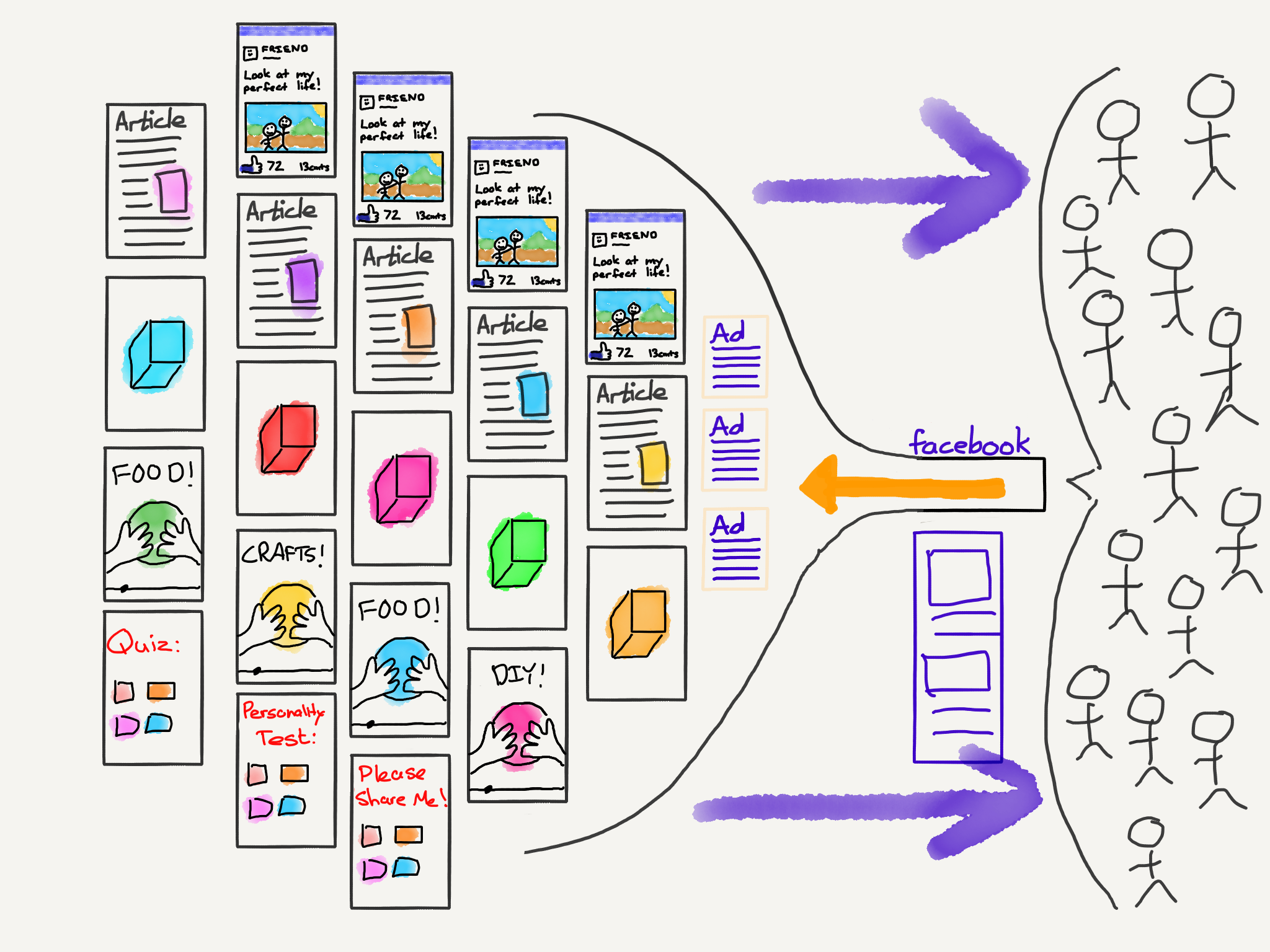
In this brave new world, power comes not from production, not from distribution, but from controlling consumption: all markets will be demand-driven; the extent to which they already are is a function of how digitized they have become.
This is why most Facebook-fail-fundamentalists so badly miss the point: that the company pays nothing for its content is not a weakness, it is a reflection of the fundamental reality that the supply of content (and increasingly goods) is infinite, and thus worthless; that the company is not essential to the distribution of products is not a measure of its economic importance, or lack thereof, but a reflection that distribution is no longer a differentiator. And last of all, the fact that communication is possible on other platforms is to ignore the fact that communication will always be easiest on Facebook, because they own the social graph. Combine that with the fact that controlling consumption is about controlling billions of individual consumers, all of whom will, all things being equal, choose the easy option, and you start to appreciate just how dominant Facebook is.
Given this reality, why would Zuckerberg want to be President? He is not only the CEO of Facebook, he is the dominant shareholder as well, answerable to no one. His power and ability to influence is greater than any President subject to political reality and check-and-balances, and besides, as Zuckerberg made clear last week, his concern is not a mere country but rather the entire world.
The argument that Facebook is more powerful than most realize is not a new one on Stratechery; in 2015 I wrote The Facebook Epoch that made similar points about just how underrated Facebook was, particularly in Silicon Valley. In my role as an analyst I can’t help but be impressed: I have probably written more positive pieces about Facebook than just about any other company, and frankly, still will.
And yet, if you were to take a military-type approach to analysis — evaluating Facebook based on capabilities, not intent — the company is, for the exact same reasons, rather terrifying. Last year in The Voters Decide I wrote:
Given their power over what users see Facebook could, if it chose, be the most potent political force in the world. Until, of course, said meddling was uncovered, at which point the service, having so significantly betrayed trust, would lose a substantial number of users and thus its lucrative and privileged place in advertising, leading to a plunge in market value. In short, there are no incentives for Facebook to explicitly favor any type of content beyond that which drives deeper engagement; all evidence suggests that is exactly what the service does.
The furor last May over Facebook’s alleged tampering with the Trending Topics box — and Facebook’s overwrought reaction to even the suggestion of explicit bias — seemed to confirm that Facebook’s incentives were such that the company would never become overtly political. To be sure, algorithms are written by humans, which means they will always have implicit bias, and the focus on engagement has its own harms, particularly the creation of filter bubbles and fake news, but I have long viewed Facebook’s use for explicit political ends to be the greatest danger of all.
This is why I read Zuckerberg’s manifesto, Building a Global Community, with such alarm. Zuckerberg not only gives his perspective on how the world is changing — and, at least in passing, some small admission that Facebook’s focus on engagement may have driven things like filter bubbles and fake news — but for the first time explicitly commits Facebook to playing a central role in effecting that change in a manner that aligns with Zuckerberg’s personal views on the world. Zuckerberg writes:
This is a time when many of us around the world are reflecting on how we can have the most positive impact. I am reminded of my favorite saying about technology: “We always overestimate what we can do in two years, and we underestimate what we can do in ten years.” We may not have the power to create the world we want immediately, but we can all start working on the long term today. In times like these, the most important thing we at Facebook can do is develop the social infrastructure to give people the power to build a global community that works for all of us.
For the past decade, Facebook has focused on connecting friends and families. With that foundation, our next focus will be developing the social infrastructure for community — for supporting us, for keeping us safe, for informing us, for civic engagement, and for inclusion of all.
It all sounds so benign, and given Zuckerberg’s framing of the disintegration of institutions that held society together, helpful, even. And one can even argue that just as the industrial revolution shifted political power from localized fiefdoms and cities to centralized nation-states, the Internet revolution will, perhaps, require a shift in political power to global entities. That seems to be Zuckerberg’s position:
Our greatest opportunities are now global — like spreading prosperity and freedom, promoting peace and understanding, lifting people out of poverty, and accelerating science. Our greatest challenges also need global responses — like ending terrorism, fighting climate change, and preventing pandemics. Progress now requires humanity coming together not just as cities or nations, but also as a global community.
There’s just one problem: first, Zuckerberg may be wrong; it’s just as plausible to argue that the ultimate end-state of the Internet Revolution is a devolution of power to smaller more responsive self-selected entities. And, even if Zuckerberg is right, is there anyone who believes that a private company run by an unaccountable all-powerful person that tracks your every move for the purpose of selling advertising is the best possible form said global governance should take?
My deep-rooted suspicion of Zuckerberg’s manifesto has nothing to do with Facebook or Zuckerberg; I suspect that we agree on more political goals than not. Rather, my discomfort arises from my strong belief that centralized power is both inefficient and dangerous: no one person, or company, can figure out optimal solutions for everyone on their own, and history is riddled with examples of central planners ostensibly acting with the best of intentions — at least in their own minds — resulting in the most horrific of consequences; those consequences sometimes take the form of overt costs, both economic and humanitarian, and sometimes those costs are foregone opportunities and innovations. Usually it’s both.
Facebook is already problematic for society when it comes to opportunity costs. While the Internet — specifically, the removal of distribution as a bottleneck — is the cause of journalism’s woes, it is Facebook that has gobbled up all of the profits in publishing. Twitter, a service I believe is both unique and essential, was squashed by Facebook; I suspect the company’s struggles for viability are at the root of the service’s inability to evolve or deal with abuse. Even Snapchat, led by the most visionary product person tech has seen in years, has serious questions about its long-term viability. Facebook is too dominant: its network effects are too strong, and its data on every user on the Internet too compelling to the advertisers other consumer-serving businesses need to be viable entities.3
I don’t necessarily begrudge Facebook this dominance; as I alluded to above I myself have benefited from chronicling it. Zuckerberg identified a market opportunity, ruthlessly exploited it with superior execution, had the humility to buy when necessary and the audacity to copy well, and has deservedly profited in the face of continual skepticism. And further, as I noted, as long as Facebook was governed by the profit-maximization incentive, I was willing to tolerate the company’s unintended consequences: whatever steps would be necessary to undo the company’s dominance, particularly if initiated by governments, would have their own unintended consequences. And besides, as we saw with IBM and Windows, markets are far more effective than governments at tearing down the ecosystem-based monopolies they enable — in part because the pursuit of profit-maximizing strategies is a key ingredient of disruption.
That, though, is why for me this manifesto crosses the line: contra Spider-Man, Facebook’s great power does not entail great responsibility; said power ought to entail the refusal to apply it, no matter how altruistic the aims, and barring that, it is on the rest of us to act in opposition.
Of course it is one thing to point out the problems with Facebook’s dominance, but it’s quite another to come up with a strategy for dealing with it; too many of the solutions — including demands that Zuckerberg use Facebook for political ends — are less concerned with the abuse of power and more with securing said power for the “right” causes. And, from the opposite side, it’s not clear that a traditional antitrust is even possible for companies governed by Aggregation Theory, as I explained last year in Antitrust and Aggregation:
To briefly recap, Aggregation Theory is about how business works in a world with zero distribution costs and zero transaction costs; consumers are attracted to an aggregator through the delivery of a superior experience, which attracts modular suppliers, which improves the experience and thus attracts more consumers, and thus more suppliers in the aforementioned virtuous cycle…
The first key antitrust implication of Aggregation Theory is that, thanks to these virtuous cycles, the big get bigger; indeed, all things being equal the equilibrium state in a market covered by Aggregation Theory is monopoly: one aggregator that has captured all of the consumers and all of the suppliers.
This monopoly, though, is a lot different than the monopolies of yesteryear: aggregators aren’t limiting consumer choice by controlling supply (like oil) or distribution (like railroads) or infrastructure (like telephone wires); rather, consumers are self-selecting onto the Aggregator’s platform because it’s a better experience.
Facebook is a particularly thorny case, because the company has multiple lock-ins: on one hand, as per Aggregation Theory, Facebook has completely modularized and commoditized content suppliers desperate to reach Facebook’s massive user base; it’s a two-sided market in which suppliers are completely powerless. But so are users, thanks to Facebook’s network effects: the number one feature of any social network is whether or not your friends or family are using it, and everyone uses Facebook (even if they also use another social network as well).
To that end, Facebook should not be allowed to buy another network-based app; I would go further and make it prima facie anticompetitive for one social network to buy another. Network effects are just too powerful to allow them to be combined. For example, the current environment would look a lot different if Facebook didn’t own Instagram or WhatsApp (and, should Facebook ever lose an antitrust lawsuit, the remedy would almost certainly be spinning off Instagram and WhatsApp).
Secondly, all social networks should be required to enable social graph portability — the ability to export your lists of friends from one network to another. Again Instagram is the perfect example: the one-time photo-filtering app launched its network off the back of Twitter by enabling the wholesale import of your Twitter social graph. And, after it was acquired by Facebook, Instagram has only accelerated its growth by continually importing your Facebook network. Today all social networks have long since made this impossible, making it that much more difficult for competitors to arise.
Third, serious attention should be given to Facebook’s data collection on individuals. As a rule I don’t have any problem with advertising, or even data collection, but Facebook is so pervasive that it is all but impossible for individuals to opt-out in any meaningful way, which further solidifies Facebook’s growing dominance of digital advertising.4
Anyone who has read Stratechery for any length of time knows I have great reservations about regulation; the benefits are easy to measure, but the opportunity costs are both invisible and often far greater. That, though, is why I am also concerned about Facebook’s dominance: there are significant opportunity costs to the social network’s dominance. Even then, my trepidation about any sort of intervention is vast, and that leads me back to Zuckerberg’s manifesto: it’s bad enough for Facebook to have so much power, but the very suggestion that Zuckerberg might utilize it for political ends raises the costs of inaction from not just opportunity costs to overt ones.
Moreover, my proposals are in line with Zuckerberg’s proclaimed goals: if the Facebook CEO truly wants to foster new kinds of communities, then he ought to unleash the force that can best build the tools those disparate communities might need. That, of course, is the market, and Facebook’s social graph is the key. That Zuckerberg believes Facebook can do it alone is evidence enough that for Zuckerberg, saving the world is at best a close second to saving Facebook; the last thing we need are unaccountable leaders who put their personal interests above those they purport to govern.
The compensation for a death sentence is knowledge of the exact hour when one is to die.
—Cincinnatus C., Invitation to a Beheading (Vladimir Nabokov, 1935)
Decision-making algorithms are everywhere, sorting us, judging us, and making critical decisions about us without our having much direct influence in the process. Political campaigns use them to decide where (and where not) to campaign. Social media platforms and search engines use them to figure out which posts and links to show us and in what order, and to target ads. Retailers use them to price items dynamically and recommend items they think you’ll be more likely to consume. News sites use them to sort content. The finance industry — from your credit score to the bots that high-frequency traders use to capitalize on news stories and tweets — is dominated by algorithms. Even dating is increasingly algorithmic, enacting a kind of de facto eugenics program for the cohort that relies on such services.
For all their ubiquity, these algorithms are paradoxical at their heart. They are designed to improve on human decision-making by supposedly removing its biases and limitations, but the inevitably reductive analytical protocols they implement are often just as vulnerable to misuse. Decision-making algorithms replace humans with simplified models of human thought processes that can reify rather than mitigate the biases those programmers are working from in conceptualizing the algorithm’s intent.
Cathy O’Neil, in her recent book Weapons of Math Destruction, defines algorithms as “opinions formalized in code.” This deceptively simple appraisal radically undercuts the common view of algorithms as neutral and objective. And even if programmers were capable of correcting against their own biases, the machine-learning components of many algorithms makes their workings mysterious, sometimes even to programmers themselves, as Frank Pasquale describes in another recent book, The Black Box Society.
Algorithms can never have “enough”
In the complexity of their code and the size of the data troves they can process, these kinds of algorithms can seem unprecedented, constituting an entirely new kind of social threat. But the aims they are designed to meet are not new. The logic of how these algorithms have been applied follows from the longstanding ideals of bureaucracies generally: that is, they are presumed to concentrate power in well-ordered and consistent structures. In theory, anyway. In practice, bureaucracies tend toward inscrutable unaccountability, much as algorithms do. By framing algorithms as an extension of familiar bureaucratic principles, we can draw from the history of the critique of bureaucracy to help further unpack algorithms’ dangers. Like formalized bureaucracy, algorithms may make overtures toward transparency, but tend toward an opacity that reinforces extant social injustices.
In the early 20th century, sociologist Max Weber outlined the essence of pure bureaucracies. Like algorithms, bureaucratic processes are built on the assumption that individual human judgment is too limited, subjective, and unreliable, deficiencies that lead to nepotism, prejudice, and inefficiency. To combat that, an ideal bureaucracy, according to Weber, has a clear purpose, explicit written rules of conduct, and a merit-based hierarchy of career employees. This structure places power in the apparatus and allows bureaucracies to function consistently regardless of who occupies different roles, but this same impersonality makes them controllable by anyone who can seize their higher offices. Also, because the apparatus itself generates the power, bureaucrats have incentive to serve that apparatus and preserve it even when it veers from its original intended function. This creates a strong tendency within bureaucracies to entrench themselves regardless of who directs them.
The way algorithms are implemented can mimic these bureaucratic tendencies. Google’s search algorithm, for example, appears to have a clear, limited purpose — to return the most relevant search results and most lucrative ads — and operates within a growing but defined space. As the company’s engineers come and go, ascend through the company hierarchy or leave it entirely, the algorithm itself persists and evolves. The intent of the algorithm was once to organize the world’s information, but as it has become a commonplace way of finding information, information has been reshaped in the algorithm’s image, as is most obvious with search-engine optimization. This effectively entrenches the algorithm at the expense of the world’s diversity of information.
Both bureaucracies and algorithms are ostensibly committed to transparency but become progressively more obscure in the name of guarding their functionality. That is, the systematicity of both make them susceptible to being “gamed”; Google and Facebook justify the secrecy of their sorting algorithms as necessary to thwarting subversive actors. Weber notes that bureaucracies too tend to become increasingly complex over time while simultaneously becoming increasingly opaque. Each trend makes the other more intractable. “Once fully established, bureaucracy is among those social structures which are hardest to destroy,” Weber warns. In bureaucracies, over time, only those “in the know” can effectively navigate the encrusted processes to their own benefit. “The superiority of the professional insider every bureaucracy seeks further to increase through the means of keeping secret its knowledge and intentions,” he writes. “Bureaucratic administration always tends to exclude the public, to hide its knowledge and action from criticism as well as it can.” This makes bureaucracies appear impervious to outside criticism and amendment.
But as O’Neil argues about algorithms, “You don’t need to understand all the details of a system to know that it has failed.” The problem with both algorithms and bureaucracies is that they try to set themselves up to be failure-proof. Bad algorithms and bureaucracies have a built-in defense mechanism in their incomprehensible structure. Engineers are often the only people who can understand or even see the code; career bureaucrats are the only people who understand the inner workings of the system. Since no one else can identify the specific reasons for problems, any failure can be interpreted as a sign that the system needs to be given more power to produce better outcomes. What constitutes a better outcome remains in the control of those implementing the algorithms, and is defined in terms of what the algorithms can process.
As Weber wrote, “The consequences of bureaucracy depend upon the direction which the powers using the apparatus give it. Very frequently a crypto-plutocratic distribution of power has been the result.” Likewise with algorithms: If a company’s algorithm increases its bottom line, for example, its social ramifications may become irrelevant externalities. If a recidivism model’s goal is to lower crime, the fairness or appropriateness of the prison sentences it produces don’t matter as long as the crime rate declines. If a social media platform’s goal is to maximize “engagement,” then it can be considered successful regardless of the veracity of the news stories or intensity of the harassment that takes place there, so long as users continue clicking and commenting.
Though automated systems purport to avert discrimination, Pasquale writes, “software engineers construct the datasets mined by scoring systems; they define the parameters of data-mining analyses; they create the clusters, links, and decision trees applied; they generate the predictive models applied. Human biases and values are embedded into each and every step of development. Computerization may simply drive discrimination upstream.” O’Neil offers a similar argument: “Models are constructed not just from data but from choices we make about which data to pay attention to — and which to leave out. Those choices are not just about logistics, profits, and efficiency. They are fundamentally moral. If we back away from them and treat mathematical models as a neutral and inevitable force, like the weather or the tides, we abdicate our responsibility.”
For bad algorithms and bureaucracies, any failure can be interpreted as a sign that the system needs more power to produce better outcomes
Far from an unintended consequence, however, that abdication becomes the whole point, even if algorithms and bureaucracies are frequently born with benevolent aims in mind. For the proprietors of these algorithms, this abdication is translated into a fervor for objective purity, as if neutrality in and of itself is always an undisputable aim. The intent of algorithms is presented as always self-evident (be neutral and thus fair) rather than a matter of negotiation and implementation. The means and ends become disconnected; objectivity becomes a front, a way of certifying outcomes regardless of whether or not they constitute social improvements. Thus the focus on combatting human bias leads directly to means for cloaking and dissipating human responsibility, merely making human bias harder to detect. Efforts to be more fair end up being a temptation or justification for opacity, greasing the tracks for an uneven allocation of rewards and penalties, exacerbating existing inequalities at any turn.
In On Violence, Hannah Arendt characterizes bureaucracy as “the rule of an intricate system of bureaus in which no men, neither one nor the best, neither the few nor the many, can be held responsible, and which could be properly called rule by Nobody.” Left unchecked, bureaucracy enables an unwitting conspiracy to carry out deeds that no individual would endorse but in which all are ultimately complicit. Corporations can pursue profit without consideration for effects on the environment or human lives. Violence becomes easier at the state level. And anti-state violence, without specific targets to aim for, shifts from strategic, logical action to incomprehensible, more terroristic expressions of rage. “The greater the bureaucratization of public life, the greater will be the attraction of violence,” Arendt argues. “In a fully developed bureaucracy there is nobody left with whom one could argue, to whom one could present grievances, on whom the pressures of power could be exerted.” It would, of course, be difficult to “attack” an algorithm, to make it feel shame or guilt, to persuade it that it is wrong.
In a capitalist society, the desire to remove human biases from decision-making processes is part of the overarching pursuit of efficiency and optimization, the rationalization Weber described as an “iron cage.” Algorithms may be sold as reducing bias, but their chief aim is to afford profit, power, and control. Fairness is the alibi for the way algorithmic systems reduce human subjects to only the attributes expressible as data, which makes us easier to monitor, manipulate, sell to, and exploit. They transfer risk from their operators to those caught up within their gears. So even when algorithms are working well, they are not working at all for us.
It’s obvious that algorithms with inaccurate data can be harmful to someone trying to get a job, a loan, or an apartment, and Pasquale and O’Neil trace out the many ramifications of this. Even if you can figure out when data brokers have inaccurate data about you, it is very difficult to get them to change it, and by the time they do, the bad data may have been passed along to countless different brokers, cascading exponentially through an interlocking system of algorithmic governance. Many algorithmic systems also use questionable proxies in place of traits that are impossible to quantify or illegal to track or sort by. Some, for instance, use ZIP codes as a proxy for race.
As with bureaucracies, algorithms purport to gain fairness by measuring only what can be measured fairly, leaving out anything prone to judgment calls, but in actuality this leaves a lot of leeway for those who have inside information or connections that can help them navigate the byzantine processes, and massage their data.
More precise and accurate data can’t fix a bad system. Even though the data may be accurate, the systems may lack the proper context for that data that situates its systemic implications. Pasquale summarizes how this occurs in lending: “Subtle but persistent racism, arising out of implicit bias or other factors, may have influenced past terms of credit, and it’s much harder to keep up on a loan at 15 percent interest than one at five percent. Late payments will be more likely, and then will be fed into present credit scoring models as neutral, objective, non-racial indicia of reliability and creditworthiness.”
Often these systems create feedback loops that worsen what they purport to measure objectively. Consider a credit rating that factors in your ZIP code. If your neighbors are bad about paying their bills, your score will go down. Your interest rates go up, making it harder to pay back loans and increasing the likelihood that you miss a payment or default. That lowers your score further, along with those of your neighbors. And so on. The algorithm is prescriptive, though the banks issuing loans view it as merely predictive.
No matter how much good data you have, there will always exist additional context, in the form of additional data that could improve it. There is no limit to reach that will confer objectivity, that will render results beyond being subject to interpretation. Algorithms can never have “enough.”
The need to optimize yourself for a network of opaque algorithms induces a sort of existential torture. In The Utopia of Rules: On Technology, Stupidity, and the Secret Joys of Bureaucracy, anthropologist David Graeber suggests a fundamental law of power dynamics: “Those on the bottom of the heap have to spend a great deal of imaginative energy trying to understand the social dynamics that surround them — including having to imagine the perspectives of those on top — while the latter can wander about largely oblivious to much of what is going on around them. That is, the powerless not only end up doing most of the actual, physical labor required to keep society running, they also do most of the interpretive labor as well.” This dynamic, Graeber argues, is built into all bureaucratic structures. He describes bureaucracies as “ways of organizing stupidity” — that is, of managing and reproducing these “extremely unequal structures of imagination” in which the powerful can disregard the perspectives of those beneath them in various social and economic hierarchies. Employees need to anticipate the needs of bosses; bosses need not reciprocate. People of color are forced to learn to accommodate and anticipate the ignorance and hostility of white people. Women need to be acutely aware of men’s intentions and feelings. And so on. Even benevolent-seeming bureaucracies, in Graeber’s view, have the effect of reinforcing “the highly schematized, minimal, blinkered perspectives typical of the powerful” and their privileges of ignorance and indifference toward those positioned as below them.
Fairness is the alibi for reducing human subjects to attributes only expressible as data, which makes us easier to exploit. Algorithms transfer risk from their operators to those caught up within their gears
This helps explain why bureaucrats and software engineers have little incentive to understand the people governed by their systems, while the governed must expend precious intellectual capital trying to reverse-engineer these systems to survive within them. It’s a losing battle, of course: Navigating the world effectively may require more and more awareness and interpretation of algorithmic systems, but in many cases the more we know, the more likely our knowledge is to become obsolete. The institutions that run these systems tend to treat our reverse-engineering them as inappropriately learning how to game them, and they can change them unilaterally. As Goodhart’s law states, when a measure becomes a target, it ceases to become a useful measure. The moment that more than a few people understand how an algorithm works, its engineers will modify it, lest it lose its power.
So we must simultaneously understand how these systems work in a general sense and behave the way they want us to, but also stop short of any behavior that could be seen as gaming them. We know our actions are recorded, but not necessarily by whom. We know we are judged, but not how. Our lives and opportunities are altered accordingly but invisibly. We are forced to figure out not only how to adapt to the best of our abilities but what it is that even happened to us.
Unfortunately, there’s not much an individual can do. It’s undeniable that individuals have been harmed by algorithms yet nearly impossible for any of those victims to prove it on an individual basis and demonstrate legal standing. O’Neil and Pasquale both note that the problems with algorithms are too extensive for any silver-bullet solution, offering instead a laundry list of approaches drawing from precedents in U.S. policy (e.g. the Fair Credit Reporting Act and the Health Insurance Portability and Accountability Act) and European legal codes. But regulatory means of reigning in algorithms — even assuming the significant hurdles of regulatory capture (the government’s understanding of these instruments is informed mostly by their beneficiaries) could be surmounted — would still require labyrinthine bureaucracies to implement them. If the problem with algorithms lies in how they mimic the ways bureaucracies function, trying to fixing them with different bureaucracies merely reiterates the situation.
Algorithms are probably not going anywhere. Technology and bureaucracy both tend toward expansion as they mature. But while getting rid of algorithms seems unlikely, they can be modified toward greater social utility. This would require evaluating them not in terms of how objective they seem, but on ethical, unapologetically subjective grounds. O’Neil argues that algorithms should be judged by the ethical orientation their programmers and users give to them. “Mathematical models can sift through data to locate people who are likely to face great challenges, whether from crime, poverty, or education,” she writes. “It’s up to society whether to use that intelligence to reject and punish them — or to reach out and help them with resources they need.” O’Neil writes of even more promising applications, like an algorithm that scans troves of data for signs of forced labor in international supply chains and another that identifies children at greatest risk for abuse. Crucially, they rely on humans at both ends of the process to make key decisions.
In this paradigm, the problem with “customized” rankings is not their lack of universality but the fact they could be even more customized to suit specific users’ goals. If a platform wishes to be truly neutral, its algorithms must be amenable to the unique objectives of each user. Pasquale suggests that when Google or Yelp or Siri makes a restaurant recommendation, a user could decide whether and how heavily to take into account not just the type of food and the distance to get there, but whether the company provides its workers with health benefits or maternity leave.
Opaque algorithms that rely on Big Data create issues that are commonly brushed aside as collateral damage when they are recognized at all. But those issues are avoidable. By acknowledging and accepting the human bias endemic to these systems, those same forces could be repurposed for good. We need not be trapped in their iron cages.

As Chris Brown reports on the CBC there has been a major brouhaha regarding the City of Vancouver’s 12,000 homes that were built before 1940. In a city that had almost a thousand demolition permits taken out in 2016 (the majority in Dunbar-Southlands) the past is getting-well, lost. Of those demolished, two-thirds of the houses were built before 1940.
In response, the City has created a “Character Home zoning review” proposing to discourage the demolition of this older housing stock by permitting replacement houses to be sizably smaller. This has not gone over well with “Many homeowners, developers, pro-density groups and even key heritage advocates are all pushing back hard against the “preservationist” plan now under discussion.”
Arguments against the designation include stifling architectural design, and freezing much-needed locations for townhouses and family focused higher density. The City of Vancouver’s Director of Planing Gil Kelley notes “The younger generation is feeling sqSo opening up new options for affordability and different living option choices for them is really critical — even as people here who are older are trying to hang on to what they already know.”
There have been some issues regarding the character home designation-how will property owners be compensated for reduced returns on the property? And if a character home is deemed to be beyond rebuilding (and there will need to be guidelines to define that) can those single family lots be filled with more family friendly and affordable higher density housing forms? And in the end, can we create a new way of looking at density in this Character Home zoning review that can move the large single family areas of the city into something that is denser and more attainable for newly formed families? Our future depends on that.


A good take on why Trumpkins don’t hear what the rest of us hear when President Trump spews incoherent word salad.
Also why I have limited interest in, or energy for, trying to persuade them through rational debate.
I have been baffled by this all along - I could not for the life of me imagine what his supporters were hearing when they listened to him babble incoherently. He’s like a political Rorschach’s test.
I feel like I’ve had the curtain drawn back.
I realized I do this to him too. I’m always trying to figure out WHAT THE FUCK HE MEANS. Only because I don’t like him and what he stands for, I’m actually trying to parse reality from it, so it strikes me as insane.
But if I was predisposed to him, my mind would decide on something that filled out my preconceived expectation.
Humans Brains are so fucking weak and wrong.
If you’ve paid attention to the way racist/generally bigoted white people have talked literally since the dawn of time, this wouldn’t be a surprise to you, but I like the way OT phrased it.
But really people often talk like this when they want to say horrible things about other human beings they know they shouldn’t be saying, it’s just with Trump it suddenly matters can’t he’s flushing our country down the toilet.
See: the way white people have always talked about the mysterious inner city and the infamous black on black crime. Or just black women in general. There are always unfinished sentences about black people/POC and ya’ll never have trouble completely them in your own heads.
It’s like their very own “auto-complete” for searches they know have already been done by their supporters time and time again.
By the way, Fox News has been doing a similar version of this for years. A local columnist pointed out that they often ask absolutely ridiculous questions, but because they ask it in question form, they get wiggle room.
“Does Obama want to kill your grandparents when they go to the doctor?”
Now, the question in itself is open ended, but obviously, you’re set up to believe that, yes, your grandparents will die because of Obama. The onus is on the station to disprove a question like this, but instead they throw a vague, twisted statement out and have two opposing people argue as if both sides of the conversation are equal in value and truth. The subject of the question then the non-clear rebuttal makes the answer seem obvious that Obama is killing your sweet granny and grandpa when they go for a flu shot.
I say all this because this network has been grooming their followers to fill in the blanks from vagueness this entire time. Trump just knows how to fill in just enough words to start the thought process down that way. He’s taken what Fox News started and perfected it.
Is ‘Trumpkins’ actually a term people are using? A little:

I wonder if we can get ‘trumpobabble’ to trend?
Whoever came up with the name “Human Resources” deserves a medal. Such a descriptive, helpful, and seemingly useful name. Why yes, I’m human and I sure could use some resources. Purely viewed by the name, Humans Resources or HR seems like such a great idea. These are the people who are responsible for looking after your people whether it’s their health, compensation, or career.
So, why do we freak out when HR is in the building? What’s with the hush whispers when you see your boss huddled with HR in her office? Layoffs? Reorg? Has anyone seen Ryan today? HR’s presence typically makes folks paranoid. I’ll repeat that: the folks whose job it is to be resources for humans collectively gives us the shakes. What happened?
It’s not HR; it’s your culture.
Humane Resources
Disclaimer: I’ve never worked in HR, and all of my observations regarding HR have been made without what I assume is the daily toil of having a gig where the expectations are so high, but corporate support is traditionally low. However, both as manager and as a former employee of an HR-focused start-up, I know a bit.
Simplification: There are all sorts of different jobs inside of HR and depending on the size of your company, your HR team may have one or all of them. Benefits, recruiting, compensation, training, it’s a long list. For the purpose of this article, let’s consider HR to be the folks who are responsible for helping a team thrive. They have many other jobs, but that’s the one I’m thinking about in this piece.
HR is a tough gig. They have constraints which often leads to unique behavior that affects their reputation. Two examples:
As a support team and a cost center, HR traditionally does not receive a lot of investment. How many folks is your manager responsible for? Ok, how many is your HR partner responsible for? My guess is your HR person has 10x the number of people for whom they are responsible. This under-resourcing has interesting consequences.
First, because of their limited numbers, they logically gravitate towards informed decision makers because these humans are an early warning system regarding what is and isn’t going well. This network helps keep them informed as to the state of the company.
Second, because of their allegedly human-related skills, they are called in when there are people-related problems. This means you only see them when something is going down. These infrequent appearances when the sky is falling contributes to their grim reaper reputation.
Finally, when they do arrive because the sky is falling, they are informed because of the carefully built information gathering network, but when they start talking, they don’t sound like you. They, like every group at your company, have a language all their own, which when accompanied with the penchant for showing up when the shit is going down makes their language the language of trouble.
All of these attributes contribute to the problematic reputation of HR. Yet, in two decades of work I’ve discovered that when the team is freaked out by HR, it’s not HR, it’s the culture. Something is rotting.
Culture == Values
Your company has values regardless of whether you’ve painted them on the wall or produced an employee handbook. They exist as a result of the Old Guard employees working together, making decisions, and successfully building the company.
Values exist as stories. Back in our first building, Christine once stayed up all night working on a single performance bug that ended up revealing fundamental flaws in our architecture. The implied value? Persistence or perhaps craftsmanship.
Values exist as people. When I watch Brad run a meeting, I realize how poorly I run my own. The implied value? Everyone’s time is valuable, efficiency, or maybe constant improvement.
Values are principles or standards of behavior, and in a group of humans, they are first defined by the founding employees and then evolved over time by the leadership team. Painting them on the walls or writing them down in an employee handbook makes them accessible and obvious, but it is how these values are consistently applied especially during times of crisis that gives values value.
When I hear, “I don’t trust HR,” I ask, “Why?” The answers vary, “They are political. They are risk mitigators. They protect the company… not the employees.” There are humans in HR who exhibit this behavior. However, it is equally likely there are humans at every level of leadership who exhibit this behavior, and all are allowed to behave in this way because of the values of the company.
Has Anyone Seen Ryan Today?
The rule is: in the absence of information, humans will make up a story to fill the vacuum. When this happens, listen to the story because not only do they usually find the worst case scenario, it’s a situation that reflects the perception of your company’s values.
Where is Ryan? Well, he left early on Friday and was out all day on Monday. I think he’s checked out and you know what we do to checked out people here? HR fires them without warning.
No, HR doesn’t fire people without warning. No, Ryan is not checked out. He’s just sick, and his manager forgot to send a message to the team. The issue here is that the team believes HR has nefarious unchecked power and in my experience they rarely do. They are capable, overworked, emotionally intelligent humans who I call when I need help.
Yes, they swarm around disasters. Yes, they have access to a lot of information. You should hold them to them a high bar. More importantly, you should understand how in the world your team comes to hold seemingly irrational beliefs because their existence is not a sign of their character of your team, it is a sign your culture is rotting.

In theory, collaboration seems simple enough—you just need to be open to ideas and solve problems as a team. Unfortunately, small complications can make collaborating far more cumbersome than you’d think. That’s why we’ve built features to help you avoid collaboration obstacles and get back to working together. Here are four ways Dropbox can help.
 It’s been a productive month: your team just cranked out five launch videos, each translated in a dozen different languages. Unfortunately, all those shared videos now sit in a bloated team folder, causing several employees to run out of local storage space. It’s the sort of problem that starts as a minor nuisance and only gets worse over time.
Instead of making your employees micro-manage their hard drive space, Smart Sync can do it for them. Smart Sync allows your team to place some files in online-only storage, but still lets them access everything right from their desktops. When they open a file stored online, Smart Sync will automatically download it to their computers. Let your team jump straight to sharing their work, rather than worrying how to make room for it.
 You sent out details for your ad campaign, and two days later, a dozen co-workers have responded with feedback. Unfortunately, the comments are scattered across three emails, two meetings, a whiteboard, and a text message.
Next time, you can send your campaign plans with Paper. Paper keeps the conversation in one place, regardless of when and how your colleagues respond. Your collaborators can comment on text, photos, or videos; see each other’s feedback; and contribute their own ideas in a doc tracking real-time changes. As the doc owner, you can loop in new reviewers, control who has access, and decide what level of feedback you want, whether comments only or in-doc editing. It’s a shared workspace that keeps everyone engaged and informed.
 You’re ready for feedback, but it’s been over a week, and half your teammates haven’t said anything. Did they forget about you? Did they miss your message?
Dropbox Business teams can now keep track of collaborators with viewer info—a live-updating look at who’s opened a file and when they last viewed it. You can see who a file’s been shared with, and check who’s viewing now. Need to give someone a nudge? You can see who hasn’t viewed the file yet, and follow up with the right co-workers, all without interrupting the group at large.
Dropbox Business teams can try an early-access version of viewer info today.
 Sometimes you want private feedback from just one or two people. But the last time you sent an early design mock-up over email, your colleague wound up forwarding it to the whole marketing team, prompting an hour of distracting debate.
With Dropbox, you can share a file securely with just a few close colleagues. Dropbox will require your collaborators to sign in first, so only the people you trust can access the file. Once your design is truly ready for primetime, you can create a shared link. Anyone can view files sent with a shared link, even if they don’t have a Dropbox account.
You can learn more about Dropbox sharing options in the Help Center.
When people spend less time worrying about how they collaborate, they spend more time actually working together. And when you can remove the collaboration snags, you’re much more likely to love the way you work.


From Josh Begley, this quickfire flip book shows every New York Times front page since 1852. Watch the shift from all words, to a handful of small pictures, to larger pictures, to color, and then more color pictures.
It reminds me of the flip book for the Hawaiian Star and the comparison of pages for popular science magazines, which show a similar evolution.
Tags: animation, New York Times, news
Attached is a photo essay inspired by the design stage of the Arbutus Greenway. Other places, it seems, have done things in the public realm that are vaguely similar. And it got me looking.
Here in Puerto Vallarta, Mexico, the city has transformed their seawall (the Malecon) with some major work. Total length is about 2 km. And the work was done in stages over decades. All to vastly improve the experience for locals and tourists alike.
Click a photo for larger versions in the form of a slide show with marvelously insightful captions.


Organizational Theory isn’t a science, though it would like to be. Unfortunately, building a scientific approach requires understanding from a number of fields that themselves are still only aspiring to be sciences. Because psychology, economics, and sociology are a mish-mash of rules of thumb and vague, non-predictive, and generally unfalsifiable “theories”, organizations are reduced to ad-hoc rules and guesswork: critical, but prescientific.

For now, to abuse the parable of the blind men and the elephant, organizational theorists are still groping at their respective elephants, unable to figure out that the trunk is next to the tusks, or even that they are part of the same animal. It’s not a science: if anything, it’s a field of engineering, albeit one without a grounding in physics or Asimovian psychohistory to draw from. Precisely because the field isn’t scientific, understanding the engineering rules of thumb that were developed over time is fantastically useful for a practitioner.
Henry Petroski’s excellent To Engineer is Human introduced me to the history of engineering. Failure is the watchword of that history. Even generations after Newton, science was simply incapable of answering basic engineering questions, like “what load will this beam support?” So engineers developed rules of thumb in different domains that assured safety, grounded in experience. This approach was almost scientific — the theory is that this structure will be stable, and if it’s untrue, it will be falsified all on its own. Organizational Structure is similar: we know a lot about what doesn’t work.
As with most fields, it’s easiest to dissect organisms once they are dead, so I’ll stick to ideas that are older than I am. Understanding the various theses and antitheses won’t lead to synthesis without the basic grounding to unify them, but the history of failed ideas can still give us a map of the pre-scientific minefield of organizational design. Once we’ve traced out the map, I’ll add some ideas about how we can navigate around the unknown dragons, and find useful insights into organizations without actually pretending to understand them.
The textbooks all try to tell us that the earliest theory of management is F. W. Taylor’s Scientific Management (1911). Before this, according to scholars of the field, “Craftsmen owned their tools, [which] minimized the possibility of management’s establishing general measure of productivity and quality.” But this is a ludicrous contention: cost accounting was well established, and factories were common a century before Taylor developed his insights. When interchangability was discovered, there must have been some theory that preceded Taylor which allowed businesses to optimize their processes — and there was! Unfortunately, it is so basic, and still so prevalent, that people haven’t noticed it.
Intuitive management is the grandfather of all management theories. Everyone has worked with others in some form or another, and management is just working with others. Some people are batter at this than others, and those best able to manage will be obvious, so there is no need for scientism. Instead, we admit we can’t formalize everything, and let people work it out. And it works!
Well, it works for a while. But at some point, things get a bit too complex, and people need to go corporate or go home. But, as I argued in that post, there is a tremendous advantage to having little structure, and hence little need for organizational theory. And as the world consolidates and bifurcates into lumbering mega-corporations and nimble scavengers and upstarts, the big guys need to realize why they aren’t able to replicate that agility — they are too large for intuition. Instead, they need theory.
Scientism, in the form of “Scientific Management”, reared its efficient head in the late nineteenth century, with clocks and measurements that found tremendous benefit from imposing order on the evidently previously unruly and disordered factory floor. Taylor observed and intervened — and he certainly found room for improvement, like allowing manual laborers rest breaks to increase their efficiency. Unfortunately he also managed to perpetuate the single most destructive management practice: the unthinking application of a paradigm to a complex problem. (This rigidity and oversimplification which replaces intuition is part of why models fail.)
One specific drawback of his approach is due to the Hawthorne effect, where measurement distorts the system it was trying to measure. Specifically, when you pay attention to someone, they get more efficient. It seems, like children, employees thrive on attention. But that means any attempt to improve efficiency by monitoring performance closely will be effective, spurring a proliferation of middle management supervisory roles, with additional costs that begin to offset this additional efficiency. Organizing many layers of management was difficult. Principles were needed to decide how to set them up — it would hardly be efficient and orderly without rules and procedures. And who better to institute strict rules then an authoritarian German sociologist?
Max Weber’s theories demanded further orderliness in corporations. He took a term intended to critique French government, bureaucracy, and turned it into a principle. The so-called Bureaucratic Management Theory (~1920) was a way to try to ensure that everything in the system worked according to the rules. The successes of the approach are obvious in the increased industrialization of industry. He formalized things like the now nearly universal idea of listing and insisting on rigid job qualifications, and an explicit hierarchy with rigid roles to fill. Actual humans would be shuffled around these systems via systematic processes.
Weber was inspired and informed by Marx’s analyses of the role of capital, but unlike the more utopian Marx, he viewed the tension between owners and employees as unresolvable. At the same time, Weber was aware of the problems of bureaucracy that were being created by the layering of management, but thought that restructuring the system properly would be enough to allow humans to fit. Ironically, the proliferation of his theories and the effects of oppressing workers were a key reason for the later rise of the Marxist approach he disputed. The success of industrializing the workforce made workers just cog-like enough to be efficiently organized into unions. The rise of unions in the wake of scientific management was a counterbalancing force to bureaucratic organization. Of course, this led to a further proliferation of the structural dichotomy of workers and managers, following the Marxist vision. Weber lived to see the beginnings of the ultimately doomed collectivist approaches started in earnest in Russia, a few years before his death in 1920.
But when it’s time to fail because of insufficient appreciation of the problem, everyone fails. And so despite Weber’s opposition to Marxism, it failed to work for much the same reason his own models failed: humans don’t really work that way.
As most of us know, dealing with micromanagement sucks. Unfortunately, measurement and structure require it, to some extent, and the cumulative effects of this were not captured in Taylor’s original short-term studies. The increase in management structure only accelerated in response to the demand for unions, which fed the opposition, and cemented the structure in place. Management was dedicated to maximizing productivity in the face of union demands. This meant that management was precluded from doing anything other than managing work processes and structure, and the tension was resolved by limiting the tools available for managing a workforce, and the tools of scientific management were institutionalized. (Instead of being institutionalized.)
One particularly amusing construct in management that came out of Weberian approaches is the span of control. To lay the background for this fanciful notion, we pretend each manager has the same task, of monitoring and managing their reports — which means that all management is, in almost a parody of Weber’s approach, a single clearly defined role to be standardized. Bureaucracies are necessarily hierarchical, for deep reasons I discussed previously, so many people were led to an assumption that management is, or should be, fractal. Each manager has K people they manage, and they are managed by someone with K direct reports as well, going all the way up and down the K-ary tree. The puzzle induced by this simplification is finding the optimal value of K – and this is called “span of control.” Reams of paper have been filled with empirical and theoretical justifications for what the optimal span is, despite lack of conceptual clarity for why this single number is useful, or how it should be applied in the real world.
Several years ago, I had the privilege of hearing Francis Fukuyama speak to an audience of experts in policy and public organizations, and a few interested students like myself, at the RAND Corporation. (It must have been 2012 or early 2013, since he mentioned drafted chapters of his then-upcoming book.) As a side-bar to the discussion, he mentioned his critique of Span of Control in his essay, “Why There is No Science of Public Administration.” Part of the justification given for a span of control of seven, he pointed out, is Miller’s Law. The law states that the number of objects an average person can hold in working memory is about seven. The justification of this, Fukuyama amusingly noted, came from a paper suggestively titled “The Magic Number Seven,” where Miller suggested, tongue-in-cheek, that seven was somehow a universal value.
As Miller concluded: “What about the seven wonders of the world, the seven seas, the seven deadly sins, the seven daughters of Atlas in the Pleiades, the seven ages of man, the seven levels of hell, the seven primary colors, the seven notes of the musical scale, and the seven days of the week? What about the seven-point rating scale, the seven categories for absolute judgment, the seven objects in the span of attention, and the seven digits in the span of immediate memory? For the present I propose to withhold judgment. Perhaps there is something deep and profound behind all these sevens, something just calling out for us to discover it. But I suspect that it is only a pernicious, Pythagorean coincidence.”
Fukuyama pointed out that the adoption of seven for span of control was evidently an application of this magical thinking. In general, simplification to such rules is itself an example of magical thinking, something we see all over. And if this makes sense, you’ll agree that it’s not simply coincidence that the number seven also has deep numerological significance. According to one blog, which is evidently well-respected by Google’s Pagerank, “Number 7 also relates to the attributes of mental analysis, philosophy and philosophical, technicality, scientific research, science, alchemy… ahead of the times.” Perhaps there is something deep and profound about the fact that science and alchemy are grouped here. Perhaps my dismissal of the magical number seven is because I’m not “ahead of the times.” But blind application of similar generalizations in management led to quite a few pernicious management beliefs. So I suspect the magical thinking just mirrors people’s inability to accept that sometimes, simple connections are illusory, and things are complex.
Backing away from our foray into mysticism, and returning to the realm of scientism-istic “fact”, the rising star of psychology was soon adopted by management theorists. After World War 2, as psychology began to gain more widespread acceptance, the discipline of “Human Relations” was born, with the motivation to provide a human approach to management. Maslow’s work in the 1960s, on Eupsychian Management was an early push in that direction, promoting the primacy of worker actualization as the goal of management. The manager changed from a cog to a coach, creating character, instead of impersonally pushing profitability.
It turns out that this approach, and related ones, failed for almost exactly the opposite reason Taylorism did: it ignored business goals in favor of human factors.
Today, firms like Goldman Sachs proudly say that “our people are our greatest asset.” That may be true, but thankfully for investors, they don’t mean the welfare of their employees or their development as human beings; they mean that people are what allows them to create wealth. Human Relations is now an almost Orwellian euphemism for everything impersonal about business: screening interviews, harassment complaints, legal and liability issues, and of course, firing people.
As a personal aside, at the start of the great recession, I was working at an investment bank. As the most junior member of my group, I suspected I was first up at the chopping block, and eventually my team-lead clumsily made it obvious that I was on my way out. After a few painful days of clumsy excuses about cross-training on the tasks I managed and re-engineered, I was asked to meet with my manager. My manager sat there, uncomfortably. The HR person sitting in the corner (conspicuously failing to provide any of those vaunted eupsychian benefits to anyone involved) would occasionally prompt him. As he read through a literal script, with the obligatory lip-service to encouraging me to view being laid-off as an opportunity, I distinctly remember that the most uncomfortable part for me, having seen this coming for a week or so, was watching my manager forced through the charade.
The process was impersonal, insulting to everyone involved, and inefficiently redundant — which describes the result of these systems in general. Human Relations as originally envisioned as a discipline is a failure. Instead of convincing management to care about workers more than profits, it led to doublespeak, as the HR workers that wanted to be psychologists were forced to be cogs instead.
A more recent management model has been suggested is to understand organizations as complex systems. And they are complex systems. The approaches suggested, however, are usually somewhat more nuanced than throwing a copy of Gleick’s Chaos at managers and running away. But unless the question is “what buzzword is being used to obscure our lack of understanding?”, “Complexity” isn’t the answer. We don’t understand most complexity enough for it to be a useful predictive model in scientific fields, so applying it to organizational theory is a lost cause. As one paper puts it, “Organizational theory has shamelessly borrowed from the physical and biological sciences for its models and metaphors. These models and metaphors have been unsatisfactory in predicting the behavior of organizations, and to provide prescriptive designs for creating organizations that are more efficient and effective.”
That noted, there are approaches to complexity that have been useful in the sciences which have had some success in organizational theory as well. My introduction to management and organizational theory, in many ways, was The Fifth Discipline: The Art & Practice of The Learning Organization, (thanks to a fantastic recommendation by Todd Slingsby.) The primary insight of this theory was that there are many quantifiable factors in business, and their relationship can be understood quantitatively — and that then-recent tools in systems theory were the way to get there. Like other approaches, this was insightful, but limited by the lack of rigor in many of the underlying models.
What it got right, however, was that a model for how the components of an organization interact was helpful for lending insight. By simplifying organizations to the simple dynamics of factory physics, approaches like the Theory of Constraints, as explained clearly by Tiago Forte, were able to lend insight to where organizations, once understood, could be improved. This move back towards neo-Taylorism is more sophisticated, and more aware of the failures of the past, but it seems primed for a similar pushback against more globalized, efficient, and inhuman business, and a similar pattern of failure.
So it is useful back a bit to consider how the lack of scientific synthesis and the role of failure has been understood.
Herbert Simon’s 1946 The Proverbs of Administration notes that there are proverbs that are widely accepted, but exactly opposed to each other; “Look before you leap” and “He who hesitates is lost.” In organizational theory, he notes, different accepted aphorisms lead to similarly contradictory conclusions. This was a criticism of much of the pre-scientific wisdom, but it applies to the recommendations of many of the later theories as well.
A later wave of criticism went beyond this basic critique. In 1956, a decade after Herbert Simon’s critique, the journal Administrative Science Quarterly launched. Almost 60 years later, the journal’s editor wrote; “ASQ’s aim was not to provide practical advice to managers but to build an interdisciplinary science of administration that both drew on and contributed to the broader enterprise of social science.” And yet, even now, “it is difficult to point to many areas of settled science when it comes to organizations.” He argues, much to my approval, that the problem retarding progress is a misalignment of metrics, or as I termed this dynamic, underspecified goals. There has been progress, but the scientific elephant remains elusive.
The failure of the field as a science is a problem for researchers but practitioners need to move forward anyway. So how can we manage our understanding in a pre-scientific field? The trick is to exploit the failures of multiple models together.
Obviously the best method is to achieve the grand insights that would coalesce pre-scientific views into a coherent predictive model. Unfortunately, despite standing on the shoulders of giants, I’m much too short to see a way around the obstacles, but I do see ways to peek through to the other side. And the way I want to talk about it is inextricably tied to language. Here, the obvious shoulders on which to stand are those provided of Gareth Morgan, who surveys a set of eight different conceptual metaphors with which to view corporations in his classic Images of Organization. As Venkat notes the book is helpful both for understanding corporations, and understanding how people discuss and understand corporations, because as he notes, “these are not really 8 perspectives, but 8 languages.”
As the political scientist Philip Tetlock notes, using any single model is demonstrably worse than using many. But the problem is more complex than than foxes versus hedgehogs, because those aren’t the only options. As Venkat puts it, hedgehogs have strong views, but ideally are swayed by evidence – the views are weakly held. Strongly holding a single view is being what he calls a cactus. Systems that dictate decisions based on simplified metrics display exactly this failure mode, as I laid out exhaustively in my earlier posts. Of course, using an unchanging set of metaphors is the informal equivalent of this failure mode, and it’s appropriate to approach the topic of organizational dynamics using a different language that that of metrics and models.
As Martin Marty said about religion; “If you only know one religion, you don’t know any.” In a slightly different vein, as the old joke goes, “If a person speaks three languages, they are trilingual, if they speak two, they are bilingual, but what do you call someone who only speaks one language?” “American.” Strict adherents of most religions tend to find comparative religion blasphemous, and American insistence on English smacks of the same type of cultural puritanism. As another old American joke puts it, “There’s no need for foreign languages – if the English in the King James Bible was good enough for St. Paul, why learn any others?” But the reason these jokes exist speaks to a deeper point; lacking comparative understanding is perfectly okay if you possess the sole and complete truth.
This is the equivalent to the internal model principle I’ve discussed; if your model is exactly correct, you only need one. If your language is the only one anyone needs, foreign languages are a waste of time. And if your religion was ordained by god, any deviance or variation is not just worthless, but heresy. But if you think you have such a model of organizations, despite the deep reasons I have laid out for why one can’t exist, you should have better things to do with it than argue the point with me.
Jokes and organizations are like beliefs: if you’ve fully explain them, you’ve killed them. And while we can learn to be multilingual, humorless, and polytheistic, that doesn’t solve the problems with rigidly applying a single paradigm. And for an organization, rigid application of a single paradigm is deadly.
If an institution behaves exactly as incentives suggest it should, it is dying. Institutions are alive to the degree they are unpredictable.
— vgr (@vgr) December 22, 2016
Understanding a system must occur on many levels, simultaneously. Speaking multiple languages can be helpful for untangling the umwelt of any particular oeuvre, or allow the speaker to grok the gestalt — rarely. Most of the time, it leads to a muddled mess. As you can see.
So how do we selectively apply the insights of our multiple incorrect models without devolving into a incoherent mess? A concrete example may help.
A mosquito is a component of an ecosystem, with behavior shaped by evolutionary and environmental pressures. At the same time, it is an organism with dietary needs dictated by its digestive system. Of course, it is also a physical system that obeys physical and chemical laws such as conservation of energy. A single aspect of the mosquito’s life, such as its diet, is not shaped by one factor or the other. Instead it is shaped by all of them in different ways.
The mental models we use, however, rarely combine these different classes and levels of understanding. The ecologist, biologist, and chemist read different journals, use different languages, and are only roughly familiar with the fields of the others. This works well when they are advancing their field individually, single-mindedly following their incentives to publish or perish, but it fails as soon as a cross-cutting question is asked.
The relationship between temperature, rainfall, ecology, and prevalence of a mosquito-borne disease can involve models at each of these three levels. Control of this sort of disease requires an understanding of many different aspects of the virus. Female mosquitoes bite people or animals in order to breed; after such a “blood-meal”, they can find a body of still water and lay their eggs. For Zika to spread, a (female) mosquito must first feed on a person with an infection for their blood meal, then, after the virus has time to multiply inside of it, feed on another person, re-transmitting the disease.
The hatching of different species of mosquitoes occurs when eggs previously laid near the water line are re-submerged. Different species lay them in different places, and then compete over resources. If frogs and fish live in the bodies of water, these predators may feed off of larvae after they hatch. If conditions are much more favorable for non-dengue mosquitoes, fewer disease carriers will exist. If temperatures are low, the mosquitoes mature slowly, and the females rarely live to have multiple blood-meals, meaning the disease cannot be spread.
A biologist might come to the conclusion that we need to control the breeding grounds, and advocate removing bromeliads that provide the locations for egg laying. A meteorologist instead focuses on where temperatures would lead to outbreaks. An ecologist could advocate introducing more predator or competitor species. A geneticist might advocate genetic engineering to stop the mosquitoes breeding. An entomologist could recommend potent insect poisons, or suggest when it is safe or unsafe to venture outside. A complete model of all of these factors is unlikely to be feasible, but all of the models can supply parts of a solution. And by considering and applying different approaches, you still don’t arrive at a perfect strategy, but with ongoing work from many angles, you can keep Zika out of Florida.
Given my insistence on switching languages and switching models, it should come as no surprise that I’m going to advocate diversity. But diversity isn’t monolithic, and it’s important to differentiate between what I’ll call inclusive diversity versus exclusive diversity. As an example of inclusive diversity, we want a variety of approaches when generating ideas. If we can eliminate insect breeding grounds by asking residents not to leave stagnant water in their yards, we don’t need genetic engineering or climate control. The gains from diversity are much more general than this single example, of course. In a software-oriented example, when a product is aimed exclusively towards people who are like the team building it, more inclusive diversity means a larger potential audience. Similarly, if there’s a way around an intractable coding problem via tweaking the UI, having the UI designer in the scrum can be critical. Being more inclusive creates gains in diversity, but it also has costs.
Exclusive diversity, on the other hand, is accompanied by privileged viewpoints and constraints, or adding additional goals and requirements. Needing to accommodate additional user types is a constraint, while being able to accommodate them is inclusive diversity. Contempt for others is exclusionary; it’s a constraint, and has real costs. So is ignorance.
Blind acceptance of diverse approaches isn’t useful either; we need to be selective about how we utilize diversity in our models. If we have many models providing constraints, showing different ways that a system can fail, we run the risk of eliminating possibilities and approaches instead of finding them.
Getting back to the point of synthesis of different incorrect approaches, balancing different models for organizational theory isn’t about trying to blindly apply multiple conflicting models, and being bound by the constraints of each. It’s about making sure all the approaches have a seat at the table. Esperanto was a disaster because it tried to synthesize instead of allowing for multiple maps. It created a new linguistic map of the world that didn’t particularly lend new insight, but mirrored the constraints of other languages.
Novices at a language frequently import the structure of their native tongue incorrectly into their speech. Once the new language is learned, however, it provides a new map of the world, one that can be integrated with the old one. Which is correct? Neither — all language is approximate, and maps are always only approximations.
Attempts to systematize organizational theory led to attempts to build single unified models, in bouts of physics envy. But this approach is backwards; before you can begin to build a single useful theory, a willingness to change your mind in the face of evidence is the most important thing a scientific mindset can provide. The fox doesn’t know which is the right model in each situation, but by evaluating them all, he can notice when predictions are shared, and when the models diverge, or are unclear. That doesn’t always make the fox’s predictions correct, but it can still keep him from holding on too tightly to the wrong answer.
Hello Mozillians!
As you may already know, last Friday – February 17th – we held a new Testday event, for Firefox 52 Beta 7.
Thank you all for helping us making Mozilla a better place – P.Avinash Sharma, Vuyisile Ndlovu, Athira Ananth, Ilse Macías and Iryna Thompson, Surentharan R.A., Subash.M, vinothini.k, R.krithika sowbarnika, Dhinesh Kumar, Fahima Zulfath A, Nagaraj.V, A.Kavipriya, Rajesh, varun tiwari, Pavithra.R, Vishnu Priya, Paarttipaabhalaji, Kavya, Sankararaman and Baranitharan.
From Bangladesh team: Nazir Ahmed Sabbir, Maruf Rahman, Md.Majedul islam, Md. Raihan Ali, Sabrina joadder silva, Afia Anjum Preety, Rezwana Islam Ria, Rayhan, Md. Mujtaba Asif, Anmona Mamun Monisha, Wasik Ahmed, Sajedul Islam, Forhad Hossain, Asif Mahmud Rony, Md Rakibul Islam.
Results:
– several test cases executed for the Graphics.
– 5 bugs verified: 637311, 1111599, 1311096, 1292629, 1215856.
– 2 new bugs filed: 1298395, 1340883.
Again thanks for another successful testday 
We hope to see you all in our next events, all the details will be posted on QMO!
Susan J. Fowler published a compelling blog post detailing continual sexual harassment — and HR malpractice — at her former employer, Uber. Uber CEO Travis Kalanick has promised an “urgent investigation.” I analyze why her account is so believable and powerful. Women claiming sexual harassment face nearly insurmountable challenges. Managers are more likely to be men. Management … Continued
The post Why the Susan J. Fowler sexual harassment story at Uber rings true appeared first on without bullshit.
Our new Flickr Heroes of the Week are ‘Daylight’ by Thibault Poriel on Twitter & Facebook and ‘Lisboa #5’ by Raúl Martin Canales on Google+ & Tumblr. Congratulations to the winners!
Flickr Heroes Honorable Mentions:
If you want your photo to be considered for a Flickr Hero feature, submit it to the Flickr Heroes group pool by Monday morning next week!


Calls for Apple to buy Netflix are getting louder. Instead of evaluating whether Apple should buy Netflix, a more valuable question is whether or not Apple actually needs to buy Netflix to accomplish its goals. Upon closer examination, it becomes clear that calls to buy Netflix are misplaced as Apple is chasing after something entirely different in the video streaming space.
Music Streaming Lessons
One way to judge Apple's approach to video streaming is to look at how the company approached music streaming. In 2014, Apple had a growing problem on its hands. A music streaming startup called Spotify had amassed 40 million subscribers by positioning free music as a carrot for signing up to paid music streaming, for which there were 10 million paying subscribers. While Apple was still seeing increasing revenues from its paid music download empire, the company lacked a viable music streaming alternative. iTunes Radio wasn't an answer as it was chained to the paid download model.
With $147 billion of cash on the balance sheet at the end of 2013, Apple could have bought Spotify for $15 billion in 2014. Apple would have not only acquired an entirely new business model for content, but also solved its music streaming service problem overnight. Spotify would have had a difficult time turning down Apple's offer since $15 billion would be overvaluing the firm.
Instead of buying Spotify, Apple bought Beats for $3 billion in 2014. Three years later, many are still not sure what to make of the acquisition. Beats was a headphones company with a questionable balance sheet. The company also had a fledgling music streaming business via its MOG acquisition two years earlier. These items didn't position Beats as a traditional Apple acquisition target. If management wanted quick access to a successful music streaming service, the obvious path forward ran through Spotify, not Beats.
However, Apple wasn't looking to buy just a music streaming service. Instead, Tim Cook and Eddy Cue, Apple SVP of Internet Software and Services, were looking for a long-term vision as to how Apple should approach music content. Beats co-founder Jimmy Iovine was selling that vision. In fact, Iovine had tried to sell that vision to Apple more than a decade earlier as co-founder of Interscope Records. With Spotify gaining power and cracks beginning to appear at the edges of the iTunes empire, Apple decided it was time to buy into Iovine's vision in 2014. Instead of buying Spotify, Apple bought Jimmy Iovine.
Music M&A
Apple relies on a very particular M&A strategy. Management acquires companies in order to fill holes in product strategy. As a result, Apple uses M&A primarily to buy technology and teams of people behind a certain technology. In such a scenario, the product is placed above all else. In recent years, Apple has been an active acquirer, buying 15 to 20 smaller companies every year.
Apple looked at its music strategy and concluded that the product hole involved more than just streaming technology. If that were the case, Spotify would have done a great job at plugging up that hole for Apple. Instead, management saw weakness when it came to talent, ideas, and a broader vision for content. Apple wanted fresh connections and relationships with the music industry - items Spotify lacked. Management was searching for a vision as to how it could strengthen its relationship with Hollywood, push the music industry forward, and strengthen the iOS ecosystem. Jimmy Iovine and the Beats team, including former music industry executives such as Larry Jackson, had the relationships Apple was chasing.
Streaming Results
By acquiring Beats, has Apple's streaming music plans worked out? Would Apple have done better by acquiring Spotify? As seen in the following chart, Apple Music has done well when looking at the number of paid subscribers. While some thought the product had little chance of gaining adoption out of the gate, Apple now has more than 20 million paying subscribers after just 17 months in the market. Apple management is likely pleased with that total. The service has obviously benefited from Apple's extensive marketing campaign as well as prominent placement within the iOS platform. The company has unofficially positioned its goal as surpassing 100 million paying subscribers.

When it comes to assessing Spotify's performance, the task becomes more complicated. On the surface, Spotify's paid subscriber growth rate appears to have remained steady following Apple Music's launch. The streaming service last disclosed 40 million paying subscribers. The problem is that Spotify has moved the goal posts when it comes to paid subscribers. The term has lost much of its meaning due to Spotify's heavy usage of promotions and bundling. In addition, Spotify's disclosures have become more sporadic when it comes to paid subscribers. Apple Music's disclosures have remained consistent to date.
There are also questions regarding Spotify's business model and sustainability. It's not clear when or how those questions will be answered. This has placed a shroud of mystery over the music streaming space.
In the meantime, Apple appears to be running fast with Apple Music as it positions "Planet of the Apps" and "CarPool Karaoke: The Series" as the first two original video shows for its streaming service. Apple's efforts with Apple Music don't appear to have been jeopardized by passing over Spotify as an acquisition target. It remains unclear if Spotify will serve as a ceiling to Apple Music's user growth. This is why Spotify's financial well-being is such a crucial topic to consider when thinking about Apple's long-term strategy to play in the music streaming space via Jimmy Iovine.
Why Acquire Netflix?
When it comes to the world of video streaming, Netflix is in an even stronger position than Spotify. With close to 90 million paying subscribers, Netflix has seen an incredible amount of success in getting people to pay for video content.
The crux of the argument for why Apple should buy Netflix centers around revenue growth. However, a few other reasons are often cited.
Netflix Acquisition Lacks Rationale
Upon closer examination, calls that Apple should buy Netflix are misplaced as they do not take into account how Apple actually views the world. Many of the arguments assume Apple's current hardware-centric revenue model is in trouble. In addition, each of the three primary reasons cited for why Apple should buy Netflix contain significant gaps in logic and rationale.
Apple's Video Strategy
In essence, Netflix is like Spotify. Apple could acquire Netflix and instantly become the leader in paid video streaming. However, there is evidence that Apple is instead looking for something different. Apple is searching for another "Jimmy Iovine," new connections and relationships with Hollywood.
Apple's content goals have a better chance of being reached by working with smaller Hollywood production companies than by acquiring Netflix. This explains Apple's reported interest in Imagine Entertainment. According to The Financial Times, Tim Cook and Eddy Cue discussed a range of possibilities with Imagine Entertainment, founded by Ron Howard and Brian Grazer, including a possible acquisition. The takeaway from those talks doesn't revolve around Apple getting its hands on an existing content portfolio. Rather it focuses on bringing people on board to come up with new ideas.
Another scenario that would likely interest Apple would be sitting down with a well-known entertainer and producer, such as Oprah, to discuss the possibility of working together on a few big ideas. Such an opportunity would let Apple stand out from the pack in the video streaming space instead of competing head-to-head with Netflix or Amazon Video. Such actions may seem trivial compared to Netflix doing 1,000 hours of original content programming. However, Apple would be looking to compete on different terms.
The preceding Apple strategy is the cornerstone of my Apple Studios theory. Apple would build a Hollywood arm tasked with coming up with original video (and music) content. Instead of viewing this as a Netflix 2.0, Apple Studios would be more of an incubator for trying out new entertainment ideas. Apple Studios would sit uniquely within Apple's organizational structure in order to have the independency needed to prosper yet not be completely cut out of Apple.

Eddy Cue and Jimmy Iovine like to say they are positioning Apple Music to be all about culture. When Apple says "culture," the company is actually referring to relevancy. Apple wants to remain relevant in the entertainment space. They want people to talk about what is going on in Apple Music. Eddy Cue recently compared Apple Music to MTV. While the juxtaposition may not be the most flattering thing for Apple Music these days considering MTV's weakened influence, Cue likely meant the MTV of yesterday. The cable channel was a cultural force for decades.
Apple is more interested in acquiring select ideas that have the potential to extend beyond just video or music content than it is in using a portion of its $230 billion of cash to buy huge content libraries. Apple held a monopoly on music mindshare during much of the late 2000s and early 2010s with iTunes. Management wants that mindshare back with Apple Music. This explains Apple's unusual arrangements with artists like Drake, Frank Ocean, and Chance the Rapper. Apple is showing us their blueprint for regaining relevancy.
This drive for relevancy also explains Apple's decision behind "Planet of the Apps." A show about apps doesn't seem to have much in common with a streaming music service. However, Apple Music has never been just about music, but rather it is about capturing relevancy. While the premise behind Planet of the Apps is similar to Shark Tank and The Voice, the integration with iOS is new and different. Planet of the Apps will include video content via an iOS app as well as broader iOS integration by having the apps that appear on the show featured prominently in the App Store. We are still firmly living in an app world. Apple thinks Planet of the Apps can get people talking - the same goal the company has for the broader Apple Music initiative.
Apple never had iTunes-like mindshare in the video space. That title went to a collection of traditional broadcast and cable companies. Looking ahead, Apple isn't trying to be like HBO, Showtime, Netflix, or Amazon Video by owning large swaths of content. Instead of buying Spotify, Apple bought Jimmy Iovine's vision for regaining relevancy in music. Apple is now looking to translate Jimmy Iovine's music vision around relationships, ideas, and mindshare into a broader strategy for video. The strategy doesn't require owning Netflix.
Receive my analysis and perspective on Apple throughout the week via exclusive daily emails (2-3 stories a day, 10-12 stories a week). To sign up, visit the membership page.


Dale Beran,
Medium,
Feb 24, 2017
Celebrating the fail is the new win. This is the core value being embraced by 4chan members, alt-right supporters and Trump voters. That's the thesis of this insightful and well-argued essay by almost-loser Dale Beran in this long but engaging read. Those who hold to the (often empty) promise higher education offers should consider this perspective. It forms part of the narrative of failure that defines a substantial body of young men, the same men who constitute things like Anonymous and Gamergate. I am not sympathetic with the 4chan perspective, but I can understand it, having lived through the same broken promises, the same periods of extended unemployment, the same challenges and the same frustrations. But instead of embracing failure I embraced diversity and equality, and found myself a cause to fight for.
[Link] [Comment]
Justin W.,
Daily Nous,
Feb 24, 2017
After reading this I was motivated to look up how a toilet works on YouTube. I'm fairly confident I understand the mechanics, but I don't really have an explanation. Why doesn't the bowl simple lose water when the flapper is opened; why does the water rush out as though it is being sucked out of the toilet? Everything in the toilet is actually pulled uphill. I think it has something to do with pressure differentials or gravity (the way a siphon does) but I'm not sure, and the videos didn't help me. And that's why this article is interesting. Knowing the facts doesn't give me the explanation, which is why a mere presentation of the facts doesn't change (or inform) opinions. "Confronting and working through the complicated details of an issue... may be the only form of thinking that will shatter the illusion of explanatory depth and change people’ s attitudes."
[Link] [Comment]
Jon Bruner,
O'Reilly,
Feb 24, 2017
This is a pretty good overview of the current bot ecosystem (which contains far more than bots) along with a good graphic drawing out the major contenders and relations between them. "Bots use artificial intelligence to converse in human terms, usually through a lightweight messaging interface like Slack or Facebook Messenger, or a voice interface like Amazon Echo or Google Assistant. Since late 2015, bots have been the subject of immense excitement in the belief that they might replace mobile apps for many tasks and provide a flexible and natural interface for sophisticated AI technology."
[Link] [Comment] The Samsung Galaxy S8 has leaked multiple times in recent weeks, but so far, the handset’s on-screen navigation bar has been camera shy. That changes today, with the leaked images giving us a clear look at the Galaxy S8 from all angles.
Continue reading →
The Samsung Galaxy S8 has leaked multiple times in recent weeks, but so far, the handset’s on-screen navigation bar has been camera shy. That changes today, with the leaked images giving us a clear look at the Galaxy S8 from all angles.
Continue reading →
New reports indicate that Tesla is vying for a larger share of the Canadian automotive market.
The auto tech company recently opened an additional dealership in Oakville, Ontario, marking its third in the Greater Toronto Area and eighth in Canada, according to freelance technology journalist Peter Nowak’s recent story in Canadian Business.
Furthermore, Tesla has also installed over 22 ‘superchargers’ across the country, which have the ability to fuel a car with nearly 270 kilometres of range in 30 minutes. There are also hundreds of ‘destination charging’ setups for Tesla owners, scattered at public locations such as hotels.
This charging network supports Tesla’s electric vehicles, which don’t have as many options for range or refuelling as regular gas-driven cars. Canadian pricing for the superchargers was revealed back in January, which varies per province.
Tesla says its Model S car has 539 kilometre range, and with this network, that should be enough to keep cars going. The Model S sells for $100,000 (depending on options selected) in Canada, while the larger Model X SUV is almost $125,000.
This still, however, doesn’t help Canadians in the Prairies; according to the network map, there are no superchargers between Ontario and Alberta and only a handful of destination chargers.
As well, Tesla’s full Autopilot mode hasn’t yet been cleared by regulators for usage in Canada. This function allows the car to self-drive, letting drivers take their hands off the steering wheel when on highways. No release window has been given for this feature.
Image credit: Wikimedia Commons
Source: Canadian Business
The post Tesla continues Canadian expansion with additional dealership and ‘supercharger’ stations appeared first on MobileSyrup.
If you’re lucky, you might not know Asurion.
The Tennessee-based company is the place many Canadians go to when they’ve dropped their phone in the toilet or rolled over it in a pickup truck. It provides device protection services to Bell and Rogers, two of Canada’s largest wireless giants, and has now been picked up by Telus to do the same.
The change marks the return of a partnership between Asurion and Telus that ended in 2014 when eSecuritel’s Brightstar Device Protection took over. Now, Asurion’s protection has been instated once again, for both Telus and Koodo.
“We are thrilled to partner with TELUS again to deliver an exceptional device care product,” said Aileen Trescher, Asurion Canada vice president and general manager of client services in a statement to MobileSyrup.
“Canadian telecom providers trust Asurion to ensure their customers are quickly reconnected, and we are honoured to accept that responsibility.
The new service took effect on February 14th and is now called ‘Telus Device Care’ rather than ‘Telus Device Protection Plan.’
The monthly fee is $7 CAD monthly and the service has two potential use charges: $29 for a ‘malfunction service charge’ and $79 for a ‘damage service charge.’
Telus’ new terms and conditions define covered failure as “a defect in parts or workmanship, a power surge or accidental damage such as dropping your phone or submerging it in water.” It does not, however, cover loss, theft, viruses or non-standard accessory damage.
Previously, the Telus Device Protection Plan was $7 and offered differing replacement fees dependent upon the quality tier of the device. The details of its coverage are a bit more vague, but it appears coverage for theft and loss are covered — or at least not specifically exempt.
Rogers and Bell have similar protection plan offerings from Asurion, as well as their respective sub-brands Fido and Virgin Mobile.
Image credit: Pexels via Pixabay
The post Asurion now offers device protection for all three major Canadian carriers appeared first on MobileSyrup.
Apple has released its third iOS 10.3 public beta, bringing with it chiefly CarPlay updates. Enhanced CarPlay features include quick access to last three apps and a new ‘Up Next’ screen for music.
10.3 also features a new Find My AirPods feature, the ability to use the ‘Reduced Motion’ preference in Safari web apps, a new user security section in settings, a podcast app redesign that makes it look more like Apple Music and a new podcast widget.
Apple’s public beta is free to participate in and sign up can be accessed here.
iOS 10.3 is expected to release to general public in Spring 2017.
The post Apple releases its third iOS 10.3 beta to the public appeared first on MobileSyrup.