Shared posts

27 Feb 21:31

3 Ways to Train Your VR Players to Drive a Non-human Body

by Crystal Beasley

Today we’ll be talking about how we as builders of virtual worlds can give our players new virtual bodies. Too many current games use our hands as hands. They’re missing out on all the fun! I don’t want at hand at all, I want a set of razor-sharp clippers. I don’t want two arms — I want three! Guess what, some neuroscientists already tried that out and it totally works. I don’t want to be a human at all, I want to be a dinosaur stomping around!

Life of Us, from Within

This is a transcript of the video from the series, Embodied Reality.

https://medium.com/media/d359763b91ff1259ef86eff0e2f4cccb/href

Turns out we can figure out how to control three arms in only a few minutes of training. Researchers at the Stanford Virtual Human Interaction Lab put players in a body with an arm protruding out of the center of their chest. They were asked to grab boxes off of shelves. They controlled the third arm with a small flick of their wrist. In only 2 ½ minutes of play they could grab boxes *faster* than doing the task with two arms. What!? They drove the body with three arms better than with two. We spent our whole lives with two arms but In two and a half minutes we can control three arms better! This is wild!

In VR, we can give players a virtual body that they can *quickly* figure out how to control. Throw the term “homuncular flexibility” into Google Scholar and you’ll find out more than you could ever want to know. I read the dry academic papers so you don’t have to. There are links at the bottom to some of my favorite studies.

These ideas of driving a novel body is already getting integrated into VR content. Life of Us, a multi-player room-scale experience got a lot of buzz at Sundance last month. Life of Us takes you along an epic evolutionary timescale from the era of single-celled organisms to dinosaurs to a human today and a future robo-bodies. You inhabit the body of a bird, and flap your wings to soar along. As an ape you wander around with your ape friend and throw the ape babies around. As a tadpole you blow bubbles by singing into the mic. They modulate your voice to make it sound like you’re underwater. Nice touch, y’all! High fives!

As a pterodactyl you can yell to breathe fire. I love that they mapped audio input to be a controller. So smart!! Think of *all* the potential inputs you have at your disposal and brainstorm what input you might map to controlling the virtual bodies in your experience. I’m hoping Life of Us adds more interactivity with these animal bodies before it releases later this year.

The key to making these shenanigans of driving a non-human body possible is high-fidelity motion tracking. Current hand controllers can map motions of the wrist. As hardware develops to capture more and more of the body’s motion, we will have many more tools in our toolbox. Let’s think forward into the future a tiny bit to a world where we have full-body motion capture available on mainstream hardware.

Imagine your player begins on level one with a body plan similar to ours, with two arms and two legs and one head. Say a kitty. It’s different, but not too different. Kitties have two arms and legs, but they also have a tail! A tail! I always wanted a tail! As researchers from University College London demonstrated, players can learn to control the tail with slight sways of the hips. These motions are quite natural and don’t require much training.

To speed the learning process along, you can have a friend in the same body model the motion. Give your player who’s newly inhabiting a kitty body a NPC kitty friend to show her the ropes. If your player sees her kitty friend slap things with her tail and win points, that will trigger her to think “Oh right, I have a tail!” and immediately start figuring out how to move her tail.

Another technique to speed along training is to use a virtual mirror to show them how the motions of their real body translate to their new virtual body. It can be challenging to realize you’re in a new body if you can’t see yourself.

The last trick is to make a duplicate avatar so that they’re looking at themselves from a third-person perspective. The cow you look over at standing in the field is actually you. When you pick up your hand, she picks up her hoof.

When the player can see their virtual body, they figure out how to control it much faster. A lot of the process happens automatically. Yep, it really is that simple. Participants in the study with the third arm often figure out how to move it without any instruction. What’s weirder, they say things like “I have no idea what I did to move it. I just did.” Y’all brains are so cool!!

As your player becomes more and more comfortable learning to drive a novel body, you can increase the difficulty by making the body less like a human one. Player can progress from kitty with four legs to ant with six to Lobster with eight — plus two pincers you have to figure out how use to snip the wittle sprigs of parsley off the stems. — What? You never fantasized about being a lobster chef cooking up a nice vegetarian bouillabaisse? But I digress.

You can keep the sense of play from novel sensations going by deviating further and further from human. How cool would it be to drive a body of a millipede with all their tiny legs, or a snake wiggling across a sand dune?! Someone please go build this for me so I can play it!

Today we talked about getting creative with mapping inputs to control brand new appendages like tails and third arms. Make sure players can see their actions so they can quickly learn new gestures and actions. And give players NPC friends who model the actions so they can mimic them.

I want to try out as many of VR experiences as I can get my hands on. If you know of some that already make use of this technique, please send them my way on twitter at @crystaldbeasley. Can’t wait to hear from y’all!

More episodes are available either in transcript for here on Medium or as a video series on YouTube at Embodied Reality.

STUDIES

Homuncular Flexibility in Virtual Reality
Human Tails: Ownership and Control of Extended Humanoid Avatars
Evaluating Control Schemes for the Third Arm of an Avatar

23 Feb 06:42

More Hum; Less Varoom

by Ken Ohrn

The Economist reviews the speed of change in motor vehicles.  The internal combustion engine’s replacement by the electric motor is happening faster than expected. It often seems that technical progress exceeds expectations, while we humans change slowly.

e-vehicle

Image via Wikimedia Commons

The implications are clear.  More electrical energy usage; less fossil fuel usage, leading to demand reduction.  Greater impetus to “leave it in the ground”, and growth of such stranded assets as an issue for utilities, fossil-fuel corporations and the governments that subsidize and enable them.  If, that is, we can overcome resistance to change by fossil-fuel companies, their captured governments, and their well-funded propaganda agents. And if we can continue to take advantage of the dropping costs for renewable energy sources like wind and solar.

The demand reduction scenario is especially concerning for Alberta’s highest-of-all high-cost tar sands industry.
THE high-pitched whirr of an electric car may not stir the soul like the bellow and growl of an internal combustion engine (ICE). But to compensate, electric motors give even the humblest cars explosive acceleration. Electric cars are similarly set for rapid forward thrust. Improving technology and tightening regulations on emissions from ICEs is about to propel electric vehicles (EVs) from a niche to the mainstream. After more than a century of reliance on fossil fuels, however, the route from petrol power to volts will be a tough one for carmakers to navigate. . . .


Ford’s boss is bolder still. In January Mark Fields announced that the “era of the electric vehicle is dawning”, and he reckons that the number of models of EVs will exceed pure ICE-powered cars within 15 years. Ford has promised 13 new electrified cars in the next five years. Others are making bigger commitments. Volkswagen, the world’s biggest carmaker, said last year that it would begin a product blitz in 2020 and launch 30 new battery-powered models by 2025, when EVs will account for up to a quarter of its sales. Daimler, a German rival, also recently set an ambitious target of up to a fifth of sales by the same date.


23 Feb 06:42

Growth without growth

by Paul Jarvis
If you don’t want to have employees, assistants, scale up or grow a company that’s bigger than you - there can still be growth involved. It’s just a different kind.
23 Feb 06:42

NeXT, Steve Jobs and the History of the Dynamic Web

by Martin

Reading stock exchange IPO prospectuses is probably not the first thing that comes to your mind when you want to learn something about computing history. This article by Hansen Hsu recently published on the blog of the Computer History Museum will convince you otherwise! In his article, Hansen discusses how NeXT, the company founded by Steve Jobs after he was ousted from Apple in the mid-1980s helped to shape the transition from a static to a dynamic web. His research is based on a draft S-1 filing for a potential NeXT IPO which was recently donated to the museum.

IPO prospectuses have a number of interesting properties for historians. A major one is that companies have to describe their products, the products of their competitors, the current technological and financial competitive landscape, risks and many other things. And the second thing that makes such documents interesting is that they have to be accurate, mustn’t leave out important facts and must stick as close to the truth as possible because otherwise the company can get sued if the stock price does not develop favorably and investors want their money back.

The NeXT draft IPO has 108 pages and reveals some interesting insights into the state of the Internet in 1996. In the document, NeXT states that most web pages were still static, i.e. there was no database and code running on web servers that assembled web pages on the fly. Yes, that’s how I remember the web in 1996. At the time I created my first web site which was hosted on a university Sun server and I created every page by hand.

At the time NeXT came out with ‘WebObjects’, an object oriented API to create web pages on the fly with information contained in a database. It seems they had quite some success with this as the prospectus lists a number of customers using it despite only launched earlier in 1996. WebObjects faded away over time because NeXT was bought by Apple, not for WebObjects but for their operating system, which would form the basis of MacOS X.

For more details, have a look at Hansen’s summary article and, if you want to know even more (e.g. how much Steve Jobs and other executives earned at NeXT), have a look at the PDF of the 108 page draft IPO document, which is available on the Computer History Museum’s website as well.

23 Feb 06:42

Strait and Narrows – Episode 2: Finding Home

by pricetags

Everyone has their own reasons for landing in Metro Vancouver, but something special links their experiences. Three individuals share their stories of finding home, and trying to make their place in the world.

strait-ep-2


23 Feb 06:41

fault lines — a cultural heritage of misaligned expectations

fault lines — a cultural heritage of misaligned expectations

Last week I had the pleasure of speaking at MuseumNext Melbourne. I did a talk that I've been threatening to do for a few years now so I was grateful for the chance to work through and better articulate my argument. A number of people said they enjoyed the talk which is always nice and I heard stories of people debating and discussing the talk on their own afterwards, which is even better.

Mostly for my own benefit of remembering I've included the talk proposal below:

Have museums, and in particular art museums, become too just a little bit too cozy with artists, their estates and their representative groups? Has it always been this way and is the only change that the increasing presence of in-house digital technologies in the a museum context only serves to highlight and reinforce this dynamic? What does it mean for a museum to try and cultivate a meaningful digital practice for their collections and exhibitions when the usage rights for their core assets are held by a third party?

How does the nearly ubiquitous presence so-called “bring-your-own” digital technologies in a museum context affect the issue? How do the abilities and expectations these technologies confer on visitors affect any middle ground that may have previously been established between the rights and demands of artists and the access and preservation goals of a museum?

What does it mean when artists themselves employ these same digital technologies and exploit audience expectations to create their own bespoke museums?

This presentation will plunge in to the topic, look around with a critical eye and endeavour to propose a practical and conceptual framework for where the museum sector goes from here.

This is what I actually said:

Hi, my name is Aaron. The story of my relationship with the cultural heritage sector is fiddly at best and boring at worst so I will just say that while I don't presently work at a museum I still use the second-person plural. I self-identify as we.

I'd like to start with a little bit of audience participation.

Raise your hand if you've ever been to a museum. Keep your hand raised if you've ever taken a photograph of a wall label to remember something you've seen while visiting a museum. Keep your hand raised, still, if you think that's working out well for you.

Between 2012 and 2015 I was part of the team at the Cooper Hewitt that built the Pen. I used to ask those same three questions during the time we were making the Pen, as a way to explain why we were making the Pen. The punch-line was always: Imagine if you never had to do that again? Imagine if you could come to museum with the confidence that remembering your visit would be easy and unintrusive and not require silly workarounds like photographing wall labels. Imagine if you could take for granted that your museum visit wouldn't be defined by all the things you had to do to remember your visit in the first place.

These days I am working on maps again. Specifically, I am working on a project to build a gazetteer of places with an open data license and global coverage spanning continents all the way down to neighbourhoods and venues. Every place in the gazetteer has a stable and permanent ID and by extension a stable and permanent URL.

When people ask why I sometimes like to say that it's mostly so that we can stop arguing about how to spell place names. What if, instead, we could take for granted that each place had a stable referent off of which we might hang all the names and all the variations in spelling, in all the languages? That might be useful if only in that it would allow us to focus on other more important things.

I mention these stories because I want to start by laying my cards on the table for what will follow in this talk. That is: I fundamentally believe that the distinction between museums and libraries and archives, in the minds of people outside the cultural heritage sector is collapsing. Assuming they ever thought those distinctions existed in the first place.

There are some people inside the sector who share my opinion but as often as not it is an idea that is met with outright hostility. These are fighting words, to many.

I have sometimes been accused of hyperbole or of not sufficiently understanding (or at least appreciating) the differing roles and responsibilities and historical contexts in which each practice has evolved. Both are fair criticisms but the problem I have with either is that that, whether or not they are true, they don't really address the actual argument I am advancing.

What if all the accussations on both side of the argument are correct?

Perhaps what I am seeing are shadows at dusk — ill-defined and lacking clarity — but that doesn't mean they aren't still there. So what exactly do I mean what I say that the distinction between these three practices has, or is, collapsing?

I mean to suggest that the functions, the external expectations of competencies, of any one professional class are blurring with the others in people's minds.

Why shouldn't a museum have a robust and well-structured body of searchable metadata not just of its collection but also all the ten-thousand word essays that have been written about it? Why shouldn't libraries be able to accept self-deposits both as an intellectual and an operational prerogative? Why shouldn't an archive offer interpretive guidance on the materials they house?

It is a challenge to explain to people outside the sector what actually distinguishes a museum from an archive when the former has storage facilities full of stuff that they can't, or won't, show to people because those objects haven't been catalogued properly. It is doubly challenging when you remember that libraries manage to make sense from a similar, often greater, chaos. It's not as though librarians actually read all the books they keep on hand but still they do enough to foster and cultivate a culture of curiousity and to promote learning and discovery in their patrons.

I think one of the reasons my argument is met with such hostility is that it is predicated on some still nascent changes that contemporary life has afforded us and the practice of preservation has not usually been in the business of nascent technologies.

By changes I mean the Internet, as a whole, and more specifically the permanent (or at least durable) and asynchronous network of documents we call the World Wide Web. This network exists in contrast to the mono-directional and now increasingly weaponized television and broadcast culture that many hoped would be relegated to the ashes of the 20th century but which has seemed to return with a vengeance.

A couple of years ago Jason Scott, whom many of you will have seen speak this morning, and I attended a different conference together and he and I were discussing his work, as part of both the Internet Archive and Archive Team, to pre-emptively save things you never knew you were going to miss on the Internet. I am 100% in support not just of these efforts but also their approach. Whatever missteps the Internet Archive and Archive Team make along the way those who follow in our footsteps will benefit from the willingness of Jason and his peers to bet on the future regardless of how dimly their contemporaries may have looked upon the present.

There is however a weak link in Jason's work.

It is a weak link whose consequences are potentially so catastrophic that unless things have gotten really really really bad we will probably never let them come to pass. It is worth recoginizing that all of Jason's work is built on the foundational layer we've come to know as the electrical grid. All of Jason's work vanishes when the power goes out.

I mention this because when you consider preservationists as a professional class and when you think about their work in an historical context then you start to realize that all they have ever known, on average, is war and pillaging and looting. As such is again important to recognize that although some mistakes have been made over the years they have otherwise done a remarkable job of keeping stuff safe under genuinely extraordinary cicrumstances.

So it's not crazy to imagine that for preservationists — again as an abstract professional class in an even more abstract historical timeline — the jury might still be out on whether electricity is anything we can depend on yet. I have yet to meet a preservationist who has expressed any kind of existential doubt about the electrical grid but, even just as an exercise, it is a possibility worth contemplating.

It seems only prudent.

I share this story because the larger argument I am trying to make in this talk rests on an even more recent and potentially less certain foundation. My argument depends not just on the electrical grid and not just a globally linked network of documents but also on a network of globally linked databases and a layer of applications that we are building on top of that.

The scale and the speed with which computerized and networked databases have shaped contemporary life often lend them and air and a weight of inevitability that is as confortable as it is misleading.

I want to acknowledge that at least one potential flaw in my argument is a misplaced confidence in our shared effort to ensure that we will be able to take for granted these layers of communal infrastructure. We treat these things as natural laws, rather than the shared and concerted efforts they are, at our own peril.

Again, even simply as an exercise, we would do well to imagine a world without an Internet. Or even just an Internet changed in nature beyond recognition. But if those possibilities are so terrible to ever let happen then we also need to think about what they makes possible. We need to to think about how those possibilities change what people expect as commonplace and, by now you might be starting to see a theme emerge, what they might take for granted.

I also want to mention that there is an entirely other talk about the roles and responsibilities that the cultural heritage sector should assume in not simply preserving this network infrastructure but actively running and maintaining it in the service of cultural heritage itself.

But this is not that talk.

Instead this a talk about the operationalization of recall. This is a talk about how recall — the core of what we champion and celebrate as so-called memory institutions — is being normalized by the network.

More than that, even, what I see is an increasing de-fetishization of recall. More and more we take recall for granted in that way we charge the most important aspects of our life with being mundane and unseen. Recall has joined the list of things that are only noticed in their absence.

I think this is a good thing but I worry that the cultural heritage sector, and in particular art museums, is structurally unprepared to adapt to it.

Here again we enter the territory of shadows at dusk. I do not want to suggest that either the problems I am describing, or their remedies, are universal. Like most things in the cultural heritage sector there will be many shades or grey that do not lend themselves easily to an eight-point strategy document. I do mean to suggest that there is something going bump in the night and it is worth our investigating.

I want to call attention to the assumption of a shared communal network infrastructure as a public good that is central to my argument. It is an assumption that, given the politics of the late 20-teens, no longer seems self-evident. And I also want to recognize that mine is an argument that presumes conditions which may be antithetical on both material and practical levels to the very practice of preservation itself. Maybe.

In the meantime it is hard to deny that we live in a world where reaching out and touching the sky is as much about touching the past as it is the present. And that we take this practice for granted.

For every Amazon order or dispatching of a car service or status update there is a Wikipedia query or someone consulting an email archive or a clown on social media being fact-checked. The list goes on. This is not simply about greater access to an ever-growing pool of information. More than that it is the ability to take for granted that the past is proximate, in a manner that is genuinely unprecented.

We use the network to circumvent the present and the moment and that's a curious environment for museums to operate in since being present in the moment is largely how we've come to see and to define ourselves.

So, in 2017 what is a museum (or a library or an archive) that does not usefully exist beyond the borders of the moment, beyond the borders of its walls? More importantly what is a museum, in 2017, that can not exist beyond its physical walls because it lacks permission to do so?

What follows is not a comprehensive catalog of ways this happens in 2017, nor are they examples specific to the network. Indeed we, in this room, could spend the rest of the afternoon documenting ways in which museums are prevented from doing their work. These examples serve only to illustrate the problem:

  • A prohibition on photography in the galleries or an overly heavy-handed response to visitors publishing photos online. A million years ago I worked at Flickr and we were constantly fielding take-down notices from the various French artists rights associations about tourist-quality photographs taken in the galleries.
  • Perpetuating the madness around print quality images in a universe where the minimum required image size for a musuem's iPad app exceeds the minimum required image size for a print publication.
  • Limiting or restricting catalog records from being published online because are not perfect or because they might upset someone.
  • Loan objects never being mentioned or included in a catalog or, worse, being removed after an exhibition comes down. This one is especially galling to me since we tell people that it's very important that they come see these objects and then pretend as though it never happened.
  • Generally limiting curatorial authority or decision making, whether it's a traveling exhibition or a retrospective of a contemporary artist's work. It's a practice that is fine if you're David Hockney and you want to hold a major retrospective of your own work at the Royal Academy which is basically a private members club. But that exhibition, in 2012, perhaps more than any other in recent memory highlighted the need for and the purpose of curatorial discretion.

What these examples point to is an imbalance in the relationship between museums and their dancing partners. That imbalance is further reflected in the inability to meaningfully interact on or with the network.

It reflects an inability for museums to engage with the network because of an overzealous regiment of permissioning or to use the network as a tool by which, to borrow Elaine Gurian's phrase, they might promote nuance and a more complex understanding of their collections.

That is also some pretty fancy talk for a pretty simple idea: That is it time for the cultural heritage sector, as a whole, to pick a fight.

It is time for the sector to pick a fight with artists, and artist's estates and even your donors. It is time for the sector to pick a fight with anyone that is preventing you from being allowed to have a greater — and I want to stress greater, not total — license of interpretation over the works which you are charged with nurturing and caring for.

The following passage did not make it in to the talk which was only 20 minutes long but since we have the luxury of time and space here: This has been a curious position to arrive at. If I studied anything it was painting and studio arts so I am broadly sympathetic with the demands of artists to maintain control and ownership of their work. I also closely followed and supported the efforts in the comix world leading up to the Creator's Bill of Rights which is an industry pretty much defined by how poorly publishers have treated artists and writers. There are good reasons why we've ended up here but I also feel as though we've gone from one extreme to the other which counts as dubious progress in my book.

It is time to pick a fight because, at least on bad days, I might even suggest that the sector has been played. We all want to outlast the present, and this is especially true of artists. Museums and libraries and archives are a pretty good bet if that's your goal.

Consider the number of works sent to MoMA, in the 1970's, after one of their registrars let it be known he would accession in to the collection anything that arrived on his desk by mail. Consider the well-known tactic of self-depositing any book with an ISBN number to the Library of Congress. If you do they are required to care and feed for that book for the rest of forever. Consider how happy people were to learn that the Library of Congress had acquired all the Twitter messages, and with it their tiny contribution, for precisely that reason.

Consider the growing number of artists and private companies who are creating their own museums in the services of... themselves.

It remains to be seen how well those last institutions will fare over time. Indeed being in it for the long-run and in being wired for the long-run, both operationally and intellectually, is what distinguishes the cultural heritage sector from other endeavours and the public is made better by those efforts.

My argument though is that taking on the burden of championing and preserving cultural heritage is a two-way street. My argument is that the sector has become prone to an unhealthy deference, to being little more than caretakers in the service of someone else's enterprise that is legitimized by our labours. There exists an imbalance in our relationship with those whose works we shepherd that, at best, hampers our ability to actively participate with the network and for our own work to square with people's expectations of what is possible and what can be taken for granted.

Ask yourselves: Can I actually do anything with my museum's collection sitting here in this or any other random conference room, right now? I suspect that that for most, probably all, of you the answer is resolutely: No, or at least not well. Those few ways in which it is possible for our collections to participate with the network are still surface-level, at most. Now ask yourselves why that is.

In closing I would like to leave you with an open question, perhaps even a provocation: Does the cultural heritage sector's current fascination with crafting experiences in fact betray our anxieties about the network? Or put another way: Is the vogue for fashioning these all-consuming, in-gallery shock-and-awe immersions actually a way for us to distract our visitors from the reality that there is often no recall of any consequence of that experience the minute they walk out the door?

Thank you.

23 Feb 06:39

Overcast 3.0: iOS 10 Features, UI Changes, Easy Queuing, and an Interview with Marco Arment

by Federico Viticci

Overcast, Marco Arment's popular podcast app for iOS, is defined by an interesting dualism: its essence has remained remarkably consistent with the original version released three years ago; at the same time, Arment has periodically revisited Overcast's design, features, and business model to build a superior listening environment for a larger audience.

The same judicious iteration permeates Overcast 3.0, launching today on the App Store. With improvements to episode management, visual changes aimed at modernizing the interface, and an evolution of the existing subscription-based model, Overcast 3.0 is another thoughtful combination of new ideas and old tropes, which converge in a refreshed yet instinctively familiar listening experience.

Overcast 3.0

While Overcast 3.0 may not look drastically different from version 2.5 (launched in March), there are several visual tweaks meant to transition the app's design language from iOS 7 to iOS 10.

It starts with the app icon, which has been redesigned to host a smaller circular shape. The change is subtle, but it's in line with other modern iOS apps.1

Overcast's old icon (top) vs. the redesign in 3.0.

Overcast's old icon (top) vs. the redesign in 3.0.

More importantly, Overcast's flow has been rebuilt around the concept of cards in lieu of nested screens. Following Apple's implementation of stacked views in Apple Music and the iMessage App Store for iOS 10, Arment has adopted a similar approach for every non-list page in Overcast 3.0: the Now Playing screen, settings, downloads, and recommendations now appear as cards that slide up from the bottom of the UI while the previously viewed screen recedes in the background and is detached from the status bar.

The new Overcast (right) uses a card-like UI inspired by Apple Music.

The new Overcast (right) uses a card-like UI inspired by Apple Music.

As I wrote in my iOS 10 review, I'm a fan of this card-like appearance, and I was hoping more developers would use it in their apps. In many ways, Arment's take on stacked cards is preferable to Apple's: while still not interruptible, the animation has a shorter execution time and the card can be dismissed with a downward swipe or by pulling from the left edge of the screen. As a result, Apple Music and Overcast may share a similar Non Playing view, but Arment's version feels snappier and more comfortable to use.2

Two design styles: Apple Music and Overcast (left, right) vs. Apple's Podcasts.

Two design styles: Apple Music and Overcast (left, right) vs. Apple's Podcasts.

Other functional improvements are poised to make Overcast a better iOS 10 citizen, too. Overcast 3.0 has a widget, which allows you to see what's playing, resume playback, and keep an eye on upcoming episodes from your Up Next queue (more on this below). The widget's design isn't too imaginative, but it gets the job done; it's nice to have more controls on the Home screen.

When scrolling a list of episodes, you can now peek and pop an episode's description and show notes with 3D Touch. I've long wished for an easier way to quickly preview the contents of an episode, and this is it. Plus, by swiping the peek card vertically, you'll access shortcuts to play an episode or delete it.

There's also support for rich notifications in iOS 10: when a new episode from your subscriptions comes in, you can expand its notification to reveal the show's artwork, episode information, and actionable buttons to play the episode or add it to your queue for later.

Rich notifications in Overcast 3.0.

Rich notifications in Overcast 3.0.

I interact with Overcast primarily by browsing the app; I dislike enabling notifications for podcasts, but I can see why others will appreciate the increased interactivity of episode alerts.

The most notable visual and practical change in Overcast 3.0, however, is the new episode action tray. Inspired by Tweetbot's tap-to-reveal action drawer in the timeline, Overcast's action bar groups and simplifies actions that were previously hidden behind swipe gestures or other menus nested in an episode's page. Upon tapping an episode in a list, Overcast will display buttons to share, star, play, add to queue, and delete the selected item.

The tray's animation doesn't have the same polished 3D effect of Tweetbot, but it's just as convenient as a gateway to oft-used actions. By switching the tap behavior on an episode's cell to unfold a contextual menu, Arment has also eliminated much of Overcast's old UI anxiety: accidentally tapping an episode no longer interrupts what you're listening to without a chance to cancel. This two-stage interface adds another step to Overcast's interaction scheme, but it also better signals the user's intention and removes a lot of complexity from the app.

Directly tied to the action tray are Overcast's new queuing and playlist management features. In Overcast 3.0, you can add an episode to Up Next (which will immediately play after the current one) or save it to the bottom of the queue. Both Up Next and Queue are options available in the playlist button of the action bar; the Queue playlist is automatically created by Overcast upon queuing an episode for the first time.

Overcast's new queuing features don't act as the defining characteristic of this update; unlike Castro 2, which revolves around a novel concept of triaging and queuing, Queue and Up Next in Overcast are just options integrated with the app's more traditional approach to browsing and managing episodes. However, I've enjoyed Overcast's unsurprising but functional implementation of queuing (particularly thanks to actions in rich notifications), and I feel like I'll spend most of my time listening from the app's Queue playlist going forward.

Speaking of which, reordering episodes in a playlist is easier in Overcast 3.0 thanks to always-visible drag handles next to each episode. The ability to quickly reorder episodes in a playlist is especially useful in conjunction with Overcast's faster Watch app.

Overcast has been rewritten for watchOS 3 (it starts up in a second on my Apple Watch Series 2) and there's a button to view upcoming episodes from the currently active playlist (whether it's the queue, a playlist, or a show's individual episode list).

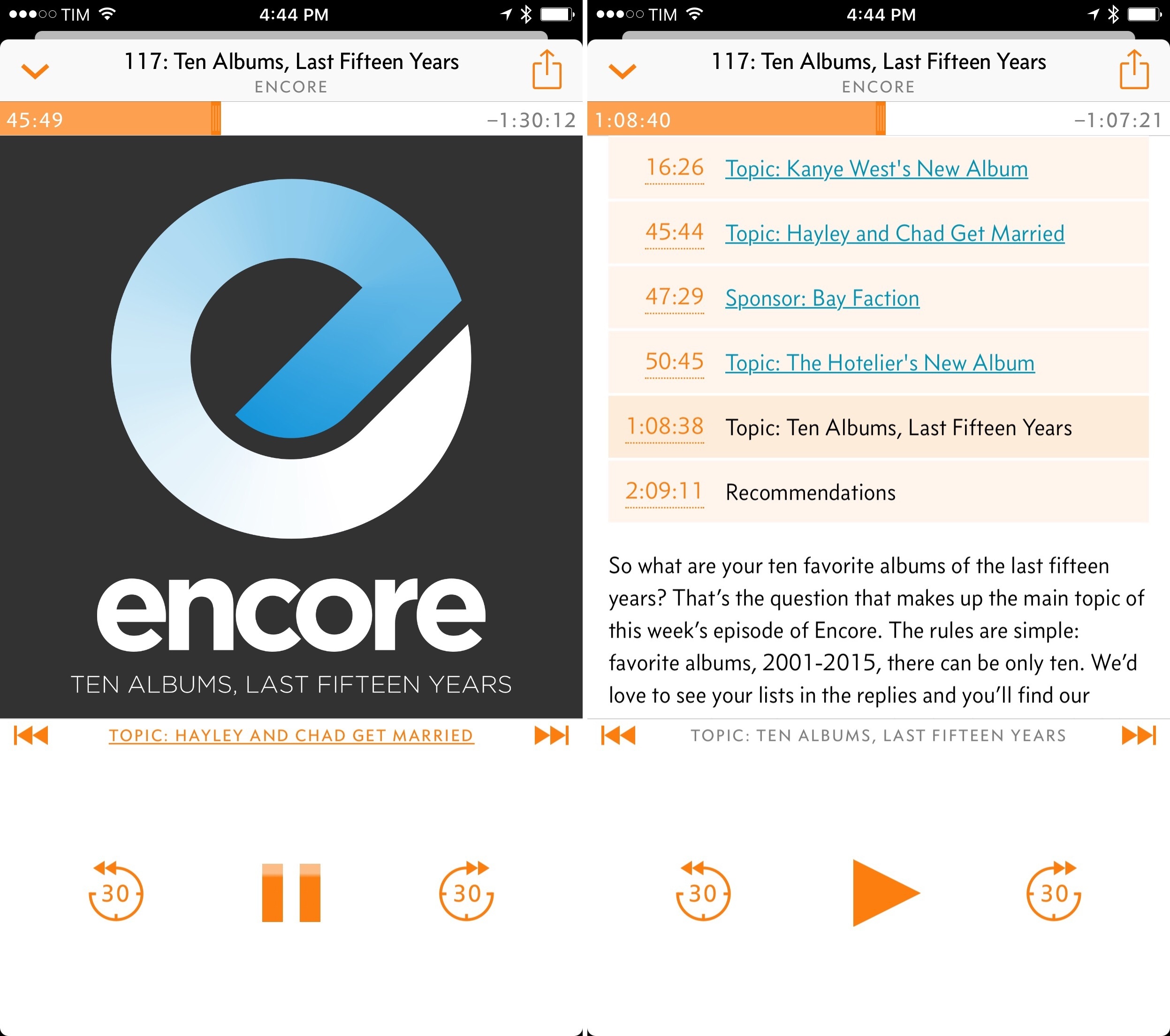
Finally, Overcast 3.0 features a redesigned Now Playing view with pagination in the top half of the screen. Vertical scrolling in the Now Playing page is gone; now, you swipe right to tweak audio settings and swipe left to view episode descriptions, show notes, and links to embedded chapters.

The new paginated Now Playing screen in Overcast 3.0.

The new paginated Now Playing screen in Overcast 3.0.

I see the refreshed Now Playing screen as an overall improvement – it splits up controls and text content in dedicated areas and it allows a sloppy vertical swipe to always dismiss the Now Playing card, which feels nice.

Page indicators are hidden if an episode includes chapters.

Page indicators are hidden if an episode includes chapters.

I have one reservation, though: while episodes without chapters hint at pagination through page indicators below the show's artwork, these indicators aren't displayed if an episode contains chapters. As chapters continue to gain popularity among podcast producers, I believe some users will be confused by the design change as they won't be able to discover the Now Playing pages at all. Page indicators should always be displayed for consistency and discoverability.

Overcast 3.0 may not come with the same number of major additions as version 2.0 (which brought support for chapters and streaming), but it's a better iOS 10 app that fixes longstanding shortcomings and makes everything easier and speedier. If you didn't like Overcast before, version 3.0 likely won't change your mind. But as someone who's used the app every day since it first launched, Overcast 3.0 offers solid improvements that continue to make it my favorite podcast app for iOS.

Overcast 3.0 is available on the App Store.


In writing this story, I had a chance to ask Marco Arment a few questions about the evolution of Overcast's business model, ads, and integration with iOS 10. You can find the interview below.


A Brief Interview with Marco Arment

Federico Viticci: We discussed the switch to a patronage model when you launched Overcast 2.0. Then in September 2016, you shared some numbers about the performance of the patronage model and explained why you decided to try ads. How has the change gone so far? What have you learned since implementing ads in Overcast?

Marco Arment: Ads with a subscription to remove them has been Overcast's most successful business model. I finally have what I've been looking for: everyone getting all of the best features, while providing healthy, sustainable, and growing income over time.

Overcast's customers are also happier with this model than my previous ones. People who don't mind ads are fine with them, and people who don't want to see them are happy to pay for the subscription instead.

FV: With Overcast 3.0, you've removed Google ads in favor of your own solution. What drove this decision, and what kind of challenges do you see ahead?

MA: In order to make much money from the big mobile ad platforms, you need to be willing to embed multiple closed-source ad libraries in your app, you need to permit lots of questionable ads, and you need to design the app such that users are seeing and tapping on the ads a lot.

My Google ads in Overcast 2.6 were successful primarily because they drove people to subscribe — the ads themselves made very little money, in part because of poor placement and in part because I kept disallowing high-paying ad categories that I thought were inappropriate.

Finally, with the recent worrisome shifts in U.S. political and surveillance areas, I decided that I was no longer comfortable embedding anyone else's closed-source ad library into Overcast. For my customers' safety and privacy, I want knowledge and control of every line of non-Apple code that my app is running.

Since Google's ads weren't making much for me anyway and subscriptions made up the bulk of the revenue, I realized I could run pretty much any ads in the app, so I made my own and am trying to sell them directly. I don't have to sell many of them to match the previous ad revenue, they're completely under my control, and only the bare minimum data for accounting is collected (number of clicks per ad, etc.).

It's more work this way, but I believe it'll be worth it.

FV: One of your original goals with moving Overcast 2.0 to a free model was to make the app easier to use in its full feature set in an increasingly competitive landscape. Did the move to free (and thus to a larger audience) bring any downsides you were not expecting? Is it necessary to offer free apps with ads if you want to achieve any meaningful scale and revenue today?

MA: It depends on your app's market. For mass-market entertainment apps, especially when Apple includes a competitor for free, it's important to remove as many barriers to trying your app as possible. Free-up-front with some sort of in-app monetization is the best balance I've found between marketshare and revenue.

For Overcast, I haven't found any major downsides to a large, mostly-free audience. I've built the business with marketshare in mind, so I've kept costs low and engineered the server-side components to scale inexpensively. It achieves neither explosive growth (which needs funding and large expenditures) nor extreme profitability (which probably needs a paid-up-front app, at the expense of marketshare and competitive vulnerability). I'm satisfied with the middle ground.

FV: Finally, iOS 10. The latest version of iOS brought, among various consumer changes, support for rich notifications and an iMessage SDK. You've added rich notification support to Overcast, but haven't shipped an iMessage component for the app. Do you find iMessage apps to have a limited appeal? And what else would you like to see in the future of iOS for audio apps like Overcast?

MA: Overcast's top sharing destination is Messages, but there hasn't been much demand for an Overcast Messages app. I think iOS users mostly think to share from the source app using the iOS share sheet, which I already offer, rather than finding a corresponding app in Messages and trying to share directly from there.

There are plenty of interesting uses for Messages apps, but I haven't come up with a compelling one for Overcast yet.

My biggest platform feature request for Overcast is Siri support. Adding a Siri intent for audio services isn't easy, which is probably why it didn't make it into the initial Siri API in iOS 10 – in addition to basic playback commands, it would probably need a system to index each app's library of available content. Whenever we get more Siri API intents, probably with iOS 11, I hope that's one of them.


  1. Some examples: TwIM, Record Bird, Google. It takes some time getting used to the different shape on the Home screen (particularly compared to the guidelines followed by Apple in their apps), but I like Overcast's icon better now. It feels fresh. ↩︎
  2. I wish a light thud played through the Taptic Engine when the Now Playing screen is swiped to the bottom, though. I also would have liked to see the chevron in the top left corner (in the episode's title bar) dynamically change its shape as the card is pulled down, like Apple Music does with its pulling indicator in the Now Playing card. ↩︎

Support MacStories Directly

Club MacStories offers exclusive access to extra MacStories content, delivered every week; it’s also a way to support us directly.

Club MacStories will help you discover the best apps for your devices and get the most out of your iPhone, iPad, and Mac. Plus, it’s made in Italy.

Join Now
23 Feb 06:39

things I’ve recently learned about legislative redistricting

Interesting things are afoot in legislative redistricting! Over the past ten years, Republicans have enacted partisan gerrymanders in a number of state houses in order to establish and maintain control of U.S. politics despite their unpopular policies. I’ve been learning what I can about redistricting and I’m curious if there’s something useful I could offer as a geospatial open data person.

This post is a summary of things I’ve been learning. If any of this is wrong or incomplete, please say so in the comments below. Also, here’s an interactive map of the three overlapping districts you’re probably in right now:

Three exciting things are happening now.

First, Wisconsin is in court trying to defend its legislative plan, and not doing well. It’s a rare case of a district plan being challenged on explicitly partisan grounds; in the past we’ve seen racial and other measures used in laws like the Voting Rights Act, but partisan outcomes have not typically been considered grounds for action. It might be headed to the Supreme Court.

Second, a new measure of partisan gerrymandering, the Efficiency Gap, is providing a court-friendly measure for partisan effects. Defined by two scholars, Nicholas Stephanopoulos and Eric McGhee, the measure defines two kinds of wasted votes: “lost votes” cast in favor of a defeated candidate, and “surplus votes” cast in favor of a winning candidate that weren’t actually necessary for the candidate’s victory. Stephanopoulos sums it up as “the difference between the parties’ respective wasted votes in an election, divided by the total number of votes cast.”

Wisconsin happens to be one of the biggest bullies on this particular block:

This New Republic article provides a friendly explanation.

Third, former U.S. Attorney General Eric Holder has created the National Democratic Redistricting Committee (NDRC), a “targeted, state-by-state strategy that ensures Democrats can fight back and produce fairer maps in the 2021 redistricting process.” Right now, I’m hearing that NDRC is in early fundraising mode.

So that’s a lot.

I sent some fan mail to Eric McGhee and he graciously helped me understand a bunch of the basic concepts over coffee.

One thing I learned is the significance and use of political geography. As Marco Rogers has pointed out, liberals and democrats clump together in urban areas: “Look at the electoral maps. Drill into the states. What we see is singular blue counties, clustered around cities, in an endless sea of red.” At Code for America, we worked with a number of cities that fell into this pattern, and frequently they were looking to CfA for help dealing with blue town vs. red county issues.

Jowei Chen, associate professor of political science in Michigan, has an extensive bibliography of writing about legislative districts. In his 2013 paper Unintentional Gerrymandering, Chen demonstrates how a sampling of possible redistricting proposals can maintain partisan bias:

In contemporary Florida and several other urbanized states, voters are arranged in geographic space in such a way that traditional districting principles of contiguity and compactness will generate substantial electoral bias in favor of the Republican Party.

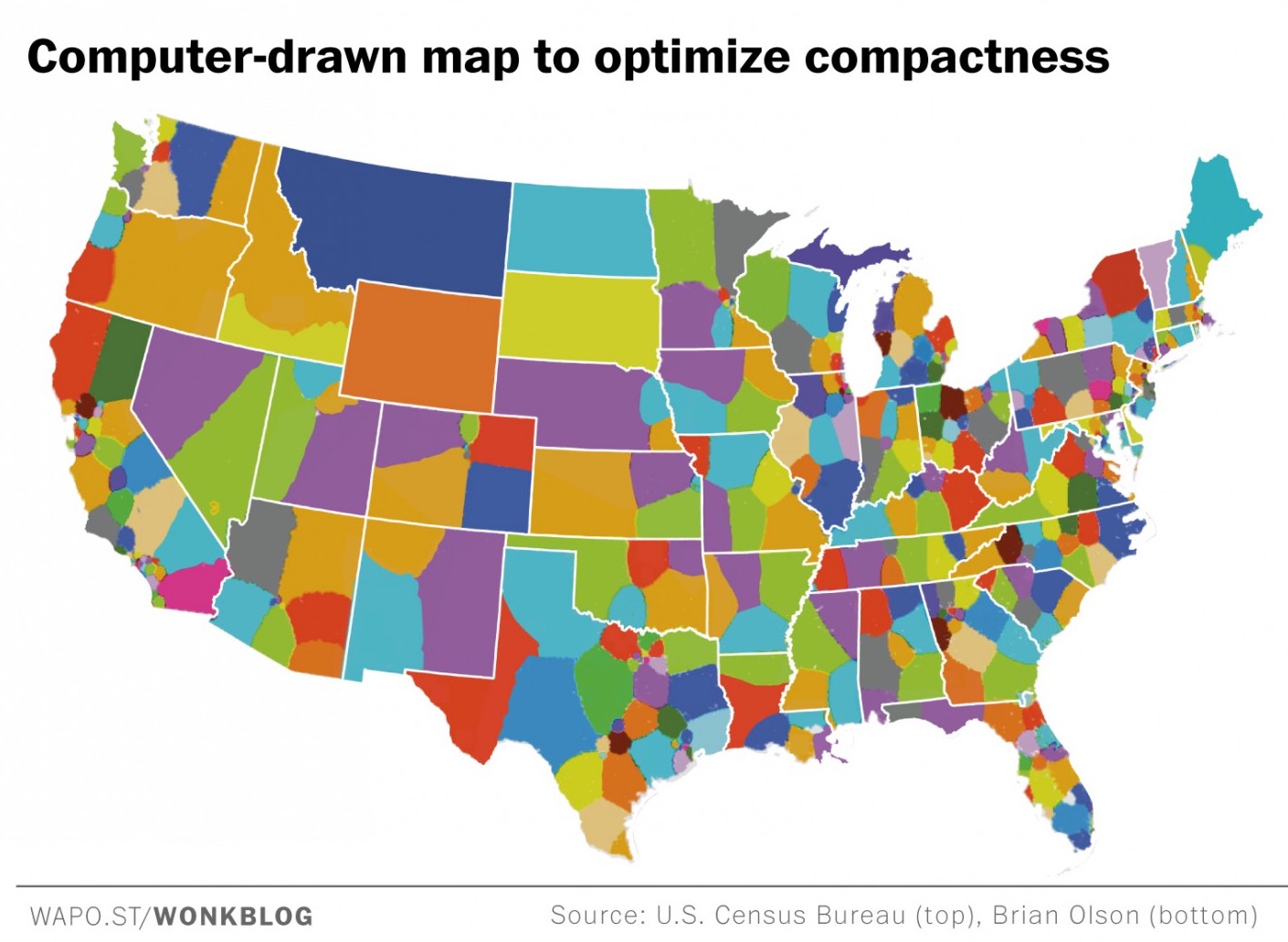
Geometry is a red herring. Over the years I’ve encountered a few geometry optimizations for proposed districts, including this one from Brian Olson, written up in the Washington Post:

Olson’s proposed district plans

While compactness is desirable in a district, Olson’s method prioritizes visual aesthetics above political geography, and he notes some of the factors he ignores on his site, such as travel time: “it might be the right kind of thing to measure, but it would take too long.” Olson’s method selects aesthetically pleasing shapes that are fast to calculate on his home computer. I think that’s a terrible basis for a redistricting plan, but the goofy shapes that exist in many current plans are a popular butt of jokes:

Gerrymandering T-Shirts by BorderlineStyle

Chen particularly calls out how cartographic concerns can be a dead-end:

Our simulations suggest that reducing the partisan bias observed in such states would require reformers to give up on what Dixon (1968) referred to as the “myth of non-partisan cartography,” focusing not on the intentions of mapmakers, but instead on an empirical standard that assesses whether a districting plan is likely to treat both parties equally (e.g., King et al., 2006; Hirsch, 2009).

However, geography is not insurmountable.

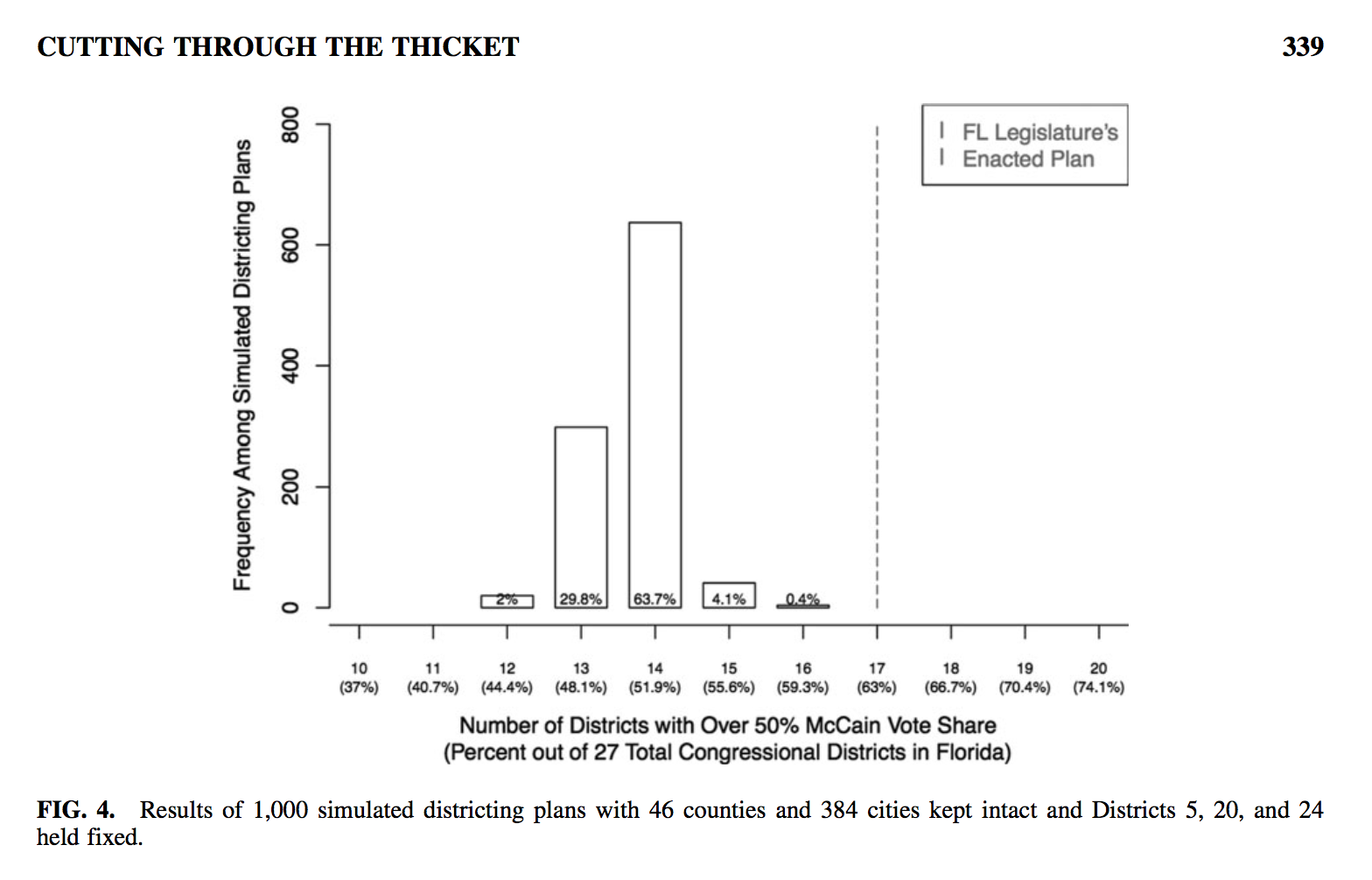
In a later 2015 paper, Cutting Through the Thicket, Chen argues through statistical simulations that legislative outcomes can be predicted for a given redistricting plan, and plots the potential results of many plans to show that a given outcome can be intentionally selected:

A straightforward redistricting algorithm can be used to generate a benchmark against which to contrast a plan that has been called into constitutional question, thus laying bare any partisan ad- vantage that cannot be attributed to legitimate legislative objectives.

Here’s Florida’s controversial 2012 plan shown as a dotted line to the right of 1,000 simulated plans, demonstrating a “clearer sense of how this extreme partisan advantage was created:”

A graph from Chen’s 2015 paper showing simulated partisan outcomes for Florida district plans

Chen concludes that the position of the dotted line relative to the modal outcomes shows partisan intent, if you agree that such an outcome is unlikely to be random.

In 2010, Republicans systematically generated skewed partisan outcomes in numerous state houses, as documented in this NPR interview with the author of Ratf**ked:

There was a huge Republican wave election in 2010, and that is an important piece of this. But the other important piece of Redmap is what they did to lock in those lines the following year. And it's the mapping efforts that were made and the precise strategies that were launched in 2011 to sustain those gains, even in Democratic years, which is what makes RedMap so effective and successful.

“RedMap” was a GOP program led by Republican strategist Chris Jankowski to turn the map red by targeting state legislative races:

The idea was that you could take a state like Ohio, for example. In 2008, the Democrats held a majority in the statehouse of 53-46. What RedMap does is they identify and target six specific statehouse seats. They spend $1 million on these races, which is an unheard of amount of money coming into a statehouse race. Republicans win five of these. They take control of the Statehouse in Ohio - also, the state Senate that year. And it gives them, essentially, a veto-proof run of the entire re-districting in the state.

Holder’s NDRC effort is a counter-effort to RedMap. They’re planning electoral, ballot, and legal initiatives to undo the damage of RedMap. Chen’s simulation method could allow a legislature to overcome geographic determinism and decide on an outcome that better represents the distribution of voters. Chen again:

We do not envision that a plaintiff would use our approach in isolation. On the contrary, it would be most effective in combination with evidence of partisan asymmetry and perhaps more traditional evidence including direct testimony about intent and critiques of individual districts. As with Justice Stevens’ description of partisan symmetry, we view it as a “helpful (though certainly not talismanic) tool.”

So, back to the efficiency gap.

McGhee and Stephanopoulos’s measure counts actual votes in real elections. That’s helpful to courts trying to determine whether a given plan is fair, because it does not rely on guessing about possible outcome from public opinion. Chen’s approach provides a statistical expectation for what a normal plan could do, as well as ways to adjust plans based on desired outcomes. Calculating the efficiency gap for a proposed district plan is complicated, because you need to account for cases where simple red/blue data is missing, such as a uncontested races. You have to impute the potential vote in each proposed new district.

To do this, you need precinct-level election data. Jon Schleuss, Joe Fox, and others working with Ben Welsh at the LA Times Data Desk recently created the most detailed election result map ever made for California. In other states, the data is often not available online, and must be specially requested from sometimes-unhelpful officials. Eric McGhee told me that many experts working on redistricting use a dataset maintained by DailyKos, an independent liberal news website.

LA Times maps of California’s 2016 election results

There’s a big opportunity here for a carefully-vetted online tool that could calculate measures like the efficiency gap for a variety of districting plans. For my part, I’m getting started understanding the sources and types of data that might help pull district plans in a fairer direction. If you’re curious about your own district, find yourself on this map:

Comments (6)
23 Feb 06:38

My Podcasting Setup

I’ve gotten a number of inquiries over the last 2 years about my podcasting setup and I’ve been meaning to write about it but….

But here it is! I actually wanted to write this because I felt like there actually wasn’t a ton of good information about this on the Internet that wasn’t for people who wanted to do it professionally but were rather more “casual” podcasters. So here’s what I’ve got.

There are two types of podcasts roughly: The kind you record with everyone in the same room and the kind you record where everyone is in different rooms. They both require slightly different setups so I’ll talk about both. For me, Elizabeth Matsui and I record The Effort Report locally because we’re both at Johns Hopkins. But Hilary Parker and I record Not So Standard Deviations remotely because she’s on the other side of the country most of the time.

Recording Equipment

When Hilary and I first started we just used the microphone attached to the headphones you get with your iPhone or whatever. That’s okay but the sound feels very “narrow” to me. That said, it’s a good way to get started and it likely costs you nothing.

The next level up for many people is the Blue Yeti USB Microphone which is perfectly fine microphone and not too expensive. Also, it uses USB (as opposed to more professional XLR) so it connects to any computer, which is nice. However, it typically retails for $120, which isn’t nothing, and there are probably cheaper microphones that are just as good. For example, Jason Snell recommends the Audio Technica ATR2100 which is only about $70.

If you’re willing to shell out a little more money, I’d highly recommend the Zoom H4n portable recorder. This is actually two things: a microphone and a recorder. It has a nice stero microphone built into the top along with two XLR inputs on the bottom that allow you to record from external mics. It records to SD cards so it’s great for a portable setup where you don’t want to carry a computer around with you. It retails for about $200 so it’s not cheap, but in my opinion it is worth every penny. I’ve been using my H4n for years now.

Because we do a lot or recording for our online courses here, we’ve actually got a bit more equipment in the office. So for in-person podcasts I sometimes record using a Sennheiser MKH416-P48US attached to an Auray MS-5230T microphone stand which is decidedly not cheap but is a great piece of hardware.

By the way, a microphone stand is great to have, if you can get one, so you don’t have to set the microphone on your desk or table. That way if you bump the table by accident or generally like to bang the table, it won’t get picked up on the microphone. It’s not something to get right away, but maybe later when you make the big time.

Recording Software

If you’re recording by yourself, you can just hook up your microphone to your computer and record to any old software that records sound (on the Mac you can use Quicktime). If you have multiple people, you can either

  1. Speak into the same mic and have both your voices recorded on the same audio file
  2. Use separate mics (and separate computers) and record separtely on to separate audio files. This requires synching the audio files in an editor, but that’s not too big a deal if you only have 2-3 people.

For local podcasts, I actually just use the H4n and record directly to the SD card. This creates separate WAV files for each microphone that are already synced so you can just plop them in the editor.

For remote podcasts, you’ll need some communication software. Hilary and I use Zencastr which has its own VoIP system that allows you to talk to anyone by just sending your guests a link. So I create a session in Zencastr, send Hilary the link for the session, she logs in (without needing any credentials) and we just start talking. The web site records the audio directly off of your microphone and then uploads the audio files (one for each guest) to Dropbox. The service is really nice and there are now a few just like it. Zencastr costs $20 a month right now but there is a limited free tier.

The other approach is to use something like Skype and then use something like ecamm call-recorder to record the conversation. The downside with this approach is that if you have any network trouble that messes up the audio, then you will also record that. However, Zencastr (and related services) do not work on iOS devices and other devices that use WebKit based browsers. So if you have someone calling in on a mobile device via Skype or something, then you’ll have to use this approach. Otherwise, I prefer the Zencastr approach and can’t really see any downside except for the cost.

Editing Software

There isn’t a lot of software that’s specifically designed for editing podcasts. I actually started off editing podcasts in Final Cut Pro X (nonlinear video editor) because that’s what I was familiar with. But now I use Logic Pro X, which is not really designed for podcasts, but it’s a real digital audio workstation and has nice features (like strip silence). But I think something like Audacity would be fine for basic editing.

The main thing I need to do with editing is merge the different audio tracks together and cut off any extraneous material at the beginning or the end. I don’t usually do a lot of editing in the middle unless there’s a major mishap like a siren goes by or a cat jumps on the computer. Once the editing is done I bounce to an AAC or MP3 file for uploading.

Hosting

You’ll need a service for hosting your audio files if you don’t have your own server. You can technically host your audio files anywhere, but specific services have niceties like auto-generating the RSS feed. For Not So Standard Deviations I use SoundCloud and for The Effort Report I use Libsyn.

Of the two services, I think I prefer Libsyn, because it’s specifically designed for podcasting and has somewhat better analytics. The web site feels a little bit like it was designed in 2003, but otherwise it works great. Libsyn also has features for things like advertising and subscriptions, but I don’t use any of those. SoundCloud is fine but wasn’t really designed for podcasting and sometimes feels a little unnatural.

Summary

If you’re interested in getting started in podcasting, here’s my bottom line:

  1. Get a partner. It’s more fun that way!
  2. If you and your partner are remote, use Zencastr or something similar.
  3. Splurge for the Zoom H4n if you can, otherwise get a reasonable cheap microphone like the Audio Technica or the Yeti.
  4. Don’t focus too much on editing. Just clip off the beginning and the end.
  5. Host on Libsyn.
23 Feb 06:38

Recommended on Medium: I’ll never bring my phone on an international flight again. Neither should you.

A public domain image of a US Customs and Border Patrol agent in an airport.

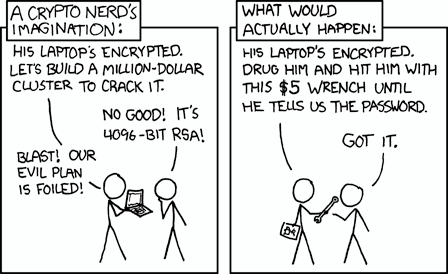
A few months ago I wrote about how you can encrypt your entire life in less than an hour. Well, all the security in the world can’t save you if someone has physical possession of your phone or laptop, and can intimidate you into giving up your password.

Image credit: XKCD

And a few weeks ago, that’s precisely what happened to a US citizen returning home from abroad.

On January 30th, Sidd Bikkannavar, a US-born scientist at NASA’s Jet Propulsion Laboratory flew back to Houston, Texas from Santiago, Chile.

On his way through through the airport, Customs and Border Patrol agents pulled him aside. They searched him, then detained him in a room with a bunch of other people sleeping in cots. They eventually returned and said they’d release him if he told them the password to unlock his phone.

Sidd Bikkannavar’s hobbies include racing solar-powered cars. Photo by The Verge

Bikkannavar explained that the phone belonged to NASA and had sensitive information on it, but his pleas fell on deaf ears. He eventually yielded and unlocked his phone. The agents left with his phone. Half an hour later, they returned, handed him his phone, and released him.

We’re going to discuss the legality of all of this, and what likely happened during that 30 minutes where Bikkannavar’s phone was unlocked and outside of his possession.

But before we do, take a moment to think about all the apps you have on your phone. Email? Facebook? Dropbox? Your browser? Signal? The history of everything you’ve ever done — everything you’ve ever searched, and everything you’ve ever said to anyone — is right there in those apps.

“We should treat personal electronic data with the same care and respect as weapons-grade plutonium — it is dangerous, long-lasting and once it has leaked there’s no getting it back.” — Cory Doctorow

How many potentially incriminating things do you have lying around your home? If you’re like most people, the answer is probably zero. And yet police would need to go before a judge and establish probable cause before they could get a warrant to search your home.

What we’re seeing now is that anyone can be grabbed on their way through customs and forced to hand over the full contents of their digital life.

Companies like Elcomsoft make “forensic software” that can suck down all your photos, contacts — even passwords for your email and social media accounts — in a matter of minutes. Their customers include the police forces of various countries, militaries, and private security forces. They can use these tools to permanently archive everything there is to know about you. All they need is your unlocked phone.

“If one would give me six lines written by the hand of the most honest man, I would find something in them to have him hanged.” — Cardinal Richelieu in 1641

What’s the worst thing that could happen if the Customs and Border Patrol succeed in getting ahold of your unlocked phone? Well…

  • Think of all of the people you’ve ever called or emailed, and all the people you’re connected with on Facebook and LinkedIn. What are the chances that one of them has committed a serious crime, or will do so in the future?
  • Have you ever taken a photo at a protest, bought a controversial book on Amazon, or vented about an encounter with a police officer to a loved one? That information is now part of your permanent record, and could be dragged out as evidence against you if you ever end up in court.
  • There’s a movement within government to make all data from all departments available to all staff at a local, state, and federal level. The more places your data ends up, the larger a hacker’s “attack surface” is — that is, the more vulnerable your data is. A security breach in a single police station in the middle of nowhere could result in your data ending up in the hands of hackers — and potentially used against you from the shadows — for the rest of your life.

Wait a second. What about my fourth and fifth amendment rights? Isn’t this illegal?

The fourth amendment protects you against unreasonable search and seizure. The fifth amendment protects you against self-incrimination.

If a police officer were to stop you on the street of America and ask you to unlock your phone and give it to them, these amendments would give you strong legal ground for refusing to do so.

But unfortunately, the US border isn’t technically the US, and you don’t have either of these rights at the border.

It’s totally legal for a US Customs and Border Patrol officer to ask you to unlock your phone and hand it over to them. And they can detain you indefinitely if you don’t. Even if you’re a American citizen.

The border is technically outside of US jurisdiction, in a sort of legal no-man’s-land. You have very few rights there. Barring the use of “excessive force,” agents can do whatever they want to you.

So my advice is to just do whatever they tell you, to and get through customs and on into the US as quickly as you can.

The US isn’t the only country that does this.

It’s only a matter of time before downloading the contents of people’s phones becomes a standard procedure for entering every country. This already happens in Canada. And you can bet that countries like China and Russia aren’t far behind.

“Never say anything in an electronic message that you wouldn’t want appearing, and attributed to you, in tomorrow morning’s front-page headline in the New York Times.” — Colonel David Russell, former head of DARPA’s Information Processing Techniques Office

Since it’s illegal in most countries to profile individual travelers, customs officers will soon require everyone to do this.

The companies who make the software that downloads data from your phones are about to get a huge infusion of money from governments. Their software will get much faster — maybe requiring only a few seconds to download all of your most pertinent data from your phone.

If we do nothing to resist, pretty soon everyone will have to unlock their phone and hand it over to a customs agent while they’re getting their passport swiped.

Over time, this unparalleled intrusion into your personal privacy may come to feel as routine as taking off your shoes and putting them on a conveyer belt.

And with this single new procedure, all the hard work that Apple and Google have invested in encrypting the data on your phone — and fighting for your privacy in court — will be a completely moot point.

Governments will have succeeded in utterly circumventing decades of innovation in security and privacy protection. All by demanding you hand them the skeleton key to your life — your unlocked phone.

You can’t hand over a device that you don’t have.

When you travel internationally, you should leave your mobile phone and laptop at home. You can rent phones at most international airports that include data plans.

If you have family overseas, you can buy a second phone and laptop and leave them there at their home.

If you’re an employer, you can create a policy that your employees are not to bring devices with them during international travel. You can then issue them “loaner” laptops and phones once they enter the country.

Since most of our private data is stored in the cloud — and not on individual devices — you could also reset your phone to its factory settings before boarding an international flight. This process will also delete the keys necessary to unencrypt any residual data on your phone (iOS and Android fully encrypt your data).

This way, you could bring your physical phone with you, then reinstall apps and re-authenticate with them once you’ve arrived. If you’re asked to hand over your unlocked phone at the border, there won’t be any personal data on it. All your data will be safe behind the world-class security that Facebook, Google, Apple, Signal, and all these other companies use.

Is all this inconvenient? Absolutely. But it’s the only sane course of action when you consider the gravity of your data falling into the wrong hands.

If you bother locking your doors at night, you should bother securing your phone’s data during international travel.

This may upset Customs and Border Patrol agents, who are probably smart enough to realize that 85% of Americans now have smart phones, and probably 100% of the Americans who travel internationally have smart phones. They may choose to detain you anyway, and force you to give them passwords to various accounts manually. But there’s no easy way for them to know which services you use and which services you don’t use, or whether you have multiple accounts.

We live in an era of mass surveillance, where governments around the world are passing terrifying new anti-privacy laws every year.

“Those who are willing to surrender their freedom for security have always demanded that if they give up their full freedom it should also be taken from those not prepared to do so.” — Friedrich Hayek

With a lot of hard work on our part, enlightenment will triumph. Privacy will be restored. And we will beat back the current climate of fear that’s confusing people into unnecessarily giving up their rights.

In the meantime, follow the Boy Scouts of America Motto: always be prepared. The next time you plan to cross a border, leave your phone at home.

Thank you for taking the time to reading this. If you liked this, click the

23 Feb 06:35

Instapaper Liked: The true story of how Teen Vogue got mad, got woke, and began terrifying men like Donald Trump

“A woman’s preaching is like a dog’s walking on his hind legs,” Samuel Johnson said back in 1791. “It is not done well; but you are surprised to find it done at…
23 Feb 02:25

Tier 3 failure shows bike-rental ain’t that easy

by John Artman

Chinese tech media is aflutter this morning after news last night that Kala, an O2O bike-rental company, went out of business after only 19 days of operation. In those 19 days, the company, in cooperation with the Putian government (a Tier 4 city in Fujian province), were only able to recover 157 of the 667 bikes they had put around the city for use. Now, they are saying that, due to an agreement with their investor, they are not able to refund any outstanding deposits.

Founded in October 2016, Kala (卡拉单车) planned to operate in Tier 3 and Tier 4 cities (in Chinese) to avoid head-on competition with bike-rental leaders Mobike and Ofo. However, it took them 2 months to find investment, after being turned down by 30 different investors.

Once they were able to get funding, they planned to expand with 5000 bikes to other Tier 3 and Tier 4 cities, but after the startling losses of their only real asset, their investor (not disclosed) invoked a clause in their value adjustment mechanism (VAM) agreement. This allowed them to take all desposits as recompense for an initial over-valuation of the company.

According to the company, they have returned as many deposits as they can, but have already ran out of money from their initial bank loan.

The news that an investor was able to walk away with all the deposits has raised many eyebrows (in Chinese) around the country. Both Mobike and Ofo have stated many times that all the deposits are kept in separate accounts from their operating budget; users can conceivably get their deposit back whenever they choose.

This outstanding failure, however, does not seem to have dampened investors enthusiam for O2O bike-rental. Mobike announced yesterday that have received post-series D funding from Temasek, a Singapore-based investment company. This puts the total amount of money Mobike has raised this year over US$ 300 million, according to the company.

23 Feb 01:49

Source: Getty Images Top Hat Raises $22.5 Million to Go After Pearson, McGraw-Hill

files/images/Top_Hat.jpg


Gerrit De Vynck, Bloomberg, Feb 23, 2017


Bloomberg offers coverage to this Canadian  company that has set up an  online bookstore for textbooks. Many of the offerings come from OpenStax (Rice University's former Connexions service) and are offered for free while the rest appear to be authored using TopHat's own authoring tool ad sell for various prices. Presumably the company has something else going for it, or they're just a really swell bunch of guys, to account for $40 million in venture capital funding. Top Hat CEO Mike Silagadze "started by selling software tools to professors that help them engage their students, such as smartphone apps that let them tell lecturers if they understand new concepts in real-time."

[Link] [Comment]
23 Feb 01:49

Trust Score (Beta) for Ethereum

files/images/joker.JPG


Nantium OÜ, Decentralize Today, Feb 23, 2017


I agree with  Nantium OÜ that "decentralization will lead to a more fair society where monopolies lose their stranglehold over some of our key economic sectors (and possibly even government sectors)." I'm less convinced that trust is a key part of this, but I'm willing to listen. In any case, what OÜ has done is to create a (beta) trust mechanism for Ethereum. Basically, it uses the same mechanism for trust as it does for payment: "you can file a complaint through an Ethereum contract that will ultimately penalize the other party’ s score." This mechanism has already been suggested for credentials, such as academic achievement or badges. I'm more inclined to think that trust (and achievement) will be derived by AIs mining publicly accessible data. But we'll see.

[Link] [Comment]
20 Feb 15:48

Sharing the Domains Documentation Love

by Reverend

I wanted to make sure Adam Croom gets the appropriate love for helping several schools get up and running with Domains documentation over the last several months. More than a few folks have inquired if we had any recommendations for solid documentation, and it is hard to compete with the new and improved OU Create docs.* Once upon a time, before the Smallest Federated Wiki whisked Mike Caulfield away, we had an idea for federated documentation using DokuWiki, but that never came to be. There was some early momentum to prevent folks from reproducing the documentation wheel—but time, energy, focus, and squirrels got in the way.  

More recently a few schools asked us if the could reproduce Oklahoma’s documentation and then customize it for their school, and it turned out that Adam had already done this for Middlebury’s Middcreate. So, he was kind enough to not only help out a few schools by porting over OU Create’s documentation site whole hog, but even wrote up a tutorial on how to do it

Re-visiting how we re-use and remix documentation resources across schools running Domain of One’s Own will most definitely be on the Domains 17 conference agenda.  I think this is something we need to revisit in order to make this much less arduous. Thanks again Adam, you rule.


David Morgen did some amazing work with Emory’s documentation early and that was the inspiration to try and figure out how to easily share work between schools that wanted to share and re-user Domains documentation.

20 Feb 15:48

Good Discussions At Bad Times

by Richard Millington

Don’t go off-topic too early.

Off-topic discussions can be useful to build strong levels of self-disclosure between members. This facilitates relationships which keep people participating and establishes a strong group identity.

But don’t do this too early.

A reader recently emailed to ask why his off-topic discussions within his Nextdoor group were falling flat. The discussions were standard, but the group was a few weeks old. The few previous discussions related to civic issues (local litter, town planning etc…).

Jumping from a discussion about an upcoming development to ‘what are you going to do this weekend?’ will always sound forced. Don’t do it.

Begin with topic-related questions first – ideally the most important topics. Give members time to become familiar with each other via discussing the topic. Wait for members to go off-topic first before you initiate and encourage similar discussions. Then gradually increase the number.

20 Feb 15:48

Anyone in the United States can now order Snapchat Spectacles online

by Ian Hardy

Late last year, Snap stated it planned to “to significantly broaden the distribution” of Spectacles in 2017.

Today, the company went one step closer to Canadians being able to purchase the sought after smart glasses. While not officially available to those located north of the U.S. border, Snap has opened up online orders for Spectacles across the United States. So, if you’re interested wearing a pair of these gems, now is the time to reconnect with a friend in the south.

The cost is $129 USD (includes charging case and cable) and the wearable manufacturer says delivery is set for two to four weeks. In addition, Snap states there is a limit of six Spectacles per household.

This is the closest Spectacles has arrived in Canada as the company has been dropping its vending machines across the United States in various locations and recently opened up a full store in New York City.

spectacles

Spectacles main feature is a “circular video format” that captures 10 seconds in 115-degree angles that play back full screen — in portrait or landscape — on a smartphone display.

Source: Snap

The post Anyone in the United States can now order Snapchat Spectacles online appeared first on MobileSyrup.

20 Feb 07:20

Putting It All Together

by hrbrmstr
The kind folks over at @RStudio gave a nod to my recently CRAN-released epidata package in their January data package roundup and I thought it might be useful to give it one more showcase using the recent CRAN update to ggalt and the new hrbrthemes (github-only for now) packages. Labor force participation rate The U.S.... Continue reading →
20 Feb 07:20

Keeping The Resistance Safe

Malden’s mayor recently decided that Malden has no need to consider becoming a sanctuary city, because Malden is so inclusive and welcoming.

I respond, in the Malden Observer.

All of us should — and some of us will — defend our friends and neighbors if their government comes to deport them. Where will Malden's officials stand?

We should resolve now that Malden will neither cooperate nor collaborate. Malden police should neither assist mass deportations nor pursue those who shelter fugitives. Public services should plan to provide necessary resources and protection; Marty Walsh has vowed to use Boston City Hall itself to shelter threatened and vulnerable residents. Malden's representatives should work to extend these resolutions throughout Massachusetts. The clarity of our resolve today might forestall a dark future.

20 Feb 07:20

Geek Career Paths

Suppose you’re doing technology, and like doing technology, and your career’s going well, and you find yourself wondering what you’re going to be doing in twenty years. I’ve been down several of the roads you might decide to take, and it occurs to me that talking them over might amuse and inform.

Thanks are due to Andre Leibovici, who tweeted Is it possible to be in a sr. leadership position and still be hands-on w/ tech & code? For geek leaders out there... how to juggle? and got me thinking about this.

Q: Should you stay in tech-related work?

Seriously, this is the most important question. I know of knitting-store owners and carpenters and luthiers and microbrewers and doctors who walked away from tech life. Their reasons were good: They wanted to engage with life physically, to get away from rows of desks, to be outside, to be around women.

Me, I was never tempted; I’ve liked computers for their own sake for decades and still do. But I’ve watched people do this, and I’m pretty convinced that if you’re going to, it’s never too late or too early. When you’re young you can get by on less, have more energy, and have lots of years to flail around till something works. When you’re older, you probably have more money, which can be used to solve a remarkable variety of problems, and more experience as to how the world works.

For the purposes of this piece, let’s assume you’re staying on the tech train.

Q: Should you stay technical?

The bad news that it’s a lot of work. We’re a young profession and we’re still working out our best practices, so the ground keeps changing under you; it doesn’t get easier as the decades go by.

The good news is that it doesn’t get harder either. Once you learn to stop expecting your knowledge to stay fresh, the pace of innovation doesn’t feel to me like it’s much faster (or slower) now than it was in 1987 or 1997 or 2007. More good news: The technology gets better. Seriously, we are so much better at building software now than we used to be in any of those other years ending in 7.

And another thing that may not be obvious: It’s not a one-way door. I stepped off the technology train, spent years in startup management and technology evangelism, and climbed back into engineering life without too much pain.

It hurts me to say this, but there are gender issues here. There is a pernicious tendency for smart women to get streamed away from actually doing technology to, well, almost any of the alternatives I’m going to talk about below. I’ve been in the room when it happens: “She’s great with customers and super-organized, let’s encourage her to look at a management role.” Not that there’s anything wrong with a management role, but the engineering ranks need women too.

Q: Should you go into management?

I tried it, was a CTO and a CEO. I liked being on the spot for everything that mattered, and rarely having to wait for someone else to make a decision. Also, of course, getting the biggest paycheck.

But I hated lots of things: finding investors and dealing with them, managing cash-flow, being pulled in a thousand directions every minute, the really hard shitty HR problems that get to the top, and never being able to say anything that wasn’t on-message. I also disliked the company of my fellow CEOs, because they are people who can never say anything that’s not on-message.

A lot of the best executives started out as engineers. And there are really no barriers. In every tech company I’ve been in, if you’re a competent engineer and also a good communicator, and show evidence of seeing the bigger picture, then if you tell your boss you’d like to try management someday, that day may come a lot faster than you expect.

Q: Should you go into Product Management?

FYI: Good product managers are really hard to grow and hard to hire. So if you combine those technical, business, and communication skills, you won’t have any trouble finding work.

But it’s probably not a good long-term choice; most companies don’t have much of a career path for PMs. That may not be a problem; many PMs transfer to management or marketing positions after a while, without obvious strain.

So while it might be a good choice right now, you’re probably not going to be a PM in twenty years.

Q: Should you go into sales?

I’ve been on a lot of sales calls, and closed a couple of big deals all by myself, which is one of the most insanely satisfying things you can get paid for (and you can get paid a lot). It’s easy enough to find out; most technology companies’ salespeople regularly need geek support and well-run ones are happy to send engineers out on sales calls. If you like what you see, give it a try.

Yes, there’s the risk of ending up in Glengarry Glen Ross. And that remorseless pressure to close is implicit in the profession. But a lot of really successful sales people are ex-engineers; is the remorseless pressure to ship that much better?

Here’s a hint: All the truly great sales pros I’ve known have been people people; would genuinely rather hang out and shoot the shit all day than anything else. If that’s not you, then probably not.

Q: Should you go into marketing?

Marketing is at the center of everything. You probably know why you’re building the technology you’re working on, and what it’s good for, But it turns out that figuring out who out there needs it, what they’d use it for, and how to explain it in simple enough terms that an overworked non-geek can get it quickly, is really really hard.

There’s a range of marketing roles, from tech-oriented ones like “developer advocate” or “evangelist”, all the way over to full-time business strategist. Every one of them is accessible in principle to a technical person who wants to change lanes.

Q: Should you go into Venture Capital?

Please, please don’t. With the exception of a very few top-tier firms, it’s a shitty business that delivers a lousy return to its investors. A large part of your job consists of saying “no” to people, then watching most of the people you say “yes” to fail anyhow.

In my view, most of the pathologies that infect the tech sector, starting with self-absorbedness, arrogance, and lousy diversity, are joined at the hip with VC culture.

Q: Should you work for startups?

Absolutely, yes. I have, twice. The best reason is that you’ll get to see all the different parts of a business up close, how they work, and if you decide you want to pitch in with something that looks interesting, you may not encounter much resistance, particularly if you turn out to be good at it.

The white-hot team intensity, the feeling that you and a few others are moving the world, is just not something you’re going to find elsewhere.

You might make a lot of money, but do bear in mind that most startups fail, and there are a lot of ways for a startup to succeed where most of the money goes to the VCs and almost none to foot soldiers.

Q: Should you work for a BigCo?

Yes; you might not like it, but you should try it. Particularly, in a well-run company, when you get to see what high-quality marketing and legal support is like, and what classes of problem can be solved by throwing money at them, and maybe most of all, how to build systems and processes that are sustainable in the long term.

The flip-side of that coin is that you’ll likely also see institutionalized stupidity, toxic politics, and pathological caution. But I think the rewards make up for it.

I should also point out that you can make serious money working for a BigCo too, particularly if you get lucky with the share price. I speak from experience here.

Finally, suppose you’ve tried managing people and you just don’t like it, but you still want a senior job. Most big tech companies have a position called “Principal Engineer” or “Distinguished Engineer” or some such, which it usually takes decades to grow into, but is pretty well the ideal job for someone like me. You get to work on the most interesting problems and feel like you’re part of the leadership team, and have the chance to move the needle.

Fintan Ryan of RedMonk just published On the Myth of the 10X Engineer and the Reality of the Distinguished Engineer, which I think overstates the wonderfulness of the position, but does hit a few key points.

Q: Should you work for a government?

Up till maybe five years ago, I would have said “No way, run screaming in the other direction.” For decades governments as a matter of policy hired no software developers and based all their projects on outsourcing, usually to loathsome blue-suit operations whose core competencies are winning public-sector bids then cashing in by charging for every ripple coming out of those classic waterfall projects.

In recent years, led initially by the UK organization now called the Government Digital Service, a few governments have clued into the fact that information processing is an essential core competence for the public sector, and started pulling it in-house.

Remember when the Obama administration wrested control of healthcare.gov out of the hands of the consultants, aimed a bunch of competent geeks at it, and rescued it? I’m thinking that kind of work could be among the most rewarding things you could load up a technical career with.

There’s a sub-question here: How about a job in the inteligence community? I’ve never had one, but I’ve sold them technology and worked with them. They have the biggest computers and maybe the hardest problems, and I firmly believe that effective intelligence makes the world a safer place.

But the people I know in the community always seemed more stressed out and less happy than your average geek, and I heard persistent grumbling about work-culture problems. So I’m not sure I’d recommend that path.

Q: Should you work for a non-tech company?

I can’t help you here very much; never done it. Since I’ve been working for AWS I’ve got in face time with a lot of IT people from outside the geek-o-sphere, and they seem to be pretty happy. But then, the ones I’m talking to are the ones mixed up in the move to the cloud, which is absolutely the most interesting single trend in IT these days.

Obviously, you’re probably at slightly higher risk of a pointy-haired boss who hasn’t the vaguest idea what it is you actually do.

Q: Should you be a consultant?

This is really two questions. First, should you be an independent consultant, working for yourself? I have, and it was OK, and paid pretty well (although both the startup and the BigCo did better). You have to be willing to market yourself aggressively; conference speaking slots work best, in my experience. Then, after the gig, you have to hassle your customers to get paid, which really isn’t fun. Finally, you’re going to be spending a lot of time on the road.

I had fun, and several remarkably interesting customers. Two things got on my nerves. First, you get to work on the hard problems, but you never get to stick around and ship a product. Second: A lot of times you end up telling management exactly the same thing their own smart geeks were telling them, but they listen to you, not their own people

The second question is, should you go work for a big consulting company? I’d offer a firm “No”, even though the pay is good. These companies work their people insanely hard, and in my opinion, based on thirty years of observation, charge too much and deliver too little. They are definitely Part Of The Problem, and you should stay away.

Q: Should you work for a nonprofit or charity?

I never have, and I regret it. Obviously, this is not a ticket to the 1%, and I suspect that the technology problems and solutions are pretty mundane. But I’d hope there would be other, more important, rewards.

20 Feb 07:19

The Lead-Crime Hypothesis and a Gripe About Mobile

by mikecaulfield

I’ve generally kept my advocacy for the Lead-Crime Hypothesis off this blog. This is a blog about web-enabled education, after all. But today I can probably get away with it because there’s a web literacy connection. Seriously, I promise.

For those who don’t know the lead-crime hypothesis, it goes like this: the massive crime wave of the late 70s to early 1990s in the U.S. — the crime wave that gave us our politics as we have them now, since it was seen as a failure of liberalism — that crime wave was caused primarily by youth exposure to lead, a result of the most massive public poisoning in the history of the world: the sale and use of leaded gasoline.

In this theory, early lead poisoning, especially in urban areas, affected the mental development of many children, making them more prone to violence and a host of other cognitive and behavioral issues. Roll those behaviors forward 18 years or so, and that early lead exposure becomes a crime wave.

You see why I don’t mention this on the blog much, even though I’ve been annoying friends with it for years. It sounds pretty tin-foil hattish, even though it’s a pretty solid hypothesis.

Anyway, I wanted to make a point about mobile learning, and today I get to do it by talking about lead.

So here’s the thing: I’m reading through an old New Scientist article from 1971 for another purpose (history of computing in education) when I see an article adjacent to the one I’m reading on lead poisoning.

I can’t resist. In it is this paragraph:

manchester-children

From “Is Lead Blowing Our Minds? New Scientist, May 27, 1971.

There’s a whole host of of questions that occur to me reading this. The first question is how that Manchester average child exposure compares to Flint, Michigan. I open a new tab and do a web search for lead blood level in Flint. It turns out that 30 children in Flint had levels above 5 micrograms per deciliter. Twenty-three of them were under six:

Unfortunately there’s a mismatch in unit here, so we’re going to have to covert 5ug/dL to parts per million. So we open another tab and find a converter:

ug.JPG

Then we convert. I actually know this conversion, but I like doing it here to make sure I don’t mess it up by a decimal place:

conv.JPG

OK, so here’s some context then that should blow your mind. In Flint there were 30 children that tested above the dangerous level of 5 ug/dL. This was the crisis. Yet, according to the New Scientist article, in 1971 the average blood level in children in Manchester UK was six times that, at 31 ug/dL. And unlike in Flint, that wasn’t temporary — that was over their entire childhood.

As usual, when I look at lead stuff, I have to flip back and forth multiple times. The numbers shock me every time. But I think I did this right. (You’re welcome to check me here).

We can have some more fun here. The Flint article says:

Any child who tests 45 micrograms per deciliter or higher must be immediately treated at a poison center, Wells said. No children have tested at that level.

We return to that New Scientist article:

A recent study of Manchester children showed an average of 0.31 ppm, with 17 percent over .50 ppm…

Again, that conversion show 17% of Manchester children had levels over 50 ug/dL. So maybe 20% of the 1971 population of Manchester, if they were alive today, would likely be rushed to a poison center for immediate blood chelation.

So that’s some context.

So now for the hypothesis. The end of that paragraph says that Finland had the highest lead levels in 1971 and Sweden the lowest in a multi-country study. This is a great find because Finland and Sweden should have similar-ish cultures, but different lead exposures. According to the lead hypothesis if we go forward 18 years or so we should find that Finland has a significantly higher crime rate than Sweden.

We make this hypothesis before we go, and decide to look at the murder rate, since it is the most comparable across countries (other violent crimes can vary in definition and record-keeping, but murder is murder).

So we open up my go-to resource for nation data — Nation Master. Unfortunately comparisons for 1989 are not available. But 1995 comparisons are, so we’ll take it:

compare

And what do we find? Score another point for the lead hypothesis: the rate of murder in Finland, the high-lead country, is three times of that in Sweden, the low-lead country.

The whole process takes about ten minutes, maybe a bit less. But at the end of it, my tabs look like this:

tabs

With about a third of those tabs opened up in the course of looking at this.

I’m not saying that I proved anything here. I could still be a nut about this leaded gasoline and crime hypothesis.

But I am saying that this is what literate web reading looks like. You read things, and slide smoothly into multi-tab investigations of issues, pulling in statistical databases, unit converters, old and new magazine articles, published research.

Now here’s my question — if I read this on my phone, how much of this could I have done? My experience tells me almost none of it. On a laptop we built all this context, developed an informal hypothesis and tested against a database. On a phone, I doubt we could have even made it through the first Flint search without wanting to throw our phone across the room.

We know that this sort of multi-tabbed environment is productive — it was, of course, one of the major breakthroughs of Xerox PARC — multiple windows between which you could copy and paste text. If you want your computer to be more than a consumption tool you need that sort of functionality.

The mobile web takes that all away, makes us dumber and less investigative. Yet year after year we hear people talking about the promise of mobile learning.

It’s not only wrong — it’s harmful.

As educators, I’m going to propose a different question. Not “How do we promote mobile learning?” but instead, how do we stop it?

How do we get kids to work on laptops, and stop reading on phones? How do we get them to learn the techniques of multi-tab investigations? Because this world where we’ve started reading everything on single-tabbed phone browsers, without workable copy and paste, without context menus, without keyboards? It’s going to make us very dumb compared to the people that came before us. And I think we need all the intelligence we can use right now.


20 Feb 07:19

116 drug deaths in B.C. last month — but none at overdose-prevention sites

mkalus shared this story .

Every one of the 26 people who overdosed on illicit drugs at Our Place in January survived, some treated with oxygen alone to keep them breathing.

As a result, they did not join the 116 people who died of drug overdoses in B.C. last month.

The 18 deaths recorded on Vancouver Island matched the high seen in November, and was up two from December, according to a report from the B.C. Coroners Service. Overall numbers in B.C. were down from a record high of 142 in December.

Sixteen of the overdoses at Our Place occurred in its temporary overdose-prevention unit, said Grant McKenzie, the organization’s communications director. The unit provides a clean place to use drugs with paramedics on hand.

“If somebody is in there, there’s basically a guarantee that they are going to survive,” McKenzie said.

None of the deaths recorded in B.C. last month took place in supervised consumption or overdose-prevention sites, the B.C. Coroners Service said. The sites, including two in Victoria and one in Nanaimo, were opened in response to the drug overdose crisis in B.C.

McKenzie said Our Place has added a third booth for drug users to respond to the need.

Seven of the people who overdosed in the unit were treated with only oxygen, he said.

Opioids such as fentanyl and heroin can shut down the respiratory system. The chance of brain damage is mitigated if paramedics can administer oxygen and keep a person breathing.

Naloxone, which counteracts the effects of opioids, is typically administered in more dire circumstances, after someone has stopped breathing.

Having a paramedic on site means that person can help with overdoses elsewhere on site, McKenzie said, including the 10 that took place in washrooms, where people often go because of the shame and stigma attached to drug use.

“A lot of times when someone overdoses in a washroom, we come across them when they are down and not breathing,” he said.

Among those who died in B.C. last month, nearly 60 per cent were between the ages of 30 and 49, the coroners service said. Four out of five were male.

Fentanyl, a powerful opioid that can be fatal in small amounts, has been detected in about 60 per cent of the 2016 overdoses examined to date.

According to the coroners service, 922 people died of apparent overdoses in 2016, up from 513 in the previous year. Of the 2016 deaths, 153 were on Vancouver Island — 66 in Victoria and 28 in Nanaimo.

January’s numbers were down from December, but it still recorded the third-highest number of fatalities for a single month.

Chief coroner Lisa Lapointe urged people who are not already dependent to avoid drugs. “The continuing high number of deaths show that the risks remain extreme.”

cjwilson@timescolonist.com

20 Feb 07:19

Week 105 chemo complete: Staying dry on Sunset Beach

by tyfn

Week 105 chemo complete: Staying dry on Sunset Beach

I arrived on Sunset Beach just after sunrise and watched from the shore as ducks swam by. It began to lightly rain so I covered my camera with my touque and took self-portraits on the beach, this site before it became too heavy.

I’ve felt pretty fatigued recently, no rx but after my early morning trip to Sunset, sickness I’m feeling much better. Something about sand and the sound of waves crashing the shore, that always lifts my spirits. Looking forward to summertime and many sunny adventures.

To recap: On Sunday, February 12th, I completed Cycle 27 Week 1. I have Multiple Myeloma and anemia, a rare blood cancer. It is incurable, but treatable. Since February 9th 2015, I have been on Pomalyst and dexamethasone chemo treatment (Pom/dex).

Weekly chemo-inspired self-portraits can be viewed in my flickr album.

Segway on the seawallMay 2014: Segway on the Seawall

The post Week 105 chemo complete: Staying dry on Sunset Beach appeared first on Fade to Play.

20 Feb 07:19

"Fascists the world over have gained popularity by calling forth the idea that the world is rotten to..."

Fascists the world over have gained popularity by calling forth the idea that the world is rotten to the core. In “The Origins of Totalitarianism,” Hannah Arendt described how fascism invites people to “throw off the mask of hypocrisy” and adopt the worldview that there is no right and wrong, only winners and losers. Hypocrisy can be aspirational: Political actors claim that they are motivated by ideals perhaps to a greater extent than they really are; shedding the mask of hypocrisy asserts that greed, vengeance and gratuitous cruelty aren’t wrong, but are legitimate motivations for political behavior.

In the last decade and a half, post-Communist autocrats like Vladimir V. Putin and Viktor Orban have adopted this cynical posture. They seem convinced that the entire world is driven solely by greed and hunger for power, and only the Western democracies continue to insist, hypocritically, that their politics are based on values and principles. This stance has breathed new life into the old Soviet propaganda tool of “whataboutism,” the trick of turning any argument against the opponent. When accused of falsifying elections, Russians retort that American elections are not unproblematic; when faced with accusations of corruption, they claim that the entire world is corrupt.

This month, Mr. Trump employed the technique of whataboutism when he was asked about his admiration for Mr. Putin, whom the host Bill O’Reilly called “a killer.” “You got a lot of killers,” responded Mr. Trump. “What, you think our country’s so innocent?” To an American ear, Mr. Trump’s statement was jarring — not because Americans believe their country to be “innocent” but because they have always relied on a sort of aspirational hypocrisy to understand the country. No American politician in living memory has advanced the idea that the entire world, including the United States, was rotten to the core.


-

Masha Gessen, In Praise of Hypocrisy

What’s most upsetting about Trump isn’t the personal manias: the narcissism, cronyism, and hollow rhetoric. What chills me to the bone is Gessen’s observation: ‘No American politician in living memory has advanced the idea that the entire world, including the United States, was rotten to the core’.

image

source: Ben Wiseman

This is a bedrock principle of his worldview, a touchstone for his apoplectic ranting and raving. He believes deeply that we are all, each of us, unprincipled and conniving, striving to best everyone else in a zero sum game, living in a Hobbesian world where the central tenet might as well be everyone for themself.

If he were just a nattering billionaire in his lonely tower, no big deal. But his embrace of a philosophy grounded on boundless nihilism and endless conflict takes us a giant step closer to totalitarianism, since there is little room for democracy, humanism, or hope in that crabbed worldview.

20 Feb 07:18

Geek Career Paths

files/images/MAC90_JOBS_NON_DESCTRUCT_POST01.jpg


Tim Bray, Ongoing, Feb 22, 2017


The is a cogent and clear article (laced with some off-colour language because it's tech) on what tech people (programmers, developers, designers) should think about doing later in their careers. The advice was accurate so far as my own experience can attest. Keeping up to date in tech is hard work, because it's constantly changing. The biggest jump for most tech people, I think, is the jump into people-oriented positions, like management or sales. The biggest risk for tech people is exposure to toxic environments, like the world of venture capitalism. And government isn't as bad as people say. Image: Mcleans.

[Link] [Comment]
20 Feb 07:18

Geek Career Paths

by Rui Carmo

Tim provides us with a solid chunk of wisdom, at a serendipitous time.

20 Feb 07:16

Bret Victor's Advice for Reading Alan Kay

by Eugene Wallingford

In Links 2013, Bret Victor offers these bits of advice for how to read Alan Kay's writings and listen to his talks:

As you read and watch Alan Kay, try not to think about computational technology, but about a society that is fluent in thinking and debating in the dimensions opened up by the computational medium.

Don't think about "coding" (that's ink and metal type, already obsolete), and don't think about "software developers" (medieval scribes only make sense in an illiterate society).

I have always been inspired and challenged by Kay's work. One of second-order challenges I face is to remember that his vision is not ultimately about people like me writing programs. It's about a culture in which every person can use computational media the way we all use backs of envelopes, sketch books, newspapers, and books today. Computation can change the way we think and exchange ideas.

Then again, it's hard enough to teach CS students to program. That is a sign that we still have work to do in understanding programming better, and also in thinking about the kind of tools we build and use. In terms of Douglas Engelbart's work, also prominently featured among Victor's 2013 influences -- we need to build tools to improve how we program before we can build tools to "improve the improving".

Links 2013 could be the reading list for an amazing seminar. There are no softballs there.

20 Feb 07:16

Looking Up

Seems like everyone I know is blue and grouchy and angry; can’t say as I blame them. But it’s time to turn a corner, because the future’s just as long as ever, and we need joy to face it. Let me see if I can help.

Canada’s first few crocuses are up!

2017 Crocuses

Yes, I did blog about the spring crocuses in 2003, 2004, 2005, 2006, 2007, 2008 (twice!), 2009 (twice!), 2010 (twice!), 2011, 2012, 2013, 2014, and 2015. Clearly I need to remediate 2016’s lacklustre performance.

Once again, as I often do, I should echo the question from John Crowley’s awesome Little, Big (seriously, one of the best books): “What is Brother North-Wind’s secret?” The answer: “If Winter comes, Spring can’t be far behind.”

This winter, our discontent has been political mostly. Lots of wars and lies and pain to be sad about, but most sharply felt: 62,985,106 Americans, about 25.4% of the potential electorate, thought it was OK to vote for That Man.

I’m sad too. And about Syria and Brexit and our sick elderly cat and my children’s foibles and global warming and destructive inequality and the fact that people still in 2017 think God wants them to kill other people.

But enough of that; today we’re in this blog’s silver-lining department. So here are a few more things to smile about.

  • What with the Women’s March and so on, the angry and disappointed have learned that they’re not crazy and not alone.

  • The explosion of unrest and anger has educated people around the world as to how non-monolithic America is.

  • The proportion of people around the world who’ve realized that Elections Have Consequences is noticeably higher than a few months ago.

  • Often I hear good new music on the car radio while I’m driving around. For example, I recommend Touch by July Talk.

  • There’s good old music too! The Rolling Stones made a pure blues record and it’s not terrible.

  • There are a lot of good books being written. For example, I recommend Do Not Say We Have Nothing.

  • There’s a lot of really good stuff on TV. For example, I recommend The Expanse.

  • Look around you; there are good people in the world.

  • Well, and another crocus.

2017 Crocus

I’ll watch the forecast for sunshine once they’ve opened,
and take some more.

Seriously, let’s grant that there are really unhappy trends stinking up the landscape. And that if we want to be part of the solution, it’s going to be a lot of uphill work with, doubtless, downhill slips. But it’s worth doing, and for reasons of mental health, and long-term survival, and pure propaganda, I’m going to try to walk into 2017 with a smile.

20 Feb 07:15

Seeing Haiti: a photo essay

by Ethan

Imagine a nation with a noble and proud history, but a rough last century. It was occupied by a massive, powerful neighbor to the north, who undermined its political system and land ownership to benefit its national commercial interests. Soon after those occupiers desisted, looted the treasury, slaughtered the opposition and chased away almost everyone with a university degree. Then the advent of AIDS destroyed a burgeoning tourism industry. After the younger madman was forced into exile, a few years of democratic reform were halted when the northern occupier intervened to exile a leftist leader and handed control of the country over to an occupying UN force. That force did little to stabilize the country, and managed to make things significantly worse, bringing a cholera epidemic to the nation. To round out the picture, throw in a massive earthquake that decimated the capital and top it off with a category four hurricane.

That’s Haiti. You wouldn’t wish that string of bad luck on Donald Trump. (Pick your own worst enemy if that doesn’t work for you.)

Now let’s imagine an impoverished neighborhood wracked by gang violence, where gunfire is a common, if not daily event. In the middle of the neighborhood, surrounded on all sides by high-density housing, is a quiet park. It includes a brightly painted truck filled with newspapers and books, a mobile library that can bring reading to communities where few books are found. An elegant waterfall runs down the steps of a garden path past plots of medicinal herbs and community gardens, resplendent in colorfully painted tires. At the base of the garden is an architecturally ambitious library, carefully constructed of geometric bamboo pods, every seat packed with uniformed schoolchildren devouring books in Kreyol, French and English.

That’s Haiti, too. Specifically, that’s Parc de Martissant, the project of FOKAL (The Fondation Connaissance et Liberté), a Haitian foundation that’s part of the Open Society Foundations. Its founder Michèle Pierre Louise (Prime Minister during President Preval’s term) and executive director Lorraine Mangones have offered an unconventional solution to Haiti’s many ills. While they work on combatting cholera, rebuilding the legal system, strengthening agriculture and protecting human rights, they do something most of our foundations don’t do. They build and restore beautiful public spaces, creating sources of neighborhood and national pride. While many international organizations are focused on helping Haitians access the bare minimum of healthcare and education, FOKAL dares to imagine what Haiti could be. And then they go ahead and build it.

Don’t get too comfortable. Because just above the library is a concrete path lined with shards of tile from a factory destroyed in the earthquake. Dark outlines represent the bodies of the fallen. The path leads to a broad, spreading tree. Below neon pink flowers, it bears fruit – heavy, mirrored skulls turning slowly in the breeze. The skulls are cast from the faces of the people in the neighborhood and made of concrete and rebar, the materials that killed tens of thousands of city residents when buildings collapsed in the earthquake of January 2010.

And that’s Haiti as well. Because there’s darkness in the beauty, and beauty in the darkness.

A week in Haiti, spent almost entirely in Port au Prince (and too much of it in the back seat of a bulletproof SUV), is not long enough to get meaningful impression of a nation. What I have are glimpses and fragments, some hopeful, some haunting.

I’m honored to serve on the Global Board of Open Society Foundations, and with our Vice President, Haitian-American Patrick Gaspard (former US ambassador to South Africa) and three fellow board members, I spent a week in Haiti touring FOKAL projects in Port au Prince and in Les Cayes, an agricultural community hit hard by Hurricane Matthew. On my last day in the city, I toured the downtown with a brilliant FOKAL architect, Farah Hyppolite, who has dedicated herself to restoring Port au Prince’s “gingerbread houses”, elegant hybrids of European and tropical architecture built for the city’s wealthy merchants at the beginning of Haiti’s dismal century.

Farah tells me that she had wanted to build the future of Haiti, ambitious structures that reflected the nation’s aspirations. But the earthquake destroyed her landmarks: the small gingerbread house she grew up in, the school she attended, the landmark buildings downtown that oriented her on the Rue Grand. “What will I show my children of where I grew up? Without my city, where is my past?”

For almost two decades, all I knew of Haiti was its art, in a watered-down and derivative form, paintings hawked on the streets of Santo Domingo and hanging in endless airport gift shops throughout the Caribbean. Too bright for New England, the paintings I found beautiful in the tropical sun looked gaudy on my white walls.

That explosion of color is everywhere in Haiti, from the paint on the side of goat-skinned drums, to the fruits in the market and most of all, the tap taps, elaborately painted pickup trucks that make up the capitol’s mass transit system. The ironwork, the cut, painted plywood, the explosive paint job and loud slogans compete to be heard over a visual environment that buzzes and pops at deafening volume.

I wasn’t expecting the color in vodou. In the Bureau D’Ethnologie, Erol Josué, a celebrated dancer and musician who serves as the museum’s curator, shows us bright, elegant dresses donned for rituals, embodying the colors and characteristics of the different spirits. Over lunch, I learn that during a ceremony, men may be taken over by female spirits, and vice versa, a fact that’s helped make vodou a welcoming place for the gay and lesbian community at a moment when charismatic churches are condemning and ostracizing queer Hatians.

I find the darkness I’d anticipated in a different sort of museum downtown. Lodged between a tire shop and an iron fabricator on Rue Dessalines is “Atis Rezistans”, the workshop and gallery of Andre Eugene, an internationally celebrated sculptor. Through a rusted arch and down an alleyway is a warren of courtyards and buildings, packed to the gills with wooden idols, ordained with nails, the guts of discarded computers, auto parts and tin cans. One wall is covered with the dark shapes of animals, serpents and spirits, cut from tires by the students in the neighborhood who Eugene teaches.

Vodou is a syncretic faith, build by slaves who combined elements of worship from Fon, Yoruba and other traditions in west Africa with Catholic rituals learned from the colonizers in the Caribbean: Ogun, orisha of war and metal in Nigera, meets St. George, patron saint of soldiers, and they become a loa. Eugene’s work syncretizes the detritus of post-Aristede Haiti with these ancient spirits into a new pantheon.

Eugene leads me through a curtain of bottle caps into his office, and I nearly trip over a human skull. I ask the artist where he obtained these dark materials. “Oh, skulls were easy after the earthquake. You could find them everywhere.” I ask him why his art is so morbid, expecting reflections on Haiti’s recent slew of tragedies. “It’s good to be different,” he tells me. “I like the dark.”

Indeed, Eugene’s art was dark before the earthquake and the hurricane. One of my companions grew up in the neighborhood and tells me that he always thought Eugene was crazy, a strange man who roamed the streets picking through garbage. Now that strange man shows art around the world and sells pieces for thousands of dollars. Eugene leads me to the unfinished second floor of his gallery and shows me the neighborhoods. He points out the workshops of fellow artists in the neighborhood, but my eye is drawn to the rooftops where scrap metal weighs down roofing sheets, rusting metal that holds the neighborhood together.

The shock of some of Eugene’s pieces wears off as I spent time with them. The gaping skulls with marble eyes begin to remind me of Eddie, Iron Maiden’s macabre, smiling, icon. Other pieces give me a deep sense of dread the longer I spend with them, in particular, those that feature baby dolls, disfigured, in bondage and crucified.

The Centre d’Art, a leafy and green space up the hill from Rue Dessalines, feels like it’s miles away from Atiz Rezistanse, but Haiti’s recent past is present here as well. On the site of a former gingerbread house, collapsed in the 2010 earthquake, are a set of shipping containers and pavillions, now the site for Haiti’s most important art collection. One 40′ box contains the archives of the Centre’s 70 year history. Another is filled with metal sculpture, a third with shelves of paintings and drawings, ornamental boxes and painted screens.

In a shady corner of the garden, a long wall serves as a blackboard, covered with elegant illustrations of the human form, the remnants of a workshop by Lionel St. Eloi, a sculptor and painter whose work includes richly colored canvasses and life-sized figures assembled from scrap metal. I fall in love with his owls, and St. Eloi has to be coaxed down from a nearby rooftop, where he’s wielding a power saw and working on carnival preparations, to sell me the piece.

I’m home from Haiti now, St. Eloi’s owl sits on my kitchen table, as lovely and wise in my snowbound New England home as in its tropical home. This afternoon, I plan to put it on the mantle over my fireplace where it can watch over myself and my guests, and perhaps scare the mice that enjoy the heat from the chimney.

A mask from Eugene’s studio came home with me as well. It’s by one of Eugene’s students, and while it’s as twisted and gruesome as the master’s work, it reminds me of something more comfortable, the unfamiliarity of the shapes of west African masks when I first came to Ghana two decades ago. I’m not sure what corner of the house I want it peering at me from, but I want it near me, to become part of my space over the years, the way things that are dark or broken can become comfortable and familiar.

Haiti is beautiful. Haiti is broken. Haiti is hopeful. Haiti is darkness. Haiti is color. You don’t always get to choose.

Love and respect to my friends at FOKAL, and to everyone who is working to share Haiti’s beauty and hope with the world, and more importantly, with all Haitian people.


All text and images are creative commons licensed, attribution only – please feel free to share, remix and reuse them, but please credit me. Profound thanks to Michèle, Lorraine, Farah, Dmitri and all the staff at FOKAL and OSF who made this visit possible.

20 Feb 07:14

A few weeks with the ZTE Axon 7 Mini

by John

I’ve been using the latest handset from ZTE, the Axon 7 Mini for a few weeks now. It’s a mid-tier Android handset with a comfortable aluminum shell, a great 16 megapixel camera and true stereo surround sound from dual front facing speakers powered by Dolby Atmos.

This is the first handset from ZTE I’ve used, with only limited awareness of them through a few friends that have their devices. Apparently they are the #4 handset maker in North America that has been quietly making inroads in Canada.

The Axon 7 Mini is the little brother to their flagship Axon 7 device. The Mini sports a 5.2″ Super AMOLED screen with Gorilla Glass 4. The Mini has 3gb of RAM and a 32gb ROM and it’s sim card tray has a micro SD card slot for up to 128gb of additional memory.

The finish of the Axon 7 Mini is not unlike a MacBook – slightly grippy brushed aluminum that feels great in the hand with no sharp edges. Unlike many other Android handsets in this class, the Mini doesn’t feel cheap or plastic-y…it feels like a premium device from the other manufacturers. One nice thing that ZTE saw to include in the box is a clear protective TPU case…the thinking is that their device may not get the same level of case options in stores and this definitely is a welcome addition. It adds very little bulk to the handset and seems like it would help in case of a drop with a small lip around the front of the screen.

The mini has an 8MP front facing camera and a 16MP rear camera with a f1.9 aperture and dual LED flash. ZTE has their own camera app in place of the default Android app and it’s pretty decent with lots of manual options and auto modes. It adds some modes that you’d normally have to use a separate app for including a great time lapse mode, a super night mode for ultra low light images and a Magic Exposure mode that lets you capture long exposures like star trails, water flow and car trails.

The super night mode was particularly impressive but you’ll need a tripod or something to hold the device rock-steady.

Below the camera on the rear is a fingerprint scanner that works lightning fast to unlock the device.

The front facing camera has the ability to take selfies via the onscreen shutter button or by tapping the fingerprint scanner.

Here’s some images I took with the Axon Mini’s 16mp camera (click through for full sized):

The Mini has a USB-C charging port that can do a quick charge (2.0 version) to 50% in about 30 minutes and fully charged in 90. Included in the box is a USB-C to USB3 cable and a quick charge USB block.

Another thing that ZTE offers is the Axon Passport program. Owners get a 2 year warranty included with their phone that gives them free shipping both ways to deal with any issues and unlimited out of warranty repairs. I can’t think of any other company with that inclusive of a protection plan included with the handset, nor one that generous.

I’ve been very impressed with the Mini’s performance and especially it’s camera. A lot of great features in a clean Android (6.0) experience. I didn’t notice any lag while navigating around the Mini and all the apps I threw at it worked as expected. It’s always a nice surprise to see above average performance on a mid-range device.

The Axon 7 Mini is available now from Virgin Mobile in Canada for $0 on a 2 year term or $399 outright. Hopefully the Axon 7 Mini will become available from more carriers or available direct and unlocked to consumers like it’s bigger brother, the Axon 7.

The post A few weeks with the ZTE Axon 7 Mini appeared first on johnbiehler.com.