Shared posts

12 Mar 17:59

The Way Siri Learns New Languages

by Ryan Christoffel

Stephen Nellis, writing for Reuters, shares an interesting look into Apple's method for teaching Siri a new language:

At Apple, the company starts working on a new language by bringing in humans to read passages in a range of accents and dialects, which are then transcribed by hand so the computer has an exact representation of the spoken text to learn from, said Alex Acero, head of the speech team at Apple. Apple also captures a range of sounds in a variety of voices. From there, an acoustic model is built that tries to predict words sequences.

Then Apple deploys “dictation mode,” its text-to-speech translator, in the new language, Acero said. When customers use dictation mode, Apple captures a small percentage of the audio recordings and makes them anonymous. The recordings, complete with background noise and mumbled words, are transcribed by humans, a process that helps cut the speech recognition error rate in half.

After enough data has been gathered and a voice actor has been recorded to play Siri in a new language, Siri is released with answers to what Apple estimates will be the most common questions, Acero said. Once released, Siri learns more about what real-world users ask and is updated every two weeks with more tweaks.

The report also shares that one of Siri's next languages will be Shanghainese, a dialect of Wu Chinese spoken in Shanghai and surrounding areas. This addition will join the existing 21 languages Siri currently speaks, which are localized across a total of 36 different countries.

Debating the strengths and weaknesses of Siri has become common practice in recent years, particularly as competing voice assistants from Amazon, Google, and Microsoft have grown more intelligent. But one area Siri has long held the lead over its competition is in supporting a large variety of different languages. It doesn't seem like Apple will be slowing down in that regard.

→ Source: reuters.com

12 Mar 17:59

We’re going to SXSW to find out how top creatives collaborate

by Liz Armistead

Ever wonder why working as a team takes you farther than flying solo? Now that we have the tools to collaborate across continents, how do we bring brilliant people together, help them connect complementary skills, and make breakthroughs?

We’ve been asking ourselves those questions a lot lately. With the launch of our latest products, we’re more focused than ever on building tools that empower people to create and innovate together. Specifically, we want to find out how can we make collaboration more fun and less tedious.

At this year’s South by Southwest Conference & Festivals, we’ll be asking influencers how they work as bands, podcasters, comedy teams, and more. We want to learn how they get into the creative zone, take inspiration from others, and combine their talents to create something they couldn’t on their own.

Stay tuned. Next week, we’ll share what we learned from some of the most influential makers at the 2017 SXSW. To see the interviews as soon as they’re posted, follow us on Twitter and Facebook.

Coming to Austin for SXSW? Join us at the Dropbox Podcast Studio on March 12 and see your favorite podcasts performed live! We’re celebrating creativity—from music to design to storytelling—with Reply All, Snap Judgment, Design Matters, Homemade Stories, and Rebel Radio. If you’re joining us, share your photos and thoughts with the hashtag #DropboxStudio.

Learn more about the powerful productivity tools in your Dropbox

12 Mar 17:59

Bikes on Reels Part 5: The Personal is Political in Wadjda

by dandy

For more than 100 years we’ve been riding bikes and going to the movies. In this new dandy series we examine how two of the world’s most noted pastimes intersect. When and how have two wheels been caught on film? Over the next six months I’ll be examining cycling in films. It’s one part film review and one part bike nerd exploration. From coming of age nostalgia, to surreal escapism, to film noir and everything in between, here is the fourth story in the series. You can read parts 1, 2, 3 and 4 by clicking here.

  Image Courtesy of Sony Picture Classics

Bikes on Reels 5: The Personal is Political in Wadjda

Story by Cayley James

When you type the words "women's liberation and bicycles" into Google you get a barrage of articles recounting the exploits of 19th and early 20th century suffragettes using pedal power to get their voices heard. Yet, the freedom of movement and representation that western suffragettes and subsequent generations of activists fought for is a battle that is still ongoing around the world. There have been just a handful of protests in the Middle East that have used bikes as a vehicle for protest over the past couple of years.

In both 2013 and 2016 Egyptian women organized bike riding campaigns that sought to stand up against street harassment and break down toxic conventions. In Yemen there was the Yemeni Women's Bike Group founded in 2015 that promotes women's cycling in the face of fuel shortages in the civil war addled country. Just this past September Iranian women rallied via social media to defy a fatwa forbidding them from cycling in public by using the hashtag #IranianWomenLoveCycling. In Iraq, a country that has been exhausted by war for nearly 15 years, has a cycling activist in the form of artist Marina Jabar. She has started organizing rides throughout Bagdad as, "a way of challenging ISIS and extremist thought." While in Saudi Arabia, the ban on women's cycling  was lifted in 2013, but it was simply lip-service to critics as they must still be accompanied by a guardian.

People power can work to create positive change and it can galvanize those who would otherwise be hesitant to weigh in on politics. Populist mediums like film have the same ability and they have a responsibility to champion underheard voices and experiences. Which is why Wadjda is such a fascinating example of how the personal is political and vice versa. When Wadjda was released in 2013 it made headlines as the first film out of the Kingdom of Saudi Arabia to be directed by a woman. It was Haifaa Al Mansour’s first feature film, and with a ten-year-old girl at its centre and a nearly all-female cast, it far surpassed the Bechdel test and charmed audiences and critics around the world. The limitations on women's rights in Saudi Arabia are legion. Human Rights Watch summarizes the Saudi Arabian Male Guardianship system as such: 

Adult women must obtain permission from a male guardian to travel, marry, or exit prison. They may be required to provide guardian consent in order to work or access healthcare. Women regularly face difficulty conducting a range of transactions without a male relative, from renting an apartment to filing legal claims.

Wadjda is not just a critically successful independent film but a triumphant moment for artistic expression and women's rights in the Middle East.

Image Courtesy of Sony Picture Classics

We first meet Wadjda (played with effusive charm by Waad Mohammed) in Koran class fidgeting and forgetting the words. The camera focuses in on the feet of her classmates and her scuffed Converse stand out amongst the mary janes and ballet flats of her peers. Next we see her selling contraband football bracelets and mix-tapes of Western pop songs she's recorded off of pirate-radio to her school mates. She talks back and helps out her friends, but always for a price. She immediately struck me as a Mark Twain character transplanted from the American south of the 1800s to the Middle East of today. The film's villain is the school's headmistress Ms.Hussa, who's determined to mould her young pupils into god-fearing and modest women that will go on to become brides and mothers. At one point she warns the girls: "A woman's voice is her nakedness."


Image Courtesy of Sony Picture Classics

One day our heroine, jealous of her neighbour Abdullah's bike, decides she needs to own her own. Unable to afford the price tag of the bike of her dreams she enters a Koran recitation competition and plans to use the winnings to buy a tasslled green cruiser. She is reminded by nearly every adult in her life that cycling is inappropriate for young women, but she persists, getting Abdullah to teach her how to ride a bike in secret and mustering the bare minimum of enthusiasm to practice the Koran -  eventually winning the competition. When asked what she'll do with the winnings she tearfully announces to the school: "I'm going to buy a bike!" Disappointed that her success is not precipitated by a theological epiphany the headmistress donates Wadjda's winnings to Palestine. She still gets the bike though - her mother having experienced her own kind of emancipation (which we don’t want to elaborate on here to avoid spoiling the entire film) surprises her with the green cruiser. The final shot of the film is her riding into the sunset in the suburbs of Riyadh. As a free and liberated young woman with allies and dreams and a whole life of subverting expectations ahead of her.

Image Courtesy of Sony Picture Classics

So much of the film is about the silencing and the elimination of women from their own lives. The hard social commentary occurs in the margins around Wadjda's hero's journey. They are throwaway scenes that highlight an unsettling number of inequalities. From street harassment to child marriage, women's inability to travel unaccompanied, tribal politics, suicide bombings and the preservation of virginity. At one point she falls off her neighbour's bike after her mother startles her during one of her clandestine cycling lessons. She sits holding her knee and yells: "I'm bleeding!" Her mother responds, "Where's the blood coming from? Your virginity?" Annoyed she yells back, "From my knee!" 

Image Courtesy of Sony Picture Classics

What is so remarkable about the film is its ability to frame the prejudices and the infringements on everyday life without sensation. It is an honest depiction of women who are unable to live for themselves.  In one scene Wadjda finds her father's family tree in the living room. There are no women's names and she tacks on a piece of paper with her own. The following day she returns to see that someone has taken it off. A quiet reminder that she exists in a society that can and will forget her if she doesn't fight.

Women's bodies, their voices and their day to day struggle divorced from their male counter parts is not the narrative that people focus on in the media coming out of the Middle East. Despite it being a rich (femin)history with dozens of artists, writers, filmmakers and activists that I implore you to discover. The struggles in Wadjda are not framed within the context of war or physical violence. Rather the violence is a psychological nightmare that has them caught between being under and over valued in the exact same exasperating breath. Much of this balancing act is personified in Wadjda's mother. Whose relationship with her daughter is a complex and honest one. That sees her  wanting the most for her child but knowing full well the compromises that she will one day have to face and confused by her rebellious streak.

Image Courtesy of Sony Picture Classics

Wadja
is profound in its simplicity and its use of metaphor. A carefully balanced coming of age story that manages to convey the tumult of growing up without histrionics. It is effusive and energetic and I was cheering with joy at the end of the film wishing I hadn't been as deferential to authority as a kid. Wishing I had been more like Wadjda.

Since its theatrical release in 2013 it was nominated for a laundry list of awards and topped a number of best-of lists. Director Haifaa Al Mansour's follow up is a splashy historic biopic of Mary Shelley, famed author of Frankenstein and daughter of proto-feminist Mary Wollstencraft, that is set to be released this spring. And most importantly there's a growing generation of Saudi women uninterested in participating in a game designed for them to fail. If the recent viral sensation 'Hwages' is any indication there are very loud, clever and articulate voices of dissent amongst the ranks.

Related on dandyhorsemagazine.com:

Rita Leistner on freedom and biking in Kabul

Zen and the art of bicycle maintenance - for women

Bike courier delivers bikes to Middle East refugee camp


12 Mar 17:58

How many tables restaurant servers have to wait on to earn minimum wage

by Nathan Yau

In most states, there is minimum wage and there is tipping minimum wage. For those who earn the latter, most of their income comes from tips. This is fine in nicer restaurants where tips can be substantial, but in places that depend on high turnover and low prices, restaurant servers need to work more tables per hour to earn the equivalent of minimum wage.

Kathryn Casteel and Charlie Smart for FiveThirtyEight have an interactive chart that shows how many tables servers have to work to make up the difference in different states.

Tables per hour makes the x-axis and hourly wage makes the y-axis, which means steeper slopes represents fewer tables to make up the difference. I’m not sure everyone will get that, but I like it.

That said, I hope people don’t interpret these numbers as servers at some restaurants have to work harder than others do. Service at Denny’s isn’t quite the same as service at a four-star. Rather, the main takeaway is that you should tip your servers. That’s where they make most of their income.

Tags: minimum wage, restaurant, work

12 Mar 17:58

Google Should Be a Librarian, not a Family Feud Contestant

by mikecaulfield

I’ve been investigating Google snippets lately, based on some work that other people have done. These are the “cards” that pop up on top sometimes, giving the user what appears to be the “one true answer”.

What’s shocking to me is not that Google malfunctions in producing these, but how often it malfunctions, and how easy it is to find malfunctions. It’s like there is little to no quality control on the algorithm at all.

Other people have found dozens of these over the past couple days, but here’s a few I found goofing off yesterday while half watching Incorporated on Syfy.

Prodded with the right terms, Google will tell you that:

  • Sasha Obama was adopted
  • Lee Harvey Oswald didn’t shoot JFK
  • GMOs make you sick

Want some screenshots? Today’s your lucky day!

oswald

C6c1glUVQAAYdXM

gmos and health.PNG

Now I’m sure that Google will reply that the results are the results. And I’m sure that other people will ask why I’m being such a special snowflake and stamping my iron boot on the neck of results I don’t like. (Their mixed metaphor, not mine!)

(By the way, trivia fact: one technique of populist dictatorships is to portray the opposition as simultaneously weak and effete while being all-powerful and brutal. Just some facts for your next pub trivia night…)

The truth is, however, that I have a fairly simple definition of a fact, and I would hope that a company who’s stated mission is “to organize the world’s information” would as well. For me a fact is:

  • something that is generally not disputed
  • by people in a position to know
  • who can be relied on to accurately tell the truth

And so, not to be too Enlightenment era about this, but all these snippets fail that test. And not just fail: they fail spectacularly.

The person writing about the GMO health risks has no science background and is considered such a sham by the scientific community that when he appeared on Dr. Oz scientists refused to share the stage with him, fearing even that would be too much normalization of him.

The site writing about Sasha and Malia being adopted, “America’s Freedom Fighters”, is site specializing in fake news to such an extent that Google autosuggests “fake news” if you type it into the search box.

aff.PNG

And the JFK conspiracy theory is — well, a conspiracy theory. It’s literally the prototypical modern conspiracy theory. It’s the picture in the dictionary next to the word “conspiracy theory”.

The truth is in cases like these cases Google often fails on all three counts:

  • They foreground information that is either disputed or for which the expert consensus is the exact opposite of what is claimed.
  • They choose sites and authors who are in no position to know more about a subject than the average person.
  • They choose people who often have real reasons to be untruthful — for example, right-wing blogs supported by fracking billionaires, white supremacist coverage of “black-on-white” crime, or critics of traditional medicine that sell naturopathic remedies on site.

Google Should Not Be Family Feud

I never really got the show Family Feud when I was a kid. That’s partially because my parents mostly put me on a diet of PBS, which made anything higher on the dial look weird. But it’s also because it just didn’t jive with my sense of why we ask questions in the first place.

For those that haven’t seen Family Feud, here’s how it works. The host of Family Feud asks you a question, like “What builds your appetite?” You try to guess what your average American would answer.

You win if you guess something in the top five of what most people would say. So a lot of people say “smelling food” so that ranks in the list. No one says “not eating” so that doesn’t rank.

Watching this as a kid I’d always wonder, “Yes, but what actually builds your appetite the most?” Like, what’s the real answer? Don’t we care about that?

But Family Feud doesn’t care about that. It was never about what is true, it was about what people say.

I don’t think Google’s purpose is to aspire to be Family Feud game show team, but it’s sometimes hard to tell. For example, a principle of “organizing the world’s information” has to be separating reliable sources from unreliable ones, and trying to provide answers that are true. But it’s clear that in many cases that’s not happening — otherwise quality control would be flagging these misfires and fixing them. The snippets, which create the impression of a definitive answer while feeding people bad science, conspiracy, and hate speech, make matters worse.

It should not be that hard to select good sources of information. For example, there is an excellent National Academies report on genetically engineered crops that was written by a mix of corporate and anti-corporate scientists and policy analysts. Here’s the conclusion of that study on health effects:

gene

On the basis of its detailed examination of comparisons between currently commercialized GE and non-GE foods in compositional analysis, acute and chronic animal-toxicity tests, long-term data on health of livestock fed GE foods, and epidemiological data, the committee concluded that no differences have been found that implicate a higher risk to human health safety from these GE foods than from their non-GE counterparts. The committee states this finding very carefully, acknowledging that any new food—GE or non-GE—may have some subtle favorable or adverse health effects that are not detected even with careful scrutiny and that health effects can develop over time.

That’s actually what science looks and sounds like — having reviewed the data available, we find no evidence but are aware that since impacts may take time to develop there may yet be adverse impacts to appear.

If you went to a competent health sciences librarian and asked for material on this, this is what you’d get back. This report as one of the definitive statements to date on GMO safety. Because the librarian’s job is not to play Family Feud, but to get you the best information.

Google instead gives you the blog of a man with no medical or scientific training who claims GMOs cause infertility, accelerated aging, and organ damage. But “survey says!” that’s true, so it’s all good.

The world right now is in a post-truth crisis that threatens to have truly earth-shattering impacts. What Google returns on a search result can truly change the fate of the entire world. What Google returns can literally lead to the end of humanity as we know it, through climate change, nuclear war, or disease. Not immediately, but as it shapes public perception one result at a time.

I’m not asking Google to choose sides. I’m not asking them to put a finger on the scale for the answers I’d like to see. I’m asking them to emulate science in designing a process that privileges returning good information over bad. I’m asking that they take their place as a librarian of knowledge, rather than a Family Feud game show contestant. It seems a reasonable request.


12 Mar 17:58

The Insight Debate: Words vs. Numbers

by Josh Bernoff

Moderator: Welcome to the first Insight Debate of 2017. We’ll be hearing from two distinguished purveyors of knowledge, Words and Numbers. I’m Professor Insight, your moderator. Let’s begin. On my left, I’d like to introduce Words. Since the dawn of communication — and certainly since the dawn of written communication over 5000 years ago — words have … Continued

The post The Insight Debate: Words vs. Numbers appeared first on without bullshit.

12 Mar 17:57

Anti-Psychiatry and Community Care

by Caterina Fake

One thing that visitors from other countries–-we see a lot of Finns in our house––notice is that there are a lot of homeless people on our streets here in San Francisco, and that many of them are clearly mentally ill.

I was reading this article on Mute (whose tagline is the intriguing “WE GLADLY FEAST ON THOSE WHO WOULD SUBDUE US”) on the anti-psychiatry activities of an Italian psychiatrist in the 1960s, Franco Basaglia, and a book about him, The Man Who Closed the Asylums: Franco Basaglia and the Revolution in Mental Health Care.

All of this led me to look up the Community Mental Health Act of 1963, and then to this Timeline of Deinstitutionalization and its Consequences–all which made made ever clearer that mental health care in this country has gone from abuse to neglect, that more people in need of care are on the streets or in jails rather than in hospitals, all of which is a terrible crime against already suffering people.

Basaglia: ‘It seems important that people know that beyond “health” and “illness” there are human beings and there are contradictions that we cannot master individually.’


12 Mar 17:57

On Next Generation Digital Learning Environments

by Reverend

Karlstads

Image credit: Bionic Teaching’s “Karlstads”

Two weeks ago Tom Woodward and I went to Karlstad University in Sweden to help run a two-day workshop. It was a lot of fun, and I have a ton to share about the experience. In fact, so much that I’m afraid any one post trying to encapsulate our time in Sweden could balloon into a novella, therefore I am going to break it into a few pieces. I’ll start with the presentation I gave after the two-day workshop, and then work my way backward and discuss the workshop on Monday and Tuesday in the following post. Finally, I’ll finish with a post on the socialist utopia of Sweden. There it is, I have committed to no less than 3 posts, now to make it so.

IMG_6359.jpg

Image credit: Bionic Teaching’s “IMG_6359.jpg”

This presentation was titled “Next Generation Digital Learning Environments” (NGDLE) inspired by the 2015 ELI white paper on the topic, which is a concept, idea, technology(?) that seems to have made NMC’s 2017 Higher Education Horizon Report* under the name of the Next-Generation LMS. I have a number of issues with classifying Domain of One’s Own as a next-gen LMS, not least of which is it continues to prioritize the necessity of the LMS. In fact, the recent arrival of this concept on the Horizon Report may very well be its kiss of death given Audrey Watters recent takedown that brings its whole reason for the Horizon Report’s being into question.† That said, I have pretty much been promoting one idea for the last 12 years: make the web the learning platform. And with this approach, or so we hoped, there would be a move away from the monolithic, templated systems for teaching and learning to the small pieces loosely joined philosophy. I spent much of 2007 and 2008 slamming the LMS, but that gets tired—not to mention it’s had little to no impact. 

IMG_6740.jpg

Image credit: Bionic Teaching’s “IMG_6740.jpg”

So, this talk in many ways was a recalibration for me. I recently blogged after my NEXA Center talk in Torino that I wanted to change things up a bit with my presentation. I wanted to start with a focus on explaining the concept behind Domain of One’s Own with the venerable Richard Scarry house metaphor, demo how DoOO works using State U, then explore why whatever comes next needs to be much more than just a next generation LMS or Digital Learning Environment, but a complete re-positioning of the way in which we think about people managing and sharing their online world (not to mention an overhauling of DNS as we know it). Although still a work-in-progress, I was able to keep ds106 to a passing mention, which in and of itself is a victory. And while I re-used several slides and media  from previous presentations (I can’t get enough of the 2006 ACLU Pizza video),  the talk felt fairly fresh and spontaneous—which is always a good sign. It will be the basis of a further, more fundamental redesign of the talk that I’ll give this May at THETA 2017 in New Zealand.

I used this quote from the ELI paper on the NGDLE as a point of departure:

What is clear is that the LMS has been highly successful in enabling the administration of learning but less so in enabling learning itself. Tools such as the grade book and mechanisms for distributing materials such as the syllabus are invaluable for the management of a course, but these resources contribute, at best, only indirectly to learning success. Initial LMS designs have been both course- and instructor-centric, which is consonant with the way higher education viewed teaching and learning through the 1990s.

Higher education is moving away from its traditional emphasis on the instructor, however, replacing it with a focus on learning and the learner. Higher education is also moving away from a standard form factor for the course, experimenting with a variety of course models. These developments pose a dilemma for any LMS whose design is still informed by instructor-centric, one-size-fits-all assumptions about teaching and learning. They also account for the love/hate relationship many in higher education have with the LMS. The LMS is both “it” and “not it”—useful in some ways but falling short in others.

The fact of whether higher ed is truly moving away from traditional course structures is arguable, although I understand the propensity for wishful thinking in ed-tech. That said, the reframing of how we imagine personal data and the work we do inside and outside of a particular course does become an interesting moment for re-positioning the faculty or the student as a node within a broader network through which they share with one another. The primary obstacle there being integration between personal spaces and an institution, corporation, government agency, etc. Jon Udell has framed this issue as a lack coherence of the various small pieces versus the ostensible integration of the all-in-one systematic solution that often leaves out and sense of the personal. The NGDLE points to this at various points, but the push for fore-grounding performance-based personalization based on analytics obscures the most important facet of such an user-centered architecture: giving faculty and students more control over their data. An architecture premised on user controlled data shared through API integrations and system federation (ideally built upon open standards) would, indeed, be a new digital learning environment. But what the ELI white paper misses is that this system needs to be approached from a new perspective that humanizes the exchange of data and makes those negotiations everywhere apparent and transparent—that’s not going to happen through a federation of corporate software companies that are mining your personal data for their own profit—and if that’s the case why can’t you say no? —or even decide the terms and get a piece of the action?

So, it made sense to mash up the architectural vision of the NGDLE with a more explicit and forward thing model for imagining how we could re-think data management at the level of the human when it comes to digital environments. This is where another white paper that came out about the same time as ELI’s NGDLE paper came in handy, namely “MyData: A Nordic Model for human-centered personal data management and proccessing,” This paper was authored by by Finnish researchers that are proffering an approach for various nordic countries to pioneer a new way of reclaiming the humanity of data exchange. The following insert from the MyData paper highlights some of the crucial rights of an individual that should be at the heart of the NGDLE, but are never articulated in the ELI paper. 


Tom and I got to chatting about just this the night before the presentation, and he quickly came up with a visual demo of dashboard for what it might look like to control various applications. It is a simple beginning, but it returns me to the MIT Hackathon with Audrey and Kin in March of 2013 when we first started imagining what Reclaim Your Domain scenario. This talk helped me refocus Domains on that core concept, and I’m hoping Tom and I can revisit this in more creative detail for the THETA conference.

 It would be interesting to have an operational dashboard that folks can play with at the conference to get a sense of what a human-centered approach to managing their data even means. But for me the real genius of the MyData vision is it is not limited to education, these are questions we need to ask about all the systems we interact with on a regular basis. If Domain of One’s Own is to be at all meaningful, it has to tap into something beyond the narrow idea of a course, a student, an instructor, etc. it has to tap into how we use this technology as people in everyday life, and why it’s valuable to us.  At the same time, the questions highlighted in the MyData document illustrate our lack of agency when it comes to our learning in most applications. It underscores how dangerous the blind push for analytics and personalization can be, which reinforces the ethos around Domains as a means to become better informed and equipped to deal with these digital environments, while at the same time without being constantly surveilled. 

So, that was the basis of this talk, it needs some fine-tuning for sure, but I have to admit I got some assistance from a couple of oddities that helped loosen up the audience a bit. The first was I arrived the morning after Trump’s “Last night in Sweden” comments. The memes were too fun not to start there:

The second and most fortuitous link was from the Commodore USA twitter account I follow. For some reason, mere minutes before my presentation, they linked to a 1984 segment of a Swedish television show wherein a gentleman explains the utter uselessness of personal computers:

This clip framed beautifully how easy it is to look back and laugh at how wrong he was, but the far harder bit is to try and ethically shape where it should go. I really am compelled by the MyData model in the Scandinavian countries because they may be able to pull it off. It was interesting to talk with folks about Nordic Mobile Telephone: the world’s earliest cellular phone network founded between Sweden and Norway in 1981. All this stuff has to start somewhere, and with the General Data Protection Regulation coming into effect across the EU in 2018, rethinking the way personal data is managed will be an even more pressing issue.

In short, this presentation was a welcome return to some of the core principles that makes managing your own domain compelling. For me it has always been a place to start rethinking how we can manage our online world in relationship to others without necessarily having to be subsumed by them. Kin Lane’s recent post about domain literacy speaks to this, and such an approach overlaps in some powerful ways with a more robust approach to web literacy. Anyway, that’s part 1 of my trip to Sweden, now for 2 and 3 tomorrow and Friday The loneliness of a long distance blogger.

_______________

*I hate to link to anything on the NMC website given how horrible they are at archiving and preserving old links, resources, and media on their site. From 2008-2010 I did quite  a few presentations for them that at the time were hosted on their site, but my broken link checker regularly reminds me those have all but gone away. 

† I still have not seen a response from the NMC, but seems to me ignoring such a full-blown attack on that organization’s very reason for being reinforces what Audrey is arguing: the Horizon Report is meaningless.

12 Mar 17:57

The Raspberry Pi as a SIP Client with PJSIP

by Martin

I know, most people have no need to call a phone line to endlessly listen to an announcement or, even better, music. However, in my line of work I sometimes do. Over the years I’ve helped myself out with calling the time service that repeats giving me the current time endlessly. But it’s a kludge and I always wanted to have my own system. Finally, I had some time to fill the gap and the result is a Raspberry Pi connected via SIP to the telephone system that endlessly plays music when I call its phone number.

In a previous post I described how I connected a SIP software client on my notebook to my fixed line network operator’s IMS. Have a look there for the details. After finding out how that worked the next logical step was to see if I could repeat this with a command line SIP client, preferably on a Raspberry Pi that would allow me to play and audio file. SIP doesn’t seem to be the most popular protocol in open source so the number of projects that I could use as a basis were limited. After researching for a while I gave PJSIP a try as it is the basis for quite a number of SIP software products.

Compiling the Software

Getting the command line pjsip user agent (client) to work on a Raspberry Pi was not quite straight forward as the software is only available as source code and has to be compiled on the target system. While this is usually straight forward these days I had quite a number of problems with this one. There are a number of articles that describe the process but each one failed for me at some point. I finally managed to get the source compiled on a Raspberry Pi by combining the wisdom contained in the following articles:

The good thing is that after compilation, the resulting directory can be copied and pasted to other Raspberry Pis without installing anything else except for a virtual sound card driver as described below. I’ve tried on a Raspberry Pi 1, 2 and 3 and it works on all of them.

A Virtual Microphone

The only thing the PJSIP requires is that a sound card supporting a microphone and a driver for it is installed. A few years ago I bought a USB sound card for a few Euros for a Raspberry Pi project that was automatically recognized by the Raspbian OS. I used it again for this project and PJSIP recognized it without the need to install anything. The second option I tried was to use a dummy microphone sound card driver that is already part of Raspbian. It can be loaded as a kernel module manually or automatically during the boot process as follows:

# manual
sudo modprobe snd-dummy

# put the driver name (snd-dummy) in /etc/modules 
# for auto-load during boot.
sudo nano -w /etc/modules

This worked well for me and I could thus put the USB sound card back into my Volumio system.

Auto-answering Calls

And here’s my command line for starting pjsip as a SIP user agent that automatically accepts incoming calls and endlessly plays the music from a .wav file:

cd ~/pjproject-2.1.0/pjsip-apps/bin

#HOME
./pjsua-armv7l-unknown-linux-gnu --play-file ~/s32.wav --local-port=5061 --auto-answer 200 --auto-play --auto-loop --max-calls 5 --config-file ./pjsip.cfg

Note: I had to use a non-standard local port (5061) as ‘pjsua’ would fail starting without the option claiming the standard port (5060) could not be opened. Whatever… From the ‘change directory’ instruction above you might have noticed that I haven’t used the latest version of the project, which was 2.6 at the time of this writing. I got it working with this version so I saw no need to try again with a newer one.

The command line instruction uses a configuration file that only contains the following parameters:

--id sip:martin-pi@fritz.box
--registrar sip:192.168.99.1
--realm fritz.box
--username martin-pi
--password very-secret-password

A quick look at the parameters shows that I didn’t make the Pi connect directly to the fixed line IMS system but rather to the SIP server on my home router instead. That probably made a lot of things a lot simpler, saved me a number of configuration options and leaves room for further adventures on a rainy day.

Limited Audio File Length

One limitation I noticed is that the length of the music in the .wav file should not be longer than about 2 minutes 20 seconds. Anything longer and pjsua would start breaking up the voice path after that time. I tried several different .wav encodings when converting an MP3 file with VLC and also different input files but the result was always the same: The music plays fine for the first 2 minutes and 20 seconds and then starts breaking up. With 2 minute sound files, however, the music plays endlessly. Just what I wanted!

Making PJSIP Run In The Background With Screen

One more thing I needed was for PJSIP to run in the background and to let me exit the terminal. For other programs I would use “nohup” and “&” for the purpose. PJSIP would complain that no terminal was available when doing this and stopped running. I thus used ‘screen’, a screen manger and terminal emulator / multiplexer that simulates several terminals in a single terminal window and lets the user attach and detach from the ‘real virtual’ terminal without stopping its own terminals (yes, ‘real virtual’ is kind of contradicting). Here are some useful ‘screen’ commands for this purpose:

  • CTRL-A followed by a “c” opens a new terminal and sends pjsipua virtually to the background without it stopping
  • CTRL-A + ” (quote!) shows a list of virtual terminals
  • “screen -r” reattaches to the still running instance after exiting the shell or SSH session.

PJSIP is not resource hungry at all so it runs well even on the first generation Raspberry Pi. The source code also offers APIs for Python and other operating systems so there’s lots of fun for many rainy days ahead!

12 Mar 17:57

Voice and the uncanny valley of AI

by Benedict Evans

Voice is a Big Deal in tech this year. Amazon has probably sold 10m Echos, you couldn't move for Alexa partnerships at CES, Google has made its own and, it seems, this is the new platform. There are a couple of different causes for this explosion, and, also, a couple of problems. To begin, the causes.

First, voice is a big deal because voice input now works in a way that it did not until very recently. The advances in machine learning in the past couple of years mean (to simplify hugely) that computers are getting much better at recognizing what people are saying. Technically, there are two different fields here; voice recognition and natural language processing. Voice recognition is the transcribing of audio to text and natural language processing is taking that text and working out what command might be in it. Since 2012, error rates for these tasks have gone from perhaps a third to under 5%. In other words, this works, mostly, when in the past it didn't. This isn't perfect yet - with normal use a 5% error rate can be something you run into every day or two, and Twitter is full of people posting examples of voice assistants not understanding at all. But this is continuing to improve - we know how to do this now.

Second, the smartphone supply chain means that making a box with microphones, a fast-enough CPU and a wireless chip is much easier - with 1.5bn smartphones sold last year, there's a firehose of ever-better, ever-cheaper components of every kind being created for that market at massive scale but available for anything else. In parallel, the ecosystem of experts and contract manufacturers around smartphones and consumer electronics that is broadly centred on Shenzhen means not only that  you can get the parts but that you can also get someone to put them together for you. Hardware is still hard, but it's not as hard as it was. So, if you want a magic voice box, that you plan to light up from the cloud, you can make one.

Third, the major internet platform companies collectively (Google, Apple, Facebook and Amazon, or GAFA) have perhaps 10 times the revenue that Wintel had in the 1990s, when they were the companies changing the world and terrifying the small fry. So, there's a lot more money (and people, and distribution) available for interesting side projects.

Fourth, a smartphone is not a neutral platform in the way that the desktop web browser (mostly) was - Apple and Google have control over what is possible on the mobile internet in ways that Microsoft did not over the desktop internet. This makes internet companies nervous - it makes Google nervous of Apple (and this is one reason why it bought Android) and Amazon and Facebook nervous of both. They want their own consumer platforms, but don't have them. This is an significant driver behind the Kindle Fire, Alexa, Facebook Messenger bots and all sorts of other projects.

All of this adds up to motive and opportunity. However, this doesn't necessarily mean that voice 'works' - or rather, we need to be a lot more specific about what 'works' means.

So, when I said that voice input 'works', what this means is that you can now use an audio wave-form to fill in a dialogue box - you can turn sound into text and text (from audio or, of course, from chatbots, which were last year's Next Big Thing) into a structured query, and you can work out where to send that query. The problem is that you might not actually have anywhere to send it. You can use voice to fill in a dialogue box, but the dialogue box has to exist - you need to have built it first. You have to build a flight-booking system, and a restaurant booking system, and a scheduling system, and a concert booking system - and anything else a user might want to do, before you can connect voice to them. Otherwise, if the user asks for any of those, you will accurately turn their voice into text, but not be able to do anything with it - all you have is a transcription system. And hence the problem - how many of these queries can you build? How many do you need? Can you just dump them to a web search or do you need (much) more?

Machine learning (simplifying hugely) means that we use data at massive scale to generate models for understanding speech and natural language, instead of the old technique of trying to write speech and language rules by hand. But we have no corresponding way to use data to build all the queries that you want to connect to - all the dialogue boxes. You still have to do that by hand. You've used machine learning to make a front-end to an expert system, but the expert system is still a pre-data, hand-crafted model. And though you might be able to use APIs and a developer ecosystem to get from answering 0.1% of possible questions to answering 1% (rhetorically speaking), that's still a 99% error rate. This does not scale - fundamentally, you can't create answers to all possible questions that any human might ever ask by hand, and we have no way to do it by machine. If we did, we would have general AI, pretty much by definition, and that's decades away.

In other words, the trap that some voice UIs fall into is that you pretend the users are talking to HAL 9000 when actually, you've just built a better IVR, and have no idea how to get from the IVR to HAL.

Given that you cannot answer any question, there is a second scaling problem - does the user know what they can ask? I suspect that the ideal number of functions for a voice UI actually follows a U-shaped curve: one command is great and is ten probably OK, but 50 or 100 is terrible, because you still can't ask anything but can't remember what you can ask. The other end of the curve comes as you get closer and closer to a system that really can answer anything, but, again, that would be 'general AI'.

The interesting implication here is that though with enough money and enough developers you might be able to build a system that can answer hundreds or thousands of different queries, this could actually be counterproductive.

The counter-argument to this is that some big platform companies (i.e Google, Amazon and perhaps Facebook) already have huge volume of people typing natural language queries in as search requests. Today they answer these by returning a page of search results, but they can take the head of that curve and build structured responses for (say) the top 100 or 500 most common types of request - this is Google's knowledge graph. So it's not that the user has to know which 50 things they can ask, but that for the top 50 (or 500) types of question they'll now get a much better response than just a page of links. Obviously, this can work well on a screen but fails on an audio-only device. But more broadly, how well this works in practice is a distribution problem - it may be that half of all questions asked fall into the top 500 types that Google (say) has built a structured response to, but how many of the questions that I myself ask Google Home each day will be in that top 500, and how often will I get a shrug?

This tends to point to the conclusion that for most companies, for voice to work really well you need a narrow and predictable domain. You need to know what the user might ask and the user needs to know what they can ask. This was the structural problem with Siri - no matter how well the voice recognition part worked, there were still only 20 things that you could ask, yet Apple managed to give people the impression that you could ask anything, so you were bound so ask something that wasn't on the list and get a computerized shrug. Conversely, Amazon's Alexa seems to have done a much better job at communicating what you can and cannot ask. Other narrow domains (hotel rooms, music, maps) also seem to work well, again, because you know what you can ask. You have to pick a field where it doesn't matter that you can't scale.

Meanwhile, voice is not necessarily the right UI for some tasks even if we actually did have HAL 9000, and all of these scaling problems were solved. Asking even an actual human being to rebook your flight or book a hotel over the phone is the wrong UI. You want to see the options. Buying clothes over an IVR would also be a pretty bad experience. So, perhaps one problem with voice is not just that the AI part isn't good enough yet but that even human voice is too limited. You can solve some of this by adding a screen, as is rumored for the Amazon Echo - but then, you could also add a touch screen, and some icons for different services. You could call it a 'Graphical User Interface', perhaps, and make the voice part optional...

As I circle around this question of awareness, it seems to me that it's useful to compare Alexa with the Apple Watch.  Neither of them do anything that you couldn't do on your phone, but they move it to a different context and they do it with less friction - so long as you remember. It's less friction to, say, set a timer or do a weight conversion with Alexa or a smart watch, as you stand in the kitchen, but more friction to remember that you can do it. You have to make a change in your mental model of how you'd achieve something, and that something is a simple, almost reflexive task where you already have the muscle memory to pull out your phone, so can this new device break the habit and form a new one? Once the habit or the awareness is there then for some things a voice assistant or a watch (or a voice assistant on a watch, of course) are much, better than pulling out your phone, but the habit does somehow have to be created first.

By extension, there may be a set of behaviors that fit better with a voice UI not because they're easier to build or because the command is statistically more likely to be used but because the mental model works better - turning on lights, music (a key use case for the Echo) or a timer more than handling appointments, perhaps. That is, a device that does one thing and has one command may be the best fit for voice even though it's theoretically completely open-ended.

There's a set of contradictions here, I think. Voice UIs look, conceptually, like much more unrestricted and general purpose interfaces than a smartphone, but they're actually narrower and more single-purpose. They look like less friction than pulling out your phone, unlocking it, loading an app and so on, and they are - but only if you've shifted your mental model. They look like the future beyond smartphones, but in their (necessarily) closed, locked-down nature they also look a lot like feature phones or carrier decks. And they're a platform, but one that might get worse the bigger the developer ecosystem. This is captured pretty well by the 'uncanny valley' concept from computer animation: as a rendering of a person goes from 'cartoon' to 'real person' there's a point where increased realism makes it look less rather then more real - making the tech better produces a worse user experience at first.

All of this takes me back to my opening point - that there are a set of reasons why people want voice to be the new thing. One more that I didn't mention is that, now that Mobile is no longer the hyper-growth sector, the tech industry is casting around looking for the Next Big Thing. I suspect that voice is certainly a big thing, but we'll have to wait a bit longer for the next platform shift.

12 Mar 17:56

WordPress Collaborative Editing

by Matt

I’m really excited about the new Google Docs integration that just launched — basically it builds a beautiful bridge between what is probably the best collaborative document editor on the planet right now, Google’s, and let’s you one-click bring a document there into a WordPress draft with all the formatting, links, and everything brought over. There’s even a clever feature that if you are copying and pasting from Docs it’ll tell you about the integration.

I think this is highly complementary to the work we’re doing with the new Editor in core WordPress. Why? Google Docs represents the web pinnacle of the WordPerfect / Word legacy of editing “pages”, what I’ll call a document editor. It runs on the web, but it’s not native to the web in that its fundamental paradigm is still about the document itself. With the new WordPress Editor the blocks will be all about bringing together building blocks from all over — maps, videos, galleries, forms, images — and making them like Legos you can use to build a rich, web-native post or page.

We’re going to look into some collaborative features, but Google’s annotations, comments, and real-time co-editing are years ahead there. So if you’re drafting something that looks closer to something in the 90s you could print out, Docs will be the best place to start and collaborate (and better than Medium). If you want to built a richer experience, something that really only makes sense on an interactive screen, that’s what the new WordPress editor will be for.

One final note, the Docs web store makes it tricky to use different Google accounts to add integrations like this one. To make it easy, open up a Google Doc under the account you want to use, then go to Add-ons -> Get add-ons… -> search for “Automattic” and you’ll be all set.

12 Mar 17:56

Don’t Be Angry

by Richard Millington

My flight to Spain was delayed by 13 hours. The airline told us not to be angry.

Telling someone not to be angry is much like telling someone not to be tired. They couldn’t do it even if they wanted to.

A sure-fire way to ignite a difficult situation is to tell someone how to feel (or worse, explain why someone is being irrational).

Anger is an automatic response to inputs and how we interpret those inputs. The only way to reduce anger is to change the inputs or change how an individual interprets those inputs.

If you’re staring down the barrel of hundreds of angry members, it’s far better to listen (sincerely), explain why something occurred and highlight what will happen next.

But don’t ever tell people how to feel.

12 Mar 17:56

Flotsam and jetsam waiting for the digital tide

by Marek Pawlowski
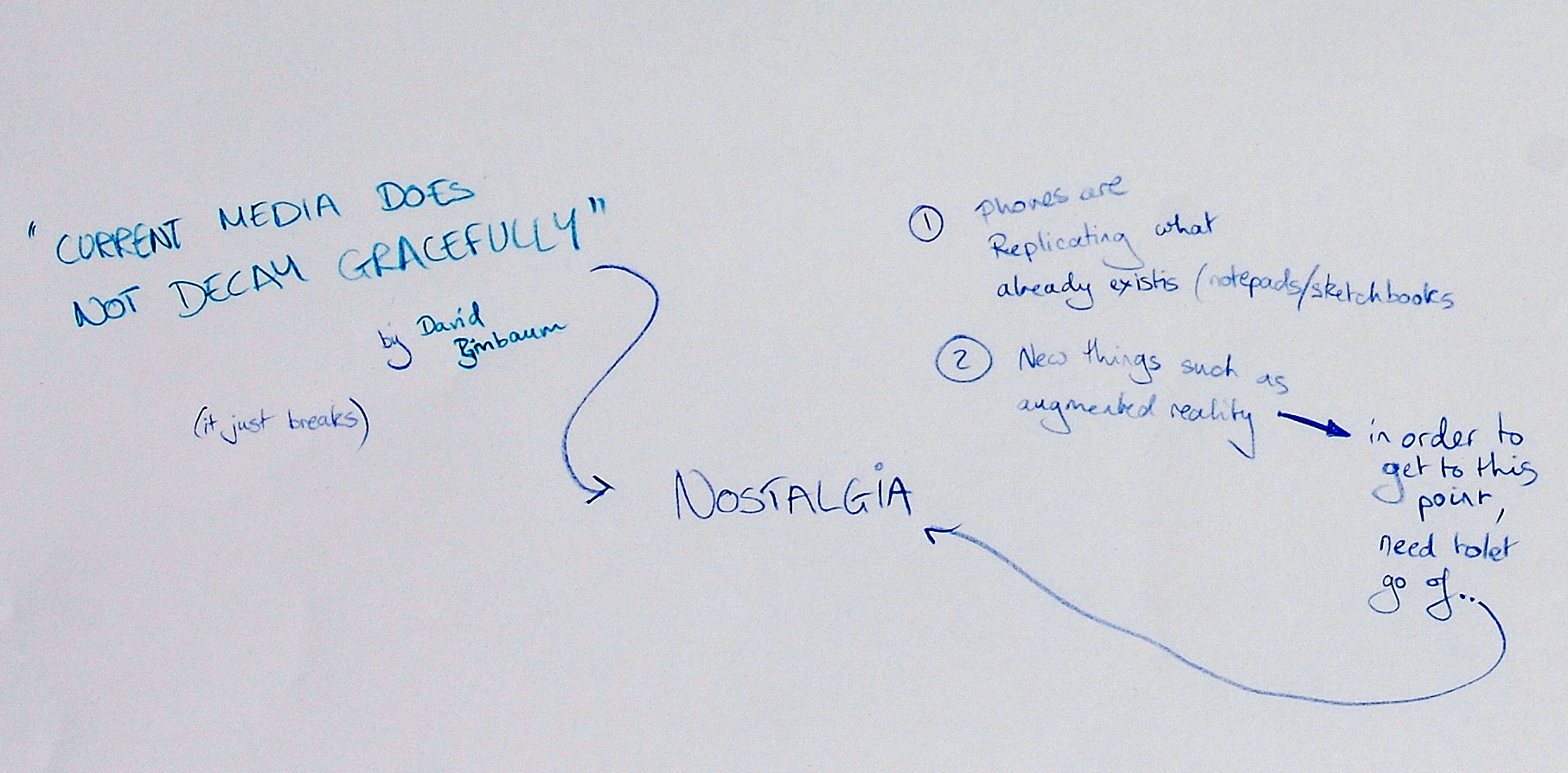
MEX creative team's working notes on graceful decay in digital media

The man-made objects one finds washed up by the tide are comprised of flotsam, which is the result of accidental loss, and jetsam, which has been deliberately discarded.  On 13th January 2017, a strong north westerly gale caused a five foot surge in tidal height along the east coast of the UK, leaving behind many examples of both.

From abandoned boats and mooring buoys to storage canisters and timbers, the variety of flotsam and jetsam was extraordinary.  Some will be cleared by organisations like the National Trust and local council, while other items will be collected and put to use by locals.

In previous years, we used plastic barrels washed up by a storm surge to construct a raft.  This year, we hope to gather enough driftwood timbers to construct a netted wooden framework to protect our fruit bushes from the birds.

Fond, as I am, of a metaphor, I couldn’t help but relate this natural event to the digital world.  If we think of the internet as an ocean, there are countless abandoned images, texts and downloadable files – unused, unseen and waiting – perhaps, for some unexpected tide to carry them back to human attention.

MEX creative team's working notes on graceful decay in digital media

At MEX/9 in May 2011 a team facilitated by Mikko-Pekka Hanski was tasked with exploring new forms of creativity enabled by mobile technology (MEX Pathway #8).  One of the concepts they developed was applying a gradual aging process to a digital asset – a photograph, for example – by transposing the natural movements of the user into digital effects which would, over time, result in a patina analogous to the aging of a physical photo kept in a wallet.

Graceful decay, a creative concept for the ageing of digital media

The flotsam and jetsam of the internet is also affected by the passing of time, but in a rather different way.  While the abandoned items remain the same, the world around them changes, such that if and when they are rediscovered, they may no longer even be accessible using the device which found them.

Somewhere out there, for instance, there is a PMN Java applet we developed in the late 90s, which once streamed a ticker tape of news headlines from the mobile industry.  It was never decommissioned, but even if it still works, who now would have the software to run it?  I’ve written about some of this before in ‘Preserving the medium and message of digital artefacts‘.

Google Photos' 'On this day' feature

Facebook, Google and others have explored some of this notion with their ‘Memories’ and ‘On this day’ features, automatically re-surfacing old photos in a present day social stream.  Judging by the number of these I see from friends, they seem unsurprisingly popular – personal memories generate powerful emotions.

However, in contrast, digital flotsam and jetsam would be defined by novelty.  These would be items previously unseen by the finder and are perhaps better considered a form of treasure hunt or digital archeology.

It leaves me pondering the question: what are the tidal forces which could be harnessed to surface such items in an unexpected way?

One example which springs to mind is the creation of a new ‘overnight celebrity’ and the resulting frenzy of digging by journalists to unearth social media assets for a juicy story.  Events of destructive force – war or natural disasters, for instance – can also prompt efforts to seek hitherto forgotten assets relating to whatever is under threat.  I would rather like to think there are other, more positive possibilities…

Part of Friday Inspirations, an ongoing MEX series exploring tangents and their relationship to better experience design.  We explain the origins of the Inspirations series in this MEX podcast and article.  Share your own inspirations on Twitter at #mexDTI.

12 Mar 17:42

Twitter Favorites: [counti8] Reading @compurbanist paper on Curated Cities project led me to @OnTheGridCity, designer’s neighborhood guide from @Hyperakt. Diving in!

Karen Quinn Fung 馮皓珍 @counti8
Reading @
12 Mar 17:42

Recommended on Medium: Big News—Pinterest Acquires Jelly!

Ben Finkel and I co-founded Jelly four years ago to create a human powered search engine.

Continue reading on AskJelly.com News »

12 Mar 17:42

Instapaper Liked: Tinder Select is a secret, members-only version of the app

Hello single friends, no pressure, but if you're not on Tinder Select, then get your act together: https://t.co/wmrQpVaksm — Ryan Cousineau (@rcousine) March…
12 Mar 17:36

Hangouts To Split Into Hangouts Meet and Chat; Become a Slack Competitor

by Rajesh Pandey
Google has long been criticised for not giving proper attention to Hangouts and updating it with features that are found in other chat tools. Instead of improving Hangouts, Google went on to launch Allo and Duo, two more messaging applications that have only further convoluted its messaging strategy. Continue reading →
12 Mar 17:34

Why Your Employees and Colleagues Might Be Your Most Important Customers

files/images/Most-Important-Customers-copy_Image-Resized-1200x675.jpg


Harvard Business Review, Mar 12, 2017


I used to warn people that unless we in public institutions didn't get our online learning act together, companies like Disney would move in and do our job for us. This advertising content (advertorial) from Disney in HBR s a case in point. "at Disney Institute," says the text, "we believe an organization must cultivate internal customer service with the same intentionality as it cultivates external customer service. Providing great customer experiences is not a single department’ s responsibility; it’ s everyone’ s." It's learning, but it's also a certain perspective on work and learning.

[Link] [Comment]
12 Mar 17:34

Social Media Production – Reflexive Learning

files/images/20170214_113317563_iOS-e1489072489219.jpg


Rob Watson, Rob Watson Media, Mar 12, 2017


Rob Watson: "We still seem to be dominated by ‘ instruction’ as the main form of learning practice, especially when it comes to learning how to use media technologies and applications. This limits the focus of learning, in my experience to a ‘ transactional’ approach...  we might be serving the learners better if we can offer them opportunities to discover something about themselves in the process of learning." Yes.

[Link] [Comment]
12 Mar 17:34

Who’s speaking at TED2017? Announcing our speaker lineup

files/images/ted2017_the_future_you.gif


TED, Mar 12, 2017


Someone said to me today that TED would be a good platform for me. This led to a conversation about how TED is careful not to offend rich people (and indeed, to make them feel good about themselves). Why is why TED will never feature, say, the organizers of Occupy Wall Street. Or me. Case in point, this year's TED. The source of the "ideas worth spreading": "the co-creator of Siri, the founder of the world’ s largest hedge fund, a Nobel-winning researcher who helped discover how we age, the head of the World Bank, and one of the greatest athletes of all time." Yeah, let's keep telling people they deserve their wealth

[Link] [Comment]
12 Mar 17:34

How Maker Mindsets Can Be An Easy Fit For Rural Schools

files/images/Hammill-1180x853.jpg


Leah Shaffer, Mind/Shift, Mar 12, 2017


Some of you may recall my photo set from the  Metcalfe Fair last October. What struck me at the time was the participation of young people in the events. In a rural community like Metcalfe, to 'make' is to raise a calf, grow a crop, or restore an antique. As this story says, "Rural districts might already be offering a maker program and not realize it. Organizations such as 4-H and Future Farmers of America  teach agricultural education skills that involve a lot of 'making.' Students might be designing, programming and learning about technology under the auspices of such a curriculum." I grew up in Metcalfe, and maybe this is why I don't see 'making' as a new thing.

[Link] [Comment]
09 Mar 22:16

This is how the Galaxy S8 and S8+’s rumoured size compares to the S7, 6P, iPhone 7 and more

by Patrick O'Rourke

With the Samsung Galaxy S8’s reveal and release still looming close on the horizon, leaks regarding the device continue to pour our at a rapid rate.

Steve Hemmerstoffer, more well-known by his Twitter handle OnLeaks, sent out a somewhat sketchy leak yesterday comparing the size of the S8 and S8+ to Samsung’s ill-fated Note 7.

Now, however, Hemmerstoffer is offering a more legitimate comparison between multiple devices.

In a new collection of images, OnLeaks compares the rumoured size of the S8 and the S8+ to the Galaxy S6, S7, Note 7, iPhone 7 and iPhone 7 Plus, putting the still unannounced smartphone’s size and minimal bezel in better perspective.

From left to right, the S6 features a 5.1-inch display, the S7 a 5.2-inch screen and the S8 a 5.8-inch display. Looking only at the numbers, the size difference between Samsung’s older flagship Galaxy offerings and the S8 is enormous. The difference in form factor footprint of the S8 compared to the Samsung’s other devices, however, is actually very minimal.

The S8 is only approximately 6mm taller but is also slimmer than both the S6 and S7, giving it a build that seems reminiscent of the recently revealed LG G6.

Comparing the S8+’s 6.2-inch display to the Note 7 and its 5.7-inch screen is also interesting, revealing that the device is set to be bigger, but not by a significant margin. Similarly, Hemmerstoffer’s mock-up also shows the massive different between the S8’s 5.8-inch display and the iPhone 7’s 4.7-inch screen.

The S8 is taller than the iPhone 7, but it’s not wider, putting the S8’s often-rumoured bezel absent display in perspective.

Source: Twitter

The post This is how the Galaxy S8 and S8+’s rumoured size compares to the S7, 6P, iPhone 7 and more appeared first on MobileSyrup.

09 Mar 22:16

Google announces new machine learning function called ‘Video Intelligence API’

by Jessica Vomiero

Google has a knack for shocking the world by revealing the futuristic projects it’s working on.

Recently however, the Mountain View, California-based company, surprised attendees of the Google Next Cloud conference when it demoed a new way to parse video by utilizing machine learning techniques.

Google’s new “Video Intelligence API” was able to identify a dachshund in a commercial being demonstrated on stage by Fei-Fei Li, chief scientist of artificial intelligence and machine learning at Google Cloud. 

Furthermore, the API was able to understand that the video as a whole was a commercial, rather than any other kind of video content. During another demonstration, the audience saw that a simple search for “beach” resulted in the API locating videos with beaches in them, complete with timestamps included.

“The API is the first of its kind, enabling developers to easily search and discover video content by providing information about entities (nouns such as “dog,” “flower” or “human” or verbs such as “run,” “swim” or “fly”) inside video content. It can even provide contextual understanding of when those entities appear; for example, searching for “Tiger” would find all precise shots containing tigers across a video collection in Google Cloud Storage,” said Google in a post on its Google Cloud Platform blog

While this reveal may sound uneventful, before now, in most cases computers have not able to understand the content of a video without reading manually inputted tags. Google is making this API available to developers just as it has with other machine learning APIs.

When it comes to machine learning services, Google is significantly behind companies like Amazon and Microsoft. Technologies like its new “Video Intelligence API” could push Google into the running to become a major competitor in the space.

Source: Google

The post Google announces new machine learning function called ‘Video Intelligence API’ appeared first on MobileSyrup.

09 Mar 22:16

Google announces Montreal will be home to the first Canadian Google Cloud Platform region

by Patrick O'Rourke

Google has announced plans to launch a new Google Cloud Platform region in Montreal, Quebec, allowing Canadian businesses to keep sensitive data within Canada and also speed up services related to machine learning and analyzing information.

While Google’s cloud services have been available to Canadian businesses for a number of years now, data has been stored in Google Cloud Platform locations based in various U.S. cities. Now that a Cloud Platform region is set to launch in Montreal, potentially sensitive data can be stored on Canadian soil, a positive move for security conscious businesses given the Patriot Act allows the United States government into data centres.

The Mountain View, California-based company says that it’s launching the new region in order to deliver lower latency for customers in adjacent geographic areas, allowing for “increased scalability” and additional “disaster recovery options.” The announcement was made during a keynote presentation at the company’s Google Cloud Next 2017 press conference in San Francisco, California.

“By opening a Google Cloud Platform region in Montreal, our goal is to allow our Canadian customers to take advantage of the low latency and high performance afforded by the Google Cloud Platform,” says Google in a recent blog post written by Jim Lambe, country manager for Google Cloud Canada.

Google says the main advantage it holds over other major tech companies that offer cloud services like Microsoft and Amazon, is that along with traditional storage, the tech giant also provides algorithms to help make more sense of massive amounts of data. Furthermore, now that it’s opened a location in Montreal, Google also says that faster speeds will be available to its Canadian enterprise customers.

“Quebec is at the forefront of innovation in Canada,” said Quebec Premier Philippe Couillard, in a statement sent to MobileSyrup. “Today we are happy to welcome the addition of the Google Cloud Region in Montreal with which Quebec-based business and Canada will take another step into a 21st century economy.”

A variety of different companies, including video game development studios, particularly those in the mobile space, as well as businesses that depend on internet infrastructure to reach end-users, utilize Google’s Cloud Platform.

Amazon and Microsoft already offer cloud storage options in Canada, but Google claims it holds a key advantage in the machine learning and artificial space.

For a full list of Google Cloud locations, check out this link.

Source: Google 

The post Google announces Montreal will be home to the first Canadian Google Cloud Platform region appeared first on MobileSyrup.

09 Mar 22:12

Weil auf mich ja immer keiner hören will: Schaut mal, ...

mkalus shared this story from Fefes Blog.

Weil auf mich ja immer keiner hören will: Schaut mal, was die CIA von Antiviren-Software hält.

Kurzzusammenfassung: Alles umgehbar, und die AV-Hersteller versuchen das jetzt mit den üblichen "haben wir schon gefixt" kleinzureden. Als ob das irgendwas besser macht! Man stelle sich mal vor, euer Haustürschloss würde auf Zuruf auch ohne Schlüssel aufgehen, und der Hersteller würde sagen: Haben wir gefixt. Würdet ihr euch da besser fühlen? Nein, natürlich nicht! Sicherheitssoftware heißt, dass sie sicher macht. Wenn man updaten muss, hat sie nicht sicher gemacht. Ganz einfache Logik. Hallo McFly? Jemand zuhause?

Oh und noch eine peinliche Frage, die bei solchen Gelegenheiten irgendwie nie jemand stellt: Gab es das Update kostenlos für alle unsicheren Versionen vorher? Laut der Gesetzeslage in Deutschland müsste ein Antivirus mit einem Bug kostenlos vom Hersteller repariert werden. Aber irgendwie hat sich etabliert, dass man die für Reparaturen von Fehlern, für die nur sie was können, auch noch bezahlen soll. Wieso findet da eigentlich niemand was bei? Was für eine bodenlose Frechheit ist das eigentlich?

Wären wir doch nur alle von vorneherein ehrlich gewesen und hätten das als das bezeichnet, was es ist. Schlangenöl.

09 Mar 22:11

How three Canadian cities are trying to become smart cities

by Jessica Vomiero

Upon hearing the phrase “smart city,” a foggy image of the Jetsons probably comes to mind.

Smart cities are still an unknown concept to most urbanites, who don’t realize that changes are currently underway to make the cities they live in smarter. On March 7th, representatives from cities across Canada came together for the second annual SAP Smart Cities Forum, where the future of urban life was explored.

As the director of technology innovation for the City of Kitchener, Dan Murray puts it; the definition of a smart city changes depending on which city you enter, as each city has its own priorities and its own obstacles.

However, for Canadian cities that are looking to become smart cities, one central theme seems to be generally agreed upon, and that is one of efficiency and communication.

While some cities like Mississauga are tackling these concepts by modernizing and improving their transportation portals, others, such as the City of Toronto, are bridging communication gaps by making its data available to its citizens.

Here’s a look at how three Canadian cities are trying to become smart cities.

Toronto: Open Data, Public Transit, IoT

Toronto City Hall

The city of Toronto has been extremely active in making the vast amounts of data its collects available to the public. The city’s open data initiatives have paved the way for all kinds of data-driven projects to come to fruition.

Some of the initiatives currently underway include the Data Catalogue on the city’s website, the public data manipulator Wellbeing Toronto, geographic data, and several data-driven apps.

According to the director of enterprise and solutions at the City of Toronto, Fazal Husain, the data obtained through the city’s open data initiatives plays a critical role in helping city workers gain a better understanding the obstacles that stand in the way of Toronto becoming a smart city.

“If the city doesn’t know the problem of day-to-day life that you’re experiencing, I don’t know if we can address it,” says Husain.

He goes on to describe the city’s Cycling App as a prime example of how data initiatives help the city run more efficiently. The Cycling App is an initiative spearheaded by Brisk Synergies for the City of Toronto which allows cyclists to record their cycling routes. This data will be made available to the city for reference when developing cycling network plans.

After a run-in with a pedestrian who raved about the app, Husain was convinced about its potential to improve circumstances for all Toronto cyclists and serve as a model for other city services.

In addition, Toronto is focusing heavily on public transit and IoT as a way to solve the city’s ongoing congestion problems. Going forward, the city is considering an IoT solution to improve the flow of traffic.

Husain concluded by saying that a smart city isn’t an end goal, but a process. “I don’t think a smart city is an end state. It will continue to be developed because technology is not standing still,” says Husain.

Mississauga: Wi-Fi Blanket, Public transit, public outreach, IoT

Mississauga

The City of Mississauga has been extremely active in the smart city movement through public transit initiatives, Wi-Fi enhancement and other forms of public engagement.

Shawn Slack, the city’s director of information technology and chief information officer spoke extensively about Mississauga’s investment in improving public transit across its jurisdiction as a response to one of the GTA’s most pressing concerns.

“So, a lot of our smart city type technologies are investing in advanced traffic management, smart bus technology, so that we can get a better handle around how traffic is moving and then respond when there’s either an accident, or during rush hour, or in making sure we have coordination of services and traffic control,” says Slack.

Slack also emphasized the importance of bringing Wi-Fi to as many corridors of the city as possible. In addition helping to bridge the digital divide, Slack describes that such a robust Wi-Fi network is also invaluable to the consolidation of communication across the city.

He uses the example of communicating with citizens. As City Hall becomes more technologically capable internally, it has the ability to communicate with citizens about relevant announcements and services through web portals, such as video messages. Without reliable internet access, citizens in certain parts of the jurisdiction may not have access to these important messages.

“We want to make sure that if we’re going to tailor communication, people have the capacity to get internet in that area,” says Slack.

In order to sustain this model, the City has partnered with multiple parties across the region, including the Region of Peel, Brampton and Caledon as well as several hospitals and universities. These partnerships ensure that services like this one remain affordable.

“It’s an economy of scale. So we have a private fibre network within the region of Peel. And it’s a partnership between the city of Mississauga, Brampton, town of Caledon and the Region of Peel, the hospitals and the post-secondary schools. We’ve built enough fibre within the region to go around the planet once. If the city were to build that on its own, it wouldn’t be as affordable and the benefits wouldn’t be as effective,” continues Slack.

Kitchener: Outreach, incubators, eServices, public transit

Kitchener City Hall

While the City of Kitchener doesn’t see a value in blanketing its jurisdiction with Wi-Fi, city leadership has developed a four-part plan to work towards becoming a smart city.

The director of technology, innovation and e-services at the City of Kitchener, Dan Murray, says that there isn’t one definitive standard for what a smart city will be. It all depends on the individual city’s circumstances.

Kitchener leadership placed a heightened emphasis on the community aspect of ‘smart city,’ by spending 18 months developing the Digital Kitchener strategy.

“We tried to leverage technology to improve the lives of the citizens in Kitchener. That’s kind of how we approached this. We approached a technology strategy with a strong community focus to it,” says Murray.

Kitchener’s strategy calls for the to be city, connected, innovative, on demand, inclusive, and to prioritize the needs that the citizens want to see fulfilled.

The city will aim to install an IoT network and fibre optic capability in areas where it would improve civic life, and implement on-demand e-services to reach citizens on the digital platforms they’re active in.

Moreover, the City of Kitchener is a fast-growing innovation hub in Canada, which is largely incorporated into the city’s smart city ambitions.

Communitech, for example, is the largest technology incubator in the Kitchener-Waterloo area, and one of the most well-known across Canada. This incubator and others will play a significant role in becoming more digitally-enabled.

“Every city also has their own realities and their own factors that are at play. I think what we try and do is look for various ideas among municipalities but you have to try and adapt them for what makes sense for yourself. And that’s really what we were trying to do with digital Kitchener, was gain an understanding of the things that are of interest to the citizens of Kitchener.”

Smart cities, by the city

When it comes to smart cities, every region has its own idea of how to get there. They all agree on one thing however; a smart city will be in a constant state of development.

As technology evolves and changes, so to will its uses in civic life. Even more importantly, as cities evolve and change, so to will their requirements of the technology they use.

Between cross-platform Wi-Fi, consolidated transportation and data-driven initiatives, it’s fair to say that citizens will begin to feel the effects of these changes extremely soon. Perhaps the ever-elusive smart city isn’t so much about achieving an end goal, but rather, a way for technology to truly change the civic experience.

The post How three Canadian cities are trying to become smart cities appeared first on MobileSyrup.

09 Mar 22:11

Hi. Thanks for the Unsolicited Mail!

by rands

Never in the history of ever have I acted on unsolicited mail. Ever. Your mail is unsolicited which means I did not request it. This makes your email spam. This is unfortunate because there is a non-zero chance the goods and/or services you’re selling might be useful. Given to my own devices, it is probable that in my endless compulsive wandering of the Internet that I would have discovered your goods and/or service and learned about the value you created.

But you blew it.

By spamming me, your product is cast as useless. And it’s not.

I realize that your strategy works. I realize that blindly spamming email addresses costs you very little and a single digital response percentage justifies your effort. You are going to continue with this strategy because the reward outweighs the risk and it feels like the fiscally responsible move.

My strategy works, too.

#

09 Mar 22:11

CRTC fines Toronto area man $15,000 for violating Canada’s Anti-Spam Legislation

by Igor Bonifacic

On Thursday, the CRTC announced its latest anti-spam fine. William Rapanos, a Toronto area man, was fined $15,000 by the Canadian Radio-television and Telecommunications Commission for 10 violations of Canada’s Anti-Spam Legislation.

In the period between July 8th, 2014 and October 16th, 2014, the CRTC’s Spam Reporting Centre received complaints from 50 individuals about an unnamed flyer printing, distribution and delivery service.

In sending the emails, Rapanos broke most of the cardinal sins when it comes to Canada’s anti-spam legislation. The emails Rapanos sent did not identify a sender, include contact information. Worst of all, his emails did not provide a mechanism for recipients to unsubscribe, nor did he ever acquire their consent to send his messages in the first place.

In his defence, Rapanos attempted to argue that his identity was stolen from him for the express purpose of spamming, an argument the CRTC found meritless. Canada’s Anti-Spam Legislation allows the CRTC to fine individuals and companies up to a maximum of $1,000,000 per violation.

Source: CRTC

The post CRTC fines Toronto area man $15,000 for violating Canada’s Anti-Spam Legislation appeared first on MobileSyrup.

09 Mar 22:11

FCC documents suggest Samsung Galaxy S8 will support Freedom Mobile’s Band 66

by Rose Behar

A Samsung device that is widely believed to be the upcoming Galaxy S8 has appeared on the United States’ Federal Communications Commission’s (FCC) authorization page, revealing that it supports Band 66, Freedom Mobile’s LTE spectrum.

Freedom Mobile — formerly known as Wind — is a wireless carrier owned by Shaw that operates in Ontario, Alberta and B.C. It secured AWS-3 Band 66 LTE spectrum at auction in March 2015 and deployed its LTE network in late 2016. As of now, the only devices it offers that are compatible with Band 66 LTE are the LG V20 and mid-range ZTE Grand X 4.

The Samsung device being certified bears the model number G950U (with ‘U’ typically meaning ‘unlocked’), which confirms previous model number leaks and makes sense within the context of Samsung’s numbering scheme — the Samsung S7 was the G930 and Samsung generally skips the number four due to its associations with bad luck in Korean culture.

The FCC certification is only for U.S. use, however, Canadians benefit from the information posted that refers to bands existing in both the U.S. and Canada. Band 66 is a prime example of this, due to the fact that T-Mobile owns a large portion of that spectrum in the U.S. The FCC did not, however, test Band 7 which is not used by any major carrier in the U.S.

The listing also confirms CDMA and GSM support, as well as 802.11ac, Bluetooth, NFC, and ANT+.

Source: FCC Via: PCMag 

The post FCC documents suggest Samsung Galaxy S8 will support Freedom Mobile’s Band 66 appeared first on MobileSyrup.

09 Mar 22:10

The case of the Canadian with eight citizenships, and why the world’s rich covet ‘backup’ passports

by Ian Young
The reasons to have a second passport are many, but for the world’s wealthy elite, they often amount to what Canadian immigration lawyer David Lesperance calls “the backup plan”. He recounted a Shanghainese client who likened second citizenship to having a “fast junk in the harbour, fitted with gold bars”. After generations of turmoil, the bolthole mentality runs deep among China’s rich – by one estimate, 47 per cent of rich mainlanders plan to...