What do markets see when they look at people? Information dragnets increasingly yield huge quantities of individual-level data, which are analyzed to sort and slot people into categories of taste, riskiness or worth. These tools deepen the reach of the market and define new strategies of profit-making. We present a new theoretical framework for understanding their development. We argue that a) modern organizations follow an institutional data imperative to collect as much data as possible; b) as a result of the analysis and use of this data, individuals accrue a form of capital flowing from their positions as measured by various digital scoring and ranking methods; and c) the facticity of these scoring methods makes them organizational devices with potentially stratifying effects. They offer firms new opportunities to structure and price offerings to consumers. For individuals, they create classification situations that identify shared life-chances in product and service markets. We discuss the implications of these processes and argue that they tend toward a new economy of moral judgment, where outcomes are experienced as morally deserved positions based on prior good actions and good tastes, as measured and classified by this new infrastructure of data collection and analysis.
Rolandt
Shared posts
Were the Luddites right? – Automation and its Consequences
Had a discussion with an economist the other day, who held to the conventional wisdom, justified by history, that the ‘creative destruction’ of whole sectors of jobs due to industrialization and technology (agriculture is a favourite example) will result in the creation of many more jobs in new sectors never previously imagined or possible. It just takes a little time, and pain, to adjust.
There is much anticipation that the next wave of automation will encroach on white-collar sectors previously thought to be unaffected, but now a target thanks to artificial intelligence. (Will that include economists?) And whether new service sectors will emerge to provide new jobs that are sufficiently well paying to maintain a healthy economy and a stable society.
Or rather, will automation accelerate the concentration of wealth even as it increases productivity but lowers wages? Does it matter that people would have less income if goods and services provided by automation were commensurately cheaper? Do we finally achieve a leisurely nirvana or will the loss of purpose and social status provided by work create a dysfunctional, unstable polity?
Will leader (or rulers) then create employment (and purpose) by recruiting vast numbers of otherwise lower-skilled men (in particular) into military and security forces whose primary job is to ensure control over otherwise disruptive and displaced workers?
Or is the economist right? Similar worries of the past proved unfounded as the limitless demands of human beings and technology created new opportunities. On the other hand, Bank of England’s Chief Economist Andy Haldane has argued that the Luddites (the English textile workers who smashed industrial machinery early in the 19th century) “had a point after all.” The transition can be ugly. (More here.)
Anyway … here’s another piece in the New York Times that looks at recent data to explore whether this next phase of automation in manufacturing is qualitatively different, the consequences of which may mean more disruption in our disruptive times.

Who is winning the race for jobs between robots and humans? Last year, two leading economists described a future in which humans come out ahead. But now they’ve declared a different winner: the robots.
The industry most affected by automation is manufacturing. For every robot per thousand workers, up to six workers lost their jobs and wages fell by as much as three-fourths of a percent, according to a new paper by the economists, Daron Acemoglu of M.I.T. and Pascual Restrepo of Boston University. It appears to be the first study to quantify large, direct, negative effects of robots.
The paper is all the more significant because the researchers, whose work is highly regarded in their field, had been more sanguine about the effect of technology on jobs. In a paper last year, they said it was likely that increased automation would create new, better jobs, so employment and wages would eventually return to their previous levels. Just as cranes replaced dockworkers but created related jobs for engineers and financiers, the theory goes, new technology has created new jobs for software developers and data analysts.
But that paper was a conceptual exercise. The new one uses real-world data — and suggests a more pessimistic future. The researchers said they were surprised to see very little employment increase in other occupations to offset the job losses in manufacturing. That increase could still happen, they said, but for now there are large numbers of people out of work, with no clear path forward — especially blue-collar men without college degreed.
The conclusion is that even if overall employment and wages recover, there will be losers in the process, and it’s going to take a very long time for these communities to recover,” Mr. Acemoglu said. …
The paper also helps explain a mystery that has been puzzling economists: why, if machines are replacing human workers, productivity hasn’t been increasing. In manufacturing, productivity has been increasing more than elsewhere — and now we see evidence of it in the employment data, too.
The study analyzed the effect of industrial robots in local labor markets in the United States. Robots are to blame for up to 670,000 lost manufacturing jobs between 1990 and 2007, it concluded, and that number will rise because industrial robots are expected to quadruple.
The paper adds to the evidence that automation, more than other factors like trade and offshoring that President Trump campaigned on, has been the bigger long-term threat to blue-collar jobs. The researchers said the findings — “large and robust negative effects of robots on employment and wages” — remained strong even after controlling for imports, offshoring, software that displaces jobs, worker demographics and the type of industry. …
The next question is whether the coming wave of technologies — like machine learning, drones and driverless cars — will have similar effects, but on many more people.
.
The segment of employment I think more worth watching is … driving. Truckers in some US states constitute the most common employment category.

In Canada, I’ve heard it estimated that 130,000 (largely) men could be displaced by automated trucking alone. (In The Netherlands, for instance, autonomous trucking is already here in Rotterdam ports and will likely extend to intercity controlled-access freeways more easily automated than complex urban environments.)
Then there are transit drivers, taxi and Uber drivers, delivery drivers …
Imagine the social and political consequences of de-employing tens of thousands of low-skilled labourers in a short time, without the ability to reabsorb them in jobs of similar pay and status. The temptation to issue them guns and allow them discretionary power to maintain social order (or, let’s say, undocumented immigrants and closing borders) will be high unless the political system can respond in more productive ways.


The new dropbox.com—files and team activity, all in one place
When you’re working with others, finding the right file is just the beginning. What about all the other work that happens around those files? Sometimes that context and those sharing relationships are just as important as the file itself. That’s why we’re excited to roll out our new redesigned website to all users today. Dropbox.com is designed to bring your files to life with team-first functionality—so it’s not just a place for your files, but for people and conversations, too. Here’s what’s new and what it means for you.
Less time coordinating work, more time getting things done
With simpler navigation, it’s easier to share files and Paper docs with others, leave feedback, and see what’s changed—without the back-and-forth over email. We’ve even customized the toolbar, presenting only the relevant next steps for what you’ve selected.

More information at a glance
The new dropbox.com lets you browse files visually with a thumbnail view, and see who else is collaborating with you on shared files and folders. And we’ve made search even smarter, providing results across your files and Dropbox Paper docs.

Now your tools have work-life balance, too
Whether you’re at the office or working from home, our new website is designed to help you focus on the task at hand. With clearer account separation, it’s easier to switch between your work and personal Dropbox accounts. And when you do, now you’ll only see search and notifications for the account you’re in.

A team-first experience that makes life easier for admins
With a cleaner, more streamlined design, the new admin console will simplify the way Dropbox Business admins manage their team. It’s coming soon in early access, so stay tuned.
To see the new web experience for yourself—and even take a quick tour—sign in to your Dropbox account on the web. For an overview of everything new on dropbox.com, check out this help center article.

Creating a Wikipedia for Fact-checking
There are many ways in which wiki is the perfect vehicle for a fact-checking site.
- First, the nature of the wiki consensus helps guarantee a fair treatment of issues from multiple perspectives.
- Second, the nature of wiki (when a particular scale is met) is that it is quick to respond to new information — much quicker than more institutional processes.
- Finally, wiki is iterative — which means as new information comes to light, fact-checking articles can be kept up-to-date, even years after the fact.
Unfortunately, there are many ways in which it is not a good fit.
- First, Wikipedia civility often falls down around contentious issues. In fact-checking, EVERY issue is contentious.
- Second, Wikipedia is prone to vandalism. It gets corrected quickly, but maybe not enough for a fact-checking site.
- Third, Wikipedia grew organically over time — culture got set before the stakes were high. Can culture develop when it’s high-stakes from day one?
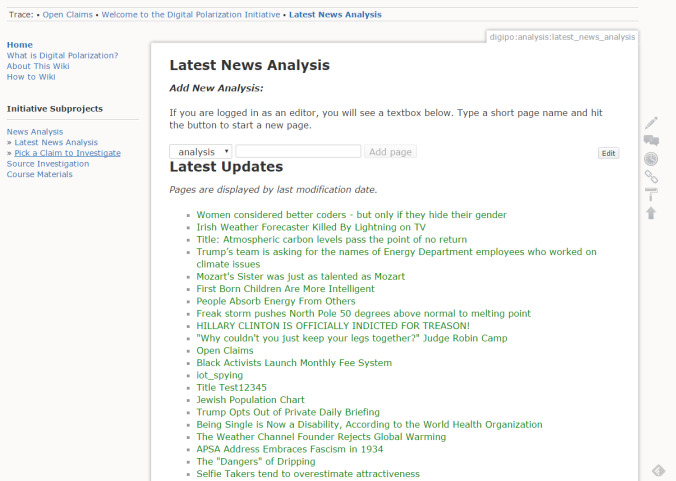
Do the pros outweigh the cons? I’m not sure. But it seems to me a promising idea worth exploring. We’re trying this idea with student authors across multiple schools at digipo.io. And so far it’s kind of sort of working:
How Wiki for Fact-Checking Is Different than Wikipedia
People will ask (as they always do) “Isn’t Wikipedia a fact-checking site already? What would be the difference?”
The difference is that Wikipedia structures knowledge topically. You can have an article on “Buffalo” or “The Pentagon Papers” or “The 2012 Benghazi Attack”. What you can’t have is a page on a claim, which is how fact-checking sites are structured.
So, for instance, in our student project above, one of the students submitted a claim “Women coders considered better than men, but only if they hide their gender.” That’s a great claim for a fact-checking page, but there is no corollary in Wikipedia.
Our fact-checking wiki has two major parts to every article. The first is the origin of the claim. This claim comes from a headline that references a study that may or may not support that conclusion. But the author does the work of tracking the claim to source.
Here’s an example of what that looks like on another claim about the Fukushima thyroid cancer rate.

Origin and Prevalence demonstrates the claim originated from a video put out by an anti-nuclear advocacy group, called Fairewinds Energy Education, and has been widely covered in both right-wing and left-wing media.
Even if we find a study that does support the headline, a good article on the claim would place that result in the context of previous and subsequent work, noting the strengths and limits of the study. Does the study confirm previous work, or buck against it? Is it more rigorous than previous work? Less rigorous? Structured somewhat differently? In our wiki we use the Issues and Analysis section to do this:

Screenshot showing the Issues and Analysis section of a DigiPo wiki page on the Fukushima thyroid cancer rate. A study is found that supports a lesser conclusion, but placed into context of subsequent work it appears that study was flawed.
There are similarities here to Wikipedia, but the focus of the article is to eventually get to that short summary of the truth at the top, not to cover a topic. In this particular article that summary turns out to be
Summary: The larger claims come from a misreading of statistics. Most experts, looking at the same data, believe that Fukushima has had little to no effect on thyroid cancer prevalence.
The rest of the page leads to the creation of that short snippet that an average reader can understand. It’s not about coverage, it’s about analysis. This is a piece of what people do on Wikipedia as they adjudicate the validity of various statements, but here it is the structuring principle.
Now, should this claim be rated “false”? Or is it better termed “Highly Unlikely”? That’s a great dicussion to have. Wouldn’t it be great to work it out through wiki?
Someone Else Should Build This Instead of Me
We are currently running DigiPo on a Dokuwiki install on Reclaim Hosting. It works for what we are doing. And I think it’s an interesting experiment in the use of wiki in education. I plan to support it as long as I can.
But I’m not a great developer or system admin. I’m an instructional designer and a community builder with a theoretical bent.
What I would love to do eventually is partner with someone on the software side, and just push students there to post. In my dreams, someone wants to spin off a specific sort of wiki site, the way that Jimmy Wales took his Wikipedia background and created Wikia around the culture of fandom. I know a fact-checking community is not as hip as the latest pages on Yuri on Ice, but we could give it a try.
If someone has the site, we have the pedagogy, and an army of teachers and students who would just love to engage with a site like this. We can focus on the pedagogy and community-building.
Is anyone out there with the resources to build and promote a major site like this feeling this? Want to talk?


That Ever-Elusive Carmageddon
Several examples here at CityLab, and an analysis of the disaster that never seems to happen. As with Vancouver’s Burrard Bridge bike lane in early 2009, the doomsday howling about Carmageddon and chaos arrives like clockwork whenever motordom’s asphalt is threatened.
But life goes on, it seems. The dire prophecies are rarely true, and the pundits rarely pilloried for their false prophecies.
Joe Cortright in CityLab looks at Atlanta, where part of I85 (a major freeway) caught fire. Yes, the usual noise filled the airwaves, but Carmageddon and its attendant chaos did not arrive.
So what’s going on here? Arguably, our mental model of traffic is just wrong. We tend to think of traffic volumes, and trip-making generally as inexorable forces of nature. The diurnal flow of 250,000 vehicles a day on an urban freeway like I-85 is just as regular and predictable as the tides. What this misses is that there’s a deep behavioral basis to travel. Human beings will shift their behavior in response to changing circumstances. If road capacity is impaired, many people can decide not to travel, change when they travel, change where they travel, or even change their mode of travel. The fact that Carmageddon almost never comes is powerful evidence of induced demand: people travel on roadways because the capacity is available for their trips, and when the capacity goes away, so does much of the trip making.
I wonder — is there a real Carmageddon? As illustrated below, is it the endless expansion of asphalt-covered land to the benefit of motordom, and to the exclusion of every other mode of transportation?

“fewer-of-tomorrows-freeways-will-be-free.jpg”


MS Open Source Camp

This is happening today (technically, in a few hours), and it’s the first Open Source development conference organized by Microsoft Portugal – and coincidentally (or not…) it’s powered by my buddies at Bright Pixel.
(Part of me finds it hilarious that this should happen on Microsoft’s 42nd anniversary, too…)
Since I’ve had to focus on other kinds of stuff over the past couple of weeks, I’m (regretfully) not speaking at the event, but I’ll be there throughout the day as time allows.
Mozilla Releases Version 2.4 of CA Certificate Policy
Mozilla has released version 2.4.1 of Mozilla’s CA Certificate Policy and sent a CA Communication to inform Certification Authorities (CAs) who have root certificates included in Mozilla’s program about new program requirements. Mozilla’s CA Certificate Program governs inclusion of root certificates in Network Security Services (NSS), a set of open source libraries designed to support cross-platform development of security-enabled client and server applications. The NSS root certificate store is not only used in Mozilla products such as the Firefox browser, but is also used by other companies and open-source projects in a variety of applications.
The changes of note in Mozilla’s CA Certificate Policy are as follows:
- In addition to audit statements, the CP and CPS documents need to be submitted to Mozilla each year.
- As of June 1, 2017, the audit, CP, and CPS documents must be provided in English, translated if necessary.
- All submitted documentation must be openly licensed (see the policy for the exact options and terms).
- Version 2.4 of Mozilla’s CA Certificate Policy incorporates by reference the Common CCADB Policy and the Mozilla CCADB Policy.
- The new Common CA Database (CCADB) Policy makes official a number of existing expectations regarding the CCADB.
- The applicable versions of some audit criteria have been updated.
- There are additional requirements on OCSP responses.
- 64 bits of entropy is required in certificate serial numbers.
The differences in Mozilla’s CA Certificate Policy between versions 2.4 and 2.3 (published December 2016), and between versions 2.4 and 2.2 (published July 2013) may be viewed on Github. Version 2.4.1 contains exactly the same normative requirements as version 2.4 but has been completely reorganized.
The CA Communication has been emailed to the Primary Point of Contact (POC) for each CA in Mozilla’s program, and they have been asked to respond to 14 action items. The full set of action items can be read here. Responses to the survey will be automatically and immediately published via the Common CA Database.
In addition to responding to the action items, we are informing CAs that we are instituting a program requirement that they follow discussions in the mozilla.dev.security.policy forum, which includes discussions about upcoming changes to Mozilla’s CA Certificate Policy, questions and clarification about policy and expectations, root certificate inclusion/change requests, and certificates that are found to be non-compliant with the CA/Browser Forum’s Baseline Requirements or other program requirements. CAs are not required to contribute to those discussions, only to be aware of them. However, we hope CAs will participate and help shape the future of Mozilla’s CA Certificate Program.
With this CA Communication, we re-iterate that participation in Mozilla’s CA Certificate Program is at our sole discretion, and we will take whatever steps are necessary to keep our users safe. Nevertheless, we believe that the best approach to safeguard that security is to work with CAs as partners, to foster open and frank communication, and to be diligent in looking for ways to improve.
Mozilla Security Team
The post Mozilla Releases Version 2.4 of CA Certificate Policy appeared first on Mozilla Security Blog.
Drain the Lab


Science. Is. Political.
This concept will probably be easy to absorb for the regular readership at Cyborgology. It’s a topic that has been discussed here a time or two. Still, as truisms go, it is one of a very few that liberals and conservatives alike love to hate. The fantasy of apolitical science is a tempting one: an unbiased, socially distant capital-s Science that seeks nothing more than enlightenment, floating in a current events vacuum and unsullied by personal past experiences. It presupposes an objective reality, a universe of constants that can be catalogued, evaluated, and understood completely. But this view of science is a myth, one that has been thoroughly dissected in the social sciences.
As often as the myth of scientific apoliticism comes into conflict with the messy reality, it is no wonder that scientific and technical expertise is often questioned in the policymaking realm. The term “anti-science” gets thrown around a lot in the United States, especially in reference to the Trump administration and the majority-Republican Congress so eager to curry favor with him.
One organization is attempting to move the needle away from anti-science policy. Founded by a STEM professional and entrepreneur, 314 Action is a political action committee geared specifically toward getting more scientists to run for elected offices at all levels of government. The PAC takes its name from the first three digits of pi, because “[p]i is everywhere. It’s the most widely known mathematical ratio both inside and out of the scientific community. It is used in virtually everything we encounter in our daily lives.” If science can be found everywhere, the logic goes, then science definitely belongs in the halls of power and decision-making as well.
From the PAC’s website:
314 ACTION’S GOALS ARE:
Strengthen communication among the STEM community, the public and our elected officials;
Educate and advocate for and defend the integrity of science and its use;
Provide a voice for the STEM community on social issues;
Promote the responsible use of data driven fact based approaches in public policy;
Increase public engagement with the STEM Community through media.
314 Action champions electing more leaders to the U.S. Senate, House, State, Executive and Legislative offices who come from STEM backgrounds. We need new leaders who understand that climate change is real and are motivated to find a solution.
We need elected officials who understand that STEM education is the new path forward, vital for our future and will ensure that our educators have the necessary funding to teach STEM curricula and our students have the resources to learn. That is why 314 Action will advocate for a quality, adequately funded STEM education for every young person in the United States.
But this begs the question: can placing more STEM professionals in Congress save science policy, or will it only produce more lifetime politicians?
In politics, anti-science and pro-science aren’t opposites. They’re two strategies toward the same end of winning and keeping political power. The struggle between these two political stances is a constant, dynamic, situationally contingent negotiation between the social prestige of scientific evidence and the political necessity to control the vocabulary and optics surrounding a given policy topic.
Anti-science doesn’t mean that politicians don’t believe in science. It means that they have a hard time reconciling scientific findings with more pressing political concerns, like fundraising from special interest donors and mollifying their constituencies. These day-to-day political tasks require total control over a political narrative with a kind of hyperreality and spectacle that leaves little room for the slow pace and uncertainty of scientific research.
And, pro-science doesn’t necessarily mean a belief in the power of science to craft good policy. As my own research has shown, scientific debates often stand in for debates about money and legislative instrumentation, because scientific debate is easier to sound bite and quicker to digest across the voting public. I have found elsewhere that political actors, at least in the climate change political sphere, most often cite sources of expert information from other actors or organizations who a priori align with their political ideologies.
The candidates 314 PAC aims to mobilize are trained scientists and novice office-holders. They are not politicians. In fact, the point is largely to recruit people who have never held office before. There’s a certain amount of purity attached to a scientific expert who has never dabbled in politics. At the same time, someone willing to risk the credibility and safety of that purity seems, in this narrative, to be a brave and competent candidate. It’s like the Madonna-whore complex of science policy.
The 314 Action fundraising page acknowledges this to some extent: “Most of our candidates will not come from the traditional career paths of politicians, and will need different channels for funding and support. 314 PAC intends to leverage the goals and values of the greater science, technology, engineering and mathematics community to give these new recruits the resources they need to become viable, credible, Democratic candidates.”
And there’s the crucial point in all of this: the advocacy of 314 PAC is aimed at liberal scientific political engagement, not greater STEM engagement overall. While it is perfectly acceptable for a PAC to pin itself to a particular ideological position, it is dangerous to conflate an acceptance of scientific principles with a liberal political mindset.
Ben Carson is a brain surgeon, celebrated as a visionary in his field, but has demonstrated time and again his tenuous grasp on history, political science, and reality. Former US Representative Todd Aiken—he of the “if it’s a legitimate rape, the female body has ways to try to shut that whole thing down” infamy—was a leader in the Army Corps of Engineers. Rand Paul is an ophthalmologist who ran for president on a platform of small government— so small that it had little room at all for research and development. The lesson here is clear: being in the STEM fields alone does not make you pro-science, being pro-science alone doesn’t make you smart, and being smart alone will not make you an effective policymaker.
None of this is to say that scientists and engineers should stay away from politics. Far from it; democracy thrives when rooted in a diversity of perspectives and consideration of all available evidence. See the first line of this post. Exposure and intersectionality are critical foils to a democracy that has grown comfortable with status quo politics and ideological purity. And scientists are human beings, voting citizens, paying consumers. They deserve a political opinion, and indeed can’t help but have one.
Furthermore, the efforts of 314 also seem to be having the unintended consequence of inspiring more women and people of color to run for office from within the STEM fields. 314 Action’s founder, Shaughnessy Naughton, is a woman who ran for the House of Representatives in 2016 on a pro-science platform. That women and people of color are more acutely aware of the politics present in science than their white male counterparts is no surprise, but it’s good that these scientists have a path forward for translating this awareness into political change.
Most importantly, I would point out that there is value in scientists running for office, even if they don’t win. Campaign events are major sources of information for voters, and the shiny optics and well-scripted hyperreality of a scientist’s campaign could go a long way in educating a constituency about a topic of scientific importance, even if it doesn’t sway votes that way. As I’ve written elsewhere, the novelty of a pro-science platform from either party could effectively shift voter attitudes in the age of anti-scientific policymaking.
The danger here is not in scientists running for office and losing. It is in scientists running for office, winning, and being unprepared to participate in the political process because they ran on an “I’m a scientist” platform. Congress has already shown itself to not only be open to the label of anti-science, but in many cases, has actively courted it. To assume that the prescription for political change is a critical mass of scientists in elected positions is to ignore the very messy social dynamics mediating the interfaces between science and politics.
Policymaking cares little for methodology, and even less for control conditions. Neither the constitutionally inscribed forward-facing process nor the subtler backstage deal-making that go into crafting policy are interested in scientific uncertainty and its sometimes glacial pace of innovation. Scientists should absolutely run for office. They should also march in demonstrations, write letters to their representatives, and engage in democracy as every other citizen has a right to do. But they—and the organizations supporting their candidacy for office—should be prepared for the contentious and sometimes fact-free atmosphere of US government.
A Life in Cameras
Seventeen years of light tight boxes
Originally published by: Instagram
A life in cameras, seventeen years, somewhat chronological. Top row: Digital, film, film, film. Bottom: All digital.
The first camera I blew my savings on was that goofy Sony Cybershot (DSC-F505), 2.1MP, giant barrel, 10x digital zoom (oh boy!). This was back in 2000 when these things took Sony’s proprietary, long, thin memory stick.
The F505 whet the appetite but I quickly realized if I was going to take “real” photos I’d need something beefier. Taught myself photography reading photo.net five hours a day in the computer lab at Waseda University. Grabbed a Nikon F801s autofocus, used, late 80s model, and a 50mm f1.8 and marveled at the images a fast prime could produce. Bokeh upon bokeh on Velvia slide film. Shot a case of it hitchhiking across Japan.1
Nine months later, Nikon (re)released their FM3a; by then I knew I didn't need autofocus, and this felt like the right tool for all jobs. A perfect mechanical SLR with a simple built-in meter. Still a marvel to hold today. And then a year later, I snagged a Hassy on Ebay, sat over there on the right of that top row.
In 2004 the D70 arrived and Goodbye Film Forever. Gorgeous sensor, could use my old glass. Felt like the future in a way the Sony projected but didn’t deliver on. By this point I had been developing and printing photos in my apartment for years, and was more than happy to shed film and its attendant frustrations / complexities in favor of more quickly arriving at finished images.
From there, the GF1 and GX1, the x100t, an interlude of iPhones — all of which I've sold as I've upgraded. And, finally, the Q and Monochrom.
To be honest, an iPhone 7+ feels as good, if not better than the GF1/GX1s of the world. And in daylight, it likely exceeds micro 4/3 in quality. Portrait mode on the 7+ is only getting better, and I'd be lying if I didn't say the most exciting impending camera announcement of 2017 is the iPhone 7s/8.
I realize film is having a resurgence but I don't miss it, not one iota. I know that’s an unpopular stance, but photographing alone, digitally, is complicated enough. Film is too seductive a siren for me to touch again. But I’m enjoying seeing everyone out there discover/rediscover and keep it alive.
Seventeen years, ten cameras, a billion shots taken or not, a collection of simple tools that grant permission to see the world.
Noted:
- A month, knowing little Japanese, two of us, a wall calendar in the backpack upon the reverse of each month we'd write our destination in poorly scribbled Chinese characters. Tokyo to Fukuoka, over a dozen rides, lonely businessmen and students and recently married couples. Old folks buying us onions. Donuts — a depressive in a roadside Mr. Donuts slowly whittling down the ash of his cigarette on the nub of an ashtray, but never really toking it. I distinctly remember one person — a surfer, a hippie — not letting us look through his CD collection and realizing it was because they didn't trust us, me and my hitchhiking accomplice. That hurt. But each day a new adventure, greetings over and over again, a great way to learn a language if there ever was one. And a bucket of photographs. Maybe someday I'll dig a few out. ↩︎
Interactive visualization is still alive
Phew. Close call.
New York Times graphics editor Gregor Aisch noted during a talk that 85 percent of readers didn’t click on the buttons of a popular interactive. So Dominikus Baur pondered the usefulness of interaction. The answer was yes. It’s all about purpose.
To clarify, Aisch recently came back to the 85 percent figure.
Knowing that the majority of readers doesn’t click buttons does not mean you shouldn’t use any buttons. Knowing that many many people will ignore your tooltips doesn’t mean you shouldn’t use any tooltips.
All it means is that you should not hide important content behind interactions. If some information is crucial, don’t make the user click or hover to see it (unless you really want to). But not everything is crucial and 15% of readers isn’t nobody.
Aisch then gives a handful of good reasons for interaction in news graphics. The gist, and what I see over here on this modest site, is that most people who come to interactive graphics on the web won’t care enough to click on things. However, for the 15 percent of people who do, it’s worth the added extra effort.
Tags: Gregor Aisch, interactive
MindNode for iOS Adds TextBundle Export Option
I've long been using iThoughts to create mind maps for my longform stories, but I've been playing around with the latest MindNode for iOS over the past couple of weeks, and I'm intrigued. MindNode 4.5 for iOS adds the ability to export mind maps as TextBundle archives (more precisely, the compressed version called TextPack), which can then be opened as rich documents in Ulysses.
Launched three years ago, TextBundle is an archive format designed to let Markdown text editors exchange text documents that also contain referenced images. Ulysses, my favorite text editor, fully supports the TextBundle spec, along with the popular Bear and Marked. With the latest MindNode 4.5, this means you can now create a mind map that contains sub-nodes, inline images, and notes, export it as TextBundle to Ulysses (or other apps), and you'll end up with a Markdown-formatted sheet that retains inline attachments.

A mind map with an image becomes a sheet in Ulysses thanks to TextBundle.
While writing in plain text with Markdown formatting is fantastic for file portability, there's the downside of .txt files not being able to act as containers of other referenced files (such as screenshots). Ulysses' unique handling of sheets breaks with the tradition of plain text files, but it enables for powerful additions to standard Markdown editing, including notes, keywords, and images. I've been writing in Ulysses for over a year, and its non-standard approach to Markdown hasn't been an issue because every time I publish a story or save a draft for a document I'm working on, I also save a second copy of the same file as a regular .txt in my Dropbox. This way, I enjoy the best of both worlds – Ulysses' richer editing environment, and the portability of plain text files synced with Dropbox.
With MindNode, TextBundle, and Ulysses, I can now create mind maps that contain images and notes, outline a document visually, and then copy it to Ulysses, where I can write, edit, and continue to see images referenced inline. This feels like a much better workflow than having to constantly keep my text editor next to a mind map. I'm going to test this system and evaluate how much it could be automated1 over the next few weeks, but, overall, it's a fantastic improvement for MindNode and Ulysses users.
MindNode 4.5 is available on the App Store.
- My ideal scenario: I would like to export a .textbundle archive from Ulysses and let Workflow turn local image references into images uploaded somewhere on the web. However, I can't figure out how to open .textbundle archives with Workflow, as changing their extension to .zip won't work. ↩︎
Support MacStories Directly
Club MacStories offers exclusive access to extra MacStories content, delivered every week; it’s also a way to support us directly.
Club MacStories will help you discover the best apps for your devices and get the most out of your iPhone, iPad, and Mac. Plus, it’s made in Italy.
Join NowWhat you’re revealing to your ISP, why a VPN isn’t enough, and ways to avoid leaking it
Benjamin Hutchins,
HackerNoon,
Apr 08, 2017
This is a long, detailed and technical post about what information your internet service provider (ISP, called 'BIAS' in this article) can gather about your internet use and sell to the government or other customers. It's written clearly, though, and it should be easy enough for most readers to follow. In a nutshell, here's what you should do to protect your personal information (quoted):
- Switch providers (see below) is at all possible, to one that will not sell your data.
- Use a VPN to protect and encrypt your traffic from your BIAS and to hide your source (your home’ s) IP address from others.
- Enable DNS security, use DNSCrypt or DNSSEC and change your DNS provider.
- Use HTTPS as much as possible, install HTTPS Everywhere.
- Be sure to use a device you control as your Internet gateway, so none of the device’ s unique identities can be revealed. Setup your own wireless network and replace any provided hardware if possible.
This is fairly comprehensive and not the easiest things for an average home user to set up (corporate users already do most of this, or should). At a certain point these need to be bundled into a 'secure' internet service. ISPs will be loathe to offer such a package. But a market exists.
[Link] [Comment]It’s Not Their Pop Idol, but a Bot. Fans Cheer Anyway.

Ben Sisario,
New York Times,
Apr 08, 2017
I suppose the new form of fame and immortality will be to have someone create a bot based on your personality. The 'Downes' bot will visit websites randomly and give them negative reviews. More seriously, this article on bots focuses - as it should - on the growing acceptance of bots in society. It turns out that we don't mind communicating with bots if they give us the sort of experience we're looking for (and that experience is not 'press 1 if you want to renew your account'). "“ As A.I. develops, everything is going to go into a mixed-reality world where you could dial up a hologram of your favorite pop star and have ‘ real conversations’ with the artificially intelligent version of that person." Or as Steven Tyler would say, "Rock on!"
[Link] [Comment]Everyone Has A Slice Of Expertise, You Need To Get Them To Share It
I received this from Amazon recently.

Do you notice how clever this is? Everyone that has bought the product now has expertise.
By sending out messages (to presumably random customers) to see if they can help answer the question, they’re soliciting a remarkable amount of engagement.
Better, they force you to choose between answering the question or admitting you don’t know.
Too often we focus on high-level expertise and forget that most questions are at the beginner level. Anyone who has recently gone through a similar experience can answer them, you don’t need experts for this.
You just need to give people a small nudge to make them feel their contributions could be useful.
Life / Training Plan 2017 (and beyond)
mkalus
shared this story
from  Michael Kalus.ca. Michael Kalus.ca.
|
This is long, would you like it to go? ePub / PDF
Back in December of 2014 I decided to “restart” a huge part of my life. Until the end of 2006 I ran a lot, biked a lot and had gotten into Ultra Running. After a car accident with a serious concussion though I first “fell off the wagon” and then ended up falling in with the “wrong” people.
I took stock though and realized that running had been a large part of what had made me happy, and indeed had been the reason why I had moved to Vancouver in the first place. So, back to basics as one would say.

I was overweight, borderline obese (around 6’ (183cm) and 220 pounds (100kg) give or take a few. My cardio was okayish but my strength was basically non-existing.
I started out looking at my diet first, then training and a bit over two years later I am at a much healthier weight, stronger and thinner than I was back then, even better in some aspects than I was before the accident.
This here is a summary on what I changed and why and how I am intending on going forward.
Before we get into this though, a disclaimer: This has worked for me, and I am still learning and modifying as I go along. Including blood tests etc. Take this as guidelines but don’t follow blindly. Do you own research and most importantly of all: Use common sense. If it hurts when you do something, stop doing it until you can find out why it hurts.
One of the things that had always bugged me during my racing days was the sheer amount of sugar you were taking in. From Gatorade, to gels to defizzed cokes during the race, not to mention the large amounts of Pizza, Pasta etc. To be honest, I never felt too good stuffing all of that in and often forewent eating enough, which had a performance impact and didn’t really make me feel all that great either.
So when I “jumped back in” I decided that nutrition was going to be the first thing I would be tackling. My thinking was that if I could run (mostly) on my body fat I would need to eat less. I had messed around a bit with this before my accident but hadn’t really gotten that far.
Since then though there has been a lot of discussion over the harm of sugar in the diet and how it seems a lot of the obesity and heart problems were driven by an over consumption of carbohydrates. To be fair, the whole “fat makes you fat” mantra I first encountered when moving to North America never had made sense to me.
I did get rather anal during the first month. I weighted out every meal and every ingredient. I logged it in MyFitnessPal, it provided some interesting insight into how much I was eating and what the composition was. I discovered two things:
- My idea of what “one serving” was was off by around 20%.
- I was eating way more carbs than I thought I was.
After logging it all for a month I made changes. I reduced carbs, increased my protein intake to recommended levels and filled the rest in with fat, natural one like avocado, olive oil but also butter and I kept the fat on my steak.
I started hitting the gym to build up strength and started doing shorter runs again.
Now, two years later I have nailed things down to a degree where I am actually happy and the rest of this post will go into more detail on food, workout and life structure.
As noted above, my original idea was to run more on fat than on carbs. We have lived in a “low fat world” for the last 20 to 30 years and the effects on most people seem to have been negative. Let me put something out there right now: Carbs aren’t evil and neither is fat. It seems we are now going from a “fat is evil” to a “carbs are evil” mindset and I suspect in 10 - 20 years we will see similar negative effects in the high-fast, no carb part of the population.
Sugar
One of the major proponents of “Sugar is poison” is Gary Taubes, who, to put it mildly, is a pretty controversial character. Some hail him as a “truth speaker”, others as a charlatan. I have read his books and he makes some interesting observation / arguments and his main hook, the insulin cycle, seems to appear correct based on my understanding of how it works. As a simplified summary: If you eat any carbs it raises your insulin level as this is the way that carbs get into cells, it basically acts as a key to both muscle and fat cells. You get fat if there are more carbs around than the muscle can accommodate, so it gets moved into fat cells. Eventually if you over use the insulin cycle the muscle cells stop responding to the insulin and carbs go straight to the fat cells. This is basically part of metabolic syndrome and a pretty good indication that you are at the very least pre-diabetic).
If you want to get an idea as to what he thinks about all of this, here’s an hour long interview:
So reducing sugar or carb intake seems to make sense. One of the main arguments by the “sugar is poison” group is that sugars weren’t really readily available to our ancestors and historically this is true as well. Sugar, in vast quantities, wasn’t available to the average person essentially until the industrial revolution when sugar cane could be processed and shipped in large quantities. It is also true that in a lot of processed foods, especially those reduced in fat, sugar and salt are often substituted. So it’s not just the candy bar that you eat that will give you that sugar rush but also that pre-made, low fat yoghurt or meal.
I still remember how hard it was for me to find a yoghurt in the US that didn’t either have starch (a carb) in it or tasted awfully sweet, even if / when it was “plain”. Almost all of the industrial food seems to come with added sugar.
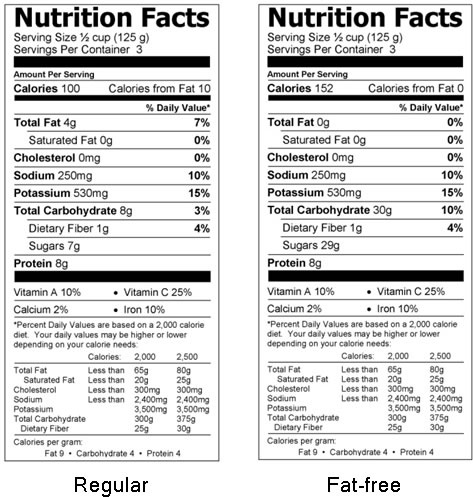
So even if you eat “healthy”, you may actually get a lot of sugar you may not want or need. Our ancestors by and large really didn’t had that ability. Most of the sugar either came in vegetables, milk or fruit, with both vegetables and fruit being seasonal.
There is no doubt that sugar and carbs are preferable for our body to use. It can be used straight in the cells and provides an instant kick. You know this when you ever feel down, then have a bit of sugar and find yourself suddenly humming again. But as the old adage goes: The dose makes the poison.

Lastly, there is the WHO’s new recommendation for maximum added sugar in the day, which was revised in 2015:
A new WHO guideline recommends adults and children reduce their daily intake of free sugars to less than 10% of their total energy intake. A further reduction to below 5% or roughly 25 grams (6 teaspoons) per day would provide additional health benefits.
Note that “free sugars” here means sugars that are not part of a plant or unprocessed food. So the apple you may have for breakfast won’t count against your allotment, that Grande Starbucks White Chocolate Mocha comes with 59 grams of sugar, which blows most people’s allotment right out of the water.
BTW Starbucks, way to go to make it hard to actually find that info. Is a PDF really the most customer friendly way to convey this information?
To summarize: I counted my sugars and carbs, I reduced the added ones and now only really take an occasional gel during very long and hard activities, e.g. during a race. I will get more into training fuel / race fuelling in the later sections.
Fats
So now onto the whole fat thing. To be honest, this is still throwing me a bit for a loop. There is the talk of “good fats” and “bad fats”. The arguments on both sides are a wee bit confusing.
The first one is that the pro-fat-is-good group tends to point out that LDL and HDL are both raised, so it’s a wash, the more nuanced ones even point out that LDL (the “bad cholesterol”) is not just one, but two different pieces with only one being bad.
The counter is that LDL rises faster on a diet high in saturated fats than the associated HDL, thus bad.
As I said, this is a wee bit confusing and I am not sure this has even closely been settled. What seems to have been settled though is that triglycerides are a good indication as to how healthy your heart is and how likely you are to actual develop heart problems later in life.
In the human body, high levels of triglycerides in the bloodstream have been linked to atherosclerosis and, by extension, the risk of heart disease and stroke. However, the relative negative impact of raised levels of triglycerides compared to that of LDL:HDL ratios is as yet unknown. The risk can be partly accounted for by a strong inverse relationship between triglyceride level and HDL-cholesterol level.
So my approach on this for now is to “not worry” and get a test for cholesterol and triglycerides done twice a year to keep an eye on where it goes. So far it seems my numbers have improved.
There seems to be a strong indication that a lot of your cholesterol levels are more influenced by your genetics than by your diet. Most of the cholesterol is created in the body and not consumed with food (so egg yolks are a-okay).

There are other things to consider with fats though, mostly in cooking, that is: The smoke point. The reason this matters is that as you heat oil it starts breaking down. When it hits the smoke point you’re on a good way to set your kitchen on fire, but you already are converting the fat into many things you don’t really want.
Hydrolysis and oxidation are the two primary degradation processes that occur in an oil during cooking. Oxidative stability is how resistant an oil is to reacting with oxygen, breaking down and potentially producing harmful compounds while exposed to continuous heat.
So cooking with olive oil is probably not so great, on the other hand having it in your salad is quite tasty.
A final note on fats, as I have reduced my carb intake I am essentially left with two energy sources, one is fat, the other one is protein. More about protein in the next section. But my general “noshing” is now mostly nuts (not peanuts though, as I found out, they aren’t really nuts, they’re legumes).
While “nut” is in their name, peanuts are in fact legumes. Peanuts actually grow underground, as opposed to nuts like walnuts, almonds, etc. that grow on trees (and are sometimes referred to as "tree nuts").
Protein
The final of the three main groups of nutrients. Protein is used to build muscle and other tissue in the body and you probably have seen / heard stories of the body builder diet which often includes huge amount of protein.
The general consensus seems to be that you need between 0.8 - 2grams of protein per kg of body weight. Women less than men and also depending on activity level. The average person probably can get away with around 1 - 1.2grams per kg of body weight.
Having said that, even at 85kg that’s still quite a pile of protein I need to eat and when I started logging I realized I often fell short of the goal.
Having said that, there is an interesting “side effect” if you eat more protein than the body needs. It gets broken down into sugars via Gluconeogenesis (GNG) and used, or stored, by the body.
Gluconeogenesis (GNG) is a metabolic pathway that results in the generation of glucose from certain non-carbohydrate carbon substrates. From breakdown of proteins, these substrates include glucogenic amino acids (although not ketogenic amino acids); from breakdown of lipids (such as triglycerides), they include glycerol (although not fatty acids); and from other steps in metabolism they include pyruvate and lactate.
Something you probably have heard of before is that a high protein diet is bad for your Kidneys.
Some quick thoughts on Dairy, Salt and Organic Food
If you had any exposure to food discussion one food you will have come across over the last few years that will apparently give you cancer and kill you dead if you consume it is dairy. I don’t really buy into this. I think like with most things, moderation is key, but I do like my cheese and I have added milk, whole milk at that too. But it’s not something you can drink like water. It has calories and it is the one exception where I do buy organic because I do think it does make a difference (if for no other reason than that it comes from much closer than the non-dairy milk I can buy in the supermarket).
As for salt, I have never really worried about it. It is a concern if you eat a lot of processed foods, but as the big idea here is to get away from it, you shouldn’t be worry either. Plus, at least for me, I do sweat a lot. So getting rid of any excess salt is somewhat easy.
As for organic food, I do like the original idea behind it, the more “natural” way to grow and caring about the welfare of wildlife and the animals. Unfortunately, as it became clear that people were willing to pay a premium for organic food the standards were “tweaked”. Additionally, people still expect perfect produce which means the waste that is so common in general agricultural production is now also around for organic food.
Lastly, organic does not mean pesticide free, the pesticide just has to be organic. This does not mean there aren’t some benefits, but if you buy organic purely because you think it’s better / healthier you’re probably wasting your money. Buying in season and at a farmers market will probably have a better net benefit (but beware of cheaters).
What to eat?
So how do I eat now? I have mostly removed a bunch of items from my diet. I am saying mostly here because having an occasional pizza or a can of coke is not the end of the world, but they are no longer in my daily diet, rather I consider them a treat. Interestingly enough, after an adjustment phase the cravings for them have mostly disappeared. More specifically items I have pretty much removed from my diet and only eat on occasion:
- Bread
- Pasta etc.
- Sugar in my coffee / tea
- Pop
- Cookies, candy bars, chips, pretzels etc.
It did surprise me quite a bit how hard it was to “kick the sugar habit”. I never thought I ate a huge amount of sugar. But as I went through this I had giant cravings for something sweet and found myself occasionally giving in and basically inhaled a chocolate bar or two in one go.
So what do I eat these days?
- Lots of veggies
- Salads, with fatty foods like avocado, fish or I add some chicken or steak to it (with a simple, home made dressing).
- (Mostly) in season fruits.
- Nuts and seeds (for snacking)
- Eggs, chicken, fish, pork and beef.
- Fermented foods, like Sauerkraut, Kimchi and Kefir
I do have a slow cooker and absolutely love making all kinds of stews in them they are easy to prep and do, and once you’re ready to eat you just grab them out of the fridge / freezer and you are good to go.
If you’re scratching your head as to how to eat low carb a book with recipes is:
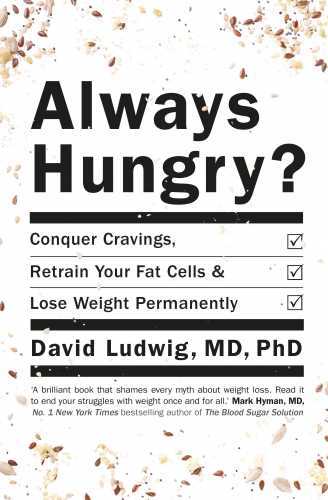
Always Hungry? is intended to help you make a transition to a low carb diet, but unlike many other diet books or advice online it isn’t overzealous. No attempt to try and shame you into getting rid of all carbs or processed foods in your life. It takes a more balanced approach and not only talks about the benefits / science behind each of the recommendations but also comes with a lot of tasty recipes. So if you have no idea how to replace that pasta in a tasty way, that’s the book for you. Otherwise: Get creative and experiment, just cooking from scratch will make a huge difference if you’re not already doing it.
This is all about moderation when it comes to carbs, not an outright banning of one of the three macro food groups. Don’t stress over it and don’t hate yourself if you end up failing on occasion. This isn’t about perfect, this is about better and in my case, eating for a better performance / experience out on the trails and in the backcountry.
Supplements
There are a few supplements I take, mostly it is magnesium as this can be hard to get enough from in the diet if you’re very active. I also take a C + D tablet during the winter months to supplement. The occasional protein shake / bar is also in the mix, though I am careful around the bars because they often contain quite a bit of sugar and as noted above, too much protein isn’t that great either.
I find that the vast majority of my protein requirements I can fulfill with my diet, a glass of whole milk or Kefir a half an hour or so before bedtime usually ends my day.
Intermittent Fasting
I had experimented with this quite a bit over the last few years on and off. Taking a day off. These days I often can eat little or nothing until it’s past lunch time.
There is a growing body of evidence that caloric restriction / fasting does have some health benefits. It reduces insulin levels and other stress markers and may even play a role in cancer prevention. Note I bolded the may here because this hasn’t been proven, but we are starting to understand authophagy better and it seems to be active in humans as well.
Autophagy (or autophagocytosis) (from the Ancient Greek αὐτόφαγος autóphagos, meaning "self-devouring" and κύτος kýtos, meaning "hollow") is the natural, regulated, destructive mechanism of the cell that disassembles unnecessary or dysfunctional components. Autophagy allows the orderly degradation and recycling of cellular components. In macroautophagy, targeted cytoplasmic constituents are isolated from the rest of the cell within a double-membraned vesicle known as an autophagosome. The autophagosome eventually fuses with lysosomes and the contents are degraded and recycled. Two additional forms of autophagy are also commonly described: microautophagy and chaperone-mediated autophagy (CMA). In disease, autophagy has been seen as an adaptive response to stress, which promotes survival, whereas in other cases it appears to promote cell death and morbidity. In the extreme case of starvation, the breakdown of cellular components promotes cellular survival by maintaining cellular energy levels.
As a general pointer. If you read anything where the word may appears next to a claim that something does something, regardless of health related or otherwise, work under the presumption that it probably doesn’t or at least not in the way it is described. I noticed that health “foods” and supplements are notorious in their prescription. It’s a trick often used by the manufacturer, because if it doesn’t work they can always say: “Well, we didn’t say it does that, just that it may be doing it.”
Goals
In no particular order:
- Increase strength to be able to move my own body weight around.
- Build a deep(er) cardio well
- Increase / maintain flexibility
- Have fun
-
Run the Squamish 50 in AugustWell, that’s not happening, as I didn’t register in time. Looking for an alternative race now.
These goals really aren’t in any particular order or priority, rather they complement each other with the race in August acting as a “check point”.
Strength

I have done the usual strength training exercises in the past. Lifting weights, going by how much I could lift / how I looked / felt. Through the course of my reading I have come across a new approach I am going to employ: Maximum Sustained Power (MSP) and also have come to define some easy metrics:
The metrics
The goal is to be able to do the following:
- 50 pushups
- 50 squats
- 2 minutes plank
- 12 pull-ups.
I am a bit more than halfway to the pushups as of this writing in early April and suspect a month from now I will hit that target. Squats I can already do (though I start feeling it around the 40 mark). With regards to the plank I am at 100 seconds, also expecting to hit the two minute mark a month from now.
Now pull-ups? That’ll take a while longer. They were always my bane. I’ll get there, but it will involve a lot of cursing.
MSP
Intro
So what’s MSP? The idea behind MSP is that unlike traditional weight lifting that has you do lots of reps with (low) weights, the idea is to put maximum effort into fewer reps to build strength and endurance. This isn’t a really new concept, HIIT has been around for a while and I know a few people that swear on it.
How-to
Where in traditional weight training you load up your plates, then do 8 - 12 reps, MSP sets a starting weight with five (5) reps. This is the weight you will continue to do the rest of the set.
The sets go (number of reps):
5-4-3-2-2-2-1 with 10 - 20 seconds recovery between each rep. Then 3 minute recovery and repeat twice more for a total of three.
The exercises done are basically two types of exercises:
Here are two quick videos that introduce you to the correct form. And yes, it’s “bro”:
Variations
Beyond the deadlifts and squats the other other good moves are standing jumps (measure height) and stairs (jumps or sprints). Similar, set a baseline first, then repeat as long as you can hit the target you established with the baseline.
Long term
As the reps become easier, just add weight, simple, isn’t it?
Cardio

So now we’re coming to the meat of this. The goal is to do endurance events again. This year the goal is the Squamish 50 as I didn’t register in time that won’t happen, I am now looking for an alternative race. For next year I am eyeing the Canadian Death Race.
The challenge here is of course mental as well as physical. Mentally I am pretty certain I am there, physically… well, this is what this is about.
The main challenge I found in the past is that feeding always was a problem. Mostly, I couldn’t really eat as much as I was supposed to and that ended up hurting me. So in early 2015 as I considered going back to this I was wondering: “What if I could run more on my body fat?”.
The answer to this seems to be that this is indeed possible as a lot of my reading seems to shown (see the diet section). In order to get into the fat burning zone the rule of thumb seems to be: 180 - age for the majority, this is surprisingly hard for me to hit, or was initially. I am getting better at it, and I noticed that “feel” gets me pretty close to it. The proof of course will be in the pudding once I go beyond three hours.
Speed training, or how to get faster

I admit it. I hate hate hate speed workouts. I have always avoided them, long story short that goes way back, not going to bore you with it.
But there are advantages to it, not in the least you end up getting faster.
Good news for me (and others) though is that you do not really need to do extensive / long sessions. Once a week appears to be enough.
All kinds of claims around sprinting have been made over the years, just look on the internet, I am not going to repeat them here because some I find a bit suspect / esoteric. Judge for yourself. But I do see value in getting faster and recruiting more muscle fibres during my workout.
Traditional speed work was a tempo run.
A tempo run is a faster-paced workout also known as a lactate-threshold, LT, or threshold run. Tempo pace is often described as "comfortably hard." Tempo running improves a crucial physiological variable for running success: our metabolic fitness.
I am changing this now and more about the why and how in the cardio section.
I will supplement temp runs with sprint workouts, presuming I am feeling ready for a sprint work out and not too tired / time challenged.
How
The sprint workouts will be time instead of distance based. In the past I hammered down a certain length of track over and over, but, see cardio section, this is a bit counter productive to what I am trying to accomplish now. Instead after a thorough warmup (sprinting is hard on the body) I set a time based workout. That is 15 - 20 second sprints with a 20 - 30 seconds recovery period.
If the performance (distance) drops significantly it is time to cool down and head home.
Similar to the MSP workout, repeating these sets of fives after a few minute rest is possible, but if the performance drops too sharply it signals the end of the sprint workout.
Then perform a cool down (e.g light jogging for a few minutes.
Running only?
The nice thing with these sprint workouts is that they cannot only be done running, but also on the bike or in the pool. The idea here is to reach maximum effort during these periods.
Running is high impact, so once a week is probably all that should be done. On the bike you can do the sprint workouts more regularly, same in the pool. But in all scenarios 100% rested should be the starting position. Feeling tired or off means no sprinting. You may cause more harm than good.
What’s the goal?
To recruit more muscle fibres, build up some fast twitch muscles, which can be used during slower activity as well reducing muscle fatigue during long periods and prime the overall nervous system. This is similar to what HIIT and similar workouts are trying to accomplish. This is also the only targeted workout where I am planning on hitting my aerobic threshold or exceed it for short periods of time.
Misc. “Training”
There is a variety of other “daily” training I have incorporated in my daily routine.
The first thing is that I am aiming for a 1000kCal “active burn”, even on days off. That is pretty much anything I do physically, from walking up stairs to going for a stroll or moving stuff around. Workouts count against this goal, it’s really more of a “minimum activity” goal.
It is quite interesting to see just how far one has to walk to burn 1000kCal, even at my size / height / fitness level.
Training Plan

Running
Running: Mondays and Thursdays.
Long Run: Saturday
Strength
Daily: Pushups, squats, planks, pull-ups
Tuesday & Thursday: MSP workouts
Stretching
Daily before bed.
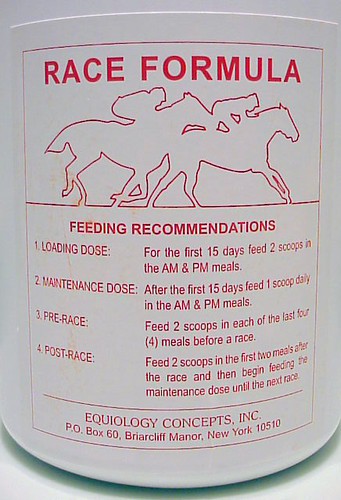
This I am still experimenting with. I did 30K a few times on cross country skis this winter and because my form sucks I made it harder on me than it should have been. The most interesting aspect in all of this was that I rarely felt “out of power” and my tracked times showed this as well as I did not see a huge drop off in my times.
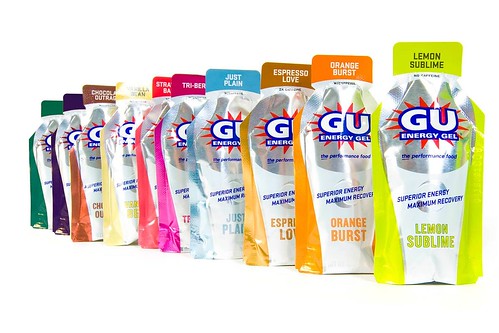
For now the plan is to extend my long runs on weekends and continue the weekly fast. All the while I will keep an eye out on how it develops and try a few different gels and other items. So far I seem to do well with the Gu gels
Experimenting with Skratch in my water bottle / bladder worked well enough, and Nuun I have been using for a few years and during the summer when it got hot.
One thing I didn’t do in the past when I was racing / training was to actually log / quantify things. This time, it’s different as they say.
I am logging different things and do so consistently now.
Body composition
Garmin Index Smart Scale

I did buy a Garmin Index Smart Scale. There were two reasons for this. The first one was that I didn’t really trust my old scale, it was a bog standard one and when I did a body composition (DEXA) scan late last year it was off by 1% when it came to body fat. The Garmin scale is aimed at athletes, so I figured it would do a better job. Additionally it ties into Apple’s Health Kit which I use as a central exchange point for all my workout data between different apps / devices as well as a “single place to check” on progress / review data.
The scale measures body fat, bone mass, skeletal muscle mass and body water and the iPhone app can graph your progress, like this:
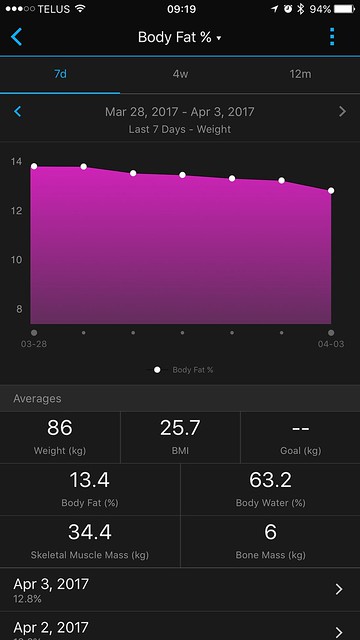
I use it to evaluate body composition mostly. My target goal is 10% body fat. I will have another DXA scan in June to validate the scales results.
DXA Scans
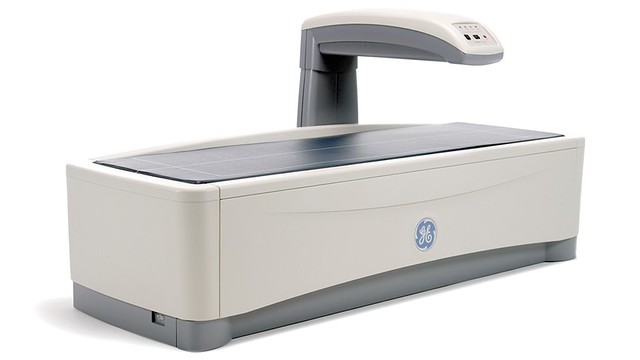 As mentioned, I did get a body comp / DXA scan last December. These are great because they can tell you where your muscles are and also where the fat sits. In this case, although I seemed to have low fat under the skin, the scan revealed (as suspected) that there was way to much fat in me (in the gut). This is the stuff that’s considered bad. I was what is known as TOFI (Thin Outside, Fat Inside). I had almost 30% fat in my abdomen, with an overall body fat content of 21.4%.
Heart Rate Variablity (HRV)
In the “good old days”, your resting heart rate was always considered the standard to determine if you were overtrained or not. Essentially, the lower your heart rate, the more rested you were.
Since then though it has been shown that Heart Rate Variability (HRV) is a much better indicator for your rested state.
In short, the difference between the beats is more important than the number of beats and the higher the variability, the better. The explanation behind this is that there are two nervous systems. The sympathetic system, which tries to prime your body for a fight or flight response and the parasympathetic system which is active when you’re more relaxed. The sympathetic system also gets activated when you are overtrained, your body is basically in a stress situation. This leads to a very “precise” rhythm. Think of your body having an “iron grip” on almost every aspect of your body so that it can marshal whatever resources it needs on short notice. You wouldn’t want to take five minutes to get ready to run away from that animal that thinks you make good dinner.
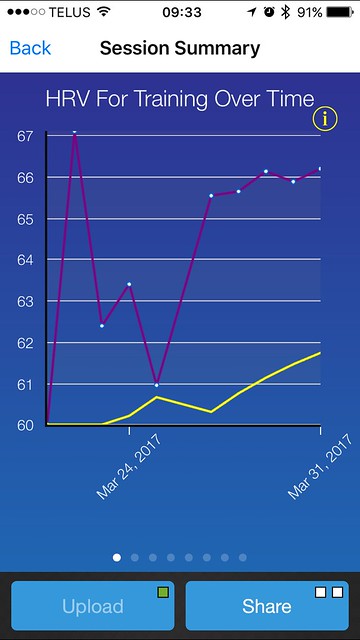
When I get up in the morning I spend five minutes with my HRM and an iPhone app to measure my HRV, see it as a relaxed five minute wakeup in bed.
The app is called “SweetbeatHRV” and their website as well as app design is pretty atrocious, but in around a month of using it I did find some interesting correlations between my feeling of rested and the numbers the app showed. I can even see impacts when I had alcohol or did something else “stupid”. For now, this seems to be a useful tool, if in a few months I come to the decision that it’s all crap I’ll update.
Heart Rate Monitoring
I am tracking my heart rate in two ways right now:

- AppleWatch Series 2
- Garmin Fenix 5x
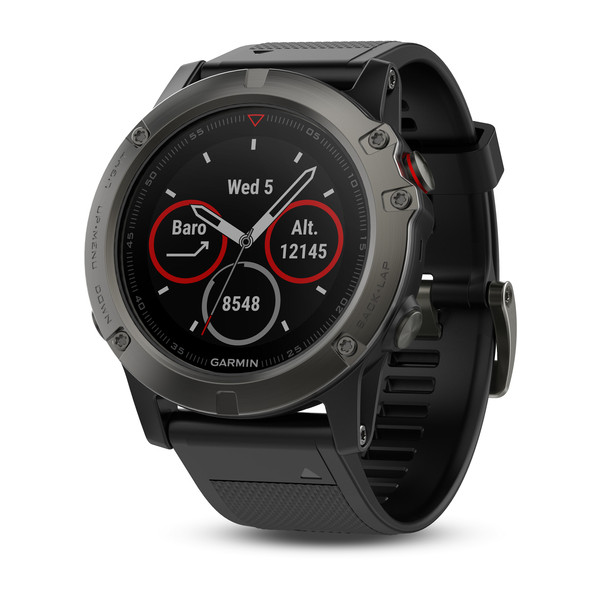
I initially had hoped that the AppleWatch could provide an “all in one” solution, unfortunately as nice as it is for logging, it’s really not good to define heart rate zones and train within them. Because of my attempt to primarily work in the fat burning zone that is a must though. So I did bite the bullet and bought a Fenix 5x as well to use for actual training. The added bonus of the 5x is that it lasts up to 100 hours vs. the AppleWatches six.
Both work without a chest strap and instead use LED lights in the wrist to measure the heart rate and seem to be accurate, at least when I was testing it against my polar chest strap.
Activity Monitoring
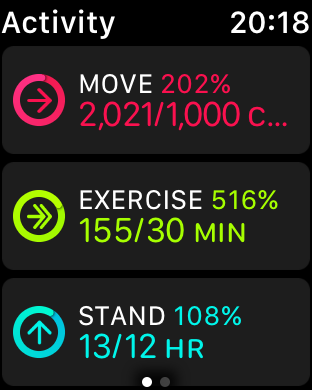
As mentioned above, I do have a daily “activity budget” of at least 1000kCal. This I track mostly with the AppleWatch, with other devices / apps feeding into this via health kit .
Workout Tracking
The Garmin Fenix 5x is the main device to track workouts. It allows me to set the heart rate training zones and thus “reigns supreme”.
Additionally I use Strava for my “workout logging” as it provides some interesting insight and I have already been using it. Here is an example from my long run:



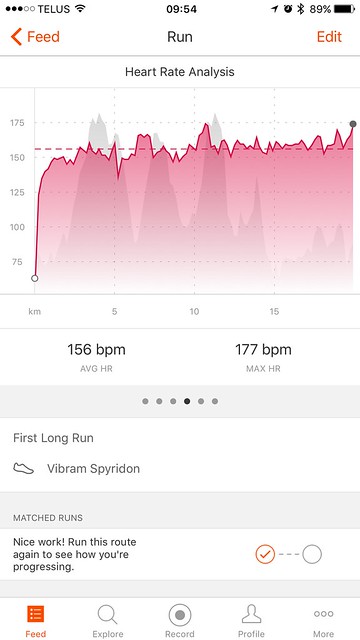
I am not sure if I will continue to use Strava in the long run. There are some problems, mostly the battery life on the phone for longer runs.
Other logging
Apple Health provides the ability to track some other things as well. I have a small little device to measure blood alcohol levels (you blow into it), I bought it for fun last year and now use it before going to bed to check my levels.
Additionally I have a cheap blood pressure cuff, so once a week I tend to test that as well. No particular reason outside of: “I have it, why not use it?”.
Lastly, as mentioned in the diet section I do get regular blood tests done to verify that my dietary changes aren’t doing anything badly.
This is the final “piece to the puzzle”. I have made some major changes on that front over the last year as well.
Less stress
 This is a multi pronged approach, mostly I have evaluated relationships I had and cut those out I found not very beneficial.
Additionally I greatly reduced my exposure to the news media. Not so much that the bad news got me, but the “public discussion” around it.
To that end I have stopped partaking in public discussion forums. I have abandoned reddit, social media etc. Social media actually for quite a while as I saw little benefit in it to begin with.
Overall this has freed up quite a bit of time I use for more reading, enjoying the outside and generally spending less time on the computer.
Have fun
 This is the other thing I have started to change. I review what is fun and what isn’t and if something isn’t fun I’ll stop doing it.
This also has an impact on the training, if there is a fun chance to do a hike / bike ride or a social event, I am okay with dropping that particular workout and instead do that. Of course this won’t overrule every single time, but I am going to be less hardcore when it comes to this than I was in the past.
Be Mindful
 Over the last two years I neglected meditation / mindful relaxation a bit. I am starting to incorporate this back into my life, even if it is only a few minutes here or there.
I am also including a weekly fast day into my schedule. Currently this is on Sundays, there seem to be quite a few benefits in these types of fasts, so we’ll see where it goes. It’s interesting how these become easier and easier as you do them more.
Less compromise
This sounds a bit contradictory, but in the past I often put my own needs and wants behind that what others wanted. This often resulted in more stress and unhappiness for me and pretty much every body.
Last year for the first time I was able to produce a list of needs, wants and nice to have’s in relationships (both romantic and friendships) and the needs ones are not negotiable. There aren’t many, about five for the needs, but these are now my core principles I will follow and not negotiate on.
What I have written here I have tried to live, with ups and downs, for about six months now. It had definitely a physical and mental impact for the better. Like any plan some of the things may not work for you and you may find additional / different things you want to try. So. Explore and try for yourself what works. See this as a guideline, not a guide / instruction manual.
There are several books / sources I culled this from. Too many to list them all here, but a few that “stuck out” I am linking here. Check them out and make up your own mind.
Born to Run
The book has been made fun of and been hailed as the “besets book ever” and it kicked off the “barefoot running” craze. For better or worse. What it did for me was that it reminded me on where I was actually happy an in a way set me back on track to writing this.
Always Hungry
This wasn’t really a book I used, but recently read and I think it will be useful if you want to make diet changes. It comes with recipes and other useful tips to make the transition easier.
Primal Endurance
This book was an interesting read, it is almost a (longer) summary of what I have written here, it did add the MSP workouts that I hadn’t on the horizon to my plan, but otherwise if you prefer a more in-depth discussion about the underlying principles / science this is a good book.
As I said a few times already: Test things for yourself, and to the books credit, it does not claim to be 100% correct for you, but rather encourages you to experiment with the principles they teach.
The Running Revolution
This book has helped me greatly with my running form and has made a huge difference. The technique taught here is known as the “[Pose Running Form]”. You can find a lot of teachers out there that will be more than happy to teach you the correct form.
This is by far not the only one, there are others, like ZEN running etc. If you google around you’ll find a lot of very similar techniques.
[The Running Revolution]
Misc sources
Lastly, the internet is full with all kinds of resources. So look around, but make sure to truly understand the underlying principles behind what is recommended. Many sites and blogs offer either an oversimplified or caricature version of what most of these ideas truly represent. So, be skeptical, and if something sounds weird / odd, try to find another source that explains the same concept differently and see if it makes sense. Of course, this is the internet, you should also check out any “counter” argument and see if that makes any more sense to you.
Lastly: Don’t be afraid to experiment, just make sure you keep an eye on what the changes you do does to you. Nothing is worse than blindly following someone else’s advice without evaluating what it does to you.
Here are the best and most affordable microSD cards for the Nintendo Switch

You bought a Nintendo Switch only to find out that the console has an extremely small — at least by today’s game size and memory standards — 32GB of internal memory.
If you’re planning on purchasing physical titles (whatever you do, don’t put them in your mouth) 32GB is likely more than enough space. If you’re more a fan of digital downloads, however, and want to play a game that isn’t just The Legend of Zelda: Breath of the Wild, you’re likely thinking about hunting down a microSD card to expand the system’s memory.

Thanks to a post-launch update the Switch is compatible with Secure Digital High Capacity (SDHC) cards that top out at 32GB, as well as Secure Digital eXtended Capacity (SDXC), which are between 64GB and 256GB. The SDXC update prompts to download as soon as you put a high-capacity card in the Switch.
Depending on how many games you intend to buy for the Switch, 32GB of additional storage via microSDHC could be enough for your purpose, but those who plan to use the eShop and Virtual Console, will definitely want to opt for a larger SDXC microSD card.
To start, this search is confined to relatively reliable brands, so you won’t find strange eBay knock off cards. While many of these cards are available at big box retailers like Best Buy and Wal-Mart, in almost all cases (unless you find a crazy deal) they’re cheaper on Amazon. I’ve also stuck with cards that meet ‘Class 10’ speed standards, which means the card transfers at 10mb/s.

Starting things off big, there are a number of options in the 200GB range, though you’ll need to be willing to shell out a few extra dollars. If you think about it though, picking up one larger card, rather than multiple smaller microSD cards, is a better option. Of course 256GB microSD cards are also available but they’re extremely expensive and not worth the cost difference for an additional 56GB.
If you’re interested, I opted for the $106 SanDisk Ultra 200GB card.
200GB microSD Cards
- Lexar High-Performance microSDXC 633x 200GB — $139 on Amazon
- SanDisk Ultra 200GB microSD — $106 on Amazon (with Prime)
- PNY Elite 200GB microSDXC Card — $79 on Amazon (this is the best deal, but the shipping length is over a month).
128GB microSD Cards
- Lexar High-Performance microSDXC 633x 128GB — $54 on Amazon (with Prime)
- SanDisk Ultra 128GB microSDXC — $58 on Amazon (with Prime)
- Samsung 128GB EVO Micro SDXC — $59 on Amazon (with Prime)
64GB microSD Cards
- Lexar High-Performance microSDXC 633x 64GB — $24 on Amazon (with Prime)
- PNY Elite Performance 64GB High Speed SDXC — $29 on Amazon (with Prime)
- SanDisk Ultra 64GB microSDXC — $34.49 on Amazon (with Prime)
- Two 64GB Lexar Professional 633x 64GB SDXC – $65 on Amazon (with Prime)
The post Here are the best and most affordable microSD cards for the Nintendo Switch appeared first on MobileSyrup.
The Omni Group Releases OmniOutliner 5 for Mac

OmniOutliner Essentials
Timed perfectly with the fifth day of the month, The Omni Group today released OmniOutliner 5, in what the company called “the biggest update to our outlining app ever.”
OmniOutliner 5 now comes in two distinct versions: Essentials and Pro. With OmniOutliner Essentials, the Omni Group has stripped down the Pro version to offer a more focused experience, featuring 10 unique themes, document statistics, and the basic outlining functionality found in previous versions of OmniOutliner. The sell, though, is through its price – $10.
OmniOutliner Pro users will see significant updates and improvements, too, with features like outline filtering, private documents with password protection, keyboard shortcut definition, and built-in themes. Pro users also receive document statistics and an improved full screen mode. For more information about the update for OmniOutliner Pro, visit the preview page here.
Although these updates bring great features to both versions, the $10 price for OmniOutliner Essentials is the standout of today's news. For the Omni Group, hitting this price point is a significant accomplishment, one that I believe will draw people into the developer’s group of apps. A Mac app of this quality, especially considering the support behind it, will tempt a lot of people to make the purchase.
For more information on OmniOutliner and to pick up a copy, visit the Omni Group’s website here.
Support MacStories Directly
Club MacStories offers exclusive access to extra MacStories content, delivered every week; it’s also a way to support us directly.
Club MacStories will help you discover the best apps for your devices and get the most out of your iPhone, iPad, and Mac. Plus, it’s made in Italy.
Join NowMake People Awesome through Real Work
Typical training workshops are informative and can be a lot of fun.
Teams get away from their normal work for a week or so, try out new technologies and techniques on prefab examples, give the instructor a quick rating, and then go home to their normal jobs.
Is this the time for traditional classroom training?
Sometimes there are issues that reduce the value or appeal of traditional classroom training:
- The team needs to schedule several days away from their real work.
- The primary output is knowledge transfer, which fades in time.
- Skills learned in the course may not be applied to real code for weeks (or ever).
- Examples are engineered to teach a lesson or make a point; they may not be realistic enough.
- Sometimes the students are not ready to receive the information.
- The preplanned agenda may not fit the perceived needs of the team.
While traditional training still has tremendous value, sometimes these issues are significant enough that training is deferred indefinitely.
How Could We Do This Differently?
What if, instead, we turned this whole idea on its head?
What if it could be more like an intense coaching session or an un-conference than a classroom?
What if the needs of the developers took priority over the instructor's agenda?
What if the instructor were to teach "just enough" and then move on?
This is the idea of the Real Work Workshop.

The new workshop is one to two weeks of intensive coaching/training in an environment optimized for rapid learning.
During the workshop, the attendees and the leader will work in the company's own, actual code base.
The team doesn't need time off from work. Instead, we do their work in the workshop.
We usually refactor some ugly code, introduce microtesting, and use microtesting and refactoring to produce new code.
On top of all of that, we use rapid delivery and rapid feedback from the content provider (PO, Customer, Manager, whatever) to steer our deliveries — an interaction that’s crucial and often missing in agile transformations.
Along the way we may learn any number of other things — unpredictably, according to the distinct strengths and weaknesses of the team.
How do you optimize for learning?
We have some standard behaviors which we find make the workshop effective:
- Working in REAL CODE and delivering REAL FEATURES grounds us in reality.
- We work with a new, unstarted feature so nobody's half-finished code is exposed for critique/ridicule.
- As we work, we take teaching moments - short lectures to address or explore issues we uncover.
- We track our work with punch lists, and even use them to improve our decision-making.
- We use mob programming as a mechanism to increase the rate of learning and sharing.
- We celebrate our wins.
- We have daily retrospectives.
- We have daily deliveries of code.
- We plaster the walls with hand-drawn posters: illustrations, references, even slogans. By the end of the week, we are sitting inside of a week's worth of learning.
- We like to have a three-month post-workshop survey to learn what lasting effect the workshops really had on the project.
Posters? What kind of posters?
We record things we've done, lessons we've learned, and things we want to remember.


What happens after the workshop?
Most teams take the learnings of the Real Work Workshop directly into their daily work.
When used with Scrum Teams, the POs usually leave with a new understanding of development work and a closeness with the team that makes early demos and continuous steering possible.
Team members have real-world examples of tests, including pin-down tests and microtests, and will apply the same techniques to driving new coding problems via tests.
Teams have more developed problem-solving skills. Some participants have become key influencers within weeks to months of a workshop.
Teams reported being more aware of, and effective in, the use of different kinds of tests, from microtests through end-to-end system tests.
Teams begin using pair programming and/or mob programming to share expertise and to more quickly conquer problems that have considerable risk and uncertainty.
Teams have a renewed focus on finishing work early and often.
Teams begin making small improvements which accelerate delivery -- often visible first in custodianship of the delivery pipeline and local tooling.
Teams have reported having more knowledge-sharing after the workshop, whether in the form of morning meetings or lunch-and-learn sessions.
Are these workshops hard to run?
It depends partly on the facilitator being a skilled improviser, able to operate without the comfort of a fixed agenda.
Adjusting to different techniques, stacks, code bases, and teams can require a lot of flexibility.
The workshop facilitator has to have the skill and experience to perform intense live, on-the-spot coaching, deal with technology differences and programming languages, adapt to new domains, and help teams to pull together quickly to share their ideas and experience.
The facilitator must be ready and able to model a willingness to learn, which comes with a willingness to be vulnerable and express ignorance. This creates an environment where others can also feel safe to ask questions and to learn new ideas.
It helps if the facilitator has a large body of reference work to draw from.
In short, the style appeals to experienced technical coaches with a strong sense of adventure.
Now what?
If this sounds intriguing, then why not schedule a Real Work Workshop for your team. I think you'll be amazed.
Have you experienced a Real Work Workshop? Would you be willing to share your experiences in the comments below?
The post Make People Awesome through Real Work appeared first on Industrial Logic.
Hohl-in-one
mkalus
shared this story
from  BILDblog. BILDblog.
|
Im „Augusta National Golf Club“ im US-Bundesstaat Georgia startet morgen eines der bedeutendsten Golfturniere der Welt, das „US Masters“. Unter anderem am Start: Der Deutsche Martin Kaymer, mit dem „Bild“ im Vorfeld gesprochen hat. Das Interview kann man heute im Blatt lesen, und die Überschrift hat es durchaus in sich:

Die Bild.de-Mitarbeiter haben daraus einen „Bild plus“-Artikel gemacht, mit der gleichen Titelzeile wie ihre Print-Kollegen:

Nanu — Martin Kaymer ein großer Fan der Politik Donald Trumps? Der US-Präsident „ein Geschenk“ für die Menschheit? Die Aussage von Martin Kaymer, die die „Bild“-Medien für ihre Schlagzeilen gewählt haben, stammt zwar von dem Golfer. Sie hat allerdings nichts mit Politik zu tun:
Sie spielen einen Großteil des Jahres in den USA. Wie hat sich Amerika unter Präsident Donald Trump verändert?
Kaymer: „Ich bin überrascht, dass die Leute, besonders die, die Trump gewählt haben, jetzt über seine Äußerungen und Handlungen verwundert sind. Er macht das, was er angekündigt hat. Für uns Golfer gibt es allerdings auch noch einen zweiten Donald Trump.“
Was meinen Sie?
Kaymer: „Über den Politiker Trump muss sich jeder seine eigene Meinung bilden. Der Golf-Fan Trump ist jedoch ein Geschenk für unseren Sport. Er hat extrem gute Plätze auf der ganzen Welt gebaut. Was er im Golf anpackt, ist eigentlich immer ein Riesenerfolg.“
Das Problem dabei: Die kompletten Antworten können bei Bild.de nur die Leute lesen, die ein „Bild plus“-Abo haben. Alle anderen sehen lediglich die Überschrift und die ersten paar Zeilen des Textes, aus denen nicht hervorgeht, dass sich Kaymers Aussage bloß auf Golfplätze bezieht.
Weil sich erste empörte Fans meldeten und schrieben, sie werden ihn ab sofort nicht mehr unterstützen, hat sich Martin Kaymer bei Facebook zu der „Bild“-Schlagzeile geäußert:

Mit Dank an Kiezgolf für den Hinweis!
Sie finden gut, was wir hier machen? Dann unterstützen Sie uns doch! Mit Ihrer Hilfe kann und wird es weiter Medienkritik beim BILDblog geben. Unser Dank ist Ihnen gewiss, wir freuen uns über jede Unterstützung — und am meisten über Daueraufträge.
Unsere Kontodaten: B-blog, IBAN: DE94 1001 0010 0555 4161 07, BIC: PBNKDEFF, Postbank Berlin, Konto 555 416 107, BLZ 100 100 10
Geht auch per Paypal:

Windows 10 Start Menu design concept show up on Twitter

With the final version of the Windows 10 Creators Update nearly upon us, a leaked screenshot of a visual revamp of the operating system that’s set to launch later this year, has appeared. This design is among numerous leaked concept screenshots that have popped up online over the last few weeks.
The new Start menu design concept, published by Tom Hounsell on Twitter, has a few subtle differences when compared with Windows 10’s current build. For example, many of the live tiles seem to have a transparency effect applied to them. This is something that according to The Verge, Microsoft has been working on adding to Windows’ Start menu for some time. The screenshot also shows other subtle differences between the concept and the current version, such as minor icon design shifts.
backlink me @bdsams #ProjectNEON #Windows10 pic.twitter.com/FLpW2hgqGd
— Tom Hounsell (@tomhounsell) April 5, 2017
Furthermore, the mail icon at the bottom is all lines now and is no longer coloured in. The File Explore icon is also now on the left side of the Start menu and can be found where other most used applications are located. The user icon has been pushed to the top in the concept design, compared to where it is now directly above the settings and File Explorer icon. It’s also worth noting that Cortana’s icon has been revamped and is much smaller.
It’s important to keep in mind, however, that this screen shot is just a design concept and its possible that it won’t be included in the final version of the Creator update.
Source: Twitter
Via: The Verge
The post Windows 10 Start Menu design concept show up on Twitter appeared first on MobileSyrup.
Samsung's Android Replacement Is a Hacker's Dream
mkalus
shared this story
from  motherboard. motherboard.
|
Last month, the CIA got a lot of attention when WikiLeaks published internal documents purporting to show how the spy agency can monitor people through their Samsung smart TVs. There was a caveat to the hack, however—the hijack involved older models of Samsung TVs and required the CIA have physical access to a TV to install the malware via a USB stick.
But the window to this sort of hijacking is far wider than originally thought because a researcher in Israel has uncovered 40 unknown vulnerabilities, or zero-days, that would allow someone to remotely hack millions of newer Samsung smart TVs, smart watches, and mobile phones already on the market, as well as ones slated for future release, without needing physical access to them. The security holes are in an open-source operating system called Tizen that Samsung has been rolling out in its devices over the last few years.
Read more: The Looming Disaster of the Internet of (Hackable) Things
Samsung has long sought to reduce its reliance on Google and Android to run its Galaxy smartphones and tablets and other devices. It already has Tizen running on some 30 million smart TVs, as well as Samsung Gear smartwatches and in some Samsung phones in a limited number of countries like Russia, India and Bangladesh—the company plans to have 10 million Tizen phones in the market this year. Samsung also announced earlier this year that Tizen would be the operating system on its new line of smart washing machines and refrigerators too.
"It may be the worst code I've ever seen."
But the operating system is riddled with serious security vulnerabilities that make it easy for a hacker to take control of Tizen-powered devices, according to Israeli researcher Amihai Neiderman.
"It may be the worst code I've ever seen," he told Motherboard in advance of a talk about his research that he is scheduled to deliver at Kaspersky Lab's Security Analyst Summit on the island of St. Maarten on Monday. "Everything you can do wrong there, they do it. You can see that nobody with any understanding of security looked at this code or wrote it. It's like taking an undergraduate and letting him program your software."
A Samsung Z1 with the Tizen operating system on display at the Mobile World Congress 2015 in Barcelona, Spain. (Image: Kārlis Dambrāns/Flickr)
All of the vulnerabilities would allow hackers to take control of a Samsung device from afar, in what's called remote-code execution. But one security hole Neiderman uncovered was particularly critical. It involves Samsung's TizenStore app—Samsung's version of Google Play Store—which delivers apps and software updates to Tizen devices. Neiderman says a flaw in its design allowed him to hijack the software to deliver malicious code to his Samsung TV.
Because the TizenStore software operates with the highest privileges you can get on a device, it's the Holy Grail for a hacker who can abuse it.
"You can update a Tizen system with any malicious code you want," he says.
Although TizenStore does use authentication to make sure only authorized Samsung software gets installed on a device, Neiderman found a heap-overflow vulnerability that gave him control before that authentication function kicked in.
Although researchers have uncovered problems with other Samsung devices in the past, Tizen has escaped extensive scrutiny from the security community, probably because it's not widely used on phones yet.
Neiderman, who is head of research at Equus Software in Israel, where he focuses on Android phone research, began analyzing the code eight months ago after purchasing a Samsung TV with Tizen installed on it. At the time Samsung was only installing the operating system on new televisions and smart watches and a limited line of smartphones sold in a few countries.
"You can update a Tizen system with any malicious code you want."
The first Tizen phones were sold in India, but have since expanded to South Africa, Nepal, parts of Africa and Indonesia, And there are signs that Samsung plans to soon sell Tizen phones in Latin America and the Middle East, parts of Europe, and eventually the United States. The company has also begun a push to expand the catalogue of Tizen applications by offering $10,000 to the developers with the 100 most downloaded mobile apps.
It didn't take long for Neiderman to notice how bad the Tizen code was on his TV, which caused him to purchase a few Tizen phones to see what he could do with them as well.
He says much of the Tizen code base is old and borrows from previous Samsung coding projects, including Bada, a previous mobile phone operating system that Samsung discontinued.
"You can see that they took all this code and tried to push it into Tizen," Neiderman says.
But most of the vulnerabilities he found were actually in new code written specifically for Tizen within the last two years. Many of them are the kind of mistakes programmers were making twenty years ago, indicating that Samsung lacks basic code development and review practices to prevent and catch such flaws.
One example he cites is the use of strcpy() in Tizen. "Strcpy()" is a function for replicating data in memory. But there's a basic flaw in it whereby it fails to check if there is enough space to write the data, which can create a buffer overrun condition that attackers can exploit. A buffer overrun occurs when the space to which data is being written is too small for the data, causing the data to write to adjacent areas of memory. Neiderman says no programmers use this function today because it's flawed, yet the Samsung coders "are using it everywhere."
A Tizen stand at the at the Mobile World Congress 2015 in Barcelona, Spain. (Image: Kārlis Dambrāns/ Flickr)
He also found that the programmers failed to use SSL encryption for secure connection when transmitting certain data. They use it on some data transmissions but not others, and usually not on ones that need it most.
"They made a lot of wrong assumptions about where they needed encryption," he says, noting that "it's extra work to move between secure connections and unsecure connections." This indicates that they didn't do it inadvertently but were making conscious decisions not to use SSL in those places, he says.
Neiderman contacted Samsung months ago to report the problems he found but got only an automated email in response. When Motherboard contacted the Korean company, a Samsung spokesperson sent a boilerplate response via email: "Samsung Electronics takes security and privacy very seriously. We regularly check our systems and if at any time there is a credible potential vulnerability, we act promptly to investigate and resolve the issue."
After this article was published, the company sent another statement reading: "We are fully committed to cooperating with Mr. Neiderman to mitigate any potential vulnerabilities. Through our SmartTV Bug Bounty program, Samsung is committed to working with security experts around the world to mitigate any security risks."
Neiderman says he has been in contact with Samsung in recent days and shared snippets of the vulnerabilities he uncovered with the company. He also says Samsung needs to reconsider deploying Tizen in phones before doing a major overhaul of the code.
"Tizen is going to be Samsung's biggest thing. We might see the new Galaxies running Tizen, it could happen that soon. But right now Tizen is not safe enough for that."
Subscribe to pluspluspodcast, Motherboard's new show about the people and machines that are building our future.
Robin Hood brand All Purpose Flour recall now Canada-wide due to possible E. coli
mkalus
shared this story
from  Ottawa Citizen. Ottawa Citizen.
|

The affected flour comes in 10-kilogram bags with a best before date of April 17, 2018, and was sold in British Columbia, Alberta, Saskatchewan and Manitoba.
The Public Health Agency of Canada says it’s investigating an outbreak of E. coli related to a batch of Robin Hood all-purpose flour that’s now the subject of a recall.
In a statement, the agency says there have been 25 cases of E. coli reported in four provinces, with six people going to hospital.
No deaths have been reported, and everyone who got sick has either recovered or is recovering.
Most of those who became ill are men, with an average age of 24.
From the Canadian Food Inspection Agency:
“The food recall warning issued on March 28, 2017 has been updated to include additional distribution information. This additional information was identified during the Canadian Food Inspection Agency’s (CFIA) food safety investigation.
Smucker Foods of Canada Corp. is recalling Robin Hood brand All Purpose Flour, Original from the marketplace due to possible E. coli O121 contamination. Consumers should not consume the recalled product described below.”

The affected flour comes in 10-kilogram bags with a best before date of April 17, 2018, and was sold in British Columbia, Alberta, Saskatchewan and Manitoba.
Illnesses were reported in B.C., Alberta, Saskatchewan and Newfoundland and Labrador.
The Canadian Food Inspection Agency issued the recall on Tuesday, saying customers shouldn’t consume the affected product but should throw it away or return it for a refund.
The CFIA said food contaminated with E. coli may not look or smell spoiled, but can still make you sick.
Symptoms can include nausea, vomiting, mild to severe abdominal cramps and watery to bloody diarrhea.
In severe cases of illness, some people may have seizures or strokes, need blood transfusions and kidney dialysis or live with permanent kidney damage.
The Public Health Agency of Canada says its investigation is ongoing, and more products linked to the outbreak could be identified.
Nokia Will Launch Its Android Smartphones in the US
 Nokia has confirmed that it will be launching its new Android smartphones — the Nokia 3, Nokia 5, and Nokia 6 — in the United States. In fact, the company is planning on launching its new handsets on a global scale.
Continue reading →
Nokia has confirmed that it will be launching its new Android smartphones — the Nokia 3, Nokia 5, and Nokia 6 — in the United States. In fact, the company is planning on launching its new handsets on a global scale.
Continue reading →
Samsung Galaxy S8+ Outlasts OnePlus 3T, Google Pixel XL in Battery Life Test
 The Samsung Galaxy S8+ is packed to the brim with features and the very best of the technology that is available in the market right now. However, one area of the phone that has concerned many people is its battery life.
Continue reading →
The Samsung Galaxy S8+ is packed to the brim with features and the very best of the technology that is available in the market right now. However, one area of the phone that has concerned many people is its battery life.
Continue reading →
Freedom Mobile overhauls rate plans, launches new LTE data offerings

Freedom Mobile has overhauled its plan offerings, now providing LTE service with all of its data, talk and text plans. Previously, it only offered one plan that took advantage of its new LTE network.
The carrier, which operates in areas of Ontario, British Columbia and Alberta, has simplified its data plan offerings from six to four. The four plans come in at $30 CAD for 250MB of full-speed, $40 for 2GB of full speed data (temporarily 4GB of data with a limited-time promotion), $49 for 4GB of full-speed data (temporarily 6GB with limited-time promotion) and $59 for 6GB of full-speed data (temporarily 8GB with limited-time promotion).

The $49 and $59 both offer ‘Away Network’ features for Canada and the U.S. roaming. The $49 plan has 2,400 minutes of Canadian and U.S. talk and unlimited global text, the $59 plan has 1GB of full-speed data, 2,400 minutes in Canada and the U.S. along with global text.
The 2GB limited-time bonus, mentioned above, is subject to change or cancellation at any time, but once a new or existing customer has signed up on a Pay Before or Pay After line or migrated to one of these new plans, that customer will receive a bonus 2GB for as long as they remain active and are in good standing on the promotional plan.
Previously, the data plans were as listed below:
- $30 Promo 30 Plan — 1 GB (full-speed data), Unlimited calls to Canada, Unlimited text/MMS to Canada & the U.S.
- $35 Smartphone Plan — 2 GB (full-speed data), Unlimited calls to Canada, Unlimited text/MMS to Canada & the U.S., Voicemail+
- $40 Promo 40 Plan — 6GB full-speed data (3GB + 3GB bonus), Unlimited calls to Canada & the U.S., Unlimited global text/MMS
- $45 Smartphone LTE Plan — 6GB full-speed data (3GB + 3GB bonus), Unlimited calls to Canada & the U.S., Unlimited global text/MMS
- $45 Everywhere Plan — Home Network: 5 GB full-speed data, Unlimited calls to Canada & the U.S., Unlimited global text/MMS Away Network: 2400 minutes of calling to Canada and the U.S., Unlimited global text
- $55 Everywhere Plan — Home Network: 8 GB (full-speed data), Unlimited calls to Canada & the U.S., Unlimited global text/MMS Away Network: 1 GB (full-speed data), 2400 minutes of calling to Canada and the U.S., Unlimited global text
Source: Freedom Mobile
The post Freedom Mobile overhauls rate plans, launches new LTE data offerings appeared first on MobileSyrup.
Samsung’s Tizen operating system is reportedly a hacker’s dream

Recently published CIA documents revealed the intelligence agency discovered a way to deliver malicious code to older Samsung smart TVs using a USB stick. Unfortunately, that relatively difficult to execute hack may turn out to be the least of Samsung’s security-related worries. According to Amihai Neiderman, a security researcher with Israel’s Equus Software, there are more than 40 zero-day exploits that allow malicious users to remotely hack the company’s Tizen operating system.
“It may be the worst code I’ve ever seen,” said Neiderman an interview with Motherboard‘s Kim Zetter. “Everything you can do wrong there, they do it. You can see that nobody with any understanding of security looked at this code or wrote it. It’s like taking an undergraduate and letting him program your software.”
One especially significant security flaw allows hackers to insert malicious code into apps delivered through the TizenStore, Samsung’s version of Google Play, due to a critical flaw in its app delivery method. Elsewhere, many of Tizen’s most critical data transmissions aren’t secured with SSL encryption.
According to Neiderman, Samsung’s programmers borrowed much of Tizen’s codebase from Bada, the company’s previous smartphone operating system. However, he says a lot of the worst code was written in the past two years, with much of it showing mistakes that programmers were making 20 years ago.
The severity of the issue quickly becomes apparent when one considers all the Samsung devices that ship with Tizen. Not only is the operating system on the company’s Gear smartwatches, it’s also on more than 30 million smart TVs and home appliances. Moreover, in the company’s efforts to further distance itself from Google and Android, Samsung plans to ship 10 million Tizen smartphones in 2017, a move that could spell disaster for the company should it ever release a Galaxy Tizen device.
When Neiderman first contacted Samsung about the vulnerabilities, the company sent back automated responses. Prompted by Motherboard‘s article, the company has since said it’s “fully committed to cooperating with Mr. Neiderman to mitigate any potential vulnerabilities.”
Source: Motherboard
The post Samsung’s Tizen operating system is reportedly a hacker’s dream appeared first on MobileSyrup.
Yelp acquires Toronto-based Turnstyle for $20 million

Yelp has acquired Toronto-based Turnstyle Analytics for $20 million USD.
Founded in 2012, Turnstyle’s location-based marketing and analytics platform allows businesses to obtain insights about on-premise customer behaviour, and send real-time messages, coupons, and rewards directly to customers’ phones through guest Wi-Fi logins.
“Since our founding, Turnstyle has focused on building the best Wi-Fi marketing service to help businesses,” said Devon Wright, Turnstyle’s co-founder and CEO. “This is an exciting opportunity to expand and leverage Yelp’s resources and capabilities; together we’ll be able to help even more local businesses improve their customer retention, driving more repeat business.”
All 30 of Turnstyle’s Toronto-based employees will join the Yelp team. The service currently supports nearly 3,500 business locations worldwide, but Yelp told TechCrunch that its focus with the product will be on the North American market.
Turnstyle said that, in the short term, customers and partners will receive the same service and support. In a statement, it added that “the acquisition is going to allow Turnstyle to continue innovating our product and bring on the best talent to keep helping our customers and partners succeed.”
Yelp, which has a consumer base of 24 million monthly app users and 65 million mobile web users, expects to leverage the offline data gleaned from Turnstyle with its own online and mobile search data, delivering a more comprehensive intent-based marketing resource to local businesses.
“We’re excited to expand our product offering for local businesses through this acquisition. Turnstyle helps connect businesses to consumers through free public Wi-Fi, and is an effective retention and loyalty program that helps businesses be more successful,” said Jeremy Stoppelman, Yelp co-founder and chief executive officer.
This story was originally published by BetaKit.
Source: Turnstyle
The post Yelp acquires Toronto-based Turnstyle for $20 million appeared first on MobileSyrup.
Rogers expands LTE coverage in Kelowna area, turns on 700 MHz spectrum in the region

Rogers has over 10 million wireless subscribers in Canada and its network reaches about 95 percent of the country’s population. A quick update for those located in Kelowna, City of West Kelowna, and Westbank First Nations as the carrier has improved and expanded its cell service in the area by installing two new cell towers.
In a statement to MobileSyrup, Rogers noted that both Rogers and Fido customers now have access to LTE speeds, including VoLTE (Voice over LTE). In addition, Rogers turned on its 700 MHz spectrum in the region, which will allow for better reception “in hard to reach places like basements, elevators and buildings with thick concrete walls.”
“With this wireless service expansion, Rogers is investing in the Kelowna region’s future as the community continues to grow,” said Amrik Virk the Minister of Technology Innovation and Citizens’ Services. “Whether you’re a local resident or visiting on holiday, you will always be connected to your loved ones, government services, learning opportunities and the world.”
Rogers recently announced its Q4 2016 results and ended the year with wireless revenues of $7.9 billion CAD, up from
$7.6 billion the previous year. Leading into July will see Joe Natale, Rogers new CEO, officially join the company.
Source: Rogers
The post Rogers expands LTE coverage in Kelowna area, turns on 700 MHz spectrum in the region appeared first on MobileSyrup.
Apple Music 2.0 update for Android delivers major design, lyrics

Android users are now receiving Apple Music 2.0, an update that came to Apple users in September 2016 with the launch of iOS 10. The update brings with it a revamped design, with large, bold headers and a simplified user experience.
For instance, the ‘Playlists’ section once present on the sidebar is now tucked into ‘Library,’ and the ‘New’ section is now located under ‘Browse.’ Alongside ‘Browse’ and ‘Library,’ the only other sidebar options are ‘For You,’ ‘Radio’ and ‘Settings.’
One of the coolest new features touching down on Android is the addition of lyrics. To see lyrics for a song (if they are included), swipe up on the ‘Now Playing’ card then click ‘Show’ next to ‘Lyrics.’

Another handy shortcut accessible through the Now Playing card is the ability to create a station from a particular song. To do this, users can also click the more button on the Now Playing card and choose ‘Create Station.’
Apple Music 2.0 is available to download now through Google Play. Check out the change log below, along with screenshots comparing the old version with the new.
- An all-new design brings greater clarity and simplicity to Apple Music:
- Now Playing. Read lyrics for songs as you listen.
- Library. Navigate your music easily and see the Downloaded Music you can play offline.
- For You. Get recommendations for playlists, albums, and more—based on music you love.
- Browse. Listen to new music first, plus playlists for any mood or activity.
- Radio. Tune in to Beats 1 shows or listen to stations for any genre.
The post Apple Music 2.0 update for Android delivers major design, lyrics appeared first on MobileSyrup.
Aukey’s 30,000mAh battery pack is the perfect Nintendo Switch travel companion

Sometimes useful accessories actually do come in big packages.
Aukey’s 30,000mAh battery pack measures in at a massive 150mm x 82mm x 28mm and weighs 552g, making it hefty and rather difficult to carry around unless you have ample space in your bag.
Specs
- Capacity: 30000mAh
- Micro-USB Input: 5V 2.4A
- Lightning Input: 5V 2.4A
- Output 1 (Quick Charge 3.0): 3.6V-6.5V/3A, 6.5V-9V/2A, 9V-12V/1.5A
- Output 2 (AiPower): 5V 2.4A
- Dimensions: 5.9” × 3.3” × 1.1”
- Weight: 20.46 oz
While we’ve had one these high-capacity battery packs around the MobileSyrup office for the last few weeks, I’ve seen little reason to opt for it over the more portable Anker 5,200mAh battery pack I’ve been using, at least until recently. This is mainly because the the battery pack lacks USB Power Delivery 2.0, which means it’s unable pass through the high wattages needed to charge most laptops while they’re in use, in my case, the 13-inch USB-C MacBook Pro (it does work when the laptop is off though).
When headed on my last few work related trips as well as a recent vacation to Cuba, however, I opted to lug the massive battery pack around in an attempt to keep my Nintendo Switch up and running and continue exploring Hyrule’s fast landscape at all time. While the Switch’s battery life can sometimes exceed three hours when playing games that aren’t graphically intensive, with The Legend of Zelda: Breath of the Wild, the console comes in at just three hours of portable power. I’ve found Aukey’s 30,000mAh charger to be the perfect way to keep my Switch running on long flights where I often don’t have access to a traditional plug.

The battery features four ports: USB-A for input and output, microUSB for recharging, Lightning input also for recharging and a Quick Charge 3 USB-A port. Apart from charging the Nintendo Switch, I’ve found the Quick Charge 3 port to be the battery pack’s most useful port, allowing me to charge supported devices — like the HTC 10 and LG G5 — at a rapid rate. I can also charge basically any USB powered device via the battery, including almost any phone I own. The battery pack itself is charged via microUSB or Lightning.
While the power pack doesn’t feature a USB-C port, which is admittedly disappointing, it does include a USB-A-to-C cable, allowing for easy charging of USB-C devices like the Nintendo Switch or any recently released smartphone that features the newer charging technology.
The charger does, however, have downsides beyond its hefty weight. For example. Aukey’s multi-coloured power lights are difficult to follow, with the battery opting to display zero to 30 percent battery with a red light, 30 to 70 percent with green and 70 to 100 percent with white. This makes it hard to tell exactly how much battery life is left in the pack.

It’s also worth mentioning that while I rarely used the battery pack to charge my MacBook, in one instance while trying to hit a tight deadline and traveling on a plane, putting my computer to sleep first and then charging it, allowed me to jump back into working on the story roughly 20 minutes later with about 30 percent battery life.
All in you can expect the battery to last at least 12 hours of charging with some devices, though it depends on what port you’re using and how often you charge your device as well as what its voltage is.
The Aukey 30,000mAh Quick Charge 3.0 battery pack is priced at $69.99 CAD on Amazon.
Note: Aukey also sells a 30,000mAh battery pack with USB-C In/Out on Amazon (which might work better for the Nintendo Switch), though it’s sold out currently.
The post Aukey’s 30,000mAh battery pack is the perfect Nintendo Switch travel companion appeared first on MobileSyrup.