Shared posts

28 Apr 21:01

Apple Isn't a Tech Company

by Neil Cybart

Apple continues to be misunderstood. With the company's cash cows showing signs of maturity, Apple's interest in new industries is growing. Questions are swirling as to where Apple may be headed next. The answer is found by assessing how Apple views itself and the role it has to play in the world. Apple isn't a tech company, but rather it's a design company betting that consumers want something more than just technology in their lives. 

Defining Apple

Over the years, Apple has been given a number of labels: 

  • Computer company
  • Technology company
  • Product company
  • Consumer electronics provider
  • Mac company
  • iPod company
  • iPhone company
  • Luxury retailer
  • Consumer discretionary company
  • Consumer staples company

Some of these labels were more valid than others. In some cases, the label was meant to represent Apple's relationship with customers. Other labels went a bit further in an attempt to describe some aspect of Apple's culture or product philosophy.

Even Apple contributed to a few labels. In January 2007, Steve Jobs announced that Apple would drop the "Computer" from its name and become just "Apple Inc." to reflect the changing product line. The name change led some to believe that Apple now viewed itself as a consumer electronics company or even an iPhone company. However, a corporate name change doesn't tell us much about how best to define a company.

A more interesting clue about how Apple views itself came three years later, at the end of the iPad unveiling keynote, when Jobs talked about how Apple was able to make a device like the iPad. Here's Jobs: 

"The reason that Apple is able to create products like the iPad is because we've always tried to be at the intersection of technology and liberal arts. To be able to get the best of both. To make extremely advanced products from a technology point of view but also have them be intuitive, easy to use, fun to use, so that they really fit the users and users don't have to come to them, they come to the user. And it's the combination of these two things that I think let us make the kind of creative products like the iPad."


Clues

This location at the intersection of technology and liberal arts explained why competitors had such a difficult time competing against iPad (as they still do today). There was something more to the iPad than just technology. However, this still doesn't tell us how best to define Apple going forward. Instead, a closer examination of Apple's business provides more valuable clues. 

Power Structure. In the late 1990s, Steve Jobs shifted the power structure within Apple so that designers had control and influence over engineers. The logic in turning Apple into a design-led company was that design is the item that leads to great products. The iMac was the first product to be born out of this new power structure. 

Since becoming CEO in 2011, Tim Cook has made a number of leadership and managerial changes that amount to giving even more power to Apple designers. My theory is that these changes have reinforced a structure that splits Apple leadership into two groups:

  • Operations and corporate strategy
  • Product

An inner circle comprised of Tim Cook, Eddy Cue, Phil Schiller, and Jeff Williams oversees Apple's day-to-day operations and broader corporate strategy. This inner circle is supported by a number of SVPs and VPs. In addition, Cook increased the number of direct reports to the CEO while expanding the managerial reach of those making up the inner circle.

Meanwhile, the Apple Industrial Design group is positioned as the overseer of Apple's product direction. Christopher Stringer is a veteran Apple industrial designer who recently was reported to be leaving Apple. A few years ago, during Apple's Samsung trial, he explained that the job of an Apple industrial designer is "to imagine objects that don’t exist and to guide the process that brings them to life."

As seen in the following diagram, which was published in my "Grading Tim Cook" article, Apple leadership is split into two groups: operations/corporate strategy and product. This structure doesn't resemble that of a technology company. The Industrial Designers have continued to consolidate power during the Tim Cook era. 

Organizational Structure. It is logical to assume that the significant amount of change in power structure has resulted in cracks forming elsewhere within Apple. While some of this has manifested itself in certain groups losing influence or sway with management, the broader culture at Apple doesn't appear to have been jeopardized. The company's functional organizational structure has played a significant role in keeping corporate politics somewhat at bay. The focus, by design, remains on the product. 

In managing the Industrial Design group, Howarth isn't simply overseeing a team of 17 industrial designers. Instead, he is managing Apple's in-house design studio. Even after including the Human Interface team, Apple's core group of designers is remarkably small. This creates a contrast with tech companies employing hundreds of designers or utilizing various outside design consultants. Today, Apple handles all of its design internally.  

By rearranging the Apple leadership structure diagram shown above, we obtain a different look at Apple. The company is comprised of a nimble design studio supported by one of the largest technology arms in the world. It would be incorrect to classify Apple as just a design studio. The technology arm allows Apple to develop the technologies powering products created by the Industrial Design group. This dynamic is made possible by close collaboration between the designers and Apple's significant engineering resources. 


Storytelling. The next big clue as to how best to define Apple comes from observing how management has tried to tell the Apple story through the press. Consider some of the recent articles and interviews published in cooperation with Apple executives.

  • Jony Ive profile in The New Yorker (February 2015). The 16,000-word profile had Apple's full support and was one of the defining pieces written about the company this decade. Ian Parker used the Apple Watch as a prism to show how today's Apple is Jony's Apple. The messaging was clear: Apple's product strategy was now led by an industrial designer. Jony now had the role formerly held by Steve Jobs. 
  • Charlie Rose's exclusive look inside Apple (December 2015). Rose was given unprecedented excess inside Apple for a 60 Minutes report. The tour included the world's first genuine look inside Apple's Industrial Design studio. While a few photos of the studio were released in the past, Rose's access was unprecedented. In one scene, Rose and Jony talk about how few people get to be in the lab. Jony laughed and said "We don't like people in this room, period," in an obvious recognition of how unusual it was to have Rose and his entire entourage sitting in the studio. This raised the question of why Apple gave Rose such access in the first place. Apple felt that a look inside the design studio would help explain itself to the world.
  • Charlie Rose interview with Jony Ive (March 2016). The 72-minute interview aired in March 2016 and was aimed at figuring out what drives Apple. The interview went into detail as to how products are developed at Apple. It also addressed various topics pertaining to Jony and his design philosophies. 

In each of the preceding examples, Apple had one goal in mind: Shape its public image. Apple wanted to be known as more than just a technology company. Instead, Apple viewed itself as a company that puts the product above everything else. 

Products. Given that the product plays such a prominent role at Apple, the clue that best helps us define Apple is found in its products. Last month, Apple unveiled a number of new products through a series of press releases. (My complete review of Apple's new products is available for members here.) The new Apple products that contained the most intrigue were Apple Watch bands. There were a number of new Woven Nylon bands as well as Classic Buckle, Sport Band, and Hermès band options. The changes amounted to Apple unveiling its spring 2017 Watch band collection.

While Apple Watch bands remain a source of mockery within some Apple user circles, the product is incredibly important for Apple. Watch bands are the primary reason Apple has been able to sell close to 25M Apple Watches to date and become the wearables leader in the process. While there is value and convenience found with having a small screen positioned on the top of one's wrist, the only reason people are willing to wear that screen in the first place is because of Watch bands. It is not a coincidence that Apple Watch bands are the most frequently updated product at Apple.

With Watch bands, Apple is shipping a product that isn't powered by any software or technology. Instead, Watch bands are judged by tangibles and intangibles more likely to be found in the fashion world than in Silicon Valley. Watch bands end up serving as a big clue for the kind of company Apple is striving to be. It's certainly not to be just a tech company. 

The Mac provides another clue as to how best to define Apple. While we can point to a number of red flags appearing in the Mac business, the major trend taking place with the Mac is that the product is changing in an iOS world. What was once geared toward the liberal arts mindset is now finding itself more appealing to those in fields such as engineering. This transition coincides with the Mac becoming a bigger headache for management. The company knows how to make technology more personal, as with the iPad. However, when the same goal is attempted with the Mac, Apple receives pushback from a small but influential segment of the Mac user base. The struggles Apple is having with Mac end up showing that Apple isn't just a tech company. There is something else at play. 

Not Tech, but Design

All of the preceding clues for how best to define Apple contain a similarity: They revolve around some element of design.

  1. Apple is a company in which designers hold the most power and influence.
  2. Apple is structured to position the product above anything else.
  3. Apple management is eager to use design to tell its story.
  4. Apple's product line embodies the principle of technology not being enough.

At every turn, Apple is quick to discuss how something more than technology is needed. Even Apple's WWDC 2017 announcement reiterates this point, saying "Technology alone is not enough." That is a powerful statement to define what is arguably Apple's most tech-focused event of the year. 


Apple isn't a tech company, but rather it's a design company. 

By being defined as a design company, Apple is positioning the user experience  - how consumers interact with technology - as more important than focusing on the sheer power found with technology. This goal permeates throughout Apple. The company isn't just a design studio with a technology arm. Instead, every group at Apple is in one way or another focused on design. Apple is betting that design is the ingredient that will continue to put the product above anything else. 

Design vs. Technology

There is a way to differentiate a design company from a tech company: Observe how the company approaches technology. In every case, Apple views core technologies not as products themselves, but as ingredients for something else. Instead of wanting to chase after technology's raw capability, Apple is more interested in technology's functionality as it relates to the user experience. This brings up Jobs' reference to Apple being at the intersection of technology and liberal arts. By looking at the world through this lens, we receive a clearer roadmap as to where Apple is headed in terms of product strategy. 

Augmented Reality (AR). Apple has been investing significantly in AR for the past few years. Instead of acting like a tech company and positioning AR as a standalone product, Apple's primary focus is to incorporate the technology into products we already use (smartphones, tablets) and products we will begin to use in the future (entirely new wearable form factors). Apple views AR as a core technology that will transform products into a new breed of navigation tools. This will add a new dimension to the technology. The way we will interact with AR is often the part of the equation not discussed much by tech companies. Apple will attempt to figure it out. 

Autonomous Driving. Contrary to reports, Apple still wants to design its own car. Apple recently was granted a permit to begin testing autonomous driving technology on California public roads. Apple is researching autonomous driving technology because it will be a core ingredient powering a range of Apple products in the transportation space. Instead of partnering with legacy auto companies, Apple will look to do everything on its own. The motivation and ambition in such a move is born from Apple's adherence to design and the quest to control the entire user experience. 

Health Monitoring. There is a reason why Apple Watch bands are the most frequently updated product in Apple's line. The best way to get people to wear health monitoring technology is to have people want to wear health monitoring technology. Today, health monitoring primarily describes simple fitness and health tracking. Apple is actively researching different technologies, including those for possible blood sugar monitoring. If successful, the technology will play a vital role in Apple's wearables products. 

Voice. A tech company positions a voice assistant as the product. Cheap standalone speakers would be positioned as a way to get people to use the voice assistant as much as possible. Apple sees voice playing a different role in computing. Voice assistants can add value to products we already use and wear throughout the day. Instead of making the voice assistant the focus, Apple is interested in how we can use our voice to make technology more manageable. 

TV. Apple's decision to not ship a television set provides an example of not enough core technology resulting in a product receiving a "no" from the company. According to reports, Apple was not able to figure out a way to differentiate itself from the competition. This is another way of saying there was little found with a television set that could lead to an entirely new user experience. Television sets are stationary, large pieces of glasses positioned a few feet in front of us. While new technology in the form of a few front-facing cameras and sensors may add a few new twists to the equation, Apple didn't think the final offering would be compelling enough. Instead, Apple focused on the piece of the television experience we do interact with - the remote control and tvOS user interface. As it turned out, Apple ended up selling more than 255M "television sets" in 2016 anyway. They are called iPhones and iPads. 

Criticism

Much of the criticism directed at Apple can be traced back to how the company is defined. Because it is not a tech company, some have questioned Apple's ability to grasp future technology waves. These critics don't give Apple enough credit for the large technology arm connected to its design studio. Suggestions that Apple's services will remain inferior to those of its peers are becoming common occurrences. However, the progress Apple has made with Apple Maps suggests this is not the case. Apple's ability to excel at machine learning is routinely questioned. The criticism boils down to Apple focusing too much on functionality (how we use the technology) and not enough on capability (what the technology can do). 

At the same time, Apple receives pushback from being a design company. The significant backlash Apple is receiving from a portion of its pro Mac user base boils down to a broader dissatisfaction with the company betting too much on design. There are some Apple users who don't want the version of technology Apple is selling. In addition, there is no sign of this dissatisfaction going away.

In reality, Apple's largest risk isn't found in being a design company or not being a technology company. Instead, it's in becoming a tech company. If Apple finds itself moving away from being design-led, the product will be put into jeopardy. This is likely one reason why Cook continues to bet so heavily on design. 

The Apple Design Book

AirPods wasn't the surprise product of 2016. Rather, Apple's $199 design book came as a shock to the Apple community.


While many looked the book as Apple designers getting intoxicated by nostalgia, the book ends up being the clearest expression of what makes Apple a design company. Apple is focused on creating products that can change the world. The secret to accomplishing this goal is to place a bet that technology alone is not enough. 

Receive my analysis and perspective on Apple throughout the week via exclusive daily emails (2-3 stories a day, 10-12 stories a week). To sign up, visit the membership page.

28 Apr 21:01

My Conversation with Parksify on Lively Public Spaces, Walkable Neighbourhoods and Family Friendly Cities

image

Photo: Tourism Vancouver

Why is Vancouver a livable city?

What makes our public spaces successful?

How can we attract families to live in urban areas?

On this week’s episode of the Parksify Podcast, I had the opportunity to talk to Ash Blankenship and answer some of these questions.

You can listen to our conversation below or follow along on iTunes and SoundCloud.


28 Apr 21:00

Has Twitter Cracked The Code For New Users?

by Stowe Boyd

Stock up more than 10% after higher than expected revenue and earnings, and better daily usage numbers

One of the well-established themes of Twitter watching is that the company has a problem attracting new users and then getting them to use the service once signed up.

Twitter reported that monthly active users surged to 328 million, seven million more than the 321 million expected, and that daily usage has grown for four consecutive quarters, for 14 percent year-over-year.

CEO Jack Dorsey says the company has made a lot of changes in the user experience of the product, such as how replies and retweets work, how @mentions work, and other significant changes to the timeline, such as using machine learning to improve recommended tweets.

Maybe the world is changing in ways that suit Twitter, rather than the other way around. As uncertainty increases, and ambiguity is compounded by profound shifts in the established world order, perhaps a loose, fluid, and hard-to-get-a-handle-on social tool like Twitter paradoxically makes more sense.

Maybe the world is growing more familiar with Twitter as a distinct model of social media, one that is oriented more obviously toward the world of media, entertainment, politics, and policy discourse, unlike its competitors Facebook, Whatsapp, Snapchat, and Youtube.

Maybe the world is changing in ways that suit Twitter, rather than the other way around. As uncertainty increases, and ambiguity is compounded by profound shifts in the established world order, perhaps a loose, fluid, and hard-to-get-a-handle-on social tool like Twitter paradoxically makes more sense.

And Donald Trump’s obsession with tweeting his opinions and perceptions isn’t hurting either. CFO Anthony Noto says there is some correlation of Twitter growth with Trump’s use, but he seems to think dropping ineffective ad formats is more important.

Investors responded to the news by driving up the stock by more than 10%, as the company reporting financial results of 11 cents a share versus projected 1 cent a share, and revenue of $548 million versus expected $511.9 million.

28 Apr 21:00

Can We Trust AI?

by Stowe Boyd

It Depends On How Much Faith You Have In The Machine

A week ago, I read an article by Will Knight at the MIT Technology Review called The Dark Secret at the Heart of AI. Knight makes the case that we should be concerned about a central element of modern AI: we don’t really know how our AIs ‘decide’ what to do.

Knight focused on a specific driverless car project by Nvidia, which exploits so-called ‘deep learning’ approaches to AI, based on the use of self-learning of neural nets. As Knight characterized it, this approach poses unique problems for us to trust the AI’s decision making:

The car didn’t follow a single instruction provided by an engineer or programmer. Instead, it relied entirely on an algorithm that had taught itself to drive by watching a human do it.
Getting a car to drive this way was an impressive feat. But it’s also a bit unsettling, since it isn’t completely clear how the car makes its decisions. Information from the vehicle’s sensors goes straight into a huge network of artificial neurons that process the data and then deliver the commands required to operate the steering wheel, the brakes, and other systems. The result seems to match the responses you’d expect from a human driver. But what if one day it did something unexpected — crashed into a tree, or sat at a green light? As things stand now, it might be difficult to find out why. The system is so complicated that even the engineers who designed it may struggle to isolate the reason for any single action. And you can’t ask it: there is no obvious way to design such a system so that it could always explain why it did what it did.

I think this version of AI is simply an edge case of a broader question of trust, though. Even if a driverless car, an autonomous back-hoe, or an AI controlling the traffic grid in metropolitan New York City was programmed by a specific developer or team of developers, why should we trust that the AI’s algorithms or logic are as we expect? How can we be certain that a drone delivering pizza in Cleveland will follow its instructions, or that a surgical robot will snip off a patient’s enflamed appendix and not their gall bladder?

I confess that my attitude to the question is ambivalence. I’m acutely aware that human beings do not actually make decisions in a rational fashion, courtesy of Daniel Kahneman (Thinking, Fast and Slow) and Dan Ariely (Predictably Irrational). So even when people tell you how they arrived at a decision you can’t rely on their descriptions. And of course, we all operate in a world where we manage to muddle through, anyway, without knowing how others are making decisions, or even how we do. So, candidly, I start out with very low expectations.

However, a company deploying a fleet of driverless dump trucks in a huge mining operation would like to know with some certainty that they aren’t likely to run over hundreds of miners per year. Or at least their insurance company might. So there are many reasons why we would like to get more certainty about the dump trucks’ inclinations.

I posed the question to readers using a survey (you can take it yourself), and got enough of a response to make it illuminating, I think, even if the specific percentages of responses may not be reliable.

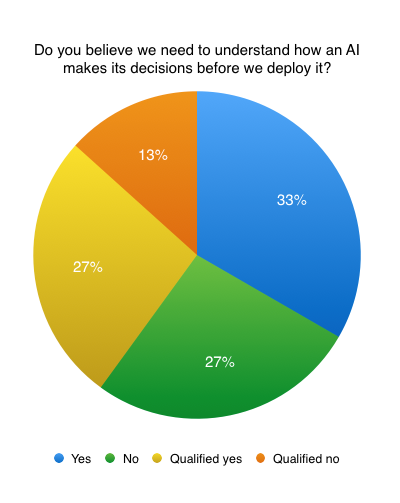
The first question I asked was ‘Do you believe we need to understand how an AI makes its decisions before we deploy it?’. Here’s the results:

Combining the yes’s with the qualified yes’s yields 60%, and the qualifications were fairly mild, such as a requirement for testing or requiring gaining the trust of someone else that is trusted. And some of the qualified no’s really are yes’s, such as ‘depends on the application’ which means in at least some cases we require that understanding.

The second and last question was ‘What would make us trust an AI?’

The leading response was ‘Demonstrating performance in a broad spectrum of operational trials, such as 10,000 hours of driving for a driverless car’, with 38% of the votes. Very close behind was ‘The AI being able to explain its reasoning’ with 33%. Smaller numbers of respondents would accept the judgment of human experts (10%) or other AI’s as monitors (10%), and some wanted combinations of experts and demonstration.

I’m a fan of empirical results, so I lean toward demonstration of performance. After all, if I don’t trust an AI, why would I trust its explanation for its behavior, either?

My sense is that we will see a widespread convergence on demonstration of AI performance in realistic settings — like the autonomous dump trucks in a real mining environment, minus real human beings, perhaps — along with continuous monitoring of AI-managed gear by additional AI’s, and those provisions are likely to be enough to satisfy people in general that the AI’s are trustworthy.

A few of the additional comments from respondents are illuminating:

  • ‘Might be spitting hairs but; having some kind of review of the data used in training, not just the inner workings of the resulting “intelligence.”’
  • ‘Some AI is inherently black box, but often the proxy for an explanation is to provide a series of illustrations of what happens to the output (recommendation, or score, or whatever we ask the AI to give us) when we change the input variables. We trust the algorithm if those changes are in line with what we would expect.’
  • ‘Human built systems obviously have vulnerabilities as well so we need to figure out how to weigh that up against an AI we do not understand. For example driverless trucks are a big risk if someone can hijack hundreds of them and drive them into crowds. We need to work out how to assess the risks versus the existing risks that trucks and cars already pose.’
  • ‘I have been in the field for 30 years and believe that AI is lower on the scale of threats to humanity than the rogue autonomous self-reproducing code that we cannot explain and do not understand what it is doing or where it originated.’

Those insights raise questions that place trust of AI in the context of trust and security at a more general level: how do we trust any software, and how do we guard against the threat of insecure or potentially malevolent software and systems?

These will be themes that we will return to again and again, in the years to come, regarding AI and almost all pervasive software and systems deployed in the world. The threat comes with the benefits, and they can’t be neatly unharnessed, alas.

Interested in AI? Request an invite for our upcoming Velocity Network session on AI and Machine Learning, May 25th in NYC.


Can We Trust AI? was originally published in Traction Report on Medium, where people are continuing the conversation by highlighting and responding to this story.

28 Apr 21:00

These Weeks in Firefox: Issue 15

by mconley

A big thank you goes out to Johann Hofmann who put these headlines together while I was away on vacation!

Highlights

  • The Form Autofill feature is being enabled on Nightly this week (for @autocomplete on <input>). Stay tuned!
  • Firefox Screenshots is in Beta 2 preffed-off by default.  We’ll enable it very soon for everyone, or you can jump the gun by toggling extensions.screenshots.system-disabled .  If you run into anything fishy, please let #screenshots know

Friends of the Firefox team

(Give a shoutout/thanks to people for helping fix and test bugs. Introductions)

Project Updates

Add-ons

Activity Stream

  • Test Pilot Activity Stream
    • Activity Stream support for Pocket has landed in Test Pilot version.  Experiment launches May 1st (thanks csadilek!)
    • You can try it now by using the Activity Stream Dev channel
    • Updated to latest eslint-plugin-mozilla which now supports mozilla-central external repositories, but need to disable no-useless-parameters as we support older than Firefox 55 (thanks Standard8!)
  • Activity Stream system add-on
    • Search feed and UI landed
    • TelemetrySender landed
    • Top Sites feed landed

Firefox Core Engineering

  • Flash
    • Telemetry experiment ran on Nightly 55 from April 14 – April 23.
    • Shield Study defaulting to click-to-play will start on Release 53 in the next week and run for six weeks.
    • Default and (slight) additional UI land in 55.
  • Crash
    • Crash pings contain raw stacks (opt-out) as of Beta 54.
    • Crash pings exist for main, content, and GPU processes as of Beta 54.
    • Crash pings are sent via pingSender (i.e. right away) as of Beta 54.
    • Only one bug did not get uplifted to 54 — a new data point added to the crash ping (a form of client crash id) as of 55.
    • Working on identifying top crashers (by signature) currently. Intending to land while 55 is on Nightly.
  • Install/Update
    • Continue with phase 1 of the Update Agent, which will continue/complete the download of an update even if a session ends.
    • Looking into trying to encourage users on FF4.0 – FF35.0 to update past 35 prior to September 2017 (when their update server, aus3, expires).
    • Fun with Nahimic: it can (and has) prevented updates. Follow 1356637 for updates.

Form Autofill

Mobile

Photon

Performance
  • Lots of sync reflow bugs filed, thanks! We now have a big backlog to triage.
  • Several fixes landed for sync reflows, especially around interactions with the tab bar (thank Dão!) and the awesomebar.
  • Starting to profile startup, and there’s a lot of room for improvement there (loading JS modules lazily from nsBrowserGlue, loading the blocklist from JSON instead of parsing a big XML file).
  • A few tips:
    • Avoid calling .focus() several times in a row, each focus call currently flushes layout.
    • Avoid using setTimeout(…, 0), Services.tm.dispatchToMainThread(…) has less overhead.
    • Avoid using Preferences.jsm (especially during startup) if it’s only to have support for default values.
    • Avoid importing NetUtil.jsm only to use newURI, use Services.io.newURI directly instead.
Structure
  • Work starting on page action menu
  • Ongoing work on the hamburger and overflow panel
  • Ongoing work on having more than one level of nesting within panel subviews (the slide-to-the-side thing in panels) and update their styling
    • All the previous stuff is / will be behind a pref. We aim to flip that pref on Nightly in the near future!
  • We swapped the sidebar to the right… and then swapped it back again. Expect more updates to sidebars in the future (with the side of the window stuff still under investigation).
Animation
  • Animations themselves are in-progress. We intend to use svg spritesheet animations for animating icon states
Visuals
Onboarding
  • Have walked through questions about the UX and visual specs with verdi from UX in today’s onboarding team meeting.
Preferences

Platform Audibles

  • Pending results of experiment, Flash will be marked as click-to-activate by default starting soon in nightly. Pending results of SHIELD study this will ride to 55 release.
  • We’ve got initial page navigation numbers comparing Chrome and Firefox
    • In general we’re competitive with Chrome (+-20%), but a few cases show us far worse, in particular back navigation: filed bug 1359400
  • A bug that caused windows to be ghosts if touch events were sent is causing large CC pauses in Nightly and Beta. Fix in tomorrow’s Nightly.
  • Initial data shows that mean-time-between-failure (MTBF) for input jank:
  • 70+% of nightly users last week saw GC pauses >0.5s
  • ASK: if you see slow things, please install/use the gecko profiler and file bugs!

Privacy/Security

  • jkt wrote a blog post about the new “Always Open In This Container” feature in containers.
  • freddyb is writing a series of ESLint rules to catch common security problems in Firefox code. First victim: Eval and implied eval.

Project Mortar (PDFium)

  • Three milestones are set for better estimating our release schedule
    • Milestone 1 (target on Q2): feature landing. We are still trying to land our significant bits into mozilla-central, which are:
      • bug 558184 and 1344942: JSPlugin and plugin binary process creation and loading
      • bug 1345330: pull in Chromium source code (PDFium + Pepper API layer) into the tree and build with Firefox
      • bug 1269760: pdf printing (to paper). The most challenged part is converting PDF to EMF printing format on Windows, because we rely on PDFium to do the conversion. This means that the sandbox for plugin binary processes should allow PDFium to create device contexts and even access files. We are discussing with the Sandbox team
    • Milestone 2: release polish. (We haven’t figured out the release target but the conversation is ongoing)
      • focus on performance and stability (meta bug 1286791), telemetry and test automation for future proofing
  • Milestone 3: script support. will NOT in the first release. Still investigating its product value

Search

Test Pilot

  • Min Vid is celebrating its largest release yet with the addition of a play and history queue.  Add media you want to watch to your upcoming queue, or replay something you missed by clicking the history tab.  Min Vid currently works on YouTube, SoundCloud, Vimeo, and direct links to audio or video.
  • Pulse has added occasional (less than once a day) prompting for feedback to help avoid biased data.  If you want to help Firefox improve performance on your favorite sites, this is your chance.  The data from this experiment goes directly to the Firefox Product team to help prioritize improvements.
  • Snooze Tabs has gone world wide now supporting 23 locales.  In addition to using Snooze Tabs in your favorite language, you’ll also find an Undo button when deleting a snoozed tab.

Here are the raw meeting notes that were used to derive this list.

Want to help us build Firefox? Get started here!

Here’s a tool to find some mentored, good first bugs to hack on.

28 Apr 21:00

Un-Annotated

I have added a script to my websites today that will block annotations – namely those from Genius and those from Hypothes.is. I have been meaning to do this for a while now, so it’s mostly a project that comes as I procrastinate doing something else rather than one that comes in response to any recent event.

I took comments off my websites in 2013 because I was sick of having to wade through threats of sexualized violence in order to host conversations on my ideas.

My blog. My rules. No comments.

I’ve made this position fairly well known – if you have something to say in response, go ahead and write your own blog post on your own damn site. So I find the idea that someone would use a service like Hypothes.is to annotate my work on my websites particularly frustrating. I don’t want comments – not in the margins and not at the foot of an article. Mostly, I don’t want to have to moderate them. I have neither the time nor the emotional bandwidth. And if I don’t want to moderate comments, that means I definitely do not want comments to appear here (or that appear to be here) that are outside my control or even my sight.

This isn’t simply about trolls and bigots threatening me (although yes, that is a huge part of it); it’s also about extracting value from my work and shifting it to another company which then gets to control (and even monetize) the conversation.

Blocking annotation tools does not stop you from annotating my work. I’m a fan of marginalia; I am. I write all over the books I've bought, for example. Blocking annotations in this case merely stops you from writing in the margins here on this website.

26 Apr 18:39

Here’s how to enable Wi-Fi Calling on Freedom Mobile

by Ian Hardy
LG

Freedom Mobile officially launched Wi-Fi calling and the feature is currently available to those who own the LG V20.

Wi-Fi calling gives Freedom customers the ability to make and receive phone calls, as well as send and receive messages while connected to a WiFi network. Calls, SMS and MMS messages sent this way are deducted from your monthly call and text buckets.

Freedom previously stated in an interview that Wi-Fi calling will come to many other devices. However, for now, here’s a quick how-to enable Wi-Fi calling on the V20.

Freedom Mobile Wi-Fi Calling

1. Update to the latest software OS
2. Turn on Wi-Fi settings on your device
3. Tap on the Settings menu
4. Connect to an available Wi-Fi network
5. Choose “Call” menu
6. Activate “Wi-Fi Calling”
7. Select your Wi-Fi calling preferences, such as when you want Wi-Fi calling to be in use.

The post Here’s how to enable Wi-Fi Calling on Freedom Mobile appeared first on MobileSyrup.

26 Apr 18:38

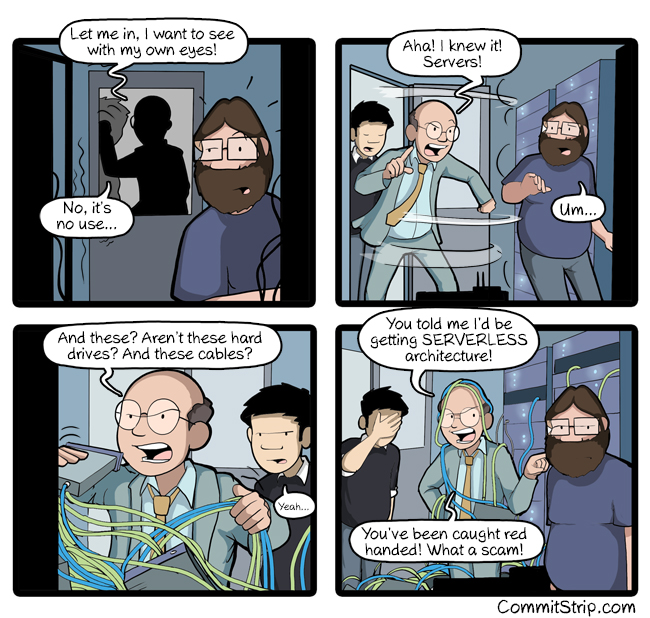
Servers? There are no servers here

by CommitStrip
mkalus shared this story from CommitStrip.

26 Apr 18:38

Just Because Your Electric Toothbrush Makes A Lot Of Noise Doesn’t Mean It’s Effective

by Mary Beth Quirk
mkalus shared this story from Consumerist.

Much like the never-ending game of oneupmanship in the razor industry, makers of toothbrushes are constantly touting unique features that promise to make your teeth that much whiter and brighter than the competition. But now one ad industry watchdog is calling foul on a commercial that implies a noisy toothbrush is somehow more effective at cleaning your chompers.

The National Advertising Division — an investigative unit of the advertising industry’s system of self-regulation system administered by the Council of Better Business Bureaus — has recommended that Philips Oral Healthcare discontinue some claims it’s made about its Sonicare Electric Toothbrushes, including the suggestion that the Sonicare is better because you can hear it working.

Rival company Procter & Gamble, which makes Oral-B electric toothbrushes, challenged claims made in “Start Your Day” Sonicare ads. In that TV spot Philips says, “This is the sound of sonic technology cleaning deep between teeth. [Powers on Oral-B 7000…] Hear the difference?”

NAD considered whether the ad implied that the respective “sounds” of the Sonicare and Oral-B technology correlate to superior efficacy for the Sonicare brushes and brush heads.

After reviewing the advertiser’s “sound of sonic technology” claims, NAD says it was “unpersuaded” by the argument that consumers would walk away only with the message that the Sonicare FlexCare is more pleasing to the ear than the Oral-B 7000.

“NAD observed that Philips linked the sound of its sonic technology with a specific comparative performance benefit in the challenged advertising,” the group says.

In its decision, NAD notes that a voiceover in the ad states, “[t]his is the sound of Sonicare technology cleaning deep between teeth” as the Sonicare device was turned on and an animated simulation depicted the FlexCare Platinum forcefully pushing water between teeth.

The watchdog concluded that at least one of the messages consumers could reasonably take away was of superior efficacy, and that the sound of sonic technology correlates to superior performance benefit of Sonicare over Oral-B at “cleaning deep between teeth.”

NAD has recommended that Philips discontinue that claim, as well as others related to how much plaque the brush can remove compared to its competitor.

Philips says in a statement that it “appreciates the NAD’s consideration of this challenge but respectfully disagrees with the NAD’s findings and recommendation regarding the Start Your Day advertisement” and will appeal the NAD’s decision to the National Advertising Review Board.


26 Apr 18:15

Data Visualization and UI design

Over the past couple of months, I’ve been rebuilding the Shambhala Meditation Timer using React Native and Redux. The idea behind the Shambhala app was to create a kind of modular framework for building meditation timers in order to allow people to create complex timers out of simple components. The three build blocks for a timer are time intervals, gong sounds, and recorded audio contemplations, and the user can stack these building blocks to create whatever kind of meditation session they want.

While I think the basic idea of the initial app was a good one, the implementation had a lot of problems. The user interface was confusing and there were a lot of counter-intuitive design decisions. Since I was the source of most of these decisions, I thought the release of version 2.0 of the app would be a good opportunity to write down some of the things I’ve learned.

I started programming in R because I was interested in data visualization, and what I’ve noticed working on this iteration of the Shambhala App is how much overlap there is between data visualization and user interface design. In particular there are three slogans that I’ve found useful for both problems:

1) Minimize the ink to information ratio

This is a slight restatement of one of Edward Tufte’s famous data visualization principles. The idea is that you should aim to be as efficient as possible with how much space you use to present your data. If you are selecting between different ways of displaying data, the best bet is to select the one which uses the least ink. This principle tends to pull you towards using lighter shapes to express data. For instance these two charts show the same information, but from a Tuftean perspective the one on the left is better because it displays the same information with less ink.

The way this principle applies to UI design is to be efficient with the visual attention of your user. The user only has so much time and attention to devote to your application and they tend to like applications which don’t waste that attention. If you can convey the same amount of information with fewer visual items, then that will tend to improve the user experience.

2) Make use of Idioms

Idioms are bits of language whose meaning derives from their use rather than their content. For instance the phrase “It’s a piece of cake” is pretty confusing when read literally, but it communicates quite a lot because of how it’s typically used. The same is true in visual communication. People get used to certain shapes representing certain types of information, and it’s often better to go along with those preconceptions rather than trying to change them. For instance, the bar chart above is less efficient at communicating the data, but people tend to associate bar charts with counts, and so it’s often a good choice when you are communicating counts of a categorical variable.

In user interface design, this principle implies that you should pick your battles in terms of creating new visual forms. Make your buttons look like buttons, and your forms look like forms. A bad UI artifact that your user already understands is usually better than a great one that they need to learn.

3) If you have to explain something, you have a design problem

One of the biggest problems in both data visualization and user interface design is reducing mistakes. People don’t spend that long looking at visual displays of information, and so it’s important to focus their attention on what’s important. Here is a good example from fivethirtyeight:

It’s almost impossible to make a mistake reading this chart. The message it’s trying to send is that Steph Curry is having a way better season than you would expect, and the visuals of the chart convey that perfectly. There’s Steph, in bright yellow, way above the crowd of other players. It would be easy to add more information to this chart, for instance by coloring the chart by position, but doing so would create confusion. The design of the chart eliminates the need for that kind of explanation.

A bad chart on this metric is something like this one of reading, writing, and income in the United States:

This is a kind of interesting idea for a chart. The main map is a projection of the three small maps aimed at showing how the three factors interact. For instance if an area is high in reading and writing but low in income, it will be orange because it’s a mixture of pink and yellow. However, the overall effect is immensely confusing because it’s not clear what we’re supposed to be looking at. Because the reader’s scarce attention isn’t directed, it’s frustrating to try to understand the chart.

In the UI space, this principle often takes the form of controlling a user’s decisions. For instance if the user is in a place where it doesn’t make sense for them to push the save button, then don’t show them the save button. By reducing the number of options, you can guarantee that the user will not make mistakes. Usually a good warning sign that your UI is breaking this rule is when you start thinking about adding some text to explain what the user should do. If you have to explain, you probably have a design problem.

Shambhala App Home Screen

The initial version of the app had a black and white video of a flag playing behind the main menu. I personally liked the look of this screen quite a lot because it had a nice texture to it, and visually highlighted the history and tradition of the Shambhala community. This was also pretty much the only part of the app which was universally loved by our user testers so it was hard to say goodbye to.

The problem with the screen is that it has a very poor information-to-ink ratio. Most of the ‘ink’, or visual bandwidth, is taken up by the flag flapping in the background. It’s a moving, interesting image, and so it occupies a lot of the user’s attention. However, it provides no informational content beyond setting the context for the application. Since the video doesn’t really tell the user very much about what they should do or what they are doing, the attention they spend on it is somewhat wasted. The video was the design equivalent of empty calories: it tastes good but doesn’t provide much nutrition.

After taking out the video, I still wanted to maintain that kind of textured look, and thought that a brocade image might make a nice background. Brocade is used as framing for Buddhist paintings in India and Tibet, and so also has a a traditional feel. After trying a few different options we came up with one which provides a similar feel as the video, but without the visual clutter.

Session Builder

The main function of the app is that it lets you create timers by stacking different blocks together. This is a useful but novel way of constructing a timer, so it’s important that the visuals of the session builder are clear. Unfortunately, what we ended up with wasn’t that clear:

Each block on this screen represents a time segment which is either a time interval, a gong, or an audio recording of some meditation instructions. The problem with this screen is that we’re using the wrong idiom. Functionally, this screen is a swipable list like Google Inbox, but the initial design made it look like a bunch of buttons. It’s natural for the user to tap on each block as though they were buttons, but it’s not natural to use the swipe functionality to delete a block. In order to fix this I made use of visual idioms related to swipable lists. This included adding in little square icons and making the text portion of the block a standard colour.

The Player

The player screen on the app was the biggest visual improvement. The idea behind the player was that we would show the user a graph of their meditation session, so they could see how much time each block would take to play. It was also important to link the two screens together visually so that the user could understand the relationship between them. The initial block did this by expanding the height of each block proportional to its length, but in the new app we went with a simpler doughnut chart.

This illustrates all three slogans. First, the initial design of the player invited explanation. You wanted to say “no, those aren’t buttons, they represent the relative time for each block. And see? their outline changes colour when they are playing.” Additionally there are lots of buttons on the bottom which are only useful some of the time. Second, it is has a terrible information-to-ink ratio. The data visualization occupies almost all of the available pixels, but doesn’t really communicate all that much. Finally, it doesn’t use the right visual idioms, again using the ‘button’ idiom when we want something that says ‘timer’.

The revised screen does a much better job. It shows the relative time of each block in a pie chart around a big Play/Pause button, and the time remaining on the session is shown by changing the opacity of the timer. By doing this we use way less digital ink to show the same amount of information, and make use of a standard idiom for timer which is a circle with a button in the center.

26 Apr 18:15

Stern.de sattelt zum Altherren-Ausritt

by Moritz Tschermak
mkalus shared this story from BILDblog.

In der Berichterstattung über die Wahl in Frankreich spielt ein Aspekt aktuell eine ganz besondere Rolle: Dass ein Sieg von Emmanuel Macron im ersten Wahlgang zwar nicht schlecht ist, aber der zweite Wahlgang dadurch noch längst nicht gewonnen ist.

Dass das Verhalten des sozialistischen Kandidaten Jean-Luc Mélenchon, sich für den zweiten Wahlgang nicht gegen Marine Le Pen auszusprechen, recht fragwürdig ist.

Dass Brigitte Trogneux, die Ehefrau von Emmanuel Macron, einige Jahre älter ist als ihr Mann. Manche Redaktionsbesatzungen müssen mit offenen Mündern vor ihren Bildschirmen sitzen und denken: „Boah, die ist ja älter als der.“

Ein Beitrag, der uns unter den vielen Berichten zum Thema extrem aufgefallen ist, ist dieser Tweet von stern.de, bei dem das verwendete Hashtag vor Chauvinismus und Ekelhaftigkeit und Verachtung nur so trieft:

Die Redaktion hat den Tweet dann relativ schnell wieder gelöscht, nachdem man gemerkt hat, dass dieser Altherren-Knallerspruch doch nicht so gut ankommt.

Screenshot gefunden bei @shlomosapiens. Mit Dank an @katrinhilger und @_phoeni für die Hinweise!

Das BILDblog finanziell unterstützen
Sie finden gut, was wir hier machen? Dann unterstützen Sie uns doch! Mit Ihrer Hilfe kann und wird es weiter Medienkritik beim BILDblog geben. Unser Dank ist Ihnen gewiss, wir freuen uns über jede Unterstützung — und am meisten über Daueraufträge.
 
Unsere Kontodaten: B-blog, IBAN: DE94 1001 0010 0555 4161 07, BIC: PBNKDEFF, Postbank Berlin, Konto 555 416 107, BLZ 100 100 10
 
Geht auch per Paypal:

Flattr this!

26 Apr 18:14

Specialization

by Richard Millington

The more you can get people to specialize, the more valuable your community will be.

The problem is many communities inadvertently encourage the opposite. People extort more favorable opinions of popular ideas to reinforce their perceived commitment to the group.

Yet the most popular ideas typically began on the fringes. They begin with people specializing in some small, obscure, or disregarded area of the field.

As Sloman and Fernbach discovered, specializing is what drives groups forward. It’s what yields the most value. You don’t need more people discussing the future of your field, you need an army of people each testing some whacky idea and reporting back what happened.

Sometimes, just the right note of encouragement at the right time can yield really remarkable results. This is why discussions, where people can suggest ideas and explain what they’re working on, can be so powerful.

You can follow up with each of them with encouragement, opportunities to promote them later in the community and do everything you can to foster as much specialization as possible.

If you even manage just a couple of people a week to pursue something unique, interesting, and with potential, you will be doing an incredible service for your community.

26 Apr 18:14

Embedded-SIM Intro – Part 7 – Interoperability

by Martin

It is obviously a must that any SIM card works in any cellular mobile device. By and large that works pretty smooth today. There is rigorous testing in place and I only know a few cases where SIM cards and devices did not harmonize and software updates were required to fix the issue. In the eSIM world where the user can’t remove the SIM card anymore but downloads a virtual SIM (a Profile) to a mobile device, interoperability is just as important. So how is this done in practice?

Interoperability in the context of this blog post means than any eUICC soldered into any device will be able to receive a virtual SIM card (a Profile) from any network operator in the world. In practice this means that any eUICC must be able to interoperate with any SM-DP+ on the Internet. In between, any LPA (Local Profile Assistant) app that sits between the eUICC chip and the SM-DP+ servers in the network must also be able to communicate to any SM-DP+.

For interoperability, all interfaces between the eUICC, LPA and SM-DP+ have been standardized and test specifications have been written by the GSMA. The SGP.23 test specification is publicly available and can be downloaded from the GSMA website. Here’s a link to a search that should lead to the latest version of the document.

While the GSMA has published architecture, implementation and test documents for eUICC remote service provisioning, one thing that was done elsewhere is the definition of the data format that describes the content of a virtual SIM card (a Profile) that can be downloaded to an eUICC over the Internet. The definition of this format was done by the SIMalliance in the ‘eUICC Profile Package: Interoperable Format Technical Specification’ that can be downloaded from their webpage.

If you’ve ever had a look into ETSI’s traditional SIM card specification you will immediately feel at home  in this document. Basically it specifies a description language to encode ‘Profile Elements’ (PEs) that hold all information that can be downloaded into a SIM card. PEs contain things such as the directory and file structure, the PIN and PUK and many other things and are described in ASN.1 notation in the document. The ASN.1 notation is then converted into TLV (Type, Length, Value) format. Thankfully, Annex C of the document contains an example of the content of a typical SIM card encoded in ASN.1 and then converted to TLV format.

In other words, to be compatible, the SM-DP+ creates a Profile for download to the eUICC in the language laid out by the SIMalliance. It then downloads the resulting byte stream to the eUICC where a ‘Profile Package Interpreter’ looks at the data and creates the data structures described in there in its non-volatile memory. Obviously, the SIMalliance also has a test specification to ensure the profile generator the SM-DP+ and the profile interpreter on the eUICC can be tested by the manufacturers for their compatibility.

26 Apr 18:14

Chrome 58 for Android Makes It Easier To Manage Downloads, Adds Full Screen Support for Web Apps

by Rajesh Pandey
Google today announced the release of Chrome 58 for Android with a bunch of performance and stability fixes. Among other things, the update also makes it easier to manage your downloads through the Downloads page. Continue reading →
26 Apr 18:14

Merger between URWork and New Space points to maturity in co-working market

by Emma Lee

China’s co-working market has well passed its initial growth stage and is shifting quickly to maturity. The completion of this transition is marked today by the largest merger ever in China’s co-working field between two top players in the market. China’s co-working unicorn URWork inked an agreement with another rival New Space for a strategic merger, the latter announced today.

The market valuation of the merged entity would hit an impressive RMB 9 billion (US$1.31 billion), the firm disclosed. Beijing-headquartered URWork has raised to unicorn status in January this year after pocketing an RMB 400 million worth of round, the largest capital injection in the vertical so far. Given URWork’s latest round booked a valuation of RMB 7 billion, it puts New Space’s valuation at roughly around RMB 2 billion. A new name for the company has not been mentioned.

Mao Daqing, CEO of URWork, was announced to take the post of board chairman and to co-CEO the new entity with Wang Shengjiang, CEO of New Space, after the merger. The two companies will maintain their independent status with team structures unchanged. The tie-up mainly lies in the sharing of resources.

Both of the two companies were launched in 2015, the year that marked the full boom of China’s co-working industry. As the first unicorn in this vertical, URWork has landed more than RMB 1.2 billion in fundings in overall six found of financing. It runs 66 locations in 18 cities around the globe.

New Space was founded by entrepreneur and educator Yu Minhong (Michael Yu) and senior banker Sheng Xitai. The duo also run Aplus Fund, a startup fund focused on AI, fintech, and entertainment. As of present, New Space is operating more than 30 locations in 13 cities. It has incubated over 200 projects, of which nearly 70% have secured angel or A round funding.

What does URWork &New Space merger mean for WeWork?

Rumors of the URWork and New Space merger have been around since at least last year when local media reported a possible merger between the two March last year. URWork CEO Mao Daqing denied the merger at the time. While the rumors were 1 year early, they came just after WeWork announced an infusion of US$ 430 million from Chinese investors. The logic at the time was that the merger would be to fend off a powerful overseas player, similar to the Didi-Kuadi merger after Uber entered the China market.

Finally confirmed one year later, it’s not just about fighting for their home turf in China, but on a larger scale for the global market.

Since the second half of 2016, URWork has been accelerating its overseas expansion, starting with Singapore, London, New York and Taiwan. Globalization sure will be a top priority for URWork-New space, which now operates nearly 100 locations in 24 cities around the world. The company said they plan to boost the number to 150 locations in 35 cities in three years.

China’s co-working space industry experienced rapid growth over the past few years. In a crowded vertical where only a few top players could survive, merging with another rival is a good option to stay in the market. New Space itself merged with AA Accelerator back in 2015, while Shanghai-based We+ just merged with CoWork. URWork and New Space merger is not the first case and they sure won’t be the last.

26 Apr 18:14

Four (more) arguments against real-world basic income

by Michal Rozworski

With the Ontario Liberals rolling out their basic income pilot project to much fanfare this week, it’s an opportune time to dive into the debates around BI once again.

1 Political aspects of unemployment

A few weeks ago I attended a debate on basic income and the left in Toronto hosted by The Leap. During the debate, the proponents of BI returned again and again to those who are outside the labour force. This focus is important. Welfare in Ontario and elsewhere is equivalent to poverty. And those outside the labour market are central to the current plans for basic income, which are more replacements for welfare rather than the kind of universal schemes argued for by some on the left. What BI fans forget is that even those outside the labor force have important functions under capitalism. While there was much said about people who can’t for various reasons participate in the labour market, there was scant attention to their position within our economic system.

A number, primarily women, are “outside the labour force” but performing the invisible, difficult, unpaid labour that makes the system tick: childcare, housework, non-market food production. Their work is valuable for society but needs to remain unpaid as long as it isn’t done for profit. The other part of those of working age but outside the labour force are key in a different way. They are a reminder that those of us don’t have any wealth have to work for a wage to survive…or else. John Clarke, who has been consistently critical of neoliberal BI schemes, made the point early in the debate that unemployment, poverty and homelessness have a political function in capitalism: they are part of the apparatus of economic coercion. People become examples for others: “Don’t want to end up on the streets/in dire poverty/…? Better get to work.”

Just another reason everyone should read the brilliant Polish economist Michal Kalecki’s 1943 article, “The Political Aspects of Full Employment“, which is really about the political function of unemployment. It is the clearest statement I’ve seen of how capitalism needs the unemployed and the poor, and how far-reaching any serious challenge to eliminating both is. It’s not going to be a policy band-aid but the fight of our lives. I didn’t see much engagement on the part of the pro-BI panelists at the debate (or in most of what I read defending BI) with how BI would handle, organizationally, strategically and politically, the fact that a ‘progressive’ version would be such a fundamental challenge to the basic workings of capitalism.

2 What goes out, must come in

It’s bizarre to see a political position advanced with so little attention to what it would cost capital and how we would go about extracting that cost. At the debate, so many of the arguments from the pro-BI side and comments from the audience simply channeled Oprah: “and you get a BI, and you get a BI, and you get a BI,…” I hate to be the egghead economist, but it was basically all a discussion of expenditures with no attention to revenues.

However, unless we are talking about a very targeted, means-tested BI program, then we’re talking about a huge fight over economic resources. And if we are talking about that kind of program then that’s what the Ontario Liberals are already proposing and we don’t need fancy “basic income” branding or a pilot project that eats up three years while welfare recipients continue in poverty. We already know that giving people more money makes them less poor. Just raise the goddamn rates and stop the morality policing!

In the case of a more ambitious BI, my very rough calculations for Ontario are that even a very modest $15,000 universal, unconditional basic income for everyone would require a doubling of provincial tax revenue, even taking into account savings from less spending on policing, healthcare and so on. When is the last time we were able to extract an additional percentage point of tax revenue, nevermind a doubling? My point is not to get lost in the minutia of dollars and cents or demoralize people, but to make clear the enormity of the task and ask serious questions about strategy and organization—those to get us to a position of power to extract anything meaningful. This is especially the case in a situation where the right is advancing BI as a means to subsidize employers—with workers too weak to win wage increases subsidizing themselves with their own taxes—or to take away some of the hard-won public services that we currently get in kind.

Even if we think about BI as a redistributive mechanism, which we shouldn’t as it ignores the fundamental workings of capitalism, it is hard to see current plans as little more than getting the working class to subsidize itself rather than effect meaningful redistribution.

3 Withholding labour without organizing workers

Proponents of BI at the debate also pointed out numerous times that BI allows workers to opt out of the labour market, to withhold their labor. They argue that this is the weapon that workers have always wielded in the face of the boss to extract gains. First, there’s the detail that existing BI proposals like the one in Ontario look to set the BI amount below the poverty line, making real, long-term opt-out from work much harder. But, more importantly, those arguing for BI on the left miss the fact that workers have won when they have withheld their labour collectively, when they have organized together.

Without collective organizing and with an insufficient BI, you are just someone with your labor power to sell and a few extra hundred dollars a month. The proposals for BI floating around now, whether in Ontario, Finland or India, are all top-down and driven by the right. If anything they will make us more atomized and less organized. They are also means-tested, still asking the question of who are the “deserving poor”? As such, they are not building broad constituencies that could defend them.

Once again, the question I have for proponents is not whether BI is or isn’t nice in abstract as policy, but how do we create the concrete politics, organizations and power to attain it.

4 Fool me once…

Outside the left’s debate halls, a real world BI is gathering steam in Ontario and it’s not looking pretty. For now, the Liberals are embarking on a three-year pilot project for something that will be a replacement and consolidation of various welfare programs. Employers, including the Ontario Chamber of Commerce, are on board with it. Their vision is plainly for BI as a subsidy for low wage work; they have explicitly counterposed it to an increase in the minimum wage.

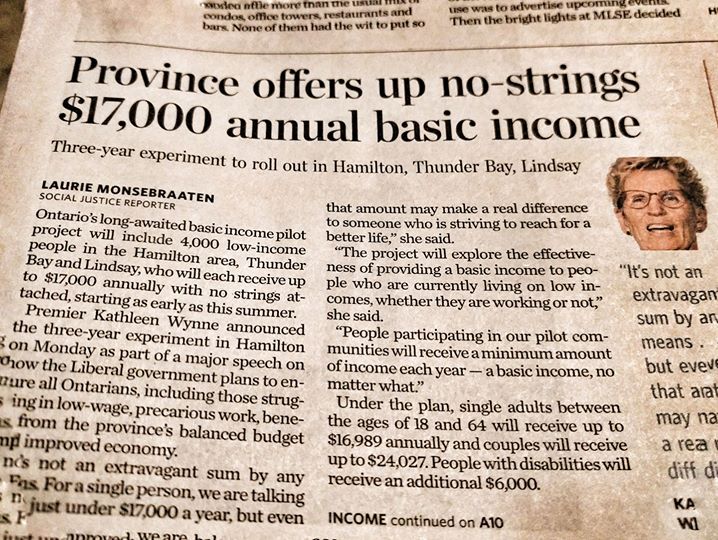
Liberal-aligned media has been predictably giving the idea a lot of free PR. The Toronto Star has put out story after story in support of BI and the Liberal proposal in particular; though, to be fair, the paper also published a surprisingly sceptical editorial, rightly calling for immediate action on welfare rates, the minimum wage and labour standards (just what the Fight for $15 and Fairness has been patiently building a grassroots, bottom-up campaign towards for years). Just today the Toronto Star ran a story headlined, “Province offers up $17,000 no-strings annual basic income”.

There are too many issues with the story that merit their own article, but just the headline has two glaring problems. First, the basic income amount in the pilot study will be a maximum of $17,000, which is still 25% below the poverty line, with most people in the pilot getting less. The pilot will only affect 4,000 households (compared to over 500,000 cases currently for Ontario Works and ODSP combined) and allow the government to leave already criminally-low welfare rates stagnant for another three years. Second, this is not a no-strings program. Any wages made in excess of the basic income amount will be clawed back at a 50% rate (hence workers subsidizing themselves). There is no pretension to universality on the part of the Liberals with their policy; this is a rationalization of welfare.

People are rightly fed up with poverty, low wages and growing inequality. The Ontario Liberals, like increasing numbers of politicians across the world, are adroitly exploiting these fears to push policy proposals that sound like a lot and do very little.

Let’s not be fooled again. The Ontario Liberals have used our own slogans against us in the past many times. See, for instance, how they commandeered “free tuition” in their last budget. What ended up to be little more than a rationalization of grants into one program was trumpeted as a progressive breakthrough. There are similar, very serious flaws with the basic income proposals being drafted and implemented by the Ontario Liberals and other right-wingers across the world. We need to be vigilant, have a clear idea of the enormity of the task ahead, and get organized rather than waiting for top-down policy to do the work of bottom-up politics.

26 Apr 18:14

Goodbye, Grandma

by Doug Belshaw

At almost exactly the same time as I landed in Toronto yesterday, my grandmother took her last breath. She had her son, my father, at her hospital bedside. Freda Belshaw was 93.

Mourning is an intensely private thing, but celebrating someone’s life — as we shall do at her funeral when I get back home — is a more public affair. People process their grief in various ways, and I’m doing so in the only way I know: by writing about it.

My grandma was a matriachal figure, a large presence in any room. She was not someone to be crossed. More than anyone I’ve ever met, she knew her own mind, had definite values, and stuck to them. Apart from the last few months of her life, she stayed in her own home, fiercely independent until finally accepting going into a home for her own safety.

Grandma left school at 14 years of age and, at 15 suffered the dual traumas of her mother dying and the Second World War breaking out. She almost single-handedly raised her younger sister. Marrying my grandad after the war, they lived a happy, working class life in County Durham, where my father was born.

Grandma birthday

She was very proud of my father, her only child. You could not only see it in her eyes when he was around her, but in the way she talked about him when he wasn’t there. They travelled together quite a bit and I was always amazed that she was making trips to the Caribbean right into her late eighties.

As an historian, I’d often ask her about her family, and about experiences during the war, but the subject would quickly change, or she’d say that she couldn’t remember. Freda was not someone to dwell on the past.

I’m sure that over the next couple of weeks, I’ll get some more thoughts together to be able to provide some vignettes and memories for the funeral. Things are a bit raw right now, and I’m writing this with tears streaming down my cheeks.

Goodbye grandma, rest in peace. xxx

26 Apr 18:13

Instagram now has over 700 million monthly active users

by Ian Hardy
Instagram

It’s been seven years since Instagram co-founder Kevin Systrom launched the popular photo and video sharing service. In 2012, with 50 million users, Instagram sold to Facebook for over $1 billion USD in cash to “create a better mobile photos experience.”

Instagram has now announced that it now has over 700 million monthly active users, which is up from 600 million from December. Facebook noted this surge in ‘Instagrammers’ is the fastest adoption the platform has seen to-date and that it has doubled in size within the past 2-years, mainly attributing the growth to its “ability to better connect people with their friends.”

Recently, Instagram has launched a variety of new features including ‘Stories’ and various filtering options, multiple account support and live video.

Here are some important timeline dates in Instagram’s history:

  • October 6th, 2010 – Instagram founded
  • December 21st, 2010 – 1 million
  • September 26th, 2011 – 10 million
  • April 9th, 2012 – 30 million
  • November 6th 2012 – 80 million
  • February 26th, 2013 – 100 million
  • March 25th, 2014 – 200 million
  • December 10th, 2014 – 300 million
  • September 22th, 2015 – 400 million
  • June 21st, 2016 – 500 million
  • December 15th, 2016 – 600 million
  • April 26th, 2017 – 700 million

Jordan Banks, Managing Director of Facebook and Instagram Canada, stated, “People now have more ways than ever to express themselves on Instagram, allowing them to feel closer to what matters to them. We’re thrilled that our global community has grown to more than 700 million people around the world, adding 100 million Instagrammers faster than ever.”

The last known Canadian stat is from May 2016 when the company noted there were 8.5 million Instagram users in Canada.

Source: Instagram Blog

The post Instagram now has over 700 million monthly active users appeared first on MobileSyrup.

26 Apr 18:13

Android 7.0 now available to download for Telus and Bell Galaxy S6 edge owners [Update]

by Igor Bonifacic
telus galaxy S6 android n update

Good things come to those who wait.

After delaying the release of Android Nougat to the Samsung Galaxy S6 line by several weeks, Telus has started to push the latest major Android release to the  Galaxy S6 edge. Telus says the update is still currently in the works for the regular Galaxy S6.

If your phone hasn’t prompted you to download the update already, pull down the notification shade, tap the cog settings icon, scroll down and tap About phone and tap update.

Samsung Galaxy S6 Nougat update page

In other S6 news, Rogers is scheduled to update S6 devices on its network in a few short days.

Update 26/04/17: A Telus spokesperson has told MobileSyrup that the carrier is still working on getting Nougat to the Galaxy S6.

Update – 8:15pm: Bell Galaxy S6 edge owners rejoice! The update to Android 7.0 is available to download for you, too! No indication yet as to when the Galaxy S6 will follow suit. ^IH

Thanks for the tip, Hani!

The post Android 7.0 now available to download for Telus and Bell Galaxy S6 edge owners [Update] appeared first on MobileSyrup.

26 Apr 18:13

Twitter Q1 2017: better-than-expected earnings and revenue, but still declining

by Bradly Shankar
Twitter Headquarters Logo

Twitter announced its quarterly earnings today, showing better-than-expected yet still declining earnings and revenue.

The company’s first quarter revenue came in at $548 million USD, which is higher than the estimated $512 million. Overall, though, this is a decrease of eight percent year-over-year, with the company posting $595 million in revenue in Q1 2016.

The social media giant’s monthly active users rose to 328 million — 7 million more than expected and 9 million more than the previous quarter. For the fourth-consecutive quarter, daily usage rose to 14 percent year-over-year growth. A specific daily active user number wasn’t revealed, though.

The company attributes the increase in user activity to improvements made to the platform in recent months, such as cracking down on online abuse and a focus on streamlined story and live video discovery.

However, the company has an outlook for the second quarter of the year that is far worse than expected, projecting adjusted EBITDA of $95 million to $115 million; analysts projected a consensus of $141 million, according to Street Account.

Twitter CEO Jack Dorsey said that while the company expects to “continue to face revenue headwinds,” it believes that in executing on its plan in the long term “should result in positive revenue growth over the long term.”

Doubling down on advertising was cited as a key area of focus.

Image credit: Flickr – Anthony Quintano

Source: Twitter

The post Twitter Q1 2017: better-than-expected earnings and revenue, but still declining appeared first on MobileSyrup.

26 Apr 18:13

Neil Irwin, The Low-Inflation World May Be Sticking Around Longer Than Expected

Neil Irwin, The Low-Inflation World May Be Sticking Around Longer Than Expected:

We’re stuck in a low-inflation world: low price gas, too much capacity for steel and other commodities, and a glut of workers looking for work. Plus, no Trump infrastructure stimulus:

Trump administration plans that seemed to point toward higher inflation and higher interest rates are looking like vaporware. A large-scale infrastructure investment program, for example, could push both interest rates and inflation higher in the United States. But so far the administration’s focus on infrastructure has not translated to specific policy ideas.

The combination of powerful long-term forces and policy gridlock in Washington means that we probably won’t see some magical moment when the low-inflation monster has been vanquished. Rather, the world is going to have to keep climbing out the hard way.

26 Apr 18:13

Supporting and growing the Raspberry Jam community

by Ben Nuttall

For almost five years, Raspberry Jams have created opportunities to welcome new people to the Raspberry Pi community, as well as providing a support network for people of all ages in digital making. All around the world, like-minded people meet up to discuss and share their latest projects, give workshops, and chat about all things Pi. Today, we are making it easier than ever to set up your own Raspberry Jam, thanks to a new Jam Guidebook, branding pack, and starter kit.

Raspberry Jam logo over world map

We think Jams provide lots of great learning opportunities and we’d like to see one in every community. We’re aware of Jams in 43 countries: most recently, we’ve seen new Jams start in Thailand, Trinidad and Tobago, and Honduras! The community team has been working on a plan to support and grow the amazing community of Jam makers around the world. Now it’s time to share the fantastic resources we have produced with you.

The Raspberry Jam Guidebook

One of the things we’ve been working on is a comprehensive Raspberry Jam Guidebook to help people set up their Jam. It’s packed full of advice gathered from the Raspberry Pi community, showing the many different types of Jam and how you can organise your own. It covers everything from promoting and structuring your Jam to managing finances: we’re sure you’ll find it useful. Download it now!

Image of Raspberry Jam Guidebook

Branding pack

One of the things many Jam organisers told us they needed was a set of assets to help with advertising. With that in mind, we’ve created a new branding pack for Jam organisers to use in their promotional materials. There’s a new Raspberry Jam logo, a set of poster templates, a set of graphical assets, and more. Download it now!

Starter kits

Finally, we’ve put together a Raspberry Jam starter kit containing stickers, flyers, printed worksheets, and lots more goodies to help people run their first Jam. Once you’ve submitted your first event to our Jam map, you can apply for your starter kit. Existing Jams won’t miss out either: they can apply for a kit when they submit their next event.

Image of Raspberry Jam starter kit contents

Find a Jam near you!

Take a look at the Jam map and see if there’s an event coming up near you. If you have kids, Jams can be a brilliant way to get them started with coding and making.

Can’t find a local Jam? Start one!

If you can’t find a Jam near you, you can start your own. You don’t have to organise it by yourself. Try to find some other people who would also like a Jam to go to, and get together with them. Work out where you could host your Jam and what form you’d like it to take. It’s OK to start small: just get some people together and see what happens. It’s worth looking at the Jam map to see if any Jams have happened nearby: just check the ‘Past Events’ box.

We have a Raspberry Jam Slack team where you can get help from other Jam organisers. Feel free to get in touch if you would like to join: just email jam@raspberrypi.org and we’ll get back to you. You can also contact us if you need further support in general, or if you have feedback on the resources.

Thanks

Many thanks to everyone who contributed to the guidebook and provided insights in the Jam survey. Thanks, too, to all Jam makers and volunteers around the world who do great work providing opportunities for people everywhere!

The post Supporting and growing the Raspberry Jam community appeared first on Raspberry Pi.

26 Apr 18:13

Bike Locks That Will Make You Feel Like You’re From The Future

by dandy


There is a sea of choices when it comes to picking the right lock - Google Images

By Taylor Moyle

You can't go wrong with a Kryptonite U-lock for your bike. And, you should always try to lock through the frame and the wheel (so a bike thief can't ride away on your bike if they do manage to cut the lock.) Here at dandyhorse, we've provided a total review on how to keep your loved one safe, and we've even provided knitting patterns for U-lock cozies, as well as the history behind Toronto's ring-and-post bike stand -- but here's a review of what's new and innovative and bike locks. Yes, these bike locks will make you feel like you are from the future. (Please note: dandyhorse staff hae not tested any of these locks.)

All images are from the companies of the locks.

Ellipse

Price: $199

This bike lock is basically from the future. Although a little pricey it comes with some really cool features not other locks have. Instead of using a key to unlock it you use your phone and the lock automatically opens when you’re in proximity. In addition the lock also will give your phone a notification if it notices someone tampering with your bike and can detect if you’ve been in an accident.


Ti Gr Lock

Price: $99 - $175

The Ti Gr Lock is for the biker who doesn’t want to ruin their #aesthetic. This lock is stylish, light and minimalist. Unlike other locks, this isn’t just another U design. It clips onto your bike frame and doesn’t get in your way as you ride. It’s also strong too, so you don’t have to worry much about your bike being stolen.

LITELOK

Price: $140 - $260

This kickstarted lock is light and according to reviews it’s almost indestructible. It has a different design compared to most other locks. In most cases if you want a light lock you will have to sacrifice some security but with the LITELOK that’s not the case. Not only that but it comes with straps making it fit on your bike easily.


tex—lock

The jury is still out on this lock as it is still in kickstarter. Although this lock is a rope based lock providing more flexibility when locking. Typically this style of lock isn’t as secure but according to the kickstarter it is strong along with being light and stylish. The lock also aims to come out in a variety of different colours and lengths. Once again though, we don’t know how well made this lock is as it’s not even out but it’s one to keep your eye out for.


LINKA

Price: $129 - $170

Another one funded by kickstarter that has some interesting features. It’s a bike lock that is always attached to your frame and locks automatically. It also has an alarm feature that will go off if someone is tampering with your bike. The smart phone app unlocks your bike automatically when you’re near it and also comes with a map of high theft areas to notify you of where to lock your bike. If you’re worried about your bike being stolen since it’s not tied down to anything you can use a chain to attach to the LINKA.


Seatylock

Price: $129

Tired of forgetting your lock? With this one the lock is combined with your seat and each time you want to lock your bike you just pop off your seat. The price is especially appealing considering you get both a seat and a lock for under $150. This is also good for those who already take off their bike seat when locking up their bike.

 
Nutlock

Price: $80

This one is to not to protect your bike but your wheels instead. Instead of flimsy bike fasteners that anyone can take off, the Nutlock bike fasteners can only be unlocked with a key. Although the price is expensive for just a couple of fasteners it will potentially save you from a $100 or more replacement fee for your tires. This product would only be recommended for higher risk areas.

~ Please note: None of these locks have been tested by dandyhorse staff. ~

More from dandyhorse magazine:

No one wants to talk about second hand bikes

Bike Spotting: On Bike Lanes

Are Bike Thieves Getting a Free Ride with GO?

Toronto Police on the case after stolen bike found on Kijiji

26 Apr 18:12

Routine Procedure

by Alex Ronan

Technology is often premised on the act of disappearing — on cutting out the middleman, the storefront, the physical transaction point. (Legal protection for workers, job security, and benefits also disappear into the void.) Now it’s possible to receive therapy without leaving your couch (iCouch.me), to visit a doctor sans the waiting room (there’s the house-call app Heal or online urgent care option PlushCare), and to order medical records without waiting on hold for 35 minutes (just choose between MotherKnows and Patients Know Best). When it comes to abortion, the dream of disappearance came well before the apps. Pre-Roe, it was assumed that with legalization, abortion would slip from the cultural battlefield and re-emerge, quietly, as the routine medical procedure it is.

The pro-choice movement has long rallied around the mantra of “Safe, Affordable, and Rare.” Two-thirds of those mandates have been achieved, just not the way they were envisioned. The procedure is extremely safe, and also rare — or rarely accessible to most Americans, who often have to travel hundreds of miles just to get to a clinic. Affordability remains a huge barrier: With so few clinics, what could be a 10-minute procedure has morphed into a whole-day affair that often requires a full day off work. A 2014 study found that cost and travel were the top factors preventing earlier abortions.

Clinics are vulnerable for their separateness, which reinforces the idea of abortion as separate from ordinary reproductive care

In the immediate aftermath, many misread Roe as an endpoint, rather than an important victory in what now seems to be an endless war. “We thought we’d won. We thought it was over,” an abortion provider practicing since 1973 once explained to me. (He’s still providing.) Today, the frontlines of anti-abortion offensives are decidedly low-tech, and defense is often mounted in kind. 


The clinic — the structure itself, beyond the medical technologies used therein — has become the most contested physical space in the seemingly endless battle over reproductive care. Just after legalization, hospital officials — who had once refused to sanction abortions, claiming that their hands were tied by abortion’s murky legal status — suddenly insisted that a deluge of patients seeking abortions would be too much to handle. Many doctors were hostile to abortion and didn’t want to provide them anyway. Swiftly, free-standing clinics were proposed as an alternative. Just after Roe, half of abortions took place in hospitals; by the late ’80s, 86 percent were happening in clinics, according to Eyal Press, who wrote a book on the subject. These days, most hospitals do less than 30 abortions per year.

Freestanding clinics offered a space staffed by supportive providers, where the cost of abortion could be kept lower than in the hospital. But these safe spaces soon found themselves under fire from state regulations, lack of funding, and violence. Clinics were more vulnerable for their separateness, which also reinforced the idea of abortion as separate from ordinary reproductive health care. In a hospital, at least, it would be harder for protesters to pinpoint providers and patients.

Most protesters today counter the free-standing clinic with their own physical presence, often crying “free speech” when providers complain about interrupted service. Their methods are usually quite low-tech — for instance, presenting poorly designed posters reminiscent of sixth-grade science fairs, demonstrating a similarly simplistic understanding of the science at play. More extreme measures are similarly basic, requiring guns, blocked numbers with which to generate bomb threats, and imitation (as in fake clinics masquerading as medical centers).

Upon arriving at a clinic, individuals seeking abortions are greeted by screaming, frothing protesters who dart around on motorized scooters, block cars, climb atop ladders with megaphones, pretend to be clinic escorts, and just generally stress out patients before a procedure that’s improved when said patients feel relaxed. For her book Contested Spaces: Abortion Clinics, Women’s Shelters and Hospitals: Politicizing the Female Body, architect Lori A. Brown interviewed a number of clinic employees. One clinic manager explained she has “no problem with them protesting, but what they’re doing is crazy … even when we prepare the patients, even when we let them know what’s going on, until you see it, until you’re in it, you can’t understand it.”

Anti-choice extremism grew through the ’80s and reached a peak in the ’90s, with clinic bombings, arson attacks, kidnappings, and murders. “Today, it seems that there’s a little less violence because the right wing has been able to make a lot of legislative changes,” an abortion provider told me in 2015. “The frustration and the desperation they felt in the first 20 or so years has been mollified by their ability to generate meaningful legislation for their side,” including significant state and federal advancements, plus some key Supreme Court decisions.

The Supreme Court has ruled in favor of small floating buffer zones that move with the individual entering a clinic, and against larger static buffer zones. In the 2014 McCullen v. Coakley ruling, the Court held that a 35-foot buffer zone Massachusetts had enacted deprived protesters and petitioners “of their two primary methods of communicating with arriving patients: close, personal conversations and distribution of literature. Those forms of expression have historically been closely associated with the transmission of ideas.”

Speech on sidewalks around abortion clinics is protected by the constitution, but blocking entrances isn’t. The ruling left some discretion to states, specifically with regard to “narrower” laws: A state, for example, can pass a law allowing police officers to force an aisle between protestors so that patients and doctors can get through. But without constant police monitoring, protestors often block entrances and simply move if and when a cop car rolls up.

Landscape work is scheduled to coincide with protests, drowning out chants covering protestors in mulch

Even though they’re able, most states seem reluctant to enact either federal or state protections for clinics. Over three decades later, only three states have enacted versions of the 1994 Federal “Freedom of Access to Clinic Entrances Act,” which specifically makes property damage and intimidation or interference at a health clinic illegal. Just 11 states have passed legislation making it illegal to obstruct a clinic entrance, and a measly six have laws on the books about threatening a clinic staff member or patient.

Since the low-tech tactics of protesters are so hard to counter through legal avenues, American clinics have to rely on low-tech defenses. Shatterproof glass, metal detectors, and security guards are common. When repeated requests for police intervention go unanswered, clinics deal with noise violations by playing classical music loudly to counter the protests or moving procedures to the back of the building to reduce patients’ exposure to the sound.

Facing political hostility and police apathy, clinics often respond to protesters on their own, with creativity borne of shoestring budgets and architectural impediments. In her book, Brown details how one clinic fought protestors by vying for the area’s weekly noise permit. Both the protestors and the clinic would request it every week, but whoever’s email got in first would be awarded the permit. If the protesters got it, they could use a microphone; if the clinic got it, they didn’t do anything beyond preventing the protesters from having it.

When protesters came with signs, one clinic responded by hanging a 1-800-ABORTION sign in view so any media coverage came with free promotion. Another pretty effective tool is lawn care: remote activated sprinklers soak protesters, so landscape work is scheduled to coincide with protests, drowning out chants and giving protestors a choice between getting covered in mulch or going away. One clinic put up a rather effective hedge until police determined it’d be a perfect place for anti-choice protestors to hide a bomb.


Targeted Regulation of Abortion Provider (TRAP) laws are forcing clinic closures around the country and, given that 75 percent of American women getting abortions are low income, it makes sense to focus on making (already safe) abortions as accessible and cheap as possible. Medical abortions, a series of pills swallowed to induce miscarriage in early pregnancy, once seemed like an effective alternative to clinic visits. A number of studies have suggested that individuals are more than capable of doing it all at home, dealing with side effects, and seeking medical attention in the case of any complications.

Data from a large clinical trial of Mifepristone–Misoprostol abortions across the U.S., involving 2,121 women aged 18 to 45, “suggests that most women can handle most steps of the medical abortion process themselves, effectively and safely.” The authors also noted that the “utility of clinic visits to ingest mifepristone and misoprostol is questionable,” arguing that “even the follow-up visit could perhaps be replaced by telephone follow-up combined with home pregnancy tests” and suggesting that “alternatives to the present protocol might allow greater control, comfort, and convenience at lower cost.” Two-thirds of abortions happen before eight weeks, but if an abortion pill were effective up to 12 weeks instead of 10, 89 percent of those seeking abortion could theoretically take a pill or two to end a pregnancy.

But since it was introduced in 2000, mifepristone, the first half of a medical abortion, has been under the FDA’s Risk Evaluation and Mitigation Strategy (REMS), which limits distribution methods, and is used mainly on drugs with a limited track record, or those with a serious risk for abuse or complications. A scathing commentary just published by a number of health experts in the New England Journal of Medicine accused the FDA of over-regulating mifepristone: “It’s unconscionable that the REMS restrictions remain after 16 years of data showing mifepristone is an exceedingly safe and effective abortion method,” said Beverly Winikoff, President of Gynuity Health Projects, in a statement.

Assuming that advancing technologies can replace the physical space that’s guaranteed abortions for decades is high-risk

Pharmacies are generally located in much smaller towns than hospitals or clinics, and are more accessible to a larger population; the possibility of a prescribed or over-the-counter medical abortion is incredibly promising, but fraught with risk. Even if FDA regulations were to be lifted, it wouldn’t necessarily mean that individual pharmacies would choose to stock (or dispense) the pills. Already, the ease of obtaining emergency contraception — which, for the 100th time, isn’t an abortion — varies dramatically. In 2007, Brown surveyed pharmacies around the country, calling and asking “Do you sell emergency contraception? Can I fill my prescription?” Many pharmacists said yes, but many did not. Kentucky pharmacists said things like “we sure don’t” and “there’s not a pharmacist here that will sell it.” In Mississippi, it was “I don’t know what that is” and “we stock but I won’t dispense it.” In North Dakota it was “looks like I’m out,” while in Utah a simple “nah” was offered. Now imagine asking, “Do you sell medical abortions?”

Shifting medical abortions from a clinic to a pharmacy may decrease distance, but make access nearly impossible, as another simple intervention faces an equally simple barrier. Unfortunately, it’s a problem with less clear counter actions. Exploring possibilities for similar situations, the Dutch non-profit Women on Waves flew their first abortion drone across a small river between abortion-friendly Germany to abortion-hostile Poland in 2015. There’s even a video of the drone’s journey on YouTube, but it’s pretty anti-climatic and ends with a nose-dive in the grass. When the drone was face down, two women swallowed the pills. German police on the other side of the river confiscated the remote, and charges over improper distribution of medicine were filed before eventually being dropped. Women on Waves has docked in countries hostile to reproductive rights and taken patients out to international waters to provide abortions, but it’s less of a large-scale solution, and more of a publicity-based challenge to egregious reproductive rights violations.

In the United States, activism surrounding medical abortions has largely focused on wrestling it out of REMS status; if and when that occurs, limited availability will present the next challenge. Making abortion more available at home is a necessary and laudable goal, but assuming that advancing technologies can replace the physical space that’s guaranteed abortions for decades is high-risk. Though clinics have been subject to an immense amount of devastating and sometimes deadly violence, they remain one of the few safe spaces for individuals seeking reproductive care.


One of the most effective approaches to ensuring safe, accessible abortion, then, might not be to look to new technologies, but to continue strengthening the one that has proved most reliable thus far. Making abortion accessible isn’t just about literal access, but also providing a safe and welcoming environment, which continues to establish abortion as the routine procedure it is at a time when 55 percent of med schools don’t offer students clinic exposure to abortion and only four percent of U.S. hospitals provide abortions. A few architects around the country are working to enhance clinic design. “Our strategy took a unified approach to opposing goals: to increase security against terrorist threats and to express warmth and welcome to [Planned Parenthood] staff and patients,” architect Anne Fougeron’s site explains. (Brown does clinic re-design, too.)

In Fougeron’s clinic design, frosted glass walls balance openness with privacy needs; integrated bullet-resistant desks provide safety without being too visually obtrusive; and bright color paint counters the idea that these medical centers need be drab. One Oakland clinic has a special waiting area for children to play in, the most honest response I’ve seen to the fact that 59 percent of those getting abortions are already mothers. Skylights, canted walls, and courtyards bring natural light into the other Oakland clinic her team worked on. “This colored refracted light, which changes in hue and intensity throughout the day, is a constant reminder of the exterior world beyond,” the architects write. Sometimes it’s the clinic itself that provides a necessary escape from that exterior world beyond.

When I worked as an abortion doula, one thing that surprised me was that most patients I saw didn’t consider their abortions to be remotely political. Before that, my only exposure to abortion had been to the activism surrounding it. Still, giving patients the chance to quietly be together before and after a procedure that many of them faced alone was paramount, no matter how they conceived of it.

The recovery room, which I dipped in and out of on each side of an abortion, offered patients a sense of community they seemed to appreciate, even when most were eager to get home. Those who cried in pain found another face stained by tears, those who struggled with guilt could see another patient who considered things differently and was cracking up over the cheesy movie that played on loop. The recovery room doesn’t host consciousness raising circles, just space for a number of patients who’d otherwise never meet, sitting in lounge chairs, sipping juice, and sharing an experience.

26 Apr 17:49

Examining the arc of 100,000 stories: a tidy analysis

by David Robinson

I recently came across a great natural language dataset from Mark Riedel: 112,000 plots of stories downloaded from English language Wikipedia. This includes books, movies, TV episodes, video games- anything that has a Plot section on a Wikipedia page.

This offers a great opportunity to analyze story structure quantitatively. In this post I’ll do a simple analysis, examining what words tend to occur at particular points within a story, including words that characterize the beginning, middle, or end.

As I usually do for text analysis, I’ll be using the tidytext package Julia Silge and I developed last year. To learn more about analyzing datasets like this, see our online book Text Mining with R: A Tidy Approach, soon to be published by O’Reilly. I’ll provide code for the text mining sections so you can follow along. I don’t show the code for most of the visualizations to keep the post concise, but as with all of my posts the code can be found here on GitHub.

Setup

I downloaded and unzipped the plots.zip file from the link on the GitHub repository. We then read the files into R, and combined them using dplyr.

library(readr)
library(dplyr)

# Plots and titles are in separate files
plots <- read_lines("~/Downloads/plots/plots", progress = FALSE)
titles <- read_lines("~/Downloads/plots/titles", progress = FALSE)

# Each story ends with an <EOS> line
plot_text <- data_frame(text = plots) %>%
  mutate(story_number = cumsum(text == "<EOS>") + 1,
         title = titles[story_number]) %>%
  filter(text != "<EOS>")

We can then use the tidytext package to unnest the plots into a tidy format, with one token per line.

library(tidytext)
plot_words <- plot_text %>%
  unnest_tokens(word, text)
plot_words
## # A tibble: 40,330,086 × 3
##    story_number       title    word
##           <dbl>       <chr>   <chr>
## 1             1 Animal Farm     old
## 2             1 Animal Farm   major
## 3             1 Animal Farm     the
## 4             1 Animal Farm     old
## 5             1 Animal Farm    boar
## 6             1 Animal Farm      on
## 7             1 Animal Farm     the
## 8             1 Animal Farm   manor
## 9             1 Animal Farm    farm
## 10            1 Animal Farm summons
## # ... with 40,330,076 more rows

This dataset contains over 40 million words across 112,000 stories.

Words at the beginning or end of stories

Joseph Campbell introduced the idea of a “hero’s journey”, that every story follows the same structure. Whether or not you buy into his theory, you can agree it’d be surprising if a plot started with a climactic fight, or ended by introducing new characters.

That structure is reflected quantitatively in what words are used at which point in a story: there are some words you’d expect would appear at the start, and others at the end.

As a simple measure of where a word occurs within a plot, we’ll record the median position of each word, along with the number of times it appears.

word_averages <- plot_words %>%
  group_by(title) %>%
  mutate(word_position = row_number() / n()) %>%
  group_by(word) %>%
  summarize(median_position = median(word_position),
            number = n())

We’re not interested in rare words that occurred in only a few plot descriptions, so we’ll filter for ones occurring at least 2,500 times.

word_averages %>%
  filter(number >= 2500) %>%
  arrange(median_position)
## # A tibble: 1,640 × 3
##           word median_position number
##          <chr>           <dbl>  <int>
## 1    fictional       0.1193618   2688
## 2         year       0.2013554  18692
## 3  protagonist       0.2029450   3222
## 4      century       0.2096774   3583
## 5      wealthy       0.2356817   5686
## 6        opens       0.2408638   7319
## 7   california       0.2423856   2656
## 8      angeles       0.2580645   2889
## 9          los       0.2661747   3110
## 10     student       0.2692308   6961
## # ... with 1,630 more rows

For example, we can see that the word “fictional” was used about 2700 times, and that half of its uses were before the 12% mark of the story: it’s highly shifted towards the beginning.

What were were the words most shifted towards the beginning or end of a story?

center

The words shifted towards the beginning of a story tend to describe a setting: “The story opens on the protagonist, a wealthy young 19th century student recently graduated from the fictional University College in Los Angeles, California.”. Most are therefore nouns and adjectives that can be used to specify and describe a person, location, or time period.

In contrast, the words shifted towards the end of a story are packed with excitement! There are a few housekeeping terms you’d expect to find at the end of a plot description (“ending”, “final”), but also a number of verbs suggestive of a climax. “The hero shoots the villain and rushes to the heroine, and apologizes. The two reunited, they kiss.”

Visualizing trends of words

The median gives us a useful summary statistic of where a word appears within a story, but let’s take a closer look at a few. First we’ll divide each story into deciles (first 10%, second 10%, etc), and count the appearances of each word within each decile.

decile_counts <- plot_words %>%
  group_by(title) %>%
  mutate(word_position = row_number() / n()) %>%
  ungroup() %>%
  mutate(decile = ceiling(word_position * 10) / 10) %>%
  count(decile, word)

This lets us visualize the frequency of a word across the length of plot descriptions. We may want to look at the most extreme start/end ones:

center

No word happens exclusively at the start or end of a story. Some, like “happily”, remain steady throughout and then spike up at the end (“lived happily ever after”). Other words, like “truth”, or “apologizes”, show a constant rise in frequency over the course of the story, which makes sense: a character generally wouldn’t “apologize” or “realize the truth” right at the start of the story. Similarly, words that establish settings like “wealthy” become steadily rarer the course of the story, as it becomes less likely the plot will introduce new characters.

One interesting feature of the above graph is that while most words peak either at the beginning or end, words like “grabs”, “rushes”, and “shoots” were most common at the 90% point. This might represent the climax of the story.

Words appearing in the middle of a story

Inspired by this examination of words that might occur at a climax, let’s consider what words were most likely to appear at particular points in the middle, rather than being shifted towards the beginning or end.

peak_decile <- decile_counts %>%
  inner_join(word_averages, by = "word") %>%
  filter(number >= 2500) %>%
  transmute(peak_decile = decile,
            word,
            number,
            fraction_peak = n / number) %>%
  arrange(desc(fraction_peak)) %>%
  distinct(word, .keep_all = TRUE)

peak_decile
## # A tibble: 1,640 × 4
##    peak_decile        word number fraction_peak
##          <dbl>       <chr>  <int>         <dbl>
## 1          0.1   fictional   2688     0.4676339
## 2          1.0     happily   2895     0.4601036
## 3          1.0        ends  18523     0.4036603
## 4          0.1       opens   7319     0.3913103
## 5          1.0    reunited   2660     0.3853383
## 6          0.1 protagonist   3222     0.3764742
## 7          1.0      ending   4181     0.3721598
## 8          0.1        year  18692     0.3578536
## 9          0.1     century   3583     0.3530561
## 10         0.1       story  37248     0.3257356
## # ... with 1,630 more rows

Each decile of the book (the start, the end, the 30% point, etc) therefore has some some words that peak within it. What words were most characteristic of particular deciles?

center

We see that the words in the start and the end are the most specific to their particular deciles: for example, almost half of the occurrences of the word “fictional” occurred in the first 10% of the story. The middle sections have words that are more spread out (having, say, 14% of their occurrences in that section rather than the expected 10%), but they still are words that make sense in the story structure.

Let’s visualize the full trend for the words overrepreseted at each point.

center

Try reading the 24 word story laid out by the subgraph titles. Our protagonist is “attracted”, then “suspicious”, followed by “jealous”, “drunk”, and ultimately “furious”. A shame that once they “confront” the problem, they run into a “trap” and are “wounded”. If you ignore the repetitive words and the lack of syntax, you can see the rising tension of a story just in these sparklines.

Sentiment analysis

As one more confirmation of our hypothesis about rising tension and conflict within a story, we can use sentiment analysis to find the average sentiment within each piece of a story.

decile_counts %>%
  inner_join(get_sentiments("afinn"), by = "word") %>%
  group_by(decile) %>%
  summarize(score = sum(score * n) / sum(n)) %>%
  ggplot(aes(decile, score)) +
  geom_line() +
  scale_x_continuous(labels = percent_format()) +
  expand_limits(y = 0) +
  labs(x = "Position within a story",
       y = "Average AFINN sentiment score")

center

Plot descriptions have a negative average AFINN score at all points in the story (which makes sense, since stories focus on conflict. But it might start with a relatively peaceful beginning, before the conflict increases over the course of the plot, until it hits a maximum around the climax, 80-90%. It’s then often followed by a resolution, which contains words like “happily”, “rescues”, and “reunited” that return it to a higher sentiment score.

In short, if we had to summarize the average story that humans tell, it would go something like Things get worse and worse until at the last minute they get better.

To be continued

This was a pretty simple analysis of story arcs (for a more in-depth example, see the research described here), and it doesn’t tell us too much we wouldn’t have been able to guess. (Except perhaps that characters are most likely to be drunk right in the middle of a story. How can we monetize that insight?)

What I like about this approach is how quickly you can gain insights with simple quantitative methods (counting, taking the median) applied to a large text dataset. In future posts, I’ll be diving deeper into these plots and showing what else we can learn.

26 Apr 17:48

Freedom Mobile launches Wi-Fi calling

by Igor Bonifacic
Back of LG V20 smartphone

Wi-Fi Calling, one of the big service improvements Freedom Mobile promised when it rebranded from Wind Mobile, is now available.

To start, the feature is only available to LG V20 users, with support for additional devices coming at a later date (additionally, the device needs to have been purchased directly from Freedom). Moreover, to enable the feature, Freedom Mobile subscribers are required to register their home address with the carrier due to regulation related to 911 calling.

Any Wi-Fi-assisted usage still counts against one’s call and text buckets. That said, Wi-Fi calling is available to all Freedom pre-paid and post-paid plan holders as long as they have a compatible device.

Correction 2: An earlier version of this article mistakenly said calls, texts, pictures and videos count against a subscriber’s call, text and data buckets. Wi-Fi calling does not count against a subscriber’s data bucket. When using Wi-Fi calling, all calls and texts are treated as if the subscriber is on Freedom’s home network, whether that is the case or not.

Per Freedom Mobile: “Calls and text, picture and video messages will be counted against your plan as if they were made from Freedom Mobile’s Home network (including calls, texts and picture messages made using Wi-Fi Calling while outside of Canada).” 

Source: Freedom Mobile

The post Freedom Mobile launches Wi-Fi calling appeared first on MobileSyrup.

26 Apr 17:48

Bell is preparing to release an ‘innovative’ over-the-top product in the near future

by Patrick O'Rourke
Bell

Bell revealed its earnings report this morning, indicating that the company’s revenue has jumped by 7.1 percent, amounting to a total base of 8,468,872 postpaid subscribers.

During the investor call following the release of the telecom’s earnings, Bell CEO George Cope indicated that his company could be looking to offer customers an over the top (OTT) set-top box solution in the near future.

“We will address the OTT substitution market in the coming weeks with a new, innovative product for the market which the street will hear about over the next four to six weeks,” said George Cope.

It’s unclear exactly what Bell’s offering will be, but it could share similarities with Telus’ recently launched Pik TV media box, or which is exclusively available in B.C. and Alberta. Mixing streaming services like Netflix with live television, Pik TV allows viewers to select channels they actually want rather than pay for a bundle that features content they rarely watch. Twenty-three base channels are included in the platform’s basic package for a price of $20 a month. Taking a different route, Bell may also offer a slimmed-down version of its Fibe TV IPTV platform

With cord cutting — not subscribing to a traditional cable service and instead relying on apps to consume content – on the rise, Canadian carriers are looking for ways to adapt to the changing Canadian market. Rogers recently revealed that its IPTV offering designed to compete with Bell’s Fibe TV and Telus’ Optik TV, will launch in “the first quarter of 2018.”

Bell also recently trademarked a mobile-focused VOD service called SnackableTV that aims to offer ‘video on demand transmission services,’ so it’s also possible Cope’s comments could pertain to this still unannounced upcoming platform.

In 2016, approximately 202,000 Canadian TV subscribers ditched their cable or satellite packages, an increase of between 30,000 and 40,000 from the prior year, according to Ottawa-based research firm Boon Dog Professional Services. Another study conducted by Convergence Research Group predicts a decline of 247,000 Canadian television subscriptions in 2017, an increase from 220,000 in 2016.

While Shomi, a streaming service owned by both Rogers and Shaw, recently shuttered, Amazon Prime Video entered the market just a few months ago, giving Canadians access to exclusive streaming content like Man in the High Castle.

A device that’s capable of offering live television, coupled with traditional streaming apps like Bell’s own CraveTV, Netflix and Amazon Prime Video, is a compelling offering, especially if a relatively affordable price tag is attached to the live television subscription service.

Update 04/26/17 3:11 p.m.: An anonymous tipster reached out to MobileSyrup regarding Cope’s comments, stating that the new service will be called ‘Fibe TV Alt’ and that it has a starting price point of $14.95, with add-on channels being priced at $4 and $7, possibly sold in small bundles.

The app will be available on iOS, Android and Apple TV, as well as Fibe TV’s website, though the tipster also mentions that other platforms could be included as well. The service will only be available in Quebec, Ontario and Atlantic provinces where Bell has an IPTV license. Subscribers must also have one of Bell’s unlimited internet plans, making this still unannounced platform far from ideal for cord cutters. Finally, the tip indicates that the service won’t be available in 4K and that quality will max out at high-definition.

Update o4/26/17 5:57 p.m.: In an interview with The Globe and Mail‘s Christine Dobby, Cope said, “In essence, it’s an app-based TV service that is in our traditional TV footprint,” informing Dobby that the company will offer the new product in areas where it has a licence for its Internet protocol television (IPTV) service: Ontario, Quebec, the Atlantic provinces and Manitoba.

Cope also stated that the new service “will target those who have cut the cord, those who have moved to the OTT market,” adding, “It is a recognition that there’s a marketplace developing for the consumption of video service through non-traditional methods.”

The post Bell is preparing to release an ‘innovative’ over-the-top product in the near future appeared first on MobileSyrup.

26 Apr 17:47

Rogue Amoeba Releases Airfoil Satellite TV for the Apple TV

by John Voorhees

Airfoil by Rogue Amoeba is a Mac app that lets you stream audio from a Mac to multiple connected devices using technologies like Bluetooth and AirPlay. I reviewed version 5 of Airfoil last year, and was impressed with its ability to stream audio to every device I could find in my home and keep them in perfect sync.

Rogue Amoeba has done some impressive reverse engineering of Apple’s OSes to make Airfoil work. The upside is Airfoil is a remarkable audio hub for anyone who wants to stream audio to virtually any connected device. The downside is that changes to Apple’s OSes can break Airfoil, which is what happened when Apple released tvOS 10.2. That update broke Airfoil streaming to Apple TVs that updated to the latest version of tvOS.

Since tvOS 10.2 was released about a month ago, Rogue Amoeba has been working on two solutions for customers. The first is Airfoil Satellite TV, a tvOS app that was released earlier this week. The app, which can receive an audio stream from Airfoil for macOS, is available as a free download on the Apple TV App Store. When you open Airfoil Satellite TV on your Apple TV, a new audio destination appears in Airfoil on your Mac named ‘Airfoil Satellite on [Your Apple TV Name].’ Pick that destination and music starts streaming from your Mac to your Apple TV.

I tested Airfoil Satellite TV on two fourth-generation Apple TVs, and it works as advertised. I did have a setup issue with one of my Apple TVs that wouldn’t show up in Airfoil on my Mac initially. The problem may have been a glitch in my home network and was easily fixed by uninstalling and reinstalling Airfoil Satellite TV. With the setup out of the way, my Apple TVs showed up as audio destinations in Airfoil on my Mac, and streaming worked flawlessly.

Airfoil Satellite TV waiting for me to start an audio stream.

Airfoil Satellite TV waiting for me to start an audio stream.

The downside of the Airfoil Satellite TV solution is that you can’t switch to a different app without ending the audio stream because Airfoil Satellite TV must be running in the foreground. That’s a limitation of how tvOS apps work that Rogue Amoeba can’t avoid. Despite that constraint, Airfoil Satellite TV is a good solution if you’ve been relying on Airfoil to stream to your Apple TV.

As I mentioned at the outset though, Rogue Amoeba is working on a second solution too. When Airfoil Satellite TV was released, Paul Kafasis said that his team had made progress in reverse engineering the changes Apple made that broke streaming to tvOS 10.2 devices. There is no release date yet, but the Rogue Amoeba post about Airfoil Satellite TV says the team is working to release a free update that will return Airfoil to its previous functionality as soon as possible. It’s never fun when OS updates break apps, but Rogue Amoeba’s clear communication with customers and diligence in finding solutions has been commendable. In the meantime, Airfoil Satellite TV is a good alternative for users who want to stream to Apple TVs running tvOS 10.2.


Support MacStories Directly

Club MacStories offers exclusive access to extra MacStories content, delivered every week; it’s also a way to support us directly.

Club MacStories will help you discover the best apps for your devices and get the most out of your iPhone, iPad, and Mac. Plus, it’s made in Italy.

Join Now
26 Apr 17:45

Can a streetcar save Detroit? Project is a bet on the future, but some say it’s too little, too late

mkalus shared this story from The Globe and Mail - World.

Visitors to Detroit these days may chance upon a surprising sight: a sleek red-and-white streetcar gliding down the city’s central avenue, sounding an occasional warning with a recorded toot of its electronic steam whistle. The digital readout above the windshield says “Hello Detroit.”

The QLine, the city’s first foray into high-order transit in decades, opens officially on May 12. As the big day approaches, drivers are testing the $4.6-million (Canadian) vehicles by running them up and down their new tracks. Bright signs warn cyclists: “Watch for rail.”

A lot is riding on the project. Civic leaders are counting on it to boost the modest comeback the city has been enjoying since it emerged from a traumatic bankruptcy that made headlines around the world. The private group behind the streetcar says just the prospect of the new line has helped draw people back to the city to live and invest, lending Detroit a new buzz.

“I can remember when this place was hoppin’ and when this place was desolate,” says chief operating officer Paul Childs, a long-time Detroiter. “It is getting a lot closer to hoppin’ now.”

Chief operating officer Paul Childs, in his office at the Penske Tech Center.

M-1 Rail workers gather for a morning meeting at the Penske Tech Center.

Dan Miller, a consultant from Transdev, takes a look under a QLine car.

Can a streetcar save Detroit? The notion seems far-fetched. This, after all, is the Motor City. The car is not just king, but emperor. The wheeled revolution that began when Henry Ford walked into town from his family farm at the age of 16 to look for work in local machine shops transformed Detroit into what it is today: a city of looping expressways and broad boulevards designed exclusively for drivers. Attempts to build a modern public-transit system have failed again and again.

QLine backers insist this project is different. The 22-metre-long streetcars from Pennsylvania’s Brookville Equipment Corp. have air conditioning, WiFi, security cameras, inside bike racks and low floors so that they are accessible to people with disabilities. Their lithium-ion battery packs allow them to run without wires for 60 per cent of the route. Each of the cars carries up to 125 passengers.

The cars will run mostly along the curb lane, picking up passengers from heated glass-walled stations, each sponsored by a company or institution. Developers, philanthropists and other private interests put up $130-million of the $190-million construction cost.

The streetcar travels on historic Woodward Avenue, the spine of Detroit’s reviving downtown. Starting near the Detroit River and ending in the New Center business district to the north, it passes some of Detroit’s main attractions, from the office buildings and sports stadiums of downtown to the theatres and cultural institutions of midtown. On or just off its route lie a huge medical complex; a big university, Wayne State; a leading art museum, the Detroit Institute of Arts; the restored Fox Theatre; Comerica Park, home of baseball’s Tigers; and Little Caesars Arena, where hockey’s Red Wings and basketball’s Pistons will play after it opens later this year.

A QLine car is tested on Woodward Avenue.

The shiny streetcar also passes stark evidence of Detroit’s decades-long decline: vast empty lots and boarded-up stores. Vacant, tumbledown houses and burned-out churches stand minutes away.

In one sense, the project is a bet on the future. Its backers are gambling that Detroit’s revival is only getting started and that, one day, the debut of the QLine will be seen as a landmark in the renaissance of a great American city. In another sense, the streetcar is a return to the past. During construction, workers found the heavy rails of old streetcar lines buried beneath the asphalt. A rusted piece of a recovered rail sits in the project’s head office.

A hundred years ago, Detroit had one of the biggest transit networks in the United States. At one point, its street railways boasted 1,600 cars. Travellers could ride as far as Flint, Mich., and Toledo, Ohio, on interurban lines. On top of that was the extensive passenger-rail system that linked Detroit to Chicago, New York and other cities around the country.

A portent of change came when Detroit’s first horseless carriage drove down Woodward on March 6, 1896. The relentless rise of the automobile had begun. Proposals to build a Detroit subway faltered and failed. Buses began to replace streetcars. The last one trundled down Woodward in 1956. The rail system withered, too. Today, the monumental Michigan Central Station stands abandoned, a pathetic symbol of the city’s collapse.

Michigan Central Station closed its doors in the 1980s. It has stood empty since then.

Old light-rail transit tracks, worn through the asphalt, on Michigan Avenue.

Detroit’s only previous foray into modern transit is a joke. The downtown People Mover launched in 1987. Running a circular route on raised tracks, it resembles one of those shuttles that takes passengers from one airport terminal to another. Detroiters nicknamed it the Person Mover because it is so underused, it sometimes carries just one passenger. Indeed, on one recent weekday afternoon, precisely one man was waiting to board at the Cobo Center station.

The People Mover passes an abandoned high rise in downtown Detroit.

It is no surprise, then, that along with its boosters, the QLine has lots of doubters. A headline in the Metro Times, an alternative weekly, called it “a streetcar that leaves much to be desired.”

Some say it is simply too little, too late. With just six streetcars on a five-kilometre back-and-forth shuttle, it is far too short to make any difference for most commuters, who will continue to rely on the city’s inadequate bus system.

The line’s builders estimate it will carry just 5,000 to 8,000 riders a day, a fraction of the more than 100,000 that take city buses. Compare that with the 65,000 a day that ride Toronto’s King streetcar or the 55,000 a day that ride Vancouver’s 99 B-Line bus.

Others dismiss the Qline as a pet project of wealthy developers that will do nothing for the city’s average residents, most of them black and many poor. Rather than light rail, they say this is “white rail.”

U.S. cities from Cincinnati to Charlotte to Kansas City have built new streetcar lines as light-rail transit comes back in fashion. Jeff Brown, a professor of urban planning at Florida State University, complains that planners often build them more to promote development than get people from A to B. “The interests that promote streetcars tend to be the same groups that have previously promoted downtown stadiums, convention centres and similar investments,” he wrote in an e-mail.

In Detroit, residents in the city centre often commute not to downtown offices but to workplaces in the suburbs. Those who work in downtown offices usually commute in from the suburbs by car. Skeptics say the streetcar will be no good for either group. Only tourists and cool young loft dwellers will get any use from it. “It’s just going to be the hipster express,” says John K. King, who owns a mammoth used-book store downtown. “It doesn’t go anywhere.”

At the other end of the line, at a coffee bar in New Center, Sam Flaik, 32, says the hype around it is just more “blah, blah, blah, everything is great, Detroit is coming back.” He fears that the streetcar will do little more than “ferry people downtown to spend money.”

But getting people downtown is the whole point. Just a few years ago, many Detroiters avoided the city centre, spooked by the ghostly abandoned buildings and rampant crime. Almost a quarter of a million people moved out of Detroit in the first decade of this century. From its peak of 1.8 million in 1950, its population has fallen to below 700,000. What was once the fourth-most populous U.S. city, now has fewer residents than Charlotte, N.C.

Now, signs of life are returning. The office-vacancy rate is the lowest in a decade, standing at 13.3 per cent in the past three months of 2016. Ten years back, one in three office spaces stood vacant.

High-end retailers such as Vancouver-based Kit and Ace have come in. New galleries, pubs, coffee bars and craft breweries are popping up in gentrifying neighbourhoods such as Corktown, west of downtown.

To brighten dim city streets, authorities have installed 65,000 new LED streetlights. To lighten the tyranny of the car, they have put in bike lanes and turned some one-way streets into two-way. A new bike-share system is set to start up this spring.

Dan Gilbert, the billionaire behind mortgage lender Quicken Loans, has been snapping up Detroit properties. His company paid $5-million for the naming rights to the streetcar, thus “ QLine.” He hopes to build the city’s tallest building on a downtown lot that was once home to a famous department store, Hudson’s.

The former site of the Hudson’s department store in downtown Detroit.

Its builders say the streetcar project should generate $3-billion in development and 10,000 housing units within 10 years. Businesses along the line hope it will bring more shoppers to Woodward, which can be pretty barren for the main drag of a major city.

“It will be something new and cool,” says Jason Johnson, 35, who runs Bob’s Classic Kicks. He sells high-end sneakers and T-shirts from a bright high-ceiling store that used to be a methadone clinic. He acknowledges, though, that he doesn’t expect to use the streetcar himself. “Me, personally, I drive a Mustang V8, so it’s kind of hard to give up.”

Down the street, florist John Kewish, 57, says the streetcar should be a boon for Detroit. “We’ve got to have some mass transit. We’re way behind other cities.”

Buses arrive and depart at the Rosa Parks Transit Center in Detroit.

The colourful glow of Ford Field is seen in the distance, in downtown Detroit’s Cass Corridor.

Last fall, voters rejected a tax that would have paid for a big rollout of new transit. At one point, the streetcar line was supposed to be three times as long, but the plan fell through because of cost and political wrangling.

Boosters say that a successful QLine would prove the worth of transit spending and prepare the ground for a fresh start, beginning, perhaps, with an extension of the streetcar line to the north as once planned.

As the project website gushes, the QLine “is envisioned to be one element of a future modern, world-class regional transit system where all forms of transportation, including rail, bus, vehicle, bicycle and pedestrian, are considered and utilized to build a vibrant, walkable region that includes a thriving downtown Detroit.”

Whether that alluring vision takes form in the Motor City, the return of streetcars is a minor miracle. The city’s first one, pulled by horses, started rolling on Aug. 27, 1863. No less than 153 years, eight months and 15 days later, a new streetcar will enter service again. For a city that has been through as much as Detroit, that can only be good news.

(Return to top of story)


THE ROUTE


Detroit landmarks serviced by the Qline include Comerica Park, home of the Detroit Tigers …

The Fox Theatre …

The Museum of Contemporary Art Detroit, featuring silk organza banners by artist Dana Hoey …

… and the campus of Wayne State University.

(Return to top of story)


ARCHITECTURE

by Marcus Gee


The sun rises over Detroit’s Fisher Building, an Art Deco landmark that sold two years ago for only $16.6-million (Canadian) – a casualty of plummeting real-estate prices in the Motor City.

PHOTOGRAPHY BY IAN WILLMS FOR THE GLOBE AND MAIL

The Fisher Building has been called Detroit’s largest art object. The art-deco masterpiece by leading 1920s architect Albert Kahn features a 28-storey tower and a barrel-vaulted ground-floor arcade decorated by murals, chandeliers and more than 40 kinds of marble.

Peter Cummings and his partners picked it up in 2015 for – hold your breath – $16.6-million (Canadian), about the same amount a seller was asking for a single luxury condo in Toronto’s Yorkville district that year. Oh, and included in the price was a collection of 2,000 parking spaces in two separate garages and four surface lots, as well as the Albert Kahn Building, a grand 11-storey edifice by the same architect.

One of the effects of Detroit’s long descent was a collapse in real estate prices. As businesses and residents fled for the suburbs, some residential and office properties lost almost all their market value. Many classic buildings from the Motor City’s golden age were simply abandoned, leaving Detroit full of majestic ruins that tourists now examine with horrified fascination. One opulent movie palace, the Michigan Theatre, was converted into what one writer called the world’s only baroque parking garage, with ranks of cars under its ornate, decayed ceilings.

Now, with Detroit stirring back to life, developers are buying up and restoring the city’s remaining jewels. “The tide has turned here in such a palpable way that these hidden treasures are starting to be discovered and polished,” says Mr. Cummings, an elegant 69-year-old who grew up in Montreal.

The Fisher is the brightest treasure of all. It was built by Detroit’s Fisher brothers, who got rich making auto bodies for General Motors. They told Mr. Kahn to spare no expense. He made them a palace, with a gold-roofed tower clad in granite and marble. The lavish Fisher Theatre inside – still operating in more modern guise – was designed to look like a Mayan temple.

To adorn the arcade, Mr. Kahn brought in Hungarian artist Geza Maroti, who designed the mosaics, sculpture and murals. The hand-painted ceiling was ornamented with gold leaf. Even the elevator doors are works of art, decorated with a series of embossed figures representing music, commerce and other fields. The building, says Mr. Cummings, is “an extraordinary piece of architecture from an extraordinary time in American history.”

People walk through the main arcade of the Fisher Building.

Like so much of old Detroit, the Fisher faded after 1967 race riots sent the city into a tailspin. Tenants moved out, maintenance declined. When it went on the auction block in 2015, Mr. Cummings and his partners saw their chance. Expecting it to go for $25-million to $40-million, they were thrilled when their online bid of $16-million came up a winner – in part because of a slip up. It seems a rival bidder mistakenly typed three extra zeroes, thrusting his bid into the billions, which the auction system rejected.

Mr. Cummings likes to see the restoration of his beloved Fisher as a symbol. He says he has “a deep emotional attachment” to the building, and to his adopted city. “I think you have to be passionate about Detroit to dig in and make a difference here.”

He went to Montreal’s Westmount High School, across the city from Town of Mount Royal High where Heather Reisman, a childhood friend and the founder of the Indigo bookstore chain, was a student. He studied literature at Yale and then at the University of Toronto, sitting at the feet of Robertson Davies. He got into the real estate game in Florida and married a Detroiter whose father, Max Fisher, no relation of the Fisher brothers, was an oil and property magnate.

Drawn to “the grittiness of the history and the sort of raw culture of the city,” he became a leading local developer and philanthropist in his own right. One recent coup was helping to bring an upscale Whole Foods supermarket to the city’s midtown district. Leaving behind his Florida real estate interests and taking an apartment in the David Whitney Building, another restored classic, he now works out of an office on the 23rd floor of the Fisher. A resident peregrine falcon swoops by the window as he speaks.

Mr. Cummings has his work cut out for him. After years of neglect, the Fisher is still only 60 per cent occupied. He says his group will put about $130-million into sprucing up the building and its related properties. They are starting with the brilliant three-storey arcade, which he proudly calls the greatest public space in the city. Workers on scaffolding are restoring the elaborate ceilings, damaged by smoke, grime and water. Among the images painted there are stylized eagles, their wings spread wide, soaring to the sky.

(Return to top of story)


TRANSIT AND URBAN RENEWAL: MORE FROM THE GLOBE AND MAIL

26 Apr 17:42

Ontario embraces no-strings-attached basic income experiment

mkalus shared this story from TORONTO STAR | NEWS | GTA.

The Richardson family got a new kitchen table and 12-year-old Eric got his first trip to the dentist.

The Wallaces, who had no running water or indoor plumbing in their farmhouse in the 1970s, were able to buy a nearly-new flatbed truck.

Forty years ago, they were among almost 2,200 Manitoba households that participated in “Mincome,” a three-year federal-provincial experiment that sent unconditional monthly payments to low-income families as a way to combat poverty and streamline social programs.

There was little analysis of the project at the time due to a change in government and political priorities in the late 1970s. But a 2011 study of Mincome turned up some interesting findings about the rural community of Dauphin, Man., where the Richardsons and Wallaces lived and where all low-income households were eligible to participate.

Hospital use in the area dropped, including admissions for accidents and mental health problems, according to University of Manitoba researcher Evelyn Forget. Meanwhile, the rate of high school completion increased compared to similar towns at the time.

This month, Ontario is launching its own pilot project to see what happens when low-income families receive monthly payments with no strings attached.

Policymakers want to know if a so-called “basic income” would improve health, housing, and employment outcomes for Ontarians.

Read more:

Toronto residents pin hopes on basic income

A short history of the poverty-busting power of basic income

Housing Minister Chris Ballard, responsible for Ontario’s poverty reduction strategy, says basic income “has captured people’s imaginations.”

“It’s a rare opportunity to make some real change,” he told the Star. “There has been so much talk, so much written. A little bit of study here, a little bit of study there. A lot of theory. We’re going to have an opportunity to do a rock-solid pilot that is either going to prove or disprove it.”

Community and Social Services Minister Helena Jaczek, who is leading the initiative with Ballard, says she is excited about the possibilities, but “tempering expectations.”

“At this point it is hypothesis,” she says. “We really want to test it.”

* * *

“There was always enough food. But there were definitely no extras,” recalls Eric Richardson, who grew up in Dauphin, a town of 10,000 about 300 km northwest of Winnipeg.

“All of a sudden I remember coming home to find this new chrome set. You know, the kind with chairs on caster wheels?” says Richardson, 54, of the day in 1974 when the dinette set arrived during the Mincome trial.

Richardson was the youngest of six kids and none of his older siblings had ever been to the dentist, he says by phone from Winnipeg where he teaches carpentry at Red River College. “I was the first one. But I got 10 fillings on that first visit. Ouch,” he says. “I still have all my own teeth, so I guess it was a good thing.”

Betty Wallace, husband Jim, and their two children lived on a farm just outside town. But for them, Mincome, which provided about $300 a month, was more problematic.

“We must have looked like we needed it,” the 87-year-old grandmother says in an interview from the farm now run by her son and his wife. Jim died about a decade ago.

“We were on the land. We grew a big garden. When we needed meat, we killed a sheep,” she says. “We didn’t need it like others.”

Wallace says she agreed to participate because recruiters needed families like hers that weren’t on social assistance. About 400 Dauphin families eventually signed up, or about 40 per cent of eligible households.

“Because of Mincome, we got a better truck,” Wallace says.

She’s still not sure farmers and other self-employed people are a good fit for a basic income because they can go months without any income and then become flush with cash when they sell some livestock or other product.

But Wallace acknowledges the benefits for families like the Richardsons. Eric’s father, Gordon, couldn’t work due to failing health. So his mother, Amy, ran a hairdressing business from home.

“She needed the money to feed and look after the kids,” Wallace says. Amy Richardson died in 2015. But in interviews before her death, she said the program helped her afford more of the basics.

The bulk of Mincome participants were in Winnipeg where low-income families were randomly chosen along with a control group. Subsequent studies of that cohort showed most male breadwinners didn’t reduce their work hours due to the extra cash, a key question the pilot project aimed to answer. However, fewer women with young children remained in the workforce.

Mincome was one of five similar experiments in North America at the time and the only one in Canada. But political interest on both sides of the border waned in the 1980s and the idea fell out of favour.

Until now.

Proponents on both the political left and right are embracing a minimum or basic income as a way to reduce poverty, support workers faced by the challenges of automation and precarious employment and reform excessively punitive and bureaucratic welfare programs. Some say unconditional cash transfers to individuals could even help staunch the rise of alt-right populism blamed for last year’s Brexit vote in the U.K. and Donald Trump’s election as president in the U.S.

Opponents worry it will be used to dismantle the social safety net, subsidize bad employers and take the pressure off government to develop effective labour strategies. But that hasn’t stopped global interest.

Finland launched a two-year pilot project in January and more than half a dozen other communities around the world are actively pursuing experiments of their own.

In Canada, former conservative senator Hugh Segal and Liberal Senator Art Eggleton co-authored a report in 2009 recommending a national basic income. Segal is advising Ontario’s Liberal government on a model for its trial. And federal NDP leadership candidate Guy Caron has made basic income a key plank in his campaign.

“It could well be the beginning of a seminal change in how modern societies inclusively and economically reduce the negative and broad impact of poverty,” Segal told the Star.

Segal’s proposed model calls for a minimum payment equivalent to about 75 per cent of the province’s low-income measure, or $1,416 a month in 2016 for a single person. (The low-income measure — an income-based definition of poverty equal to half of the median household income in the province, adjusted by size — was about $22,653 for a single person last year.)

The no-strings-attached payments for adults between 18 and 65 would be non-taxable and participants would be allowed to keep a portion of any additional employment income.

In a paper released last fall, Segal recommended a three-year randomized control trial in a large urban centre as well as three “saturation sites” where everyone living in poverty would be eligible to take part. Communities in northern and southern Ontario, as well as a First Nations reserve should be tested, Segal suggested.

More than 35,000 Ontarians weighed in on the proposal during online and public consultations over the winter. It has also attracted foreign media attention.

“I have been approached by several international documentary filmmakers who are keen to track what we are doing here,” says Sheila Regher, head of the grassroots advocacy group Basic Income Canada Network. “It is a very exciting time for our movement globally as numerous pilot projects get off the ground around the world.”

Canada provides relatively generous benefits for seniors and children, but nothing substantial for working-age individuals except welfare, a system mired in rules that force single people to live on incomes about 55 per cent below the poverty line, Regher notes. “A basic income would be a huge game-changer for them.”

Although some anti-poverty advocates condemn Ontario’s basic income experiment as an excuse to ignore longstanding calls to raise welfare rates, Regher says the pilot is a chance to change the conversation.

Details on Ontario’s pilot project, announced in the 2016 budget as a way to test a different approach to providing income support, will be released in the coming days. The government will announce where the experiment will take place, who is eligible and how much money they will receive. Participation will be voluntary and no one will be worse off for taking part, the government has said.

Jaczek says the project’s findings will play an important role in her ministry’s ongoing commitment to reform the province’s meagre and rule-bound welfare system.

“At some point, something has to converge,” she says of the basic income pilot and welfare reforms that are happening at the same time. “If we do show improvement in terms of attachment to the labour force and less stress-related illness (through basic income), that’s worth doing for everybody.”

* * *

Gregory Mason, an associate professor of economics at the University of Manitoba, directed the digitization of Mincome data in the early 1980s after funding for the project ran out. While most Mincome participants were part of a randomized controlled trial in Winnipeg, interest today centres on Dauphin because of Forget’s research, he says.

Dauphin also remains the only community where all low-income households were eligible to receive the unconditional cash. Researchers say results in Dauphin are the most accurate reflection of what could happen if a basic income became more broadly available as provincial or national policy.

But as Mason and others note, randomized controlled studies carry more weight in scientific circles, which is why Dauphin remains the only saturation site ever tested for a basic income.

Forget, Segal and others still believe there are clear benefits.

“People are affected by their neighbours, their peers. This is an aspect the randomized trial misses,” says David Calnitsky, a post-doctoral fellow at the University of Manitoba and one of the first researchers to examine surveys completed by Dauphin Mincome participants.

For Calnitsky, one of the most interesting findings is how Mincome reduced the stigma of welfare. As one Dauphin participant wrote: “It trusts the Canadian people and leaves a man or woman their pride,” he notes in a research paper.

“The routine humiliation of the poor that continues to exist in our current highly conditional social assistance system melts away under a basic income system,” he says in an interview.

If a basic income replaced welfare and more people benefited from the program, it would become more politically difficult for governments to take it away, Calnitsky says.

In an increasingly polarizing world, a basic income could play an important social role by bridging the divide between the working poor and the welfare poor, the so-called “deserving” and “undeserving poor,” he adds.

In a finding that may concern business interests, Calnitsky’s research also shows a “statistically important” drop in the percentage of individuals in the labour force during the Mincome years. This shows that a basic income would give people the choice to turn down a low-wage or otherwise undesirable job or choose other socially-important activities, he says.

In a yet-to-be published study, Calnitsky found Dauphin employers paid higher wages for new hires during Mincome, suggesting a basic income could boost wages for low-wage workers.

But there is a wide range of skepticism over how a basic income would impact work today.

“Any struggling low-wage worker would jump at the offer of a basic income to give them a bit more breathing room,” says Pam Frache, with the advocacy group Workers’ Action Centre.

“But if a basic income is going to be good for everyone, how do we make sure it is not subsidizing a cheap labour strategy?” adds Frache. If it is to support people who are unable to work or who cannot work due to care-giving or other reasons, a basic income that brings them within 75 per cent of the poverty line still leaves them in poverty, she adds.

Segal estimates it would cost $30 billion a year to lift every Canadian out of poverty. The figure for Ontario is pegged at $8 billion. It would cost about $5 billion to raise current welfare rates under Ontario Works and the Ontario Disability Support Program to the poverty line.

Anything that is universal and beneficial would be tremendously expensive, Frache adds.

“If we fund basic income, what is the risk of something else being squeezed out? What social programs will be lost? Housing subsidies? Daycare subsidies?” she asks. “There is no way we will have a basic income program that will be in addition to all the existing social programs.”

“That’s the skepticism and where the queasy stomachs come into play,” she says. “It all sounds good until you start seeing the numbers and then you start to see anything that’s meaningful is hugely expensive. And then you have to ask what suffers? What is going to give?”

Peter Clutterbuck of the Ontario Social Planning Network worries the enthusiasm over basic income neglects the importance of work. A basic income can’t replace the social inclusion that comes from work, he says. And it will never pay as much as a good job.

* * *

At Queen’s Park, Jaczek muses about Manitoba’s Mincome project and wonders how the residents of Dauphin are doing now.

“There were some positive indications . . . and then it was stopped,” she says. “But was there any hold-over?”

Eric Richardson, whose family used the money to send him to the dentist, still has his own teeth. And he still has the chrome and Formica kitchen table his family purchased with Mincome.

Remarkably, Betty Wallace says the second-hand truck she and her late husband Jim bought for $3,100 through the program, still sits in the yard, 40 years later.

“It turned out to be a heck of a good truck,” she says. “We still use it.”

Back in the 1970s, Wallace says her family wasn’t earning enough to pay income taxes. But today her son pays more in taxes than many people earn in a whole year.

“So it’s pay-back time,” she chuckles. And that is the legacy of Mincome.

“If you can take a family down on their luck, or with medical problems or what have you, and get them over the hump and into a job that they like, pretty soon they will be paying income tax,” Wallace adds. “I think it’s one of the best things they have ever done.”

You might be interested in

You might be interested in

Delivered dailyThe Morning Headlines Newsletter

The Toronto Star and <a href="http://thestar.com" rel="nofollow">thestar.com</a>, each property of Toronto Star Newspapers Limited, One Yonge Street, 4th Floor, Toronto, ON, M5E 1E6. You can unsubscribe at any time. Please contact us or see our privacy policy for more information.