Shared posts

30 Apr 17:14

Writing an annotated bibliography

by Raul Pacheco-Vega

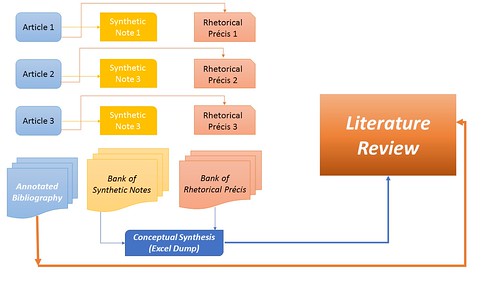
One of the research products I find most useful for an academic, short of openly-accessible datasets and code for replication is the annotated bibliography. As I have noted before, I consider the annotated bibliography an intermediate step between a bank of rhetorical precis, a bank of synthetic notes, and a fully-developed literature review.

iPod March 2017 038

I consider developing annotated bibliographies an important activity. Thus the annotated bibliography is, for me, an actual scholarly product. It may come from “intermediate” materials, such as a set of rhetorical precis, or a group of synthetic notes, but in the end, the annotated bibliography is a scholarly product in and of itself. It should be readable and provide you with insight that you couldn’t get from the full set of articles or book chapters.
Components of a Research Paper Data

Generally speaking, you can see the annotated bibliography as an organized, systematic dump of all your synthetic notes (or rhetorical precis). Each entry starts with the full article, book or book chapter citation, followed by a short summary of the article. Some authors include the article or book chapter abstract, others don’t. Here are four models for how to create an entry for an annotated bibliography I really liked:

And here are two examples of excellent annotated bibliographies. The first one was created by Dr. Kathryn Furlong and Dr. Christina Cook on municipal water governance in Canada. The second, on community-based water governance, was created by Jingsi Jin with Kelly Sharp under Dr. Crystal Tremblay and Dr. Leila Harris’ supervision.

Literature Road Mapping

One element that links the rhetorical precis and the annotated bibliography is that in the annotation for each entry, you can make a value judgment as to what aspects you find more valuable or important of the article. When I write those judgments, I copy those notes (my synthetic notes) and insert them into my Conceptual Synthesis Excel Dump for that particular topic.

For example, I am currently writing on timing and sequencing (that is, on how specific events can lead to the creation of specific rules, norms and institutions). I could write an annotated bibliography on the topic (which I am not currently doing as I am writing a full paper, but it would be possible for me to do it as an intermediate step). Previously, I have written on how you can draw several of the most important ideas of a paper by looking at the Abstract, Introduction and Conclusion (the AIC method).

The AIC technique DOES NOT substitute for an actual, in-depth read of a paper. But it does provide some basic ideas for an annotated bibliography. You should also be able to write most of the synthetic summary for a paper out of the AIC summary. The AIC also provides you with the foundations of a detailed memorandum.

Following the timing and sequencing example, I am reading Tulia Falleti’s “A Sequential Theory of Decentralization” APSR paper. In this paper, Professor Falleti proposes that the timing and sequencing of decentralization implementation have an impact on how intergovernmental relations result and what the specific outcome in this process will be. While the entire paper is important, I am mostly interested in the timing and sequencing components.

My annotated bibliography entry could very well just include a summary of the main points of Falleti’s paper:

Falleti, Tulia G. “A sequential theory of decentralization: Latin American cases in comparative perspective.” American Political Science Review 99.03 (2005): 327-346.

In this paper, Falleti proposes a sequential theory of decentralization where she defines decentralization as a process, looks at the sequence of events that decentralization processes follow, defines three types of decentralization and takes into account policy feedback effects and the territorial interests of bargaining actors. Falleti applies her analysis to four Latin American countries. Falleti shows that decentralization doesn’t necessary increase the power of governors and mayors, but instead this power is dependent on the sequence of decentralization reforms and the timing of these.

Normally, for papers I am reading at the overview/meso level, I would write a summary that is based on the results of AIC (Abstract, Introduction, Conclusion). However, since I find this article by Tulia Falleti quite important, I will write a detailed memorandum, and I will drop my highlights and scribbles on the margins into my Excel dump (Conceptual Synthesis).

As I have written before, I triage the full set of readings I plan to do, and I am strategic, focusing in more depth on those articles, books and book chapters that I know could very well provide me with key insights for a literature review. Being this strategic isn’t all that relevant if one is doing a very broad annotated bibliography. That’s why doing a citation tracing process around anchor authors is important. You need to make sure that you do in-depth readings when those are written by the key authors that you need to read for your literature review.

Hopefully sharing my processes will help people write their annotated bibliographies and their literature reviews!

30 Apr 17:14

Why I’m joining the Mozilla Board by Nicole Wong

by Mozilla

It’s an honor for me to join the Mozilla Board. I’m so inspired by the Foundation’s mission and by the incredibly talented people that lead it. And, I’m looking forward to contributing to Mozilla’s plans to build out a leadership network focused on protecting the open Internet.

Though I’m still too new to the organization to be able to diagnose Mozilla’s biggest challenges, I think this is a really exciting and crucial time for Mozilla to develop products that really put users first. Today’s Internet users have complex needs, so I’ll be excited to see how the Mozilla community works to identify and solve them.

Obviously, this is also a very challenging time to protect the Internet from the national and global trends toward authoritarianism, censorship and surveillance. Mozilla is in a great position to address some of those challenges.

During my career, I’ve had the privilege of working in both the private and public sector, but the consistent theme is focusing on the intersection of emerging technologies, law, and public policy. I have tried to build cultures, policies, and practices that are forward-leaning in the development and defense of a healthy internet. I’m looking forward to doing the same at the Foundation, helping build out the leadership network and focusing on emerging tech policy leaders.

Nicole is an attorney specializing in Internet, media and intellectual property law. She served as President Obama’s deputy chief technology officer (CTO) and has also worked as the vice president and deputy general counsel at Google to arbitrate issues of censorship. She was appointed to the Mozilla Foundation board in April 2017.

The post Why I’m joining the Mozilla Board by Nicole Wong appeared first on The Mozilla Blog.

30 Apr 17:14

Why I’m joining the Mozilla Board by Mohamed Nanabhay

by Mozilla

Mozilla has been at the forefront of shaping internet culture and fighting to keep the Internet open. Being able to join the Board and be of service to that mission is an honor as the open internet played such an important role in my life and my work.

My generation came online to the shrill beeps of our modems connecting to this network that represented endless possibilities. Those beeps of our modems dialing up provided the soundtrack to some of our deepest friendships and community, crossing borders and breaking down barriers. I remember contributing to the SpreadFirefox.com campaign in 2004 to put an advert into the New York Times. That campaign epitomized the best of what we could achieve on the network – thousands coming together to promote the open source project that many thousands worked on that would go on to touch millions of people.

As the next billion come online, there are real questions about what sort of Internet they are coming online to. We know that it is most often through a mobile device (phone or tablet) and often the first contact is through Facebook (including WhatsApp). Navigating the usage (what role does the browser play when most people are using Apps?) and the social implications (will an even greater number of people confuse Facebook with the Internet?) are deeply important in the near term.

At Al Jazeera I was deeply focused on using social technologies to not only distribute news but also discover and amplify the voices of people being most impacted by power. With Creative Commons I worked to launch a repository of broadcast quality video footage under the most permissive license. At Global Voices, bridge building and providing a nuanced understand through a local lens is key to what we do. And at the Media Development Investment Fund (MDIF), we are deeply committed to funding the highest quality journalism in countries where there is a threat to press freedom.

This work has all really been around building bridges, connecting people, and amplifying voices. While our kids may never know the thrill of hearing a modem connection I hope that we can work to ensure that the Internet remains open so they can use it to learn, build, and grow in the same way we did.

Mohamed Nanabhay is the Deputy CEO of the Media Development Investment Fund (MDIF), which invests in independent media around the world providing the news, information and debate that people need to build free, thriving societies. He is also the board chair of GlobalVoices.org and the former head of Al Jazeera English. Mohamed was appointed to the Mozilla Foundation board in April 2017.

Photo credit: Joi Ito

The post Why I’m joining the Mozilla Board by Mohamed Nanabhay appeared first on The Mozilla Blog.

30 Apr 17:13

Platform update & Q&A

by Michał

Hey there, SUMO Nation!

As you may have noticed, we are (for the time being) back to the previous engine powering the support site at support.mozilla.org

You can follow the latest updates and participate in the discussion about this here.

We are definitely present and following this discussion, noting your concerns and questions. We can provide you with answers and reassurance, even if we do not have ready-made solutions to some of the issues you are highlighting.

Since some of you may not be frequently visiting the forums, we would also like to make sure you can find the answers to some of the more burning questions asked across our community here, on our blog.

Q: Why is Mozilla no longer interested in using Kitsune, its own support platform?

The software engineers and project managers developing Kitsune were shifted to work on critical development needs in the Firefox browser. Kitsune also had only a handful of contributors to the code base. After calculating the time and money requirements for maintaining our own platform, which were considerable and might have entailed a major overhaul, Mozilla decided that using an third-party solution was a better investment for the long term future of Mozilla’s support needs. (To be honest, it was one of the hardest decisions we have made.) We also considered that Lithium has significant ongoing software development which we think will lead to faster feature improvements than we might have achieved internally with Kitsune.

Q: Why is the new support platform still not providing all the functionality available in Kitsune?

Kitsune had been customized and hand-crafted from scratch by Mozillians and for Mozillians over a period of eight years.

No other platform in the market can offer the same level of compatibility with Mozilla’s mission and contribution methods without a serious investment of time and development power.

We have been working with Lithium for an extended period of time on matching the core functionality of Kitsune. This is a complex, lengthy, and ongoing process.

Due to technical differences in development and deployment of features between both platforms, complete feature parity may not be possible. We promise that over time we will push aggressively to close the feature gap and even to develop useful new features that were not present in Kitsune. We understand that many in the community feel that Kitsune is a better option and there are many things we love about Kitsune. We are hopeful that Lithium will grow on you and ultimately surpass Kitsune.

Q: How will you ensure that Mozilla’s image is not negatively influenced by issues with the support site now and in the future?

We will do our very best to provide the best support site and the best workflows we can for the budget that we are allocated for support technology and tools. We are extremely serious about maintaining Mozilla’s good image and working with our community and users to ensure that Mozilla is viewed positively. We realize that changes in software and workflows may not work equally well for everyone but we will do our best to help. We always have and always will appreciate the contributions from you, our community – and that users choose to browse on Firefox.

Q: What can the community members do to help any of the above now and in the future?

First of all, please continue to contribute your time and hard work answering user questions. It’s the most valuable contribution you can make and one we greatly appreciate. Thank you.

Second, your ideas on how to improve the Mozilla support platform are something we always listen closely to, as you are in the system as much as we are. These can be new features or improvements to existing features (or adding back in older features), including improvements to the Lithium platform. We can’t promise that we will be able to include all requests in our roadmap but the community does drive our priorities and inform our decisions.

Please add these requests into the Platform meeting notes or file feature requests through Bugzilla (and make sure they are assigned to us.) Please note that we already have several feature improvements lined up for development and deployment by Lithium. We will do what we can to keep the information flowing back and forth in a clear and organized manner.

As always, thank you for your continuous presence and support of Mozilla’s mission. We can’t make it happen without you.

All the best to you all!

The SUMO Team on behalf of Mozilla

30 Apr 17:12

The manual transmission is alive and well – if you know where to look

mkalus shared this story from The Globe and Mail - Commentary.

The stick-shift is not dead. Reports of its demise have been greatly exaggerated. If you’re a car enthusiast or car critic mourning for manuals, using online forums like a group therapy session, I have good news.

Well, first, some bad news: the Buick Verano is no longer available with a three-pedal manual, (or at all after this year, except in China). #Savethemanuals! Boo-hoo. Whatever.

The Porsche GT3 is back with a three-pedal, six-speed, clutch-and-stick shifter. That’s big news for gearheads. It’s Porsche admitting the GT3 need not be all about fastest lap times, that for some people, fun trumps speed. Still, it’s hard not to see it as Porsche manipulating its cult of eager customers. Those who bought the PDK-automatic GT3 will now be lining up to trade them up to a new six-speed GT3, which is otherwise almost identical. Simultaneously, it’s making the limited-edition 911 R – and the prices they’ve been trading hands at – seem more than a little silly.

The Mazda MX-5’s six-speed makes it feel faster, more involving and ultimately more satisfying.

Mike Ditz

But the new GT3 isn’t even the best news. No, for those of us who like driving and appreciate a twisty road, it is that there are plenty of cars with stick-shifts currently available. In a totally unscientific and haphazard survey of auto makers, I found more than 40 cars available with a manual transmission. There are certainly even more out there.

The Mazda MX-5 is an obvious example. The six-speed makes it feel faster, more involving and ultimately more satisfying. But the same holds true for more unlikely cars. The Mazda3 is heroically fun with a stick, considering it’s only got 155 horsepower and costs less than $20,000.

The Fiesta ST with a five-speed is only $25,000.

Ford

A Ford Fiesta with a five-speed manual is a riot – a classic case of the old adage, “It’s more fun to drive a slow car fast than a fast car slow.” The sportier Fiesta ST with a five-speed is like a real-life Wacky Racer and it’s only $25,000.

As a rule: The less powerful the car, the more fun it becomes with a stick-shift. Unintuitive, maybe, but try it out. Go test-drive a manual Toyota Corolla or Yaris – if you can find one on a dealer lot – and revel in the ability to take it up to redline without breaking the speed limit. The racket from the engine as you push it to the limit can make you feel like Kimi Raikkonen, albeit on a budget. Now, test-drive one with an automatic. A bit sluggish, right?

This rule is doubly true if you’re comparing a manual box against a heinous CVT automatic. Get that lawnmower transmission away from my cars.

The Subaru BRZ starts under $30,000.

SUBARU

The Subaru BRZ and Toyota 86 (formerly known as the Scion FR-S) could both use more power to be truly great. The stick-shift, offered as standard on both, should be mandatory because it makes better use of the power that is there. Both the Subaru and Toyota start under $30,000.

BMW offers several models with a manual. In recent years, Munich has lost a lot of driver’s-car credibility, but the counterargument is always that: Hey, well, you can still buy a rear-wheel-drive 340i with a stick-shift. The M2, M3 and M4 all come standard with a stick, too.

Other cars you can get with a stick? Fiat 500 Abarth, Ford Mustang and Focus RS, Jeep Wrangler, Subaru WRX and STI, Chevy Camaro and Corvette Z06, Dodge Challenger Hellcat, Jaguar F-Type, Volkswagen Golf SportWagen and Golf R, Honda Civic and Fit, Nissan 370Z and Micra, Hyundai Veloster, Mini Cooper and Cadillac ATS-V. Yes, a Cadillac. And wouldn’t you know: it’s great.

There are not many sports cars purer than a Carrera S with a manual box.

Porsche

You don’t need to spend over $160,000 on a GT3 to get a manual Porsche. Nearly all 911 models come standard with a seven-speed manual. True, the seven is not as precise as the six-speed, but there are not many sports cars purer than a Carrera S with a manual box. Alternatively, a manual Targa 4 GTS would be a very tasteful way to spend $150,000.

More good news: Manuals will often save you some money. The PDK-automatic is a $4,250 option on that Porsche Targa 4 GTS.

The Porsche 911 Carrera GTS with an interior package painted in Carmine red.

PORSCHE

If you’re looking to buy the absolute cheapest new car on four wheels, a manual is the way to go, too. A base Nissan Micra requires compromises – like sweating through summer without air conditioning – but with a stick-shift it’s a six-pack under $10,000.

The more I look at the list of manual cars available in Canada, the more it becomes clear: It’s only at the high end of the car market where manuals are dying. This is said for those enthusiasts who could have purchased a Ferrari 550 with a gleaming metal-gated shifter. Ferrari, Lamborghini and McLaren have stopped making manual boxes.

Not all high-end cars are better with a stick. Shifting your own gears in a BMW M6, for example, is like rowing a canoe across a lake of gravel. If the next-generation M5 and M6 don’t have a manual option, I won’t miss it.

Aston Martin is the exception. The V12 Vantage S with a dog-leg seven-speed is perhaps the quickest way to find zen. The company has said it would like to continue offering cars with clutches and gear levers.

There could come a day when fuel-economy standards make manuals untenable. They aren’t as fuel-efficient as the latest automatics. But until then, there are plenty of good cars that’ll let you shift gears the old-fashioned way.

As of 2017, I’m happy to report news of the manual transmission’s demise is false.


A partial list of cars you can buy with a manual transmission:

  • Mazda MX-5
  • Mazda3
  • Subaru BRZ
  • Subaru WRX – STI 6-speed manual only
  • Toyota 86
  • Toyota Corolla
  • Toyota Yaris
  • Porsche 911 GT3
  • Porsche 911 Carrera
  • Fiat 500 Abarth
  • Fiat 124 Spyder
  • Ford Focus RS
  • Ford Fiesta ST
  • Ford Mustang
  • Aston Martin Vantage V12 S (seven-speed)
  • BMW M2
  • BMW M3
  • BMW M4
  • Audi A4 and A5 coupe
  • Jaguar F-Type
  • Volkswagen Golf and Golf R
  • Volkswagen Golf SportWagen
  • Volkswagen Jetta
  • Cadillac ATS-V
  • Jeep Wrangler
  • Dodge Challenger and Hellcat
  • Chevrolet Camaro
  • Chevrolet Cruze
  • Corvette Z06
  • Honda Civic
  • Honda Fit
  • Hyundai Veloster
  • Mini Cooper
  • Mitsubishi Mirage
  • Nissan Versa
  • Nissan 370Z
  • Nissan Micra
30 Apr 17:12

Hackers Leak Netflix’s Orange is The New Black, Season 5 Premiere

by Andy
mkalus shared this story from TorrentFreak.

tdo-logoMuch to the disappointment of studios everywhere, movie and TV shows leak onto the Internet every single week.

However, if what is unfolding today lives up to its billing, we could be looking at the start of one of the most significant piracy leaks of recent times.

Earlier this evening, the first episode of the brand new season of Netflix’s Orange is the New Black was uploaded to The Pirate Bay, months ahead of its official June release date.

So how did this unreleased content fall into the wrong hands?

As seen from the torrent details uploaded to Pirate Bay, the leak is the work of a hacking entity calling itself TheDarkOverlord (TDO). An extraction of the .torrent file’s meta data reveals a 1.1GB file named:

‘Episode1/ORANGEep5001_HDSR_CTM_ProResProxy_8.15.16-H264_SD_16x9.mov’.

In information sent to TF, the group says that sometime during the closing months of 2016, it gained access to the systems of Larson Studios, an ADR (additional dialogue recorded) studio, based in Hollywood. The following screenshot reportedly from the leak indeed suggests a copy that was in production and possibly unfinished in some way.

After obtained its haul, TDO says it entered into “negotiations” with the video services company over the fate of the liberated content.

“After we had a copy of their data safely in our possession, we asked that we be paid a small fee in exchange for non-disclosure. We approached them on the Eve of their Christmas,” a member of the group previously told us over an encrypted channel.

So who are TDO? According to several security reports, TDO is a fairly prolific hacking group (their spokesman says they are more than one) that has claimed responsibility for a number of attacks in recent months.

One, which targeted construction company Pre-Con Products Ltd, involved the leak of contracts and a video which purported to show a fatal accident. Another, concerning polyurethane and epoxy product company GS Polymers, Inc, resulted in a leak of data after the company reportedly showed a “disinterest” in “working” with TDO. The group has also targeted medical organizations and leaked gigabytes of data obtained from Gorilla Glue.

As is clear from its actions, TDO takes its business seriously and when the group allegedly contacted Larson Studios before Christmas, they had extortion (their word) in mind. In a lengthy business-like ‘contract’ shared with TorrentFreak, TDO laid out its terms for cooperation with the California-based company.

“This agreement of accord, assurances, and satisfaction is between Larson Studios (the ‘Client’) and thedarkoverlord, a subsidiary of TheDarkOverlord Solutions, a subsidiary of World Wide Web, LLC [WWW, LLC] (the ‘Proposer’),” the wordy contract begins.

In section 2 of the contract, headed “Description of Services,” TheDarkOverLord offers to “refrain from communicating in any method, design, or otherwise to any individual, corporation, computer, or other entity any knowledge, information, or otherwise,” which appears to be an offer not to leak the content obtained.

Unsurprisingly, there were a number of conditions. The subsequent section 3 reveals that the “services” come at a price – 50 bitcoins – plus potential late payment fees, at TDO’s discretion.

tdo-contract

TDO informs TF that Larson Studios agreed to the pay the ransom and even sent back the contract.

“They printed, signed, and scanned the contract back to us,” the group says.

A copy seen by TF does have a signature, but TDO claims that Larson failed to follow through with the all-important bitcoin payment by the deadline of 31st December. That resulted in follow-up contact with the company.

“A late fee was levied and they still didn’t hold up their end of the agreement,” TDO says.

In an earlier discussion with TDO after the group reached out to us, we tried to establish what makes a group like this tick. Needless to say, they gave very little away. We got the impression from news reports that the group is mostly motivated by money, possibly power, but to remove doubt we asked the question.

“Are you familiar with the famous American bank robber, Willie Sutton?” a spokesperson replied.

“In an interview, he was once asked ‘Why do you rob banks?’ To which replied, ‘Because that’s where the money is.’ It’s said that this exchange led to the creation of Sutton’s law which states that when diagnosing, one should consider the obvious. We’ll leave you to interpret what we’re motivated by.”

Later, the group stated that its only motivation is its “greed for internet money.”

TorrentFreak understands that the leak of this single episode could represent just the start of an even bigger drop of pre-release TV series and movies. TDO claims to be sitting on a massive trove of unreleased video material, all of it high-quality.

“The quality is almost publish quality. One will find small audio errors and video errors like lack of color correction, but things are mostly complete with most of the material,” TDO says.

TheDarkOverlord did not explain what it hopes to achieve by leaking this video content now, months after it was obtained. However, when questioned the group told us that the information shared with us thus far represents just “the tip of the iceberg.”

In the past few minutes the group has taken to its Twitter account, posting messages directed at Netflix who are likely to be watching events unfold.

This is a breaking news story, updates will follow

Update: The group has published a statement on Pastebin.

Source: TF, for the latest info on copyright, file-sharing, torrent sites and ANONYMOUS VPN services.

30 Apr 17:11

New Mozilla Foundation Board Members: Mohamed Nanabhay and Nicole Wong

by Mitchell Baker

Today, I’m thrilled to announce that Mohamed Nanabhay and Nicole Wong have joined the Mozilla Foundation Board of Directors.

Over the last few years, we’ve been working to expand the boards for both the Mozilla Foundation and the Mozilla Corporation. Our goals for the Foundation board roles were to grow Mozilla’s capacity to move our mission forward; expand the number and diversity of people on our boards, and; add specific skills in areas related to movement building and organizational excellence. Adding Mohamed and Nicole represents a significant move forward on these goals.

We met Mohamed about seven years ago through former board member and then Creative Commons CEO Joi Ito. Mohamed was at Al Jazeera at the time and hosted one of Mozilla’s first Open News fellows. Mohamed Nanabhay currently serves as the Deputy CEO of the Media Development Investment Fund (MDIF), which invests in independent media around the world providing the news, information and debate that people need to build free, thriving societies.

Nicole is an attorney specializing in Internet, media and intellectual property law. She served as President Obama’s deputy chief technology officer (CTO) and has also worked as the vice president and deputy general counsel at Google to arbitrate issues of censorship. Nicole has already been active in helping Mozilla set up a new fellows program gathering people who have worked in government on progressive tech policy. That program launches in June.

Talented and dedicated people are the key to building an Internet as a global public resource that is open and accessible to all. Nicole and Mohammad bring expertise, dedication and new perspectives to Mozilla. I am honored and proud to have them as our newest Board members.

Please join me in welcoming Mohamed and Nicole to the Board. You can read more about why Mohamed chose to join the Board here, and why Nicole joined us here.

Mitchell

30 Apr 17:11

Samsung Galaxy S8 Owners Reporting Random Restart Issues

by Rajesh Pandey
An increasing number of Galaxy S8 owners have been complaining about their handset restarting randomly. The issue has been occurring multiple times a day randomly leading to a frustrating experience for owners of Samsung’s latest flagship handsets. Continue reading →

30 Apr 17:11

"We respond to the inherent uncertainties of data by adding more data without revisiting our..."

“We respond to the inherent uncertainties of data by adding more data without revisiting our assumptions, creating an impression of certainty that can be lulling, misleading and often dangerous.”

-

Bret Stephens, Climate of Complete Certainty 

This one factoid – intended to create doubt and uncertainty about climate science – is embedded in a column about climate change that is drawing enormous heat (snark intended) for inaccuracies and denialism. Stephens wrote:

Anyone who has read the 2014 report of the Intergovernmental Panel on Climate Change knows that, while the modest (0.85 degrees Celsius, or about 1.5 degrees Fahrenheit) warming of the Northern Hemisphere since 1880 is indisputable, as is the human influence on that warming, much else that passes as accepted fact is really a matter of probabilities.

And Joe Romm at ThinkProgress responded:

This probably sets the record for most errors in a single sentence ever published in the New York Times.

Andy Revkin makes the point that

Uncertainty is real, but hardly a reason for simply more conversation.

Looks like the NY Times failed on fact checking their new conservative columnist.

30 Apr 17:11

brix

brix:

I’m not sure that I want a businessy phone system integrated with Slack, but maybe I do.

SLACK + BRIX

PHONE NUMBERS FOR YOUR SLACK CHANNELS

Slack transformed how your team collaborates, cooperates, and communicates. If you’ve been using it for a while, by now it should be talking nicely with your other systems and software, making your life a whole lot simpler.

But one thing that might not be connected is your phone number. That’s about to change. By connecting Brix to Slack you can give any Slack Channel a UK 0330 phone number using a simple slash command.

0330 numbers are ideal for businesses, as they cost the same to call as a landline, and they’re included in minute bundles with every mobile operator.

Any calls to your Brix numbers will be sent to all the people in the relevant channel with UK or US phone numbers in their Slack profile. The first person to pick up and confirm they want the call by pressing 1 will be connected.

30 Apr 17:11

Samsung Galaxy S8 :: A few additional observations

by Volker Weber

4739ceb58be1c8594a52dee274ea512b

Before I return the S8 to Samsung a few additional observations, in no particular order:

  • Battery life is much better than I expected. Even on the 3000 mAh battery of the smaller model. I never ran out of power and quick charge is really quick.
  • When I first tried a curved screen on the S6 edge, I loved the screen and I hated how often I would misplace the cursor while typing. The S8 is completely different. Palm rejection is almost perfect.
  • When reading or watching videos, I often wished there was more bezel to hold on to. I still find the iPhone much more usable.
  • Having three different biometrics looks like an advantage. But I'd rather have only one, but one that works well. Face detection isn't secure, iris recognition does not work well enough and looks awkward, finger print reader on the back is worse than on home button in the front.
  • Being able to put the back button on the left side was a major benefit to me.
  • I love the always-on screen. It's perfectly designed.
  • S8 is as smooth as a glass pebble. And just as slippery. I haven't dropped any other device as often as the S8. Buy a skin!
  • The Bixby button is located under your index finger when you turn the phone on with your thumb. Every time I press this button accidentally, I hate Samsung a little but more.

I will wipe the device on Monday and return it to Samsung the day after.

30 Apr 17:11

Reflected sunbeam. (at Vancouver Convention Centre)


Reflected sunbeam. (at Vancouver Convention Centre)

30 Apr 17:11

Are we living in The Handmaid’s Tale?

mkalus shared this story from The Globe and Mail - Opinion.

Margaret Atwood’s The Handmaid’s Tale is a brilliant achievement of dystopian fiction – detailed, haunting and deeply creepy. The much-praised TV version debuted this week, and, by all accounts, it’s spectacular.

The story is set in the not-too-distant future, when environmental poisons (a favourite Atwood theme) have rendered most of the population sterile. The United States, now known as Gilead, has been taken over by a fundamentalist theocracy and the remaining fertile women have been enslaved as breeding stock. When the book was first published in 1985, Ronald Reagan was president and the Moral Majority was in the ascendant. Alarmed progressives solemnly hailed it as a possible portent of things to come.

Today, the book is widely regarded as prophetic. And more people than ever are convinced that women’s rights are under existential threat. “The Handmaid’s Tale Is Horrifying Because It Seems So Possible,” Vanity Fair blared. “The Misogynist Future of The Handmaid’s Tale Feels Terrifyingly Within Reach,” Jezebel said. “We live in the reproductive dystopia of The Handmaid’s Tale,” The New Yorker warned. The entire cultural class seems to have been gripped by the fear that women are about to be enslaved by fascistic monsters who will impregnate them against their will and wrench their babies from their arms at birth.

What accounts for these fever dreams? Short answer: Donald Trump. Many women appear to actually believe that he and his religious right-wing cronies will take away their contraception, strip them of their rights and usher in an age of mass sexual assault.

I hate to disappoint them, but it’s exceedingly unlikely. Sure, he’s a sexist pig. But so are a few Democrats I could name. The religious wars are mostly over and the good guys won. The religious right is in steep decline. Gay marriage is legal. Discrimination is against the law. The working-class Americans who voted for Mr. Trump have been deserting organized religion by the millions. He is the most secular president of modern times. It’s too bad he wants to defund Planned Parenthood. But I don’t doubt that both women and Planned Parenthood will survive.

Yet, it’s not just Mr. Trump. Long before he came along, the rhetoric of misogyny and female oppression had reached impressive new heights. The more progress women made, the shriller the narrative became. The Handmaid’s Tale played a role in that. It played to the argument that this progress was a sham. If anything, the activists argue, women’s lives have gotten worse.

If this seems weird, then you haven’t been following the plot. As Moira Weigel explains to us in The New Yorker, the biggest threat to women’s rights is the toxic capitalist system itself. “[T]he cultural forces that Atwood was responding to included a neoliberal revolution that colluded in oppressing women,” she writes. “In the America of 2017, as in Gilead, birth rates are falling, not because of mysterious toxins in the air but because many Americans cannot imagine being able to afford children … Others are barren … because they have worked straight through their childbearing years.”

Funny, I thought reproductive choice and feminism had something to do with that. But I must have been mistaken.

The dystopia depicted in The Handmaid’s Tale really does exist, of course. But no one ever mentions it. It’s called Saudi Arabia, which is pretty much a dead ringer for Gilead. And, just as in the book, there really are parts of the world where homosexuals are strung up by the roadside. Iran and Chechnya, for starters. But you won’t read those things in the reviews because they don’t fit the narrative. No one mentions the stupefying absurdity of giving Saudi Arabia a seat on the UN women’s rights commission. That’s because the real problem is neoliberal capitalism.

Could the horrors of The Handmaid’s Tale actually happen in America? Well, yes. Two weeks ago, a medical doctor in Michigan was criminally charged for allegedly conspiring to perform mutilating surgical procedures on two seven-year-old girls, who were taken there in secret by their parents. These procedures are done in the name of religion. Where was the outcry, enraged editorials, and the protest marches from American feminists? The girls belonged to a Muslim sect who believe in female genital mutilation. So nobody paid much attention. In an effort to avoid appearing culturally insensitive, The New York Times even used the delicate phrase “genital cutting” in its reporting.

At times like this, I badly miss that other great dystopian writer. His name was George Orwell. You should read him, too.

Report Typo/Error

Follow us on Twitter: @GlobeDebate

30 Apr 17:11

Notes on Commonsism

Yes, I coined another word. 

image

I am a commonsist.

The term got its start as a tag, and I didn’t use the term in the post tagged with it.

Commonsism mixes together the thinking of Elinor Ostrom and Aldo Leopold, and many others.

Ostrom won the Nobel prize for economics for her work on common-pooled resources (CPRs) or ‘commons’, that was sparked by Garrett Hardin’s 1968 Science article, The Tragedy of the Commons. 

Hardin employed the example of a herder grazing his cattle on pasturage ‘open to all’, and who has an incentive to add cattle to their herd. But so does every other herder, and if nothing halts their collective self-centered actions, the pasture will quickly be reduced to a desert.

One pessimistic interpretation is that absent the intervention of an outside power – a Leviathan like a king or a democratic government, or religious decrees – the unchecked exploitation of the commons is inevitable.

Ostrom,  however, found numerous examples of well-managed CPRs across the world, based on her field work in the management of pasture by locals in Africa and irrigation systems management in villages of western Nepal, and the examination of other systems of commons management.

As noted in a piece in the Economist, Ostrom cataloged the rules that are necessary for managing a commons:

In “Governing the Commons”, which was published in 1990, Elinor Ostrom of Indiana University described the rules needed to keep a commons going. She showed that there are almost always elaborate conventions over who can use resources and when. What you take out of a commons has to be proportional to what you put in. Usage has to be compatible with the commons’ underlying health (ie, you cannot just keep grazing your animals regardless). Everyone has to have some say in the rules. And people usually pay more attention to monitoring abuses and to conflict resolution than to sanctions and punishment.

In her Governing the Commons (1990) she laid out the 8 Principles for Managing a Commons:

1. Define clear group boundaries

2. Match rules governing use of common goods to local needs and conditions.

3. Ensure that those affected by the rules can participate in modifying the rules.

4. Make sure the rule-making rights of community members are respected by outside authorities.

5. Develop a system, carried out by community members, for monitoring members’ behavior.

6. Use graduated sanctions for rule violators.

7. Provide accessible, low-cost means for dispute resolution.

8. Build responsibility for governing the common resource in nested tiers from the lowest level up [better translated into network terms, ‘from the smallest social scale’] to the entire interconnected system [‘network’].

What if we were to consider the Earth as a commons, and at the local level, each watershed and island, each prairie and region, as commons, as well?

The premise that the greatest degree of control for a shared resource – for example the Hudson Valley watershed – should be determined principally by those living within that watershed. Note, however, that resource must be managed by the principles above, along with the zeroth principle: all activities must be based on the foundation of causing the least harm to the commons as possible, so that the commons can continue to be used by its members and by future generations.

This zeroth rule is also equivalent to environmentalist Aldo Leopold’s golden rule:

A thing is right when it tends to preserve the integrity, stability and beauty of the biotic community. It is wrong when it tends otherwise.

Or paraphrased, 

We can judge the morality of political and social actions by the degree to which they harm or help the land, the sea, and the air.

I am reminded of the saying from Marcus Aurelius,

That which is not good for the bee-hive cannot be good for the bees.

So, I am a commonsist: I reject political authority that does not derive from a bottom-up management of our world as a network of commons. 

At every scale, the rules of the commons must shape human activities that impact the commons, most importantly, the views of those closest to a commons should carry the most weight. But just as the watershed of Fishkill Creek (where I live in Beacon NY) drains into the Hudson, the actions that we who live along the creek can impact others in the greater watershed, so polluting the creek has impacts at the greater scale. However, if we manage local fishing in the creek to maintain fish levels, and avoid importing aggressive exotic fish, we are likely to not damage the greater watershed.

By acting as responsible members at the bottommost scale in the watershed, we also are acting in the interests of all, at the greater watershed of the Hudson. And those outside our watershed should not have much of a say in what we do locally, unless we are keeping our own watershed cleaning by trucking pollutants to the Connecticut watershed.

By the opposite logic, however, those that are failing to follow the principles of the commons – for example, companies that spill PCBs into the Hudson, or countries that are spewing CO2 into the atmosphere and warming the earth–are immoral, no matter what their motivations for doing so may be. And those closest to the mess being made have the right and obligation to compel them to stop. 

And here’s where this system demonstrates that the world is upside down: if a political order is organized in such a way that actions based on the principles of the commons can be blocked by those less close to the commons it is flawed, and probably immoral. For example, the State of NY should not be able to compel a municipality to allow fracking, which could damage the land to the detriment of all. On the other hand, if Beacon citizens voted in favor of fracking along Fishkill Creek, they can be overruled by the greater Hudson River watershed citizenship (especially those downstream and nearby), since the possibility of damage to the greater watershed is relatively high.

Consider the XL Pipeline from this perspective, and it’s clear the Feds should not don’t have the moral right to compel Nebraska – or any other region – to accept the XL Pipeline for the benefit of energy companies, or even for ‘energy independence’. It’s patently immoral.

The zeroth rule, Leopold’s golden rule, creates a massive check on activities that threaten the greater good, and do not allow a substitution of money or other compensation in exchange for the possible or actual damage. 

So, join the commonsists, and resist the political order that places anything ahead of the perpetuation of the commons we – and posterity – rely on.

30 Apr 17:10

A chance encounter on the campaign trail blows up on Clark.

mkalus shared this story from The Province.

It was a campaign-trail encounter that lasted all of seven seconds, but it blew-up into a social-media firestorm that backfired on Christy Clark and the B.C. Liberals.

Now the woman at the centre of the storm is speaking out against Liberal charges that she was an “NDP plant” sent out to embarrass Clark in front of the TV cameras as part of a campaign “stunt.”

Linda Higgins, a retired social-worker assistant from the Sunshine Coast, said it was just “a fluke” that she bumped into Clark while the Liberal leader was meeting and greeting voters at a North Vancouver grocery store.

“I decided on the spur of the moment to go up and talk to her,” Higgins told me. “I’m not voting for her and I wanted to tell her why.”

After Clark shook her hand, Higgins told her: “I would never vote for you because of what … ” But Clark cut her off.

“You don’t have to — that’s why we live in a democracy,” Clark said, before turning her back on Higgins and walking away.

Clark’s brush-off was a gift to the NDP. An online backlash erupted with an #IAmLinda hashtag on Twitter, as Liberal-bashers everywhere took to their computers and smartphones.

When Higgins got home that night, she got a phone call from her nephew.

“He said, ‘Auntie Linda, you’re trending on Twitter!’ I said, ‘What are you talking about?’ I couldn’t believe it.”

Sure enough, the #IamLinda hashtag had become one of the hottest Twitter trends in B.C., and was still registering thousands of online hits this weekend.

The online posts list all manner of gripes against Clark’s government — everything from soaring B.C. Hydro rates to overcrowded schools to backed-up emergency rooms — all with the #IAmLinda hashtag.

But the Liberals fought back, unleashing a conspiracy theory that the whole thing was cooked up by the NDP.

“#BCNDP is free to send their members to disrupt #TeamBC2017 events,” Liberal campaign director Laura Miller tweeted.

Other online Liberal surrogates called it an NDP “stunt” and a “sneak attack.” Lobbyist Mark Marissen, Clark’s ex-husband, called Higgins “an NDP plant.”

Higgins is shocked by it all.

“This was not set-up by the NDP — I’m not a member of the NDP or any other party,” she told me. “Nobody knew I was going to talk to Christy Clark. I didn’t even know it myself until I saw her. I’m not a political person. It was just an impulse thing.”

Higgins said she wanted to tell Clark about how the high cost of living has priced her adult kids out of the Vancouver housing market.

“They have good jobs, but they can’t afford a home,” she said. “I was also upset about those health-care workers who were fired, including a man who committed suicide. I wanted to tell her my concerns and I genuinely thought she would listen.”

Instead, Higgins said she was shocked again by Clark’s later comments about the incident.

Clark told reporters: “She said she didn’t vote for me last time, she’s never voted B.C. Liberal and she never will and she’s not going to vote for me again. Perfect. That’s her right,” Clark said.

“I said no such thing to her,” Higgins told me. “I didn’t say anything remotely like that. It was all on tape. I don’t know where she got that from or why she would say that about me.”

Higgins said it’s not true that she’s never voted Liberal or that she would never vote Liberal in future.

“I think I voted for Gordon Wilson once,” she said, referring to the former B.C. Liberal leader. “And I wouldn’t rule out voting for them again if they had a good candidate.”

But she is voting NDP this time, and the Liberals pointed to a Facebook photo of her with Sunshine Coast NDP candidate Nicholas Simons. Simons is also a former social worker and he said Higgins used to work in the same provincial government building with him before he became an MLA 12 years ago.

“I think I’ve seen her on the ferry a couple of times since then,” he said. “She’s never been involved with the NDP, as far as I know. What the Liberals said about her was absolutely reckless.”

Simons said he reached-out to Higgins on Friday to see how she was holding up and she later stopped by one of his campaign events. He posted their photo on Facebook, triggering the Liberals’ conspiracy theory that she was an NDP stooge.

All-in-all, this was a bad gaffe by Clark that she and the Liberals made worse by making stuff up. With just over one week to go before voting day May 9, it makes me wonder if the Liberals are getting worried.

Clark had another stumble the other day when she seemed to suggest the Liberals might be open to an HST-style, “value-added tax” in B.C.

The Liberals imposed a 12-per-cent harmonized sales tax in 2009 after saying in the previous election that the tax was “not something that is contemplated.” The HST was withdrawn after voters rejected it in a historic 2011 referendum.

The business sector has been angling ever since for another HST-type tax, known as a value-added tax.

“We will not consider an HST as long as I am premier,” Clark said. “We do know that the Tax Competitiveness Panel came back with a recommendation for a value-added tax, which is different. So what I’ve said is, ‘Look, we’ll be prepared to talk to the business community … ‘ ”

The NDP naturally jumped all over this, saying Clark was considering another HST with a different name. But the Liberals insisted Saturday that they will not impose a value-added tax on British Columbians.

The finish line is in sight. It could be a wild final week.

msmyth@postmedia.com

twitter.com/mikesmythnews

CLICK HERE to report a typo.

Is there more to this story? We’d like to hear from you about this or any other stories you think we should know about. Email vantips@postmedia.com.

30 Apr 17:10

Metro startups take care of the shopping, cooking

mkalus shared this story .

Jacqueline Tupper has a busy life and little time to cook healthy meals.

The challenge of eating well is made that much harder when her dietary requirements differ from those of her children, ages four and six, which differ again from those of husband Bryce. Oh, and she also owns and operates a South Granville boutique, Lord’s Shoes and Apparel.

“It’s a really busy time, which is why Eat Your Cake saves my bacon,” she says. 

Eat Your Cake is one of a dozen or more Vancouver startups that shop for food, prepare meals and deliver them, ready to eat, to your door. There are companies that just do your shopping, while others will send food and a chef or nutritionist to cook it for you in your own home.

“We get three totally different levels of food from them,” Tupper explains. “I get my lunches and snacks, all vegetarian. When we get dinner, half of it caters to my kids and their palate and the other half is for my husband and I, so part vegetarian for me and fish for him.”

Eat Your cake delivers to Tupper’s home twice a week, leaving prepared meals in her fridge while she is at work.

“Before I go to work I check the fridge, pick my lunch and there’s always a yummy treat to go with it and off I go to work,” she says. “It’s always something new, it’s always something fresh. If there’s anything I don’t like, I just say I didn’t enjoy it and it never shows up again.”

The Tuppers are typical of a growing market: families that are outsourcing shopping and cooking to experts who ensure that they are eating healthy, often organic, meals as often as possible. Depending on the service level, people pay from about $200 to $500 a week.

Eat Your Cake has nearly 500 subscribers in mainly Vancouver, on the North Shore, Richmond and Surrey, and their client base is growing “rapidly.”

“We specialize in pre-made meals,” says founder Joanna Wolski. “Our clients discuss their health goals with one of our nutritionists and then we come up with a meal plan geared to weight loss, athletic support or healthy eating.”

Most people opt for a weekdays package that provides lunches and dinners Monday to Friday, which allows them to cook or go out to eat on the weekend.

The rest break down into two groups: People who want three meals a day, seven days a week; and people who just need meals a couple of days a week, for a weekend meal or a difficult weeknight.

“Some people want to be taken care of all day every day, breakfast lunch, dinner and snacks,” says Wolski.

Buying prepared, healthy meals is a double win for Annie Wang, a project manager for an IT consulting firm who works 70 to 80 hours a week. It saves precious time and relieves her of the need to obsess over labels, macrodiets and micronutrients.

“I do not have time to cook. This gives me a lot of freedom with my time and helps control my weight,” she says. “I’m a bit of a label whore and I don’t want to be counting carbohydrates or weighing food on a scale. I’ve done that and it’s so hard on you mentally.”

Wang buys prepared meals — some vegetarian and some with meat — to eat Monday through Thursday while her husband is travelling for work.

“It’s a pain to cook for one and this leaves me the flexibility to vary my diet on the weekends, see friends and be social,” she says. 

Fresh in Your Fridge takes the concept one step further, not just prepping meals, but coming to your home and cooking them, too.

Founder Erika Weissenborn has a stable of nutritionists with culinary training who do home visits to cook between 10 and 25 meals to be eaten throughout the week.

Most of her clients have highly specialized diets or long lists of food sensitivities, but she also caters to people who want to eat vegan, paleo or gluten-free.

“We work with a lot of people that want something a little more high end, especially families that don’t want to eat out of four little plastic tubs,” she says. “It feels more natural and a little more homey to have someone cooking in your home.”

A brand new startup, Community Grocer, hopes to tap into demand for local, sustainable and organic groceries from people who are still keen to cook their own food. Their Kickstarter campaign is selling $50 memberships with the promise that ethical grocery choices will be offered at a 20- to 40-per-cent-below retail prices.

“If we sell 150 memberships we can buy about four months inventory of non-perishable foods,” says founder Michael Menashy, a serial entrepreneur. “This is going to allow us to buy in mass volumes.”

Clients can shop online and then either pick up their groceries at the Mount Pleasant depot or have them delivered. When membership hits 500, Menashy will add frozen meat to the product list and hopes to include Avalon Dairy, fresh fruits and vegetables within a year.

“We envision this as a one-stop shop for people,” he says. “There are a lot people who want to support these products but find them hard to get or unaffordable. When you do find these kinds of food all in one place, you realize you’ve met your moral goals but spent your whole paycheque.”

rshore@postmedia.com

Businesses in the prepared food space

Fresh Prep: You cook prepped meals

Chomp: Vegan prepared meals

Vancouver Muscle Meals: Ready-to-eat meals, delivered

CLICK HERE to report a typo.

Is there more to this story? We’d like to hear from you about this or any other stories you think we should know about. Email vantips@postmedia.com.

30 Apr 17:10

#Surrey #RCMP responding to McDonald's on 160th St for a report of a male high on drugs eating someone else's food.

by scanbc
mkalus shared this story from scanbc on Twitter.

#Surrey #RCMP responding to McDonald's on 160th St for a report of a male high on drugs eating someone else's food.


Posted by scanbc on Sat Apr 29 20:52:37 2017.


249 likes, 193 retweets
30 Apr 17:10

Another Great Bike the Blossoms Ride in Vancouver

by Average Joe Cyclist

The latest Bike the Blossoms Ride in Vancouver was a great success, with an excellent turnout despite threatening skies. The rain held off for just long enough for most riders to finish the relaxed ride around the blossom-lined lanes of Vancouver. Bike the Blossoms in Vancouver was again organized by Velopalooza and the Vancouver Cherry Blossom Festival.
The post Another Great Bike the Blossoms Ride in Vancouver appeared first on Average Joe Cyclist.

30 Apr 17:10

Twitter Favorites: [gruber] What the hell is going on with the Toronto Blue Jays?

John Gruber @gruber
What the hell is going on with the Toronto Blue Jays?
30 Apr 17:09

Notes on Commonsism

by Stowe Boyd

Yes, I coined another word.

I am a commonsist.

The term got its start as a tag, and I didn’t use the term in the post tagged with it.

Commonsism mixes together the thinking of Elinor Ostrom and Aldo Leopold, and many others.

Ostrom won the Nobel prize for economics for her work on common-pooled resources (CPRs) or ‘commons’, that was sparked by Garrett Hardin’s 1968 Science article, The Tragedy of the Commons.

Hardin employed the example of a herder grazing his cattle on pasturage ‘open to all’, and who has an incentive to add cattle to their herd. But so does every other herder, and if nothing halts their collective self-centered actions, the pasture will quickly be reduced to a desert.

I am a commonsist: I reject political authority that does not derive from a bottom-up management of our world as a network of commons.

One pessimistic interpretation is that absent the intervention of an outside power — a Leviathan like a king or a democratic government, or religious decrees — the unchecked exploitation of the commons is inevitable.

Ostrom, however, found numerous examples of well-managed CPRs across the world, based on her field work in the management of pasture by locals in Africa and irrigation systems management in villages of western Nepal, and the examination of other systems of commons management.

As noted in a piece in the Economist, Ostrom cataloged the rules that are necessary for managing a commons:

In “Governing the Commons”, which was published in 1990, Elinor Ostrom of Indiana University described the rules needed to keep a commons going. She showed that there are almost always elaborate conventions over who can use resources and when. What you take out of a commons has to be proportional to what you put in. Usage has to be compatible with the commons’ underlying health (ie, you cannot just keep grazing your animals regardless). Everyone has to have some say in the rules. And people usually pay more attention to monitoring abuses and to conflict resolution than to sanctions and punishment.

In her Governing the Commons (1990) she laid out the 8 Principles for Managing a Commons:

1. Define clear group boundaries
2. Match rules governing use of common goods to local needs and conditions.
3. Ensure that those affected by the rules can participate in modifying the rules.
4. Make sure the rule-making rights of community members are respected by outside authorities.
5. Develop a system, carried out by community members, for monitoring members’ behavior.
6. Use graduated sanctions for rule violators.
7. Provide accessible, low-cost means for dispute resolution.
8. Build responsibility for governing the common resource in nested tiers from the lowest level up [better translated into network terms, ‘from the smallest social scale’] to the entire interconnected system [‘network’].

What if we were to consider the Earth as a commons, and at the local level, each watershed and island, each prairie and region, as commons, as well?

The premise that the greatest degree of control for a shared resource — for example the Hudson Valley watershed — should be determined principally by those living within that watershed. Note, however, that resource must be managed by the principles above, along with the zeroth principle: all activities must be based on the foundation of causing the least harm to the commons as possible, so that the commons can continue to be used by its members and by future generations.

This zeroth rule is also equivalent to environmentalist Aldo Leopold’s golden rule:

A thing is right when it tends to preserve the integrity, stability and beauty of the biotic community. It is wrong when it tends otherwise.

Or paraphrased,

We can judge the morality of political and social actions by the degree to which they harm or help the land, the sea, and the air.

I am reminded of the saying from Marcus Aurelius,

That which is not good for the bee-hive cannot be good for the bees.

So, I am a commonsist: I reject political authority that does not derive from a bottom-up management of our world as a network of commons.

At every scale, the rules of the commons must shape human activities that impact the commons, most importantly, the views of those closest to a commons should carry the most weight. But just as the watershed of Fishkill Creek (where I live in Beacon NY) drains into the Hudson, the actions that we who live along the creek can impact others in the greater watershed, so polluting the creek has impacts at the greater scale. However, if we manage local fishing in the creek to maintain fish levels, and avoid importing aggressive exotic fish, we are likely to not damage the greater watershed.

By acting as responsible members at the bottommost scale in the watershed, we also are acting in the interests of all, at the greater watershed of the Hudson. And those outside our watershed should not have much of a say in what we do locally, unless we are keeping our own watershed cleaning by trucking pollutants to the Connecticut watershed.

By the opposite logic, however, those that are failing to follow the principles of the commons — for example, companies that spill PCBs into the Hudson, or countries that are spewing CO2 into the atmosphere and warming the earth–are immoral, no matter what their motivations for doing so may be. And those closest to the mess being made have the right and obligation to compel them to stop.

And here’s where this system demonstrates that the world is upside down: if a political order is organized in such a way that actions based on the principles of the commons can be blocked by those less close to the commons it is flawed, and probably immoral. For example, the State of NY should not be able to compel a municipality to allow fracking, which could damage the land to the detriment of all. On the other hand, if Beacon citizens voted in favor of fracking along Fishkill Creek, they can be overruled by the greater Hudson River watershed citizenship (especially those downstream and nearby), since the possibility of damage to the greater watershed is relatively high.

The zeroth rule, Leopold’s golden rule, creates a massive check on activities that threaten the greater good, and do not allow a substitution of money or other compensation in exchange for the possible or actual damage.

So, join the commonsists, and resist the political order that places anything ahead of the perpetuation of the commons we — and posterity — rely on.

Originally published at stoweboyd.com.

28 Apr 23:12

Comparing today’s United Airlines statements (mostly right) to what they said before (really wrong)

by Josh Bernoff

Two-and-a-half weeks after dragging a passenger off a flight like a rag doll, United Airlines has released a statement about changes to its procedures and emailed all its frequent flyers. Everything they did wrong in the original statements, they’ve now done right. And the two sets of statements give me a unique opportunity to contrast effective … Continued

The post Comparing today’s United Airlines statements (mostly right) to what they said before (really wrong) appeared first on without bullshit.

28 Apr 23:12

"The best music in life – like all the best things in life – is that which suggests itself, revealing..."

“The best music in life – like all the best things in life – is that which suggests itself, revealing itself not from the realms of the obligatory and the abstracted, but from the enchanted and unassailable.”

- Lary Wallace, Why do your musical tastes get frozen over in your twenties?
28 Apr 23:12

Neoliberalism restructures work and pensions

by Michal Rozworski

On today’s show, two sociologists talk about aspects of neoliberal restructuring. First, Nicole Aschoff, sociologist, author of The New Prophets of Capital and until very recently managing editor of Jacobin magazine speaks with me about the auto industry, Trump and why globalization shouldn’t be solely blamed for the destruction of good jobs even while it is nevertheless in crisis. Next, Mike McCarthy, assistant professor of sociology at Marquette University in Milwaukee, discusses his recent book Dismantling Solidarity: Capitalist Politics and American Pensions since the New Deal about how the pensions system has been transformed in ways that leave workers more vulnerable.

As always, remember to subscribe above to get new episodes as they appear, rate the show on iTunes and donate to help keep this good thing going. Thanks!

28 Apr 23:11

Learn the A-B-C’s of Home Audio Streaming

by Paul Kafasis

Over on their Next Track podcast, I chatted with Kirk McElhearn and Doug Adams about the A-B-C’s of home audio streaming. That’s AirPlay, Bluetooth, and (Google) Cast. If you’re interested to get audio streaming throughout your house, give Episode #50 – Streaming Music in your Home a listen. Of course, our home audio streaming app Airfoil app ties in to the discussion.

28 Apr 20:50

SOCIALIZATION THEORY T. Parsons (1st Part)

by admin

10

Socialization theory of T. Parsons a system of theoretical propositions put forward by the American sociologist Talcott Parsons (1902-1979) and reflects the interpretation of the socialization of positions of structural functionalism.

Typically, lighting Parsons outstanding role in the creation of a grand system of structural functionalism obscures his contribution to the development of socialization theory, although it is original and productive youth theories. It is guessed influence of B. Malinowski, who studied at Parsons School of Economics in London; there are parallels with the ideas of Sorokin, a well-known Parsons at Harvard University. It is also important that in 1944, Parsons led the Harvard School of Sociology, in 1946 participated in the creation of the Faculty of social relations, including in addition to sociology and social anthropology and social and clinical psychology (Parsons led this department until 1956). The theory of socialization, so he formed at the crossroads of the sciences, which include socialization in their subject field, each for its part, in its aspect.
Parsons theoretical position the result of the integration of the views of Max Weber, Emile Durkheim, Pareto and many other prominent sociologists. The most important contribution to sociology Parsons recognized the creation of the general theory of social action and structural-functional theory of social systems. “The first great synthesis”, as he called his theoretical concept Parsons (Parsons, 1998: 214), was completed in 1937, the publication of the book “The Structure of Social Action”, which became a major turning point in his professional career. The following general works of Parsons’ Social System “(1951),” Towards a general theory of action “(1951) consolidated the author priority macrosociology development.

However, the desire to create a society of Parsons Theory repeatedly interrupted excitedly private sociological problems, of which, however, are often followed by a new impetus to the broad general sociological generalizations. Therefore, after the appearance of “structures of social action” Parsons turned to empirical research some of the issues of medical practice. Under the influence of the results obtained, as well as the serious study of the works of Freud, and then by E. Erikson, he develops an original theory of socialization, which includes a general theory of social systems.
To understand it’s important to note that, according to Parsons, in any social system is a set of four functions that ensure its viability. According to the first letters of the English terms designating these functions, their system briefly called AGIL. Parsons Letters A indicate the first function (by adaptation). This adaptation function. Its purpose is to adapt the system to the environment. It provides a rational organization and redistribution of resources in order to ensure, because of the achievement of its objectives. Second Parsons Function designated by the letter G (by goal attainment focus). This feature achievement. It is also aimed at the environment, but its purpose is different realize the interests of the system, to achieve the implementation of its plan by acting in their own interests to the environment. The third function is denoted by the letter I (of integration) a feature integration. Its purpose to ensure the cohesion of all elements of the system. This means that it is necessary to ensure that the new items that the system has to include in its membership to replace lost, obsolete and so on. N., Became really his, thus ensuring the continuation of the life of the system in the new generations.

The letter L (from latent pattern maintenance preservation of the hidden structure) designates the fourth function. It is the function of preserving the forms and voltage control. When you select this function, Parsons proceeded from the fact that the social system must have a margin of internal strength and withstand the stresses that are created tensions between the elements (in this case people). The stability of the social systems, according to Parsons, support social institutions. Permanent task of the system is its protection from destruction from within. This is achieved by keeping the samples for which the system is oriented, ie. E. The establishment of a specific identity with this system it elements. Follow noted that in the literature there is another abbreviation Parson Ian model, namely GAIL, as indicated in the preface to the new edition of “Social system “Parsons, written by Bryan S. Turner (Turner, 1991: XIX, XXVIII). Parsons also in 1961 represents their interpretation of this model as follows: “I assume that any basic functional imperatives of the system (and, consequently, the social system) can be reduced to four imperatives that I have called the preservation of the sample, Integration of, achievement of objectives and adaptation. These requirements are listed in order of importance from the point of view of a cybernetic process control actions in this type system (Parsons 2002: 565). Thus, the more accurate the model designation Parsons would LIGA.

The American sociologist comes to analyzing the socialization of the fact that the main character of the individual structure formed in the process of socialization based on the structure of systems of social facilities, with whom she had a relationship during his life, including, of course, the cultural values and norms, institutionalized in these systems at the same time, according to Parsons, socialization does not need to be associated with the processes of structural change in the society in which it takes place). This group of “socialization systems” Parsons Sees as the “reference group” of systems associated with the process of socialization (Parsons, 1965: 58). The thesis of the author is that the “socialization process is a series of stages, defined as preparation for participation in various levels of society; Only some selected minorities are prepared to participate with the consciousness of all responsibility in the higher levels of the organization. Orientation systems, included in the process of socialization, are special kinds of organizations at the respective levels “(ibid: 58-59).

The post SOCIALIZATION THEORY T. Parsons (1st Part) appeared first on BookRiff.

28 Apr 19:57

Data Compression and the Complexity of Consciousness

by Eugene Wallingford

Okay, so this is cool:

Neuroscientists stimulate the brain with brief pulses of energy and then record the echoes that bounce back. Dreamless sleep and general anaesthesia return simple echoes; brains in conscious states produce more complex patterns. Then comes a little inspiration from data compression:

Excitingly, we can now quantify the complexity of these echoes by working out how compressible they are, similar to how simple algorithms compress digital photos into JPEG files. The ability to do this represents a first step towards a "consciousness-meter" that is both practically useful and theoretically motivated.

This made me think of Chris Ford's StrangeLoop 2015 talk about using compression to understand music. Using compressibility as a proxy for complexity gives us a first opportunity to understand all sorts of phenomena about which we are collecting data. Kolmogorov complexity is a fun tool for programmers to wield.

The passage above is from an Aeon article on the study of consciousness. I found it an interesting read from beginning to end.

28 Apr 19:57

New publication analysing LRMI metadata on the web

files/images/LRMI_Properties.JPG

Phil Barker, Sharing, Learning, May 01, 2017


Icon

This is a really interesting conference paper (10 page PDF) on the use of the Learning Resource Metadata Initiative (LRMI) vocabulary through schema.org on the open web. The quality of the metadata is generally poor, with some sites (Expedia, MIT, Stanford, MERLOT) containing tens of thousands of errors. Lesson one: "terms that  have a specific meaning within the learning, education and training field are construed in their more generic meaning." Lesson two: "  the strong inverse relationship between sophisticated data structures and amount of usage." For example, "the  AlignmentObject: potentially very expressive, but either it solves a problem no one has (which I don’ t think is the case) or it is so complex that few people understand it well." 

[Link] [Comment]
28 Apr 19:57

How to undertake a literature review

by Raul Pacheco-Vega

I have been asked a few times for a blog post on how to conduct a proper literature review. This is hard to do sometimes because a lot of people have different methods to do their reviews of the literature (see examples here, here, here and here). I tweeted a few of the steps I undertake, but I figured the easiest way to do this was to actually write a full blog post with the protocol I follow. I usually teach my students (graduate and undergraduate) and my research assistants how to do each one of the steps, so I will be walking you through my own process, rather than any generally accepted version of a method for reviewing the literature. You can apply much of the research process (citation tracing, concept saturation, finding anchor authors and creating subheadings that are based on questions to be answered) to the process of creating an annotated bibliography.

#AcWri at the Radisson Paraiso Ajusco Hotel

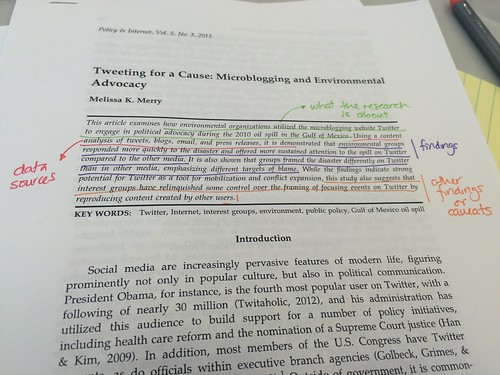
Right now I am doing a review of the literature on online activism for environmental protection purposes. This isn’t a topic that is entirely new to me, because I do know some of the work and a few of the authors who have studied this particular issue, or at least online activism. Among these I can count Dr. Melissa K. Merry (University of Louisville), Dr. Dave Karpf (George Washington University), Dr. Deen Freelon (American University) and Dr. Meredith Clark (University of North Texas). Melissa’s work is specifically on how environmental advocacy organizations have used Twitter, so citations to her work, and the papers she cites are the backbone of the literature review. Deen, Dave and Meredith have researched online activism, so their publications should be part of the contextual components.

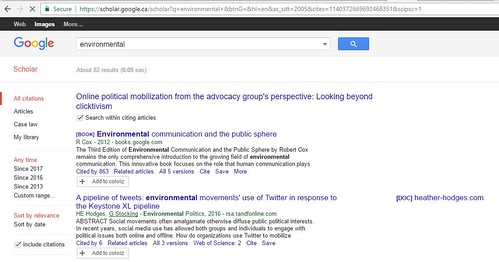
An element of undertaking a literature review that almost nobody tells you about is the serendipitous nature of finding a specific author. For example, while I have tweeted quite a lot, and I knew of the work of Dave Karpf on online activism because I followed him on Twitter, I didn’t know about the work of Melissa until she became my discussant at this year’s Midwest Political Science Association conference and I Googled her work, which is COMPLETELY relevant to what I am studying right now. I knew of Deen and Meredith’s work and their study of #BlackLivesMatter because I had followed it on Twitter. But it took me a citation tracing process based on Dave’s 2010 piece to find Heather Hodges and Galen Stocking’s article on Twitter activism against the Keystone XL Pipeline, which is VERY much specific to what I am researching now. So much of what I come across is actually rather serendipitous. Heather and Galen’s paper then became also part of the list of the anchor authors.

1. Identify the main topic and the anchor authors.

The first stage of undertaking a literature review is identifying the main topic for the review, and a few key authors, what I called in the previous paragraph, the anchor authors. For example, for this review I’m doing on online environmental activism I identified three articles by Melissa, one by Dave, as my foundation ones.

AcWri and literature reviews 018

2. Undertake a citation tracing process to check who is citing whom and whether you’ve reached conceptual saturation

As I mentioned in the prevous paragraph, from reading and summarizing Melissa and Dave’s articles, I found other authors who have done relevant and similar work, like Heather Hodges and Galen Stocking. I used citation tracing both in the case of Melissa and in that of Dave, and that’s how I converged on the Hodges and Stocking article (both Melissa and Dave were cited in their piece).

citation tracing online activism

3. Read, summarise, synthesise, WRITE.

Once I found more relevant articles, I started reading and summarizing them, and creating my Conceptual Synthesis Excel Dump. As I have mentioned before, while I create one for each research project I undertake, I don’t believe the Conceptual Synthesis Excel Dump should be submitted as part of a project report, but it IS an important component. That is, your Excel dump should exist, and it should encompass all the literature you have reviewed, but it’s not a product that a funding agency might be interested in publishing or even posting online.

Tweeting for environmental NGOs Excel dump

4. Generate the main themes for your Conceptual Synthesis Excel Dump and headings for your literature review, based on specific topics you’re researching.

The Conceptual Synthesis Excel Dump will help you create headings for your literature review, provide you with accurate quotations for your paper, and give you a snapshot, bird’s-eye view of where your paper is situated and the gaps in the literature, but it is NOT an actual scholarly output. Annotated bibliographies, banks of synthetic notes and literature reviews are actual research products.

5. Repeat the process until reaching conceptual saturation.

Depending on how in-depth I want to go, I write rhetorical precis or synthetic summaries of each article, and then dump them into my Conceptual Synthesis Excel Dump for that specific topic. I may also want to create an annotated bibliography. But sometimes I am so busy that I simply go from the Conceptual Synthesis Excel Dump to writing the literature review.

Most people I know write first an annotated bibliography and THEN, based on the results of their annotations, start writing their literature review. Since I am usually reviewing a body of works for a specific paper I am writing, I rarely have the time to write an annotated bibliography. However, something I may do is ask my research assistants to write an annotated bibliography on a broader topic and, based on that one, choose specific citations I may want to use for the literature review section of the paper I am writing.

6. Write the literature review as though you were answering questions about each subheading.

I usually break down the literature review, if it is a research product in and of itself (like the one we generated for the UC MEXUS CONACYT project) in headings and summarize how each one of the papers, book chapters and books I reviewed relates to each other within the literature, within each heading. So for example, if I were doing this literature review as a product itself, I probably would use a list of topics and headings like this:

  1. Introduction.
  2. The role of activism in policy change.
  3. Activist strategies’ repertoire: online and offline.
  4. Experiences of online activists’ in influencing domestic policy change.
  5. Environmental activists’ repertoires: online and offline.
  6. How do environmental activists use online strategies to influence policy change.
  7. Gaps in the literature.
  8. Conclusions.

Some authors, like Dr. Eduardo Araral, publish their literature reviews as scholarly pieces in international journals. This coauthored piece on Water Governance 2.0 is a really solid literature review with a critical component that provides additional insight than just summarizing the works published so far on the topic.

This paper by Benson et al is another good literature review published as a journal article (on water governance and integrated water resources management).

These pieces (by Miranda et al 2011 and by Batchelor) on water governance are not published as journal articles, but remain solid literature reviews.

This literature review by the Pacific Institute on voluntary standards in environmental regulation is also quite solid.

Overall, the exercise of undertaking a literature review is an important and necessary one for students both at the undergraduate and at the graduate level, and that’s why it is fundamental that we teach our students how to do them properly. Hopefully my post will answer some questions on how to conduct literature reviews!

28 Apr 18:02

Google specifies Pixel and Nexus end of support dates

by Igor Bonifacic
Rolandt

basially forcing people to buy a new pixel every 2 years, i think 3 years would be a lot better!

Google Pixel smartphone on table

Google has updated the Nexus and Pixel support pages to provide specific dates for when the company will stop issuing software and security updates for the Pixel, Pixel Xl and recent Nexus devices.

Both of the company’s 2016 smartphones will continue to receive major Android system updates until October 2018. Moreover, Google will continue to update the two devices against security threats until October 2019.

Neither of these dates is strictly new as they conform to Google’s previously announced promise to continue issuing security updates “for at least 3 years from when the device first became available on the Google Store, or at least 18 months from when the Google Store last sold the device, whichever is longer.” Still, it’s good to have those dates down in writing. See the full lists below.

Nexus devices

Pixel and Pixel XL

Pixel end of support date chart

Source: Google Via: Droid Life

The post Google specifies Pixel and Nexus end of support dates appeared first on MobileSyrup.

28 Apr 18:01

Apple tells Qualcomm it will not pay any royalties until legal dispute is settled

by Igor Bonifacic
Back of Product Red iPhone 7

Apple has informed Qualcomm it will withhold any royalty payments it owes the company until their ongoing legal battle is resolved.

According to Fortune, Qualcomm depends on royalties for 80 percent of its pre-tax profit. As a result of Apple’s escalation, Qualcomm has been forced to cut its Q2 revenue forecast by $500 million USD. The company has told shareholders it now expects quarterly revenue to land between $4.8 billion and $5.6 billion.

Apple does not pay Qualcomm royalties directly; instead, with licensing agreements related to the iPhone and iPad, Qualcomm charges the company’s manufacturing partners, who then pass the bill to Apple. Qualcomm revealed those manufacturers had started withholding payments earlier this month. However, the company did not provide specific financial guidance at the time.

“Qualcomm’s demands are unreasonable and they have been charging higher rates based on our innovation, not their own.”

Apple says it has spent the past five years unsuccessfully attempting to negotiate a direct licensing agreement with Qualcomm. “They have refused to negotiate fair terms,” the tech giant said in a statement. “Without an agreed-upon rate to determine how much is owed, we have suspended payments until the correct amount can be determined by the court. As we’ve said before, Qualcomm’s demands are unreasonable and they have been charging higher rates based on our innovation, not their own.”

Qualcomm, meanwhile, said, “Apple’s continued interference with Qualcomm’s agreements to which Apple is not a party is wrongful and the latest step in Apple’s global attack on Qualcomm. We will continue vigorously to defend our business model, and pursue our right to protect and receive fair value for our technological contributions to the industry.”

In January, Apple filed a $1-= billion lawsuit against Qualcomm, accusing the company of abusing its position as market leader to force unfair licensing agreements upon its customers. Qualcomm responded with a countersuit in which it argued Apple broke contract and said the company was unwilling to pay fair market value for its patents.

Qualcomm has been the subject of multiple anti-trust investigations involving regulators in the U.S., E.U. and South Korea. Since the start of the year, the company’s stock has shed 20 percent of its value. Qualcomm was recently forced to pay BlackBerry $814 million in overpaid royalties.

Source: Fortune Via: Apple Insider

The post Apple tells Qualcomm it will not pay any royalties until legal dispute is settled appeared first on MobileSyrup.