Shared posts

28 Apr 20:52

WeChat allows official accounts to create own mini-app

by Sheila Yu

WeChat recently announced a new feature called “store mini-app” (门店小程序), in its latest efforts to promote the application of its “mini-apps” (小程序).

The new feature will allow merchants to quickly create their own store mini-app on WeChat Media Platform (微信公众平台) while dispensing with the necessity of complicated app development.

The store mini-app feature is now available to official accounts registered by enterprises, media agencies, government organs and other organizations, while those registered by individuals cannot use the feature for the moment.

After official account owners fill in information on the WeChat of their business or stores, a mini-app akin to “shop name card” will be quickly generated. And store information will be displayed such as store name, store introduction, business hours, contact information, geographical location and images.

The mini-app feature was officially launched by internet giant Tencent in January, enabling users to access mobile services directly in-app. The innovative feature had a mediocre showing due in part to the feature’s limited use cases. It is time for the mini-app feature to shine as the introduction of the new store mini-app is set to increase more use scenarios.

This store mini-app can not only help merchants save costs (no need to hire third-party app developers again) and create an online display platform in a short period of time but is convenient for users to find merchants quickly.

In addition, the new function will promote the formation of a benign business path in which official account owners publish store information on WeChat while users buy services or goods offline guided by the feature. This will effectively connect online and offline channels, an uplift to the current mini-app feature which is more limited to online services.

WeChat, boasting a vast user base of 889 million MAU, has gained a significant amount of traffic through its tie-ups with third-party services such as Mobike, Didi Chuxing, JD.com, and Meituan.

With WeChat’s edges in user base and traffic, this new feature may help change the offline business landscape.

28 Apr 20:52

TTC takes 153 buses off the road due to safety concern

mkalus shared this story from TORONTO STAR | NEWS | GTA.

The TTC has temporarily taken all of its bendy buses off the road due to issues with “unexpected acceleration.”

The elongated, accordion-like vehicles account for only 153 of the TTC’s 1,900-bus fleet, and are used on just six routes: 7 Bathurst, 29 Dufferin, 36 Finch West, 85 Sheppard East, 53 Steeles Express and 41 Keele.

But TTC spokesperson Brad Ross said all bus passengers should be prepared for their Friday morning commute to take longer than usual, as buses are pulled from other routes to shore up the gaps.

“We might be two or three buses short on a route,” Ross told the Star. “We’re going to try to spread the pain out as much as possible so it’s minimal across the city.”

In a press release Thursday evening, Ross said the decision to ground their fleet of 18-metre buses was made after one of the vehicles “experienced a ‘full throttle’” during routine maintenance.

Another bendy bus — also called articulated buses — went into unexpected acceleration while being driven back to the garage, Ross said. No passengers were on board at the time.

The manufacturer of the buses, a Canadian subsidiary of Volvo Buses called Nova, was been notified and has come up with a solution to the problem, Ross said in the release.

The fix, however, takes approximately 20 minutes to implement on each bus and, as such, the fleet will not be back to full capacity until at least Friday afternoon, Ross added.

Delivered dailyThe Morning Headlines Newsletter

The Toronto Star and <a href="http://thestar.com" rel="nofollow">thestar.com</a>, each property of Toronto Star Newspapers Limited, One Yonge Street, 4th Floor, Toronto, ON, M5E 1E6. You can unsubscribe at any time. Please contact us or see our privacy policy for more information.

You might be interested in

You might be interested in

28 Apr 20:52

Fraser Voices Press Release

by Stephen Rees

In the wake of Christy Clark sending a letter to Justin Trudeau suggesting a tax on US coal exports through Vancouver would be an appropriate response to the softwood lumber tariff

Actually this lady beat her to it

Screen Shot 2017-04-27 at 9.16.39 PM


No Coal Makes Way for a Cheaper, Faster, Safer Second Tunnel


No need for $4 billion Boondoggle Bridge


After years of ignoring thousands of people complaining about the impacts of US thermal coal through the Lower Fraser Delta, Premier Christy Clark is finally acknowledging that the coal is “not good for the environment.”

Now she is asking Prime Minister Trudeau to ban the export of thermal coal.  No matter how he responds, the public now expects the B.C. Government to stop plans of Fraser Surrey Docks to export US thermal coal.

The reason for the largest, most expensive bridge ever built in B.C. is to remove the George Massey Tunnel, dredge the Fraser deeper and facilitate export of US thermal coal through Fraser Surrey Docks.

Plans also include transport of dangerous jet fuel and LNG on Panamax vessels and LNG carriers on the Fraser for the first time in history.  As Canada has no effective laws, these projects do not meet international safety standards.

With no need for coal freighters, the public should demand that the B.C. Government revive the original plans to upgrade the George Massey Tunnel and build a second tunnel by immersing a second tube.  This would be cheaper, faster, and safer.

Cheaper:    Bridge: $3.5 to $6 billion                    Tunnel:       $1 to $2 billion

Faster:        Bridge:  5 to 6 years                          Tunnel:       2 to 3 years

Safer:          During seismic activity: “Underground structures suffer minor damage       compared to aboveground structures.”

(Tunnel under seismic loading: a review of damage case histories and protection methods, page 24)

ENGOS, Journalists and Politicians

“… politicians (other than all local mayors except one) simply have done little to challenge this $3.5 Billion boondoggle when another tunnel at less than 1/4 the coast is the best alternative to protect the fragile lower Fraser River.

The issue is mainly about building a bridge that will allow large freighters and tankers up the river after the tunnel is removed and that will be a very large nail into the coffin of the Lower Fraser in that it will be followed by Port Vancouver’s grandiose plans to industrialize the estuary and lower river.

This and the Roberts Bank Terminal 2 project will be the modern era’s beginning of the final degradation process of the last significant biological values in this globally significant river and estuary. It is time that the federal Trudeau Ministers did stand up and take notice of an out of control Port Vancouver and a total lack of and or proper CEAA assessment of such large projects affecting many federal values.”

Otto Langer Fisheries Biologist

Background

The B.C. Government triple-deleted all information on how they changed plans from a twinned tunnel to a massive bridge.  Freedom of information requests from the public and MLA Vicki Huntington yielded a response of:

“Although a thorough search was conducted, no records were located in response to your request.”

However, a FOI request from Voters Taking Action on Climate Change revealed that from 2012 to 2014, the B.C. Liberals had ongoing discussions and correspondence with the federal government, the Port of Vancouver, Fraser Surrey Docks and vested interests.


Filed under: port expansion, Transportation Tagged: Massey Tunnel
28 Apr 20:52

Gender and verbs across 100,000 stories: a tidy analysis

by David Robinson

Previously in this series

I was fascinated by my colleague Julia Silge’s recent blog post on what verbs tend to occur after “he” or “she” in several novels, and what they might imply about gender roles within fictional work. This made me wonder what trends could be found across a larger dataset of stories.

Mark Riedl’s Wikipedia plots dataset that I examined in yesterday’s post offers a great opportunity to analyze this question. The dataset contains over 100,000 descriptions of plots from films, novels, TV shows, and video games. The stories span centuries and come from tens of thousands of authors, but the descriptions are written by a modern audience, which means we can quantify gender roles across a wide variety of genres. Since the dataset contains plot descriptions rather than primary sources, it’s also more about what happens at than how an author describes the work: we’re less likely to see “thinks” or “says”, but more likely to see “shoots” or “escapes”.

As I usually do for text analysis, I’ll be using the tidytext package Julia and I developed last year. To learn more about analyzing datasets like this, see our online book Text Mining with R: A Tidy Approach, soon to be published by O’Reilly. I’ll provide code for the text mining sections so you can follow along. I don’t show the code for most of the visualizations to keep the post concise, but as with all of my posts the code can be found here on GitHub.

Setup

We’d start with the same code from the last post, that read in the plot_text variable from the raw dataset. Just as Julia did, we then tokenize the text into bigrams, or consecutive pairs of words, with the tidytext package, then filter for cases where a word occurred after “he” or “she”.1

library(dplyr)
library(tidytext)

bigrams <- plot_text %>%
  unnest_tokens(bigram, text, token = "ngrams", n = 2, collapse = FALSE)

bigrams_separated <- bigrams %>%
  separate(bigram, c("word1", "word2"), sep = " ")
he_she_words <- bigrams_separated %>%
  filter(word1 %in% c("he", "she"))

he_she_words
## # A tibble: 797,388 × 4
##    story_number                      title word1      word2
##           <dbl>                      <chr> <chr>      <chr>
## 1             1                Animal Farm    he     refers
## 2             1                Animal Farm    he    accuses
## 3             1                Animal Farm    he  collapses
## 4             1                Animal Farm    he celebrates
## 5             1                Animal Farm    he  abolishes
## 6             2 A Clockwork Orange (novel)    he         is
## 7             2 A Clockwork Orange (novel)    he  describes
## 8             2 A Clockwork Orange (novel)    he      meets
## 9             2 A Clockwork Orange (novel)    he    invites
## 10            2 A Clockwork Orange (novel)    he      drugs
## # ... with 797,378 more rows

For example, we see the plot description for “Animal Farm” has five uses of a verb after “he”, such as “he refers” and “he accuses”. (Note that throughout this post I’ll refer to these after-pronoun words as as “verbs” since the vast majority are, but some are conjunctions like “and” or adjectives like “quickly”).

Gender-associated verbs

Which words were most shifted towards occurring after “he” or “she”? We’ll filter for words that appeared at least 200 times.

he_she_counts <- he_she_words %>%
  count(word1, word2) %>%
  spread(word1, n, fill = 0) %>%
  mutate(total = he + she,
         he = (he + 1) / sum(he + 1),
         she = (she + 1) / sum(she + 1),
         log_ratio = log2(she / he),
         abs_ratio = abs(log_ratio)) %>%
  arrange(desc(log_ratio))

This can be visualized in a bar plot of the most skewed words.2

center

I think this paints a somewhat dark picture of gender roles within typical story plots. Women are more likely to be in the role of victims- “she screams”, “she cries”, or “she pleads.” Men tend to be the aggressor: “he kidnaps” or “he beats”. Not all male-oriented terms are negative- many, like “he saves”/”he rescues” are distinctly positive- but almost all are active rather than receptive.

We could alternatively visualize the data by comparing the total number of words to the difference in association with “he” and “she”. This helps find common words that show a large shift.

he_she_counts %>%
  filter(!word2 %in% c("himself", "herself", "she"),
         total>= 100) %>%
  ggplot(aes(total, log_ratio)) +
  geom_point() +
  scale_x_log10(breaks = c(100, 1000, 10000, 1e5),
                labels = comma_format()) +
  geom_text(aes(label = word2), vjust = 1, hjust = 1,
            check_overlap = TRUE) +
  scale_y_continuous(breaks = seq(-2, 2),
                     labels = c('4X "he"', '2X "he"', "Same", '2X "she"', '4X "she"')) +
  labs(x = 'Total uses after "he" or "she" (note log scale)',
       y = 'Relative uses after "she" to after "he"',
       title = "Gendered verbs: comparing frequency to pronoun shift",
       subtitle = "Only words occurring at least 100 times after he/she. Overlapping labels were removed.") +
  expand_limits(x = 75)

center

There are a number of very common words (“is”, “has”, “was”) that occur equally often after “he” or “she”, but also some fairly common ones (“agrees”, “loves”, “tells”) that are shifted. “She accepts” and “He kills” are the two most shifted verbs that occurred at least a thousand times, as well as the most frequent words with more than a twofold shift.

“Poison is a woman’s weapon”: terms related to violence

Women in storylines are not always passive victims: the fact that the verb “stabs” is shifted towards female characters is interesting. What does the shift look like for other words related to violence or crime?

center

There’s an old stereotype (that’s appeared in works like Game of Thrones and Sherlock Holmes) that “poison is a woman’s weapon”, and this is supported in our analysis. Female characters are more likely to “poison”, “stab”, or “kick”; male characters are more likely to “beat”, “strangle”, or simply “murder” or “kill”. Men are moderately more likely to “steal”, but much more likely to “rob”.

It’s interesting to compare this to an analysis from the Washington Post of real murders in America. Based on this text analysis, a fictional murderer is about 2.5X as likely to be male than female, but in America (and likely elsewhere) murderers are about 9X more likely to be male than female. This means female murderers may be overrepresented in fiction relative to reality.

The fact that men are only slightly more likely to “shoot” in fiction is also notable, since the article noted that men are considerably more likely to choose guns as a murder weapon than women are.

Try it yourself

This data shows a shift in what verbs are used after “he” and “she”, and therefore what roles male and female characters tend to have within stories. However, it’s only scratching the surface of the questions that can be examined with this data.

  • Is the shift stronger in some formats or genre than another? We could split the works into films, novels, and TV series, and ask whether these gender roles are equally strong in each.
  • Is the shift different between male- and female- created works?
  • Has the difference changed over time? Some examination indicates the vast majority of these plots come from stories written in the last century, and most of them from the last few decades (not surprising since many are movies or television episodes, and since Wikipedia users are more likely to describe contemporary work).

I’d also note that we could expand the analysis to include not only pronouns but first names (e.g. not only “she tells”, but “Mary tells” or “Susan tells”), which would probably improve the accuracy of the analysis.

Again, the full code for this post is available here, and I hope others explore this data more deeply.

  1. Gender is not a binary, so please note that this analysis is examining how the Wikipedia description’s author refers to the character. For example, we miss cases of singular they, but it would be challenging to separate it from the more common plural. 

  2. I’m also skipping the words “himself” and “herself”, which are the most gender-shifted words but aren’t interesting for our purposes. 

28 Apr 20:52

Building Online Community Engagement Systems Rooted In Psychology

by Richard Millington

To understand sustained participation in a community, you have to understand CAR.

This stands for Competence, Autonomy, and Relatedness.

It’s self-determination theory which has a lot of supporting studies (unlike Maslow’s Hierarchy of Needs, which has none).

Peak motivation is reached when we satisfy three needs.

  1. The need for competence
  2. The need for autonomy
  3. The need for relatedness

You can see a community-adapted model here:

Being Honest With Yourself, Why Do You Participate?

If you’re truly honest with yourself, you will probably admit you participate in a community because you like to feel smart and appreciated.

You like to feel you belong as part of a group of peers. You like that sense of recognition when you provide good solutions to challenging problems.

We’ve tried and tested multiple theories and ideas to sustain participation from community members.

Nothing has proven anywhere near as successful as systematically and incrementally helping members feel smarter, have more autonomy, and form more genuine relationships with members.

Every program you initiate in your community should be focused on helping members feel higher levels of competence, autonomy, and relatedness.

No other rewards you can offer members will come close to matching these.

But, You Need Systems (not one-off tactics).

However, for this to work, you need sustainable systems; not one-off tactics.

You need systems that will take a newcomer and gradually make them smarter, give them more responsibility within the community, and connect them with people like them.

This talk, for example, is almost entirely about systems to achieve this.

If you can’t see the video below, click here.

During Psychology of Communities, we’re going to spend time teaching you to design these engagement systems supported by psychology.

There is an incredible opportunity to work to increase the level of activity in your community by designing great systems.

Once you design your system, you know what behaviors and can align your daily actions to match.

p.s. The price will rise tonight, please sign up before then.

p.p.s. Remember you can also sign up for both our Strategic Community Management program and Psychology of Community for $1,100 USD before tomorrow.

28 Apr 20:52

This startup wants to shake up data visualization with VR

by Emma Lee

Our world is now brimming with data. Every home, office, machine and people is contributing their own bits and bytes to the every-growing data pool. Data collection is not the problem anymore. The problem now is understanding it and gleaning insights.

Kineviz, a startup that offers custom data visualization solutions and tools for enterprises, wants to solve the problem by drawing upon VR technology. The company’s product is basically based on a per client basis so as to satisfy specific requirements from different customers in a bit to make complex data easy to understand. The form of the product varies according to customer demands from conference experiences, apps, and internal tools.

Kineviz

Kineviz team — From left to right: Sony Green, Weidong Yang, Travis Bennett

“For a lot of things, 2D is still the best solution,” reckoned Sony Green, head of business development. “But VR offers a lot of advantages over existing data visualizations solutions, especially for certain kind of datas. When you get into really high dimensional data, something like 100 different dimensions per node. It’s difficult to keep track of all that info with lots of 2D graphics and it becomes a very large cognitive load for people to track them on multiple screens at once.”

VR allows us to tap into our natural abililty to process special information. Without looking around, we have an innate understanding of the spaces we are in because that’s how our brains are wired. In a simulated environment created by VR, we use these natural ways of processing information that a 2D screen can’t offer.

Furthermore, VR opens up use cases that were previous impossible by lowering the barrier for common users. You don’t have to be a data scientist: anyone who can play a game can use VR to explore data science in a way that is intuitive.

Thanks to the special capabilities of VR data visualization, this technology is now mainly applied into areas that need to process data with high complexity, such as healthcare and file sharing. Kineviz has already developed solutions for Baystreet Research, Box, and Berkeley.

Adopting a hardware agnostic approach, Kineviz is engaged in developing web VR, which all mainstream VR headsets like HTC Vive and Oculus support. “There’s more flexibility and we can handle all the functionality without having to develop separate solutions,” Sony noted.

Right now games and simulation are pretty much where everyone is focused, but the maturing VR market is also pointing to more business applications of the technology and data visualization is one of the areas it has great potentials.

In addition to VR, Sony says that the firm us also looking into AR. “The hardware and the overall experience of VR is so much more cohesive right now than the AR solutions we have seen,” he said. “That means when AR hardware catches up, we already have some of the questions answered in terms of ways to poach the interface and to program for a 3D special awareness of data.”

Weidong Yang, a Chinese American physicist entrepreneur, founded the company with technologist Travis Bennett in 2014. Based on a shared interest in dancing, Yang also founded Kinetech Arts, a not for profit dance performance company, where dance artists, visual/sound artists, engineers and scientists work together, with the vision of enriching the experience of live performance by the advance of science and technology.

28 Apr 20:51

Bike-rental war escalates with Alipay supporting “scan-and-ride” function for six bike-rental apps

by Emma Lee

Alipay, the online and mobile payment platform operated by Ant Financial, has teamed up with six bike-rental apps to allow users to rent 6 million bikes in 50 cities across China directly through the app’s new “scan and ride” function.

Users can unlock any ofo, YouonBike, Bluebike, hellobike, Ubike or funbike vehicle simply by scanning its QR code through the Alipay app starting from today, the company announced.

Bike-rental has exploded in China over the past year, with tens of millions of users taking millions of rides every day across the country. However, users are facing with an increasingly bothering problem of choosing between a “rainbow” of different bike rental services. For users, new service eliminates the need to download individual apps for each service. For the companies on the other hand, the partnership helps both parties to drive more traffic.

Bike-rental apps are no longer the only place where urban commuters can borrow a bicycle. Behind the heating competition, there’s an increasing presence of internet giants, who are entering the battle field through capital injection or product line-up, or both.

Mobike’s service was integrated this March into WeChat, a popular messaging app developed by Mobike’s investor Tencent. Didi also added ofo to its app earlier this week in a similar move.

Although Alipay’s cooperation comes a bit late, it has certain advantages. The sheer number of partners, which indicates more bikes, is a plus in a market where bike availability is the top priority for users. When Alipay users scan the QR code, no user registration for separate bike-rental apps is needed for renting the bike. In addition, any user that rents a bike through Alipay automatically receives comprehensive accident insurance.

“Bike-sharing is transforming lifestyles across China, providing a healthy, convenient and affordable way to get across town. Integrating Alipay with these apps will make life even easier for users and help the industry continue its tremendous growth.”

~ Chen Long, Chief Strategy Officer of Ant Financial

Before this product tie-up, Alibaba has already tapped the market through its credit rating system Sesame Credit. Ofo and YouonBike allow users with qualifying scores on Sesame Credit to rent bikes without a deposit.

28 Apr 20:51

My Parents Went to Domains17 and All I Got Was This Lousy T-Shirt

by Reverend

Have you registered for Domains 17 yet? There is no time like the present! Especially since we are presently working on the conference t-shirt. Bryan Mathers came up with the following sketch of the shirt…

…based on this email by Lauren Brumfield to get the word out to folks who expressed interest as well as a gentle reminder for scheduled presenters to register. 

There has been some guff from folks, specifically our fellow conference organizer Adam Croom, about Reclaim’s resistance to black t-shirts. Tim Owens has gone on record about his problem with the hegemony of Def Leppard-inspired concert Ts, but Adam promised us the black t-shirts would mean more registrants so it is time for you all to prove him wrong so we can go back to the many colors of the Reclaim Rainbow.

But if you register now we will not hold it against you either.

28 Apr 20:51

Data exploration banned

by Nathan Yau

Statistician John Tukey, who coined Exploratory Data Analysis, talked a lot about using visualization to find meaning in your data. You don’t always know what you’re looking, so you explore it visually. Etyn Adar, who teaches information visualization at the University of Michigan, makes a good case for banning the phrase in his students’ project proposals.

For all the clever names he created for things (software, bit, cepstrum, quefrency) what’s up with EDA? The name is fundamentally problematic because it’s ambiguous. “Explore” can be both transitive (to seek something) and intransitive (to wander, seeking nothing in particular). Tukey’s book seems emphasize the former — it’s full of unique graphical tools to find certain patterns in the data: distribution types, differences between distributions, outliers, and many other useful statistical patterns. The problem is that students think he meant the latter.

I see this sort of thing in my suggestion box too. Data exploration with visualization is good, but when someone describes their project as an exploration tool, it often means it lacks focus or direction. Instead it looks like generic graphs that don’t answer anything particular and leave all interpretation to the reader.

Tags: exploration, John Tukey, teaching

28 Apr 20:51

Smoking Hot Cruzbike T50 Kickstarter still has Some Pain-free Recumbent Ergonomic Bikes Left

by Average Joe Cyclist

Cruzbike T50 Deluxe Green MachineCruzbike has introduced a recumbent bike that is designed ergonomically for pain free cycling. The Kickstarter has been live for only a week, yet is already fully funded. The Cruzbike T50 Kickstarter raised an amazing $100,000 in less than 48 hours. Clearly, there is a big demand for affordable, high-quality, ergonomic bikes. The good news is that some of these innovative new recumbent bikes are still available.

The post Smoking Hot Cruzbike T50 Kickstarter still has Some Pain-free Recumbent Ergonomic Bikes Left appeared first on Average Joe Cyclist.

28 Apr 20:51

Exploring the Deep Web: A Knowledge Vs Comfort Dilemma

files/images/dw5.png

Ludovico Ristori, Digicult, May 01, 2017


Icon

The thesis of this article is that the deep web isn't all bad, and that though it contains quite a bit that actually is bad, it is nonetheless worth exploring. "Probably the real interesting element of DW is that it obligates you to choose a personal way of exploring. You can make a lot of different choices and you are, actually, put face to face with your real nature of student, researcher or simple citizen.  Are you ready to risk something to know or understand something?" This is a a bit of a travelogue of the deep web, and a bit of an homage to it.

[Link] [Comment]
28 Apr 20:51

Most Popular This Week

by WC Staff
28 Apr 20:50

Life expectancy if all diseases were magically cured

by Nathan Yau

Here’s a fun what-if simulation that imagines a world where all natural causes of death were gone. People only die of things like car crashes and homicide. The result: people who live to thousands of years old.

Of course, this assumes that the likelihood of dying from external causes stays the same. With such a long life expectancy, do people start to take more risks? Or do we become more sloth-like because we have all the time in the world? Ah, that’s a thinker.

Want a simulation closer to reality? Here you go.

Tags: mortality, simulation

28 Apr 19:57

Google Now Clearly Mentions When Pixel and Nexus Devices Will Receive Their Last Security Updates

by Rajesh Pandey
Google has always made it clear that it would be providing OS updates to its Nexus and Pixel devices for two years since their launch and security updates for three years. Today, Google is explicitly making it clear as to how long it will be supporting its existing Pixel and Nexus devices. Continue reading →
28 Apr 19:57

Science has outgrown the human mind and its limited capacities – Ahmed Alkhateeb | Aeon Ideas

wildcat2030:

See on Scoop.it - Knowmads, Infocology of the future

Science is in the midst of a data crisis. Last year, there were more than 1.2 million new papers published in the biomedical sciences alone, bringing the total number of peer-reviewed biomedical papers to over 26 million. However, the average scientist reads only about 250 papers a year. Meanwhile, the quality of the scientific literature has been in decline. Some recent studies found that the majority of biomedical papers were irreproducible.

The twin challenges of too much quantity and too little quality are rooted in the finite neurological capacity of the human mind. Scientists are deriving hypotheses from a smaller and smaller fraction of our collective knowledge and consequently, more and more, asking the wrong questions, or asking ones that have already been answered. Also, human creativity seems to depend increasingly on the stochasticity of previous experiences – particular life events that allow a researcher to notice something others do not. Although chance has always been a factor in scientific discovery, it is currently playing a much larger role than it should.

One promising strategy to overcome the current crisis is to integrate machines and artificial intelligence in the scientific process. Machines have greater memory and higher computational capacity than the human brain. Automation of the scientific process could greatly increase the rate of discovery. It could even begin another scientific revolution. That huge possibility hinges on an equally huge question: can scientific discovery really be automated?

Of course it can.

28 Apr 18:04

Google Wifi offers Canadians a sleek 3-piece mesh network for $439

by Rose Behar
Google Home

Nearly seven months after debuting in the United States, Google has now brought its Google Wifi expandable mesh network system to Canada. The tech giant joins a relatively small pool of mesh offerings currently available — primarily Linksys’ Velop system, Netgear’s Orbi, Securifi’s Almond 3 and Amped Wireless’ Ally — and it does so at the competitive price of $439 CAD for a three-pack and $179 for one individual router.

Since it hit the shelves today, April 28th, at the Google Store, Best Buy Canada, Staples Canada and Walmart Canada, I took the system for a test drive to see if it was a drastic improvement over my own single router, the Rogers-provided Hitron CGN3ACSMR.

So what is a mesh network and why is it better than a single router? If you’ve ever encountered dead zones within your home where the Wi-Fi connection is weak and perhaps even non-existent due to the construction of your home, interference or sheer range, then you’ve hit on the reason behind wireless mesh networks.

Google Wifi in box

A wireless mesh network uses multiple wireless routers — or as Google calls them, ‘points’ — to provide better coverage over a certain area of space. The routers communicate with each other, thus providing more seamless hand-offs than a wireless repeater may be capable of, and enlarging the size and stability of Wi-Fi access in your home.

Google first began developing its interest in Wi-Fi hardware approximately four years ago, according to the company. It eventually came out with the OnHub router (co-developed with TP-Link) in August 2015. The router came along with an app that promised users the ability to carry out troubleshooting and administrative changes using an app — rather than the more common, and confusing, web interface.

Google Wifi, which can be used together with OnHub, is the next evolution of the Mountain View company’s router aspirations.

Visually, it has a beautiful, minimal all-white aesthetic that would look very much at home in an Apple Store. It’s round with a flat top and the width of an average grapefruit. Everything about the device is matte white, apart from a very subtle ‘G’ on top and a cutout around the middle that emits blue light. On the back is an in-line reset button.

There’s a distinctly futuristic vibe about the whole thing. I feel as if a robot voice may emit from it at any moment — though Google Home and Wifi product lead Ben Brown refrained from commenting on whether the company’s AI speaker Google Home might eventually be packaged together with the system at a recent press briefing in Toronto.

google wifi kitchen 2

At that same briefing, Brown said that the stylish appearance of Google Wifi was in fact a key design element for functionality. After all, typical routers usually aren’t something that people like to display. They have big antennas, bulky cords and designs that don’t take interior decor in to account. As a result, they are often confined to closets or secluded areas of the home where guests won’t see them. They’re Boo Radleys. Unfortunately, tucking your router away also reduces its signal strength.

“The fact that it was ugly and had to be hidden was a design issue,” said Brown, noting that the Google Wifi points are designed to be attractive enough to place in plain view on a side table or shelf, for instance.

In that regard, Google Wifi succeeds. I find the points actually add to the aesthetic appeal of my home. Though I will note that the system didn’t completely solve the issue of displaying my less beautiful Hitron router, since it must be connected to Google Wifi by an ethernet cord for the system to work, and there is no handy place in my living room to hide it.

Another aspect of the traditional router experience that Google aims to solve with its Wifi mesh network is the user interface with which you control it. Instead of going to your router’s daunting web control interface, you just download an app — Google Wifi — that first helps you through setup and then provides a robust set of functionalities for ruling over your own Wi-Fi kingdom.

One of my favourite features of the app is the setting that lets you easily prioritize certain devices to receive more bandwidth. You can also easily see and share passwords and create a guest network while still allowing friends to access specific devices like a Chromecast.
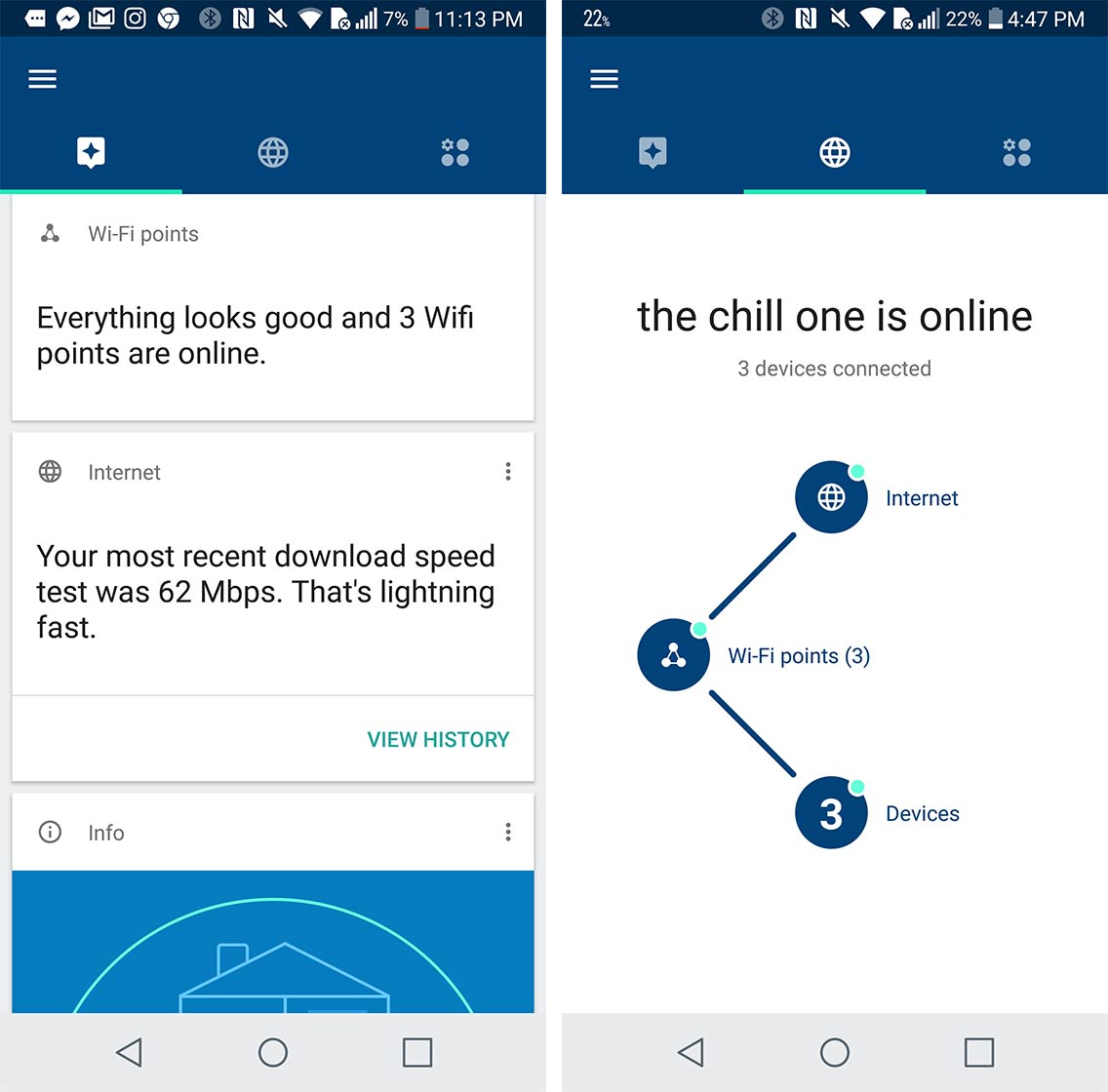
google wifi app screenshot

Those who have kids will likely enjoy the fact that they can pause Wi-Fi access for their childrens’ devices (or schedule pauses) and those with less tech-inclined parents or seniors in their lives can become a remote network manager for another home’s mesh system through the app.

Additionally, you can see what devices are connected, remotely check the health of your own network and run speed tests. All this, in an extremely simple-to-use app that looks a bit like a network-specific version of Google Now.

At the press briefing, Brown brought up the fact that “a good bulk of [the] team was based out of Canada and still is,” and that they contribute primarily to the mobile app and on-device software — which means Canadians are to thank for its ease of use.

Yet another key selling point for Google Wifi — it’s easier to setup than other routers. In theory, this is true. In practice, I ran into some trouble with the super simple one-page card of instructions.

On every Google Wifi point (all of which are identical) there are two Gigabit ethernet ports and a USB-C port. What I didn’t know, and what the instructions didn’t state explicitly, is that only one port on each point is able to function as a WAN port and so I first plugged the ethernet cord from my Hitron router into a LAN-only port. After a period of confusion, it was pointed out to me that a visual on the card showed a green globe by the WAN port which matched up with an indicator on the device itself.

Stupid mistake, sure. But I also think it’s an indication you can go too far when it comes to minimal instruction pages.

google wifi rear

In any case, once that issue was resolved, setting up the other points took only a matter of minutes. All my roommate and I needed to do was plug them in and pair them with the app.

As a side note on security — Brown states that during the setup process an encrypted connection is made between the phone, the app and the device in order to secure data, and each point has a trusted platform module (TPM) — a dedicated microcontroller designed to secure hardware by integrating cryptographic keys into devices.

Additionally, in case you were wondering whether Google is standing by its motto of “Don’t be evil” and respecting your privacy, the company published a post that states: “the Google Wifi app and your Wifi points do not track the websites you visit or collect the content of any traffic on your network,” though it does collect data such as Wi-Fi channel, signal strength, and device types. Users can manage the three types of data collected — cloud services, Wifi point stats, and app stats — in the app.Google wifi on floor

Once I had all the points setup and named by room, I got to work speed testing in order to compare the results with my pre-Google Wifi tests.

For reference, my household runs on a Rogers Ignite 60 internet plan — a plan that is no longer on the market, replaced by Rogers Ignite 75. It promises speeds of up to 60Mbps download and 10Mbps upload. While those speeds (and higher) have been accurate where the router sits, in the front part of my very long apartment, service has been terrible in my bedroom about five rooms down. Can’t-even-watch-Netflix-terrible.

In the living room, where the router has always been, Google Wifi didn’t provide a hugely significant improvement to speeds.

The average download speed I was receiving before setting up Google Wifi (tested through Speedtest by Ookla, Netflix’s Fast.com and Rogers’ own tool) was 67.74Mbps, the average upload speed 10.97Mbps and the average latency 12ms.

After setting up Google Wifi, I saw an average of 70.40Mbps down, 10.89Mbps up and 13.5ms latency. Then, curious to see if there would be a tangible difference in performance, I tested once again after I turned off wireless for the Hitron router. The result was a slight increase of 70.67Mbps down, 11Mbps up and 13.5ms latency.

More important to my overall enjoyment of my home’s Wi-Fi network, however, was the reception in my own bedroom, separated by a long corridor and five rooms’ worth of thick walls. In that respect, the difference is extreme, and significantly improves my quality of digital life.

After setting up the point in my bedroom, I experienced a robust 71.47Mbps down, 11.07Mbps up and 14.5ms latency. Without the point, I receive 32.09Mbps down, 10.83Mbps up and 16.5ms latency.

Google wifi side

Google Wifi provides these speeds through AC1200 2×2 Wave 2 Wi-Fi technology with simultaneous dual bands (2.4GHz/5GHz) supporting IEEE 802.11a/b/g/n/ac. It should be noted that its specs and slightly meager port offerings per device certainly aren’t the best on the market.

In contrast, the Netgear Orbi two-pack (which retails for about $549.80) is tri-band (2.4GHz/5GHz) and has four gigabit ethernet ports on each router.  The Linksys Velop three-pack (about $550) is also tri-band and has two WAN/LAN auto-sensing gigabit ethernet ports per device.

Of the other Canadian wireless mesh competitors available in Canada, neither boast tri-band technology. The Amped Wireless Ally-0091K (about $429.44) has a USB port, modem port and three gigabit LAN ports on the main router and one gigabit port on the ‘extender,’ while the Securifi Almond 3 comes in at about $499.99 and has one WAN gigabit port, two LAN gigabit ports and one USB 2.0 port per device.

But when it comes down to it, Google Wifi isn’t really about the specs. It’s about design and simplicity of use. And with its easy-to-navigate and extremely functional app and gorgeous design, the device has nailed that value proposition.

The post Google Wifi offers Canadians a sleek 3-piece mesh network for $439 appeared first on MobileSyrup.

28 Apr 17:44

Maciej Ceglowski, Build a Better Monster: Morality, Machine Learning, and Mass Surveillance

Maciej Ceglowski, Build a Better Monster: Morality, Machine Learning, and Mass Surveillance:

There’s an uncomfortable feeling in the tech industry that we did something wrong, that in following our credo of “move fast and break things”, some of what we knocked down were the load-bearing walls of our democracy.

[…]

Everything moves in the direction of greater surveillance.

He is a strong dissident voice, countering the techno-utopian unicornism that generally dominate discussion of tech culture.

In any setting where attention is convertible into money, social media will always reward drama, dissent, conflict, iconoclasm and strife. There will be no comparable rewards for cooperation, de-escalation, consensus-building, or compromise, qualities that are essential for the slow work of building a movement.

(h/t Scott Rosenberg)

I am reminded of my recent 10 work skills for the postnormal era, where I touched on Complex Ethics, and postnormal traumatic stress syndrome: 

The decline in faith, the break in identification with trusted organizations (government, religion, unions, nationalism), and the apparent collapse of the social contract all contribute to what I call postnormal traumatic stress syndrome: we are stressed beyond the breaking point by the postnormal world, but it’s not in the past. We are not past that stress: it’s an on-going state; permanent, and seemingly inescapable.

We live in a time of dilemmas, not simple problem solving. The tools we have shaped are making a new world, and it has purpose. But the purpose is not necessarily making a better world for all of us. Maybe just for some.

28 Apr 17:44

America’s Rich Get Richer and the Poor Get Replaced by Robots

America’s Rich Get Richer and the Poor Get Replaced by Robots:

The rich-poor gap – the difference in annual income between households in the top 20 percent and those in the bottom 20 percent – ballooned by $29,200 to $189,600 between 2010 and 2015, based on Bloomberg calculations using U.S. Census Bureau data.

Computers and robots are taking over many types of tasks, shoving aside some workers while boosting the productivity of specialized employees, contributing to the gap.

“Technological developments have increasingly replaced low- and mid-skilled jobs while complementing higher-skilled jobs,” said Chad Sparber, an associate professor and chair of the economic department at Colgate University.

Read more: Robots Are Slashing U.S. Wages and Worsening Pay Inequality

This shift is predicted to continue. About 38 percent of U.S. jobs could be at high risk of automation by the early 2030s, according to a study by PricewaterhouseCoopers LLP. The “most-exposed” industries include retail and wholesale trade, transportation and storage, and manufacturing, with less-educated workers facing the biggest challenges.

Companies’ use of temporary and part-time employees to cut costs also may be widening the disparity, with wage growth failing to keep up with rising residential and basic-necessity expenses. As the divide grows, hardships increase for the bottom 20 percent. Affordable housing, for example, is in short supply nationwide, forcing workers to find shelter further from their jobs and endure lengthier and costlier commutes. Rental costs rose nationally by 3.9 percent in March from a year earlier, according to the Labor Department.

28 Apr 17:44

ISS Solar Transit 2

mkalus shared this story from xkcd.com.

Most people don't realize it, but they actually launch a new space station every few weeks because this keeps happening.
28 Apr 17:44

#Surrey #RCMP are responding to a complaint from a resident that a neighbour is playing with his garden hose.

by scanbc
mkalus shared this story from scanbc on Twitter.

#Surrey #RCMP are responding to a complaint from a resident that a neighbour is playing with his garden hose.


Posted by scanbc on Fri Apr 28 05:39:25 2017.


309 likes, 202 retweets
28 Apr 17:44

Shape My Grips Review

by Average Joe Cyclist

Shape My Grips offers grips for the top bar and the drops of your road bikeIf you are the type of cyclist who likes to make their road bike ride as comfortable and personalized as possible, Shape My Grip might be for you! In a nutshell, SMG (Shape My Grip) offers grips for the top bar and the drops of your road bike. Instead of gripping a flat bar or drop, you get to nestle your fingers into ergonomic grips with slots for your fingers, making for a more comfortable, secure ride. And you can further customize them with an Exacto knife! Post includes installation videos, plus a how-to on applying handlebar tape to your handlebars.

The post Shape My Grips Review appeared first on Average Joe Cyclist.

28 Apr 17:44

No One Wants to Talk About Second Hand Bikes

by dandy


Uncle Jacob's less-than-organized basement stock 

The Secret Lives of Second Hand Bikes
Why doesn't any one want to talk about [the lack of] second hand bikes for sale in Toronto?

By Taylor Moyle
Photos by Tammy Thorne and Cayley James

Finding a cheap bike in Toronto is hard. I'm a student on a fixed budget, and biking is the easiest and one of the cheapest ways to get around downtown. After my bike was stolen (yet again) recently I decided to look into the second hand bike shops. It was a search that was much harder than anticipated. To my surprise the city is seriously lacking in brick and mortar shops that sell used bikes.

I went to investigate exactly why this was the case. Why are there hardly any bike shops that sell second hand bikes? And for the ones that do, I wanted to find out how they’re getting their bikes. What I found were rude shop owners, defensive store clerks, and others simply just not wanting to talk.

Uncle Jacob’s, a spot on Spadina just south of College, has a sign out front that reads: “A great place to shop for less.” According to my editor the shop is rumoured within the cycling community as a place that sells stolen bikes. The infamous bike thief Igor Kenk was the last known kingpin of bike theft in the west end. Bikes are still getting stolen in Toronto though. Where are they going?

There haven’t been too many instances of people finding their stolen bikes in shops like Uncle Jacob's, though. But, says Toronto Police Officer Jenniferjit Sandhu, “If a bike is located in a second hand bike shop and there is reasonable grounds to believe it is stolen, contact police immediately.” Police also suggest you register your bike with them. (We suggest locking your bike properly, take a photo of it, and and bring it inside overnight.)

When I entered Uncle Jacob’s there were two sections of bikes. The employee there told me that one side was used and the other was second hand. The shop attendant reassured me that all new bikes are built new from the box, after I questioned the rustiness.

Uncle Jacob's basement is jammed full of bikes.

I later approached the guys at Cyclemania on Bloor West to try to find out more information about second hand bikes - and see if I could 'ethically' source one for myself. I went to the shop at around 3 p.m. and was unable to go in as the door was locked. They unlocked the door, after returning from lunch (which looked like it may have been a trip to the LCBO) and I then met the employees.

One man, bundled up in a jacket and toque (since the place doesn’t appear to have heating) greeted me with a tallboy in his hand and asked what I wanted.

Another man came up from behind him with a short glass of brown liquid (I was thinking 'whisky') and  asked me why I wanted to know about the second hand bikes at their shop.

“We steal them,” one man taunted.

“He’s obviously joking,” the toque-wearing employee added quickly.

I continued to try to ask about second hand bikes, asking if they or the owner would want to talk about it for an interview with this bike magazine. Since the owner wasn’t there at that time, I said I’d come back. As I was walking out one guy yelled: “I’ll save you the trip. Don’t come back. He doesn’t want to talk about it and neither do we.”

This was an ongoing problem with most of the shop owners I tried to talk to. No one wanted to talk about second hand bikes. Not even Public Butter, a really groovy vintage clothing and furniture shop that sells a few used bikes that they get from estate and barn sales outside of the GTA, where they get most of their other stuff.

Public Butter in Parkdale has a small selection of second hand bikes in disrepair (they do not have a mechanic on staff anymore.) Some of the inexpensive beauties are pictured above.

 All of this sketchy behaviour was confusion because you know what? Selling second hand bikes is totally legal.

Second hand bikes at this junk shop in Kensington Market were selling for anywhere from $60 to $150 dollars.

One shop owner that was willing to speak to me was Uncle Jacob himself. 

It wasn’t easy to get in contact with him. His real name is Jacob Feiv. I first spoke with Feiv when I called him and asked him for an interview over the phone. He was fine with it until I asked him the first question:

“Where do you get your second hand bikes?”

He told me he didn’t want to do this over the phone and would rather speak about it in person. And so, a few weeks later, I finally found myself outside of Uncle Jacob’s shop yet again.

I waited, as I had done before, wondering if Feiv would show up. Then, just after 11:00 a.m. I saw a hefty old man walking down the street towards me. He looked like one of my uncles.

In terms of where Feiv is getting second hand bikes he said he gets them from three or four people who he trusts and they supposedly get them from garage sales. Feiv also said over 70 per cent of his bikes are new.

This is difficult to believe though. Not just based on my experience in the store but also on what my colleague reported. After my conversation with "Uncle Jacob," at the request of our editor, another dandyhorse staffer swung by the shop to see if she could get into the basement where there was a fabled stash of stolen bikes. My colleague visited and the employee who was there at the time (who was definitely not Feiv) had no problem with her going into the basement.

As you can see from the photos is seems like much more than just 20 or 30 per cent of his bikes are second hand, especially with half the bikes on the top floor being sold as used. 

Feiv had said he had gotten crates of bikes from Bicycles for Humanity. A company that, according to him was sending bikes to Africa, but since they weren’t mountain bikes Feiv was able to purchase them. But when my colleague spoke to the other employee he stuck to the line that they were from a few guys trawling yard sales. But definitely “NO STOLEN BIKES.”

It takes work to properly receive a second hand bike without breaking the law. From taking the serial number, manufacturer, make and personal details of the seller - it's a time consuming process for even the most organized retailer.

We called around to a couple of shops across the GTA that were known to be legitimate retailers to get their take on the situation.

"We stopped selling them about two years ago," said Mike from Cycle Solutions on Kingston Road in the east end, after one too many obviously stolen bikes came into the store. Their decision was prompted by having no legal recourse, and they felt it was the right thing to do for their community. 

In the west end Newson's will do exchanges and also buying bikes off of people. Justin said that they always ask for photo ID, take down serial numbers and report it to the police if they have suspicions.

We're still not sure where to find a good karma second hand bike in Toronto, but one thing we know for sure: The stolen bike problem in Toronto is still happening even without Igor so don't forget to lock up properly and take your baby inside for the night.

Related on dandyhorsemagazine.com

Bike Locks That Will Make You Feel Like You’re From The Future

Bike Theft at GO stations: A Growing Problem?

Kenk the film

7 Ways to Save your Lover

Bike locks that will make you feel like you are from the future

28 Apr 17:43

McArthurGlen YVR Mall-Parking for Customers, Employees not so much.

by Sandy James Planner

mcarthur-glen-slider

According to The Richmond News (and thanks to Scot Bathgate for alerting Price Tags) there is a season of discontent with the clerks and part-time workers at the airport’s McArthurGlen designer outlet shopping mall. This mall has been doing a booming business at its pseudo European storefront facade mall, located about a one kilometer walk  from the Templeton Canada Line Station.

The mall has a 2,000 space parking lot for its customers, but nowhere for employees to park free. Nearly 70 of the 600 employees have been parking their vehicles on a piece of airport owned land to the west of the mall. All was good until the airport announced that starting May 1 parking would be $4.00  for four hours on that piece of land. Since many of the part-time workers make the $10.85 minimum wage, that does represent a sizable chunk. There is another parking lot at the Templeton Canada line station but that cost is nearly $70.00 a month.

Now of course some Price Tags readers will think it seems strange that employees expected to park for free, or that the fact there was no employee parking was not mentioned in the interviews. But as the Richmond News found out, some employees came to work at the airport mall because it was “closer to her Richmond home” and “I came here to cut down on transit costs. Lots of other malls have designated parking for staff.”

In Metrotown there is a parking for employees as well as at the Tsawwassen Mills mega mall.  One manager noted that the McArthurGlen parking lot was never full and it was for appearances that employees were to park away from customers. “I used to work at Metrotown (in Burnaby) and it has parking for employees. Our parking lot here is very seldom full,” said the woman, who suggested not allowing staff to park alongside the customers was all about appearances.

There is of course the ability to take the Canada line to Bridgeport Station and connect to express buses across the region from that location. It is also Sea Island policy for everyone to pay for parking on the island. Should regional malls be providing parking for employees driving to work?

monopoly-1


28 Apr 17:43

Harbour to Harbour Vancouver to Victoria Coming Soon

by Sandy James Planner

lb200220v2v20empress20final20mock-up_0

Scot Hein, architect and urban designer said that once you had a  subway system that connected your downtown, you had arrived as a city. The same cosmopolitan factor applies for seamless, carless connections to places connected by water, especially Victoria on Vancouver Island.

The new Vancouver to Victoria service by ferry connecting the downtowns by V2V Vacations will travel from Victoria’s Inner Harbour to Coal Harbour.  The service is expected to start in mid-May. Vancouver Courier’s Andrew Duffy reports that the 3.5 hour trip will be made with leather seats, on-board wi-fi and you can order beer and wine. Another firm, Clipper Navigation will join V2V Vacations on this route next year.

“The trip is estimated to take 3.5 hours.When it is up and running, V2V’s Victoria departures will leave from beside the Steamship Terminal Building at 2 p.m. and Vancouver departures from the Vancouver Convention Centre docks leaving at 8 a.m.”

Unfortunately this connection is not cheap. Adults will pay between $120 to $240 one way, and you are asked to check in about one hour prior to departure. You can find out more and make your reservation here.

The last passenger service between the two harbours 14 years ago closed after 19 months, with low ridership. Are there enough tourists and commuting locals  for this route to be sustainable?

v2v-empress-ferry-696x392


28 Apr 17:43

“Show Courage, Please U-Turn on the Massey Bridge Decision”

by Sandy James Planner

tunnel-open-house

Another cogent letter in the Richmond News written by Andy Hobbs questions the expenditure of $3.5 billion dollars (now forecast to exceed $4.5 billion dollars) on the  Massey Bridge, which at three kilometers  will be the longest bridge in the province. “The 3,000-metre proposed bridge replaces a 629-metre tunnel in order to cross a river that’s about 200-metres wide.  “

In 2004, the province invested $22.2 million in seismic upgrades to the existing tunnel which has a remaining life span of 10 to 15 years. The highest estimate for twinning the existing tunnel is $1.7 billion and takes far less time than the new bridge’s construction. 

“Of course, there are other considerations beyond practical budgetary factors. The visual footprint of the proposed bridge would dominate the surrounding flat landscape and consume arable land and planned city parkland. While the new bridge would be an impressive structure, its 10 lanes, immense multi-storey profile, and 3,000-metre length would overpower neighbourhoods on both sides of the river. Our goal, whenever practical, should be to minimize our footprint on the environment. Unlike the bridge, an enhanced twinned tunnel would provide very comparable  transportation improvements while minimizing our intrusion on the environment.”

“There’s no question that the George Massey Tunnel requires improvements to reduce traffic congestion. With more than 80,000 vehicles using the tunnel every day and 8,000 during the rush hour(s), the provincial government should be commended for committing to making improvements.”

Courage, leadership and changing one’s mind are not mutually exclusive. Too often, all of us, including governments, become too entrenched in our positions on various issues. For some, reconsideration, reflection or changing our minds or plans are seen, somehow, as weakness or indecisiveness. The willingness to listen and, perhaps, alter plans should be seen as strength, strong leadership and confidence, not weakness. In terms of the bridge, the government should demonstrate leadership, political courage and reconsider the bridge proposal.”


“In the late 1960’s and early 1970’s, the plan for a freeway through Vancouver was contentious and, eventually, it was shelved and the freeway was stopped. There wasn’t unanimity at the time and  only through a historical lens can that decision be confirmed as visionary. The George Massey Tunnel replacement is another watershed moment. It is not too late for reconsideration and to change plans.”


Ru-turn-sign


28 Apr 17:42

Sony's A9 Marketing Push

The Web site sonyalpharumors posted a marketing-use only document for the new Sony A9. If this briefing document is accurate—and I believe it is—it produces a bit of head scratching for me.

Here's the document sonyalpharumors posted:

28 Apr 17:42

Mirrorless Had a Good First Quarter

The CIPA shipment numbers are out for the full first quarter of 2017. That allows us to look at the data in a little better light. I don't put much faith on individual month data, but when we look closely at how larger periods have fared year-to-year, we get more reliable patterns to discuss. 

28 Apr 17:42

Sony earnings decline, but 2018 forecasts biggest profit jump in 20 years

by Bradly Shankar
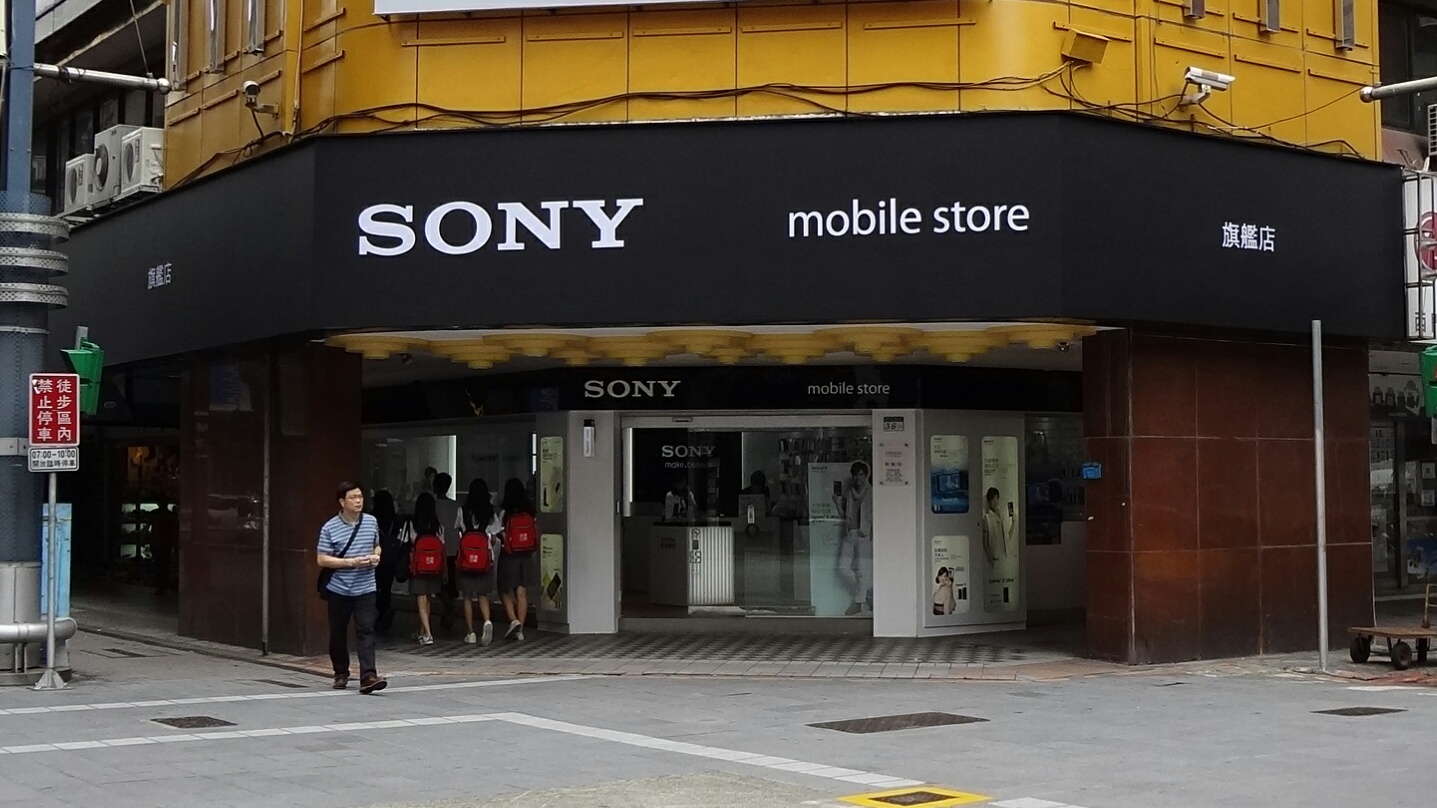
Sony Mobile store Taipei

Sony’s earnings were down in the fiscal year ending March 31st, but the company is forecasting annual operating profit to increase 73.2 percent for the 2018 fiscal year.

The Japanese tech giant estimates $4.5 billion USD in this period, compared to roughly $2.6 billion the year prior. This is in line with analyst predictions compiled by Reuters.

Sony announced that in this period, it shipped just 14.6 million smartphones following “significant downsizing” of its sales in unprofitable regions. In the previous fiscal year, the company posted shipments of 24.9 million units.

However, the overall Mobile Communications division reported a $91 million operating profit in this period, compared with a $57.4 million loss in the previous year.

Sales decreased 32.7 per cent year-oo-year to $6.8 billion, with Sony citing declines in European, Middle Eastern and Latin American markets. Last quarter, the company reported a 35 percent year-on-year decrease.

Sony anticipates an eight per cent increase in the current financial year, with its XZ Premium smartphone set to launch in June in select markets. A Canadian release has not yet been confirmed, though.

As for PlayStation, Sony’s gaming brand continued to show strong performance, with revenue jumping 6.3 percent year-over-year to $14.73 billion. Twenty million units of the PS4 console shipped in 2016, up from 17.7 million the year prior, bringing lifetime shipments to 60 million.

It’s important to note that this doesn’t mean that as many units have been sold, just how many were sent out to retailers. Sony previously announced in December that 50 million PS4s have been sold worldwide.

Earlier this month, Sony also released a $380 CAD 1 TB PS4 model.

Sony attributed increased revenue to high software sales; this year, it’s already released exclusives like Nioh, Horizon: Zero Dawn, Nier: Automata and Persona 5. Resident Evil 7 also launched with PlayStation VR compatibility, with 10 percent of overall players taking advantage of the feature.

Image credit: Wikimedia Commons

Source: Sony

The post Sony earnings decline, but 2018 forecasts biggest profit jump in 20 years appeared first on MobileSyrup.

28 Apr 17:42

show-and-tell-31

by chris-roos

Friday 28th April, 2017

Chris Roos by Chris Roos

Show and Tell 31

Chris and I (James was enjoying some time off) were joined by Amy, Leo, Ben G, Tom S, Rob C and Rob D for our 31st Show & Tell at Forge & Co on Wed 12 Apr.

Thanks to Tom S for the photos!


Ben G

Ben kicked things off by talking a bit more about Snap!: the drag and drop programming language he showed us at Show & Tell 30 last month.

Ben showed us some software he and his son had built to help with his son’s homework. I seem to recall that the homework involved coming up with a number of sentences in the format of “<proper noun> <verb> <determiner> <noun>” (e.g. Ben carried that lift). They fed lists of proper nouns, verbs, determiners and nouns into their app and had a cartoon character display a random question and answer.

Ben shows us his son's homework program


Tom S

Tom showed us some work he’s been doing while reading the Types and Programming Languages book at London Computation Club.

Tom shows us the Types and Programming Languages book

Having read the book previously, he’s using this second reading as an opportunity to approach it a bit differently. He’s developing some inference rules with the intention of being able to evaluate the languages in chapter 3 of the book. The README in the inference rules repo appears to be a good place to start if you want to learn more. Alternatively, I’m sure you’ll be more than welcome at the London Computation Club meetings.

Tom explained that Types and Programming Languages book was influential in his writing of Understanding Computation and that they both share a similar style.


Leo

Leo showed us a tool he’s been developing on and off since late 2016. He’s experimenting with a utility to visualise what’s going on in a computer in the way that an FMRI or CAT scan might help visualise what’s happening in the brain.

Leo used his utility to visualise real-time memory access when running top and sqlite. It was interesting to see that the heap was accessed almost constantly while everything else remained relatively static. It also looked quite a bit like the disk defragmenter utility in Windows :-)

Leo shows us his tool for monitoring memory access

The OS doesn’t provide the data required to build such a tool so Leo’s using Pintools to (as I understand it) rewrite the binaries and inject code to record memory access. This data is then visualised using JavaScript. Leo pointed out that this act of instrumentation results in the binaries being quite a bit slower than their original counterparts.

Let’s interested in whether such a visualisation tool can help characterise software in some way without having to understand the internals.

Tom S mentioned Valgrind as software in a similar space that might be interesting to investigate.


Rob C

Rob showed us Diggit: a tool built by Lawrence Jones while studying Computing at Imperial.

Diggit analyses the history of a repository in order to provide automated Pull Request reviews covering things like:

  • Suggesting additional changes that might be required, e.g. expected app_controller.rb to change as it was modified in 83% of changes when app_template.html was changed.
  • Highlighting that a method has been growing in size over time.
  • Highlighting that a file has increased in complexity over time.

Rob shows us Diggit

I think the idea is for Diggit to be offered as a service so that multiple projects can make use of it. Rob mentioned that it had been optimised to be able to offer feedback on a PR within 10 minutes. I think this is based on some research from Facebook that suggests this is about the longest people are willing to wait before moving on to something else.

There was some interesting, albeit slightly over my head, discussion about the algorithms used to analyse the code in a repository. Rob mentioned A priori estimates and the FP-Growth algorithm, the latter of which is apparently used in supermarkets to offer you alternatives based on what you purchased.

Rob mentioned that the tool wasn’t always useful and used an example of it suggesting an update to a Gemfile when the Gemfile.lock has changed: while a change to the Gemfile will always trigger a change to the Gemfile.lock, the reverse isn’t necessarily true.

Tom S mentioned that there are some similarities with James M’s method-log project.

Leo mentioned Code Climate as doing something similar although I understand that that doesn’t take the history of the code into account.

Someone (I forget who, sorry!) mentioned Codescene. A tool that supposedly helps you identify areas of your code that might warrant some further investigation.

And finally, a couple of people mentioned Danger as another service that helps automate aspects of the PR review process.


Show & Tell 32

Please get in touch if you’re interested in joining us for the next Show & Tell on Wednesday, 10th May 2017.

Please enable JavaScript to view the comments powered by Disqus. comments powered by Disqus
28 Apr 17:42

Translink Liveries

by Stephen Rees

This post started life as a comment. Back in 2007. Originally the links in the comment went to a site called fotopic.net which ceased operations in 2011. So I went to my flickr stream to see if I could find similar illustrations.

So why did I “need” this? Becuase of this in my inbox this morning

The pingback was to this post and was from this article . It is nice to see that old stories from this blog continue to have some utility. And now this new post can be the source of reference to the old article and my comment under it.

For a while Translink had plain white buses: this was for buses ordered in the period of transition from BC Transit, before the new blue and yellow livery was decided on.

Translink P8101 Braid Stn New Westminster BC 2002_0114

Many remained in service in the old red, white and blue of BC Transit.

Translink P3105 D40HF Braid Stn 2002_0612

Note that black paint has been added to to window pillars and on the upper part of the doors. This was peculiar to the Vancouver transit system and was not added to BC Transit buses operating elsewhere.

Translink P4226 Pitt Meadows BC 2006_0908

This was the standard livery in Translink’s first iteration. As the fleet went through its usual maintenance cycle the older buses were repainted white with a blue and gold set of stripes.

TL S058 on C93 Williams Rd 2004_0811

Community shuttles had a variation on the paint scheme.

Translink R8076 D60LF on 98 B Line Richmond BC 2007_0708

The B Line had its own variation, with a blue front to help intending passengers spot the difference from regular services. This was very similar to the BC Transit B Line livery, which had a red rather than the gold swoosh.

Translink B8010 D60LF Broadway at Commercial 2008_0114

Of course that did not stop artics in regular livery being used on the B Line. A number of regular bus services needed the capacity of articulated buses to meet the surge of demand caused by the introduction of U Pass as UBC and SFU

E40LFR 2270 Howe at Smithe 2007_0827

When the new trolleybuses started being delivered they carried this new black and grey livery with the blue stripe converted to a swoosh and the black being expanded on the front and onto the upper panel – not just the window surrounds. New diesel and natural gas buses were similarly treated.

9548

The Novabus did not get nearly as much black paint as the New Flyers, and I think looks the better for it.

S351 on C21 Beach on Burrard at Dunsmuir

But the new Shuttle buses did

R9222 R9247 Bridgeport Stn

The high floor Orion highway coaches used on the express routes got their own yellow livery. This is the first version.

R9282 Burrard Station #602 Tsawwassen Heights

Later versions have grey on the lower panel. This one was photographed at Burrard Station: the introduction of the Canada Line saw these services cut back to Bridgeport Station in Richmond – which is where the previous picture was taken.

Xcelsior bendy on 41st at Arbutus

The most recent variation has also reduced the amount of black paint with grey on the front and sides and is, to my eye, more pleasing.

The last one on the lot

This was a variation used in West Vancouver for a while.

West Vancouver Blue Bus 1204

This is what they use now. There is so little blue visible that the words BLUE BUS have to be added above the bike rack in large, friendly capital letters.

BC Transit 9270 Abbotsford

BC Transit now uses this livery instead of the old red white and blue.

BC Transit 9067

Though in 2015 it could still be seen in Victoria – here on a British built Transbus (Dennis) Dart Plaxton Pointer delivered in 2000.

And, by special request, here is a preserved bus in the old BC Hydro Transit livery

BC Hydro Fishbowl

Photo by Michael Chu on flickr

2040 at Marpole 20080407

And I think this one may be earlier. I am told that in the bad old days buses got repainted with each change of government into the colours of the ruling party – but that can’t be true can it?


Filed under: transit, Vancouver Tagged: BC Transit, TransLink