Shared posts

12 May 18:29

I choose activism for Black liberation

by Desmond Cole

This week I met with Andrew Philips, the Toronto Star’s editorial page editor, who has essentially served as my boss at the newspaper. Phillips called me in regarding my political disruption of the April 20 meeting of the Toronto Police Services Board. Phillips said this action had violated the Star’s rules on journalism and activism. He didn’t discipline me or cite any consequence for my actions—Phillips said he just wanted me to know what the Star’s rules are.

I have no formal employment with the Star. I’ve never signed any contract or agreement, and no one ever directed me to any of the policies Phillips cited. However, I knew my police protest was activism, and I could have guessed the Star wouldn’t appreciate it.

At no time during this week’s meeting did Phillips try to tell me how I must conduct myself in the future. He did say he hopes I will continue my bi-monthly column. I appreciate the offer but I’m not going to accept it. If I must choose between a newspaper column and the actions I must take to liberate myself and my community, I choose activism in the service of Black liberation.

There’s so much I feel and could say about this decision, but for now I will limit my commentary to my experience as a freelancer with the Star. For the last year I have been contributing to the Star once every two weeks. I started as a weekly columnist in September of 2015 but my space was cut in half after eight months with almost no explanation (at the time Phillips cited budget struggles and told me “times are tough”).

I doubt any freelance columnist in the recent (or even not so recent) history of the Star has consistently generated more interest and readership, and consequently more revenue, than I have. Few of the Star’s full time columnists cannot claim the following I have built as a freelancer and, with the very notable exception of Washington correspondent Daniel Dale, no regular Star columnist or reporter can match my success in aggressively marketing my work on social media.

My contributions to the Star are in sharp contrast with the lack of tenure, exposure, support, and compensation I have received in return. I believe I have been good for business during a time when our industry is desperate for new voices and new readers. Although I was recently warned about my actions, the Star’s leadership has previously warned me about its limited appetite for my very political and unapologetically Black voice.

In April of 2016, John Honderich, the chair of Torstar Corp., who was also serving as the Star’s acting publisher at that time, asked to meet with me. Honderich suggested I was writing about race too often, and advised me to diversify my topics. The next day I published a piece in support of Yusra Khogali, a Black Lives Matter Toronto co-founder who was the subject of a racist, Islamophobic campaign to distract from her activism. It was the most popular piece I wrote all year—my editor contacted me to congratulate me on its reach.

The Star invests heavily in reporters whose excellent work inspires much of my commentary on anti-Black racism and white supremacy in Canada. Yet it seems the Star is reluctant to invest in columnists who relentlessly name these racial power imbalances, who call out the political and institutional forces responsible for white supremacy and Black suffering.

This is bad news for emerging local Black journalists and journalism students, most of whom are Black women and many of whom tell me they are also being shunned, not for their actions but for their radical and emancipatory content. My profile will allow me to find other work, but what about all the brilliant Black people who share my conviction and sense of urgency? Will they ever find steady work in Canadian media?

The struggle continues. I hope my candour here, and my growing reputation as an unapologetic Black activist, is compatible with a continued relationship with the Star. I wish my colleagues there—especially Nicholas Keung, Wendy Gillis, Evelyn Kwong, Jim Rankin, Patty Winsa, San Grewal, Azeezah Kanji, Jennifer Pagliaro, Jayme Poisson, Betsy Powell, Jacques Gallant, Sara Mojtehedzadeh, Morgan Campbell, Ed Keenan, and Daniel Dale—continued success in their respective works, all of which have shaped my writing. 

See y’all in the streets, on Newstalk 1010 radio (every Sunday at 4 p.m.) and, hopefully sometime early next year, in the pages of my first book with Doubleday Canada.

In love, rage, and Black power

~Desmond Cole

04 May 20:25

Communities Are About The Unsearchable

by Richard Millington

You can’t search for that feeling of helping someone out and seeing the impact your help had.

You can’t search for that sense of community you feel with your peers; facing and overcoming difficult challenges together.

You can’t search for what other people just like you are working on today.

You can’t search for how it feels when people begin to notice and recognize your contributors.

You can’t search for information if you don’t know how people describe and talk about the problem.

You can’t search for someone who might know someone who has tackled the challenge you’re facing today and might be able to help you.

You can’t search for the great ideas your members might have that might change your business.

You can’t search for what members feel about the products you’re about to release.

You can’t search for whether that vendor you’re about to hire is trustworthy.

You can’t search for those in-jokes that only you and the people in your community will get.

You can’t search for the comparing reliability of two similarly-focused articles.

Google will get stronger, social platforms will rise and fall, machine learning might make some basic tasks obsolete.

But, remember, the best benefits of a community are unsearchable.

The best questions are the questions Google can’t answer. If you’re responsible for any community today, your job is to create and find the amazing hidden value in the unsearchable.

04 May 20:25

Still Blogging in 2017

Not alone and not unread, but the ground underfoot ain’t steady. An instance of Homo economicus wouldn’t be doing this — no payday looming. So I guess I’m not one of those. But hey, whenever I can steal an hour I can send the world whatever words and pictures occupy my mind and laptop. Which, all these years later, still feels like immense privilege.

A lot of good writing is on Medium, which has learned its bloglessons. Shortish-to-longish form: check. Something fresh every day: check. Follow your faves: check. But on my phone, an irritating goober at the screen’s foot says “open in app”, trying to tempt me out of the blogosphere, off of the Web. I guess lots of people go there but I’m not gonna.

On a blog, I can write about blogging and whimsically toss in self-indulgent pictures of May’s budding azaleas.

Budding azaleas

I can end my career, right here, in a flash. I can rant about the perfidy and corruption of my local governing party, who I devoutly hope are about to be turfed by the voters. I can discuss the difference between O(1) and O(log(N)), which can usually be safely ignored.

On blogs, I can read most of the long-form writing that’s worth reading about the art and craft of programming computers. Or I can follow most of the economists’ debates that are worth having. Or I can check out a new photographer every day and see new a way of seeing the world.

Having said that, it seems sad that most of the traffic these days goes to BigPubs. That the advertising dollars are being sucked inexorably into Facebook/Google and away from anyone else. That these days, I feel good over a piece that gets more than twenty thousand reads (only one so far this year).

But I don’t care. I’ll prove it by running a picture of a cement mixer’s insides.

Inside a cement mixer

I wonder what the Web will be like when we’re a couple more generations in? I’m pretty sure that as long as it remains easy to fill a little bit of the great namespace with your words and pictures, people will.

The great danger is that the Web’s future is mall-like: No space really public, no storefronts but national brands’, no visuals composed by amateurs, nothing that’s on offer just for its own sake, and for love.

Here’s a visual composed by an amateur.

New York in a rainstorm

Manhattan rainstorm (spot the bicyclist).

If you’re reading this, you have my thanks. But let’s be honest: I can’t know what you like. Every human product that’s really worth reading or seeing or hearing is made mostly to please its human producer. Because if you aim to please the world you usually miss, the target’s just too big and you can only guess where it is..

That, more than anything, is why I’m still optimistic about whatever this thing is I’m doing here.

Anyhow, I’m not going away.

04 May 20:23

belief

I saw a lot of people post an oatmeal comic in the past couple days. It's called "you're not going to believe what I'm about to tell you" and it makes a stab at discussing the so-called "backfire effect", the (well known) tendency for a person, when told some fact that contradicts their beliefs, to disbelieve the fact and increase their belief to its contrary. In other words: the new fact backfires, and the person "resists" learning the fact.

The oatmeal comic calls this phenomenon "backwards and batshit-fucking-bonkers" and goes on to discuss a pile of neurological characterizations of people rejecting information they find disfavourable. The point the author is making is that we have this little irrational, defensive part of our brains that doesn't want to hear information we disagree with and builds walls and fortresses of denial against it.

Now, I'm not going to say that doesn't happen. People do absolutely behave defensively and deny things they know, deep down, to be true. Further, there is a huge and well-documented list of similar human cognitive biases to familiarize ourselves with. It's definitely important to be discussing that aspect to ideological polarization.

However, something rubbed me the wrong way reading the oatmeal comic, and I think it's this: polarization (and confirmation bias in general) is not just a result of irrational cognitive biases. It is also something completely reasonable to do if you are willing to believe that someone might be lying to you.

And in many cases, that's not unlikely! We all know that people lie to us. We might not say "liar" in each case -- and it's surely a recipe for a miserable life to assume too many people are lying to you too often -- but from a very early age, most children figure out that lies are cheap and easy. We go through a gleeful, horrified phase of learning that anyone can lie -- and try it out ourselves! -- and then settle into a grim slog of maturation in which we learn how very pervasive the problem is.

We realize that adults lied to us about various things we were taught, that the media is literally financed by lying trying to sell things, that people and companies lie about their intentions, abilities and actions, that think-tanks full of people are paid to lie all day, that politicians lie to acquire power, that histories are written by the victors, that countries manufacture causes for wars. That layer upon layer of lies permeate our world. That is just how it is and we all arrive at adulthood reasonably aware that, when Person X tells us Fact Y, there is a reasonable chance that X is lying and Y is false.

That's not the amygdala talking. That's not emotional defensiveness talking. It's cold, dispassionate reasoning based on awareness of misinformation, awareness of the cost of a given bit of misinformation balanced against the set of interests that might benefit from you believing it. As much as one might dislike lies -- and to be clear, I much prefer people simply tell the truth! -- it's disingenuous to paint skeptical reception of presented facts as solely the result of cognitive bias. It's also cognition about epistemology working exactly as it should.

I've little more to add of my own, so I'll just present a chunk of a book that phrases the relationship between "odds of X being true" and "odds of X being a lie" in more detail: E.T. Jaynes' Probability Theory: The Logic Of Science

(Note: I am not some latter-day positivist à la lesswrong; I enjoyed this book but also feel it's unrealistically reductionist, mechanistic and optimistic. But it is charming and lucid!)


[...] in practice we find that this convergence of opinions usually happens for small children; for adults it happens sometimes but not always. For example, new experimental evidence does cause scientists to come into closer agreement with each other about the explanation of a phenomenon.

Then it might be thought (and for some it is an article of faith in democracy) that open discussion of public issues would tend to bring about a general consensus on them. On the contrary, we observe repeatedly that when some controversial issue has been discussed vigorously for a few years, society becomes polarized into opposite extreme camps; it is almost impossible to find anyone who retains a moderate view. The Dreyfus affair in France, which tore the nation apart for 20 years, is one of the most thoroughly documented examples of this. Today, such issues as nuclear power, abortion, criminal justice, etc., are following the same course. New information given simultaneously to different people may cause a convergence of views; but it may equally cause a divergence.

This divergence phenomenon is observed also in relatively well-controlled psychological experiments. Some have concluded that people reason in a basically irrational way: prejudices seem to be strengthened by new information which ought to have the opposite effect.

But now, in view of the above ESP example [in which interpretations diverged], we wonder whether probability theory might also account for this divergence and indicate that people may be, after all, thinking in a reasonably rational, Bayesian way (i.e. in a way consistent with their prior information and prior beliefs). The key to the ESP example is that our new information is not

S = fully adequate precautions against error or deception were taken, and Mrs. Stewart did in fact deliver that phenomenal performance.


It was that some ESP researcher has claimed that S is true. But if our prior probability for S is lower than our prior probability that we are being deceived, hearing this claim has the opposite effect on our state of belief from what the claimant intended.

The same is true in science and politics; the new information a scientist gets is not that an experiment did in fact yield this result, with adequate protection against error. It is that some colleague claimed that it did. The information we get from the TV evening news is not that a certain event actually happened a certain way; it is that some news reporter has claimed that it did.

Scientists can reach agreement quickly because we trust our experimental colleagues to have high standards of intellectual honesty and sharp perception to detect possible sources of error. And this belief is justified because, after all, hundreds of new experiments are reported every month, but only about once in a decade is an experiment reported that turns out later to have been wrong. So our prior probability for deception is very low; like trusting children, we believe what experimentalists tell us [Note: this book was written before the current crisis in reproducibility / academic fraud].

In politics, we have a very different situation. Not only do we doubt a politician's promises, few people believe that news reporters deal truthfully and objectively with economic, social, or political topics. We are convinced that virtually all news reporting is selective and distorted, designed not to report the facts, but to indoctrinate us into the reporter's socio-political views. And this belief is justified abundantly by the internal evidence in the reporter's own product -- every choice of words and inflection of voice shifting the bias invariably in the same direction.

Not only in political speeches and news reporting, but wherever we seek for information on political matters, we run up against this same obstacle; we cannot trust anyone to tell us the truth, because we perceive that everyone who wants to talk about it is motivated either by self-interest or ideology. In political matters, whatever the source of information, our prior probability for deception is always very high.


This entry was originally posted at http://graydon2.dreamwidth.org/249109.html. Please comment there using OpenID.
04 May 20:22

Get a free AIY Projects Voice Kit with The MagPi 57!

by Rob Zwetsloot

We’re extremely excited to share with you the latest issue of The MagPi, the official Raspberry Pi magazine. It’s a very special issue bundled with an exclusive project kit from Google.

Called AIY Projects, the free hardware kit enables you to add voice interaction to your Raspberry Pi projects. The first AIY Projects kits are bundled free with the print edition of The MagPi 57.

Photo of the free AIY Projects kit bundled with The MagPi 57: HAT accessory boards, wires, button and custom cardboard housing

What you’ll find inside

Inside the magazine, you’ll find a Google Voice Hardware Attached on Top (HAT) accessory board, a stereo microphone Voice HAT board, a large arcade button, and a selection of wires. Last but not least, you’ll find a custom cardboard case to house it all in.

All you need to add is a Raspberry Pi 3. Then, after some software setup, you’ll have access to the Google Assistant SDK and Google Cloud Speech API.

AIY Projects adds natural human interaction to your Raspberry Pi

Check out the exclusive Google AIY Projects Kit that comes free with The MagPi 57! Grab yourself a copy in stores or online now: http://magpi.cc/2pI6IiQ This first AIY Projects kit taps into the Google Assistant SDK and Cloud Speech API using the AIY Projects Voice HAT (Hardware Accessory on Top) board, stereo microphone, and speaker (included free with the magazine).

We’ve got a full breakdown of how to set it all up and get it working inside the magazine. The folks at Google, along with us at The MagPi, are really excited to see what projects you can create (or enhance) with this kit, whether you’re creating a voice-controlled robot or a voice interface that answers all your questions. Some Raspberry Pi owners have been building AIY Projects in secret at Hackster, and we have their best voice interaction ideas in the magazine.

On top of this incredible bundle we also have our usual selection of excellent tutorials – such as an introduction to programming with Minecraft Pi, and hacking an Amazon Dash button – along with reviews, project showcases, and our guide to building the ultimate makers’ toolbox.

Two-page spread from The MagPi, titled "Makers' Toolkit"

Create the ultimate makers’ toolkit and much more with issue 57 of The MagPi

Subscribers should be getting their copies tomorrow, and you can also buy a copy in UK stores today including WHSmith, Tesco, Sainsbury’s, and Asda. Copies have been shipped to North America, and are available at Barnes & Noble and other stores. Otherwise, you can get a copy online from The PiHut. Digital versions (without the AIY Projects kit) are available in our Android and iOS app. Finally, as always, there’s the free PDF download.

We really hope you enjoy this issue and make some amazing things with your AIY Projects kit. Let us know what you plan to make on social media, using the hashtag #AIYProjects, or on the Raspberry Pi forums.

The post Get a free AIY Projects Voice Kit with The MagPi 57! appeared first on Raspberry Pi.

04 May 20:22

Logging code commits with Nomie

by Thejesh GN

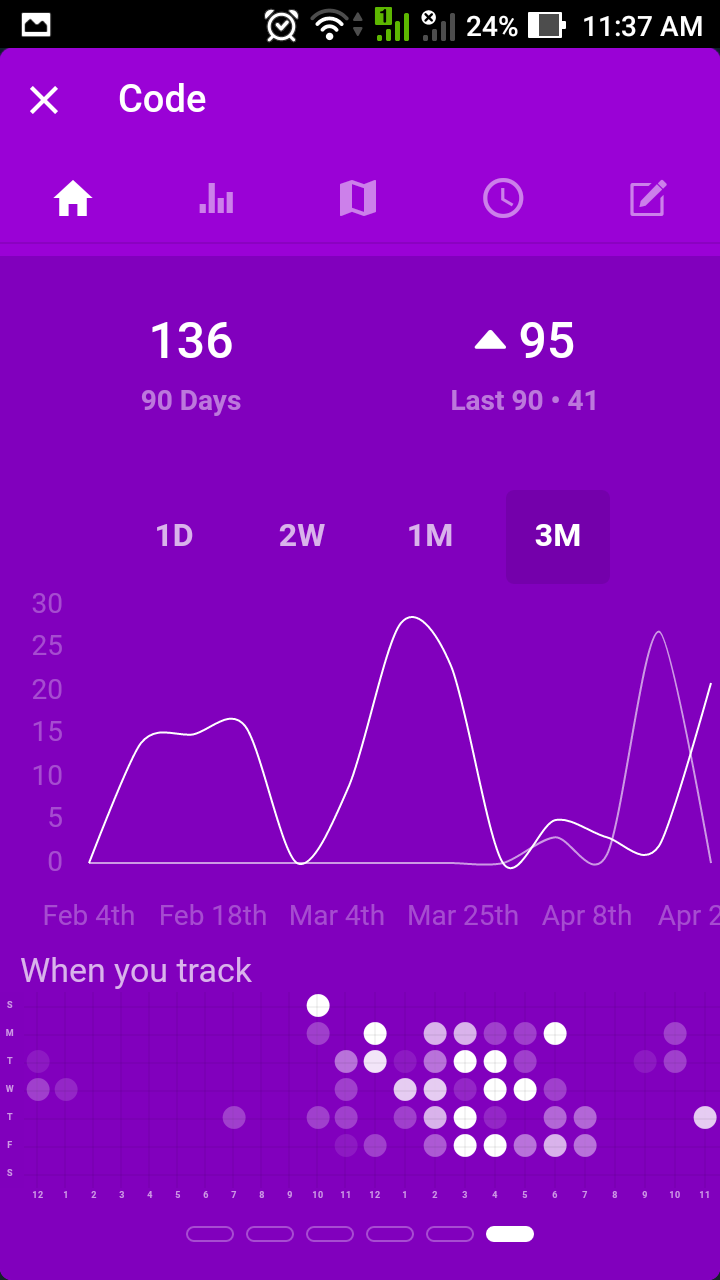
I use Nomie to track almost all things in my life. For a long time I wanted to log my commits so I can do some analysis like “where do I code the most?” etc. So as soon as I got the Nomie API key, I created post-commit hooks to track code commits.

GIT

# create global hook templates
git config --global init.templatedir '~/.git-templates'
mkdir -p ~/.git-templates/hooks

# Edit or create post hook
nano  ~/.git-templates/hooks/post-commit

#Add the line to send the message and save the file
curl -s https://api.nomie.io/v2/push/<API_KEY>/action=track/label=Code/charge=1  > /dev/null

# make it executable
chmod a+x ~/.git-templates/hooks/post-commit

### reinit so the hooks are copied to the specific git repo
git init

Once the post-commit hook is added. You need to “git init” for existing projects. It automatically gets added to new projects when you do init.

HG

Its much easier with mercurial. Just add it to the global .hgrc. The hook automatically applies to all the existing projects and new ones. If you want it only for specific project then edit the specific project hgrc.

# Edit global .hgrc
nano ~/.hgrc

#add the hook under [hooks]
[hooks]
commit = curl -s https://api.nomie.io/v2/push/<API_KEY>/action=track/label=Code/charge=1  > /dev/null

Nomie gives you some graphs by default but you can create your own as the data is available.

When do I commit

When do I commit

Where do I commit?

Where do I commit?

Generic Graph, But you can add other parameters like Coffee or Sleep.

Generic Graph, But you can add other parameters like Coffee or Sleep.

Generic Graph, But you can add other parameters like Coffee or Sleep.

Generic Graph, But you can add other parameters like Coffee or Sleep.

04 May 20:22

What a Haskell Study Group is Not

by Chris Allen

This article is by Steven Syrek. I’m reposting it here because I endorse what he’s saying. I believe Steven brings a valuable perspective on the haskell book, reading groups, and education in general.

Steven posted this article on his Medium.

He has also written some extended notes on pedagogy tied to this post here.


The most rewarding thing about learning Haskell is the feeling that you are making real progress toward understanding not just the syntax of a programming language but a way of solving problems that is more universal than the domain of software development. The most rewarding thing about teaching Haskell is watching others make this same progress. The most frustrating thing about both learning and teaching Haskell is the widespread attitude that functional programming in general, or Haskell specifically, is difficult.

The goal of any teacher should be to expel this myth. The Haskell community is too small to support much formal education and those most apt to teach have precious little time to do so. And so the myth persists, and many people who could or would learn Haskell do not, whether out of fear, misprision, or lack of communal encouragement. Independent study groups, however, can meet the needs of language learners just as well, but only if they are committed at the outset to pragmatic goals and maintain a culture of mutual support and accountability.

Over the course of about eight months, from September 2016 to April 2017, I ran a Haskell study group in New York City based on Chris Allen and Julie Moronuki’s book, Haskell Programming from First Principles. Since this book was designed to provide a curriculum, it was ideally suited to our purposes. We covered one chapter a week, more or less, as there is just enough content per chapter to keep a dedicated group humming along: challenged but not overwhelmed.

In this article, I will share my thoughts on what made our group successful, where we went astray, and in particular on what a Haskell study group should not be—as the pitfalls are many but advice for avoiding them, based on actual experience, scant. My own background happens to be in education, which has no doubt informed my observations, but I was just as much a student in this study group, even if I happened to be its organizer. I hope this dual role has given me insight from both sides of the pedagogical divide that will be useful to others thinking about starting their own Haskell study groups, a course of action I highly recommend.

1. A Haskell study group is not meant to serve any purpose other than helping people learn Haskell.

Keep this mantra in mind: the point of a Haskell study group is to help people learn Haskell. Nothing else matters. Refer to this mantra whenever you’re in doubt about anything else.

2. A Haskell study group is not a place for people to learn about monads.

Or any other specific language feature. Do not let the random people who will inevitably show up derail your meetings with general, off-topic questions. Make a schedule, post it publicly, and stick to it. Once you embark on diversions, you may never get back on track. Respect the time, commitment, and ongoing progress of your regulars and let newcomers catch up on their own. Always assume anyone who comes to a meeting has: 1) read the chapter for that week, 2) typed in all the code in the chapter and, separately, 3) attempted to complete all the exercises in the chapter. Avoid spending too much time on topics everyone should already know or any time at all on questions about the language from Meetup shoppers.

3. A Haskell study group should not reinforce mistaken or unhelpful stereotypes about Haskell.

Many people have had a hard time learning Haskell. This has given the language a reputation for being hard to learn. In reality, Haskell is elegant and far easier to learn than many other, less elegant languages. The dearth of teaching materials and low quality of documentation have made it difficult for entrants to gain a foothold in the community as compared to language communities that go out of their way to be approachable to newcomers. The Haskell Book directly addresses this problem, however, and it does no one any good to credit assumptions that Haskell requires you to be a math genius. Haskell is capable of representing extremely abstract mathematical entities, but so is math itself, and you hardly need to understand linear algebra to balance your checkbook. I’ve been a college writing instructor for over a decade. Writing is hard. Teaching writing is hard. But anyone can become a proficient writer, even if few will ever write literary masterpieces. We can respect the challenge without succumbing to it or using it as an excuse. Practice, and you’ll improve. Complain, and you’ll remain mediocre. Focus on the positives and the cumulative effect of breakthroughs in the Haskell learning experience.

4. A Haskell study group is not a language advocacy committee.

Given Haskell’s rather esoteric reputation in the world of professional developers, you are likely to be issued demands to defend Haskell’s general usefulness, the practical utility of certain concepts, or the viability of functional programming as a whole. Don’t do it. People have Google if they want to research such things and the entire rest of the Internet if they want to bring their spoons to a knife fight. Your group exists to teach people how to code, not to teach developers how to do their jobs. Focus on the people. Ignore the trolls, don’t use facile comparisons to OOP to explain anything, and don’t waste your energy trying to convince the skeptical. Actually, examples of what you can do in Haskell won’t necessarily help your cause, because most programming languages can do anything any other language can do. The power of Haskell isn’t in any one abstraction. It’s in leveraging all of them together to build software, and software is complex, composed of many interlocking parts. You aren’t likely to persuade by showing someone “the amazing things you can do with Functor” or what have you. Ultimately, they will have to find out for themselves.

5. A Haskell study group is not an experiment in deliberative democracy.

A successful study group requires leadership. Leadership means that someone has to be in charge. Someone has to find space for the meetings, plan them, show up to all of them on time, be responsible for any contingencies that arise, and enforce norms of behavior. If there is no point person, it is unlikely that the group as a whole will make much progress. Sometimes, leaders emerge organically, but it’s better for someone to volunteer to be the organizer in advance. Natural leaders can serve a useful purpose, but they can also be destructive if they aren’t reliable, grow resentful at having assumed a role they didn’t sign up for, or turn your study group into a cult of personality instead of a collaborative learning environment. It’s also essential for the organizer to have buy-in from the rest of the group. On the one hand, participants should appreciate the amount of work it takes to put a study group together and keep it together. On the other hand, an effective leader makes decisions without turning every possible choice into a referendum. Democracy is a fine thing, but in this situation, it is more likely to result in anarchy and listlessness than efficient and decisive action. Respect for the organizer(s) is also relevant to the next point:

6. A Haskell study group should not turn anyone into a martyr.

Whoever is running your group, it’s a good idea if the person in charge is a fellow learner. Someone already proficient in Haskell will need to be especially motivated to teach others to stick with a study group for beginners. Another beginner, however, will have intrinsic motivation. In fact, the organizer will have an even stronger incentive to keep up with the work. Beware any situation in which a single person has assumed all of the responsibility but has little incentive to continue participating or is otherwise crushed by the demands of a dysfunctional group culture—it’s not sustainable.

7. A Haskell study group is not a traditional classroom.

While it is advantageous for the organizer to have prior teaching experience, it is not essential. Since such experience is in short supply, most groups will have to go with what and whom they have. That means the culture of the group is even more important, because people who don’t know how to teach should probably not try to do it. Go over exercises, break into pairs or smaller groups if necessary, but avoid devoting too much of any given meeting to lectures or presentations. Talking is no substitute for coding.

8. A Haskell study group is not a hackathon.

That is, it shouldn’t be a freeform, come-and-do-as-you-please affair. Adhere to a long term curriculum, keep individual meetings structured, and enforce norms of accountability. People who drift in and out or consistently show up unprepared are only going to drain energy from the room. Shower those who participate in good faith with praise and attention. Marginalize those who only come for Haskell social hour or for the free food and drinks. Speaking of which:

9. A Haskell study group is not a Meetup.

Go ahead and use Meetup to schedule your meetings. I did. But don’t give people the impression that it’s one of those Meetups where you can show up to eat pizza, drink beer, and contribute nothing. Likewise:

10. A Haskell study group is not a tech talk.

Your study group is not a form of entertainment. Don’t just give talks or show slides. Some of that may be an inducement to attend, but you want students, not audience members. Your best bet is to plug in to a projector, display the REPL side-by-side with the PDF of the book, and code. You can do pairing, mobbing, taking turns on the exercises, or whatever other method you desire as long as you’re coding and everyone else has the chance to code right along with you. Live coding can be scary, so make it an exercise in solidarity. If everyone did their homework, then everyone should have something to contribute. I suggest you ask them to close their computers and have them do the exercises again, on the spot, for reinforcement. You’ll probably find that everyone ends up loving that in spite of themselves. And failures along the way are fine. In fact, the type checker invites “failure-driven development.” Work things out together. Learn to love the REPL together. Encourage hands-on work, and figure out as a group how to leverage error messages to produce provably correct code.

11. Haskell study group meetings should not go on forever.

People are busy. If you get anyone to dedicate an hour a week to attending a Haskell meeting, it’s a miracle. Don’t ask for too much, or you’re just going to discourage people who would otherwise like to come. As with learning anything, most of the work of learning Haskell people have to do on their own. The study group can provide motivation and moral support (and asynchronous assistance if you use Slack or something similar), but the meetings themselves shouldn’t be longer than an hour or two. Use them to catch up, go over as many of the exercises as possible, and answer questions relevant to that week’s chapter assignment. The book provides a curriculum, and it’s best to just follow it. There is no need to diverge into advanced language features or demonstrate practical applications of every concept. Keep it short, and keep it simple. Also, you don’t have to make sure everyone completely understands everything. Give people time to figure things out, and help them do so however you can, but if it takes too long, move on. You can always work with people one-on-one if they get stuck somewhere.

12. Haskell study groups themselves should not go on forever.

Choose a realistic goal for your study group. Covering chapters 1 to 18 is a realistic goal, at least to start. That will get you through monads (the denouement for many students), at which point you can decide how to proceed with the more advanced material. Some will have had enough, while others will be ready to learn independently. At any rate, don’t give people the impression that they’ll be visiting your co-working cubicle farm every week for the rest of their lives.

13. A Haskell study group is not group therapy.

Remember the point of a Haskell study group? It isn’t to make people feel good about themselves or give them a place to go at night. It’s to teach people Haskell. You don’t need to be an intimidating jerk, but you aren’t doing anyone who attends any favors by not prodding them at least a little bit. If group members come prepared, they should be able to participate in group discussion of the exercises. You can organize smaller groups if some members are truly shrinking violets, but I don’t recommend letting people off the hook just because they’re reluctant to speak up. Create a supportive environment, and there’s no reason for anyone to be terrified of contributing. You never know when an otherwise shy person may be withholding a valuable insight just for being reluctant to be the center of attention. Moreover, you may never know when one such person’s confusion about a concept is shared by others, just because no one wants to admit it. Seek out opportunities for productive conversations. Don’t let people be dominating or rude, but also don’t let them be window dressing. Both attitudes are often just forms of pride, and you need to break through that to reach the vulnerable, yearning students within. Likewise, don’t be afraid to ask people to leave if their attitude or behavior is causing problems or their lack of preparedness makes their ongoing participation pointless and a negative example for others.

14. A Haskell study group is not a race.

Do not skip material in the book, and do not try to cover too much at once. A chapter a week, more or less, should be the pace you adopt. Any faster is overwhelming. Any slower is boring and ineffective. Some chapters are long enough to warrant coverage over multiple weeks, but that should be a rarity. And precious few chapters (certainly not chapter 1) are skippable. Set a reasonable pace, and trust the curriculum. Don’t feel the need to move quickly or to slow down, even if some people ask for it. I repeat, most of the work they do, they should do at home. The meetings are for review, as much as you can reasonably do, and not to serve the needs of any one student. Also, don’t skip the chapter on QuickCheck, and don’t let anyone skip writing all those quickBatch tests. We know who you are.

15. A Haskell study group is not a competition.

Programmers often have strong, competitive personalities. Do your best to contain that. Even better, turn it to useful ends: make the game about helping others, not being smarter or further along in the book. Encourage more experienced students to help less experienced students, in pairs if necessary, so the value of collective progress is enhanced and “being in charge, because I’m the best” diminished. That said, a competitive spirit can be motivating as long as it isn’t toxic. Whatever keeps people showing up without discouraging others—it’s often a fine balance.

16. A Haskell study group should not encourage or facilitate cheating.

Implore group members to at least try the exercises for themselves and avoid looking for solutions online. Insist that they do not post solutions publicly themselves. On a related note, make sure they buy the book. The authors worked hard on it, of course, but most people will value something more highly if they have paid for it. You’ll want your group to have that feeling of “buy-in” however you can get it.

17. A Haskell study group should not let its culture develop spontaneously.

The culture of any group of people has at least as much to do with how that group behaves and what it considers acceptable, en masse, than its laws. And culture has inertia. If the culture of your study group is misaligned with the goal of learning Haskell, you will have a hard time changing it. Therefore, establish and reinforce your group’s culture from the outset. Be serious about the responsibilities of its members and that it’s not OK to show up unprepared. Think about creating the proper incentives for productive behavior, and avoid giving in to a culture of impunity. Over time, as the group becomes habituated to doing things the right way, you won’t need to be an enforcer as much. On the other hand, a culture that has gone astray will not easily be corrected with new rules, because by that point, leadership will no longer have the credibility to overrule custom: consuetudo pro lege servatur.

18. A Haskell study group does not need anything other than Haskell in order to teach people Haskell.

Use the tools provided by the language to teach the language: the REPL, the type checker, handy compiler extensions such as InstanceSigs, etc. Empower students to use these tools to develop an intuition for the type system and how to use it to solve problems. You don’t need to explain anything in terms of JavaScript, and be careful about overusing metaphors, too. Comparing Haskell to other languages and making abstract concepts more concrete feel like easy wins, but don’t do either as a substitute for teaching and learning the language on its own terms.

19. A Haskell study group is not for people who can’t handle discipline and hard work.

The Haskell Book is nothing if not demanding. But the intensity of the curriculum is meant to guide students to develop an intuition for how the type system works and the ability to interpret the terse but expressive syntax of Haskell code as quickly as possible. It helps you build up a repertoire of fundamental concepts and techniques that lead to ever more complex, but still comprehensible, abstractions down the road. There are no shortcuts here. Diligent learners will rapidly establish for themselves that foundation of understanding, and it will help them move more easily, and with a greater sense of achievement, as more advanced concepts are introduced. Conversely, the less studious are unlikely to overcome the psychological barriers that make people think Haskell is difficult. They will grow frustrated and give up as their more enthusiastic peers come to seem like magicians when working with the REPL. The truth is just the difference in commitment.

20. A Haskell study group is not only about discipline and hard work.

After your meetings, go out with the group to a local bar or cafe. Pick a regular place so it becomes a tradition. Not only is it good for community cohesion, which is good for the continuation of your study group, but it gives people a venue for venting their natural desire to socialize—a venue that is not the meeting place itself. You’re likely going to end up with a core group of people who always come. Cultivate them. Cherish them. Protect their interests. Get the less committed to want to be a part of the in-crowd, and welcome them with open arms when they prove themselves worthy.


I know this site is a bit of a disaster zone, but if you like my writing or think you could learn something useful from me, please take a look at the Haskell book I've been writing. There's a free sample available too!

Posted on May 3, 2017

04 May 20:21

Things I learned working on Firefox Focus

by Anthony Lam

We launched Focus as a free content blocker for Safari on iOS back in December 2015. The idea was to bring control back into users’ hands. We wanted to let them dictate how they wanted to spend their browsing data, even if they weren’t using Firefox.

About a year later, we wanted to give the product an update. We wanted to experiment more on Mobile. But how?

What if we could give mobile users an app that only allowed private browsing?
What would “success” or “failure” look like?
How were we going to do any of this?

Eventually, we released the update (and it’s on the App Store!). We learned a few things and now we’re working on Firefox Focus for Android.

Move together and move quickly

Our team was very small. So we needed to set expectations early — who’s responsible for what?

We tried to stay focused (heh) on a small set of well-defined goals. Everyone had a part to play. A clearly defined timeline helped us avoid scope creep too. It set the tone for our discussions and made it a lot easier to prioritize issues.

Slide from our presentation at our All Hands in Kona, HI (Source: Barbara Bermes)

We had weekly check-ins to make sure everyone was on the same page. All of our meetings were clearly directed and to the point. As things came up they would also be filed as GitHub issues so we always had a way to track our discussions.

It’s important to remember that getting 100% consensus is pretty much impossible. But “moving together” doesn’t necessarily mean everyone has to think the same. It’s natural to have doubts. Trust each other and try to move forward as a team. Define what success looks like together. Then go out, and gather some data.

Share early and often

Even if you aren’t finished, design comps/mock ups can really help provide a shared vision. Try to share them more! I’m guilty too sometimes. I know it can be hard. But I’ve always been glad that I did.

Where possible, we made all design changes “on device” using Buddybuild. This helped us arrive at decisions quicker, and with more confidence. It was great for design and engineering issues but it also kept the entire team in sync (especially useful when working across offices and timezones). Basically, it was our way of sharing early and often.

Erase button — “Good enough” initial designs

Then there was Slack . Lots of it. Our team was small, but distributed. Slack made it easy for anyone to give feedback, report/resolve GitHub issues, or even just give an encouraging 👍.

Sharing early might have pitfalls too. But it can get everyone involved and excited about the final product. Visual mock ups create a common language and helps avoid miscommunication later on. Share the vision, spread the workload. Insightful feedback can uncover interesting opportunities, but don’t let criticism stall you either.

Be flexible

Originally, Focus was a slightly different product. I didn’t work on the first version myself (that was mostly Darrin) but Brian (one of our engineers) did.

As designers, we should be opinionated but we also need to be flexible. Whatever decision we arrive at right now might not be ideal, but maybe that’s OK. Who knows, maybe sometimes we don’t have the right answer. Remember, it’s iterative!

Brian and I shared the same timezone but not the same office. So we spent a fair amount of time on Vidyo. Being on a video call over a long period of time can be really tiring. But it helped us hammer out the details quickly. When something didn’t make sense, we didn’t have to wait for the next weekly meeting to chat.

This is probably terrible of me, but I actually didn’t have a “full design spec” until towards the end of the project.

Screen sharing unfinished designs

Unfortunately, there isn’t a one-size-fits-all type of solution here. For us, Vidyo and Slack made the most sense but there were still drawbacks. Everyone’s different. Every team is different. Find a solution that works for you and your team. The key is to be flexible, to adapt.

There are always more opportunities to learn, and to grow. Within our products and ourselves as practitioners too. In the end, I really think it’s a constant process.

Firefox Focus on Android — Buddybuild #1420 on device

If you’re interested in contributing, here are the GitHub repos for Firefox Focus on iOS, and Android. Currently, we’re working towards the initial release of Firefox Focus on Android. Send any feedback, questions and comments you might have!


Things I learned working on Firefox Focus was originally published in Firefox User Experience on Medium, where people are continuing the conversation by highlighting and responding to this story.

04 May 20:21

Most popular colors used by most popular sites

by Nathan Yau

Paul Hebert was curious about the colors used on the web’s larger sites, so he scraped the top ten ranked by Alexa. Then he plotted the colors in the stylesheets.

Tags: color

04 May 20:20

Email Service Newton Launches Amazon Alexa Support

by Ryan Christoffel

Newton, the email client for power users, today launched Amazon Echo integration with an Alexa skill. The skill enables email management with nothing but your voice; in addition to having Alexa read emails to you, you can perform the following list of actions by voice:

  • Snooze
  • Mark as read
  • Delete
  • Archive
  • Mark as spam

Replying to or composing new emails is not possible with Alexa, but personally, I don't think I would trust a voice assistant to write my emails anyways – at least not until the technology grows more foolproof. The option to perform simple actions by voice, like archiving or snoozing messages, is much more appealing.

Newton's expansion to Alexa-equipped devices follows the introduction of a Windows version of the client in beta form earlier this week. As a daily Newton user, I wrote about the iOS and macOS versions last Friday for Club MacStories members, and look forward to seeing the service continue to grow and improve.

→ Source: blog.newtonhq.com

04 May 20:20

"If you said ‘hashtag’ in 2002, people would have thought it was a breed of dog."

“If you said ‘hashtag’ in 2002, people would have thought it was a breed of dog.”

- Dorit Rabinyan, cited by Ian Fisher in It’s Complicated: The Path of an Israeli-Palestinian Love Story
04 May 20:20

Puerto Rico Declares a Form of Bankruptcy

Puerto Rico Declares a Form of Bankruptcy:

Puerto Rico is looking like the US equivalent of Greece in the EU. A southern, tourism-oriented economy, now effectively bankrupt, needing the larger union to step in and backstop it. And just like Greece, it’s not alone. The bigger worry is that Illinois may turn out to be Italy (Italian banks now have debt of $390B!).

With its creditors at its heels and its coffers depleted, Puerto Rico sought what is essentially bankruptcy relief in federal court on Wednesday, the first time in history that an American state or territory had taken the extraordinary measure.

The action sent Puerto Rico, whose approximately $123 billion in debt and pension obligations far exceeds the $18 billion bankruptcy filed by Detroit in 2013, to uncharted ground.

While the court proceedings could eventually make the island solvent for the first time in decades, the more immediate repercussions will likely be grim: Government workers will forgo pension money, public health and infrastructure projects will go wanting, and the “brain drain” the island has been suffering as professionals move to the mainland could intensify.

Puerto Rico is “unable to provide its citizens effective services” because of the crushing weight of its debt, according to a filing on Wednesday by the federal board that has supervised the island’s financial affairs since last year.

The total includes about $74 billion in bond debt and $49 million in unfunded pension obligations.

While many of Puerto Rico’s circumstances are unique, its case is also a warning sign for many American states and municipalities — such as Illinois and Philadelphia — that are facing some of the same strains, including rising pension costs, crumbling infrastructure, departing taxpayers and credit downgrades that make it more expensive to raise money. Historically, Puerto Rico was barred from declaring bankruptcy. In the end, however, financial reality trumped the statutes, and Congress enacted a law last year allowing bankruptcy-like proceedings.

Puerto Rico will now be able to get recalcitrant investors to accept losses. The worst part of this mess is that the pensioners are going to get screwed because of the mistakes of the commonwealth’s leaders. 

04 May 20:20

No apology from Clark as BC Liberals throw in the #IamLinda towel

mkalus shared this story from The Globe and Mail - British Columbia:
And people really wonder about Trump or BREXIT?

For a fifth day in a row, Christy Clark’s election campaign was dogged with questions about the BC Liberal Leader’s handling of a brief but testy exchange she had with a voter that sparked a social media firestorm.

Apparently, that was enough for the Liberals to finally admit that their attempts to discredit and malign Linda Higgins as an NDP operative out to disrupt and embarrass Ms. Clark were baseless. In an e-mail to The Globe and Mail, the party said: “As the Premier said, we are fortunate to live in a democracy where we are able to respectfully disagree with each other. We are happy to stand corrected.”

But there was no apology to Ms. Higgins. The Sunshine Coast woman stumbled upon a Liberal campaign event in North Vancouver last Thursday, approached Ms. Clark and told her she would not be voting for her. Before she had a chance to explain why, the Liberal Leader cut her off and blurted out something about the wonders of living in a democracy before bolting off as fast as she could. The moment was caught on camera and when it was posted to social media, Ms. Clark’s treatment of Ms. Higgins immediately stoked a strong reaction and incited the hashtag: #IamLinda.

In response to the negative comments toward Ms. Clark the hashtag was eliciting, the Liberal Party’s campaign director, Laura Miller, suggested on Twitter that Ms. Higgins was an NDPer, out to make mischief. Other key Liberal strategists also chimed in, insinuating the same thing – a view seemingly based on a photo that was unearthed of Ms. Higgins with NDP candidate Nicholas Simons. As it turned out, they were merely acquaintances from another movie.

Soon, the media was on to the story, revealing that Ms. Higgins was no NDP plant, but just a citizen who happened upon Ms. Clark and thought she would express her frustration over some of the government’s policies and the high cost of housing in B.C. She never got the chance.

This is when Ms. Clark, had she not been seized by her famous stubborn streak, should have ended the controversy by apologizing to the woman for not sticking around to hear her out and apologizing on behalf of principals in her party who suggested she was doing the NDP’s dirty work. But no. Instead, the Liberal Leader doubled down on trying to question the woman’s motives.

She told reporters: “She [Ms. Higgins] said she didn’t vote for me last time, she’s never voted BC Liberal and she never will and she’s not going to vote for me again. Perfect, that’s her right.” It was a bizarre claim to make since tape of the exchange clearly showed Ms. Higgins did not have the time to make any such statements before being cut off by Ms. Clark. Ms. Higgins also flatly denied making any such remarks.

Again, it only helped to keep the story alive, even inflame it. Day after day on the campaign trail, Ms. Clark was asked about it. Day after day she sloughed it off, saying it wasn’t a big deal. Finally, on Tuesday in Merritt, she told reporters they would have to ask Liberal headquarters what evidence they had Ms. Higgins was an NDP plant. Soon after, the party issued the statement that it did.

If this entire sordid mess sounds eerily familiar, it should: In February, Ms. Clark made a completely baseless accusation that the NDP had hacked into Liberal Party computers. It was an astonishing charge, especially given that the Liberal Leader, then acting in her role as Premier, could not produce a shred of evidence to back up her incendiary allegation. A couple of days later, she slowly began to climb down from her statement, but refused to apologize. Then finally, Independent MLA Vicki Huntington came forward to reveal it was a staffer in her office who accessed sensitive information on the Liberal Party website that was open to the public to see.

Forced into a corner, Ms. Clark did something she clearly hates to do: express regret. Among other things she said: “… I have no problem saying sorry because I made a mistake and I shouldn’t have jumped to those conclusions as quickly as I did.”

Yet it was fine, it seems, for senior staff in her party to jump to conclusions of their own when it came to the motives and background of Linda Higgins – without a scintilla of proof. And it was all right for Ms. Clark to completely manufacture words she attributed to Ms. Higgins, in an attempt to demean her further. Who does that?

The Liberal Party’s admission that it wrongly accused Linda Higgins of being someone she wasn’t may have ended queries about this matter on the campaign trail. But in the process, the matter has raised questions of different sort, ones that speak to the essential character of someone running to be premier.

Report Typo/Error

Follow Gary Mason on Twitter: @garymasonglobe

04 May 20:20

Do Nike’s New Shoes Give Runners an Unfair Advantage?

mkalus shared this story .

If accurate, said Tucker, the South African sports scientist, that is “the equivalent of running downhill at a fairly steep gradient” of 1 to 1.5 percent.

“That’s a massive difference,” he added.

The I.A.A.F. finds itself inundated on many fronts, like corruption, doping and the permissible levels of testosterone in female athletes. And it has long appeared ill equipped to define what should be allowed on the legs and feet of runners.

This occurred most notably in the case of Pistorius, the double-amputee runner who won a ruling in an international sports court to be eligible to compete in the 400 meters against able-bodied runners at the 2012 London Olympics. (Pistorius is serving a six-year sentence for the murder of his girlfriend in 2013.)

In 2007, during the Pistorius track case, the I.A.A.F. introduced a rule prohibiting technical aids that use springs or wheels, which seemed aimed at his use of J-shaped carbon-fiber blades. That year, Spira Footwear said its running shoes were banned because of spring technology that the federation deemed improper.

But the federation’s rules have become more ambiguous since Pistorius prevailed in the Court of Arbitration for Sport.

The I.A.A.F.’s Rule 143 now says that shoes “must not be constructed so as to give an athlete any unfair additional assistance, including by the incorporation of any technology which will give the wearer any unfair advantage.”

What constitutes an unfair advantage? It is not explained.

The rule does say that “all types of competition shoes must be approved by the I.A.A.F.” But Nike said that it was unaware of any formal approval process and that shoe companies do not routinely submit their shoes for inspection.

Nike officials said they were working closely with the I.A.A.F. on course design and drug testing for the Breaking2 project and would be “sharing” the shoes with the governing body. They also noted that carbon-fiber soles have been used before in the running shoe industry.

“We’re giving our athletes a benefit within the rules as they’re written,” said Schoolmeester, the Nike executive, adding, “We’re not using any sort of illegal springs or anything like that.”

Tucker, an exercise physiologist at the School of Medicine of the University of the Free State in Bloemfontein, South Africa, said he thought the Nike shoe “probably should be illegal” because it purports to act as a spring. If it were banned, he said, it should be done in conjunction with a rewriting of the I.A.A.F.’s vague rules.

Nike’s fastest marathon runner to date, Kenenisa Bekele of Ethiopia, belongs to a competing project to break two hours, organized by Yannis Pitsiladis, a sports scientist in England. At the Berlin Marathon in September, Bekele wore the Zoom Vaporfly and ran the second-fastest marathon ever in 2:03:03. He plans to wear the same model to make a world record attempt at the London Marathon in April.

This year, Pitsiladis had a CT scan performed on the shoes that Bekele wore in Berlin. That’s when he first noticed what appeared to be a carbon-fiber plate in the midsole.

Because the plate appears to be a springlike device, Pitsiladis said, he expected the shoe to be banned. But as long as it is not, Bekele plans to continue to use it. He said through Pitsiladis that he liked the cushioning and the fact that his calf muscles did not get sore on long runs.

“Will he be allowed to use it” in London, asked Pitsiladis, a professor of exercise science at the University of Brighton in England. “Or, after the race, will someone tell me the world record is no longer valid because you used a banned shoe?”

Runners who competed against those who wore Nike’s Zoom Vaporfly in the Olympics and other major marathons are also curious to learn more about the shoe.

“Athletes should be upset” if it’s illegal, said Hawi Keflezighi, the agent and brother of Meb Keflezighi, the 2004 Olympic marathon silver medalist from the United States. “But at the same time we’ve always believed in innocent until proven guilty.” Meb Keflezighi finished second to Galen Rupp at the 2016 Olympic trials before struggling through the race at the Rio Games with stomach problems. He wears Skechers.

Widespread doping is a more urgent concern for his brother than shoe technology, Hawi Keflezighi said, but he added: “What’s the tipping point? Where a shoe company says, well, we’re crossing the line here because we have a spring in our shoes or whatever?”

In truth, some experts said, debate about Nike’s latest shoes may only help increase sales to joggers and four-hour marathoners. A less expensive model than the Olympic shoe, with similar technology, goes on sale in June for $150.

“To me, it’s kind of a compliment when you are delivering a big enough benefit that people are starting to ask, is this unfair?” Schoolmeester said. “We don’t believe it is, but that’s pretty flattering.”

Jos Hermens, a former Dutch long-distance runner whose management company represents Kipchoge, the Olympic champion, Bekele and other top marathon runners, said he would be “surprised and disappointed” if the latest model were banned.

The sport should continue to welcome technological advances, he said, just as it did when tracks upgraded from cinder to synthetic rubber, pole vault poles evolved from bamboo to fiberglass and shoes began to incorporate air bladders and gels for cushioning.

“We’re not living in medieval times,” Hermens said. “There are going to be new techniques and materials. It’s time to show something to go forward instead of tipping backward.”

Continue reading the main story
04 May 20:20

How Can the Province Support a 3.5 Billion Dollar Sinking Massey Bridge?

by Sandy James Planner

new-bridge-conceptual-designOne of the great things about the readership of Price Tags is that the readers are a well-educated bunch who readily share information. Here is  some of the dialogue regarding the Massey Tunnel debacle that is by informed readers concerned about this multi billion dollar overbuilding of a simple conveyance that could be easily handled by a direct twinning of the tunnel.

It has been suggested in this letter to the Delta Optimist and documented in the thorough blog written by Stephen Rees that there are other underlying factors that make the Massey Bridge look like a very expensive concept that needs to be rethought. From the letter to the Optimist written by Frank Suto:

I have some reservations about the proposed new bridge to be built atop the George Massey Tunnel. As a part of the planning process boreholes were drilled to depths over 1,000 feet on both sides of the river. It turns out the boreholes, as reported about three years ago, revealed nothing but sand and silt. At some depths it was so mushy that cores could not be retrieved.
massey-twin
The plan, as I understand, is to build two concrete towers, 500 feet or more high, to support a bridge deck 10 lanes wide on nothing more than waterlogged sand and silt. One can’t help but think about the possibility of two leaning and sinking towers.
I suspect another tunnel with four (possibly six) new lanes while retaining the proposed Highway 99 roadway/transit improvements could be designed and built in less time and at less cost versus the proposed bridge.”
11072959
As Stephen Rees notes on his blog and picked up by Price Tags reader Alex Botta: “Stephen also posted information previously on the ground conditions below the bridge site. There are apparently no firm bearing soils even 330 m below the surface, which was one of the top considerations that led to building a tunnel decades ago. In addition to the above issues, this bridge could literally and figuratively sink.”
georgemasseytunnel
Price Tags reader Clark Lim further notes: … I cannot see how such a large bridge built on questionable soil requiring so much height leading into one of the most dense networks of signalized roads, can be a good thing… If we want to keep things simple and much more cost-effective, then there is a solution that can solve congestion not only at this water-challenged part of Hwy 99 but all through into downtown and all other destinations using the tunnel. And it would cost only a fraction of the +$3.5 billion. It is called transit and carpooling..in this case the numbers show evidence of possible latent demand for these modes. And eventually if needed, more tubes can be added, but we may not need them if we can max out existing infrastructure with more cost-effective “first-principle” solutions.”
“First-Principle solutions”. How do we even have this conversation if this ten lane 3.5 million dollar bridged boondoggle is a so-called “done deal” with little transparent process and no way for the public to learn more or influence this sinking decision?

04 May 20:20

Museum of Vancouver Goes to Vienna

by Ken Ohrn

The MoV will exhibit an exploration of Vienna’s housing model. HINT:  it’s really different from Vancouver’s.   Here’s more background.

  • Wednesday May 17 to Sunday July 16, 2017
  • Museum of Vancouver, 1100 Chestnut St., at Vanier Park.

The Vienna Model exhibition, curated by Wolfgang Forster and William Menkins, explores housing in Vienna, Austria, through its portrait of the city’s pathbreaking approach to architecture, urban life, neighborhood revitalization, and the creation of new communities.

Vancouver is consistently ranked alongside the Vienna as one of the world’s most livable cities. Vienna has a stable housing market, with 60% of the population living in municipally built, owned, or managed housing. By comparison, Vancouver is undergoing a housing crisis. Vienna’s housing history and policies provides alternative approaches for British Columbia.

As Vancouver embarks upon a community engagement process revolving around housing, The Vienna Model expands discussion about urban planning options and encourages dialogue and debate on the future of the city.

Another intro is HERE, but you need to scroll down the page a bit.  Some of Vienna’s designs are whimsical, colourful and arresting (see below).  Maybe a bit too whimsical, a bit too colourful for Vancouver. Oh well.  We can dream.

Vienna.Housing
The Hundertwasser-Haus in Vienna, designed by the expressionist painter Friedensreich Hundertwasser with architect Joseph Krawina. Credit:   Isik Mater.

This 49 minute video explores a 3200-unit residential development in Vienna.


04 May 20:20

It’s Bike to Work Week Time – May 29-Jun 4

by pricetags

Bike to Work Week is fast approaching! Register online before May 10th for your chance to win an Arc’teryx jacket.

No promise about the weather, though.


04 May 20:19

Cube Drone

by @cube_drone Curtis Lassam

@cube_drone wrote:

Additional Sorting Algorithms


single image

text

Open-Minded Sort: Doesn’t sort at all. The variables are fine just the way that they are. Who are you to judge? (A bunch of numbers holding up signs with slogans like “!=”, “don’t label us”, and “free your memory”)
Libertarian Sort: Every number is made responsible for sorting itself. Note: no working implementations. (An unsorted list with a 3 at the end. “I’m pretty sure I deserve to be here.”)
Rush-Hour Merge Sort: It’s like normal merge sort, but one asshole variable refuses to merge and another one shows up driving on the shoulder.

Read full topic

04 May 20:19

Have You Heard: Education Can’t Fix Poverty. So Why Keep Insisting that It Can?

files/images/pov-2-768x361.jpg

Jennifer Berkshire, National Education Policy Center, May 07, 2017


Icon

This is Harvey Kantor is professor emeritus in the Department of Education, Culture and Society at the University of Utah, making sense: "One of the consequences of making education so central to social policy has been that we’ ve ended up taking the pressure off of the state for the kinds of policies that would be more effective at addressing poverty and economic inequality. Instead we’ re asking education to do things it can’ t possibly do."

[Link] [Comment]
04 May 20:19

Apple Highlights U.S. Job Creation on Website

by Ryan Christoffel

Apple has updated its website with a page focusing on U.S. job creation. Perhaps the most significant number listed is the claim that Apple has created over 2,000,000 U.S. jobs when counting its corporate employees, suppliers, and work supported by the App Store ecosystem.

Much of the information given on the site is extremely detailed, such as the state-by-state breakdown that includes the following data for each of the 50 states:

  • How many Apple employees work there;
  • How many App Store-related jobs are funded there (as seen in the image above);
  • The number of retail stores there;
  • The number of suppliers based there; and
  • A highlighting of App Store apps that were created there.

The data is fascinating and extensive, and worth checking out. Some of the interesting tidbits I learned about my home state of Texas are that it contains the second largest base of Apple corporate employees in the world, and that the indie game Reigns was developed here.

→ Source: apple.com

04 May 20:19

"The quickest way to feel your age is to wake up hungover in Las Vegas."

“The quickest way to feel your age is to wake up hungover in Las Vegas.”

- Robert Spuhler, Aging Out of Coachella, in Five Easy Steps
04 May 20:19

"Without great solitude no serious work is possible."

“Without great solitude no serious work is possible.”

- Picasso
04 May 20:18

Motorola May Launch a New Tablet With ‘Productivity Mode’

by Evan Selleck
For fans of Motorola hardware, a new tablet may be heading down the pipe which adds at least one noteworthy new feature to the mix. Continue reading →
04 May 20:18

SHAPING VANCOUVER 2017: Diversity, Inclusivity and Understanding – May 11

by pricetags

From Heritage Vancouver:

CONVERSATION #2: UNDEFINED HERITAGE: DIVERSITY – INCLUSIVITY AND UNDERSTANDING


What would a broader narrative that includes our diverse histories that shaped our city look like? Heritage policy in Vancouver has historically been dominated by a pre-1940 Anglo-Colonial bias that has limited how and what we define as heritage. This has resulted in the exclusion of many narratives that are essential to the development of our city.

In this talk, we explore what it means when Vancouver Specials, diverse cultural groups, immigrant experiences, and long-established international influences are missing from this conversation. We also wish to explore how these marginalized styles, histories, cultures and people worthy of recognition exist within the mainstream conversation on heritage, and how they might exist in an expanded field where they may be recognized on more equal footing.


PANELISTS

Michael Schwartz is Director of Community Engagement at the Jewish Museum and Archives of BC.

Kiriko Watanabe is a Vancouver-based curator with a special interest in West Coast modern art, architecture and design.

Pete Fry is a long time Strathcona resident and community advocate.

Maurice Guibord est le Président de la Société historique francophone de la Colombie-Britannique.  Maurice Guibord is the President of the Société historique francophone de la Colombie-Britannique.

Leonora Angeles, Associate Professor at the School of Community and Regional Planning and the Women’s and Gender Studies Undergraduate Program at UBC


Thursday, May 11

7 – 9 pm

Djavad Mowafaghian World Art Centre, Goldcorp Centre for the Arts, 149 W. Hastings Street


04 May 20:17

Third top executive in three months departs Rogers amid new CEO

by Bradly Shankar
Rogers Header Logo

Nitin Kawale has left Rogers Communications, the third high-profile executive to do so since March.

Kawale, the former head of Cisco Systems Canada, was hired by former Rogers CEO Guy Laurence. Joe Natale became the new CEO two weeks ago.

Laurence himself left Rogers in October 2016. Chief corporate officer Jacob Glick left in March, followed by chief strategy officer Frank Boulben’s departure at the end of April.

“Nitin Kawale has decided to move on from Rogers and focus on his philanthropic and community activities,” Rogers told news outlets in a statement. “We thank him for his contributions to our enterprise business.” It’s unclear what, specifically, these activities might entail.

Kawale has a significant history in the Canadian telecommunications industry, having joined Telus in 2003 as leader of its enterprise solutions division. He later went to Cisco in December 2014. As part of his hiring at Rogers, Kawale was paid a $500,000 cash sign-on bonus and was granted share-based awards that are now worth a total of $3 million.

Meanwhile, about half of the high-profile executives who joined Rogers under Laurence’s tenure as CEO remain with the company. Deepak Khandelwal, who is chief customer officer, Dirk Woessner, in charge of the consumer business division and Rick Brace, head of the media unit, all continue to work at Rogers.

Source: The Globe and Mail

The post Third top executive in three months departs Rogers amid new CEO appeared first on MobileSyrup.

04 May 20:16

Nest co-founder and former Apple executive Tony Fadell joins Magna’s advisory council

by Bradly Shankar
Tony Fadell with Nest

Tony Fadell, co-founder of Nest and former executive at Apple, has joined Canadian automotive supplier Magna International.

In a press release, the Ontario-based Magna announced that Fadell its technology advisory council. This team is made up of tech industry experts who are dedicated to furthering automotive innovation.

In his time at Apple, Fadell was credited as being the “father of the iPod” and advisor to the CEO. He left the company in 2008 and later founded smart home technology-focused Nest with fellow engineer Matt Rogers in 2010. Nest was acquired by Google in January 2014 and now operates under its parent company Alphabet.

“Magna’s deep vehicle systems knowledge and electronics capabilities, combined with its global engineering and manufacturing expertise, are remarkable,” Fadell said in the press release. “They are in a great position to help drive change in the auto industry and I am excited to be working with such an innovative company.”

Fadell told Bloomberg that he will be working on vehicles with “all forms of mobility,” citing that cars will be able to travel on water and in the air in the near future.

Some other notable tech figures joining this council include Ian Hunter, head of the BioInstrumentation Lab at the Massachusetts Institute of Technology and Mei-Wei Cheng, a member of the Board of Directors of Seagate Technology.

Image credit: Flickr – Official Leweb Photos

Source: Magna

The post Nest co-founder and former Apple executive Tony Fadell joins Magna’s advisory council appeared first on MobileSyrup.

04 May 20:16

Nokia celebrates May the Fourth with far out YouTube video

by Dean Daley
Nokia 6 Star Wars ad

Nokia is commemorating May the Fourth with a quirky YouTube video that aims to remind viewers that their new smartphones are on their way.

The video features the four new Nokia devices that the Finnish company, HMD Global, announced during Mobile World Congress 2017: the Nokia 33103, 5 and 6.

The Star Wars Day-themed ad delivers a variety of Star Wars references, such as the beginning “A long time ago, in a galaxy far far away.”

The devices are also located on a dusty Tatooine-like planet, with lasers missing their target, and the Nokia 6 followed by two white Nokia 3 devices (stormtroopers) saying the series’ most well-known line, “I am your father.” It also adds its own little joke with the Nokia 3310 declaring “I am the father of you all!”

Nokia 3310 announcing that it's the father of all phones

The Nokia 3, 5 and 6 are the company’s mid-ranged devices for the year. The Nokia 6, the more powerful of the three, features a 5.5-inch device with a 1080 x 1920 pixel display, 16-megapixel camera, powered by a Qualcomm octa-core Snapdragon 430 processor with 4GB of RAM.

The Nokia 6 device does not have a Canadian price tag or release date, though Nokia’s website says the phone will cost €229, which converts into $345.38 CAD.

The four Nokia devices are expected to release globally in the near future.

Source: Nokia

The post Nokia celebrates May the Fourth with far out YouTube video appeared first on MobileSyrup.

04 May 20:16

iPhone graphics supplier Imagination Technologies launches legal dispute with Apple

by Bradly Shankar
iPhone 7 Plus in hand

UK-based Imagination Technologies, the company that has supplied graphics chip designs for the iPhone, is getting into a legal dispute with Apple.

Imagination Tech said in April that Apple had informed the British firm that it would start developing its own graphics chips within the next 15 to 24 months. As a result, their longterm partnership would come to an end.

Apple accounts for nearly half of Imagination’s revenue and on the day of this announcement, its shares went down 70 percent, with little recovery since.

Imagination’s chips have been used in Apple devices dating back as far as the iPod, with the company receiving royalties from every sold product carrying the tech.

According to Imagination, Apple likely won’t be able make its own tech without violating its patent, and unsatisfactory progress has been made on an alternative commercial arrangements.

“Imagination has therefore commenced the dispute resolution procedure under the licence agreement with a view to reaching an agreement through a more structured process,” the company said.

As a result of the associated financial struggles, Imagination also said it plans to sell off two businesses, its embedded processor technology MIPS and mobile connectivity unit Ensigma.

This isn’t the only ongoing legal battle Apple is faced with; the tech giant is currently engaged in disputes over patents with Qualcomm.

Source: Reuters

The post iPhone graphics supplier Imagination Technologies launches legal dispute with Apple appeared first on MobileSyrup.

04 May 19:37

The Samsung Galaxy S8: Unboxed

Yes, kids, it’s that time of year again: Another Samsung Galaxy phone is here! And it’s mostly phenomenal.

Starting at $726 —that’s $77 more than the equivalent iPhone 7—you get a waterproof, fast, rugged, gorgeous, expandable smartphone that packs a huge screen into a relatively small body. How? By filling the entire front, nearly edge to edge, with screen. No margins.

That also means no physical Home button. The Home button is now a picture on the screen. Works fine, except that where will the fingerprint reader go?

Samsung has opted to put it on the back of the phone—unfortunately, right next to the camera lens. Every time you try to unlock the phone with your finger, you’ll get finger grease on the lens. Oopsie!

The other bad news is Samsung’s philosophy of “there’s no such thing as too much.” The phone is laden with bloatware, including Samsung’s own, pointless duplicates of Android’s browser, photo manager, and so on. And there are, believe it or not, 55 setup steps before you can start using the phone.

That’s out of control.

You should also know that one of the most delicious new features of the S8 isn’t yet activated: Bixby. That’s Samsung’s smarter version of Siri or Google Now. Once it’s turned on, Samsung says, when you press the dedicated Bixby button on the left edge of the phone, you’ll be able to say, “Email this photo to my mom,” for example, or “Put on my Party playlist and call me an Uber home.” (It will work with only 10 apps at the outset.)

But never mind all that: As long as you don’t mind its new tall, skinny shape (and the letterbox bars that therefore appear when you’re watching videos), you will adore this phone. The camera (basically the same one as on last year’s S7) is terrific. It now come with cool features like Bixby Vision, which recognizes products by their packaging and offers to let you buy them; recognizes famous buildings and gives you information about them; and recognizes text in other languages and tries to translate them.

The phone also charges super fast—basically, 1 minute per percent. 30 minutes, 30%. A “wireless” charging stand is also available.

And you can log in with either a fingerprint, face recognition (people say you can fool it with a photo, but I wasn’t able to), or iris recognition (fails in bright sunlight).

And no, the Galaxy S8 won’t explode on you, like last year’s Note 7 fireball. The battery in the S8 is, alas, smaller than last year’s just for that reason; it will just get you through a day.

In other words, the new Galaxy is hot only in the sense of “lots of people will want it.”

For more, here’s Dan Howley’s full review.

More from David Pogue:

Inside the World’s Greatest Scavenger Hunt: Part I

Inside the World’s Greatest Scavenger Hunt: Part 2

Inside the World’s Greatest Scavenger Hunt, Part 3

The David Pogue Review: Windows 10 Creators Update

Now I get it: Bitcoin

David Pogue tested 47 pill-reminder apps to find the best one

David Pogue’s search for the world’s best air-travel app

The little-known iPhone feature that lets blind people see with their fingers

David Pogue, tech columnist for Yahoo Finance, welcomes nontoxic comments in the comments section below. On the web, he’s davidpogue.com. On Twitter, he’s @pogue. On email, he’s poguester@yahoo.com. You can read all his articles here, or you can sign up to get his columns by email

04 May 19:37

How to Prepare for an Automated Future

files/images/04up-automation1-master768.jpg

Claire Cain Miller, New York Times, May 07, 2017


Icon

Why are we preparing students for jobs that won't exist? Consider this: "We don’ t know how quickly machines will displace people’ s jobs, or how many they’ ll take, but we know it’ s happening — not just to  factory workers  but also to  money managersdermatologists  and  retail workers." As this Times article says, "The question isn’ t how to train people for nonexistent jobs. It’ s how to share the wealth in a world where we don’ t need most people to work." Thant's not to say that we no longer need education. But the sort of education we need isn't skills upgrading, particularly. It's more like helping people become self-reliant and personally capable, not because they need to work in order to survive, but because they want to work to help society progress.

[Link] [Comment]