Shared posts

01 Jun 22:07

Google’s 3 Secrets To Designing Perfect Conversations

files/images/googles-secrets-to-building-great-conversational-interfaces.2.jpg

Mark Wilson, Jun 01, 2017


Icon

Google's approach to interaction is based on the work of British philosopher  Paul  Grice, who  "theorized that people employ  all sorts of norms (which are known as Grice’s Maxims) to make sure that conversations flow normally." What's interesting is that a lot of the time the response doesn't depend on having understood the other speaker. It might be more important to simply keep the conversation flowing than to ask for a clarification. Grice's maxims aren't rules  per se but generally they distinguish between people we want to and people we find to be a bore.  [Link] [Comment]

30 May 17:59

The Digital Revolution Will Not Be Powerpointed (nor MOOCed)

files/images/acticivism-not-ppt.jpg

Alan Levine, CogDogBlog, Jun 01, 2017


Icon

There's a lesson in the metaphor of a Stanford-based MOOC on activism that has students create PowerPoints and form teams to write mission statements. "I am deeply engrossed in reading Zeynep Tufekci’s  Twitter and Tear Gas  with her direct experience participating in the Mexican Zapatista uprisings in, Arab Spring, the Occupy Movement, and the protests in her home country of Turkey in Gezi Park," writes Alan Levine. "I have yet to read of any of these efforts starting with people crafting a mission statement." And as the course content seems so far removes from actual activism, so also the course itself seems so far removed from what can and should be done in online learning. "I am most certainly being judgemental, but I cannot be part of such a cloistered, bubbled experience," writes Levine. "I cannot see any relevance to what is happening right now." [Link] [Comment]

30 May 17:59

Thank you Caleb, in Vermont, for this awesome M...

by jared madsen

Thank you Caleb, in Vermont, for this awesome MADSEN un-boxing and front wheel installation video!!

30 May 17:58

Microsoft macht gerade viel richtig

by Volker Weber

DAySm2rXkAAw JD

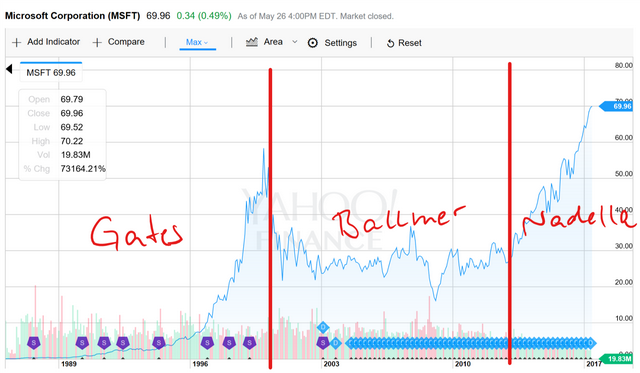
In der Ära Ballmer haben sich viele Leute angewöhnt, alles, was Microsoft unternahm, schlecht zu finden. Seit Nadella das Unternehmen führt, läuft es wieder rund. Das kann man an vielen Stellen sehen, am deutlichsten aber an der Kursentwicklung. Ich denke, da ist noch mehr Potential.

30 May 17:58

When the US forces you to check your notebook

by Volker Weber

1996 Toshiba commercial

30 May 17:57

The Way Ahead

by Stephen Fry

Transcript of lecture delivered on the 28th May  2017 • Hay Festival, Hay-on-Wye 

Peter Florence, the supremo of this great literary festival, asked me some months ago if I might, as part of Hay’s celebration of the five hundredth anniversary of Martin Luther’s kickstarting of the reformation, suggest a reform of the internet. Firstly let me say that, despite a lifetime immersing myself in what I consider the provoking, beguiling, bewitching and often befuddling joy of technological development, especially in the realm of information technology, networking and shiny digital devices, I am no computer scientist, coder or programmer. Many people, some of them no doubt here in this tent now, will know much more about the subject I’m going to discourse upon. Take this, if you take it all, as the offering of a curious mind, curious in both sense, avid for information and just plain odd.

You will be relieved to know, that unlike Martin Luther, I do not have a full 95 theses to nail to the door, or in Hay’s case, to the tent flap. It might be worth reminding ourselves perhaps, however, of the great excitements of the early 16th century. I do not think it is a coincidence that Luther grew up as one of the very first generation to have access to printed books, much as some of you may have children who were the first to grow up with access to e-books, to iPads and to the internet.

Johannes Gutenberg’s great project, his Bible, bore fruit in 1455 – perhaps 120 or so copies on paper and 60 on vellum, calfskin – but Gutenberg had in fact already given this new art of moveable metal type printing a trial run, a proof of concept, in the production of hundreds, perhaps thousands, of Papal indulgences. An indulgence was a piece of paper, signed and sealed by the Vatican. Whoever could afford such a holy ticket could buy it and be … well, indulged. They could, in effect, sin – up to and including the face value of the indulgence they bore, which held good, officially for no more than 40 years, but indulgences were soon produced with expiry dates of 20,000 and in a few recorded cases 45,000 years, allowing the lucky purchaser to go straight to paradise without passing purgatory. Just as you can buy carbon credit now, so you could buy this Vatican vice voucher, a sin offset document. The Church originally had their monks and clerks write these by hand, but then, thanks to Gutenberg, they had thousands of them printed at a fraction of the cost, to raise money for, amongst other things the completion of St Peter’s in Rome but also – as Luther noted – for the lining of individual pockets and the filling of personal coffers. It was this venal and corrupt practice that led Luther to proclaim his 95 theses.

The technology then had intensified the corruption, but it was that same technology that was to spread the word of Luther’s protest and prime the pump of the Protestant reformation. This always seems to be the way with technological innovation. As much as it is a vector of negative disruption – corruption indeed – it is also the vector of progress and improvement. In 1450 there were no printed books in the world, by 1500 there were millions. Printing itself was and is morally and doctrinally neutral, without positive or negative valency per se: it could as well be used for the dissemination of official catholic propaganda (to use the Vatican’s own word) as it could be used for the transmission of what the church would consider subversive or heretical material. This held true over the centuries. Printing frustrated the church on the one hand – they had Diderot imprisoned for recruiting scholars and contributors to his great Encyclopédie, a project that attempted to describe the world in enlightenment and scientific terms – but on the other, printing allowed the propagation of printed bibles for missions around all the newly colonised corners of the world, spreading the power, reach and authority of the Holy See. It is worth remembering this point: the technology itself is neutral.

Gutenberg’s printing revolution, by way of Das Kapital and Mein Kampf, by way of smashed samizdat presses in pre-Revolutionary Russia, by way of The Origin of Species and the Protocols of the Elders of Zion, by way of the rolling offset lithos of Fleet Street, Dickens, Joyce, J. K. Rowling, Mao’s Little Red Book and Hallmark greetings cards brought us to the world into which all of us were born, it brought us, amongst other things – quite literally – here to Hay-on-Wye. I started coming to this great festival before the word Kindle had a technological meaning, when an “e-book” might be a survey of 90s Rave drug Culture, or possibly an Ian McMillan glossary of Yorkshire Dialect.

Printed books haven’t gone away, indeed, we are most of us I suspect, pleased to learn how much they have come roaring back, in parallel with vinyl records and other instances of analogue refusal to die. But the difference between an ebook and a printed book is as nothing when set beside the influence of digital technology as a whole on the public weal, international polity and the destiny of our species. It has embedded itself in our lives with enormous speed. If you are not at the very least anxious about that, then perhaps you have not quite understood how dependent we are in every aspect of our lives – personal, professional, health, wealth, transport, nutrition, prosperity, mind, body and spirit.

The great Canadian Marshall McLuhan –– philosopher should one call him? – whose prophetic soul seems more and more amazing with each passing year, gave us the phrase the ‘Global Village’ to describe the post-printing age that he already saw coming back in the 1950s. Where the Printing Age had ‘fragmented the psyche’ as he put it, the Global Village – whose internal tensions exist in the paradoxical nature of the phrase itself: both Global and a village – this would tribalise us, he thought and actually regress us to a second oral age. Writing in 1962, before even ARPANET, the ancestor of the internet existed, this is how he forecasts the electronic age which he thinks will change human cognition and behaviour:-

“Instead of tending towards a vast Alexandrian library the world will become a computer, an electronic brain, exactly as in an infantile piece of science fiction. And as our senses go outside us, Big Brother goes inside. So, unless aware of this dynamic, we shall at once move into a phase of panic terrors, exactly befitting a small world of tribal drums, total interdependence, and superimposed co-existence. […] Terror is the normal state of any oral society, for in it everything affects everything all the time. […] In our long striving to recover for the Western world a unity of sensibility and of thought and feeling we have no more been prepared to accept the tribal consequences of such unity than we were ready for the fragmentation of the human psyche by print culture”.

Like much of McLuhan’s writing, densely packed with complex ideas as they are, this repays far more study and unpicking than would be appropriate here, but I think we might all agree that we have arrived at that “phase of panic terrors” he foresaw. Let me suggest a few of the anxieties we feel about the digital world today:

  • Aside from the ugliness and ferocity of trolling on social media, we fret over the so-called post-truth age, with its arguments over what is ‘fake news’ and what are ‘alternative facts’ and the concomitant diminution of trust in any authoritative source of information, or consensus as to the validity and credibility of news and current events at all.
  • The refusal of social media platforms to take responsibility for those dangerous, fake, defamatory, inflammatory and fake items whose effects would have legal consequences for traditional printed or broadcast media but which they can escape.
  • The rise of big data and one’s personal footprint of analytics, spending and preferences, becoming, willy nilly, corporate property. The ever present threat to our privacy that this involves concerns us. Everyone we know, everything we read, watch, listen to, eat, everything we desire and perhaps every electronic message we send – all readable by a corporation or a government.
  • The unfair non-contractual working practices afoot in the so-called Gig Economy – Uber Drivers, delivery couriers and so on. Not to mention the effect of those services on the pre-existing workforce of cab-drivers and others whose hard won qualifications might be set at nought.
  • The ghettoisation of opinion and identity, known as the filter bubble, apportioning us narrow sources of information that accord with our pre-existing views, giving a whole new power to cognitive bias, entrenching us in our political and social beliefs, ever widening the canyon between us and those who disagree with us. And the more the canyon widens, the farther away the other side and the less likely we are to hear or see what goes on there, intensifying the problem and always at the super new speeds this digital new world confers.
  • The threats to personal, national and transnational security – threats emanating from ‘bad actors’ that might be cyber-extortionists, unscrupulous corporations, unfriendly foreign powers, intrusive domestic governments and their agencies.
  • The threat to the young of grooming that leads to abuse, or of recruitment that leads to extremist and violent ideologies and actions.
  • Algorithms continue every microsecond to harvest data of my movements, by GPS for example, analyse my actions, read my gmail, build up information on my mood, sexuality, political, religious and cultural affiliations, habits and propensities – such data is for sale …
  • Bullying – especially of the young. Body shaming. Blackmail. Extortion. Revenge porn. On-air suicides, encouragements to self-harm and live-streamed violence.
  • The corporate assault on net neutrality.
  • The fragile security of our entire digital world and the ever-present looming possibility of a Big One, that cataclysm brought about either by malice, act of war, systemic technical failure, or some other unforeseen cause, an extinction level event which will obliterate our title deeds, eliminate our personal records, annul our bank accounts and life savings, delete all the archives and accumulated data of our existences and create a kind of digital winter for humankind.

These are some of the things that rightly worry us. An example of every one of them can be found almost daily in a story on-line or in the mainstream so called dead tree media. All of them individually, or in a potential catastrophic avalanche, threaten to engulf us. One thesis I could immediately nail up to the tent flap is to join in the call for aggregating news entities like Facebook to be legally classified as publishers. At the moment they are evading responsibility for their content because they can claim to be ‘platforms’ rather than publishers. Given that they are the main source of news for over 80% of the population that is clearly an absurd anomaly. If they and Twitter and like platforms recognise their responsibility as publishers it will certainly help them better police their content for unacceptable libels, defamations, threats and other horrors that a free but legally bound press would as a matter of course be expected to control. But that correction of the legal standing and responsibility of social media platforms is almost certainly going to happen and soon, and is, frankly, small potatoes – as, to some extent, are the other anxieties I’ve outlined. For there is so more, so much more coming – as they say in America – down the pike. Some huge potatoes are looming on the horizon.

First, let’s just take time to remember how it all came about. I bought my first computer in 1982. We early adopters were like pioneer motorists in the first age of the internal combustion engine. You couldn’t feasibly drive a car without knowing how the engine worked. Every mile or so you had to, in the words of a popular song of the time, get out and get under your automobile, you had to tweak the magneto and adjust the carburettor and so on. And now? Now you never have to look at the engine from one year to another. All you have to know is how to negotiate the traffic. Just like computers and networking. No need now to know how to program, how to write an Interslip modem script or tweak your subnet mask. All you have to know is how to drive the thing such that you can get where you want to get safely and reliably. Now of course, with both cars and computer networking, the highways are clogged, one-way systems everywhere, streets are blocked, advertising hoardings deface the roadside, toll roads are in operation, car thieves patrol your area, speed traps, parking fees and towing away blights your life and traffic is a nightmare. Back then, ah the joys of the open road, you may have looked silly in your goggles and acoustic couplers, but what bliss it was in that dawn to be alive and to be young was very heaven. Just as when cars were slow, so when modems were slow, traffic was light and the illusion was of speed.

In the 1980s I joined Prestel and CIX, text based bulletin boards and information exchanges, then CompuServe an online service that allowed GIF in the 80s then finally Demon Internet allowing me to be a cybernaut. I literally did not know a single other human being who was on the net. I felt like the only person in Britain with a tennis racket. Not much chance of a game. But I got to know people from other countries as we swapped emails and techniques for getting in and out of university servers. There was no world wide web at this point. There were search engines like Veronica, JANET, WAIS, the Gopher project, telnet, irc, ftp etc etc. A world, as ever, of initials and acronyms. Commercial online services like CompuServe and AOL began to grow and offer their paid customers ‘ramps’ onto the true wild west of the internet. Then came Tim Berners Lee’s invention, the worldwide web and the arrival of the first browsers, Mosaic and then Netscape. It was the early days of portals, reliable feature-rich, for their time, home page gateways. Excite, Lycos, Prodigy, Alta Vista, Earthlink, Yahoo, Ask Jeeves were the big portal and search engine names. The rise of AOL seemed permanent and unstoppable. Every shop counter had piles of their introductory CDs, every glossy magazine had them taped to their cover. They were so big, they became the lead name in the giant media corporation they created, AOL Time Warner, which now embarrassedly hides the name AOL and pretends they don’t exist, from hot hot hot to icy cold in less than a decade. To have an AOL or hotmail email address is now so uncool it’s probably retro-cool again. In the mid-90s I did a film Wilde, first movie to end credits with a URL – if you watch the last screen says www.oscarwilde.com (since expired). That year an outfit called Google arrived with a fancy new set of search algorithms, Steve Jobs rejoined the company he had founded but from which he had been fired. The iMac arrived. Then came the new millennium and the fear of the year 2000’s millennium bug. Things hotted up. The iPod ‘disrupted’ to use that annoying word, the whole music industry. In 2005-6 Facebook opened up to the world, Ten years ago, almost to the week, the iPhone arrived. Twitter landed and various other social media services followed, Quora (for grownups), Snapchat (for children), Instagram (for the tragic) and so on. And here we are.

I’m sure you all remember the myth of Pandora’s Box. Which was really Pandora’s Jar. We call it Pandora’s Box because no less a figure than one of the heroes of early humanism, Erasmus, mistranslated it. The myth was told in Hesiod’s Works and Days, which described a pithos or jar. It seems Erasmus, when he translated it from the original Greek into Latin, mistook the word for pyxis meaning box, like the pyx in which priests to this day keep the communion host. So the jar became a box, showing that fake news could spread and replace the truth even before the days of printing.

Pandora and her jar were all part of Zeus’s revenge on Prometheus and us. He had not forgiven him for stealing fire from heaven and giving it to mankind. The gods had looked down and seen fires breaking out everywhere, industry, ceramics, cooking, foundries for art and war – but they saw the divine spark too, the creative fire that raised us to divine levels. Zeus was to punish Prometheus by chaining him to the Caucuses and sending eagles, or perhaps vultures, to peck out the immortal Titan’s liver every day. But mankind he punished in a more subtle way: and for once I use the word mankind without fear of being tutted. There were no women at this point. The god Hephaestus, Vulcan to the Romans, was commanded by Zeus to create the first human female from clay moistened by his spittle. Hephaestus took his wife Aphrodite, his mother Hera, his aunt Demeter and his sister Athena as models and lovingly sculpted a girl of quite marvellous beauty into whom Aphrodite, goddess of love and beauty then breathed life.

The other gods joined together to equip her uniquely for the world. Athena trained her in household crafts, embroidery and weaving, and dressed her in a glorious silver robe. The Charites, or Graces, were put in charge of accessorising this with necklaces, broaches and bracelets of the finest pearl, agate, jasper and chalcedony. The Horai, the Hours, plaited flowers around her hair until she was so beautiful that all who saw her caught their breath. Hera endowed her with authority, poise and self-possession. Apollo taught her skill in music, learning, archery, rhetoric and reason. Hermes schooled her in the arts of deception, curiosity and cunning. And he gave her a name. Since each of the gods had conferred upon her a notable talent or accomplishment, she was to be called All-Gifted, which in Greek is Pandora.

Hephaestus bestowed one more gift upon this paragon, which Zeus presented to her himself. It was a jar/box filled with … he did not tell her.

Well you know what happened: after weeks of aching curiosity Pandora waited until she was alone in the house and – she couldn’t help herself, which of us could? She pulled the jar from its hiding place and twisted the lid. Its waxen seal gave way and she pulled it free. There was a fast fluttering, a furious flapping of wings and a wild wheeling and whirling in her ears. She cried out in pain and fright and jumped back as she felt something leathery, scaly and bony brush her neck, followed by a sharp and terrible prick of pain as some sting or bite pierced her skin. More and more flying forms buzzed from the mouth of the jar – a great cloud of them chattering, screaming and howling in her ears. With a cry Pandora summoned up the courage and strength to close the lid and seal the jar.

Like a cloud of locusts, the shrieking, wailing creatures flew away over the town, over the countryside and around the world, settling like a pestilence wherever humankind had habitation.

The names of the creatures were Ponos, Hardship. Limos, Starvation. Algos, Pain. Dysnomia, Anarchy. Pseudea, Lies. Neikea, Quarrels. Amphilogiai, Disputes. Makhai, Wars. Hysminai, Battles. Androktasiai and Phonoi, Manslaughters and Murders.

Illness, violence, deceit, misery, cruelty, lies and anarchy had arrived. They would never leave the earth.

What Pandora did not know was that when she shut the lid of the jar so hastily she forever imprisoned inside one last little creature , which was left behind to beat its wings hopelessly in the box for ever. Its name was Elpis, Hope.

The comparison seems rather good, don’t you think? If Gutenberg’s revolution was Pandora 2.0 and the Industrial Revolution 3.0 then the information age is Pandora 4.0.

When I first found out about and joined the internet and watched it grow with the arrival of the www I described it to friends, whom I was anxious to convert and get themselves email addresses, as the greatest gathering of human beings in the history of the planet. As new services came on line and web 2.0 blossomed into the social media services we now know and perhaps rely on, I believed, I really believed, that humankind might well be saved by the all-gifted net. It would spread, art, literature, music, culture, philosophy, enlightenment and knowledge. In its train would come new freedoms, a new understanding between the peoples of the world, a new contract. This was to be our millennium’s Pandora, an all-gifted organism that would bring nothing but learning, understanding, amity, comity and friendship. I looked at budding projects like Wikipedia and I saw Diderot’s enlightenment dream becoming a reality. I saw art galleries and archives becoming freely available to all. I saw special interest groups able to exchange information and ideas with their fellows across the globe: whether it was coin-collecting, a love of a particular style of music, a shared pleasure in gaming, hiking or cosplay, a rare physical or mental disorder in common – suddenly people could contact each other across the world. Free translations, free lectures, tours, user-generated advice on travel, hunting for the best deals and bargains, sharing experience in all fields of human endeavour. Borders, barriers, frontiers and boundaries would melt and dissolve. An end to tribalism, racism, ignorance and fear. A new dawn for mankind. It was all good. You are allowed to laugh at my naivety, I do myself.

And when Twitter, which I had joined early on thinking it a fun trivial little nonsense that might be worth pursuing, when it showed how people could connect in real time as they massed in the squares of Tunisia and Egypt ushering in the Arab Spring, my joy was complete. What tyrant could endure in this new world? How could censorship and propaganda survive when the wisdom and knowledge of crowds was there to shine the light of truth in all the world’s darkest places? This was paradise come to earth. Utopia made real! What could possibly go wrong?

When did I become aware, when did we start to notice that perhaps it wasn’t quite so perfect after all. Well, the odd caterpillar in the salad, or fly in the ointment shouldn’t put us off. But the beating of the leathery scaly wings of something worse fluttering from the jar couldn’t be ignored even by so perfectly gullible and optimistic a fool as me. The lid had been lifted and trolls were flying out, bullies, monstrously cruel and malicious thieves, extortionists, brigands, pirates, liars, con artists, predators and monsters. Hope was nowhere to be seen.

So have I gone from dewy-eyed, dopy and idiotic optimist to dead-eyed, despondent and despairing pessimist? Or perhaps I am doing no more than responding to a few political developments of late that I don’t like and which seem to have been powered by social media. If the Brexit vote and the American general election had gone the other way, would I and others of my stamp be wringing our hands at the state of the online world? Surely these anxieties are just the moaning of the sneering metropolitan coastal elite who have finally been pushed off their smug self-satisfied perches by the voice of the real people. We have lost. The people have spoken. The alt-right, the Trumpians and the Leave Campaign were just more social-network-savvy, smarter, better organised and now you feeble Social Justice Warriors are crying foul on the whole system?

Well, I hope I can convince you it isn’t that at all. I am a great believer in the Wheel of Fortune, not the prime-time American gameshow, but the Roman rota fortunae. It never stops turning. Most of us in the this room can remember when Clinton and Blair and their centre-left Third Way ruled the roost. They were at the very top of the wheel and now they’re at the bottom. President Trump is now at the top of the wheel, which means he and his kind must, by definition (according to this metaphor at least) be on the way down. Indeed, I think we can perceive that since his surprise ascent to the apex he is already starting to descend. We have passed Peak Trump and the rest of his story will dissolve into mere gossip, weird news, hilarity and eye-popping scandal as he cycles down into failed nullity, the fate of even the most distinguished politicians. Historical mulch on the floor of history.

So I hope you see that I am not suggesting that the internet and our digital world are in need of repair because this or that political grouping ebbs or flows, waxes or wanes. The fact is everything I have thus far spoken about, is to some extent old news.

You might remember that when I listed those anxieties we all share at the moment I added that there is more, much more “coming down the pike”? So, here’s my estimation of what it is that’s coming.

I’ll frame it with this memory of my friend Douglas Adams, now 16 years dead – if only he were in my place giving this talk, how much his insights into technology, art and society are needed. I remember he recalled a 1930s Wonder Book of Science that he found in his parents’ attic. It had come out around the time of the development of domestically available electric motors, a technological advance that we don’t think about these days for a very good reason, which I’ll come to. I’m talking about the development which would allow a motor to turn, just as a steam engine did, but without the fuel having to be in the house. The fuel was in the power station: the electricity came into your home and you could simply switch on an your motor. The Wonder Book showed what it imagined would be a Future House of the 1950s. In the attic they depicted a huge master motor with a great belt attached to a shaft from which ran other belts turning a clothes mangle for drying laundry, a washing-machine, a record-player – all kinds of devices magically imparted with mechanical motion thanks to the electric motor in the attic. Of course, the book suggested, householders of the future would have to be electric motor literate (though they didn’t use that exact phrase), able to maintain the motor, grease the shafts, apply belt-stick to the canvas of the belts to stop them slipping and so on. This book, with its cutaway illustrations and belts on shafts slapping and driving throughout the house looks comically absurd to us. But the authors were right, electric motors would go on to revolutionise our lives: what they failed to foresee is that we wouldn’t have to know a single thing about them. They would miniaturise and become embedded in our machines, self-regulating and invisible. They’re in our washing-machines, in our vacuum-cleaners, in our CD drives, smoothie-blenders, blu-rays, ovens, car windows, fridges, printers, coffee-makers a hundred thousand objects we use all the time but never think twice about. The electric motor became people literate. Fifty years after the wonder book we were all being told that we had to be computer literate, but no – just as with the electric motors, miniature computers appeared in our music players, our phones, ovens, cars, washing-machines, alarm clocks, phones, cameras, coffee-makers.

Well, you might have heard of IoT, the Internet of Things. Just as electric motors and computers began to be seamless, transparently, almost invisibly incorporated into every days objects that already existed and new ones that were developed for our convenience, so internet connection is being baked not only into todays electrical devices and appliances, but into ordinary domestic objects too. Things. Through radio protocols like wifi, Near Field Communication and Bluetooth everything from lightbulbs, door-locks, central heating thermostats, shopping lists, alarm systems, fridges, luggage, clothes, human bodies and bloodstreams that are constantly online, remotely available and controllable through web, smartphone and computer apps (I blush to confess I have – early adopter/idiot that I am – fallen for most of them, we have an internet connected fridge in our Los Angeles home and wherever I am in the world I can see inside it, thanks to its three cameras). Many of these IoT, Internet of Things objects, so called smart devices, are the classic example of a solution looking for a problem. I would include my fridge in that. But people in all walks of life are now investing hugely in this future: millions of IoT products are sold every month, you’re probably becoming more and more aware (if you haven’t already made the plunge) of Virtual Assistants, second generation advances on Alexa, Siri, Hello Google and the freakishly and inexplicably named Cortana. These, once installed, typically as speaker units in the home, in order to work, listen to every word spoken within auditory range. This makes these and all IoT devices, you will have realised quickly, a soft, ripe low-hanging target awaiting any hacker who can, if so disposed, link co-opted devices and use them as slave elements in giant bots, malicious automated cyber-dragons that combine the processing power of their enslaved devices to wreak enormous damage and stage spectacular data and currency heists.

Many of us who have shown an interest in the development of computing, watched over the years as two other nascent technologies struggled to match the almost supernatural properties of their popular science fiction manifestations. Robotics and artificial intelligence. The great Marvin Minsky, regarded by many as the father of Artificial Intelligence, knew that whatever kinds of AI were espoused – brute force, expert systems, machine learning, heuristics, genetic programming, neural nets – the reality, the successful system, would almost certainly be a mix of all those approaches. Above all, the success of AI was dependent upon reaping the advantages of the ineluctable Moore’s Law that has seen the year on year exponential increases in speeds and memory capacities necessary for the construction of workable AI. Gordon Moore, the founder of semiconductor company Intel, first proposed some time in the 1960s that processing speed/power/capacity would double every 18-24 months. What he actually said is that you would be able to place double the amount of transistors in the same square inch of silicon which amounts, broadly speaking, to increasing power and speed. This is the reason everything has sped up so extraordinarily. Pong, the monochrome tennis game with a slidey-up-and-down bat and a square ‘ball’ was not a result of inefficient, unimaginative, ignorant computer programming, it was the most you could do with chips as they were, the programmers were incredibly gifted and pushed the processor to its limit. Today’s 3D augmented and virtual reality graphics are no smarter really, they’ve just got a Maclaren to drive, not a Model T.

So it’s not just that computing power increases every eighteen months or so, it doubles. The speed, power and capacity from which it is now doubling boggles the mind and allows a whole new kind of technology to arise, or if you want to be Yeatsian and apocalyptic, to slouch towards Bethlehem to be born.

The almost metaphysical question of consciousness, feeling and the passing of the famous Turing Test aside, Moore’s Law’s delivery to developers of ever doubling processing speeds and capacity was always going to turn science fiction into science fact. It was never an ‘if’ or a ‘whether’, it was always a ‘when’. As far as cybernetics and robotics are concerned, there are different issues of moveable parts and sensory mechanisms. Moravec’s paradox comes in to force here, which states that computers are very good at what humans find difficult, but very bad at what we find easy. For example, machines can do lightning fast calculations and feats of memory way beyond human capacity, but no machine has been built that can approach the motor and perception ability of a one year old. Which, when you think about it, is just as it should be, we want machines to be good at the things we find hard and don’t need them to be good at the things we find easy.

Nonetheless, just as physics tries to unify fields of force, so technology unifies its different fields and the point is this:- the Internet of Things, Robotics and Artificial Intelligence are now essentially one and the same thing. In America I own a car that is capable of autonomous driving. I sit on the freeway, pull twice on a stalk on the steering wheel, fold my arms and tuck in my feet, the car, one of Elon Musk’s Tesla models, does it all – it brakes when the car approaches a vehicle up ahead and keeps an optimum distance. It speeds up when it can. It slows to a halt when it needs to and starts again. Thanks to GPS, it remembers where speed bumps are and raises the suspension the better to handle them. It even opens my garage doors automatically as I approach and closes them when I leave home. And this is nothing nothing compared to what is to come. The impact on our lives and employment is incalculable, just as the effect on the world of Tim Berners-Lee’s web protocols and programs http and HTML were incalculable. We are talking about nothing less than the mass obsolescence of much of the human workforce. Not mass unemployment necessarily but mass redeployment certainly. Not just in the sector that Americans call blue collar. Assembly lines have been replacing humans with machines for years. But white collar, college-educated workers are now being replaced too. Already an insurance company in Japan has installed an AI office system that replaces 60 clerical workers with just one whose role is to maintain the AI system. Trucks will be autonomous, ie driverless, very soon. And trains of course. Fun strikes ahead in the Southern Rail region. All this will happen in no longer than the length of time I’ve been coming here to Hay and have watched mobile phones become smart phones, watched AOL rise and fall.

Money is the great driver of course. The moment cars that self-drive are shown actuarily to have fewer accidents than human-driven cars, then insurance premiums will sky-rocket for those who choose to drive. Share holders will adore, as they always have, the idea of firing workers and replacing them with non-unionised systems that never pull a sickie or blow the whistle on dodgy corporate practices. It is worth pointing out that when United Airlines cabin crew seemed to beat up and throw off the plane a doctor and hit the headlines, accruing staggering negative publicity, the share-price barely wobbled. When rival American Airlines gave their staff a pay-rise, something that rarely rippled in the news cycle, their price immediately plummeted. The markets are a kind of artificial intelligence already, one that is not very human friendly, algorithmically led towards profit whatever the social cost. And clearly, worrying about the gig economy and the threat Uber drivers pose is almost comically dumb when Uber drivers themselves will be redundant in the very near future.

What else? Douglas Adams’s babel-fish, a real time language translation device, is not very far off. The day will come in our lifetimes when we will not be able to distinguish between pieces of music entirely composed by machine and entirely composed by humans. You might be familiar with the University of Oregon experiment in which pianist Winifred Kerner played three pieces, one by Bach, one by a computer program and one by a professor of music at the university called Dr Steve Larson. They thought the Larson piece was by a computer, the Bach piece was composed by Larson and that the piece written by the computer was genuine Johann Sebastian Bach. That experiment took place twenty years ago. It is very likely that your next absolute favourite hummable tune will be artificially written. Or poem. Or novel.

If intelligent systems can design systems more intelligent than themselves, the exponentially steep rate of improvement will dizzy our minds. It’s very important to keep this perhaps obvious point in mind: in the field of technology we never arrive at a state of finished satisfaction. The way things are now is not how they will be in two years time. Heraclitus said you cannot step into the same river twice, for fresh water is always flowing past you. The technological stream similarly allows for no sense of stasis. Technology is not a noun, it is a verb – a process. We know that our economics is in flux too, predicated and dependent on growth, growth, growth. What we have to accept is that there has been a confluence of that economic imperative for growth, Moore’s Law of ever-increasing computational power, human curiosity and ambition and our very particular kind of consumer addiction and need for the new – all of which have swollen the river of technological progress into flood.

Great gifts will come this new phase, from Pandora 5.0, of course they will. Let me sketch a few more or less at random and far from complete. History teaches that everything I say will be an underestimation. So, AI, robotics and smart devices in the biotech and medical sphere are already coming on line, the NHS has a deal with Google’s Deep Mind machine-learning AI (originally a British company Deep Mind is now the world champion at the game Go, which it taught itself), this  kind of AI in the clinical realm will offer earlier diagnosis, the ability to read medical imaging data with much more accuracy and spot incipient signs of disease, making radiologists for example redundant; in the area of virology and related sciences it can assist with analysis of amino acids, protein structures and the creation of serums and treatments hugely accelerating drug development; we will see the manufacture of greater and better cybernetic prosthesis, bionic eyes, ears and limbs; more robotic surgery, faster and more accurate genetic analysis, genotyping and biometric data; brain computer interfaces, will allow thought and dream reading, the operation by thought alone of machinery, devices, musical instruments, paint brushes, tools; brain machine data input and output will transform a huge number of activities and operations allowing the happy combination (harnessing Moravec’s paradox) of the best human abilities of motor skills and perception with the best machine abilities of calculation and precision; we will see care robots for the elderly, cyber Mary Poppins guardians and babysitters for children and the vulnerable. The fight for greater longevity will unquestionably rely on AI techniques and usher in the possibility of the conquest of death itself. We are doubtless used to hearing that the first human to live to 200 years old is already alive, the younger people in this room can certainly expect to break the 120 barrier. I have been told by more than one solemn-faced scientist that the first person to live to 1,000 is probably alive and that immortality is technically and feasibly within reach. In other arenas, not counting the world of work, we will see better weather forecasting, an amelioration of traffic flow, automated shopping and delivery. A diminution of human error in multiple areas of exchange and interaction will lead to all kinds of undreamed of benefits.

The next big step for AI is the inevitable achievement of Artificial General Intelligence, or AGI, sometimes called ‘full artificial intelligence’ the point at which machines really do think like humans. In 2013, hundreds of experts were asked when they thought AGI may arise and the median prediction was they year 2040. After that the probability, most would say certain, is artificial super-intelligence and the possibility of reaching what is called the Technological Singularity – what computer pioneer John van Neumann described as the point “…beyond which humans affairs, as we know them, could not continue.” I don’t think I have to worry about that. Plenty of you in this tent have cause to, and your children beyond question will certainly know all about it. Unless of course the climate causes such havoc that we reach a Meteorological Singularity. Or the nuclear codes are penetrated by a self-teaching algorithm whose only purpose is to find a way to launch…

It’s clear that, while it is hard to calculate the cascade upon cascade of new developments and their positive effects, we already know the dire consequences and frightening scenarios that threaten to engulf us. We know them because science fiction writers and dystopians in all media have got there before us and laid the nightmare visions out. Their imaginations have seen it all coming. So whether you believe Ray Bradbury, George Orwell, Aldous Huxley, Isaac Asimov, Margaret Atwood, Ridley Scott, Anthony Burgess, H. G. Wells, Stanley Kubrick, Kazuo Ishiguro, Philip K. Dick, William Gibson, John Wyndham, James Cameron, the Wachowski’s or the scores and scores of other authors and film-makers who have painted scenarios of chaos and doom, you can certainly believe that a great transformation of human society is under way, greater than Gutenberg’s revolution – greater I would submit than the Industrial Revolution (though clearly dependent on it) – the greatest change to our ways of living since we moved from hunting and gathering to settling down in farms, villages and seaports and started to trade and form civilisations. Whether it will alter the behaviour, cognition and identity of the individual in the same way it is certain to alter the behaviour, cognition and identity of the group, well that is a hard question to answer.

But believe me when I say that it is happening. To be frank it has happened. The unimaginably colossal sums of money that have flowed to the first two generations of Silicon Valley pioneers have filled their coffers, their war chests, and they are all investing in autonomous cars, biotech, the IoT, robotics Artificial Intelligence and their convergence. None more so than the outlier, the front-runner Mr Elon Musk whose neural link system is well worth your reading about online on the great waitbutwhy.com website. Its author Tim Urban is a paid consultant of Elon Musk’s so he has the advantage of knowing what he is writing about but the potential disadvantage of being parti pri and lacking in objectivity. Elon Musk made enough money from his part in the founding and running of PayPal to fund his manifold exploits. The Neuralink project joins his Tesla automobile company and subsidiary battery and solar power businesses, his Space X reusable spacecraft group, his OpenAI initiative and Hyperloop transport system. The 1950s and 60s Space Race was funded by sovereign governments, this race is funded by private equity, by the original investors in Google, Apple, Facebook and so on. Nation states and their agencies are not major players in this game, least of all poor old Britain. Even if our politicians were across this issue, and they absolutely are not, our votes would still be an irrelevance.

When Steve Jobs was asked the secret of his success he often liked to quote the great Canadian ice-hockey legend Wayne Gretzky who was asked why he was so far and away the greatest player of his, or perhaps any age. Gretzky’s reply was that while other players skated to the puck, he skated to where the puck was going to be. That what how Jobs saw as the necessary practice of the innovator. Business leaders and politicos always say with bland regularity that change brings as many opportunities as it brings challenges. The dark side of the rise of the machines, the sudden obsolescence of so many careers and jobs, the insecurity, the potential for crime, exploitation, extortion, repression, surveillance and even newer forms of cyberterrorism give us the collywobbles and suggest challenges for sure, but we must understand that it is going to happen collywobbles, initial resistance or not, because the lid is already off the jar, so the best we can do is keep it off and let hope fly out.

I do submit that it is nothing short of scandalous to be in the middle of a general election in 2017, on the very brink of this awe-inspiring, terrifying, scarcely credible but unquestionably real and imminent revolution, and find that politicians are skating not to where the puck is going to be, not even to where the puck is, but – as ever – to where the puck used to be. Westminster’s and the main political parties’ records on this subject are truly abysmal. Their ignorance and ostrich-like refusal to come to terms with the internet’s direction of travel has always been lax, ludicrous and laughable but it is also dangerously irresponsible. The state of the broadband infrastructure in rural areas is shambolic and contemptuous. As for the moaning about the expense and delays and subsequent abandonment of that aborted all new NHS IT system, well those chickens have come home to roost, haven’t they? The scandal of Britain’s largest entity, the NHS, using ancient Windows XP and even NT systems in 2017 with update and security patch costs not paid for. Wow.

The only manifesto commitment I can see on this subject is an unenforceable and irrelevant one that suggests a new Conservative government is going to attempt to increase its powers of control over Internet Service Providers, proposing to force ISPs to dislodge their users’ histories, there will no doubt more nagging to open up end-to-end messaging apps too, but it’s all skating to where the puck was.

But we are no good, any of us, at dealing with the future, politicians perhaps least of all thanks to a short electoral cycle and a race to the simplistic, unscientific and ill-informed bottom when it comes to the future. By way of example from another realm: Social Care is a hot button issue this electoral cycle, but everyone knew twenty years ago that the demographic inevitability of a population bulge going into retirement and old age having to be funded by a dwindling tax base was coming to pass and that is when plans should have been made, not now when it is almost too late and much, much more expensive and difficult. No one had the guts to say these things out loud at election time 20 years ago. Similarly, no one is talking now of the threat to employment, privacy, security and civil liberties of the remorseless, unstoppable convergence of the Internet of Things, Robotics and Artificial Intelligence or of the golden promise of that revolution. No one is suggesting how this will impinge on the education of the young and the re-education of the working population. The phenomenon of the ever expanding service industries we have relied on for so long is all very well, but you can have just so many Starbucks and Gregg’s on any given street and who is to say a robo-barista isn’t already being trialled somewhere in Seattle or the Santa Clara valley?

If you have children you should be encouraging them and their teachers to research into the careers of the future, some of which are very exciting. Social Robotics will be a big field for example, well worth looking that up – it’s a blend of social anthropology, psychology and design. Then again your son or daughter could be one of the first lawyers to specialise in Robot Rights, perhaps work on establishing charters for the building in of values and ethical systems or maybe they will go the other way and start up Robot Brothels catering to all tastes, because if history teaches us anything it’s that the sex industry will be coining it before any minister of state works out what’s going on.

So one thesis I would have to nail up to the tent is to clamour for government to bring all this deeper into schools and colleges. The subject of the next technological wave, I mean, not pornography and prostitution. Get people working at the leading edge of AI and robotics to come into the classrooms. But more importantly listen to them – even if what they say is unpalatable, our masters must have the intellectual courage and honesty to say if they don’t understand and ask for repetition and clarification. This time, in other words, we mustn’t let the wave engulf us, we must ride its crest. It’s not quite too late to re-gear governmental and educational planning and thinking.

You could argue convincingly I think that one of Churchill’s greatest qualities, one which helped turn the tide of the Second World War, was his openness to science and technological development, as shown in the Science Museum exhibition a couple of years ago dedicated to his role in that sphere. The development of radar, which he supported, was of course a vital part of the victory in the skies in 1940. Sonar too was of incalculable importance in the Battle of the Atlantic. Churchill always listened to his adviser Lord Cherwell, whom he called the scientific lobe of his brain, he got behind wonderful inventions and developments like the Bouncing Bomb, Operation Windows and gyroscopes, and of course that famous five word note he sent concerning the money going into the decryption developments in Dollis Hill and Bletchley. A Treasury official queried the amounts. Churchill visited the Research Station and saw the Colossus vacuum tube computer and its Mark 2 version under construction, he listened, he absorbed and pondered. when he returned to Downing Street he scribbled a message to the Treasury. “Give them what they want,” he wrote. That short note could be regarded as one of the founding documents of digital computing. Of course, you could justly observe that Hitler exhibited a like belief in science and the power of technology: prompting Churchill himself in one of his best known speeches to say: “… if we fail, then the whole world, including the United States, including all that we have known and cared for, will sink into the abyss of a new Dark Age made more sinister, and perhaps more protracted, by the lights of perverted science…’” And perverted or not we all benefited from the inventions and technology that emerged from Germany under Nazi rule, from tape recording to rockets. I said earlier that printing was capable of being perverted into Mein Kampf or The Protocols of the Elders of Zion, into ransomware or fake news that incites murder. I can’t emphasise this point enough. Technology or science do not in and of themselves have moral valency. But at the moment we are blaming the technology rather than our lack of preparedness or understanding, which as Marshall McLuhan observed, is as witless as “… cussing a buzz-saw for lopping off fingers and complaining, ‘but I never saw that coming’.”

The witlessness of our leaders and of ourselves is indeed a problem. The real danger surely is not technology but technophobic Canute-ism, a belief that we can control, change or stem the technological tide instead of understanding that we need to learn how to harness it. Driving cars is dangerous, but we developed driving lesson requirements, traffic controls, seat-belts, maintenance protocols, proximity sensors, emission standards – all kinds of ways of mitigating the danger so as not to deny ourselves the life-changing benefits of motoring.

We understand why angry Ned Ludd destroyed the weaving machines that were threatening his occupation (Luddites were prophetic in their way, it was weaving machines that first used the punched cards on which computers relied right up to the 1970s). We understand too why French workers took their clogs, their sabots as they were called, and threw them into the machinery to jam it up, giving us the word sabotage. But we know that they were in the end, if you’ll pardon the phrase, pissing into the wind. No technology has ever been stopped.

So what is the thesis I am nailing up? Well, there is no authority for me to protest to, no equivalent of Pope Leo X for it to be delivered to, and I am certainly no Martin Luther. The only thesis I can think worth nailing up is absurdly simple. It is a cry as much from the heart as from the head and it is just one word – Prepare. We have an advantage over our hunter gatherer and farming ancestors, for whether it is Winter that is coming, or a new Spring, is entirely in our hands, so long as we prepare.

I can at least, unlike Martin Luther, thank you for your indulgence.

Thank you.

Stephen Fry

BBC Arts Video
Hay Festival

The post The Way Ahead appeared first on Official site of Stephen Fry.

30 May 17:57

MoV Das Wiener Modell

by Stephen Rees

At the Museum of Vancouver  in association with Urbanarium, an exhibition about the extensive social housing provision in Vienna, which started with the collapse of the Hapsburg empire after WWI and continues to this day.

The Vienna Model exhibition, curated by Wolfgang Förster and William Menkins, explores housing in Vienna, Austria, through its portrait of the city’s pathbreaking approach to architecture, urban life, neighborhood revitalization, and the creation of new communities.

Vancouver is consistently ranked alongside the Vienna as one of the world’s most livable cities. Vienna has a stable housing market, with 60% of the population living in municipally built, owned, or managed housing. By comparison, Vancouver is undergoing a housing crisis. Vienna’s housing history and policies provides alternative approaches for British Columbia.

As Vancouver embarks upon a community engagement process revolving around housing, The Vienna Model expands discussion about urban planning options and encourages dialogue and debate on the future of the city.

In addition to its investigation of design that is focused on community, Vancouver- and Vienna-based artists and cultural researchers Sabine Bitter and Helmut Weber have selected art projects and public works that reflect Vienna housing into a broader context. These are included in the exhibition and illustrated catalogue.


Comparisons

MoV  Das Wiener Modell

MoV Das Wiener Modell

Housing and Transportation

Most the exhibition is about housing and how to make it available to people who cannot afford to buy their own home. There did not seem to be a great deal of emphasis on transportation but I did find this

MoV Das Wiener Modell

“Built as part of Vienna’s efforts to encourage the use of bicycles, it reduced car parking to 50% of the usual requirement (one spot per apartment), replacing it with more attractive and transparent bike storage rooms on the ground floor, a bike repair centre, and large elevators for tenants who want to take their bicycles up to their apartments. Situated… next to a subway station and the city’s bike network.”

MoV Das Wiener Modell

The best transportation plan is a good land use plan and this one does well by putting places that people want to visit close at hand. This obviously reduces car use but apparently they still need underground parking.

MoV Das Wiener Modell

This picture makes it clearer that the external wall is merely a facade enclosing more conventional buildings

MoV Das Wiener Modell

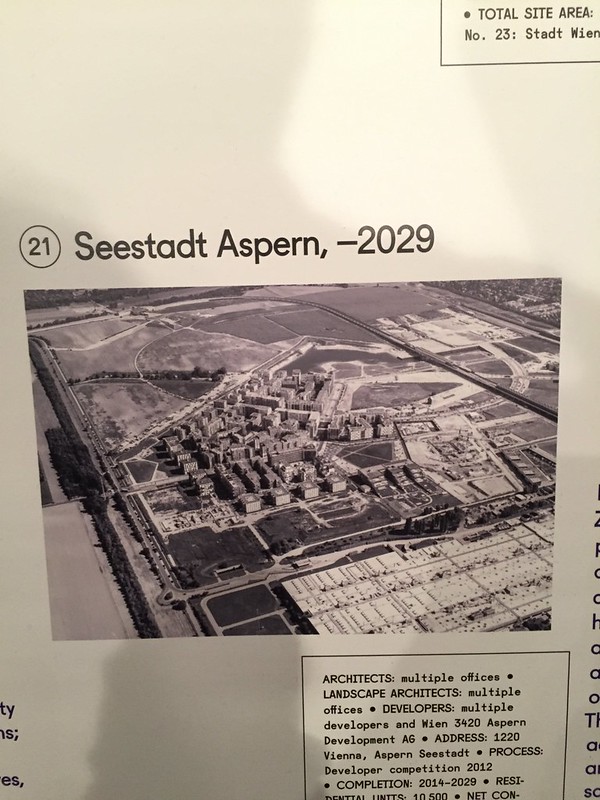
This is about Seestadt Aspern one of the newest developments – I think you can read the bit about public transportation without me copying the text. Let me know if this doesn’t work on your phone.

MoV Das Wiener Modell

Looks a bit grim to me – sort of Cuban – but maybe it will be better once it’s finished and populated

MoV Das Wiener Modell

Apparently most people here (93%) favoured the Vienna approach until there was a debate which turned quite a few against it (video). But there was still a 81% favourable!

The most frequent mode of discussion in the main stream seems to focus around markets – supply and demand – amid much frustration that simply building more doesn’t affect demand when there is a seemingly limitless amount of money available to buy real estate as an investment (as opposed to somewhere to live). Lost in this is the history of Canada has something of a leader in housing provision – back when we still believed that government can sometimes do things right. Public housing provision does and can make sense. But I do think that having a split between planners who do housing and planners who do transportation will simply repeat the same errors once again – the dangerous “projects” (US), the soulless “council estates” (UK) . So mixed use – not poverty ghettos – and lots of amenities within easy reach – as well as jobs and homes next to each other. A bit like cities were before planning – but without the health hazards!


Filed under: housing, placemaking, Transportation, Urban Planning Tagged: Livable city, Vienna
30 May 17:56

Props to Pop on Memorial Day

by Doc Searls

pop

Thinking today, with great appreciation, about my father, Allen H. Searls, who served twice in the U.S. Army, first in the Coastal Artillery and again in the Signal Corps, during World War II.

As I put it in the caption under that photo,

Pop hated not fighting in The War. So he re-enlisted even though he had already served in the Coastal Artillery. Grandma wrote on the back of this picture… “Pvt Allen H. Searls, 42103538, Camp Croft, S.C., Spartanburg, March 1, 1944.” He was promoted to corporal thanks to having served once already, and assigned to the Signal Corps in part because he scored 159 on the Army’s IQ test. He never bragged on that, by the way. (Though I will.) It was also very hard to get it out of him. Not that we needed to. We all knew how smart he was.

Among other things he—

  • Arrived in the second wave at Normandy.
  • Lost some of his hearing from laying communications wiring forward of cannons, as his unit advanced.
  • Was involved in liberating at least one concentration camp.
  • Served as one of Eisenhower’s phone operators after the war ended.

Like most veterans who were involved in combat and other unpleasantries, he didn’t like talking about that. Instead he talked about his buddies and interesting technical details about how things worked, places he enjoyed seeing.

Maybe my sister (another veteran, in this case of the U.S. Navy) can weigh in with some other details.

Main thing is honoring Pop. He was a great patriot and a great dad.

30 May 17:39

Finding The Platform vs. Finding The Time

by Richard Millington

Yes, you found the perfect platform.

But have you found the time?

Most people underestimate the time it takes to bring a platform to life. The need identification, platform demonstrations, negotiations, approvals, design tweaks, more tweaks, yet more tweaks, fixing the broken single sign-on, more tweaks, explaining internally why it’s taking so long, more tweaks etc…

It might not be quite a full-time job, but if you’re doing a big implementation it’s going to be a huge part of your job.

Where will you find the time to do it well?

Working yourself to exhaustion isn’t a solution, so what will you spend less time doing?

Will you spend less time responding to members? Put aside new initiatives? Hold back on researching your members? Write less content? Remove bad stuff slower? Cancel 1 to 1s with your community team?

The cost of a community platform isn’t just financial, it’s what it stops you from doing in the short-term. Don’t casually push things aside. Deliberately decide beforehand what tasks you will cut and hand over.

30 May 17:39

Routing With Linux At The Edge: The Ubiquiti ERX

by Martin

I really like the Raspberry Pi platform as it gives me full Linux flexibility for many of my projects. The platform’s limit, however, is networking, as a Pi only has a single 100BaseT Ethernet interface. Yes, it can be extended via additional USB/Ethernet interfaces and I’ve done so in the past but it’s a bit of a kludge and one is still limited to 100BaseT (due to USB2). For network centric projects I’ve long been looking for another hardware platform that would give me similar Linux flexibility but I haven’t found anything useful. That is, until now!

In a recent Freak Show podcast (in German), Clemens Schrimpe mentioned the Ubiquiti Edge Router hardware that comes with a fully accessible Linux operating system that is based on Debian. Ubiquiti Edge Routers come in different sizes from 19″ rack mounted 8 port down to a 5 port Gbit mini-router with and without an SPF interface as required. I instantly ordered the smallest version (the ERX) for around 60 euros as I could immediately see a number of applications where it could be useful.

VyOS

While the router comes with a great browser based graphical user interface for configuration and monitoring for those who know what they are doing, it can also be accessed via SSH. The device’s routing functionality is based on VyOS, an open source Linux based routing platform (or perhaps the non-open Vyatta and is controlled via shell commands (or the web based GUI).

One of the cool things about VyOS is that all configuration changes take effect without rebooting the machine but lead to an automatic reboot after a timeout unless they have been committed. This way a remote administrator can get access to the device again should a command have led to a lockout. And even after a commit, a manual reboot will return to the previous configuration unless the changed configuration is explicitly saved.

Routing And Shaping

One of the first things I did was to play around with the routing and traffic shaping capabilities of the device. There’s a GUI wizard with which the device can be configured with a few clicks as an IPv4 NAT router with one Ethernet port for backhauling and 4 ports for connecting local devices. SSH and GUI are blocked on the external interface by default with firewall rules and the router can also perform IPv6 prefix delegation if the backhaul network is IPv6 enabled. I’ve left this part for another day though as well as the extensive IPSec and OpenVPN client/server options.

The ERX also comes with interesting traffic shaping options and a variety of different algorithms. Again, the GUI makes it easy to shape traffic on a per interface basis in both directions and changes can be done on the fly without any rebooting necessary. I was quite impressed with the shaping algorithm as ping round trip delay times remained low, i.e. web browsing and ssh access remained snappy despite the interface being maxed out. Very nice!

The Linux Below

When I said a fully accessible Linux I really meant fully accessible! The router runs a minimal Debian system and the things I have touched so far all work the same way as on, say, Ubuntu or on a Raspberry Pi. To see just how far I could go I modified /etc/crontab to run a script every 5 minutes that checks if the router has an SSH tunnel established to a gateway in my home network and if not the script re-establishes the tunnel so I can access it over the Internet. This worked like a charm and the configuration even survived a drastic VyOS configuration change. I also used the SSH tunnel to run a remote tcpdump on the router and pipe the recorded network packets directly to Wireshark running on my PC. Also SCP file access over SSH works out of the box. In general the SSH client and server software seem to be fully installed as even the ssh-key tool for generating new client and server keys worked out of the box. It’s even possible to install extra packages via ‘apt-get’ from the standard Debian repository, which I used, for example, to install the ‘nano’ editor.

The Hardware

Hardware wise the ERX is based on a Mediatek MT7621 router chip with 5 Ethernet ports, a 4 core MIPS processor, 256 MB RAM and 220 MB of Flash memory of which 75 MB is free for installing additional software. That’s miles away from a Raspberry Pi 3 in all respects but I guess that’s not the point here anyway.

Summary

So far I’m very impressed with the ERX. The Debian based system is fully customizable, software packages can be installed from the standard repository, VyOS offers great routing functionality that can be managed via the shell or the web based GUI. The only thing I’ve missed so far is the ability so throttle a particular device to a certain speed but that’s about the only negative point found so far. So let’s see how the device performs in practice over time.

30 May 17:39

Comparing Google Maps and Apple Maps Over a Year

by Nathan Yau

Google collects much of their own data to construct their maps, whereas Apple sources most of their data externally. This difference, coupled with varying cartography that changes over time, means an interesting contrast between the two map services. Justin O’Beirne took monthly screenshots for a year to look at the differences more closely.

Tags: Apple, cartography, Google

30 May 17:38

With Italy No Longer in U.S. Focus, Russia Swoops to Fill the Void | Jason Horowitz

With Italy No Longer in U.S. Focus, Russia Swoops to Fill the Void | Jason Horowitz:

As the traditional geopolitical alignments fray, here in the postnormal, Italy seems to be the EU country most quickly aligning with Russia and pulling away from the US:

But the most consequential warming to Russia has come from the surging Five Star Movement, which now leads in the polls as Italy faces the prospect of elections late this year.

The Five Star Movement has called for a referendum on Italy’s inclusion in the eurozone, an end to sanctions on Russia and a de facto geopolitical shift away from the United States and toward Russia.

At a recent unveiling of their foreign policy platform in Parliament, Five Star Movement leaders depicted Russia as a strategic partner that had been unfairly punished, and the United States as an abusive ally whose 70-year relationship with Italy had run its course.

“There’s a limit,” Manlio Di Stefano, the head of the Five Star Movement’s foreign affairs committee, said about Italy’s post-World War II alliance with the United States.

Mr. Di Stefano said he had met Ambassador Razov, who declined an interview for this article.

On the Five Star Movement’s popular blog, Mr. Di Stefano wrote in a recent post that NATO was secretly preparing a “final assault” on Russia.

In an interview, he argued that his party had opposed the sanctions on Russia to alleviate the suffering of Italian businesses and lamented that the once-promising Mr. Trump had proved to be a disappointing pawn of the military-industrial complex.

“He said he wanted to improve relations with Russia and stabilize the Mediterranean,” Mr. Di Stefano said. “Then he started bombing” Syria, which is an ally of Russia.

Soon after Mr. Trump’s election, Beppe Grillo, a co-founder and leader of the Five Star Movement, and many members of the party celebrated his victory as a finger in the establishment’s eye, and party leaders expressed approval of Mr. Trump’s kind words about Mr. Putin.

But as Mr. Trump’s position on Russia has become more ambiguous and tense, a latent anti-American sentiment in the Five Star Movement has surfaced.

Many of the movement’s leaders attended a conference organized last month by Davide Casaleggio — a major, if quiet, power in the Five Star Movement, whose internet firm spread the Sputnik Italia content. Mr. Grillo sat with the mayor of Rome and other leading party members, applauding speakers who have promoted conspiracy theories about the C.I.A. as they cheered the WikiLeaks founder Julian Assange from the stage.

On the sideline, Alessandro Di Battista, a party leader, said the era of Italian subservience to the United States was over. His party, he said, would seek to move Italy away from the United States and toward Russia “to a more equidistant point” once it came to power.

In 2014, the Five Star Movement went from criticizing Mr. Putin for his human rights abuses to championing his leadership.

That about-face raised suspicion among government officials in the United States and Europe that the party had received Russian financial assistance (“It’s a lie,” Mr. Di Battista said) or electoral assistance through fake news and propaganda through Sputnik. (“RAI does a lot more fake news than Sputnik in this moment,” Mr. Di Stefano said, referring to the Italian state broadcaster.)

No evidence of the Five Star Movement’s receiving funds from Russia has surfaced.

30 May 17:38

Drug Lobbyists’ Battle Cry Over Prices: Blame the Others |  Eric Lipton, Katie Thomas

Drug Lobbyists’ Battle Cry Over Prices: Blame the Others |  Eric Lipton, Katie Thomas:

Big Pharma is spending like mad to stave off any government efforts to cut profits on drugs:

With billions in profit on the line, the pharmaceutical and health products industry has already spent $78 million on lobbying in the first quarter of this year, a 14 percent jump over last year, according to the Center for Responsive Politics. The industry pays some 1,100 lobbyists — more than two for each member of Congress.

In the 2016 election cycle, the industry poured more than $58 million into the election campaigns of members of Congress and presidential candidates, as well as other political causes, the Center for Responsive Politics data shows. That was the biggest investment in the industry’s history and a 20 percent jump from the last presidential election cycle in 2012.

No single proposal has emerged as a clear winner in the bid to lower prices. Mr. Trump has sent conflicting signals: On one hand, he has accused the industry of “price fixing” and has said the government should be allowed to negotiate the price of drugs covered by Medicare. At other times, he has talked about rolling back regulations and named an industry-friendly former congressman, Tom Price, to head the Department of Health and Human Services, and a former pharmaceutical consultant, Scott Gottlieb, to lead the Food and Drug Administration.

Members of Congress have put forward a grab-bag of options, each of which would help or hurt different industry players.

Some address minor aspects, such as a bipartisan bill that would force brand-name drugmakers to hand over samples of their drugs to generic competitors. One would allow for the importing of cheaper drugs. Another would force pharmacy benefit managers to disclose more information about how they did business.

For now, it is a free-for-all.

[…]

The brand-name drug industry is the dominant player. It spends the most on campaign contributions, has the largest army of lobbyists and has the biggest pile of chits among lawmakers to try to protect its own interests.

Its trade group, the Pharmaceutical Research and Manufacturers of America, or PhRMA, was so concerned about its vulnerability this year that it increased its annual dues by 50 percent — generating an extra $100 million to flood social media, television stations, as well as newspapers and magazines with advertising that reminds consumers of the industry’s role in helping to save lives. A second set of PhRMA ads point blame for price increases elsewhere, like benefit managers and health insurers.

In doing so, PhRMA is seeking to rehabilitate a reputation that was damaged by the actions of companies like Turing Pharmaceuticals, which sharply hiked the price of a decades-old medicine. Its unapologetic former chief executive, Martin Shkreli, came to be seen as the ultimate illustration of the industry’s bad deeds.

Though Turing was never a member of the group, PhRMA recently purged nearly two dozen companies from its membership after it voted to exclude investor-driven drug companies like Turing.

Nearly every week that Congress is in session, the industry holds fund-raisers at private clubs and restaurants to help bankroll the re-election campaigns of its allies. One former lobbyist for PhRMA recently boasted that he had once organized six fund-raising events in a two-day period. (He asked that he not be named because the fund-raising efforts are supposed to be confidential.)

This is exactly the swamp that Trump boasted he would drain. We’ll see. 

The GOP is eager to cut health insurance and medical benefits to the powerless to create tax cuts for the wealthy. Do we expect the same self-serving, heartless clowns to turn their backs on companies bursting with lobbying cash for the sake of poor sick people who need prescription drugs? What do you think?

Will the Democrats ever screw up their courage to advocate openly for single payer? Will they accept the inevitable realignment of the plebiscite around the up-versus-down axis, and drop the left-versus-right lies? Democrats who accept money from Big Pharma should be hounded from the party, or a new party should be created.

30 May 17:38

When Politicians Pick Their Voters | The New York Times

When Politicians Pick Their Voters | The New York Times:

Perhaps the best single proof of human venality is the tendency of elected officials in a nominally democratic political system to gerrymander districts with the explicit intent to create boundaries based on likely voting preferences, instead of more natural divisions. 

The GOP has been particularly effective gerrymandering in recent years:

While the exact impact of gerrymandering is difficult to measure, a new study by the Brennan Center for Justice found that Republicans hold at least 16 to 17 congressional seats because of partisan bias in district boundaries — two-thirds of the 24 seats Democrats would need to retake control of the House. Even more remarkably, just seven states account for nearly all that bias, and all but one of them are swing states.

During the last three election cycles, the study found, Michigan, Pennsylvania and North Carolina have consistently had the most extreme bias, accounting for seven to 10 extra Republican seats among them. In North Carolina, Republicans hold 10 of 13 congressional seats, even though the statewide vote is roughly split. In Pennsylvania, which Donald Trump won by less than one percentage point, the Republican advantage is 13 to 5.

These three states, along with Ohio, Texas, Virginia and Florida, all share one feature: one-party control of the redistricting process. The study found that this was the most likely culprit behind the bias, for two reasons.

First, there was significantly less bias in states that entrusted mapmaking to the courts or to independent commissions, or that gave Democrats and Republicans shared control over the process. Second, the researchers found little to no effect from neutral factors known to skew seat distribution — like the tendency of Democratic voters to live closer together in cities, thus wasting more votes than Republicans, who tend to be spread over a wider area. In the states with the worst partisan bias, voters are distributed fairly evenly.

The bottom line is that politicians can’t be trusted to draw maps that fairly represent their constituents, and they won’t willingly give up the power once they have it. So it’s up to the courts to step in and set clear rules.

If the Supreme Court did its job, they’d force some sort of litmus test that would block gerrymandering nationwide. Let’s keep our fingers crossed. Maybe Gorsuch will turn out to be Sarah J O’Connor.

30 May 17:38

Mayor Mitch Landrieu’s Gallier Hall address, 19 May 2017

Immediately before New Orleans removed a statue of Robert E Lee – the fourth Confederate monument to be removed in recent weeks – Mayor Mitch Landrieu gave a remarkable speech, one that will have, I hope, a major impact on the US going forward. And, presages what I expect will be a national presence for Mayor Landrieu in the future.

Thank you for coming.

The soul of our beloved City is deeply rooted in a history that has evolved over thousands of years; rooted in a diverse people who have been here together every step of the way – for both good and for ill.

It is a history that holds in its heart the stories of Native Americans: the Choctaw, Houma Nation, the Chitimacha. Of Hernando de Soto, Robert Cavelier, Sieur de La Salle, the Acadians, the Islenos, the enslaved people from Senegambia, Free People of Color, the Haitians, the Germans, both the empires of Francexii and Spain. The Italians, the Irish, the Cubans, the south and central Americans, the Vietnamese and so many more.

You see: New Orleans is truly a city of many nations, a melting pot, a bubbling cauldron of many cultures.

There is no other place quite like it in the world that so eloquently exemplifies the uniquely American motto: e pluribus unum — out of many we are one.

But there are also other truths about our city that we must confront. New Orleans was America’s largest slave market: a port where hundreds of thousands of souls were brought, sold and shipped up the Mississippi River to lives of forced labor of misery of rape, of torture.

America was the place where nearly 4,000 of our fellow citizens were lynched, 540 alone in Louisiana; where the courts enshrined ‘separate but equal’; where Freedom riders coming to New Orleans were beaten to a bloody pulp.

So when people say to me that the monuments in question are history, well what I just described is real history as well, and it is the searing truth.

And it immediately begs the questions: why there are no slave ship monuments, no prominent markers on public land to remember the lynchings or the slave blocks; nothing to remember this long chapter of our lives; the pain, the sacrifice, the shame … all of it happening on the soil of New Orleans.

So for those self-appointed defenders of history and the monuments, they are eerily silent on what amounts to this historical malfeasance, a lie by omission.

There is a difference between remembrance of history and reverence of it. For America and New Orleans, it has been a long, winding road, marked by great tragedy and great triumph. But we cannot be afraid of our truth.

As President George W. Bush said at the dedication ceremony for the National Museum of African American History & Culture, “A great nation does not hide its history. It faces its flaws and corrects them.”

So today I want to speak about why we chose to remove these four monuments to the Lost Cause of the Confederacy, but also how and why this process can move us towards healing and understanding of each other.

So, let’s start with the facts.

The historic record is clear: the Robert E. Lee, Jefferson Davis, and P.G.T. Beauregard statues were not erected just to honor these men, but as part of the movement which became known as The Cult of the Lost Cause. This ‘cult’ had one goal — through monuments and through other means — to rewrite history to hide the truth, which is that the Confederacy was on the wrong side of humanity.

First erected over 166 years after the founding of our city and 19 years after the end of the Civil War, the monuments that we took down were meant to rebrand the history of our city and the ideals of a defeated Confederacy.

It is self-evident that these men did not fight for the United States of America, They fought against it. They may have been warriors, but in this cause they were not patriots.

These statues are not just stone and metal. They are not just innocent remembrances of a benign history. These monuments purposefully celebrate a fictional, sanitized Confederacy; ignoring the death, ignoring the enslavement, and the terror that it actually stood for.

After the Civil War, these statues were a part of that terrorism as much as a burning cross on someone’s lawn; they were erected purposefully to send a strong message to all who walked in their shadows about who was still in charge in this city.

Should you have further doubt about the true goals of the Confederacy, in the very weeks before the war broke out, the Vice President of the Confederacy, Alexander Stephens, made it clear that the Confederate cause was about maintaining slavery and white supremacy.

He said in his now famous ‘Cornerstone speech’ that the Confederacy’s “cornerstone rests upon the great truth, that the negro is not equal to the white man; that slavery — subordination to the superior race — is his natural and normal condition. This, our new government, is the first, in the history of the world, based upon this great physical, philosophical, and moral truth.”

Now, with these shocking words still ringing in your ears, I want to try to gently peel from your hands the grip on a false narrative of our history that I think weakens us and make straight a wrong turn we made many years ago so we can more closely connect with integrity to the founding principles of our nation and forge a clearer and straighter path toward a better city and more perfect union.

Last year, President Barack Obama echoed these sentiments about the need to contextualize and remember all of our history. He recalled a piece of stone, a slave auction block engraved with a marker commemorating a single moment in 1830 when Andrew Jackson and Henry Clay stood and spoke from it.

President Obama said, “Consider what this artifact tells us about history … on a stone where day after day for years, men and women … bound and bought and sold and bid like cattle on a stone worn down by the tragedy of over a thousand bare feet. For a long time the only thing we considered important, the singular thing we once chose to commemorate as history with a plaque were the unmemorable speeches of two powerful men.”

A piece of stone – one stone. Both stories were history. One story told. One story forgotten or maybe even purposefully ignored.

As clear as it is for me today … for a long time, even though I grew up in one of New Orleans’ most diverse neighborhoods, even with my family’s long proud history of fighting for civil rights … I must have passed by those monuments a million times without giving them a second thought.

So I am not judging anybody, I am not judging people. We all take our own journey on race. I just hope people listen like I did when my dear friend Wynton Marsalis helped me see the truth. He asked me to think about all the people who have left New Orleans because of our exclusionary attitudes.

Another friend asked me to consider these four monuments from the perspective of an African American mother or father trying to explain to their fifth grade daughter who Robert E. Lee is and why he stands atop of our beautiful city. Can you do it?

Can you look into that young girl’s eyes and convince her that Robert E. Lee is there to encourage her? Do you think she will feel inspired and hopeful by that story? Do these monuments help her see a future with limitless potential? Have you ever thought that if her potential is limited, yours and mine are too?

We all know the answer to these very simple questions.

When you look into this child’s eyes is the moment when the searing truth comes into focus for us. This is the moment when we know what is right and what we must do. We can’t walk away from this truth.

And I knew that taking down the monuments was going to be tough, but you elected me to do the right thing, not the easy thing and this is what that looks like. So relocating these Confederate monuments is not about taking something away from someone else. This is not about politics, this is not about blame or retaliation. This is not a naïve quest to solve all our problems at once.

This is, however, about showing the whole world that we as a city and as a people are able to acknowledge, understand, reconcile and, most importantly, choose a better future for ourselves, making straight what has been crooked and making right what was wrong.

Otherwise, we will continue to pay a price with discord, with division, and yes, with violence.

To literally put the confederacy on a pedestal in our most prominent places of honor is an inaccurate recitation of our full past, it is an affront to our present, and it is a bad prescription for our future.

History cannot be changed. It cannot be moved like a statue. What is done is done. The Civil War is over, and the Confederacy lost and we are better for it. Surely we are far enough removed from this dark time to acknowledge that the cause of the Confederacy was wrong.

And in the second decade of the 21st century, asking African Americans — or anyone else — to drive by property that they own; occupied by reverential statues of men who fought to destroy the country and deny that person’s humanity seems perverse and absurd.

Centuries-old wounds are still raw because they never healed right in the first place.

Here is the essential truth: we are better together than we are apart. Indivisibility is our essence. Isn’t this the gift that the people of New Orleans have given to the world?

We radiate beauty and grace in our food, in our music, in our architecture, in our joy of life, in our celebration of death; in everything that we do. We gave the world this funky thing called jazz; the most uniquely American art form that is developed across the ages from different cultures.

Think about second lines, think about Mardi Gras, think about muffaletta, think about the Saints, gumbo, red beans and rice. By God, just think. All we hold dear is created by throwing everything in the pot; creating, producing something better; everything a product of our historic diversity.

We are proof that out of many we are one — and better for it! Out of many we are one — and we really do love it!

And yet, we still seem to find so many excuses for not doing the right thing. Again, remember President Bush’s words, “A great nation does not hide its history. It faces its flaws and corrects them.”

We forget, we deny how much we really depend on each other, how much we need each other. We justify our silence and inaction by manufacturing noble causes that marinate in historical denial. We still find a way to say “wait, not so fast.”

But like Dr. Martin Luther King Jr. said, “wait has almost always meant never.”

We can’t wait any longer. We need to change. And we need to change now. No more waiting. This is not just about statues, this is about our attitudes and behavior as well. If we take these statues down and don’t change to become a more open and inclusive society this would have all been in vain.

While some have driven by these monuments every day and either revered their beauty or failed to see them at all, many of our neighbors and fellow Americans see them very clearly. Many are painfully aware of the long shadows their presence casts, not only literally but figuratively. And they clearly receive the message that the Confederacy and the cult of the lost cause intended to deliver.

Earlier this week, as the cult of the lost cause statue of P.G.T Beauregard came down, world renowned musician Terence Blanchard stood watch, his wife Robin and their two beautiful daughters at their side.

Terence went to a high school on the edge of City Park named after one of America’s greatest heroes and patriots, John F. Kennedy. But to get there he had to pass by this monument to a man who fought to deny him his humanity.

He said, “I’ve never looked at them as a source of pride … it’s always made me feel as if they were put there by people who don’t respect us. This is something I never thought I’d see in my lifetime. It’s a sign that the world is changing.”

Yes, Terence, it is, and it is long overdue.

Now is the time to send a new message to the next generation of New Orleanians who can follow in Terence and Robin’s remarkable footsteps.

A message about the future, about the next 300 years and beyond; let us not miss this opportunity New Orleans and let us help the rest of the country do the same. Because now is the time for choosing. Now is the time to actually make this the City we always should have been, had we gotten it right in the first place.

We should stop for a moment and ask ourselves — at this point in our history, after Katrina, after Rita, after Ike, after Gustav, after the national recession, after the BP oil catastrophe and after the tornado — if presented with the opportunity to build monuments that told our story or to curate these particular spaces … would these monuments be what we want the world to see? Is this really our story?

We have not erased history; we are becoming part of the city’s history by righting the wrong image these monuments represent and crafting a better, more complete future for all our children and for future generations.

And unlike when these Confederate monuments were first erected as symbols of white supremacy, we now have a chance to create not only new symbols, but to do it together, as one people.

In our blessed land we all come to the table of democracy as equals.

We have to reaffirm our commitment to a future where each citizen is guaranteed the uniquely American gifts of life, liberty and the pursuit of happiness.

That is what really makes America great and today it is more important than ever to hold fast to these values and together say a self-evident truth that out of many we are one. That is why today we reclaim these spaces for the United States of America.

Because we are one nation, not two; indivisible with liberty and justice for all, not some. We all are part of one nation, all pledging allegiance to one flag, the flag of the United States of America. And New Orleanians are in, all of the way.

It is in this union and in this truth that real patriotism is rooted and flourishes.

Instead of revering a 4-year brief historical aberration that was called the Confederacy we can celebrate all 300 years of our rich, diverse history as a place named New Orleans and set the tone for the next 300 years.

After decades of public debate, of anger, of anxiety, of anticipation, of humiliation and of frustration. After public hearings and approvals from three separate community led commissions. After two robust public hearings and a 6-1 vote by the duly elected New Orleans City Council. After review by 13 different federal and state judges. The full weight of the legislative, executive, and judicial branches of government has been brought to bear and the monuments in accordance with the law have been removed.

So now is the time to come together and heal and focus on our larger task. Not only building new symbols, but making this city a beautiful manifestation of what is possible and what we as a people can become.

Let us remember what the once exiled, imprisoned and now universally loved  Nelson Mandela and what he said after the fall of apartheid. “If the pain has often been unbearable and the revelations shocking to all of us, it  is because they indeed bring us the beginnings of a common understanding of what happened and a steady restoration of the nation’s humanity.”

So before we part let us again state the truth clearly.

The Confederacy was on the wrong side of history and humanity. It sought to tear apart our nation and subjugate our fellow Americans to slavery. This is the history we should never forget and one that we should never again put on a pedestal to be revered.

As a community, we must recognize the significance of removing New Orleans’ Confederate monuments. It is our acknowledgment that now is the time to take stock of, and then move past, a painful part of our history. Anything less would render generations of courageous struggle and soul-searching a truly lost cause.

Anything less would fall short of the immortal words of our greatest President Abraham Lincoln, who with an open heart and clarity of purpose calls on us today to unite as one people when he said:

“With malice toward none, with charity for all, with firmness in the right as God gives us to see the right, let us strive on to finish the work we are in, to bind up the nation’s wounds, to do all which may achieve and cherish: a just and lasting peace among ourselves and with all nations.”

Thank you.

30 May 17:38

Are we ready for more on-demand freelance work? | Eric Hazan

30 May 17:38

A growing number of people think their job is useless. Time to rethink the meaning of work | Rutger Bregman

A growing number of people think their job is useless. Time to rethink the meaning of work | Rutger Bregman:

In a 2013 survey of 12,000 professionals by the Harvard Business Review, half said they felt their job had no “meaning and significance,” and an equal number were unable to relate to their company’s mission, while another poll among 230,000 employees in 142 countries showed that only 13% of workers actually like their job. A recent poll among Brits revealed that as many as 37% think they have a job that is utterly useless.

They have, what anthropologist David Graeber refers to as, “bullshit jobs”. On paper, these jobs sound fantastic. And yet there are scores of successful professionals with imposing LinkedIn profiles and impressive salaries who nevertheless go home every evening grumbling that their work serves no purpose.

[…]

Historically, society has been able to afford more bullshit jobs precisely because our robots kept getting better. As our farms and factories grew more efficient, they accounted for a shrinking share of our economy. And the more productive agriculture and manufacturing became, the fewer people they employed. Call it the paradox of progress: the richer we become, the more room we have to waste our time. It’s like Brad Pitt says in Fight Club: too often, we’re “working jobs we hate so we can buy shit we don’t need.”

The time has come to stop sidestepping the debate and home in on the real issue: what would our economy look like if we were to radically redefine the meaning of “work”? I firmly believe that a universal basic income is the most effective answer to the dilemma of advancing robotization. Not because robots will take over all the purposeful jobs, but because a basic income would give everybody the chance to do work that is meaningful.

I believe in a future where the value of your work is not determined by the size of your paycheck, but by the amount of happiness you spread and the amount of meaning you give. I believe in a future where the point of education is not to prepare you for another useless job, but for a life well lived. I believe in a future where “jobs are for robots and life is for people.”

And if basic income sounds Utopian to you, then I’d like to remind you that every milestone of civilization – from the end of slavery to democracy to equal rights for men and women – was once a Utopian fantasy too. Or, as Oscar Wilde wrote long ago: “Progress is the realization of Utopias.”

Ok. Great. Wonderful. Now get the system reoriented to pay for all that.

Just remember that in Fight Club everything ended with anarchic revolution.

30 May 17:37

The Human Spring

I refer to the idea of The Human Spring in various writings. Here’s the snapshot:

I am predicting that the rise of AI, looming climate catastrophe, and another worldwide recession will, in combination, drive us to a worldwide revolution: the Human Spring. My bet is 2023.

Here’s the scenario:

  1. The worldwide realignment of politics around an up-versus-down axis instead of left-versus-right will become the norm in Western industrialized countries (note: this is castigated as populism, extremism, and other negative terms by those holding tight to left-to-right).
  2. The failure of neoliberal globalism after the next market crash will be triggered by climate change, Chinese debt default, and growing joblessness due to the acellerating driverless economy.
  3. A growing proportion of out-of-work and desperate young people bring down the Western social order – basically Occupy Earth – and a new political/cultural system repudiates the contracts inherent in postindustrial economics and geopolitics.

Brace yourself. It may not be altogether peaceful.

30 May 17:37

Deep Learning Is Going to Teach Us All the Lesson of Our Lives: Jobs Are for Machines | Scott Santens

Deep Learning Is Going to Teach Us All the Lesson of Our Lives: Jobs Are for Machines | Scott Santens:

Scott Sarsens provides a great recap of the background for future joblessness, and suggest we start asking tough questions now. People have been asking these questions for some time, but we certainly haven’t answered them yet.

We need to recognize what it means for exponential technological change to be entering the labor market space for nonroutine jobs for the first time ever. Machines that can learn mean nothing humans do as a job is uniquely safe anymore. From hamburgers to healthcare, machines can be created to successfully perform such tasks with no need or less need for humans, and at lower costs than humans.

Amelia is just one AI out there currently being beta-tested in companies right now. Created by IPsoft over the past 16 years, she’s learned how to perform the work of call center employees. She can learn in seconds what takes us months, and she can do it in 20 languages. Because she’s able to learn, she’s able to do more over time. In one company putting her through the paces, she successfully handled one of every ten calls in the first week, and by the end of the second month, she could resolve six of ten calls. Because of this, it’s been estimated that she can put 250 million people out of a job, worldwide.

Viv is an AI coming soon from the creators of Siri who’ll be our own personal assistant. She’ll perform tasks online for us, and even function as a Facebook News Feed on steroids by suggesting we consume the media she’ll know we’ll like best. In doing all of this for us, we’ll see far fewer ads, and that means the entire advertising industry — that industry the entire Internet is built upon — stands to be hugely disrupted.

A world with Amelia and Viv — and the countless other AI counterparts coming online soon — in combination with robots like Boston Dynamics’ next generation Atlas portends, is a world where machines can do all four types of jobs and that means serious societal reconsiderations. If a machine can do a job instead of a human, should any human be forced at the threat of destitution to perform that job? Should income itself remain coupled to employment, such that having a job is the only way to obtain income, whenjobs for many are entirely unobtainable? If machines are performing an increasing percentage of our jobs for us, and not getting paid to do them,where does that money go instead? And what does it no longer buy? Is it even possible that many of the jobs we’re creating don’t need to exist at all, and only do because of the incomes they provide? These are questions we need to start asking, and fast.

Or, to take a slightly different tack: maybe we need to step in and regulate AI before it eliminates all jobs? At least to slow down the curve so the world economic system doesn’t hit the wall. But that may be inescapable, at this point, just like ecological disaster (see The Human Spring).

What are people for, in a world that doesn’t value their labor?

30 May 17:37

Cracking the Mystery of Labor's Falling Share of GDP | Noah Smith

30 May 17:37

Volvo wants to automate your weekly garbage pickup

30 May 17:36

Remote work: how we make it work.

In the last couple of years, there has been a strong advocacy for remote work and how it a)improve employees productivity and b)is fast becoming the future of work. Technology companies, especially startups add remote work as one of their benefits.

But things aren’t always rosy in the remote land. one of the problems that I have seen one too many times is that of communication and visibility and the antidote to this is over communication. Voice out every move. The physical office provides some benefit that is almost non-existent when you work remotely, for one, the in-person communication cannot be overemphasised.

Working from the same physical location and actually seeing the people you work with has a huge upside. This benefit becomes apparent when communicating with one another, things like voice tone and body language add fine-grained nuances that technology can’t bridge.

____________

Working and leading a remote team can be daunting without the right tools and processes in place. Getting the right tools very early on will save the team loads of trouble and also improve productivity. I mean, you can only do your best work when you have the right tools. In this article, I’ll try to highlight some of the tools that my team uses daily and why we use them.

Slack: Slack is where the magic happens. I think about this tool like our command centre. It’s pretty much where we start and end our day. With the help of amazing bots and integrations, the possibilities with Slack are endless. We use Slack for our daily stand-ups, file sharing, voice calls and more. I personally use Slack as a personal assistant of some sort; I set reminders for things I am supposed to get back to at specific time using Slack reminders. Slack’s slash command provides a rich suite of operations that can be performed right from the app.

Beyond just the daily communication, we apply Slack to our team’s internal adaptation of ChatOps; a transparent workflow with a high focus on visibility. Take for instance, when a ticket is created or moved on our JIRA project board, a notification is sent to Slack our #developers Slack channel, that way, everyone on the team knows what’s happening at every point in time and who is working or responsible for what. When a comment is added to a GitHub pull request, Slack notifies a channel with the comment and the relevant parties can either continue the conversation using Slack or move it to GitHub.

What is ChatOps? Conversations, put to work. ChatOps is a collaboration model that connects people, tools, process, and automation into a transparent workflow. This flow connects the work needed, the work happening, and the work done in a persistent location staffed by the people, bots, and related tools. Source: Atlassian

We are big believers in the agile methodology, as such, we take things like continuous integration and deployment pretty seriously. Sprint planning, retrospective and stand-up all happen on Slack.

CircleCI: CircleCI is an invaluable and almost indispensable tool. For us, it isn’t just another CI tool, it’s our source of truth. CircleCI plays a critical role in our development cycle and deployment pipeline. It helps with running our test suites and does an auto deployment. The beautiful thing about this tool is how it integrates nicely with our workflow and other tools. For instance, when a build is broken, not only does CircleCI emails the entire team, it also sends a Slack notification to the team. And since we use almost the same Slack handle on our GitHub profile, the build offender —a person who breaks a build…I made this up— is notified immediately, this helps improve our turn around time and it also encourages transparency and accountability.

CirleCI further allows us to enforce some defined standards like a coding style, it lint’s all of our code and this process helps keeps our code base clean and promote consistency.

CircleCI/Slack integration. Photo credit - Igor Davydenko

JIRA and GitHub: are other tools that we use extensively. We use feature branching in our workflow, which means every JIRA ticket is a branch. The integration between JIRA and GitHub allows us to go straight from a JIRA ticket to a GitHub branch, and since we have a PULL_REQUEST_TEMPLATE that requires us to include the JIRA ticket ID, we can easily go back to JIRA from GitHub.

When a branch is pushed into GitHub, JIRA links it automatically to its assigned ticket.

A JIRA ticket, showing the associated GitHub branch, number of commits and pull request status

Screen Hero: Once in a while, people need help with technical issues and this is absolutely normal. When a team member is blocked and needs help with an issue, someone who is free or a team member with the most experience and knowledge of the problem jumps on Scree Hero and pair. One of the benefits of this is that stronger bonds and connections are formed.

How did we get here?

In the beginning, things weren’t always like this, it took a bit of trial and error to find the best workflow. We started out using Slack for just communication but quickly found out that a lot of people didn’t quite know what was happening at every point in time. So, instead of asking “what are you working on?” every so often, we leverage our tools and let them do the talking for us. That way, we can minimise user interruption and just focus on getting work done.

As a distributed team, we use these tools to compensate for our lack of in-person interaction. It could be a little annoying, and quite frankly, frustrating, having to go check on what task a person is working on at any point in time and also check the ticket status. We delegate this to Slack and Slack does the informing when a ticket status is changed. If a ticket moves from In Progress to Code Review, the author doesn’t need to manually inform the team to review their work, Slack handles this and a few extra keystrokes are saved. Everyone is happy :)

Improvements?

We are not where I will want us to be, but honestly, I don’t think we’ll ever get there. It will be a case of constant improvement. In the future, I would love to see us trigger manual deployment via Slack and get performance metrics via Slack too. We will likely experiment with tools like Hubot to see if they work for our team.

In addition, we’ll also explore custom integrations to leverage the APIs of the third party tools that we use. We will explore building an integration to AWS for instance, such that if there is a service degradation from a region that we work with, Slack can notify us in near real-time. This same tool can also be extended to include GitHub status notification etc. With this in place, we will be more proactive than reactive to issues.

PS: Do you work remotely? I will like to know how you work.

30 May 17:26

A Delicious Compliment

by Matt

Once a little boy sent me a charming card with a little drawing on it. I loved it. I answer all my children’s letters—sometimes very hastily—but this one I lingered over. I sent him a card and I drew a picture of a Wild Thing on it. I wrote, “Dear Jim: I loved your card.” Then I got a letter back from his mother and she said, “Jim loved your card so much he ate it.” That to me was one of the highest compliments I’ve ever received. He didn’t care that it was an original Maurice Sendak drawing or anything. He saw it, he loved it, he ate it.

From Maurice Sendak, the author of Where the Wild Things Are.

30 May 17:09

Leaked video reveals Microsoft’s original vision for the Lumia 950

by Rose Behar
microsoft lumia 950 concept

A leaked video shows Microsoft originally had a more ambitious vision for the Lumia 950  and 950 XL that included a pen accessory and an ‘Active Sides’ 3D touch feature akin to the HTC U11’s squeezable sides.

The video, from Windows Central, shows the device supporting the same pen used on the Surface, with a user marking up a picture that appears immediately on a Surface tablet nearby through OneNote.

It also briefly shows the ‘Active Sides’ feature, which reportedly let the device detect when it was being held, allowing for a higher level of intelligence when it comes to turning off the the display or rotating the screen. A related leak from earlier this year by Twitter user @tfwboredom, shown below, further reveals some of the gesture options that were apparently cut.

Windows Central also published internal media documents that show a ‘smartcover’ with a circular hole in the front to show the time or other relevant info and a clip-on spot for the pen — drawing a connection between the device and the Surface brand.

The video, obtained by Windows Central from an anonymous source, was reportedly a concept reel made during the 950’s development in early 2015 — though the publication says sources assured them that several of the features, including pen support, were working on 950 prototypes and was only canned shortly before launch.

Do you think this version of the Lumia 950 would have been more successful than the one that made it to market? Let us know in the comments.

Source: Windows Central

The post Leaked video reveals Microsoft’s original vision for the Lumia 950 appeared first on MobileSyrup.

30 May 16:56

A Selection of the 30 Most Disappointing Under 30

mkalus shared this story .

Will Heller, twenty-six
After a month at a Zen silent-meditation retreat, Heller went back to his job at Goldman Sachs as a commodities trader in oil and gas.

Victor Chen, twenty-eight
Chen used an app to hire a person to pick up and deliver a Chipotle burrito to him every night for twenty-two consecutive nights.

Joanna Feldman, twenty-two
Misquoted E. E. Cummings in her rib-cage tattoo.

Rebecca Meyer, twenty-nine
Since earning her M.F.A. in fiction from Columbia, Meyer has been at work writing her début novel in her sprawling Chinatown loft, which was paid for in full by her parents. She has written sixteen pages, and they’re not very good.

Haley DiStefano, twenty-seven
DiStefano is known for posting pictures of her eight-thousand-dollar Cartier bracelets on Instagram, accompanied by the hashtag “#ManicureMonday.”

David Saperstein, twenty-six
Shared an article about fatalities in Syria accompanied by the comment “So many feels.”

Oksana Iyovitch, twenty-four
Iyovitch purchased a Scottish Fold kitten after seeing a picture of one on the Twitter feed Cute Emergency. Tried to return the cat to the breeder when it “got too big.”

Tim Harris, twenty-seven
Started a Bay Area “summer camp” where exhausted tech bros can “unplug” for two thousand dollars a weekend.

Lizzy Balanchine, nineteen
Bad dancer.

Max Kaiserman, twenty-five
Shared upward of two Bernie Sanders-related Facebook posts daily from March through July, then continued to post anti-Hillary articles after she secured the nomination.

Bess Kalb, twenty-nine
Kalb started a screenplay, talked about it to at least thirty friends and family members and two Uber drivers, and then never finished it.

30 May 16:55

The Eve V is the USB-C Surface Pro that Microsoft won’t make

mkalus shared this story from The Verge - All Posts.

Microsoft is quite open about its reasons for continually refusing to add USB-C to its line of Surface computers; the company just doesn’t think the multi-functional port is mainstream enough yet. But that doesn’t mean people don’t want it, as Eve-Tech CEO Konstantinos Karatsevidis will tell you. And he should know — his startup’s new convertible computer, the Eve V, had its spec sheet determined by the votes of thousands of crowdfunding backers.

What does the resulting product look like? Well, it’s pretty much a Surface Pro with two USB-C ports. You were saying, Microsoft?

<img src="https://cdn.vox-cdn.com/uploads/chorus_asset/file/8594835/DSCF5228.jpg" alt="">

But Microsoft is just fine with the Eve V. In fact, it’s impressed — it’s going to be showing off the product this week in its booth and at its keynote at Computex Taipei, according to Karatsevidis. Intel is another heavy hitter backing the Eve V, having invested a “six-figure” sum in its development. There’s something going on with the Eve V beyond your average Indiegogo vaporware.

Other specs apparently decided upon by committee are a slightly thicker chassis than the Surface Pro to allow for a bigger battery, and Intel Core i5 or i7 Y-series processors — that’s the low-power line that used to be called Core M before Intel confusingly rebranded it. Karatsevidis claims that the Eve V’s cooling system allows the processor to run at top speed for longer, and the selection of chips allowed for a fanless design.

Performance and battery life assessments will have to wait for a full review, of course. But what I can say about the Eve V after spending a little time with it is that there aren’t any obvious red flags in its design, apart from a backspace button that’s inexplicably labeled “oops!” The build quality is solid, with subtle rounded edges that make it feel friendlier than a Surface Pro. There is almost no branding beyond a light pattern underneath the kickstand and a triangle logo on the V key. The design is obviously derivative, but it’s a good-looking machine for what it is.

The 3:2 12.3-inch 2736 x 1824 screen appears to be a very similar panel to the Surface Pro’s, though the glass has had an extra anti-reflective coating applied. The pen, meanwhile, is literally identical to the Surface Pro 2, 3, and 4’s — it comes from the same supplier and is backwards compatible. The keyboard has RGB backlighting and a surprising amount of travel, and there’s a Precision Trackpad that felt reasonably good. The power button has a fingerprint sensor. And yes, there are two USB-C ports — one with Thunderbolt 3 — as well as two regular USB-A ports. And a headphone jack with a dedicated amplifier.

<img src="https://cdn.vox-cdn.com/uploads/chorus_asset/file/8594839/DSCF5237.jpg" alt="">

All of this starts at $799 including the keyboard and pen. The Surface Pro also starts at $799, but that’s for a model with half the RAM (just 4GB) and without a bundled keyboard or pen. On paper, the Eve V looks like a very well balanced machine for the price.

The catch is that it’s going to be produced in limited quantities, so you might have trouble actually buying one even if it does turn out to be great. Eve-Tech is a small company that seems to be taking inspiration from OnePlus’ early success stoking fan enthusiasm with direct online sales in batches. It’s going to be shipping the first Eve V units out to Indiegogo backers in a matter of weeks, however, so it shouldn’t be too long before we know whether this really is a product worth buzzing about.

<img src="https://cdn.vox-cdn.com/uploads/chorus_asset/file/8594843/DSCF5229.jpg" alt=""> <img src="https://cdn.vox-cdn.com/uploads/chorus_asset/file/8594849/DSCF5236.jpg" alt=""> <img src="https://cdn.vox-cdn.com/uploads/chorus_asset/file/8594853/DSCF5230.jpg" alt="">
29 May 22:49

Riddle Me This

by Ken Ohrn

What’s green and orange and hopes to live only 4 years?

Green.Orange


29 May 22:49

Face it, Canada — you’re a real estate addict, and no one wants a cure

mkalus shared this story from The Globe and Mail - Magazine.

Why, Canada! It’s great to see you, old friend. Here, take the comfortable seat by the window. You’re probably wondering why I’m here in your living room, so let me blurt it out. This is an intervention. And, yes, it’s about this housing habit of yours.

I know what you’re going to say: What’s so bad about a little mortgage debt? What’s wrong with just one more bidding war? Sure, sure. You’ve been playing this real estate game for a long time and it hasn’t killed you yet.

But that’s what every addict says. And you, my friend, are an addict: A middle-class junkie, to be sure, but still a fiend on fire for the buzz of cheap mortgages and the rush of rising home prices.

Canada, just look at yourself. Your home prices have surged to unprecedented heights and your debt levels have ballooned. The International Monetary Fund and others have warned of the dangerous rise in borrowing.

And here’s your dirty little secret: You’re enjoying the whole sick, crazy ride, aren’t you?

This is the scandal no one talks about. Officially, everyone is fretting that we may have a housing bubble. Politicians, bankers and regulators go all preacher-faced and proclaim their deep, deep concern.

But let’s be honest: No one really gives a damn, do they? And why should they? Now that a record 70% of Canadian families are homeowners, the vast majority of households crave even more insane prices. A politician who credibly promised to jolt the housing market back to reality and reduce prices by 20% would be slashed to shreds by mobs of hedge-clipper-wielding homeowners.

Our elected officials aren’t fools. While they devise half-hearted, largely cosmetic measures that might cool the madness by half a degree, the system goes on adding fuel to the frenzy.How, you ask? Tax laws shelter profits on the sales of principal residences. CMHC insures mortgages with meagre down payments. RRSP rules allow first-time homebuyers to tap their retirement savings, while governments proffer various other incentives to nudge newbies into the market.

Any nation serious about getting off its real estate high would demand an immediate end to this nonsense. It could start by introducing—perhaps in increments—a tax on the profits from a principal residence. It could demand far higher down payments, restrict people’s ability to pour savings into housing, and discourage first-timers from entering an already crazy market. In addition, it could encourage the building of high-quality rental accommodations.

But, Canada, you either don’t do these things or do them only in the most grudging, timid fashion. Fundamentally, that’s because you don’t want to take action. Let’s face the truth. You’re just a doper jonesing for your next hit of magically mushrooming real estate prices.

Instead of confronting the ad-diction, you try to pin the blame on foreigners. Really? It’s not foreigners who are propelling the lunacy in rust-belt towns like Windsor, Ontario, where prices soared 20% over the past year. It’s not foreigners who nearly doubled the debt load of Canadian households over the past generation, from 87% of our disposable income in 1990 to 167% now.

Oh, I know what you say, Canada. You always claim it’s just low interest rates, that’s all. You insist that with debt so cheap, it makes sense to borrow, especially for mortgages.

So let me be blunt: That’s junk math. This is not the 1980s any more. Rates are low today precisely because inflation has faded and economic growth is so lacklustre. In a low-growth environment like this, the real burden of debt tends to stick around because you can’t count on galloping inflation or bountiful pay increases to help ease the load. Paying down a mortgage is a long, painful process if you’re paying 3% but your salary is only inching ahead by 1% a year.

Piling on mortgage debt in today’s climate only makes sense if you believe someone will be willing to buy your property for an even greater price in the future. But how sure a bet is that? Despite what your real estate agent says, there’s scant evidence of any housing shortage. Canada’s population is growing a mere 1% a year, way below the levels of a few decades ago. Our working-age population is barely expanding at all. Rents have gone up nowhere near as much as home prices, a sign there is actually a fair amount of accommodation out there, even in supposedly packed cities.

Fundamentally, Canada’s real estate mania is a financial phenomenon. It’s a collective lunacy fuelled by households taking on more and more debt to bet on what they hope will be a profitable investment.

We’ve seen this story before—in Japan in the early 1990s, in the United States, Ireland and Spain several years later—and it doesn’t end well. In each case, big run-ups in real estate prices and mortgage debt gave way to devastating recessions, followed by painfully slow recoveries.

Even if you think Canada can escape that fate, there’s still the issue of fairness. Soaring real estate prices are really a transfer of wealth between generations. In many cities, boomers who paid three times their annual incomes for homes a generation ago are now selling them to millennials who are paying six times their incomes. The weight of that debt is going to suffocate young families for decades to come and drag on economic growth.

There’s no easy way out, my friend. But there are things we could do. As with any detox program, we have to start by admitting that we have a problem. Then we have to admit we have all the tools to solve the problem if only we choose to do so. Yes, I know, it’s going to hurt a little, but here’s one final truth: It will only get worse if we wait.

29 May 22:49

When Should You Say No To Your Boss?

When Should You Say No To Your Boss?:

A study conducted by the American Psychological Association found that more than 50% of us check work email before and after work hours, throughout the weekend, and even when we’re sick. Even worse, 44% of us check work email while on vacation.

A Northern Illinois University study that came out this summer shows just how bad this level of connection really is. The study found that the expectation that people need to respond to emails during off-work hours produces a prolonged stress response, which the researchers named telepressure. Telepressure ensures that you are never able to relax and truly disengage from work. This prolonged state of stress is terrible for your health. Besides increasing your risk of heart disease, depression, and obesity, stress decreases your cognitive performance.

29 May 22:49

Businesses Beyond Bias: How AI Will Reshape Hiring Practices