Shared posts

01 Jun 22:07

More Attention On The Most Popular Topic

by Richard Millington

Your members will want to engage in some topics more than others.

It makes no sense to give all topics equal prominence, nor respond to every topic with equal speed.

Some questions are naturally more urgent. Some problems require clarification and more information before you (or your members) can give a good answer. Some issues are naturally more exciting to talk about and have an entirely different tone of the debate.

Don’t treat every topic equally. Pick the top few and put them in the most prominent place. Square does this well.

Spend the majority of your time on the topics which likely to account for 50%+ engagement or interest within the community. Answer these questions first, create content about these topics, optimize search traffic for these topics.

Most systems are designed to give every question equal importance. That’s a mistake. Some questions have a bigger impact upon satisfaction, retention, and future knowledge sharing than others. Focus on those questions.

29 May 22:59

The problem with curated photos on social media

by Paul Jarvis

Maybe the next time you take a photo and post it you’ll question your motivations.

The post The problem with curated photos on social media appeared first on Paul Jarvis.

29 May 22:59

Economists look for signs of erosion in new-car sales | Neal Boudette

Economists look for signs of erosion in new-car sales | Neal Boudette:

When automakers report new-car sales for May on Thursday, investors and economists will watch closely for signs of further erosion in the market. Sales had been on the rise since 2010, but declined in the first four months of this year. Edmunds.com is predicting a flat month, with sales of about 1.53 million cars and light trucks, but notes that manufacturers have been pumping sales with incentives. Other major indicators, like rising dealer inventories and declining prices for used cars, provide reasons to believe that a seven-year streak has run out of gas. 

29 May 22:59

The Future of European Transit: Driverless and Utilitarian

The Future of European Transit: Driverless and Utilitarian:

European driverless efforts are more oriented to slow-moving mass transit applications than the US:

The coming age of driverless cars has typically centered on Silicon Valley highfliers like Tesla, Uber and Google, which have showcased their autonomous driving technology in luxury sedans and sport utility vehicles costing $100,000 or more. But across Europe, fledgling driverless projects like those by Deutsche Bahn are instead focused on utilitarian self-driving vehicles for mass transit that barely exceed walking pace.

Forgoing the latest automotive trends of aerodynamics and style, European transportation groups and city planners are instead aiming to connect these unglamorous driverless vehicles to existing public transportation networks of subways and buses. The goal is to eventually offer on-demand driverless services to those who cannot afford the latest expensive offerings from Tesla and others.

“When it comes to public transportation, we’re really close on making this technology work,” said Harri Santamala, who coordinates several projects involving autonomous public transport in Finland and directs a “smart mobility” program at Helsinki Metropolia University of Applied Sciences.

While cities in the United States — including Ann Arbor, Mich., and Las Vegas — have tested some of these mass transit driverless vehicles, Europe is a particular hotbed of this activity. That is because of the region’s densely packed urban areas and decades-old and widely used public transit systems, which often include subways, trains and buses.

In total, more than 20 pilot or existing public transport programs have taken place in Europe involving autonomous vehicles, according to a review by The New York Times. Most of these projects have received government funding, tapping into local research institutions and tech start-ups that are not household names.

Contrast the dense urban transit networks of Europe with the freeways and suburban sprawl of the US.

29 May 22:59

Trails is Your GPS Tracker and Logbook for iPhone & Apple Watch [Sponsor]

by John Voorhees

When you start your next outdoor adventure, make sure you bring along Trails. Trails is a GPS tracker and logbook that gathers statistics like altitude, ascent and descent, speed, pace, and duration. It also includes topographic maps available for offline use when you have no data connection. Soon, Trails will add a dashboard display with summary statistics and graphs of your activities using a customizable date range and with optional filtering by tags.

Trails takes advantage of the latest Apple hardware and features like 3D Touch, Spotlight search for tracks and waypoints, Siri to start and end a trip, a Today Widget, and AirDrop sharing. In addition, with a Series 2 Apple Watch, you can start recordings, use it as a second screen to display live statistics, and gather heart rate and calorie data.

Trails features a wide array of ways to export and share the data you collect like integration with Apple’s Health app, GPX export, the ability to upload to Trails.io to share your trips, like the hike through San Francisco embedded above, local WiFi sharing, and full database backups. You’re in full control of your data. You don't have to signup for anything to get started, your data isn’t uploaded anywhere without your permission, and there are no ads to get in the way.

Trails has a special promotion for MacStories readers. Trail is giving away 10 one-year subscriptions to Trails Pro. Just enter your email address here by 9:00 pm US Eastern time on June 4, 2017. Winners will be selected randomly and be given a code that they can redeem for the one-year subscription by contacting the Trails team.

Our thanks to Trails for sponsoring MacStories this week.


Support MacStories Directly

Club MacStories offers exclusive access to extra MacStories content, delivered every week; it’s also a way to support us directly.

Club MacStories will help you discover the best apps for your devices and get the most out of your iPhone, iPad, and Mac. Plus, it’s made in Italy.

Join Now
29 May 22:59

Public Art — Charles Dickens Mural

by Ken Ohrn

It’s at Charles Dickens Elementary school (17th and Windsor), and does not portray the English writer. It does portray a rocket ship, lightning bolt, a yin-yang Venus balloon, and a dancing cactus.  It extolls “Imagination”, and lives near a white lilac bush.


29 May 22:59

Surface Pro 4 vs new Surface Pro

by Volker Weber

Did you just buy a Surface Pro 4 and feel left behind after the announcement for the new Surface Pro? Or are you still looking forward to your first Surface Pro? I want to give you a few reasons to consider the old model.

  • What you are looking for is the Core i5 with 8 GB of RAM and 256 GB of storage, which is the sweet spot for most people. That's 1449 €. Surface Pro does not come with a pen, which costs an extra 110 €. Then you need a keyboard. 180 € for the Signature cover. That brings the total to 1740 €. Surface Pro 4 has seen some aggressive sales where the price gets cut by 200 € and more, the pen is included, and often even the type cover. Amazon.de lists the Pro 4 in i5/8/256 configration with pen at 1049 €. That is a whopping 500 below the new machine. Expect more clearance sales once the new model ships.
  • Microsoft claims 13.5 hours of battery life for the new model in the Core i5 configuration. They claimed 9 hours for the Surface Pro 4. Both are dubious. I get arond 6 to 6.5 hours (on a Core i7). The battery goes from 38 Wh to 49 Wh. It's a newer CPU, but still. I think you will be looking at 9 hours, especially if you do more than watching video at low brightness. Or if you use Chrome instead of the more power conscious Edge that I work with.
  • Surface Pro 4 had teething problems in the area of power management for many months after it came out. The new i5 has no fan, but it's still a 15 W CPU. I can imagine it takes a while until Microsoft gets the power throttling right. Pure speculation on my part, but there is a risk.

Of course I would swap the old machine against the new one on short notice. We test things so you don't have to. But if you are on a tight budget I would be looking at the "old" Surface Pro 4. The difference between the two isn't that large.

If you are on the road a lot, you may want to wait for the LTE option which is only available on the new model, later this year.

29 May 22:59

Huawei P10 :: An update

by Volker Weber

ZZ35EF0657

There is a Chinese curse that says 'may you live in interesting times', or so I have been told. I would not know since I don't speak the language. The P10 is the exact opposite. It's boring, in a good way. The matte black one which I have is completely non-descriptive. No branding on the front, a very subdued Huawei logo on the back and a LEICA branding in the corner. Safe for that logo, nobody would know what you are using. It might as well be some entry level phone.

Isn't that insanely great?

You have a screaming fast processor, plenty of storage (64 GB + microSD), a great camera, the perfect button layout (volume + on/off on the right), fast charging over USB-C, the fastest finger print reader I have seen, excellent build quality, and nobody knows. Nobody. It's thin and light, no camera bump, so-so battery performance, and did I mention it tops off in minutes not hours?

If it weren't for the Android upgrade situation I would hands down recommend it. We are currently looking at 7.0 with March security patch. If they do an update every three months, we should see one next month. I will keep you posted.

And that LEICA branding? The dual lens camera shoots great photos without much effort. One lens is color, the other higher res black/white. I don't see an improvement over the iPhone 7 plus or the Galaxy S8. But it sure shoots very beautiful monochrome photos. That's where you feel the most LEICAish. I would say it does not really matter. All photos turn out great. The difference between the top smartphone cameras is miniscule.

A 64 GB iPhone 7 does not exist. Since it's not expandable, a 128 GB model sets you back 869 € or less. A Galaxy S8 sells for 719 €, a Huawei P10 is available for as little as 500 €.

There you have it. A solid top smartphone for a reasonable price. Boring. :-)

29 May 22:59

I was overly enthusiastic about Sonos :: My mistake

by Volker Weber

DSC 7768

Last week I was overly enthusiastic about the prospect of bringing new life into my special relationship with Sonos. I should not have posted that. It's a different company now.

In other news: a Playbar that only displays a solid white light when turned on. Does not respond to factory reset, does not appear in the controller. Who has seen that?

Update: Sonos resolved the Playbar issue like a champ. Maybe they can also fix my other issue.

29320801a1884808627c0daf4a53886f

29 May 22:55

What if we took transit out of politics

by Stephen Rees

The article in the Globe and Mail (paywalled – sorry!) actually is entitled “What if we took transit out of the hands of politicians?” And looks at the sorry record of the Greater Toronto Area in the hands of Ontario politicians at both municipal and provincial level. It is hard to disagree that they have not covered themselves in glory and seem to be putting short term political advantage ahead of sensible planning. And actually the key event is not really “transit” as it is a proposal to build intercity high speed rail between Toronto and London, passing through Kitchener-Waterloo. Something already announced more than once.

I am not going to get into why this is indeed nonsense on stilts, but I am going to turn my attention to this bit down at the end of the article.

Public transit doesn’t have to be run by a private business. But it has to be run by an organization that operates like a business, responding to market demand – actual customers – not political demands.

And that is wrong on more than one ground too. It is only because the article is the usual right wing, business is best, mainstream media obsession that the quote starts as it does. Privatisation of public transport – urban transit and passenger bus and rail services – has been a dreadful failure in Britain. As has been pointed out here more than once, it actually now attracts much more subsidy than it did when publicly owned and operated. Complaints about service are legion, but the companies that run trains and buses for profits have generally made out like bandits. When those companies have failed, and the service taken back into public control, it has always improved

But in the case of urban transit in a rapidly growing region “responding to market demand” is also a recipe for certain failure. And that stems from the myopia that separates out building new transportation from planning urban growth. Land use and transportation are inextricably locked together – but Tony Keller doesn’t mention land use once. This lack of understanding is also why we should mistrust the federal Infrastructure Bank – if its ludicrously high interest rate costs were not enough reason already.

Transit expansion should not wait for market demand – it should lead it and shape it. Especially if the project requires large up front capital investments in buying new rights of way and building massive infrastructure. You have to build these things where people are thin on the ground, if you are to be allowed to start at all, because once they are opened you want to attract development. Building in already densely populated areas – like New York’s Second Avenue subway – is hideously expensive, and the cause of much complaint from the existing residents. The huge interstate freeway system was built between cities, on greenfields, first before tackling the much more contentious inner city areas. The result was, of course, urban sprawl and much disruption of established communities. Doing transit right in major cities requires expertise in “the art of insertion” as the Parisian tramway planners say.

If we had built the SkyTrain through the TriCities before they developed, the trains would have run empty for the first few years, but the style of  development would have been very different. Transit oriented development is actually not at all new and untried – it is what was built before car ownership was widespread. It is only because North American development defaults to the low density car-oriented urban pattern that transit struggles. Before Henry Ford, most streetcar and interurban service was privately owned – and its promoters were usually real estate developers.

Because everything about the suburbs depends on subsidies transit has to be subsidized, which is why some form of political control is essential. It also has to be recognised that most of the benefits of not being car oriented come from things that the private sector has a hard time monetising. Or the people suffer terribly when they succeed.  People who use transit, cycle or walk for most of their trips are both happier and healthier. People who feel forced to spend far too much of their day stuck in traffic in their cars are both unhealthier and frustrated. Drive until you qualify for a mortgage is actually a deal with the devil. The combined cost of living – travel plus accommodation – is actually higher for low density car oriented suburbs – but the lower house prices (and tax treatment of mortgages in places like the US and UK) seem to continue to attract buyers.

While we have done quite well in producing a greater variety of housing stock, we have not done nearly as well in providing the necessary mobility services. This is partly, once again, because we have relied on politicians. And sadly the supposedly “progressive” NDP wasn’t actually that much different to the evil BC Liberals. The Millennium Line for a long time wasn’t as useful as the whole T shaped arrangement we have now (due to the long overdue Evergreen extension)  but at least it was capable of expansion. Unlike the deliberately underbuilt Canada Line.

The next steps to be taken here – and in Greater Toronto – inevitably will involve politicians since huge amounts of money need to be spent. And they would be well advised to avoid the pitfalls of P3s and go with public sector investments, that are designed to support rather than confuse the necessary land use arrangements. In this region we once had such an integrated and use and transportation plan: it was deliberately scuttled by the BC Liberal Party as a way of paying off the people who provided them with the money to run successful elections. Obviously we need to get the big money out of provincial politics. Obviously we need a better way of electing politicians. We also need to have system of urban and regional planning that integrates development of land use and transportation systems. Their operation can indeed be left to the professionals BUT wherever public money is used there has to be accountability. That requires openness, honesty and a commitment to listening. Indirectly elected municipal politicians cannot be expected to do this well at a regional level.


Filed under: electoral reform, placemaking, politics, regional government, transit, Transportation
29 May 22:54

Leaked Samsung Galaxy C10 Renders Show Dual-Camera Setup, Dedicated Bixby Button, and More

by Rajesh Pandey
Samsung Galaxy S8 was widely expected to be the company’s first handset to feature a dual-camera setup. However, that was not the case to be as the Galaxy S8 ended up shipping with the same camera setup found on the Galaxy S7. Now though, renders of Samsung’s first Galaxy smartphone with a dual-camera setup — the Galaxy C10 — have leaked online. Continue reading →
29 May 22:54

Three people hit by car near Granville Island, imparied driving a factor

mkalus shared this story from Comments on: Three people hit by car near Granville Island, imparied driving a factor:
The amount of space on GI given over to cars is quite astonishing. Closing it to general traffic and, say, run a shuttle bus from UBC to the Island (if you want to promote driving at all) is long overdue. I'd call on the city of Vancouver to do something here, but the Island is Federal jurisdiction and it's not like Vancouver has been at the forefront of creating people spaces, how long as the "debate" around Robson Square been going on?

OTTAWA, ON. (NEWS 1130) – The head of one of the country’s top medical publications is pushing federal politicians to vote against the bill that will legalize recreational marijuana in Canada by next year.

An editorial in the Canadian Medical Journal Association warns the new pot law will put the health of young people in jeopardy.

“Simply put, cannabis should not be used by young people,” writes the journal’s Editor-in-Chief Dr. Diane Kelsall. “It is toxic to neurons, and regular use of marijuana can actually change their developing brains.”

Kelsall adds that even though the legislation is supposed to protect public health and safety, sections of the act appear to be “starkly at odds with this objective,” particularly for young people.

Bill C-45 is set to legalize recreational marijuana by July of next year for people 18 and over with no limits on potency.

The journal takes the position that since the human brain keeps developing until the age of 25, Canada’s pot laws should restrict the sale and use of marijuana for people under the age of 21.

The Canadian Paediatric Society warns marijuana use by young people is strongly linked to “cannabis dependence and other substance use disorders; the initiation and maintenance of tobacco smoking; an increased presence of mental illness, including depression, anxiety and psychosis; impaired neurological development and cognitive decline.” It also says a young person’s performance in school will drop and their overall lifetime achievement.

“The government appears to be hastening to deliver on a campaign promise without being careful enough about the health impacts of policy,” adds Dr. Kelsall. “It’s not good enough to say that provinces and territories can set more stringent rules if they wish. If Parliament truly cares about the public health and safety of Canadians, especially our youth, this bill will not pass.”

Under Bill C-45 Adults over 18 would be allowed to possess up to 30 grams of dried cannabis or its equivalent in public, share up to 30 grams of dried cannabis with other adults and buy cannabis or cannabis oil from a provincially regulated retailer. They would also be permitted to grow up to four plants per resident for personal use, as well as make legal cannabis-containing products at home.

The government aims to establish “significant penalties” for those who engage young Canadians in “cannabis-related offences” and a “zero-tolerance approach” to drug-impaired driving, along with a “robust” public awareness campaign.

29 May 22:54

No Satisfaction

by Ronny
mkalus shared this story from Das Kraftfuttermischwerk.

Wie unmenschlich! (╯°□°)╯︵ ┻━┻


(via René)

29 May 22:54

Public Art — Charles Dickens Mural

by Ken Ohrn
mkalus shared this story from Price Tags.

It’s at Charles Dickens Elementary school (17th and Windsor), and does not portray the English writer. It does portray a rocket ship, lightning bolt, a yin-yang Venus balloon, and a dancing cactus.  It extolls “Imagination”, and lives near a white lilac bush.


29 May 22:54

Motordom Reigns Supreme in Ontario where a Pedestrian Crossing is a Courtesy

by Sandy James Planner
mkalus shared this story from Price Tags.

3865107164_d5cfb76604_o

Perth Ontario is located 83 kilometers from Ottawa and is an old town established after the War of 1812 in 1816. The Tay River runs through it, and it has a historical core of stone buildings and antique storefronts that are a visual delight to pedestrians. It is a perfect place to stroll and window shop, with many great restaurants and the wonder of the Gore Street Antique Market which is a huge store full of different antique vendors and some museum quality antiques. A hand painted scroll presented to one of Vancouver’s original steamship captains was found here and  is now heading to the Vancouver Maritime Museum.

With all of this interest, it made sense for the Town of Perth to make some pedestrian “courtesy” crossings for  visitors and others to cross the street. But “courtesy” takes on a whole new meaning here because in Ontario cars are not legally required to stop for them. You read that right. The use of the cross walk is at the users’ risk, and Police “would likely not lay a charge against a driver if the driver does not yield to a pedestrian. It is the responsibility of the pedestrian crossing at the ‘courtesy’ locations to ensure vehicles have stopped before they cross.” 

IMG_9937


Because the pedestrian crossings are really not safe pedestrian crossings where cars stop for pedestrians, the Town of Perth laid out additional signage on the poles letting pedestrians know they are liable if hit. The safe alternative under the Ontario Highway Act is  a pedestrian activated light signal which would cost in the six figures. In this case, if the motorist hit the pedestrian while the pedestrian was crossing with a walk light the motorist would be liable.

It was Allan Jacobs formerly of the San Francisco Planning Department and the author of “Great Streets” that taught the “Curb Test”. That is a specific test where you step off the curb by one foot and wait to see if traffic will stop. If traffic will not stop, you again double the space between yourself and the curb.  The Curb Test was applied  at a “courtesy crossing” on Perth’s Gore Street-no one stopped. Once the Curb Test was applied and the pedestrian attempting to cross was photographed, traffic stopped. Clearly a witness with a camera made the difference to car behaviour.

Ontario has now amended their Highway Act to allow for “pedestrian crossovers” with a painted cross walk and overhead lights and pedestrian activated flashers. These however are generally for four lane roads with a minimum speed of 60 kilometers per hour and are a major expenditure.  For those folks walking around Ontario’s small towns, those technology light, simple “courtesy” crossings are not pedestrian friendly, reinforcing that in Ontario, the “car is still king”.

quote-if-we-can-develop-and-design-streets-so-that-they-are-wonderful-fulfilling-places-to-allan-jacobs-75-56-49


29 May 22:54

Here's what's coming to Netflix Canada in June

mkalus shared this story from Comments on: Here’s what’s coming to Netflix Canada in June.

Here’s all of the television shows and movies coming to Netflix Canada this June.

June 1st and 2nd


This month starts off with Miss Peregrine’s Home for Peculiar Children, a fantastical movie based on the novel by the same name. Though it adds and take away essential plot points, it gives a different experience for readers of the novels and those who are new to its world. Also on the 1st is Birth of a Nation a historical drama where a preacher commences an uprising to free fellow slaves in the South.

June 2nd the second season of Flaked starring Will Arnett, where the actor plays as a self-help guru who needs a bit of help himself, is set to drop. Season 2 of Chelea Handler’s ‘Chelsea’ is set to release every Friday in June as well.

June 4th to the 9th


Turn: Washington Spies season three, a drama based Alexander Rose’s book Washington Spies: The Story America’s First Spy Ring, focused on the Culper Ring, will launch on the 4th of June.

While on the 7th the movie Edge of Seventeen starring Hailee Steinfeld, Hayley Lu Richardson and Blake Jenner about a high school girl’s best friend dating her older brother, will release.

June 9th is the day nearly everyone has been waiting for, however, with the fifth season of Netflix Original Orange is the New Black, starring Taylor Schilling as Piper, finally releasing. The 9th is also the premiere of Netflix Original Shimmer Lake, a small town crime thriller directed and written by Oren Uziel, one of the writers for 22 Jump Street.

June 11th – 14th


Vacation, a movie with a self explanatory title, will launch on the 11th, with Oh Hello on Broadway, the Oh Hello comedy act created by Nick Kroll and John Mulaney.

The second season of Quantico, focused on the lives of FBI agents who went through Quantico together, and how an explosion at Grand Central Station has turned their lives upside down. One of my favourite shows, Animal Kingdoma crime drama that focuses on the life of Joshua J Cody, played by Finn Cole, who moves in with his grandmother and his three uncles, who all then pull off insane heists.

June 16th


The 16th is a bit of a busy day for Netflix, as three different titles will be launching. Netflix Original The Ranch, starring Ashton Kutcher and Danny Masterson, both from That 70s Show — also on Netflix, —  will release its third season.

Children’s show, World of Winx season two will also be available on the 16th. Lastly A Man Called Ove, a Swedish comedy-drama film will release on Netflix, with subtitles, on the 16th

June 20th – 22nd

Disney’s newest hyrdro-kinetic princess, Moana, will be joining Netflix on the 20th.

Action crime drama, Queen of the South season one will be Netflix on the 21st. The show features a woman trying to avenge her boyfriend by being the country’s most prevalent drug smuggler.

On June 22nd the comedy drama film, 20th Century Woman, is set to be available on Netflix. The movie is about three women raising a teenage boy in 1979.

June 23rd


June 23rd is just as busy as the 16th for Netflix, with four new titles hitting the streaming service. Glow, a sports drama about the lives of women who perform in professional wrestling, will launch its first season on the 23rd.

The first season of  Netflix Original Free Rein, a TV show about a girl meeting a mysterious horse on the English country side, also releases on June 23rd. Nobody Speak: Trials Of The Free Press, directed by Brian Knappenberger, is about Hulk Hogan’s court case against Gawker Media and how the rich can circumvent the free speech of the press.

Lastly, Netflix Original film You Get Me, starring Bella Thorne, Halston Sage and Tylor John Smith, will premiere on the 23rd.

June 27th – 28th


Netflix will launch Chris D’EliaMan On Fire skit will launch on the 27th of June. D’Elia is known for co-starring on the show Witney.

The seventh season of murder mystery drama, Pretty Little Liars, will be available on Netflix on the 28th. OKJA an odd Netflix Original about a girl name Mija who does everything to protect her large peculiar animal name Okja.

June 30th


Finally we’ve reached the last day of the month, though Netflix left some of its best content for last. The eighth season of Rupaul’s Drag Race will be available on the 30th.

The second season of Between, sci-fi drama about a mysterious disease that kills everyone over the age of 22 in the town of Pretty Lake, will be on Netflix the last day of June. The last title for the month of June is Netflix Original Gypsy, a show about a therapist who gets involved in the lives of her patients.

Here’s a quick look at everything that will be on Netflix this month:

June 1st
Miss Peregrine’s Home for Peculiar Children
The Birth of a Nation 

June 2nd
Flaked: Season 2

June 4th
Turn: Washington Spies: Season 3
Shadow Hunters: The Mortal Instruments: Season 2 weekly episodes

June 7th
iZombie: Season 3 weekly episodes
The Edge of Seventeen

June 9th
OITNB: Season 5
Shimmer Lake

June 11th
The Fosters: Season 4

June 13th
Vacation
Oh Hello on Broadway

June 14th
Quantico: Season 2
Animal Kingdom: Season 1

June 16th
The Ranch: Part 3
World of Winx: Season 2
A Man called Ove

June 20th
Moana

June 21st
Queen of The South: Season 1

June 22nd
20th Century Women

June 23d
Glow: Season 1
Free Rein: Season 1
Nobody Speak: Trials of the Free Press
You Get Me

June 27th
Chris D’Elia: Man On Fire

June 28th
Pretty Little Liars: Season 7
OKJA

June 30th
Rupaul’s Drag Race: Season 8
Between: Season 2
Gypsy: season 1

Source: Netflix

Image Credit: IMDB

29 May 22:53

It says ‘Product of Canada’ but is it? The growing problem of ferreting out counterfeit vegetables

mkalus shared this story from Comments on: It says ‘Product of Canada’ but is it? The growing problem of ferreting out counterfeit vegetables.

Mike Faille / National Post

Mike Faille / National Post

ETOBICOKE, Ont. — Even on hot days, the forklift operators at the teeming Ontario Food Terminal wear jackets. The showrooms keep the temperature low to preserve the cornucopia of available fruits and vegetables. One operator, perched on a platform at the back of his forklift, impassively munches an apple as he swings past with a load of cauliflower, eggplant and kale.

In a kind of ballet dance under cathedral-like ceilings, the forklifts zip up and down ramps and around corners, loading trucks that will whisk the food to restaurants and grocery stores.

These days, thanks to important investments in greenhouses in Ontario, many of the peppers, tomatoes and cucumbers sold here are locally grown. They come to Canada’s largest fruit and produce wholesale market by truck from gargantuan hydroponic operations concentrated near Leamington, Ont.

For instance, Streef Produce Ltd. boasts Regal tomatoes from Leamington, Platinum Produce Co. sweet peppers from Blenheim, and St. David’s hydroponic eggplant from Niagara-on-the-Lake.

The produce industry is a big, fierce and cutthroat business. Margins can be razor thin, and wholesalers must sell the merchandise while it is fresh. There are rules, too. For example: having to tell the truth about the origin of the produce.

A year ago, Mucci International Marketing Inc., Mucci Pac Ltd. and two executives paid fines totalling $1.5 million for falsely putting “Product of Canada” labels on large quantities of peppers, tomatoes and cucumbers grown elsewhere, mainly in Mexico. Mucci supplied mislabelled produce mainly to Costco, as well as to Loblaws and Sobeys. 

The fine was a whopping penalty — more than 10 times the amount the Canadian Food Inspection Agency (CFIA) has levied against any other food producer in Canada during the past few years.

But the story did not end there. The Ontario Greenhouse Vegetable Growers (OGVG) has since levied a $3.2-million fine against Mucci Pac and Mucci International, which produce, package and market greenhouse vegetables from a base in Leamington, Ont., for violating the marketing board’s regulations, according to documents obtained by the Financial Post.

That additional fine, and the secrecy surrounding it, raise questions about the veggies in supermarket produce bins. For many, the “Product of Canada,” label is reassuring; consumers can pick up a Canadian pepper grown under strict rules of food safety and support local jobs. But is it really “product of Canada?” Or is it a counterfeit cuke?

“Consumers have the right to know where their food is coming from,” said Aline Dimitri, the CFIA’s deputy chief food safety officer.

The CFIA, on a routine inspection of the Ontario Food Terminal in January 2012, discovered mislabelled peppers. Investigators later executed three search warrants on Mucci in 2013 and 2014, and seized more than 70 boxes of documents, according to an agreed statement of facts filed with the court in Windsor. A forensic accountant then reviewed the records of 243 Mucci deliveries.

“Produce was being repackaged and re-labelled with incorrect country of origin information … Mucci representatives had told re-pack workers to do so,” reads the agreed statement of facts. This statement also quotes an email of a Mucci worker, who wrote that he was told “to make it Canada even though it is Mexico.”

Patrick Ducharme, a lawyer for Mucci, told a Postmedia reporter last summer that Mucci, working with a computer system that labels the vegetables as they come in and go out, mislabelled some of its products.

“We began working on resolving it to admit the mistakes they made and to agree that they would ensure there was compliance in the future,” he added.

The CFIA last June announced the Mucci companies and two executives had pleaded guilty to eight counts of contravening the Food and Drugs Act, the Consumer Packaging and Labelling Act and the Canada Agricultural Products Act.

Subsequent action against Mucci took place in private.

An OGVG letter dated March 28, 2017, notes that the vegetable growers held a hearing Sept. 29, 2016, under the marketing board’s regulations, “as a result of the companies and individuals related to Mucci International Marketing Inc. pleading guilty to CFIA charges for misrepresenting the origin of vegetables in the marketplace.

“Mucci Pac and Mucci International acknowledged their failures to comply with the General Regulations and as a result, the OGVG levied a combined fine of $3.2 million and a probation term of five (5) years against both companies,” the letter reads.

Ontario Greenhouse Growers

Ontario Greenhouse GrowersTomatoes growing in a greenhouse in southwestern Ontario. The Ontario Greenhouse Vegetable Growers levied further fines against vegetable seller Mucci over peppers, tomatoes and cucumbers labelled "Product of Canada" that were grown in Mexico.

Any “evidence of new labeling infractions” will trigger a new hearing. If Mucci gets through the probation period in compliance with labeling rules, $1.6 million of the fine “will be suspended.”

The letter states the OGVG “has worked hard … to make consumers aware of the advantages of purchasing Ontario greenhouse vegetables. We will continue to address any infractions of our General Regulations in order to maintain the brand and integrity associated with Ontario grown greenhouse vegetables.”

The OGVG refused to answer questions about its Mucci fine. The growers’ lawyer, Amy Dale, sent a letter to the Financial Post that read in part, “As is very clear from the face of that document, it was a communiqué to OGVG licensees, was not for redistribution or reproduction and was to be kept strictly private and confidential to OGVG licensees.”

The OGVG is a marketing board, to which, under Ontario rules, greenhouse growers must belong, and to whom they must pay fees. The board’s letter to the Post suggests that it informed its “licensees” of its fine against Mucci. But several greenhouse growers said they did not know of the provincial fine.

“I am not personally aware of it,” said Gord Bonisteel at St. David’s Hydroponics. “We are growing our own product at our greenhouses. It’s a vibrant industry. I’d like to think that other people are abiding by the rules.”

The CFIA said it is aware of the $3.2-million fine.

In a written response to the Post’s questions, the Ontario Farm Product Marketing Commission said, “OGVG’s Rules of Procedure state that oral hearings are private unless the board deems them to be public,” adding that, “Marketing boards are not required to provide the Commission with their hearing decisions.”

Mucci farms did not respond to several calls and emails requesting comment.

The OGVG’s March 28 letter said recipients can get more information from Rick Seguin, its general manager. But OGVG told the Post that Seguin no longer works there. Reached at his home in Leamington, Seguin said the OGVG fired him in April. “The board wanted to go in a different direction,” he said. He did not elaborate.

Sylvain Charlebois, a professor of food distribution and dean of the Rowe School of Business at Dalhousie University in Halifax, said the secretive nature of the vegetable growers’ process did not surprise him.

“It was a group of peers punishing one of theirs, which is more delicate,” he said. “They are trying to clean up their act as a family.”

Charlebois said consumers will pay a premium of 15 to 20 per cent for products that are local and natural.

You are going to see more and more of these food fraud cases popping up

Produce prices at the food terminal bear this out: Provincial Fruit Co. Ltd. put a price of $20 on a flat of 12 one-pint boxes of Mucci red cherry tomatoes, product of Mexico; a flat containing 12 one-pint boxes of Mucci’s locally grown “Sundrop, non-GMO” cherry tomatoes sold for $24.

“You are going to see more and more of these food fraud cases popping up,” Charlebois said. But he added food fraud is difficult to prove when it comes to vegetables.

“These cases are really complicated,” he said. “Usually the CFIA will act on complaints. To find evidence is not easy. You have to go into the business.

“Most companies’ morals and ethics are sound,” he added. “But there are a few companies ruining it for everyone and that’s the problem.” 

At the food terminal, a manager at Provincial Fruit stood leaning on a tower of broccoli flats, eating a loquat (product of Spain). When told of the $3.2-million fine against Mucci, he whistled under his breath.

Ontario Greenhouse Growers

Ontario Greenhouse GrowersThe business of growing vegetables in greenhouses is expanding fast with the "Product of Canada" label providing consumers with a sense of ease about what they are buying. But one food expert warns that food fraud is a problem that won't go away.

“The world is a very small place,” the manager said. “If we can’t get any peppers from Leamington, because it’s been snowy or rainy or cold or cloudy and they’re not producing, then we bring in peppers from Mexico. The inspectors, who are in plainclothes, come in and make sure there is a country of origin and a distributor on the box.”

Not far away, Marcus Koornneef stood by a counter at Koornneef Produce Ltd. He is the third generation to wholesale fruits and vegetables from Grimsby, Ont.; his grandfather started the business selling fruit out of a pickup truck. Today, nine cucumber growers and three pepper farmers grow exclusively for the company.

Koornneef gets up on weekdays at 2:15 a.m. and arrives at the food terminal just after 3 a.m. He said all the wholesalers closely watch each other and fiercely compete.

“Competition in this industry is very dog-eat-dog,” Koornneef said. “These are not rolls of toilet paper. I’ve gotta sell these peppers. You can’t be asleep at the wheel. If you fall asleep and everyone else starts dropping their pants on the price of cucumbers, you lose out on those sales.”

Under those circumstances, one can see why it might be tempting to say that a vegetable is something that it is not.

If we have intelligence that there is a substitution, we will act

“If we have intelligence that there is a substitution, we will act,” said Dimitri at the CFIA. “The vast majority of businesses are not out there to be fraudulent. Most are good industry citizens. People should still be vigilant. We have a range of enforcement tools.”

One possible tool could be to use nuclear magnetic resonance technology to determine where produce comes from based on its composition, a technique Charlebois said he recently tried out in Vienna.

“We bought a half a dozen apples, labelled as grown in Italy,” he said. “The machinery told us the apples were likely coming from Spain.” The machine he used, he said, cost about 250,000 euros.

“It’s cost-prohibitive to have on your kitchen counter,” he said, adding that researchers are working on a retail version of the produce origin-detector.

Until that is available, consumers have limited options. Short of growing vegetables in their backyards, shoppers will have to trust their suppliers — and the inspectors who monitor them.

Financial Post

<a href="mailto:pkuitenbrouwer@nationalpost.com">pkuitenbrouwer@nationalpost.com</a>

Twitter.com/pkuitenbrouwer

29 May 22:53

Great Barrier Reef can no longer be saved, Australian experts concede

mkalus shared this story .

The Great Barrier Reef – a canary in the coal mine for global warming – can no longer be saved in its present form partly because of the “extraordinary rapidity” of climate change, experts have conceded.

Instead, action should be taken to maintain the World Heritage Site's 'ecological function' as its ecological health declines, they reportedly recommended.

Like coral across the world, the reef has been severely damaged by the warming of the oceans with up to 95 per cent of areas surveyed in 2016 found to have been bleached.

A scientist examines bleached coral on the Great Barrier Reef near Orpheus Island (AFP)

Bleaching is not always fatal but a study last year found the “largest die-off of corals ever recorded” with about 67 per cent of shallow water coral found dead in a survey of a 700km stretch.

Now experts on a committee set up by the Australian government to improve the health of the reef have revealed that they believe the lesser target of maintaining its “ecological function” is more realistic.

In a recent communique, the expert panel said they were “united in their concern about the seriousness of the impacts facing the Reef and concluded that coral bleaching since early 2016 has changed the Reef fundamentally”. 

 “There is great concern about the future of the Reef, and the communities and businesses that depend on it, but hope still remains for maintaining ecological function over the coming decades,” it said.

Great Barrier Reef at 'terminal stage' after latest coral bleaching data

“Members agreed that, in our lifetime and on our watch, substantial areas of the Great Barrier Reef and the surrounding ecosystems are experiencing major long-term damage which may be irreversible unless action is taken now. 

“The planet has changed in a way that science informs us is unprecedented in human history. While that in itself may be cause for action, the extraordinary rapidity of the change we now observe makes action even more urgent.”

It recommended that reducing greenhouse gas emissions “must be central to the response”. 

“This needs to be coupled with increased efforts to improve the resilience of the coral and other ecosystems that form the Great Barrier Reef. The focus of efforts should be on managing the Reef to maintain the benefits that the Reef provides,” it added.

While the committee's communique did not expressly give up hope that the reef could be saved in its current form, the Guardian reported that two experts on the committee, speaking anonymously, revealed they had recommended introducing the goal of maintaining "ecological function" at a recent meeting.

And the Great Barrier Reef Marine Park Authority explained what that would mean. 

“The concept of ‘maintaining ecological function’ refers to the balance of ecological processes necessary for the reef ecosystem as a whole to persist, but perhaps in a different form, noting the composition and structure may differ from what is currently seen today,” the authority said.

The Great Barrier Reef - In Pictures

The Great Barrier Reef - In Pictures

  • 1/8

    Satelite image of the Great Barrier Reef

    NASA

  • 2/8

    The Agincourt reefs are a small group of reefs known as ribbons that run parallel to the continental shelf on the very outer edge of the Great Barrier Reef

    Rex

  • 3/8

    Soft corals in the Great Barrier Reef

    Rex

  • 4/8

    Air view of the Agincourt Reefs which are a small group of reefs known as ribbons that run parallel to the Continental Shelf on the very outer edge of the Great Barrier Reef off the coast of Port Douglas in north-eastern Queensland, Australia

    Rex

  • 5/8

    Helicopter cockpit and aerial view of Great Barrier Reef, Cairns, Queensland, Australia

    Getty Images/iStockphoto

  • 6/8

    Bat fish and Parrot fish in Great Barrier Reef

    Getty Images/iStockphoto

  • 7/8

    Green Turtle with Diver Underwater in Great Barrier Reef

    iStockphoto

  • 8/8

    The great Barrier Reef

    Getty Images/iStockphoto

Professor Ove Hoegh-Guldberg, who sits on the expert panel, told the newspaper they were trying to manage reefs in a “rapidly changing world”.

“So managing to restore the reefs of the past – the way they were prior to the big insults of the 80s, 90s and 2000s ... maybe we need to be looking at this in a different sense,” he said.

“What are the key ecological functions? Essentially, what roles do they play that are important to humans?”

The expert committee's views could lead to the reef being declared a World Heritage Site "in danger", a finding that the Australian government has resisted.

Reuse content
29 May 21:45

Recommended on Medium: Microsoft and the Open Source community

An afternoon in Vancouver of listening & sharing what Microsoft can do with the community

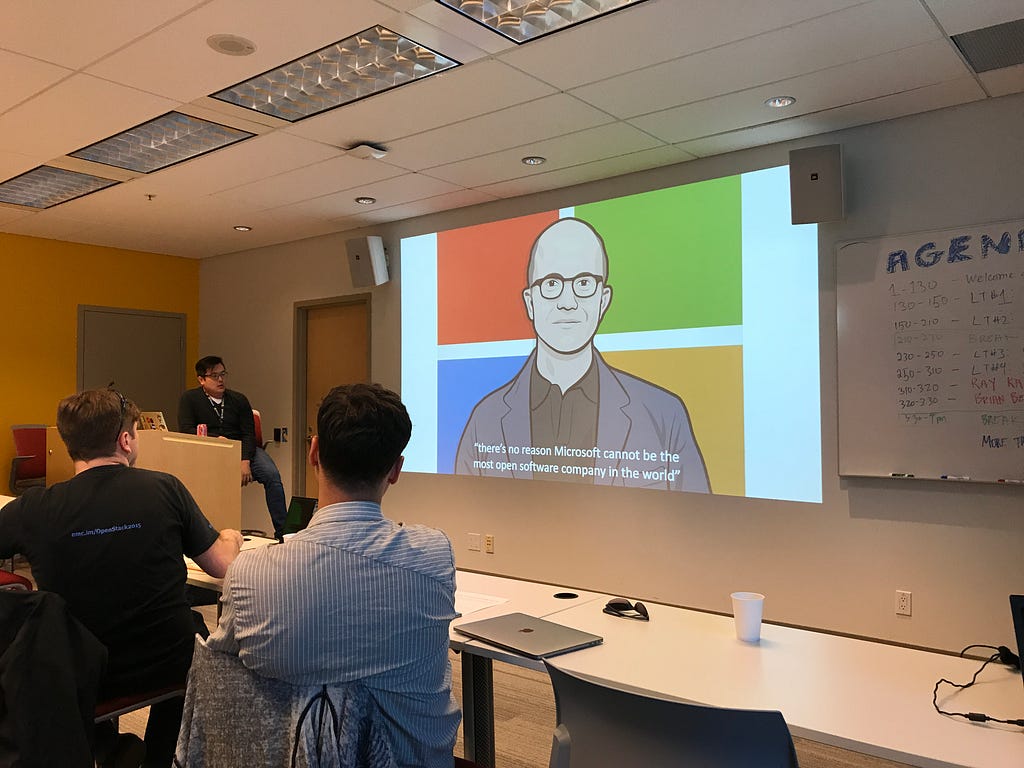
“There’s no reason Microsoft cannot be the most open software company in the world” — Satya Nadella, CEO of Microsoft

I was invited, along with a group of people from the loosely defined local Vancouver open source community, to attend an afternoon session to give feedback to Microsoft about their relations to open source.

We started with local community members giving lightning talks – short presentations in and around open source / development topics.

Chris Nicola spoke about using OSS inside your company and various aspects of what that means.

Other speakers spoke on open source teaching curriculum and the ethics of open source. A Microsoft team member gave us an overview of the Azure dashboard and features.

There was lots of discussion in and around the talks, so I’m recounting comments anecdotally regardless of when / where they occurred.

We moved into three breakout groups, each covering a question. I was in the Question #2 group:

What are your feelings towards the big tech companies?

We went around the room talking about our impressions of the “big tech companies”.

The tide is clearly shifting against Apple. No one was happy about how closed they are, and the recent hardware was uninspiring.

IBM was on the list, but everyone glossed over them. They didn’t seem relevant as a “tech giant” and no open source projects came to mind.

Like Apple, there was some discomfort about Google. One angle was the impression that they mainly practiced corporate open source: they released projects but didn’t necessarily take much (if any) input from the community.

Everyone in the room used Google email services for either personal or work (or both).

Talking about Amazon, it was clear that the only open source they practiced was implementations of their own SDKs, whereas none of the services themselves were available as open source. Many people used their services by default, most believed their cloud services dashboard was the most confusing and hardest to use.

Microsoft was seen as changing – passing the baton of closed overlord to Apple – and in general becoming more open. But Windows desktop OS lacking in privacy and being highly vulnerable to viruses and malware meant that no one was looking at running it as their main OS.

The Visual Studio Code programmer’s text editor was spoken of highly. “Faster than Atom”. “Almost as fast as vim”. “Fast enough to use”.

Just coincidentally, a company I follow released a helper tool for the kubernetes project called ksonnet, and besides a CLI, a vscode extension was the first tooling they supported.

Several people had tried the Windows Linux subsystem. One person said it worked fine for him, no one else had had success with it for their projects out of the box.

Azure was a relative unknown. People knew about it, but hadn’t used it, so weren’t even sure that it did the same things that the other cloud providers did. Or why they would pick to over Amazon or Google Cloud.

Rob Ellis made a great point, that corporations shouldn’t open source something just because they wanted credit for being open:

My own usage of Microsoft

I have a family license for Office which includes OneDrive storage space. The Outlook app on iOS is a great email client, although I really want them to bring back the full functionality of Sunrise Calendar, which was acquired and then killed.

I don’t use Windows on a regular basis. I have been experimenting with LiquidSky, a streaming gaming service which gives me a Windows desktop on a high powered machine in the cloud that I can install my Steam account and other PC gaming services. I like the utility of an on-demand desktop in the cloud — especially when I don’t have to worry about maintaining it.

(I’ve maintained my own Windows desktops before — they’ve always degraded in performance, never mind having to actively be concerned about virus scanners)

I’ve written about considering what my next laptop might be — and it’s by no means certain that it will be a Mac. Microsoft is quite good at hardware — it’s the end-to-end user experience of Windows and apps that causes friction.

As for Azure, I definitely would consider it on a case by case basis for projects. I’m interested in the Azure Bot Service. The Language Understanding Intelligence Service (LUIS) which provides NLP and other context services (like IBM’s Watson) is very interesting.

But I’m not a working programmer, and I’m not familiar with Azure because I’ve used it only rarely. The last project I experimented with was their Ethereum blockchain deployment quickstart template, and they now have Azure Blockchain as a Service.

For my hobbyist needs, I reach for Heroku most often. It’s the easiest and quickest way to get an open source app up and running and on the public internet for me. There are some new services such as Now or Glitch, and all of the cloud providers have some version of “cloud functions” where you can run a single function at a time. For Heroku, I don’t have to worry about maintaining an operating system or dealing with scaling, while easily being able to take a “traditionally” written chunk of application source code and get it going.

I’ll experiment some more with Azure and try creating a “Deploy to Azure” template for one of the open source projects I contribute to, to see how it compares.

But what I really want is a Heroku-like experience for my applications. I don’t want to deal with machines / operating systems, whether or not they are containerized.

What should Microsoft do?

I was impressed that Microsoft had taken the time to gather a group of employees and host us, to listen to feedback from the community. This alone is an activity that I don’t see other big companies doing, or at least I haven’t seen it in Vancouver before.

One of the comments that I made in regards to Visual Studio Code (of which there was a lot of interest in discussing further), was that Microsoft didn’t need to make a special event and buy us dinner just to talk about stuff we found interesting anyway. Have a Visual Studio Code meetup, and we’ll come out and participate.

If Satya Nadella does intend Microsoft to be the “most open” company, Microsoft can continue flying this community flag, actively participating in local events, and lead through their actions.

We are moving into a time where the “open source” license of the code matters less than ever. Data, privacy, and the tuning of algorithms — the open-ness of data and decision making — is what matters most. Microsoft has already turned the corner on a lot of their old ways, but many scars from the last 15 years still remain.

Welcome to the community, Microsoft. Let’s keep talking.


Microsoft and the Open Source community was originally published in Boris Mann’s Blog on Medium, where people are continuing the conversation by highlighting and responding to this story.

29 May 21:45

Do You Suffer from Bicycle Face?

by dandy


by Cayley James

Curious about the history and inspiration of Marc Bernhard's photo essay BikeFACE?

For time immemorial men have been overly interested in trying to prevent women from doing most everything. From work, to health, to the democratic process there is a long history and on going battle for women’s equality and autonomy. So it’s no surprise that in the 19th century, as the bicycle was taking up its mantle as one of the world’s most popular pastimes, that some doctors came up with the fictional disorder known as “Bicycle Face.”

The key characteristics of the affliction were as outlined by The Springfield Republican:

  • usually flushed, but sometimes pale,
  • often with lips more or less drawn,
  • dark shadows under the eyes, and always with an expression of weariness.

These symptoms were caused by, “over-exertion” as, “the upright position on the wheel, and the unconscious effort to maintain one's balance tend to produce a wearied and exhausted 'bicycle face,'

There are a number of excellent resources about the bizarre history of this condition online. Vox published a very comprehensive look back. On one blog I found a helpful list of “DON’Ts” for women considering riding a bike from an 1895 New York World newspaper. But they more or less repeat the same line: it was a fear mongering tactic that was designed to try and curtail the empowerment the bicycle gave to the modern woman.

18th and 19th century historian Geri Walton notes that a Dr. E B Turner claimed bicycle face was a sham and stated:

The bicycle “hump” also known as “‘kyphosis bicyclistarum" need but provoke a smile, provided only that the reader observe the good old cycling rule: Sit easily upright and keep your eyes well in front of you.

So ladies let's get back in the saddle and fight the good fight against bogus misogyny.

Check out the BikeFACE! series here. We'll be posting each portrait individually throughout Bike Month on dandyhorsemagazine.com in celebration of women and cycling.


29 May 21:45

BikeFACE: A photo essay

by dandy

BikeFACE!

dandyhorse is pleased to present the photo essay BikeFACE! by Marc Bernhard

In 1890s Europe and North America, the bicycle was gaining popularity as a means of transportation, recreational activity and sport. However, medical opinion about the health benefits of cycling, especially for women, was mixed. One of the supposed risks faced by women was a condition known as “bicycle face.

Due to the physical exertion required, cycling was an activity thought unsuitable for women. The symptoms of bicycle face could include "a wearied and exhausted look, flushed or pale skin tones, drawn lips, clenched jaw and bulging eyes with dark shadows."

At the turn of the century the bicycle afforded many women increased freedom and autonomy, and the bicycle itself became a symbol of women’s emancipation. With the ridiculous prognosis of "bicycle face" we saw how cycling, feminism, patriarchy and medical opinion collided in the1890s.

Photographer Marc Bernhard says, "The purpose of BikeFACE! is to promote and celebrate women’s commuter, recreational and sport cycling. It is a series of studio images in which the subjects were invited to ride their bikes on a stationary trainer at full exertion to see what their bicycle face might look like. The series is meant to be a light-hearted, tongue-in-cheek reference to the historical anti-feminist ideas against cycling, by showing the strength, intensity and determination of women cyclists today."

dandyhorse is pleased to present this essay celebrating women cyclists in our city -- just in time for Bike Month! You can read more about "bicycle face" here.

MARC BERNHARD is a fair-weather cyclist, teacher and photographer. He plans oodles more bike trips than he ever actually completes. This summer he plans to cycle from Edmonton to Winnipeg. It remains to be seen if this actually happens. You can see more of his work here or follow him on Instagram @bernhard.photography

We will be rolling out these BikeFACE profiles over the month here on dandyhorsemagazine.com in celebration of Bike Month, women and cycling.

As they go live, links to each individual profile will be added below.

Claire McFarlane

Katie Wittmann

Perri Lo

Annalise Walmer

Farah Sandhu

Cassandra McWade

29 May 21:44

BikeFACE: Claire McFarlane

by dandy

CLAIRE MCFARLANE rider statement: "Being on two wheels means that I can get anywhere in the city at any time of day. It allows me to enjoy Toronto in a different way because you see things from another perspective when you're on a bike."

dandyhorse is pleased to present the photo essay BikeFACE! by Marc Bernhard

In 1890s Europe and North America, the bicycle was gaining popularity as a means of transportation, recreational activity and sport. However, medical opinion about the health benefits of cycling, especially for women, was mixed. One of the supposed risks for women was a condition known as “bicycle face.

At the turn of the century the bicycle afforded many women increased freedom and autonomy, and the bicycle itself became a symbol of women’s emancipation. With the ridiculous prognosis of "bicycle face" we saw how cycling, feminism, patriarchy and medical opinion collided in the1890s.

Photographer Marc Bernhard says, "The purpose of BikeFACE! is to promote and celebrate women’s commuter, recreational and sport cycling. It is a series of studio images in which the subjects were invited to ride their bikes on a stationary trainer at full exertion to see what their bicycle face might look like. The series is meant to be a light-hearted, tongue-in-cheek reference to the historical anti-feminist ideas against cycling, by showing the strength, intensity and determination of women cyclists today."

Claire McFarlane is a former dandyhorse editor and co-founder of the Bad Girls Bike Club. Cycling "...allows me to enjoy Toronto in a different way because you see things from another perspective when you're on a bike."

dandyhorse is pleased to present this essay celebrating women cyclists in our city -- just in time for Bike Month! You can read more about "bicycle face" here.

We'll be rolling out each profile one at a time throughout Bike Month and adding all the links here.

29 May 21:44

How Google Builds Its Maps—and What It Means for the Future of Everything

files/images/US-after-thumb-615x362-98080.5.jpeg

Alexis C. Madrigal, The Atlantic, Jun 01, 2017


Icon

"Google's geographic data may become its most valuable asset," writes Alexis Madrigal, "not solely because of this data alone, but because location data makes everything else Google does and knows more valuable." It makes sense. Location - specifically, geolocation - creates otherwise unknowable  relations between entities. The map is the first representation of that set of relations, but eventually the map will also contain the data that my cup is located six inches away from my elbow (which, if it is well designed, will prompt it to close its lid, just in case). Via Doug Peterson. [Link] [Comment]

29 May 21:43

Almost 7 in 10 Metro residents will be non-white in two decades

mkalus shared this story from Vancouver Sun.

Canada is experiencing the fastest rate of ethnic change of any country in the Western world, say international demographers.

Almost seven of 10 Metro Vancouver residents will be visible minorities, or non-whites, in less than two decades, says Eric Kaufmann, a professor at University of London, Birkbeck, citing Statistics Canada projections.

In addition, Kaufmann said, University of Laval professor Patrice Dion has worked with Statistics Canada officials to develop projections that suggest Canada as a whole, at the current rate of immigration, will be almost 80 per cent non-white in less than a century.

While the rapid pace of change likely will not  hurt Canada’s economy, Kaufmann said, it will continue to have great effect on the ethnic make-up of cities such as Greater Toronto and Metro Vancouver.

These two Canadian cities will soon, or already have, become “majority minority,” a term describing places in which one or more ethnic minority (relative to the country’s population) make up a majority of the local population.

A 2017 Statistics Canada report, titled Immigration and Diversity: Population Projections, forecasts the number of Canadians with visible minority status will “increase more rapidly than the rest of the population” and “could more than double by 2036 to between 12.8 million and 16.3 million.”

The cities that will have the highest levels of visible minorities by 2036 will be Greater Toronto, Metro Vancouver, Calgary, Abbotsford-Mission, Edmonton and Winnipeg.

Non-whites already make up almost half the residents of Greater Toronto and Metro Vancouver.

But Statistics Canada projects the working-age population of Greater Toronto will expand to roughly 71 per cent non-white by 2036, while Metro Vancouver’s working-age population will be more than 66 per cent non-white. Abbotsford-Mission’s portion will be 52 per cent.

Meanwhile, Victoria and Kelowna will remain less than 25 per cent non-white. So will Quebec, the Maritimes and rural Canada.

Kaufmann, who was born in Hong Kong to mixed-race parents and raised in West Vancouver, has studied how neighbourhoods change in Britain, Canada and elsewhere when there is a brisk influx of mostly non-white immigrants.

“Minorities will move into relatively white areas, but whites generally do not move into strongly minority areas. Whites have, and will, tend to move toward relatively white areas,” said Kaufmann.

Along with political scientist Gareth Harris, he wrote the book, Changing Places: Mapping the White British Response to Ethnic Change.

Kaufmann and Harris have tracked “white withdrawal” in Britain and Canada, monitoring how whites tend to “unconsciously” move out of neighbourhoods when a large influx of non-white immigrants moves in.

The white depopulation phenomenon has occurred in Canada in cities such as Richmond and Burnaby in B.C., and Markham and Scarborough in Ontario, Kaufmann said.

In separate research Postmedia determined that, while the ethnic Chinese population of Richmond grew by almost 80,000 people between 1981 and 2011, the white population declined by 28,000 people.

“Is white withdrawal a problem? Only insofar as this makes it less likely that newcomers will have contact with the historic majority of a country,” Kaufmann said.

Kaufmann and Harris don’t use the term “white flight” to describe this pattern because they don’t think it is normally fuelled by racism or xenophobia.

“White conservatives and liberals, racists and cosmopolitans, all move to relatively white areas at similar rates,” writes Vancouver-raised political scientist Eric Kaufmann in Changing Places.

“White conservatives and liberals, racists and cosmopolitans, all move to relatively white areas at similar rates,” they say in Changing Places, published by Demos, which describes itself as Britain’s “leading cross-party think-tank.”

Since Western countries remain among the relative few in the world that welcome immigrants, Kaufmann said, it’s significant many politicians in Europe and the U.S. have been increasingly calling for lower immigration.

Meanwhile, Canada is undergoing “the fastest rate of ethnic change of any country in the Western world,” Kaufmann said, describing how 300,000 immigrants are arriving each year in a country of 35 million people, with four in five of those immigrants being visible minorities.

“The United States’ per capita immigration rate is only one-third to one-half as fast as Canada’s. … At the same time (U.S. President Donald) Trump has promised to reduce America’s inflows by half,” Kaufmann said.

“Europe is also generally tightening inflows and only 300,000 non-Europeans enter the European Union, population 510 million, each year. Most immigrant-receiving Western European states will be at least three-quarters European origin in 2050.”

In Canada, whites currently make up about 80 per cent of the population.

Kaufmann, however, drew attention to a study led by the University of Laval’s Patrice Dion and Statistics Canada official Eric Caron-Malenfant that projects that by 2106, the vast majority of Canada’s population will be descendants of immigrants who arrived after 2006.

Assuming that four in five immigrants during that time period will continue to be non-white, Kaufmann projected that by 2106 whites will account for between 12 to 38 per cent of the population.

“I think a reasonable middle conclusion is that Canada will be 20 per cent white, 65 per cent non-white and 15 per cent mixed race by 2106,” he said.

“Canada will probably become a ‘majority-minority’ country around 2060.”

dtodd@postmedia.com

Twitter.com/douglastodd

MORE RELATED: Douglas Todd: Vancouver is the most ‘Asian’ city outside Asia

Has B.C. become a place of urban-rural solititudes?

29 May 21:41

Android auto-clicking adware ‘Judy’ discovered, ‘possibly the largest malware campaign found on Google Play’

by Bradly Shankar
Google Play Store on phone

Malicious auto-clicking ad software on Android known as ‘Judy,’ has reportedly reached as many as 36.5 million phones. Discovered by security firm Checkpoint, the malware uses Android devices to generate significant amounts of fraudulent clicks on advertisement, with revenues going to the perpetrators.

In a blog post, Checkpoint says this might be the largest malware campaign found on Google Play to date. Judy is said to have been downloaded between 4.5 million and 18.5 million times, meaning the total spread of the malware may have reached between 8.5 and 36.5 million users.

Checkpoint says that because it is unknown how long malware existed inside some of these apps, a specific number of affected users can’t be identified. The firm says one app, in particular, hadn’t been updated since April 2016, meaning that the malicious code had remained undetected on the Play Store for quite some time.

The malware was found in 41 apps developed by a Korean company called Kiniwini, which is registered on Google Play as Enistudio corp.  Once the firm informed Google of Judy, all of Kiniwini’s apps were removed from the Play Store. The company has developed apps for both Android and iOS platforms.

Judy malware app

However, Checkpoint says it found several apps containing the malware that had been developed by companies besides Kiniwni. Checkpoint says it’s “unclear” if there is a direct connection between all of the apps, noting that it’s possible that code was borrowed between apps “knowingly or unknowingly.”

A full list of the apps carrying Judy, as well as other information on the malware, can be found on Checkpoint’s blog.

Recently, other malware on Android known as “Cloak and Dagger” was discovered, which allows hackers to hide malicious activity from users on the OS.

Via: Fortune

The post Android auto-clicking adware ‘Judy’ discovered, ‘possibly the largest malware campaign found on Google Play’ appeared first on MobileSyrup.

29 May 21:40

Here’s what’s coming to Netflix Canada in June

by Dean Daley
Netflix app

Here’s all of the television shows and movies coming to Netflix Canada this June.

There is a full list of titles at the bottom of the article.

June 1st and 2nd


This month starts off with Miss Peregrine’s Home for Peculiar Children, a fantastical movie based on the novel by the same name. Though it adds and take away essential plot points, it gives a different experience for readers of the novels and those who are new to its world. Also on the 1st is Birth of a Nation a historical drama where a preacher commences an uprising to free fellow slaves in the South.

June 2nd the second season of Flaked starring Will Arnett, where the actor plays as a self-help guru who needs a bit of help himself, is set to drop. Season 2 of Chelsea Handler’s ‘Chelsea’ is set to release every Friday in June as well.

June 4th to the 9th


Turn: Washington Spies season three, a drama based Alexander Rose’s book Washington Spies: The Story America’s First Spy Ring, focused on the Culper Ring, will launch on the 4th of June.

While on the 7th the movie Edge of Seventeen starring Hailee Steinfeld, Hayley Lu Richardson and Blake Jenner about a high school girl’s best friend dating her older brother, will release.

June 9th is the day nearly everyone has been waiting for, however, with the fifth season of Netflix Original Orange is the New Black, starring Taylor Schilling as Piper, finally releasing. The 9th is also the premiere of Netflix Original Shimmer Lake, a small town crime thriller directed and written by Oren Uziel, one of the writers for 22 Jump Street.

June 11th – 14th


Vacation, a movie with a self explanatory title, will launch on the 11th, with Oh Hello on Broadway, the Oh Hello comedy act created by Nick Kroll and John Mulaney.

The second season of Quantico, focused on the lives of FBI agents who went through Quantico together, and how an explosion at Grand Central Station has turned their lives upside down. One of my favourite shows, Animal Kingdoma crime drama that focuses on the life of Joshua J Cody, played by Finn Cole, who moves in with his grandmother and his three uncles, who all pull off insane heists.

June 16th


The 16th is a bit of a busy day for Netflix, as three different titles will be launching. Netflix Original The Ranch, starring Ashton Kutcher and Danny Masterson, both from That 70s Show — also on Netflix, —  will release its third season.

Children’s show, World of Winx season two will also be available on the 16th. Lastly A Man Called Ove, a Swedish comedy-drama film will release on Netflix, with subtitles, on the 16th

June 20th – 22nd

Disney’s newest hyrdro-kinetic princess, Moana, will be joining Netflix on the 20th.

Action crime drama, Queen of the South season one will be Netflix on the 21st. The show features a woman trying to avenge her boyfriend by being the country’s most prevalent drug smuggler.

On June 22nd the comedy drama film, 20th Century Woman, is set to be available on Netflix. The movie is about three women raising a teenage boy in 1979.

June 23rd


June 23rd is just as busy as the 16th for Netflix, with four new titles hitting the streaming service. Glow, a sports drama about the lives of women who perform in professional wrestling, will launch its first season on the 23rd.

The first season of  Netflix Original Free Rein, a TV show about a girl meeting a mysterious horse on the English country side, also releases on June 23rd. Nobody Speak: Trials Of The Free Press, directed by Brian Knappenberger, is about Hulk Hogan’s court case against Gawker Media and how the rich can circumvent the free speech of the press.

Lastly, Netflix Original film You Get Me, starring Bella Thorne, Halston Sage and Tylor John Smith, will premiere on the 23rd.

June 27th – 28th


Netflix will launch Chris D’EliaMan On Fire skit will launch on the 27th of June. D’Elia is known for co-starring on the show Whitney.

The seventh season of murder mystery drama, Pretty Little Liars, will be available on Netflix on the 28th. OKJA an odd Netflix Original about a girl name Mija who does everything to protect her large peculiar animal name Okja.

June 30th


Finally we’ve reached the last day of the month, though Netflix left some of its best content for last. The eighth season of Rupaul’s Drag Race will be available on the 30th.

The second season of Between, sci-fi drama about a mysterious disease that kills everyone over the age of 22 in the town of Pretty Lake, will be on Netflix the last day of June. The last title for the month of June is Netflix Original Gypsy, a show about a therapist who gets involved in the lives of her patients.

Here’s a quick look at everything that will be on Netflix this month:

June 1st
Miss Peregrine’s Home for Peculiar Children
The Birth of a Nation 

June 2nd
Flaked: Season 2

June 4th
Turn: Washington Spies: Season 3
Shadow Hunters: The Mortal Instruments: Season 2 weekly episodes

June 7th
iZombie: Season 3 weekly episodes
The Edge of Seventeen

June 9th
OITNB: Season 5
Shimmer Lake

June 11th
The Fosters: Season 4

June 13th
Vacation
Oh Hello on Broadway

June 14th
Quantico: Season 2
Animal Kingdom: Season 1

June 16th
The Ranch: Part 3
World of Winx: Season 2
A Man called Ove

June 20th
Moana

June 21st
Queen of The South: Season 1

June 22nd
20th Century Women

June 23d
Glow: Season 1
Free Rein: Season 1
Nobody Speak: Trials of the Free Press
You Get Me

June 27th
Chris D’Elia: Man On Fire

June 28th
Pretty Little Liars: Season 7
OKJA

June 30th
Rupaul’s Drag Race: Season 8
Between: Season 2
Gypsy: season 1

Source: Netflix

Image Credit: IMDB

The post Here’s what’s coming to Netflix Canada in June appeared first on MobileSyrup.

29 May 21:40

ARM debuts new processor designs built for artificial intelligence

by Rose Behar
arm processor performance

Ahead of the Computex conference in Taipei where Intel CPUs will take the spotlight in a variety of new PCs, ARM has released its new CPU and GPU architecture: the premium Cortex-A75 CPU, mid-range Cortex A-55 and Mali-G72 GPU.

Although its brand is rarely presented in a consumer-facing manner, ARM is the company behind nearly all mobile processors. The British company, owned by Japanese telecom and internet company SoftBank, designs processors, as well as SoC infrastructure and software that are used by Qualcomm’s Snapdragon, Samsung’s Exynos and Apple’s A-series chips.

The company’s new processors feature the usual efficiency and performance improvements, but are also designed specifically for onboard artificial intelligence and machine learning.

The new Cortex-A75 and A55 are the company’s first DynamIQ big.LITTLE processors, meaning its vendors will now have more options for customizing the amount and variety of cores. While ARM currently allows for designs that pair a cluster of big CPUs with a matched number of little cores, the new design allows vendors to create a mixed up cluster of up to eight big and little cores. For example, a chipset that calls on the company’s new designs could have three A75 cores and five A55 cores, or one A75 and seven A55s — all depending on the intended desires for power efficiency, performance and price point.

arm processor

The combination of these flexible CPU clusters, says ARM in a blog post, along with its GPU compute technology, dedicated accelerators and its new ARM Compute Library “work[s] together to efficiently enhance and scale AI performance.”

The ARM Compute Library is an open-source collection of low-level software functions optimized for Cortex CPU and Mali GPU architectures that the company says can boost the performance of AI and machine learning workloads by 10 to 15 times on both new and existing ARM-based chips.

The ARM Cortex-A75 features a reported 22 percent performance improvement over its predecessor, the Cortex-A73, while the Cortex-A55 reportedly features the highest power efficiency of any midrange ARM CPU yet. The Mali-G72 GPU, meanwhile, has 25 percent improvement in efficiency relative to the G71.

The Cortex-A75 and A55 designs were released to vendors at the end of 2016, so the company expects to see new mobile devices powered by its new designs by the first quarter of 2018 — though it notes that some Chinese manufacturers may push out devices with the designs before the end of the year.

Source: ARM

Via: The Verge

Image credit: Socram8888 via Wikimedia

The post ARM debuts new processor designs built for artificial intelligence appeared first on MobileSyrup.

29 May 21:40

Huawei Canada program to send 20 engineering students to China for technological skills development

by Bradly Shankar
Huawei launch event banner

Huawei has announced 20 Canadian university engineering students have been selected to participate in its ‘Seeds for the Future‘ program.

This is the third year Seeds for the Future has run, with the program giving students a chance to get firsthand experience with the advancement taking place in China’s technological industry. Seeds of the Future also seeks to build links between Canada and China and promote career opportunities in the telecommunications centre and get more people engaged in information and communications technology (ICT) community.

The selected students will gather in Ottawa for two days of preparation at Huawei Canada’s Research Centre before heading to China on June 1st for a two-week professional and cultural trip. During this time, Huawei says they’ll be able to work with company staff and visit its laboratories for live demonstrations of advanced communications technologies. Students will also have time to tour the city and experience Chinese culture, including planned visits to landmarks such as the Great Wall of China and the Forbidden City.

“We are proud to offer this opportunity to another talented group of engineering students from across the country,” said Huawei Canada president Sean Yang in a press release. “This award-winning program has grown in popularity and we’re happy to see that nearly half the students participating this year are women. This hands-on experience provides students with a once in a lifetime work and cultural exchange, with an opportunity to see China and its industry-leading innovation.”

Below is the full list of all participants:

Huawei Canada competition finalists

In the press release, Huawei says it will also invest $10 million CAD in 2017 directly into research projects with universities across Canada.

In other Huawei news, the company recently announced that its P10 and P10 Plus smartphones are set to launch in Canada on June 6th.

Source: Newswire

The post Huawei Canada program to send 20 engineering students to China for technological skills development appeared first on MobileSyrup.

29 May 21:40

What to expect from Andy Rubin ‘Essential’ smartphone unveil

by Dean Daley
Andy Rubin bezel-less new smartphone

We’re expecting Andy Rubin’s ‘Essential’ smartphone to be unveiled tomorrow at the Code Conference in Rancho Palos Verdes, California.

Though it was confirmed that the mysterious device will be announced tomorrow, we’re not exactly sure when, though Andy Rubin is expected to speak at the conference, with the keynote starting at 4pm PT/7pm ET.

Though not too much is known about the Essential device so far, we do know the smartphone will run Google’s Android operating system and that the phone will be nearly bezel-less.

From this tweet, shown above, it appears that the Essential smartphone will feature a volume rocker and power button on its right side.

Furthermore, the device appears to include some sort of apparatus for either AR or 360-degree video content. It’s quite likely the extra accessory will be for 360-degree video, due to the tweet (shown below) that Rubin sent out early April.

Unlike many other smartphones, not much has leaked about about the phone beyond GFXBench scores of the device. According to GFXBench, the smartphone will feature a Snapdragon 835 octacore chipset, 3.6GB of RAM and a 12-megapixel rear-facing camera, though these scores should be taken with skepticism given that the leak also mentions the device will have an 18-inch display (these were probably prototype specs).

More believable rumours suggest the smartphone will feature a 5.5-inch screen, some form of modularity, a significant focus on AI and 3D Touch haptic feedback technology, similar to the haptic feedback seen in Apple’s iPhones.

We’ll all have to wait until tomorrow to finally catch our first glimpse of Andy Rubin’s mysterious Essential device.

Source: Andy Rubin, EssentialGFX Bench 

The post What to expect from Andy Rubin ‘Essential’ smartphone unveil appeared first on MobileSyrup.

29 May 21:39

U.S. considering ban on laptops on all international flights

by Bradly Shankar
Laptop on airplane

Homeland Security Secretary John Kelly has said he’s considering banning laptops from all international flights going to and from the United States.

This follows a ban imposed in March on all electronic devices larger than a smartphone in aircraft cabins on flights. Laptops, cameras, iPads, tablets, e-readers, portable DVD players and hand-held gaming systems, among other devices. The U.S.’ specific wording is anything “larger than a cellphone or smartphone [must] be placed in checked baggage.” The only exceptions are “approved medical devices,” which may be allowed on flights after being screening.

These restrictions were put into place over concerns of terrorist activity and affect 10 airports and about 50 flights per day, mostly from the Middle East.

In an interview on “Fox News Sunday,” Kelly said he “might” consider to expand this ban to cover laptops on all international flights.

Kelly said that the U.S. must “raise the bar for aviation security much higher than it is now” by relying on “new technologies down the road.”

While Kelly didn’t provide a timing for when the increased ban might be introduced, he said airline security is a “real sophisticated threat” and he’ll “reserve making that decision until [they] see where it’s going.”

MobileSyrup has reached out to Transport Canada for comment on how this might affect Canadian travel to the U.S. and will update the article with a response.

Image credit: Flickr – Karl Baron

Source: CP24

The post U.S. considering ban on laptops on all international flights appeared first on MobileSyrup.