Shared posts

13 Jul 16:23

An Expert’s Guide to Marketing Throughout the Sales Cycle

by Jenna Hanington

An Expert's Guide to Marketing Throughout the Sales Cycle

A recent survey by Forrester Research found that 74% of business buyers conduct more than half of their research online before making an offline purchase. This shouldn’t come as a surprise to B2B marketers, who have been struggling to reach an increasingly independent audience for years. In fact, this change in buyer behavior has been a catalyst for the shift to a customer-centric selling model.

Today’s buyers control their journey through the buying cycle much more than today’s vendors control the selling cycle … Marketing now owns a much bigger piece of the lead-to-revenue cycle, and B2B marketers must take responsibility for engaging with the customer through more of the buying journey,” commented Lori Wizdo, VP, Principal Analyst at Forrester Research in a recent blog post. (highlight to tweet)

Marketing content is an important piece of this puzzle. Marketers must cater to their buyers’ preferences by producing readily-available, cross-channel content that buyers can access on their terms to aid in the decision-making process.

This calls for a stage-based approach, which means breaking the buying cycle down into its most basic steps and creating targeted content for each unique phase. Personalizing each buyer’s experience can seem daunting, but today’s MarTech solutions make this a bit easier to execute and automate with capabilities like lead nurturing, retargeting, and dynamic content.

In order for a stage-based strategy to be effective, the content that you’re providing must be appropriate for the exact stage your buyer is in. If not, they will take their research elsewhere—and unfortunately, “elsewhere” typically means your competitors. Here are a few rules of thumb for content development at each sales stage (depending on your business, you may have more or fewer stages than what is outlined below).

Stage 1: Brand Awareness

When buyers are just beginning their research, they may not have even heard of your product or brand. They just know they are concerned about or looking to improve a certain aspect of their business. Content in this stage should be light, educational, and focused on topics relevant to your industry, not your product. It’s your job to show customers that they have a need for your solution.

During the brand awareness stage, all of the following content types are appropriate to provide your buyers as they begin to dive into their research:

  • Educational white papers and webinars
  • Tip sheets and checklists
  • Videos
  • Infographics
  • Blog posts

Stage 2: Research and Consideration

Research continues as your buyers move through the sales cycle. In the middle of the funnel, your buyers have identified your product as a potential solution and will be looking to learn more about the benefits of offerings like yours, so provide content that points out both the advantages of having your product as well as the disadvantages of not having it. While many buyers will begin reaching out to inside sales representatives at this point in their research, marketing can supplement these selling conversations through content like:

  • Case studies, including webinars that feature client success
  • ROI calculators
  • Industry and analyst reports
  • Product- or ROI-focused white papers

Stage 3: Decision Time

At the bottom of the funnel, your buyers have decided that they want what you offer, but are still trying to choose the right vendor. At this point, you’ll want your content to do a combination of the following: create urgency, help buyers justify their decision to upper management, and get them thinking about the implementation process. Remember, nothing will be more persuasive to the C-suite than concrete proof of success.

Any of the following are appropriate examples of bottom-of-funnel content:

  • Implementation guides and support information
  • Targeted case studies with ROI numbers
  • Buyer’s guides
  • White papers or one-sheeters geared toward decision-makers
  • Detailed pricing information


The secret to success with stage-based marketing is twofold: Having a variety of content available on your website for buyers at all stages of the sales cycle is great, but it’s equally important to be proactive and help buyers find what they need. Actively delivering stage-based content to buyers throughout the sales process can help propel them from one stage of the sales cycle to the next—all while letting them know you are invested in their success.

Get more content like this, plus the very BEST marketing education, totally free. Get our Definitive email newsletter.

       
13 Jul 16:22

Forrester pops 4 myths about social intelligence

by Barry Levine
balloon pops
If you’re not reaching, engaging, and monetizing customers on mobile, you’re likely losing them to someone else. Register now for the 8th annual MobileBeat, July 13-14, where the best and brightest will be exploring the latest strategies and tactics in the mobile space.

Listening to social media improves your social marketing.

That idea misses the point, according to Forrester analyst Allison Smith in a recent report, “Four Social Intelligence Myths That Keep You from Success.”

Social media listening and analysis can help improve businesses in many ways, she emphasized, including better customer service, product design, or legal compliance. But Smith told me she keeps coming across four attitudes that are either flat-out wrong or are missing the larger picture.

Myth No. 1: The best way to determine the quality of a listening technology is by looking at sentiment accuracy.

Social listening vendors are not reliable sources for the accuracy of their product’s sentiment analysis, said Smith, in large part because it’s still a tricky thing.

“Sentiment analysis still has a long way to go,” VB Insight’s director of marketing technology Stewart Rogers noted in his recent report, “Social media management: Tools, tactics … and how to win.”

He pointed to a possible post like, “I want a cheeseburger so bad!” A natural language processing engine used in sentiment analysis might categorize this as a negative expression, when in fact it’s not.

Better to determine the quality of listening technology by judging its integration with your current tools like CRMs, Smith contended, and by references from customers like you.

Myth No. 2: The social metrics that we (the vendor and the marketer) track are the right ones because they are designed for the social channel.

Marketers too often track the metrics offered by the vendor, such as sentiment, reach, engagement, and impressions. But Smith said the trick is to think of social listening as a tactic, not as an initiative requiring success metrics, just as talking to a customer in a store is a useful tactic that can help informs products and services.

Myth No. 3: Listening to social improves social marketing.

Social data does a lot more than improve social marketing. It improves businesses, because marketers can better understand the customer. Smith gives the example of membership buying service DirectBuy, which is testing pricing options in social ads before taking the winning combo into the field.

Myth No. 4: Our problem is our tool.

No, she said — the real problem is the business problem has not been clearly defined, or that understanding insights from social data was not embedded as a goal throughout the company.


VB's research team is studying mobile user acquisition... Chime in here, and we’ll share the results.


13 Jul 16:21

Cloud Costs vs. Cloud Value: A Complicated Picture - IT Business Edge (blog)


Cloud Costs vs. Cloud Value: A Complicated Picture
IT Business Edge (blog)
The declarations came fast and furious this week following news of price increases for some key cloud services: The race to the bottom is finished, the era of cheap cloud computing is over. But a closer look at what is really happening produces a more ...

and more »
13 Jul 16:21

8 Effective Meetings for Agile Marketing Teams

by Jeff Julian

I love meetings.  Yeah, I said it, I love meetings.  Why you might ask?  Because I truly value the input and insights of the roles I am not in.  I love knowing the big picture, where we currently are, and where we are going.  I love to hear new ideas and a fresh prospective on the work we are accomplishing.  And I love to get feedback from the audience we are delivering content to.

I also hate meetings.  This is a far more agreeable statement for most of you who are reading this post.  Most meetings are a huge waste of time.  People have to travel to them, the agendas are not defined well, and they last far beyond the amount of time required.

In this post I outline the Agile Marketing timeline in the prospective of the meetings we hold.  After the first round of these meetings occur, they are repeated on different intervals based on the rate of change and the required agenda.  Each one of these meetings has a well-defined agenda and leg work needed to go into the preparation of the materials each time before we meet.

Over the next few weeks, I will release a post detailing each meeting and the agenda that goes along with them.  In the meantime, reach out on LinkedIn if you would like clarification on any of the details.

Overview of the Agile Marketing Timeline

Before we get into the details of this meeting, let’s look at where it lives in the Agile Marketing timeline.  Remember that agile is more of an approach to doing work and there are many different ways to go about implementing your process.  I find in marketing the Scrum process is a good fit for a Content Marketing effort.

Here is a simple view of the exercises and meetings in the Agile Marketing timeline:

  • Prospective Meeting – Discuss the issues we face before we implement our process and the plan of execution.  This meeting will be replaced by the Retrospective Meeting after the first Sprint.
  • Persona Development – We need to develop the first set of personas for our Content Marketing efforts.  Our focus will be on unique characteristics and how we can provide value to the personas.  Interview people who match your personas on a regular basis and modify your definition when needed.
  • Content Mission Statement Definition – The outcome of this meeting is to identify the outline we will use to ensure our content fits with our goals and the goals of the audience.  Consider a quarter meeting with stakeholders and marketing leaders to be sure we are on the right trajectory.
  • Content Backlog Grooming Meeting – One of my favorite meetings, but the one everyone tends to forget.  The Backlog Grooming Meeting’s agenda is to go through the backlog and adjust the priority of the current items, formulate ideas for new items, and make adjustments to the existing items when we determine better ways of delivering value.  You can have larger sessions with everyone on the Agile Marketing team available for brainstorming, brain writing, or mind mapping to find the gaps in your content.  You can also have smaller sessions with just the Content Owner and ScrumMaster to make sure items are meeting the delivery expectations of the business.
  • Sprint Planning Meeting – We will look at the resources available, the time we have allocated to the time box, and the prioritized Content Backlog to determine what we will accomplish as a team.  The Content Developers will break the Content Items into tasks and estimate.  Any current concerns with the content being developed will be discussed during the meeting and any actionable items that arise will be placed on the Sprint as high priority tasks.
  • Daily Standup Meeting – Each day, physically or virtually, your team will meet to report status.  Every Content Developer will let the ScrumMaster and team know what they worked on the day before, what they are planning on working on today, and what issues they would like to have resolved by the ScrumMaster.  This meeting should be held in the location of the task board or have access to the digital Scrum system.
  • Sprint Demo – With the Content Owner present, the team with present the work accomplished in the Sprint.  A review of the Content Item associated with the final content is conducted to be certain we are delivering the defined value, the content meets our quality standards, and it is complete.
  • Retrospective – The Sprint is over, the demo has been done.  From here you might want to just straight into planning the next Sprint and getting started on producing more content, but there is probably something in the air that needs to be addressed.  Collaborative teams can become infested with bad blood and put people on edge when the issues that occur are not dealt with during the points where our team comes up for air.  The issues may be specific to a member, the team, a part of the process, or the organization in general.  Whatever stems the issue, this meeting is a safe place for the team to open up and discuss the issues they saw during the Sprint.  And although it is good just to be heard sometimes, the team should determine a corrective action to resolve the issue if it is ongoing.  Where there are issues discussed, you should also be very generous with praise.  What went well is just as important as what went wrong.  If you feel the team is on a down note, maybe you failed a Sprint, it should be a part of the ritual to share those things that were great.

Now On to Your Next Meeting

That’s it!  You can now conduct your meetings with purpose.

Agile Marketing Workshop by AJi

I know when people say Agile Marketing is supposed to be simple and I say there are 8 types of meeting you need to conduct, those two phrases don’t seem to align but they do.  If you look at the traditional process of developing content, we will probably find we have more meetings, meetings without agendas, or miss out on the benefits of gathering together around the goal.

Agile Marketing is about optimizing your time and the time of the team while still gathering the relevant information you need to measure and protect the team for burnout and churn.

In my view, the team is the biggest asset to the Content Marketing effort.  If we don’t have the appropriate feedback mechanisms to ensure they are well informed about the content they are producing our efforts will not hit the mark.  If we are not measuring the pulse of the Content Developers, we will soon burn through the tanks and find ourselves exhausted and unable to finish.

If you need to have someone review your process or just want to chat about some of these events in Agile Marketing, please connect up with me on LinkedIn (check Friend to bypass the relationship gate) and mention Agile Marketing in your message.

13 Jul 16:21

The Right Sales Training

by S. Anthony Iannarino

The right sales process, sales methodology, or sales training for one sales organization, may be entirely wrong for another sales organization. There are dozens of factors to consider. Here are a few of the most important.

Strategy: What is the company’s overall strategy? How does the sales force contribute to the attainment of strategic goals? If the training isn’t aligned with, or can’t contribute to the overall strategy, it isn’t the right training.

Maturity: How mature is the sales organization as a whole? Does it have the competencies it will need to execute the process, methodology, or training outcomes? There are some sales organizations that won’t be ready for certain training and development. They would be better served with something that moves them towards maturity.

Leadership: Is the leadership capable of leading the execution of the sales process, methodology, or training? Are they deeply engaged? The return on an investment of training and development is directly proportional to the amount of leadership exercised before, during, and after the training.

Needs: What does the sales force need to improve their results? How tightly aligned with those needs is the process, methodology, or training? Training that doesn’t provide the sales force with what it needs to succeed isn’t the right training?

Clients and Customers: Training around sales processes, sales methodologies, or other sales skills needs to account for who you are selling to. What does the sales organizations clients (or customers) need? How does the training help the sales force create value for their clients?

The process, methodology, or sales training some other company is using may not be right for you and your sales organization. It doesn’t matter how popular it is, and it doesn’t matter how much you feel the need to provide your sales force with something new.

The most effective sales training around a process, methodology, and sales skills are principle-based. You don’t perform better by chasing novelties. You perform better by better executing the fundamentals.

The post The Right Sales Training appeared first on The Sales Blog.

13 Jul 16:20

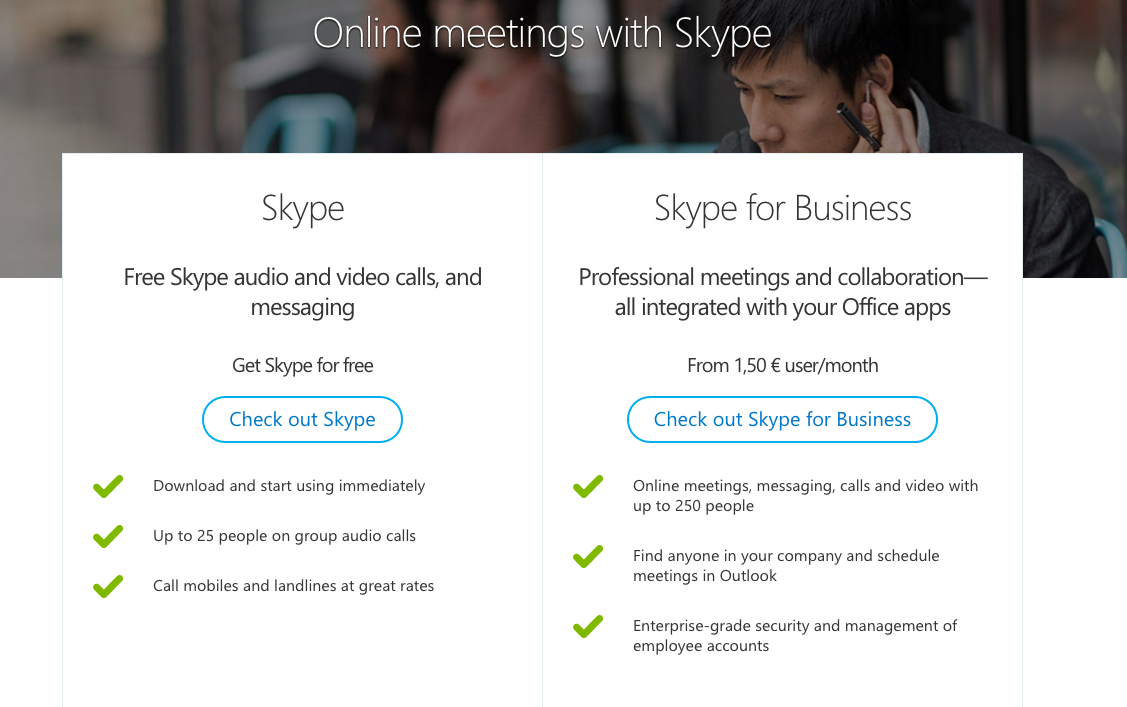
10,000 Reasons Why Skype For Business Doesn’t Suck As Much As You Think

by GetApp

When Microsoft relaunched Skype for Business earlier this year, it essentially amounted to giving its Lync app a sugary, Skype-flavored coating. At the time, many industry commentators felt that it was a risk for Microsoft to reposition its corporate collaboration software in this way.

Some wondered how Microsoft could possibly differentiate the value of Skype between businesses and consumers, or what kind of impression it would give a company’s clients if they’re using Skype to communicate– isn’t it just a free app that people use to make faces at their grandma?

What’s more, there were already plenty of cloud collaboration and communication apps out there making a name for themselves as reliable, robust, and feature-filled tools, tailored-made to the needs of a business. Apps like Aircall, GoToMeeting, and 8×8 were – and still are – awesome alternatives to Skype.

For all of these reasons, you would assume that it all backfired for Microsoft, and that Skype for Business is now a laughing stock, right? Actually, no. Skype for Business has been generally well received since it was released as part of Office’s April update, and its latest update – announced yesterday – promises even more cool tools for the forward thinking-business.

Skype vs Skype Business features list

Some wondered if Microsoft would be able to convince business users of the value of an enterprise version of Skype

Why it’s time to take Skype seriously

The latest new features of Skype for Business are available now for Office 365 enterprise customers, in the form of a technical preview. The standout feature for me is the new Skype Meeting Broadcast, which allows you to broadcast a Skype for Business meeting online to up-to a whopping 10,000 people.

Skype Meeting Broadcast will mean that larger businesses can host internal ‘town hall’-style meetings. Even smaller businesses could use the tool to ramp up their marketing efforts by performing public webinars to engage communities of thousands of customers and potential customers.

The Skype Meeting Broadcast feature includes some noteworthy integrations, including Bing Pulse for gauging attendee opinions through real time polling and sentiment tracking. Yammer integration will increase audience participation by allowing attendees to interact during the broadcast.

http://www.youtube.com/watch?v=wLWpAEH2cyIThe other major new changes to Skype for Business are PTSN conferencing, which allows people to join meetings that they are invited to using a landline or mobile phone, and Cloud PBX with PTSN calling, which lets users make and receive traditional phone calls via the Skype for Business client.

The new Skype for Business features are available now as a technical preview for Office 365 enterprise customers (PSTN conferencing and Cloud PBX with PTSN calling are only available to U.S. customers for now). Click here to register for the preview.

Are you using the Skype for Business service? We’d love to know your thoughts on how it compares to other communication and collaboration apps for business. Do you think it sucks or are you a convert? Share your feelings in the comments below!

13 Jul 16:20

3 Golden Rules of Building Professional Credibility

by Devon Smiley

Credibility, like trust, can be hard to earn – but very easy to lose. Establishing your professional reputation and building credibility is about more than having a sharp website, well designed business cards, or numerous ebooks and webinars to your name. It’s about delivering value to your clients consistently, and always improving your skills.

If you’re just starting out in your career, or this is your first foray into entrepreneurship, this may seem daunting, but here are 3 Golden Rules that will guide you in building professional credibility.

1) Stick to what you know

I love marketing. I love branding. I love discussing how companies pull together campaigns to sell even the most mundane products. But I’m no expert. Which is why I haven’t hung out my shingle as a brand or marketing consultant – I just don’t have the chops to back it up, even if I do have the passion. Establishing professional credibility is best done when you have a strong foundation of expertise in your field.

2) Admit when you don’t know

To me, one of the scariest things is when someone always has an answer to my questions. Always. Building credibility can mean admitting when you don’t know the answer to something. It shows that you’re not driven by ego, but instead by a desire to give the best advice or service to your client. That said, if you’re finding yourself repeatedly lacking the knowledge needed to address customer concerns or questions, revisiting Golden Rule #1 is recommended…is there another area of expertise you may be better suited to working with?

3) Find out, and follow up!

Admitting that you don’t know something is only one part of building credibility. What really cements it – and strengthens your reputation and likelihood of earning repeat business or a referral – is a timely follow up to your client with the answer. Leverage your network to find someone with the expertise. Research or experiment to create your own response. Ensuring that you’re constantly enriching your skill set and increasing your value to your clients is the best way to confirm your professional reputation.

13 Jul 16:20

The Work/Life Balance Myth

by Peter Stark

In a recovering economy that has increasingly expected employees to do more with less, the idea of work/life balance is almost laughable to some. As engaged leaders committed to our roles, we are just as susceptible to blurring that line, if that line even exists.

When you’re committed to and passionate about your job, putting in the hours isn’t as much of a chore as it would be if you hated your job, and resented every moment you spent doing it. If you have a rewarding, meaningful job, the work is likely hard and not easily compacted into the typical 40-hour work week. People who achieve great success in their line of work most often like what they do for a living. They don’t see it as work, but as a central part of their lives.

As much as they live and breathe the work that they love, many successful people also have families and commitments outside of work that they are equally dedicated to. Achieving a balance between work and life outside of work is becoming an increasingly more difficult quest as our lives become increasingly connected, and we are always reachable. It’s not surprising, then, that the pursuit of a work/life balance has been replaced by a pursuit for work/life integration.

While achieving the perfect equilibrium of work and personal time is a noble goal to strive for, the reality is that few can achieve and sustain it. Jack Welch caused a controversy when he said “There is no such thing as work/life balance. There are work/life choices.” I agree. You are responsible for your own work/life balance. Knowing that you can never sustain work/life balance indefinitely helps you redefine success in ways that can positively impact both your career and quality of life.

Make time to think about it. Before you can start to work on better integrating your work and personal life, you need to dedicate some time to figuring out what’s important to you. We are all equally blessed with 168 hours every week. Are you spending those hours doing the things that energize you or make you happy? What does the good life look like to you? If you had one extra hour every day, what would you spend that hour doing? If you’re going to make choices about how you spend your time, you have to make time to think about the answers to these questions first.

Seek energy, not balance: Happiness and work/life balance are not the same thing. You can have perfect work/life balance and be in a dead end, uninspiring job that leaves you depressed and exhausted. You can also be working incredibly long hours on a complex, challenging project and be happy, because you’re spending time in an area of your life that energizes you. Leaders who are engaged, energized and in charge of their lives have something more than happiness. Because they make important choices about how they spend their time, and spend their time on pursuits that energize them, they have fulfillment, which no amount of money can buy. Prioritize what energizes you over forcing a balance.

Take advantage of flexibility: More companies are beginning to see the value of flexible schedules and work arrangements for their employees. If that is available to you, take advantage of it. Take a longer lunch, and catch a yoga class or go for a run. If you want to be a bigger part of your children’s afternoon routine, then leave work a little earlier and take care of reports and emails after they go to bed.

Make choices ahead of time: You cannot excel at all things, at all times. If you drive yourself to excellence in all areas, you’ll most likely only excel in stress and frustration. Instead, think through your current priorities and determine your focus. Depending on where you are in your career, your highest priority might be work, or it might be your life outside of work. If work is currently your highest priority, your focus and decision-making are based on work. If, however, you determine that your children or caring for elderly parents is your highest priority, then your actions are weighted more heavily towards life outside of work. If you take time to think through your current priorities, and make choices ahead of time, then the right balance and allocation of your time will become more apparent. When you are spending time in areas that are important to you, stress levels are reduced and your satisfaction in both work and life outside of work are enhanced.

Communicate your boundaries: Integrating the different areas of your life is one thing, but that doesn’t mean you can’t have boundaries. It is so easy to get caught up in the long working hours conundrum. In cultures where working 60 – 70 hours per week is the norm, people wear their weekly hours worked as a badge of honor. It is easy to feel guilty if you slip out before 6:00. Don’t buy into the guilt. Just because people are working those long hours does not mean they are any more productive than someone working fewer hours each week, but working efficiently. Set and communicate your boundaries. Be willing to say “no” to a request if it doesn’t align with your vision and goals. If being home early enough to spend time with your family is a priority, let coworkers know that they can depend on you to attend an occasional late meeting or evening out with a client, but otherwise, you’ll be leaving at five o’clock each day. Advise your boss and others that you won’t be routinely checking emails each evening and may not pick up messages until the next morning.

On the flip side, if you are in the habit of writing emails late at night after the kids go to bed, consider the boundaries of your employees, too. In our hyper-connected world, employees often feel pressured to respond to emails that are sent well outside of business hours. If you’re crafting late night emails, schedule them to be sent the next morning.

Manage your mind-set: Understand that sustained work/life balance will be an ongoing challenge. It is never easy. Think of it as a moving target on a long journey with an unclear destination. But, do continue to think about it and take action. Identify what stresses you, and develop a course of action to reduce the stress. In some cases, stress can be reduced by determining your current priorities, focusing your actions and communicating your boundaries. In other cases, significant change may be the answer, as in leaving for an organization that demands high standards, but is not as definitive about the hours worked to achieve the outcome and allows for individual flexibility.

You may have come across the popular definition of insanity as “Doing the same thing over and over again and expecting different results.” If chasing work/life balance is making you crazy, concede. Back off and make time to think. Do something different to take charge of your priorities and spend your time accordingly. To avoid becoming a burnout statistic, seek energy rather than balance.

13 Jul 16:20

How To Measure The True Value Of SEO For Your Business

by Kevin Gallagher

measure-seo

We all like to know we’re getting our money’s worth, don’t we?

That is especially true in business, as paying too much out and not getting much in return could leave you in a sticky situation.

However, when it comes to finding an SEO service, things can get particularly confusing.

A quick 10-minute online search will provide you with a wealth of SEO services being touted from as little as £20, to £10,000 a month.

So, what should you be paying?

How much SEO should really cost

It goes without saying, SEO services that come with a hefty price tag can be off-putting, making the cheaper deals seem more tempting than ever.

However, it’s worthwhile to bear in mind that when it comes to SEO, you really get what you pay for.

In other words, be wary of really cheap SEO, as more often than not, it’s probably not going to do much at the end of the day.

According to Website Magazine, the average monthly cost of SEO services is $750 (that’s just under £500).

At an hourly rate, you should expecting to be paying around £65.

However, as you’ll probably be aware, the actual cost of SEO can also vary depending on the different types of packages and services you use.

So, how do you work out which service is right for you, and which is ripping you off?

Work out the true value of SEO

My advice here is not to focus too much on cost; instead, try to think about the value an SEO service is going to bring to your business.

Take a close look at a few SEO company websites. What are they offering?

If they say they can increase your sales by 500 percent, it’s probably too good to be true.

However, they should be able to demonstrate the value you’re going to get back from their services, and explain how they’re going to do it.

Remember, getting to the top of Google rankings isn’t necessarily the best SEO practice. Nor is simply directing a lot more traffic to your website. What you really want to know is how many more sales and leads the service is going to generate for you over the next 6 – 12 months.

You can’t always expect solid promises, as nothing is ever guaranteed, but a company should at least be able to give you a good estimate on the return of your investment.

Do your homework

If possible, really do your research before committing to an SEO company by looking at the company’s history, and any third party reviews online.

Don’t just check customer testimonials published on their website; actually speak to these previous customers directly and find out whether they’ve actually seen tangible results.

Next, interview the company.

To help you out a bit, here’s a checklist I’ve put together called ‘33 Questions you need to be asking an Edinburgh Digital Marketing agency’. These can easily be adapted and are exactly the sort of questions you need to ask an SEO company, before you commit to buy.

By asking the right kind of questions, you should be able to work out the true value of your investment, and whether the cost is justified.

The most affordable way to use SEO

It’s important to note here that SEO on its own won’t work – it needs to be part of a wider strategy – such as inbound marketing  – to actually be successful.

If you don’t want to spend a lot of money on SEO for your business, my advice is to go it alone. Sounds scary, doesn’t it? It’s really not.

All you really have to do is spend time understanding the questions your customers are asking, and then write about them.

Inbound marketing 101

By regularly coming up with helpful, quality content that your customers will love (and adding some important keywords naturally within the text), you’ll be well on your way to coming up with a solid inbound marketing strategy.

At the bottom of each blog post or web page, you should have a call-to-action – whether it’s downloading an ebook, reading a brochure, or booking an appointment – so that you move your customers through their buyer’s journey.

Use free SEO tools such as Google WebMaster Tools to analyze your website from a technical perspective and make sure you’re on the right track.

Finally, don’t forget to use social media effectively. Share your posts, but also get involved and interact as much as possible – it’s not just an advertising platform.

These are all things that will help you to grow your business.

Remember; if an SEO company can’t tell you what you’re going to get in return, in terms of leads and sales, don’t pay up.

Conclusion

The world of SEO can be a confusing one, with services ranging from as little as £20 to £10,000 a month. On average, you can expect to pay around £500 a month for SEO services, depending on the type you choose. However, in order to get a good return for your investment, you need to work out the real value you’re going to get from paying.

Really do your homework on an SEO company before you decide to buy. Check out the company’s history, look at third party reviews, and actually speak with previous or existing customers. When interacting with these companies, make sure you ask the right questions and that you know exactly what you’re going to get from your investment.

My rule: If a company’s main promise is to get you to the top of search rankings, run a mile.

inbound marketing guide

13 Jul 16:19

How Kindness Became Our Forbidden Pleasure

by Maria Popova

“We are never as kind as we want to be, but nothing outrages us more than people being unkind to us.”

“Practice kindness all day to everybody and you will realize you’re already in heaven now,” Jack Kerouac wrote in a beautiful 1957 letter. “Kindness, kindness, kindness,” Susan Sontag resolved in her diary on New Year’s Day in 1972. And yet, although kindness is the foundation of all spiritual traditions and was even a central credo for the father of modern economics, at some point in recent history, kindness became little more than an abstract aspiration, its concrete practical applications a hazardous and vulnerable-making behavior to be avoided — we need only look to the internet’s “outrage culture” for evidence, or to the rise of cynicism as our flawed self-defense mechanism against the perceived perils of kindness. We’ve come to see the emotional porousness that kindness requires as a dangerous crack in the armor of the independent self, an exploitable outward vulnerability — too high a cost to pay for the warm inward balm of the benevolence for which we long in the deepest parts of ourselves.

Kindness has become “our forbidden pleasure.”

So argue psychoanalyst Adam Phillips and historian Barbara Taylor in the plainly titled, tiny, enormously rewarding book On Kindness (public library).

Illustration by Marianne Dubuc from 'The Lion and the Bird.' Click image for more.

Taylor and Phillips write:

The kind life — the life lived in instinctive sympathetic identification with the vulnerabilities and attractions of others — is the life we are more inclined to live, and indeed is the one we are often living without letting ourselves know that this is what we are doing. People are leading secretly kind lives all the time but without a language in which to express this, or cultural support for it. Living according to our sympathies, we imagine, will weaken or overwhelm us; kindness is the saboteur of the successful life. We need to know how we have come to believe that the best lives we can lead seem to involve sacrificing the best things about ourselves; and how we have come to believe that there are pleasures greater than kindness…

In one sense kindness is always hazardous because it is based on a susceptibility to others, a capacity to identify with their pleasures and sufferings. Putting oneself in someone else’s shoes, as the saying goes, can be very uncomfortable. But if the pleasures of kindness — like all the greatest human pleasures — are inherently perilous, they are nonetheless some of the most satisfying we possess.

[…]

In giving up on kindness — and especially our own acts of kindness — we deprive ourselves of a pleasure that is fundamental to our sense of well-being.

The most paradoxical part of the story is that for most of our civilizational history, we’ve seen ourselves as fundamentally kind and held kindness as a high ideal of personhood. Only in recent times — in large part thanks to Emerson — did the ideal of independence and self-reliance become the benchmark of spiritual success. The need for belonging has become an intolerable manifestation of vulnerability — we’ve stopped believing in our own kindness and the merits of mutual belonging, producing what poet and philosopher David Whyte has elegantly termed “our sense of slight woundedness.” On a mission to examine “when and why this confidence evaporated and the consequences of this transformation,” Taylor and Phillips write:

Kindness’s original meaning of kinship or sameness has stretched over time to encompass sentiments that today go by a wide variety of names — sympathy, generosity, altruism, benevolence, humanity, compassion, pity, empathy… The precise meanings of these words vary, but fundamentally they all denote what the Victorians called “open-heartedness,” the sympathetic expansiveness linking self to other.

Art by Jean-Pierre Weill from 'The Well of Being.' Click image for more.

Perhaps because open-heartedness is impossible without vulnerability — an open heart is an aperture through which the world can enter us, but also one through which exploitive and cruel forces can penetrate the softest core of who we are without obstruction — the original meaning of and longing for kindness has been calcified by our impulse for armoring and self-protection. Taylor and Phillips write:

Today it is only between parents and children that kindness is expected, sanctioned, and indeed obligatory… Kindness — that is, the ability to bear the vulnerability of others, and therefore of oneself — has become a sign of weakness (except of course among saintly people, in whom it is a sign of their exceptionality)… All compassion is self-pity, D. H. Lawrence remarked, and this usefully formulates the widespread modern suspicion of kindness: that it is either a higher form of selfishness (the kind that is morally triumphant and secretly exploitative) or the lowest form of weakness (kindness is the way the weak control the strong, the kind are only kind because they haven’t got the guts to be anything else). If we think of humans as essentially competitive, and therefore triumphalist by inclination, as we are encouraged to do, then kindness looks distinctly old-fashioned, indeed nostalgic, a vestige from a time when we could recognize ourselves in each other and feel sympathetic because of our kind-ness… And what, after all, can kindness help us win, except moral approval; or possibly not even that, in a society where “respect” for personal status has become a leading value.

And yet despite our resistance to kindness, some deeper, dormant part of us still registers it, still cringes upon encountering its absence. This paradoxical relationship with kindness, perhaps more so than anything else, explains the “outrage culture” of the internet:

We usually know what the kind thing to do is — and kindness when it is done to us, and register its absence when it is not… We are never as kind as we want to be, but nothing outrages us more than people being unkind to us. There is nothing we feel more consistently deprived of than kindness; the unkindness of others has become our contemporary complaint. Kindness consistently preoccupies us, and yet most of us are unable to live a life guided by it.

Embedded in our ambivalence about kindness is a special sort of psychological self-sabotage — by denying our own kind impulses, we also deny ourselves the powerful pleasure our acts of kindness produce. Taylor and Phillips consider how, given our natural inclination for kindness, we end up cheating ourselves of this deep spiritual reward:

The forms kindness can take … are partly learned from the societies in which we grow up, and so can be unlearned or badly taught or resisted… Children begin their lives “naturally” kind, and that something happens to this kindness as they grow up in contemporary society.

Illustration by Maurice Sendak from 'Open House for Butterflies' by Ruth Krauss. Click image for more.

Picking up where Rousseau left off a quarter millennium ago, Phillips and Taylor consider what it takes to nourish our natural benevolence, asserting that it must begin with embracing the very vulnerability from which kindness springs:

Everybody is vulnerable at every stage of their lives; everybody is subject to illness, accident, personal tragedy, political and economic reality. This doesn’t mean that people aren’t also resilient and resourceful. Bearing other people’s vulnerability — which means sharing in it imaginatively and practically without needing to get rid of it, to yank people out of it — entails being able to bear one’s own. Indeed it would be realistic to say that what we have in common is our vulnerability; it is the medium of contact between us, what we most fundamentally recognize in each other.

Illustration by Benji Davies from 'The Storm Whale.' Click image for more.

At some point in our lives, however, vulnerability becomes a threat and a trauma. Phillips and Taylor trace the developmental origin of that shift:

The child’s first, formative trauma is his growing acknowledgment of his need for others (in actuality the mother is as vulnerable to her need for her baby as the baby is to his need for her; parents need their children not to worry them too much). The needy child experiences a trauma of concern (“How can I take care of my mother to ensure that she takes care of me?”), which calls up his natural kindness; but this concern — and the later forms of kindness that emerge from it — is too easily turned away from. This turning away we call self-sufficiency, and when we want to pathologize it we call it narcissism. The pleasure of kindness is that it connects us with others; but the terror of kindness is that it makes us too immediately aware of our own and other people’s vulnerabilities (vulnerabilities that we are prone to call failings when we are at our most frightened). Vulnerability — particularly the vulnerability we call desire — is our shared biological inheritance. Kindness, in other words, opens us up to the world (and worlds) of other people in ways that we both long for and dread.

In a sentiment that echoes Phillips’s illuminating earlier work on why developing a capacity for risk-tolerance is essential to our self-reliance, Taylor and Phillips elegantly capture the dark counterpoint to our tendency to desire safety at whatever the cost:

If there is no invulnerability anywhere, suddenly there is too much vulnerability everywhere.

[…]

It is not that real kindness requires people to be selfless, it is rather that real kindness changes people in the doing of it, often in unpredictable ways. Real kindness is an exchange with essentially unpredictable consequences. It is a risk precisely because it mingles our needs and desires with the needs and desires of others, in a way that so-called self-interest never can… Kindness is a way of knowing people beyond our understanding of them.

But rather than a lament, undergirding these observations is a powerful message of hope: For all of its pervasive undertones of and platforms for outrage, contemporary culture — and the digital universe that is part of it — offers fertile new soil in which to grow the natural inclinations that give rise to the pleasure of communion and kindness. Taylor and Phillips capture this beautifully:

By involving us with strangers (even with “foreigners” thousands of miles away), as well as with intimates, [kindness] is potentially far more promiscuous than sexuality. But … the child needs the adult — and his wider society — to help him keep faith with his kindness, that is, to help him discover and enjoy the pleasures of caring for others… People have long known this, and long forgotten it. The history of kindness … tells the story of this knowing, and forgetting, and reknowing, as central to Western ideas about the good life.

In the remainder of the altogether wonderful and acutely necessary On Kindness, Phillips and Taylor explore how we can build a society that nurtures rather than corrupting our natural kindness by learning, from childhood on, to feel comfortable with the uncomfortable risks of making ourselves vulnerable enough to be kind. Complement it with Einstein on kindness, Brené Brown on the crucial difference between empathy and sympathy, Adam Smith’s underappreciated wisdom on benevolence, and George Saunders’s magnificent commencement address on the power of kindness, then revisit Phillips’s insightful mediations on balance and the necessary excesses of life and the essential capacity for “fertile solitude”.

Donating = Loving

Bringing you (ad-free) Brain Pickings takes hundreds of hours each month. If you find any joy and stimulation here, please consider becoming a Supporting Member with a recurring monthly donation of your choosing, between a cup of tea and a good dinner.


♥ $7 / month♥ $3 / month♥ $10 / month♥ $25 / month


You can also become a one-time patron with a single donation in any amount.


Brain Pickings has a free weekly newsletter. It comes out on Sundays and offers the week’s best articles. Here’s what to expect. Like? Sign up.

13 Jul 16:19

PR Advice: How To Write A Pitch Email That Doesn’t Suck

by John Miller

how_to_write_a_PR_pitchYou know what reporters never do anymore? Pick up the phone when they can see it’s a PR person calling. Caller ID has just about ruined your chance of having a spontaneous conversation with that Widget Beat Reporter at the Journal. And, obviously, leaving a voicemail is laughably old school.

So… if you’re a media relations pro you pretty much have to be able to break through via the written word. Most communication with reporters is conducted today through email or Twitter – at least until you’ve built up a relationship and the reporter will actually take your call. That puts a lot of pressure on those email you’re s ending to reporters – if your emails are lame, they’ll get deleted, you won’t ever have success, and eventually, you’ll get deleted too (from your job). To avoid this fate, there are some things you need to know.

However.

Before you start writing, you need to do some research. For eons, reporters have demanded that PR people “read the publication” before sending a pitch. In 2015, this is more necessary than ever before. A poorly targeted pitch that demonstrates lack of understanding has no chance of culminating in a story placement for your organization; it can even turn out to be a negative – vindictive/angry/curmudgeonly reporters have been known to blast misguided pitches…publicly. So begin to dip your toe into the journalist’s world – follow them on social media, maybe even share some of their work that you find especially compelling (don’t overdo it), and read what they’ve done in the past and are working on currently.

PR_Advice_How_to_Write_a_Pitch_Email_that_Doesnt_Suck-1

To avoid this fate or just plain old irrelevance, you need to have some empathy for reporters and their situation. Journalists today are more harried than ever, and it’s way too simple for them to delete your email without ever giving it a second thought. And that leaves you stuck. Don’t let this happen – do the little things first to make sure that you’re beginning to build a relationship, even if it’s a virtual, social media-based relationship.

Once you’ve done your homework, it’s time to start crafting your masterpiece. Here’s how to build the pitch email that will break through:

Personalize! Businesses today want to automate everything. When emailing reporters, that’s usually a bad approach. Yes, it can be painstaking to have dozens and dozens of one-on-one conversations, but that’s where the most success will be found. The more you can make your pitch email the start of a relationship rather than a transaction, the better off you’ll be.

Draw them in. You need to strike a chord right out of the gate in order to get their attention. Think about how you engage with unsolicited emails that land in your inbox: If the subject line is truly compelling, you might open the email – but if the emailer doesn’t grab your attention in the very first line, you’re probably out of there. (I know I am.)

Flattery might get you somewhere. Speaking of your first paragraph, it’s a good practice to mention something the reporter wrote recently and say that you enjoyed for whatever reason – goodness knows that their editor rarely gives them praise. Just don’t make it hollow praise; more than likely, the cynical journalist reading your email won’t believe you if it doesn’t seem genuine.

Don’t be too fluffy.  Public relations pros have a long history of embellishing – they called it puffery in my college journalism classes. Don’t overpromise the awesomely wondrous things your organization’s new solution can do. The reporter won’t believe you and you’ll end up doing more harm than good. Remember – just the facts, ma’am.

Provide details, but don’t turn this thing into War and Peace. Your goal is to spark a conversation, not overwhelm the reporter with information. At the same time, there needs to be some substance in the email; otherwise, who cares? Don’t be shy about enlisting a teammate to lend a second set of eyes to your pitch email before you send it to get a better idea of whether you’re finding the right balance.

Ask for something.  Create a call to action. Give them a next step. Let them know where to find your website, and where to call or write. Then get proactive. Tell them you will be following up in the next 24 hours. You don’t have to be specific. Give them just enough time to digest what you’ve written, but not so much time that they’ve forgotten.

The pitch email is just the start. As with any other relationship, if you deliver value you have an opportunity to allow the relationship to grow stronger. The pitch email that sparks this relationship is the first impression you’re creating, so take it seriously. Revisit, redraft and revisit again. It’s how you gain mindshare, and set yourself apart from the crowd. Follow up with a link to an article that contributes to the success of the business, or to one of your blog posts that relates to company operations.

13 Jul 16:16

Unleashing the Predictive Power of Data

by Andrea Goldberg

pixabay_crystalball

Along with the buzz about big data, there has been a lot of hype lately about developing a holistic view of one’s customers and customizing the buyer journey. This has created a focus on the predictive power of data and predictive analytics. These techniques allow one to extract information and patterns from existing data in order to predict future outcomes, understand trends, and make decisions.

Predictive analytics do not actually provide exact views of what will happen, but they do provide probabilities. Used correctly, these techniques can be very helpful in planning scenarios of possible outcomes, in guiding investments, or enabling one to make decisions on what course of action to pursue.

Predicative analytics use customer data to create an end-to-end view of the customer no matter where their information resides and where they might interact with a company. The outcome of these type of analyses are used to focus marketing and sales efforts across the breadth of customer touch points. This way an organization can promote products at relevant points of access, and proactively identify and solve problems that may cause the loss of customers or impact the ability to gain new ones.

These techniques have been used to identify customer lifetime value, cross-sell and upsell opportunities and propensity to quit. By understanding these things, marketers are able to determine which customers should be afforded a personal visit versus who should just be sent an email. Having this type of insight clearly makes a channel strategy more efficient and effective. It help businesses attract, retain and grow the most profitable customers and maximize the return on their marketing spending.

One company that has been very successful using predictive analytics to run their core business is UPS. They recognized that knowing where packages were and where they needed to go and by when, was a mathematical problem they could solve for. This way they could optimize routes and make the process more efficient. Using sophisticated mathematical models they have reduced 85 million miles driven a year. In the past, the UPS drivers would need figure out how to handle difficult situations. Now it’s in a very specific order, optimized with data and analytics.

IBM is using knowledge gained from their own customer engagements to create predictive analytics solutions that their clients can use “out of the box.” These contain pre-built dashboards, although they can be modified as needed. Some examples are:

  • Banking – These enable banks to use their customers spending patterns to predict financial and life events and allow them to deliver much more targeted offers at exactly the right times.
  • Media & Entertainment – These help media and entertainment companies understand viewing behaviors of micro-segments so that advertisers can promote the things that these customers are most interested in.
  • Retail – These solutions allow retailers to understand the potential overall revenue impact of individual products and make better decisions about which things to carry and how to best promote them.

In the future, we can expect to see more sophisticated applications of these techniques, so that offers will be customized to the needs of buyers and marketing communications will reside on the appropriate channel, using media each customer prefers. We have been hearing about the power of understanding customer journeys and one-to-one marketing for a while now. Predictive analytics enables organizations to make this vision a reality.

13 Jul 16:16

What Compels Buyers

by S. Anthony Iannarino

If you want to compel people to take action, find out what already compels them. What is already motivating them to act is the sweet spot for getting things done. But there are some natural assumptions you make about what compels people.

C-Level Executives care deeply about driving their business into the future. They care about creating a competitive advantage. Leaders are responsible for producing better results. They fear not knowing something that they need to know. C-Level Executives care about strategy, initiatives that drive big results, metrics that need improvement, and how they should think about the future.

You are not compelling when you talk about your product, your service, or your solution unless or until you tie it to bigger themes.

Management stakeholders care about executing and delivering results. They need to produce results, and the things that allow them to produce better results now are what compels them. Management stakeholders are compelled by metrics like revenue, costs, and profitability. But they are also compelled by the factors that drive those bigger categories, like productivity and throughput.

When you talk about your product, service, or solution outside of the impact it will have on the results they need, you are not compelling. You are compelling when you focus on how to drive metrics like profitability when you tie them to other metrics like productivity.

End user stakeholders, the people who use your product, service, or solution care deeply that it works. They need to execute, and their company measures them on things like productivity and throughput. They are compelled by things that help them do their job better, faster, and more easily. They care about the problems that prevent them from being able to do their work. They fear someone will sell their company something that makes it more difficult to produce the results for which they are responsible.

You aren’t compelling to end-users when you talk about strategy, even though the C-Level executives in their company care deeply about how what you help serves their strategic needs. You aren’t compelling to end-user stakeholders when you talk to them about metrics on which they aren’t measured or don’t understand. You are compelling when you share how what you sell will help them, and that includes the features and benefits that differentiate you from your competitors.

If you want to compel people to act and change, help them with what is already compelling them. You can make some pretty good assumptions about what they find compelling.

The post What Compels Buyers appeared first on The Sales Blog.

13 Jul 16:16

3 Sales Performance Management Benefits of Getting to “No” Quickly

by George Jacob

When you bring new B2B buyers into your customer experience, do you try to show some of them the door?

Here are three reasons why you should do just that.

1.  You can avoid the distraction of fairy-tale contracts.

High-performing sales professionals are great at recognizing costs and benefits of potential contracts early on. They’re skilled at knowing which prospects to nudge, and which aren’t worth the energy.

For less-seasoned sales reps, it can be difficult to determine the long shot from the sure deal. And that means they can chase prospects that aren’t interested, or contracts that won’t close.

15-07-10-chasing-the-sales-quota-dream

If you can find a way to get to “no” more quickly, you can remove the chase-me-I’m-shiny appeal of fairy-tale contracts. And you’ll have more time to work on the “yeses” and the “maybes.”

2.  You can deliver more value to the right prospects.

Our research into modern B2B buyers shows that value can help you sign deals and grow contract sizes.

However, if you’re working to improve your sales performance management, it’s important to view value as a finite resource across your sales team. If you’re juggling too many leads, you’ll limit the amount of value you can deliver to each of them.

But if you remove the poor-quality leads, you can focus less on juggling and more on meaningful interactions. You’ll have more time for the constructive back-and-forths that can lead to bigger contracts.

15-07-10-delivering-value-in-sales-all-day-every-day

3.  You can discover further insights about the type of buyer who (actually) buys.

Just like in customer experience strategy, customer insights are extremely valuable in business-to-business sales. If you can segment your buyers and define commonalities like needs, issues, and budgets, then you can make sweeping improvements to address them across your sales processes.

If you’re focused on the prospects with the most potential, you’ll be able to learn more about them.

15-07-10-taking-the-time-to-see-your-b2b-buyers

Sales pipeline management can be a tricky proposition, because it’s been historically difficult for sales managers to predict buyer behavior. But we’re working hard to figure it out.

Image Credits

13 Jul 16:15

Why Are They Buying—Do They Know?

by Dave Brock

I’ve written, often, about the importance of understanding why our customers are buying. Too often, we lose this in our headlong rush to pitch our products and get the purchase order. We fail to understand what the customer is trying to achieve, their goals, the opportunities they are trying to address.

We don’t know what’s making them dissatisfied with their current operations and driving the need to buy.

Clearly we increase our effectiveness and impact when we clearly understand what’s driving the customer and the consequences of doing nothing.

But in today’s world of large buying groups and complex decision-making, sometimes the customer loses sight (perhaps they never have it) of why they are buying.

If we are doing our jobs as sales professionals, we are engaging everyone involved in the buying process. We are understanding their own personal motivations and drivers for buying. We are learning their roles in the process.

However in spite of how well we understand the motivations and drivers of the individuals–we still find 40%+ of forecast deals end in no decision made.

The challenge these buyers face is, as a group, they may not know why they are buying–or at least they aren’t aligned with why they are buying.

There are various pieces of research showing the average size of decision-making groups in complex B2B purchases is increasing. Most of the data shows numbers in the range of 5-6 people involved in a complex decision (my own anecdotal evidence is much higher).

This research also points to the challenge of aligning the agendas, goals, priorities of each person on the decision-making team. They each have their own goals, but it’s impossible for them to make a decision until, as a group, they are aligned. In some sense it’s like those “jury deliberation scenes” you see on TV crime shows. In those, everyone has a different view of the facts or biases. Until they all agree they cannot reach a verdict–if they can’t they end up in the “hung jury.”

In complex decision making, while understanding what each individual is trying to achieve, while it’s important to influence them on our solutions, until we are able to deal effectively with the group–helping them align and helping them come to agreement on “Why are we buying,” our ability to win deals is at risk.

It presents a real challenge for how we sell. Usually we deal with individuals. Often, our only exposure to the group is when we are making our final presentations. Clearly, this sets everyone up for failure.

We need to change our engagement process, we need to engage the group much earlier, we need to learn how to facilitate, how to guide the discussion, and how to help the customer team align themselves, knowing why they are buying, the consequences of inaction, and the process they, together, will undertake in reaching a decision.

What are you doing differently to engage the customer buying team?

13 Jul 16:14

An Expert’s Guide to Marketing Throughout the Sales Cycle

by Jenna Hanington

An Expert's Guide to Marketing Throughout the Sales Cycle

A recent survey by Forrester Research found that 74% of business buyers conduct more than half of their research online before making an offline purchase. This shouldn’t come as a surprise to B2B marketers, who have been struggling to reach an increasingly independent audience for years. In fact, this change in buyer behavior has been a catalyst for the shift to a customer-centric selling model.

Today’s buyers control their journey through the buying cycle much more than today’s vendors control the selling cycle … Marketing now owns a much bigger piece of the lead-to-revenue cycle, and B2B marketers must take responsibility for engaging with the customer through more of the buying journey,” commented Lori Wizdo, VP, Principal Analyst at Forrester Research in a recent blog post. (highlight to tweet)

Marketing content is an important piece of this puzzle. Marketers must cater to their buyers’ preferences by producing readily-available, cross-channel content that buyers can access on their terms to aid in the decision-making process.

This calls for a stage-based approach, which means breaking the buying cycle down into its most basic steps and creating targeted content for each unique phase. Personalizing each buyer’s experience can seem daunting, but today’s MarTech solutions make this a bit easier to execute and automate with capabilities like lead nurturing, retargeting, and dynamic content.

In order for a stage-based strategy to be effective, the content that you’re providing must be appropriate for the exact stage your buyer is in. If not, they will take their research elsewhere—and unfortunately, “elsewhere” typically means your competitors. Here are a few rules of thumb for content development at each sales stage (depending on your business, you may have more or fewer stages than what is outlined below).

Stage 1: Brand Awareness

When buyers are just beginning their research, they may not have even heard of your product or brand. They just know they are concerned about or looking to improve a certain aspect of their business. Content in this stage should be light, educational, and focused on topics relevant to your industry, not your product. It’s your job to show customers that they have a need for your solution.

During the brand awareness stage, all of the following content types are appropriate to provide your buyers as they begin to dive into their research:

  • Educational white papers and webinars
  • Tip sheets and checklists
  • Videos
  • Infographics
  • Blog posts

Stage 2: Research and Consideration

Research continues as your buyers move through the sales cycle. In the middle of the funnel, your buyers have identified your product as a potential solution and will be looking to learn more about the benefits of offerings like yours, so provide content that points out both the advantages of having your product as well as the disadvantages of not having it. While many buyers will begin reaching out to inside sales representatives at this point in their research, marketing can supplement these selling conversations through content like:

  • Case studies, including webinars that feature client success
  • ROI calculators
  • Industry and analyst reports
  • Product- or ROI-focused white papers

Stage 3: Decision Time

At the bottom of the funnel, your buyers have decided that they want what you offer, but are still trying to choose the right vendor. At this point, you’ll want your content to do a combination of the following: create urgency, help buyers justify their decision to upper management, and get them thinking about the implementation process. Remember, nothing will be more persuasive to the C-suite than concrete proof of success.

Any of the following are appropriate examples of bottom-of-funnel content:

  • Implementation guides and support information
  • Targeted case studies with ROI numbers
  • Buyer’s guides
  • White papers or one-sheeters geared toward decision-makers
  • Detailed pricing information


The secret to success with stage-based marketing is twofold: Having a variety of content available on your website for buyers at all stages of the sales cycle is great, but it’s equally important to be proactive and help buyers find what they need. Actively delivering stage-based content to buyers throughout the sales process can help propel them from one stage of the sales cycle to the next—all while letting them know you are invested in their success.

Get more content like this, plus the very BEST marketing education, totally free. Get our Definitive email newsletter.

       
13 Jul 16:13

Lean Sales: Cause And Effect

by Dave Brock

Whether we are in marketing or sales (or anything for that matter), everything that we do creates an effect–or an outcome.

Cause/Effect—Action/Reaction—Input/Output

It’s a simple concept, perhaps so simple, we tend to ignore it.

For example, why would we continue to make hundreds of calls to anyone we can reach, pitching our products with abysmal results? At least if our goal is something other than creating abysmal results?

Why would we chase opportunities outside our sweet spot, when we know we have greater success with our ideal customers?

Why would we continue the same tired marketing programs, if we see they don’t create high quality leads for sales?

Why would we continue to focus on achieving our goals, when we know the customer doesn’t care?

Yet we do!

Every day millions of marketing and sales people get up, go to work and do the same thing they’ve done year after year. The same programs, the same workflow, the same processes, the same mind numbing activities that aren’t producing the outcomes (quantity and quality) that we expect.

And we ask ourselves, “Why aren’t we making our numbers? Why aren’t we achieving our goals?”

If we are to achieve success for our customers and ourselves, we need to pause and consider, “What actions/activities/programs/processes create the intended outcomes?”

Surprisingly, when I pose this question, too often, I get a blank stare in return. But it’s really pretty easy to figure out. We have to start at the end, with the desired outcomes and work our way backwards. We have to examine the things we did that created the outcomes we expected.

What causes us to win deals? Thoughtful win reviews, examining the activities we undertook, the activities the customer undertook, the interim commitments the customer made, resources involved both by the customer and us, what we proposed and how, how we justified and helped the customer justify the solution. As we look at a number of sales opportunities, we start seeing common patterns in the things that customers and we did that create a win. By the way, this defines our sales process.

Likewise in making high impact sales calls, or prospecting, examining the things we and our customers do to create the desired outcomes enables us to define those things we need to do to produce results. Knowing what creates a healthy pipeline with good velocity and doing those things creates healthy pipelines.

Managers do this with recruiting, onboarding, training and other things. For example, what skills, competencies, attitudes, behaviors, experiences do our highest performers have? If we want to hire more potentially high performers, it’s pretty easy if we have a template or picture of what a high performer looks like.

Marketing’s the same. Creating content, optimizing the website, participating in shows, creating visibility and awareness is all meaningless, if these activities don’t drive demand, high quality leads, real engagement, and revenue.

Working backwards from the outcomes we like and understanding what creates these outcomes, informs you of the activities critical to produce results. Duugghh! Yet we don’t do it, instead we look for the latest tool, gimmick technique, blindly hoping they will produce results.

Things change, the same old things no longer produce results. What worked in the past no longer works—but we keep doing them. If they aren’t producing the outcome we need, then we have to do things differently. We have to experiment, closely keeping an eye on what works–what activities create the desired outcomes? Then we have to execute those things effectively and efficiently.

It’s really not that difficult, but I get calls from dozens of puzzled executives saying, “We aren’t making our numbers, our sales people aren’t producing the right results, our marketing programs aren’t producing leads.” Usually, they’ve exhausted all the hot, fashionable, and trendy new stuff–because that’s what the “cool kids” are doing. Yet those don’t produce results. They wonder what’s wrong.

It’s often embarrassing when I start asking questions, when I start to go back to basics, “What things are producing results? Why don’t you do them more–more consistently?”

There’s no big “Aha,” to this post–and perhaps that’s the point.

If things aren’t working, look at those things that produced the outcomes you want. Analyze them, work backwards, understand the cause-effect relationships, systematize them and get everyone executing sharply and with discipline.

If the things you used to do aren’t working, then don’t continue doing them. Figure out what’s wrong, figure out what produces the right results, do more of that stuff.

13 Jul 16:13

3 Sales Acceleration Tips For Outbound Sales Teams

by Jesse Davis

If you want to grow sales revenue quickly, look no further than your outbound prospecting team. You may have already noticed that the biggest B2B deals tend to come from outbound sales prospecting. After all, you can’t always wait around for big accounts to find you.

But here’s a compelling stat that you may not have seen yet: during a recent webinar I helped organize, one of our panelists presented some data from a DemandGen report showing that 80% of new B2B purchases are unplanned and unbudgeted. That means that if you just stick with inbound sales tactics, you could be losing out on up to 80% of your potential revenue!

So how do you win more of those big outbound deals? Outbound sales prospecting can be challenging. But luckily, with the right tactics and technology, prospecting for revenue is a lot easier. Here are a few valuable tips that I’ve picked up from working at a sales acceleration company that will help you kick your outbound sales prospecting into top gear.

Target Newly Hired Executives

A powerful way to quickly accelerate your outbound sales efforts is by reaching out to newly hired executives. When executives take on a new job, they are often expected to make sweeping changes. And, much of the time, they are given a sizeable budget to enact those changes. You want to be sure that you get to these newly hired decision makers before your competitors do.

One way to identify when decision makers change jobs is by using LinkedIn. Each day, you should check out your LinkedIn alerts (toward the top right hand corner of your main page). You can scroll through contacts that have recently changed jobs or had a work anniversary. When you identify a prospect that has changed jobs, be sure to reach out. But don’t stop there! Be sure to find out who they are replacing at their new company and who replaced them at their old company. This will help you identify even more newly hired executives with the budget and desire to make changes.

Dial Prospects From Local Phone Numbers

People usually don’t pick up numbers that they don’t recognize, I don’t know about you, but when I see some toll-free or out of state number flash on my caller ID I tend to send it right to voicemail. But sometimes I do answer calls from local phone numbers, because I think it could potentially be someone I know whose number isn’t saved in my phone. Apparently I’m not alone. Data from Software Advice reveals that leads are up to 400% more likely to answer calls from numbers with Local Area codes. At RingDNA, we offer a tool called Local Presence that enables reps to automatically dial leads from numbers with local area codes. Since we rolled it out, our customers have been having a much easier time getting decision makers on the phone.

Outsource Outbound Sales Efforts

It pays to have a team of dedicated prospectors that can 100% devote themselves to sourcing sales-ready leads for your account executives to close. But since demand for great sales reps is so high, it can be difficult to quickly onboard a great team of prospectors. One of the quickest ways to ramp up your prospecting efforts is by outsourcing some or all of your prospecting efforts. A great outsourced sales team can work with your company to target leads that match your ideal profile. And then help qualify prospects and set appointments for your salespeople. This can radically help reduce time to quota.

Want some more awesome outbound sales tips? In this on-demand webinar, RingDNA’s CEO Howard Brown and QuotaFactory’s CEO Peter Gracey break down the science behind outbound sales prospecting!

13 Jul 16:13

5 Lead Generation Benchmarks to Track in 2015

by Andrew Macey

iStock_000015006618_Large

For most inbound campaigns, success is measured by the number and quality of leads generated.  With extensive persona development and building out a buyer’s journey, marketers can start to identify high-priority leads and begin forecasting lead generation metrics for the upcoming year.  Tracking this data over time can provide significant insight into which channels convert best, how long leads stay within a sales cycle and help to identify where to allocate additional marketing resources.  To do so properly, it’s important to track key lead generation benchmarks month over month.  Here are 5 lead gen benchmarks that every marketing team should track in 2015:

Visit to Lead Conversion Rate (VTL%)

Probably one of the most important metrics for any inbound strategy is overall visit to lead conversion rate.  Well-performing websites convert visitors at around 2%, and often with good content, even higher.  This metric will clearly show how well your calls-to-action and landing pages are performing each month and whether or not you are using the right offers to attract new leads.  Because this benchmark is a percentage, it should be irrelevant of the increase or decrease in overall traffic numbers each month.  This benchmark is important to track often to identify new opportunities in low-converting channels.

Overall Contact Growth

Similar to the VTL%, tracking overall contact growth is also important.  For most marketing teams, these leads are needed to fill the sales pipelines, therefore the more leads that are generated; the more potential business is done.  Furthermore, as these leads begin to be scored and qualified further, odds are that a smaller percentage of these contacts will actually be right for sales follow-up.  Therefore, tracking overall contact growth will show you month-over-month how your lead generation campaigns are performing, which channels yield the highest conversions, and also help to show any gaps that might need addressing.

Marketing Qualified Leads

As contacts begin to be qualified, tracking Marketing Qualified Leads can provide additional insight as well.  These leads are ones that are not yet sales-ready; however do fit your target audience or persona.  Tracking these leads will help to fuel effective lead nurturing campaigns as you can see common characteristics of these contacts and address their pain points directly.  Having a clear definition of marketing qualified leads can help improve follow-ups and more effective middle-of-the-funnel campaigns.

Sales Qualified Leads

On the same topic, the number of Sales Qualified Leads is another important benchmark to track.  These are the leads that are sales-ready and should yield a higher close rate.  Tracking these leads and how this number grows over time will show how well your lead qualification is performing and how effectively your workflows are nurturing MQLs.  An increase in SQLs will result in additional closed business and if not, it might be a good time to revisit your SQL and MQL definitions.

Customer Close Rate

Customer close rate is a benchmark that all marketing teams should track effectively.  This metric will directly connect your marketing efforts and inbound campaigns to business that was brought in and revenue to your business.  The easiest way to track this is by closing opportunities in HubSpot either manually or by integrating your CRM.  Tracking this benchmark will significantly improve your monthly or quarterly reports and also show clear ROI of particular inbound efforts.  When reporting back on the effectiveness of paid advertising, content campaigns or even tradeshow exhibition, having closed-loop analytics in place is critical.

As you can see in the HubSpot reporting tools, there are many benchmarks and metrics to be aware of when evaluating your inbound campaigns.  Above, we’ve identified 5 must-haves for your 2015 reports, however depending on your particular role or department, there may certain reports or functionality you address more than others.  The key is to tie your metrics back to your overall goals.  With revenue goals, we tend to look at close rates and lead qualification, whereas teams that are tasked with growing social engagement may focus on reach and interaction data.  Either way, utilize these benchmarks for clear and effective inbound reporting to help push you towards and past your 2015 goals.

13 Jul 16:13

Top 5 Inbound Marketing Metrics You Should Be Measuring

by Kristen Patel

top_5_inbound__marketing_metrics

Marketing is marketing, right? Wrong. Outbound marketing and inbound marketing are entirely different ball games. Outbound marketing is all about getting in front of your potential customers – whether they want you there or not – and inbound marketing is all about bringing your potential customers to you.

Can you guess which approach is more effective? [Hint: That was a rhetorical question!]

In order to be a successful inbound marketer, you need to recognize that success with inbound marketing cannot be measured in the same way as the success of outbound marketing. I mean, think about it – unless you’re running an additional outbound advertising campaign, very rarely will you be considering traditional outbound metrics such as your cost-per-click (CPCs) as benchmarks for success.

Instead, with inbound marketing you have so many other indicdators to consider, from website visitors, to lead acquisition, to conversions, and more.

So… The question is, if you’re not measuring what you previously considered a key indicator, what should you be measuring?

New Business from Inbound Activities

This where the rubber meets the road when it comes to inbound marketing. Point blank – have you generated new business as a result of your inbound marketing activities?

Unlike many outbound marketing activities, you can actually measure the ROI of inbound marketing in a way that is concrete and objective thanks to the magic of the internet. There are plenty of ways to do this manually using tracking URLs, Google Analytics, spreadsheets and the like, but why go to all that effort when today’s marketing automation software platforms make this so simple? Here at Quintain, we use HubSpot to measure the impact of our inbound marketing activities. With Hubspot’s Sources Report, this is very easy to understand. You can see exactly how your website visitors found you, including who’s coming in from organic search, from social media, from email marketing referrals and even direct traffic.

HubSpot_Sources_Customer_ROI

The beauty of the Sources Report is that it doesn’t just tell you where your visitors came from, it also tells you how many of those visitors converted into leads, and then into customers – and it breaks it all down by channel. If you’re doing your inbound marketing effectively, you should be seeing inbound results under all sources but direct traffic.

As your business makes its transition from outbound to inbound marketing, it will start seeing results, specifically in terms of the quantity of leads and the cost of customer acquisition (COCA). According to Demand Metric, inbound marketing costs 62% less than traditional marketing, yet each dollar spent on inbound marketing generates 3 times as many leads as traditional marketing.

Wow.

Website Traffic to Lead Ratio

It’s fair to say that if your website traffic is increasing, and you’ve strategically included numerous calls to action (CTAs) around your site, you should be seeing your leads increase as well. If you’re not satisfied with your overall visitor-to-lead conversion rate, take a look at the conversion rates of individual pages on your website. Start with your best performing pages – the ones that attract the greatest number of visitors. Ask the following question:

  • Do these pages have calls to action?
  • Are the CTAs related to the topic of the page on which they are placed?
  • Are they appropriate given the various stages of the buyer’s journey?
  • Are they placed appropriately and designed with eye catching colors?

Understanding which CTAs to offer visitors is critical. You don’t want to place your Bottom of the Funnel offer on a Top of the Funnel page, regardless of how heavily trafficked it is.

Landing Page Conversion Rates

This may sound redundant – after all, aren’t landing pages the pages that convert your website traffic into your leads? Yep, that is true. But landing pages are in many cases more powerful than typical website pages. I like to think of landing page visitors as members of a captive audience. After all, according to Marketing Sherpa, 42% of offer-related graphics on landing pages aren’t clickable and 16% of landing pages don’t have navigation bars. That means that when your visitors are on your landing pages, they’re kind of stuck there, unless they choose to actually exit your page or they convert on your offer.

So use that real estate wisely:

  • Make your landing pages easy to read
  • Make them colorful – interesting not gaudy
  • Make them direct

Essentially, do what you can (test, test, test!) to see what leads to the highest visitor-to-lead conversion ratio.

Lead to Customer Conversion Ratio

This seems to be the hot topic lately, and it goes back to the fact that outbound and inbound marketing are so different. Outbound marketing, though annoying if you’re on the receiving end of the efforts, ensures that a company’s salespeople are going only after qualified people – it’s whether they want the product or service that is unknown. Inbound marketing is the opposite; you know your audience interested, and you can watch them gobble up the content that you’re producing… But you don’t know that they are qualified or they’re even planning to purchase in the next few months.

Or do you?

If you’re not happy with your lead to customer ratio, make more of an effort to qualify or even score your leads (use this template to set up lead scoring). Understand whether they’re Marketing Qualified (MQLs) or Sales Qualified (SQLs), and begin to nurture them. After all, According to Forrester Research, companies that excel at lead nurturing generate 50% more sales ready leads at 33% lower cost.

Marketing-Influenced Customer Revenue

While it’s great that inbound marketing is growing your site traffic and boosting your gathered leads, is inbound actually bringing in revenue? After all, at the end of the day, that’s what marketing – whether outbound or inbound – is all about. While marketers (myself included) will say that marketing’s all about satisfying the needs of the consumers, it’s not. Marketing is all about growing your business through an increased customer base. So unfortunately, at the end of the day, it really all comes down to revenue. But lucky for you, businesses that blog (the core of inbound) are 13x more likely to enjoy positive ROI.

The inbound marketing metrics outlined in this post are the best ways to get started. From here, there are plenty of other metrics you can track – but getting the basics established is the most important part.

Download Measuring the Effectiveness of Inbound Marketing

13 Jul 16:13

How to Plug Leaks in Your Customer Workflow

by Annie Zelm

plug_leaks_customer_workflow

Your company would love to have the problem of too many leads coming in, but does your sales structure allow you to properly cultivate each opportunity?

Are your sales and marketing teams coordinating effectively to follow up on each lead, regardless of how it’s acquired?

Or are some leads slipping through the cracks?

Here are 3 ways to identify leaks in your customer workflow and plug the holes.

Analyze Your Customer Acquisition Costs

How much does it really cost to gain a new customer? It’s important to not only calculate this, but take time to examine these costs periodically. If the cost continues to exceed the reward, it’s time to reevaluate.

Rather than investing in costly advertisements that have a lower rate of return, focus on simple, more cost-effective ways to engage potential customers, such as email marketing. By targeting specific customers with an opportunity for open dialogue, businesses offer a forum to begin conversations about a product or service offering.

Consider Your Conversion Success Rate

Once a buyer is interested, then he or she cannot remain interested for long. A sales team must move a buyer from “interested” to “highly interested” or risk losing the sale. Think of it as the “friend zone” of business. Make a move soon, or risk forever living outside the barrier.

Scott Martineau, co-founder and Vice-President of Infusionsoft, identifies a few of the pitfalls businesses can make after first contact has been made. He writes there is often a “failure to educate and build trust with your leads.”

Some are ready to be sold. Others may need to develop a stronger relationship before they are ready to take a step forward. The answer here is to provide better educational material – not desperate pleas to buy, buy, buy. When your company shows itself as an authority in the marketplace with the knowledge it possesses, then a customer is more likely to stay engaged and learn about a company’s offerings.

Identify When Your Lead Goes Cold—But Don’t Forget Them

Sometimes transactions happen right away with minimal effort, while others take much longer and require much more effort. Your company must be prepared for either scenario, as even the most interested of buyers may not want to pull the trigger. Despite having the best content or the finest product offering, something has hindered their decision-making and kept you from achieving a new customer.

When that happens, prospects may be thrown into the “not interested” or “cold leads” bucket – often never to be touched again. This is a common mistake.

With the advancement of social media and email marketing, companies have access to provide content to potential buyers. As Linkedin’s Koka Sexton models in his article on “Get Back to Me Later”, online marketing efforts can be personalized for long-term prospects, creating urgency that may become relevant six months or even six days away. This access to buyers is more than just generating new leads – it’s also for staying engaged with past leads. Like, sending new content, opening up past conversations, or even calling attention to new movements in the industry. All are effective for reengaging past relationships.

These observations are good, but every sales force needs to maintain a sense of focus when working on new and potential clients. Not every lead will become a new client. But it’s more important to understand the means and how to reach the intended audience no matter what state that customer is in.

10 Jul 19:05

What You Can Learn About Negotiation From Mark Cuban (And DeAndre Jordan)

by Chris Matyszczyk
You can think you've won a negotiation with a new employee. The only way you'll know is when they arrive at work.


10 Jul 19:05

Google starts applying artificial intelligence to Gmail spam filters

by Kyle Wiggers

Google's applying the power of its artificial intelligence to Gmail, the company has announced. It'll use machine learning to sort spam smartly, taking care to respect individual preferences for catalogs and newsletters.

The post Google starts applying artificial intelligence to Gmail spam filters appeared first on Digital Trends.

10 Jul 19:04

Here are the 12 most influential programmers working today

by Matt Weinberger

richard stallman

The apps and games you use every day don't exist in a vacuum — someone, somewhere, wrote the code. 

That also goes for the underlying platforms and hardware that those apps run on. And the web. And the entire Internet itself.

Even the programming languages that people use to build this stuff first had to be written by somebody else. 

So who's at the top of the programming pyramid? 

SEE ALSO: 11 popular programming languages that can help you land a job

Linus Torvalds created Linux, a free operating system, in his dorm room at the University of Helsinki. Today, Linux is the operating system of choice for data centers, supercomputers, and server farms everywhere — as well as a dedicated cadre of enthusiasts.

Torvalds is also well known for his sharp tongue — when an audience member at a recent talk asked Torvalds if he thought his manner was turning off members of the Linux community, he replied "I don't care about you." 


Sir Tim Berners-Lee is the only entrant on this list to earn a knighthood from Queen Elizabeth II. He invented the hypertext transfer protocol (HTTP), the technology on which the entire World Wide Web is built.

These days, Berners-Lee is leading the Alliance for Affordable Internet, a non-profit backed by the likes of Google, Facebook, and Microsoft, that's trying to make broadband Internet access more affordable for everybody in the world. 


Donald Knuth's academic work in computer science has earned him the title of the "father of the analysis of algorithms." Everything from the Facebook news feed algorithm to Amazon suggestions owes something to his work.

At 77 years old, Knuth is still writing his multi-volume work "The Art of Computer Programming," with the most recent installment coming out in 2011. He's also a professor emeritus at Stanford University.  


See the rest of the story at Business Insider
10 Jul 19:02

Always Negotiate Prices at the Furniture Store

by Melanie Pinola

The next time you need to shop for furniture, don’t be afraid to haggle down the price. MarketWatch explains that furniture is one of the most marked-up products you could buy.

Read more...

10 Jul 18:59

Must-See Marketing: Crisis management with WestJet and Subway

by Sissi Wang

A weekly digest of the most important stories and ideas in advertising and media, from our colleagues at Marketing.

WESTJET’S EXPERT SOCIAL MEDIA RESPONSE TO BOMB HOAXES

West Jet’s recent handling of four consecutive bomb threats, sets an example for other companies on how to properly use social media throughout a crisis. Rather than trying to keep the threats quiet, the airline company shared just enough information with the general public through Twitter, to help settle everybody’s concerns while not compromising the investigation or people’s safety.

READ MORE HERE

SUBWAY’S SPOKESPERSON CRISIS: PR EXPERTS WEIGH IN

The latest FBI raid of Subway’s celebrity spokesperson Jared Fogle’s home poses a PR problem for Subway, as the investigation is linked to a former Jared Foundation employee, who was arrested in a child pornography case earlier this year. Subway already announced it was suspending its relationship with Fogle, we have four PR experts weigh in on how the event will impact Subway’s brand.

READ MORE HERE

FACEBOOK NO LONGER CHARGES LIKES AND SHARES AS AD CLICKS

Facebook is differentiating ‘likes’ and ‘shares’ in its definition of a “click” to make it easier for direct marketers and small businesses who cares most about getting traffic on their site instead of social engagement and branding.

READ MORE HERE


MORE MUST-SEE MARKETING:

The post Must-See Marketing: Crisis management with WestJet and Subway appeared first on Canadian Business - Your Source For Business News.

10 Jul 18:51

5 Customer Service Fails That Will Make You Squirm

by GetApp

Ever told a customer they have zero fashion sense? Or held them to ransom just after their house was wrecked by a tornado? Maybe you’ve spent 20 minutes arguing on the phone like a spoiled child because they no longer want your service? If so, congratulations, you’ve made it into the exclusive club of the worst customer service workers in the world!

There have been countless tales of customer service calamities over the last few years, and we’ve picked out some of our favorites below. What’s more, we brought in the experts to examine why things went so horribly wrong and to offer some words of wisdom to highlight how your company can avoid the negative PR that comes with the feverish social media backlash of such cringeworthy customer service practices.

Besides following their advice, you should also think about investing in a customer service app. There are plenty of excellent applications out there to help you create lasting customer relationships. On with the horror stories…

Fail #1: The Wedding Crusher

The story:

For many women, shopping for wedding dresses makes them feel like a princess. But for one poor bride-to-be in Australia, the experience was something that will forever haunt her, as The Age outlined in its report of the story.

The plight of Keara O’Neil went viral on social media after her fashion sense was ridiculed by the customer service team of retail outlet, Gasp. Keara complained to Gasp about her treatment by a pushy sales assistant while shopping for bridesmaids dresses for her wedding, who she claimed told her: “I knew you were a joke the minute you walked in”.

The email response she received back after lodging her complaint (which you can read here) left Keara gobsmacked. She was told by the Gasp representative that the outlet appeals “to a very fashion forward customer.” Instead of apologizing for her treatment she was told that the sales assistant who she was referring to was a “retail superstar” who’s “only problem is that he is too good at what he does”.

Excerpt from GASP area manager, Matthew Chidgey

Excerpt from GASP area manager, Matthew Chidgey’s response to Keara O’Neil’s complaint (published on Melbourne Herald Sun)

The email response finishes by asking Keara to “side step our store during future window shopping expeditions.”

The fallout:

Not only did Gasp lose Keara as a customer (in fact, they outright told her they didn’t want her business), but after her tale reached the internet, the company was faced with a firestorm. The Gasp Facebook page was bombarded with derogatory comments, and anti-Gasp pages such as We Hate Gasp and Boycott Gasp began springing up.

The lesson:

Shep Hyken, customer service and experience expert, and author of New York Times bestseller, The Amazement Revolution says:

“Not all customers are created equal, but they are all people and should be treated as such. Some customers spend more, some spend less. Others don’t spend at all. But alienating a customer based on any type of disconnect – be it looks, communication, or any other factor – is a mistake.

I’m reminded of the scene from the movie Pretty Woman when Julia Roberts, who didn’t look like she belonged on Rodeo Drive in Beverly Hills, is disrespected by a salesperson in an upscale shop. Several hours later she walks down the street with thousands of dollars of merchandise she had bought at another store. The lesson was obvious.”

Fail #2: The Amazon agent who wouldn’t listen

The story:

Ever get the feeling someone’s not listening to you? We’d all expect this from time-to-time from a partner, kid, or dog – but from Amazon’s live chat customer support?

As Business Insider reported, that’s what happened to Chris Williams when he contacted an Amazon chat support worker with a request to disassociate an email address from his Amazon account due to fears he could be subjected to a phishing scam. Now, Amazon is generally noted for its great customer service, but in this case Williams had to spend nearly an hour on live chat trying to get agent to understand what he meant.

The live chat worker, who insisted on calling Chris ‘Brittni’ appeared to use a mixture of canned responses and poorly written English, which caused no end of confusion to the customer. What’s more, the transcript demonstrates that the agent had lots of trouble understanding what was quite a pretty simple query.

The entire transcript of the query was published here by Chris Williams, and makes for an infuriating read.

The Amazon agent inexplicably continues to refer to Chris as

The Amazon agent inexplicably continues to refer to Chris as ‘Maam’ and ‘Brittni’

The fallout:

Although the support worker never lost their cool in the face of the customer’s frustration-fuelled tirades, the agent’s poor understanding of the subject led to negative publicity for Amazon when the story got out, prompting Business Insider to run a piece highlighting the site’s use of canned responses in their live chat support.

The lesson:

Emily Yellin is a journalist and author of Your Call is (Not That) Important to Us: Customer Service and What It Reveals About Our World and Our Lives. She says:

“For companies, you are only as strong as your weakest customer service channel. Please apply the same standards of good practices to all of them. Treat people well and give both customers and your agents a sense of control in a situation where both often are made to feel helpless, and thus enraged. Company executives set up the dynamic between their employees and their customers. So when things go wrong, I always blame the CEO and upper management instead of the agents, supervisors or customers. Jeff Bezos is known for being customer-centric. So I wonder what this signals.

Whenever a channel of communication opens between companies and their customers, a new way to do customer service well or poorly also opens up. Phones, emails, social media, texts and chat – they all are reaching new heights of both good and bad these days. It is vitally important that companies pay careful attention to these interactions because each one makes up your marketing, PR, customer service and reputation. It doesn’t take much for that to affect your bottom line. So I would say that Amazon had better pay better attention to all their channels of customer interaction. I have seen so many instances in which a company’s customer service missteps were the first sign of eventual stock price declines.”

Fail #3: Missing cable box causes a storm

The story:

The last thing you want after your neighborhood has been ravaged by a tornado is for your cable company to tell you to cough up money to replace your missing set top box – or go look for it.

That’s exactly what happened to one Charter Cable subscriber who, as Stop the Cap! reported, had just lost her home, possessions, along with her cable box. The customer, named only as ‘Kelly’ was told by Charter Cable:

“If your house was destroyed, and you have looked around the neighborhood for our cable box and cannot find it, you owe us $212 and you need to either pay us or make an insurance claim on our behalf”.

The fallout:

After the storm surrounding this seemingly insensitive act of customer service broke in the media, Charter Cable changed its policies so that customers would not be charged for equipment for missing or damaged equipment as a result of the tornado.

Contacting a customer just after a disaster like the one that struck Jefferson County to demand money is certainly not very tactful and it ended up giving Charter a PR headache.

The lesson:

Bill Quiseng is a blogger and award-winning writer in the areas of customer service for front-line associates and customer service leadership for managers. He says:

“Roy Disney said, “If values are clear, decisions are easy.” Charter Communications’ Mission Statement starts with “Drive growth and increase shareholder value…”. So it should not be surprising that Charter did what it did.

The first principle of creating customer loyalty is “Be the Customer.” “Walk in the customer’s shoes” is common sense insight, but certainly not common practice at Charter. If “People over Profit” was a core value at Charter, given the customer’s emotional toll from such a catastrophic event, Charter would certainly have been more empathetic.

It [Charter] could have used the event to build brand loyalty by telling its customers they were waiving the cost of any lost cable boxes. Instead it only reinforced the collective customer perception that cable companies are the worst at customer service.”

Fail #4: The rep who couldn’t let go

The story:

What is it with cable providers and their customer service? Another horror story, recounted by Time, comes from former Engadget editor-in-chief, Ryan Block who was given a rough ride by a “customer retention specialist” when he called to cancel his contract with Comcast.

As the recording of the call (or at least, this eight-minute snippet of it) proves, sometimes an agent needs to know when to give up.

In a painstaking call that often feels like a political debate rather than a customer service query, Ryan asks multiple times if it’s possible to arrange to cancel the service over the phone and the unrelenting agent continually refuses to supply an answer, instead coming back with questions asking why he wants to disconnect.

The fallout:

Ryan eventually managed to get disconnected, but the impact on Comcast’s reputation suffered a big blow, and the company was forced to issue a statement outlining its embarrassment at the way the customer was spoken to.

The lesson:

Mike Aoki is speaker, trainer and consultant at Reflective Keynotes, which offers call center, sales and presentation skills training. He says: “The Comcast cancellation story is notorious for the agent’s over aggressiveness,” and offers the following tips that he says would have helped:

1. Always acknowledge the customer’s initial request for cancellation. Many customers expect a fight when they call to cancel, so diffuse that tension by acknowledging the customer’s request. You should still try to retain them. However, don’t start the conversation in an adversarial mode by ignoring or refuting the customer’s initial request. Instead, respond with, “I’m sorry to hear you want to cancel.”

2. Offer to help them. Callers are still expecting a fight. So, continue to defuse that tension by stating, “I want to help you.”

3. Begin asking questions to discover ways to help them retain their service. Always start this part of the conversation prefacing your question with, “In order to complete your request, I’ll need to ask a few questions,” Then, ask whatever questions are appropriate to uncover the customer’s need to cancel.

4. Offer alternatives and solutions. After you’ve discovered why the customer wants to quit, see if you can help them make better use of their service.

5. Remember, your company’s reputation is more important than saving any individual customer. Do not be overly aggressive in your “save” attempt. Try once, or at most, twice, to retain the customer. If someone has turned down two “save” attempts, asking a third time probably won’t work. But, it make provoke the customer to lash out on social media or complain to the press. As we saw in this Comcast “save” attempt, the caller was so irate, they lashed out on social media and used their press connections to make the story front page news. The damage from this one phone call was far worse than just losing a single customer.

Fail #5: Pain in the bot

The story:

When Mark Hamilton got into a dispute over a protest he was making against Bank of America, he took to Twitter to vent his frustration at being forced by police to vacate the scene, reported Digiday.

However, when other Twitter users weighed in to give their opinion on Mark’s plight, Bank of America’s automated responses seemed to go into overdrive. The company’s Twitter account began @ messaging respondents with stock phrases such as: “We’d be happy to review your account with you to discuss any concerns. Please let us know if you need assistance” and “I work for Bank of America. What happened? Anything I can do to help”.

twitterfail

The fallout:

In response to Digiday’s article, Bank of America issued a statement to say: ““All of our interactions are personal and handled by a team of over 100 social-media servicing representatives. We respond to mentions of the bank to help identify underlying customer issues in addition to direct requests for help.” However, in this case, the tweets were sent in response to angry messages from activists disgruntled at the bank, so they seemed completely out of context.

The lesson:

Micah Solomon, customer service consultant and speaker said:

“Since BoA says this wasn’t a bot response but a personal (but NOT personalized) response, the problem (and solution) would seem to be this: anyone answering a tweet should at least spend a minute reviewing the background behind the tweet.

I’ve received (not from the same institution) those annoying “what happened?” tweets that seem like they have no knowledge of history. Social customer service IS customer service and you need thoughtful responses, even if they’re 140 or fewer characters.”


If you’re keen to avoid such disasters as the customer service bloopers we’ve highlighted here (and you should be!) go read the 10 lessons that Sujan Patel wrote for the GetApp Lab describing the key things entrepreneurs should know about customer service.

Oh, and do make sure you have the right customer service software for your business. Check out our ranking of the top 25 customer service apps, GetRank, to help you make the right choice.

10 Jul 18:46

How To Edit A Rough Draft

by Anne Murphy

declaration of independence

Even TJ needed a good edit.

So you’ve beaten writer’s block and have that first draft of your eBook, whitepaper, blog post, article, or email done. But you’re terrified to reread it, expecting to find a nonsensical monstrosity.

Even Thomas Jefferson’s “original Rough draught” of the Declaration of Independence needed an edit.

Take a deep breath, my writer friend, and give yourself a break.

The truth is that every content asset—to be truly effective—requires a solid edit. Even Thomas Jefferson’s “original Rough draught” of the Declaration of Independence needed work (although I would have liked to see “our everlasting Adieu!” to British rule in the final cut).

Today, in honor of Independence Day, here are four tips to help you “advance from that subordination” of your rough draft and create an excellent final content asset.

Tip 1: Step Away

It’s almost impossible to go directly from writing your first draft into editing. You’re simply too close to the text.

Switch to a different task, or get up and go for a walk. If possible, give it a few days. If you’re on a short timeline, take an hour or two. You need distance from your piece to see it with fresh eyes. Otherwise, you’ll likely miss edits in flow and consistency and gloss over details like punctuation or word choice.

Tip 2: Review Your Style Guide

Your editorial style guide should always be close when you’re writing or editing marketing content. Consistency is powerful, especially in marketing, and you want to present your prospects and readers with polished, professional content. Before editing a rough draft, review your company’s style guide to get yourself in the right mindset to catch those little details specific to your brand.

Don’t have a style guide? Download this fantastic template, based on Kapost’s own style guide.

Tip 3: Print It Out

I started my career in book publishing, surrounded by thousands of pages of printed manuscripts. Editor after editor would pass version after version to and from authors, agents, and copyeditors. It may seem wasteful, but if you’re having trouble focusing, actually print out the piece and mark up the page. Having a physical, tangible page engages more of your senses in the editing process and, therefore, more of your mind. I have zero data to back this up, but anecdotally, I’ve heard other marketers and editors agree: you catch more mistakes on the printed page.

If you don’t take this route, make sure to give yourself a break from the screen every once in a while. Tired eyes might miss an “it’s” that should be an “its.”

Tip 4: Hunker Down

Dig into the content you’re editing. Go somewhere quiet, somewhere you can focus. Have headphones? Throw them on. Turn off your social media notifications. Put your phone on “do not disturb” mode. The key is to focus your brain fully on the content. This ensures you’ll see the piece as a whole, and be able to catch inconsistencies or places where structure could be improved.

You may not be writing the Declaration of Independence, but a good edit will help you reach your buyers with high-quality, consistent, and clean content—the kind of content that would make Thomas Jefferson proud.

10 Jul 16:37

Mercedes vs. Google: How two competing visions are racing to bring driverless cars to market

by Dee-Ann Durbin, The Associated Press

DETROIT — Two competing visions could determine how you first experience a driverless car.

Traditional automakers like Mercedes and Toyota already make vehicles equipped with systems that keep cars within their lanes, apply the brakes or park by themselves. Their plan is to gradually automate more functions of driving until, perhaps by 2025, some cars will be fully capable of driving themselves.

But Google, Alibaba, Baidu and other tech companies are aggressively working on their own self-driving vehicles, and could leapfrog the car industry in bringing them to market. Google, for instance, promises to deliver a self-driving car in five years.

The next five to ten years are going to be the most disruptive we’ve ever seen in the history of personal transportation

Some experts predict that car companies will continue to make the cars consumers buy and park in their driveway, and eventually some will be driverless. When the tech companies roll out driverless cars, they likely will be self-driving taxis for urban areas.

But the outcome is far from certain. Tech companies could go into the business of making cars for consumers, or automakers could choose to develop and operate their own fleets of self-driving taxis.

“One thing is clear. The next five to ten years are going to be the most disruptive we’ve ever seen in the history of personal transportation,” says Karl Brauer, a senior analyst at Kelley Blue Book.

Right now, automakers have several advantages. They have a decades-long history of research and development and a deep understanding of drivers’ needs and habits. They’re also not new to semi-autonomous driving: Mercedes-Benz pioneered adaptive cruise control in 1999, while Nissan introduced lane-keeping in 2001.

Automakers also have the manufacturing capacity to make the vehicles and the dealerships to sell them. Those are cash-intensive parts of the business that tech companies likely want no part of.

Advances are coming at a furious pace. Mercedes and Infiniti offer cars that steer themselves and stay within their lanes at highway speeds. Tesla Motors is expected to offer hands-free driving on the highway this summer; Cadillac will offer it next year. In 2017, Audi will offer low-speed, hands-free driving that works during traffic jams.

But Google says a gradual approach to going driverless is wrong — and even dangerous.

“The prevailing philosophy is that we’re going to take the driver assistance systems that are in the vehicle today and we’re going to incrementally make those better and better, and eventually we’ll get to this point where we have self-driving cars,” Chris Urmson, the director of Google’s self-driving car program, said in May at an event in Mountain View.

“We fundamentally don’t believe that’s the case. We believe that’s like saying, ’If I work really hard at jumping, one day I’ll just be able to fly.”’

AP Photo/Eric Risberg, File
AP Photo/Eric Risberg, FileGoogle is currently testing a small fleet of self-driving cars with no steering wheel. It plans to drive the cars thousands of miles on California highways and backstreets, teaching them all the tricks of driving.

Urmson worries that drivers might wrongly assume cars have autonomous features, or they might get overconfident in their car’s abilities and forget to take back the wheel in an emergency.

Case in point: Last month, a driver testing a Volvo XC60 in the Dominican Republic plowed into some bystanders. The driver thought the car had a system that would stop automatically if it detected pedestrians. But Volvo says the car wasn’t equipped with that optional system.

Google is currently testing a small fleet of self-driving cars with no steering wheel. It plans to drive the cars thousands of miles on California highways and backstreets, teaching them all the tricks of driving.

Such an approach has its benefits. Unlike car companies, which have to constantly update current models, tech companies can take the time to dream big and perfect their self-driving systems.

Customers would likely trust a self-driving system backed by Apple or Google. And tech companies have plenty of money: Google ended the first quarter with US$65 billion in cash and marketable securities; General Motors had US$21 billion.

AP Photo/Matthias Schrader, File
AP Photo/Matthias Schrader, FileTraditional automakers like Mercedes and Toyota already make vehicles with the building blocks of self-driving _ systems that rely on cameras and radar to keep cars within their lanes, apply the brakes or park by themselves.

But many experts find Google’s five-year timeframe overly ambitious. There are legal and ethical issues to work through before driverless cars go mainstream. Google’s cars also require extremely detailed mapping, which has only been done in limited areas.

David Zuby, the executive vice-president of the Insurance Institute for Highway Safety, says the auto industry is cautious for a reason.

“If someone sets the technology too far ahead and it fails, that could set things back more than if you would let it evolve more naturally,” he said.

Egil Juliussen, who analyzes autonomous technology for the consulting firm IHS Automotive, says both approaches can work.

He says the automakers’ gradual approach will cut down on accidents. In the meantime, Google, Uber and others will perfect their technology by focusing on low-speed, self-driving pods for urban areas.

But at some point, Juliussen says, car companies will switch from semi-autonomous to fully autonomous driving. Automakers might ditch their own self-driving systems in favour of software from a tech company. Or they might try to fight off the tech companies and keep the profits to themselves.

AP Photo/Eric Risberg, File
AP Photo/Eric Risberg, FileIn this Tuesday, May 13, 2014 file photo, a screen shows what a Google self-driving car sees through the window of one of the cars on exhibit at the Computer History Museum in Mountain View, Calif.

The demand for autonomous capability is there. Forty-four per cent of U.S. car buyers say they would consider buying a self-driving car in the next decade, according to a recent survey of 1,500 consumers by the Boston Consulting Group. The biggest motivators: Lower insurance premiums and increased safety.

For now, the most advanced systems are pricey and found on luxury brands. Buyers of the new Volvo XC90 SUV must pay US$2,850 extra for lane keeping, adaptive cruise control and blind spot detection.

But mainstream brands aren’t far behind. More autonomous technology will hit the market as cameras and sensors get cheaper and consumers demand more safety features. Toyota promises automatic braking, pedestrian detection and lane departure warning for just a few hundred dollars on all of its vehicles by 2017.

BCG expects fully autonomous cars that drive on highways and in urban environments by 2025. By 2035, the company predicts that about 10 per cent of vehicles sold globally will be fully autonomous and 15 per cent will be semi-autonomous, based on the past rate of adoption of other features like adaptive cruise control.

Xavier Mosquet, who heads BCG’s automotive practice, foresees a day when buyers will sacrifice things like engine power or a premium interior in favour of more autonomous technology.

“They will say, ’What the car does for me is as important as other features in the car,”’ he says.

Then the question becomes whether they opt for a car with a Mercedes logo or a Google one.

The Associated Press

10 Jul 16:35

How An Email Drip Campaign Can Increase Engagement And Response

by Adam Baetu

emn-drip-campaigns

Email marketing isn’t as simple as many outside the industry would believe – it is something of a science, with lots of different methods, techniques and tactics to learn. One of these is drip marketing, which can help marketers to nurture long-term leads, convert these leads into sales and get the most out of every resource available to them.

How does it work?

Email drip campaigns are designed to ‘drip’ relevant information to recipients at exactly the right time, depending on where they are in the sales process. Emails can be written and scheduled so that recipients receive the right information just at the moment when they most appreciate it – which can prompt a sale or at least an inquiry. It’s all about carefully managing and nurturing leads, keeping customers interested in the brand and in some ways, automating the sales process.

Types of drip campaigns

There are quite a few different types of email drip campaigns, each with different benefits. For example, you can run a re-engagement drip to usher existing customers back into the sales cycle or you can target customers who currently do business with your competitors. You can run promotional drips, training drips or educational drips, the latter providing the recipient with useful and relevant advice and information to help improve your brand’s credibility.

The one you choose depends on the goal you’ve set for the campaign, whether it’s to increase brand awareness or to convert a certain percentage of leads into click-throughs and sales.

Why email drip campaigns are so effective

If executed correctly, an intuitive email marketing drip campaign can have a fantastic range of benefits, including the following:

Creating a continuous supply of leads. One goal of drip marketing is to create and nurture leads at every stage of the sales cycle – this is essential for the continuing health and growth of your business

Adding value to customers. Today’s internet-savvy customers can recognize a desperate and poorly conceived sales campaign when they see one, but a drip campaign provides recipients with information and content that can actually be useful and interesting to them. This can boost engagement and response, as well as improving your brand’s reputation.

Save time and resources. The beauty of drip marketing is that it can be automated and planned out months in advance using tools, apps and platforms specially designed for the purpose, freeing up lots of valuable time and resources. Using automated processes – for example, a recipient playing a video triggers a follow-up email on a similar and relevant topic – there’s no need to remember where every single lead is in the sales process. You can create more leads and spend less time closing them.

Making your brand more relevant. If your timing is right and your campaign is properly planned, you can provide your customers with relevant, useful, topical and even entertaining content at just the right moment for it to have maximum impact.