
Many of us have a hard time asking for stuff, and that doesn’t make for strong negotiating skills. Self-improvement guru Ramit Sethi calls out a classic mistake among passive hagglers: we make it too easy for the other party to say no.
Many of us have a hard time asking for stuff, and that doesn’t make for strong negotiating skills. Self-improvement guru Ramit Sethi calls out a classic mistake among passive hagglers: we make it too easy for the other party to say no.

Networking is an important part of developing your career, but it can be intimidating to reach out to a stranger. The Muse suggests this simple template to make things a little less awkward.
Accounting for more than 19 million citizens, the Asian American population in the United States is rapidly increasing. In the past ten years, this group has grown by more than 10% in 49 states. Asian Americans represented 5.6% of the US population in 2010. This number is expected to hit 9% by 2050. Since the population growth has been sudden and explosive, this demographic is often overlooked.
Even more telling is how much time Asian Americans spend on the internet. Asian American men in the 25-54 age group spend 50% more time on the internet than any other race. They also make more internet purchases. This number is quickly growing; at the 2012 3AF Conference in Las Vegas, one of the keynote speakers announced that because Asian Americans are so active online, and that so little content is directed at this demographic, they have flocked to the few sources that do tailor their content.
Whether you are actively trying to target this demographic or want to expand your business, know that this market in particular is under-utilized, hungry for internet content, and growing.

On average, Asian American households make six-figure incomes. They typically take in more money than any other cultural group, and they prefer brand name products to generics. By 2017, this demographic is expected to exceed $1 trillion in buying power.
In addition, they purchase electronics at a higher rate and with greater frequency. This emphasis on breakthrough technologies means they make more expensive purchases more often and are more susceptible to multimedia marketing.
Statistical comparisons should be taken with a grain of salt. As a minority that still makes up a comparatively small part of the overall population, the effort to understand this demographic has been weak, though more businesses are paying attention. Despite the fact that Asian Americans tend to outspend other groups in housing, they also tend to live in places with an extremely high cost of living, like New York City, Los Angeles, and San Francisco. Asian Americans are also more likely to have more family members living under one roof. It is not uncommon to have immediate relatives living together, pushing the average, overall household income through the metaphorical roof.
The point is, while this demographic is becoming a major slice of the internet spending pie, experts are still scratching their heads as to exactly how Asian Americans fit into the overall tapestry of US online culture.

Previously mentioned, Asian Americans are generally tech-savvy. Statistically, they write searches better tailored to their interests, use more apps, and readily invest in new technologies. Their demographic responds better to viral marketing than any other kinds of campaign.
Another trend in the Asian American community is the way they use their email contact lists. Most Asian Americans have large families, and they keep everyone on a huge list of contacts and send emails on a regular basis. They have huge networks of friends and relatives, personalized for everyone.
As a result, if a product comes out that one person likes, anywhere from 80 (low end) to thousands of people will get a word of mouth referral. News spreads quicker through this community, which is a double-edged sword. It is a great way for a small business owner to reach a huge demographic through just a few points of contact, but negative feedback can simultaneously close a lot of doors.
Like every other demographic, Asian Americans want personalized content. Multicultural marketing becomes a powerful tool. While more than 70% of Asian Americans speak English, most prefer to read websites and use apps that have websites in their native languages, which some companies are beginning to deliver.
Often, large families live under one roof. As with any other culture trying to save a buck, Asian Americans tend to use stores like Costo over other retail chains. Bulk buying is efficient. Items marketed toward this demographic should be functional; purchases often come down to relevancy and ease of access. Because this group tends to include smart shoppers, products are favored when they provide more product information, not less. Generally, Asian Americans demand transparency so they can evaluate an item’s usefulness.
For this reason, product descriptions are also important. For instance, mutual funds are not referred to in the same way outside of the United States. The terminology varies country to country. After a company determines its key demographic, it will often need to refer to products using the terminology familiar to the target group. Launching the same product toward an Asian American demographic often takes some research in preferences and jargon.
If a business decides it wants to tap into this growing market, it can apply these steps in the following ways:
There is no denying the increasing power of the Asian American demographic. Internet marketers and companies everywhere, take notice. By applying these ideas and being aware of market growth and changes, a business can successfully target this group.
Five states in the U.S. make up about half of the country's property value, a fact that becomes striking when you look at this cartogram made by Max Galka, which shows the country mapped by property value.
The post This striking map shows the U.S. mapped by property value appeared first on Digital Trends.
BRUSSELS – Greece has submitted a 13-page set of proposals to its European creditors that is intended to act as a foundation to free up a new three-year, 53.5-billion euro bailout package to save the nation from bankruptcy. Here are the main points of the package that the Greek parliament will debate Friday.
__
BUDGET TARGETS:
The Greek government is pledging to stick to primary surplus targets — meaning that the government is earning more in taxes than it is spending — of 1 per cent this year, 2 per cent in 2016, 3 and 3.5 per cent in 2017 and 2018 respectively.
___
SALES TAX REFORM:
The proposals include a slew of tax hikes including a 23 per cent value added tax on restaurants and catering, a reduced 13 per cent tax on basic foodstuffs, energy hotels and water and a so-called “super reduced” rate of 6 per cent on such things as pharmaceuticals, books and theatre — perhaps appropriate for a country that pioneered drama. The new tax levels will kick into gear this October.
Moreover, special tax breaks for the country’s islands — popular tourist magnets — will be scrapped. Only the most remote islands will get to keep the coveted tax breaks.
___
FISCAL REFORM:
Military spending will be slashed by 100 million euros this year and double that in 2016. Corporate tax will increase from 26 to 28 per cent and farmers will lose preferential tax treatment and fuel subsidies. The government will enact a clamp-down on tax dodgers. The country’s huge shipping industry will also see a tonnage tax hike and the industry’s preferential tax treatments will be phased out. A luxury tax will be extended to cover recreational vessels over five meters (16.4 feet) and the rate will jump from 10 to 13 per cent.
___
PENSION REFORM:
The government is looking at reforms that would bring permanent savings of 1/4- 1/2per cent of gross domestic product in 2015 and 1 per cent of GDP in 2016 and beyond. Measures aimed at achieving those numbers include discouraging early retirement and standardizing the retirement age to 67 by 2022 — except for those performing “arduous jobs” and mothers raising kids with a disability.
Social pensions will be better targeted, while supplementary pension funds will be financed by employees’ own contributions. Perks such as a solidarity fund will be gradually phased out and health contributions for pensioners will jump from 4 to 6 per cent on average. More reforms will kick in to make the pension system more sustainable, including an overhaul of pension contributions for all self-employed.
Authorities will also vet reforms to make sure that they’re fair.
___
PUBLIC SECTOR REFORM:
Authorities will shape up public sector wages to ensure that they’re on a downward trajectory by 2019 and that they fit “the skill, performance and responsibility” of staff. Perks such as paid leave and travel allowances will be streamlined to conform with EU norms. A plan to make it easier to reassign public sector workers to different posts wherever they’re needed will also be introduced. A new strategic plan to fight corruption will be drawn up by the end of this month while new laws will make political party finances more transparent and protect financial crime investigations from political interference.
___
TAX ADMINSTRATION:
The government will set up an autonomous tax revenue agency and enact reforms streamline tax collection, track down tax cheats and combat fuel smuggling.
___
FINANCIAL SECTOR:
Amendments on insolvency laws will aim to get debtors to pay up loans, while consultants will help on how to deal with bad loans. Steps will also be taken get foreign investors to pour their money into Greek banks.
___
PRODUCT MARKET:
The government will open restricted professions such as engineers, notaries and court bailiffs. It will draw up laws aimed at getting rid of red tape and making it easier to get business licenses, while reforming the gas market.
___
PRIVATIZATIONS:
The government will look at selling off state assets and will get the ball rolling on privatizing the electricity grid company, regional airports and ports including Pireaus and Thessaloniki.
The post Greece eyes tax hikes, spending cuts, pension reforms to clinch 53.5 billion euro bailout appeared first on Canadian Business - Your Source For Business News.
Finding Product/Market Fit is one of the most important challenges faced by a startup. Here’s how we used Twitter to find a solution.
Every startup begins with a vision.
There is no guaranteed way to verify your vision. No hypothetical market in which you can confirm whether you’re dreaming or having a delusion.
Focus groups and surveys rely on small samples of people. But small samples of people are unreliable and often can’t envision the use for a revolutionary new product.
Imagine …
The answers seem obvious today, but there was a moment before these products were introduced when the answer wasn’t clear.
Selecting a sample of people who could foresee the benefit of these technologies is virtually impossible.
Until a product has been developed and the right customers have been introduced to the product, there is no way to bridge the gap between the potential and the actual reaction of the customer.
Product/Market Fit is a no man’s land that every startup enters and few survive.
MondoPlayer has a simple vision – to find and play videos from all over the web in a continuous stream.
It sounds like an easy proposition, but it’s actually very difficult. Videos exist on millions of websites with different architectures. Finding, indexing and playing these videos in a stream is very challenging.
A good friend of mine put it best when he asked me, “Why would anyone want to play video clips in a continuous stream?”
In a simple question, he had defined our product/market fit challenge.
In the end analysis, a technical capability is not a business. Unless users want this capability it has no intrinsic value.
Our goal is to find early adopters, the people who want this capability.
We needed a way to test a variety of vertical markets to gauge response. To see how the real world was organized in our market space and who would respond to our value proposition.
So we set up several Twitter accounts, each targeting a market niche and testing a hypothesis.
These are a sample of our tests, but in theory MondoPlayer is all of these things. What matters is whether the market agrees.
As the old saying goes, “if you have to ask” you’re probably not looking at your target market. In my experience it takes about 2+ weeks to be sure you’re onto the right market niche.
Successful market niches will respond by following in much larger numbers and will be more inclined to interact on Twitter and with your website or blog.
Twitter is a low cost way to meaningfully test your product in a lot of markets in a short time. Unlike a focus group or a survey, these are real potential customers who can interact with you and provide valuable feedback.
In November 2007, hedge fund manager Leon Cooperman sent Warren Buffett two presentations he was preparing to give at the Value Investing Congress.
One of Cooperman's slide decks was highly critical of stock repurchasing and the way it was being practiced by companies at the time. In the presentation, he used Loews as an example of a company that had a good buyback program.
Join the conversation about this story »
NOW WATCH: Here's what you get when you order 'Omaha Steaks' in the mail
ATHENS — Greek Prime Minister Alexis Tsipras appealed to his party’s lawmakers on Friday to back a tough reforms package after abruptly offering last-minute concessions to try to save the country from financial meltdown.
After walking into a party meeting to applause, Tsipras rallied his Syriza lawmakers to throw their weight behind the new proposals ahead of a snap vote in parliament on the negotiations, urging them to help keep Greece in the euro.
“We are confronted with crucial decisions,” a government official quoted Tspiras telling his Syriza lawmakers.
“We got a mandate to bring a better deal than the ultimatum that the Eurogroup gave us, but certainly not given a mandate to take Greece out of the eurozone, he said. “We are all in this together.”
It is unclear whether all the creditors would back the latest reforms package, which was strikingly similar to the terms Greece had rejected in a referendum that Tsipras had called in June.
France, Greece’s strongest supporter in the eurozone, rushed to offer praise with President Francois Hollande calling the offer “serious and credible.” Eurogroup head Jeroen Dijsselbloem called it a “thorough piece of text” but declined to go into specifics.
“Broad support in Greece gives it more credibility, but even then we need to consider carefully whether the proposal is good and if the numbers add up,” he told reporters. “One way or the other, it is a very major decision we need to take.”
The lenders’ backing is crucial for eurozone leaders to support the proposals.
Dijsselbloem, European Commission President Jean-Claude Juncker, European Central Bank President Mario Draghi and International Monetary Fund head Christine Lagarde will make a first assessment of the plans by teleconference at 1100 GMT, EU sources said.
European markets rallied on the improved prospects for a last-ditch deal to keep Greece in the currency area, while Italian, Spanish and Portuguese bond yields fell, reflecting perception of reduced risk.
Nevertheless, Greece would have to overcome a hardening of attitudes towards it among its eurozone partners, including Germany, which has contributed more to Greek bailouts than any other country. Some, including a senior member of German Chancellor Angela Merkel’s party, greeted the latest reform proposals with skepticism. Latvia’s prime minister said he would not accept any proposal that includes a debt writedown.
Finance ministers of the 19-nation euro area will meet on Saturday to decide whether to recommend opening negotiations on a third bailout program for Athens despite widespread exasperation at the five-year-old Greek debt crisis.
Greece asked for 53.5 billion euros ($59 billion) to help cover its debts until 2018, a review of primary surplus targets in the light of the sharp deterioration of its economy, and a “reprofiling” of the country’s long-term debt.
But the plan could cause trouble for Tsipras at home, from hardliners in his own party as well as his junior coalition ally. Any new deal would also have to be endorsed by national parliaments including in Germany.
“The proposals are not compatible with the Syriza program,” Energy Minister Panagiotis Lafazanis, who belongs to the hard left wing in Syriza, told Reuters.
He declined to say how he would vote. “We will take it step by step.”
A small group of pensioners held a protest outside the finance ministry in Athens and an anti-austerity demonstration is planned for Friday evening.
“The new measures are suffocating,” said Irini Skordara, a 79-year-old pensioner, one of dozens of pensioners queuing outside a bank to withdraw their pension. “Better we live poor than to plunge into chaos.”
Tsipras has called a snap vote in parliament asking for its backing to negotiate a list of “prior actions” – measures his government would take to convince creditors of its intent ahead of negotiations and to secure the first disbursement.
“THE RIGHT CHOICE”
The latest offer includes defence spending cuts, a timetable for privatizing state assets such as Piraeus port and regional airports, hikes in value added tax for hotels and restaurants and slashing a top-up payment for poorer pensioners.
“The ‘No’ in the referendum appears to be turning into a ‘Yes’ from Tsipras,” Commerzbank analyst Markus Koch said.
Greek banks have been closed since June 29, when capital controls were imposed and cash withdrawals rationed after the collapse of previous bailout talks. Greece defaulted on an IMF loan repayment the following day and now faces a critical July 20 bond redemption to the ECB of 3.49 billion euros, which it cannot make without aid.
The country has had two bailouts worth 240 billion euros from the eurozone and the IMF since 2010, but its economy has shrunk by a quarter, unemployment is at more than 25 percent and one in two young people is out of work.
“The prime minister seems to have made the right choice between his party and the interest of Greece,” an editorial in the center-right daily Kathimerini said.
“His decision to accept a tough package of measures will ensure the country stays in the euro. This is not the time for gripes and assessing the damage, what’s most important is securing the country’s interests and its place in the eurozone.”
Germany made a small concession on Thursday by acknowledging that Greece will need some debt restructuring as part of the new program to make its public finances viable in the medium-term.
“What is most important is that the package of measures will have the parliament’s authorisation, not only from the two ruling parties but also the other three pro-European parties of the opposition – New Democracy, Potami and PASOK,” the Greek newspaper Ethnos said.
“It is a consensus that has been delayed for five years, costing Greek people a lot. But what really counts is that it came about at last, perhaps at the most appropriate time.”
© Thomson Reuters 2015

Okay, you probably don't want to start your sales demo with "I mean, what's the deal with airline peanuts? Am I right, folks?" Only Jerry Seinfeld can get a laugh out of airline food humor. Do not attempt.
There's probably nothing more intimidating than getting up in front of a room of people expecting you to make them laugh. Although presenting your product to a roomful of stakeholders expecting you to provide value and tie your offering into their day-to-day lives is likely a close second.
All jokes aside, salespeople could stand to learn a thing or two from stand-up comedians. The greats know how to use body language to their advantage, adapt their tone to match the audience, and spin a heckler's game around on them. And if you swap "heckling" for "objecting," these all sound like skills salespeople would be wise to master.
In the post "5 Things Sales Professionals Can Learn From Stand-Up Comedians," Simon Wong draws parallels between joke tellers and rainmakers.
"Great comedians are all great presenters in their own rights," Wong writes. "To be able to keep an audience of hundreds and thousands engaged for greater than 90 minutes and leaving them wanting more is the key to their success."
After channeling your inner Louis C.K., check out five more of the week's best sales posts.
In this video, Keenan explains how to separate yourself from the pack fast with his characteristic enthusiasm.
Just like in decor and fashion, less is more in sales.
Make sure you pick the consultant who's the perfect fit for your organization.
One fatal flaw can send your prospects running.
To the risk takers go the rewards.
What were your favorite sales posts of the week? Share in the comments.


If you were an early adopter of Customer Relationship Management (CRM) technology, you probably found it to be an expensive, complex tool that often fell short of delivering on expectations. Today, CRM is easier to use, more cost effective, and a must-have for managing nearly every aspect of business data.
Now that you either have or are probably considering a CRM system, how do you get the most out of it? Here are five tips for leveraging your CRM for sales forecasting to gain greater confidence in sales forecast accuracy:
1) Understand the primary purpose of your CRM.
There are many, many applications that you can layer on today’s CRM systems, but the key is restraint. To get the most out of your CRM, you need to embrace its primary purpose as a customer relationship management platform. So, use it in that regard to manage your relationships and sales opportunities. Don’t get stuck in the trap of trying to make your CRM do everything it possibly can, or it will become too complex for the everyday use intended.
2) Don’t use your CRM to fix operational inefficiencies.
Yes, there are cool systems and platforms that can bring rich functionality into your CRM. You can layer in project management and integrate it with your financial systems. These add-ins can provide a lot of additional data, and it’s tempting to use the CRM to try and fix operational inefficiencies. But, while a CRM can do many things, it first must be a customer relationship management platform. Your priority when configuring the technology should be to make it more useful for your sales team and managing those relationships and to not make it more complicated and cumbersome. The key is to think about marketing, sales, and customer service first. Once you have those nailed down, you can layer in additional uses more effectively. It’s when you lose sight of priorities that the CRM can become a jumbled, nonstrategic barrier to productivity.
3) Align your CRM with your sales process.
You need to be thoughtful about how your CRM is initially set up. The first step should be to develop your organization’s sales process. Then, make sure your CRM can mirror and align with that sales process. At every step in development, you should be thinking from this perspective: How does this help me better understand and serve my customer? How does this benefit my sales team, and how does it get my sales rep, my sales manager, and the executive leadership the information they need to effectively manage this business, close deals, and gain insight into forecasting and predicting performance?
4) Add the right functionality. When considering what functionality to add to your CRM, approach it from a sales perspective. What does a sales rep need to do in order to manage deals effectively? What makes it easier for sales reps to gain access to the information they need about their clients and their deals? One key element to consider is a content management platform so that sales reps have easier access to marketing materials and other internally developed content that help them promote and sell.
LinkedIn and other social media platforms can be integrated into your CRM so that sales reps can more easily connect with prospects, get leads, and gain insights into their contacts and industry issues. And, with e-mail and other communication systems integrated in the CRM, sales reps can approach prospects and contacts directly and avoid duplication of effort in taking notes and updating records.
Accessibility on mobile applications and devices is a given in today’s on-the-go environment. Just make sure that your CRM mobile apps are thoughtfully developed and designed for ease of use.
5) Maintain good relationships across departments.
Being in Sales Operations, I make sure to maintain good relationships across the company and stay informed about what’s happening in other departments. As people make decisions in their areas of the business, I need to be able to determine whether it makes sense to integrate their initiative into the CRM to both make their information more accessible to the sales team and better serve customers.
Any time you create something that is supposed to provide more information or value to the sales team, make sure that the team can take advantage of it easily and without adding yet another place to go to access the data. Just remember, the CRM is first and foremost a sales tool. While it can also be useful in sharing knowledge and information across an organization, the key is to find a balance that works for your sales reps and your leadership team.
Ease of use and sales support: those are my priorities with CRM technology.
Learn more about Richardson’s Consultative Selling Sales Training Solutions.

The post 5 Tips to Leverage Your CRM for Sales Forecasting appeared first on Richardson Sales Enablement Blog.


This article is reprinted, with the author Japjot Sethi's permission, from the WittyParrot "My Best Tip for Sales Success" eBook published in May 2015.

Social media is a wily beast. Between engagement, click-through, reach, and post frequency, there are a million and one potential factors to consider when planning, executing, and gauging the success of your social media strategy.
Add to that a plethora of different social networks to amp your content, and it can be impossible to know which one to focus your attention on. If you ask any content marketer (and I did) which social network they value the most, they’ll say it depends on anything from the audience being targeted, to the content being shared, to what the goal of the campaign is.
I asked Andrew Hutchinson, Digital Strategy Consultant, and he said that exact thing: “Are Twitter followers more valuable than Facebook fans? Depends on who to. It’s impossible to say one is more valuable than the other. Some people like Facebook more, some like Twitter more – your audience is the only one you need to worry about in this regard.”
I see his point, but I tend to disagree. There has certainly been research on which social network is conducive to which industry, and lots of data about usage and time spent on social media, but nothing seems to accurately compare or logically equate, shot for shot, one social network to another, to answer the question: are Twitter followers more or less valuable than Facebook fans? What’s the likelihood that one type of fan will interact and engage with your content compared to another? Which social network should you really be targeting?
Are Twitter followers more or less valuable than Facebook fans?
I dove deep into the research pool to look for some data to try and make sense of all the disparate info about social media. Lo and behold, I came up with a method to figure out the exchange value between two monolithic social networks: Facebook and Twitter.

The result: one Twitter follower is 1.8* times as engaged as a single Facebook fan.
What does that mean? Let’s break it down.
Say you have 10,000 fans on your Facebook page, and 10,000 followers on Twitter. For every post you publish, there’s an average engagement rate of 0.34 percent on Facebook, and 0.60 percent on Twitter.
This means that for every post you publish on Facebook, you engage roughly 34 people. On Twitter, that number almost doubles at 60 people. So, if you consider the same number of followers on Twitter and Facebook, a single Twitter follower is 1.8 times more likely to engage (like, comment, share, retweet, click-through, etc.) with your content than a single Facebook fan. Problem solved, right? Not exactly.
It’s rare that you have the same number of fans on Facebook as you do followers on Twitter. I surveyed 1,000 social media users through GetApp’s research program GetData, asking where people are more likely to go if they like a brand, product, or are looking for content. 41.2 percent said that they are more likely to go to Facebook to follow a brand or company, while only 10.5 percent are willing to go to Twitter (these numbers don’t come as a surprise considering that Facebook has 1.3 billion monthly active users, while Twitter has a paltry 271 million in comparison). The remaining 47.3 percent prefer not to go online to follow brands, while only 1 percent will choose a different social network.
Using this data, consider that if you have 10,000 people that are interested in your brand:
4,120 of those will go to Facebook, while only 1,005 will go to Twitter.
If you consider the same engagement rate as above (0.34% on Facebook and 0.6% on Twitter), 14 of those 4,120 people will engage with every post on Facebook, while only 6 of the 1005 people will engage with that post on Twitter. Yet, those 1,005 Twitter followers are 1.8 times more likely to engage with a single post, which is the equivalent of 10.8 Facebook fans. Facebook might see more engagement, but Twitter isn’t far behind.
So, if you calculate that you have 4,120 Facebook followers and you want to engage the same number of people on Twitter, post for post, you only need 4120/1.8* followers, which works out to 2,334 Twitter followers.
Of course, none of this is as sound a mathematical formula as E=MC2 because these stats are ever evolving and there’s plenty of other variables to consider, including the content itself, time of post, headline etc., but it is an exercise in how there are ways to gauge (aside from monetary return) the relevance of social media channels for engagement.
The clincher comes when you think about post frequency. This average is per post, and post frequency between Twitter and Facebook differs greatly. Common practice sees companies tweeting 14 times a day on average, while the accepted number of Facebook posts per day is between 2 and 3. If you’re tweeting 14 times a day to your 1,005 followers, you can engage a potential audience of up to 84 people; posting to Facebook three times a day means you’d only reach about 42 people.
So what does this all mean?
Twitter can give you more bang for your engagement buck per post because you have the potential to engage more followers even if you have a smaller community than you do on Facebook. The problem is getting those followers, as people are generally more drawn to Facebook than to Twitter. At the end of the day, however, less Twitter followers will get you further than having less Facebook fans.
Nichole Elizabeth DeMere, SaaS consultant and Customer Success Evangelist, see the value of Twitter followers as brand advocates in a different way: “Twitter’s feed moves more quickly, [and] Twitter updates are more compact. This means that any updates about brands won’t take up as much time or space in other members’ feeds, meaning that these members are less likely to view branded content as an annoyance if they’re uninterested in it.”
Maybe it’s time to start rethinking your social media strategy?
Editor’s note: *1.8 has been rounded up from 60/34= 1.76470588
To get the inside scoop on the best software to help manage your social media campaigns, check out our latest GetRank research, where we analyse the top cloud apps for social media marketing, based on a series of key criteria. If you’re hungry to find out more about marketing software trends, download the accompanying GetRank Q2 report – it’s free and fascinating!
Where does the time go? It’s been a full two months since we last checked in with Ian Patterson, wrapping up the fourth day in his Five Days Delivering Digital Transformation series of guest posts. Since then, Ian has taken on a swanky new client-side job in Liverpool and I’ve launched a new consultancy focused on content marketing — the latter of which makes Ian’s fifth and final post all the more fitting, as he shares his views on the role content plays in moving companies into the future.
So let’s join Ian as he shows up for Day 5.

In recent years there’s been a wave of information about the importance of content, specifically digital marketing or ‘content marketing’. Spurred on by significant updates to how Google delivers search results, emphasis has been placed on regularly updated, high quality content. This has led most conscientious business people to ponder the importance of content, how they can improve their content and (ideally) make money from it. To help satisfy this need, the digital industry has exploded with service options with 69% of senior marketers allocating their digital marketing funds to website content, development and performance optimisation.
Unfortunately the word ‘content’ is one of those vague words that will conjure a different meaning depending on who you are. Add the word ‘digital’ and we have two vague words that don’t really help explain themselves.
When I undertook a new role as Head of Digital Content some years ago I found myself explaining what digital content was, before I could make progress in meetings. Here are some examples of what the words ‘Digital Content’ mean to some people…
Depending on your perspective, digital content can mean one or more of these things, but people tend to describe content as the thing we can see – the picture, post or video e.g. ‘the ‘wrapping’. In my experience, it’s the substance that matters more; the message, meaning, context and story hidden inside what you can see. What your company says and what your customer sees have never been more vital to the health of your business..
Businesses have always been held accountable for what they say, but it’s no secret that social media has lifted the lid on the corporate world. With each employee having a voice and customers expecting more in-depth content online, it’s never been so important to explore how content can improve your company culture, by empowering expression and sharing successes. Smart businesses start early, whilst others wait until the final day of a project to panic about what they should say.
On the final day of this series it seems fitting to share two experiences; one being a business that undervalued it’s digital content, and another that respected it.
It was during one of my more recent consulting assignments that I identified early a deficiency in the client’s approach to content content creation.
Having been asked to explore any way I could help, I focused on the need for the business to better understand and communicate their offering, by producing high quality content that attracted potential customers and earned positive feedback from clients. Unfortunately the owners didn’t see the value in producing content to this level and asked me to focus my attentions elsewhere. Hearing this I asked the owners what they would do if they lost one of their largest clients and didn’t have a credible content presence to attract new business. The answer they provided surprised me, as they explained their network of contacts would yield more then enough opportunity without investing time in producing content. I wasn’t convinced.
Months later their largest client experienced a market crash and withdrew spending. With virtually no content, the business had to start from scratch to fight for attention and new business leads. What could have been a well thought out content strategy, with inbound interest being attracted to them over time, instead ended up being a series of embarrassing new business attempts resulting in the loss of some staff whilst business waited to pick up.
This is perhaps one of the most extreme examples I have ever seen, of a business failing to embrace the importance of digital content, thus failing to communicate their success with the rest of the world.
At the other end of the scale are businesses that value the content they create so highly that their approach to content itself can have a positive, transformative effect for their business.
When consulting for a label manufacturer, I wondered how they could create content that would draw in a crowd. Based on sound content marketing principles, we started to unpack their history, learn about their typical buyers, put ourselves in their shoes, and think about the content a prospective customer would want to read. The net result was a content strategy that was so unique, the business owner wanted every employee to understand and embrace it as part of his or her day job. This meant creating internal communications like posters, mugs and desktop wallpapers that explained the importance of understanding the business audience to share exciting news, stories and anecdotes that could be re-purposed for blog content. The effects were profound, with the business feeling like it had turned a corner and had finally found it’s voice.

And so, to end this series I’d like to offer up a challenge. If you’ve ever been mis-sold on the benefits of digital content, I’d like to suggest that you take some initiative and try producing content that your business (and you as a part of your business) will be proud of this month.
Forget the results for a second and focus on the story, the meaning behind your message. Find the sweet spot between the things that make your business unique and the things your customers will find useful. If you pitch it right, you may just find the market sees you as in control, confident, and making the right kind of noise (or more accurately, creating the right kind of signal) that resonates with your customers and prospects.
That’s a powerful prospect and a big first step in establishing a culture of content. And building a culture of content is an important step toward true digital — scratch that — business transformation.

While the words “brand newsroom” might conjure images of reporters furiously typing away to meet deadlines, today’s brand newsrooms are anything but. They house an organization’s publishing efforts and may be staffed by former journalists, marketing, or PR folks. They may have a large staff or just a few people on hand. In fact, each newsroom will be staffed differently depending on a company’s resources, size, and priorities.
And brand newsrooms aren’t just a place for press releases that inform the media anymore. The types of content within them can be used to expand on other content like whitepapers, webinars and tipsheets. And, perhaps most importantly, brand newsrooms have evolved into content hubs used to inform, engage, and sometimes even entertain customers and prospects, who, with the internet, have direct access to the information.
So why should your manufacturing company create one? Having a brand newsroom in place allows your brand to connect with customers like never before by creating and publishing timely and original content.
Brand newsrooms aren’t just reserved for leading consumer brands. Manufacturers can take advantage of them to educate and delight their audiences. The secret ingredient for success isn’t having a lot of news; it’s great storytelling. Remember, when it comes to storytelling, it’s not about selling your product, it’s about providing your audience with a high quality, engaging experience.
In addition to providing useful content to your readers, a well done brand newsroom has the potential to bring your product to life, humanize your company and tell the story of your brand. Take Coca-Cola as an example.

The brand’s Journey newsroom wanted to “kill the press release” and instead provide visitors with shareable content they would enjoy. The site has seen millions of visitors with the average person spending an impressive 4 minutes per article.
I know what you’re thinking.
“I don’t have Coca-Cola’s budget. It’s hard enough for me to come up with content as a manufacturer. How am I supposed to put together an entire brand newsroom?”
The good new is, it’s easier than you think. Here are a few tips for creating an effective manufacturing-focused brand newsroom.
Instead of focusing on what you sell, focus on the human element behind it. After all, real humans contribute to the creation of your products, right? Take GE’s GE Reports as an example.

Included in its manufacturing newsroom is a story about a jet engine, but not just any jet engine. This engine is just 12 inches long and was conceptualized and built by a team of engineers. They built it using additive manufacturing parts, and used a 3D printer to bring it to life. Not only that, they filmed it going to 33,000 rotations per minute.
“The development team has already registered a major victory for using additive manufacturing in producing aircraft components. They designed and developed a fuel nozzle that will be additively manufactured for inclusion in the CFM LEAP jet engine for commercial single-aisle aircraft,” the article noted.
While doing a story on a mini jet engine might not seem that impactful, it’s the story behind the engine—the people who worked to create it—that draws the reader in. So, when you’re evaluating the type of content to create in your newsroom, think of the humans behind the end product. Was a particular product the result of years of hard work? What special skills do employees have that make your company unique? What goes into the creation of a product your customers or prospects might not know about?
Your employees could also be your storytellers. Think of your company the way a journalist would think of a beat. Report on its happenings and ask for and allow employees to contribute story ideas.
Video is another great element to include in your newsroom. Showcasing your product in action is an effective way to educate your audience about all of its uses or even to inspire awe. In addition, you could serve as a resource for your customers and prospects by creating training videos.
Need some inspiration? Take a look at this video series from SME for inspiration.
Alternatively, if you have a new product announcement, instead of the standard press release, create a video demonstrating the product and what it could be used for. Add a statement or two from your executive team or from one of the people involved in its creation, and you have an engaging way to share news with the media and your customers and prospects.
Case studies can be an effective way to show the success of your product, and filming a brief video with one of your customers explaining how your product helped them overcome a challenge is simple and entertaining way to bring the story to life.
Even if you don’t have a lot of content ideas at first, having an editorial calendar can be an important first step in helping you create your brand newsroom. Keep in mind it’s about quality, not quantity, when it comes to content, and an editorial calendar can help you visualize your goals and content needs.
It should include information like when you want the content to be published, the topic it covers, any keywords you find relevant, the type of media it will be (blog, video, ebook) and the persona and stage you’d like to target.
Once you have an editorial calendar outlined, take time to determine who should be responsible for various production needs like writing, design and distribution, and assign due dates based on your timeline. Remember, though, your calendar doesn’t have to have rigid dates in place. It can be flexible, allowing for items like breaking news, annoucements or a product launch.
Keep your calendar in a shared place where each member of your team can see and update it. Having an editorial calendar in place can help you see what content you have availble and what content you should plan for.
You don’t have to be a large brand or have a robust team to create and maintain a brand newsroom if you’re a manufacturer. Simply knowing the kinds of content your personas find valuable, finding stories from employees and customers, and breaking out of product-focused content are the first steps. By creating useful, helpful and entertaining pieces of content, you can help your manufacturing brand stand out and, more importantly, connect with buyers.
[Photo Credit: Telegraph newsroom]
Few market watchers today will deny that the revolution in customer empowerment is in full swing, and is rapidly spreading from consumer to business environments. In an age when a single tweet can bring down years of brand-building labor, how is a modern seller best provided with an opportunity to restore equilibrium to the buyer / seller dynamic?
There is little doubt that the digital-era customer experience has changed everything we once knew about the trading of goods and services. Think about the generations-old experience of purchasing a car: before the mid-1990’s, the seller held all the power, and did a remarkable and frustrating job of confusing customers about the most elemental fact involved: the actual price of the vehicle. As Consumers Reports, Kelley Blue Book, Yelp, and ultimately social media rose in popularity, the pendulum of knowledge and influence swung dramatically toward the buyer. Today, we mostly explore and price out cars online, and then sometimes drop by a dealership to handle the paperwork.
Much as this democratic, user-generated content revolution has spelled trouble for the classic car salesman, so too are enterprise B2B sellers challenged by the well-documented “hidden sales cycle” that allows their prospects to do significant homework before facing off in a 1:1 conversation. With better-informed and savvier buyers, enterprises and their front-line reps need to re-think the sales information engine that drives continuous revenue.
Fortunately, enterprise sales leaders and operational managers recognize this situation. New Aberdeen research published in The 21st Century Buying Experience: Say Farewell to the Sales Cycle highlights “customers are demanding better service than ever” as the leading (62% popularity) business pressure among all survey respondents. With the radical change that has taken place in the buyer’s journey, the Best-in-Class companies from this research are the quickest to take action, nominating “integrate multiple internal sources of data into a single view of each customer” as their leading strategic action, with a 63% voting rate. This approach is a logical manner in which to corral an exponentially growing number of customer data silos that many businesses now own: marketing automation systems, CRM platforms, contact center deployments, and help desk operations. With these multiple and often conflicting “versions of the truth” about prospects and customers, companies find it more difficult, not less, to stay a step ahead of their buyers – unless they figure out how to create a clean, accurate, visually efficient snapshot of the customer for their sales reps and managers.
CRM alone is not a solution here, as it traditionally does not align all business motions to the customer’s buying journey. Indeed, Aberdeen’s Sales Effectiveness research introduces a multitude of integrated technologies that enhance the power and reach of core CRM, creating a better user and customer experience. Still, simply throwing technology at sales challenges is not effective without a solid underpinning of strong data management.
Figure 1: Maturity Of Customer Data Integration By Best-in-Class
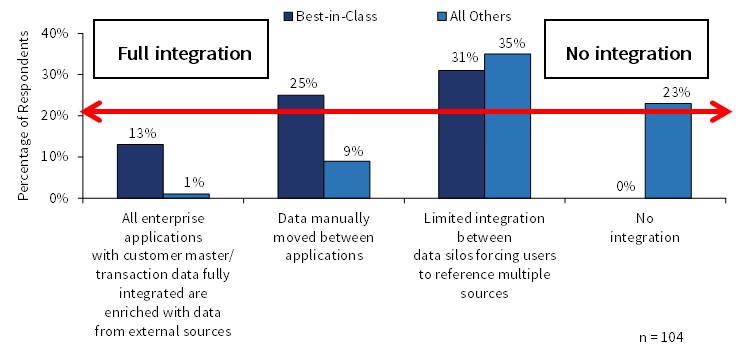
This is where top-performing sales organizations play out one of their many best practices to achieve stronger business results than under-performers: more aggressively integrating all customer-facing enterprise applications into a true, accurate, unified 360˚ view of prospective and current spenders. Figure 1 demonstrates that while the majority of companies are relatively weak in adopting this approach, a direct correlation between business results and application integration is proven.
This efficiency can play out in many scenarios that well-integrated enterprises are better at leveraging data for their own, and customers’ benefits. For example, consider that a senior seller at Company A is nearing a deal with a key buyer at Company B, and they develop a scope-of-work document that heads to legal or procurement colleagues within both companies. It is then discovered that a long-gone employee from B neglected to pay a small invoice from A, and that unbeknownst to the seller and buyer, the two firms are actually in small claims court and forbidden from doing more business with one another until the once-forgotten case is resolved. The fallout? A deal is lost or delayed, a quota missed, a desired product not acquired, time has been wasted, and reputations have been damaged. Had the selling organization connected the dots earlier, perhaps the accounts receivable and sales teams could have collaborated, and turned the debt into an up-sell component of the now-stalled deal.
Think of the 360˚ customer view this way: building out a data-driven customer lifecycle management approach that ensures that the best message is delivered to the right buyer at each watershed moment – prospect, hand-raiser, lead, opportunity, purchaser, renewal – in their customer journey. This nirvana does not, of course, take place without significant attention paid to core competencies that underlie the technologies. Consider the findings in Figure 2, which present a number of best practices that top performers adopt more frequently than weaker sales organizations:
Figure 2: What Exactly Does Customer Data Integration Require?
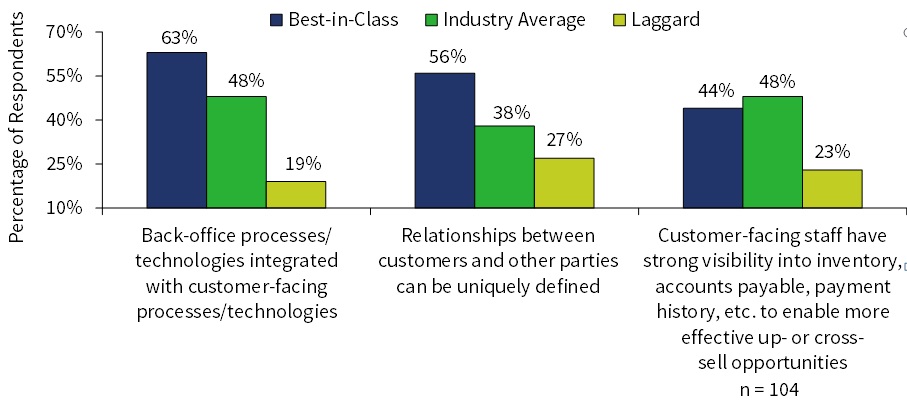
Here, the data supports a well-known trend in enterprise customer management: the blurring of traditional marketing, sales, and service job roles. It is common knowledge, supported by frequent Aberdeen research, that contemporary marketers, once held accountable for sheer prospecting volume, are now compensated on and tasked with generating sales revenue. Sellers, too, are now adding “micro-marketing” capabilities to their personal tool sets, determining the flow and content of messaging, assets, and social media output that to which their buyers and accounts are exposed. Hence Figure 2 supports the idea of total customer data integration by connecting front- and back-office applications; normalizing parent-child account relationships, and also stop-gap measures to prevent the Company A / B scenario above. In fact, the current research data shows that companies that aggressively integrate enterprise and desktop applications achieve 22% stronger customer retention (73% vs. 60%) rates, and also see 22% more sales reps achieving annual quota (44% vs. 36%), when compared to firms that do not adopt this core competency. On an annual basis, too, firms that connect all external party records to the CRM and unified internal data repository out-perform non-adopters around increasing customer retention, CRM adoption, average deal size, reps achieving quota, and average net client annual spend.
I’ve got three more strategies for you in this free report.

Uber is fighting back against a federal class-action lawsuit that seeks to reclassify all of its drivers in California from independent contractors to employees.
In court documents filed with the Northern California District Court on Thursday, Uber argued that the class-action part of the suit should be dropped because the 160,000 drivers "have little or nothing in common, other than their use of the Uber App in California at some point over the past six years."
Here's the most interesting parts from Uber's argument:
The case is scheduled to begin trial in August.
SEE ALSO: The driver who beat Uber will teach you how to do it too — for $50
Join the conversation about this story »
NOW WATCH: Is Uber really cheaper than a taxi?
 Business-to-business marketing has changed. In the old days, customers couldn’t use the Internet to evaluate buying options. They went directly to vendors for information. A vendor’s sales representatives cultivated relationships with their customers, and crafted their pitch based on individual customer’s needs and goals. Today, B2B customers usually complete more than 60% of their product and purchase evaluation process before they ever contact a salesperson. By visiting vendor websites and reading online user forums, they eliminate many vendors without ever talking to them.
To reach customers who may be rejecting your company online, align your marketing message with their specific concerns. The challenge is learning what those concerns are without knowing the buyer. Don’t rely on intuition or guesswork. You’ll never win a B2B buyer’s attention with generalities like “flexible,” “scalable” or “easy to use.”
Instead, segment your market into “buyer personas.” Each persona is an “archetype,” a composite of many buyers with similar attitudes. Build these personas with data you gather during in-depth interviews with actual buyers. Once you understand these personas, you can show B2B buyers how features like flexibility or ease of use relate to their specific, individual goals.
Marketers traditionally segment customers into demographic cohorts, grouping them according to attributes like age, education or income. However, such information doesn’t provide worthy clues about why a buyer may hesitate before buying. Raw information about a buyer’s lifestyle does not reveal what he or she hopes to achieve with a B2B purchase.
A buyer persona offers insight into the “when, how and why” of a purchase decision. You’ll learn which companies are your most likely prospects. You’ll know which executives influence the buying decisions and what features matter to them. You’ll also learn what resources they trust for product evaluation and advice. And you’ll be prepared to eliminate any barriers to a sale.
Listen carefully to your customer to unlock five areas of buying insight:
1. “Priority initiative” – This describes the circumstances that prompted the prospect’s search for a solution in your category. With this behind-the-scenes information, you’ll learn the best time to approach a prospective buyer, and you’ll identify the personas within the company who prompted the search.
2. “Success factors” – These are the performance results the buyer hopes to achieve with the purchase, such as cutting costs or reducing turnover.
3. “Perceived barriers” – These are the reasons prospects choose not to buy. Barriers can include disagreement among decision makers or dissatisfaction with a previous purchase.
4. “Buyer’s journey” – This outlines the buyer’s efforts to assess and choose among options. It reveals who has a stake in the choice and rates each party’s level of influence.
5. “Decision criteria” – This describes the particular product features buyers seek. If you know that a customer most needs, for example, ease of use, you won’t waste time touting your product’s compatibility with different platforms.
Ready to get started, and reach potential customers via inbound marketing? Download your free Buyer Persona Template below.

If you were to build a business empire that serves your own interests—a business that solves your problems, how easier would that be? Developing products and designing effective marketing campaigns is much easier when you have a fictional character that models your customer, and when you happen to be the customer then you have a huge advantage to yourself. Entrepreneurs bent on solving problems that they too experience, understand their customer better and can easily anticipate their customer’s reaction to a particular marketing model. In this case, you begin to see your business through the eyes of your customer. This might not be possible when you are not the customer of your business, and in such a case, you have to develop a fictional character that represents the very customer base that you target. These made-up characters are your buyer personas.

Buyer personas, like marriages, are not rushed: They are well thought-out and tuned up to guide product development and marketing efforts. Would you take a gamble? Try these tested steps:
To adequately understand your buyers, their thoughts, behavior, buying patterns and their inner “why”, you need a creative data sourcing idea. You have to perform a qualitative research that seeks to understand what exactly motivates your target buyer. Plan to collect data from your real buyers and prospects through online and offline surveys, phone and in-person interviews, and social media interactions. Your sales and customer service team is integral to this process. There is so much that you can grab about your customer from Facebook insights, Twitter analytics, and other online forums. As you gather your data, focus on digging out personal information, customer demographics, interests, aspirations, motivations, challenges, pain points, and objections. Only after you’ve gathered this information will you be able to help your customers accomplish their goals through your product.
Once you’ve collected accurate customer data, it’s time to find your ideal market segments—distinguish your buyer “types”. At this stage, focus on assigning unique attributes to your customer types, perhaps even marking each buyer group with some headshot. Segmentation should be based on specific business characteristics shared by some group of customers. You can then use the crafted segments to develop archetypal customers that embody specific group signals inspired by customer behavior. Your segments may reflect:
With this information, planning your overall marketing and content strategy becomes a lot easier. You can also segment these groups further to have more specific personas.
To create an effective buyer persona, you need to conjure up some “real” people. Give them some identity like a name or image to represent them. This is where you come up with a clear description for the various customer types that you crafted in step two. Each description should reflect unique signals about the buyer’s job, age, income status, needs, goals, and key role. Attempt to answer these questions:
Seek to identify both personal and business goals that drive the shopping patterns of your audience. Goals differ from one buyer group to another; goals may sometimes be unrealistic and not possible to achieve using your product. In your product development and marketing strategy, strive to marry up your customer’s goals and your product.
With information about your buyer’s gender, age, education, profession, interests, marital status, net worth, financial situation, and geographical location, you can now identify their primary and secondary challenges. What are their pain points? Find out what frustrates your buyer on the job and think of alleviating such feelings. At this stage, think of how you can solve these challenges to the satisfaction of each buyer “type”. One way of doing that would be adding value to your sales process.
Both product development and marketing strategies should seek to address challenges reported by buyer groups. To set the right pitch for persona development, walking in your customer’s shoes is of the essence. When you understand their emotions and how they feel about their jobs, developing products that adequately serve their needs becomes easier.
There are numerous aspects that define your success as an entrepreneur, and one of them is being able to respond to objections raised by your prospects toward your product. For every buyer group, identify what stops your product from ticking. Is it capital expenditure or usability? If your product is costlier than that of your competitor, clearly explain to the buyer what makes your product superior. Look for triggers as well; this could be issues with cost-savings, scalability, ease of use, or short timeline for migration. Understanding existing triggers and objections will help you develop a content marketing strategy that’s customer focused.
Based on the collected data, seek to discover marketing channels that will most likely reach a particular buyer “type”. Which marketing channel has higher conversion rate? Is there a niche online platform associated with your audience? For instance, LinkedIn would be your best bet if your target audience belongs to the professional class. Mapping your customer’s online behavior helps you understand their favorite topics and interests as well.
Great buyer personas are built on genuine customer interests and opinions about your product. This is where both positive and negative feedback from your customers shape the entire process of building buyer personas. Actual customer quotes from previous interviews and chat sessions are critical at this stage. Based on these quotes, you are able to discover your customer’s likes and dislikes, as well as their attitude about your product.
This is the last stage after defining your personas. During this stage, you are required to develop a customized marketing campaign that transforms these buyer personas into actual customers. This is referred to as the buying journey. Understand the journey that the buyer walks before buying your product and develop a message that directly addresses his concerns through an informed content strategy.
The best way to create velocity in the sales funnel is to get prospects to lean in to you. If they deeply want what you offer, things move quickly. To do that, focus on buyers' goals—objectives the client absolutely must achieve. Goals nearly always get funded and quickly.
How confident are you in your sales dialogue?
Even the best, most accomplished salespeople know there are some simple words and phrases that can instantly turn off a potential buyer. In a role that’s based on getting people to trust the words they say, salespeople all too often use words with empty meanings that can jeopardize their relationships with prospects. This not only causes prospects to pull back, but it could end up sabotaging the deal.
Here is a list of words and phrases salespeople should avoid and the replacements that can be used instead.
Avoid: “Trust me” or “To be honest with you”
Replace with: Examples of experience and expertise
These phrases create doubt and raise red flags to your buyers about your overall trustworthiness. Begging for trust makes it sound like information was being withheld or that the customer had a reason not to trust you before. Instead, always be genuine and upfront while building positive rapport and delivering value. Your trustworthiness will naturally develop and show through.
Tell prospects how many years you have worked at the company or in the industry. Always be sure to mention the key skills or experiences that establish you as an expert whose opinion they can trust. Also, identifying a connection with a lead or prospect can help you build a more personalized relationship. For example, if you notice you have the same alma mater or grew up in the same town, mention it!
Avoid: “Problem”
Replace with: “Challenge”
The word “problem” can sound worrisome to a potential customer. It is a daunting word for many people and can put a negative lens on a situation that may, in fact, be easier than anticipated to overcome.
To avoid this, substitute problem for challenge. When speaking with a customer, you want to make the conversation sound positive with a forward-thinking focus. By identifying something as a challenge versus a problem, you have the opportunity to present proactive and long-term solutions.
Avoid: Clichés like “peace of mind” and “win-win”
Replace with: Specific examples that show instead of tell
Clichés are overused and no longer provide the impactful punch they once did. Put yourself in the shoes of the customer. There’s nothing worse than trying to get an honest answer from someone and all you get is a cliché, cookie-cutter response that doesn’t really answer your question. As a customer, consider what you would appreciate – an honest answer.
Provide specific, relevant examples that the customer can connect with and show them, rather than tell them, that this is a win-win situation. When in doubt, use straightforward language to keep the conversation professional and honest. This will also help avoid any confusion with a lead or prospect.
Avoid: “Contract” and “payment”
Replace with: “Agreement” and “investment”
When it’s time to close the deal, contract can be an intimidating word. Replace it with agreement to sound less binding and harsh. Avoid using payment when possible, too, and switch it out for investment, which sounds beneficial from the customer’s point of view.
Salespeople are all about building relationships, so don’t let these common language blunders ruin a potentially successful deal. Simply changing the words you use with customers can dramatically alter their perception of the deal.
Do you have sales words or phrases that make you cringe?

VB INSIGHT:
The modern marketing technology stack is often a horrific snaggle-toothed mess of purchased, inherited, acquired, forgotten, misused, and someone-really-still-uses-that tools, often owned and managed by multiple people, and not completely documented anywhere.
This is a real problem when you want to personalize your marketing. And personalizing your marketing is a big step towards improving conversion, lift, and ROI.

Above: Data unification is marketers’ biggest challenge
It can drive 3.2X lift in email open rates, for instance, says Avari, 20-50 percent improvement in conversion rates, according to Sailthru, and a 20+ percent increase in customer lifetime value. Our own research at VB has found that personalization is a major priority for marketers in 2015 and can result in doubling conversion for marketers using marketing automation systems.
“Personalization sets you apart from competitors,” says Andrew Jones, a VB research analyst. “It means relevance to customers, whether they know and appreciate it or not — it works.”
Capturing, unifying, and using customer data to drive revenue growth
is available on VB Insight for $99, or free with your martech subscription
But it’s hard to do in a very diverse technological stack … which is one major reason why many marketers who are trying to do personalized marketing are failing, or being limited to ye olde mail merge insert-names-into-emails.
“Far fewer are doing much beyond that,” he says.

Above: Derived values marketers use for personalization
Jones’ new report on identity, marketing, and using customer data to drive revenue growth reports five main ways of centralizing customer data, each of which is appropriate for different companies in varying spaces.
They are:
Tag management, such as that provided by Tealium and Ensighten, helps brands capture and unify all the data that every tool in their web and mobile tech stack is capturing. That includes data from analytics packages, ads, CRM systems, A/B and multivariate testing tools, and more. Once all that data is aggregated in a single place, marketers have a much more complete picture of their customers and prospects.
Jones says a similar but distinct category is customer data hubs, which ingest all the data from various hubs, and spit it back to you as needed. The only example in the category? Segment.io.
 A more common category is customer identity management, which we used to call single sign-on or social sign-on. Vendors like Gigya, Jainrain, and LoginRadius provide solutions here, but these only focus on known customers — not anonymous visitors.
Consumer profile management might be the most sophisticated category, and here’s where you’ll find the marketing clouds, such as those offered by Adobe, Salesforce, Oracle, and Marketo. These are typically aggregated conglomerations of technologies for all different kinds of marketing needs on web, social, and mobile, but some, like Sailthru, AgilOne, and HubSpot, are integrated, purpose-built, and unified software tools. The customer experience platforms like SDL and Sitecore fit here as well.
Finally, some marketers rely on data management platforms to unify their customer records as well as bolster them with third-party data, such as offline purchase data. Companies here would include BlueKai, Aggregate Knowledge, and many others, including tools embedded within marketing clouds.
Which tool you use will depend on what kind of company you are, and what your needs require, Jones says. But it’s not optional:
“Data unification is critical to get a better view of your customer,” he says. “If data in one channel suggests you’re talking to a teenage boy, but he’s using his mom’s laptop, data from another channel may tell you who it really is and even what else they care about. With each piece of data we get a better idea of identity.”
The entire report is available on VB Insight for $99, or free with your VB martech subscription.
Powered by VBProfiles

 Even though I’ve lived in Austin, Texas for over a year, I never get into my car without plugging my destination into my favorite navigation app. It’s become habit. Although I know where I’m going (most of the time, anyway), having turn-by-turn navigation and a live map at my disposal ensures I’ll get from Point A to Point B in the fastest and most efficient way possible. It helps me avoid traffic jams and, on the off chance I miss a turn, it seamlessly guides me back to my route.
A map is a great thing to have — whether you’re seeking an alternate route during rush hour or strategizing the next step in engaging your company’s prospects. Even if you think you know the journey by heart, you’re more likely to avoid common pitfalls and yield better results by having a reference handy.
The problem many technology companies face is their buyer’s journey isn’t as straightforward as the traditional sales funnel model would lead you to believe. With so many touch points along the path before a buyer even reaches out to your sales team, how can you identify what takes your buyers from “I have a need” to “I choose your solution”?
Consider the following to help you make sense of your buyer’s sales journey and build a map to guide your inbound sales strategy.
First, let’s start with the basics: understanding each segment of the journey. Your buyer enters three phases before selecting your product as his chosen solution. These stages include:
This chart from HubSpot illustrates these three stages:

While no two companies share identical buyer’s journeys, the steps your customers take toward a sale are often similar. For example, let’s say you work for a company that sells project management software to small businesses. Here’s what your company’s buyer’s journey might look like.
Seems pretty easy, right? Once you’ve mapped this journey, strategizing becomes much simpler. But to properly identify each step and influencing factor within the journey, you have to do a little old-fashioned discovery and analysis.
You’ve been in the tech industry for several years, and you’ve been with your current company long enough to know what drives your customers to make a decision. Creating a buyer’s journey will be a piece of cake. Except, of course, if you assume incorrectly.
In addition to uniting your sales and marketing teams, discovering your buyer’s journey offers you the opportunity to locate and patch holes or weak spots in your process — so long as you do your homework. While assumptions are helpful, you still need to dive into the data. Here’s how:
The biggest threat to the success of technology companies isn’t a lack of funding from investors or waning market demands. Heck, the biggest threat isn’t even a company’s closest competitor. The No. 1 hazard holding you back from exceeding your business objectives is a lack of alignment between your sales and marketing teams.
And the No. 1 solution? You guessed it. A well-mapped and clearly documented buyer’s journey. Here’s the important piece of the puzzle, though. To really understand the sales journey, you have to marry the experiences of sales and marketing. If you ask a salesperson why a customer made a purchase, then ask a marketing person the same question, you will get two very different answers. This is because they’re engaging with customers at different points in the journey. To see a clearer picture, you have to understand both teams’ experiences. Then cross-educate these teams.
By creating transparency and open communication between your sales and marketing teams, you will not only develop a clearer roadmap, but you can ensure proper engagement at each stage of the buyer’s journey.

It’s essential to understand your buyer’s actions and behaviors within each phase of the buyer’s sales journey. While thoroughly mapping your journey and using it to drive your inbound strategy doesn’t mean every lead will become a customer, shaping your processes to your buyer’s behaviors will help increase efficiency. And even if your current process is successful, a little additional direction could mean the difference between meeting and exceeding your quarterly sales goals.
We’ll call this the Great Canadian Non-Recession
The would-be homebuyers flocking to Brad Lamb’s real estate brokerage are remarkably chipper for a country that’s supposed to be in a recession.
Despite the ominous predictions, Lamb said buyers are confident that they’ll remain employed and the value of the homes they buy will go up. He pegged confidence at a giddy 10 out of 10 in Toronto, seven out of 10 in Ottawa and five out of 10 in oil-dependent Alberta, compared to zero during the 2008-2009 financial crisis.
Confidence is “affected,” Lamb said. “But it’s not affected to the point where people are like… ‘The world is ending.’ Interest rates are low, the economy feels pretty good, people feel good about their jobs.”
While economists wring their hands about whether May and June’s gross domestic product figures will show Canada entered a technical recession in the second quarter, consumers are blissfully buying new cars, putting down payments on houses and expressing confidence in the economy. Despite the effects of the crash in oil prices on Alberta, employment remains strong across the country.
If it turns out Canada’s GDP did shrink in the second quarter as well as the first, the country will have met the commonly accepted definition of a recession. But BMO Financial Group chief economist Douglas Porter said that shouldn’t be the only test.
“It’s a rule of thumb that two consecutive quarters equals a recession and generally speaking, that is a reasonable rule to go by,” Porter said. “But we would say that there were some extenuating circumstances here. We just don’t believe that what we’ve been through over the last six months qualifies as a recession.”

Bank of America Merrill Lynch was the first to raise the r-word just after Canada Day. Economist Emanuella Enenajor said in a research note that she believes Canada’s economy shrank by 0.6 per cent in the second quarter, matching a similar contraction in the first three months of the year. Toronto-Dominion Bank and CIBC World Markets Inc. soon followed with recession predictions of their own.
We won’t actually know the official second quarter GDP numbers until Statistics Canada releases them on Sept. 1, but we do know output appears to have shrunk during the first four months of the year. GDP declined at an annualized rate of 0.6 per cent in the first quarter and 0.1 per cent in April, suggesting the Bank of Canada’s April prediction that the economy would rebound in the second quarter may have been optimistic.
Things looked even bleaker last Tuesday, when Statistics Canada released data showing Canada posted its second-largest trade deficit on record in May. Canada imported $3.3 billion more than it exported that month, with exports down 0.6 per cent compared to April and 6.7 per cent compared to the same period a year earlier.
But Philip Cross, a former chief economic analyst at Statistics Canada, pointed out that the agency revises GDP regularly after releasing its initial estimates. Recent history suggests the chance of April’s 0.1 per cent decline being revised into flat or even positive growth are about 50-50, he said.
“I would not declare a recession until I was sure it would survive every possible revision,” Cross said. “If it was based on a 0.1 per cent decline in GDP and employment, I would still say, ‘Boy, that could still be revised away.’ It’s not enough.”
Cross, who is also a member of the CD Howe Business Cycle Dating Committee that determines whether weak economic periods are officially considered recessions, said he wouldn’t even be convinced if the numbers show two unequivocal quarters of decline. He said that definition is arbitrary and outdated because it doesn’t consider employment.
We just don’t believe that what we’ve been through over the last six months qualifies as a recession
Six months of shrinking GDP might be a tidy definition for economists and finance professionals, but for ordinary people, a recession means workers are losing their jobs. In fact, the unemployment rate was 6.6 per cent in January and has stayed steady at 6.8 per cent from February to June. Labour statistics released Friday show the 6,400 jobs lost last month weren’t enough to move the unemployment rate.
On Thursday, Scotiabank released a report arguing the country is not in a recession “in any meaningful or broadly defined way.” Scotia Economics vice president Derek Holt said in his opinion, things aren’t bad enough to warrant another cut to interest rates.
“We’ll call this the Great Canadian Non-Recession,” Holt said in the report. “It is likely premature to give up on the rebound story and court the substantial risks associated with further rate cuts.”
Those employed Canadians are making big-ticket purchases. Home sales were up 3.1 per cent from April to May, according to the Canadian Real Estate Association. Statistics Canada data shows May housing starts were up 2.7 per cent compared to the same month a year earlier and in April, new car sales increased 5.6 per cent year over year.

“Consumers aren’t spooked by this talk of recession because they know that in their own daily lives, the labour market is still pretty good,” Cross said. “People are terrible interpreters of what the aggregate economy is doing. They’re very good at assessing what their own personal circumstances are. That’s why variables like consumer confidence tend to be pretty good indicators of how the economy is doing.”
Life isn’t all jobs, houses and new cars for everyone, of course. Chester Nagy, president of the Calgary-based manufacturer Plains Fabrication & Supply, had about 180 employees this time last year at his business, making equipment for the oil and gas industry. He’s already laid off about half of them and just issued notice of another 10 per cent cut if the sector doesn’t improve by the end of August.
From Nagy’s perspective, it sure feels like a recession. He compared the mood around today’s oil crash to the deep recession of the ’80s, which hit suddenly and lasted for years.
“Four companies within four blocks of me have shut down completely in my same sector,” Nagy said. “I think it’s a lot worse than people are making it out to be.”

There’s no question that the huge drop in oil prices has had a profound effect on the economy, especially in Alberta. It’s why the Bank of Canada issued a quarter-percentage-point rate cut to 0.75 per cent in January, with many predicting another is coming next week.
But Porter, the BMO economist, said that’s actually more evidence this is not a true recession. Recessions, he said, must have the “three Ds:” Depth, duration and dispersion.
“It’s the dispersion I have the big issue with,” he said. “Regionally, it just isn’t broad enough.”
Porter agreed with Cross that the six-month standard for declaring recessions isn’t adequate. He said there have been times when GDP shrank for fewer than six months and still qualified as an official recession, because the decline was steep enough and the effects were widespread throughout regions and sectors.
However, Canada has yet to experience six months of declining GDP without the experts declaring it a recession, Porter said. In other words, if this is a recession, it may be the least unpleasant one in Canadian history.
“We’re basically having a debate about semantics,” Porter said. “Whether what we’ve already been through was a recession or not doesn’t really help households or businesses in their planning.”
Financial Post

As sellers, we’ve been taught that someone with a need for our solution is a prospect. But that’s not true or we’d be closing a lot more business and wasting a lot less time following prospects who will never buy. Just because we see a need does not mean they
Not to mention we use our biased questions and listen through biased ears and ‘hear’ what’s being said as a ‘need’. In fact, given our predisposed assumptions and restricted inquiries, we have no way of knowing when, or how, or if the people we speak with are willing to bring in an outside solution regardless of a possible match or need.
A decision to make a purchase is based on dozens of factors that go far beyond need. So rule number #1: need does not a prospect make.
Unfortunately, the sales model has no capability to go behind-the-scenes to facilitate buy-in from the buy side, from folks within the buyer’s environment who
And the sales model, used to attempt to place solutions, doesn’t have the tool set to enable prospective prospects to manage all their internal, systemic, and hidden issues that are beyond the purview of buying anything. Here’s rule #2: until everyone and everything that will touch the new solution buys-in to bringing it on board, there will be no purchase, regardless of a need.
A BUYING DECISION IS A CHANGE MANAGEMENT PROBLEM
People don’t want to buy anything, they merely want to reach excellence at the least ‘cost’ to the system (their culture, their environment). It’s only when it becomes clear that they cannot resolve a problem internally, and they’ve determined that the ‘cost’ of bringing something in is equal to or less than their status quo, that they’re willing to purchase anything, regardless of need or the efficacy of your solution.
That doesn’t mean they’re not buyers. It just means they’re not buyers yet. And because they’re change focused to start with, they can’t hear, or notice, the content we introduce them to that would lead to a sale.
Buyers have change management problems well before they have solution choice issues. A purchase is merely the last element in a chain of events that must take place, most of which are outside of a seller’s purview.
Of course once the person/group becomes a buyer, they will need the questions and pitches offered by the sales model. But not until then. You see, people take some time to become buyers even when their problem ‘needs’ our solution. Unfortunately, they won’t read our marketing content or take calls, or even buy, until then.
One of the biggest fallacies of sales is that someone is identified as a buyer when it seems they have a need. Because people merely want to resolve a problem, they must explore all avenues of an internal fix, and then get buy-in for change, before recognizing a purchase is their only alternative. And the sales model does nothing to facilitate this.
Indeed, until they figure out if a fix will ‘cost’ less than the status quo, people aren’t even buyers. Remember: they were doing ‘good enough’ until now, and if a new solution causes more disruption than the cost of staying the same, they aren’t buyers. Rule #3: the status quo is sacrosanct, regardless of the need or the efficacy of your solution.
CASE STUDIES
Here are two situations in which I failed miserably (and lost quite a bit of money), prior to understanding that buyers (in companies and individuals) must know how to manage internal change before they can buy. I’ve since figured out how I could have first facilitated these issues, but at the time, I was a victim to their decisions.
In both situations it seemed crazy to me to give up vast increases in sales rather than figure out how to manage the change. But this is where I had my ‘aha’ moment, where I realized the difference between what I had to sell, their ‘need’, and how they bought: People need to maintain the equilibrium of their status quo at all costs – at all costs – regardless of the benefits of our solutions.
If they have to fire a team to bring in new software, they have a decision: software or people. Do they need the software? Sure. But maintaining the system might have a higher value. Indeed, sellers can’t know the internal criteria – the history, the relationships, the future plans – of prospective buyers, especially with a sales hat on.
By starting first with a solution placement goal, and with ‘need’ as the criteria, sales will only ever succeed with the low hanging fruit – once folks have done their change work and show up as ready. All those who still have to manage change and address their internal issues aren’t buyers yet, regardless of need.
But wearing a different hat, it’s easy to find the ones who are on route to becoming buyers and facilitate them through their change – and be there with them as a real trusted advisor as they become buyers. We wait while they do it anyway. Might as well help and become part of their Buying Decision Team in the process.
THE DAD STORY
I’m going to tell a story I’ve told dozens of times. For those who have read it in other articles or my books, I apologize. But it’s a terrific story.
Years ago, while running a Buying Facilitation® program at IBM, they asked me to speak to folks at a ‘Mom and Pop’ store nearby who they wanted as a Beta test site. These folks would be getting a free computer for their efforts, yet three sales folks had been unable to get a Yes from them even though their old computer was far too slow for their growing company.
A man answered when I called. Here was the conversation:
SD: Hello. My name is Sharon-Drew Morgen. I’m calling from IBM. I’m a consultant for them and was reading the files they have on you here when they offered you a free Beta. Can I ask how your current computer is working?
B: Hi. Um, it’s ok.
SD: What’s stopping it from being better than OK?
B: Dad.
SD: Dad? I don’t understand.
B: This is a Mom and Pop shop. I’m the son. The owner is my Dad. He started the company 40 years ago, is now in his 70s, and has been handling all tech issues [Note: those were the early days of the net when there was so much confusion]. He’s retiring next year.
SD: Ah. So you can’t consider bringing in anything new that he might be uncomfortable with and will wait until he leaves to look into it?
B: Right. I would love to do your Beta as our system is so slow. I’ve just got to take care of Dad.
SD: I wonder if you and Dad would be willing to travel about 5 miles to X company on Y street. They are using it right now and are one of our Betas. Maybe you and Dad could go play with it a bit, ask them some questions, and see if Dad is comfortable?
B: Good idea.
They went, and a week later took the Beta. They had a need, but weren’t buyers until they figured out how to resolve the change management issues that were keeping them in place.
No matter how much you think your solution matches with a ‘need’, your goal, your questions, your inquiries, are all based on what you’re selling and you’re not facilitating them in the first steps they must take before they become buyers, steps based on systemic change, not need or solutions.
By this fact alone, you will only ever close those folks who need what you’re selling, the way you’re selling it, at the moment you show up, and you’re only closing the low hanging fruit. My clients find those who WILL buy on the first call, facilitate them through the change process, and close 40% of their list against the control group’s 5.4%. And it actually takes less time (and less wasted resource! And less sales folks!) to close.
Using the sales model you cannot influence what’s going on behind the scenes – the personalities, the history, the internal politics, and the ‘givens’ that an outsider can never understand. And they will never buy until it’s done – regardless of their need or the efficacy of our solution.
THE SALES MODEL IS SOLUTION-BASED; BUYING IS SYSTEMS-BASED
Philosophically the sales model is necessary and important: as sellers we clearly see needs that our solutions will resolve. But we don’t have a prospect until or unless their Buying Decision Team – everyone who will touch the final solution – is ready, willing, and able to
or they cannot buy. Indeed: a prospect is someone who WILL buy, not someone who SHOULD buy. And ‘need’ has nothing to do with it. In other words, sales is a second tier effort – first facilitate the buying decision/change management process, then when they’re buyers, sell.
And unfortunately, as outsiders, we can’t ever really know what’s going on within their decuiosn process. But sometimes, they don’t either. And we can use our knowledge of our industries to really help them in this area before we start selling. After all, we wait while they do it anyway. Might as well be competitive and help them with an add-on skill set.
I developed Buying Facilitation® in 1983 to manage the issues my own sales team faced in my tech startup. The model is an add-on tool for sellers to first facilitate people through their Pre-Sales change management issues before they sell.
As a sales professional, I never understood why ‘prospects’ weren’t buying as often as was logical. When I became an entrepreneur, I realized the problem people have when deciding to either fix their own problems or make a purchase, when I had needs myself.
When potential vendors came in to pitch new solutions to me, they ignored the change management issues I had to deal with as part of my buying decision process. Everything these folks discussed, every question asked, was focused on selling me something.
It never occurred to anyone that just maybe I wasn’t ready to be a buyer yet, that just maybe they had nothing to sell until I could clearly see my way through to a path to buy, to manage any changes that a solution would entail, even though I certainly needed their products. And it never occurred to them they actually could have really helped me make the decisions I needed to make that would have led me to buying.
Our time together should have been used to facilitate my change management issues. And then not only would I have been a prospect, but I would have been a buyer in a fraction of the time it would have taken me to figure it out on my own.
So I developed my Buying Facilitation® model to add to sales to begin prospecting by
and then selling.
After training this material for decades, I’ve found the most difficult part of Buying Facilitation® is the difficulty sales folks have in remembering to first put aside the ‘need’ or ‘sale’ and instead truly serve others in discovering their most efficient path to their own best solutions. People want excellence. The last thing they want is to buy anything. The last thing.
And you’re pushing the last thing far too soon, certainly depriving yourself of a real possibility of becoming a servant leader, a relationship manager, and a true professional and acting competitively as a true facilitator to enable the change management process that comes before the buying process.
I’m not suggesting you not sell. I’m suggesting you don’t begin by attempting to assess ‘need’ or ‘value’ when there’s no way for them to know the full extent of their need until they’ve gone through their change management and buy-in issues. Indeed, once they’ve got the entire fact pattern, they may indeed need to buy more from you. Using Buying Facilitation® enables you to become more competitive.
One more thing: once you enter a call with the goal of facilitating change rather than trying to sell, you’ll know who will be a likely buyer on your first call: It’s those who seek change, and have been flummoxed by being able to resolve the problem your solution can resolve.
Stop seeking those with ‘need’ and seek those who want to change. And then facilitate them through their process. When it’s time to buy, they’ll be ready, won’t worry much about price, and you’ll barely have to pitch. By that time you’ll be on their team, be a truly trusted provider, be ahead of the competitors, and there won’t be a price issue.
Also remember: Prospects don’t need your help to buy. All of your content is on your website. What they need help with is managing their change decisions – that’s the length of the sales cycle and what takes so long. It’s your competitive advantage.
Help prospective buyers determine how to change, how to get buy-in, how to bring in your solution. And then you can sell. Buying Facilitation® first, then sales. You need both. Then you can help buyers decide to be prospects – and they will buy.
_______________
Sharon-Drew Morgen is a breakthrough innovator and original thinker, having developed new paradigms in sales (inventor Buying Facilitation®, listening/communication (What? Did you really say what I think I heard?), change management (The How of Change ), coaching, and leadership. She is the author of several books, including the NYTimes Business Bestseller Selling with Integrity and Dirty Little Secrets: why buyers can’t buy and sellers can’t sell). Sharon-Drew coaches and consults with companies seeking out of the box remedies for congruent, servant-leader-based change in leadership, healthcare, and sales. Her award-winning blog carries original articles with new thinking, weekly. www.sharondrewmorgen.com She can be reached at sharondrew@sharondrewmorgen.com.
The post Prospects Aren't Always Prospects first appeared on Sharon-Drew Morgen.

As marketers, you hold fast to your creativity, drawing on your inspiration rather than falling prey to old ideas. But here’s the thing – copying your best work does not make you a copy cat. It makes you an agile marketer.
Only 32% of marketers think that they are creating enough content — that means that a staggering 68% of marketers believe they’re falling short. By repurposing your content in interactive forms, you broaden your reach, strengthen your authority, and flex your creative muscles without going back to the drawing board.
Instead of starting from scratch every time you develop your editorial strategy, derive a portion of your planned content from past successes. Because interactive content generates twice the conversions of passive content, your repurposed pieces are bound to make an even bigger splash than your original efforts.
As HubSpot reminds us, repurposing content is not the same as revamping your content. Think of revamping your content as redecorating; the structure and purpose of the house stay the same, but you overhaul those old curtains and ugly cabinets with new features.
Repurposing, on the other hand, pulls apart an amazing house and uses the parts to build something completely different. It stretches the building blocks of your best content to serve new purposes along the buyer’s journey.
Interactive content is a powerful way to repurpose existing assets because it allows you to capitalize on the positive impact of repetition without losing your audience’s interest. And you have a smorgasbord of different forms to choose from, too.
Here are some examples of easy-to-repurpose static content and easy-to-build interactive content:
Static Content Interactive Content Blog Posts Calculators E-Books Assessments Videos Interactive Videos Infographics Interactive Infographics White Papers Interactive White Papers Images Image Galleries Guides Quizzes Data Sheets Polls and Surveys Podcasts Contests
Your next step is to identify evergreen, static content to transform to interactive forms. Evergreen content always sparkles like it’s summer, even if you published it over a year ago. It’s timeless and offers the highest quality experience.
Here are some common forms of evergreen content:
Instead of wading your way through your company’s work from past years, use definitive metrics to discern which evergreen pieces made the biggest impact. Look at the content with the highest click-through rates and the most shares on social media — your greatest hits are the best places to start.
Are they evergreen? If they include statistics, news or are pertinent to old companies events, you have two choices: revamp before you repurpose, or move on to the next best thing. Tweaking facts and figures in a truly stellar piece may be worth the extra effort.
As always, you want to discern the purpose of your work before you dive into the nitty gritty of pulling it together. How are you going to use interactive content to serve your company?
Most companies implement repurposed content in one of two ways :
Companies often bring in repurposed interactive content to benefit long-form content. Bizo, for example, simply incorporated quizzes and assessments into their blog posts, which were already effective engagement channels. With 15 interactive campaigns over 90 days, they created 400 leads at a 50% cost reduction.
This interactive quiz from University of California, Berkeley certainly holds its own as a stand-alone piece. It gives the audience an opportunity to test emotional intelligence, while offering clear, practical insights.

How do you think that UC Berkeley transformed academic research into an entertaining, enlightening quiz? They started with long-form articles and pared them down to their absolute essentials. You probably remember taking a highlighter to your textbooks in middle school. If you are planning to repurpose long-form content into snackable bites, you want to follow the same principles:
Let’s say you want to repurpose your static content into long-form, interactive equivalents, rather than snackable pieces. Skip the slice and dice, and instead utilize moments of personalization.
Imagine that static content is a one-way street. Interactive content is a two-way street with many destinations — it forks in different directions, leading your customers on the route that is best for them. As a marketer, you have to think about where to part the road, so you lead your audience toward specific rather than one-size-fits-all destinations.

This interactive infographic from GOOD magazine allows individuals to calculate the amount of water they use in a day based on their choices. To create this infographic, GOOD identified people’s differing habits as the points for personalization. As the audience selects the activities they engage in (driving a car, shopping or working), the bar on the left side of the infographic moves up to reflect their water usage.
Once you cut down your content and identify points for personalization, you can fit your evergreen content into interactive form without the help of a creative agency or your favorite IT professionals. SnapApp makes it easy!
Here are just a few of the benefits you will reap in the long term:
Increased SEO
Crafting multiple pieces of content around the same topic means you will boost your company’s SEO.
Education
Repeating your message in new forms educates your audience and boosts your authority.
Better Numbers
Effective interactive content generates conversions over 70% of the time, so expect a big bump in numbers.
More Accurate Data
Enriching your marketing plan with interactive content yields meaningful data from questions and assessments.
New Audiences
New mediums means new audiences.
Are you ready to get started? Learn more about what interactive content is and why it works!
It’s halftime of 2015. Your sales team just finished a quick 4th of July breather. Here are 5 quick pep talks from top sales coaches as you head into the year’s 2nd half.
Ever had a manager or coach give a speech that resonated more powerfully than most?
The answer, of course, is yes. The best speeches combine passion and insight to drill into our psyche and dig out new levels of energy, savvy and determination.
With half of 2015 behind you, now is the perfect opportunity to give your team the epic halftime speech it needs to hear. And because a little extra coaching never hurts, here are 5 inspirational, insightful speeches from several of the most renowned sales coaches influencing the sales profession right now.
We asked a few of the best sales coaches in the world to give a brief speech delivering timely insights and inspiration to sales teams as they enter Quarter 3.
They came through in spades. Prepare the hearts and minds of your sales team for 2015’s second half with 5 epic speeches from top sales coaches.

A Senior Consultant with the Bridge Group, Cindy has over 20 years of sales and sales management experience, and has spent 6+ years delivering playbooks, interim management, training, and coaching to Bridge Group clients.
Happy July, I can’t believe half of the year is gone. I have one word for both reps and sales leaders that will up your game for the second half….Coaching.
Merriam-Webster defines a coach as a person who teaches and trains an athlete or performer. I see a sales team as a group of athletes who, if coached properly, will condition their sales muscles to consistently perform at a higher level and achieve greatness.
For those of you who are thinking that your team is great and doesn’t need coaching, I have two words for you: Phil Mickelson.
Even though he is one of the highest paid and most successful professional golfers; he works with multiple coaches; including a swing coach, a putting coach and a mental coach.
Have I made my point?
Now that I’ve convinced you that coaching has its merits, you may be wondering where to start.
Create a coaching culture: Schedule regular side-by-side coaching sessions with each rep. There is no better opportunity to reinforce what is working and identify obstacles to be overcome than by listening to live calls. Commit to spending a minimum of 3-4 hours per month with each rep and make sure it happens. Your reps need to know that they are your top priority. And no, pipeline reviews don’t count as coaching.
So now that you’ve made the coaching commitment, you may be looking for ideas on what to coach on. Here are some topics that often need attention.
Buyer knowledge: Your team needs to know who your ideal buyers are, what their hot buttons are, and how your product or service solves their business issues. If your reps are droning on and on about product, then it’s likely they don’t really understand your buyers’ hot buttons. Every conversation should be focused on the buyer, not your company and its products.
Prospecting: Whether your team only responds to inbound leads or is responsible for proactive outbound prospecting; they need:
1) A touch “map” that tells them how many times they need to touch every lead or contact; along with when to leave a voice message and when to send an email.
2) Messaging themes that align with your buyers’ hot buttons and tell the story of the business issues you solve over the series of touches. Don’t allow your reps to just “go through the motions.” Remove “following up” and “touching base” from their vocabulary and they will be better positioned to have great conversations once they finally connect with the buyer.
3) Qualification: If your reps are tightly qualifying for Authority, Budget, and Timeline but glossing over Need, they are spinning their wheels on deals that are unlikely to close without divine intervention. Reps must be able to ask the tough questions to uncover need. Superficial qualification equals a sketchy pipeline.
Effective coaching includes rep follow through. At the conclusion of each coaching session, assign goals for the next session that includes practicing the new behaviors they need to work on; along with self-development. Self-development could include reading a few chapters in a book or sitting with an A player and listening like a sponge.
Vince Lombardi said “Individual commitment to a group effort – that is what makes a team work, a company work, a society work, a civilization work.”
So what’s your individual commitment to your team, Coach?

Mark is the VP of Sales at Outreach.io, where he runs a global sales team that helps sales executives better manage their reps, pipelines and sales process through Outreach’s unique sales acceleration platform.
Almost without fail, the success of the second half of the sales year depends on your execution of the first half’s game plan. The consequences of shortsighted decisions, deal chasing, and procrastination in the winter and spring are about to rear their ugly heads making your EOY goals suddenly seem impossible.
How do you recover when faced with the next six months quickly becoming a lost cause? It’s tough, but there is a way. The strategy you need is “take 3 steps back to make a giant leap forward.”
SIx months of poor execution can only be overcome by a giant leap forward, and the only way to get enough momentum to carry you all the way to your goals is by backing up, getting a running start, and jumping like you are Blake Griffin dunking on Timothy Mozgov.
How to take 3 steps back:
1) Stop. Slow down. Set aside a couple days you will invest in steps 2 and 3 that follow. Get ready to lose this week or this month, so you can win the ones that follow.
2) Assess. Evaluate. Think hard thoughts. What needs to happen for you to hit your EOY goals? What was missing from your execution in the first 6 months of the year? Find and understand the big picture of the work and results required and why you didn’t do it the first time around.
3) Break it down. Chunk it up. Use your newly gained understanding to define the details of what you will need to do. Then, figure out how you are going to do it.
That’s some general direction. Here are some specific tasks you can do:
Identify opportunities which must close to have a chance of hitting quota for the year. Double down on those. Please don’t be overly optimistic and think it will all close. Build in a margin of error, but work those account like your job depends on it…it might.
How many more average opportunities do you need to create? How many big? How many small? Now, work backwards. What’s your close rate? What’s your conversion rate? That shows you how many leads you need. How much prospecting time do you need to create that pipeline? You’ll need to prioritize those activities or you will never get there.
Identify the deals that will not get any more time out of you. If they close, great. If they don’t, fine. You don’t have time for everything, so you are going to have to let some stuff go to do the new mission critical tasks you’ve created.
It’s cliche, but don’t be insane and think you’ll hit your EOY goals by just working the same way you have been. Be smart. Come up with a different plan. Then….Do.Work.Son.

Combining impressive backgrounds in sales management and analytics, Jordan founded CloserIQ in 2014 to help startups hire top sales talent. As CEO, Jordan oversees sales & business development.
As the second half of 2015 begins, it’s time to re-group and focus on the goals you made at the beginning of the year. Maybe you crushed your first half quota or maybe you’re way behind and feeling a little bit of panic setting in. Either way, the first half is done. This is a brand new ball game.
Here are 5 tips to help you finish 2015 stronger than you started.
1) Find your motivation.
It all starts with why you come to work everyday. Make sure you’ve got positive energy and motivation to keep you focused for the next 6 months.
To clear the air, request a check-in with your manager and have them help you take it to the next level. Make sure you know your goals and promotion opportunities. You need to know what it means to crush it and what happens when you do. Your manager should have the same incentives as you to make sure you stay hungry.
2) Set daily activity goals.
Six months is a long time. If you know your pipeline conversion rates then you should be able to calculate the daily activity goals you need to hit. It’s much better to have a sense of how you did at the end of every day then get blind sided at the end of the year.
If you are struggling to reach your daily activity goals despite working a full day, then you should ask your manager for help diagnosing where your time is going.
3) Maintain a consistent pipeline.
Don’t bust your pipeline by under-allocating time with top of the funnel opportunities. Having a late-stage heavy pipeline may be a great feeling for the next month but if you’re not paying attention, you’ll have some bad swings and look like a one hit wonder.
4) Push to a close.
Which opportunities have the best engagement right now that you can drive towards a final decision? It’s much harder to re-ignite conversations so make sure you are following-up on your working deals and driving towards a final state of closure, even if it’s a no.
5) Minimize distractions.
Other than the regular social media culprits, you need to watch out for fantasy football in the second half of the year. It’s an amazing game but also very addictive.
Before draft season begins, layout some boundaries for yourself and don’t over-commit. It’s not about being a good employee, it’s about maximizing your selling time and minimizing distractions. Keep your eyes on what’s important — your career, your reputation as a closer, and your W-2.
That’s all I got. There are tips that we all need a reminder of every once a while.
And don’t procrastinate on this stuff. Start putting the work in today so you don’t end up like the other clowns who will be blaming the shitty weather and holiday effects for their poor performance in the second half.
Good luck. Go crush it.

The subject of a recent Sales Influencer Series episode, Matt is a long-time sales executive who now runs a consulting firm that specializes in optimizing sales, marketing, and operations for startups and small businesses.
It’s time to step up.
You are all heart. Time and time again you have answered the bell and put in the grind to make your numbers. You work hard and hustle for everything you’ve won- but that’s not enough anymore.
It’s time to step up and become more than just another meat puppet peddling the latest and greatest version of a product. Ineffective salespeople are being culled from the herd every day. It’s time for the willing to stand up and start treating their sales profession as a craft. Something to be honed, refined and developed into a world-class skillset.
Be better than the best you compete against- know more, do more, hustle harder. Know your product and THEIR product better than they do.
Be a student of your industry- understanding the current state, future trends and potential pain for which your buyers are trying to solve.
Find ways to add real value to the process for your prospects, don’t just facilitate a purchase.
Don’t wait on your half-assed marketing department or sales manager to create a better value proposition for you, create one yourself that actually gets you traction. Ask for forgiveness later.
Pick up a book; any book about sales tactics and strategy, read it, and then read another.
Consume at least one industry publication per day- preferably two.
Get to work early. Stay late. Exercise. Eat a vegetable once in a while.
Strive to get better at what you do every day.
Celebrate your wins with vigor and be willing to truthfully examine your defeats. Own both and be accountable for either outcome.
Most of all, find joy in the process. Love the grind or find ways to make it part of what builds you up and makes you stronger, faster and a killer of quotas.

The President of AA-ISP’s top chapter and founder of Inside Sales by Design, Dionne Mischler is an Inside Sales guru, lifelong sales management leader and personal favorite expert of Ambition.
When leading a team, especially my own, I believe in positive motivation and making our number well ahead of the deadline. I also preach this to my clients and highlight it when given the opportunity to present best practices. It comes as a surprise to some when I share that revenue is a result of doing the basic everyday activities well.
And in order to guarantee the right result, the right sales infrastructure needs to be in place as well as the team engaging in the right activities – phone, emails, texts, social media, etc. Given that, my emails to my team are short and expectations are consistent whether it’s the first of the year or mid-way through.
So one of my “half-time” messages would read/sound something like this:
“Team, congratulations on a job well done! We’ve made our number in both revenue and net new accounts and contacts. We are leading the pack and providing real value to our prospects, customers, and organization. We couldn’t have done it without you and appreciate all of your efforts!
As we enter Q3, we’ve got an amazing opportunity ahead of us to delight our customers, help our prospects, and as a result, make our number and for you to achieve your personal goals when comp plan milestones are overachieved. I’ve spoken with all of you and know you have some personal goals so let’s go get ‘em!
And as always, I’m here and committed to making sure you’re all successful. I look forward to an amazing and successful second half of the year and hearing the stories from your realized goals of vacations and home buying!”
It’s no secret that the kids love Snapchat. An astounding 71 percent of Snapchat users are under age 25. More than half (58 percent) of college students say they’re likely to purchase a product form a brand that sends them a Snapchat coupon. Users between the age of 18 and 29 spend an average of 20 minutes a day on Snapchat, while 30-44 year-olds spend just nine minutes on average.
And yet, just one percent of marketers are using Snapchat. As recently illustrated on Social Media Today, marketers aren’t using it because, well, they aren’t using it. Their lack of familiarity with the platform is fueling their fear of applying it to their work. Recent college graduates may know and love Snapchat, but their boss and their boss’ boss don’t, so it’s no easy task convincing them it’s a worthwhile endeavor.
This leads to two implications for marketers who are considering adding Snapchat to their toolbox:
I could list a horde of B2C brands who have been honing their Snapchat game since its inception in 2011 and talk about the tactics they use to engage with their captive Snapchat audience, but a quick google search would yield the same results.
The one thing all of those brands have in common? Their target audience (or some subset of it) aligns with demographic data on Snapchat users. In other words, they market to teens and young adults.
But what about B2B companies? Is there really an opportunity for them on Snapchat? If the answer is yes, it’s going to be because of a combination of three factors:
To borrow from the popular “lead a horse to water” adage, you can direct your audience to your account on a social platform, but you can’t make them engage if they’re not a part of that community.
Segment your audience and get to know them and their consumer behaviors intimately to determine if they will be keen to communication via Snapchat. Don’t waste your time creating content if it’s never going to be seen.
Rather than planning a siloed Snapchat campaign, target audience members should be directed to subscribe to a brand’s snaps via some other channel (such as Twitter or email or Instagram). Snapchats are not broadcasted and displayed publically in a feed for on-demand viewing like we’re used to seeing on other social channels. Paired with an inability to browse and explore other users and accounts, it’s imperative that users are reminded to subscribe to your snaps on a regular basis by way of traditional social media platforms.
Furthermore, augmenting campaigns with Snapchat content ensures you have a real and genuine purpose for communicating with users. Snapchatting as a brand is pointless if you don’t have a specific goal in mind. Unlike the average user, broadcasting silly selfies and random shots of your day isn’t a good look or particularly engaging move for a brand.
Instead, Snapchatting brands should look for opportunities to create content around a central idea or theme. Caveat: It has to be something your audience cares about, too. So while a series of snaps about a new product or an award you’ve won might seem great to you, it’s likely your audience will tire of it quickly.
Remember that Snapchat users either want a way to incorporate themselves into the content (such as by taking selfies that feature the brand in some way) or special access to something (such as a behind the scenes peek at a live event).
Creating content for an engaged audience as part of a larger omni-channel campaign will only get you so far. Capitalizing on location-specific content is the third and final key to successful B2B Snapchatting. It’s what makes average content fun, exciting and highly relevant. It’s why Snapchat’s Our Stories are now the most popular aspect of the platform.
Geofilters (special overlays for snaps that can only be accessed in certain locations) are quite possibly the app’s best feature. They play in integral part of what makes Our Stories so fun and engaging. The functionality never changes, but fresh filters from new locations give Snapchat a daily refresh to keep users coming back for more.
 While location doesn’t play the leading role in Snapchat like it did on Foursquare and does on Swarm, it certainly has a strong supporting role. Seeing snaps from users who are in the same location as you (such as at a conference) creates a special (albeit ephemeral) bond with those users. Conversely, viewing snaps from across the country (or across the globe) gives viewers a special firsthand account of what’s happening. It’s the next best thing to actually being there.
If you’re organizing a conference or other type of event, you’d be remiss if you didn’t apply to create a Geofilter.
B2B selling hinges on relationships. So, if you’re not ready to dive in head first with a branded Snapchat account that utilizes geofilters and takes advantage of their ever-evolving advertising options, Delmondo’s Nick Cicero suggests that you consider adding Snapchat to your sales and marketing team’s toolboxes.
“Bearing in mind Snapchat’s skew towards a younger demographic, empowering an account executive in an ad agency or media company to use it as a relationship building tool with his younger contacts could be what makes your organization stand out in a prospect’s mind,” he explains. “Do you have a particularly adept young marketer on your team with Snapchat savvy? Embolden them to build their personal brand as the resident Snapchat expert and encourage your audience to subscribe to their account.”
Uncomfortable with the idea of putting your employees in the limelight, but still interested in capitalizing on Snapchat? Find an influencer in your space with a dedicated following on Snapchat and offer them a complimentary pass to your event in exchange for sharing the experience with their followers. If you’re not hosting an event, see if you can work together to integrate you messaging into their content in a mutually beneficial way.
The possibilities are endless and it is possible for B2Bs to join the Snapchat revolution—it just requires a little creativity and courage to venture into the unknown.

 Lead (or data) velocity is a marketing metric that’s quickly gaining popularity among Marketing Ops and Demand Gen practitioners. And it’s understandable why. Lead velocity is a gauge of several fundamental marketing objectives: sales-marketing alignment, customer experience and marketing-attributed revenue.
We’ll get into much more specific definitions and how to measure velocity later in this post. At a high level, lead velocity is about speed (e.g., the time it takes for a generated contact to become sales-qualified lead) and conversions rates (the percentage of leads that convert through various points in the customer acquisition funnel).
Poor customer experience
Velocity can be both a symptom and a cause of bad customer experience. If the speed with which your contacts are making their way through the customer acquisition funnel is slowing or the number of those contacts in various stages is decreasing, it likely signifies a customer experience failure of some sort. Your content, engagement strategies, workflows – or any number of things – may be off. Velocity helps to uncover failing efforts and where added focus may improve prospect experience and customer acquisition.
On the other hand, velocity may be strained due to operational issues, such as unstandardized data formats or taking too long to upload contacts into nurture tracks. This in effect deprives prospects of getting the info they want when they want it, and decreases the likelihood of conversion.
Marketing-sales misalignment
Slow velocity hurts marketing’s credibility and relationship with sales. And since one of Marketing Ops’ key focuses is to align marketing efforts with sales’ goals, this relationship shouldn’t be taken lightly by Ops practitioners. Sales reps want good, interested leads. And they want them at volume.
A high velocity ensures that sales gets what they want from marketing, and this is typically reciprocated through actionable feedback that marketing can use to adjust initiatives and improve results.
Impact on revenue
The above two points mean fewer new customers, less marketing-attributed revenue and quite possibly a diminished role for both Marketing Ops and Demand Gen teams.
In recent years numerous articles have proposed various ways to calculate velocity. None of them are right or wrong, but after reviewing many and testing additional methods, I’ve found common “schools of thought” and where they prove most helpful.
The “School of Speed”
This is the easiest, most literal definition of velocity: the time it takes for a lead/contact to get through the various stages of the buying cycle. For example, the time that elapses between when a media partner’s generation of a lead and when it’s imported into the marketer’s automation system. Or, the time it takes a marketing-qualified lead (MQL) to become a sales-accepted lead (SAL).
You can calculate in sections or the entire buying cycle; but the metric is “elapsed time” and the lower the figure, the better. This definition tends to be more important for B2B orgs, which have much longer sales cycles and decreasing these cycles is a key objective of both marketing and sales efforts.
The “School of Conversions”
In this calculation it’s all about the volume of leads that convert compared to a previous month or quarter. The percentage increase in conversions is the velocity rate. So, the higher the percentage, the better.
For example, if you have 200 contacts convert to MQLs this month and you only had 150 convert last month, your velocity rate would be 33%, because your number of conversion increased by 50, which is 33% of last month’s 150 total.
B2C orgs are typically more concerned with conversion rates than speed, so this definition is usually more relevant to their needs. But that’s not to say that B2B orgs don’t care about conversion rates, which is why the next calculation is likely the most important…
The “The Hybrid School”
The final definition of velocity mixes the previous two outlined above, combining both speed and conversion rates. As such, it’s likely the most helpful calculation for most B2B organizations. Moreover, it’s easily broken down in sub-metrics to pinpoint the extent of various areas of failure.
This is one way to calculate a hybrid velocity:
[(# of qualified leads in current month) minus (# of qualified leads in previous month)] divided by (# of qualified leads in previous month) x 100.
This figure is then divided by the average time elapsed during that conversion processes. For example, we’ll use the time elapsed between contact capture and conversion to sales accepted lead (SAL).

(200 SALs in current month – 150 SALs previous month) ÷ 150 x 100 = 33%
33% ÷20 days = 1.65 would be your velocity figure here.
If you cut elapsed time in half but remained at 33% conversion the following month, your velocity would still double to 3.3. 33% ÷ 10 days = 3.3
Or you may have generated 300 SALs the following month, doubling conversions (100%). And let’s say the average time elapsed also doubled to 40 days.
100% ÷40 = 2.5
Note – if your conversion rate actually decreases from the previous month, it’ll throw off the calculation. This is one reason to always keep track of the conversion rates and speed separately in addition to the hybrid calculation. It’s also just good to know the individual factors that contribute to your monthly or quarterly calculation.
Think of the hybrid formula like baseball’s “OPS” stat (On-Base Percentage Plus Slugging Average) – you always want to know conversion rates and speed between conversions as individual statistics, but having them in a singular figure makes for quicker, more well-rounded comparisons between campaigns, leads sources, quarterly programs, and even stages of the buy cycle.
Undefined objectives – Customer acquisition is a relay race with many legs spanning numerous teams and departments. If these teams don’t agree on when or how a lead should be handed off, velocity slows dramatically.
Solution – Focus on frequent communication. In my experience, two tactics do a remarkable job in achieving this: (1) Weekly sales-marketing calls to review pipeline and program data and (2) Regularly being involved on sales calls with prospects.
Numerous, disjointed lead sources and unstandardized data – Third-party data sources, media partners, trade shows, webinars, etc. are all used by demand marketers to acquire data on prospective customers. This diversification is great except for when the time comes to consolidate and import data into customer engagement systems (marketing automation or CRM).
Left decentralized, it’s not uncommon for time between initial data capture and MA/CRM importation to extend longer than ten days – that’s long enough for prospects to lose interest in products/services or engage with a competitor.
Solution – The key to solving this issue is consolidating diverse sources into a single location and insist on standard data formats. This first requires an understanding of where and how prospect data sources converge. With this understanding, you’ll then be able to focus on creating data formatting standards and streamlined workflows to get data into nurture tracks in a timely manner, which then leads to higher, faster conversion rates.
Unstandardized processes – This often goes hand in hand with data, but it’s important to highlight in its own right. Processes left unstandardized result in many redundant, manual efforts, such as multiple handoffs between your staff and data providers or normalizing lead files for importation into marketing automation systems. Most Demand Gen marketers still have unique processes for each media provider they work with, which backs up how quickly leads can be re-engaged to convert.
Solution – Connect your systems. Integrating systems that capture, refine, leverage and analyze customer data eliminates a ton of manual processes that waste resources, hurt customer experience and prevent growth. Most marketers have integrations between their marketing automation and CRM systems, but these technologies are often still disconnected from third-party prospect data sources, which allows them to remain disjointed and procedurally dissimilar. Ensuring a smooth, automated flow of data all the way up the funnel to prospect data capture eliminates bottlenecks that slow velocity and allow prospect interest to wane (i.e., bad customer experience).
Lead velocity is critical metric for all demand-focused marketers. By understanding its impact, how to measure it, and most importantly, how to improve it, you can make a material difference on marketing’s contribution to customer growth. And, your customers will thank you for an improved customer experience.

Understanding lead generation can make the difference between life and death for a company. With strong lead generation, your business can weather rough spots in other areas and truly shine to your fullest when the rest of the picture is complete.
The importance of lead generation is well-recognized, which is why Pareto put the time and effort in to create this beautiful interactive infographic to explain the core elements of a successful lead generation strategy.
There are seven areas identified by the infographic as being key to your understanding. The first, source quality, offers an insight into understanding how to identify worthwhile sources and optimize your ROI on the effort you’re spending to reach them. For example, using email to generate leads is best done between the hours of 8 AM and 3 PM.
Lead volume is the second area of study for the infographic, calling attention to the fact that managing your lead volume is a balance between bringing in leads and having optimal capacity for handling leads properly. As noted in the infographic, even the best sales team will sometimes lose a deal; holding on to leads until the time is right can allow you to maximize your conversion by giving sales teams the time to properly pursue their sale.
Understanding decision makers is the third aspect of lead generation. In an era of social media and online presence building, finding out information about key decision makers is easier than ever and offers a clear return on investment by better equipping your sales team to close the deal by offering something they know the decision maker wants.
Similarly, the fourth area covered – business targeting – is about finding out whether the businesses you are after are in a position to generate value for you, and how best to offer value to them. It’s worth taking the time to find out whether businesses are expanding, investing, or restructuring.
Location targeting, the fifth segment, helps you to understand how you’re shaping your business based on location. Your best locations for current business may be saturated, so take a look at what made them successful areas of business development and look for new locations with similar criteria.
Knowing your markets and understanding the industries you’re engaged with – or could expand into – is the sixth area, and offers further opportunities. When you understand how your target industries operate by knowing key purchase periods and trends, you open up the opportunity to be there and make yourself known right as the need is greatest.
Finally, social media and traditional media offer powerful channels of information. Use them to give your sales team common ground with prospects, and use alerts to ensure you’re always up to date on the latest face that prospects are presenting to the world and news regarding their industry.
Lead generation is such a crucial aspect of your business strategy that the return on investment for time spent maximizing it is very high. By understanding your channels and making the most of them, you position yourself to get the most out of every lead and prospect.
Please click here to experience the full interactive version!


