Shared posts

26 Jun 16:08

Case Study: When You Have to Choose Between Core and New Customers

by Marco Bertini
jun17-27-200153217-001

It was the Monday morning after the Phoenix race. Erica Jackson, chief marketing officer of the Mendoza Marathon Corporation, had risen early to watch people line up to register for next year’s event and expected an enthusiastic crowd. But when she walked into the field, she saw only dour looks and slumped shoulders.

Alan Kurtz, MMC’s chief operating officer, was standing off to the side, and she moved to join him, but a racer intercepted her. “Do you work for Mendoza?” he asked, sounding annoyed.

Editor's Note

This fictionalized case study will appear in a forthcoming issue of Harvard Business Review, along with commentary from experts and readers. If you’d like your comment to be considered for publication, please be sure to include your full name, company or university affiliation, and email address.

Erica looked down at the MMC logo on her water bottle, remembered putting on the matching hat, and knew she was outed. She’d joined the company six weeks before, following a long stint as CMO of Atawear, a high-end sports apparel company. As an avid runner, she was excited to work directly with CEO Danny Mendoza, the former Olympian and founder of the company, which ran races combining aspects of ultramarathons and military-style obstacle courses. The events started in the late 1990s as an ultimate personal challenge among Danny and his close friends but now had grown to more than 50 annual races across Canada, Europe, and the United States. And while Danny couldn’t compete in or even attend all the races himself anymore, he encouraged his staff to participate as often as they could. Staying connected to MMC athletes—especially the “Mendoza Maniacs,” as the hard-core racers referred to themselves—had always been important to him.

“This is a nightmare,” the racer said. “I didn’t even race yesterday, but because I want to register for next year, I had to drive overnight from LA to get here. I took a day off work, and now the line isn’t even moving.”

“You can also register online,” Erica offered, but the racer’s eyes started to roll before she finished the sentence.

Erica sighed. During her first weeks on the job, Danny had encouraged her to go on a “listening tour,” meeting with MMC staff and athletes, and she quickly learned that the race registration process was a huge pain point, frustrating both diehards and people keen to try a Mendoza Marathon for the first time. Under the current rules, you had two options: compete with thousands of others to register online when slots went on sale (which was usually fruitless; a recent GQ article had noted that MMC bib numbers sold out faster than Springsteen tickets) or stand in line for a select number of tickets at the race site, typically with a few hundred others. Showing up in person afforded you better chances, and it was what enthusiasts typically opted for—even registering in events they probably wouldn’t compete in, just in case they couldn’t get a bib for the race they wanted—claiming the online madness was for mere amateurs. And Mendoza maniacs often started queuing at dawn to earn their entry ticket.

“What’s your name?” Erica asked, noting his MMC tattoo. It was clear from the size of his bicep that he was serious about training.

“Toby, 11.” This was how maniacs often introduced themselves, name and number of races completed. “This part is just maddening. I’m a dedicated athlete. My wife is irritated by the amount of time and money I put into training for these races—the huge time sink just to register makes it even worse.”

“I’m Erica, zero—so far. And I can tell you we’re absolutely working on it. We’re going to change things up. We haven’t nailed down the details, but we’re getting there.” The line started moving, so Toby threw her a skeptical look and shuffled forward. Erica turned around to find Alan right behind her.

“Already making big promises, I see?” he said with a teasing smile. He’d clearly overheard the last part of her conversation.

“Well, he’s right,” she retorted. “I hope your plan makes this better for the Toby’s of the world.”

Exclusive Membership

The following week, Erica and Alan were meeting with Danny at MMC’s Toronto offices to go over the new registration scheme, which Alan had been working on for the past year. His idea was to introduce an exclusive membership program, tentatively called Mendoza Access, which offered advance entrance to any race for a $1,500 annual fee. Market research had shown that committed maniacs like Toby were already shelling out that kind of money (sometimes more) just to travel to registration sites. Moreover, many signed up for multiple events in case later they weren’t able to get into their first choice. This meant they took bibs that then went unused, exacerbating the scarcity problem for the would-be racers who were often shut out. Under the new plan, MMC would increase revenue from the annual fee while offering a hassle-free entry process. Even though she was new, Erica thought Alan’s proposal made a lot of sense—she’d seen VIP programs work well in her previous role and she was eager to put in place a registration process that worked for everyone.

“Does the $1,500 include the cost of registration?” Danny asked.

“No, they’d still be paying the $350 entry fee,” Alan replied. “But if you consider that they’re already paying for anywhere between two and six registration fees, flights, hotels, and meals—not to mention the time they waste getting to the sites—this is a much better deal for them.”

“And this will open more slots for other racers—people who haven’t run with us before?”

“That’s the idea. With Mendoza Access members not participating in the standard registration process and signing up only for the races they actually plan to run in, we’re estimating a gain of several thousand spots across all events,” Erica answered. “We’re actually being more inclusive with the Access program while making more money without raising registration fees. It’s a win-win.” Danny had been clear with Erica and Alan that he didn’t want a proposal that raised prices across the board—keeping the registration fee relatively affordable was important to him. They thought Danny would go for this solution because it was more targeted, focusing on price increases for only those willing to pay in order to save on the hassle and multiple registrations.

“And we’d be doing all of this, of course, without significantly increasing our costs, which is what Carlton is looking for,” Alan said, referring to the private equity firm that had recently invested in MMC. Danny had agreed to work with them because he knew his brand was underexploited, and Carlton had promised to help him expand his customer base (and thus their own returns) while staying true to the company’s ethos of pushing one’s limits of physical and mental fitness. In fact, they’d been the ones to suggest he hire a CMO, and to recommend Erica.

“Telling me it will appeal to the suits won’t help your case,” Danny said. “I don’t care what they think.” Erica and Alan exchanged a quick glance. They both knew that he did care and was under pressure from Carlton to improve the bottom line, but he hated the idea that profits had to be part of MMC’s core strategy. When he talked about expansion it was always in the context of getting more people to embrace the MMC lifestyle, not increasing revenues. “I’m more interested in what our racers will think.”

“Access members will get a ton of other perks. VIP passes for spectators, subscription to our magazine, and discounts in the MMC store,” Alan noted.

Erica could tell Danny still wasn’t convinced.

“Why don’t we float it by some of our fans?” she said.

“Like in focus groups? What is this—1989?” Danny grumbled.

“No, online. Facebook, Twitter. Let’s just get a sense of how people will react. We don’t have to share all the scheme’s details, just the general idea.”

“They’re going to love it,” Alan said. “And if they don’t, they’ll learn to.”

Social Sentiment

“These are actual quotes?” Danny asked incredulously. It was a week later and he was reading through a report Erica just handed him. “‘For $1,500, the membership card better be made of unicorn skin!’” he recited. “‘Buy access to run alongside filthy-rich American weekend warriors who bought themselves past the line instead of real athletes? No thanks.’”

Erica cringed inwardly. She’d been just as surprised by some of the heated responses and was starting to feel lukewarm about the proposal. She knew better than to be swayed by a few vocal and passionate people online, but even in her short tenure as CMO she had come to realize how much Danny valued the maniacs.

“The response has been mixed,” Alan admitted.

“Mixed? These are brutal,” Danny said, reading another. “‘MMC is now just a bunch of money-sucking corporate vampires who don’t care about the people who made these races what they are.’ That doesn’t sound ‘mixed’ to me.”

“We need to look at the overall picture,” Erica pointed out. “There were three times as many positive responses about the program than negatives ones. Quite a few people said, ‘Sign me up!’”

Danny still hadn’t looked up from the report. He read another: “‘I appreciate that you guys are running a business, but this is insulting. Why don’t you just send Danny to my house to kick my puppy?’”

“Should we pull the plug on this?” he asked.

“I think we should go ahead,” Alan said firmly. “There’s risk, no doubt. But Erica has been clear that the people who comment on social media are going to be the most vitriolic, and even if you tally up the negative comments, it’s only a small minority of our Facebook followers. If we lost those people, it wouldn’t be the end of the world. Especially if we end up with the 3,000 Access members we expect. This is about growing the brand—and our revenues. I know you don’t want to piss off our core fans, but we have to gain the participation—and loyalty—of a larger group.

“Look at Porsche,” he continued. “Launching the Cayenne and getting into the SUV market had purists freaking out, but it’s now their best-selling model and no one jumped ship. The brand is as strong as it’s ever been.”

“Do you agree, Erica?” Danny asked.

She hesitated. Alan had a good point about Porsche, but her gut was telling her that maybe their case was different.

“I’m on the fence. I see where Alan is coming from, but I also know how important the maniacs are to our brand. I know you don’t want to be seen as sellouts, and I can’t help but think of Doc Martens. When they started actively marketing their boots to the masses, the out-crowd of punks, rockers, and artists totally abandoned them, causing the brand to lose its cool factor.”

“So you’re saying we might make a lot of money, but we’re going to be as uncool as Doc Martens?”

“I don’t think that analogy holds,” Alan said. “MMC isn’t a fashion trend. It’s a way of life, an addiction even. The maniacs may be annoyed, sure. But they don’t have to buy the membership. And it will take a lot more than this to make them stop racing. Our fans consider themselves part of the MMC family. They’re not going anywhere.”

“And if they do?” Erica asked. “We’re no longer the only game in town.”

“This new scheme doesn’t have to be set in stone. We can give it a shot and roll it back if need be,” Alan said. “We’ll apologize and go back to the way things were. Family forgives, right?”

Skip the Line

Erica was up late, catching up on e-mails when Alan’s name popped up on Slack.

You working too? she typed.

Actually registering my daughter for basketball but couldn’t resist checking messages, he wrote back. How’d you think the meeting went today?

I’d hoped we’d make a decision, she wrote.

Danny likes to mull things over.

Me too, she said. I keep thinking about Toby.

The tattoo guy in Phoenix?

Yeah. I’m trying to figure out how I’d explain Mendoza Access to him. He just wants to get into the race, and it feels a bit like we’re trying to make more money off of his dedication to MMC.

Why shouldn’t we, when we’re giving him what he wants? Don’t forget, he’s Toby, 11. 11! Do you really think he’ll abandon us now? 

Question: Should they move forward with Mendoza Access or go back to the drawing board?

If you’d like your comment to be considered for publication in a forthcoming issue of HBR, please remember to include your full name, company or university affiliation, and e-mail address.

26 Jun 15:57

With its ‘endless aisle’ Walmart Canada takes another swipe at Amazon

by Hollie Shaw

TORONTO — Walmart Canada is moving a step further into Amazon’s territory at a most convenient time.

As Amazon makes a bold move into bricks-and-mortar fresh grocery retailing through its pending purchase of Whole Foods, the Canadian retailer is increasing the amount of products available on its Walmart.ca website in the next two months by opening it up to an “endless aisle” of third-party Marketplace sellers, making goods from outside brands and small businesses available for sale on its website.

“This has been in the works for a long time,” CEO Lee Tappenden, a 20-year veteran of the retailer who worked in a number of divisions around the globe before taking up the helm of the Canadian unit last June, said in an interview. “We will double the SKUS we have online at the launch date, and by early next year we will have millions of SKUs online.”

At the same time, Walmart Canada is launching in-store pickup for the goods it sells online, a model known in the industry as “click and collect.” It’s a draw for customers who want to save the cost of having items delivered to their homes. “Our plan is to have 100 stores with (the feature) by Christmas,” Tappenden said, and over time roll out the pick-up feature to the remainder of Walmart’s 410 stores across the country.

It comes well over a decade into a war between Amazon, a pioneer of marketplace selling in addition to its own offering of goods, and big-box retailers such as Walmart and Best Buy, who have been dealing with Amazon and eBay’s encroachment into what was originally their biggest asset — a vast selection.

“Walmart was designed based on assortment, a one-stop shop, and this is still what it is today,” Tappenden said as he strolled through the aisles of the company’s Ancaster, Ont. outlet near Hamilton, which features the retailer’s newest digitally integrated store layout. “This is just making that transition to combine in store and online.”

Walmart’s U.S. division has been on an online acquisition tear of late in an aggressive bid to fight Amazon, acquiring e-commerce brands that are more upscale and fashionable than its in-store brands, womenswear site ModCloth, menswear site Bonobos and Shoes.com. As department stores and apparel specialists close stores at a record pace, it is predicted Amazon will be the biggest clothing seller in the U.S. by the end of the year.

Walmart.com in the U.S. opened up its distribution platform to third-party online Marketplace sellers in 2009, and Tappenden said the move will allow the Canadian unit to offer thousands of brands to consumers that are not on offer at Walmart. “Baby brands, toy, home, apparel — brands that would have an affinity with us,” he said.

Buying online and picking up in store is a feature common to large retailers such as Canadian Tire and Staples. At the Ancaster store, the one outlet at which the program is up and running, Walmart Canada has already observed that consumers spend an average of 250 per cent more on click-and-collect orders than they do on an average transaction. The Ancaster location is piloting a host of other digital innovations, such as allowing customers to scan their own items while they shop and present the tally to a cashier at the end of the trip to speed up the checkout experience.

Walmart Canada’s Ancaster, Ont. location.

“If you are going to stay relevant to consumers at this point, this is the right response,” said George Minakakis, CEO at the Toronto-based Inception Retail Group. “You need to bring the (store-based) business into Amazon’s environment.”

Customers research thoroughly online nowadays before buying goods, and often cherry pick items between a number of online and store-based retailers based on price and product quality, he noted. Amazon, as one of the most sophisticated retail data companies in the world, hones its business model around consumer search and shopping behaviour, product recommendations and pricing algorithms.

“While a lot of retailers have a very good infrastructure in place for online (customers), they have to find ways to keep people coming in to their stores, and that is the tension,” Minakakis said.

Walmart Canada, meanwhile, has been working diligently to try to maintain traffic at its stores. Fortuitously, the seeds were in place before the advent of online shopping: In 1987, Walmart U.S. made a game-changing move into fresh groceries, a category known for luring consumers to bricks and mortar stores at least once a week. The theory is, the more people come for groceries, the more likely it is they will buy general merchandise such as bed sheets and sneakers. Walmart began introducing food at its Canadian stores in 2006.

Since then, and despite the presence of much stronger incumbent grocery players, Walmart’s grocery business has grown to account for about half of its roughly $25.5 billion in annual sales in Canada, according to estimates.

That would put its sales on par with that of the country’s third-biggest traditional grocery chain, Metro, which had sales of $12.8 billion last year.

In addition to aggressively lowering prices, Walmart’s latest grocery initiative involves grabbing a bigger “share of stomach” in the market, trying to lure in shoppers with high-grade beef at discount store prices.

Last month, Walmart upgraded its meat to AAA Canadian Angus beef from lower-grade AA beef without raising its beef prices. While the country’s hard discount grocery chains such as No Frills and FreshCo are known for low prices, they do not carry AAA grade beef.

“A lot of people who shop at Walmart every week say that they have a Walmart shopping list and then their grocery list,” Tappenden said. “The Walmart list would be laundry detergent, toothpaste, kitchen rolls” — everything but fresh food, he says.

But selling good meat, Tappenden adds, is the key to converting more of shoppers over to Walmart’s fresh business.

“If you own the centre of the plate, there is a halo effect,” he said. “If people are willing to buy meat from you, they are likely to have trust on produce, trust in grocery, trust on laundry. (Meat) is the hardest one to get trust on.”

Kevin Grier, a food industry analyst based in Guelph, Ont., concurred with Tappenden’s perspective about consumers and produce, beef in particular.

“They are really shaking things up, and the cash register ring is a lot higher when you have beef being purchased with an order,” Grier said.

He noted Walmart recently sold bone-in AAA striploin steak for $5.77 a pound when a price of $6.99 would be considered a sale price at most retailers. “They would be taking a loss at that price. That makes everybody wake up, from the packers to the competitors.”

In the first quarter, same-store sales at Walmart Canada were up 1.5 per cent compared with last year, with overall basket value up 2.2 per cent and traffic 0.7 per cent.

“The growth in basket value implies that consumers are purchasing more items per trip,” Peter Sklar, analyst at BMO Capital Markets, wrote in a note to clients. Walmart Canada is presenting an ongoing challenge for the Canadian grocers, as the company appears to be gaining market share in the grocery segment.”

Financial Post

hshaw@nationalpost.com

Twitter.com/HollieKShaw

26 Jun 15:54

5 Lesser-Known Ways Cyber Attacks Can Destroy Your Business

by Mahesh Jain

typographyimages / Pixabay

According to the Cyber Security Breaches Survey 2017, 46% of all UK businesses with over 99 employees saw at least one cyber attack during the last 12 months. The number rises to 72% when it comes to US firms, according to Hiscox Cyber Readiness Report. Statistics also suggest that most business leaders view cyber security as a top priority, but a majority have not taken any concrete steps to implement a cyber security policy.

This is alarming when you consider the severity of the damage that a cyber attack can deal. Some of the examples that jump to mind are:

  • An employee stealing the information of over 350,000 clients from Morgan Stanley
  • The hacking of Ashley Madison and the stealing of data belonging to its 37 million users
  • The hacking of Democratic National Convention servers
  • The data breach at Yahoo that compromised the data of over 1 billion users
  • North Korea’s alleged cyber attack on Sony Pictures

Are you aware of the risks posed by cyber attacks?

It is not easy for business leaders to measure the impact of a cyber attack. Usually, the costs of cyber attacks are measured in terms of the money spent on technical investigations, implementation of stronger cyber security measures, compliance costs, and customer notifications. However, there are many other costs that your business may face as a direct or indirect result of cyber attacks or online frauds. The effect of the below factors can last over a much longer period compared to the initial fallout of the cyber attack.

  1. Erosion of customer trust: If your business loses data that belongs to a customer or client, there is a strong chance that you will see an increase in customer attrition. At the same time, the task of getting new customers or clients onboard becomes doubly difficult.
  2. Loss of business or profits: Often, companies that fail to protect the data of their clients end up losing contracts. In the face of indignant customer or clients who are angry at your business for failing to protect their data, your business may have to offer steep discounts to persuade the customers or clients to stay with you.
  3. Disruption in operations: In case you are attacked by malware or any other kind of sophisticated virus, there is a strong chance that many of your systems will be rendered unusable, leading to a disruption in operations.
  4. Loss of IP: Information related to your customer or your banking details is not the only sensitive information that can be stolen. For businesses that hold Intellectual Property (IP), the loss of information related to the IP can lead to a steep depreciation in its value. For small product companies or software development companies, the loss of IP can often be a death blow.
  5. Rise in insurance costs: Cyber attack premiums across the world have risen after a spate of high-profile attacks over the last decade. For businesses that are perceived to be at a higher risk (especially businesses that have been successfully targeted previously), the insurance premiums have skyrocketed.

Is your business ready to combat cybercrime and other types of fraud?

Training your staff in fraud detection and prevention methods, and putting an information security policy in place are the keys to combating cyber-attacks and attempts at online fraud.

For expert information on what your business can do to prevent fraud, please join our cyber security expert, Amit Simon, on 26 June 2017 in the webinar:

26 Jun 15:54

4 Lessons Every Salesperson Can Learn From Olympic Rowers

by Heather R. Morgan

After crashing out of the Atlanta and Barcelona Olympics in 1992 and 1996, respectively, and placing seventh in the 1998 World Rowing Championships, the Great Britain Men’s Rowing Eight won gold at the Sydney Olympics in 2000. The victory was their first gold in nearly a century.

I can’t say for sure, but I suspect their win was all thanks to a few changes in their approach to competing. Interestingly enough, some of those changes can be applied to your cold emails.

You may not think you can learn sales techniques from gold-medal-winning athletes who push oars back and forth until they almost kill themselves, but you’d be wrong.

Both professions are primarily results driven, neither are for the faint hearted, and there’s even a best-selling book about rowing that’s really about how to sell better.

Here are four lessons you can learn about sales emails from Olympic rowers:

1. It’s not all about you

Imagine a rower whose best position is at the back of the boat but who always wants to row at the front and be the leader. Or perhaps this rower wants to train on their own rather than with the team. In other words, they value their individual time over the team’s time.

A rower who wants everything on their own terms ends up dragging the whole team down. That one person’s narcissism could ruin everyone’s chance for Olympic gold.

It’s the same with sales emails. Your prospects don’t want every last detail about your company or some clever-but-rambling story. They want to hear what your company can do for them.

Imagine opening an email from a stranger because it has an intriguing subject line, but then reading paragraphs of intricate detail on a product instead of a brief message that gets to the point. Would you reply or hit delete?

Whether it’s rowing or sales emails, it’s not about you.

2. Measure only the right metrics

When it comes to rowing, there are all sorts of metrics that seem useful on their own: strokes per minute, individual times, lung capacity of the individual rowers, and so on.

But these metrics are actually distractions when it comes to the race for the gold medal. Really, there’s only one metric that matters: how long it takes the team to reach the finish line.

Sales emails have many metrics you could measure, like email response rate. But just looking at response rate on its own is misleading. Those responses might really be out-of-office auto responders or even negative messages asking you to remove the recipient from your list.

It’s the same with measuring open rate. Sales prospects that open your emails but don’t reply won’t get you any closer to a call or in-person meeting, so your time is better spent on different metrics.

The real one worth measuring is positive email response rate, when the buyer replies and asks for more information or tells you when they’re free for a quick call. These emails are the ones that will lead to quality conversations that close better deals.

3. Ask, “Will it make the boat go faster?”

The Great Britain Men’s Rowing Eight spent years placing poorly in major tournaments, whether it was at the Olympics or the World Championships. Most of the time they didn’t even make it to the finals, but then they won gold at the Sydney Olympics in 2000. How did this happen?

Well, for starters, they chose to skip the Opening Ceremony. Their philosophy was, Will it make the boat go faster?

Since attending the Opening Ceremony would not make their boat go faster, they opted out. Their time, they decided, would be better spent resting to prepare for the race. They may have wanted to go and soak in this once-in-a-lifetime opportunity, but for the sake of the race, they stayed in.

It was a hard choice that paid off.

When it comes to sales emails, ask yourself, Will this email get a response that leads to a valuable sales conversation? Is this email absolutely necessary for the prospect or am I sending it because I really like a new feature and want to work it into an email?

Just because you’re attached to a particular value prop or piece of content doesn’t mean your client will be. And if they aren’t, it’s your job to make the tough choice and shelve that angle in favor of a more relevant one.

4. Strategize a way to deal with the pain

Olympic rowers might suffer through more pain than any other athletes. For example, 100-meter sprinters run at 100% capacity for about 10 seconds, and this exhausts them.

Olympic rowers, meanwhile, row at about 98% of their capacity for an entire 2,000-meter race. That seems humanly impossible, doesn’t it?

It almost is. That’s why elite rowing teams and clubs have their own psychologists who put an an emphasis on training willpower. Leander, one of the oldest rowing clubs in the world, has produced world-famous medallists like Sir Steve Redgrave. One of their psychologists sums willpower up as, “Can I hurt myself more than you can hurt you?” If rowers don’t practice willpower as a way to deal with the pain, they won’t even get close to gold.

It’s the same with sales. Sending four sales emails and getting no response sucks, and you will feel some pain. But multiple studies suggest you should send eight messages when cold-emailing a sales prospect, since 33% of responses are between emails five and eight.

Imagine if you gave up after just four emails? It would be the equivalent of the Olympic rowers not even finishing the race.

From now on, when reviewing your sales emails, read every sentence and ask yourself the following: Will this make the prospect want to buy? If it’s a no, be as ruthless as the Olympic rowers who didn’t even go to the Opening Ceremony.

26 Jun 15:54

Challenging Without Being Challenging

The idea of challenging your clients and prospective clients with an insight, something they need to think about and act upon, is a powerful idea made popular by Matt Dixon and Brent Adamson of CEB (Now Gartner). The idea holds true because if you are going to be a trusted advisor, you are going to need the advice that makes up exactly half of that recipe. If you you are going to be consultative, you have to be able to offer good counsel, and it is impossible to do so if you know nothing—and if you don’t have a strong point of view worth considering.

The word “challenger” was embraced by senior executives in sales because they recognized the kind of salespeople who create value for them, because they believed the approach was sound, and because they intuitively understood that this is what the very best, most consultative salespeople on their teams were doing to create and win opportunities.

Lately, and maybe it’s just my experience, I have witnessed salespeople challenging their clients and prospective clients—while also being a quite challenging.

I watched a video of a salesperson bully their prospective client into taking the next step by being a challenging personality. Some have praised this behavior, suggesting that they personally buy things from salespeople they don’t know, like, or trust, putting forth the idea that you should push hard no matter  the relationship. Others have suggested that you don’t have to be nice to sell effectively, believing that being nice is detrimental to your results.

The thing about challenging your clients and prospects with an insight, is that a positive relationship makes that challenge easier. So, in fact, does an other-orientation. When someone knows that you have their best interest at heart, it is easier for them to accept your challenge. When you tell someone their baby is ugly, you would do well to have made the deposits in that relationship before doing so, or you better hope you have fast rapport skills.

In a day and age where your clients have many options and alternatives to buying from you, why on Earth would you want to deliberately do anything that would decrease or diminish a preference to do business with you?

Force is the choice of the weak. Influence is the choice of those who are strong. If you have to resort to being argumentative, being a challenging personality, or bullying someone to get them to take action, that is sign that you are a bad salesperson—even if you successfully make a sale.

The inability to challenge while being completely professional makes you something less than consultative, and it deprives you of ever being a trusted advisor. Challenge, but don’t be a challenging personality.

[smartads]

The post Challenging Without Being Challenging appeared first on The Sales Blog.

26 Jun 15:53

The Most Ridiculous Idea in Business: Shareholder Value – Episode 146

Shareholder value is the outcome of taking care of your employees and your clients. No one is inspired to work harder or buy from you because you are trying to increase your shareholder’s wealth.

The post The Most Ridiculous Idea in Business: Shareholder Value – Episode 146 appeared first on The Sales Blog.

26 Jun 15:53

“Sales People Don’t Have Time To Create Value With Customers…..”

by Dave Brock

geralt / Pixabay

I read a comment in a post, “Sales people don’t have time to create value with their customers anymore.” In fairness to the author, he was claiming sales is broken—it is.

My knee jerk reaction was, “This is complete BS!” Upon reflecting I realized it’s true, and it’s probably an understatement.

Without a doubt, sales people are busier than ever. They have too much on their plates, and keep getting more and more piled on. Sales people, just as their customers are time poor.

At the same time, they are pressed by management for more volume. They blindly send hundreds emails, followed by dozens to hundreds of calls. All of this is aided by the “sales stack,” tools that are supposed to make them more efficient—though possibly not more effective.

When they eventually reach and engage their prospect, that prospect is equally busy and time poor. Too often, sales people are ill equipped for this initial conversation. While they have the tools to research and prepare, they don’t take the time. They’ve been trained on their products, but have had too little training on the customer, their businesses, and challenges. They don’t know how to bridge the challenge their customer face and how their own solutions help the customer address those challenges.

Instead they pitch their products to a customer who may not be interested or engaged or care.

At this point of the argument, let’s pause and reflect.

Our sales people are clearly speaking with customers and engaging them. They are having conversations with customers—albeit with great struggles. But sit with any manager, look at any dashboard, and you will see all sorts of data on the number of calls, the minutes spent with customers, and so forth. They are taking time with customers.

In those moments of time they are taking, they could and should be creating value.

Perhaps the real issue isn’t that they don’t have the time to create value, it’s they don’t know how to create value in the time they are taking.

In fairness to sales people, it may not be their fault!

Afterall, look at the scripts and training they have had. It tends to be very product and internally focused. Their prospecting programs are designed to maximize their efficiency, not necessarily to maximize customer engagement in talking about their business issues.

Or look at the coaching they get, if they get any, on their calls. In the hundreds of reviews I’ve participated in during the past year, I have never heard a manager ask the simple question, “What value did you create in the call?” In the pre-call planning sessions, I’ve never heard the question, “What value will you create?” If we aren’t coaching them on how to create value in each interaction with the customer, why should we expect them to take the time to create value?

It must be unacceptable to accept that sales people don’t have the time to create value in their calls/meetings with customers.

That, after all, is their job, it’s what separates them from everyone else, it’s what engages the customer and makes them choose to buy.

The issue isn’t they don’t have the time to create value, it’s they don’t know how to create value in every interaction.

It’s the responsibility of management to change this.

Sales management must insist that people are trained in creating value–whether that training comes from sales enablement, marketing, product management, everything hast to be positioned in the context of how what we do creates value for the customer.

Sales management must coach sales people on creating value. In every call review, make sure you ask, “What value did you create?” In every pre-call planning meeting, ask, “What value will you create?” If the sales person can’t answer, they aren’t ready for the call.

Afterword: There has been a fascinating discussion on this in LinkedIn. You can read it here.

26 Jun 15:52

3 stupid sales shortcuts: spamming, lying, and begging

by steli@close.io (Steli Efti)
stupid-sales-shortcuts.jpg

All salespeople go through dry spells. They fall short of sales goals. They stress over missed opportunities and ineffective pipelines.

When they’re desperate enough, some salespeople look for shortcuts. They search for quick ways to hit their quota. They chase easy money. But short-term fixes rarely lead to long-term success.

Want my best sales tips for startups? Get started with my free course.

If you really want to build a career in sales, here are 3 shortcuts you should always avoid:

Shortcut #1: Spamming

Spamming is easier than ever before. You can send 50,000 emails in the time it takes you to read this sentence. All you need is a lead list and some marketing software.

The math usually looks something like this:

If I send 50,000 emails and 1% responds, that’s 500 prospects. If I close 5% of those prospects, I’ll have 25 new customers.

But it’s never that simple. Most lead lists are outdated and overused. They’re sold again and again to people just as desperate as you are. So when you spam 50,000 inboxes, you’re polluting an already polluted marketplace.

Customers don’t have the time (or patience) for low-precision, low-value messages. They get enough of that from everyone else. Your spam isn’t better than anyone else’s spam.

What’s the long-term impact?

You’re missing opportunities to create thoughtful, customized conversations. You’re not learning anything about your customers or your product. When you substitute quantity for quality, you’re limiting engagement with your brand. You’re making the conversation one-directional.

There’s also a chance you’ll get blocked from your email. So even if someone is swayed by your message, you’d have no way to connect with them. The benefits never outweigh the costs.

Shortcut #2: Lying

You don’t lie because you’re a bad person. You lie because you’re $2,000 short of your sales goal.

It’s bullshit, but true. You’re not out to destroy anyone—you just need to make your month. So you start selling to unqualified leads. You compromise and overpromise. You make it easy to purchase your product, even if it’s not a great fit.

We’ll improve your productivity. We'll increase sales. We'll guarantee 100% uptime.

Here’s the problem:

When you sell to unqualified leads, there’s very little chance for them to succeed. Many times, they require a level of service you can’t provide. So you get flooded with odd demands and workaround requests. Or worse, they act like assholes because you lied to them.

What’s the long-term impact?

Your customers are going to churn. And they won’t churn quietly. They’ll demand refunds and ping your CEO. They’ll call, email, and tweet. They’ll post negative comments. They’ll badmouth your company to friends, associates, and vendors. They’ll murder your brand’s reputation.

Is all this worth hitting your sales goal? Absolutely not. Only sell to qualified leads. Don’t make compromises on your character just to hit a quota.

Shortcut #3: Begging

Want to look selfish and desperate? Try out these lines on your next call:

It’s been a tough month, but I’m hoping to turn things around. If you sign up today, that’d really help me out. I can offer our product for practically nothing. And if you’re unhappy in a few weeks, no problem. You can cancel at any time.

I can’t think of anything worse to say on a call. Seriously, don’t ever do this.

Nobody trusts a desperate salesperson. No one is reassured when you’ll say anything to close a deal. You’re only proving that you care more about yourself than your customers.

Massive discounts also devalue your brand. There’s a time and place to negotiate price—and discounts may be a part of your larger sales strategy—but giving things away isn’t a formula for success.

What’s the long-term impact?

When you build relationships based on favors and free products, you don’t have a business model. You have a charity. As soon as the discounts expire, your customers will find a company they can trust.

If you’re considering one of these shortcuts, forget about your quota

Forget about this month or this quarter. Think about the next decade. How will these shortcuts affect your pipeline? How will they influence your reputation?

A bad month is one more opportunity to learn from your mistakes. It’s a chance to reflect on why you missed your sales goal. Don’t stress about what’s already happened. Make the necessary changes and move on.

Build your career for the long-term, not the end of the month. Spammers, liars, and beggars will never have a future in sales.


Want to learn more about startup sales? Get started with my free startup sales course—just click the button below:

Join the free Startup Sales Success Course today

26 Jun 15:52

JPMORGAN: Beware of overcrowding in markets where 'everyone holds the same position'

by Joe Ciolli

delhi india crowded trains

There doesn't appear to be much room for originality in the global market landscape.

Through conversations with portfolio managers, JPMorgan has found that investors are piling into the same positions. And it's created a tenuous situation.

"This creates a problem as it limits upside with everyone having bought already, and raises downside if we all try to get out the door at the same time," Jan Loeys, the head of asset allocation and alternative investments at JPMorgan, wrote in a client note.

Of particular interest is the overweight position in stocks held by money managers worldwide. While investors are known to increase allocations to stocks during times of economic expansion, this actually makes the market more vulnerable to adverse news, Loeys said.

Stock benchmarks also tend to be more uniform, which translates to greater risk when overweight positions get too full, according to JPMorgan. US equity allocation is the highest since 2007, which is a major reason why the firm favors European and emerging-market stocks.

Screen Shot 2017 06 26 at 9.13.30 AM

Still, while global equity positions look extended based on recent history, they only hold 1% more stock exposure than average over the past two decades, JPMorgan data show.

"We all hold the same tactical overweight of equities and this only becomes a big problem if risk perceptions worsen enough to induce us to de-risk," Loeys wrote. "This is not our view now."

Here's a full summary of the crowded market positions, as gathered by JPMorgan through conversations with portfolio managers:

  • Overweight equities, overall
  • Overweight tech stocks
  • Overweight European and emerging-market stocks versus US
  • Overweight European and emerging-market foreign-exchange versus US
  • Underweight fixed income
  • Overweight credit versus government bonds

SEE ALSO: The next big stock market shift could come from an unexpected source

Join the conversation about this story »

NOW WATCH: An economist explains the key issues that Trump needs to address to boost the economy

26 Jun 15:51

What’s the Difference Between Push Notifications & Email?

by Megan Marrs

Push notifications and emails are both powerful ways to deliver messages to your users.

While these two mediums have some similarities, the methods and strategies used in email marketing are quite different than what is required to be successful with mobile push notifications.

Today we’re exploring how push and email differ, and what you need to know to do push notifications right!

Key Differences Between Push Notifications vs Email

Length: Push Notifications are Super Short

The most obvious difference between push messages and emails is the length. While emails can vary in length, push messages are often less than 50 characters!

While you never want to take up too much of your customer’s time, with push notifications, hitting that short and sweet mark is even more important.

Most users simply won’t engage with long push notifications that look more like prose than alerts – keep your messages short, clear, and to the point.

Intimacy: Smartphone Push Notifications Trump Inbox For Intimacy

Marketers recognize that an individual’s inbox is a much more intimate space than a web browsing session, but push notifications are even more intimate.

Users look to their phone when they’re nervous, curious, in bed, in the bathroom – for many, a smartphone is similar to a safety blanket.

opentable segmentation.png

Asking for a user’s attention in such a personal, intimate space requires a certain level of tact. If an email to a user’s inbox is like ringing the front doorbell, a push notification is like knocking on the bedroom door!

Never be spammy or obnoxious with your push notifications, and always highlight the value and user incentive. You should only be sending push notifications about news that will be interesting to the user, not interesting just for your app (for example, will users really care about the 2.3 edition of your app that features new button sizes? Probably not, so don’t bug them about it).

Different Tolerance Thresholds: Push Gets Away With Less

Many users will opt into mailing lists and never unsubscribe – they’ll simply ignore your emails or delete them when they come in.

While of course you’d rather have users read your emails than delete them, the relatively low chance of an unsubscribe action allows for multiple opportunities to reach out and re-engage with users.

However, most app users have a much lower tolerance threshold when it comes to push notifications – if you message them every day with annoying interruptions that provide no value, they’ll turn off push notifications and you’ll never be able to contact them again.

Getting users to re-activate push permissions after they turn them off is very difficult, so it’s best to tread carefully when composing your push notification campaign.

Content vs. Alert: Email Tends to Deliver More Completed Content

One major difference between these two communication channels is what they are used for.

Both emails and push notifications can be used to alert customers to a special sale or new features.

However, while emails can serve directly as content, push notifications don’t really have this ability, except in a very limited capacity.

In an email, you can provide users with a full blog-post length piece of content if you’d like. You can give a complete message with no additional action needed.

Push notifications, on the other hand, are almost always acting as a middle man, trying to get users to click into your app or take further action.

This isn’t to say there aren’t exceptions – weather updates and transactional notifications are a few ways to deliver content directly via push notifications.

Still, for the most part, push is used to drive additional action, rather than serve value by itself.

Sound Alerts, Punctuation, Emojis, & Rich Push

Unique sound alerts, punctuation, and emojis are all powerful tools for making a push notification stand out and capture attention.

While punctuation and emojis are also incorporated into some emails, they primarily focus on just the subject line.

Push notifications also have the unique ability to, in some cases, attach CTA-style buttons to their messages.

places-emoji.png

Push notifications can even include images or other extra media. These are referred to as rich push notifications, and they’re definitely worth experimenting with!

More Rewarding A/B Testing With Push

There’s no denying that A/B testing is vital for pulling off a successful marketing campaign, and that’s true for email and push alike.

However, A/B testing with push notifications is unique because you have such little content to work with.

This means that even the tiniest changes can reap huge rewards – whether that involves adjusting just one or two words, mixing up punctuation, or switching a smiling emoji for one that’s crying for joy (we humans are a fickle bunch).

Because even tiny changes can have big effects, some may find A/B testing with push a bit more fun and exciting than with other mediums like email.

The Most Meaningful Metrics: What to Measure for Push vs Email

Push notifications and emails share some similar metrics for measuring success, as well as a couple key differences.

For both methods, it’s important to examine:

  • Open Rates. Whether email or push, it’s important to know how many users are opening and looking at your message. For push, this would apply to those notifications which you can expand to consume the whole message.
  • Click-Through-Rate. Push notifications and emails also both rely heavily on CTR as a metric to measure. Who is clicking through on your messages and being sent on to the next step in your campaign path?
  • Conversion Rate. Conversion rate is another metrics that’s essential for both push and email. Was your message effective at driving a conversion?

Push notifications have a few additional metrics that are important to take into account, such as:

  • Time in App After Notification. This is an additional metric to help measure the engagement that resulted from your push message. Some users may not click through on your push notification, but may go open your app later as a result of your interaction.

Push Provides the Ultimate Personalization Power

Marketers have already been implementing personalization strategies into email – usually this simply involves capturing an individual’s name, and incorporating that into the email message.

However, apps have the ability to take personalization to the next level – we’re talking way more powerful info than just a user’s name.

With apps, you can collection a vast amount of user data including:

  • Past purchases
  • Location
  • Tastes and interests
  • App activity and time in app
  • Plus tons of other detailed behaviors and demographic data

App marketers can then segment individuals into various groups based on their behaviors and user data, while creating targeted funnels personalized to each segment.

For example, imagine one user spends most of their time in your news app watching videos, while another user spends time reading hot-off-the-press text articles.

MIC-1.png

You might create two different push notifications (one notifying the user of a new video, the other pointing out a new article) to promote the same news story, personalized for the two different users.

This kind of deep personalization is highly valuable, and access to large swaths of user data allow push notifications to use a unique level of granularity that emails can’t come close to matching.

***

As you can see, while push notifications and emails have some similarities, they are, for the most part, entirely different beasts.

Don’t make the mistake of copy and pasting your email marketing strategies onto push; push notifications require an entirely different approach and need their own tailored campaigns to truly capitalize on the power of push!

26 Jun 15:51

For the First Time, Offshore Wind Power Will Be Profitable Without Subsidies

by Peter Fairley
In Europe, new tech boosts the appeal of previously pricey offshore wind
Photo: Dong Energy
/image/MjkxNDk0NA.jpeg
Photo: Dong Energy
Big British Blades: A platform for installing one of the world’s biggest turbines stands off the east coast of England.

[ Correction: An earlier version of this post included a map that was labeled incorrectly. It indicated that the countries with transmission links bringing offshore wind power ashore includes Sweden. The wind projects do not, at this time, have a Swedish arm.  We apologize for the error.]

Europe’s offshore wind power industry recently achieved a major milestone: three projects to be built without government subsidy. Bent Christensen, who is responsible for energy-cost projections for Siemens’s wind power division, credits industry-wide cost cutting that has outstripped expectations. “We’re three to four years ahead of schedule,” says Christensen.

Projects taking shape in European waters this summer, meanwhile, will demonstrate the ongoing innovation required to deliver on those bids—innovations that could make offshore wind farms more attractive to both financiers and grid operators.

Detractors have long derided offshore wind power as a niche segment. In spite of fantastically strong wind gusts, building offshore-ready equipment and installing it in the punishing marine environment has been pricey.

In 2013, when new projects were delivering electricity for about €160 (US $179) per megawatt-hour, the industry collectively set what Christensen calls a “realistic stretch goal” to squeeze that to €100/MWh by 2020. Christensen, who is also senior vice president of Siemens’s wind turbine business, Siemens Gamesa Renewable Energy, says that by his math the industry is already there.

/image/MjkxNDk4MQ.jpeg  
Illustration: iStockphoto
The North Wind: Three proposed offshore projects [orange] will be competitive without government subsidies. They depend on technology  developed for recent projects such as Hornsea [in blue] and bigger turbines. Innovative transmission links [in purple] will make wind farms more valuable by connecting them to more countries.   

Christensen’s estimate is echoed by the financial advisory firm Lazard, which projects the unsubsidized cost of newly commenced projects at €105/MWh ($118/MWh)—a 27 percent reduction since 2014. Lazard’s December 2016 analysis finds that offshore wind is cheaper or on par with coal-fired generators, rooftop solar arrays, and nuclear reactors.

Recent bids for near-shore projects, meanwhile, rival the cost of onshore wind and utility-scale solar energy. Several projects in Denmark and the Netherlands promise offshore wind power for less than €75/MWh, and then there are the subsidy-free German bids this April by Copenhagen-based Dong Energy and the German utility Energie Baden-Württemberg. Ulrik Stridbaek, Dong’s senior director for regulatory affairs, estimates its projects’ power cost at €62/MWh.

According to Stridbaek, competition, innovation, and scale all contribute to the rapid cost declines that have been achieved throughout the industry’s supply chain—from turbine manufacturing to installation to power transmission. But Stridbaek says that “the decisive factor is scale.”

Dong’s 1.2-gigawatt Hornsea Project One wind park, which it will begin installing next year at a spot 120 kilometers off the United Kingdom’s Yorkshire coast, is nearly twice the output of the current record holder. The turbines populating offshore farms are also beefing up. Offshore turbines topped out at 3.9 MW each in 2013, whereas today’s biggest deliver 8 MW. Dong installed the first of those mass-produced giants at another U.K. wind farm in December.

Zero-subsidy projections for those German projects, meanwhile, rely on 13- to 15-MW turbines that don’t yet exist. Dong is betting, says Stridbaek, that suppliers such as Siemens Gamesa and MHI Vestas Offshore Wind will have such giants ready for the North Sea projects’ completion, in either 2024 or 2025.

New tech is also needed for the transmission systems that bring wind power ashore. Several novel approaches are now being tested in the Baltic Sea, where a 30-km patch cord between German and Danish wind farms will create an extra interconnector between the Nordic and European grids. The cable’s seabed route across the shallow Baltic sandbar known as Kriegers Flak is being cleared of unexploded World War II ordnance this month, and the link is expected to be completed next year.

When the Baltic wind farms are idle—about 50 percent of the time—Europe’s software-integrated power markets will use their cables to exchange electricity between northern Europe and Scandinavia. Peter Jørgensen, vice president for the Danish grid operator Energinet.dk, expects the link to deepen the region’s existing pattern of power swaps, in which European wind power and Nordic hydropower balance each other.

What made the project feasible, says Jørgensen, is a low-cost arrangement of the high-voltage direct-current (HVDC) converters needed to exchange 400 MW between the two grids, which are not in sync with each other. Early designs would have placed one converter offshore at Kriegers Flak. Instead, the project will place both converters back-to-back in Germany onshore, thus avoiding the roughly 50 percent premium for an offshore platform.

A supersize version of this dual-use cable design hatched last year by the Dutch-owned grid operator TenneT calls for offshore transmission hubs for the North Sea. The proposal, recently joined by Energinet, calls for one or more artificial islands whose power systems would gather up to 100,000 MW of offshore wind generation and parcel it out to the North Sea countries.

These “power link islands” would—like the Kriegers Flak link—minimize transmission costs by keeping HVDC converters on dry land and maximize their value by trading power between grids. They would also host technicians, spare parts, service vessels, and an airport offshore, thus reducing the cost of wind farm maintenance.

The North Sea proposal is in prefeasibility studies, according to Jørgensen, and may not work out. But industry participants say it is the kind of creative thinking needed to keep costs falling—especially given the massive scale of renewable energy deployment required to meet Europe’s ambitious decarbonization goals.

This article appears in the July 2017 print issue as “Wind Power to Be Profitable Without Subsidies.”

26 Jun 15:50

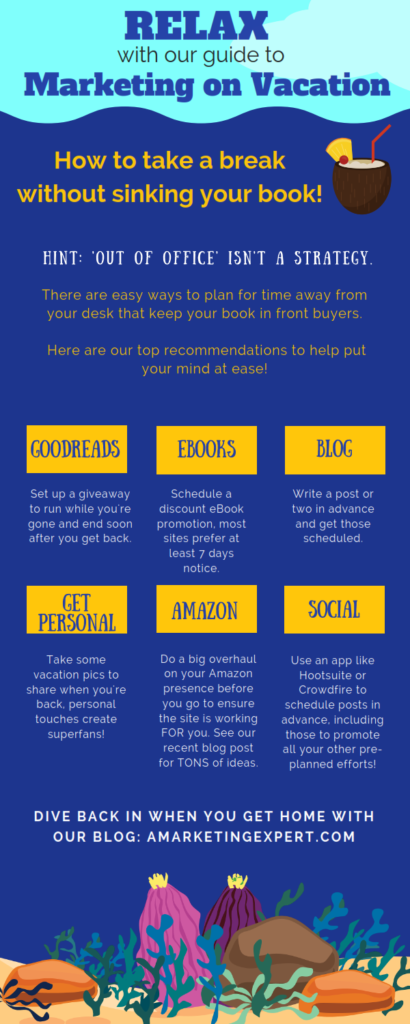
Summer Book Marketing Guide [Infographic]

by Penny Sansevieri

So you want to take a vacation. Great! But you don’t want to stop your book’s progress while you hit the beach, take in the sun and sand (or mimosas and waffles). What’s an indie author to do?


Want to take a #vacation and keep your #bookmarketing alive? Check out our infographic guide! via…
Click To Tweet


Relax! We’ve got you covered with our summer book marketing guide! There are lots of promotions you can set up in advance of your travels to make sure your book marketing continues without a hitch. Even while you’re off enjoying the sights and sounds of your vacation.

How to take a vacation AND market your book

We even developed this handy infographic that you can use as a guide to success. You’ll want to bookmark this page, anddownload the infographic, for easy reference. You don’t want to forget these great ideas you can revisit time and again. But especially not when you plan to step away from your desk.

Summer Vacation Marketing | AMarketingExpert.com

For a larger, printable version of our Summer Vacation Marketing Guide, simply click the image!


Your guide to #bookmarketing on #vacation! You’ll want to keep this handy. via @bookgal
Click To Tweet


If the Amazon overhaul seems a bit overwhelming keep in mind that we have a fantastic, affordable, Amazon Optimization program to start you on the right track. We can help you find more buyers, sell more books, and improve your ranking. Find out more at www.sellmorebooksonamazon.com.

And remember, whether it’s a Goodreads giveawayFacebook posts or other Social Media content, we have lots of great ideas and advice on our blog.

Add your go-to summer marketing strategies in the comments, I’d love to hear what works for you!

26 Jun 15:50

Smart investors care about how you price your offering

by Karen Chiang

Pricing power has a huge impact on how investors see your company. One rule of thumb used in due dilligence is to ask, 'Can this company raise its prices?' If the answer is no, or if there is a lot of downward pressure on prices, then company valuation goes down. Smart companies understand their pricing power and are taking steps to increase it.

Valuation is the process of determining the equity value of your company. Potential investors, and lenders for that matter, will always evaluate your company’s earning potential. They will ask how you intend to achieve those earnings, and for evidence to show that you are on track to actually achieve them.

Pricing is where all of your critical marketing decisions come together. Investors will assess your pricing strategy and pricing performance as part of their due diligence. Let’s look at the key marketing decisions your investors will scrutinize.

icon_market segmenttation .png

Market Segmentation

This is the first step in demonstrating that you understand your company’s market opportunity. Use value-based market segmentation and not just basic firmographics. A value-based segmentation ensures that you understand the value you are creating for your customers and that you can target the customers that get exceptional value. As mentioned in my previous blog, why good pricing strategy starts with market segmentation, value is always tied to a specific customer segment. You need to understand the pattern of needs, attitudes, and behaviors to identify customers who will recognize the differentiation of your offering and the value it will deliver to them. Market segmentations underpins your calculation of market size.

Customer Targeting


You cannot target all of the segments you have identified. Targeting means that you have identified the most attractive segments. Proper targeting will impact your speed-to-growth and is a key component of your go-to-market strategy. Targeting is about prioritizing your marketing investment, both financial and in terms of effort. Targeting is your commitment on what you think the ‘best path’ to growing market share, revenue, or profit. You also need to understand the sequence in which you are going to go after your target segments. and explain “the why” behind your most attractive segments—explain how your targets influence each other. You also need to consider the buying process of your prospects and customers.   

icon_unique value.png

Unique and differentiated value proposition


Your value proposition determines your ability to realize your potential earnings. Knowing your unique and differentiated value proposition depends on how well you have segmented your market and targeted customers using value drivers. It answers the question of how you are going to capture your market. Pricing is an expression of your value proposition. Your value proposition, and therefore your price, is always relative to the next best competitive alternative. Investors want to know that you have done your competitive analysis. Claiming there is no alternative will not fly. You need to be able to substantiate and quantify your unique value proposition—and be able to articulate your unique differentiated value to convince both your customer and your investor that your offering is the one to choose.

Market Sizing

This is a measure of your market opportunity and provides an indication of potential earnings. You will need to demonstrate to investors that your total addressable market (TAM) and your service addressable market (SAM) is large enough to justify your valuation. Your segment sizes (number of prospects) and the value (revenue) you are able to capture from them is used to calculate this number.

Customer Traction

Customer traction is defined as “quantitative evidence of market demand" by Naval Ravikant. It is the evidence that someone wants your offering. Customer traction demonstrates to your investor that your company is growing in value; it communicates momentum in market adoption.

Price Optimization

Pricing is the lever to win higher profits, revenue or market share. Optimizing price communicates value because you are connecting to your buyers emotional and economic needs. Developing the correct pricing metrics helps you to monitor price acceptance, guide behavior across pricing tiers, and be better prepared for competitive positioning.

Create Value


Price to create and capture value for customers and your investors (financial stakeholders). Pricing is where marketing strategy gets real. Your customer probably does not know what segment they are in, but you and your customer have to agree on a price if you are to win a sale. Pricing provides direct insight into segmentation, targeting, value proposition and communication. Good pricing practices are part of how to sell. Contact us at Ibbaka to learn how we help our customers understand and reach their valuation metrics to secure financing.

26 Jun 15:50

5 Keys to Creating Killer Case Studies – Even If You’re Totally Swamped

by Rachel Foster

Title image with desk and stack of papers, clock on the wall and a checklist

Case studies are one of the most powerful items in your B2B marketing toolbox.

According to a Content Marketing Institute study, B2B marketers called customer testimonials and case studies their most effective content.

Meanwhile, Dimensional Research found that 90% of buyers who read positive customer success content claimed that it influenced their purchasing decision.

But if you’re part of a small marketing team, you might not have the time to develop all of the case studies you need to turn prospects into customers.

According to the latest B2B Content Marketing Benchmarks, Budgets, and Trends report, the biggest barrier to content marketing success is not devoting enough time to it.

Here are five keys to publishing a steady stream of customer success content – even if you don’t have the time:

1. Work with the right customers

Finding a customer who will agree to a case study – and then getting their story approved – can take a long time.

If you’re in a hurry to fill your content calendar, you must reach out to the right customers. Look for someone who is already raving about you on social media, in online reviews, or via email. Chances are, this customer will be more than happy to help you.

Image of customer and thumbs up

2. Use video testimonials

Ask your customers to share their stories on camera. A short interview will require minimal editing and allow you to quickly publish new content.

3. Send your customer interviews out for transcription

Most marketers record their customer interviews. Recordings are helpful, as they give you something to refer to when you write a case study and need to insert compelling quotes.

But it takes a long time to listen to a recording and find an ideal sound bite – especially if you spent an hour on the phone with your customer. When you transcribe your interviews, you can quickly search them for key phrases. Then, you can copy and paste your customer’s exact words into your case study. You may still need to do some editing, but working from a transcription will save you a lot of time.

4. Develop a case study formula

Creating great content is 50 percent about your writing abilities and 50 percent about your process.

When you have a proven, repeatable process, you can quickly produce case studies. You’ll also deal with fewer revisions and get approvals faster.

I recommend that you create a list of questions that you will ask all of your customers during case study interviews. That way, you won’t need to spend a lot of time preparing for an interview.

cumputer with various workflow icons surrounding it

Also develop a template for your case studies. What information would you like to include? Strong case studies usually contain the following sections:

The customer: Include a sentence or two about the company. I often pull this information from the boilerplate at the end of a customer’s press release.

  • The challenge: What challenges did your customer try to solve before they started to use your products or services? How were these challenges negatively impacting their business?
  • The discovery: How did your customer find out about you? Why did they choose you over your competitors?
  • The implementation: How did they implement your product or service? Did you help them overcome any challenges during this phase of the project? If so, how?
  • The results: What ROI did your customer achieve? Insert as many numbers related to their success as possible.

Be sure to include these sections, or some variation on them, in your case study template.

5. Get someone else to write your case studies for you

If you are swamped, you might benefit from hiring a freelance copywriter to write your case studies. They can handle everything from interviewing your customer to the final edits. The only thing you’ll need to do is get approvals.

Try some of these techniques when you need to create customer success content but are short on time.

After you complete a case study, be sure to share it across a number of channels. Don’t just bury it on your website and hope leads will find it. When you take your message beyond your website, you increase your chances of connecting with customers as they are getting ready to buy and want proof that your products deliver results.

26 Jun 15:50

Channel Ready Checklist: Everything You Need to Set Your Channel Up for Success

by Jessica Baker

Congratulations, it’s a Channel Strategy! If you’ve just given birth to your company’s first channel strategy, the fun is just beginning. As my grandmother used to say, “The devil is in the details,” and such is true for your new channel strategy. With so many things to think about, it’s helpful to have a channel ready checklist to be sure you haven’t forgotten anything.

Doing business with the channel requires a cross-functional team to have the resources required for execution. You will have the task of orchestrating activities in sales, services, enablement, operations and marketing to deliver the requirements for product readiness in the channel. Developing and successfully implementing a channel model right the first time is not a sales-only initiative, it’s a company-wide effort!

As you begin your partner relationships, it’s very important that everyone is on the same page with how you will support this relationship. Being “ready” for the channel helps to establish a trusted relationship that can scale and grow with success.

For example, training and enablement is a must have in your initial launch. It is critical for partners to intelligently talk about and demonstrate your product or service in order to sell it for you. If elementary training is not available at launch, it can slow your efforts with partners, resulting in resource-intensive sales cycles for you and a longer time to revenue with partners.

Here’s a checklist to help you gage your readiness. As you read each item, you should be able to reply “yes” or “very close to yes” with each of these:

  • You have determined there is enough market demand to support partners.
  • You can point to credible third-party validation that the market is ready.
  • You have developed compelling business propositions for both the customer and your partners.
  • You are ready to support your partners with technical, sales and program management skills.
  • You have a ramping methodology to provide knowledge and skills training to your partners for your product technically, but also for sales, marketing and vertical expertise.
  • You can clearly and easily demonstrate an ROI to partners who participate in your strategy.
  • The timing is right and you have the right product and the right go-to-market channel type for you product/solution.
  • All the elements that your product needs to be successful are ready now, even if that means you don’t supply them yourself.
  • You have clear product marketing messages that resonate with buyers.
  • You have an ideal client profile to help partners target their efforts.
  • You have something in the way of sales and support tools to offer to your partners.
  • Your product has documentation you can share with partners (technical, logistical and financial)
  • You have channel-pricing strategies that allow for a competitive price and competitive margin for your partners.
  • You have a channel program defined for partners.
  • Your product and service are available now.
  • If you are expanding internationally, are your product and support materials localized?

Now, before you wonder how you will ever get all that done, I do not mean to suggest you need to build all of this in a perfect final format before you launch, but you should be able to check each item off in agreement. Partners don’t need polished and slick materials, but they do need basic information, support and structure. As you mature in your channel strategy, these items will naturally evolve and mature, so don’t let that stop you now. A shaky video, a self-recorded training session, an excel spreadsheet of benefit and requirements is better than nothing. Be upfront and honest with your partners about what you have and what you will have for them in the future. Investing in your partner readiness and building trust with your partners now will pay off down the road.

Provided that you are headed in the right direction, and you are committing to “yes” with all of the above, you should enjoy a prosperous relationship with your channel, and will mature together to sustainable channel revenue.

The post Channel Ready Checklist: Everything You Need to Set Your Channel Up for Success appeared first on OpenView Labs.

26 Jun 15:50

How to Close: The Complete List of Sales Closing Techniques

by afrost@hubspot.com (Aja Frost)

close-sale-compressor-868696-edited.jpg

You usually only get one chance to close. If you’re successful, the hard work you’ve done over the past days, weeks, or months will literally pay off.

But if you’re unsuccessful, you’ll have nothing to show for those hours.

No wonder closing is one of the most stressful parts of selling.

Since prospects, opportunities, and personal style differ so much, there isn’t a single optimal closing style. To help you find the best one for a specific deal, use this guide of TK techniques.

How to Close With Modern Closing Techniques

Adjournment Close

How it works: When you can tell your prospect isn’t ready to make a decision, give them more time to think rather than pushing for the close.

Why it works: Most buyers expect you to take the stereotypical, overly aggressive approach. Understanding it's not in their best interest to decide immediately will earn you their trust; plus, research shows the deal is usually bigger since you don’t need to resort to discounting.

What it sounds like: “I know this is probably an important decision for [company], and I don’t want to rush you. Should we schedule a call for tomorrow?”

Artisan Close

How it works: Highlight how much work, skill, thought, and/or time has been invested into the product you’re selling.

Why it works: The more difficult or labor-intensive something is to make, the more someone will value it. Intuitively, this makes sense -- but reps often forget their prospects typically don’t have the same context or product knowledge as they do.

What it sounds like: “We have 10 people whose sole job is upgrading the dashboard so it’s as easy to read as possible. That’s more than any other company in this space.”

Ask-the-Manager Close

How it works: Rather than requesting a discount for your prospect and telling them it’s been approved, let them know you’ve asked. Then, once your manager says yes, tell your prospect the good news.

Why it works: Showing your prospect you’re willing to compromise on price and work on their behalf boosts your credibility. In addition, they’re likelier to make their concessions of their own.

What it sounds like: “I can’t authorize a discount of that size, but my manager can. Let me ask her if we can do that for you.”

Three hours later: “Happy to say my manager gave us the green light. The new price would be …”

Balance Sheet Close

How it works: Tally up the benefits and drawbacks of the purchase so the buyer gets a sense of your product’s value and why they should buy.

Why it works: Your prospect is already making a pros and cons list -- either mentally or on paper. By doing it for them, you get to control the process while building their trust. You can also make it explicitly clear the payoff outweighs the risks or disadvantages.

What it sounds like: “Let’s go over the pros and cons of using our employee management platform. On the one hand, you’ve already got a system up and running. Your employees might not be thrilled about switching. It’ll take a few weeks to export your data and train them how to use the new tool. But as we’ve calculated, you’ll save at least $1,000 per week. It’s also much easier to use than your existing platform, according to the customers who have switched, and comes with 24/7 support.”

Best Time Close

How it works: Emphasize the importance of buying right now. In other words, appeal to your prospect’s sense of urgency.

Why it works: It’s incredibly difficult to change, which is why salespeople lose to the status quo more than the competition. Encourage your prospect to act now, while they’re as motivated as they’ll ever be to buy. Time kills sales deals.

(Of course, that doesn’t mean manufacturing a reason. Act unethically, and you’ll lose future customers thanks to negative word-of-mouth. Look for a genuine reason the buyer needs your solution ASAP. If it’s a good fit, that shouldn’t be hard to do.

What it sounds like: “If you want this in place for your next customer event, we need to finalize the contract by the end of the week.”

Calendar Close

How it works: Instead of going for the ultimate close, which your prospect often isn’t ready for, request a future meeting. This keeps the momentum going.

Why it works: Getting a specific commitment from the buyer is key. It’s much likelier you’ll get back on the phone with them if you’ve agreed to a date and time before your current call has ended -- and if your prospect won’t schedule another, they’re probably not serious in the first place.

What it sounds like: “Next, I usually meet with the customer’s end users to learn about their day-to-day processes. Are two or three people on your finance team free next Wednesday?”

Conditional Close

How it works: Set up a quid pro quo agreement. If you agree to your prospect’s condition, they’ll concede one of your points.

Why it works: This strategy leverages your prospect’s sense of fairness and shows you’re willing to compromise to arrive at a mutually satisfying agreement.

What it sounds like: “Our agreements are typically multi-year. However, if you pay for six months upfront, I can give you a one-year contract.”

Cost of Ownership Close

How it works: Calculate the total cost of owning your product, including implementation, services, maintenance, upgrade fees, and so on. Then contrast that to a competitor’s products. If applicable, demonstrate how a small difference in cost adds up over time.

Why it works: It’s easy to focus on the sticker price and forget about the bigger picture. Using this technique ensures the buyer sees the latter.

What it sounds like: “Competitor X is $200 cheaper, but their monthly support costs $50 more. You’ll ‘break even’ in four months. Eight months after that, you’ll have saved $400 over the competition.”

Customer Care Close

How it works: After you’ve lost a deal, wait an appropriate amount of time before reaching out to the prospect to ask about their buying experience.

Why it works: Showing interest in your prospect’s opinion makes them feel important and respected. It also suggests your company cares about its customers, which may convince them to change their mind. Additionally, you’ll get valuable intel into their reasoning that may come in handy for the account, not to mention your other deals. Even if this prospect doesn’t reverse their decision, you’ll have set the stage for a future purchase.

What it sounds like: “Hi Saria, I was wondering if you’d be willing to answer a few questions about working with me in February. I’m always trying to improve, and this would be really helpful. Did I give you enough information? Was the speed of the process okay? Were there any objections or concerns I didn’t appropriately resolve? How could I have done a better job?”

Weekly Cost Close

How it works: Calculate how much your product will cost per week (or day, or month).

Why it works: The solution will seem more affordable once it’s been divided into smaller pieces. You can even compare the reduced price to a common everyday purchase, like a cup of coffee or a movie ticket.

What it sounds like: “This costs just a dollar per day, which is like buying one employee a bagel.”

Needs Close

How it works: List everything the buyer has said they’d need in the product. Then review your product against that list.

Why it works: Checking off each box in short succession proves your product is a good fit. You might not be able to meet every single one of their desires, but the buyer will likely conclude it’s still a good purchase.

What it sounds like: “Let me make sure I’ve gotten everything you’re looking for. You need a tool that’ll let you schedule texts to your customers, tie revenue to individual text messaging campaigns, and easily review performance through metrics like response rate and CTR. Did I miss anything? Great. Well, let’s see. Happn offers scheduled SMS messages to 1,000 contacts, comes with advanced analytics so …”

Negative Consequences Close

How it works: Describe the undesirable ramifications of doing nothing using the information your prospect gave you during the discovery process.

Why it works: Fear, Urgency, and Doubt (FUD) tactics can drive the buyer to pull the trigger. It’s an effective way to help them overcome their hesitations, but make sure you’re using it ethically. Only describe real consequences.

What it sounds like: “You currently service 462 locations in 80-plus counties. If a single supply route is disrupted -- which according to the stats you gave me, happens roughly every two years -- you’ll lose access to at least one-third of those. That could cost you $1 million in revenue if you’re being conservative.”

No Hassle Close

How it works: Complete as much of the buying process as possible for your prospect. For example, sign out the paperwork, forward materials to Legal in advance, meet with Procurement to settle on a mutually satisfactory price, and so on.

Why it works: Getting rid of all the administrative details not only makes it incredibly easy for your prospect to say ‘yes,’ it also encourages them to buy in return for your help.

What it sounds like: “I just emailed you a TechReview comparison of our product versus Nectea that you can show to your boss. It’ll help her understand why Nectea isn’t the best choice if you want to use the same app at twice your current size. I’ve also sent you a product walkthrough video that she may be interested in watching.”

Quality Close

How it works: Instead of selling on price, highlight the value of your product. Emphasize how long it lasts, how easy it is to use, how infrequently it requires maintenance, how innovative it is, how well-designed they’ll find it, and so on.

Why it works: Most prospects are drawn in by price, but helping them understand value is more important in the long run will win you the deal -- without resorting to discounting.

What it sounds like: “Our product has 3% higher uptime than any of our competitors, which is hugely significant when you translate that to real hours.”

Reversal Close

How it works: Tell your prospect you’re not sure they’re a right fit. They’re smaller, less mature, and/or less established than your typical customer.

Why it works: People want what they can’t have, so suggesting your product is out of reach will naturally spark your prospect’s desire to buy it. This reverses the power dynamic -- rather than you selling them, they’re selling you. In addition, you’ll seem more credible and trustworthy because you’re not willing to take just anyone’s money.

It might go without saying, but don’t abuse this technique. It should be reserved for buyers who don’t meet your typical personas.

What it sounds like: “Full disclosure, John. Our customers usually employ 600-plus people and have dedicated training teams. Since your company is half that size, you might not be able to take full advantage of the product.”

Scale Close

How it works: Ask your prospect how interested they are in making a purchase on a scale from one to 10. After they choose a number, say you’re surprised -- you thought their number would be lower. Have them describe why they’d buy. Repeat their answers back to them. Then say you’re confused. If they’re so enamored with the product, why didn’t they say ‘10’?

Why it works: This strategy identifies your prospect’s top buying priorities and objections. It’s the perfect jumping-off point for a frank discussion of why the product fits their needs.

What it sounds like: “From one to 10, where 1 is ‘definitely not buying’ and 10 is ‘I want to buy immediately,’ what number are you?”

“I’m surprised you said [number], I would’ve guessed you were a [lower number]. Why did you pick [number]?”

“So, it seems like you chose [number] because of X, Y, and Z. But then if you have these great reasons to move forward, I’m wondering why you’re not actually a 10.”

Similarity Close

How it works: Describe a buyer who faced similar challenges who has seen a lot of success with your product.

Why it works: If the prospect is worried about the issues they’re experiencing, hearing about someone who overcame the same issues will quell some of their anxiety. It’ll also reinforce the connections you’ve drawn between their needs and the product’s features.

What it sounds like: “I worked with another company in the shipping industry last year. Like you, they had roughly 50 employees and struggled to hire more shore-based operation workers. After they started using the branding strategy we developed more them, their application rate nearly doubled.”

Testimonial Close

How it works: Rather than trying to convince your prospect of your solution’s benefits, sell through a happy customer. You can either use a written testimonial or an actual customer reference.

Why it works: An independent person or business is far more convincing than you’ll be, since they’re less biased. This process also builds up your trust and credibility.

What it sounds like: “I know you’re interested in our receipt feature, so I wanted to show you an email from one of our customers talking about how smooth their process became once they started using our tool.”

1-2-3 Close

How it works: Summarize the product’s features, benefits, or use cases in sets of three.

Why it works: According to changingminds.org, this close harnesses the “principle of triples”
-- “three things given together act as a coherent set of three hammer-blows that give a compelling message.”

What it sounds like: “Our tools will help you prospect, qualify, and close.”

Modern buyers can spot high-pressure closing tactics from a mile away. To sell in 2017, you need a strategy that’ll help them make a decision -- not manipulate them. These tactics will help you do just that.

HubSpot Free Sales Training

26 Jun 15:49

The 6 Marketing Channels You Should Be Personalizing

by Katie Sweet

cross-channel personalization

It isn’t enough to master your marketing communications through one channel if your current or prospective customers engage with you in many different channels. And for most companies, it is pretty safe to assume that they are. The typical digital consumer now owns 3.64 connected devices. Forrester predicts that by 2021, 40% of in-store sales will be influenced by the internet. And even in financial services, 47% of bank customers engaged in at least one cross-channel interaction in the past 90 days.

At Evergage, when we talk about cross-channel marketing, we don’t mean mass communication across channels. We mean personalized communication. Why? Consumers expect personalized experiences. Forrester found that 77% of consumers have chosen, recommended, or paid more for a brand that provides a personalized service or experience. And Infosys uncovered that 74% of customers feel frustrated when website content is not personalized.

And when we talk about cross-channel personalization, we mean the ability to provide a consistent and relevant experience across website, web app, mobile app, search, email and human channels. In this blog post, let’s briefly explore each of these areas.

1. Website

Many digital marketers view their website as their most important channel. Whether your goal is to drive online sales, generate leads or maximize page views, there is typically some action you want a visitor to take while on your site. As a result, many of your online marketing activities are focused on driving traffic there. Given its importance, it’s critical to show each person exactly what they are looking for on your site to drive those conversions or page views. Personalization – whether using rule-based targeting to segments or machine-learning algorithms at the one-to-one level – allows you to do that.

Squaw Valley Alpine Meadows personalizes its main homepage experience to several of its main customer segments, such as visitors from target cities, families and season pass holders. By showing each group of visitors something relevant to them, these experiences have improved conversions and revenue per user.

web attribute segment

This example just scratches the surface of website personalization. For some other easy to deploy ideas, check out this blog post.

2. Web App

For subscription-based businesses like SaaS, financial services, publishers and many retailers, the logged-in environment (also called web applications) is often the primary interface for engaging with customers. There is a huge opportunity to personalize the logged-in environment to identify when users need help and direct them to most relevant resources, drive users to leverage features that can help them get the most value out of the product, identify churn risks and upsell opportunities, and more.

Endurance International Group (EIG) leverages in-app personalization to communicate and engage with its customers “in the moment” at different stages of their lifecycles. For instance, while providing web hosting services to customers, EIG saw an upsell opportunity to offer a premium website creation tool to specific audiences. Leveraging in-app personalization to target users with an upsell CTA at the right time, the company saw conversion rates 4-5 times better than their traditional promotional email campaigns.

3. Mobile App

Mobile apps have become a vital means of engaging and interacting with increasingly mobile audiences. In fact, more than a third of consumers say they expect their mobile apps and websites to be more personalized over the next three years. Yet our recent study with Researchscape International found that mobile apps are the least personalized channel — only 18% of marketers using personalization are using it for their mobile apps.

Personalization on mobile devices is much like website and web app personalization — helping users find the most relevant content. You can similarly target different segments and individuals with rules and machine-learning algorithms.

For example, a travel app can share a specific deal only with users who have booked a flight within the past month. Or an e-commerce app can deliver personalized recommendations that boost brand and price affinities to help shoppers find products they will be interested in, quickly and easily. An effective personalization solution can even allow you to build, test and implement various messaging campaigns in your app, without involving developers or waiting for an app store release. Learn more about how that works in this blog post.

4. Email

Email undoubtedly remains a critical communication channel – one used by nearly all businesses today. Many marketers already leverage personalization in their emails to some degree. In fact, we found in a recent study with Researchscape International that email is the most personalized channel. Typically, marketers leverage their email solution’s broad segmentation capabilities to personalize email campaigns. Yet, half of the respondents to a Retail Touchpoints survey say that they have received emails from retailers with irrelevant information.

In order to ensure the content of your emails is relevant to an individual, you need to consider all you know about that person across channels, particularly in terms of individual behavior, history and preferences. But what is relevant to a person at one moment may be out of date to that same person later. The key is to be relevant at open time, rather than at send time.

For example, let’s say that an e-retailer sends an email containing three product recommendations to a regular customer. Between when the email is sent and when he opens the email, he purchased Product 1 via the mobile app, Product 2 went out of stock, and Product 3 dropped in price. If the retailer personalizes the email at open time, when he opens the email, Products 1 and 2 would be substituted with different (but still relevant) product recommendations, and Product 3’s price would be reflected accurately.

5. Search

The search function on any website is incredibly important, as it is a key channel for helping customers find and discover products and content. The visitors that use the search function state exactly what they are looking for, and in many cases are more ready to convert than other visitors that don’t use search. Yet search is a traditionally underused channel, and search results are notoriously ineffective across industries.

To make the most use of your on-site search, you should show visitors the most relevant products or content with as little effort (and as few clicks) as possible. That means that the search results you show should be selected and sorted in a way that is unique for each person, based on the visitor’s intent and affinities.

For example, Zumiez leverages in-depth behavioral data to assess the interests and preferences of each visitor to its site, so that it can help them find the most relevant products in the search bar. In the image below, note that the recommended shoes are in the shopper’s preferred gender (women’s) and brand (Vans) based on her previous behavior on the site.

deep behavior segment

Essentially, search results that consider each person’s preferences and intent will provide products and content that are maximally relevant to the individual, not to the search term.

6. Human

The human channel is in some ways the most obvious form of personalization, because it’s very easy to provide a personalized experience to a customer when in a one-on-one conversation with him. But at the same time it can be the least obvious form of personalization, as many marketers do not realize that they can use the same principles and the same valuable information that they collect in all of the previously mentioned channels to pass on to call center, customer success and sales personnel to enable more relevant customer engagement.

For example, a B2B salesperson prospecting into an account can provide a personalized experience too. When preparing for a sales call, she can look into the activity of all visitors associated with the account – including an account’s activity history, preferred solutions, categories and content — to steer the conversation in a relevant direction even before asking any discovery questions.

Final Thoughts

In today’s multichannel world, cross-channel personalization is increasingly worth the effort to get right. Of course, achieving successful cross-channel personalization requires the right data and the right technology. For more information about the components you need for cross-channel personalization, check out this blog post.

Hopefully this article has illuminated some channels you may not yet have considered within your personalization strategy. To talk to someone about how Evergage can help you establish and execute your own cross-channel personalization strategy, request a 15-minute consultation today.

26 Jun 15:49

How B2B Manufacturing and Technically-Oriented Firms Can Leverage FAQ’s in Their Content Marketing Programs

by Dan Konstantinovsky

Leading B2B marketers recognize that having a consistent and meaningful content marketing program is critical to driving inbound demand generation and communicating thought leadership.

But if it’s so important, why are so many B2B firms and manufacturers struggling to do it successfully? In fact, only 34% of B2B firms claim to have an effective content marketing program.

One key reason our marketing agency comes across is that identifying new and effective topics becomes more challenging as the content program progresses. All too often, B2B firms run out of material after only a few months – 49% of B2B marketers attributed their content development stagnancy to content creation challenges – and once the content marketing program loses momentum, getting it back and allocating necessary resources is even more challenging than before.

B2B Content Marketing Tips for Manufacturing and Engineering Firms

One way to help ensure your content development program stays on course and keeps momentum is by developing a robust FAQ page. That’s right! A page that’s often overlooked in website planning can be the difference between a successful content marketing program and one that loses momentum and fails.

Many B2B firms already have an FAQ page but typically it includes items like who to contact for emergency service, sales territories, credit terms, shipping restrictions, industry certifications, or minimum order requirements. But an effective FAQ section shouldn’t just be quick answers to logistics-related post-purchase questions; it can be a section devoted to value-added information including:

  • General offering overview – e.g., ‘What is rollforming?’or ‘What is an Asset Management System?’
  • Product details and dimensions – are there certain product questions that keep coming up?
  • Industry applications – what questions do customers ask about your offerings in their specific industries?
  • Best practices – do customers ask how to apply your offerings for their application?
  • Installation and service – What typical questions are asked during and after installation?
  • Competitor comparison – How does your offering compare to a competitor or to doing nothing?
  • Company history and future direction – communicating your company overview including culture and community involvement can be a differentiator in your custo
  • mers’ eyes
  • Engineering expertise – How is your engineering team uniquely better at solving specific problems
  • Production expertise – what materials or configurations do you use to solve known applications issues?
  • Quality system – do customers ask about your quality program?
  • In-house capabilities / Outsourcing – exactly who will do what is an issue many customers want to understand
  • Level of distributor/partner support
  • Typical ROI/payback
  • And many more

I’m guessing you’re thinking the following: Sounds like it can be a good idea but who’s going to capture all this information and convert it into meaningful content on an ongoing basis? The answer to this is different based on organizational needs – but for many B2B firms, establishing a content development team that includes different functions and meets at a regular interval can be one approach. If you ask each member of the team to write down every single customer-facing question they hear on a daily basis, by the end of the month you’ll have more content ideas than you’ll know what to do with. And if you don’t generate a wealth of ideas, consider researching associations in your space to see what kinds of FAQ information they already offer to get a sense of what your customers may benefit from.

Once you’ve identified interesting FAQ-related content ideas, there are several ways to leverage this new content:

  • Utilize it across your entire marketing program including social media, newsletters, targeted videos, outbound lead-generation emails and blog posts. And don’t forget to repurpose each FAQ into different formats as well – such as video or infographics.
  • Drive organic rankings. Another advantage of having a great FAQ page is because the content is extremely focused on one specific topic, it will almost self-optimize for that keyword phrase and help improve organic rankings.
  • Create a lead-magnet that supports relevant FAQs. Is there a tool, template or document you can create to help someone overcome or be better informed regarding an FAQ? If so, this would be an excellent opportunity to drive leads.

Successful content development is challenging for most B2B manufacturing and engineering firms – especially those that sell highly technical products or services and have limited marketing resources. Better leveraging your internal resources for content development ideas and converting them into a robust FAQ section is an excellent way to overcome your limitations.

26 Jun 15:49

5 Reasons Why Your Business is Losing Leads

by Parker Davis

geralt / Pixabay

Leads are the lifeblood of just about every business.

They’re the fuel that keeps the engine going. With a steady influx of targeted leads, you’ll make more sales, learn more about your customers, and generate more revenue.

But businesses face two main challenges when it comes to leads:

  1. Getting the leads in the first place
  2. Converting the leads into customers

Today, we’ll give you strategies to help you overcome each of these challenges. That way, you can get more leads and convert them into customers (instead of losing them along the way).

Here are 5 reasons why your business is losing leads…

  1. Poor Lead Magnet

Your lead magnet is more or less the “bribe” the gives your website visitors a reason give you their email.

It should be relatively simple, prominent throughout your website, and built around your prospects biggest needs.

So for example, if your business is focused around real estate, your lead magnet could be something like: “Home buying cheat sheet: 5 quick tips to find the perfect home.”

If you’re having trouble thinking of a good lead magnet, you can check out this post on 5 great lead magnet ideas.

Once you have your lead magnet build and ready to go, you should feature it on your homepage, within your posts as well as at the end, and on the sidebar. You can also consider adding it as an “exit pop up” to incentivize visitors to subscribe before they leave your site.

  1. No Email Autoresponder (or a Weak One)

Once visitors sign up for your email list, what happens?

You should be contacting them right away with an email autoresponder. An email autoresponder is the sequence of emails that a subscriber gets when they sign up for your list.

It typically consists of 5-7 emails spread out over 1 or 2 weeks.

Within these emails, you should add value by giving them helpful content around their challenges, and then finish off the sequence by giving them the chance to purchase your product or service.

This gives you the best chance to quickly turn your leads into customers.

  1. You’re Not There When They Need You

When your prospects give you a call, are you always there to answer the phone and help them with their questions?

Or do they often get no answer, or simply get sent to voicemail?

If so, you’re losing a lot of potential leads.

And how about when your prospects message you on Facebook? Are you there to answer as well, or do they get no response for hours at a time?

You can solve each of these issues quite easily. The first can be solved by hiring a virtual receptionist service that is there to answer the phone 24/7. The second is to use an automated Facebook bot to immediately respond to messages through your Facebook page.

  1. Poor Page Load Speed

Your website speed goes a long way in determining whether visitors (AKA potential leads) stick around your website or quickly leave it.

If your website is taking nearly a full second to load its pages, that’s too slow, and it’s going to cause you to lose leads.

But you can take some measures to speed up your website. One big way is to switch to a faster hosting service.

Weak Content Strategy

Is your content structured around what your prospects need? What’s more, do you have content that caters to prospects in different parts of your funnel?

For example, there’s top of funnel content – content that caters to people looking for resources, opinions, and insight. There’s middle of the funnel content, where people are evaluating whether or not to buy your product. Then there’s bottom of the funnel content where people are looking to find out how to buy your product.

Your blog have a mix of these types of content.

Wrapping Up Reasons Why Your Business is Losing Leads…

To keep your business functioning at a high level, you need to not just get enough leads, but be able to convert those leads into paying customers.

The strategies we’ve given you here will help you to do both of those things.

What other reasons do you think businesses lose leads? Let us know on social media!

26 Jun 15:49

How Listening Can Impact Discovery Call Success

by Stephanie Rodriguez

“We have two ears and one tongue so that we would listen more and talk less.” — Diogenes

That quote is over 2000 years old, and yet listening more than you talk is still a struggle for today’s modern sales rep. This struggle was clearly illustrated in a post we wrote earlier this year highlighting new data from our partners at Gong.io, focused on the impact of this conventional wisdom of speaking less and listening more. As a follow up to this initial research, Gong.io conducted a new study of over 500,000 discovery calls to see how talk/listen ratios impact the success of a sales discovery call. We highlighted all the takeaways in a full report earlier this month.

Again, the data showed top performers all tend to listen more than they talk, with the ideal ratio of talking to listening hovering around 46:54.

Average performers spoke a lot more: 68% of the time. And the lowest performers? They spent over 72% of their discovery calls talking!

Looking at this data, it’s easy to see there is a clear correlation between listening more and success on discovery calls, but why? Here are three ways listening more helps you close the deal.

Listen More to Know More

Put yourself in your prospect’s shoes during a discovery call for a minute. They didn’t set a call with you to hear a sales pitch. They have specific questions and paint points they need addressed before becoming a customer. While your impulse may be to lead with your sales pitch first, it’s more important to spend the discovery call learning. When you frame the discovery call in this light, it becomes pretty clear that you gain more knowledge by letting the prospect take the conversational reins.

“Most people do not listen with the intent to understand; they listen with the intent to reply.” — Stephen R Covey

If you ask the right questions and listen to the reply, you can easily learn from the prospect what talking issues and areas are the most important for them. Your prospect will tell you exactly what they care about, what they want from your product, and how you can gain their business. All you have to do is listen to understand.

Customer’s Side of the Story

Think about the last time you went to buy a new phone. You go to your service provider, tell them exactly what you want, and they go on and on about other phones with better specs, pixels, and other bits you frankly didn’t care about.

These experiences are annoying. Maybe you had questions about the actual phone you are buying. But since the rep didn’t bother to listen to you, you will most likely turn to another source next time you have a question. If the rep selling you the phone had just listened to what you wanted, the sale would have been made smoothly and you would happily return with any other phone needs.

Your prospects have this exact same mindset during the discovery call. They are looking to spend money on your product, but have questions that need to be answered first. By taking the time to hear them out, you can build trust and the foundation for a solid customer relationship that will keep them coming back for more business.

A Relationship Based on Trust

Some people may underestimate just how important trust is in a business relationship. But if a prospect trust you as a sales rep they are likely to invest more in your company and product. Through actively listening to a prospects needs, you can turn the conversation into an extreme value for their company by addressing the concerns they have, and providing a solution to problems they may experience.

So taking the time to hear out a potential customer you can build trust and the foundation for a solid customer relationship that will keep them coming back for more business. By listening for over half the call and keeping their focus on the customer, top performers build trust with their prospects. These same reps are achieving more successes in their discovery calls. The prospect leaves the call feeling heard and knowledgeable and much more prepared to continue in the sales process.

Obviously for the average rep, who is still talking for the majority of their call, this change won’t happen over night. But you can slowly make adjustments, take pauses to hear more of what the prospect says, and keep making the effort to listen more than you speak.


Download your copy of the free report today and start turning every discovery call into a highly qualified opportunity.

The post How Listening Can Impact Discovery Call Success appeared first on SalesLoft.

26 Jun 15:49

3 Superpowers AI Gives Sales Leaders

by Gail Axelrod

Artificial Intelligence (AI), or the ability of computers to analyze information, accomplish tasks and make decisions like a person would, is changing our world. Take, for example, the phenomena of self-driving cars. Google’s self-driving prototypes have long been seen parading the streets of Silicon Valley, and if Elon Musk has his way, your Tesla will soon be able to drive around and make you money while you’re at work.

Surgeons are also using AI for more precise incisions and to have more accurate patient data. In fact, a report released by the White House in 2016 cited a study that found that when pathologists worked with AI to diagnose cancer, they could reduce their error rate by 85%

It’s no surprise that AI is transforming sales, too. Thanks to the data analysis and insights provided by intelligent sales platforms, reps and managers alike can have “sales superpowers” that enable them to make smarter, more strategic decisions. Here are three superpowers AI gives sales leaders that are mighty enough to make Superman green with envy.

1. X-ray Vision

As a sales manager, you’re outnumbered, and it’s easy to feel as though there aren’t enough hours in the day to give your reps what they need. If you could be at every meeting and on every call, you would, but you can’t – which is where AI comes in. Rather than joining every one-hour intro call, managers can leverage technologies like natural language processing and machine learning to “see through” these communications in just a few minutes.

For example, are reps talking more than they’re listening? Are they covering all the most important topics? Over time, these intelligent sales platforms can even identify red flags and win likelihoods based on diction and other verbal signals, or pinpoint the ideal time within a call to mention pricing. “X-ray” insights like these can be used to coach and improve overall team performance in a way that was nearly (if not completely) impossible less than a decade ago.

2. Telepathy

When marketing hands your team a list of a thousand leads, or you’re staring a full day of sourcing in the face, how much time do you think you waste weeding out unqualified or uninterested prospects? Wouldn’t it be nice to be able to read companies’ minds and know whether or not they had a high likelihood of converting before spending time researching and reaching out? Believe it or not, you can – more or less.

By tracking and analyzing the qualities of won deals, AI can effectively score leads based on their similarities to these companies and their corresponding close likelihoods. Scientific sales platforms take this a step further by providing data-driven recommendations as to the types of prospects companies should seek out to generate the most value for their business. Using these prescriptive sales insights, teams can grow sales faster by strategically prioritizing their outreach and focusing their efforts on building the right relationships.

3. Clairvoyance

Sales forecasting. Do those two words make you nervous? If they do, you’re not alone – more than ⅔ of businesses classify their sales forecasts as “ineffective.” With everything from headcount planning to investor interest hingeing on your company’s ability to accurately predict future revenue, the ability to see into the future would certainly come in handy for sales leaders everywhere.

Luckily, AI can be your crystal ball. Predictive metrics like estimated close date and win likelihood aid in generating more reliable and accurate sales forecasts. What’s more, prescriptive sales insights enable teams to drive toward sales forecasts with precision by recommending the most lucrative lead/rep combinations, team activities and much more. Trending $25K short? Now you can know exactly what strings to pull to make up the difference.

Becoming a Sales Superhero with Sales AI

AI is transforming sales in many ways, from helping companies identify their ideal prospects to alerting them when a potential deal may be in danger. Who wouldn’t want to absorb all the superpowers that AI has to offer!?

To learn more about what artificial sales intelligence can do for your business and how you can get started reaping the benefits, download this free eBook: Beyond Predictive Analytics: Why the Future of AI in Sales Is Prescriptive.

The post 3 Superpowers AI Gives Sales Leaders appeared first on OpenView Labs.

26 Jun 15:49

Innovation is a gift worth getting: Competing for the future starts with challenging business as usual

by Brian Solis

Every day when you get to the office, there is a surmountable volume of work that greets you. The list is usually pretty long, with calls to return, to do items stacked up, emails overflowing, meetings, marketing and sales planning to fill the pipeline. It’s all in a day’s work. But what if one day you woke up and noticed that the volume of work was notably less? I’m sure you’d be relieved for a bit. But then each day, you start to notice that the trend only continues. Your relief shifts to concern and eventually panic. “What’s happening!?,” you start asking. The answers reveal that your markets shifted because your visitors and your tourism stakeholders started to think and then act differently. While you were busy keeping up with your existing tourism plan and your annual campaign, your market inevitably evolved away from you.

Sounds like a nightmare right? The good news is that it’s the kind of bad dream that you can wake up from and say, “phew!” The bad news is that this scenario is playing out right now, slowly at first, but then quickly. The reality is that change is accelerating and we have a choice in what we do about it. It’s what you do differently moving forward that defines your place in the future of the DMO industry. While the idea of what you market and sell is relatively the same, it’s the how and also why that separates where you are from where you need to be.

If you think about it, change is less of a threat and more of a gift to shape the future of your work and your industry.

Iteration vs. Innovation

We live in an era of digital Darwinism, a state of evolution where technology and society continues to evolve. The question is, where do we fall in that evolution?

I know, I know. Change is hard, but you’re trying. You’re learning new things, adopting the latest tech, experimenting with state-of-the-art digital marketing. Bravo. This is a great place to start. Learning is how we open new doors. But this only gets us so far. How so, you ask? When we learn something new, we tend to apply it to existing mindsets, how we see and value what we see. Said another way, we take what’s new and use it in ways that are familiar to us. This leads to what I call iteration, which is often confused with innovation. It just takes us incrementally further. But innovation takes, in addition to learning, the ability to also unlearn many things we accept as standard protocol to do new things that unlock new opportunities. The differences between iteration and innovation are important as both are needed to compete for the future right now. It just takes balance…

  1. Iteration is doing the same things better.
  2. Innovation is doing new things that create new value.
  3. Disruption happens when the new things make the old things obsolete.

Funnel Vision: Designing the Customer Journey 2.0

In my research as a digital analyst and anthropologist, I learned that one of the catalysts for true innovation and even disruption is exploring not only new technology and trends but also how people are changing in parallel. The answer has been hiding right in front of us this whole time. See, technology is only part of the story. The rest is about how people adopt and in turn use all of this stuff. It reveals how, what and why we need to change, how to be discoverable and relevant and to whom and how to design new products and services that matter to each of our customer groups.

With the rise of social media, pervasive internet and mobile devices, how your visitors and potential visitors discover, learn, share and make decisions has forever changed. In the process, every new technology and the new capabilities they introduce to customers is radically reshaping the customer journey. And, this evolution has impacted everything from marketing to sales to relationship-building.

I know one of the common reactions to this message is to think, “yeah, but that’s just for B2C companies.” Nope. The truth is that it’s every type of company and organization, B2B included and beyond. Because in the end, it’s all about human beings and how they use technology and experiences to make decisions.

How you reach people, how they learn about you, what they value and how they make decisions accordingly is all changing. You must adapt too.

Innovation starts with learning and unlearning. It also takes seeing new possibilities in all the things we missed, misjudged, or chose not to see. Innovation is all the work you do to conform to expectations and aspirations of people as they evolve instead of making them conform to your legacy perspectives, assumptions, processes and metrics of success.

To reach and engage people differently, to earn relevance and ultimately their business, we need to see the world through their eyes and walk in their steps. We need to understand how they discover, where they go, what they ask, what they value, and how they make decisions, et al. Undergoing an out of body digital-first and even mobile-first customer journey teaches us everything. It makes us see and feel things differently.

Yes, you still have your traditional customers who like to do things the way that they always have. However, no innovator ever said, “but that’s the way things have always been done.” You still have to serve them and deliver experiences that they cherish. Change and innovation take an intentional balance between doing what you do well and what you don’t yet know to do well. This takes experimenting with new technology of course, but also learning and unlearning to gain new perspective, empathy and purpose to bring to light new opportunities. Innovation and change start with you.

Originally published at DestinationThink

Brian Solis is principal analyst and futurist at Altimeter, the digital analyst group at Prophet, Brian is world renowned keynote speaker and 7x best-selling author. His latest book, X: Where Business Meets Designexplores the future of brand and customer engagement through experience design. Invite him to speak at your event or bring him in to inspire and change executive mindsets.

Connect with Brian!

Twitter: @briansolis
Facebook: TheBrianSolis
LinkedIn: BrianSolis
Instagram: BrianSolis
Youtube: BrianSolisTV
Snapchat: BrianSolis

The post Innovation is a gift worth getting: Competing for the future starts with challenging business as usual appeared first on Brian Solis.

26 Jun 15:48

Digital Leadership: Integrating Sales and Marketing Channels [Podcast]

by Jeff Korhan

Episode 68 of Landscape Digital Show reveals why digital leadership is necessary to integrate sales and marketing channels, and how to get it done.


Digital Leadership: Integrating Sales and Marketing Channels

It seems business slows down this time of the year. This leads to a question: What should we be doing during these summer doldrums?

Keep moving.

Every business experiences slowdowns, but they can be minimized by taking the right measures to close the gaps.

Is the cause of the summer doldrums a lack of leads or the failure to close sales? Leads are the responsibility of marketing and closing sales is clearly the responsibility of the sales team.

The solution is getting sales and marketing working together.

When sales slow down, doubling up on selling efforts is the action that many businesses take. However, that can be a big mistake if you have not properly prepared your customers for them with tactics that demonstrate empathy and earn trust, such as content marketing.

Empathy is a vital business objective because that understanding is the raw material for achieving alignment with customers.

Let’s explore how this can work to smooth out wrinkles like the summer doldrums that can impact business growth.

Empathy is a Valid Business Strategy

Some people associate empathy with intimate feelings and touchy-feeling tactics that have no place in a business setting.

Empathy is understanding. That’s what buyers expect before they will commit to a relationship with a business. Thus, getting your sales and marketing down to the level of emotions and feelings will only make it better.

If your business slows down this time of year, as many do, use this time to interview your customers. Stop focusing on product sales and start asking your customers questions.

Pay attention to how they position your company and compare that to your marketing. Are they congruent?

Look for what is not being said too. Take the risk of going deeper and you may be surprised at what you get for creating case studies that can be used across all of your sales and marketing channels.

Practice the Digital-First Mindset

It’s recommended that you build all of your sales and marketing on the foundation of digital. For one thing, our experiences nowadays are predominantly digital, and the majority of those digital experiences are mobile.

Therefore, your attention and resources should be weighted more heavily on creating the best mobile experience possible for your customers. If you doubt this strategy, consider that Google now gives priority to the mobile vs the desktop experience in search results.

Our increasingly complicated world is driven by search, and not just online. Acknowledge and use this to your advantage by working to achieve consistent use of keywords, natural language, messaging, and voice and style across all of your channels.

Get into the habit of having a digital-first mindset. For one thing, it’s necessary to make your digital channels work. More importantly, when you take this approach to your internal systems it teaches everyone to communicate consistently with customers, regardless of the channel he or she may be using.

Customers Expect an Integrated Channel Experience

Marketing today is ideally a collaboration with buyers. It’s one in which the business and its customers co-create solutions that are better than what was previously thought possible. This requires customer-focused sales and marketing that attracts attention, encourages engagement and interaction, and leads to experiences that build business growth.

The traditional role of marketing was to create awareness and interest, but today it is bigger than that.

Our digital marketing channels, including websites, blogs, social media, email, podcasts, and video can indeed take a lead all the way to a sale, but they can do it much better with the help of sales and service.

That experience must be planned, tracked and measured because the sales and marketing channels now overlap, and that is why each of them should be used to do what they do best while supporting the others.

Every channel should have a theme or purpose that closes a gap in the overall customer experience. For example, you have to decide if your email newsletter will drive sales with special offers or nurture and grow that audience with valuable content.

There is no right or wrong answer here, just right or wrong outcomes that are due to failing to deliver an experience that is congruent with the brand promise – who the business wants to be for its customers.

United Airlines clearly didn’t intend to create a media fiasco when it permitted security guards to drag that passenger off one of its planes. It simply lost touch with its customers. Now it is employing an empathy strategy to fix who it wants to be for them.

The digital channels are a constant reminder that a customer-focused strategy is the only way to operate a business today

As you move forward with your plan, keep in mind that integrating the respective channels is more than a project. It’s an ongoing challenge that can actually be fun for sales and marketing geeks.

If you enjoy making customers happy, then I imagine that describes you too.

Join me and we’ll make this happen together!

Call to Action

The call to action for this episode is to apply digital leadership to mapping out the integration of your sales and marketing channels. Leading brands are increasingly shifting to a digital-first approach for building more relevant experiences that are bigger than the products they sell.

You should too.

24 Jun 16:54

JPMorgan says everyone should read these 11 books this summer

by Business Insider

books papers files reading

JPMorgan has released its 18th annual summer reading list.

The books includes titles such as "Rethink: The Surprising History of New Ideas" and "Women in Science: 50 Fearless Pioneers Who Changed the World," as well as authors such as Sheryl Sandberg and Michael Bloomberg.

“This year’s selections are diverse and thought-provoking non-fiction titles, reflecting the passions and causes our global client base care about most,” said Darin Oduyoye, Chief Communications Officer for JPMorgan Asset & Wealth Management.

We've included a roundup of the books along with brief descriptions from JPMorgan.

Climate of Hope: How Cities, Businesses, and Citizens Can Save the Planet

Authors: Michael Bloomberg and Carl Pope

Description: Noted philanthropist and former New York City Mayor Michael Bloomberg and renowned environmentalist Carl Pope team up to share insights and solutions they believe will address the impact of climate change, from how we manage our cities to how we invest. While urging immediate action, they remain optimistic that people and policy can come together to confront what might be civilization's greatest challenge.

Find here on Amazon

Source: JPMorgan


Hit Makers: The Science of Popularity in an Age of Distraction

Authors: Derek Thompson

Description: In the Internet age, popularity often seems attainable by anyone, even on a global scale. In Hit Makers, Derek Thompson offers an alternative explanation: Hits are rarely flukes. Instead, hits are meticulously, almost scientifically crafted to be both familiar and new. From popular songs to blockbuster movies, the author explores how “the science of popularity” shapes our culture and our lives.

Find here on Amazon

Source: JPMorgan


Madame President: The Extraordinary Journey of Ellen Johnson Sirleaf

Authors: Helene Cooper

Description: As Africa's first elected female president and 2011 Nobel Peace Prize recipient, Ellen Johnson Sirleaf has blazed a trail of equality and empowerment for women everywhere. Helene Cooper, herself born in Monrovia, Liberia, details Sirleaf’s amazing path from mother of four boys and survivor of war and violence to leader of a fragile nation–an inspiring and memorable story.

Find here on Amazon

Source: JPMorgan


See the rest of the story at Business Insider
24 Jun 16:50

Cook This Page is IKEA’s brilliant cooking hack

by Jules Yap

Finally, easy to follow assembly instructions from IKEA.

It’s hard to go wrong with the Cook This Page recipe parchment paper, an interactive recipe card from IKEA. Using food safe ink, the recipes are printed on parchment paper, with ingredient blanks measured to size. All you need to do is to place the ingredients on their corresponding images, roll it up and place it in the oven to bake.

Cook this page IKEA parchment paper - ingredients close up

Cook this page IKEA parchment paper - ingredients close up

The ingredients get steamed in the wrapper and when it’s done, cut it open and voilà! It’s ready to serve. And what I like most, it’s so easy to clean up. The lazy cook/ dishwasher in me is jumping with joy!

Cook this page IKEA parchment paper - blank

Cook this page IKEA parchment paper with ingredients

Cook this page IKEA parchment paper - cooked

Parchment paper cooking is not an entirely new idea, so we can’t give IKEA all the credit. The concept has been around ever since our forefathers learnt how to wrap food in leaves/ mud/ bamboo/ whatever. In my hometown, we have a famous salted chicken baked in parchment paper and it’s the yummiest ever and it’s been around since I was wee small.

But most parchment paper is just that – paper – they don’t come with recipes printed on them, with to-size measurements of ingredients. Well, this may change soon. I see a Kickstarter in the making.

Cook this page IKEA parchment paper - blank

Cook this page IKEA parchment paper with ingredients

Cook this page IKEA parchment paper - cooked

Kudos to IKEA and their agency Leo Burnett for the fresh twist. The extra step of printing the illustrations onto the paper makes it easier for “people who find new recipes intimidating. IKEA wanted to show people that getting creative can be deliciously simple,” it says in this video. It’s a great way for the beginner cook to get started on healthy homemade meals. I think it’s also an awesome way to introduce kids to cooking. What better way to keep little fingers busy than lining up shrimp!

The recipes incorporate IKEA food and kitchen items. From what I can see, each booklet comes with 4 recipes: Salmon with Lemon and Dill, Meatballs with Ravioli, Shrimp with Olives and Rhubarb Raspberry Crumble. Yums.

Cook this page IKEA parchment paper - blank

Cook this page IKEA parchment paper with ingredients

Cook this page IKEA parchment paper - cooked

Now, don’t get too excited. The Cook This Page recipe sheets were a promotional item for the IKEA Canada’s kitchen sale, so we may never see them in stores. But we’re keeping our fingers crossed, aren’t we?

The post Cook This Page is IKEA’s brilliant cooking hack appeared first on IKEA Hackers.

24 Jun 16:50

The 15 best business books to read this summer

by Richard Feloni and Shana Lebowitz

reading summer

  • Summer vacation is a great time to catch up on reading. It's even better if the books you choose will make you more productive and happier when you head back to work.
  • We picked out 15 business books from this year and last year that we found particularly entertaining and insightful.
  • Those books include "Bad Blood" by John Carreyrou, about the massive Theranos scandal, and "The Geometry of Wealth," about getting a handle on your finances.

The best kind of summer reading is a book that's both informative and entertaining — a book that makes you feel smarter without boring you to tears.

They're not always easy to find, but lucky you — we've found 15 of them. Below, you'll see some of our favorite business books from this year and last.

Don't be surprised if you devour more than one in a single vacation week, and return to the office brimming with new ideas.

SEE ALSO: 7 books you can finish in a long weekend that will make you a more well-rounded person

'Bad Blood' by John Carreyrou

The medical device startup Theranos was once the world's hottest startup, its founder Elizabeth Holmes — deemed the "youngest self-made female billionaire — a revolutionary. But after some digging into the company, it all unraveled.

Wall Street Journal reporter John Carreyrou has the definitive account of what happened at Theranos, and how it was revealed to have been built on lies, secrecy, and an oppressive culture.

Find it here »


'Brotopia' by Emily Chang

Bloomberg Technology host and executive producer Emily Chang has conducted multiple interviews with the most powerful people in tech, and in "Brotopia," she's taking a look at how the promise and glories of Silicon Valley can be real — but only for men.

Chang drew from interviews with tech's foremost women, including Facebook's COO Sheryl Sandberg, YouTube CEO Susan Wojcicki, and former Yahoo CEO Marissa Mayer, to illustrate how women risked their careers to pave the way for others, and sheds light on how the Valley has a long way to go in terms of treating women as equals.

Find it here »


'Dream Teams' by Shane Snow

In "Dream Teams," Snow, who is a journalist and an entrepreneur, takes a look at what makes great teams so effective.

He draws on neuroscience, psychology, and business, and brings in historical examples like the Wright brothers and the Wu-Tang Clean to illustrate his arguments — all of which are applicable to the modern workplace.

Find it here »


See the rest of the story at Business Insider
24 Jun 16:37

Never mind your prospect’s current situation - what about their future direction?

by bob@inflexion-point.com (Bob Apollo)

Falling Rocket.pngMost of today’s most popular B2B sales methodologies - including Value Selling, Challenger®, Solution Selling, Consultative Selling, SPIN® selling and many more - recommend that we always take the time to diagnose our prospect’s current pain points before we seek to propose our solution.
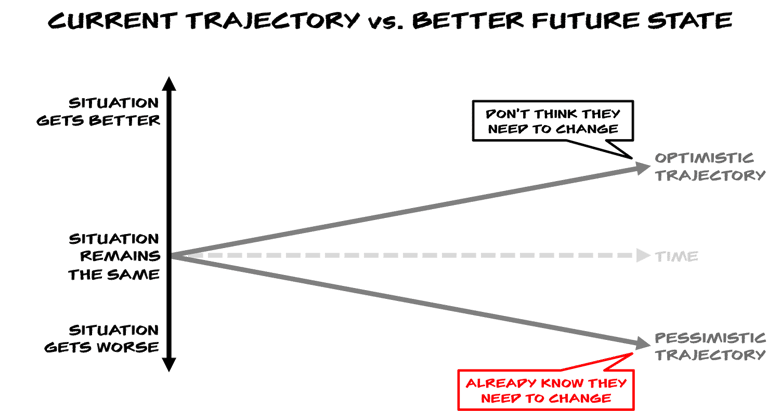
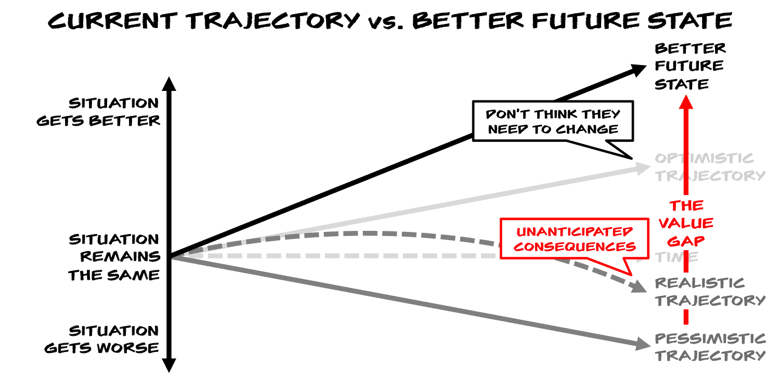

These techniques are even more effective when we manage to amplify the pain of their current situation or help the prospect to acknowledge previously unrecognised or undervalued needs that we are particularly effective at addressing.

But simply seeking to diagnose their current situation seems like an inadequate strategy compared with helping them see the future consequences of pursuing their current path as opposed to what they might be able to achieve if they were willing to change their behaviour…

I’ve shared my thoughts about the concept of the value gap in previous articles. Now I’d like to focus my attention on a key aspect of the value gap - the need to establish the greatest possible contrast between our customer’s current direction and a better future situation that they could be capable of reaching with our help.

When we ask our customers to look forward to the future, some will believe that they are on a positive trajectory. Others may already recognise that they have issues that they know they need to address, and acknowledge that if they fail to deal with them they will find themselves on a negative trajectory. And many (perhaps the majority) will probably regard themselves as being “somewhere in between”.

Current Trajectory.png

We might think that those customers who already recognise that they have issues that they need to deal with would represent our best short-term prospects. But that depends a great deal on the point at which they involved us in the conversation.

If we’ve been there from the start - even better, if we’ve been the catalyst that caused them to recognise the need to change in the first place - we start with some significant advantages.

But if we’ve only been able to engage at a late stage in their decision journey - after they have already started to form a view about what an ideal solution might look like - we can find ourselves at a significant disadvantage, because it’s likely that our competitors have already influenced their thinking.

And even if the customer currently believes they are on a positive trajectory, they may well be wrong - because if organisations fail to recognise or react to the idea that the world is changing, staying with the status quo is almost certain to expose them to growing risk. If with the benefit of our collective experience we can credibly claim to know better, then it's up to us to challenge their perceptions.

Better Future State.png

Whether the customer believes they are currently on a positive or negative trajectory, our goal is to persuade them that there is a significant and growing value gap between their current trajectory and a significantly better future state that they can reach with our help.

SMALL VALUE GAP = LITTLE LIKELIHOOD OF ACTION

Or, if we can’t establish that significant value gap, we may want to reconsider whether the customer has sufficient motivation to change and whether we should invest a great deal of time in pursuing what may be a poorly qualified opportunity.

The value gap is all about contrasting the negative implications of pursuing their current trajectory with the positive outcomes they can expect from changing their behaviour. If there is little or no contrast, there is likely to be little or no real motivation to take decisive action.

Even when they adopt a “solution selling” mindset, many sales people - and many marketing campaigns - tend to leap straight from a targeted problem to the benefits of their solution, but this is a big mistake and serves to suppress the customer’s motivation to change.

LOSS AVERSION THERAPY

In his ground-breaking work on loss aversion, the Nobel-winning behavioural economist Dan Kahneman showed that people (and the organisations they work for) are twice as likely to be willing to spend to avoid a loss as they are to invest to achieve a gain.

So if our messages are all about the potential of future gain, and are not also contrasted with the probability of increasing pain should the customer follow their current trajectory and stick with the status quo, we’re undermining more than half of our potential ability to motivate them to take action.

When establishing and amplifying our customer’s value gap, we need to go beyond the obvious aspects of their current situation and help them to recognise and acknowledge the unexpected, undervalued and unrecognised negative consequences of staying on their current path and sticking with the status quo.

A CHANGING WORLD

We need to paint a picture of a changing world in which trends over which they may have little control are creating an environment in the organisations that are able to adapt will emerge as the winners and those that don’t end up as as losers. We need to help our customers to recognise and react to their emerging future reality.

And we need to persuade them that the longer they wait, the worse the value gap is likely to become. There is no question: contrast drives urgency - and complacency only serves to store up problems for the future.

So: what are your marketers and sales people doing to help your prospective customers recognise the value gap between their current trajectory and a better future state? And how are they positioning your unique enablers as the customer’s best opportunity to bridge the gap?

THE SALES VALUE GAP

I’m writing this article as we enter the last few days of the first half of the sales year. I’m prepared to bet that many of the opportunities that are currently being confidently forecasted but which end up failing to close suffer that fate because the customer didn’t see a big enough value gap and decided to stick with the status quo.

It’s a pattern that will be repeated in sales pipeline reviews around the world. Are you prepared to let that happen to your sales organisation? And if - as might be the case - it’s too late to do much to change matters before the end of the current quarter, what are you prepared to prevent the same pattern being repeated next quarter?

Because, just like your customers, your sales organisation almost certainly has a value gap too. If you’re interested in learning more about how to bridge it, please get in touch and I’ll do my best to amplify your pain before I go on to share some strategies that could allow you to achieve a better future state...

OTHER RELATED ARTICLES

ABOUT THE AUTHOR

Apollo_3_white_background_250_square.jpgBob Apollo is a Fellow of the Association of Professional Sales and the founder of UK-based Inflexion-Point Strategy Partners, home of the Value Selling System®. Following a successful career spanning start-ups, scale-ups and corporates, Bob now works with a growing client base of tech-based B2B-focused scale-up businesses, equipping and enabling them to systematically create, capture and justify their unique business value in every customer interaction.

24 Jun 16:34

5 Ways Lead Nurturing Can Help You Crush Your Sales Goals

by Kristen Buzzaird

Once you have spent time and resources finding new leads for your company, you want to turn them into customers. The intermediate step between lead generation and customer service is lead nurturing — and a huge step it is. Lead nurturing encompasses all the ways you get to know your leads, educate them on what you have to offer, and encourage them to buy. It is a process of gradually getting better acquainted, building interest, and establishing trust that ends with a completed sale and a happy customer. Here are some ways that lead nurturing can help you achieve your sales goals.

  1. Lead nurturing increases needed contacts. In a perfect world, leads would be so impressed by your company’s products and services that they would be eager to buy the very first time you contact them. In some cases, this does occur, but it is more common that it takes several “touches” between company and lead to bring about a sale. Standard wisdom is that it takes seven contacts before a lead converts to a customer. By its very nature, the technique of lead nurturing is the perfect way to make these necessary contacts. Each time you send a follow-up email, or make a phone inquiry, or grab the lead’s attention with a physical piece of direct mail, you’re practicing lead nurturing. Better yet, you’re also chipping away at that goal of seven contacts.
  2. Lead nurturing improves conversion. Statistics show that the majority of leads do not become customers. Without a program of lead nurturing, a company that converts 20 percent of its leads into sales can be considered to be working at the limits of success. However, with an organized lead nurturing strategy in place, that 20 percent conversion rate can be increased significantly. It makes sense. Lead nurturing ensures that your leads are well educated on what your company’s products and services can do for them. It reassures them that you’ll be there to help them if needed. And, it improves the relationship and increases trust.
  3. Lead nurturing creates more sales at less cost. Lead nurturing is an investment in customer acquisition. It requires the dedication of resources, but the ROI makes it worthwhile. Lead nurturing, effectively done, can generate substantially more sales-ready leads — around 50 percent more, according to some sources. The cost of acquiring these leads, in turn, is decreased by about a third.
  4. Lead nurturing weeds out the uninterested. As you move through the steps of the lead nurturing process, you’ll likely find that some leads drop out and become unavailable. This should not necessarily be a cause for concern. Lead generation is designed to appeal to those who need your offerings and to weed out those who are not interested, not authorized to make a purchase, or otherwise unlikely to become customers. When these sources are eliminated, you’re free to spend more time and effort on the leads that are better positioned to become customers.
  5. Lead nurturing encourages customers to buy more. Customers who have grown to like and trust a company through lead generation practices are not only more likely to buy, they are also likely to make larger purchases. They may want to reward you for the concern you’ve shown during the lead nurturing process, or they may simply be convinced that your company has exactly what they need.
24 Jun 16:34

Why Marketers Need to Master Relationship Marketing

by Amity Kapadia

Many marketers have heard the adage, “Who’s the easiest person to sell to? Someone you’ve already sold to.”

This is one of the many beneficial facets of relationship marketing. Instead of going through the effort to reach, engage, and convert new customers, focus on delighting the customers you already have. By providing excellent customer service, monitoring what is said about your brand online, engaging with your customers on social media, and cultivating a brand that feels accessible, your existing customers develop a heightened feeling of brand loyalty.

Overall, brands that are successful with relationship marketing are creating meaningful connections with people who will talk about their brand and deliver positive messages to their networks, aka prospective customers. If you position your brand as being receptive to communication from customers and potential customers; and if your brand engages in conversations online about your customers’ experiences, your offerings, and the space that you work in, you are building a strong foundation on which you can build successful relationship marketing campaigns.

Thus, there are many relationship marketing strategies that marketers should try in order to expand brand awareness and drive sales. Imagine that relationship marketing is a peacock (just go with it for a minute). The numerous channels that can support your relationship marketing goals are like the peacock fanning out its feathers.

Consider these three strategies to jumpstart your relationship marketing efforts:

1. Target online influencers to spread the positive gospel about your product.

Celebrities, gurus, experts, and organizations that have legions of social media followers often partner with brands to market the brand’s products or services, for an agreed-upon fee. The brand benefits from the influencer’s implicit endorsement and the exposure to the influencers’ many faithful fans and followers.

2. Incentivize your customer base to make referrals.

You already have superstar brand advocates in your customer base. Relationship marketing engages your customers and motivates them to recommend you to family and friends. If you incentivize your customers to spread the word with rewards, monetary or otherwise, you create a pipeline to receive leads that have been warmed up by your customers! (Most customers weigh recommendations from friends considerably, especially so among high-income earners).

3. Create relationships with affiliates who earn a kickback every time they send a potential customer – or conversion – your way.

Affiliate marketing is when online content producers or digital properties link to your product, write about your product, run your display ads, or otherwise promote your product in exchange for a fee or for a percentage of the resulting sales. Affiliate marketing is generally very effective. There’s a reason why companies that are already at the top of their game, like Amazon and Netflix, execute affiliate marketing campaigns.

Because there are so many variables to relationship marketing, it’s important to take a systematic and organized approach. Let’s come back to the peacock with her feathers fanned out. Imagine trying to count all her feathers. Your eyes would blur from the kaleidoscope coloring and you’d be unlikely to get an accurate count: you’d probably miss quite a few feathers.

This is the same with relationship marketing. A piecemeal approach to relationship marketing won’t be nearly as effective if you’re not using the right technological tools. It will be difficult to harness the sheer volume of strategic relationships, affiliates, and top referrers without a system that facilitates and streamlines the relationship marketing process. To truly scale your efforts, partner with a relationship marketing software vendor that offers tools to maximize your engagement and revenue every step of the way.

24 Jun 16:34

Choosing the Right Channels and Strategies for Your ABM Program

by Madhumanti Debnath

jarmoluk / Pixabay

We’ve explored how to target the right accounts for your account-based marketing program, but once that’s accomplished, how do you actually reach them? After all, developing content and organizational buyer personas is only effective if you have a method of delivering this content to the right buyers.

Choosing the right channel and strategy for your ABM program is all about understanding where your target audience “lives” online. You want to deliver content where your audience already is.

If you have a solid buyer persona for each account you are targeting, you may already have information about ideal channels to pursue. For instance, if you know that the executive team at a big account uses LinkedIn and Twitter to share thought leadership articles, those would probably be good channels to use. Or, maybe you are already in contact with some key prospects via email. This could indicate that email newsletters and one-on-one sales pitches are the way to go.

Here are some examples of channels that your target audience might use:

  • Social networks (LinkedIn, Twitter, Facebook)
  • Email
  • Direct mail
  • Video
  • In-person events and conferences
  • Blogs
  • Webinars
  • Mobile

Once you’ve pinpointed the channel(s) that you will use, it’s time to strategize how your team will use them. Will you publish thought leadership and share it? Create highly targeted display ads? Encourage salespeople to reach out one-to-one?

There is no one-size-fits-all strategy for ABM. Instead, it will depend on your goals and resources. And often, you will have multiple goals that will require multiple strategies.

Some common ABM goals include:

  • Expanding into new markets or territories
  • Increasing visibility in existing market or territory
  • Making more efficient use of your marketing resources for larger, bigger-impact results
  • A higher return on investment
  • Better sales-marketing alignment within your organization
  • Launching a new product to a targeted audience
  • Seeing more value from existing customers through upsells, etc.

For example, if you want to reach marketing specialists at a select few mid-sized SaaS companies, you might choose LinkedIn as your preferred channel, since you know they typically share content there. Your goal is to generate new leads, so you start by raising awareness using sidebar ads. Then, once your audience is aware of your brand, you move onto delivering in-stream thought leadership pieces. From here, you monitor who engages with and downloads your content, and your sales team contacts the accounts that have shown interest.

Lastly, any good strategy requires measurement and follow-up, so make sure you are tracking and evaluating your results, and using the lessons learned in your next ABM program.