Extra: Rambla de Benipila en Cartagena. Primer día de las fiestas de cartagineses y romanos, primera paIiza brutaI a cargo de un grupo de agradables sujetos (enviado por ElectroMoha)
Ver post completo: Pues porque me han dicho que TVE es una TV plural, si no pensaría que es la herramienta del Estado para justificar y tapar sus cаgadas.

Enviado por Milei.
Ver post completo: ¿Te imaginas no poder evitar decir «H1TLER» cada pocos segundos?

El presidente de la Autoridad Palestina, Mahmoud Abbas, exige reparaciones al Reino Unido por su gobierno de 1917-1948, citando el derecho internacional.

Ver post completo: Tras su reconocimiento como Estado, Palestina exige 2 billones de libras en reparaciones al Reino Unido


En España, la compra de banderas ha ascendido vertiginosamente en el último mes. Muy especialmente desde las protestas en La Vuelta, una de las tres grandes pruebas ciclistas a nivel mundial junto con el Tour de Francia y el Giro de Italia. Las protestas comenzaron en Cataluña y las banderas comenzaron a tener presencia masiva en el País Vasco. Se podían contar por miles. @elmundo

Ver post completo: “Me las quitan de las manos, señora”.
This post was co-authored with Owen Janson, Audra Devoto, and Christopher Brown of Metagenomi.
From CRISPR gene editing to industrial biocatalysis, enzymes power some of the most transformative technologies in healthcare, energy, and manufacturing. But discovering novel enzymes that can transform an industry — such as Cas9 for genome engineering — requires sifting through the billions of diverse enzymes encoded by organisms spanning the tree of life. Advances in DNA sequencing and metagenomics have enabled the growth of vast public and proprietary databases containing known protein sequences, but scanning through these collections to identify high value candidates is fundamentally a big data problem as well as a biological one.
At Metagenomi, we’re developing potentially curative therapeutics by using our extensive metagenomics database (MGXdb) to build a toolbox of novel gene editing systems. In this post, we highlight how Metagenomi is tackling the challenge of enzyme discovery at the billion protein scale by using the scalable infrastructure of Amazon Web Services (AWS) to build a high-performance protein database and search solution based on embeddings. By embedding every protein in our large proprietary database into a vector space, making the data accessible using LanceDB built on Amazon Simple Storage Service (Amazon S3), and accessed with AWS Lambda, we were able to transform enzyme discovery into a nearest neighbor search problem and rapidly access previously unexplored discovery space.
At the core of our solution is LanceDB. LanceDB is an open source vector database that enables rapid approximate nearest neighbor (ANN) searches on indexed vectors. LanceDB is particularly well suited for a serverless stack because it’s entirely file-based and is also compatible with Amazon S3 storage. As a result, we can store our database of embedded protein sequences on relatively low-cost Amazon S3, rather than a persistent disk storage such as Amazon Elastic Block Store (Amazon EBS). Instead of constantly running servers, all that is needed to rapidly query the database on-demand is a Lambda function that uses LanceDB to find nearest neighbors directly from the data on S3.
To overcome the challenge of ingesting and querying billions of vector embeddings representing Metagenomi’s large protein database, we devised a method for splitting the database into equal sized parts (folders) stored for low cost on Amazon S3 that can be indexed in parallel and searched with a map-reduce approach using Lambda. The following diagram illustrates this architecture.
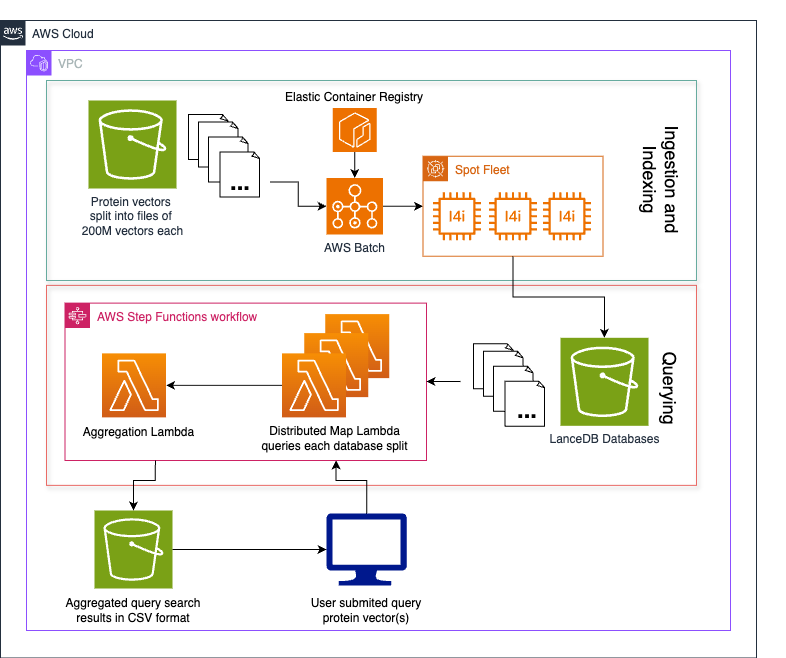
The process follows four steps:
To make use of LanceDB’s fast ANN search capabilities, the data must be in vector form. Our metagenomics database consists of billions of proteins, each a string of amino acids. To convert each protein into a vector that captures biologically meaningful information, we run them through a protein language model (pLM), capturing the model’s hidden layers as a vector representation of that protein. Many pLMs can be used to generate protein embeddings, depending on the desired biological information and computational requirements. Here, we use the AMPLIFY_350M model, a transformer encoder model that is fast enough to scale to our entire protein database. We perform a mean-pool of the final hidden layer of the model to produce a 960-dimension vector for each protein. These vectors and their respective unique protein IDs are then stored in HDF5 files.
To turn our protein vectors into a searchable database, we use LanceDB to build an index suitable for quickly finding ANNs to a query. However, indexing can take a long time and is difficult to distribute across nodes. To speed up indexing, we first divide our data into roughly evenly sized buckets. We then assign each of our embedding HDF5 files to buckets of size roughly equal to 200 million total vectors using a best-fit bin packing algorithm. The exact size packing method used to bucket data depends on the number and dimension of the vectors, as well as their format. Each bucket is ingested into a separate table that will separately reside in a single LanceDB database object store on Amazon S3.
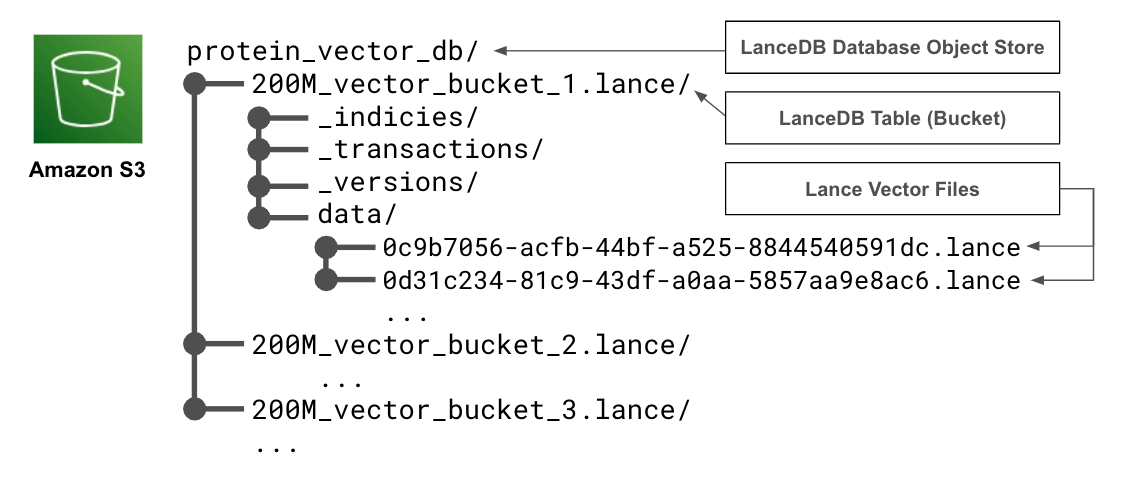
By bucketing our data, we can produce several smaller databases that can be indexed on separate nodes in a much shorter amount of time. We can also add more data to our database incrementally as a new bucket, instead of reindexing all the existing data.
After the vectorized data has been assigned to a bucket, it’s time to turn it into a LanceDB table and index it to enable fast ANN querying. The details on how to convert your specific data into a LanceDB table can be found in the LanceDB documentation. For each of our buckets of approximately 200 million vectors, we create a LanceDB table with an IVF-PQ index on the cosine distance. For indexing, we use several partitions equal to the square root of the number of inserted rows, and several sub vectors equal to the number of dimensions of our vectors divided by 16.
To make things smoother to query, we name each table after the bucket from which it was created and upload them to a single S3 directory such that their file structure indicates a single LanceDB database with multiple tables.
The following code snippet provides an example of how you might ingest vectors from an HDF5 file containing id and embedding columns into a LanceDB database and index for fast ANN searches based on cosine distance. The only requirements for running this snippet are python >= 3.9, as well as the lancedb, pyarrow, and h5py packages. It should be noted that this snippet was tested and developed using lancedb version 0.21.1 using the asynchronous LanceDB API.
from typing import List, Iterable
from itertools import islice
from math import sqrt
import pyarrow as pa
import datetime
import asyncio
import lancedb
import h5py

def batched(iterable: Iterable, n: int) -> Iterable[List]:
    """Yield batches of n items from iterable."""
    while batch := list(islice(iterable, n)):
        yield batch

async def vectors_to_db(
    vectors: str,
    db: str,
    table_name: str,
    vector_dim: int,
    ingestion_batch_size: int,
) -> int:
    """Ingest and index vectors from an HDF5 file into a LanceDB table.
    Args:
        vectors (str): An HDF5 file containing protein IDs and their
            960-dimension vector representations.
        db (str): Path to the LanceDB database.
        table_name (str): Name of the table to create.
        vector_dim (int): Dimension of the vectors.
    """
    # create db and table
    custom_schema = pa.schema(
        [
            pa.field("embedding", pa.list_(pa.float32(), vector_dim)),
            pa.field("id", pa.string()),
        ]
    )

    # count the total number of rows as they are added to the table
    total_rows = 0

    # open a connection to the new database and create a table
    with await lancedb.connect_async(db) as db_connection:
        with await db_connection.create_table(
            table_name, schema=custom_schema
        ) as table_connection:
            # open vectors file
            with h5py.File(vectors, "r") as vectors_handle:
                # create a generator over the rows
                rows = (
                    {"embedding": e, "id": i}
                    for e, i in zip(
                        vectors_handle["embedding"],
                        vectors_handle["id"],
                    )
                )

                # insert rows in batches to avoid memory issues
                for batch in batched(rows, ingestion_batch_size):
                    total_rows += len(batch)
                    await table_connection.add(batch)

            # optimize the table and remove old data
            await table_connection.optimize(
                cleanup_older_than=datetime.timedelta(days=0)
            )

            # configure the index for the table
            index_config = lancedb.index.IvfPq(
                distance_type="cosine",
                num_partitions=int(sqrt(total_rows)),
                num_sub_vectors=int(
                    vector_dim / 16
                ),
            )

            # index the table
            await table_connection.create_index(
                "embedding", config=index_config
            )

# ingest and index your data
asyncio.run(
    vectors_to_db(
        vectors="./my_vectors.h5",
        db="./test_db",
        table_name="bucket1",
        vector_dim=960,
        ingestion_batch_size=50000
    )
)
The task of vectorizing, ingesting, indexing each bucket could be parallelized over multiple AWS Batch jobs or run on a single Amazon Elastic Compute Cloud (Amazon EC2) instance.
After the data has been bucketed and ingested into a LanceDB database on Amazon S3, we need a way to query it. Because LanceDB can be queried directly from Amazon S3 using the LanceDB Python API, we can use Lambda functions to take a user-provided query vector and search for ANNs, then return the data to the user. However, because our data has been bucketed across several tables in the database, we need to search for nearest neighbors in each bucket and aggregate the results before passing them back to the user.
We implement the query workflow as an AWS Step Functions state machine that manages a query process for each bucket as Lambda processes, as well as a single Lambda process at the end that aggregates the data and writes the resulting ANNs to a .csv file on Amazon S3. However, this could also be implemented as a series of AWS Batch processes or even run locally. The following snippet shows how a process assigned to one bucket could run an ANN query against one of the database’s buckets, requiring only pandas and lancedb to run on python >= 3.9. As detailed before in the ingestion section, we use the asynchronous LanceDB API and lancedb package version 0.21.1.
from typing import List, Iterable
import asyncio
import lancedb
import pandas
import random

async def run_query_async(
    lancedb_s3_uri: str,
    table_name: str,
    q_vec: List[float],
    k: int,
    vec_col: str,
    n_probes: int,
    refine_factor: int,
) -> pandas.DataFrame:
    """Run a query on a LanceDB table.
    Args:
        lancedb_s3_uri (str): S3 URI of the LanceDB database.
        table_name (str): Name of the table to query.
        q_vec (List[float]): Query vector.
        k (int): Number of nearest neighbors to return.
        vec_col (str): Column name of the vector column.
        n_probes (int): Number of probes to use for the query.
        refine_factor (int): Refine factor for the query.
    Returns:
        pandas.DataFrame: DataFrame containing the approximate nearest
        neighbors to the query vector.
    """
    # open a connection to the database and table
    with await lancedb.connect_async(
        lancedb_s3_uri, storage_options={"timeout": "120s"}
    ) as db_connection:
        with await db_connection.open_table(table_name) as table_connection:
            # query the approximate nearest neighbors to the query vector
            df = (
                await table_connection.query()
                .nearest_to(q_vec)
                .column(vec_col)
                .nprobes(n_probes)
                .refine_factor(refine_factor)
                .limit(k)
                .distance_type("cosine")
                .to_pandas()
            )

    return df

# query the example bucket we produced in the last section
bucket1_df = asyncio.run(
    snippets.run_query_async(
        lancedb_s3_uri="s3://mg-analysis/owen/20250415_lancedb_snippet_testing/test_db/",
        table_name="bucket1",
        q_vec=[random.random() for _ in range(960)],
        k=3,
        vec_col="embedding",
        n_probes=1,
        refine_factor=1,
    )
)
The preceding query will return a panda DataFrame of the following structure:
| embedding | id | _distance |
| [-5.124435, 4.242000, …] | id_1 | 0.000000 |
| [-5.783999, 4.340500, …] | id_2 | 0.001000 |
| [-6.932943, 3.394850, …] | id_3 | 0.04020 |
Where the embedding column contains the vector representations of the nearest neighbors, the id column their IDs, and the _distance column their cosine distances to the queried vector.
After each bucket has been independently queried across nodes and each has returned a nearest neighbors DataFrame, the results must be merged and subset to return the user. The following snippet shows how you might do this.
def aggregate_nearest_neighbors(
    dfs: List[pandas.DataFrame], k: int
):
    """Aggregate the nearest neighbors for each query vector.
    Args:
        dfs (List[pandas.DataFrame]): A list of DataFrames containing the
            nearest neighbors queried from each bucket.
        k (int): The number of nearest neighbors to aggregate.
    Returns:
        pd.DataFrame: A DataFrame with the aggregated nearest neighbors.
    """
    # concatenate the DataFrames and get the top k nearest neighbors
    return (
        pandas.concat(dfs, ignore_index=True)
        .sort_values(by=["_distance"], ascending=True)
        .reset_index(drop=True)
        .head(k)
    )

# add the dataframes from querying each bucket to a list
dfs = [bucket1_df, bucket2_df, bucket3_df, bucket4_df, bucket_5]

# aggregate the nearest neighbors across all buckets
nearest_neighbors_all_buckets_df = aggregate_nearest_neighbors(dfs, 5)Though querying a LanceDB database directly from its S3 object store on Lambda works well for querying the ANNs of one or a few query vectors, some use cases might require querying thousands or even millions of vectors.
One solution we’ve found that scales well to large batches of queries is to modify the preceding query implementation such that it first downloads one of the database buckets to local storage, then queries it locally using the LanceDB API. Because database buckets can have a large storage footprint, this implementation is better suited for AWS Batch jobs than Lambda, and we recommend using optimized instance storage (for example, i4i instances) rather than EBS volumes. After all query Batch jobs finish, a final job can aggregate their results before returning to the user. Orchestration of parallel query jobs and the aggregation job can be done with Nextflow. Though this implementation will have significantly more overhead and latency from downloading the buckets to disk, it can handle larger batches of queries more efficiently and still requires no continuously running server-based database.
Indexing strategies and database split sizes depend on your personal need for performance. Consider the following general optimization guidance when customizing to your use case.
An example database created by Metagenomi consisted of 3.5 billion vector embeddings produced by AMPLIFY, of dimension 960. Ingesting and indexing these 3.5B vector embeddings in split sizes of 200M vectors on i4i.8xlarge instances took 108 total compute hours. Because this solution is serverless and can be queried directly from its S3 object store, the only fixed cost of this database is its storage footprint on Amazon S3 (for an indexed database of 3.5B vectors, this is approximately 12.9 TB). Lambda queries can be an exceptionally low-cost querying solution, with many queries costing fractions of a cent.
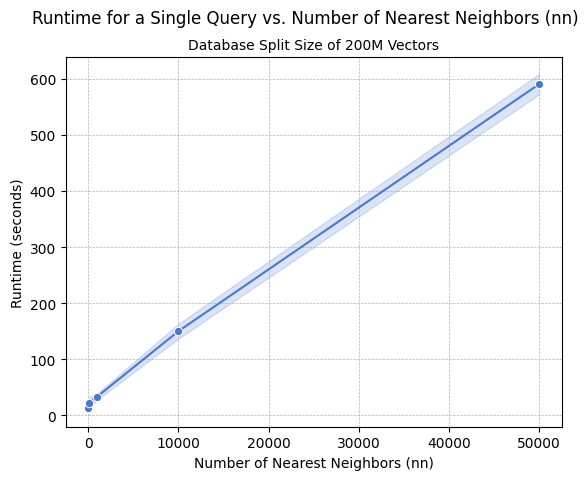
In general, larger database splits will be more cost effective to query but will result in longer runtimes and longer indexing times. We recommend scaling up database split sizes to the maximum size that results in an acceptable query return time for a single split while also considering limits of parallelization such as maximum concurrent Lambda functions running. Metagenomi identified database splits of 200M vectors each to yield an optimal trade-off in cost and runtime for both small and large queries. We recommend ingesting and indexing on storage-optimized instances, such as those in the i4i family, for optimal performance and cost savings. If querying is to be done on an instance using a disk-based database (as opposed to Lambda and Amazon S3), we also recommend using storage-optimized instances for queries. We found the Lambda implementation could quickly handle single queries requesting up to 50,000 ANNs, or multi queries of up to 100 sequences with fewer than 5 ANNs. Runtime increases linearly with the number of ANNs requested, as shown in the following graph.
In this post, we showed how Metagenomi was able to store and query billions of protein embeddings at low cost using LanceDB implemented with Amazon S3 and AWS Lambda. This work expands on Metagenomi’s patient-driven mission to create curative genetic medicines by accelerating our discovery and engineering platform. Having quick access to the ANN embedding space of a query protein in seconds has enabled the integration of rapid search methods in our extensive analysis pipelines, accelerated the discovery of several diverse and novel enzyme families, and enabled protein engineering efforts by providing scientists with methods to generate and search embeddings on the fly. As Metagenomi continues to rapidly scale protein and DNA databases, horizontal scaling enabled by database splits that can be indexed and searched in parallel facilitates an embedding database solution that scales to future needs.
The solution outlined in this post focuses on vectors produced by a protein large language model (LLM) but can be applied to other vectorized datasets. To learn more about LanceDB integrated with Amazon S3, refer to the LanceDB documentation.
References
A reader writes:
This may not be an answerable question, but I’m interested in your views on what makes company culture. I ask because my very small (fewer than 10 people), 100%-remote company recently hired a new employee, and during the interview I anticipated that the candidate might ask about company culture and I realized that I would not know what to say.
This was an unusual hire for our company, because it was only the third time in our more than 10-year history that we’ve hired someone who had no previous connection to a current employee.
A quick overview of my company might provide helpful perspective: a couple of us have been here since the company’s inception; everyone else was brought in (usually without posting the open position) because one of the company leaders knew and liked them from previous jobs. Though I recognize the benefit of hiring known quantities, I’ve expressed discomfort about this trend, as my fear — borne out many times over — is that these employees would come in and just resume the relationship they had with the person they knew previously rather than get to know everyone as a new “cold” employee would need to do. The result, in my view, is that our workplace has, in place of its own culture, a bunch of separate 1:1 relationships—some of which overlap to the point of being cliques.
All of this got me wondering if there were certain essential components that go into what people think of as company culture—things like physical space or a critical mass of employees.
The new candidate never did ask about company culture, which may be a good thing, because I think my answer would have had to be, “We don’t have one.”
You have a company culture, whether you realize it or not. I bet if you asked non-leadership employees, they’d have an easy time describing how they view the culture. Of course, whether they’d be candid about it is a different question — and that’s also part of culture.
Culture is basically “how we do stuff here.” Here’s just a partial list of what it includes:
… and on and on.
I once heard someone say, “Culture is what happens when the boss leaves the room,” and that’s a good description of it too.
In your case, it sounds like part of your culture might be that the team doesn’t feel cohesive — that it’s a team of individual relationships functioning independently of each other, without a lot of collaboration or trust outside of those silos. That’s a part of culture! (It’s also a part of your culture that you can work on changing if you want to. You’ll need to articulate what you’re seeing and how it affects the organization, name what you’d like to see instead, and figure out how to deliberately move toward that.)
For what it’s worth, hiring only people who you already know will bring additional problems too: you’re more likely to end up with a group of employees who are all very similar to each other (demographically and/or in world view), and you’re missing out on potentially stronger candidates just because you don’t already know them. When you’re very small, sometimes it can make sense to hire like that, but as the organization grows larger (and you’re probably at that point now), continuing to hire that way is very likely to hold you back and impact the results you get over time.
But bringing new people into a culture like you described risks being rough for those new people if you don’t first get more deliberate about what you want employees’ experience to be there.
The post I don’t think my company has a culture at all appeared first on Ask a Manager.

"Ya he dicho al equipo que: Sin un cambio de nombre y sin un cambio de bandera, no continuaremos" dice Gitelis. Adam (el dueño) dice que se mantendrá la bandera. Las reglas de la UCI indican que los equipos tienen hasta el 15 de Octubre para registrar la nacionalidad del equipo. Gitelis indico: "No es un problema de estar bien o no. Se ha generado demasiada controversia alrededor de nuestra marca y mi responsabilidad es con los trabajadores e inversores [...] Hay demasiada controversia que no debemos tener alrededor de nuestra marca"
etiquetas: ciclismo, israel, premier tech, cambio, nombre, factor
» noticia original (www.cyclingnews.com)

Junto a la kufiya, el pañuelo tradicional palestino, la sandía se ha convertido en un símbolo de resistencia y solidaridad con Palestina. Su imagen aparece cada vez más en manifestaciones, redes sociales y eventos culturales, especialmente tras la intensificación del conflicto en Gaza desde octubre de 2023.
etiquetas: palestina, sandía, símbolos, censira
» noticia original (www.es.amnesty.org)

El escritor y profesor universitario aragonés, Santiago Gascón, relata su desazón tras la publicación de dos entrevistas, en La Razón y Semana, que jamás le hicieron pero que comprometen su reputación y la de la Universidad de Zaragoza. Escritor, guionista, profesor universitario, y siempre dispuesto a colaborar con medios de comunicación, asociaciones e iniciativas culturales, o en la divulgación académica con talante humilde y empático, (y también colaborador esporádico de este medio), el aragonés Santiago Gascón, se ve en la obligación de sa
etiquetas: falsas, entrevistas, fake, news, santiago, gascón, la razón, semana
» noticia original (arainfo.org)

En un comunicado, asegura que existe una "limpieza étnica" y acusa a Benjamin Netanyahu de ser el "principal impulsor de antisemitismo".
etiquetas: felipe gonzález, limpieza étnica, antisemitismo, netanyahu
» noticia original (es.ara.cat)

Dua Lipa despide a su mánager de los últimos ocho años, David Levy, por suscribir una carta que solicitaba el veto de KNEECAP en Glastonbury.
etiquetas: dua lima, palestina, gaza, david levy
» noticia original (jenesaispop.com)

Has estado buscando y buscando distribuciones de Linux sin parar, pero tal vez ninguna te convence o hay tantas que ni sabes con cuál comenzar a adentrarte en este mundo. Es normal tener cierto miedo por probar un sistema operativo completamente nuevo, pero el tiempo pasa rápido y Windows 10 pronto se quedará sin soporte.
etiquetas: linux, clon, windows 11, linuxfx
» noticia original (computerhoy.20minutos.es)

Las manifestaciones reúnen a miles de personas en 81 ciudades, con una gran participación estudiantil.
etiquetas: huelga general, gaza, solidaridad, italia
» noticia original (elpais.com)

La ONG de derechos humanos defiende que las administraciones “prohiban e inhabiliten” a las multinacionales que hacen negocio con el apartheid y la maquinaria de guerra israelí, algo que el Gobierno español no contempla.
etiquetas: genocidio, israel, veto
» noticia original (www.elsaltodiario.com)

En un comunicado, el PP ha respondido a "las ofensas" del presidente del PNV, Aitor Esteban, durante el acto que la formación jeltzale celebró el sábado en el edificio parisino, donde aseguró que su partido no olvidará "el escándalo que han montado" para evitar su devolución el PP y Vox.
etiquetas: pnv, pp, palacete paris
» noticia original (orain.eus)

La teniente fiscal del Tribunal Supremo y número dos de Álvaro García Ortiz ha pedido la absolución del fiscal general del Estado al considerar que los hechos de los que se le acusa "no son constitutivos de delito alguno". "La información contenida en esos correos electrónicos ya era conocida por otras personas con anterioridad a que el fiscal general adquirió conocimiento de la misma", subraya el escrito de la Fiscalía, presentado el 15 de septiembre.
etiquetas: fiscalía, garcía ortiz, correo, filtración
» noticia original (www.20minutos.es)

La filtración incluye información sobre familiares del presidente del Gobierno y de numerosos políticos de los principales partidos
etiquetas: datos, filtración, cni, interior
» noticia original (www.vozpopuli.com)

Las embarcaciones que transportaban este comercio eran los clíperes del té, estrechos veleros de altos mástiles, construidos para la velocidad. Desarrollados en la década de 1840 y perfeccionados en la de 1850, podían transportar grandes cargamentos a una extraordinaria velocidad. Los más famosos fueron construidos en Aberdeen, Glasgow y a lo largo del Támesis; sus afiladas proas y sus imponentes aparejos estaban diseñados para acortar días, incluso semanas, el viaje desde China.
etiquetas: historia, carrera, veleros, té
» noticia original (www.vistaalmar.es)

(Visible en modo lectura) Carlos Mur, ex alto cargo del Gobierno de Ayuso imputado en el ‘caso residencias’, había aparecido en el cartel de dos conferencias en el Colegio de Médicos de Madrid. “Nos parece deleznable el trato, no solo de la Comunidad de Madrid, sino también del Colegio de Médicos, que nos extraña que no supiera de su implicación en las muertes de las residencias”.
etiquetas: carlos mur, colegio de médicos, madrid, conferencias
» noticia original (elpais.com)

Las horas extras son igual de ilegales cuando no se pagan en absoluto que cuando se pagan en un sobre fuera de nómina. Incluso también pueden ser ilegales cuando se pagan en nómina pero en un concepto fuera de la cotización a la Seguridad Social.
etiquetas: trabajo, fraude fiscal, horas extras ilegales
» noticia original (laboro-spain.blogspot.com)

Las manifestaciones reúnen a miles de personas en 81 ciudades, con una gran participación estudiantil. Buena parte de Italia se ha parado este lunes por los efectos de una huelga general en solidaridad con Gaza, “contra el genocidio” del pueblo palestino y en apoyo a la Global Sumud Flotilla, que partió también de puertos italianos y se unió a la expedición que zarpó desde Barcelona.
etiquetas: huelga general, solidaridad con gaza, manifestaciones, sindicatos
» noticia original (elpais.com)